#ColoradoRiver #COWaterPlan: “Having this additional storage enables that flexibility” — Jim Lochhead #COriver

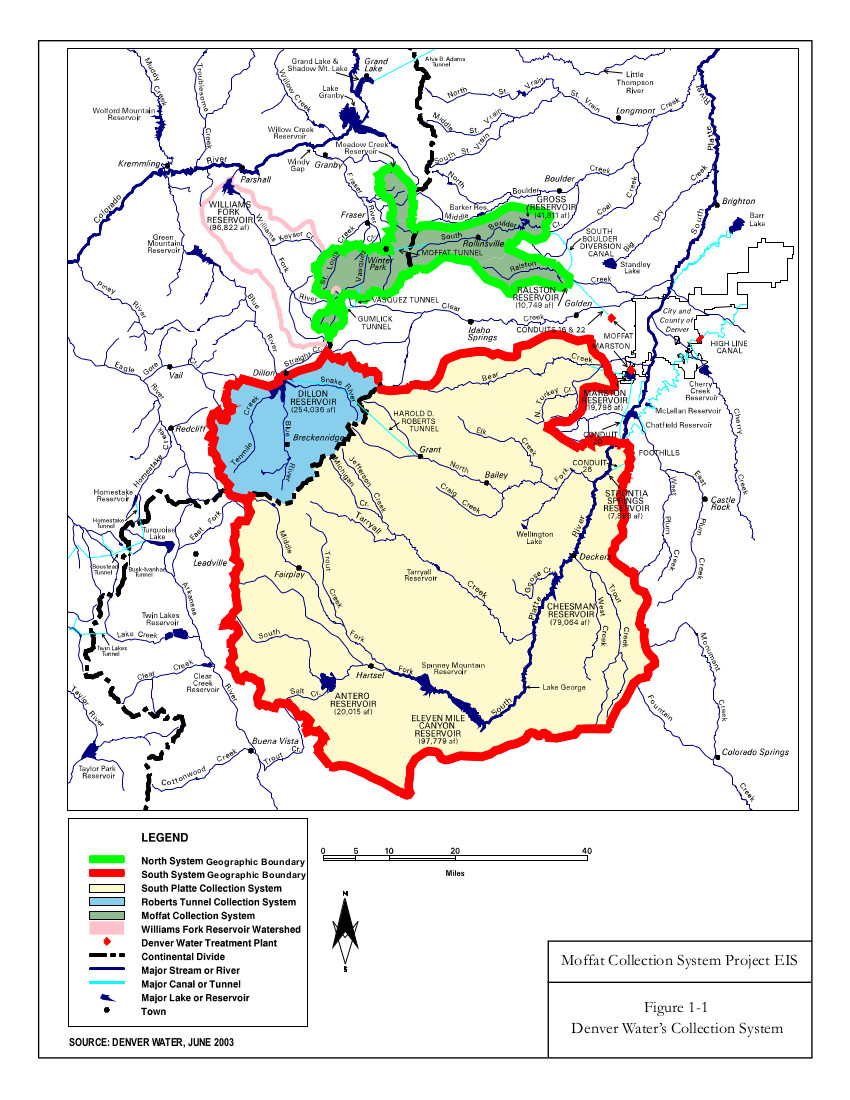
Denver Water's collection system via the USACE EIS
Denver Water’s collection system via the USACE EIS

From The Denver Post (Bruce Finley):

This formal backing completes the state’s environmental reviews for the Moffat project, 13 years in the making, clearing the way for construction — if remaining federal permits are issued. Denver Water and opponents from Western Slope towns and nature groups reached a compromise aimed at enabling more population growth while off-setting environmental harm.

It is a key infrastructure project that will add reliability to public water supplies and protect the environment, Gov. John Hickenlooper wrote in a letter to Denver Water manager Jim Lochhead.

It “aligns with the key elements of Colorado’s Water Plan,” Hickenlooper wrote. “Denver Water and its partners further our shared vision for a secure and sustainable water future while assuring a net environmental benefit in a new era of cooperation.”

Denver would siphon 10,000 acre-feet a year, on average, more water out of Colorado River headwaters, conveying it eastward under the Continental Divide through a tunnel for more than 20 miles to an expanded Gross Reservoir southwest of Boulder. By raising that reservoir’s existing 340-foot dam to 471 feet, the project would increase today’s 41,811 acre-feet storage capacity by 77,000 acre-feet — more than doubling the surface area of the reservoir…

For more than a decade, Denver Water has been seeking permits, including federal approval for construction affecting wetlands and to generate hydro-electricity at the dam.

“During dry years, we won’t be diverting water. It is a relatively small amount of water. … It is a water supply that Colorado is entitled to develop,” Lochhead said in an interview.

The increased storage capacity “allows us to take water in wet times and carry it over through drought periods. It gives us operational flexibility on the Western Slope. … Having this additional storage enables that flexibility.”

Colorado leaders’ formal endorsement follows a recent Colorado Department of Public Health and Environment decision to issue a water quality permit for the project, certifying no water quality standards will be violated. Hickenlooper has directed state officials to work with federal water and energy regulators to expedite issuance of other permits. Denver Water officials said they expect to have all permits by the end of 2017, start construction 2019 and finish by 2024…

…Trout Unlimited and other conservation groups call the project a realistic compromise considering the rapid population growth along Colorado’s Front Range.

“If the state needs to develop more water, they need to do it in a less-damaging, more responsible way — as opposed to going to the pristine headwaters of the South Platte River, which is what the Two Forks project was going to do,” TU attorney Mely Whiting said.

“We’ve put things in place that will make Denver Water be a steward of the river,” Whiting said. The agreement hashed out between Denver Water and conservationists “does not specifically say they have to tweak the flows to help the environment. It does say they have to monitor, for water temperature and macroinvertebrates. And if there’s a problem, they are responsible for figuring out why and they need to do something about it. It does not say exactly what they have to do but they have to fix any problem.”

Gross Dam enlargement concept graphic via Denver Water

From The Colorado Independent (Marianne Goodland):

Gov. John Hickenlooper has officially endorsed a project to expand Boulder County’s Gross Reservoir, a move he hopes will improve Colorado’s water capacity for the next several decades.

The endorsement was considered a formality; Hickenlooper wrote to President Barack Obama four years ago, asking for the president’s help in speeding up the process for Gross and other water projects.

Colorado is predicted to face a gap of more than one million acre-feet of water by 2050, according to a 2010 estimate that many believe may be on the low end. One acre-foot of water is the amount of water it would take to cover the field at Mile High Stadium from endzone to endzone with one foot of water. That’s 325,851 gallons of water. The average family of four uses about half an acre–foot of water per year.

Hickenlooper couldn’t give his formal okay for the expansion of the reservoir, which is northwest of Eldorado Springs, until the state’s Department of Public Health and Environment had completed its review that certifies the project would comply with state water quality standards.

At 41,811 acre feet, Gross is among the state’s smallest reservoirs. It’s operated by Denver Water, supplied by water coming from the Fraser River on the west side of the Continental Divide through the Moffat Tunnel.

The expansion would allow the reservoir to collect another 18,000 acre-feet of water, enough to supply 72,000 more households per year. The estimated cost is about $380 million, which includes design, management, permitting, mitigation and construction.

The Gross expansion has been in the works for more than 13 years, with its first permits applied for in 2003. If all goes according to plan, the permitting process will be completed in 2017,with construction to begin in 2019 or 2020. The reservoir could be fully filled by 2025, according to Denver Water spokesman Travis Thompson.

In his letter to Denver Water, Hickenlooper called the Gross project key to serving more than 25 percent of the state’s population. It will “add reliability to our public water supply, and provide environmental benefits to both the East and West Slopes of Colorado,” he said.

Aye, there’s the rub: the Western Slope, whose residents fear that anything that will divert more water from the Western Slope to the Eastern Slope will cut into their water supplies. They also worry that more diversions of Colorado River water will make it more difficult to satisfy multi-state compacts with southwestern states that rely on water from the Colorado River, of which the Fraser is a tributary.

But Jim Lochhead, head of Denver Water, told The Colorado Independent that any further diversions will require buy-in from folks on the Western Slope.

It’s part of an arrangement between Denver Water and 17 Western Slope water providers that has been in development for the past six years, Lochhead said. “We’ve worked extensively with the West Slope to develop the Colorado River cooperative agreement,” which will make the environment and economy of Western Colorado better off, he said.

The agreement addresses impacts of Denver Water projects in Grand, Summit and other counties, all the way to the Colorado-Utah border.

Lochhead hopes the Gross Reservoir project will be a model for cooperation, with benefits for both sides of the Continental Divide.

And the cost? The budget for the agreement starts at $25 million and goes up from there. That first funding goes to Summit and Grand counties for enhancement projects, which includes improved water supply for Winter Park, Keystone and Breckenridge ski areas. Lochhead said the locals will figure out exactly how to spend the money, and that Denver Water isn’t dictating what those counties will do with it beyond setting some parameters for protection of watersheds, the area of land that drains to a particular body of water.

Denver Water has also committed to making improvements to the Shoshone Power Plant on the Colorado River near Glenwood Springs, and improvements to wastewater treatment plants all the way to the western state line to enhance area water quality.

“We have an extensive list of commitments to partner with the Western Slope, to do the right thing,” Lochhead said.

The Gross Reservoir expansion is critical to Denver Water’s future needs, as Lochhead sees it, because its improved capacity will allow the water utility to operate its system with more flexibility. That’s most important for Denver Water’s attention to environmental concerns, both on the Western Slope and for South Boulder Creek, which flows out of Gross Reservoir.

“The state’s responsibility is to ensure we do the right thing for Colorado’s future, and this project is vital infrastructure for our economy and the environment,” Hickenlooper said in a statement today. “The partnerships and collaboration between Denver Water, the West Slope and conservation organizations associated with this project are just what the Colorado Water Plan is all about.”

Added Lochhead in a statement Wednesday: “The Denver metropolitan area is tied to the economic and environmental health of the rest of the state, and Denver Water is committed to undertake this project in a way that enhances Colorado’s values.”
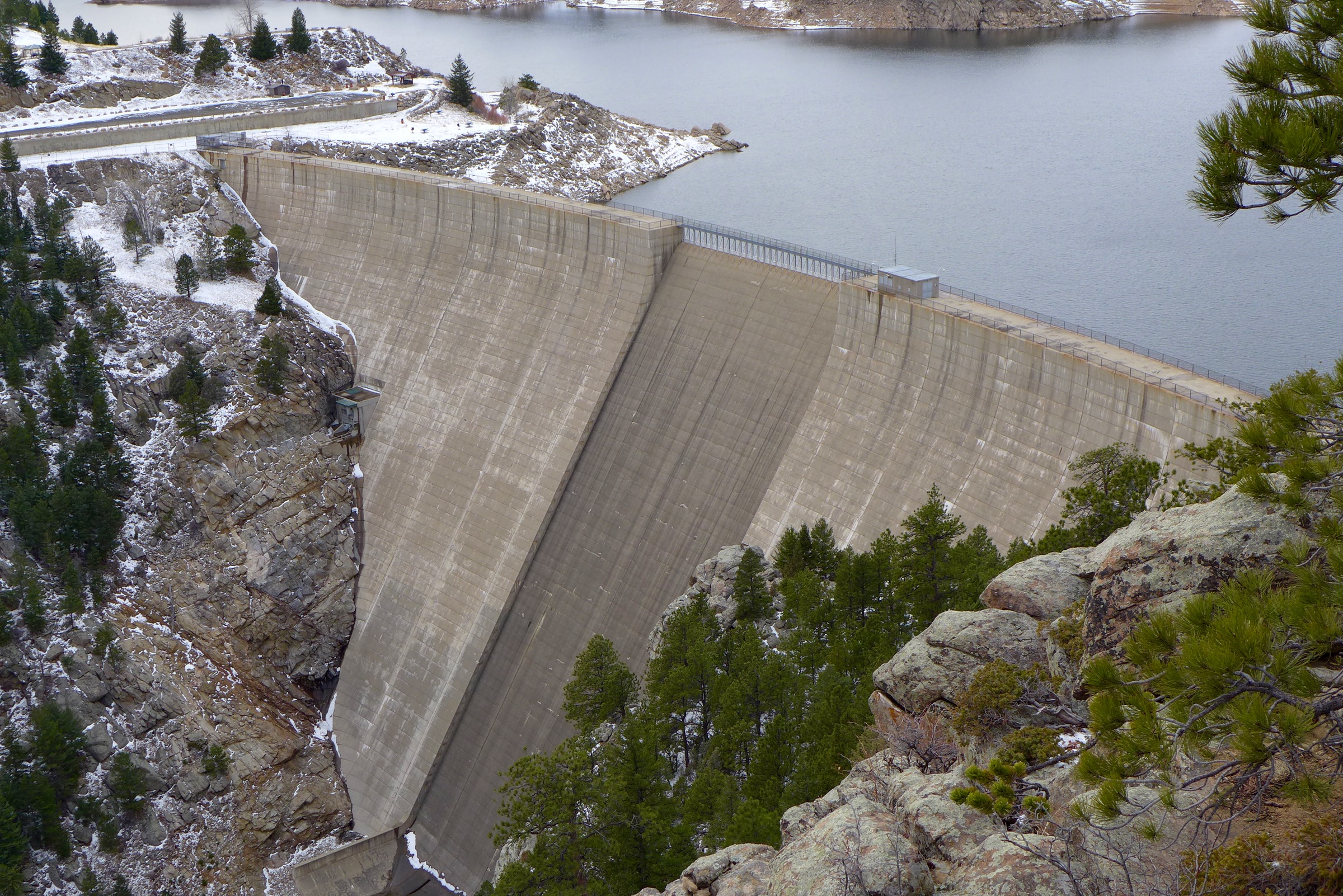
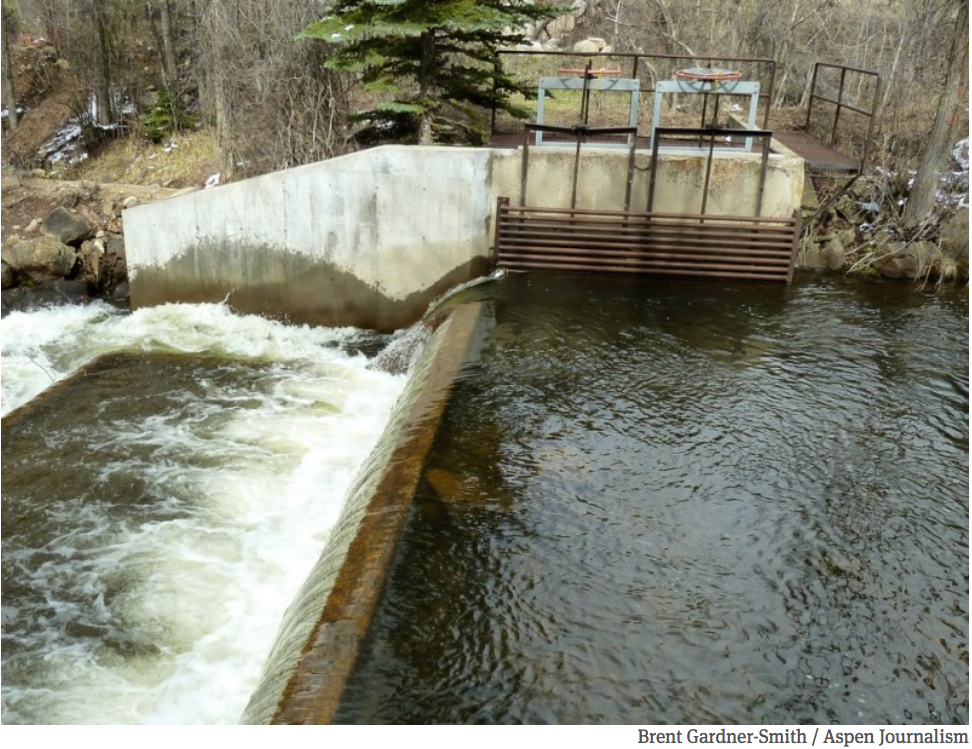
The dam that forms Gross Reservoir, located in the mountains west of Boulder. Photo: Brent Gardner-Smith/Aspen Journalism

#ColoradoRiver: Gov. Hickenlooper endorses Gross Reservoir Expansion Project — @DenverWater #COriver

The dam that forms Gross Reservoir, located in the mountains west of Boulder. Photo: Brent Gardner-Smith/Aspen Journalism

Here’s the release from Denver Water (Stacy Chesney/Travis Thompson):

Colorado Gov. John Hickenlooper has officially endorsed Denver Water’s proposed Gross Reservoir Expansion Project as a model for achieving a balanced approach to environmental protection and water supply development through an inclusive and collaborative public process.

The endorsement follows the Colorado Department of Public Health and Environment’s issuance of a Section 401 Water Quality Certification on June 23, 2016, which ensures compliance with state water quality standards. The certification confirms that Denver Water’s commitment to extensive mitigation and enhancement measures for the project will result in a net environmental benefit.

“The state’s responsibility is to ensure we do the right thing for Colorado’s future, and this project is vital infrastructure for our economy and the environment,” said Colorado Gov. John Hickenlooper. “The partnerships and collaboration between Denver Water, the West Slope and conservation organizations associated with this project are just what the Colorado Water Plan is all about.”

The Gross Reservoir Expansion Project — also known as the Moffat Collection System Project — will strengthen Denver Water’s system against drought and climate change by nearly tripling the capacity of Gross Reservoir, located in Boulder County.

“Colorado is a growing and dynamic state,” said Denver Water CEO Jim Lochhead. “Denver Water has the critical responsibility to sustain over 25 percent of the state’s population and the majority of our economy for decades to come.”

Since 2003, Denver Water has been involved in federal, state and local permitting processes to evaluate the proposed project and develop ways to not only mitigate identified impacts, but also to enhance the aquatic environment and the economy of Colorado. The 401 certification — one of the major regulatory requirements — recognizes and builds upon other existing Denver Water agreements such as the landmark Colorado River Cooperative Agreement, Learning by Doing cooperative effort and the Grand County Mitigation and Enhancement Coordination Plan.

“The Denver metropolitan area is tied to the economic and environmental health of the rest of the state, and Denver Water is committed to undertake this project in a way that enhances Colorado’s values,” said Lochhead.

Denver Water expects to secure all of the major permits for the project by the end of 2017. The estimated cost of the project is about $380 million, which includes design, management, permitting, mitigation and construction.

Visit http://grossreservoir.org to read more about the project and http://denverwaterblog.org for videos with voices from a few of the many project supporters including, Gov. Hickenlooper, Western Resource Advocates, Trout Unlimited, Colorado Water Conservation Board and Colorado Parks and Wildlife.

Here’s a post from Brent Gardner-Smith (Aspen Journalism) dealing with the subject but with a West Slope angle.

Pitkin County awards contract for Basalt whitewater park

Looking up the Roaring Fork River where Pitkin County intends to build a whitewater park with two wave features. Two Rivers Road is to the left in the photo, taken the first week of July, 2016.

By Brent Gardner-Smith, Aspen Journalism

BASALT – Pitkin County has awarded a construction contract worth $770,000 to a company in Durango to build a whitewater park in the Roaring Fork River near Basalt’s Elk Run subdivision.

The in-channel work, to be completed by next February, includes extensive rock work in the channel and on the riverbank and the installation of two wave-producing concrete structures anchored into the riverbed.

The upstream wave is designed to appeal to kayakers, while the downstream wave should also be suitable for stand-up paddlers at some water levels.

After a recent bid process, the county awarded the contract to build the in-channel features of the whitewater park last week to Diggin’ It River Works Inc. of Durango, according to Laura Makar, an attorney with Pitkin County who is overseeing the project. The whitewater park is being managed by the county attorney’s office, as it started as a water-rights effort.

The company has recently built whitewater parks in West Glenwood and Durango. River Restoration of Carbondale, which designed the West Glenwood wave, has designed the Basalt project and its two wave-producing features.

The in-channel work for the Basalt project includes:

constructing temporary coffer dams to channel the flow of the river into a 60-inch bypass pipe to expose the riverbed for construction;

the placement of boulders in the river to form five grade-control structures above the features;

the anchoring of the two wave structures themselves; and

installation of stabilizing boulders along the toe of a steep section of riverbank.

See drawings.

Looking down the Roaring Fork River at the location where Pitkin County intends to build a whitewater park. Two Rivers Road is to the right. The county is planning to build a ramp, a set of stairs and a pedestrian corral between the river and the road.

To the river

The county plans to build a modest level of access features and public amenities as part of the project, consistent with approvals for the project granted by the town of Basalt in 2015.

(See “Exhibit A” from town of Basalt ordinance number 18-2015).

The amenities, for example, do not include viewing platforms on the riverbank as shown in some conceptual renderings by the county during public meetings on the project last year.

The riverside improvements, to be completed by May 1, 2017, include a new ramp, or path, down the riverbank from Two Rivers Road to the downstream end of the whitewater park and a metal stairway down the riverbank across from the entrance to the Elk Run subdivision, at the upper end of the whitewater park.

The downstream ramp is to serve as both a public access path and as an emergency ramp big enough to drive an ATV down if necessary.

The stairway, to be built on the riverbank across from the entrance to Elk Run, may or may not be open to the public and might be used for emergency access only, according to James Lindt, a planner with the town.

The county’s plans also include the creation of five or six parallel parking spaces just downvalley of the whitewater park, on town land on the south side of Two Rivers Road, and the addition of four more parking spaces at Fisherman’s Park, which today can hold about eight vehicles in a small dirt lot next to a picnic pavilion and a bathroom.

The town has also required that the county delineate parking spaces for two or three vehicles with trailers near Fisherman’s Park and resurface the small boat ramp across Two Rivers Road from the park. The county also plans to add boulders in the river to enlarge the eddy at the bottom of the modest boat ramp.

In an effort to make it safer for kayakers and spectators heading to and from the whitewater park, the roadside improvements include a path on the south side of Two Rivers Road, just above the whitewater park, to be formed by two sections of split-rail fence running parallel to the road and the river.

The “pedestrian corral” is designed to safely guide people from the downstream end of the whitewater park back up Two Rivers Road toward Fisherman’s Park, which the county is viewing as the primary put-in for boaters to access the two play waves.

It’s a short float around the corner from Fisherman’s Park to the whitewater park location, but it’s a difficult paddle back up the river, especially in higher water, from the whitewater park location to Fisherman’s Park.

So if a boater parks at Fisherman’s Park and floats down to the park, they will likely need to walk back up through the “corral” when they get out of the river, cross the road at the Elk Run intersection, and then walk on the sidewalk on the north side of the road back to the parking lot at Fisherman’s Park.

Looking up Two Rivers Road as a truck turns into the Elk Run subdivision. The whitewater park is to be built to the right of the view. Fisherman's Park is beyond the entrance to Elk Run, on the left.
Looking up Two Rivers Road as a truck turns into the Elk Run subdivision. The whitewater park is to be built to the right of the view. Fisherman’s Park is beyond the entrance to Elk Run, on the left.

Flashing lights

In an effort to increase pedestrian safety along the busy roadway, the county is also required to install three crosswalks across Two Rivers Road, each with flashing cautionary signs to warn and stop motorists.

The crosswalks are to be located at Fisherman’s Park, at the entrance to the tree farm property about a block down the road, and on the downvalley side of the entrance to Elk Run, at the upstream end of the walking corral. There are currently no marked crosswalks on Two Rivers Road in those locations.

The town intends to discourage accessing the whitewater park from the other side of the river, at the end of Emma Road, past Subway and Stubbies, although there is technically public access to the river from that location on town property. Emma Road is a private road, but it does have a public access easement on it, according to Lindt.

It’s also possible to access the whitewater park from Ponderosa Park, on the south side of the bridge by the 7-Eleven store, where there is public parking and a riverside trail leading up to the whitewater park location.

“The main access to be encouraged is off of Two Rivers Road,” Lindt said.

Construction staging for the project is slated to take place on the Emma Road side of the river, however, and the county is required to leave a dirt roadway for emergency vehicles to use to access the whitewater park when it’s finished.

Exhibit A to the Town of Basalt's ordinance approving Pitkin County's whitewater park.
Exhibit A to the Town of Basalt’s ordinance approving Pitkin County’s whitewater park.

Still Planning

The location for the Basalt whitewater park is not ideal, either in terms of the roadside access or its place on the river, just below a low highway bridge and hard against a steep bank on river-right.

But the choice of location, just above the confluence of the Roaring Fork and Fryingpan rivers and the Pitkin County line, has been driven more by a water rights consideration than the location in the river itself or in Basalt, where the town is working on a riverfront park downstream of the county’s whitewater park location.

Pitkin County officials have consistently stressed that their primary motivation in pursuing the whitewater park is to establish the water rights associated with the park’s wave-producing features, but they also think it will be a good recreational amenity.

“I think that this is going to be a water park that people will use, people will enjoy, and people will be safe while using,” Makar said.

The county is eager to move forward with construction of the in-channel work associated with the whitewater park, and is doing so before a “river recreation plan” and a master plan for Two Rivers Road have been completed by the town. Both plans are cited in the town’s approvals of the whitewater park, but there is not a requirement that they be complete before the county moves ahead.

“Pitkin County doesn’t have control over those planning processes, or control over when those planning processes are complete,” Makar said. “That’s why Pitkin County has gone forward with the instream work and the minimal improvements out of stream. If there were recommendations and changes made by the town of Basalt pursuant to those planning processes, certainly the park could adjust in the future to work with recommendations made by those planning processes.”

For example, there has been discussion of moving Two Rivers Road to the north to create more space to access the river. Lindt said a third public meeting on the river recreation plan will likely be held in August.

A graphic presented at a county meeting held on February 6, 2016 at Basalt town hall. Three variations of the proposed Basalt whitewater park were shown that night. This is the Keep It Simple version that shows the access trail/ramp but no other streamside improvements.
A graphic presented at a county meeting held on February 6, 2016, at Basalt Town Hall. Three variations of the proposed Basalt whitewater park were shown that night. This is the Keep It Simple version that shows the access trail/ramp but no other streamside improvements.
This is Middle of the Road variation of the whitewater park and shows a split-rail fence, but not in a parallel configuration showing a pedestrian corral. (A drawing of the corral has not yet been made public).
This is the Middle of the Road variation of the whitewater park and shows a split-rail fence, but not in a parallel configuration showing a pedestrian corral. (A drawing of the corral has not yet been made public.)
The most elaborate of the three variations, this is called the Events Space variations and shows viewing stands hanging over the riverbank next to Two Rivers Road.
The most elaborate of the three variations, this is called the Events Space variation and shows viewing stands hanging over the riverbank next to Two Rivers Road.

Final plans coming

The county still has to submit a final site plan for the project, which will provide additional details to the parking and pedestrian aspects of the plan, which are being worked on by Loris, a planning firm in Denver. The county must also obtain a construction management plan and a floodplain development permit from the town before construction begins.

Gregory Knott, the chief of police in Basalt, expressed concerns last year during the review process about public access and safety, given the location of the whitewater park along Two Rivers Road.

“Two Rivers Road is not suited to provide parking for individuals utilizing the whitewater park,” Knott said in a referral-comment letter dated Aug. 27, 2015, emphasizing that “parking along Two Rivers Road is not a safe or viable option.”

On Friday, Knott said he is comfortable that the safety measures ultimately included in the town’s October 2015 approval of the park will address his concerns, but also said he still needs to review the final site plan from the county.

The Army Corps of Engineers, which regulates changes to rivers and waterways, issued a 404 permit for the county’s work in the river in 2010, but the initial deadline to complete the work under the permit has expired and the county is currently seeking an extension until February 2018.

Funding for the project has come from the county’s Healthy Rivers and Streams board and was approved by the county commissioners. The $770,000 worth of work awarded last week does not include the cost of roadside amenities. Makar said an estimate for the final project is forthcoming as design work continues.

The steep riverbank on the Roaring Fork River where Pitkin County intends to build a whitewater kayak park. Looking upstream, early July, 2016.

Flow rights

After an expensive water court process the county obtained a conditional water right for the whitewater park and it carries a 2010 priority date.

The right is known as a “recreational in-channel diversion,” or RICD, and county officials see the water right as a way to keep water in the river in the face of future potential transmountain diversions from the upper Roaring Fork.

From April 15 to May 17, the county could call for 240 cubic feet per second (cfs) of water to flow through the park.

Then, from May 18 to June 10, the county could call for 380 cfs.

And during peak runoff, from June 11 to June 25, it could call for 1,350 cfs of water to flow through the kayak park and create the biggest surf waves of the season.

After June 25, the water right steps back down to 380 cfs until Aug. 20, and then back to 240 cfs until Labor Day.

Editor’s note: Aspen Journalism, the Aspen Daily News, and Coyote Gulch are collaborating on coverage of rivers and water. The Daily News published this story on Monday, July 4, 2016.

#COWaterPlan: Dealing with the “gap”

Clear Creek Reservoir

From The Pueblo Chieftain (Chris Woodka):

This is the first in a continuing series about how Colorado’s Water Plan will be put into action.

New sources of water are unlikely, so the Arkansas River basin’s focus should be on which crops or landscapes are irrigated, because irrigation is the largest use of water.

Pueblo Water plans to increase storage in key locations above, in and below Lake Pueblo.
Although we won’t find the water supply we want, wise use and efficient water management can stretch the supply we have.

That’s the outlook from Alan Ward, water resources manager for Pueblo Water.

Ward has been involved with filling municipal water needs during the severe drought of 2002 and the more prolonged drought of 2011-13.

He oversees a complex water leasing program that allows Pueblo to make the fullest use possible of its water portfolio.

Ward was part of Pueblo Water’s team that purchased more than one-quarter of the Bessemer Ditch water rights to secure future supply, and as a result is now a member of the canal company’s board of directors.

Colorado’s Water Plan was unveiled last year as an evolving way to meet water needs for the state for decades to come.

The process to develop the document was exhaustive, with hundreds of meetings, thousands of comments and 10 years of effort. It will take even more work to implement the plan and to focus activities that are in line with the plan’s objectives.

To gain a better understanding of how policymakers view the plan, The Pueblo Chieftain and Arkansas Basin Roundtable is asking key individuals three basic questions: How the gap will be filled, what projects are anticipated and what actions can be taken to prevent the gap from getting bigger.

Here are Ward’s answers:

How do we fill the gap in the Arkansas River basin within Colorado’s Water Plan and the Basin Implementation Plan?

“Since the water of the Arkansas River basin is already completely appropriated, the ‘gap’ is really the difference between the water supply we have and the water supply we’d like to have.
I am not optimistic about the prospects of increasing supply. There is no currently unused supply to develop locally within the Arkansas River basin, so an increased supply would have to be imported from elsewhere.

“I think that the expense along with the political and environmental hurdles make importation of new water supply into the Arkansas River basin very complicated and climate change may lead to even less supply on both the Eastern and Western slopes.

“As an alternative, I believe the focus in the Arkansas River basin should be on adapting to having less water than we would like. Storage is key to making the most efficient use of the available water supply.

Storage allows for some control of the timing and location of the limited water supply so that it can be used when and where it is most needed.

Storage also provides the flexibility to move water in ways that can enhance recreational opportunities and minimize environmental impacts.

“Irrigation, whether for crops and livestock grazing or lawns and urban landscapes, is the primary consumptive use of water in the Arkansas Basin (and most of the western United States). I believe that there just isn’t the water capacity to increase the amount of irrigated land, so there needs to be some difficult discussions about what gets irrigated. If urban irrigation increases, then agricultural irrigation will have to decrease or vice versa. It is important to note that urban irrigation has been on a downward trend so there is probably room for some urban growth without an overall increase in the amount of urban irrigation.

“Determining where water should be used for irrigation is a complex problem.

Because water rights are a private property right that can be transferred to new uses, there can be tensions about what role government should play in shaping the free-market movement of water rights and what involvement local communities should have in the transfer of water rights. Finding the right balance between the rights of individuals to use their property as they wish and achieving the desired outcomes of the broader public will be difficult.

“Other water uses such as domestic (including indoor urban), environmental, recreational and industrial are extremely important, but they are so small relative to irrigation use that changes in these water uses will only have minor impacts on the ‘gap’ at a basinwide scale.”

What projects do you plan to fill the gap?

“Pueblo Water is looking to add storage capacity at three key locations for its operations.

“Clear Creek Reservoir can be enlarged to provide additional storage in the Upper Arkansas River basin, which may facilitate better management and optimization of Pueblo’s water imported from the Western Slope.

“Pueblo Reservoir is ideally located in that it is low enough in the basin that a significant amount of water flows into it from upstream.

Many of the largest water users can take delivery of water from the reservoir either by pipeline or by release down the Arkansas River. Enlargement of Lake Pueblo could provide flexibility and water management efficiencies to Pueblo Water and many other urban, rural and agricultural water users.

“Storage located a short distance downstream of the city of Pueblo would allow for more efficient reuse of Pueblo Water’s fully consumable water supplies while at the same time optimizing the timing of flow on the Arkansas River through Pueblo for recreational and environmental benefits.

“Pueblo Water has committed to partner with Colorado Springs, Aurora, Fountain, Pueblo West and the Southeastern Colorado Water Conservancy District in developing this type of storage in order to recapture water that the parties could have captured at Lake Pueblo if not for the Pueblo Flow Management Program (recovery of yield storage).”

How do we keep the gaps for agriculture and municipalities from becoming bigger?

“Keep expectations for water supply in line with actual water supply, plus encourage wise use and efficient water management, including expansion of storage.”

Weld County commissioners approve User Special Review rules for water infrastructure

Greeley in 1870 via Denver Public Library http://photoswest.org/cgi-bin/imager?10009071+X-9071

From The Greeley Tribune (Catharine Sweeney):

Weld County officials adopted new water line regulations Monday morning, but some say the rules meddle where they don’t belong.

The Board of County Commissioners voted 4-1 to require almost anyone building a water pipeline through Weld to go through a public hearing process.

Cities, towns, water districts or ditch companies will have to get a use by special review permit, or USR, which requires a lengthy written application and two public hearings. Organizations within Weld County, such as the city of Greeley, are exempt from the rules and won’t have to go through the hearings. Only organizations pumping water out of the county or across it to somewhere else will have to get the permit. For example, the city of Thornton has been buying Weld County farmland and intends to drain its water, pumping it down to the city.

One county commissioner thinks no organization should have to go through such hearings.

“For me, philosophically, I just can’t support it,” said Commissioner Julie Cozad, the sole commissioner voting against the plan. “For me, it is a private property right issue.”

When companies and other organizations build a pipeline through someone’s property, they have to get what’s called an easement. That means the organization has to work with the property owner on a legal access agreement, and often, the owner gets paid.

That process ensures the property owner is protected, Cozad said.

“I don’t think the government should get in the middle of it,” she said.

If companies have to go through hearings, it gives the county commissioners control over some of the project’s specifics. They can require mitigation efforts, which the regulations’ proponents say is vital to anyone who has a pipeline going through their yard.

But it also gives county officials bargaining chips on other parts of the project. For example, they could tell a company it will only get permission if it changes its route. Cozad said this violated the company’s private property rights.

The USR process can be expensive. The application itself can cost $2,500, and it requires studies that some companies would have to contract out. Cozad said those costs get passed down to water users.

“When we add regulation to things, it does increase the cost to consumers,” she said.

She also said this regulation was crafted to address one issue in particular. The city of Thornton bought Weld farmland in the 1980s with the intention [to move the water]…

Other commissioners voiced concerns about Weld’s future access to water and lack of resident protection.

“Right now it’s one (city), I agree,” Commissioner Sean Conway said about Thornton. “But it’s going to be others. … Up and down the South Platte, the Poudre, we’re seeing more thirsty municipalities.”

Officials believe projects like these are going to become more common, so the county needs some kind of mechanism to give input and let neighboring residents do the same.

There are already regulations on pipelines, Commissioner Barbara Kirkmeyer said. But there’s nothing that allows residents to speak up for themselves to regulators.

“I’ve been in those negotiations with pipelines on my property,” she said. ”I don’t know if any of you have been through it. I have.”

She said it was tough, and having another way to negotiate with the companies would help.

Although no current commissioners fell on Cozad’s side of the argument, a former one did.

Bill Jerke, who was also a state legislator and is now the executive director of energy industry advocate group FUEL Colorado, was the only resident who took the stand during the meeting.

“Obviously, I’m here because I oppose this,” he said. “I just have a number of issues.”

The state already has its regulations on water transactions, and people already go through water court, he said. Under these rules, the county commissioners could go against all those other agencies and decline a USR permit, which would block projects.

“I’m not sure you’re granted that right as the county government,” he said.

He also doubted the USR process could protect residents. Usually, a landowner has to file for the permit, not the developer. Residents and the entity working to get the pipeline would have to work on the application together.

“If (the residents are) agreeing to be represented by the entity, how are they being abused?” he said.

Last, he accused the board of interfering with business.

“As much as I dislike Weld water leaving Weld, … I think getting county government interfering … is even more bothersome to me,” he said.

Report: Tribes and Water in the #ColoradoRiver Basin — CRRG #COriver

Many Indian reservations are located in or near contentious river basins where demand for water outstrips supply. Map courtesy of the Bureau of Reclamation.

Click here to read the report from the Colorado River Research Group. Here’s an excerpt:

Tribes with reservations in the Colorado River Basin currently have quantified rights to divert about 20 percent of the basin’s annual average water supply, while over a dozen others still have outstanding claims. Yet, as the Colorado River Research Group has noted before, existing uses of basin water already exceed reliable supplies, even though many tribes are not fully using the water already allocated to them. Understandably, tribes want and deserve to enjoy the full benefits of their rights. Other water users, however, are concerned about how tribal water rights and uses integrate with already existing and planned future non‐Indian uses of basin water. These competing interests have long been viewed as on a collision course. But, in fact, much progress has been made over the fifty plus years since Arizona v. California (1963) to satisfy tribal rights without displacing other existing uses. It has not been easy.

Making additional progress will also be difficult, but is an essential step forward in basin management. This reality jumped from the pages of the 2012 Colorado River Basin Water Supply and Demand Study (“Basin Study”), and is being explored further in an ongoing joint study by the Bureau of Reclamation and the Ten Tribes Partnership, now tentatively scheduled for completion in December 2016. Given the salience of tribal rights—both to tribal and non‐Indian users—this article provides an introduction to what we currently know about tribal water rights in the basin. This article provides context for emerging policy discussions focused on providing tribes with more flexibility and opportunity in the use of their water, perhaps through voluntary transfer mechanisms such as leasing and forbearance agreements.

City of Aspen to discuss possible dams on Castle and Maroon creeks

A rendering from Wilderness Workshop of a potential Maroon Creek Reservoir, which would hold 4,567 acre-feet of water behind a 155-foot-tall dam. The rendering was prepared by a professional hydrologist and is based on plans submitted to the state by the city.

By Brent Gardner-Smith, Aspen Journalism

ASPEN – Officials at the city of Aspen intend to hold at least one public meeting this summer to discuss the conditional water rights it holds that are tied to potential dams on upper Castle and Maroon creeks.

The city’s next diligence filing for its conditional water rights for the two dams and reservoirs is due in Division 5 water court in Glenwood Springs by Oct. 31. It’s highly unusual in Colorado for a city, or any other entity, to hold a public meeting on a pending diligence filing.

David Hornbacher, city of Aspen director of utilities and environmental initiatives, said that while holding a public meeting is indeed “different,” he is acting at the direction of the city council.

“These are important questions,” he said. “And it’s very much about looking into the future and how do we ensure Aspen has what it needs to continue to thrive and be the place that it is, and what’s the best approach.”

Paul Noto, a water attorney with Patrick, Miller and Noto, which specializes in water law and has represented many clients in the Roaring Fork River watershed, said it was “very unusual” for a city to hold a public hearing about a pending diligence filing.

“I’ve never heard of it, although that’s not to say it’s never occurred,” Noto said. “I’ve just never heard of it.”

 A rendering from Wilderness Workshop showing the potential Castle Creek Reservoir. The rendering was developed by a professional hydrologist and i sbased on engineering plans filed by the city.
A rendering from Wilderness Workshop showing the potential Castle Creek Reservoir. The rendering was developed by a professional hydrologist and i sbased on engineering plans filed by the city.

15-story dams?

If built as currently described by the city’s plans, which were first presented to a water court judge in 1965, the Maroon Creek reservoir would store 4,567 acre-feet of water behind a 155-foot-tall dam just below the confluence of East Maroon and West Maroon creeks.

While only about a third of the size of Paonia Reservoir, which can hold 15,553 acre-feet when full, a Maroon Creek reservoir would still cover 85 acres of U.S. Forest Service land about a mile-and-a-half below Maroon Lake.

It would also inundate portions of both the East Maroon Creek and West Maroon Creek trails in the Maroon Bells-Snowmass Wilderness.

The Castle Creek reservoir would hold 9,062 acre-feet of water behind a 170-foot-tall dam located about two miles below the historic town site of Ashcroft.

It would inundate 120 acres of mostly private land between Fall Creek and Sandy Creek and flood a small piece of Forest Service land within the Maroon Bells-Snowmass Wilderness.

Both reservoirs would be located in Pitkin County.

Since 1965, the city has told the state eight different times it intends to build two large dams in pristine locations in the upper Castle and Maroon creek valleys, and it is on the record that the city intends to file a diligence application this fall. In its September 2009 diligence filing the city told the water court “it has steadily applied efforts to complete” the reservoirs “in a reasonably expedient and efficient manner.”

A court official, known as a water referee, agreed.

“To date, the city of Aspen has not needed to construct the storage structures as it has devoted considerable resources to reducing per capita water consumption,” the unnamed referee wrote. (Please see related story).

A rendering from Wilderness Workshop showing how a Castle Creek Reservoir might look on a seasonal basis after water has been drawn done to meet downstream needs.

Private and public meetings

Hornbacher said this week he will hold one private meeting with stakeholders in early July about the dams and at least one public meeting in July or early August, “depending on the level of public interest.”

After presenting information about the water rights and taking questions and suggestions at the meetings, Hornbacher said he would report back to the council in a work session in August or September to get its direction by the Oct. 31 filing deadline.

He said council could direct staff to proceed with the diligence filing and try and keep the water rights on the books for another six years.

Or it could direct staff not to file, or to file a modified application.

Hornbacher said a modified application could mean filing on one dam and reservoir, but not both, or it could mean filing on both reservoirs but changing their size and shape.

It’s not unheard of for entities to walk away from conditional water rights. The Colorado River District made the decision to abandon rights for two large dams on the Crystal River in 2013. And over the last five years, the district has stepped away from a number of other conditional water rights.

Among the stakeholders Hornbacher plans to invite to a private meeting are Wilderness Workshop, Roaring Fork Conservancy, U.S. Forest Service, and Pitkin County.

Wilderness Workshop first reported the city’s decision to hold public hearings in a newsletter it sent to members on June 1. The headline of the article read, “Potential dams on Maroon and Castle creeks still on the books” and a subhead read, “A diligence filing this fall would keep them alive; WW says, ‘No way!’”

The city of Aspen intends to hold at least one public meeting on the conditional water rights it holds for two large dams, one on upper Castle Creek and one on upper Maroon Creek, shown here in this 2012 file photo, with the Maroon Bells visible in the background. The dam on Maroon Creek would be 155-feet-tall and store 4,567 acre-feet of water.

Proving diligence

Typically, owners of conditional water rights need to demonstrate to the court they meet the “can and will” doctrine – that they can build the proposed water supply project and that they will build it.

The city may also need to meet standards developing in the wake of a Colorado Supreme Court decision in Pagosa Area Water & Sanitation Dist. v. Trout Unlimited.

Alan Martellaro, the Division 5 engineer based in Glenwood Springs, told the city in May, in response to a separate conditional water rights application it filed, that “the applicant [the city] must demonstrate that speculation is overcome per the criteria in ‘Pagosa.’”

“The applicant must demonstrate the proposed appropriation can and will be diverted and put to beneficial use for each of the proposed uses: a) within a reasonable planning period; b) using normal population growth assumptions; and c) the amount claimed is necessary and unappropriated water is available,” Martellaro wrote.

In past filings, the city has left the state with the distinct impression that it intends to build the two reservoirs, especially in the face of the uncertainty of climate change. But it has also left citizens with another impression – that it is simply protecting its water rights, not warming up bulldozers in view of the Bells.

Noto, the Aspen water attorney, says “you can’t have it both ways.”

“It’s a really important point,” Noto said. “You either are moving forward toward completing your project, which is essentially the standard for keeping your water right, or you’re not. And there’s no in-between.”

Noto has represented clients in the past who successfully opposed the city’s proposed hydropower plant on Castle Creek, but said he is not currently representing a client regarding the city’s pending diligence filing.

As such, Noto was willing to talk on the record in the role of citizen and as an experienced local water attorney.

He said he doesn’t agree with the city’s reasoning that a hotter future may increase the need for the reservoirs.

“I don’t buy it,” he said. “To use climate change as a pretext for damming the Maroon Bells and damming upper Castle Creek is not appropriate.”

The city of Aspen recently completed a raw water availability study that concluded that Aspen has sufficient water to meet future municipal demands, but in one of out of 20 years it might have trouble meeting its goal of keeping instream flows of at least 14 cfs in Maroon Creek and 13.3 cfs in Castle Creek.

The language in the water availability study leaves open the door for the city to suggest that building dams on the upper sections of the creeks could help meet its instream flow goals on the lower sections of the creeks.

A map produced by Pitkin County from a map on file with the state of the city of Aspen's proposed Maroon Creek Reservoir, located just below Maroon Creek Lake, shown to the left as the smaller of the two bodies of water. The map was commissioned by Aspen Journalism and confirmed in 2012 as accurate by city officials.

Good planning?

“What we’re talking about is trade-offs,” Noto said. “Is maintaining an instream flow worth building large dams at the Maroon Bells and upper Castle Creek? Absolutely not. There are other ways that the city could meet the instream flow such as eliminating some irrigation during times of shortage. There are better ways to meet your goals than building big dams. And the people aren’t going to stand for it.”

Noto was asked if he could see a reason why the city should hold on to its conditional water rights on Castle and Maroon creeks.

“I don’t see it,” he said. “I can’t, for the life of me, envision a scenario where it would be good planning or good policy to dam Maroon Bells and to dam upper Castle Creek.”

Wilderness Workshop told its members in its June newsletter that it would be working “to convince the city to abandon the rights to these reservoirs (and we’ll need your help).”

American Rivers is also on the record as opposing the city’s plans to build dams and reservoirs.

“We are absolutely and always will be opposed to new reservoirs on Castle and Maroon creeks,” said Matt Rice, director of the Colorado River Basin Program for American Rivers. “They contradict the values of Aspen and the state of Colorado — values we will fight for.”

American Rivers is a national nonprofit dedicated to river restoration and protection, which fought vigorously against the city of Aspen’s Castle Creek hydro power plant.

Rice said whether or not American Rivers will oppose the city in water court if it does decide to file a diligence application is a strategic decision to be made down the road.

“We think the city’s willingness to have an open, transparent process with citizens is a good thing, if indeed that’s what it is,” Rice said. “There needs to be a sincere and open examination of these projects and what people would be giving up if they were developed.”

Editor’s note:
Aspen Journalism, the Aspen Daily News, Coyote Gulch are collaborating on the coverage of rivers and water. The Daily News published this story on Monday, June 20, 2016.

Guffey: Water districts review progress on augmentation plans — The Flume

Upper South Platte Basin

From The Fairplay Flume (Flip Boettcher):

About 30 people met at the Bull Moose Restaurant and Bar June 5 in Guffey to hear how the Center of Colorado Water Conservancy District and the Upper South Platte Water Conservancy District’s plans for augmented water in water division 2 were progressing.

There was a town hall water meeting with CCWD and USPWCD last year in April.

Colorado has seven water basins and parts of two of them are located in Park County.

Division 1 is in the South Platte water basin and covers most of Park County. The South Platte water basin has “free water,” that is, water not claimed by water rights.

Division 2, which includes far southern Park County, in the Guffey area, is in the Arkansas water basin. The Arkansas basin is over-appropriated. This means more water has been designated as available than is actually in the river.

Therefore, the CCWCD and the USPWCD needed a plan for augmented (supplemental) water to supply Division 2’s water needs.

In attendance at the meeting were local resident Bill Betz, organizer of the meeting; Dan Drucker, Operations Manager for CCWCD; David Shohet, legal representative for CCWC and HASP (Headwater Authority of the South Platte); and the entire board of directors for the USPWCD, John Rice, Tom Wells, Lynda James, local Guffey resident Bob Slagle and Dave Wissel, president.

The CCWCD, which serves only Park County and the USPWCD, which serves Park County and parts of Teller, Douglas, Jefferson and Clear Creek counties, have been working nearly 20 years on a water augmentation program for Division 2, and it is close to being finished, Drucker said.

It is just waiting for the judge’s signature, he added. HASP was formed by the two water districts to be the business entity for the augmented water plans within their service areas.

An augmented water plan is a legal way to replace upstream water use to downstream water rights.

One doesn’t actually get the augmented water, explained Shohet. Currently, Division 1 has an augmentation plan in place.

According to Wissel, the Division 2 augmentation water plan is still in the preliminary design phase, but finally there is a legal way to divert water to Division 2.

What is really needed is the purchase of native water rights and storage vessels, including ponds, Wissel added.

One of HASP’s goals is to locate and develop water resources for use by its customers.

HASP has purchased senior water rights and storage vessels at Twin Lakes in Lake County. This will enable HASP to release water downstream for upstream augmented water use in Division 2, stated Shohet.
HASP would also like to purchase some water rights on Badger and Currant creeks in Park County.

HASP is also looking for local ponds to store water in, but these ponds need to be by a live stream, said Drucker, so HASP can take out water, store it, and release it in a timely manner.

Another goal of HASP is to help businesses and residents in their service area obtain water supplies for their water uses. HASP’s biggest interest is to help existing subdivisions – not new ones – obtain a water supply as well as commercial uses.

HASP can only supply augmented water in its service areas.

HASP’s last goal is to bring out-of-compliance water users into compliance with state regulations. HASP is not an enforcement agency, stressed Drucker. HASP can only develop and sell augmented water to its service area customers.

The state does the enforcement of out-of-compliance users. The augmented water plan is not only a way to bring out-of-compliance users into compliance, Wissel said, but also a way for those already compliant users to obtain additional water.

Drucker said many water users with an in-house use only well are running 8-10 cows and doing outside watering.

In-house use only wells means no outside tap. These users would need to purchase augmented water to come into compliance.

Domestic wells allow for an outside tap, watering for livestock and watering of a up to 1-acre garden. Any water use over that would require the purchase of augmented water.

According to Shohet, one domestic well is allowed per 35-acres.

Right now, according to Shohet, anyone can get a water right for any stream or creek in Colorado, but with the “first in time, first in line” water rule, you may not actually get water without an augmented water plan.

Since augmented water is based on usage, augmented wells will be metered. In existing compliant wells, only augmented water will be metered.

The Division 2 augmented water plan is not ready yet. There are no customers for the augmented water, but the need for water will generate customers once the plan is in place, said Drucker.

There are also plans to transport water from Division 1 to Division 2, but storage vessels are needed, Wissel said.

A question was raised about HASP holding people hostage and charging sky high rates for augmented water.
HASP is composed of three members from CCWCD and USPWCD. It takes three members to approve actions.

James said HASP would never be in a profit mode, that it is a legal entity and a beneficial monopoly.

In December 2015, Gov. John Hickenlooper signed into law Colorado’s water plan which notes the broad, near-term actions needed to secure future water.

The plan includes continued efforts to conserve water; additional efforts to reuse and recycle water; more water options for agriculture; and a path forward for interests to agree and create benefits for basins that provide water.

If you need water, contact HASP at HASP@HaspWater.com, http://haspwater.com/, 719-466-3908, or P.O. Box 1747, Fairplay, CO 80440.

Contact CCWCD at http://centerofcoloradowater.com/. Contact USPWCD at https://www.uspwcd.org/.

2016 #coleg: #Colorado water catchment — The Mountain Ear

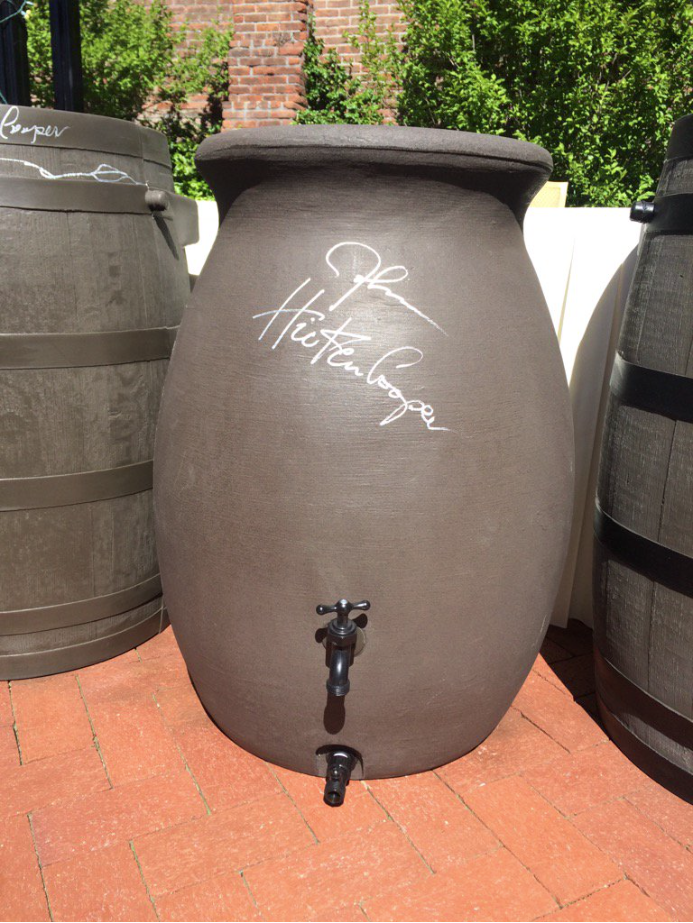
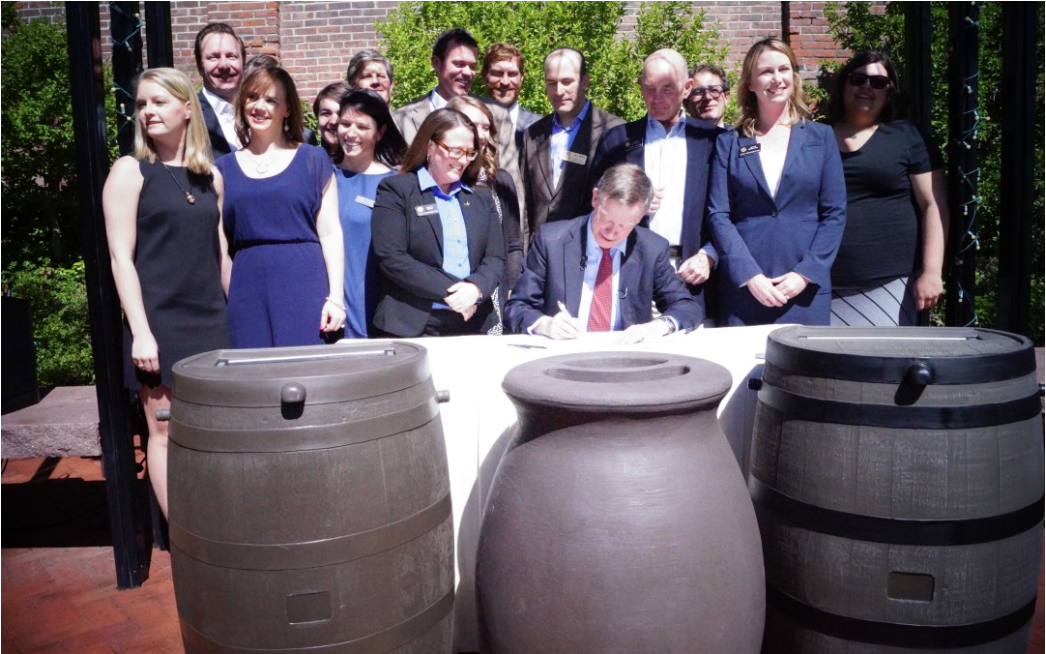
Governor Hickenlooper signed a rain barrel at the HB16-1005 bill signing ceremony. Photo via @jessica_goad and Twitter.

From The Mountain Ear (Janet Perry):

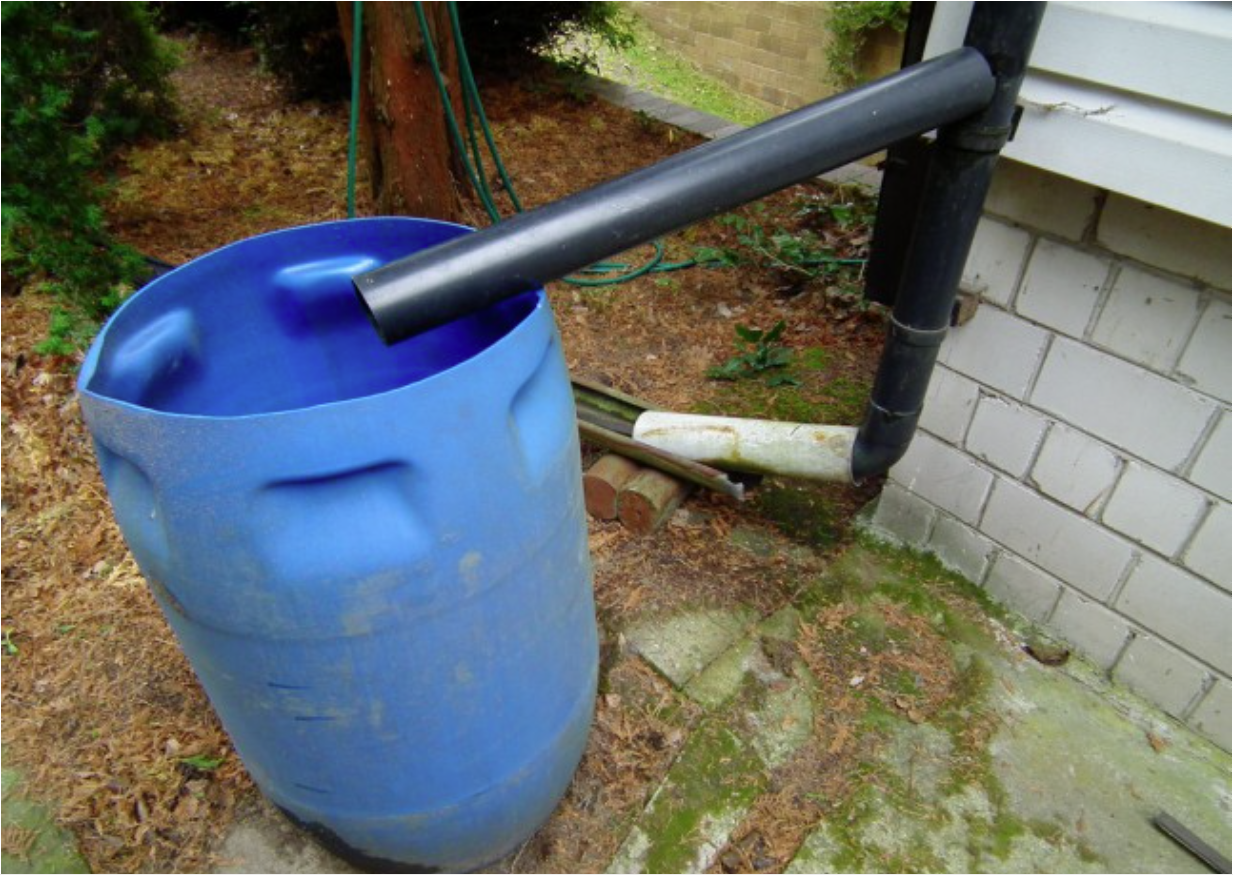
New legislation passed last month in Colorado will allow homeowners to catch water runoff from their rooftops via gutter downspouts flowing into one or two aboveground barrels with lids. The volume of the barrels must not exceed 110 gallons. That water must be used for outdoor irrigation on the property where it is collected. If not the homeowner, a renter must get approval from the owner. If multiple unit buildings, there can be no more than four units. The legislation, HB 16-05 will become law on August 10th of this year.

One of the bill’s House sponsors, CO Representative Daneya Esgar, told The Mountain-Ear, “This common sense bill, simply allows Coloradoans the ability to catch some rain that falls on their roof, and use it to water their gardens. This year we worked hard with the Colorado Farm Bureau, agricultural organizations and others who were nervous about the similar bill last year, to be sure this law would not infringe on anyone’s water rights.”

[…]

The State Engineer must report to the Legislature in 2019 about whether the allowance for this collection of rainwater has “caused any discernible injury to downstream water rights”. It was this language that allayed the concerns of Colorado farmers and helped pave the way for the bill’s passage in April.

Rebecca Martinez, Associate Director of Communications for the Colorado Farm Bureau, told The Mountain-Ear that the “Colorado Farm Bureau is supportive of HB16-1005 because of specific protections that have been added to the bill that haven’t been a part of previously proposed legislation. Last year, HB16-1005’s predecessor bill lacked adequate protection of individuals’ water rights. “Over the course of many discussions, we’ve made it clear that this bill must contain language protecting water right owners and it is imperative that this bill recognize the state’s prior appropriation doctrine,” president of Colorado Farm Bureau, Don Shawcroft, said. “As the language currently stands, the state’s water court system is fully considered and will allow the State Engineer to address injuries to other water rights should they occur in the future.”

Theresa Conley of Conservation Colorado told The Mountain-Ear, “This bill would help citizens better connect to their outdoor water use by seeing how much water they are using, how much water lawns or plants consume, and how much rain we receive. It also increases folks understanding of our prior appropriation system of water law in terms of why we have it and that it can be a flexible, adaptive water rights system that works.”

Conley further explained, “Colorado faces water challenges (drought, damaged rivers, water security), and an informed public is a necessity for any solution to those challenges. Allowing residential use of rain barrels will build a conservation ethic in the populace, foster a deeper connection to water in the state, and will not impact other water users.”

Residents of Nederland could especially reap the benefits of the bill’s aim at water conservation, as the incorporation of barrels for outdoor irrigation would offset the extremely high cost of water within the town.

Loveland’s waterways are soaked in history — Loveland Reporter-Herald

Lake Loveland
Lake Loveland

Here’s a guest column from Olivia Lowe writing for the Loveland Reporter Herald. Here’s an excerpt:

For a few months now people, including my husband, have asked me to do a story about Loveland’s pioneer ditches.

They wanted to know how many, how old, how long and any other odd tidbits of information I could find. Once I started the research I was both fascinated and overwhelmed. At one point I decided to scrap the story because water is not only contentious, but it is complicated as well. I also came to the conclusion that volumes of books and essays have been written on the subject for a reason, because there is no way it can be covered in one 700-word column. And yet, here it is, a column about ditches. That said, I have pared it down to the bits I found most interesting.

There are currently nine ditches, three ditch exchanges, plus what are known as lateral and transfer ditches, pulling water out of the Big Thompson River in the Loveland area.

Start with the Handy Ditch, which is first in line but not first in priority. Its headgate is situated just south of Sylvan Dam. To the east and last in line is the Hillsborough Ditch at County Road 9 between East First Street and Colo. 402. Loveland’s seven other ditches lie in between…

Back in 1893 we had a grand total of three ditches. The Big Thompson Ditch was decreed in 1861, the Mariano, later named Home Supply, was next in May of 1863. One month later, Farmers Ditch was decreed. The Old Barnes Ditch came next in 1865. It was named after David Barnes, which is odd because Mr. Barnes and his wife Sarah did not homestead here until 1870. The Chubbuck Ditch, also known as the English Ditch and later named the Loveland & Greeley Ditch, was decreed in November 1865. This meandering waterway runs along First Street for a bit and then bends north up to Boyd Lake, where it leans to the east and heads toward Greeley…

If you do not plan on using your appropriated water right away, then you will need to dig a basin to hold it. Loveland’s first reservoir was dug in 1883. Today it goes by Donath Lake, but I have also heard it referred to as Dykeman Reservoir. Next was Mariano decreed in 1888. Later called Home Supply Reservoir and known to us all now as Boedecker Lake.

Lake Loveland is also a reservoir. The farmers decided that rather than allowing excess water to float away forever, they could hold some in reserve for the late-summer crops. Prior to its official decree in 1883 it was 145 acres of stagnant and shallow water; five feet of summer stink hemmed in by a sandstone ridge. Hayes Lake, as it was called, was determined to be the perfect fit for a reservoir. By enlarging Barnes Ditch for a distance of two miles from its head (about a mile west of Wilson Avenue and U.S. 34) to the lake, they could increase its capacity to 146 acres with a water depth of 46½ feet.

2016 #coleg: Residential rain barrels could capture 1,200 gallons a year — 9News

Governor Hickenlooper signed a rain barrel at the HB16-1005 bill signing ceremony. Photo via @jessica_goad and Twitter.
From 9News.com (Ryan Haarer):

Starting August 10, if rain falls on your roof, you can keep it. Each household can keep two rain barrels for a total of 110 gallons of water. A study at Colorado State University estimates that could add up to 1,200 gallons a year.

“At first I get worried about hail that would kill my vegetables, but then I am excited about the rain!” said Jessica Goad with Conservation Colorado…

Jessica works for Conservation Colorado which pushed hard to get this legislation passed. It failed last year because of concerns over how such a law would affect Colorado’s complicated water laws.

“The use of residential rain barrels had no impact on users downstream,” she says.

That’s according to a study by Colorado State University. The 1,200 gallons of water you could be capturing a year will not impact other areas. And the law requires further monitoring to ensure rain barrels never have an impact on other water users.

CFWE: Diane Hoppe Leadership Award presented to Gov. John Hickenlooper #COWaterPlan

Governor John Hickenlooper at the Colorado Foundation for Water Education's Diane Hoppe Leadership Award Reception, May 20, 2016.
Governor John Hickenlooper at the Colorado Foundation for Water Education’s Diane Hoppe Leadership Award Reception, May 20, 2016.

The administration of water rights is serious business. Governor Hickenlooper recognized the need for a Colorado Water Plan and then issued an executive order to produce one. Some said that he was asking them to, “Do the impossible,” that is, bring the varied entrenched water interests in Colorado together.

The Colorado Foundation for Water Education presented the Governor with their first Dianne Hoppe Leadership Award yesterday evening. Eric Hecox, board president, cited Hickenlooper’s leadership, dedication to wise governance, and faith in the power of listening to all sides in an issue to find common ground.

The governor credited everyone involved with the Water Plan. He singled out the IBCC and roundtables for their 10 years of effort working the grass roots across Colorado.

Heather Dutton received the Emerging Leader Award. Greg Hobbs’ introduction on Your Colorado Water Blog says, “[Heather Dutton] the newest manager of the San Luis Valley Water Conservancy District, glories in the heritage of the Rio Grande River. She’s a fifth-generation daughter of the Valley’s farming and ranching community, like her father Doug, who farms in the center of the Valley.”

Ms. Dutton thanked her family for their support and also cited the collaboration and mentoring from friends and colleagues.

Nicole Seltzer and the CFWE staff are getting pretty good at throwing these shindigs. I thought it was a great tribute. to change the President’s Award name to the Diane Hoppe Leadership Award. She was instrumental in passing the legislation that established the Colorado Foundation for Water Education. Diane passed this year but leaves a deep legacy.

Here’s a gallery of photos from the event:

2016 #coleg: Gov. Hickenlooper signs HB16-1005 (Residential Precipitation Collection)

Governor Hickenlooper signed a rain barrel at the HB16-1005 bill signing ceremony. Photo via @jessica_goad and Twitter.

From Colorado Public Radio (Grace Hood):

Activities like watering the lawn and thirsty flower beds don’t require treated water from the tap. Until this week, the state technically could have fined Broderick $500 for his system.

The new law, which takes effect in August, allows homeowners to collect as much as 110 gallons of rain in up to two barrels.

‘Legalize It’

The state hasn’t issued fines in recent years. So why even bother changing the law?

Democratic Rep. Jessie Danielson of Wheatridge says in the face of climate change, drought and a taxed water supply system, rain barrels are an important conservation tool.

“It will tie the consumer to their water usage a lot more closely,” said Danielson.

The bill was first introduced in 2015 but lacked support from the agricultural community and some lawmakers. However, it struck a chord with many homeowners this year. Danielson said as she posted Facebook updates about the bill during the session, those dispatches got more responses than any other posts.

One person was so devoted to the cause they started selling t-shirts.

“They put the words ‘legalize it’ at the top, and instead of it being some marijuana-themed t-shirt it was a picture of a rain barrel,” Danielson said. “This is a fun, important environmental issue that just makes sense to people.”

Drought and water supply concerns have been a catalyst for other state legislatures in Texas, Utah and California to take up rainwater collection.

Some western cities like Los Angeles even offer rebates on equipment.

But in Colorado, where drought is still fresh on many farmers’ minds, getting the bill passed wasn’t easy.

Getting From ‘No’ To ‘Yes’

After the bill was introduced, one of the largest opponents was the Colorado Farm Bureau…

“Rain barrels were kind of looked at as the red-headed step child in a sense,” said Marc Arnusch, a farmer and member of the Colorado Farm Bureau board.

Arnusch said amendments to the 2016 version of the bill guaranteed that rain barrels wouldn’t interfere with farmers’ water rights. The final bill literally says “a rain barrel does not constitute a water right.”

The law will also require the state engineer to track adoption and usage among homeowners. That was a big selling point for Arnusch.

“We need to start preaching heavily about conservation and using water intelligently,” said Arnusch. “And that starts quite frankly in the urban areas of our state.”

Debate and research on rainwater collection stretches back almost a decade in the state. Colorado launched a small-scale study back in 2007. It found that 97 percent of the rainwater in Douglas County is lost to evaporation and vegetation. The study was a catalyst for a 2009 law that gave well owners the right to collect rain water.

In Colorado, the debate may be complicated, but rain barrel owner Aaron Broderick said owning a rain barrel is pretty simple. It takes an afternoon to set up and it can cost under $100. The end result will be a cheaper water bill.

“The thing that’s interesting is that it really isn’t much of an inconvenience,” he said.

The true test will be whether the law causes an inconvenience for water rights holders in the near future. The state engineer’s office is expected to deliver its first report on rain barrels sometime in 2019.

From The Durango Herald (Peter Marcus):

After two years and a downpour of controversy, Coloradans soon will be allowed to use barrels to collect rain that falls from their roofs…

Starting Aug. 10, Coloradans will be allowed to use up to two 55-gallon barrels, which cost about $100 on average.

“They promote education – pay attention to water and how it’s used – and they also promote stewardship,” Hickenlooper said of the barrels, signing the legislation in the backyard of the Governor’s Residence at Boettcher Mansion in Denver.

While the legislation seemed obvious to many observers, it struggled through the Legislature, failing last year, before picking up steam this year.

What held it back was fears that rain barrels would erode the state’s prior appropriations system, which grants water rights to the first person to take water from an aquifer or river, despite residential proximity.

Several amendments this year helped garner support from factions that ardently fight for water rights, including the Colorado Farm Bureau.

The law allows water officials to curtail use of barrels if injury to water rights is found. The law also states that using a rain barrel is not a water right, and requires the state engineer to evaluate if the use of rain barrels impacts water rights across the state.

Sen. Ellen Roberts, R-Durango, helped push the measure along over the past two years by garnering support in the Republican-controlled Senate.

“We don’t want to impact anyone’s water rights. We just want to make sure that we aren’t the only state in the union where this was illegal,” said Rep. Daneya Esgar, D-Pueblo, a co-sponsor of the bill.

Sen. Mike Merrifield, D-Colorado Springs, added: “It gives urbanites a more personal and intimate connection with the complicated water system in Colorado.”

Rep. Jessie Danielson, D-Wheat Ridge, pointed out that it was remarkable to pass a controversial piece of legislation during a contentious legislative session.

“We keep hearing that there’s this gridlock and that we’re not able to get anything done in a hyper-partisan time,” Danielson said. “This bill is an example of working across the aisle.”

HB16-1005 signing ceremony photo via @ConservationCO

Here’s a release from Conservation Colorado:

Colorado Governor John Hickenlooper this afternoon signed H.B. 1005, a bill legalizing the use of residential rain barrels in Colorado.

Conservation Colorado Executive Director Pete Maysmith and Western Resource Advocates President Jon Goldin-Dubois made the following comments:

This is a victory for Coloradans who care about their state’s incredible rivers, lakes, streams, and waters. Rain barrels are an important educational tool and a great first step toward conservation and increasing awareness about the water challenges facing Colorado. Water conservation is the cheapest, fastest, and most flexible water strategy we have to addressing these challenges. Moving forward, we are ready to work with the Hickenlooper administration, our legislature, and private citizens to implement more water conservation policies, starting with the statewide water conservation goal outlined in last year’s landmark Colorado Water Plan.

Pete Maysmith, Conservation Colorado

On this bright sunny day, we are dancing in the rain!! We applaud Governor Hickenlooper and Representatives Esgar and Danielson and Senator Merrifield for their leadership in passing HB 16-1005, legalizing rain barrels. Now Colorado joins other states across the nation in ensuring everyone can use this common-sense tool to help water their gardens. The entire West is facing water challenges with a growing population, limited water supplies, and a changing climate. We need increased water conservation to help meet these challenges. Someone with a rain barrel develops a better awareness of the water cycle, leading to a needed increased water conservation ethic. We look forward to working with state leaders to build on this step and implement our new Colorado Water Plan. This legislation shows what we can do when we all work together.

Jon Goldin-Dubois, Western Resource Advocates

For more photos and a video of the event, please contact Jessica Goad at jessica@conservationco.org

From CBS Denver:

“We just want to make sure we’re not the only state in the union where this is illegal. I think that’s why it gained so much national attention, even international attention,” said Rep. Daneya Esgar, a Democrat representing Pueblo.

The new law allows residents to collect and store up to 110 gallons of rainwater as long as you put it back in the ground on your property.

“We thought this was just a good Colorado common sense measure,” said Rep. Jessie Danielson, a Democrat representing Wheat Ridge. “You could take water from the roof, collect it in a barrel and water your tomato plants. Seems straight forward, right? But it wasn’t.”

Danielson’s father is a farmer in Weld County. She said lawmakers initially met resistance from ranchers who worried that allowing people to store water for use when it’s dry would mean less water and runoff downstream.

“We did come to an agreement, one that assures that agriculture and other water users across the state will not have any injury,” said Danielson.

The Colorado Farm Bureau supported the measure. Other supporters say the bill is about conservation and education about the state’s mostprecious natural resource.

“As we move into the implementation of Colorado’s water plan we know that conservation is the cheapest, most effective approach we can do,” said Hickenlooper.

Esgar was one of the first to put the new law into practice, “My wife actually purchased me a rain barrel, although I won’t say it’s been filled yet.”

Sponsors of the bill struck a compromise with farmers and ranchers, adding a provision to the bill that says if there’s any proof rain barrels are hurting downstream users, the state engineer can curtail the usage of them.

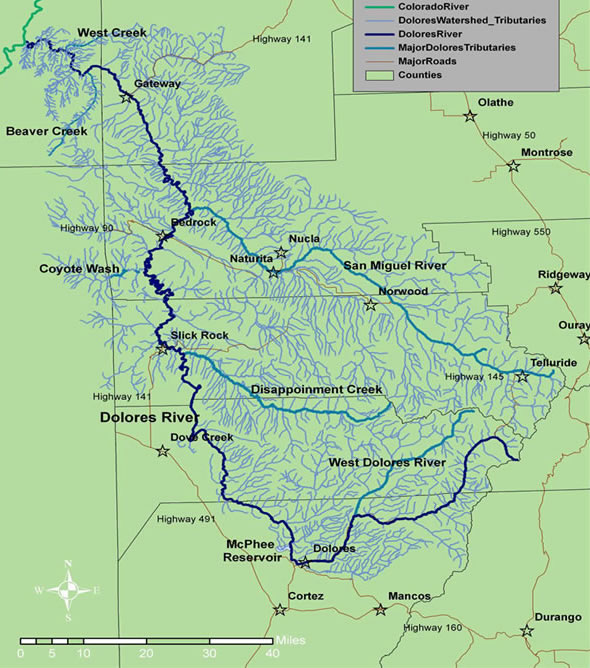
Forum explores new potential use of Dolores River — The Cortez Journal

From The Cortez Journal (Jim Mimiaga):

A documentary screening about the Dolores River was followed by a lively forum about the issue of low flows below McPhee Dam.

“River of Sorrows” was commissioned by the Dolores River Boating Advocates to highlight the plight of the Lower Dolores River.

The new film, which is for sale on the DRBA website for $10, had several showings April 30 at the Sunflower Theatre.

A panel answered questions from a moderator and from the audience. The panel included Josh Munson of the DRBA; Mike Preston, general manager of the Dolores Water Conservancy District; Eric White of the Ute Mountain Farm and Ranch; Mike Japhet, a retired aquatic biologist with the Colorado Parks and Wildlife; and Amber Clark, of the Dolores River Dialogue.

What are the major challenges facing the Dolores River and what are the solutions for addressing those challenges?

Munson said the challenge is for people to see there are beneficial uses to Dolores River water other than just farming, such as for fishery health and boating. Changing the water rights system to allow individuals to sell or lease their water allocation so it stays in the river is one solution.

“Other uses helps to diversify the economy,” he said.

Preston said a major challenge is managing the reservoir in drought conditions. He said the goal is maximizing efficiencies in order to improve carryover in the reservoir year to year.

“High storage lifts all boats, including for recreation,” he said.

White said the film missed the compromises the Ute Mountain Ute tribe has made regarding water rights.

“Our allocation has dropped,” he said. “The tribe has fought for our water rights for a long time.”

Japhet said low flows below the dam are threatening three native fish: the flannelhead sucker, bluehead sucker, and roundtail chub.

“They have been declining precipitously,” he said.

Japhet called for more flexibility in how water reserved for fish and wildlife is managed out of McPhee. For example, 850 acre-feet diverted to the Simon Draw wetlands could be used to augment low flows on the Lower Dolores to help fish.

Clark said the big picture solution need to be collaborative and local, “or somebody from outside will find a solution for us.”

The group revealed the difficulty in finding a compromise that improves the downstream fishery and recreation boating but does not threaten the local agricultural economy.

“Use if or lose it water doctrine is a waste of water resources for farmers and conservationists,” Munson said. “The system does not allow for an individual to lease their water” for instream purposes.

Preston pointed out that in the last eight years, there has been four years where there was a release from the dam. The last one was in 2011, and this year a spill is uncertain.

“We are four for four. When we have excess water we release for boating and the fishery,” he said.
Japhet said the “elephant in the room” is if one of the three native fish species is petitioned for listing on the endangered species list.

“It would cause the U.S. Fish and Wildlife to take a very close look at what is going on with the water and fish resource,” he said. “The best solution is to be proactive and work something out locally to avoid a federal mandate telling us what to do.”

An audience member asked if the river itself has a right to water. Preston said the state instream flow program designates minimum flows for the river, including a 900 cfs below the confluence with the San Miguel. Below the dam the instream flow designation is 78 cfs.

“The river has a right to water, the fact that it was once wild should stay in people’s minds,” Munson replied. “The place itself has a beneficial use for fish, birds, otters. It’s recreation provides a way to make a living.”

Betty Ann Kohlner expressed concerns about McPhee water being used for hydraulic fracturing used for drilling natural gas.

Preston said about 4,000 acre-feet is available in McPhee for municipal and industrial purposes, including for fracking. But, he said, There has been limited use of the water for that purpose.

“If you can lease water to frack, why can’t water be leased for recreation and fish needs downstream from willing owners?” responded one man. “There is a contradiction in how we apply our understanding of how we should use water.”

Don Schwindt, of the DWCD board, pointed out that the Dolores River is part of the Colorado River compact that divides the state’s river water with several downstream states.

“Two thirds of the state’s water is required to leave by compact, and as it leaves it is available in the streams,” he said. “That two-thirds is more dominate than agricultural use.”

Dolores River watershed

“Prior appropriation is a doctrine of scarcity” — Greg Hobbs

Arkansas River Basin via The Encyclopedia of Earth

From The Pueblo Chieftain (Chris Woodka):

If there was a message, it was: Water is everything and it starts here.

Retired Colorado Supreme Court Justice Greg Hobbs held the Arkansas River Basin Water Forum captive for about an hour with a mix of photos that ranged from historic images to family photo albums and a collection of historic maps, which he once owned but has donated to the Supreme Court.

His narrative wove a tale of almost mythical historic figures and hard-nosed facts to describe how Colorado water law took shape.

As is his custom, he opened his remarks with one of his own poems, “Colorado, Mother of Rivers.”

“When I was young, the waters sang of being here before I am, of falling wet and soft and slow to berry bog and high meadow,” Hobbs began, ending with: “I call the scarlet to the jaw as morning calls her own hatchlings, call Yampa, White, the Rio Grande, San Juan, the Platte, the Arkansas.”
Hobbs put a special emphasis on “Arkansas.”

“What a great river,” he gushed, marveling at how the Arkansas River flowed just a few yards from the auditorium at the Salida Steam Plant. “What a historical river this is.”

He then proceeded to take the crowd on a journey through time describing the state and the Arkansas River basin’s formation through civilization.

The Native Americans and Hispanic cultures that first occupied Colorado gave the state clues about how water should be managed. The people at Mesa Verde developed a domestic water system using reservoirs hundreds of years before Europeans arrived and Spanish settlers brought acequias to northern New Mexico to irrigate crops at a time when America was not yet a country.

“The more we get urbanized, the more we get dissociated from the land,” Hobbs said. “We need to recognize our Native American and Hispanic roots.”

North American Indian regional  losses 1850 thru 1890.
North American Indian regional losses 1850 thru 1890.

Maybe that kind of thinking led to his own son’s path in life. Hobbs talked about his son, Dan, who carried a sketch book with him everywhere as a child to plan the farm he one day hoped to own. Dan Hobbs now is a farmer on the Bessemer Ditch.

The elder Hobbs’ interest in water was more shaped by a career as first a water lawyer — he jokingly said it is not an honorable profession — and then as a Colorado Supreme Court Justice for nearly 20 years before his retirement last year.

And an intense interest in history.

Hobbs tried to set the record straight on John Wesley Powell, an early explorer of the Colorado River who argued for division of Montana counties along the lines of watersheds, but is often “misquoted” as trying to divide the entire American West in the same way.

In the Arkansas River basin, the Santa Fe Trail brought the first outside settlers to Bent’s Fort, and the discovery of gold in 1858 led to the formation of the Colorado territory in 1861 — a rectangular shape that took land from Utah, New Mexico, Nebraska and Kansas territories. The action also set up the “Mother of Rivers” status for Colorado, which now encompasses the headwaters for the Platte, Colorado, Arkansas rivers and the Rio Grande.

In 1861, Colorado developed the first concept that makes its water law unique, the idea that water can be separated from the land. Unlike a riparian system, Colorado water can be moved to farms that are not located beside a river. It set up a system of prior appropriation, where the first farmer to use the water is entitled to the first diversion.

When Colorado became a state in 1876, another layer of law was added to declare public ownership of the water, rather than individual users.

“What a profound statement our ancestors made,” Hobbs said.

As a result, the senior agricultural water rights remain the most valuable in Colorado, Hobbs said.

“We have a system in place where we can transfer water rights, and the most valuable water rights are our senior water rights,” Hobbs said.

He called periodic attempts to change Colorado’s system to a market- based exchange at one end of the spectrum or a public trust doctrine at the other are equally dangerous because they could leave some without water.

“Prior appropriation is a doctrine of scarcity,” Hobbs emphasized.

During his talk, he also outlined Native American water rights, the formation of compacts with other states, the development of cities on agricultural land and his personal reflections on state water leaders like Wayne Aspinall, Felix Sparks, Jim Isgar and Diane Hoppe.

It was like watching a river of information flow quickly by, hard to grasp in one sitting. Understanding water is like another passage from Hobbs’ poem: “And shape the stones to carry me, when I am young and full of fight for roaring here and roaring there, for pouring torrents in the air.”

rifflesaspenjournalismbrentgardnersmith

2016 #coleg: Gov. Hickenlooper signs HB16-1109 (Application Of State Water Law To Federal Agencies)

Photo via Bob Berwyn

From The Vail Daily (Randy Wyrick):

Colorado lawmakers unanimously made federal water grabs almost impossible.

The Colorado Water Rights Protection Act passed both the Colorado House and Senate without a single dissenting vote. The bill thwarts federal efforts to control or own water that begins on or passes through federal land, and to do so without paying for it.

That’s important in our region because about 80 percent of Eagle and Summit counties are federal land, said Glenn Porzak…

In fact, the Eagle River Water & Sanitation District and Upper Eagle Regional Water Authority both have water infrastructure on federal lands.

Rick Sackbauer, Eagle River Water & Sanitation District board chair, called the bill “a great victory for water right holders in the Eagle River valley and throughout Colorado.”

“The authority and other water providers have made enormous financial investments in water rights and water infrastructure in reliance on state laws,” said George Gregory, Upper Eagle Regional Water Authority board chair.

WATER RIGHTS TRIFECTA

Porzak with Porzak, Browning & Bushong, is water counsel for Eagle River Water & Sanitation District, Upper Eagle Regional Water Authority and many others. He worked on the bill for three years.

Porzak said the legislation does three things:

1. Forces the feds to buy water rights, instead of taking them by manipulating policy.

2. Forces the feds to go through state water court, in compliance with federal law.

3. Orders Colorado’s state engineer not to enforce any water rights restriction by the U.S. Forest Service or the Bureau of Land Management, and provides tools for water right holders to fight these agencies in court if necessary.

In other words, if the feds want water rights, then they have to buy them, like everyone else does.

“Water rights are a saleable commodity,” Porzak said. “They’re trying to get the water for free. This bill creates a financial disincentive. They (the feds) can issue a directive, but they do so at their peril.”

Trail map for Powderhorn Ski Area via liftopia

WHY IT BEGAN

The impetus for the bill began in 2012, when the Forest Service demanded that ski areas, in exchange for renewing their leases on public land, turn over their private state issued water rights to the federal government.

The ski areas sued and the U.S. Forest Service lost on procedural grounds. The Court ordered the Forest Service to go back to the drawing board, and while improvements have been made in the context of ski area policy, the Forest Service has subsequently issued other policy directives that raise additional concerns for private water right holders throughout Colorado.

The Forest Service said it was trying to make sure water rights stay with the ski areas, and aren’t sold separately if the ski area is sold.

“This legislation is not pie in the sky. It has real substance to it,” Porzak said.

“#Colorado has a workable fabric of law and governance that has stood the test of time” — Greg Hobbs

From The Mountain Mail (Joe Stone):

The 22nd annual Arkansas River Basin Water Forum featured retired Colorado Supreme Court Chief Justice Gregory Hobbs as keynote speaker Thursday at Salida SteamPlant.

Terry Scanga, Upper Arkansas Water Conservancy District general manager, introduced Hobbs as “a mentor and teacher to the water community,” praising Hobbs’ talent for writing clearly and succinctly about Colorado water complexities.

Hobbs’ talk painted a historical picture of Colorado water management beginning with the Ancestral Puebloans who lived at Mesa Verde and Hovenweep, where they constructed water storage reservoirs using primitive wood and stone tools.

Hobbs’ talk included slides from his collection of historical maps that show the evolution of various countries and territories in what is now the western United States, including a watershed map created by famous explorer John Wesley Powell.

Hobbs said Powell wanted to organize settlements around water and watersheds, which would have prevented trans-basin water diversion, forcing water users to conserve the scarce resource in the arid West.

Hobbs shared a wealth of historical information, noting that federal legislation in the 1860s separated water from the land and allowed water to be taken from one place to be put to beneficial use in another location.

This change from riparian water rights of the eastern U.S. laid the foundation for Colorado’s system of Prior Appropriation, summarized as “First in time, first in right,” Hobbs said.

Key to this system is the fact that the Colorado Constitution established water as a public resource in 1876, Hobbs said, adding that rights to use water are a special type of property right.

The Prior Appropriation system allows the transfer of water rights, and Hobbs said senior water rights are the most valuable property rights in Colorado.

Hobbs said the system has worked for more than 100 years, and recent efforts to subject water rights to the free market system would have devastating consequences.

When it comes to water, Hobbs said, “Colorado has a workable fabric of law and governance that has stood the test of time.”

Delph Carpenter's 1922 Colorado River Basin map with Lake Mead and Lake Powell
Delph Carpenter’s 1922 Colorado River Basin map with Lake Mead and Lake Powell

2015 #coleg: HB16-1337 (Appellate Process For Decisions About Groundwater) killed in Senate Judiciary Comm.

Crop circles -- irrigated agriculture
Crop circles — irrigated agriculture

From The Grand Junction Daily Sentinel (Charles Ashby):

A bill to prevent new evidence from being presented in groundwater rights appeals got caught in a legislative maelstrom Tuesday from which it can’t return.

After more than two hours of public testimony, most of which was in favor of the idea, the measure at first failed to get a motion to be referred out of the Senate Judiciary Committee, leaving it in a kind of legislative limbo for a while.

Later, however, the panel returned and killed HB1337 long after its sponsor, Sen. Ray Scott, R-Grand Junction, had left.

During that time, Scott had started to investigate ways to get the support he needed to revive the bill in hopes of persuading the chairwoman of the committee, Sen. Ellen Roberts, to have an actual vote on it.

Problem was, though, that Durango Republican was one of a majority of senators on the five-member committee who opposed the bill, which the committee ultimately killed on a unanimous vote.

Scott wasn’t happy at the outcome because he believed he had the votes to get the measure out of committee even though it was opposed by Senate President Bill Cadman, R-Colorado Springs, who took nearly three weeks to assign it to a committee.

“Sad to see such disingenuous activities by senators,” the Grand Junction Republican said. “Didn’t even have the courage to kill the bill in front of farmers and ranchers who are left holding the empty water bucket.”

The measure was designed to align the Colorado Groundwater Commission with other state panels when it comes to adjudicating certain issues, in this case, groundwater rights. Unlike decisions made by that commission, appeals in all other state panels — much like lower courts in general — bar the introduction of new evidence on appeal.

Scott said that practice has allowed well-funded water rights sellers to try a case twice, something small farmers and ranchers told the committee they can’t afford to do.

The bill also pitted two well-heeled investors against each other: former GOP Gov. Bill Owens and billionaire businessman Phil Anschutz. Owens, who opposed the bill, is executive director of a land and water development and asset management company; Anschutz, who supported the bill, has numerous farming interests, many of which rely on groundwater supplies…

On Tuesday, the Senate gave final approval to SB97 to bar the Legislature from using severance tax revenues for anything other then their intended purpose.

Those taxes, paid by mineral extraction companies, go to fund the Colorado Department of Natural Resources and in grant and direct disbursements to local communities, to offset the impact of such industries as mining and oil and gas development.

From The Denver Post (Joey Bunch):

A legislative battle over ground-water disputes that divided top Republicans washed out in committee Tuesday afternoon.

House Bill 1337 would have made it harder for municipalities, developers or others to win court cases for permits to pump water that might otherwise be used agriculture didn’t get a motion for a vote after hours of testimony from farmers and water districts.

The bill would keep those who would dispute decisions from the state Ground Water Commission from introducing new evidence in the appeal process. Their competitors said it would allow them to out-spend farmers, ranchers and rural water districts to overpower them in court.

“The size of a checkbook should not determine how water is managed,” Marc Arnusch, a Weld County farmer and member of the Lost Creek Ground Water Management District told the Senate Judiciary Committee Tuesday.

Committee chairwoman Ellen Roberts, a Republican from Durango who is a lawyer, said that instead of the routine 2 out of 100 state Ground Water Commission cases a year that are appealed to district court, many more would have to pay for studies and legal expertise up front to hedge against the potential of an appeal later.

“I don’t see how this would reduce costs for everybody,” she said. “It would drive them up.”

The bill was sponsored by Sen. Ray Scott, a Republican from Grand Junction who is considering a run for governor in 2018.

Scott and House sponsor Don Coram have been at odds over the bill with Republican Senate President Bill Cadman and the last Republican governor, Bill Owens, who personally urged Republican lawmakers to kill the bill.

Owens works for an investment group that deals in water.

The legislation sailed through the Democrat-led House, passing 60-5 on April 1. It was not assigned to a Senate committee until three weeks later.

“It’s been a wild ride to get to this hearing,” Scott said.

The bill’s supporters fear municipalities getting well permits to pump year-round instead of seasonally, as agriculture does.

“No one wants to see more ‘buy and dry’ of ag water,” Colorado Farm Bureau president Don Shawcroft said. “This legislation is necessary to level the playing field on applications to change water rights in designated basins. What’s happened is that if the application is appealed to the district court, the applicant is using legal maneuvering to bring new information that was not presented to the Ground Water Commission.”

From The Durango Herald (Peter Marcus):

A measure that aimed to level the playing field for farmers and ranchers appealing groundwater rights rulings drowned in the Legislature on Tuesday.

The legislation would have prohibited entering new evidence on appeal after a state commission makes a decision on groundwater disputes…

The bill had powerful opposition from former Gov. Bill Owens, a Republican, and Senate President Bill Cadman, R-Colorado Springs.

“Big boy politics at its worst,” lamented Rep. Don Coram, R-Montrose, who co-sponsored the bill in the House, where it passed 60-5, with the support of Rep. J. Paul Brown, R-Ignacio.

The 12-member Colorado Ground Water Commission issues decisions on disputes. Appeals, however, are handled by water court judges in district courts across the state.

State law allows for new evidence to be entered upon appeal when the issue hits water court, though such appeals are rare.

At that time, larger water interests – often those that try to transfer water from agricultural to municipal use – rely on water engineers and other experts to stack evidence in the case, say proponents of the bill.

Smaller farmers and ranchers – who are fighting for their water rights – are forced to invest in attorneys to combat the insertion of new evidence. Costs can become unbearable.

“It finally puts a stop to the games being played by those looking to take advantage of our designated basin system,” Marc Arnusch, a member of the Ground Water Commission, said of the legislation.

“A case must be heard again completely from the beginning, which causes a great deal of time and money.”

Coram assumed the measure would be a simple fix to an obvious problem. But that was before it became embroiled in politics.

Since leaving office in 2007, Owens has worked on water and land resource issues, including proposing water sales to municipalities. Coram gave Owens and Cadman “100 percent credit” for the bill’s troubled path in the Senate.

“I’ve worked on things in this building that’s taken me two, three years to get through. I’ll be back,” Coram said.

Critics of the bill – including Sen. Ellen Roberts, R-Durango – say the measure would erode an unbiased appeals process before a judge. They point out that most of the commission members are political appointments by the governor, unlike a court.

“It’s a stacked commission,” Roberts said.

“When you go to court, there is an independent judge … there are procedural differences.”
Who owns the water in Ruedi Reservoir? The list includes, indirectly, ancient fish.

There are three main types of water in Ruedi Reservoir.

By Brent Gardner-Smith, Aspen Journalism

BASALT — Knowing who owns, or controls, the water in Ruedi has become of greater public interest since 2013, when all of the water in the reservoir was sold, as the new ownership regime could change how much water is released from the reservoir in any given year.

And how much water is released from Ruedi has implications for the quality of the trout fishing on the lower Fryingpan River and the health of four species of endangered fish in the Colorado River below Palisade.

Given that, we thought it worth figuring out who owns the water in Ruedi, and the resulting list, signed off on by the Bureau of Reclamation, is below.

There are three types of water in Ruedi. The first is “fish water,” or water held in storage in Ruedi until it is released to benefit struggling populations of native fish in the Colorado River between Palisade and Grand Junction, in what’s known as the 15-mile reach.

The fish water is released from Ruedi and sent down the Fryingpan River, which flows into the Roaring Fork River in Basalt, which in turn flows into the Colorado River in Glenwood Springs.

The second type of water in Ruedi is “contract water.”

This is water that has been sold by the Bureau of Reclamation to recover the costs of building and operating the reservoir.

Contracts for annual delivery of water from Ruedi 
vary in size from 12,000 to 15,000 acre-feet (AF) and there are now over 30 individuals and entities with water contracts.

When these Ruedi water owners are called out by senior downstream water rights holders, most significantly the large diverters near Grand Junction collectively known as “the Cameo call,” then they can ask Reclamation to release their “augmentation” water in Ruedi instead of stopping their normal use of water from their local sources.

In practice, this does not happen very often. But in a dry year, it could be important to many of the contract holders.

The third type of water can be viewed as “reservoir water.”

This is water not generally released from the reservoir, and includes the “dead” pool, the “inactive” pool, the “recreation and regulatory” pool and the “replacement” pool in Ruedi.

Ruedi was built, in part, to provide a “replacement” pool for the big upstream diversions of the Fry-Ark project, but these various “reservoir” pools are not a big factor in shaping the amount of flow out of the reservoir.

An angler in the Fryingpan River last fall, when the river was running about 300 cfs.

2015 flows

The question of how much water was flowing out of Ruedi, and who owns it, became an issue for many anglers on the lower Fryingpan River in September and October last year, when the river was consistently flowing at about 300 cubic feet per second.

At that level, the river can be hard to wade across, and local fly-fishing guides began to get complaints from some regular customers, who prefer levels in the 230 to 250 cfs range.

The river was high last year because 24,412.5 AF of water was released from Ruedi to help the endangered fish. This was an increase from 2014 and 2013, when 15,412 AF and 10,412 AF was released, respectively, as fish water.

There are three sub-pools of fish water in Ruedi, totaling 15,412.5 AF.

The first pool is 5,000 acre feet of fish water under contract to the CWCB and provided to the U.S. Fish and Wildlife Service for use in the 15-mile reach.

The second pool of fish water contains 5,412.5 AF. This pool is under contract to the Colorado River District, which acts as a custodian for the water on behalf of Western Slope interests.

The third pool contains another 5,000 AF and remains under the control of Reclamation, which considers it available for use in four-out-of-five years, or 80 percent of the time.

This third pool of fish water is, in essence, “extra” water that is provided by Reclamation to help the fish when conditions in Ruedi allow.

So while there is a total of 15,413.5 AF of fish water in Ruedi, only 10,413.5 AF of it is counted in our tally under the heading of “fish water.” We list the third pool of 5,000 AF, under the heading of fish water, but it is actually included in the “reservoir water” category.

A view of Ruedi Reservoir showing the face of the dam, the spillway, the building that houses a hydropower plant, and an overflow outlet just above it. The pool just below the outlets often has the biggest fish on the river lurking within it.

Contract water as fish water

In addition to the 15,413.5 AF of fish water released in 2015, there was also 9,000 AF of contract water released as fish water, which was a new development for both Ruedi and the lower Fryingpan River.

The 9,000 AF of contract water released as fish water was part of a 12,000 AF pool of water bought in 2013 by Ute Water Conservancy District in Grand Junction.

Ute Water bought its 12,000 AF for $15.6 million, or $1,300 an AF, to use as a back-up source of water. But last year it entered into a lease contract with the CWCB, at $7.20 an AF, so that the water could be used instead to benefit the endangered fish.

After Ute Water and CWCB finalized a lease arrangement in August to release up to the full 12,000 AF, only 9,000 AF could be released by the end of October without bringing flows over 300 cfs in the lower Fryingpan.

This year, though, Ute Water and CWCB hope to get an earlier start on releasing the full 12,000 AF as fish water, on top of the three pools of fish water totaling 15,412.5 AF.

If they succeed, that could mean 27,412.5 AF of water could be released from Ruedi as fish water, and flows in the Fryingpan could again be in the range of 300 cfs.

Given the discussion of water in Ruedi, a lingering question is, how much of the other contract water can be turned into fish water?

Bob Rice, a contracts specialist at Reclamation, said some of the water in contracts held by the Colorado River District could potentially be used for fish water, but it is currently unlikely that they will be.

While other contracts may also include the flexibility for the water to be used for “piscatorial,” or fish, uses, almost all of the water held by other contract holders is limited to use within their individual jurisdictions, and not in the 15-mile reach. The 12,000 acre-feet owned by Ute Water is a rare case, as the 15-mile reach is within their boundary.

So while more contract water may not turn into fish water in the future, it is the case that a fair amount of contract water could also be released along with fish water, at the request of the owners of the water. And that could bring the river up.

A map showing Ruedi Reservoir, the Fryingpan River, and the 15-mile reach on the Colorado River near Grand Junction.

The list

Here’s the list of who owns water in Ruedi, by acre-feet.

Some entities have multiple contracts for water in Ruedi. In those instances, we have added up the AF in each contract and combined them and included the amount of AF in each contract in parenthesis.

Ownership of Water in Ruedi Reservoir

Fish Water

5,000 AF Colorado Water Conservation Board, for 15-mile reach
5,412.5 AF Colorado River District, for 15-mile reach

Subtotal: 10,412.5 AF

(5,000 AF) (CWCB, for 15-mile reach, available 4-out-of-5 years. It’s often used as fish water, but technically it is in the “reservoir water” pool).

Contract Water

12,000 AF Ute Water Conservancy District
11,413.5 AF Colorado River District (500, 530, 700, 4,683.5, 5,000)
6,000 AF Exxon Mobil Corp.
2,000 AF Colorado River District (tied to 5,412.5 fish water as “insurance” water)
1,790 AF Basalt Water Conservancy District (300, 490, 500, 500)
1,250 AF Battlement Mesa Metropolitan District
600 AF West Divide Water Conservancy District (100, 500)
550 AF City of Rifle (200, 350)
500 AF Town of Basalt (200, 300)
500 AF City of Glenwood Springs
500 AF Snowmass Water and Sanitation District
500 AF Town of Carbondale (250, 250)
400 AF Mid-Valley Metropolitan District (100, 300)
400 AF City of Aspen
400 AF Town of New Castle
400 AF Garfield County
330 AF Summit County
300 AF Town of Silt (83, 217)
200 AF Town of Palisade
185 AF Ruedi Water and Power Authority
150 AF Wildcat Ranch Association (50, 100)
140 AF Wildcat Reservoir Company
125 AF Town of DeBeque (25, 100)
100 AF Crown Mountain Park and Recreation District (38, 62)
100 AF W/J Metropolitan District
75 AF Town of Parachute
43 AF Starwood Water District
35 AF Thomas Bailey
30 AF Elk Wallow Ranch LLC
21 AF Owl Creek Meadows
20 AF Westbank Ranch Homeowners Association
15 AF Owl Creek Ranch Homeowners Association
15 AF Ted and Hilda Vaughan
Subtotal: 41,087.5 AF

Reservoir Water

28,000 AF replacement pool
21,778 AF recreation and remaining regulatory pool
1,032 AF inactive pool
63 AF dead pool
Sutotal: 50,873 AF

Total Water

102,373 AF

#Colorado’s share of the Rio Grande outsized and ill-timed according to #NM water users

Rio Grande and Pecos River basins

From Taos News (J.R. Logan):

Shortly after midnight last Friday (April 1), irrigators in Colorado’s San Luis Valley opened the gate on a diversion dam and pushed 80,000 gallons-a-minute of the Río Grande into a canal system that includes 210 miles of ditch and serves hundreds of farmers.

April 1 marks the beginning of irrigation season for the valley’s farmers. The Río Grande is at the heart of the valley’s massive agricultural industry, and farmers waste no time in taking their share…

Agriculture is big business north of the border. An incredibly complex infrastructure of dams and canals spreads water from the river across the valley, most of it to fill shallow aquifers that feed hundreds of center pivot sprinklers. But the water demands of the industry on that side of the state line in spring often leave little water in the river by the time it hits New Mexico. At times in recent years, the river at the border was more than 90 percent smaller than when it entered the valley.

Environmentalists complain that dramatically altering the natural pulse of spring runoff has devastating ecological effects that extend far downstream. And rafting outfitters in Taos County have said Colorado irrigators sucking most of the river dry hurts their business by making popular sections of the river — namely the Taos Box through the Río Grande del Norte National Monument — impassible. “They’re starting earlier, and it’s more intense,” says Cisco Guevara, outfitter and owner of Los River Runners. Guevara and other outfits started running the Taos Box in March, when early runoff swelled the river enough to get a boat through. But between April 1 and April 5, flows at the state line dropped by more than half…

Exactly how low the flow will go depends on the snowpack in the Río Grande’s headwaters in Colorado. Under the Río Grande Compact — a water sharing agreement struck by Colorado, New Mexico and Texas nearly 80 years ago — Colorado must “deliver” a certain percentage of the river to the state line every year. That percentage varies, depending on the total amount of water that goes downriver each year.

The catch – for New Mexico – is that the delivery is calculated on an annual basis, meaning Colorado can let every drop of the river go to New Mexico during the fall and winter while taking most of the river during the spring and summer and still fulfill its debt to New Mexico.

Unfortunately for river rats like Guevara, peak rafting season happens to coincide with irrigation season.

Still, the demands of thirsty irrigators in Colorado don’t necessarily mean the river will shrink to a trickle at the state line. Peak runoff is still weeks off, and when ample snowpack melts in earnest and the Río Grande really gets rolling, farmers can only take so much water, meaning there’s plenty left for those downstream…

As of Wednesday (April 6), snowpack in the Río Grande headwaters was at 86 percent of the 30-year average, suggesting flows this year will be slightly below average. But that could change if the mountains see additional spring snow storms that bolster snowpack, as was the case last year.

Raft guides aren’t the only ones griping about the way water in the Río Grande is shared.

In 2014, Santa Fe-based environmental group WildEarth Guardians served notice of its intent to sue the state of Colorado, arguing extreme diversions for agricultural use imperiled the habitat of the endangered silvery minnow in the Middle Río Grande Valley.

No such lawsuit has been filed. Instead, the group is suing the state of New Mexico, hoping to compel the state engineer to limit the amount of water that can be diverted by the Middle Río Grande Conservancy District, which serves farmers in the center of the state.

Westwide SNOTEL map April 10, 2015 via the NRCS.

East Mesa Ditch owners open to leaving water in Crystal River

A graphic from the Snapshot Assessment of the Roaring Fork Watershed , a report done by Seth Mason of Lotic Hydrological. The graphic shows how a section of the Crystal River below several major diversions can be nearly dried up.

GLENWOOD SPRINGS – The East Mesa Water Co. has told the Colorado basin roundtable it could potentially leave in the Crystal River about a third of the water it now diverts in late summer if enough improvements are made to its 8.5-mile-long irrigation ditch.

Today about 30 to 40 percent of the water sent into the antiquated East Mesa Ditch is lost to evaporation and ditch leakage. But adding pipes and improving structures could reduce those water losses and allow more water to flow down the often de-watered lower Crystal River.

The East Mesa Ditch has a senior 1902 water right to divert 31.8 cubic feet per second from the Crystal, as well as a 1952 right to divert another 10 cfs. The diversion structure for the ditch is nine miles south of Carbondale, on river right.

“A 30 percent savings could mean, potentially, 10 (cubic) feet of water back into the Crystal River system,” said Richard McIntyre, the treasurer of East Mesa Water Co., during a grant application presentation to the Colorado roundtable on March 28.

The ditch company is currently seeking $60,000 from the roundtable to improve three sections of the ditch as part of a $114,000 project planned for this year.

McIntrye, representing the 12 owners in the East Mesa Water Co., also read a prepared statement to the roundtable as part of the grant presentation.

“The ditch company believes that there are avenues becoming available to us that may assist in easing some pressures on the Crystal River system and benefit the shareholders as well,” McIntrye said. “However, before we are able to intelligently assess and address the issues it is essential that we make our delivery system efficient.”

The biggest shareholders in the East Mesa Ditch include McIntrye, Paul and John Nieslanik, Tom Bailey of the Iron Rose Ranch, Hal Harvey, Tom Turnbull and Willa Doolan. Marty Nieslanik is the president of East Mesa Water Co.

“Although we have made concentrated efforts to rehabilitate the infrastructure on the ditch recently, it remains in poor to satisfactory condition,” McIntrye continued.

McIntrye said the ditch company was developing a five-year plan to “rehabilitate failing aspects of the ditch” and a 10-year plan to “pipe much, or even all” of the ditch.

Last year the Colorado roundtable gave East Mesa Water Co. $60,000 to help fund what turned out to be a $760,000 project to repair a 450-foot-long tunnel and install 1,200 feet of pipe in the ditch. East Mesa also received a $300,000 grant from the Natural Resources Conservation Service for the work.

“With irrigation efficiencies made by managing shareholders, combined with an effective delivery system, we hope to be a contributor to resolving the pressing issues that we all face in maintaining substantial water flows in the Crystal River and beyond,” said McIntrye, concluding his prepared remarks.

The lands irrigated by the East Mesa Ditch are shown in purple, according to a technical report from Lotic Hydrological called Water Rights Allocation and Accounting Model Development for the Lower Crystal River.

‘The four questions’

A member of the roundtable then asked McIntyre if East Mesa was involved in the ongoing process to develop a stream management plan for the Crystal River.

“We’ve attended a lot of the meetings,” McIntrye said. “And over years of attending those meetings we keep asking the four questions, as they obviously want some of our water: one, when do you want the water; number two, how much water do you want; number three, what’s the water worth to you; and number four, who is going to pay us? And it’s been impossible to get any one of those questions really answered, but we still attend the meetings.”
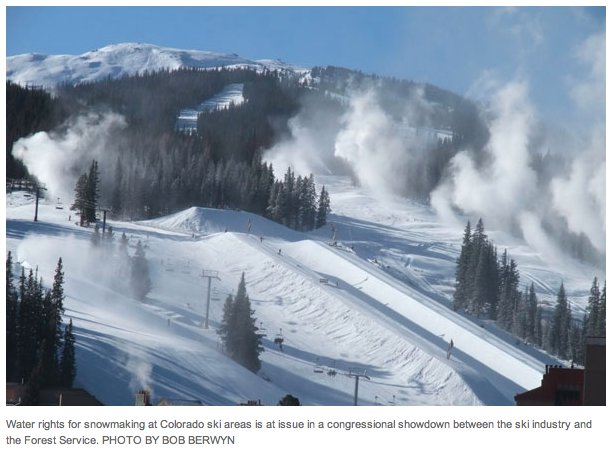
McIntyre said East Mesa is forming an association of diverters on the Crystal River to gather information on its own and to possibly present an offer to the community.

There are 12 irrigation ditches on the lower Crystal River and collectively they divert about 171 cfs of water from the river each day during irrigation season, according to Ken Ransford, the secretary of the Colorado roundtable.

The Colorado Water Conservation Board holds an instream environmental flow right of 100 cfs on the Crystal, but the river often drops far below that level in late summer, at least in the section below the bigger irrigation ditches,

East Mesa is the second largest diverter on the Crystal, behind the Sweet Jessup Canal.

According to Ransford, the East Mesa ditch has diverted an average of 9,626 acre feet of water annually from 1952 to 2014. In 2014, it diverted 8,774 acre feet.

According to records gathered and maintained by the Colorado Department of Natural Resources, East Mesa irrigates 383 acres of hay fields, which Ransford notes in his minutes of the March 28 roundtable meeting works out to “25 acre feet for each of the 383 irrigated acres.” In a follow-up email, Ransford notes it typically only takes two acre feet of water to grow an acre of hay.

The East Mesa Water Co., in its grant application to the roundtable, says the ditch has a service area of 740 acres.

And it says the hay grown on that 740 acres is worth about $500,000 annually, assuming a yield of four tons per acre and a hay price of $170 a ton.

The ditch company, however, also says there is more value in how the hay fields look to tourists than in the hay itself, saying the economic value is “closely related to recreation and tourism.”
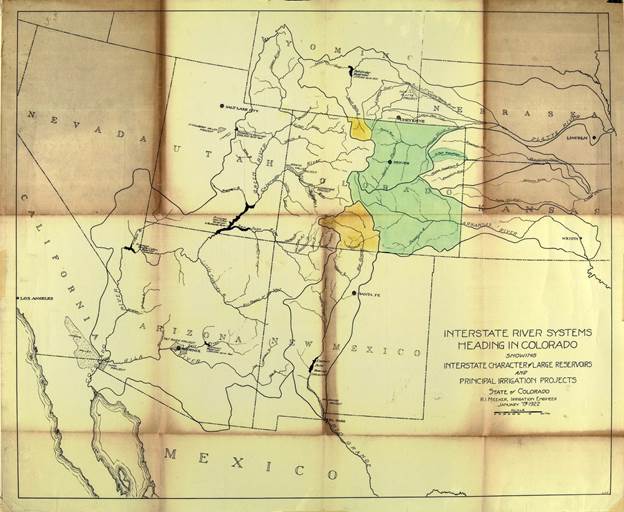
“The effect on overall commerce would be significant if one of the most scenic views in the valley, that approaching Mt. Sopris, were to be brown and dry rather than green and lush because this ditch failed,” East Mesa’s grant application states.

The proposed $114,000 ditch improvement project pitched to the Colorado roundtable last week includes replacing the measuring device at the headgate and replacing two failing sections of the ditch where it crosses Nettle and Thomas creeks. East Mesa says the improvements could save 150 acre feet of water a year.

The 12 shareholders in the ditch company plan to put up $19,000 of the $114,000 project and are hoping to get a $35,000 from a grant from the Colorado River District and $60,000 from the Colorado roundtable.

The roundtable gets its funds from the state’s Water Supply Reserve Account program. In turn, that account is funded with oil and gas severance taxes, which are down sharply this year.

The Colorado roundtable now has $353,327 in its account for 2016. On March 28 the roundtable was presented with four grant requests totaling $263,500, including the $60,000 request from East Mesa.

A next steps meeting has since been set for April 11. The roundtable is expected to vote on East Mesa’s application at its May meeting.

Editor’s note: Aspen Journalism is collaborating with the Aspen Daily News and Coyote Gulch on coverage of rivers and water in Colorado and the West. The Daily News published this article on Monday, April 4, 2016.

2016 #coleg: HB16-1005 (Rain Barrels) is on its way to Gov. Hickenlooper’s desk

From The Denver Post (Joey Bunch):

“As a farmer’s daughter, I’m proud to have helped pass this common-sense water-conservation measure,” said Rep. Jessie Danielson, a Democrat from Wheat Ridge who was one of the bill’s sponsors.

Conservation groups hope the legislation encourages Coloradans to capture and use runoff from their rooftops on their lawns and gardens to help people recognize that water is a precious resource in this arid state, compared to the amount they would have used from their garden hoses, otherwise.

Photo via the Colorado Independent

2016 #coleg: HB16-1005 (Rain barrels) passes initial Sen. vote

Photo from the Colorado Independent.

From The Grand Junction Daily Sentinel (Charles Ashby):

Though many homeowners already do it, Colorado residents soon could be able to use rain barrels — legally — to collect water from their rooftops under a bill that won preliminary approval in the Colorado Senate on Thursday…

Sen. Michael Merrifield, D-Manitou Springs, who sponsored the bill in the Senate, said the measure has been altered to address as many concerns as possible to comply with Colorado’s complicated water laws, including making it clear that the use of rain barrels does not constitute a water right.

Merrifield said a chief benefit of the bill is it will help educate Colorado residents about the importance of water, and how it is the life-blood of the state.

“It allows urban residents to connect themselves to the water system of our state,” he said. “We are not blessed with a huge amount of water. The more our urban residents understand the system, the better for all users.”

Under the bill, rain collection is limited to above-ground barrels and only for rooftops of single-family homes. It also bars homeowners’ associations from banning such barrels, although they are allowed to make rules governing the appearance of the barrels that are used.

While no one spoke out against the bill when it won a voice vote on the floor of the Senate, Sen. Jerry Sonnenberg, R-Sterling, expressed his opposition to the measure when it cleared the Senate Agriculture, Natural Resources & Energy Committee on Wednesday.

“My concern here is that if indeed we have rain barrels that may cause depletions out of order of priority storage … the next person in line would be the one curtailed,” Sonnenberg said. “That’s a concern for me, given that agriculture has 85 percent of the water.”

To help address that issue, the bill was amended to require the State Engineer’s Office to report to the Legislature by 2019 whether there is any evidence that the use of rain barrels has caused injury to downstream users.

Also opposing the measure in committee were Sens. Ray Scott, R-Grand Junction, and Randy Baumgardner, R-Hot Sulphur Springs. Supporting it from the Western Slope included Sens. Kerry Donovan, D-Vail, and Ellen Roberts, R-Durango.

The bill requires a final Senate vote before it heads to the governor’s office. It passed the House last month on a 63-1 vote.

When the ground shifted under the hooves of #Colorado’s water buffaloes — The Mountain Town News

From The Mountain Town News (Allen Best):

During the next few years, two major installations will take shape in Denver that will seek to inform urban development of the future, including the use of water.

Along I-25, jut southwest of downtown, Denver Water has already started redeveloping its administrative campus. Most of the buildings there are more than 50 years old, but the water agency also sees it as an opportunity with the $195 million redevelopment to demonstrate the technology and concepts of the future.

Jim Lochhead -- photo via Westword (Alan Prendergast)
Jim Lochhead — photo via Westword (Alan Prendergast)

With all that it has planned said Jim Lochhead, the chief executive of Denver Water, the agency thinks it can reduce the amount of water needed for the campus by 50 percent. The agency, he said, is embracing “total reuse.”

The other project to keep an eye on within Denver is at the Coliseum and Western Stock Show complex along I-70 north of downtown Denver. With state backing, the aging complex will be redeveloped by Denver in concert with Colorado State University using cutting-edge building technologies but also minimal water uses.

Denver and the West have entered a new era that recognizes limits. Lochhead, in a recent presentation at the Rocky Mountain Land Use Institute. During the 25 years of the conference there has been an “extraordinary remarkable transition in the paradigm of water,” he said.

In the first half of the 20th century, water developers, commonly called “water buffaloes,” encountered little opposition to their work. But after World War II, they “really ran into this new world that they didn’t understand,” said Lochhead.

The South Platte River typically all but vanishes as it passes through Denver’s industrial neighborhood north of downtown, downstream of the Burlington Ditch diversion, near the Cherokee power plant. Photo/Allen Best

The buffaloes understood water development in ways that were both monolithic and linear. Major cities and other agencies developed water, and they just ran over the opposition. Their development was linear, in that they just expected to do one more project after another. Their attitude, he said, was “if we run out of water, we’ll just get more.”

Lochhead identified a pivotal change in the 1950s, when a proposal to dam the Yampa River at Echo Park in northwest Colorado was fought by environmental groups and conservationists such as Wallace Stegner.

“They really didn’t see the first signs of the world shifting from under them as the Sierra Club was able to defeat construction of the dam in Echo Park,” he said. The water buffaloes didn’t see what was coming as Congress adopted the Wilderness Act and then a raft of environmental legislation. They didn’t see it when Jimmy Carter issued his “hit list” of federally funded reclamation projects in 1977, which effectively became the end of the era of dam building.

stoptwoforksdampostcardfrontcirca1988

In Colorado, according to Lochhead, the pivot came in the early 1990s, when Two Forks Dam was defeated. It was a stern rebuke to the thinking of Colorado’s water developers, who believed if “just only they could get one more big water project.”

Denver, in the 21st century, has been part of the new wave of thinking. This has been evident most clearly in the plans to enlarge Gross Reservoir, southwest of Boulder. The increased water will come from stepped-up diversions from across the Continental Divide, in the Fraser and Williams Fork valleys, at the head of the Colorado River.

At first glance, this looks like business as usual. But this project has been different. Nobody questioned Denver’s right to the water under Colorado water law. But Denver at the outset admitted that there were other considerations, especially when the streams were already nearly tapped out. With the increased diversions, up to 80 percent of the flows of the Fraser River will be diverted.

West portal Moffat Water Tunnel

The plan worked out after lengthy negotiations between Denver Water representatives and those from Grand County and the Western Slope is complex. What is pertinent is that some of the major environmental groups, most notably Trout Unlimited, endorsed the settlement. And here’s a key principle:

When diversions occur will matter equally, or even more so, than how much is diverted.

Lochhead also pointed to the need for partnerships with irrigators downstream on the South Platte River. Denver has pledged to step up the reuse of the water it imports from the Western Slope, and it is entitled, by law, to use that water to extinction. Using the water to extinction, however, means less water for those downstream.

“We will have to have partnerships in how we deal with those impacts,” said Lochhead.

Also speaking on the same panel at the Rocky Mountain Land Use institute was Lawrence McDonnell, an adjunct professor of water law at the University of Colorado. The broad change in the West in the last quarter-century has been a small shift of water from agricultural produce to municipal uses, to accommodate rapid population growth. In the eight states, population grew 60 percent from 1990 to 2010, with most of that growth occurring on urban areas.

“Leadership has to come from cities,” he said, and it has. Growth has occurred “in ways that often resulted in far less per-capita water use.”

2015 #coleg: Rainwater harvesting bill stalls in #Colorado Senate — The Colorado Independent

Photo credit: Photo credit: Krzysztof Lis, Creative Commons, Flickr. Via the Colorado Independent.

From The Colorado Independent (Marianne Goodland):

A perennial bill that would allow Coloradans to collect rainwater from rooftops in two 55-gallon barrels for watering lawns and gardens was sailing toward the Governor’s desk to be inked into law. But the measure stalled out in the Senate Agriculture, Natural Resources and Energy Committee.

Just like last year, Eastern Plains Republican Sen. Jerry Sonnenberg said he worried rainwater harvesting would shortchange rural senior water-rights holders from what they were due, and the state would have no way to stop the harvesters from hoarding what the law states is not theirs.

Rainwater harvesting enthusiasts are now asking if anything could convince Sonnenberg that two 55-gallon rain barrels attached to downspouts per household would not put a significant dent into his rural constituents’ water rights.

In Colorado, whoever lays first claim to a water right, in a river, stream or ditch, gets their water first. Everyone else takes a back seat, and may get less water, especially in times of drought. This is the backbone of state water law, a doctrine called prior appropriation.

Sonnenberg and other rural lawmakers fear rainwater collection would impact those senior water rights. And those fears were not put to rest with testimony from the Department of Natural Resources.

Sonnenberg questioned Kevin Rein, the deputy state engineer, about how the department would shut down rain barrel use when someone with senior water rights claims they’re losing their rightful water supply. Rein noted the bill grants the state engineer, who monitors water usage, the authority to ensure everybody complies with Colorado water law.

That applies to rain barrel use, too. Just how that would work, however, wasn’t clear.

Rein pointed to a study from Colorado State University that claimed there would be little or no impact from rain barrel use.

That didn’t sway Sonnenberg, who suggested a hypothetical: What if the city of Greeley is losing 40 acre-feet of water, and believes it’s due to rain barrel use in Denver? How would the state engineer determine which rainwater harvesters were to blame, which barrels were holding what was due downstream That’s where things got messy. Rein said the first place he would look was not at rain barrels, but at water used by someone with a lower priority claim to the water. Crawling around through people’s alleys and backyards isn’t likely a workable way to figure out if that’s where the loss is coming from, Rein said.

When the bill was in the House, its sponsors, Democrats Reps. Jessie Danielson of Wheat Ridge and Daneya Esgar of Pueblo, worked with rural lawmakers, such as Rep. Jon Becker of Fort Morgan, to add language that said rain barrel use was not intended to harm senior water rights.

“It worries the heck out of me when the state engineer says when water is short,” if that shortage could be attributable to rain barrels, the person who pays for it instead is the junior water rights holder, Sonnenberg said. “That says the amendments put on in the House are lip service and not enforceable.”

Last year, Sonnenberg did exactly the same thing. He allowed testimony on the bill, which was heard in the Senate Ag Committee on April 16, then put it on hold until the day before the 2015 session ended, in effect killing the bill.

It’s not like there aren’t the votes in the Senate to pass it. The bill is supported by one of Sonnenberg’s Ag Committee colleagues, Senate President Pro Tem Ellen Roberts, a Durango Republican. Her vote, along with the committee’s Democrats, are enough to get the bill out of the Ag Committee. But only if the bill is allowed to come to a vote.

Those who advocated for the bill point to its popularity with Coloradans. Theresa Conley of Conservation Colorado told The Colorado Independent Thursday they’re encouraged by the bill’s broad support, which she noted included representatives from Greeley Water and the Colorado Farm Bureau. Both organizations opposed the bill in 2015.

It’s not always clear where to lay the blame when someone’s water rights are injured, said Conley. She vowed to sit down with Sonnenberg to figure out a way to address his concerns.

The bill’s Senate sponsor, Democrat Mike Merrifield of Manitou Springs, said he is confident the bill will eventually clear the committee and make it through the Senate.

“Citizens of Colorado want to be able to do this,” Merrifield told reporters Thursday. “Rain barrels are an efficient way to learn about water policy in Colorado.”

From Aspen Public Radio (Bente Birkland):

“I didn’t plan on today being Groundhog Day, I anticipated that the bill would pass,” said state Sen. Michael Merrifield (D-Colorado Springs), sponsor of House Bill 16-1005 [.pdf].

“Citizens of Colorado want to be able to do this,” Merrifield said. “A rain barrel is an efficient way for people to learn about water policy in Colorado.”

Opponents worry rain barrels would prevent some water from reaching downstream users. The bill already passed in the House where Democrats added changes to bring Republican opponents on board. One amendment would give the state water engineer the ability to shut down rain barrels if they are determined to impact downstream users. Another clarifies that having a rain barrel is not a water right.

“I indeed had high hopes that those were helpful,” said Senator Jerry Sonnenberg (R-Sterling), chair of the Senate Agriculture and Natural Resources Committee.

Like many inside the capitol, he’s tired of having the rain barrel debate.

“I want to be done with this, but right now I’m not comfortable,” he said.

Sonnenberg disputes a study from Colorado State University water experts that found rain barrels would not hurt other water users, because that water would otherwise be absorbed in the grass and shrubs. Sonnenberg posed a hypothetical scenario.

“Say the town of Greeley looks like they get shorted 40 acre-feet and it can be attributed to rain barrel usage in the city and county of Denver,” Sonnenberg said. “How would you deal with that specific type of instance? You obviously can’t walk up and down alleys and see who has rain barrels to curtail them.”

Bill supporters say that scenario would never happen because rain barrels have no impact, but Sonnenberg still wants more information before voting. Colorado is the only state in the country that doesn’t allow rain barrels. Water experts say the measure’s time has come, and they want to move beyond this debate and start focusing on substantive policy changes to deal with projected long term water shortages.

Despite the hurdle in the committee hearing, Sonnenberg and others don’t think there will be a repeat of the bill’s 2015 fate; they expect something to pass before the session ends.

2016 #coleg: Sonnenberg tables HB16-1005 (rain barrels)

From The Denver Post (Joey Bunch):

Committee chairman Jerry Sonnenberg, a Republican from Sterling, tabled the bill after a list of people testified for it, including organizations that supported it a year ago.

Sonnenberg tabled the bill last year and never brought it up for another hearing. This year he pledges that there will be a vote, “even if I vote no.”

[…]

Sonnenberg said, first, rain-barrel users needed to recognize Colorado water law’s pecking order of water rights, known as the prior-appropriation system.

Sonnenberg also wants the state engineer’s office to maintain oversight, so that in times of drought rain barrels can be curtailed.

Kevin Rein, the deputy state engineer over water supply and litigation, told Sonnenberg Thursday that regulating rain barrels would be difficult. Beyond checking yards to find the rain barrels, engineers would have to determine if shutting those barrels off would increase water for water rights holders elsewhere.

“It gets more difficult than just checking back yards,” he said.

That gave Sonnenberg pause.

He said that without meaningful enforcement “it would make the farmer pay for that depletion rather than rain barrels. That’s outside the prior-appropriation system, and I haven’t figured out how I’m going to deal with that now.”

Water law experts say rain-barrels are only technically illegal, because proving they injure the water rights of other users is nearly impossible. Nearly all of the water would be absorbed in the ground by the downspout or in the ground in the garden, a Colorado State University analysis indicated.

“We do not think any changes to the water cycle could be accurately quantified or measured,” said Chris Olson, a researcher and program manager at the Colorado Stormwater Center at CSU. “The water is going to be infiltrated or evaporated … The only difference is the timing, a day, maybe two, before the rain barrel is emptied.”

Garin Vorthmann, who represented the Colorado Farm Bureau, testified earlier that the powerful organization supports the legislation now that it includes the House compromises.

“It’s time to find a resolution to this ongoing conversation,” she told the Senate committee.

Danielson expressed disappointment but patience about the Senate logjam.

“I respect Sen. Sonnenberg’s decision to take a close look at this,” she said. “I am hopeful that we, along with rain barrel supporters such as the Farm Bureau, will be able to make rain barrels a reality.”

From The Durango Herald (Peter Marcus):

The move drew criticism from supporters, who pointed out that Republican Sen. Ellen Roberts of Durango supported the bill last year, and offered the swing vote again this year to advance the legislation out of committee.

The bill also earned overwhelming support in the House this year, where it started.

It marks the second time Republican Sen. Jerry Sonnenberg of Sterling delayed a vote on rain barrel legislation. He did it last year when the bill moved through his Agriculture, Natural Resources and Energy Committee. It sat then for nearly a month…

The state’s prior appropriations system grants water rights to the first person to take water from an aquifer or river, despite residential proximity. A study by Colorado State University found that allowing 110 gallons of rainwater storage per household would not decrease surface runoff by any detectable amount on a typical lot.

On Thursday, Sonnenberg questioned Deputy State Engineer Kevin Rein about the Division of Water Resources’ ability to curtail the use of rain barrels based on a determination of injury, as the bill was earlier amended to require.

“It’s an overwhelming chore to go through all the yards in Denver. I think our first cut at that would be we would need to have some rain barrels identified that are resulting in a deprivation of water to the senior water rights downstream, and then we could make that evaluation,” Rein said.

Sonnenberg worried that farmers and ranchers would feel the pinch: “This could very easily go to the next guy, which may be that farmer in Brighton, and have to curtail him.”

Supporters of the bill hoped they would be able to convince Sonnenberg not to delay the bill because of compromises reached along the way. Amendments helped pass the bill in the House 61-3…

Unlikely groups who previously expressed concerns with the legislation have come on board, including Greeley Water and the Colorado Farm Bureau. “It’s time to find a solution in this ongoing conversation,” said Garin Vorthmann, representing the Colorado Farm Bureau.

But Sonnenberg wasn’t convinced, adding: “I want to be done with this … but right now, I’m not comfortable.”

Theresa Conley, a water advocate for Conservation Colorado, said she was “disappointed.”

“Fear is a very motivating thing,” she said. “Until the governor has signed this bill, I’m going to be working on it like it could die tomorrow.”

From The Colorado Springs Gazette (Megan Schrader):

“There has been a lot of misinformation put out on this bill,” Sen. Jerry Sonnenberg, R-Sterling, said Thursday afternoon. “I’m not comfortable. I’m going to help get an extension and we’re going to lay this over until I can be comfortable, until we can make sure that someone else isn’t paying for someone else’s rain barrel.”

[…]

Sen. Michael Merrifield, a Colorado Springs Democrat and sponsor of House Bill 1005, said it’s like Groundhog Day (the movie) where the same day keeps being repeated…

“I had fully anticipated that the bill would pass and at least with a super-majority,” Merrifield said. “I’m still confident that we’ll pass a bill. I’d like to do it sooner than later.”

Merrifield said concerns could have been addressed on the floor with amendments.

Sonnenberg said he was thrown by testimony from the state water engineer Thursday and needs time to work out his concerns but he pledged to bring the bill for a vote.

“I’m tired of this,” he said. “I’m tired of this issue. I’m confident they have been very willing to work and talk and have these conversations. I think it’s fixable, I just honestly right now can’t think what that is. I will bring this to a vote even if I vote no. We will have closure on this.”

Photo via the Colorado Independent

2016 #coleg: HB16-1228 (Ag Protection Water Right Transfer Mechanism) moves forward

cropcirclescoloradoindependent
From The Grand Junction Daily Sentinel (Charles Ashby):

Some Western Slope lawmakers are concerned that a bill that won preliminary approval in the Colorado House on Monday could lead to water being permanently taken off of the state’s farms and ranches.

Reps. J. Paul Brown, R-Ignacio, and Don Coram, R-Montrose, said the measure, HB1228, could create a situation where half of an agricultural operation’s water could be removed on a permanent basis.

Brown became so concerned about the measure after it was altered in the House Agriculture, Livestock & Natural Resources Committee earlier this month that he’s planning to take his name off of it.

He signed onto the bill initially because he believed it was aimed at protecting agricultural water rights’ owners when they lease water that they don’t need.

“The concern is that farmers are going to have to go to court proving that they are not harmed by somebody else doing this,” Brown said.

As the bill is written now, the Colorado River Water District is opposed to it because of the harm it could cause water rights’ owners who aren’t involved in such diversions, which is known as a flexible water right.

Coram said the Legislature approved a new law a few years ago that allows for such flex water leases for up to three out of every 10 years, requiring a water rights’ owner to obtain a new decree in water court for each diversion.

This new bill allows for up to 50 percent of an agriculture water right to be leased for non-agricultural use, and be renewed twice without having to go through water court as long as that lease doesn’t change, he said.

“They say this is to prevent buy and dry, but lease and cease is the same thing,” Coram said. “It’s one thing to take the water out three out of every 10 years, but if you take it forever it’s very devastating for communities.”

But Rep. Jon Becker, R-Fort Morgan, one of the main sponsors of the bill, said neither lawmaker needs to worry.

Becker said he has an amendment to fix their main problem with the bill, which deals with in-stream flows.

That amendment is to be tacked onto the bill when it is debated in the Senate, where Sens. Jerry Sonnenberg, R-Sterling, and Kerry Donovan, D-Vail, are sponsoring the bill.

Groundwater rules trial is scheduled — The Valley Courier

From the Valley Courier (Ruth Heide):

Rules changing the way well owners operate in the San Luis Valley will go to trial in 2018.

Rio Grande Water Users Association Attorney Bill Paddock told that group of water users during their annual meeting on Thursday that a trial date has been set to hear objections to the rules, which the state filed last fall. The court has scheduled the trial to begin on January 2, 2018.

One of the reasons for setting the trial so far out is the amount of time the trial could take. The judge has scheduled up to eight weeks for the trial, Paddock said.

He reminded the group that 30 statements of opposition were filed in response to the state’s groundwater rules for the Rio Grande Basin, which encompasses the San Luis Valley. About half of those “statements of opposition” were in favor of the rules and about half against. The only method to voice support for the rules was to file a “statement of opposition.”

The groundwater rules focus on protecting senior water rights, promoting sustainability and upholding the state’s Rio Grande Compact with downstream states. The rules require wells in the basin to make up for the injuries they have caused surface water rights or face the possibility of being shut down.

Paddock said the objections to the rules range from concerns about the irrigation season, which is specified as part of the rules, to challenges about how the state plans to determine and enforce the sustainability requirement that is part of the water rules.

Paddock said the sustainability issue was likely the strongest piece of the legal challenge. The state is requiring water users to bring the confined, or deeper, aquifer back to the level it was during the period of 1978-2000 , but the state does not have enough data to determine what those levels should be, so it will be collecting further data to enforce that portion of the rules.

Paddock said some water users, such as those in the Alamosa/La Jara area defined in the rules, have not changed how much they have pumped since that 1978-2000 period, while other areas of the Valley have experienced dramatic changes in pumping since that time.

“That’s going to be the biggest issue,” Paddock said.

He said the state would begin negotiating with objectors to see if it can work out some of their concerns short of trial. He said he was optimistic a number of issues people have raised could be resolved simply through those negotiations or as legal questions decided by the judge.

If that is the case, the courts will not be looking at an eight-week trial but something less than that, possibly 4-6 weeks, Paddock said.

“On the confined aquifer sustainability issue, there is likely to be a trial,” he said, “and if that’s the issue it’s likely to be a 4-6-week trial because of the complexity of the problem and the number of expert witnesses who will have to testify.”

Pond on the Garcia Ranch via Rio Grande Headwaters Land Trust

2016 #coleg: HB16-1005 (Rain barrels) just might get to Gov. Hickenlooper’s desk this session

Photo from the Colorado Independent.

From The Denver Post (Samantha Fox):

The sponsors of this bill hope to encourage water-wise practices. Water-rights holders are acutely aware of the value of water and understand the importance of conservation, but they are looking for assurance that their water availability and their long-fought-for rights won’t be harmed.

After amendments added recently to address data collection on impacts, provide for a review and objection period, and expressly stipulate that rain water-harvesting does not constitute a water right, it looks like the bill may pass this time.

Take a closer look at the issue and you’ll realize it isn’t as simple as conservationists versus farming. Water rights are an important component in our state’s laws, and affect flows that underpin a broad spectrum of critical water uses, stream conservation, farming, and municipal supply, among others. They are inherently tied to our economy and ability to grow sustainably.

2016 #coleg: How will HB16-1005 (rain barrels) fare in the State Senate?

From The Denver Post (Joey Bunch):

Republicans want to make sure rain barrels don’t put a crack in state water law and ensure that those with the [most senior] water rights get their [water in priority].

Rep. Jessie Danielson, a Democrat from Arvada, said the House bill she’s sponsoring is about clarifying the law, which might encourage more people to use rain barrels. The measure has passed the state House and is headed to the Senate.

“Even if we can conserve the smallest amount of water, it is less treated drinking water being poured out onto our lawns,” Danielson said…

Proving that use of a rain-barrel is causing harm to a water right in court could be a tough job, said Bill Paddock, one of Colorado’s top water lawyers.

To start, someone would have to figure out how many rain barrels are being used in a watershed that feeds downstream water rights. Since there’s no requirement to register them, even in the proposed legislation, analyzing any harm done to holders of water claims would mean checking downspouts door to door to get a count.

Then there would need to be a measurement of how much water each barrel stored. Then the analysis would have to show how much, if any, of that water would have made it back to the river, Paddock said.

“It’s really a question of whether the water that runs off your roof and into a rain barrel and onto a garden is injuring someone else’s water right,” he said.

Photo via the Colorado Independent

2016 #coleg: Could this be the year for rain-water barrels in #Colorado? — The Colorado Independent

Photo from the Colorado Independent.

From the Colorado Independent (Marianne Goodland):

Colorado is the only state in the country that outlaws rainwater collection, a popular conservation technique among urban farmers and gardeners that has some rural farmers and ranchers worried cityfolk would violate first-come-first-serve water rights.

A new bill that would allow Coloradans to collect rainwater runoff from their roofs and protect downstream senior water-users rights is coursing its way through the state Capitol.

Leading negotiations between urban and rural water users: Republican Rep. Jon Becker of Fort Morgan.
Under the 2016 bill, residents could collect rainwater in no more than two 50-gallon rain barrels. The state engineer would be responsible for providing information on the appropriate use of rain barrels, and under a Becker-sponsored amendment, would ban rainwater harvesting in years when there’s not enough to go around.

Becker has opposed rainwater harvesting in the past, twice last year, and once this session, when an earlier version of the bill went through the House Agriculture, Livestock and Natural Resources Committee.

Most Republicans at the Capitol have opposed the bill in the past. Were rain barrels to become popular, opponents worry benevolent city slickers would suck up water farmers and ranchers need for their livelihood.

Prior appropriation example via Oregon.gov

[First in time, First in right] water rights, called prior appropriation, are the backbone of Colorado water law. The first person to use a water source secures the rights. Farmers, ranchers and municipal water providers often have first dibs on water that comes from rivers, streams and ditches.

Senior water rights holders worry that during droughts, which Colorado experiences regularly, there would be no way to enforce restrictions on rain water harvesting and that urban dwellers would abuse their rights.

Rainwater harvesting enthusiasts and environmental groups say the practice will help educate urban and suburban Coloradans about the importance of conservation and where their water comes from. This is a compelling argument to rural water users who complain city dwellers are clueless about where their water comes from and fail to understand how precious every drop is.

Collecting rainwater would have a minimal impact, if any, on water rights, according to a recent study from Colorado State University that proponents have used to show the practice would not impact senior water-rights holders.

The Ag Committee amended the rain barrel bill, House Bill 16-1005, to declare water a property right. Under the amendment, the use of rain barrels would be subject to the prior appropriation doctrine. But the declaration doesn’t have the force of law and did not outline how disputes would be addressed, abuses curbed and rules enforced.

Becker and several other committee Republicans still weren’t convinced, and voted against the bill.
After a week of negotiations between Becker and the measure’s sponsors, the bill was ready for the full House debate last week.

“Is there an appropriate path for an injured party to go through in order to curtail the use of rain barrels?” Becker asked the House, suggesting an amendment to clarify that the state engineer could ban rainwater collection when a downstream user with senior rights didn’t have the water they were entitled to. That authority is granted under a 1963 law intended to address a shortage issue when wells pump out too much water. Becker said rain barrels should apply to this rule, too.

Becker’s amendment also asked the state engineer to keep a close eye on rain barrel use. Under the amendment, the state engineer would report back to the House and Senate ag committees on whether rain collection has violated water rights, based on complaints, rainwater collection pilots or any other data. But that report wouldn’t be due until 2022.

Proving that collecting rainwater in a barrel hurts downstream users isn’t so easy and that concern is sure to be a stumbling block when the bill reaches the Republican-controlled Senate. Still, Becker’s amendment was enough to eliminate much of the Republican opposition to the measure.

“It’s a responsible way to look at rain barrels,” Becker told the House. His efforts didn’t go unnoticed. The bill’s Democratic sponsors and House Majority Leader Crisanta Duran of Denver all applauded Becker’s work on the bill, which gives it a better chance of surviving the Senate.
As amended, the bill garnered support from 16 more House Republicans than a year ago, including Becker, and it passed the House almost unanimously, 61-3.

Here’s a guest column from Samantha Fox running in the Loveland Reporter-Herald:

Rain barrels are in the news again in Colorado, the only state in the U.S. where collection of rainwater is illegal. House Bill 1005, now with the Senate, is an attempt to change that; a similar bill was defeated last year.

Many people react strongly to this debate with a question: why is rainwater capture, a strategy that seems aligned with a water conservation ethic, illegal in a dry state that needs to conserve water?

Others answer just as strongly that the longstanding and tightly managed “prior appropriation” system of Western water rights must be protected. Once the spigot on rain barrels has been opened, can it be turned back off if water rights owners are affected?

Those two poles sum up most of the discourse around rain barrels, but it need not be a polarizing issue. Here are some of the nuances being carefully considered behind the scenes:

• Rainwater harvesting has actually been legal on a limited basis in Colorado since 2009 — those who can’t connect to a municipal system qualify. How many people are operating in this capacity? Has there been evidence of injury to water rights from this law?

• In urban areas, impervious surfaces funnel rain into municipal systems or storm drains. Does this mean it isn’t available to streams for diversion by water right holders anyway? Municipal supply often comes from rural areas. If rainwater harvesting catches on, how would water rights in big drainages be affected by changing the current storage dynamic of rainwater?

• In times of low or even average river flows, some water right holders have to place “calls” that halt junior diversions in favor of senior ones. Just how tenuous is this balance? Is it really so tight that rainwater harvesting could immediately cause some rights holders to lose water? If so, where does this happen and what’s the recourse?

• Colorado is a headwater state for six states dependent on Colorado River water. It’s also the only mainland state that has rivers flowing out but no rivers flowing in. All of Colorado’s water comes from snowpack and rain. Could the scale of rooftop water harvesting become big enough to impact water legally promised to other states? A 2007 study found that 97 percent of rain in one Colorado county evaporated or was taken up by plants. But that is one county in a state with diverse topography and microclimates. How does this dynamic work in every area that is crucial to stream flows?

• Some people have been capturing rainwater illegally for years in Colorado. In other states, rainwater capture is only used by 5 to 10 percent of households; how does Colorado currently compare to this number, and will it reach the same plateau of adoption?

• In the language of the bill, rooftop snow accumulation is equivalent to rain under the generic term, “precipitation.” How does the seasonality of these flows affect water right holders who expect injury?

The sponsors of this bill hope to encourage water-wise practices. Water rights holders are acutely aware of the value of water and understand the importance of conservation, but they are looking for assurance that their water availability and their long-fought-for rights won’t be harmed. After amendments added recently that address data collection on impacts, provide for a review and objection period, and expressly stipulate that rain water harvesting does not constitute a water right, it looks like the bill may pass this time.

Take a closer look at the issue and you’ll realize it isn’t as simple as conservationists versus farming. Water rights are an important component in our state’s laws, and affect flows that underpin a broad spectrum of critical water uses, stream conservation, farming, and municipal supply, among others. They are inherently tied to our economy and ability to grow sustainably. Asking the less obvious questions is more likely to lead us to a solution we can all live with.

2016 #coleg: How will HB16-1005 (rain barrels) fare in the State Senate?

Rain barrel schematic

From The Durango Herald (Peter Marcus):

The Colorado House on Tuesday gave overwhelming bipartisan approval to a bill that would allow Coloradans to collect rain water that falls on their roofs.

The House passed the bill 61-3…

House Bill 1005 now heads to the Republican-controlled Senate, where Sen. Jerry Sonnenberg, R-Sterling, has previously objected to the measure. He chairs the Agriculture, Natural Resources and Energy Committee, where the bill was assigned last year and delayed in committee over objections from Sonnenberg.

The concern is with eroding the state’s prior appropriations system, in which water rights are granted to the first person to take water from an aquifer or river, despite residential proximity.

A study by Colorado State University in September, however, stated that allowing 100 gallons of rainwater storage per household would not decrease surface runoff by any detectable amount on a typical lot.

With the amendments added this week, and the momentum behind the bill, it has its best chance of passing through the Legislature this year…

“The people of Colorado have spoken and their elected officials have listened,” said Pete Maysmith, executive director of Conservation Colorado. “Citizens in our state want the senseless ban on rain barrels to be lifted so they can use this conservation tool to water their lawns and gardens.”

#ColoradoRiver: “You have to invoke temperatures to explain the current #drought” — Brad Udall

While Lake Powell entered 2002, when this photo was taken, with a pretty healthy amount of water stored, by 2004 the bathtub rings had expanded as drought deepened. Photo/U.S. Bureau of Reclamation.

From The Mountain Town News (Allen Best):

Invoking rising temperatures to explain drought in Colorado River

The drought in the Colorado River Basin in the 21st century has been phenomenal. There was that harrowing year of 2002, which broke records for low streamflows going back 150 to 300 years. Even now, the levels of water in the two big reservoirs on the river, Powell and Mead, continue to decline.

And then there’s California, epic in its drought.

But here’s something to confuse the storyline. Precipitation in these droughts alone fails to explain the droughts, as we conventionally think about them. California’s Sierra Nevada last winter got 40 to 90 percent of normal precipitation. That would suggest a drought, yes, and a memorable one. But this drought was defined as the worst in 1,200 years.

Declining reservoir levels in the Colorado River Basin this century similarly can’t be explained simply by lack of precipitation. There have been some good snow years, too. Yet Lake Mead has fallen from 91 percent of capacity in 2000 to just 35 percent of capacity now.

What’s going on? Global warming, say scientists. The story is of rising temperatures. In the Sierra Nevada last winter, the average temperature was above 32 degrees Fahrenheit, the first time in 120 years of recorded history. This, in turn, influences —and reduces—runoff.

The increased warmth results in more moisture sublimating directly out of the snowpack into the atmosphere, more water in creeks, lakes, and reservoirs evaporating, and plants requiring more water because they transpire moisture at higher levels into the atmosphere.

“Repeat after me: precipitation is not runoff,” instructed Brad Udall, a climate research scientist at the Colorado Water Institute, at a recent presentation.

lakemeadesince200002292016capviaallenbest

A hydrologist by training, Udall has been boring down at the intersection of water and climate change in recent years. He pays particular attention to the Colorado River, where he once was a river guide in the Grand Canyon. But he points to the Rio Grande as probably the most stressed river in the West.

“Climate change is water change. The two go hand in hand,” he said in a lecture at the Chautauqua Community House in Boulder, Colo. “Heat drives the water cycle.”

The Intergovernmental Panel on Climate Change has reported all kinds of observations that are consistent with climate change. Seven of 10 were water-recycle related. For example, sea-surface temperatures have gone up by about 0.5 degrees Fahrenheit since 1950. Water vapor in the atmosphere has increased by about 5 percent, consistent with projections.

Greenhouse gas emissions, he said, exacerbate existing drought sequences. One report, by Benjamin Cook and others, found that probability of a drought lasting 35 years or longer in both the Central Plains and the Southwest exceeds 80 percent in the 21st century.

Brad Udall via CSU Water Institute

Udall, working with Jonathan Overpeck, a climate scientist at the University of Arizona, has been studying runoff in the Colorado River, to understand the broader story of supply and demand, droughts, and falling reservoirs.

The current 15-year drought in the basin, he says, has had only 40 percent of the precipitation decline associated with a similar drought of the 1950s.

Why isn’t the water in the river? It’s because of rising temperatures.

“You have to invoke temperatures to explain the current drought,” Udall said.

It’s 1.6 degrees C warmer already, and climate models show that every degree C increase in warming will see about a 6.5 percent decrease in flows.

“Over the course of a century, you are looking at 20 percent to 30 percent losses (in river volume) due to temperature, and some models show up to 80 percent,” he said.

The Rio Grande looks to have the largest threat to flow reductions in the United States, perhaps 50 percent. It has a small collection basin in the San Juan Mountains of Colorado before flowing south into arid New Mexico and along the border of Texas and Mexico.

modeledtotalnewmexicostorage1950thru210002292016viaallenbest

Climate change will slam the Rio Grande. One study projects annual reservoir storage in the basin will drop 55 percent by century’s end.

Udall also had this to say:

  • Dams are not the entire answer, or maybe even much of an answer, to the need for storage. “There is a logical limit to what you can do to dams,” he said. “It’s like building more highways in Denver or building more interstates.”
  • The United States has 98,000 dams, including 8,000 big ones, and while they store water, they have adverse consequences: they inundate riparian areas, they waste water, they change the river flows, and they hold back sediments.

    Udall sees aquifers as a preferred place to store water. Arizona already has a robust aquifer recharge program, and water districts in the southern part of metropolitan Denver have also started recharging aquifers.

  • Rain barrels probably make sense. In Colorado, it’s still illegal to capture rain falling off your roof. That’s because Colorado’s prior appropriation doctrine requires that all water diversions, no matter how tiny, be adjudicated through courts. This astounds people, as the barrels don’t capture all that much water. The value of rain barrels, said Udall, is that they can cause people to think about water.
  • Desalinization can be done, but is extremely expensive. Cloud-seeding may offer just a sliver of increased snowpack. There are no magic bullets.
  • Undergoing severe drought, Australia upended its entire water allocation system. Will Colorado and other Western states ever upend their prior appropriation doctrine? Probably not, Udall said.
  • 2016 #coleg: HB16-1005, rain barrels to State Senate

    Rain barrel schematic
    Rain barrel schematic

    From The Pueblo Chieftain (Chris Woodka):

    Support is pouring in for a bill that would make rain barrels legal in Colorado.
    HB1005 passed the House on a 61-3 vote Tuesday and now goes to the Senate. Rep. Clarice Navarro, R-Pueblo, was one of the three votes against the legislation.

    Reps. Justin Everett, R-Littleton, Jim Wilson, R-Salida, also voted against it.

    “We amended the legislation so that it has broader support,” said Rep. Daneya Esgar, D-Pueblo.

    The bill allows homeowners to collect water in two 55-gallon barrels for later use on lawns and gardens.

    She provided a list of supporters that includes Trout Unlimited, the Farm Bureau, Denver Water and other diverse groups across the environmental spectrum. Pueblo Board of Water Works President Nick Gradisar personally supported the bill as well.

    The amendments came after 10-2 approval from the House ag committee, and all of the committee members voted for the final product.

    The amendments included a clear statement that having a rain barrel is not a water right, that the state engineer can curtail rain barrel use if necessary and a review of any allegations of injury to other water users by the state engineer in three to six years.

    Esgar is optimistic the bill will get a hearing in the Senate this year, after Senate ag committee chairman Sen. Jerry Sonnenberg, R-Sterling, spiked a similar bill that passed the House in 2015.

    “I’m hoping with the work that we’ve been doing on the bill he’ll support it,” Esgar said.

    Colorado is the only state where rain barrels are largely illegal, but studies by Colorado State University show there would be no additional impact to water rights than from simply allowing water to flow from downspouts onto lawns.

    2016 #coleg: Colorado Rain Barrel Bill Inches Forward, Earns House GOP Support — KUNC

    Photo via the Colorado Independent
    Photo via the Colorado Independent

    From KUNC (Bente Birkeland):

    Colorado is on the road to becoming the final state in the country to legalize rain barrels, after Democrats reached an agreement with several Republicans who opposed previous versions of the measure.

    “It is a water right and what you have done with this, you have protected that water right,” said Rep. Don Coram (R-Montrose), who had voted against a rain barrel bill last session.

    Now he said he can back it – and other Republicans are also on board with HB 16-1005 [.pdf].

    “I’ve gotten a lot of emails asking for this bill, even though it may seem a trivial issue, it’s not to somebody who is very cognizant of Colorado water law,” said Rep. Bob Rankin (R-Carbondale). “And I would not have voted for it without the amendments.”

    Rep. Jon Becker (R-Fort Morgan) sponsored one of the amendments. It clarifies that having a rain barrel is not a water right. It would also give the state engineer the ability to curtail rain barrel usage.

    Another amendment would require the state engineer to write a report to the House and Senate agriculture committees if rain barrels are found to negatively impact downstream water users.

    2016 #coleg HB16-1005 rain barrel bill

    Photo from the Colorado Independent.
    Photo from the Colorado Independent.

    From The Colorado Independent (Marianne Goodland):

    Put a bucket under your downspout and collect rain running off your roof to water your garden. You’re an outlaw in Colorado.

    Critics have lambasted the state for barring this quaint eco-friendly, urban-farming technique, but to rural Coloradans devoted to prior appropriation, the water rule that the first person to take water secures rights to it into the future, rainwater harvesting should be banned.

    While this square state is one of 19 governing water with a prior appropriation doctrine, we’re the only one to ban rainwater collection.

    James Eklund, director of the Colorado Water Conservation Board, doesn’t see harm in the practice. He’s the brains behind Colorado’s state water plan, Gov. John Hickenlooper’s strategy for avoiding a massive water shortage by 2050.

    The water plan pushes the state to take a leading role in water usage and conservation, something the anti-rain barrel ban makes a mockery of, as the law’s critics see it. Last year, an attempt to rid the state of the ban was stalled and eventually defeated by Sen. Jerry Sonnenberg, a Sterling Republican who said the changing the law would undermine first-come first-serve water rights for farmers and ranchers in his district. Rainwater, as proponents of prior appropriation see it, is included under the first-come-first-serve doctrine. Even urban runoff replenishes streams, rivers and aquifers, they say.

    For the second time in two years, lawmakers are trying to undo the ban, saying a rigid interpretation of Colorado water laws shouldn’t get in the way of much needed water conservation. Democratic Reps. Jessie Danielson of Wheat Ridge and Daneya Esgar of Pueblo took a bill to strike the law to the House Agriculture, Livestock and Natural Resources committee Monday for a first hearing.

    Danielson and Esgar brought witnesses to the hearing who championed the bill, saying rainwater would be put to good use in the state’s suburbs and cities. Rainwater harvesting would educate Coloradans about water scarcity and conservation, said the bill’s defenders.

    Drew Beckwith of Western Resource Advocates said rain barrels would help inform the public about water issues.

    “It makes visible what is invisible,” Beckwith said.

    Ag committee member Rep. Jon Becker said the new bill’s proponents had not addressed farmers and ranchers’ concerns that allowing rain barrels would undermine prior appropriation and deprive rural communities of much needed water for livestock and crops.

    Last fall, Colorado State University’s centers on stormwater and urban water studied the impact of rainwater collection. In an average rainfall, about 8,000 gallons of water fall on a lot with a home, according to the study. A rain barrel would collect roughly 55 gallons. The new bill would allow up to two rain barrels per household. Uncaptured rainfall would evaporate or run off into underground drainage systems, back to rivers and creeks, and to downstream ranchers, farmers and towns.

    The CSU study concluded that the impact of collecting rainwater on downstream users would be minimal, according to the presentation made to the committee.

    The bill directs those who collect rainwater to use it to water lawns and gardens, and not for drinking.

    Currently, most Coloradans who water their lawns use treated drinking water instead of runoff. That makes no sense, said water board head Eklund to the committee.

    Farmer Jim Yahn of Sterling, who says he and fellow farmers and ranchers measure every drop of water to make sure they’re not ripped off, didn’t buy Eklund’s arguments.

    “We’re not anti-rain barrel,” Yahn told the committee. “We’re against the misuse of the prior appropriation system.”

    Yahn pointed out that “wet” years with above-average rainfall are unusual, and he fears he won’t have enough water in the more normal, dry years.

    “You either believe in prior appropriation or you let water go” outside of the priority system, Yahn said.

    There’s no recourse in the bill for those who say they would lose water from rainwater harvesting. If someone in the priority system wants to argue they have less water because of rain barrels, they’d have to figure out the specific person who took more than their share and seek redress with the state water courts. Doing so would be impossible, Sonnenberg told The Independent.

    The bill offers no means for ensuring rain water collectors are accountable to water law, Sonnenberg said Tuesday, and he expects it to be amended to address that issue.

    Currently, water courts rule on such issues; however, the process is too costly for the average Coloradan. Sonnenberg said the state water engineer could be given that task of investigating rain water barrel users abusing their rights.

    Becker asked the sponsors to consider some way to replace water collected by rain barrel users, an idea that was floated in the interim Water Resource Review Committee last summer. He also asked that the bill be amended to halt rainwater collection when there are calls on the rivers. A call occurs when people with more water rights have less than they are entitled to and take water from those with fewer rights.

    Even fellow Republicans didn’t support Becker’s amendment, saying it was unenforceable.

    Danielson and Esgar said they worked with water rights holders to create a bill that would honor prior appropriation and still allow rainwater collection. Danielson cited her ag family’s dependence on first-come-first-serve water rights as a reason the bill would not undermine prior appropriation.

    Environmentalists cheered as the bill passed, 10-2, with three Republicans backing it. That included Rep. Lori Saine of Firestone, whose constituents have battled flooded basements and fields for the last several years. Next, the House will debate the bill, where it will likely pass.

    The big question is whether the bill will be able to clear the Senate Agriculture, Natural Resources and Energy Committee, a Republican-majority committee led by Sonnenberg, who opposed the bill last year.

    Sonnenberg told The Independent his support hinges on amendments that reinforce prior appropriation doctrine.

    To appease him, Danielson and Esgar secured an amendment to put language supporting first-some-first-serve water rights into the bill’s statement of intent.

    Conservation Colorado called the ban on rain barrels antiquated and said the bill would help connect Coloradans to their water use.

    The public supports rain barrels, the group said in a statement, so opponents “must move out of the way and recognize that Coloradans want to use rain barrels…”

    In cheering the bill’s passage, Esgar noted that people can shovel snow off their sidewalks and put the snow onto their lawns.

    If you can do that, she said, “Why can’t you collect rainwater and put it on your garden?”

    2016 #coleg: HB16-1005, “We’ve been in the rain collection business [reservoirs] for more than 100 years” — Jim Yahn

    Rain barrel schematic
    Rain barrel schematic

    From The Pueblo Chieftain (Chris Woodka):

    Rain barrels would have less impact on water rights than uses such as stock ponds and rural household wells or just shoveling snow off the sidewalk into the grass and planting trees in cities, in Rep. Daneya Esgar’s estimation.

    “It does not make a lot of sense to pick and choose water rights,” the Pueblo Democrat told the House agriculture committee Monday. “We have strong data that shows no impact.”

    But some agricultural groups are stubbornly insisting that they’ll suffer by a thousand 55-gallon cuts.

    “You’re taking a little bit of water. Can you measure it? Maybe not,” said Jim Yahn, manager of the North Sterling irrigation district and a member of the state Interbasin Compact Committee. “But at some point the ground is saturated and it’s going to run off.”

    The bill to legalize two 55-gallon rain barrels per single-family home, HB1005, passed the committee on a 10-2 vote Monday and now heads to the House floor. Water could be stored and used later on gardens or lawns.

    The bill is similar to a measure that passed the state House last year, only to be corked in a Senate committee at the end of the session. This year, there are some modifications that clearly state rain barrels will not interfere with the constitutional and legal doctrine of prior appropriation. Two amendments to safeguard water rights were added Monday.

    But the committee drowned an amendment proposed by Jon Becker, R-Fort Morgan, to curtail rain barrels during river calls, a move co-sponsor Jessie Danielson, D-Wheatridge, called “hostile.” The sponsors also have raised an umbrella against attempts to put control of rain barrels in the hands of the state engineer.

    The bill as it is got a neutral response from the Division of Water Resources, and conceptual support from the Colorado Water Conservation Board.

    “We as a state want our brand to be about water innovation,” CWCB executive director James Eklund told the committee, adding that rain barrels fit well with the public education component of Colorado’s Water Plan.

    Reagan Waskom, director of the Colorado Water Institute, broke down the impact of rain barrels by the numbers for the committee, based on Colorado State University studies.

    A 4,000-square-foot urban lot would receive 45,000 gallons of water from 7 inches of rain during the agricultural growing season. The ground absorbs 2 inches per foot anyway. Typical landscaping on that lot would use 90,000 gallons in the same period. What’s more, the rooftops and sidewalks that are built on that lot increase runoff by a factor of 10.

    “The amount stored by a rain barrel would be captured in the soil anyway,” Waskom said.

    In areas where they are legal — all other 49 states — only 5-10 percent of households use them.

    “If we could show a difference (in the percentage using barrels) we would, but you multiply by zero and get zero,” Waskom said.

    Yahn, along with other ag groups, testified that downstream producers in the South Platte watch Denver rain events closely and rely on the surge in the river.

    “We’ve been in the rain collection business for more than 100 years. It’s called reservoirs and the water is taken in priority,” Yahn said.

    He asked what legal recourse farmers would have under the proposed bill.

    Deputy State Engineer Kevin Rein later explained it would be difficult to pursue a remedy for rain barrels.

    But Rein also confirmed Esgar’s assertion that far more water is taking out of priority already in stock ponds and through household wells on 35-acre lots which can take enough water for three homes, an acre of garden and domestic animals.

    Colorado also allows a pilot project at Sterling Ranch in Douglas County to harvest rainwater that would otherwise go to a stream under a 2009 law, Rein said.

    Environmental groups support the bill as a way to increase urban awareness about conservation.

    “They begin to understand how much water a lawn or garden takes,” said Drew Beckwith of Western Resource Advocates. “It makes visible what is invisible to most people.”

    2016 #coleg, HB16-1005: “You’re not going to be able to measure it” — Reagan Waskom

    Photo via the Colorado Independent
    Photo via the Colorado Independent

    From The Denver Post (Joey Bunch):

    For the second year in a row, a legislative storm is brewing in Colorado over who legally owns drops of rain.

    A bill that would allow gardeners to store 110 gallons of runoff from their roof in up to two rain barrels passed on a 10-2 bipartisan vote in a House committee Monday. Republicans in the state Senate let a similar bill expire without a vote on the chamber floor at the end of last year’s session.

    Opponents cited state water law that says rainfall must be allowed to move unabated back into the ecosystem to feed aquifers and reservoirs for those who hold expensive water rights.

    In theory, proponents say, when the rainwater goes on gardens or lawns, it would then return to the larger environment. In the bargain, rain-barrel users would get a sense of how little it rains in Colorado and how much water they use on their property,

    “This is a simple tool that will encourage water conservation and encourage people to use water wisely at their homes,” said Rep. Jessie Danielson, a Democrat from Wheat Ridge, who is one of the bill’s sponsors.

    Colorado is the only state that bans rain barrels and is one of just four states that restrict so-called rainwater harvesting, joined by Arizona, Oklahoma and Utah, according to the National Conference of State Legislatures.

    Reagan Waskom, director of the Colorado Water Institute and chairman of the Colorado State University Water Center, said an experiment showed no detectable impact on downstream runoff. Nearly all of it is absorbed in the soil, just as it would if it was not captured.

    CSU is neutral on the bill, he said.

    “The water that’s captured in a rain barrel would be captured in the soil, anyway,” Waskom said. “You’re not going to be able to measure it.

    “It’s very important, every drop, to the downstream users,” he said.

    Sen. Jerry Sonnenberg, R-Sterling, a chief opponent last year, said the bill would face problems in the Senate if it does not acknowledge the state’s prior appropriation doctrine, which ensures those with senior water rights get their share. The bill also must identify a state agency or other authority to see that happens, he said.

    From The Grand Junction Daily Sentinel (Charles Ashby):

    Colorado would become the last state in the West to allow its residents to collect rainwater in barrels from their rooftops under a bill that won approval in a House committee on Monday.

    Similar to a measure that failed last year, the bill would allow homeowners to have up to two 55-gallon rain barrels, but they can only use the water for the purpose of irrigating their lawns and gardens.

    In the House Agriculture, Livestock & Natural Resources Committee, which approved the measure on a bipartisan 10-2 vote, proponents of HB1005 said even if all homeowners in the state took advantage of the bill, it would impact a small amount of water in the state.

    Yet opponents said that amount is still an impact that could make or break a single farm or ranch downstream.

    Jim Yahn, manager of the North Sterling and Prewitt reservoirs in northeast Colorado, said all water in the state is part of a prior-appropriated system that is based on first in time, first in line. That means people own water rights, and those with the most senior rights get the water first.

    Taking any water out of the system is a violation of that major tenet in water law, he said.

    “Every drop of water is valuable,” Yahn said. “Anytime you get any runoff from your lawn, if you have captured some of that in a rain barrel, you’ve taken water out of the system.”

    Proponents, however, said water that is allowed to run off of rooftops either evaporates before making it into that system or is absorbed by plants.

    Trapping it and letting people put it for outdoor use causes homeowners to save water because they are using less from their taps, meaning more ends up for downstream use.

    “We have an opportunity to support a pretty straightforward bill that will encourage the urban and suburban water users across the state to think twice about the amount of water that they are putting on their landscaping,” said Rep. Jessie Danielson, D-Wheat Ridge, one of the sponsors of the bill. “If they can save even a little bit, it will translate down the line to more water for farms.”

    Some opponents of the bill said they would have an easier time with it if it included a clause that would allow for moratoriums on rain barrel use at times when there is a “call” on a river.

    That happens when downstream water users who have more senior rights demand their water in dry years.

    Rep. Jon Becker, R-Fort Morgan, said the state’s water engineer needs to have more control over the use of such barrels, but the bill doesn’t allow for it.

    “To say (there is) a de minimis impact is not necessarily the truth, and is not anything we can prove,” he said. “Because of that, I want to see in the bill someplace that there is an easier way for the state engineer or objectors to come in and talk about this.”

    The measure heads to the full House for more debate.

    From The Durango Herald (Peter Marcus):

    After a slippery ride, lawmakers on Monday advanced a measure that would allow Coloradans to collect rain water that falls on their roofs.

    The House Agriculture, Livestock and Natural Resources Committee backed House Bill 1005 by a vote of 10-2, after a more than two-hour hearing. It now heads to the full House for consideration.

    The measure is written similar to last year’s bill, which died on the second-to-last day of the session after it failed to receive a Senate floor vote despite a last-minute effort to garner support.

    The bill would allow people to capture rain from their roof in up to two 55-gallon barrels for use in their garden or on their lawn.

    Sponsors of the bill are hopeful that they can muster enough support to drive it through the legislative process, especially following a study by Colorado State University in September that stated that allowing 100 gallons of rainwater storage per household would not decrease surface runoff by any detectable amount on a typical lot.

    “Instead of it going into your windowsill, or possibly a sidewalk, you could use it where you see fit … on your tomato plants and your flower garden,” said Rep. Jessie Danielson, D-Wheat Ridge, a co-sponsor of the bill.

    Critics raise concerns about eroding the state’s prior appropriations system, in which water rights are granted to the first person to take water from an aquifer or river, despite residential proximity.

    In an effort to address the water rights controversy, some rural lawmakers pushed an amendment that would have allowed the state engineer to intervene if complaints over water rights arise. But the amendment was defeated.

    “It was mentioned that a lot of the opposition would go away if … the state engineer had the authority to intervene or had some oversight if necessary. … To me, this amendment actually does that. … I just think it would take a lot of the angst about this bill away,” said Rep. J. Paul Brown, R-Ignacio, who voted for the bill despite the amendment failing.

    Rep. Don Coram, R-Montrose, raised concerns with Colorado being a water provider among 18 states that have a prior appropriations system. He voted against the measure.

    “We’re not even talking the same thing here,” Coram told supporters of the bill. “We’re a headwater state. We’re the rooftop. We run in every direction.”

    State water officials did not take a formal position on the legislation. But James Eklund, director of the Colorado Water Conservation Board, said the effort could help with a narrative on water conservation in the West.

    “The concept of residential rainwater harvesting aligns with the CWCB’s philosophy of promotion of education and water stewardship at a local level …” Eklund said.

    Upper Ark develops lease-fallowing model

    Flood irrigation in the Arkansas Valley via Greg Hobbs
    Flood irrigation in the Arkansas Valley via Greg Hobbs

    From The Pueblo Chieftain (Chris Woodka):

    A way to beat plowshares into databases has been found.

    A lease fallowing tool, developed by the Upper Arkansas Water Conservancy District using a state grant, was explained to the Arkansas Basin Roundtable last week.

    The tool is designed to streamline and standardize the evaluation of historic use of irrigation water and return flows to streams.

    “It’s conservative, so a water rights holder can be assured their rights are not being injured,” said Terry Scanga, executive director of the Upper Ark district. “It’s a streamlined process, but conservative to make sure we don’t hurt the river.”

    Determining the consumptive use and depletion factors when water rights are changed can be an expensive and time-consuming process. Usually it requires a trip to water court to face objectors who will argue to the last drop. The combination of those factors determines how much water can be moved out of a system without injuring water rights.

    By using formulas that have been applied in other cases, such as the Hydrologic Institute model and Irrigation System Analysis Model, and maximizing presumptions about variables, a common platform for water transfers can be reached, said Ivan Walter, the lead engineer for the tool.

    Water users are still responsible for ensuring the data are accurate.

    Water users would still be free to hire their own engineers if they did not want to use the tool. The tool requires the user to fill in information including the location, type of crop and weather conditions. It can also be modified depending on how the information will be used.

    The math in the model already has been applied to the Super Ditch pilot program last year, which dried up parts of six farms on the Catlin Canal to lease water to Fowler, Fountain and Security.

    The lease is a pilot project under HB13-1248.

    A working version of the model, which can be adapted to the South Platte and Rio Grande watersheds as well, is available online at the Colorado Division of Water Resources, Department of Natural Resources decision support system or Colorado Water Conservation Board websites.

    2016 #coleg: HB16-1005 rain barrel bill, sponsors downplay downstream injury

    Rain barrel schematic
    Rain barrel schematic

    From KOAA.com (Andy Koen)

    “When you fill up your rain barrel with rain that comes off of your roof and you use that to water your garden instead of turning your hose on and leaving it water for an hour with treated water, you realize where are your water is coming from,” [Daneya Esgar] said. “You might think a little bit differently about it and might help conserve the water that we need in Colorado to make sure that we maintain our great resource.”

    The prevailing theory currently keeping Colorado homeowners from using rain barrels is that run-off from residential homes eventually flows through storm sewers into creeks and drains that feed interstate rivers. So, trapping that water at the source could harm cities and states downstream.

    Esgar thinks that theory is flawed. She carried a similar bill last year that was defeated in the State Senate. During the interim session, State Senator Ellen Roberts asked Colorado State University to study whether residential rain barrel use causing any downstream injury.

    “CSU came and did a great presentation to the interim water committee basically saying this is absolutely no injury this doesn’t hurt downstream users so once we heard that report we decided to go ahead and try again this year,” Esgar said.

    House Bill 16-1005 would limit consumers to using just two rain barrels per household, for a maximum storage capacity of 110 gallons. The water must be used for irrigating lawns and gardens.

    Esgar thinks the bill has a better chance this time around because of the CSU Study and bipartisan support already shown in the House.

    “We’ve really been working since September with the opposition, the few people that were opposed to it, to really see if we could come up with a way to change the bill language a little bit that protects the downstream users without really infringing on the integrity of what we want the bill to be,” she said.

    The Rain Barrel Bill will be introduced into the House Agriculture, Livestock and Natural Resources Committee next Monday where it is expected to pass.

    #ColoradoRiver: Many eyes are on the Shoshone Hydroelectric water right

    From The Grand Junction Daily Sentinel (Dennis Webb):

    The Colorado River District is asking Western Slope governments and water entities for more funding for continued study into ways to ensure the permanent preservation of a large, priority water right on the Colorado River.

    The district and other contributors already have spent more than $200,000 looking into options to preserve the rights associated with the Shoshone Generating Station hydroelectric plant in Glenwood Canyon east of Glenwood Springs.

    The district is now seeking to spend another $200,000 for the effort. It is shouldering half of the cost of the study.

    The Shoshone plant has water rights dating to shortly after 1900. Its right to 1,250 cubic feet per second is senior to rights including those of Front Range municipal transmountain diverters.

    As a result, the right ensures at least that level of flow both above and below the dam that serves the plant.

    “The importance of that in the recreation and rafting industry frankly can’t be overstated. It’s huge,” Lee Leavenworth, an attorney advising Garfield County commissioners, told them Monday.

    The small, 15-megawatt plant is owned by Xcel Energy. Western Slope interests long have feared that Xcel might sell the plant to a Front Range entity interested in buying and retiring the water right to allow more diversions under junior rights.

    Xcel has said the plant’s not for sale and is important to Xcel’s power system reliability and stability.

    But the Western Slope organizations aren’t taking chances, with the study exploring options including Western Slope acquisition of the plant and its water right should the plant go up for sale.

    A 2013 agreement between Denver Water and 17 Western Slope water providers and governments included formalization of a protocol for generally continuing flows required by the plant even when there are plant outages. Denver Water also agreed to support possible Western Slope purchase of the plant.

    Garfield commissioners on Monday agreed to commit up to $4,300 to the continuation of the study as part of a cost-sharing arrangement that would include entities from the Colorado River headwaters to the Utah state line.

    “If that power plant is for sale we need to be first in line, the Western Slope,” Garfield Commissioner Tom Jankovsky said Monday.

    He also voiced confidence in the ability of Western Slope entities to come up with what would be needed to buy the plant if that possibility arises.

    “I think you would find that the money is there if we need to buy that,” he said.

    “Why should I suffer for their sprawl?” — Bill Trampe

    Sprawl
    Sprawl

    From ProPublic.org (Abrahm Lustgarten):

    A vestige of 139-year-old water law pushes ranchers to use as much water as they possibly can, even during a drought. “Use it or lose it” clauses, as they are known, are common in state laws throughout the Colorado River basin and give the farmers, ranchers and governments holding water rights a powerful incentive to use more water than they need. Under the provisions of these measures, people who use less water than they are legally entitled to risk seeing their allotment slashed.

    There are few starker examples of how man’s missteps and policies are contributing to the water shortage currently afflicting the western United States. In a series of reports, ProPublica is examining how decisions on water management and growth have exacerbated more than a decade of drought, bringing the West to the point of crisis. The Colorado River is the most important source of water for nearly 40 million people across California, Arizona, Nevada, New Mexico, Wyoming, Utah and Colorado, and supports some 15 percent of the nation’s food crops.

    But the river is in trouble, and water laws are one significant cause. Legal water rights and state allocations have been issued for more water than the river, in an average year, can provide. Meanwhile its annual flow has been steadily decreasing as the climate changes and drought grips the region. And so, for more than a decade, states and the federal government have tried to wring more supply out of the Colorado and spread it further, in part by persuading the farmers and ranchers who use the vast majority of the river’s water and have the largest water rights to conserve it.

    But in many ways it’s the vast body of often-antiquated law governing western water rights, officials acknowledge, that actively undermines conservation, making waste — or at least heavy use — entirely rational.

    “Water is money,” said Eugene Backhaus, a state resource conservationist for the U.S. Department of Agriculture’s Natural Resources Conservation Service, which works to help ranchers use water more efficiently. “The way the current water law structure is, if they don’t use it for the assigned use, they could lose the water right.”

    […]

    “The whole system is designed towards preserving the status quo,” said Jim Lochhead, the chief executive of the urban utility Denver Water, who formerly represented Colorado on interstate water negotiations. The most pragmatic approach, he thinks, is to build off existing water law while reforming its worst parts. But in a perfect world, he said, “I would abolish Colorado water rights law and start all over again with a clean slate.”

    None of the antiquated parts of what across the entire basin is referred to loosely as “water law” play as much a role in stressing the water system — or seem as fixable — as the one known as “use it or lose it.”

    Originally devised in part to keep speculators from hoarding water to build wealth and power, the intent of “use it” laws was to make sure the people who held rights to water exercised them. They could keep those rights indefinitely, passing them on through generations or selling them…at great profit, as long as they constantly put the water to what most Western water laws refer to as “beneficial use.”

    […]

    Denver and other eastern Colorado cities already take 154 billion gallons of water across the Continental Divide from western Colorado each year. Schemes to build more tunnels to divert more water from rural western areas like Gunnison are a constant concern. And last July the utilities and groups that represent the lower river states’ biggest urban areas — including Las Vegas, Denver and Los Angeles — proposed a pilot program to find additional water supplies in the agriculturally rich parts of Colorado, in part by paying people like Trampe to fallow fields, be more water-efficient or perhaps lease or sell their water rights.

    “The cities continue to grow and grow and grow … and they expect me — or us as an industry — to give up water,” Trampe said. “Why should I suffer for their sprawl?”

    […]

    “Do we want to fix it in a way that sends more water to Arizona?” asked [John McClow], the water attorney. “We’re still parochial about that. If we save some water, I think we want to use it ourselves.”

    Aspen to develop river management plan for upper Fork — The Aspen Times

    Roaring Fork River in early July 2012 via Aspen Journalism
    Roaring Fork River in early July 2012 via Aspen Journalism

    From Aspen Journalism (Brent Gardner-Smith) via The Aspen Times:

    The city of Aspen is seeking consultants to help it prepare a river management plan for the upper Roaring Fork River, which has been plagued in drought years by low flows as it winds through central Aspen.

    “The city of Aspen plans to study the upper Roaring Fork River, from its headwaters to a point just below the confluence with Maroon Creek,” the city’s request for proposals, or RFP, says.

    April Long, the city’s stormwater manager, said the development of a river management plan was one of the Aspen city council’s top ten goals in 2015. Long said she expects regional engineering firms specializing in water to put together teams of consultants and submit proposals to the city, which are due by Jan. 15.

    “Since 2008, the city has focused on improving the quality of water discharged through its outfalls. The city now feels it is important to focus its attention on one of the other probable causes for impairment – inadequate flows during periods of drought,” the RFP says.

    The city’s RFP also says it expects proposed consulting teams “to include members with experience and expertise in water resources engineering, river science, hydrology, water quality, stream geomorphology, Colorado water rights and water law, and group facilitation.”

    Long said the city’s river management plan will be similar to the ‘”stream management plans” that are called for in the recently released Colorado Water Plan, and that ongoing work being done by the Colorado Water Trust for Pitkin County on ways to add more water to the river will be looked at when formulating the city’s river plan.

    “Our ultimate goal for the project is to develop a plan that outlines operational, management, and physical options that improve the health of the river while respecting each stakeholder’s rights and interests,” the city’s RFP says.

    The Roaring Fork River flows into the city’s boundaries at Stillwater Drive east of downtown Aspen.

    The stretch of the river between there and the confluence with Castle Creek has been known to drop below 32 cubic feet per second, which the Colorado Water Conservation Board considers the minimum amount of water necessary to protect the river’s environment “to a reasonable degree.”

    “In the early 2000s several studies investigated the health of the Roaring Fork River and reported a severely degraded or impaired stretch of river within the city,” the RFP says. “The instream flow determined for this stretch in the 1970s is 32 cubic feet per second. During the droughts of 2002 and 2012, the river in this stretch dropped to only 5 cfs – only 15 percent of the instream flow.”

    One big factor in the amount of water in the Roaring Fork River through Aspen is the Salvation Ditch, an irrigation ditch that diverts water from the river at Stillwater Drive.

    The ditch has a senior 1902 water right that allows up to 58 cfs of water to be diverted and sent across lower Red Mountain to Woody Creek.

    During the drought of 2012 there were days when there was more water flowing down the Salvation Ditch than was flowing down the Roaring Fork as it winds through town.

    For example, according to a study done by S.K. Mason Environmental LLC, on July 27, 2012 there was 17.4 cfs flowing in the Salvation Ditch and 7.6 cfs of water flowing down the Fork below the ditch.

    However, Tom Moore, the president of the Salvation Ditch Company, said the shareholders who own land along the ditch company also need the water in dry years, they have made significant investments in the water system, and they are concerned about weakening their water right by not diverting the water.

    He also pointed out that the Salvation Ditch water right is senior to the 1930s era water rights held by the Twin Lakes Reservoir and Canal Co., which diverts water under Independence Pass. As such, the Salvation Ditch plays a role in keeping water in the Roaring Fork River, he said.

    The city’s Long said talking with the Salvation Ditch Co. will be an important part of the river management plan, which is why the city is seeking proposals that include consultants with an expertise in working with various stakeholders.

    The city’s RFP says “we hope that by determining valuable attributes of the river, we can work together as a community to lessen impairment and improve water quality, river health, ecological health, recreational opportunities, and riparian habitat in ways that closer meet the community’s goals.”

    Editor’s note: Aspen Journalism is covering rivers and water in collaboration with the Glenwood Springs Post Independent and The Aspen Times. More at http://www.aspenjournalism.org.

    A view of the Salvation Ditch diversion dam and head gate, just of off Stillwater Drive, east of Aspen. Smith / Aspen Journalism
    A view of the Salvation Ditch diversion dam and head gate, just of off Stillwater Drive, east of Aspen. Smith / Aspen Journalism

    2015 #COleg: Rain Barrels To Be Reconsidered — #Colorado Public Radio

    Rain barrel schematic
    Rain barrel schematic

    From Colorado Public Radio (Nathan Heffel):

    After failing to pass the state legislature in 2015, Democratic lawmakers plan to again introduce a bill allowing the use of rain barrels for outdoor irrigation. Its sponsors say Colorado is the only state that outlaws the practice.

    Rep. Jessie Danielson, D-Wheat Ridge, says the new bill will look similar to the one that failed last session, but she’s also working with opponents in hopes of better success in 2016.

    Ski areas win water fight with feds — The Aspen Times

    Photo via Bob Berwyn
    Photo via Bob Berwyn

    From The Aspen Times (Randy Wyrick):

    The latest potential federal water grab may have dried up died Wednesday morning when the Forest Service threw in the towel…

    The Forest Service insisted that water rights established on national forest land should be tied to the land, and that the federal government should own those water rights. The Forest Service says the policy is designed to keep ski areas from selling water rights for other purposes.

    “By the Forest Service Chief’s own admission, there has not been an instance of ski area water rights being sold off for other uses,” said Rep. Scott Tipton, R-Colo, who represents western Eagle County and the rest of Western Colorado in the U.S. House of Representatives.

    Ski areas should use water for skiing, the Forest Service said in publishing its directive Wednesday.

    “Because water for snowmaking and other uses is critical to the continuation of ski areas on NFS lands, the Forest Service has a strong interest in addressing the long-term availability of water to operate permitted ski areas, the Forest Service statement said…

    DEFEATING THE FEDS

    The National Ski Areas Association took the Forest Service to federal court, saying the Forest Service’s policy was an illegal taking, that no federal law gives the Forest Service the authority to take water rights, and the U.S. Supreme Court has ruled repeatedly that water is regulated by the states, said Geraldine Link, public policy director with the National Ski Areas Association.

    Because it’s a federal issue, they landed in federal court where the NSAA got an injunction against the Forest Service. The federal judge told the Forest Service to go to back to the drawing board.

    The Forest Service entered its Ski Area Water Clause into the federal record Wednesday morning. The directive was expected by the end of the year, and the Forest Service made it with a day and a half to go in 2015.

    “We’re happy about this approach. It protects the ski areas in water rights. At the same time it protects the Forest Service’s commitment for winter recreation in the long term,” Link said.

    Now, instead of giving water rights to the federal government, ski areas remain at the helm of their water rights for the future, Link said.

    “We’re partners with the Forest Service, and together we deliver a recreation package that’s unparalleled in the world,” Link said. “It’s not only good for the Forest Service and ski areas, it’s good for the public.”

    HOW ALL THIS STARTED

    Oregon rancher Tim Lowry started it all when the BLM tried to curtail his family’s grazing rights. He spent 10 years and $800,000 in legal fees, finally winning a verdict from his state’s Supreme Court. Lowry testified that he had purchased those water rights, and the feds refused to compensate him for them.

    Colorado Sen. Michael Bennet called the Forest Service’s directive “balanced.”

    “Water is a precious resource on which Colorado’s ski areas rely for economic sustainability and growth. We are lucky to live in a state with world class skiing right in our back yard and we want to keep it that way,” Bennet said.

    According to Colorado Ski Country USA, Colorado’s ski industry generates $4.8 billion each year for our economy and supports more than 46,000 year-round equivalent jobs.

    From The Denver Post (Jason Blevins):

    The U.S. Forest Service will not require ski resorts to transfer water rights to the federal government as a condition of operating on public land. Instead, the agency will require ski areas to prove there is enough water to sustain skiing for the future.

    The ski industry applauded the final decision Wednesday, as the agency released its final directive on the issue of water rights at ski areas on federal land.

    In 2011, the Forest Service, which oversees 122 ski areas that count 23 million visits a year, proposed a clause in its permitting process that would require ski resorts to transfer water rights to the federal government.

    The Forest Service had argued that the clause would assure the water would never be separated from the land. The agency feared that as the value of water rights climbs in the arid West, ski areas might see more economic benefit in selling water rights than in using the water for snowmaking and ski operations. The National Ski Areas Association sued the Forest Service in January 2012 over what it called an illegal taking of private property. In late 2012, a U.S. District Court judge overturned the new water rule and the Forest Service vetted it in a series of public meetings…

    “The final directive focuses on sufficiency of water to operate ski area on NFS lands,” reads the directive. “This final directive will promote the long-term sustainability of ski areas on NFS lands by addressing the long-term availability of water to operate ski areas before permit issuance.”

    The agency acknowledged how ski resorts in Colorado and New Mexico often spend millions of dollars on water projects. Many Western resorts consider water rights to be business assets.

    In an important point raised by the ski resort industry since the water clause was proposed in 2011, the Forest Service acknowledges that water rights, especially in the West, are a matter of state law.

    The decision protects ski areas’ investment in water and the Forest Service’s commitment of natural resources to winter recreation, said Geraldine Link, director of public policy at the National Ski Areas Association.

    “In the bigger picture, this benefits the recreating public,” Link said. “The goal here is improving the long-term sustainability for ski areas on federal land. This will encourage further investment by ski areas in water resources and that provides stability and certainty for the local communities in which they operate.”

    More USFS coverage on Coyote Gulch here.

    USFS Final Notice: Ski Areas Water Clause

    Copper Mountain snowmaking via ColoradoSki.com
    Copper Mountain snowmaking via ColoradoSki.com

    In “Prior Appropriation” states like Colorado the USFS is requiring a hydrological analysis of water rights that will be used to operate the ski area under its permit. The analysis must demonstrate adequacy for the needs under the permit. Also, before severing any part of a right dedicated to the permit another hydrological analysis must show that no harm to the needs under the permit. The rule also covers what can be done with a right if the permittee sells the ski area.

    They’ve backed off on the transfer of title for rights to the United States.

    Click here to read the the permit language in prior appropriation states.

    Click here to read US Representative Tipton’s statement:

    Today, Congressman Scott Tipton (R-CO) issued this statement in response to the U.S. Forest Service’s publication of the final directive for the Ski Area Water Clause in the federal record.

    “The Forest Service’s conditional use of permit for ski areas has been one of the Administration’s most onerous attempts to hijack private water rights. While the latest version of the directive is improved from the original that sought to outright force the transfer of private water rights to the federal government, there still is room for improvement. The latest rendition of this ill-fated directive places unnecessary restrictions on private water rights holders, in an attempt to solve a problem that doesn’t exist. By the Forest Service Chief’s own admission, there has not been an instance of ski area water rights being sold off for other uses. Furthermore, there is still ongoing concern that while the Forest Service may not require the outright transfer of private water rights in this directive, it is still enforcing manuals that do.

    “Western water users are right to be wary of any action on water rights by this Administration, which has been dead set on slowly expanding federal control over water in the Western U.S. We continue to work on getting legislative protections in place to codify state water law and defend private water rights users from federal taking and interference as our Water Rights Protection Act seeks to do.”

    Despite the Forest Service’s insistence that under the new ski area permit condition it will no longer require the transfer of water rights, Forest Service manual 2441.32 (Possessory Interests), which is currently being enforced, instructs the agency to continue to claim water rights of permittees. It is unclear if or how the Forest Service plans to reconcile the conflicting instructions.

    Section 2541.32 of the 2007 Forest Service Water Uses and Development Manual directs:

    “Claim possessory interest in water rights in the name of the United States for water uses on National Forest System lands as follows:

    “Claim water rights for water used directly by the Forest Service and by the general public on the National Forest System.

    “Claim water rights for water used by permittees, contractors, and other authorized users of the National Forest System, to carry out activities related to multiple use objectives. Make these claims if both water use and water development are on the

    “National Forest System and one or more of the following situations exists:

    a. National Forest management alternatives or efficiency will be limited if another party holds the water right.

    b. Forest Service programs or activities will continue after the current permittee, contractors or other authorized user discontinues operations.”

    See the full manual HERE.

    Tipton has led the charge in Congress to protect private water rights users from federal takings and interference. He is the sponsor of the Water Rights Protection Act, H.R. 1830, which would provide water users with a line of defense from federal attempts, such as the Forest Service Groundwater Management Directive and ski area permit clause, to take private water rights without compensation or restrict user access to them. H.R. 1830 has passed the House in the 113th and 114th Congresses, and has wide support from local, state and national stakeholders including the National Ski Areas Association.

    More coverage of the USFS on Coyote Gulch here.

    #ColoradoRiver: When Levee Breaks — Are Cracks Showing in Foundation of Western US Water Law? — The National Law Review

    Prior appropriation example via Oregon.gov
    Prior appropriation example via Oregon.gov

    From The National Law Review (Fred E. Breedlove III):

    Dwindling surface water supplies [in the Southwest and particularly in the Colorado River Basin] have revealed cracks in the roughly 150 year old bedrock foundation of Western Water Law – the prior appropriation doctrine…

    [Prior Appropriation] is a system that has tended to concentrate the ownership of water in historic uses (such as agriculture) at the expense of more recent uses (such as industry and cities). Most states allow these rights to be moved to a different place or type of use (such as industry and cities) through a “sever and transfer” procedure, although this process can be complex and cumbersome.

    One hundred fifty years ago, the primary concern being addressed by the law of prior-appropriation was ensuring that the first people to stake mining claims would have enough water to mine…Today, water from a single river system supports countless competing uses on a much grander scale that could not have been anticipated in the 19th century, including mining, agriculture, industrial, municipal/domestic, and environmental. Completely cutting off lower priority water uses on a river to ensure the full allocation of senior right holders’ deliveries are made at the expense of people downstream who depend on that water source for domestic potable uses can seem unfair at the least, dangerous at the worst. On the other hand, it is also unfair to force senior water right holders to give up water rights that they believed were fully protected under the law when deciding to invest in their use of that water. In both cases, there are also significant economic impacts associated with reduced or eliminated water deliveries that should be considered.

    The solution to this problem, however, is probably not to completely scrap the aging prior appropriation doctrine. Rather, the doctrine can be salvaged by improving transferability of water rights. Peter Culp, Partner at Squire Patton Boggs (US) LLP, recently co-authored a comprehensive analysis of investment opportunities in the Colorado Basin and explored potential strategies for adapting the prior appropriation doctrine to the 21st century. Those strategies include water sharing agreements, water banking, leases, exchanges, and others.

    For example, on the Colorado River, water users have come together voluntarily to address water scarcity in order to avoid the potential catastrophe that could result from a strict enforcement of the prior appropriation doctrine. Back in January of this year, I wrote about how Colorado River water users have agreed to preemptively share the burden of decreased supplies as a result of drought and climate change. The Lower Basin states are taking steps to develop (often through conservation) additional water in Lake Mead in order to stave off a shortage on the river that could have serious economic consequences…

    Whether water users like it or not, change is not only coming, change is here. Even if drought ends tomorrow, a rigid system of water rights based on prior appropriation that lacks flexibility for allowing right transfers, water sharing agreements and other arrangements is untenable in the modern world where competing demands with high social and economic value conflict over limited water resources. The current shift to sharing risk and cooperative solutions to water scarcity problems is the way of the future.

    Photo from http://trmurf.com/
    Photo from http://trmurf.com/

    Responses filed to water rules — The Valley Courier

    From The Valley Courier (Ruth Heide):

    This is the first of a series focusing on the responses filed to the Rio Grande Basin groundwater rules.

    Although water users in Saguache County still have until the end of the month to respond to the Rio Grande Basin groundwater rules filed earlier this fall, the rules had generated nearly two dozen objections by the response deadline for everyone else last week.

    About half of the 22 “objections ,” or responses to the rules, were in favor of the state promulgating rules requiring aquifer sustainability , setting the irrigation season and governing well usage in the basin, which encompasses the San Luis Valley. Several other responses were opposed to at least part of the rules, and a few responses were somewhat ambiguous.

    The way the response mechanism was set up, those who supported the groundwater rules had to file statements of objections . Organizations filing statements of objections in support of the rules included : Rio Grande Water Conservation District; Rio Grande Water Users Association ; San Luis Valley Irrigation District; San Luis Valley Water Conservancy District; Battle Mountain Resources; Conejos Water Conservancy District; Natural Prairie Colorado Farmlands Holdings, LLC and Alpha Hay Farms, LLC; and Senior Water of the Rio Grande.

    The organizations filing in support of the rules reserved the right to challenge future modifications of the rules. They and virtually all those responding to the rules also wanted leeway to respond or object to new information that might arise in the future in connection with the rules.

    The towns of Del Norte, Crestone, Saguache and Monte Vista, all represented by the same law firm (Berg Hill Greenleaf Ruscitti LLP of Boulder), acknowledged they owned surface and groundwater rights (except for Crestone, which has no surface rights) in the Rio Grande Basin and might be required to replace out of priority well depletions under the rules.

    They all stated the rules should only be approved “to the extent that they are adequately supported by accurate water modeling and equitably protect vested water rights in the Rio Grande Bain from injury from the withdrawal of groundwater.”

    Those communities also reserved the right to raise additional objections “as additional information becomes known.”

    The same law firm also represented Senior Water of the Rio Grande whose members hold the first 216 priorities decreed on the Rio Grande. The group “endeavors to protect and preserve the doctrine of prior appropriation while working to create partnerships to secure the health of the Rio Grande watershed for generations to come.” The group supported the rules.

    The Northeast Water Users Association generally supported the rules but reserved the right to oppose portions of them in the future if it became necessary.

    The City of Alamosa also generally supported the rules but stated the rules were subject to interpretation on two points, namely the criteria used in considering deviation from the presumptive irrigation season and in determining compliance with the sustainability requirement with respect to the confined aquifer. The city filed its statement in order to monitor litigation concerning those two aspects and ensure “judicial construction of the rules” on those two aspects was inline with the city’s understanding of those provisions, “allowing for consideration of irrigation needs of specific water users that may differ from overall average irrigation needs and providing benchmark tests for sustainability based on proportionate reduction of groundwater withdrawals of proponents of individual augmentation plans and not response area wide considerations.”

    Another point the city of Alamosa wants to monitor is its understanding that the rules “consider point discharge effluent in coming up with net accretions to the stream in which the discharge is located, so long as the model predicts such accretions.”

    The Trinchera Water Conservancy District was not opposed to the rules but sought clarification regarding the sub-district’s ability to develop a groundwater management plan. Given no opposition , the water court approved the sponsoring district’s sub-district in 2008.

    “The proposed rules appear to contemplate that a subdistrict of a water conservancy district may pursue and implement a groundwater management plan,” the Trinchera district stated.

    “However, they are not totally clear in this regard .”

    The Rio Grande Water Conservation District has sponsored, and is in the process of sponsoring, several sub-districts , which are permitted under the state groundwater rules. The Trinchera Water Conservancy District sought the same type of clarification and permission for its sub-district .

    Since the rules require compliance within a year, the Trinchera District asked for resolution of this issue as soon as possible , since it would have to make plans and investments in water rights, facilities and forbearance agreements or other arrangements “to protect wells within the Trinchera Subdistrict under the proposed rules.”

    San Luis Valley. In this perspective, S is on top. Costilla County is along the edge of the southeastern side of the Valley between the Sangre de Cristo sub-range known as the Culebra Mountains (on the E) and the Rio Grande (on the W); upper left quadrant within SLV on this map. Source: http://geogdata.scsun.edu.
    San Luis Valley. In this perspective, S is on top. Costilla County is along the edge of the southeastern side of the Valley between the Sangre de Cristo sub-range known as the Culebra Mountains (on the E) and the Rio Grande (on the W); upper left quadrant within SLV on this map. Source: http://geogdata.scsun.edu.

    Watering the West: How pioneers built local towns through irrigation — The Watch

    Dolores River watershed
    Dolores River watershed

    From The Watch (Regan Tuttle):

    Telluride’s early days, survival depended dearly on water. The enterprises that built the region — farming, ranching and mining — required irrigation from rivers, and lots of it. Of course, water becomes scarcer the farther one moves from the mountains or from the San Miguel River.

    For the pioneers, creating an infrastructure that could sustain them in the short term and withstand the march of progress was no easy task. Suffering cold conditions, subsisting on biscuits and beans, laboring with shovels, axes and other hand tools, pioneers worked to channel water from its source to where they needed it.
    Back then, this was legal. Just decades ago, as the old-timers established our local towns, “Water could be diverted from the stream, and ditches built across public and private land to convey water to its place of beneficial use,” the Colorado Foundation for Water Education reported.

    “In a dry and thirsty land it is necessary to divert the waters of the streams from their natural channels,” Colorado Chief Justice Moses Hallet said in the late 1800s.

    Telluride

    During Telluride’s early days, water was hauled from the San Miguel River and from springs on the east side of town. Wilson Rockwell said in his book “Uncompahgre Country” that a man named Dutch George in the late 1800s delivered five-gallon buckets of water from the spring at Cornet Creek to saloons and businesses on what is now Colorado Avenue for 10 cents each, two buckets at a time, balanced by a yoke around his neck.

    When attorney L.L. Nunn needed water for his commercial bathhouse on the east end, he ran a garden hose from Cornet Falls. Later, in 1886, H. H. Corbin constructed a 370-foot vertical pipeline that transported water from Cornet Creek into town.

    Though people then said it couldn’t be done, high pressure water was flumed from Trout Lake to help establish the Ames power plant, and later the Ilium plant, that would put Telluride on the map as the first city in the world to be powered by alternating electric current. Of course, the purpose was to support the mining industry.

    Nucla

    For some, creating access to water was more difficult. The Town of Nucla, formerly Tabeguache Park, was founded by a socialist organization whose members wanted to escape their greedy landlords in Denver. By accident, they discovered the location that provided everything they desired: mild winters, ample sunlight, virgin soil — but no water.

    Called the Colorado Cooperative Company, the members, or comrades, set up camp in the late 1800s in what became the second largest city in Montrose County to bring water to the homesteads for which they’d filed claims.
    They were told their task was impossible.

    “I believe [that] actually helped build the ditch. When you are told you can’t, you’ll bust a tug to do it,” Leonard F. Zatterstrom said in a memoir published in Marie Templeton’s book “The Visionaries.”

    The Colorado Cooperative Company constructed a 17-mile-long wooden flume, called the CC Ditch, built along the wall of the San Miguel River canyon. David Lavender in “One Man’s West” writes that those who worked on the ditch were compensated by “credit at the commissary for food and supplies, plus water credits toward the purchase of ditch rights. The canal succeeded, and several prosperous farms sprang up.”

    People like Zatterstrom worked eight-hour days building the flume, sleeping in the bunkhouse, buying their food through the company store and receiving rations of milk from the cooperative’s dairy cows.

    Nucla was born when the project was completed in 1904, and “Piñon became a ghost town practically overnight,” Zatterstrom said.

    But the hard work didn’t pay off for everyone. Mary Rogers was a 9-year old girl during the CC Ditch project. Because both her parents died, she went to live with her grandmother and uncles, the Heinemans, who worked on the CC Ditch. Like others, the German family came to Piñon in search of a better life, and hoped to one day own a farm.

    “My mother worked in the garden and did dishes,” Norma McKeever, now 88, said. According to her, the conditions were not pleasant, especially in the winter. Rogers said the food was terrible, just biscuits and beans at the camp’s boardinghouse in the cold season. But it was worth it to the family. They’d filed a homestead claim with hopes that when the CC Ditch was done, they’d have irrigation water and could build a life.

    Rogers was in her teens by the time the CC Ditch was completed. But the water didn’t reach the Heineman’s farm in 1904. The majority of the CC Ditch workers had accomplished what they’d needed for their own homesteads, and they weren’t willing to extend the project. What can you do with a farm that has no water?

    Grandmother Heineman went to work as a washerwoman and housekeeper for those who owned prosperous farms. Mary Rogers got a job at the Western Hotel in Norwood. One of her uncles moved to Nevada and never came back.

    McKeever said the Heinemans, buried in the pauper site at Nucla Cemetery, weren’t the only ones to feel cheated out of their homestead dreams.

    Though socialism failed, the town has not. Water still serves Nucla to this day, though the wooden flume has mostly been replaced by more practical means. The town celebrates the water victory every July with their Water Days celebration.

    Norwood

    Wilson Barrett of Redvale is the ditch rider — the patroller or inspector — for the waterway that is the lifeblood of Norwood, the Gurley Ditch. He is the only employee of Farmer’s Water Development, the stock company that “owns” the Gurley and divides its shares of water. But nobody really owns the water in Colorado, he said, just the rights to use it. According to him, life in Norwood wouldn’t be possible for anyone if the old-timers hadn’t dug the ditch.

    In the late 1800s, when pioneers began settling Wrights Mesa, Rockwell said Ed Joseph — of the Joseph family, one of the first to settle the area — began construction of a reservoir east of the Lone Cone in the high country.

    Some people disagree as to who later built the Gurley Ditch and finished the reservoir above it. Barrett said it was Naturita Land and Cattle Company. Regardless, whatever company worked on the project went bankrupt. One of the owners in that outfit was named Charles Gorley. Over time, the spelling of “Gorley” evolved into “Gurley,” which is used today.

    To avoid losing the rights to use their water, local farmers and ranchers on the mesa decided to purchase the floundering company, buying it out of bankruptcy, and then established Farmer’s Water Development.

    Now irrigation water runs from the dam through Beaver Park and to Wrights Mesa, mostly for agricultural purposes, but a small percentage is used for domestic water in town.

    Barrett’s great uncle, Gordon Barrett, was one of the first workers to help dig the Gurley.

    “They came in 1914, and they worked on the ditch in the fall. If you worked in the fall, you could get shares in the company,” Barrett said. “He was nominated to work on the ditch as part of the family so they could get more water.”

    Recently, going through old paperwork, Barrett found one of the original invoices for equipment. He discovered a purchase order, sandwiched between old papers, for picks, boxes of dynamite, shovels and other tools that made the Gurley.

    Without the ditch, Barrett said, Norwood would not have survived.

    Ridgway

    Most people probably don’t know that Ridgway almost didn’t survive. Years ago, in the 1960s, there were plans for a dam to be constructed just north of where Ridgway now sits. Had the original plans been executed, Ridgway would now be under water.

    Some refer to it as “the town that refused to die,” and Ridgway lucked out when officials in the 1970s decided to move the dam farther north. Now, the Ridgway Reservoir, constructed in the late ‘80s, covers what was the old ghost town of Dallas.

    Though Ridgway is situated on the Uncompahgre River, that stream is not the town’s source of water. Sometimes running yellow or orange, the Uncompahgre is known as a “dirty river” due to the minerals it contains. The town of Ridgway sourced its water in the late 1800s from Hartwell Lake, now Lake Otonowanda, below Mount Sneffels.

    Ridgway completed a major expansion of its reservoir last summer.

    Today

    Today, being on town water is a luxury most people probably don’t think much about. While just 100 years ago we were hauling water and digging ditches through the local mountains, most folks now just turn on the tap. Our pioneers have made it possible for us to have access to water even in places where water didn’t naturally occur.

    Those who live further out in the country have other water issues, and real estate in many parts of Colorado becomes complicated when water rights enter the picture. Sometimes water rights are a part of landownership; sometimes they’re not. Water is overseen by water commissions and boards in various regions.

    These days, one cannot simply dig a diversion ditch from an existing stream or take water from a manmade ditch. Now, water projects involve planning, permits, engineering work and financing. The Colorado Doctrine, a set of laws pertaining to water use and landownership, has been in place since the 1860s.

    Some producers, especially the new farmers without water rights, have trouble wrapping their heads around the laws.

    Last July Leila Seraphin, formerly of California, bought a property in Norwood that the Gurley Ditch runs through. She said she wishes she could use some of that water for her own farming and gardening, but she knows it’s against the law.

    “We were told right when we moved here water was a big issue and taking from the Gurley was not allowed, and that all the water was owned,” she said.

    Building a life as a new producer on Wrights Mesa, she has learned a lot about where her water comes from.

    “It’s hard to imagine water being free to use, as every drop has a price tag,” she said.

    Barrett said people living in this region should be grateful for their water.

    “The water we have — 99 percent of it was done with a shovel and a pick. Without the pioneers, there would be nobody here,” he said.

    He believes that is especially true for Wrights Mesa, as he said that before the Gurley ditch, life didn’t exist in Norwood.

    “The early homesteaders had to go clear into the San Miguel River or into Naturita Creek with wagons and barrels to haul it to have any water at all,” he said. “I’d say for most people [this] is new information.”

    Uncompahgre River Valley looking south
    Uncompahgre River Valley looking south

    #COWaterPlan: Front Range water providers defend their turf — Aspen Journalism

    streamflowaspenjournalism

    From Aspen Journalism (Brent Gardner-Smith):

    A group of Front Range water providers have told the Colorado Water Conservation Board to stop denigrating lawns and civic landscapes in the Colorado Water Plan, while at the same time, Western Slope organizations are telling cities to use less water to grow grass.

    “Urban dwellers are entitled to a ‘reasonable recreational experience’ in the environment in which they reside,” the Front Range Water Council wrote in a Sept. 15 letter about the water plan.

    “This includes adequate irrigation supplies for yards, public parks, recreation fields, open space, etc.,” the council said. “Many urban citizens, including those of limited economic means or physical limitations, or those who simply are not kayakers, fisherman, backpackers or skiers, engage in enjoyable outdoor recreational activities ‘in their own backyard.’”

    The members of the Front Range Water Council are Aurora Water, Colorado Springs Utilities, Denver Water, Northern Water, the Pueblo Board of Water Works, the Southeastern Water Conservancy District and the Twin Lakes Reservoir and Canal Co.

    The deadline for comments on the draft water plan was Sept. 17. The finished document is to be released Nov. 19 at a CWCB meeting in Denver.

    Colorado Springs Utilities also sent its own letter to the CWCB, signed by M. Patrick Wells, the managing engineer for water resource planning for the utility.

    “Many city dwellers value their city parks, ball fields, and backyards just as much as the scenic rivers or bucolic valleys, and they enjoy their urban environment far more often,” Wells said in his Sept. 17 letter.

    But Ken Nuebecker, the associate director of the Colorado river program at American Rivers, walked across the Front Range’s lawn argument in his own comment letter to the CWCB on Sept. 14.

    “While parks, ball fields and the urban forest have their place, we need to make sure that these engineered areas, which can easily be rebuilt, are not ‘protected’ at the expense of far more complex rivers systems which are not so easily ‘rebuilt,’” Neubecker said.

    But lawns can lead people to nature, and to rivers, Wells told the CWCB.

    “How can we expect current and future generations of citizens in urban areas to understand or appreciate the value of locally grown food in the lower Arkansas Valley or the importance of healthy rivers on the West Slope if they do not have healthy, sustainable outdoor spaces of their own to first make a connection with nature,” Wells wrote.

    Wells also said “there remains too much focus on curbing outdoor water use” which “currently accounts for less than 4% of Colorado’s total water use.”

    However, Andre Wille, the chair of the Pitkin County Healthy Rivers and Streams Board, suggested to the CWCB that healthy rivers may be a higher priority for many than lush lawns.

    “Truly, no Coloradan believes our water supply should be satisfied by sacrificing our quality of life or the very natural environment that has brought so many of us here and supports at numerous levels our state’s vibrant and growing economy,” Wille said in an Sept. 15 letter to CWCB.

    This sign, on the irrigated lawn outside the Aspen music tent, could well sum up how Front Range and Western Slope water organizations view each other.
    This sign, on the irrigated lawn outside the Aspen music tent, could well sum up how Front Range and Western Slope water organizations view each other.

    The dissing of summer lawns

    Denver Water CEO Jim Lochhead told the CWCB that the tone of the draft water plan was overly negative in regard to outdoor urban water uses.

    “The assumption and tone of the plan that municipal use (particularly the roughly 3% of the state’s water use that supports urban landscaping) is somehow wasteful or less valuable than other uses of water needs to be removed and replaced with language that is respectful of all uses of water that are done in an efficient manner,” said Lochhead in a Sept. 17 letter.

    Wells of Colorado Springs Utilities also said the tone of the first section of the water plan was “anti-growth and anti-city.”

    “If the plan is to reflect the values of the citizens of Colorado, it must recognize and validate the values clearly espoused by the silent millions in the state who have voluntarily chosen the municipal lifestyle of single family residences with a reasonable amount of bluegrass lawn,” Wells wrote.

    But the vision of a new wave of “silent millions” enjoying thirsty lawns on the Front Range creates apprehension on the West Slope.

    The Roaring Fork Conservancy, which works to protect the heavily-diverted Roaring Fork River watershed, told that the CWCB that “outdoor water use is an area ripe for major conservation gains.”

    “While Roaring Fork Conservancy doesn’t insist lawns are a thing of the past, local land use codes ought to mandate green infrastructure and water-efficient native landscaping in new development, and incentivize conversion for existing development,” said Rick Lofaro, the conservancy’s executive director, in a Sept. 17 letter to the CWCB.

    And the Colorado River Basin Roundtable, which meets in Glenwood Springs under the auspices of the CWCB, took an even stronger stance on suburban lawns and civic landscapes.

    “It has been said that municipal outdoor irrigation is but three percent of the state’s water use,’ the roundtable said in its Sept. 17 comments. “Outdoor water use, however, is roughly 50 percent of municipal demands in the irrigation season. In totality, it is the municipal gap – most often described as 500,000 acre-feet — that is driving the water plan. A high conservation level closes better than 90 percent of the gap.”

    Denver Water’s Lochhead comes at it from the other side of the fence.

    “Denver Water serves almost a quarter of the state’s population using less than two percent of all the water used in Colorado,” Lochhead told the CWCB. “Even if we eliminated all outdoor water use (approximately half of our total water demands), we would only make a one percent change in the State’s water usage.”

    Meanwhile, the Colorado River District, which represents 15 counties on Colorado’s Western Slope, acknowledged the Front Range’s sensitivity about its lawns and civic landscaping.

    “The River District does not wish to ‘demonize, lawn grass, the district told the CWCB in an unsigned memo on Sept. 17. “However, outdoor landscaping is by far the greatest, single consumptive use of municipal water supplies. Accordingly, the plan must include specific, measurable goals for turf-related conservation.”

    Enjoying a recreational experience on grass.
    Enjoying a recreational experience on grass.

    Lawns aside, more water

    And while Front Range water utilities tend not to intertwine their defense of lawns with a call for new water supplies, most of their letters do include direct calls for more water storage projects – new dams and reservoirs – and new transmountain diversions.

    The Front Range Water Council told the CWCB that the water plan must “emphasize the need for ‘new’ storage as well as the expansion of existing facilities, and the state must advocate for policies that advance this end.”

    Denver Water’’s Lochhead said that “conservation alone will not be enough to close the gap. Additional storage will be required to allow us to manage water efficiently and for multiple benefits.”

    And Wells of Colorado Springs Utilities told the CWCB, somewhat deeper in its letter than the section about the virtue of lawns, that “the final plan should contain a definitive statement that a new transmountain diversion will be constructed, even if no formal concept has been proposed. Any plan that fails to include a section on new supply development … cannot be considered a comprehensive, strategic vision for meeting Colorado’s future water needs.”

    Editor’s note: Aspen Journalism is collaborating with The Aspen Times and the Glenwood Springs Post Independent on the coverage of statewide water issues and the development of the Colorado Water Plan. The Post Indy ran a version of this story on Tuesday, Oct. 3, 2015.