A look at the current southwestern Colorado #drought #ColoradoRiver

Colorado Drought Monitor February 24, 2015

From The Durango Herald (Mary Shinn):

Years of drought and overgrazing have dried out the fields in southwestern La Plata County. Dust easily blows away in the wind.

Last year, from March until May, dust storms caused problems for students, drivers and farmers, and without enough precipitation, the dirty storms could return…

The area from Breen into New Mexico and west of Black Ridge to the La Plata County line was hit hard last year by dust, said Sterling Moss, district conservationist for the Natural Resources Conservation Service office in Durango.

The recent snowfall earlier this week dumped about a foot of snow near Breen and Kline, and more snow is expected to accumulate this weekend.

“This is a huge blessing, but we are still way far from being out of the woods,” said Trent Taylor, owner of Blue Horizons Farm Inc.

The entire river basin, which includes the Dolores, Animas, San Juan and San Miguel rivers, would need to receive 218 percent of historical snowfall to get back on track, said Bruce Whitehead, executive director of the Southwestern Water Conservation District.

“I don’t think we’ll make it to normal snowpack this year,” he said.

A long dry spell in January and February left local conservationists and farmers nervous. In mid-February, Moss dug down to test soil moisture as wind dried the field of winter wheat all around him.

In southwestern La Plata County, snow should have blanketed the field near County Road 119 for weeks. But instead, Moss didn’t even find enough moisture in the soil to support the wheat through harvest.

“I’ve never seen a February like that,” Taylor said.

The newly fallen snow could ease the situation. If it melts slowly, it can soak deeper into the soil than rain does.

But re-establishing healthy fields is key to preventing dust storms through the spring winds.

Moss and his office have been working with landowners to plant grass in areas dedicated to conservation reserves to keep the top soil from blowing away. These areas are dedicated to wildlife habitat, and landowners receive a government subsidy for not working the land. This helps farmers survive in the worst drought years, Taylor said.

But it has been challenging.

“A lot of grass has been planted that hasn’t been established yet,” Moss said.

The stands of grass are key to keeping valuable topsoil in place. An inch of topsoil can take 100 years to accumulate, he said.

But without precipitation at the right time, the grasses won’t grow. This year, Moss might recommend planting grass or another cover crop in mid-summer in hopes the monsoons will come.

In the past few years, fall rains have brought most of the moisture for the year.

Leaving the stems from last year’s crop in place also can prevent wind and rain erosion and keep the soil cooler, said Abdel Berrada, a soil scientist with Colorado State University.

This stubble helps conserve soil, but it also provides habitat for pests, like cut worms that may require herbicide, Taylor said.

Planting trees as wind breaks or setting up snow fences can help keep the dust down. But trees can’t thrive when there’s very little water…

“Growing plants on bare bones soil with little to no water can be an uphill challenge,” said Darrin Parmenter, county extension agent for Colorado State University.

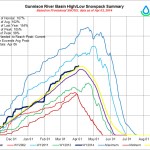
San Miguel, Dolores, Animas, and San Juan Basin High/Low Graph February 25, 2015 via the NRCS

Norwood: Lawn and garden irrigation project awaits CWCB funds for feasibility study

Lone Cone from Norwood

From The Norwood Post (Regan Tuttle):

At February’s Norwood town board meeting, trustees discussed the Colorado Water Conservation Board’s upcoming decision on a grant award that Norwood recently applied for. The funding would make possible a feasibility study that will determine whether or not Norwood should move forward with a lawn and garden raw water irrigation project, similar to that of Dove Creek.

Last month, town officials met with those of Dove Creek to learn the details of the project.

Town Administrator Patti Grafmyer said that receiving the grant would not mean that the irrigation project will automatically move forward.

“Norwood can evaluate the feasibility study,” she said. “We are just asking for the funding, but once that has happened, there will be a scope of work that will have to be signed with the town board.”

CWCB members will make the decision this March.

More San Miguel River watershed coverage here.

Water Lines: Colorado Water Plan delivered, key dilemmas remain — Hannah Holm

From the Grand Junction Free Press (Hannah Holm):

Colorado lurched one more step towards resolving how to satisfy growing demands for water with stable-to-diminishing supplies when Governor Hickenlooper received the first complete draft of a statewide water plan on Dec. 10.

In compiling the plan, the Colorado Water Conservation Board (CWCB) provided the latest information on current and projected water supplies and defined some “no regrets” actions that would help no matter what the future holds. These include achieving at least low-to-medium levels of conservation, completing already planned projects, implementing water re-use projects, and preserving the option of taking more water out of the Colorado River and its tributaries to meet both West and East Slope needs.

The CWCB stopped short of endorsing (or vetoing) any particular projects to meet future needs or taking a hard stand on the role conservation and land-use restrictions should play in meeting future needs. The draft plan maps the landscape, but doesn’t define the route.

The identification of specific projects was left to roundtables of water providers and stakeholders in each of the state’s major river basins. As anticipated, those basin plans conflict on the issue of whether East Slope basins can continue to rely on additional West Slope water to meet their growing needs. Approximately 500,000 acre-feet per year already flows east across the Continental Divide through ditches and tunnels that siphon off a majority of the natural flows from many headwaters streams. One acre-foot can meet the needs of two to three households for a year under current usage rates.

Seven-point draft conceptual agreement framework for negotiations on a future transmountain diversion screen shot December 18, 2014 via Aspen Journalism

While the draft plan doesn’t say “yes” or “no” to additional transmountain diversions, it does incorporate a seven-point “draft conceptual agreement” on how to negotiate on future transmountain diversions. The draft discussion framework (there’s been a lot of push back on calling it an agreement) contains several new features in the many-decades-long debate between East and West Slope actors over transmountain diversions. It states that the East Slope is not looking for stable water deliveries each year from any such project, recognizing that it may only be able to divert in wet years and would have to use transmountain water in conjunction with non-West Slope sources, such as the Denver Basin aquifer and temporary transfers from agriculture.

The draft framework also notes the need for an “insurance policy” to protect against Colorado water users getting cut off in the event that we fail to let enough water flow beyond the state line to meet downstream obligations. Colorado and the other Upper Colorado River Basin states have never failed to meet their obligation to downstream states under the 1922 Colorado River Compact, but the margin by which we’ve exceeded it keeps diminishing. Additional use in Colorado, Utah, Wyoming and New Mexico, plus continued drought, could push us over that threshold.

While the draft framework is a tiny part of the draft Colorado Water Plan, it’s likely to be at the center of debate between water leaders from each of the state’s major river basins as the draft Colorado Water Plan becomes “final” over the coming year. In a meeting Dec. 18, members of the four West Slope basin roundtables met in Grand Junction to work towards a common negotiating position in those discussions.

The four roundtables share extreme skepticism about the wisdom of any transmountain diversion, no matter the caveats; they also share a concern that any “insurance policy” to protect existing uses from curtailment under the 1922 Colorado River Compact would ultimately result in water being transferred out of West Slope agriculture, even if the transfer is voluntary and lower-impact than the wholesale “buying and drying” of agricultural water rights that has already devastated some East Slope farming communities.

Where the West Slope roundtables begin to diverge is over how additional Colorado River Basin development on the West Slope figures into the picture. Given that any new uses raise the risk of failing to meet downstream obligations, should new West Slope water projects be looked on any more favorably than new projects to send water across the Continental Divide? Where is the right line in the trade-off between protecting existing Colorado River water users and making the fullest use possible of the resource? And what place should “nonconsumptive” uses of water for the health of the environment and recreation play into these decisions?

This already complicated dilemma is made more complicated by the fact that the Yampa and White river basins have fewer dams and diversions on their streams than the other West Slope river basins, and therefore have a greater interest in new projects to provide greater security for existing users, as well potentially irrigate even more land and/or meet the needs of increasing energy development. Is the Yampa Basin bearing an unfair share of the burden of meeting downstream obligations, or would it be even more unfair for existing users in other basins to have to cut back in order to subsidize Yampa Basin growth?

In the quest to find common ground on this issue, participants in the Dec. 18 meeting called for better hydrologic data in order to better understand how much additional risk is created by different levels of additional use.

I don’t know if that’s possible, given the current state of scientific understanding of our region’s climate and hydrology, particularly when it comes to forecasting. What may bear fruit is the search for the right “triggers,” in terms of reservoir and/or streamflow levels, to indicate when more development, on either side of the Continental Divide, can proceed without posing unacceptable risks to the whole system. Don’t expect this dilemma to be resolved any time soon, no matter what deadlines exist on paper.

This is part of a series of articles coordinated by the Water Center at Colorado Mesa University in cooperation with the Colorado and Gunnison Basin Roundtables to raise awareness about water needs, uses and policies in our region. To learn more about the basin roundtables and statewide water planning, and to let the roundtables know what you think, go to http://www.coloradomesa.edu/WaterCenter. You can also find the Water Center on Facebook at http://Facebook.com/WaterCenter.CMU or Twitter at http://Twitter.com/WaterCenterCMU.

More Colorado Water Plan coverage here.

Draft conceptual diversion deal presented to West Slope water interests — Aspen Journalism

Informational graphic screen shot December 18, 2014 via Aspen Journalism

From Aspen Journalism (Brent Gardner-Smith):

A draft seven-point framework that lays out conditions for a potential new transmountain diversion in Colorado was explained Thursday in Grand Junction to the members of four Western Slope water-planning roundtables.

About 75 members of the four roundtables heard Bruce Whitehead, a member of the Interbasin Compact Committee, describe in relatively plain terms a “draft conceptual agreement” the committee reached in June on how to possibly move more water from the Western Slope to the Front Range.

“This is conceptual,” said Whitehead, who serves on the Southwest Basin roundtable. “We haven’t sold the ranch, and I don’t think, intend to. It was really to set up a dialogue about, yes, go ahead and say it, transmountain diversions. What are the pros? What are the cons? How do we meet Colorado’s gap in the future?”

Whitehead said the seven-point framework had moved the discussion about a new transmountain diversion past the water-planning euphemism “new supply.”

“The term ‘new supply’ had been used a lot,” Whitehead said. “And folks on the Western Slope, obviously, are a little sensitive about new supply. I’ve heard it stated that it might be new supply to somebody else but it’s not really a new supply.”

Sawyer Creek diversion via Aspen Journalism

The 7-Points, in the draft water plan

The 27-member Interbasin Compact Committee serves as something of an executive committee for the nine basin roundtables. Its mission includes developing new water storage and providing a framework for negotiations between the roundtables.

The Colorado Water Conservation Board, the state agency charged with planning for the state’s water needs, oversees both the committee and the roundtables.

On Dec. 10, the agency presented a draft Colorado water plan to Gov. John Hickenlooper. The plan includes the committee’s seven-point “draft conceptual agreement.”

Whitehead explained that the committee members were polled at a meeting in June using a clicker system, and all of them endorsed the statement, “I agree that the draft conceptual agreement is ready to go the water conservation board for consideration while we continue to get feedback from our roundtables and constituencies and the public.”

“So it is not a done deal,” Whitehead said. “And I know there’s even been some things in the newspaper here recently that agreements have been cut, that a deal’s been done, and that’s not the case.”

Members of both the Colorado River Basin and the Gunnison River Basin roundtables recently expressed dismay that a perception had been created that an agreement on a new transbasin has been reached.

“Our last roundtable meeting in November was a very emotional, heartfelt meeting where we discussed the seven points,” said Louis Meyer, a member of the Colorado roundtable. “We are the donor basin. There are currently 15 major transmountain diversions diverting between 450,000 and 600,000 acre-feet out of our basin.”

At their November meeting, the Colorado roundtable members unanimously adopted a motion stating that “it would be premature and inappropriate” to include the seven points in the Colorado water plan.

“We’re not saying they don’t belong in Colorado’s water plan; we’re saying they are not ready yet,” Meyer said at Thursday’s meeting, which also was attended by another 75 or so members of the public and Colorado’s professional water community. “They need a lot more discussion.”

The first and perhaps most significant of the seven points states that “the eastern slope is not looking for firm yield from a new transmountain diversion project and would accept hydrologic risk for that project.”

“I think the (Interbasin Compact Committee) has acknowledged that in high-water years, and at high levels of storage, there is probably some water left to develop in the Colorado River system,” Whitehead said of the first point. “In very low years, as in the previous 14 or 15 years we’ve just seen, there may not be.”

Whitehead said the third point, concerning “triggers” that might force a new transmountain diversion to divert less water, was about managing a potential “compact call” from California and other lower-basin states. Such a call could force junior water-rights owners in Colorado and other upper-basin states to stop diverting water.

“If it looks like we’re going to be headed toward compact curtailment of some kind, then they shouldn’t divert and increase that risk,” Whitehead said of a new diversion. “What those triggers are hasn’t been fully defined.”

The fourth point calls for an “insurance policy” for existing junior water rights, and raises the question of how much more water should be diverted from the state’s west-flowing rivers in the face of a looming compact call.

“Obviously, any development is going to increase the risk,” Whitehead said. “In my mind, 2 acres of irrigation on the Animas River that has a fairly small depletion is a bit of a different animal than a 100,000 acre-foot diversion. So how do we handle that? Is there a de minimus amount that we could agree to that would allow for some future uses on the Western Slope while trying to minimize that risk?”

Most of the basin roundtables are set to meet in January, and the Interbasin Compact Committee, which has not met since June, is slated to meet Jan. 28. A final version of the Colorado water-supply plan is due in December 2015.

Editor’s note: Aspen Journalism and The Aspen Times are collaborating on coverage of rivers and water. The Times published this story on Monday, Dec. 22, 2014.

More IBCC — basin roundtables coverage here.

“Our agriculture water is the low-hanging fruit” — J. Paul Brown

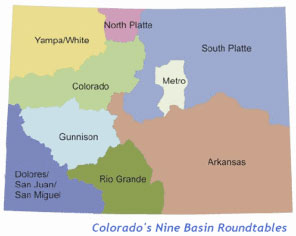
Basin roundtable boundaries

From The Grand Junction Daily Sentinel (Dennis Webb):

Protecting Western Slope agriculture appears to be one area of agreement as the region looks for ways of speaking with one voice on Colorado water issues. That was one takeaway from what was effectively a Western Slope water summit held [December 18] in Grand Junction with the goal of presenting some consolidated messages on the state’s newly drafted water plan.

Members of four roundtable groups — representing the Gunnison and Colorado river basins, southwest Colorado and the Yampa, White and Green river basins — already have developed their own plans that were incorporated into the newly completed draft plan. Representatives from all those roundtables gathered Thursday to talk about common themes that have emerged that they can be jointly voicing to the rest of the state as a final plan is developed.

In the case of agriculture, Colorado roundtable basin chair Jim Pokrandt said it’s important that the state not engage in poor water planning that forces farmers and ranchers out of business.

Said state Rep. J. Paul Brown, R-Ignacio, who works in agriculture himself, “Our agriculture water is the low-hanging fruit. It’s the easy water to buy and that’s exactly what’s happened.”

He talked about a need for more Front Range storage of its own water and alternatives like bringing in water from the Missouri River “so you’re not buying that agricultural water.”

Jim Spehar, a former Mesa County commissioner and Grand Junction mayor, agreed about the importance of considering agriculture in state water planning.

“If this discussion isn’t done by and for agriculture I think it will be done to agriculture,” he said.

Thursday’s discussion also turned to other areas including municipal and agriculture conservation. Gunnison County rancher Ken Spann said one thing those in agriculture need to know is where any water they might free up from conservation would go. He’d like to see it help fill Lake Powell to help states in the Upper Colorado River basin meet interstate compact water obligations.

But he worries that instead it could just end up supplying another new subdivision, or perhaps simply being offset by new water use being sought in the Yampa basin, which would mean no net increase in Colorado River water reaching Powell.

“The trade-offs (from conservation efforts) have to be identified and we are now at the point where we have to do that or people won’t play,” he said.

Western Slope water interests plan to continue talking about seeking a unified voice on water, including by addressing issues such as a somewhat controversial proposed framework for discussing any possible new diversions of western Colorado water to the Front Range.

“This is just the start of the West Slope conversation,” said Moffat County rancher T. Wright Dickinson, who also sits on Colorado’s Interbasin Compact Committee, a statewide forum for discussing water issues.

More IBCC — basin roundtables coverage here.

Water Diversions, Part One — Pagosa Daily Post #COwaterplan

San Juan River from Wolf Creek Pass

From the Pagosa Daily Post (Bill Hudson):

We’re lucky here in Colorado. When we grow weary of ordinary, everyday political controversies — federal immigration policy, perhaps, or governments collecting personal data on private citizens, or another federally mandated standardized test foisted on our children, or more locally, streets and roads slowly crumbling into asphalt dust — we always have one big controversy that can serve as a welcome diversion:

Water.

I attended a couple of diversionary discussions last month in Pagosa Springs, on the subject of Colorado water. The first discussion took place on November 17 at the Ross Aragon Community Center, in the South Conference Room, and was hosted by the Southwest Basin Roundtable.

The second meeting — related in a somewhat diversionary way — involved the elected board members of the Pagosa Area Water and Sanitation District (PAWSD) and resulted, after considerable discussion, in a closed-door executive session. More about that later… we’ll start with a summary of the Roundtable meeting .. which, interestingly enough, was attended by not a single member of the PAWSD board…

The November 17 meeting was sparsely attended — about 24 people, mostly members of various water boards or commissions — even though the subject matter may ultimately prove relatively momentous: namely, the impending Colorado Water Plan, and more specifically the portion of that plan known as the Southwest Basin Implementation Plan. We started the meeting by going around the room and introducing ourselves. I was struck by a comment from one of the non-governmental attendees.

“I’m Donna Formwalt, Pagosa Springs. We’re ranchers here. And I’m very interested in the water takeover by the Forest Service.”

The Colorado Water Plan is an initiative of Governor Hickenlooper’s office, begun as the result of an executive order issued in May 2013. A press release posted on the Governor’s website states:

Gov. John Hickenlooper today directed the Colorado Water Conservation Board (CWCB) to begin work on a draft Colorado Water Plan that will support agriculture in rural Colorado and align state policy to the state’s water values.

“Colorado deserves a plan for its water future use that aligns the state’s many and varied water efforts and streamlines the regulatory processes,” Hickenlooper said. “We started this effort more than two years ago and are pleased to see another major step forward. We look forward to continuing to tap Colorado’s collaborative and innovative spirit to address our water challenges.”

But as Ms. Formwalt hinted with her comment about the Forest Service, Colorado’s innovative and collaborative spirit will be challenged, in the coming months and years, by officials serving non-Colorado governments. The U.S. Forest Service, for one. And the governments of the “Lower Basin States” for another.

Are we preparing well enough for that conflict?

From the Colorado Water Plan website:

Colorado’s Water Plan will provide a path forward for providing Coloradans with the water we need while supporting healthy watersheds and the environment, robust recreation and tourism economies, vibrant and sustainable cities, and viable and productive agriculture.

Of course, no one — not even Governor Hickenlooper — can actually “provide Coloradans with the water we need.” Only Mother Nature can actually provide water, last I looked. But what the Governor and the Colorado Water Conservation Board mean to provide is a generally accepted plan for portioning out the limited water Mother Nature provides, in a state where supposedly conflicting interests want to preserve the status quo. History has taught us, you can preserve the status quo for only so long — and then people start fighting.

In the case of an ever-more-precious resource like water, the key battles might be between Rural Colorado and Urban Colorado, or they might be between this state where so many American rivers find their source — Colorado — and the several states where those rivers end up in water taps, a thousand miles away.

The Colorado Water Plan is, I assume, an attempt to keep both types of battles from getting too nasty.

The Southwest Basin — a geographic area defined by the Colorado Water Conservation Board — is located in the southwest corner of Colorado and covers an area of approximately 10,169 square miles. The largest cities are Durango (pop. 15,213) and Cortez (pop. 8,328). The region also includes three ski areas: Telluride, Wolf Creek, and Durango Mountain Resort.

A good deal of water flows through the Southwest Basin, and a good number of people want to get their hands on a share of it — including the people who will likely move into the region over the next 30 years or so. The Southwest Basin is projected to increase in municipal and industrial (M&I) water demand between 17,000 acre feet (AF) and 27,000 AF by 2050, according to Roundtable projections.

From the Roundtable web page:

Southwest Basin’s Major Projects and Programs
Dry Gulch Reservoir
Animas-La Plata Project
Long Hollow Reservoir
La Plata Archuleta Water District

It’s confounding, how that Dry Gulch Reservoir keeps showing up… like a bad penny.

More Colorado Water Plan coverage here. More Dry Gulch Reservoir coverage here.

Southwest Roundtable to hold 4 meetings about their basin implementation plan #COWaterPlan

Basin roundtable boundaries

From The Durango Herald:

Four meetings on the Southwest Basin Implementation Plan, part of a statewide effort to resolve water shortages, to be unveiled next month, start next week.

Members of the public can learn about draft plans and offer opinions to water authorities.

The Southwest basin contains nine subbasins from the San Juan River to the Dolores and San Miguel rivers.

The meetings are scheduled from 6 to 8 p.m. on Nov. 17 at the Ross Aragon Community Center, 451 Hot Springs Blvd., in Pagosa Springs; Nov. 19 at the Pine River Senior Center, 111 West South St., in Bayfield; Dec. 1 at the Mancos Community Center, 117 N. Main St., in Mancos; and Dec. 9 at the Placerville School House, 400 Front St., in Placerville.

Further information is available from Ann Oliver at 903-9361 or Carrie Lile at 259-5322.

Telluride: New Pandora treatment plant awaiting final state approvals to go online

From The Telluride Daily Planet (Mary Slosson):

The Pandora Water Treatment Plant valves were opened up on Oct. 24 and everything worked, Telluride Public Works Director Paul Ruud said. The plant will not plug into the municipal water supply until a few remaining state certifications are completed, he added. Those final approvals from the Colorado Department of Public Health and Environment will probably be finalized in the new two weeks, Ruud said. Town officials were obligated to have the plant functional by a Nov. 1. deadline.

But the plant works, a fact that Ruud and members of the Telluride Town Council and town staff have heralded this week.

“We’re quite pleased after 20-some years of working on it, we finally have a functional water plant,” Ruud said. “It’s been quite an undertaking. We’re happy to be at the place we are now.”

The facility, located off Bridal Veil Road on the east end of the box canyon, has been under construction for three years. The plant can produce one million gallons of water per day, and has the capacity to be expanded to double that – two million gallons of water per day – if the need ever arises in the future, Ruud said.

“It is our expectation that once the Pandora Water Plant comes online and is functioning as it is designed… we will basically be in a very good position with water for the foreseeable future, possibly the next 50 years,” Ruud said.

City planners realized 20 years ago that neither Corner Creek nor Mill Creek would be sufficient sources of water, Ruud said, especially if the region went into a drought scenario.

“We’re very, very fortunate that our elected officials 20 years ago got the ball rolling. Projects this big take 20 years to accomplish. They had a lot of foresight to start thinking about this way back when,” Ruud added. “For a small town like ourselves, that’s a fairly ambitious undertaking.”

They began working to acquire water rights in the Bridal Veil Basin and converting those rights to municipal water rights. But that effort sometimes caused delays.

After voters approved a $10 million bond in 2005 to fund the construction of the project, it stalled for years as the town and Idarado Mining Company, which owns much of the land and infrastructure involved, tussled over water rights.

Work on the project finally began in earnest in the summer of 2011. In 2013 the town had to add around $4.7 million to the project after a budgetary shortfall.

Now the town will be able to take water out of Blue Lake, Lewis Lake or even Bridal Veil Creek.

The San Miguel Power Association has agreed to purchase electricity generated by a hydropower generator in the treatment plant, Ruud added, so the facility can also contribute to the electrical grid.

“It’s very, very exciting. Anytime a community can take care of some of their really, really important infrastructure needs, it’s a tremendous milestone for the community,” Ruud said.

More infrastructure coverage here.

Valley Floor sewer lagoons to get makeover — The Telluride Daily Planet

Photo via TellurideValleyFloor.org

From The Telluride Daily Planet (Mary Slosson):

Town Council approved a restoration project Tuesday that will transform two man-made sewage lagoons on the Valley Floor into new wetlands.

The two artificial ponds, located in the open Valley Floor space adjacent to the southwest corner of the Pearl Property, are believed to have been excavated in the 1960s with the intent to use as sewage treatment lagoons. They were never used and almost immediately filled with water, officials said. As a result, they were eventually left alone to grow as wild as they could.

“We look at this as a naturalizing of what was obviously a mechanical, man-made and never used excavation, the spoils of which isolated it from the wetland ecosystem,” said Angela Dye, chair of the Open Space Commission. “This project will integrate it into the wetland system we have up there now.”

The restoration project is expected to take two to three weeks and is budgeted at $116,500. Town officials hope to complete the project this fall, when they say the construction would least impact wildlife that calls the ponds home.

In fact, that wildlife is one of the reasons that planners decided to incorporate some of the ponds’ already existing standing water into the final wetland restoration design, instead of reverting the plots back to their native state and removing the standing water altogether.

“There was a desire to keep the pond, and it wasn’t purely for aesthetic reasons,” said Town of Telluride Program Director Lance McDonald, summarizing planning discussions leading up to the restoration proposal.

“There is a lot of wildlife that use the standing water. There is not a lot of standing water on the floor,” McDonald said. “The diversity of animals is quite high here: raccoons, muskrats, fox, geese, ducks. This was an opportunity to have a place for those species on the Valley Floor even though it’s not a natural feature.”

Dye said that the restored sewer ponds would become an environmental education opportunity, with student groups able to observe the waterfowl, mammals and wildlife that flock to the area.

The restoration project will remove the land beam between the lagoons that was created during the original pond excavation to create one uniform body of water, and then use that soil to create wetland benches in the water. The project will also reintroduce native vegetation to the area using samples and seeds from the immediate wetland areas.

A total of 34,800 square feet of new wetlands will be rehabilitated, creating a seamless natural environment from the Pearl Property to the rest of the Valley Floor.

More restoration/reclamation coverage here.

Southwestern basin implementation plan ready for comment #COWaterPlan

San Juan River from Wolf Creek Pass

From the Pagosa Sun (Ed Fincher):

Laura Spann from the Southwestern Water Conservation District in Durango announced yesterday the release of The Southwest Basin Implementation Plan (BIP), which can be found under the “community” tab on the Colorado Water Plan website http://www.coloradowaterplan.com.

The local portion of the state plan can be accessed by clicking on “San Juan and Dolores River Basin” under the community tab. The resulting page states, “Residents and interested parties are encouraged to participate in the Basin Implementation Plan process. As the process moves forward, documents relating to the plan will be posted here.” There are currently two documents on the page available for download.

While the website allows for electronic comments to be made concerning the broader Colorado Water Plan, Spann asks that interested members of the public direct any comments specifically about the southwest portion of the plan to Carrie Lile via email at carrie@durangowater.com or phone, 259-5322…

The website goes on to explain, “The Southwest Basin is located in the southwest corner of Colorado and covers an area of approximately 10,169 square miles. The largest cities within the basin are Durango (pop. 15,213) and Cortez (pop. 8,328). The region also includes three ski areas: Telluride, Wolf Creek and Durango Mountain Resort.”

The website concludes, “The Southwest Basin is projected to increase in municipal and industrial (M&I) water demand between 17,000 acre feet (AF) and 27,000 AF by 2050 with passive conservation included.”

More Colorado Water Plan coverage here.

9News series about #COwater and the #COWaterPlan — Maya Rodriguez


9News.com reporter Maya Rodriguez has embarked on a series about the Colorado Water Plan and water issues in Colorado. The first installment deals with Cheesman Dam and Reservoir.

Correction: The original post attributed the article to *Mary* Rodriguez. Coyote Gulch blames autocorrect rather than the author and his propensity to post at the wee hours of the morning.

Here’s an excerpt from Ms. Rodriguez’s article:

It is something most of us take for granted: running water. Colorado is now beginning to grapple with how to keep the tap flowing, both now and in the future. As the state develops a water plan, set to be released in December, we are beginning a series of stories revolving around that precious resource…

Cheesman Reservoir and Dam

Nearly 7,000 feet above sea level, it’s a place of stillness and a quiet refuge. Yet, it’s also a place capable of wielding immense power.

Cheesman Reservoir is a major source of water for communities up and down the Front Range. It holds 25 billion gallons of water. That’s enough water to cover Sports Authority Field with a foot of water more than 79,000 times. All of it is held in place by the Cheesman Dam, which was built nearly 110 years ago.

“It was tremendous foresight that this reservoir has been pretty much unchanged in all that time,” documentary filmmaker Jim Havey of Havey Productions said.

The reservoir is just one of the places Havey is beginning to capture as part of an upcoming documentary called “The Great Divide.” The subject? Water.

“We looked at water, initially, as a great way to tell the story of Colorado,” he said.

Colorado’s water system is a complex combination of reservoirs, rivers and dams. As the state’s population has grown, though, there has been a greater need to come up with a water plan that can evolve with time.

“Really, it is all connected,” said Travis Thompson, spokesperson for Denver Water, which bought the Cheesman Reservoir nearly 100 years ago.

Denver Water– along with water municipalities and agencies across Colorado– is now working on a long-term plan for Colorado’s water. It includes, among other things, figuring out the best way to manage the state’s water as it flows between different river basins and whether or not to create more reservoirs.

“We’re not planning just for today, we’re planning for tomorrow– 25 years, 50 years down the road,” Thompson said. “And we have many challenges that we’re looking into, just like our forefathers had.”

Those challenges include how to provide enough water for people and industries in Colorado, as well as people in 18 other states– and even two states in Mexico– which also get their water from rivers that begin in Colorado.

“What the water plan is going to mean, I don’t think anybody knows yet,” Havey said.

Yet, it’s a plan that has a lot riding on it below the surface. The first draft of the state’s water plan is due in December and is expected to be presented to the state legislature next year. For more information about the water documentary, “The Great Divide,” go to http://bit.ly/1qDftUO.

More Denver Water coverage here. More South Platte River Basin coverage here. More Colorado Water Plan coverage here.

Telluride: Pandora raw water and treated water project is moving along nicely

Bridal Veil Falls
Bridal Veil Falls

From The Telluride Daily Planet (Collin McRann):

The Pandora water treatment project at the east end of the valley is on schedule and should be complete by this fall, ending more than three years of construction.

The project, which fired up in 2011, has been in the works for more than 20 years, and it will pipe water from Upper Bridal Veil Basin to a new treatment facility at the east end of the box canyon. And while there have been many hurdles, including engineering challenges and budgetary issues, the project should be complete by October and stay within the town’s 2014 budget, according to Telluride Public Works Director Paul Ruud.

“We keep making progress on the building and the water plant itself,” Rudd said. “The building is almost completed. We’re just outfitting the internals. There are aspects of the project that are done. We’ve tied in both the raw waterline coming in from Bridal Veil [Falls] and the treated line that’s going towards town, into the plant.”

Ruud said crews are also working on a physical water diversion out of Bridal Veil Creek as well as a number of other components involved with the diversion. If things go as planned, the plant will go online in early October.

“We haven’t really had any issues,” Ruud said. “We did have fairly substantial soil stabilization right at the treatment plant. That ended up being quite a substantial undertaking. But as of right now we are within the approved budget for this year and we expect the project will be completed with our existing budget.”

The facility will also contain a micro-hydro component that is expected to be operational when the plant goes live, which will boost the town’s generation of renewable energy. But the main purpose of the plant is to boost the town’s water capacity. Telluride’s current system, which relies primarily on the Mill Creek Water Plant, has been strained by high demand and other issues in recent years.

Rudd said construction has been making good progress this summer. With the good weather there have been a lot of people in the area going up to Bridal Veil Falls. But disturbances from construction are nearing an end.

More San Miguel River watershed coverage here.

Norwood infrastructure upgrades should help with water quality

norwood

From The Norwood Post (Regan Tuttle):

The Town of Norwood continues to make headway in water quality and availability. This past February, Norwood completed a major upgrade to the water treatment plant.

“We just completed a big project that we did last year. We’ve added a filter to the water treatment plant to help with water quality. That took about a year and was finished in February,” Public Works Director Tim Lippert said.

Lippert has been in service to the Town of Norwood — in public works, Norwood Water Commission and Norwood Sanitation District — for 22 years.

According to Lippert, the EPA, through the Colorado Department of Health, has tightened the standards for drinking water over the years. As a result, Norwood’s previous water treatment system was not in compliance.

Through many grants and low-interest loans, and the hard work of town officials, the water treatment plant is now producing more and cleaner and water than ever before…

The latest addition features a new clarifier system that converts raw water through a chemical and sand filter process to produce Norwood’s best drinking water yet…

Last year, Norwood also completed repair on the Gardner Springs water right. During that process, Lippert and his crew discovered damage to the Norwood Pipeline.

The Norwood Pipeline will now be rehabilitated through grant funding made possible by Southwest Water Conservancy in Durango.

“We had done exploratory digging there to see why it wasn’t producing. The pipe was smashed, and we are now replacing 600 feet,” Lippert said.

According to Lippert, the plastic irrigation pipes may not have been bedded properly. Over the years, the weight of the mud collapsed them.

“We couldn’t get water through it,” Lippert said. “And silting happened also because of restrictions.”

The Norwood Pipeline project will include a flume with control valves for the purpose of measuring water flow. Water from Norwood Pipeline can then be diverted into one of Norwood’s two reservoirs.

“We can then measure flow and divert it where we want,” Lippert said.

More infrastructure coverage here.

Conservation: Telluride may impose permanent restrictions

Photo via TellurideValleyFloor.org

From The Watch (Seth Cagin):

With greatly expanded supplies of treated municipal water coming online at the end of this year when the Pandora Water Treatment Plant is scheduled to open, the Town of Telluride is considering the implementation of new water conservation measures.

While it may seem counterintuitive that a greater supply of water dictates the wisdom of more conservation, Town Manager Greg Clifton told the Telluride Town Council on Tuesday that “it is a matter of good stewardship of a natural resource,” especially incumbent, he suggested, on a “headwaters community.”

The biggest proposed new regulation, if council approves it, would not be not dramatic: restricting spray irrigation in town to nighttime hours, thus minimizing water losses to evaporation.

Greater awareness of the value of permanent water conservation measures has come about during the last two years, when there were water shortages and emergency conservation measures were imposed, Clifton said. In addition, he told council, it is a stipulation of a comprehensive settlement agreement with the Idarado Mining Co. that is close to completion that the town implement water conservation measures.

Water efficiency in Telluride also leaves more water in the San Miguel River, Karen Guglielmone, project manager for the town’s public works department told council, to the benefit not only of downstream water users, but also the local environment.

On a related note, reductions in water use also provide the benefit of putting less pressure on the town’s wastewater treatment plant. The town currently experiences more water consumption than the wastewater treatment plant can accommodate in the morning hours in the summer during large festivals. The town will attempt to encourage residents and visitors at those times to try to spread their water use out over the course of the day.

More conservation coverage here.

Hope for Howard Fork water quality? CDRMS is looking at acid mine drainage mitigation again. #ColoradoRiver

Howard Fork via The Trust for Land Restoration
Howard Fork via RestorationTrust.org

From The Telluride Daily Planet (Heather Sackett):

… the Colorado Division of Reclamation Mining and Safety is beginning the process of trying to stabilize the mine near Ophir and improve the water quality of streams in the area. The DRMS project aims to see if there is a way to stop water from flowing through the mine, which will also help improve the water quality of Howard Fork, which flows into the San Miguel River. The project is being overseen by the Environmental Protection Agency, which has been investigating the water quality and taking samples from the Iron Springs Mining District for a couple of years, according to EPA Site Assessment Manager Jean Wyatt.

“It’s in part to understand the baseline conditions for water quality and understand if something can be done to stop the mine water from passing through the workings of the mine,” Wyatt said. “There are elevated levels of zinc and iron coming out of that mine … We want to understand what the conditions are and who could contribute resources or expertise to increase the quality of the watershed in general.”

DRMS is seeking bids from contractors to reopen the portal and stabilize and rehabilitate portions of the underground workings of the Carbonero Mine. The project will also include the construction of a platform at the portal, construction of water management structures near Ophir Pass Road below the site and re-grading and reclamation of certain areas.

“That’s the goal: to stabilize the mine and enter and see what, if anything, can be done,” said Bruce Stover, director of the DRMS Inactive Mine Reclamation Progam. “This isn’t a final remediation by any means. This is just part of an ongoing investigation.”

Glenn Pauls is the landowner of the site. In the 1980s, Pauls acquired many of the mining claims in the area — he estimates about 1,100 acres in roughly 100 claims at one point — with the intention of making a trade with the Forest Service at some point. His goal, he said is to preserve the Ophir Pass Road and keep it open for Jeep traffic. Pauls said he would like to create a hydroelectricity project at the Carbonero Mine site, once the water quality studies are complete.

“The idea is that we open it up and find out if the water coming in the back end is clean,” he said. “I can’t touch the water until someone gives me the OK.”

A mandatory pre-bid meeting for interested contractors is planned for the site on Ophir Pass Road about a half-mile east of Ophir at 10:30 a.m. June 11. The submission deadline for bids is June 24. For more information about the project, contact Kristin Miranda at the Department of Natural Resources/Division of Reclamation, Mining and Safety at 303-866-3567 ext. 8133 or kristin.miranda@state.co.us.

More San Miguel River watershed coverage here.

Southwestern Water Conservation District Annual Water Seminar recap #COWaterPlan #ColoradoRiver

sanjuan

From the Pine River Times (Carole McWilliams):

With continuing population growth in Southwestern states and ongoing drought, water issues are becoming more and more about who has to cut back their use when there isn’t enough to meet demand.

That thread ran through presentations at the annual Water Seminar on April 4 in Durango, sponsored by the Southwest Water Conservation District.

“How will we handle the water and other needs of 10 million people,” asked John Stulp, a former state agriculture commissioner and current chair of the Interbasin Compact Committee (IBCC) which is developing a State Water Plan along with nine basin water roundtables…

Harris cited a statewide statistic that with municipal water use, half is used inside and half outside. Ninety percent of the inside use returns to the stream. With outside use, 70 to 80 percent is “consumed” and does not return to the stream. The Southwest Roundtable has approved a goal to shift the percentage of municipal use to indoor, especially where the water comes from ag dry-up or trans-mountain diversion, he said.

Harris initiated the idea of legislation to limit lawn sizes in residential developments after 2016 where the water would come from a permanent transfer from ag. It didn’t get through the State Senate but will be a study topic by an interim committee on water resources during the off-session.

“The lawn bill, this is just the first time, not the last,” Harris asserted. “Reduction of lawn size is a significant conservation measure to help meet 2050 water supply.”

State Rep. Don Coram from Montrose commented “On the Front Range, they haven’t addressed storage or depleting the aquifer. They are more interested in trans-mountain diversion.”[…]

John McGlow from the Upper Colorado River Commission said curtailment such as this will affect water rights decreed after the 1922 Colorado River Compact. The Upper Basin is western Colorado, eastern Utah, southwest Wyoming, and northwest New Mexico. They have begun discussions on how cutbacks would be shared, or how to avoid getting to that point with things like fallowing fields and reducing frequency of irrigation.

“Lake Powell is our bank account for complying with the compact,” he said. It’s the cushion for the Upper Basin states to deliver mandated quantities of water to the Lower Basin states (California, Arizona and Nevada) and Mexico over a 10-year average. Navajo Reservoir also is part of that.

McGlow said 1999 was the last year that Powell was full. The goal is to get enough water into Lake Powell each year to avoid curtailment or the possibility of the water level getting too low for hydropower generation, which he said would have its own serious impacts.

The good news is there’s enough snowpack in northwest and north central Colorado that these won’t be issues this year, McGlow said…

Panelist Dan Birch from the Colorado River Conservation District said most pre-compact rights on the Western Slope are in the Grand Valley and Uncompaghre Valley. There is around 1 million AF of pre-compact irrigation on the West Slope, he said. Most of that land is in pasture or hay. Pasture can’t be fallowed, he said.

With a target to make up for 350,000 AF of post-compact use, Birch said, “I don’t think we want one-third of ag to go away. What we’re talking about is interruptible voluntary market-based contracts” for pre-compact users to reduce their water use. “This has to work for the farmers and the ditch companies,” he said.

Birch said power plants in Northwest Colorado are significant post-compact water users. “In the event of a (water) shortage, it will be important to keep critical uses going,” including power generation, he said.

Demand management is a key to avoiding Upper Basin curtailment or loss of hydro generation. “We are way behind on actual implementation of demand management,” including agricultural fallowing and reducing municipal demands, McGlow said. “It’s still a concept. It’s in its infancy.”

Fallowing and reduced irrigation are part of what’s called water banking. Panelist Aaron Derwingson said, “Pretty much everyone supports water banking in concept. It gets a lot more complex actually doing it.”

More Colorado Water Plan coverage here.

Southwestern Water Conservation District 32nd Annual Water Seminar recap #ColoradoRiver

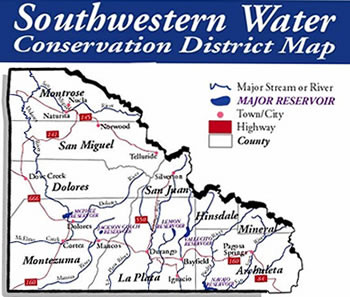
southwesternwaterconservationdistrictmap

From The Durango Herald (Sarah Mueller):

Speakers addressed the controversial practice of transmountain diversions, which takes water from the Western Slope to the Front Range. The water crosses the Continental Divide.

“Frankly, on the Front Range, they’re really not interested in depleting that aquifer; they’re more interested in the transmountain diversions,” Rep. Don Coram, R-Montrose said. “They haven’t addressed the situations of storage; their answer is there’s more water on the Western Slope than they need.”

Steve Harris, president of Harris Water Engineering, talked about the recent controversy over his idea of limiting lawn size in new suburban developments after 2016. The bill, sponsored by Sen. Ellen Roberts, R-Durango, drew fierce opposition from home builders and utility companies.

“About half the people I talked to thought that was a great idea and the other half thought I was a demon,” he said. “In this state, I know what it’s like to get between people and grass.”

Roberts rewrote the bill to call for a study of water conservation.

Another bill floating through the General Assembly would require Colorado residents to purchase “WaterSense” fixtures, such as toilets, shower heads and faucets, after 2016.

Coram said he opposed the bill because the products don’t save much water, and it’s impossible to enforce. WaterSense is a Environmental Protection Agency program labeling products as water-efficient…

Kehmeier, speaking on the water banks panel, said he’s participated in an informal marketplace among local farmers with personal reservoirs where people could lease excess water…

The Colorado Water Conservation Board also gave an update about creating the state’s water plan. Gov. John Hickenlooper directed the board last year to develop the plan. A draft plan is expected to go to Hickenlooper by the end of the year.

More Southwestern Water Conservation District coverage <a href="

Snowpack news (% of avg): San Miguel, Dolores, Animas, and San Juan = 83%

From The Durango Herald (Dale Rodebaugh):

The snowpack in the combined Animas, San Juan, Dolores and San Miguel river basins was 79 percent of the 30-year median April 1; however, this week’s storms brought the basins up to 82 percent.

If it’s any consolation, the combined snowpack this April 1 is 111 percent of what it was last year on the same date.

There’s a chance late storms could increase the snowpack for the southern San Juan basins, but it’s unlikely since the maximum level is generally reached in the first week of April.

In other words, it’s as good as it’s going to get for the Animas, Dolores, San Juan and San Miguel basins…

Overall, the statewide snowpack is above normal – 115 percent of the median on April 1 and 156 percent of the April 2013 number.

But storms carried less moisture in March than in previous months. As a result, the major basins showed a slight decrease in snowpack.

Only two basins – the Colorado and the combined Yampa, White, North Platte – had snowpack percentages higher than last month.

Storms have provided runoff that improved storage in reservoirs statewide.

Reservoir storage in the Animas, San Juan, Dolores and San Miguel basins was 82 percent of average, compared with 66 percent at this time last year.

Statewide, reservoirs held 89 percent of their average, compared with 69 percent a year ago.

From The Fort Morgan Times (Michael Bennet):

A few weeks ago, I was lucky enough to strap on some snowshoes for a short hike on Berthoud Pass with local water managers and staff from the Natural Resources Conservation Service (NRCS). They were taking a manual reading of the state’s snowpack and checking the automatic SNOTEL measurement device. Undersecretary Robert Bonnie, the U.S. Department of Agriculture’s top environmental and natural resource official, and the man who oversees NRCS, also came along.

These snowpack measurement systems, some that date back to the 1900s, are a critical part of the Snow Survey and Water Supply Forecasting program that Colorado water officials rely on to anticipate river flows in the spring when the snow melts and calculate how much water will run off into rivers and reservoirs. Our state’s farmers and ranchers depend on these forecasts to decide how much and what type of crops to plant, while metropolitan leaders use the data to decide how best to meet their needs in the coming years and to prepare for potential flooding.

Beyond Colorado, these measurements are important for states downstream that depend on our watersheds. Colorado contains nine major watersheds, each with its own snowfall patterns and obligations to other states. While some of these water sources may be at 100 percent, in other regions the levels may be less than half of the normal supply. Many of the state’s water rights agreements are predicated on the level of snowpack making the accuracy of these measurements particularly important.

Recently, however, funding for the Snow Survey and Water Supply Forecasting Program was threatened by budget cuts and sequestration.

Colorado communities from across the state shared their strong concerns that cutting funding to this program would damage the accuracy of the measurements and reduce the effectiveness of this vital planning tool. In response to these concerns, we joined forces with Colorado’s water community, Senator Mark Udall, and Congressman Scott Tipton to urge the NRCS to reconsider the cuts. After working with local

communities, water managers, and the NRCS, we secured funding for the program for this winter. In addition, we secured funding in congress for the next fiscal year.

Old Uravan diversion dam on Tabeguache Creek removed, the San Miguel River tributary is now running free

Tabeguache Creek via the USFS

From The Telluride Daily Planet (Katie Klingsporn):

In the 1930s, a 6-foot-tall, 60-feet-wide diversion dam was built in Tabeguache Creek, just upstream from its confluence with the San Miguel River, for the purposes of providing water to the Town of Uravan.

That dam remained for roughly 80 years, even as the uranium mining town was abandoned, declared a Superfund Site and razed in a reclamation project.

When Uravan shuttered, the dam stopped diverting water for human consumption. It continued, however, to block upstream passage to three species of native fish that rely on warm-water tributaries for their spawning grounds.

Until recently, that is. Thanks to a Bureau of Land Management project that was supported by the San Miguel Watershed Coalition and Nature Conservancy, the diversion dam was dismantled earlier this month.

Following two years of research, planning and securing funding, it took crews from Reams Construction a day and a half to pull all of the concrete out of the streambed.

And just like that, Tabeguache Creek was flowing free.

Peter Mueller, who is both the Nature Conservancy’s Southwestern Colorado Project Director and a board member on the Watershed Coalition, said the removal was a great thing to witness.

“One of the things that is so critical for the Nature Conservancy, the Coalition and BLM is that the native fish use these tributaries for spawning,” Mueller said. “And so to be able to remove this diversion structure and open up another eight miles of habitat, with full cooperation of both private landowners and the federal government … we were really excited about it.”

Amanda Clements, an ecologist with the BLM, said the project came about when the agency’s fish biologist was examining Colorado maps for migration barriers.

“He spotted this one,” Clements said.

Through follow-up investigation, Clements said, the BLM discovered that water rights of the dam had been determined abandoned and that removal of the structure would open up a lot of habitat for three species of native fish: Roundtail chub, Flannelmouth sucker and Bluehead sucker. All three are considered “BLM Colorado sensitive species.”

More San Miguel River watershed coverage here and here.

The Spring 2014 Water Information Program newsletter is hot off the presses

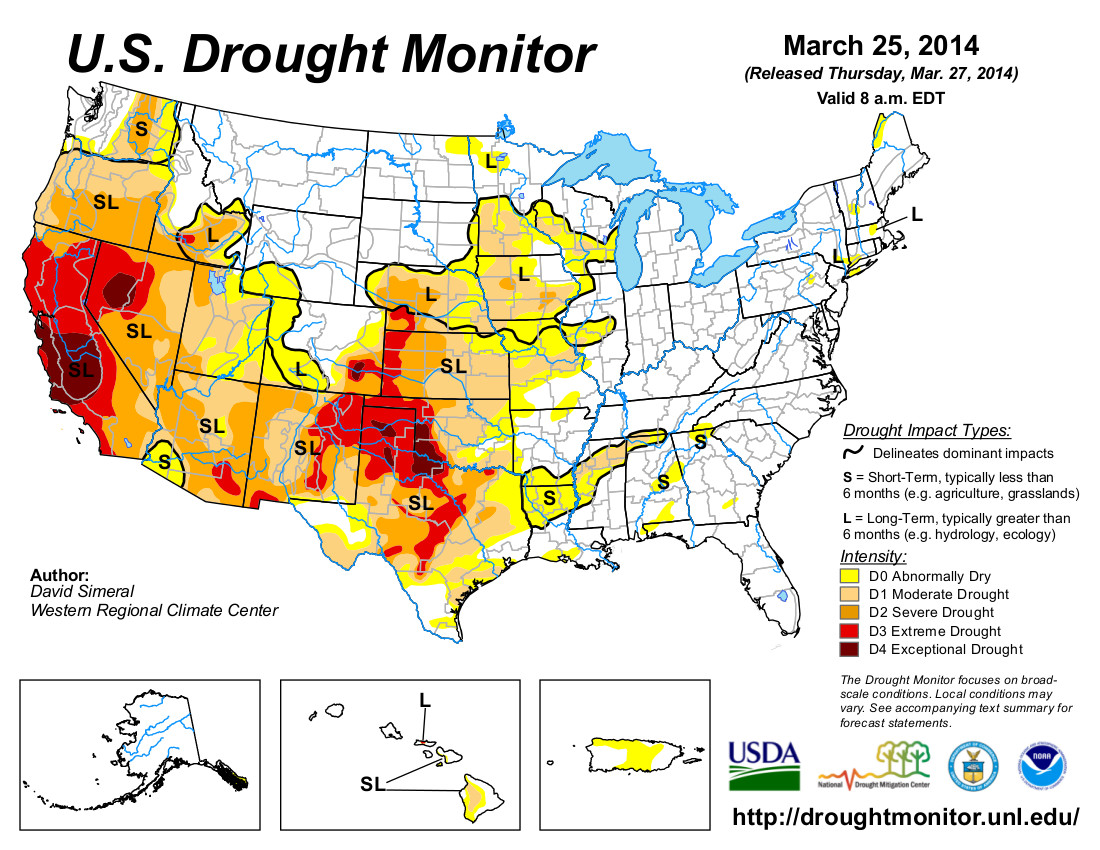
US Drought Monitor March 25, 2014

Click here to read the newsletter.

San Miguel River: Project to restore the historic Hanging Flume wins the 2014 Steven H. Hart award

From The Grand Junction Daily Sentinel:

An ambitious project to rebuild a historic flume among the cliffs above the San Miguel River south of Gateway was recently recognized for its innovative effort at reconstructing history. The 2014 Stephen H. Hart Award was given to the Western Colorado Interpretive Association, Anthony & Associates, and the Bureau of Land Management — a presentation made by History Colorado, a charitable state agency under the Department of Higher Education.

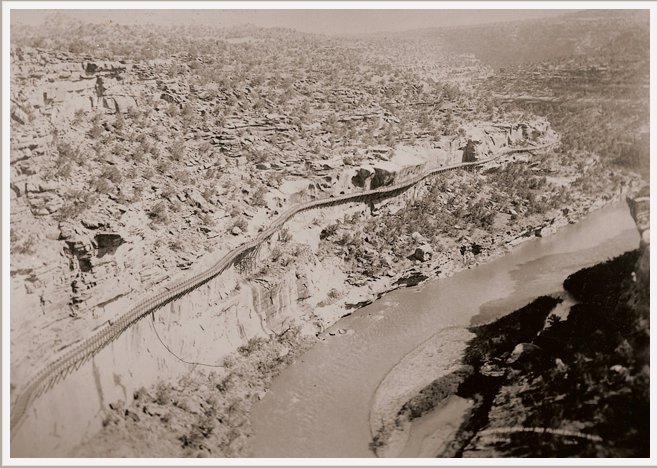
The project to rebuild the flume was done over five days in 2012. In its day, the flume was essentially an open water chute used to transfer 80 million gallons of water per 24-hour period from the San Miguel River, through 10 miles of wooden flume and earthen ditch, according to the WCIA.

“The Hanging Flume is much more than a marvel of engineering. It is a statement driven in stone – a monument to an era of innovation and ‘can-do’ attitude in the 1880s,” the group said in a press release announcing the award.

The project, they say, was an effort to answer the question of exactly how the original flume builders were able to pull it off. Funding was made available by private funders the J.M. Kaplan Fund and the John Hendricks Family Foundation.

Today the flume is listed on the National Register of Historic Places and is the longest historic structure in the state, and the most intact flume left in North America, according to the WCIA.

And in 2006, the Montrose Placer Mining Company Hanging Flume was listed as one of the “100 Most Endangered Sites in the World” by the World Monuments Fund.

More San Miguel River watershed coverage here.

Say hello to HangingFlume.org


HangingFlume.org has a new makeover with a ton of photographs. Buy their book to help fund their efforts.

Here’s an excerpt from the Home page:

It isn’t to say that the idea of building a flume was so crazy. Flumes for placer mining were common at the time. Flume construction methods had been used in California for years and required only minimal skills. To cross arroyos and washes, water could be funneled through flume boxes supported by trestles. But in the canyons of the Dolores and San Miguel Rivers, minimal engineering skill was not enough. This flume would have to be ten miles long, and to complete the entire route at the proper gradient, the Flume would have to cling to seven miles of sheer rock walls, at times suspended hundreds of feet above the river.

The Hanging Flume is perhaps one of the most risky and lofty plans in mining history . . . and for the purposes of placer mining, pretty much a complete failure. But as a heritage tourism site, it still holds our attention, long after the memory of its father, the mysterious Nathaniel P. Turner and hundreds of grunt workers have faded. Recent preservation efforts promise that we will enjoy the Hanging Flume for generations to come.

More San Miguel River coverage here and here.

Wild and scenic designation for the Dolores River?

Dolores River near Bedrock

From the Cortez Journal (Jim Mimiaga):

New management plans by the BLM and Forest Service upgrade the status of two native fish, and list new sections of the river as “preliminarily suitable” for a Wild and Scenic designation.

Roy Smith, a BLM water specialist, explained that the suitability status for the Lower Dolores from the dam to Bedrock has been in place since a 1976, and the special status was reaffirmed in a recently released public lands management plan.

“It qualifies because below the dam, the lower Dolores is a free-flowing stream that has outstandingly remarkable values (ORVs),” he said. “A common misconception is that suitability means we can wave a wand and make it Wild and Scenic, but that is not true. That takes congressional action.”

The 1976 suitability study noted that the Dolores is compatible with a Wild and Scenic designation, and “McPhee dam will enhance and complement such designation.”

ORVs are obscure and sometimes controversial assessments that identify river-related natural values. They are an indication that a river could qualify as a Wild and Scenic River in the future. In the meantime, their natural values are protected in management plans.

In their recent management plan, the BLM and Forest Service upped the ante, adding the bluehead and flannelmouth suckers to ORV standard list, which already includes the bonytail chub.

The Colorado Water Conservation board also believes native fish on the river deserve additional help. They propose to issue a new in-stream flow requirement for a 34-mile section of the river from the confluence with the San Miguel River to the Gateway community.

Ted Kowalski, a CWCB water resource specialist, explained that the new instream flow is proposed to improve habitat conditions for native fish.

“In-stream flows are designed to protect the natural hydrographs on the river, and we feel they are better than top-down river management from the federal side,” Kowalski said. “The proposed instream flows on that section of the Dolores are timed to accommodate spawning needs for native fish.”

Required peak flows reach 900 cfs during spring runoff, and then taper off. Most of the water would be provided by the San Miguel River, an upstream tributary…

The Dolores Water Conservation Board and the Southwestern Water Conservation board objected to the changes, fearing the move could force more water to be released downstream. They have filed appeals and protests to stop them.

Even the preliminary Wild and Scenic status on the Dolores is strongly opposed by McPhee Reservoir operators because if officially designated, Wild and Scenic rivers come with a federally reserved water right, which would also force more water to be released from the dam.

Jeff Kane, an attorney representing SWCD, said adding two native fish as ORVs was unexpected and unfair to a local collaborative process working to identify and protect native fish needs…

Accusations that federal agencies and the CWCB hijacked a 10-year-long, grass-roots effort to protect the Dolores were expressed at the meeting, which was attended by 80 local and regional officials…

A diverse stakeholder group, the Dolores River Working Group, is proposing to make the Lower Dolores River into a National Conservation Area through future legislation. As part of the deal, suitability status for Wild and Scenic on the Lower Dolores River would be dropped.

“It is still worthwhile to get our proposal out there,” said Amber Kelley, Dolores River coordinator for the San Juan Citizen’s Alliance. “We should continue to move forward in our collaborative effort despite the concerns about the BLM changes.”

More Dolores River Watershed coverage here and here.

Telluride: Snowmaking upgrade over the summer includes 16,000 feet of steel pipe

Telluride Ski Area via Powder Skiing Colorado

From The Watch (Gus Jarvis):

The ski area, thanks to the mind and work of Telluride Ski and Golf Company’s Director of Snowmaking Brandon Green, has taken some momentous steps this year toward reaching that goal by completing a huge snowmaking infrastructure upgrade which, combined with new snowmaking technology, will enable Telluride to open more runs earlier in the year.

Over the summer, crews replaced decrepit pipe and laid 16,000 feet of steel pipe in the ground as a start to building the foundation of the ski area’s snowmaking future. All of the pipe was painstakingly buried four feet underground, a foot below the frost line. On some portions of the system where wetlands existed, crews bored a hole for the new pipeline without having to touch the surface…

While the new, stronger pipe will eliminate down time due to breakage, the new pipe was laid in a loop system so that if a pipe does burst, the new system can still operate with the help of nearby shutoff valves.

“If something breaks on one spot,” Green said, “we can keep it running operationally and we will be able to maintain it with zero down time, which is ultimately my goal.”

The new pipe infrastructure also has the ability to bring water at a higher pressure, which is needed for the 71 new low energy Snow Logic snowmaking guns the ski area invested in over the past two years.

More infrastructure coverage here.

Colorado State Representative Don Coram plans to shutter and restore four uranium mines

usdroughtmonitor06042013

From The Durango Herald (Joe Hanel):

The action follows several years of legal pressure by activists on the state and federal government to shut down the old uranium mines that dot the landscape of San Miguel and Montrose counties.A 2008 state law required all uranium mines to meet a higher level of regulatory scrutiny. State mining regulators are now demanding that all mine operators either submit a detailed environmental-protection plan or shut down their mines and reclaim the land.“Economically, it seemed to be more feasible to me to do a reclamation plan. It was strictly a matter of economics,” said Coram, a Montrose Republican whose district includes Montezuma County. Coram’s company, Gold Eagle Mining Inc., bought the mines in 1998. Three are close to the Dolores River at Slick Rock. The fourth overlooks the Paradox Valley in Montrose County. They have been out of operation almost constantly since the early 1980s. The state has given him until May 2014 to finish reclamation of the sites.

But even as they enter the cleanup stage, the mines remain as controversial as ever. A mining watchdog group called Information Network for Responsible Mining, or INFORM, has been hounding Coram and other mine operators, and the group submitted a harsh objection to Coram’s request earlier this year for an extension of his permit to leave the mines idle.“We will not mince words in criticizing the condition of the Slick Rock mines: They are dangerous to public health, to the Dolores River, to wildlife, and to the ecosystem they actively pollute. These mines represent egregious examples of neglect and mismanagement and have been allowed, for many years, to erode their toxic and radioactive contaminants directly into the Dolores,” INFORM’s objection stated.Coram sharply disputes the charges…

Tony Waldron of the Division of Reclamation, Mining and Safety said Coram’s mines are not polluting the Dolores River…

Radiometric readings near the mines show nothing above the natural background levels of radiation.However, stormwater does run off some of the mining waste piles, Waldron said. As part of the reclamation work, Gold Eagle will have to flatten the piles to reduce the risk of tainted water spilling off the site.Other reclamation work includes closing portals, replanting vegetation and removing old buildings.

More nuclear coverage here and here.

San Miguel River watershed: Instream flow right granted in May should keep the river whole from stem to stern

sanmiguelriver.jpg

From The Colorado Springs Gazette (Ryan Handy):

One of the last free-flowing rivers in Colorado, the San Miguel will continue to course through the western slope unchecked by mankind, thanks to a May 20 Colorado Water Court ruling granting it protected status. Granted “in-stream flow protection,” the San Miguel will continue to be a natural habitat for three fish species, as well as fuel the down-stream rafting economy, said John Fielder, a landscape photographer and champion of natural resources preservation. “Like the Yampa (River), the San Miguel is one of the last undammed major rivers in the state,” Fielder said.

The in-stream water rights guarantee that no one can take water out of the river, said Rob Harris, a lawyer for Western Resources Advocates, a resources conservation non-profit. Instead, the San Miguel’s water will be preserved for three native fish: the Roundtail Chub, the Flannel Mouth Sucker, and the Bluehead Sucker, Harris said…

To preserve the fish natural habitat, the Colorado Water Conservation Board applied for in-stream flow protection for the San Miguel in 2011, at the urging of Colorado Parks and Wildlife and the Bureau of Land Management. The in-stream protection protects a 17-mile segment of the river, which runs west of Montrose near Naturita.

More San Miguel River watershed coverage here and here.

Western Resource Advocates: Historic Protection Approved for San Miguel River

sanmiguelriver1109

Here’s the release from Western Resource Advocates (Jason Bane):

A major portion of the San Miguel River will be permanently protected under a precedent-setting water right after a Colorado Water Court ruling this week. In a ruling signed on May 20, the Water Court for Division 4 ruled in favor of an application for “in-stream flow” (ISF) protection that permanently safeguards a large section of the San Miguel River west of Montrose, Colo. The protection was sought by the Colorado Water Conservation Board (CWCB), and Western Resource Advocates and The Wilderness Society intervened in support of the Board’s application.

“The San Miguel River is one of the last relatively free-flowing rivers in Colorado, and this water right will help ensure that it stays that way for generations to come,” said Rob Harris, Senior Water Attorney with Western Resource Advocates (WRA) and the lead counsel representing WRA and The Wilderness Society. “The Colorado Water Conservation Board recognized early on that this is an incredibly significant protection, and the Board did a great job of working with a diverse community to negotiate an outcome that is truly in the best interests of both the surrounding area and the entire state.”

The Water Court for Division 4 approved the dedication of an in-stream flow protection of up to 325 cfs (cubic feet per second), which amounts to one of the largest river protections in the history of the state—exceeded only by similar protections afforded the much-larger Colorado River (A typical ISF protection accounts for less than 10 cfs). The San Miguel ISF recognizes the importance of keeping water ‘in the stream’ to benefit the natural environment. Healthy rivers also benefit recreation, local communities, and the economy.

“We’re pleased to secure permanent protection for this scenic river in Colorado’s Red Rock Canyon country,” said Harris. “This really is a tremendous accomplishment, and we are incredibly proud to have played a part in the process.”

The CWCB and the Colorado Attorney General’s office amicably concluded negotiations that satisfied nearly every interested party to the case, including the Board of County Commissioners of Montrose County and Tri- State Generation and Transmission Association. Barring an appeal of the Water Court ruling to the Colorado Supreme Court, the May 20th decision concludes a process that began with an ISF application on Oct. 31, 2011.

The location of the San Miguel River protection is west of Montrose, near the town of Nucla.

More San Miguel Watershed coverage here and here.

Telluride’s water system upgrades $500,000 over budget this year

telluride.jpg

From The Watch (Samantha Wright):

Council had originally budgeted $6.5 million for the 2013 portion of the ambitious project, which aims to provide a state-of-the-art water distribution and treatment system to ensure a reliable, high-quality water supply for the Town of Telluride. This number, however, did not incorporate the so-called Falls Crest Diversion outlined in the Comprehensive Settlement Agreement which the town and Idarado entered into late last year. The agreement brought a 20-year legal battle over water rights between the two entities to an end.

The elaborately engineered Falls Crest Diversion brings one source of water from Bridal Veil Basin via pipeline across the cliff face directly below Bridal Veil Power Station to tie into the tailrace (where another source of water comes out of the turbine). The water then flows into a collection system vertically down toward Black Bear Road, eventually reaching the Pandora Water Treatment Plant currently under construction. The CSA calls for Idarado to contribute about a quarter of the cost for the Falls Creek Diversion – roughly $125,000 – with the Town of Telluride picking up the rest of the tab.

Also not included in original cost projections for 2013 were the “zero-discharge” processes that are an essential part of this project as it has been negotiated in the CSA. Initially, Telluride Public Works Director Paul Ruud explained, the design for the water treatment plant included a discharge component that would release some untreated water into Marshall Creek. The CSA’s zero-discharge requirement scuttled that plan. “There won’t be anything coming out of the plant except clean water,” Ruud explained. “This did add considerably to the expense of the plant.”

Beyond the cost overruns for construction in the current year, council also discussed the fact that the overall construction cost for the project (including the small hydro component) is estimated to come in at around $15 million – significantly more than the $10 million bond approved by Telluride voters to pay for the project in 2005. This money, mobilized in 2010, has gone toward improvement of complicated diversion and conveyance infrastructure over the past two years that is intended to get the water from Bridal Veil Basin to the site of the new Pandora water treatment plant. Last fall, the Telluride Town Council approved an additional $2 million transfer of Real Estate Transfer Tax (RETT) funds from the Capital Improvement Fund to the Water Fund to cover additional costs for the project through 2013…

Despite of the Pandora Water System Project’s hefty and ever-mounting price tag, council generally agreed in the end that it was a price worth paying. “I am thankful that past council members made the decision to get us started,” said Councilor Ann Brady. “Imagine if we were just starting this project, with the climate change we are facing now. Thank goodness the people before us took the step (of securing the $10 million bond). Even though it was skimpy, at least it got us started.”

Clifton echoed Brady’s sentiment, adding, “This will bring the town well into the future in terms of our domestic water supply.”

More infrastructure coverage here.

The proposed Piñon Ridge uranium mill gets state license #ColoradoRiver

pinonridgesite.jpg

Here’s the release from the Colorado Department of Public Health and Environment:

The Colorado Department of Public Health and Environment Radiation Program today announced Energy Fuels Resources Corp. has met all the regulatory requirements for a radioactive materials license for the Piñon Ridge Uranium Mill in western Montrose County, Colo. State law requires the department to approve applications when such requirements are met.

The license was required before Energy Fuels could construct its planned 500-tons-per day uranium/vanadium mill approximately 12 miles west of Naturita, Colo., in the Paradox Valley.

The mill will process uranium ore from mines in the region to produce uranium oxide, which requires additional processing outside Colorado to become fuel for nuclear reactors. The mill also will recover vanadium, a metal used in steel alloys and high-tech batteries.

The license imposes a number of conditions on Energy Fuels involving construction of the mill; the receipt, possession, use and transfer of radioactive materials; and procedures to minimize risks to property and public health and safety, and to prevent loss or theft of radioactive material. Notably, the license requires an enhanced groundwater monitoring plan, subject to annual review.

A separate settlement agreement between Telluride and San Miguel County with Energy Fuels sets up additional protections related to the transportation of radioactive materials, blowing dust and water quality monitoring. In addition to the approximately $13 million financial surety established by the state, this agreement increases Energy Fuels’ total surety to an amount not less than $15 million.

Dr. Chris Urbina, executive director and chief medical officer of the department, said, “With the approval of the license, our work is not done. We will continue to work with the community members and officials to keep them informed of progress.”

During construction and operation of the Piñon Ridge facility, the department’s oversight will continue, including regular inspections and an annual review of the financial assurance. The department expects to have at least one staff member whose primary assignment will include monitoring and inspections of the facility.

Ron Henderson, chairman of the Montrose Board of County Commissioners said, “An exhaustive process has been followed and validated with the approval of this license.”
Montrose Commissioner David White said, “This validates the science behind the application, design and potential construction of the mill. It is a state-of-the-art facility and will benefit the citizens of Montrose County, the state of Colorado and the United States for decades to come.”

The license application was submitted by Energy Fuels on Nov. 18, 2009, and has undergone a thorough technical and regulatory review. Prior to its approval of the license, the department and the applicant conducted eight public meetings in 2010 in Nucla, Naturita, Paradox, Montrose, Telluride and Ophir. And in November 2012, the department held a six-day hearing in Nucla to allow cross-examination of witnesses and to solicit additional public comment. All of the information was thoroughly reviewed by the state’s Radiation Program prior to the decision to grant the license.

The administrative record includes comprehensive reports and comments by engineers, scientists, environmental and business groups, government officials from western Colorado counties and towns, and regulators. Anyone interested can view the department’s Decision Analysis and Environmental Impact Analysis, which includes a copy of the license and the department’s responses to public comments.

Dr. Urbina said, “From the beginning, we have listened carefully to the public and worked with Energy Fuels to minimize risks to public health and the environment. Today’s engineering standards – and strict environmental regulations – far exceed those in place when the last such mill was constructed more than 25 years ago. We are confident these standards and regulations will ensure the safe construction and operation of the facility.”

From the Associated Press (Alexandra Tilsley) The Denver Post:

The Colorado Department of Public Health and Environment issued Toronto-based Energy Fuels a radioactive materials license, clearing the way for the creation of the Pinon Ridge Mill in western Colorado’s Montrose County…

That doesn’t mean construction is imminent. Energy Fuels spokesman Curtis Moore said the company is waiting for the price of uranium to rise. Currently, Moore said, uranium is priced at about $40 per pound, down from about $72 per pound before the disaster at Japan’s Fukushima Plant in 2011. The spot price of uranium was more than $135 a pound when Energy Fuels announced plans for the mill in 2007…

Energy Fuels also plans to open or reopen a number of Colorado mines, Moore said. Those mines are all small—perhaps a few hundred acres in size—and are mostly in areas that have been mined previously. “These are historic mines, historic mining districts. These are not pristine wilderness districts,” Moore said…

Warren Smith, community involvement manager for the Hazardous Materials and Waste Management Division of CDPHE, said importing radioactive waste is not allowed under the license. He notes that waste produced by the mill will be stored in underground cells designed to last at least 200 years. The license carries a number of other environmental safeguards, including requirements that Energy Fuels monitor groundwater for contamination and install fences and wires to keep wildlife away from areas that might have radiation…

Montrose County Commission David White said that most area residents seem assured that the plan is environmentally sound and are excited about the economic possibilities. Once constructed, the mill is expected to create at least 85 jobs, with up to 400 jobs generated by opening additional mines and increasing economic activity, according to Moore.

More Piñon Ridge uranium mill coverage here and here.

Remediation work has been unsuccessful at Silver Bell Mine tailings site

redmountainpass.jpg

From The Watch (Gus Jarvis):

A settlement was reached late last month between Sheep Mountain Alliance and PacifiCorp that obligates the company to investigate and take further remediation actions on the Silver Bell Tailings located near the Ophir turn on U.S. Hwy. 145.

Since 1998, PacifiCorp has taken voluntary steps to cap, stabilize and clean the mine tailings deposited by the Silver Bell Mill in the 1950s. For the past two years, that completed remediation work on the tailings have been in a monitoring stage. So far, the remediation work has been unsuccessful in keeping the Environmental Protection Agency’s water quality standards for the San Miguel River at acceptable levels.

Roughly one year ago, when, according to Sheep Mountain Alliance Director Hilary Cooper, the organization was “combing” through EPA water data from the San Miguel River, downstream from the tailings, “alarming” records they believed to be Clean Water Act violations turned up.

SMA eventually brought a citizen Clean Water Act lawsuit against PacificCorp , alleging liability due to years of illegal discharges of heavy metals, acidic drainage and other pollutants from the impoundment. All of those mine contaminants, the lawsuit alleged, were flowing out of the Silver Bell Tailings impoundment and into the Howard Fork of the San Miguel River, despite the remediation work that had been completed on the site.

The lawsuit eventually led to a mediation process between SMA and PacifiCorp, resulting in a settlement and a consent decree announced March 21. In the settlement, both parties agreed to use a third-party expert to analyze and recommend a way forward that both parties could agree on. PacifiCorp has agreed to embark on four-step monitoring process of the tailings that will determine where the specific source of the contamination is located; once that is found, PacifiCorp will come to the table with a proposed correction.

“What we believe is that it will lead to a replacement of the tailings cap,” Cooper said. “But this way, with an in-depth analysis of the contamination sources, we think a new cap will be engineered in a way that will have a higher chance at success than what is there right now.”[…]

In addition to the management plan action, PacifiCorp has also agreed to pay $150,000 to the San Miguel Watershed Coalition. Under federal law, polluters found accountable under the Clean Water Act are required to pay funds in lieu of civil penalties toward local watersheds. The funds will be applied to the restoration of the Priest Lake reservoir.

More water pollution coverage here.

Colorado Parks and Wildlife prepares to reclaim Miramonte Reservoir in SW Colorado; bag, possession limits removed

miramontereservoircpw.jpg

Here’s the release from Colorado Parks and Wildlife:

Illegal stocking of smallmouth bass in Miramonte Reservoir will force Colorado Parks and Wildlife to partially drain the lake and treat it with an organic pesticide to kill all the fish early this fall. Restocking will occur shortly after the treatment is completed.

The good news for anglers is that as of April 1 all bag and possession limits will be removed for smallmouth bass and trout until the treatment begins.

“This emergency public salvage will allow licensed anglers a unique opportunity to catch and keep these fish prior to the treatment,” said Eric Gardunio, aquatic biologist in Montrose.

Miramonte Reservoir is located in San Miguel County about 10 miles south of Norwood in western Colorado. The reservoir is one of the most productive stillwater trout fisheries in the state and people travel from throughout the West to catch the rainbow and brown trout that regularly grow to quality size. The lake is also a popular destination for crayfish enthusiasts. Miramonte accounts for about 20,000 angler days every year which contributes $1.5 million to the economy of San Miguel County.

The illegal stocking of smallmouth bass has threatened the trout fishery and crayfish, as well as native fish downstream in the San Miguel and Dolores rivers, prompting action by Parks and Wildlife.

During the salvage anglers must have a 2013 Colorado fishing license and only hook and line methods of take will be permitted. The use of explosives, toxicants, firearms, seines, nets, snagging or electricity is prohibited. Signs will be placed at access points around the lake to notify anglers of this temporary regulation change.

“The trout fishing following ice-off around April 1 should be productive and anglers should take home good numbers of the pink-fleshed Miramonte trout,” Gardunio said.

As the reservoir is drained beginning in May, angler access may become difficult due to exposed mud flats. Boat access will be limited as ramps will eventually become unusable as the water level drops. Interested anglers are encouraged to utilize the fishery early in the year to avoid access issues later in the season.

This emergency salvage is a part of an effort by Parks and Wildlife to maximize angling opportunities in the short term while rebuilding the trout fishery at Miramonte as soon as possible.

“Treating the reservoir is something we wish we didn’t have to do, but we know we must,” said Renzo DelPiccolo, area wildlife manager in Montrose. “People who illegally move fish into lakes, ponds and rivers are not only committing a criminal act, they are endangering native species, stealing a resource and recreational opportunity from thousands of anglers and negatively impacting the local community.”

The chemical treatment, using Rotenone, is scheduled for early fall and the reservoir will be opened for fishing until that time. The date of the treatment will be announced late in the summer. During the treatment the reservoir will be closed for public safety. The reservoir will be drawn down and Rotenone will be applied to the remaining water and feeder streams to kill all of the fish. Rotenone breaks down quickly in the environment and poses no threat to vegetation or non-aquatic species.

Biologists will restock the lake with fish as soon as the pesticide has dissipated; a quick recovery of the trout and crayfish fisheries is expected.

“Miramonte is a very productive fishery where trout can grow ten inches or more in a single year,” Gardunio said. “We expect the catchable and sub-catchable trout we stock following the treatment to be up to quality size within a year of re-stocking.”

“This reservoir is managed as a put-and-grow trout fishery and that management strategy will not change,” explained John Alves, senior aquatic biologist for the southwest region for Colorado Parks and Wildlife. “Under this management strategy we can provide an excellent angling opportunity at a low cost to anglers.”

Smallmouth bass, which are a warmwater predator fish, were illegally stocked in the reservoir sometime before 2011 and reproduction has been documented. A recent survey showed that in one year smallmouth bass have increased in abundance from 5 percent to 44 percent of the fishery.

“The bass are now a top predator in the lake. They compete with trout for food and space, and consume trout and crayfish,” Alves said. “If left alone, the bass could eventually devastate Miramonte as a trout fishery. Furthermore, the habitat, prey base and water temperature will not support a quality bass fishery in the long term. So, once an illegally stocked fish population has become established, the only recourse is to start over by using a fish pesticide to kill all the fish in a lake.”

In addition to impacting a renowned sport fishery, the smallmouth bass also pose a threat to downstream native fish. An agreement between the state of Colorado, U.S. Fish and Wildlife Service and neighboring states restricts stocking of non-native warm water fish without a permit because of the danger they pose to native and endangered fish.

Miramonte Reservoir is located above the San Miguel and Dolores rivers which support important populations of three native fish species that biologists are working to protect: the roundtail chub, the bluehead sucker and the flannelmouth sucker. These native fish are found only in desert rivers of the western United States. Changes in the river system such as dams, pollution, water withdrawals, competition and predation from non-native species have caused these fish to decline in range and numbers.

“Native species are needed to help maintain the natural health and balance of any ecosystem. If a species is lost it affects the health of other plants and animals, and changes a natural ecosystem forever,” Alves said.

CPW aims to maintain healthy native fish populations not only for the benefit of native ecosystems and the people of Colorado, but also to prevent unwanted federal management of these species under the Endangered Species Act.

“Illegal stocking carries serious consequences that can have long-lasting negative effects on both fisheries and local communities,” DelPiccolo said.

Anyone who has information about illegal fish stocking at Miramonte Reservoir or at any other water in Colorado should contact the Parks and Wildlife office in Montrose at 970-252-6000, or call Operation Game Thief at 1-877-265-6648. Tips can be made anonymously and cash rewards are possible.

To read a full fisheries management report about Miramonte Reservoir, see: http://wildlife.state.co.us/SiteCollectionDocuments/DOW/Fishing/FisheryWaterSummaries/Summaries/Southwest/MiramonteReservoir.pdf.

For more information about fisheries management in Colorado and aquatic nuisance species, see: http://wildlife.state.co.us/FISHING/Pages/Fishing.aspx.

San Juans: Just two dust on snow events so far this winter #codrought

dustonsnowsanjuans.jpg

From The Telluride Daily Planet (Collin McRann):

One of the leading local climate research entities in the state is the Silverton Center for Snow and Avalanche Studies, which has been conducting research on local precipitation and snowpack for more than a decade. Over the years, the center has accumulated reams of data about the snowpack, and on Friday a researcher presented some of the center’s findings at the monthly EcoAction Roundtable at the Wilkinson Public Library to a crowd of more than 15 people…

Though a lot of climate change research is focused on increasing temperatures, there are many side effects of warmer temperatures that could have a profound impact locally. One of those is dust on snow, which the center has been studying for years. Since 2004, the center has been gathering data on the amount of sunlight radiation reflected from the snowpack at sites in Beck Basin. When the snow is clean it reflects more heat and melts slower, but when covered in dust it melts faster. [Researcher Kim Buck] said almost all of the dust on snow in Colorado comes off of the Colorado Plateau. She said once the dust blows in and gets on the snow, it can speed up the melt dramatically — by an entire month in the spring…

Locally, there have been two dust blow-ins this winter, but they were mild compared with dust storms of the past few years, notably 2009, Buck said…

The center’s and NOAA’s snowpack data shows that this year’s snowpack is lower than last year at this time. According to NOAA information, the snowpack in the San Miguel, Dolores, Animas and San Juan River Basin is around 85 percent of normal. Last year it was slightly higher. Buck said it could be bad news this summer.

“It is extremely unlikely that we’re going to catch up on precipitation,” Buck said “Last year the state was just coming off of that great big water year, so reservoirs were full. This year reservoirs are low and then we’re getting another low snow year back to back. So I think the cities in the Front Range will have a pretty hard time in the summer.”

San Miguel River: Montrose County stipulates out of CWCB in-stream flow case

sanmiguelriver.jpg

From the Montrose Daily Press (Katharhynn Heidelberg):

Montrose County has given up its objection to a state filing for in-stream flow rights on the San Miguel River in exchange for the Uravan Trust’s water rights when those become available. County commissioners on Thursday approved a stipulated agreement with the Colorado Water Conservation Board concerning the board’s application for in-stream flow rights.

After a separate and heavily contested 2010 filing, the county obtained water rights on the San Miguel last summer and must meet several benchmarks, including constructing at least one reservoir to capture the water.

More San Miguel Watershed coverage here and here.

Placer mining clubs: ‘We need to work closer with the clubs and a lot of individuals who go out’ — Barbara Sharrow

suctiondredgewithsedimentplume.jpg

From The Telluride Daily Planet (Heather Sackett):

Placer mining on the San Miguel River has recently come under the scrutiny of the Colorado Bureau of Land Management, but not for the methods described above [panning, metal detectors]. What the BLM says it’s worried about are suction dredges, which suck up sediment — and gold — from the river bottom, sometimes creating large holes in the process. The operation consists of a gas-powered dredge pump, hoses and a metal sluice box that filters sediment through screens. Sometimes a prospector will don a wetsuit and regulator and get into the water to help guide the hose.

BLM Uncompaghre Field Office Manager Barbara Sharrow says last fall her agency discovered several places where placer miners had been digging and dredging into the riverbanks, causing erosion and in some cases resulting in four-by-five-foot pits. If the holes aren’t filled in, the spring runoff causes the river to widen, Sharrow said. Some holes have been dug underneath trees, making it almost certain they will be washed away. The most popular places for placer mining on the San Miguel — and where the most damage is taking place — are near the Piñon River bridge, the Norwood bridge and around the town of Naturita.

“We are getting into some resource damage there,” Sharrow said. “We need to work closer with the clubs and a lot of individuals who go out. We need to come up with some options.”

To that end, the BLM is currently researching the issue and is planning on meeting with regional placer mining clubs this winter. Grand Junction and Olathe also have clubs. The meetings will also address claims and Sharrow encourages aspiring miners to get maps from the BLM office in Montrose.

[Toby Walker] said members of his club are good stewards of the river, and if they dig holes, they fill them in. The club also helps keep the waterways healthy by walking the banks and picking up trash during every outing, he said. “It just gives us all a bad name,” he said. “The people in our club are great. If they dig any holes, they fill them in. There’s always a bad seed that comes in.”

He said it would be a great idea for the BLM to come and present alongside the geologists, historians and other guest speakers at the group’s monthly meetings. “It would be great if they would come talk to us about the regulations and what they mean,” Walker said.

Sharrow is not against placer mining. But with gold prices high — an ounce is worth nearly $1,700 — the hobby is sure to continue to attract amateur prospectors. She said the activity has gotten more popular since the economy tanked. “It’s kind of a cool activity I think,” Sharrow said. “We need to work with the folks so we are not damaging the resources and we come to a good place there. That’s my goal.”

More restoration/reclamation coverage here.

Norwood and the Lone Cone Ditch Company settle with Telluride over San Miguel water rights application

Lone Cone from the Dolores River

From The Norwood Post (Patrick Alan Coleman/Katie Klingsporn):

The Town of Norwood along with the Lone Cone Ditch and Reservoir Company reached a settlement with the Town of Telluride over Telluride’s opposition to applications for water rights on the San Miguel river. Norwood’s application, which came as a response to the Colorado Water Conservation Board’s (CWCB) filing for increased in-stream flow to protect fish habitat, was meant to ensure water for 50 years of future growth along the 85 miles of line in the Norwood Water Commission (NWC) district.

The settlement reduces the proposed 16,300 acre-feet of water in five reservoirs proposed in the original cases filed. That amount was based in part on water commission studies suggesting how much water would be adequate for two percent growth in the NWC district up to the year 2060.

Under the proposed settlement, the Norwood Water Commission will withdraw claims for two of the five reservoirs — the Upper Gurley and Huff Gulch reservoirs — as well as the J&M Hughes Ditch enlargement. The NWC will also accept an overall storage capacity limitation of 2,250 acre-feet and a use limitation of 1,000 acre-feet annually. NWC must also select, within 12 years, one of the alternate reservoirs or a combination of them to develop, with a cumulative storage capacity of no more than 2,240 acre-feet, and abandon storage rights for the reservoirs not selected. In addition, the NWC will have to abandon reservoirs for which construction has not begun within 24 years, and forfeit water for which actual uses do not develop by 2060.

The Lone Cone Ditch and Reservoir Company, meanwhile, will limit its use of water stored in the Lone Cone Reservoir enlargement to 1,750 acre-feet, and not sell its stored water allocation to NWC…

According to Norwood Town Administrator Patti Grafmyer, much of the reason for settling with Telluride was due to the expenses that would have likely been incurred by fighting the municipality in water court…

The water fight began shortly after the CWCB announced that it would be filing for increased in-stream flows in 2010. The announcement had counties and towns along the San Miguel river scrambling to file additional rites on streams, tributaries, and storage along the river in order to ensure that their rights would not be junior to those of the CWCB.

Initially affected parties joined together with the Southwestern Water Conservation District who had completed a study detailing how much water would be needed by the communities in the watershed as they grew into the future.

At that time the Town of Norwood was meeting and working in tandem with a coalition that included Nucla, Naturita, their Montrose county representatives and representatives from San Miguel county. The initial plan was for the parties to file for water in conjunction.

In September of 2010, both Montrose county and San Miguel county pulled out of the endeavor due to legal questions and vagaries of the proposed group filing. While Montrose county continued to support its municipalities by pursuing rights for future water, the dissolution of the initial partnership left the town of Norwood on its own with just one month to file before the CWCB.

More San Miguel River coverage here and here.

The Telluride Town Council approves Bridal Veil settlement between the town and Idarado

bridalveilfallstelluride.jpg

From The Telluride Watch (Samantha Wright):

The agreement shores up Telluride’s ability to develop a new municipal water supply high above town in Bridal Veil Basin, and streamlines its path toward constructing the new Pandora Water Treatment Plant at the foot of Black Bear Pass.

Idarado, meanwhile, gets assurances that enough water from Bridal Veil Basin will continue to flow into the San Miguel River during low-flow winter months to dilute the zinc discharged by the historic Treasury Tunnel, thus enabling the mining company to adhere to strict state-imposed environmental obligations.

Council also unanimously passed on second reading a related ordinance authorizing the conveyance of certain remedial and residual water rights back to Idarado.

Witnessing the occasion were Larry Fisk, the vice president of Idarado Mining Company, and Jay Montgomery, a Boulder-based water rights attorney who for two decades has captained the town’s complicated legal skirmishes with Idarado.

Telluride obtained extensive water rights in Bridal Veil Basin from the Idarado Mining Co. in the 1992 settlement of a lawsuit arising out of the contamination of wells in Town Park. Over the course of years of legal wrangling, the town won the approval to convert those historic industrial water rights to municipal use.

More San Miguel Watershed coverage here and here.

Crystal River: Momentum building for Wild and Scenic designation

crystalvoicepetemcbride.jpg

Here’s an analysis of efforts to protect the Crystal River under the National Wild and Scenic Rivers Act from Brent Gardner-Smith writing for The Aspen Daily News. Click through and read the whole article. Here’s an excerpt:

Thirty-nine miles of the Crystal River are already “eligible” for designation under the federal Wild and Scenic Rivers Act. Now four organizations are building local support to determine if much of the river is also “suitable” for protection under the act.

Passed in 1968, the act allows local and regional communities to develop a federally backed management plan designed to preserve and protect a free-flowing river such as the Crystal River, which runs from the back of the Maroon Bells to the lower Roaring Fork River through Crystal, Marble, Redstone and Carbondale.

Wild and Scenic status, which ultimately requires an act of Congress to obtain, prevents a federal agency from approving, or funding, a new dam or reservoir on a Wild and Scenic-designated river.

And that’s one big reason why Pitkin County, the Roaring Fork Conservancy, the Crystal Valley Environmental Protection Association (CVEPA) and American Rivers are exploring Wild and Scenic status for the Crystal — because it would likely block a potential dam and reservoir from being built at Placita, an old coal town between Marble and Redstone.

The West Divide Water Conservancy District and the Colorado River District are fighting to retain conditional water rights that could allow for a dam across the Crystal and a 4,000-acre-foot reservoir.

The river district says such a reservoir could put more water in the often parched lower Crystal River in the fall and could also provide hydropower…

Chuck Wanner, a former Fort Collins city council member, said at the meetings that it took 10 years to get sections of the Cache La Poudre River on the Eastern Slope designated under Wild and Scenic.

Today, that’s the only river in the state that carries the designation and no river in the vast Colorado River basin is officially Wild and Scenic.

When asked about that via email, Ely of Pitkin County said he thought Colorado had only one designated river because of the “lack of information as to the benefits and restrictions of the designation, and the time and dedication it takes to get it through Congress.”

Another reason may be that once a river is designated Wild and Scenic, the federal government becomes a stakeholder on the river and has a chance to review potential changes to it, such as any new water rights. Some may feel that Colorado water law is complicated enough already.

And then there is the fact that designation eliminates the possibility of federal funding for future water projects, which can dampen the enthusiasm of most cities, counties and water districts.

Whatever the reasons for scarcity in Colorado, Pitkin County is ready to lead a Wild and Scenic process for the Crystal River.

“I think the Crystal has the potential to be a nice clean straightforward effort because there are no out-of-basin uses yet,” Ely wrote. “If there is interest in going forward, we’re happy to be the laboring oar and do that work.”[…]

While today only the Cache la Poudre River has stretches that are designated under the Wild and Scenic Rivers Act, the BLM is preparing a suitability study on a number of area river stretches.

A final EIS is expected to be released in early 2013 by the BLM’s Colorado River Valley Field Office followed by a record of decision in 2014 for the following rivers and river sections:

• Abrams Creek

• Battlement Creek

• Colorado River — State Bridge to Dotsero

• Colorado River — Glenwood Canyon to approximately 1-mile east of No Name Creek

• Deep Creek — From the BLM/Forest Service land boundary to the Deep Creek ditch diversion

• Deep Creek — From the Deep Creek ditch diversion to the BLM/private land boundary

• Eagle River

• Egeria Creek

• Hack Creek

• Mitchell Creek

• No Name Creek

• Rock Creek

• Thompson Creek

• East Middle Fork Parachute Creek Complex

• East Fork Parachute Creek Complex

For more information on regarding Wild and Scenic suitability on these rivers, search for “Colorado River Valley Draft Resource Management Plan,” which will lead you to a BLM website that contains the draft EIS document.

The BLM is also reviewing a number of stretches on major rivers in Colorado, either for eligibility or suitability, including:

• Animas River

• Dolores River

• San Miguel River

• Gunnison River

• Colorado River

• Blue River

In all, according to Deanna Masteron, a public affairs specialist with the BLM in Lakewood, the BLM is currently analyzing more than 100 segments in Colorado through various land-use plans. The Forest Service also has the ability to analyze rivers for Wild and Scenic designation.

More Wild and Scenic coverage here and here.

Idarado and Telluride find their way to a settlement agreement

bridalveilfallstelluride.jpg

From The Telluride Watch (Samantha Wright):

If council approves the settlement agreement, which it anticipates doing at its next meeting on Tuesday, Dec. 11, it will put an end to a decades-long legal battle between the town and Idarado (Idarado’s parent company is the Newmont Mining Corporation) over the town’s water supply, and streamline the path toward constructing the new Pandora Water Treatment Plant, ensuring Telluride a plentiful municipal water supply well into the future…

Telluride Town Attorney Kevin Geiger described the process of reaching the settlement agreement as “one of the more intensive engineering and legal efforts the town has ever undertaken…

The agreement addresses ways in which the Bridal Veil Water System can be improved and enhanced so that yield can be increased for the benefit of the Town of Telluride and Idarado.

One of the key issues it resolves is the timing of how the town can operate its projected Pandora Water Treatment Plant to meet the its demands and still be sensitive to environmental concerns Idarado continues to address with the State of Colorado, including keeping zinc levels in the San Miguel River at acceptable levels.

Basically, the town has agreed to take less water (.8 cubic feet per second, or about a half-million gallons per day) from Bridal Veil Basin in the winter months. This amount of water can be supplemented with water from its current municipal water treatment plant at Mill Creek, which has a maximum capacity of 1.5 cfs.

If the town’s demand is still not met, it retains the right to go back to Bridal Veil Basin to satisfy the rest of its demand. In the winter months, peak demand in Telluride currently spikes at about 1.1 cfs so the town would still be drawing 70 to 80 percent of its water out of Bridal Veil Basin…

Idarado, meanwhile, has given the town greater flexibility to draw basically as much water as it needs out of Bridal Veil Basin to meet its summer demand which currently peaks at 1.9 cfs.

One of the benefits Idarado is offering the town in exchange for the timing restrictions is a million dollars’ worth of infrastructure improvements to maximize the efficiency of the historic Bridal Veil Water System, some components of which date back to the 1880s. Idarado has also agreed to assume full responsibility for maintenance of upper reaches of the system above the Bridal Veil Powerhouse.

Idarado is also allowing the town to incorporate a hydroelectric element into its new Pandora Water Treatment Project. Previously, the company did not consent to the proposed hydro design. Now, under the terms of the settlement agreement, Idarado has given a thumbs-up to hydro as a permitted use, and has also given authorization to combine its own water with the town’s, to double the amount of water going through the system and generate more electricity at no cost to the town.

The term of the agreement is 20 years, but after year 10, there are mechanisms in the settlement agreement to increase the town’s draw on water if it experiences a spike in demand. These mechanisms are not tied to Idarado’s zinc compliance issues…

The crown jewel of the Bridal Veil Water System is Blue Lake, a pristine mountain lake that is 330 feet deep and holds 6,000 acre feet of water. The water flows into the Bridal Veil Hydroelectric Plant via a network of historic pipelines, diversion and conveyance structures associated with the senior water rights that Idarado and the town now share at a ratio of about 60/40.

Telluride obtained extensive water rights in Bridal Veil Basin from the Idarado Mining Co. in the 1992 settlement of a lawsuit arising out of the contamination of wells in Town Park. Over the course of a decade of legal wrangling, the town won the approval to convert these historic industrial water rights to municipal use. These senior water rights, which include a portion of the tremendous water storage capacity of Blue Lake, enabled Telluride to eventually develop the Pandora Water Treatment System now under construction which is capable of delivering pristine mountain water to its citizenry.

More coverage from Katie Klingsporn writing for The Telluride Daily Planet. Here’s and excerpt:

The water dispute is rooted in a long history of settlements, environmental mandates, water rights and expansion plans.

In the late ‘80s, the state of Colorado brought a lawsuit against Idarado related to environmental issues left from its past mining activities. In a settlement reached in that case, Idarado was required to perform certain environmental remediation activities and keep the water in the San Miguel River to certain standards.

Around the same time, the town noticed pollution in Town Park wells and also asserted claims against Idarado. In 1992, the town and Idarado entered into a settlement agreement. In an effort to put to bed the potential town lawsuit and to seek the town’s approval of the settlement with the state, Idarado offered to provide the town water rights and water structures in Bridal Veil basin as an alternative municipal water supply.

In 2005, the two parties entered into another agreement. This time, Idarado offered to convey a two-acre site near the Pandora Mill to the town, which the town is planning to use for the site of its new water treatment plant. The plant is part of a years-long plan to ensure that the town has a enough water to meet its future needs.

But around 2007, Idarado began expressing concerns about how the town’s proposed water draws for the treatment plant would impact its ability to comply with the state’s water quality standards. The water draw, according to Idarado, could adversely impact its compliance, triggering significant and costly obligations for the company.

That issue has been at the center of the town’s negotiations with Idarado. And after two years of extensive talks, the two parties have chiseled out a settlement…

“It basically sets up a priority system,” [Town Attorney Kevin Geiger] said.

More San Miguel River Watershed coverage here.

Piñon Ridge uranium mill hearing recap

pinonridgesite.jpg

From email from the Sheep Mountain Alliance (Hillary White):

After opening statements by all the parties kicked off the proceedings on Wed., Frank Filas, Environmental Project Manager for Energy Fuels took the stand and remained there through most of today. Mr. Filas’ testimony generally covered the entire length of the application submitted by Energy Fuels and set up the opportunity for SMA’s experts to point several deficiencies during the next few days. Matt Sandler for Rocky Mountain Wild conducted his cross examination today focused on wildlife impacts and NEPA and ESA adherence.

After Mr. Filas the focus turned to air quality impacts. Dr. Craig Little, a health physicist and radio ecologist who did the air dispersion modeling for Energy Fuels took the stand. It was a rather technical discussion and seemed to leave more questions than answers. Main questions surrounded the type of modeling used and if it could adequately address long distance impact determinations.

Next, Nancy Chick who works for the State in the Air Pollution Control Division (APCD) was called. As an aside, the APCD has been processing Energy Fuels air quality permit, a necessary part of the license for several years. The department has sent data and modeling back to Energy Fuels several times and analysis is ongoing but somewhat on hold according to the department. Ms. Chick testified to the data she has considered to date…

During the first 2 days there have been many strong comments helping SMA establish that record. We know the residents of the West End deserve good jobs and a healthy economy, but if they want a uranium mill to provide that for them we much know the cost of that mill not only to their communities but to the surrounding ones as well. Without the real costs and analysis of real impacts no one can make an informed decision.

More coverage from Gus Jarvis writing for The Telluride Watch. From the article:

Two days before the Colorado Department of Public Health and Environment began a new public hearing process over Energy Fuels, Inc.’s application for a radioactive materials license to build the proposed Piñon Ridge Uranium Mill, a group of residents who live near the Cotter Uranium Mill/superfund site in Cañon City sent a letter to Judge Richard Dana over concerns about the state’s ability to provide adequate over a new uranium mill.

The letter from the Colorado Citizens Against Toxic Waste group, a nonprofit organization, was sent to Dana on Monday. Dana is presiding over the hearing, which began in Nucla Wednesday evening.

The members of the group, who live near the Superfund site in Cañon City, stated in their letter that their concerns about the new Piñon Ridge mill stem from years of experience in dealing with CDPHE regulators on the Cotter Mill cleanup, which has been managed by the state since the late 1980s.

“Our biggest concern is that our state does not have the staff or the resources devoted to regulating a site like this, and that is where a lot of problems will come from,” the group’s co-chair Sharyn Cunningham said in a telephone interview Monday. “If the mill is built, and once they find contamination – and they will – our concern is whether or not the people living nearby will be protected by the state agencies.

“I do not believe they will be protected.”

More coverage from Heather Sackett writing for The Telluride Daily Planet. From the article:

About 25 audience members filtered into the wood-paneled room for the last hour of the hearing, which had been set aside for public comment. Placerville resident Dan Chancellor said his father’s home near Grand Junction had been built on a pile of mine tailings. At age 58, his father died of a type of lung cancer associated with radioactive materials, he said.

“Will you fail again to protect me and my family?” Chancellor asked. “There is no guarantee about jobs.”

But Ayngel Overson, a lifelong resident of Nucla, echoed a point of view held by many in the economically depressed West End. She said her grandfather was a uranium miner, and that the mill opening represents jobs in the rural area. She choked up as she described a community in decline and how graduating classes at Nucla High School have dwindled to around a dozen. She addressed her comments to those opposing the mill.

“For five years we have been waiting for jobs,” Overson told the crowd. “We can’t make it anymore … Right now, this is all they’ve got. Uranium doesn’t scare us. It’s something we’ve learned to live with. You are stopping people from surviving.”

But the aim of the four-day hearing, which continues through Monday, is not to argue the merits or dangers of the proposed mill. The purpose of the long-anticipated hearing, held at the Loyal Order of the Moose Lodge in Nucla, is for Toronto-based Energy Fuels, Inc. to supplement its application for a radioactive materials license and to give those with party status the opportunity to cross-examine the company’s representatives.

More nuclear coverage here and here.

CDPHE: Hearings for the proposed Piñon Ridge uranium mill on Wednesday

paradoxvalley.jpg

From The Telluride Daily Planet (Collin McRann):

The hearings are set to begin Wednesday morning and could run through Nov. 13. They will be held each day at the Moose Lodge in Nucla from 8:30 a.m. to 5:30 p.m. with public comment set to start at 4 p.m. The hearings are the result of a lawsuit filed against the state agency that issued the licence, and represent another chapter in the divisive issue of uranium development in the region…

Parties will be presenting verbal arguments for and against the mill’s license to Richard Dana, who is the appointed hearing officer on the issue. Dana has been chosen by the state to act as an independent party between the different interests involved with the Piñon Ridge uranium mill project. The hearing format will consist of arguments and cross-examination from lawyers representing different parties of interest, statements from industry specialists and other experts as well as a section for members of the public to make their points…

Following the hearings, Dana will submit his recommendations and findings on whether or not the Colorado Department of Public Health and Environment should issue the license. But the CDPHE will make the final decision on the license next spring with a final statement due by April 27.

More Piñon Ridge uranium mill coverage here. More nuclear coverage here and here.

Colorado Water 2012: A look at the basins of Southwestern Colorado

sanjuan.jpg

Here’s the latest installment of the Valley Courier’s Colorado Water 2012 series, written by Bruce Whitehead. Here’s an excerpt:

Southwestern Colorado’s rivers are unique in that many of the rivers and tributaries flow from north to south and are administered as independent river systems.

This is due to the fact that many, such as the Navajo, Blanco, Piedra, Pine, Florida, Animas, La Plata, and Mancos Rivers, are tributary to the San Juan River in New Mexico or just upstream of the state line. The Dolores River flows from north to south, but makes a “U-turn” near Cortez and heads back to the northwest and joins the Colorado River in Utah. The San Miguel River originates just above Telluride, and flows to the west where it joins the Dolores River just above the Colorado-Utah state line.

The southwest basin has many areas that are under strict water rights administration on a regular basis, but there is still water available for appropriation and development pursuant to Colorado’s Constitution and the Colorado River Compact. The region is also known for its beautiful scenery and recreation opportunities, which is the basis for the establishment of the Weminuche Wilderness area as well as nearly 150 reaches of streams with in-stream flow water rights. Over 50 natural lake levels are also protected by the state’s In-Stream Flow and Natural Lake Level Program.

Water leaders have been active for many years in the basin and recognized early on that in order to meet agricultural and municipal demands storage would need to be developed. The Southwestern Water Conservation District was formed in 1941, and has been responsible for the planning, development, and water rights acquisition for many of the federal projects in the region. Reservoirs such as McPhee (Dolores Project), Jackson Gulch (Mancos Project), Ridges Basin a.k.a Lake Nighthorse (Animas-La Plata Project), Lemon (Florida Project), and Vallecito (Pine River Project) provide for a supplemental supply of irrigation and municipal water in all but the driest of years. The delivery of these supplemental supplies assists with keeping flows in many critical reaches of river that historically had little or no flow late in the season due to limited supplies and water rights administration.

Southwest Colorado is also home to two Sovereign Nations and Indian Reservations that were established by treaty in 1868. Under federal law the Ute Mountain Ute Tribe and Southern Ute Indian Tribe were entitled to federal reserved water rights, which had the potential to create conflicts with Colorado water law and non-Indian water users in the basin. After nearly a decade of negotiations, a consent decree was entered with the water court that settled the tribal claims. The Tribal Settlement included some early dates of appropriation for the tribes, and a water supply from some of the federal storage projects including the Dolores, Animas-La Plata, Florida, and Pine River Projects. This landmark settlement is evidence that both tribal and non-Indian interests can be provided for with water storage and cooperative water management.

More Colorado Water 2012 coverage here.

Restoration: Cutthroats were recently seen doing backflips from joy in their restored habitat at Woods Lake

woodslakecdow.jpg

From The Telluride Watch (Gus Jarvis):

Once the population is established at Woods Lake, the habitat will provide the broodstock, which will eventually assist in cutthroat conservation efforts throughout the Dolores and Gunnison river basins. To make sure a healthy population of cutthroats survive at Woods Lake, Kowalski said, biologists will go back to the lake in the summer of 2013 and release several thousand fry, which, along with the spawning adults released in 2012, will make for a healthy and diverse population.

“We’ll do that to give us multiple age classes of fish and to provide good genetic diversity,” Kowalski said. “The biggest thing for us now is getting the population built up, so there’s plenty of fish for anglers to catch. The cutthroat should do great in this habitat. The lake has been fishless for two years and the aquatic invertebrates have exploded, so the lake is full of food for them. Essentially we have taken these fish confined to a tiny little stream and placed them into a wide, open habitat with no competitors.

“They should have excellent growth up there.”

Kowalski said anglers can expect to start catching cutthroat trout in the summer of 2013 from Woods Lake, but it will be a couple of years before there are large numbers of older-age fish to catch. Anglers are encouraged to release all fish they catch for the next couple of years to allow the population to grow. Fishing in the lake and streams above is restricted to artificial flies and lures only.

More restoration/reclamation coverage here.

All objectors have stipulated out of San Miguel County’s water rights application

sanmiguelwatershed.jpg

From the Montrose County Daily Press (Katharhynn Heidelberg):

District Judge J. Steven Patrick on Wednesday signed an order approving stipulations between the county, the Colorado Water Conservation Board and the state and division engineers. Patrick must yet issue a formal decree, which is expected soon.

The county filed in 2010 for water rights on the San Miguel River and said it acted quickly so that its application could come in ahead of the Colorado Water Conservation Board’s. Initially, the county wanted up to six reservoir sites and several thousand acre-feet of water. Controversy arose after environmental groups questioned the overall plan as a “water grab” and others raised questions about eminent domain.

More San Miguel River Watershed coverage here and here.

Restoration: CPW reintroduces cutthroats to Woods Lake

woodslakecdow.jpg

From The Telluride Daily Planet (Collin McRann):

Colorado Parks and Wildlife stocked the lake with 250 cutthroat trout last week as part of an ongoing project to restore the species to its native habitat. Transporting the fish was done via horseback and truck from a small stream on the Uncompahgre Plateau the same day. The cutthroat will take around two years to create a sustainable population in their new home, according to CPW. The reintroduction plan ultimately calls for more than 2,000 fish to be stocked into the lake and its surrounding tributaries — the next stocking is planned for the spring of 2013. “We’ll do [the spring relocation] to give us multiple age classes of fish and to provide good genetic diversity,” said Dan Kowalski, an aquatic researcher with Parks and Wildlife in Montrose, in a release.

The 24-acre lake is located off of Forest Service Road 618 west of Telluride and was chosen for a number of reasons — mainly its pristine condition and remote location. But its natural barriers also prevent non-native species from gaining access…

In Colorado, there are three species of cutthroat trout in different regions of the state. Colorado River cutthroat trout live in drainages west of the continental divide, Greenback cutthroat trout are in the South Platte and Arkansas River drainages, and the Rio Grande cutthroat trout are found in streams draining into the San Luis Valley, according to Parks and Wildlife.

Efforts to restore the species have been ongoing since the early 1970s, when Greenback trout was listed as endangered. Greenbacks currently have a lesser-threatened classification.

According to Parks and Wildlife, another cutthroat restoration project is ongoing in the upper Hermosa Creek drainage near the Durango Mountain Resort in San Juan County. When that project is completed in about five years, more than 20 miles of Hermosa Creek and feeder streams will be home to native cutthroats.

More restoration coverage here and here.

San Miguel River: Montrose County water rights application heading to trial

sanmiguelhangingflumeaerialhangingflumeorg.jpg

From the Montrose Daily Press (Katharhynn Heidelberg):

Montrose County’s stipulation with several objectors in its water rights case has been accepted by District Judge J. Steven Patrick, court records show. A three-day trial remains set, however, as the stipulation did not encompass all 29 objectors to the county’s filing for water rights on the San Miguel River. The Colorado Water Conservation Board in June had filed a statement of opposition, as well as a motion to intervene in the case “due to information that was not in the (water rights) applications, but was revealed in the engineering report,” unclear language, and proposed actions, such as appropriating instream flow and recreational in-channel diversions, that were not listed in the application.

More San Miguel River watershed coverage here and here.

San Miguel River: Montrose County water rights application amended, some objectors remain

sanmiguelwatershed.jpg

From The Telluride Daily Planet (Katie Klingsporn):

The agreement, which was also signed by the Town of Telluride, allows Montrose County far fewer water rights — both in volume and the ability to build reservoirs — than it originally applied for. The agreement mandates that the county drop its claims for the Marie Scott Reservoir and other facilities, which were proposed to be constructed near Specie and Beaver mesas, and forces Montrose County to select, within six years, one or two of the remaining four proposed new reservoirs to develop and abandon the others. It subjects all the water rights to volumetric restrictions of 3,200 acre-feet, and subjects the county to what are known as need-based reality checks. Under this measure, Montrose County is given a period of time to demonstrate that the predictions it had to justify the water rights applications were valid. If it fails to meet those requirements, its water use limit will be reduced.

The Town of Telluride, which was one of the parties that filed in opposition to the county’s application, signed off on the settlement agreement after determining that it sufficiently protects the water in the river. Town Attorney Kevin Geiger said the town will likely send the judge a fully executed stipulation and proposed decree this week to consider entering as an order to the court…

Montrose County Commissioner Gary Ellis, meanwhile, said he is happy with the settlement. He feels the agreement is a fair and realistic settlement that provides the county enough water to meet its needs…

Not everyone has given it the OK, however. The Colorado Water Conservation Board and Colorado Division of Water Resources remain as objectors; Montrose County Attorney Bob Hill told the Montrose Daily Press this week that the county is working out some details with them. And Telluride-based environmental organization Sheep Mountain Alliance dropped out of the settlement agreement to preserve its right to challenge Montrose County in the future…

Montrose County filed the six applications for water rights in the San Miguel River and its tributaries in 2010. It filed the applications in a bid to get ahead of a planned Colorado Water Conservation Board instream flow water rights application, which aims at ensuring minimum flows in the waterway to protect aquatic habitat, and cited a need to supply future industrial, residential and commercial development, including a golf course, uranium milling activity and an anticipated population growth.

In its filings, Montrose County sought to adjudicate diversions of more than four cubic feet per second, six separate reservoirs and reservoir enlargements with a capacity of more than 51,000 acre-feet and potential annual diversions of more than 96,000 acre-feet, and water exchanges to facilitate diversions, storage and water delivery, according to Town of Telluride documents.

The filing raised alarms in the river’s watershed; soon, the Town of Telluride filed statements of opposition, joining several other objectors in the case, including Sheep Mountain Alliance, the owner of Gateway Resorts, San Miguel County and private landowners in the region.

More San Miguel River watershed coverage here and here.

Restoration: Woods Lake fish are going to get a dose of Rotenone to pave the way for expanded cutthroat habitat

woodslakecdow.jpg

From The Telluride Daily Planet (Collin McRann):

Over the past year, the lake and its tributaries — located off of Forest Service Road 618 west of Telluride — have been the subject of a Colorado Parks and Wildlife project to eliminate non-native trout, mainly brookies and browns, to make way for native cutthroats. Though the project was supposed to be complete by this summer, an assessment revealed brooke trout are still living the lake.

“Last year we treated the lake and tributaries and then they went back this summer, and we found mainly young of the year — brooke trout,” said John Alves, a Senior aquatic biologist with Colorado Parks and Wildlife. “It looks like some of them might have spawned before we got the project going last year, so there’s some that we have to go hit again this year, that’s going to happen next week.” The lake will be treated Aug. 14-16 with a chemical called Rotenone. Alves said the treatment will focus on areas of the lake where the brooke trout were found.

Another assessment will be done after the treatment via electro fishing and gill netting. If it is then determined the lake is ready for a transplant of cutthroat, the fish could be transported into the area as soon as this fall. If not, the lake will be left barren until next year…

The transplant will involve at least 2,000 cutthroats a year, which will be taken from different brood stocks and hatcheries around the state. Though no specific source for the fish has been determined, Alves said Kelso Creek in the Uncompahgre National Forest is a likely candidate.

More restoration/reclamation coverage here and here.

Telluride: Engineering report rates the town’s water system as ‘poor’ and the sewer system as ‘fair’

bridalveilfallstelluride.jpg

From the Telluride Daily Planet (Katie Klingsporn):

Engineers from Farnsworth Group presented a review of Telluride’s water and sewer systems to the Telluride Town Council on Tuesday. In their assessment, Engineers Xuehua Bai and Eric Garner reviewed the health of miles of the town’s pipeline based on factors like age and material of the pipe, assigned scores to segments of the system and gave overall ratings. Based on their data, they concluded that the overall rating of the town’s municipal water system is poor, while the sewer system fared better with a rating of fair.

The town’s municipal water system is fed by Mill Creek, and includes the treatment plant at Mill Creek, a backup source at Stillwell Tunnel, three storage tanks and 19.6 miles of pipeline…

The Farnsworth Group concluded that the town needs to replace 14,000 feet of its water pipelines, or 13.6 percent of the total water line. The cost is estimated to be about $1.6 million, although that estimate is based on 2011 prices.

In the sewer system, meanwhile, the engineers identified 5,200 feet of pipeline, or 4.2 percent of the overall sewer line, that needs to be replaced, at a cost of $660,000.

More infrastructure coverage here.

Illegal Stocking Hits Miramonte Trout Fishery: Rotenone to the rescue

miramontereservoircpw.jpg

Here’s the release from Colorado Parks and Wildlife:

Colorado Parks and Wildlife is planning to take action to eradicate smallmouth bass at Miramonte Reservoir where they’ve become established after being stocked illegally.

The agency will utilize an organic pesticide to kill all the fish in the reservoir and then rebuild this renowned trout fishery that attracts anglers from throughout the West. The operation is tentatively scheduled to occur in late summer or fall of 2013.

In the meantime, Parks and Wildlife is implementing an emergency order that removes all bag and possession limits on smallmouth bass at Miramonte Reservoir.

“Killing all the fish in the reservoir lake is something we wish we didn’t have to do, but we know we must,” said Renzo DelPiccolo, area wildlife manager in Montrose. “People who illegally move fish into lakes, ponds and rivers are not only committing a criminal act, they are endangering native species, stealing a resource and recreational opportunity from thousands of anglers and negatively impacting the local community.”

Miramonte Reservoir is located in San Miguel County about 10 miles south of Norwood in western Colorado. The reservoir is one of the most productive still-water trout fisheries in the state and people travel from throughout the West to catch the rainbow and brown trout that regularly grow to quality size. The lake is also a popular destination for crayfish enthusiasts. Miramonte accounts for about 20,000 angler days every year which contribute $1.5 million to the economy of San Miguel County.

Miramonte is a very productive reservoir, allowing Parks and Wildlife to stock thousands of fingerling trout every year. The trout grow quickly and reach quality size within two years.

“This reservoir is managed as a put and grow trout fishery and that management strategy will not change,” explained John Alves, senior aquatic biologist for the southwest region for Colorado Parks and Wildlife. “Under this management strategy we can provide an excellent angling opportunity at a low cost to anglers.”

Smallmouth bass, which are a warm-water predator fish, were illegally stocked in the reservoir sometime before 2011 and reproduction has been documented. A recent survey showed that in one year smallmouth bass have increased in abundance from 5 percent to 44 percent of the fish in the reservoir.

“The bass are now a top predator in the lake. They compete with trout for food and space, and consume trout and crayfish,” Alves said. “If left alone, the bass could eventually devastate Miramonte as a trout fishery. Furthermore the habitat, prey base and water temperature will not support a quality bass fishery in the long term. So, once an illegally stocked fish population has become established, the only recourse is to start over by using a fish pesticide to kill all the fish in a lake.”

In addition to impacting a renowned sport fishery, the smallmouth bass also pose a threat to native fish downstream. An agreement between the state of Colorado, U.S. Fish and Wildlife Service and neighboring states restricts stocking of non-native warm water fish without a permit because of the danger they pose to native and endangered fish.

Miramonte Reservoir is located above the San Miguel and Dolores rivers which support important populations of three native fish species that biologists are working to protect: the roundtail chub, the bluehead sucker and the flannelmouth sucker. These native fish are found only in desert rivers of the western United States. Changes in the river system such as dams, pollution, water withdrawals and competition from non-native species have caused these fish to decline in range and numbers.

“Native species are needed to help maintain the natural health and balance of any ecosystem. If a species is lost, that affects the health of other plants and animals, and changes a natural ecosystem forever,” Alves said.

CPW aims to maintain healthy native fish populations not only for the benefit of native ecosystems and the people of Colorado, but also to prevent unwanted federal management of these species under the Endangered Species Act.

“Illegal stocking carries serious consequences that can have long-lasting negative effects on local communities,” DelPiccolo said.

Draining and treating a reservoir is also expensive and takes money away from other important aquatic habitat projects. The Miramonte operation will cost more than $100,000, not including staff time. The reservoir will be drawn down to a small pool and the chemical Rotenone will be applied to the remaining water and feeder streams to kill all the fish. Rotenone breaks down quickly in the environment and poses no threat to vegetation or non-aquatic species. Biologists will restock the lake with fish as soon as the pesticide has dissipated.

Anyone who has information about illegal fish stocking at Miramonte Reservoir or at any other water in Colorado should contact the Parks and Wildlife office in Montrose at 970-252-6000, or call Operation Game Thief at 1-877-265-6648. Tips can be made anonymously and cash rewards are possible.

For more information about fisheries management in Colorado and aquatic nuisance species, see: http://wildlife.state.co.us/FISHING/Pages/Fishing.aspx.

More restoration coverage here and here.