Pitkin County looks to boost #RoaringForkRiver streamflows with water purchase: Deal for water used on Front Range has $6.5 million price tag — Heather Sackett (AspenJournalism.org)

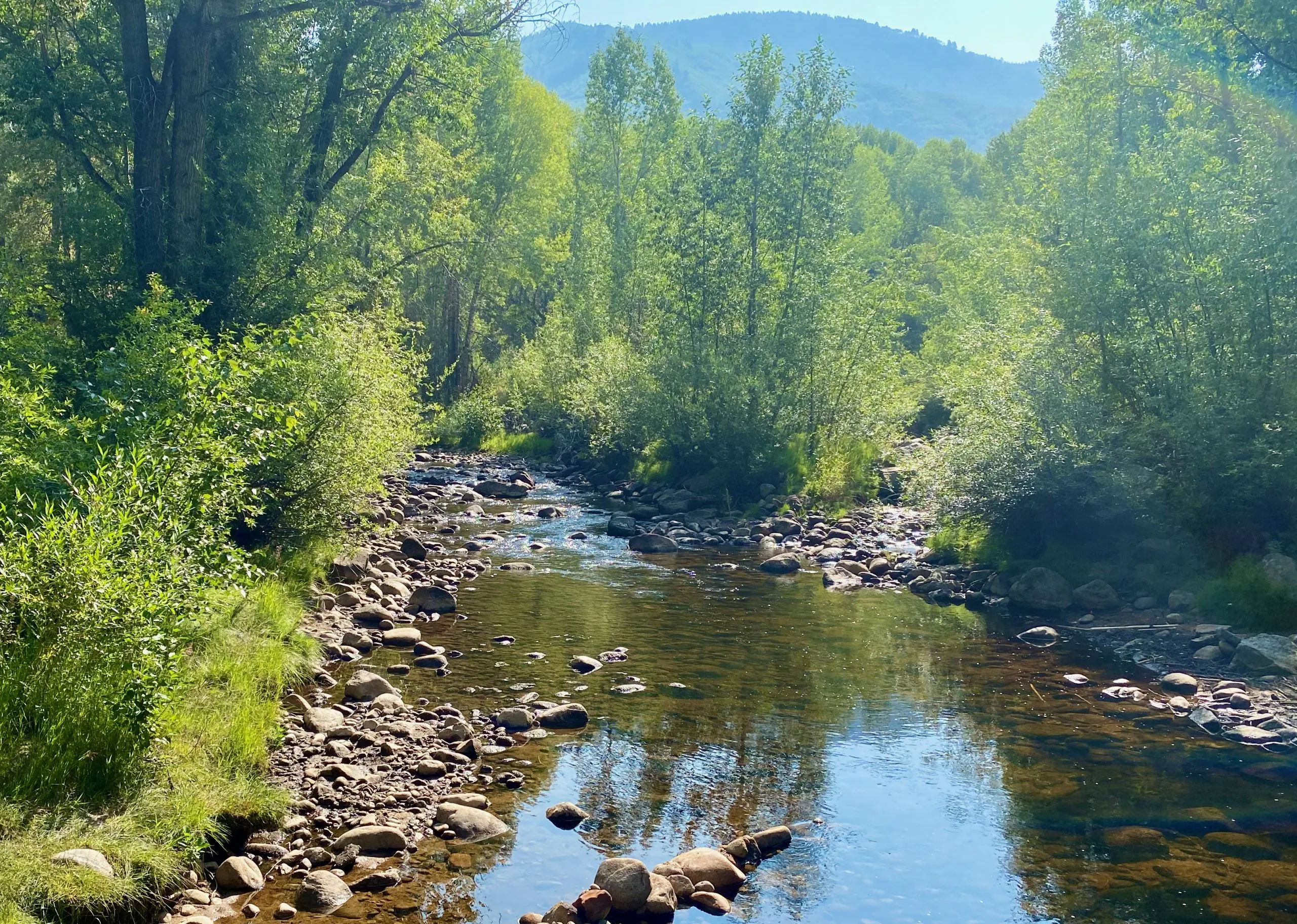
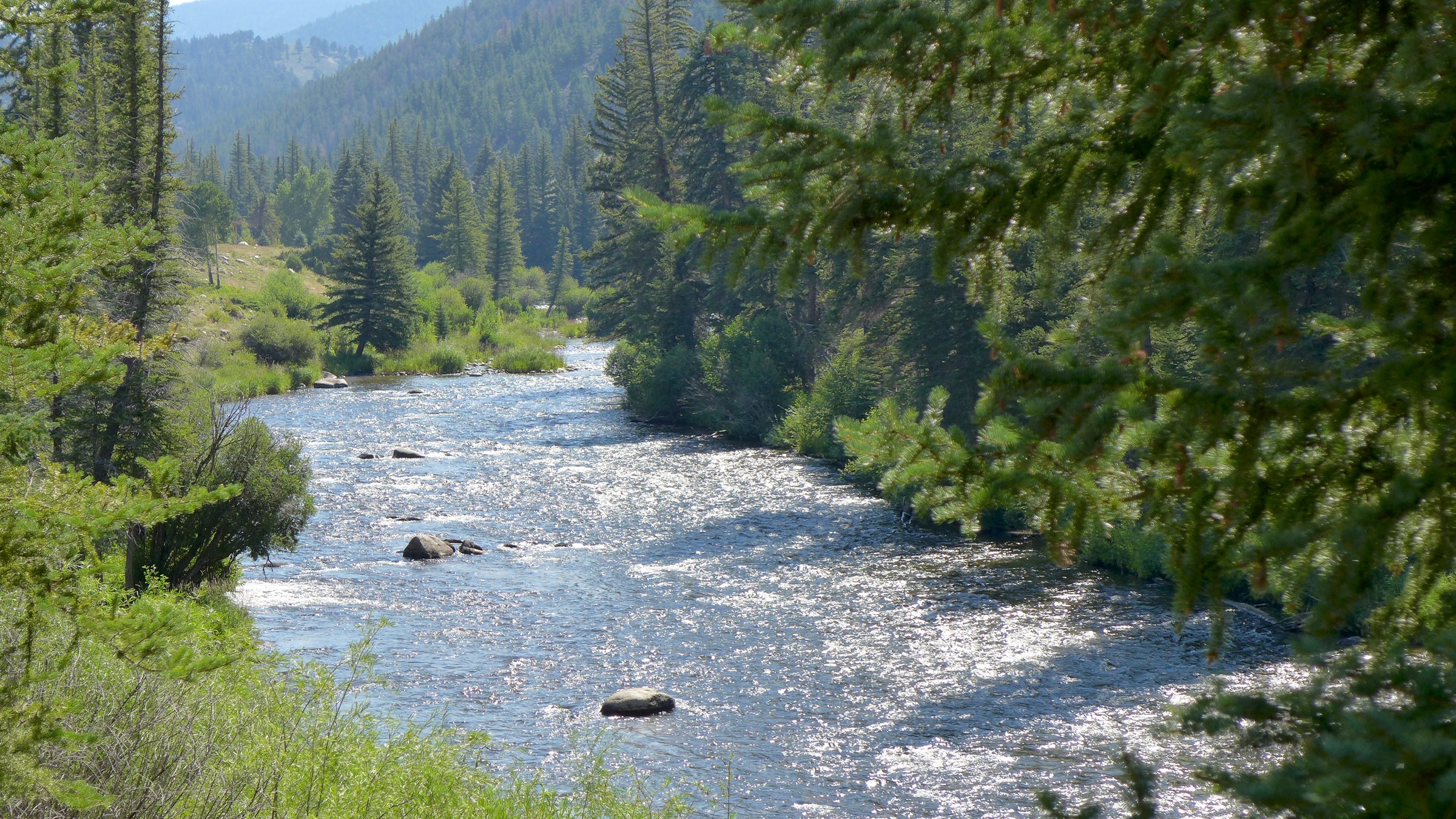
A nearby stream gauge reported that the Roaring Fork River, shown here at Rio Grande Park in Aspen, was flowing at about 9 cfs when this photo was taken in August 2021. Pitkin County plans to buy shares of Twin Lakes water to boost flows in the Roaring Fork. CREDIT: CURTIS WACKERLE/ASPEN JOURNALISM

Click the link to read the article on the Aspen Journalism website (Heather Sackett):

January 23, 2026

Pitkin County is making a historic deal to buy water currently used on the Front Range and put it back into the Roaring Fork. 

The county plans to buy 60 shares of water from Twin Lakes Reservoir and Canal Co. and 34 shares from Fountain Mutual Ditch Co. For $6.5 million, Pitkin County will acquire about 71 acre-feet, although only 45 of those acre-feet represent Western Slope water that is currently diverted to the Front Range. 

Pitkin County Commissioner Francie Jacober made the announcement at Wednesday’s board meeting of the Colorado River Water Conservation District. 

“This is obviously going to help with the flows in the upper Roaring Fork,” Jacober said at the meeting. “It’s really exciting.” 

The money for the purchase will ultimately come from the Pitkin County Healthy Rivers fund, which is supported by a 0.1% countywide sales tax. However, a portion of the funds for the purchase will initially come from the general fund, and the county will issue bonds before the end of the year that will be repaid using Healthy Rivers revenues. 

According to a purchase and sale agreement related to the transaction that was posted online Friday, the Twin Lakes shares are being sold by Castle Concrete Co., while the Fountain shares are owned by Riverbend Industries, which is Castle Concrete’s parent company. Historically, the water involved has been used in the operation of a gravel pit and for gravel processing. 

memo outlining the deal noted that in order to purchase the Twin Lakes shares, the seller also required the county to buy the Fountain shares, which are estimated to yield about 26 acre-feet per year, but that water is not decreed for use on the west side of the Continental Divide.

“We are exploring options for disposing of these shares, either by trading for additional Twin Lakes shares or through sale, thereby offsetting a portion of the purchase price for the Twin Lakes shares,” the memo says.

Jacober told Aspen Journalism that the county worked with brokers West Water Research on the deal, which is set to close on April 2. Representatives from the company declined to comment on the pending transaction. 

The Healthy Rivers board approved the expenditure in a 6-1 vote Jan. 15, and the Board of County Commissioners are set to consider the deal at the Jan. 28 regular meeting.

“I think the [Healthy Rivers] board is moved by the fact that water is really scarce in Colorado and there are not that many opportunities to own and control the timing of water, and that’s what we are excited about here,” said Healthy Rivers chair Kirstin Neff. 

Pitkin County Deputy Attorney Anne Marie McPhee said the county heard that the shares were going to become available before they officially hit the market and officials approached the seller with an offer. 

“That’s how we were able to get the shares,” McPhee said. “Because it’s very rare for these type of shares to come on the open market and usually the municipalities on the eastern slope are trying to get them as quickly as they can.”

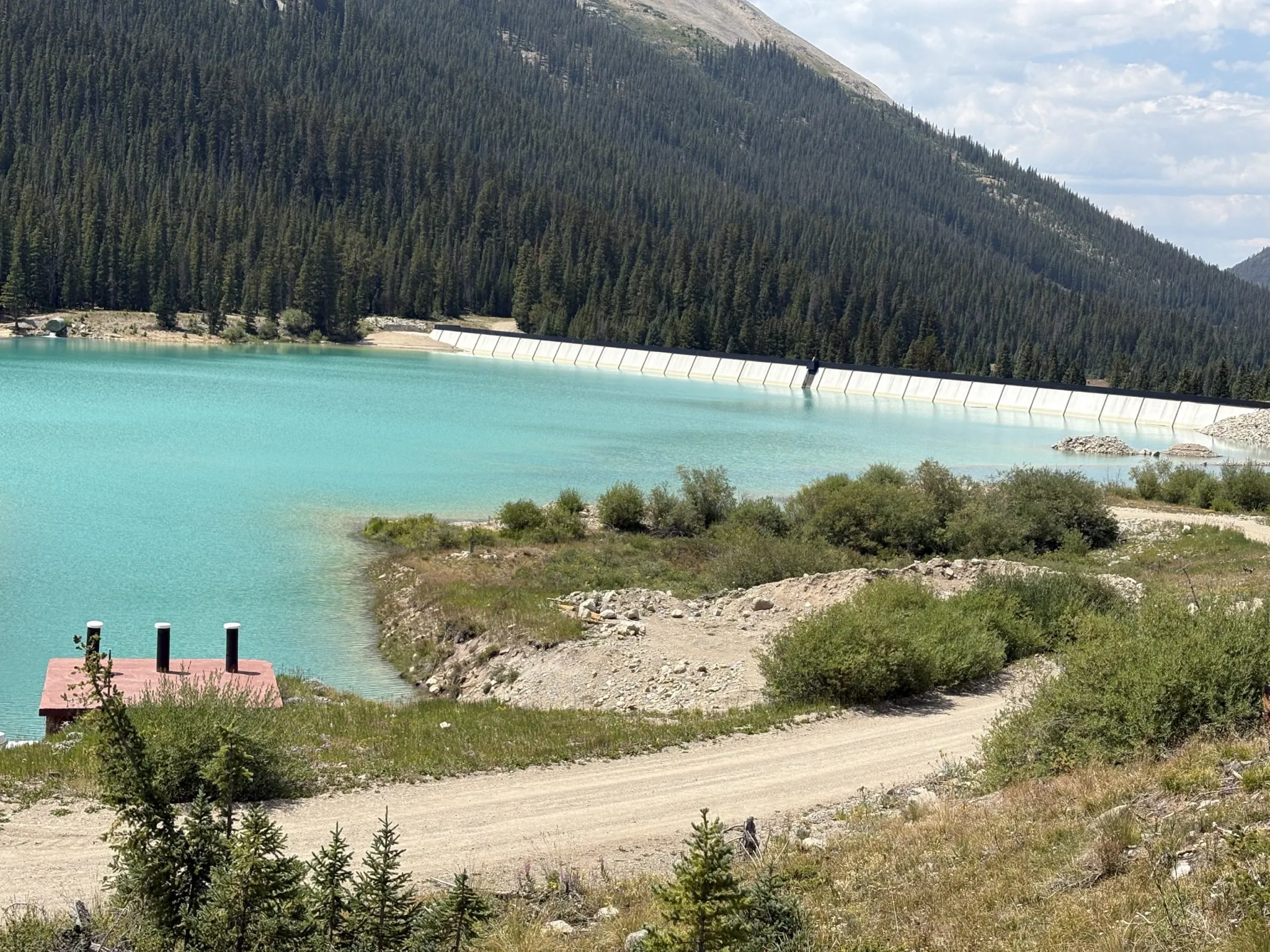
Grizzly Reservoir is part of Twin Lakes’ transmountain diversion system at the headwaters of the Roaring Fork River. Pitkin County plans to buy shares of water from Twin Lakes that are currently used on the Front Range, and put it back into the Roaring Fork River. CREDIT: HEATHER SACKETT/ASPEN JOURNALISM

Twin Lakes system

The Twin Lakes system is a complex and highly engineered arrangement of reservoirs, tunnels and canals that takes water from the headwaters of the Roaring Fork near Independence Pass and delivers it to Front Range cities in what is known as a transmountain diversion. Across the state’s headwaters, transmountain diversions take about 500,000 acre-feet per year from the Colorado River basin to the Front Range. 

Four municipalities own 95% of the shares of Twin Lakes water: Colorado Springs Utilities owns 55%; the Board of Water Works of Pueblo has 23%; Pueblo West Metropolitan District owns 12%; and the city of Aurora has 5%.

Twin Lakes collection system

The project is able to divert up to 46,000 acre-feet annually, or nearly 40% of the flows in the Roaring Fork headwaters, which can leave the Roaring Fork through Aspen depleted. Pitkin County’s purchase will return a small amount of that water to the Roaring Fork. 

Pitkin County has long had a goal of boosting flows in the Roaring Fork, securing a recreational in-channel diversion water right for a park in Basalt and enacting exchange deals and other agreements with Front Range water providers that keep more water flowing west.

Twin Lakes President Alan Ward said the company is not directly involved in transactions between buyers and sellers of water shares. Twin Lakes must simply approve the transfer of certificates between the two. 

County officials said they plan to release the water down the Roaring Fork during the irrigation season when flows are low, but not when the Cameo call is on, which already results in additional water in the Roaring Fork. 

When irrigators in the Grand Valley place the Cameo call, which happens most summers, those with upstream junior water rights, such as Twin Lakes, have to stop diverting so that irrigators can get their share. When Twin Lakes shuts off, it boosts flows in the Roaring Fork. 

McPhee said that although the deal is not cheap, it is a once-in-a-lifetime opportunity.

“You don’t get these opportunities to put physical water in the river anymore, particularly up at the headwaters,” she said. “So we are excited about this.”

Aspen Journalism is supported by a grant from the Pitkin County Healthy Community Fund.

Map of the Roaring Fork River drainage basin in western Colorado, USA. Made using USGS data. By Shannon1 – Own work, CC BY-SA 4.0, https://commons.wikimedia.org/w/index.php?curid=69290878

#ColoradoRiver talks: States are still at odds but working toward a 5-year plan: Time is running short, with less than a month to submit a plan to the federal government — Annie Knox (UtahNewsDispatch.com) #COriver #aridification

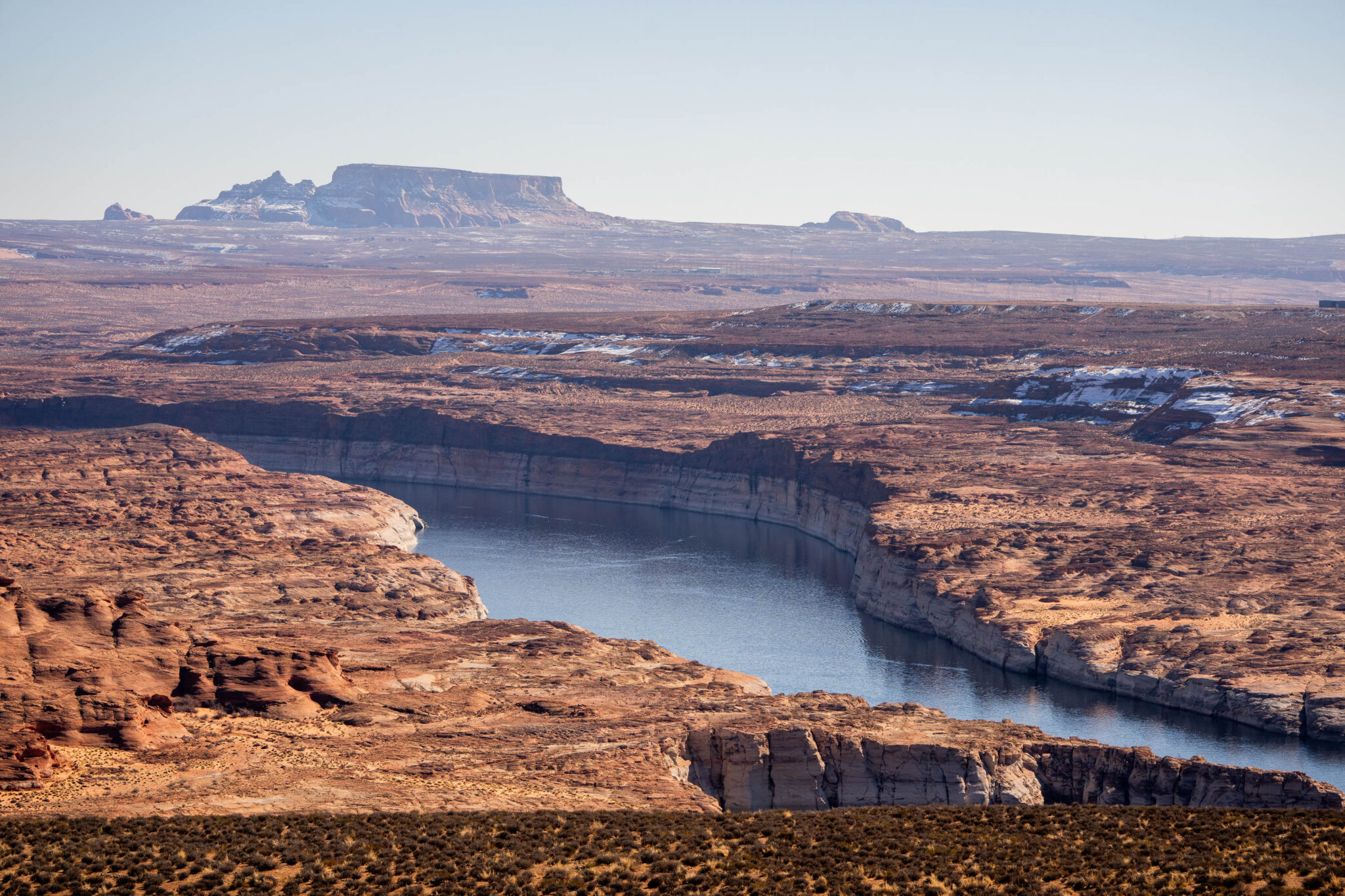
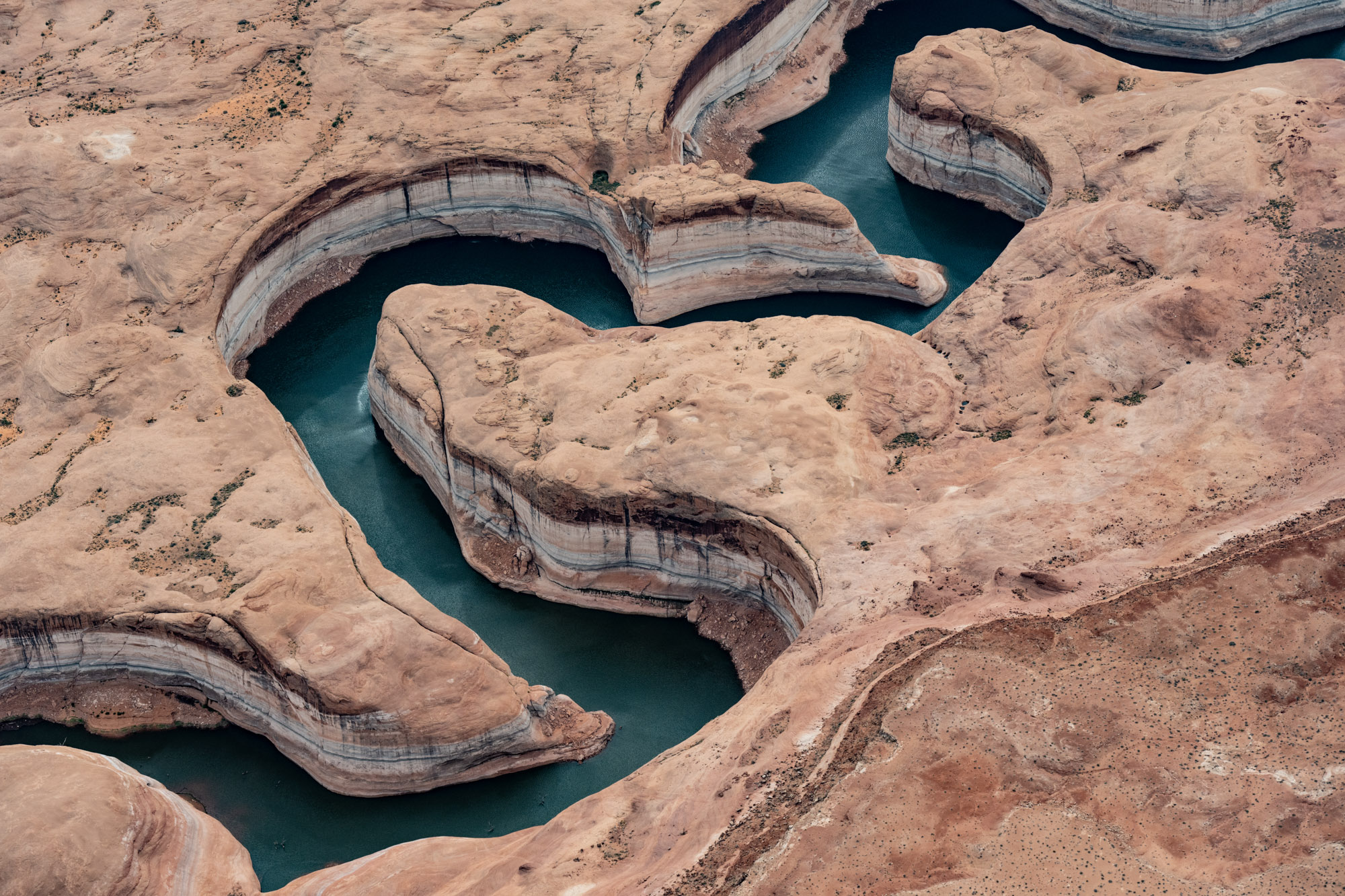
The so-called “bathtub ring”, a deposit of pale minerals left behind where reservoir water levels once reached, is shown on the edge of Lake Powell near Page, Arizona on Sunday, Feb. 2, 2025. (Photo by Spenser Heaps for Utah News Dispatch)

Click the link to read the article on the Utah News Dispatch website (Annie Knox):

January 30, 2026

With just weeks to decide how to share the Colorado River’s shrinking water supply, negotiators from seven states hunkered down in a Salt Lake City conference room. 

Outside was busy traffic on State Street and South Temple. Inside was gridlock that eased up for a time, only to return, Utah’s chief negotiator, Gene Shawcroft said Tuesday of last week’s meetings.

The states moved forward on a deal for two-and-a-half days, then went back by almost as far as they’d come, Shawcroft said. 

“I would just tell you that four days is too long. We got tired of each other,” he said. 

Shawcroft reiterated Tuesday what he and his counterparts from the other Colorado River states have said in recent months: They don’t have a deal, but they do have a commitment to keep talking and meet their upcoming February deadline. 

The earlier goal was to reach a 20-year deal, but Shawcroft told Utah News Dispatch the states are now working on an agreement for a shorter time frame. 

“I think it’ll be fairly simple, but I think it’ll allow us to operate for the next five years,” Shawcroft said.  

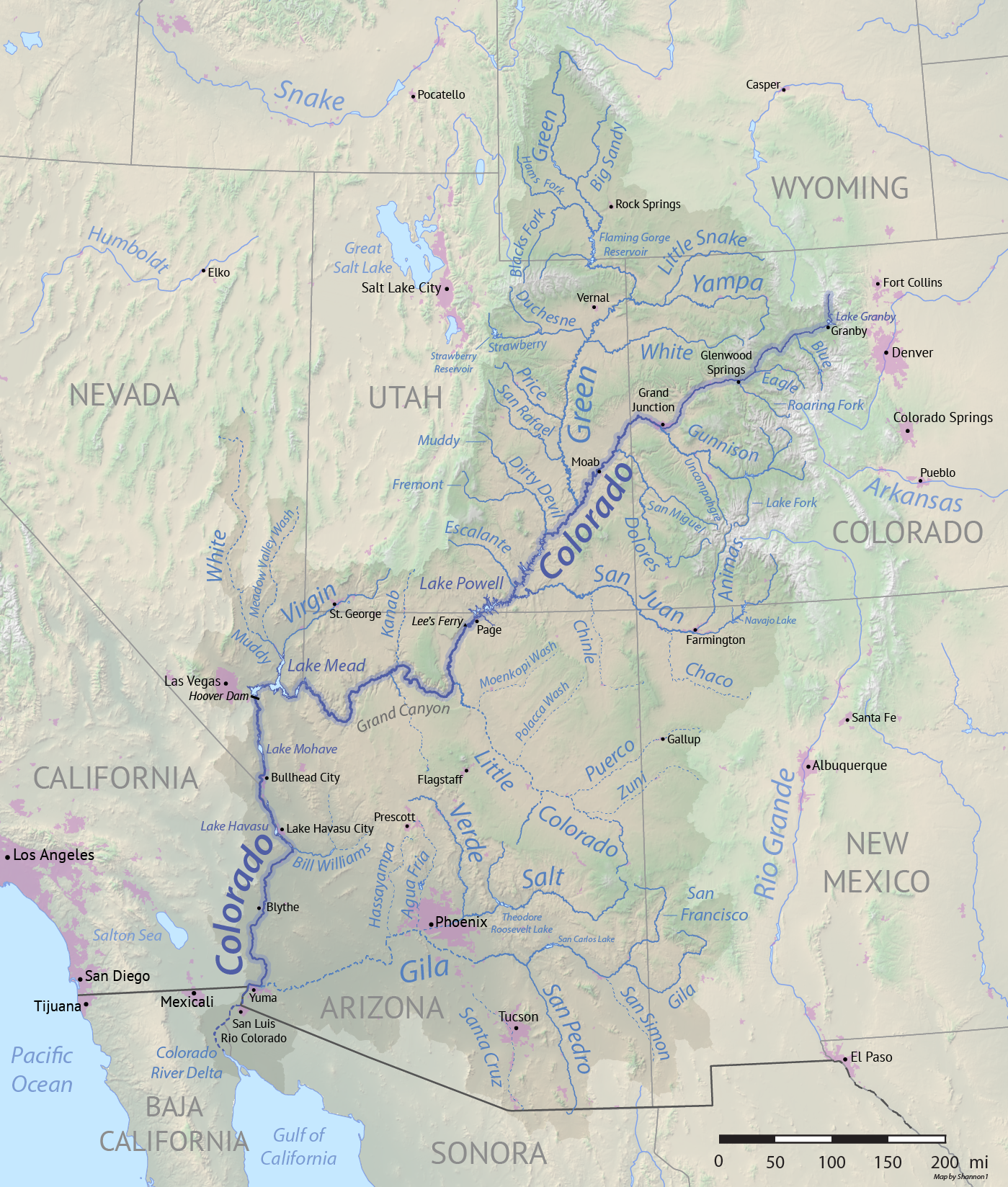
Map of the Colorado River drainage basin, created using USGS data. By Shannon1 Creative Commons Attribution-Share Alike 4.0

The river provides water to 40 million people across the U.S. and Mexico, contributing 27% of Utah’s water supply. It is shrinking because of drought, [ed. and aridification]overuse and hotter temperatures tied to climate change.

Time for negotiators is also drying up as a Feb. 14 deadline set by the federal government approaches. The current agreement runs through late 2026.

The four Upper Basin states — Utah, Colorado, New Mexico and Wyoming — are at odds with the Lower Basin states of Nevada, Arizona and California.

The upstream states don’t want to make mandatory cuts in dry years, saying they typically use much less than they’re allocated. The downstream states say all seven need to absorb cuts in difficult years.

Conservation groups have criticized the states for not reaching a deal yet, saying “escalating risks” — including declining storage in lakes Powell and Mead — are piling up every month they fail to agree on a plan. 

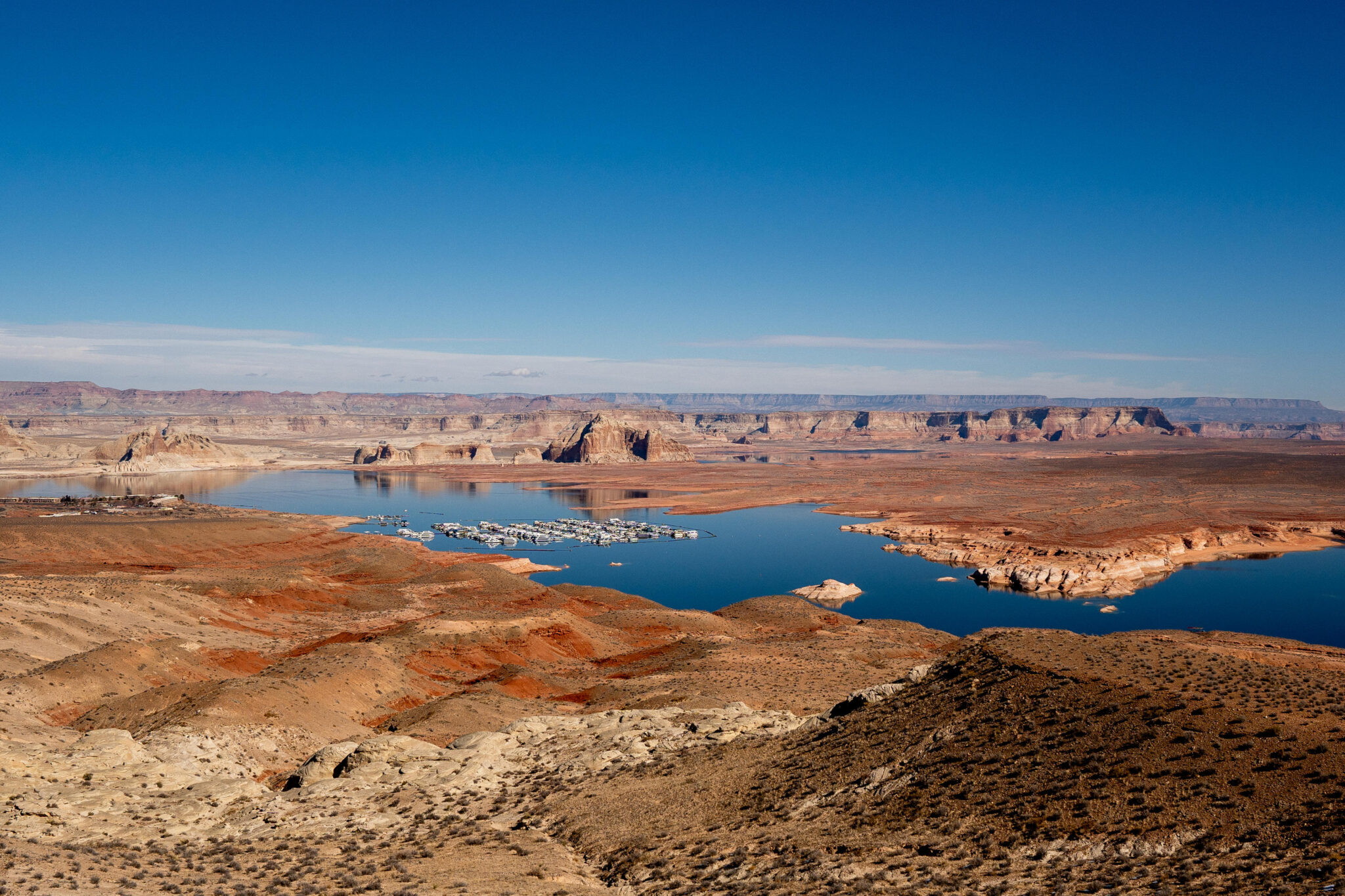
Lake Powell and the Wahweap Marina are pictured near Page, Arizona on Sunday, Feb. 2, 2025. (Photo by Spenser Heaps for Utah News Dispatch)

The debate centers in part on upstream reservoirs like Flaming Gorge on the Utah-Wyoming border and whether they’ll be managed under the new plan. 

“Lower Basin believes those reservoirs ought to be used at the beck and call of the lower basin to reduce their reductions,” Shawcroft said at the meeting. “Obviously, we think differently.” 

Arizona Gov. Katie Hobbs, for her part, has criticized the upstream states’ “extreme negotiating posture,” saying they refuse to participate in any sharing in managing water shortages. 

West Drought Monitor map January 13, 2026.

Demand for water is outpacing the river’s supply, and extended dry periods aren’t helping. At the meeting, board members viewed a map covered in yellow, orange and red, noting the entire Colorado River watershed is experiencing some level of drought. 

Earlier this month, the U.S. Bureau of Reclamation, the federal agency that oversees water in the West,released five options for a framework on managing the river’s biggest reservoirs, Lake Mead in Nevada and Lake Powell on the Utah-Arizona line.

Amy Haas, executive director of the Colorado River Authority of Utah, said she and her colleagues were still reviewing the 1,600-page document but one thing is clear.  

“None of the five can provide what for Utah is really the central consideration for the deal, and that is a waiver of compact litigation,” Haas said. 

States can sacrifice more than just time and money in lawsuits over water use. In Texas, similar litigationgave the federal government more leverage in negotiations. 

One of the Bureau of Reclamation’s plans would have Nevada, Arizona and California face potential water shortages. It could go into effect next year if the seven states don’t reach a deal.  

“The river and the 40 million people who depend on it cannot wait,” Andrea Travnicek, assistant interior secretary for water and science, said in a Jan. 9 statement announcing the five alternatives. “In the face of an ongoing severe drought, inaction is not an option.”

Udall/Overpeck 4-panel Figure Colorado River temperature/precipitation/natural flows with trend. Lake Mead and Lake Powell storage. Updated through Water Year 2025. Note the tiny points on the annual data so that you can flyspeck the individual years. Credit: Brad Udall

The Arkansas Valley Conduit project has about three years of cash left to keep building, despite President Trump’s veto — Jerd Smith (Fresh Water News) #ArkansasRiver #ColoradoRiver #COriver #aridification

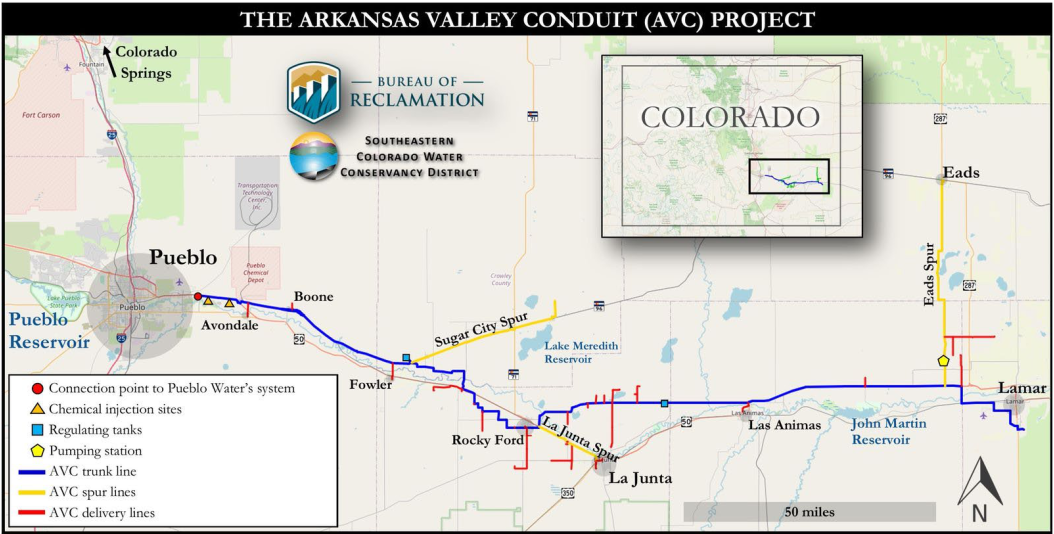
Arkansas Valley Conduit map via the Southeastern Colorado Water Conservancy District (Chris Woodka) June 2021.

Click the link to read the article on the Water Education Colorado website (Jerd Smith):

January 15, 2026

Water officials and Colorado’s congressional reps are scrambling to find an affordable path forward for communities in the Lower Arkansas Valley who had hoped the federal government would help them lower their costs for a critical clean water pipeline.

President Trump vetoed the bipartisan Finish the Arkansas Valley Conduit Act on New Year’s Eve, and despite Colorado’s efforts, Congress failed to override the veto last week.

Construction on the $1.39 billion pipeline began in 2023. There’s enough money left from the $500 million appropriated by Congress to continue building for another three to five years, according to Bill Long, president of the board for the Pueblo-based Southeastern Water Conservancy District. The district operates the federal Fryingpan-Arkansas Project and is overseeing pipeline construction for the U.S. Bureau of Reclamation.

That means the pipeline should eventually reach Rocky Ford, a point roughly halfway between its start east of Pueblo Reservoir and its endpoint farther east, near Lamar. “It’s when we get to the second half of the project where it will be challenging to build and repay our portion of the debt,” Long said. “Without this legislation, there will be a point where we will have to stop.”

What comes next isn’t clear yet, though members of Colorado’s congressional delegation and water officials in the Lower Arkansas Valley said they are evaluating their options for taking another run at the issue in Congress.

“Obviously things are up in the air,” Long said.

“Sooner rather than later we may be looking at a new piece of legislation, but the question is, would this administration be amenable to a new piece of legislation. If we can’t find something, we may have to wait this administration out,” he said.

Pueblo Dam. Photo courtesy of Colorado Parks and Wildlife

Waiting for clean water in the Lower Arkansas Valley is nothing new.

First envisioned as part of the U.S. Bureau of Reclamation’s Fryingpan-Arkansas Project in 1962, the pipeline languished on paper for decades because of high costs. The 130-mile pipeline serves 39 communities.

The need for clean water in the Lower Arkansas Valley became apparent in the 1950s and earlier, by some accounts, when wells drilled near the Arkansas River were showing a range of toxic elements, including naturally occurring radium and selenium. Both can cause severe health problems, including bone cancer and lung issues if high amounts are consumed.

Without safe drinking water, towns in the region have either had to haul water or install expensive reverse osmosis plants to purify their contaminated well water.

Things changed on the stalled project in 2023, when Congress directed some $500 million toward the pipeline.

The legislation would have gone further, allowing the repayment terms on the loans from the federal government to be extended to 75 years, up from 50 years, and to cut interest rates in half, from 3.046% to 1.523%. The legislation also would have allowed the project to be classified as one of hardship, a move that may have allowed the U.S. Bureau of Reclamation to forgive some loan payments if a case for economic hardship could have been made.

The conduit project is also partially funded with grants and loans from state agencies, including the Colorado Water Resources and Power Development Authority.

“The act was an important step in making this project affordable,” said Keith McLaughlin, executive director of the Colorado Water Resources and Power Development Authority, one of the agencies helping fund the work.

“Obviously we’re disappointed,” he said.

Colorado politicos say they’re still working to push legislation through. The bipartisan act was sponsored by Colorado Republican U.S. Reps. Lauren Boebert and Jeff Hurd in the U.S. House and Democratic U.S. Sens. John Hickenlooper and Michael Bennet in the U.S. Senate.

Trump’s veto of the measure is widely seen as being the result of ongoing conflicts between his administration and Colorado Gov. Jared Polis, a Democrat, including a request to pardon former Mesa County Clerk Tina Peters, who is serving a nine-year prison term for orchestrating a data breach of the county’s elections equipment violating state elections. Polis so far has declined to intervene in that case, although he did describe the sentence as “harsh,” leading some to speculate that he might commute it. In a statement, Polis said he was hopeful that Congress would ultimately succeed in approving some form of aid to help complete the conduit.

Neither Boebert nor Hurd responded to a request for comment. But Hickenlooper said that all the congressional reps continue to work on a new path forward.

“The people of southeastern Colorado have waited 60 years for clean, safe drinking water. We’re continuing to work with our partners in the delegation to complete the Arkansas Valley Conduit and deliver on the federal government’s promise,” Hickenlooper said via email.

More by Jerd Smith

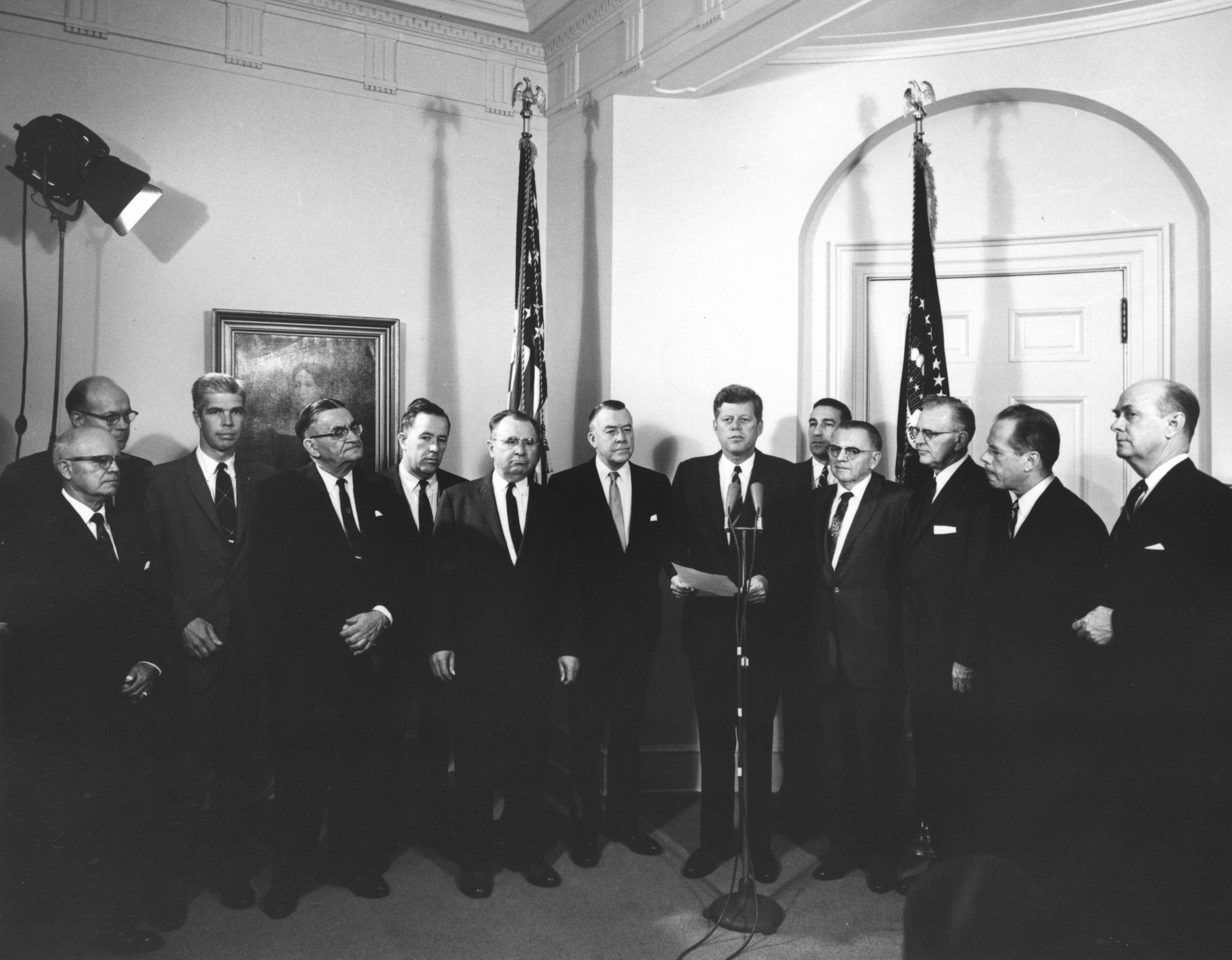
Bill signing – H.R. 2206 Public Law 87-590, Frying-Pan-Arkansas Project, Colorado. Photo credit: John F. Kennedy Presidential Library and Museum

U.S. House of Representatives refuses to override President Trump’s veto of bill that would’ve helped fund the Arkansas Valley Conduit — The #Denver Post #ArkansasRiver

Arkansas Valley Conduit map via the Southeastern Colorado Water Conservancy District (Chris Woodka) June 2021.

Click the link to read the article on The Denver Post website (Kevin Freking and Nick Coltrain ). Here’s an excerpt:

January 8, 2026

Rep. Lauren Boebert, who sponsored bill, pushed president in November to release Jeffrey Epstein files

The U.S. House refused Thursday to override President Donald Trump’s vetoes of two low-profile bills — including one that would help pay for a water pipeline in Colorado — as Republicans stuck with the president despite their prior support for the measures. Congress can override a veto with support from two-thirds of the members of the House and the Senate. The threshold is rarely reached. In this case, Republicans opted to avoid a fight in an election year over bills with little national significance, with most GOP members voting to sustain the vetoes. The two vetoes were the first of Trump’s second term. One bill was designed to help local communities finance the construction of a pipeline to provide water to tens of thousands in southeastern Colorado. The other designated a site in Everglades National Park as a part of the Miccosukee Indian Reservation…

On the Colorado bill, 35 Republicans sided with Democrats in voting for an override — with all members of the state’s delegation from both parties supporting an override. On the Florida bill, only 24 Republicans voted for the override. The White House did not issue any veto threats prior to passage of the bills, so Trump’s scathing comments in his recent veto message came as a surprise to sponsors of the legislation. Ultimately, his vetoes had the effect of punishing backers who had opposed the president’s positions on other issues. The water pipeline bill came from Republican Rep. Lauren Boebert of Colorado, a longtime Trump ally who broke with the president in November to release files on convicted sex offender Jeffrey Epstein. The bill to give the Miccosukee Tribe of Indians more control of some of its tribal lands would have benefited one of the groups that sued the administration over an immigration detention center known as “Alligator Alcatraz.”

Map of the Arkansas River drainage basin. Created using USGS National Map and NASA SRTM data. By Shannon1 – Own work, CC BY-SA 4.0, https://commons.wikimedia.org/w/index.php?curid=79039596

U.S. Senators John Hickenlooper, and Michael Bennet Slam President Trump’s Veto of Their Finish the Arkansas Valley Conduit Act #ArkansasRiver #ColoradoRiver

President John F. Kennedy at dedication of the Fryingpan-Arkansas Project.

Click the link to read the release on Senator Hickenlooper’s website:

December 31, 2025

U.S. Senators John Hickenlooper and Michael Bennet issued the following statement after President Trump vetoed their bipartisan Finish the Arkansas Valley Conduit Act

“Nothing says ‘Make America Great Again’ like denying 50,000 rural Coloradans access to clean, affordable drinking water. President Trump’s first veto of his second term blocks a bipartisan bill that both the House and Senate passed unanimously, costs taxpayers nothing, and delivers safe, reliable water to rural communities that overwhelmingly supported him. Trump’s attacks on Southern Colorado are politics at its worst—putting personal and political grievances ahead of Americans. Southeastern Coloradans were promised the completion of the Arkansas Valley Conduit more than 60 years ago. With this veto, President Trump broke that promise and demonstrated exactly why so many Americans are fed up with Washington. We will keep fighting to make sure rural Coloradans get the clean drinking water they were promised.”

Arkansas Valley Conduit map via the Southeastern Colorado Water Conservancy District (Chris Woodka) June 2021.

#Conservation studies findings on #Colorado’s Western Slope have lessons for water managers: Western Slope water users want Front Range to match cuts — Heather Sackett (AspenJournalism.org) #ColoradoRiver #COriver #aridification

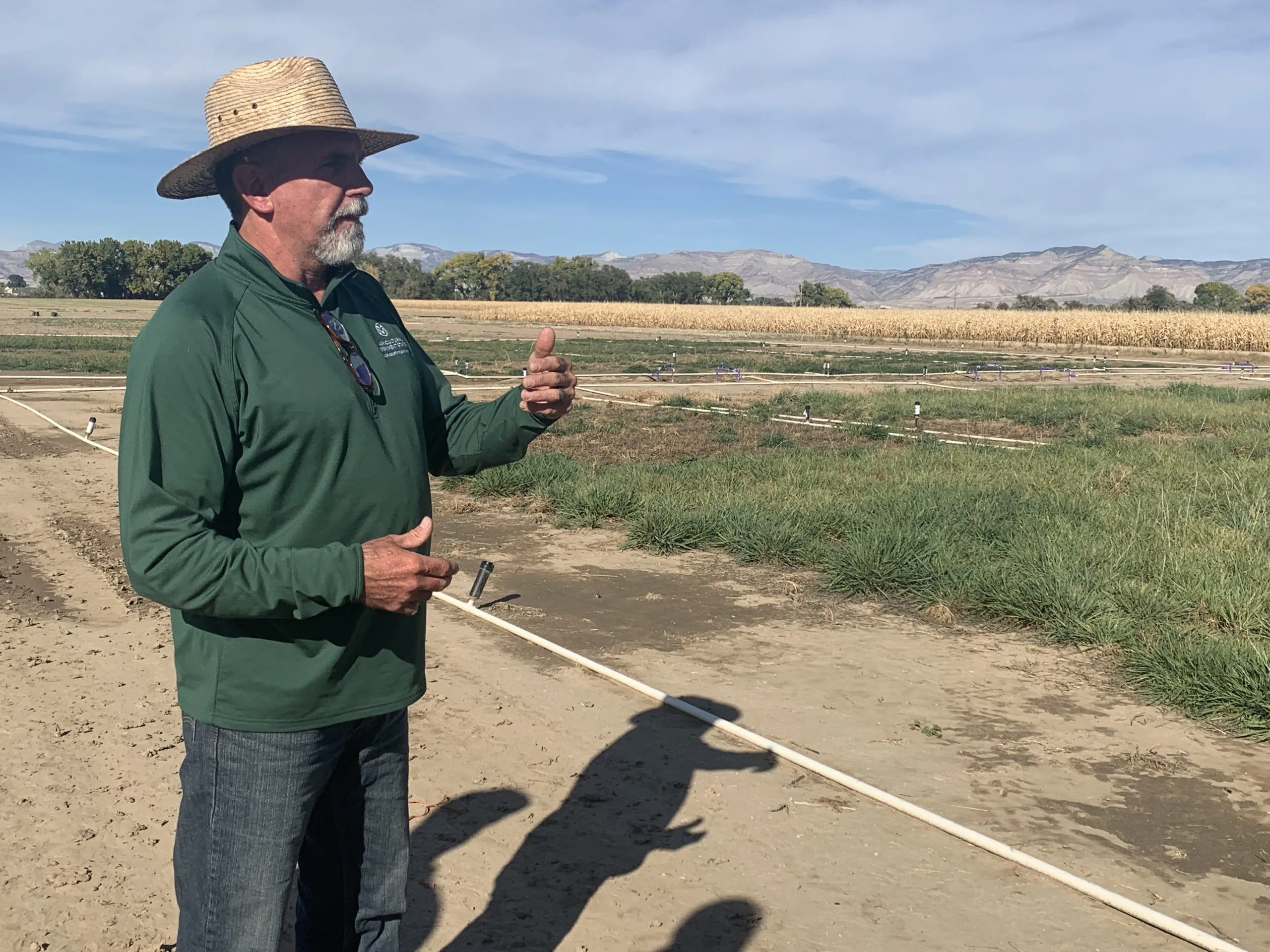
Colorado State University researcher Perry Cabot talks to a group about forage crops at the Fruita field station. Cabot studies the effects of irrigation withdrawal and forage crops that use less water. CREDIT: HEATHER SACKETT/ASPEN JOURNALISM

Click the link to read the article on the Aspen Journalism website (Heather Sackett):

December 12, 2025

The findings of recent water-conservation studies on the Western Slope could have implications for lawmakers and water managers as they plan for a future with less water.

Researchers from Colorado State University have found that removing irrigation water from high-elevation grass pastures for an entire season could have long-lasting effects and may not conserve much water compared with lower-elevation crops. Western Slope water users prefer conservation programs that don’t require them to withhold water for the entire irrigation season, and having the Front Range simultaneously reduce its water use may persuade more people to participate. Researchers also found that water users who are resistant to conservation programs don’t feel much individual responsibility to contribute to what is a Colorado River basinwide water shortage. 

“It’s not a simple economic calculus to get somebody to the table and get them to sign a contract for a conservation agreement,” said Seth Mason, a Carbondale-based hydrologist and one of the researchers. “It involves a lot of nuance. It involves a lot of thinking about tradeoffs.” 

Udall/Overpeck 4-panel Figure Colorado River temperature/precipitation/natural flows with trend. Lake Mead and Lake Powell storage. Updated through Water Year 2025. Note the tiny points on the annual data so that you can flyspeck the individual years. Credit: Brad Udall

Over the past 25 years, a historic drought and the effects of climate change have robbed the Colorado River of its flows, meaning there is increasing competition for a dwindling resource. In 2022, water levels in Lake Powell fell to their lowest point ever, prompting federal officials to call on the seven states that share the river for unprecedented levels of water conservation. 

The Upper Basin states (Colorado, New Mexico, Utah and Wyoming) have experimented for the past decade with pilot programs that pay agricultural water users to voluntarily and temporarily cut back by not irrigating some of their fields for a season or part of a season.

The most recent program was the federally funded System Conservation Pilot Program, which ran in the Upper Basin in 2023 and 2024, and saved about 100,000 acre-feet of water at a cost of $45 million. The Upper Basin has been facing mounting pressure to cut back on its use, and although some type of future conservation program seems certain, Upper Basin officials say conservation must be voluntary, not mandatory.

Despite dabbling in these pilot conservation programs, Upper Basin water managers have resisted calls for cuts, saying their water users already suffer shortages in dry years and blaming the plummeting reservoirs on the Lower Basin states (California, Nevada and Arizona). Plus, the Upper Basin has never used its entire allocation of 7.5 million acre-feet a year promised to it under the 1922 Colorado River Compact, while the Lower Basin uses more than its fair share. 

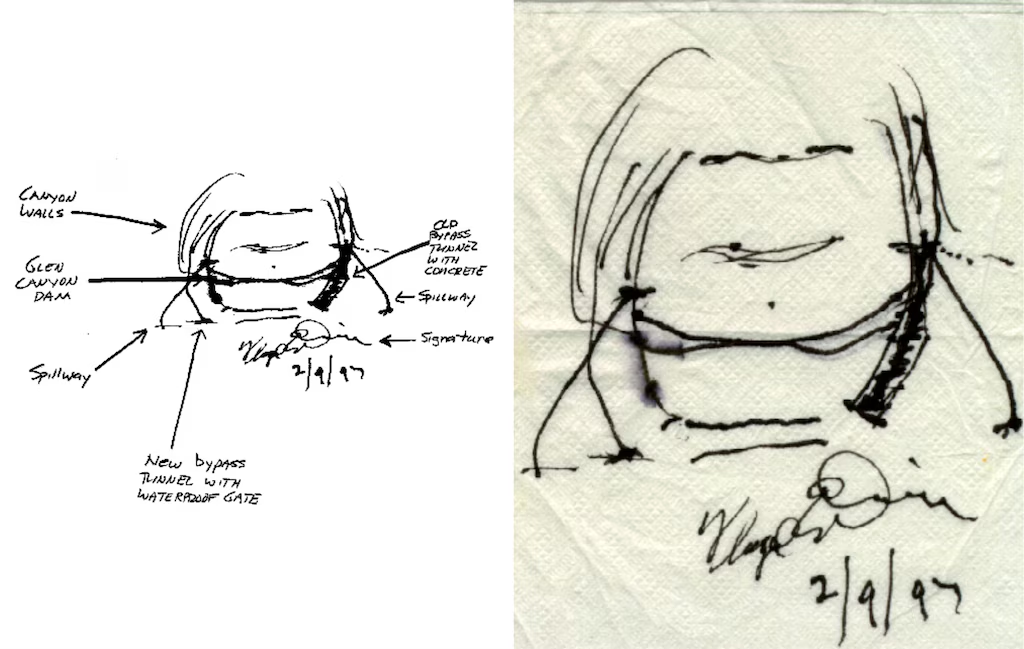
Sketches by Floyd Dominy show the way he’d end the Glen Canyon Dam. From the article “Floyd Dominy built the Glen Canyon Dam, then he sketched its end on a napkin” on the Salt Lake Tribune website

But as climate change continues to fuel shortages, makes a mockery of century-old agreements and pushes Colorado River management into crisis mode, the Upper Basin can no longer avoid scrutiny about how it uses water. 

“We need a stable system in order to protect rivers,” said Matt Rice, director of the Southwest region at environmental group American Rivers, which helped fund and conduct the research. “(Upper Basin conservation) is not a silver bullet. But it’s an important contributing factor, it’s politically important and it’s inevitable.”

Researchers from Colorado State University used this monitoring station to track water use on fields near Kremmling. Researchers have found that Western Slope water users are more likely to participate in conservation programs if there is a corresponding Front Range match in water use reduction. CREDIT: HEATHER SACKETT/ASPEN JOURNALISM

Findings

Papers by the researchers outline how water savings on Colorado’s high-elevation grass pastures — which represent the majority of irrigated acres on the Western Slope — are much less than on lower-elevation fields with other annual crops. Elevation can be thought of as a proxy for temperature; fewer frost-free days means a shorter growing season and less water use by the plants. 

“Our results suggest that to get the equivalent conserved consumptive-use benefit that you might achieve on one acre of cornfield in Delta would require five acres of grass pasture if you were up near Granby, for example,” said Mason, who is a doctoral candidate at CSU. “This is a pretty important constraint as we’re thinking about what it means to do conservation in different locations across the West Slope.”

In addition to the science of water savings, Mason’s research also looked at the social aspects of how water users decide to participate in conservation programs. He surveyed 573 agricultural water users across the Western Slope and found that attitudes toward conservation and tendencies toward risk aversion — not just how much money was offered — played a role in participation. 

Many who said they would not participate had a low sense of individual responsibility to act and a limited sense of agency that they could meaningfully contribute to a basinwide problem.

If you don’t pay attention to the attitudes of water users, you could end up with an overly rosy picture of the likelihood of participation, Mason said.

“It may do well to think less about how you optimize conservation contracts on price and do more thinking about how you might structure public outreach campaigns to change hearts and minds, how you might shift language as a policymaker,” he said. “A lot of the commentary that we hear around us is that maybe this isn’t our problem, that this is the Lower Basin’s problem. [ed. emphasis mine] The more you hear that, the less likely you are to internalize a notion of responsibility.”

Mason also found that a corresponding reduction in Front Range water use may boost participation by Western Slope water users. The fact that Front Range water providers take about 500,000 acre-feet annually from the headwaters of the Colorado River is a sore spot for many on the Western Slope, who feel the growth of Front Range cities has come at their expense. These transmountain diversions can leave Western Slope streams depleted. 

Western Slope water users often describe feeling as if they have a target on their back as the quickest and easiest place to find water savings.

“I think they tend to be appreciative of notions that have some element of burden sharing built into them,” Mason said. “So they aren’t the only ones being looked at to contribute as part of a solution to a problem.”

Perry Cabot, a CSU researcher who studies the effects of irrigation withdrawal and forage crops that use less water, headed up a study on fields near Kremmling to see what happens when they aren’t irrigated for a full season or part of a season. The findings showed that fields where irrigation water was removed for the entire season produced less hay, even several years after full irrigation was resumed. Fields where water was removed for only part of the season had minimal yield loss and faster recovery. 

“In the full season, you can have a three-year legacy effect, so that’s where the risk really comes in if you’re a producer participating in these programs,” Cabot said. “For three years after, you’re not getting paid even though you’ve diminished that yield.”

At the CSU research station in Fruita, Cabot is studying a legume called sainfoin, a forage crop and potentially an alternative to grass or alfalfa. He said sainfoin shows promise as a drought-tolerant crop that can be cut early in the season, allowing producers to have their cake and eat it too: They could maintain the income from growing a crop, avoid some of the worst impacts of a full-season fallowing, and still participate in a partial-season conservation program. 

“I’d like to see flexible options that allow us to think about conservation happening on fields that still have green stuff out there,” Cabot said.

This field near Kremmling participated in an early study on the effects of removing irrigation water. Researchers found the effects of full-season fallowing can have lasting impacts. CREDIT: HEATHER SACKETT/ASPEN JOURNALISM

Part of the solution

The Glenwood Springs-based Colorado River Water Conservation District has been one of the loudest voices weighing in on conservation in recent years, helping to fund Cabot’s and Mason’s studies, as well as conducting its own. The River District, which represents 15 counties on the Western Slope, is not a fan of conservation programs, but it has long accepted their inevitability. It has advocated for local control and strict guidelines around a program’s implementation to avoid negative impacts to rural agricultural communities. 

River District General Manager Andy Mueller said there is still a lot of resistance to a conservation program in Colorado — especially if the saved water is being used downstream to fuel the growth of residential subdivisions, computer-chip factories and data centers in Arizona. In addition to wanting the Front Range to share their pain, Western Slope water users don’t want to make sacrifices for the benefit of the Lower Basin. [ed. emphasis mine]

“They want to be part of the solution, but they don’t want to suffer so that others can thrive,” Mueller said. “That’s what I keep hearing over and over again from our producers on the ground: They are willing to step up, but they want everybody to step up with them.”

Water experts agree Upper Basin conservation is not a quick solution that will keep the system from crashing. Complicated questions remain about how to make sure the conserved water gets to Lake Powell and how a program would be funded. 

And as recent studies show, the tricky social issues that influence program participation, multiseason impacts to fields when water is removed and the scant water savings from high-elevation pastures mean the state may struggle to contribute a meaningful amount of water to the Colorado River system through a conservation program. 

“If the dry conditions continue, it’s hard to produce the volumes of water that make a difference in that system,” Mueller said. “But are we willing to try? Absolutely. It has to be done really carefully.”

Map of the Colorado River drainage basin, created using USGS data. By Shannon1 Creative Commons Attribution-Share Alike 4.0

President Trump vetoes bill to fund pipeline to bring clean water to southeast #Colorado: U.S. Representative Boebert’s Epstein vote, Colorado’s imprisonment of Tina Peters have drawn the president’s ire recently — The #Denver Post #ArkansasRiver #ColoradoRiver

Arkansas Valley Conduit map via the Southeastern Colorado Water Conservancy District (Chris Woodka) June 2021.

Click the link to read the article on The Denver Post website (Nick Coltrain). Here’s an excerpt:

December 31, 2025

House Resolution 131, sponsored by U.S. Rep. Lauren Boebert and U.S. Sen. Michael Bennet, both of Colorado, sought to jumpstart a project that has languished since 1962. The bill, one of two vetoed by Trump on Tuesday, would extend the repayment period for the project and lower the interest rate. It passed both chambers of Congress by voice vote earlier this year…Trump, who has recently lashed out at Colorado for a slew of grievances, cited the project’s $1.3 billion price tag and said it was supposed to be paid for by local municipalities — not the federal government — in his veto statement…

9News first reported the veto. In a statement to the news station, Boebert said, “If this administration wants to make its legacy blocking projects that deliver water to rural Americans, that’s on them.” She also told the network that she hopes “this veto has nothing to do with political retaliation for calling out corruption and demanding accountability. Americans deserve leadership that puts people over politics.”

Boebert, a Republican representing Colorado’s 4th Congressional District and a longtime ally of the president, recently broke with him by voting to mandate the release of the so-called Epstein files, a trove of documents about the notorious sex criminal with longtime ties to Trump. Trump has also singled out Colorado for retribution over the state’s imprisonment of former Mesa County Clerk Tina Peters.

Chris Woodka, senior policy and issues manager at the Southeastern Colorado Water Conservancy District, which is overseeing the project, said his team is working with Colorado’s congressional delegation on next steps.

Map of the Arkansas River drainage basin. Created using USGS National Map and NASA SRTM data. By Shannon1 – Own work, CC BY-SA 4.0, https://commons.wikimedia.org/w/index.php?curid=79039596

The Year in Water 2025: The #ColoradoRiver — Brett Walton (circleofblue.org) #COriver #aridification

Click the link to read the article on the Circle of Blue website (Brett Walton):

December 24, 2025

The year is ending with the Colorado River at a critical juncture.

Figure 4. Graph showing active storage in Lake Powell, Lake Mead, and in Powell+Mead between January 1, 2023, and November 30, 2025. Credit: Jack Schmidt/Center for Colorado River Studies

The big reservoirs Mead and Powell remain perilously low and the seven states that share the basin have been unable to agree on cuts that would reduce their reliance on the shrinking river.

Reservoir operating rules expire at the end of 2026. If no agreement is reached the federal government could step in, or the states could take their chances in court. It’s a risky move that no one in principle seems to want. Yet brinkmanship and entrenched positions have stymied compromise.

Native America in the Colorado River Basin. Credit: USBR

The basin’s Indian tribes, which collectively have rights to more than a quarter of its recent average annual flow, are adamant that their interests – and more broadly, the river itself – be protected. “Any progress made in the negotiations to date is merely rationing a reduced supply, not actively managing and augmenting it as a shared resource with strategies and tools that can benefit the entire basin,” the leaders of the Gila River Indian Community wrote on November 12.

The Colorado River Indian Tribes, whose riverside reservation includes lands in Arizona and California, voted in November to extend legal personhood to the river under tribal law.

Map of the Colorado River drainage basin, created using USGS data. By Shannon1 Creative Commons Attribution-Share Alike 4.0

The #Colorado Water Conservation Board votes yes on Shoshone: The #ColoradoRiver District will retain some control over management of powerful water rights — Heather Sackett (AspenJournalism.org) #COriver #arification

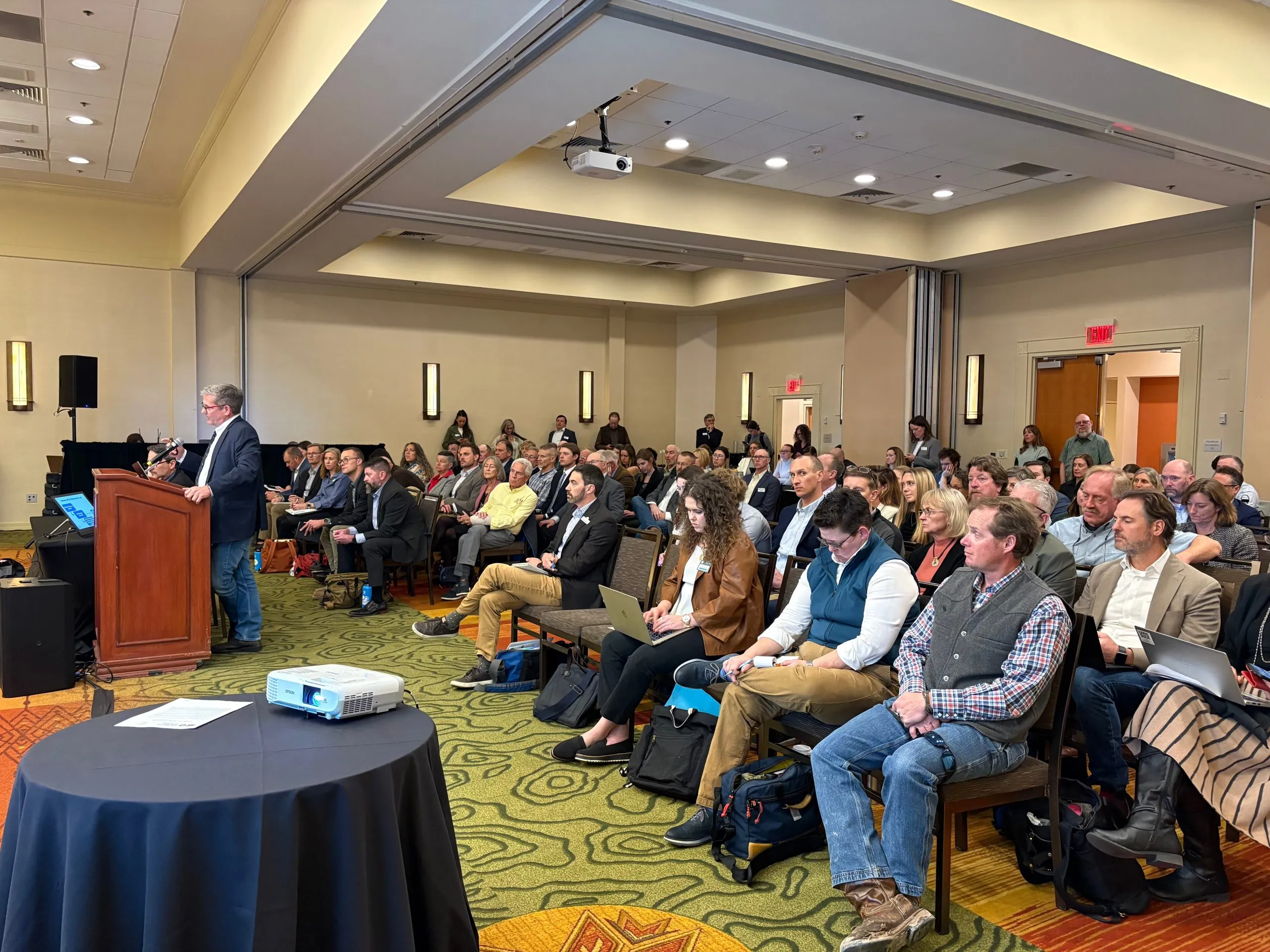
River District General Manager Andy Mueller speaks to the Colorado Water Conservation Board in front of a packed house Wednesday. The board voted unanimously to accept water rights tied to the Shoshone hydropower plant to benefit the environment. CREDIT: HEATHER SACKETT/ASPEN JOURNALISM

Click the link to read the article on the Aspen Journalism website (Heather Sackett):

November 20, 2025

In a historic move Wednesday evening, the state water board voted unanimously to accept water rights tied to the Shoshone hydropower plant, a major step toward securing those flows in perpetuity for the Western Slope.

The Colorado Water Conservation Board said the Shoshone water rights, which are some of the oldest and most powerful on the mainstem of the Colorado River, can be used to benefit the environment. 

“The Shoshone acquisition makes a lot of sense to me, and I’m very proud to be a part of the work that everybody’s put into it,” said Mike Camblin, who represents the Yampa, White and Green river basins on the CWCB. “I hope that our children and our grandchildren look back and realize we made the right decision on this.”

The Glenwood Springs-based Colorado River Water Conservation District plans to purchase the Shoshone water rights for $99 million from Xcel Energy, but the district first needed the approval of the CWCB, which is the only entity in the state allowed to hold instream-flow water rights to benefit the environment. Because the water is returned to the river after it runs through the hydroplant’s turbines, downstream cities, irrigators, recreators and the environment all benefit.

River District General Manager Andy Mueller called it a fantastic day in Colorado history. 

“I think that was the right decision for the Colorado River and the right decision for our whole state,” Mueller said. “I think the state for generations to come, centuries in the future will benefit from having that water in the Colorado River.”

Importantly, the instream-flow agreement approved by the board says that the Western Slope, along with the CWCB, will retain some control over exercising the rights. The River District and its constituents drew a hard line in the sand regarding this point and said they would walk away from the deal if they had to cede control solely to the CWCB.

Though not totally unprecedented, co-management is a departure from the norm, as the CWCB has never shared management of an instream-flow water right this large or this powerful with another entity. 

In attendance at Wednesday’s CWCB meeting in Golden were representatives of ditch companies, elected officials and water managers from across the River District’s 15-county area. Some of the attendees said during their public comments that if the River District didn’t retain some control over the water rights, they would pull their funding and withdraw their support from the Shoshone campaign. 

Mesa County Commissioner Bobbie Daniel said the joint-management proposal is a safeguard that ensures that Western Slope interests are not pushed aside. Mesa County has committed $1 million toward the purchase of the water rights.

“The Shoshone call is one of the great stabilizing forces on the river, a heartbeat that has kept our valley farms alive, our communities whole and our economy steady, even in lean years,” Daniel said. “If a joint management is not adopted, Mesa County will withdraw its support for this acquisition. It’s not out of anger or politics, but because anything less would fail the people that we serve.”

The Shoshone hydropower plant in Glenwood Canyon has some of the oldest and most powerful nonconsumptive water rights on the Colorado River. A broad coalition of Western Slope entities support the River District purchasing the rights. CREDIT: HEATHER SACKETT/ASPEN JOURNALISM

Blow to the Front Range

The CWCB’s decision was a blow to Front Range water providers, who objected to the River District’s having a say over how to manage the water rights, even though they supported the overall goal of protecting flows for the environment. Denver Water, Northern Water, Aurora Water and Colorado Springs Utilities argued that the CWCB has exclusive authority over the rights, according to state statute. 

Critically, because the Shoshone plant’s water rights — one that dates to 1902 for 1,250 cubic feet per second and another that dates to 1929 for 158 cfs — are senior to many other water users, they have the ability to command the flows of the Colorado River and its tributaries upstream all the way to the headwaters. This means that the owners of the rights can “call out” junior Front Range water providers with younger water rights that take water across the Continental Divide via transmountain diversions and force them to cut back. 

The fact that Front Range water providers take about 500,000 acre-feet annually from the headwaters of the Colorado River is a sore spot for many on the Western Slope, who feel the growth of Front Range cities has come at their expense. These transmountain diversions can leave Western Slope streams depleted. 

The Shoshone call pulls water west much of the time. But the Front Range parties wanted assurances that during extreme droughts or emergency situations, the call would be “relaxed,” allowing them to take more water to their cities’ millions of customers. 

Alex Davis, assistant general manager with Aurora Water, said the CWCB should retain the ability to relax the call as a “backstop” under extremely rare circumstances. 

“It is asking that in those emergency situations, the board has the ability to step in and say: We’re going to do what we think is best for the state of Colorado,” Davis said.

The agreement approved by the board lays out a collaborative process to consider a call relaxation, with a stakeholder panel of water managers from both sides of the divide. The specific wording of this agreement was hashed out during Wednesday’s meeting, with lawyers representing the CWCB and River District conferencing to tweak language and make edits.

Colorado Water Conservation Board member representing the Arkansas River basin Greg Felt, left, talks with River District General Manager Andy Mueller Wednesday after the board voted to accept the Shoshone water rights for instream flow purposes. The move represents a major step toward securing those rights in perpetuity for the Western Slope. CREDIT: HEATHER SACKETT/ASPEN JOURNALISM

The CWCB had been set to decide on the Shoshone rights at its meeting in September, but the River District granted an eleventh-hour 60-day extension so they could address issues raised by the board and try to negotiate a consensus with the Front Range parties. 

Despite all the detailed arguments laid out by the parties, thousands of pages of technical and legal documents, and hours of testimony and public comment over the September and November CWCB meetings, the board’s scope of decisionmaking remained narrow: Should the CWCB accept a perpetual interest in the Shoshone water rights and will these rights preserve the natural environment to a reasonable degree? 

In the end, the board decided yes, and also determined that it did, in fact, have the authority to allow the River District to co-manage the Shoshone water rights alongside it.

“I really think it’s pretty incredible that there’s no objection to the environmental aspects of this flow and the purpose of this water right for environmental purposes,” said CWCB Director Taylor Hawes, who represents the mainstem of the Colorado River where the Shoshone plant is located. “(The River District is) donating that water right. It seems like they should have a say. And while I realize this case is unique, I don’t see anything in the statute or the rules that prohibits us from doing this.”

But the fight to keep Shoshone flowing west is not over for the River District. The CWCB, River District and the water rights’ current owner, Xcel, now plan to file a joint application in water court to make the deal official by adding the instream-flow use to the water rights. 

The water court process will decide another contentious issue that is sure to again highlight disagreement between the Western Slope and Front Range as they compete for the state’s dwindling water resources: precisely how much water is associated with the water rights, a number based on the plant’s past use.

“I also very much understand the concerns of both sides of the divide in not wanting the other side to have a windfall,” Hawes said. “That has been kind of the heart of all of this. And I hope we can all trust that the water court’s process will give us a result where we don’t have to worry about that. Everyone’s concerns will be addressed in that process.”

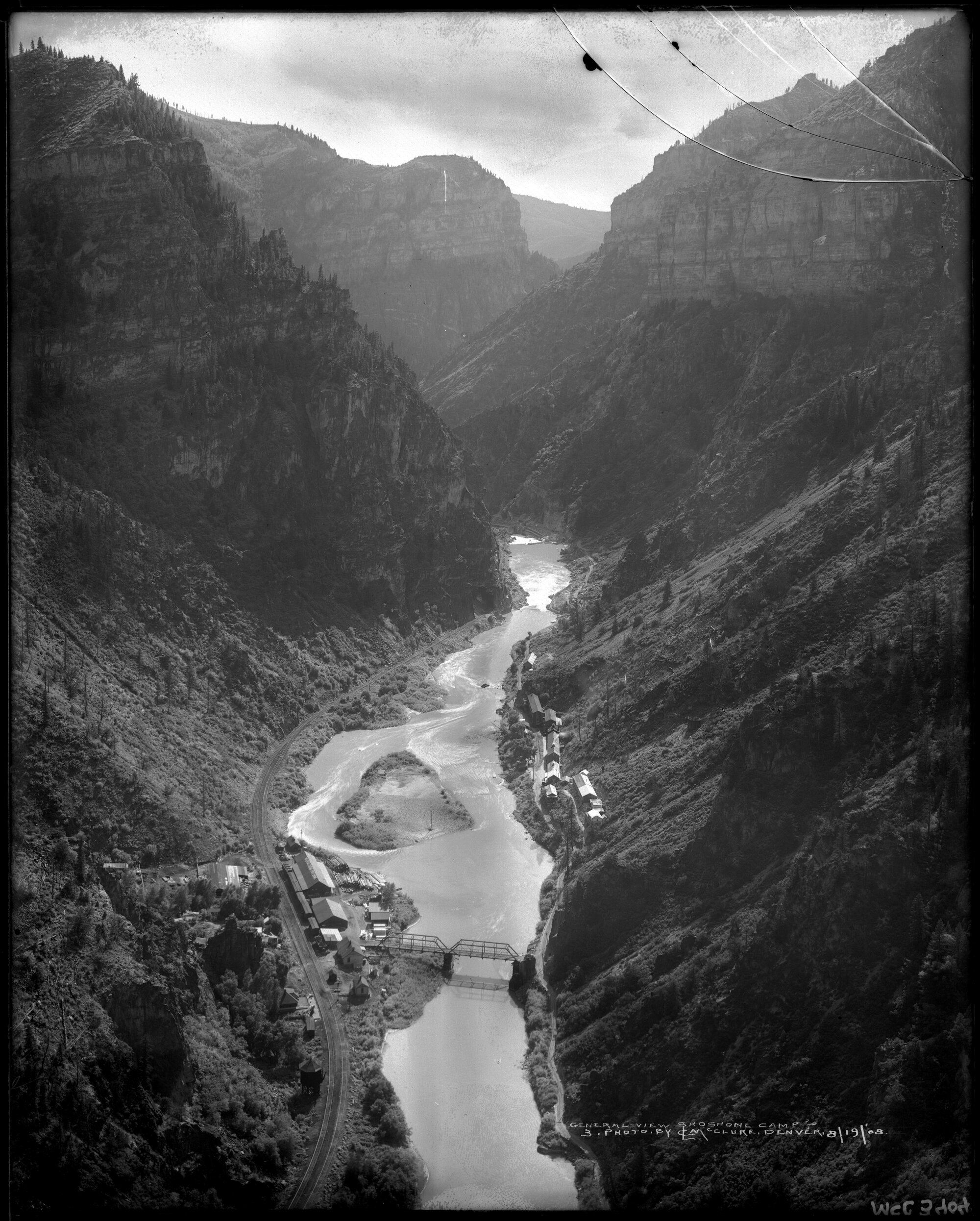
View of Shoshone Hydroelectric Plant construction in Glenwood Canyon (Garfield County) Colorado; shows the Colorado River, the dam, sheds, a footbridge, and the workmen’s camp. Creator: McClure, Louis Charles, 1867-1957. Credit: Denver Public Library Digital Collections

#ColoradoRiver: States miss their deadline on a deal, but they’re still talking, #Utah and the federal government aren’t giving details or a new timeline — Annie Knox (UtahNewsDispatch.com) #COriver #aridification

Udall/Overpeck 4-panel Figure Colorado River temperature/precipitation/natural flows with trend. Lake Mead and Lake Powell storage. Updated through Water Year 2025. Note the tiny points on the annual data so that you can flyspeck the individual years. Credit: Brad Udall

Click the link to read the article on the Utah News Dispatch website (Annie Knox):

November 11, 2025

Utah and six other states along the Colorado River blew past their deadline Tuesday to reach a new deal on managing the dwindling river, but negotiations aren’t over. 

“We will continue to engage with our partners across the Basin to develop a framework that protects water users and the system as a whole,” Utah Gov. Spencer Cox said Tuesday afternoon on the social media site X. 

The river contributes 27% of Utah’s water supply, and provides water to 40 million people across the U.S. and Mexico. Drought, overuse and hotter temperatures tied to climate change have all combined to shrink its flow. 

The federal government had said it would step in and make its own plan if states failed to reach broad consensus by Tuesday, but the states agree they don’t want that to happen, Cox said.

“While the Basin States did not finalize an agreement today on post-2026 Colorado River operations, our commitment to a state-led path remains,” the governor said. 

The U.S. Department of the Interior did not respond to questions from Utah News Dispatch Tuesday evening about the timeline and whether it would intervene. The current agreement runs through late 2026. 

The federal agency and Utah’s negotiator Gene Shawcroft issued the same prepared statement, saying the talks yielded “collective progress.” They did not give any details on sticking points. 

The seven states, the Department of the Interior and the U.S. Bureau of Reclamation, which manages water in the West, all “recognize the serious and ongoing challenges facing the Colorado River,” their statement says. “Prolonged drought and low reservoir conditions have placed extraordinary pressure on this critical water resource that supports 40 million people, tribal nations, agriculture, and industry.” 

They said the states and federal agencies share a commitment to ensuring the river’s long-term sustainability. 

“While more work needs to be done, collective progress has been made that warrants continued efforts to define and approve details for a finalized agreement,” the statement says. 

The four Upper Basin states — Utah, Colorado, New Mexico and Wyoming — and the Lower Basin states of Nevada, Arizona and California presented competing plans to the federal government last year. 

The Upper Basin states have sought to fend off mandatory cuts in dry years, saying they generally use much less than they’re allocated. The Lower Basin states have insisted that all seven absorb cuts in dry years. 

In part to prepare for the possibility of mandatory cuts, Utah has been investing in measuring and monitoring water use in recent years. 

In 2023, the Legislature set aside $1 million for a Colorado River measurement infrastructure project and $650,000 in ongoing yearly funding, according to the Utah Division of Water Rights.

Map of the Colorado River drainage basin, created using USGS data. By Shannon1 Creative Commons Attribution-Share Alike 4.0

The #ColoradoRiver is nearly out of time — and excuses: If the seven basin states can’t lead, Washington and the courts will — James Eklund (BigPivots.com) #COriver #aridification

People at Lake Powell May 25, 2022. Photo credit: Allen Best/Big Pivots

Click the link to read the article on the Big Pivots website (James Eklund):

November 11, 2025

If the seven basin states can’t lead, Washington and the courts will. The West deserves better than to surrender its future out of inertia and pride.

The River at a Crossroads

Today, November 11, the seven states that share the Colorado River face a deadline they’re unlikely to meet. The Department of the Interior has asked them to agree on the bones of a post-2026 management plan — the rules that will decide who gets cut, when, and by how much as the river keeps shrinking.

If they fail, Washington will write the rules for them. And if Washington falters, unelected judges will. Either way, the West loses control of its own destiny. That’s not leadership; that’s abdication.

The Lower Basin is braced for federal action. The Upper Basin is bracing for blame. Both are right to be worried — and both are missing the point. The river doesn’t care about politics or priority dates. It only responds to snow, sun, and science.

Udall/Overpeck 4-panel Figure Colorado River temperature/precipitation/natural flows with trend. Lake Mead and Lake Powell storage. Updated through Water Year 2025. Note the tiny points on the annual data so that you can flyspeck the individual years. Credit: Brad Udall

Hydrology Has Changed; Leadership Hasn’t

We built the Colorado River system for a climate that no longer exists. Reservoirs that once promised endless growth now sit half-empty — Lake Powell at roughly 29%, Lake Mead near 31%. The math is unforgiving: less water is coming in than going out.

Yet our governance still pretends otherwise. The Law of the River — that tangled mix of compacts, decrees, and deals — assumes a river of at least 16.5 million acre-feet. Nature is now giving us perhaps 12, maybe less. We’re overdrawn every year, and the overdraft is accelerating.

This isn’t a failure of hydrology; it’s a failure of adaptation. The West has always been proud of its self-reliance, but we’re behaving like a bureaucracy waiting for someone else to make the hard call. We need leaders, not hall monitors.

And if you want to know what failure of adaptation looks like, glance halfway around the world. Tehran, Iran, a city of more than eight million, is on the brink of evacuation. Its reservoirs are nearly dry, some below 10% capacity. Rainfall has fallen 40%  below average. Iran’s president recently warned that if the skies don’t open, the capital may have to be moved. Moved. Imagine Washington, D.C. abandoned because the Potomac went dry. That’s not science fiction — that’s what happens when water governance waits too long to face reality. The Colorado River isn’t there yet, but the trajectory rhymes. Tehran is a mirror we should study before it shows our reflection.

The Blame Game vs. Shared Responsibility

At Arizona State University’s recent Law of the Colorado River: The View from the Lower Basin conference, one thing was clear: the Lower Basin has its legal arguments loaded and ready. So does the Upper Basin. Both are preparing for a fight neither side can win.

Arizona’s governor calls the Upper Basin’s stance extreme; the Upper Basin counters that it can’t conserve water that isn’t there. California points to its billions in saved water and asks why others won’t match it. Colorado replies that it’s already living within its snowpack. Every argument is technically correct — and collectively disastrous.

Finger-pointing won’t refill a reservoir. The real crisis isn’t between the basins; it’s between the past and the future. The river is shrinking faster than our imagination.

The Case for State-Led Solutions

We know how to do this. We’ve done it before. In 2019, when both Lakes Mead and Powell were circling the drain, the Basin States pulled together the Drought Contingency Plan. It wasn’t perfect, but it kept the system alive long enough for the recent recovery years to matter. That’s proof we can still ride together when it counts.

Utah and Wyoming are finally taking first steps toward real demand-management programs — voluntary, compensated conservation that could bank water in Powell. They’re six years too late, but they’re at least facing forward. The Lower Basin, to its credit, has cut deeply — usage there is down to about 5.9 million acre-feet, the lowest since 1983. The economies of Phoenix, Las Vegas, and Los Angeles didn’t collapse. They adapted. That’s the model.

A state-led deal is the only way to keep Western hands on the reins. Federal control would be blunt; court control, brutal. Every day we delay, we invite both. The West should never outsource its destiny to Washington or to a judge in black robes who’s never stood in an irrigation ditch with a shovel.

The Call of the Saddle

This river built the modern West. It carved our canyons, powered our farms and ranches, lit our cities, and defined our sense of possibility. But it can’t survive our paralysis.

The next agreement — whatever we call it — won’t be about dividing abundance. It will be about managing scarcity with grace and intelligence. That means each state giving up a little sovereignty to save the system that sustains us all. It means governors and commissioners finding the courage to sign something imperfect but real.

Our basin remembers how to ride — hell, we practically invented it. The horse is saddled. The trail is narrow. And the storm is moving in fast.

Either we climb back on together, or we’ll watch someone else take the reins.

L to R, Anne Castle, Don Coram, James Eklund, and Jim Pokrandt

James Eklund is a Colorado water lawyer, rancher, former director of the Colorado Water Conservation Board, and formerly Colorado’s Colorado River principal. He advises public and private clients across the West on water, land, and natural-resources issues at Taft/ Sherman & Howard.

Map of the Colorado River drainage basin, created using USGS data. By Shannon1 – Own work, CC BY-SA 4.0, https://commons.wikimedia.org/w/index.php?curid=65868008

Rainfall brings #ColoradoRiver drought relief, but concerns for next year’s water supply remain —  Cassie Sherwood (WaterDesk.org) #COriver #aridification

The Colorado River fills Glen Canyon, forming Lake Powell, the nation’s second-largest reservoir. The reservoir could drop to a new record low in 2026 if conditions remain dry in the Southwestern watershed. (Alexander Heilner/The Water Desk with aerial support from LightHawk)

Click the link to read the article on The Water Desk website (Cassie Sherwood):

November 4, 2025

This story is produced and distributed by The Water Desk at the University of Colorado Boulder’s Center for Environmental Journalism. 

Heavy autumn rains brought relief to drought-plagued portions of the Southwest, but across the Colorado River basin ongoing water supply concerns still linger amid tense policy negotiations and near record-low reservoir storage.  

Even after accounting for the heavy rain, 57% of the Colorado River watershed remains in severe drought, according to the U.S. Drought Monitor. More than 11% of the basin is in extreme drought. 

A less than average upcoming snow season combined with a dry spring or early summer in 2026 could create conditions for another low runoff year. The Colorado River’s headwaters saw a weak snowpack last winter, which contributed to one of the worst spring runoff seasons on record in 2025. Drought conditions spread and worsened into summer throughout the southern Rocky Mountains. 

Peter Goble, Colorado’s assistant state climatologist, explained that the recent rainfall “certainly recharged soils,” in some watersheds. 

Flows on the Animas River at Durango. Water Year 2026 is shown in black in comparison to past years. From https://climate.colostate.edu/drought/#streamflow

Streamflow in the Animas River and Rio Grande increased significantly following the October rains and flooding. Rain in southwest Colorado, particularly around Pagosa Springs, brought flooding that damaged homes and downtown businesses. Rain gauges near the San Juan Mountains recorded 7 to 10 inches of precipitation from October 9-15. 

“We would love to see this rain come over a more steady incremental period,” Goble said. “But oftentimes it is these flooding events that kind of put the kibosh on a drought more locally.” 

The flooding erased drought designations on the Drought Monitor map in those localized areas, but basinwide drought conditions tell a different story. Dry soils, depleted reservoirs and winter weather forecasts continue to cause water managers to worry.

Even with the recent rain, soils in many parts of the Colorado River basin remain dry. Soil absorbs moisture almost like a sponge. When the soil moisture is low, spring runoff soaks into the soil, saturating the ground first. Soils that are more saturated lead to more water filtering into streams and reservoirs when runoff occurs, making the process more efficient. 

“We’re still going to need a good snowpack in order to be set up nicely, but this (rain) improves our outlook for the efficiency of that snowpack,” Goble said.

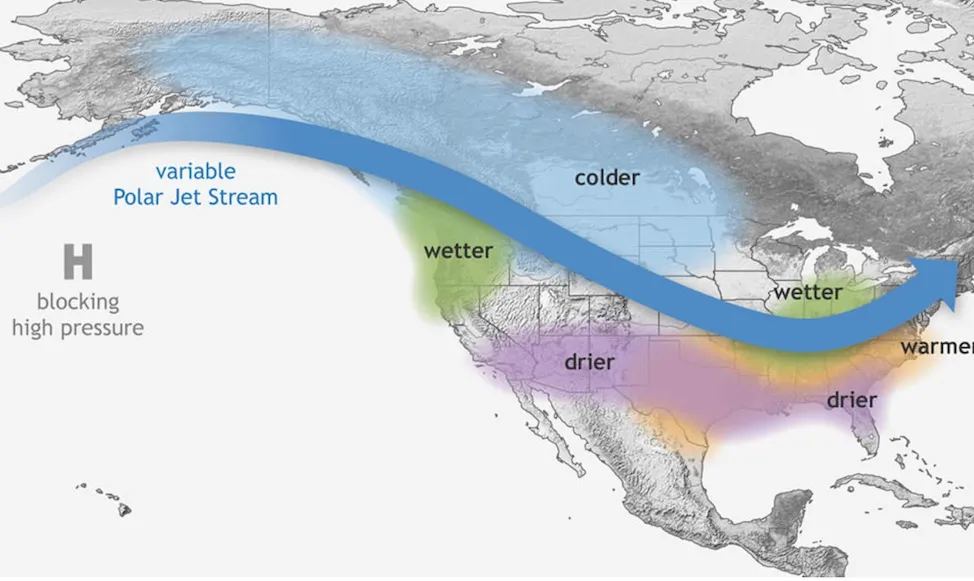
La Niña causes the jet stream to move northward and to weaken over the eastern Pacific. During La Niña winters, the Southwest tends to see warmer and drier conditions than usual. Since La Niña conditions are more common during the negative phase of the Pacific Decadal Oscillation, a negative PDO is likewise associated with warmer, drier conditions across the Southwest. (Image credit: NOAA)

Federal forecasts show the possibility of a mild La Niña through February. The climate pattern occurs when Pacific Ocean waters cool down and alter global weather conditions. La Niña patterns often impact the amount of snowpack accumulation in the coming year. The southern part of Colorado is often drier in a La Niña year while northern areas, around Steamboat Springs, typically see snowier conditions. 

The stakes for an above average runoff next year are high. The two biggest reservoirs in the country, Lake Powell and Lake Mead have steadily declined over the last 25 years. Powell is currently at 29% of its capacity and Lake Mead is at 32%. A lessened runoff could push them dangerously low.

While the rain slightly alleviates local drought, it’s “only a drop in the bucket when it comes to refilling Lake Powell and Lake Mead,” Goble said. “We’re still going to see those regional water shortages persist.” 

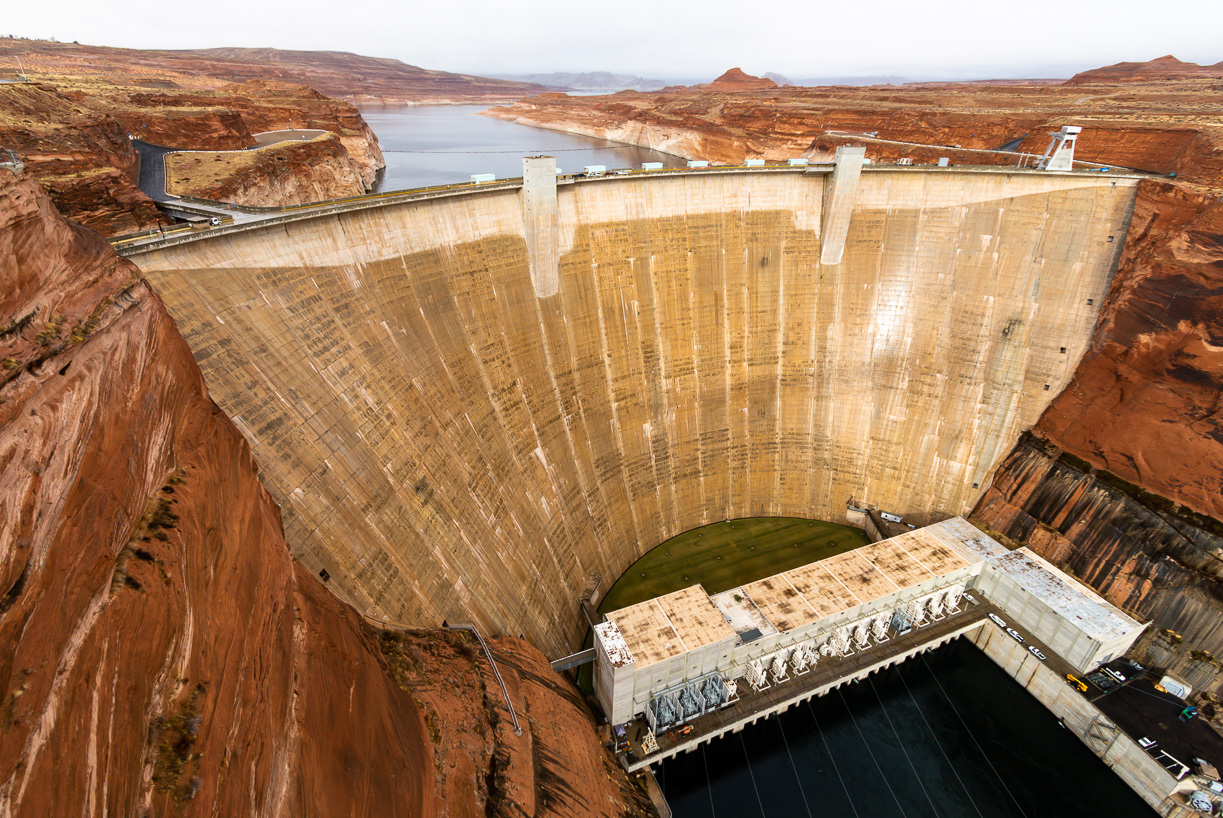
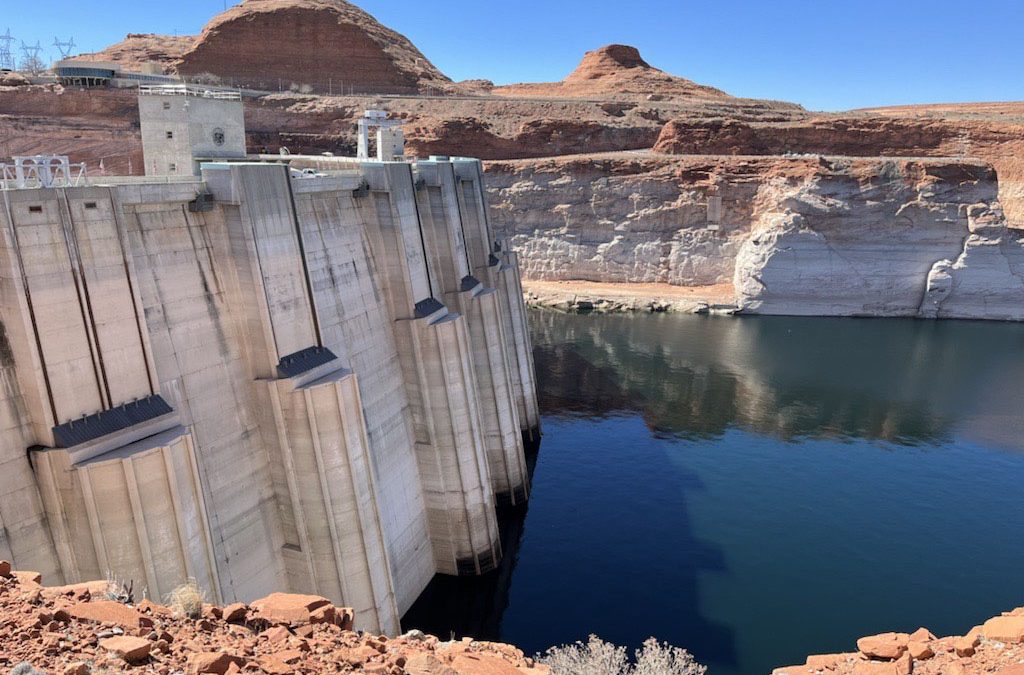
Glen Canyon Dam holds back the waters of Lake Powell, which has reached critically low levels in the last three years. The reservoir serves downstream water use in Arizona, California, Nevada and Mexico. (Mitch Tobin/The Water Desk)

If water levels continue to decline in these larger reservoirs, the dams’ infrastructure is threatened and the hydropower turbines can’t be used. Lake Powell, for example, has different outlets installed so water can be released in low conditions, however they are not designed to be the main outlet source. New federal projections show it’s possible Powell’s levels could drop low enough to cease hydropower production as early as October 2026, if conditions remain dry.

“They could reach levels they have never reached before and potentially reach catastrophic levels,” said John Berggren, regional policy manager for Western Resource Advocates.  

In response to extremely low water conditions, it’s possible water from upstream reservoirs in Colorado, Wyoming and New Mexico could be released to support Powell’s hydropower turbines. 

“We are seeing a new normal because of climate change, because of aridification,” Eric Kuhn said, former general manager of the Colorado River District, on the state’s Western Slope. In 2022, the basin saw similar drought conditions. 

“We are back where we were just a few years later,” Kuhn said. “The system is slipping away.” 

The basin states are also engaged in negotiations for new operating guidelines for the Colorado River, set to be in place by 2027. Given the ongoing drought conditions, water experts say the two reservoirs cannot wait for new guidelines.

“Don’t forget the short term problem while you are focused on a long-term agreement,” Kuhn said. A recent research paper, co-authored by Kuhn, highlights the need for urgent consumptive cuts basinwide. “We have got to figure out what’s going to happen next year if next year happens to be dry.”

Map of the Colorado River drainage basin, created using USGS data. By Shannon1 Creative Commons Attribution-Share Alike 4.0

Deadline closing in for #Utah and 6 other states hammering out a new water plan: Upstream and downstream states have less than two weeks to power through sticking points — Annie Knox (UtahNewsDispatch.com) #ColoradoRiver #COriver #aridification

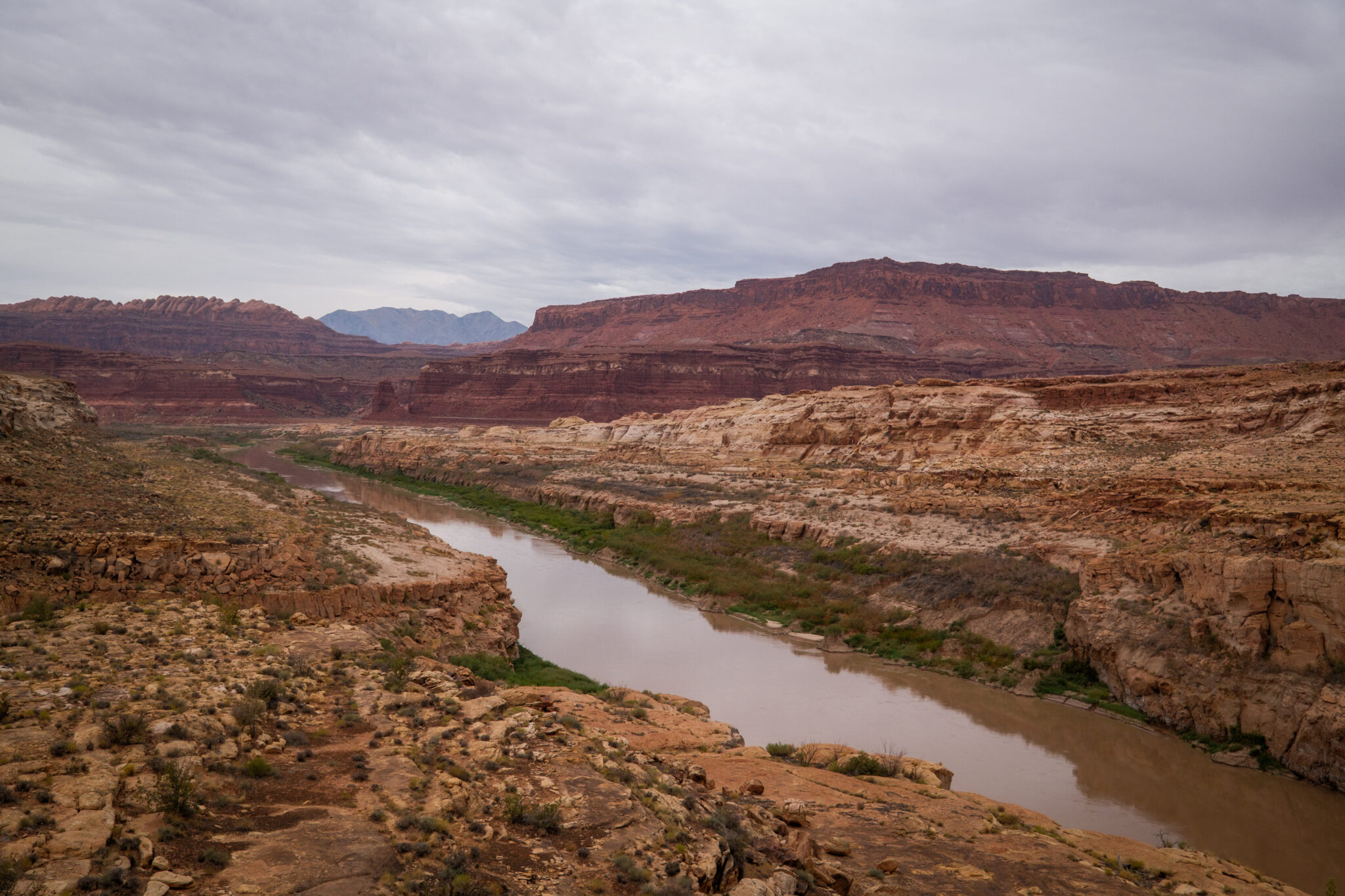
The Colorado River is pictured where if flows near Hite, just beyond the upper reaches of Lake Powell, on Friday, Sept. 19, 2025. (Photo by Spenser Heaps for Utah News Dispatch)

Click the link to read the article on the Utah News Dispatch website (Annie Knox):

October 31, 2025

Utah and six other states along the Colorado River are pushing up against a deadline to figure out as a group how to manage the river and its reservoirs. 

If they can’t reach an agreement by Nov. 11, the federal government is set to intervene and make its own plan. The existing agreement expires at the end of next year. 

“There’s still hope,” Marc Stilson, principal engineer for the Colorado River Authority of Utah, said Thursday. “They’re working hard, and they’re close.” 

The upstream Upper Basin states — Utah, Colorado, New Mexico, and Wyoming — and the Lower Basin states of Nevada, Arizona and California pitched competing plans to the federal government last year. 

Now, in the home stretch of negotiations, the seven states are working through questions including which reservoirs would be managed under the new agreement, how they’ll measure water use and whether the plan will include mandatory cuts to water allocations, Stilson said. 

The Upper Basin states have resisted the idea of mandatory cuts in dry years, saying they typically use much less than their yearly allocation. 

Lower Basin states have said all seven should share water cuts during dry years under the new plan, warning if they don’t, downstream states could face cuts that aren’t feasible for them to absorb, the Nevada Current reported

The river provides water to 40 million people across the U.S. and Mexico, and contributes 27 percent of Utah’s water supply. Hotter temperatures tied to climate change have mixed with drought and overuse to reduce its flow. 

Utah isn’t waiting to prepare for potentially significant changes to how it manages water, said Michael Drake, deputy state engineer with the Utah Division of Water rights. 

It’s been investing in expanding its use of tools to better measure and monitor water use since 2023, Drake told reporters Thursday. 

That year, the Legislature poured $1 million into a Colorado River measurement infrastructure project and approved $650,000 in annual funding to monitor water use, according to the division. 

Whether the state ends up facing cuts as part of the new plan or just working toward new targets, Drake said, it sees a need “to be able to manage water better, and you can’t regulate what you can’t measure.”

“As we get close here, I think reality is starting to hit and so we want to put out the messaging, you know, we can do this,” Drake told Utah News Dispatch. 

He noted the possibility of forced cuts is troubling to many of the state’s farmers. 

“What we’re going to be asking people to do is to see water running in a stream, and to not take it, to leave it there,” Drake said. “It’s a hard pill to swallow.”

Scott Thayn, who farms alfalfa and the grain sorghum in unincorporated Carbon County, agreed.

“If something happens with this new treaty and they drop it 10, 15, 20%,” Thayn said, “most of the years we’re going to be hurting.”

Map credit: AGU

What’s holding up the #ColoradoRiver negotiations? Experts break down the sticking points — Shannon Mullane (Fresh Water News) #COriver #aridification

The back of Glen Canyon Dam in 2023 when the surface level was about 3,522 feet above sea level. Jonathan P. Thompson photo.

Click the link to read the article on the Water Education Colorado website (Shannon Mullane):

October 30, 2025

Seven states in the Colorado River Basin are days away from a Nov. 11 deadline to hash out a rough idea of how the water supply for 40 million people will be managed starting in fall 2026. And they’re still at loggerheads over what to do.

The rules that govern how key reservoirs store and release water supplies expire Dec. 31. They’ll guide reservoir operations until fall 2026, and federal and state officials plan to use the winter months to nail down a new set of replacement rules. But negotiating those new rules raises questions about everything from when the new agreement will expire to who has to cut back on water use in the basin’s driest years.

And those questions have stymied the seven state negotiators for months. In March 2024, four Upper Basin states — Colorado, New Mexico, Utah and Wyoming — shared their vision for what future management should look like. Three Lower Basin states — Arizona, California and Nevada — released a competing vision at the same time. The negotiators have suggested and shot down ideas in the time since, but they have made no firm decisions.

This shows that Colorado’s Western Slope is the biggest supplier of water to the Colorado River. Source: David F. Gold et al, Exploring the Spatially Compounding Multi‐Sectoral Drought Vulnerabilities in Colorado’s West Slope River Basins, Earth’s Future (2024). DOI: 10.1029/2024EF004841

As the clock ticks down, onlookers have been increasingly frustrated and critical of the lack of progress in the closed-door negotiations.

“They seem to have been stuck basically on the same stuff for the last two-plus years,” said Jim Lochhead, former CEO/manager for Denver Water, the state’s largest water provider. “Part of why it’s so frustrating is they keep circling around to the same conversations over and over again.”

The Department of the Interior is managing the process to replace the set of rules, established in 2007, that guide how key reservoirs — lakes Mead and Powell — store and release water.

The federal agency plans to release a draft of its plans in December and have a final decision signed by May or June. If the seven states can come to agreement by March, the Department of the Interior can parachute it into its planning process, said Scott Cameron, acting head of the Bureau of Reclamation, during a meeting in Arizona in June.

Colorado River Storage Project map. Credit: Reclmation

If they cannot agree, the feds will decide how the basin’s water is managed. The federal government already has significant authority in the Lower Basin. But federal officials have also said they could leverage their authority over federal water projects in the Upper Basin, like Blue Mesa and the Colorado River Storage Project, to manage water in coming years.

The states could also take the matter to court, which could take decades to resolve and would put water management in the hands of judges instead of Colorado River communities, experts say.

“I think, if the definition of failure is that they don’t come to an agreement, we’ll know on Nov. 11,” said Sarah Porter, director of the Kyl Center for Water Policy at Arizona State University. “My sense is that they’ve all tried really hard.”

So what exactly is holding up progress? [Shannon Mullane] reached out to nine water professionals, from state negotiators to water experts, to break down the sticking points.

Water cuts in the Upper Basin (yes, that includes Colorado)

One of the top sticking points in the negotiations is whether the four Upper Basin states will commit to making firm water cuts or conservation goals during the basin’s driest years, experts said.

Colorado, New Mexico, Utah and Wyoming officials say the states regularly do not use their full legal allocation of Colorado River water, about 7.5 million acre-feet per year. The four states’ usage usually hovers closer to 4.5 million acre-feet per year and can fall to 3 million acre-feet in drier years, according to Upper Basin accounting.

They’re already cutting off junior water users early in dry years, like 2022. Water sharing is based on “first in time, first in right,” which means more recent, or junior, water rights are cut off before older, senior rights.

The officials argue that they’re already cutting back, and using less than their share, so why commit to cutting more? Conserving more water is also dependent on how much water is flowing through rivers and streams in any given year, Commissioner Becky Mitchell, Colorado’s governor-appointed negotiator, said.

Rebecca Mitchell, John Entsminger, Estevan Lopez, Gene Shawcroft, JB Hamby, Tom Buschatzke at the Getches-Wilkinson Center/Water and Tribes Initiative Conference June 6, 2024. Photo credit: Rebecca Mitchell

“We cannot conserve water that is not there,” she said.

In March 2024, the states proposed voluntary, temporary cuts, but that doesn’t work for the Lower Basin officials.

The downstream states proposed in March 2024 that they could take the first cuts — up to 1.5 million of their 7.5 million-acre-foot legal allocation — if reservoir storage is 38% to 69% of its capacity. After that, the Upper Basin and Lower Basin could evenly split additional cuts, according to the Lower Basin proposal.

That was a nonstarter for the Upper Basin officials, who balked when the Lower Basin asked them to cut up to 1.2 million acre-feet, or about a quarter to a third of the typical water use in the upstream states. Some of the Upper Basin states also say they do not currently have the legal authority to impose mandatory water cuts within their states when it comes to interstate water sharing agreements. [ed. emphasis mine]

This is one of two major disagreements in the negotiations, according to California Commissioner JB Hamby. The other is how and when water is released from the Upper Basin at Glen Canyon Dam to the Lower Basin, he said.

“There’s been lots of proposals bandied about back and forth between the basins and the feds,” Hamby said. “We’re not any closer at this point in time because those are the two most critical sticking points.”

Arizona officials declined to comment for the story. Nevada’s representative did not respond to requests for comment.

The political sticking point

Each of the seven negotiators is accountable to their home state. They have to be able to sell a deal to their water users and state lawmakers in a way that feels like a win, Porter of Arizona State University said.

In Arizona, Commissioner Tom Buschatzke must strike a deal that water users and the state legislature can get behind.

“There may be a situation where no deal is better than trying to sell a deal to your water users that you know they will utterly hate,” Porter said.

There are certain nonstarters for Arizona: Everyone expects to see water cuts for communities, like Phoenix, that rely on the Central Arizona Project, a 336-mile federal system that supplies Colorado River water to the most populated regions in Arizona. But it’s hard to see a benefit for Arizona in a deal with no water, or not enough water, for the project, Porter said.

And water users can sue if they don’t like the seven-state deal or if senior water users are asked to cut back on water to help junior water users. That would run counter to how the legal priority system has worked for over a century. Such lawsuits would tie up Colorado River water management in court for years, Porter said. [ed. emphasis mine]

Udall/Overpeck 4-panel Figure Colorado River temperature/precipitation/natural flows with trend. Lake Mead and Lake Powell storage. Updated through Water Year 2024. Credit: Brad Udall

“We’re really on the precipice of significant new, bigger shortages, and so the likelihood of a water user bringing legal action because of cuts outside of the priority system … is much higher than it was in 2019,” Porter said.

In past meetings, Cameron of the Bureau of Reclamation has called on water users to be more flexible so their state commissioners have room to negotiate.

“I urge you to continue to work with Tom (Buschatzke), embrace his leadership and give him the freedom to maneuver to strike an appropriate deal with his six colleagues in the other states,” Cameron said during an Arizona Reconsultation Committee meeting in June.

In Colorado, Mitchell said she is still working closely with water users within the state.

“We have firmly sat in the negotiating room with the principles we have always had,” she said. “That is something I have promised Coloradans: The principles that we developed are still the principles that I am taking into the room with me. Those are factored in as we are negotiating.”

What experts want to see

Water experts and professionals have been stuck on the outside of the closed-door negotiations, waiting on updates with greater frustration as the deadline draws near.

Now the states have less than two weeks to agree, at a high-level, on how to manage the water supply for millions of people, two countries, 30 Native American tribes, key food supplies and multibillion-dollar industries.

“They have the most thankless task that anyone in the Colorado basin could have,” Porter said.

Lochhead, formerly of Denver Water, said it seems impossible to reach any kind of comprehensive agreement before Nov. 11. They might be able to reach a conceptual outline, he said. They might be able to find a way forward if they were less entrenched in the Upper Basin versus Lower Basin dynamic, he added.

Jennifer Pitt and Brad Udall at the Getches-Wilkinson Center/Water and Tribes Initiative conference June 5, 2025. Photo credit: Allen Best/Big Pivots

Jennifer Pitt, Colorado River Program Director for the National Audubon Society, suggested that states work toward making the most out of water supplies instead of legal questions that are tough to resolve.

“Once the rules of the game become clear, people are going to lean hard into those solutions,” she said. “And there are many of them.”

John Berggren, regional policy manager for Western Resource Advocates, said the basin needs to see compromise as a win, not a loss. Officials need to educate their constituents that compromising empowers people to choose their destiny, instead of having courts or the federal government dictate it for the basin.

“A compromise is not a bad thing,” Berggren said. “Coming to agreement, coming to the table is actually a good thing for us.”


10 sticking points

The Colorado River water experts and negotiators highlighted 10 key sticking points:

  1. The term of the agreement: The negotiators have weighed different options for how long the new agreement should last and whether there should be a short-term period for states to ramp up conservation programs and water use reductions. This is a lower-level sticking point where states might be able to find consensus more easily.
  2. Reservoir management: The states have also debated which reservoirs will be managed under the new agreement. The Lower Basin wants to include upstream reservoirs, including Blue Mesa Reservoir in Colorado. The Upper Basin only wants Lake Mead and Lake Powell involved and worries that including upstream reservoirs will change how water flows through the basin or encourage Lower Basin overuse.
  3. Rebuilding reservoir storage: Commissioner Mitchell of Colorado was adamant that the new plan needs to prioritize rebuilding reservoir storage, since key reservoirs — Lake Mead and Lake Powell — are falling closer to critical levels. Commissioner Hamby of California said the states can figure out how to handle reservoir storage, and other issues, like water cuts, pose a greater challenge.
  4. Operating Lake Mead and Lake Powell: The current operational rules are mainly based on reservoir levels and river forecasts. When Lake Mead reaches a certain water level, it triggers adjustments in Lake Powell. The state officials agree these rules did not work. Colorado wants to prioritize the health of Lake Powell and base operations on real water levels — not forecasts. The states almost came to an agreement on how to do this earlier in the summer, but the idea was re-shelved.
  5. Cutting back on water: This is a particularly thorny issue. Would the Upper Basin commit to firm water conservation goals or mandatory cuts? Is the Lower Basin doing enough to address the Upper Basin’s concerns about overuse in the three downstream states? Officials in both basins say large cutbacks to their water supply would be an existential threat to their communities now and in the future.
  6. Basic accounting: The states disagree on key numbers. How does each state count its water use, shortages and conservation efforts? How much water is the Upper Basin supposed to send down to Mexico, or is that the Lower Basin’s job? How do downstream states count water use from tributaries, like the Gila River?
  7. 100-year-old issues: The states are also bolstering their legal arguments when it comes to unclear language in the Colorado River Compact of 1922, which laid out how the two basins were supposed to share water. Does it say the four upstream states are required to deliver a certain amount of water to the three downstream states? Or does it say the upstream states aren’t supposed to cause the water deliveries to go below a certain level? Some Upper Basin lawyers say they can argue that climate change, not the states’ water use, is the cause.
  8. Distrust: The basin states have thrown plenty of barbs at each other during the negotiations. Each has accused the other of gaming the system in some way. Lower Basin and Upper Basin officials have said other states could time reservoir releases from lakes Mead or Powell to benefit their state. The Lower Basin has questioned whether the Upper Basin has inflated shortage calculations. The Upper Basin has long complained about Arizona’s practice of taking Colorado River water out of Lake Mead and storing it underground.
  9. Group dynamics: The basin has split into Team Lower Basin and Team Upper Basin. Could states make more progress if they operated more independently, threw out ideas, formed coalitions and convinced others to join?
  10. In-state politics: Even if the state officials can work out the details of an agreement, they still have to take it home and convince their states it’s a good idea. That can be complicated. In Colorado alone, there are decades-old conflicts over water between the Western Slope and Front Rangefarmers and citiestribal and non-tribal water users.

More by Shannon Mullane

Map of the Colorado River drainage basin, created using USGS data. By Shannon1 Creative Commons Attribution-Share Alike 4.0

Mediation ordered for Denver Water, environmental group over turbulent Gross Dam project — Michael Booth (Fresh Water News)

The middle section of the dam is arched to give the dam strength as water pushes up against the structure. Photo credit: Denver Water.

Click the link to read the article on the Water Education Colorado website (Michael Booth):

October 23, 2025

Denver Water and Save the Colorado must enter mediation at the end of the month to see if a deal is possible on the mid-project challenge to the water utility’s $531 million dam raising underway at Gross Reservoir in Boulder County, according to an order from the U.S. Court of Appeals.

A federal trial judge initially halted construction on the nearly finished dam, saying the U.S. Army Corps of Engineers permits for Denver Water violated U.S. environmental laws and that the water level at Gross could not be raised. Judge Christine Arguello later lifted the injunction on construction, for safety reasons, while Denver Water appealed the permit issues to the 10th Circuit Court of Appeals.

The 10th Circuit will take briefs from both sides of the dam dispute in November, and is now ordering a mediation session for Oct. 30. The conference is to “explore any possibilities for settlement” and lawyers for both sides are “expected to have consulted with their clients prior to the conference and have as much authority as feasible” on settlement questions, the court order says.

Construction has continued since the injunction was lifted, with Denver Water pouring thousands of tons of concrete to raise the existing dam structure on South Boulder Creek. Denver Water has argued it needs additional storage on the north end of its sprawling water delivery system for 1 million metro customers, to balance extensive southern storage employing water from the South Platte River basin.

Denver Water’s collection system via the USACE EIS

Save the Colorado and coplaintiffs the Sierra Club, WildEarth Guardians and others argue too much water has already been taken from the Colorado River basin on the west side of the Continental Divide, and that the forest-clearing and construction at Gross is further destructive to the environment. Gross Reservoir stores Fraser River rights that Denver Water owns and brings through a tunnel under the divide into South Boulder Creek.

“We look forward to having a constructive conversation with Denver Water to find a mutually agreeable path forward that addresses the significant environmental impacts of the project,” Save the Colorado founder Gary Wockner said.

When securing required project permits from Boulder County, Denver Water had previously agreed to environmental mitigation and enhancements for damages from Gross construction. But Save the Colorado and co-plaintiffs sued to stop the project at the federal level, and Arguello agreed that the Army Corps had failed to account for climate change, drought and other factors in writing the U.S. permits.

Denver Water declined comment Tuesday on the mediation order.

The halt and restart of the Gross Dam raising came in what has turned out to be a tumultuous year for major Colorado water diversion and storage projects.

While the Gross Dam decisions were underway, Wockner was finishing negotiations with Northern Water over $100 million in environmental mitigation funding to allow the $2.7 billion, two-dam Northern Integrated Supply Project to move forward. Once the 15 communities and water agencies subscribed to NISP water shares saw the increasing price tag, some began pulling out.

Northern Water reviewed the scale of NISP with engineers, then said it planned to move forward at the previously announced scale. The consortium’s board has asked all 15 initial members to indicate by Dec. 31 where they stand with the project and its price tag.

More by Michael Booth

Roller-compacted concrete will be placed on top of the existing dam to raise it to a new height of 471 feet. A total of 118 new steps will make up the new dam. Image credit: Denver Water.

Release: #Colorado Governor Jared Polis, Attorney General Phil Weiser Urge U.S. Supreme Court to Reject #Nebraska Case on #SouthPlatteRiver

Perkins canal drawing showing the Colorado portion, courtesy Nebraska Department of Natural Resources.

Here’s the release from Governor Polis’ office (Lawrence Pacheco and Shelby Wieman):

October 15, 2025

Governor Jared Polis and Attorney General Phil Weiser today urged the U.S. Supreme Court to reject a case about the South Platte River Compact and Nebraska’s efforts to build the Perkins County Canal. Colorado is complying with its obligations under the compact and not obstructing Nebraska’s efforts to build the canal, so there is nothing for the court to review at this time, according to a brief filed with the court.   

The South Platte River originates in Colorado and supplies water for the state’s biggest cities and some of its most productive agricultural lands. The river starts in the Rocky Mountains and winds roughly 380 miles northeast into Nebraska. The South Platte River Compact is an agreement between Colorado and Nebraska that establishes the States’ rights and responsibilities to use water in the South Platte. 

While Colorado acknowledges Nebraska’s right to build the Perkins County Canal, Nebraska has failed to move forward on the project for over 100 years. Recently, Nebraska officials have taken preliminary steps to plan and permit the project through the U.S. Army Corps of Engineers, but numerous steps lie ahead during which Nebraska, and others who might be affected by the project, will identify potential issues and fully study any impacts.

Nebraska appears to be using the prospect of the canal and this request for Supreme Court action as leverage to renegotiate the South Platte River Compact. Colorado will ensure that Nebraska honors the letter of the Compact, just as Colorado always has. 

“Water is the lifeblood of our state. We have always faithfully honored the century-old South Platte Compact and all other water agreements with our downstream neighbor states, and we will continue to do so. We refuse to sit idly by while Nebraska chases a meritless lawsuit that threatens Colorado’s precious water resources, our robust agriculture industry, and our rural communities in Northeastern Colorado,” said Governor Jared Polis. 

Attorney General Weiser said Colorado is complying with the compact and not interfering with Nebraska’s efforts to build the canal. As such, Nebraska hasn’t raised any claims ripe for Supreme Court review. Whatever issues arise in the future can be addressed through federal permitting processes or lower courts. 

“Nebraska’s claimed violations rely on speculative and premature allegations. To the extent any legal issues arise in the future, there are alternative forums to resolve them. The Supreme Court need not take a case that would put the court and the parties on a long, time-intensive, and expensive path that might well, in the end, put the States right back where they were before Nebraska filed their proposed complaint,” said Attorney General Weiser. “Even if the court decides to take up part or all of Nebraska’s case, I’m confident that we will win on the merits. Both the facts and the law are on our side.”

Nebraska’s claims that Colorado authorizes water uses that harm Nebraska during the irrigation season are not supported by facts. Jason Ullmann, the State Engineer and Director of the Division of Water Resources, said Nebraska has only recently suggested they were concerned that Colorado was not meeting its obligations during the irrigation season.

“For over 100 years the Colorado State Engineer’s Office has worked with Nebraska and performed the hard work of ensuring Colorado meets its compact obligations on the South Platte River. This means we make difficult decisions every day on who receives their water and when based on the priority system and compact terms. As a result, water users in Colorado and Nebraska all receive their allotted share, said Jason Ullmann, State Engineer and Director of the Division of Water Resources “We were surprised and disappointed by Nebraska’s lawsuit and are hopeful once all the briefs are filed that we can resume discussions to meet the mutual needs of both of our States.”

The Supreme Court has original and exclusive jurisdiction over interstate disputes, such as border disputes and water rights. States must file a motion for leave to file a bill of complaint to bring a case to the court. The Supreme Court must still decide whether to accept the case.

The case is Nebraska v. Colorado, case number 220161.

Read Colorado’s Response in Opposition to Nebraska’s Motion for Leave to File Bill of Complaint (PDF).

The South Platte River Basin is shaded in yellow. Source: Tom Cech, One World One Water Center, Metropolitan State University of Denver.

Gross Dam construction making steady progress: Dam is now 60 feet taller after busy summer of work — Jay Adams (DenverWater.org)

Click the link to read the article on the Denver Water website (Jay Adams):

September 18, 2025

Denver Water’s Gross Dam in Boulder County continues to rise after a busy summer of construction.

Hundreds of workers are taking part in the Gross Reservoir Expansion Project, which will raise the height of Gross Dam by 131 feet.

As of Sept. 5, crews had raised the dam by 60 feet. The project is designed to increase the water storage capacity of Gross Reservoir, which supplies water to 1.5 million people in the Denver metro area.

“Over the past two years, we’ve been working on the original dam to prepare it for the enlarged height and width,” said Casey Dick, Denver Water’s deputy program manager for the project.

“At the end of June, the concrete work reached the original crest, so now all the concrete placements are above the existing structure.”

A dump truck fills up with concrete at the top of Gross Dam. The trucks drive across the top of the dam and place the concrete in layers to raise the dam higher. Photo credit: Denver Water.

Once completed, Gross Dam will be 471 feet tall and around 2,000 feet wide.

As the dam has gone up, it has become easier to see some of the differences between the original dam, which was completed in the 1950s, and the newly renovated structure.

For instance, the original surface of the downstream side of the dam was smooth. Now, the downstream side of the dam is a series of stair steps. The steps were an integral part of the construction process and supported the trucks that deposited layers of concrete onto the original structure of the dam.

This picture was taken from roughly the crest of the original dam. The dam has been raised 60 feet as of Sept. 5. The new face of the dam features a stepped design, which was needed for the construction process. Photo credit: Denver Water.

The renovated dam will also take on a new shape.

“The original structure was built as a ’curved gravity’ dam,” Dick said. “Now, we’re taking advantage of that curved geometry in the middle portion of the dam to create what’s called a ‘thick arch’ dam in the center of the canyon.”

The middle section of the dam is arched to give the dam strength as water pushes up against the structure. Photo credit: Denver Water.

Arches are used in dam construction because the force of the water in the reservoir pushes up against the arch and into the canyon walls. This gives an arched dam more strength compared to a flat structure.

“We’ve also built what are called ’thrust blocks’ on the sides of the original dam,” Dick said. “These give the dam additional support by essentially extending the canyon walls upward to support the arch.”

The “thrust blocks,” highlighted in red, extend out from the canyon wall. The blocks provide additional strength where the arch of the dam meets the rock. Photo credit: Denver Water.

As work has risen above the original crest of the dam, workers have built formwork, or temporary molds, on both the upstream and downstream sides of the dam. The temporary structures hold the freshly placed concrete in the proper shape until it hardens and cures.

Workers build formwork, or temporary molds, on the top of the dam. The forms hold new concrete in place until it cures. Photo credit: Denver Water.

With the new added concrete added during the project, Gross Dam is now much steeper than the original structure. At the base, the dam is 300 feet thick, but it gets skinnier as it goes up. At the top, the dam will be just 25 feet thick. Crews have had to adjust to the smaller work area to maneuver their equipment as the project progressed.

Work to raise the dam will continue as late as possible into 2025, until weather conditions make it too cold to place concrete.

“We’d like to thank all the men and women out here from Kiewit-Barnard and the other contractors out here,” Dick said. “They are working around the clock and as fast as they can to complete this project.”

Roller-compacted concrete will be placed on top of the existing dam to raise it to a new height of 471 feet. A total of 118 new steps will make up the new dam. Image credit: Denver Water.

‘No One Comes Out of This Unscathed’: Experts Warn That #ColoradoRiver Use Needs Cutting Immediately — Wyatt Myskow (InsideClimateNews.org) #COriver #aridification

Glen Canyon Dam creates water storage on the Colorado River in Lake Powell. Credit: U.S. Bureau of Reclamation

Click the link to read the article on the Inside Climate News website (Wyatt Miskow):

September 15, 2025

A new report finds that Lakes Mead and Powell, the nation’s largest reservoirs, could store just 9 percent of their combined capacity by the end of next summer.

Consumption of Colorado River water is outpacing nature’s ability to replenish it, with the basin’s reservoirs on the verge of being depleted to the point of exhaustion without urgent federal action to cut use, according to a new analysis from leading experts of the river.

The analysis, published Thursday [September 11, 2025], found that if the river’s water continues to be used at the same rate and the Southwest sees another winter as dry as the last one, Lakes Mead and Powell—the nation’s two largest reservoirs—would collectively hold 9 percent of the water they can store by the end of next summer. After enduring decades of overconsumption of the river’s water, the lakes would have just under 4 million acre feet of water in storage for emergencies and drier years when demand can’t be met. Every year, roughly 13 million acre feet is taken from the river for drinking water and human development across the region, with conservative forecasts estimating roughly 9.3 million acre feet of inflow next year. 

The report is stark in its assessment of the situation: Current Colorado River levels require “immediate and substantial reductions in consumptive use across the Basin” or Lake Powell by 2027 would have no storage left and “would have to be operated as a ‘run of river” facility” in which only the inflow from the river could be released downstream. 

“The River recognizes no human laws or governance structures and follows only physical ones,” the report’s authors wrote. “There is a declining amount of water available in the Colorado River system, primarily caused by the effects of a warming climate—longer growing seasons, drier soils, and less efficient conversion of the winter snowpack into stream flow. Although American society has developed infrastructure to store the spring snowmelt and make that water available in other seasons to more completely utilize the variable runoff, the Colorado River watershed produces only a finite volume of water, regardless of how many dams exist.”

The lifeblood of the American Southwest, the Colorado River’s water flows from Wyoming to Mexico, enabling the region’s population and economies to develop. The damming of the river has diverted water to booming metropolises like Los Angeles and Phoenix while also supporting the U.S.’s most productive agricultural areas and powering some of the its largest hydroelectric dams. In total, the river supplies seven states, 30 tribes and 40 million people with water.

The compact that divvied up the river’s water a century ago overestimated how much actually flowed through it, and climate change has diminished the supply even further. The melting snowpack that runs off mountains in the spring to feed the river has declined, shrinking the river and its storage reservoirs during decades of drought. The seven states that take Colorado River water are divided into two factions engaged in tense conversations about its future and how cutbacks should be distributed. Current guidelines for managing the river in times of drought are set to expire at the end of next year, and new ones are legally required to take their place, but negotiations between states, tribes and other stakeholders over the sharing of the necessary cuts in water usage are at an impasse. 

But if current conditions persist, further cutbacks on the river won’t be able to wait until those negotiations are finished, the report’s authors find, and they urged the Department of the Interior “to take immediate action.”

“Let’s hope that we are all wrong and that it snows like hell all winter and runoff is wonderful and we buy ourselves some time and additional buffer,” said Kathryn Sorensen, director of research for Arizona State University’s Kyl Center for Water Policy and one of the report’s co-authors. “But of course, it never makes sense to plan as if it’s going to snow, and we have to deal with what is a realistic but not worst-case scenario and take responsible actions.”

Adding to the issue is the status of the infrastructure that enables the river to be diverted and stored for use. For example, the researchers write, it was thought that anything above what’s known as “dead pool”—a water level below the reservoirs’ lowest outlets that can pass water through the dams—was “active storage.” But testing last year from the Bureau of Reclamation, the federal agency overseeing the river and its dams, found that those outlets can only be safely used at water levels higher than previously thought and cannot be used for long durations.

Margaret Garcia, an associate professor at ASU’s School of Sustainable Engineering and the Built Environment, who was not a part of the study, said the analyses makes clear the “reality of dead pool is within sight” for the basin’s reservoirs, even without considering the possibility of having an extremely dry year.

She likened the reservoirs to having a savings account with a bank. “When you have a savings account, you have some time to scramble and figure things out,” Garcia said. “But if you’ve already drawn down your savings account and then  [you’re laid off] and you never filled it back up at least a little bit, you’re in for a really tough situation.”

And just like a savings account, Garcia said, a reservoir isn’t much good if it can’t generate hydropower or store water. 

Sorensen said the secretary of the Interior, Doug Burgum, has broad authority to act to protect critical infrastructure in both of the river’s basins. The question is what those actions should be.

“The solutions are there,” she said. “The solutions are known. They’re just extraordinarily painful to implement. “

State negotiators have worked this year to determine how to manage the river after 2026, Sorensen said, but the buffer of water stored in reservoirs “that we’re relying on to kind of get us through the negotiations and these difficult times is potentially much smaller than maybe was commonly understood.”

“No one comes out of this unscathed,” she said. 

Map credit: AGU

As Gross Reservoir rises, Boulder County residents grapple with project’s legal turmoil — The Water Desk #BoulderCreek

Cranes and construction equipment line the shore at Gross Reservoir on June 19, 2025 in Boulder County, Colorado. The construction is part of an expansion project that will supply water to Denver’s residents. (Cassie Sherwood/The Water Desk)

Click the link to read the article on The Water Desk website (Cassie Sherwood):

July 23, 2025

Pieter Strauss used to love hosting stargazing parties at his house in the Lakeshore Park neighborhood up Flagstaff Road southwest of Boulder. The hobbyist astronomer would fire up the barbecue and spend hours showing his neighbors the night sky through his observatory and telescopes. 

Strauss’s house sits looking directly over Gross Reservoir, which provides water to Denver residents.

But when a project to significantly raise the reservoir’s dam began construction in 2022, those moments of neighborhood tranquility were lost for some residents. For Strauss the biggest impact was the bright construction lights used to keep work moving overnight. 

“It became impossible to sit on the deck before sunrise and after sundown, astrophotography was impossible. They lit up the skies,” with powerful floodlights, Strauss said. 

For over 20 years, residents and various environmental groups have protested the project, which suffered a series of legal blows this year. Construction on the massive dam ground to a halt in April amidst the courtroom wrangling, and subsequent decisions have cast a new level of uncertainty over large-scale water projects that propose to draw on the beleaguered Colorado River.  

However, by the end of May, federal courts ruled that construction could continue due to concerns surrounding uncompleted construction and potential flooding possibilities, but that the reservoir could not be filled. 

The Gross Reservoir Expansion Project involves raising the height of the existing dam by 131 feet. The dam will be built out and will have “steps” made of roller-compacted concrete to reach the new height. Image credit: Denver Water

Raising the dam 

Gross Reservoir’s dam is owned and operated by Denver Water. The utility built it in the 1950s, with two other building phases planned to accommodate future water needs. The current dam expansion will raise the height of the dam 131 feet, tripling the current capacity of the reservoir, and providing more water for Denver Water customers. 

The construction was spurred by “a combination of demands in our system, as well as concerns about climate and concerns about the needs for greater resilience in our system,” said Jessica Brody, general counsel for Denver Water. 

The need for the expansion is similar to a bank savings account, Brody said. Tripling the capacity of the reservoir is a savings account that can be drawn on in circumstances of an emergency.

“If we have an extreme drought event, we want to have more water banks that we can help smooth the impacts to our customers,” Brody said. 

When the utility initially announced plans to begin moving forward with a dam expansion, residents of the area were concerned. Environmental threats and the disruptions from the massive construction project topped the list of worries. They attended meetings at town halls with county commissioners. They organized with other residents in and around Coal Creek canyon.

While some residents fought the expansion, others anticipated it. When the dam was initially constructed, the utility planned to expand further down the line. 

Since construction began in 2022, residents have experienced noise and light pollution. Five neighbors have moved from the Lakeshore Park neighborhood. Pieter Strauss, at whose house they once held stargazing gatherings, was among them. 

Beverly Kurtz, member of TEG, on Pieter Strauss’s former porch overlooking Gross Reservoir on June 19, 2025. Once construction began, Strauss was no longer able to host neighborhood stargazing parties due to light pollution. (Cassie Sherwood/The Water Desk)

“The most valuable thing to all the people who have moved up here is that they had a quiet nature sanctuary. But then when you take that away, is it worth it?” said Anna McDermott, another resident of the area. 

“We sleep with our windows open. Not one house has air conditioning, so you sleep with your windows open in the summer months,” she said.  “You hear these giant backup beepers crashing, grinding all night long. Even with earplugs, I can’t sleep.” 

The Environmental Group (TEG) is an organization of residents in the Lakeshore Park neighborhood and surrounding residents, focused on engaging the community in action when environmental issues arise. Along with Save the Colorado, The Sierra Club, and other environmental organizations, TEG has fought the expansion. Beverly Kurtz, former president of TEG, has worked to hold Denver Water and the companies working on the dam, Kiewit Corp. and Barnard Construction Company Inc., accountable during construction. 

Heavy duty trucks are required to use a different road to access the dam rather than the paved road up Flagstaff Mountain due to fire concerns. Large semi-trucks have slid off the road due to the steep grade, which can cause traffic jams and road closures. 

“At one point they had one of the two roads down this mountain closed for five months,” Kurtz said. “It wasn’t until we called the sheriff out here and he realized the safety concern that they opened the road back up.”

Legal snares slow construction

In October 2024, two years after construction began, Save the Colorado, along with other environmental groups, won a lawsuit against Denver Water. U.S. District Court judge Christine Arguello found the utility’s dam construction permit violated the Clean Water Act and the National Environmental Policy Act. At the time, construction was able to continue and Arguello ordered the groups to work out an agreement regarding damages. 

In April 2025, the judge ordered a temporary halt on construction. The initial lawsuit argued that the U.S. Army Corps of Engineers, who provided the project permitting, did not fully consider climate change impacts when it approved the dam’s expansion. 

A month later, Arguello ruled that Denver Water could finish construction on raising the dam, but that the reservoir could not be filled until the Army Corps reissued the permits.

“If you stop the construction of a dam when it is partially built, the dam doesn’t function as it was ultimately designed to function,” said Denver Water’s Brody. “That was a big concern of ours and the Federal Energy Regulatory Commission.”

The utility has also been ordered to not remove any additional trees surrounding the dam until the proper permits are obtained. The project proposes the removal of over 200,000 trees. 

Arguello’s opinion also called into question the underlying water rights Denver Water would rely on to fill the newly enlarged reservoir when construction finished. Gross Reservoir is filled with water from the headwaters of the Colorado River, which has experienced steep declines in water supply amid a long-term warming and drying trend in the Rocky Mountains. 

“The Environmental Impact Statement didn’t even look at the fact that the flows of the Colorado River are in decline. Most of the science suggests they will continue to decline further,” said Doug Kenney, Western Water Policy Program director at the University of Colorado Boulder’s Natural Resources Law Center. Acquiring new permits will require Denver Water to redefine the project’s purpose and evaluate the environmental damage, he said.

The case is more than a local water project. Diverting more water across the western slope of Colorado has created concerns for ecosystems throughout the overappropriated watershed and for communities downstream in California, Nevada and Arizona. 

“It makes it more difficult to ensure that there’s sufficient flow downstream as a result,” Kenney said. “We have got to stop this practice of taking more and more water out of the upper reaches of the Colorado River because it just increases the stress on a river that is already under a tremendous amount of stress.”

By calling into question the project’s potential to have downstream impacts, the decision could add a new legal hurdle future water development infrastructure will have to clear. 

“Historically, agencies in recent decades have not done enough to consider climate change in decisions,” Kenney said. Cases like this one need to happen in natural resource law more generally, he said, as they help establish precedents for future projects that could potentially put the environment at risk. 

Denver Water is appealing the court decisions that bar the expansion. That could result in a reissue of the permits with a redefined purpose or a dismissal of the court rulings made earlier this year. 

“We think that the district court made some misjudgements or misinterpretations when it found the Army Corps committed these errors,” Brody said. 

Learning to live alongside it

Amid the stops and starts of Gross Reservoir construction, nearby residents are not ready to let go of what they used to have. 

Kurtz and McDermott recall their old activities along the reservoir’s north shore. A handful of neighbors would walk their dogs everyday along the hiking trail that connected the reservoir to their neighborhood. The trail has since been widened significantly, to allow for excavating equipment. They would host Memorial Day parties along the water’s edge. 

Beverly Kurtz and Anna McDermott, longtime residents of the Lakeshore Park neighborhood pose in front of Gross Reservoir on June 19, 2025. They are members of TEG, an environmental group involved in a lawsuit against Denver Water. (Cassie Sherwood/The Water Desk)

Now they minimize their excursions to the shore as much as they can. At this point they’re more than ready for construction to be completed, exhausted from the daily disruptions, explosions and drilling. 

“Now clearly, when the work is done, the things which negatively impacted my life would go away. But I couldn’t last them out,” Strauss said. He recently relocated to the Boulder area. “It was just my bad luck that my golden years coincided with the worst effects of the project.” 

Some residents found that the expansion project has renewed their sense of community in Lakeshore Park.

“In a weird way a lot of us have gotten even closer because we were in the battle together,” Kurtz said. “We feel like at this point we won the battle, but we’ve lost the war.”

“They will get the permits to eventually fill this reservoir following the expansion,” she said. 

However, federal courts requiring the proper permits to continue construction is a win in her and TEG’s book, as it sets a precedent for any large construction processes that occur in the future. It will ensure that the proper environmental permits are obtained before construction can begin on a project. 

“If nothing else, we hope that precedent still stands. Because it will help somebody else,” she said. 

This story was produced by The Water Desk, an independent journalism initiative at the University of Colorado Boulder’s Center for Environmental Journalism. 

The Southern Ute tribe has finally tapped #LakeNighthorse water. Why did it take 60 years? — Shannon Mullane (Fresh Water News) #AnimasRiver

Lake Nighthorse and Durango March 2016 photo via Greg Hobbs.

Click the link to read the article on the Water Education Colorado website (Shannon Mullane):

July 31, 2025

This summer, the Southern Ute Indian Tribe rolled out miles of temporary rubber water lines. The above-ground tubes had one job: carrying water to oil and gas operations on the reservation.

But the pipelines also represent something else: a historic moment in a drawn-out, arduous debate over water in southwestern Colorado.

In May, the Southern Ute Indian Tribe tapped into its water in the controversial Animas-La Plata Project, the first time a tribe has used its water from the project since it was authorized in 1968.

The Animas-La Plata Project has come to encapsulate long-held dreams to develop Western water — and the decades of debates, environmental concerns, local objections and Congressional maneuvering that almost made the project fail.

At the center of it all were tribal nations and the chance to, once and for all, settle all of the tribal water claims in Colorado. It took until 2011 to fill Lake Nighthorse, the main feature of a heavily scaled-down federal water project located just south of Durango. Then 14 more years for a tribe to be able to use a small slice of its water.

More barriers — tied to interstate laws, finances and infrastructure — still stand in the way of tribes and other Animas-La Plata water users taking full advantage of the multimillion-dollar project. 

“This has taken the hard work of many Tribal leaders and Tribal staff over many decades to get to where we are at now,” the Southern Ute Indian Tribe said in a prepared statement.

All Animas-La Plata Project water users can access water both in the reservoir, Lake Nighthorse, and the Animas River, but they draw from the river first. The reservoir functions like a savings account, said Russ Howard, the general manager for the Animas-La Plata Project.

This year, the tribe used water from the Animas River for oil and gas well completion activities, which wrapped up in mid-July. The tribe declined to provide more details.

It plans to use the revenue from the project to upgrade dilapidated irrigation systems, like the deteriorating federal Pine River Indian Irrigation Project, or other water-related projects, like infrastructure to access its Animas-La Plata Project water.

The Southern Ute Indian Tribe and its sister tribe in Colorado, the Ute Mountain Ute Tribe, have repeatedly brought up their lack of access to the Animas-La Plata Project in high-level conversations about tribal water access in the broader Colorado River Basin and how to manage the basin’s overstressed water supplies once key management rules expire in 2026.

The Colorado River Basin is the lifeblood of the American Southwest, providing water to 40 million people, cities from Denver to Los Angeles, industries and a multibillion-dollar agriculture industry. The Colorado River’s headwaters are in western Colorado, but its water finds its way to faucets, ditches and hoses in every corner of the state.

Tribal nations have federally recognized rights to about 26% of the Colorado River’s average flow between 2000 and 2018. But they’re not using all of this water. In some cases, they’re still going through legal processes to finalize their rights. In others, they are working on finding funding for new pipes, reservoirs and canals to access their water.

In some cases, downstream water users have become reliant on water while tribes are sorting out their water rights. But tribes say they are actively working on ways to put their water to use, which could push nontribal water users down the priority list.

“The Tribe wants everyone to understand that there currently is a reliance on undeveloped tribal water,” the Southern Ute statement said. “It is important for everyone to understand that the Southern Ute Indian Tribe has the right to develop its water resources and plans to do so.”

A big dream for the Southwest

People have been crafting different versions of an Animas-La Plata Project since at least 1904.

In the 1970s, they were drawing up maps showing a dam across the Animas River, also called El Río de las Ánimas Perdidas or the River of Lost Souls, to create the Howardsville Reservoir north of Durango. Other new reservoirs, plus hundreds of miles of canals and ditches, would provide irrigation water for both Native and non-Native farmers. The “Animas Mountain Reservoir” would provide drinking water for Durango. There would be plenty of water for irrigation, municipal and industrial users in the Southwest.

It was the age of water development in the West, led by the U.S. Bureau of Reclamation, and anything seemed possible.

Only, none of that happened.

That’s according to piles of manila folders, labeled in scrawling cursive, in the archives at Fort Lewis College’s Center of Southwest Studies. There, thousands of pages of documents reveal how, exactly, the big dream fell apart and a small, but vital, version survived.

In the 1960s, lawmakers, like Colorado Democrat Wayne Aspinall, fought in Congress to get the Animas-La Plata Project into the Colorado River Basin Project Act of 1968.

Congress authorized the project alongside others in the Upper Colorado River Basin, like the Dolores Project in southwestern Colorado, and Lower Basin goals, like the Central Arizona Project. They were supposed to be developed on the same timeline to avoid showing favoritism to one basin or another.

The Central Arizona Project came online and started sending water to growing cities, like Phoenix. The Dolores Project launched to help farmers and ranchers.

But the Animas-La Plata Project remained snared in issue after issue.

Decades of challenges

In the 1980s, the Southern Ute and Ute Mountain Ute tribes saw the Animas-La Plata Project as a way to settle their water rights in Colorado.

They agreed to stop 15 years of water-related lawsuits against the federal government — and to give up water rights claims in other local streams — in exchange for the Animas-La Plata Project and the tribal water rights that came with it.

The idea turned into the Colorado Ute Indian Water Rights Final Settlement Agreement of 1986. Getting the agreement approved by Congress, however, took two years.

Some farmers supported it: If the tribes pursued their powerful water rights on the streams, their claims would likely have priority over nontribal farmers, meaning they might not get as much water in drier years. And people in the dry Southwest needed the stability of guaranteed water storage.

Drought conditions have at times forced the Ute Mountain Ute Tribe Farm & Ranch Enterprise in southwest Colorado to operate on a fraction of the water needed to grow crops, resulting in dormant fields and irrigation systems. On a day in late May [2022] when wildfire smoke obscured the throat of an ancient volcano called Shiprock in the distance, I visited the Ute Mountain Ute farming and ranching operation in the southwestern corner of Colorado. Photo credit: Allen Best/Big Pivots

Rafting companies feared a project would hurt business. Environmentalists said it was one of the last free-flowing rivers in the Colorado River Basin. It didn’t make sense to pump water out of the Animas, over a hill and into a valley to create a reservoir, they said. That valley held protected elk habitat. It also included waste material from uranium mining. (This was eventually removed in a remediation project.)

For years, local groups fought the project’s costs, the electricity its pumps would require and the burden more irrigation water use would put on the Animas.

“I’ll actually tell you a little bit about it,” said Lew Matis, one of the volunteers organizing railroad photos in the Center of Southwest Studies on a Wednesday in July. “I was involved with the taxpayers against the Animas Project.”

Matis, a self-described “old fart of old Fort Lewis,” even wrote to The Durango Herald in the 1980s, saying the $586.5 million price tag was “approaching pie-in-the-sky aspects.”

Then there was the classic Colorado River tug-of-war between the Lower Basin and the Upper Basin: The Upper Basin tribes wanted to be able to lease their water off-reservation. Lower Basin states, like Arizona, California and Nevada, said it would conflict with state and interstate laws. They’d kill legislation that included leasing. Tribal officials said the states didn’t want to have to pay for tribal water they were already getting for free.

(Whether and how tribes can lease water between the Lower Basin and Upper Basin is still an issue today. It was one of the central problems that held up a $5 billion Arizona-tribal settlement that is languishing in Congress.)

Tribal officials traveled to Washington, D.C., to push for the settlement to pass.

“I’ve been moving this Animas-La Plata Project through, the people say well it’s not going to get funded,” said Leonard Burch, former Southern Ute Chairman, in an interview from the 1980s. “But we insist.”

A big dream and a (much) smaller reality

By 1988, Congress approved the settlement agreement with the Animas-La Plata Project at its center.

It solved all the tribal water rights claims in Colorado in one go, something that states like Arizona are still trying to do. The Ute Mountain Ute Tribe, which also has land in New Mexico and Utah, is still working to finalize some of its water claims.

Then U.S. Rep. Ben Nighthorse Campbell, in a press release from 1988, likened the settlement to “winning a gold medal.” (And he would know. Campbell won a gold medal in judo in the 1963 Pan-American Games.)

Then, in the early 1990s, the U.S. Fish and Wildlife Service found an endangered fish species, the Colorado pikeminnow, downstream from the potential project site. And the Animas-La Plata Project started to crumble.

The Colorado pikeminnow, renamed to remove a slur, can grow to nearly 6 feet in length and was the main predator in the Colorado River system. But by the late 20th century, it occupied about 25% of its natural range, and federal wildlife officials said dams and river depletions were one of its biggest threats.

The findings opened the door to questions about impacts to other species, like peregrine falcons, rare plants, bald eagles and razorback suckers.

The federal government started to question whether the project’s costs matched the benefits. The U.S. Bureau of Reclamation’s fervor for enormous Western water projects had waned, and former President Bill Clinton’s administration did not support the larger version of the Animas-La Plata Project authorized in the 1960s.

That project would have cost $744 million and built two reservoirs, 240 miles of pipelines and canals, seven water-pumping plants and 34 miles of electric transmission lines, according to local news coverage from the ’90s. It would also require the careful collection and removal of hundreds of years of cultural artifacts from different Native American bands, which was done for the final project.

After years of intense political maneuvering and fighting among all sides, Congress finally approved the final project: a dam to create a reservoir in Ridges Basin — now called Lake Nighthorse — and a pumping plant and pipes to suck up Animas River water and push it into the reservoir.

The La Plata River, which would have received Animas River water in the original version (hence its name), was left alone. The irrigation water — part of the original goal of the project — was removed from the agreement. The size of the dam shrank to 217 feet from 313 feet above the streambed. Congress dropped reservoirs and delivery pipelines for tribes. The final cost estimates ranged from $250 million to $340 million.

Looking at a description of the project from the 1980s, the project’s current manager Howard said hardly any of the plan actually happened.

“It’s unfortunate. That was the vision. Everybody was excited, and everybody supported what it was trying to do,” he said. “But ultimately, we ended up with a very, very small portion of what you’re showing in that document.”

“A whole bunch of work left” 

The final Animas-La Plata Project did achieve some of its original goals.

It settled water rights in Colorado for the Southern Ute and Ute Mountain Ute tribes.  It included about 132,000 acre-feet of water and a new recreation spot for locals. Officials responded to environmental concerns (although some may still argue that point). It secured municipal and industrial water for the Navajo Nation near Shiprock, three New Mexico communities, Durango and rural residents in the Southwest. And tribes had funding to help them develop their water resources.

But “there’s a whole bunch of work left to do,” Howard said.

So far, four of the 11 entities that have water rights in the Animas-La Plata Project have been able to put that water to use, he said. The Southern Ute Tribal Council approved the use of up to 2,000 acre-feet annually of its Animas-La Plata Project water, according to the tribe’s statement.

“It’s long overdue,” said Becky Mitchell, the state’s commissioner to the Upper Colorado River Commission. She has advocated for tribes in Colorado River negotiations. “They’ve been trying to get access and infrastructure help and be able to access water that they have rights to. This is a step in that direction.”

The Ute Mountain Ute Indian Tribe, which is located farther from the Animas River and Lake Nighthorse, is still looking for ways to access its water. Whether that is new, expensive infrastructure — pipes and reservoirs that were formerly included in the Animas-La Plata Project — or other options is still to be determined.

Simple geography is one of the biggest barriers in using their project water, said Peter Ortego, a long-time lawyer for the Ute Mountain Ute Tribe.

The Animas-La Plata Project is right next to the Colorado-New Mexico border, but it must be used within Colorado. The tribes have too much municipal water for the area’s population, and too much industrial water for the potential mining uses so close to the border. Hydraulic fracturing, the main oil and gas water use, doesn’t use much, he said.

“When it comes to the health of the Tribe’s water system, I think taking the irrigation out of that was really bad,” Ortego said. “It hurt the farmers. It hurt the Tribe.”

The Ute Mountain Ute Tribe took a major step forward in December when they finalized their repayment contract with provisions that make it easier to participate in conservation projects and to afford the federal operations and maintenance fees that are triggered upon first water use, he said.

Ben Nighthorse Campbell, now 92 and living about 25 miles from the reservoir that bears his name, still thinks the project was a success. He remembers the bitter fights with environmentalists, recalling a passing car with a bumper sticker that said, “Don’t dam the Animas, damn Campbell.”

When the project finally passed, it passed overwhelmingly, and that was the thing the opposition hated most of all, he said.

“I don’t like to be vindictive, but I felt like, ‘Gotcha, you bastards,’” Campbell said in an interview with The Colorado Sun. “It became kind of personal, you know? They threw so many barbs at me, so many shots, and I was just ready to fight back.”

Colorado has come a long way, but going forward, water managers need to focus on more ways to reuse water, said Campbell, who also served as Colorado’s U.S. Senator.

“We’ve got to find better ways of using what we have. Not producing more water that doesn’t exist,” he said.

More by Shannon Mullane

Romancing the River We Have – sort of…. — George Sibley (SibleysRivers.com) #ColoradoRiver #COriver #aridification

Click the link to read the article on the Sibley’s Rivers website (George Sibley):

July 30, 2025

We left the Colorado River a couple months ago to explore the Trumpsters’ effort to use the public lands in the river basin to ‘unleash American energy’ and return us to the glorious age of cheap petroleum – and why it’s not happening. At that time, the seven states in the river’s basin were in a stalemate over a management plan to replace the cobbled together ‘interim’ management guidelines that expire next year. The Trumpsters’ have not interceded noticeably in this situation, since it appears to require complex and sustained thought.

Unfortunately, the stalemate is still the basic situation. As a couple water mavens put it, we’re all still waiting for the black smoke coming out of the chimney to turn white. The Basin’s state representatives are meeting together regularly though, with input from the First People, and reports from the meetings suggest that the participants have all agreed to ‘work with the river we have, not the river we wish we (still) had’ (if we ever actually did have it) – the Colorado River Compact’s river. So a little review here today, to remind us where this puts us….

Members of the Colorado River Commission, in Santa Fe in 1922, after signing the Colorado River Compact. From left, W. S. Norviel (Arizona), Delph E. Carpenter (Colorado), Herbert Hoover (Secretary of Commerce and Chairman of Commission), R. E. Caldwell (Utah), Clarence C. Stetson (Executive Secretary of Commission), Stephen B. Davis, Jr. (New Mexico), Frank C. Emerson (Wyoming), W. F. McClure (California), and James G. Scrugham (Nevada) CREDIT: COLORADO STATE UNIVERSITY WATER RESOURCES ARCHIVE via Aspen Journalism

The Colorado River Compact was created in 1922 for a river that had been, for a couple decades, running flows guesstimated to average 18 million acre-feet (maf) annually. The compact commissioners thought they were being conservative in only dividing 15 maf among themselves, and assumed that ‘those men who may come after us, possessed of a far greater fund of information’ would be dividing up even more water after resolving a share for Mexico and resolution of the Indian rights.

The river then played desert trickster and stopped running those big flows, shortly after Congress passed the Boulder Canyon Act to reconstruct the Colorado River through the subtropical deserts below the canyons. By the end of the 1930s drought that followed, the states’ water leaders knew the numbers in the Compact division might have been for a river that no longer existed, if it ever really had. But they persisted with the Compact, in the spirit of the unnamed quasi-mythical G.W. Bush administration official: ‘We are an empire now, and when we act, we create our own reality.’ The next half century was invested in creating our own imperial reality for the Colorado River – until we began to run into more ‘natural’ realities than we’d anticipated….

Udall/Overpeck 4-panel Figure Colorado River temperature/precipitation/natural flows with trend. Lake Mead and Lake Powell storage. Updated through Water Year 2024. Credit: Brad Udall

The unimperial reality today is a river whose annual flow since the turn of the century has dropped to an average around 12.5 million acre-feet (maf), two-thirds the size of the Compact’s river. That is ‘the river we have’ – and we are aware of the extent to which our superimposed imperial reality on the Colorado River region (and on the whole planet) has caused a lot of this unanticipated loss of water.

Exactly what it means when the basin-wide negotiators say they are working with that ‘river we have’ has not been revealed. One bad sign, however, viewing it from ‘outside the box,’ is their persistence in thinking of the river as divided into a four-state Upper Basin and a three-state Lower Basin, a construct destined by a competitive appropriation culture to devolve into chronic conflict – which it has.

Much of the conflict has revolved around the foggily written Article III(d) of the Compact, stating that the Upper Basin ‘will not cause the flow of the river at Lee Ferry to be depleted below an aggregate of 75,000,000 acre-feet for any period of ten consecutive years.’ This could be most rationally interpreted as a warning to the Upper Basin to just be careful to not develop to the point of using more than their 7.5 maf/year (which the four states have not even come close to doing) and cutting into the Lower Basin’s 7.5 maf in dry periods. Or it could be irrationally interpreted as a delivery obligation that the Upper Basin had to deliver regardless of the natural state of the river, even if an extended drought forced the upper states to short themselves in order to deliver the required 7.5 maf.

Looking upstream at the Boulder Dam (now called Hoover Dam) under construction. “Boulder Dam, looking upstream August 31, 1933 2345” is written at the bottom of the photo. Via UNLV

Given a history of tension among the states based on how fast California was growing, the obvious choice between those interpretations was to believe the worst. Their intent in convening the compact commission had been to prevent a ‘seven-state horse race’ to appropriate water for their futures; they wanted a seven-state division of the use of the river’s water that would override interstate appropriative competition. But they didn’t know enough about either the river or their own fantasy-infused futures to do that desired division. The two-basin division has come to be regarded as a stroke of genius, good for all time, when in fact it was just an expedient measure – one wouldn’t be wrong to call it a ‘desperate measure’ – to cobble together something that would persuade Congress that the states were enough on the same page so Congress could put up the money for a big control structure (Hoover Dam).

But in their haste in pasting together the two-basin compact, they appeared, through Article III(d), to make one basin ‘junior’ to the other, subject to a ‘compact call’ in an extended drought  – or at least that is how everyone chose to interpret it. The 2007 ‘Interim Guidelines’ began to address that (perceived) inequity by imposing cuts on the Lower Basin states when Mead and Powell Reservoirs dropped to dangerous levels, but on not the Upper Basin (leaving their shortages up to the erratic river). But interstate ‘seniority’ played a big role in the size of cuts for each Lower Basin state, belying the notion that the Compact would protect states from interstate appropriative competition.

So what could today’s negotiators be doing instead? There is actually a constructive and useful way to divide a desert river into two ‘basins,’ based on the nature of the desert river. All rivers are surface water that is leaving – maybe reluctantly – the land it flows through; it is leaving the land because the land and its life were not able to put the water to use in support of life or to hold it as groundwater in an aquifer. Even much of the groundwater that doesn’t get used by the plants does not escape leaving the land with the river; isotopic analysis indicates that over the course of a year more than half of all the water in surface streams is groundwater trickling back in.

Ephemeral streams are streams that do not always flow. They are above the groundwater reservoir and appear after precipitation in the area. Via Socratic.org

This is not to say that a river is nothing but a drainage ditch – an earlier Army Corps of Engineers perspective that messed up a lot of rivers, trying to make the drainage more efficient by straightening channels. All rivers have a much more complex relationship with the land they are flowing through than just ‘drainage.’ Most rivers have their origins in highlands – mountains or other significant uplands – where steep slopes or fast snowmelts produce too much water to sink into whatever soil there might be; this generates surface flows that become small streams confluing to form larger streams and rivers. Through hyporheic exchange, surface streams either gain groundwater from the land they flow through when that land has a higher water table than the stream level (a gaining stream), or they lose water to the riparian areas along the river when the water table there is lower than the stream level (a losing stream – although, since the water it loses nurtures life in the riparian area, I think hydrologists should consider calling it a ‘giving stream’).

For rivers in humid regions, there is adequate precipitation throughout the river’s basin so the rivers will usually gain more from the land they pass through than they will lose (or ‘give’); they are gaining streams that grow from both surface and ground water until they discharge it all into the seas. But a desert river like the Colorado, on the other hand, is a dependable gaining stream only in its highland headwaters, where the Colorado River accumulates 85-90 percent of its entire water supply from the Southern Rockies, Wind River and Wasatch Mountains above ~8,000 feet elevation. This water-producing region is less than 15 percent of the whole basin. (That ‘division contour’ is more accurately an ‘ecotone,’ a blurry edge zone, in the 7,500-8,500 feet range.)

Below the ~8,000 foot elevation, the river’s tributaries flow first into the high orographic ‘cold deserts’ (steppes) of western Colorado, southwestern Wyoming and eastern Utah. Most of its tributaries have been ‘stepping down’ through the mountain region in a series of canyons alternating with floodplains, all of it the water’s work – and all of it the beautiful erosion and deposition that draws and holds us here. As they drop into the high desert, they get into a serious canyon-cutting project through the Colorado Plateau, up to a mile deep – a mystery story in itself that I’ve written about before. After more than five hundred miles of canyons winding through the Plateau, the river flows out into the subtropical Mojave and Sonora ‘hot deserts,’ and thence – only occasionally now – emptying what’s left into the Gulf of California.

Super Bloom along UT-128 during the last road trip with Mrs. Gulch May 2023.

But once they drop out of its headwaters highlands, desert streams and rivers like the Colorado and its tributaries become losing (giving) streams; they get little new precipitation below the ~8,000 foot contour. The occasional exception is the desert cloudburst that manages to penetrate the desert’s heat shield, dumping a huge rain that mostly runs off the desert land in a quick, destructive flood, filling dry arroyos and stream beds for a few dangerous hours. Or a rare winter snowfall that melts and sinks in, activating flora and small fauna that have lain inactive for long periods, instigating pilgrimages from hundreds of miles away just to see the desert in bloom.

The ‘natural’ Colorado River (the river before the 20th century CE) became a ‘big river’ for two or three months a year, in the May-July period when its mountain snowpack released the majority of the river’s water into its tributaries and ground storage. But once the snowpack was gone, the natural river became an increasingly modest flow, fed largely by groundwater, and as it wandered through the desert regions, it gave what water it had to riparian life (a process that intensified as humans began ‘broadening’ its riparian areas through irrigation systems), or into desert aquifers – and a lot of it just evaporated or transpired back into the atmosphere (losses that increased as humans spread more of it out in reservoirs and fields).

There were probably years (like our current water year) in which the last of the natural river’s water never made it through its lush delta to the sea in the autumn. It is not unusual for a desert stream to completely disappear in its desert; some 40 surface streams and rivers flow into the Great Basin, and most of them just disappear after spreading their limited beneficence en route.

The natural and logical ‘two-basin’ division for a desert river like the Colorado, then, would be into a ‘water production region’ and a ‘water consumption region.’ With the exception of mountain mining or resort towns, and the mountain flora and fauna, nearly all the users of Colorado River water live below that ~8,000 foot division. They are all in the same boat, trying to figure out how best to share a ‘losing river’ when its flows drop into the desert regions where they live.

Map of the Colorado River drainage basin, created using USGS data. By Shannon1 Creative Commons Attribution-Share Alike 4.0

The Colorado River Compact ignores this natural division of the river. The clumsy division into the four-state Upper Basin and three-state Lower Basin is done according to state boundaries, which have no geographic or hydrographic relevance to the Colorado River Basin.  The state boundaries also include a lot of heavily developed land outside the natural river basin that can lay claim to Colorado River water as part of the state – and they have population and wealth concentrations that enable them to move that water out of the basin through tunnels. ‘We are an empire, and when we act’ et cetera et cetera.

The Compact division is especially problematic for the Upper Basin. A quarter to a third of the Upper Basin area is the river’s major water production area, scattered among the mountains of the four states above the ~8,000-foot contour, and the rest of the Compact’s Upper Basin is part of the river’s water consumption region. The Compact makes no such distinction, and all the water above the Upper-Lower division point near Lee’s Ferry is presumed to be the Upper Basin’s – minus the annual ‘delivery obligations’ of 7.5 maf for the Lower Basin and half of the 1.5 maf for Mexico. Given that the river’s annual flows vary between 5 and 20 maf, this makes the Upper Basin’s Compact allotment of 7.5 maf annually a fantasy.

Acknowledging the desert nature of the Colorado River suggests a rather radical, but common sense two-basin management strategy for the Colorado River, addressing two main challenges: first, to work out an equitable division among all users for the use of the water that flows into the ‘water consumption region’; and second, for all water consumption region users to collaborate on optimizing (not ‘maximizing’) the flow out of the ‘water production region’ and into the deserts.

And a third challenge (which should be first) would be to transcend (abandon) the Compact’s two-basin division, the artificiality of which just gets in the way of desert-river reality at best, and at worst fosters a competitive rather than collaborative attitude between the two basins.

And that’s enough for today. We will look more closely at those challenges next time – unless the negotiators have come up with a brilliant breakthrough to parse out. Don’t hold your breath….

Colorado River “Beginnings”. Photo: Brent Gardner-Smith/Aspen Journalism

#LakePowell forecasts show hydropower generation is at risk next year as water levels drop — Shannon Mullane (Water Education Colorado) #ColoradoRiver #COriver #aridification

This 2023 diagram shows the tubes through which Lake Powell’s fish can pass through to the section of the Colorado River that flows through the Grand Canyon. Credit: USGS and Reclamation 2023

Click the link to read the article on the Water Education Colorado website (Shannon Mullane):

July 17, 2025

Federal officials reported Tuesday that the water level in Lake Powell, one of the main water storage reservoirs for the Colorado River Basin, could fall low enough to stop hydropower generation at the reservoir by December 2026.

The reservoir’s water levels have fallen as the Colorado River Basin, the water supply for 40 million people, has been overstressed by rising temperatures, prolonged drought and relentless demand. Upper Basin officials sounded the alarm in June, saying this year’s conditions echo the extreme conditions of 2021 and 2022, when Lake Powell and its sister reservoir, Lake Mead, dropped to historic lows.

The basin needs a different management approach, specifically one that is more closely tied to the actual water supply each year, the Upper Colorado River Commission’s statement said.

The seven basin states, including Colorado, are in high-stakes negotiations over how to manage the basin’s water after 2026. One of the biggest impasses has been how to cut water use in the basin’s driest years.

“You can’t reduce what doesn’t come down the stream. And that’s the reality we’re faced with,” Commissioner Gene Shawcroft of Utah said in the statement. “The only way we’re going to achieve a successful outcome is if we’re willing to work together — and not just protect our own interests.”

Lake Powell is seen in a November 2019 aerial photo from the nonprofit EcoFlight. The Upper Basin states are proposing two pools of stored water in Lake Powell: A Lake Powell protection account and a Lake Powell conservation account. Credit: EcoFlight

Lake Powell, located on the Utah-Arizona border, collects water from Colorado, New Mexico, Utah, Wyoming, part of Arizona and tribal reservations in the Colorado River’s Upper Basin. Glen Canyon Dam releases the reservoir’s water downstream to Lake Mead, Native American tribes, Mexico, and Lower Basin states, including Arizona, California and Nevada.

Lake Powell and Lake Mead make up about 92% of the reservoir storage capacity in the entire Colorado River Basin.

The U.S. Bureau of Reclamation’s July report, called a 24-month study, shows the potential for Lake Powell to decline below two critical elevations: 3,525 feet and 3,490 feet.

It could drop below 3,525 feet in April 2026, which would prompt emergency drought response actions. That’s in the most probable scenario, but the federal agency also considers drier and wetter forecast scenarios. The dry forecast shows that the reservoir’s water levels would fall below this elevation as soon as January.

Lake Powell would have to fall below 3,490 feet in order to halt power generation.

Planning for emergency water releases

In 2021 and 2022, officials leapt into crisis management mode and released water from upstream reservoirs — including Blue Mesa, Colorado’s largest reservoir — to stabilize Lake Powell’s water levels.

The emergency releases prompted some concerns about recreation at Blue Mesa.

The July 24-month study triggered planning for potential emergency releases, called drought response operations, at Lake Powell, and Flaming Gorge, Blue Mesa and Navajo reservoirs, said Chuck Cullom, executive director of the Upper Colorado River Commission.

“The Upper Division States and Reclamation have been monitoring the risks to Lake Powell since January 2025 due to the declining snowpack and runoff, and are prepared to take appropriate actions as conditions evolve through 2025 and spring of 2026,” he said in an email to The Colorado Sun.

The back of Glen Canyon Dam circa 1964, not long after the reservoir had begun filling up. Here the water level is above dead pool, meaning water can be released via the river outlets, but it is below minimum power pool, so water cannot yet enter the penstocks to generate electricity. Bureau of Reclamation photo. Annotations: Jonathan P. Thompson

At-risk hydropower

Hydroelectric power generation takes a hit with lower water levels at Lake Powell and Lake Mead.

Reclamation’s dry conditions forecast says Lake Powell could fall below 3,490 feet by December 2026, and Lake Mead’s water level could fall below a key elevation, 1,035 feet, by May 2027. At that point, Hoover Dam would have to turn off several turbines and its power production would be significantly reduced, said Eric Kuhn, a Colorado water expert.

In more typical or unusually wet forecasts, neither reservoir would fall below these critical elevations in the next two years, according to the report.

Lake Powell and other federal reservoirs provide a cheap and consistent source of renewable energy. Without that, electricity providers would have to look to other, more expensive sources of energy or nonrenewable supplies. Some of those costs can get handed down to customers in their monthly utility bills.

Output capacity of the dam’s turbines decreases in direct proportion to the reservoir’s surface elevation. As Lake Powell Shrinks, the dam generates less power. Source: Argonne National Laboratory.

Glen Canyon’s hydropower is normally pooled with other power sources to serve customers in Wyoming, Colorado, Arizona, New Mexico, Nevada, Texas and Utah. Its power generation has already been impacted: Fourteen of the lowest generation years at the dam have occurred since 2000.

A strong monsoon season this summer could help elevate the water levels in the major reservoirs, as could a heavy winter snowpack in the mountains this coming winter.

“If next year is below average, then we’re setting ourselves up for some very difficult decisions in the basin,” said Kuhn, former general manager of the Colorado River District and author of “Science Be Dammed,” a book about the perils of ignoring science in Western water management.

Arizona power house at Hoover Dam December 2019. Each of the 17 hydroelectric generators at Hoover Dam can produced electricity sufficient for 1,000 houses. Photo credit: Allen Best/The Mountain Town News

Kuhn has also been tracking the releases from Lake Powell with big, interstate legal questions in mind.

If the river’s flow falls below a 10-year total of about 82.5 million acre-feet, it could trigger a legal mire. In that scenario, the Lower Basin could argue that the Upper Basin would be required to send more water downstream in compliance with the foundational agreement, the 1922 Colorado River Compact.

Some Upper Basin lawyers disagree about the terms of when states, like Colorado, would be required to send more water downstream. That’s a big concern for water users, including farmers and ranchers, who say they already don’t have enough water in dry years.

From 2017 to 2026, the 10-year cumulative flow is expected to be about 83 million acre-feet, Kuhn said.

“We’re OK through 2026,” Kuhn said. “But under the most probable and minimum probable [forecasts], it’s almost a certainty that the flow will drop below 82.5.”

Lake Powell’s ecosystems feel the strain

Bridget Deemer, a research ecologist for the U.S. Geological Survey, keeps her eye on how lower water levels impact ecosystems in Lake Powell.

In a recent study, she found that low dissolved oxygen zones grow larger as water levels fall and more sediment gets backed up in the reservoir over time. This sediment can spur more decomposition, which uses up oxygen in the water.

The zones can cut down on fish habitat. Fish don’t want to be in the warm surface waters of the lake, but as they search for their preferred temperature and food source, they can end up in an area with low oxygen, Deemer said.

The effect is greatest right below Glen Canyon Dam. In 2023, there were 116 days when the oxygen was below 5 milligrams per liter, which is the threshold for trout. At 2 to 3 milligrams per liter, the fish can die.

Deemer also studies how these zones are impacted by algae blooms.

Lake Powell researchers noted toxic algae blooms around the Fourth of July and last fall. They don’t know definitively what caused either bloom event, but research does show that warming water temperatures and increased nutrients are two leading causes of harmful algae blooms.

These blooms can impact fish, people, pets or anything that ingests the algae.

“In general, Lake Powell is doing well,” she said. “Its waters are really clear without a lot of nutrients and algal growth. These blooms are smaller scale and localized.”

More by Shannon Mullane

Map credit: AGU

Return of the Deadpool Diaries: The #ColoradoRiver news keeps getting worse — John Fleck (InkStain.net) #COriver #aridification

Lake Mead shipwreck. “That boat is totally fixable.” – Greg. Photo credit: John Fleck

Click the link to read the article on the InkStain.net website (John Fleck):

July 17, 2025

With the latest Bureau of Reclamation model runs highlighting the serious risks posed by the declining reservoir levels that Utah State’s Jack Schmidt has been warning about, there are signs that the closed-room discussions among the seven basin states, after brief glimmers of hope last month, are once again not going well.

The Reservoirs

The latest Bureau of Reclamation 24-month studies show a clear risk of Lake Powell dropping below minimum power pool in late 2026, with Lake Mead dropping to elevation 1,025 by the summer of 2027. This should be hair on fire stuff.

The “clear risk” here is based on Reclamation’s monthly “minimum probable” model runs – what happens if we have bad snowpacks next year, and the year after? These are probabilistic estimates, not predictions. But the whole point of Reclamation doing this is so that we can be prepared. We need a robust public discussion about what our plan is if we end up on this fork in the hydrologic road.

The warning signs are clearly there in Jack’s analyses. Frustrated by the delay in the traditional metrics we use for measuring and monitoring the Colorado River, Jack’s been doing routine updates on reservoir storage contents. The traditional metrics we use – the Upper Basin Consumptive Uses and Losses Reports, the Lower Basin Decree Accounting Reports, the Natural Flow Database – have significant lags. The reservoir data is there in real time, integrating how much the climate system provides and how much humans use. The data here are all public. Jack’s value add is to sum them up and slice and dice the resulting data structures.

The somewhat arcane but incredibly useful framework he’s been using his his recent analyses is the period of accumulation, when reservoirs rise as river flows exceed human uses above them and extractions below them, following by the period of decline, when we’re drawing down the reservoirs. This is a tool, or a way of thinking, that we could use in real time to adjust our behavior, noting bad reservoir conditions and reducing our use. This is not something our water allocation framework is well suited to do.

The Negotiations

For more than a year, those involved in the delicate interstate negotiations over future Colorado River water allocation rules have repeatedly asked that we give them space to have the hard conversations they need to have in private. The results, or lack thereof, have done nothing to earn our trust.

The potential path forward.

When Arizona’s Tom Buschatzke moved the up-until-then super secret “supply driven” allocation concept into public view a month ago, it seemed like a good sign along two dimensions. First, the idea of basing the amount of water delivered from Upper Basin to Lower Basin past Lee Ferry on actual hydrology, on a percentage of how much water the climate is actually providing, seemed like an eminently reasonable approach. Second, Buschatzke was talking about this in public.

Folks from the Upper Basin followed suit, and a round of positive press followed.

Talking to Alex Hager, I called it “a glimmer of hope.

But as this shifts from the brief sunshine of public statements back to the closed door negotiations, any glimmer appears dim indeed.

The problems were already visible in that brief, glorious bit of sunshine of public discussion last month.

There are two critical questions that need to be settled to make this work. The obvious one is the number – what percentage of the three year natural flow are we talking about shepherding down past Lee Ferry? The second is more subtle: What happens if the Lee Ferry flow falls short of that number?

Speaking to the Arizona Reconsultation Committee, Buschatzke was clear that whatever percentage number they settled on would be an Upper Basin “delivery obligation” at Lee Ferry. Becky Mitchell, speaking on behalf of Colorado, (but effectively as the de-facto Upper Basin voice, the role the other Upper Basin states seem to have for all practical purposes ceded to her) said (per Heather Sackett’s excellent reporting) it was in no way to be considered a delivery obligation.

When I suggested in a blog post that Upper Basin states might need to curtail water users in order to ensure the agreed-upon-percentage (whatever that is) is met, I got an angry call informing me that the Upper Basin was considering no such thing.

What this makes clear is that the same disagreement over the irreducibly ambiguous legal question in Article III of the Colorado River Compact – does the Upper Basin have a Lee Ferry delivery obligation or not? – is simply being shifted to a new modeling framework.

Never mind the equally intractable question of what the Lee Ferry don’t-call-it-a-delivery-obligation percentage might be. I don’t know anything more than gossip, but the gossip suggests the attempt to settle on a number, or even a range of numbers that Reclamation might model as part of its NEPA analysis, also is not going well.

If I was talking to Alex Hager today, I would no longer describe a glimmer of hope.

The Failure Mode

One of the most useful questions I learned to ask as a reporter covering water involved drilling down to the question of what happens when scarcity finally bites. What is the failure mode? Who actually doesn’t get water? How does that work? [ed. emphasis mine]

The combination of Jack’s analysis and Reclamation’s latest 24-month study suggests that we need to be asking that question in the near term. When Powell approaches minimum power pool, and Mead drops below 1030, whose water use will be curtailed to protect the system? If your answer involves a defense of why your own water supply should not be reduced, you’re doing this wrong. Everyone needs to be realistic about their risk of a legal outcome different from their agency lawyer’s position. But we also need to recognize moral obligations here, to find ways to share in this shrinking river. How are we going to come together, as a community, to respond?

The longer term argument also needs to begin to take this form.

Let us imagine going to the Supreme Court to settle the question of whether the Upper Basin does or does not have a legal delivery obligation under Article III of the Colorado River Compact to deliver 75 million or 82.5 million acre feet per year past Lee Ferry. If you lose that litigation, what is the failure mode? Who actually doesn’t get water? If your groupthink has convinced you that this is not a meaningful question, that you’re sure to win, and the other basin is the one that needs to be thinking about failure modes, you need a second opinion, to get out of your groupthink bubble.

Whatever “bring it on” enthusiasm for litigation you’re hearing from your groupthinkers needs to be tempered by an honest discussion about what happens to your communities’ water supplies if you lose.

I’ll also make a modest pitch here for a need to recognize moral obligations, to find ways to share this shrinking river.

Map of the Colorado River drainage basin, created using USGS data. By Shannon1 Creative Commons Attribution-Share Alike 4.0

‘We stand on the brink of system failure’: Feds up pressure for states to reach deal on the future of the #ColoradoRiver — The Salt Lake Tribune #COriver #aridification

Click the link to read the article on The Salt Lake Tribune website (Leia Larsen). Here’s an excerpt:

June 26, 2025

The clock is ticking for seven states to figure out how they’ll share dwindling water in the Colorado River for the foreseeable future. In a meeting at the Utah State Capitol Thursday [June 26. 2025], the river’s four Upper Basin state commissioners further embraced the idea of a “divorce” with their Lower Basin neighbors — an idea also floated at a meeting in eastern Utah last week, as reported by Fox 13.

“Today we stand on the brink of system failure,” said Becky Mitchell, the commissioner for Colorado. “We also stand on the precipice of a major decision point.”

…negotiations between the four Upper Basin states, which includes Utah, Colorado, Wyoming and New Mexico, have been in a standstill with the remaining three Lower Basin states for more than a year. The Interior Department’s acting assistant secretary for water and science, Scott Cameron, has met with leadership in the seven states that use Colorado River water since April, working to broker a deal.

Udall/Overpeck 4-panel Figure Colorado River temperature/precipitation/natural flows with trend. Lake Mead and Lake Powell storage. Updated through Water Year 2024. Credit: Brad Udall

“We all have to live in the physical world as it is,” he said, “not as we might hope it will be.”

On Thursday, Cameron presented water managers with a deadline. The Interior Department plans to release a draft environmental impact statement evaluating different alternatives for the river’s future in December, which will then open to public comment. The department will make its final decision on how to proceed by June of 2026.

“The goal is to essentially parachute in a seven-state deal as the preferred alternative,” Cameron said.

For that to work, the states will need to reach an agreement by Nov. 11. By Feb. 14, they’ll need to hand over the details of their plan. Whatever the states decide on, Cameron reminded commissioners, will likely take an act of Congress and new policy adopted by most of the affected states’ legislatures…

The idea of framing the future relationship of the river users as a “divorce” was first pitched by the Lower Basin states, Mitchell said. Under that proposal, the Upper Basin states would release water from Lake Powell based on the average natural flow measured at Lee’s Ferry, a point just downstream of the reservoir and upstream of both Grand Canyon National Park and Lake Mead.

“If done correctly,” Mitchell said, “it should provide the opportunity for the Upper and Lower basins to manage themselves, with the only real point of agreement being the Powell release.”

The Colorado Water Conservation Board grants hearing over Shoshone Power Plant water rights deal — Shannon Mullane (Fresh Water News) #ColoradoRiver #COriver #aridification

Water runs down a spillway at the Shoshone hydro plant in Glenwood Canyon. Rockfalls, fires and mudslides in recent years have caused frequent shutdowns of plant operations. Credit: Heather Sackett/Aspen Journalism

Click the link to read the article on the Water Education Colorado website (Shannon Mullane):

July 3, 2025

{The Colorado Water Conservation Board] unanimously agreed Tuesday to hear out Front Range water operators’ concerns about a Western Slope plan to purchase historic Colorado River water rights.

The Colorado River Water Conservation District, which represents 15 Western Slope counties, negotiated a $99 million deal to purchase water rights tied to the century-old Shoshone Power Plant, owned by a subsidiary of Xcel Energy.

The River District and the Front Range groups — Aurora Water, Denver Water, Colorado Springs Utilities and Northern Water — all want to maintain the historical flows past Shoshone to provide predictable water supplies long into the future. They mainly disagree about the amount of water involved. Front Range providers say, if the number is too high, it could hamper their ability to provide water to millions of people.

In June, the Front Range water managers asked the Colorado Water Conservation Board to hold a hearing to air concerns. That hearing will be held during the board’s meeting, Sept. 16-18.

“We look forward to the hearing, and we appreciate the effort and the time that you and the staff have put into this effort,” Andy Mueller, the River District’s general manager, said during the board meeting Tuesday. “[We] look forward to finishing this in September.”

The decision Tuesday also opened up a seven-day period, ending July 9, for others to ask to join the September hearing. The board will share updates with the public on its website.

The hearing is part of a larger [CWCB Instream and water court] process to decide whether Shoshone Power Plant’s water rights can become an environmental water right, called an instream flow right. These rights aim to keep water in rivers to help aquatic ecosystems.

Photo: 1950 “Public Service Dam” (Shoshone Dam) in Colorado River near Glenwood Springs Colorado.

In this case, the environmental water right would focus on a 2.4-mile stretch between Shoshone’s intake dam, which takes water out of the Colorado River, and the end of its penstocks, which return all of Shoshone’s water to the river. The power plant is tucked into Glenwood Canyon along Interstate 70 a few miles east of Glenwood Springs.

At times, the power plant sucks nearly all of the Colorado River’s flow — depending on the amount of water in the river above the dam — through its turbines before returning it to the river channel. When this happens, the 2.4-mile stretch immediately below the dam is reduced to a narrow channel of water.

The environmental flow right would allow water managers to keep more water in that stretch of the river to help fish and other aquatic species. If approved, it would be the largest, most influential instream flow right in the state’s portfolio. The Colorado water board has until Sept. 18 to make its decision.

The Colorado River District wants to purchase the water rights as part of a larger plan to permanently shore up water supplies for Western Slope communities, which have long worried that Shoshone’s flows could change if Xcel decided to shut down the power plant or sell the water rights.

The district has a purchase agreement with Xcel Energy to buy the rights and lease the water back to Xcel to generate electricity. One of the terms of the deal is getting the instream flow use approved by the state.

The Front Range water providers and water managers want to prevent any changes to Shoshone’s water rights from harming their water supplies.

Shoshone’s water rights are like the bottom blocks in a game of Jenga: change to the rights could cause ripple effects statewide, in part, because of their age, location and amount of water.

Shoshone’s oldest water right can impact up to 10,600 other upstream water rights because of the plant’s geographic location, according to the Colorado Division of Water Resources. Those junior water users include Front Range water managers, like Denver Water and Northern Water, that send water to millions of people.

Colorado transmountain diversions via the State Engineer’s office

They are also tied to numerous, carefully negotiated agreements that dictate how water flows across both western and eastern Colorado.

The Front Range water operators want to resolve their concerns about the historical flows through Shoshone during the instream flow approval process this summer.

The Colorado River District says their questions can be resolved during the subsequent water court proceedings, where opposing parties will have another opportunity to voice their concerns and make sure their water supplies aren’t negatively impacted.

“We are deeply concerned that the Front Range entities requesting this contested hearing are asking the CWCB to encroach on the jurisdiction of water court,” the district said in a prepared statement Tuesday.

More by Shannon Mullane

Map credit: AGU

More Coyote Gulch Shoshone water right coverage here.

The secret double life of america’s public lands: And why you should know about it if you drink water… —  John Zablocki (AmericanRiver.org)

Middle Fork Snoqualmie River, Washington | Monty Vanderbilt

Click the link to read the article on the American Rivers website (John Zablocki):

January 21, 2025

Public lands are the birthright of every American. One of the great privileges of living in this country is the ability to access hundreds of millions of acres to enjoy the great outdoors — all for free.

People care about and use public lands for many reasons. From hunters and anglers to miners and ranchers, hikers and mountain bikers—there is something for almost everyone on public lands. But what if you live in a city and never set foot on public lands?  Why care about them then?

Log Meadow, California | Maiya Greenwood

Not everyone hunts, fishes, mines, ranches, hikes, or bikes; but everyone, truly everyone, depends on clean water. The big secret about public lands is that they are arguably the country’s single biggest clean water provider. According to the US Forest Service, National Forests are the largest source of municipal water supply in the nation, serving over 60 million people in 3,400 communities across 33 states. Many of the country’s largest urban areas, including Los Angeles, Portland, Denver, and Atlanta receive a significant portion of their water supply from national forests.

Healthy forests and grasslands perform many of the functions of traditional water infrastructure. They store water, filter pollutants, and transport clean water to downstream communities. And they do it naturally — essentially for free. When rivers are damaged from land uses on public lands, we all pay the price — literally; we all pay more in taxes and utility bills to clean up the water.

What happens on the public’s land also happens to the public’s water. The importance of managing public lands for the benefit of public water is so fundamental, it has been a pillar of public lands management agencies’ missions since their inception over a century ago. For example, The Organic Act of 1897[1] that created the US Forest Service stated:

Federal judge permits completion of #Denver Water dam work, citing safety concerns: Senior Judge Christine Arguello backed off of her prior rhetoric and acknowledged safety reasons for permitting the dam’s construction to proceed — #Colorado Politics

Workers from Denver Water and contractor Kiewit Barnard stand in front of Gross Dam in May 2024 to mark the start of the dam raise process. Photo credit: Denver Water.

Click the link to read the article on the Colorado Politics website (Michael Karik). Here’s an excerpt:

Although she stood by her prior determination that the project permit was unlawful, a federal judge last week decided construction on a major Denver Water infrastructure project should continue for safety reasons…Earlier this spring, U.S. District Court Senior Judge Christine M. Arguello found that, as a result of federal law violations, the expansion of Gross Reservoir and Dam should cease permanently and any further construction on the ongoing project would stop temporarily. The pause on construction, Arguello explained, would give her time to hear from engineers and determine what work would need to occur to make the dam safe…

However, on May 29, Arguello retreated from her prior bellicose tone.

“There is a risk of environmental injury and loss of human life if dam construction is halted for another two years while Denver Water re-designs the structure of the dam,” she wrote in her latest order. “Furthermore, the evidence shows that enjoining dam construction would harm Denver Water and the general public by requiring Denver Water to lay off much of its specialized workforce (which also harms those workers), as well as interfere with Denver Water’s contracts with contractors supplying materials and labor for the Project, which in turn, would significantly increase the costs.”

Dillon Reservoir is expected to fill around the Fourth of July this year and could potentially support up to 2 weeks of raft-able flows on the #BlueRiver — Summit Daily #ColoradoRiver #COriver #aridification

Grays and Torreys, Dillon Reservoir May 2017. Photo credit Greg Hobbs.

Click the link to read the article on the Summit Daily website (Ryan Spencer). Here’s an excerpt:

May 25, 2025

Both the Dillon Reservoir and the Green Mountain Reservoir are expected to reach capacity this summer, Colorado Division of Water Resources division engineer James Heath said at the State of the River in Silverthorne on Thursday, May 22…An about-normal snowpack in Summit County this winter means both reservoirs are expected to “fill and potentially spill,” Heath said. While the snowpack levels were close to normal, the runoff has been slightly below normal because the county went into last winter with dry soils, he said…

The snowpack in the Colorado River Headwaters Basin peaked April 7, about a week earlier than normal, Heath said. At 89% of the 30-year-median…The Blue River Basin [peaked] April 8, at 108% of the 30-year-median, Heath said…

.Dillon Reservoir should reach an elevation of 9,012 feet by June 18, allowing both the Dillon and Frisco marinas to be fully operational by that time. Outflows…should exceed 500 cubic feet per second — the level ideal for rafting the Blue River — around the third week in June and continue until around the Fourth of July weekend, he said.

Green Mountain Reservoir. Photo credit: Colorado Parks & Wildlife

Front Range cities step up opposition to $99M #ColoradoRiver water rights purchase — (Shannon Mullane) #COriver #aridification

This historical photo shows the penstocks of the Shoshone power plant above the Colorado River. A coalition led by the Colorado River District is seeking to purchase the water rights associated with the plant. Credit: Library of Congress photo

Click the link to read the article on the Water Education Colorado website (Shannon Mullane):

May 22, 2025

Denver, Aurora, Colorado Springs and Northern Water voiced opposition Wednesday to the Western Slope’s proposal to spend $99 million to buy historic water rights on the Colorado River.

The Colorado River Water Conservation District has been working for years to buy the water rights tied to Shoshone Power Plant, a small, easy-to-miss hydropower plant off Interstate 70 east of Glenwood Springs. The highly coveted water rights are some of the  largest and oldest on the Colorado River in Colorado.

The Front Range providers are concerned that any change to the water rights could impact water supplies for millions of people in cities, farmers, industrial users and more. The Front Range providers publicly voiced their concerns, some for the first time, at a meeting of the Colorado Water Conservation Board, a state water policy agency.

The proposed purchase taps into a decades-old water conflict in Colorado: Most of the state’s water flows west of the Continental Divide; most of the population lives to the east; and water users are left to battle over how to share it.

“If this proposal were to go forward as presented in the application, it could harm our ability to provide water for essential use during severe or prolonged drought. I think it’s important for the board to understand that,” Jessica Brody, an attorney for Denver Water, told the 15-member board Wednesday. 

Denver Water, the oldest and largest water provider in Colorado, delivers water to 1.5 million residents in the Denver area.

The Colorado River District, which represents 15 Colorado counties west of the Continental Divide, wants to keep the status quo permanently to support river-dependent Western Slope economies without harming other water users, district officials said.

The overstressed and drought-plagued river is a vital water source for about 40 million people across the West and northern Mexico.

“That right is so important to keeping the Colorado River alive,” Andy Mueller, Colorado River District general manager, said during the meeting’s public comment period. “This is a right that will save this river from now into eternity … and that’s why this is so important.”

Over 70 people, nearly twice the usual audience, attended the four-hour Shoshone discussion Wednesday, which involved 561 pages of documents, over 20 speakers and a public comment period.

The Western Slope aims to make history

The water rights in question, owned by Public Service Company of Colorado, a subsidiary of Xcel, are some of the most powerful on the Colorado River in Colorado. 

Using the rights, the utility can take water out of the river, send it through hydropower turbines, and spit it back into the river about 2.4 miles downstream.

One right is old, dating back to 1905, which means it can cut off water to younger — or junior — upstream water users to ensure it gets its share of the river in times of shortage. Some of those junior water rights are owned by Denver Water, Aurora, Colorado Springs Utilities and Northern Water.

The rights are also tied to numerous, carefully negotiated agreements that dictate how water flows across both western and eastern Colorado. 

Bicycling the Colorado National Monument, Grand Valley in the distance via Colorado.com

Over time, Western Slope communities have come to rely on Shoshone’s rights to pull water to their area to benefit farmers, ranchers, river companies, communities and more. 

The Colorado River District wants to buy the rights to ensure that westward flow of water will continue even if Xcel shuts down Shoshone (which the utility has said, repeatedly, it has no plans to do). 

They’ve gathered millions of dollars from a broad coalition of communities, irrigators and other water users. The state of Colorado plans to give $20 million to help fund the effort. 

The federal government might give $40 million, but that funding was tied up in President Donald Trump’s policy to cut spending from big Biden-era spending packages. It was unclear Thursday if the awarded funds will come through, the district said.

Supporters sent over 50 letters to the Colorado Water Conservation Board before Wednesday’s meeting. 

“I wanted to just convey the excitement that the river district and our 30 partners have, here on the West Slope, to really do something that is available once in a generation,” Mueller said. 

The Front Range water providers all said they, too, wanted to maintain those status quo flows. They just don’t want to see any changes to the timing, amount or location of where they get their supplies.

Under the district’s proposal, the state would be able to use Shoshone’s senior water rights to keep water in the Colorado River for ecosystem health when the power plant isn’t in use. 

The Colorado Water Conservation Board is tasked with deciding whether it will accept the district’s proposal for an environmental use. The meeting Wednesday triggered a 120-day decision making process.

“Any change to the rights will have impacts both intended and unintended, and it is important for the board to understand those impacts to avoid harm to existing water users,” Brody said. 

The water provider plans to contest the Colorado River District’s plan within that 120-day period.

How much water is at stake?

The Front Range providers voiced another concern: The River District’s proposal could be inflating Shoshone’s past water use.

Water rights come with upper limits on how much water can be used. It’s a key part of how water is managed in Colorado: Setting a limit ensures one person isn’t using too much water to the detriment of other users.

For those who have a stake in Shoshone’s water rights — which includes much of Colorado — it’s a number to fight over.

The River District did an initial historical analysis, which calculated that Shoshone used 844,644 acre-feet on average per year between 1975 and 2003. One acre-foot of water supplies two to three households for a year.

Denver Water said the analysis ignored the last 20 years of Shoshone operations. Colorado Springs, Northern Water and Aurora questioned the district’s math. Northern was the first provider to do so publicly in August.

“We think the instream flow is expanded from its original historic use by up to 36%,” said Alex Davis, Aurora Water’s assistant general manager of water supply and demand.

She requested the board do its own study of Shoshone’s historical water use instead of accepting the River District’s analysis — which would mean the state agency would side with one side of the state, the Western Slope, against the other, Davis said.

The River District emphasized that its analysis was preliminary. The final analysis will be decided during a multiyear water court process, which is the next step if the state decides to accept the instream flow application.

Water court can be contentious and costly, Davis said. 

“This could be incredibly divisive if we have to battle it out in water court, and we don’t want to do that,” Davis said.

More by Shannon Mullane
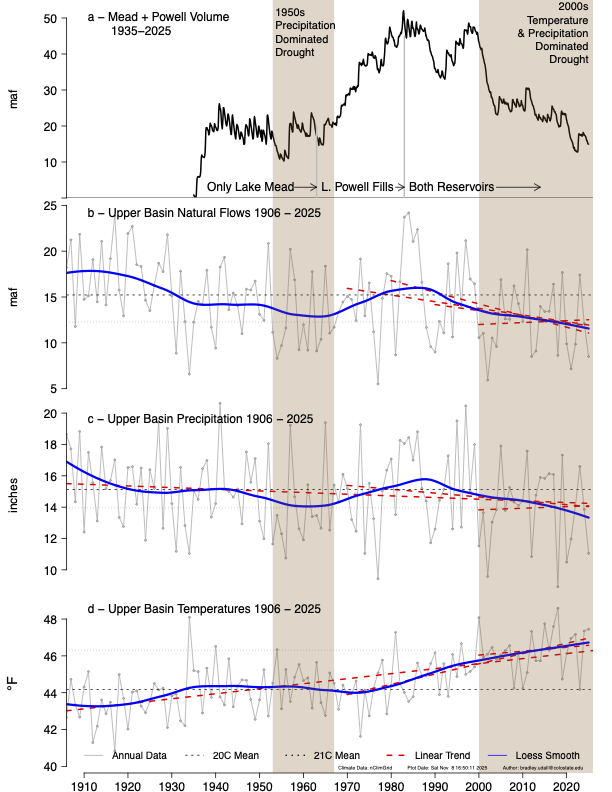
Colorado transmountain diversions via the State Engineer’s office

Opinion: Protecting Northeastern #Colorado’s Water Supply Requires Cooperation, Transparency — Brad Wind (Northern Water) #NISP #PoudreRiver #SouthPlatteRiver

The Northern Integrated Supply Project, currently estimated at $2 billion, would create two new reservoirs and a system of pipelines to capture more drinking water for 15 community water suppliers. An environmental group is now suing the Army Corps of Engineers over a key permit for Northern Water’s proposal. (Save the Poudre lawsuit, from Northern Water project pages)

Click the link to read the column on the Northern Water website (Brad Wind):

May 20, 2025

You might have read recently about how the Northern Integrated Supply Project, or NISP, is contributing $100 million to a fund for projects to improve the Cache la Poudre River in northeastern Colorado. That funding is part of an agreement between the Northern Colorado Water Conservancy District, known as Northern Water, and the nonprofit group Save the Poudre that will conclude a federal lawsuit against the project.

It’s an outcome that both sides can accept because of the importance of both the Poudre River and a much-needed water supply to communities throughout the region.

The agreement should catch the attention of Denver metro-area water providers that are looking to export existing irrigation water supplies out of northeastern Colorado to serve their future customers. 

Brad Wind of Loveland is the general manager of Northern Water, which supplies water to more than 1 million people in northeastern Colorado.

For background, NISP was conceived in the 1990s and early 2000s to provide water to the emerging communities of the northern Front Range. The project will consist of two off-channel reservoirs, one located northwest of Fort Collins and one north of Greeley. It also anticipates exchanges of water with nearby farmers eliminating the dry-up of some agricultural land in the future. 

Throughout the lengthy permitting process for NISP, the public has had many opportunities to offer comments and concerns to federal, state and local officials. Some of the concerns were incorporated into mitigation and improvement requirements associated with the project, and all written comments were addressed specifically in the final Environmental Impact Statement produced by the U.S. Army Corps of Engineers.

The $100 million settlement of the federal litigation identifies even more improvements that can be made in the region beyond those required by permitting agencies.

Unfortunately, actions by certain Denver metro-area water providers that anticipate removing water from northeastern Colorado do not undergo such robust scrutiny. Oftentimes, advocates for water resources in the region learn about potential water transfers only when an item appears on a meeting agenda of a metro-area water provider. By then it is too late to consider the regional economic, environmental and social impacts that such a change could produce.

Frequently, these water deals are brokered by third parties who quietly accumulate water and land assets to present them behind closed doors in neat and tidy packages to thirsty cities. There are few, if any, opportunities to discuss how these water transfers will impact local communities in northeastern Colorado or how these impacts could be mitigated by those who seek to move water to the Denver metro area.  

The half-million residents who receive water from NISP participants are going to pay billions of dollars to develop water resources for their communities while addressing concerns in the Poudre River watershed. At the same time Denver metro communities are working to undercut the existing supplies that previous northeastern Colorado residents have invested in and relied upon for decades. 

Water providers in the Denver area need to be part of the long-term solution to how our northeastern Colorado communities remain vibrant, not distant parties to single point-in-time transactions that provide a perpetual benefit to communities beyond the horizon. 

If native water supplies must depart for the Denver metro area from northeastern Colorado, it is appropriate that the new water user should not just pay for the costs to acquire water but also offset the impacts to northeastern Colorado’s degraded quality of life, and diminished regional economy. 

All of our futures are diminished by the loss of water from our region. Public processes and mitigation can lessen, to a degree, the perpetual impacts such a loss will endure.

Spring #snowpack: Slightly better than advertised, weak statewide figures obscure more nuanced scenario for Denver Water as we enter runoff season — Todd Hartman (News on Tap)

North Fork Snake River. Melted snow is the primary source of drinking water for the 1.5 million people who rely on Denver Water every day. Photo credit: Denver Water.

Click the link to read the article on the Denver Water website (Todd Hartman):

May 16, 2025

News headlines this spring offered a bleak picture of Colorado’s snowpack heading into the spring runoff season. But, as always with headlines, it is best to also read the story that follows.

Because the story for Denver Water isn’t quite so dour. 

Snowpack woes hit Colorado’s southern half hard. For Denver Water, positioned farther north, the water supply looks better.

First, let’s do the numbers. 

Denver Water had a weak showing in the South Platte River Basin, with peak snowpack hitting just 84% of normal and — most unhelpful of all — peaking on April 6, 19 days earlier than typical.

The news was far better in the Colorado River Basin (north of the South Platte River Basin), which accounts for the other half of Denver Water’s supply. There, peak snowpack clocked in at 109% on April 25, right on the mark for a typical peak date.

“Overall, not great, but not terrible either,” summed up Nathan Elder, water supply manager for the utility. 

The best news for Denver Water: The utility is starting the runoff and reservoir-filling season with existing storage levels about 2% above average. 

That’s a credit to its customers’ efforts to conserve water and translates into a good chance that Denver Water will be able to fill its storage reservoirs that help 1.5 million people get through the summer hot season.

But “fill” doesn’t mean “spill.” That is, there won’t be excess water to spill into rivers in what can make for dramatic visuals and provide an extra boost to river flows. 

“We hope to fill our reservoirs right to the brim, but that’s where it stops,” Elder said.

Denver Water’s planners are concerned about a hot-and-dry trend taking hold in May, and emphasize the need for residents to adhere to the utility’s annual summer watering rules that allow irrigation only in the evening and morning hours (between 6 p.m. and 10 a.m.) and limit irrigation to no more than three days a week — preferably just one or two days when springtime temperatures are lower.

And watch the skies. When we do get a good rainstorm, turn your sprinkler dial to “off” for a few days.

The generally poor snowpack and early runoff in much of the state, including in the South Platte River Basin, also stokes concerns for a rough fire season, as 9News meteorologist Chris Bianchi pointed out in a May 13, 2025, story

“This year’s snowpack levels resemble those recorded in 2018, 2012, 2002 and 1992. All of which were marked by intense wildfire activity. Three out of those four years saw large-scale fires, raising concerns that 2025 could follow a similar trajectory unless weather patterns shift dramatically.”

And, on a too-long-didn’t-read basis, here’s Bianchi’s tweet that summed up the story:

Denver Water’s watershed experts agree that conditions could increase wildfire risk.

“The risk of wildfire is relatively low when there is snow on the ground. When snowpack melts rapidly, vegetation can dry out quickly and become susceptible to wildfire ignitions,” said Madelene McDonald, a watershed scientist and wildfire specialist for Denver Water.

Though McDonald notes that experts anticipate “average” wildfire behavior in Colorado in 2025, that still means thousands of fires that could collectively affect more than 100,000 acres in the state. 

“It’s important to stay vigilant and prepared to experience wildfire under any snowpack conditions or fire outlook scenarios,” she said.

An April pivot

The current outlook is a pivot from what had been looking like a normal year for snowpack as recently as April 1, Elder said.

“For Denver Water, April is typically a month where we build snow,” he said. 

But that didn’t happen this year, and by mid-May the snowpack had shriveled to half its typical percentage.

The tepid spring in the South Platte River Basin also highlights the importance of Denver Water’s Gross Reservoir Expansion Project, which recently has been slowed in federal court. (Read Denver Water’s recent statement on a May 6 court hearing.) 

That project will expand the reservoir and add roughly 80,000 acre-feet of water storage capacity in the utility’s north system, which gathers snowmelt from the Upper Colorado River Basin. That additional water storage will provide a buffer to protect the utility’s customers from the effects of years when the snowpack is weaker, like this year, in Denver Water’s separate and unconnected south system.

“Our system is robust but suffers from significant imbalance,” Elder said. 

“We rely too heavily on our south system, on the South Platte, which accounts for 90% of our storage,” he said. “Increasing storage to the north will give Denver Water far more flexibility to handle these weaker snowpack years on the South Platte.”

And years marked by a weaker snowpack in the South Platte River Basin have become more common. 

In four of the last five years, the South Platte snowpack above Denver Water’s collection system has peaked below normal. And in that fifth year — last year — it barely cleared the “normal” bar at 101%. All of which amplifies the need for the Gross Reservoir Expansion Project.

Raising Gross Dam, seen here on April 8, 2025, will nearly triple the water storage capacity of the reservoir behind it. The project has been in the permitting and review process for 23 years. Photo credit: Denver Water.

Now, as June approaches, water managers will turn their focus to runoff levels, temperatures and fire potential. And come summer, they will once again — as always — hope for a big dose of monsoonal moisture. 

Those big rainstorms not only deliver a boost to rivers and reservoirs but prompt attentive customers to turn off their irrigation system and let their grass and plants drink up nature’s soaking bounty. 

Remember, the less you pour, the more your water utility can store.

And it’s never a bad time to consider transforming your landscape, or even parts of it. 

Denver Water has a new guide to help: the DIY Landscape Transformation Guide, and it includes ways to eradicate grass in the areas where you want to remodel your landscape with native plants and other changes.

Denver Water relies on a network of reservoirs to collect and store water. The large collection area provides flexibility for collecting water as some areas receive different amounts of precipitation throughout the year. Image credit: Denver Water.

Northern #Colorado will soon have new reservoirs, but the cost to build them has skyrocketed — Alex Hager (KUNC.org) #PoudreRiver #SouthPlatteRiver

The Cache la Poudre River flows through Bellevue, Colorado on May 12, 2025. Water from the river will be used to fill the nearby Glade Reservoir once it’s built. The cost to build the new water storage project has grown from $400 million to $2.2 billion. Alex Hager/KUNC

Click the link to read the article on the KUNC website (Alex Hager):

May 15, 2025

This story is part of ongoing coverage of water in the West, produced by KUNC in Colorado and supported by the Walton Family Foundation. KUNC is solely responsible for its editorial coverage.

There’s a stretch of highway in Larimer County where prairie grasses sway with each passing vehicle. Cars, horse trailers and semi trucks zip through the valley on their way between Fort Collins and Laramie. Soon, it’ll be under more than 200 feet of water.

U.S. Highway 287 runs through the future site of Glade Reservoir. The Larimer county Board of County Commissioners approved the 1041 Land Use Permit for NISP in September, 2020. Photo credit: Northern Water

It’s the planned site of Glade Reservoir, the cornerstone of a massive new water storage system designed to meet the demands of fast-growing towns and cities in Northern Colorado. After more than two decades of permitting, planning and environmental lawsuits, it’s closer than ever to breaking ground.

But along the way, some things changed. Over the years, costs to build the reservoir system — and reroute seven miles of U.S. Highway 287 — have ballooned. Price estimates for the Northern Integrated Supply Project, often referred to as NISP, went from $400 million to $2.2 billion. Because of that, some of the towns that signed up to use its water are cutting back on their involvement before the reservoir system stores a single drop.

Northern Water, the agency building NISP, has projected confidence that it will still get built as planned. The long road from idea to construction, and the things that have changed along the way, can tell us a lot about how Northern Colorado uses water, and how much it costs to keep taps flowing.

The Northern Integrated Supply Project, currently estimated at $2 billion, would create two new reservoirs and a system of pipelines to capture more drinking water for 15 community water suppliers. (Northern Water project pages)

Rising costs

When it was first pitched, in the early 2000s, NISP garnered support as a way to make sure small towns with fast-growing populations could host new housing developments without going dry.

For a tiny town like Severance, that was an attractive proposition. Just 11 years ago, about midway through the NISP planning process, the town had a population of about 3,000. That’s when Nicholas Wharton took the job as town manager. Since then, he’s overseen the installation of the town’s first stoplight, the from-scratch development of its own police department and a homebuilding boom that has nearly quadrupled Severance’s population.

Signing on to NISP, he said, was a way to make sure Severance had enough water for all that growth.

“I think for smaller towns,” he said, “It was a great idea back when it was affordable to us.”

Wesley Lavanchy, the town administrator for Eaton, Colo., poses outside of his office on April 15, 2025. His town is one of four water agencies that reduced the amount of water it would store in NISP, and the amount it would pay to keep it there. Alex Hager/KUNC

Since then, Severance has cut back on the amount of water it will store in NISP, and the amount it will pay to be a part of the project. At one point, the town held 2,000 shares of the project. In 2024, it sold off 1,500 of those shares. Wharton said the town council might try to sell off even more.

And Severance isn’t alone.

Due West, in Eaton, town officials also got cold feet. They were one of four NISP shareholders to offload a portion of their involvement in the new reservoir project on the same day in July 2024.

For years, the water agencies that were part of NISP were mostly focused on paperwork — making sure the project had the permits it needed to get built. Then, there was a lawsuit from environmentalists standing in the way. But after NISP’s proponents were mostly seeing green lights on permits and decided to settle a major lawsuit, the focus shifted to money.

“I think the question for us now is, how do we afford this?,” said Wesley Lavanchy, Eaton’s town administrator. “Moving forward, how much can we afford? It’s like chocolate cake. You like it, it tastes great, but you can’t eat the whole thing.”

Ultimately, Eaton decided to sell off more than half of its NISP shares.

“I suspect that more entities would have been able to hold their commitment had the permitting process not drug on so long, the cost escalated, the litigation kind of wrapped things up,” Lavanchy said.

Cheaper alternatives

While the cost to build NISP has gone up, the cost of other water sources has gone down. Eaton and Severance said it’s getting easier to afford shares of the Colorado-Big Thompson project, which was a big motivator in their pullback from NISP.

That project, referred to as CBT, pipes water from the Colorado River across the continental divide. It flows underneath Rocky Mountain National Park and into major reservoirs along the Northern Front Range, such as Horsetooth Reservoir near Fort Collins and Carter Lake outside of Loveland.

Water from the Colorado-Big Thompson project is managed by Northern Water, the same agency building and operating NISP.

Boats cruise across Horsetooth Reservoir near Fort Collins, Colorado on May 12, 2025. The reservoir holds water from the Colorado-Big Thompson project, which has seen prices level off in recent years. Glade Reservoir is expected to be even larger than Horsetooth. Alex Hager/KUNC

For years, the CBT system was the main way for growing cities in Larimer and Weld Counties to get water for residential development. Typically, farms have sold their portion of CBT water to cities, towns, or developers. Occasionally, they are taken to auction, where cities bid against one another for water stored in those big reservoirs.

The cost of that water skyrocketed between 2010 and 2022. Estimated prices, adjusted for inflation, went from less than $20,000 per share, to around $100,000 per share, according to data from the consulting firm Westwater research. Since 2022, that soaring rise has leveled out.

“We believe that’s largely driven by a softening in the home construction sector,” said Adam Jokerst, a Fort Collins-based regional director for Westwater. “A lot of CBT purchases are by municipalities and developers who dedicate them to municipalities. And when new home construction slows, we see less demand for those shares.”

How did NISP get so expensive?

Northern Water said the price to build NISP has been climbing for about 15 years. Brad Wind, the agency’s general manager, cited inflation and rising interest rates as major drivers. He doesn’t, however, expect that to stop or significantly change the reservoir project.

“It’s an expensive project,” Wind said. “We and the participants advancing the project like it was envisioned.”

The lengthy process to get the project’s two reservoirs — Glade, and a smaller one called Galeton reservoir — from concept to construction gave time for the winds of economic change to shift direction. It’s not uncommon for a massive dam project like NISP to take more than fifteen years to attain a laundry list of environmental permits.

The project also faced opposition from local governments and nonprofits. At one point, Fort Collins voted to oppose the project. The most significant roadblock came from the environmental nonprofit Save the Poudre.

The group rallied local support and took legal action to try and stop NISP. At a 2015 event, Save the Poudre director Gary Wockner told a crowd of supporters that he would “fight to stop the project for as long as it takes.”

In late February, Wockner’s group settled for $100 million dollars. Northern Water will pay that sum into a trust over the course of the next two decades, and the money will be used to fund river improvement projects. In the intervening time, though, the price tag to build NISP likely grew significantly.


New Northern Colorado reservoirs moving ahead after settlement of NISP lawsuitAlex Hager, March 5, 2025.


Wind said Northern plans to hire a contractor that could find ways to bring down the price by changing construction methods, but doesn’t expect “substantial reductions” to building costs, especially with rising prices of imported construction materials.

Over the years, the towns and water agencies that wanted to use NISP signed periodic agreements to stay part of the project. Now, time is ticking for those participants to sign a binding contract.

Eaton’s Lavanchy said that upcoming contract made his town take a harder look at their water needs, and whether those needs would be satisfied by NISP.

“We’re not dating anymore,” he said, “We’re getting married, and there’s no way out. Divorce is not an option. So it’s like, ‘Let’s be smart and think about, what are these obligations going to run us?’”

‘Demand continues to increase’

Even as some entities cut back on their financial ties to NISP, the project still has momentum.

For one, those towns and water agencies looking to sell their shares found a willing buyer. Eaton, Severance, Fort Lupton and the Left Hand Water District all sold their shares to the Fort Collins Loveland Water District.

Vehicles drive on U.S. Highway 287, near Bellevue, Colo. on May 12, 2025. The highway will be rerouted to make way for a massive new reservoir. Alex Hager/KUNC

The Fort Collins Loveland Water District, which serves an area roughly between Harmony Road and State Route 34, declined to be interviewed for this story.

Second, NISP has a total of 15 participants, and many of them are still on board for the same amount of water they signed up for years ago.

“No matter what,” Severance’s Wharton said, “In one way, you’ll see those 15 probably still continue to be a part of it no matter what, because everybody does realize how precious that water is and how this will be one of the last [big reservoirs.] I don’t think anybody’s discouraged.”

Even the towns that reduced the amount of water they’ll pay to use from NISP are keeping some. Severance and Eaton said they want to make sure they’re getting water from a diverse group of sources, especially with climate change and political bickering threatening their main source of water — the Colorado River via the CBT.

Ultimately, the fast-growing region served by Northern Water — from Boulder County to Fort Collins, and east to Fort Lupton — will keep needing water for a future that will likely see plenty of new home construction.

“It doesn’t appear that folks are shying away from moving to Northern Colorado,” Brad Wind said. “Either from within our state or from outside of our state, so the demand continues to increase for a high quality water supply, which NISP will produce.”

Update on Gross Reservoir Expansion Project following May 6, 2025, testimony: Denver Water provides statement on the risk presented by delaying construction — News on Tap

Storm pattern over Colorado September 2013 — Graphic/NWS via USA Today

Click the link to read the release on the Denver Water website:

May 8, 2025

Following a day of testimony on May 6, Denver Water has been asked by U.S. District Court Judge Christine Arguello to provide the court with the utility’s final summary highlighting its position following the witness testimony and exhibits. There isn’t a specific timetable set for this yet.

The focus of the hearing was for the judge to determine if construction can safely stop while Denver Water moves forward on an additional permitting review as the court ruled on April 3. Here is Denver Water’s statement on the risk presented by delaying construction:

Denver Water has already started the appeal process with the 10th Circuit Court of Appeals. As part of this, the project has been allowed to continue (under a temporary stay) while legal proceedings are underway.

Roller-compacted concrete will be placed on top of the existing dam to raise it to a new height of 471 feet. A total of 118 new steps will make up the new dam. Image credit: Denver Water.

Regional Pool Allocation Set at  23,000 Acre-feet; Sealed Bids Due 2 p.m. Thursday, May 22, 2025 — Northern Water

Aerial view of Lake Estes and Olympus Dam looking west. Photo credit Northern Water.

From email from Northern Water (Jeff Stahla):

May 9, 2025

The Northern Water Board of Directors allocated 23,000 acre-feet of Regional Pool Program (RPP) water during its May 8, 2025, Board meeting. RPP water is available for lease by eligible Northern Colorado water users, with sealed bids due 2 p.m. May 22, 2025. Bid prices per-acre-foot must be greater than or equal to $33.80, a floor price the Board selected based on the 2025 agricultural assessment rate. Late bids will not be considered.

The allocation will be available to bidders from two subpools of 11,500 acre-feet each; one that delivers water from Horsetooth Reservoir, and a second that delivers to water users south of Horsetooth Reservoir, including the Big Thompson River, St Vrain Creek and Boulder Creek.

The following forms are required to submit a bid: 

  • Pre-Approval Form – To confirm eligibility, interested bidders must email or mail the Pre-Approval Form to Northern Water. A new Pre-Approval Form is required each year.   
  • Carrier Consent Form – If the RPP water will be delivered by a carrier, such as a ditch or reservoir company, bidders and their carriers must complete the Carrier Consent Form or provide a signed agreement stating that the carrier will deliver the RPP water to the bidder. This form must also be emailed or mailed to Northern Water.  
  • Bid Form – Sealed bids will be accepted at Northern Water’s headquarters through a “self-serve” process. Bidders will sign in at a kiosk in the Building A lobby at Northern Water, 220 Water Ave., Berthoud, and print a bid label for their sealed bid envelope. The label will identify the bidder name, date and time stamp, and bid number. Bidders are then asked to secure the label to the bid envelope and place it in the drop box. Sealed bids may also be mailed to Northern Water, but bids must be received before the deadline.  

Sealed bids are due by 2 p.m. Thursday, May 22, at Northern Water’s headquarters, 220 Water Ave., Berthoud, CO 80513. As described above, sealed bids can be mailed or hand delivered; email and fax bid forms will not be accepted. RPP leases within each subpool will be awarded based on highest bids per acre-foot. Sealed bids will be opened at 2:10 p.m. Thursday, May 22, in the Grand Lake Conference Room of Building A at Northern Water.

Questions regarding the Regional Pool Program and bid submittal can be emailed to regionalpool@northernwater.org or by calling Sarah Smith at 970-622-2295 or Water Scheduling at 970-292-2500.

Designer of #Colorado’s Gross Dam expansion warns of possible flooding if judge halts project — Jerd Smith (Fresh Water News) #ColoradoRiver #SouthPlatteRiver

Denver Water is helping ensure its future water security with the Gross Reservoir Expansion Project. When the project is complete, it will nearly triple the Boulder County reservoir’s capacity to 119,000 acre-feet. CREDIT: HEATHER SACKETT/ASPEN JOURNALISM

Click the link to read the article on the Water Education Colorado website (Jerd Smith):

May 8, 2025

Adam engineer who designed a major expansion of Gross Reservoir Dam in Boulder County told a federal judge Tuesday that the raising of the dam, facing a potential halt due to an April federal court ruling, needs to proceed to protect public safety.

Mike Rogers, the civil engineer who designed the $531 million expansion of the dam,  said bad weather could create flood conditions that would lead to a catastrophic failure similar to what occurred with the Oroville Dam failure in California in 2017.

But Stephen Rigbey, a Canadian dam safety expert testifying for Save The Colorado, said any issues with putting the construction project on hold, even in its partially-complete state, could be addressed, and that the risk of a catastrophic failure was “negligible.”

Workers from Denver Water and contractor Kiewit Barnard stand in front of Gross Dam in May 2024 to mark the start of the dam raise process. Photo credit: Denver Water.

Rogers’ and Rigbey’s testimony Tuesday came during a federal hearing in Denver, after which U.S. District Court Judge Christine Arguello will determine whether to allow construction to move forward on the Denver Water project or whether the construction will be paused until new federal reviews she has ordered are completed and legal questions are answered.

But at the end of Tuesday’s hearing, Arguello said the parties to the case had not provided enough information for her to make a decision and ordered them to submit more data later this month.

The massive construction project has raised fierce opposition in Boulder County and prompted several legal challenges from Save The Colorado, a group that advocates on behalf of rivers. Though its early lawsuits failed, in 2022 the river defenders won an appeal that put the legal battle back in play. Despite months of settlement talks, no agreement was reached.

Denver Water’s entire collection system. Image credit: Denver Water.

Boulder County Commissioner Ashley Stolzmann was unmoved by Rogers’ testimony, saying she hopes the judge halts the work to prevent further environmental damage in Boulder County and to protect the Fraser River, a tributary to the Upper Colorado River. The Fraser has served as the source of water for Gross Reservoir since the 1950s, when it was built.

“It’s incredibly disappointing that Denver has chosen to move forward,” Stolzmann said. “With climate change, it really is a time for different entities to work together to repair the climate. I want to see Denver seek alternative solutions.”

Denver Water first moved to raise Gross Dam more than 20 years ago when the water provider began designing the expansion and seeking the necessary federal and state permits. Denver Water has said raising the dam and expanding the reservoir is necessary to ensure it has enough water throughout its delivery system and to help with future water supplies as climate change continues to reduce streamflows.

The Gross Reservoir Expansion Project involves raising the height of the existing dam by 131 feet. The dam will be built out and will have “steps” made of roller-compacted concrete to reach the new height. Image credit: Denver Water

After years of engineering, environmental studies and federal and state analyses, Denver received a permit from the U.S. Army Corps of Engineers and construction began in 2022. It has involved taking apart a portion of the original dam and raising its height by 131 feet to nearly triple the reservoir’s storage capacity to 119,000 acre-feet from 42,000 acre-feet.

The case took center stage again April 3, when Judge Arguello put a temporary halt to construction of the higher dam, at Save The Colorado’s request.

In that high-profile ruling, Arguello said, in part, that the Army Corps should have considered whether ongoing climate change and drought would leave the Colorado River and Western Slope waterways too depleted to safely allow transfer of Denver Water’s rights into a larger Gross Reservoir for Front Range water users.

At the same time, she ordered a permanent injunction prohibiting enlargement of the reservoir, including tree removal and water diversion, and impacts to wildlife.

Almost immediately, Denver Water filed for temporary relief from the order, saying, in part, that it would be unsafe to stop work as the incomplete concrete walls towered above Gross Reservoir.

Arguello granted that request, too, allowing Denver to continue work on the dam considered necessary for safety.

Denver Water has also filed an appeal with the U.S. 10th Circuit Court of appeals, seeking to permanently protect its right to continue building the dam. The appeals court is expected to wait for the lower court to rule, before considering Denver Water’s request.

More by Jerd Smith

Udall/Overpeck 4-panel Figure Colorado River temperature/precipitation/natural flows with trend. Lake Mead and Lake Powell storage. Updated through Water Year 2024. Credit: Brad Udall

The #ColoradoRiver needs some ‘shared pain’ to break a deadlock, water experts say — Alex Hager (KUNC.org) #COriver #aridification

Dusk falls on Lake Powell near Bullfrog Marina on July 15, 2024. A new letter from water policy experts gives negotiators some recommendations on how to sustainably manage the Colorado River in the future. Alex Hager/KUNC

Click the link to read the article on the KUNC website (Alex Hager):

May 3, 2025

This story is part of ongoing coverage of the Colorado River, produced by KUNC in Colorado and supported by the Walton Family Foundation. KUNC is solely responsible for its editorial coverage.

The seven states that use the Colorado River are deadlocked about how to share it in the future. The current rules for dividing its shrinking supplies expire in 2026. State leaders are under pressure to propose a new sharing agreement urgently, so they can finish environmental paperwork before that deadline.

Right now, they don’t appear close to an agreement, so a group of prominent Colorado River experts co-signed a letter outlining seven things they want to see in the next set of rules.

The letter gives a clear, concise list of recommendations for ways to keep taps flowing while protecting tribes and the environment. Whether the states will listen is another matter entirely.

‘Shared pain’

The letter, written by a group of academics and retired policymakers, makes no bones about it: states need to find a collective solution to their collective problem. And some of them might not be happy.

State leaders have been reluctant to volunteer cutbacks, and have largely stayed divided along a decades-old fault line. On one side, the Upper Basin – which consists of Colorado, Utah, Wyoming and New Mexico. The other side, the Lower Basin, is made up of California, Arizona and Nevada.

The recent letter is interesting in part because it’s co-authored by people from both sides of the Colorado River debate. Eric Kuhn led an agency that defends Western Colorado’s water. Kathryn Sorensen led Phoenix’s water department.

The letter was also written by Anne Castle, who has worked in federal water policy positions, and Jack Schmidt, a water researcher at Utah State University. Co-authors John Fleck and Katherine Tara research water policy at the University of New Mexico.

The authors write that states need to engage in some level of “shared pain,” meaning cutbacks to the amount of water that flows to farms, homes, and businesses.

“‘Shared’,” the letter writes, “Does not mean equal, either in amount, triggers, or duration.”

Water from the Colorado River flows through the East Highline Canal on its way to farms in the Imperial Valley on June 20, 2023. The Colorado River’s single largest user has taken federal money through incentive programs to cut back on water use. Alex Hager/KUNC

The Lower Basin states have already proposed relatively modest cutbacks, and the Upper Basin seems to be digging in its heels on the idea that they should not have to give up any water at all.

This letter pushes back on that stance.

“There’s lots of wonderful legal arguments about why it shouldn’t be me that needs to use less water,” Anne Castle, one of the letter’s authors, told KUNC. “But in order to have a viable and politically viable agreement, everybody has to do a share.”

Other recommendations

In addition to calling for states to put their heads together, the authors also warned against leaning too hard on federal checks as a way to conserve water. Money from the federal government has been a key part of avoiding catastrophe on the Colorado River in recent years. Hundreds of millions of dollars have gone to big water users, often farmers, as an incentive to use less water.

Those funds have come under threat during President Donald Trump’s second term. The letter says new rules for the Colorado River “cannot assume that federal taxpayers will reimburse Western water users over the long term to forgo the use of water that does not exist.”

The letter goes on to advocate for groups that can sometimes be an afterthought in Western water policy. It essentially re-ups an earlier call from a group of tribes in the Colorado River basin, which are asking for a bigger seat at the table after more than a century of exclusion. It also pushes for new rules to be more flexible, which would make it easier to protect river ecosystems. That mirrors similar comments from a group of nonprofits.

The shortest and final recommendation in the letter says that any new Colorado River rules have to make sure there’s enough water to keep people safe and healthy.

“There must be absolute protection of domestic water deliveries for public health and safety,” it reads.

In short, it’s asking to make sure that a worst-case-scenario doesn’t see drinking water reserves go dry, while agriculture and other industries keep their faucets flowing.

“I don’t think that would happen,” Castle said. “I think the market would intervene and take care of this situation.”

The reaction

KUNC reached out to top water negotiators in Arizona and Colorado for this story. Their answers fell in line with oft-repeated talking points from each basin.

A spokesman for the Arizona Department of Water Resources wrote that its director, Tom Buschatzke, “agreed with the authors that ‘every state and sector of the economy must contribute to the solution to this imbalance.’”


Water policymakers from (left to right) Utah, New Mexico, Colorado and Wyoming speak on a panel at the Colorado River Water Users Association conference in Las Vegas on December 5, 2024. The Upper Basin states have been reluctant to volunteer cutbacks ahead of the next set of river-sharing rules. Alex Hager/KUNC

Colorado’s top water official, Becky Mitchell, wrote that the recommendations overlooked climate change’s impact on Upper Basin water supplies, and that states already take “mandatory and uncompensated” cuts.

“Colorado water users do not enjoy a guaranteed delivery of the full amount of their water rights each year,” she wrote.

Jennifer Gimbel, Colorado’s former top water official, did not contribute to the letter and also took issue with the suggestion that both basins could afford to make cutbacks.

“Are the authors of the paper thinking that federal law should be enacted to override state law?” Gimbel wrote to KUNC in an email. “Are they thinking that users in the Upper Basin, who they say should not rely on federal compensation, should just give up their livelihoods voluntarily or be compensated by the state legislatures? I don’t know because they don’t say.”

Denver Water vows to take Gross Reservoir Dam expansion fight to the U.S. Supreme Court — Jerd Smith (Fresh Water News)

The dam raise process begins at the bottom of the dam using roller-compacted concrete to build the new steps that will go up the face of the dam. Photo credit: Denver Water.

Click the link to read the article on the Water Education Colorado website (Jerd Smith):

April 24, 2025

Denver Water vowed this week to take the high-stakes battle over a partially built dam in Boulder County to the U.S. Supreme Court if necessary to defend what it sees as its well-established right to continue construction and deliver water to its 1.5 million metro-area customers.

“It would be irresponsible not to do that,” Denver Water’s General Manager Alan Salazar said in an interview Tuesday as a tense month of legal maneuvering continued.

Senior U.S. District Court Judge Christine Arguello on April 3 put a halt to construction of the $531 million Gross Reservoir Dam raise nearly four months after Denver Water and the river-defending nonprofit Save the Colorado failed to negotiate a settlement that would add new environmental protections to the project. When settlement talks stalled, Save the Colorado asked for and was granted an injunction.

Almost immediately, Denver Water filed for temporary relief from the injunction, saying, in part, that it would be unsafe to stop work as the incomplete concrete walls towered above Gross Reservoir in western Boulder County.

Arguello granted that request, too.

Now the water agency, the largest utility in the Intermountain West, has filed an emergency request with the federal appeals court, seeking to permanently protect its right to continue construction as the legal battle continues.

A decision could come as early as this week as a 10th Circuit Court of Appeals panel considers Denver Water’s emergency request, according to environmental advocate Gary Wockner. Wockner leads Save The Colorado, a group that has financed and led litigation against Denver Water and many other agencies seeking new dams or river diversions. Wockner said he is ready to continue the fight as well.

“We are prepared to defend the district court’s decision,” Wockner said, referring to the construction halt.

Alan Salazar, who became Denver Water CEO/Manager in August 2023 Photo credit: Denver Water

The high-profile dispute erupted in Denver just weeks after Northern Water agreed to a $100 million settlement with Save The Colorado and its sister group, Save The Poudre, to allow construction of the Northern Integrated Supply Project, or NISP, to proceed.

The money will be used to help restore the Cache la Poudre River, including moving diversion points and crafting new agreements with diverters that will ultimately leave more water in the river. Northern Water, which operates the federally owned Colorado-Big Thompson Project for the U.S. Bureau of Reclamation, is overseeing the permitting and construction of NISP.

But two years of talks and negotiations between Save The Colorado and Denver Water failed to yield a similar environmental settlement over the Gross Reservoir Dam expansion project. It was after the talks failed that Federal District Court Judge Arguello agreed to halt construction on the dam.

Whether a new environmental deal will be forthcoming now isn’t clear. Both sides declined to comment on whether settlement talks had resumed.

Salazar also declined to discuss whether a deal similar to the $100 million NISP settlement would emerge over the Gross Reservoir lawsuit.

“I don’t want to get into the cost of a settlement,” Salazar said. “But the impact on ratepayers would be significant.

Case sets the stage for future water projects in Colorado

Across the state, water officials are closely watching the case play out.

For fast-growing Parker Water and Sanitation, the preliminary injunction to stop construction, though temporary, is worrisome.

Its general manager, Ron Redd, said he wasn’t sure how his small district, which is planning a major new water project in northeastern Colorado, would cope with a similar injunction or a U.S. Supreme Court battle.

“In everything permitting-wise you need consistency in how you move projects forward,” Redd said. “To have that disrupted causes concern. Is this going to be the new normal going forward? That bothers me.”

Denver Water first moved to raise Gross Dam more than 20 years ago when it began designing the expansion and seeking the federal and state permits required by most water projects.

After years of engineering, studies and federal and state analyses, construction began in 2022. It has involved taking part of the original dam, built in the 1950s, and raising its height by 131 feet to nearly triple the reservoir’s storage capacity to 119,000 acre-feet from 42,000 acre-feet. An acre-foot of water equals 326,000 gallons, enough to serve up to four urban households each year.

The giant utility has said it needs the additional storage to secure future water supplies as climate change threatens stream flows in its water system, a key part of which lies in the Fraser River, a tributary to the Upper Colorado River in Grand County. The expansion was also necessary to strengthen its ability to distribute water from the northern end of its system, especially if problems emerged elsewhere in the southern part of its distribution area, as occurred during the 2002 drought.

And the judge agreed climate change is a factor but she said it’s not clear the water would ever even materialize as flows shrink. She overturned Denver Water’s permits because she said the Army Corps had not factored in Colorado River flow losses from climate change, and whether Denver would ever actually see the water it plans to store in an expanded Gross. Arguello also ruled the Army Corps had not spent enough time analyzing alternatives to the Gross Reservoir expansion.

Wockner said forcing Denver Water and the U.S. Army Corps of Engineers to re-analyze water projections under new climate change scenarios, as his group has asked, is critical to helping protect the broader Colorado River and stopping destructive dam projects.

Whether the questions the case raises about permitting and environmental protections ultimately make their way to the U.S. Supreme Court isn’t clear yet.

But James Eklund, a water attorney and former director of the Colorado Water Conservation Board, the state’s lead agency on water planning and funding, said Denver Water has the expertise and financial muscle to take it there.

“They have really sharp people over there,” he said. “I would say they are not only willing, they would have the facts to present a case they believe would be successful.”

[…]

More by Jerd Smith

The Gross Reservoir Expansion Project involves raising the height of the existing dam by 131 feet. The dam will be built out and will have “steps” made of roller-compacted concrete to reach the new height. Image credit: Denver Water

#ColoradoRiver Basin states have just weeks left to agree on plan: Sen. John Hickenlooper said he’s frustrated at slow pace of negotiations — Heather Sackett (AspenJournalism.org) #COriver #aridification

U.S. Sen. John Hickenlooper, D-Colo. stopped in Glenwood Springs on the bank of the Colorado River on April 15 for a roundtable with Western Slope water users. Many who spoke were promised federal funding for projects to address environmental and drought issues, which has now been frozen by the Trump administration. Credit: Heather Sackett/Aspen Journalism

Click the link to read the article on the Aspen Journalism website (Heather Sackett):

April 22, 2025

During a tour of the Western Slope last week, U.S. Sen. John Hickenlooper, D-Colo., said he was frustrated with the pace of negotiations that could determine how the Colorado River is shared in the future and that the Upper Basin states may be pushing back too hard.

A deal should have been reached last summer, he said.

“Colorado should have a right to keep the water that we have been using the way we’ve been using it, and I don’t think we should compromise that,” Hickenlooper said. “But there are a lot of things we could do to give a little to be part of the solution to the Lower Basin and get to a collaborative solution. Again, I’m frustrated by our lack of progress.”

The remarks came during a Q&A with reporters April 15 after a roundtable in Glenwood Springs with Western Slope water managers, many of whom spoke about their projects that were promised funding through the Inflation Reduction Act, which was earmarked for environmental and drought issues. That funding has since been frozen by the Trump administration.

Hickenlooper added that Colorado River management decisions should not be coming from Washington and that the only path forward is an agreement among the seven states that comprise the two basins. Hickenlooper has supported conservation efforts in the Upper Basin (Colorado, New Mexico, Utah and Wyoming), including the System Conservation Pilot Program, which paid water users to cut back in 2023 and 2024.

The seven states that use water from the Colorado River – Arizona, California and Nevada comprise the Lower Basin – have just over a month left to agree on how the nation’s two largest reservoirs would be operated and cuts shared in the future before the federal government may decide for them.

“It’s our understanding from Reclamation that they are going to start the impacts analysis in early June, so they are seeking a consensus alternative by the end of May,” said Chuck Cullom, executive director of the Upper Colorado River Commission.

The current guidelines for the management of the Colorado River expire at the end of 2026, and new ones need to be in place by that August, when reservoir operations for the next water year are set. That means the clock is ticking on the National Environmental Policy Act (NEPA) process that will develop and adopt new guidelines. Without an agreement between the basins, the U.S. Bureau of Reclamation will move forward with its own management plan.

“[Reclamation] is targeting a record of decision in the summer of 2026 so that it is implementable on Oct. 1, 2026, when the next new water year starts,” Cullom said.

From left, J.B. Hamby, chair of the Colorado River Board of California, Tom Buschatzke, Arizona Department of Water Resources; Becky Mitchell, Colorado representative to the Upper Colorado River Commission. From left, Colorado River negotiator for California JB Hamby, Arizona’s Tom Buschatzke and Colorado’s Becky Mitchell. Water managers from all seven Colorado River Basin states have just over a month left to reach a consensus on how the river will be shared in the future.Credit: Tom Yulsman/The Water Desk

Although water managers say coming to an agreement that all seven states can live with is better than the federal government imposing its own rules, the Upper Basin and the Lower Basin remain divided. Talks ground to a halt at the end of last year, but they have since resumed, according to Colorado officials.

Lead negotiator for Colorado Becky Mitchell said in a written statement that Colorado is focused on working with the basin states towards a consensus approach for the post-2026 operations of Lake Powell and Lake Mead that would fit within Reclamation’s timeline for the NEPA process.

“The basin states share common goals: we want to avoid litigation, and we want a sustainable solution for reservoir operations,” Mitchell said. “In light of these goals, I see the basin states working towards sustainable, supply-driven operations of Lakes Powell and Mead that are resilient across a range of hydrologic conditions experienced in the basin.”

In March 2024, each basin submitted competing proposals to federal officials. In January, the bureau released an alternatives analysis, which outlined five potential paths forward. It did not include either basin’s proposal as an option and instead looked at a “basin hybrid” option, with elements from each basin’s proposal.

A major sticking point that has not yet been resolved is that Lower Basin water managers say the Upper Basin states must share cuts under the driest conditions. Upper Basin officials maintain they already suffer annual shortages of about 1.3 million acre-feet because they are squeezed by climate change and shouldn’t have to share additional cuts because their states have never used the entire 7.5 million-acre-foot apportionment given to them by the Colorado River Compact. Upper Basin officials, however, have offered to voluntarily conserve up to 200,000 acre-feet of water a year.

“A lot of the difference in the two proposals is that the Lower Basin seems much more comfortable running the system at a lower volume of water in the reservoirs, and we view that as leading to crisis management,” Andy Mueller, general manager of the Glenwood Springs-based Colorado River Water Conservation District, said at the district’s regular board meeting April 15. “So if you keep the system in a constant state of crisis, then it’s one emergency after another, which should feel familiar to anybody who’s been following the Colorado River for the last 20 years, because that’s what has been happening.”

This 2023 diagram shows the tubes through which Lake Powell’s fish can pass through to the section of the Colorado River that flows through the Grand Canyon. Credit: USGS and Reclamation 2023

Of the five potential options in the bureau’s analysis, the “federal authorities” alternative may be the most likely way forward if a consensus between the two basins is not reached. That alternative includes up to 3.5 million acre-feet of cuts in the Lower Basin, no Upper Basin conservation and a focus on upstream reservoir releases to keep Lake Powell full enough to make hydropower at Glen Canyon Dam.

“We have to remember that creating your own solution for the consensus is always better than allowing somebody else to create it for you, so we are hopeful that will happen,” Mueller said.

Adding to the urgency of finding agreement on future river operations is a rapidly diminishing snowpack and spring-runoff forecast that could once again drive reservoirs to crisis levels. Hot and dry conditions have pushed snowpack across the Upper Basin down to 74% of average — a 27% loss in the past two weeks. Conditions may be beginning to resemble 2021 and 2022, when Lake Powell fell to its lowest point ever, threatening the ability to make hydropower and triggering emergency upstream reservoir releases and calls from federal officials for 2 million to 4 million acre-feet in conservation from the states.

“It’s the opposite of good,” Cullom said of this year’s runoff forecast. “Now through the first week of May, either we’ll get some replenishment or the snowpack will collapse. My money’s on collapsing, unfortunately, similar to 2021.”

Map of the Colorado River drainage basin, created using USGS data. By Shannon1 Creative Commons Attribution-Share Alike 4.0

#Nebraska’s $600 million water project faces resistance from #Colorado landowners — Colorado Politics #SouthPlatteRiver

Perkins County Canal Project Area. Credit: Nebraska Department of Natural Resources

Click the link to read the article on the Colorado Politics website (Marianne Goodland). Here’s an excerpt:

April 7, 2025

On or around April 17, six landowners in Sedgwick County will face a decision: whether to sell their land to the state of Nebraska for a canal that will be at least partially constructed in Colorado, or face what is likely to be an unprecedented land grab…The history of the proposed canal dates back more than 100 years, to the compact between Colorado and Nebraska regarding water from the South Platte River. Article VI of the compact states that Nebraska can divert 500 cubic feet per second during the non-irrigation season, as well as any additional available flows, into the canal. That non-irrigation season runs from Oct. 15 to April 1…

However, Nebraska claims that Colorado has increased its own diversions and related water uses during the non-irrigation season, leaving Nebraska with no choice but to construct the canal and claim its non-irrigation season water. The canal would start just east of Ovid, in Sedgwick County, and continue into Perkins County, just across the state line in Nebraska. The 1923 compact allows Nebraska to build the canal, using eminent domain, and to seek it in federal court if necessary.

People work on the Perkins County Canal in the 1890s. The project eventually was abandoned due to financial troubles. But remnants are still visible near Julesburg. Perkins County Historical Society

For one state to grab the land of another is unprecedented, Attorney General Phil Weiser told Colorado Politics earlier this year. While Colorado agreed to the canal in 1923, that’s not how Weiser sees it now. Weiser sent a letter to the Sedgwick County commissioners in January, stating that he is opposed to Nebraska’s potential action. He wrote that he had advised Nebraska’s attorney general that the project would provide little to no benefit to the state of Nebraska. However, if Nebraska moves forward, Colorado will defend its rights, he added.

Perkins canal drawing showing the Colorado portion, courtesy Nebraska Department of Natural Resources.

Judge allows Denver Water two more weeks of Gross Dam construction before court-ordered halt — The #Denver Post

The construction site at the bottom of Gross Dam with equipment used to place concrete and build the new steps. Photo credit: Denver Water.

Click the link to read the article on The Denver Post website (Elise Schmelzer). Here’s an excerpt:

April 7, 2025

The state’s largest water utility will have two weeks to complete any necessary work on its $531 million dam expansion project before a court-ordered construction halt takes effect, a federal judge ruled Sunday. The granting of a temporary window for construction follows an order late Thursday by U.S. District Court Judge Christine Arguello blocking Denver Water’s expansion of Gross Reservoir outside Nederland and barring further construction work to raise the height of the dam…In response to the order, Denver Water asked the judge to allow dam construction to continue while the utility appealed her decision.

“Denver Water faces enormous irreparable harm from the order stopping ongoing project construction, which may threaten the safety of the half-constructed dam; require Denver Water to quickly lay off hundreds of construction workers; impose millions in additional materials and equipment costs on Denver Water and its ratepayers; and increase the risk of water shortages,” lawyers for the utility wrote in their request.

Arguello denied the utility’s request to allow construction to continue during the appeal but granted the 14-day stay on her order blocking all construction. After a yet-to-be-scheduled hearing, she will decide exactly how much more construction to allow to make the existing dam structurally sound…Arguello in her Sunday order reiterated her criticism of Denver Water’s decision to start construction even though it faced challenges to the legality of the project.

“The financial concerns argued by Denver Water do not outweigh the irreparable injury of environmental harm,” the judge wrote. “Denver Water took a calculated risk when it decided to move forward with construction despite the lawsuit.”

Dancing with Deadpool on #NewMexico’s Middle #RioGrande — John Fleck (InkStain.net)

Dancing with Deadpool.

Click the link to read the article on the InkStain website (John Fleck):

April 4, 2025

We are heading into a remarkable year on New Mexico’s Middle Rio Grande. Here are some critical factors:

  1. The preliminary April 1 forecast from the NRCS is for 27 percent of median April – July runoff at Otowi, the key measurement gage for New Mexico’s Middle Rio Grande.
  2. Current reservoir storage above us is basically nothing.
  3. Reclamation’s most recent forecast model runs suggest flow through Albuquerque peaked in February. It usually peaks in May.

We will learn a great deal this year.

What I’m Watching

New Mexico water projects map via Reclamation

City Water

At last night’s meeting of the Albuquerque Bernalillo County Water Utility Authority’s Technical Customer Advisory Committee, water rights manager Diane Agnew said the utility is planning to shut down its river diversions, shifting system operations to groundwater, by the end of April. Albuquerque invested ~half a billion dollars in its river diversion system, in order to make direct use of our San Juan-Chama Project water, to relieve pressure on the aquifer. This will be the fifth year in a row that Rio Grande flows have been so low that we can’t use the new system for a substantial part of the year.
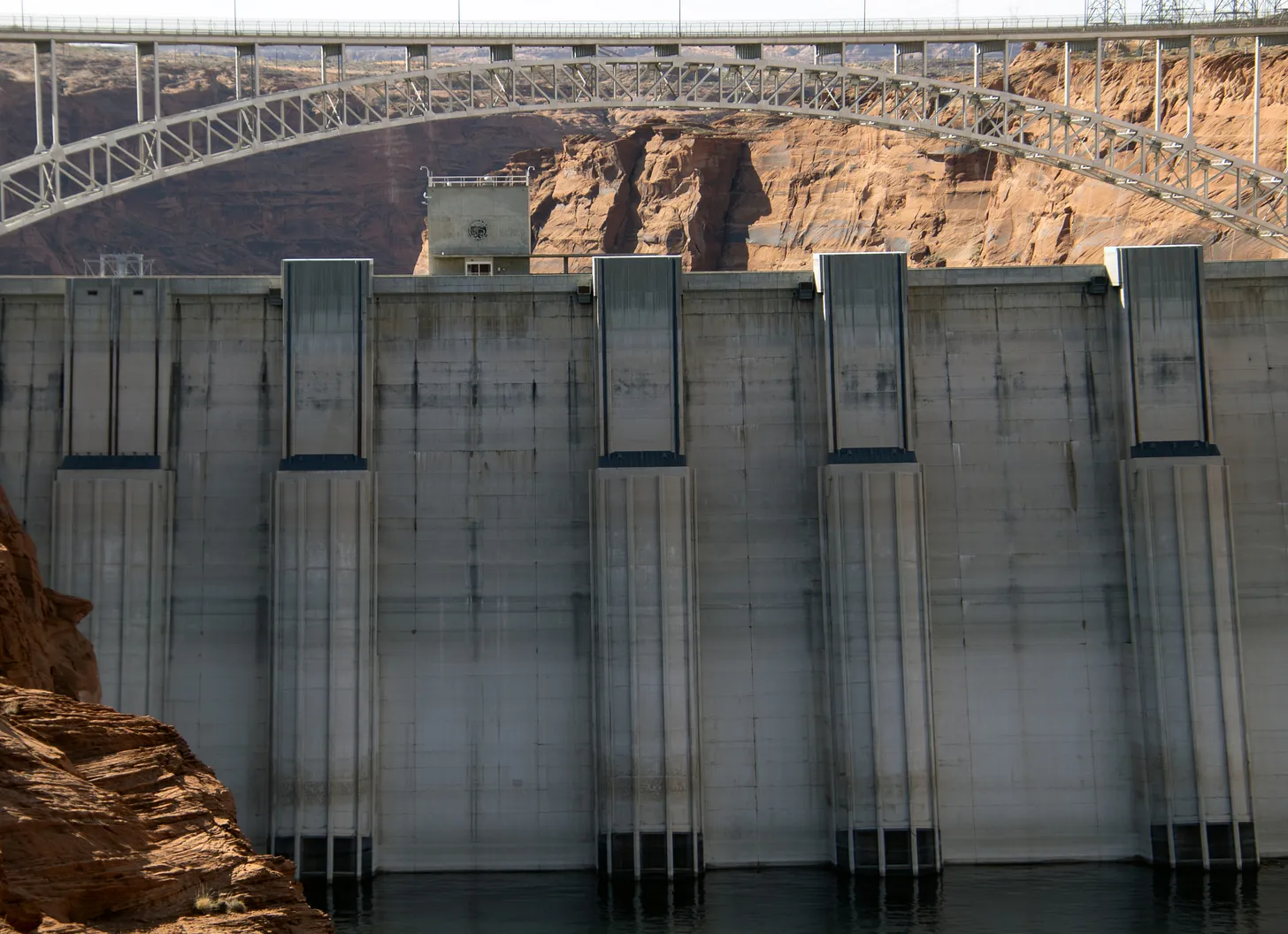
(For the nerds, Diane’s incredibly useful slides from last night’s TCAC meeting are here, the 4/3/2025 agenda packet.)

We have groundwater. My taps will still run, and I’ll be able to water my yard. But we’ll once again be putting stress on the aquifer that we’ve been trying to rest, to set aside as a safety reserve for the future. Is that future already here?

Reclamation operates pumps to move water from the Low Flow Conveyance Channel into the Rio Grande. The LFCC acts as a drain for the lower part of the Middle Rio Grande.

Irrigation

Middle Rio Grande Conservancy District irrigators who depend on ditch water are going to have a tough year, with supplies running short very early. The impacts here are a little weird.

Most of the relatively small number of the non-Indian full-on commercial farmers have supplemental wells. Smaller operators, who farm as a second income, will have to rely on their first income, whatever that is, and hope for some monsoon rains to get more cuttings of hay. Lots of hobby farmers will just run their domestic wells, or buy hay for their horses from out of state.

Native American farming is a more complicated story that I don’t fully understand. State and federal law recognize the fact that they were here first – we really do kinda comply with the doctrine of prior appropriation here. Their priority rights – “prior and paramount” – were enshrined in federal law in the 1928 act of Congress that kicked in federal money through the predecessor of the Bureau of Indian Affairs – crucial money to get construction of the Middle Rio Grande Conservancy District started when no one else – neither the rest of the federal government, nor the bond market – was willing to pony up the money. (Buy our new book Ribbons of Green, as soon as UNM Press publishes it! It includes a deep dive into the critical role of the Pueblos in supporting the formation and early funding of the MRGCD, without which there likely would be no MRGCD.)

Is there a way to set aside some prior and paramount water for Pueblo farmers this year to keep their fields green?

Side channels were excavated by the Bureau of Reclamation along the Rio Grande where it passes through the Rhodes’ property to provide habitat for the endangered silvery minnow. (Dustin Armstrong/U.S. Bureau Of Reclamation)

River Drying

The Rio Grande through Albuquerque will go dry, or nearly so, in a way we haven’t seen since the early 1980s. That means a very tough year for the endangered Rio Grande silvery minnow. We’re testing the boundaries of the definition of “extinction”. (To understand the minnow story, I again commend you to my Utton Center colleague Rin Tara’s terrific look at the minnow past and future.)

Do people care, either about the minnow or the river itself? We’ll find out!

Birds and water at Bosque de Apache New Mexico November 9, 2022. Photo credit: Abby Burk

Bosque

Our riverside woods, a ribbon of cottonwood gallery forest that took root in the mid-20th century between the levees built by the Bureau of Reclamation, will likely stay relatively green. The trees dip their roots into the shallow aquifer. As we’ve seen with the more routine river drying that happens every year to the south, the bosque muddles through.

New Mexico Lakes, Rivers and Water Resources via Geology.com.

Denver Water statement regarding the April 3, 2025, court remedy order on Gross Reservoir Expansion Project #ColoradoRiver #SouthPlatteRiver

Roller-compacted concrete will be placed on top of the existing dam to raise it to a new height of 471 feet. A total of 118 new steps will make up the new dam. Image credit: Denver Water.

From email from Denver Water:

April 4, 2025

Denver Water is gravely concerned about this ruling and its ramifications for the future of metro Denver and its water supply. We plan to appeal and seek an immediate stay of this order that leaves a critical project that is 60% complete on hold and puts at risk our ability to efficiently provide a safe, secure and reliable water supply to 1.5 million people. Denver Water will do everything in its power to see this project through to completion.

It’s impossible to reconcile the judge’s order with what is clearly in the broader public interest.

 We view this decision as a radical remedy that should raise alarm bells with the public, not only because of its impacts to water security in an era of longer, deeper droughts, catastrophic wildfire and extreme weather, but because it serves as an egregious example of how difficult it has become to build critical infrastructure in the face of relentless litigation and a broken permitting process. In this case, the order is even more appalling with the project so deep into construction. 

Denver Water will abide by the judge’s order and temporarily halt construction on the dam pending a hearing with the judge and will rapidly appeal the decision. Work for the spring season was scheduled to begin April 10, and the final part of the dam raise was to be completed this year. Leaving the project incomplete creates ongoing safety and water supply issues, as Denver Water cannot fill the reservoir to capacity during construction and, as we have testified to the judge, the original gravity dam has been deconstructed and its foundation excavated, exposing steep rock slopes that depend on bolts to temporarily shore them up. These are among the issues that we will address with the judge in an upcoming hearing.  

This order is also exacting a significant human cost, as it comes just as Denver Water and its contractors were preparing for spring construction season. With an extended freeze on construction, hundreds of men and women will be thrown out of work, many with specific skillsets who relocated to the region to work on this specific project. It also required enormous effort over years from Denver Water and its contractors to build the workforce for this complex project. All of that now stands in jeopardy, causing immediate harm to our valued workers, their families, the dozens of business partners, and our local economy. 

It’s crucial to understand that Denver Water was granted all required local, state and federal permits to move ahead with the project after a regulatory oversight process stretching over nearly two decades, dating to 2002. Further, Denver Water has committed more than $30 million to over 60 environmental mitigation and enhancement projects on the Front Range and West Slope. The utility proceeded with construction on the expansion in 2022, under an order from the Federal Energy Regulatory Commission to complete the project by 2027.

On top of that legally binding FERC order, Denver Water has an enormous sense of urgency surrounding the project, considering increasingly variable weather and water supply patterns, how close we have come to falling short of water on the north side of our system in years past, our harrowing experiences with the threats and impacts of wildfire in our collection area and the need for system flexibility to ensure we can provide a critical public resource under crisis conditions. 

To be clear, these are not theoretical matters. Denver has seen the impact of drought and catastrophic wildfire before. The starkest example came in 2002, when extended drought and fast-moving wildfire struck the region in dramatic fashion. Denver Water came very close to being unable to provide our northern customers with safe, clean drinking water – an absolute human health and safety priority, and the responsibility of this utility, as the region’s water provider.  

Denver Water is also missing opportunities to store additional, critical water supplies. Had the expansion been complete in 2013, for example, Denver Water could have easily filled Gross Reservoir, including storing additional storm water during the catastrophic flooding that year. In 2015, water flowed out of state because existing Denver Water reservoirs were full and there was no place to capture and store it. In the hot, dry 2018 summer, we would have been able to provide extra water to the Fraser River or Williams Fork River basin to help enhance the conditions of these dry rivers. 

The expansion of Gross Reservoir is intended to protect the people who rely on us, now and in the future. The Gross Reservoir expansion reduces the significant pressure on our southern system, which delivers 80% of our water supply, depends heavily on the South Platte River and has seen a series of wildfires that threaten water delivery, water quality and water treatment. In both 1996 and 2002, sediment loads from deluges following the Buffalo Creek and Hayman fires created impacts to our southern system that challenged our ability to ensure water supply to our customers; we are still addressing these impacts to this very day. 

Denver Water is responsible for providing a safe and secure water supply for 1.5 million people in Denver and portions of the surrounding metro area and has understood the urgency of the Gross Reservoir expansion since the 1990s, when the environmental community recommended expansion of the reservoir as part of a plan to address future supply and water security. 

To repeat: The utility began working on permitting for this project in 2002, more than 20 years ago. The project has been analyzed and permitted in various forms by no fewer than seven state and federal environmental agencies, and Denver Water has consulted extensively with environmental organizations, nonprofits, the public and other stakeholders to identify efforts to enhance and reasonably restore resources on both the West Slope and Front Range. Denver Water is operating under a legally mandated deadline for project completion in 2027 from the Federal Energy Regulatory Commission, which is not part of this current lawsuit. 

Throughout the permitting process, Denver Water has been driven by these values: the need to do this expansion the right way and the safe way, by involving the community; upholding the highest environmental standards; providing a sustainable, high-quality water supply to our customers; and protecting and managing the water and natural environment that define Colorado. In keeping with these values, Denver Water designed and implemented the project to provide a net environmental benefit to impacted local watersheds. 

Denver Water looks forward to working with the agencies and the courts to move this critical project toward completion.

Judge orders Denver Water to halt expansion of Gross Reservoir over flawed environmental permitting: Water provider’s $531 million project has been underway in Boulder County since 2022 — The #Denver Post #ColoradoRiver #SouthPlatteRiver

Workers from Denver Water and contractor Kiewit Barnard stand in front of Gross Dam in May 2024 to mark the start of the dam raise process. Photo credit: Denver Water.

Click the link to read the article on The Denver Post website (Elise Schmelzer). Here’s an excerpt:

April 4, 2025

Colorado’s largest water provider must stop construction on a $531 million dam expansion already underway in Boulder County after a federal judge found that assessments of how the project would impact the environment were flawed. U.S. District Court Judge Christine Arguello in an order late Thursday blocked Denver Water from enlarging Gross Reservoir east of Nederland until major federal environmental permitting processes are redone. The judge found that allowing the reservoir expansion to continue without redoing the permits would cause irreparable environmental damage that cannot be compensated for by monetary payments. That harm would outweigh any financial costs Denver Water would incur from halting construction, she wrote.

“Environmental injury is often the very definition of irreparable harm — often permanent or at least of long duration,” Arguello wrote. “All parties agree that there will be environmental harm resulting from completion of the Moffat Collection System Project, including the destruction of 500,000 trees, water diversion from several creeks, and impacts to wildlife by the sudden loss of land.”

She issued a preliminary injunction ordering Denver Water to halt construction on the dam until a further hearing when engineers can explain how much further construction is needed to make the partially built dam safe and structurally sound. Denver Water planned to raise the height of the dam by 131 feet, allowing the utility to store more water. She will then issue a permanent injunction on how much more construction will be allowed. The order is a huge victory for environmental groups that for years have opposed the controversial project. A coalition of environmental groups first filed suit in 2018 to stop the expansion of the reservoir, which they say would harm the health of the Colorado River system — where the reservoir’s water is sourced.

Aspinall Unit operations / #GunnisonRiver flow change — Erik Knight (USBR) #UncompahgreRiver

Grand opening of the Gunnison Tunnel in Colorado 1909. Photo credit USBR.

From email from Reclamation (Erik Knight):

March 17, 2025

Releases from the Aspinall Unit will be increased from 700 cfs to 1200 cfs Tuesday, March 18th.  Releases are being increased to coincide with the start of diversions at the Gunnison Tunnel.

Flows in the lower Gunnison River are currently above the baseflow target of 1050 cfs. After this release change river flows are expected to remain above the baseflow target for the foreseeable future.

Pursuant to the Aspinall Unit Operations Record of Decision (ROD), the baseflow target in the lower Gunnison River, as measured at the Whitewater gage, is 1050 cfs for March through May.

Currently, Gunnison Tunnel diversions are 0 cfs and flows in the Gunnison River through the Black Canyon are around 650 cfs. After this release change Gunnison Tunnel diversions will be 450 cfs and flows in the Gunnison River through the Black Canyon will be around 700 cfs. Current flow information is obtained from provisional data that may undergo revision subsequent to review.

This scheduled release change is subject to changes in river flows and weather conditions. For questions or concerns regarding these operations contact:

Erik Knight at (970) 248-0629, e-mail eknight@usbr.gov

Take your children out into these landscapes” — Kevin Fedarko

My friend Joe’s son and the Orr kids at the top of the Crack in the Wall trail to Coyote Gulch with Stevens Arch in the Background. Photo credit: Joe Ruffert

Kevin Fedarko was the keynote speaker at the symposium and he is as inspirational a speaker as you could ask for. It doesn’t hurt that the landscape that he spoke about is the Grand Canyon. He urged the attendees to, “Take your children out into these landscapes so that they can learn to love them.” He is advocating for the protection of the Grand Canyon in particular but really he is advocating for the protection all public lands.

Kevin Fedarko and Coyote Gulch at the Rio Grande State of the Basin Symposium hosted by the Salazar Rio Grande del Norte Center at Adams State University in Alamosa March 29, 2024.

What an inspirational talk from Kevin. I know what he is saying when he speaks about the time after dinner on the trail where the sunset lights up the canyon in different hues and where, he and Pete McBride, his partner on the Grand Canyon through hike, could hear the Colorado River hundreds of feet below them, continuing its work cutting and molding the rocks, because the silence in that landscape is so complete. He and I share the allure of the Colorado Plateau. Kevin was introduced to it through Collin Flectcher’s book The Man Who Walked Through Time, after he received a dog-eared copy from his father. They lived in Pittsburgh in a landscape that was industrialized but the book enabled Kevin to imagine places that were unspoiled.

My introduction to the Colorado Plateau came from an article in Outside magazine that included a panoramic photo of the Escalante River taken from the ledges above the river. Readers in the know can put 2 and 2 together from the name of this blog — Coyote Gulch — my homage to the canyons tributary to Glen Canyon and Lake Foul.

Stevens Arch viewed from Coyote Gulch. Photo via Joe Ruffert

Kevin’s keynote came at the end of the day on March 29th after a jam-packed schedule.

Early in the day Ken Salazar spoke about the future of the San Luis Valley saying, “Where is the sustainability of the valley going to come from.” Without agriculture this place would wither and die.” He is right, American Rivers and other organizations introduced a paper, The Economic Value of Water Resources in the San Luis Valley which was a response to yet another plan to export water out of the valley to the Front Range. (Currently on hold as Renewable Water Resources does not have a willing buyer. Thank you Colorado water law.)

Claire Sheridan informed attendees that their report sought to quantify all the economic benefits from each drop of water in the valley. “When you buy a bottle of water you know exactly what it costs. But what is the value of having the Sandhill cranes come here every year?”

Sandhill Cranes Dancing. Photo by: Arrow Myers courtesy Monte Vista Crane Festival
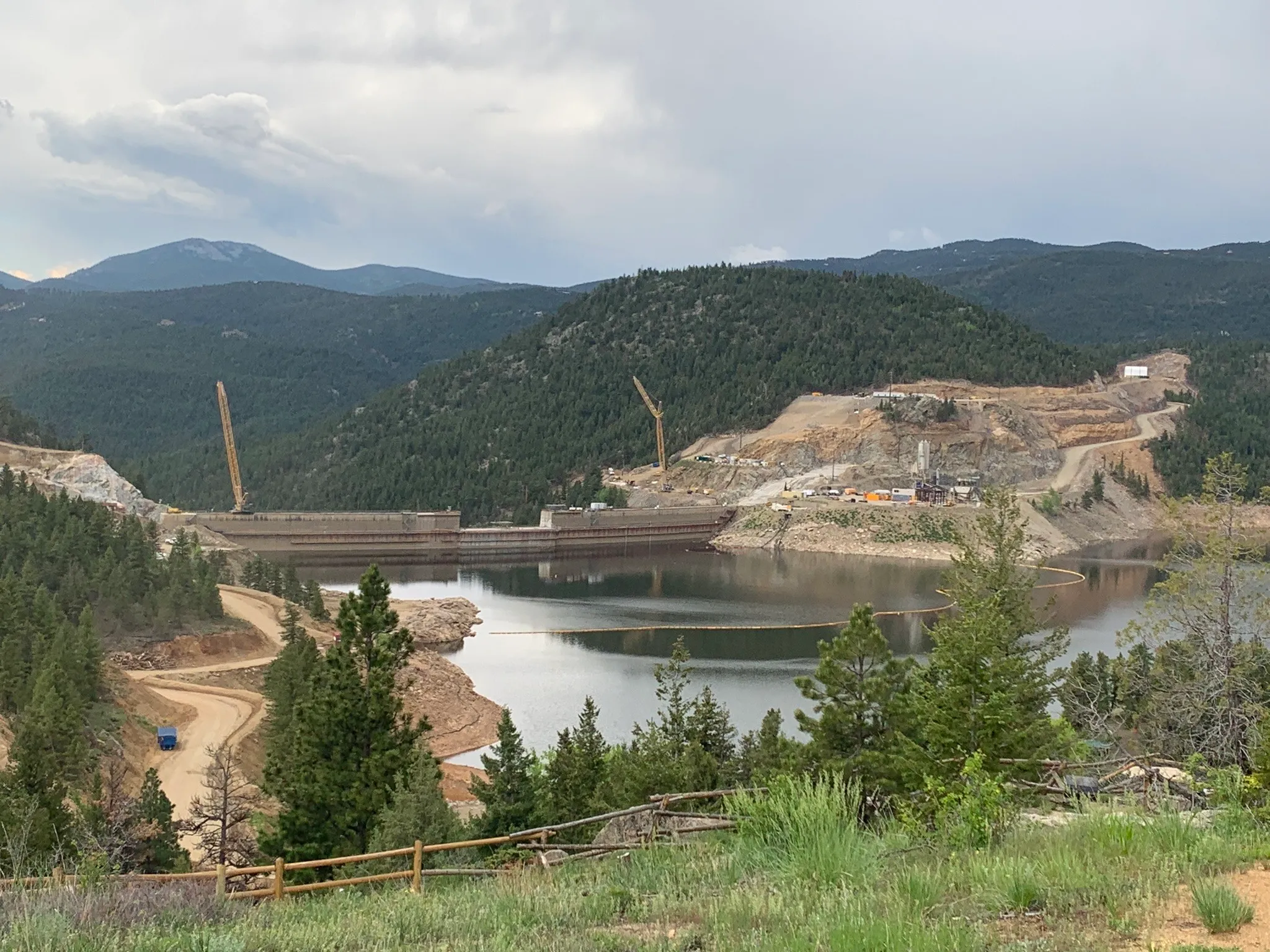
Russ Schumacher detailed the current state of the climate (snowpack at 63%) and folks from the Division of Water Resources expounded on the current state of aquifer recovery and obligations under the Rio Grande Compact.

The session about the Colorado Airborne Snow Measurement Program was fascinating. Nathan Coombs talked about the combination of SNOTEL, manual snow courses, Lidar, radar, and machine learning used to articulate a more complete picture of snowpack. “You can’t have enough tools in your toolbox,” he said.

Coombs detailed the difficulty of meeting the obligations under the Rio Grande Compact with insufficient knowledge of snowpack and therefore runoff volumes. Inaccurate information can lead to operational decisions that overestimate those volumes and then require severe curtailments in July and August just when farmers are finishing their crops. “When you make an error the correction is what kills you,” he said.

If you are going to learn about agriculture in the valley it is informative to understand the advances in soil health knowledge and the current state of adoption. That was the theme of the session “Building Healthy Soils”. John Rizza’s enthusiasm for the subject was obvious and had me thinking about what I can do for my city landscape.

Amber Pacheco described how the Rio Grande Basin Roundtable and other organizations reach out to as many folks in the valley as possible. Inclusivity is the engine driving collaboration.

Many thanks to Salazar Rio Grande del Norte Center director Paul Formisano for reaching out to me about the symposium. I loved the program. You can scroll through my posts on BlueSky here

Orr kids, Escalante River June 2007

Romancing the River: Remembering Dick Bratton – and His Times — George Sibley (SibleysRivers.com)

Photo credit: Sibley’s Rivers

Click the link to read the article on the Sibley’s Rivers website (George Sibley):

February 17, 2025

Well, with the fate of constitution democracy in the courts where we know the mills grind slowly (as opposed to the grinders who break things quickly); and with the money frozen for farmers doing well by doing good in water conservation; and neither white smoke nor black smoke arising from the chimneys of the enclaves trying to envision the next decade or so for the Colorado River – I’ll take a break from my wonkish efforts to think outside the box, to remember a friend and mentor, and friend of the River, who thought outside the box often in the last half of the 20th century.

The cantankerous Colorado River water community recently lost a valued member, L. Richard Bratton, a water attorney in the Upper Gunnison River Basin from 1958 till his death January 28.

Dick Bratton’s scope of influence went beyond the Upper Gunnison mountain valleys, however; he was a creative thinker who never met anyone he could not talk to – or listen to, or work with. A born “connector,” he became an active player in events on the cusp of major changes in the development of water in the entire Upper Basin of the Colorado River.

Born in 1932 and raised in Salida, Dick Bratton came to Gunnison to attend Western State College, then went to the University of Colorado Law School. While at school in Gunnison, he had met Ed Dutcher, a somewhat legendary West Slope water attorney. Shortly after Bratton completed law school, Dutcher invited him to join his firm in 1958.

Aspinall Unit dams

Bratton joined Dutcher’s firm that year – and in 1959, the Colorado River Storage Project (CRSP) came to the Upper Gunnison River Valley in a big way, with Congressional approval of funding for CRSP’s Curencanti Project (Blue Mesa, Morrow Point and Crystal Dams, now renamed the Wayne Aspinall Unit), and he found himself plunged into all of the ongoing and emerging challenges faced by small communities with agrarian roots in an urbanizing and industrializing world.

The first challenge was Theodore Roosevelt’s conservation vision. The “Father of American Conservation” had a different view of conservation than most of us have today; to him and his philosopher sidekick Gifford Pinchot, conservation meant first the orderly development of resources otherwise wasted – like the Colorado River pouring itself into the sea in a two-month uncontrolled and mostly unused flood of snowmelt. And when it came to what should be developed and by and for whom, their rule was “the greatest good for the greatest number,” with “for the longest time” sometimes remembered, sometimes not.

In the Upper Gunnison, the Bureau of Reclamation had chosen the Curecanti Reservoir site not to benefit the small ranches and farms of the Upper Gunnison valleys, in accord with their original Rooseveltian mission. It was chosen because it was a great site for a major reservoir in a regional water development for four states that were paranoid over their obligation to make sure a set amount of water passed on to the three more populous states below the Colorado River canyons. The greatest good for the greatest number.

The Curecanti Reservoir as originally proposed, however, would have backed 2.5 million acre-feet (maf) of water almost up to the city limits of Gunnison, with the shallow end exposing major mudflats every summer as the reservoir was drawn down, and the prevailing westerlies would have turned Gunnison into a dust bowl. Bratton’s partner and mentor Ed Dutcher had invested much of his career into opposing this local sacrifice for the greatest good for the greatest number – not just standard NIMBYism; the community was fighting for its life, and also for the life of two small towns that would be inundated along with 30 miles of legendary fishing stream, 23 small river resorts, and 6,000 acres of ranchland.

After much noisy negotiation with the Bureau of Reclamation for Dutcher and his “Committee of 39,” the Bureau dropped the reservoir size to just under one million acre-feet, saving Gunnison from the dust inundation, but still losing the two smaller towns and their economic activities – and the great fishing.

Being sensitive to the cost the project was imposing on the ranchers and farmers that the Bureau was actually created to serve, however, an “Upper Gunnison River Project” with seveeral small reservoirs was included as a future participating project in the CRSP Act, to be paid for partially by the revenues from the hydroelectric plant on the three largest CRSP dams: Glen Canyon, Flaming Gorge and the Curecanti Unit.

So one of Bratton’s first jobs in Gunnison was helping talk the people of the valley into taxing themselves a little to create an Upper Gunnison River Water Conservancy District under state law, both to help the Bureau lobby for project funding in Washington, and to nudge and harass the Bureau into getting project planning and execution done. Creating the Conservancy was accomplished in an election in 1959, a busy year for Dutcher and Bratton.

In 1961 Dutcher was appointed to a judgeship, and Bratton took over the law firm. That same year, the Bureau opened an office in Gunnison, and began the preliminary work for the Curecanti Project – clearing the land of trees, relocating roads, and buying out all of the human occupants, an unpleasant and depressing process in the valley. The “greatest good for the greatest number” rule, applied in many areas other than conservation, has nothing in the formula for the “lesser numbers” – probably one source of our current urban-rural troubles.

As construction proceeded on the Curecanti dams, though, a “big pivot” in the way the entire nation perceived the American West was becoming unignorable. The Bureau of Reclamation had depended on the willingness of the American people to continue investing in the “reclaiming” of arid lands to create more of the iconic “family farms” and to otherwise further the development of raw resources to feed the people and industries of an increasingly urbanized and industrialized economy. But the increasingly urbanized, industrialized – and after the Second War, increasingly mobilized – American people were enjoying a rising standard of living that included more time for recreation – paid vacations! – and “their” western public lands were increasingly perceived not as a resource hinterland, but as a vacation paradise, to be kept as pure and pristine as possible with millions of people trampling through.

On Bratton’s home front, the Crested Butte Ski Resort also opened in 1961 upvalley, forcing the beginning of a transition in the Upper Gunnison’s self-perception as part of the mining, farming and ranching “working west,” as opposed to a service sector serving visitors to the great western playground. “Conservation” was swinging from the Rooseveltian orderly development of otherwise “wasted” resources toward conservation as careful guarding of the West’s resources, including preservation of its residual wild magnificence, Wallace Stegner’s “society to match its scenery.”

Bratton himself was the son of a “working west” family, with a couple generations before him in Colorado engaged in mining and mining-related economic activities. But like the political creator of the Colorado River Storage Project, West Slope Congressman Wayne Aspinall, Bratton could see where things were going, and worked to make the transition at home as non-disruptive as possible for the “Old West” yielding to the “New West.” (Aspinall’s CRSP Act included provisions for recreational facilities around the major dam sites – but also provisions for a number of “Old West” valley-scale projects that could not meet cost-benefit analyses on their own without assistance from hydropower revenues.)

The Taylor River, jewel of the Gunnison River basin. Photo: Brent Gardner-Smith/Aspen Journalism

The creative quality of Bratton’s work in that transition is probably best shown in the story of the resurrection of the Taylor River. The Taylor River collected runoff from some of the highest and snowiest peaks of the Continental Divide and came down to the Gunnison River through 25 miles of canyons – a beautiful mountain river with a reputation among “anglers” (don’t even say “bait”) as a world-class fishery, even in the early 20th century.

But in the 1930s, the Bureau put a dam at the head of the canyons to store late-season water for farmers in the Uncompaghre River valley, more than a hundred miles downriver at the receiving end of the Gunnison Tunnel, the Bureau’s first big transbasin water project. That project to make life better for distant farmers effectively killed the Taylor and its aquatic life as a river, reversing its natural wet and dry cycles and turning it into an irrigation canal that ran at the will of the Bureau. This was a great loss to the people of the Upper Gunnison, who knew that the best time for fishing was after work anyway. The loss of the Taylor was their first lesson in what the greater good for a greater number meant for the lesser number.

And the Curecanti Project was their second lesson, inundating another twenty-some miles of world-class fishery, along with two small towns and a fishing-resort community that made decent livings from the river. But the Upper Gunnison farmers and ranchers held out hope that, once the Curecanti Unit was in place to play its role in the larger world of Colorado River Basin policy and politics, the Bureau would at least fulfill its promise and begin work on the Upper Gunnison River Project to give them a little help with late-season water.

But just in the decade-and-a-half from the difficult passage of the CRSP Act in 1956 to the completion of the Curecanti Project, public support for expensive irrigation projects to develop western lands basically dried up, replaced by active opposition to anything disturbing the natural beauty and magnificence of The West. It became obvious to the Upper Gunnison Conservancy board and Bratton – attorney on retainer to the board for its first 40 years – that there would be no federal funds for an Upper Gunnison River Project.

But Bratton – a convener and collaborator who managed to maintain good working relationships even with opponents – started to play on the Bureau’s guilt at not being able to fulfill their promise to the people of the Upper Gunnison. He found a willing collaborator in Bob Jennings, a Bureau manager in the West Slope office. Together, they devised a plan whereby the Bureau would let the Uncompaghre Valley Water Users Association store their Taylor Reservoir water in the Blue Mesa Reservoir – at least a day closer to where the water would be used. Then the water could be moved from the Taylor Reservoir down to Blue Mesa from in a schedule more in tune with the natural flow of a river. Maybe the Bureau could not create small upstream reservoirs for the “Old West” agrarian economy, but it could facilitate the resurrection of a beautiful river for the “New West” economy taking shape (and Old West workers who liked to fish).

Taylor Dam. By WaterArchives.org – CO-A-0034, WaterArchives.org, CC BY-SA 4.0, https://commons.wikimedia.org/w/index.php?curid=36300145

This was accomplished with a 1975 agreement among the Uncompahgre Valley farmers, the Colorado River Water Conservation District, the Upper Gunnison River Water Conservancy, and the Bureau. The Bureau would manage the “new” river, but with input from the other three parties – input that begins each spring with a meeting of an Upper Gunnison River “Local Users Group”: representatives from Taylor River irrigators, whitewater recreation businesses, Taylor Reservoir flatwater businesses, anglers, and riparian residents. This group sits down with projections for the summer runoff, and compile suggestions for the Bureau on the operation of the Taylor River that will meet all their needs more or less (and being sure to get the Uncompahgre farmers’ water down to Blue Mesa storage in a timely way). The Bureau and other parties can override their recommendations, but seldom need to. And the Taylor is a beautiful mountain river again – “unnatural” only in being democratically operated by all of its Old West and New West users.

Bratton did not stop there. He led the Upper Gunnison River Water Conservancy District through the process of filing for rights on a secondfill of the Taylor Reservoir. Taylor Park above the reservoir gathers on average half again the 110,000 af needed for the Uncompahgre users first fill. Any water collected in a second fill would be left in the river, for wildlife and other environmental benefits downriver – a right consistent with Colorado’s 1973 instream flow law, to sustain the aquatic and riparian environment “to a reasonable degree.” This water right, inconceivable before the 1970s and NEPA awarenesss, was granted in 1990 – just in time to help thwart a proposal for a transmountain diversion to the Front Range from the adjacent Union Park.

Even then, Bratton was not yet done playing on Bureau guilt for imposing the Curecanti Unit on the Upper Gunnison with no compensatory project for the local water users – even though the Upper Gunnison community generates a lot of economic activity from the Curecanti National Recreation Area around Blue Mesa Reservoir. Early in the 21st century, Bratton wanted to develop some ranchland he owned adjacent to the City of Gunnison, with a tributary of the Gunnison River running through it. This development was not received by local residents with any great enthusiasm.

But Bratton remembered a ‘handshake agreement’ with the Bureau from the Curecanti construction era, that the Bureau would replace the great sport fishery the reservoir would inundate with some good public access fishing streams elsewhere in the basin. So rather than developing a standard golf-course-rimmed-with-expensive-homes development, Bratton reminded the Bureau of its promise, and sold it the stream corridor through his land for public access, to be managed by Colorado Parks and Wildlife.

Bratton was also deeply committed to his alma mater, Western State College (now Western Colorado University). In 1975 – obviously a busy year in his life – he orchestrated the creation of the Western State College Foundation, with bequests from former Colorado Governor Dan Thornton and his wife Jessie, valley ranchers; the Foundation continues as an important support for program development at the University.

The following year, 1976, he collaborated with Western history professor Duane Vandenbusche on a water education course. The next year, 1977, that evolved into the “Western Water Workshop,” to which Bratton invited an incredible lineup of speakers, including – in the same room – longtime West Slope Congressman Wayne Aspinall, Denver Water’s longtime chief counsel and bitter West Slope adversary Glenn Saunders, Assistant Bureau of Reclamation Director Cliff Barrett, former Governor John Vanderhoof, and a number of other luminaries of the “water buffalo era.” Your author was privileged to sneak into those summer sessions – one of the most memorable of which was Bureau man Cliff Barrett trying to suss out the implications of President Carter’s recently released “hit list,” a list of water projects, including a number of CRSP projects, that did not meet a new cost-benefit analysis – essentially the official end of the era of federally-funded western water development.

The Western Water Workshop continued for forty years; a place where East Slope and West Slope, Old West and New West participants could gather for a couple days of off-the-record escape from the physical and cultural heat of the cities in the summer. I sserved as director of the Workshop for six year after the turn of the century until I retired from Western, and I found Dick Bratton to still be a great resource and idea person. At that time he had been appointed by President G. W. Bush to be the federal representative on the Upper Colorado River Commission. He once took pains to save my Water Workshop job when I had inadvertently offended one of the old “water buffalo” with a couple invitees to a session; Bratton reminded his old friend that the Workshop promised “the presentation of all reasonable points of view.”

The reader may feel this article is more a history lesson than the remembrance of a man. (A full obituary can be found in the Feburary 6 Gunnison Country Times – www.gunnisontimes.com) But it is my feeling that some people cannot be understood outside of the history they are part of, and Dick Bratton was such a person. Like his friend Wayne Aspinall, he tried to help Colorado’s West Slope (and the larger intermountain West) negotiate the difficult, inevitable, and ongoing transition from the “Old West working economy” to the “New West amenity economy.” His heart may have been more with the former, but he became at home with the latter because, basically, he was at home in the world, whatever it was, and enjoying working with whomever he encountered there. And he was a fisherman as well as the son of a miner.

Greg Hobbs, Dick Bratton, Jim Pokrandt

Northern Water may be nearing settlement of lawsuit filed to stop $2 billion reservoir project — Jerd Smith (Fresh Water News) #NISP #PoudreRiver #SouthPlatteRiver

A stretch of the Cache la Poudre River, between Fort Collins and Greeley. Credit: Water Education Colorado.

Click the link to read the article on the Water Education Colorado website (Jerd Smith):

February 13, 2025

More than a year after an environmental group sued to stop a $2 billion northern Colorado water project, whispers of a settlement are being heard as the case winds its way through U.S. District Court in Denver.

Last January, Save The Poudre sued to block the Northern Integrated Supply Project, a two-reservoir development designed to serve tens of thousands of people in northern Colorado. The suit alleged that the Army Corps of Engineers had not adequately weighed the environmental impacts and less harmful ecological alternatives to the project…

Colorado-Big Thompson Project map. Courtesy of Northern Water.

Northern Water, which operates the federally owned Colorado-Big Thompson Project for the U.S. Bureau of Reclamation, is overseeing the permitting and construction of NISP. The agency also declined to comment on any potential settlement. Northern Water serves more than 1 million Front Range residents and hundreds of growers in the South Platte River Basin.

“We’re still moving forward with what we need to do on the litigation,” Northern spokesman Jeff Stahla said.

Northern Water’s board discussed the litigation in a confidential executive session last week at a study retreat and it is scheduled to discuss it in another private executive session Feb. 13 at its formal board meeting, according to the agenda.

Sources told Fresh Water News and The Colorado Sun that those discussions are related to the potential multimillion-dollar settlement.

Key developments this past year

In October, a federal judge delivered a favorable ruling to Wockner’s Save the Colorado on a case involving Denver Water’s Gross Reservoir expansion project. Now [envisonmental groups] are seeking an injunction to force Denver Water to stop construction of the dam, which began in 2022.

Workers from Denver Water and contractor Kiewit Barnard stand in front of Gross Dam in May to mark the start of the dam raise process. Photo credit: Denver Water.

Raising the Boulder County dam by 131 feet will allow Denver Water to capture more water from the headwaters of the Upper Colorado River on the Western Slope. In its ruling, the federal court said the U.S. Army Corps of Engineers had failed to consider the impact of climate change on the flows in the Colorado River.

What impact that ruling may have on the NISP case isn’t clear, but [the environmental group that sued Denver Water] said they believe it will give his organization more leverage to push for changes in NISP.

In addition, the City of Fort Collins has dropped its formal opposition to NISP. And Stahla said Northern has continued to push forward with key parts of the development, including the design work needed to relocate a 7-mile stretch of U.S. 287 northwest of Fort Collins.

Fort Collins Mayor Jeni Arndt said the city changed its stance because most of its environmental concerns had been met through the 21-year federal permitting process.

“The EPA had signed off, and the Corps of Engineers had signed off,” she said. “It was obvious that this was not going to be another Two Forks,” referring to a massive dam proposed in the 1970s by Denver Water on the South Platte River near Deckers. It was rejected by the EPA due to environmental concerns.

Arndt said the city also planned to use a later review process, known as a 1041 review, to address other environmental concerns that might arise.

If NISP is ultimately built, and most believe it will be, it will provide water for 15 fast-growing communities and water districts along the Interstate 25 corridor, including the Fort Collins-Loveland Water District, Fort Morgan, Lafayette and Windsor.

The largest participant in the giant project is the Fort Collins-Loveland District. Board member Stephen Smith said he believes NISP will move forward one way or another and that it is critical to serving the water-short region.

“NISP is going to get built and it will provide water to Fort Collins by 2033,” he said.

More by Jerd Smith

The Northern Integrated Supply Project, currently estimated at $2 billion, would create two new reservoirs and a system of pipelines to capture more drinking water for 15 community water suppliers. An environmental group is now suing the Army Corps of Engineers over a key permit for Northern Water’s proposal. (Save the Poudre lawsuit, from Northern Water project pages)

Water experts: Crisis on #ColoradoRiver affects all Coloradans — The #Sterling Journal Advocate #COriver #aridification

Colorado transmountain diversions via the State Engineer’s office

Click the link to read the article on The Sterling Journal Advocate website (Jeff Rice). Here’s an excerpt:

February 11, 2025

Three of Colorado’s top water experts hammered home the idea that Colorado’s water situation id precarious, at best, and almost always on the brink of crisis. The day-long Voices of Rural Colorado symposium in Denver was the setting for an hour-long discussion of Colorado water. Attendees heard from, and interacted with, Rebecca Mitchell, former executive director of the Colorado Water Conservation Board and now Colorado’s representative on the Upper Colorado River Commission; Zane Kessler, director of government relations for the Colorado River District; and Jim Yahn, Logan County Commissioner and manager of the North Sterling Irrigation District. One of the points that was repeatedly made during the discussion was that the Colorado River is Colorado’s River. Besides watering most of the Western Slope of Colorado, the river is tapped for more than a half-million acre feet of water to the Front Range and eastern plains. Nearly half of that, about 200,000 acre feet per year, is fed directly into the Big Thompson River at Estes Park, primarily for irrigation in the South Platte River Basin. The remaining 330,000 acre feet is diverted to cities on the Front Range like Denver, Colorado Springs and Pueblo. That water ends up in the South Platte and Arkansas River basins…

Yahn told the attendees that continued drought in the Colorado River Basin will have an impact on the South Platte Valley, which is why projects like the Chimney Hollow Reservoir, nearing completion next to Carter Lake west of Berthoud, are important…Mitchell said that the crisis on the Colorado is easily seen in the water levels of the two largest reservoirs on the river, Lake Mead on the Nevada-Arizona state line near Las Vegas, and Lake Powell, halfway between Salt Lake City and Phoenix on the Utah-Arizona state line.

Rare earth elements found in #LincolnCreek raise new questions: Mineralized tributary and Ruby mine also source of rare earth elements in Lincoln Creek — Heather Sackett (AspenJournalism.org)

Lincoln Creek was orange just downstream of the mineralized tributary in July 2024. A team of scientists from the University of Colorado Boulder found that a mineralized tributary is also contributing rare earth elements to Lincoln Creek, in addition to other metals like aluminum. Credit: HEATHER SACKETT/Aspen Journalis

Click the link to read the article on the Aspen Journalism website (Heather Sackett):

January 25, 2025

Recent sampling shows that a high-alpine tributary of the Roaring Fork River, in addition to having high concentrations of certain metals, also contains rare earth elements. But what that means for human and aquatic health is unclear.

Scientists from the University of Colorado Boulder presented the preliminary results from water-quality sampling on Lincoln Creek over last summer at a public meeting hosted by the Roaring Fork Conservancy at the Basalt Regional Library on Thursday. 

Occupying a lesser-known corner of the periodic table, rare earth elements (which, despite their name, are commonly occurring in Earth’s crust) are a set of 17 heavy metals that are used in making products such as cellphones, fiber-optic cables and computer monitors. With names such as yttrium, lanthanum and neodymium, they often turn up at sites in Colorado where there is acid rock drainage, such as upper Lincoln Creek.

“You get a phone’s worth of neodymium coming down the mineralized tributary about every 5½ minutes,” said Adam Odorisio, a graduate student and researcher at CU’s environmental engineering department. “This translates to 96,000 phones per year. And what I think is the most striking fact in this is that this is for one tributary. You multiply this across hundreds of acid mine sites in Colorado and potentially thousands across the Western U.S. and it’s very exciting for resource extraction.” 

CU scientists are also monitoring other high alpine acid rock and mine drainage sites in Colorado, including the Snake River. Odorisio said the concentrations of rare earth elements in a mineralized tributary that feeds Lincoln Creek was in the middle of the pack when compared to other sites around the state.

Twin Lakes collection system

In addition to the potential for mining valuable rare earth metals, scientists are eager to learn more about their impacts to human health and aquatic environments. There are no state or federal water quality standards for rare earth elements. Lincoln Creek is a source of drinking water for Front Range cities, including Colorado Springs. 

“This is just wide open as an unknown area,” said Diane McKnight, a professor at CU’s Institute of Arctic and Alpine Research. “It’s not clear that it’s something to worry about here. The water from (Lincoln Creek) that goes into the Twin Lakes system is highly diluted.” 

Over nine days from June through October, the CU team collected 79 water samples from eight sites, took sediment core samples from the Grizzly Reservoir lakebed, and collected rock scrapings and bugs from the waterway. Early results also confirmed what the Environmental Protection Agency found in previous water-quality tests: The water is highly acidic, and concentrations of metals including zinc, copper and aluminum exceed standards for aquatic life. Scientists found that a groundwater source could also be adding metals to Lincoln Creek. They are still analyzing the data and plan to present more results at a spring meeting.

“For the greater scientific community, the fate of rare earth elements in aquatic systems is not well understood,” Odorisio said. “We are hoping to change that.”

The headwaters of Lincoln Creek upstream from the Ruby Mine and mineralized tributary. Recent water sampling by scientists from the University of Colorado Boulder found rare earth elements in the creek downstream, but implications for human health and aquatic impacts are unclear. Credit: HEATHER SACKETT/Aspen Journalism

The results may be of use to the Lincoln Creek workgroup, an ad hoc group – composed of officials from Pitkin County, Colorado Parks and Wildlife, the U.S. Forest Service, Colorado Department of Public Health and Environment, Independence Pass Foundation, Roaring Fork Conservancy and others – that is trying to understand how contaminants are impacting Lincoln Creek and the Roaring Fork River. The group has hired consultants LRE Water to compile water-quality data collected by several different agencies last summer and propose options to clean up the waterways. 

“The rare earth metals is a group we haven’t really thought through,” said Kurt Dahl, Pitkin County’s environmental health manager. “That’s one of the things that we are talking through with the contractor, LRE Water.” 

The water quality of Lincoln Creek has been under increased scrutiny in recent years as fish kills and discoloration of the water downstream of Grizzly Reservoir have become more frequent. In July, reservoir owner and operator Twin Lakes Reservoir & Canal Co. drained the reservoir for a planned dam-rehabilitation project, releasing an orange slug of sediment-laden water from the bottom of the reservoir downstream. Testing showed that the water had high levels of iron and aluminum, but not copper, which is toxic to fish.

An EPA report in 2023 determined that a “mineralized tributary,” which feeds into Lincoln Creek above the reservoir near the ghost town of Ruby, is the main source of the high concentrations of metals downstream. 

Prior to mining, snowmelt and rain seep into natural cracks and fractures, eventually emerging as a freshwater spring (usually). Graphic credit: Jonathan Thompson

The process that causes metals leaching into streams can be both naturally occurring and caused by mining activities. In both cases, sulfide minerals in rock come into contact with oxygen and water, producing sulfuric acid. The acid can then leach the metals out of the rock and into a stream, a process known as acid rock drainage. The contamination from acid rock drainage seems to be increasing at other locations around Colorado and may be exacerbated by climate change as temperatures rise. 

The recent water-quality-testing effort on Lincoln Creek is probably just the beginning of a long-term data-collection and monitoring program, Dahl said. 

“I think there’s still a lot of energy around this,” Dahl said. “People are really invested in this, and it’s going to take a couple of years to get it characterized.”

Aspen Journalism, which is solely responsible for its editorial content, is supported by a grant from the Pitkin County Healthy Community Fund.

This story ran in the Jan. 27 edition of The Aspen Times.

Map of the Roaring Fork River drainage basin in western Colorado, USA. Made using USGS data. By Shannon1 – Own work, CC BY-SA 4.0, https://commons.wikimedia.org/w/index.php?curid=69290878

Bone-dry winter in the San Juans — Allen Best (BigPivots.com) #SanJuanRiver #DoloresRiver #ColoradoRiver #COriver #aridification

Lee Ferry, the dividing line between the upper and lower basin states of the Colorado River Basin. Photo credit: Allen Best

Click the link to read the article on the Big Pivots website (Allen Best):

January 28, 2025

It’s part of a theme. Does Colorado need to start planning for potential Colorado River curtailments?

Snow in southwestern Colorado has been scarce this winter. Archuleta County recently had a grass fire. A store manager at Terry’s Ace Hardware in Pagosa Springs tells me half as many snowblowers have been sold this winter despite new state rebates knocking 30% off the price of electric models.

Near Durango, snowplows normally used at a subdivision located at 8,000 feet remain unused. At Chapman Hill, the in-town ski area, all snow remains artificial, and it’s not enough to cover all the slopes. A little natural snow would help, but none is in the forecast.

Snow may yet arrive. Examining data collected on Wolf Creek Pass since 1936, the Pagosa Sun’s Josh Kurz found several winters that procrastinated until February. Even when snow arrived, though, the winter-end totals were far below average.

All this suggests another subpar runoff in the San Juan and Animas rivers. They contribute to Lake Powell, one of two big water bank accounts on the Colorado River. When I visited the reservoir in May 2022, water levels were dropping rapidly. The manager of Glen Canyon Dam pointed to a ledge below us that had been underwater since the mid-1960s. It had emerged only a few weeks before my visit.

That ledge at Powell was covered again after an above-average runoff in 2023. The reservoir has recovered to 35% of capacity.

A ledge that had been used in the construction of Glen Canyon Dam emerged in spring 2022 after about 50 years of being underwater.  Photo May 2022/Allen Best

Will reservoir levels stay that high? Probably not, and that is a significant problem. Delegates who wrangled the Colorado River Compact in a lodge near Santa Fe in 1922 understood drought, at least somewhat. They did not contemplate the global warming now underway.

In apportioning the river flows, they also assumed an average 17.5 million acre-feet at Lee Ferry, the dividing line between the upper and lower basins. It’s a few miles downstream from Glen Canyon Dam and upstream from the Grand Canyon. Even during the 20th century the river was rarely that generous. This century it has become stingy, with average annual flows of 12.5 million acre-feet. Some worry that continued warming during coming decades may further cause declines to 9.5 million acre-feet.

Udall/Overpeck 4-panel Figure Colorado River temperature/precipitation/natural flows with trend. Lake Mead and Lake Powell storage. Updated through Water Year 2024. Credit: Brad Udall

Colorado State University’s Brad Udall and other scientists contend half of declining flows should be understood as resulting from warming temperatures. A 2024 study predicts droughts with the severity that formerly occurred once in 1,000 years will by mid-century become 1-in-60 year events.

How will the seven basin states share this diminished river? Viewpoints differ so dramatically that delegates from the upper- and lower-basin states loathed sharing space during an annual meeting in Las Vegas as had been their custom. Legal saber-rattling abounds. A critical issue is an ambiguous clause in the compact about releases of water downstream to Arizona and hence Nevada and California.

Colorado transmountain diversions via the State Engineer’s office

Might Colorado need to curtail its diversions from the Colorado River? That would be painful. Roughly half the water for cities along the Front Range, where 88% of Coloradans live, comes from the Colorado River and its tributaries. Transmountain diversions augment agriculture water in the South Platte and Arkansas River valleys. The vast majority of those water rights were adjudicated after the compact of 1922 and hence would be vulnerable to curtailment. Many water districts on the Western Slope also have water rights junior to the compact.

In Grand Junction last September, Andy Mueller, the general manager of the Colorado River Water Conservation District, the primary water policy agency for 15 of Western Slope counties, made the case that Colorado should plan for compact curtailments — just in case. The district had earlier sent a letter to Jason Ullmann, the state water engineer, asking him to please get moving with compact curtailment rules.

Eric Kuhn, Mueller’s predecessor at the district, who is now semi-retired, made the case for compact curtailment planning in the Spring 2024 issue of Colorado Environmental Law Review. Kuhn’s piece runs 15,000 words, all of them necessary to sort through the tangled complexities. Central is the compact clause that specifies the upper basin states must not cause the flow at Lee Ferry, just below today’s Glen Canyon Dam, to be depleted below an aggregate of 75 million acre-feet on a rolling 10-years basis.

That threshold has not yet been met — yet. Kuhn describes a “recipe for disaster” if it is. He foresees those with agriculture rights on the Western Slope being called upon to surrender rights. He and Mueller argue for precautionary planning. That planning “could be contentious,” Kuhn concedes, but the “advantages of being prepared for the consequences of a compact curtailment outweigh the concern.”

Last October, after Mueller’s remarks in Grand Junction, I solicited statements from Colorado state government. The Polis administration said it would be premature to plan compact curtailment. The two largest single transmountain diverters of Colorado River Water, Denver Water and Northern Water, concurred.

Front Range cities, including Berthoud, above, are highly reliant upon water imported from the Colorado River and its tributaries. December 2023 photo/Allen Best

Recently, I talked with Jim Lochhead. For 25 years he represented Colorado and its water users in interstate Colorado River matters. He ran the state’s Department of Natural Resources for four years in the 1990s and, ending in 2023, wrapped up 13 years as chief executive of Denver Water. Lochhead, who stressed that he spoke only for himself, similarly sees compact curtailment planning as premature.

“It just doesn’t make sense to go through that political brain damage until we really have to,” he said. “Hopefully we won’t have to, because (the upper and lower basins) will come up with a solution.”

Lochhead does believe that a negotiated solution remains possible, despite the surly words of recent years…

“We need to figure out ways to negotiate an essentially shared sacrifice for how we’re going to manage the system, so it can be sustainable into the future,” he said. This, he says, will take cooperation that so far has been absent, at least in public, and it will also take money.

Instead, we’ll have to slog along. The runoff in the Colorado River currently is predicted to be 81% of average. It fits with a theme. Unlike the children of Lake Wobegone, most runoffs in the 21st century have been below average.

Map of the Colorado River drainage basin, created using USGS data. By Shannon1 Creative Commons Attribution-Share Alike 4.0