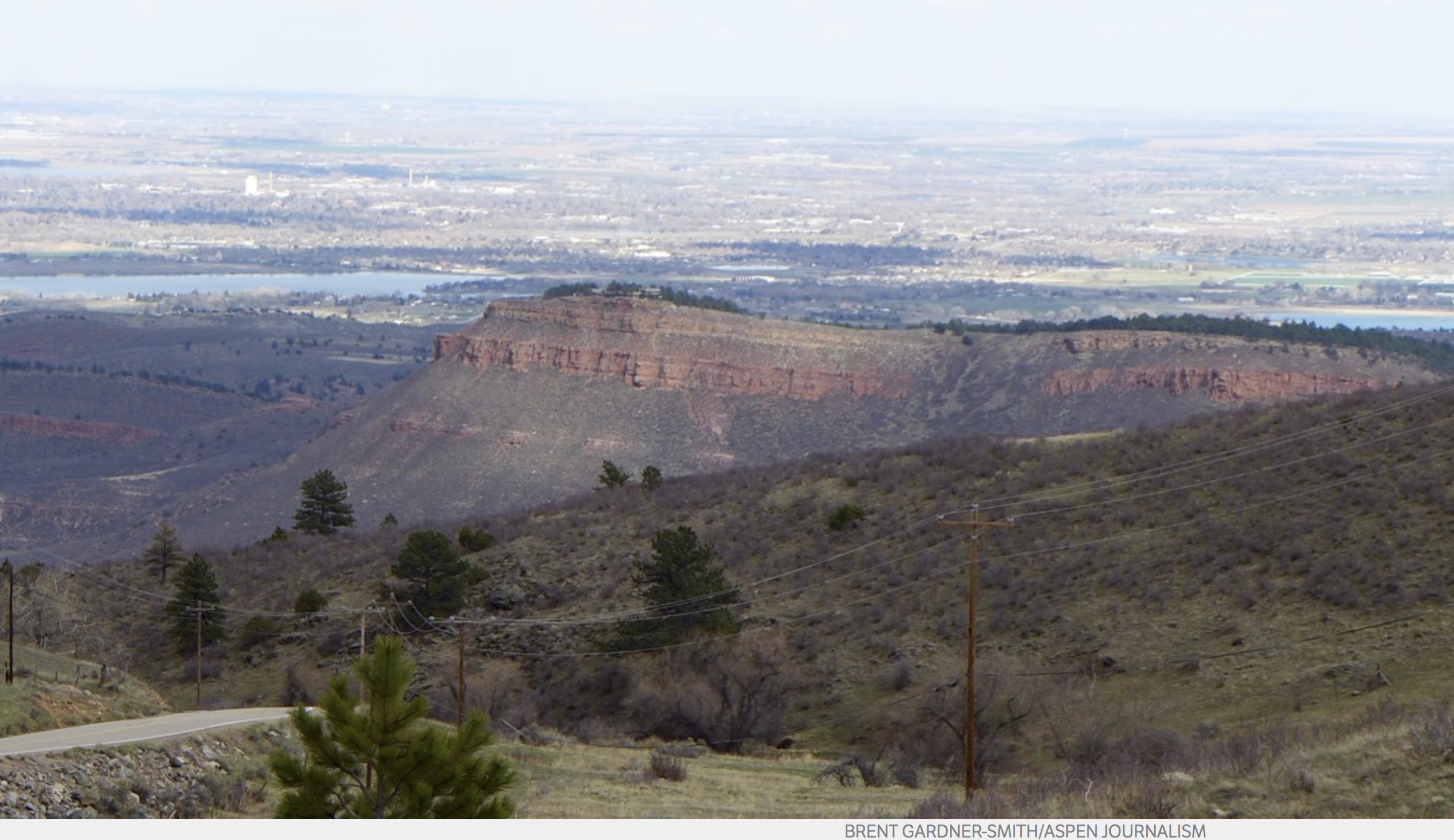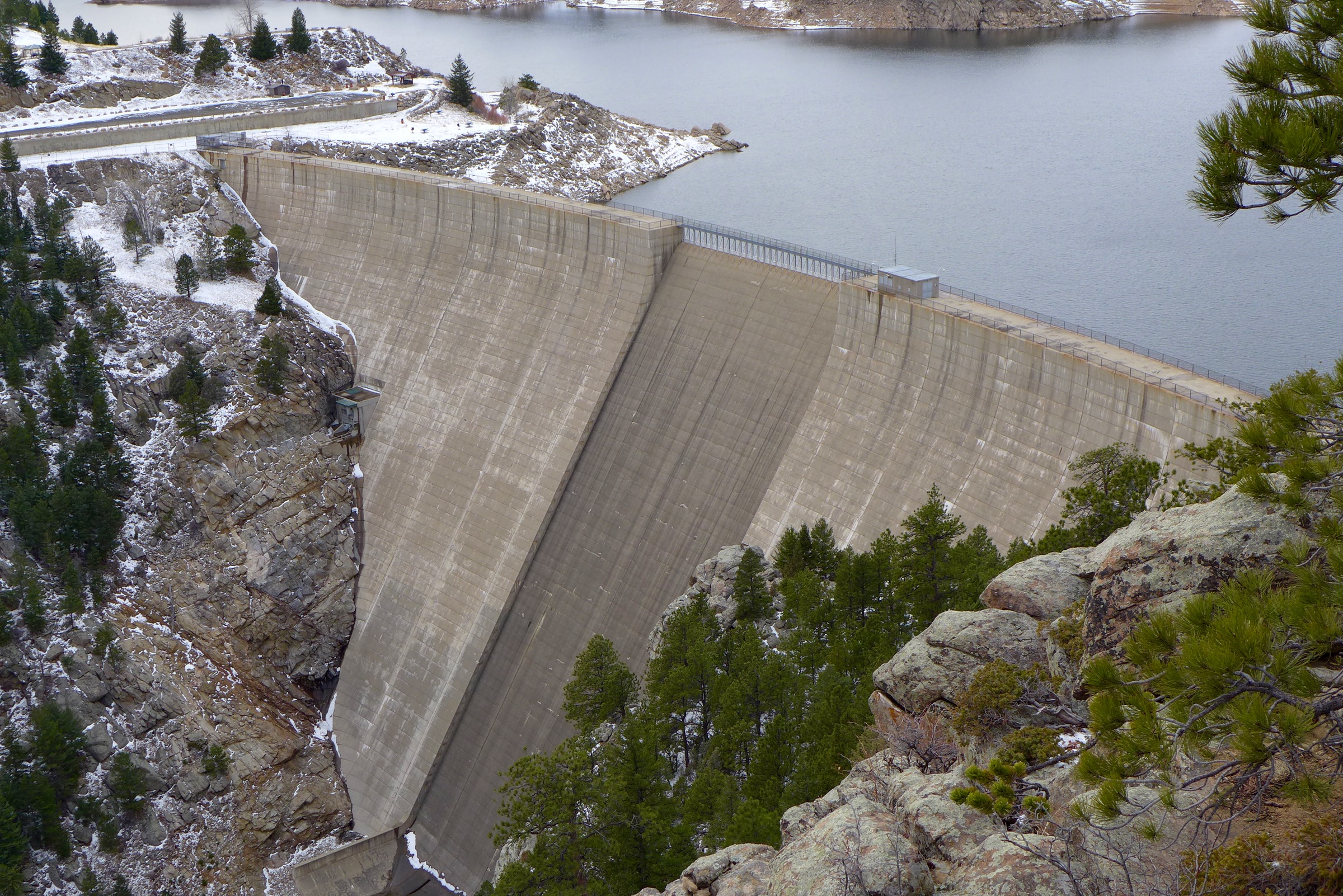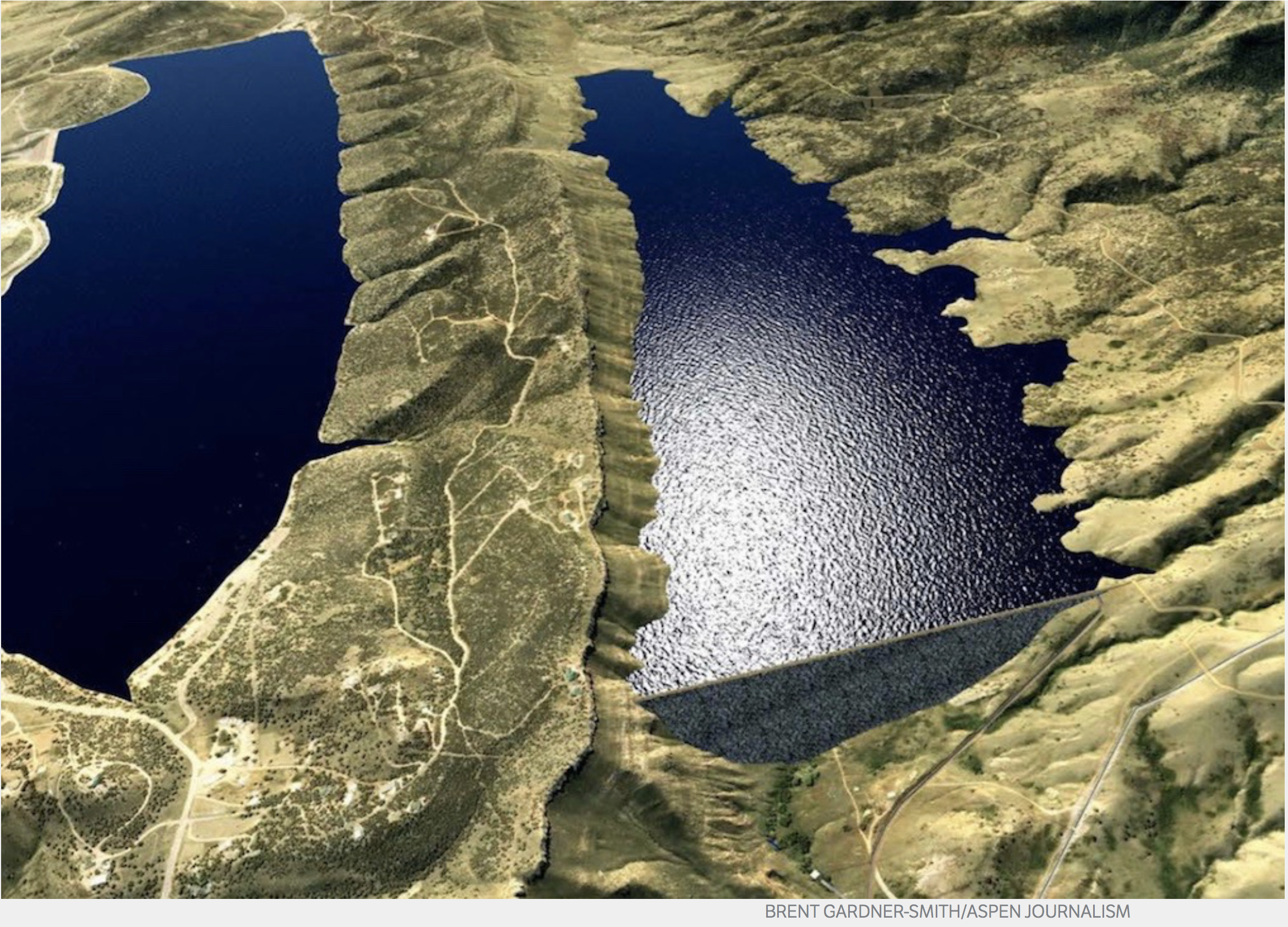
Looking east toward the Chimney Hollow Reservoir site, which is just this side of the red ridge. On the other side is Carter Lake Reservoir and beyond that, the Loveland area.
Click here to read the newsletter. Here’s an excerpt:
New website offers better access to Windy Gap Firming Project info
Northern Water and the Municipal Subdistrict have launched a revamped website to provide easy-to-find data regarding the Windy Gap Firming Project and its chief component, Chimney Hollow Reservoir.
The site, http://chimneyhollow.org, offers answers to frequently asked questions, information for potential contractors and download-ready fact sheets. In addition, it offers a video from Gov. John Hickenlooper that discusses his endorsement of the project as well as its place in the the Colorado Water Plan.
As the project moves forward, the site will also present information related to the construction of Chimney Hollow Reservoir as well as the mitigation and enhancement efforts being conducted by Northern Water’s Municipal Subdistrict.
The project also has a presence on Facebook, found here.
Looking east toward the Chimney Hollow Reservoir site, which is just this side of the red ridge. On the other side is Carter Lake Reservoir and beyond that, the Loveland area.
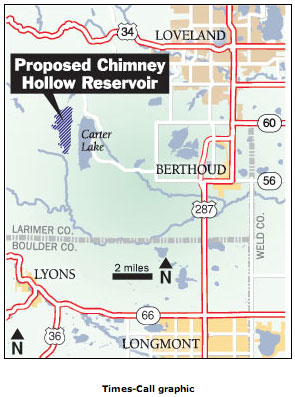
In western Larimer County a sedimentary rock ridge runs parallel to the gradual beginnings of the Rocky Mountain foothills, forming a large valley known as Chimney Hollow.
In May 2017, federal agencies approved plans to flood the valley — which is between Longmont, to the south, and Loveland, to the north — to create a 90,000 acre-foot reservoir.
But while the 14-year federal permitting process has now come to an end and construction slated to begin early next year, a federal lawsuit from six environmental groups could stop the project from moving forward.
“We are just trying to inject some sanity and stop the madness,” said Gary Wockner, director of Save the Colorado, an environmental nonprofit based in Ft. Collins that supports the Colorado River and is the lead petitioner in the case. “The Colorado River is the most dammed, drained, depleted river on the planet.”
The construction of Chimney Hollow Reservoir is the foundation for the $400 million Windy Gap “firming project,” a supplemental storage plan tied to the existing Windy Gap dam and reservoir, which is on the main stem of the Colorado River in Grand County. The firming project also includes construction of a bypass channel at Windy Gap’s original diversion point in order to help mitigate existing impacts on fish and water quality.
The relatively modest Windy Gap reservoir, which holds 445 acre-feet, was built in 1985 to draw water from the Colorado River and pump it uphill to Lake Granby and into the Colorado-Big Thompson project. The water is then sent under the Continental Divide and into Larimer and other Front Range counties.
The Northern Colorado Water Conservation District based in Berthoud, owns the Windy Gap reservoir, operates the Colorado-Big Thompson system, and is intent on constructing Chimney Hollow reservoir to store additional Colorado River water.
Fourteen municipalities and water districts throughout the Front Range are signed up to help pay for the Chimney Hollow reservoir, based on the share of the water they intend to use.
Though the existing Windy Gap Project can today draw as much as 90,000 acre-feet of water from the Colorado River, due to junior water rights and a lack of storage, the project is often unable to provide any water at all to the Front Range.
With the Chimney Hollow Reservoir in place, the Windy Gap project could supply a guaranteed 30,000 acre-feet of water per year to its customers.
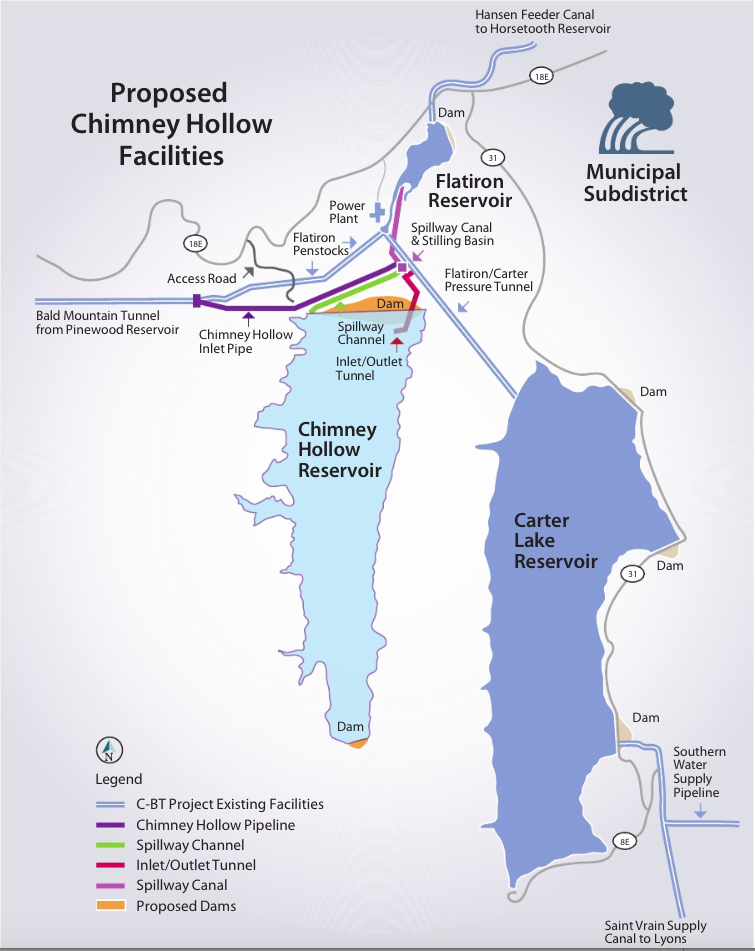
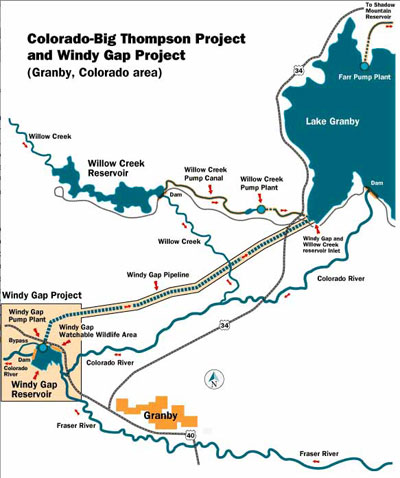
A graphic from Northern Water showing the lay out of Windy Gap Firming Project.
Other alternatives?
Wockner and Save the Colorado have been joined by five other environmental groups — Save the Poudre, Wildearth Guardians, Living Rivers, Waterkeeper Alliance and the Sierra Club — in suing the Bureau of Reclamation and the Army Corps of Engineers over their environmental review of the Windy Gap firming project.
The petitioners allege that the agencies violated the National Environmental Protection Act and the Clean Water Act by failing to consider alternatives, like water conservation, instead of building a new project.
“Rather than rigorously exploring and objectively evaluating ways to meet (Northern’s) actual water supply needs, the federal agencies accepted (Northern’s) claimed need at face value and only considered reservoir options that would further (Northern’s) preconceived goal of “firming” Windy Gap water supplies,” says the petitioner’s complaint.
Both the Bureau of Reclamation and the Army Corps of Engineers declined interview requests for this story, but according to the Bureau’s Final Environmental Impact Statement, the firming project would supply only about 10 percent of its customers projected 2050 water demand.
Because conservation cannot account for the entire projected gap, the FEIS states that the agency did not consider conservation as an alternative to the firming project.
The agencies’ assumptions about the demand gap are consistent with those of the 2015 Colorado Water Plan the state’s official water strategy document, which estimates that water demand in 2050 could exceed supplies by as much as 560,000 acre-feet.
To make up for this gap, the plan calls for conservation measures and also the significant expansion of water storage facilities.
Because of the water plan’s call for storage, the Windy Gap firming project is considered a critical storage project by the state and received endorsements from both the Colorado Water Conservation Board and Gov. John Hickenlooper.
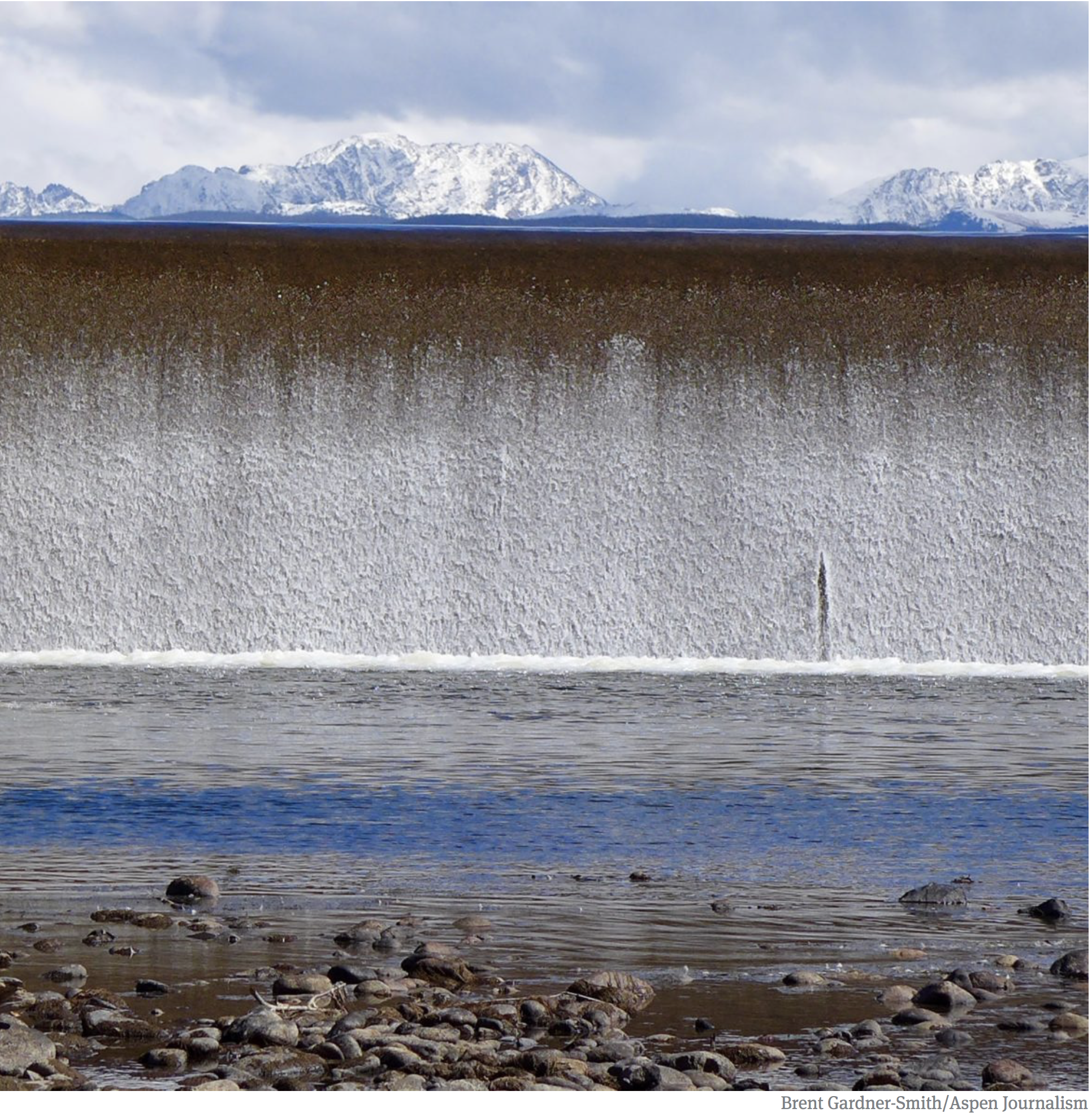
Outflow from the dam across the Colorado River that forms Windy Gap Reservoir. Taken during a field trip the reservoir in September, 2017.
Conservation included
Northern, which is not a defendant in the lawsuit, filed a motion in March to intervene on behalf of the defendants in the lawsuit to help defend the permit process.
When asked why conservation was not considered as an alternative, officials from Northern said that the demand estimates already assume that municipalities will increase water conservation.
“We did not count conservation as an alternative. We built conservation into our demand projection,” said Jeff Drager, Northern’s director of engineering and the project manager for the Windy Gap firming project. “So when we looked at how much water our participants need we figured we factored in some level of conservation already.”
Though Northern and the state use the projected demand gap to justify the firming project, the petitioners say the demand estimates are inflated.
On May 3, the petitioners filed a motion to add a statistics report to the case’s administrative record.
According to the report, the Bureau of Reclamation and the Army Corps failed to update the estimated water use statistics in their impact statements with the actual water use data as it became available over the course of the 14-year permitting process.
The report found that the agencies’ estimates for municipal water use were between 9 and 97 percent higher than the actual water use figures.
“The thrust of our claim is that the federal government just took the project participants word for how much water they would need,” said Kevin Lynch, the attorney for the petitioners. “The agency has a duty to independently verify that need and they didn’t do anything. They took projections from 2005 and that data was wildly over-inflated.”
The court is now reviewing the petitioners’ administrative motions as well as motions by both Northern and the Colorado Department of Natural Resources to intervene on behalf of the defendants.
These changes will likely delay court proceedings for at least several months.
There already are six projects being pursued in the South Platte Basin to extend the water supply. These are not included in the recent South Platte Storage Survey, but have been considered and under way for some time:
Northern Integrated Supply Project (NISP) map July 27, 2016 via Northern Water.
• The NISP/Glade project — The Northern Integrated Supply Project is a proposed water storage and distribution project that will supply 15 Northern Front Range water partners with 40,000 acre-feet of new, reliable water supplies.
Map from Northern Water via the Fort Collins Coloradan.
• Chimney Hollow Reservoir — A 360-foot high dam that will hold 90,000 acre feet to help supply the thirsty Thompson Valley urban area. The water will come from the Windy Gap Project, a diversion dam and pumping station completed in 1985 to provide extra irrigation and municipal water out of the Colorado River. The water originally was stored in Grand Lake, but when that is full, the water cannot be stored. Chimney Hollow, also known as the Windy Gap Firming Project, solves that problem.
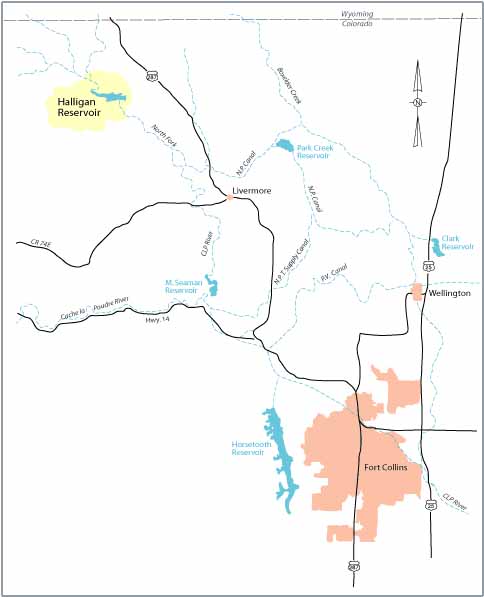
Reservoirs NW of Fort Collins
• Halligan reservoir enlargements — Halligan Reservoir near Fort Collins is about 100 years old. Its capacity is about 6,400 acre feet of water and the City of Fort Collins wants to add 8,125 acre feet to the reservoir by raising its dam about 25 feet.
• Milton Seaman Reservoir enlargement — Greeley originally had wanted to expand Seaman Reservoir in conjunction with Halligan, but because of diverging goals Greeley withdrew from the joint project. The expansion of Seamon now is targeted for design in 2028 and construction by 2030.
Gross Dam enlargement concept graphic via Denver Water
• Gross Reservoir enlargement — Gross Reservoir is one of 11 reservoirs supplying water to the City of Denver and surrounding urban areas. It is on the city’s Moffat System, which diverts water from the Western Slope to the metro area. Denver Water has proposed raising the dam height by 131 feet, which will allow the capacity of the reservoir to increase by 77,000 acre feet.
Proposed reallocation pool — Graphic/USACE
• Chatfield Reallocation Plan — The U.S. Army Corps of Engineers has determined that Chatfield Reservoir, built primarily for flood control after the 1965 South Platte River flood, can accommodate an additional 20,600 acre feet of water storage for water supply without compromising its flood control function. This additional storage space will be used by municipal and agricultural water providers to help meet the diverse needs of the state. No actual construction is required, but the legal, environmental, and engineering concerns of allowing the reservoir to hold more water all have to be satisfied.
Gross Dam enlargement concept graphic via Denver Water
FromThe Boulder Daily Camera (Lurline Underbrink Curran):
I would like to share why I support Denver Water’s Gross Reservoir Expansion project.
While located in Boulder County, the project obtains the water from Grand County — a county that is currently the most impacted county in the state of Colorado for transbasin diversions. You must wonder why the county and its citizens, stakeholders in the Colorado River Basin, along with Trout Unlimited support this project.
The reason is the Colorado River Cooperative Agreement, which is an historic agreement with statewide environmental benefits which were fought for and gained through sometimes difficult and long negotiations. It has been hailed as a new paradigm and one that will serve as an example of what can be gained when dealing with a finite resource like water. The signatories to this agreement represent the entire Colorado River Basin, and I had the honor of acting as Grand County’s lead negotiator in this agreement. I worked for Grand County for 33 years, retiring as county manager in 2015. I have lived in Grand County over 60 years and have deep roots and interest in the well-being of our waterways.
The environmental benefits gained by Grand County, which include additional flows, river ecosystem improvements, use of Denver Water’s system, participation in an adaptive management process called Learning by Doing, money for river improvements, just to name a few, are necessary to protect and enhance the Fraser and Colorado rivers. Without these benefits, these rivers will continue to degrade, with no hope of recovery or improvement.
Those who oppose the project offer no solutions to the already stressed aquatic environment of the Fraser and Colorado rivers. Through the Learning By Doing format and a public private partnership, partners have already implemented a river project on the Fraser as an example of what can be done. This project immediately produced improvements that were astounding. Colorado Parks and Wildlife can verify this claim. This essential work will not continue without the CRCA.
The impacts that are associated with the construction of the Gross Reservoir Enlargement are substantial and one sympathizes with those who will experience them, but the reality is they will end. Mitigation for the construction impacts can be applied. However, without the CRCA, the impacts to the Fraser and Colorado rivers will continue with no hope of improvement.
The environmental enhancements and mitigation that are part of the CRCA cannot be replicated without the reservoir expansion project, and the loss of these enhancements and mitigation will doom the Fraser and Colorado rivers in Grand County to environmental catastrophe.
At least seven major new reservoirs and water diversion projects are being planned in Colorado, which had a population of 5.6 million in 2017. Many would continue the controversial practice of diverting water across the Rocky Mountains from the state’s Western Slope, where the majority of Colorado’s precipitation falls, to its more arid Front Range, where people are flocking to Denver, Boulder, Fort Collins, Longmont and increasingly sprawling suburbs.
The water projects have been inspired partly by the Colorado Water Plan, an effort by Governor John Hickenlooper to solve a projected water deficit of 560,000 acre-feet by 2050, or enough to serve more than 1 million households. The plan calls for 400,000 acre-feet of new water storage and an equal amount of water conservation.
The plan is only two years old. But critics say it has prioritized gray infrastructure – new dams, pipelines and pumps – over green projects like water conservation and sustainable land use…
The state water plan does not recommend any specific water development projects. But Hickenlooper has personally endorsed several of them. He also appointed all the voting members of the Colorado Water Conservation Board, the entity that oversees the Water Plan and awards grants for water projects.
Greg Johnson, chief of water supply planning at the Water Conservation Board, said the state’s plan emphasizes conservation just as much as new water supply projects. But he said the latter may be more more pressing in some cases.
“Some of the bigger projects that are in permitting right now are helping meet really critical supply needs that a lot of those faster-growing northern Front Range suburbs have, where they’ve got new developments going up all over the place,” Johnson said. “They have maybe a 10- or 15-year horizon to get some of those things done.”
One of the water developments endorsed by the governor won a $90 million loan in 2017 from the Water Conservation Board – the largest loan in the board’s history. Known as the Windy Gap Firming Project, it proposes a new reservoir called the Chimney Hollow Reservoir near Longmont to store Colorado River water diverted through an existing tunnel under the Continental Divide.
The loan covers nearly one-fourth of total costs for the project, which is proposed by the Northern Colorado Water Conservancy District.
As its name implies, the project is intended to “firm up” existing Colorado River water rights held by a dozen Front Range cities. The cities already draw on these water rights, but can’t fully tap them in some years because of storage limitations. The new 90,000 acre-foot reservoir will solve this problem and allow them to divert the river almost every year.
The project would result in diverting 30,000 acre-feet more water out of the Colorado River every year than is currently diverted…
Other major projects in the works include the Moffat Collection System, a plan by Denver Water to expand Gross Reservoir to hold 77,000 acre-feet of additional diversions from Colorado River headwaters streams; and the White River Storage Project, a proposal for a new reservoir of up to 90,000 acre-feet in the northwest corner of the state, near the town of Rangely…
Greg Silkensen, a spokesman for the Northern Colorado Water Conservancy District, said the Windy Gap project is vital to many fast-growing Front Range communities that have lower-priority water rights.
“The Colorado economy is just crazy. Everybody and their brother is moving here,” Silkensen said. “There is a great deal of environmental mitigation that will go forward if the project is built. There’s going to be a lot of benefit to the Upper Colorado River if it does go through.”
Those projects include stream habitat restoration in the Colorado River and water quality improvements in Grand Lake, part of the existing Western Slope diversion system.
Fort Morgan triggers building water pump station: Participants in the Southern Water Supply Project pipeline long knew that an eastern pump station may be needed to ensure enough water can be delivered to its farthest-out participants: Fort Morgan and Morgan County Quality Water District, the Times reported May 13.
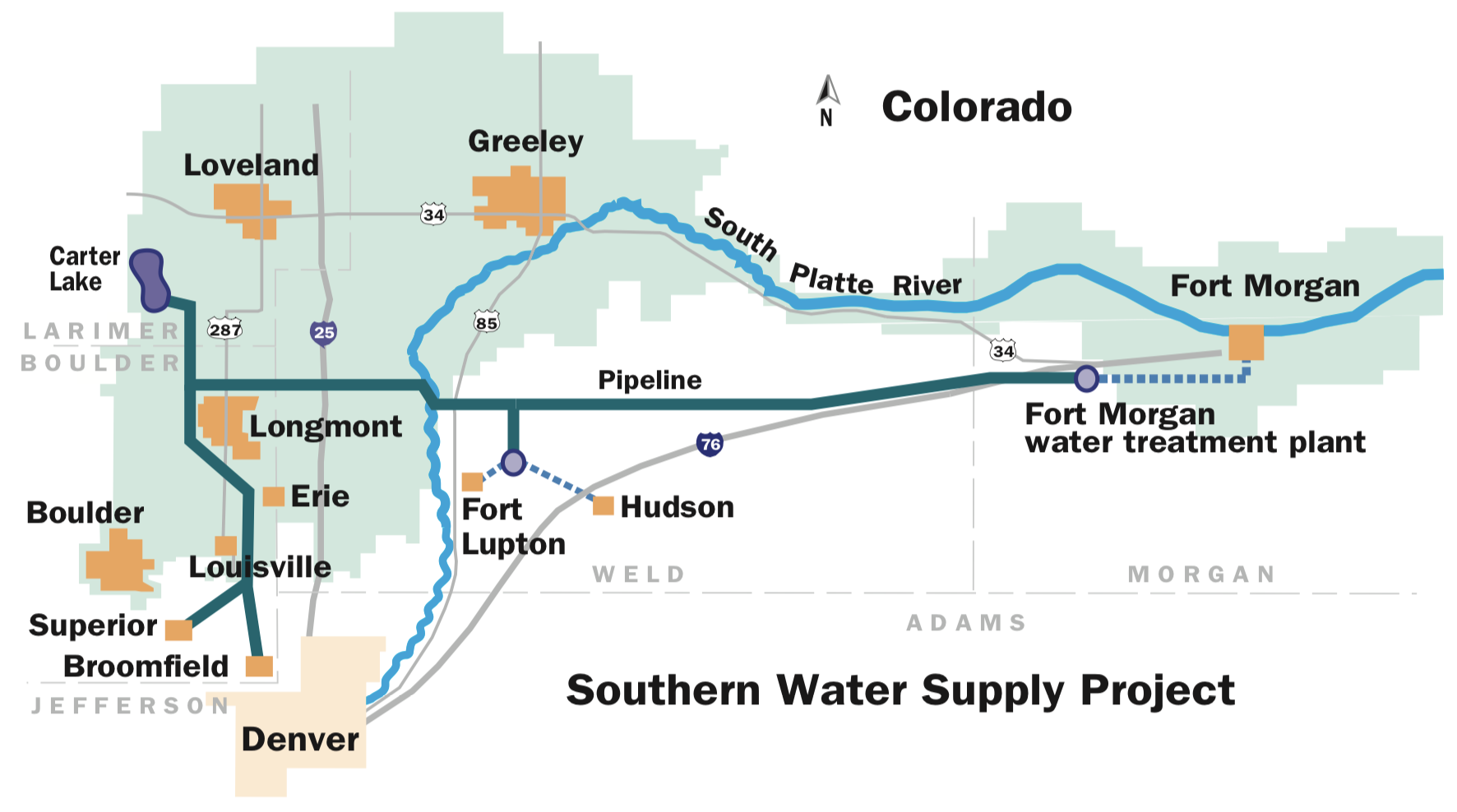
Fort Morgan and Quality Water both reached their capacity of Colorado-Big Thompson water multiple times in recent summers. Gravity is currently what brings the water to Fort Morgan, since Carter Lake, where it is stored, is hundreds of feet higher than Fort Morgan. But growth in use of water by the pipeline’s participants meant less and less water can reach Fort Morgan just through gravity. All of the participants in the pipeline had the right to call for a pump station to be built, as per the original agreements. The council did approve directing staff to proceed with that request to Northern Water. But getting a pump station built will be expensive for all the participants in the pipeline, since the overall project is expected to cost about $6 million. It would take about three years from its start before the pump station would be online…
New water meter system for Log Lane: The new town water meter system will cost Log Lane Village approximately $154,520, the Times reported June 16.
The town’s board of trustees had previously approved contracting with Aclara/HD Systems for providing a new water meter system, but the costs and details had not yet been finalized. That’s happened June 14, with the board approving the expenditure and choosing the more expensive but longer-lasting scalable option of two proposals offered by contractor.
On a 4-2 vote, a Longmont City Council majority on Tuesday night reduced the amount of water the city will contract to store in the Windy Gap Firming Project reservoir to be built in Larimer County.
Council members Polly Christensen, Marcia Martin, Joan Peck and Aren Rodriguez instead changed the city’s commitment to its share of the overall project expense to whatever would be needed to pay for Longmont’s storage of 8,000 acre-feet of water in the Chimney Hollow Reservoir, rather than the 10,000 acre-feet that a previous council majority had favored.
That smaller amount of Longmont water storage is expected to reduce the amount of bonds, if any, that the city would have to sell to help finance its share of the water storage.
It also is expected to reduce the amount of any additional water-rate increases — if any — that Longmont would have had to bill its customers to pay for the $36.3 million in bonds that Longmont voters in the 2017 election authorized the city to sell.
It would not, however, eliminate the 9 percent water-rate increase the previous council had already imposed for 2018, followed by another 9 percent increase in 2019.
Mayor Brian Bagley and Councilwoman Bonnie Finley dissented from the vote to reduce the amount of water that Longmont would have stored, and the resulting reduction in Longmont’s cost share for the reservoir project.
Collaboration is a lofty goal touted by political and business leaders as a potential way forward on anything from climate change to healthcare to obesity. Drop your weapons, turn your enemies into partners and achieve great things — or so the thinking goes. But collaboration is a concept that sounds great in the abstract and quickly turns messy in practice, with plenty of pitfalls along the way toward a common goal.
Avoiding drawn out fights has always been tough when dealing with water issues in the West. Collaboration wasn’t always the go-to strategy for environmentalists, political figures and water managers who held competing interests on overtaxed, overdrawn rivers.
But with the Windy Gap Firming Project in northern Colorado’s mountains, old grudges are being put aside in favor of new, collaborative tactics. While some of the West’s oldest enemies are working together, those who feel left behind by all the newfound teamwork aren’t ready to sing “Kumbaya.”
[…]
Windy Gap Reservoir — at the heart of the dispute — is a shallow, human-made lake just west of Rocky Mountain National Park. Colorado River water sits in a wide, shallow pool, kept in place by a dam…
It’s just one piece of a much larger diversion project that moves water from the headwaters of the Colorado through the mountains for use along the Front Range. Water managers have proposed, and received the federal permits needed, to use this small reservoir to move more water eastward, exercising water rights they say they’re unable to use now because the system is full to the brim at inopportune times.
That type of proposal — to send more Colorado River water eastward to supplement urban and suburban growth — stirs up all kinds of West Slope anxiety about Front Range growth.
“We know the flows are going to be diverted,” [Kirk] Klancke says. “We know the state’s not going to stop growing, that’s reality.”
“The pragmatic approach would be then to figure out how to keep your aquatic habitat healthy with those diminished flows, and that’s what we’re doing,” he says.
Rather than fight powerful water managers like Denver Water and Northern Water in the duke-it-out, courtroom-style battle some environmental groups have perfected over the years, Trout Unlimited and some of its allies took an unprecedented step: working together. Since the Windy Gap project’s revival more than a decade ago, they’ve had a seat at the negotiating table. If cities want to siphon away West Slope water, Klancke says, they need to give something in return.
“These are some of the most powerful people in the state because they control one of the state’s most important resources,” he says.
Which is exactly why other environmentalists, like Ken Fucik, don’t trust the water diverters and, by association, environmental groups like Trout Unlimited for working with them.
“When you look at the process over here, there are some of us over here who are unhappy,” Fucik says.
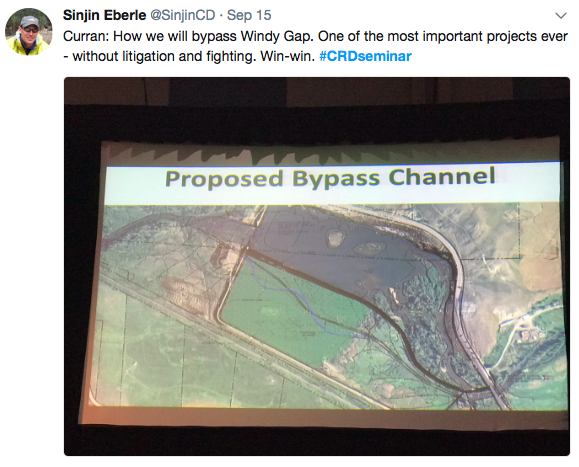
Fucik, a retired environmental consultant from Grand Lake, is opposed to a 2012 deal brokered by Trout Unlimited, county officials and others. In exchange for a permit to allow more water be sent to the Front Range as part of Windy Gap, the negotiators got $10 million in required mitigation to upgrade water quality in the headwaters and an additional $12 million in mitigation work for fish and wildlife, projects not required by law. That includes partial funding for a bypass channel that would skirt around Windy Gap dam and reservoir, reconnecting the upper reaches of the Colorado River, allowing fish to move more freely.
Grand County was also able to negotiate additional flows out of Windy Gap Dam to flush out sediment, an agreement that Northern Water be in charge of operation of the new bypass and more flows to support endangered fish in a stretch of the Colorado near Grand Junction…
Environmental consultant Geoff Elliott agrees. He lives in Grand County and says when you’re not part of collaborative agreements and weren’t invited to the negotiations, you end up feeling left out and unheard.
“It comes down to trust and we’re asked to trust in a process where we’ve been eliminated, pushed out and punished,” he says. “It’s hard for us to trust in that process.”
Fucik and Elliott are now supporting a recently filed lawsuit from a handful of environmental groups who take a different tactic with water projects, like Save The Colorado and WildEarth Guardians. Their goal is to prevent more water pulled from the Colorado River watershed from traveling to the Front Range…
For an environmentalist concerned about the health of the river, this conundrum has become the fork in the road: When do you collaborate with someone who’s supposed to be your enemy? And when do you roll the dice in court?
Lurline Curran photo credit Aspen Journalism.
Lurline Underbrink Curran says the path of most resistance has been tried before, with pretty erratic results. She’s the former Grand County manager and sat at the negotiating table with Northern Water.
“I don’t understand collaboration becoming a dirty word,” she says. “Because I can tell you, I can throw out some dirty words that will curl your hair, and that is not one of them.”
Because Grand County officials, like Curran, held the key to a permit that would allow the project to move forward, she joined forces with environmental groups like Trout Unlimited and ranchers concerned about the river’s flow downstream of Windy Gap. The negotiations took years and Curran says her team was a formidable opponent to the Front Range water suppliers, despite what detractors might think.
Curran admits some of the negotiations were done behind closed doors, as she says, to build trust among old enemies. But adds that the solutions they came up with will benefit the river in the long-term.
“Will the Colorado be as wide and deep as it used to be? Hell no. But that’s gone. Like it or not that’s been gone for decades,” she says. “But you can make it so it’s functional.”
Map from Northern Water via the Fort Collins Coloradan.
The idea of bringing parties with old grudges to the negotiating table was meant to avoid lawsuits in the first place. Now that one’s been filed it threatens to bring down the whole deal. Northern Water has already started planning the $400 million Chimney Hollow Reservoir. Trout Unlimited is still fundraising to secure enough money to build the Windy Gap bypass channel, the crown jewel of the agreement.
Northern Water spokesman Brian Werner says the agency is moving ahead with its plans.
“I’d be lying if I said there weren’t any concerns, we’d rather not have a lawsuit filed,” Werner says.
Werner doesn’t have any regrets on how the compromise went down. For decades, water managers have been seen as bullies who strong arm their opponents to get what they want. He says the Windy Gap Bypass project seemed like a turning point.
“What’s best for the river?” he asks. “We need water for growth in Colorado, there’s no question about that. How are we going to do it, folks?”
Either by working with your enemies. Or against them.
Proposed bypass channel for the Colorado River with Windy Gap Reservoir being taken offline, part of the agreements around Northern Water’s Windy Gap Firming project.
Representatives of two of the utilities that hope to store water in Chimney Hollow say that if a lawsuit filed to halt the reservoir is successful it may not stop the water from being diverted from the Colorado River, and a leading conservation group says the lawsuit will hurt the river not help it.
“It could mean that instead of one big project that holds the 90,000 acre feet, participants use a bunch of smaller options (for water storage),” said Michael Cook, district manager of the Little Thompson Water District, one of 13 participants in the reservoir project led by Northern Water.
The participants already own the supply of water, called Windy Gap, that would be diverted into the reservoir. However, they do not have a place to store it during years when water is plentiful for use in dry years when it is needed.
This reservoir would provide that storage to firm up the supply, which is why it also is called the Windy Gap Firming project.
The Little Thompson Water District accounts for about 6 percent of the overall project and has been using some of its Windy Gap water each year.
The city of Loveland, which owns 10.5 percent of the water, has used it infrequently but is relying on the water, which it purchased with money from a bond, for future water needs as the city grows.
The city needs a place to store this water to firm up the supply and would be forced to look at other storage options for its Windy Gap water if the lawsuit were to prevail, said Larry Howard, the city’s water resources manager…
However, he, like Werner, expressed confidence that the 14-year permitting process was sound and that the reservoir project will go forward despite the lawsuit, which was filed Thursday.
An attorney for Trout Unlimited, too, expressed doubt that the lawsuit will stop the project, stating that, despite the lawsuit, water will continue to be diverted from the Colorado River as populations grow and other solutions are needed to turn the tide.
“This lawsuit likely won’t stop Windy Gap, but it could succeed in delaying real solutions to the problems,” Mely Whiting, attorney for Trout Unlimited, said in a written statement. Trout Unlimited was a leading participant in negotiations for mitigation and conservation efforts included in the project.
“Habitat restoration projects and other solutions are already being implemented and showing great success in improving the health of the Colorado River. That’s why many conservation groups who’ve been working the longest on this problem support our collaborative approach.
“These solutions offer the best hope for keeping the valuable resources of the Upper Colorado alive. This short-sighted lawsuit would only delay progress.”
Proposed bypass channel for the Colorado River with Windy Gap Reservoir being taken offline, part of the agreements around Northern Water’s Windy Gap Firming project.
The lawsuit, filed in U.S. District Court, questions the need for the Windy Gap Firming project, which would ensure the full complement of more than 40,000 acre feet of water is diverted from the Colorado and eventually stored in the planned, $400 million Chimney Hollow Reservoir the Front Range communities would share…
The lawsuit was filed by Save the Colorado, Save the Poudre, WildEarth Guardians, Living Rivers and the Waterkeeper Alliance, a collection of nonprofit environmental groups that have long opposed the project.
It was filed against the U.S. Bureau of Reclamation and the U.S. Army Corps of Engineers for their roles in approving the project in May and conducting the environmental impact statement. In April 2016, Gov. John Hickenlooper endorsed the project, as well.
Northern Colorado Water Conservancy District spokesman Brian Werner said he hasn’t had much time to review the lawsuit, but he said although he and others are disappointed, he’s confident the project will eventually move forward. Northern Water was the driving force behind the Windy Gap firming project, which was proposed as a way to ensure Front Range municipalities get the full yield they’re due based on water rights from the Colorado.
The lawsuit, filed Thursday in U.S. District Court in Denver, asks the judge to throw out the records of decision by the U.S. Bureau of Reclamation and the U.S Army Corps of Engineers, claiming they violated the National Environmental Policy Act and the Clean Water Act in approving the project.
Save the Colorado, Save the Poudre, WildEarth Guardians, Living Rivers and Waterkeeper Alliance, together, filed the lawsuit against the Bureau of Reclamation and the U.S. Army Corps of Engineers, claiming that the permitting process was flawed and did not consider the cumulative effects on the river, the resulting effect on the ecosystem and tourism or alternatives for water supply…
The main target of the lawsuit is the environmental analysis, led by the Bureau of Reclamation and relied upon by the Corps of Engineers. That environmental process, which included both a draft and final environmental impact statement, took more than a decade…
“We think that the process has worked well,” said Werner. “The EIS, we don’t think that there is any basis in fact about it (in the lawsuit). In this country, anybody can say what they want about a process. We think the federal government has done it well.”
In fact, Northern Water has agreed to a wildlife mitigation plan that will benefit not destroy the river and the trout habitat, including channel work that has already begun and control of flows and diversions to boost the ecosystem for trout and other aquatic life, Werner said.
“The Colorado River below Windy Gap is better with the mitigation and enhancement and the project than it is without it,” Werner said.
The lawsuit claims that the project should have been replaced with other alternatives but that the applicants “stubbornly” continued to push forward because of how much money they had already sunk into the reservoir…
“Federal agencies must evaluate not only the impacts of a proposed project, but also alternatives to the intended course of action,” Zach Lass, student attorney at the University of Denver Sturm College of Law, said in a press release. “Reclamation and the Corps fell victim to a sunk costs bias that infected the entire review and approval process when they failed to consider alternatives that did not involve spending more money trying to salvage their failed Windy Gap Project.”
[…]
One of the big issues alleged in the lawsuit is that the extensive environmental analyses failed to consider alternative sources of water besides pulling more from the river and storing it in a brand new reservoir. The applicants failed to look at conservation, efficiency and water recycling, said [Gary] Wockner…
The lawsuit does not ask for an immediate injunction to stop work that is currently being done on the Chimney Hollow site, which includes blasting of a test quarry for construction of a small version of the dam to gather information on the geology of the area.
That work, along with planned tree removal and relocation of a power line, will continue as this lawsuit is heard in court, Werner said…
No court dates likely will be set until the Bureau of Reclamation and the U.S. Army Corps of Engineers have responded to the initial complaint, and they have 60 days to do so. Often, it takes at least a year for a decision in this type of lawsuit.
Work has started on the new Chimney Hollow Reservoir in Larimer County. Final approval was granted for a 90,000 acre foot reservoir in May, and crews are now surveying and drilling at the site, to determine the extent of building materials.
Chimney Hollow will be operated by Northern Water. It is located just west of Carter Lake Reservoir, and is going to be close to the same size of twin to the east. This location was chosen for it’s proximity to existing Colorado Big Thompson facilities, and because there were no threatened or endangered species, no existing residences to relocate, and they were able to acquire the property from a single owner, Hewlett Packard.
Nearly 400,000 northern Colorado residents will benefit from this new water supply. Those areas are Broomfield, Longmont, Loveland, Greeley, Erie, Superior, Louisville, Fort Lupton, Lafayette, and the towns in the Central Weld County Water District.
“This project specifically is to make some supplies reliable year in, and year out, for those communities. They will be able to have more of a guarantee that they will be able to pull water from the Windy Gap Project, which today, is not possible. There are some years where there is either no water available, or nowhere to store it,” said Brian Werner, spokesperson for Northern Water…
Contracts will start to get awarded in 2018, and Northern Water says that construction will likely start later next year, or early in 2019. It will be a three to four year build. The next step, which could happen this fall, is to relocate power lines that run through the middle of the property, and to also start clearing the vegetation.
Once construction is complete, they can start filling the reservoir with water. According to Northern Water, that could take several years to fill up.
“There are state regulations on dam safety, on how fast we can bring the water elevation up, so it’s sort of fill and seal, before we can go to that next incremental level. It could take 3, or 5, or even 10 years to fill it. A lot is dependent of mother nature as well, with how much water is available,” Werner said.
The water will come from the headwaters of the Colorado River, channeled back to the east from Windy Gap Reservoir.
The Chimney Hollow project has already been 14 years in the making. The permitting process began in 2003, and there have been $15 million spent in studies. The total estimated cost is $400 million.
The dam is estimated to be about 340 feet tall, which makes it the tallest dam to be built in Colorado since the Morrow Point Dam in Gunnison County back in 1968. Morrow Point is still the largest dam in Colorado at 468 feet. Denver Water has recently received approval to increase the size of Gross Dam, in Boulder County, to 471, which will make that the largest dam once it is finished.
Chimney Hollow Dam could be the first in the United States with an asphalt core. This type has been used in Europe and Canada for many years. The available land material in the area, made asphalt the more cost effective choice. The asphalt will be the inner seal of the dam, but the outside appearance will be more earthy, made of land and boulders. Arizona has also received approval to build an asphalt core dam, and could be completed about the same time as Colorado’s.
Larimer County will be handling the recreation on this new reservoir, and already has some initial plans for hiking, fishing, and boating. It will be a non-motorized boating lake and a day-use area. So far, there are no plans to allow overnight camping.
There had been some opposition to this project, and other proposals to build new reservoirs in Colorado. River conservation groups are concerned about the impacts of further taxing a the Colorado River system. Werner says they are addressing the future of the river, and the future of Colorado’s population at the same time.
“We are all for using water more efficiently, and water managers in this state are doing a darn good job of that, but the bottom line is that you have to provide some additional buckets, some additional water storage to meet our future demand, without drying up our agricultural lands,” he said.
A 5-2 Longmont City Council majority decided Wednesday night to ask voters’ authorization to sell an estimated $36.3 million in bonds to help finance the city’s share of costs for the Windy Gap Firming Project…
…the city’s water customers would pay higher rates in 2018, with rates increasing by an average 13 percent above 2017 levels. There would be another 10 percent increase in 2019 and a 6 percent increase in 2020 as the city makes annual principal and interest repayments on the 20-year bonds.
The water rate-backed bonds, along with about $6.2 million the city projects it will be getting from development fees and other sources, would cover Longmont’s costs of paying for the project that would be able to provide the city with about 10,000 acre-feet of water. A council majority continued to endorse the 10,000 acre-feet level on Wednesday night.
Mayor Dennis Coombs and council members Brian Bagley, Bonnie Finley, Jeff Moore and Gabe Santos voted Tuesday to direct the city staff to prepare an ordinance that will, when adopted, advance the bonding question to November’s ballot.
Council members Polly Christensen and Joan Peck voted against the $36.3 million bonding scenario.
Christensen and Peck instead tried to get the council to support an alternative that would have lowered Longmont’s Windy Gap Firming Project level from 10,000 acre-feet of water to an 8,000 acre-foot participation. That option would have maintained a set of 9 percent annual water rate increases that already are to take place at the start of 2018 and again in 2019, but with no rate increases above that 9 percent level in either of those years.
The Christensen-Peck approach, however, failed on a 5-2 vote, with all other council members voting against that option.
Santos said that when it comes to water delivery and supplies, “it’s incumbent on us to make decisions for the future, for the next generations.”
Coombs noted that under Longmont’s tiered water-rate system, with residents’ and businesses’ actual water bills based on how much water they actually use, “people have some control,” even with the pending increases ahead.
Customers “can take some responsibility” for conserving water, and thereby reducing the water bills they get, even with the higher rates ahead in future years, he said.
Peck, however, said she was concerned that “we’re buying more (water) than we actually need” if Longmont sticks with the 10,000 acre-feet participation level from the Windy Gap Firming Project, which is to include construction of a new Chimney Hollow Reservoir southwest of Loveland.
Colorado transmountain diversions via the State Engineer’s office
Prior to the council’s Wednesday night action to direct the staff to prepare the ballot measure language for the bonding option, a number of residents spoke about their opposition to that project and questioned its need. Some also objected to the entire concept of diverting water from the Western Slope to the Front Range.
Click here to read the newsletter. Here’s an excerpt:
Chimney Hollow Reservoir receives final approval
The U.S. Army Corps of Engineers recently signed a final Record of Decision and approved a 404 Clean Water Act Permit for the Windy Gap Firming Project. This decision paves the way forward to construct Chimney Hollow Reservoir following a 14-year federal permitting process that began in 2003. Chimney Hollow Reservoir will be located in the foothills immediately west of Carter Lake in southern Larimer County. It will store up to 90,000 acre-feet of water behind a 350 ft. tall dam, which will be one of the first constructed in the United States with an asphalt core. For further information please click any of the links below.
Map from Northern Water via the Fort Collins Coloradan.
Lurline Underbrink Curran, the long-time Grand County manager, was lavished with praise Wednesday evening at the Denver Botanic Gardens, but she may have told the best joke.
Curran said she learned she was to be honored by the Colorado Water Trust after being asked to sit in on a conference telephone call with the group’s directors. The group’s mission is to restore flows in Colorado Rivers in need.
The news they purported to share seemed to comport with that mission. The new administration, they told her, had a keen interest in the Colorado River, and there were plans to remove all the dams —and make Mexico pay for it.
As she wondered what Water Trust directors were imbibing, they broke the real reason for wanting her on the phone: They wished to bestow her with the 2017 David Getches Flowing Water Award.
Getches was a law professor at the University of Colorado known to be an “inspired creator of new alternatives to old stalemates.”
Grand County long was Colorado’s best example of a stalemate. It was hit early and often for water diversions to solve Colorado’s intractable problem: about 75 percent of the state’s water originates west of the Continental Divide and almost 90 percent of people and the best agriculture lands lie to the east.
About a decade ago, at a water workshop in Gunnison, Curran described her county’s position simply: Denver, she said, had been thinking ahead—and Grand County had not.
But when two Front Range water agencies announced long-standing plans to incrementally expand diversions from the Granby-Winter Park area, Grand County chose a more sophisticated approach. It wasn’t neither hell no nor roll over.
The result is called Learning by Doing, which is premised in a cooperative effort to scientifically manage diversions in ways that cause least harm to native flows in the Fraser Rivers and its tributaries as well as the Colorado River itself.
The Windy Gap reservoir, located on the Colorado River near Granby, is part of a transmountain diversion system in Grand County. It’s been the focus of much of Underbrink Curran’s work. Photo credit Northern Water.
Sense of purpose
Eric Wilkinson, general manager of the Berthoud-based Northern Colorado Water Conservation District, which distributes water to the Boulder-Fort Collins-Greeley area through the Colorado-Big Thompson project, said he wasn’t immediately impressed with Curran when negotiations began. “I vividly remember walking out of that meeting and thinking, ‘I don’t really appreciate that woman.’”
After four years of “very extensive, intense negotiations,” he instead found Curran to be a “visionary” who was nonetheless “pragmatic but with a keen sense of purpose.”
“The Colorado River is far better now and into the future because of Lurline’s efforts and her stubborn determination to make it better,” he said.
Curran grew up in Kremmling. She had a circuitous route to public service. She managed the local bowling alley before going to work at the Grand County Courthouse in Hot Sulphur Springs, first as a secretary, then a planner before being chosen as the county manager.
Dave Taussig, a water attorney in Denver and also a director of the Colorado Water Trust, also grew up in Kremmling. His parents had a ranch at Ute Park, which is now covered by the Henderson Mill’s tailings.
“In the past, the transmountain diverters would come over and then skedaddle as quickly as they could, never to be seen or heard from again,” Taussig said.
But what Grand County did this time creates a new dynamic.
The effort is “bearing fruit already,” he said.
Editor’s note: Aspen Journalism is collaborating on coverage of rivers and water with Sky-Hi News, the Summit Daily News, the Vail Daily, the Glenwood Springs Post Independent and The Aspen Times. the Sky-Hi News published this story on June 15, 2017.
Just last week, the Army Corps of Engineers approved the Chimney Hollow reservoir project, which will hold 90,000 acre feet of water and feed several Front Range communities, including Greeley.
Such infrastructure is vital for future growth, regardless, [Brian] Werner said.
The fight is not over. The conservancy district will continue to fight for the Northern Integrated Supply Project, a proposed water storage and distribution project that will supply 15 northern Front Range communities with 40,000 acre feet of water. That’s been held up at the Army Corps of Engineers for more than a decade. A decision is expected next year.
“Chimney Hollow and NISP will put a major dent into what we’ll need down the road,” Werner said. “More people are coming whether we build this or not. Our future looks a lot better having some of these storage buckets with more people than a lot more people and no storage buckets. We’ll start drying up more farms. We’ve got to have water.”
In addition to water storage, the city of Greeley, has an intense focus on proper drainage to combat the decades-old problem of flooding in Greeley.
Joel Hemesath, public works director, said the city has been working for the past two years with some bond money to improve drainage in and around Greeley. He said the city is gearing up for downtown projects, as well, that will route drainage to a detention pond by the Poudre River via bigger pipes.
Since 2012, the city has spent a little more than $17 million on stormwater projects.
The city also works hard to improve trails, dedicating just shy of $900,000 to them since 2012.
Hemesath said the city would like to extend Sheep Draw Trail through some more western subdivisions, and extend the Poudre Trail farther east.
Map from Northern Water via the Fort Collins Coloradan.
From the Loveland Reporter-Herald (Pamela Johnson):
The U.S. Army Corps of Engineers’ final decision allowing Northern Water to build Chimney Hollow Reservoir southwest of Loveland, issued 14 years after the federal permitting process began means, that construction could begin in late 2018 and water begin filling in 2022.
That same year, an open space around the reservoir with trails, backcountry camping and boating should open under the management of Larimer County’s Department of Natural Resources.
The permits that allow Northern Water to finish design and begin building the $400 million reservoir on behalf of 13 municipal water providers, including Loveland, require several different actions to mitigate environmental damage or concerns.
[Eric] Wilkinson, general manager of Northern Water, summarized some of the mitigations associated with Chimney Hollow Reservoir, which will store water pulled from the Colorado River through the Windy Gap project.
• Maintaining certain water temperatures on the Colorado River to make sure the habitat for fish stays healthy.
• Paying for about $4 million worth of stream channel improvements on the Colorado River for 14 miles ending near the confluence of the Williams Fork River, to make significant enhancements to aquatic habitat.
• Flush flows every six years to move sediment and improve habitat.
• Construct a channel that will carry the water around Windy Gap Reservoir, allowing fish to migrate through that area and improving spawning conditions in the Colorado River downstream of Windy Gap.
• Replace wetlands that will be destroyed by the actual construction of the reservoir with similar acres in another location.
• Conduct stream restoration along the Little Thompson River in two locations to help restore that channel to its pre-2013 flood conditions and maintain those enhancements over the long term.
Chimney Hollow will hold about 90,000 acre-feet of water, enough for more than 90,000 households, that will be pulled from the Colorado River in wet years and stored for use in dry years.
The Windy Gap Firming project and its accompanying Chimney Hollow Reservoir has been approved, paving the way for more reliable water across the Front Range while also further draining the Colorado River.
The Windy Gap Project has its roots in the 1980s, and was intended to provide the Front Range with more than 40,000 acre-feet of water from the Colorado River. But without enough storage capacity, municipalities haven’t realized that yield every year.
“We are pleased to make it to this milestone with our partners at Northern Water and all of the other communities involved,” Greeley City Manager Roy Otto said in text message Thursday.
The firming project, centered on the construction of Chimney Hollow Reservoir near Carter Lake, is expected to address that problem at a cost of about $400 million.
The Army Corps of Engineers gave final approval Wednesday, and construction should start in late 2018 or early 2019.
It’s a project nearly 15 years in the making.
“We’re ecstatic,” Northern Water spokesman Brian Werner said. “You get one of these (types of projects) done in your whole lifetime.”
Water for the reservoir would be pumped from the Windy Gap Reservoir on the Colorado River near the town of Granby, west of the Continental Divide, through an existing tunnel under the Rocky Mountains to the east side of the divide.
Greeley is one of 12 beneficiaries of the project, which also will create more reliable water supply for Fort Lupton, Longmont and Loveland.
Chimney Hollow Reservoir will hold 90,000 acre-feet of water, and Greeley will get about 9,200 acre-feet of water per year from the project.
An acre-foot of water is 326,000 gallons, or equivalent to a foot of water covering a football field. Greeley residents, according to the city’s new water budget, will use about 20,000 gallons per year.
Sen. Cory Gadner, R-Colo., also applauded the decision, calling the project a major component of Colorado’s longterm water needs.
“Getting to this point has been years in the making, and it is hard to state just how important it is that Northern Water can finally move forward with construction,” Gardner said in a news release.
The project’s approval was met with resistance from some water conservation advocates, though, including Gary Wockner with Save the Colorado and Save the Poudre.
“The Colorado River is on life support right now,” Wockner told the Associated Press. “If the patient is bleeding out, you don’t cut open a new artery to try and heal it. Instead, you should work to protect and restore the river, not further drain it.”
Save the Colorado is opposed to the Windy Gap project, and Wockner told The Tribune it’s likely his group will file a lawsuit in federal court to stop the project.
“Our policy is no new dams and diversions out of the Colorado River system,” Wockner said. “This is a dam and diversion, so we’re going to do everything we can to stop it.”
Wockner, who said the Colorado River is being overused, instead calls for more water conservation, including moving away from green lawns, recycling water and managing growth better.
Werner points to the endorsement of Democratic Gov. John Hickenlooper, officials in Grand County on the Western Slope and Trout Unlimited, a trout and salmon conservation organization as proof the Windy Gap Firming project’s strong support.
Before the Windy Gap Firming project, Colorado had never endorsed a water project that has come before the federal government.
Without the project, Werner said municipalities would have to do what they’ve always done in particularly wet years: dump the excess water down the Colorado River rather than saving it for drier times.
“There is still a lot of work to do,” Otto said. “This project, along with the expansion of Milton Seaman Reservoir, are critically important to Greeley’s longterm water needs.”
Site of Chimney Hollow Reservoir via Northern Water.
Map from Northern Water via the Fort Collins Coloradan.
Chimney Hollow Reservoir site via the Bureau of Reclamation
Site of proposed Chimney Hollow Reservoir — Windy Gap Firming Project via the Longmont Times-Call
Windy Gap participants (2012)
Windy Gap Reservoir
Windy Gap Reservoir
Here’s the release from the US Army Corps of Engineers Omaha District (Kiel Downing/Cheryl Moore):
The Corps of Engineers, Omaha District, finalized its Record of Decision (ROD) approving the Windy Gap Firming Project on May 17, 2017. The project is proposed by the Municipal Subdistrict, Northern Colorado Water Conservancy District (Subdistrict) and involves the construction of Windy Gap Firming Project Water Supply facilities for its customers and 13 other Front Range water providers. The Subdistrict requested a Section 404 Clean Water Act (CWA) Permit from the Corps’ Omaha District Denver Regulatory Branch. “Due to the potential for significant environmental impacts to the East and West Slopes of Colorado, this project resulted in the preparation of an Environmental Impact Statement (EIS)” said Kiel Downing, Denver Regulatory Office Chief. The U.S. Bureau of Reclamation (Reclamation) was the lead federal agency preparing the EIS, and the Corps participated as a Cooperating Agency.
The original Windy Gap Project, constructed in the early 1980’s, was intended to provide more than 40,000 acre-feet of firm yield to the east slope, but due to operational constraints that didn’t happen. The project currently captures water from the Colorado River, pumps it to existing reservoirs on the west slope and moves the water through a tunnel system (the Colorado-Big Thompson Project operated by Reclamation) to the Front Range of Colorado. Because of the historic deficiency in water deliveries and lack of storage, the Windy Gap Project participants have not been able to fully rely on existing Windy Gap Project water for meeting a portion of their annual water demand. As a result, the participants, initiated the proposed construction of the Chimney Hollow Reservoir, which would firm all or a portion of their individual Windy Gap Project water allotment units to meet a portion of existing and future municipal and industrial water requirements. The Chimney Hollow Reservoir, as proposed, is a 90,000 AF capacity reservoir that will be dammed at the northern and southern limits.
Reclamation published the Windy Gap Firming Project, Environmental Impact Statement in November of 2011, and ROD on December 12, 2014. The State CWA Section 401 Water Quality Certification began shortly thereafter with the Subdistrict submitting its application to the State in March of 2015. The State issued the Section 401 WQC for the WGFP on March 25, 2016. This determination was necessary for the Corps determination under Section 404 of the CWA. The Subdistrict provided the Corps its Mitigation Plan for permanent and temporary impacts to Waters of the U.S. associated with the WGFP on March 17, 2017 and the Corps with continued agency collaboration, updated study information, and new Federal and State requirements, finalized their ROD shortly thereafter marking the end of the federal approval process.
Kiel Downing, Denver regulatory office chief for the Corps of Engineers, announced Wednesday afternoon the Record of Decision for the Clean Water Act permit for the Windy Gap Firming Project, which includes the reservoir.
With the final federal permit in hand, Northern Water officials can start planning for construction of the $400 million project, which is set to start in late 2018 or early 2019, according to Northern Water Public Information Officer Brian Werner.
“We’re smiling,” Werner said. “These things come along once in a generation.”
Berthoud-based Northern Water will manage the construction of a pair of dams in a valley west of Carter Lake that will hold approximately 90,000 acre-feet of water, or about 29 billion gallons — enough water for more than 90,000 households.
Water to fill Chimney Hollow will come from the Colorado River basin in years when its flows are above average. The water will be carried through a diversion at Windy Gap Reservoir in Grand County to Lake Granby and the Colorado-Big Thompson Project.
Municipalities including Loveland, Fort Collins and Greeley conceived of Windy Gap in 1970. The need for storage space for the communities involved to “firm” their ownership of the Windy Gap water rights expanded in later years to include Chimney Hollow Reservoir because in above-average precipitation years, Lake Granby often does not have enough space to store the additional water.
Rep. Hugh McKean, R-Loveland, said he was ecstatic when he heard about the Corps of Engineers’ approval, comparing it to Christmas.
In his time serving on the Loveland City Council and then the Colorado House of Representatives, he has seen how much the storage project was needed…
For cities such as Loveland, Windy Gap water fills an important role for its municipal users because it is a 365-day-a-year, deliverable water source, unlike in-basin seasonal water offered through local ditch companies. It will join the Colorado-Big Thompson Project shares in the city’s water portfolio…
McKean acknowledges that because the water has not been diverted before, questions and concerns will emerge from Western Slope water users and communities. However, because the Windy Gap Firming Project water is available only in years of above-average flows on the Colorado River, municipalities on the Front Range won’t be served until water rights holders on the Western Slope get their allocations.
He said he will be in Montrose this summer at a meeting of the Uncompahgre Water Users Association to talk about the project’s effect on the basins and in the context of the state water plan.
From the Associated Press (Dan Elliott) via The Colorado Springs Gazette:
The federal government gave final approval Wednesday for a $400 million dam and reservoir in northern Colorado where 13 cities and water districts will store water from the other side of the Continental Divide.
The Army Corps of Engineers issued a permit for construction of the Chimney Hollow Reservoir in the foothills about 50 miles (80 kilometers) north of Denver.
The corps regulates some of the environmental impacts of big water projects.
It is the last approval the reservoir needs, said Brian Werner, a spokesman for the Northern Colorado Water Conservancy District, which oversees the project.
Construction could start in early 2019, after the district refines the plans, hires a project manager and awards contracts.
Water for the reservoir would be pumped from the Windy Gap Reservoir on the Colorado River near the town of Granby, west of the Continental Divide, through an existing tunnel under the Rocky Mountains to the east side of the divide.
The 13 water providers own the rights to the water but have nowhere to store it. The project is formally called the Windy Gap Firming Project because it would firm up the water supply.
The Chimney Hollow Reservoir will store up to 90,000 acre-feet (1.1 million cubic meters). One acre-foot (1,200 cubic meters) can supply two typical households for a year.
New reservoirs are always contentious in Colorado. Water managers and urban planners argue the state needs more because it does not have the capacity to store all the water it is entitled to under agreements with other states. They also say Colorado needs more water for its growing population.
Some conservationists oppose new reservoirs because of their environmental damage and because the state’s rivers are already overtaxed.
“The Colorado River is on life support right now,” said Gary Wockner, director of Save the Colorado. “If the patient is bleeding out, you don’t cut open a new artery to try and heal it. Instead, you should work to protect and restore the river, not further drain it.”
Wockner said his group will likely challenge the Corps of Engineers permit in court.
Trout Unlimited negotiated some environmental improvements in the Colorado River near the Windy Gap Reservoir as part of the project. Mely Whiting, an attorney for the group, said she had not yet seen the final Corps of Engineers permit.
Water providers that will pay for and benefit from the Chimney Hollow Reservoir are the cities of Broomfield, Erie, Greeley, Longmont, Louisville, Loveland, Superior, Evans, Lafayette and Fort Lupton, as well as the Central Weld County and Little Thompson water districts.
The Denver Art Museum was the location for The Colorado Foundation for Water Education’s President’s Award Reception yesterday evening.
Eric Kuhn received the Dianne Hoppe Leadership Award and Drew Beckwith was honored as an Emerging Leader.
Each year when I attend this event I am struck by the camaraderie shown by the water folks here in Colorado. Water really does bring us together to find solutions, and at the end of the day we have so much to agree on. Water for Ag, water to drive the economy, water for the fish and bugs. It takes a great number of people to meet the water needs of the Headwaters State, collaboration is key, and this event helps us to connect.
Jim Lochhead introduced Eric Kuhn and detailed his accomplishments while leading the Colorado River District. The Colorado River Cooperative Agreement and the Windy Gap Firming agreement were at the top of the list. Lochhead also praised Mr. Kuhn as one of the two most influential persons in the Colorado River Basin along with Pat Mulroy.
Drew Beckwith
Eric Hecox told us about Drew Beckwith’s influence on the Statewide Water Supply Initiative. Eric credited Mr. Beckwith for poring over the workbooks, questioning assumptions, and advocating for conservation.
Drew is an accomplished water educator himself choosing video in the Drew in a Canoe series. He helped get the public on board with legislation passed in 2016 to legalize rain barrels.
People that install rain barrels are, “More connected to water,” he said.
This is always a great event to attend. Thanks Jayla, Caitlin, Jenny, and Stephanie.
Officials in charge of the Windy Gap Firming Project are checking to make sure that a Dec. 7 Colorado Supreme Court decision won’t adversely affect the $387.36 million transmountain water diversion project that will benefit the Front Range…
…in December, the Colorado Supreme Court sided with western slope interests against Aurora in case that had to deal with pumping western slope water across the continental divide and storing it on the eastern slope. Aurora had a one-half interest in the Busk-Ivanhoe Diversion Project in western Colorado.
Jim Pokrandt, spokesman for the Colorado River District, said the case relied on storage rights for the water.
“The big crux of the Aurora case is that they didn’t have the storage rights for the transmountain water that they took,” Pokrandt said. “So I’m sure what a lot of folks are doing is looking at their water decrees and seeing if they actually have decreed storage rights for transmountain water. That’s the question for the Windy Gap Firming Project.”
Pokrandt said that in the Colorado River District’s view, the court made the right decision.
“Our position is that water law is water law and under ordinary water law, you need a water right to store water. And Aurora argued that transmountain water didn’t need an exact water right to store it,” Pokrandt said. “But, no you do need that because water law is water law and there’s nothing special about transmountain water.”
The municipal subdistrict of the Northern Colorado Water Conservancy District is leading the Windy Gap Firming Project.
Eric Wilkinson, general manager of the municipal subdistrict, said they have staff researching to make sure the Aurora decision is unique to the case and to verify that the Windy Gap Firming Project is on legally stable ground moving forward.
“The Busk-Ivanhoe decision has a very significant application statewide … what the (Colorado) Supreme Court decision did is apply, in essence, 2016 water rights administration and laws to a decree that is dated 1928,” Wilkinson said.
Wilkinson added that staff are verifying that they have the water decrees to store Windy Gap water on the within the basin of use, which would be on the western slope.
Northern Spokesman Brian Werner said they are fairly certain the Colorado Supreme Court decision shouldn’t have major impacts on the Windy Gap Firming Project, which has been in the works since 2004.
“I want to emphasize that intent to store, we’ve had that all along with the Windy Gap Firming Project,” Werner said. “So if you’re asking what the impact (of the decision) is on the Windy Gap Firming Project, I can tell you there shouldn’t be any.”
Wilkinson added that with Colorado water law, nothing is certain forever.
“That’s the intent of our research to get to that point (of certainty),” Wilkinson said.
“But in Colorado water law and some of the interpretations that come out, there is not such a thing as absolute certainty. This Busk-Ivanhoe decision introduced some change in thought that didn’t exist before so say ‘here’s how it will be always and forever in absolute certainty’ is probably unreasonable, but we’re trying to get to a reasonable amount of certainty.”
Colorado transmountain diversions via the State Engineer’s office
Coyote Gulch contributor Brent Gardner-Smith took a deep dive into the decision to extract a summary of the water court process for a change of use. Below is his email:
John,
You might appreciate this. In the midst of the Busk opinion is summary of the factors that go into changing a water right. I’ve stripped it of the legal references, but otherwise, it’s the court’s words. Thought you might appreciate it. Not sure what else to do with it yet.
BGS
Under Colorado’s doctrine of prior appropriation, a water right is a usufructuary right that affords its owner the right to use and enjoy a portion of the waters of the state.
One does not “own” water, but owns the right to use water within the limitations of this doctrine.
The touchstone of Colorado’s prior appropriation doctrine is beneficial use. That is, an appropriator perfects a right to use water by applying a specified quantity of unappropriated water to a beneficial use.
“Beneficial use” is “that amount of water that is reasonable and appropriate under reasonably efficient practices to accomplish without waste the purpose for which the appropriation is lawfully made.”
Colorado water law has long recognized the right of water users to make changes to the terms of their decrees—including changes to the type, place, or time of beneficial use; changes to the points of diversion; changes to storage; and changes from direct flow to storage and subsequent application and vice versa.
Permanent changes to a water right must be decreed through the adjudication process established by the legislature … and … parties wishing to change the use of a water right must obtain a water court decree allowing the change in use.
It is inherent in the notion of a ‘change’ of water right that the right itself can only be changed and not enlarged.
This is a basic predicate of water law dating to the nineteenth century; a change application merely continues the rights decreed in the original appropriation in a new form and may not expand the amount of water actually used under the original decree.
In other words, “the right to change a water right is limited to that amount of water actually used beneficially pursuant to the decree at the appropriator’s place of use.”
Thus, in order to determine that a requested change of a water right is merely a change, and will not amount to an enlargement of the original appropriation, the court must quantify the historic use of the right to some degree of precision.
Quantification of the amount of water beneficially consumed pursuant to the decree guards against rewarding wasteful practices or recognizing water claims that are not justified by the nature or extent of the appropriator’s actual need.
An absolute decree confirms that a right of appropriation has vested; the decree entitles the appropriator to use that right through its decreed point of diversion in a specified amount, usually expressed as a flow rate (for a diversion right) or in acre-feet of water (for a storage right).
The term “historic use” refers to the “historic consumptive use” or “historic beneficial consumptive use,” attributable to the appropriation of that quantity of water historically consumed by applying the water to its decreed beneficial use.
However, because “the period and pattern of use are not known with certainty at the time a water right is adjudicated,” the decreed flow rate at the decreed point of diversion is not the same as the matured measure of the water right.
Rather, over an extended period of time, “a pattern of historic diversions and use under the decreed right for its decreed use at its place of use” will become the true measure of the mature water right for change purposes, typically quantified in acre-feet of water consumed.
Crucially, proper analysis of the historic consumptive use of a water right measures the amount of water both actually and lawfully used in accordance with the decree.
Because beneficial use defines the genesis and maturation of every appropriative water right in this state, every decree includes an implied limitation that diversions are limited to those sufficient for the purposes for which the appropriation was made.
Importantly, the actual historic diversion for beneficial use may be less than the decreed rate because, for example, “that amount has simply not been historically needed or applied for the decreed purpose.”
Indeed, we have often observed that when an appropriator exercises the right to change a decreed water right, he runs the real risk that the right will be requantified at an amount less than his original decree, based on the actual historic consumptive use of the right.
In short, an initial change application reopens the original decree for determination of the true measure of the appropriative right’s consumptive use draw on the river system.
In sum, “the fundamental purpose of a change proceeding is to ensure that the true right — that which has ripened by beneficial use over time — is the one that will prevail in its changed form.”
The decision is actually a page-turner for water wonks.
This graphic shows the transmountain diversions in Colorado.
A map of the Busk-Ivanhoe system, with Ivanhoe Reservoir on the left side of the map and Turquoise Reservoir on the right.
Grand County Water Quality Specialist Katherine Morris and contract employee Lurline Underbrink-Curran gave a water quality update at the first Board of County Commissioners (BOCC) meeting of 2017.
WINDY GAP BYPASS
On Dec. 21, 2016 the Natural Resources Conservation Service, part of the federal US Department of Agriculture, announced The Colorado River Headwaters Project (CRHP) would receive a $7.75 million grant to apply to a series of river restoration and conservation projects in Grand County. The grant, totaling $7,758,830, comes to the CRHP through the Regional Conservation Partnership Program (RCPP), part of the NRCS. The grant equals 80 percent of the requested amount. Underbrink-Curran said, in an update, that there are several sources the RCPP will apply to for the remaining funds. With the amount of money secured, other funders may be more willing to sign on to a project that has the ability to be completed and do such great things for the environment, fish passage, water quality and temperature and agriculture.
The $7.75 million grant will be divided up between a series of water projects including the creation of a bypass channel that will connect the Colorado River below the Windy Gap Reservoir to the sections of the River above the Reservoir. A significant portion of the funds will also be used to improve river habitat downstream from the Windy Gap as well as improving irrigation systems for irrigating ranchers in the Kremmling area and to improve soil and water quality.
According to Underbrink-Curran, the water right issue for the bypass channel has made some progress. At the last meeting there was a real effort to find a path that all could agree upon. Steve Bushong with UCRA had drafted a position that all agreed might work. That draft was circulated with the attorneys and has undergone several revisions and inclusions but seems to be getting close to complete.
UPRR INJECTION WELL
Morris said in December of 2016 the Water Quality Board requested she submit a letter to the Colorado Department of Public Health and Environment (CDPHE) expressing the board’s dissatisfaction of a revised discharge permit for Union Pacific Railroad (UPRR).
UPRR plans to submit a Class V Injection Well permit for a site near the Moffat Tunnel in Winter Park. Class V wells are used to inject non-hazardous fluids underground. Most are used to dispose of waste into or above underground sources of drinking water. This disposal can pose a threat to ground water quality if not managed properly.
According to UPRR, The plant would treat and return 95 percent of the contaminated groundwater issuing from the tunnel and return it, clean, to the Fraser River.
Grand County shared their concerns with the Environmental Protection Agency (EPA) stating that the plant was designed to treat only metals and total suspended solids (TSS), but the current discharge permit only recognizes TSS and metals as contaminants. According to Morris, Grand County does not know what will be the fate of the organic pollution that will also be in the discharge during annual tunnel cleaning operations, which is what caused the pollution found in September.
Morris said she has not drafted the letter yet because the permit has not been released.
BERTHOUD PASS SEDIMENT CONTROL
Morris said the Colorado Department of Transportation (CDOT) is asking for comments by Jan.30 on a draft Berthoud Pass Sediment Control Action Plan (SCAP). The SCAP will identify potential scenarios for enhanced maintenance and sediment control features to be implemented when funding becomes available. The last meeting about this effort took place in October of 2015. Morris said she will be reviewing the SCAP this month.
Following a closed-door session on Longmont’s water supply, the City Council tabled some of the water rate increases that were slated to start on Jan. 1.
The water rates were slated to increase by 17 percent in both 2017 and 2018, 8 percent of which in both years would go toward financing Longmont’s 10,000 acre-feet participation level in the Windy Gap Firming Project. However, on Tuesday, council decided rates will rise 9 percent in both years.
The council voted unanimously to table the water rate increase, which was on second reading Tuesday, until the U.S. Army Corps of Engineers issues a 404 permit for the Windy Gap Firming Project.
While design work is ongoing for the Windy Gap Firming Project, no construction work can start until the Corps issues the permit, Dale Rademacher, Longmont general manager of public works and natural resources, told the council Tuesday. While staff hoped it would come before the end of 2016, that doesn’t seem to be the case.
First water through the Adams Tunnel. Photo credit Northern Water.
Click here to read the newsletter. Here’s an excerpt:
The C-BT Project water year ended on Oct. 31. C-BT Project storage levels on Nov. 1 were above average for a third consecutive year, with 548,274 acre-feet in active storage. The Nov. 1 average is 444,177 AF. Deliveries increased in 2016 over 2015 levels, with 204,078 AF delivered (including quota, Carryover Program and Regional Pool Program water). Forty-six percent of the deliveries were from Horsetooth Reservoir, 40 percent from Carter Lake and the remaining 14 percent went to the Big Thompson River, Hansen Feeder Canal and the South Platte River. Estimated deliveries to municipal and industrial users totaled 102,157 AF, while agricultural deliveries were approximately 101,921 AF.
The long awaited Windy Gap Bypass Project may begin moving forward in the not-so-distant future.
Officials from Grand County as well as multiple local partnering agencies and groups are patiently awaiting news on a $10 million Regional Conservation Partnership Program (RCPP) grant. The announcement regarding which applicants will receive the grant is expected sometime in Dec. this year. If the grant award is approved full funding for the Windy Gap Bypass Project will be secured.
WORKIN ON THE RIVER
The RCPP grant is administered by the National Resources Conservation Service (NRCS) and is given to producers and landowners to provide conservation assistance. The grant application was submitted under a partnership of multiple local organizations and entities including: Grand County government, the Irrigators in the Lands in the Vicinity of Kremmling (ILVK), the Upper Colorado River Alliance (UCRA), Middle Park, the Colorado River District, Trout Unlimited, Colorado Parks and Wildlife (CPW) and Northern Water.
If awarded the $10 million grant monies will go directly to two specific projects: the Windy Gap Bypass Project and a streambed habitat improvement project in the Colorado River for the ILVK. Additionally CPW is working to secure funding from the States Wildlife Mitigation and Enhancement Plan to conduct a stream enhancement project on the Colorado River between the Windy Gap and the ILVK lands. If local organizers are able to secure funding for all three projects roughly 33-miles of the Colorado River will see stream improvements.
Lurline Underbrink-Curran is a contract employee for Grand County overseeing much of the County’s efforts on water issues. She worked closely with others to develop the RCPP grant application. “This will be a big deal if we are successful,” Underbrink-Curran said. “We think we have a strong application and we have a very strong partnership collaboration.”
She cautioned against expecting results too quickly though, even if full funding is approved. “The things that happened to the River didn’t happen over night and we won’t fix them overnight. But if we have methods and plans in place we will get them fixed.”
WINDY GAP BYPASS
The total cost of the Windy Gap Bypass Project is estimated at roughly $9.6 million. A total of $4.5 million has already been secured for the project and the $10 million RCPP grant would cover the remainder, with excess funds going to the ILVK Project.
Map of the Colorado-Big Thompson Project via Northern Water
The Windy Gap Bypass Project is intended to create a free flowing channel for water from the Colorado River to [bypass] the Windy Gap Reservoir. The Windy Gap Reservoir is located just a short distance west of Granby on US Highway 40 and is one of several water storage reservoir[s] that make up the Colorado Big-Thompson Project’s water diversion system.
Water from the Windy Gap is pumped through the Northern Water diversion and pump network eventually reaching Grand Lake before moving across the Continental Divide through the Alva B. Adams Tunnel. When the Windy Gap Reservoir was initially constructed no free flowing channel was created. As such the Windy Gap Reservoir divides the river habitat above and below the reservoir, preventing fish and other creatures from migrating freely.
Additionally the Windy Gap causes the Colorado River to lose nearly all of its velocity, allowing for a substantial amount of sediment to develop in both the reservoir and in the river downstream. The sediment buildup negatively impacts bug habitat, which has a domino effect on all other species living in the river.
The work that will be done for the Windy Gap Bypass is fairly simple in concept. Excavators will dig out a channel within the existing Windy Gap Reservoir. The dirt from the excavations will be used to construct a berm inside the Reservoir. The berm will establish a smaller reservoir while also creating a separate channel for the free flow of water down the Colorado.
ILVK PROJECT
The ILVK streambed habitat improvement project seeks to address two concerns: issues with irrigation infrastructure and improvements of streambed habitat for bug and aquatic life.
As Paul Bruchez, one of the ILVK landowners helping to spearhead the project explained, the project hopes to accomplish both goals through the same work; by rebuilding the pools and riffles that create healthy river habitat and focusing most of those efforts on areas where the irrigation pumping infrastructure already exists.
The ILVK is a landowners organization made up primarily of irrigating ranchers near the town of Kremmling. The ILVK holds some of the most senior water rights on the upper Colorado River; their senior water rights are recognized in Senate Document 80 and their rights precede the famous Colorado-Big Thompson Project (CBTP).
Prior to the establishment of the CBTP there were virtually no water storage reservoirs in the high country and no ditches bringing water to the landowners of the ILVK. At that time they were considered as having, “meadows act water rights” meaning they did not irrigate their fields using irrigation ditches, rather their fields naturally flooded each spring/summer as snow runoff from higher elevations made its way to the Colorado River.
When the CBTP was established irrigation pumps were constructed to provide water from the Colorado River to the landowners of the ILVK. As time has passed and additional water diversions and storage projects were undertaken above the ILVK region the flows that provided the ILVK members with irrigation water have diminished, along with the overall water table.
“We have a fixed station (irrigation) pump system with a river that is dynamic and changing,” Bruchez explained. “My neighbors and family struggle with irrigation issues. But I am also watching the regress of the Colorado River from a fishery standpoint. The concept of the ILVK project is to fix and repair our irrigation systems to be sustainable while using construction techniques that will improve the health of the river overall.”
In that way the ILVK project proverbially kills two birds with one stone. But for Bruchez and other landowners along the Colorado the effort isn’t just about improving their ability to access the water that is theirs by right, it is about the broader health of the River as well.
“If we can cut down water temps by even a fraction we are making headway,” Bruchez said. “It almost becomes a water quality issue. We are not just improving segments but improving the whole river system. We can’t look at one part or another as the priority. It is a system that needs a system wide repair.”
Map from Northern Water via the Fort Collins Coloradan.
FromAspen Journalism (Brent Gardner-Smith) via The Aspen Daily News:
The board of directors of the Colorado Water Conservation Board gave conceptual approval Wednesday to a $90 million loan to help finance the $400 million Windy Gap Firming Project, which will divert more water from the Colorado River.
The CWCB, charged with facilitating water supply projects in Colorado, has both a loan program and a grant program. And while its grant program is being challenged by a sharp drop in severance tax revenue from the oil and gas sector, the agency’s loan program remains robust, especially as Aurora just repaid a $70 million loan ahead of schedule.
The $90 million loan to Northern Water, which is developing Windy Gap, is the largest in the agency’s history. It will help facilitate a project that is more popular on the Eastern Slope than the Western Slope, given it will increase the level of water sent under the Continental Divide.
The loan, which still needs final approval from the CWCB board, will be part of a financing package for a new reservoir near Loveland called Chimney Hollow Reservoir, which will cost $400 million to construct.
Eric Wilkinson, the general manager of Northern Water, said he expects the project to be approved in 2017, that test drilling has begun at the dam site — next to Carter Lake Reservoir in Larimer County — and design work is well underway. Gov. Hickenlooper has also endorsed the Windy Gap project, even though final federal approval is still outstanding.
Wilkinson also said that the prospect of a CWCB loan has galvanized financing discussions among the 12 different entities – including 10 cities from Broomfield north to Greeley — who are involved in the project as members of the Northern Water Municipal Subdistrict.
“The difference that this has made cannot be overstated,” Wilkinson told the CWCB board about the loan.
Savings needed to backfill drop in severance tax funding
The $90 million loan makes up a big chunk of this year’s “projects bill,” which is submitted annually by the CWCB to the state Legislature for approval. This year’s projects bill is $165 million in all, which makes it the largest annual spending request in the history of the CWCB, which dates back to 1937.
Another big part of the projects bill is $55 million for an array of grants and loans spurred by the Colorado Water Plan, which was approved a year ago by the CWCB board and presented to the governor.
Of the $55 million, $10 million is for projects to be funded at the discretion of the CWCB directors, and $5 million is specifically for watershed restoration efforts and stream management plans, which is a nod to environmental interests in the state.
Another $10 million is used to fund the agency’s Water Supply Reserve Fund, which helps fund local water supply projects identified and approved by the nine basin roundtables around the state, including the Colorado River Basin Roundtable, which meets in Glenwood Springs.
Site of Chimney Hollow Reservoir via Northern Water.
Funding for roundtable projects is supposed to come from severance taxes paid by oil and gas producers in the state to the tune of $10 million a year. But the combination of the slowdown in the gas patch and property tax rebates given to the industry means that the CWCB is only going to see about a quarter of the severance tax revenue this year that it normally receives.
As such, the CWCB is asking the Legislature to let it spend severance tax revenue it has tucked away from the good years. That approach, however, is fraught with danger, as the Legislature is busy trying to figure out how to fill a $500 million to $800 million hole in the state’s budget, which must be balanced each year by law.
James Eklund, director of the CWCB, said the Legislature will be looking in all nooks and crannies for funds, but he’s hopeful that the approval of the state water plan last year will help convince lawmakers that the CWCB has a legitimate need for the money it has set aside for future projects.
Also in the $55 million bucket in the projects bill is a $30 million “loan guarantee fund” to help water suppliers with varying credit ratings to gain better interest rates when funding new projects together.
Eklund is sensitive to criticism that not enough has been achieved after the publication of the Colorado Water Plan a year ago, which itself was the product of an intense two-year collaborative effort among water interests in the state.
On Wednesday, he told the CWCB directors that while the Water Plan was now a year old, it was “only five days old in water years.”
“We are moving forward aggressively,” Eklund said. “And I don’t think slowly at all, especially if you look at it in water time.”
Board renews Ruedi fish-water lease
Also at last week’s CWCB meeting, Eklund said that the Ute Water Conservancy District in Grand Junction has offered to once again lease 12,000 acre-feet of water it owns in Ruedi Reservoir to the CWCB, so the agency can help maintain flows in the Colorado River, as it has done the last two years.
While the water from Ruedi benefits endangered fish in a critical 15-mile reach of the Colorado, it has also kicked up river levels in the lower Fryingpan River below Ruedi Reservoir in the late summer and fall to the consternation of some anglers.
The CWCB board also approved a $1.7 million loan for improvements to the Grand Valley Power Plant, which controls one of the senior water rights that make up the “Cameo Call” on the Colorado River above Grand Junction.
The loan to the Grand Valley Water Users Association and the Orchard Mesa Irrigation District will help cover the costs of a $5.2 million project to modernize the hydropower plant, which was built in the 1930s.
Contracts were also finalized this week with a bevy of water consultants to prepare the next edition of the Statewide Water Supply Initiative, or SWSI, which is a more technical version of the state water plan.
The SWSI plan is slated to be finished by December 2017 and is designed to inform regional water plans created by the basin roundtables, known as “basin implementation plans,” as well as provide a base of data for the next version of the more policy-driven Colorado Water Plan.
Also, State Engineer Dick Wolfe informed the CWCB board he’ll be retiring in June 2017 at age 55, after nine years in his role as the state’s top water cop.
Editor’s note: Aspen Journalism and the Aspen Daily News are collaborating on coverage of rivers and water in Colorado. More at http://www.aspenjournalism.org.
FromAspen Journalism (Allen Best) via The Aspen Daily News:
Nobody disputes that the Colorado-Big Thompson project has changed Grand Lake, the state’s largest, deepest natural lake. How could it not?
In the 1940s, Grand Lake was integrated into the giant C-BT, what the late historian David Lavender called a “massive violation of geography.” It’s Colorado’s largest transmountain diversion project. By one tally in the 1990s, it delivers an average 231,060 acre-feet annually from the headwaters of the Colorado River to cities and farms east of the Continental Divide. This compares to the 105,024 acre-feet from three tunnels through the Sawatch Range east of Aspen.
Almost immediately after the C-BT was completed in 1953, locals began to complain that the project shoehorned into the lake had sullied the lake’s clarity by introducing algae and sediments. This is, they insist, a violation of federal law.
The controversy pivots on Senate Document 80, a part of the Congressional authorization for project funding in 1937. The document describes the needs of irrigation, industrial and power production but also warns against impacts to nearby Rocky Mountain National Park.
The lake, if outside the park, has one of Colorado’s most memorable backdrops. The document specifies the need “to preserve the fishing and recreational facilities and the scenic attractions of Grand Lake…”
On that, say many locals, the C-BT has failed, and they say that until recently they got little response from the U.S. Bureau of Reclamation, the agency that built the C-BT.
But now, in a reversal, the bureau is working with 18 other stakeholders in an effort to solve the problem. Parties include Northern Colorado Water, the agency that manages the diversions for cities and farmers of northeastern Colorado, Grand County and other state and local organizations.
Grand Lake’s story fits into a broad theme of changed sensibilities in Colorado about 20th century river alterations. Restoration and remediation projects are starting or underway on the San Miguel River in Telluride, on the Eagle River at Camp Hale and on the Fraser River near Winter Park.
“It’s possible that at one time, the impacts of the CBT Project on Grand Lake clarity were thought to be just part of the price we pay for valuable water projects,” said Anne Castle, a fellow at the Getches-Wilkinson Center for Natural Resources, Energy and the Environment at the University of Colorado-Boulder. “Now, we are more inclined to believe that the environmental values have significance, including economic significance, and that operations can and should be adjusted to better accommodate these values.”
The work at Grand Lake also illustrates the power of persistence and spunk by advocates of environmental protection. And it involves a collaborative process called adaptive management that emphasizes consensus-based decision-making in solving stubborn issues involving water diversions.
Nobody thinks solving this problem will be easy, though. In April, after several years of working together, the Grand Lake stakeholders submitted a plan to the Colorado Water Quality Control Commission. The plan approved by the commission sets an interim clarity goal for summer pumping during the next five years.
During that time, the Bureau of Reclamation is to develop a plan for long-term solutions. Alternatives include expensive new tunnels, possibly bypassing Grand Lake altogether. A preview of the alternatives may emerge at a meeting of stakeholders in late November.
Not everybody in Grand Lake thinks that reduced clarity is a problem. “There are people who think there’s a problem, but there is no problem,” says Jim Gasner, a member of the Grand Lake Board of Trustees, the town’s elected body, and a fishing “teacher” at Rocky Mountain Outfitters.
But Elwin Crabtree, a real estate agent and former Grand County commissioner, sees something different. “It’s adverse to its natural being,” he said in early August in an interview at his office along the town’s main street of knotty-pined stores and lodges. “I think we look at it as a moral issue,” he added. “I think we believe in having responsibility to be good stewards of our environment.”
The C-BT is an effort to address what one historian in the 1950s called “nature’s error.” Even as Aspen was putting on its silver-lined britches in the 1880s, farmers along the South Platte River and its tributaries were struggling with inadequate water in late summer to finish their corn and other crops.
Grand River Ditch July 2016. Photo credit Greg Hobbs.
Irrigators set out to remedy this. The first large-scale transmountain diversion from the headwaters of the Colorado River began in 1890. Called the Grand River Ditch, it’s beveled into the side of the Never Summer Range in what is now Rocky Mountain National Park, collecting water like a rain gutter from a roof.
Then came the 1930s, the decade of the Dust Bowl, the Great Depression and the New Deal. Farmers in northeastern Colorado had long been agitating for added infusions of water from the Colorado River headwaters. But they couldn’t get it done themselves. They needed federal funding.
Map of the Colorado-Big Thompson Project via Northern Water
The flawed design
But the work along the Continental Divide from 1939 to 1953 created a wound at Grand Lake. In retrospect, the design was flawed.
The C-BT at the Colorado River headwaters consists of three main bodies of interconnected water. Only one, Grand Lake, is natural.
Farthest downstream is Granby Reservoir, which is Colorado’s third largest, capable of holding 539,758 acre-feet of water during runoff of spring and early summer. This compares to Ruedi Reservoir’s 102,373 acre-feet and Dillon’s 257,304 acre-feet.
From Granby, water is pumped upstream as needed by Eastern Slope diverters to Shadow Mountain Reservoir. Shallow, no more than nine feet deep, Shadow Mountain is directly connected through a short canal to Grand Lake.
In 2011, reservoirs east of the divide were full, so water was allowed to continue down the Colorado River without diversion. This photo shows what the lake looked like on Aug. 30, without pumping. Photo courtesy of Byron Metzler and pilot Steve Paul
The canal occupies the original path of the Colorado River emerging from Grand Lake. From the interconnected Grand Lake and Shadow Mountain Reservoir, water is then pumped through the 13.1-mile Alva Adams Tunnel underneath the national park to the Estes Park area for storage in reservoirs there and along the northern Front Range.
Shadow Mountain is a problem, though. Its shallowness allows water to be easily warmed in summer, producing algae that can float into Grand Lake. The shallowness also allows lake-bottom sediments to be disturbed more easily and dispersed into Grand Lake.
Evidence for the historic, pre-construction clarity of Grand Lake is scant: Just one measurement, taken in 1941, of 9.2 meters (30 feet).
Detailed observations during the last decade show clarity down to 6 meters (19.6 feet), but no more.
The standard adopted in April by the state agency specifies a minimum of 2.5 meters and an average of 3.8 meters (8.2 feet to 12.4 feet) during summer diversion season.
“I think the clarity standard has really elevated the discussion,” says Lane Wyatt, co-director of the water quality/quantity committee in the Northwest Council of Governments. “This is the only clarity standard in Colorado. It’s the first one we’ve ever done.”
Clarity is not the only issue, though. Water must be delivered to farms and cities. As it is flows downhill toward the Great Plains, it generates electricity distributed by the Western Area Power Authority. Purchasers of this low-cost power include Aspen Electric and Holy Cross Energy.
Canton “Scally” O’Donnell, president of the Three Lakes Watershed Association, remembers a more pristine past.
As a boy, his family summered at Grand Lake. That was in the 1930s and 1940s. “We drank the water right out of the lake, and many families did that,” O’Donnell said.
The first complaint about the sullied water was filed in 1954, the year after the project’s formal completion. In 1956, Grand Lake trustees adopted a resolution that informed Colorado’s congressional delegation of problems. The resolution was aimed at the Bureau of Reclamation.
“I think it’s fair to say that up until seven or eight years ago, the bureau pretty much stonewalled,” O’Donnell said. “They just did not want to recognize the problem, and Northern Colorado Water, the same.”
Movement has occurred during the last decade. One avenue for local protest was a proposed expansion of an existing diversion of the Colorado River at Windy Gap, about 15 miles downstream. Completed in 1985, the Windy Gap dam uses the C-BT infrastructure to deliver additional water to the Rawhide power plant north of Fort Collins, Greeley, Boulder and other cities.
The Windy Gap Firming, or expansion, plan was formally introduced after the drought of 2002. It proposes diversion of remaining water rights owned by a string of northern Front Range cities.
The effect of persistence
O’Donnell, of the Three Lakes Watershed Association, thinks the changed attitudes is explained by the persistence of individual public officials.
He singles out Lurline Underbrink Curran, then the Grand County manager. “She’s smart and she’s tough,” he said. “She just kept on beating on everybody to make it happen.”
He also points to the influence of Anne Castle, a long-time Denver water lawyer who served from 2009 to 20014 as assistant secretary for water and science in the Interior Department. Her responsibilities included oversight of the Bureau of Reclamation.
“I think part of the reason it has attention now is the fact that the Windy Gap Firming Project required the federal government to pay attention to Senate Document 80 and both C-BT and Windy Gap Firming Project do have an impact on Grand Lake’s recreation and scenic attraction. Calling attention to that issue, as both Lurline and I did, with prodding from Scally, had an impact,” Castle said.
But again, agreeing there is a problem is not the same thing as finding a solution.
“There is a lot of uncertainty about how our operations affect clarity,” said Victor Lee, an engineer for the Bureau of Reclamation.
The precise circumstances that cause algae and sediments to degrade clarity are poorly understood. Northern has been altering its diversion regimes, to see if that will improve clarity.
This year, from July until late August, pumping was conducted about 15 hours a day at 250 cubic feet per second. Clarity degraded, though. Algae growth was suspected. So the pumping was accelerated to about 20 hours a day with two pumps. Results were mixed.
It was a success, said Lee, in that they learned something. Clarity readings exceeded the minimum but did not meet the average standard. “I would say the experiment was successful, but we did not meet our objective,” he said.
Esther Vincent, water quality manager for Northern Water, said the effort to address Grand Lake’s muddled clarity is attracting attention across Colorado by water professionals. Spurring their interest, she said, is the possibility of other bodies of water being assigned clarity standards.
There’s also interest in the adaptive management process created for Grand Lake. It’s similar to but separate from Learning By Doing, which was created in response to expanded water diversions from both Windy Gap and by Denver Water’s Moffat Tunnel collection system.
Vincent also points out a deeply philosophical question. In 1937, when adopting S.D. 80, did Congress have the same notion about what constitutes “scenic attraction” as we do today?
“I am an engineer,” she said. “Asking an engineer to define what beauty is, is an interesting dilemma. It’s not a concept that lends itself very well to science.”
Editor’s note: Aspen Journalism and the Aspen Daily News are collaborating on coverage of Colorado’s rivers and water. More at http://www.aspenjournalism.org.
The Longmont City Council opted for the middle-of-the road option for funding Longmont’s portion of the Windy Gap Firming Project, despite survey responses of residents that indicated most favored an all-cash option.
The decision, along with the March decision to participate in the water storage project at 10,000 acre-feet, will likely mean water rate increases of 8 percent in both 2017 and 2018, above the 9 percent increases in both years that have already been approved.
The council had three funding options to choose from, while many residents in a survey commissioned for the city expressed doubt that Longmont needs the 10,000 acre-feet of water storage instead of the 6,000 that was originally proposed.
The money for the 6,000 acre-feet is already in the bank and the rate increases and debt come into play to pay for the additional 4,000 acre-feet of storage, Longmont general manager of public works and natural resources Dale Rademacher said Tuesday.
Rademacher said the city needed an extra $16 million to pay for the extra water storage. The council chose to raise $10 million of that cost in “cash” that will come from the rate increases. The remaining $6 million will be debt, which will need to be approved by the council but won’t need to go on a ballot like a larger amount of debt would require.
Some council members expressed surprise that of the 848 households who returned a random city survey on the issue, most favored an all-cash option. Survey data was weighted to more closely match Longmont demographic data. The survey has a 3 percent margin of error.
The all-cash option to raise the money would have raised rates 13 percent in 2017 and 12 percent in 2018 above the already-approved 9 percent increases in both years.
Most people who completed the scientific mail survey favored this all-cash option, with 46 percent of respondents saying they either “strongly support” or “somewhat support” it.
The city also released a web comment form where any resident — not just the ones who received the mailed survey — could tell the council about their preferences. While not scientific, most people online said they didn’t want any of the three options, but of the three, most supported a high-debt, low-rate increase option.
The third option would have required a vote of the people to issue $16.7 million in debt and mean water increases of 5 percent in both 2018 and 2019 above the already 9 percent increase.
Former Mayor Roger Lange spoke during the public-comment portion of the meeting, urging the council to keep water rates as low as they can by reducing the participation in the project back to the 6,000 acre-foot level and use debt.
“It’s surprising that option 1 — the all-cash option — appeared to be favored by the people who got the survey,” Lange said. “In the web response survey, option 1 got the least favorable comments and many said they want none of the options. So it seems these surveys are diametrically opposed.”
Former City Manager Gordon Pedrow also spoke and reiterated that he thought the city should have stayed with the 6,000 acre-feet participation level rather than the increased 10,000 acre-feet level.
“With that rash decision, you have forced upon your residents options along with these horrible rate increases,” Pedrow said. “When residents receive their bills and realize what you’ve done, it will result in a complete loss of trust in you elected officials.”
The Times-Call published a letter to the editor from Pedrow in September that touched on many of the same points, plus urged residents to recall any “draconian” water rate ordinance so it can be put to a general vote. Nine of the respondents in the web survey referenced the letter and said they don’t see the need for the extra 4,000 acre-feet of water storage.
The amount of participation in the Windy Gap decision was strange in that the Longmont water board recommended 10,000 acre-feet while city staff recommended 6,000 acre-feet. The higher participation level passed the council 5-2 with Councilwomen Polly Christensen and Joan Peck dissenting.
Water board Chair Todd Williams spoke during the public-comment portion of the meeting on Tuesday, defending the board’s March recommendation.
Windy Gap is a relatively low-cost option to add water to the collector system, plus is the project that is farthest along in the lengthy approval process, Williams said.
“By the time Windy Gap stores one drop of water, it will have been 20 years since the project started because of all the studies and permits associated with starting it. All other projects have much more uncertainty in terms of implementation, cost and timing,” Williams said.
Williams added that the variables determining how much water Longmont will need in the future are not set in stone. If other entities that Longmont trades water with walked away from the agreement, for example, Longmont would lose some sources of water, Williams said.
Mayor Dennis Coombs said if new information becomes available on whether Longmont needs 6,000 or 10,000 acre-feet of participation, he would like it presented to council. Christensen said she didn’t vote for the 10,000 acre-feet and she would be happy to return to the lower level, but none of the other council members seemed to support the idea.
Coombs said he noticed that people older than 55 years old wanted debt while younger people seemed to lean toward cash.
“My job is to do what I think most people in the city want and not favor one age group over another,” Coombs said. “Option 2 seems to thread the needle and satisfies the most people.”
It’s been almost a century since the Colorado River Compact was created, divvying up the resources of this mighty waterway between seven states and Mexico. That means almost 40 million people are dependent on the river in some way. Traditionally, the economic value of the river was based on what the water could be used for when extracted—things like agriculture, mining, and industry. Now, more people are pointing to the economic value of keeping water in the river itself.
The Fraser River in Grand County is a tributary of the Colorado River, which starts in Rocky Mountain National Park. It runs through the heart of the town of Fraser and neighboring Winter Park. These towns attract skiers in winter and fly fishers and outdoor enthusiasts the rest of the year.
“The recreation is all based around the river… it’s the absolute base of the recreational system,” says Dennis Saffell, a real estate broker in the mountain communities of Grand and Summit Counties. Saffell says there’s a direct connection to property values and proximity to the river…
Saffell says a loss of flow in the river would likely decrease the values for all properties in these mountain communities that are dependant on the river for a tourism economy.
That’s something that others in western slope communities are well aware of, including Jim Pokrandt with the Colorado River District, the principal water policy and planning agency for the Colorado River Basin within the state.
“We understand that water left in the river is important to the economy,” says Pokdradt, “and if we have dried up rivers then we’d have degradation to our western slope economy.”
Pokrandt says the fortunes of many western slope towns hinge on understanding that the strength of local economies is beginning to shift from taking water out of the river to leaving it in.
“Rafting, that’s a big deal, skiing that’s a big deal now, hunting, fishing… this is our economy here on the west slope,” says Pokrandt. “Yes, ag is still big, and yes there’s still some mining, but our new economy is based on water in the rivers in western Colorado.”
Historically, most Colorado water rights have involved uses that divert water from the streams, but back in the early 1970s lawmakers began to recognize the need to create rights allowing water to remain in the river, to help protect ecology. But that was just a first step. Now 43 years later, a lot of water is still being taken out of the Colorado River basin and diverted to the east. There are 13 major trans mountain diversions and many other smaller ones.
It’s a concern for advocates like Craig Mackey, co-director of the non-profit Protect the Flows.
“In the 21st century we have an economic reason to have the river itself, the recreation economy, the tourism economy and I think the hardest one to quantify is a quality of life economy,” says Mackey.
Protect the Flows advocates for conservation of the Colorado River Basin, pointing to the connection between a healthy river and healthy economies.
“People want to live here, they want to locate here, they want to grow businesses here, they want to raise their families here,” says Mackey. “And water and our snow in our mountains, which becomes the water in our rivers, is a huge driver in that quality of life economy that we’re so lucky to have here in the state of Colorado.”
Protect the Flows worked with Arizona State University in 2014 on the first study on the economic impact of the Colorado River. It found that the major waterway generates $1.4 trillion in economic benefits annually throughout the entire seven state river basin. In Colorado, the tourism and outdoor recreation economy tied to the river brings in more than $9 billion annually.
The Colorado Water Plan acknowledges the need to keep water in streams, but it also acknowledges the water needs of growing cities.
Realtor Dennis Seffell says even more needs to be done.
“Now it’s time to take a new fresh look as to why it’s important to keep rivers full of water,” Saffell says.
A prolonged drought in the south west, paired with over allocation, has left the Colorado River in a sorry state. Front Range communities, largely dependent on that western water, are having some success with conservation. But with an additional 2 million people expected to move to the Denver metro area over the next 25 years, demand will only increase.
Connecting the Drops is a collaboration between Rocky Mountain Community Radio stations and the Colorado Foundation for Water Education, with support from CoBank.
Site of Chimney Hollow Reservoir via Northern Water.
From the Loveland Reporter-Herald (Pamela Johnson):
“Chimney Hollow dam will be the tallest one constructed in Colorado in the last 50 years,” said Don Mongomery, the principal engineer who will design the reservoir project, drawing on experience from dams around the globe.
“It will be in the order of 360 feet tall,” he said, with a crest estimated at 3,500 feet long.
Final design of Chimney Hollow will pare down the specific height and construction details for the dam, spillway, pipeline and inlets that will allow Northern Water to store as much as 90,000 acre-feet of Windy Gap Firming Project water.
Northern Water, the agency coordinating the project, recently hired the Broomfield-based MWH Global with an $11.9 million contract for engineering and design. Montgomery, who was raised and went to college in Boulder and Larimer counties, is leading that process.
He said he is excited to use the skills he has honed worldwide, working on projects on the Panama Canal and in Peru among other locations, in his home state to build a reservoir that will provide recreation that he, among many others, enjoys with his family.
“To be able to bring that home is pretty amazing,” said Montgomery. “To be able to help my community is pretty exciting. Once they’re done, they become these great resources to the community.”
Chimney Hollow Reservoir is expected to be completed by 2021 to begin storing water for 13 participants including Loveland, Longmont and the Little Thompson Water District. And it will become a new recreation area managed by the Larimer County Department of Natural Resources.
The reservoir and surrounding park will be located west of Loveland near Carter Lake, Flatiron Reservoir and Pinewood Reservoir, which are all managed by Northern Water for water storage and by Larimer County for recreation.
Specific recreation plans are still in the works, but Larimer County Department of Natural Resources officials are looking at a mix of camping, hiking and non-motorized boating, including paddle boats and sail boats. Campsites reachable only by boat also are in the initial plans.
The design of Chimney Hollow should take about two years and will include determining the best type of structure to be built, whether it will have a clay core made from materials on site, a concrete face or an asphalt core, noted Montgomery. This will be determined by drilling, sampling and studying the area.
The process will fine-tune the construction details and the costs as well as the exact height of the dam at Chimney Hollow. It will, however, be around 360 feet tall, which will make it the tallest in Larimer County,.
Construction of Chimney Hollow will be the biggest reservoir project in Larimer County in about six decades.
Northern Water began applying for permits in 2003, and the federal government approved the project in December 2014. Since then, the water district has been working on the rest of its needed permits. All that is left is a federal wetlands permit, which Werner expects to be approved this year.
“This is the very last piece in the puzzle,” said Werner. “At this point, there’s nothing else. No other permits, no other agreements that we have to do. We’ve done it all.”
Map from Northern Water via the Fort Collins Coloradan.
Engineering and consulting firm MWH Global Inc. in Broomfield, a division of Canada-based Stantec Inc., has received an $11.9 million contract to design the Chimney Hollow Reservoir dam that will be located between Loveland and Longmont.
The Municipal Subdistrict of the Northern Colorado Water Conservancy District hired MWH to design a 360-foot-tall dam, spillway and outlet works for the 90,000-acre-foot reservoir near Loveland.
Officials said on Tuesday that the Chimney Hollow Reservoir dam, located on the west side of Carter Lake, will be the largest dam built in Colorado in 50 years. It will provide water storage for growing communities in Northern Colorado, including Broomfield, Longmont, Loveland and Greeley. The subdistrict estimates that its communities could see a water-supply shortage of 64,000 acre feet, or approximately 29 billion gallons, by 2030.
The design for the Chimney Hollow Reservoir Project is expected to be completed in 2018, with construction completed in 2021. The engineering services provided by MWH will include evaluating alternatives, final design and support during bidding.
The Longmont City Council has opted to participate in the Windy Gap Firming Project, which would construct a reservoir in order to hold some of the water produced by Longmont’s water rights.
There are three options to finance Longmont’s projected $47 million portion of the Windy Gap Firming Project — one using all cash and two using variations of debt.
If the council chooses to pay the $47 million in cash, it would mean initial water rate increases of 13 percent in 2017 and 12 percent in 2018, above the 9 percent increase in both of those years that has already been approved, for totals of 22 percent and 21 percent.
Or, the council could choose to use $41 million cash and $6 million in debt. This would mean initial rate increases of 8 percent in both 2017 and 2018 above the already approved 9 percent increase in those years. With this option, the city would spend $50.1 million total, including interest, on the project.
Finally, the council could choose to finance the project with $30.3 million in cash and $16.7 million of debt, it would mean initiative water rate increases of 5 percent in both 2018 and 2019 above the 9 percent increase in both those years. This option would ultimately cost the city $55.8 million.
For the cash option and the $6 million debt option, the rate increases over 10 years would be similar. The $16.7 million debt option would result in the highest total rate increase over a decade.
Longmont spokeswoman Holly Milne said that the council asked for the survey and the online comment form because they wanted resident feedback before they make a decision.
Faced with three different financing mechanisms for Longmont’s $47 million portion of the Windy Gap Firming Project, the council chose to gather more information from the public first.
Longmont public works and natural resources staff told the council on Tuesday that they have three options to finance the $47 million — completely through rate increases, through rate increases and by issuing $6 million in debt or by issuing $16.7 million in debt.
The decision directly affects Longmont residents’ wallets. Essentially, paying cash up front with rate increases means steep rate jumps in the next two years but is cheaper in the long term.
If the council chooses eventually to finance it completely through cash, water rates will need to jump 21 percent in 2017 and 22 percent in 2018, including 9 percent increases already approved.
Debt, on the other hand, would cause milder rate increases for more years, and cost the city more long term.
On the other end of the extreme, council could choose to ask the voters to issue $16.7 million in debt for the project, which would mean delaying adding an additional increase to rates until 2018. In 2018, they would need to be raised 14 percent and another 14 percent in 2019, then between 5 and 7 percent each in years between 2020 through 2026.
With a projected 4.25 interest rate, a $16.7 million bond would cost an additional $8.4 million in interest, for a total of $25.1 million over 20 years.
In the middle of the two extremes is an option of a mix of cash and debt. The City Council could vote to issue up to $6 million in debt to finance Windy Gap without a vote of the general public. This would cause water rates to jump 17 percent each in 2017 and 2018, by zero percent in 2019 and between 4 and 7 percent each in years between 2020 to 2027.
Dale Rademacher, general manager of public works and natural resources, told the council that staff has timed it out so that the city wouldn’t lose any of the options by commissioning a survey of residents on the Windy Gap financing issue…
The council opted to commission a statistically valid survey be sent to 3,000 randomly chosen Longmont households explaining the three options.
The Longmont City Council on Tuesday will make several high-level decisions on how to finance the Windy Gap Firming Project.
In March, the council opted for the costlier 10,000 acre-foot level of the $387.36 million project, which would bring the pricetag for Longmont up to about $47 million. In April, the council directed they would prefer to pay with cash rather than debt for the $47 million, which would save money in the long-term but mean steep rate hikes in the short-term.
Now, staff has come back with a third option — a mix of cash and debt financing.
The council has already approved and codified raises to rates of 9 percent in both 2017 and 2018. If the council chose to finance the complete $47 million through rate increases, rates would need to rise 21 percent in 2017 and 22 percent in 2018, staff wrote to council in a memo.
But, raising rates is a little unpredictable for staff, because people might use less water in order to save money. While that helps with the city’s water conservation goals, it could make financing a huge project like Windy Gap tough.
“What we do know is that if we have a rate increase, it dampens consumption because people do react to an increased cost. What we’ve seen over time is that initial reaction tends to go away over time,” said Dale Rademacher, general manager of Longmont public resources and natural works…
By contrast, if Longmont chose to finance the $47 million project with $16.7 million in bonds, rates would not increase beyond the planned 9 percent in 2017 and then by 14 percent in 2018 and another 14 percent in 2019. The downside to debt is that it costs more in the long-term.
At a projected 4.25 percent interest rate, bonding out $16.7 million would cost the city $55.75 million over 20 years.
In the middle, staff has proposed bonding out only $6 million of the cost and financing the rest through rate increases.
This option would mean rate increases of 17 percent each in 2017 and 2018, between the two extremes of 21 percent with all cash and 9 percent with the higher debt option.
Rademacher said council could choose to bond out $6 million of the cost without a vote of the public…
Council on Tuesday needs to decide which financing option they want, and by extension, how much rates should raise in 2017.
Rademacher said all the rate raises are projected to happen by January 1, 2017 and if a major bonding issue needed to go to the ballot, staff are projecting to put it in front of voters in November, 2017.
Council could also decide to wait on the financing decision and get more public feedback on the issue. While there were questions related to Windy Gap on the regular Longmont resident survey, staff decided to remove those questions and ask council about a more specific survey.
National Research Center submitted a bid in order to survey Longmont residents about whether they would prefer to pay cash or debt for Windy Gap. To do an online-only survey would cost $3,440. To mail out a survey to randomly selected households would cost between $5,130 and $11,850 depending if NRC targeted 800, 1,500 or 3,000 households.
City of Loveland staff members will ask for approval from the Loveland City Council Tuesday to buy up to an additional 3,000 acre-feet of storage space in the Windy Gap Firming Project.
The meeting will take place at 6 p.m. in the municipal building at 500 E. Third St…
The city of Loveland already has 7,000 acre-feet of storage committed in the project and has an immediate opportunity to buy 2,000 more, each 1,000 requiring an immediate payment of $159,851 to Northern Water, according to a council memo.
City staff members are bringing a resolution to council members to ask that they be allowed to purchase up to 3,000 acre-feet because council members previously expressed interest in bumping the city’s storage to 10,000 acre-feet, the memo stated.
“Modeling indicates that this storage acquisition would increase the City’s overall firm yield value, available during drought conditions, by 500 acre-feet,” the memo stated.
The city’s estimated costs for the 7,000 acre-feet is $32,866,434, $2,084,608 of which has already been paid, according to the memo. Adding the 2,000 acre-feet would make the city’s estimated payment costs $42,136,434. An additional 1,000 acre-feet would be another $4,635,000 in costs.
Staff members are seeking new resolutions to obtain the 10,000 acre-feet because the ones passed in 2008 were for lesser amounts.
The Loveland Utilities Commission unanimously approved the resolution being recommended to City Council.
Click here to go to the website. Here’s an excerpt:
The Grand County Learning By Doing Cooperative Effort (LBD) is a unique partnership of East and West Slope water stakeholders in Colorado.
LBD emerged from the Colorado River Cooperative Agreement, a five-year negotiation that became effective in 2013 and will be fully implemented with the successful construction of the Moffat Collection System and Windy Gap Firming Project. The agreement establishes a long-term partnership between Denver Water and Colorado’s West Slope, including several water utilities, nonprofit organizations and government agencies.
A Governance Committee oversees the LBD activities, with one voting member from each of these organizations:
Colorado Parks and Wildlife
Colorado River District
Denver Water
Grand County
Middle Park Water Conservancy District
Northern Colorado Water Conservancy District
Trout Unlimited
A Technical Committee, made up of representatives from the Governance organizations, as well as government agencies, regional water utilities and other partners, advises on LBD efforts and activities.
Map from Northern Water via the Fort Collins Coloradan.
Click here to read the newsletter. Here’s an excerpt:
State endorses the Windy Gap Firming Project
During Northern Water’s April 13 Spring Water Users meeting, Mr. John Stulp, Governor Hickenlooper’s water policy advisor, read a letter from the governor endorsing the Windy Gap Firming Project.
The governor said, “Northern Water and its many project partners have worked diligently, transparently and exhaustively in a collorabitve public process that could stand as a model for a project of this nature.” Hickenlooper continued, “This is precisely the kind of cooperative effort envisioned for a project to earn a state endorsement in Colorado’s Water Plan.”
The state’s endorsement followed the Colorado Department of Public Health and Environment’s March 25 issuance of a 401 water quality certification for the WGFP. Project Manager Jeff Drager said, “This is the next to last step in getting the project permitted. The final step is the federal 404 wetlands permit from the U.S. Army Corps of Engineers, which we believe will be forthcoming in the next few months.”
This is the State of Colorado’s first endorsement of a water storage project.
LOVELAND – Mike King, the new director of planning for Denver Water, said at a recent meeting that beyond additional transmountain diversions through the Moffatt Tunnel into an expanded Gross Reservoir near Boulder, Denver Water doesn’t have other Western Slope projects on its radar.
King served as executive director of Colorado’s Department of Natural Resources from 2010 until January of this year, when he took the planning director job with Denver Water.
After speaking to a luncheon crowd of close to 200 at the Northern Water Conservancy District’s spring water users meeting in Loveland on April 13, King was asked from the audience “How much more water does Denver Water need from the Western Slope?”
“I think if we get Gross Reservoir approved, the answer is for the foreseeable future, you know, we need to do that first,” King said.
King is a native of Montrose, son of a water attorney, and has a journalism degree from CU Boulder, a law degree from the University of Denver, a master’s in public administration from CU Denver and 23 years of state government experience.
“And I can tell you that the reality is, whether it is from a permitting perspective or a regulatory perspective, the West Slope is going to be a very difficult place,” King continued. “If there is water available, it is going to be a last resort. And I so think that the answer is, that won’t be on our radar.”
Denver Water is seeking federal approval to raise the dam that forms Gross Reservoir, in the mountains west of Boulder, by 131 feet. That would store an additional 77,000 acre-feet of water and bring the reservoir capacity to 118,811 acre-feet. Ruedi Reservoir, by comparison, holds 102,373 acre-feet.
The $360 million project would provide 18,000 acre-feet of firm yield to Denver Water’s system and result in an additional 15,000 acre-feet of water being diverted from the West Slope each year. On average, Denver Water’s 1.3 million customers use about 125,000 acre-feet of West Slope water each year.
The water to fill an expanded Gross Reservoir would mainly come from tributaries of the Fraser and Williams Fork rivers, via the Moffat Tunnel, near Winter Park.
Beyond the Gross Reservoir project, King explained that any future Denver Water projects on the West Slope would need to fit within the confines of the Colorado River Cooperative Agreement, signed by Denver Water and 17 West Slope entities in 2013.
The CRCA, says that “if there is more water, it only comes after the West Slope says they agree with it and it makes sense,” King said. “That sets the bar so incredibly high and gives them the ultimate ability to say, ‘This is good for the West Slope.’
“And so I just don’t think Denver Water is going to be looking to the West Slope,” King continued. “I think anybody who manages natural resources, and water in particular, will never say ‘never’ to anything, but I think it is certainly not on our radar.”
Not on Denver Water’s radar, perhaps, but it is worth noting that Denver Water is the only major Front Range water provider to have signed the cooperative agreement with the West Slope.
When asked what he thought of King’s remarks about West Slope water, Eric Kuhn, the general manager of the Colorado River District said he thought the comments reflect “the concept that if Denver takes more water from the West Slope it could undermine the security/reliability of what they already take.”
Kuhn’s comment relates to the possibility that if Denver Water diverts too much water from the Western Slope, it could help trigger a compact call from the lower basin states, which could pinch Denver’s transmountain supply of water.
Editor’s note: Above is a recording of Mike King, the director of planning for Denver Water, speaking after lunch in front of about 200 people at Northern Water’s spring water users meeting, a public meeting held at The Ranch event center in Loveland on Wednesday, April 13, 2016. The recording, made by Aspen Journalism, begins shortly after King had begun his remarks. It is 26:34 in length. At 8:20, King discusses the development of the Colorado Water Plan. At 22:40, King answers a question about the governor’s endorsement of the Windy Gap project and another phrased as “How much more water does Denver Water need from the Western Slope?”)
A buoyant crowd
Earlier in the meeting engineers from Northern Water — which supplies water to cities and farms from Broomfield to Fort Collins — told the mix of water providers and water users from northeastern Colorado that they could expect an average spring runoff this year, both from the South Platte and the Colorado Rivers.
They were also told that Northern Water was making progress on its two biggest projects: the Windy Gap Firming Project, which includes construction of Chimney Hollow Reservoir near Berthoud; and NISP, the Northern Integrated Supply Project.
NISP includes two new reservoirs, Glade and Galeton, to be filled with East Slope water from the Cache La Poudre River, which runs through Fort Collins and into the South Platte River.
Just before lunch, John Stulp, the special policy advisor on water to Gov. John Hickenlooper, read a surprise letter from the governor endorsing the Windy Gap project, which would divert an additional 9,000 acre-feet of water each year, on average, from the upper Colorado River and send it through a tunnel toward Chimney Hollow.
Windy Gap is part of the Colorado-Big Thompson Project, which diverts on average 260,000 acre-feet a year from the Western Slope.
The Windy Gap project does include environmental mitigation measures for the sake of the Colorado River, and has approval from the required state agencies and Grand County, but it still needs a permit from the U.S. Army Corps of Engineers.
Looking east toward the Chimney Hollow Reservoir site, which is just this side of the red ridge. On the other side is Carter Lake Reservoir and beyond that, the Loveland area.A graphic from Northern Water showing the lay out of Windy Gap Firming Project.
A political risk
After lunch, King shared some insights from his old job as head of the state’s department of natural resources.
“I think it’s important that you understand what the development of the state water plan looked like from the governor’s perspective and the state’s perspective,” King told his audience.
As head of DNR, King had oversight over the Colorado Water Conservation Board, which was specifically tasked by the governor in late 2013 to produce the state’s first-ever water plan, and to do so in just two years.
King said that he, Stulp and the governor knew that a water plan in Colorado could be “the place where political careers went to die.”
“So the thing we had to make sure that came out of this, knowing that we weren’t going to solve the state’s water issues in two years, was that we had to do this in a manner that politically, this was viewed as a big win, and that future governors and future elected officials would say, ‘We need to do this again and we need to continue this discussion,’” King said.
“Not because the governor needed a political win,” King added, “but because to have the next stage of the water plan, to have the discussion in five years, you can’t have an albatross around this, and I think we were able to do that, and so we’re very proud of that.
“If we had a political mushroom cloud, no one would have ever touched the Colorado Water Plan again,” King continued. “That meant we aimed a little bit lower than maybe we would have liked, and I’ve gotten this at Denver Water, talking about lost opportunities in the Colorado Water Plan. Maybe we did aim just a little bit lower than we should have.”
King said the state was not able to “reconcile the inherent conflicts” in the various basin implementation plans, or BIPs, that were put together by regional basin roundtables as part of the water planning process.
And he acknowledged that the plan has been criticized for not including a specific list of water projects supported by the state, and for reading more like a statement of problems and values than a working plan.
“One of things that has been driven home to me time and time again in the two months that I’ve been at Denver Water is that planning is not something you do every five or six years,” King said. “Planning is a continuous process.”
King also said that there were some “tremendous successes” in the water plan, including the basin implantation plans, or BIPs, even though they sometimes conflicted.
“We got BIPs from every single basin,” King said. “The basins turned over their cards and said ‘This is what we need.’ So now we have a major step forward.”
Other plan elements
King said other successes in the Colorado Water Plan include the stated goal of conserving 400,000 acre-feet of water by 2050 and a nod to changing land use planning in Colorado.
King said tying land use to water availability “was something we never discussed in Colorado because it infringed on local control and it was just kind of a boogieman in the room.”
But he pointed out that “the vast majority of the basin implementation plans said, expressly, ‘We need to have this discussion’ and ‘We need to start tying land use to water availability,’” King said. “That’s a good thing. That’s a major step forward.”
When it comes to land use and Denver Water, King said driving down the per capita use remained a high priority and that if Denver proper grows, it is going to grow up through taller buildings, not by sprawling outward.
King also said Denver Water was working to manage, and plan for, the already apparent effects of climate change, especially as spring runoff is now coming earlier than it used to.
“We know that the flows are coming earlier, we know that the runoff is coming earlier,” King said, noting that reality is causing Denver Water to plan for different scenarios and ask questions about storage and late summer deliveries of water.
“For us, the most immediate thing is, is that we know it’s getting warmer,” King said. “In the last 20 years we’ve seen that, the way the [run offs] are coming earlier. We know we’ve had catastrophic events that are incredibly difficult for us to manage. And so we’re trying to work through that.”
Editor’s note: Aspen Journalism, the Aspen Daily News and Coyote Gulch are collaborating on coverage of rivers and water. The Daily News published this story on Wednesday, April 20, 2016.
The Longmont City Council reached a consensus Tuesday night — they would rather the city pay roughly $47 million in cash instead of using debt for a portion of the Windy Gap Firming Project.
Water rates are set to increase by 9 percent in 2017, 2018 and 2019, then 8 percent in 2020 and 2021, said Dale Rademacher, general manager of public works and natural resources.
Paying cash for Windy Gap is cheaper for the city in the long run, but staff estimates it will raise water rates by 21 percent in 2017 and then by another 22 percent in 2018, rather than the planned 9 percent. Debt financing would have cost almost $25 million more in the long term with a predicted 5 percent interest rate but resulted in more gradual rate increases between 5 and 14 percent in the short term…
City Manager Harold Dominguez said there are plans in the works to test utility rate discounts for low-income households. To qualify, a single Longmont resident would need to make less than $12,720 in a year or a married couple would need to earn less than $17,146 in a year, although those limits could have adjusted slightly since the test program was introduced.
The City Council also directed Rademacher to explore alternative financing so the entire burden of the $47 million doesn’t fall on ratepayers. There’s a Windy Gap surcharge on new water taps that sunsets at the end of 2017. Councilmembers said they’d rather the surcharge just stayed in place in order to generate funds for the Windy Gap project.
Additionally, a property owner can either transfer non-historical water rights to satisfy a raw water requirement or pay cash-in-lieu. Staff will study limiting it to cash payment only in order to pay for Windy Gap.
Meanwhile, here’s the view from Grand County (Lance Maggart):
The long awaited development of Northern Water’s Chimney Hollow Reservoir cleared one of the final two hurdles on the road to construction in late March when the Colorado Department of Public Health and Environment (CDPHE) released its 401 water quality certification for the project, generally referred to as the Windy Gap Firming Project (WGFP).
The issuance of the 401 water quality certification from the CDPHE was one of two final steps in the permitting process required for construction on the project to begin. The 401 certification from the state comes after 13 years of work. According to Northern Water’s Public Information Officer Brian Werner Northern Water began the formal permitting process for the development of Chimney Hollow Reservoir in 2003. Since beginning the formal permitting process Northern Water and other participants have spent roughly 15 million dollars on the projects permitting process.
Now that Northern Water has received their 401 certification from the state the municipal water provider is awaiting a 404 wetlands permit from the US Army Corp of Engineers, the final permitting step before construction can begin on Chimney Hollow.
404 WETLAND PERMITS
As a matter of practice 404 wetlands permits from the Corp of Engineers require issuances of state certifications, like the CDPHE 401 water quality certification, before the Corp of Engineers can complete their own permitting processes. “This is the next to the last step in getting the project permitted,” stated Project Manager Jeff Drager.
Officials at Northern Water said they expect the 404 wetlands permit is forthcoming and anticipate its issuance in the next few months. Werner was quick to point out that Governor John Hickenlooper has officially endorsed the project, a first in the history of the state according to a press release from Northern Water highlighting the endorsement.
“Northern Water and its many project partners have worked diligently, transparently and exhaustively in a collaborative public process that could stand as a model fro assessing, reviewing and developing a project of this nature,” stated Hickenlooper in a letter read at Northern Water’s Spring Water Users meeting in Loveland last week by the Governor’s Water Policy Advisor John Stulp.
Once Northern Water has secured the final permit for the project from the Corp of Engineers work on Chimney Hollow Reservoir can begin. Chimney Hollow is eventually expected to store 90,000 acre-feet of water and will be located just west of Carter Lake Reservoir in southern Larimer County. The development of the reservoir will mean additional water diversions out of Grand County. The total estimated price tag for the WGFP is around $400 million.
ENDORSEMENTS
Despite environmental concerns produced by the additional diversions both Grand County and the conservation group Trout Unlimited have endorsed the project, following sustained negotiations between Northern Water and various stakeholders from the western slope regarding environmental mitigation and adaptive management plans for the Colorado and Fraser Rivers. A press release from Trout Unlimited praised the river protections that were reaffirmed with the state 401 certification.
“We strongly believe these permit conditions establish a strong health insurance policy for the Upper Colorado River,” stated Mely Whiting, counsel for Trout Unlimited. In their press release Trout Unlimited outlines conditions within the 401 certification the organization feels will address both fish habitat issues and water quality needs including: monitoring of stream temperatures, key nutrients and aquatic life, providing periodic “flushing flows” to cleanse the river during runoff and requiring ongoing monitoring and response if degraded conditions are detected.
The 401 certification and the environmental protections included with it were made possible in part from a more collaboratively minded interaction between west slope stakeholders such as Grand County and Trout Unlimited and east slope diverters Northern Water and Denver Water. “This long-term monitoring and flexibility of response is called ‘adaptive management’ and it’s a critical feature of the permit requirements,” stated Whiting. “Adaptive management recognizes that stakeholders can’t foresee every problem, and it provides a process for ongoing monitoring and mitigation of river problems as they arise.”
Grand County local Kirk Klancke is the president of the Colorado Headwaters Chapter of Trout Unlimited and has long championed the health of both the Fraser and Colorado Rivers. Klancke spoke positively about the adaptive management and collaborative spirit that has made negotiations for the WGFP possible. “We wouldn’t be at this point without the leadership of Grand County and their persistent efforts to improve the health of the Colorado River,” stated Klancke. “The Northern subdistrict also deserves credit for listening to our concerns and working with all stakeholders to find solutions.”
Here’s the release from Governor Hickenlooper’s office:
Gov. John Hickenlooper today formally endorsed the Windy Gap Firming Project, a water project that will serve cities and farmers on the northern Front Range as well as provide environmental benefits on the Western Slope.
The project expands the existing Windy Gap system built in the 1980s and includes the planned Chimney Hollow Reservoir southwest of Loveland to ensure more reliable supplies for the Northern Colorado Water Conservancy District and other project participants. It also includes several protective measures for fish and waterways on the Western Slope.
“Northern Water and its many project partners have worked diligently, transparently and exhaustively in a collaborative public process that could stand as a model for a project of this nature,” Hickenlooper said. “This is precisely the kind of cooperative effort envisioned for a project to earn a state endorsement in Colorado’s Water Plan.”
The Windy Gap Firming Project has been in the process of obtaining federal, state and local permits and certifications since 2003, including the required Fish and Wildlife Mitigation Plan approved by Colorado Parks and Wildlife, the Colorado Water Conservation Board and, most recently, the Section 401 Water Quality Certification from the Colorado Department of Public Health and Environment.
“Colorado moves the needle today with endorsement of a project that makes gains for the environment and water supply together,” said James Eklund, director of the Colorado Water Conservation Board, the agency that facilitated development of Colorado’s Water Plan. “Grand County, environmental stakeholders, and Northern Water set an excellent example of the collaboration necessary to achieve the bold measurable objectives of Colorado’s Water Plan and the Colorado and South Platte Basin Implementation Plans.”
“Northern Water worked closely with state biologists to ensure that impacts on streams and rivers – and the fish and wildlife that depend on them – were identified and addressed through mitigation for the benefit of the environment, wildlife and recreation,” said Bob Broscheid, director of Colorado Parks and Wildlife. “This was a thorough and unified process and shows what we can accomplish when we work together to reach shared goals.”
With necessary permits and certifications for the project in hand, Hickenlooper also today directed his staff to work with the U.S. Army Corps of Engineers in the federal agency’s issuance of a Section 404 Permit, the final federal regulatory step for the project.
Here’s the release from the Northern Colorado Water Conservancy District (Brian Werner):
Chimney Hollow Reservoir close to reality
Today the State of Colorado officially endorsed the Windy Gap Firming Project and Chimney Hollow Reservoir.
John Stulp, Governor John Hickenlooper’s Water Policy Advisor, made the announcement at Northern Water’s Spring Water Users meeting in Loveland. Reading a letter signed by Gov. Hickenlooper, Stulp told the 200 attendees that this is the state of Colorado’s first endorsement of a water project under the Colorado Water Plan, which was finalized last November.
“Further, the WGFP aligns with the key elements of the Colorado Water Plan…” Hickenlooper wrote.
Hickenlooper continued, “Northern Water and its many project partners have worked diligently, transparently and exhaustively in a collaborative public process that could stand as a model for assessing, reviewing and developing a project of this nature.”
Northern Water’s Municipal Subdistrict President Dennis Yanchunas spoke for the project’s participants in saying, “It’s really exciting to have that endorsement, the first ever by the state.” [ed. emphasis mine] Colorado’s endorsement came on the heels of state water quality certification in late March.
The Colorado Department of Public Health and Environment issued its 401 water quality certification for the Windy Gap Firming Project on March 25, bringing the project permitting process nearer to completion.
“This is the next to the last step in getting the project permitted,” said Project Manager Jeff Drager.
“The final step is the federal 404 wetlands permit from the U.S. Army Corps of Engineers, which we believe will be forthcoming in the next few months.”
The state’s endorsement of the WGFP culminates 13 years of diligent effort and lengthy negotiations to permit and authorize a project that will assure a reliable water supply for more than 500,000 northern Front Range residents.
The federal permitting process began in 2003 under the National Environmental Policy Act. The U.S. Bureau of Reclamation served as the lead federal agency and issued a final Environmental Impact Statement in 2011 and a Record of Decision in 2014 for Chimney Hollow Reservoir.
In addition, the Colorado Parks and Wildlife Commission and Colorado Water Conservation Board approved a fish and wildlife mitigation plan in 2011. The following year the Grand County Commissioners issued a 1041 permit and reached an agreement with Northern Water’s Municipal Subdistrict on a mitigation and enhancement package.
A wide variety of organizations, including Trout Unlimited, support the CDPHE’s long-awaited ruling.
“This permit is another step toward fulfilling the Windy Gap Firming Project’s potential to be part of a balanced water supply strategy for Colorado Front Range,” said Drew Peternell, director of TU’s Colorado Water and Habitat Project.
“Through a balanced portfolio – including responsible supply projects like WGFP – along with stronger conservation and reuse programs and ag-urban water sharing — Colorado can meet its diverse water needs…” Peternell added.
The Windy Gap Firming Project is a collaboration of 12 Northern Front Range water providers and the Platte River Power Authority to improve the reliability of their Windy Gap water supplies. Windy Gap began delivering water in 1985.
The participants include 10 municipalities: Broomfield, Erie, Evans, Fort Lupton, Greeley, Lafayette, Longmont, Louisville, Loveland and Superior; two water districts: Central Weld County and Little Thompson; and one power provider: Platte River. They currently provide water to 500,000 people.
The current cost estimate for WGFP is $400 million. To date the participants have spent $15 million on associated permitting costs.
The Windy Gap Firming Project is one step closer to being more than just big dreams and big dollar signs. The project, which would allow for the construction of the Chimney Hollow Reservoir southwest of Loveland, received the first endorsement a water project has ever gotten from the state of Colorado.
Governor Hickenlooper, John Salazar and John Stulp at the 2012 Drought Conference
John Stulp, special policy adviser for water to Gov. John Hickenlooper, read a letter from the governor at the Northern Water Spring Water Users meeting Wednesday at the Ranch in Loveland. In the letter, Hickenlooper applauded Northern Water for the Windy Gap Firming Project’s ability to bring communities together, protect fish and wildlife, and make Colorado’s water more sustainable, along with other ideals outlined in the Colorado Water Plan, which was adopted last November.
“Northern Water and its many project partners have worked diligently, transparently and exhaustively in a collaborative public process that could stand as a model for a project of this nature,” Hickenlooper said in a news release from his office. “This is precisely the kind of cooperative effort envisioned for a project to earn a state endorsement in Colorado’s Water Plan.”
While the endorsement from the state doesn’t advance the plan in earnest, it does give it credibility in the next and final step to getting its building permit completed.
“This is the next to the last step in getting the project permitted,” said Windy Gap Firming Project manager Jeff Drager in a release from Northern Water. “The final step is the federal 404 wetlands permit from the U.S. Army Corps of Engineers, which we believe will be forthcoming in the next few months.”
When the U.S. Army Corps of Engineers considers the project for the permit, it will want to know if the state approves of it. Now, with an official recommendation from the governor, the path should be smoother for the Windy Gap Firming Project and the Chimney Hollow Reservoir, Stulp said.
“I think this (project) is being done right,” Stulp said. “Now, we have the state’s endorsement and I think that will inform the fed agencies, the Corps at this point, that this has got strong support in Colorado.”
The city of Greeley was one of the original six cities to invest in the existing Windy Gap Reservoir. Now, the city is a participant in the Windy Gap Firming Project. Once the Chimney Hollow reservoir is built, Greeley will receive 4,400 acre-feet of water per year. An acre-foot of water is roughly the equivalent of one football field filled with a foot of water — that’s almost 326,000 gallons of water, or more than 8,000 bathtubs full.
Evans, Fort Lupton and the Central Weld County Water District are also participants in the Windy Gap Firming Project.
The project is estimated to cost about $400 million and participants have thus far spent $15 million, according to the Northern Water release. The reservoir will store 90,000 acre-feet of water and will be located near Carter Lake and parts of Northern Water’s Colorado-Big Thompson Project.
The Windy Gap Firming Project’s participants are primarily municipalities, but also include two water districts and one power company. The purpose of the project is to create an alternative water source for cities and companies to purchase water from instead of resorting to tactics like buy-and-dry or competing with agricultural land for water resources.
During his presentation at the Northern Water Spring Water Users Meeting, Metropolitan State University of Denver professor Tom Cech talked population growth. He said right now, Colorado is home to more than 5 million people. By 2030, that number’s projected to rise to more than 7 million after having already grown about 30 percent since 1990. In the South Platte Basin alone, that kind of population growth will equal a shortage of about 410,000 acre-feet of water, or about 134 billion gallons. Between 133,000 and 226,000 acres of irrigated land in the South Platte River Basin are expected to dry up by 2030.
With the rapid population expansion and resulting urban sprawl happening in Colorado, projects like these are more important than ever, said Eric Wilkinson, Northern Water’s general manager.
“People need water and we’re going to grow. Obviously people like this area, people move to this area and people will continue to come and we have to find ways to provide that water supply,” Wilkinson said. “This is a good way of doing it.”
Gov. John Hickenlooper on Wednesday weighed in formally backing the long-delayed and controversial $400 million Windy Gap project to divert more water from the Colorado River to the booming Front Range.
Hickenlooper ordered state officials to work with the U.S. Army Corps of Engineers to obtain a final federal wetlands permit needed for work to begin. His endorsement is expected to aid that effort.
Northern Water would expand its existing river diversion system built in 1985 by installing a new reservoir southwest of Loveland to hold diverted Colorado River water. That 29 billion-gallon Chimney Hollow Reservoir would supply farmers and growing cities.
“This is the first time he has endorsed this project. We were certainly hoping for it. We were pleasantly surprised,” Northern Water spokesman Brian Werner said.
“This means that construction, starting in 2019, is a reality.”
Northern Water has been planning the project, working with state and federal officials on permits, since 2003. A mitigation plan, approved by Colorado Parks and Wildlife and the Colorado Water Conservation Board, lays out measures to protect fish and off-set environmental harm including altered river flows.
Colorado Department of Public Health and Environment officials, responsible for ensuring water quality, signed off on March 25.
“Northern Water and its many project partners have worked diligently, transparently and exhaustively in a collaborative public process that could stand as a model for a project of this nature,” Hickenlooper said. “This is precisely the kind of cooperative effort envisioned for a project to earn a state endorsement in Colorado’s Water Plan.”
Front Range users would would siphon additional west-flowing water — up to 8.4 billion gallons a year — out of the Colorado River and pump it back eastward under the Continental Divide. That water, stored in the new reservoir, is expected to meet needs of 500,000 residents around Broomfield, Longmont, Loveland and Greeley.
Environment groups on Wednesday reacted with fury.
“This project will further drain and destroy the Colorado River and imperil endangered fish,” said Gary Wockner, director of Save the Colorado River. “We’ve registered 23 complaints with the Army Corps of Engineers. The federal government should deny the permit. This project is reckless.”
Colorado officials endorsed a long-sought water storage project that would include construction of Chimney Hollow Reservoir southwest of Loveland.
Gov. John Hickenlooper on Wednesday voiced his support for the Windy Gap Firming Project, which would divert water from the Western Slope to the Front Range to shore up supplies for municipalities and farmers…
Participants in the water-storage project include Loveland, Longmont, Greeley, Broomfield, Platte River Power Authority and two water districts.
The project recently received a key water quality certification from the Colorado Department of Public Health and Environment. The certification is needed to receive a final permit from the U.S. Army Corps of Engineers to build the project…
Map from Northern Water via the Fort Collins Coloradoan.
If the expected permits come through, final design on Chimney Hollow Reservoir would begin later this year with construction beginning in 2018-19, Werner said.
Chimney Hollow Reservoir would hold up to 90,000 acre feet of water. An acre foot is enough water to meet the annual needs of three to four urban households.
Larimer County would build and operate recreational facilities at the reservoir, which would be built west of Carter Lake. Carter Lake holds up to 112,000 acre feet of water.
The Windy Gap Firming Project has been under federal, state and local review since 2003. It has been challenged by environmentalists over the years because of its impact on the Colorado River’s ecosystem through increased water diversions.
In a recent email to the Coloradoan, the group Save the Colorado stated it would scrutinize the 404 permit decision from the Corps to ensure the project adheres to the National Environmental Policy Act, the Clean Water Act and the Endangered Species Act.
Supporters say the Windy Gap Firming includes measures that would mitigate its environmental impacts and protect fish, streams and water quality in Grand Lake and the Colorado River.
The project — formally called the Windy Gap Firming Project — calls for the construction of a new reservoir, called Chimney Hollow Reservoir southwest of Loveland. The reservoir will be designed to hold up to 90,000 acre feet of water, and reliably deliver about 30,000 acre feet of water every year, enough to support the needs of 60,000 families of four people.
It’s an expansion of the existing Windy Gap system built in the 1980s to divert water from the Colorado River to the Front Range. But the construction of a new reservoir is crucial, said Brian Werner, a spokesman for the Northern Colorado Water Conservancy District, the lead agency on the project.
Because of the Windy Gap project’s relatively junior water rights, water cannot be diverted in years when the snow pack is low. And during wet years, there’s not enough storage space in Lake Granby to store the Windy Gap water, which means it runs down the river.
“Windy Gap right now doesn’t have any firm yield,” Werner said, meaning that the system can’t be counted on to have water available for customers every single year.
“In wet years there’s no where to put it [the water], and in dry years there’s nothing to pump,” Werner said.
About 500,000 people live in the water districts that would be served by the Windy Gap Firming Project, including Broomfield, Lafayette, Louisville, Loveland, Erie and Evans. To date, the cost of planning and permitting the project has risen to $15 million, according to the Northern Colorado Water Conservancy District.
And with population numbers expected to jump in coming years, this project and others will be needed to ensure there’s enough water for the communities to grow, Werner said.
The project’s leaders have worked on agreements to mitigate environmental impacts to protect fish, ensure stream protection and reduce water quality impacts to Grand Lake and the Colorado River.
Last month, the Colorado Department of Public Health and Environment this week released its final “401 water quality certification,” meaning that the state had signed off on the plans to mitigate the environmental impact of the project on the Upper Colorado River.
Trout Unlimited, said the conditions imposed by the state health department put the “threatened river and fishery on road to recovery.
“We firmly believe these permit conditions establish a strong health insurance policy for the Upper Colorado River,” said Mely Whiting, counsel for Trout Unlimited, in a statement.
It took a long time to get here. Click here to take a trip back in time through the Coyote Gulch “Windy Gap” category. Click here for posts from the older Coyote Gulch blog.
Moffat Collection System Project/Windy Gap Firming Project via the Boulder Daily Camera
Windy Gap and C-BT Granby area facilities
Windy Gap Reservoir
Windy Gap Reservoir
Site of proposed Chimney Hollow Reservoir — Windy Gap Firming Project via the Longmont Times-Call
Chimney Hollow Reservoir site
Chimney Hollow Reservoir site via the Bureau of Reclamation
Here’s the release from Colorado Trout Unlimited (Randy Schofield):
TU praises river protections in Windy Gap project permit
Says 401 permit conditions put threatened river and fishery on road to
recovery
(Denver)-The Colorado Department of Public Health and Environment this week released its final 401 water quality certification for the proposed Windy Gap Firming Project (WGFP), which would divert additional water from the Upper Colorado River to northern Front Range communities. Trout Unlimited praised the 401 permit conditions for reaffirming the health of the Upper Colorado River and its world-class trout fishery.
“We firmly believe these permit conditions establish a strong health insurance policy for the Upper Colorado River,” said Mely Whiting, counsel for Trout Unlimited.
For years, Front Range water diversions have removed about 60 percent of the native flows of the Colorado headwaters, severely impacting fish and other aquatic life that depend on healthy flows to clean cobble and prevent the buildup of habitat-choking algae and sediment. The proposed Windy Gap expansion would further reduce native flows.
TU said the conditions included in the 401 permit for WGFP address critical fish habitat and water quality needs by:
* preventing stream temperature impacts during low flows in the summer.
* providing periodic “flushing flows” to cleanse the river during runoff.
* requiring ongoing monitoring and response if degraded conditions are detected.
The 401 permit conditions largely incorporate the protections included in earlier agreements involving the WGFP sponsor, the Municipal Subdistrict of the Northern Colorado Water Conservancy District (Subdistrict) and its project participants, and other stakeholders, including Grand County, Trout Unlimited, and the Upper Colorado River Alliance.
Under the 401 permit, the Subdistrict is required to monitor specifically for stream temperature, key nutrients, and aquatic life and submit results with an annual report that identifies any evidence of impairment (standards not met). If impairment is identified, the Subdistrict has to investigate to determine whether WGFP is causing or contributing to the impairment. If WGFP is found to play a role, then the Subdistrict is required to come up with a plan to solve the problem, consistent with state water quality laws.
“This long-term monitoring and flexibility of response is called ‘adaptive management’-and it’s a critical feature of the permit requirements,” said Whiting. “Adaptive management recognizes that stakeholders can’t foresee every problem, and it provides a process for ongoing monitoring and mitigation of river problems as they arise.”
TU noted that the permit builds on years of hard work, negotiations and collaboration. “We wouldn’t be at this point without the leadership of Grand County and their persistent efforts to improve the health of the Colorado River,” said Kirk Klancke, president of TU’s Colorado River Headwaters chapter. “And the Northern subdistrict also deserves credit for listening to our concerns and working with all stakeholders to find solutions.”
“This permit is another step toward fulfilling the Windy Gap Firming Project’s potential to be part of a balanced water supply strategy for Colorado’s Front Range,” said Drew Peternell, director of TU’s Colorado Water and Habitat Project. “Through a balanced portfolio-including responsible supply projects like WGFP, along with stronger conservation and reuse programs and ag-urban water-sharing-Colorado can meet its diverse water needs, from municipal needs to recreation, while keeping our rivers healthy.”
Under Section 401 of the federal Clean Water Act, the state of Colorado must provide the U.S. Army Corps of Engineers with a permit certifying that the project will comply with federal water quality standards. The remaining regulatory hurdle for the Windy Gap Firming Project is the final 404 wetlands permit by the Army Corps of Engineers, which the Corps could issue in 2016.
Issuance of all permits for the project will release resources, including money needed for the design and construction of the Windy Gap Reservoir Bypass to create a new river channel and reconnect the river and its fisheries upstream and downstream of the reservoir.
“It’s been a long and arduous process,” said Whiting of the WGFP permitting process, which has taken over 10 years. “It is time to roll up our sleeves and go to work for the river.”
Colorado unveiled a statewide water plan this past November to better prepare for an estimated doubling of its population by the year 2050, from about 5 million to an estimated 10.5 million. In the meantime, both intra- and interstate interests are presently at work attempting to gobble up every ounce of the Colorado River before it flows to the next.
Between four separate proposed diversion projects across Colorado, Utah and Wyoming — three states that make up the Upper Basin section of the Colorado River — about another 250,000 acre-feet of water would be pulled from these vital headwaters…
Specific to Colorado, those projects are the Moffat Collection System Project (A Denver Water enterprise that would remove 18,000 acre-feet), and the Windy Gap Firming Project (A Northern Water undertaking to obtain 30,000 acre-feet). And then Wyoming is in the initial stages of the Fontenelle Dam Re-engineering proposal, which would claim the largest amount of water at 123,000 acre-feet, and finally Utah’s Lake Powell Pipeline, which would require 86,000 acre-feet.
The idea is, basically, to stockpile water for each individual community before it can get downstream. The impediment standing in the way though — aside from their respective project approval processes, of course — is senior rights to the water source, as per the Colorado River Compact of 1922, from the states of the Lower Basin: California, Nevada and Arizona…
TAPPING OUT
All of these advancing claims on the Colorado River, on top of another plan suggested by Wyoming concerning 10 new Green River reservoirs over the next 10 years, several others in Colorado, as well as a small diversion project in New Mexico, are fast tapping the source out. The state’s water plan, produced through the Colorado Water Conservation Board (CWCB), was designed in part to help offset such concerns. But even this program is already running into its own set of troubles.
The director of the CWCB, James Eklund, recently scheduled a stakeholders meeting to discuss permitting of water diversions and additional storage but did not invite any of the counties and other entities associated with these headwaters. After learning of the meeting after the fact, the counties of Summit, Pitkin, Grand and Eagle (and joined by Gunnison and Park counties) sent a letter to Eklund stating that holding such meetings without this group was improper.
“We expressed our extreme disappointment,” said Summit County Commissioner Karn Stiegelmeier, “and this was not in the spirit of the letter of the Colorado Water Plan. “It was great frustration that right after this was passed, and we think we have good understand, and there have been so many hours and hours of meetings about how we should move forward and not leave local government out, and there was this meeting.”
[…]
A headwaters local government representative will now attend the next such meeting. The letter’s message was clear, said Stiegelmeier, who is also the vice chair of the Colorado Basin Roundtable.
“You may figure out how to comply with the EPA and all of the different federal agencies,” she said, “but if you’re not looking at local authorities and regulations, then you may be spinning your wheels and missing the boat. If you don’t include the local governments, you’re basically wasting time, and then it puts us on the defensive.”
DOWN THE RIVER
The water plan, which is not law but merely a consensus agreement, has now moved toward the next stages. No longer are the proposals to secure more water throughout the state, in particular for its most populous cities, a theory, but it’s transitioned to figuring out how to pay for all of it, with estimates coming it at $100 million a year.
Statewide tap fees and taxes are two funding sources currently be investigated by the CWCB. In the meantime, these other water diversion plans from within Colorado, in addition to those of neighboring states, move forward.
Decisions on the next steps for the two Colorado projects are due some time in 2016, while the Lake Powell Pipeline is on a federal fast-track plan and could be executed as early as the next two or so years. The Wyoming projects are still in the early phases of development.
The Colorado River Basin is divided into upper and lower portions. It provides water to the Colorado River, a water source that serves 40 million people over seven states in the southwestern United States. Colorado River Commission of Nevada
Moffat Collection System Project/Windy Gap Firming Project via the Boulder Daily Camera
James Eklund and Governor Hickenlooper roll out the Colorado Water Plan, Thursday, November 19, 2015 via The Colorado Independent
A screenshot from the website for Colorado’s Water Plan.
Officials are working to make one of Greeley’s supplemental water suppliers more reliable, and the city may sign off on another million dollars to do it soon.
The Windy Gap Firming Project has been ongoing for decades. The goal: add to an existing water system by building the Chimney Hollow reservoir near Loveland to store more water from the Colorado River.
The current phase of the project includes finalizing some permitting and finding a designer. Greeley is splitting the project cost with 12 other agencies, and its share of this phase is about $1.1 million.
The Greeley Water and Sewer Board authorized the expense during its meeting Wednesday, but it has to get permission from the city council. That should happen next month.
The money will come out of the water and sewer board’s budget, which is funded and handled separately from the rest of the city departments.
Each user foots the bill for the project, and it’s pro-rated based on who will get the most water from it. Greeley is slated to get the third most. Platte River Power Authority is first.
The Windy Gap water system has been giving water to Greeley and a dozen other providers for decades. It gets water out of the Colorado River, where water access is competitive. Different agencies and projects have water rights, which prioritize them above one another and dictate how much water they are allowed.
During dry spells, some water rights aren’t good enough.
“There are some years where Windy Gap can’t give a drop of water,” said Brian Werner, a spokesman for Northern Colorado Water Conservancy District. “Chimney Hollow guarantees they will have a yield.”
In the good years, when Windy Gap’s water rights allow it to take water, that water will travel through a pipeline into the reservoir. Windy Gap users can then use reservoir water during dry years.
In addition to coordinating the agencies participating in the project, Northern Water oversees the pipeline infrastructure used to move water from the Western Slope to the eastern half of the state.
The organization tends to head up multi-jurisdictional water projects, which can be grueling. Both Windy Gap and the region’s other predominant water storage effort, the Northern Integrated Supply Project, have been in permitting for more than a decade. But Windy Gap is making progress.
“We certainly see a light at the end of the tunnel for this project,” Werner said.
At the end of 2014, the Bureau of Reclamation, a federal agency that oversees natural resources such as water, signed off on the project. Now, they only need two more permits — one from Colorado that certifies water quality and one from the Army Corps of Engineers that guarantees wetland mitigation.
That brings the organizers into the next phase of planning: finding a firm to design the project. They’ll take the original plans from 12 years ago and refine them, Werner said.
Once that design is finished, the agencies will find a contractor to build the reservoir. Werner said, fingers crossed, that will happen in late 2018 or in 2019.
The Chimney Hollow reservoir will hold about 90,000 acre-feet of water.
Here’s a report from Hillary Rosner writing for Nova Next. Click through and read the whole thing. Here’s an excerpt:
“Be careful of rattlesnakes,” Brian Werner says as we walk near what will, a few years out, become the south end of Chimney Hollow Reservoir. I try to imagine what will happen to the snakes—and the bears and birds and burrowing animals—when these 1,600 acres become a lakebed. I’d been conducting an animated interview with Werner for more than an hour as we toured the region’s waterworks–reservoirs, pipelines, diversion ditches, pumps—but now, standing here, I’m speechless. Perhaps sensing my mood, Werner tries to be upbeat. He gestures to the west, where, as part of the reservoir land-acquisition deal, another 1,800 acres will be permanently protected. But it’s hard to stand beneath those ponderosas and not feel a kind of heartbreak.
Werner works for Northern Water, a public utility that delivers water to parts of eight northeastern Colorado counties and about 880,000 people. In conjunction with the U.S. Bureau of Reclamation, Northern Water administers the Colorado-Big Thompson Project, a sprawling collection of reservoirs and pipes built to send Colorado River water from the western part of the state across the Rockies (through a tunnel beneath Rocky Mountain National Park) the more populous—and growing—northeastern towns. Werner’s job title is public information officer, but after 34 years with the utility, he’s also its de facto historian, with an insider’s deep knowledge of the entire state’s water past and present, including the intricacies of water rights. (Western water law is an unfathomably complex beast predicated on a first-come-first-served system, which is why newer cities, late to the game, are struggling for rights to water that often flows right past them.)
Up and down Colorado’s Front Range—the string of cities perched along the Rocky Mountains’ eastern flanks—it’s a boom time. Fort Collins, the northernmost city, has doubled its population since the 1980s, with no sign of stopping. Farther to the east, in former rural communities like Frederick, Dacono, and Evans, pavement is spreading like weeds, subdivisions are sprouting in place of corn. The reservoir soon to drown the spectacular landscape under my feet that afternoon would deliver water to these bustling communities.
Nearby, another proposed reservoir would submerge a highway to store water from the Poudre River, which flows through downtown Fort Collins; this project will serve those same growing towns. “Some people think if we don’t build those projects, people just won’t come,” Werner says. “I wish that were the case. But it’s not gonna happen. People are going to keep moving here, because it’s a great place to live.”
Across much of the West, the story is similar. As cities and states grapple with urban growth alongside the impacts of global warming—crippling drought, a shifted timeline of snowmelt and stream flows, uncertainty about future water supplies—nothing is off the table when it comes to securing access to water. These days, the stories that make national news are more likely to be about old dams coming down than about new ones rising. That’s partly because dams coming down are still a rarity. But across the West, the local news is far more likely to be about smaller dams going up. The era of water mega-projects may be behind us, but engineers are still transforming landscapes to deliver water—an increasingly elusive and valuable commodity…
“The Reclamation era”—roughly the 1930s to the 1970s—“was big monster projects, massive dams that totally reshaped the watershed, rivers, and ecology,” says Reagan Waskom, director of the Colorado Water Institute at Colorado State University in Fort Collins. Today’s projects, Waskom says, are a series of “expansions and enlargements,” smaller-scale efforts meant to complement or shore up existing systems…
A subsidiary of Northern Water, called the Municipal Subdistrict, runs the Windy Gap project, which was built in the early 1980s to provide water for Boulder, Fort Collins, and four other Front Range cities. The system pulls water from the Colorado River and stores it in the Windy Gap reservoir on the west side of the Rockies then delivers it to Lake Granby, where it is pumped through the Big Thompson system to the eastern side. But in wet years, Lake Granby, the main reservoir for that Big Thompson system, is already full—leaving no room to store the Windy Gap water. That means in dry years, when the customers really need it, the water isn’t there.
Chimney Hollow is the solution, a way to stabilize the Windy Gap water supply. Water managers call it “firming.” Imagine that you are technically entitled to ten units of water out of a reservoir that stores 100 units. But in a dry year, the reservoir might only contain 30 units, and there are other customers besides you. In such a system, you couldn’t really depend on the reservoir for your water. That worst-case scenario is what water people call “firm yield.”
On the Windy Gap system, the firm yield is currently zero. “In the dry years, there’s no water available,” explains Werner, “and in the wet years, there’s nowhere to put it. You can’t rely on a project with zero firm yield.” Chimney Hollow, the utility contends, will give customers—the city of Erie, say— guaranteed annual delivery of their legally allotted water.
“Even with climate change, we know that there will be high flow years,” Waskom says. “When those come along, you’ve either got a place to store that water or you don’t.”[…]
There’s also the issue of whether there will continue to be enough water in the rivers to make these efforts worthwhile. “Whether you have a big reservoir or just a straw where you’re sucking water out of the river and sending it somewhere else, the question is, will the water be there?” says Jeff Lukas, a researcher with the Western Water Assessment, a think tank based at the University of Colorado. “Just because you’ve done the modeling and your scheme would’ve worked under the hydrology of last 50 years doesn’t mean it’ll work in the next 50 years.”[…]
The new world is nothing if not complex. It’s a world of tradeoffs, a world without easy answers. Still, standing on the hillside at Chimney Hollow, I’m sure of one thing: I wish there was some way to spare this spectacular place.
Chimney Hollow Reservoir site via the Bureau of Reclamation
Site of proposed Chimney Hollow Reservoir — Windy Gap Firming Project via the Longmont Times-Call
Windy Gap Reservoir
Windy Gap Reservoir
Moffat Collection System Project/Windy Gap Firming Project via the Boulder Daily Camera
From the Glenwood Springs Post Independent (Brent Gardner-Smith):
The Colorado Water Plan set to be released Nov. 19 will include a goal of developing 400,000 acre-feet of additional water storage in Colorado and a corresponding goal of reducing water use in the state by 400,000 acre-feet.
“The gap between supply and demand that we are forecasting is 560,000 acre feet by 2050, and if you add up 400,000 acre feet in conservation and 400,000 acre feet in storage, we zero out the gap,” said James Eklund, the director of the Colorado Water Conservation Board, which has been preparing the water plan for the last two years.
“And,” Eklund said, “while we are not saying which specific projects are going to have to come on line, we are saying that as an entire state we’ve got to work the problem of the gap from both the supply side and the demand side.”
Eklund said the goal of developing 400,000 acre-feet of additional water storage by 2050 was realistic.
As examples, Eklund cited, without officially endorsing, the proposed Moffat, Windy Gap and NISP projects, all of which are under review and include expanded reservoir storage.
Gross Reservoir, southwest of Boulder, is proposed to be enlarged to hold an additional 77,000 acre-feet of water as part of the expansion of the Moffat Collection System.
The proposed Chimney Hollow Reservoir, part of the Windy Gap Firming Project, would add 90,000 acre-feet of storage southwest of Loveland.
The proposed Glade and Galeton reservoirs, which are at the core of NISP, or the Northern Integrated Supply Project, would add 170,000 and 45,000 acre feet of new storage, respectively, near Fort Collins.
And the planned expansion of Chatfield Reservoir, south of Denver, of which the CWCB is an official sponsor, would add 20,600 acre-feet of storage.
In all, that’s 402,600 acre-feet of proposed additional storage on the Front Range.
“We think the projects on the books are going to get us most of the way there,” Eklund said. “So I don’t see the storage goal as pie-in-the-sky. And I don’t see it requiring some really big nasty project that somebody has been worrying about emerging.”
W. SLOPE NEEDS STORAGE
He also pointed to the growing potential to store water in underground aquifers near Denver as an additional opportunity. And, he noted, the Front Range “does not have a copyright on the idea of more storage.”
“The Western Slope needs more storage, too,” Eklund said. “They have gaps, municipal and industrial supply and demand gaps, just the like the folks on the Front Range. “
But the storage projects now in process may not be enough, or happen fast enough, for many Front Range water providers and planners, at least judging by the comment letters sent to the CWCB on the draft water plan by a Sept. 17 deadline.
Colorado Springs Utilities, in a Sept. 17 comment letter, told the CWCB it was “disappointed with the relative lack of discussion on storage” in the water plan.
“While we appreciate the plan’s focus on enlarging existing storage, we believe more attention should be paid to developing storage of all types, e.g., on-channel storage, off-channel storage, gravel pit storage, etc.,” wrote M. Patrick Wells, the managing engineer for water resource planning for CSU.
“The plan should include an affirmative statement that it is state policy to develop additional storage,” Wells said. “This cannot be stressed enough, and Colorado needs to do as much as it can to secure as much additional storage of all types within its borders as is possible.”
‘STRETCH GOAL’
The city of Westminster, which sits between Denver and Boulder, “believes that many of the components of the water plan will be successful only if there is the political will to create more water storage, including identifying new storage locations, expanding existing storage and encouraging regional storage solutions,” Westminster Mayor Herb Atchison wrote in a Sept. 17 letter.
And John Kaufman, the general manager of Centennial Water and Sanitation District, which serves customers south of Denver, told the CWCB “more storage, particularly on the East Slope of the Continental Divide, is needed. And creative ways to bring more West Slope water to the East Slope should be explored in a manner that also benefits West-Slope interests.”
Kaufman also said in his Sept. 17 letter that the water plan “will not achieve full success if conservation is viewed as the keystone of the plan.”
While there is abundant enthusiasm for additional storage among Front Range water providers, there is less support for, and even belief in, the CWCB’s goal of conserving an additional 400,000 acre-feet, which has been dubbed a “stretch goal” during the development of the water plan.
Aurora Water, for example, questioned the assumptions used by CWCB in reaching its 400,000 acre-foot goal.
Joe Stibrich, Aurora Water’s water resources policy manager told the CWCB in a Sept. 17 letter he understood CWCB added up 154,000 acre-feet of potential “passive conservation” savings, 166,000 acre-feet of “active conservation” savings, and 80,000 acre-feet of “aspirational stretch” savings to reach its goal.
Stibrich said “additional work is needed to validate the numbers” and that it would be more useful to “define potential saving in a range” such as 320,000 to 400,000 acre-feet.
And he said CWCB should make sure people know its “stretch goal” is just aspirational.
“By its very nature, a stretch goal is aspirational and is not achievable under current policies and with existing technology and programs,” Stibrich said.
CONSERVATION LIMITS?
And the Front Range Water Council, made up of the largest water providers in Colorado, told the CWCB that reaching the conservation goal couldn’t be expected to come before new storage.
“The plan should reject the notion that project approvals should be contingent of first meeting any sort of conservation goals or targets,” the letter from the council said. “Passive and active conservation savings occurs over time as a result of technological innovation, education, market penetration and other factors and as a result, does not naturally lend itself to being ‘sequenced’ ahead of other water supply options. “
Burt Knight, Greeley’s director of water and sewer, bluntly warned against relying on conservation.
“We cannot conserve our way out of the anticipated gap, and the conservation mandates proposed in this draft could have a domino effect on our environment, our economy, our public health and our quality of life,” Knight wrote.
Offering another perspective, Richard Van Gytenbeek, the outreach coordinator for Trout Unlimited’s Colorado Water Project, said the state should go beyond the 400,000 acre-foot goal in the plan and set a goal of saving 460,000 acre-feet.
“A stretch goal, by its very definition, should be aggressive and go beyond what we know we can do using the types of strategies already in place,” Van Gytenbeek told the CWCB in a Sept 17 letter. “Colorado needs to be aggressive and discover how far we truly can go in water efficiency.”
And in addition to the full-throated call for more storage in the comment letters to the CWCB, there are also words of caution about new dams and reservoirs.
“Reservoirs can provide beneficial stream flows downstream, but they can also do the opposite,” said Ken Neubecker, the assistant director for the Colorado River Program at American Rivers, in a Sept. 14 comment letter.
While Neubecker concedes that additional water storage “must be considered,” he told the CWCB ”we must also recognize that politically such storage will be difficult.”
“It is easy for politicians and roundtables to demand more storage,” Neubecker said, “until they identify the specific ‘backyard’ they want to fill, the source they wish to deplete and the existing uses they intend to deprive.”
Aspen Journalism is collaborating with the Glenwood Springs Post Independent and The Aspen Times on coverage of water and rivers in Colorado. More at http://www.aspenjournalism.org.
Gross Dam enlargement concept graphic via Denver Water
Site of proposed Chimney Hollow Reservoir — Windy Gap Firming Project via the Longmont Times-Call
Proposed reallocation pool — Graphic/USACE
Northern Integrated Supply Project via The Denver Post
From the Glenwood Springs Post Independent (Brent Gardner-Smith):
Letters sent to the Colorado Water Conservation Board in September about the draft Colorado Water Plan reveal a range of opinions about potential new transmountain diversions and the merits of using a “conceptual framework” to evaluate them.
Various Front Range water providers and interest groups told the CWCB that the conceptual framework should not be included in the water plan, should not be a regulatory requirement, and should not apply to transmountain diversion projects already in the planning and approval stage.
“Even with wording changes, the basin roundtables recommend that the CWCB not adopt the framework as it is a work in progress that may be modified as dialogue continues,” wrote the S. Platte and Metro basin roundtables, two of nine regional water-supply groups that meet under the auspices of the CWCB, in a combined Sept. 17 comment letter.
But a number of organizations based on the Western Slope or that focus on the Colorado River basin say the framework is a good step forward.
Officials at the Getches-Wilkinson Center for Natural Resources, Energy and the Environment at the University of Colorado Boulder, for example, gave an enthusiastic endorsement of the framework.
“This is a revolutionary document and a quantum leap forward in Colorado water history,” Lawerence MacDonnell and Anne Castle, both of the Getches-Wilkinson Center, wrote in a Sept. 17 letter to the CWCB. “The conceptual framework is a critically important part of the Colorado Water Plan and should be formally adopted in the plan and by the CWCB, not just monitored.”
The final water plan is expected to be approved by the CWCB board of directors at their meeting on Nov. 19 at the History Colorado Center in Denver.
The conceptual framework includes seven principles “to guide future negotiations between proponents of a new TMD and those communities who may be affected were it built.”
The concepts covered include a recognition that there may not be water to divert in dry years, that new diversions should not increase the likelihood of a compact call from California, that municipal conservation should also be pursued and that environmental needs must be addressed.
Brent Newman, a program manager in the water supply planning section of CWCB, said Friday that the framework is going to be included in the final water plan and will be called “Colorado’s Conceptual Framework.”
“Folks may not agree with every single principle, or even with discussing the concepts of a transmountain diversion out loud, but it represents a historic milestone in Colorado water policy that’s a long way from ‘Not One More Drop’ or ‘We’ll See You in Court,’” Newman said, citing the long-held positions of the Western Slope and the Front Range, respectively.
RANGE OF VIEWS
Comments on the second draft of the water plan were due Sept. 17 and water-focused organizations filed more than 50 substantive letters.
It’s not hard to pick up on the differing views in the letters about the framework, which was developed over the last two years by members of the Interbasin Compact Committee, which serves as an executive committee for the CWCB’s nine basin roundtables.
Those who don’t think new transmountain diversions are a good idea tend to support the framework. But those who see new diversions as necessary diminish the framework’s authority and reject its potential restrictions.
Castle and MacDonnell of the Getches-Wilkinson Center clearly support the framework, but they see big problems with taking more water from the upper Colorado River basin.
The pair told the CWCB that “development of significant new Colorado River supplies increases the risk of future curtailment to all existing, post-1922 Colorado River water users, reduces the production of renewable hydropower at Colorado River Storage Project reservoirs, and could ratchet up unwelcome and counterproductive political dynamics among the Colorado River basin states.”
But officials at Colorado Springs Utilities, while aware of potential issues with downstream water users in other states, see new TMDs as a likely necessity.
M. Patrick Wells, the managing engineer for water resource planning for CSU, told the CWCB in a Sept. 17 letter that the draft water plan “consistently overlooks the fact that one or more new TMDs will ultimately need to be constructed to address Colorado’s water supply gap.”
As such, Wells said the final water plan “should contain a definitive statement that a new TMD will be constructed, even if no formal concept has been proposed.”
Wells also said CSU has “a significant concern” that adhering to the framework will become a regulatory requirement of new water projects.
The utility “strongly requests” that language be added to the water plan to “make it abundantly clear that the conceptual framework is not a statement of state policy, and is not in any way to be interpreted or construed as a basis for any conditions or requirements in any water court case, state or federal permitting process, or contract negotiation.”
The members of the Front Range Water Council agree with Colorado Springs Utilities on this point.
In its Sept. 15 letter, the council pointed to recent remarks about the framework made by John McClow, a CWCB board member from the Gunnison River basin.
“As board member McClow stated in his remarks at the summer Colorado Water Congress convention, the framework has no regulatory force or effect. Rather, it is guidance, the implementation and use of which will depend on the positions taken by the parties who engage in good faith negotiations on the construction of future specific proposed projects.”
The council includes Denver Water, Aurora Water, Colorado Springs Utilities, Northern Water, the Southeastern Colorado Water Conservancy District, the Twin Lakes Reservoir and Canal Co., and the Board of Water Works of Pueblo.
MORE WATER EAST
A few organizations have told the CWCB that the framework should apply to both potential new transmountain diversions and the “firming” of existing transmountain water supplies.
Today, about 600,000 acre-feet of water a year is sent east under the Continental Divide and over 500,000 acre feet of that is diverted from headwaters in Grand, Summit, Eagle and Pitkin counties.
And another 120,000 to 140,000 acre-feet of water could be sent east after changes are made to existing transmountain diversion systems, according to the Colorado River basin roundtable.
Included in that 140,000 acre-feet figure is 20,000 acre-feet more from the Windy Gap project in Grand County, 18,000 acre-feet more from the Moffat Collection System above Winter Park, and 20,000 from the Eagle River MOU project, which potentially includes an expansion of Eagle Park Reservoir at the Climax Mine and a new dam and reservoir on lower Homestake Creek.
In addition to those, the water quality and quantity committee of the Northwest Colorado Council of Governments told the CWCB that there are other projects in the works that could send more water east, including “future Dillon Reservoir diversions, firming in the upper Roaring Fork and Fryingpan rivers, and Colorado Springs Utilities expanded diversions from the upper Blue River.”
In the language of the Colorado Water Plan, these projects already on the books are called IPPs, for “identified projects and processes.”
The Pitkin County commissioners, in a Sept. 15 letter, told the CWCB that the county “wholeheartedly endorses” the framework but “strongly believes” the framework’s core principles need to be “expanded in scope to apply equally to the various IPPs that involve trans-basin diversions.”
The Pitkin County Healthy Rivers and Streams Board, a tax-funded organization dedicated to leaving more water in the Roaring Fork River and its tributaries, feels the same way.
“The IPPs are the result of simple community canvassing to obtain information as to any potential plans or processes that are being contemplated around the state,” the board wrote in a Sept. 17 letter. “The IPPs have not been vetted and vary widely in size, impact and feasibility. “
SOME PLAIN LANGUAGE
Trout Unlimited, which has been paying close attention to the development of the water plan, said it supports the framework.
But it also gave the CWCB some plain-language criteria it thinks should be used to judge new TMDs.
“These transmountain diversions of water can cause severe economic and environmental damage to the areas of origin,” wrote Richard Van Gytenbeek, the Colorado River Basin outreach coordinator for Trout Unlimited, in a Sept. 17 letter to the CWCB.
As such, Gytenbeek told the CWCB it “should reject all new TMDs” unless the project proponent is already “employing high levels of conservation,” can show “that water is available for the project,” and “makes commitments that guarantee against environmental or economic harm to the basin of origin.”
The Colorado River District, which has board members from 15 Western Slope counties, said it supports the framework.
The river district’s general manager, Eric Kuhn, has been instrumental as a member of the IBCC in developing many of the framework’s key concepts.
“Admittedly, there are elements of the framework that we would prefer to edit but recognize there are others who would address those same edits in an opposite fashion,” the River District told the CWCB in a Sept. 17 memo.
However, the River District said the framework “represents a ‘way forward’ for constructive discussion about possible development of Colorado River basin water resources for out-of-basin use.”
Aspen Journalism is collaborating with the Post Independent and The Aspen Times and on coverage of statewide water issues. More at http://www.aspenjournalism.org…
SEVEN PRINCIPLES
1. East Slope water providers are not looking for firm yield from a new TMD and the project proponent would accept hydrologic risk for that project.
2. A new TMD would be used conjunctively with East Slope supplies, such as interruptible supply agreements, Denver Basin Aquifer resources, carry-over storage, terminal storage, drought restriction savings and other non-West Slope water sources.
3. In order to manage when a new TMD would be able to divert, triggers are needed. Triggers are operating parameters that determine when and how much water a potential new TMD could divert, based upon predetermined conditions within the Colorado River System.
4. A collaborative program that protects against involuntary curtailment is needed for existing uses and some reasonable increment of future development in the Colorado River System, but it will not cover a new TMD.
5. Future West Slope needs should be accommodated as part of a new TMD project.
6. Colorado will continue its commitment to improve conservation and reuse.
7: Environmental resiliency and recreational needs must be addressed both before and conjunctively with a new TMD.
Colorado transmountain diversions via the University of Colorado
Windy Gap Reservoir via Northern Water From the Sky-Hi Daily News (Hank Shell):
Grand County and its partners have raised all but $50,000 of the $385,000 needed for the first two engineering phases of the Windy Gap Bypass Project.
The first engineering phase will cost $85,000, to which Grand County has contributed $55,000 and the Upper Colorado River alliance has contributed $20,000, and the Colorado River District pitched in $10,000, said Assistant County Manager Ed Moyer during the Tuesday, Sept. 22 board of county commissioners meeting.
Former County Manager Lurline Underbrink Curran and Mely Whiting, counsel for Trout Unlimited, secured $250,000 from the Gates Family Foundation to fund phase 2 of the project, leaving $50,000 to be raised, Moyer said.
Project participants hope to have the two phases completed by 2016.
The Windy Gap Bypass Project seeks to establish a free flowing channel of the Colorado River around the Windy Gap Reservoir near Granby.
Proponents say the project will vastly improve the condition of the Upper Colorado River by reconnecting fish migration corridors and addressing temperature and sediment issues in the river.
During the meeting, officials from the Upper Colorado River Basin’s biggest water interests including Northern Water, Denver Water and the U.S. Bureau of Reclamation spoke about some of the basin’s biggest issues, including the state of runoff and snowpack in the region and the movement at Ritschard Dam on Wolford Mountain Reservoir.
Though snowpack seemed to falter during what proved to be a rather dry March, it’s been building steadily over the last three to four weeks, explained Don Meyer with the Colorado River District.
The variations in snowpack have pushed the basin into “uncharted territory,” he said.
“I think the message here is think 2010 in terms of snowpack,” Meyer said.
Though he added that snowpack is not analogous to runoff, Meyer said 2015 “will likely eclipse 2010 in terms of stream flow.”
Victor Lee with the U.S. Bureau of Reclamation echoed Meyer, adding that recent cold temperatures across the region have allowed snowpack to persist.
Though snowpack is currently below average, it could linger past the point at which the average snowpack tends to drop…
If the current snowpack does translate into high runoff in Grand County, there may not be anywhere to put it, Lee said.
Front Range reservoirs are full, and storage in Lake Granby is the highest it’s ever been for this time of year, according to Lee’s presentation…
Though it could be a good runoff year for Grand County, Meyer said that snow-water equivalent above Lake Powell is still well below average, making it a dry year for the Upper Colorado River Basin overall.
RITSCHARD DAM
Officials aren’t sure when the settling and movement at Ritschard Dam will stop, but it poses no threat to safety, said John Currier with the Colorado River District.
“We really are absolutely confident that we don’t have an imminent safety problem with this dam,” Currier said…
ENDANGERED FISH
The Bureau of Reclamation will increase flows from the Granby Dam to 1,500 CFS around May 29 and maintain those flows until around June 8, Lee said.
The releases will be part of an endangered fish recovery program and will be coordinated with releases from other basin reservoirs to enhance peak flows in the Grand Valley where the plan is focused.
Wolford Mountain Reservoir will also participate in the coordinated releases, Meyer said.
The program hopes to re-establish bonytail chub, Colorado pikeminnow, razorback sucker and humpback chub populations to a 15-mile stretch of the Colorado River above Grand Junction.
WINDY GAP FIRMING
After receiving its Record of Decision last year, the Windy Gap Firming Project’s next major hurdle is acquiring a Section 404 permit from the Army Corps of Engineers for the construction of Chimney Hollow Reservoir, said Don Carlson with Northern Water.
The permit regulates dredged or fill material into water as part of the Clean Water Act.
Northern Water hopes to acquire the permit this year, with construction possibly beginning in 2016 or 2017, Carlson said.
The project seeks to firm up the Windy Gap water right with a new Front Range reservoir. The project currently stores water in Lake Granby.
Because it’s a junior water right, yield for the project is little to nothing in dry years.
Northern Water also hopes to establish a free-flowing channel of the Colorado River beside the Windy Gap Reservoir as part of the Windy Gap Reservoir Bypass Project.
The new channel would allow for fish migration and improve aquatic habitat along the Colorado River.
That project still needs $6 million of its projected $10 million cost.
MOFFAT TUNNEL FLOWS
Moffat Tunnel flows are hovering around 15 CFS as Denver Water is getting high yield from its Boulder Creek water right, said Bob Steger with Denver Water.
The increased yield from that junior water right means flows through Moffat Tunnel will remain low through early summer, Steger said.
“The point is we’ll be taking a lot less water than we normally do,” he said.
Denver Water expects its flows through the tunnel to increase in late summer as its yield from Boulder Creek drops, Steger said.
Williams Fork Reservoir, which is used to fulfill Denver Water’s obligations on the Western Slope, is expected to fill in three to four weeks, Steger said.
Federal water authorities signed off Friday on the $300 million Windy Gap Firming Project to siphon more water out of the Colorado River Basin into a huge new reservoir for the high-growth Front Range.
The west-flowing river water — up to 8.4 billion gallons a year pumped back eastward and under the Continental Divide — is expected to meet the needs of 400,000 residents around Broomfield, Longmont, Loveland and Greeley.
A U.S. Bureau of Reclamation decision clears Northern Water to build the 29 billion-gallon Chimney Hollow Reservoir, assuming it obtains state water quality and federal wetlands permits.
The reservoir would sit southwest of Loveland, west of Carter Lake. Work would begin by 2018, Northern Water spokesman Brian Werner said.
“It’s going to make water supplies more reliable,” Werner said. “You want to make sure you have a firm supply year in, year out so you have water for the basic needs of your communities.
“With all the growth we’ve seen in northern Colorado, we keep pushing that envelope of how close we are when that really dry year hits. We’ve got a lot more people moving in — one of the fastest-growing populations in the country — and part of this is about preparing for the future.”
For more than a decade, western Colorado communities have fought the project, contending it will degrade the ailing Colorado River Basin.
The project would divert river water near Granby and pump it through an existing 9-foot-diameter tunnel under the Continental Divide, to be stored in Chimney Hollow.
Numerous studies have found this will increase environmental harm that began in the 1930s, when federal agencies began pumping west-flowing water back eastward, through the Adams, Moffat and other tunnels, to Colorado’s semi-arid Front Range. Water temperatures spiked. Algae spread. Sediment clogged channels and choked aquatic life.
Negotiations during the past six years led to plans to try to minimize environmental harm and offset damage.
Northern Water has agreed to:
• Install temperature-monitoring devices and not divert water when the river gets too warm.
• Release trapped water for 50 hours at least once every three years, ensuring flows of 600 cubic feet per second, to simulate natural floods essential for ecosystem health.
• Give 977 million gallons a year to Grand County.
The project would increase the amount Northern Water diverts annually to more than 250,000 acre-feet, bringing total water diverted from the Colorado River Basin to 67 percent of the natural flows. Northern Water supplies 33 cities and irrigation water for 650,000 acres of crops.
The record of decision states that the proposed Chimney Hollow Reservoir site is the preferred location for holding water transported from the Western Slope via the Colorado Big Thompson Water Project. The proposed reservoir would feed 10 municipalities across Northern Colorado including Greeley, Loveland and Fort Lupton.
Northern Water’s Brian Werner said this is an important step in a long process bringing, what he calls, water stability to Northern Colorado users.
“We have two steps remaining next year [2015], we need a state water quality certification and then a wetlands permit from the Army Corps of Engineers,” Werner said. “Once those steps happen we move forward with design, that’s probably a year, year and a half. And then we can start going out to bid and onto construction.”
Werner said a 2017 or 2018 ground breaking on the project is likely.
Project managers said the Windy Gap Firming Project could provide 26,000 acre-feet of additional yearly water to Northern Colorado cities if constructed. Currently that additional water is lost in years of high run-off since there’s no place to hold it. During low run-off years, water is unavailable because the Windy Gap Project holds junior water rights.
“This makes reliable a water supply to a number of Northern Colorado communities that haven’t had the reliability factor with their Windy Gap water supplies. So it gives them another comfort level in terms of future water supplies,” Werner said.
“With the drought throughout the Colorado River basin and always on people’s minds, this is a huge step in terms of finding and putting together a future water supply for these communities.”
The federal permitting process for the project began in 2003, and the Bureau of Reclamation issued a final Environmental Impact Statement in 2011. A fish and wildlife mitigation plan was also approved at that time by the Colorado Parks and Wildlife Commission.
Site of proposed Chimney Hollow Reservoir — Windy Gap Firming Project via the Longmont Times-Call From the Sky-Hi Daily News:
The U.S. Bureau of Reclamation has given its go-ahead to the Windy Gap Firming project which, if brought to fruition, will supply up to 26,000 acre-feet of additional Upper Colorado River water to the Front Range. The delivery system for the Colorado-Big Thompson project includes Windy Gap Reservoir, Lake Granby, Shadow Mountain Reservoir, Grand Lake and the Alva B. Adams Tunnel under Rocky Mountain National Park.
Look for more details next week in the Sky-Hi News and at http://www.skyhidailynews.com. Following are excerpts from the press release about the decision from by the Bureau of Reclamation:
The Bureau of Reclamation’s Great Plains Regional Director Michael J. Ryan signed the Record of Decision, contract and associated documents, for the Windy Gap Firming Project, located southwest of Loveland.
“The Windy Gap Firming Project is an exceptional example of the federal government working with our partners to get big things done,” said Ryan. “This project represents an immense effort from a diverse group of stakeholders who pulled together and created a workable project that provides benefits to the people of Colorado and the nation.”
The signing of the ROD culminates a years-long effort by multiple water providers to increase the reliability of, or “firm,” the Windy Gap Project water supply, increasing reliable annual yield from zero to approximately 26,000 acre-feet. …
The project potentially entails construction of a 90,000 acre-foot water storage reservoir, Chimney Hollow, south of Flatiron Reservoir on the East Slope, to provide more reliable water deliveries to Colorado’s Front Range communities and industry. The construction of Chimney Hollow Reservoir will also provide additional recreational opportunities that would be developed and managed by Larimer County.
“The process outcome is what all future water projects should be based on,” the Grand County Commissioners said in a statement. “We believe that consultation with Grand County during the 2014 contract negotiations is an indication of Reclamation’s commitment to open decision-making on matters involving operations of the Colorado-Big Thompson Project.”
Reclamation, along with Northern Water Conservancy District and Northern Water’s Municipal Subdistrict, have negotiated a contract allowing the Subdistrict to use excess, or unused, capacity in Reclamation’s Colorado-Big Thompson Project for Windy Gap Project water. New connections between Chimney Hollow Reservoir and C-BT Project facilities would allow water delivery to participants using existing C-BT infrastructure. Colorado-Big Thompson Project water would also be “prepositioned” in the Subdistrict’s Chimney Hollow Reservoir to help improve the reliability of Windy Gap Project water deliveries. Total allowable C-BT Project storage or yield would not change.
The estimated total construction cost for Chimney Hollow Reservoir and associated facilities is $223 million (in 2005 dollars) for the dam, reservoir, appurtenances and conveyance facilities. It is estimated that Chimney Hollow could be operational in five to seven years.
The future of water storage for Greeley and several other northern Colorado municipalities became a little more clear on Friday.
The Windy Gap Firming Project hit a historic milestone with the signing of its long-awaited record of decision at the Northern Water headquarters here.
Officials from Northern Water and the Bureau of Reclamation also signed a new contract to allow Windy Gap water to be transported from the Western Slope to Chimney Hollow Reservoir, to be located southwest of Loveland, through the Colorado Big Thompson Project infrastructure.
“For the participants in this project that have worked so tirelessly over a number of years to make today a reality, today the development of construction of the Windy Gap project has taken one significant step toward reality,” said Northern Water’s general manager, Erik Wilkinson.
The signing concludes 11 years of efforts and six years of negotiations to establish Chimney Gap Reservoir as the preferred alternative for the Windy Gap project. Once built, the reservoir will hold 90,000 acre-feet of water for 13 participating municipalities and water districts on the Front Range. The Windy Gap Firming Project will provide 26,000 acre-feet of water a year to the project to supply northeastern Colorado.
Although Friday’s signing marks a significant step forward in the project, several key steps remain, including certification on water quality, permitting from the Board of Engineers and the actual construction of the project. Construction is expected to begin on Chimney Hollow Reservoir in 2018.
Burt Knight, water and sewer director for Greeley, one of the top participants in the project with 4,400 acre-feet, recognized the signing as an important step forward in securing the city’s water assets.
“This strengthens our supply portfolio. We get water from four different basins. This strengthens our water that comes from the Western Slope and actually helps us with our reuse and irrigation side of the system, since this water can be reused over and over,” Knight said.
While the interests of the Front Range and Western Slope were often at odds during negotiations, Grand County Manager Lurline Curran said the relationships built during discussions were ultimately what allowed the project to move forward.
“I believe these negotiations have set a precedence on how water projects should be done in the future, not just here in Grand County but in the whole West,” she said.
Mike Applegate, president of Northern Water’s board of directors, said the project provides benefits to both sides of the divide.
“It’s one where there were definitely some tough negotiations but both sides listened to each other. Both sides got something out of the agreements. We’ve made the river better than it has been in a long time over in the Colorado River Basin,” he said.
He pointed to the importance of the plan statewide and its role in the recently released Colorado Water Plan draft.
“This project is recognized even in the Colorado Water Plan as critical for the future of the region, a project that really needs to get built if we really want to protect agriculture in the South Platte Basin,” Applegate said. “These communities that are signed up for this, they have the need right now, so we need to get this project built and get it working.”
James Eklund, director of the Colorado Water Conservation Board, said that much like the state water plan, this step forward on the Windy Gap Firming Project has been a long time coming.
“It’s really indicative of something you’ll find in the draft plan, that we, in this very board room, approved sending to the governor’s office last week. What that is, is this idea that there is a path for projects that involve water from the West Slope to the East Slope that are win-win type projects, that it’s not a situation where it’s a zero sum game,” he said.
The new Chimney Hollow Reservoir, which is expected to be complete in five to seven years, will allow member communities to store water during wet years.
While many Front Range cities and water districts get their water from the Windy Gap project near Lake Granby, water from Windy Gap can be pumped to the communities only in a year that’s not too dry or not too wet.
Too dry and there’s not enough water to pump. Too wet, and the water pumped to Lake Granby fills the lake past capacity and it just flows back to Windy Gap. The proposed Chimney Hollow reservoir could fix this problem, holding water in wet years to use in dry years.
The 31,575-acre-feet reservoir just west of Cater Lake will cost an estimated $273 million for the dam, reservoir and pumping facilities, according to a Bureau of Reclamation news release.
The federal permitting process for Chimney Hollow began in 2003, culminating Friday as a representative from the U.S. Bureau of Reclamation signed a contract and environmental impact statement as a consortium of county officials, mayors, water district board members and other public officials looked on.
The event celebrated the culmination of not just the permitting process but successful — yet many times contentious — negotiations that went on among entities on both the eastern and western sides of Rocky Mountain National Park. The water must be pumped from Windy Gap to Lake Granby, on the western slope, and then to the Front Range communities on the eastern slope via an underground tunnel already in place.
As the various environmental and other permits were being acquired, negotiations were occurring between entities on the Western and Eastern slopes.
“We didn’t start off in a big group hug,” Greeley Water and Sewer Board Vice Chairman Mick Todd told the group of assembled mayors and water officials Friday.
Dale Rademacher, Longmont’s director of public works and natural resources, said the effort was important for not only Longmont but for all of the other surrounding communities.
“The entire West is water short, and these types of collaborative efforts are going to be important and are going to work for a wide variety of people,” Rademacher said.
Longmont Mayor Dennis Coombs said moving forward with Chimney Hollow is especially exciting for him because Longmont Mayor Ralph Price is the one who filed for water rights for the Windy Gap project in 1967.
“We are standing on the shoulders of some great leaders,” Coombs said. Among the 13 entities sharing use of the future Chimney Hollow reservoir, Longmont will have the third most shares at roughly 16.2 percent. Broomfield will own the most shares at about 18 percent, and Platte River Power Authority will own the second most at about 16.3 percent. The authority provides electricity to Longmont, Estes Park, Loveland and Fort Collins.
Platte River Power Authority General Manager Jacqueline Sargent said that when completed, Chimney Hollow will make the supply of water they need for cooling during power generation more reliable.When there isn’t enough Windy Gap water available, Platte River Power Authority must buy it from other sources, which in dry years can get expensive.
“What this really means to us is that it enhances our ability to have a reliable source of energy to serve our communities and that’s really important to us,” Sargent said.
If you missed yesterday’s historic signing ceremony with @usbr you can watch it all online. http://t.co/dAPf4Kzr6c.
Site of proposed Chimney Hollow Reservoir — Windy Gap Firming Project via the Longmont Times-Call
Chimney Hollow Reservoir site
Chimney Hollow Reservoir site via the Bureau of Reclamation
Windy Gap participants (2012)
Windy Gap Reservoir
Moffat Collection System Project/Windy Gap Firming Project via the Boulder Daily Camera
Windy Gap and C-BT Granby area facilities
Windy Gap Reservoir
Here’s the release from Reclamation (Tyler Johnson):
Today, the Bureau of Reclamation’s Great Plains Regional Director Michael J. Ryan signed the Record of Decision, contract and associated documents, for the Windy Gap Firming Project, located southwest of Loveland, Colo.
“The Windy Gap Firming Project is an exceptional example of the federal government working with our partners to get big things done,” said Ryan. “This project represents an immense effort from a diverse group of stakeholders who pulled together and created a workable project that provides benefits to the people of Colorado and the nation.”
The signing of the ROD culminates a years-long effort by multiple water providers to increase the reliability of, or “firm,” the Windy Gap Project water supply, increasing reliable annual yield from zero to approximately 26,000 acre-feet.
“This is an important milestone for the Windy Gap Participants who have worked tirelessly over many years to make today a reality,” said Eric Wilkinson, General Manager for the Northern Colorado Water Conservancy District. “Today the development and construction of the Windy Gap Firming Project is one very significant step closer to reality. Thanks go out to all those who negotiated in good faith over the last several years to develop a number of agreements that form the foundation for the documents being signed today.”
The project potentially entails construction of a 90,000 acre-foot water storage reservoir, Chimney Hollow, south of Flatiron Reservoir on the East Slope, to provide more reliable water deliveries to Colorado’s Front Range communities and industry. The construction of Chimney Hollow Reservoir will also provide additional recreational opportunities that would be developed and managed by Larimer County.
“The process outcome is what all future water projects should be based on,” the Grand County Commissioners said in a statement. “We believe that consultation with Grand County during the 2014 contract negotiations is an indication of Reclamation’s commitment to open decision-making on matters involving operations of the Colorado-Big Thompson Project.”
Reclamation, along with Northern Water Conservancy District and Northern Water’s Municipal Subdistrict, have negotiated a contract allowing the Subdistrict to use excess, or unused, capacity in Reclamation’s Colorado-Big Thompson Project for Windy Gap Project water. New connections between Chimney Hollow Reservoir and C-BT Project facilities would allow water delivery to participants using existing C-BT infrastructure. Colorado-Big Thompson Project water would also be “prepositioned” in the Subdistrict’s Chimney Hollow Reservoir to help improve the reliability of Windy Gap Project water deliveries. Total allowable C-BT Project storage or yield would not change. The estimated total construction cost for Chimney Hollow Reservoir and associated facilities is $223 million (in 2005 dollars) for the dam, reservoir, appurtenances and conveyance facilities. It is estimated that Chimney Hollow could be operational in five to seven years.
Here’s the release from Northern Water (Brian Werner):
The Windy Gap Firming Project received its Record of Decision Dec. 19, 2014, during a signing ceremony at Northern Water’s headquarters in Berthoud. Mike Ryan, Great Plains Regional Director for the U.S. Bureau of Reclamation, signed the firming project’s long- anticipated ROD.
Officials from Northern Water, Northern Water’s Municipal Subdistrict and Reclamation also signed a new Carriage Contract allowing Windy Gap water to be transported from the West Slope to Chimney Hollow Reservoir using existing Colorado-Big Thompson Project facilities.
The ROD identifies and confirms Chimney Hollow Reservoir as the firming project’s preferred alternative. If built as proposed, Chimney Hollow Reservoir would store up to 90,000 acre-feet of water southwest of Loveland and just west of Carter Lake.
“Signing the Record of Decision and new Carriage Contract is a major milestone for the project,” said Jeff Drager, Project Manager for the Windy Gap Firming Project. “With Chimney Hollow Reservoir, the Windy Gap Firming Project will be able to provide 26,000 acre-feet of water year in and year out to growing communities in Northeastern Colorado.”
Dennis Yanchunas, President of Northern Water’s Municipal Subdistrict, applauded the participants’ perseverance. “While this has taken a number of years, it is worth the effort as Chimney Hollow Reservoir is that much closer to reality.”
The Windy Gap Firming Project is a collaboration of 12 Northeastern Colorado water providers and Platte River Power Authority to improve the reliability of their Windy Gap water supplies. Windy Gap began delivering water in 1985.
The participants include 10 municipalities: Broomfield, Erie, Evans, Fort Lupton, Greeley, Lafayette, Longmont, Louisville, Loveland and Superior; two water districts: Central Weld County and Little Thompson; and one power provider: Platte River.
The firming project’s federal permitting process began in 2003 under the National Environmental Policy Act. Reclamation issued a final Environmental Impact Statement in 2011 along with the Colorado Parks and Wildlife Commission’s approval of a fish and wildlife mitigation plan.
Construction of Chimney Hollow Reservoir could begin in 2018.
Northern Water’s Municipal Subdistrict is a separate and independent conservancy district formed by six municipalities in 1970 to build and operate the Windy Gap Project. The Windy Gap Project consists of a diversion dam and pump plant on the Colorado River, and a six-mile pipeline to Lake Granby.
Northern Water is a public agency created in 1937 to contract with Reclamation to build the Colorado-Big Thompson Project, which collects water on the West Slope and delivers it to the East Slope through a 13-mile tunnel beneath Rocky Mountain National Park. Northern Water’s boundaries encompass portions of eight counties, 640,000 irrigated acres and a population of about 880,000 people. For more information, visit http://www.northernwater.org.Reservoir.