The Colorado Department of Agriculture (CDA) and the Colorado Energy Office (CEO) are seeking applicants for agricultural energy efficiency and renewable energy projects.
The total amount available for assistance in fiscal year 2019 is $250,000. The funding is available to Colorado agricultural irrigators, dairies, greenhouses, nurseries and cold storage facilities.
The funding is part of the multiagency Colorado Agricultural Energy Efficiency Program, which provides technical and financial assistance to agricultural producers to install and maintain projects that address natural resource concerns in Colorado. The current funding amount includes $200,000 for energy efficiency projects and $50,000 for renewable energy projects. This funding is provided by CDA’s Advancing Colorado’s Renewable Energy and Energy Efficiency grant program.
The Colorado Agricultural Energy Efficiency Program provides a turnkey approach that makes energy-efficiency improvements easy for producers. The program provides free energy audits, renewable energy site assessments and technical support services to about 60 Colorado producers annually.
CEO administers the program and funds the energy audits and technical support services, along with some project financing. The U.S. Department of Agriculture and CDA also provide funding for project implementation and additional services.
Applicants must be enrolled in the agricultural efficiency program and complete either an energy audit to receive funding for energy efficiency projects or complete a preliminary site assessment and technical report to receive funding for renewable energy projects.
Applicants may receive up to $50,000 per project. Additional federal funding may be available. Eligible energy-efficiency projects are limited to those recommended in the energy audit report. Eligible renewable energy technologies are limited to thermal systems for hot or chilled water, process heat, or space conditioning, and solar photovoltaic systems. Renewable energy technologies for thermal systems include geothermal and advanced heat-pump systems, and solar thermal technologies.
Senate Bill 19-181, which would put in place additional regulations on oil and gas development in Colorado, passed Monday out of the House Finance Committee.
It was a 7-4, party-line vote, with Democrats voting for it and Republicans voting against.
The bill, which would change the mission and makeup of the Colorado Oil and Gas Conservation Commission, change forced or statutory pooling regulations and provide more local control over oil and gas development, has already passed three Senate committees and now two House committees…
Perhaps the biggest question about the bill is how it will impact the industry, particularly in Weld County, which produces more oil and gas than all other Colorado counties combined.
Industry groups and the bill’s sponsors are at odds over the impacts, and the nonpartisan Colorado Legislative Council staff has said there are too many unknowns to accurately predict the impacts — aside from a near $1 million increase in expenses, to go along with seven new employees and an increase in fees that would generate $3 million in revenue annually.
“The measure’s future impact on tax revenue will depend on the type of regulations that state agencies and local governments implement, and the effects those regulations have on business decisions to develop oil and gas resources,” according to the Colorado Legislative Council’s fiscal report. “Since the future actions of state agencies, localgovernments and business operators are unknowable, a change in state tax revenue cannot be estimated.”
Colorado Speaker of the House KC Becker, a co-sponsor of the bill who joined local legislator Rep. Rochelle Galindo, D-Greeley, at a roundtable discussion this past Saturday, provided a statement of her own.
“Oil and gas drilling is happening in neighborhoods at unprecedented levels and if industry continues to ignore the Coloradans who are raising issues around drilling — as they have been for years — they will continue to be in the same position,” Becker said in a news release. “I’m proud of this bill and the stakeholder work that has gone into it because it will finally put health and safety first, protect our air, water and enhance our way of life.”
Karley Robinson with newborn son Quill on their back proch in Windsor, CO. A multi-well oil and gas site sits less than 100 feet from their back door, with holding tanks and combustor towers that burn off excess gases. Quill was born 4 weeks premature. Pictured here at 6 weeks old.
Here’s an opinion piece from Pete Kolbenschlag that’s running in The Aspen Daily News:
Here are some of the things that SB-181, the Public Health and Safety oil and gas reform bill, would do. That bill recently passed the state senate and is now being debated in the house.
SB-181 gives local government the ability to require additional bonding, which helps make sure that unscrupulous operators don’t leave taxpayers responsible, as has happened before.
It strengthens property rights and improves due process by reforming “force pooling” law to require a majority of owners, rather than one, to force others into a “pool” for development.
SB-181 gives local government land-use oversight , which is equivalent to the same authorities they have over other industrial operations.
It requires that a state agency doing public business put the public interest first. The new law would clarify that the COGCC mission is not to foster oil and gas development but to oversee and regulate it.
Despite these sensible reforms, like all regulations before, industry predicts SB-181 will bring devastation upon it. And by proximity, upon all of us. Regulations are “placing an intolerable burden on the economy,” and whatever benefit they may bring, the consequences will be too severe, threaten “economic chaos,” bring the possibility “entire industries could fold.”
But as familiar as this refrain, the fear-mongering around SB-181 is legion: “And then before you know it, you have a ghost town, and tourism doesn’t happen here,” one official predicted.
In the end it often is that industry gets its way — until people say enough. Then we get seat-belts, in cars that still exist; we get lead paint off shelves, that are still painted brightly; and we still have refrigerators and shelves of hair products, without ozone-killing chemicals.
Airbags did not kill the automobile (the first quote above), nor did chaos reign when we phased out CFCs (the other quotes). Similarly oil and gas will not disappear because of SB-181.
Despite all the industry hand-wringing, it’s rather simple. If a company can’t ensure its operations don’t threaten health and safety; if it needs special rules and one-of-a-kind permissions to operate; if it acts under a sense of entitlement so pervasive that a company working with a single mineral owner can force frack all the nearby owners; and if an industry cannot even provide hard financial assurances that taxpayers won’t be left holding the bag; then we don’t need that company here. Which is why we need SB-181.
At a local level, Cortez adopted a conservation plan in November that seeks to reduce per capita water consumption from 200 gallons per day to 180 gallons per day. The plan includes metering water users and rebates for water-efficient appliances.
“Luckily, we had a great year this year, but if we have another couple of dry years, 2020 might be when it gets a little closer,” Padgett said. “But for right now, we’re fine.”
There might not be an immediate threat, but she said the variable hydrology and declining storage at Lake Powell pose real and immediate concerns. She said it’s best to take a proactive approach to planning to avoid getting into sticky situations.
“If we do fall out of compact compliance, it’s a pretty catastrophic event, so we always want to be prepared for that worst-case scenario,” Padgett said. “These recent droughts have really made everyone aware that we need to start planning more for that uncertain future.”
We recently concluded the second full month of 2019, and already the year to date has turned out on the warm side.
Steady warmth around the globe made February the fifth hottest on record. Seasonally, the period from December 2018 through February 2019 ranked fourth hottest on record, according to scientists at NOAA’s National Centers for Environmental Information.
Here are more highlights from NOAA’s latest monthly global climate report:
Climate by the numbers
February 2019
The average global temperature in February was 1.42 degrees F above the 20th-century average of 53.9 degrees, making it the fifth-hottest of any February in the 140-year record (1880-2019). Last month was also the 43rd consecutive February and the 410 consecutive month with global temperatures above average.
The year to date I January through February
The period from January through February of this year saw a global temperature that was 1.51 degrees F above the average of 53.8 degrees. This was the fourth highest YTD on record. Much of Australia, parts of northeastern Brazil, the Southern Ocean, East China and the Barents Seas and southeastern Pacific Ocean had a record hot YTD.
Season | December through February
The seasonal temperature for the period from December 2018 through February 2019 was 1.51 degrees F above the average of 53.8 degrees, which is the fourth highest for that period.
An annotated map of the world showing notable climate events that occurred in November 2018. For details, see the short bulleted list below in our story and an more details at http://www.ncdc.noaa.gov/sotc/global/201902.
Other noteworthy global climate facts and stats
Polar sea-ice coverage remains smaller than average: Average Arctic sea ice coverage (extent) in February was 5.9 percent below the 1981–2010 average, the seventh smallest for February on record. While sea ice extent shrunk in the Bering Sea, sea ice expanded in the Barents Sea and Sea of Okhotsk. The Antarctic sea ice extent was 13.4 percent below average, the seventh smallest for February on record.
Balmy sea-surface temperatures: The average February sea-surface temperature was 1.26 degrees F above the average of 60.6 degrees – the second highest global ocean temperature for February on record.
The New Mexico Environment Department wants to withdraw from a federal lawsuit challenging Obama-era protections for waterways and wetlands across the country.
The department filed a motion Thursday, saying the positions taken in the lawsuit are inconsistent with its stance on proposed revisions to the water rule that were issued last month by the U.S. Environmental Protection Agency.
The department says the proposed definition for waterways that would be protected under the rule would exclude most of New Mexico’s waters.
Environment Secretary James Kenney says all water in New Mexico – from the Rio Grande to groundwater and seasonal streams – must be afforded legal protections.
Combined with the effects of climate change, the state argues that New Mexico’s waters may become more intermittent and therefore even less protected under the proposed rule.
On Thursday, House Speaker KC Becker, D-Boulder, and Rep. Dominique Jackson, D-Aurora, introduced a bill to authorize a state plan to curb carbon and “ensure that Colorado leads on climate action.”
Meanwhile, the Senate Transportation and Energy Committee approved a bill backed by Sen. Kerry Donovan, D-Vail, to better collect and track data on emissions.
“People in my district depend on clean land, water and air for their personal enjoyment and livelihood, but climate change is putting that at risk,” Donovan said in a statement. “This bill is an important step towards protecting our environment while ensuring that the businesses powering our local economies can continue to operate in the years ahead.”
The Air Quality Control Commission would collect greenhouse gas emissions data statewide for a forecast that would come with recommendations to make reductions.
The commission would have until July 1, 2020, to get the system in place.
Senate Bill 19-096 is sponsored in the House by Rep. Chris Hansen, D-Denver.
House Bill 19-1261, sponsored in the upper chamber by Sens. Faith Winter, D-Westminster, and Angela Williams, D-Denver, is aimed at creating jobs and spurring innovation while cutting air pollution, the sponsors said in a news release Thursday.
Lawmakers could put goals to reduce carbon pollution into state law, and use new rules to get industry to reduce carbon emissions, as well.
“Climate change is real,” Becker said in a statement. “It’s happening. And we have a moral and economic imperative to act now.
“As a mother, a defender of clean air and water, and legislator, I am committed to ensuring our state is making responsible investments in our future and working to preserve our unique quality of life. I cannot think of a more important challenge for our state to tackle than climate change.”
The Democrats listed impacts of climate change on Colorado: poor air quality, wildfires, drought, diminished snowpack and shallow rivers, all drains on the state’s tourism-dependent economy.
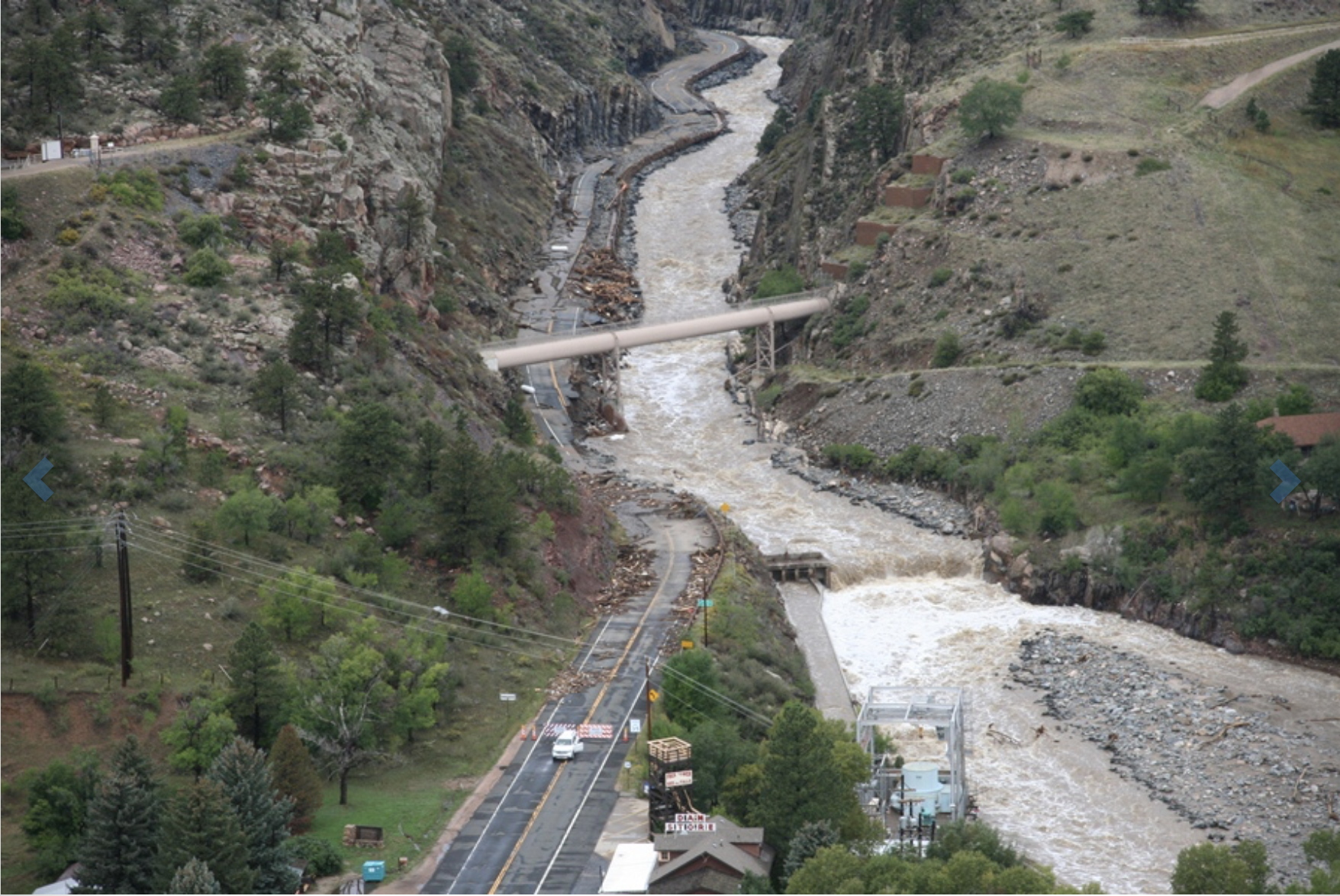
The reconstruction of U.S. 34 in the Big Thompson Canyon was chosen from 820 construction projects nationwide to be named Best of the Best by Engineering New Record.
Several partners in the project — Kiewit Construction, Colorado Department of Transportation, Jacobs, the engineering firm, and a handful of subcontractors — are named on the award that was presented Friday in New York City.
“You would not believe the projects it beat out — vertical construction, a new cadet building for the Army, other just very complicated projects,” said Doug Stremel, project manager with Jacobs.
“It’s really exciting … It was a collaborative effort for CDOT, Kiewit and Jacobs and the others. It was a team effort. We’re happy to share in it, but it really was a collaborative effort.”
Here’s the release from the U.S. Army Corps of Engineers, Omaha District (Capt. Ryan Hignight):
The U.S. Army Corps of Engineers, Omaha District continues to work with state, local, and tribal governments to repair damaged levees from the 2019 unregulated runoff event. There are over 350 miles of levees on the Missouri, Platte and Elkhorn rivers and tributaries that have experienced significant flood damage. Due to the magnitude of damage along these levees, repair efforts will take an extended period of time. The Omaha District is initiating efforts to perform damage assessments as water recedes and access to the levee system becomes available.
Omaha District Commander Col. John Hudson visited Pierre, South Dakota and met with state emergency management officials. They discussed flood forecasts as well as Omaha District’s ability to respond to state, county, or tribal requests for assistance. Col. Hudson also met with South Dakota Governor Kristi Noem and Congressman Dusty Johnson. Col Hudson provided them with a situational update on Omaha District’s capabilities regarding the upcoming spring thaw and potential rains. He also discussed the Army Corps’ technical assistance in Sioux Falls, South Dakota concerning high flows and snow melt concerns.
The District is sending notification to levee sponsors in the PL 84-99 program on Monday, March 25 with information on how to request damage assessment and levee repairs. Levees must be active in the Public Law 84-99 program to be eligible for repairs.
Much of the levee system remains compromised due to the record inflows surpassing their designed protection levels.
As of noon today, there were 47 confirmed breaches at L611-614 (South of Council Bluffs, Iowa), L-601 (South of Glenwood, Iowa), L-594 (near Fremont County, Iowa), L-575 (Fremont County, Iowa), L-550 (Atchison County, Missouri), L-536 (Atchinson County, Missouri), R-613 (Sarpy County, Nebraska), R-562 (Nemaha County, Nebraska), Western Sarpy (Ashland, Nebraska), Clear Creek (Ashland, Nebraska), Union Levee (Valley, Nebraska), and R-573 (Otoe County, Nebraska). In addition, levee 550 remains overtopping.
The Omaha District is initiating efforts to perform damage assessments as the water recedes and access to the levee systems becomes available. The District has already begun initiating underwater surveys of scour holes along the Missouri and Platte rivers as well as collecting aerial imagery to support these efforts.
Omaha District’s focus remains on ensuring the safety of citizens and communicating the conditions on the river systems to all of our partners and stakeholders. The Corps continues to provide flood fight assistance to state, local, and tribal government agencies.
The Omaha District has distributed approximately 227,000 sandbags, 2,020 super sandbags, 9,930 feet of HESCO barriers, seven pumps and 21 poly rolls.
The first source of information for citizens is their local emergency managers. For questions or concerns you can call 211, which is a national resource hotline and website geared to local area needs.
After roughly seven years of work, Colorado River Compact states have reached an agreement for drought contingency plans that would maintain levels at lakes Powell and Mead.
The contingency plans allow Colorado and the other Upper Basin states (New Mexico, Utah and Wyoming) to control their own destiny, Uncompahgre Valley Water Users Association Manager Steve Anderson said.
“It, one, gives us the right to use the storage in the Colorado River Storage Project Act reservoirs to help with the level of Lake Powell. That’s a big win,” he said…
According to a March 19 letter the seven Colorado River Basin states sent to Congress, requesting legislation necessary to implement the new drought contingency agreement, 2018’s runoff was the second lowest since 2000 and there is no significant trend indicating these conditions will improve, even if runoff turns out to be above-average this year.
The recent agreement needs Congress to pass legislation directing the Secretary of the Interior to implement it. Under the drought contingency plan, the Lower Basin states have agreed to a schedule of curtailments, or shortages, when levels at Mead reach certain points.
Such trigger points are established and specific, “no ifs, ands, or buts about it,” said Jim Pokrandt, community affairs director with the Colorado River District.
The situation is different in the Upper Basin.
“The three legs of the stool for the Upper Basin, one leg is to increase cloud-seeding and the eradication of tamarisk. The second leg of the stool is to use the Aspinall Unit reservoir (Blue Mesa), the Navajo reservoir and the Flaming Gorge reservoir to be able to send a slug of water from one or all of the reservoirs down to Powell,” Pokrandt said.
The involved states must now plan to determine how much water can come out of those reservoirs to bolster levels at Lake Powell, in the event the drought contingency plan needs to be enacted.
“The third leg of the stool is a ‘plan to make a plan’ with demand-management,” Pokrandt said.
Demand-management means reducing water use so the savings can be sent on to Lake Powell to keep the power turbines turning. For Western Colorado, this means finding a way not to use water, he said.
“There are two key ways. One would be a mandatory curtailment, which would be an economical, social and environmental disaster for Western Colorado,” Pokrandt said.
“The other way would be to come up with a voluntary way with producers and water users. What we call that is ‘voluntary, compensated and temporary.’ This is where we have a plan to make a plan. We don’t know what voluntary, compensated and temporary means yet.”
At present, there is neither policy nor money for this purpose.
The bathtub ring in Lake Powell in October 2014, which illustrates how reservoir levels have dropped since 2000. A state official says she sees no reason Colorado shouldn’t move forward with an investigation of a program that would send water to Lake Powell. Photo credit: Brent Gardner-Smith/Aspen Journalism
Sand and silt are piling up on the Colorado River above Lake Powell, as water levels continue to fall due to persistent drought and encroaching aridification. Water managers from San Diego to Wyoming are working to find ways to keep the river’s reservoirs, and water delivery systems, functioning.
A raft coming out of Cataract Canyon into upper Lake Powell encounters the bathtub ring left by the receding reservoir. As Lake Powell, and Lake Mead, continue to see less and less water, it’s prompting water managers, including those at the Colorado River District, to coordinate on ways to send more water downstream. Photo credit: Aspen Journalism/Brent Gardner-Smith
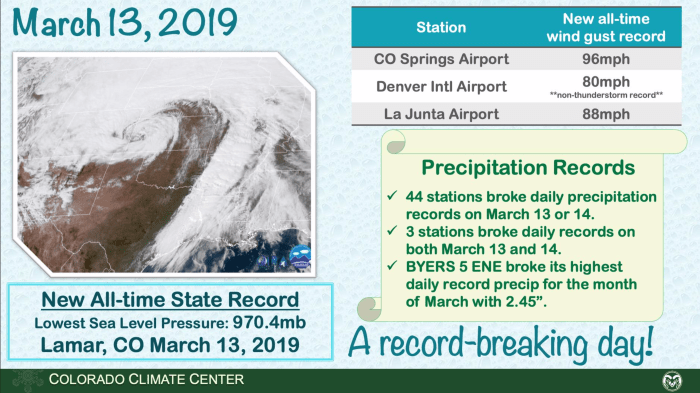
Last week’s “bomb cyclone” set records for low pressure and winds across eastern Colorado, including a new state record for sea level pressure. Here is our summary of the records that we’ve been able to confirm!
Gail Schwartz, a resident of Basalt, is poised to represent the Colorado River basin on the Colorado Water Conservation Board. She’s the first woman to do so, and she’ll be a part of the first CWCB board, since 1937, to have a female majority. Photo credit: Gail Schwartz
Former state Sen. Gail Schwartz is expected Wednesday to join the board of directors of the Colorado Water Conservation Board, a state agency established in 1937 to protect and develop the state’s water supply.
In doing so, Schwartz will become part of the first female majority on the CWCB board, and she’ll be the first woman to represent the Colorado River Basin on the board.
Schwartz moved to Aspen in the early 1970s, lived in Snowmass Village when she served in the state Senate for two terms (2007 to ’15) and then moved to Crested Butte. While there, she lost to Rep. Scott Tipton in her race for Congress in 2016. She has since moved to Basalt and has now volunteered for a three-year term on the CWCB board.
Schwartz and two other women — appointed by Gov. Jared Polis and now slated to be confirmed on March 20 by the state Senate — are expected to be sworn in Wednesday at a CWCB meeting in Fort Collins, and then six of the 10 voting members of the CWCB board will be women.
And if the board’s five nonvoting members are added to the mix, it means eight of its 15 members will be women.
Will a majority of women on the CWCB board help solve the water challenges facing Colorado and the Colorado River system?
“I think it will change the conversation,” Schwartz said, noting her experience in the state Legislature, where about 40 percent of the lawmakers were, and are today, women.
“Women are about looking for solutions,” Schwartz said. “They go into public service or elected office to serve, and it’s not a power grab, and what I found at the state level is that women are willing to compromise, they are willing to seek resolution and they draw less of a hard line on issues.”
And Schwartz won’t be alone in making state water history this week.
Jaclyn “Jackie” Brown of Oak Creek will become the first woman to hold the CWCB seat allocated to the Yampa, White and Green river basins in northwestern Colorado.
Brown is the current chair of the Yampa, White and Green river-basin roundtable, and she is one of only two women on it. She also is the natural resource policy adviser for the Tri-State Generation and Transmission Association.
“The water industry is moving in a direction where there is more diversity,” Brown said. “And I do think that matters. I think every board does better with more diversity.”
That said, Brown said her goal in serving on CWCB is to represent all the water users in the northwest corner of the state.
Also joining the board this week is Jessica Brody, the general counsel for Denver Water, who will be representing the seat allocated to the city and county of Denver.
Brody said she’s proud to follow in the footsteps of Patricia Wells, who was also the general counsel for Denver Water and served on the CWCB from 1996 to 2000 and from 2012 to this past January. She noted that Wells also was the first female city attorney for the city and county of Denver.
And Brody will be the fourth woman to represent Denver on the CWCB board, following Wells, Barbara Biggs and Carolyn McIntosh.
“It’s really to be celebrated that there are so many incredible women rising to prominence in this industry and in this sector,” Brody said. “Obviously, we all bring our own unique perspective, and gender may influence our perspective, but honestly, it’s just a thrill to be part of this new class and to get to share this moment with so many incredible women, and men.”
Of the remaining six voting members on the CWCB board appointed by the state’s governor, three are women. They are Curran Trick, the first woman to represent the North Platte River Basin; Heather Dutton, the first woman to represent the Rio Grande River Basin; and Celene Hawkins, the fourth woman to represent the San Miguel, Dolores and San Juan river basins in southwestern Colorado.
The other three appointed voting members on the CWCB are Steven Anderson, who represents the Gunnison River Basin, which has never had a female representative on CWCB; Jim Yahn of the South Platte River Basin, which has previously had two women on CWCB; and Jack Goble of the Arkansas River basin, which has not had a woman on the CWCB since Vena Pointer, who was a founding board member and served from 1937 to 1948.
Of the nine appointed voting members, four (Schwartz, Brown, Brody and Hawkins) are Democrats, four (Curran, Dutton, Anderson and Yahn) are Republicans and one (Goble) is unaffiliated.
There also is one ex-officio voting seat on the CWCB board reserved for the director of the Department of Natural Resources, which brings the number of voting seats to 10. Dan Gibbs now holds that seat.
And there are five nonvoting seats, two of which are currently held by women: Rebecca Mitchell, the director of the CWCB and the agency’s second female director, and Kate Greenberg, who is the first female commissioner of agriculture in Colorado since the office was created in 1949.
As such, here’s how the gender math works out: Six of the 10 voting members are women, and eight of the 15 members are women — a female majority in each case.
For Mitchell, the CWCB director, the gender makeup of the board is not as important as the ability for the board members to work together to further the agency’s mission, which is “to conserve, develop, protect and manage Colorado’s water for present and future generations.”
Still, Mitchell recognizes the gender milestone being reached.
“It is historical, and being an engineer, the numbers are the numbers,” Mitchell said. “But it wasn’t a goal — it’s just the way it turned out.”
However, the water sector in Colorado is still dominated by men — including many older white men — so the first female majority on the CWCB board is notable for those who follow the agency.
“It’s about time that we have this level of representation on our most important water board in the state regarding water policy,” said Tom Cech, co-director of the One World One Water Center at Metropolitan State University of Denver.
He, along with William McDonald, wrote “Defend and Develop: A Brief History of the Colorado Water Conservation Board’s First 75 Years,” published in 2012.
“I’m very pleased to see this change occurring on the CWCB because it provides a different outlook and voice to our important water issues of the day,” Cech said. “That said, our next challenge is engage more people of color in this conversation and as members of boards like the CWCB, because then we get a true voice of the people in the state of Colorado.”
Editor’s note: Aspen Journalism covers rivers and water in the Colorado River basin in collaboration with The Aspen Times, the Glenwood Springs Post Independent, the Vail Daily, the Summit Daily, and the Steamboat Pilot. The Times published this story on Tuesday, March 19, 2019.
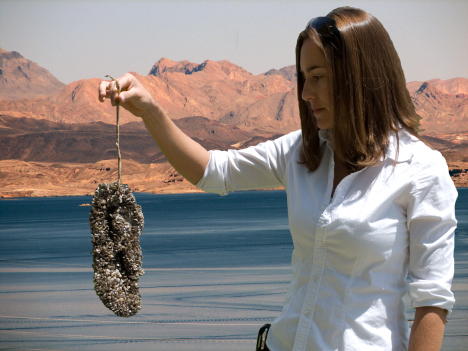
Click here to go to the Invasive Mussel Collaborative website:
This webinar is part of a miniseries on the genomics of invasive mussels hosted by the Invasive Mussel Collaborative. Part one of the miniseries covers the U.S. Bureau of Reclamation’s prize competition “Eradication of Invasive Mussels in Open Water.” The first prize awarded in this competition proposed a novel genetic modification-based method for control…
Presentations:
Sherri Pucherelli: Invasive Mussel Prize Competition
Steve Suhr: Eradication of Invasive Quagga and Zebra Mussels using Engineered Disseminated Neoplasia
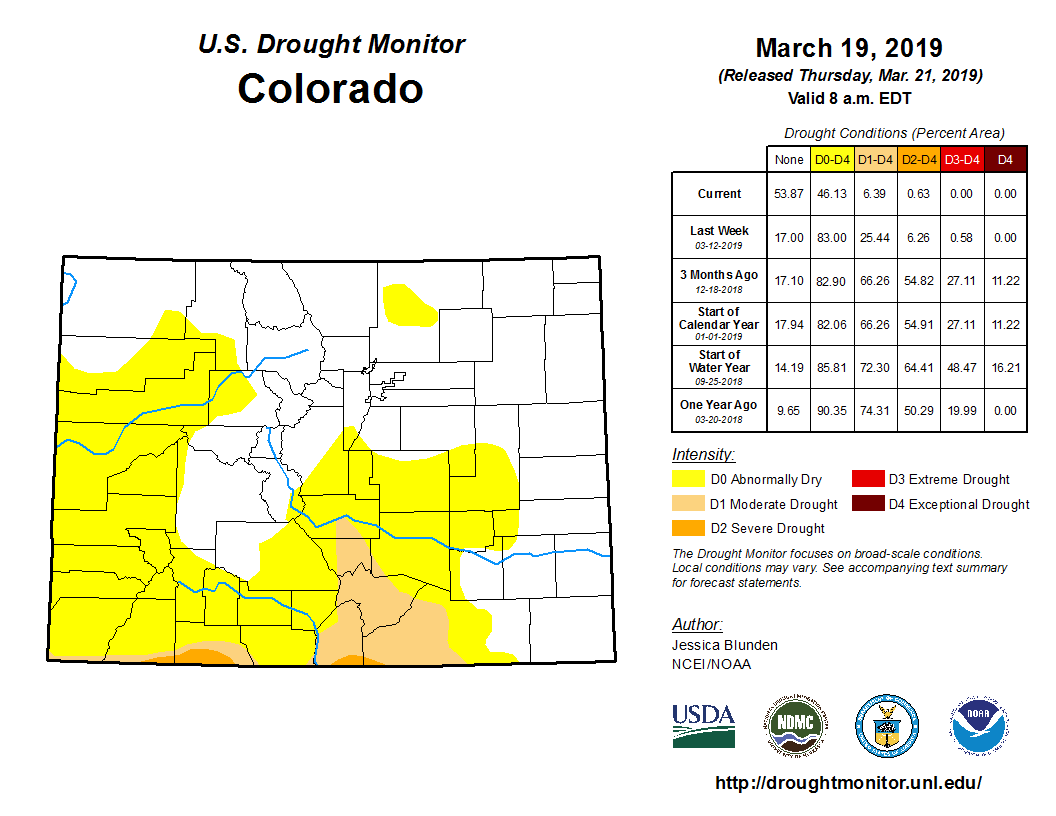
The U.S. Drought Monitor reported on Thursday that there are no more extreme or exceptional drought conditions in the state, which plagued the Four Corners region after the dry 2018 winter and summer. Three months ago, nearly 30 percent of Colorado was listed under that status.
As of Thursday’s report, only 46.13 percent of the state was listed in some kind of drought status. That’s down from 83 percent last week.
Colorado Drought Monitor March 19, 2019.
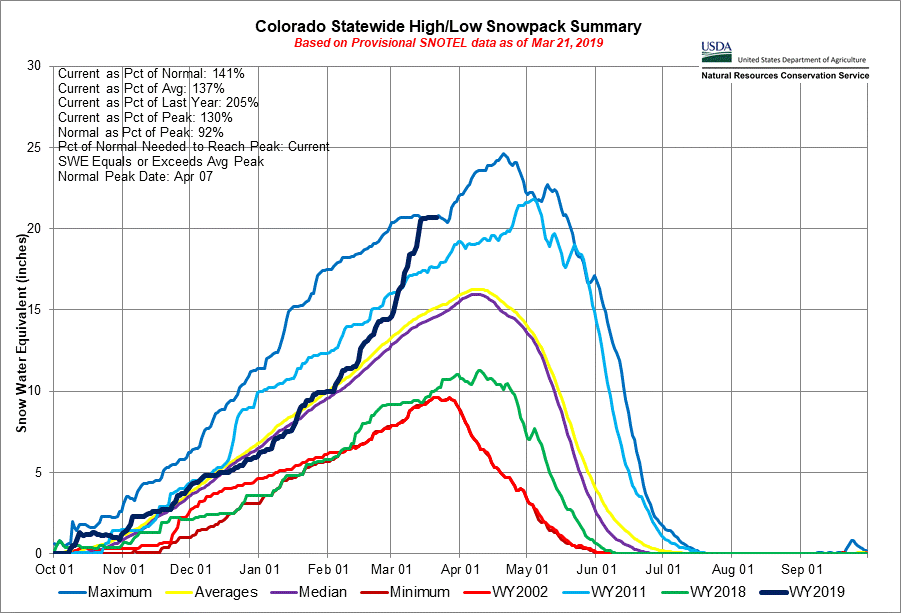
Gov. Jared Polis, in a Facebook live video with snow experts, called the state’s snowpack “epic.”
Colorado Statewide Basin High/Low graph March 21, 2019 via the NRCS.
[Joel] Gratz said the last time Colorado’s spring snowpack was anywhere near as solid was 11 years ago. But you have to go back to the 1996-97 season to really match this year’s levels.
A wall of snow towers above the bulldozer on south Red Mountain Pass. (Provided by the Colorado Department of Transportation)
FromThe New Mexico Political Report (Laura Paskus):
Recent storms packed the mountains of southern Colorado and northern New Mexico with healthy snow levels, and meteorologists anticipate El Niño conditions will persist through the spring. This is welcome news after last year’s dry conditions. But in the long term, forecasters and farmers still remain cautious. That’s because long-term drought has dried out the state’s soils. And reservoirs remain low, particularly on the Rio Grande and its tributary, the Chama River.
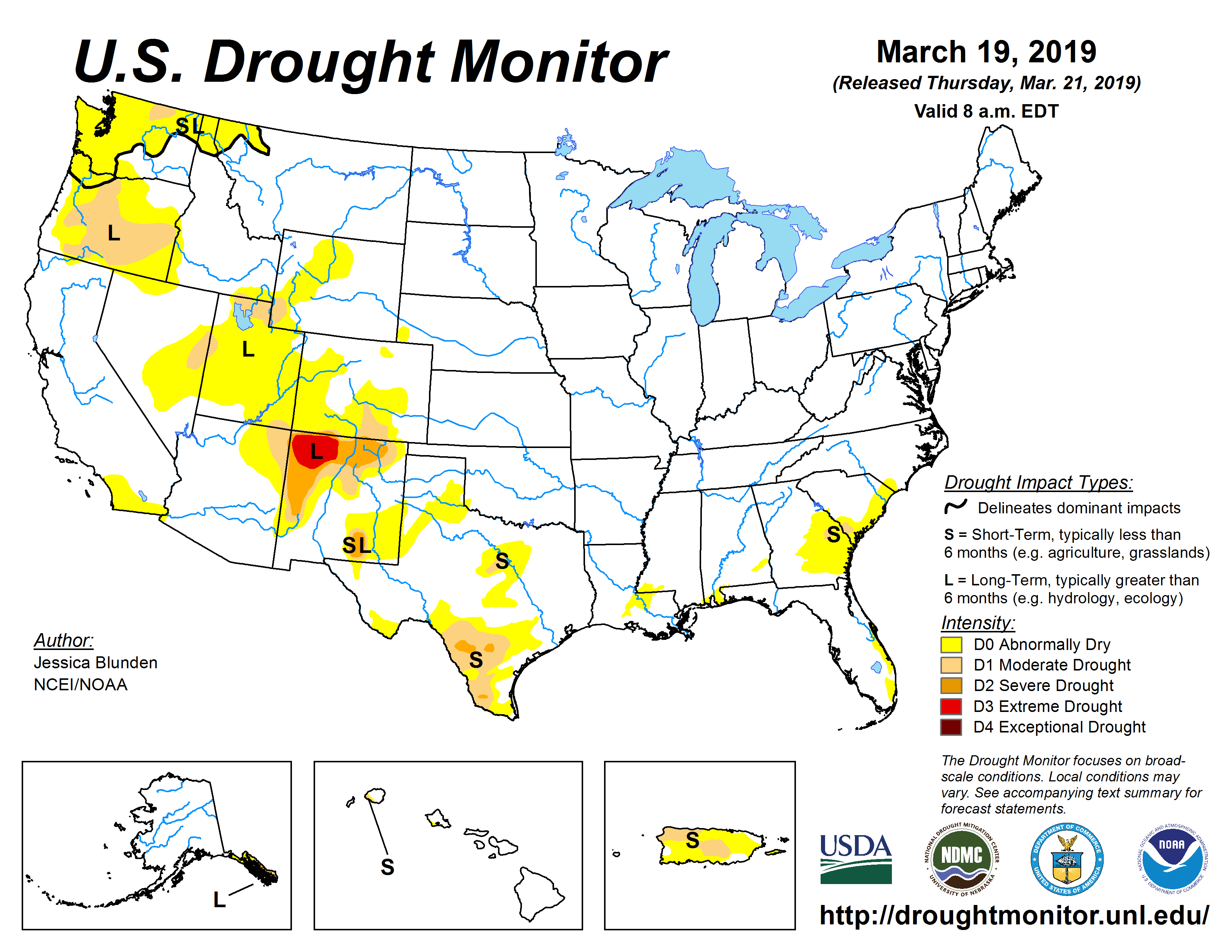
According to the most recent national drought monitor, the only extreme drought conditions in the entire nation are in San Juan County in northwestern New Mexico. Drought conditions are also building in west Texas and in New Mexico’s Lea and Eddy counties. And though El Niño conditions favor bringing precipitation to the Southwest, temperatures are expected to be above average over the next month, too.
US Drought Monitor March 19, 2019.
During a call earlier this week about the outlook for the Rio Grande this year, Greg Waller, service coordination hydrologist with NOAA’s West Gulf River Forecast Center, emphasized the good snowpack news, especially after last year’s “brutal” conditions. But he also noted it’s critical to pay attention to what happens next.
Because the ground is so dry, initial snowmelt will first do the job of saturating top layers of the soil…
Refilling empty reservoirs
In 2018, there wasn’t any runoff to speak of on the Rio Grande, and both the river and reservoirs suffered.
“By this time last year, we were preparing to manage drying on the river,” said Mary Carlson with the U.S. Bureau of Reclamation. In 2018, the Rio Grande began drying in early April, when it should have been flush with snowmelt.
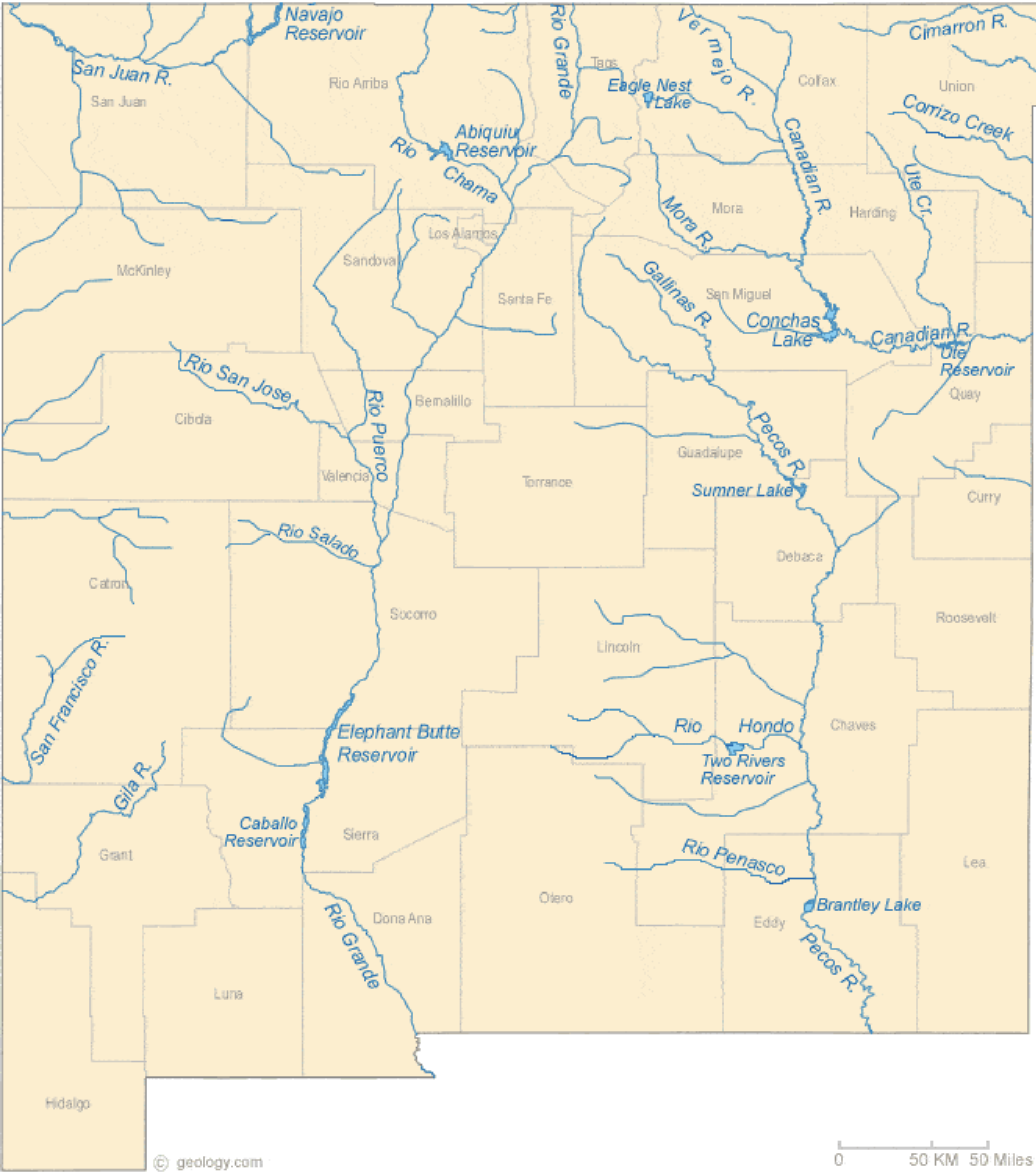
Since last May, New Mexico has been under Article VII restrictions: According to the Rio Grande Compact of 1938, Colorado and New Mexico can’t store water in any of the upstream reservoirs built after 1929 when combined storage in Elephant Butte and Caballo reservoirs is below 400,000 acre feet. This includes Heron, El Vado and Heron reservoirs.
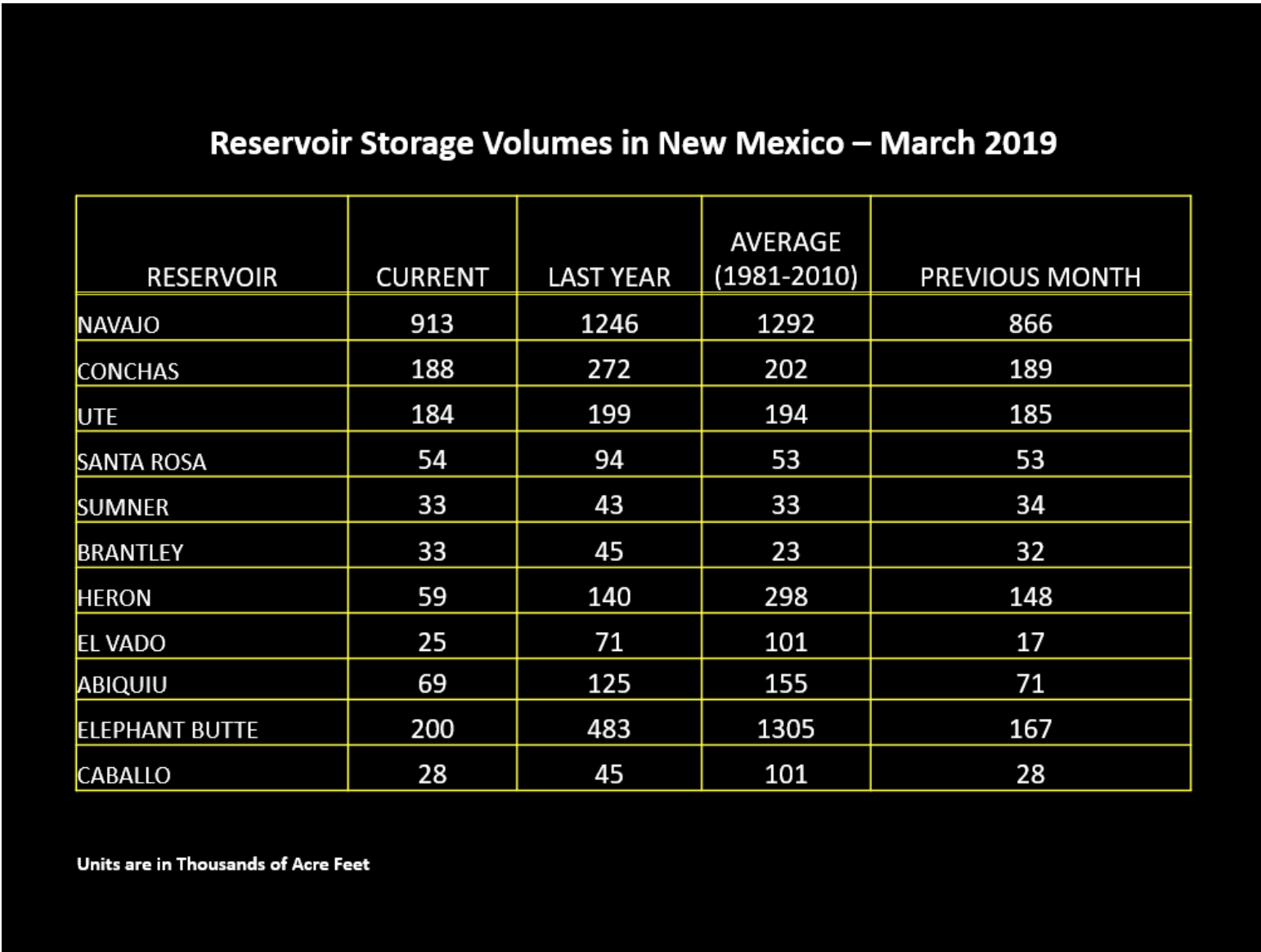
As of Thursday, Elephant Butte is holding 205,000 acre feet of water, and Caballo, 28,000 acre feet.
March reservoir storage levels in New Mexico – Office of the State Engineer via the New Mexico Political Report
Carlson said Reclamation estimates Article VII restrictions will lift in mid-May, for about a month, until combined storage in the two reservoirs drops again below 400,000 acre feet.
While most of New Mexico’s streams and rivers are at or above their norm for the season—even the Santa Fe River is flowing right now—most of the state’s largest reservoirs still tell the story of 2018’s historically dry and warm conditions.
Elephant Butte Reservoir is at just 10.4 percent capacity as of Thursday, and on the Chama River, El Vado Reservoir currently holds just 25,000 acre feet of water, Heron Reservoir, 59,000 acre feet and Abiquiu Reservoir, 69,000 acre feet. For perspective, that means Heron is 15 percent full, El Vado, 14 percent and Abiquiu, just 12 percent.
Improvement over last year
In the Middle Rio Grande Valley, irrigation canals and ditches are already flowing, mostly to flush debris that built up over the winter and to check for leaks.
“There has been some irrigation going on, but generally it has remained cool and damp, and we are not getting many requests for water yet,” said Middle Rio Grande Conservancy District hydrologist David Gensler. “Certainly not like last year, when it was so dry and people were desperate for water.”
Unless something “really unexpected” happens, he said, the district anticipates a “pretty comfortable year” for irrigation in the Middle Rio Grande
Even if New Mexico comes out of Article VII restrictions, he said the district probably won’t store much water in 2019, and they aren’t even considering the possibility of filling El Vado. That’s not just due to conditions and restrictions, he said: repairs are planned for El Vado, and managers will also need water to help support endangered species in the river, such as the Rio Grande silvery minnow…
There is a downside to anticipating this year’s runoff, he said: they’ll be watching the levees closely. The timing of snowmelt will matter, but there could be situations similar to in 2017, when there was levee seepage and bank failures. Gensler also anticipates that the Chama River below Abiquiu Reservoir will run at the channel’s capacity, causing erosion and damage to acequia intakes there…
Southern New Mexico farmers in wait-and-see mode
Further downstream, farmers in southern New Mexico are also watching the levels at Elephant Butte, which hit a low last September of three percent capacity.
Elephant Butte Irrigation District (EBID) farmers will start receiving water from Caballo Reservoir at the end of May. Until then, they will have to pump groundwater if they need to irrigate.
Currently, the district anticipates delivering to farmers six to ten inches of water per acre. But EBID hasn’t decided on final allocations yet, because their storage levels are so low, explained Phillip King, a civil engineering professor at New Mexico State University and water adviser to EBID.
A normal allotment for EBID farmers is 36 inches per acre per year. Last year, EBID farmers received ten inches. And even in 2017, during which snowpack was robust, drought and storage conditions meant they received 24 inches.
“While the snowpack looks promising, we don’t allocate it until it reaches the reservoir,” he said. “It is a long way from the mountain slopes of Colorado to Elephant Butte Dam.”
[…]
‘Pray for rain’
Meanwhile, over on the Pecos River, the Carlsbad Irrigation District had planned to start the irrigation season by now, but they’re holding off, probably for just a few more days…
Unlike on the Rio Grande, farmers on the Pecos have received full allotments of water in recent years—that’s about 3.7 acre feet per year. Right now, the initial allotment for this spring is set at 2.5 acre feet. “We expect that will go up,” Ballard said. “We have not yet gotten any of the snowmelt or runoff from the Sangre de Cristos into Santa Rosa Lake, so we’re just waiting to see what that will be before we increase the allotment.”
Map of the Rio Grande watershed. Graphic credit: WikiMedia
Evaporation monitoring platform located in Padre Bay at Lake Powell. Sensors measuring wind speed and other weather parameters along with water temperature will help researchers estimate the timing and magnitude of water lost to the atmosphere. Photo credit: The Desert Research Institute
Here’s the release from the Desert Research Institute:
In the western United States, reservoirs are critical for storing water that can later be used by cities and for agricultural applications — but evaporation can remove a significant amount of this stored water each year.
A new collaboration between the Desert Research Institute in Reno, Nev. and the Technical Service Center of the Department of Interior’s Bureau of Reclamation aims to improve our understanding of evaporation from Lake Powell and other major reservoirs of the western United States through the deployment of floating evaporation stations.
The stations monitor meteorological conditions over the water and estimate evaporation using four primary methods: eddy covariance, energy balance, aerodynamic bulk mass transfer, and the combination of energy balance and aerodynamic. Data from the stations are transmitted back to the research team via a web portal for real-time monitoring.
While there are multiple techniques used for estimating reservoir evaporation, there is little consensus on which is best for accuracy, cost, and long-term operational monitoring potential, says principal investigator Chris Pearson, Assistant Research Scientist of Hydrology at DRI.
“A key aspect of this project is to use multiple techniques, including newer and older, more traditional methods. We’ll run them all at the same time, side by side, to see how well they agree or don’t agree,” Pearson said.
Researcher adjusts the alignment of the inertial motion unit during installation at Lake Powell. 3-D wind measurements from the Eddy Covariance system will be corrected for pitch, roll, and yaw motion of the floating platform. Photo credit: Desert Research Institute
Water temperatures in Lake Powell change significantly throughout the year, as snowmelt fed runoff enters from the Colorado River and other tributaries. Temperatures also vary by depth and location around the lake. Consequently, the team has deployed measuring stations at two different locations, Warm Creek and Padre Bay, where the depth of water is around 100-150 feet.
By collecting data from multiple sites in the reservoir, the research team will learn about how evaporation rates vary both spatially and temporally throughout the year. The end goal, says Pearson, is to help scientists and water managers make accurate evaporation estimates using best available science – both at Lake Powell and elsewhere in the world.
“Eventually we’d like to integrate these data with satellite and gridded climate products, so we can provide accurate estimates with minimal instrumentation in the field, but collecting reliable and accurate benchmark in-situ data is the first step.” Pearson said.
This project is made possible with funding from the Bureau of Reclamation. Other members of the project team include Justin Huntington, Ph.D. (DRI, co-principal investigator), Brad Lyles (DRI), Richard Jasoni, Ph.D. (DRI), Mark Spears, P.E. (Reclamation, senior project lead), Dan Broman, Ph.D. (Reclamation), and Kathleen Holman, Ph.D. (Reclamation).
The Four Corners methane hotspot is yet another environmental climate and public health disaster served to our community by industry. But now that we’ve identified the sources we can begin to hold those responsible accountable for cleaning up after themselves. The BLM methane rule and EPA methane rule are more clearly essential than ever. Photo credit: San Juan Citizens Alliance
Effort worries coal counties on Western Slope; seen as duplicate by some
Lawmakers gave initial approval to a bill Thursday that orders the state to expand its tracking and possibly regulations of greenhouse gas emissions through 2050, an effort to buck the Trump administration’s disinterest in tackling climate change.
Colorado has been tracking greenhouse gas emissions by sector since 2008, but Senate Bill 096 greatly expands an existing effort by the Air Quality Control Commission. Under the bill, the commission would collect data and propose rules to address emissions by July 2020. The Colorado Department of Public Health and Environment would be required to collect annual greenhouse gas data by sector and publish it; the department would also be required to forecast emissions through 2050.
The bill’s opponents say it would generate more regulations that could push coal-fired power plants closer to extinction, killing jobs and further raising electricity costs on the Western Slope…
…Sen. Kerry Donovan, D-Vail, the bill’s sponsor, said the measure would help Colorado reach its 2025 goal of cutting greenhouse gas emissions by at least a quarter. It would also ensure that greenhouse gas emission data would not depend on the federal government, which under President Donald Trump has abandoned its commitment to the Paris climate change accords.
The bill passed the Senate Transportation and Energy Committee on a party-line vote of 5-2; it now heads to the Appropriations Committee…
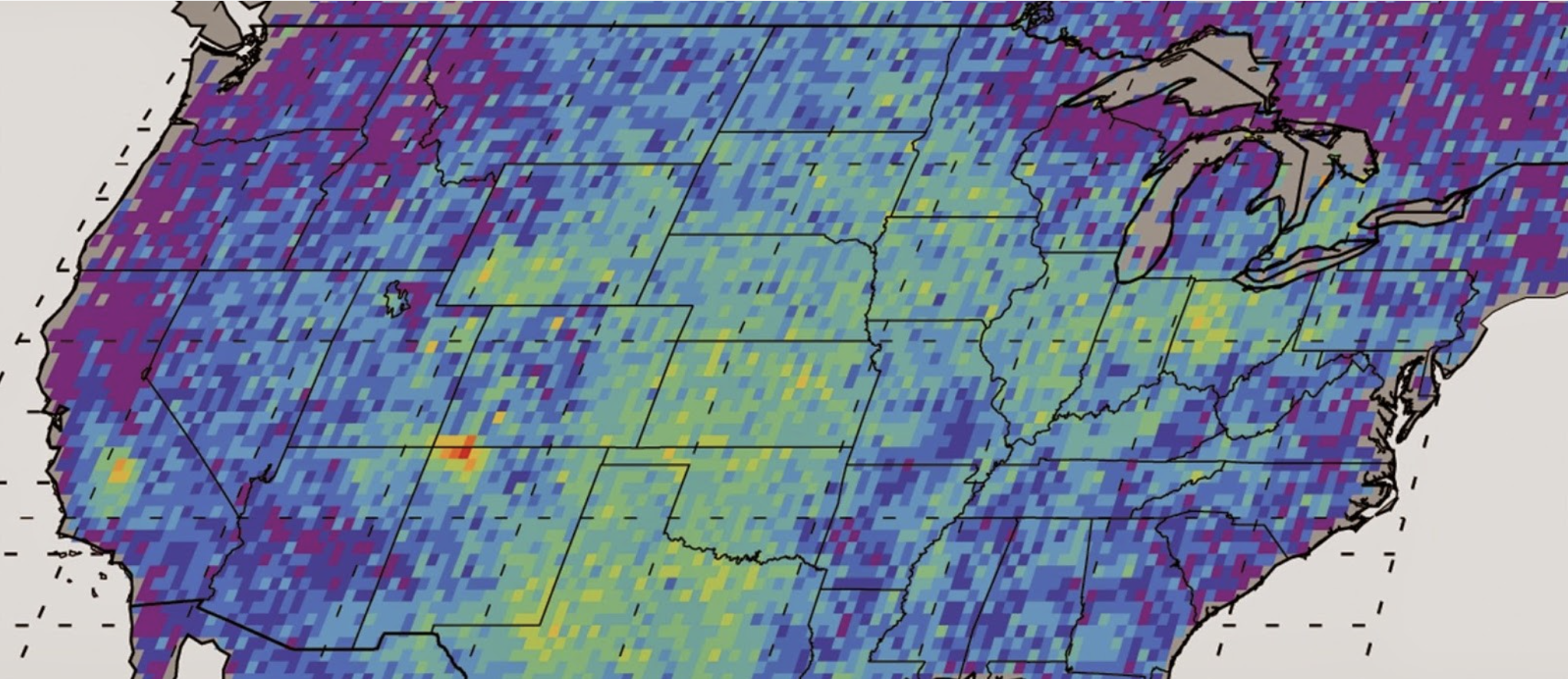
Southwest Colorado greenhouse gas emissions attracted global attention in 2014, when NASA scientists discovered a 2,500-square-mile methane cloud over the Four Corners caused in part by natural gas production. Methane is one of the most potent greenhouse gases.
Even as Colorado grapples with methane emissions from oil and gas operations and a power mix still mostly reliant on coal, Sen. Ray Scott, a Mesa County Republican, questioned why SB 096 would have the state spend nearly $2 million to duplicate data already being tracked by the federal agencies and local universities.
Greater Sandhill Cranes in flight over the San Luis Valley. The annual Monte Vista Crane Festival takes place during March each year. Photo credit: Colorado Parks and Wildlife
I’ve known for awhile that a crane’s diet consists of crop waste grain such as corn, wheat, barley, oats, as well as snails, crayfish, insects, small vertebrates and the eggs of other birds, but what I observed over the next hour was completely unexpected. The cranes used their elongated beaks to root around for potatoes, with great enthusiasm. At first I thought they were just slicing them into smaller and smaller pieces in order to eat them – which some of them were, but then I saw one throw back an entire potato and swallow it whole. Then another, and another. I pressed record.
The sandhill cranes were swallowing potatoes whole like a pelican eating a fish! After years of capturing footage of the cranes flying in and out of fields, it was quite interesting and unexpected to witness a behavior I had never before observed in this species.
Lessons Learned
I am so glad I got the courage to ask the landowner for permission to access their land. My trip was shaping up to be pretty fowl but by the end I was happy as a lark. I think next year I’ll time my visit for the heart of the festival when there are guided tours lead by birding professionals, volunteers to ask for advice and help, fellow birders to compare notes with and a craft fair to chill at instead of brooding in my hotel lobby. Honestly, the festival is a hoot. If you’ve never been to one before I highly recommend it– maybe I’ll see you there next year! We’re always looking to add more crane enthusiasts to our flock.
From the Colorado Water Conservation Board/Colorado Division of Water Resources (Ben Wade):
In response to persistent and prolonged drought conditions throughout the southern half of the state and along the western border, the Colorado Drought Mitigation and Response Plan was activated for the agricultural sector on May 2, 2018, additional counties in northwest Colorado were added in September and activation remains in effect; information can be found HERE.
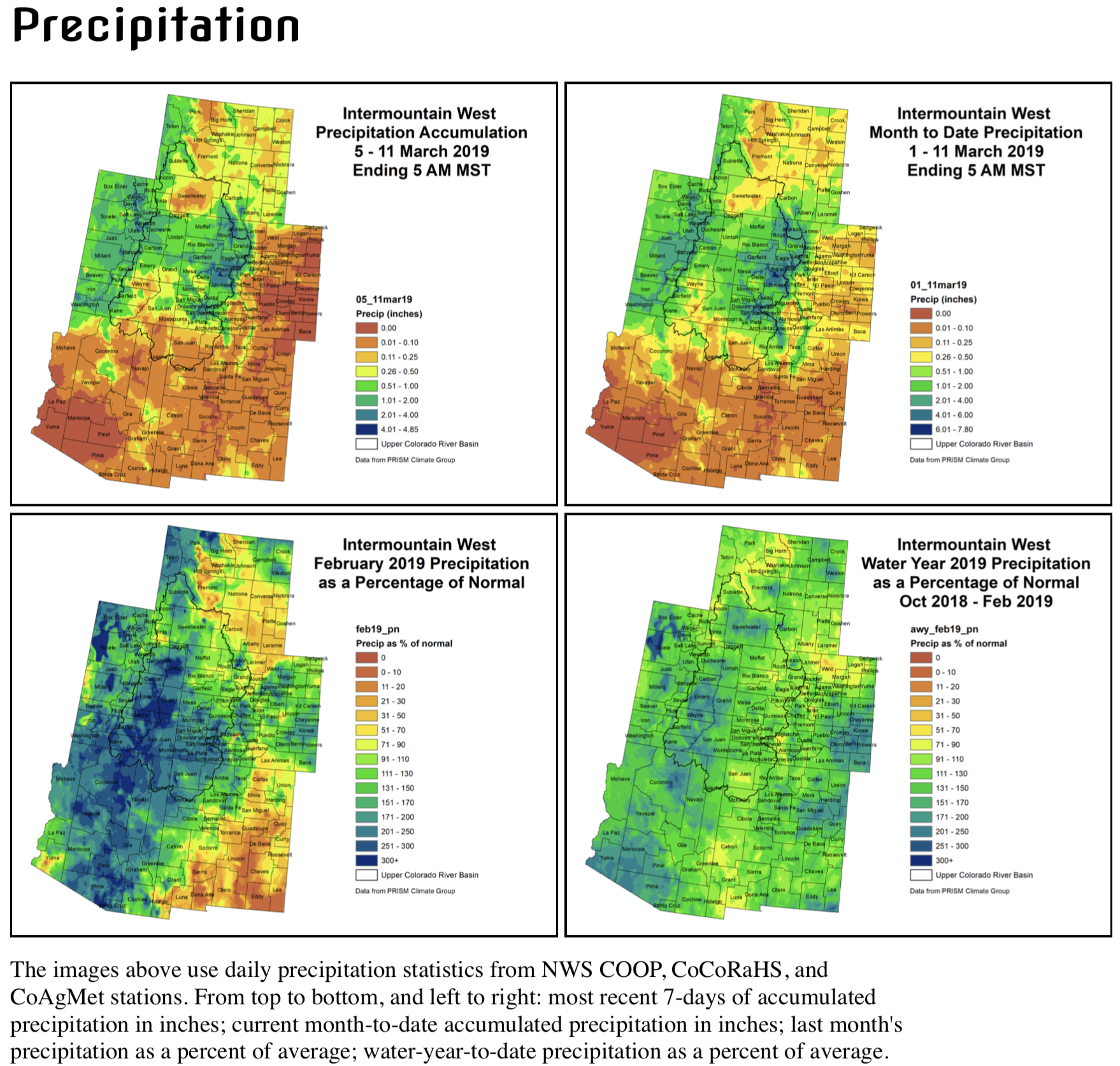
February and March-to-date have both seen impressive snow accumulation statewide, but especially in the southern half of the state where snowpack is currently above 150 percent of normal for all basins. This persistent moisture and near normal temperatures has resulted in significant drought improvements across the region. We will continue to monitor throughout the snow melt season to determine inflows to reservoirs and streamflow levels. Post wildfire flooding remains a concern and will be closely monitored. The daily flood threat bulletin can be accessed May 1 through September 30 HERE.
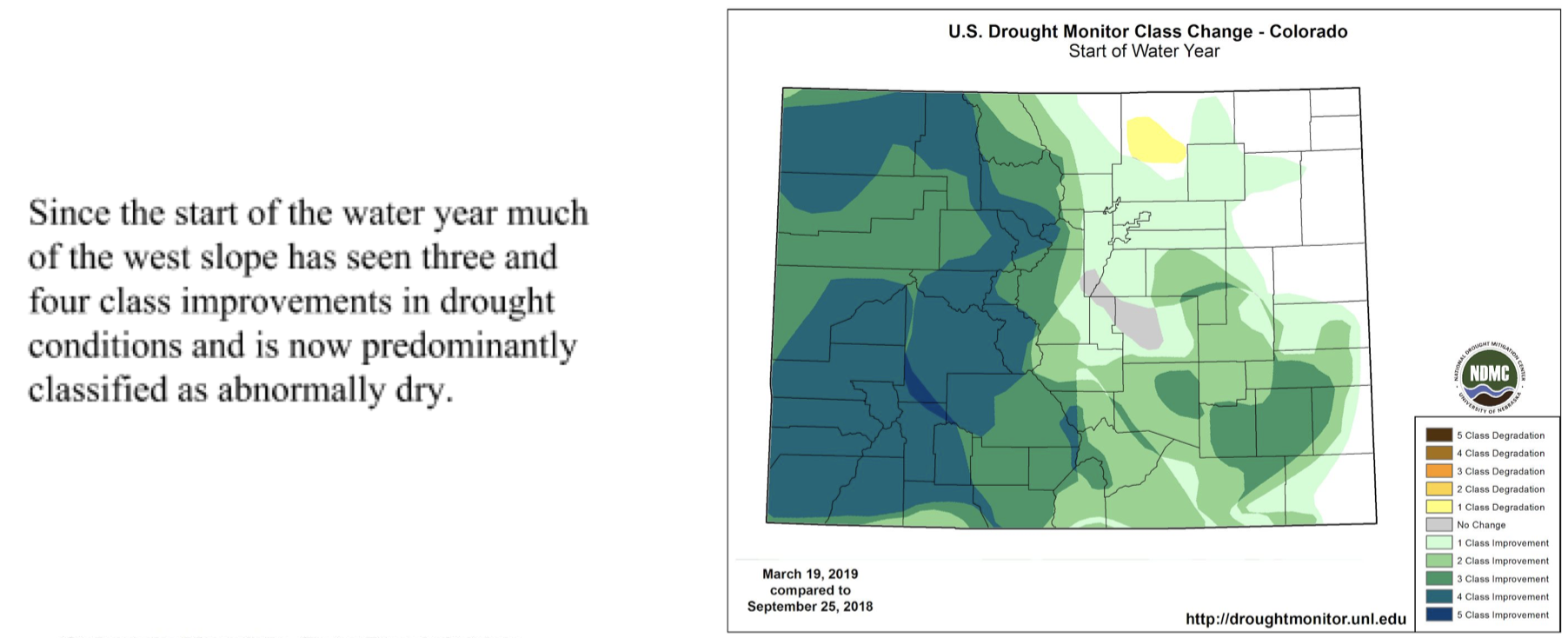
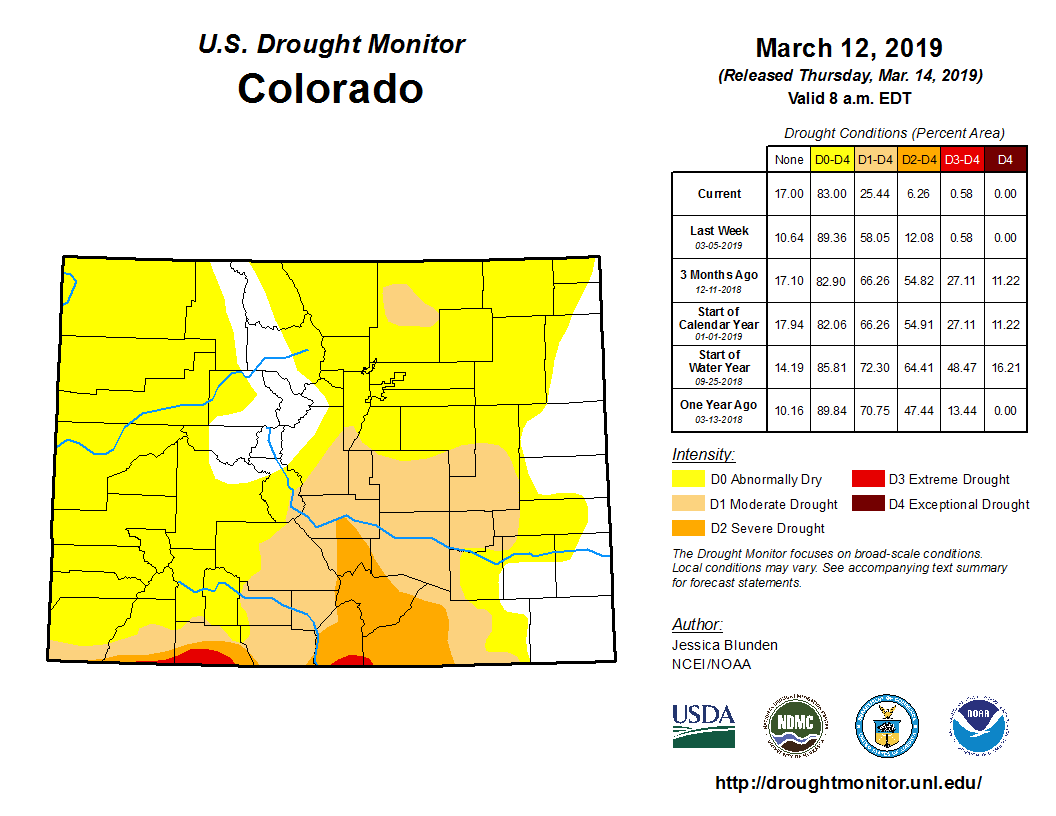
As of March 19th, exceptional drought (D4) and extreme drought (D3) have been entirely removed from Colorado. Severe drought covers just 0.63 percent of the state while moderate drought covers an additional six percent. Forty percent of the state is currently experiencing abnormally dry conditions, a significant improvement in recent weeks. Most of the western slope has seen three and even four class improvements in drought conditions since the start of the water year (see image below).
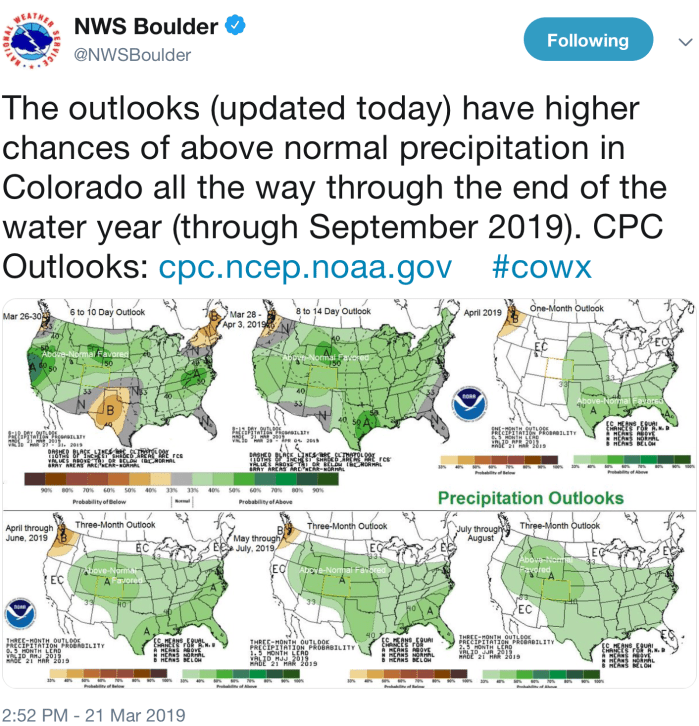
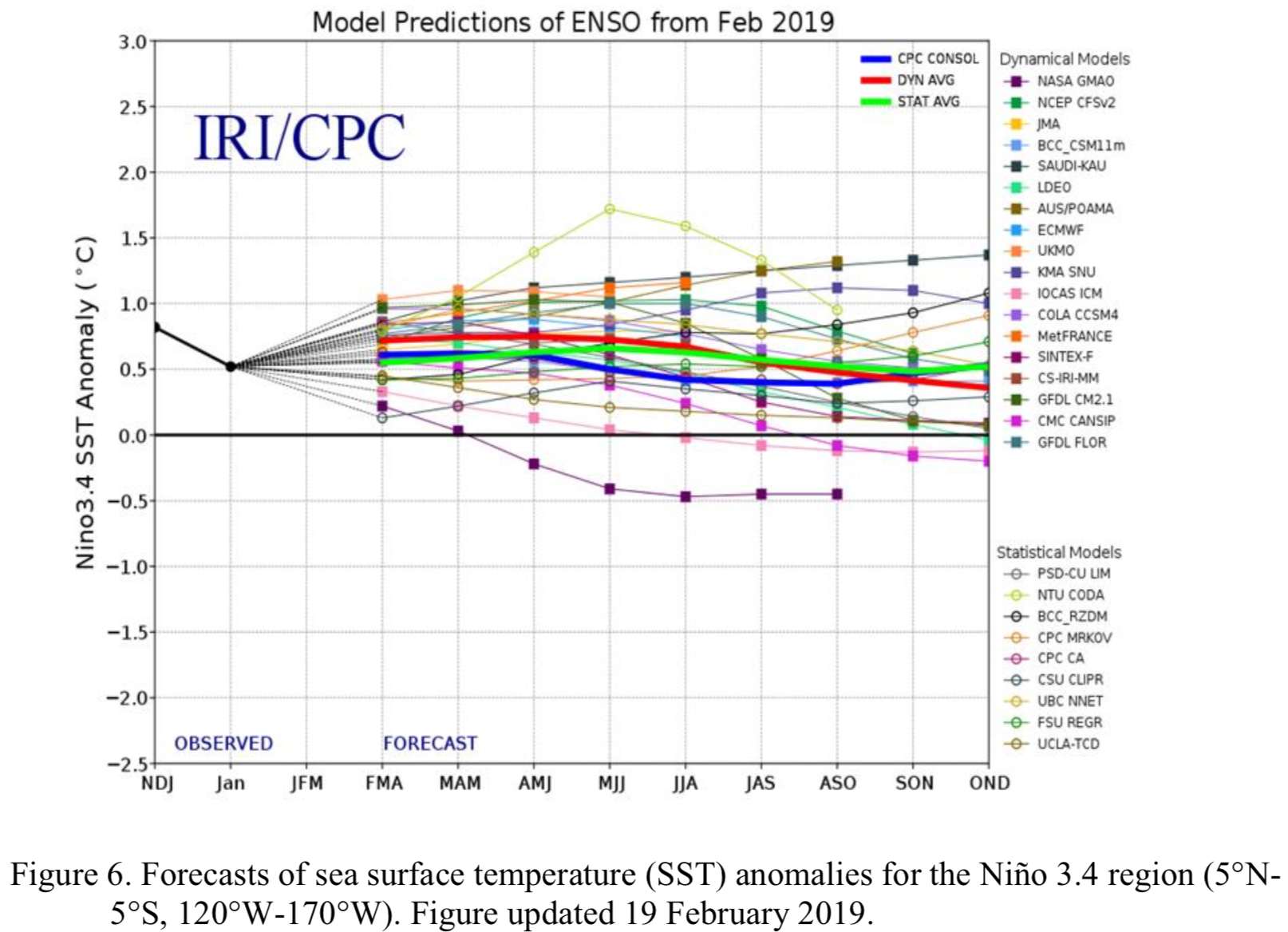
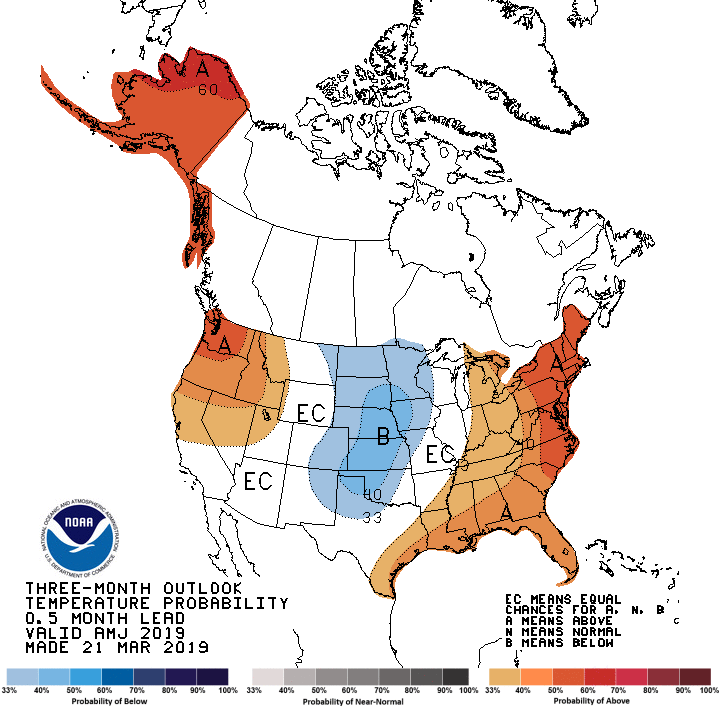
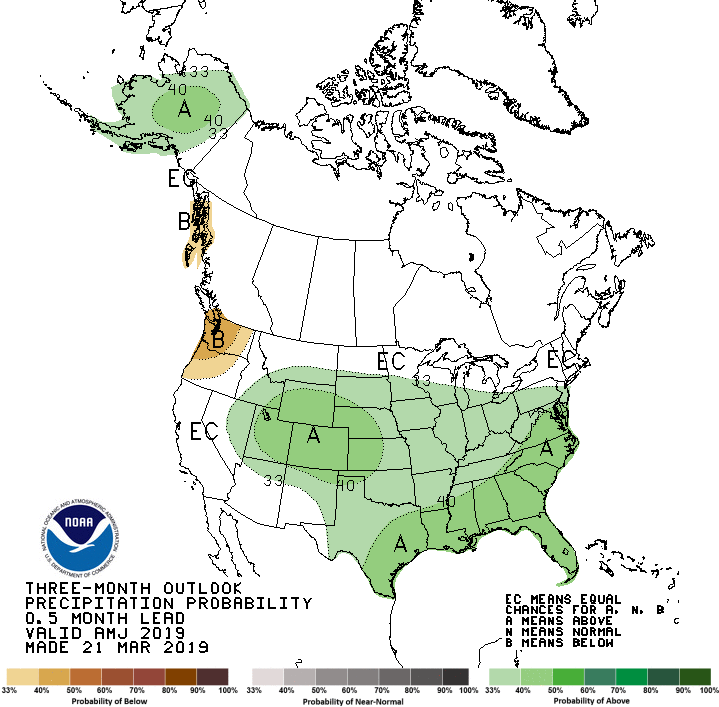
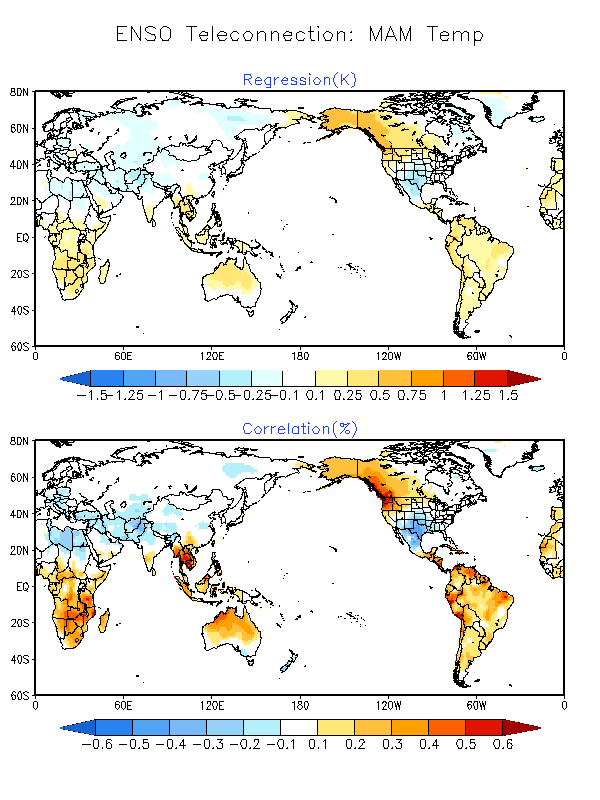
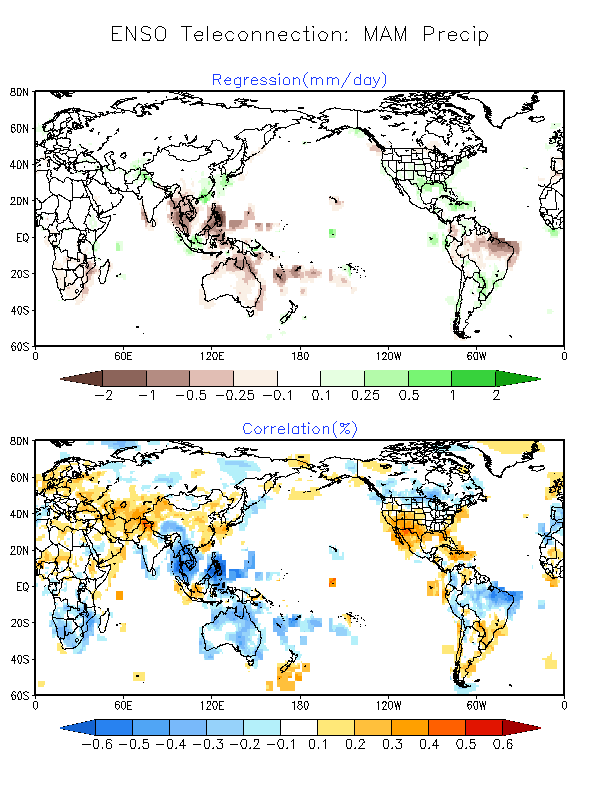
El Niño conditions are now present, and will likely continue through spring (80 percent chance) and even summer (60 percent chance) of this year. Historically spring during an El Niño event trends toward wetter conditions, and the NOAA Climate Prediction Center outlooks for April, and for the April-May-June period show increased chances of wetter-than-average conditions, with less confidence in the temperature outlook.
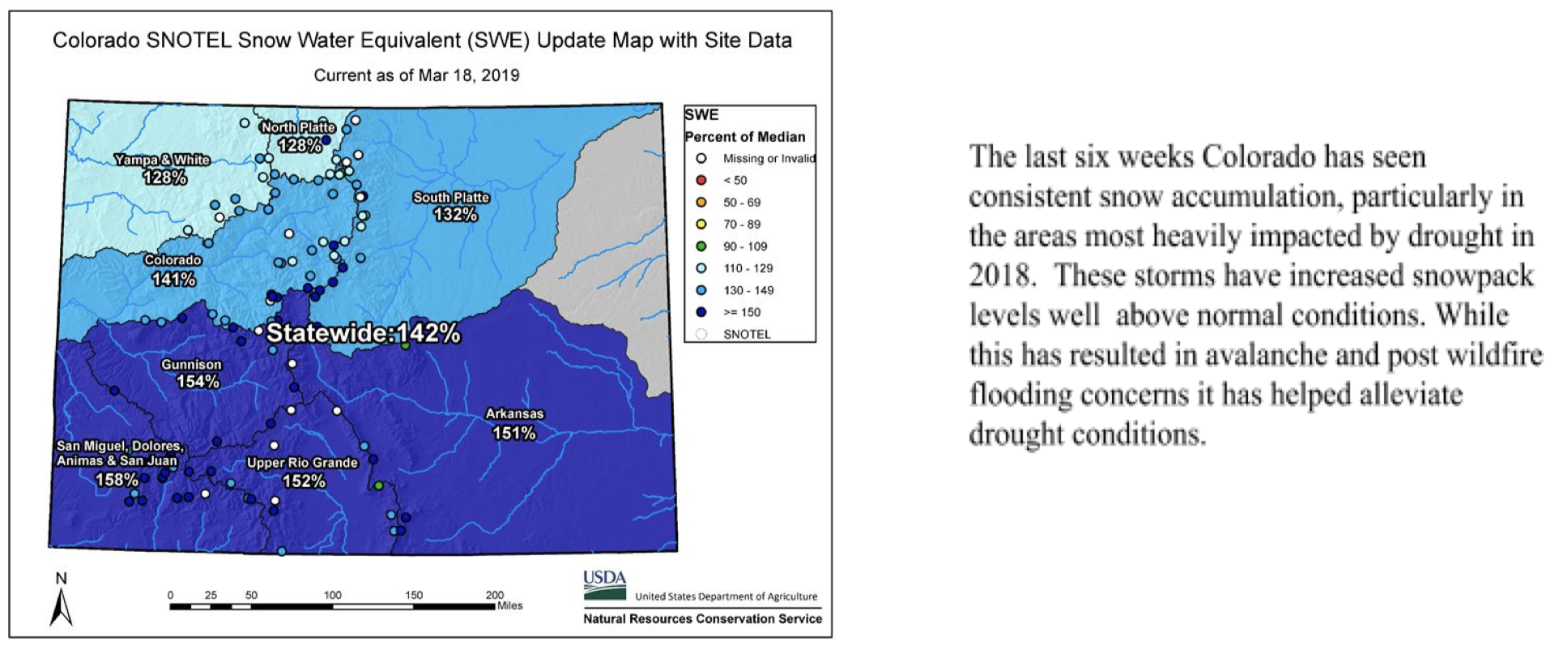
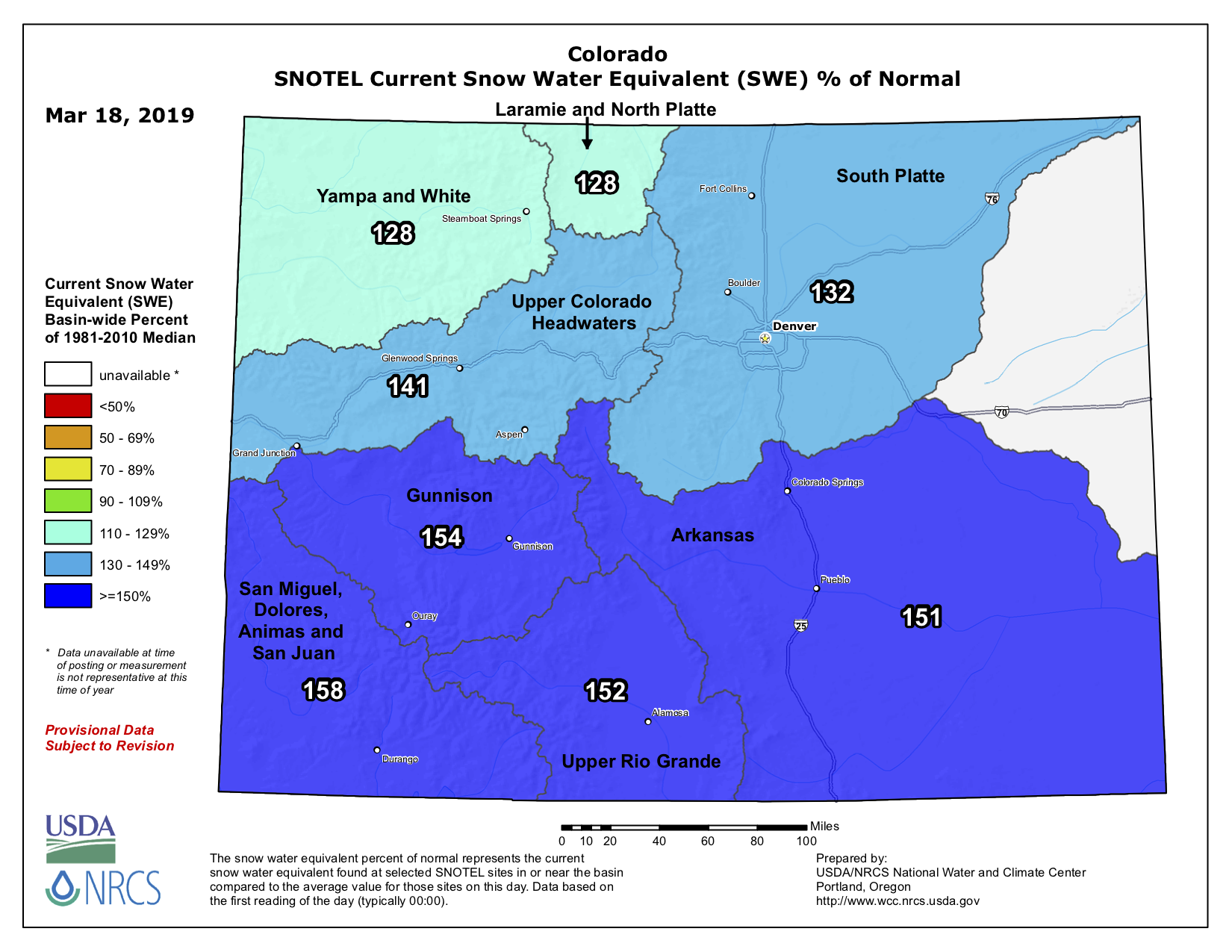
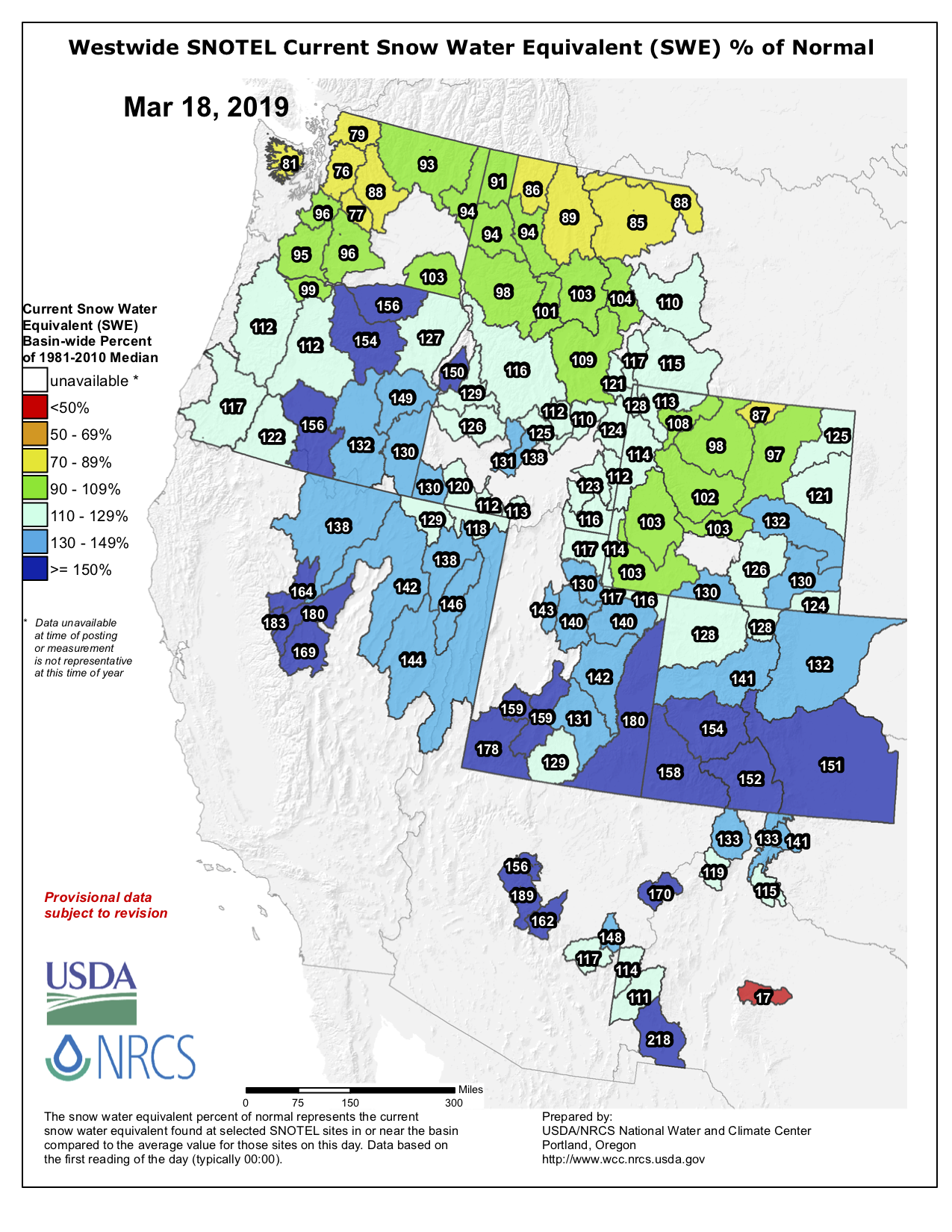
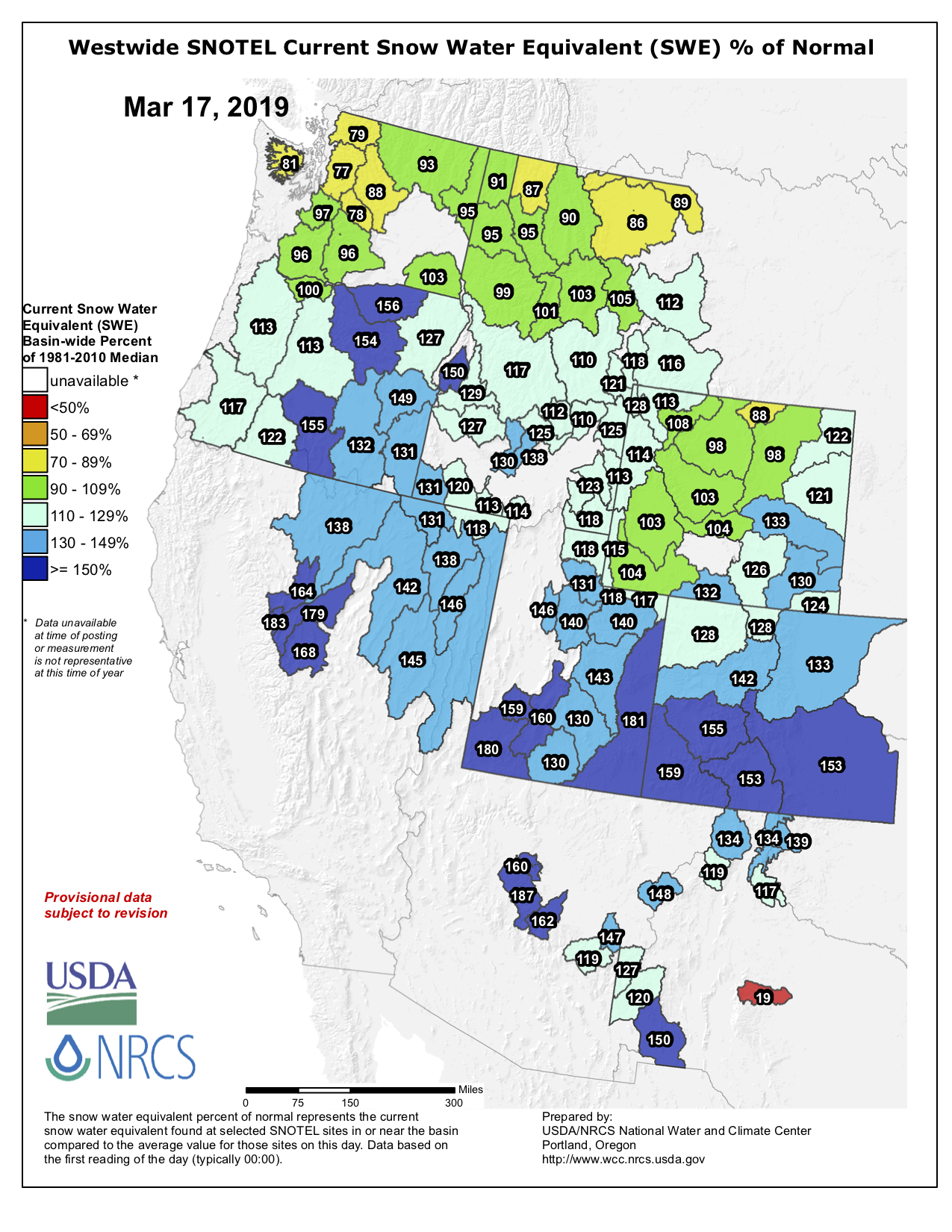
SNOTEL snow water equivalent statewide is 142 percent of average with all basins well above average. The highest snowpack is in the Southwest basins of the San Miguel, Dolores, Animas & San Juan at 158 percent of median, while the lowest is tied with both the Yampa-White and the North Platte at 128 percent of median (see image below).
Many basins, as well as the state as a whole are near maximum observed snowpack for this time of year and short term forecasts indicate that an active storm pattern is likely to remain.
Reservoir storage, statewide remains at 83 percent of normal but is expected to increase as soon as the runoff season begins. The South Platte, Colorado, and Yampa-White, all above 90 percent of average as of March 1st. Storage in the Arkansas and Upper Rio Grande basins are at 87 and 78 percent of normal, respectively. The Southwest basins of the San Miguel, Dolores, Animas & San Juan, and Gunnison remain the lowest in the state at 58 and 63 percent of normal, respectively.
Streamflow forecasts are near to above normal statewide and have been steadily increasing in recent weeks. As a result the Colorado Basin River Forecast Center has adjusted their April-July unregulated inflow forecasts as follows: Blue Mesa Reservoir 960 KAF (142% of average) a 32 percent of average increase, McPhee Reservoir 480 KAF (163% of average) a 51 percent of average increase. The Lake Powell inflow forecast is 9.50 MAF (133% of average) an increase of 2.2 million acre-feet or 31% of average.
The Drought Visualization Tool is now live; please take a minute to provide feedback on this tool HERE.
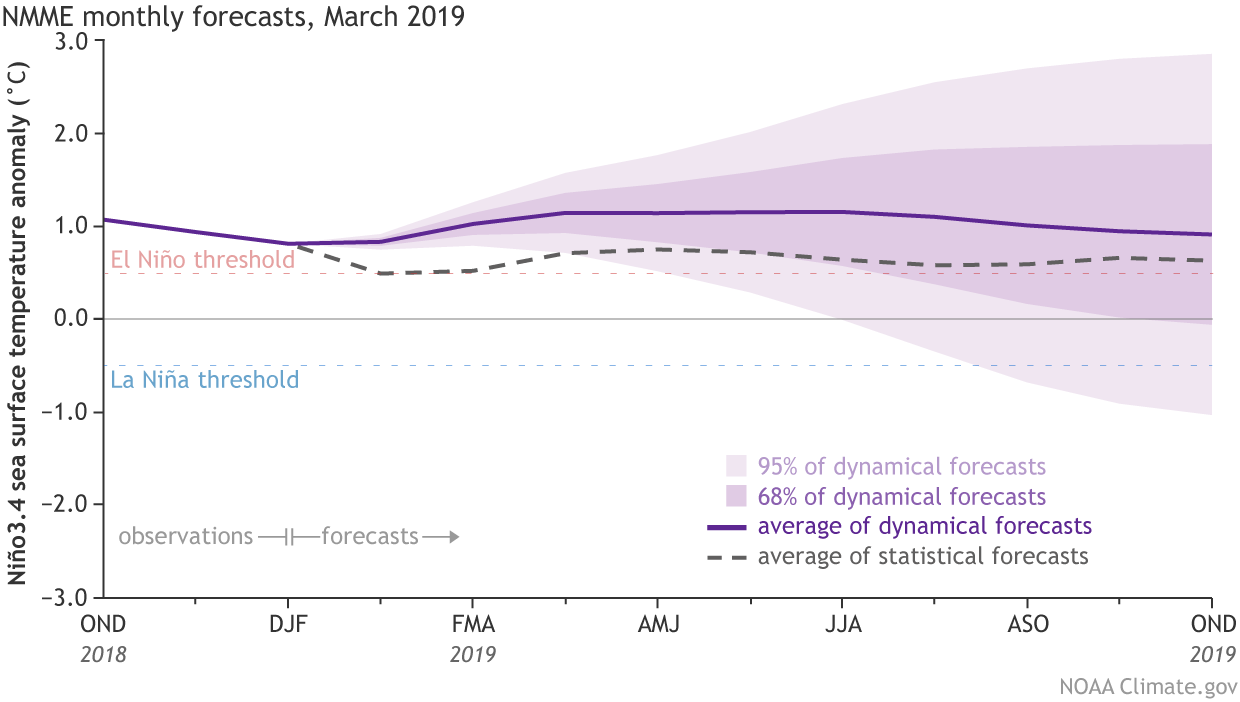
Synopsis: Weak El Niño conditions are likely to continue through the Northern Hemisphere spring 2019 (~80% chance) and summer (~60% chance).
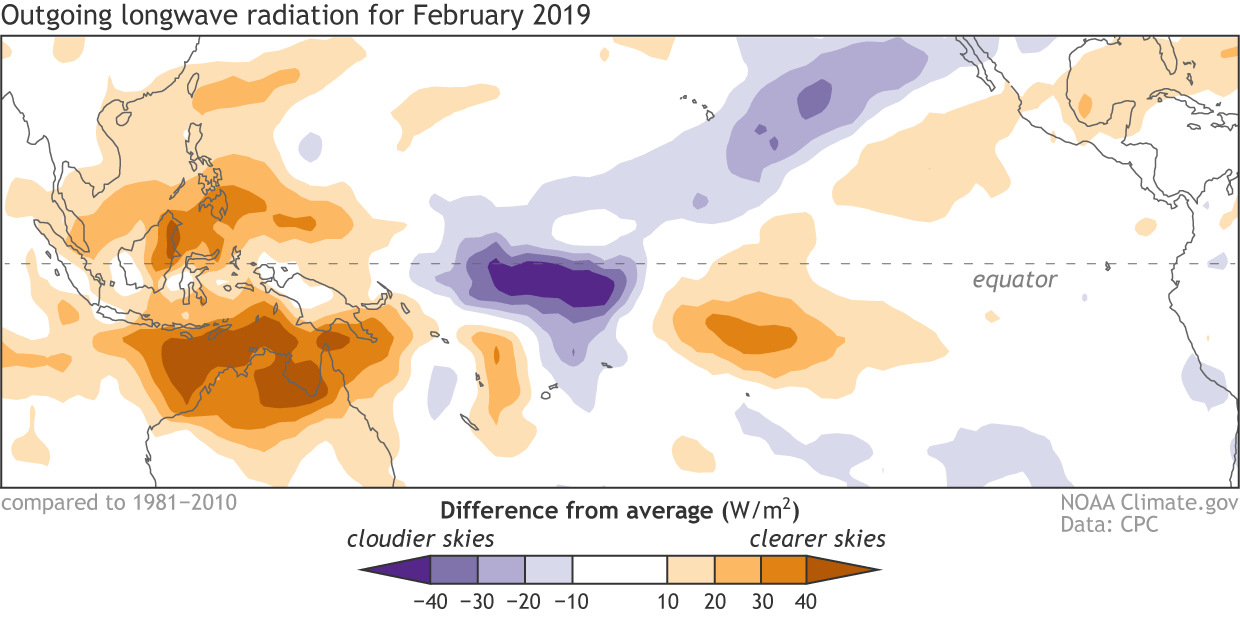
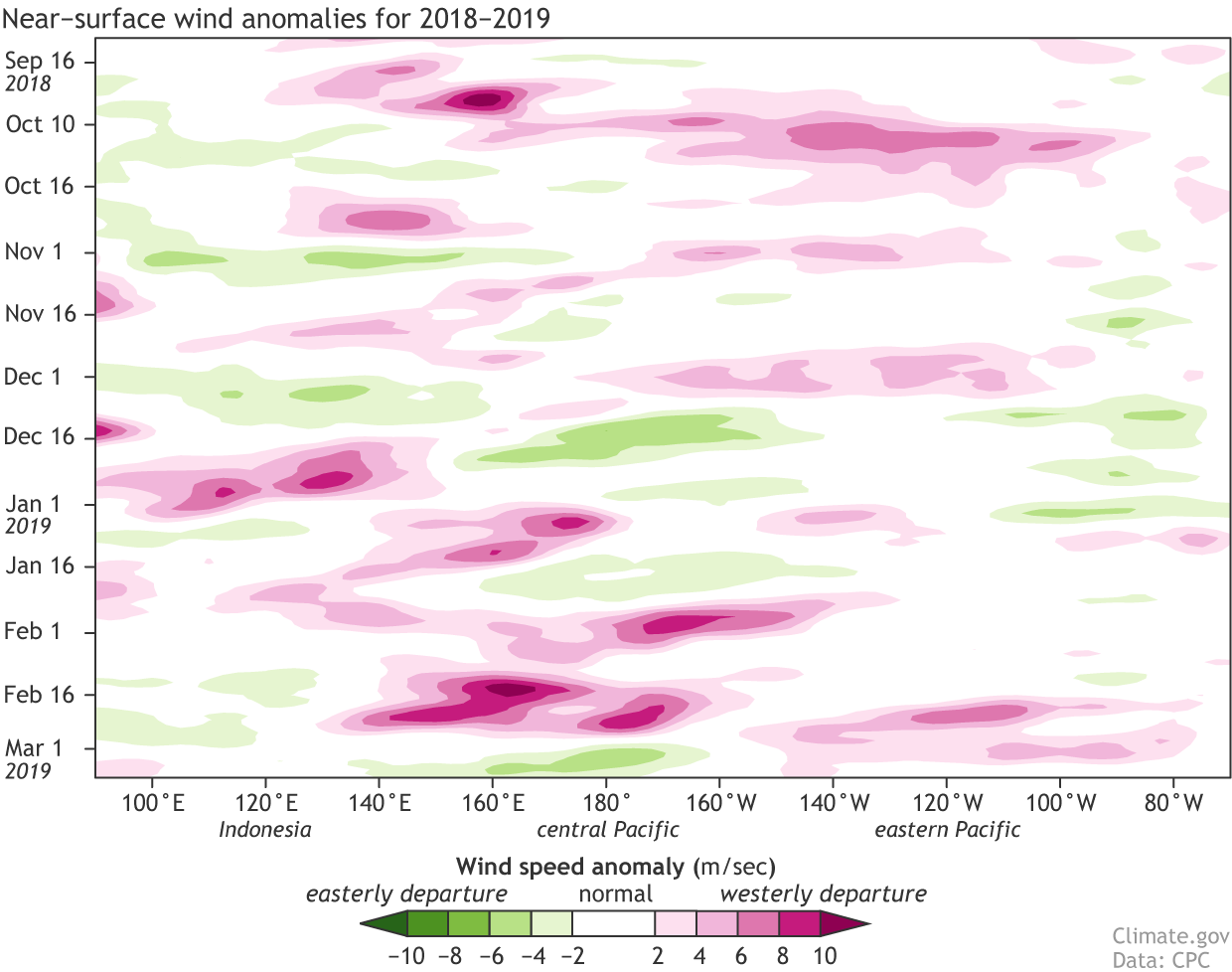
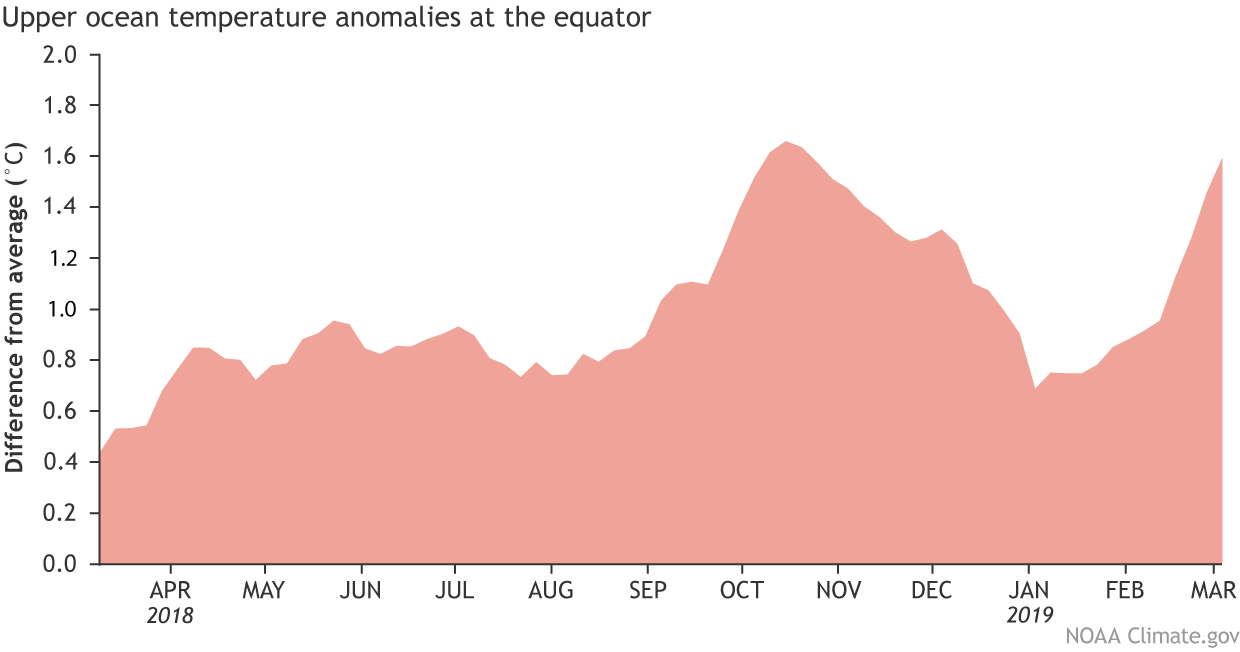
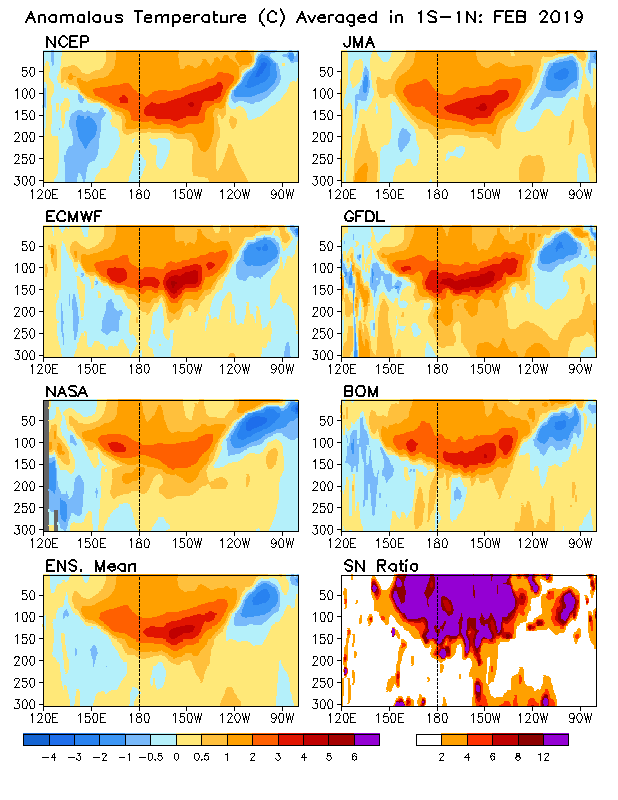
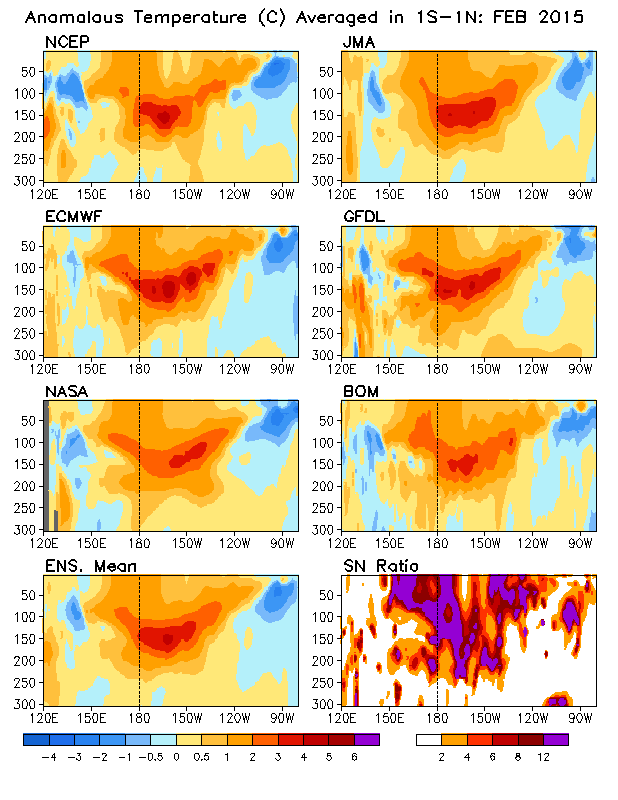
El Niño conditions strengthened during February 2019, as above-average sea surface temperatures (SSTs) increased across the equatorial Pacific Ocean and the associated atmospheric anomalies became increasingly well-defined. The SST index values in the Niño3, Niño3.4 and Niño4 regions all increased during February, with the latest weekly values near +1C in each region. The anomalous upper-ocean heat content (averaged across 180°-100°W) increased appreciably during February, due to an increase in above-average temperatures at depth in association with a downwelling equatorial oceanic Kelvin wave. Enhanced equatorial convection prevailed near the Date Line, while suppressed convection was observed over Indonesia. Low-level wind anomalies were westerly in the central Pacific Ocean, while upper-level wind anomalies were mostly westerly over the far western and far eastern Pacific. The equatorial and traditional Southern Oscillation Index values were both negative (-1.4 standard deviations). Overall, these features are consistent with weak El Niño conditions.
The majority of models in the IRI/CPC plume predict a Niño 3.4 index of +0.5C or greater through the Northern Hemisphere early autumn 2019. Given the recent downwelling Kelvin wave, and the increase in both the SSTs and subsurface ocean temperatures, most forecasters expect positive SST anomalies to persist across the central and eastern Pacific for at least the next several months. During that time, forecasters predict the SST anomalies in the Niño 3.4 region to remain between +0.5C and +1.0C, indicating weak El Niño conditions. However, because forecasts made during spring tend to be less accurate, the predicted chance that El Niño will persist beyond summer is currently about 50%. In summary, weak El Niño conditions are likely to continue through the Northern Hemisphere spring 2019 (~80% chance) and summer (~60% chance); click CPC/IRI consensus forecast for the chance of each outcome for each 3-month period.
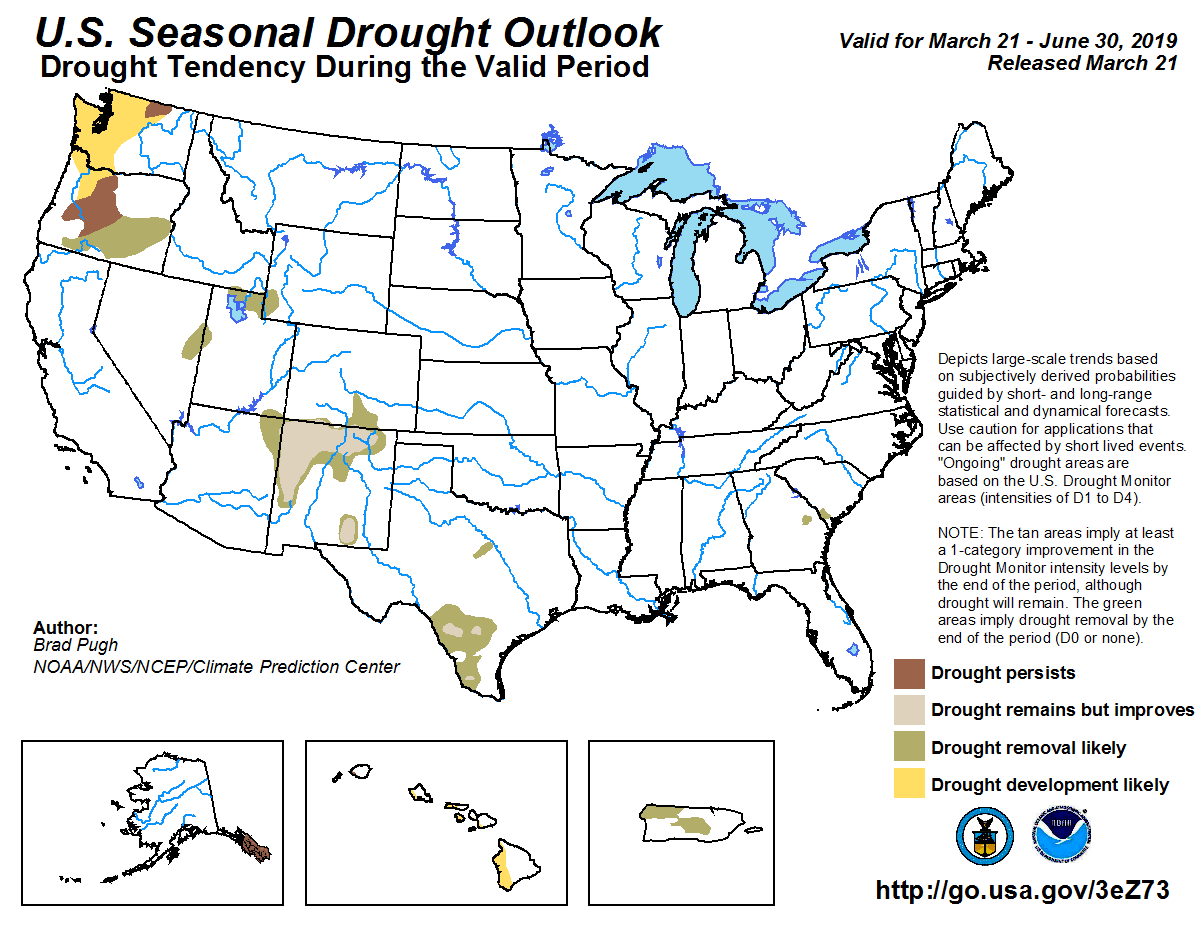
Seasonal temperature outlook through June 30.2019 via the Climate Predication Center.Seasonal precipitation outlook through June 30.2019 via the Climate Predication Center.Seasonal drought outlook through June 30.2019 via the Climate Predication Center.
Click on a thumbnail graphic to view a gallery of drought data from the US Drought Monitor.
US Drought Monitor March 19, 2019.
West Drought Monitor March 19, 2019.
Colorado Drought Monitor March 19, 2019.
Click here to go to the US Drought Monitor website. Here’s an excerpt:
Summary
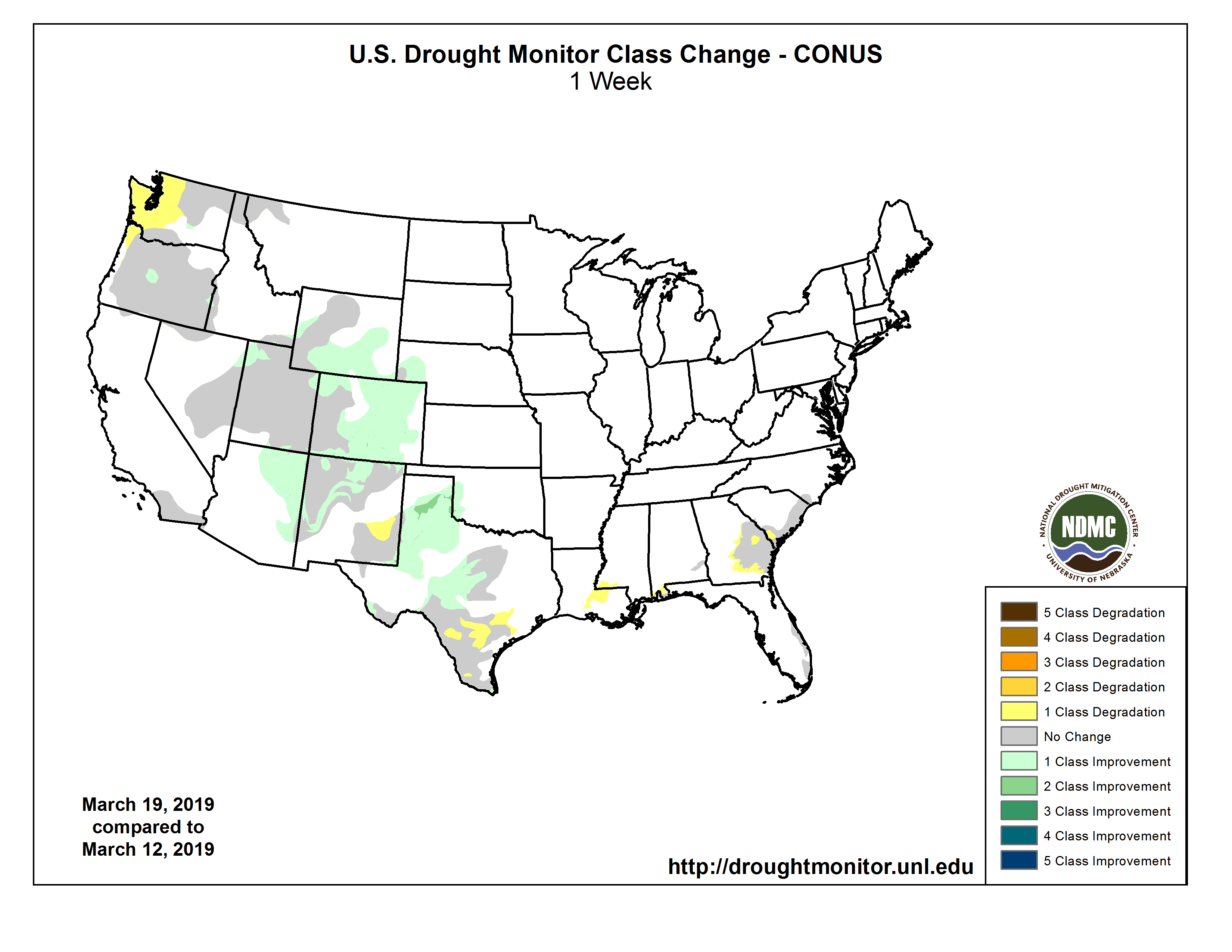
A historic major winter storm impacted much of the country this past week with blizzard conditions, category-2 hurricane-force winds, heavy rain, thunderstorms, tornadoes, and flooding. Funnel clouds and tornadoes were seen in south central Arizona and southeastern New Mexico. Up to a foot of snow fell across the Denver, Colorado, area, while up to two feet fell over southeastern Wyoming, western Nebraska, and into southwestern and central South Dakota. To the south, thunderstorms rolled across Texas and parts of the lower Mississippi River Valley into the Tennessee and Ohio Valleys, including eastern Arkansas, southwestern Tennessee, and northwestern Mississippi. Heavy rainfall melted snow and led to flooding from Kansas, Nebraska, and South Dakota to the western Great Lakes. Much of the South, however, from southern Texas eastward, missed out on most of the precipitation and conditions continue to dry…
Most of the High Plains were impacted by a major winter storm early in the drought week that brought blizzard conditions, heavy rain, and dangerous flooding. Except for the western region where abnormally dry conditions (D0) are present, the remainder of Colorado saw widespread improvement, due to the recent storm and a generally very active weather pattern since February that has left excellent snowpack, with much of the north half and east returning to normal conditions. Severe drought (D2) shrank significantly in the southern part of the state. With heavy snow–one to two feet in areas–abnormally dry conditions were alleviated across most of the western Nebraska panhandle and in eastern and southern Wyoming…
Last week, California emerged from drought conditions for the first week since December 11, 2011, breaking its 376-week streak. Reservoirs continue to slowly replenish in areas of the state still experiencing abnormal dryness (D0) and no further changes were made here. However, areas of abnormal dryness and drought continued to decline in other western states this week, due to recent above-average precipitation and excellent snowpack conditions at higher elevations. Arizona and New Mexico in particular saw widespread 1-category improvements. Notably, exceptional drought (D4, the worst category depicted on the drought map) was eliminated and extreme drought (D3) broadly contracted in northern New Mexico. In Oregon, the small area of severe drought (D2) in Deschutes County was eliminated. Moderate drought in the rest of the state remains unchanged as temperatures begin to warm and soil moisture is still dry when considering conditions over the past year or so. In contrast to other parts of the West, western Washington and along the northern coast of Oregon have seen below-normal precipitation over the past few months on average and stream flows are quite low here, even record low in some places. Abnormally dry conditions were expanded across this area. Reports indicate that the dry weather has caused an increase in brush fires in Whatcom, Mason, Grays Harbor, Cowlitz, and Clark Counties in Washington…
Heavy precipitation from a major storm system on the 13th fell over abnormally dry (D0) and drought areas in western Oklahoma and northern and central Texas, where conditions widely improved by 1 category, and even 2 categories from western Swisher County northeastward to western Gray County. Those areas received enough rainfall to alleviate deficits at both long- and short-term time scales. The precipitation largely missed southern parts of Texas, Louisiana, and Mississippi. Abnormally dry conditions spread from southern Alabama into the southeastern corner of Mississippi and an area was introduced from the southwest corner of the state southwestward through Lafayette Parish to the northern tip of Vermillion Parish near the Gulf of Mexico. Dryness and drought expanded eastward in southern Texas, and three pockets of severe drought (D2) were introduced: two center on Zavala and Atascosa Counties and one area sits on the border of Jim Hogg and Starr Counties in the far south…
Looking Ahead
Over the week beginning Tuesday, March 19, according to NOAA’s Climate Prediction Center, light rain is generally expected over much of the contiguous United States, with regional and localized amounts of around an inch or so anticipated across several states, from California to Arkansas, along with most of the eastern seaboard from North Carolina to Maine. Already dry areas in the Southeast are expected to continue to dry. Looking further ahead to March 25-29, there is a high probability Alaska will see above-average temperatures and precipitation. The central contiguous U.S. and Pacific Northwest may also see above-average temperatures, while most of California, eastern Nevada, and the Northeast may have below-average temperatures. This timeframe may also be wetter than average across most of the region, with the exception of the upper Northeast and northern Michigan. Please note the forecast confidence for this period is below average.
US Drought Monitor one week change map through March 19, 2019.
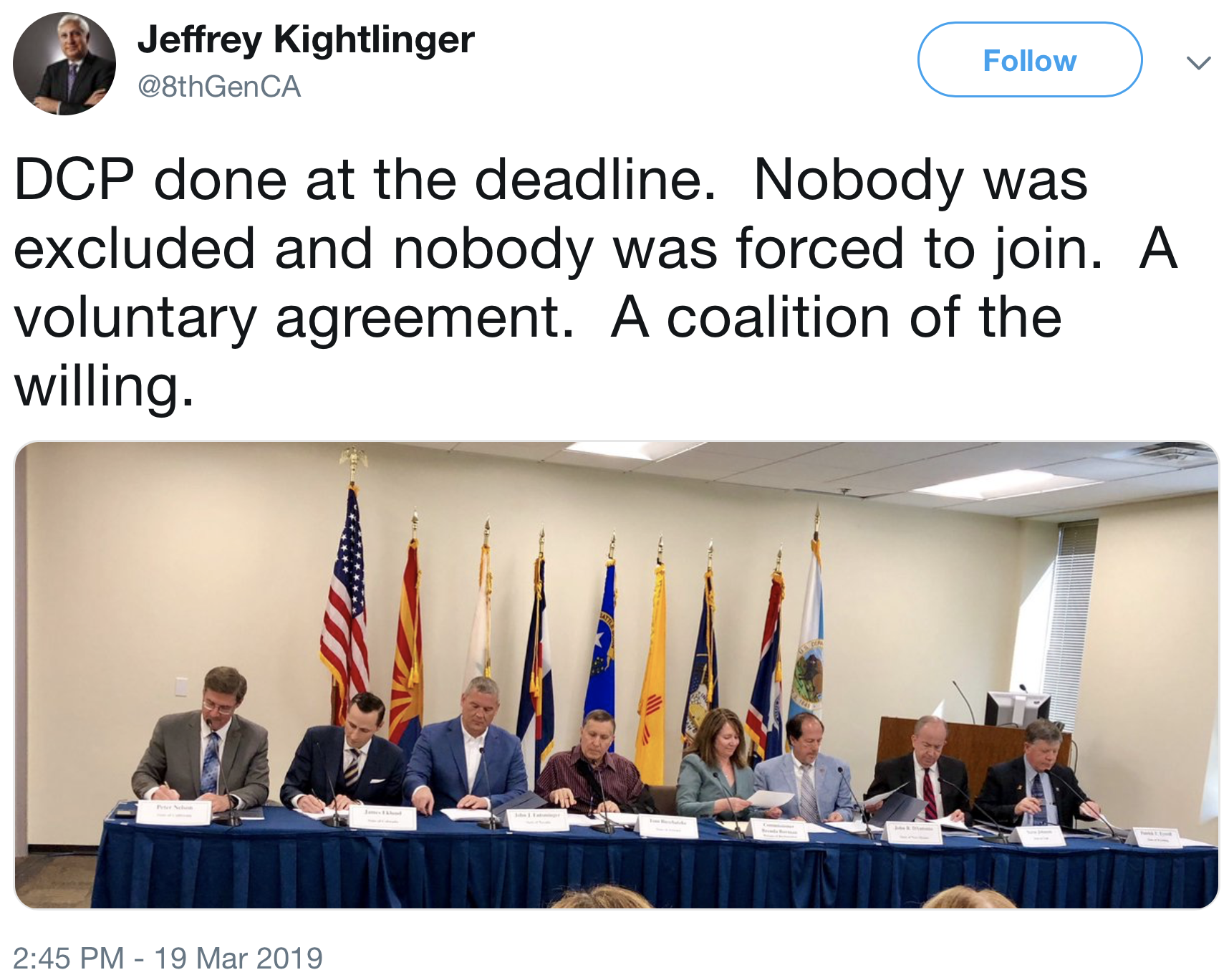
Water leaders from the seven states that make up the Colorado River basin are one step closer to finalizing a drought contingency plan. Representatives from Colorado, Wyoming, Utah, New Mexico, Nevada, California and Arizona met in Phoenix Tuesday to sign a letter to Congress asking for federal approval of the plan.
Recent heavy snows in the southern Rockies have relieved some short-term pressure on the region’s water supplies. If dry conditions in the southwest return in the next six years, the plan would force Arizona, Nevada, California and Mexico to cut back the amount each takes from the overallocated river system.
If snowpack remains high the next few years the plans might never be used.
“Today is a very important day in the history of the Colorado River,” said U.S. Bureau of Reclamation commissioner Brenda Burman, who for more than a year has pressured state water managers to agree on voluntary cutbacks. “Today the seven basin states have come to an agreement and signed together a letter to Congress memorializing that agreement. The intrastate drought contingency plans are done. They are complete.”
In the letter, water leaders from throughout the basin say they want to execute the drought contingency plan no later than April 22, 2019.
In declaring the plans done, Burman also decided to rescind her call to Colorado River basin state governors for input to craft a federal plan should the states fail to coalesce.
The plan has been cobbled together through a series of agreements over the last five months among the states that make up the Colorado River watershed. Nevada first approved its portion of the plan in November 2018. Colorado, Wyoming, Utah and New Mexico followed suit in December. Starting Jan. 31, 2019 California and Arizona failed to meet a series of federal deadlines while the two states attempted to calm warring intrastate factions.
In Phoenix, water officials attempted to provide closure to the drought contingency plan process, while acknowledging big hurdles remain, including projected climate impacts to snowpack and the river’s structural deficit where more water exists on paper in the form of water rights than in the system itself…
“This is definitely a euphoric high point that we’re in right now, but there are miles and miles to go before we sleep,” said Upper Colorado River Commission member James Eklund. He signed the letter on behalf of the state of Colorado.
The euphoria isn’t shared by all users in the southwestern watershed. The plan now moves forward without the support of the single largest user of the river’s water. The Imperial Irrigation District (IID) in southern California said it would only sign on to the drought plan when it received $200 million in federal funds to mitigate public health and environmental problems brought on by the shrinking Salton Sea.
“By forging ahead, what they are saying is that the only acceptable way to check the boxes marked ‘IID’ and ‘Salton Sea’ is to erase them,” said IID board president Erik Ortega in a written statement. “What they’re also saying is that getting the [drought contingency plan] done is more important than getting it right.”
[…]
The drought contingency plan overlays onto a set of 2007 guidelines that govern how the river’s reservoirs are managed. Those guidelines weren’t able to keep up as dry conditions and chronic overuse in the basin caused reservoirs to drop to critical levels. The plan is meant to provide temporary stability while water managers negotiate a new set of operating guidelines which go into effect in 2026…
“If we were aliens visiting Earth from another system years from now would we run it this way? Probably not,” said Eklund, of the Upper Colorado River Commission. “But there are history and legacy, pieces of law and policy, politics in this basin that have guided us to where we are and what we have to do. And I think given the hand we’ve been dealt this is a pretty outstanding moment.”
FromThe Denver Post (Bruce Finley) via The Fort Morgan Times:
This “drought contingency” plan completed by the seven Western states to meet an extended federal deadline is “meant to avoid a crisis on the river,” said U.S. Bureau of Reclamation Commissioner Brenda Burman.
After 2026, the feds will look at flows in what scientists project will be a more diminished Colorado River and, working with states, “we will negotiate our next step,” Burman said.
This complex water plan hashed out since 2017 depends on all residents of the West using less water to deal with a 19-year shift toward aridity. Negotiators tinkered with fundamentals of the 1922 law that divvies up shares of Colorado River water for each state — an improvisation to try to address one of the planet’s toughest water problems caused by chronic overuse and climate change.
For two years, federal water authorities at the brink of declaring a shortage — which would trigger a federal takeover of managing deliveries from the Colorado River — have been pushing states to hash out drought plans as a temporary bridge toward sustainable use of the river. Congressional officials have scheduled hearings next week aimed at implementing the plan…
Federal scientists have projected that, if dry times continue, reservoir operators within five years will not be able to deliver water as usual to downriver cities including Phoenix, Los Angeles, Tucson and San Diego. The other main reservoir on the Colorado River, Lake Mead, remained only 41 percent full, with feds projecting that by the end of 2019, the water level will barely exceed (by about 6 feet) the threshold for federal declaration of that official shortage.
“This plan means we have seven states concerned about how to move forward and, instead of balkanizing the basin into fractured state interest groups, we’re all working together to control our own destiny,” said James Eklund, the Denver-based attorney who represented Colorado through extended multistate negotiations.
The outlook for the Colorado River “has not been rosy for the last 20 years. This snowpack does look decent. It may be an outlier. We have got to plan for the worst and hope for the best,” Eklund said in an interview with The Denver Post on Tuesday.
For Colorado, the plan “does not obligate us to use less water,” Eklund said, but instead creates incentives for conservation. It allows Colorado and other upper basin states (Wyoming, Utah, New Mexico) to use Lake Powell as a bank account for extra water. Under river drought protocols negotiated in 2007, extra water in Powell above the amount those states are required to deliver to the lower basin states (Arizona, Nevada, California) could be moved out toward Lake Mead to help address the chronic depletion there.
That now has changed so that ranchers, growers, cities and industries that use less water can store it in Lake Powell. Federal officials said they hope this plan, once Congress directs implementation, will immediately create incentives for using less water.
“If the Colorado River reservoirs keep going down and down and down, then two sectors will feel the brunt of the pain: the environment and people in poverty. Those are the two that always, globally, when there is water stress, feel the pain disproportionately,” Eklund said. “We’re trying, with this contingency plan, to go a different route that allows us to manage our water and the river system so that it stays healthy longer. It allows us to keep away from that acute crisis that, if history is any guide, would hit hardest on the environment and people in poverty.”
A key concern for upper basin states has been the electricity generated at the federally run dam atop the Grand Canyon. If Lake Powell water, formed by that dam, drops 81 feet lower than it was this week, cities including Denver, Pueblo, Colorado Springs and scores of rural electrification districts that rely on distribution of electricity by the Western Area Power Administration could see sharp increases in their power bills…
Beyond the West’s booming cities, expanding fossil fuels and other industries, and agricultural operations, semi-arid landscapes and wildlife, including endangered fish and bird species, depend on healthier ecosystems along the Colorado River…
“If we don’t do something to address the drought situation for agriculture, cities and industry, and stabilize the river system, then the environment is going to suffer. This is a critically important step,” said Matt Rice, Colorado River Basin program director for the advocacy group American Rivers.
“Realistically we have to understand that with the huge economy driven by this river, we have to figure out ways to stabilize it,” Rice said, “or else rivers, the natural environment and recreation are going to suffer most.”
Headwaters of the Arkansas River basin. Photo: Brent Gardner-Smith/Aspen Journlaism
From the Upper Arkansas Water Conservancy District (Terry Scanga) via The Ark Valley Voice:
Most discussions involving water supply or quality require a good examination of historical perspective of water development. For this reason, understanding the system by which water is and has been allocated in Colorado since statehood, is a good starting point.
Water in Colorado is allocated as a private property right through a system referred to as the Appropriation Doctrine. It is the only arid Western state that utilizes a pure form of this doctrine called the “Colorado Doctrine”. This doctrine is enshrined in the state’s constitution. It is a constitutional right for the citizens of Colorado to an appropriation of water based on its beneficial use. Although many legislative statutes deal with water appropriation and use, these all rely upon, and must comport, with the basic constitutional right granted the citizens of the state.
This article is not intended to delve into the Appropriation Doctrine, except to point out that water rights and decrees are granted as a private property right. In fact, this system is automatically designed to apportion available water supply without undue interference from government, except for the administration of the existing water decrees or through the water court.
In 2005 legislation was passed creating the inter-basin compact committee and the nine basin roundtables. The basins utilized the Statewide Water Supply Initiative (a project to calculate the available water supply compared to demand –a needs assessment) to identify the projects and processes needed to address any water supply gap out to the year 2050; for all uses– municipal, industrial, irrigation (agricultural), environmental and recreational. Water entities and individuals were involved in each basin throughout the state to develop these plans.
Projects were identified and some were funded in part with grants from the state’s Colorado Water Conservation Board. The Colorado Water Plan was developed from these plans and processes. These projects have gone a long way to make available the necessary water supplies for the future. Many of the projects are ongoing and more will be needed to meet future needs.
Colorado is an arid state with future shortages forecast in the higher growth regions. In the Arkansas Basin, many junior water rights were established during high precipitation periods. Due to this, the Arkansas Basin today is considered an over-appropriated basin meaning that on average there are more decreed water rights than water available. Most of these junior water rights are decreed for irrigation use in agriculture. In the Arkansas Basin shortages are forecast for all water uses.
The Colorado Water Plan is a collection of the ideas and projects on how we can meet future water demands. Meeting the future need revolves around developing new Colorado River Supplies and Alternative Agricultural Transfers coupled with storage. The Colorado River normally has water that is unused and could be utilized to fill the gaps in the higher growth regions. Presently Colorado is well ahead in meeting its Compact obligations on the Colorado River, despite unsubstantiated claims from some state politicians and the administration that Colorado may be unable to meet its obligations.
Agricultural irrigation uses 80 percent or more of the available supply statewide. Some of these uses could be temporarily interrupted through court approved Lease-Fallowing agreements, and the water owner compensated, to meet shortages in drier years. In wet years existing storage and new storage could be utilized to save the excess for drier times. Storage projects, including alluvial storage, need to be built to meet the future needs. Water storage operations could be adapted to meet multiple uses for stream management, to meet increased demands for the environment and recreation.
Through the existing Appropriation System, the above plans and others are underway to meet this future need. All this can, and should, be completed through the Colorado Doctrine of Appropriation, a strong legal framework to guarantee the security, reliability and flexibility in the development and protection of water resources.
In terms of water supply, the greatest threat for the future would be a loss or erosion, through legislative or administrative action, of the time-tested Colorado Doctrine of prior appropriation. Actions are underway to use the water plan as a framework to advocate for the use of policy to appropriate water. Using policy for water appropriation would give the administration and legislature a pathway or initiative to utilize legislation, in lieu of the more deliberate Appropriation system that is designed to protect existing water rights from injury. This strongly suggests that the legislature and administration may attempt to act upon perceived crises to garner support to move future appropriations or changes of current water use through legislation instead of the water court system.
Already underway is a Demand Management Plan that will allow administrative policies to transfer water rights from agriculture through Deficit Irrigation, or by utilizing an undefined process termed “Conserved Consumptive Use”, to Lake Powell, or to municipal use. In the Arkansas Basin most irrigation is already in a deficit so there is no water to be saved. Under Colorado’s pure form of prior appropriation, in low flow periods, water rights are curtailed automatically to force reductions in use. There is no need to use state policy to create conservation.
The frightening part of these actions is that, if successful, the only way for water right owners to protect themselves from injury will be expensive court action. If legislation is successful in adopting the concept of “Conserved Consumptive Use” it is possible we will see lower flows in the Arkansas River due to a reduction in trans-mountain diversions. These diversions support all uses in the river, such as the voluntary flow management program. Instead of water flowing to the Arkansas River, some may flow down the Colorado River to Lake Powell for storage and eventual evaporation there, under a plan called Demand Management.
In the Upper Arkansas Basin water quality has been addressed is various ways. The Arkansas River was polluted by mining runoff and is normally affected by natural geologic formations. Most of this pollution has been cleaned-up, and today there are large sections of gold medal fishing. Studies conducted by the US Geologic Survey have concluded that most of our ground water is of good quality. These are good things.
But the threat to water quality from sediment runoff from burn areas in our forests are real. Due to the beetle infestations and decimation of the forest stands in the US Forest lands, fire is more likely and has occurred.
The after effects of fire is larger than normal storm runoff. This will, and has already caused, heavy sediment loading on our streams and the Arkansas River. The Upper Arkansas Water Conservancy District (UAWCD) and the Arkansas Basin Roundtable is working with the US Forest Service and local entities to address some of these areas. Locally, the UAWCD is working with the Forest Service on a pilot project to remove beetle killed forest stands and make it a commercially viable resource. If successful, this may be part of the solution.
In the lower part of the Upper Arkansas River Basin, in Eastern Fremont County, there is a geologic formation that contains selenium that contributes to contamination in this part of the Arkansas River. At this time simply identifying these areas is a challenge, but it is being worked on by the US Geologic Survey. Most of this type of contamination primarily affects the Lower Arkansas Basin. Delivery of good municipal drinking water supplies is being undertaken by the South Eastern Colorado Water Conservancy District, with the construction of a pipeline from Pueblo Reservoir to the Lower Basin communities.
Colorado’s U.S. senators said this week they will both fight hard for full funding of the Land and Water Conservation Fund despite the Trump administration’s plans to gut the program that’s pumped more than $268 million into the state for parks, ball fields, trails and open space.
“Congress finally secures LWCF for future generations, and the administration turns around and tries to cut its funding. This is exactly why Coloradans are so frustrated with Washington,” Democratic Sen. Michael Bennet told the Vail Daily on Tuesday via a spokeswoman.
Bennet was referring to the signing last week of the John D. Dingell Jr. Conservation, Management and Recreation Act (formerly the Natural Resources Management Act) by President Donald Trump — the day after the White House released a proposed 2020 budget with deep cuts to the LWCF and other public lands programs…
Established by Congress in 1965, the LWCF uses offshore drilling lease fees to develop parks, wildlife refuges and recreational facilities on federal, state and local lands. It also funds additions and upgrades to national parks, forests and other public lands, including projects in western Colorado. Trump’s budget would reportedly slash LWCF funding by 95 percent…
State groups dependent on the funding would love to see an end to the annual budget battle for the program, which is now permanently reauthorized and collecting money from drilling operations.
“I struggle with that; I struggle with the whole (funding) concept, not just LWCF but the Forest Service and BLM budgets as a whole,” said Scott Jones, chairman of Colorado Parks and Wildlife’s State Recreational Trails Committee. “When Land and Water Conservation Fund money went away, the non-motorized side of the state trails program almost disappeared. It would have been less than a million bucks a year, and that was going to be a big problem.”
[…]
The ongoing construction of the Continental Divide Trail depends on LWCF money, particularly in areas where there’s no nearby federally owned public land. In those cases, proponents of the trail use LWCF funds to acquire private land for the trail.
In a statement, the Continental Divide Trail Coalition blasted the president’s “drastic cuts to LWCF,” which the coalition argued “undermined White House claims of support for the program.”
Teresa Martinez, executive director of the Golden-based CDTC, celebrated the renewal of the program but said it’s time to “get back to work to fight to ensure strong funding for LWCF.”
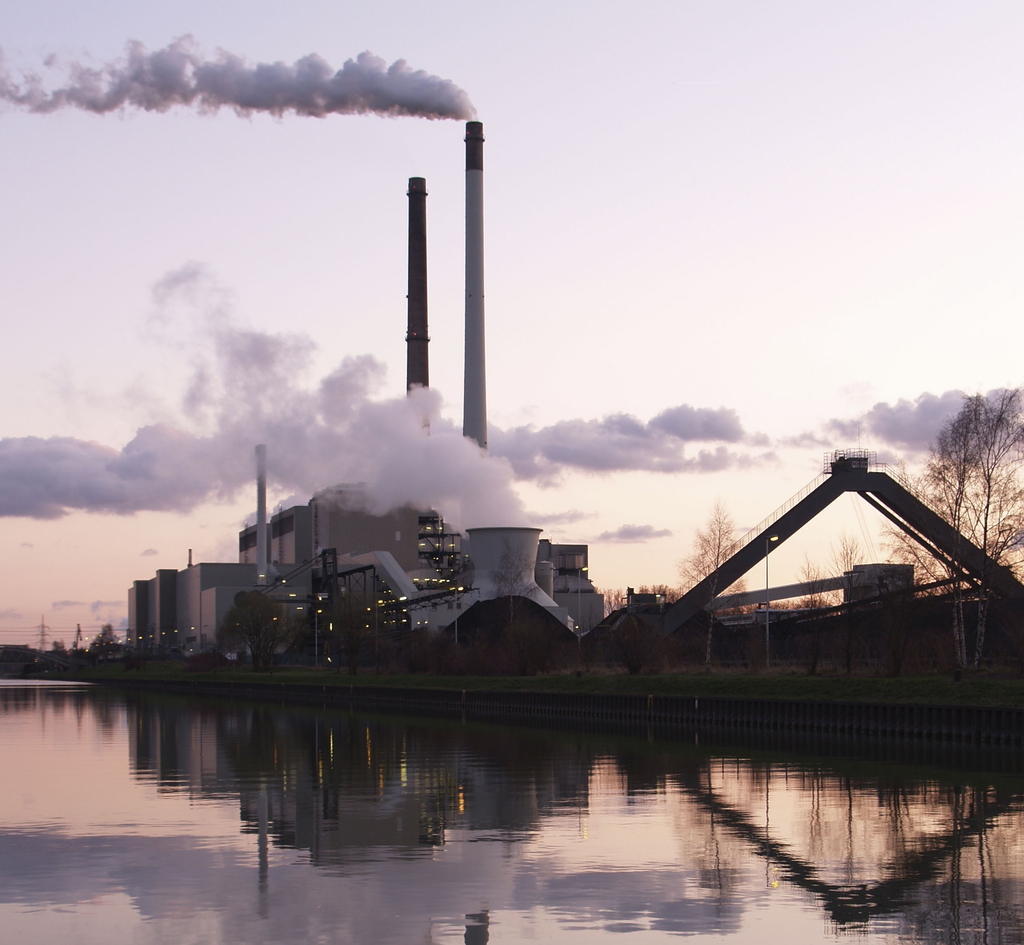
Local plants vow to minimize coal-ash contamination to meet new EPA rules; report finds cases much worse in other states
Since federal regulations kicked in a few years ago, coal-fired power plants are required to monitor and publicly report what happens to the residue from burning coal and determine whether chemicals are seeping from the coal-ash disposal sites into the groundwater.
But the reporting process is inconsistent between facilities and the data collected is often complicated to interpret. So a group of environmentalists culled the data from 265 coal-fired power plants or ash dumps, including seven in Colorado, and found 91 percent had unsafe levels of one or more chemicals in nearby groundwater.
“This is only the beginning of the end,” said Abel Russ, a senior attorney for The Environmental Integrity Project, which published the report as part of a collaboration between the Sierra Club, Earthjustice and other environmental organizations. “If it’s gradually leaking and if you don’t do anything about it now, future generations will have to deal with it. And it’s not any one chemical but a bunch. Most had four different chemicals (contaminating groundwater). The coal-ash rule and our report are looking at drinking water standards, but there’s the whole fish and wildlife (ecosystem) that this doesn’t address.”
U.S. Bureau of Reclamation Commissioner Brenda Burman commended Arizona, California, Nevada, New Mexico, Utah and Wyoming for reaching a consensus on the Colorado River drought contingency plan. Now the states are seeking approval from Congress to implement it.
“It is time for us to work with our congressional delegations to move forward to make sure we can implement DCP this year,” Burman said on a call with reporters.
Under the drought plan, states voluntarily would give up water to keep Lake Mead on the Arizona-Nevada border and Lake Powell upstream on the Arizona-Utah border from crashing. Mexico also has agreed to cuts.
The push for federal legislation comes after the Colorado River Board of California voted Monday to move ahead without a water agency that has the largest entitlement to the river’s water.
The Imperial Irrigation District was written out of California’s plan when another powerful water agency, the Metropolitan Water District, pledged to contribute most of the state’s voluntary water cuts.
Imperial had said it would not commit to the drought plan unless it secured $200 million in federal funding to help restore a massive, briny lake southeast of Los Angeles known as the Salton Sea. The district also accused others in the Colorado River basin of reneging on a promise to cross the finish line together.
“IID has one agenda, to be part of a DCP that treats the Salton Sea with the dignity and due consideration it deserves, not as its first casualty,” Imperial board President Erik Ortega said.
The Southern Nevada Water Authority called Imperial’s refusal to approve the plan “shortsighted” and “manipulative.” Burman has said the drought plan would have no effect on the Salton Sea, and Imperial could choose to join the deal later.
The Bureau of Reclamation had given states until Tuesday to submit comments on what to do next after California and Arizona failed to meet federal deadlines to wrap up their drought plans. The agency received no comments, and Burman canceled the request.
Arizona says it doesn’t expect its remaining work to delay implementation of the drought plan. But the state cannot officially sign on until Congress approves it.
At least two congressional subcommittee hearings on the drought plan are scheduled for later this month…
The latest study shows a shortage might be averted because of above-average snowpack, though the call for 2020 won’t be made until August. In New Mexico, the basin that feeds the Rio Grande is about 135 percent above median levels.
But officials say one good year of snowpack won’t reduce long-term risks for the Rio Grande or the Colorado River.
The drought contingency plan takes the states through 2026, when existing guidelines expire. The states already are preparing for negotiations that will begin next year for new guidelines.
“We all recognize we’re looking at a drier future,” said Tom Buschatzke, director of the Arizona Department of Water Resources.
Arizona and the six other Colorado River Basin states took a big step toward completion of a drought plan by asking Congress to approve it.
The request is an acknowledgment by the states and the U.S. Bureau of Reclamation that they’ve now finished work on the plan to conserve Colorado River water to keep Lakes Mead and Powell from dropping to critically low levels.
The seven basin states’ representatives signed the letter to Congress at a ceremony Tuesday in Phoenix.
At a media teleconference held afterward, officials expressed hope for relatively speedy approval, and noted that both the U.S. House and the Senate are scheduled to hold hearings on the drought plan next week.
But the plan leaves behind a key player — Southern California’s Imperial Irrigation District, which controls by far the largest share of river water in the basin…
Congressional approval of the drought plan will kick in a series of gradually escalating reductions in river water use by the Lower Colorado Basin, first mostly by Arizona but eventually by California with lesser reductions incurred by Nevada.
The most serious reductions may well be forestalled for a year if not longer because of unusually heavy snows falling upon the colder Upper Basin states in February and early March.
Because of the snowpack those storms left behind, the Bureau of Reclamation dramatically raised its forecast for expected Lake Mead levels in 2020 to the point where a major shortage is no longer likely then.
Through Tuesday, snowpack in the Upper Basin was 136 percent of normal.
The predicted April-July runoff into Lake Powell, a key benchmark of the river’s health, is now at 133 percent of normal, which would be the 14th highest total on record.
By contrast, last year’s April-July runoff was 36 percent of normal, the fifth lowest on record…
But since this year would get only the river’s sixth year of above-average runoff since the drought started in 2000, state officials at Tuesday’s teleconference stressed the need for continued vigilance and conservation of river water.
“What we do know is that as temperatures increase, that should reduce the river flows” from evaporation, said Terry Fulp, director of the bureau’s Lower Colorado Region. “If we look at this particular drought, we believe that is due in part to increased temperatures.
“The real question is what about the future? The drought plan is a really good step toward insuring, ourselves, that the two reservoirs don’t reach critical elevations.”
Reclamation Commissioner Brenda Burman said she’s pleased to see that the seven basin states’ work is finished for now.
She said she’s halting work on her previous plan to take written suggestions from the seven states on how to manage the river because of their then-unfinished business on the drought contingency plan, or DCP.
“This is the best path forward,” Burman said. “The DCP will reduce the risks that the Colorado River Basin is facing.”
Even if Lake Mead doesn’t fall into the shortage trigger level of below 1,075 feet at the end of 2019, the new drought plan once approved will require Arizona to reduce its take of Central Arizona Project water from the Colorado by 192,000 acre-feet. That’s well below one-third of the entire CAP’s annual delivery.
Once Mead drops below 1,075, the cuts will gradually escalate, starting at about 20 percent of the total CAP supply and topping off at nearly half the total supply, at about 700,000 acre-feet.
The Imperial district’s participation in the drought plan wasn’t needed for its approval by the seven states. That’s because Southern California’s Metropolitan Water District recently agreed to conserve the water that Imperial decided not to leave in Lake Mead, thus boosting California’s total share of conserved water to the minimum required.
Imperial District officials said the $200 million in federal funds requested for the Salton Sea would match more than $200 million of state funds already approved. They said it would not only help boost the sea’s shrinking habitat for birds and fish, but prevent toxic dust from the drying sea from hurting surrounding air quality and causing human health problems.
“That money is not for us. It’s that Salton Sea in our backyard,” said Robert Schettler, an irrigation district spokesman, in a telephone interview. “We have citizens, lands and crops around the Salton Sea that are all suffering from the sea’s declines.”
Burman acknowledged the district’s concerns and said the federal government supports the Salton Sea restoration effort.
But the U.S. Department of Agriculture, which controls the funding for such drought-related agricultural projects, is only now ramping the program up after Congress last year authorized such projects, and it’s impossible to say when the money will be forthcoming, officials said.
FromThe Arizona Republic (Ian James and Janey Wilson):
The set of agreements would prop up water-starved reservoirs that supply cities and farms across the Southwest and would lay the groundwork for larger negotiations to address the river’s chronic overallocation, which has been compounded by years of drought and the worsening effects of climate change.
The states’ delegates met in Phoenix and signed their joint letter to Congress alongside federal Reclamation Commissioner Brenda Burman, who had set a Tuesday deadline for the states to complete the agreements.
“Today is a very important day in the history of the Colorado River,” Burman said after the signing. “Congratulations to all for a job well done.”
The first cuts in water deliveries to Arizona and Nevada could begin as soon as next year under the terms of the deal…
Tuesday’s meeting was held behind closed doors at the office of the Arizona Department of Water Resources. Doug MacEachern, a department spokesman, said that due to limited space, “we simply cannot reasonably accommodate public access to these meetings.”
[…]
While the signing was underway in Phoenix, a veteran board member of the IID spoke angrily at a meeting on the shore of the Salton Sea, condemning his counterparts for writing his district out of the deal and suggesting they were sipping champagne while ignoring an urgent “environmental and public-health disaster” at the shrinking lake.
Burman and other officials said the drought plan was designed in a way that will avoid causing further declines in the Salton Sea, which has been receding as water has increasingly been transferred from the farmlands of the Imperial Valley to urban areas in Southern California.
Burman said IID decided not to join the plan but can sign on later if the district chooses.
In their letter, the states’ representatives asked Congress to promptly pass legislation authorizing the Interior secretary to implement the agreements. Hearings have been scheduled in the Senate and the House next week. Once the legislation is passed, the agreements still need to be signed by representatives of the states…
During a meeting on the shore of the Salton Sea on Tuesday, IID officials lashed out at those gathering to sign on to the drought deal without them in Arizona.
“I have six grandchildren who live on the Salton Sea and five of them have asthma. On behalf of them, I say, ‘Damn them. Damn them,’” said IID board member Jim Hanks.
“As we gather here today on the shore of the Salton Sea strewn with bleached bones, bird carcasses and a growing shoreline,” Hanks said, “and as champagne is being prepared for debauched self-congratulation in Phoenix, remember this: The IID is the elephant in the room on the Colorado River as we move forward. And like the elephant, our memory and rage is long.”
Hanks spoke at a meeting of California’s State Water Resources Control Board, where regulators received an annual update on the lack of progress on Salton Sea projects. Water board Chair E. Joaquin Esquivel said both the drought contingency plan and the Salton Sea are important, but that efforts can proceed on separate tracks…
Some conservation groups voiced concerns that fast-tracking the drought plans could mean that environmental laws are ignored.
Kim Delfino of the group Defenders of Wildlife noted that while the proposed legislative language sent to Congress had explicitly protected water rights, it did not mention environmental protections. Instead, the proposed legislation includes the exact language from an earlier court decision regarding the All-American Canal, part of the river delivery system, that allowed environmental reviews to be bypassed.
State officials said the intent from the beginning was for the new plans to abide by existing decisions on environmental compliance. They noted the drought plans rely on the seven states voluntarily leaving more water in Lake Mead and Lake Powell and not breaking ground on any new water projects.
Delfino said she understands that but still worries about the inclusion of the language in the legislation and what it might mean.
“They’ve actually made it worse than the original version by protecting water rights but not anything else,” Delfino said.
Audubon California raised similar concerns. Other environmental groups, including Environmental Defense Fund and Trout Unlimited, applauded the completion of the drought plans.
Here’s the release from Governor Polis’ office:
The seven Colorado River Basin States of Colorado, Arizona, California, Nevada, New Mexico, Utah, and Wyoming signed a letter to Congress today requesting legislation to implement a negotiated contingency plan that responds to the historic dry conditions and the effects of climate change on the Colorado River.
“Water is the lifeblood of the West. We all have a vested interest in the management of the Colorado River,” Governor Jared Polis said. “Thanks to the excellent work from each of the Basin States, we are in position to ensure lasting success for the Colorado River, its environment, economy, and future.”
The announcement comes on the deadline set by the Bureau of Reclamation Commissioner Brenda Burman for the Basin States to address the situation or provide her agency with input as to Colorado River operations and management.
Gov. Polis’s principal representative on Colorado River negotiations, James Eklund, echoed the call for action, “As we finish this race, we begin another… and our pace needs to quicken. Our exceptional snowpack this year merely signals that the more extreme swings in precipitation and the warmer temperatures of climate change require effective and efficient implementation of the tools we are creating in the contingency plan.”
While the state of California chose to join Colorado and the other Basin States in signing the letter to Congress, an important water user, the Imperial Irrigation District in Southern California unfortunately could not move forward at this time due to an outstanding request for federal assistance. “We support regional, state and local stakeholders in their efforts to obtain federal funding through existing and future programs to help address impacts to the Salton Sea. However, as negotiated, the DCP is not linked to and does not result in adverse impacts to the Salton Sea. The flexible tools found in the DCPs are needed now,” said Eklund.
The Colorado River provides water to approximately 40 million people and 5.5 million acres of irrigated agriculture in the Upper Basin (Colorado, New Mexico, Utah and Wyoming) and Lower Basin (Arizona, California and Nevada). The river originates in Colorado and Colorado contributes approximately 70 percent of its flow. Since 2000, the Basin has experienced historically dry conditions and combined storage in Lakes Powell and Mead has reached its lowest level since Lake Powell initially filled in the 1960s. Last year’s runoff into the Colorado River was the second lowest since 2000, and there is no sign that the trend of extended dry conditions will end any time soon even if 2019 provides above average runoff. Lakes Powell and Mead could reach critically low levels as early as 2021. Declining reservoirs threaten water supplies that are essential to the environment, economy, and overall health of the Southwestern United States.
Las Vegas could face up to a 10 percent cut in its water right if Lake Mead falls below a shortage elevation, a reduction water managers said they are prepared for…
In a statement, the Southern Nevada Water Authority, called Imperial’s decision “shortsighted, manipulative and simply not supported by any reasonable view of the facts.”
As always, the congressional process could spark debate on other issues. Last week, the trade publication E&E News reported that there was some concern that some proposed legislation could override laws that require federal agencies to conduct environmental reviews.
Congress is expected to begin discussing the plan in a Senate hearing on March 27. Sen. Catherine Cortez Masto is the ranking member of the subcommittee that will review the plan.
“I look forward to discussing the drought contingency plan at the Senate Energy and Natural Resources subcommittee hearing next week and will continue to collaborate with my western state colleagues to solidify a plan that protects Lake Mead, the Colorado River and the water resources of those who live in Nevada and across the west,” Cortez Masto said in a statement.
John Entsminger, the general manager of the Southern Nevada Water Authority, is scheduled to testify at the hearing. On Tuesday, he called agreement on the drought plan a “historic” day. He said negotiators have briefed their delegations and see a nonpartisan path through Congress…
John Fleck, the director of the University of New Mexico’s Water Resources Program, said he had mixed feelings about the approval of the drought plan. He said the plan is necessary. At the same time, he said it was concerning the river’s largest water user was left out.
“There is the moral problem of poor people whose health is being impacted by these decisions being left out of the decision-making process,” he said. “And there is the practical problem of the largest water users with senior water rights being left out of the process.”
“That could really bite us in the long-run,” he added.
The district had planned to cut its use under the drought plan, with the condition that it received a commitment for $200 million in Farm Bill funding to restore the Salton Sea. The Metropolitan Water District, a powerful wholesale water provider for Southern California cities, said that it would cover the district’s cuts to allow the drought plan to move forward by March 19.
It is possible that funding could still come in the future through U.S. Department of Agriculture programs that are still being developed. However, those programs will likely be competitive.
During the call, Entsminger noted that the states had written a letter one week ago, emphasizing the importance of finding a solution to the Salton Sea crisis. But he also said that the plan would not worsen the problem and needed to move forward. Once implemented, the states can begin leaving more water in critical reservoirs, Lake Mead and Lake Powell, to prevent shortages on a binational river system that supports agriculture and about 40 million people in the Southwest.
The Southern Nevada Water Authority released a statement after the call, saying that the the drought plan was of “critical importance” and that the district’s claims were unfounded.
“The Imperial Irrigation District’s refusal to approve the plans supported by every one of its counterparts in the Upper and Lower Colorado River Basin is shortsighted, manipulative and simply not supported by any reasonable view of the facts,” the water authority said, adding that the plan complies with environmental laws. “The DCPs have no effect on the Salton Sea, a fact acknowledged by [the district’s] own Board of Directors during a September 2018 meeting.”
[…]
The disagreement in California comes after months of infighting between water users in Arizona, the state would require to take the sharpest cuts under the drought plan. Many of Arizona’s issues have been resolved, although the state is still finalizing some agreements.
Peter Nelson, chairman of the Colorado River Board of California, said Tuesday at the press conference that he was disappointed California could not move forward in complete consensus. But he said that the drought plan would not make the impacts to the Salton Sea worse.
“It is my feeling we would have been better served with the Imperial Irrigation District participating with the state of California, but that was unable to happen,” Nelson said.
The water in Lake Mead, the vast reservoir formed by the Hoover Dam that supplies the lower basin, has dropped to levels not seen since it began to fill in the 1960s. Lake Mead and Lake Powell, another reservoir on the river, are essential sources of water for Southern California and Arizona, and sit at less than 40 percent full…
By the beginning of March, the water level in Lake Mead had dropped to 1,088 feet above sea level. At 1,075 feet, under guidelines agreed to in 2007, the federal government would declare a shortage on the lower Colorado River, and mandatory water restrictions would go into effect.
Without sacrifices by the states — Colorado, New Mexico, Utah and Wyoming in the upper basin, and Arizona, California and Nevada in the lower basin — the reservoir could reach the trigger point next year, though recent heavy snowfall in the mountains that feed the river may help for a time…
The federal government regulates the water, but the states own the rights to it, said Jennifer Pitt, an expert on river issues with the Audubon Society. “So there’s a tension there,” she said. “The federal government’s consistent approach is to use that authority as a stick, but not ever go so far as to have to claim it.”
The river is important to the people who use its water, but also to “all of nature that depends on the river in the arid landscape of the Southwest,” Ms. Pitt said.
Another big risk is that Lake Mead could eventually drop below 950 feet, when water could no longer turn the dam’s turbines, or even 895 feet, when the lake would reach “deadpool” status and no water could flow out. That, said Patricia Aaron, a spokeswoman for the Bureau of Reclamation, need never happen. “That’s what the drought contingency planning on the river is about,” she said.
Brad Udall, a senior scientist at Colorado State University and an expert on water supplies in the West, told a congressional panel last month that the lower basin uses about 10.2 million acre-feet of water from the river each year, while upstream flows provide just nine million. (An acre-foot is the volume of one foot of water over one acre, about 325,000 gallons.)
Beyond that drain, climate change is bringing on a long-term crisis. “The Colorado River, and the entire Southwest, has shifted to a new hotter and drier climate, and, equally important, will continue to shift to a hotter and drier climate for several decades after we stop emitting greenhouse gases,” he said in his testimony.
In an interview, Mr. Udall said the influence of climate change was already apparent in the West. “Climate change is not some distant process,” he said. “It’s here, it’s now, it’s in our faces. It’s creating messes we have to deal with.”
Jonathan T. Overpeck, a climate scientist at the University of Michigan, said that politicians and policymakers needed to factor climate change into their plans. Lack of river water will lead people to pump more groundwater, which was deposited in the ice ages. “We’re using this fossil groundwater in unsustainable ways,” he said.
In a warming world, Dr. Overpeck said, less water in rivers and lakes is inevitable, whatever relief a wet season might bring. But for the most part, Western political leaders “don’t want to talk about it,” he said. “It is the disaster that’s over the horizon, if we don’t talk about it.”
In a teleconference from Phoenix announcing the plans’ completion, Wyoming State Engineer Pat Tyrrell said the general intent of the plans and the subsequent legislation will be to protect water levels at both Lake Mead and Lake Powell by incentivizing additional conservation of water…
A generous snowpack in the West is sitting at nearly 140 percent of average and may actually stave off an anticipated water shortage declaration in 2020 for the lower basin states.
But Burman warned Tuesday that one wet year doesn’t erase 18 years of the driest period on the river in 1,200 years.
“It takes years to recover from the type of intense drought this region has experienced,” he said.
Eric Millis, director of the Utah Division of Water Resources, said the plans are the culmination of years of hard work.
Comment on this story
“The significance is that it provides protection to the upper basin uses and the state of Utah, and the entire basin and helps us deal with drought and climate change. It offers us that security and protection.”
The components of the plans for the upper and lower basin states have to work in tandem, he added. For the upper basin, the magic number is keeping Lake Powell at 3,525 elevation, or 25 feet above the power pool elevation, Millis said.
Take a helicopter ride with the Colorado Department of Transportation and see for yourself what they are up against on Red Mountain Pass.
US 550 Red Mt. Pass is a major mountain highway in southwest Colorado. The high-country mountain corridor links the mountain communities of Silverton and Ouray. The highway is part of the San Juan Skyway (scenic byway) and is also known as the “Million Dollar Highway.”
Footage of US 550, Red Mt. Pass, traveling north from Silverton to Engineer Pass Rd., then views of the highway returning back, south to Silverton.
Severe snowstorms and epic avalanche activity have closed this highway, located in southwest Colorado, since Sunday, March 3, 2019.
This video was captured on March 15, immediately following avalanche mitigation operations intended to knock down potential existing avalanches and snow slides that have kept road maintenance crews from working on the highway. Mitigation efforts were successful, and crews can now work safely (from avalanche danger) to clear snow and debris from the roadway.
Operations are expected to be slow-going because many of the snow slides are “dirty,” containing rocks, limbs and even trees brought down from the mountain sides.
This story by Jonathan P. Thompson ran in the Silverton Mountain Journal in winter of 2002. Given the historic avalanche cycle, and the lengthy closure of Red Mountain Pass, it seemed like an opportune time to re-up it. Spoiler: Silverton has been shut off from the world by avalanches many times in the past. In 1932, the roads and railroad were shut down from February until the end of April. Yikes!
Eddie Imel died 10 years ago this March (editor’s note: in March 1992). Imel was a plow driver for the Colorado Department of Transportation on the Ouray side of Red Mountain Pass. Like all the plow drivers between Ouray and Cascade, Imel was part of the infantry; he was a foot soldier in the war to keep Highway 550 into Silverton open and keep the town it feeds alive. Imel was the third soldier to die in that war in 22 years and, like the other two, he was slain by the deadliest enemy of this unending conflict: the East Riverside Slide.
The winter of 1991-1992 was not an especially heavy one in these parts. In fact, after a good start–43″ of snow fell in Silverton in November–the snowfall petered out. December (15″), January (10″), and February (15″) were all unusually dry months for snow in the San Juans. Long periods of sunny days and cold, clear nights between storms served to rot out the early, scant snowpack. In other words, conditions were ripe for a serious avalanche season upon the arrival of the big, spring storms.
And arrive they did: Over 30 inches of snow fell in the San Juan Mountains and the slides were running all over the place. Highway 550 was finally closed, but by the time the gates were shut, it was too late. The CDOT truck that swept the road to make sure all motorists were out of danger dodged big slides before being blocked by a portion of the East Riverside Slide that had hit the road just north of the snowshed. Edie Imel and Danny Jaramillo were piloting a CDOT plow, attempting to clear the road so that the sweep truck and other motorists inside the snowshed could get to safety. The plow came to a stop, the two soldiers got out to adjust the chains, and, as the East Riverside is apt to do, it ran again, burying the plow and the drivers.
Everyone in the snowshed, CDOT officials, and local law enforcement reasonably assumed both victims of the slide were dead. A body recovery effort would have been too risky, so it was delayed. The motorists in the shed were escorted back to safety, the mourning began, and, 18 hours after the slide ran, a call came in from the emergency telephone in the snowshed. Danny Jaramillo had tunneled his way out of the cement-like snow. Imel’s body was recovered not long after.
The system, or rather the lack of a real system, for determining avalanche hazard and deciding when to close the road had failed one too many times. Things had to change.
Silverton’s connection with the outside world has always been vulnerable to snowslides. Before there were plow drivers risking their lives to keep the arteries and veins of San Juan civilization from being blocked, there were mail carriers. Before the railroad arrived in 1882, Silverton’s winter link to the lowlands usually consisted of no more than one man on a set of “snowshoes,” or long, wide, heavy wooden skis. Men with names like Greenhalgh, Aspaas, Bales, Mears, and Nelson skied regularly over Cunningham Pass (south of Stony Pass) with huge, 50- to 60-pound sacks on their backs or dragging sleds full of mail and supplies. It was not a job for the faint at heart — avalanche danger was ignored, at least one froze to death, and others, somehow, survived both snow and cold — but it was a necessary one. Without their efforts, Silverton would have had to shut down come winter.
Newspaper clipping from March 1906, after a huge storm resulted in a deadly St. Patrick’s Day avalanche cycle.
In 1882, the railroad finally reached the heart of the San Juans, but by no means did this signal an end to avalanche troubles. The snowshoe-riding mail carriers of old, as long as they avoided being hit by slides, could simply ski over the top of the slide debris, but the train could not. From Needleton to Silverton, the tracks pass through the depository for dozens of slides, some of significant size. Dramatic photos of the Saguache slide (probably also known as the Snowshed slide north of Elk Park) show a trench dug for the train through a 60 foot pile of snow and debris. Nearly every winter saw at least one avalanche-caused blockade during which the train could not reach Silverton. Sometimes they only lasted a few hours while tens or even hundreds of men cleared the tracks. But there were times when Silverton was cut off from the world for days, weeks, and, in one case, three months. In 1884, Silverton was without a train for 73 days. Food ran short and milk cows were killed for beef.
The winter of 1906 will long be remembered as the most tragic, avalanche-wise, in the San Juans. Big January storms pounded the region following a relatively dry November and December, and the slides came down. Five men were killed at the mouth of the tunnel of the Sunnyside Mine near Eureka when they were engulfed by a slide. Eleven avalanches were reported between Silverton and Elk Park that ranged from seven to 30 feet deep and 50 to 450 feet long; the train was kept at bay for 18 days.
All of that was minor compared to what followed in March when an enormous storm sat over the region for about a week, relentlessly pounding the San Juans. Slides swept away the Shenandoah boarding house, killing twelve men, and ravaged a number of other structures in the area, often killing their inhabitants and making that the most deadly avalanche season ever in the San Juans. Twenty-four people lost their lives to snowslides in San Juan County that winter.
Transportation in and out of Silverton came to a standstill. Two-hundred men of Japanese descent worked to clear 50-foot deep piles of debris that at least 15 slides had deposited on the tracks between Needleton and Elk Park. It took 33 days for them to break through. Local newspaper editors blamed the Railroad, not the snowslides, for the delay in opening the tracks, a sentiment that would echo throughout the years, even after the highway became the main link between Silverton and everywhere else.
Perhaps the worst winter, in terms of Silverton being cut off from the outside, was 1931-1932. By then the highways to Ouray and Durango were gaining importance as supply routes through the San Juans. That gave the newspapers someone else, the highway department, to blame for closures. After a December storm, the editor of the Silverton Standard wrote: “Now during the recent storm it was not deemed expedient for men to attempt to keep the highway open, but after the storm settled it was clearly the duty of the maintenance department of Colorado to open the roads, or at least determine that they should not be opened. What was done? Nothing. How long in our case did the situation continue? For at least one week.”
Silverton continued that year to be pummeled by storm after storm. In February, following a devastating “San Juaner,” all highways were closed, including those to Howardsville and Gladstone; a slide wrecked the Iowa-Tiger boarding house at Silver Lake; all telephone lines in and out of Silverton were down; and the train crashed near Rockwood while attempting to reach Silverton. One couple hiked out to Ouray in order to escape the confines of Baker’s Park, some snowshoed to Rockwood in order to catch the train, and a 350-pound load of butter, eggs, and meat was brought by toboggan from Ouray. In April, it was reported that the Riverside Slide had deposited a pile of snow 300 feet long and 60 feet deep. The road to Durango (which at that time traveled down avalanche-riddled Lime Creek, not over Coal Bank Pass) was opened on April 30, and the Ouray side was cleared shortly thereafter.
Only four years later Silverton was shut off again by slides for weeks, prompting a team made up of Louis Dalla, E.F. Sutherland, James Baudino, John Turner, and Carl Larson to snowshoe down the canyon to Needleton to fetch the mail.
By the time one of the biggest winters in San Juan history hit in 1951, the railroad’s importance had been diminished somewhat by the improved highways, especially to the south. But in the San Juans even good highways, which traveled through slightly less avalanche-prone areas, are liable to be shut down, and that’s exactly what happened that year. There was so much snow that people had trouble getting around town, not to mention over the passes. The Highland Mary Mill in Cunningham Gulch was wrecked by a slide, killing one. The highway to the north opened after six days, and it took several more days of around-the-clock effort, to break through the dozens of slides that covered the road to the south.
In spite of the huge winters, the series of avalanches that hit the roads with regularity, and the lack of any avalanche policy governing Highway 550 at the time, not one motorist had been killed by an avalanche on the highway by the middle of the 20th century. Nevertheless, following the huge winter of 1952, the Colorado Highway Department implemented an official policy dealing with road closures and avalanche hazard. The policy said that if avalanche danger was determined to be high, the road would be closed, control work would be done, the debris would be cleared, and the road re-opened.
At first glance, the system seems identical to the current one. In practice, however, the road was usually kept open until the slides were coming down so big, and with such frequency, that the plows were simply unable to punch through them anymore. It was a policy that, at best, was unscientific. Louie Dalla, road supervisor for the Silverton district, who was known as a man who almost always kept the roads open, described the non-policy policy in a 1963 interview with Allen Nossaman: “About the only good rule is not to go in a storm. They ask us how an accident could have been prevented in many slides. The best answer to that is — They should have stayed in bed. The study of slides is a science, and the study comes pretty close to getting the answers but not close enough.”
In other words, it was up to the motorist, not the highway department, to ultimately assess the danger and make the decision about whether to travel the road or not. It is a noble sentiment, and one from another time before liability and lawsuits were the norm. Up until 1991, the only avalanche forecasters were the plow drivers themselves, their command centers the cabs of their plows. The policy was imperfect, at best and, in 1963, its fatal flaws were first revealed.
On March 3, 1963, Reverend Marvin Hudson made his usual trip over Red Mountain Pass to preside over services at the Silverton Congregational Church. He had his daughters Amelia and Pauline in the car with him. A large storm had hit and the East Riverside Slide had already run once. His car was slip-sliding across the road as he passed under the ominous East Riverside slide, so the Reverend stopped to install his chains. That is when the Riverside ran again. It took rescuers a week to find the Reverend’s body and another to find Amelia’s. Pauline was not recovered until May 30.
The tragedy inspired a Colorado Highway Department Engineer to recommend the construction of a snowshed under the Riverside, a suggestion made by a Swiss avalanche expert two years earlier. The shed was not built, the road closure policy remained the same, and, in 1970, plow driver Robert Miller was killed by the Riverside’s infamous second release.
Angered citizens demanded the construction of a snowshed but Highway 550, which is still one of the last places to get funding from the state transportation coffers, would get no protection. Nothing was done.
It took yet another fatality, under similar circumstances, to motivate the state to finally build the snowshed. This time it was plow driver Terry Kishbaugh who was taken by the East Riverside on February 10, 1978. Seven years later, the snowshed was built. At least one expert recommended the snowshed be 1,200 feet long; others said that the absolute minimum length for it to be effective was 400 feet. When all was said and done, the snowshed only covered 180 feet of highway (as it does today), leaving cars, and plow drivers, and Eddie Imel and Danny Jaramillo exposed to the deadly torrent known as the East Riverside slide.
Those were the fatalities. Then there were the close calls. According to CDOT statistics, 68 cars were hit by slides between 1951 and 1991 between Coal Bank and Ouray. These included a Trailways bus that was knocked off Molas Pass by the Champion slide and a bus bashed by the Brooklyns filled with miners coming home to Silverton from their shift at the Idarado Mine. Injuries were relatively minor. Finally, when the San Juans had to say goodbye to a third plow driver in 22 years, things changed.
In July 1992, CDOT announced its new Highway 550 Avalanche Hazard Reduction Plan. Weather and snowpack evaluation stations would be installed under the plan; avalanche control equipment such as Howitzers would be implemented; CDOT workers would all be trained in avalanche awareness; and fixed control-gun towers would be installed. Most significantly, however, the avalanche forecasting job would go to two Colorado Avalanche Information Center professionals based in Silverton (plow drivers, however, continue to serve an important role, communicating their on the road observations to forecasters).
Silverton’s forecasters are devoted, full-time, to assessing the avalanche hazard on the passes. Even during long periods between storms, they patrol the passes and analyze the snowpack, its structure, and its stability, allowing them to know approximately how much snow, and at what density, the current snowpack can hold in the event of a storm. When a storm does hit, the forecasters are out on the highway alongside the plow drivers, constantly monitoring conditions and passing recommendations on to the local road supervisor in Durango or Ridgway. Ultimately, it is the road supervisor, not the forecaster, that makes the decision to close the road.
The days of waiting for several big slides to come down before deeming the hazard high are over, according to Silverton Avalanche Forecaster Andy Gleason. This has sometimes caused impatience in Silverton, where people still remember the old days and where mail, supplies, and commuter routes are shut down along with the roads. And, of course, when the road is closed it means the precious few winter tourists and their money are kept out, an issue that may even get more urgent when the new ski area opens. Many citizens, especially those that have been around for a while, feel that it is premature to close the roads before any slides have come down.
Gleason disagrees. “When I recommend closure I’m always asked: ‘What slides hit the road,” said Gleason. “If we were doing our job really well we would answer that nothing hit the road, but this is what is about to hit the road.” Gleason concedes that, partly because of the importance of the roads to Silverton, the road is usually not closed until smaller “indicator” slides such as the Blue Point have run. Or, he says, if two inches of snow fall in one hour or less in the Uncompahgre Gorge, then it is time to lock the gates with or without indicator slides. “It will avalanche,” said Gleason.
The ultimate goal of the avalanche reduction program, according to Gleason, is to create more avalanches of smaller size. “Our perfect avalanche control day would be if every slide ran small to the edge of the road so that there is no clean-up necessary,” said Gleason.
Although this policy may mean more frequent and earlier closures, ultimately it could result in cumulative closures of fewer hours during a winter than under the old policy. Most importantly, of course, it means that everyone — the plow drivers, the motorists, the law enforcement people patrolling the roads — are safer.
Its first decade of existence has been a successful one for the Avalanche Hazard Reduction Plan. Imel’s was the last avalanche-related fatality on Highway 550, close calls are rare, and during the past five years, long, sustained closures have been kept to a minimum. In 1998-1999 Red Mountain Pass was closed for a total of 110 hours and Molas/Coal Bank for 17 hours; in 1999-2000, the road to the north was only out of service for a total of 33 hours and Molas was closed for a paltry 6.5 hours; and last year, an average snow year, Red Mountain was down for 83 hours and Molas/Coal Bank for 30 hours. These numbers are not small, but in earlier years it was not unheard of for the road to be closed in both directions for 83 hours at one time.
Improvements during the last five years have helped the forecasters and controllers immensely. Snow measurement stakes have been placed in the starting zones of the West Lime Creek and Mother Cline slides; Howitzers have returned to their traditional place in avalanche control work, making helicopters less necessary and allowing for more efficiency and quicker control work; and the forecasters learn more about the snowpack each year.
Still, the new plan is not perfect. Gleason would like to see more forecasters here (two, Silverton-based forecasters cover Coal Bank, Molas, and Red Mountain Passes in addition to Lizard Head Pass, which is two hours away by CDOT truck); more passive control measures such as snowsheds, snow fences, and snow defense structures; better automated weather stations; and a remote avalanche detection system (one is being researched here but Gleason signed a waiver promising not to talk about it).
John Greenell (a.k.a. Greenhalgh) and his trusty pair of snowshoes was one of the mail carriers that provided Silverton a link with the outside world in its earliest winters of existence. He was known as a man that could make the trip up Cunningham Gulch, over Cunningham Pass, into the Rio Grande Country and to Del Norte and back in any type of weather.
On Monday, November 27, 1876, Greenell set out from Carr’s Cabin on the other side of the divide on the return trip (over Stony Pass this time) to Silverton. He never arrived. A group of searchers found his body a few days later, frozen to death near the top of Stony Pass, his hand rigidly clutching his mailbag.
We have changed a great deal since Greenell’s days, but the mountains are just about the same. Winters are still hard, avalanches still rush down mountainsides, and Silverton is still, occasionally, isolated from the outside world.
A heavy duty snow blower punches a hole through the snow that came down the West Riverside slide triggered yesterday, Monday, March 4, on north Red Mountain Pass, US 550. The snow shed which protects the traveling public from natural slide activity is seen in the background.
Nebraska state officials flew over the flood-ravaged Spencer Dam on March 16, 2019. The Niobrara River had been running at 5 or 6 feet of gage height before it broke through the 90-year-old dam early on March 14, 2019. After that, an 11-foot wave rolled through. Photo credit: State of Nebraska
Here’s a report on the flooding in Nebraska from Peter Salter writing for The Lincoln Journal Star. Click through and read the whole article and check out the various videos. Here’s an excerpt:
From their offices in Lincoln early Thursday, hydrologists with the U.S. Geological Survey were monitoring the final few moments of a stream gauge more than 200 miles away, on the Niobrara River.
It was hinting at something catastrophic.
“We were watching it from here, and it looked like something incredible was happening that we couldn’t believe,” said Jason Lambrecht. “And suddenly, everything went dark.”
The gauge had been ripped away by the wall of water released when the 90-year-old Spencer Dam failed under the pressure of the river, swollen with rain and rapid snowmelt and broken ice. But its last readings allowed Lambrecht to measure the size of the surge.
Earlier, the Niobrara had been running at 5 or 6 feet of gauge height. After it broke through the dam, it measured nearly 17.5 feet. It wasn’t a gradual increase, either…
And in its wake, three Nebraska counties would learn how that much moving water can become immediately destructive and potentially deadly. How it can cause instant pain and long-term suffering. How it can harm not only those in its path, but those living miles away.
First, the wave swept away a section of U.S. 281, a nearby riverside saloon and at least one home, possibly occupied. And it continued downstream, barreling toward the town of Niobrara — and its mouth at the Missouri River — about 40 miles away.
Knox County: ‘It’s crazy’
The service station owners thought they were ready for the coming water.
They’d taken the tire machine and other equipment away. They brought the important paperwork home. They put their ’68 Camaro up on the lift. They moved the rest of what they could to higher ground, filling the rafters with inventory.
And the couple had a huge inventory. Vic’s Service has anchored the west edge of Niobrara for 25 years, and had enough hydraulic fittings and plumbing pieces to serve as a kind of farmer’s supply store, said Ruth Janak, who co-owns the station with her husband, Victor.
They checked on their business Wednesday, and found it already swamped with 4 feet of water, her desk upturned, pop machines on their sides. A mess, but nothing they couldn’t handle.
“We thought, when the water recedes, we’ll be able to get in and clean all that up,” she said.
They returned Thursday, and found most of it missing.
“Our main building, the one we did our business at, it’s gone. The gas pumps are gone. We lost the propane tank. So many tools are gone,” Janak said Friday. “Where’s all that stuff at? It’s crazy.”
Later, she would find a jug of hydraulic fluid — and someone else’s pontoon boat — on what remained of the town’s golf course. But their main building, and much of what it contained, had likely tumbled downstream.
Theirs wasn’t the only missing building. The wall of water had brutalized Niobrara’s west side, a low-lying commercial district, and the part of town closest to the river.
Jody Stark, the chair of the village board, listed the other casualties. Several buildings from a hay business? Gone. A state Department of Transportation garage? Gone. A Knox County road shop? Gone. The Mormon Bridge on Nebraska 12? Stark has video of the deck floating away. The Country Cafe? Still standing, but it had been nearly swallowed by water and ice, with maybe a foot of the roof visible at one point.
“A lot of buildings washed away,” he said. “They were pretty much swept right down the river and they’re in the Missouri somewhere.”
The good news? Almost all of the 300 or so residents of Niobrara live on higher ground, and weren’t directly hurt by the floodwaters…
Still, his town was struggling. The flooding compromised the town’s two wells, leaving its residents without a water supply, and the fire department was going door-to-door, filling containers. Getting in and out of town was also difficult; by Friday, the Standing Bear Bridge to South Dakota had reopened, and there was one passable gravel road south of town. Nebraska 14, the main route south out of Niobrara, was so strewn with ice it was only open for emergency travel.
The damage was unprecedented, Stark said, and worse than they had originally expected. But that was before they’d heard the Spencer Dam had failed and even more water was headed their way…
The Spencer Dam was a flow-through hydroelectric dam, with garage-type doors that let water through, and Becker said it wasn’t known whether the doors had been open or closed at the time. They disappeared downstream, he said.
Its breach triggered immediate and long-term problems. It swept away a Holt County house just downstream, and authorities were still searching for its owner.
“On March 14th at around 5 in the morning the dam on the niobrara river south of Spencer NE was overtaken by flooding and ice jams. 2 days prior to this there was significant snow melting. 1 day prior there was all day rain measuring 1-1.5 inches. The ground was still frozen from recent below normal temperatures. All that water broke loose ice chunks the size of cars and trucks. The dam was no match for this extreme force. The dam and the dike were both destroyed. The water then washed out Hwy 281 and flooding many communities downstream.” — Birkel Dirtwork
And the force of the flow severed the supply of water to the north, in Boyd County. Many of its 2,000 residents relied on the pipeline from Holt County that was buried beneath the river. Now that it’s gone, they don’t have the water they need for drinking, for livestock, for flushing.
They received a truckload of bottled water Friday, enough to last maybe a day, said Doug Fox, Boyd County’s emergency management coordinator. They need more…
And Boyd County was struggling to stay connected with the rest of the state. The failure of Spencer Dam took out a pair of routes over the Niobrara River, and the only ways out of Boyd County were north into South Dakota or west into Keya Paha County, Fox said.
Nebraska Rivers Shown on the Map: Beaver Creek, Big Blue River, Calamus River, Dismal River, Elkhorn River, Frenchman Creek, Little Blue River, Lodgepole Creek, Logan Creek, Loup River, Medicine Creek, Middle Loup River, Missouri River, Niobrara River, North Fork Big Nemaha River, North Loup River, North Platte River, Platte River, Republican River, Shell Creek, South Loup River, South Platte River, White River and Wood River. Nebraska Lakes Shown on the Map: Harlan County Lake, Hugh Butler Lake, Lake McConaughy, Lewis and Clark Lake and Merritt Reservoir. Map credit: Geology.com
Click through to view a gallery of photos from the School Stride for Climate on March 15, 2019:
From Sydney to Seoul, Cape Town to New York, children skipped school en masse Friday to demand action on climate change.
It was a stark display of the alarm of a generation. It was also a glimpse of the anger directed at older people who have not, in the protesters’ view, taken global warming seriously enough.
The Colorado Avalanche Information Center described the snowy torrents thundering over the weekend as historic. There were deaths, there were bizarre circumstances. And at least one snowslide occurred at a scale perhaps not seen since 1910.
“The avalanches are running much larger than they have, in some cases, for maybe 50 to 100 years,” Spencer Logan, an avalanche forecaster with the center, told the Summit Daily News last Friday, soon after the avalanche cycle began.
First, the bizarre circumstances of the death of a 25-year-old man who was shoveling a low-angle roof with a companion on Saturday at a housing development near Crested Butte. According to a preliminary report by the avalanche information center, no one noticed the roof avalanche for about 10 minutes.
Help was summoned, and their bodies were located by probes. The second snow shoveler, a 37-year-old man, who had not been buried as deeply, was treated for hypothermia. They had been buried for 20 to 30 minutes.
This was in a subdivision about a mile south of the town of Crested Butte. Another roof avalanche buried a 28-year-old man the evening before in Mt. Crested Butte, the town at the base of the ski area. He was treated for low core-body temperature. Yet another roof shoveler had been rescued from a roof avalanche the weekend before.
CBS4 in Denver said the Crested Butte area had received more than 4 feet of wet, heavy snow in the days prior to the weekend avalanches. Several days more of snowfall are predicted for early this week…
In Summit County, Arapahoe Basin Ski Area was closed for two days as a precautionary measure. Probably a good thing, said the Summit Daily News as notorious avalanche paths called the Little Professor and the Widowmaker ran, burying the highway to the ski area.
More notable yet was an avalanche in the Tenmile Range above Frisco. There, a slide in 1910 took out a mining camp called Masontown. In local lore, everybody had been off to the bars in Frisco when the slide occurred. In fact, the town had been abandoned. Whatever. It was a big slide, and experts tell the Summit Daily that the slide that occurred last week might have been even bigger.
Finally, U.S. Highway 550 between Ouray and Silverton in the San Juan Mountains had been closed for a week as of Monday. Also called the Million Dollar Highway, the route was projected by Colorado highway crews to remain closed “indefinitely.”
The notorious Riverside slide had claimed many lives over the years until a snowshed was erected to funnel snows over the highway. This time it wasn’t enough. There was 20 to 30 feet of snow on the pavement before state crews intentionally triggered more slides, leaving up to 60 feet of snow. The new slide filled in the snowshed, too.
Colorado’s snowpack is now over 140 percent of normal thanks to a series of winter storms. Southern river basins are above 150 percent of normal.
The state has already exceeded average annual snowpack which usually doesn’t happen until early April. Any additional snow this spring will simply be icing on the cake in terms of water storage and drought reduction.
The latest U.S. Drought Monitor map released on Thursday showed incredible news for southwest Colorado.
For everyone who was caught in Colorado’s historic “bomb cyclone” blizzard Wednesday, a couple of visions come to mind: whipping winds, pelting snow and whiteout conditions.
But Weld County farmers and water managers are still thinking about what happened in the relative calm before the storm: steady rainfall that seeped into the ground early on.
It’s the type of moisture farmers want for their soil.
“This storm that we got was really beneficial from a moisture standpoint because a lot of that moisture came as rain early on,” said Randy Ray, the executive director of the Central Colorado Water Conservancy District. “So that rain was able to penetrate and soak into the ground.”
The ensuing blizzard? “It’s not as beneficial in these ground blizzards because the snow doesn’t stick to the ground,” he said. “The most beneficial snow is a nice foot of snow that just falls naturally on ground without 80 mph winds pushing it.”
[…]
Snowpack in Colorado’s South Platte River Basin, as of a Thursday measurement, was at 16 inches of snow water equivalent, a measurement that accounts for the amount of water in snow. The basin is 133 percent of average snowpack, and 168 percent of last year…
During the 2018 water year, which ended in September and was the second-driest year on record for Colorado, behind 2002, about 15 percent of the state — mostly the southwest region — experienced exceptional drought conditions, the type states only expect once every 50 years. When the water year started over in October, conditions started to change dramatically. As of March, not one region of the state is experiencing exceptional drought conditions. Most of the state, 57 percent, is abnormally dry.
Greeley and portions of Weld County are experiencing a moderate drought…
[Russ Schumacher] said he usually expects the peak of snowpack to come in early to mid-April. But many portions of the state have already passed the normal peak in just the first half of March.
Westwide SNOTEL basin-filled map March 18, 2019 via the NRCS.
Our much-delayed weak El Niño continued into March, and forecasters give it an 80% chance to continue through the spring, with a 60% chance of continuation through the summer.
Spring showers
As you may remember from February’s update, the atmosphere finally started showing signs of a response to the warmer-than-average sea surface temperatures in the central tropical Pacific, leading the forecast team to issue an El Niño Advisory. More rain and clouds than average formed over the warmer waters of the central Pacific, less over Indonesia, and near-surface winds in the central Pacific slowed. These patterns continued over the past few weeks, with the dry-Indonesia/rainy-central-Pacific pattern showing up clearly in the cloud patterns.
Places that were more (purple) or less (orange) cloudy than the 1981-2010 average during February 2019, based on satellite observations of outgoing longwave radiation (heat). Thick clouds block heat from radiating out to space, so less radiation equals more clouds, and more radiation equals clearer skies. Climate.gov map from CPC OLR data.
(For a really cool investigation into why the atmospheric response may have been delayed this year, be sure to check out the recent post by Nat Johnson, P.I.)
The strength of the atmospheric component of ENSO, the Southern Oscillation, is measured using two different indexes. While they use different specific locations, both indexes compare the atmospheric pressure in the far western Pacific to that in the east-central Pacific. When these indexes are negative, it means there is less rising air than average (higher pressure) in the west, and more rising air (lower pressure) in the east. Both the Southern Oscillation Index and the Equatorial Southern Oscillation Index were -1.4 during February.
Near-surface wind anomalies over the tropical Pacific (5°N-5°S) during 2018, starting at the top in September 2018 and ending in early March 2019 at the bottom. Each row in this type of image is the departure from average (1981-2010) at that time. Pink areas show weaker-than-average trade winds, and green stronger. NOAA Climate.gov image, based on data provided by the Climate Prediction Center.
During most of February, the winds near the surface of the central Pacific were substantially slower than normal. When the trade winds slow, they allow the surface waters to warm, and can sometimes kick off or enhance a downwelling Kelvin wave, a large area of warm water that slides from the west to the east under the surface. Likely in part due to the slowing winds, sea surface temperatures in the equatorial Pacific Niño3.4 monitoring region increased to ~1°C warmer than average during February, reversing some cooling that had taken place in January.
Area-averaged upper-ocean heat content anomaly (°C) in the equatorial Pacific (5°N-5°S, 180º-100ºW). The heat content anomaly is computed as the departure from the 1981-2010 base period pentad (5-day) means. Heat content has been elevated for the last 12 months, but recently increased again. Climate.gov figure from CPC data.
The amount of warmer-than-average water below the surface of the tropical Pacific also increased substantially in February, after dropping over the past few months. As the current downwelling Kelvin wave continues to move to the east and gradually rise, it will provide warmth to the surface—one of the sources of confidence in forecasters’ predictions that El Niño conditions will continue through the spring.
Spring training
The state of the tropical Pacific in early 2019 has some eerie similarities to that of early 2015. After several months of warmer-than-average sea surface temperatures, the atmosphere responded with weak El Niño conditions, similar to 2015. And, a downwelling Kelvin wave is present, as in 2015. Many climate models are predicting that sea surface temperatures will remain elevated through the year.
Climate model forecasts for the Niño3.4 Index. Dynamical model data (purple line) from the North American Multi-Model Ensemble (NMME): darker purple envelope shows the range of 68% of all model forecasts; lighter purple shows the range of 95% of all model forecasts. Statistical model data (dashed line) from CPC’s Consolidated SST Forecasts. NOAA Climate.gov image from CPC data.
So are we in for another 2015-style strong El Niño? Even with now and then having so much in common, it’s far too soon to tell. Climate models are notoriously unreliable when making predictions in March and April, when ENSO is often in transition. As this graph of climate model forecasts shows, the range of potential outcomes is huge, and includes everything from a moderate La Niña through a stronger El Niño. This huge range tells us that the climate models do not have much agreement about what will happen next fall.
Also, wind patterns and heat content in March are not very powerful predictors of fall El Niño patterns. While it’s likely that the current weak El Niño conditions will continue through the summer, as Michelle said in 2015, “there are still plenty of innings left to play.” Hopefully, we’ll have a clearer picture of next fall after the spring predictability barrier is behind us.
Spring green
What do El Niño conditions through the spring portend for global weather patterns? El Niño’s effect on global circulation is weaker in the spring than in winter, but still detectable. Historical global temperature and rain patterns during El Niño in the spring show less rain than average over a lot of the tropics, for example.
Weak El Niño conditions mean these impacts may be less consistent than during strong El Niño. Check the Climate Prediction Center for an outlook on US seasonal patterns. El Niño conditions through the summer can affect the hurricane season, too—the Climate Prediction Center’s hurricane season outlook will be issued in May, so stay tuned!
The Pentagon is reportedly lobbying for a more lenient standard for cleaning up toxic chemicals used for decades in firefighting foam that have been found in drinking water in southern El Paso County and around the country.
Even if the Pentagon is successful, the Air Force appears unlikely to get off the hook for cleaning up the contaminated Widefield aquifer serving tens of thousands of residents south of Colorado Springs, state health officials said.
The Defense Department’s push to revise safety standards comes as it faces billions of dollars in cleanup costs tied to its decades-long use of a firefighting foam laced with per- and polyfluoroalkyl substances. The chemicals, known as PFAS, are tied to cancer, liver disease and low infant birth weight.
The lobbying appears aimed at influencing the Environmental Protection Agency’s groundwater cleanup standard — a level at which cleanup would be required of polluters.
In a report to Congress, the Pentagon said an appropriate level is 380 parts per trillion, the New York Times reported. It’s at least five times what the EPA says could be harmful to people, and dozens of times higher than another federal agency says is toxic to people.
At that level, the military could avoid paying to clean up many contaminated sites across the nation, said David Andrews, senior scientist for the Washington D.C.-based Environmental Working Group, an advocacy group.
“Even if it’s the same number of sites, the amount of cleanup you’re doing at each site would be drastically reduced,” Andrews said. “The likely impact is that DoD is really trying to pass on the responsibilities and the cost for cleaning up this contamination. Which is dreadful.”
In a statement, the Pentagon said it takes its cleanup responsibility “seriously.”
“DOD is not seeking a different or weaker cleanup standard but wants the standard risk-based cleanup approach that is based on science and applies to everyone,” the statement said.
Still, one of Delaware’s Democratic U.S. senators, Tom Carper, claimed in a letter to the EPA that the Defense Department is currently only cleaning up sites where groundwater readings exceed 400 parts per trillion, and only removing the chemicals to 70 ppt. The Pentagon was joined by NASA and the Small Business Administration in lobbying for more relaxed standards, the senator said.
The Pentagon report only referenced two PFAS varieties — PFOA and PFOS — even though thousands of other varieties are known to exist. The report was issued last year, and reported Thursday by The New York Times, along with Carper’s letter.
The Defense Department’s maneuvering is expected to have little impact on cleanup operations around Peterson Air Force Base, Colorado health officials say.
State regulations would still force the Air Force to clean up the tainted Widefield aquifer to a more stringent standard that is in line with the EPA’s current health advisory, according to Kelly MacGregor, a Colorado Department of Health and Environment spokeswoman.
The state’s Water Quality Control Commission voted unanimously in April to adopt a site-specific groundwater quality standard of 70 ppt for the same two chemicals — PFOA and PFOS — combined.
Even without the state standard, the aquifer’s contamination downstream from the base is so bad that cleanup efforts around Peterson would likely go unaffected by the Pentagon’s lobbying.
Seven wells drilled about three years ago in the Widefield aquifer showed PFOS at levels of 400 ppt or greater. One well drilled at the Colorado Springs Airport found the chemical at 1,600 ppt.
Neither the state’s adopted groundwater standard, nor lobbying efforts in Washington, D.C., touch on the thousands of other types of chemicals, also called perfluorinated compounds.
For communities affected by use of the foam, such as Security, Widefield and Fountain, that could be a significant problem, Andrews said.
For example, another type of chemical called PFHxS is often associated with use of the firefighting foam. And no other type of perfluorinated compound was as common in drinking water samples taken from Security or Fountain wells as PFHxS, nor present at such high levels, according to EPA drinking water data.
A couple of other chemicals were reported as frequently in wells serving Widefield. But again, none were as consistently high as PFHxS.
It also has been found in the drinking water of dozens of other water districts across the country, EPA results show. The federal Agency for Toxic Substances and Disease Registry says it could cause liver damage and a decreased ability to respond to vaccines.
Several other types of PFAS also have raised health concerns while being found in water systems across the country.
“Really we’d like to see the EPA and the DoD focusing on reducing the total PFAS contamination … shifting into high gear and taking responsibility for cleaning up all of this contamination,” Andrews said.
FromThe Los Angeles Times (Alejandra Reyes-Velarde):
For the first time since 2011, the state shows no areas suffering from prolonged drought and illustrates almost entirely normal conditions, according to a map released Thursday by the U.S. Drought Monitor.
“The reservoirs are full, lakes are full, the streams are flowing, there’s tons of snow,” said Jessica Blunden, a climate scientist with the National Climatic Data Center at the National Oceanic and Atmospheric Administration. “All the drought is officially gone.”
[…]
In January, storms filled up many of the state’s water reserves almost to capacity and added about 580 billion gallons of water to reservoirs across the state. That month, the snowpack in the Sierra Nevada, a major source of California’s water supply, doubled — and then doubled again in February…
A year ago, just 11% of the state was experiencing normal conditions while 88.9% of the state was “abnormally dry,” according to the drought report. Some parts of Los Angeles and Ventura counties were still colored dark red, meaning they were experiencing “extreme drought.”
[…]
Small portions in the far northern and southern parts of the state were still marked as “abnormally dry,” but elsewhere, the map registered no drought conditions at all. In San Diego County, reservoirs were only 65% full, which contributed to the dry conditions in that area, Blunden said.
In 1922, Federal and State representatives met for the Colorado River Compact Commission in Santa Fe, New Mexico. Among the attendees were Arthur P. Davis, Director of Reclamation Service, and Herbert Hoover, who at the time, was the Secretary of Commerce. Photo taken November 24, 1922. USBR photo.
If, as being widely reported, the Colorado River basin states (and the major water agencies that largely dictate what the states do) ultimately decide to proceed with a Lower Colorado River Basin Drought Contingency Plan that cuts out the Imperial Irrigation District (IID), no one should be surprised. It’s simply continuing a long, and perhaps successful, tradition of basin governance by running over the “miscreant(s)”…
In our new book Science be Dammed, John Fleck and I argue that the beauty of the 1922 Compact was that it was a social contract between the faster growing states on the lower river (primarily California) and the slower growing states on the upper river to leave some water in the river for their future development. This allowed the states to cautiously form the coalitions necessary to pass the federal legislation needed to develop the river. As we have seen, for the major decisions there was rarely unanimous agreement. Today, in an era of reallocation of existing supplies, what is needed is a similar social contract between the haves, the rural areas of the basin that rely on agriculture (with senior rights), recreation and a healthy river and the have-nots, the urban centers with mostly junior rights, but with a need for certainty of supply and the political and economic power to overwhelm the rest of the basin. The goal of such a social contract would be to allow the inevitable reallocations, but only if there is a clear and real benefit to the areas-of-origin.
Leaving IID out of the Lower Basin DCP might make sense for a number of good reasons (especially with the great snowpack which reduces the risk faced by the Metropolitan Water District of Southern California in shouldering the DCP burden without IID’s help), the question policy makers should consider is in the long run (post 2026 for the Colorado River Basin) is such an action going to make it easier or harder to manage conflicts on a shrinking river?
Westwide SNOTEL basin-filled map March 17, 2019 via the NRCS.
Description of Job
Although the Division of Water Resources Office is located in Alamosa, the position’s primary duties are performed within 30 miles of the border of Colorado.
This position assists the Division of Water Resources (DWR) State Engineer in carrying out the statutory duties required of the DWR and any written instruction of the State Engineer within the geographic area of State Division Three; serve as Division Engineer as designated; assure integrity of the Prior Appropriations Doctrine while maximizing beneficial use of water; coordinate the regulation of water within the Division; consult with the Water Court; resolve disputes that exceed the abilities of Water Commissioners; supervise field and office personnel; assist the public through the Water Court process and well permit application process and in the understanding of water law, hydrology and water supply, and other water-related issues; prepare expert witness reports; consult with the Water Court regarding Water Court applications; respond to water user complaints and write reports summarizing the agency’s position; and negotiate or provide expert engineering support / testimony to litigate any conditions necessary to protect existing water rights. Other duties as assigned.
Rio Grande River Basin via the Colorado Geologic Survey
Map of the Rio Grande watershed. Graphic credit: WikiMedia
San Luis Valley. In this perspective, S is on top. Costilla County is along the edge of the southeastern side of the Valley between the Sangre de Cristo sub-range known as the Culebra Mountains (on the E) and the Rio Grande (on the W); upper left quadrant within SLV on this map. Source: http://geogdata.scsun.edu.
Westwide SNOTEL basin-filled map March 16, 2019 via the NRCS.
From email from Reclamation (Marlon Duke/Patti Aaron):
The Bureau of Reclamation today updated its monthly 24-month study projections, indicating improved hydrological conditions throughout the Colorado River Basin. Current snowpack in the Upper Basin is nearly 140 percent of average, with a forecasted inflow to Lake Powell of 92 percent of average for water year 2019.
“We are pleased to see the above average snowpack conditions in the Upper Basin and the improvement in the inflow forecast for Lake Powell,” said Reclamation Upper Colorado Regional Director Brent Rhees. “Significant risks and uncertainty persist and storage at Lake Powell remains essential to the overall well-being of the basin.”
“These developments may lessen the chance of shortage in 2020,” said Reclamation Lower Colorado Regional Director Terry Fulp. “However, one near- or even above-average year will not end the ongoing extended drought experienced in the Colorado River Basin and does not substantially reduce the risks facing the basin.”
In Reclamation’s March 2019 24-Month Study Lake Powell’s releases are projected to increase to 9.0 maf in water year 2019. Lake Mead’s elevation is projected to be 1,080.85 feet by year’s end.
The operating tiers for Lake Powell in water year 2020 and the operating condition for Lake Mead in calendar year 2020 will be determined based on the projected conditions on January 1, 2020, as reported in the August 2019 24-Month Study.
After more than four hours of impassioned pleas from members of the public Thursday night, Boulder County commissioners voted unanimously that Denver Water’s planned expansion of Gross Reservoir must go through the county’s review process.
That vote, affirming an earlier finding by Boulder County Land Use Director Dale Case, now poses a significant challenge for the utility, which serves 1.4 million water users in the Denver metro area — none of them in Boulder County — and claims the project is needed to meet the needs of metro population that’s just going to keep growing.
“I think it’s just critical that local people have their say on this project that affects them the most,” said Boulder County Commissioner Matt Jones, just before the vote was taken…
Denver Water’s plan had been to start construction this year on a project to raise the Gross Reservoir Dam in southwestern Boulder County by 131 feet to a height of 471 feet and to expand the reservoir’s capacity by 77,000 acre-feet.
The cost of the endeavor, said to be the biggest construction project ever contemplated in Boulder County, is now estimated at $464 million (in 2025 dollars) and could take at least six years to complete.
Boulder County Land Use Director Dale Case issued a finding on Oct. 22 that Denver Water’s plans, formally known as the Moffat Collection System Project,were subject to the county’s so-called “1041” review process — that number references the state House bill passed in 1974 allowing local governments to regulate matters of statewide interest through a local permitting process.
Denver Water however, has argued to the contrary.
“We contend that state law exempts the expansion from the 1041 process because it was permitted under local land use codes at the time that the state enacted the law authorizing the 1041 review process,” said Denver Water spokesman Travis Thompson.
From the Water Education Foundation (Gary Pitzer):
Western Water Q&A: Jayne Harkins’ duties include collaboration with Mexico on Colorado River supply, water quality issues
Jayne Harkins, the U.S. Commissioner of the International Boundary and Water Commission. (Image: IBWC)
For the bulk of her career, Jayne Harkins has devoted her energy to issues associated with the management of the Colorado River, both with the U.S. Bureau of Reclamation and with the Colorado River Commission of Nevada.
Now her career is taking a different direction. Harkins, 58, was appointed by President Trump last August to take the helm of the United States section of the U.S.-Mexico agency that oversees myriad water matters between the two countries as they seek to sustainably manage the supply and water quality of the Colorado River, including its once-thriving Delta in Mexico, and other rivers the two countries share. She is the first woman to be named the U.S. Commissioner of the International Boundary and Water Commission for either the United States or Mexico in the commission’s 129-year history.
The IBWC, whose jurisdiction covers the 1,954 miles of border from San Diego to the Gulf of Mexico, is responsible for applying the boundary and
he United States and Mexico, and settling differences that may arise in their application.
The IBWC is recognizable to many people as the implementing body for the additions to the 1944 U.S.-Mexican Water Treaty on the Colorado, Rio Grande and Tijuana rivers known as Minutes. In 2017, the latest addendum, Minute 323, built on previous agreements that specified reductions in water deliveries to Mexico off the Colorado River during a shortage and allowed Mexico to store water in Lake Mead, the nation’s largest reservoir which sits near Las Vegas.
The New River, a contaminated waterway that flows north from Mexico, spills into the Salton Sea in southwestern California’s Imperial Valley. Transborder pollution is among Jayne Harkins’ priorities as U.S. IBWC Commissioner. (Image: U.S. Bureau of Reclamation)
There are other issues, as well. Transborder pollution – from the New River spilling into the Salton Sea and from the Tijuana River fouling San Diego County beaches – is on her radar. Last year, the San Diego Regional Water Quality Control Board sued the U.S. section of the IBWC, claiming it is violating the Clean Water Act by not monitoring or stopping the untreated waste flowing to the Pacific Ocean from the Tijuana River that has caused beach closures in San Diego County.
Harkins, who lives in El Paso, Texas, spoke recently to Western Water about her new mission, transborder pollution and addressing Colorado River shortages with Mexico. The transcript has been lightly edited for space.
You are the first woman to be selected as IBWC commissioner. Do you see that as a significant accomplishment?
Yeah, I do. It is [significant] but I wish it weren’t. It should have happened a long time ago from my perspective. For me, you just plow on and get work done.
What is the significance of the IBWC and how its mission affects the various stakeholders?
We started as the International Boundary Commission and, of course, that is more straightforward. They work to demarcate the boundary, [and] maintain our boundary monuments.
Jayne Harkins (seated, far left), as executive director of the Colorado River Commission of Nevada, was one of the signers in 2017 of domestic agreements that were part of Minute 323, the addendum to the 1944 U.S.-Mexican Water Treaty. (Image: U.S. Bureau of Reclamation)
In 1944, of course, we got the treaty with Mexico that went beyond boundary stuff. That is what distributed waters between the United States and Mexico on the Colorado River. A part of that treaty authorized the joint construction and operation of international storage dams on the Rio Grande, and there is some discussion on a preferential solution to the issue of border sanitation problems.
I think a lot of what IBWC can do in both the U.S. and Mexico is bring all the stakeholders together into binational meetings to talk about the data we have, what are we lacking and then try to resolve issues.
What are your priorities as commissioner?
My priority is border sanitation. We have a number of areas with border sanitation issues and that’s one to try and figure out and see what we can do. Also, we have our treaty water deliveries and water quantity and quality responsibilities, depending on what the minutes require. We have those pieces that we need to make sure get done. We have got infrastructure issues on some of our dams and we just need to be operating and maintaining older infrastructure and make sure we are repairing and replacing as needed.
What is the IBWC’s role in water quality issues?
We are coordinating with others because there are some things that we can’t do that others can, and so we are trying to bring a coordinated effort among the federal U.S. entities. With Mexico, it’s what are the appropriate entities, federal and state, that they have to have. Each one of these is a local issue and we’ve got to bring in the local stakeholders because they have an interest as well. Some solutions may include infrastructure on both sides of the border. A number of studies regarding infrastructure improvements have been completed or are underway. We are working with local, state and federal agencies, as well as Mexico, to address the Tijuana River sanitation issue in a cooperative manner.
This has been ongoing for a long time. As I looked at it, I’m like, “Are things better than they were?” If you look at the data, even New River stuff [the New River flows from Mexico into California’s Imperial Valley and toward the Salton Sea], it’s much better than it was 20 years ago. If you look at the numbers overall, it’s not good enough. It’s not like the discharges meet U.S. standards and that’s what people in the U.S. are looking for. We are trying to help be a convener of folks to make sure we know what the data looks like, to make sure we know fact from fiction and bring people together who can perhaps bring some money to this and work with Mexico to see who can do what parts.
The water quality issues on the Colorado River are outlined in Minute 242 as related to salinity requirements. Minute 323 established a Salinity Work Group to minimize the impact of Minute 323 activities on salinity and to undertake cooperative actions like modernizing salinity monitoring equipment.
How is the IBWC involved with drought planning efforts?
Colorado River water released from Morelos Dam, along the border with Mexico, flows downstream into the Colorado River channel in March 2014 to benefit the environment as part of the cooperative measures agreed to by the United States and Mexico under Minute 319. (Image: U.S. Bureau of Reclamation)
We are not specifically engaged in the Lower Basin Drought Contingency Plan, but we are very interested in it and monitoring it and checking in with folks about what’s going on. Mexico is very interested because they have agreed to sharing shortages when the Lower Basin is in shortage. If there is a Lower Basin Drought Contingency Plan, Mexico has their Binational Water Scarcity Plan and they would take some additional reductions. So from the standpoint as to how we implement Minute 323 and what we need to do with sharing information with Mexico, that’s our part of the involvement.
The Binational Water Scarcity Contingency Plan is essentially how the DCP would be applied to Mexico.
What’s the status of Minute 323 implementation?
There are a number of conservation projects in Mexico that are wrapping up. We are involved in the verification that they got constructed. We will work with Mexico on the quantity of water that’s being conserved. As construction gets done, those projects are funded by some of the U.S. stakeholders, and we move that money over to Mexico so they can pay the contractors.
A recent report provided findings of the 2014 pulse flow of more than 100,000 acre-feet of water into the riparian corridor of the Colorado River Delta implemented under Minute 319. How will that inform future efforts?
We learned many things about water delivery methods, infiltration, irrigation techniques and groundwater – information that will guide our Minute 323 environmental work. This report provides solid scientific information about our restoration efforts. The findings will help us apply environmental water more effectively in the future.
The Eagle River roils with spring runoff in June 2011 near Edwards, Colo. Photo/Allen Best
From the Eagle River Watershed Council (Lizzie Schoder) via The Vail Daily:
In low snow years like last year, the effects to our community can be felt immediately from the loss of revenue from ski tourism to low flows in our rivers in the following hot summer months leading to voluntary fishing closures and a lackluster whitewater season. Our angling, boating, recreation, wildlife and aquatic communities all feel the impact. While it seems Ullr has different plans this year, as we are in the midst of back-to-back storm cycles refreshing our snowpack and currently putting us at about 136 percent of normal, we aren’t nearly in the clear of the drought in the Colorado River Basin, or its long-term companion, aridification.
Research shows earlier runoff timing, higher ambient air temperatures, the dust-on-snow effect, and lower flows aren’t just periodic concerns, but more a representation of our new normal. The Eagle River and its tributaries support a wide array of uses inextricably tied to the wellbeing of our local economies and our high quality of life, not limited to: drinking water, agriculture, boating, angling, wildlife and biodiversity, aesthetics, lawns and gardens, snowmaking, and industry and power production. The effects of climate change, coupled with increasing demand from our ever-growing population, and the likelihood of future water storage projects, underline the need to plan for our community’s water future.
The Eagle River Watershed Council — with the help of its many community partners and stakeholders — has undertaken an exciting initiative to be on the forefront of water management planning and engage the community through the Eagle River Community Water Plan. While the council has undertaken successful planning and assessment initiatives in the past, including the Eagle River Watershed Plan and the Colorado River Inventory & Assessment, these completed plans have largely focused on water quality issues in our watershed. The Community Water Plan will place a greater focus on future water quantity issues and will address increasing demand shortage scenarios.
What is a community water plan?
Colorado’s Water Plan, adopted by the state in 2015, set a goal of communities implementing community water plans, also known as stream management plans, on 80 percent of Colorado’s locally prioritized streams by the year 2030. The plan seeks to identify the desired environmental and recreational flows in our watershed and will provide the opportunity to safeguard the environmental, recreational, agricultural, tourism, and municipal uses of the river. In other words, the plan will allow for the protection of river health as well as the other uses of water the community values.
Focusing on the entire length of the Eagle River, from its headwaters on Tennessee Pass to the confluence with the Colorado River in Dotsero, the plan will consider past, present, and future human and river health values to identify opportunities to correct historical degradation and mitigate against non-desirable future conditions due to stressors such as climate change and population growth.
The plan’s diverse stakeholder group includes: local governments, fishing and rafting guide companies, the Eagle County Conservation District, the Northwest Colorado Council of Governments, American Rivers, the National Forest Foundation, the US Forest Service, the Bureau of Land Management, Colorado Parks and Wildlife, the Colorado Division of Water Resources, and the Eagle River MOU partners, including Climax Molybdenum Company, Vail Resorts, the Colorado River District, the Eagle River Water & Sanitation District, the Upper Eagle Regional Water Authority, and the partners in Homestake Reservoir (the cities of Colorado Springs and Aurora).
The plan will culminate in a set of recommendations for projects, policies or management actions that can be used to mitigate stressors and encourage land and water management actions that promote ecosystem health.
The stakeholder group is committed to striving for equitable outcomes through engaging and listening to a broad range of community members. Community meetings will be held throughout the planning process to provide an opportunity for the community to engage in the process. Although the first round of community meetings were held in late February with presentations about the plan and current river conditions, the opportunity to submit formal input through online surveys still exists.
To have a truly representative Community Water Plan, members of the community are encouraged to complete these surveys that inquire about how the community uses the river, and which degraded segments of and threats to the river are most concerning. A recording of the presentations, surveys (in English and Spanish) and more information are available online at http://www.erwc.org. The Watershed Council and its partners encourage the community to make their voice heard in this important planning process and to stay tuned for future community meetings planned for this summer.
Eagle River Watershed Council has a mission to advocate for the health and conservation of the Upper Colorado and Eagle River basins through research, education, and projects. To learn more, call (970) 827-5406 or visit http://www.erwc.org.