Potential San Luis Valley water export topic of Saguache County Board of Commissioners “working meeting” March 12, 2019

Saguache Creek

From The Valley Courier (Teresa Benns):

A group of county residents is appealing to those concerned about water issues in the county to attend an important water meeting March 12 at 6:30 p.m. at the Road and Bridge Building in Saguache, 305 3rd Street, to sit in on a discussion with commissioners regarding water export plans.

The meeting is styled as “a listening work session,” meaning no public comment or questions will be allowed. The guest speaker is Sean Tonner, who will host a water export proposal presentation…

The water plan, apparently in the works for the past several years, was officially announced during a Rio Grande Water Conservation meeting in Alamosa, the Valley Courier reported Dec. 7, 2018…

Background

While some of those proposing the plan are newly arrived players, the proposal is not. The plan first emerged in the late 1980s with Maurice Strong’s Arizona Land and Cattle Co. and Stockmen’s Water. After reorganizing as AWDI, the new version of the plan was opposed and defeated in the early 1990s by the Rio Grande Water District and Valley citizens.

Originally AWDI, backed by then Baca Ranch owner Gary Boyce — also owner of numerous other water rights — presented a plan to pump 200,000 acre-feet of water annually from the underground aquifer. They claimed there would be no impact on the environment or existing water users. The application was later amended to 60,000 acre-feet annually, (approximately twice the amount consumed yearly by the City of Pueblo).

The new version of the water transport plan was most recently run past Saguache County Commissioners in 2014, prior to the death of Baca Ranch owner Gary Boyce. The entity then proposing the water was Sustainable Water Resources (SWR), now retitled as Renewable Water Resources (RWR). The new company is a mix of the previous organization and new members, a media advisor for the group said Tuesday.

Rio Grande River Basin via the Colorado Geologic Survey

Park County Commissioners restrict Land and Water Trust Fund board members to those without water expertise — The Fairplay Flume

From The Fairplay Flume (Lynda James):

After the third 10-year voter approval of the county one-percent sales tax was passed, Park County commissioners voted Jan. 24 to eliminate any person on the Land and Water Trust Fund board who owns or administers water rights.

The specific language in Section 3(e) of the 2019 resolution reads “No member of the board shall be a member of the governing body, employee, agent or representative of any public or private entity engaged in acquiring, operating or maintaining water rights, water systems, water structures or water augmentation plans, or shall otherwise have a conflict of interest or the appearance of a conflict of interest in relation to his or her service on the board.”

Two current members, Dan Drucker and County Manager Tom Eisenman, work for entities that own and administer water rights and associated augmentation plan.

The resolution did not address when the two would be removed, immediately or when their terms expire.

One exception to the new rule is that a member of family-owned ranches and farms with water rights may still be appointed to the LWTF board…

The 2019 change was made “to prohibit people from serving on the board that may not have the best interest of Park County in mind, but are serving other water organizations with their own water interests,” Commissioner Dick Elsner told The Flume…

The 2019 resolution added that all members must be registered to vote in Park County.

Elsner said the requirement was to make sure Park County people are making the decision on how to spend Park County money.

#RioGrande “State of the Basin” recap #COWaterPlan

Map of the Rio Grande watershed. Graphic credit: WikiMedia

From the San Luis Valley Water Conservancy District via The Monte Vista Journal:

During the 2019 “State of the Basin Symposium” at Adams State University, the Rio Grande Basin was reminded that Colorado has a water plan as Heather Dutton, manager of the San Luis Valley Water Conservancy District and Rio Grande Basin representative on the Colorado Water Conservation Board, shared some insights on the Colorado Water Plan.

Officially completed on Nov. 19, 2015 by the Colorado Water Conservation Board, the statewide effort followed an Executive Order from Governor John Hickenlooper and represents a great deal of work and input from many experts across the state. Dutton opened her remarks by giving a brief history of the San Luis Valley Water Conservancy District. Next, she turned the focus of her presentation to some of the components of the plan and the work of the Colorado Water Conservation Board.

Dutton noted that the plan was designed to address the major water issues that Colorado faces. Some of the key areas that the plan focuses on include agriculture, conservation, land use, the supply-demand gap, storage, and watershed health environment, funding, and outreach and education. The plan has been called a roadmap for the future of Colorado’s water. There are numerous goals that the plan has outlined such as maximizing alternatives to permanent agriculture dry-up and the promotion of water efficiency ethic for all Coloradans. The overarching goal of the plan is to help Colorado meet its water needs relative to growing population levels and reach a degree of sustainability by 2030.
Dutton also mentioned the Colorado Water Plan Grant Program, which is the funding portion of the plan that is designed to provide needed financial assistance for vital water projects across the state. “The CWCB is putting its money where its mouth is,” said Dutton.

Dutton further noted that part of the process of creating the plan included gathering input from each of Colorado’s respective basin roundtables. Each basin was required to submit its own plan. This led to the Rio Grande Basin Implementation Plan. The result was the San Luis Valley water community having a voice in the entire process. Dutton acknowledged the work of many of the leaders that were present.

While the implementation process is ongoing, Dutton expressed optimism that Colorado Water Plan will continue help the Rio Grande Basin and the rest of the state see a brighter future when it comes to water.

#Colorado’s new Department of Natural Resources head talks oil and water — The Colorado Independent #ActOnClimate

Colorado Water Plan website screen shot November 1, 2013

From The Colorado Independent (John Herrick):

Hundreds of men and women who work in the state’s oil and gas fields flocked to the state Capitol this week to protest a bill that, if passed, will impose dramatic changes on the way oil and gas drilling is conducted in Colorado. Workers filled the halls of the Capitol ahead of what ended up being a 12-hour committee hearing on the proposed legislation. Many who lined up to testify said they feared the new regulations would end up costing them their jobs.

Also waiting to testify was Dan Gibbs, the newly appointed executive director for the Department of Natural Resources. The 43-year-old from Breckenridge will play a key role in guiding oil and gas regulators — who work in his department — through any regulatory changes. The bill, which is expected to win approval of the Democrat-controlled legislature and Gov. Jared Polis, calls for landmark regulatory changes, including elimination of the mandate that state regulators foster oil and gas development.

Gibbs, a former county commissioner and state lawmaker, has made it clear that he supports the bill, especially a provision that would give local communities more say in permitting decisions. Current Colorado law says that responsibility for regulating fracking falls to the state. Still, several cities across the Front Range have sought in vain to control drilling within their borders, including outright bans. As a state representative, Gibbs helped strengthen regulations over oil and gas, sponsoring a bill to protect wildlife from drilling impacts. He brings his more regulation-focused perspective to the department on the heels of a record production year for the $31-billion industry.

During his testimony, Gibbs said he heard similar fears of job cuts when he was a lawmaker working on oil and gas bills.

“We didn’t see any evidence of any job loss as a result of these bills. In fact, there was an increase in activity from 2007 to what we see now,” said Gibbs, who was sitting next to Erin Martinez, a survivor of the Firestone explosion in April 2017. Her husband and brother were killed.

Gibbs grew up rafting, fly fishing, skiing and ultrarunning. He wears a sports watch and carries his wildland firefighting red card at all times. He worked for former U.S. Sen. Mark Udall in Washington, D.C., served as a state representative before being appointed to the Senate by a vacancy committee, and has been elected Summit County commissioner three times.

The Department of Natural Resources, made up of 1,465 employees, oversees drilling, mining, water management and state parks in Colorado. In addition to navigating changes to Colorado Oil and Gas Conservation Commission [COGCC], the body that regulates and promotes oil and gas development, he will also be responsible for another urgent challenge: trying to figure out how to pay for the Colorado Water Plan. The plan, which will cost an estimated $100 million a year to implement, is part of a solution to avert projected water shortages due to population growth, climate change and obligations to other states and tribes that rely on the Colorado River.

We spoke to Gibbs before Tuesday’s marathon Senate Transportation and Energy committee hearing, and again afterward. Our conversation has been edited for clarity and brevity.

You spend a lot of time outdoors. Is there anything you’ve seen that for you really exemplifies climate change?

In 2009, I was fighting the Old Stage Fire in Boulder County during the second week of January on the first day of the legislative session…

That’s when former Gov. Bill Ritter was giving his State of the State address.

Yeah, he actually mentioned me. ‘As we speak, Dan Gibbs in on the fire line.’ Never did I think I would be fighting a fire in Colorado in January. But that just shows how clearly things are changing. You know, in Summit County, we have 156,000 acres of dead trees as a result of the mountain pine beetle. It was like a slow-moving tsunami, moving from Grand County into Summit County. … I mention this because the mountain pine beetle is a situation of climate change where the winters historically have not been cold enough.

What do you think the economic impacts of oil and gas drilling in Colorado are?

There can be a balance with doing things in a more environmentally friendly way while recognizing the economic impacts of having oil and gas industry do well in Colorado. I don’t think it’s either-or. I worked on a bill that added a higher level of wildlife protections for oil and gas. … I was in the committee room. It was packed full of sportsmen wearing camo and blaze orange. And I also had support from oil and gas industry. At that time they were willing to be supportive of this particular bill, believe it or not. As a local government person, formerly as a county commissioner, county commissioners are in charge of looking at health, safety and welfare of people that live in that community and visit. … If someone wants to build something they have to go through a planning process to get approval. If they want to mine something — you know we have a lot of historic mines in Summit County — they need to get a [permit]. We have a gravel pit. And people had concerns about the trucks going by their house. Well, we can make sure the rocks are covered. We can mitigate the times of operation. We can make things more doable for people that have to be directly impacted by that.

What about the economic impacts of drilling on industries like the outdoor recreation industry? I’m wondering if you think the economic impacts of drilling and coal mining go beyond just the jobs of the people that are working in the oil fields or the coal mines.

I don’t think we need to pit one industry against another. I wouldn’t even call it the recreation industry because, where I live, it’s the environment that’s the economic driver. So the more we can protect the environment, the more it is beneficial to our economy. And I think that’s reflective of many parts of Colorado.

How do you reconcile those two competing imperatives: to protect the environment, while at the same time protecting an industry that offers good-paying jobs and provides money for your department.

We need to look at ways we can protect people, protect the environment, and people’s way of life. I think oil and gas can do things in a way that is not harmful to people’s health. I think there is a way to do it. I don’t think you need to set up oil and gas wells right next to where people live. I think there are ways to do better environmental monitoring of wells when they are close to where people live or when they are close to critical water storage areas. I think we can do things in a more environmentally friendly way where oil and gas can continue to do business in Colorado while minimizing harming the environment.

The state legislature wants to do way with COGCC’s role of fostering oil and gas development and make it solely a regulatory agency. What’s your reaction to the bill in the legislature?

I think there should be serious reforms within the structure with how we do things in Colorado. I support this bill, Senate Bill 181. I like having local government have a seat at the table if they want to. … Local governments are in the business of regulating land use issues. I’m shocked that local communities have never had the authority to shape land use decisions as it relates to oil and gas. Depending on many truckloads go through an area, things can be mitigated based on how close [that activity] is to homes, how close it is to critical wildlife areas like sage grouse.

You’re going to be over at the state Capitol today. You may end up talking to a number of people who work in the industry who will say ‘I’m going to lose my job’ because of this bill. What are you going to tell them?

I will say that’s not true. There is no evidence to reflect that this bill is trying to shut down industry in any way. What it’s trying to do is balance oil and gas activity with looking at what’s best for people and their communities. It’s not creating necessarily a veto power. It is adding a layer of oversight that doesn’t exist now. New oversight. So I would say that’s just not an accurate statement. But I’m sure we’ll hear that a lot. The industry is important in Colorado. And the bill, as it goes through the process, will have five, six hearings and discussions in the House and Senate and opportunities to amend. It’s not the ending point, but the starting point. The bill will likely change.

I wanted to transition to water. Water projects are funded through severance taxes. And severance taxes are dependent on the production of oil and gas. Would you describe that as a competing mission — on one hand you have these environmental programs that are reliant on an industry that has an environmental impact?

It’s funny you say that. Well, not funny. As a county commissioner, we funded all of our recycling programs through tipping fees at our landfills. The more trash we got, the more programs we could fund for diversion. And so, it’s similar, the more oil and gas activity you have in the state, the more we can fund environmental programs. … I think we need a new strategy in terms of how we fund environmental programs. And not just be dependent on severance funds. Looking at other programs I have: the Parks and Wildlife budget is about 85 percent contingent on hunting and fishing licenses. I’m going to be working on a more sustainable funding source moving forward that is not just contingent on hunting and fishing licenses.

Should people who recreate, like backpackers, pay more to Colorado Parks and Wildlife?

What we have right now for Parks and Wildlife is not sustainable. We need to look at every option on the table. … We really need to be creative to figure out who might be willing to help fund the trail system throughout Colorado and what opportunities exist with new foundations that could help with funding.

What are you doing to come up with a new funding mechanism or revenue stream for the Colorado Water Plan?

I just met with a group of stakeholders. The governor has more or less a line item request of $30 million this year. And that will go along with the [state budget]. And then, on top of that, we have the Colorado Water Conservation Board’s water projects bill, and that’s going to have $20 million associated with that. So we’re going to have $50 million going toward implementation strategies. We need about $100 million [per year] moving forward. I think this is a great place to start. You need a lot of local partners. It’s not just the state flipping the switch. … We have all these folks that are working hard to figure out a plan moving forward. There is talk of a possible ballot question in the future. All options are on the table.

When do you expect the Surface Water Supply Index (SWSI) report [which projects Colorado’s water shortages] to be ready?

Sometime over the summer.

It was supposed to come out years ago. What explains the delay?

I don’t know. But I will tell you that I think moving forward it’s important that we do regular updates to SWSI. Climate change, population growth, and a variety of different factors impact water availability. I think we need to get on a set schedule that gives us updates — I’m not saying every year — but fairly frequently. That will help us set policies going forward.

Water shortages are projected in future years and there is no clear way to pay for the water plan. You still have oil and gas and local communities duking it out in the suburbs. There are a lot of pressing issues without easy answers. This job will pay about $160,000, but aside from that, what made you want to take on this challenge?

I think daily about my young kids and the fact that I could be in this position right now and I can shape how we manage natural resources right now, but have an eye on what Colorado will look like in the next generation, in future generations. That really appeals to me. Working for a governor like Jared Polis, I support his vision of protecting the environment, understanding that protecting the environment is the best way that we can protect our economy in Colorado.

What keeps you up at night?

I think about the employees that work here for DNR. We have amazing staff here and ensuring that they are OK in the jobs that they have. But any day I could hear about an oil and gas explosion similar to Firestone. That definitely keeps me up. I worry about hearing about the mountain lion attack in Fort Collins and then looking at strategies that we have to deal with lions. This jobs is so diverse. Folks can call me at two in the morning with catastrophic situations like Firestone.

Someone might call you up and bring you out to the fireline, too, right?

Yeah, exactly. I get nervous about oil and gas. But once it hits summertime, I feel like we are one lighting strike, one unattended campfire, from having a mega-fire in Colorado that would have devastating consequences.

#Snowpack news: East Slope diverter @CSUtilities hopes to fill storage after severe #drought in 2018 #ColordoRiver #COriver

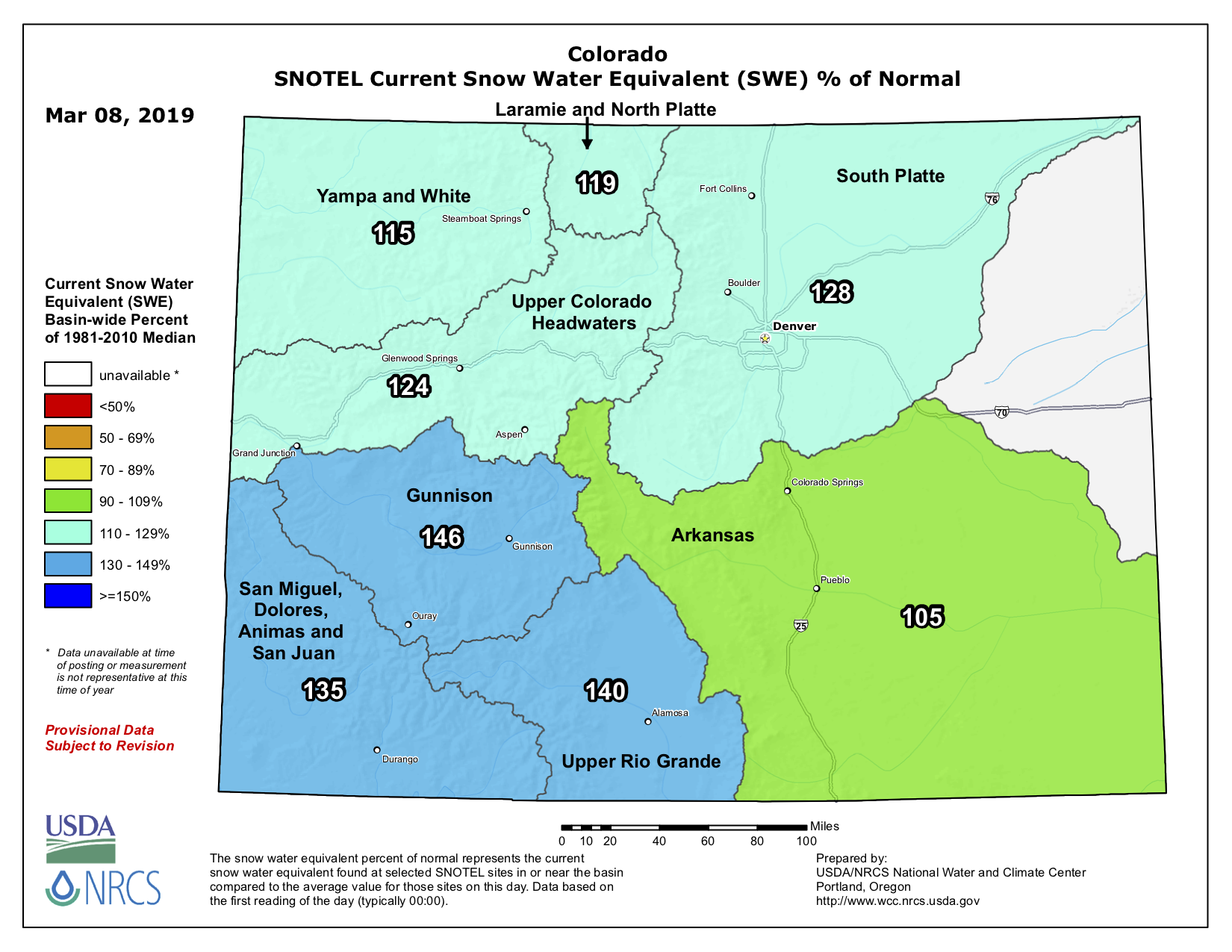
Colorado statewide basin-filled snowpack map March 8, 2019.

From KRDO.com (Chase Golightly):

While things seem chaotic in the North West, Colorado Springs and Pueblo could reap the benefits as winter moves out.

The planning supervisor for water conservation at Colorado Springs Utilities Kalsoum Abbasi says all this snowfall in our area and especially on the western slope where Colorado Springs gets 60 percent of it’s water, is comforting. Especially after last years drought. “It’s definilty a relief to see a lot more snow pack than last year,” Abbasi says, “last year at this time things didn’t look so great so.”

With more water coming in, Springs Utilities is able to fill its 25 reservoirs. Preparing us for the upcoming dry months, knowing there will be enough water to get us through it. Abbasi says, “It’s nice to have a recovery year where we are seeing the snowpack increase and we can refill our reservoirs and know that we are going to go into the summer in really good shape.”

The rain and snow hopefully helping to reduce fire danger as well.

Security files suit against Air Force over water contamination –Pueblo Chieftain

Photo via USAF Air Combat Command

From the Pueblo Chieftain (Peter Roper):

It’s been nearly three years since the U.S. Air Force acknowledged that toxic chemicals from Peterson Air Force Base contaminated groundwater under the city of Security, forcing it to stop using well water that served its 19,000 customers.

This week, Security officials and the Pikes Peak Community Foundation answered with a federal lawsuit in Denver asking for nearly $19 million in damages from ongoing contamination.

What’s causing it isn’t in doubt. A military firefighting foam that contains perfluorinated chemicals has been seeping into groundwater south of Peterson AFB since 1970 and has contaminated the underlying Widefield and Windmill Gulch aquifers.

Air Force officials confirmed the contamination in an August 2016 study, and the Security Water District stopped using its 24 groundwater wells the following month. Then, it began buying water through the Southern Delivery System pipeline from Pueblo Reservoir.

Despite the 2016 Air Force study, the lawsuit says the federal government rejected a claim for damages last year, forcing Security and the Pikes Peak foundation, a nonprofit charity, to sue for damages.

The water district has itemized $15.5 million in losses and expenses related to finding a new water supply for the community.

The foundation, which owns Venetucci Farms in El Paso County, is asking for $3.1 million in damages for losing access to water suitable for growing crops.

The lawsuit gives a detailed account of how Air Force officials used the firefighting foam at Peterson AFB since 1970. It was used mostly in training, though the Air Force also sprayed contaminated water over the base’s golf course. It was also poured into the Colorado Springs city sewers…

On Wednesday, representatives from the Defense Department testified before a House subcommittee about the extent of the problem. They said the foam’s chemicals have been found in more than 560 public and private water systems nationally.

Living up to the snowpack hype – News on TAP

By March 7, Denver’s Colorado River collection system had reached the monthly average for snow water equivalent.

Source: Living up to the snowpack hype – News on TAP

#Drought news: Widespread precipitation is erasing aridity across #Colorado

Click here to go to the US Drought Monitor website. Here’s an excerpt:

Summary

Bitterly cold conditions settled over central portions of the nation, while stormy weather prevailed over parts of the eastern and western U.S. The Southeastern rain afforded localized relief from dryness, while a continuation of the west’s stormy weather pattern brought more drought relief to locales from the Pacific Coast into the Rockies. In contrast, short-term dryness intensified across the southcentral U.S., in particular central Texas…

High Plains

Most of the High Plains remained free of dryness and drought, with a moderate to deep snowpack coincident with temperatures averaging more than 20°F below normal. However, western portions of this region (notably, the mountains) continued to experience significant recovery from long-term Moderate (D1) to Severe (D2) Drought. During the 7-day monitoring period, precipitation totaled 1 to locally more than 3 inches (liquid equivalent) from the Park Range in northern Colorado to the San Juan Mountains in the south. Water-year precipitation has totaled 100 to 150 percent of normal, and mountain snow water equivalents (SWE) are in the 75th to the 100th percentile, indicative of favorable spring runoff prospects. The lingering drought remains most apparent in the longer term, with 24-month precipitation still averaging 50 to 75 percent of normal in the region’s D1 and D2 areas…

West

The ongoing recovery from long-term drought continued over much of the west, though dry conditions lingered over northern- and southern-most portions of the region.

In the Four Corners States, locally heavy precipitation (1-4 inches, locally more) in northern portions of the region afforded relief from Moderate to Extreme Drought (D1-D3) from the central Rockies into northern New Mexico. Water-year precipitation has totaled an impressive 110 to 225 percent of normal over most of the Four Corners, with below-normal precipitation confined to southwestern and northwestern New Mexico. Spring runoff prospects are likewise favorable, with mountain snow water equivalents (SWE) currently at or above the 70th percentile, save for subpar SWE in the Gila Mountains. The Four Corner’s drought is mostly apparent in the longer-term, with 24-month precipitation averaging 55 to 75 percent of normal in the region’s core drought areas.

Farther north, heavy rain and mountain snow continued to slam locations from the northern California Coast into the northcentral Rockies. Precipitation over the past 7 days totaled an impressive 2 to 10 inches (locally more) from San Francisco north into the southern Cascades and east to the Sierra Nevada. Outside of a few locales in the southern San Joaquin Valley and in the far north, almost all of California is now reporting precipitation surpluses for the water year. To further illustrate, California’s disappearing Moderate Drought (D1) was limited to small portions in the far north, while Abnormal Dryness (D0) was confined to relatively small sections in northern and southern portions of the state. The wet weather in the north has also afforded additional drought relief in southwestern Oregon, with water-year deficits nearly eradicated from Medford into the southwestern Harney Basin. Despite the overall wet weather pattern, the water year has featured sub-par precipitation (70-80 percent of normal) in the central and northern Cascade Range. Snowpacks are in good to excellent shape in the Sierra Nevada (80th-98th percentile), southern Cascades (60th-92nd percentile), and from the Great Basin into the northcentral Rockies (55th-100th percentile). Conversely, subpar snowpacks remained a concern in the northern Rockies (locally below the 20th percentile) and northern Cascades (10th-30th percentile)…

Looking Ahead

A stormy weather pattern will continue over much of the nation. A series of fast-moving Pacific storms will bring significant precipitation to most of the contiguous U.S., save for parts of the Gulf Coast States, southern California, and from the northern High Plains into the upper Midwest. Fresh snowfall is likely from the Cascades and Sierra Nevada into the Rockies, while another round of moderate to heavy snow may also blanket locales from the central High Plains into the Great Lakes Region. Potentially moderate to heavy rain is also in the offing from the southern Plains into the lower Ohio Valley. The NWS 6- to 10-day outlook for March 12–16 calls for above-normal precipitation across the entire nation, except for drier-than-normal conditions from California into the northern Rockies. Colder-than-normal weather over the western half of the nation will contrast with above-normal temperatures east of the Mississippi.

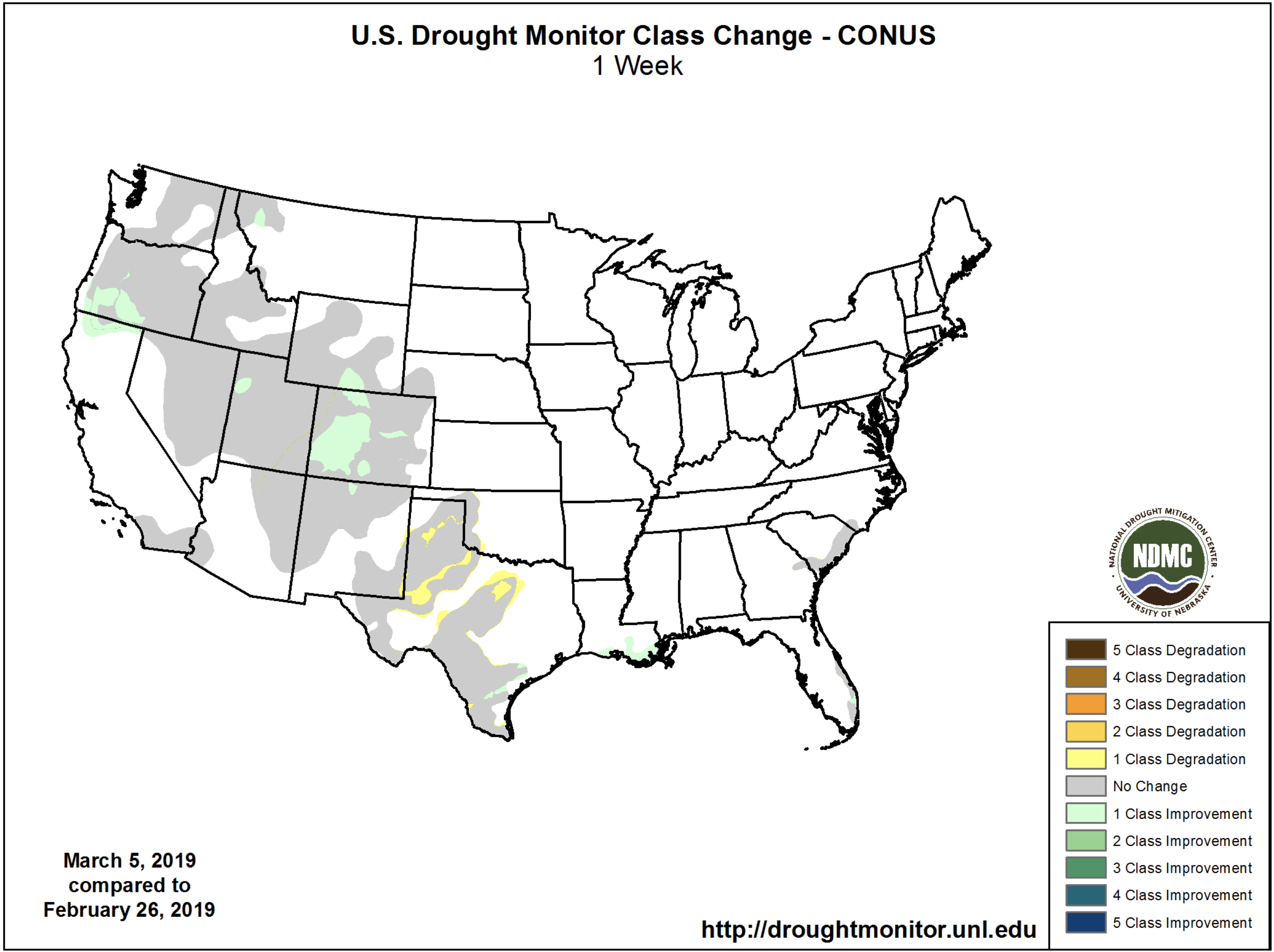
US Drought Monitor one week change map ending March 5, 2019.

San Juan #Snowpack 2019: Big, but not the biggest (yet) — Jonathan Thompson (@jonnypeace) #ColoradoRiver #COriver #aridification

From RiverOfLostSouls.com (Jonathan Thompson):

Photo credit: http://riveroflostsouls.com

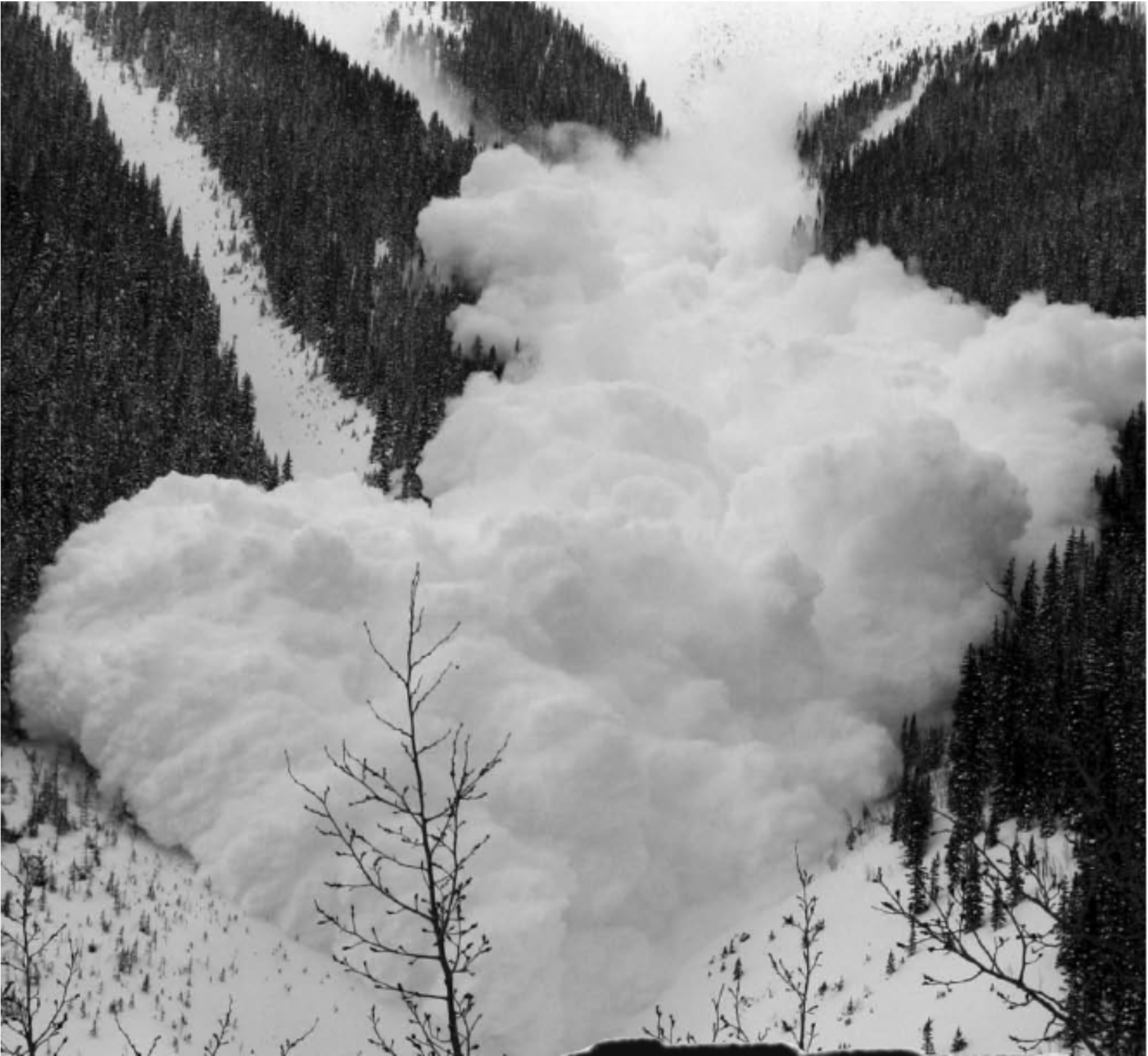
Let there be no doubt: It has been a snowy winter in the San Juan Mountains in southwestern Colorado, along with the rest of the state and much of the nation. Six people have been killed in Colorado avalanches, three of them in the San Juans. The highways leading into Silverton have been closed multiple times this winter due to avalanches, and Red Mountain Pass remains shut and buried with miles of slide debris as I write this early on March 7. Skiing, by all accounts, has been fantastic. If someone were to have gone into hibernation a year ago in the San Juans, and had just woken up today, they’d probably think they had been transported into a completely different world.

A CDOT driver clears debris from the East Riverside slide south of Red Mountain Pass in early March. This slide is the deadliest on Hwy 550 between Durango and Ouray. In the ’60s a reverend and his two daughters were killed here, and plow drivers were killed by the Riverside in ’78 and ’92, not long after the (too-short) snowshed was built. Courtesy Colorado Department of Transportation.

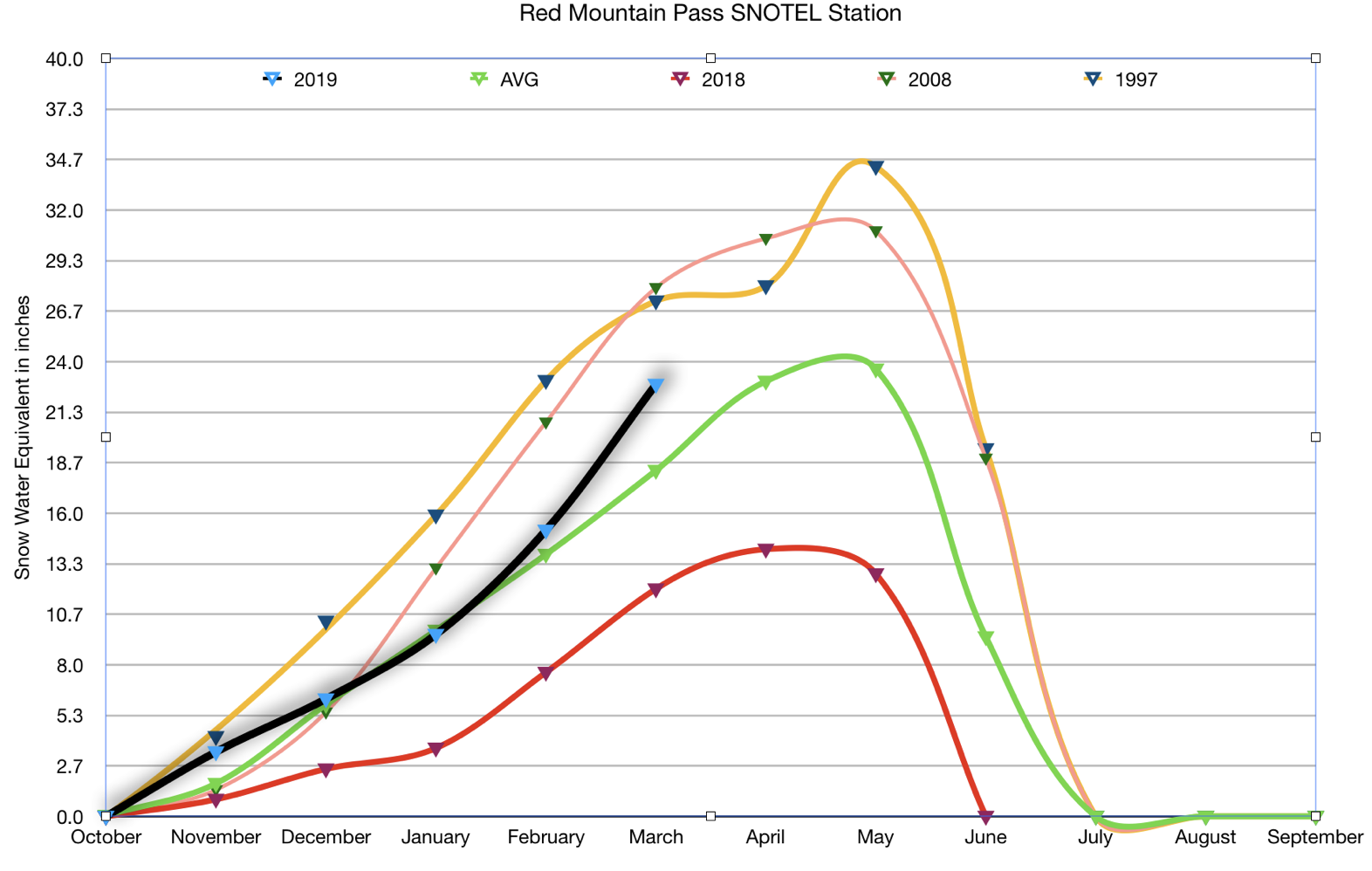
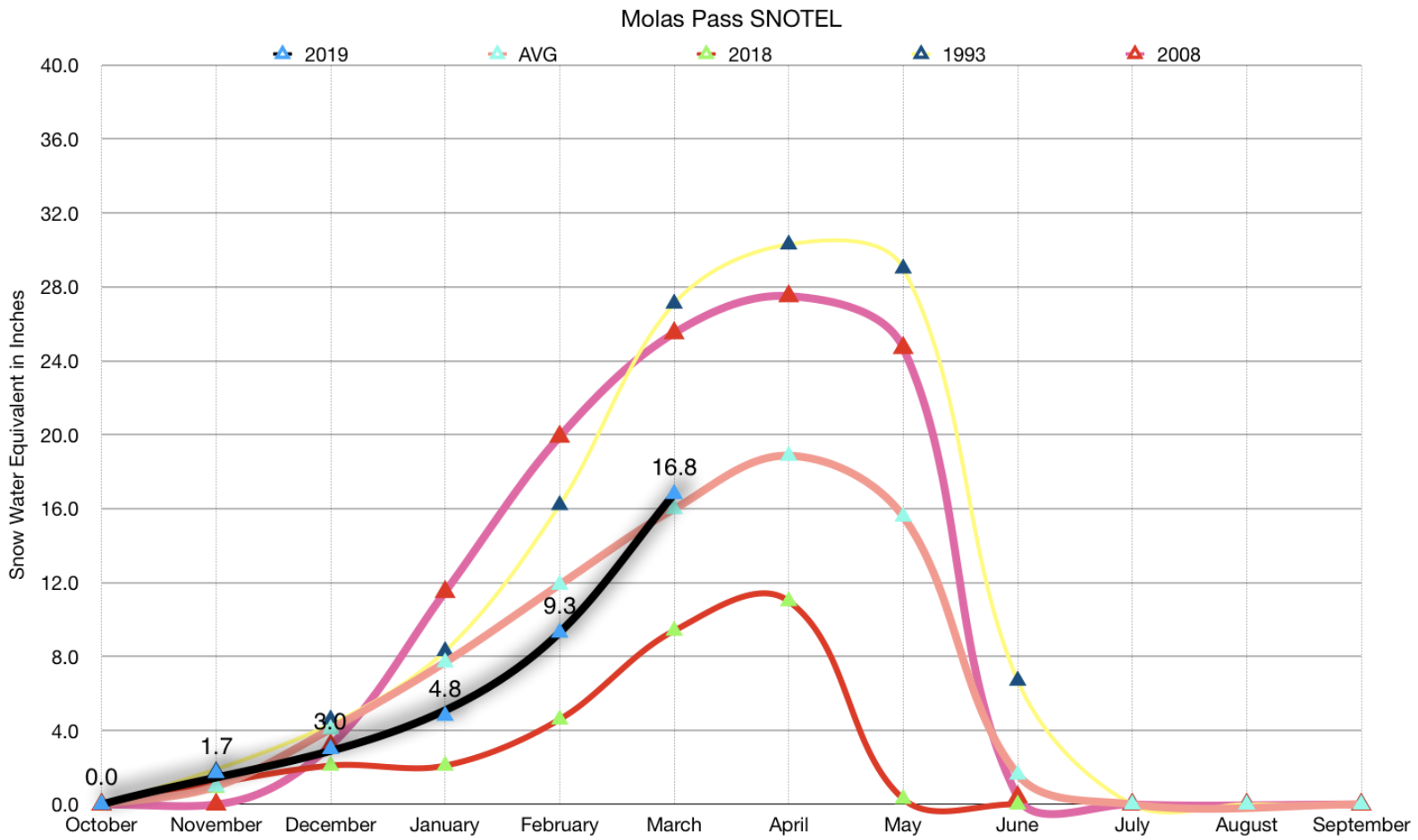
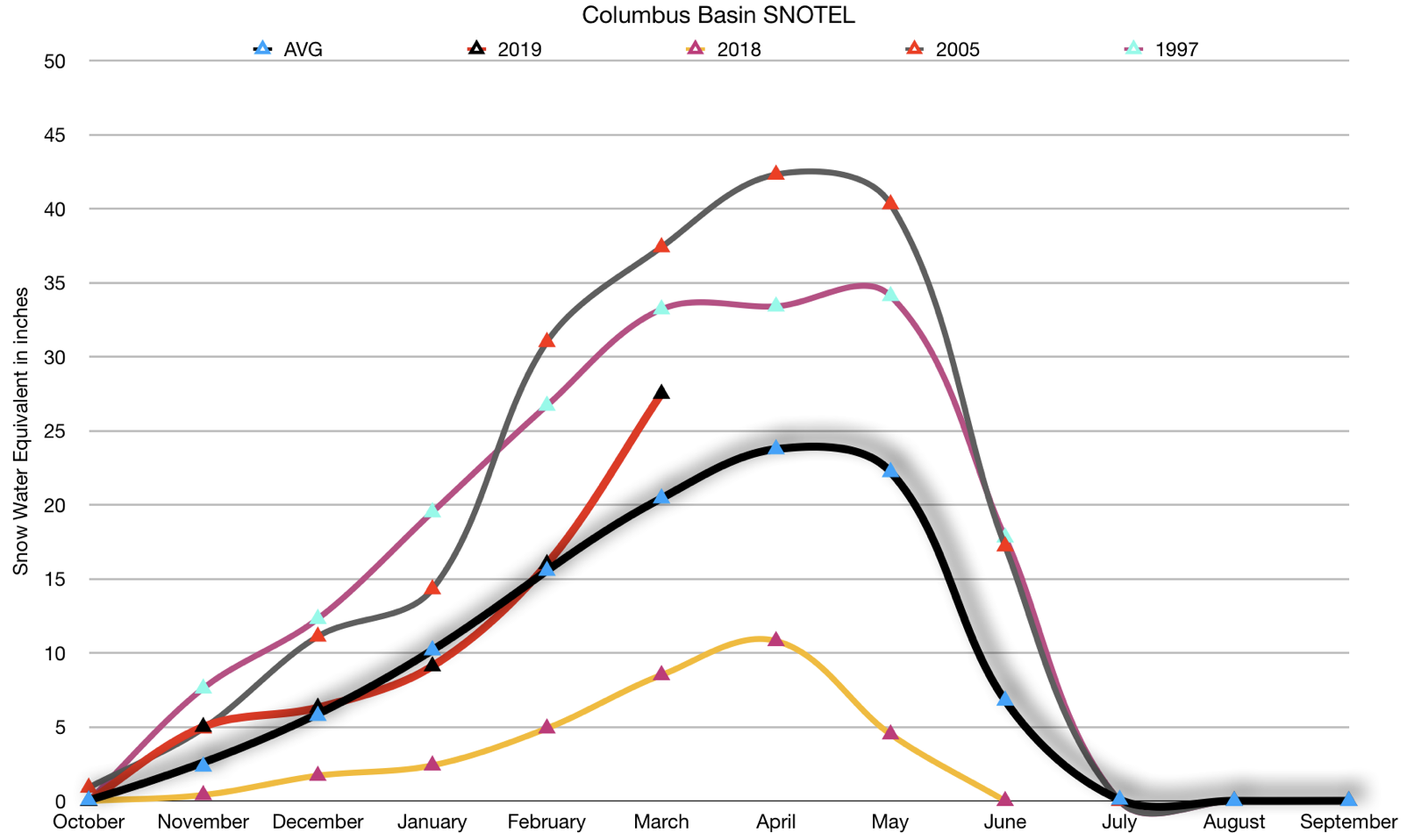
And yet, according to data from a sampling of SNOTEL stations across the San Juans, the March 1 snowpack still did not crack the top three highest levels on record, even though the SNOTEL records only go back less than four decades. Yeah, I know, those of you who have spent much of the winter shoveling out or catching sweet face shots are probably wondering what kind of Bulgarian weed this guy’s smoking. But I’m just the messenger, here, delivering data gathered by remote, automated, and perfectly sober stations, specifically those located near Molas Lake, on Red Mountain Pass, and in Columbus Basin in the La Plata Mountains.

The graphs below show this water year’s snow water equivalent for the first of each month so far, average level for the period of record, 2018 levels, and the two highest snowpacks on March 1 during the period of record.

Red Mountain Pass is so far seeing its 8th heaviest snowpack for 3/1 since 1981.
We’re not sure what’s going on at Molas, where the SNOTEL station showed the March 1 snowpack sitting at average levels. This year is at 14th biggest snows since 1987.
While the snowpack is sitting well above average at Columbus Basin, it remains far below previous years, sitting in sixth place since 1995.

The main takeaways: • The snowpack, i.e. the snow water equivalent, is sitting well above average for the period of record for each station. • The snow water equivalent for each station is currently about two times what it was a year ago. • A lot more snow will have to fall in order to make this the biggest winter on record.

And now for some caveats: • These graphs show snowpack levels at the first of the month, and all three of the sample stations have received two to three more inches of SWE since then in massive early March storms, which could have boosted this year’s ranking a bit. • I chose these three stations because they sit at a high altitude (and had values > 0 last year), and because they are geographically diverse. It’s possible that lower elevation stations have more snow this year than they ever have. I’ll look into that for a future post. • These data are merely for the amount of water in the snow at a specific point of time. They do not necessarily reflect total snow accumulation for the water year. It’s possible that more snow has fallen than in “bigger” years, but that warmer temperatures have melted it. I’ll also look into how this winter’s temperatures compare to previous years in a future post.

#Colorado Water Supply Outlook Report March 1, 2019 — NRCS #Snowpack #Runoff

Click here to read the report. Here’s an excerpt:

February Provides Substantial Increases to Colorado Snowpack — NRCS

Here’s the release from the NRCS (Brian Domonkos):

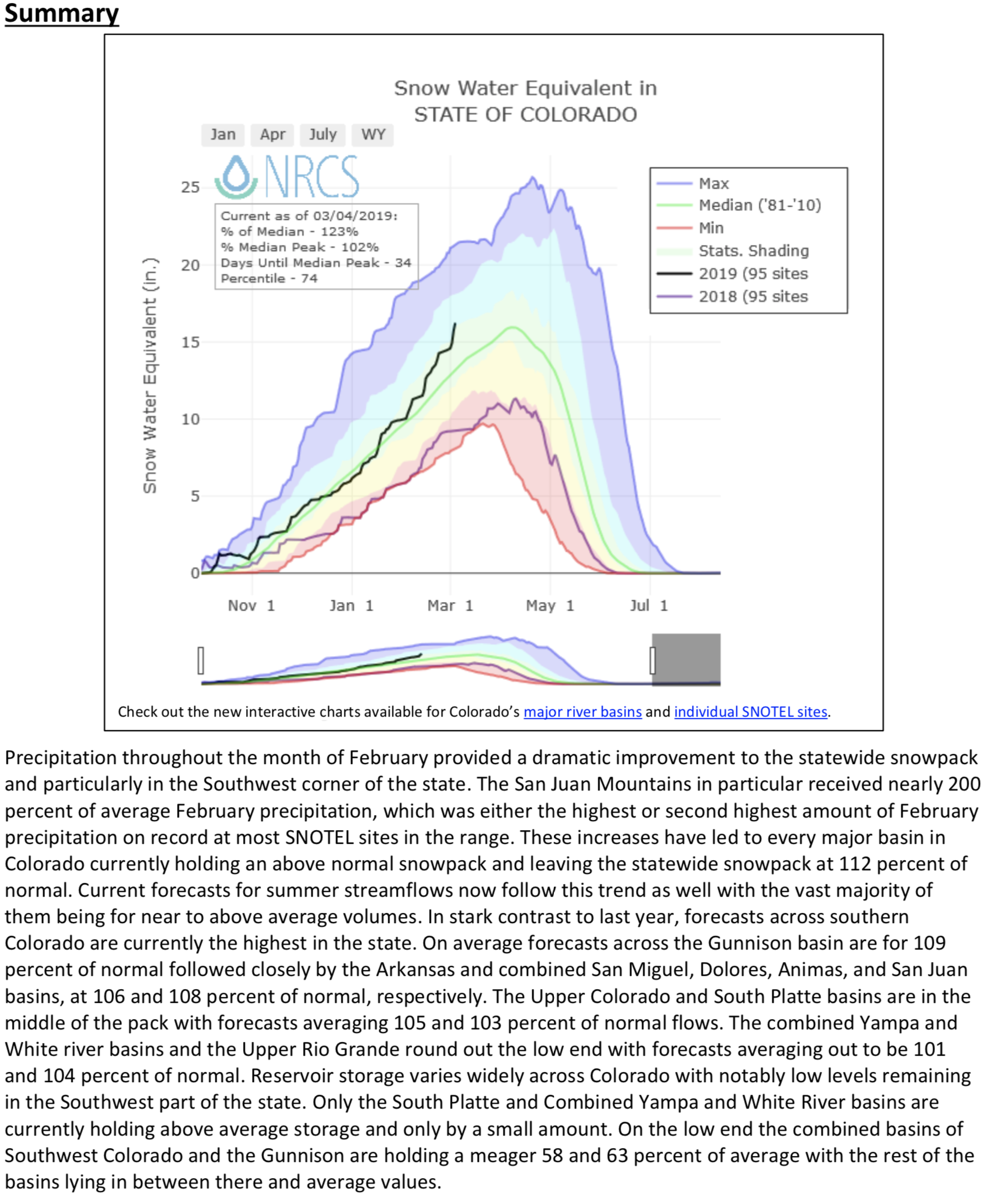
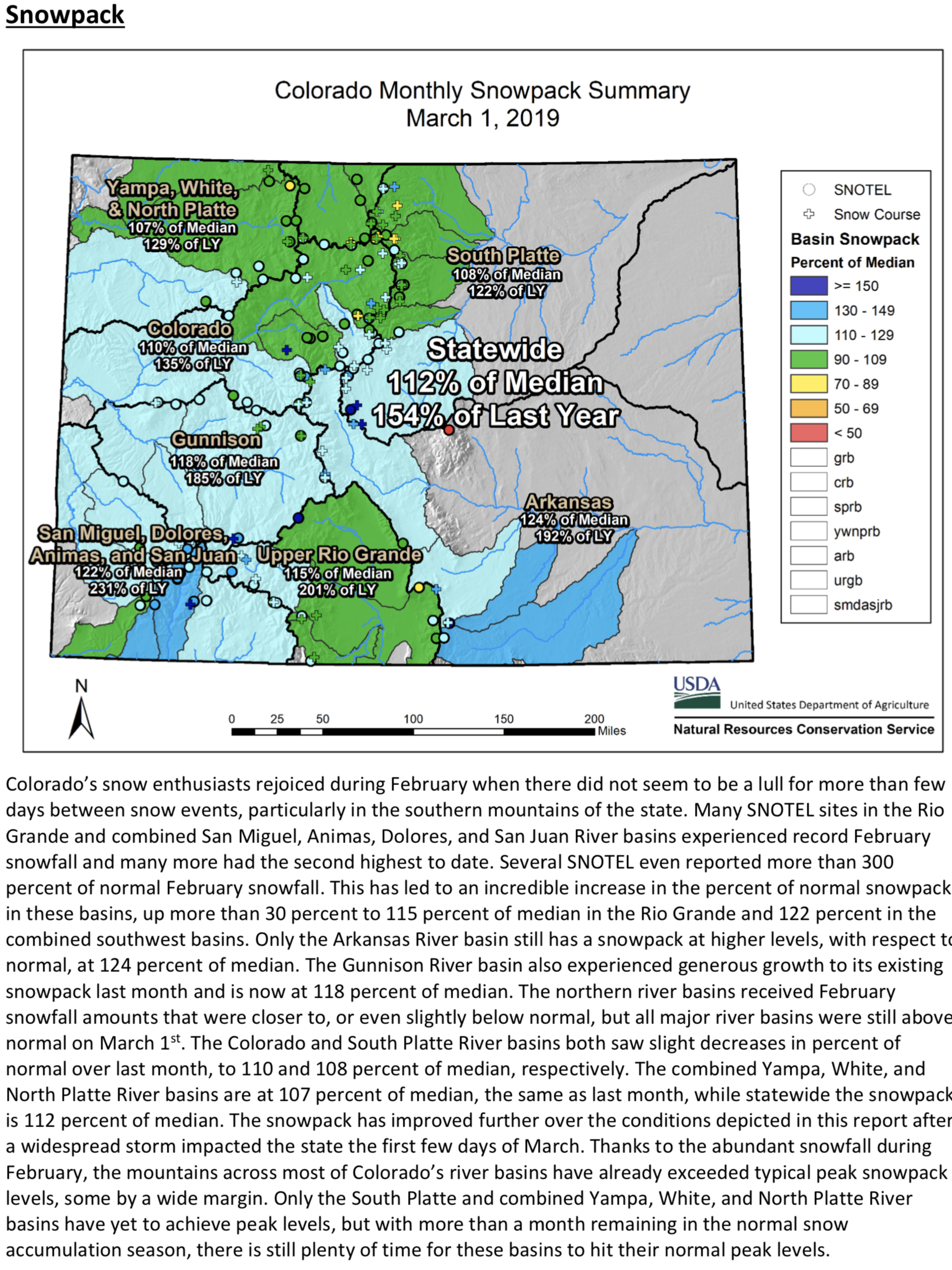
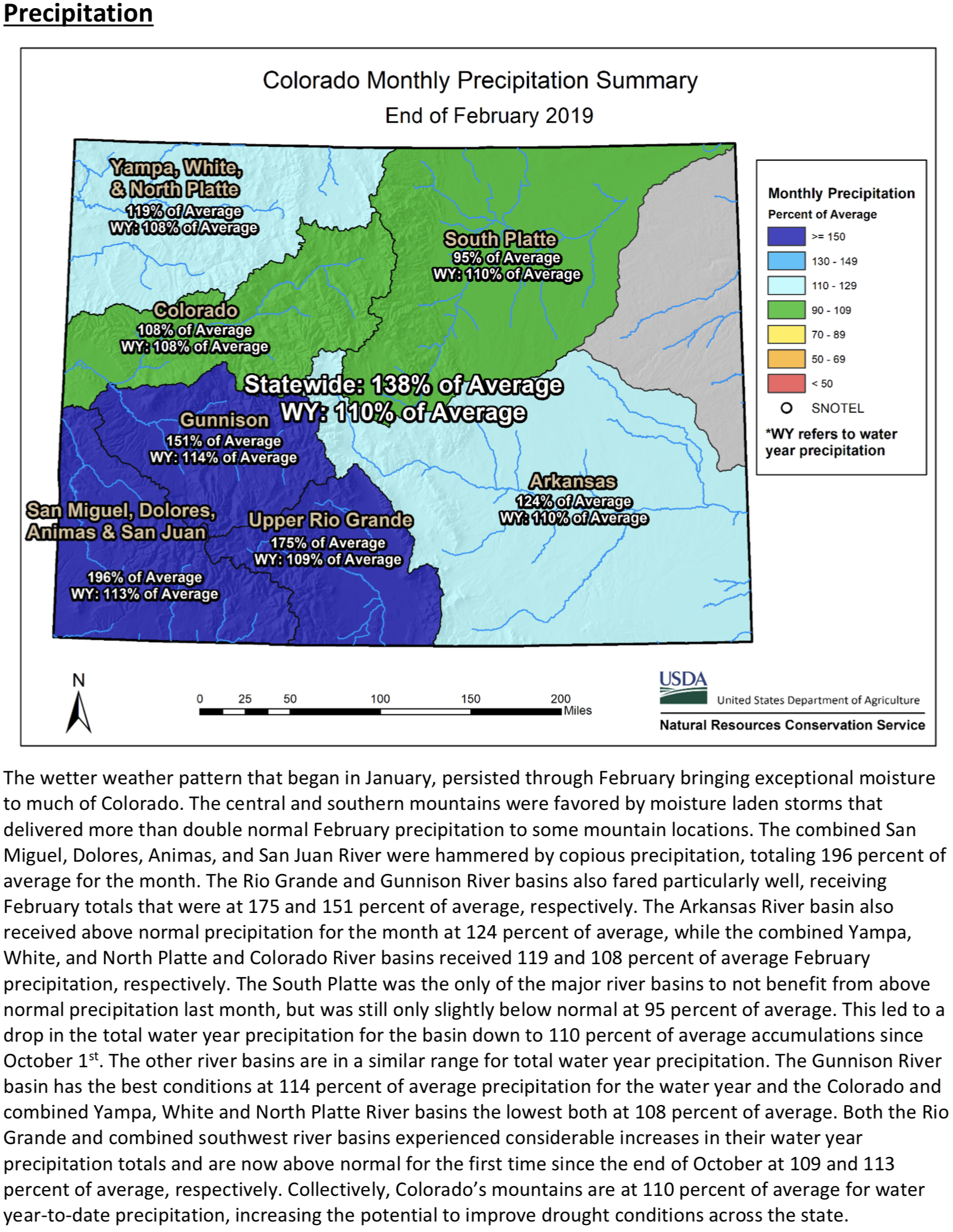
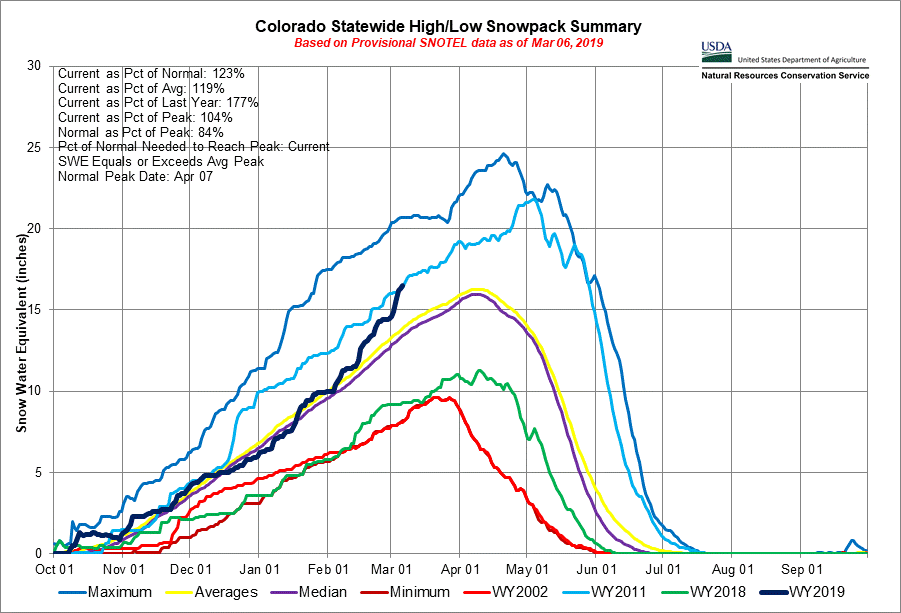
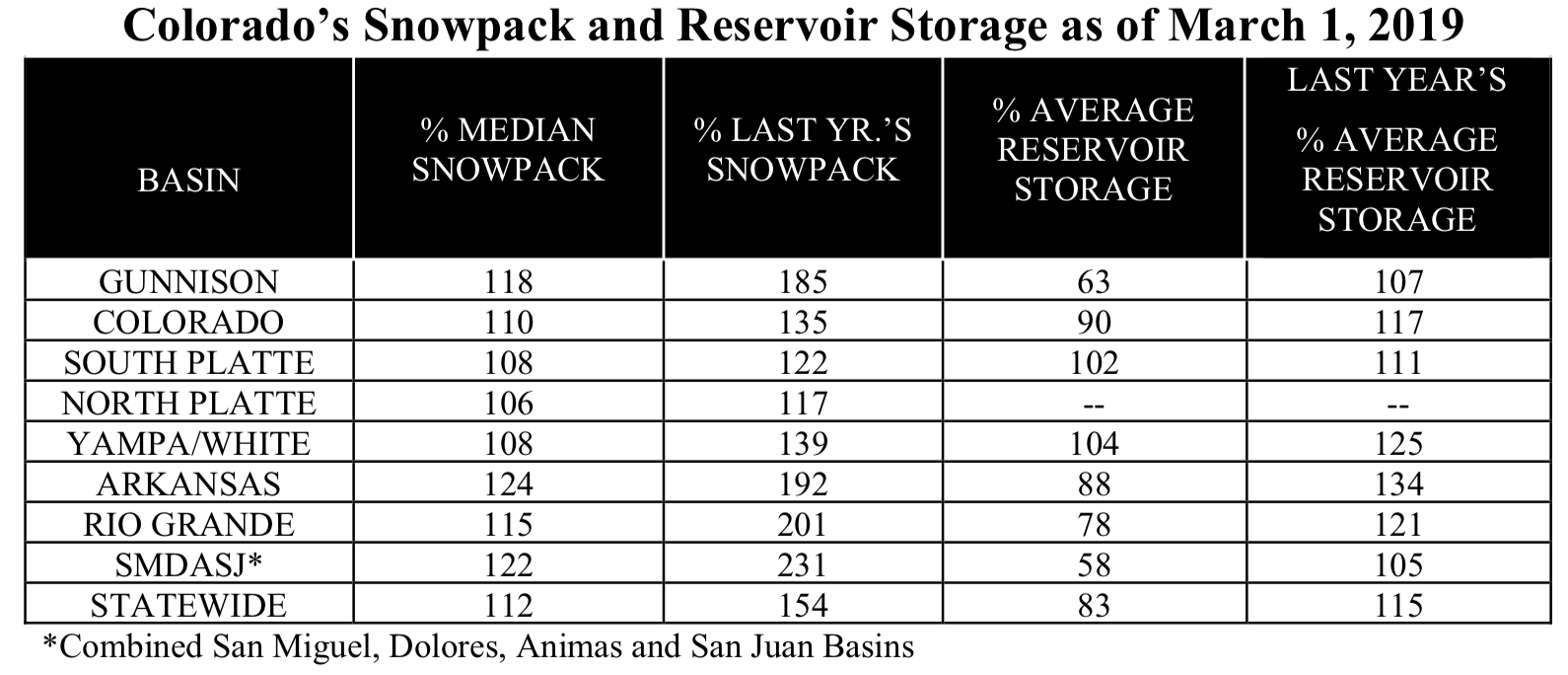
The month of February brought ample precipitation across the state of Colorado with the South Platte basin being the only in the state that received below average monthly precipitation. The mountains of southwest Colorado fared particularly well. The combined San Miguel, Dolores, Animas, and San Juan basins received 196 percent of average precipitation followed by the Upper Rio Grande and the Gunnison at 175 and 151 percent, respectively. This is great news for those basins after last year’s extremely low streamflows led to depleted reservoir storages going into winter. “Recent storms have led to every major basin in Colorado currently holding above normal snowpack. Additionally, statewide the snowpack has already risen to above the normal peak accumulation which commonly occurs the second week in April. This is good news for the summer water supply situation across Colorado.” notes Karl Wetlaufer, Hydrologist and Assistant Supervisor with the NRCS Colorado Snow Survey.

Statewide Basin High/Low graph March 6, 2019 via the NRCS.

Reservoir storage values remain highly variable across the state and the only basins currently holding above average storage levels are the South Platte and combined Yampa, White, and North Platte which are at 102 and 104 percent of normal, respectively. On the low end the combined San Miguel, Dolores, Animas, and San Juan basins have only 58 percent of average followed closely by the Gunnison at 63 percent. Wetlaufer continued, “Both of these basins are holding some of the lowest reservoir levels seen over the last several decades, so the recent snowfall is welcome news in those areas and will help to begin replenishing reservoir storage after the very low streamflows of 2018.”

Following the trend in snowfall, after this last month all major basins in Colorado now have above average water year-to-date precipitation. As of March 1st, all basins had received a very similar amount of precipitation since the beginning of October, relative to normal, in a range between 108 and 114 percent of average.

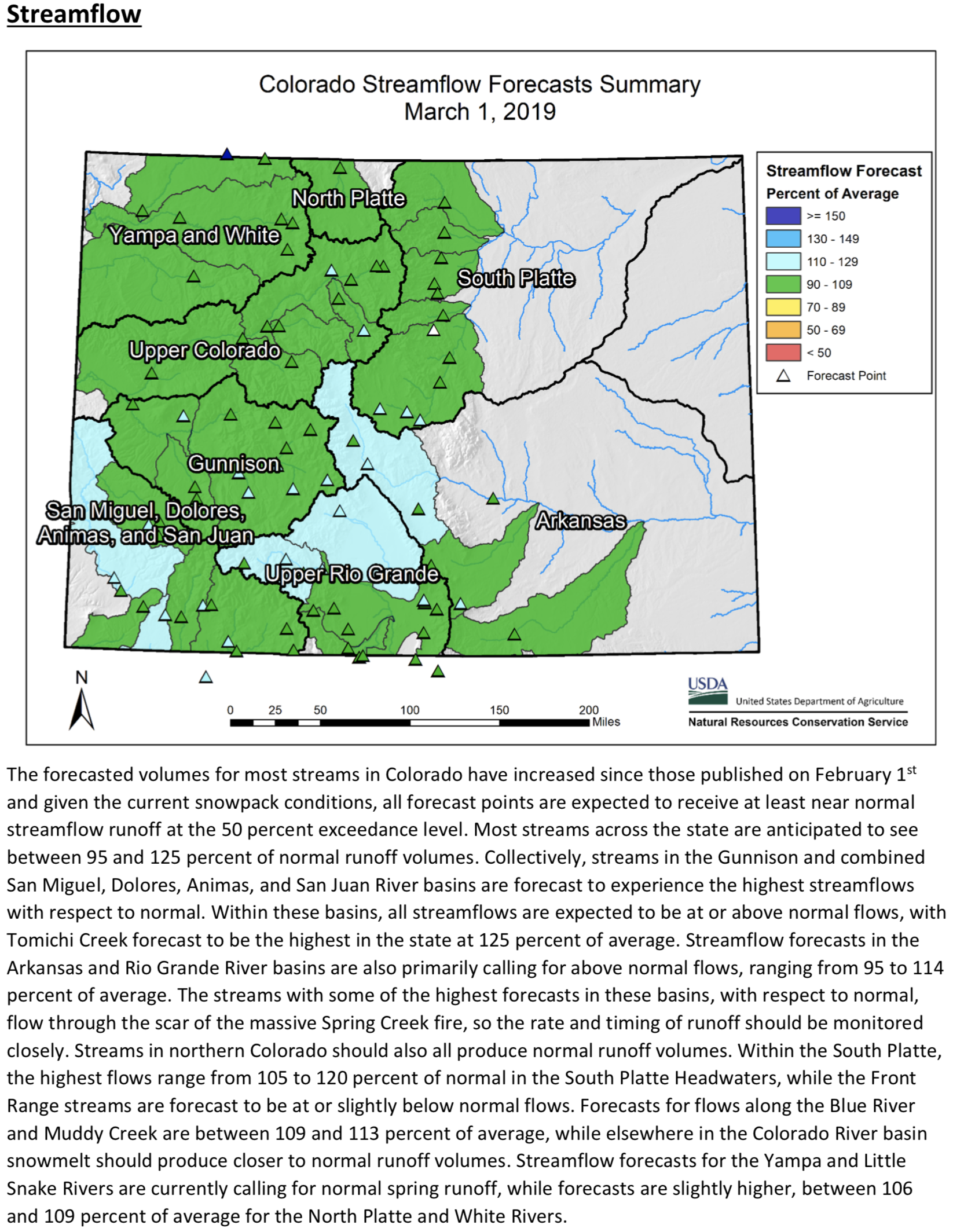
Streamflow forecasts in Colorado are currently for near to above average summer streamflow and in many areas the forecasts have notably increased over last month. On the high end the Gunnison basin as a whole is forecast to have 109 percent of average streamflow followed closely by the Arkansas and combined San Miguel, Dolores, Animas, and San Juan basins at 106 and 108 percent, respectively. The average of streamflow forecasts in the Upper Colorado basin is 105 percent of normal and 103 percent in the South Platte. On the low end, but still above normal is the combined Yampa and White River basins which are forecast to have 101 percent of normal flows and 104 in the Upper Rio Grande.

For more detailed information about March 1 mountain snowpack refer to the March 1, 2019 Colorado Water Supply Outlook Report. For the most up to date information about Colorado snowpack and water supply related information, refer to the Colorado Snow Survey website.

#Runoff/#Snowpack news: Huerfano County flood preparedness meeting recap

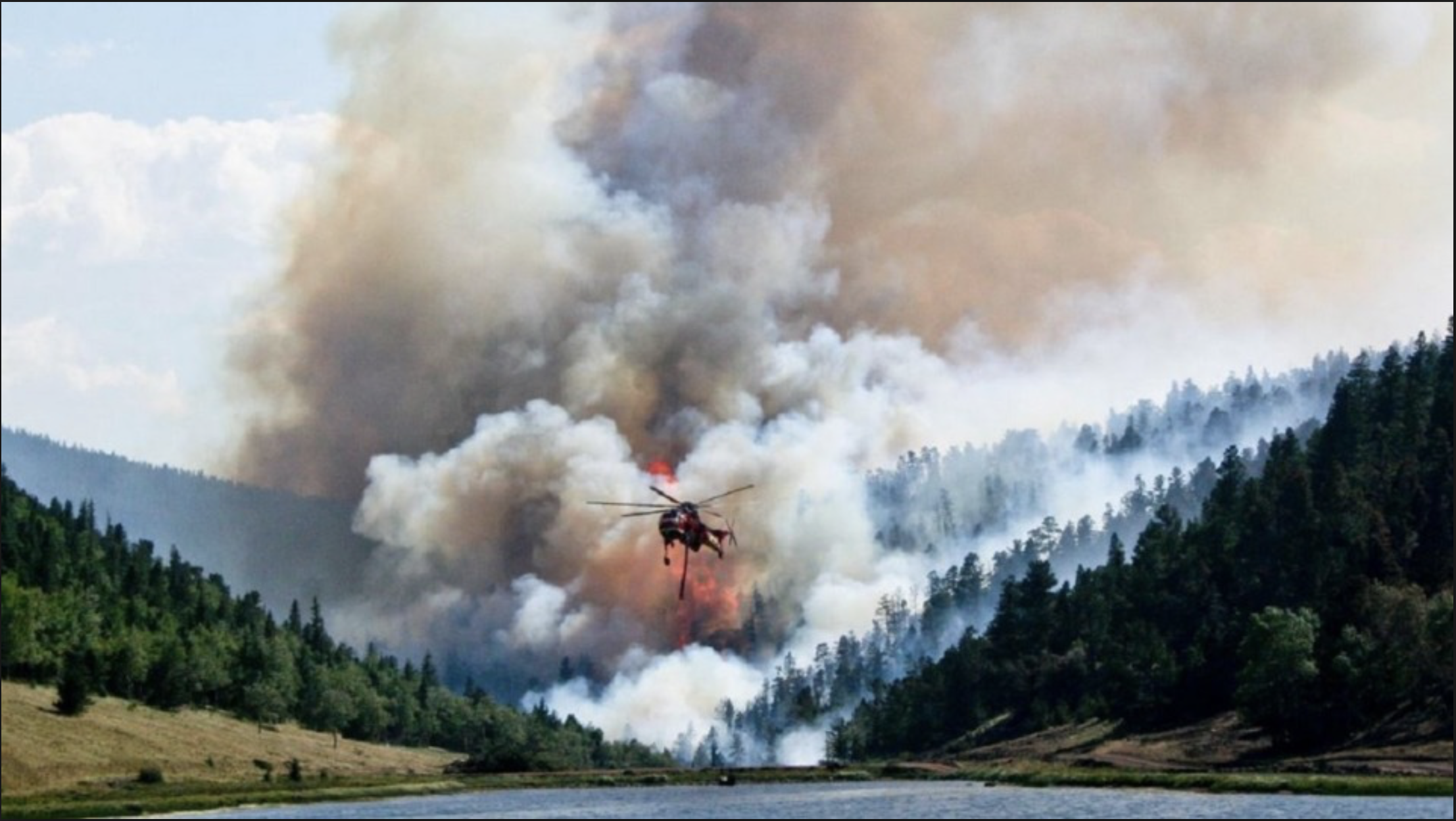
A firefighting helicopter flies in the foreground while the Spring Creek Fire (August 2018) rages behind it. Photo credit: El Paso County

From KOAA.com (Caiti Blase):

Residents in Huerfano County are preparing for the worst as major flooding could hit the region this year due to the huge burn scar left by the 2018 Spring Creek Fire.

A flood preparedness meeting was held Wednesday night at the Fox Theatre in Walsenburg with dozens of people attending to find out what steps they need to take to get ready for potential flooding.

Officials are warning – whatever you thought you knew about flooding think again.

John Galusha, county administrator for Huerfano County, said, “The burn severity is the highest burn severity recorded in a fire in the United States ever.”

Last summer’s Spring Creek Fire may be over, but the damage it left behind is going to rear its ugly head in the coming months.

Galusha said, “We know that we’re going to have extreme runoff so it’s going to be 7-15 times higher than our average runoff.”

Thousands of homes in Huerfano County could be flooded either by rapid snow melt or monsoon season. The soil in this area was burned so deep during the Spring Fire that it will actually repel water.

From The Farmington Daily Times (Mike Easterling):

The abnormally dry conditions that have prevailed in the Four Corners region for the past year and a half, leaving most of San Juan County in a major drought, have shown signs of dissipating this winter.

But even with the snowpack in the southwest Colorado high country at an encouragingly high level, an official at the National Weather Service in Albuquerque is offering a mixed perspective on the region’s long-term moisture situation.

“That’s the big question,” Royce Fontenot, the senior service hydrologist for the NWS office in Albuquerque, said today. “Do we balance the stronger short-term upswing (in moisture) versus the longer-term deficit?”

Fontenot said the NWS is nowhere near ready to declare an end to the drought.

“We’re cautiously optimistic we’re going to continue to see improvement, but we’re still looking at the long-term drought and the damage it has done to the system.”

Dry conditions settled in over San Juan County in early October 2017, Fontenot said, resulting in a devastatingly dry winter of 2017-2018 and a poor monsoon season last summer. Over the past 17 months, the county has received only 55 percent of its normal moisture, and that has left most of the county locked in varying stages of drought, according to the U.S. Drought Monitor.

The far west edge of the county is in a severe drought, the third-worst classification. Most of the rest of the county is in extreme drought, the second-worst classification. And an oval-shaped patch extending east from Farmington to the Rio Arriba County line is in an exceptional drought, the worst stage. That classification is typified by exceptional and widespread crop/pasture loss and shortages of water creating water emergencies.

But Fontenot said conditions have improved over the last 90 days. Over that period, the normal amount of precipitation the Farmington area would have expected to see was 1.65 inches. Instead, he said, it has gotten. 2.97 inches — 180 percent of normal…

Even more moisture has fallen in the mountains of southwest Colorado, the watershed that feeds San Juan County’s rivers. According to the U.S. Department of Agriculture’s Colorado SNOTEL website, the snowpack in the San Miguel, Dolores, Animas and San Juan rivers watershed was 131 percent of median today, the wettest region in all of Colorado…

Windy conditions can disperse much of that snow, and it can simply evaporate, Fontenot said. And if it turns warm too quickly this spring, the snowpack can all melt at once, sending much of that moisture downstream before it can be used.

Another factor working against the region, he said, is the soil moisture content. The period from October 2017 to December 2018 was so dry, he said, that much of the snow that has fallen from the sky won’t wind up in a river as it normally would.

From The Associated Press (John Antczak):

California is drenched and its mountains are piled high with snow amid a still-unfolding winter of storms that was unimaginable just a few months ago.

Drought conditions have almost been eliminated, hills blackened by huge wildfires are sporting lush coats of green, and snow has fallen in the usually temperate suburbs of Southern California, where chilly conditions have made jackets and scarves the rule…

Blizzards have pounded the Sierra Nevada, burying the towering mountain range in massive amounts of snow. On the eastern side of the range, for example, the Mammoth Mountain resort reported nearly 47.8 feet (14.5 meters) of snow at the summit so far this season.

While frequently disrupting travel, the storms stoked a big part of the state’s water supply — the Sierra snowpack that melts and runs off into reservoirs during spring and summer.

The California Department of Water Resources reported Thursday that the Sierra snowpack is now 153 percent of average to date.

A manual measurement at Phillips Station off U.S. 50 near Sierra-at-Tahoe found a snow depth of 113 inches (287 centimeters) and a snow water equivalent of 43.5 inches (110.5 centimeters), more than double what was recorded there in January.

Phillips Station is where then-Gov. Jerry Brown attended a snowpack survey in April 2015 that found a field barren of any measureable snow. Brown later ordered Californians to use less water. On Thursday, the department was unable to livestream the measurement because stormy weather cut the cell connection…

Where it hasn’t snowed, there has been rain, and a lot of it.

Nearly 21 inches (53.3 centimeters) of rain fell in 48 hours this week near the Northern California wine country city of Guerneville, where the Russian River was slowly receding Thursday after extensive flooding…

The U.S. Drought Monitor reported Thursday that more than 87 percent of California was now free of any level of drought or unusual dryness. Just 2.3 percent — along the Oregon border — was in moderate drought, and the remainder was in a condition called abnormally dry.

Three months ago, nearly 84 percent of the state was in moderate, severe or extreme drought, and the rest was abnormally dry.

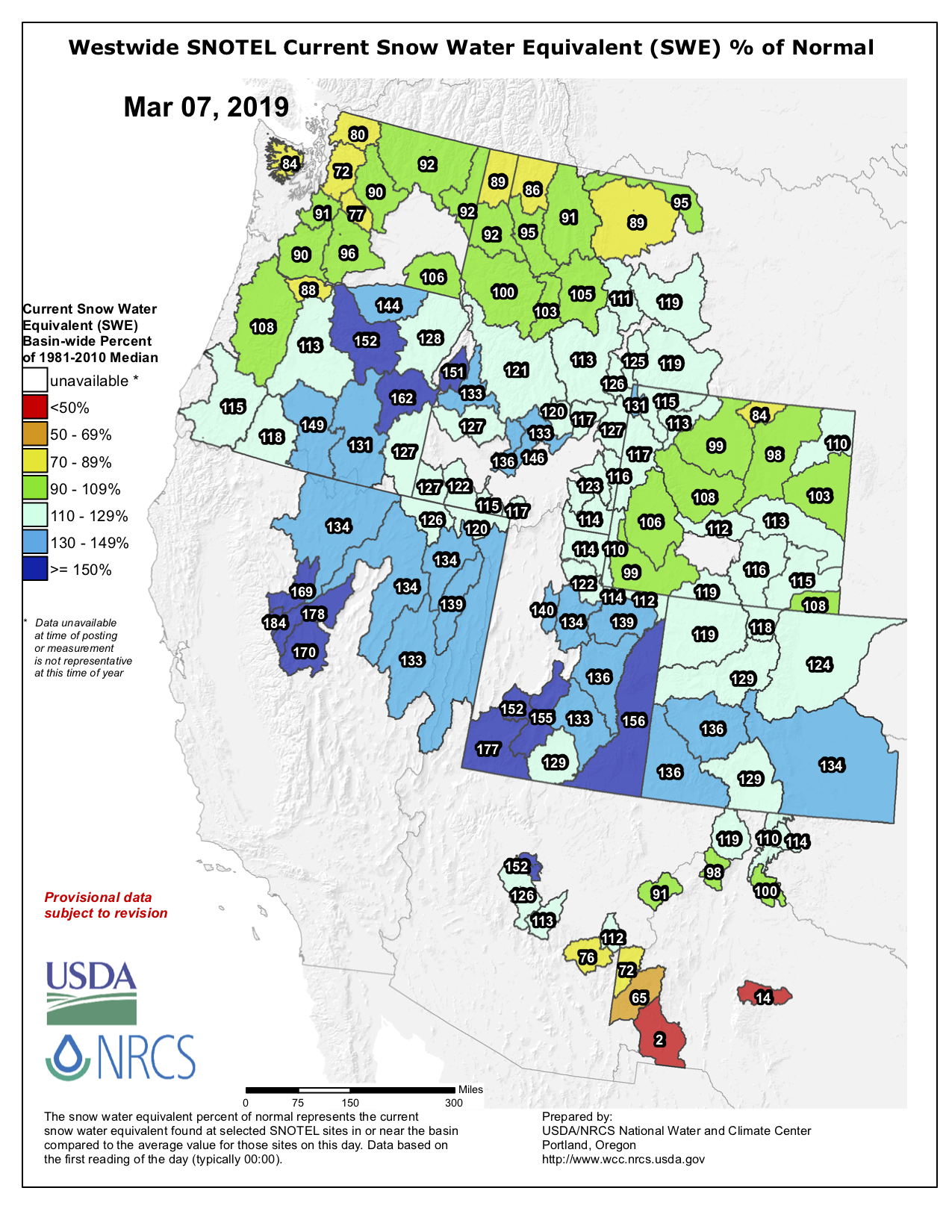
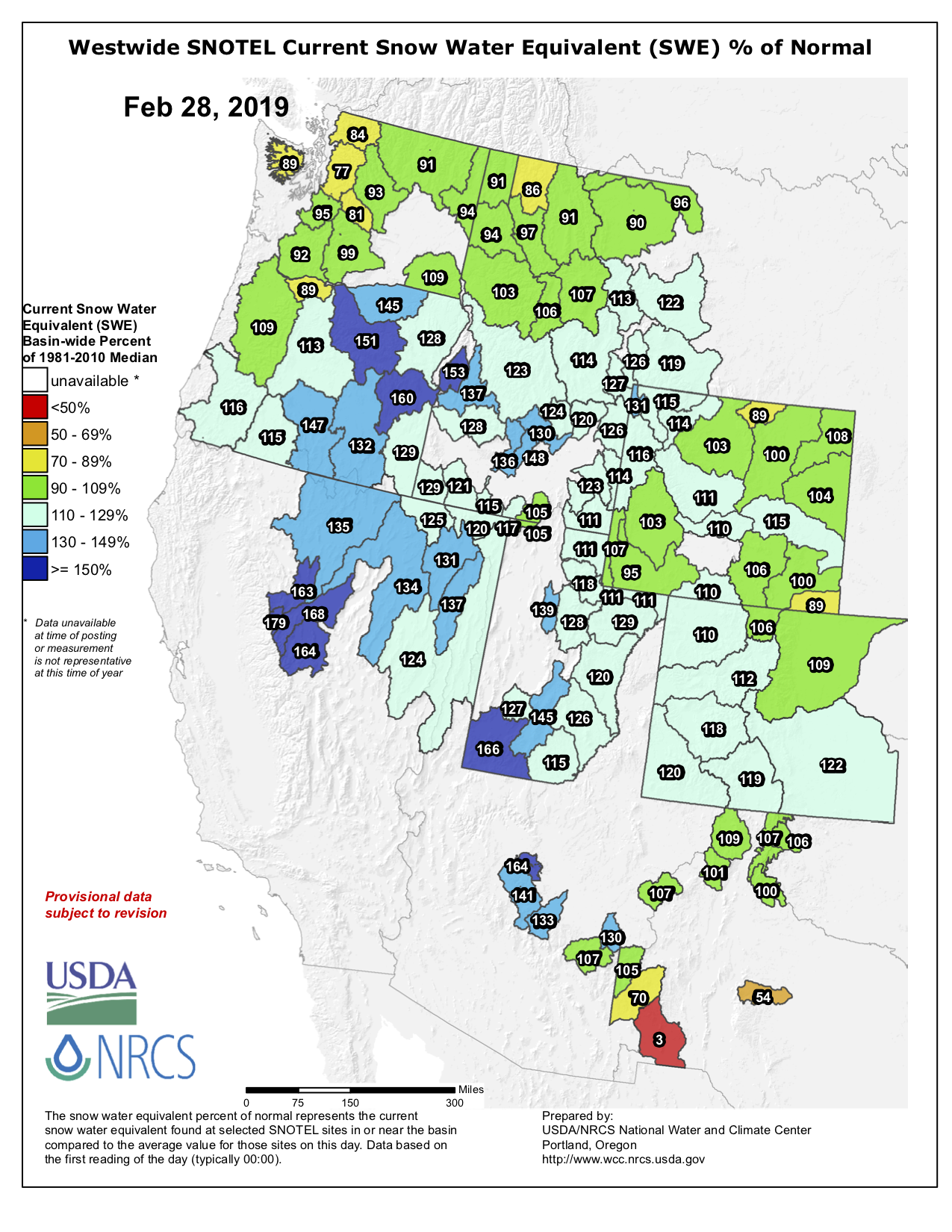
Westwide SNOTEL basin-filled map March 7, 2019 via the NRCS.

2019 #COleg: SB19-184 (Authority Colorado Water Institute Study Blockchain Technology) would authorize research of block chain applicability to markets, water banking, water rights, and administration

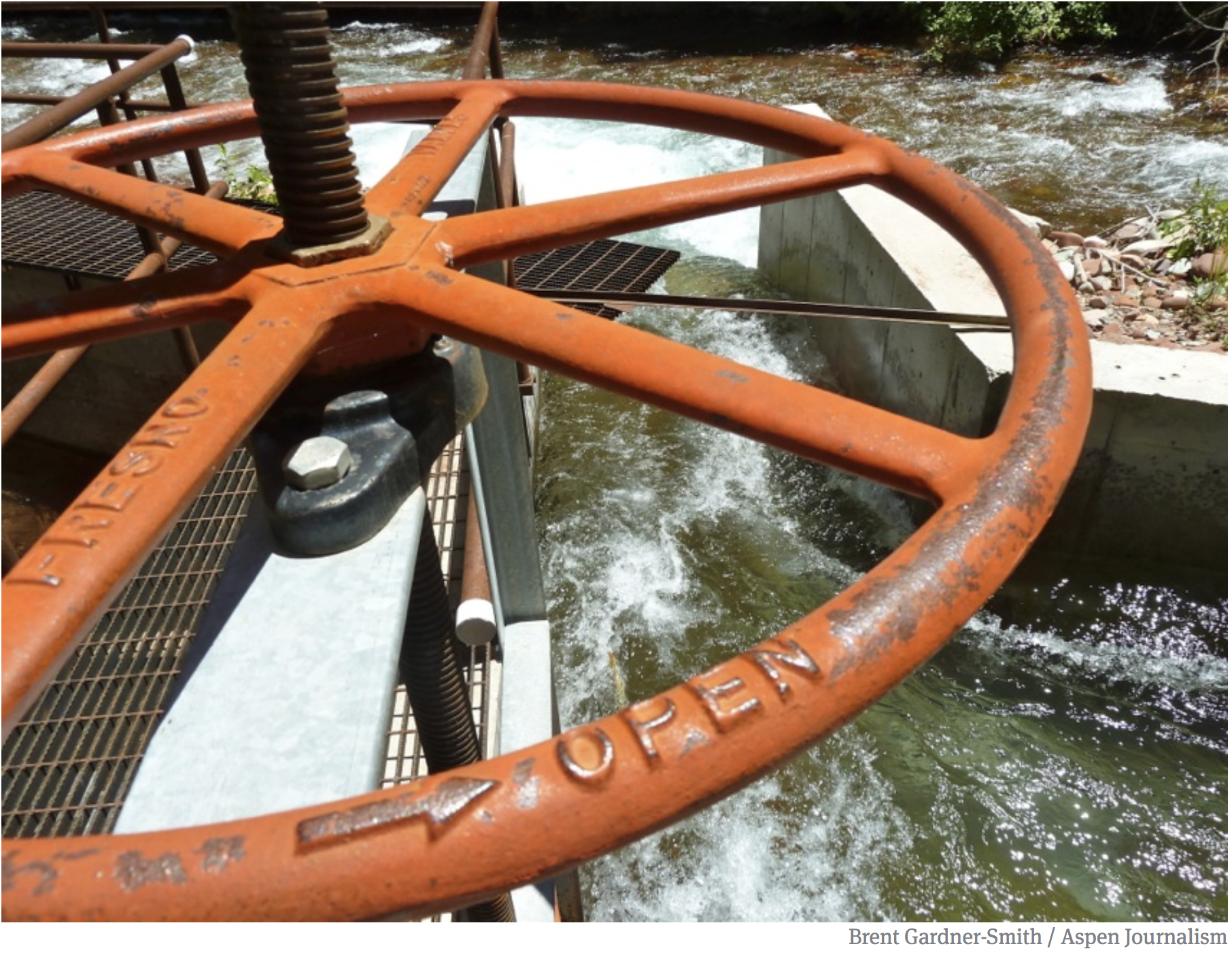
A headgate on an irrigation ditch on Maroon Creek, a tributary of the Roaring Fork River. Photo credit: Aspen Journalism/Brent Gardner-Smith

From CoinDesk.com (Yogita Khatri):

Lawmakers in Colorado want the U.S. state to study the potential of blockchain technology in water rights management.

Republican senator Jack Tate, along with representatives Jeni James Arndt (Democratic) and Marc Catlin (Republican), filed [SB19-184 (Authority Colorado Water Institute Study Blockchain Technology)] on Tuesday, proposing that the Colorado Water Institute should be granted authority to study how blockchain technology can help improve its operations.

The institute, an affiliate of Colorado State University, should study various use cases of blockchain tech, including water rights database management, the establishment of water “banks” or markets, and general administration, according to the bill.

The study would be carried out only after the institute has received enough money, and would be allowed to solicit and accept donations from private or public institutions for the purpose. The findings should later be reported to the general assembly, the lawmakers said.

The Colorado Water Institute has the mission to “connect all of Colorado’s higher education expertise to the research and education needs of Colorado water managers and users.”

2019 #COleg: #Colorado Senate Transportation and Energy Committee passes [SB19-181, Protect Public Welfare Oil And Gas Operations] 4-3 after 12 hours of testimony #KeepItInTheGround #ActOnClimate

Wattenberg Oil and Gas Field via Free Range Longmont

From The Greeley Tribune (Tyler Silvy):

The Senate Transportation and Energy Committee passed [SB19-181, Protect Public Welfare Oil And Gas Operations] on a 4-3, party-line vote after 12 hours of testimony from the public, government officials and industry officials…

The Colorado Senate Transportation and Energy Committee convened the first hearing for Senate Bill 19-181, dubbed Protect Public Welfare Oil and Gas Operations.

The bill would make a variety of changes to oil and gas law in Colorado, including the following:

  • It would change the mission of the Colorado Oil and Gas Conservation Commission from one of fostering oil and gas development to one of regulating the industry. It also changes the makeup of the COGCC board.
  • It would provide explicit local control on oil and gas development, opening the door for local government-instituted bans or moratoriums, which have previously been tied up in court battles because the industry has been considered one of state interest.
  • It would change the way forced or statutory pooling works, requiring a higher threshold of obtained mineral rights before companies can force pool other mineral rights owners in an area.
  • Testimony during the committee hearing ran the gamut, including state officials, industry officials, business interests and residents, and it was expected to go well into the night…

    Talking about the rallies beforehand — both pro-181 and anti-181 groups — as well as the overflow rooms necessary for all of the attendees, [Carl] Erickson said the scene was wild…

    Dan Gibbs, executive director of department of natural resources; and Jeff Robbins, acting director of the Colorado Oil and Gas Conservation Commission; both came out in support of the legislation.

    So, too, did Erin Martinez, who survived a home explosion in Firestone that killed her brother and her husband.

    “With proper regulations and inspections and pressure testing, this entire tragedy could have been avoided,” Martinez said in closing.

    The Senate Transportation and Energy Committee opened the hearing with testimony from Senate Majority Leader Steve Fenberg, the measure’s co-sponsor, according to reporting from The Denver Post.

    As he told The Tribune on Sunday, he said during the hearing that the Tuesday hearing was the first of several — with six total to come.

    “At the forefront, objective of this bill is to ensure that we are protecting the health and safety and welfare of Coloradans, the environment, wildlife, when it comes to extraction of oil and gas across the state,” said Fenberg, D-Boulder, according to The Post.

    #NM sues @usairforce over #PFAS pollution

    View of Alamogordo, New Mexico. By Foreverstocks – Own work, CC BY-SA 4.0, https://commons.wikimedia.org/w/index.php?curid=38802827

    From The New Mexico Political Report (Laura Paskus):

    On Tuesday, New Mexico Attorney General Hector Balderas and the New Mexico Environment Department (NMED) filed a complaint in federal district court, asking a judge to compel the Air Force to act on, and fund, cleanup at the two bases near Clovis and Alamogordo.

    “We have significant amounts of PFAS in the groundwater, under both Cannon and Holloman Air Force bases,” NMED Secretary James Kenney told NM Political Report.

    PFAS, or per and polyfluoroalkyl substances, are toxic, human-manufactured chemicals that move through groundwater and biological systems. Even in small amounts, exposure to PFAS increases the risk of testicular, kidney and thyroid cancer and problems like ulcerative colitis and pregnancy-induced hypertension.

    “We want the groundwater cleaned up in the shortest amount of time possible, and we think at this point litigation is our best and fastest approach,” Kenney said. NMED and the New Mexico Department of Health are continuing to collect groundwater samples, and the two agencies are also working closely with the state’s Department of Agriculture. “As soon as we have those results, which should be in the next couple of weeks, we will determine the best way [to engage with the community],” he said. That could mean public meetings or roundtable discussions in the communities.

    “I personally understand: It’s a bit scary, if you’re in those areas, to know there’s a groundwater issue and [to wonder], ‘How am I affected?” Kenney said. “We need to get some scientific data to get the answers to those questions.”

    Groundwater tests at Cannon Air Force Base near Clovis showed concentrations of PFAS exceeding 26,000 nanograms per liter, or more than 300 times the federal lifetime drinking water exposure limit. In off-base wells, including those that supply drinking water to dairies, levels ranged from 25 to 1,600 nanograms per liter. The human health advisory for a lifetime drinking water exposure to PFAS is 70 parts per trillion, or 70 nanograms per liter. At Holloman, contamination levels in some wells were 18,000 times the federal health advisory for PFAS.

    2019 #COleg (SB19-181): Ten Things You Should Know About #Colorado’s Oil and Gas Industry — @ConservationColorado #KeepItInTheGround

    Directional drilling from one well site via the National Science Foundation

    From Conservation Colorado (Audrey Wheeler):

    Here in Colorado, the oil and gas industry has had too much influence for too long while our communities and environment suffer.

    Over the last decade, communities across the state have found themselves with no power to stand up to the industry when drilling comes to their neighborhoods. The very agency that is supposed to regulate the industry also has a dual mission to “foster” industry growth. And hundreds of oil and other toxic spills related to drilling occur in Colorado every year.

    At the same time, the oil and gas industry has cut corners when it comes to Coloradans’ health and safety. They’ve built industrial operations in residential neighborhoods, ignoring community complaints even during the most egregious examples, such as in Battlement Mesa, with a pad 350 feet from homes. Companies have spent tens of millions on public campaigns and elections. As a result, nearly every commonsense policy to keep the industry in check has failed.

    But with new leadership in the governor’s office and the state legislature, we have the chance to make a change.

    A bill announced [February 28, 2019] by Governor Polis, Senate Majority Leader Steve Fenberg, and House Speaker KC Becker would protect public health and safety, give more power to local governments, and enact new protections for our environment. We’re overdue for reforms like this to our state laws.
    Here are 10 reasons why these reforms are urgent for Colorado:

    Oil and gas operations pose a threat to our health and safety.

    1. Our state has had at least 116 fires and explosions at oil and gas operations from 2006 to 2015.

    2. After the deadly explosion in Firestone that killed two people, former employees of Anadarko accused the company of sacrificing safety to boost profits. In court documents, they claimed company culture was cavalier with regard to public safety and oversight.

    3. Coloradans who live close to oil and gas operations face health risks including cancer, birth defects, and asthma.

    Colorado’s current oil and gas regulations are too weak to protect our communities, workers, and environment.

    4. The Colorado Oil and Gas Conservation Commission has a nearly uninterrupted, 68-year history of failing to deny permits for oil and gas companies to drill—regardless of the risks that wells pose to health, safety, and the environment.

    5. Fifty-one oil and gas workers were killed on the job in Colorado between 2003 and 2014. Several more have been killed since then.

    The industry has blocked commonsense reforms time and time again.

    6. Oil and gas companies have a successful history of defeating regulations: only four of twenty-five bills that would have protected health and safety were passed by the state legislature since 2013.

    7. In 2018 alone, the oil and gas industry opposed six bills aimed at increasing protections for communities and the environment, including those to put oil and gas rigs further away from school playgrounds, improve accident reporting, and facilitate mapping of underground pipelines that run near homes—a direct response to the tragedy in Firestone.

    And they spend millions to influence the public and legislators at every step of the political process.

    8. Oil and gas companies invest heavily in defeating citizen efforts to improve our state laws or implementing those that help their bottom line. In 2018, they spent $37.3 million to defeat Proposition 112, a ballot initiative for larger setbacks for oil and gas development, and advance Amendment 74, an effort to guarantee company profits in the state constitution.

    9. The industry donates big money to elections, both traceable and dark money. In the 2018 election cycle, oil and gas interests gave close to $1 million to just one electoral committee, the Senate Majority Fund (known as the “campaign arm for Republican senators” in Colorado).

    10. Oil and gas interests paid at least $200,000 on lobbying to sway decision-makers at the Capitol in 2018.

    This story isn’t about one irresponsible company, but about a well-funded campaign to maximize profits over public safety and stop at nothing to get there. It’s past time we adopted common-sense rules that make the industry a better actor in Colorado — and we need to seize that chance.

    ACT NOW: Tell your legislators to protect our neighborhoods and put health and safety first! >>

    Earthquake reported at the Paradox Valley Salinity Control Facility — @USBR

    Here’s the release from the Bureau of Reclamation (Marlon Duke):

    The U.S. Geological Survey reported that an earthquake occurred at 10:22 a.m. MST, on Monday, March 4, 2019, near Reclamation’s Paradox Valley Salinity Control Facility near Bedrock, Colorado. Reclamation maintains a comprehensive network of seismic monitoring instruments in the area, which indicated a preliminary magnitude 4.1 for this earthquake. The quake was felt by employees at the Reclamation facility and residents in surrounding areas.

    The Paradox Valley Salinity Control Facility injects highly pressurized, concentrated salt water (brine) into a 16,000-foot-deep well, preventing the brine from entering the Dolores River. The well was not operating at the time of the earthquake due to routine maintenance. Operations will not resume until Reclamation completes a thorough assessment of the situation.

    High-pressure brine injection has been known to trigger small earthquakes in the past, and today’s event was within the range of previously induced earthquakes. Reclamation’s seismic network in the area monitors the location, magnitude and frequency around the Paradox Valley Salinity Control Facility. Reclamation will continue using that network to monitor earthquakes in the area.

    The Paradox Valley Salinity Control Facility substantially benefits downstream water quality in the Colorado River Basin, and helps the United States meet treaty obligations with Mexico for allowable salinity levels in the river. Historically, the Dolores River picked up an estimated 205,000 tons of salt annually as it passed through the Paradox Valley. Since the mid-1990s much of this salt has been collected by the Paradox Valley Salinity Control Unit in shallow wells along the Dolores River and then injected into deep subsurface geologic formations. The deep well injection program removes about 95,000 tons of salt annually from the Dolores and Colorado rivers.

    Judge denies @EPA motion to dismiss #GoldKingMine spill lawsuit — The Farmington Daily Times #AnimasRiver

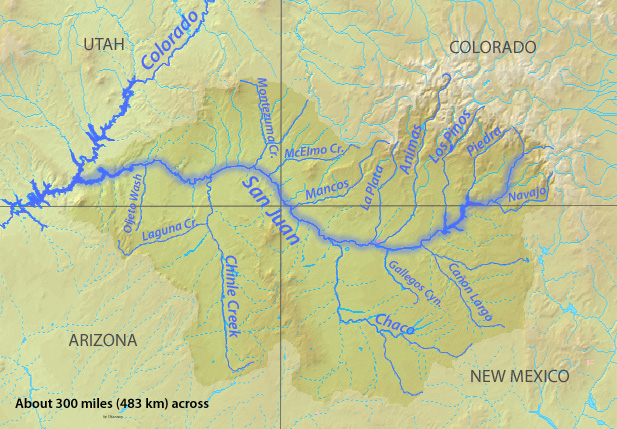
    San Juan River Basin. Graphic credit Wikipedia.

    From The Farmington Daily Times (Noel Lyn Smith):

    A federal judge has denied a motion to dismiss claims brought by state, federal and local governments and private entities related to damages caused by the Gold King Mine spill.

    U.S. District Court Judge William P. Johnson denied the motion on Feb. 28 by the U.S. Environmental Protection Agency, its contractors and mining companies…

    New Mexico, Navajo Nation and Utah, along with residents in Aztec and on the Navajo Nation, have filed lawsuits for environmental damages and tort claims against the federal agency and its contractors and mining companies since May 2016.

    The defendants requested that the court dismiss claims, arguing sovereign immunity barred the litigation.

    The two states and the tribe are seeking to recover the costs of their responses to the spill under the Comprehensive Environmental Response, Compensation and Liability Act.

    New Mexico officials commended the latest court decision.

    James Kenney, secretary for the environment department, said the state will continue to hold the defendants responsible for the environmental and economic harms caused by the spill.

    Among damages the state is seeking on its behalf and for agricultural and recreational operations is more than $130 million in lost income, taxes, fees and revenues…

    Navajo Nation President Jonathan Nez said the tribe is pleased with the judge’s decision.

    How George H.W. Bush’s EPA administrator saved the #SouthPlatte — The #Colorado Springs Gazette

    William Reilly watches as President George H.W. Bush signs the Clean Air Act Amendments of 1990. By Carol T. Powers, photographer, The White House – U.S. Environmental Protection Agency (EPA) Archive, Public Domain, https://commons.wikimedia.org/w/index.php?curid=57646185

    From The Colorado Springs Gazette (Paul Klee):

    Thank you, William K. Reilly.

    Thank you for saving our river from drowning.

    Reilly, now 79, is the former Environmental Protection Agency administrator who vetoed the Two Forks project that in 1990 sought to dam the South Platte upstream from the one stop sign in the mountain town of Deckers.

    “It was all systems go,” Reilly said last week, and the 20 miles of irreplaceable trout habitat where hundreds of kids like me learned to fly fish would be nothing more than a sad bedtime story.

    This fragile, world-class trout fishery would have been flooded below the 615-foot Two Forks dam, a structure roughly the size of Hoover Dam. Twenty-five miles southwest of Denver and 42 miles northwest from Colorado Springs, six towns and a priceless outdoor recreation area would have been washed away.

    So thank you.

    “How’s the river doing, anyway?” Reilly asked before his keynote speech for Colorado Trout Unlimited’s annual River Stewardship Gala here Thursday.

    Really well, considering. The Hayman fire was rough on everybody, and the trout populations are gradually returning. But here’s the real catch: At least this stretch of river still exists.

    Thanks to Reilly.

    As Reilly told it from his home in San Francisco, the Two Forks dam was “a foregone conclusion from every angle” when the late George H.W. Bush hired him as head of the EPA in 1989.

    “You don’t bring the World Wildlife president into the EPA to just sit there. You want drive, action,” Reilly said. “I was determined in my authority to make him the environmental president.”

    Damming the confluence of the north and south forks of the South Platte was long viewed as a solution to the water demands of the Denver suburbs that grew another neighborhood in the time you read this…

    Reilly is not a fisherman. That’s the funny part. But he saw the water battles here in a different light. He observed a metro area that “had no real water metering at the time,” where the tradition of Western water waste ran wild, where sprinklers flipped on while it was raining…

    One, “Nothing in our field is ever final. This could return, or something like it. There will be a future generation that believes the time is right and a project like this is worth it,” he said.

    Two, “Lobbying, communication, data, analysis with details, honesty and integrity, it all works in our system. It really does. I know a lot of activists despair that it doesn’t, but it does.

    “I don’t think we knew there were so many fishermen in the country. It seemed like half of them wrote to us,” Reilly said. “The government, they were a little bit taken aback. They had some negative blow-back, but then there was a cascade of positive mail from fishermen that came in.”

    The latest issue of the “Colorado Water” newsletter is hot off the presses from the #Colorado Water Institute

    Click here to read the newsletter.

    Proposals sought for inaugural Food-Water-Sustainability grant program — @ColoradoStateU

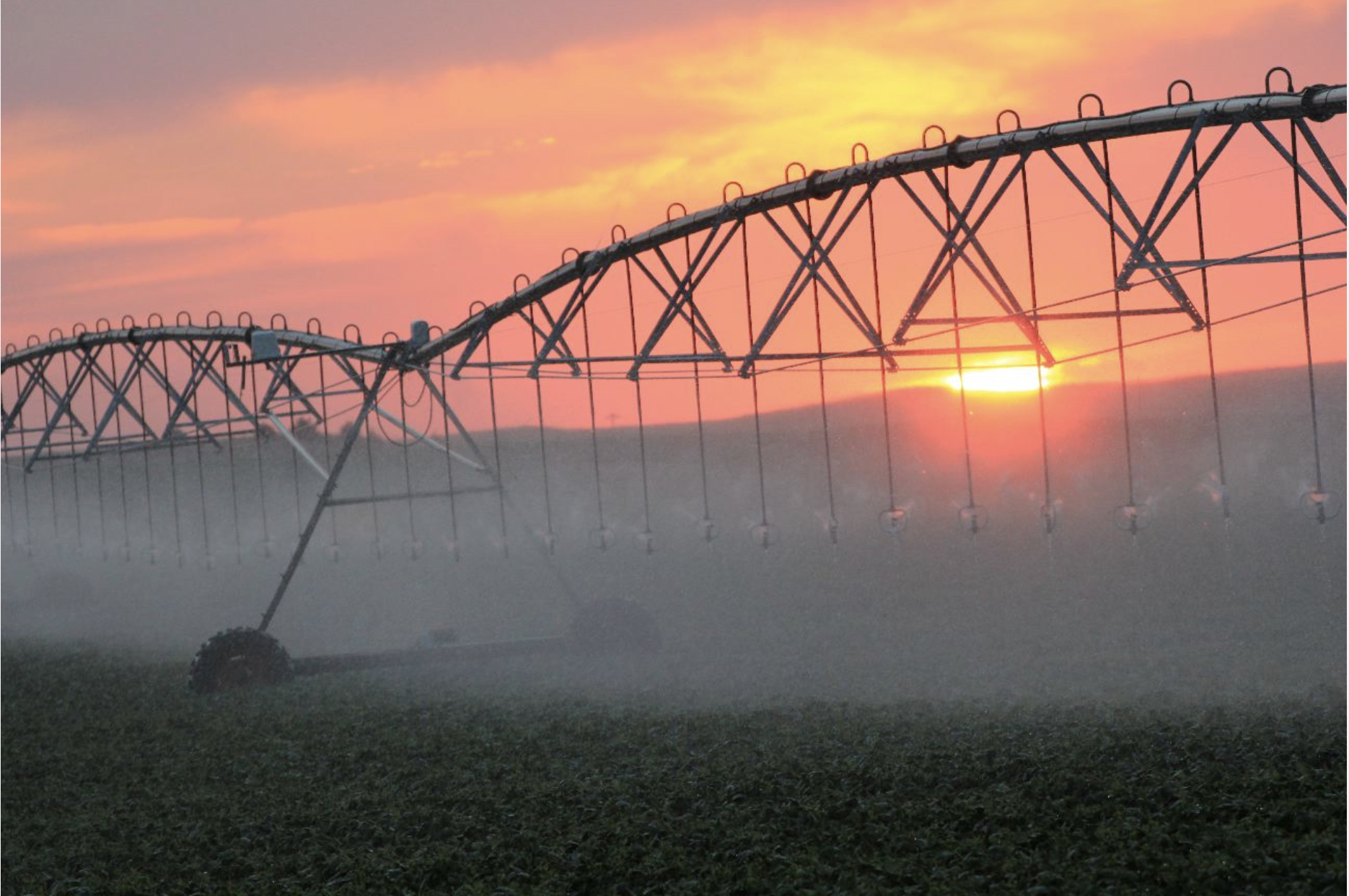
    A center-pivot sprinkler near Wray, Colo. Photo/Allen Best

    From Colorado State University:

    The Colorado Water Center, the School of Global Environmental Sustainability and the Agricultural Experiment Station are announcing a request for proposals for 2019-20 for their first-ever Food-Water-Sustainability competitive grant program.

    Jointly funded by the three complementary centers, the program seeks proposals from a broad range of disciplines that target a sustainability challenge at the food-water nexus currently faced by our community, region, country or world. Proposals should also help support the mission and goals of all partner entities through collaboration and creative scholarship.

    Driven by a rising global population, rapid urbanization, changing diets and economic growth, demand for food and water resources is increasing around the world. Agriculture is the largest consumer of the world’s freshwater resources, and it is estimated that with a population of 8.3 billion people by 2030, we will need 40 percent more water and 35 percent more food. These resources already face mounting threats, including pollution, climate change impacts, the destruction and degradation of freshwater ecosystems and habitats, and agricultural intensification. Devising effective responses to these major challenges will require a systems-oriented, multidisciplinary approach to reshape the food-water nexus so that it works for all people sustainably. Yet many of the tools and approaches needed have yet to be developed or applied.

    The Food-Water-Sustainability Research Team encourages any CSU faculty and staff with established research interests in food, water and sustainability, whose existing or planned research projects will be significantly enhanced by receiving the award, to apply. Applicants must demonstrate the ability and desire to address a relevant challenge through broad-based interdisciplinary research, education and engagement activities. Special consideration will be given to projects that include undergraduate and graduate students as well as post-doc researchers. Proposals are due April 1.

    The awarded research team will have the opportunity to accelerate progress in a research area designed to meet global food, water and sustainability challenges, and to engage in the faculty, staff and practitioners of the Colorado Water Center, the School of Global Environmental Sustainability and the Agricultural Experiment Station.

    The RFP is open to all CSU faculty and staff in good academic standing. For more information, visit http://watercenter.colostate.edu, http://sustainability.colostate.edu, and http://aes.agsci.colostate.edu.

    #ColoradoRiver: #Drought Contingency planning effort creaks along #COriver #aridification #DCP

    Las Vegas Lake Mead intake schematic, courtesy SNWA.

    From The Nevada Independent (Daniel Rothberg):

    The federal government initiated a comment period today for the seven states in the Colorado River Basin, after Arizona and California were unable to agree on a Southwest drought plan by a second “deadline” of March 4.

    The Department of Interior is now giving the governors of the seven states, including Nevada, 15 days to offer recommendations on how federal water managers should proceed if the states can’t agree to a drought plan that they have been negotiating for years.

    The expected Interior action sets a new target to complete the drought plan by March 19, a goal that many believe is achievable as Arizona and California come closer to resolving issues within their respective states that had prevented officials from signing onto the plan. The new deadline comes after water users missed a first deadline to finish the plan by Jan. 31.

    “The states that share the Colorado River continue to work hard on finalizing negotiations of the Drought Contingency Plan, and Nevada’s representatives are confident that a final plan will be delivered to the United States Secretary of the Interior by the March 19 deadline,” Bronson Mack, a spokesman for the Southern Nevada Water Authority said in an emailed statement.

    The water authority has said it is prepared for the drought plan, which would require the states to make voluntary cuts to its allocation, because of conservation and reusing indoor water.

    John Entsminger, who leads the water authority, serves as the governor’s negotiator on Colorado River issues.

    Like those before it, this newest deadline is seen as a soft target. Even if March 19 passes, the federal government would not take an immediate action until later in the year when decisions have to be made about how to operate Colorado River reservoirs going into 2020. The Bureau of Reclamation, an Interior Department agency, operates those dams and reservoirs.

    Paonia turns the water back on

    Water infrastructure as sidewalk art

    From The Grand Junction Daily Sentinel (Dennis Webb):

    Paonia began restoring water service Monday to residents affected by an outage resulting from leaks and poor production from the springs that provide the town’s raw water supply…

    The town began restoring service Monday morning but was doing so slowly to avoid pressure spikes. Knight expected that by the end of Monday most people who weren’t getting water would be seeing some water pressure, although that might not be the case for homes at higher elevations or at the end of water lines.

    The town is expecting full pressure systemwide to be reached by this afternoon.

    A notice to boil the water before drinking it remains in place as the service is being restored to allow time for lines to be flushed and chlorine to make its way through the system. Knight said if things go well, water samples may be able to be taken today. Still, it will take about 24 hours to get test results to the state to determine whether the notice can be lifted.

    The town last week cut service first to about a third of the 1,800 people it serves, and then to about 200 more taps. That happened after it found and fixed some leaks, but its spring water supplies weren’t able to replenish the lost water in its main tank. Knight believes those springs were affected by last year’s drought.

    The town continued service to what it considered essential areas, such as those serving school, urgent care center and nursing home facilities, and downtown businesses.

    The town is now restoring cut-off service thanks to a number of factors. Mount Lamborn Ranch agreed to make water available from Roeber Reservoir, and state officials helped the town find additional water in the town’s springs, Knight said. Also, a few more large leaks were found.

    Knight said a leak-detection crew from the city of Westminster found one of them, and the city of Montrose sent a construction crew to fix it. It’s one of numerous examples of support Paonia has gotten from state, county and local governments. Others who have helped include plumbers who have offered to check residents’ pressure relief valves on their hot water tanks in preparation for water service to be restored.

    Knight said the town had been processing as little as 135 gallons a minute, but now is up to 550 gallons a minute, which far exceeds even normal usage of the system and is letting the town refill tanks. Still, its springs are producing about half of normal for this time of year, so it is continuing to encourage conservation.

    The town is planning another community meeting today at 6 p.m. at the Paradise Theatre to update residents on the situation.

    From KUNC (Luke Runyon):

    The problem started on Feb. 17, when Paonia’s water operators noted a loss of water in a 2 million gallon storage tank. A team went out looking for a leak, but could not locate it. As the leak continued, the town’s water system lost enough pressure that the state of Colorado imposed a boil order. In response, town officials declared a state of emergency.

    A potable water tank arrived soon after, on loan from the National Park Service, which affected residents could use to fill up vessels to take water back to their homes. A team, aided by the city of Westminster, was sent out to locate the leaks. They found one in a supply pipe that was spilling into the North Fork River. After locating the leak, the town’s water delivery system came back online on Feb. 22.

    Four days later, town officials discovered that its water customers were consuming more than what was being produced at its water treatment plant. A series of 22 springs at the base Mount Lamborn serves as the town’s raw water supply. Because of record-breaking dry conditions during much of 2018, the springs are running at half their normal volumes for this time of year.

    To avoid seeing the town’s entire supply dip to a dangerous level, town administrator Ken Knight chose to shut down some water users to allow the system to recharge. First he denied water to 27 mostly rural providers who purchase water from the town to deliver to customers within Delta County. Then Knight turned off the majority of the town’s residential users, choosing to maintain service at Paonia’s schools, town buildings, downtown business district and other facilities deemed critical to the town’s operations.

    Since then, Knight says the town has been working with a local rancher association to tap into a privately-held reservoir to fill the town’s system. That’s allowed most of Paonia’s downtown core to keep receiving water while the rest of the community has been out of water or on a boil notice.

    Even when water service returns, which could come as early as Monday, the town will remain on a boil order until the town can flush its system, pull samples of the treated water, and send them to a lab for testing. If those samples show the water is safe to drink, Knight says Paonia residents could get service back without a boil order in place by Wednesday afternoon.

    If samples come back positive for contaminants, that process would be delayed until the water is deemed safe.

    The #ColoradoRiver is a Reliable Source of Water for #Utah — @UTAHSavesH2O #LakePowellPipeline #COriver #aridification

    Upper Colorado River Basin map via the Upper Colorado River Commission.

    From the Utah Department of Natural Resources:

    Falling storage levels at both lakes Powell and Mead have highlighted the potential effects of climate change on the Colorado River, causing some to question its future viability as a reliable water supply source for the state of Utah.

    “All water providers, including the State of Utah, understand the level of concern some have regarding the perceived uncertainty associated with the use of Colorado River water,” said Eric Millis, director of the Utah Division of Water Resources. “The Colorado River is reliable. We work closely with our federal partners and other basin states to plan for future needs and mitigate potential impacts. The drought contingency plans recently outlined by the Upper and Lower Basin states serve as an example of such planning.”

    When looking at whether the river can meet future needs, scientists, water providers, and those who manage the river look at its past performance during varying weather conditions. Colorado River flows are cyclical, as are weather patterns.

    The system’s reliability is documented in the benchmark Bureau of Reclamation (BOR) 2012 Colorado River Basin Study. The study reports that, in the 10 years preceding its issuance, which had been some of the driest of the last century, the Upper Basin states (Colorado, Wyoming, New Mexico and Utah) have delivered more than 92 million acre feet of water to the Lower Basin states (Nevada, Arizona and California)—that’s 17 million acre feet more than the minimum required by the Colorado River Compact.[1]

    “In both wet and dry cycles over the past century, the river has always provided enough water to meet established uses and compact requirements,” said Don Ostler, former Executive Director and Secretary of the Upper Colorado River Commission. “Recent hydrologic modeling, based on projected drought scenarios, has shown the river to be capable of remaining a reliable supply for the Upper Basin into the future, especially if the basin states continue to work cooperatively on sensible drought contingency plans.”

    The 2012 Basin Study and associated climate model projections indicate a potential decrease in mean natural flow of the Colorado River of approximately 9 percent over the next 50 years. In

    addition, some scientists predict that as a consequence of continued warming in the basin, the decrease in river flows could be even greater.

    Modeling conducted by BOR in August 2018, taking into account future water uses in the Upper Basin including the Lake Powell Pipeline, indicates a near 0 percent probability of a declared 1922 Compact shortage for the Upper Basin through the year 2050 presuming hydrology remains similar to what the basin has experienced over the last 100 years. On the other hand, if the future hydrology of the basin is similar to drier, hotter climate change predictions, more closely resembling the last 30 years including historic drought, the risk of a declared 1922 Compact shortage rises to less than 13 percent through the year 2050.

    “The BOR and the basin states are planning for the possibility of a long-term imbalance in supply and demand on the Colorado River. To mitigate the risks and uncertainties associated with these water supplies, Utah has worked with the other states in the Upper Basin to develop an agreement on drought contingency development. Since the river provides water to some 40 million people, it is imperative that the western states, including Utah, all do their part to protect this river,” said Millis.

    Utah receives 23 percent of the Colorado River water supply available to the Upper Basin. Utah is using approximately 72 percent of the current annual reliable supply of 1.4 million acre feet, including evaporation and system loss. The reliability of the Colorado River gives Utah the opportunity to develop its water for the benefit of Utah.

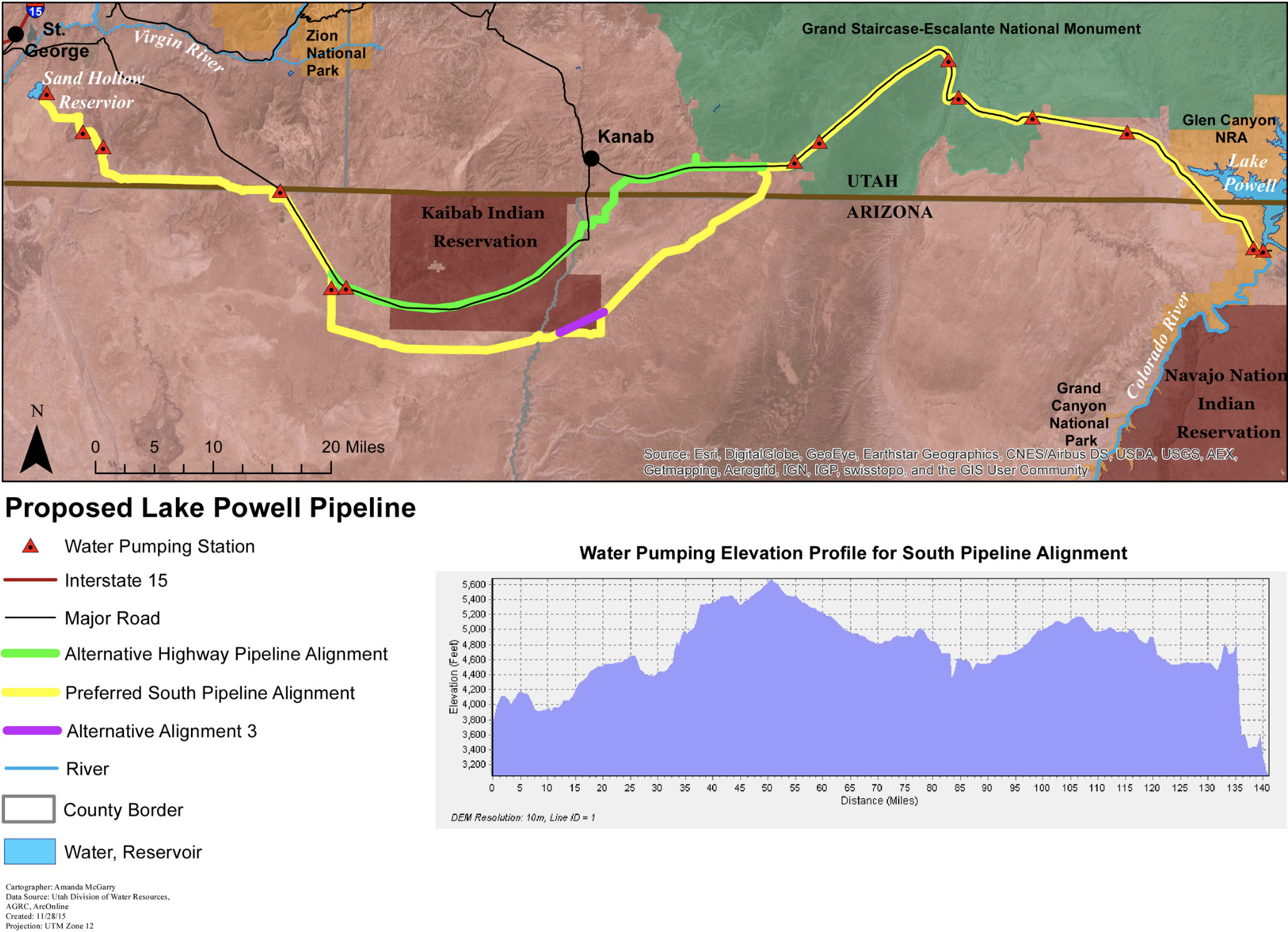
    Even though Utah may be developing its water rights later than some of the other basin states, it does not mean there will not be enough water for projects like the Lake Powell Pipeline. There is water available for the Lake Powell Pipeline, which is currently being permitted to meet the needs of the fastest growing region of the state. The Lake Powell Pipeline would transport 86,249 acre feet of Colorado River water from Lake Powell through a buried pipeline to Washington and Kane counties.
    Utah’s share of the water is not subject to a prior appropriation or “first in time, first in right,” administrative scheme among the states. The compacts that guide each states’ use of Colorado River water were expressly developed to ensure that faster growing states would not be able to claim all of the available basin water.

    “The Utah Board of Water Resources can develop a portion of Utah’s Colorado River in a manner consistent with the Law of the River,” Millis said. “Utah’s right to develop water for the Lake Powell Pipeline is equal to, not inferior to, the rights of all the other 1922 Compact signatory states.”

    With the projected need for more water in southwest Utah as early as the late 2020s, the Utah Division of Water Resources continues to advance the permitting for the Lake Powell Pipeline. The Environmental Impact Statement is the next step with a Record of Decision estimated to be issued in the fall of 2020.

    Click here to read the annual report from the Upper Colorado River Commission.

    This $2+ billion project would pump 28 billion gallons of water 2,000 feet uphill across 140 miles of desert to provide just 160,000 residents in Southwest Utah with more water. Graphic credit: Utah Rivers Council

    #Snowpack news: Widespread beautiful snowfall across #Colorado boosts early March totals

    Click on a thumbnail graphic below to view a gallery of snowpack data from the NRCS.

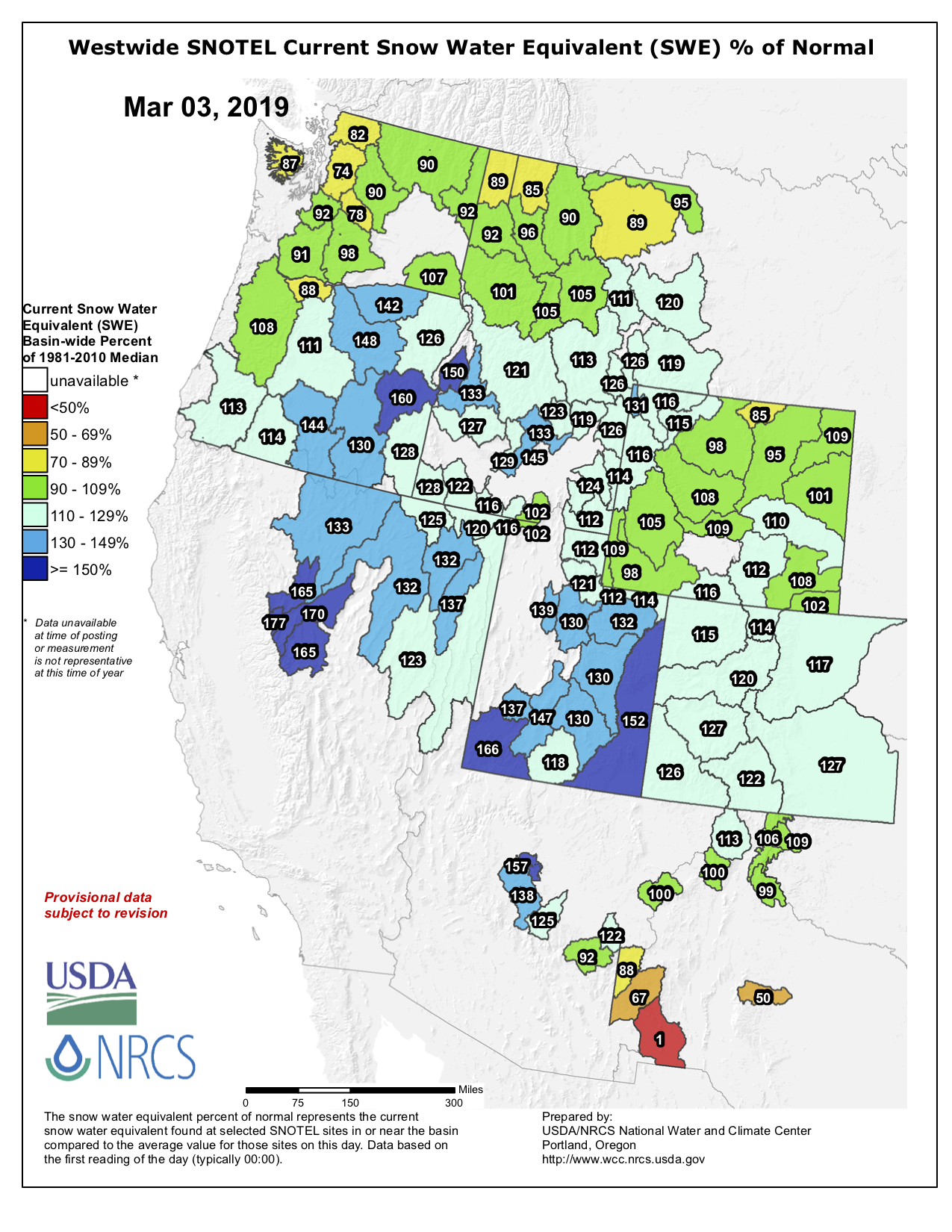
    And, here’s the Westwide SNOTEL basin-filled map for March 4, 2019.

    Westwide SNOTEL basin-filled map March 4, 2019 via the NRCS,

    White River Algae Technical Advisory Group meeting recap

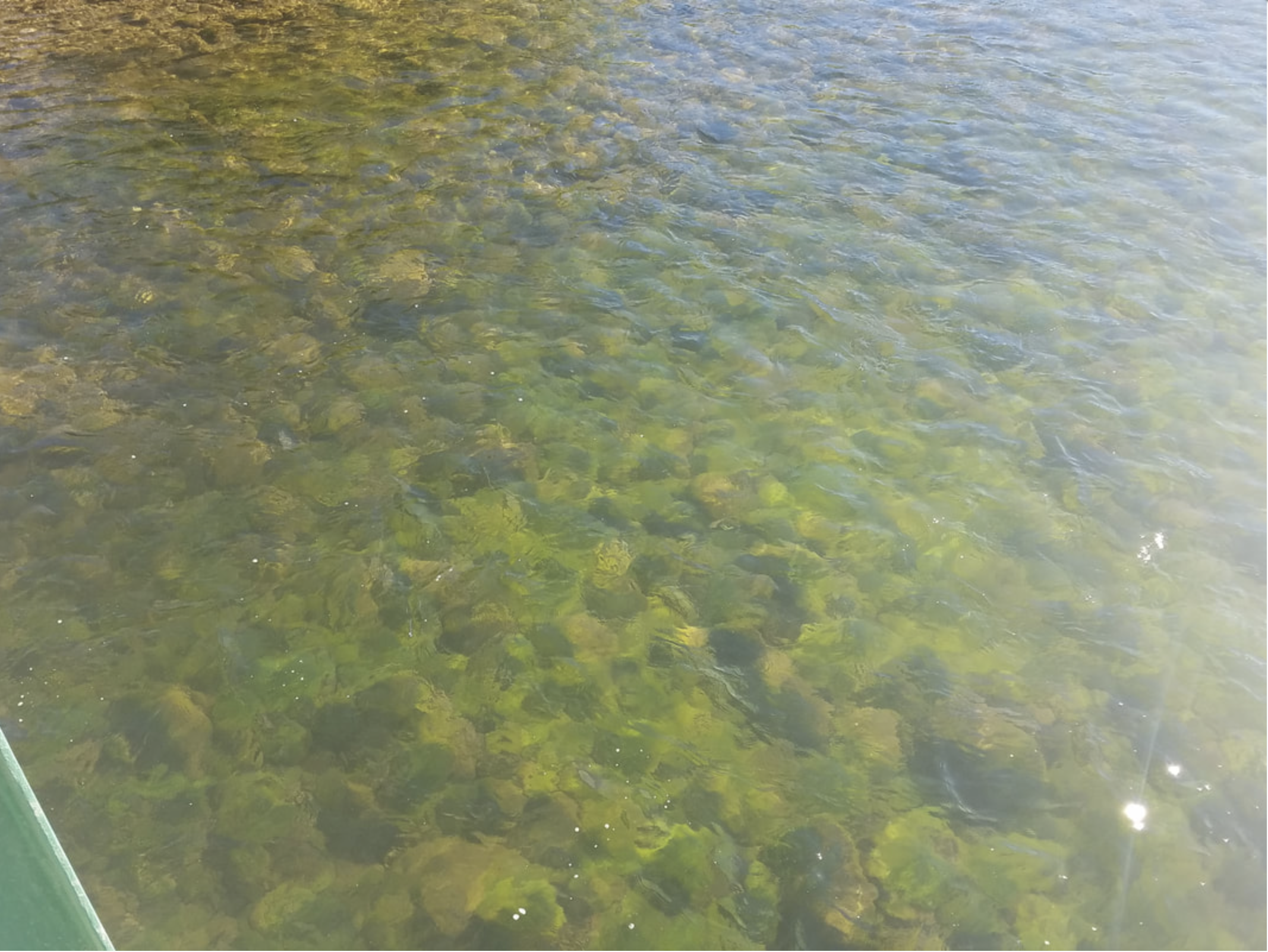
    Picture taken 6/25/18 from the Miller Creek bridge. Unfortunately, the algae is coming on early this year. We are looking forward to finding the cause(s) of this algae in the near future. Photo credit: White River Algae
    ​Technical Advisory Group

    From the White River Algae Technical Advisory Group via The Rio Blanco Herald Times:

    Members of the White River Algae Technical Advisory Group (TAG), met Feb. 13 to discuss the 2019 plans to ascertain what is driving the algae growth in the White River to improve the overall health of the watershed. Callie Hendrickson, executive director of the White River and Douglas Creek Conservation Districts facilitated the meeting.

    USGS provided a review of 2018 studies and planned 2019 activities. Ken Leib, Western Colorado Office Chief, stated their goal is to document and understand benthic algal occurrence, characteristics and controls at multiple locations within the White River (WR) study area and described the study design and approach. Cory Williams, Western Colorado Studies Chief, reviewed the historical analysis, water quality trends, algae sampling and isotope sampling. Key takeaways are as follows. Historical streamflow analysis showed a decreasing trend in flow patterns since 1900 while available high-resolution water temperature data indicates increasing daily mean temperatures during May-September between two more recent time periods (1979-84 and 2007-17). Little to no change has been shown in the mean, annual concentration of kjeldahl nitrogen while total phosphorous showed a substantial increase in concentration and flux between 1999 and 2017. Concentrations in phosphorous increased during snowmelt-runoff (high flow) and decrease during fall and winter months. Several types of algae were present at each study site and Cladophora was found at all 19 USGS study sites. Water samples were collected and analyzed for nitrate concentrations at six locations but, concentrations were too low for isotope analysis. Isotopic analysis is an aspect of the study intended to aid in identification of sources of nitrate in the watershed. Sampling and nitrate analysis are ongoing and USGS is exploring alternative sampling approaches to meet target concentration ranges. Historical analysis and literature review, physical and chemical characterization/data collection, algae sampling and isotope sampling will all be continued in 2019.

    Tyler Adams, project manager, and Susan Nall, section supervisor, with the Army Corps of Engineers (ACE) reviewed permitted activity in the recent past. They described their regulatory authorities and explained how to know when a project is regulated and when it may qualify for exemptions. Available permits vary from Nation Wide Permits (NWP) to Regional General Permits (RGP) to Individual Permits (IP). Permitting history in the Upper White River total 53 permits (NWPs=38, RGPs=14, IP=1), about 866,939 acres, from 2008-2018.

    Matt Weaver, 5 Rivers Inc. gave a presentation on a local project proposal that is currently in the application process with the ACE. The proposal is to enhance fish habitat in the White River. The plan is to create 18 pools in which Weaver will remove material from the pool area and add it to the bank to leave everything functioning as a pool-bar sequence. Weaver and the landowners are communicating with the Colorado Parks and Wildlife to avoid disrupting crucial times such as spawning season, etc. One USGS study site is encompassed in the project area. The landowners/managers are willing to work with the TAG and USGS to do their best not to affect the ongoing study.

    Several discussion items were identified at the last TAG meeting as potential changes to the USGS 2019 Scope of Work (SOW). Items such as monitoring growth of the algae using pictures, isotopic analysis, water temperature monitoring, taxonomy, capturing the impacts of stream structure changes, water clarity (turbidity) and quantitative mapping were reviewed to make decisions on how the TAG would like to move forward.

    After this discussion, the TAG reached a consensus that the White River Conservation District should move forward with the original agreement with USGS to continue the 2019 SOW for the White River Algae project. That SOW includes the workplan elements: Scouring flows and analysis and Pre, peak-, post-algae and water quality sampling events.

    See http://www.whiterivercd.com/white-river-algae-working-group.html for Power Point Presentations and meeting notes.

    #ColoradoRiver: A look at the @USBR deadlines for the #Drought Contingency Plans #DCP #COriver #aridification

    All American Canal Construction circa. 1938 via the Imperial Irrigation District

    From KJZZ (Brett Jaspers) via KUNC:

    As Arizona and other Colorado River states move ever closer to finishing the Drought Contingency Plan to boost Lake Mead, the federal government is moving forward on a parallel track. That path would create a federal plan in case the states don’t finish by the deadline.

    But what is the deadline?

    On Feb. 1, Burman gave everyone another month to wrap up. But that second deadline – March 4th – has passed too. Reclamation is now accepting input from governors in the Colorado River basin on what kind of alternate plan the Department of Interior should install if needed. That input is due March 19th. Another deadline.

    All the while, Arizona is continuing to work on its various agreements.

    Last month, Ted Cooke, General Manager of the Central Arizona Project, told reporters Arizona wouldn’t be done by March 4th.

    “That’s an artificial deadline and these are very complex agreements and very complex negotiations,” he said. “We will take the time we need to do them properly. That being said, I don’t expect it to drag on for months and months and months.”

    At the time, Cooke was confident all of Arizona’s internal deals would be done before the end of April. He also said it wasn’t clear to him what the federal government considered “done.

    “We do not have a clear list of things that need to be completed by that day.” he said, referring to March 4.

    Reclamation would not specify to KJZZ which of Arizona’s separate agreements absolutely must be signed, sealed and delivered for the state to join Colorado, Wyoming, New Mexico, Utah and Nevada in the “done” column. On the February 1st press call, Commissioner Burman did say “all” agreements need to be complete.

    Estevan López, who was Reclamation Commissioner from late 2014 until the end of the Obama Administration, said he would want all of the sub-agreements to be signed. “So that nobody can get cold feet and say, ‘oh wait a minute. I want to change this aspect of it.’ Because then, one little thread starts unraveling the whole thing.”

    López said a contingency plan – regardless of who writes it – absolutely needs to be in place by the time an important document gets released in early August. It’s called the August 24-month Study. This tells water users in the basin the projected level of Lake Mead and what amount of cutbacks the states must take. So that makes August the ultimate deadline.

    Commissioner Burman has made it clear she wants the Drought Contingency Plan to come from the states. And they very well may get there. But just in case, the parallel federal process is moving forward.

    “She’s doing it. She’s doing it incrementally,” López said, referring to Burman. “But if things don’t come together by July or August, I think Reclamation will do something.”

    If it came to that, the states could very well contest the broad authority the feds say they have over the Colorado River. We know no one wants it to come to that – especially not for a river system that supplies water to about 40 million people.

    But until we get there, we’re likely to keep hearing about deadlines.

    The March 2019 @CWCB_DNR “Floodstage” newsletter is hot off the presses

    Cherry Creek Flood August 3, 1933 — photo via the Denver Public Library

    Click here to read the newsletter. Here’s an excerpt:

    As of mid-February, Colorado’s statewide snowpack sat at 108% of normal. Snowpack is higher in the northern and eastern basins and lower in the southwestern basins. The climate forecasts through the runoff season suggest that these numbers could climb higher as fore- casts indicate a wet spring statewide.

    Higher snowpack percentages can increase the possibility of snow- melt flooding. Generally, watersheds are monitored for this once they reach 130% snowpack. Currently, no watersheds exceed this threshold, but state officials continue to monitor conditions due to the wet climate forecast moving forward. To view snowpack conditions and better understand the potential flood threat in your location, visit the Natural Resources Conservation Service’s Snow Telemetry (SNOTEL) and Snow Course Data and Products page.

    It is worth mentioning that, as indicated by looking back through Colorado’s history, the majority of flooding events occurring through- out the state are rain-based and not snowmelt-based. In fact, the last year of widespread snowmelt flooding was in 1984, although isolated instances have occurred since then. One area of ongoing concern relates to rain-on-snow events, in which high elevation, late spring rainstorms fall on still surviving snowfields. This can quickly exacerbate runoff and create problems that wouldn’t exist in the absence of either the rain or the snow.

    #Snowpack/#Runoff news: Whitewater enthusiasts are gearing up for the snowmelt season

    Westwide SNOTEL basin-filled map March 3, 2019 via the NRCS.

    From The Summit Daily (Deepan Dutta):

    This year’s statewide average snowpack is dramatically higher than any time in the past three years, and currently stands at 113 percent of normal. The pack is also a whopping 58 percent higher than last year’s dry winter, which peaked and melted early, resulting in a shortened season that disappointed many whitewater enthusiasts.

    Brandon Gonski, general manager of Breckenridge outdoor adventure company AVA Rafting & Zipline, said that he and others in the rafting industry have been getting steadily more excited about this upcoming season…

    “The snowpack in the Upper Colorado is at 113 percent, South Platte is at 110, Arkansas at 124,” Gonski said. “That all stacks up to be great news for us overall. There should be plenty of water, especially compared to last year.”

    From The Cortez Journal (Mary Shinn):

    Rain and abnormally warm temperatures this spring could cause serious flooding below the 416 Fire burn scar…

    The area is not expected to see above-average temperatures in March, April and May, he said.

    But every storm is different and the long-range forecast for average temperatures does not rule out periods of warm weather, he said.

    Rain on snow would cause the worst flooding for the Hermosa area during the runoff season…

    Higher daytime temperatures and warm nights could also cause higher runoff, said Butch Knowlton, La Plata County director of emergency management…

    The areas most likely to be affected by high levels of runoff are near or below Dyke Canyon, Tripp Creek and Hermosa Creek, he said…

    Nighttime temperatures below freezing would help moderate the runoff flows, Knowlton said during an Animas River Community Forum on Thursday.

    The forum brought together representatives from government agencies, ditch companies and nonprofits working on flood mitigation.

    Some groups are working on construction projects to divert water and improve flood prediction, but not many projects are expected to be in place before spring runoff.

    In the short-term, La Plata County plans to install temporary temperature and rain gauges that will help predict flooding this spring, said Tom McNamara, emergency management coordinator for the county.

    The county is also working on putting in another temporary radar system during the summer that would help predict monsoonal systems, Knowlton said.

    Flood mitigation on private property is also expected to get started this year, possibly during the summer, said county spokeswoman Megan Graham.

    The county will put out bids for the construction, potentially for several properties at a time, she said.

    “We want to get the work done as quickly as possible, but there are administrative steps that have to be taken,” she said.

    Federal funding will cover 75 percent of the construction on private land through the Emergency Watershed Protection Program. Property owners interested in participating in the program will be responsible for up to 25 percent of the cost, she said.

    Five irrigation companies in the Animas Valley are also preparing for runoff waters that flow into ditches and are carried to areas they would not naturally go, said Ed Zink, the secretary and treasurer for Animas Consolidated Ditch.

    The ditch companies received about $200,000 in grant funding and provided about $100,000 in a local match to fund construction and to help keep ditches clear of silt and debris.

    This spring, Animas Consolidated Ditch plans to put in gates and help direct floodwaters to the Animas River, Zink said.

    From The Pagosa Sun (Chris Mannara):

    At long last, after several large storms, snow water equivalency (SWE) and precipitation data are reported as being above average for this first time this winter.

    According to a press release craft- ed by Pagosa Area Water and Sanita- tion District Manager Justin Ramsey, the SWE was 26.1 inches as of Feb. 25, while the median was only 25.5 inches.

    With those recent totals, SWE is now 102.4 percent of median, up from last week’s total of 88.9 percent of median.

    “It’s good, we’re all above average now,” Ramsey said in an interview.

    With limited snow in the forecast, Ramsey noted that the SWE levels will probably stay about the same with minimal melting occurring at the Upper San Juan site.

    “But, we’re probably going to drop below 100 percent again because the average always goes up a little bit,” Ramsey said.

    The median and averages are based on data from 1981 through 2010.

    Last week, the SWE was measured at 20.6 inches while the median was listed at 23.2 inches.

    Precipitation currently is 29.5 inches while the precipitation av- erage is 26.9 inches, making the precipitation totals 109.7 percent of median.

    Last week, precipitation totals were only 24.5 inches while the median was 25.4 inches, making the total 96.5 percent of median.

    Water Quality Workshop: Impacting Your Farm’s Bottom Line March 5, 2019 — #Colorado Ag Water Alliance

    Click here for all the inside skinny and to register:

    Water Quality Workshop:
    Impacting Your Farm’s Bottom Line
    March 5th

    American Legion in Keenesburg, CO
    595 Railroad Ave.
    Keenesburg, CO 80643
    4:00 – 8:00 pm

    Unprotected farm fields yield topsoil as well as farm fertilizers and other potential pollutants when heavy rains occur.

    Push for renewables vexes Western power supplier — @HighCountryNews #ActOnClimate #KeepItInTheGround

    From The High Country News (Keriann Conroy):

    Colorado’s largest member-owned generation and transmission provider may be in trouble. Tri-State Generation and Transmission, which provides wholesale electricity to rural cooperatives in Colorado, New Mexico, Wyoming and Nebraska, is facing increasing pressure to let go of some of its contracts and to improve its renewable portfolio. But it appears unable to change fast enough to keep up with the times.

    Most of Tri-State’s power is generated from coal- and gas-fired plants or large hydroelectric dams, but it is now facing regulatory hassles and the potential exodus of customers. Rural “distribution” cooperatives are currently waiting to see how much it would cost them to exit their contracts, while Colorado moves toward regulations requiring more renewables.

    Colorado Green, located between Springfield and Lamar, was Colorado’s first, large wind farm. Photo/Allen Best

    The controversy has escalated in recent weeks. Last month, more than 60 Colorado lawmakers weighed in on a dispute between Tri-State and one of its rural cooperatives, Delta-Montrose Electric Association, in support of the co-op. Tri-State is at odds with western Colorado’s DMEA, which wants to end its contract with the power supplier. The two sides are currently engaged in a dispute over how much the rural co-op should pay to exit and who should determine the price tag. DMEA wants Colorado’s Public Utilities Commission to determine a “fair, just and reasonable” fee, but Tri-State would prefer to set its own price. In a letter to the Public Utilities Commission on Jan. 14, 17 state senators and 35 state representatives urged the state’s Public Utilities Commission to “consider exercising its jurisdiction” over determining the exit fee. On Feb. 14, the PUC announced it would indeed exercise that jurisdiction and determine a fee, setting the stage for an announcement in coming weeks and a public hearing in June.

    The dispute, which could have far-reaching consequences for Tri-State’s financial viability and the cost of electricity for many of Colorado’s rural residents, underscores the difficulties faced by communities who want to find new ways to generate power and to leave large legacy assets behind. In 2016, Kit Carson Electric, a cooperative in New Mexico, left its contract with Tri-State, paying a $37 million exit fee. The price was determined by Tri-State without regulatory oversight from the PUC and without any explanation of how Tri-State calculated it.

    The ongoing conflict between Tri-State and DMEA raises large questions over Tri-State’s ability to change with the times, including how it plans to adapt its business model as more members become interested in generating their own renewable power.

    In August 2018, the Rocky Mountain Institute, a nonprofit based out of Basalt, Colorado, that works to accelerate the cost effectiveness of renewable energy adoption through market solutions, released a report concerning Tri-State’s economic possibilities. RMI estimated that if Tri-State continues to rely on coal, rather than transition away from legacy assets and invest in renewable energy sources, it will cost its members $600 million through 2030. Worry over increased rates from dependence on coal may increase the pressure on other large co-ops to leave their contracts as they seek out more renewables, creating a downward spiral for Tri-State and its members.

    If cooperatives continue to exit their contracts without the PUC determining the kind of “fair, just and reasonable” fee that DMEA is asking for, costs could rise even higher for the remaining members, as the burden of Tri-State’s debt shifts to fewer cooperatives. Tri-State’s largest member, Colorado’s United Power, wrote letters to other co-ops suggesting changes to Tri-State’s bylaws that would allow members to purchase more power outside of Tri-State, in light of its “increasingly outmoded” generation and transmission business model. La Plata Electric Association has been studying the costs of other power suppliers but has not yet made concrete plans to exit its contract.

    Craig Station in northwest Colorado is a coal-fired power plant operated by Tri-State Generation & Transmission. Photo credit: Allen Best

    Tri-State assures its members that it expects to meet Colorado’s renewable energy standards — by providing 20 percent “clean energy” — even though it is not legally required to until 2020. It currently claims to offer members a portfolio composed of 30 percent renewable energy, but the public information released in its annual report doesn’t add up. Tri-State has some small wind, solar and hydropower projects, which would comprise a small percentage of its portfolio. It also gets half its renewable portfolio from federally owned hydroelectric projects developed between the 1930s and 1950s, known as the Western Area Power Administration, or WAPA. However, most of Tri-State’s WAPA purchases are not included in Colorado’s renewable energy standards because they are considered “large hydro.” If you take its WAPA purchases out of the equation, Tri-State is nowhere near the 30 percent, or even 20 percent, that it claims.

    Determining the portion of renewables in Tri-State’s mix is difficult because of the company’s lack of transparency. In a 2015 annual report, Tri-State claimed that just over 5 percent of its power sold was generated by renewable sources. In more recent annual reports, however, Tri-State has chosen not to include production output for the third-party wind, solar and “small hydro” projects that it purchases, so the extent of these contributions to its portfolio are unknown. Additionally, Tri-State inflates its renewable claims by double-counting power from the local renewable sources of member cooperatives. While this is allowed under Colorado’s renewable energy standards, it enables Tri-State to claim the renewable generation produced by its member cooperatives, while its members are constrained by their contracts with Tri-State in meeting their own RES requirements of 6 percent generation. Tri-State’s contracts require each co-op to purchase 95 percent of its power from it, thus capping local renewable generation at 5 percent.
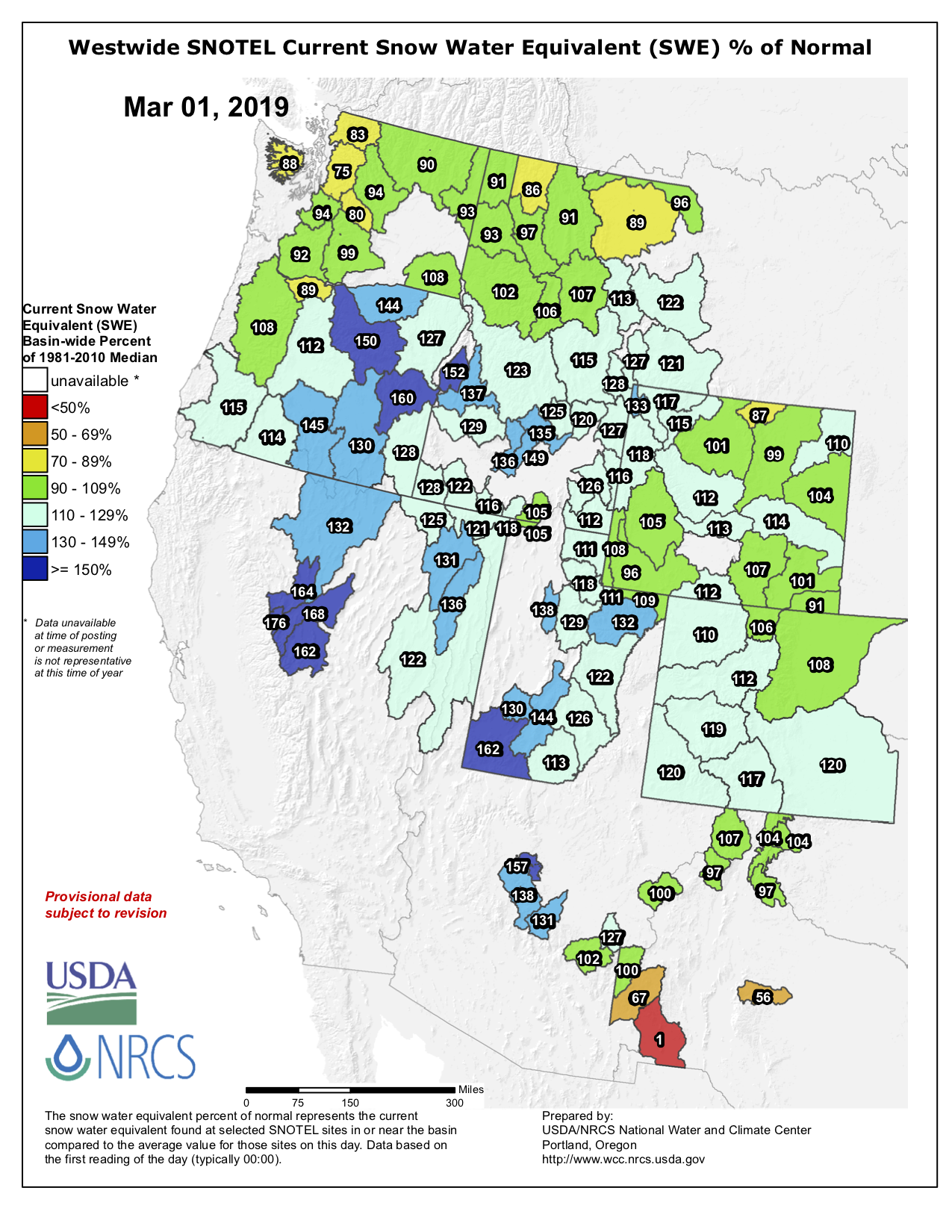
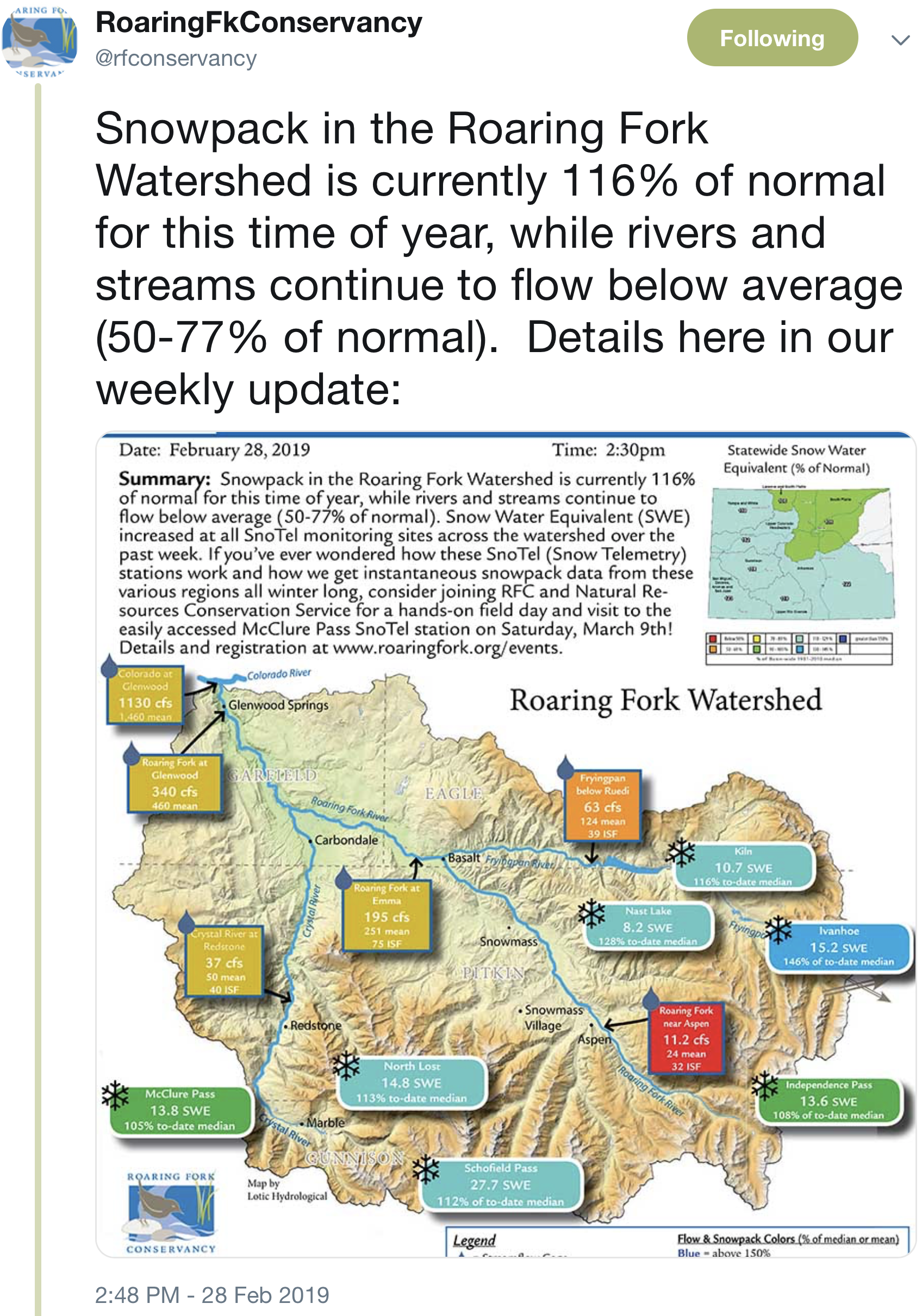
    As Colorado’s other major utilities, including Xcel Energy and Platte River Power Authority, have announced specific targets and deadlines for transitioning to renewables, Tri-State has remained heavily reliant on coal without setting any renewable energy or emission reduction goals. Meanwhile, its members have become increasingly aware of the rising cost of coal dependence and shrinking cost of renewable development. This has sparked cooperative pressure on the power supplier to provide affordable electricity, as Colorado is currently witnessing with DMEA’s demands for a “reasonable and just” exit fee to protect other co-ops from unfair pricing.

    Tri-State’s response to its members’ actions will become clear when its 2018 annual report is released this coming March, in addition to the results of its recent appointment of a new CEO. The report should provide comprehensive strategies for meeting renewable energy standards by the end of the year. Yet as more rural cooperatives look to DMEA’s model for a path forward, the future for Tri-State looks less than bright, unless it adds more renewables.

    Keriann Conroy is a graduate student at Western Colorado University in Gunnison, Colorado, studying democratic practices and sustainability. Email High Country News at editor@hcn.org.

    ‘Why shouldn’t I try and save all you adults?’ – @HighCountryNews #ActOnClimate

    Photo credit: Haven Coleman Twitter Feed, https://twitter.com/havenruthie

    From The High Country News (Jessica Kutz):

    Every Friday since the beginning of this year, bundled in a burnt-orange puffy jacket, 12-year-old Haven Coleman has protested climate change in front of government buildings and businesses storefronts in Denver, Colorado. The reactions are mixed. Last week, a man flipped her off through his rolled-down window; other times, people shout words of encouragement or give a thumbs-up. At one of her strikes in February, I find her sitting cross-legged on the cold, hard cement steps leading to the entrance of the Denver City Council building, two posters propped up next to her. One sign has four hash-tagged words: #ClimateBreakdown #FridaysforFuture, #ClimateStrike and #GreenNewDeal written in large skinny black letters. The other proclaims: “School Strike for Climate.”

    After about half an hour, an older gentleman in a neon-yellow T-shirt and worn blue jeans pauses to read Coleman’s signs. He doesn’t like what they say. “That’s to your disadvantage,” he tells her matter-of-factly. “You need school.” Coleman, a seventh-grader with long brown hair and expressive hand gestures, tries to come up with a quick response, but by the time she’s pulled her thoughts together, he’s already gone up the City Hall steps.

    Around the country, other young climate activists have gone on similar solo strikes, cheering each other on from afar through Instagram and Twitter. They find encouragement from teens in other countries, like England and Belgium, where the youth climate movement has inspired a vast wave of students to ditch class on Fridays and flood into the streets to protest. Like many adults, they are energized by the eloquent, powerful and at times frightening speeches of Swedish 16-year-old Greta Thunberg, who has been protesting in front of the Swedish Parliament since last August.

    WITH A FUTURE THAT looks increasingly perilous — a recent U.N. climate report gave world leaders just 12 years to act to avoid the worst effects of climate change — Coleman and her peers feel a sense of urgency. “Us kids, we are the only ones who are doing anything recognizing that our future is at stake,” Coleman said, with a hint of exasperation in her voice. “The reason why we are ‘climate striking’ is to try and get the attention of the adults, because we can’t vote — but we can influence senators.”

    And grabbing the attention of adults is Coleman’s strong suit. She made headlines over a year ago, when she spoke at a town hall hosted in August 2017 by Republican Colorado Sen. Cory Gardner, who has received over $1.2 million dollars in campaign funding from oil and gas industries. The senator listened to Coleman’s heartfelt speech that day from the stage. Through tears, she pleaded with him to take action against climate change. She even offered to help. “If the carbon polluters’ money is holding you back, I can organize kids, adults and money and we can use social media and do grassroots,” she told him, as people in the crowd flashed green cards and cheered.

    Gardner didn’t take her up on her offer, but the videos that surfaced of Haven’s speeches to Republican State Rep. Doug Lamborn, R, a known climate change denier, garnered the attention of another prominent figure, Al Gore. She had met him briefly once before at a training event. But months later, after hearing about her climate activism in Colorado, he invited her to be a part of his “24 Hours of Reality” project, a day of television programming centered on climate change. Coleman says her activism “has been going up from there.”

    Haven Coleman questions Republican State Rep. Doug Lamborn in Colorado Springs last August.
    Jonathan Caughran/YouTube video capture

    THESE DAYS, ALL OF her energy is going into planning the U.S. Youth Climate Strike, a national event organized by Coleman and two other young climate activists, Alexandria Villasenor and Isra Hirsi. It will take place in solidarity with a global school strike for climate action on the same day, in which students plan to urge U.S. politicians to adopt the Green New Deal and to stem the effects of the “climate crisis.” Over 300 people have already signed on to lead strikes in their cities. With less than a month to go, events have been confirmed in 28 states. Coleman is confident that the movement will reach every part of the country.

    Balancing school and planning a national strike can be challenging — to say the least — for a seventh-grader. She caught some flak from a teacher when she missed a math-tutoring session; she’d gotten stranded on a planning phone call with her climate strike co-leaders. When she tried to explain that she had just started the U.S. version of a European climate action movement, her teacher responded by telling her, “You better get your priorities together.” Coleman has missed several days of school to attend rallies in D.C. and speak at climate change events, but for the most part, she tries to balance school with her activism. On her Friday strikes, she squeezes in her protests early in the mornings or during lunch, though sometimes she ends up a little late for her classes.

    School and activism have never harmonized for Coleman, anyway. When she lived in politically conservative Colorado Springs, she says the other kids “hated my guts” and shoved her into lockers. “It got pretty intense, and I ended up doing home school.” At her current school in Denver, she says her classmates don’t really get this “climate activism thing,” so she tries not to bring it up too often. “It is just hard because when people don’t really understand… It is sort of like I’m hunting for dragons or something,” she says.

    It’s difficult not having people her age to turn to when she feels overwhelmed by climate change, Coleman said. “When you are dealing with such a heavy issue at such a young age, sometimes it just brings you down,” she says. In those moments, her parents help her through it —especially because “you don’t see a lot of kids being activists.” The strike on March 15 just might change that. “I hope that a ton of kids will flood into the streets,” Coleman says.

    At one point, I ask Haven what motivates her to turn her feelings about climate change into real action, something many adults have failed to do. “I feel like I need to do something,” she says, “because why wouldn’t you want to save your future?”

    “We can stop the worst effects, so why shouldn’t I try and save all you adults?”

    Jessica Kutz is an editorial fellow for High Country News. Email her at jessicak@hcn.org.

    Police-state tactics at the U.S.-Mexico border — @HighCountryNews

    From The High Country News (Ruxandra Guidi):

    Earlier this year, a journalist friend of mine (he asked me not to use his name for fear of reprisal) headed to Tijuana to interview some of the Central American migrants camped out in makeshift shelters throughout the city, looking for the best way to enter the U.S. and ask for asylum. When he attempted to cross the border on his return, my friend was taken to “secondary” screening. No reason was given, but a Customs and Border Protection agent asked him, over and over, “What did the migrants tell you?” After hours of waiting and intimidation, another agent gave him his card and asked him to reach out. “He told me he could use my help,” my friend told me.

    This is not normal: CBP has no business questioning journalists about their work or trying to enlist them to give away information about their sources. But under President Donald Trump, the practice has become commonplace. Over the past year, journalists have complained to the Committee to Protect Journalists (CPJ) about being asked to provide information about the migrant caravan or to hand over video footage and submit to interviews over “potentially illegal conduct.” “Custom and Border Protection’s apparent use of secondary screening as a pretext for questioning journalists about their reporting is akin to treating the media as informants and is a worrying sign for press freedom,” said CPJ’s Alexandra Ellerbeck. That’s the sort of statement more commonly made about press freedom in Russia, Nicaragua or Thailand. Today, though, it is very much a U.S. story, and a very troubling one, alongside other recent policies and measures — deployment of National Guard along the border, the criminalization of humanitarian workers, the separation of migrant children from their parents and the extended detention of asylum-seekers — all done in the name of defending the homeland, and fighting crime and terrorism. What once happened elsewhere, under faraway authoritarian regimes, is now taking place in front of us and rapidly eroding the moral core of American society.

    During the Mexican Revolution, 1910-1920, American and Mexican soldiers guard International Street in Nogales. The border marker still stands today.
    Photo credit: Wikimedia Commons

    One government agency in particular has come to represent this shift: Immigration and Customs Enforcement, or ICE. It’s relatively new, founded after the Sept. 11, 2001, terrorist attacks. But in its brief existence, ICE has built up a massive immigrant detention network, along with a history of abuses. ICE’s 2019 budget asked for almost $9 billion to run a system that would hold 52,000 people in detention every day. Homeland Security Secretary Kirstjen Nielsen claims that 3,755 “known or suspected terrorists” have been prevented from traveling to or entering the U.S. But as of two years ago, the State Department declared there was “no credible information that any member of a terrorist group has traveled through Mexico to gain access to the United States.” The buildup of police and immigration enforcement is common to authoritarian regimes: Under military strongman Hosni Mubarak, Egypt boasted 1,500 policemen for every 100,000 people.

    “There is no political blowback for ICE; in fact, they have the continued support from the president,” Mike Turner, who oversaw ICE’s San Diego office and retired from the agency 11 years ago, told me. “I look at the separation of immigrant parents and their children, and if I was to go back 15 years ago, I can’t believe we would have allowed that to be done the way that it was done. I can’t envision how they’re doing that from a moral and ethical stance.”

    When I asked Turner how an agency that was created to combat terrorism became a deportation machine, he sighed, and measured his response. “I did not think we should be chasing every last undocumented person working at a fast-food restaurant,” he said. The Trump administration, however, has encouraged ICE to arrest and deport at will, setting the agency free from any previous restraints observed even during then-President Barack Obama’s record-high deportations.

    Now we’re witnessing how the current regime has created the ongoing spectacle of a “border crisis” to support its immoral treatment of immigrants, people who try to help them and all who bear witness to their situation. It is worth repeating these truths again and again: Illegal crossings are currently at a 46-year low. The National Guard has no business enforcing immigration laws. Asylum seekers are not criminals. And ultimately, there is no need for razor wire along the border wall in Nogales, Arizona, nor for taller concrete planks along the San Diego border.

    There is no real crisis at the border. The White House’s latest declaration of a national emergency there is the only real crisis — and it is undermining the rule of law and democracy in a manner disturbingly similar to what only happens in police states.

    I used to cross the San Diego-Tijuana border regularly for work. Coming back into the U.S. by car meant getting stuck in a ridiculously long and slow-moving line of traffic until you reached a tollbooth, where a CBP agent asked whether you were a U.S. citizen, and sometimes wanted to see your passport. When I was asked what I’d been doing in Tijuana, I’d always tell the truth: I was out reporting — doing my job, talking to people. I hope the generations of journalists who come after me will be able to answer that question so honestly.

    Contributing editor Ruxandra Guidi writes from Los Angeles, California. Email her at ruxandrag@hcn.org.

    The Nature Conservancy is building a system to supply water to the Scott M. Matheson Wetlands Preserve for razorback sucker habitat

    From KSLTV.com (John Hollenhorst):

    The rescue project is on the Scott M. Matheson Wetlands Preserve, a property owned by The Nature Conservancy on the fringes of Moab alongside the Colorado River. Over the last few weeks, construction crews have been creating a special side-channel that will carry river-water into the wetlands during periods of higher water. It’s designed to mimic – on a small scale – the natural system of annual spring flooding that’s been disrupted over the last century or so by dams, diversions and other human activity.

    “We don’t have the same magnitude of flood events, or the same duration, or even the same timing,” said Zach Ahrens, a fish biologist for the Utah Division of Wildlife Resources, one of several agencies that have partnered on the project.

    In the spring, the suckers spawn and hatch tiny babies in the main current of the river. The plan is to divert the higher spring flows through the new channel into a large pond in the Matheson wetlands. Actually, in recent years it hasn’t really resembled a pond because it contains so little water. The new channel is aimed at refilling it from time to time to give the larvae of razorback suckers an alternative, temporary habitat.

    “Away from the main channel allows for a little bit warmer water, which allows the fish to grow more quickly,” Ahrens said. “It also allows them some refuge from the turbulent currents that occur during spring runoff.”

    If they stay out in the main channel of the river, the larvae are highly vulnerable to being eaten by non-native fish that have taken over the Colorado. “They’re maybe a half an inch long,” Ahrens said. “They’re tiny little translucent noodle-looking things.”

    But if they can spend a few months in an off-stream nursery, they can come out big and strong.

    “If we can bring them into a safe harbor, into a nursery and give them the months they need to grow to a sufficient size, and then release them back into the river, then they can compete” Whitham said.

    When they re-enter the Colorado River, they’ll have a better chance of stand up to hungry non-native predators that were accidentally or deliberately introduced in the last few decades.

    “If we can help bring back these populations of native fish, who have been around for millions of years, and get them to sufficient sizes, then we’ll know that we’re doing something right,” Whitham said.

    The project is being built in phases because all the funding hasn’t been lined up yet. The Nature Conservancy hopes to fill the gap with state and federal grants as well as private contributions.

    The latest E-Newsletter is hot off the presses from the Hutchins Water Center

    Slide from Becky Mitchell’s presentation at the recent Water Course shindig from the Hutchins Water Center.

    Click here to read the newsletter. Here’s an excerpt:

    WATER COURSE MATERIALS POSTED
    Presentation slides and some streaming links for the Hutchins Water Center’s recent 3-evening Water Course are now posted here. Topics included CO Water Law, Impacts of Drought & Aridification, and Drought Contingency Planning, and we had a stellar slate of speakers.

    @SenatorBennet, @SenCoryGardner & Colleagues Introduce #PFAS Action Plan of 2019

    Widefield aquifer via the Colorado Water Institute.

    Here’s the release from Senator Bennet’s office:

    Bipartisan bill would designate PFAS chemicals as hazardous substances under our environmental protection laws

    U.S. Senators Michael Bennet (D-CO) and Cory Gardner (R-CO), with a bipartisan group of colleagues, today introduced legislation that would mandate the Environmental Protection Agency (EPA), within one year of enactment, declare per- and polyfluoroalkyl substances (PFAS) as hazardous substances eligible for cleanup funds under the EPA Superfund law, and also enable a requirement that polluters undertake or pay for remediation.

    “It is inexcusable that the Trump administration continues to delay action to address PFAS contamination across the country,” Bennet said. “This bipartisan bill will ensure contaminated sites are cleaned up and resources are available to communities in Colorado so they have access to safe drinking water. Passing this measure is one of many steps we must take to address this public health threat with the urgency it requires.”

    “This bipartisan legislation will allow EPA to pursue polluters responsible for PFAS contamination and provide the communities remediation options through Superfund,” Gardner said. “PFAS contamination is a serious issue facing our communities and we need to act quickly to address this challenge. I will continue working to make sure Coloradans have access to clean and safe drinking water.”

    In May 2018, former Environmental Protection Agency (EPA) Administrator Scott Pruitt announced that EPA would propose designating PFOA and PFOS, two specific PFAS chemicals, as “hazardous substances” through one of the available statutory mechanisms, including CERCLA Section 102. Nearly a year later, on February 14, 2019, EPA released its long-anticipated PFAS Action Plan. The plan included another commitment by EPA to make that designation for PFOA and PFOS, but did not identify the available statutory mechanism it would use, nor how long the designation process would take to complete.

    Clear and swift action from Congress to list PFAS as hazardous substances under CERCLA would advance the action already proposed by EPA, enabling the agency to protect human health and the environment in an expeditious manner.

    Bennet’s reaction to the EPA’s plan, and his record of two years of work to address PFAS in Colorado and across the country, is available HERE.

    In addition to Bennet and Gardner, original cosponsors include U.S. Senators Tom Carper (D-DE), Shelley Moore Capito (R-WV), Gary Peters (D-MI), Thom Tillis (R-NC), Debbie Stabenow (D-MI), Marco Rubio (R-FL), Jeff Merkley (D-OR), Jack Reed (D-RI), Lisa Murkowski (R-AL), Jeanne Shaheen (D-NH), Richard Burr (R-NC), and Joe Manchin (D-WV). U.S. Representative Debbie Dingell (D-Mich.) led the introduction of companion legislation in the House of Representatives earlier this Congress.

    The bill text is available HERE.

    From The Colorado Springs Gazette (Jakob Rodgers):

    The senators’ PFAS Action Plan for 2019 comes after the Environmental Protection Agency was criticized by environmental groups and affected residents for not going further in its plan for addressing the chemicals.

    The bipartisan legislation — Bennet is a Democrat, Gardner a Republican — mandates the EPA declare all perfluoroalkyl and polyfluoroalkyl substances, man-made compounds also known as PFAS, as “hazardous substances” within one year of the bill’s passage. The designation would clear the way for the EPA to use Superfund money to clean up contaminated sites, while opening the door for the government to sue polluters for cleanup costs.

    “It seems like a positive step,” said Meghan Hughes, a spokeswoman for the Colorado Department of Public Health and Environment. “It really could be a driver for PFAS groundwater investigations and contaminations (cleanups) across the state.”

    […]

    The legislation does not address any other aspect of the EPA’s oversight of those chemicals, such as whether the agency should regulate the chemicals in a similar fashion as lead, cyanide and mercury.

    Should it pass, it’s impact on southern El Paso County — where the drinking water of tens of thousands of Security, Widefield and Fountain residents was tainted — remained unclear Friday.

    The Air Force is in the midst of a yearslong process to address the chemicals that is similar to the federal Superfund program, due to the decadeslong use of a firefighting foam containing the toxic chemicals at Peterson Air Force Base that was detected in groundwater.

    The Air Force is still investigating the contamination — a process that was expected to take years. And any cleanup steps — such as removing the chemicals from the Widefield aquifer — have not been announced, nor has money been allocated for such cleanup efforts.

    In the meantime, water districts serving Security, Widefield and Fountain have spent millions of dollars installing treatment systems and piping in water from elsewhere to remove the chemicals from residents’ tap water to nondetectable levels.

    Two other communities in Colorado — in Boulder and Adams counties — also have discovered the chemicals in their drinking water. Both contamination sites were near fire departments that used the same toxic firefighting foam that was a mainstay at Peterson Air Force Base, according to the Colorado Department of Public Health and Environment.

    The @USBR March 4th deadline is upon all of us in the #ColoradoRiver Basin but the spotlight is shining on #Arizona and #California #DCP #COriver #aridification

    All eyes are on Arizona and California with Brenda Burman’s extended deadline coming up on Monday. They are dealing with the Lower Basin Drought Contingency Plan, which really should be a plan to address the declining supply and increasing demand that causes an annual deficit. (H/T Eric Kuhn over at Inkstain.

    From Arizona Central (Ian James):

    Water poured into an artificial wetland next to the Gila River near Sacaton as Arizona’s leading proponents of a Colorado River drought plan celebrated the state’s progress in moving toward a deal.

    Leaders of the Gila River Indian Community touted the restoration project as an example of putting water back into a river that has was sucked dry over the years, and a symbolic step in promoting sustainable water management in the state. The inauguration ceremony on the reservation featured traditional singing by men and boys who shook gourd rattles in unison.

    Gov. Stephen Roe Lewis said the community, which has agreed to contribute water under the proposed Colorado River deal, is playing a vital role in helping to finish the three-state Drought Contingency Plan, or DCP.

    “This is very important and very historic,” Lewis told the audience of community members, politicians and water managers. “It goes beyond politics. It goes to the benefit and the future sustainability and existence of all of us here.”

    […]

    Caption: Imperial Valley, Salton Sea, CA / ModelRelease: N/A / PropertyRelease: N/A (Newscom TagID: ndxphotos113984) [Photo via Newscom]

    Unresolved issues remain

    Yet even as Arizona’s top water officials expressed optimism about finishing the drought agreement after months of difficult negotiations, they also voiced concerns that unresolved issues in California still could upend the entire deal.

    More than 250 miles to the west in California’s Imperial Valley, leaders of the irrigation district that controls the largest share of Colorado River water were still discussing a key condition of their participation. Imperial Irrigation District officials announced at a meeting on Friday afternoon that the federal Bureau of Reclamation has agreed to their condition that the drought package include linkage to funding for the Salton Sea.

    They said federal officials will write a strong letter of support backing IID’s requests for $200 million in Farm Bill funding for wetlands projects around the shrinking sea. The projects are aimed at keeping down dust along the shorelines and salvaging deteriorating habitat for fish and birds.

    Reclamation Commissioner Brenda Burman, the U.S. solicitor and staff are finalizing a letter stating that “they consider the restoration of the Salton Sea is a critical ingredient of the drought contingency plans and cannot be ignored, and they stand prepared to help the IID with the Department of Agriculture to try to get funding in whatever way possible,” said IID attorney Charles Dumars.

    He cautioned that it was “a building block, nothing more,” but said it was a big one that could be used to persuade Agriculture Department officials to allocate funds for the receding lake…

    The board also voted unanimously to oppose a supposed “white knight” offer by the Metropolitan Water District of Southern California’s general manager, Jeffrey Kightlinger, to provide IID’s portion of water to be kept in Lake Mead if the agency doesn’t sign on to the drought plan.

    Several board members and people in the audience chided the Los Angeles-based agency for trying to interfere in their process, saying it was ignoring the public-health issues at the Salton Sea created by the withdrawal of Colorado River water…

    IID officials also discussed a timeline that Burman and her staff presented at a recent meeting in Las Vegas. The aim, Martinez said, is to have agreements adopted by all parties…in Phoenix on March 14 or 15 to sign a joint letter to Congress endorsing the plan…

    Gila River watershed. Graphic credit: Wikimedia

    Arizona working to wrap up its part

    The Gila River Indian Community’s involvement is key because the community is entitled to about a fourth of the water that passes through the Central Arizona Project, and it has offered to kick in some water to make the drought agreement work.

    Arizona’s plan for divvying up the water cutbacks involves deliveries of “mitigation” water to help lessen the blow for some farmers and other entities, as well as compensation payments for those that contribute water. Those payments are to be covered with more than $100 million from the state and the Central Arizona Water Conservation District, which manages the CAP Canal. Much of the money would go toward paying for water from the Colorado River Indian Tribes and the Gila River Indian Community…

    Gov. Ducey signed a package of legislation on Jan. 31 endorsing the Drought Contingency Plan. Arizona still needs to finish a list of internal water agreements to make the state’s piece of the deal work.

    State officials have presented a list of a dozen remaining agreements, two of which would require the approval of the Gila River Indian Community. But Cooke said not all the agreements need to be signed for the three-state deal to move forward.

    Cooke said he’s focused most of all on finishing a framework agreement for Arizona focusing on “intentionally created surplus,” a term for unused water that is stored in Lake Mead.

    Cranes make annual return to the San Luis Valley — @COParksWildlife

    Greater Sandhill Cranes in flight over the San Luis Valley. The annual Monte Vista Crane Festival is March 8-10. Photo credit: Colorado Parks and Wildlife

    Here’s the release from Colorado Parks and Wildlife:

    In the San Luis Valley nature is again putting on one of its most memorable displays: the spring migration of Greater Sandhill Cranes. In appreciation of this wildlife spectacle, area organizations, businesses and wildlife agencies are holding the annual Monte Vista Crane Festival, March 8-10.

    “Everyone who lives in Colorado should take the time to see this ancient and magnificent migration,” said Joe Lewandowski, public information officer for the Southwest Region of Colorado Parks and Wildlife. “This is one of only a few great wildlife migrations in the United States that people can easily see. The sights and sounds are absolutely amazing.”

    The cranes started arriving in mid-February, flying from their winter nesting ground, primarily in New Mexico. The large wetland areas, wildlife refuges and grain fields in the San Luis Valley draw in about 25,000 birds. The cranes stop in the valley to rest-up and re-fuel for their trip north to their summer nesting and breeding grounds in Idaho, Montana and Wyoming.

    Cranes are among the oldest living species on the planet: Fossil records for cranes date back 9 million years.

    The birds that migrate through Colorado are the largest of the North American sandhill subspecies standing 4-feet tall, having a wing-span of up to 7 feet and weighing in at 11 pounds. Besides their imposing size, the birds issue a continuous, distinctive and haunting call. At this time of year cranes are engaged in their mating ritual and the birds perform an elegant hopping dance to gain the attention of other birds.

    The birds are abundant in areas near the town of Monte Vista and wildlife watchers can see the birds most readily in the Monte Vista National Wildlife Refuge, about 5 miles south of town of Colorado Highway 15. Birds also gather at the Alamosa National Wildlife Refuge, southeast of the town of Alamosa, and at that Rio Grande, Higel and Russell Lakes state wildlife areas.

    The cranes are most active at dawn and at dusk when they’re moving back and forth from their nighttime roosting areas. But in the middle of the day they graze gracefully in the grain fields of the Monte Vista refuge.

    Be sure to dress warm, as winter still reigns in the valley.

    During the three days of the festival, free tours are offered at 7 a.m. and 4 p.m. when the birds are most active. Visitors take buses to various spots on the wildlife refuge, and U.S. Fish and Wildlife Service staffers talk about the migration and the refuge. If you want to take a tour, be on time because the buses leave promptly.

    The number of cranes in the valley peaks in mid-March; but many birds linger through the month. So even if you can’t go the weekend of the festival there’s still plenty of time to see the birds.

    Birdwatchers who travel on their own should be cautious when parking, getting out of vehicles and walking along roads. People are also asked to view birds from a distance with binoculars and spotting scopes, and to observe trail signs and closure notices.

    Many other bird species – including eagles, turkeys, and a variety of raptors and waterfowl – can also be seen throughout the San Luis Valley. Look in the many cottonwood trees for owl nests.

    The festival headquarters and starting point for the tours is the Ski Hi Park building located near U.S. Highway 160 on Sherman Avenue on the east side of Monte Vista. Visitors can pick up maps, schedules and information at the headquarters. Besides the tours, a variety of workshops are put on by bird, wildlife and photography experts. An arts and crafts fair continues through the weekend at the headquarters building.

    Approximate distances to Monte Vista: Denver, 220 miles; Colorado Springs, 182 miles; Salida, 85 miles; Vail, 175 miles; Durango, 135 miles; Grand Junction, 230 miles.

    For more information on the Monte Vista Crane Festival, see: mvcranefest.org; or https://www.fws.gov/refuge/Monte_Vista. For more information on State Wildlife Areas in the San Luis Valley, go to: https://cpw.state.co.us/placestogo.

    Colorado NRCS now accepting applications for 2019 Agricultural Land Easement and Wetlands Reserve Programs — High Plains/Midwest Ag Journal

    Irrigation sprinklers run over a farm in Longmont in the South Platte River basin. Photo credit: Lindsay Fendt/Aspen Journalism

    From The High Plains/Midwest Ag Journal:

    Clint Evans, Colorado State conservationist for USDA’s Natural Resources Conservation Service recently announced applications for the 2019 Agricultural Conservation Easement Program—Agricultural Land Easement and Agricultural Conservation Easement Program-Wetlands Reserve Program—are currently being accepted on a rolling basis. Due to the new 2018 Farm Bill, Colorado NRCS will not be announcing an application deadline for either program at this time. A subsequent announcement will be made at least 30 days prior to any established deadline in 2019.

    The purpose of the ACEP-ALE program is to protect the agricultural viability, grazing uses and related conservation values by limiting nonagricultural uses of the land. The purpose of the ACEP-WRE program is to protect and restore wetlands, wildlife habitat, and water quality on agricultural lands. These programs are voluntary and the landowner retains ownership of the land.

    Applicants for ACEP-ALE must be a federally recognized Indian Tribe, state or local units of government, or a non-governmental organization. Individual landowners may apply for ACEP-WRE if their land includes farmed or converted wetlands that can be successfully restored or other eligible wetland type.

    Completed application packets for ACEP-ALE should be emailed to Heather Foley at heather.foley@co.usda.gov or mailed to Heather Foley, easements coordinator, USDA-NRCS, Denver Federal Center, Building 56, Room 2604, Denver, CO 80225. Completed application packets for ACEP-WRE must be submitted to the local NRCS field offices located within USDA Service Centers. Application packets for either program must be submitted based on the 2018 guidelines.

    For more information about NRCS easement programs, please contact Heather Foley at 720-544-2805 or heather.foley@co.usda.gov. You can also visit your local NRCS Service Center or visit the Colorado NRCS website at http://www.co.nrcs.usda.gov.

    Letter: Climate crisis and a betrayed generation #ActOnClimate

    From The Guardian letters to the editor:

    Activists behind recent youth-led climate protests say their views are being ignored in the debate about global warming

    We, the young, are deeply concerned about our future. Humanity is currently causing the sixth mass extinction of species and the global climate system is at the brink of a catastrophic crisis. Its devastating impacts are already felt by millions of people around the globe. Yet we are far from reaching the goals of the Paris agreement.

    Young people make up more than half of the global population. Our generation grew up with the climate crisis and we will have to deal with it for the rest of our lives. Despite that fact, most of us are not included in the local and global decision-making process. We are the voiceless future of humanity.

    We will no longer accept this injustice. We demand justice for all past, current and future victims of the climate crisis, and so we are rising up. Thousands of us have taken to the streets in the past weeks all around the world. Now we will make our voices heard. On 15 March, we will protest on every continent.

    We finally need to treat the climate crisis as a crisis. It is the biggest threat in human history and we will not accept the world’s decision-makers’ inaction that threatens our entire civilisation. We will not accept a life in fear and devastation. We have the right to live our dreams and hopes. Climate change is already happening. People did die, are dying and will die because of it, but we can and will stop this madness.

    We, the young, have started to move. We are going to change the fate of humanity, whether you like it or not. United we will rise until we see climate justice. We demand the world’s decision-makers take responsibility and solve this crisis.

    You have failed us in the past. If you continue failing us in the future, we, the young people, will make change happen by ourselves. The youth of this world has started to move and we will not rest again.

    The global coordination group of the youth-led climate strike.

    Click here to go the FridaysForFuture website.

    Alamosa councillors plan to oppose latest San Luis Valley water export plans

    The northern end of Colorado’s San Luis Valley has a raw, lonely beauty that rivals almost any place in the North American West. Photo/Allen Best

    From The Valley Courier (Ruth Heide):

    Alamosa city councilors and staff are willing to join the fight against the latest water export proposal, they told water leader Cleave Simpson during a work session Tuesday night.

    Simpson is the general manager of the Rio Grande Water Conservation District, which has taken a position against a water export proposal by Renewable Water Resources. He shared with the council the history of former water export proposals and details about the latest one, which proposes to export 22,000 acre feet from the San Luis Valley to the south Denver metro area.

    “I do believe it’s real,” Simpson said. “I think they intend to do it.”

    Nothing has yet been filed in court but Simpson said the spokesman for Renewable Water Resources indicated the case might be filed by the end of this year. Simpson said the City of Alamosa could enter the case when it is filed.

    The city council and staff discussed other ways they could be involved including taking an official stand through a resolution, like the water conservation district did, and participating in education and awareness.

    “It would damage the agriculture of the Valley,” Councilman David Broyles commented about the proposed export.

    “And economy,” added Alamosa City Manager Heather Brooks.

    Councilman Charles Griego said he believed the city’s first step would be to pass an official resolution during a council meeting. Brooks suggested the city council could pass a resolution either the second meeting in March or first meeting in April. “I am hearing this is something we should be taking seriously,” Brooks said.

    Griego said the city needs to be clear that “not one drop” should be exported from the Valley and that the council would be against any kind of water leaving the Valley. He said the word needs to get out how devastating this would be to the Valley…

    He said he is going to inform the Interbasin Compact Commission members later this week, as he is a member of that governor-appointed statewide water board.

    Simpson said Renewable Water Resources on its website (renewablewaterresources.com) says “Best for the San Luis Valley. Best for the environment. Best for Colorado.” However, he sees no benefit whatsoever to the Valley of this project. “It’s not good for the San Luis Valley.”

    He added that the Valley has a history of opposition to similar projects and will adamantly oppose this one too.

    “Every 10-20 years, there’s another export proposal,” Simpson said.

    Some of the past proposals, which were unsuccessful, were a proposal to export water from wells drilled in Costilla County to San Marcos, Texas in the 1970’s and multiple export proposals tied to the late Gary Boyce who owned land in Saguache County. American Water Development Inc. (AWDI) proposed to pump 200,000 acre feet of water from the Baca Ranch area to the Front Range.

    The latest proposal is that of Renewable Water Resources, which purchased a 12,000-acre ranch north of Crestone. Their proposal is to pipe 22,000 acre feet of water from the confined aquifer out of the Valley and ultimately to the Denver area. (Simpson described 22,000 acre feet as the equivalent of 100 circles.) Renewable Water Resources representatives met with the Rio Grande Water Conservation District board to seek the district’s cooperation in helping the developers use up to $60 million (about $2,500 an acre foot) to buy and retire water rights across the Valley and to help manage a $50-million community fund. Although planning to pump out 22,000 acre feet, the water developers propose to buy up twice that much, 40,000-44,000 acre feet of water rights, and retire a portion, which is a different approach than previous water exporters, Simpson explained.

    He said reducing water consumption is a similar goal to the water district and sub-districts. However, “We are not pursuing permanent dry up or permanent removal of 22,000 acre feet of water leaving the Valley.”

    Idalia: The South Fork #RepublicanRiver Restoration Coalition Bonny Reservoir project landowner meeting March 14, 2019

    From the South Fork Republican River Restoration Coalition via The Yuma Pioneer:

    Bonny Reservoir, once a popular camping, boating and fishing destination located in extreme southeastern Yuma County, was drained years ago to help Colorado get into compliance with the Republican River Compact with Kansas and Nebraska.

    However, efforts by a coalition of county governments and other organizations — named the South Fork Republican River Restoration Coalition — still remain underway to at least partially restore it to its formal usage.

    There have been a series of public meetings since last year. The next is being planned for Thursday, March 14, in a joint meeting with the Colorado Agriculture Preservation Association. It will be at Idalia School from 5 to 6:30 p.m., followed by CAPA’s annual meeting.

    The coalition has been working on the project for the past two years. Yuma County and Kit Carson County are part of the group, along with Three Rivers Alliance, the Republican River Water Conservation District, Colorado Parks & Wildlife and The Nature Conservancy.

    Yuma County Commissioner Robin Wiley told the Pioneer he believes the group is making headway in a positive direction. He stressed that plans do include necessarily refilling the lake, but restoring the stream flow and possibly establishing some non-water and small water recreational activities in and around the old lake bed.

    The coalition secured a grant in January 2018 from the Colorado Water Conservation Board for $99,000, with The Nature Conservancy giving the cash match.

    Wiley said the money is being used to do Phase I of the project, planning and design.

    The coalition has hired Otak Engineering to do channel design and engineering. A firm named Stillwater is doing the habitat restoration planning, and CHM has been hired to do an economic analysis of possible recreational activities.

    It had a landowner meeting last August in Idalia to tell the landowners, up and down the South Fork of the Republican River, what the coalition is trying to do and ask for their cooperation.

    Last November there were two meetings, one in Idalia and one in Burlington, to get input from the public on the project.

    Now comes the March 14 meeting in Idalia. All interested members of the public are invited to attend.

    @Northern_Water: Farm purchase part of #NISP effort to ensure water-secure future for local communities and agriculture

    Northern Integrated Supply Project (NISP) map July 27, 2016 via Northern Water.

    Here’s the release from Northern Water (Brian Werner):

    The recent purchase of a Weld County farm marks a new venture for Northern Water and Northern Integrated Supply Project participants – one that’s part of the ongoing, collaborative effort to secure future water supplies for both the region’s communities and our vital agricultural industry.
    On Jan. 31, Northern Water and the NISP participants purchased a 28-acre farm northeast of Greeley and the property’s water rights. The farm was purchased through the NISP Water Secure program, a cooperative effort to maintain the exchange of water for NISP while keeping water on participating farms. This investment is a shift from the “buy-and-dry” approach that has stressed our agricultural communities.

    This innovative program will eventually provide supplemental water to approximately 500,000 residents in northern Colorado while preserving thousands of acres of irrigated farmland. Water Secure is part of a strategic long-term plan to better plan for future growth and to consistently apply Colorado Water Plan principles to protect water for our communities, farms and the environment. Without innovative approaches such as Water Secure, the region is on pace to see hundreds of thousands of irrigated acres dried up by mid-century.

    “This is an outside-the-box, ‘buy-and-supply’ approach we’re taking to address the tightening water supplies facing Northern Colorado and its future generations,” said Northern Water General Manager Brad Wind.

    The recently purchased farm sits within an area of Weld County that is key to NISP – a project that, once built, will include Glade Reservoir near Fort Collins and Galeton Reservoir near Ault, and deliver approximately 40,000 acre-feet of water annually to 15 local communities and water districts.

    As part of the project, Northern Water and the NISP participants are working with the New Cache la Poudre Irrigating Company and Larimer and Weld Irrigation Company ditch and reservoir systems in Weld County, to use a portion of their senior water rights in exchanges that will ensure the NISP participants receive the water from the project.

    These exchanges with the two systems will keep water flowing to those farms, as well as include compensation that will enhance the long-term viability of their operations.

    To avoid water leaving those farms permanently through buy and dry purchases from other entities, Northern Water will buy land and water from willing sellers to ensure those supplies remain in the two ditch systems and available for exchange.

    The senior water rights in the New Cache and Larimer-Weld systems are currently among the most sought after by water providers looking to obtain future supplies.
    Farms in the New Cache and Larimer-Weld systems bought by Northern Water will remain in production, through limited land use easements on the property, lease-back agreements or other arrangements that will require continued irrigation on those farms.

    Furthermore, the purchase of any irrigated lands will be done with the goal of eventually returning them to private ownership.

    “The Water Secure program maintains irrigated agriculture and provides open space benefits while eliminating many of the long-term challenges with the practice of buying and drying,” Wind added.

    To learn more about NISP, go to http://www.gladereservoir.org.

    From The Greeley Tribune (Sara Knuth):

    As part of the newly implemented Water Secure program, Northern Water purchased the 28-acre farm northeast of Greeley on Jan. 31 with communities that participate in the Northern Integrated Supply Project, which will result in two reservoirs and more water for 15 communities…

    Instead of municipalities buying up water rights on farmland and leaving them to dry out, the district is looking at the initiative as a way to both preserve irrigated farmland and provide supplemental water to an estimated 500,000 northern Colorado residents.

    During a phone interview Thursday, Northern Water spokesman Brian Werner said it’s critical to make sure water is delivered annually to farms.

    “It’s what makes this project work,” he said. “Keeping water on farms, as opposed to the good old way it’s been done in the past in this state. The American West, you bought land and you dried it up. We’re buying it and we’re calling it ‘buy and supply’ rather than buy and dry. So we need to keep the water on the property.”

    This is how the program will work:

    Northern Water and the NISP participants, which include Evans and Windsor, will work with the New Cache la Poudre Irrigating Company and the Larimer and Weld Irrigation Company ditch and reservoir systems in Weld County to use a portion of their senior water rights to make sure the NISP communities get water from the project.

    In turn, the exchanges with the two systems will ensure water keeps flowing to participating farms and include compensation. Farms in both systems purchased by Northern Water will remain in production through arrangements such as limited land use easements and lease-back agreements.

    “To avoid water leaving those farms permanently through buy and dry purchases from other entities, Northern Water will buy land and water from willing sellers to ensure those supplies remain in the two ditch systems and available for exchange,” according to the news release.

    For the district, getting rights from both systems is significant — senior water rights in New Cache and Larimer-Weld systems are among the most sought after by water providers who are looking for supplies.

    Werner said the company isn’t sure yet how much the district will invest in the program but said it will likely take millions of dollars.

    Still, Northern officials emphasized that the purchase of any irrigated land will happen with an end goal in sight: return the farms to private ownership again eventually.

    #Snowpack/#Drought news: “Things really have been turning a corner this winter” — Peter Goble (@ColoradoClimate)

    Westwide SNOTEL basin-filled map March 1. 2019 via the NRCS.

    From The Grand Junction Daily Sentinel (Dennis Webb):

    The state’s snowpack is ending February at 114 percent of median, compared to about 94 percent around the start of the year. It’s looking increasingly likely this winter will help the state at least somewhat recover from the drought and low water supplies that besieged it last year.

    “Things really have been turning a corner this winter,” said Peter Goble, a climatologist with the Colorado Climate Center at Colorado State University.

    Just this week, moister weather led to the end of a drought designation in the far-western parts of Mesa, Garfield, Rio Blanco and Moffat counties. Those areas have been downgraded to an abnormally dry U.S. Drought Monitor designation, a step below drought. Most of western Colorado otherwise remains in various stages of drought.

    Some of the best moisture news in the state comes in southwest Colorado, which has had some of the worst drought conditions in the state and has struggled for years in terms of snowpack. At the year’s start, snow water equivalent levels in river basins in southwest Colorado were around 70 percent of normal. As of Thursday, that region had snowpack of 122 percent of median, tying the Arkansas River Basin for the highest amount statewide.

    The Gunnison River Basin, which also had miserable snowpack a year ago and was 90 percent of normal around this year’s start, now stands at 119 percent of median. The Colorado River Basin is at 112 percent of median. No major basin in the state is below median.

    A weekly climate, water and drought assessment Goble and his Colorado Climate Center colleagues help prepare says snowpack is now above average for almost all of the Intermountain West. The assessment pointed to recent storms that included nearly 2 feet of snow in Durango in 24 hours and 86 inches at Wolf Creek Ski Area in a week, an average of more than a foot a day…

    …an El Niño climate pattern that has been months in developing has officially formed over the Pacific Ocean. Strautins said El Niño winters statistically lean toward wetter springs in central and southwestern Colorado, although this winter’s El Niño has been atypical in that it has taken so long to form…

    Even if the storm spigots turn off, it’s worth noting that in some places in western Colorado, snowpack levels have surpassed average peak seasonal values. Peak accumulations usually aren’t reached until sometime in early to mid-April, depending on the location and elevation.

    Goble said snowpack in the San Juan Mountains currently ranges anywhere from 80 to 115 percent of average annual peak.

    “Roughly half of the (measuring) stations are above 100 percent,” he said.

    On Grand Mesa, stations are recording levels from 73 to 87 percent of average peak, he said. Last year at this time on Grand Mesa, those figures ranged from 29 to 54 percent of average peak…

    [Alsdus] Strautins said many reservoirs in western Colorado will fill when there’s an average snowpack year, even when snowpack was well below average the previous year. Refilling those reservoirs is crucial because they were drawn down last year to help meet irrigation and municipal needs due to the lack of precipitation, and have less water available to help this year if snowpack again is low.

    Still, bigger reservoirs, among them Blue Mesa Reservoir, can take longer than a year to refill. And the Colorado River’s two major reservoirs, Lake Powell and Lake Mead, continue to face systemic shortfalls.

    Their water levels are both currently at about 40 percent of capacity, and states within the Colorado River Basin have been developing contingency plans for dealing with the possibility of continued drought.

    The Journey of Water — Lego style – News on TAP

    Silas Malers, 12, dazzled the Colorado Water Congress with his use of Legos to show how water moves.

    Source: The Journey of Water — Lego style – News on TAP

    A multimillion-dollar project gets a fresh look through students’ eyes – News on TAP

    CU engineering students tackle real-world design challenges at new Denver Water treatment plant.

    Source: A multimillion-dollar project gets a fresh look through students’ eyes – News on TAP

    #Drought news: #Snow blankets the #West, major improvements in Four Corners and W. #Colorado

    Click on a thumbnail graphic to view a gallery of drought data from the US Drought Monitor.

    Click here to go the US Drought Monitor website. Here’s an excerpt:

    Summary

    A pair of late-winter storms blanketed large areas of the West with snow, easing drought; bolstering high-elevation snowpack; and further improving spring and summer runoff prospects. The first storm system, which swept across the Southwest from February 20-22, produced heavy precipitation in core drought areas of the Four Corners States and deposited measurable snow in locations such as Las Vegas, Nevada, and Tucson, Arizona. The second storm—in actuality a series of disturbances—began to affect parts of the Northwest during the weekend of February 23-24 and later delivered another round of heavy precipitation across northern California. Farther east, drenching rain resulted in aggravated and expanded flooding from the northern Mississippi Delta into the southern Appalachians. Rainfall totaled 4 to 12 inches or more in the flood-affected area, with some of the highest amounts occurring in the Tennessee Valley. On February 23-24, thunderstorms spawned several tornadoes in Alabama, Georgia, and Mississippi. Farther north, a blizzard briefly engulfed portions of the northern and central Plains and upper Midwest. The short-lived but fierce storm produced several inches of snow, driven by wind gusts in excess of 60 mph, mainly on February 23-24. High winds also raked the southern Plains—without the benefit of significant precipitation—compounding the effects of short-term dryness on winter wheat and rangeland health…

    High Plains

    Abnormal dryness (D0) was also removed from North Dakota, following a protracted period of below-normal temperatures and frequent snowfall events. The drought situation for Wyoming and Colorado will be covered in the section devoted to the West…

    West

    As described in the summary section, major storm systems affected core drought areas in Oregon and the Four Corners region, respectively, leading to locally significant reductions in the coverage of dryness (D0) and moderate to exceptional drought (D1 to D4). By late February, nearly all Western river basins, except a few in southern New Mexico, are experiencing near- to above-average snowpack. In addition, the recent spate of cold weather has maximized snow accumulations, even at middle and lower elevations. According to the California Department of Water Resources, the average water content of the Sierra Nevada snowpack by February 26 stood at 36 inches—150% of average for the date and approximately 130% of average peak value. In Oregon, extreme drought (D3) was eradicated, while substantial reductions were realized in the coverage of moderate to severe drought (D1 to D2). Drought was nearly pushed out of California, with only a lingering sliver of moderate drought (D1) along the Oregon border. Major improvements were also introduced in parts of Nevada, Idaho, Utah, Colorado, and Arizona. Extreme drought (D3) was nearly eased out of southern Colorado, leaving a remnant area of extreme to exceptional drought (D3 to D4) across northern New Mexico. In another example of a major reduction, the former large Western area of moderate drought (D1) was split into three pieces, with cuts across Nevada/Idaho, and Utah/Wyoming/Colorado, respectively…

    South

    Some of the heavy rain that fell across the mid-South grazed the central Gulf Coast region, resulting in a slight reduction in the coverage of abnormal dryness (D0). Farther west, abnormal dryness (D0) and moderate drought (D1) was broadly expanded across western and southern Texas, as well as southwestern Oklahoma. According to the U.S. Department of Agriculture, 21% of the winter wheat in Texas was in very poor to poor condition on February 24. On the same date, 28% of Texas’ rangeland and pastures were categorized as very poor to poor, while statewide topsoil moisture was 42% very short to short. Topsoils were especially dry (moisture was 86% very short to short) on Texas’ southern high plains and in the lower Rio Grande Valley (79% very short to short). From December 1, 2018 – February 26, 2019, rainfall in McAllen, Texas, totaled just 1.81 inches (55% of normal). Elsewhere in Texas, year-to-date precipitation through February 19 totaled less than one-quarter of an inch in Childress (0.19 inch, or 11% of normal), Dalhart (0.08 inch, or 9%), and Lubbock (0.04 inch, or 3%)…

    Looking Ahead

    The storm system currently affecting the West will lose some organization while traversing the central and eastern U.S. Nevertheless, 5-day rainfall totals could reach 1 to 3 inches or more in the Southeast, while periods of generally light snow will affect portions of the Plains, Midwest, and Northeast. During the weekend and early next week, a strong surge of cold air will engulf the Plains and Midwest, with sub-zero temperatures expected as far south as northern sections of Kansas and Missouri. In addition, sub-freezing temperatures could reach into the Deep South. Farther west, a new storm system should arrive in California during the weekend, with wintry precipitation rapidly spreading eastward across portions of the southern U.S. by early next week. Outside of the contiguous U.S., Alaska’s drought areas will continue to experience cold, mostly dry weather during the next few days, while locally heavy showers over Hawaii’s Big Island will shift east of the state by late in the week. Elsewhere, conditions over Puerto Rico will favor a slight increase in shower activity, although no widespread, organized rainfall is expected into early next week.

    The NWS 6- to 10-day outlook for March 5 – 9 calls for the likelihood of colder-than-normal conditions nationwide, except for near-normal temperatures in southern Florida and above-normal temperatures in parts of the Southwest. Meanwhile, wetter-than-normal weather from California into the middle Mississippi Valley should contrast with below-normal precipitation in the upper Great Lakes region and most areas east of the Mississippi River.

    West Drought Monitor one week change map ending February, 26, 2019.

    #Snowpack/#Runoff news: #DoloresRiver watershed SWE keeps building #ColoradoRiver #COriver #aridification

    From The Cortez Journal (Jim Mimiaga):

    Dolores Basin snowfall as of Feb. 27 is at 114 percent of average, according to Snotel data with the Natural Resource Conservation Service…

    Dam releases on the Dolores River below the dam are at 28 cubic feet per second. Releases will ramp up to 35 cfs at the end of February then 40 cfs in mid-March.

    Runoff predictions by the Colorado Basin River Forecast Center for the Dolores River are approaching the historical average. However, it is still highly unlikely that there will be a whitewater boating release below McPhee dam in 2019, according to the Dolores Water Conservancy District.

    This is attributed to the extremely low carryover in McPhee coming out of the 2018 shortage. In April, preliminary downstream release projections will be available.

    Total snowfall for Cortez for the winter season – November through February – is at 44.8 inches, or 124 percent of average snowfall of 36 inches, said Jim Andrus, a Cortez meteorologist and observer for the National Weather Service.

    From The Powell Wyoming Tribune:

    In the snow-starved 2018 runoff year, the [Lake Powell] came up only 4 feet. The previous year (2017), the lake recovered 44 feet with snowmelt. Reservoir watchers are anxiously awaiting the 2019 runoff.

    The picture at Lake Mead behind the Hoover Dam, only 25 miles from the Las Vegas strip, is even more dire. The last time Lake Mead, downstream on the Colorado below the Grand Canyon, was full to its capacity of 26 million acre-feet of water was in 1983.

    After the last 19 years of drought and overuse, Lake Mead is at only 40 percent of capacity with roughly 12 million acre feet of held water in 2019…

    Wyoming has a part to play in the drama. Wyoming, Utah and Colorado are the principal Upper Colorado River Basin states which contribute snowmelt to Lake Powell (and ultimately to Lake Mead). New Mexico bridges the upper basin and the lower basin areas of the Colorado River drainage.

    The Green River Basin of Wyoming is the source of Colorado River runoff contribution from this state.

    Westwide SNOTEL basin-filled map February 28, 2019 via the NRCS.

    “I understand IID has issues that are important to the community, but we need to have Met move forward without IID” — Jeffrey Kightlinger #DCP #ColoradoRiver #COriver #aridification

    The first Metropolitan Water District Board of Directors’ meeting in Pasadena, December 1928. Photo via the Metropolitan Water District of Southern California.

    From The Palm Springs Desert Sun (Janet Wilson):

    With a Monday deadline looming, the Metropolitan Water District of Southern California has offered to break an impasse on a seven-state Colorado River drought contingency package by contributing necessary water from its own reserves on behalf of the Imperial Irrigation District. It’s not help that IID is seeking, but Metropolitan general manager Jeffrey Kightlinger said he had no choice.

    He informed IID and federal, Arizona and Nevada officials at meetings in Las Vegas on Monday of the offer.

    “I told them Metropolitan would be willing to go ahead and sign off for California, in the absence of the Imperial Irrigation District being willing to do that. We would make both IID’s and Metropolitan’s water contributions,” Kightlinger said.

    He said U.S Bureau of Reclamation Commissioner Brenda Burman and the state officials were appreciative of the offer, while IID officials preferred his agency not move forward until their conditions are met.

    IID, the lone holdout on the multi-pronged deal to conserve water for 40 million people and thousands of acres of farmland across the West, voted in December to only approve the plan if $200 million in federal funds was awarded to restore the fast-drying Salton Sea. The sea, California’s largest inland water body, lost imports from the river 13 months ago, sending ever greater clouds of hazardous dust across neighboring communities, farms and wildlife refuges. An avenue to provide funding was created in this year’s Farm Bill, administered by the U.S. Department of Agriculture…

    Kightlinger said he took a good look at this winter’s significant snow pack and rainfall figures and decided his district could replace the 250,000 acre feet of water that IID might need to leave in the shrinking Lake Mead reservoir as part of the drought plan.

    “It’s always possible mandatory cuts will be made, and we feel making our own plans instead … all that certainty helps,” said Kightlinger. “To have no certainty is very difficult for an urban agency. I understand IID has issues that are important to the community, but we need to have Met move forward without IID.”