Colorado State University: Drip irrigation primer

A picture named dripirrigation

Here’s a primer of sorts on drip irrigation from Curtis Swift, CSU Extension Horticulture Specialist, running in the Delta County Independent:

The drying winds we have been experiencing have been sucking water from plants and soil. Screens used to divert the wind and protect young plants from blowing sand and debris also help reduce this moisture loss.

A layer of mulch placed around the plant also helps maintain soil moisture. If you live in an area where the soil is still cold, a layer of mulch is not recommended at this time as it prevents the soil from warming, delays emergence and can increase potential for root rot problems. Be sure the mulch is not placed against the stem of the plant as this can increase stem disease problems.

Take care to ensure newly planted tomatoes, peppers, eggplants and other plants have adequate soil moisture. Until you are sure the frost season is over you should keep an eye on the weather and provide protection as necessary for these warm-season vegetable crops. Walls O’ Water or other season extenders should be considered.

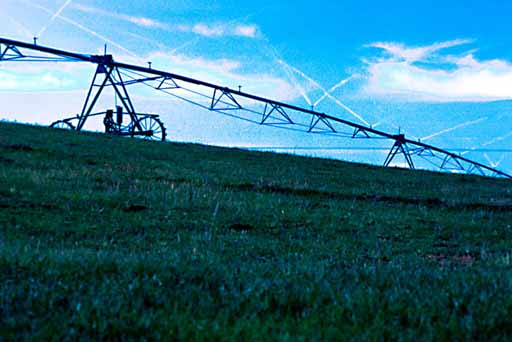
Drip irrigation is one way to provide moisture to your garden. Some gardeners lay leaky hose or sprinkler hose along their rows of vegetables and flowers and in their shrub beds. Some use drip tube (aka dripper line and drip hose) or drip tape while others use PVC pipe through which they have drilled small holes Any of these techniques work as a way to water the vegetables, flowers and shrubs.

The effectiveness of the drip irrigation system depends on the cleanliness of the water, the rate the water is applied, the spacing of the emitters and the distance between the lines of drip tube.

Sprinkler hose, soaker hose or leaky pipe tend to plug even when using domestic water due to the lime that precipitates out of the water and fills the emitters and weep holes. You can avoid this problem by occasionally running acid through the system, but since acid can burn holes through clothing and skin this is not something I recommend. The use of drip tape or drip tube are better options.

Drip tape is made from thin plastic and thus is not as durable as thicker-wall dripper line. Drip tape requires a pressure regulator of no more than 15 psi (pounds per square inch) for the 15 mil tape. Thinner tape requires a lower pressure. Higher pressures blows the drip tape apart. More detailed guidance on the use of drip tape can be found at ww.dripworksusa.com/ttape-2.php.

Pressure regulators used with drip tube range from 20 psi to as high as 45 psi. With the psi as high as 100 at the pump or faucet, the pressure needs to be significantly reduced to use with drip tape and drip tube. You cannot reduce the pressure by turning down the flow at the faucet. Drip systems are not recommended with irrigation water unless you have very good filtration. You should consider using a filter even when the drip system is attached to domestic water. A 200 mesh filter is needed for drip tape and the 1⁄4 inch drip tube. 150 mesh filtration is adequate for the larger 17 mm drip tube.

The drip tube selected should be based on the infiltration rate of the soil in your garden. The infiltration rate is a measure of how quickly water moves into the soil. Our silty clay loam soils have an infiltration rate of about 0.2 inches of water per hour. When water is applied faster than the infiltration rate, water pools or puddles. This causes soil particles to separate and a crust of silt and clay to cover the soil surface.

This is the same thing that happens when we have a heavy rain. A crust forms on the surface of the bare soil. This crust prevents water infiltration and forms a barrier to emerging seedlings. Applying water at the proper rate relative to the infiltration rate of the soil avoids the formation of this crust. Once a crust forms the soil needs to be raked or broken up to permit water to again enter the soil and for seedlings to emerge. Mulch helps reduce soil crusting but does not increase water infiltration.

Drip tube is available with different application (precipitation) rates. Drip tube with emitters spaced every 18 inches and rated at 0.4 gallons per hour applies water at a rate between 0.21 and .29 inches per hour. This is the proper application rate for our soil. Drip tube rated at 0.6 gallons per hour applies water at a rate of between 0.56 to 0.96 inches per hour. The 1⁄4 inch drip tube is rated at 0.9 gallons per hour and applies water much too fast for our soil. Unless you have a very well drained soil, the 0.6 and 1⁄4 inch drip tube is not what you should use. Lines of the 0.4 gallon per hour drip tube with emitters spaced at 18 inches should be spaced between 18 to 24 inches apart.

Irrigation companies seldom carry the 0.4 gallon per hour drip tube yet this is the one you should consider. They can order this for you. Be sure the emitters in the drip tube are 18 inches apart.

More conservation coverage here.

Pagosa Springs: Community Water Supply Planning Group update

A picture named sanjuan

From the Pagosa Sun (Chuck McGuire):

According to the meeting agenda, the hired facilitator, Maro Zagoras, of Desired Outcomes Inc. (Fort Collins), was to initiate discussions on her specific role, hopeful meeting outcomes, the day’s agenda and equally important, determining a group name and establishing immediate and future ground rules. That was to begin at precisely 4:30 p.m. First, however, Zagoras chose to “train” or educate the panel on proper conduct and procedures necessary in reaching vital decisions relevant to the group’s final charge, which the group itself must ultimately define.

Though the CWSPG has yet to clearly define its true aim — much less name itself, or designate an official group spokesperson — determining the best means of managing PAWSD finances has never been considered its ultimate goal by the 29 additional participants now seated on the panel. Rather, answering whether PAWSD should plan for future water needs and, if so, how, are apparently the questions that drew most volunteers to sit on the CWSPG panel to begin with. Certainly, any future water storage plans will involve detailed financing, in which informed district constituents should play a vital role. However, PAWSD is a complex special district funded by several convoluted enterprise funds, the management of which can’t be taken lightly.

More Pagosa Springs coverage here and here.

Fryingpan-Arkansas Project: Ruedi Reservoir operations meeting Wednesday

A picture named ruedidam

From email from Re clamation (Kara Lamb):

If you are interested in the volume of water releases from Ruedi Reservoir to the Fryingpan River late summer and early fall, then Wed., July 14, 2010, needs to be on your calendar. That day, Reclamation will host the second of two Ruedi Reservoir operations meetings scheduled for this year. The July 14 meeting will be held at the Basalt Town Hall, 101 Midland Avenue, Basalt, Colo. from 7 to 9 p.m.

The meeting will provide an overview of Ruedi Reservoir operations during this year’s spring run-off, as well as projected operations for late summer and early fall, key fishing seasons in Basalt.

As always, the meeting will conclude with a public question and answer session.

For more information, please contact Kara Lamb, Public Information Coordinator for Reclamation’s Eastern Colorado Area Office, by phone or e-mail: (970)962-4326, or klamb@usbr.gov, or visit our Website at http://www.usbr.gov/gp/ecao/ruedi.html.

More Fryingpan-Arkansas Project coverage here.

The Upper Ark’s Terry Scanga is keeping a close eye on Aurora’s leasing operations

A picture named arkansasriverbasin

From The Pueblo Chieftain (Chris Woodka):

[Terry Scanga’s] concern is what Aurora does in the years when it has more water than it needs to satisfy its primary service area — the city of 300,000 people. By entering long-term contracts to provide water to others, Aurora is increasing the chances it would have to call for more water from its sources in the Arkansas and Colorado basins…

What really irks Scanga is a deal Aurora reached last year with Nestle Waters North America to supply augmentation water for 200 acre-feet annually, at a cost of about $800 per acre-foot. The contract is for 10 years, subject to availability of water. “Nestle was a double whammy because it also takes water out of the basin,” Scanga said. At the time the deal was reached, the Upper Ark district had been negotiating with Nestle for a higher price, about $1,200 per acre-foot. Ironically, the Upper Ark was involved because the water would be provided by Salida, which through its own decree is restricted to use the water within its own service area — city limits. “Our rates were based on funding something needed in this basin. Salida couldn’t sell it under their decree, and Nestle didn’t have a decree,” Scanga said. “The money would have gone for storage, which would in the long run give Nestle a firm supply. The key was, we were expecting Nestle to come back and negotiate.” Instead, Aurora snapped up the contract, a move that four members of the city’s 11-member council actually opposed. Some said it had little benefit to Aurora. Earlier this year, the Upper Ark district filed comments on the substitute water supply plan Nestle needs to use Aurora’s water, specifically asking the Colorado Division of Water Resources not to allow Arkansas Valley water to be used in the Nestle contract. “The proposed lease of water by Aurora to Nestle has the potential to defeat the purpose of (the 2003) IGA,” attorney Julianne Woldridge wrote in the comments. The state agreed, and restricted Aurora to using Colorado River water in augmenting Nestle depletions in the final March plan…

In late 2009, Aurora and its new partner, Climax Mines, filed for a change of rights on the Columbine Ditch. In that application Aurora seeks to add additional places and types of use for the water in the Arkansas River basin, a move the Upper Arkansas district opposes.

Aurora also entered an agreement with South Metro Water Supply Authority in late 2009 that has the potential to add more uses for water from all three basins to the South Platte area. Aurora already provides water for everything from the upscale community of Roxborough, to gravel pits, to farmers downstream, through its South Platte system.

More Aurora coverage here.

2010 Colorado elections: McInnis profile

A picture named ridgesbasindam

Here’s a long background piece about Scott McInnis from Karen Crummy writing for The Denver Post. From the article:

McInnis, chairman of the House subcommittee on forests and forest health, also brokered a compromise with Grand County commissioners that allowed “historic uses” such as motorized vehicles, mountain bikes and limited logging on the west side of the Continental Divide. He also backed a bill requiring federal agencies to compensate private-property owners for actions taken under the Endangered Species Act, the Clean Air Act and other laws regarding water rights. “He was conservative when it came to natural resources, which was reflective of his district,” said Denver pollster Floyd Ciruli, noting that issues of agriculture, water and mineral extraction all play big roles in the region’s job market…

McInnis pushed for the controversial Animas-La Plata project, a massive dam and diversion effort for the Animas River near Durango, which gives American Indians a reservoir for economic development. McInnis and others said it was the best way to settle old water claims from the Ute tribe, while others argued it was not only too expensive, but that a third of the water would instead help municipalities and local developers…

More 2010 Colorado elections coverage here.

Red Cliff: New wastewater treatment plant update

A picture named wastewatertreatmentwtext

From the Vail Daily (Sarah Mausolf):

The town’s new wastewater treatment plant should be finished in mid-September, Mayor Ramon Montoya said. “If we had not acted on this, literally the federal government had the abilty to come in and close down the town,” he said. “That’s what I was threatened with when I first became the mayor.”

The current plant has been violating environmental regulations for 20 years, Montoya said. It had been dumping inadequately treated human waste into the confluence of Homestake Creek and the Eagle River…

Grant money will cover the $5.1 million project. R.N. Civil Construction based in Centennial has been working on the treatment plant since September…

Federal stimulus dollars from the federal American Recovery and Reinvestment Act funded a majority of the project. Western Pipeline Utility Construction, based in Palisade, started work this week on repairing the pipes that transport the waste. The plant should be fully online by Sept. 15, Montoya said.

More wastewater coverage here.

Windy Gap Firming and the Moffat Collection System Project: What are the potential long-term environmental effects?

A picture named grandlake

From The Denver Post (Bruce Finley):

“I know (Front Range residents) want to take showers, but we have to co-exist. They can’t destroy the beauty here — which is probably part of why they came to Colorado in the first place,” said Pat Raney, 66, one of a dozen or so volunteers who test water quality. Lying on her belly on the deck of a rocking pontoon boat on the lake, Raney lowered a disc used to measure underwater visibility: “7 feet 4 inches,” she reported to fellow volunteers. “Color is brown.” That’s less one third of the 30-feet visibility documented in 1941 before diversions here began…

While Grand Lake residents opposed to diversions tested water last week, Northern Colorado water district officials (who conduct their own water-clarity tests) were leading two busloads of Front Range residents on a moving seminar aimed at highlighting the need for new water.

Front Range water authorities contend that rearranging nature’s plumbing is not the only factor making Grand Lake water murkier. Residential and commercial development around Grand Lake may lead to septic system, lawn fertilizer and other contamination of water, Denver Water project manager Travis Bray said. The Front Range authorities now are trying to sweeten their proposals. They’re offering to improve the town of Fraser’s water-treatment plant — easing stress on that river. A cleaner Fraser flow into the Colorado would mean “no net change in the nutrient levels” in Grand Lake, Northern project manager Jeff Drager said. Northern would team with Denver Water to improve the facility, he said. “We’re talking maybe $4 million.”

The water providers also have offered to manage river flows in a way that ensures additional water to sustain fish.

More Colorado River Basin coverage here.

Southern Delivery System: Reclamation raises the stakes $200 million

A picture named sdspreferredalternative

From The Colorado Springs Gazette (Eileen Welsome):

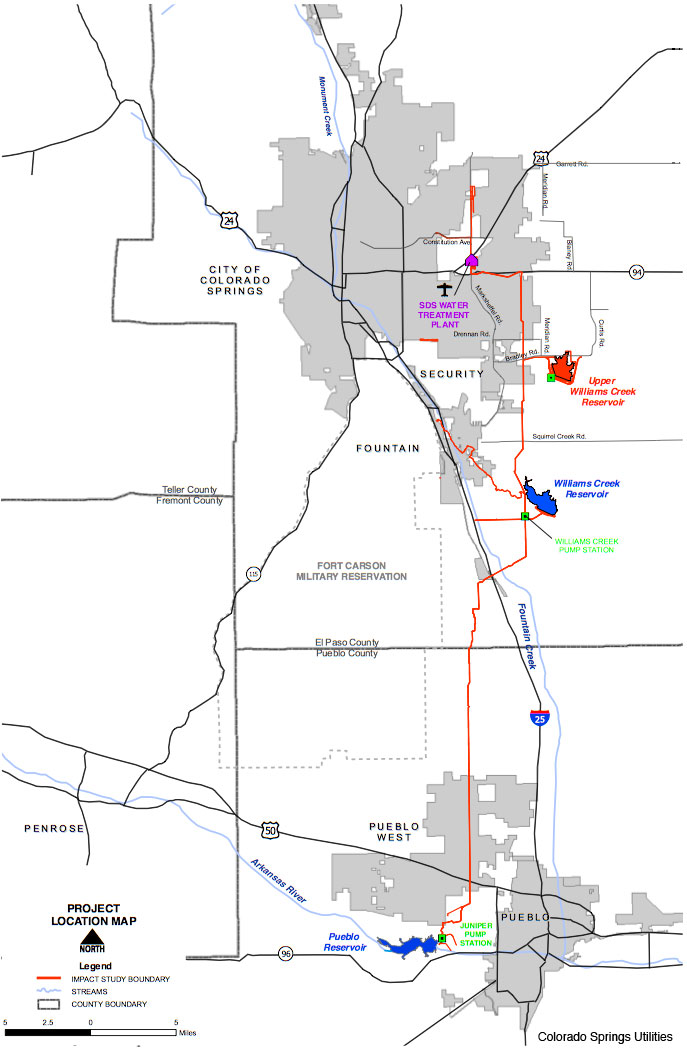
At issue are $200 million in potential additional costs that the federal government wants to impose on Utilities and its partners for storage and conveyance of water through Pueblo Reservoir. Utilities contends the costs are unfair and much higher than what other water providers, such as Pueblo, are charged. “We should be treated fairly and equitably,” said Utilities’ John Fredell, SDS project director.

Colorado Springs City Councilman and Utilities board member Sean Paige said the fees are outrageous. “The whole thing is appalling,” Paige said. “The Bureau of Reclamation isn’t there to squeeze every dollar that it can from the city through these negotiations. They’re supposed to be helping us to come to an equitable arrangement to manage this water project.”[…]

Fredell and his team will face off against Bureau of Reclamation officials in a two-day session scheduled to begin 9 a.m. Thursday at Fountain Valley School of Colorado. The negotiations are scheduled to resume 8 a.m. Friday at the same location. Like the previous two sessions, May 25 in Pueblo and June 15 in Colorado Springs, the public is invited. Although public negotiations are a little like showing your cards to opponents in a high-stakes poker game, it’s the policy of the bureau to conduct negotiations in public, said spokeswoman Kara Lamb.

More coverage from Chris Woodka writing for The Pueblo Chieftain. From the article:

The next round of negotiations will begin at 9 a.m. Thursday and continue at 8 a.m. Friday at the Fountain Valley School, 6155 Fountain Valley School Road, Colorado Springs. It will be held in the Bancroft Room of the campus library. The two sides ended far apart at the end of the last session in June. Reclamation’s offer calls for storage and conveyance for $75 an acre-foot and $50 per acre-foot for an annual exchange. An annual inflation factor of 3.08 percent is included.

The terms were called “unacceptable” by SDS Project Director John Fredell at the conclusion of the last session. Colorado Springs is asking for a storage and exchange fee of $17.35 per acre-foot, with no conveyance fee for the structure it wants to build, a North Outlet Works on the face of Pueblo Dam. Its inflation factor is 1.79 percent annually. Colorado Springs is negotiating on behalf of its SDS partners, Security, Fountain and Pueblo West.

More Southern Delivery System coverage here and here.

Water vs. Energy

A picture named tarsandstrucks

Here’s the website for the IEEE Spectrum Special Report: Water vs. Energy. From the “Water-Energy Nexus” section:

Without water, we’d have practically no energy. Without energy—and therefore cars, planes, laptops, smartphones, and lighting—we wouldn’t be doing much. In almost every type of power plant, water is a major hidden cost. Water cools the blistering steam of thermal plants and allows hydroelectric turbines to churn. It brings biofuel crops from the ground and geothermal energy from the depths of the Earth. Our power sources would be impotent without water.

2010 Colorado elections: The candidates for Attorney General were glad-handing in northern Colorado last week

A picture named fortmorganrainbowbridge

From The Fort Morgan Times (Dan Barker):

[Attorney General John Suthers] said his office has done a good job of dealing with settling issues surrounding the Republican River Compact, although is was painful to have to shut off some wells to comply with the agreement. Unfortunately, Kansas decided to sue Nebraska over the issues, which may mean the compact will go to the U.S. Supreme Court, as such interstate conflicts do, and that may mean starting over, he said. His office filed a response to the lawsuit Wednesday, saying Colorado believes the disagreements can be settled within arbitration, Suthers said.

Suthers also said he was sympathetic to the plight of South Platte River basin farmers who lost their rights to use wells. A pipeline to bring water to the Front Range may help with water issues, but there is little chance that the farmers will be able to use the wells again, he said.

[Boulder County district attorney Stan Garnett] said his mother was born in 1930 and lived on a 200-acre farm on Beaver Creek in Morgan County. Her family used water from the creek and wells to support the farm, but the aquifer is so depleted that people cannot do that anymore. Water issues affect life on the land, and if elected, he would fight for Colorado rights in water compacts and fight to prevent pollution of aquifers and other waters so that people can maintain their farming way of life, Garnett said…

Garnett also said he also hears a lot about the need to protect water, environmental concerns and public safety issues, which he would make priorities.

More 2010 Colorado elections coverage here.

University of Arizona Flandrau Science Center: Monsoon monitor

A picture named lightningcj

Here’s the release from the University of Arizona (Jeff Harrison):

The monsoon is coming. Perhaps this weekend. Maybe.

It’s always a guessing game when and where and to what extent the annual summer thunderstorms will appear. This year is no different.

Two summers ago, the monsoon season produced a spectacular 9 inches of rain. Last year, it was only a meager 4 inches.

And forecasters, pointing to temperature changes in the Pacific Ocean, suspect it may only produce an average amount of rainfall this summer.

A new website and a new exhibit at the University of Arizona Flandrau Science Center offer plenty of information about monsoon activity in Arizona, said Gary Woodard, the associate director of the UA’s Sustainability of semi-Arid Hydrology and Riparian Areas, or SAHRA, now part of Biosphere 2.

Woodard said SAHRA’s Monsoon Monitor website is still a work in progress, but it already offers a webcam view of the Tucson Basin from the UA campus, a drought monitor, rainfall data and weather radar. Another window shows a video clip of the previous hour of sky activity in Tucson, which is especially captivating when clouds start to build up.

The monsoon exhibit at Flandrau includes graphics on the structure and mechanics of monsoon storms, lightning, measuring precipitation, rainwater harvesting and thunderstorm photography.

There also is an exhibit of fulgurites, sometimes called petrified or frozen lightning. These are tubular structures created when lightning strikes silica-based soil and heats it to about 3,300 degrees Fahrenheit. The tubes it creates are formed in less than a second.

Woodard also said monsoons are the active focus of a number of UA faculty members at SAHRA and elsewhere on campus. Projects range from basic research on storm modeling, forecasting and tracking sources of monsoon moisture to lightning detection, the quality of storm water runoff and flash flooding in urban areas.

Christopher Castro, an assistant professor of atmospheric sciences at the UA, is researching the role of surface water temperatures in the Pacific in predicting both summer and winter rainfall patterns in Arizona. Castro said predicting current monsoon activity remains elusive but scientific modeling that integrates regional climate data for seasonal forecasts integrated with hydrologic models is one active area of research.

One important factor in improving forecasts is establishing relationships with scientists in Mexico.

“There is a big hole in data gathering in Mexico. If you miss the location of a significant upper-level circulation feature or a surge of moisture from the Gulf of California, that has a really big impact,” he said.

There are other reasons to study monsoons. Peter Troch, a professor in hydrology and water resources, said water and fire managers depend on reliable data to avoid shortages and schedule crews to fight wildfires.

Troch pointed to data that show a projected decline of 10 percent to 30 percent in runoff in the seven-state Colorado River Basin over the next 50 years. At the same time, the U.S. Census Bureau projects that population growth in the lower parts of the already parched basin will increase by more than 20 million over the next two decades.

Fires also are a monsoon-related threat this time of year. Winter rains fueled heavy vegetation growth, especially at lower elevations, Troth said.

There already have been a number of fires across Arizona, including three in the Flagstaff area. Some were caused by campfires and other human activity, but others were started by another phenomenon common to monsoons, lightning.

Woodard said technology developed at the UA is improving the ability of forecasters to predict in real time when and where lightning will be a threat. A spinoff company was created by UA researchers and later bought by a company that manufactures detection equipment for meteorologists.

He also acknowledged that Arizona is not the lightning capital of the U.S. That would be Florida.

“But we have quality lightning,” Woodard said. “It’s no surprise that scientists come from all over the world to study lightning here.”

He said that’s because clouds here rise thousands of feet in the air and create the ice at their tops believed to be necessary for electrical discharges in the atmosphere. Plus the clear air and mountain backdrops make lightning strikes visible for miles.

Said Woodard: “That makes us the lightning photography capital of the world.”

Northern Integrated Supply Project: Supporters are planning a rally on Thursday

A picture named nisppreferredalternative

State Representative B.J. Nikkel is trying to rally the troops with this opinion piece running in the Berthoud Recorder. She writes:

In the 1930’s, W.D. Farr and other visionaries led the effort to build the Big Thompson Water Project. Today, this tremendous project provides an invaluable supply of water to our ranchers and farmers, and families living in our Northern Colorado communities.

Over the past 30 years, Northern Colorado’s population has more than doubled and yet no new significant water supply facility has been built. Growing cities in the Denver metro-area are looking north to find the water supply their communities need and they have their sights on thousands of acres of irrigated farmland in Northern Colorado.

Without a new significant water project, a recent environmental study showed that more than one hundred square miles of currently irrigated productive farmland will be dried up forever. The result would be catastrophic and would be an environmental and economic disaster for Northern Colorado.

Today the Recorder is running the rebuttal from Mark Easter and Gary Wockner (Save the Poudre. They write:

In their ground-breaking report “Farming on the Edge: Sprawling Development Threatens America’s Best Farmland”, the American Farmland Trust identified the Cache la Poudre Valley as some of the best farmland in the world. The report identifies our Ag heritage as critically endangered due to poor land use planning, sprawling development, inefficient use of water resources and inadequate protections for agricultural water rights.

More Northern Integrated Supply Project coverage here and here.

The upper Arkansas valley stands to gain five new weather stations

A picture named transpiration

From The Pueblo Chieftain (Chris Woodka):

“Right now, knowing the evapotranspiration rate is important to determining how much water you’re using,” said Terry Scanga, general manager of the Upper Arkansas Valley Water Conservancy District. “What makes this valuable is that 10-20 years from now, you’ll have good data. If you don’t have good data, then you’re not going to be able to prove consumptive use.”

The Upper Ark district is enlisting partners to install five stations in the Colorado Agricultural Meteorological Network. Two would be in Chaffee County, two in Fremont County and one in Custer County. Scanga said each station costs about $2,000 annually to operate, and all should be up and running by the end of the year. The network, sponsored by Colorado State University and the U.S. Department of Agriculture, operates about 15 stations in the Lower Arkansas Valley from Pueblo to Holly, and five in the Rio Grande basin. Statewide, there are about 70 sites…

…the data also are critical in other areas. At CSU’s Rocky Ford Agriculture Research Center, information is used for everything from crop variety analysis to calibration of a weighing lysimeter that is being used to develop a better regional ET model.

The Upper Ark district is inviting conservation districts, ditch companies or other agricultural interests to participate in the program.

More Arkansas Basin coverage here.

Energy policy — nuclear: Cotter Corp starts Schwartzwalder mine cleanup

A picture named uranium

From The Denver Post:

The owner of a defunct uranium mine leaking pollution along a creek that flows into a Denver Water reservoir has launched a cleanup as ordered, state officials confirmed Thursday. Cotter Corp. installed a system that can pump and treat up to 50 gallons per minute of contaminated water from inside its Schwartzenwalder Mine, west of Denver in Jefferson County.

More Schwartzwalder mine coverage here.

Greeley: Water consumption up with recent summer weather

A picture named watersprinkler

From The Greeley Tribune (Catharine Hausler):

local water usage is up this year compared with last year, said Jon Monson, Greeley’s water and sewer director. Greeley residents used 35.4 million gallons of water a day during the first week in July, up from the 27.7 million gallons they used during the same week last year, he said…The University of Northern Colorado is doing its best to conserve water, cutting back water use this week due to the downpour last weekend and the cool, cloudy weather that left the city looking more like Seattle than Greeley. Some parts of Greeley saw 1.3 inches of rain late Sunday, with an average of just under an inch.

State Engineer directs Reclamation to release recent precipitation gains from Bonny Reservoir

A picture named bonnyreservoir

From the Yuma Pioneer (Tony Rayl):

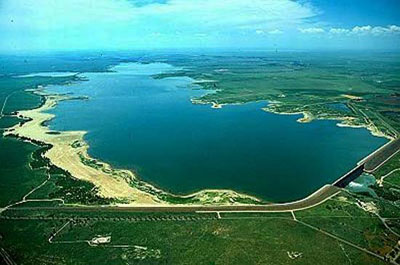
Bonny Lake State Park saw its level increase by nearly 5,000 acre feet this past week due to a couple of significant rain events. It did not take long for the State of Colorado to get on top of that, as State Engineer Dick Wolfe issued an order today, July 8, for the release of water from the lake. The water will be sent down the South Fork of the Republican River in the state’s continuing efforts to be in compliance with the Republican River Compact.

More coverage of the recent rainfall in the basin from Tony Rayl writing for the Yuma Pioneer. From the article:

Meteorologist Mark Buller with the National Weather Service out of Goodland, Kansas, said the storm was the result of the perfect combination of several factors — in other words, the perfect storm. He said the air mass was very moist, and the winds in the atmosphere that would move it along were not very strong, “so it formed and stayed there.” Buller said the strong winds were the result of the incredible amount of rain that was coming down. “There is so much rain coming down, that it drags the air down, too.” He said. He offered the technical term of “precipitation drag.”[…]

[Senior Park Ranger Bob Shade of Bonny Lake State Park] reported Tuesday that the water level at Bonny Lake had gone up 4.08 feet since Friday, equalling 4,857 acre feet. That raises the lake’s level to nearly 18,000 feet, the highest it has been in years. He added that more runoff was hitting the lake Tuesday from big rains that hit Burlington, Bethune and Flagler on Sunday, then flow to Bonny through Landsman Creek…

Shade said the state park itself received three inches of rain at the visitor’s center on the south side, 5.5 inches on the north side at the Foster Grove Campground, and four inches at the dam. “The cell just parked northwest of the lake and rained hard,” Shade said.

More Republican River Basin coverage here.

Colorado Springs: Water consumption and rate analysis

A picture named pikespeak

From the Colorado Springs Independent (Pam Zubeck):

In some cases, Springs residents’ water bills are more than four times what they were a year ago. With June temperatures running 108 percent of normal and rainfall at just 15 percent of normal, Colorado Springs Utilities’ customers guzzled 3.4 billion gallons of water from June 1 through 27. That’s way more than the 2.5 billion for the same period last year and rivals the 3.45 billion used in June 2001, the year before drought forced conservation measures.

Springs customers are among the lowest per-capita water users on the Front Range, thanks to watering restrictions imposed during the drought and water-saving techniques since embraced by the community, such as Xeriscaping and low-flow appliances. But those who reacted to June’s heat, wind and skimpy rainfall by pouring water on their gardens and lawns got a big surprise in their mailboxes recently. Not only did higher usage push bills up, but they’re paying more for water than two years ago. In February 2009, rates went up 41 percent, but the change went largely unnoticed last year when rain drenched the area and helped sustain lawns. Then, on Jan. 1, another 6 percent hike kicked in, including a per-day customer charge…

A household that used 1,600 cubic feet in 2009 paid $55.18. If usage goes to 3,200 cubic feet this year, the tab is $138.48…

Also keep in mind that water rates are tiered, meaning the more you use, the higher per cubic foot you’re charged. For up to 999 cubic feet, you pay 2.24 cents per cubic foot; from 1,000 to 2,499 cubic feet, you pay 4.18 cents; and for more than 2,500 cubic feet, the rate is 6.17 cents…

If you think what’s happened to rates is bad already, brace yourself. Two consecutive 12 percent annual rate hikes begin next year, and four more are expected to follow, doubling water bills by 2016. While a chunk of the rate hikes will fund the $2.3 billion Southern Delivery System pipeline project from Pueblo Reservoir, they also will pay for system maintenance, which includes a 20-year water main rehabilitation program involving a quarter of the city’s 1,900-mile water pipe network, [Utilities spokeswoman Patrice Quintero] says.

More Arkansas Basin coverage here.

Northern Integrated Supply Project: Supporters plan rally for July 15

A picture named nisp2

From The Greeley Tribune:

Northern Colorado farm and ranch organizations and public officials have announced an agricultural rally to show support for the Northern Integrated Supply Project, a proposed water storage project that is a cooperative venture between agricultural ditch companies and growing northern Front Range communities. The rally will be from 11 a.m.-1:30 p.m. July 15 at Anderson Farms, outside Erie. The farm, at 6728 Weld County Road 3.25, is 2.5 miles east of Interstate 25 on Colo. 52 and a mile north on Weld 3.25…

“Had the NISP project been in place in the last two years, Colorado would have been able to capture and store more than 150,0000 acre-feet of water from the Poudre and South Platte basins alone,” Foutz said in a news release. “Instead, Colorado must watch as that water flows downstream to Nebraska.” The rally is designed to demonstrate the agricultural communities’ strong support for the water storage project. It will feature speakers from the farming and livestock community in northern Colorado, agricultural industry representatives and elected officials. It also will be an opportunity to highlight the importance of water storage to the future of agriculture in the region, and the strong farm and ranch community support for NISP, Foutz said. The rally will be open to the public and a barbecue lunch will be served.

More coverage from The Pulse – of Colorado Farm Bureau (Shawn Martini).

More Northern Integrated Supply Project coverage here and here.

Energy policy — oil and gas: The North Fork River Improvement Association is embarking on a review of potential oil and gas development in the watershed

A picture named gunnisonriver

From email from the North Fork River Improvement Association:

NFRIA is excited to announce that we have received full-funding for the planning stage of a new watershed water quality monitoring program.Thanks to anonymous donors, we can begin immediately to design an efficient, cost-effective program to monitor the possible effects of natural gas drilling in the area.

The plan should be finalized within 60 to 90 days, and will establish sampling parameters and specify sampling locations. Once the plan is in place, our extraordinary volunteer water quality monitoring team can begin taking samples, pending additional funding.

More oil and gas coverage here.

The Colorado River District’s annual seminar is slated for September 16

A picture named coloradoriverbasincgs

From email from the Colorado River District (Jim Pokrandt):

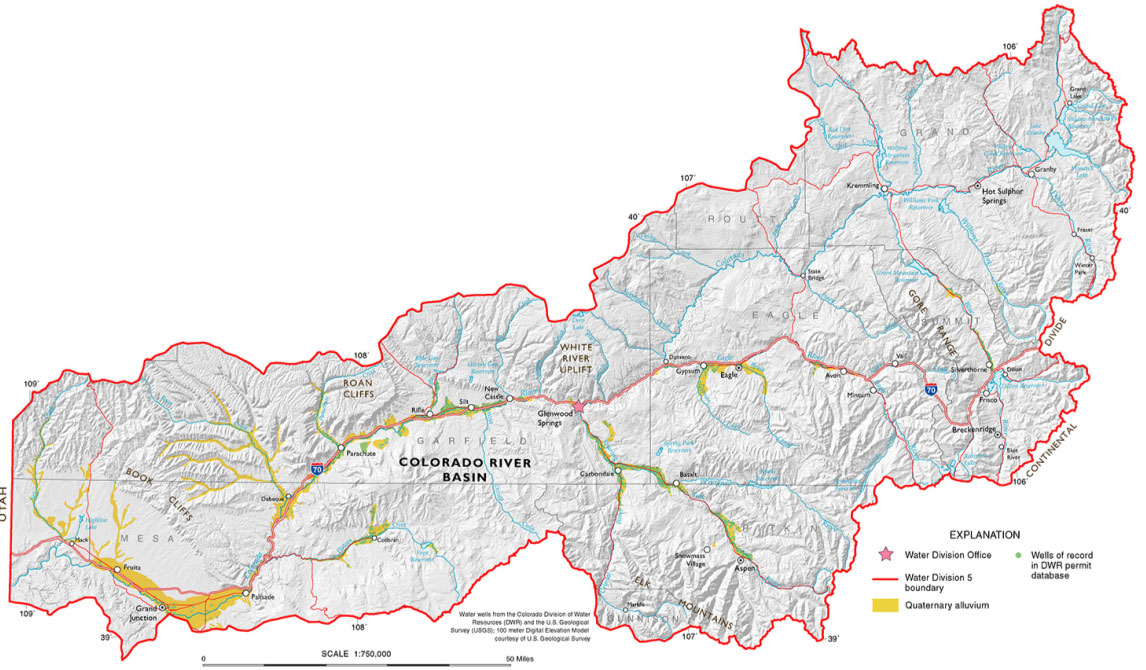
The Colorado River District’s Annual Water Seminar is Thursday, Sept. 16, 2010, at the Two Rivers Convention Center in Grand Junction, Colorado. It follows on the heels of the Colorado Water Conservation Board meeting in Grand Junction on Sept. 14-15.

Seminar speakers will address the water supply negotiation with Denver Water known as the Colorado River Basin Proposal, the western water rights market, the new era of corporate water responsibility and more. Look for registration information in the coming weeks.

More Colorado River Basin coverage here.

CWCB: Board meeting set for July 20-21 in Salida

A picture named arkansasbasinalluvialaquifersubregions

From email from the Colorado Water Conservation Board (Lisa Barr):

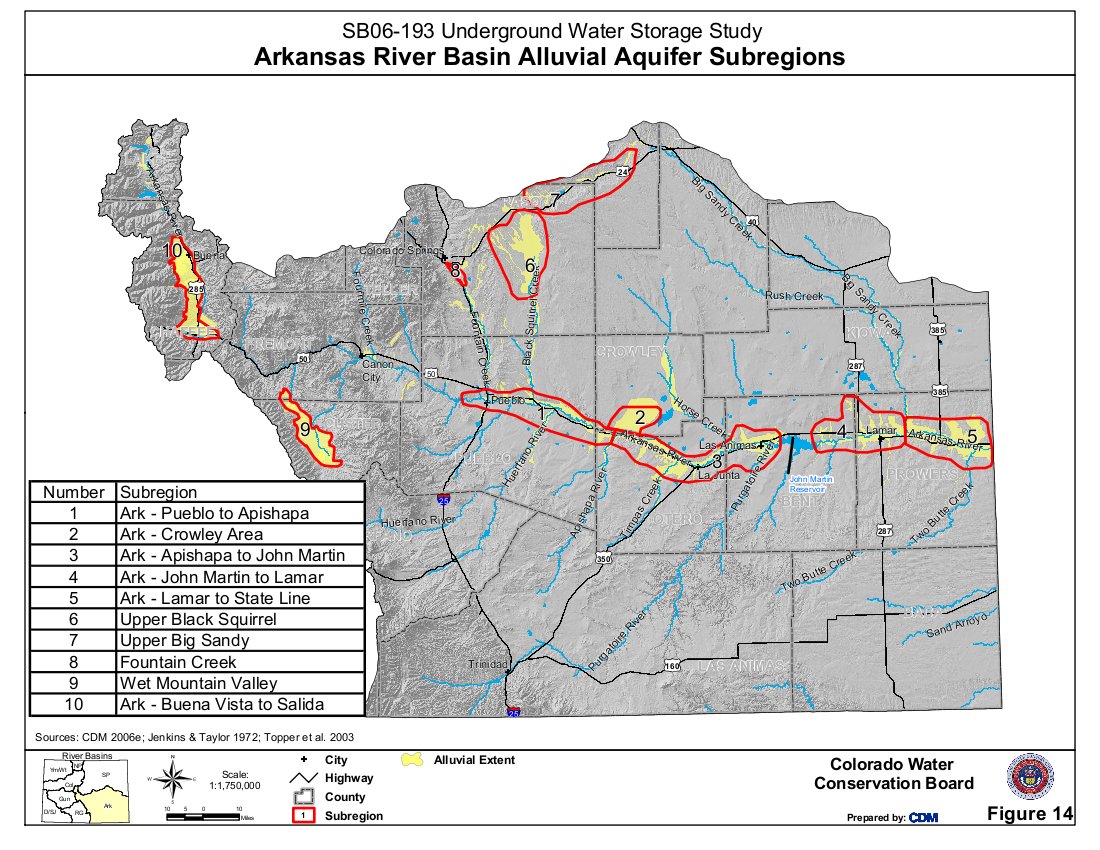
The Colorado Water Conservation Board is meeting on July 20-21, 2010, at the Salida SteamPlant Event Center, 220 W. Sackett St., Salida, Co., 81201.

The agenda is available on the CWCB website. CWCB staff memos and other materials will be available July 16, 2010, on our website.

The meeting will be “streamed” via the internet through the CWCB’s website. Click on the “Listen to the meeting LIVE!” link, found on our home page just before the meeting begins.

Presentations are also being made available. To watch presentations that accompany agenda items, click the “Watch Presentations” link on the CWCB website homepage just before the meeting begins.

The CWCB is implementing a new email system in an effort to improve our communication with citizens, customers, and constituents. If you do not wish to receive notices of Board activities, please let us know.

If you need more information about this Board meeting, please contact Lisa Barr at lisa.barr@state.co.us.

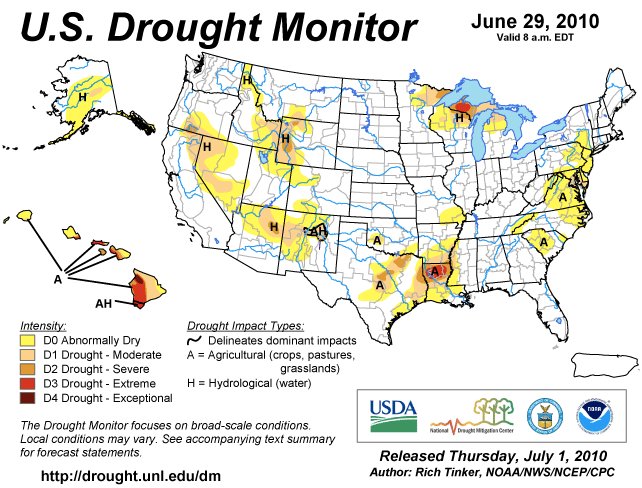
NIDIS Weekly Climate, Water and Drought Assessment Summary of the Upper Colorado River Basin

A picture named usdroughtmonitor06292010

Click here your copy of Henry Reges’ notes from yesterday’s webinar.

Aurora: Middle school students project promotes fish-friendly car washing

A picture named carwashfacts

Here’s the release from the Federal Way News:

Federal Way’s Fish Friendly Car Wash Program has long served as a model for other local communities. But earlier this year, the City was surprised to learn that the program’s reach had extended several states away.

With help from the City’s water quality specialist Hollie Shilley, fourth-graders at Indian Ridge Elementary in Aurora, Colo., are poised to receive national attention for their efforts to educate people on the negative impact that car washing can have on natural waterways.

The students knew that residential car washing—and charity car wash events in particular—often sends large volumes of waste wash water down storm drains, creating one of the biggest sources of surface water pollution. In April, they took these ideas and developed them into an entry for Project Citizen, an education program sponsored by the Center for Civic Education and the National Conference of State Legislatures.

An Internet search for background information brought up Federal Way’s program and Shilley’s name.

Shilley was excited to help. She explained that car wash kits divert wash water from the storm drain into the sanitary sewer, and she provided step-by-step photo instructions and a video about how to set up and use the kit. She also helped the students locate a source for the kits and shared examples of Federal Way’s educational materials.

The students embraced the idea of implementing a similar program in their own community and brainstormed other creative ways to make a difference.

They asked Colorado legislators for an official state day to recognize the role of commercial car washes in preventing stormwater pollution and developed an accompanying slogan, “Don’t wash our future down the drain!”

They also created an educational brochure, surveyed local car dealerships to learn about their carwashing practices, and wrote to the CEO of Subaru, asking that a commercial showing a couple washing a car in their driveway be remade to portray more environmentally friendly actions.

In May, they presented their project at the Project Citizen event in Denver. They ended up winning the top prize and will represent Colorado at the National Project Citizen Showcase later this month in Louisville, Kentucky.

“I am proud to have been able to help the students at Indian Ridge Elementary,” Shilley said. “It’s great when young kids get rewarded for their hard work and determination, and I hope it will encourage them to keep working to make a difference in their community and watershed. We congratulate them wish them the best of luck at the national event.”

More stormwater coverage here.

Colorado-Big Thompson Project update

A picture named greenmountainreservoir

From email from Reclamation (Kara Lamb):

At the end of the Holiday weekend, we began scaling releases from Green Mountain to the Lower Blue back some more. Today, we dropped again by 100 cfs. By [Tuesday] afternoon, there should be about 400 cfs in the Lower Blue.

More Colorado-Big Thompson coverage here.

Runoff news: Denver Water’s reservoirs are in good shape entering the summer

A picture named morninggloryspillwaydillonreservoir

From CBS4Denver.com:

Dillon Reservoir is full to the brim. It’s fed by the Upper Colorado River Basin, and the basin’s water supply is at 113 percent of average. The statewide average is at 106 percent of average. That’s a healthy supply but Denver Water still has a message…

Because June was so warm and dry, much of the snowpack melted at once. That means the water levels will slowly drop as they are drawn down by demand — mostly from the Front Range.

Is desalination becoming more cost effective?

A picture named arubadesalination

From TriplePundit.com (Leon Kaye):

Energy Recovery Inc. (ERI), headquartered in San Leandro, CA, has a process that it claims not only runs at 98% efficiency, but can reduce desalination plants’ energy consumption by 60% to 80%. The company works on an average of 300 projects around the world annually, often retrofitting older plants with its Pressure Exchanger energy recovery technology. Like other desalination systems, ERI uses reverse osmosis. With a combination of high pressure systems, frictionless hydrodynamic bearing, and a low pressure incoming feed stream, water is forced through the membranes, separating salt and other elements from sea water. In layperson’s terms, a ceramic rotor floating without creating any friction is the difference between older, more expensive technologies, and ERI’s system, which consumes much less energy.

Yesterday I spoke with GG Pique, President and CEO of ERI. One way in which ERI’s technology can have a positive environmental impact is evident in Sand City, CA, just outside of Monterey. The town is home to only a few hundred people, but shopping and tourism brings in about 40,000 daily while employing 4,000. Using ERI’s system, Sand City’s desalination plant produces almost 600,000 gallons of potable water a day. Wells drawing water are not in the bay, where they would interfere with marine life, but from four subsurface beach wells. Generally running during off-peak hours, the new facility can desalinate water at about $3 per 1000 gallons…

ERI maintains a library of case studies on its web site, and has performed well financially since going public in 2008. Pique explained that more projects with which ERI is involved are using renewable energy to at least in part fuel such operations.

More water treatment coverage here.

Water and the energy costs associated with consumption

A picture named grandlake

From the Summit Daily News (Roxane Peyser and Jennifer Schenk):

The water we use for residential and commercial consumption requires the use of enormous quantities of energy. Again, this is different from the more limited notion of thinking about water consumption solely from the perspective of depleting a vital resource. On average, energy used solely for pumping raw water collected from lakes, rivers, streams and aquifers through treatment facilities represents 15 percent of all the energy used in the treatment and distribution process; the remaining 85 percent of the energy used in the process is for distribution to homes, business and industry. This doesn’t even take into account the additional energy required for circulation, filtering and pumping after water is delivered to homes and businesses. When water leaves homes and businesses, it goes through an extensive wastewater treatment process…

Consider that the energy it takes to run a faucet for five minutes is equivalent to the energy used to run a 60-watt light bulb for 14 hours. Additional energy is consumed when we heat and cool the water we use. According to the U.S. Environmental Protection Agency, we use more energy to heat the water just in our homes than to light them. Initial and wastewater treatment is 3-4 percent of our national total electricity use, and this is expected to increase 20 percent over the next 15 years…

• Denver water used just over 20,000,000 kWh in 2007 to treat raw water and over 31,000,000 kWh for distribution

• The City of Parker (south metro Denver area) used 24,749,000 kWh of electricity in 2008 in connection with its water treatment process.

Lakes Appreciation Month

A picture named grandlake

From email from the Colorado Lakes and Reservoir Management Association via Loretta Lohman:

Every year, CLRMA has the Governor sign Colorado ‘ s official Lakes Appreciation Month proclamation and this year is no different. Governor Bill Ritter has again recognized the importance of our lakes and reservoirs throughout the state.

This year will be the biggest celebration yet. Starting with Grand Lake, the annual Buffalo BBQ celebration will be on the lakefront and CLRMA is taking advantage of this classic lake celebration in July to help honor one of Colorado ‘ s most important natural lakes . If you missed the last l ake a ppreciation event up at Grand Lake , make sure you head up on July 16-18 to see the State ‘ s largest natural lake and have a great BBQ experience . Contact Sarah Clements for more details about the weekend events (sarahclements@rkymtn hi.com).

For people farther west , Ridgway Reservoir will be hosting the second annual Lake Appreciation Day on July 17th. Last year’s Lake Appreciation Month event saw record attendance for the park. Contact Sarah Sauter for more information ( sarah@coloradowater.org).

Also on July 17 th , Barr Lake State Park will have their annual shoreline clean up. This year, organizers are having to cap the number of volunteers at 400. Last year , an army of 500+ volunteers showed up to help clean up the reservoir. Volunteers will again collect tires, batteries, and other trash from the shoreline in the morning and then enjoy a free BBQ at 11:30am . Afternoon activities include boat rides with the park ranger, free canoe lessons, fishing poles for kids, and other fun activities for the family. Contact the Barr Lake Nature Center to RSVP or get more details (303) 659-6005.

If you can ‘ t make it to one of these fun lake events, then make sure you get out there some other time in July and enjoy one of your favorite lakes or reservoirs.

Please check out http://www.clrma.org/ for more information.

16 states ban dishwasher soap with more than 0.5% phosphorus

A picture named bluegreenalgaebloom

USA Today (Thanks to Loretta Lohman for the link):

Stores will not be allowed to sell detergent with more than 0.5 percent phosphorous. The bans do not apply to commercial dishwashing products, and detergents for hand-washing dishes generally contain no phosphorus…

States instituting the rule include Illinois, Indiana, Maryland, Massachusetts, Michigan, Minnesota, Montana, New Hampshire, Ohio, Oregon, Pennsylvania, Utah, Vermont, Virginia, Washington and Wisconsin, reports the Associated Press…

“Phosphorous is like a fertilizer. It increases algae and aquatic weed growth in water bodies,” Bernie Duffy, natural resource specialist with the Oregon Department of Environmental Quality, told the AP. He said too much algae depletes oxygen needed for healthy fish and aquatic life. Sewage treatment plants and private septic systems can remove much but not all of the phosphorous from wastewater, so some of it ends up in lakes, streams and rivers.

More wastewater coverage here.

Moffat System Collection Project: How will the project affect the whitewater season?

A picture named grossdam

From CBS4Denver.com (Stan Bush):

The expansion plans are raising the anxiety level in other parts of the state. Rafting companies say the Denver Water plan could ruin their business. “It could mean shorter seasons and lower flows,” said Campy Campton, Kodi Rafting Owner. “It could significantly affect what we’re doing and what we’re looking at in terms of water flows on the rivers.”[…]

The rafting companies say the plan would decimate a business that brings millions of dollars into Colorado. “The direct expenditures of $350,000 would be, within the community of Summit County, would be all but gone,” Campton said.

Denver Waters says it will need the water for an expected population boom in the metro area. It says an environmentalist’s assessment of its plan should be finished by 2011. Denver Water says if it doesn’t get more storage capacity it may have to cut off service to $85,000 homes by the year 2030.

More Moffat Collection System Project coverage here.

Snowpack/runoff news

A picture named snowpackcolorado07062010

From the Summit Daily News (Julie Sutor):

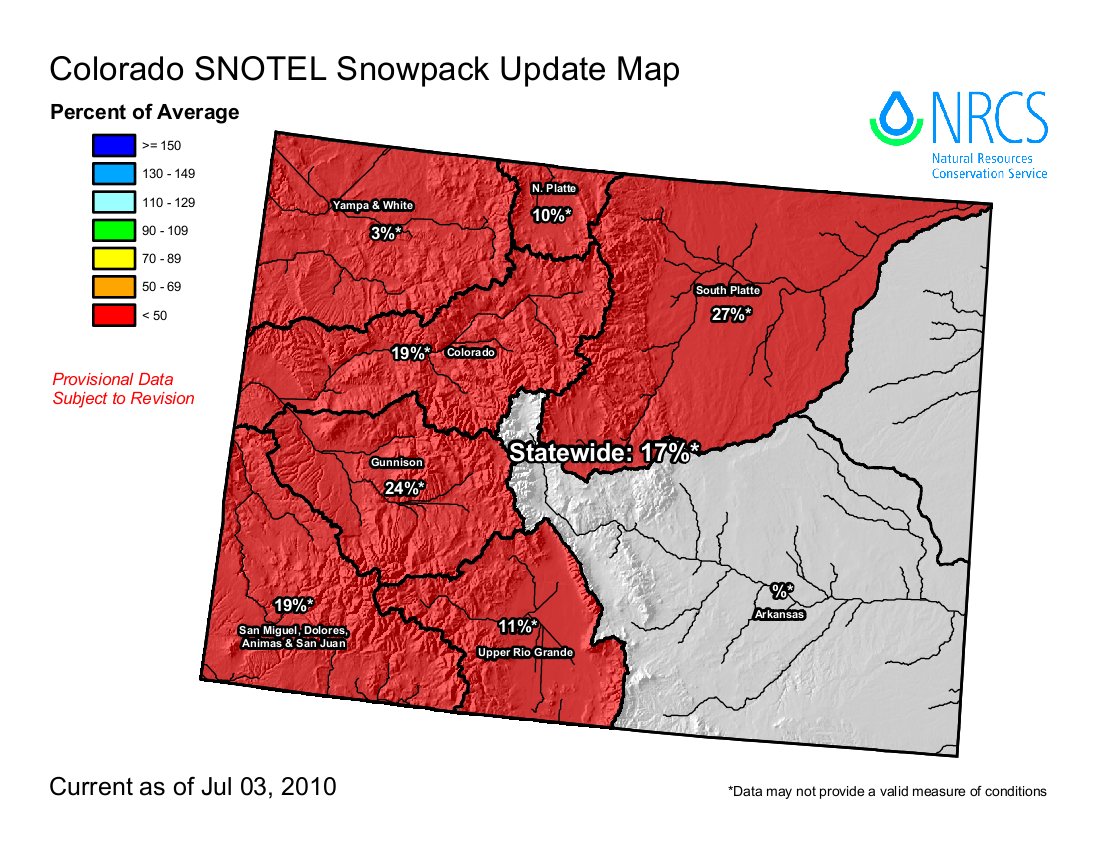
“June was so warm and dry that all the snow has left our measurement sites — we are now snow-free,” said Chris Pacheco, assistant snow survey supervisor for NRCS. The timing of the snowpack’s disappearance this year was fairly typical, Pacheco said. But some sites in the northern part of the state near the Wyoming border just melted out last week, a little later than usual.

Reservoir levels in Colorado are in good shape, with many river basins above average for this time of year. Statewide, water storage is at 106 percent of average — slightly below last year’s figure. The Upper Colorado basin, which includes Summit County, has the highest reservoir storage in the state, at 113 percent of average. On July 1, Dillon Reservoir was just more than 100 percent full. The Upper Rio Grande basin has the state’s lowest reservoir storage, at 81 percent of average. All other river basins in the state are hovering slightly above average…

[Klaus Wolter of the National Oceanic and Atmospheric Administration’s Boulder laboratory] is somewhat optimistic about the moisture picture for the next few weeks. But after that, he predicts about three months of dry weather for the Front Range, which has the potential to decrease reservoir levels.

Energy policy — hydroelectric: Proposed Aspen hydroelectric plant update

A picture named hydroelectricdam

From the Aspen Daily News (Curtis Wackerle):

The city of Aspen is about $3.3 million into the Castle Creek hydroelectric project so far, with officials hoping to apply this summer for federal permission to construct the power facility. The project, if granted a “conduit exemption” by the Federal Energy Regulatory Commission, is expected to remain within its $6.19 million budget, Aspen public works director Phil Overeynder said. “The unknown cost is permitting and what it will take to complete the permitting,” Overeynder said.

The conduit exemption would allow the city to bypass the more complex federal licensing process. In deciding whether or not the city qualifies, FERC “puts a high degree of deference” to state agencies which monitor natural resources, such as the Colorado Division of Wildlife, Overeynder said. The DOW has looked at the project, and requested that the city obtain a study to determine minimum baseline water levels in Castle Creek. That study is nearly complete and established a minimum flow of 13.3 cubic feet per second to protect fish and other aquatic life. Once FERC gets the application, Overeynder said he hopes to have a decision within six months, although there is no guaranteed timeframe for a ruling.

The city has spent $632,653 on design of the “energy center,” which would house the turbine; $272,850 on planning; and $99,091 on studies related to the project, according to information provided by the city of Aspen…

The city has budgeted $665,000 for construction of the energy center, including controls inside the building and a pipe to return water to Castle Creek. The turbine itself is expected to cost about $1.4 million, including a pressure-reducing valve, Overeynder said.

More hydroelectric coverage here and here.

Metro Denver area reuse and wastewater projects update

A picture named prairiewaterstreatment

From The Denver Post (Bruce Finley):

The projects are driven by scarcity — the growing difficulty of drawing sufficient new supplies from mountain snowpack — and by rapid depletion of groundwater wells that some metro residents rely on. Water providers say they also increasingly are detecting new contaminants, such as pharmaceutical residues from birth-control pills, cosmetics and antidepressants, that they anticipate might have to be removed. “We’re preparing for the future. There’s still expected to be a lot of growth along Colorado’s Front Range. That’s what these plants are for,” said Steve Witter, water resources manager for the Arapahoe County Water and Wastewater Authority…

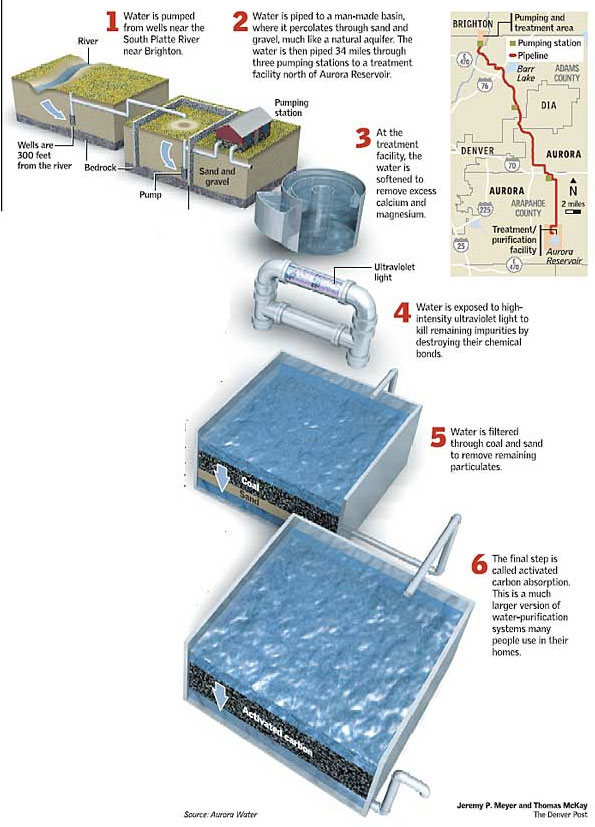
At the end of June, Arapahoe County and Cottonwood water authorities activated a $30 million purification plant serving residents of the southeastern metro area. Many now receive water purified using membrane and reverse-osmosis filtering, chemicals (hydrogen peroxide and chlorine) and ultraviolet light…

This fall, Aurora’s $659 million “prairie waters” system is expected to start treating South Platte River water that otherwise would not be diverted. Aurora raised water prices (bills now average $75, up from $35), tripled tap fees and issued $450 million in bonds to pay for the project…

Parker water authorities are developing a large reservoir and are hunting for water to fill it and also designing a $50 million treatment plant, said Jim Nikkel, assistant manager of the Parker Water and Sanitation District. The plant will filter up to 10 million gallons a day, he said, and will be useful in shifting away from reliance on wells.

East Cherry Creek Valley water authorities are planning a $30 million treatment plant, using reverse-osmosis and ultraviolet methods, to sustain their 50,000 metro-area customers.

More reuse coverage here.

Energy policy — oil and gas: The Environmental Protection Agency is holding a hearing in Denver to gather information on hydraulic fracturing

A picture named hydraulicfracturing

From email from the San Juan Citizens Alliance

The EPA will be conducting a study on the relationship between hydraulic fracturing and its potential impacts on drinking water. In designing the scope of the study, the EPA is soliciting public comments on its draft study plan. EPA will solicit these comments at a public hearing.

6-10 p.m., July 13,
Marriott Tech Center’s Rocky Mountain
Events Center Denver
(4900 S. Syracuse Street, Denver, CO)

Staff and members of the San Juan Citizens Alliance will be attending the Denver public hearing to urge the EPA to develop a comprehensive study plan. If you are interested in going to this hearing to speak, please contact Josh Joswick 970-259-3583.

Written comments may be submitted to EPA:

Jill Dean, Office of groundwater and drinking water
Environmental Protection Agency
1200 Pennsylvania Ave., NW., Mailcode 4606M
Washington, DC 20460
phone: 202-564-8241
e-mail: dean.jill@epa.gov.

submit electronic comments to EPA:
hydraulic.fracturing@epa.gov.

For more information on the meeting:
http://www.epa.gov/safewater/uic/wells_hydrofrac.html

More oil and gas coverage here.

The Southeastern Colorado Water Conservancy District settles with the state over new ag rules in the Arkansas Valley

A picture named irrigation

From The Pueblo Chieftain (Chris Woodka):

A 14-day trial is scheduled to begin on Nov. 16, but in many water cases, many of the provisions that would be argued in court are settled through stipulations. Many of the objections, called statements of opposition, are filed to monitor the case, protect water rights or conditions that have been previously worked out.

State Engineer Dick Wolfe and Division Engineer Steve Witte hosted meetings in 2008-09 with many of those who would be affected by the rules, altering them along the way with suggestions made during the meetings. The rules are meant to protect Colorado from future litigation by Kansas over the Arkansas River Compact. The rules prevent increased consumptive use through irrigation efficiency improvements like sprinklers, drip systems and canal linings.

Southeastern is the first to reach a stipulation, which also has led to a draft proposed decree in the case. The stipulation preserves the proper use of Fryingpan-Arkansas Project flows, winter water storage and compliance with U.S. Supreme Court decisions on the compact…

Ditch companies and some landowners are still not happy with the rules, and filed in protest of them. They include the Fort Lyon, Catlin, Amity, District 67 ditches, Beaver Park Water in Penrose, Smith Mutual Ditch in Lamar and the Arkansas Valley Ditch Association. Other individuals and lateral groups also protested. “The proposed rules are unconstitutional, contrary to law, vague, arbitrary, capricious and not reasonable,” wrote Carolyn Burr, attorney for the Catlin Canal.

More Ark Valley Consumptive Use Rules coverage here and here.

Castle Rock: Water Wiser workshops

A picture named denveraquifer

From The Douglas County News Press (Rhonda Moore):

Castle Rock offers Water Wiser workshops for free, courtesy of the utilities department. Participants learn irrigation tips, sprinkler system management and how to tap into the town’s water conservation resources. What they walk away with is a greater awareness of fundamental water-saving measures and a window sticker identifying them as a participant.

The sticker is the key to grant participants a waiver from the town’s three-day-per-week watering restrictions.

The town takes a proactive stance when it comes to water conservation, and part of its effort includes watering restrictions between May and August each year. The restrictions limit landscape watering to every three days for Castle Rock residents…

While the town aims for a zero penalty community for watering infractions, the penalty-financed rebates include the popular rebate for high efficiency washing machines and a rebate for replacing turf with drought-tolerant landscaping.

Of the several rebates available for water saving measures, all are exhausted for 2010 except the rebate for Smartscape renovation. The Smartscape rebate reimburses residents who replace their turf with water wise landscapes at a rate of $1 per square foot.

Department personnel rely on drive-by inspections and neighborhood watches to ensure residents are watering within their schedule, said Rick Schultz, water conservation specialist for the town’s utilities department. Those inspections are a thing of the past for Water Wiser participants.

“The main goal is to open people’s eyes to the common sense of irrigation and the common sense of managing your sprinkler,” Schultz said. “As a benefit we’ll exempt them from every third day watering schedule. By taking them off that schedule they have the flexibility to say, ‘it’s my watering day but it’s going to rain so I’m not going to water,’ and wait for another day.”

More conservation coverage here.
NIDIS Weekly Climate, Water and Drought Assessment Summary of the Upper Colorado River Basin

A picture named coloradoriverbasin

Click here for a copy of Henry Reges’ notes from last Tuesday’s webinar.

Arkansas Valley: Enforcement of priority below John Martin Reservoir is causing expenses to increase for some farmers

A picture named johnmartinreservoir

From The Pueblo Chieftain (Chris Woodka):

“Most all of us have had it running since 1890 or ’95. It’s been running for 114 years, and now the state’s shutting it off and sending it into the mainstem of the river,” Reed said. Reed farms off the Wiley Drain of the Fort Lyon Canal, which historically carried its flows through the Wiley area into the Amity Canal, later to be returned to the Arkansas River. The drain is fed by tile drains in fields along the way, return flows not fully used by crops. About two years ago, he was told by the state Division of Water Resources that his diversion points were in the wrong places and that he was taking water out of priority. Once he fixes those problems, at his own expense, he’ll get less water than he has in the past.

More Arkansas River Basin coverage here.

Gunnision River Basin: The Colorado Water Conservation Board and the Colorado Water Trust close on Breem Ditch water for instream flow program

A picture named genderbendingpollution

From the Sterling Journal Advocate:

The Colorado Water Conservation Board (CWCB) and the Colorado Water Trust closed on the purchase of up to 5.45 cubic feet per second of water under the Breem Ditch water right for instream flow use to preserve the natural environment of two highly visible water-short streams — Washington Gulch and the Slate River, and to improve the natural environment of Washington Gulch. The June 28 acquisition was the CWCB’s first water purchase using funds authorized by the General Assembly in 2008 for instream flow water acquisitions. The CWCB purchased a portion of the water using those funds, and the Colorado Water Trust donated a portion of the water to the CWCB. “This is a great example of the benefits CWCB’s Water Acquisition Program can provide to our state’s streams through creative partnerships with water users,” said Jennifer Gimbel, director of the CWCB.

The Breem Ditch water acquisition is the result of a unique, collaborative approach by the CWCB, the Colorado Water Trust, the Skyland Metropolitan District and Verzuh Ranch, Inc., a local development company owned by Billy Joe Lacy and Dan Dow. Despite sometimes water-plentiful summers, irrigation diversions into the Breem Ditch would cause Washington Gulch to completely dry by the middle of July and reduce flows in the Slate River as well. The purchase of the Breem Ditch will allow Washington Gulch to flow year-round, even during dry summers, and will help fix flow shortages to the Slate River.

Under Colorado’s Instream Flow Program, the CWCB will protect the water decreed to the Breem Ditch on Washington Gulch and about two miles of the Slate River downstream of the confluence with Washington Gulch. Below this reach, the water will be available for Skyland Metropolitan District’s system, which from 2002 to 2004 — Colorado’s most severe recent drought period — was in danger of impairment.

More instream flow coverage here.

Water pollution: The argument for removing pharmaceuticals from wastewater effluent

A picture named genderbendingpollution

From Denver Westword (Michael Roberts):

“Where we have very large domestic populations, we’re either excreting or dumping a lot of chemicals down the drain, and a number of them are estrogenic in nature. They get into wastewater treatment plants, which aren’t constructed in a way to deal with chemicals in the very low concentrations of these chemicals, [said CU-Boulder professor David Norris]”[…]

…in Boulder, Norris says, the situation improved dramatically “after the wastewater treatment plant went from a trickling filter process to a more efficient system, called activated sludge. This was something mandated by the EPA, because they weren’t meeting standards for some of the other chemical requirements for effluents. So it wasn’t related to what we were studying. But it had a side benefit.”

The team is still analyzing some of the data from tests conducted after the new plant was up and running. But this time around, Norris points out, “we had no demasculinizatoin of fish over a 28 day period, and we only saw a slight feminization — and we didn’t see that until somewhere between day fourteen and day 28. So a modest upgrade of the plant reduced a lot of these chemicals.”

More water pollution coverage here.
Larimer County: Planning Commission hearing for proposed metropolitan district July 21

A picture named fountainpavementdrawing

From the North Forty News:

The primary purpose of the district, according to Seaworth’s proposal, would be to “provide water and sanitary sewer service within the service area.” Owners of property within the service area include Richard Seaworth, Troy Seaworth, Sandra Seaworth, R.E. Seaworth and Sons, and Seaworth AG Enterprises Inc.

Currently, water within the service area is supplied by the Northern Colorado Water Association or by nontributary wells requiring water treatment. The proposal also states that the metro district and Wellington could form a water authority through an intergovernmental agreement. The water authority would sell potable water to residential water users that could include customers within the district, the town of Wellington and other water customers in the future. Potable water within the district would initially come from a 100-foot alluvial well and a reverse osmosis treatment plant. Both would be installed by Wellington and the metro district, in concert with Wellington Water Works.

Wellington Water Works, a partnership involving Richard Seaworth, has a plant that treats oil well water before discharging it into the Boxelder Creek drainage.

Sewer service within the district would be provided by individual sewage disposal systems or by a centralized sewer system provided by the district, the water authority or a separate sewer authority.

More infrastructure coverage here.

Larimer County: Coal Creek Flood Mitigation Project update

A picture named southplatteflood

From the North Forty News (JoAn Bjarko):

Residents from the Indian Creek drainage east of Interstate 25 turned out for a June 15 open house sponsored by the Larimer County Engineering Department. Area residents were invited to look at the latest plans to reduce potential flooding in the region and to offer comments. Phase I of the Boxelder Regional Stormwater Improvement Project is called the Coal Creek Flood Mitigation Project. Coal Creek and Indian Creek are tributaries of Boxelder Creek.

Criticism of a three-government plan to reduce the region’s 100-year floodplain dates back more than a year to when local residents found out they would be assessed annual fees to pay for the work. The first phase, estimated to cost $3.9 million, will get $2.9 million from the Federal Emergency Management Agency. In June, residents near Indian Creek contended that the first project, for which they are being assessed a fee, has no benefit for them and may even aggravate flooding conditions. Fees for rural residential properties in the Boxelder Basin have been set by the county between $62 and $97 per year, depending on the size of the property. Wellington town residents and Fort Collins city residents are also paying into the fund through monthly stormwater fees.

More stormwater coverage here.

Runoff news: Cache la Pourdre peak is highest since 1999

A picture named cachelapoudre

From the North Forty News:

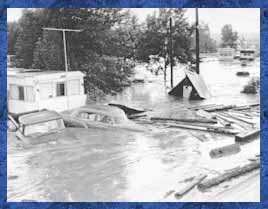
Two big peaks occurred this spring, one at 4,340 cubic feet per second on June 8 and the second at 4,670 cfs on June 12 after heavy rains. High water threatened some homes in the LaPorte area on June 12. The average spring peak at the mouth of the Poudre River is 2,960 cfs, according to river commissioner George Varra. Last year’s peak was just 1,930 cfs. The ’90s saw some very high peaks along with flooding, notably the 1997 flood that killed five people in Fort Collins. Peak flows included 4,732 cfs in 1995, 3,308 cfs in 1997 and 5,822 cfs in 1999. A historic low was recorded in 2002, just 880 cfs.

Invasive mussel prevention procedures update

A picture named zebramusselinfestation

From the Crested Butte News (Seth Mensing):

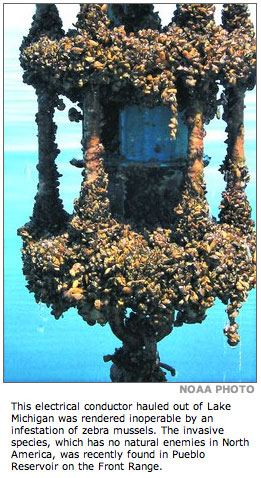
The threat of invasive zebra and quagga mussels isn’t gone from Western Slope watersheds, even though none have been found in the region this year. And local agencies like the Colorado Division of Wildlife and National Park Service are continuing work this summer to keep the mussels at bay. Gunnison County’s Blue Mesa Reservoir, Colorado’s largest body of water, is ground zero for the DOW’s containment effort. Superintendent Rudd says, “We’re doing a grid sampling across the lake twice a month. That takes us a couple of weeks to get to all of those spots. And we’ll be continuing with double time sampling. As of now we’re still mussel free and this is good news.”

Motor boaters on the lake this summer can expect an inspection before entering the water and after taking their boats out. To speed the process Blue Mesa has installed a second large decontamination station for big boats, or those that need a thorough cleaning. “It seems that people are being pretty responsive to our asking folks to dry and clean their boats when they come to the launch sites,” DOW spokesman Joe Lewandowski says. “I think that’s a big part of the reason we haven’t had [any new populations of mussels] in Colorado this year.”

From the Canyon Courier:

Beginning July 1, all boats launched in Evergreen Lake must be inspected for zebra or quagga mussels, which are tiny freshwater mollusks that arrived from the Black and Caspian seas on ships traveling internationally. All boats and floatable devices, including canoes, kayaks and belly boats, are subject to inspection. A boater pass costs $4 a day or $30 for the season. The inspections are free but mandatory, and are available during business hours seven days a week, as part of a statewide mandatory testing program now in effect.

More invasive species coverage here and here.

Gunnison: Gunnison District Court Judge Steven Patrick has reappointed George Sibley and Dennis Steckel to the Upper Gunnison River Water Conservancy District

A picture named gunnisonblackcanyon

From the Crested Butte News (Mark Reaman):

In his ruling, Patrick said the court had received numerous letters of recommendation to reappoint Steckel. It was pointed out that he had served as a “mentor” to many new board members and this was a positive attribute he brought to the board. Patrick said Sibley too brought knowledge, familiarity and experience to the board. Patrick lauded Spencer as being qualified to sit on the UGRWCD but chose to go with tenure. He has also reappointed directors Brett Redden and Steve Schechter to the board.

More Gunnison River Basin coverage here.

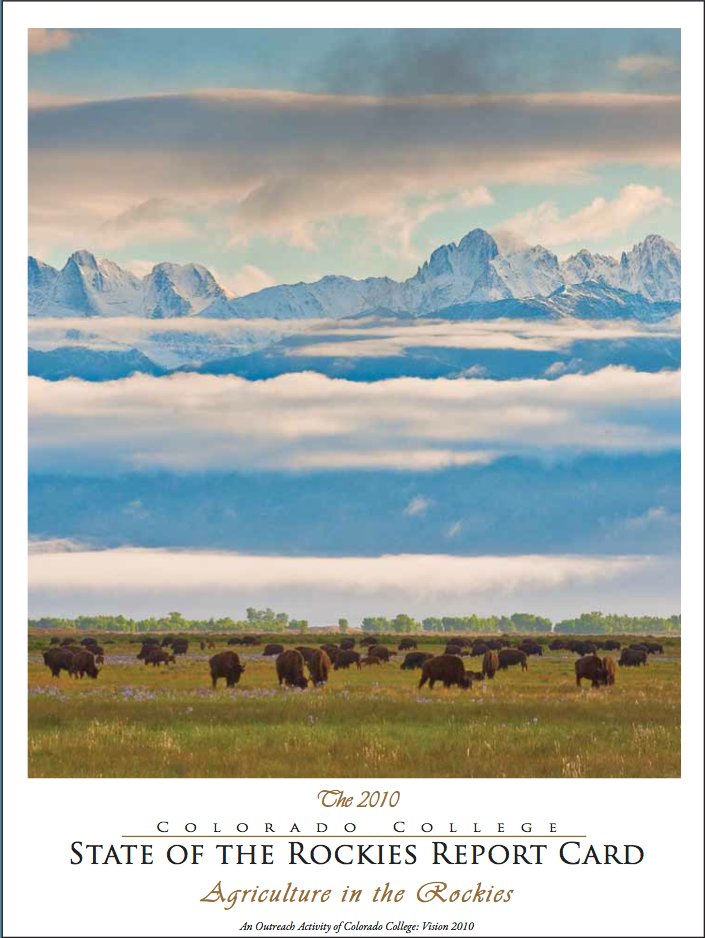
Colorado College: 2010 State of the Rockies Report Card

A picture named stateoftherockiesreportcard2010

Agriculture is the focus of this year’s report card. Click here to get your copy to read under the cottonwoods down by the creek this weekend.

Thanks to New West (Jill Kuraitis) for the heads up. From the article:

Colorado College’s 2010 State of the Rockies report, now in its eighth year of research and reporting on issues that define our lives in the mountain west, is focused on agriculture. The report provides the statistical overview of the region’s industry, but also delves deep into agricultural history, land and water use, demographics, production, finance, organization, and a “foodprint” of Rockies’ agriculture, according to project leaders.

States defined as part of the Rockies are Montana, Wyoming, Colorado, New Mexico, Arizona, Utah, Nevada and Idaho.

The average age of farm operators in the U.S. has increased from 52 to 57 years old, and only between 1 and 6 percent earn all their income from farming. In the Rockies, female farmers have increased by 257 percent. Ethnic diversity among farm owners and operators is also trending upward.

Aspinall Unit update

A picture named aspinallunit

From email from Reclamation (Dan Crabtree):

Aspinall Operations 2010 Runoff Facts:

· Runoff has subsided in the Gunnison Basin.

· Blue Mesa Reservoir peaked at an elevation of 7508.9 on about June 29th. This is 10.5 ft below the top of the spillway gate.

· June runoff into Blue Mesa was 205,000 ac-ft, 70% of average.

· The July runoff volume is projected to be 75,000 ac-ft, 75% of average, bringing the projected April – July runoff to 520,000 ac-ft, 72% of average.

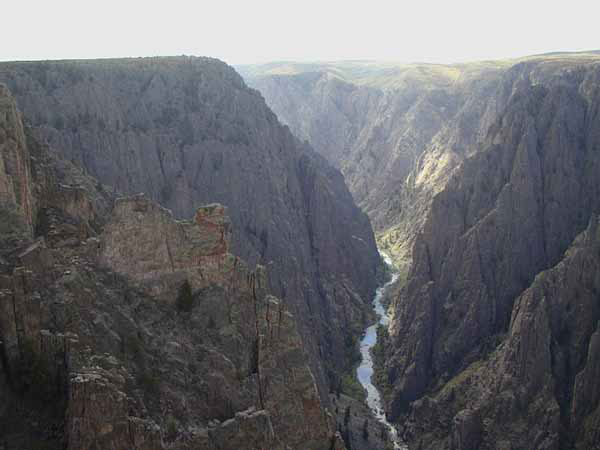
· Releases from Crystal Reservoir are currently about 1,650 cfs, the Gunnison Tunnel is diverting 1,000 cfs leaving 650 cfs in the Black Canyon and Gunnison Gorge. This flow will be maintained unless hydrologic conditions dictate otherwise.

Due to a variety of scheduling conflicts, the Aspinall Operations Meeting has been rescheduled …. again. Please get out your eraser and pencil and mark Thursday, September 2nd as the date for the 2010 “August” Aspinall Operations meeting. It will be held at the Elk Creek Visitors Center at Blue Mesa Reservoir starting at 1:00 p.m. We will be discussing the above runoff information in more detail as well as past and future operations. Hope to see you there.

More Aspinall Unit coverage here.

Fryingpan-Arkansas Project update

A picture named fryingpanarkansasproject

From email from Reclamation (Kara Lamb):

…we are reducing releases from Ruedi Dam to the Fryingpan by another 75 cfs. This will be the only change for the weekend. As a result, flows in the ‘Pan through the Holiday weekend should be about 225 cfs.

More Fryingpan-Arkansas Project coverage here.

Colorado-Big Thompson Project update

A picture named coloradobigthompsonmap

From email from Reclamation (Kara Lamb):

About an hour ago, we increased releases from Olympus Dam to about 450 cfs–an increase of about 250 cfs. We are bypassing some of the runoff from last night’s rain above the Estes Park area. If more rain materializes today, it is possible we could maintain the 450 cfs into the weekend. If the heat continues, we could scale releases back tonight.

As always, recreators should keep an eye on the gage before going up to the river as the conditions are subject to change.

From email from Reclamation (Kara Lamb):

This afternoon, we will cease pumping to Carter Lake Reservoir and increase the flows to Horsetooth Reservoir. By this evening, Horsetooth should be receiving approximately 515 cfs. Water users are currently pulling about 200 cfs from the reservoir.

Carter and Horsetooth are still near full. Carter is currently at a water level elevation of 5758–about one foot below full. Horsetooth is slowly beginning to drop a little bit and is at an elevation of 5426–about four feet down from full.

More Colorado-Big Thompson coverage here.

Great Outdoors Colorado Grant to be used to preserve open space near Prewitt Reservoir

A picture named lowersouthplatteriver

From the Sterling Journal Advocate:

The Colorado Great Outdoors (GOCO) Board has awarded Colorado Open Lands (COL) $452,043 for the Prewitt Reservoir Conservation project in Logan and Washington counties. COL will purchase conservation easements over two adjacent ranches covering 4,370 acres in the South Platte River Corridor in northwest Washington and southwest Logan Counties. The ranches lie between Prewitt Reservoir and Interstate 76 and serve as large areas of open space that provide highly scenic views of the reservoir and a rural landscape to travelers along I-76. They both support local agriculture, with one as a self-contained cattle ranch and alfalfa farm and the other leased annually for seasonal grazing. Due to their proximity to Prewitt Reservoir and the Prewitt Reservoir State Wildlife Area, both properties provide important wildlife habitat for white-tailed dear and waterfowl and create a contiguous protected area of almost 7,400 acres. Water on one ranch is provided by seep from the reservoir and the landowner intends to acquire additional water rights for wetlands improvements in the future. The other ranch has two adjudicated irrigation wells that will be tied to the land with easement.
The South Platte River Basin is being threatened by demand for water for Front Range cities and other residential development and 94 percent of the corridor is still unprotected.

More South Platte Basin coverage here.