Pitkin County: ‘Healthy Rivers and Streams Fund’ projects update

A picture named roaringfork

From the Aspen Daily News (Andrew Travers):

The seven-member board is spending a little under $100,000 to hire a consultant to study the Roaring Fork’s streamflow from the Salvation Ditch through Aspen to where it meets Castle Creek. Due to diversions, that most visible bend in the river is often quite low in the summertime. The study will assess what levels of flow are healthy for the Roaring Fork’s ecosystem year-round.

On the Fryingpan, near Basalt, the board is asking for bids from contractors to assess the economic impact the river has on the midvalley. Officials haven’t yet put a ballpark price on that study, Pitkin County attorney John Ely said. They’re seeking an all-encompassing view of the river economy — taking into account not only tourist spending on rafting, fishing and recreation, but also its toll on real estate prices, and how a flowing river may affect home sales.

Those are the first two on-the-ground projects for the board, which was founded with a promise to maintain and improve water quality and quantity, riparian habitats, and protect county water rights from Front Range diversions. The Roaring Fork and Fryingpan projects emerged after the board did a cursory analysis of all rivers and streams in the county.

More Roaring Fork watershed coverage here and here.

Aspinall Unit update

A picture named curecantibluemesa

From email from Reclamation (Dan Crabtree):

The most recent Colorado Basin River Forecast Center April through July runoff forecast is 495,000 ac-ft., down 25,000 ac-ft from the July 1st forecast. As dry as things have been, the final number is more likely to end up around 487,000 ac-ft. (Remember, the May 1st forecast was 560,000 ac-ft). In order to maintain storage and extend decent flows through the summer, releases from the Aspinall Unit will be reduced by 50 cfs tomorrow, July 22nd. Flows in the Black Canyon and Gunnison Gorge will then be about 600 cfs and, depending on hydrology, will be maintained through September. Flows will be further reduced to 500 cfs sometime in October and carry through December. At this time, Reclamation projects an end of December Blue Mesa elevation of 7488.6, which is 1.4 feet below the normal December target. Please contact Dan Crabtree at 970-248-0652 or reply to this email with questions.

As a reminder, the next Aspinall Operations Meeting will be held on Thursday, September 2nd in the Elk Creek Visitor Center on Blue Mesa Reservoir, starting at 1:00 p.m. We will be discussing past and future operations, as well as other activities within the Gunnison Basin.

More Aspinall Unit coverage here.

CWCB: July board meeting recap

A picture named salidawaterpark

Update: From The Mountain Mail (Joe Stone):

Highlights of the board’s second day in Salida included a presentation about the new “Guidebook of Best Practices for Municipal Water Conservation in Colorado,” a tool to help water providers implement effective water conservation measures. Brenda O’brien, project manager for Colorado WaterWise, said the board-funded guidebook will be available by the end of the month and can help conserve significant amounts of water, up to 63 percent for outdoor residential use, for example…

Board members also

• heard a report about the benefits of the Community Rating System, which rewards communities for flood mitigation measures;

• received an update on passive water conservation, which is expected to reduce water use in the Arkansas Basin by up to 39,400 acre-feet per year by 2050;

• heard a report about reallocation of water storage in Chatfield reservoir;

• received an update about potential wild and scenic rivers designations;

• heard updates on several cases;

• convened an executive session for the attorney general’s report and legal briefing.

Board members will meet again Sept. 14-15 in Grand Junction in conjunction with the Colorado River District Water Seminar on Sept. 16.

From The Pueblo Chieftain (Chris Woodka):

Southeastern Colorado Water Conservancy District Executive Director Jim Broderick updated the CWCB on the status of the Arkansas Valley Conduit. The board has approved a $60 million loan toward the $300 million project. The conduit received a $5 million appropriation this year and could get as much as $6 million next year, “Thank you for that approval. Without that, there would be no federal appropriation,” Broderick said…

In another matter, the board approved a $33,600 grant toward a $42,000 study by the Southeastern Water Conservancy District of how water flows are managed in the Upper Arkansas River. The study will be done by Paul Flack, a former hydrologist for Colorado State Parks, who is now a consultant. It grew out of a meeting last year among Upper Arkansas stakeholders who disagreed about how water is moved during certain times of year…

The board also:
-Looked at progress on a decision support system for the Arkansas Valley, which will provide information on cumulative impacts of water projects.
– Received a presentation on the Arkansas Basin Roundtable’s needs assessment from Jay Winner, general manger of the Lower Arkansas Valley Water Conservancy District.
-Heard an update on the Upper Arkansas Conservancy District’s data collection system, which added gauges on streams and at reservoirs.
– Looked at the Upper Ark district’s water basin study.
– Received a progress report on the Arkansas Basin Data Collection and Assessment that has grown out of more than a decade of studies by Colorado State University.

More coverage from Chris Woodka writing for The Pueblo Chieftain. From the article:

The board approved a list of prequalified loans — but not the actual loans — that included a plan to rehabilitate the Cucharas Reservoir Dam. John McKowen, who has purchased three-fourths of the Huerfano-Cucharas Ditch, wants to rebuild the dam in Huerfano County in order to restore irrigation on farmland in Pueblo County. About 500 acres of farmland is growing dryland wheat, irrigated wheat and corn under a pilot project this year and, McKowen eventually intends to put 10,000 acres back into production. “We’ve spent about $4 million so far,” McKowen said. The dam was restricted in 1988 after a breach was discovered. The existing reservoir was engineered to hold 50,000 acre-feet of water. It is the largest reservoir in the state under restriction…

Reed Dils, the Arkansas River basin representative on the CWCB, asked whether other uses of water are being anticipated, such as creating home sites on the shores of the reservoir. “Nothing like that is planned,” McKowen said. “It’s never going to be a permanent reservoir.”[…]

State Engineer Dick Wolfe raised several questions about water rights and the ability to fill the reservoir.
McKowen acknowledged his direct flow rights are junior, but the storage right is relatively senior, dating back to the early 1900s.

More CWCB coverage here.

Buena Vista: Supply options discussed by town board

A picture named fountainpavementdrawing

From The Chaffee County Times (Kathy Davis):

Town engineer Rachel Friedman said the town has 2,270 available taps. There are 1,490 existing taps, leaving 780 additional taps the town’s existing water rights can support, she said. The town has a commitment of an additional 500 taps for infill on town lots. The projected number of taps needed for proposed subdivisions and other proposed development is 976 taps. The total projected demand is approximately 1,476 taps. Friedman said the average water usage is 400 gallons per tap per day. This is a high average, she said. In some places, the average usage is 200 gallons per tap per day…

Regarding new water sources, the town has been measuring for a dry-up on 63 acres in the big meadow on Crossman Avenue. The dry-up is required by the water court decree for the town to convert Leesmaugh Ditch agriculture water rights to municipal use. If the town completes the dry-up of the meadow, it could get an additional 120 to 200 taps, town engineer Patricia Flood said. A maximum dry-up of the meadow could take another two years, she said. Trustee Jerry Steinauer asked if there were a way to hasten the dry up. Drains could be installed, Flood said.

Also discussed was an exchange of water proposed by the John Cogswell, developer of the Villages at Cottonwood Meadows, a proposed subdivision in the meadow on Crossman Avenue. Town administrator Sue Boyd said it would require Cogswell’s commitment to paying the fees for analysis of the exchange…

The town needs to think about additional sources of supply to meet needs, Covell said. The town’s water master plan recommends acquisition of additional water from a new well on the Arkansas River. Other recommended sources would be from the town’s well, well #3, and the purchase of additional water rights.

More infrastructure coverage here.

CWCB: Sterling Ranch rainwater catchments project first to be approved under HB 09-1129

A picture named cistern

Update: From INDT (John Rebchook):

The Colorado Water Conservation Board voted unanimously on Wednesday to name the 3,400-acre Sterling Ranch as the state’s first rainwater harvesting pilot project. Sterling Ranch’s innovative water conservation plan currently calls for using just one-third the water traditionally required in Douglas County—without relying on rainwater collection. With the rainwater pilot designation, Sterling Ranch will develop a new water source to be used for outside irrigation that could result in even more water supply savings. “We are very excited about this pilot project,” said Geoff Blakeslee, chairman of the Colorado Water Conservation Board, at the board meeting held in Salida…

Sterling Ranch estimates that at least half of the community’s outdoor irrigation demand can be met by capturing rainwater from storm drainage systems and rooftops in underground storage tanks or retention ponds. After being collected, it can be recycled to water the community’s lawns, gardens and open space.

From the Denver Business Journal (Paula Moore):

The proposed, $4.3 billion Sterling Ranch community in Douglas County will get the state’s first rainwater harvesting pilot project, ranch developers said Wednesday. The Colorado Water Conservation Board in Salida unanimously picked Sterling Ranch, which includes 3,400 acres, to have one of 10 such projects. The ranch will collect rainwater, from storm drainage systems and rooftops, and keep it in underground storage tanks or retention ponds. The water will be recycled for lawns, gardens and open space at the community. “This is a giant leap forward for water conservation,” Harold Smethills, principal at Sterling Ranch LLC and the project’s managing director, said in a statement. “It combines forward-thinking rainwater harvesting with Sterling Ranch’s vision for innovative water conservation…

The rainwater pilot project is part of the 2009 Colorado Legislature’s House Bill 1129, signed into law by Gov. Bill Ritter last June. The legislation permits 10 rainwater collection systems to be developed.

More conservation coverage here.

Runoff news: Hot and dry weather causes streamflows to drop in the San Luis Valley

A picture named riogranderiver

From the Valley Courier (Ruth Heide):

Colorado Division of Water Resources Division III Engineer Craig Cotten announced a zero curtailment for irrigators on both Rio Grande and Conejos River systems beginning Wednesday, primarily because no water is flowing and the state’s obligation to downstream states has been adjusted accordingly. He said he has lowered the projected annual index for the Rio Grande to 530,000 acre feet, 5,000 less than the projection at the beginning of this month and considerably less than the 575,000-acre-foot June 1 forecast. Of the new 530,000-acre-foot projection, the Rio Grande must deliver 137,200 acre feet or about 27 percent to downstream states through the Rio Grande Compact. The Rio Grande has already delivered nearly 100,000 acre feet to downstream states, and the additional required delivery will likely be met through current return flows, Closed Basin Project water and winter flows in November and December, Cotten said. “So we won’t need much at all during the irrigation season,” he said.

Cotten also decreased by 5,000 acre feet the projected annual index on the Conejos River system, which is now forecast at 290,000 acre feet. At the beginning of June the forecast was 315,000 acre feet. Of the 290,000 acre feet projected annual index, the Conejos River system must deliver 102,200 acre feet downstream, or about 35 percent. The river will have no problem meeting that requirement. In fact, it will likely over deliver this year, Cotten said. “We don’t need anything through the rest of the irrigation season to the bottom end of the Conejos,” he said. “However, that is also anticipating we are going to get 2,800 acre feet out of the Closed Basin Project.”[…]

Cotten explained that stream flows on the Rio Grande and Conejos were tracking average until about June 10, when they dropped significantly. “It just cratered, dropped real hard and we are continuing to drop,” he said. On the Conejos River system, he said, “We are significantly below our average stream flows on almost all of our gauging stations right now.” He said the low river levels are an indication of the lack of precipitation the Valley has received so far this summer.

From the Summit County Citizens Voice (Bob Berwyn):

As of July 19, about 375 cubic feet per second were being diverted under the Continental Divide to the South Platte drainage. “It’s been really hot in Denver,” said water resource project manager Dave Bennett, “Demand is up.” Bennett said about 800 acre feet of water so far have been withdrawn from Dillon Reservoir, leaving it a few inches shy of its highest elevation…

Little said about 109 cfs is flowing out through the dam and into the Lower Blue, still well above the minimum 50 cfs level set by state rules to protect trout. The total combined inflow for all the Blue River and all its tributaries flowing into the reservoir was only 177 cfs on July 19. Blue River water commissioner Scott Hummer said most local streams, notably the Snake River, are flowing near historic lows after the snowpack quickly vanished in June. Making an educated guess, Hummer said some local streams could drop to the levels of the historic drought in 2002, when some streams reached all-time record low flows.

The good news is that all the reservoirs in the state are full or nearly full, giving water managers a buffer to work with…

Summer rains in the Denver area could reduce the demand for water from Dillon Reservoir, Bennett said, explaining that operations of the Roberts Tunnel are weather-dependent. Cool, wet weather in Denver could lead to a reduction in diversions through the tunnel.

Southern Delivery System: Colorado Springs Utilities briefs the utilities board about storage negotiations with Reclamation in Lake Pueblo

A picture named puebloreservoir

From The Colorado Springs Gazette (Eileen Welsome):

“We’re seeing movement and I’m encouraged by that,” John Fredell, SDS project manager, said during a presentation Wednesday at the monthly meeting of the Utilities Board. The municipally-owned utility and the federal government have held three public negotiation sessions this summer on the contracts needed for the 62-mile pipeline, which will transport water north from the reservoir to Colorado Springs. During the sessions, CSU’s negotiating team has succeeded in whittling the roughly $200 million that the Bureau has been demanding to about $82 million. Utilities contends that’s still too much and would like to see the figure decline by another $40 million or so. The next round of talks are scheduled for late August…

Mike Collins, the leader for Reclamation’s negotiating team, said through a spokesperson that he also was hopeful. “While we have not yet reached agreement on all of the proposals exchanged in the last session, I am optimistic that agreement can be reached.”[…]

During the most recent round of talks, Reclamation suggested charging the utility $41.56 per acre foot of water for the excess capacity storage contracts. By contrast, CSU argued that it should be charged $25.31 per acre foot…The two sides also disagree about other costs, including an agreement that would enable the utility to do “paper” exchanges of water held in the reservoir with water in other facilities, as well as how much credit the Utility should receive for building a $30 million outlet in the damn that will transport water to the SDS pipeline and can be used by other water providers.

More Southern Delivery System coverage here and here.

Northern Integrated Supply Project: The Waterkeeper Alliance delivers cease and desist letter to the Northern Colorado Water Conservancy over use of the trade name ‘Save the Poudre’

A picture named cachelapoudre

Update: From the Fort Collins Coloradoan (Bobby Magill):

The same day Northern Colorado Water Conservancy District officials said they wouldn’t print anymore “Save the Poudre, Store it in Glade” bumper stickers after environmentalists cried foul, Northern Water announced Friday that the Western Slope’s largest coalition of local governments, Club 20, threw its support behind Glade Reservoir.

From The Denver Post (Monte Whaley):

The Northern Colorado Water Conservancy District recently printed 500 bumper stickers that read: “Save the Poudre: Store it in Glade.” The bumper stickers were produced for about $2.50 each, paid for by the 15 cities and water districts funding the reservoir project, said district spokesman Brian Werner…

Waterkeeper Alliance sent a cease-and-desist letter Wednesday to the Northern Colorado Water Conservancy District, saying “Save the Poudre” is a protected trade name. It was registered by Save the Poudre: Poudre Waterkeeper with the state and should not be used by the district, said Gary Wockner, director of Save the Poudre. “We’ve been using the name for four years on our website, press releases and printed literature. We’re the only ‘Save the Poudre’ in the world, and we’ve recently filed for service-mark protection with the U.S. Patent and Trademark Office,” Wockner said. “That this public agency stole our name and is using it against us is reprehensible.”

More Northern Integrated Supply Project coverage here and here.

I am a Western person

A picture named uncompahgresheepherders

It’s been a while since I published one of Justice Greg Hobbs’ poems. Here you go:

I AM A WESTERN PERSON

I am a Western person
educated to yellow cactus
flowers and snow
white peaks,

California to Colorado,
Alaska to New Mexico,
shaped for beneficial use
born to a higher purpose,

We are visitors,
lifetime visitors,
shaped for beneficial use
born to a higher purpose

Reprinted, with permission, from Colorado Mother of Rivers: Water Poems by Justice Greg Hobbs. Click here to order the book from the Colorado Foundation for Water Education.

NIDIS Weekly Climate, Water and Drought Assessment Summary of the Upper Colorado River Basin

A picture named usdroughtmonitor07132010

Here are Henry Reges’ notes from yesterday’s webinar.

More Colorado River Basin coverage here.

2010 Colorado elections: Scott McInnis and the Hasan Family Foundation background

A picture named saguachecreek

Here’s a background piece about the relationship between the Hasan Family Foundation and Scott McInnis from the Associated Press (Steven K. Paulson) via The Durango Herald. From the article:

Hasan says he was expecting Scott McInnis to work full-time for two years writing and lecturing on solutions for Colorado’s protracted drought, but McInnis delivered only a few speeches and submitted plagiarized essays before bailing out after only a month’s work to go to join a high-priced Denver law firm. “I looked at the grant sheet and realized that no amount of time had been specified for him to be working. I thought it breached our understanding, but it was a legally binding document,” Hasan said.

McInnis gave the foundation records that showed he gave a speech on Sept. 30, 2005, at the Colorado River Water Seminar in Grand Junction titled “Washington in the Rear View Mirror.” He also gave four other keynote addresses to the Delta Chamber of Commerce, the Davinci Institute in Denver, the Denver Rotary Club and the Colorado Mining Association, along with several television interviews…

Hasan said he became concerned about Colorado’s water problems while driving to monthly clinics on the Eastern Plains and added it to his agenda, even though it wasn’t part of the original mission. Seeme Hasan hired McInnis, whom she called “the most knowledgeable person in the state when it comes to federal and state laws regarding water and land issues.” Instead of solutions, the foundation says it got 59 pages of folksy “Musings on Water” interspersed with history and facts plagiarized from a 1984 essay written by state Supreme Court Justice Gregory Hobbs, a nationally recognized water expert…

Hasan said his wife read the papers when McInnis turned them in and determined they were unpublishable, but Hasan said he was legally bound to pay McInnis because of the loose wording of the grant letter…

Hasan said he already had friends in the White House and in Congress when he hired McInnis to write the essays and didn’t need his help. “I’ve never gone to Congress for anything. The government can’t do anything for you, it can only get in the way,” he said.

More election coverage from Ashley Keesis-Wood writing for the Windsor Beacon. From the article:

Windsorite Aaron Lore, who stopped by the Main Street Grill to chat with McInnis, said one of his concerns was the environment. “What’s your position on in-situ mining?” he asked McInnis. In-situ mining is the process being proposed by PowerTech to extract uranium from more than 5,700 acres of land near Nunn. McInnis said he comes from a mining area in Colorado, and is generally a pro-mining and pro-jobs guy. “I’m not sure about the specifics of this project,” he said. “But I will look into it.”

More coverage from Westword (Michael Roberts):

[Monday], Scott McInnis made his first public appearance — at Adams State College in Alamosa — since word of his plagiarism problems broke. But according to Channel 7’s John Ferrugia, who was there, McInnis treated a subsequent interview like a game of dodge ball, repeatedly declining to answer direct questions about his now-infamous “Musings on Water” or the assertion from old family friend turned under-the-bus-tossee Rolly Fischer that he’s been lying…

It’s been widely reported that none of the attendees at [Monday’s] campaign event asked about plagiarism. But assuming that means the public in general doesn’t care about the topic may be a leap too far. “We were told in an e-mail back-and-forth that McInnis would be answering no questions about the Rolly issue,” Ferrugia says. “He would only be answering questions about farming issues.”

More 2010 Colorado elections coverage here.

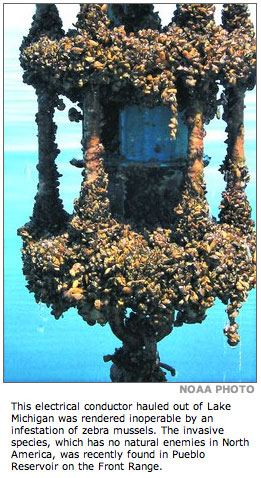
Denver Federal Center based Reclamation team is researching poison, blasts of ultra-violet light, shock waves and the introduction of a mussel-destroying predatory sunfish as possible methods for the control of invasive mussels

A picture named zebramusselinfestation

From The Denver Post (Bruce Finley):

The researchers testing these tactics say some seem to work and, if proved, could save tens of millions of dollars by protecting western hydropower and water delivery facilities against the proliferating Eurasian quagga and zebra mussels. “Once the mussels are there, this would help control them,” said U.S. Bureau of Reclamation mussel program coordinator Leonard Willett, who this week was supervising tests at dams along the lower Colorado River.

Lab tests of the poison are “very promising,” he said. It contains Pseudomonas fluorescens — derived from a bacterium that destroys mussels but apparently not fish. The Environmental Protection Agency has been asked to issue an emergency permit allowing open-water tests…

One tactic involves installing underwater UV-ray devices on pipelines. Mussels inside pipes respond to sudden, intense ultraviolet light by closing up, rendering them unable to attach. Testing of underwater cylinders that emit pulses of energy and discourage mussels from attaching is underway at Colorado’s Leadville Fish Hatchery. Teflon-like coatings also are being tested. And, while quagga and zebra mussels have no natural predator in the United States, researchers are exploring the possibility that a type of sunfish, if introduced, could devour mussels…

This year, the mussels’ spread in Colorado has indeed slowed. A suspected colonization of Blue Mesa Reservoir, west of Gunnison, was not confirmed. Mussels in Pueblo Reservoir and others appear to be somewhat contained, perhaps due to periodic colder temperatures that inhibit breeding, Hosler said. “In Colorado, for right now,” she said, “it looks like we’re winning.”

More Pseudomonas fluorescens coverage here. More invasive species coverage here.

Natural Resources Defense Council: One out of three counties in the U.S. lower 48 states faces an increased risk of water shortages due to climate change

A picture named watersustainabilitynrdc

Here’s a report on the study I linked to yesterday, from Bobby Magill writing for the Fort Collins Coloradoan. From the article:

Larimer County’s water supplies – and those of most of the state’s mountain counties – are at little risk of diminishing in the face of climate change because Northern Colorado could see more precipitation as the Earth warms, not less…

Some of the most devastating effects on water supplies will be felt up and down the Great Plains, including Weld County and Denver, according to the report…

Climate change might pose moderate to extreme risk to water supplies in Jackson, Mesa, Delta, Montrose, Montezuma, La Plata, Alamosa, Rio Grande, Moffat and Saguache counties in addition to those in the Eastern Plains, according to the report. The study’s lead author, Tetra Tech principal engineer Sujoy Roy, said Tuesday that Colorado’s Eastern Plains are at high risk of seeing their water diminish by mid-century because of the region’s heavy use of groundwater, which could begin to dry up…

Larimer County is expected to see more precipitation as temperatures rise, lowering the risk to the county’s water supplies, Roy said.

More coverage from Chris Woodka writing for The Pueblo Chieftain. From the article:

In particular, Pueblo County, the Lower Arkansas Valley and Eastern Plains are among the areas to be hardest hit if temperatures increase and water supply dwindles, as predicted by 16 varying climate models. A report by Tetra Tech for the Natural Resources Defense Council used publicly available databases and a set of models from the Intergovernmental Panel on Climate Change to evaluate the risk posed by climate change…

The report mirrors concerns the Colorado Water Conservation Board has been dealing with in statewide water supply, but puts into focus the impacts that would be anticipated strictly in terms of water demand for agriculture. The report looks at climate and takes other changes, such as growth or the export of existing water supplies into account, said Sujoy Roy, principal engineer and lead report author. “The goal of the analysis is to identify regions where potential stresses, and the need to do something about them, may be the greatest,” Roy said.

More coverage from USA Today. From the article:

High-risk areas include parts of Arizona, Arkansas, California, Colorado, Florida, Idaho, Kansas, Mississippi, Montana, Nebraska, Nevada, New Mexico, Oklahoma and Texas. The rising risk results from decreases in precipitation, based on 16 leading climate models, and increases in water demand, based on current growth trends. The report says water demand is projected to increase by as much as 12.3% between 2000 and 2050. “This analysis shows climate change will take a serious toll on water supplies throughout the country in the coming decades,” said Dan Lashof, director of NRDC’s Climate Center, adding that the only real solution is “meaningful legislation” by Congress to reduce global warming.

More climate change coverage here and here.

Fryingpan-Arkansas Project update: Ruedi releases for the Upper Colorado River Endangered Fish Recovery Program start today

A picture named coloradopikeminnow

From email from Reclamation (Kara Lamb):

As we discussed in our public meeting last week, today we began releasing water for the Upper Colorado Endangered Fish Recovery Program. Our first change occurred at 1 p.m. when we bumped up 30 cfs to 195 at the Ruedi gage. Our second increase is happening now at 5 p.m. We are increasing by 65 cfs to a total of 260 cfs at the Ruedi gage.

More endangered species coverage here.

Interbasin Compact Committee June meeting recap

A picture named laplatasfromroadt

From email from the Interbasin Compact Committee (Alex Davis):

Thank you for your participation at the June IBCC meeting. I think it was a very positive meeting, and I hope that you did as well. This email is a follow-up to the IBCC meeting, including workgroup assignments and responsibilities. Attached are the minutes from the meeting and a list of the reports that are complete, in draft form, or in process.

At the IBCC meeting, several members volunteered to serve on one or more subcommittees to help further refine our thinking and/or draft options to help move us forward. The work of these subcommittees will lay the foundation for the discussion at our August meeting, and it is important that IBCC members participate in them fully. Participation in the subcommittees is still open, and anyone who wants to volunteer for one or more committees should do that. We also want to encourage those who were not in attendance at the June meeting to sign up for one or more of these subcommittees. (In particular, this would be Eric Kuhn, Stan Cazier, and Bill Trampe. If any of you have questions, please call me, Jennifer Gimbel, or Jacob Bornstein.)

Given the short timeframe that exists for the IBCC to finalize its work on these issues prior to submitting a report to the next governor, it is my understanding that IBCC members will either actively participate as a subcommittee member or respect the work of the subcommittee and its recommendations to the IBCC. CWCB staff will be working with each subcommittee organizer to set up meetings and identify any additional needs each group might have. Please let Jacob Bornstein (Jacob.bornstein@state.co.us) and Viola Bralish (viola.bralish@state.co.us) know if you would like to participate on one or more of the subcommittees and you are not already listed below. Subcommittees will begin planning meetings in the next week or so, so please let us know if you want to join one or more subcommittees by close of business on Monday, July 19th.

NEW SUPPLY SUBCOMMITTEE

Purpose:Develop draft guidelines or principles for new supply development. The results of this work will be discussed at the August IBCC meeting.

Members:

* Alex Davis (Organizer)
* Heather Bergman (Facilitator)
* Melinda Kassen
* Taylor Hawes
* Mark Pifher
* T. Wright Dickinson
* Steve Harris
* Peter Nichols
* Carlyle Currier
* Jennifer Gimbel

IDENTIFIED PROJECTS & PROCESSES SUBCOMMITTEE

Purpose:Hold an informal workshop to explore the “lessons learned” and obstacles to IPPs. CWCB staff will help the group gather existing summaries of IPP successes and challenges, and the group will examine these for cross-cutting challenges and opportunities. The group will focus on identifying specific ways to overcome the identified challenges. In its June meeting the IBCC concluded that it is not the role of roundtables, the IBCC, or the state to support or reject specific IPPs. However, there is a significant role for these entities to help overcome the many barriers to implementing the IPPs and to more broadly define the overall yield each basin needs from their IPPs.

Members:

* Jennifer Gimbel (Organizer)
* Carl Trick
* Alex Davis
* Eric Wilkinson
* Melinda Kassen
* Wayne Vanderschuere

CONSERVATION SUBCOMMITTEE

Purpose:Review Water Conservation Best Practices Guidebook and Conservation Strategy to create broad policy statements based on the results of the BMP Guidebook. If the task group feels it is appropriate and can make progress, they will also discuss options for better quantitative measure of conservation. In its June meeting the IBCC concluded that the task group will focus on the ability of utilities to adopt and implement best management practices rather than percent reductions.

Members:

* Wayne Vanderschuere (Organizer)
* Jay Winner
* Jeff Devere
* Taylor Hawes

CWCB STAFF NEXT STEPS:

1. Identified Projects & Processes:

a. CWCB will draft a one-page document regarding the IBCC’s view of the State’s role in IPPs. This will be edited/finalized by the IBCC subcommittee on IPPs.

b. CWCB staff will help the subcommittee gather existing summaries of IPP successes and challenges for the subcommittee to examine these for cross-cutting challenges and opportunities.

2. Nonconsumptive:

a. CWCB will send out summary of existing efforts and progress on nonconsumptive uses at the basin roundtables by the end of July

b. CWCB staff will rewrite the nonconsumptive one-page summary, including the summary of existing efforts above. Staff will complete this by the end of July as well.

3. Alternative Agricultural Transfer Methods:The existing Task Force addressing ag transfer methods will distribute a summary of options to IBCC members by the end of July

4. Conservation:CWCB staff will send IBCC members the final “Colorado Statewide Water Conservation Best Practices Guidebook” prior to the next IBCC meeting.

5. Land Use:CWCB staff previously sent a link to the density memo and report Linking Land Use Planning and Water Supply Planning (email sent 6/18/2010). Staff would be happy to resend this document to anyone who needs it upon request.

Thank you for your continued dedication to this process; I think we have a real opportunity to move this particular ‘ball’ forward, and I look forward to working with you.

More IBCC — basin roundtables coverage here.

Natural Resources Defense Council: One out of three counties in the U.S. lower 48 states faces an increased risk of water shortages due to climate change

A picture named watersustainabilitynrdc

From PRNewswire:

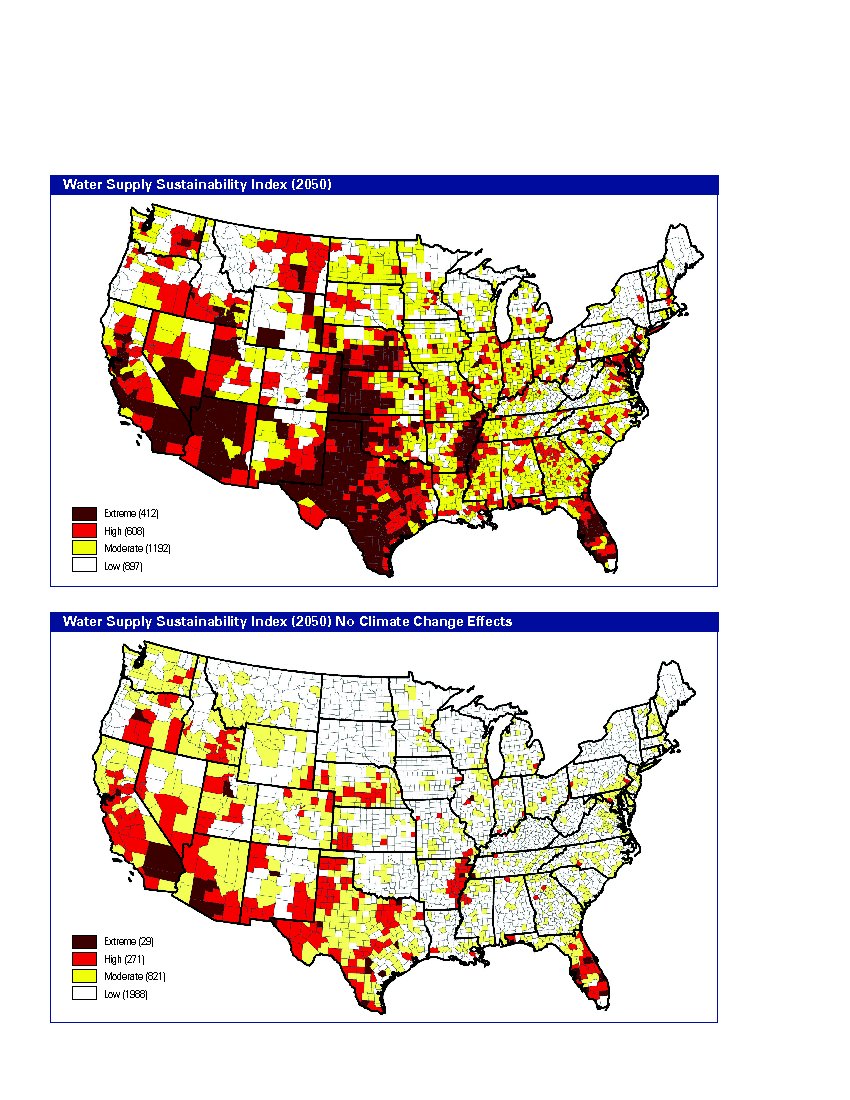
Over 1,100 U.S. counties— more than one-third of all counties in the lower 48 states — now face higher risks of water shortages by mid-century as the result of global warming and more than 400 of these counties will be at extremely high risk for water shortages, based on estimates from a new report by Tetra Tech for the Natural Resources Defense Council (NRDC).

The report uses publicly available water use data across the United States and climate projections from a set of models used in recent Intergovernmental Panel on Climate Change (IPCC) work to evaluate withdrawals related to renewable water supply. The report finds that 14 states face an extreme or high risk to water sustainability, or are likely to see limitations on water availability as demand exceeds supply by 2050. These areas include parts of Arizona, Arkansas, California, Colorado, Florida, Idaho, Kansas, Mississippi, Montana, Nebraska, Nevada, New Mexico, Oklahoma, and Texas. In particular, in the Great Plains and Southwest United States, water sustainability is at extreme risk.

The more than 400 counties identified as being at greatest risk in the report reflects a 14-times increase from previous estimates. For a look at county- and state-specific maps detailing the report findings (including a Google Earth map), go to http://www.nrdc.org/globalWarming/watersustainability/ and http://rd.tetratech.com/climatechange/projects/nrdc_climate.asp.

Click on the thumbnail graphic above and check out the counties over the Ogallala Aquifer and the Green River Basin. The Green River Basin is where Aaron Million and the Colorado-Wyoming Coalition are in a race for transmountain water. They want it for the Front Range.

Here’s the link to the article. Here’s the NRDC’s climate change website

More Climate Change coverage here and here.

NIDIS Weekly Climate, Water and Drought Assessment Summary of the Upper Colorado River Basin

A picture named usdroughtmonitor07132010

Click here for Henry Reges’ notes from the Tuesday, July 13 meeting.

CWCB: Water Availability Task Force meeting recap

A picture named usdroughtmonitor07132010

Below are my notes from yesterday’s meeting:

Flood potential

No one gave a report on flooding potential.

Announcements

Taryn Hutchins-Cabibi said that the Colorado River Water Availability Study closes Wednesday. The CWCB will only consider comments in written form. Submit them to Ray Alvarado at the CWCB.

The public comment period for the statewide drought plan opens on Friday, July 23. They will accept comments until August 20. All materials will be available on the CWCB website on Friday.

State drought plan

Ms. Hutchins-Cabibi informed the group about the status of the statewide drought plan and some of the methodology used. She went into detail about their vulnerability assessment. She says that this was the first vulnerability assessment that she knows about that incorporates climate change. She detailed the timeline for the plan:

1. Incorporate written comments and finalize plan — September 14
2. Colorado Water Conservation Board approval — September 14
3. Submit to Colorado Department of Emergency Management so the plan can be included in the State Hazard Mitigation Plan– late September
4. Adoption by Governor Ritter and submittal to the Federal Emergency Management Agency — late 2010

State Climatologist’s report

Wendy Ryan said that June was the warmest in Colorado since the state started keeping records in 1895. Precipitation for June varied from dry in southwestern Colorado and the Rio Grande Basin to above average precipitation for the northeastern plains. Precipitation for the water year is above average for most of the state with some exceptions such as El Paso County.

Grand Lake is having a, “very dry year,” she said. They are tracking below the driest year on record.

Grand Junction is experiencing below average precipitation as is Montrose. Mesa Verde is a little below average, Del Norte is average, Pueblo is above average, Burlington is way above average, Akron is average and Fort Collins and Boulder are above average.

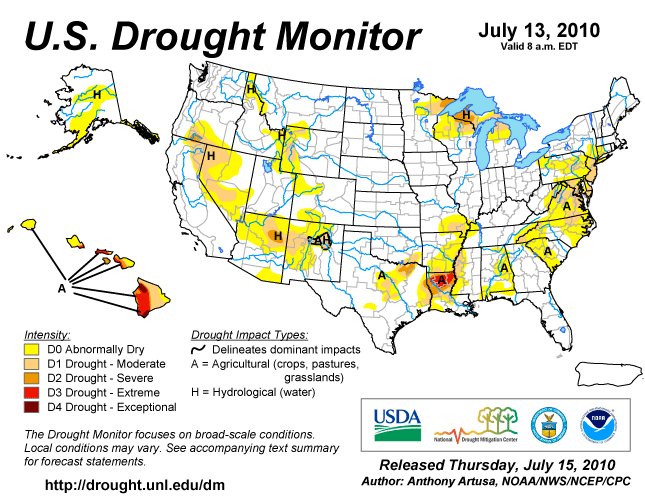
She said that the U.S. Drought Monitor is showing D0 (abnormally dry) in parts of the San Juans, San Luis Valley and the upper Colorado River Basin.

NRCS

Mike Gillespie said that his report would focused on precipitation since there is no snow left.

The Yampa and White River basins have been quite dry and that is the story so far for July. Reservoir storage is at 109% of average.

The Colorado Basin is coming in at 90% of average precipitation. After tracking just below average for most of the year things dried out in June and July, he said. Reservoir storage is at 113% of average and 99% of capacity.

The South Platte Basin is showing 91% of average precipitation and had average precipitation for June. Reservoir storage is 107% of average.

The Gunnison Basin is tracking at 91% of average precipitation for the water year and has been tracking below average for the year. They’ve seen two and a half months of below average making them, “quite dry,” he said. Reservoir storage is 104% of average.

In the southwest corner of the state the San Miguel, Dolores and San Juan basins precipitation is, “almost a flat line so far,” and things are, “beginning to lag quite a bit,” he said. They’ve been below average for precipitation for 3-4 months. Reservoir storage is sitting at 109% of average.

In the Rio Grande Basin the precipitation for the water year is 90% of average. They are experiencing a, “drying trend as well,” Gillespie said. Reservoir Storage is at 81% of average.

The Arkansas Basin has seen several months of below average precipitation and is sitting at 84% of average. Reservoir storage is 101% of average.

So the statewide figures are: 90% of average precipitation; reservoir storage at 106%; and a, “drying trend going into the summer months,” according to Gillespie.

More CWCB coverage here.

2010 Colorado elections: Scott McInnis makes a stop in the San Luis Valley

A picture named smithreservoir

Update: From the Valley Courier (Ruth Heide):

During his [McInnis] previous tenure in public service he sat on natural resource committees at both the state and national levels, he said…

He criticized state legislative measures that took money away from the Colorado Water Conservation Board and Branding Board. He said those funds should be used for the projects for which those boards were set up, not to supplement other programs in the general fund…

When asked how the state could address projected water shortfalls in the future without drying up massive amounts of agricultural land, McInnis said agriculture is essential to the health of this state, and rather than dry up ag lands to provide water for future growth, Colorado needs to look at alternatives. He suggested additional water storage and pointed to a doctoral student’s project that proposes to draw water from the Flaming Gorge through Wyoming to the Front Range. “That’s the kind of answer that’s going to be our future,” he said. He said the cost of such a project might run $5 billion, but the cost could be spread over time. “It’s an investment we must make,” he said.

From The Pueblo Chieftain (Matt Hildner):

While none of the 180 in attendance at the conference publicly questioned McInnis about the [“Musings on Water” – gate], he did get asked about water. He said it was critical for the state to find more water storage to supply the Front Range with water. “You can’t dry up farmland,” he said. “There are other options.” McInnis has backed Northern Integrated Supply Project, which would cost $426 million, build storage near Fort Collins, and prevent the dry-up of roughly 25,000 acres, according to its designers.

He also backed the proposal from Aaron Million to pump water from Flaming Gorge Reservoir on the Utah-Wyoming border back to the Front Range. He noted that the project’s $4 billion price tag was an investment of the same magnitude of Denver International Airport.

From TPMDC.com (Eric Lach):

When given a list of other potential candidates, 64 percent of GOP voters picked another candidate. When asked who they thought would make the “strongest Republican gubernatorial candidate,” McInnis came in second with 19%. The top vote getter: ex-Rep. Tom Tancredo, with 29%. Of the 1,181 registered voters contacted last Thursday, 73% had heard about the plagiarism story. Thirty-seven percent of GOP voters think McInnis should drop out.

More 2010 Colorado elections coverage here.

Colorado-Big Thompson Project update

A picture named coloradobigthompsonmap

From email from Reclamation (Kara Lamb):

With the recent heat, we are finally starting to see a dip in the elevations at Horsetooth and Carter reservoirs.

Today, Horsetooth is releasing about 360 cfs to water users (agricultural, city and industrial users). About 164 cfs is coming into the reservoir. It has started to go down and is at an elevation today of 5425. It will reach 5424 by tomorrow and will continue going down.

The pump to Carter went off in the middle of the night last night. Carter is approximately one foot below full at an elevation of 5758. With the heat, it is likely demand out of Carter will come up, too, and we’ll start to see the elevation there start to go down as well.

We are making deliveries down the Big Thompson River and along the canals. As we run water through the project, we are seeing regular fluctuation at both Pinewood and Flatiron reservoirs as we generate hydro-electric power at Pole Hill, Flatiron and the Big Thompson power plants. If you are visiting either Flatiron or Pinewood, please keep the fluctuating nature of the reservoirs in mind. In particular, please remember there is no boating, wading, swimming, etc. of any kind allowed in Flatiron. It goes up and down too much and has strong currents.

Those near Lake Estes will see the elevation creep up at Estes slightly. Releases from Olympus Dam to the Big Thompson River have remained around 125 cfs for the past week and are anticipated to stay at that rate for a while, weather depending, of course.

More Colorado-Big Thompson coverage here.

Rio Grande Basin: The objectors to the groundwater management Sub-district No. 1 rules have filed an appeal of Judge O. John Kuenhold’s recent approval of the plan

A picture named slvdischargerecharge

From the Valley Courier (Ruth Heide):

The Rio Grande Water Conservation District, Rio Grande Water Users Association, Conejos Water Conservancy District, State Engineer, and Farming Technology Corporation filed Supporters’ Motion to Amend Decree on July 8. The following day, the senior water users filed notices of appeal to Colorado’s higher courts in two closely associated water and civil cases.

The senior water users’ attorneys contended in their appeals that the amended plan, and the judge’s conditions regarding its approval, still did not provide enough protections for senior water rights. They contended that injury would continue to occur to senior water rights as long as wells were allowed to pump within the sub-district area without state curtailment. They stated that such pumping constituted out of priority depletions. They also questioned whether the water management plan was complete, comprehensive and detailed enough and whether it complied with Senate Bill 04-222 and Colorado law…

Objectors also questioned whether the trial court erred in:

• determining that the plan of water management need not contain sufficient terms and conditions for the trial court to determine “no injury” to other water rights as a result;

• delegating to the sub-district and state and division engineers the authority to determine “annual replacement plans” to replace depletions from sub-district well pumping;

• deferring a finding regarding whether the plan of water management will result in injury to other water rights and instead relying on retained jurisdiction over the plan;

• approving the use of response function, a method for determining water injuries;

• determining that a plan of water management may use a reduction in the amount of water consumed by native vegetation to increase the quantity of water available to be pumped by sub-district wells;

• not requiring the sub-district to prove ownership or control over sufficient legally available replacement water to cover depletions from pumping sub-district wells;

• allowing the sub-district to utilize the water rights subject to the decrees referred to in Case Nos. 06CV64 and 07CW52 as the “recharge decrees” and in approving the quantification of fully consumable water in estimating ground water depletions;

• finding that the sub-district’s proposed use of Closed Basin Project water is not prohibited;

• allowing a 50 acre foot per year lower limit for the determination of injurious depletions and in allowing the replacement of injurious depletions in subsequent years;

• not adopting, rejecting, or referring back the plan of water management to the sub-district (the judge had referred the plan back to the sub-district board of managers once before);

• not affording objectors the opportunity to propose specific terms and conditions to the plan of water management;

• not requiring the sub-district to replace all injurious depletions, including ongoing depletions resulting from past pumping of sub-district wells, until the year 2012;

• approving Appendix 4 (budget and accounting plan) and Appendix 5 (operational timelines) of the plan of water management;

• determining the sub-district may contract with the owners of any non- sub-district wells.

• finding that individual plans of augmentation in Water Division 3 are not presently possible and cannot be completed with any engineering validity;

• finding that the calculation of the Surface Water Credit in Appendix 2 of the plan of water management is reasonable and supported by the record;

• finding that the amended plan of water management’s change in timing for removing land from irrigation to effectuate further recovery of the unconfined aquifer to a sustainable condition is lawful.

San Luis Valley groundwater coverage here and here.

Northern Integrated Supply Project: The Town of Frederick is solidly on board with the project

A picture named nisp2

From the Carbon Valley Farmer & Miner (Emily Dougherty):

The town’s sole source of water for potable water system is the Colorado Big Thompson (CB-T) project, which Frederick officials say they have outgrown, especially considering the projection that few CB-T units will be available on the open market beyond 2015…

“After studying many options and consulting true experts related to water issues, we firmly believe that NISP is the best choice available for Frederick and that it will prove to be a great benefit for all economic and social sectors of Northern Colorado,” Frederick mayor pro-term Tony Carey said in a letter in support of the NISP…

Carey went on to say that the town’s current water supplies are barely meeting the area’s needs and that if NISP is not approved, “Frederick and other participants will be forced to look at acquiring agricultural water rights to meet future demands,” he wrote…

the town strongly prefers to implement the NISP plans for Glade Reservoir and the South Platte Water Conservation Project, and to also work with the Larimer and Weld and the New Cache La Poudre irrigation companies to improve their operations rather than buying water rights that would negatively impact them.

Here’s a recap of last week’s rally by supporters of the project where 200 or so showed up, from Monte Whaley writing for The Denver Post. From the article:

At one point, Weld County Commissioner Sean Conway led the throng with shouts of “NISP now” before sending them out to spread the gospel of the Northern Integrated Supply Project.”You go and send that message about how much we need this,” Conway said, rallying the troops from inside a barn at Anderson Farms, northwest of Erie…

The go-ahead for NISP rests largely in the hands of the Army Corps of Engineers, which released a draft environmental-impact statement for the project in 2008. But the corps decided to do a supplemental study after critics said the original failed to answer critical questions, including the extent of the environmental damage the dams may cause. The supplemental report should be completed and released by next summer, said Brian Werner, spokesman for the Northern Colorado Water Conservancy District…

Don Korrey — who works 800 acres of corn and alfalfa northeast of Sterling — said NISP is desperately needed to preserve water that otherwise would flow out of the plains and into cities. “Any storage anywhere will help farmers everywhere,” Korrey said. “It’s obvious cities are asking for more water rights, and if they keep doing that, our water will be depleted and their goes our livelihoods.”

More Northern Integrated Supply Project coverage here and here.

Middle Park Land Trust Fraser River restoration project protects a quarter-mile corridor

A picture named eisenhowerfishing

From the Sky-Hi Daily News (Reid Armstrong):

The easement, which was recorded June 23, will protect for perpetuity some 17 riparian acres on property owned by Eric and Kathy Pietz. Another 70 acres on the neighboring Devil’s Thumb Ranch, which was placed into a conservation easement between 2007 and 2008, completes the corridor. “This is something we’d been working on for several years,” said Cindy Southway of Conservation Assistance who helped guide the project. The conservation easement wasn’t part of the original plan for the quarter-mile river corridor, which has been completely restored in the last two years through a wetlands mitigation project funded by Rendezvous…

The property didn’t always have a rich wetlands habitat. Two years ago, that 600 foot stretch of river was 75 feet wide, shallow, steep and was considered to be very poor fish habitat. In fact, said project manager Geoff Elliott of Grand Environmental Services, satellite photos indicate that section of river might have been straightened at some point to help transport logs through the Fraser Flats down to the lumber mill in Tabernash…

Elliott said that he spent three years studying the Fraser River in different places, determining what features helped create a healthy river. He took along a fishing guide who showed him the best fishing holes in the area, and Elliott studied their geometry and then recreated them in the restoration project. The project, which was funded entirely by Rendezvous as part of its development permit with the U.S. Army Corps of Engineers, involved creating multiple bends in the river and adding features to improve fish habitat and water quality, such as pocket and shallow rapids and spots where the river will actually spill out of its banks and feed the wetlands…

The project more than doubled the length of the river, creating an ‘M’ out of what had once been an ‘I,’ and narrowed the channel down to 35-45 feet, allowing the water to flow deeper and cooler. Elliott said that two years after the completion of construction along that section of river, willow and other riparian plants along the river banks are thriving and the wetlands are growing. Within just one year, the river had been recolonized by the bugs that are the backbone of hearty fishery habitat — stone flies, water beetles and worms among other. And now, there are even signs of brown trout spawning in the new habitat.

More restoration coverage here and here.

2010 Colorado Elections: ‘Musings on Water’ – gate update

A picture named wetmountainvalley

Update: From The Denver Post (Karen Crummy):

Do I look like I’m going anywhere? These boots are made for walking, and I’m ready to fight,” [McInnis] said to The Post, looking down at his brown cowboy boots.

He also addressed again the controversy surrounding articles he submitted to the Hasan Foundation as original works but which included whole pages and passages that were similar to or copied directly from a 1984 essay by now-Colorado Supreme Court Justice Gregory Hobbs.

“It was an obvious mistake. I stood up, took responsibility and moved on,” McInnis said.

Update: From The Grand Junction Daily Sentinel (Denny Herzog)

But there’s a seriousness to it, too. Plagiarism, particularly to those of us who have made careers out of dealing with the written word, is not to be taken lightly. Yet that’s exactly the way McInnis dealt with it, at least early on. Shortly after the story broke, he said if it were not an election year, it wouldn’t be an issue. The implication was that only in an election year would such a minor transgression be such a big deal. Sorry Scott, but theft, and that’s what plagiarism is, is a big deal, even in years when you’re not on the ballot.

From NewsFirst5.com (James Amos):

Dr. Malik Hasan, who helped establish the Hasan Family Foundation, says the board was hoping to get recommendations on how to deal with Colorado’s drought when it commissioned the essays from former U.S. Rep. Scott McInnis in 2005. Hasan says he was disappointed when McInnis took a job in a law firm and turned in reports that were unpublishable, but there was nothing he could do about it.

From The Denver Post (Mike Littwin):

As I’m writing this column, the most relevant questions are all about the McInnis campaign death watch, now on high alert. The terms of the debate have changed from whether McInnis can still win after his “Musings on Water”-gate scandal to how long McInnis can survive. There’s an Aug. 10 primary date against Dan Maes — who, to this point, has offered up no known credentials for the job — and then there’s the November race against Democrat John Hickenlooper, who has pulled ahead in the latest polling. Still, I don’t expect McInnis to quit because he is Scott McInnis, who is far too stubborn to quit. Just look at the latest news. McInnis says he’s paying back the $300,000 that he took — and I mean took in the best way — from the Hasan Family Foundation for the plagiarized articles highlighting his water-law expertise. The real scandal is that he was paid that kind of money for his, uh, musings at all, original or otherwise. But if McInnis were going to quit the race, why wouldn’t he just keep the money, which is a lot of cash even by lawyer- lobbyist standards? The quitting, at this writing, has been limited to three McInnis senior staffers. You don’t have to wonder why they left the campaign. They were either shocked by McInnis’ behavior, particularly in regard to ex-pal Rolly Fischer, or they may have just noticed that the campaign bus, with its incriminating tire marks, has left the station.

More 2010 Colorado elections coverage here.

Arkansas Valley Conduit: Will Reclamation place too high a financial burden on the project?

A picture named fountainpavementdrawing

From The Pueblo Chieftain (Chris Woodka):

The Southeastern Colorado Water Conservation District is watching the current proceedings with interest, and the implications of the [Southern Delivery System] outcome for the district were frequently mentioned during two days of negotiations last week.

“Do you remain comfortable charging less for out-of-district users than for those of us in the district?” David Robbins, an attorney for Colorado Springs, asked Mike Collins, area manager for Reclamation at one point. Robbins referred to a 2007 storage contract with Aurora that amounts to $46 per acre-foot in 2011 vs. proposals that have ranged from $50-100 per acre-foot for SDS.

Collins replied, after a barrage of questions and a day of banter, that Reclamation from now on would use a “negotiated market” method of determining contract prices in the Arkansas Valley. That is a change from past contracts based on cost of service that Collins discounted as “snapshots in time.”[…]

The rate Colorado Springs eventually reaches in SDS — right now, it’s expected to come down between $25 and $40 — will also provide revenues to repay the costs of the conduit under a 2009 law. Even the low end fits into the projections made by federal staff on the repayment strategy, Broderick said. “I’m not seeing this as having much impact on the funding of the conduit,” he said.

More Arkansas Valley Conduit coverage here and here.

New National Academy of Sciences study puts numbers to the expected the impacts of climate change

A picture named spainsunflower

From The Denver Post (Bruce Finley):

For example, for every 1.8 degrees of warming, Colorado can expect 5 percent to 10 percent less water in the Arkansas River and Rio Grande, the government-funded study found. The Colorado River Basin, which sustains people in seven western states, likely would see 6 percent less water for every 1.8-degree increase. Wildfires would devour three times as much land, the study found. And rainfall in Colorado and other southwestern sates would decrease by 5 percent to 10 percent.

Meanwhile, here’s a report about June being the warmest on record from the Summit County Citizens Voice. From the article:

The National Oceanic and Atmospheric Administration reported today that June 2010 was the warmest June on record for the planet, based on records going back to 1880. Combined land and sea temperatures around the planet made it the warmest January to June period on-record, the agency said in it’s monthly climate summary. The combined global land and ocean average surface temperature for June 2010 was the warmest on record at 61.1 degrees, 1.22 degrees above the 20th century average. Warmer-than-average conditions dominated the globe, with the most prominent warmth in Peru, the central and eastern contiguous U.S., and eastern and western Asia. Cooler-than-average regions included Scandinavia, southern China and the northwestern contiguous United States.

More climate change coverage here.

Weld County: Recap of agricultural tour aimed to educate residents

A picture named dripirrigation

From The Greeley Tribune (Meagan Birely):

On Friday, the Chamber of Commerce Agricultural Committee brought farmers and city folks together to learn about the process, product, procedures and problems of sharing water. The tour, “From Desert to Oasis: The story of how irrigation transformed the plains of eastern Colorado” took a busload of people around Weld to look at different places impacted by and using different irrigation systems…

Cory Gardner, R-Yuma, who serves on the Legislature’s agricultural committee and is running for Congress in the 4th Congressional District, said the tour was very eye-opening to the role Weld plays in the world’s food supply. Garner said it is not only important for him personally to be educated on the matter but to continue to educate others as well. “We in agriculture have got to do a better job in educating our city citizens,” Gardner said. “We get 70 percent of our oil from overseas. I would hate to see that much of our food come from overseas.”

More education coverage here.

Southern Delivery System: Colorado Springs Utilities presents Reclamation with a counter-proposal in the ongoing negotiations for a an excess capacity storage contract

A picture named sdspreferredalternative

From The Pueblo Chieftain (Chris Woodka):

Colorado Springs backed into a proposed figure of $25.31 per acre-foot annually beginning in 2011. Eventually, the SDS partners would like to store 42,000 acre-feet of water in Lake Pueblo in excess-capacity space — capacity in Lake Pueblo that is not needed for storing Fryingpan-Arkansas Project water. The move came after Michael Collins, Reclamation’s area manager, asked Colorado Springs for a counter-proposal based on a market approach in a Thursday negotiating session at the Fountain Valley School.

His request had come at the end of a day of heated discussions where Reclamation would not respond to a proposal by Colorado Springs based strictly on cost of service. Collins and the rest of Reclamation’s team — federal attorney Chuck Cahoy and contract officer Lynette Smith — faced pointed questioning from SDS Project Director John Fredell and attorney David Robbins. Reclamation had dropped the rate from $50 per acre-foot to $41.56 per acre-foot annually at the end of Thursday’s session…

The proposal would resolve a dispute over control of excess-capacity in the first few hundred feet of pipeline, allowing Colorado Springs to recoup some of the cost, but making it part of the Fryingpan-Arkansas Project managed by Reclamation. Reclamation would apply the same rate to an exchange — really, a paper trade of water stored in Lake Pueblo for project water in upper reservoirs — of up to 10,000 acre-feet annually that Colorado Springs alone is requesting. Colorado Springs would pay for 1,000 acre-feet annually, but there is still disagreement about whether the city would be reimbursed if it did not use the exchange in any given year. “We appreciate receiving the proposal,” Collins said. “We’ll not give it consideration today, but withhold our decision until the next session.”

Here’s where things stood after Friday’s session according to a report from Daniel Chaćon writing for the The Colorado Springs Gazette. From the article:

…representatives from both sides said they were optimistic they could reach a deal. “It’s hard to predict how close we are, really, but I’m very encouraged by the negotiation process,” said Michael Collins, manager of the federal agency’s Eastern Colorado Area Office in Loveland. “We’ve had good sessions all the way along.”[…]

Before the end of today’s negotiation session – the fourth since May – Utilities proposed paying $25.31 per acre-foot, plus a 1.79 percent annual inflation fee. Collins said the federal agency would give the proposal “serious consideration” and provide a response at the next negotiation session, which has not yet been scheduled.

More coverage from Chris Woodka writing for The Pueblo Chieftain. From the article:

On Friday, Colorado Springs proposed building a 90-inch pipeline from the North Outlet Works to the point where the SDS pipeline would turn out to provide Pueblo West water, several hundred feet from the dam. SDS would use a maximum of 150 cubic feet per second in the pipeline, which would have a capacity of roughly four times that. “The SDS partners would use 25 percent,” John Fredell, SDS project director told Reclamation’s negotiating team. “The excess-capacity, you would control.”[…]

Reclamation Area Manager Michael Collins offered Colorado Springs a payment of $287,500 — Colorado Springs estimated $500,000; Reclamation, $75,000 — over three years to oversize the line to 90 inches to the point where SDS becomes a single-purpose project. “Future generations would say we were short-sighted if we did not do this,” Collins said. David Robbins, Colorado Springs attorney, argued that while the cost of using larger pipe is minimal, SDS participants should not bear the costs of building the $30 million North Outlet Works alone if others hook on in the future. “If third parties want to use it, they should be asked to pay the cost,” Robbins said. Friday’s proposal backed off that position. Under Colorado Springs’ calculations, the oversized portion of the pipeline would cost $23 million, but in negotiations reimbursement for only $5 million was requested…

Colorado Springs and Reclamation made progress toward a conveyance contract Friday that would be separate from the excess-capacity storage and exchange contracts that are being negotiated. Robbins suggested numerous changes in the contract language that did not substantially alter the substance of the deal. Reclamation backed off its original stance of charging for conveyance from Pueblo Dam, instead letting the SDS participants use the North Outlet Works they build at no additional charge.

More Southern Delivery System coverage here and here.

2010 Colorado elections: The Hasan Family Foundation wants Scott McInnis to reimburse the dough he was paid for his fellowship

A picture named troutcreekpass

From The Pueblo Chieftain (Patrick Malone):

McInnis said he intends to repay the foundation [$300,000]. The demand followed an internal foundation review of articles submitted by McInnis that contained plagiarized material. A written statement released by the board Friday said McInnis’ output for the foundation “was only a fraction of the work he was obligated to perform . . . Of the little work that he did, he has admitted it was neither fully completed by him, nor fully original. In view of the public disclosure . . . it is clear that Mr. McInnis has not fulfilled the terms of our agreement . . . The foundation demands he repay all monies paid to him under the fellowship.”[…]

“The foundation board met and reviewed the facts of the case,” Hasan family spokesman Drew Dougherty said Friday. “With the admissions from Mr. McInnis and Mr. Fischer, no further investigation was necessary.”

Here’s what I’m sure the McInnis campaign hopes is the final word from them (from email):

Scott McInnis, Republican candidate for Governor, today issued the following statement in response to a news release issued by The Hasan Family Foundation:

“I have said since this matter was brought to my attention that the articles provided as part of the Hasan Family Foundation fellowship were faulty. I explained how this problem arose, and I accepted responsibility.

“I apologized to the Hasans for this mistake, and I expressed my determination to make it right with my dear friends. I will be in contact with the Hasan family to make full payment arrangements. I agree with the Foundation that this brings this matter to a close, and I look forward to continuing to speak on the campaign trail about the critical issues facing all of Colorado, including jobs and economic recovery.”

Three staffers have resigned over the scandal from the McInnis campaign according to a report from Karen Crummy writing for The Denver Post. From the article:

“That says to me one of two things: Either they (the staffers) have lost confidence in the viability of the campaign or they’ve lost confidence in the candidate due to the incident,” said longtime political analyst Eric Sondermann.

McInnis on Friday also backed out of the second scheduled public appearance in as many days, this time an Arapahoe County Republicans event featuring former Minnesota Gov. Tim Pawlenty, a possible 2012 presidential candidate and vice president of the Republican Governors Association…

While those signs point to a foundering campaign, McInnis has reserved nearly $260,000 in television time in the Denver and Colorado Springs markets to run his first TV ads up to the Aug. 10 primary election…

The departing staffers — policy director Mac Zimmerman, political director Dustin Zvonek and regional director T.Q. Houlton — were all staffers of former U.S. Rep. Tom Tancredo, who garnered the most support for governor among registered Republican voters in a Denver Post poll released Friday. Zimmerman was also the chief of staff for former state Senate Minority Leader Josh Penry, and Zvonek worked for Penry as a policy analyst.

Here’s a guest commentary from Seeme Hasan writing in The Denver Post. She writes:

In building the Hasan School of Business of Pueblo — in addition to many donations to other causes, including the University of Colorado Foundation, Pueblo Community College and the Pueblo City Library — water education was to become one of the biggest contributions that the Hasan Family Foundation would give to our state. Unfortunately, these goals were not to be realized. While history will tell certain stories of this past week, the most terrible loss is that of Colorado’s — the missed opportunity of uniting to protect our water. To us, this will forever be Colorado’s greatest tragedy.

According to this report from Wyatt Haupt Jr. writing for the Grand Junction Free Press John Hickenlooper — who has wisely avoided too much public comment on the McInnis plagiarism scandal — has moved ahead in a Rasmussen poll. From the article:

The Rasmussen Reports survey showed Hickenlooper with 45 percent of voter support, while McInnis picked up 43 percent. A total 7 percent expressed support for a different candidate, while 5 percent indicated they were of undecided status. The poll has margin of error of plus or minus 4 percentage points. A total of 750 likely voters were surveyed July 15. The poll represents a 7-percentage point switch in the last month for McInnis, whose campaign was rocked earlier this week by a plagiarism charge. The allegation surfaced in a Denver Post story, which delved into water articiles penned by McInnis in 2005 and 2006.

Here’s some of the back story about Rolly Fischer and Scott McInnis from Tim Hoover writing for The Denver Post. From the article:

Rolly Fischer developed a high profile as a water expert during a 28-year career with the Colorado River Water Conservation District but left after his own brushes with ethics questions were publicized. In 1996, the Grand Junction Daily Sentinel published a series of articles examining how the river district, then headed by Fischer, had done business with companies operated by his wife. Fischer himself was an officer in the companies, which provided temporary employees and payroll services to the water district. The contracts for those services were not put out for competitive bids. Fischer also came under scrutiny for his $105,000 annual salary, perks that included a personal vehicle and executive airline club memberships and spending practices such as racking up $14,000 in travel expenses in one year. Fischer abruptly resigned from the water district after the Sentinel’s stories ran.

More coverage from Charles Ashby writing for The Grand Junction Daily Sentinel. From the article:

McInnis went on to say he had apologized to the group for the mistake and would contact it “to make full payment arrangements.” The incident has dogged McInnis all week and is expected to remain an issue through the Aug. 10 primaries, where he hopes to win the GOP nomination against Evergreen businessman Dan Maes. McInnis has repeatedly said he will not drop out of the race despite numerous calls for him to do so. “I look forward to continuing to speak on the campaign trail about the critical issues facing all of Colorado, including jobs and economic recovery,” he said.

Finally, Jason Salzman pokes some fun at Scott McInnis on the Huffington Post. He writes:

But even if you have to give some of the money back, you should know that you’ll definitely have the respect of the freelance writing community for breaking free from the normal rules that bind writers to their desks. You’ve allowed me and other freelancers to dream of a day when we can be freelance writers and not write at all. As a leader, you’re trying to head us in that direction by experimenting with new freelance ideas and techniques. Some will surely fail, but that’s to be expected as you work toward a world where freelance writers are paid more and work less. As I wrote before, “Honorable” Congressman, whether you’re elected or not, you have secured your spot as a rock star of the freelance writing community in Colorado. Please let us know at your earliest convenience when you will be able to meet with me and other writers to advise us on how we can be as successful as you at freelance writing.

More 2010 Colorado Elections coverage here.

Arkansas Valley Conduit: The project is on track for $6 million in funding in 2011

A picture named pipeline

From The Pueblo Chieftain (Peter Roper):

Rep. John Salazar, D-Colo., is a member of the House Appropriations Energy and Water Subcommittee, and he announced that panel had agreed to dedicate $6 million to the project in 2011. That follows the historic award of $5 million this year. “This is a promise that is long overdue, since 1962 to be exact, and it is time that these communities in Southern Colorado have the clean, reliable water delivery system they were promised,” Salazar said in a statement after the vote…

Rep. Betsy Markey, D-Colo., whose 4th Congressional District include the lower Arkansas Valley, issued a statement that said, “I will fight every day to make sure that funding for the conduit continues.” The funding for the conduit project is now part of the 2011 water and energy appropriations bill and will next be considered by the full House Appropriations Committee.

More Arkansas Valley Conduit coverage here and here.

2010 Colorado elections: Tom Tancredo jumps off the Scott McInnis ship

A picture named unaweepcanyon

From The State Column:

“We haven’t got a chance under the present circumstances,” Mr. Tancredo said, in reference to allegations of plagiarism plaguing the McInnis campaign. “This is a huge disaster for the Republican party unless we can get a candidate in there to make this all work.” Mr. Tancredo, a conservative who ran as an underdog presidential candidate in 2008, said his own sources say Mr. McInnis will likely drop out of the race for governor.

More 2010 Colorado elections coverage here.

Northern Integrated Supply Project: Supporters of the project rally in Weld County

A picture named nisppreferredalternative

Here’s a report from Tom Hacker writing for the Loveland Reporter-Herald. From the article:

The Anderson Farm, once a working farm but now an entertainment and education venue, hosted the event organized by the Colorado Farm Bureau and the Northern Colorado Water Conservancy District, the architect of the project. “People say there is a crisis coming,” former Colorado Agriculture Commissioner Don Ament said in warming up the crowd of about 200. “I’m here to tell you the crisis is already here.”

Farmers in Northern Colorado have said since the time the project was unveiled six years ago that it is the only thing standing between their livelihoods and the water needs of growing Front Range communities…

Opponents, led by the conservation group Friends of the Poudre, say the project would drop Poudre flow levels so low that water quality and wildlife habitat would be severely affected. They use the slogan “Save the Poudre” to make their point. But the mantra Thursday was “Save the Poudre, Store it in Glade,” with banners carrying the message hoisted at the Anderson Farm and bumper stickers available for attendees to take with them.

Well it has been an interesting week for politicians and alleged plagiarism. It looks like two northern Colorado lawmakers helped themselves to a colleague’s opinion piece in support of the Northern Integrated Supply Project. Here’s a report from Kelly King writing for the Loveland Connection. From the article:

Columns purportedly authored by Rep. BJ Nikkel, R-Loveland, and Weld County Commissioner Doug Rademacher focused on the need for new water storage capabilities in Northern Colorado, highlighted their support for the Northern Integrated Water Supply Project, or NISP, and encouraged readers to attend a Thursday agricultural rally in Erie. Nikkel’s and Rademacher’s columns published in the Berthoud Recorder, Windsor Beacon and Greeley Tribune closely mirrored a column published in the Denver Post, written by Weld County Commissioner Sean Conway.

Conway admits he provided his writings to Nikkel and Rademacher after they expressed interest in spreading news about the agricultural rally and their support of NISP. “Anyone who knows me, knows that I’m a longtime supporter of NISP,” Conway said. “Leading up the ag rally, I wanted people to know about the event. I submitted a column to the Denver Post as an exclusive update about the event, authored by me. “Over the course of the next few days, my office mate, Doug Rademacher, said he wanted to submit something to the Greeley paper about the event. I offered him the column and said ‘Use what you want.’ Essentially, he took it and ran with it and I’m fine with that.”

Conway said he also talked with Nikkel, who wanted to submit a column to newspapers in her district, in Loveland, Berthoud and Windsor. “I sent her the column and told her she had my permission to use it,” Conway said.

More Northern Integrated Supply Project coverage here and here.

Energy policy — nuclear: New nuclear power plant in the works for Pueblo County?

A picture named nukeplantcattenomfrance

From The Pueblo Chieftain (Chris Woodka):

“The world needs energy,” [Don Banner], a local attorney, said in outlining his plan Wednesday. “The United States is behind the eight ball when it comes to nuclear energy.” Banner has formed a corporation called Puebloans for Energizing Our Community LLC to develop a plan that would solicit bids to build a nuclear power plant. The plan includes a way to divide a portion of the anticipated profits among community groups…

Banner has contracts to buy 25,000 acres of land southeast of Pueblo for Colorado Energy Park, which eventually could support nuclear, solar and wind energy projects. It’s the nuclear portion that holds the potential not only to fill a gap in national energy production, but to help the community as well, Banner said. “Wind and solar energy will never be the primary sources of electricity,” Banner said. “From what I’ve been told, the most that would be tolerated on the grid is 27 percent.” Banner is convinced nuclear energy is the safest form of primary power generation, both in terms of industrial accidents and secondary health impacts. It also would reduce the amount of carbon emissions compared with coal, gas or oil energy production.

More nuclear coverage here and here.

Colorado Springs: Peterson Air Force Base conservation efforts

A picture named watersprinkler

From the Colorado Springs Independent (Pam Zubeck):

The base pays $100,000 a month for water, according to this story. Hence, base officials recently began developing a system that will shut off sprinklers after it rains one-eighth of an inch. The base also hopes to switch its irrigation system to non-potable water after the pipeline project is completed.

More conservation coverage here.

2010 Colorado elections: Scott McInnis is standing behind his position that the lifting of Justice Hobbs’ writings was just a big mistake

A picture named crystalcreekreservoir

Update: Rolly Fischer is on the video record now. Channel 7’s John Ferrugia interviewed him yesterday. Here’s the link to their video page. I could not determine how to deep link. From the article:

Ferrugia asked, “Rolly, is Scott McInnis lying to us?”

“Yes,” said Fischer.

Meanwhile The Denver Post’s Karen Crummy is reporting that Colorado Republican leaders are preparing for the eventuality that McInnis might drop out of the goveror’s race. From the article:

The name rising to the top of the list was University of Colorado president Bruce Benson, the 1994 Republican nominee for governor. Benson said he was dedicated to his current job. “We’ve made great strides at the university and have a great team of people,” he said. But asked whether he was open to being a candidate again, he said, “You never say no.”

Others being considered include former Congressman Tom Tancredo and state Senate Minority Leader Josh Penry, who had been running against McInnis in the primary but dropped out of the race in November.

From The Pueblo Chieftain (Patrick Malone):

Foes have characterized McInnis’ faux pas as plagiarism and called for him to leave the governor’s race, something McInnis said he won’t do. “There obviously was a mistake made, and the research associates did not have sufficient attributions,” McInnis told The Pueblo Chieftain…

McInnis identified the researcher who plucked the writings from Hobbs as Rolly Fischer, who worked at the Colorado River Conservation Board. “(Fischer) thought it was in the public domain and you could use that,” McInnis said. McInnis said Fischer “is sick about” the plagiarism allegations…

The candidate admitted some personal responsibility for the gaffe. “One: (Fischer) should ha ve attributed it,” McInnis said. “Two: In the process, I need to go through the research material.”[…]

Dave Dill, Pueblo County Republican chairman, echoed McInnis’ position on Carroll’s remarks. “Obviously, McInnis is running pretty strong, in fundraising and in the campaign in general,” Dill said. “Democrats are fearing he’ll take the primary. If he is indeed the front-runner, (Democrats) would be happy to have him out of the race. They are afraid.”

The Fort Collins Coloradoan editorial board is calling on McInnis to bow out of the race. They write:

McInnis should bow out of the governor’s race. Prolonging his campaign in light of news about the plagiarism would not serve his party and does not serve Coloradans. Quite often, during election season, candidates do try to discredit their opponents by revealing unflattering facts or situations about them. These “stunts” do little to educate voters and appeal to the lowest common denominator. But McInnis is flat wrong in believing that this revelation is only significant or news because he is a candidate for governor. Honesty and integrity matter as much for the dog catcher as for the governor, not to mention a former U.S. congressman. McInnis apologized for the mistake, but he didn’t assume responsibility. And there is a difference.

On Wednesday The Denver Post editorial board also indicated that McInnis should quit the governor’s race. Here’s an excerpt:

The plagiarism and other issues have cumulatively so damaged McInnis’ credibility that we do not believe he can be an effective governor. Even though McInnis acknowledged he made a mistake, he still spent part of Tuesday blaming a research assistant for the failure to credit the work. If you put your name on something and take money for it — a lot of money in this case — it is your responsibility to make rock-solid sure it is bona fide, original work that will stand up to scrutiny. The state’s chief executive must be someone Coloradans can believe in as the state suffers a stretch of tight budgets and a struggling economy. If Scott McInnis cannot be trusted to turn in what amounts to an overpaid term paper — without plagiarizing someone else’s work — there is no way he can be relied upon to guide Colorado through these complicated times.

Meanwhile, Ed Quillen sizes up the situation in a way that simplifies everything, in his column in today’s Denver Post. He writes:

At least McInnis had the good sense to steal from a good source, Gregory J. Hobbs, a water lawyer who has served on our state Supreme Court since 1996…

… Hobbs writes with clarity, grace and knowledge about Colorado water. And as the late Steve Frazee (a Salida novelist who died in 1992) once advised me: “Your writing is influenced by what you read. Consciously or unconsciously, you’ll imitate. So you should always read the best — Shakespeare, Cervantes, Dickens, Homer.” Except McInnis apparently wasn’t reading Hobbs on water, because the candidate has blamed his “research adviser,” Rolly Fischer of Glenwood Springs, for lifting the material.

More 2010 Colorado elections coverage here.

Aurora Reservoir yields Colorado record catfish

A picture named channelcatfish

Congratulations to Dari McKinnon of Parker. He caught a new Colorado record catfish recently weighing 35 pounds 8 ounces. Here’s a report from The Denver Post. From the article:

“It was literally pulling the boat,” he said. The previous record was a 35-pound, 4-ounce channel catfish caught last year by Mike Stone, also at Aurora Reservoir.

Arkansas Basin: The State Engineer’s office is identifying water rights that have been abandoned

A picture named measuringwithweir

From The Pueblo Chieftain (Chris Woodka):

There are roughly 12,400 water rights in the Arkansas River basin, but only those that are absolute rights can be considered for abandonment. Conditional water rights, those that have not been fully put to use, must pass a due diligence test in Water Court every six years.

After an abandoned right has been listed — it is published on the state website and in local newspapers — the owners can protest with a written objection in Water Court. A judge makes the final decision. “Typically, there will be a few people who recognize that they own a right on the list and they will register a protest,” Witte said. “The majority have truly been abandoned.”

More Arkansas Basin coverage here.

Rio Grande Basin: The objectors to the groundwater management subdistrict #1 rules have filed an appeal of Judge O. John Kuenhold’s recent approval of the plan

A picture named slvdischargerecharge

From The Pueblo Chieftain (Matt Hildner):

The subdistrict water management plan approved by Judge O. John Kuenhold calls for subdistrict members to tax themselves to pay for injuries to senior surface rights owners and fallow up to 40,000 acres of farmland.

The subdistrict includes roughly 174,000 acres of irrigated farmland and 3,000 wells.

Objectors want the Supreme Court to determine whether the trial court erred in relegating authority to the subdistrict and the State Engineer’s office to devise annual replacement plans to compensate surface rights owners for injury.

The appeal questioned if the trial court erred by deferring any finding of injury and instead retaining jurisdiction over the plan to make such a determination.

A series of points in the appeal also question the sources of potential replacement water.

More San Luis Valley groundwater coverage here and here.

Arkansas Valley: The High Line board says nay to the Woodmoor District moving share water out of the ditch company boundaries

A picture named arkbasinditchsystem

From The Pueblo Chieftain (Chris Woodka):

“The use of the water by Woodmoor is not in accordance with our bylaws and is not acceptable,” said Dan Henrichs, High Line superintendent. “The board voted not to approve it.” Wood- moor, located north of Colorado Springs, has contracts to purchase 47.8 shares on the High Line Canal, mostly at the end of the ditch. In order to use the water outside ditch boundaries, it would have to get the board’s approval. While the board has sold water through a lease arrangement to Aurora in the past, there is no guarantee that water could be used outside the ditch boundaries, Henrichs said.

More Arkansas Basin coverage here.

Expedition Blue Planet makes a stop in Fort Collins

A picture named expeditionblueplanet1020

Here’s a report from Sarah Jane Kyle writing for the Fort Collins Coloradoan. From the article:

The expedition is the first by Expedition Blue Planet, a partnership between [Alexandra Cousteau’s] nonprofit Blue Legacy and National Geographic, through North America. Jonathan Smith, Cousteau’s business partner and the producer of Expedition Blue Planet, said the tour hopes to focus more on the work local organizations do throughout the region. “One of the things we really wanted to do was not just engage people and say that there are water issues we need to think about, but we wanted people to plug into local organizations that we thought were real champions of some of these issues,” Smith said.

After researching many local organizations throughout North America, Smith said the nonprofit Save the Poudre campaign kept resurfacing. Cousteau and Smith decided to bring the expedition to Fort Collins to get a closer look. “We kept coming back around to not only Save the Poudre, but what was going on in the Poudre,” Smith said. “It was a really compelling thing for us… we want people in these communities not just to see our work but to plug into these local groups.”

More conservation coverage here.

Energy policy — nuclear: Should the public be allowed to comment on the Colorado’s new uranium mining rules?

A picture named uraniuminsituleaching

From The Denver Post (Monte Whaley):

“Time is money,” said Richard Clement, president and chief executive of Powertech USA, which has plans for a huge in-situ uranium mine in Weld County. “And unless you are Exxon Mobil and can stand five or six years of review on a project, most mining companies can’t tolerate that kind of delay.” Clement spoke before the Colorado Mined Land Reclamation Board, which is considering rules for in-situ mining in Colorado. This week’s hearings are part of a year-long effort to frame mining regulations as stipulated by a law signed by Gov. Bill Ritter in 2008…

Several groups lobbied the board Tuesday in hopes of influencing the final draft of the rules. Industry representatives said in-situ extraction is already safe and heavily regulated by federal and state agencies. A proposed 10-working-day public-comment period about mining prospecting — as well as a review of those comments by the state Division of Reclamation, Mining and Safety — would add another layer of bureaucracy that critics say could discourage any exploration for uranium.

More nuclear coverage here and here.

2010 Colorado elections: Scott McInnis background

A picture named roanplateau1

Here’s a background piece about Scott McInnis from Joe Hanel writing for The Durango Herald. From the article:

McInnis is a partner at Hogan Lovells, a law and lobbying firm – formerly known as Hogan & Hartson – where [Bill Ritter] worked before he became governor. As part of his work for the firm, McInnis lobbied for the Million Conservation Resource Group, a company that wants to build a water pipeline from Flaming Gorge Reservoir in southwest Wyoming to the Denver metro area. McInnis still thinks the pipeline is a good idea, and he is confident there is enough water legally available under the multi-state Colorado River Compact. “Some of the lower states may be complaining because they get the benefit,” he said. “But the reality of it is, that’s Colorado water, and we have to capture it for Colorado use or we’re going to lose it, in my opinion.”[…]

McInnis represented the 3rd Congressional District, which spans most of the state’s western half, and in his stump speech, he makes a point of both Maes’ and Hickenlooper’s Denver-area background. “There’s only one candidate in here who’s not from the metropolitan area. There’s only one candidate who’s ever represented Durango,” he said.

Mr. Hanel has also posted an interview with Scott McInnis — pre-plagiarism scandal — on The Durango Herald. From the article:

DH: Governor Ritter’s policy favors using water for recreational purposes, and he has spent money on buying water for endangered species. That’s been a departure for the Colorado Water Conservation Board. Would you continue those policies with you appointments to the CWCB?

McInnis: [McInnis’s wife] Lori’s father was actually probably the longest-serving member (of the CWCB). Lori’s a cattle rancher. So I know a lot about the Water Conservation Board. First of all, you can’t raid their funds. Those funds are being raided, just like the Brand Board. Those are very important funds to protect. Before the Ritter administration, by the way, they bought rights for in-stream flows. This isn’t new with the Ritter administration. In fact, minimum streamflow is Republican, it’s not Democrat. It’s Colorado under the Legislature. It isn’t like Ritter found something new. It was in the process. He might have prioritized it. But they key to it is not the day-to-day operation. The key to it is who your appointments are. My appointments will be very experienced in water. They’ll have a very clear understanding, or I won’t appoint them, that water storage is absolutely essential. And they’ll have to have a strong feeling about protection of the water, whether it’s protection of the water for saving it, storing it, or whether it’s protection of the water for the quality of the water…

DH: You’ve supported the proposed Flaming Gorge pipeline (from the Southwest Wyoming reservoir to the Front Range). Are you confident there’s enough water left under the Colorado River Compact for a project like that?

McInnis: There is. There is. Flaming Gorge – those rights are unclaimed. The Bureau of Reclamation makes those decisions. The water’s at Flaming Gorge. Now, some of the lower states may be complaining, because they get the benefit. That’s Colorado water. We’re going to have to give some to Wyoming to run the pipeline across Wyoming. We have to pay the toll. But the reality of it is, that’s Colorado water, and we have to capture it for Colorado use, or we’re going to lose it, in my opinion.

More 2010 Colorado elections coverage here.

2010 Colorado elections: Did Scott McInnis plagiarize some of his writings on water?

A picture named bridalveilfallstelluride

Bump and Update: Here’s McInnis’ side from email from the campaign:

In 2005, I accepted a water fellowship with the non-profit Hasan Family Foundation. Part of this fellowship entailed compiling a series of articles designed to promote public understanding of historical water issues in Colorado.

In order to complete this project, I retained a renowned Colorado water expert. That expert, Rolly Fischer, spent nearly three decades with the Colorado River Water Conservation District , and is well-respected across the state. During our collaboration, he provided research for the articles.

Regrettably, it has now become clear that much of the research was in fact taken from other source material without proper attribution. While I do not believe that this was a deliberate act, it was a serious mistake.

It’s unacceptable, it’s inexcusable, but it was also unintentional.

I made a mistake, and should have been more vigilant in my review of research material Rolly submitted.

I’ve reached out to Justice Hobbs and the Hasan Family Foundation, and hope to meet with both in the not too distant future.

We all share a deep commitment to Colorado’s future. In the coming days, I hope we can put this matter behind us, and focus on solving the many problems that face our state.

More coverage from the Montrose Daily Press (Kristen Wyatt). From the article:

It wasn’t clear if McInnis spoke with Hobbs on Tuesday. An aide had said earlier that McInnis had apologized to Hobbs. Whole sections of McInnis’ “Musings On Water” about the history of Colorado water rights were identical to a 1984 piece that Hobbs wrote. McInnis’ essays were accompanied by a 2005 letter stating the essays were original.

I’m sure that Scott McInnis is hoping that his statement above kills the controversy. It might not. Here’s Denver Post columnist Mike Litwin:

In any case, McInnis made the “non issue” statement to Adam Schrager of 9News, saying that what interests Coloradans is jobs, which is clearly true. They’re interested in their jobs, and we’re all interested — I promise — in seeing how you get a McInnis-style job. In a McInnis job, you retire from Congress and then sign on for a $300,000 stipend from the Hasan Family Foundation to write a series of articles. Now, here’s the good part: In writing “Musings on Water,” you either copy someone else’s work — making the job much easier — or you outsource the job to someone else, who then copies the work, making your job easier still. According to McInnis, it was all a researcher’s fault, even though McInnis failed to mention any researcher when he turned in the articles. Meanwhile, the researcher, Rolly Fischer, a water expert, told the Glenwood Springs Post Independent, “Scott’s responsible for it.” What we know for sure is that McInnis assured the foundation in a memo that the work was “original and not from any other source.” Yes, he did. And so, it’s pretty simple, really. Either McInnis cheated (plagiarizing someone’s work) or he lied (getting someone else to do his work) or both, and for a neat $300,000 payoff.

More coverage from the Associated Press via the Las Vegas Sun. From the article:

A former congressman, McInnis was paid $300,000 by a foundation for a three-year fellowship that included writing about water. When reporters questioned McInnis’s work for the Hasan Family Foundation, the group posted the essays on its website. The writings were not previously made public. The foundation says it may seek a refund from McInnis. McInnis is not planning to publicly apologize. His GOP primary challenger, Dan Maes, says McInnis should “man up” about the plagiarism.

More coverage from Tim Hoover writing for The Denver Post. From the article:

In an interview Tuesday with 9News, McInnis said he intended to “make it right” with the [Hasan Family Foundation]. “I’ll sit down with them. It’s a good foundation, good people. Have known ’em for a long time. I’ll go in, sit down with them, and we’ll discuss what we need to do,” he said.

More coverage from Karen Crummy writing for The Denver Post. From the article:

A Denver Post review of McInnis’ floor speeches and columns published during his congressional career found striking similarities between a 1995 speech and 1994 column by McInnis and a previously published Op-Ed in The Washington Post. “There is a growing popular belief in South Korea that the North has outmaneuvered Washington and marginalized the South’s role,” wrote Richard V. Allen and Daryl M. Plunk in a Washington Post Op-Ed published Nov. 9, 1994. Six weeks later, McInnis wrote in the Rocky Mountain News: “There is growing South Korean sentiment that North Korea has outmaneuvered Washington and marginalized the South’s input into this issue.” A month after that, he made the same statement on the House floor with only minor alteration…

McInnis on Tuesday declared the plagiarism of the water essays a “non-issue” that Colorado voters don’t care about. Although his campaign manager put out a statement late Monday saying McInnis believes the “buck stops” with him, McInnis spent Tuesday asserting that he failed only in that he did not monitor his research assistant closely enough. “We got faulty research,” McInnis told 9News. “This is a nonissue if it’s not a political year. Voters don’t really care about this issue. They care about jobs, getting back to work.” McInnis also told 9News he expected there were numerous other problems with the water essays he submitted as his own work. Rolly Fischer, a former engineer who McInnis said was responsible for lifting paragraphs and at least four full pages from work written by Colorado Supreme Court Justice Gregory Hobbs, denied the charge. “Scott’s responsible for it,” he said to the Glenwood Springs Post-Independent, and then declined to comment further. Contacted by a Denver Post reporter at his home Tuesday, Fischer declined to comment, saying, “I don’t trust the press.”

More coverage from The Denver Post. From the article:

Meanwhile, House Speaker Terrance Carroll, D-Denver, called on McInnis to immediately drop out of the race. “The Denver Post’s story made it quite clear that Scott McInnis lacks the integrity to hold the office of Governor. It would be difficult for him to create any public trust, which is critical for this position,” said Carroll.

More coverage from John Colson writing for the Glenwood Springs Post Independent. From the article:

Long-time local resident Rolly Fischer on Tuesday declined to say much about his involvement in a research paper that gubernatorial candidate, and former Congressman Scott McInnis wrote to meet a fellowship deadline. “Scott’s responsible for it,” stated Fisher, an engineer who worked for the Colorado River Water Conservation for, when asked whether he was responsible for articles attributed to McInnis. Beyond that, Fisher said flatly, “I have nothing to say.”

More coverage from Talking Points Memo (Eric Lach):

Yesterday, Schaffer tweeted a link to the Denver Post story that broke the news, saying: “Family Foundation miffed it paid $300k to congressman for plagarized work & no-shows. Den. Post http://tw0.us/JYo #tcot #redco”

Maybe its personal? The backstory: In 2007, McInnis dropped out of a Senate primary battle with Schaffer, citing family reasons. Then, just days before Nov. 4, McInnis threw his fellow Republican under the bus, telling the press “I would have beat Udall” in the general election, and lamenting the “radical element” in his party.

More coverage from the Examiner (Ian Cerveny). From the article:

The Hasan Family Foundation released these plagiarism accusations through the Denver Post earlier this week, forcing McInnis to come clean on his sloppy partial authorship.

Not coincidentally, a member of the Hasan family entered into the 2010 race for state treasurer late last year. Ali Hasan, son of Hasan Family Foundation founders Malik and Seeme Hasan, was favored to finish strong in the assembly, but was instead routed by fellow Republican candidate JJ Ament. McInnis refused to endorse any candidates in that race, despite his close relationship with the Hasan family and the fellowship extended to McInnis by the Foundation in 2005 after he left Congress.

It is likely that the Hasan Family Foundation knew that McInnis was not entirely responsible for the articles published under his name five years ago, and they may have also been aware of the plagiarized content therein. The timing of these accusations smacks of a vendetta … one earned when McInnis failed to repay a favor by endorsing Ali Hasan for state treasurer.

The Foundation took the fight to their website on their Fellowship Page in a carefully worded denunciation of McInnis’ work as a senior fellow. [ed. Scroll down to McInnis’ area. The linked file is a .pdf}.

From the Hassan Family Foundation statement (Seeme Hasan):

In light of the accusations against Scott McInnis regarding plagiarism of articles to the Hasan Family Foundation, I am shocked, angry and disappointed. Any work related to the fellowship that Mr. McInnis submitted was always represented as final. At no time, whatsoever, did Mr. McInnis communicate that any of the work were “rough drafts.” Any representation that they were submitted to the Foundation as “rough drafts” is absolutely incorrect.

In addition, there were never discussions nor any knowledge by the Foundation that Mr. McInnis was working with a “research advisor.” If indeed Mr. McInnis was working with a “research advisor,” it was never brought to our attention, nor authorized. The work that the Foundation hired Mr. McInnis to do was to be done solely by Mr. McInnis, and not in concert with anyone else.

The Hasan Family Foundation takes the issue of plagiarism extremely seriously. At no time was it brought to our attention that Mr. McInnis used information not cited or unethically used work that was not his own. All work was represented to be original and final. We will conduct an independent, internal investigation and if the allegations are proven to be true, we will demand Mr. McInnis return all monies paid to him by the Foundation.

Jason Salzman (BigMedia.org) is on the very long list of journalists that are hoping to land an interview with Rolly Fisher. Here’s his blog post from earlier today. He writes:

So it’s going to take some work to get Fischer to tell his story, which deserves to be told. Maybe a blogger is the right person for the job? Someone who’s not a journalist.

More coverage of the Rolly Fischer backstory from Charles Ashby writing for The Grand Junction Daily Sentinel. From the article:

Embattled GOP gubernatorial candidate Scott McInnis said he didn’t know anything about why Rolly Fischer retired from the Colorado River Water Conservation District in 1996. At the same time, though, McInnis said the man he hired in 2005 and 2006 to do research for him for a series of water articles for the Hasan Family Foundation was an old friend whom he’s known for years. “Rollie is a friend,” McInnis told The Daily Sentinel on Tuesday. “The material I got sounded just like Rollie’s. I don’t know anything about that (why he left the district). The fact is, no matter what Rollie did on this research stuff, I should have caught it.”

More coverage from the NPR Blog (Frank James):

Polls in Colorado suggest a close race for governor between Denver mayor John Hickenlooper and former Republican Congressman Scott McInnis, that’s if McInnis gets past the impending primary. Recent polls show McInnis leading Hickenlooper by three to five percentage points. Which is why it’s worth paying attention to plagiarism charges against McInnis since they could have an impact on such a close race.

More coverage from The Colorado Independent (Scott Kersgaard). From the article:

Fischer was hired by the Colorado River Water Conservation District in 1958 as secretary-engineer. He was the district’s first and only employee at that time. As the district grew, so did Fischer’s job, which evolved into the position of general manager, even though he kept the secretary-engineer title until he left the district in 1996, according to district spokesman Chris Treese. By the time Fischer left the district, it employed 18 people and Fischer was the boss…

According to [Chris Treese, Colorado River District], the board of directors dismissed Fischer for reasons that were not made public. Treese acknowledged, though, that the dismissal followed a series of articles in the Grand Junction Daily Sentinel. Those articles are not available on the Sentinel’s web site, but in Tuesday’s paper, reporter Charles Ashby characterized the articles thusly: “Fischer retired in 1996 after The Daily Sentinel published a series of articles showing that the river district hired two companies operated by his wife, Tillie, without going to a competitive bid. Fischer was part owner of those businesses, which handled payroll accounts and general administrative functions.”

More coverage from The Colorado Statesman (Ernest Luning):

There’s little love lost between McInnis — who weighed entering the 2008 Senate race but stepped aside, leaving the field to the eventual nominee — and Schaffer, who served alongside McInnis in Congress for three terms and currently sits on the Colorado Board of Education. A week before the election, with Schaffer down in the polls, McInnis boasted to the online news site The Colorado Independent that he “would have beat Udall,” and said his “biggest threat was getting through the primary.” He blamed “radical elements” in his own party for thwarting his ambitions.

The director of the left-leaning Colorado Ethics Watch organization said McInnis’ possible breach could land him afoul of rules governing attorneys licensed to practice law in the state. “The reports that Congressman McInnis’ water essays for the Hasan Family Foundation contained plagiarized material, if true, raise serious questions about McInnis’ compliance with the ethics rules that apply to all Colorado lawyers,” said Ethics Watch boss Luis Toro in a statement. “The Colorado Rules of Professional Conduct specifically warn lawyers against conduct involving dishonesty or misrepresentation and against failure to adequately supervise their non-attorney staff.”[…]

A spokesman for Denver Mayor John Hickenlooper, who is running unopposed for the Democratic nomination for governor, didn’t return telephone and e-mail messages seeking comment on the McInnis charges. But the mayor told The Denver Post editorial board on Tuesday the allegations “create a cloud” over his potential opponent, Post opinion writer Chuck Plunkett wrote on the newspaper’s political blog. Hickenlooper also said he wouldn’t hire a “known plagiarist,” according to Plunkett.

More coverage from the Colorado Independent (David O. Williams). From the article:

Colorado Republican Party chair Dick Wadhams – presumably one of those radical elements – was none too happy with McInnis at the time but rushed to his defense Tuesday, blasting outgoing Colorado Speaker of the House Terrance Carroll for saying McInnis should withdraw and throwing some mud Democratic gubernatorial hopeful John Hickenlooper’s way in the process: “I know it must be difficult for Terrance Carroll to understand how irrelevant he is as a lame duck state representative. But while he’s on his moral high horse today, maybe he can tell Coloradans if Denver Mayor John Hickenlooper was lying in Copenhagen when he attacked skeptics of global warming or was Hickenlooper lying to the Colorado Oil and Gas Association when he said he himself was a skeptic of global warming,” Wadhams said.

A few weeks back there was a bit of controversy over the availability of a series of articles about water that Scott McInnis was paid $300,000 to write by the Hasan Family Foundation. When they became available I read through them, sending my comments to Jason Salzman at BigMedia.org. I gave McInnis the benefit of the doubt for the content since he had been directed to write at a level that most readers could understand. I questioned some of his facts but in general found that the articles were accurate and interesting. The problem is that McInnis appears to have plagiarized some of the writing. Here’s a report from Karen Crummy writing for The Denver Post. From the article:

Although GOP gubernatorial candidate Scott McInnis presented his “Musings on Water” for publication as original works, portions are identical and nearly identical to an essay on water written 20 years earlier by now-Colorado Supreme Court Justice Gregory J. Hobbs. A Clemson University expert who reviewed McInnis’ work next to Hobbs’ essay called it a clear case of plagiarism of both words and ideas…

In at least four of those articles, McInnis’ work mirrors Hobbs’ 1984 essay published by the Colorado Water Congress, “Green Mountain Reservoir: Lock or Key?” In one of his installments of the musings, titled “Pumpbacks and Roundtables,” McInnis uses four full pages that are nearly reprinted verbatim from Hobbs’ earlier work. The justice reviewed examples of his work and McInnis’ essays provided by The Denver Post and released a statement through court spokesman Rob McCallum. “There are definite similarities,” Hobbs said. “I would expect there would be some attribution.”

More 2010 Colorado elections coverage here.

Summit County: Blue River residents are moving off septic systems and on to the Upper Blue River Sanitation District system

A picture named wastewatertreatmentwtext

From the Summit Daily News (Robert Allen):

Sewer service expands into Blue River this month as the town of about 680 residents begins phasing out septic systems. About 100 lots are to have access to sewer service after the first round of construction ends in November…

The sanitation district’s improvements there includes installing a lift station and other equipment for the sewer. Construction is to then proceed south through the Mountain View and Sherwood Forest subdivisions. The district awarded the $800,000 contract to Stan Miller, Inc. Carlberg said the Blue River sewer expansion is to include about 670 lots over the next 10 to 12 years, depending when subdivisions want to connect. Service and connection costs are deferred until people have connected with the system.

In other sanitation news, the district’s $34 million treatment plant expansion at Farmer’s Korner is on track for completion as early as next summer — earlier than a previous projection of December 2011, Carlberg said.

More wastewater coverage here.

Energy policy — geothermal: The Bureau of Land Management is assessing the geothermal energy potential for the San Luis Valley

A picture named coloradohotsprings

From The Pueblo Chieftain (Matt Hildner):

The agency, which administers the federal mineral estate, has started an analysis of what lands should be open to geothermal leasing and what conditions should govern the development, said Joe Vieira, project manager for the valley’s BLM office. There are no outstanding geothermal leases in the region, nor have there been any parcels nominated for leasing, but federal and state officials hope that will change…

Nine areas of the state have been identified as spots with the best potential, including the edges of the San Luis Basin, the Raton Basin west of Trinidad and Mount Princeton near Buena Vista…

The agency is seeking public comment on the kinds of leasing stipulations that should apply and what areas should be off limits to development. Restrictions could include no surface occupancy, controlled surface occupancy or timing limitations, in which developers are barred from any construction activity for a specific time frame. Areas that will be excluded from leasing include the National Park System, congressionally-dedicated wilderness areas and wilderness study areas.

More geothermal coverage here and here.

Summit County: Update on county efforts to thwart invasive species

A picture named zebraquaggamussels

From the Summit Daily News (Julie Sutor):

Aquatic nuisance species like zebra mussels, quagga mussels, New Zealand mudsnails and rusty crayfish have thus far not been detected in Summit County’s waters. But they’re practically banging on our door. Populations of the invasive mussels are already established in Pueblo Reservoir and in multiple reservoirs in Grand County. Stopping them from crossing the county border depends on the vigilance of boaters, anglers and others who enjoy the water…

According to [Elizabeth Brown, state invasive species coordinator for the Colorado Division of Wildlife], people can get confused or intimidated by the topic of invasive species, but halting their spread is actually quite simple. “It’s very easy for an everyday person who knows nothing about natural resources biology to stop invasive species just by making sure their boat or ATV doesn’t have any biological material on it. Whether on land or water, it’s the same message: Keep your stuff clean, take nothing with you, and leave nothing behind,” Brown said.

Taking nothing with you includes not picking up plants or animals from one body of water and move them to another. For that matter, don’t take water from one place and move it to another — some species are so small at juvenile stages of development that they’re invisible to the naked eye. And if you’ve become tired of tending your household aquarium, never release species into local habitats…

Both [zebra and quagga] mussels are small barnacle-like mollusks with dark and light stripes. They smother aquatic organisms, such as crayfish and native clams and outcompete for food and aquatic habitat. They damage equipment by attaching to boat motors or hard surfaces and clog water treatment facilities. Once they’re in the water, there’s no way to control them, so prevention is the best — and only — cure. Each female mussel produces about one million eggs a year. From the time the mussels enter a water body, they can completely cover its bottom and begin creeping up the shoreline within a matter of five years…

The rusty crayfish, native to the American Midwest, is Colorado’s newest invasive aquatic species. It was originally spread by anglers who used it as bait. The crustacean has been discovered in the headwaters of Colorado’s Yampa River. “They don’t create the high-dollar cost for water supplies like zebra mussels do, but from an ecological standpoint, they’re pretty horrendous. They have strong impacts to the food web and native fishes,” Brown said.

The Eurasian watermilfoil, a submerged aquatic plant, also appeared recently in the Centennial State. It forms extensive, thick, dense mats that clog water bodies, disrupting fisheries, fostering mosquitos and impairing drinking water.

The New Zealand mudsnail was first detected in Colorado rivers and streams in 2004. The mudsnail invades new habitat when it becomes attached to fishing gear, boats, trailers, fish or bait, and then it comes off in the next stream or river. Mudsnails consume aquatic vegetation, upsetting the balance of the aquatic environment.

More invasive species coverage here.

2010 Colorado elections: Did Scott McInnis plagiarize some of his writings on water?

A picture named lakeforkgunnisonriver

A few weeks back there was a bit of controversy over the availability of a series of articles about water that Scott McInnis was paid $300,000 to write by the Hasan Family Foundation. When they became available I read through them, sending my comments to Jason Salzman at BigMedia.org. I gave McInnis the benefit of the doubt for the content since he had been directed to write at a level that most readers could understand. I questioned some of his facts but in general found that the articles were accurate and interesting. The problem is that McInnis appears to have plagiarized some of the writing. Here’s a report from Karen Crummy writing for The Denver Post. From the article:

Although GOP gubernatorial candidate Scott McInnis presented his “Musings on Water” for publication as original works, portions are identical and nearly identical to an essay on water written 20 years earlier by now-Colorado Supreme Court Justice Gregory J. Hobbs. A Clemson University expert who reviewed McInnis’ work next to Hobbs’ essay called it a clear case of plagiarism of both words and ideas…

In at least four of those articles, McInnis’ work mirrors Hobbs’ 1984 essay published by the Colorado Water Congress, “Green Mountain Reservoir: Lock or Key?” In one of his installments of the musings, titled “Pumpbacks and Roundtables,” McInnis uses four full pages that are nearly reprinted verbatim from Hobbs’ earlier work. The justice reviewed examples of his work and McInnis’ essays provided by The Denver Post and released a statement through court spokesman Rob McCallum. “There are definite similarities,” Hobbs said. “I would expect there would be some attribution.”

More 2010 Colorado elections coverage here.

Arkansas Valley Super Ditch update

A picture named arkbasinditchsystem

From The Pueblo Chieftain (Chris Woodka):

“If anyone in this country thinks the cities are not going to try and buy the whole thing, they haven’t been paying attention,” said John Schweizer, Super Ditch president. “This way the farmer gets to keep the water to sell as another crop.” Schweizer disagrees with recent objections raised about the Super Ditch exchange application in Division 2 Water Court that the movement of water will diminish flows in the Arkansas River…

He is concerned not only about Woodmoor Water and Sanitation District hunting for water rights on ditches in the valley, but also last year’s sale of more than one-quarter of the Bessemer Ditch to the Pueblo Board of Water Works. “If Woodmoor, or Pueblo, takes the water, it won’t come back for 100 years. I don’t understand the difference,” Schweizer said. “Why is it all right for them to buy up the Bessemer? The people will take the money, spend it and then they’re gone. If the water stays here, the money will be spent here.”[…]

The High Line Canal’s lease agreement with Aurora in 2004-05 was a demonstration of how a temporary contract can help farmers, Schweizer said. “In 2002, we didn’t have enough water to spit at,” he said. The next three years weren’t much better, but the deal with Aurora allowed farmers to sell the water, while keeping some land in irrigation. Since there are no deals yet for the Super Ditch, no one is sure how much land would be dried up. “We’ve talked about a 35 percent limit, but in a drought year, there’s not enough water. All the High Line lease did was help the farmers by giving them another crop, and the money from it was put back in the valley,” Schweizer said…

Schweizer said the water needs to stay in the Arkansas Valley to retain the ability to grow food locally and is convinced that when the time comes there would be no way to keep cities from taking the water, unless they could merely borrow it.

More Arkansas Valley Super Ditch coverage here and here.
The Lower Arkansas Valley Water Conservancy District is buying Larkspur Ditch shares

A picture named coloradotransmountaindiversions

From the La Junta Tribune Democrat (Bette McFarren):

The Larkspur Ditch is a transmountain diversion into the Arkansas Basin which was purchased by the Catlin Canal. The Larkspur, until recently, has been tied to Catlin Canal Shares, but because it produced such a small portion of Catlin’s needs (between 250 and 300 acre feet per year – on 185,650 acres of irrigated ground), had not attempted to divert any of the Larkspur water for a number of years nor maintained facilities on the Larkspur…
The conservancy district assured the county that all acreage that has in the past benefited from Larkspur water will continue to be served by the Catlin Canal. In conjunction with this purchase, the conservancy would like to enter into an Intergovernmental Agreement with Otero County, rather than going through the Otero County 1041 process. Intergovernmental Agreement is allowed by Section 2.204 of Otero County’s 1041 Regulations. Otero County agrees with the idea, with the assurance that agricultural needs will continue to be met by the Catlin Canal.

More Arkansas Basin coverage here.