Cherokee Metropolitan District recall election December 7

A picture named waterfromtap.jpg

From The Colorado Springs Gazette (John C. Ensslin):

4th Judicial District Judge David L. Shakes refused to intervene in the recall vote against Robert Lovato after hearing a day and a half of testimony about alleged irregularities in the petition-gathering process. Before issuing a lengthy ruling from the bench, Shakes said he wanted to make it clear he wasn’t taking sides in the recall. “That issue is a political matter and is up to the voters,” he said.

More Cherokee Metropolitan District coverage here and here.

Snowpack news

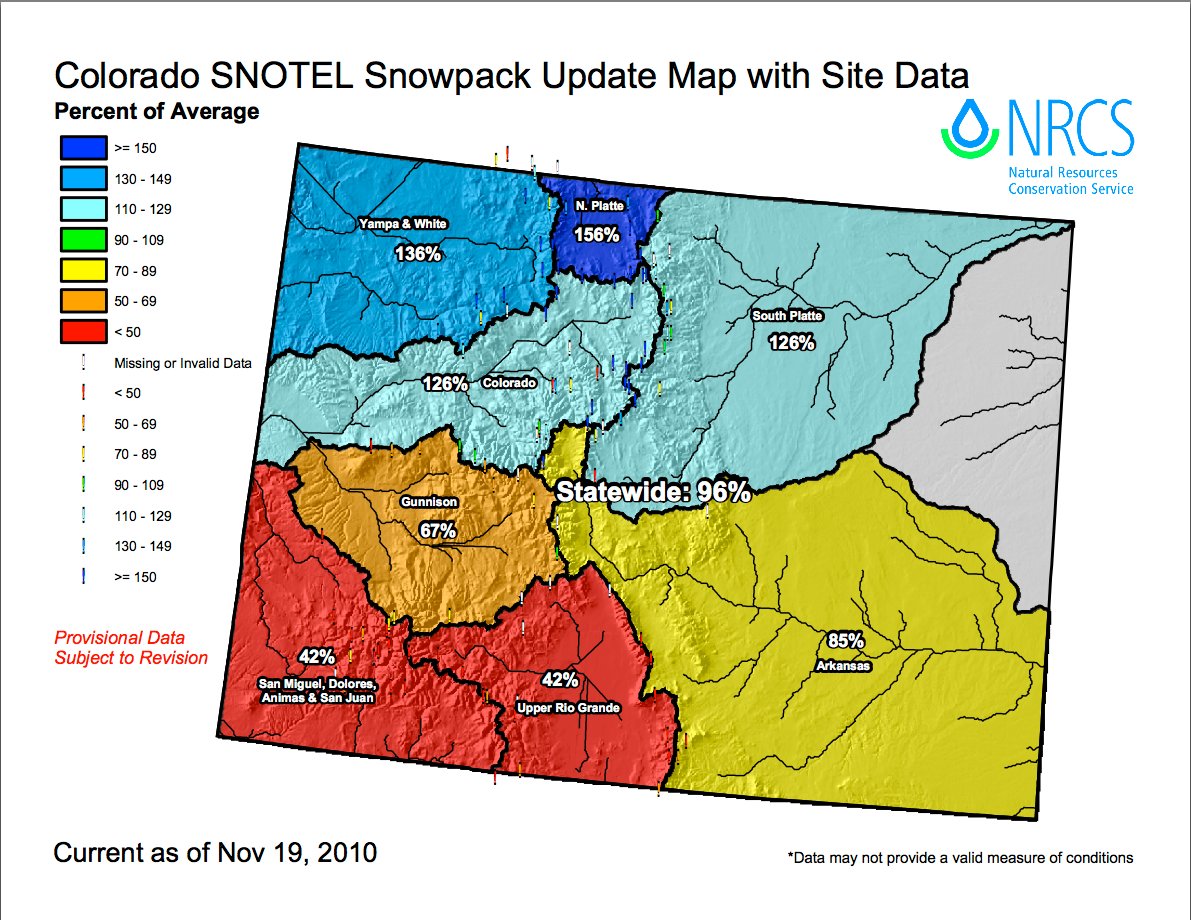
A picture named snowpackcolorado11192010

From the Fort Collins Coloradoan (Bobby Magill):

The snowpack is nearly 200 percent of average at some monitoring sites in western Larimer County. The South Platte Basin, which includes the Poudre River, has an overall snowpack 157 percent of average as of Friday morning, according to U.S. Natural Resources Conservation Service data. The most robust snowpack in Colorado is in western Larimer County and Jackson County, where some monitoring stations in the Park Range and the Rawah Mountains have a snowpack greater than 200 percent of average for the season.

More coverage from The Greeley Tribune (Bill Jackson):

Going into the 2010 water year, water reserves were at 120 percent of average throughout the [Colorado-Big Thompson Project], Karen Rademacher told a crowd of about 150 during the Fall Water Users Meeting of the Northern Colorado Water Conservancy District at the Embassy Suites Hotel. Rademacher is a senior water resources engineer with the water district. But, Rademacher said Thursday, it was late winter snow storms and early spring rain storms that really made the year. As a result, reserves going into the 2011 water year are at 150 percent…

Mike Applegate, president of Northern’s board of directors, said the heavy runoff resulted in 640,000 acre-feet of water leaving Colorado at the Nebraska line, which was another sign of the need for additional storage in the state. That additional storage, he said, would allow better management of water resources. The permitting process, however, for two new projects, the Northern Integrated Supply Project and the Windy Gap Firming Project, continue at a slow pace…

While the Front Range has seen dry weather conditions for the past three months, Rademacher said Grand County — where the C-BT collects water for diversion — has been hit with early wet, snowstorms. Storms Oct. 25-26 and Tuesday and Wednesday, she said, “have got us off to a great start; 30 percent of the entire snow season is already on the ground in our collection area.” There was an estimated 2 feet of snow on the ground near Grand Lake as of last week…

Dave Nettles, Division 1 Engineer with the Colorado Division of Water Resources in Greeley, said the peak flow on the South Platte River at Kersey came in June and was about twice the average for that time of year. However, by July, it was below average. Reservoir storage all along the South Platte basin is in pretty good shape, he said, despite the dry conditions of the past three months.

It looks like the San Juans are going to get a dumping by Sunday night.

Arkansas Valley Super Ditch board meeting recap

A picture named arkbasinditchsystem.jpg

Here’s a report from Chris Woodka writing for The Pueblo Chieftain. Click through and check out the sidebar about the consumptive use factor calculation for the various ditches. From the article:

“I think Super Ditch is a good idea. . . . Participate or don’t participate, but don’t be jealous of what your neighbor has,” one speaker said. “It’s always going to be better to lease the water than sell it and retire to Arizona.”

The Super Ditch board held the meeting at the Gobin Community Center in an attempt to inform shareholders of seven ditches about two pending lease agreements with the Pikes Peak Regional Water Authority and Aurora and measure interest in participation…

Bart Mendenhall, attorney for the Lower Arkansas Valley Water Conservancy District, explained that only the amount of consumptive use of a crop could be leased, and that the amount likely would be the same coefficient as was applied in the H-I (hydrologic-institutional) model under the Kansas v. Colorado case.

That amount is anything but certain. Consumptive use is technically the number of inches of water a plant uses to grow, but defining it is like shooting at a moving target. The state now is locked into the H-I model, but has spent millions of dollars on studies such as a weighing lysimeter at the Rocky Ford Agriculture Research Center to refine it. In addition, the availability of water, the amount of rain, the type of crop and the method of irrigation all play a role.

Then, there are percentages of consumptive use determined as part of the 24-year Kansas v. Colorado U.S. Supreme Court lawsuit that the State Engineer’s Office likely will require in any change case or administrative contract, Mendenhall said.

More coverage from The Pueblo Chieftain (Chris Woodka):

The Super Ditch board mailed out information packets to shareholders on seven ditches on proposed leases to sell up to 8,020 acre-feet of water annually to Pikes Peak Regional Water Authority and 10,000 acre-feet in three years out of 10 to Aurora.

“Never in the life of the valley have seven ditches come forward with this type of effort,” Super Ditch President John Schweizer told 120 people at the Rocky Ford meeting. “The idea is to lease water as a crop.” The Super Ditch initially will limit farmers to 35 percent of eligible acreage in any given year, which caused some to question whether payments would be small if spread out over the 200,000 acres irrigated under the ditch systems — Bessemer, Catlin, Fort Lyon, High Line, Holbrook, Otero and Oxford. Dry up of ground also must be rotational. Schweizer said the idea is to proportion the acreage to avoid detrimental impacts to those who keep farming.

The ditches annual have diversions of about 600,000 acre-feet, and many of the ditches could meet the demand of the two leases now on the table. Pure Cycle, which owns more than 20,000 acres on the Fort Lyon Canal, could alone fill both orders and has submitted a card indicating interest in the leases.

More Arkansas Valley Super Ditch coverage here and here.

NIDIS Weekly Climate, Water and Drought Assessment Summary of the Upper Colorado River Basin

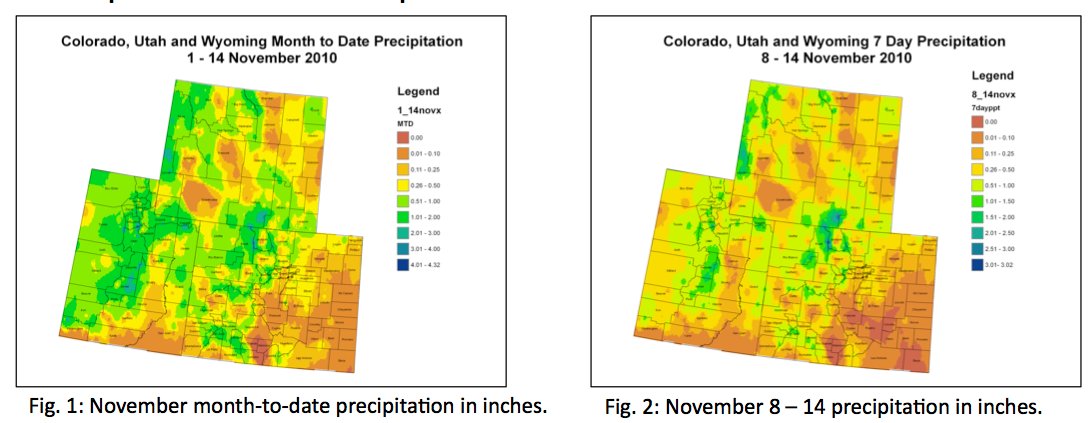
A picture named precipthrunovember142010

Here are the notes from Tuesday via Henry Reges.

Water Research Foundation Announces Dec 7 Webcast titled, ‘North American Residential Water Usage Trends and Applications for Utilities’

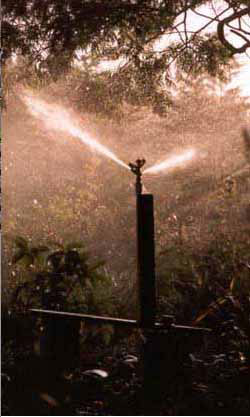
A picture named watersprinkler.jpg

From email from the Water Research Foundation via a colleague at work:

On December 7, 2010, at 3:30 pm ET (2:30pm CT, 1:30pm MT, 12:30pm PT) the Water Research Foundation will present a one-hour Webcast titled “North American Residential Water Usage Trends and Applications for Utilities.”

Register for this Webcast by clicking on the link below:

http://video.webcasts.com/events/h2oo001/36778

Synopsis

Many water utilities are experiencing declining water sales among residential households, even though the total number of residents and households continues to grow and as household incomes continue to rise. A variety of theories have been advanced to explain the declining usage, however, to date, no definitive statement has been made as to the validity of these theories or the amount each variable contributes to residential water-usage decline.

While “water conservation” is normally viewed as protecting a scarce resource, this can cause revenue erosion and uncertainty in terms of meeting revenue requirements for water utilities. Without a clear understanding of the changing water-use patterns, it is difficult to develop appropriate pricing structures that will both recoup costs and provide resources for the future. Thus, for utilities to both encourage conservation and have sufficient financial reserves for maintenance and growth, it is necessary to better understand how water-use patterns have changed over the last 30 years, what factors are driving usage, and how these factors might impact utilities in the future.

This Webcast, based on the published report North American Residential Water Usage Trends and Applications for Utilities (Order #4031), will focus on (1) understanding residential water-usage behavior patterns and trends, (2) assessing the impact of those patterns on water utility operations, and (3) providing data that can be correlated with future trends for planning purposes.

Presenters:

Greg C. Heitzman, President/CEO, Louisville Water Company and Thomas D. Rockaway, Director of the University of Louisville’s Center for Infrastructure Research

If you have any questions about registration, please contact Terry Freeman at tfreeman@WaterRF.org, or 303-347-6248. Registration to the Webcast is free to Foundation subscribers and is one of the many benefits of being a Foundation subscriber. Foundation subscribers will also be able to download the Webcast from the Water Research Foundation Website a few days after the event.

More education coverage here.

Mesa State College: Water Seminar – Selenium Bioreactor Mon. 22 Nov. 4pm

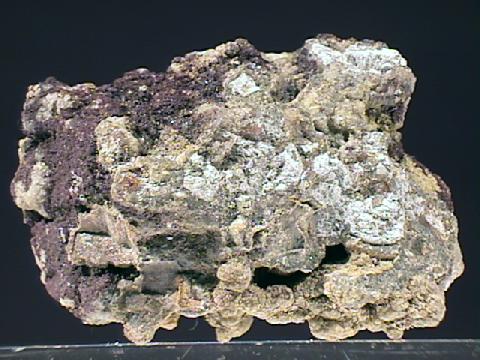
A picture named selenium.jpg

From email from Gigi Richard:

Our next presentation in the Fall 2010 Natural Resources of the West: Water seminar series a project of the Water Center at Mesa State College will be…

Mon 22 November, 4:00 pm
Saccomanno Lecture Hall, Wubben Science Building , Room 141 (WS 141)
Mesa State College

Will Wood Chips and Hay Keep Selenium Away? A Passive Bioreactor for Removing Selenium from Water
Dr. Russ Walker, Professor of Environmental Science, Mesa State College

Seminars are free and open to the public, no registration necessary.

For the entire seminar series schedule, please see: http://home.mesastate.edu/~grichard/WSS/Seminar2010.html

For more information please contact:

Prof. Gigi Richard, 970.248.1689, grichard@mesastate.edu
Prof. Tamera Minnick, 970.248.1663, tminnick@mesastate.edu

More education coverage here.

EPA to Expand Chemicals Testing for Endocrine Disruption

A picture named genderbendingpollution.jpg

Here’s the release from the Environmental Protection Agency (Latisha Petteway):

The U.S. Environmental Protection Agency (EPA) has identified a list of 134 chemicals that will be screened for their potential to disrupt the endocrine system. Endocrine disruptors are chemicals that interact with and possibly disrupt the hormones produced or secreted by the human or animal endocrine system, which regulates growth, metabolism and reproduction. Administrator Lisa P. Jackson has made it a top priority to ensure the safety of chemicals, and this is another step in this process.

“Endocrine disruptors represent a serious health concern for the American people, especially children. Americans today are exposed to more chemicals in our products, our environment and our bodies than ever before, and it is essential that EPA takes every step to gather information and prevent risks,” said EPA Administrator Lisa P. Jackson. “We are using the best available science to examine a larger list of chemicals and ensure that they are not contaminating the water we drink and exposing adults and children to potential harm.”

The list includes chemicals that have been identified as priorities under the Safe Drinking Water Act (SDWA) and may be found in sources of drinking water where a substantial number of people may be exposed. The list also includes pesticide active ingredients that are being evaluated under EPA’s registration review program to ensure they meet current scientific and regulatory standards. The data generated from the screens will provide robust and systematic scientific information to help EPA identify whether additional testing is necessary, or whether other steps are necessary to address potential endocrine disrupting chemicals.

The chemicals listed include those used in products such as solvents, gasoline, plastics, personal care products, pesticides, and pharmaceuticals, including benzene, perchlorate, urethane, ethylene glycol, and erythromycin.

Also being announced today are draft policies and procedures that EPA will follow to order testing, minimize duplicative testing, promote equitable cost-sharing, and to address issues that are unique to chemicals regulated under the SDWA.

After public comment and review, EPA will issue test orders to pesticide registrants and the manufacturers of these chemicals to compel them to generate data to determine whether their chemicals may disrupt the estrogen, androgen and thyroid pathways of the endocrine system.

EPA is already screening an initial group of 67 pesticide chemicals. In October 2009, the agency issued orders to companies requiring endocrine disruptor screening program data for these chemicals. EPA will begin issuing orders for this second group of 134 chemicals beginning in 2011.

EPA has the most comprehensive mandated testing program for hormone effects in the world. The program is the result of a multi-year effort that includes validation of the science through a transparent scientific review process.

More information: http://www.epa.gov/endo.

More water pollution coverage here.

CWCB: Two Rivers Water Company gets loan approval for work on Cucharas Reservoir Dam

A picture named cucharasriver.jpg

From DMNNewsWire.com:

Two Rivers Water Company, a company focused on acquiring and developing water, farming and alternative energy in southern Colorado, announced today they have received a $9,900,000 loan approval from the Colorado Water Conservation Board. This loan will be in two phases. The first phase will be to fund the repairs of the Cucharas Reservoir to comply with the Colorado Division of Water Resources, Dam Safety Program requirements. Once the repairs are completed, Two Rivers will begin the permitting process to either completely rehabilitate the existing dam or construct a new roller-compacted concrete dam. The expected storage of the rehabilitated or new dam is in excess of 41,000 acre feet.

More Arkansas River basin coverage here.

Arkansas Valley Super Ditch: Lots of questions and a good deal of interest at recent public meetings

A picture named arkbasinditchsystem.jpg

From The Pueblo Chieftain (Chris Woodka):

More than 400 water rights owners have returned cards the Super Ditch board sent out earlier this month to shareholders on seven ditches in an attempt to measure interest in the fledgling water leasing program. And more than 120 attended a meeting Thursday at the Gobin Community Center. About 30 people turned out for an evening meeting at Lamar.

They peppered the Super Ditch board with questions for two hours about how the program would work: how much water would be available, where it would be stored and when water contracts would be expected. Many wanted to know why they had to sign up by the end of November, before many of the ditches had annual meetings to discuss the proposal among themselves. “The reason we need a commitment now is that we have to identify a source of water for the court case, an environmental impact statement and 1041 permits,” explained John Schweizer, president of the Super Ditch. “By returning the cards, you keep your options open.”

The Super Ditch board decided to send out the cards and host the meetings after a meeting last month. The board has lease agreements with the Pikes Peak Regional Water Authority and Aurora and now needs to show it has ditch shareholders interested in filling the supply. “Otherwise, you are speculating,” Schweizer said…

“The best thing about leasing is that you can control your vote,” [Dale] Mauch said. “The cities are going to keep coming. We came up with a way to to deal with it so we can take advantage of it in the future. If Super Ditch can supply the water, 50 years from now, it’s the Walmart of water.”

More Arkansas Valley Super Ditch coverage here and here.

Boulder County: Keep it Clean partnership

A picture named effluent.jpg

Say hello to the Keep it Clean Partnership. They’re organizing to educate folks in Boulder County on good practices that help keep pollutants out of storm sewers, rivers and streams.

Thanks to the Boulder Weekly for the link.

More stormwater coverage here. More water pollution coverage here.

Flaming Gorge pipeline: Rock Springs City Council gets update briefing

A picture named flaminggorgepipelinemillion.jpg

From The Green River Star (David Martin):

The main point [Don Hartley, a representative of the group Communities Protecting the Green] stressed was the fact that the issue would be around for a long time. Hartley told the Council a number of the proposed projects overlap one another. Due to the amount of time needed to sort out the projects and perform the research needed, Hartley said the Army Corps of Engineers believes a final decision could be made by 2018. “We’re in this for the long haul, “ Hartley said…

The estimated costs of the coming legal battle are enormous, as are the players involved, according to Hartley. However, the amount of money pledged by the cities of Rock Springs and Green River and Sweetwater County are “only the tip of the iceberg,” as Rock Springs Councilman Neil Kourbelas said. Kourbelas asked if other concerned communities and groups were pledging funds to help with potential legal costs, saying more than just the three government bodies involved with the organization would be affected by a trans-basin water project.

More Flaming Gorge pipeline coverage here and here.

2010 Annual Meeting of the Arkansas River Compact Administration

A picture named arkansasriverbasinwikipedia.jpg

From the Ditch and Reservoir Company Alliance:

The 2010 Annual Meeting of the Arkansas River Compact Administration (“ARCA”) will be held on Tuesday, December 14, 2010, commencing at 8:30 A.M. MST** (9:30 A.M. CST) in the Lamar Community Building, 610 South Sixth Street, in Lamar, Colorado. The meeting will be recessed for lunch at about 12:00 PM and reconvened for the completion of business in the afternoon as necessary. Meetings of ARCA are operated in compliance with the federal Americans with Disabilities Act. If you need a special accommodation as a result of a disability please contact Stephanie Gonzales at 719-734-5367 at least three days before the meeting.

The Engineering, Operations, and Administrative/Legal Committees of the Administration will meet on Monday, December 13, 2010, The Lamar Community Building, 610 South Sixth Street, in Lamar, Colorado at 2:00 PM. MST** (3:00 P.M. CST) and continuing to completion. Tentative agendas for the Committee meetings are also set out below. The public is welcome to attend the Committee meetings, but time for comments may be limited.

** Meeting times may change, please check the final notice and agenda for the actual meeting times. The final meeting notice and draft agenda will be posted on both the Kansas Department of Agriculture’s website http://www.ksda.gov/ and on the Colorado Water Conservation Board’s website at http://cwcb.state.co.us on or after December 1. This preliminary notice was prepared
on November 12, 2010.

More Arkansas River basin coverage here.

New whitewater park for Montrose?

A picture named kayaker.jpg

From The Telluride Watch (Peter Shelton):

Now retired from competition and fresh from the opening of the 2012 Olympic kayaking venue in London, which was built by his firm, S2O Design of Boulder, [Scott] Shipley made a pitch for a family-oriented whitewater park on the Uncompahgre River at Upper Cerise (Riverbottom) Park.

City Park Planner Dennis Erickson hosted the event at the Pavilion, which also included a presentation by lead planner Ann Christensen of DHM Design in Durango, who introduced the draft plan. Also on hand was Gabe Preston of CPI Consulting, who led the group in a keypad polling exercise on priorities within the draft plan.

Participants indicated their preferences – high priority, medium or low – for a number of goals being considered in the plan, including: developing new city-owned parks on the northern third of the 10-mile-long river corridor, building more pedestrian bridges across the river, connecting downtown Main Street more directly to the river, building tails to link existing and future parks, acquiring private property for river improvements, and preservation/enhancement of the river ecosystem.

A whitewater park scored high on the list. But the highest priority for the public on this night was clearly trails, bicycle/pedestrian trails, to connect parks and link existing segments of river trail, thereby providing alternate-transportation routes, not just for recreation, but for commuting and shopping as well.

More whitewater coverage <a href="

La Niña update

A picture named elninolanina.jpg

From the San Diego Union-Tribune (Robert Krier):

Klaus Wolter, a long-range forecaster who consults with the California Department of Water Resources to help set water-management strategies, said the current La Niña is one of, if not the strongest La Niña on record. The stronger the La Niña, the more likely it will last, he said. “The odds are quite high that we won’t see a short-lived La Niña,” Wolter said in San Diego Wednesday. “The odds are higher than 50-50 (that it will continue). “La Niña is fundamentally different (from El Niños). Events (of this size) have lasted two, even three years.”[…]

Wolter, who spoke at the Westin Hotel in the Gaslamp Quarter during a workshop on the winter outlook sponsored by the DWR, said the rain this weekend and the abnormally wet October in California and the Colorado River Basin, another major source of imported water for the region, will have little bearing on the coming months. “As much as we rejoice with all this moisture, it doesn’t mean much for the rest of the winter,” said Wolter, who works for the National Oceanic and Atmospheric Administration’s Western Water Assessment Team and the University of Colorado. “The winter season is really what counts.”

Energy policy — nuclear: Schwartzwalder mine cleanup update

A picture named uranium.jpg

From The Denver Post (Bruce Finley):

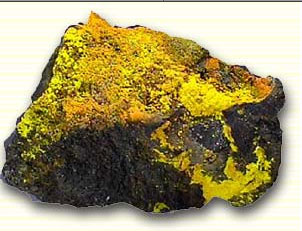
Cotter’s attorneys conceded that Cotter has not taken a step toward complying with an existing state order to pump out and treat toxic water filling the Schwartzwalder mine. That mine sits upstream from Denver Water’s Ralston Reservoir, which supplies drinking water to 1.3 million metro-area residents…

“We are entitled to know what compliance would look like,” Cotter attorney Nea Brown said before the state Mined Land Reclamation Board. Board members then read aloud a prior order requiring Cotter to pump water from the mine to a level at least 500 feet below the opening of the mine. There was an Aug. 31 deadline. “I’m just a farmer from down east, but I can read that,” said board chairman Ira Paulin, who represents the mining industry at state hearings. “It says you have got to implement it.”

Brown argued that the required corrective actions are broad and unclear and that Cotter would need time to move in equipment and have a place to put the water it removes…

Board members will continue their hearing today, when they will decide whether to impose additional fines of up to $1,000 a day for 78 days, issue new violations and a “cease and desist order” that essentially repeats state demands. Cotter separately has taken its case to Denver District Court, filing a lawsuit against the state. It asks that a judge block state efforts to order the cleanup and impose fines and accuses the state mined lands board members of abusing their discretion.

More Schwartzwalder mine coverage here. More nuclear coverage here and here.

Silt: Town water violates state standards for trihalomethanes for the second time this year

A picture named watertreatment.jpg

From the Rifle Citizen Telegram (John Gardner):

According to the Silt’s public works director Gerry Pace, the town of Silt’s water supply is in violation of the Colorado drinking water standard for a class of chemicals called total trihalomethanes (TTHMs). This is the second time this year that the town’s water has been in violation. “We went up one notch on TTHMs,” Pace said of the third quarter tests which took place in October.

TTHMs form when the source water with natural organic matter is treated with chlorine. Municipalities are required to test TTHM levels quarterly at multiple locations throughout the water system. The state regulates TTHMs to reduce the likelihood of chronic health outcomes due to long-term water consumption. Some people who drink water containing total TTHMs in excess of maximum contamination level, over many years, may experience problems with their liver, kidneys and central nervous system, and may have an increased risk of getting cancer, according to a letter sent to Silt residents.

Test results from an Oct. 25 test showed that Silt’s water system exceeds the allowable TTHM level of 80 micrograms per liter. The levels reported from the October test were 84 micrograms per liter, compared to 83 from the second quarter tests this year, Pace said. Subsequently, every quarter that TTHM levels remain above 80, the city is required to notify residents.

More water treatment coverage here.

Denver Water Board announces 2011 rates

A picture named rehabbedwaterlinedenverwater.jpg

Here’s the release from Denver Water (Stacy Chesney):

The Denver Board of Water Commissioners voted to adjust water rates for 2011 at its meeting today. The adjustment will provide further funding for the utility’s capital projects, which include upgrades to aging infrastructure over the next decade. The new water rates will take effect March 2011.

“Water rates are driven by the vital maintenance and capital projects needed to maintain and improve our system and to keep our infrastructure reliable in the future,” said Todd Cristiano, manager of rates. “Next year’s critical projects include work like dredging Strontia Springs Reservoir, our watershed protection initiative with the U.S. Forest Service, replacing the 105-year old valves at Cheesman Dam, finishing major upgrades at Williams Fork Reservoir and Dam, and stepping up our pipe rehabilitation and replacement program.”

The effects of the proposed changes on customer bills would vary depending upon the amount of water the customer uses and whether the customer lives in Denver or is served by a suburban distributor under contract with Denver Water; the more customers use, the more they will pay. Under the current rate proposal, average Denver residential customers would see their bills increase by about $41 a year — an average of $3.40 per month. Typical suburban residential customers served by Denver Water would see an increase of $32 per year — an average of $2.66 per month. For example, the average annual cost for water for an inside-city customer in 2010 was $330, and would be $371 in 2011. Similarly, the average annual cost for an outside-city customer in 2010 was $555, and would be $587 in 2011. Adjustments also have been proposed for commercial, industrial and government customers.

Rates for Denver Water customers living inside the city would remain among the lowest in the metro area, while rates for Denver Water residential customers in the suburbs would still fall at or below the median among area water providers.

Denver Water owns and maintains more than 3,000 miles of distribution pipe — enough to stretch from Los Angeles to New York — as well as 12 raw water reservoirs, 22 pump stations and four treatment plants. Ongoing rehabilitation and replacement of infrastructure is needed throughout the water distribution system, much of which dates back to post-World War II installation or earlier.

Denver Water is funded through rates and new tap fees, not taxes. Its rates are designed to recover the costs of providing reliable, high-quality water service and to encourage efficiency by charging higher prices for increased water use. A significant portion of Denver Water’s annual costs do not vary with the amount of water sold and include maintenance of the system’s distribution pipes, reservoirs, pump stations and treatment plants. Denver Water also examines and adjusts its capital plan as necessary each year.

Details of the 2011 rates can be found Denver Water’s website (www.denverwater.org). Members of the public who have questions about the proposed rate adjustment may call 303-628-6320.

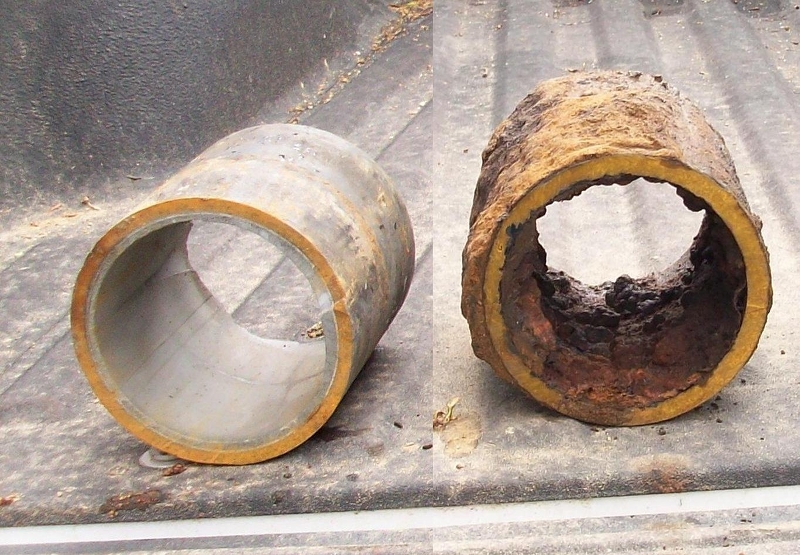
Click on the thumbnail graphic for a quick look at a rehabbed waterline.

More coverage from Bruce Finley writing for The Denver Post. From the article:

Starting in March 2011, metro-area residents’ bills will increase by an average of $41 a year in Denver and $32 a year in suburban areas, utility spokeswoman Stacey Chesney said. It will be the 20th straight year that Denver Water customers have faced rate hikes. Denver Water board members said the rate hike is required to cover the cost of maintaining more than 3,000 miles of pipe, 12 water reservoirs, 22 pump stations and four treatment plants…

This year, the average annual cost for Denver Water’s urban customers was $330. For suburban Denver Water customers, the average cost was $555 — still lower than the cost of water supplied by other water providers, Chesney said. Denver Water also raised rates about 5 percent for commercial, industrial and government customers.

More Denver Water coverage here.

Lower Arkansas Valley Water Conservancy District board meeting recap

A picture named arkbasinditchsystem.jpg

From The Pueblo Chieftain (Chris Woodka):

Two meetings today will help test support for the Super Ditch. The Super Ditch board this month sent signup cards and information packets to shareholders on seven ditches in advance of the meetings, which are at 1 p.m. at the Gobin Community Building in Rocky Ford and at 6 p.m. at the Bowman Building at Lamar. The process will gauge interest among water rights owners for contracts with the Pikes Peak Regional Water Authority and Aurora. While agreements have been signed, the specific water rights to be used in meeting supply have to be identified to satisfy legal and engineering requirements. The Bessemer, Catlin, Fort Lyon, High Line, Holbrook, Otero and Oxford ditch systems are eligible for participation…

The Lower Ark is seeking two grants from the Colorado Water Conservation Board for Super Ditch projects:

– $254,000 for engineering of delivery systems, including storage; the Lower Ark would match with $28,000.

– $28,000 to study long-term farm financial planning from temporary water transfers, with $3,000 from the Lower Ark.

The CWCB funds would come from $1.5 million which is available for studies of alternative projects to municipal purchases of water rights in agriculture.

[Colorado State University] is doing studies on farms owned by the Lower Ark district on the High Line and Holbrook canals to determine how much expense per acre farmers could expect during a lease. That would include the value of crops not grown and ground preparation. Part of the study mirrors corn test plot research at the CSU Arkansas Valley Research Center, but there is an additional economic component as well. Cabot is developing a spreadsheet tool that farmers could use to calculate whether a lease makes sense for them. The research also is looking at whether alternative crops that require less water, such as canola or sorghum, could be grown on irrigated ground as dryland crops during fallowing periods.

More coverage from Chris Woodka writing for The Pueblo Chieftain. From the article:

A group plan for irrigators that would allow them to comply with new state rules on surface irrigation in the Arkansas Valley was approved Wednesday. The Lower Arkansas Valley Water Conservancy District approved its plan 6-1 and will begin signing up farmers immediately in advance of Jan. 1, when the new rules take effect. Otero County Director Wayne Whittaker opposed the plan, saying it costs farmers too much and puts the Lower Ark district in a role that should belong to the state. “When we first discussed this, it was going to cost farmers $100 and we would just do the paperwork to submit to the division engineer,” Whittaker said.

More Lower Ark coverage here and here.

Colorado-Big Thompson project update: Shadow Mountain/Grand Lake connecting channel work complete

A picture named grandlake.jpg

From the Sky-Hi Daily News:

The channel had been closed since early October for a rehabilitation project to increase the safety and efficiency of the 65-year-old structure. Because most of the project work is completed, normal water operations have resumed. Workers will continue paving and re-vegetation work through mid-November. The channel is part of the Colorado-Big Thompson Project, which is owned by the U.S. Bureau of Reclamation and operated by Northern Water, a public agency created in 1937 to contract with the U.S. Bureau of Reclamation to build the Colorado-Big Thompson Project, which collects water on the West Slope and delivers it to the East Slope through a 13- mile tunnel that runs underneath Rocky Mountain National Park.

More Colorado-Big Thompson Project coverage here

Energy policy — nuclear: Powertech’s lawsuit update

A picture named uraniuminsitu.jpg

From the Fort Collins Coloradoan (Bobby Magill):

Powertech USA President Richard Clement said the company is on track to file a permit application in 2011 for its Centennial Project uranium mine northeast of Fort Collins despite the lawsuit. “What we’re doing by filing (the lawsuit), there’s a number of issues there that we felt were inappropriately dealt with, but the rules themselves, we feel the rules are livable and we can work within the rules,” Clement said. Some provisions of the rules, he said, didn’t conform to the 2008 state law requiring Powertech to keep the groundwater clean…

Clement said earlier this year that the one provision in the rules, which requires companies to establish baseline groundwater purity before they even start looking for uranium underground, would be “fatal” to all future in situ mining operations statewide. “This is a suit on behalf of industry, not just Powertech,” he said Tuesday…

Jeff Parsons, senior attorney at the Western Mining Action Project, which represents local residents opposed to the mine, said it’s difficult to gauge the possible success of Powertech’s lawsuit, but it’s hard to imagine the company submitting its Centennial Project permit application to the state while the suit is making its way through the courts. “They previously said they plan to file their application for the Centennial Project by the end of the year, and now they’re suing,” Parsons said. “That raises the questions about what their timeline is for this project. This litigation can last years.” He said it would be awkward for Powertech to be legally challenging regulations they say they can comply with in their permit application.

More coverage from David O. Williams writing for the Colorado Independent. From the article:

Two uranium mining companies have filed lawsuits against the state this fall, challenging rules requiring cleanup of existing uranium mines and mandating water reclamation at a proposed mining site. Conservationists say the recent lawsuits filed by the Cotter Corp. and Powertech USA demonstrate the industry isn’t serious about a higher level of environmental protection in a new uranium mining boom…

An executive for Uranium One, a Canadian company with Denver offices, told the Colorado Independent (TCI) in October that his company is divesting itself of Colorado mine holdings in part because of the cost of increased environmental scrutiny and state regulation. But a Powertech attorney last week told TCI that his company’s lawsuit is less about money and more about reducing regulatory hurdles.

“No, it isn’t a fiscal issue at all,” said John Fognani of Fognani and Fought law firm. “If you want to narrow it down, it’s a resource issue in terms of utilizing more water resources to make sure that you meet the mandate and bring water quality back to background or better, which is what the rule states, and of course that’s what the legislation states. At the end of the day it’s really the water resource issue.”

More nuclear coverage here and here. More Powertech coverage here and here. More HB 08-1161 coverage here.

TheDenverChannel.com grills Denver Water exec over expenditures, Denver Water responds

A picture named dilloncolorado.jpg

John Ferrugia and Tom Burke from the television station have penned this report about the results of their investigation into Denver Water expenditures in light of the approximately $40 per year rate increase. Click through and read the whole article. Here’s an excerpt:

If all are approved, residential customers of Denver Water could see an increase of more than $40 a year. “When we see Denver Water upping their rates for their next three years, I wonder, ‘Are they being as efficient as possible Are they being as responsible as possible with our money?'” said Denver City Councilman Paul Lopez. Lopez has been a vocal opponent of the proposed rate hike…

Soon after Denver Water announced the proposed rate increase to city council in October, the CALL7 Investigators asked for and obtained a copy of all the department’s expenditures since January 2009. 7NEWS found a large majority of the expenses went to expected items like tools, pipes, repairs, vehicles, consultants and utility bills. But we also found a number of expenditures that raised questions, including $1.8 million going to community outreach and public relations. “I don’t think there is a need to do that level of community outreach when they are a monopoly, essentially,” said Lopez, referring to the fact that most of Denver Water’s 1.3 million customers do not have a choice of water provider for their homes or businesses…

“What benefit do I, as a Denver Water customer get, through your community outreach?” Ferrugia asked Denver Water Director of Finance Angela Bricmont. “Community outreach is key because it’s part of our campaign. The ‘Use Only What You Need’ campaign is part of our strategic plan to really provide water for the future,” explained Bricmont. “Many consumers look at this campaign and say, ‘I’ve conserved. I’m not using as much water… and then it costs me more money?'” asked Ferrugia. “The reality is it’s not costing you more money. In the long run, it’s actually costing you less,” said Bricmont. “What’s driving up your monthly water bill is that we have 50-year-old pipes and the fact that we need to go out and repair those so we can continue to supply clean, safe drinking water.”[…]

“Line dancing classes? Why would Denver Water need line dancing classes?” asked a visibly surprised Lopez. “This is reckless — $2,000 of our money for line dancing classes is reckless, especially now.”

Bricmont explained that the line dancing classes as well as expenditures for cooking classes, aerobics, $4,800 for golf outings and $2,500 for the Denver Water softball team were part of the department’s “Workplace Wellness Program.” “We have invested in our employees’ health and one reason we’ve done that is we’re self-insured. It’s in our best interest, both as an employer and bottom line, that we have healthy productive employees,” said Bricont. “We have a program to reach out to make sure our employees and taking advantage of the things we know work and to keep them on the job and healthy.”

Denver Water (Stacy Chesney) issued a release late yesterday in response to the article:

We take very seriously the obligation to spend our ratepayer’s money wisely. Denver Water is a well-managed organization and we take careful steps to ensure we’re fiscally responsible. When verifiable problems are brought to our attention, we fix them. We will continue to take appropriate steps to assure our operations are efficient and accountable.

Water rates are driven by the vital maintenance and capital projects needed to maintain and improve our system and to keep Denver Water’s infrastructure reliable and strong into the future. The request for a rate adjustment in 2011 is based on the need to invest in these critical projects. Next year’s projects include work like dredging Strontia Springs Reservoir, our watershed protection initiative with the U.S. Forest Service, as well as replacing the 105-year old valves at Cheesman Dam, finishing major upgrades at Williams Fork Reservoir and Dam, and stepping up our pipe rehabilitation and replacement program.

Denver Water’s rates are among the lowest in the state. If it weren’t for the need to dredge Strontia Springs Reservoir, our budget for 2011 would be less than it was in 2010. We will continue to invest in our system’s infrastructure to fulfill our obligation to provide reliable clean water to our customers now and in the future. We also have a responsibility to invest in conservation as a critical part of our strategy to provide water to our customers in the future, to eliminate waste and to help the environment.

Our mission is to provide a reliable supply of safe, clean water to more than 1.3 million people in Denver and the surrounding suburbs. As we deliver on that mission, we have a responsibility to our employees, who work hard every day to take care of our 3,000+ miles of pipe, 19 raw water reservoirs, 22 pump stations, four treatment plants, and much more. As part of that, we support wellness programs, which help reduce health and lost productivity costs in the long run. We also reimburse meals for legitimate business expenses, which include employees working overtime to repair the system. We’re committed to fostering a healthy workforce and need to retain and attract employees with the expertise to run our complex water system.

The expenses related to employee wellness, food, community outreach and the Use Only What You Need campaign amount to less than 1 percent of Denver Water’s budget.

We work hard to keep our costs reasonable and stay accountable to our ratepayers. Over the course of a year, we handle more than 50,000 financial transactions. We’re not perfect, but we do our best to make sure we are a fiscally responsible organization. When we find violations of our policies, we will follow up and deal with them. We’re proud of the work we do. We have controls in place to ensure the proper review and approval of all payments. In addition, periodic review is done by accounting, as well as internal and external auditors.

More Denver Water coverage here and here.

Pueblo: The Board of Water Works lays out 2011 budget with 5% rate increase

A picture named fountainpavementdrawing.jpg

From The Pueblo Chieftain (Chris Woodka):

The Pueblo Board of Water Works Tuesday proposed a $30.7 million budget, a little less than originally proposed. The budget will mean a 5 percent rate increase for Pueblo water customers, mostly to cover rising energy costs and increased legal and engineering expenses. Employee salaries and benefits will increase about 2 percent, including a 1.43 cost of living increase. For residential customers, the increase would mean a typical increase of about $1.50 per month in winter months, or less than $5 per month during summer months with lawn watering for single-family homeowners.

More infrastructure coverage here.

Fryingpan-Arkansas Project: Senator Udall is seeking consensus from Colorado’s congressional delegation for Aurora’s use of project facilities to move water out of basin

A picture named puebloreservoir.jpg

From The Pueblo Chieftain (Chris Woodka):

“It’s not fair to suggest that I’ve put my thumb on the scales toward Aurora or the Arkansas Valley,” Udall said. “The role I was playing was in assuring the court that if the parties would agree, then I would be a mediator in the process.” Udall also said there would have to be consensus from the entire congressional delegation, including newly elected Republicans Scott Tipton and Cory Gardner, who will be in the U.S. House.

The Lower Arkansas Valley Water Conservancy District is suing the Bureau of Reclamation in the Denver federal court over a 40-year contract awarded to Aurora by Reclamation in 2007. The Lower Ark contended the contract violated the 1962 legislation authorizing the Fryingpan-Arkansas Project, but signed a 2009 agreement with Aurora to stay the case for two years. Part of the agreement was to seek federal legislation that legitimizes use of the Fry-Ark Project by Aurora.

Udall looks at the possibility of such legislation as “one last attempt” to avoid costly court battles over the issue in the future. “If the parties reach agreement, then I would help them vet it,” Udall said. “If there’s not an agreement, then I’m not going to introduce legislation.”[…]

“I’m relying on the parties who come to the table to keep the valley whole, if those parties can come to an agreement,” Udall said. “If the parties don’t agree, I’m doing nothing.”

More Fryingpan-Arkansas coverage here and here.

Coyote Gulch outage

I’m on deadline at Colorado Central Magazine. I’ll see you on Wednesday.

Fraser River: Traction sand mitigation project update

From The Denver Post (Bruce Finley):

State highway, Denver Water and U.S. Forest Service officials last week said work on a traction-sand removal system along the Fraser River will begin in the spring — at the earliest. Colorado Department of Transportation trucks dump 5,584 tons a year of traction sand, gravel and salt on the west side of Berthoud Pass. This material slides off the road into the Fraser River, “smothering the rocks, which smothers the bug life, which is the bottom of the food chain. Then the fish starve,” said Kirk Klancke, president of Trout Unlimited’s Colorado River headwaters chapter and manager of two water districts, who helped line up about $240,000 in federal and state grants for sediment removal. State studies document dwindling bug life and sculpin — the native bottom-feeders needed to sustain bigger fish — between the Berthoud Pass summit and the town of Winter Park. Denver Water’s diversions from the Fraser River that supply 1.3 million metro area residents and Winter Park’s diversions for snowmaking both exacerbate the damage…

Three concrete basins constructed on the pass along the west side can collect traction material swept off the road during dry periods, [CDOT spokeswoman Stacey Stegman] said. And 3,300 tons of the traction material then can be vacuumed out of the basins.

More Fraser River coverage here and here.

Gore Creek: Lower numbers for macroinvertebrates due to urbanization?

From the Vail Daily (Sarah Mausolf):

A recent study revealed certain bugs are disappearing in the East Vail stretch of the stream. The bugs present in low numbers — certain mayflies, stoneflies and caddisflies — are especially sensitive to the effects of urbanization, said David Rees, a bug expert processing the study data. And their absence is a sign that something is damaging this popular trout-fishing stream, which runs through a tourist town that prides itself on its natural beauty. “A large portion of our economy depends on this perception that this is a pristine area,” said Lin Brooks, assistant general manager for the Eagle River Water and Sanitation District.

Something has been causing a change in the stream’s macroinvertebrates, the tiny bugs that live in the rocks, Rees said. There are fewer types of bugs overall than one expects to see in a mountain stream, Rees said. While some bugs are dwindling, others are more plentiful then normal, he said. Midges and worms, which are less sensitive to environmental stress, are abundant. “Whenever we see this change in the composition, it’s an indication there’s stress,” he said…

John Woodling, a retired fish biologist familiar with the stream, agrees [highway] sand is a likely culprit. The sand settles over the rocks and fills up the space where the bugs live, he said. Although CDOT has been working to contain the sand, there is still plenty left on the hillside, he said…

Brooks said the water district plans to investigate other theories, too. One holds that fertilizers and lawn chemicals are hurting the creek…

Another theory claims road gunk that washes into the stream has been changing its makeup…

The state is coming up with new regulations for the nutrients wastewater treatment plants discharge, Brooks said. The water district volunteered to do the study to help explore the complex relationship between nutrients and river health, she said. Researchers collected samples at 18 locations along Gore Creek and the Eagle River in fall 2008 and spring 2009, Brooks said. They are still processing the results of samples they took in fall 2010, she said. Brooks expects The Colorado Water Quality Control Division to come out with new rules for nutrient discharge by June 2011. It could cost the water district $10 million to $20 million to remodel the local treatment plants to comply with the regulations, she said.

More Eagle River watershed coverage here and here.

Flaming Gorge pipeline: Opposition to the transmountain diversion project grows

Say hello to the temporary home for OurDamWater.org. They’re online to spread the word against the Million Resources Group’s plans to build a pipeline from the Green River in Southwest Wyoming to Colorado’s Front Range and points south. Thanks to CBS4Denver.com for the link.

More Flaming Gorge pipeline coverage here and here.

Vail Valley water education programs: Sixth-graders November 17 and 18, everyone else November 22

From the Vail Daily:

Sundance Water Company will join Minturn Middle School’s sixth grade science teachers Nov. 17 and 18 to help educate students and their parents about water.

Students will learn about the importance of drinking water, the water cycle, and how humans can affect the water we drink. They will also participate in testing water from all over the valley.

Parents and others are welcome to attend a free viewing of the documentary “Tapped,” sponsored by Sundance, the Eagle River Watershed Council and the Vilar Performing Arts Center Nov. 22 at 6 p.m. The documentary will be followed by a question-and-answer session with Kinetico water professionals. Donations will be accepted and all proceeds will go toward the school’s science department.

In addition, Sundance will donate 5 percent of all sales from Nov. 18 through Dec. 31.

To learn more, call 970-977-0292, e-mail scott@KineticoRM.com or go to http://www.KineticoRM.com.

More education coverage here.

Arkansas Valley seep ditch curtailment update

From The Pueblo Chieftain (Chris Woodka):

“Our intent is not to administer the law in a way that puts people out of business, but we have to administer water rights,” Wolfe said. “When the governor (Bill Ritter) asked me to take this job, I told him I would uphold the constitution, knowing that it would affect people’s livelihoods.”

At the time, in 2007, the state was dealing with compact issues on the Republican River and a water rights dispute in the South Platte basin that had the effect of shutting down many high-volume irrigation wells. The state also was looking at irrigation consumptive use rules that affected the Arkansas River Compact. Those rules will go into effect Jan. 1, and will require irrigators to account for surface-water improvements such as sprinklers, drip irrigation and ditch lining. Wolfe said more than a year of meetings helped the state explain its position to farmers and modify the rules to make them less onerous. He said he hopes to achieve the same results by having his staff meet with those affected by the seep ditch rules…

Seep ditches sprang up to use return flows — water that runs off fields and is not used to grow crops — from larger irrigation systems. As a result, they generally have decreed water rights that are junior to mutual irrigation ditches. The state says those rights must be curtailed until downstream senior rights are satisfied. Seep ditch owners say they have used the water for decades — 100 years or more in some cases — without complaint from the downstream ditches. More than 40 farms are at risk. They say the water was never available before it was claimed in seep ditch rights, and would have never made it back to the stream, anyway. Therefore, they argue, any downstream call should be regarded as a futile call — legally available, but unable to be physically delivered. The water rights of downstream owners have been filled at the expense of other rights upstream that are senior to the seep ditch rights, said Steve Witte, Water Division 2 engineer. Witte admitted the seep ditch rights have never been enforced by him or his predecessors. He said that’s a mistake, and farmers who have used the water have benefitted at the expense of others.

More Arkansas River basin coverage here.

Senator Udall intends to sponsor legislation next year authorizing Aurora to use Fryingpan-Arkansas facilities to move water out of the Arkansas Basin

From The Pueblo Chieftain (Chris Woodka):

The information was included in a report by attorneys for Aurora and the Lower Arkansas Valley Water Conservancy District filed late Friday in the Denver U.S. District Court. The report says Udall has agreed to circulate draft legislation along the lines of past attempts to change federal law to allow Aurora to use Fry-Ark storage and exchange contracts to move water from farms dried up in Lake, Crowley and Otero counties into its South Platte collection system. “Senator Udall indicated that he intends to circulate draft legislation in the next Congress so that the congressional delegation can reach consensus on language that will implement the settlement agreement,” wrote attorneys Stuart Somach, for Aurora, and Peter Nichols, for the Lower Ark, in the joint filing.

The legislation is expected to be much the same as language included in earlier versions of the Preferred Storage Options Plan, a provision of a 2003 agreement with the Southeastern Colorado Water Conservancy District, and in the 2004 intergovernmental agreement among Pueblo, the Pueblo water board, Colorado Springs, Fountain, the Southeastern district and Aurora…

The report indicates that if Congress has not enacted legislation by May 13, 2011 — the two-year anniversary of the settlement agreement [In 2009, the Lower Ark and Aurora reached a settlement that included additional concessions by Aurora and placed a stay on the case for two years. Among the provisions was new federal legislation that cleared Aurora to use the Fry-Ark project.] — Aurora and the Lower Ark will provide an amended settlement agreement recommending administrative closure of the case that preserves the right to reopen the case. Periodic status reports also would be included.

More Fryingpan-Arkansas Project coverage here and here.

A look at the global water supply gap

From the Guardian (Dominic Waughray):

Currently about 70% of the world’s freshwater withdrawals are for agriculture, 16% are for energy and industry and 14% are for domestic purposes. Recent work suggests that unless we change our historic approach to how we use water, we could face a 40% gap by 2030 between global demand and what can sustainably be supplied. Why is this, and what are the implications?

To meet the forecast growth in demand for food over the next 20 years, farmers will need to increase production by 70-100%. Changing diets will increase demand for meat and dairy products in particular. A kilogram of meat requires up to 20,000 litres of water to produce (compared to about 1,200 litres to produce a kilo of grain), and global demand for meat is forecast to increase 50% by 2025. Herein lies the water challenge. If we already use over 70% of freshwater withdrawals for agriculture and face an increase in demand for food by 70% by 2030, especially for water-intensive meat and dairy, it is clear that a business-as-usual approach is not an option. We cannot use over 100% of our freshwater for agriculture. Significant, perhaps radical changes in agricultural water usage will be required.

At the same time, our demand for energy will also grow; and energy is also a thirsty sector. The International Energy Agency forecasts that the world economy will demand at least 40% more energy by 2030. McKinsey and Company estimates that 77% of the power stations we will need by then have yet to be built. By that year, China will need to expand its power generating capacity by over 1,300 GW (1.5 times the current level of the US) and India by 400 GW (equal to the current combined total power generation of Japan, South Korea and Australia). Increasing access to energy is a priority for many countries. 1.5bn people in the developing world still lack access to electricity and over 3bn rely on biomass for heating and cooking. Yet, energy needs a lot of water. In richer countries, up to 50% of freshwater withdrawals can be used in the production of oil, gas and electricity…

Many countries are extracting groundwater faster than it can be replenished (Mexico by 20%, China by 25% and India by 56%). Over 70 of the world’s major rivers now hardly reach the ocean due to the extensive diversion of water for human use. If current trends continue, by 2030 increasing water scarcity could cause annual grain losses equivalent to 30% of current world consumption (just as we need 70% more food). As demand continues to grow, competition for water will intensify between economic sectors, as well as between geographies.

Thanks to Loretta Lohman for the link.

Wiggins: The town council is slowly moving through the paperwork required for new water system

From The Fort Morgan Times (Dan Barker):

The council unanimously approved a resolution authorizing indebtedness for its water project, but that is not quite what it sounds like, said Wiggins Town Attorney Sam Light. This was basically approval of signing a USDA form contract which sets up conditions for taking a loan and grant package from the federal agency, and which indicates that the entire debt could come due if Wiggins defaults on its loan once bonds are issued, he said. It pledges the water system as security for the loan, and states that Wiggins cannot contract to build the project without USDA consent after the agency has a chance to see designs, Light said. Essentially, this contract says that Wiggins understands all the provisions and agrees to them, he said. The resolution also agrees that Wiggins will comply with all state and federal laws, and will continually operate the facility in good condition. Part of the agreement is to provide for adequate revenues to pay the debt on time, and to operate and maintain the facility. Revenue cannot be used to pay any expenses which are not directly incurred for the facility, and no free use of the facility will be permitted.

Board members went into a closed-door executive session for 2-1/2 hours to discuss a land and water purchase for the water project, legal issues pertaining to the water project, use of land from previously purchased acreage which was part of buying water, and getting permission from the Weldon Valley Ditch Co. to change the use of the water from that property, Light said…

The USDA did approve a grant and loan package for Wiggins to build the new water system, which includes a pipeline to bring water from a farm northwest of the town and to build a water treatment facility at the farm. Certain conditions must be met before the town can begin taking bids from contractors to do the job, said Tim Holbrook, who is overseeing the engineering aspect of the project for Industrial Facilities Engineering. Staff is working to secure easements for the pipeline, including negotiating for private land for the pipe, he said. They have also applied to the Colorado Department of Transportation for approval for the pipeline to cross Highway 144 and Highway 34, and did secure approval from the Burlington Northern Santa Fe Railroad to trench under its property to lay pipe. Holbrook said he is working on completing an engineering design to send in to the USDA, which will include the treatment part of the project. That is also needed for a permit to construct the project, and getting that permit could take 30 to 60 days, he said.

More Wiggins coverage here and here.

‘Protect Our Rivers’ license plate on tap for Colorado?

Here’s the announcement from Colorado Trout Unlimited:

In the 2011 legislative session, Colorado Trout Unlimited is introducing a bill to create the Protect Our Rivers license plate. To help ensure passage of the bill, we need to collect 3,000 signatures from Colorado residents that are interested in later purchasing the license plate. Note that signing the petition does not obligate you to purchase – at this time, you are merely expressing an interest.

Once the bill is passed, to obtain the Protect Our Rivers license plate, you must make a one-time, tax-deductible donation of $25 to Colorado Trout Unlimited. This money will be used to help CTU fulfill its mission of protecting, conserving and restoring Colorado’s rivers – the money will remain local, 100% will be allocated within Colorado. The design of the license plate has not been finalized yet, but it is likely to be very similar to the sample [click on the thumbnail graphic to the right]:

To learn more about the Protect Our Rivers license plate, read the FAQ (frequently asked questions).

For now, we’d really appreciate it if you’d sign our petition! And don’t forget to tell your friends!!

From the Montrose Daily Press:

The High Country Citizens Alliance and other conservation groups are advocating the creation of a “Protect Our Rivers” special license plate. They need 3,000 signatures by Nov. 30 in order to get the Legislature to consider approving the plate’s creation. If the state approves the plate, it can be purchased for $75, of which $50 goes to the state. The remaining $25 will go to Colorado Trout Unlimited.

More conservation coverage here.

Energy policy — geothermal: 3E Geothermal, LLC leases Colorado’s first geothermal lease for $37 per acre

From The Mountain Mail (Keith Berger):

After some spirited competitive bidding, the parcel sold for $37 per-acre to 3E Geothermal, LLC, in Colorado Springs. The company paid a bonus bid of $29,600 for the parcel.

You may be wondering what is next. There were 16 protest letters submitted on the geothermal parcel during the protest period. Prior to the sale, the protests were screened for any critical issues that would merit deferring the parcel from the sale. Though the expressed concerns are important, they were not deemed critical, or were addressed in our pre-sale environmental review, so the sale of the parcel proceeded. Concerns included contamination of ground water, surface water and vegetation, interruption of animal habitat and recreational activities, traffic, noise from industrial drilling, unstable soils below some prominent cliff formations, and a potential for earthquakes. Each letter will be reviewed in-depth with a response to the protester as to whether the protest is upheld or dismissed and why. The lease will not be issued until all 16 protests have been resolved. If the lease is issued it would be the first step in any geothermal development process.

The bureau’s next action would come if the lessee submits a project proposal. The bureau would then initiate an environmental review of the proposal and seek your input for concerns and potential issues related to that proposal…

Information about the Mount Princeton Geothermal Lease Parcel is available on our website at http://www.blm.gov/co/st/en/fo/rgfo.html or you can contact Melissa Smeins, Royal Gorge Field Office geologist at (719) 269-8523.

More coverage from Joe Stone writing for The Mountain Mail. From the article:

3E Geothermal LLC, the company that acquired the Mount Princeton geothermal lease Wednesday, is a wholly owned subsidiary of Young Life and will “protect the natural beauty of our camp’s setting,” said Steve Lundgren, camp manager of Frontier Ranch. Frontier Ranch, a Christian youth camp owned by Young Life, occupies much of the surface estate of the 799-acre geothermal lease near Nathrop. “We did not want to be in a situation where other parties would have the ability to scar the landscape so critical to giving our guests a great camping experience,” Lundgren said…

When asked about the possibilities for developing the geothermal resource, Lundgren said lease owners have a responsibility “to make a good faith effort to evaluate the viability of geothermal resource production.” He said Young Life desires to protect the natural beauty of the land but is “currently contemplating the most conscientious way of complying with the requirement.” Under U.S. Bureau of Land Management terms of the lease, failure to develop the geothermal resource would result in termination of the lease in 10 years.

More geothermal coverage here and here.

Custer County Conservation District names ‘Conservationists of the Year’

From The Wet Mountain Tribune (Nora Drenner):

This year’s recipients were Alice and Charles Proctor, Marian Shearn, Peggy McIntosh and the late Jim Proctor of the M66 Ranch. Charles, Alice and Marian, who purchased the ranch in 1977, were on hand to receive the esteemed award. Local Conservation District Manager Robin Young said the M66 Ranch was chosen due to the owners commitment to following conservation measures on their 195-acre ranch including the placement of a conservation easement on the ranch in 2004. Also noted was the owners’ dedication to bringing the awareness of conservation to others by inviting art students to visit their ranch and creating art projects with what they find in nature. “They have a love of the land, people, teaching and learning,” said Young.

More Custer County coverage here and here.

Yuma: Water rates going up in January

From The Yuma Pioneer (Tony Rayl):

The Yuma City Council gave final approval to an increased water rate at its regular meeting, last week, November 2. The basic rate for the first 5,000 gallons is increasing from $8 per month to $8.50. The charge for each additional 1,000 gallons is going up from 85 cents to $1.25. The higher rates will go into effect in January, which means city customers will not see it reflected on their bills until the one that is due in early March…

Even with the increase, Yuma’s water rates still are half the average of the other northeast Colorado municipalities. The new revenue is expected to be about $77,000 annually. City Manager Doug Sanderson was questioned by City Attorney Roger Seedorf during the public hearing held prior to the council’s vote. Sanderson explained the Water Enterprise Fund currently is breaking even, and the new revenue will allow for reserves to be built to go toward future projects. Those projects include helping purchase a new SCADA system (a combined project with the Sewer Department), along with replacing old water lines, valves and such, purchasing water rights through the Yuma County Water Authority, and painting the inside of the water towers.

More infrastructure coverage here.

Cedaredge: Wastewater fees to rise?

From the Delta County Independent (Bob Borchardt):

During the Nov. 4 budget work session one item discussed was the likelihood that the current sewer rates charged to area residents will be increased $9 over the next two years. According to Town Administrator Kathleen Sickles, there are three projected increases of $3 per month, every six months, over an 18-month period starting January 2011, for a total increase of $9 per month. Trustee Nancy Sturgill said she was not excited about having more than one increase per year. Sturgill recommended having a $4.50 per year, instead of having two increases in one year. “I’d rather not ding residential property owners twice in one year.”

More infrastructure coverage here.

Animas-La Plata Project: Lake Nighthorse recreation meeting recap

From The Durango Herald (Dale Rodebaugh):

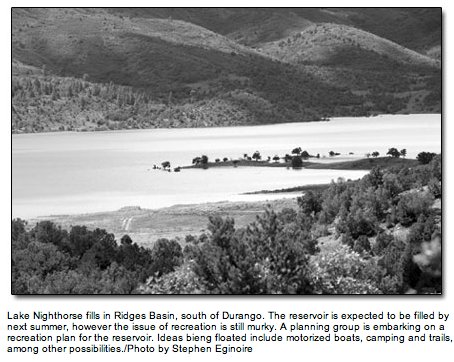
On Wednesday, about 30 people turned out at the La Plata County Fairgrounds for the first in a series of public meetings about recreation on the lake, which will cover 1,500 surface acres when fully filled in 2011. Posted for public viewing were comments on the subject, and almost all of them contained a pitch for either motorized or nonmotorized boating…

Friends Anne Sutherland and Cindy Ortman, who hadn’t seen one another in six years, found they still have a lot in common. They don’t want motorboats on the lake, too. “I’m here to give input,” Sutherland said. “No motorized craft – boats or jet skis.” Ortman said she’d like to see sailboats and rowing and high school and college crew teams…

Joy Lujan, a National Park Service community planner, is coordinating creation of a recreation master plan at the lake. Lujan wants participants in upcoming forums and workshops to have a solid foundation for discussions. Lujan points out that although federal Wallop-Breaux funding that helped build a boat ramp at Lake Nighthorse requires access for motorized craft, the master plan will spell out the type and location of water-based activities…

Also on hand to answer questions at the meeting were employees of the Bureau of Reclamation, which owns Lake Nighthorse; board members of the Animas-La Plata Water Conservancy District, which is leading the campaign to fund the recreation master plan; and a representative from consultant DHM Design…

Another open house is scheduled from 5 to 8 p.m. today at 175 Mercado St., Suite 117, in Three Springs. Public forums and workshops will follow until a final recreation plan is unveiled Jan. 12.

More Animas-La Plata Project coverage here and here.

San Juan Basin: Water Supply Community Work Group meeting recap

From the Pagosa Sun (Randi Pierce):

When group chairman Bruce Dryburgh called the meeting to order, the group lacked a quorum, though with the arrival of Steve Van Horn, official business could begin — approval of past minutes and “removing members from the island.” Jan Clinkenbeard was voted out of the group due to her recent appointment to the Pagosa Area Water and Sanitation District Board of Directors, as was Archuleta County Commissioner John Ranson for his conflict of interest in light of the BoCC’s statutory oversight duties concerning PAWSD…

Following a brief hiatus, the group then met with the PAWSD board, with Shellie Peterson, interim district manager, presenting a report on the history of the PAWSD schedule of fees and charges. The presentation included the development and justification of all of the PAWSD fees, with many board members noting the informative value of the report.

PAWSD Special Projects Manager Renee Lewis said in a later interview that the report provided a good platform for the WSCWG’s future work, should they decide to continue on and in what capacity to do so. According to Dryburgh, no further meetings of the WSCWG had been scheduled as of presstime.

More San Juan Basin coverage here.

Energy policy — nuclear: Cotter Corp, Inc. and the Colorado Department of Health and Envrironment are far apart on groundwater monitoring costs

Update: From the Cañon City Daily Record (Rachel Alexander):

In January, Cotter submitted an estimate of $2,891,319 to which the department responded with an estimate of $15,066,000. At the Community Advisory Group meeting, Oct. 28, Steve Tarlton, radiation control project manager for CDPHE, explained the differences in the initial estimates and how the department and company came to the new estimate. “We were proposing active systems, they were proposing passive systems,” Tarlton said of the initial numbers, stating the main difference was in scope.

Following the initial estimates, informal negotiations were undertaken to attempt to come to an agreement, Tarlton said. The negotiations addressed three groundwater plumes: Lincoln Park north the De Weese Dye Ditch, the SCS Dam to the the De Weese Dye Ditch and the facility itself. The golf course plume was addressed earlier with the license surety. The two parties agreed to a scope of work needed in each area and that was used as a basis of the estimate. The agreed-to scope is not a final decision as to what work will actually need to be done, that will need additional data and a public process. The surety for Lincoln Park is $1,108,074, for the facility is $6,874,684 and for the dam to the ditch it is $1,938,803.

Cotter has a period of time to respond to the estimate from CDPHE before the numbers are made final. Cotter spokesman John Hamrick said the company does not have a comment on the surety process at this time.

From The Pueblo Chieftain (Tracy Harmon):

The Colorado Department of Public Health on Oct. 26 issued an order requiring Cotter Corp. to adjust its $2.6 million surety to $9.9 million to cover estimated costs to install and monitor groundwater wells and prevent groundwater from seeping off site at the currently idle uranium mill just south of Canon City.

On Nov. 5, Cotter attorney Mark Mathews notified the state that Cotter disputes the state’s estimate of $9.9 million and requested an informal mediation…

The state and Cotter officials also are trying to work out an agreement on decommissioning costs when the mill finally closes. State officials estimate the final cleanup cost at $43.7 million, while Cotter Corp. officials estimate it to be $23.2 million. The draft decommissioning funding plan may be viewed at http://www.cdphe.state.co.us/hm/cotter/index.htm. Public comment will be accepted through Nov. 24. Comments should be faxed to 303-759-05355 or mailed to Steve Tarlton, manager, Radiation Control Program, Colorado Department of Public Health, 4300 S. Cherry Creek Drive, Denver, CO 80246-1530. E-mail comments also can be sent to steve.tarlton@state.co.us

More nuclear coverage here and here.

Denver Water’s proposed rate increases attract the focus of councillor Jeanne Faatz

From The Denver Daily News (Peter Marcus):

The Board of Water Commissioners will hold a public hearing on Wednesday, as well as again next Wednesday, before voting on the proposal. The plan calls for an average increase for next year of $41 per year for Denver customers, or an increase of about $3.40 per month. The increase would be more than 10 percent for next year and comes as Denver Water officials warn that consumers may see an increase of 31 percent over the next three years. If approved, the increased water rates would take effect in March 2011.

Suburban residential customers would see an average increase of about $2.66 per month, or about $32 per year.

The proposal has already made a splash with Denver City Council members – but not the kind of splash that Denver Water would have liked. In addition to raising concerns over the impact a rate increase could have on constituents, Councilwoman Jeanne Faatz took the opportunity last month to raise questions over the organization of the Denver Water board itself.

Currently, the Board of Water Commissioners is a five-member board that is appointed by the mayor of Denver. Faatz questioned whether it wouldn’t be a better idea to switch to a board that is elected by the people, to perhaps better represent the interests of voters.

“Our same people are paying these rates and they have definitely let us know that they are not interested in increased taxes and we have tried to listen to that and be responsive, and they’re not interested in higher fees, and yet you all just pretty much as an enterprise get to set what you set and charge them,” Faatz told Denver Water officials at a City Council briefing last month.

More Denver Water coverage here.

Mesa State College water seminar Land use change, water use, and water-quality in the Lower Gunnison and Grand Valleys, scheduled for November 15

Here’s the link to the announcement.

From email from Gigi Richards (Mesa State College):

Land use change, water use, and water-quality in the Lower Gunnison and Grand Valleys
Ken Leib, Western Colorado Studies Section Chief and Hydrologist, US Geological Survey

The presentation will focus on water-quality issues associated with irrigation and development in the Lower Gunnsison and Grand Valleys. Specifically the presentation will touch on salinity and selenium issues and the mechanisms that cause mobilization of these constituents. Sedimentary formations and soils derived from these formations will be discussed along with a conceptual model of soil water interaction. Also included will be specific research by the USGS that documents the effect of land use on water-quality and also trends observed in salinity and selenium at selected USGS streamflow gaging stations.

Ken Leib has a B.S. degree in Watershed Management from Colorado State University. He has worked for the USGS in Western Colorado for 15 years. His background includes work on issues related to abandon mines, oil and gas impacts, and salinity and selenium characterization.

Seminars are free and open to the public, no registration necessary.

For the entire seminar series schedule, please see: http://home.mesastate.edu/~grichard/WSS/Seminar2010.html

For more information please contact:

Prof. Gigi Richard, 970.248.1689, grichard@mesastate.edu
Prof. Tamera Minnick, 970.248.1663, tminnick@mesastate.edu

More Gunnison River basin coverage here. More Colorado River basin coverage here.

NIDIS Weekly Climate, Water and Drought Assessment Summary of the Upper Colorado River Basin

A picture named coloradoriverbasin.jpg

Here are Henry Reges’ notes from Tuesday’s webinar.

La Niña update

A picture named elninolanina.jpg

From CBS4Denver.com (Alan Gionet):

“We’ve got one thing going for us this year which is a strong or fairly strong La Nina,” said Colorado’s state climatologist Nolan Doesken, talking about the scenario of cold sea surface temperatures in the eastern tropical Pacific. “And if you look at how that’s behaved in the past, that usually favors dry in the Southwest during winter and very dry in Florida and southeastern states, wetter in the Pacific Northwest and then Colorado is sort of in the in-between.” La Nina conditions have traditionally caused slightly warmer temperatures, especially in the southwest part of the state. CBS4 meteorologist Jennifer Zeppelin explained La Nina’s usual effects further. “So it’s colder waters and so most of the moisture and the drier air is really going to be filtering into our area, wheras the moisture is really going to be staying back to the Northwest because of the way the pattern is shifting.”[…]

“La Nina sometimes favors frequent small snows in the northern and central Rockies,” said Doesken. “Fairly favorable from a winter recreation point of view, but not necessarily from a total water supply point of view for next year.” There’s concern that La Nina could exacerbate Colorado’s dry situation. Smaller snows means smaller water loading into the mountains and maybe more dryness. “The thing we’re concerned about though is La Ninas, especially strong ones that last long, tend to bring dry springs with them,” he said.

Energy policy — nuclear: Powertech sues Colorado over new in-situ mining rules

A picture named uraniuminsitu.jpg

From the Fort Collins Coloradoan (Bobby Magill):

Powertech, which previously called some of the provisions of the rules “fatal” to future in situ uranium mining in Colorado, proposes to open the Centennial Project uranium mine about 15 miles northeast of Fort Collins in Weld County.

The rules, mandated by House Bill 1161, signed by Gov. Bill Ritter in 2008, require Powertech to establish the level of groundwater purity before it begins prospecting for uranium and then establish a similar baseline for water quality before mining begins…

When the company is finished mining, it must fully decontaminate the groundwater and return it to its original purity to ensure the water is no longer polluted. Powertech’s lawsuit calls that rule irrational. Fully cleaning up the groundwater will be too expensive and will require the use of too much water from somewhere else to do the job, the lawsuit claims. And, Powertech claims, making the company completely decontaminate the water will hold the company to a higher standard than any other mining company in Colorado…

The lawsuit alleges [Rep. Randy Fischer, Rep. John Kefalas], Rep. Kathleen Curry and Sen. Gayle Schwartz violated the separation of powers under the state Constitution by writing a March 15 letter to the Mined Land Reclamation Board providing them direction on how to implement HB 1161.

Powertech’s lawsuit claims the state has no authority to require mining companies to test groundwater purity before it begins prospecting for uranium, and it says the state’s rule to show how other mines have reclaimed the groundwater is arbitrary. “These rules require information about other operations permitted at some time in the past or at other locations by an operator unrelated” to Powertech, the lawsuit claims, dismissing the rules as overly burdensome.

More coverage from the Loveland Reporter-Herald (Tom Hacker):

Powertech Uranium Corp., the Canadian uranium prospecting company that plans the Centennial mine, filed suit in Denver District Court claiming rules adopted by regulators during the past two years designed to protect groundwater are “arbitrary and capricious.” But members of Citizens Against Resource Destruction, the group aligned to fight the mine plan, say Powertech’s legal action stands in contrast to its stated commitment to protect the environment. Moreover, Powertech officials had said in published comments they “can live with” the new rules, and they are “not fatal to the project.”[…]

A lawyer representing the Western Mining Action Project said Thursday the lawsuit’s progress would be difficult to predict. “These cases can move quickly or they can take some time,” said Jeff Parsons, a Loveland resident who commutes to the mining watchdog group’s headquarters in Lyons. “It can be a very long, drawn-out process.”

The Weld County rancher who founded the opposition group, and whose land is adjacent to the mine site, said the lawsuit flies in the face of the company’s assurances to protect water resources. “It’s insulting,” Robin Davis said. “Powertech has told us from the very beginning they could and would restore our water. Now that we have regulations in place that will hold them accountable to their word, they sue the state of Colorado for protecting its resources.” The rule-making process took two years. It included a trip to Loveland by members of the mine reclamation board in April to gather public comment.

Conservationists were joined by water utilities, local governments and affected communities in crafting the regulations. Parsons said Powertech’s suit will face obstacles in the legal process as it progresses. “Anytime you sue the state over a regulatory issue, it’s an uphill battle,” he said.

More coverage from Monte Whaley writing for The Denver Post. From the article:

The lawsuit, filed Monday in Denver District Court by Powertech Inc., names the Colorado Mined Land Reclamation Board and Mike King, executive director of the Colorado Department of Natural Resources, as defendants. The company claims that rules and regulations adopted in August by the state to protect groundwater against damage created by the “in-situ” method of uranium mining are too restrictive. The lawsuit asks the court to examine the rules adopted by the board to determine whether it violated Colorado statutory rulemaking requirements and the state’s constitution. “We feel some improvements can be made and others are outside the bounds of what the Colorado legislature intended,” said Powertech attorney John Fognani…

[Jeff Parsons, a lawyer for the Western Mining Action Project] said this is the second time in recent weeks the uranium mining industry has sued state mining regulators to weaken groundwater protections. In September, Cotter Corp. sued the state mining board over cleanup orders at Cotter’s Schwartzwalder Mine, which drains into Denver Water supplies on Ralston Creek near Golden. “The uranium mining industry in Colorado is wrong to keep fighting water-quality protections and better public involvement,” Parsons said…

According to the lawsuit, one of the rules requires applicants to document reclamation work at five in-situ mining operations, not necessarily their own. “These rules require information about other operations permitted some time in the past, or at other locations by an operator unrelated to the applicant, and are therefore arbitrary, capricious, prejudicial and void for vagueness.” Another rule authorizes a “discretionary denial of a permit” if the mining reclamation board has “uncertainty” about the feasibility of a reclamation. “This provision is confusing, vague and unnecessary,” since the agency already has the authority, and responsibility, to deny a permit if an applicant can’t reach reclamation standards, according to the lawsuit.

Fognani said Powertech would still be able to meet the requirements of any state permitting process if the rules remain intact. “We just believe some certain improvement can be made,” he said.

More coverage from the Northern Colorado Business Journal. From the article:

The Powertech suit alleges that the rules go too far in restricting the company’s ability to mine uranium. It plans to use an in-situ process that removes underground uranium deposits by injecting a solution into the deposits to loosen them so they can be pumped to the surface. The rules require denial of a permit if a mining company cannot first demonstrate it will restore groundwater quality to baseline quality or better. The suit further alleges that another rule is a “blackball” provision that allows the denial of a reclamation permit because of “one or more past or current violations by an applicant or by an entity or individual who is very loosely related, if at all, to the applicant.” “These provisions are overly broad and punitive and could prevent a good company from conducting a mining operation because of isolated or administrative-type violations that may not even be related to that company,” the suit states.

More nuclear coverage here and here. More HB 08-1161 coverage here.

Arkansas Basin Roundtable meeting recap

A picture named purgatoireriver.jpg

From The Pueblo Chieftain (Chris Woodka):

A request for $75,000 [for Purgatoire River cleanup], which will be matched with $83,000 in local funding sources, will move to the Colorado Water Conservation Board in January, once the application passes the review of the needs assessment committee…

The Trinidad Community Foundation assessed the needs of the Purgatoire River below Trinidad Dam, located two miles southwest of Trinidad. The most critical reach is just east of Interstate 25 and is about one-half mile long, said Jeris Danielson, manager of the Purgatoire Conservancy District, which is contributing $15,000 to the project. “If you’ve driven through there and seen it, you know it’s in sorry shape,” Danielson said.

The channel is filled with Russian olives and tamarisk and inaccessible. Removing the plants could increase the water available to irrigators in the district, he noted. The project seeks to remove the invasive species and revegetate the area, create structures in the river to improve fish habitat and build a handicapped-accessible trail through the area. The trail would connect to an existing park.

Meanwhile the roundtable discussed adding water quality information to the basin-wide model being developed by the CWCB. Here’s a report from Chris Woodka writing for The Pueblo Chieftain. From the article:

A blueprint for an Arkansas Valley decision support system for water administration and planning was reviewed Wednesday by the Arkansas Basin Roundtable. Colorado Water Conservation Board staff is outlining what steps it will take to develop the model in a feasibility study that will be presented to the board in May. After that, it will take years and millions of dollars to develop the actual model.

“The feedback that we’ve gotten is that water quality is important and should be addressed,” Lindsay Griffith of Brown and Caldwell Engineers told the roundtable. “There is a need for the basin to have real-time tools, and we’re looking at how to integrate water quality into the basin model.” That would be a step forward from the decision support systems the state has developed in other basins. Since the early 1990s, the state has completed models for the Colorado River and Rio Grande basins. The CWCB is finishing a model for the South Platte basin. All of those concentrate on water supply alone…

The statistical platform for the model is still being debated by a technical committee. Some want the model to be based on a computer program developed by Colorado State University that is already used for specific projects in the valley. Others say the model now used by the state would provide consistency across basins.

More IBCC – basin roundtables coverage here and here.

The Pueblo Board of Water Works is still in the hunt for shares of the Bessemer Ditch

A picture named bessemerditch1

From The Pueblo Chieftain (Chris Woodka):

A new plan, which will be presented at a budget hearing 2 p.m. Tuesday, includes $1.5 million for new Bessemer shares, as well as $550,000 from the water development fund to pay for legal, engineering and capital costs associated with the transfer of the shares. The purchase of Bessemer shares is part of a long-term plan to reduce Pueblo’s dependence on water imports from the Western Slope. Water probably won’t be needed for years to come, so nearly all of the Bessemer contracts include a provision that leases the water back to farmers for the next 20 years.

More Bessemer Ditch coverage here and here.

Alamosa High School students get recognition for Rio Grande River data collection project

A picture named riogranderiver.jpg

From the Valley Courier (Julia Wilson):

“We were one of 60 schools from Colorado, New Mexico, Texas and Mexico that tested the river for 11 different parameters on the same day and at the same time,” said AHS science teacher Katie Montague. The goal of the study is to create a snap shot of the river from the headwaters all the way down into Mexico. The plan is to continue the project annually to create a history of data that can be analyzed by scientists now and in years to come.

“This is an incredible accomplishment,” Tricia Cortez, Dia del Rio 2010 coordinator with the Rio Grande International Study Center that sponsored the project, said. “We created tremendous excitement among teachers and students throughout the basin, and witnessed a growing awareness and concern for issues impacting our river and watershed. With the help of our many partners throughout the basin, we hope to replicate this event year after year.”

More Rio Grande River basin coverage here.
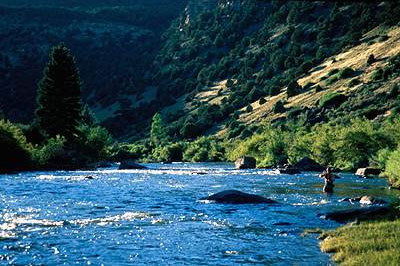
Flaming Gorge Pipeline: Is there enough water for the project?

A picture named flaminggorgepipelinemillion.jpg

From the Fort Collins Coloradoan (Bobby Magill):

“In my view, there’s a very high risk there’s not enough water,” Eric Kuhn, manager of the Glenwood Springs-based Colorado River Water Conservation District, said Friday.

Many residents of southwestern Wyoming fear Million’s Regional Watershed Supply Project could kill the region’s recreation economy centered on Flaming Gorge Reservoir.

Kuhn spoke to some of those residents in Rock Springs in late October to provide them with a western Colorado perspective of the implications of the pipeline…

Long term averages of water flow in the Green River suggest there’s plenty of water in the river system that hasn’t been appropriated for human consumption, Kuhn said. But averaging the river’s declining flows over the last 30 years, “it’s nowhere close,” he said.

If the pipeline were to deplete Flaming Gorge of its water, southwest Wyoming’s recreation economy could take a huge hit, he said. “I think there’s going to be significant opposition in Wyoming, and specifically in southwestern Wyoming, to this project,” Kuhn said.

Million said Kuhn and the Colorado River District have a political agenda aimed at keeping as much water as possible in the Colorado River system rather than letting it be pumped to the Front Range.

More Flaming Gorge Pipeline coverage here and here.