Colorado-Big Thompson Project update

A picture named coloradobigthompsonmap.jpg

From email from Reclamation (Kara Lamb):

We have passed the half-way mark in our annual maintenance across the Colorado-Big Thompson Project. There are roughly four weeks left.

This afternoon, we started running water through the Alva B. Adams Tunnel for some power generation on the upper portion of the project. As a result, Lake Estes is anticipated to rise a couple feet in water level elevation. It will begin a more typical pattern of water level fluctuation by Friday.

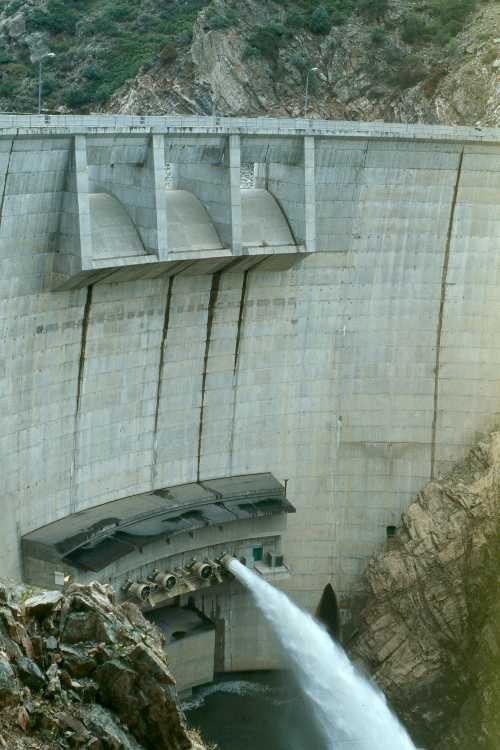
At 10:00 p.m. on Thursday, November 11, we will begin increasing releases from Lake Estes through Olympus Dam to the Big Thompson River. The first release will increase by 100 cfs, bringing the river below the dam to about 140 cfs. At 11:00 p.m., we will increase by about 150 cfs, putting 300 cfs in the river below the dam. We will increase by about 90 cfs around midnight, putting the river at about 440 cfs. We anticipate that releases to the Big T will range between 390-440 cfs for the next couple of weeks, possibly longer. The duration of the release through Olympus Dam, and the rate of flow, are largely dependent on freezing temperatures.

Water released to the river will be recaptured at the Dille Diversion near the mouth of the Big Thompson Canyon. From there it will run, via the Charles Hansen Feeder Canal, to Horsetooth Reservoir. Currently, Horsetooth is at an elevation of about 5378. It should start rising again by Friday afternoon.

Meanwhile, flows to the southern power arm of the system will remain on hold. Annual maintenance continues at the Pole Hill Power Plant, in the Bald Mountain Pressure Tunnel, at the Flatiron Power Plant, and along portions of the Charles Hansen Feeder Canal south of the Big Thompson Canyon. As a result, both Pinewood and Flatiron reservoirs remain drawn down to dead storage. We anticipate both reservoirs will start refilling in mid-to-late-December.

For the last week, Carter Lake has maintained an elevation around 5682 feet. However, it will likely drop more before the middle of next month. It is anticipated we will begin pumping water to Carter in late December.

More Colorado-Big Thompson Project coverage here.

The Arkansas Valley Super Ditch Company will hold two shareholder meetings November 18 to gauge interest in the proposed leasing program

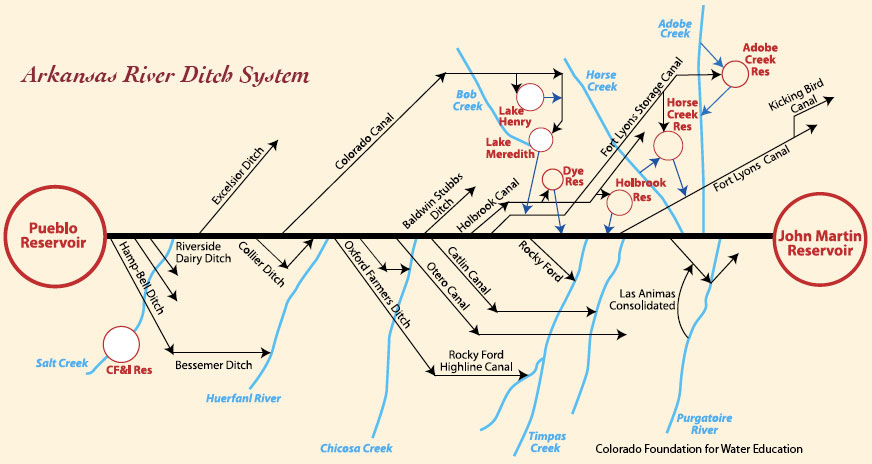
A picture named arkbasinditchsystem.jpg

From The Pueblo Chieftain (Chris Woodka):

The meetings both will be on Nov. 18: 1 p.m. at the Gobin Community Building in Rocky Ford; and 6 p.m. at the Lamar Community College Bowman Building. Shareholders on the Bessemer, Catlin, Fort Lyon, High Line, Holbrook, Otero and Oxford canals were sent letters last week with information about two lease agreements that would sell water to Aurora and the Pikes Peak Regional Water Authority over the next 40 years…

The Super Ditch board has approved agreements that would allow:

– Leases of up to 8,020 acre-feet per year to the Pikes Peak group in El Paso County for the next 40 years. The amount of water could increase to 20,000-25,000 acre-feet per year over time.

– Leases of up to 10,000 acre-feet per year to Aurora in three years out of 10, subject to restrictions specified under intergovernmental agreements until 2048.

Only the consumptive use of water could be leased and farm ground would have to be dried up during the lease period. Leases would be for $500 per acre-foot and the Super Ditch would be responsible only for moving the water to Lake Pueblo. The rate would escalate according to the Colorado Municipal League Utilities Index, and the leases could be extended by mutual agreement.

More Arkansas Valley Super Ditch Company coverage here and here.

Schweizer said the Super Ditch board has talked about limiting the participation to 30-35 percent of acreage.

Castle Rock: The town council passes 5-year 30 percent increase for water rates on first reading

A picture named waterfromtap.jpg

From The Douglas County News Press (Rhonda Moore):

On Oct. 26, Utilities Director Ron Redd proposed to increase water rates over a five-year period, beginning in 2011. Redd presented a plan to introduce a tiered approach that by 2015 will have a net affect of a 30 percent rate increase for residential customers. Over that period of time, commercial customers will experience a drop in their water bills of more than 2 percent, beginning with a 17 percent rate decrease in year one and continuing with annual rate increases through year five. The reason for the decrease to the commercial rates is an adjustment to the fixed costs associated with its customer base, Redd said…

If town council approves the rate increases at second and final reading, customers will begin seeing changes to their water bills beginning in January, 2011. The average residential customer will pay about $6.25 more per month for water, or a 5.88 percent increase. Those increases will continue through 2015, when residential customers will be paying about $32 more each month, or $384 per year, than they pay today. In the first year of the rate increases, commercial customers will save abouyt $50 each month, with a 17 percent decrease in their bills. The commercial rates will then undergo various rate increases over the next four years, resulting in a two-percent decrease from what they pay today.

More infrastructure coverage here.

Snowpack news

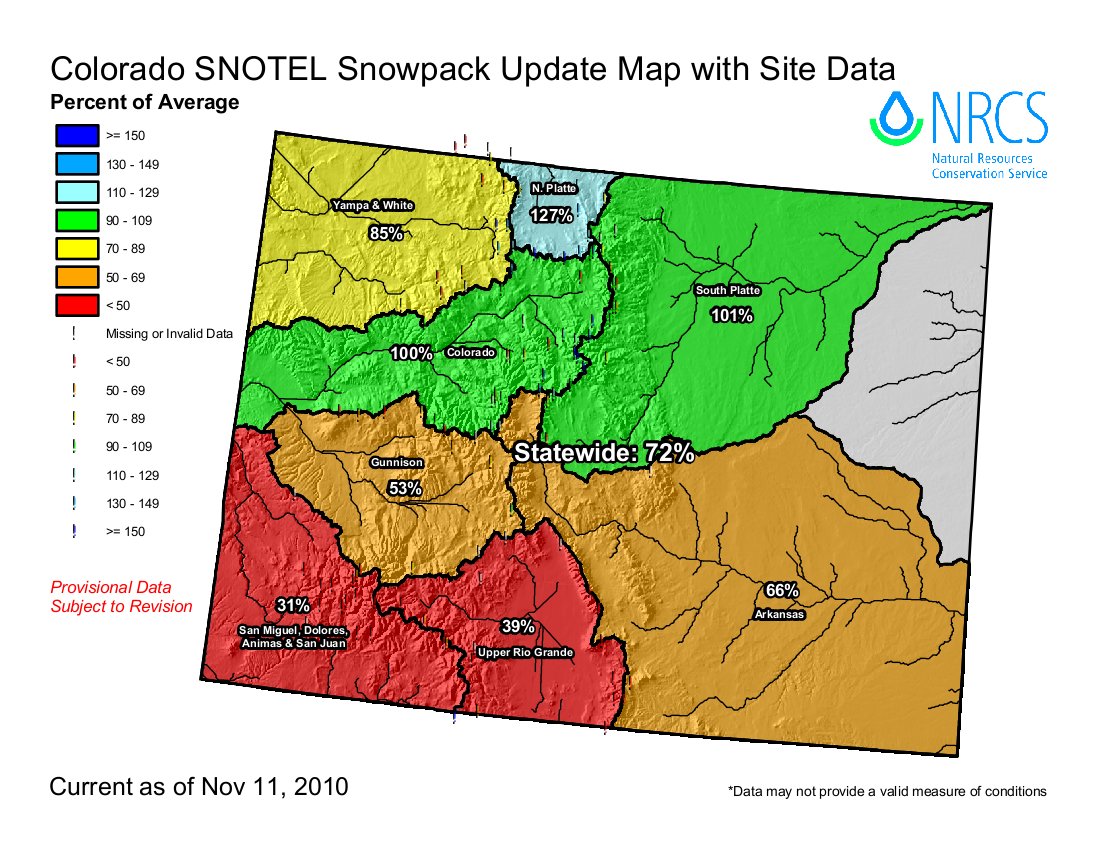
A picture named snowpack11112010

From the Glenwood Springs Post Independent:

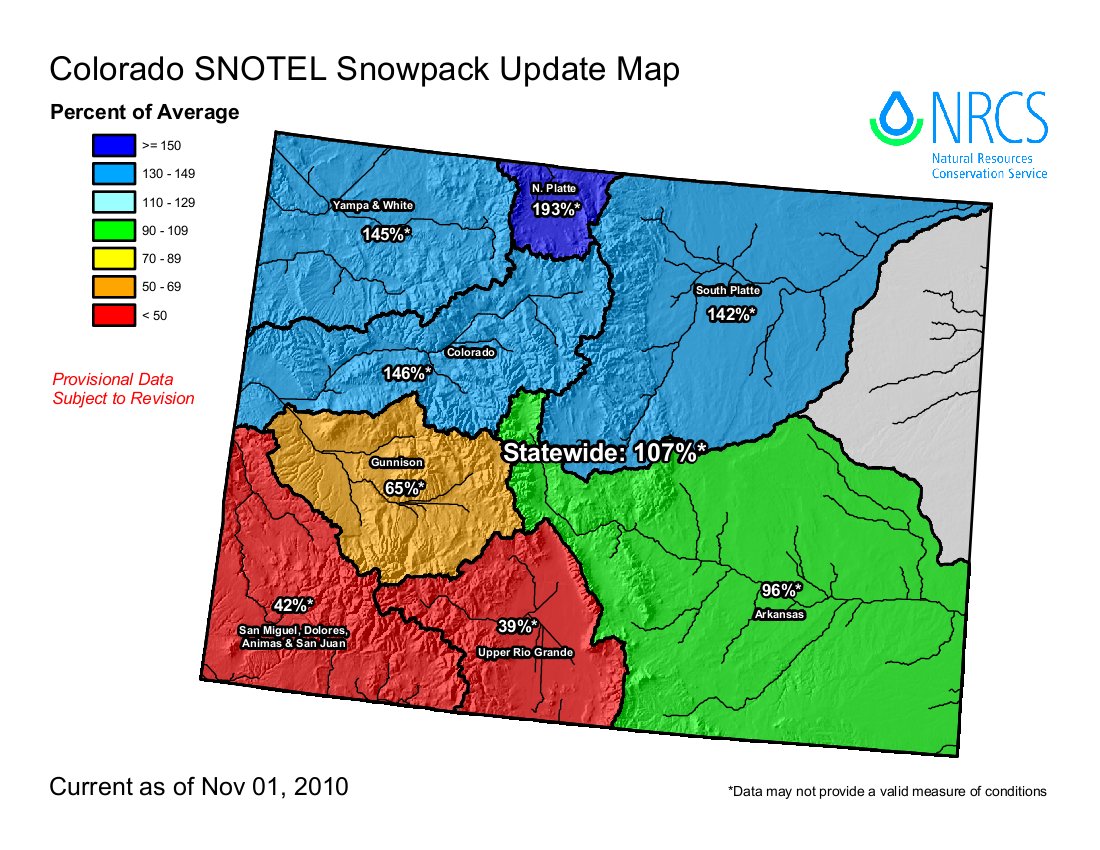
Overall, the snowpack for the [Roaring Fork] watershed is at 81 percent of average. However, the upper Roaring Fork River drainage is starting off the season with above average snowpack, while the upper reaches of the Crystal River drainage are well below average…According to the report, the Roaring Fork at Independence Pass was 125 percent of average as of the first of November, while the Crystal at Schofield Pass was at just 44 percent of average.

San Juan River basin: San Juan River Workgroup East Fork discussion November 29

A picture named sanjuan.jpg

From the Pagosa Sun (Marsha Porter-Norton):

The San Juan River Workgroup will meet at 5:30 p.m. Monday, Nov. 29. This meeting was rescheduled from a previously announced date. The meeting location is the Ross Aragon Community Center. The Workgroup will discuss the East Fork…

To learn more and to find all the meeting handouts, schedule and minutes as well as information about the River Protection Workgroup go to http://ocs.fortlewis.edu/riverprotection/ (click on “San Juan River Workgroup” on the left side) or call the Southwestern Water Conservation District at 247-1302 or call the San Juan Citizens Alliance at 259-3583.

More San Juan River basin coverage here.

Tropical Cyclone Tracks

A picture named urbandrainage1dayrain11102010

I ran across a cool graphic on Wikipedia this morning that shows global tropical cyclone tracks. With the miracle of computers the graphic designer was able to flatten the earth on top and bottom while overlaying the tracks of tropical cyclones. Click on the thumbnail graphic to the right to see it in detail.

A beautiful snow

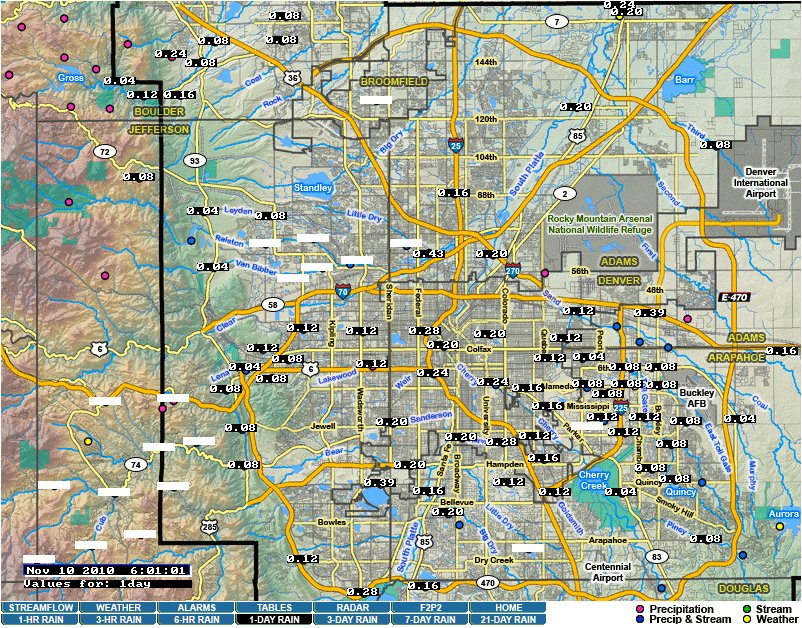
A picture named urbandrainage1dayrain11102010

After such a hot and dry fall it was a treat to watch the hail, rain and snow storm yesterday. Click on the thumbnail graphic to the right to see the one day precipitation map for the Denver area from the Urban Drainage and Flood Control District.

43 hundredths was recorded a couple of miles from Gulch Manor at the Little Dry station near 64th and Pecos.

Upper Colorado River Basin: Water Year 2010 streamflow recap

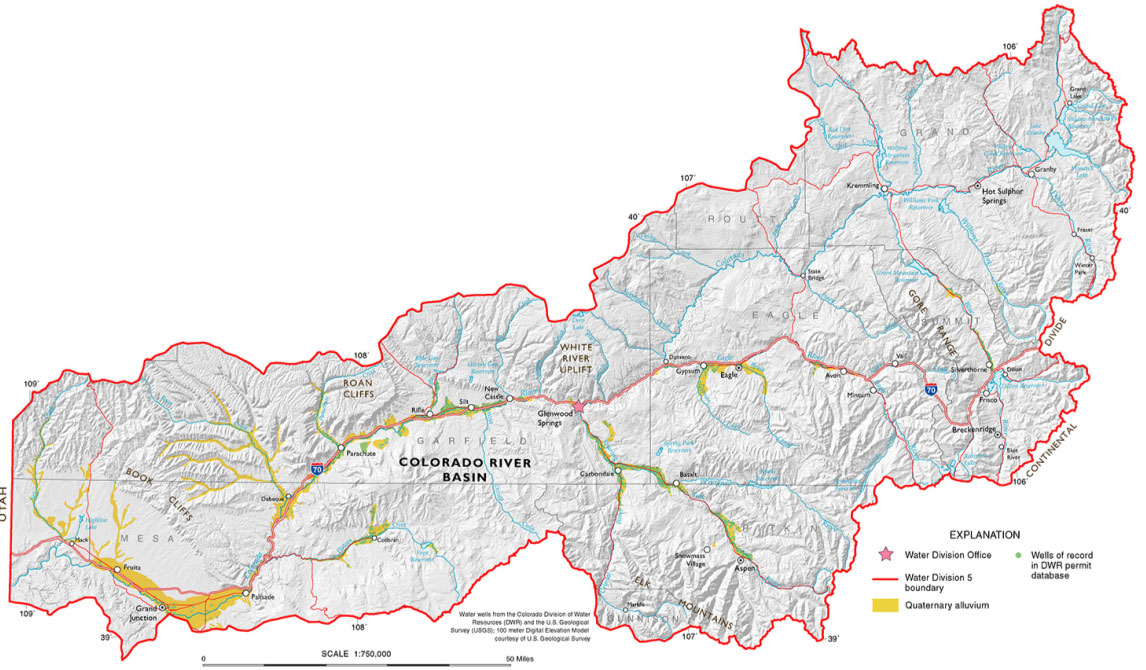
A picture named coloradoriverbasincgs.jpg

From the Glenwood Springs Post Independent (John Stroud):

“It was a roller coaster year,” said Don Meyer, senior water resources engineer for the River District. “We had a pretty dry late winter and early spring, which led to a low snowpack.” What snowpack there was also melted in a quick runoff, due in part to a heavy layer of dirt in the higher elevations from a series of spring dust storms and hotter-than-normal temperatures in late May and early June.

“Then we had a big monsoonal season, especially in the upper Colorado basin where we got quite a bit of rain,” Meyer said. “It was a real mixed bag, but in general it was a much better water year than we anticipated back in the spring.”

Currently, most rivers in the Colorado Basin are running at or near average for this time of year, despite a dry fall. The Colorado River below Glenwood Springs was running at 1,770 cubic feet per second (cfs) on Tuesday, slightly below the 43-year average for that date of 1,920 cfs. Since mid-August, the Colorado below Glenwood was running at or above average, before dropping off in late October as dry weather persisted.

Two major tributaries of the Colorado have been running below average for the past 60 to 90 days, however. The Roaring Fork River at Glenwood Springs was running at 593 cfs on Tuesday, compared to the 39-year average of 678 cfs. The Roaring Fork has been flowing at below-average levels since early September. Likewise, the Eagle River at Gypsum has been running below average since about that same time period. On Tuesday, it was running at 244 cfs compared to the 64-year average of 252 cfs…

River flows in the Colorado below the Shoshone hydroelectric plant in Glenwood Canyon for the past two years have also been impacted by the fact that the power plant has been out of commission. As a result, Denver and other Front Range water users placed a call on the Shoshone allotment. Still, downstream water interests have been able to work out an agreement that has kept near-historical flows in the Colorado River, intended for protection of endangered fish species as well as recreation interests.

More Colorado River basin coverage here.

Pueblo: Fountain Creek community meeting recap

A picture named fountaincreek.jpg

Update: From The Pueblo Chieftain (Chris Woodka):

Flood control money through a district formed to fix Fountain Creek won’t necessarily tie into Pueblo’s master plan for the Historic East Side and Fountain Creek, County Commissioner Jeff Chostner said Wednesday. City officials mentioned the funds Tuesday as one source of money while discussing an ambitious master plan for urban renewal and recreation that could cost $60 million and take 50 years to complete. “My concern is that we’re leading people on about things that the money is not intended for,” Chostner said. “The money will not come out of Southern Delivery System funds, because these projects don’t meet the terms of the 1041 permit.”

From The Pueblo Chieftain (Chris Woodka):

A crowd of about 30 people attended a community meeting at Risley Middle School to review a master plan that has been in the making for nearly a year. Many of those who attended were at the previous three public meetings or a dozen steering committee meetings earlier this year, and there were a few curious newcomers. The goal is to tie together a plan to improve flood protection and access along Fountain Creek from its confluence with the Arkansas River to Eighth Street with an urban redevelopment plan in the adjacent area south of Eighth and west of Hudson Avenue. Features in the plan include a pedestrian bridge over Fountain Creek at First Street, expanded parks at El Centro del Quinto Sol and Plaza Verde, a trail that connects to the Front Range Trail System to the north, a skate park, water fountains and a community-built playground. There are also gateway approaches planned on Fourth and Eighth streets. It also would tie in to flood control projects elsewhere on Fountain Creek, and use some of the sediment dredged from Fountain Creek to create more user-friendly approaches to the earthen levees south of Fourth Street. The total cost of the projects outlined Tuesday would be in the neighborhood of $60 million and take 40-50 years to complete, [Scott Hobson, assistant city manager for community development] explained…

…there are bite-sized pieces and the opportunity for more funding partners. Hobson said the master plan actually includes 20 separate projects that range in price from $500,000 for some of the less-developed park areas to $6 million-$7 million for the more urban neighborhoods. For the parks, which could be tackled soonest, the city would look to Great Outdoors Colorado. “The city applies to GOCo for one or two projects each year,” Hobson said.

The approaches on Fourth and Eighth streets would tie into improvements now being planned on Interstate 25 by the Colorado Department of Transportation. Flood control projects and work on the levees could be funded by the Corps of Engineers, Natural Resource Conservation Service or the Fountain Creek Watershed Flood Control and Greenway District — once it has a funding source in place, Hobson said.

More Fountain Creek coverage here and here.

The Pueblo Board of Water Works is looking at a five percent increase in water rates

A picture named waterfromtap.jpg

From The Pueblo Chieftain (Chris Woodka):

The board sat down with staff Tuesday to look at specifics in the proposed budget, and will consider approval of the budget following a public hearing at 2 p.m. Tuesday. The water board is looking at a $30.2 million budget in 2001 that is actually less than the previous two years. However, there were extraordinary expenses and revenues in 2009 and 2010…

A 5 percent increase means the average residential water bill will increase $1.45-$1.58 per month, based on 11,000 gallons used per month, depending on tap size. In summer, it would be less than $5 per month, based on higher usage for lawn watering of about 30,000 gallons in a month. Since the drought of 2002, residential use has decreased, and the budget is built on projections of 123,000 gallons annually per residential account, said Seth Clayton, manager of the financial division. In 2009, one of the wettest years on record, single-family households averaged 118,000 gallons. In 2010, use is projected to be 128,000 gallons per household. Similar patterns have been seen in multifamily and commercial accounts. “October and November have been drier and warmer than usual, and that’s really boosted revenues,” Clayton said, in estimating revenues from metered water sales that will come close to projected $20 million this year, about 70 percent of total revenues…

Pueblo water rates increased dramatically during the early 1980s, then hardly at all until the mid-1990s. Since then, they have increased by 1.5 to 5 percent annually.

More Pueblo Board of Water Works coverage here.

Whither Lake Mead?

A picture named Draininggraphic.jpg

From the High Country News (Emilene Ostlind):

Although the surface of Lake Mead today is at almost 75 percent of its maximum level, the reservoir holds just 39 percent of its full capacity. The new low illustrates a trend that has implications not just for the almost 20 million people downstream who rely on the reservoir’s water, but for the entire Colorado River watershed.

More Colorado River basin coverage here. More Lake Mead coverage here.

Conservation easement review in the offing

A picture named saguachecreek.jpg

Update: From The Denver Post (Jessica Fender):

Lawmakers in the 2010 legislative session added $1.1 million to the Revenue Department’s budget to hire staff and contract third-party appraisers to resolve the backlog. That money became available at the start of July, department spokesman Mark Couch said. His agency welcomes an audit, he said. “We hope it will help resolve concerns about these tax credits,” Couch said. “These are very complicated tax returns. They take a lot of review when they go through the process of being disputed and protested. We didn’t have the funding until the beginning of the fiscal year.”[…]

An unknown number of landowners and tax-credit buyers around 2005 began getting notices from the Revenue Department advising them they had claimed a larger break than they were entitled to and questioning the appraised value of the land that determines the size of the credit. Of 2,847 conservation easements the state has considered between 2000 and 2008, about 500 have been denied or are in question, Revenue Department figures show. Letter recipients are given a month to appeal the decision. Many do.

And that’s where the bottleneck starts, according to J.D. Wright, president of Landowners United. The group advocates for about 90 landowners entangled in easement disputes. He said some property owners have erroneously had wages garnisheed. Others live in uncertainty about their financial futures.

From the Associated Press (Stephen K. Paulson) via Bloomberg Businessweek:

The Legislative Audit Committee on Monday said it will consider whether to audit the state Department of Revenue later this year to find out if landowners are being treated fairly and disputes are resolved in a timely manner. State Rep. Marsha Looper, a Republican from Calhan who requested the audit, says it could take 10 years at the current rate to resolve disputes from 355 landowners who claim over $90 million in tax credits. Those credits have been challenged by the state. Lawmakers first want to find out how much information is available because it involves confidential state and federal tax records. “Some of these property owners only have 30 days to protest denial of their appeals that could lead to foreclosure, and they’re not even getting a certified letter. Credit buyers are already getting liens on their loans. The state is going after the credit banks,” Looper said.

More conservation easements coverage here and here.

The Dominion Water and Sanitation District to join the South Metro Water Supply Authority

A picture named southmetrowaterauthority.jpg

From The Denver Post:

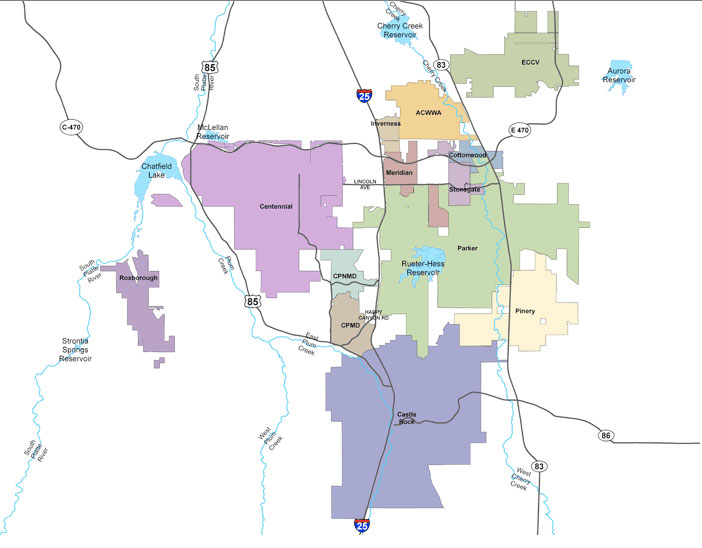
South Metro Water Supply Authority, a public entity of cooperating water providers in Doug las and Arapahoe counties, has accepted Dominion Water and Sanitation District as its 15th member. Dominion is a wholesale water provider for the Chatfield Basin population, including Sterling Ranch.

More South Metro Water Supply Authority coverage here and here.

Colorado Springs: Stormwater projects update

A picture named arkansasfountainconverge.jpg

From The Pueblo Chieftain (Chris Woodka):

The city plans to eat up the last of its stormwater funds generated from 2007-09 to finish up one project and meet its requirements for Environmental Protection Agency and Colorado Department of Public Health and Environment stormwater permits through next year.
Then, it will have to look to its general fund to meet the permit costs.

Colorado Springs will spend only one-fifth of what it would have generated if the stormwater enterprise were still in place, and has nothing left for capital projects. City Council eliminated the enterprise nearly one year ago.

The news rankled Pueblo political and environmental leaders, who say Colorado Springs told the U.S. Bureau of Reclamation and Pueblo County commissioners the stormwater enterprise would help deal with growth issues created by the Southern Delivery System. “They consistently mentioned the stormwater enterprise and the $70 million in critical projects it would address,” said state Rep. Sal Pace, D-Pueblo, who protested unsuccessfully to Reclamation when the enterprise was dissolved. “It really appears Colorado Springs is not meeting their obligations under the Pueblo County 1041 permit as well.”[…]

In a memo presented to Council Monday, city staff reported there are only enough funds to partially cover next year’s projected stormwater costs.
The city only spent $26.5 million to deal with six of the highest priorities on a $300 million list of backlogged projects, $66 million of which were called critical. Of that, $5.6 million came from grants and partnerships. “No dedicated funding or engineering staff are projected to be budgeted in 2011 for stormwater capital improvement projects,” the memo states. Stormwater maintenance projects have been turned over to the the city street department, which will mainly respond to citizen complaints about structures that are not working properly, according to the staff report.

More stormwater coverage here.

CWCB: Joint meeting with the Front Range Water Council November 15, regular meeting November 16-17

A picture named southplattecanoe.jpg

From email from the CWCB:

A joint meeting of the Colorado Water Conservation Board (CWCB) and Front Range Water Council will be held at Northern Colorado Water Conservancy District’s office at 220 Water Avenue, Berthoud, Colorado 80513 on Monday, November 15, 2010, commencing at 10:00 a.m. The CWCB will hold the Floodplain Rules and Regulations Hearing at Northern Colorado Water Conservancy District’s office at 220 Water Avenue, Berthoud, Colorado 80513, Monday, November 15, 2010, commencing at 1:00 p.m. A meeting of the Colorado Water Conservation Board (CWCB) will commence on Tuesday, November 16, 2010, at 10:00 a.m. and continue through Wednesday, November 17, 2010. This meeting will be held at Northern Colorado Water Conservancy District’s office at 220 Water Avenue, Berthoud, Colorado 80513.

The CWCB posts notices of its meetings 30-days from the next regular meeting. Notices of special meetings are posted on the website within five business days and not less than 24-hours of such a meeting. Notices of regular and special meetings may also be received by email. To receive notices by email visit: http://cwcb.state.co.us/Home/CWCBInsider/.

Although dates and times are indicated in this notice and in the following agenda, the CWCB may address and take action on noticed items in any order. Known changes will be announced at the beginning of the meeting. This notice, any late notice (s) of additional items, and briefing memos prepared for the CWCB will be posted at 1313 Sherman Street, Suite 721, Denver, CO 80203, and on our internet website at: http://www.cwcb.state.co.us.

The CWCB’s meetings are made available live through the internet. To listen to the proceedings, click the “Listen to the meeting LIVE!” link on the CWCB website homepage. The link will be posted just prior to the start of the meeting on the first day of the meeting. A program that handles streaming media (such as Windows Media Player, RealPlayer or similar) is necessary to be able to listen. Presentations for this meeting will not be available through the See-and-Share software due to technical constraints.

CWCB encourages citizens to express their views and provide information to the Board on every agenda item. This can be done by sending an email to brent.newman@state.co.us, by sending a letter to the Board Director or its Chairman, or by attending the meeting. If you attend a meeting, simply fill out a comment sheet and give it to the Board Coordinator at the recording station.

The Board will appreciate hearing your views when it reaches that agenda item. If you have any questions, need special accommodations as a result of a disability, or require further information on any CWCB activity, please contact Brent Newman at 303-866-3441, Ext. 3222.

More CWCB coverage here.

Pagosa Area Water and Sanitation District: Highlands Lagoon Elimination Project update

A picture named sewagelagoon.jpg

From email from the PAWSD:

As the leaves brown, PAWSD is going green! The Highlands Lagoon Elimination Project is funded in part by a $1.3 million grant from the State’s Green Project Reserve Fund, which is a special pot of federal stimulus funds for green initiatives. The Highlands project will include a biosolids beneficial use facility, which will turn our wastewater sludge into a rich, safe, class 1 soil amendment. That beats dumping the sludge in the landfill!

More wastewater coverage here and here.

Energy policy — oil shale: Towards a consensus on oil shale development

A picture named shellfreezewalloilshale.jpg

From The Grand Junction Daily Sentinel (Dennis Webb):

What defines a cautionary approach depends upon to whom you talk, however. For [Rocky Mountain Farmers Union president Kent Peppler], writing in a guest column for the website newest.net, the new round of research and development leases being offered by Interior Secretary Ken Salazar, including in Rio Blanco County, are “the right way to go.”

For environmentalists such as Jason Wedemeyer, Western Slope energy organizer for the Colorado Environmental Coalition, issuing a second round of such leases isn’t warranted when the impacts associated with technologies being tried by companies in a first round of leases remain unknown. In Colorado, those leases are held by Shell, Chevron and American Shale Oil LLC. “We want to see results before we lease off more of the Piceance Basin,” Wedemeyer said Thursday as he surveyed existing and proposed lease sites from the air on a plane ride provided by EcoFlight…

Glenn Vawter, executive director of the National Oil Shale Association, thinks any shale development would disturb less land than natural gas drilling and thus have less effect on wildlife. “As with all these things, there will be some impact, but I think there are mitigation measures that … can be put in place,” he said.

Water and wildlife are among a host of issues to be considered during Bureau of Land Management environmental reviews in Colorado and Utah after the BLM’s Washington office decided to advance nominations for the second round of leases for further study. ExxonMobil and Natural Soda Holdings are seeking the Rio Blanco County leases, and AuraSource Inc. wants one in Utah.

While the Colorado Environmental Coalition continues to oppose issuing more leases, Wedemeyer said he is glad the ones Salazar offered are smaller. Companies are seeking 160-acre leases, with the possibility to expand them to 640-acre commercial leases. The first round of 160-acre leases provided for potential expansion to 5,120-acre commercial leases.

More oil shale coverage here and here.

Upper Arkansas Water Conservancy District SCADA installation update

A picture named scada.jpg

From The Mountain Mail (Joe Stone):

Six reservoir sites received gauges to monitor alpine water and weather conditions. Nine tributary stream gauge sites were constructed above strategic diversion points (historic controlling calls) in Chaffee, Custer, and Fremont counties.

Colorado Water Conservation Board’s annual report, “Colorado’s Water Supply Future,” said, “More than 500,000 downstream Colorado residents are affected by available supplies of Upper Arkansas River Valley water.” In addition, the report summarized a study of surface water and groundwater interaction conducted by the conservancy district and the U.S. Geological Survey.

More infrastructure coverage here.

Sedalia: Proposed reservoir on Penley Ranch is attracting opposition

A picture named plumcreeknearsedalia.jpg

From 9News.com (Jeffrey Wolf/Matt Flener):

Developers are looking to build a water reservoir on the 1,179-acre Penley Ranch in Douglas County near Sedalia along Colorado State Highway 67. The property is located near Jarre Canyon, and has long been a favorite view for nearby homeowners and those who have hunted and walked the land. Some neighbors in the nearby Indian Creek Ranch subdivision say the proposed reservoir and two dams would decrease property values and add costs for flood insurance…

The reservoir on the land would hold anywhere from 15,000 to 25,000 acre-feet of water, depending on which one of the two options are chosen by Douglas County planners. “Option A,” as it is called, would hold more water at a total cost of $150 million, whereas “Option B” would hold less at a cost of roughly $56 million. The reservoir and dams would require final approval from federal and state authorities before construction begins. Fellows says it is too early to say what city, county, or water district may eventually control the water, and could not guarantee Douglas County would receive any water…

The reservoir would have no public use and would have a security fence to keep people out of the property, according to developers.

More South Platte River basin coverage here.

Arkansas Valley: Colorado Water Supply Reserve Account distribution recap

A picture named arkansasriverbasin.jpg

From The Pueblo Chieftain (Chris Woodka):

In 2006, SB179 had created the Water Supply Reserve Account, and the roundtables were being asked to bring forward projects that would use money to identify water needs, evaluate available water supplies or build projects. There weren’t hard-and-fast guidelines and proposals had to pass muster of the Colorado Water Conservation Board. Three proposals moved ahead that day: the Arkansas Valley Conduit, tamarisk removal and a study of recharge in the Upper Black Squirrel Aquifer in El Paso County. Since then, more than $4 million has been brought into the Arkansas River basin for 21 water projects or activities through the roundtable. The Rio Grande basin also has received about $4 million Like a snowball, those funds have leveraged more money as they were spent. Statewide, $26 million in grants from the account have been matched by $50 million from other sources…

BASIN BENEFITS

Since 2007, the Arkansas River Basin has received more than $4 million from a state fund established in 2006 to fund water activities. Projects include:

2007

Arkansas Valley Conduit, $200,000
Tamarisk control, $50,000
Upper Black Squirrel recharge, $45,200
Groundwater conference, $24,721
Fountain Creek Vision Task Force, $75,000
Round Mountain Water District, $120,000
Lower Ark Rotational Fallowing, $150,000

2008

Upper Big Sandy water balance, $45,000
Transfers subcommittee, $23,860
Las Animas water, $300,000
Zebra mussels, Lake Pueblo, $1 million
Colorado State University basinwide investigation, $600,000
Zero liquid discharge (reverse-osmosis brine), $725,000
Upper Ark water monitoring devices, $285,000

2009

Headwaters diversion improvements, $58,000
Non-consumptive needs quantification, $148,975
Fountain Creek sediment removal demonstration, $225,000
Groundwater policy, aquifer storage and recovery, $225,000

2010

Upper Arkansas water balance, $190,000
Fountain Creek flathead chub study, $35,000
Flaming Gorge Task Force study, $40,000

More IBCC — basin roundtables coverage here.

Pueblo: Fountain Creek open house Tuesday

A picture named fountaincreek.jpg

From The Pueblo Chieftain (Chris Woodka):

The results of a yearlong study looking at Fountain Creek improvements and redevelopment of Pueblo’s Historic East Side will be shared with the public this week. The city planning department and the Fountain Creek Foundation will sponsor the open house and discussion of proposals from 5 to 7 p.m. Tuesday at Risley Middle School, 625 N. Monument Ave. The study has been coordinated by THK Associates, which is developing a corridor master plan under a $1.2 million, four-year agreement among the Fountain Creek Watershed Flood Control and Greenway District, the Lower Arkansas Valley Water Conservancy District and Colorado Springs Utilities.

More Fountain Creek coverage here and here.

Whither Lake Mead?

A picture named coloradoriverhooverdam.jpg

From The Grand Junction Daily Sentinel (Dennis Webb):

[Molina resident Carlyle Currier the IBCC representative for the Colorado River Basin Roundtable] and others involved in water policy in western Colorado see Lake Powell as a bank account for upper basin states, ensuring their ability to fulfill their water delivery obligation to lower basin states under the terms of the 1922 Colorado River Compact. Lower basin states are using more Colorado River water than they are entitled to under the compact — a rate that has proven to be an unsustainable during a decade of drought and has drawn down Lake Mead. “If we are required to allow too much water to meet the needs of the lower basin … and those that benefit from Lake Mead, well, that puts us in jeopardy of lowering Lake Powell too much and getting us in real trouble if we do have another severe drought like 2002,” Currier said.

1,082 and falling? Just a few weeks ago, Mead’s water elevation dropped to 1,082 feet above sea level, its lowest point since it was filled in the 1930s. “Quite frankly, in terms of operating the reservoir, it was just a historical fact, not much more than that. But it was still of great interest, I think, to folks,” said Terry Fulp, deputy regional director of the Bureau of Reclamation Lower Colorado Region.

If you live in The Grand Junction Daily Sentinel area think about subscribing to their online publication. They need the dough to keep the fine water content coming.

More Colorado River basin coverage here.

Ed Quillen: The ‘Curse of Referendum A’ lives on

A picture named coyotegulchandedquillen10022010

I’m not sure that I agree. I’ve become very cynical about the voting public. I’m not sure that they are that deep. Here’s the link to Ed Quillen’s column in today’s Denver Post. He writes:

Among those listed supporters [of Referendum A in 2003] were Tom Tancredo, who just ran for governor on the American Constitution Party ticket and lost; Tambor Williams, Republican nominee for lieutenant governor on a seriously losing ticket; and Ken Buck, Republican nominee for U.S. Senate and loser to Michael Bennet. Indeed, the only winner on the list was my congressman, Doug Lamborn, then in the state legislature. He won by a landslide, as you’d expect for a Republican in our 5th District, which is dominated by Colorado Springs. It has never, since it was created after Colorado gained a seat in the 1970 census, elected a Democrat.

Click through and read the whole thing. Ed is starting up the conversation around Congressional re-districting.

More 2010 Colorado elections coverage here.

Research shows that Mayans relied on drained wetlands for cropland

A picture named tulummayanruins.jpg

From Nature (Amanda Mascarelli):

It has long been suspected that the Maya relied heavily on agriculture. In the 1970s, researchers began characterizing the remains of elaborate irrigation canals found in wetland areas. But it has not been clear how widespread these canals were or whether the use of wetlands for farming was an important part of the Maya agricultural system.

At the GSA meeting, [Timothy Beach, a physical geographer at Georgetown University in Washington DC] presented the results of two decades’ work aimed at answering these questions1,2. During that time, he and his wife, Sheryl Luzzadder-Beach, a physical geographer specializing in water quality from George Mason University in Fairfax, Virginia, and their colleagues, have performed more than 60 excavations to study and map the different earth layers, or strata, in field sites in northern Belize. “Usually in archaeology there’s an elite focus on the majestic cities that we can wonder at. But the burning question is always how did they feed these populations.”

Working in low-lying wetlands, which are difficult to access and navigate, the team dug trenches some 3 metres deep and 10–20 metres long to study soil and water chemistry. They performed carbon-isotope analyses on soil layers and studied fossilized plant materials to work out how the land was used.

The soil layers revealed signs of rising water tables and the remnants of flood deposits. Fossilized plant remains at these sites show that the Maya were growing crops such as avocados, grass species and maize. Their research suggests that the Maya built canals between wetlands to divert water and create new farmland, says Beach.

As the Maya mucked out the ditches, they would have tossed the soil onto the adjacent land, creating elevated fields which would kept the root systems of their crops above the waterlogged soil, while allowing access to the irrigation water. Beach says that surveys carried out using Google Earth and remote sensing techniques suggest that this wetland system was probably around 100 kilometres across.

Colorado-Big Thompson Project winter maintenance update

A picture named coloradobigthompsonmap.jpg

From the Loveland Reporter Herald (Pamela Dickman):

The U.S. Bureau of Reclamation received federal stimulus money to begin the project in July. The price includes some new equipment plus the paint job. The old coating on the pipes has held up well for 50-plus years, but it was time for a new coat, and the stimulus money was available, said Kara Lamb, Bureau of Reclamation spokeswoman.

Crews are blasting the current coating off the outside and inside of the pipes with a grit that is harder than rock, explained Gary Valasek, safety inspector. Because the old coating contains heavy metals, workers must follow strict safety guidelines.

More Colorado-Big Thompson coverage here.

Arkansas Valley: High Line annual meeting recap

A picture named arkbasinditchsystem.jpg

From The Pueblo Chieftain (Chris Woodka):

The High Line board of directors this week rejected a request by some shareholders who have contracts with Woodmoor Water and Sanitation District to place on its annual agenda a change the bylaws that would allow Woodmoor to move water from rights it has contracted to purchase on the canal. “The board sets the agenda, and we can only discuss what is advertised to be discussed,” said Dan Henrichs, superintendent of the High Line Canal. “If Woodmoor Water wants to move forward, it would need to have enough shareholders to request a special meeting.” Woodmoor has contracts to buy 47.8 shares of water on the High Line Canal, roughly 2 percent of the ditch. The shares are used on farms at the end of the canal…

The High Line board also will not discuss the Arkansas Valley Super Ditch, which is seeking bylaw changes to allow water to be leased — sold on a temporary basis — outside the ditch. “Some are of the opinion that the High Line already voted to change its bylaws to allow leasing outside the ditch,” Henrichs said. High Line leased water to Aurora and Colorado Springs in 2004-05, and voted to change its bylaws at that time for the lease. The bylaws do not specify who can lease water from shareholders on the ditch.

More Arkansas River basin coverage here.

Strontia Springs Reservoir dredging project update

A picture named strontiaspringsdam.jpg

From 9News.com (Chris Vanderveen):

…600,000 cubic yards of sediment. “That’s the equivalent of a pile of sediment on the Broncos home field 200 feet high,” says Doug Raitt, the Strontia Springs Reservoir Dredging project manager for Denver Water…

This week a number of giant pumps started to arrive to assist in the project. The “straw” is 7 miles long. It willl help take the sediment from the reservoir to the mouth of Waterton Canyon. Five separate pumps will assist the flow of the water and sediment. “It requires a boost periodically down the canyon road,” says Raitt. Once down the road, the sediment will be collected in a 15-acre sight where it will eventually be sold off…

The bulk of the work will really begin in the spring when the frozen water in the reservoir fully melts. If all goes well, the project should be done in September of next year.

More Denver Water coverage here.

Estes Park: ‘Two Views on Water in the West’ November 13

A picture named longspeak.jpg

From the Estes Park Trail-Gazette (Julie Harvey):

Renowned aquatic and terrestrial ecologists Cathy M. Tate and Tim Seastedt will go with the flow on water, discussing current ecology and uses, at the Shining Mountains Group annual dinner, Saturday, Nov. 13, at the Crags in Estes Park. Tate, an ecologist with the National Quality Assessment Program at the U.S. Geological Survey, and Seastedt, a professor of ecology and evolutionary biology at the University of Colorado in Boulder, will speak from 8 to 9:30 p.m. The public is invited to attend. Cost for the evening is $15, which includes a social hour and cash bar, beginning at 5 p.m. to 6:30 p.m., a buffet dinner from 6:30 to 8 p.m. and the program. Tate and Seastedt will present “Two Views on Water and the West,” and discuss the current and ongoing changes in the way water is obtained and used by animals, humans and plants in Colorado. Included will be water quality and quantity of streams, rivers and reservoirs, and related patterns of rainfall and snowfall to forest die-back, the appearance of new species, the loss of native species and how these changes will affect biological communities…

Space is limited. Payment must reach Madeline Framson by Nov. 8. Checks are payable to Shining Mountains Group — CMC, mark them for annual dinner. Send the check to Madeline Framson, 1155 S. St. Vrain #C8, Estes Park, CO 80517. For more information, call (970) 586-6623.

More education coverage here.

Pueblo: City council is looking at taking over management of Arkansas River levees through town

A picture named puebloleveearkansasriver.jpg

From The Pueblo Chieftain (Chris Woodka):

A city proposal would dissolve the district — a process that would be carried out in district court — and turn the assets over to the city. The final decision on whether to proceed rests with the [Pueblo Conservancy District’s] board and City Council, and discussions now center around whether it’s the right course. “It makes common sense,” said City Attorney Tom Florczak. “Why have an additional layer of bureaucracy?”

Consolidating the responsibilities of the district with the city’s stormwater utility makes sense because the city has done the bulk of negotiations with the Federal Emergency Management Agency in certifying the levees provide flood protection. The city is doing the same type of work on Fountain Creek and has the resources available for planning and designing projects, Florczak said.

More Arkansas River basin coverage here.

Boulder: DARCA water law workshop November 12

A picture named denverandhudsoncanal.jpg

Here’s the link to the DARCA announcement. Here’s a report from John McKenzie writing for the Pagosa Daily Post:

The Water Law Workshop will be interactive and will cover specific issues ditch companies frequently face, as well as cases that are currently in progress. The workshop instructors will provide a wealth of information on a broad array of issues relevant to shareholders, directors and officers serving on ditch and reservoir companies, and water attorneys.

All topics include issues in the FRICO case, negotiating the engagement letter, conflicts of interest in representation of ditch companies and shareholders, practicing in Colorado, pre-alternative dispute resolution -The Coase Theorem, alternative dispute resolution, should ditch companies use the small claims court system?, restrictions and encumbrances on the transfer of water shares, and farms and fish, are there common interests?

The instructors for the course are Star Waring and Karl F. Kumli (Dietze and Davis, P.C.), Steven O. Sims (Brownstein Hyatt Farber Schreck), Cynthia F. Covell (Alperstein & Covell P.C.), Aaron Clay (Clay & Dodson, P.C.), John McKenzie (DARCA), Nate A. Keever and Jenna H. Keller (Dufford, Waldeck, Milburn & Krohn, L.L.P.) and Drew Peternell (Trout Unlimited’s Colorado Water Project).

More water law coverage here.

More education coverage here.

Pagosa Springs plans new features for their whitewater park

A picture named sanjuan.jpg

From the Pagosa Sun (Jim McQuggin):

…if Army Corps of Engineers (ACoE) permitting goes seamlessly, along with other variables, river enthusiasts could have as many as seven new whitewater structures in the river by next summer…

The two new features, set for completion before next spring, will be installed in the portion of the river adjacent to Town Park.

With two new features slated for completion by mid-December, the town also approved engineering for five additional features in the near future, with construction possible as soon as next spring if ACoE permitting can make it through the process prior to late-winter thawing. Of the five features, two are planned for installation just north of the bridge on east U.S. 160, adjacent to the River Center shopping complex. Farther down the river, one feature is planned for the portion of the river adjacent to Town Hall, with two more set for construction adjacent to Yamaguchi Park. With the construction of a total of seven new features in the San Juan River, Pagosa Springs could potentially become a premier destination for rafters, kayakers and other whitewater enthusiasts…

As far as the additional five structures, Pitcher said that engineering and surveying was in process, as well as necessary easement acquisition (to fulfill ACoE requirements). “That’s going good and, as far as easements, I think we’ll have that done. Everyone seems to be supportive of the project.” If Riverbend and the town can secure those easements along with amended ACoE permits, construction on a third phase of the project (for five more structures) could begin as early as next spring.

Meanwhile, a whitewater park may be on the horizon for Montrose. Here’s a report from Kati O’Hare writing for the Montrose Daily Press. From the article:

[Scott Shipley, a world champion kayaker and veteran whitewater park designer] spoke Wednesday to a crowd of about 50 about the Uncompahgre River’s potential for a park. The discussion was part of a follow-up presentation about the city’s ongoing Uncompahgre River Corridor Master Plan process. Shipley said Montrose has the river, with its flow, and all aspects needed for a successful whitewater park. “They’re designed to mesh with the environment” and consider fish passage, vegetation and river access, he said. Designers consider 100-year floods and “most important, are designed that it doesn’t have a negative impact on the community where you put it.”

More whitewater coverage here.

USGS: Most River Flows across the U.S. are Altered by Land and Water Management, Leading to Ecological Degradation

A picture named usdroughtmonitor11022010

Here’s the link to the report here’s the release from the USGS (Daren Carlisle/Kara Capelli):

The amount of water flowing in streams and rivers has been significantly altered in nearly 90 percent of waters that were assessed in a new nationwide USGS study. Flow alterations are a primary contributor to degraded river ecosystems and loss of native species.

“This USGS assessment provides the most geographically extensive analysis to date of stream flow alteration,” said Bill Werkheiser, USGS Associate Director for Water. “Findings show the pervasiveness of stream flow alteration resulting from land and water management, the significant impact of altered stream flow on aquatic organisms, and the importance of considering this factor for sustaining and restoring the health of the Nation’s streams and ecosystems.”

Flows are altered by a variety of land- and water-management activities, including reservoirs, diversions, subsurface tile drains, groundwater withdrawals, wastewater inputs, and impervious surfaces, such as parking lots, sidewalks and roads.

“Altered river flows lead to the loss of native fish and invertebrate species whose survival and reproduction are tightly linked to specific flow conditions,” said Daren Carlisle, USGS ecologist and lead scientist on this study. “These consequences can also affect water quality, recreational opportunities and the maintenance of sport fish populations.”

For example, in streams with severely diminished flow, native trout, a popular sport fish that requires fast-flowing streams with gravel bottoms, are replaced by less desirable non-native species, such as carp. Overall, the USGS study indicated that streams with diminished flow contained aquatic communities that prefer slow moving currents more characteristic of lake or pond habitats.

“Management practices related to water demand continue to alter stream flows in many places,” said Jeff Ostermiller, Water Quality Manager with the Utah Division of Water Quality. “Understanding the ecological effects of these flow alterations helps water managers develop effective strategies to ensure that water remains sufficiently clean and abundant to support fisheries and recreation opportunities, while simultaneously supporting economic development.”

Annual and seasonal cycles of water flows — particularly the low and high flows — shape ecological processes in rivers and streams. An adequate minimum flow is important to maintain suitable water conditions and habitat for fish and other aquatic life. High flows are important because they replenish floodplains and flush out accumulated sediment that can degrade habitat.

“While this study provided the first, national assessment of flow alteration, focused studies within specific geographic regions will provide a better understanding of the ecological effects of altered stream flows, which can be more effectively applied to local water management challenges,” said Carlisle.

The severity and type of stream flow alteration varies among regions, due to natural landscape features, land practices, degree of development, and water demand. Differences are especially large between arid and wet climates. In wet climates, watershed management is often focused on flood control, which can result in lower maximum flows and higher minimum flows. Extremely low flows are the greatest concern in arid climates, in large part due to groundwater withdrawals and high water use for irrigation.

The study identified over 1,000 unimpaired streams to use as reference points to create stream flow models. The models were applied to estimate expected flows for 2,888 additional streams where the USGS had flow monitoring gauges from 1980-2007. The estimated values for the 2,888 streams were compared to actual, measured flows to determine the degree to which streams have been altered.

This study was conducted by the USGS National Water-Quality Assessment Program, which has assessed the physical, chemical and biological characteristics of streams and rivers across the nation since 1991.

For more than 125 years, the USGS has served as the Nation’s water monitoring agency, including flow and quality in selected streams and rivers across the United States. USGS continues to work closely with the Environmental Protection Agency and other federal agencies, states and local watersheds to assure that USGS monitoring and assessments provide useful information for managing and protecting streams throughout the Nation.

Water-quality data from more than 1,300 locations, much of it in real-time, are available through USGS Water Quality Watch. Additional information about surface water, groundwater and water quality is available at the National Water Information System Web Interface. You can also receive instant, customized updates about water conditions by subscribing to WaterAlert.

More coverage from The Summit County Citizens Voice (Bob Berwyn):

Flows are altered by a variety of land- and water-management activities, including reservoirs, diversions, subsurface tile drains, groundwater withdrawals, wastewater inputs, and impervious surfaces, such as parking lots, sidewalks and roads.

“Altered river flows lead to the loss of native fish and invertebrate species whose survival and reproduction are tightly linked to specific flow conditions,” said Daren Carlisle, USGS ecologist and lead scientist on this study. “These consequences can also affect water quality, recreational opportunities and the maintenance of sport fish populations.”

For example, in streams with severely diminished flow, native trout, a popular sport fish that requires fast-flowing streams with gravel bottoms, are replaced by less desirable non-native species, such as carp. Overall, the USGS study indicated that streams with diminished flow contained aquatic communities that prefer slow moving currents more characteristic of lake or pond habitats.

More USGS coverage here.

NIDIS Weekly Climate, Water and Drought Assessment Summary of the Upper Colorado River Basin

A picture named usdroughtmonitor11022010

Here are the notes for this week.

Don’t forget to register for the online webinar next week.

Mesa State College: The Effects of Water Management on Native Fishes in the Dolores and Yampa River Basins – Hydrology Matters

A picture named snaggletoothrdoloresriver.jpg

From email from Mesa State College (Gigi Richard)

Our next presentation in the Fall 2010 Natural Resources of the West: Water seminar series a project of the Water Center at Mesa State College will be…

Monday 8 November, 4:00 pm
Saccomanno Lecture Hall, Wubben Science Building, Room 141 (WS 141)
Mesa State College

The Effects of Water Management on Native Fishes in the Dolores and Yampa River Basins – Hydrology Matters

David Graf, Water Resource Specialist, Colorado Division of Wildlife

Seminars are free and open to the public, no registration necessary.
For the entire seminar series schedule, please see:

http://home.mesastate.edu/~grichard/WSS/Seminar2010.html

For more information please contact:

Prof. Gigi Richard, 970.248.1689, grichard@mesastate.edu
Prof. Tamera Minnick, 970.248.1663, tminnick@mesastate.edu

More Dolores River watershed coverage here. More Yampa River basin coverage here.

Energy policy — hydroelectric: Public Comments Sought on Potential Hydropower Development at Existing Reclamation Facilities

A picture named hydroelectricdam.jpg

Here’s the release from the Bureau of Reclamation (Peter Soeth):

The Bureau of Reclamation has issued a Federal Register Notice announcing the availability for public review and comment the Hydropower Resource Assessment at Existing Reclamation Facilities Draft Report (pdf). This draft report is an assessment of the economic and technical potential for hydropower development at existing Reclamation owned non-powered dams and structures.
The draft report provides an inventory of hydropower potential at existing Reclamation sites using broad energy and economic criteria. It does not make any recommendation for development of the sites included in the report.

Reclamation signed a Memorandum of Understanding with the Department of Energy and U.S. Army Corps of Engineers to increase renewable energy generation by focusing on development of sustainable, low impact, and small hydropower projects. To help meet the goal of the MOU, Reclamation produced an updated list of facilities and sites best suited for projects to increase sustainable hydropower generation.
Comments may be submitted by mail or email to:

Michael Pulskamp
Bureau of Reclamation
Denver Federal Center, Bldg 67
PO Box 25007
Denver, CO 80225
Email: mpulskamp@usbr.gov

Comments must be received by December 3, 2010.

The draft report and Federal Register Notice is available for download on Reclamation’s website at www.usbr.gov/power/.

More hydroelectric coverage here and here.

Energy policy — nuclear: The Colorado Department of Natural Resources gives Cotter Corp two weeks to berm uranium tailing piles at dormant mine near the Dolores River

A picture named uranium.jpg

From The Denver Post (Bruce Finley):

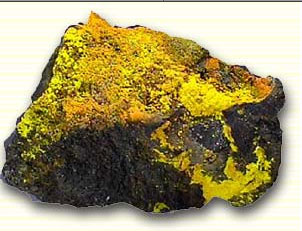
The regulators ordered Cotter to build berms around the 300 to 500 tons of uranium ore by Nov. 17 and to remove the uranium by early next year. “The worry is that an inactive mine can have maintenance and upkeep problems. It could cause polluted runoff,” said Bob Randall, deputy director of Colorado’s Department of Natural Resources. “What we want Cotter to do is clear it. They’ve got to put the berms up. They’ve got two weeks to do it.” Regulators also have ordered Cotter to submit an environmental protection plan.
Separately, Colorado Department of Public Health and Environment officials are poised to renew Cotter’s water-discharge permit for the mine, requiring compliance with current federal standards, said Steve Gunderson, the agency’s water-quality director…

Cotter’s mine sits on federal Bureau of Land Management land, leased by the U.S. Department of Energy. It is one of several uranium sites where state environmental overseers are pressing Cotter for cleanup action.

More nuclear coverage here and here.

New study questions the effectiveness of cloud seeding

A picture named cloudseedingexplained.jpg

From Science Daily:

…research now reveals that the common practice of cloud seeding with materials such as silver iodide and frozen carbon dioxide may not be as effective as it had been hoped. In the most comprehensive reassessment of the effects of cloud seeding over the past fifty years, new findings from Prof. Pinhas Alpert, Prof. Zev Levin and Dr. Noam Halfon of Tel Aviv University’s Department of Geophysics and Planetary Sciences have dispelled the notion that seeding is an effective mechanism for precipitation enhancement.

The findings were recently reported in Atmospheric Research…

During the course of his study, Prof. Alpert and his colleagues looked over fifty years’ worth of data on cloud seeding, with an emphasis on the effects of seeding on rainfall amounts in a target area over the Sea of Galilee in the north of Israel. The research team used a comprehensive rainfall database and compared statistics from periods of seeding and non-seeding, as well as the amounts of precipitation in adjacent non-seeded areas. “By comparing rainfall statistics with periods of seeding, we were able to show that increments of rainfall happened by chance,” says Prof. Alpert. “For the first time, we were able to explain the increases in rainfall through changing weather patterns” instead of the use of cloud seeding.

More cloud seeding coverage here and here.

Energy policy — oil and gas: New produced water facility planned for south of Rifle

A picture named derrick.jpg

From the Grand Junction Free Press (John Colson):

The Greenback Produced Water Recovery LLC will be building what is technically termed a “solid waste disposal site and facility” on a 40-acre property known locally as the Shaeffer Ranch, about four miles south of Interstate 70, southeast of Rifle. The facility, according to documents on file with Garfield County, will “treat, store and reuse produced water from oil and gas operations.” The facility will occupy about 11 acres of the larger parcel. According to Dan Packard, one of the company’s representatives, produced water will be trucked to the facility from well pads throughout the region, where it will be filtered, separated from any remaining oil and gas, clarified and “air stripped.” It can then be put into the same tanker trucks that brought the water to the facility in the first place, and taken back to the drilling pads for reuse…

Packard said that, once treated, the water is suitable for use in toilets and for hand-washing, and that it will be put to those uses at the facility itself.

More OIl and Gas coverage here and here.

ARRI act funds Colorado water projects

A picture named fountainpavementdrawing.jpg

Here’s a release from Governor Ritter’s office (Myung Oak Kim):

Gov. Bill Ritter today congratulated the town of Wiggins in Morgan County for securing $5.5 million from the American Recovery and Reinvestment Act for water system improvements. This is the second major Recovery Act award to Wiggins. In March, the U.S. Department of Agriculture awarded the Wiggins Telephone Association a grant and loan totaling $4.3 million to expand high-speed Internet to customers in the Weldon Valley.

“The Recovery Act is helping rural Colorado advance critical water infrastructure projects like the one in Wiggins to ensure access to safe drinking water and to improve public health,” Gov. Ritter said. “This is yet another way that the Recovery Act is creating jobs and lasting benefits to communities across Colorado.”

The town of Wiggins was awarded a $3,327,000 loan and a $2,252,000 grant through the USDA Rural Development Water and Environmental Program. This program distributes loans and grants to rural communities to improve water and wastewater infrastructure to provide safe drinking water and a cleaner environment. This was one of 89 projects worth $445 million announced today by Agriculture Secretary Tom Vilsack.

In August, the Town of Palisade on the West Slope secured $7.8 million in a loan and grant for water needs through the same program. Two other rural communities, Huajatolla Valley Estates in Huerfano County and Tranquil Acres in Teller County, also received grants and loans.

Colorado expects to receive at least $7.3 billion in Recovery Act funds over the next year or so. More information can be found at www.colorado.gov/recovery.

More infrastructure coverage here.

The American Water Works Association is heading up a study of supply and climate change

A picture named waterfromtap.jpg

Here’s the release from the AWWA (Greg Kail):

The American Water Works Association (AWWA) today announced it will lead a ground-breaking new study on how municipalities forecast water demand within the context of anticipated climate change.

The project, funded by a grant from the National Oceanic and Atmospheric Administration (NOAA), will provide recommendations on how to improve current water demand forecasting and identify areas of essential future research.

The study includes an assessment of current computer models, workshops to identify knowledge gaps, development of research priorities, and recommendations for reducing risk through improved demand forecasting. The researchers will conduct model simulations at two drinking water utilities.
“This project is historic in its focus,” said AWWA Executive Director David LaFrance. “Most studies on climate change and drinking water have focused on the supply side, looking at water resources. The examination of water demand adds an important new perspective. AWWA is excited about the opportunity to help municipalities deal with the complex questions surrounding water demand and climate change.”

AWWA Director of Federal Relations Alan Roberson will serve as principal investigator for the project. Other members of the project team include faculty from George Washington University and the University of Colorado at Boulder, along with staff from the environmental facilitator, Kearns & West.
The project will take approximately two years to complete.

Boone turns dirt on new wastewater treatment plant

A picture named wastewatertreatmentwtext.jpg

From The Pueblo Chieftain (John Norton):

State and local officials were on hand Tuesday as ground was broken for a new wastewater treatment plant that will end the town’s noncompliance problems and provide for residential and commercial growth as more people come to work at the nearby Pueblo Chemical Depot. Most of the $1.6 million project was financed by Community Development Block Grant funds that came from the American Recovery and Reinvestment Act. Boone borrowed $315,000 from the Colorado Water and Power Development Authority for its share and a $10,000 planning grant was provided by the Colorado Department of Public Health and Environment.

More wastewater coverage here and here.

La Niña update

A picture named elninolanina.jpg

From The Colorado Springs Gazette:

Temperatures in November should be warmer than average, said Jim Hall, spokesman for the National Weather Service in Pueblo, meaning they’ll likely rise above the month’s normal daily high temperature of 49.8 degrees and normal low of 22.6 degrees.

Precipitation should also be somewhat scarce. Normally the city gets 6.2 inches of snow, but La Niña has a stubborn tendency to push storms from the Pacific into Canada. With the jet stream so far north, much of the area will be left under a ridge of high pressure — conditions that are less than favorable for a snowstorm.

Energy policy — geothermal: DOE grant allows state to install geothermal system at Colorado capitol

A picture named geothermalopenloop.jpg

Here’s the release from Governor Ritter’s office (Tyler Smith/Todd Hartman/Lance Shepherd):

Gov. Bill Ritter today praised a project that will provide geothermal heating and cooling for the State Capitol building with the help of a U.S. Department of Energy Recovery Act grant. Colorado’s Capitol, which opened in 1894, will be among the first in the nation to benefit from a geothermal system.

The DOE grant will provide $4.6 million for an open-loop geothermal system that will save the state an estimated $95,000 in heating and cooling costs in the first year alone.

“This is a great project to highlight the significant potential that geothermal energy has here in Colorado, and it serves as a shining example of how the New Energy Economy creates jobs, diversifies our energy resources and bolsters energy security,” Gov. Ritter said. “By tapping into the steady temperature below the earth’s surface we will be able to heat and cool the Capitol building with a reliable and clean source of renewable energy at a reduced cost to the people of Colorado.”

The total cost of the project is an estimated $6 million, with $1.4 million funded by the state through Certificates of Participation and a lease-purchase agreement with Chevron. Under the agreement Chevron will guarantee utility savings are sufficient to make the annual lease-purchase payments.

“Today’s announcement is another example of how the Recovery Act is benefiting Colorado and states across the country. This project will help save taxpayers money, reduce our dependence on foreign oil, and support Colorado’s role as a leader in the clean energy economy of the future,” said U.S. Energy Secretary Steven Chu.

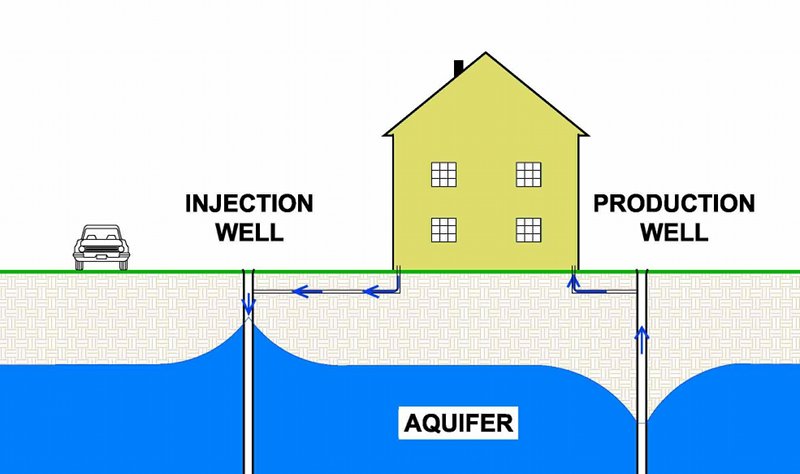
The first phase of the project, which began last week, will drill a well deeper than 900 feet down into the Arapahoe Aquifer, with a second phase beginning in the spring that will include HVAC upgrades and drilling a second well. Water will be pulled from the aquifer to take advantage of consistent 55-degree temperatures that can be used to heat the building in the winter and cool the building in the summer.

The project follows a similar instillation in which a geothermal ground source heat pump was installed at the Governor’s Residence in 2009. The instillation has shown considerable energy savings by reducing the natural gas load by 70 percent and the electricity by 15 percent at the Residence.

More coverage from Brighter Energy (James Cartledge):

The first phase of installation began last month, drilling a well more than 900 feet down into the Arapahoe Aquifer, and is expected to continue through into the spring of 2011 with heating and air conditioning upgrades and the drilling of a second well. The project will see water pumped from the underground aquifer, which offers consistent temperatures of 55 degrees, which can be used to heat the building in winter and cool the building in the summer…

A similar geothermal system was installed at the Governor’s residence last year, which has reduced the building’s natural gas use by 70% and electricity consumption by 15%.

More geothermal coverage here and here.

Colorado State University Receives $2.75 Million to Train Next Generation of Water Scientists and Engineers

A picture named studentsuniversitymissourimacs.jpg

Here’s the release from Colorado State University (Emily Wilmsen):

Jorge A. Ramirez, a Colorado State University professor of civil and environmental engineering, will lead a new $2.75 million research and education program to train the next generation of water scientists. The new program is funded by NSF’s IGERT, the National Science Foundation’s flagship interdisciplinary research training program.

Ramirez and his collaborators received the prestigious NSF grant to develop a new doctoral program in integrated, multidisciplinary research and education that addresses the complex hydrologic, ecologic and socio-economic challenges facing society.

“Water management decisions generate conflicts between humans, ecosystem needs and political jurisdictions,” Ramirez said. “Therefore, there is a critical need for scientists who can address three important questions: 1) how can limited fresh water be distributed equitably in a socially acceptable and sustainable framework; 2) what are the relative ecological and societal benefits and drawbacks of management actions; and 3) how can science provide answers for wise water management decisions?”

The new program is known as WATER or Water, Atmosphere, Ecosystem Education and Research. The WATER program will train doctoral students to conduct interdisciplinary research at the interfaces between hydrologic, atmospheric, ecologic and management disciplines. Students will probe questions of variability and uncertainty, vulnerability of human use and ecosystems and sustainability. The program involves 11 science and engineering departments at Colorado State University and includes opportunities for trainees to participate in internships at federal and state agencies.

The five-year grant will train as many as 30 doctoral students in civil and environmental engineering, atmospheric science and ecology on all aspects of WATER science and engineering, Ramirez said.

Other key researchers participating in the grant are Neil Grigg, also a professor of civil and environmental engineering; Scott Denning, professor of atmospheric science; and LeRoy Poff, professor of biology.

NSF’s Integrative Graduate Education and Research Traineeship program, or IGERT, is intended to meet the challenges of educating U.S. scientists and engineers with the interdisciplinary background, deep knowledge in a chosen discipline and the technical, professional and personal skills needed for the career demands of the future. The program is intended to catalyze a cultural change in graduate education by establishing innovative new models for graduate education and training in a fertile environment for collaborative research that transcends traditional disciplinary boundaries.

Ramirez teaches hydrologic science and engineering and researches such issues as the impacts of climate variability on hydrologic processes, integrated vulnerability and sustainability of water supply, evapotranspiration trends and climate change, land-atmosphere interactions and ecohydrologic modeling. In addition, he is organizer of the Hydrology Days conference, a three-day international scientific meeting held annually at CSU.

More education coverage here.

NIDIS Weekly Climate, Water and Drought Assessment Summary of the Upper Colorado River Basin

A picture named snowpack11012011

Here are the notes from last Tuesday.

More Colorado River basin coverage here.

Greeley: How much water will the new Leprino cheese plant use?

A picture named irrigationditchgreeleyhistoricalresources.jpg

Here’s a look at the feed requirements for Leprino’s new cheese plant, from Bill Jackson writing for The Greeley Tribune. From the article:

A dairy cow will eat about 45 pounds of corn silage per day, or two to three times that of a steer in a beef cattle feedlot, [Bill Wailes, head of the animal sciences department at Colorado State University] said. That amount varies from dairy to dairy, depending on specific feed rations, but, regardless, that’s a lot of corn. Silage is a crop that has to be grown close to its point of consumption, whether it be a dairy or a feedlot. The limit on the distance it can be transported is about 25 miles because of its moisture content. Hay is another source of roughage in the diet of a dairy cow or feeder animal. It can come from farther distances, although the price of fuel will have a significant impact. Shell corn, another major component of the diet of a ruminant, can, and does, come from greater distances. And, in recent years, the byproduct from ethanol plants in the region has become a staple in the diet of dairy animals. So, using 50,000 as the number of new cows coming to Weld County, Wailes estimated an additional 410,000 tons of silage per year would be required. Based on a 30-ton-per-acre average, which admittedly is a little high, a minimum of 14,000 acres of new silage will be needed in the area to meet the needs of those cows…

Corn silage, according to research conducted by Joel Schneekloth and Allen Andales of CSU, requires about 8 inches less a year in water than does sugar beets in the Greeley area — 30 inches for beets versus 22 inches for corn. Under ideal conditions — whatever those may be — the net requirement is reduced by rain, which in the Greeley area is about 7 inches per growing season. Depending on the efficiency of irrigation systems, the two researchers said the gross water requirements of sugar beets versus corn could be as much as 52 percent.

More South Platte River basin coverage here.

Telluride: The town council approves $10 million in bonds for new water treatment plant

A picture named bridalveilfallstelluride.jpg

From the Telluride Daily Planet (Katie Klingsporn):

The project aims to provide Telluride with a pure and secure source of water by tapping Blue Lake — located high in upper Bridal Veil Basin. The plan is to pipe water from Blue Lake to a facility built on a shelf of land in the east end of the box canyon, and from there disperse it to town users. Planning of the project has been in the works for more than a decade, and voters approved the bonds in 2006. However, it has been stalled by litigation, as the town wrangled in court with Idarado Mining Company over water rights and easements, and negotiations were still ongoing this summer.

But it lurched back to life early this fall when the town approved a construction contract, and the momentum was carried into a plan to issue the bonds to pay for it. The town’s bond counsel, Steve Jeffers, said the current climate is very favorable for bonding, and urged the town to pull the trigger this fall. By issuing bonds right now, he said, the town could find interest rates at around 3.4 percent. In previous discussions on the matter, Jeffers also indicated that contractor rates are low right now. And he urged the town to issue the bonds just in case a trio of controversial ballot measures, 60, 61 and 101 — which could adversely affect the ability of governments to bond — pass on Tuesday.

More San Miguel River watershed coverage here.

Precipitation news

A picture named pinewoodreservoirberthoudrecorder.jpg

From the Boulder Daily Camera (Laura Snider):

Since Aug. 1, Boulder has received just 2.26 inches of rain. The average precipitation over those three months is 5.14 inches, according to Matt Kelsch, a meteorologist at the University Corp. for Atmospheric Research in Boulder.

Bayfield and the La Plata / Archuleta Water District to partner on water treatment plant?

A picture named watertreatment.jpg

From the Pine River Times (Carole McWilliams):

Cooperation got a positive response on Oct. 19 at a joint meeting of Bayfield town trustees and La Plata/ Archuleta Water District board members. They discussed a possible joint venture to expand the town’s existing water treatment plant or to build a new one. Either one would provide water to both entities. The other alternative is for the district to go it alone with a new plant. LAPLAWD board chairman Dick Lunceford thanked town trustees for being open to discussing a joint venture. “I think it will be a benefit to both,” he said…

The district master plan proposes a treatment plant near Bayfield and one at the Animas/ La Plata Project Lake Nighthorse to serve the west side of the district.
Water engineer Steve Harris (Kraft’s employer) said the Bayfield treatment plant is the higher priority, because that’s more in the center of the district’s 400-square-mile service area…

[Town Manager Justin Clifton] said the town will put out a request for qualifications for a consultant to do a feasibility study on a joint venture. Both boards will have to agree on cost sharing and approve a contract to do the study…

[Water engineer Steve Harris], [LAPLAWD board chairman Dick Lunceford], and [Engineer Amy Kraft] noted how long it’s taken to achieve a rural water system. The effort started in 1994 with the idea that it would be fairly easy, Harris said, adding, “Maybe we are finally getting close to putting pipe in the ground.” Kraft joked that since she got involved with the effort, she has gone to college, graduated, and had a child.

More San Juan Basin coverage here.

Arkansas Valley: Pure Cycle is looking for ways to make some dough on its investment in valley irrigation water

A picture named arkbasinditchsystem.jpg

From The Pueblo Chieftain (Chris Woodka):

“We haven’t changed our plans at all,” said Mark Harding, president of Pure Cycle. “We’re still very interested in participating in this municipal-agricultural partnership.”[…]

Shortly after the purchase, Harding explained that Pure Cycle was looking for opportunities to use the water within the Arkansas River basin, as well as its stated intention of building a pipeline to take the water from the valley. Harding was among those who incorporated the Arkansas Valley Super Ditch in 2008, improving the chances that those Fort Lyon shares could be used within the valley.

Pure Cycle inherited conditions that were put on its Fort Lyon farms when High Plains A&M attempted to change the use of the water. In 2003, the Fort Lyon board approved moving the water outside the ditch, provided it was taken in rotation. In 2004, District 2 Water Judge Dennis Maes denied High Plains’ application to change the use of water because it was speculative. The Colorado Supreme Court upheld that ruling following a challenge by High Plains. Pure Cycle announced plans to build a pipeline from the La Junta area when it bought the water in 2006, although it soon became apparent those plans were years away. Pure Cycle now serves only about 300 homes, although it is in line to provide water for 24,000 acres of future development on the former Lowry Range east of Aurora, as well as a 5,000-unit development on Sky Ranch. For now, Pure Cycle continues to farm the land it owns on the Fort Lyon…

Harding also is noncommittal on what impact participating in the Super Ditch would have in stopping or delaying a pipeline from the Lower Arkansas Valley. “There are limitations on exchange potential, so I’m not sure what infrastructure would be necessary,” Harding said. The Super Ditch has filed for an exchange decree that would move water up the river and into Lake Pueblo, which still has to be approved in Water Court. Approval of ditch companies, county commissioners and other agencies also is needed before contracts can be drafted.

Meanwhile, Aurora’s hands are tied by intergovernmental agreements with respect to buying and drying more agricultural land. Here’s a report from Chris Woodka writing for The Pueblo Chieftain. From the article:

“We can become a farmer,” Aurora Mayor Ed Tauer said this week. “We can’t move the water [newly acquired water rights], however, so it’s unlikely we’d buy a large amount.” At a meeting with the Arkansas Valley Super Ditch board Tuesday, Tauer talked about putting water supplies from existing or new farms purchased by Aurora into the pool of water rights that could be used for the Super Ditch. That possibility is also accounted for in a 2009 agreement with the Lower Arkansas Valley Water Conservancy District that allows Aurora to participate either as a buyer or seller of water through the Super Ditch.

A 2003 agreement with the Southeastern Colorado Water Conservancy District — fortified by the 2004 six-party intergovernmental agreement — doesn’t limit Aurora from acquiring new water rights in the Arkansas Valley, but does prevent it from using existing infrastructure or changing the use of any new water rights, said Mark Pifher, director of Aurora Water.

More Arkansas Valley Super Ditch coverage here and here.