Snowpack news

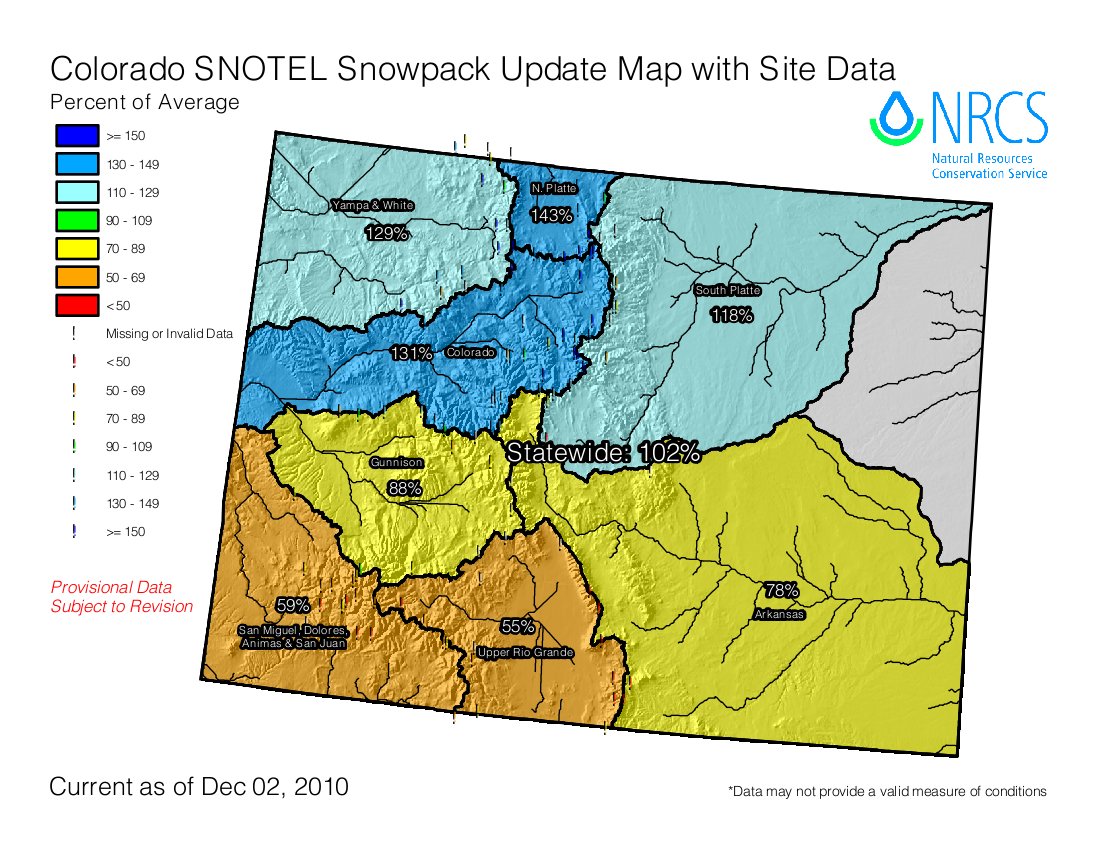
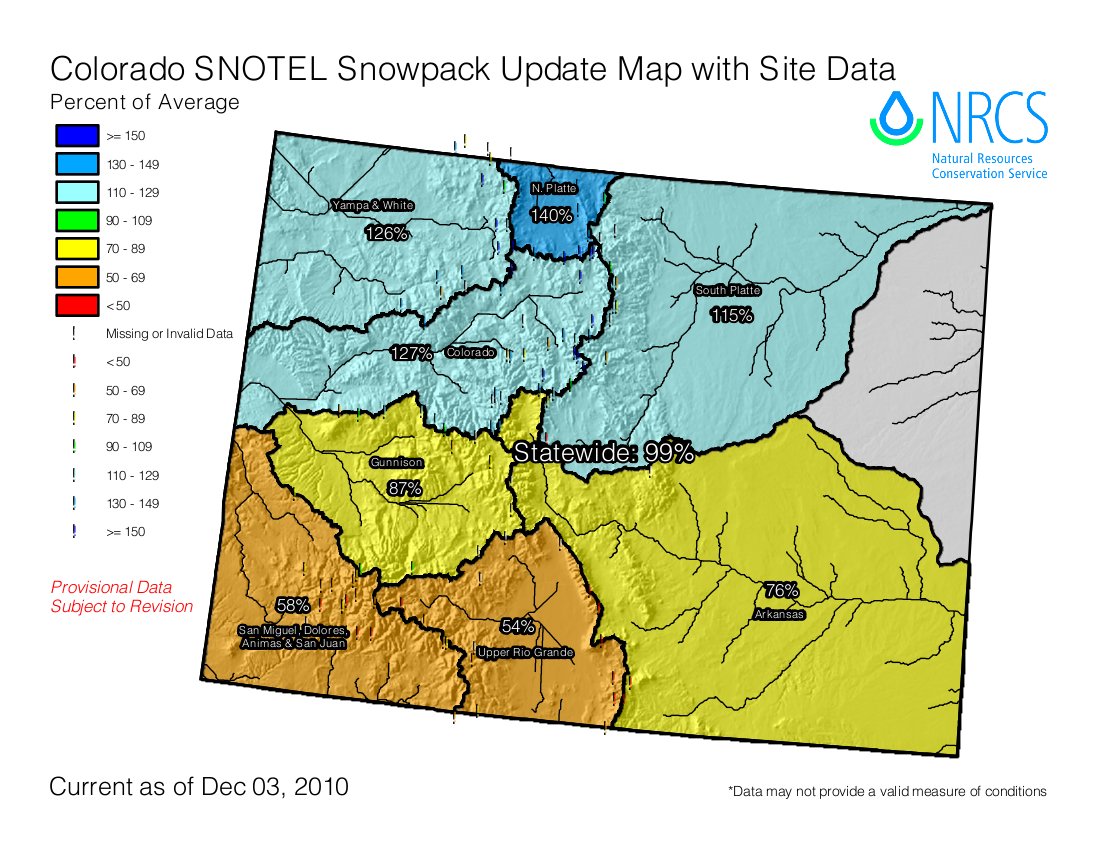
A picture named snowpackcolorado12032010

From the Aspen Daily News (Brent Gardner-Smith):

“At least so far this year, things are setting up in that typical La Nina pattern, said Chris Pacheco, the assistant snow survey supervisor with the Natural Resources Conservation Service (NRSC). “It is not surprising that the northern portion of the state is doing better than the southern part of the state.”[…]

And according to [the Ski West Report], snowpack around the Aspen area is at 123 percent of average, based on an average of readings from snow monitoring stations on Independence Pass, McClure Pass, North Lost Trail near Marble and Schofield Pass. The Independence Pass snow-monitoring station, at 10,600 feet, is at 113 percent of average…

The area around the Steamboat ski area is 178 percent of the 30-year average. The areas around Keystone, Arapaho Basin and the Loveland ski area is 157 percent of average, while the snowpack around Copper Mountain and Breckenridge is 139 percent of average. The NRSC shows Crested Butte at 127 percent of average, Vail at 119 percent and Powderhorn near Grand Junction at 103 percent. But then the numbers fall toward the south. The area around the Monarch ski area shows a snow depth of 103 percent of average, Purgatory near Durango is at 100 percent of average, Telluride is at 98 percent and Wolf Creek is at 84 percent…

Snowpack in the Colorado River basin — from the headwaters in Rocky Mountain National Park to above Lake Powell — is 130 percent of average.

Silt: The town with the help of the Aspen Valley Land Trust acquires a 132 acre parcel next to the Colorado River for habitat and river access

A picture named siltcreek.jpg

From the Glenwood Springs Post Independent:

Hikers, boaters and fishing enthusiasts soon will have a new access to the Colorado River at the Silt River Preserve, a 132-acre riverfront parcel formally purchased on Nov. 30 by the Town of Silt for $1.2 million. The purchase from the Dixon Water Foundation was the culmination of a year and a half of effort by the town and the Aspen Valley Land Trust (AVLT) aimed at preserving open space and riparian habitat along the river for public benefit.

More conservation coverage here.

Mesa State College seminar — ‘Running Dry: A Journey From Source to Sea Down the Colorado River’

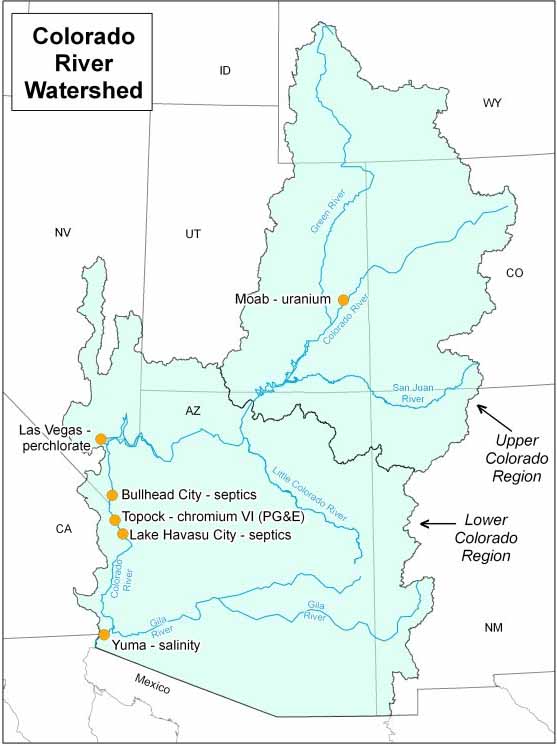
A picture named coriverwatershed.jpg

From email from Gigi Richard:

Our next presentation in the Fall 2010 Natural Resources of the West: Water seminar series a project of the Water Center at Mesa State College will be…

Mon 6 December, 4:00 pm
Saccomanno Lecture Hall, Wubben Science Building , Room 141 (WS 141)
Mesa State College

Running Dry: A Journey From Source to Sea Down the Colorado River
Jon Waterman
Author and National Geographic Freshwater Hero

In the spring of 2008, Jonathan Waterman, a National Geographic Society grantee, Sonoran Institute Fellow, and an award-winning author, began a journey by foot and boat down the iconic mother of all western American rivers, the Colorado. Standing at over 10,000 feet in Colorado’s Rocky Mountain National Park, he emptied his mother’s ashes into the headwaters and began a journey by foot and boat down the river, all the way to its last trickle in the Sonoran desert and down the parched Mexican delta to the Pacific Ocean. It would be the first time anyone had ever traveled from these headwaters 1,450-miles to Gulf of California and it would be a compelling, complicated, and hugely informative journey.

As part of his Colorado River Project, Waterman has undertaken a lecture campaign throughout the west to educate the public about the river’s challenges in times of climate change and population growth. He also chronicles his experience and the river in his new narrative book,Running Dry: A Journey From Source to Sea Down the Colorado River, a photo book, The Colorado River: Flowing through Conflict, and a National Geographic ColoradoRiver BasinWall Map. The Colorado, sometimes called the American Nile, supplies water for 30 million people and more than 3 million farm acres, across 7 western states and northern Mexico. But the demands made on the river have put its very future at stake. The river has not reached the sea for many years. It is the lifeblood of the American West, and as its waters dip to an all-time low, the economy, wildlife, people, and very landscape of this vast region are in jeopardy.

Mr. Waterman’s talk is presented with the generous support and funding of: The Water Center at Mesa State, Mesa State College’s Lectures and Forums Committee; The Land Policy Institute at Mesa State College; Mesa State College’s Academic Affairs Office; and the Grand Valley Audubon Society.

Seminars are free and open to the public, no registration necessary.
For the entire seminar series schedule, please see:
http://home.mesastate.edu/~grichard/WSS/Seminar2010.html
For more information please contact:
Prof. Gigi Richard, 970.248.1689, grichard@mesastate.edu
Prof. Tamera Minnick, 970.248.1663, tminnick@mesastate.edu

More coverage from the Grand Junction Free Press (Sharon Sullivan).

More Colorado River Basin coverage here.

Trout Unlimited and the Pagosa Area Water and Sanitation District agree to settle Dry Gulch lawsuit and have worked out the terms for a proposed decree

A picture named sanjuan.jpg

Here’s the release from email from Trout Unlimited (Randy Scholfield):

Trout Unlimited announced today that it has reached settlement in principle with the Pagosa Area Water and Sanitation District and the San Juan Water Conservancy District in long-running litigation on the districts’ claims for water rights for the so-called Dry Gulch Reservoir and Pumping Station project near Pagosa Springs. The settlement, which still needs to be written into a decree and approved by District Court Judge Gregory G. Lyman, sets significant limits on the amount of water the districts can divert from the San Juan River for the proposed project.

The settlement represents a dramatic downscaling of the Dry Gulch project. In 2004, the districts filed an application with the district court in Durango for water rights they claimed to need to serve future population growth in Pagosa Springs and Archuleta County. The districts claimed storage rights of 35,000 acre-feet in Dry Gulch Reservoir, a refill right for the reservoir of 35,000 acre-feet, and the right to divert 180 cubic feet of water per second from the San Juan River.

Under their original application, the water districts could have diverted as much as 128,400 acre-feet of water per year from the San Juan. Under terms of the settlement, the utilities can take no more than 11,000 acre-feet from the San Juan River in any one year and no more than 9,300 acre-feet per year on a 10-year rolling average.

Moreover, the districts are prohibited from diverting water if doing so will cause flows in the San Juan River to drop below minimum flow thresholds designed to protect fish and the environment. These flow thresholds are double the amount of the existing Colorado Water Conservation Board instream flow water rights.

“This is a victory for the San Juan River,” said Drew Peternell, director of Trout Unlimited’s Colorado Water Project. “The original application could have been devastating to fish habitat and the river ecosystem, but now we have a settlement that balances the districts’ need for water with the health of the San Juan.”

In 2006, TU appealed the decision of the district court awarding the utilities’ 2004 water rights application. Citing concerns that the districts were speculating in water and claiming more water than they needed, in 2007 the Colorado Supreme Court reversed the water court decision and remanded the case. In so doing, the Supreme Court established new, stricter standards for public utilities claiming water rights for future population growth.

In 2008, the district court issued another decree awarding the utilities water rights for a 25,000 acre-foot reservoir and diversions of 150 cfs. Trout Unlimited appealed to the Supreme Court again, arguing that the revised water rights were still speculative and not consistent with credible future water demand projections.

In November 2009, the Colorado Supreme Court agreed with TU, again reversing the water court decision. The Supreme Court reaffirmed its earlier ruling that public utilities must base the size of their water rights on credible evidence of future water needs.

“The settlement underscores that municipal water projects must be based on well-founded, substantiated data about future growth and water needs,” Peternell said. “In a time of water scarcity, Colorado must embrace water solutions that meet a range of needs, including municipal growth, agriculture and wildlife and recreation. No water user can take more than its fair share.”

Here’s Part One of Bill Hudson’s series Dry Gulch gets a little dryer running in the Pagosa Daily Post. From the article:

Evan Ela had been representing both PAWSD and SJWCD since 2004 in their joint attempt to secure new water rights sufficient to fill that crucially necessary 35,000 acre-foot reservoir. That water rights application was approved by Durango judge Greg Lyman, but was then challenged by national fishing organization Trout Unlimited — twice. Both Trout Unlimited challenges were essentially upheld by the Colorado Supreme Court, sending the case back to judge Lyman for further hearings.

Over the past year, PAWSD, SJWCD and Trout Unlimited have been engaged in settlement discussions.

The essential question was this: Would PAWSD and SJWCD be willing to reduce the size of the requested new water rights — and as a result, reduce the size of the Dry Gulch Reservoir — in order to help preserve a free-flowing, wildlife-supporting San Juan River?

One year ago, I would not have expected either the PAWSD board or the SJWCD board to even consider backing down on their requested water rights. But over the past year, a couple of significant changes occurred on the PAWSD board. New directors Roy Vega and Allan Bunch joined that board — and then WSCWG member Jan Clinkenbeard was appointed to a seat left vacant by resigning member Bob Huff. Those changes created a completely new majority on the PAWSD board.

Meanwhile, the SJWCD board also saw a couple of changes to its nine member board, as three resignations led to new members Pat Ullrich, Larry Ash, and Diane Bower being added to the board.

And maybe, everybody was just tired of arguing about Court Case 04CW85.

More Dry Gulch Reservoir coverage here and here.

Cache la Poudre River: Lawsuit to be filed by conservation groups over the Arapahoe snowfly

A picture named arapahoesnowfly.jpg

From the Fort Collins Coloradoan (Bobby Magill):

The environmental groups filed their petition with the Fish and Wildlife Service in April, but the agency did not make a decision about whether the snowfly was threatened enough for the service to consider protecting it. The Fish and Wildlife Service “gave the standard response: They have other things to do,” said Nicole Rosmarino of WildEarth Guardians, who sent a letter to the agency Wednesday informing it that the environmental groups intend to sue if it doesn’t act within 60 days.

“They haven’t given us an indication of when they’ll come out with a finding,” Rosmarino said. “The only way to get the Fish and Wildlife Service to issue decisions on petitions is to go to court. This is the first step toward going to court over the Arapahoe snowfly.”

Fish and Wildlife Service spokeswoman Diane Katzen-berger said the agency is working on its decision about the snowfly, and it is due to be published in the Federal Register in April. She said the agency is cash-strapped and short-staffed, and it hasn’t been able to get around to fully evaluating the snowfly’s status until recently.

More endangered/threatened species coverage here.

Fraser: Town may move to use-based water rates

A picture named frasercolorado.jpg

From the Sky-Hi Daily News (Reid Armstrong):

Town Manager Jeff Durbin along with the town’s water-wastewater committee has proposed treating businesses and residences the same under a new fee structure. “I don’t see any reason to multiply the rate for businesses just because they are businesses,” Durbin said. “Businesses carry more of the burden already, and without them, we won’t have services.”[…]

Under the proposed system, businesses and residences would be charged based on the size of the pipe coming into their building rather than on the square footage of the business or the number of bedrooms in the house. The new system is expected to “flatten out inconsistencies,” Durbin said. Many businesses are expected to pay less for water and sewer under the proposed fee structure than they did in 2010. Larger, newer residences are also likely to see rates drop with the new fee structure since they are typically second homes that use less water.

But, with the switch from a flat rate to a use-based system comes some risk, explained Durbin. If the plan works and customers really start conserving water, the town stands to lose much-needed revenue…

Most of Fraser’s single-family residential customers currently pay a flat rate of $119 per quarter for water and $121 for sewer, regardless of use. The proposed base rate drops to $115 per quarter for almost all residences, including those who have larger homes. But, the town is also proposing a usage fee of $1.50 per 1,000 gallons. The average homeowner who uses 4,000 gallons per month will only see their bill increase by about $6 or 5 percent, Durbin said. Wastewater rates are proposed to increase from $121 per quarter to $129.

The board will discuss the proposed rate changes when it meets at 7 p.m. Dec. 1 in Fraser Town Hall.

More infrastructure coverage here.

Snowpack/La Niña news

A picture named geothermalenergy.jpg

From The Grand Junction Daily Sentinel (Dave Buchanan):

According the [NRCS report], the area around Steamboat has received 178 percent of its 30-year average snowfall to this date. The area around Keystone, Arapahoe Basin and Loveland ski area is 157 percent of average while the snowpack around Copper Mountain and Breckenridge is 139 percent of average. The Aspen area is 123 percent of average while Crested Butte registers at 127 percent of average, Vail at 119 percent and Powderhorn at 103 percent…The area around Purgatory near Durango is at 100 percent of average, Telluride is at 98 percent and Wolf Creek, which usually boasts one of the state’s deepest snowpacks, registers 84 percent.

More coverage from The Crested Butte News (Mike Horn):

As for the outlook in Colorado, Joel Gratz, founder of Coloradopowderforecast.com, said to expect a solid winter. “La Niña means good, good things for Colorado. From about Crested Butte and north, this season’s snowfall should total 100 percent to 125 percent of average. “For Colorado and the United States in general, La Niña favors areas that are farther north. I would expect Steamboat to do very well this year, as well as states north of Colorado.” In the central mountains, we’re right on the edge—and hopefully inside of the storm track. So far, so good. Early-season storms, according to Gratz, “are 100 percent typical. It’s actually uncanny how these individual early-season storms epitomize the average La Niña pattern. Most La Niña-type storms will provide good snow to the central and northern Colorado Mountains, with slightly lower amounts for the San Juans. “The [Elk Mountains] should do well and are a part of my ‘100 to 125 percent’ of average snowfall zone on the season. During the last La Niña winter [2007-2008], Irwin recorded over 1,000 inches of snow. Heck yeah!”

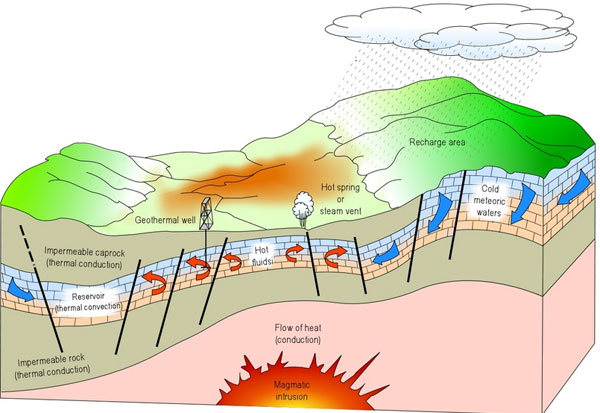
Energy policy — geothermal: Pagosa Springs geothermal infrastructure update

A picture named geothermalenergy.jpg

From the Pagosa Sun (Jim McQuiggin):

Last month, Pagosa Springs Geothermal Supervisor Phil Starks presented a report to council stating that the potential for systemic failure is especially apparent in the town’s geothermal heating system, which experienced a cascade of failures during the past year. Initial repairs to the system earlier this summer were immediately followed by failures downline (concentrated along the Lewis Street corridor), most likely the result of differential pressure created when the initial repairs were done. Reporting the work completed over the summer, Starks added that the failures were symptomatic of a system that had exceeded its lifespan and would see increased failures in the near future.

When SUN staff, during a later phone interview, asked Starks if those failures were systemic, Starks replied, “Yeah, essentially.” According to Starks, “It’s the whole system in general because of the nature of the geothermal water, the age and type of piping used, plus the heat of the water. We are fatiguing the system due to the depressurizing and repressurizing that takes place every year.” Currently, the town carries most of its water for geothermal heating through asbestos cement (AC) piping, which under normal circumstances has a lifespan of anywhere between 50 and 70 years. While the AC piping in Pagosa Springs has been in the ground for over 30 years, “The way we use our system is causing the breakdowns,” said Starks. Starks said that breaks occur in the system, “Normally when we repressurize — about one a year,” but added that, with the stress on the aging system, he anticipates that number to increase, similar to what happened this past summer…

Although the Obama administration has allocated hundreds of billions of dollars for infrastructure projects since early 2009 — with allocations especially designated for renewable energy — the town has been slow to pursue those funds. Despite an additional $50 billion being released by the administration this past summer, with those funds tied directly to infrastructure (with priority given to renewable energy projects), the town has just recently investigated availability of infrastructure stimulus money for its geothermal system (Starks and the town, after several fits and starts, have pursued federal funds for construction of its wastewater treatment plant). While Starks said that a grant application was being written by Mary Tighe (the Pagosa Springs Community Development Corporation’s newly-hired community grant writer), he could not say what kind of priority was being given to the grant application or when it would be submitted.

More geothermal coverage here and here.

Pagosa Area Water and Sanitation District’s water resource fee dominates board meeting

A picture named fountainpavementdrawing.jpg

From the Pagosa Sun (Randi Pierce):

The board invited PAWSD attorney Evan Ela, of Collins, Cockrel & Cole (Denver), to the meeting to discuss the legality of the district’s WRF since its legality has been questioned by directors Roy Vega and Allan Bunch, as well as a number of the Water Supply Community Work Group. The WRF is an assessment levied on all new construction to help pay for future water development made necessary by growth. The fee is not currently being assessed due to a moratorium in place that will expire Feb. 1, giving the board time to look into the matter.

PAWSD initiated the fee in 2005, as district engineers insisted new water storage would soon be necessary. At the time, a panel of community volunteers decided that new growth should pay its own way, thus resulting in the WRF and other “impact” fees imposed by other local districts, the town and Archuleta County. Before implementing the WRF, PAWSD looked into how similar communities funded future water development, as attorneys from Collins, Cockrel & Cole analyzed legal options. Near the end of 2005, the district board approved the fee…

At Tuesday’s meeting, Ela reiterated the stance that the fee is “fully legal” under Title 32, explaining to the board how each Titles 29, 30, 31 and 32 relate to various governmental and quasi-governmental entities. Ela explained that Title 29, which discusses impact fees, is “entirely directed” towards governments with land regulatory powers and that it is “no accident” such fees were under Title 29. Ela continued that statutes have to be read precisely, also citing multiple court cases in which water districts were allowed to impose “rationally related” development fees for growth to pay its own way. Ela added his belief that courts give latitude on the fees to be rationally related at the time the service is needed…

Two hours of discussion later and with no real headway seemingly made in terms of a consensus between the board members over the legality of the WRF, future discussions concerning both the presence of the fee and the possibility of WRF rebates will have to take place before the Feb. 1 moratorium expires.

More Pagosa Springs coverage here and here.

Spinney Mountain Reservoir closes for season

A picture named spinneymountainreservoir.jpg

From the Fairplay Flume (Marcey Hodshire):

Spinney Mountain State Park on County Road 59 near Hartsel is closed until next spring, according to a press release by Colorado State Parks…”Colorado State Parks and the City of Aurora, which uses the water stored in the reservoir, close the park each fall when ice covers the reservoir,” said Park Manager Kevin Tobey in the press release.

More South Platte River basin coverage here and here.

Eagle River watershed: Water settlement secures water rights on the upper Eagle River

A picture named eagleriver.jpg

From the Vail Daily (Sarah Mausolf):

Developers filed for water rights for the project with the Colorado water court in 2005, [Dave Kleinkopf, a principal for developer Crave Real Estate] said. Several parties that use water on the upper Eagle River, including the Eagle River Water and Sanitation District, filed as objectors to the case. Until recently, it had been unclear whether the various interest groups would reach an agreement over the water rights or the case would go to trial in water court. A trial could have put the water rights for the project in jeopardy and would have cost developers a significant amount of money, Kleinkopf said.

Water for the future Battle Mountain project will come from a proposed 1, 210 acre-foot reservoir at Bolts Lake, south of Minturn…

Water rights for the project came through a settlement signed by the town of Minturn, Battle Mountain, Eagle River Water and Sanitation District, Upper Eagle Regional Water Authority, Vail Associates, Inc. and Eagle Park Reservoir Company, along with the Arrowhead, Beaver Creek, Berry Creek, Eagle-Vail, Edwards, Holland Creek, and Red Sky Ranch metropolitan districts. The settlement pertains to four cases filed with the water court between 2005 and 2007…

The agreement also granted Minturn water rights for future growth in town, independent from the Battle Mountain project. The water district will give Minturn access to as much as 50 acre-feet of the district’s storage water in either Eagle Park Reservoir or Homestake Reservoir, which are upstream of Minturn.

More Eagle River watershed coverage here and here.

Middle Colorado Partnership to hold ‘Water Law in the West’ seminar December 3

A picture named coloradorivereaglecounty.jpg

From the Glenwood Springs Post Independent (Clark Anderson):

The Middle Colorado River Watershed Partnership (Partnership) will host a seminar on “Water Law in the West” on Friday, Dec. 3, at 8:30 a.m., at the Garfield County Re-2 School District administration building, 839 Railroad Ave. in Rifle. The seminar, part of a series being hosted by the Partnership, features Aaron Clay, a water attorney from Delta, with over 30 years of experience practicing water law in Colorado, including 26 years as a Referee with the Colorado Water Court. The seminar will provide an introduction to the legal and policy underpinnings of water use and management in Colorado and in the arid West, including fundamentals about water rights and how water supplies are appropriated and administered, all in nontechnical terms.

More Colorado River basin coverage here.

Precipitation news

A picture named snowflakesbentley.jpg

From the Summit County Citizens Voice:

Several Colorado ski areas have already picked up more than 100 inches of snow this season, with Steamboat leading the pack at 111 inches. Breckenridge has reported 109 inches of snowfall for the season…Vail also broke the 100-inch mark during the most recent wave of snow…Beaver Creek is at 73 inches for the season and has about 800 acres of terrain open for early December skiing…Copper has picked up 87 inches of snow so far, and an automate SNOTEL site at Copper is showing that the snowpack is nearly double the average for this time of year…Keystone year-to-date snowfall…[is] 78 inches…Just across the Divide, Loveland also broke the century mark, with 101 inches of snow.

Colorado State University Scientists Lead Team Studying Precipitation in Higher-Latitude Clouds

A picture named cloudsatlaunch.jpg

Here’s the release from Colorado State University:

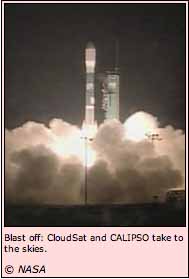
Scientists have gained a much better picture of how much precipitation comes from clouds thanks to CloudSat, NASA’s first cloud-profiling radar in orbit designed in part by former Colorado State University researcher Graeme Stephens.

Even the best technology in the world needs a backup plan: Scientists need to check the measurements from CloudSat against actual observations in the sky to ensure that their predictions and models are working.

Tristan L’Ecuyer, a Colorado State research scientist and one of the original crew working on CloudSat with NASA’s Jet Propulsion Laboratory, spent five weeks in September and October flying over Helsinki, Finland, to measure precipitation in clouds at higher latitudes. These clouds produce light, steady rainfall that makes up a large fraction of the fresh water that supports life at higher latitudes. Helsinki gets extended periods – usually two months – of this type of light rainfall, L’Ecuyer said.

L’Ecuyer flew in a specially equipped plane – owned by the National Science Foundation – to compare measurements of cloud particles and raindrops against precipitation models and CloudSat observations.

The experiment, known as the Light Precipitation Validation Experiment, provided some of the first observational data on these types of clouds. Also working on the project were research scientist Matt Lebsock and graduate student Norm Wood, both from Colorado State, as well as scientists from the Finnish Meteorological Institute, the University of Helsinki, Environment Canada and the University of Wyoming, which hosts the plane.

“Light rainfall at higher latitudes is an important source of fresh water that could be susceptible to climate change. It’s really important to be able to verify whether our model of future changes in light rainfall are on the right track or not,” L’Ecuyer said. “We’re trying to measure the whole vertical profile of the cloud that produces precipitation to help explain what we see from space with CloudSat. The CloudSat observations can then be used to test climate models globally.”

Measurements collected during the experiment show how these high-latitude clouds produce precipitation: Small ice particles at the top of the cloud collect into snow crystals just above the freezing mark. As those particles start to fall and the temperature warms above freezing, they collapse and turn into rain drops.

“We watched the ice crystals melt as we flew down through the clouds – you can’t see that with the naked eye,” L’Ecuyer said. “We’re studying the properties of the air, the humidity, temperature and the water content as well as how much rainfall actually landed.”

Funding for the project was provided through CloudSat and JPL.

Stephens, formerly at CSU and now at JPL, is the principal investigator on NASA CloudSat mission, which is one of the few university-led Earth science missions. CloudSat launched from Vandenberg Air Force Base near Santa Barbara, Calif., and reached its destination 438 miles above Earth in April 2006. Colorado State’s Cooperative Institute for Research in the Atmosphere – a partnership with NOAA – collects and distributes data from CloudSat to scientists across the globe.

The National League of Cities is holding its Congress of Cities and Exposition today in Denver

A picture named cityparksunrise.jpg

From The Denver Post:

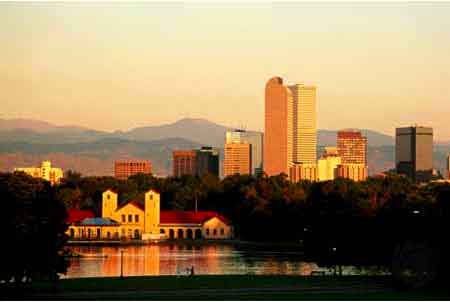
The National League of Cities is holding its Congress of Cities and Exposition at the Colorado Convention Center in downtown Denver through Saturday. Thousands of municipal elected officials and city workers are in town for seminars with titles such as “Regional Perspectives on Water Infrastructure.”

Ben Grumbles takes over the reins at the Clean Water Alliance

A picture named animasriver.jpg

Say hello to the Clean Water Alliance. From their website:

The 501(c)(3) nonprofit Clean Water America Alliance (CWAA) is working today to explore the complex issue of water sustainability and plan for the future by improving public awareness that advances holistic, watershed-based approaches to water quality and quantity challenges. A broad cross-section of interests have come together through the Alliance to begin an important dialogue on the future – focusing on exploring and analyzing issues of critical importance to the nation’s ability to provide clean and safe waters to future generations, offering information and education to citizens and policy-makers on key issues, and recognizing organizations and individuals for innovation and outstanding achievements in the water quality and quantity arena.

Here’s the Grumbles’ announcement (Lorraine Lokin):

The Clean Water America Alliance welcomes Ben Grumbles, a dynamic water policy leader, as its new President beginning in December. A passionate civil servant, Grumbles served as Director of the Arizona Department of Environmental Quality and is the longest serving Assistant Administrator for Water at the U.S. Environmental Protection Agency (EPA). “The Alliance is uniquely positioned to make a big difference and improve water policy nationally and locally,” explains Grumbles. “I’m honored to have the chance to help unite, rather than divide, people and interests and make meaningful progress sustaining America’s most precious liquid asset.”

Grumbles has served on the Alliance Board of Directors since April 2009 and chaired the organization’s national dialogue series which concluded this past September. He succeeds Ken Kirk, who shepherded the Alliance for its first three years. Kirk will continue his role as the Executive Director of the National Association of Clean Water Agencies (NACWA). “New leadership is critical at this time to move the Alliance forward” says Kirk. “I believe strongly in the organization’s objectives and will continue to participate in other capacities going forward.”

While serving as the Director of the Arizona Department of Environmental Quality, Grumbles focused on three priority areas: conservation and reuse of water (e.g. wastewater recycling), clean energy and climate change (e.g. solar power, vehicle emissions, uranium mining), and collaboration (e.g. the Colorado River, the Mexican Border, e-waste recycling). While serving as the Assistant Administrator for Water at the U.S. EPA he led its National Water Program from January 2004 – January 2009. He also served as associate administrator for EPA’s Office of Congressional and Intergovernmental Relations in 2004, working with mayors, governors, and state and federal legislators.

Prior to EPA, Grumbles worked as a Senior Counsel for the Water Resources and Environment Subcommittee of the U.S. House Transportation and Infrastructure Committee and Environmental Counsel and Deputy Chief of Staff for the Science Committee. He also taught for 10 years at the Environmental Law Program of George Washington University Law School from 1994 to 2004. Ben has a BA degree in English from Wake Forest University in North Carolina, a JD degree from Emory Law School in Georgia, and an LLM (Masters) degree in environmental law from George Washington Law School in Washington, D.C.

Their Urban Water Sustainability Leadership Conference is next week.

Interbasin Compact Committee meeting recap: Strategies to take the pressure off agricultural water

A picture named ibccroundtable.jpg

From The Pueblo Chieftain (Patrick Malone):

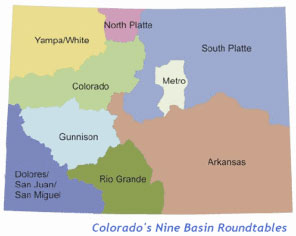
During its meeting at the Denver West Sheraton on Wednesday, the IBCC unveiled that progress in a draft strategy for sustaining the state’s future water supply. Its four-pronged tenets are a blend of water conservation, identified projects and processes (IPPs), agricultural transfers and developing new supplies.

While agricultural transfers are a staple in the strategy, delicate handling of them and a mindful perspective on their impact also are keys, and minimizing agricultural transfers is an objective of the IBCC’s strategy. “Large-scale dryup of irrigated agriculture has considerable adverse economic and environmental impacts,” the report said. “While some future portion of (municipal and industrial) water will come from agricultural sources, encouraging alternative agricultural transfers and new water supply development is essential to prevent the dryup of agricultural land. To the extent the conservation, IPPs and new water supply development is successful, less water will be transferred out of agriculture to meet the (municipal and industrial) gap.”

One mechanism proposed in the report to protect agricultural water is a legislative fix that makes long-term leasing of water rights more enticing to municipalities. [IBCC member Jay Winner of Pueblo] said that could be an effective step away from the “buy-and-dry” approach that can cripple agricultural areas and the economies they support.

Winner forecast that projects mirroring the Arkansas Valley Super Ditch that feed the urban thirst for water while halting buy-and-dry situations will be another alternative to selling the water that feeds Colorado farms. “It could be the model for the Western United States that keeps agriculture whole while saving municipalities,” Winner said…

The IBCC recommended proceeding with planned water projects such as the Super Ditch in order to be prepared for the population boom and to accommodate its water needs as it gradually arrives. Among the report’s more bold recommendations was state funding for those long-term projects, even if it costs $18 billion. That is a monumental sum at a time when the state is confronting a $1 billion budget deficit, and the general fund at the Colorado General Assembly’s disposal is about $7 billion annually…

Among the more radical ideas contained in the report were the means of conservation. They included adopting a statewide plumbing code for reduced flows and requiring retrofits of water-using fixtures (such as toilets and sinks) to meet certain use conservation standards before a building or house could be sold. Gov. Bill Ritter said he recognized the value of those recommendations, but warned the IBCC to expect a fight from cities and counties that presently enjoy local control over those matters…

Winner said the conservation efforts outlined in the plan aren’t folly, but will be absolutely necessary in order for the state’s water needs to be met a half-century from now. “If the people of Colorado want the state that they envision, they need to take a serious look at this now,” Winner said. Other strategies proposed in the plan include greater state support from permitting to completion of water projects and steep fees to areas that gain water by taking it from another part of the state…

Winner said the timeline is indefinite for the recommendations in the plan to progress from draft to implementation. Certain aspects could be the topic of legislation in the General Assembly when it reconvenes in January, but much of the report will next be vetted by basin roundtables throughout the state.

More coverage — Governor Ritter’s speech at the meeting — from Patrick Malone writing for The Pueblo Chieftain. From the article:

The only way to balance the competing water interests of municipalities and agriculture is to move forward with a strategy for sustained water availability that takes both into account, Ritter said. Likewise, other opposing water forces — energy and nonenergy users, and consumptive and nonconsumptive uses — also must be weighed on the scale of reason when crafting water strategies for the future, the governor said. “You have to reinvent this,” Ritter said, emphasizing that factious fighting between the competing interests in the water arena must join forces to assure that none is left without…

Along with funding for higher education, Ritter said he warned his successor, Gov.-elect John Hickenlooper, that water is a matter of paramount importance awaiting him when he takes office in January. Ritter interjected his belief that human-caused global warming could impact precipitation levels in the future and further limit the water available to the state in the future. He urged even those in the water community who doubt global-warming theories to take heed of the projected impact on precipitation as they plan for the future. “You can’t think about water without some of the forecasting that’s been done, because it’s dire,” Ritter said. “I don’t think it’s something you can dismiss or ignore in terms of planning the future of water availability in Colorado.”

More coverage from the Associated Press (Stephen K. Paulson) via CB Online. From the article:

The panel suggested the state should coordinate, support and endorse projects. One of their main conclusions was that the state needs more storage on the Western Slope. They also suggested that the governor issue an executive order to state agencies to implement a water use reduction and conservation plan. Suggestions included requiring people who sell their house to replace appliances with water efficient models and help utilities reduce water use. Until now, the state has left most water development projects to loca l communities and shied away from promoting water projects until the federal government gave its approval…

“We can’t get to a state with 10 million people without thinking about water. We have often prided ourselves on local control of these issues … but at the same time, we need the statewide vision. If we don’t have statewide vision, we will do the unthinkable, which is become less of an agricultural state and become a state where water usage is for residential and municipal use,” he told the panel…

Former state Agriculture Commissioner Don Ament, a farmer who attended the water basin meetings but has no official role, said the report does little to solve problems in conservation, loss of agricultural land and finding new water sources.

More IBCC — basin roundtables coverage here.

Hite will rise again

A picture named hitemarina.jpg

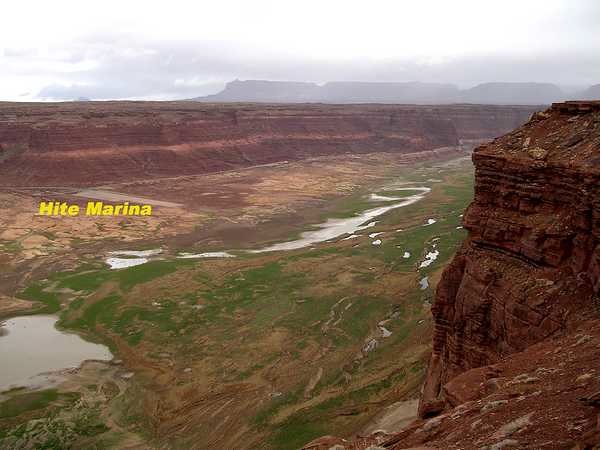
I just finished re-reading Edward Abbey‘s Hayduke Lives! where our favorite fictional eco-terroist gang takes on Bishop Love and the forces of mining in the Arizona Strip. I love Abbey’s writing and share many of his sentiments about the canyon country.

“Hite will rise again,” says Abbey — through the character Seldom Seen Smith. The town was flooded by Lake Powell but there was (is?) a marina there.

While looking for graphics for the Eagle River watershed this morning I ran across a great photo of Hite Marina on the Colorado River District website. It seems that the 10 year drought in the Southwestern U.S. has done the job for old Seldom Seen. Click on the thumbnail graphic above and to the right for the photo.

Here’s the link to the Colorado River District photo gallery.

Eagle River watershed: Water Settlement Secures Water Rights on the Upper Eagle River

A picture named eagleriverbasin.jpg

Here’s the release from the Eagle River Water and Sanitation District (Diane Johnson):

A settlement reached between water users on the Upper Eagle River has ended years of legal battles over water rights in the Minturn area, and set the stage for future cooperation on water quality and water supply issues in the Eagle River Basin.

Four cases, filed between 2005 and 2007, were settled between several of the major parties earlier this year, which eventually resulted in final decrees that secure water rights for the town of Minturn and the Battle Mountain Project.

“The settlement protects existing water rights and the water quality of the Eagle River, while providing for the development of new water rights to serve the future growth of Minturn and a more limited proposed Battle Mountain development project,” said Bob Warner, Eagle River Water & Sanitation District board chairman.

The settlement and decrees also provide Minturn with the ability to serve the future growth of the Town which occurs outside of the Battle Mountain Project using portions of its historic senior water rights, its junior water rights, and existing storage water in the Eagle River basin. The Battle Mountain Project will be served with new water rights.

Signatories to the settlement include the Town of Minturn, Battle Mountain, Eagle River Water & Sanitation District, Upper Eagle Regional Water Authority, Vail Associates, Inc., Eagle Park Reservoir Company, and the Arrowhead, Beaver Creek, Berry Creek, Eagle-Vail, Edwards, Holland Creek, and Red Sky Ranch Metropolitan Districts.

“We believe the water quality and water use interests of the Upper Eagle River basin are best served when there is cooperation between all the users of this natural resource,” said Warner. He added that it is his desire that “the agreement reached between the parties will signal a new era of joint cooperation toward effective use and protection of Eagle River water.”

The Eagle River Water & Sanitation District has also agreed to make available to Minturn up to 50 acre-feet of the District’s storage water in either Eagle Park Reservoir or Homestake Reservoir, both of which are upstream of Minturn. “This water will be available to serve growth within Minturn’s original, pre-2008 water service area,” said Warner.

Water for the future Battle Mountain Project will come from proposed junior water rights stored in a proposed 1,210 acre-foot reservoir at Bolts Lake, south of the existing town of Minturn.

The settlement allows Eagle River Water and Sanitation District, Eagle Park Reservoir Company, Upper Eagle Regional Water Authority, and Vail Associates to monitor the design, remediation, and monitoring systems proposed for the Bolts Lake area. “This cooperative effort will ensure that water quality of the Eagle River is protected from historic activities conducted at the Eagle Mine, south of Minturn,” said Tom Leonhardt, Authority board chairman.

“In signing the settlement, the Minturn Town Council showed great vision and leadership,” said Dave Kleinkopf, a principal in Crave Real Estate and general partner of Battle Mountain. “In addition to achieving a very significant first step in making the Battle Mountain project a reality, the Council also secured the water future for the town.”

For more information, contact Minturn Town Manager, Jim White, at (970) 824-5645 or ERWSD General Manager, Dennis Gelvin, at (970) 476-7480 or visit http://erwsd.org

More Eagle River watershed coverage here and here.

Historical water price trends

A picture named waterrightsinvestmentsvsotherindexes.jpg

Here’s a report about the prices of raw water and the current trends from Steve Maxwell writing for the American Water Works Association. It’s not hard to predict what would happen if the market moved to private industry. Here’s an excerpt:

Today, declining water availability has become a critical determinant of future growth in many areas of the West: Phoenix and Tucson, Ariz.; Las Vegas, Nev.; Denver, Colo.; Albuquerque, N.M.; and Southern California. As such situations develop, water is gradually transferred from agricultural irrigation to municipal consumption, and the prices of such water transfers are increasing sharply…

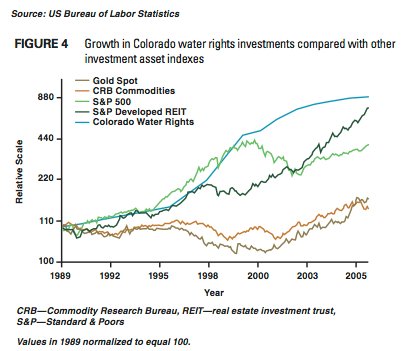
As conditions of water scarcity and stress continue to develop in more and more regions around the world, water will continue to exhibit rapidly increasing prices. As this discussion demonstrates, we have already seen these trends in Australia and the western United States—and the conditions are in place for this or a similar trend to occur in many other parts of the world. As price rises, there will be more and more incentive for improved utilization of water, increased recycling, and increased reuse of water as well as more focus on wiser allocation of water among competing uses. Further- more, as water’s value is increas- ingly recognized and as its price continues to increase, water seems likely to begin to evolve into a new financial asset class as well—an increasingly attractive opportunity to invest in. For example, as shown in Figure 4, the price of Colorado water rights is indexed against various other investment asset indexes from 1989 to 2006. A dollar invested in water rights in that state would have clearly returned more than a dollar invested in most any of the other standard financial investment cate- gories—the stock market, precious metals, real estate, or commodi- ties. Water is our most precious commodity, and its price will increasingly reflect that fact.

Secretary Salazar pow wows with the governors of the Colorado River basin states

A picture named coriverupperlowerbasins.jpg

From the Ridenbugh Press/Water Rights (Randy Stapilus):

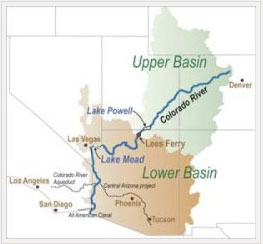
As a record drought goes into its eleventh year, Secretary Salazar called today’s meeting to discuss a number of ongoing water issues confronting the Department and the States, and to continue the collaboration that has historically occurred on such issues. At today’s meeting, the state and departmental representatives renewed their commitment to a strong working partnership with open lines of communication in order to tackle the challenges ahead.

Thanks to Loretta Lohman for the link.

More Colorado River basin coverage here.

Cache la Poudre River: Lawsuit to be filed by conservation groups over the Arapahoe snowfly

A picture named arapahoesnowfly.jpg

From email from Save the Poudre (Gary Wockner):

Today a coalition of citizens’ groups provided the U.S. Fish and Wildlife Service (USFWS) with a formal written notice of the groups’ intent to sue the Agency over its failure to address the groups’ petition to list the Arapahoe Snowfly, an insect important for the ecological health of the Poudre River basin, as an endangered species. Snowflies (sometimes called winter stoneflies) require cool, clear rivers and streams to survive, which makes them excellent biological indicators of watershed health – the Poudre Watershed is the Arapahoe Snowfly’s only known place of existence on earth. The Arapahoe Snowfly is endangered by a host of environmental problems, including stream dewatering. Scientists and conservation groups believe the Snowfly is on the brink of extinction in the Poudre River ecosystem.

“Our organization’s mission is to protect and restore the Poudre River,” said Gary Wockner of Save the Poudre: Poudre Waterkeeper. “And that extends to every species living in the river. We believe the U.S. Fish and Wildlife Service is violating the Endangered Species Act by not addressing our petition to list the Arapahoe Snowfly.”

By law, when any person or group petitions the USFWS to list a species under the Endangered Species Act (ESA), the USFWS has 90 days to evaluate the petition and make a “finding.” The coalition of groups filed the petition on April 6, 2010 – the finding should have occurred by July 6, 2010. The Service is now nearly 5 months late.

“Unfortunately, these delays are all too common in our dealings with the U.S. Fish and Wildlife Service,” said Nicole Rosmarino, whose group WildEarth Guardians is leading the legal effort to list the Arapahoe Snowfly under the ESA. “While the USFWS has paid lip service to speeding up its ESA work, hundreds of species remain waiting for findings in the United States. The Arapahoe Snowfly simply cannot wait – we will continue to press the government to issue a finding on this species.”

There are now 251 species of plants and wildlife that are formal “candidates” awaiting federal listing. Many of these species have been on the waiting list for protection for a decade or more. Outside of Hawaii, only 4 new U.S. species have been listed under the Act since Interior Secretary Ken Salazar took office. At the current pace, it would take nearly a century to get through the backlog of candidate species in the continental U.S.

“The U.S. Fish and Wildlife Service needs to act immediately,” said Scott Black of Xerces Society for Invertebrate Conservation. “The Poudre River ecosystem cannot afford to lose the Arapahoe Snowfly – we can’t allow the Snowfly to go extinct.”

Co-signing the NOI are all of the groups that originally filed the petition, including: The Xerces Society for Invertebrate Conservation , an international nonprofit scientific organization dedicated to protecting wildlife through the conservation of invertebrates and their habitat; Dr. Boris Kondratieff , a Colorado State University entomologist and expert in aquatic insects who discovered the Arapahoe Snowfly; Save the Poudre: Poudre Waterkeeper , an organization that works to protect and restore the Cache la Poudre River; Cache la Poudre River Foundation , an organization founded for the protection of Wild Trout through the town of Fort Collins, Colorado; WildEarth Guardians , which protects and restores wildlife, wild rivers and wild places in the American West; and Center for Native Ecosystems , a group dedicated to protecting native species and their habitats in the Rocky Mountain Region.

The Notice of Intent (NOI) to sue is publicly posted here: http://poudreriver.home.comcast.net/~poudreriver/Arapahoe_Snowfly_60d_NOI.pdf

Read the petition.

Read more about the Arapahoe snowfly.

More coverage from the Colorado Independent (David O. Williams):

A coalition of environmental and citizen activist groups today filed a notice of intent to sue the U.S. Fish and Wildlife Service (USFWS) for failing to act on a petition to list the Arapahoe Snowfly – native to the Poudre River basin in northern Colorado – as an endangered species. The snowfly, also called winter snowflies, are only found in the Poudre watershed, but are seen by conservationists as an “indicator species’ indicative of the overall biological health of watershed. The groups planning to sue the USFWS cite scientists who feel the snowfly is on the brink of extinction, an indication the Poudre is succumbing to mounting pressure from a variety of users.

More endangered/threatened species coverage here.

NIDIS Weekly Climate, Water and Drought Assessment Summary of the Upper Colorado River Basin

A picture named precipitation11302010

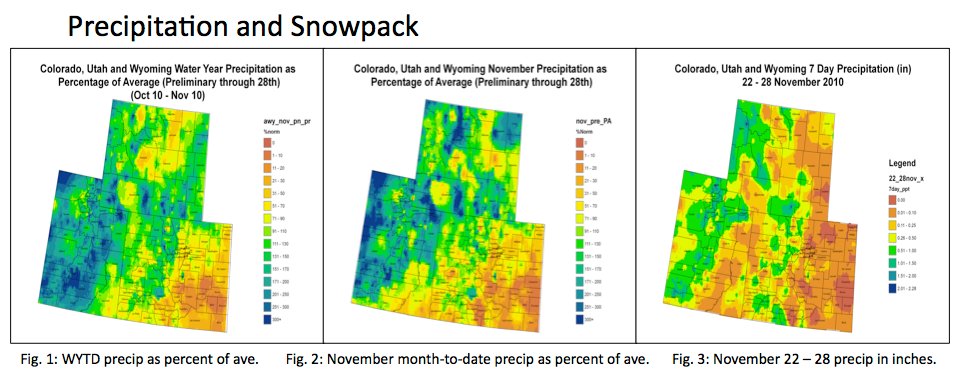
Here are this week’s notes from the Colorado Climate Center (Wendy Ryan/Henry Reges).

Precipitation news

A picture named usdroughtmonitor11232010

From the Longmont Daily Times Call (Scott Rochat):

Longmont logged just 3 inches of snow for November, a quarter of its usual 12-inch tally. But a couple of early rainstorms helped keep the water coming: 0.66 inches of precipitation for the month (vs. a 0.83 average) and 13.23 inches for the year (compared to an average of 13.57.) Now the bad news: It might stay dry. For a while. “It does fit the La Niña pattern,” said Times-Call weather expert Dave Larison. “If it continues like this, we might have to be watering lawns in January or February just to keep the moisture up.”

Cloud-seeding starting up in Summit County

A picture named cloudseedingexplained.jpg

From the Summit County Citizens Voice (Bob Berwyn):

Combined, Keystone, Breckenridge and Arapahoe Basin are pitching in $75,000 to help pay for the installation of five new silver iodide generators and two months of operations, with an option to extend the deal for a third month at a cost of $20,000. Vail has been cloud-seeding for more than 30 years, but this the first time Summit County ski resorts have been directly targeted by the program, which is part of a larger regional effort to increase winter snowfall and spring runoff…

The state permitting process addresses environmental and public safety concerns with triggers that require a cessation of cloud-seeding in certain conditions, For example, when parts of Colorado were under a blizzard warning during the Thanksgiving weekend, cloud seeding stopped…

The Summit County cloud-seeding program involves manually operated ground-based generators that release silver iodide particles into the atmosphere when conditions are favorable for precipitation. The particles help provide additional seed material for snow crystal formation. By some commonly accepted estimates, the process can increase precipitation by 5 to 15 percent.

More cloud-seeding coverage here.

Snowpack news

A picture named snowpackcolorado11302010

From the Summit County Citizens Voice (Bob Berwyn):

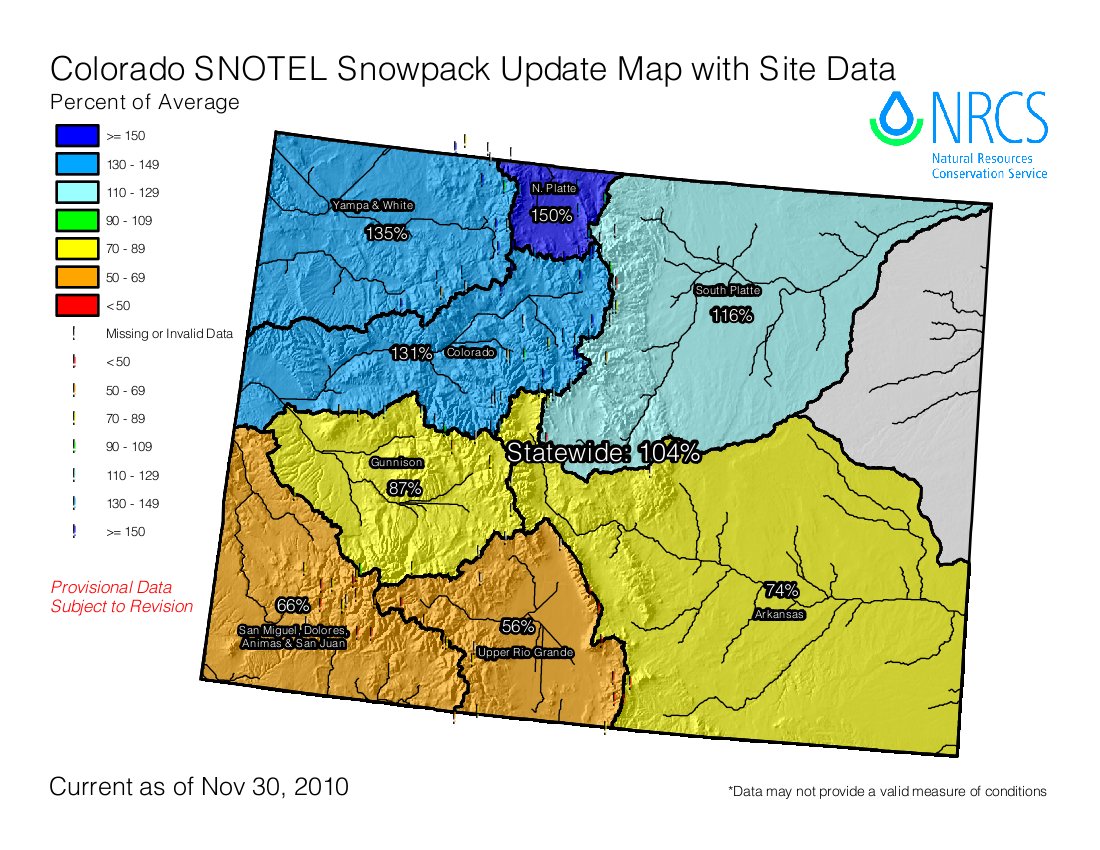
Copper Mountain‘s reading is 189 percent of normal, with Grizzly Peak at 158 percent and Fremont Pass at 145 percent of normal. The only sites that were a bit below average are at lower elevations, for example Summit Ranch, at about 72 percent of average, according to Blue River Basin water commissioner Scott Hummer. Across the Blue River Basin, the snowpack is at 136 percent of the long-term average for Nov. 30, Hummer said, emphasizing that it’s the April and May readings that are critical for summer water supplies.

The November snow totals only represent a small percentage of the seasonal totals, but at least the winter is off to a good start, Hummer said. Statewide, the Nov. 30 snowpack is close to normal, at 104 percent. the highest reading comes from the North Platte Basin, at 150 percent of normal, while the lowest reading is in the Rio Grande Basin, at only 56 percent of average. So far, precipitation patterns have been in line with La Niña-based predictions that call for better than average snowfall across the northwestern part of the state, with below average snow down south…

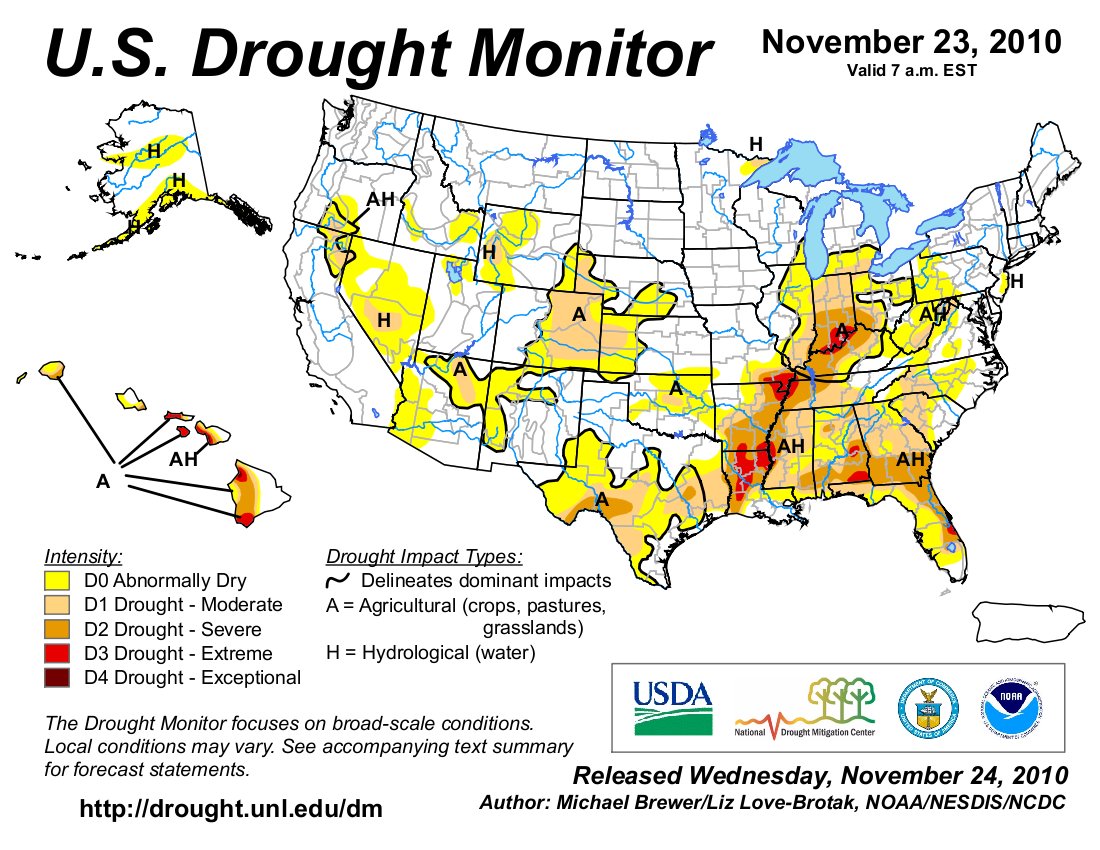
All the state’s northern basins have above-average snowpack readings, with the Colorado Basin at 131 percent of average. The farther south you go, the lower the totals, with the Gunnison Basin at 87 percent, the Arkansas at 74 percent and the San Miguel, Dolores, Animas and San Juan Basin at 66 percent. The South Platte — the key basin to Denver’s water supply, is at 116 percent of normal, thanks to snows in the headwaters area. Beyond that, the entire Front Range, and the plains out toward Kansas are now listed on the drought monitor under a D1 status, for moderate drought conditions — another forecast effect of a La Niña winter.

Regular autumn snowfall helped Summit County streamflows stay near average after they dipped very low in late summer, Hummer said. For example, the Blue River below Goose Pasture Tarn was flowing at 10 cfs Tuesday morning, just 1 cfs below the 27-year average. The record minimum flow was 7,8 cfs in 1993, the record high was 21 cfs, in 1985. Some local stream gauges are frozen, but the Snake River, just below Keystone’s snowmaking diversion, was flowing at 16. 2 cfs Tuesday morning, close to average and well above a state-set minimum of 6 cfs.

NRCS snowpack monitoring

A picture named measuringsnowpack.jpg

From The Greeley Tribune (Bill Jackson):

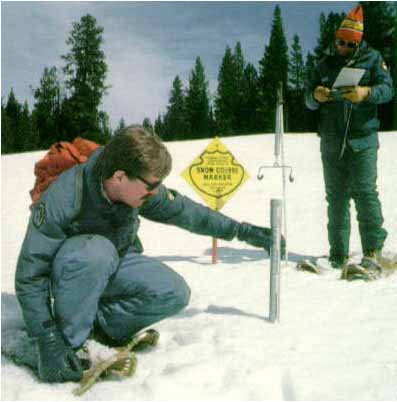
The USDA has conducted a cooperative snow survey program since 1935…The program is a federal, state and local partnership directed by NRCS and includes not only Colorado, but Arizona, Idaho, Montana, Nevada, New Mexico, Oregon, Utah, Washington and Wyoming as well. Alaska and southern Canada are also partners. California has an independent program. The program, under federal leadership, was developed following the drought of 1934, when ag leaders requested USDA’s help in forecasting water supplies for the 1935 growing season. Since then, about 1,600 snow courses have been developed. Generally, they are about 1,000 feet long and are located in small meadows protected from the wind. NRCS specialists, such as [John Fusaro and Todd Boldt with the Fort Collins NRCS office], take measurements near the first of the month during the snowpack season. In the Poudre Canyon, there are four such courses, and in the Big Thompson Canyon, there are four more…

In 1977, the NRCS began development of a network of automated radio telemetry sites for collecting snow survey data. The so-called SNOTEL network provides the agency’s offices with daily or more frequent information on streamflow potential. That comes in handy especially during periods of flood or drought. There are half a dozen or more SNOTEL sites in Larimer County and several more in northern Colorado.

The Colorado River District is kicking off a grant program for water resources projects

A picture named coloradorivergjwik.jpg

From email from the Colorado River Water Conservation District (Martha Moore):

The Colorado River District is accepting grant applications for projects that protect, enhance or develop water resources within the 15-county area covered by the District. This includes all watersheds in north- and central- western Colorado, except the San Juan River basin.

Eligible projects must achieve one or more of the following:

– develop a new water supply

– improve an existing system

– improve instream water quality

– increase water use efficiency

– reduce sediment loading

– implement watershed management actions

– control tamarisk

– protect pre-1922 Colorado River Compact water rights

Past projects have included the construction of new water storage, the enlargement of existing water storage or diversion facilities, rehabilitation of non-functioning or restricted water resource structures and implementation of water efficiency measures and other watershed improvements. Such projects that utilize pre-1922 water rights will be given additional ranking priority over similar projects that do not. Each project will be ranked based upon its own merits in accordance with published ranking criteria.

Eligible applicants can receive up to a maximum of $150,000 ((or approximately 25% of the total project cost whichever is less, in the case of smaller projects this percentage may be slightly higher) for their project. The total grant pool for 2011 is $250,000. Application deadline is Jan. 31, 2011.

More Colorado River basin coverage here.