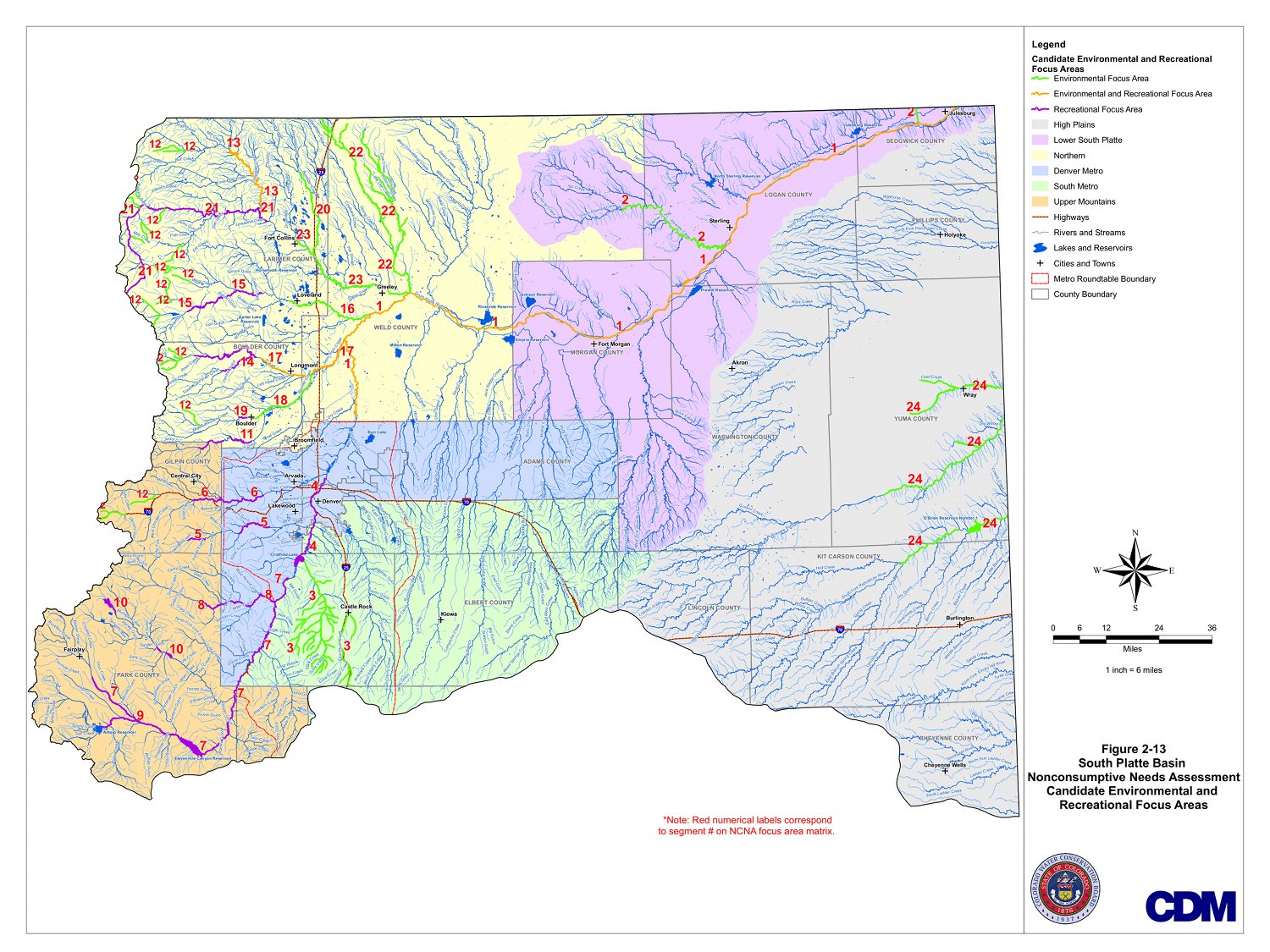
Click here to download a copy.
More IBCC — basin roundtables coverage here.

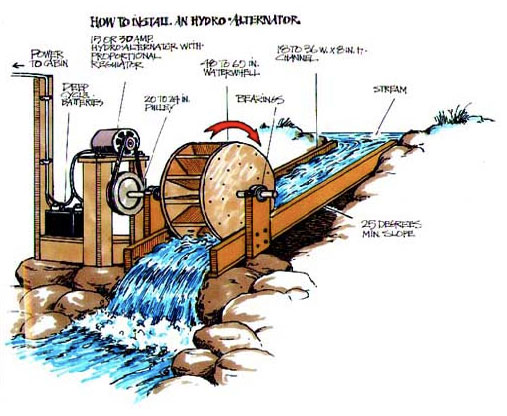
From the Aspen Daily News (Curtis Wackerle):
There will also be a public meeting Tuesday evening with city and FERC officials to explain details of the project and take questions.
Beginning at 1 p.m.,, city officials will lead site visits to five locations associated with the new hydro project. The field trip will visit diversion facilities on Castle and Maroon creeks, where the city takes its water for consumptive and hydro power purposes. There will also be visits to the existing Maroon Creek hydro facility, the water treatment plant at Thomas Reservoir and the site of the proposed new hydro plant under the Castle Creek highway bridge. Registration for the field trip closed last week. About 30 people, including two FERC representatives in from Washington, D.C., are signed up to go along.
Beginning at 5 p.m. Tuesday at the Rio Grande conference room in the building above Taster’s Pizza, the city will hold a meeting open to the general public. The meeting’s purpose is to “present information and have a dialogue,” said David Hornbacher, the city’s director of utilities and environmental initiatives.
The meeting kicks off a 60-day comment period with the feds where the public is invited to weigh in on the project as FERC considers granting a license. The city is proposing to build a plant taking up to 52 cubic feet per second of water from Castle and Maroon creeks to feed a generator that could produce an average of 6.8 million kilowatt hours of electricity a year.

Here’s the release from ALANCO Tecnologies, Inc.:
New Subsidiary Alanco Energy Services, Inc. to Provide – Produced Water Disposal Services to Natural Gas Industry
Alanco Technologies, Inc. announced formation of a new wholly owned Colorado subsidiary, Alanco Energy Services, Inc. (“AES” or “Company”) to treat and dispose of “produced water” generated by natural gas producers in Western Colorado. The new Company has entered into a definitive agreement to purchase (expected to close in the next few days) a 160 acre parcel; acquired an additional long-term leased site (both located near Grand Junction, Colorado); and acquired intellectual property and rights to federal, state and county permits required to develop both sites to provide such services to the local gas industry.Produced water, usually highly saline, and containing 1-2% entrained hydrocarbon condensate (oil), is produced as a by-product of oil and gas production, and is most often disposed into on-site injection wells, near the production sites. However, on-site capacity limitations frequently require producers to truck excess water to alternative commercial disposal facilities, which can be a major expense, particularly in light of current low gas prices. Recent growth of the U.S. natural gas industry is creating demand for new facilities to dispose of produced water, while increasingly restrictive federal and state environmental requirements are increasing both the cost and timelines for new disposal locations and/or expansion of existing facilities.
AES’s produced water business will entail the receipt of truck delivered produced water from gas producers within an approximate 100 mile radius of AES’s disposal sites for a per barrel fee in the $3 – $4 range; treatment of the received water to recover and sell the approximate 1-2% of entrained oil; and disposal of the treated water into on-site evaporation ponds. AES’s target market is Western Colorado’s Piceance Basin production area, with over 12,000 currently active gas wells. In 2010, Piceance Basin gas producers generated in excess of 35 million barrels of produced water, and contracted for off-site disposal of about 15% of that volume.
AES’s initial investment, for land purchase, lease transfer, permits and intellectual property comprised of an approximate $600,000 cash payment, 40,000 shares of restricted Alanco common stock, a $200,000 non-interest bearing secured note due November, 2012, and potentially significant earn-out payments over an approximate 10 year period, based upon AES profitability. The sellers in the transaction were Colorado-based TC Operating, LLC, and a related entity, Deer Creek Disposal, LLC.
Phase I site development has commenced with completion anticipated in 12 months, and additional capital investment estimated to be approximately $5,000,000. Alanco Management anticipates that currently available cash and equivalents, plus significant early AES cash generation, will be sufficient to finance Phase I project build-outs. Future planned facilities expansion is expected to be entirely financed by AES generated cash flow.
AES has entered into a Management Services contract with TC Operating, LLC (“TCO”) to provide operating management of the AES produced water disposal business, including facility construction project management. The TCO managing partners, Tom Pool and Craig Creel, each have over 30 years of broad experience in the oil and gas industry.
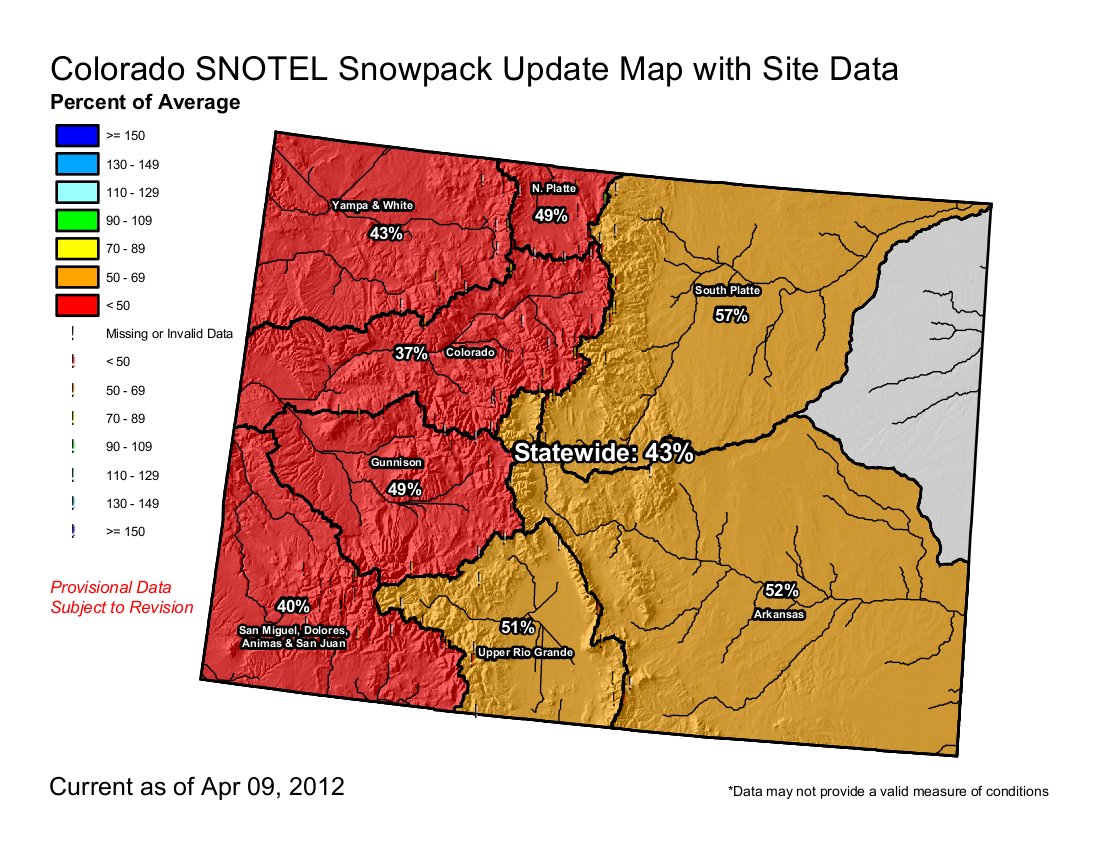
Click on the thumbnail graphic to the right for the latest snowpack map from the Natural Resources Conservation Service.
From the Yuma Sun (Chris McDaniel):
“System wide total reservoir storage, as of April 4, was 63 percent of capacity,” said Doug Hendrix, external coordination manager for the Bureau of Reclamation’s Yuma Area Office. “This year has been a little bit drier year. The precipitation to date in the Upper Basin into the Upper Basin reservoirs has been about 79 percent of average.” Another issue that means lower water levels was the very warm weather in March that prematurely melted an already small snowpack into the river’s Upper Basin. Snow is the source of most of the river water flowing into the Lower Basin states of Arizona, Nevada and California.
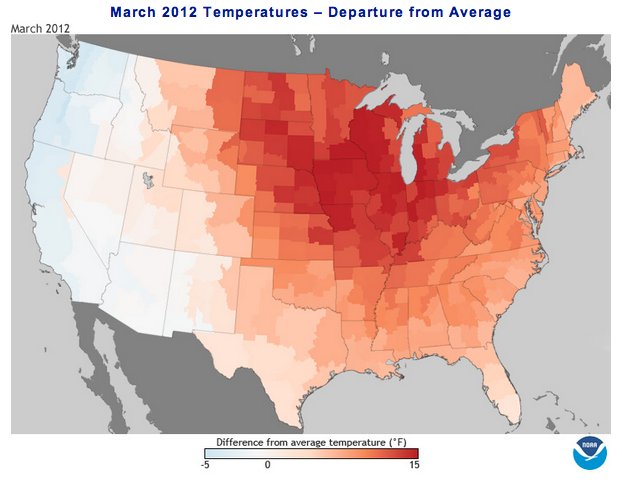
Here’s the State of the Climate National Overview March 2012 from the National Climatic Data Center. Click on the thumbnail graphic to the right for a U.S. map of temperature departures from average for March.
More coverage from the Summit County Citizens Voice (Bob Berwyn):
Every state in the country broke at least one record high during March, and 25 states east of the Rockies reported their all-time warmest March readings on record. For the contiguous 48 states as a whole, March was also the warmest on record, at 8.6 degrees above the breaking the old record (1910) by .5 degrees. The National Climatic Data Center reports that it was second-largest single-month departure from average temperatures, after January 2006. And despite a lingering La Niña, which often has a cooling influence, the first quarter of 2012 is also being reported as the warmest on record.
From email from the Colorado Water Conservation Board (Ben Wade):
The next Water Availability & Task Force meeting is on Wednesday, April 18 from 9:30a-11:30a.m. at the Colorado Parks & Wildlife Headquarters, 6060 Broadway Denver, CO, in the Bighorn Room.
More CWCB coverage here.

From the Associated Press via the San Francisco Chronicle:
Salazar spoke during the State of the Rockies Project conference at Colorado College, where students have been studying how to preserve the Colorado River basin…
…climate change, drought and population growth in the West have heightened interest in how the states and Mexico can continue sharing the [Colorado] river and still support irrigation, hydropower, tourism, recreation, agricultural and municipal needs and wildlife. Salazar said the Colorado River Compact that outlines how seven Western states and Mexico will share the river system’s water was created without the best science or knowledge. The agreement wrongly assumed there was 2 million acre-feet more available than there really is, he said. Nevertheless, he said the compact will not be reopened. Within Salazar’s department, the U.S. Bureau of Reclamation is reviewing ideas for how to address a projected imbalance in Colorado River basin supply and demand.
Meanwhile the U.S. and Mexico continue to negotiate details of how to share the river. Salazar’s appearance Monday came the same day that 25 conservation groups delivered a petition urging the U.S. and Mexico to allow some flows to return to the dried-up delta where the Colorado River flows into the Gulf of California. Salazar said the U.S. and Mexico hope to announce results of the negotiations soon. He didn’t give a timetable.
More coverage from Debbie Kelley writing for the Colorado Springs Independent. From the article:
As President Obama’s appointed U.S. Secretary of the Interior, the San Luis Valley native and 1977 CC graduate is familiar with the problems associated with what’s often called “the hardest-working river” in the nation. “The Colorado River is already a water-short river — more water has been allocated than what that river has today, not only along southern states but with the treaty with Mexico,” Salazar said during the 2012 State of the Rockies Project conference, which continues Tuesday. But Salazar assured the hundreds of conference attendees that his department is working on the issues and hopes to announce a new allocation agreement with Mexico soon.
The river is ruled by a compilation of decrees, rights, court decisions and laws that together are referred to as the “Law of the River.” The keystone is the 1922 Colorado River Compact, an interstate agreement for general water allotments, which Salazar said overestimated by 2 million acre feet the annual amount of water that could be extracted from the river. In response to a question from the audience, Salazar said he doesn’t think the Compact will ever be opened up for negotiation: “The legacies that have been created over 89 years are so embedded in the Law of the River,” he said…
Salazar also seized on the connection between the dwindling water supply and the energy industry, deriding the push by U.S. Rep. Doug Lamborn, R-Colorado Springs, for expanded oil shale development. “We need to let the world know how much water would be required to develop those oil shale resources — the estimates I’ve seen are over 1 million acre feet and some at 2 million,” Salazar said. “Where would that water come from? What’s going to be the consequences to the ranchers and farmers dependent on the Colorado River?”
More Colorado River basin coverage here.

From The Denver Post (Bruce Finley):
Town officials are asking companies to let them review drilling plans for compatibility with local development. They’re demanding new drilling operations capture 100 percent of air emissions. They’ve begun using a $50,000 device that tests water for hydrocarbons. “We have to do everything in our power to protect our residents’ health and safety,” town administrator A.J. Krieger said…
Testing along creeks and irrigation ditches and in reservoirs “is going to give us baseline data,” water-plant operations chief Bruce Chameroy said. “What we’re looking for is changes.”[…]
“We know we don’t have the authority to stop it. Even our residents who are most concerned recognize the need for energy and private-property rights. We just want it done in a safe way,” Krieger said.
State task-force talk has encompassed emerging new arrangements using local inspectors at well sites. But Erie is wary of “unfunded mandates” and can’t afford to hire chemists and petroleum engineers to conduct proper inspections, Krieger said.
From the Summit County Citizens Voice (Bob Berwyn):
… it’s clear that much of Colorado is experiencing the beginnings of a meteorological drought, with below average snowfall since the start of the water year, Oct. 1, 2011…
What dies it all mean for the high country? According to Summit County’s multi-hazard mitigation plan, past drought impacts have included degradation of air quality due to dust, reduction of tourism and recreation activities, and damage to the ranching economy in the Lower Blue Basin. The economy of Summit County, which is based upon the ski industry and other outdoor recreation and tourism, is very vulnerable to drought conditions, according to the county’s plan.
From the Summit County Citizens Voice (Bob Berwyn):
“March was the real game-changer,” [State Climatologist Nolan Doesken] said, explaining that the state’s snowpack usually grows and peaks during the last few weeks of winter; this year, it was the opposite, with a meltdown that saw statewide snowpack dwindle by nearly a third.
In fact, some parts of the central and northern mountains recorded above average precipitation in January and February, but that wasn’t enough to make up for a dry early winter, and when March turned balmy, the snow simply vanished.
“We don’t expect north-facing, high-elevation slopes to melt in March,” said Doesken by phone from Durango, where he was attending an annual water-users conference.
High-wind episodes during some of the dry periods between storms also were a factor, scouring the snow from some of the highest elevations, where the snow usually builds into thick, deep pillows that slowly melt during the spring. Some of the snow that’s blown around by the wind also simply sublimates into the atmosphere, Doesken said.
That means most of the snow ended up at mid-elevations, in many cases in the lodgepole pine belt, where the beetle-kill may also be a factor in the rapid melt-down. Instead of being shaded by thick evergreen branches, the snow on the ground was exposed to the early spring sun.
There’s still a slight chance that a big wet storm — like a 2003 mid-March deluge that ended the 2001-2002 drought — could make up some of this winter’s deficit, but those odds diminish with each passing week, he said. And the outlook for the next few months from NOAA’s Climate Prediction Center continues to trend toward the dry side, with better than average odds for warmer-than-average temperatures and below-average precipitation, he added…
Some weather experts have suggested that a dry winter can affect the monsoon because there’s not as much localized moisture available for evaporation and condensation. But overall, there doesn’t seem to be much statistical data to support that conclusion, Doesken said. “There’s an ever-so-slight bias toward more precipitation after a dry winter,” he said, explaining that one theory is that early heating in the Southwest helps develop the big desert heat low pressure system that becomes the pump for monsoon moisture.

From the website:
As a culmination of this year’s State of the Rockies Project work on the Colorado River Basin, the Project will be hosting a conference on the Colorado College Campus on April 9th and 10th, 2012. In addition to the release of the 2012 State of the Rockies Report Card, we will have a stellar line-up of speakers addressing the future management of the Colorado River Basin. Speakers for the Conference will include the Honorable Ken Salazar, Seceretary of the Department of the Interior, Marcia McNutt, Director of the U.S. Geological Survey, and Colorado Governor John Hickenlooper.
More from the State of the Rockies director, Walt Hecox, running in The Denver Post. From the guest column:
At the annual State of the Rockies Conference in Colorado Springs this week, the 2012 State of the Rockies Project Report Card will focus on “Managing the Colorado River Basin: Agenda for Use, Restoration and Sustainability for the Next Generation.” Five undergraduate researchers will present their findings, including their recommendations to save the basin…
The state of the Colorado River Basin is dire: decades of population growth, climate change, damming and diversion for municipal and agricultural water use have endangered multiple animal species, diminished in-stream flows and led to the river’s lower section running completely dry. Experts predict that by 2050, there won’t be enough water in the river to meet the needs of the communities that depend on it.
As Podmore and Stauffer-Norris finished their journey [ed. from the headwaters of the Green River to the Colorado River Delta] in January, photographing and blogging as they went, they witnessed the most graphic evidence of this stark reality on the southernmost section of the river. In the Delta, once a lush network of wetlands, there is now normally only dirt and dying tamarisk. In their willingness to confront such a reality and their commitment to changing it, these two young men stand in direct contrast to the apathy evidenced by much of their generation. Not only that, they also aim to enlist their peers in efforts to resolve the messes created by previous generations.
“We need to view the Colorado River and its tributaries as a single body of water. Our actions can affect portions of the river thousands of miles downstream,” Podmore wrote in a February Huffington Post article. “As water becomes a more hotly contested resource in the Southwest, we need to recognize the benefits of protecting the whole river system.”
To change present basin management, we must pursue water conservation, innovative ways to share water between agriculture and municipalities, and find sufficient water to sustain riparian areas while fairly dealing with water claims of Native Americans and Mexico. No generation is more vital to this effort than today’s Millennials, who will soon hold the reigns of decision-making.
From the Broomfield Enterprise (Joe Rubino):
In Broomfield, Mamie Doud Eisenhower Public Library and Environmental Services are leading the Colorado Water 2012 charge. Having already hosted a well-attended class about Xeriscape gardening — the practice of planting native and other water-thrifty plants to limit irrigation needs — Shirley Garcia, Broomfield Environmental Services coordinator, said the city has numerous other water-friendly classes planned this summer…
While Environmental Services and the Parks Department focus on ways to practice water conservation, staff at the library are taking on another side of the Colorado Water 2012 campaign: Awareness. The library next month will host a trio of programs dedicated to emphasizing the historical and ongoing importance of water in Colorado, including an expected May 6-19 visit from the traveling Colorado Water 2012 display…
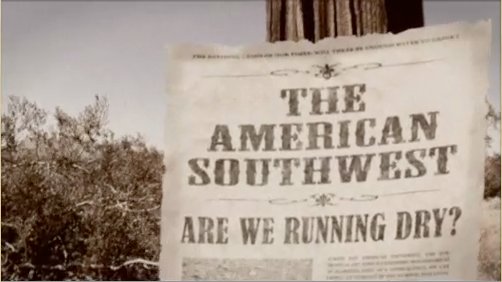
Reference librarian Cindy Eubank is heading up the water projects at the library. The Water 2012 exhibit, when coupled with a May 8 screening of the film “The American Southwest: Are We Running Dry?” and a photo exhibit documenting the effects the Dust Bowl had on Colorado farmers in the 1930s, should be eye-opening, Eubank said.
More Colorado Water 2012 coverage here.

From The Pueblo Chieftain (Chris Woodka):
The Natural Resources Defense Council, a nonprofit environmental agency, rated all 50 states on how they are preparing for impacts of climate change on water resources. Colorado ranked highest among all Rocky Mountain states. Essentially, Colorado earned a B, ranking behind nine other states, using the criteria chosen by the council…
“Rising temperatures and more extreme weather events are impacting our families, our health and our pocketbooks. Water is a matter of survival. It powers our lives and industries, and it keeps our natural systems healthy,” said Steve Fleischli, a water policy analyst. “This report is both a wake-up call and a road map for all communities to understand how vital it is to prepare for climate change so we can effectively safeguard our most valuable resources.”[…]
Gov. John Hickenlooper, through his water policy adviser John Stulp, has asked for a state water plan by 2016.
In Colorado, water rights are privately held and administered through court decisions. There is no central state water authority, and decisions about supply, planning, funding projects and water quality are split among several state agencies…
Individual metro water providers — including Denver, Aurora, Colorado Springs and Pueblo — are incorporating the possibility of long-term climate change into their planning efforts. The Colorado Water Conservation Board also incorporated weather pattern variance in its investigation of Colorado River supply.
From The Pueblo Chieftain (Chris Woodka):
“We’ve had water issues in Colorado, but we’ve never had a crisis because we have planning,” state water adviser John Stulp said Thursday. “Water is one of those essential things for life, and we all have an opinion about it.”[…]
Stulp praised the Water Infrastructure and Supply Efficiency, or WISE, partnership among Denver, Aurora and 15 South Metro water suppliers as a new example of collaboration that will help prevent more encroachment of city needs into water supplies needed for agriculture and recreation. Historically, the state’s great water projects arose from a need followed by years of planning and major changes in how water policy developed, Stulp said…
Stulp noted that the Chinese character for crisis combines the symbols for danger and opportunity. “I see that we have great opportunities in the future of water for Colorado,” Stulp said. “There’s only going to be enough water through cooperation and collaboration.”
More coverage from Chris Woodka writing for The Pueblo Chieftain. From the article:
“They [South Metro water providers] all rely on the same diminishing groundwater supplies,” explained Joe Stibrich, deputy director for water resources at Aurora Water. “The WISE partnership uses existing capacities. . . . It’s the largest conservation program in the state.”
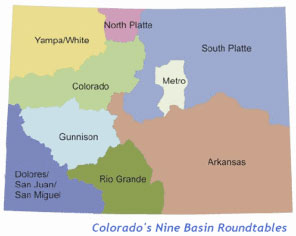
Stibrich explained the WISE partnership at a public presentation of the Metro Roundtable Thursday at Metro State College. More than 200 people attended.The partnership is possible because Aurora has built the Prairie Waters Project, a $650 million system that captures reusable wastewater flows, treats them and returns them to the water supply. “Prairie Waters was first identified as a project to meet Aurora’s needs,” Stibrich said. “It’s a drought hardening process that gives us supplies we can rely on, but don’t always need.”
The WISE partnership will allow the South Metro communities to purchase an average of 10,000 acre-feet annually from Denver and Aurora. Eventually, that could be as much as 60,000 acre-feet. It also gives Denver a firm supply of 15,000 acre-feet during drought years through the Prairie Waters Project, while protecting all of Aurora’s interests in the project. During a drought, the South Metro users will still have their groundwater resources to fall back on. Many of the individual water districts in the group have continued to search for other sources.
More IBCC — basin roundtables coverage here.
From email from Reclamation (Kara Lamb):
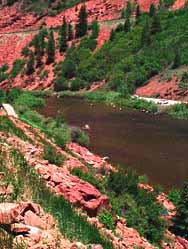
As you may have already noticed, the reduction in releases from Ruedi to the Fryingpan did not happen this morning [April 6]. It has been postponed at least through the weekend. As a result, the 67 cfs release from Ruedi will continue for the time being.
More Fryingpan-Arkansas Project coverage here.

From the Summit County Citizens Voice (Bob Berwyn):
Currently, the reservoir is only about four feet below capacity. Last summer the reservoir filled July 27, one of the latest dates on record, as Denver Water made way for abundant runoff required by drawing the water level way down in spring and early summer…
Read more about Dillon Reservoir fill and spill operations in this Summit Voice story…
Denver Water is releasing about 53 cubic feet per second to the Lower Blue, just a shade more than the required mininum flows of 50 cfs set to protect the fishery. More than three times that amount of water is going through the Roberts Tunnel to the Front Range. Tunnel diversions have been averaging about 150 to 225 cfs in recent weeks, according to Bob Steger, manager of raw water supplies for Denver Water.
More Blue River watershed coverage here.
From the Summit County Citizens Voice (Bob Berwyn):
BuRec spokesperson Kara Lamb said the agency isn’t sure yet whether Green Mountain Reservoir will even have a so-called paper fill this year. As of April 5, water experts were still crunching snowpack numbers and streamflow projections, with at least some preliminary projections for Green Mountain Reservoir due by the end of next week.
Those projections will be of interest to recreational stakeholders at Green Mountain Reservoir, who rely on a short summer boating and fishing season to maintain businesses through the year.
A paper fill is when some the water that’s technically part of the Green Mountain water right is held back in Dillon Reservoir. Instead of letting that water flow down the Blue to Green Mountain Reservoir, Denver Water, through an exchange, uses water from Williams Fork Reservoir to meet downstream demands for Green Mountain water.
The April 1 start of fill declaration by the BuRec is the earliest date that the agency can start calling for water to fill Green Mountain Reservoir. The timing was triggered by the dismal snowpack and the expectation of an early runoff, said BuRec spokesperson Kara Lamb.
Already, many streams in the headwaters region are running well above average for this time of year, and the snowpack in the Upper Colorado is below 50 percent of average and dropping fast.
From email from Reclamation (Kara Lamb):
A couple days ago, I updated you on the reduction of flows at Green Mountain Dam to the Lower Blue. We had scaled back releases to about 72 cfs. Tonight [April5], I am updating you again to let you know that, with recent snow pack conditions in mind, that release rate is likely to remain in effect well into May–and possibly longer, depending on weather.
We also declared our “start of fill” at Green Mountain on April 1, this year. That means, we started storing water in the reservoir on April 1–the earliest date we can start storing.
From The Mountain Mail (Callie McDermott):
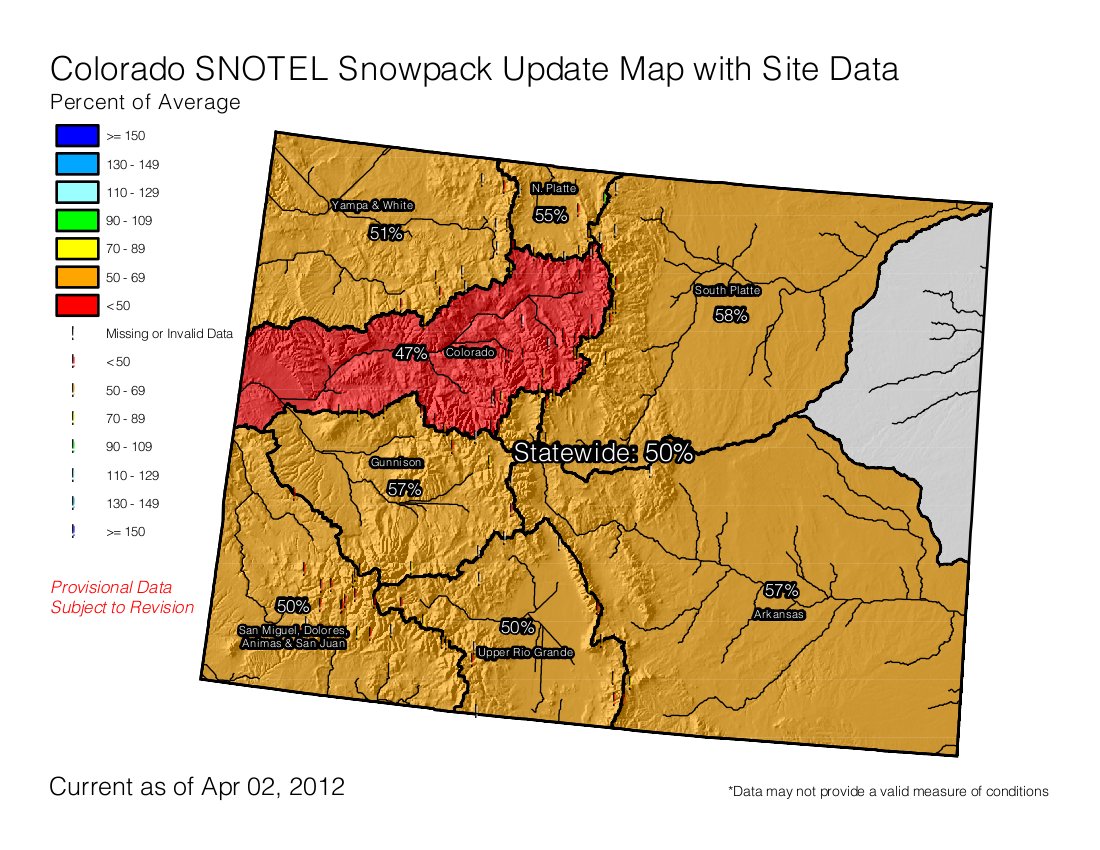
Mage Skordahl, assistant snow survey supervisor with the Natural Resources Conservation Service, said the entire Arkansas Basin is at 56 percent of average – downstream basins that have received above-average precipitation account for the higher overall snowpack. Statewide snowpack is also 52 percent of average – down 29 percentage points since March 1.
In a press release, Phyllis Ann Philipps, state conservationist with the Natural Resources Conservation Service, reported statewide snowpack conditions have not been this low since 2002, when the April 1 snowpack also was reported to be 52 percent of average.

Click here to check out their cool website with all the skinny for across the country. Here’s the link to their water readiness review for Colorado. Here’s an excerpt:
Containing the headwaters of four major U.S. river systems, Colorado seemingly has plentiful water resources. However, due to interstate compacts and agreements, the state must allow much of this water to leave its borders. As increasing temperatures challenge traditional notions of water management and availability in the West and municipal demand continues to grow as populations swell, conflicts over water resources will intensify. Consequently, the potential economic impacts to the state from climate change are significant. In 2007, winter recreation alone contributed nearly $2 billion to the Colorado economy.1 Warmer temperatures could lead to less snow and a shortening of the ski season. In fact, a 2006 study projected a loss of 43 to 82 percent in April snowpack for Colorado counties with ski resorts by the end of the 21st century.2 Dwindling water resources and higher temperatures as a result of climate change could also impair the state’s $5.5 billion agricultural industry.3 To lessen these impacts, Colorado should continue to fund research on the impacts of climate change on water resources and work to incorporate climate change considerations into all aspects of water resources planning—both statewide and locally.
More coverage from Bruce Finley writing for The Denver Post. From the article:
NRDC analysts looked at water-supply planning, as well as the extent to which states were trying to reduce greenhouse-gas pollution linked to global warming. “While Colorado has done more than many states, it should engage in more robust planning and implementation to prepare for climate change,” the NRDC report said. The primary challenges in Colorado are expected to be shifts in water supply, extreme storms, increased flooding and changes to aquatic life…
Colorado’s ranking “seems about right,” said Taryn Hutchins-Cabibi, a state drought and climate change specialist in the Department of Natural Resources. “We definitely have done more within the Interior West on the planning side, especially with regard to water.”
More coverage from Brandon Loomis writing for The Salt Lake Tribune. From the article:
The Natural Resources Defense Council released a report Thursday that groups the states in four categories for their efforts to prepare and prevent calamity. The council’s “Ready or Not” report puts Utah’s efforts in the lowest tier, partly because it found state agencies ignore the threat while legislators have passed resolutions downplaying the phenomenon.
“It seems like the [Utah] state water plan hasn’t really taken a look at what climate change will do to water supply and hydrology in the state,” NRDC water policy analyst Ben Chou said in a telephone news conference.
Numerous studies have predicted less supply for the Great Basin and Colorado River watersheds as snowfall turns to rain and temperatures increase evaporation. Timing of precipitation also may shift, requiring greater storage capacity to maintain irrigation water when it is needed.
NRDC says states facing potential shortages should incorporate them into their projections, while areas projected to get more water in fiercer storms should plan for better flood control. Some states, such as California and New York, are ahead in planning, according to the report. Utah is behind most, in the group’s reckoning, and behind all states that share the Colorado River.
More coverage from Michelle Mehta writing for Switchboard, the NRDC staff blog. From the post:
California has already experienced the kinds of climate change-related impacts projected only to get worse. For instance, due to “stubbornly dry conditions” the Department of Water Resources recently reduced its estimate of the amount of water the State Water Project will deliver in 2012, from 60 percent to 50 percent of the requested amount of slightly more than 4 million acre-feet. Record-setting heat in 2010 caused nearly 40,000 Los Angeles homes and residences to lose electricity and prompted adjustments to train speeds and schedules.
Fortunately, leaders across this state have recognized these risks and are acting to reduce statewide greenhouse gas pollution and prepare for the impacts of climate change. As detailed in a new NRDC report released today, California is one of just nine states in the U.S. to develop a comprehensive climate change preparedness plan, making it one of the most engaged states compared to the rest of the nation. And even among this elite group, our state stands out. Our state has established statewide greenhouse gas pollution reduction targets and is using a cap-and-trade regulation to limit greenhouse gas pollution from major sources.

From the Earthjustice blog (Doug Pflugh):
Million is back at it again, asking the Federal Energy Regulatory Commission to reconsider his application for a preliminary permit. Million’s request comes on the heels of FERC’s dismissal of his preliminary permit. You may remember that Million turned to FERC after an earlier attempt to permit this project was terminated by the Army Corps of Engineers last summer. That’s two no’s in less than one year. Will a third do the trick?
This week, Earthjustice, representing 10 environmental groups, filed papers with the Federal Energy Regulatory Commission (FERC) objecting to a do-over by FERC. FERC’s decision to deny the permit was right on the money and should have been the end of this scheme. But, with at least $1.4 billion at stake—according to Million—it’s easy to understand why he isn’t giving up easily…
Earthjustice represents a coalition of ten conservation groups with interests throughout the Colorado River Basin: Sierra Club, Center for Biological Diversity, Rocky Mountain Wild, Save the Poudre: Poudre Waterkeeper, Biodiversity Conservation Alliance, Wyoming Outdoor Council, Citizens for Dixie’s Future, Glen Canyon Institute, Living Rivers: Colorado Riverkeeper, and Utah Rivers Council.
More coverage from Mark Wilcox writing for the Wyoming Business Report. From the article:
Aaron Million’s confidential business plan to annually pump about 81 billion gallons out of Flaming Gorge and the Green River that feeds it has been revealed to the Associated Press, and it is no small wonder he has not taken ‘no’ for an answer. The plan would bring in an estimated net profit of between $1.4 and $2.4 billion. And that’s after construction costs of somewhere between $2.8 billion and $3.2 billion. And end users of the water would pay up to $117 million in annual operating costs based on a “cost plus 20 percent” business model with estimated operating costs of between $70 million and $90 million…
“Million’s plan is a blatant attempt to transform an important public good into billions of dollars of private profit,” said Earthjustice staff attorney McCrystie Adams in a statement urging the Federal Energy Regulatory Commission not to rehear Million’s request. Earthjustice represents various conservation clients on this issue. “We know from the developer’s public statements and documents that he’s looking for someone else to cover the millions of dollars of permitting costs that will undoubtedly be associated with what they describe as ‘the largest water infrastructure, pipeline, hydropower and storage project’ in the region.”
Adams’ statement refers to portions of the plan showing that Million’s Wyco Power and Water Inc. is seeking to raise $15 million through 2015 to get through the permitting process. While the amount raised so far is confidential, $5 million has been spent on the permitting process.
“It is clear that Million sees the Flaming Gorge Pipeline as his Mega-Millions jackpot and hopes someone else will pay for his tickets,” Adams wrote. “Fortunately, the odds of permitting this boondoggle are similar to winning the lottery.”
From The Durango Herald (Dale Rodebaugh):
“Our snow is melting fast,” said Rege Leach, a Colorado Division of Water Resources engineer in Durango. “Stream flows are higher and earlier than average.” The area had boosted some of the healthiest snowpack in the state. But now, the San Juan Basin, which is drained by rivers from Wolf Creek Pass to the Utah state line, has seen its snowpack decline rapidly. “Our snowpack was 50 percent of average Tuesday, compared to 84 percent of average on the same date last year,” Leach said. “Still, we’re doing well when compared to 2002, when we were 29 percent of average on that date.”[…]
The entire Four Corners now is rated D0, Ryan said. The D2 zone that covered the northwest part of the state, Rio Blanco and Routt counties, has been expanded, she said. The Rio Grande and Arkansas basins have been D3 and D4 since last summer. Leach said that this week, the Gunnison Basin snowpack was 57 percent of average; the upper Colorado Basin, 45 percent; the Yampa, 46 percent; the Arkansas, 59 percent; and the South Platte, 57 percent…
The National Weather Service outlook for the next three months isn’t encouraging. “It appears that temperatures will be above normal and precipitation below normal for April, May and June,” Paul Frisbie, a National Weather Service meteorologist said. “I don’t see anything that tells me I’m wrong.” Strong wind also can cause snow to melt more rapidly, Frisbie said. Moisture is lost to evaporation rather than gathered as runoff, he said.
From the Associated Press via The Columbus Republic:
This year’s forecast of 49 percent of normal April through July flows into Lake Powell stems in part from very warm weather in March that prematurely melted an already less than spectacular snowpack in the river’s Upper Basin. That’s the source of most of the river water flowing into the Lower Basin states of Arizona, Nevada and California…
CAP officials are predicting they won’t see shortages in the canal system that runs from western Arizona through Phoenix and Tucson until 2017 or 2018 at the earliest.
From The Aspen Times (Scott Condon):
The Colorado Basin River Forecast Center’s latest forecast says peak flow of the Roaring Fork River at Glenwood Springs is likely to be 2,800 cubic feet per second — just 47 percent of the average peak. The forecast could be altered by a drastic change in the weather. In contrast, the river peaked at 8,200 cfs last year — nearly 39 percent above average. It peaked on July 2. The normal peak is between May 29 and June 23, according to the river forecast center, a division of the National Oceanic and Atmospheric Administration…
The amount of water that will flow through the Roaring Fork River from April 1 through July 31 is forecast to be 380 kilo acre feet, or 54 percent of the average of 704 kilo acre feet, according to Mage Skordahl, assistant snow survey supervisor for the Natural Resources Conservation Service. A revised streamflow forecast was issued April 1. It reflects the significant drop in the snowpack Colorado experienced during March, Skordahl said. The statewide snowpack fell to 52 percent of average as of April 1. That was down from 81 percent on March 1…
An automated snowpack measuring station 10 miles east of Aspen showed the snowpack was just 46 percent of average. In the entire Roaring Fork River basin, the snowpack is highest at the Ivanhoe site in Fryingpan Valley, at 69 percent. It is lowest at Nast Lake, also in the Fryingpan Valley, at just 10 percent of average. Nast Lake is at 8,700 feet in elevation. Ivanhoe is at 69 percent.
From the Fort Collins Coloradoan (Bobby Magill):
No significant drought is expected to impact northeast Colorado, including Larimer County, through June, according to a seasonal drought forecast issued by the National Oceanic and Atmospheric Administration on Thursday. The outlook forecasts a significant drought intensifying in southern Colorado and west of the Continental Divide, but near-normal conditions are expected throughout the northeast quadrant of the state…
The National Weather Service is forecasting good chances of below-normal precipitation for nearly all of Colorado through April and May.
“They’re basically saying we’re going to continue as-is,” said meteorologist Mark Heuer of DayWeather in Cheyenne, Wyo. “We’re not going to be seeing actual drought conditions develop, but that doesn’t mean we won’t be drier and warmer than normal. We’re probably going to be looking at increased fire danger, water restrictions and also below-average precipitation as we get into and through the spring months.”
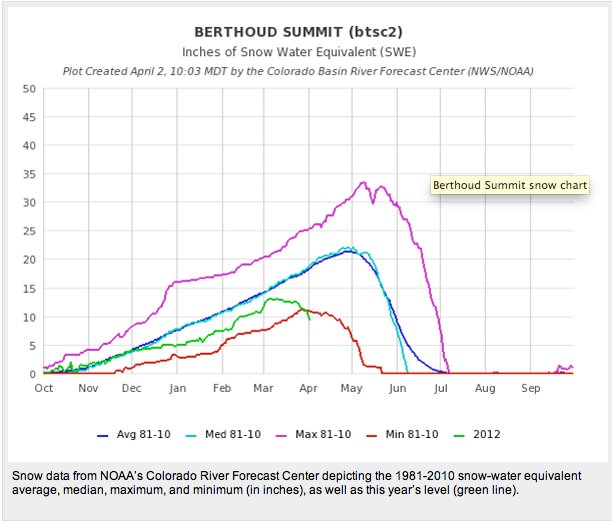
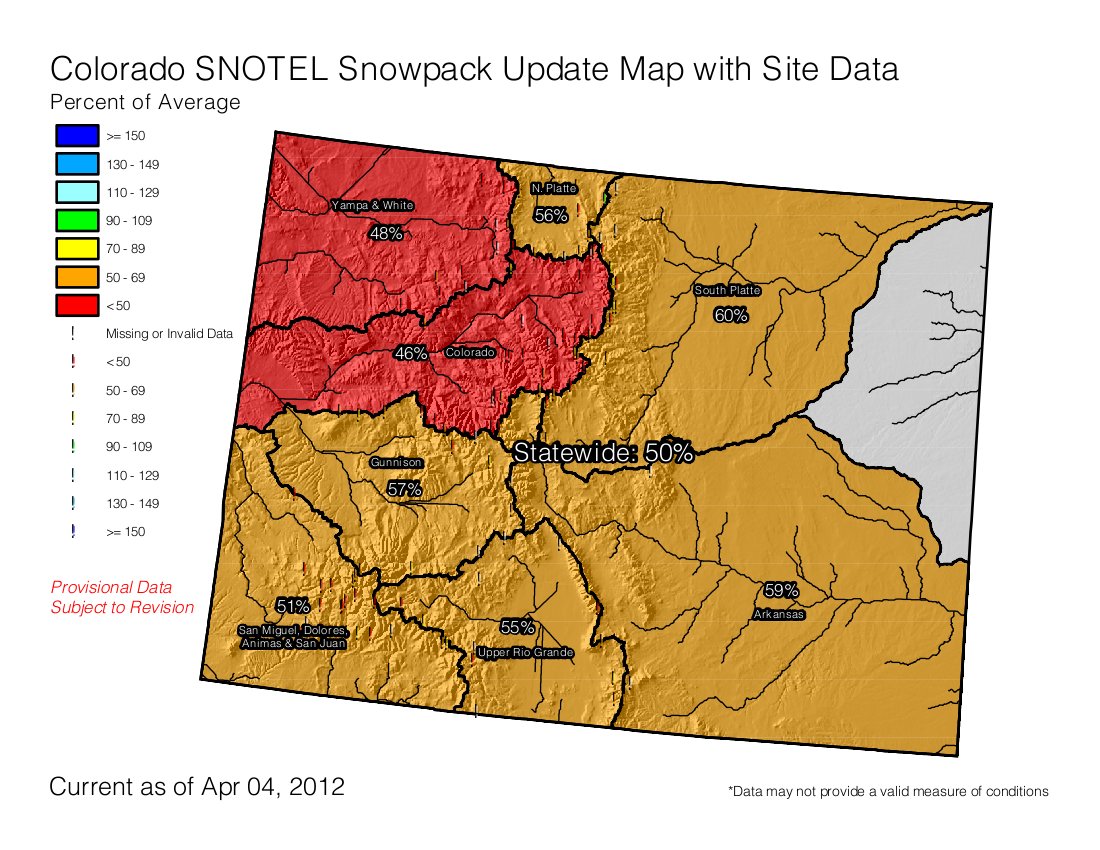

The message from the NRCS is no surprise to Coyote Gulch readers. We’ve been chronicling the precipitous decline in snowpack over the past month. Click on the thumbnail graphics for the latest snowpack map and table of snowpack and storage numbers for April 1, 2012, from the Natural Resources Conservation Service, as well as the Ogive of the Berthoud Pass Snotel (Climate Prediction Center via National Geographic). Here’s the release from the Natural Resources Conservation Service (Mage Skordahl):
The reprieve due to average or above average snow accumulation in February and the resulting boost in snowpack totals across the state was short lived. March brought dry, warm and windy weather to Colorado resulting in significant declines in the snowpack. According to Phyllis Ann Philipps, State Conservationist with the Natural Resources Conservation Service (NRCS), the latest snow surveys conducted on April 1, show that statewide snowpack has fallen to a paltry 52 percent of average. This is a decrease of 29 percentage points from the 81 percent of average measured on March 1. Statewide snowpack conditions have not been this low since 2002 when the snowpack on April 1 was also reported to be just 52 percent of average. Luckily Colorado’s reservoir storage is in better condition than it was in 2002; storage volumes statewide were reported at 108 percent of average at the end of March.
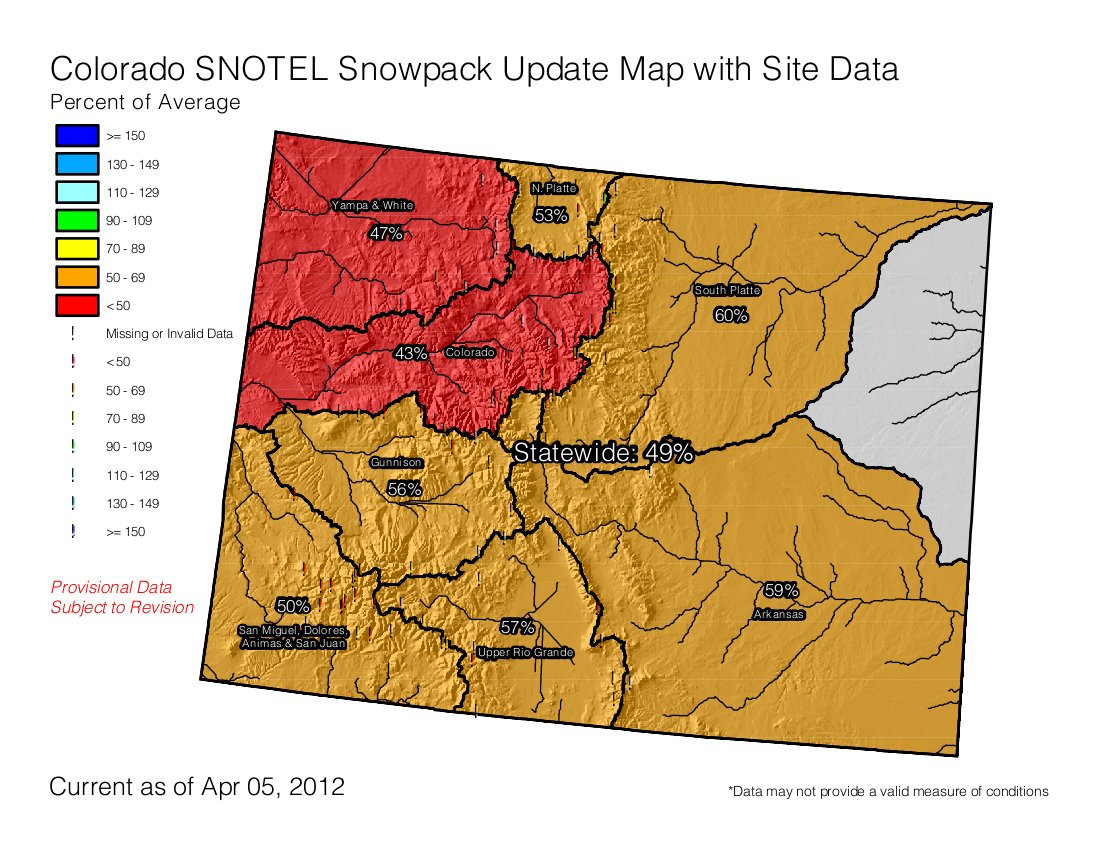
All major basins in the state reported significant drops in snowpack percentages over the last month, resulting from well below average snowfall and precipitation and warmer than average temperatures. The combined Yampa and White River basins and the Colorado River basin are both reporting snowpack’s that are less than 50 percent of average; 47 and 49 percent of average respectively. The South Platte River basin’s snowpack, while still above the statewide average, saw the largest decrease from conditions reported at the beginning of March. The basin’s snowpack dropped a substantial 34 percentage points from 89 percent of average on March 1 to 55 percent of average on April 1. Snowpack totals in the rest of the major basins ranged from 53 to 57 percent of average.
In an average winter the state receives around 20 percent of its seasonal snow accumulation in March. This winter however, March precipitation recorded at SNOTEL sites was well below average with monthly statewide totals at just 29 percent of average and instead of continuing to accumulate snow, data from SNOTEL sites revealed a snowpack beginning to melt. With April 12, the average date the snowpack reaches its peak, just around the corner there is very little hope for significant improvements to snowpack conditions prior to the spring-summer runoff season.
As of April 1, streamflow forecasts across Colorado have decreased by 20 to 40 percent of average from those issued last month. This closely mirrors the decline in snowpack percentages observed across the state. At this point all major basins in Colorado are expected to receive well below average runoff this spring and summer.
The bright spot in this month’s water supply report is that reservoir storage continues to track at near to above average volumes across the state. This stored water should help alleviate late-summer shortages.
More coverage from Bob Berwyn writing for the Summit County Citizens Voice. From the article:
Specifically, the snowpack declined by 29 percent between March 1 and April 1 during a month that usually delivers 20 percent of the total annual snowfall. All major river basins reported declines, with the lowest levels in the Yampa/White River Basin and the Colorado River Basin, both now well below 50 percent of average.
The South Platte River Basin, critical for water supplies in the Denver Metro area, saw the largest drop, falling 24 percent from 89 percent of average on March 1 to just 55 percent of average on April 1.
Jennifer Pitt (Environmental Defense Fund via National Geographic) is asking the question, Can Lack of Snow in Colorado River Basin Lead to a More Sustainable Path?. Here’s an excerpt:
If 2012 kicks off a series of dry years similar to those of 2000-2010, shortages will be unavoidable in the Lower Basin. Worse, the impact of another extended drought would be magnified by the fact that reservoirs in the basin are only 64 percent filled today, while they were completely full when the last drought started.
An extended drought starting in 2012 could drain so much water from Lake Mead as to threaten the ability of Las Vegas to access what amounts to 90 percent of its developed supply, just as it could threaten the ability of the Upper Basin to make downstream deliveries required under the Colorado River Compact. These would be untenable impacts, and certain to cause legal chaos and confusion unless the federal government, states, water users and other stakeholders start to work now on additional agreements that implement more conservation and allow more flexibility in times of extended drought.
Until fairly recently, water managers using Colorado River supplies would look to divert more water from the river. Because annual use of Colorado River water has reached (even perhaps exceeded) the annual average supply, today’s central challenges for water managers are to manage demands (through conservation) and to help facilitate more flexibility in the use of the basin’s water, such as voluntary markets, while avoiding economic and environmental damages. For many (but certainly not all) water managers in the basin, it’s a new – and difficult – way of doing business.
The bare mountaintops of 2012, and the possibility of more years like it, are certain to make the jobs of water managers more challenging. Scarcity will increase competition for water, and prices are sure to rise. But it’s also possible that this year’s dry conditions, coming so soon after the dry conditions of 2002, will continue to shift public awareness and opinion towards more support of these new ways.
As those of us who depend on the Colorado River increasingly come to recognize that extreme variability is ‘the new normal,’ water managers could find a public more willing to adapt. We need an honest discussion about the trade-offs we face, and the opportunities to do more with the water we already have.
From the Summit County Citizens Voice (Bob Berwyn):
This past month may not have been the driest March ever in the high country, but it was very close. At the official National Weather Service in Dillon, there was measurable precipitation on only four days (March 2,3,4 and 19), adding up to just 3 inches of snow and a paltry 0.20 inches of water, compared to the average 1.42 inches of water and 22 inches of snow.
From the Summit County Citizens Voice (Bob Berwyn):
Based on experimental forecasting, odds are close to 40 percent that La Niña will return for a third winter, according to Boulder-based NOAA climate scientist Klaus Wolter, who emphasized that’s not the official outlook from NOAA or the Climate Prediction Center.
A triple La Niña could spell trouble for an already dry Colorado, as three-year La Niña events are statistically linked with some the driest conditions on record in Colorado, including a historic mid-1950s drought, the mid-1970s drought that prompted ski resorts to start making snow, as well as the drought in the early 2000s that culminated with the ultra-dry year of 2002, when Dillon Reservoir nearly disappeared in a cloud of dust.
The best hope for a moisture turn-around would be a sudden switch to El Niño, which some climate models are predicting, but Wolter calculates that there’s only a 20 percent chance of that happening.

From the Deseret News (Amy Joi O’Donoghue):
[Sarah] Sidwell’s Tag-A-Long Expeditions is one of 370 businesses that are part of the Protect the Flows coalition, which is offering up options to be weighed in the Colorado River Supply and Demand Study. The study is part of an exhaustive effort by the Bureau of Reclamation examining current and future imbalances in the Colorado River system over the next 50 years and ways to restore balance. After an evaluation period anticipated to last through June, the study will provide a road map of strategies that can be undertaken to help ensure the river system remains a viable water resource for the next 50 years…
The group said historical data complied by the U.S. Geological Survey with its streamflow monitoring system should be relied on extensively for determining a practical calculation of how much water actually exists in the system — not what is predicted through widely-varying snowpack seasons. “There is actual empirical evidence that shows how much water we can expect to have in the river,” Sidwell said.
The coalition was in Washington, D.C., earlier this year to present its ideas, which include establishing guidelines for new “water-smart” landscape designs, encouraging pool cover usage and providing incentives to farmers for incorporating more water-efficient irrigation technologies.
More Colorado River basin coverage here.
From email from the Interbasin Compact Committee (Jacob Bornstein):
We now have three additional documents available on the following webpage: http://cwcb.state.co.us/about-us/about-the-ibcc-brts/Pages/2012StatewideRoundtableSummit.aspx.
These include,
1) The Summit Summary
2) Summit Table Discussion Key Points
3) Summit Survey SummaryWe are still in the process of compiling all of the Summit notes we received and will put these on the website. We continue to go through these notes to better understand the discussion as well as find items for further exploration and inclusion into our thought process.
From the Summit Summary:
The 2nd Statewide Roundtable Summit was held on March 1, 2012. Participants included 275 people who registered in advance and an additional twelve “walk-ins.” More than 70 staff and volunteers donated their time and effort to help make the day successful. Roles included registration, note-taking, and table moderation. In addition, several sponsors were critical to being able to provide a reception and food. CDM Smith was the title sponsor. Colorado Springs Utilities and SGM Engineering were lunch sponsors. Northern Water Conservancy District, The Nature Conservancy, Hydros Consulting, and Harris Water Engineering were break sponsors.
More IBCC — basin roundtables coverage here.

Here are the summaries from the Colorado Climate Center. Click on the thumbnail graphic for the precipitation summary.
If you’ve wondered why Aaron Million has been so dogged in his pursuit of his pipeline dream facing while facing huge opposition across Wyoming, Colorado and Utah and from conservationists across the U.S., you need only to focus on the potential rewards from a for-profit operation in the middle of Colorado’s last remaining developable water in the Colorado River basin and the wealthy Denver southern suburbs. Here’s a report from Catharine Tsai writing for the Associated Press via The Colorado Springs Gazette. From the article:
His team’s confidential business proposal, shown to potential contractors, estimates construction costs of $2.8 billion to $3.2 billion, with annual operating costs of between an estimated $70 million and $90 million per year being paid by water users.
The project would initially deliver about 110,000 acre-feet of water to municipal and industrial users, with re-use available to farm and environmental interests, according to the business plan. The water would be sold under a “cost plus 20 percent” financial model, with 20 percent being added on top of costs for delivering the water. That would result in a one-time $360 million to $480 million profit to the contractor from water sales, according to the plan.
The second stage of the project would deliver up to 140,000 acre-feet, with water sold at market rates. “Potential net profit is targeted in the $1.4 billion to $2.4 billion range,” the plan said.
Though the business plan lays out staged development, Million said the project likely would be built all at once to avoid having infrastructure costs balloon over time. In any case, costs should be lower if it’s developed privately, not publicly, he said. “The project is financially sound. We think we can get it done for 30 to 40 percent less than a public sector project,” Million said.
Million provided the business proposal to The Associated Press in response to questions about an earlier version of the plan obtained by the AP.
The role of Million’s Wyco Power and Water Inc. would be to shepherd the project through the permitting process, Million said. It would earn a management fee, which could range from 0.25 percent to 3 percent of money raised for its work, he said. The plan said Wyco is seeking to raise $15 million through 2015 to get through the permitting process. Million said the amount he has raised so far is confidential, but he has said $5 million has been spent on the project during the four years since he proposed it.
“We’ve finally learned what this proposal is about. It’s about people wanting to get extremely rich off of the natural wealth of the Colorado River and the communities up and down the basin that depend on it,” said Gary Wockner of Save the Colorado.
From The Greeley Tribune (Bridgett Weaver):
Hobbs, one of the nation’s leading authorities on water rights, was at Brentwood Middle School on Wednesday afternoon to talk to students about the adventures of water, as in river rafting and recreational water use. He was there representing the Water 2012 project, which aims to engage Coloradans in a statewide celebration of water, to raise awareness of water use and create new local and statewide opportunities that celebrate Colorado’s water, its uses and its value.
He did this by talking about a book his brother Will Hobbs wrote. The book, “River Thunder,” is about a group of young teens who take a trip down the Colorado River in the Grand Canyon. By bringing pictures from his personal outdoor and river adventures and by pulling them into the conversation with questions, Hobbs kept the students quiet and attentive.
Before talking to the large group, Hobbs participated in an eighth grade Advanced Placement history class. There he talked about Colorado’s history and his job on the Supreme Court. “We got to know things we didn’t know before, like how the court works,” said Lobna Alsrray, an eighth-grader…
Hobbs is promoting his brother’s book as part of the Water 2012 book club.
More Colorado Water 2012 coverage here.
From email from the Colorado Watershed Assembly:
There will be an Non-Consumptive Needs Workshop next Wednesday, April 11th from 11:30-2:30 at the Dolores Water Conservation District offices in Cortez. This workshop is hosted by the Non-Consumptive Needs Subcommittee of the Southwest Basins Roundtable and the State.
The full Roundtable meeting is at 3pm.
Please RSVP to Wendy McDermott (wendy@sanjuancitizens.org) for the workshop by COB this Friday. Lunch is provided by the CWCB!
More IBCC — basin roundtables coverage here.

From email from Reclamation (Erik Knight):
The April 1st forecast for spring runoff to Blue Mesa Reservoir has been issued and the numbers keep dropping. This forecast now predicts 330,000 acre-feet of runoff between April and July, which is 49% of average. Warm and dry conditions have caused the forecast to drop 90,000 acre-feet since the mid-March forecast. The monthly runoff distribution also shows an increase in the April runoff volume while all other months decrease, indicating an early runoff. For comparison, this forecasted runoff volume is lower than every year’s runoff volume since 2000 except for 2002.
Given this information, flows in the Gunnison River through the Black Canyon will be dropping to 400 cfs today, Wednesday, April 4th, as diversions through the Gunnison Tunnel increase.
Reclamation plans to operate the Aspinall Unit to allow the Black Canyon of the Gunnison River one day peak flow target to be met. Under the current forecast this target is approximately 960 cfs. The final determination of the spring peak target will be made upon issuance of the May 1st forecast by CBRFC.
Using the current forecast the peak flow target at the Whitewater gage is 900 cfs. Reclamation expects this flow target to be met in conjunction with the spring peak flows in the Black Canyon of the Gunnison River.
As a reminder, the April Aspinall Operations Meeting will be held in Reclamation’s Western Colorado Area Office, Grand Junction location, on April 26th beginning at 1:00 p.m.
More Aspinall Unit coverage here.
Here’s the latest installment of the Valley Courier’s Colorado Water 2012 series written by Brian Werner. From the article:
The rich water development history of the South Platte Basin goes back another 75 years before Northern Water’s creation. In fact the earliest water rights in the basin date to 1861 when the first farmers began diverting water from the Poudre River near Fort Collins.
A little more than a decade later, in 1874, a confrontation between the downstream Greeley residents and the upstream Fort Collins residents led to the codification of the doctrine of prior appropriation and eventually as part of the State Constitution in 1876.
As ditch, reservoir and irrigation companies were developed and canals built during the remainder of the 19th century the region flourished and developed a robust agricultural economy. Beginning in the 1890s and continuing for 20 years, hundreds of storage reservoirs were built to store water for late summer irrigation or for future dry years.
When Northern Water was created in the 1930s as a direct result of the ongoing drought and depression, there were more than 120 ditch, reservoir and irrigation companies in existence within the boundaries of what was to become the Northern Colorado Water Conservancy District.
Northern Water was established under the Water Conservancy Act of Colorado in September 1937. Its first order of business was to work with the Federal government – the Bureau of Reclamation which had been established in 1902 – to build what was to become the largest transmountain diversion project in the state. The project, the Colorado-Big Thompson, was a direct result of the 1930s drought and depression and was viewed as a life saver for the economy of northeastern Colorado…
Today, Northern Water is working through the environmental permitting on two water storage projects – the <a href="Today, Northern Water is working through the environmental permitting on two water storage projects – the Windy Gap Firming and the Northern Integrated Supply projects. When built these will provide an additional 70,000 acre feet of new supply to the region and lessen the pressure on agriculture to supply those needs.”>Windy Gap Firming and the Northern Integrated Supply projects. When built these will provide an additional 70,000 acre feet of new supply to the region and lessen the pressure on agriculture to supply those needs.
More Colorado Water 2012 coverage here.</p

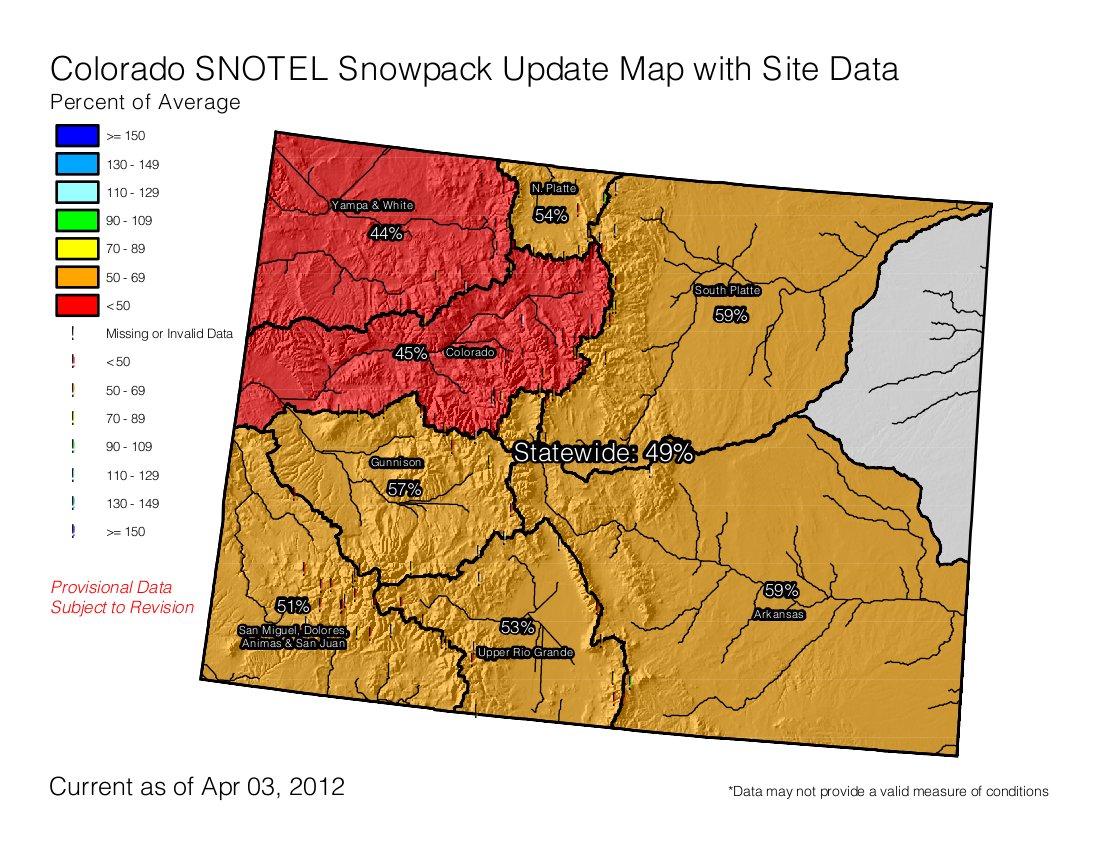
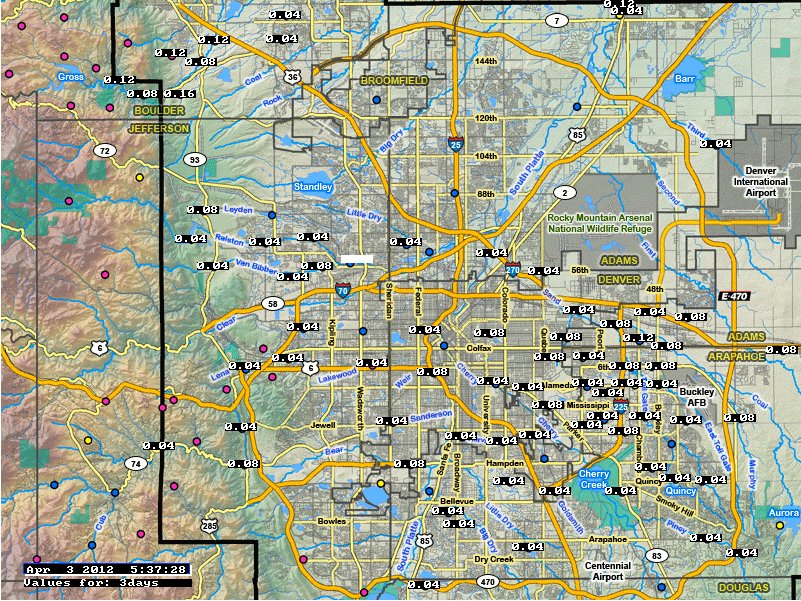
Click on the thumbnail graphic to the right for the 3-day precipitation map for the Denver area from the Urban Drainage and Flood Control District. The two stations nearest Gulch Manor reported .28 and .47 inches of beautiful moisture.
I’ve also posted a thumbnail of the current snowpack map from the Natural Resources Conservation Service.
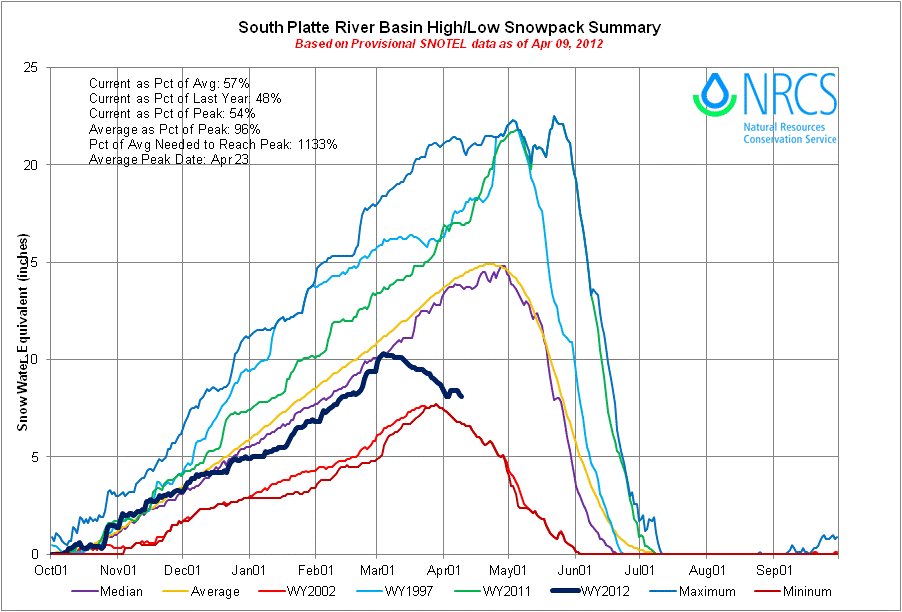
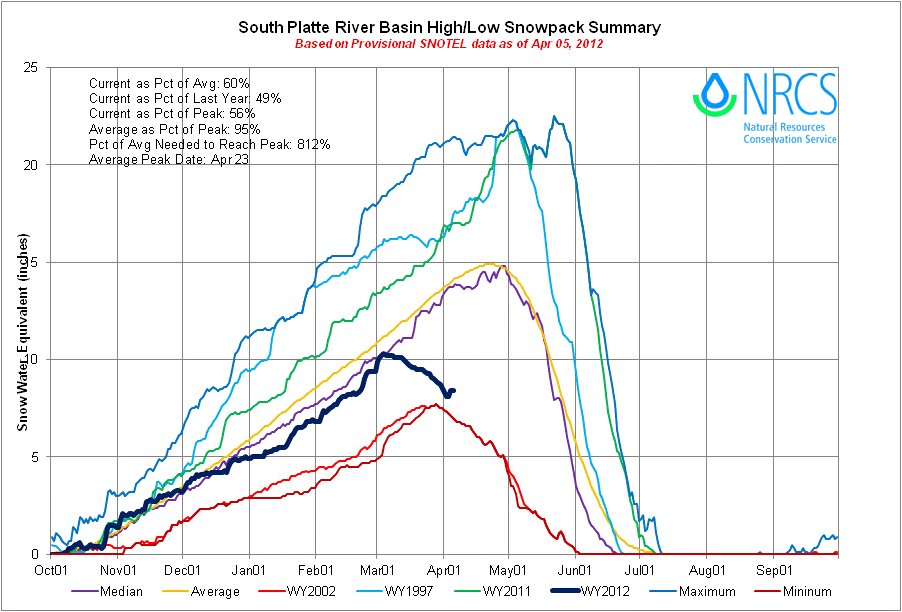
Finally, I’ve posted the Ogive for the South Platte River basin high/low snowpack summary. Note the red lines showing the daily minimums and the 2002 drought year. April 2002 was a disaster for the snowpack with much of a low snowpack sublimating into the atmosphere. Snow/cold weather dances are still in order.
From The Pueblo Chieftain (Pete Roper):
Falling trees pushed over by wind gusts reaching 64 mph tore down power lines in the Pueblo area, while nearly 2 feet of snow fell in the nearby foothills. Beulah and Rye both reported deep wet snow, while farther south an estimated 3 feet of snowfall was reported in Cuchara…
Walsenburg saw about 4 inches of snowfall, according to Ron Mercier, emergency dispatch communications director. Cuchara received about 3 feet of snow at the most, Mercier added…
Monarch Mountain ski resort reported 4 inches of new snow, which promoted a chain-law for commercial vehicles traveling over Monarch Pass…In Salida, a weather spotter reported 3 inches of snow…Canon City residents reported 4 inches of snow, which combined with overnight rain for 0.48 of an inch of moisture. In Custer County, Road and Bridge Department Foreman Dave Trujillo reported between 13 and 16 inches of snow in the hardest hit parts of the county, while lower totals ranged from 7 to 12 inches.
From KUNC (Kirk Siegler):
“Despite what we’re seeing outside my window [Tuesday] of a little snowfall which is most welcome, rest assured we’re very concerned about the conditions, and we are in a drought,” said Lochhead, CEO of Denver Water. As head of the largest water utility in the state, it’s Lochhead’s job to ensure that water from melting snow keeps making its way to the taps of 1.3 million customers – even in a drought – and even when the average snowpack levels statewide are about half where they should be…
Lochhead said his agency and its regional counterparts that make up the Front Range Water Council have yet to implement restrictions on water use. But that could change in the coming weeks. The main reason they haven’t already is because the last two years were wet and snowy.
“Our storages reservoirs are our savings account in Colorado,” said Brian Werner, spokesman for Northern Water in Berthoud, the second largest water utility in the state and a member of the Council. Werner said Northern’s reservoirs are still about 25% above average, though like Lochhead, he’s worried about the long-term forecast. “We are in relatively good shape going into 2012, especially in comparison to 2002-2003 when we had the same kinds of numbers in terms of snowpack, but we didn’t have the same amounts of storage,” Werner said…
But even if it is approved, it wouldn’t happen for another decade. So for now, Jim Lochhead said he can only feel fortunate that, like Northern, Denver Water’s reservoirs are mostly full. “But we’re also reluctant to roll the dice on what might happen in 2013, so we really don’t want to spend our savings account and waste it,” Lochhead said.
From the Associated Press via TheDenverChannel.com (Wayne Harrison):
Aurora Water spokesman Greg Baker says destructive wildfires and an arid March have reduced expectations for this year’s water supply. The most severe drought in the state is in the Arkansas Basin where drought areas are reporting extreme conditions as a result of last summer’s Texas drought which also affected Colorado. In Fort Collins, March was the warmest in 124 years of record keeping. Warnings are also out for the Yampa/White Basin in northwestern Colorado due to lack of sufficient snowpack, and most of the northeastern plains are abnormally dry. The statewide snowpack was at 49 percent of average Tuesday.
State climatologist Nolan Doesken said even though reservoir levels are still strong and northeast Colorado soil moisture is still good, it’s early in the season for the state to be this warm and dry. “This is very concerning,” he said.
From KUSA (Blair Shiff):
“A lot of people have been comparing this year to 2002 and the difference is that we didn’t have the reservoir storage in 2002,” Mage Skordahl, with the Colorado Snow Survey Program, said. “2002 came off of multiple years of below-average snowpack and very little storage in the reservoirs and that is when you really start to get in trouble when you have multiple years of below-average [snowpack].” Skordahl also says if Colorado sees heavy spring rains, it will help make up for a drier winter.
From the Aspen Daily News (Curtis Wackerle):
March, typically a snow-heavy month in the Colorado Rockies, averages between 25 and 26 inches of snow, according to Cory Gates of AspenWeather.Net. In 2012, it snowed 7 inches on March 1, a trace on March 2 and 1.25 inches on March 18, bringing the grand total to 8.25 inches, according to Gates’ records. Since local records have been kept, going back to 1934, the driest March on record was 1966, which saw 7.2 inches of snow, Gates said. So this March, with about an inch less of snow, would have been the driest on record.
It also was exceptionally warm for most of the month, which saw high temperature records fall on four days. March 31 hit 69 degrees in town, about a degree shy of the all-time highest recorded temperature for March. A total of 10 days in March saw temperatures break 60 degrees, “which is unprecedented and will never happen again in our lifetime,” Gates wrote in an email.
The Pacific Ocean is to blame for the lack of snow, Gates said. The pattern coming off the sea meant the Aspen area had a “ridge aloft” bringing lots of sunshine since March 18.
From The Denver Post (Jason Blevins):
Confirming what everyone in the high country already suspected, Monday’s preliminary data from the Natural Resources Conservation Service’s Colorado Snow Survey office reveals the state’s snowpack at 50 percent of average. That’s the lowest beginning of April measurement since the survey began in 1968. It’s even lower than in 2002, when early April snowpack measured 52 percent of average, marking the apex of a lingering drought that parched Colorado. “I can tell you from being at the ski areas that it’s going backward fast,” said Jim Pokrandt, spokesman for the Colorado River District.
Outside his Glenwood Springs office window, Pokrandt eyed the Colorado River, fed by a basin with snowpack measuring a meager 40 percent of last year and 50 percent of average. And the river was rushing — higher than normal for early April. “The runoff is starting early,” he said.
With wildfires in March and ski areas scraping to reach mid-April closing dates, the spring so far does not bode well for paddlers, fishermen and river lovers. Unless the snow hammer falls in late April and May — the next two weeks look warm and dry, according to the National Weather Service’s Climate Prediction Center — Colorado’s rivers will be trickling with extra-low flows by early summer…
“The reservoirs this year won’t be hit too hard,” said Pokrandt, adding that “lessons we learned” from 2002 will help water managers this summer. “Water providers might want to be quicker on the draw to implement water conservation measures. They waited too long in 2002, and the reservoirs got hit and we went into the following year in a big predicament.”

From Windsor Now!:
The Clearview Library District will host a forum about Hydraulic Fracturing from 6:30-8 p.m. Wednesday at the Windsor-Severance Library, 720 3rd St., Windsor. Shane Davis of the Sierra Club and Sarah Landry of the Colorado Oil and Gas Association will be the featured speakers. A question and answer session will follow their presentations.

From the Englewood Herald (Tom Munds):
New regulations regarding the removal of microscopic giardia and cryptosporidium organisms from drinking water make it necessary for the city’s Allen Water Filter Plant to install the ultraviolet system as part of its treatment process. “Our filter system keeps us in compliance with current regulations regarding removal of giardia and cryptosporidium,” utility director Stewart Fonda told the City Council at the March 26 study session. “However, we need to install the ultraviolet system now in order to be able to comply with the more stringent regulations that will be in place by 2014.”[…]
He said the plans are to remake a 1950-era building into a two-story structure that will be the location of the ultraviolet process. The ultraviolet system will be on the first floor and the power supplies for the system will occupy the second floor. There will be three ultraviolet “trains” in place. Each “train” consists of line of six or eight 4,000- to 5,000-watt ultraviolet bulbs that are similar in shape to fluorescent lighting. The intensity of the bulbs means the water only requires a few seconds of ultraviolet disinfection. The project is scheduled to begin in September and will take about a year. The cost will be $3.5 million to $4 million.
Rain and snow, I almost forgot what they look like with the dry March weather. Click on the thumbnail graphic to the right for the 3-Day precipitation map from Urban Drainage.
Meanwhile, CoCoRaHS is recruiting new observers in southeastern Colorado, according to Bruce Fickenscher writing for the La Junta Tribune. From the article:
Goals stated in the CoCoRaHS mission statement include: provide accurate high-quality precipitation data for our many end users on a timely basis, increase the density of precipitation data available throughout the country by encouraging volunteer weather observing, encouraging citizens to have fun participating in meteorological science and heightening their awareness about weather, and providing enrichment activities in water and weather resources for teachers, educators and the community at large. Volunteers make an important contribution in helping others. By providing your daily observation, you help fill in a piece of the weather puzzle that affects many across your area in one way or another.
In southeast Colorado, CoCoRaHS data has been utilized in reporting to USDA offices, documenting extreme weather conditions affecting crops and livestock, BUT we need more volunteers. There are many areas in the seven counties of the Southeast Area that we do not receive any weather information from. CoCoRaHS data is not only used to document when an area gets precipitation, but when it does not.
One advantage of the CoCoRaHS system is that individual volunteers may enter their own data on the website, but for some that is not an option they wish to use. Therefore, in the Southeast Area, we are making another option available. If you wish to participate in the program but do not, or cannot, use the Internet, you may call your local CSU Extension office and give a verbal report to the staff, they will then enter your data into the system. I know all of you producers check your rain gauges and the majority of you have cellphones – easy reporting with a phone call!
If you wish to learn more about the CoCoRaHS network or to sign up as a volunteer, you may contact Storm Casper for Baca County at the Baca County NRCS office at (719) 523-4522 ext. 3, Kevin Lindahl for Crowley, Otero or Bent counties at (719) 469-1894, Bruce Fickenscher for Cheyenne, Kiowa, or Prowers Counties at (719) 438-5321, or your local CSU Extension office in any of those counties. New volunteers will receive an information packet explaining how to properly install and read their rain gauges and reporting procedures as well as a complimentary, high quality rain gauge to get started. The more reports, the more accurate the information!
Here’s the release from the Front Range Water Council via Denver Water
Front Range Water Council members are keeping a close eye on snowpack levels, and some might implement additional water restrictions if their supplies continue to look below average.
Even those water providers whose storage appears to be in good shape for this year are carefully watching the numbers because if warm dry weather continues through this summer, they may need to stock up for what could be a dry year in 2013.
“During the drought 10 years ago, water providers learned it’s difficult for reservoir storage to survive multiple-year droughts,” said Jim Lochhead, Front Range Water Council chair and CEO/manager of Denver Water. “As a result, municipalities pushed more comprehensive conservation efforts, and we’re seeing those positive results today. But conservation alone is not enough. We need strategies that also include reuse and new supplies.”
The Front Range Water Council is a collaboration between Aurora Water, Denver Water, Colorado Springs, Northern Water, Pueblo Board of Water Works, Southeastern Colorado Water Conservancy District and the Twin Lakes Reservoir and Canal Company. The members, all of whom pull various amounts of water from the Colorado River, are looking at options should the snowpack levels remain low.
In Colorado, the year round water supply is dependent on the winter snows and the ability to store the snowmelt runoff for later use. Because each provider also pulls water from additional sources — some of which are in better shape than others — individual providers will likely need to address their supplies in different ways:
Aurora Water — Aurora Water’s supplies are in relatively good shape, in part because of the Prairie Waters project, which recaptures river water from the South Platte, as well as higher than normal reservoir levels. However, staff is keeping a close eye on reservoir levels to determine if Aurora needs to keep extra supply in the event dry weather continues into 2013. Aurora has permanent conservation measures in place which prohibits residents from watering more than three days a week or between the hours of 10 a.m. and 6 p.m., but no additional restrictions are planned.
Colorado Springs Utilities — Colorado Springs Utilities is well positioned to manage its water situation this spring and summer thanks to adequate storage levels and customer conservation. Staff continues to carefully monitor the dry weather conditions and below average snowpack.
Even though Colorado Springs Utilities is not looking at mandatory restrictions this year, it reminds its customers that the City remains in voluntary water restrictions. Customers should be even more diligent in managing their water use this irrigation season by following conservation tips, attending free xeriscape classes and taking advantage of rebate programs at http://www.csu.org.
Denver Water — Denver Water gets about half of its supply from the Colorado River and half from the South Platte River, snowpack levels in both basins are very low. Officials have not yet implemented additional restrictions, but could if its system reservoir levels drop. In the meantime, Denver Water asks residents to conserve as much as possible.
Denver Water is proposing several projects to meet its future need. It is building out its recycled water treatment system and has an aggressive conservation program. In addition, the utility is pursuing new supply. Following the 2002 drought, Denver Water nearly ran out of water in the north end of its system, which is more susceptible to water supply problems during a dry year. The utility currently is in the permitting process to enlarge Gross Reservoir near Boulder to help avoid running out of water any given year and put water where it is needed.
Northern Colorado Water Conservancy District – Northern Water and its Municipal Subdistrict provide water to Northeastern Colorado through the Colorado-Big Thompson and Windy Gap projects. The C-BT Project has above average water in its storage reservoirs due to recent high snowpack years and will be able to fulfill this year’s deliveries despite lackluster snowpack. In addition, two proposals – the Windy Gap Firming and Northern Integrated Supply projects – would add even more reliable annual supply to this growing region.
Pueblo Board of Water Works – The Board has worked diligently to maintain an ample reserve supply in storage at Clear Creek, Twin Lakes, Turquoise and Pueblo Reservoirs so that it can continue providing a reliable water supply to all of its customers, even during severe droughts. The Board currently has over 3 times as much water stored in these reservoirs than it did going into the irrigation season in 2002. For this reason the Board does not anticipate any watering restrictions or curtailment of extraterritorial water leases for this coming summer.
Wise water use by Puebloans has saved millions of gallons of water since 2003. The Board acknowledges our customers’ help in preserving this vital resource, and encourages them to continue doing so.
Twin Lakes Reservoir and Canal Company – Twin Lakes provides water to municipal and agricultural users in the Arkansas River and South Platte basins including several Front Range Water Council members. Twin Lakes is closely monitoring the snowpack and runoff forecasts and is preparing for a below average year.
Southeastern Colorado Water Conservancy District – A majority of the water supply to the Fryingpan-Arkansas Project comes from the Colorado River, where snowpack levels are very low. By May 1st the Bureau of Reclamation will notify the Southeastern Colorado Water Conservation District as to the amount of project water available to the District’s domestic, municipal, and irrigation entities that have applied for project water. Since the supply of project water is to supplement the supplies available to the users from privately-owned water rights, the use of project water increases during years in which there are lesser supplies of privately-owned water within the basin. The Allocation Committee then meets to review the applications, and prepare recommendations concerning the applications received as related to the amount of water available. Recommendations from the Allocation Committee are considered at the next meeting of the board of directors of the District, and appropriate allocations are made.
Front Range Water Utility Council member media contacts:
Aurora Water – Greg Baker 303-739-7081
Colorado Springs Utilities – Steve Berry 719-668-3803 or Mark Murphy 719-668-3831.
Denver Water – Stacy Chesney 303-628-6584
Northern Colorado Water Conservancy District – Brian Werner 970-622-2229
Pueblo Board of Water Works – Paul Fanning 719-584-0212
Twin Lakes Reservoir and Canal Company – Steve Berry, 719-668-3803 or Mark Murphy 719-668-3831
Southeastern Colorado Water Conservancy District – Lee Miller 719-948-2400
Meanwhile, here’s a release from Colorado State University (Emily Narvaes Wilmsen) that explains current conditions:
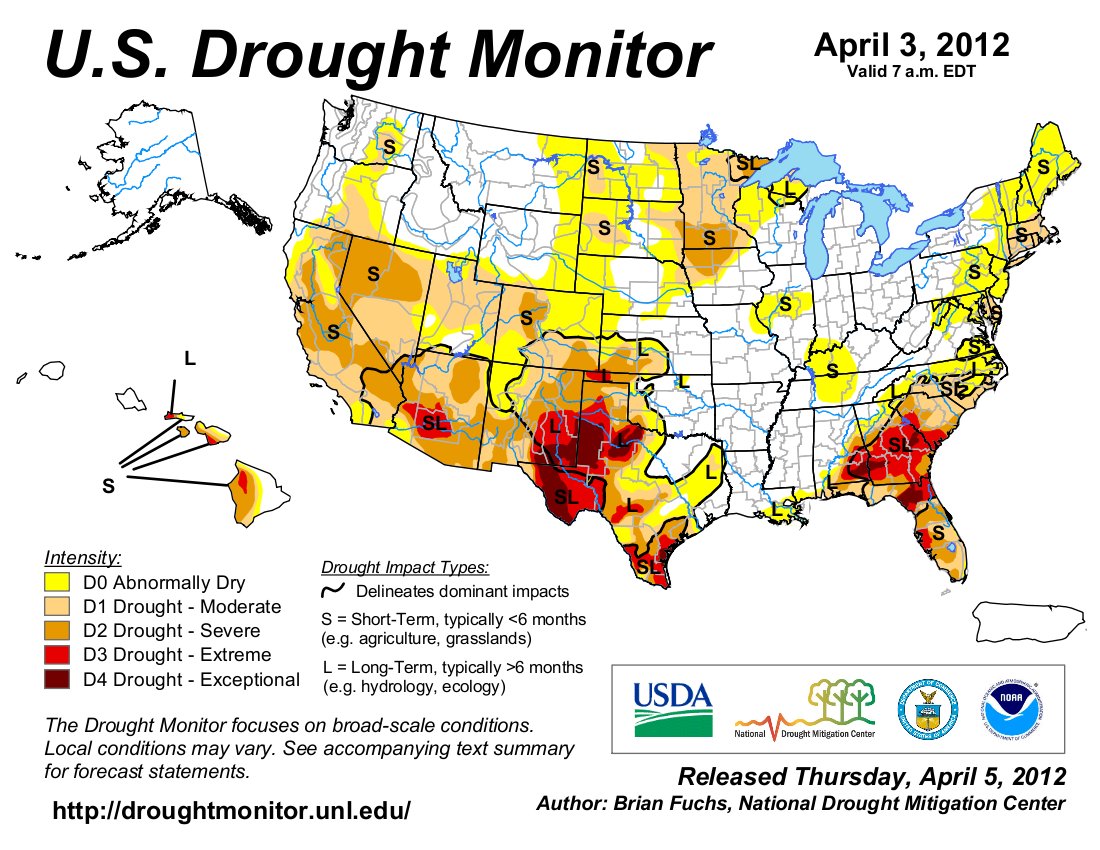
Despite the cooler weather coming in, Colorado State University climatologists have officially confirmed for the U.S. Drought Monitor what many people in Colorado already know: About 98 percent of the state is experiencing varying levels of drought.
The most severe drought in the state is in the Arkansas Basin where drought ranges from D1, or “moderate” drought to D3, or “extreme” conditions as a result of last summer’s Texas drought which also affected Colorado. A newer area of D2 or “severe” drought has recently been added to the Yampa/White Basin in northwestern Colorado due to lack of sufficient snowpack this season.
Most of the Northeastern Plains are designated as “abnormally dry.” In October, 60 percent of the state didn’t have any drought categories. That has shrunk to 2 percent, said Nolan Doesken, the state climatologist who is based at Colorado State University.
“Even though reservoir levels are still strong and northeast Colorado soil moisture is still pretty good, we just don’t usually start out quite this warm and dry at this time – so this is very concerning.”
Some comparison is being made to 2002, which was the last major drought in Colorado.
“In 2002, things didn’t seem that bad at the end of March as March had been quite cool with some snow,” Doesken said. “April 2002 was a lot like March 2012 in that there was scarcely any precip statewide and the snowpack just disappeared without producing much runoff. I don’t recall much fire issues until mid April 2002, but then things started going crazy.
“There is plenty of time yet for at least some parts of Colorado to improve,” Doesken said. “Our spring ‘cool wet season’ continues into mid-May in southern Colorado and into the first or second week of June in northern Colorado. We typically need – and often receive – about three major widespread cold and soaking storms during this coming 10- to 11-week period along with increasing amounts of scattered thunderstorms, especially from late April onward.”
Statewide, the northeast plains have received less than 5 percent of normal for the March – that’s the worst for the state, said Wendy Ryan, research associate who works with Doesken in CSU’s Colorado Climate Center.
“The temperature has been 6 to 9 degrees above normal,” Ryan said. “The mountains have already started melting out after some improvement in February. I recently helped with the snow course at Cameron Pass and it’s only 50 percent of normal at the end of March. The two lower courses, Big South and Chambers were single digit percents of normal with barely any snow cover at all.”
The U.S. Drought Monitor officially tracks drought conditions across the United States; the office of the State Climatologist at Colorado State University is responsible for reporting Colorado’s conditions to the monitor. The drought monitor, through the National Drought Mitigation Center based at the University of Nebraska-Lincoln, is a synthesis of multiple indices and impacts that represent a consensus of some 200 federal and academic scientists.
In Fort Collins, March was the warmest in 124 years of record keeping, Ryan said.
“In Fort Collins, we had the hottest and driest March on record,” Ryan said. “This is the first time we’ve ever had only a trace of precipitation for March. No years have had zero.”
Ryan said the Front Range urban corridor has been one inch or more below average for March. The entire state is below 50 percent with the exception of the far Eastern Plains, which have received some moisture.
The statewide snowpack has declined in recent weeks and is currently only 60 percent of normal, she said.
“March is one of our bigger precipitation months on the Front Range so to not have anything is a big deal,” Ryan said. “This is pretty much polar opposite to last year with record snowpack continued to accumulate in the mountains all spring.”
From the Summit County Citizens Voice (Bob Berwyn):
Statewide, the snowpack is only 50 percent of the historic average; the Colorado River Basin snowpack is the lowest in the state, at 47 percent. NOAA’s Climate Prediction Center is showing above average chances for dry weather to continue the next three months, with above average temperatures, which could further debilitate the spring snowpack.
Even those water providers whose storage appears to be in good shape for this year are carefully watching the numbers because if warm dry weather continues through this summer, they may need to stock up for what could be a dry year in 2013, according to the Front Range Water Council.
“During the drought 10 years ago, water providers learned it’s difficult for reservoir storage to survive multiple-year droughts,” said Jim Lochhead, Front Range Water Council chair and CEO/manager of Denver Water.
From the Denver Business Journal (Cathy Proctor):
Council members all pull water from the Colorado River, and are looking at options if snowpack levels remain low, the council said.
From The Denver Post (Monte Whaley):
About 98 percent of the state is experiencing varying levels of drought, according to CSU, with the most severe in the Arkansas Basin, where drought ranges from D1, or “moderate” drought to D3, or “extreme.” Last summer’s Texas drought is also still affecting Colorado, CSU said.
A newer area of D2 or “severe” drought has recently been added to the Yampa/White Basin in northwestern Colorado due to lack of sufficient snowpack this season.
Most of the northeastern plains are designated as “abnormally dry.” Conditions changed drastically since October, when 60 percent of the state didn’t have any drought categories.
That has shrunk to 2 percent, said Nolan Doesken, the state climatologist who is based at CSU.
“Even though the reservoir levels are still strong and northeast Colorado soil moisture is still pretty good, we just don’t usually start out quite this warm and dry at this time — so this is very concerning,” Doesken said.
Some are comparing this year to 2002, which was the last major drought in Colorado. “In 2002, things didn’t seem that bad at the end of March as March has been quite cool with some snow,” Doesken said.
April 2002 was a lot like March 2012, he added, saying there was scarcely any precipitation statewide and the snowpack disappeared without producing much runoff…
“We typically need — and often receive — about three major widespread cold and soaking storms during this coming 10-to-11 week period along with increasing amounts of scattered thunderstorms, especially from late April onward,” Doesken said.
From The Pueblo Chieftain (Chris Woodka):
“As we all know, water is one of our most precious resources,” said Alan Hamel, executive director of the Pueblo Board of Water Works. “And, even though we don’t anticipate any restrictions on irrigation this year, we encourage all of our customers to use water very wisely and not waste it.”[…]
Most of Colorado’s snowpack occurs in March and April, and statewide snowpack was listed at 58 percent of normal Monday by the Natural Resources Conservation Service. Pueblo received only 0.11 inches in March, and has received 0.74 inches for the year, less than half of normal. Record-breaking temperatures were recorded over the weekend before colder weather and high winds returned Monday…
Between its accounts in Lake Pueblo, Clear Creek, Turquoise and Twin Lakes, the water board has more than 43,000 acre-feet of water in storage, more than a year’s worth of potable water supply.
From CBS4Denver.com:
Denver Water said because March was so dry they’re now anticipating a weak year for the rivers and creeks that fill the lake. “We need to maintain or hold some more water in Dillon Reservoir in anticipation of low run off and snowpack,” [Phil Hofer, Frisco Bay marina manager] said.
By law Denver Water has to release 50 cubic feet per second. They said they’re just above that at 53. On the same day last year they were releasing 97 cubic feet per second. And by the end of April 2011 they were releasing 255 cubic feet per second.
From the Colorado Springs Independent (Pam Zubeck):
Despite the flushing and a dam project that has reduced the city’s transmountain storage capability, Utilities has ample water for a normal growing season, Berry says, promising there won’t be a repeat of 2002 when drought conditions triggered water restrictions during what turned out to be the third driest year in more than a century, with only 7.84 inches of rain. Only two Dust Bowl years, 1939 and 1934, were drier.
It seems like a no-brainer to expect rationing, considering Colorado Springs has received .37 of an inch precipitation since January 1, or 22 percent of the normal 1.69 inches, the National Weather Service reports.
Adding to the problem are high temperatures. Along with dozens of cities in 25 states, Colorado Springs experienced higher-than-normal temperatures in March. The average high was nearly 64 degrees, compared to an average of 52 in a normal year. The average minimum was 32 in March, compared to 26 degrees in a normal year, according to the Weather Service…
But Pueblo won’t impose restrictions, and neither will Springs Utilities, despite a project to improve Homestake Reservoir, part of the city’s transmountain system, which delivers water from the Colorado River basin to Colorado Springs. The reservoir, in the Holy Cross Wilderness area near Leadville, will be drained and the work will begin this summer. (Berry says the lake is already low enough that two snowmobiles have been found at the bottom, “but no Jimmy Hoffa.”)
Utilities officials decided to move ahead on the $30 million project this year (Aurora is a partner in the project) after 2011 turned out to be a “pretty wet season,” Berry says, with 16.24 inches of precipiation for the year, not far off the normal mark of 17.4 inches.
To compensate for the empty Homestake Reservoir, Utilities purchased additional storage space in Pueblo Reservoir. That water will be delivered to the Springs through the Fountain Valley Authority water line, Berry says.
While snowfall has been below normal in most of Colorado, except for the Sangre de Cristo range, Berry says local snowpack on Pikes Peak is a little above average. That means the North and South Catamount Reservoirs, lowered last year due to repairs on Montgomery Dam near Breckenridge, will likely return to normal levels this year.
Local storage is at 73 percent of capacity, Berry says, slightly more than the historic capacity of 70 percent, while the city’s systemwide storage stands at 69 percent of capacity, compared to the historic level of 62 percent.
From The Colorado Springs Gazette (Andre Wineke):
“We’ve looked at it and, while it’s certainly dry, we feel good about our storage this year,” said Utilities spokesman Steve Berry. “For 2012, we don’t expect any restrictions.”
Having said that, Berry added, it wouldn’t hurt everyone in Colorado Springs to keep an eye on their water usage.
“I think if the weather conditions don’t improve going into next year and if we have a bad snowpack next year like we have this year, then it could be a problem,” he said. “It’s still key that our customers conserve. Customer water usage is going to be really important this spring and summer. If our customers help us, that will certainly help us going into next year.”
Berry said Colorado Springs Utilities’ storage reservoirs are at about 69 percent of capacity. That’s above the 62 percent average for this time of year from 1970-2004, albeit down from the 77 percent of capacity in 2011…
The warm March did pump up local water use: Colorado Springs residents used an average of 53.6 million gallons of water a day during the month, up 15.2 percent from March, 2011, according to Colorado Springs Utilities. On the plus side, however, Utilities customers used 358 million gallons less than they did back in March, 2001 — about a 27 percent decrease after adjusting for the city’s growth.
From the Fort Collins Coloradoan (Bobby Magill):
Normally, Fort Collins gets more than a foot of snow every March. But not last month.
Only a trace of precipitation was recorded in Fort Collins last month, the first time in history that March did not have any measurable precipitation at all. The next driest March on record was 1966, when 0.01 inches of rain fell.
The average overall temperature for March was 50 degrees, or 8.6 degrees above normal. The average high temperature for March was 67.2 degrees – five degrees higher than the average high temperature for April.

Here’s the announcement from Greeley Water:
Colorado Governor John Hickenlooper has proclaimed the week of April 22-28 “Wastewater Worker Recognition Week” statewide. The proclamation honors the work of about 4,000 certified wastewater treatment plant operators and thousands of engineers, maintenance personnel, laboratory workers, scientists, biosolids workers, sewer maintenance workers, industrial waste pretreatment workers, administrative staff, and suppliers to the industry. Mayor Tom Norton will sign a proclamation similar to the one signed by Governor Hickenlooper on April 17.
Greeley’s Water Pollution Control Facility (WPCF) has won awards for its outstanding efforts as an outstanding wastewater treatment plant and environmental steward. WPCF won the Plant Performance Merit Award presented by the Rocky Mountain Water Environment Association (RMWEA) four times in 1992, 1999, 2005, and 2011. In February, WPCF was recognized by Xcel Energy for energy efficiency, as it won the 2011 Custom Efficiency Achievement Award. WPCF was chosen by Xcel because of the installation of high-speed turbo blowers to improve aeration at the plant. It is estimated that these new blowers will save the plant approximately $100,000 – $120,000 annually in projected electrical energy costs.
Greeley Wastewater employees are innovative as well. In 2009, the Wastewater Operations staff built a customized and low cost solution to treat high strength ammonia, resulting in a daily 307-pound reduction in ammonia waste that requires treatment. In 2011, filter boxes were designed and installed at the blower building that houses the six new high-efficiency blowers; this project helps keep the building clean and dust free. This year, plant staff will be participating in a Northern Colorado “Get Into Water” program which is designed to recruit and train individuals for the water/wastewater industry. Specifically, water and wastewater utilities are very concerned about workforce/succession planning and continuity issues as many utility workers begin to retire. This program will increase the public’s awareness of water industry career opportunities. The treatment plant is also evaluating a possible 500 KW solar energy project for the treatment plant and other energy reduction technologies.
Group or individual tours of Greeley’s Water Pollution Control Facility are available for citizens to learn more about wastewater treatment. Please call (970) 350-9360 for more information. Visit the Water and Sewer Department’s website for more on Greeley’s wastewater system: www.greeleygov.com/water/wastewater.aspx.
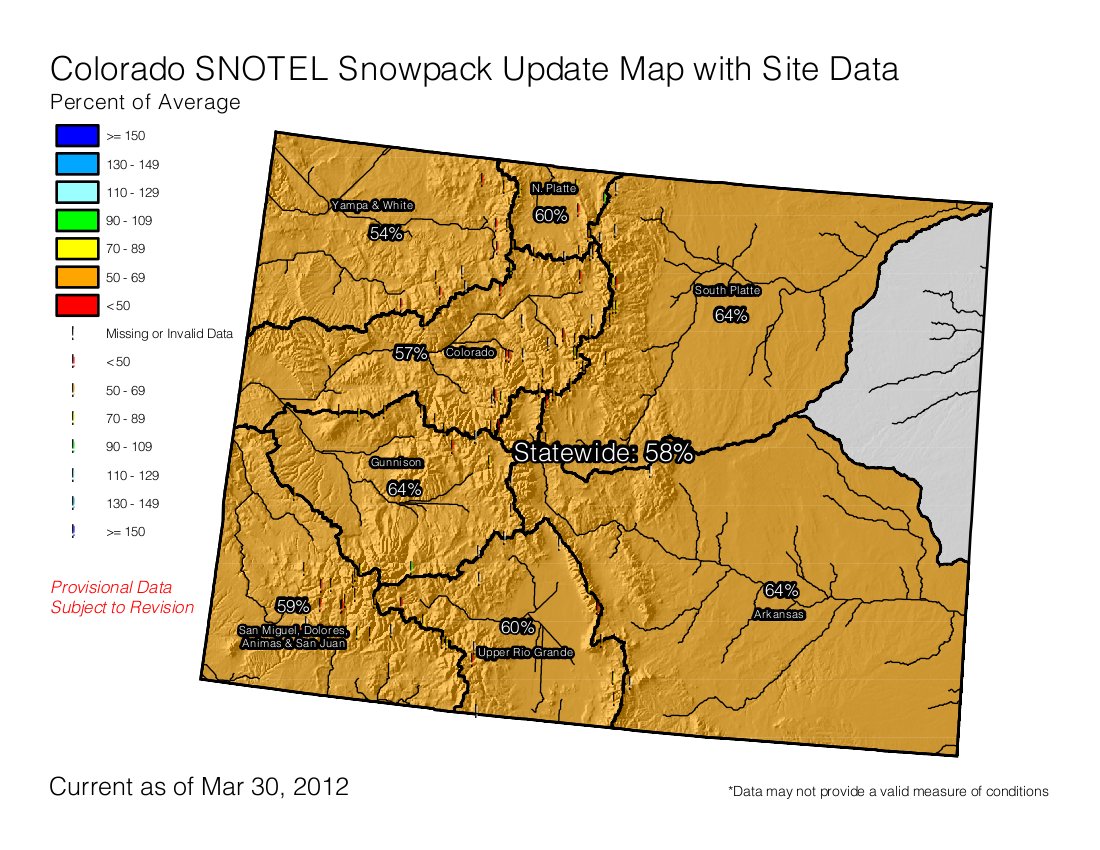
From The Pueblo Chieftain (Anthony A. Mestas):
The weather service reported the average monthly temperature in Pueblo in March was 48.7 degrees. That figure is 6.4 degrees above normal and makes last month the fourth-warmest on record in Pueblo. That is well behind the average temperature of 51.3 degrees recorded in March of 1910…
The weather service reported that Pueblo received 0.11 inches of precipitation in March, which is 0.82 inches below normal and makes this March the seventh driest March on record in Pueblo.

From The Telluride Daily Planet (Katie Klingsporn):
The towns and SMA filed final briefs, known as “reply briefs,” in Denver District Court this week. Barring a request for an exemption from CDPHE or Energy Fuels, these briefs will be the last filed to the court, which will take up the case and may or may not schedule oral arguments. In the reply briefs, the towns and SMA continue to contend that the CDPHE violated federal and state laws and ignored dangers to Colorado’s air and water when it issued the permit to Energy Fuels. Both briefs urge the court to vacate the license and remand the application back to CDPHE, which would force the process to start anew. “The hearing procedure was deficient, it did not comply with either federal law or Colorado law … and therefore the process needs to be reset,” said Telluride Town Attorney Kevin Geiger…
Much of the argument put forth by SMA and the towns hinges on a claim that the CDPHE failed to offer the public an opportunity to request a public hearing — as required under the Atomic Energy Act — after the agency issued its environmental report and draft license on the project. This public hearing, they say, is meant to provide a legal process involving testimony under oath and cross examination, not merely a meeting open to the public. The state and Energy Fuels claim that federal law does not in fact apply to its licensing of the mill, but the towns and SMA contest that assertion.
From email from the Ditch and Reservoir Company Association (John McKenzie):
The General Assembly of the State of Colorado passed HB 12-1010 in March and it was signed by the Governor on 3/15/12. This legislation amends the procedure for replacing lost ditch stock certificates. Prior to this change in the statute, an owner of a lost certificate had to wait three years before a ditch company could issue a replacement certificate. The new bill eliminates the three year waiting period. It takes effect on August 8, 2012.
Please remember that the alternative of a lost instrument bond may be
acceptable by ditch companies.During the legislative process, Jeffrey J. Kahn, Esq., of Lyons Gaddis
Kahn & Hall, PC testified on behalf of DARCA’s support for the bill.
More 2012 Colorado legislation coverage here.

From The Pueblo Chieftain (Lori Winner):
The Institute of Medicine determined that “adequate intake for men is roughly 3 liters and 2.2 liters for women.” There are 4.23 cups per liter, which equals 33.81 ounces per liter, making 8 cups approximately 2 liters. This formula comes close to the Institute of Medicine’s recommendations for women. However, it falls short by one liter for men. Water needs are as individualized as body type. Obese individuals need more water. A 200-pound person with low body fat needs less water than a 200-pound obese person with a high percentage of body fat…
As a general rule, there is no need to hydrate during an exercise session lasting 1 hour or less as long as you are properly hydrated prior to the workout.

From The Greeley Tribune (Analisa Romano):
The county’s new Federal Mineral Lease Board, comprised of Weld Commissioner David Long and two members in the oil and gas industry, granted the money to commissioners to purchase the gas chromatograph and mass spectrometer instrument for an estimated $145,000. While the Colorado Oil and Gas Conservation Commission does similar testing for well water contamination, Weld County Commissioner Sean Conway said the availability of the instrument gives residents “another layer of security” as the industry continues to expand in Weld…
[Trevor Jiricek, Weld’s director of planning] said the gas spectrometer will detect compounds normally found in petroleum. After testing to see whether the water shows sign of oil and gas activity, residents must pay for any additional analysis, Jiricek said. The money used to buy the instrument didn’t come from Weld taxpayers, said Long — it’s federal money granted to the county for oil and gas production on public lands, primarily the Pawnee National Grassland. Weld commissioners just approved the new Federal Mineral Lease Board last fall, which independently decides how to spend the revenue, he said. So this is the first year the board can allocate the money to entities that hope to offset some of the industry’s impacts…
[Weld Commissioner David Long] said the new instrument will also be able to establish a baseline for well water in the area, so that when oil and gas activity does increase, the county will have a better idea of the industry’s impact. “That’s kind of the recommendation across the nation,” said Mark Thomas, a chemist with the Weld Department of Public Health and Environment, of testing water before and after activity. Thomas said he doesn’t expect any samples that will test positive for hydraulic fracturing chemicals.
From the Boulder Daily Camera (Mitchell Byars):
The city of Boulder has only recorded .01 inches of rain this month, and there has been no measurable snowfall so far in what is typically the snowiest month of the year, according to meteorologist Matt Kelsch. Should it not rain or snow in the next three days — which Kelsch said is very likely — it will be Boulder’s driest March in recorded history. The previous record was .05 inches of rain in 1910.

From The Pueblo Chieftain (Chris Woodka):
In January, the organic farm advocate traveled to New York to lend his support — and testimony, if needed — to a federal court case brought by the Organic Seed Growers and Trade Association against Monsanto. Hobbs was not called on to testify during the oral arguments, but joined about 200 others from food safety groups and Occupy Wall Street in a rally near the courthouse after the courtroom action wrapped up. The farmers lost their challenge to Monsanto’s patents on genetically engineered seed on Feb. 24. Monsanto admitted to filing 144 lawsuits between 1997-2010 and settled another 700 cases out of court for undisclosed amounts with gag orders on the farmers, which the association says amounts to harassment of farmers. “Our goal is to protect farmers from patent infringement charges by Monsanto when their organic crops are contaminated by Monsanto’s genetically altered seed,” Hobbs said.
Last week, a federal appeals court agreed to hear an appeal of the New York decision…
“We believe the precautionary principle should be followed,” Hobbs said. “The first genetic crops appeared in the 1990s, and they pushed them without any review. Now, 94 percent of soy is genetically modified, and that wipes out the genetic diversity.”
For Hobbs, 43, who has farmed on 30 acres at Avondale since 2000, there is no direct threat to the types of food he grows, both as cash crops and for seed: garlic, squash, beans and vegetables. In all, he and partner Jamie Dunston raise seed for eight varieties of garlic and a couple dozen other vegetables.
Hobbs relocated to Pueblo after learning about organic farming and training others in Northern New Mexico in the late 1990s. He was lured here by the climate — cool nights, hot days during growing season — and plentiful water on the Bessemer Ditch.

From The Denver Post (Bruce Finley):
The Northern Water Conservancy District runs the auction, offering excess water diverted from the Colorado River Basin — 25,000 acre-feet so far this year — and conveyed through a 13-mile tunnel under the Continental Divide. A growing portion of that water now will be pumped thousands of feet underground at well sites to coax out oil and gas.
State officials charged with promoting and regulating the energy industry estimated that fracking required about 13,900 acre-feet in 2010. That’s a small share of the total water consumed in Colorado, about 0.08 percent. However, this fast-growing share already exceeds the amount that the ski industry draws from mountain rivers for making artificial snow. Each oil or gas well drilled requires 500,000 to 5 million gallons of water. A Colorado Oil and Gas Conservation Commission report projected water needs for fracking will increase to 18,700 acre-feet a year by 2015…
Riding his tractor this week, Colorado hay producer Lar Voss, who bid for water at the recent auction, accepted this approach. Voss bid for 100 acre-feet “to be sure I’ve got enough for the crops,” he said. Selling water to those who can pay the most “is what ought to happen.”[…]
At the recent auction, Fort Lupton-based A & W Water Service Inc. bid successfully for 1,500 acre-feet of water, paying about $35 per acre- foot. That’s slightly higher than the market price that irrigators pay for leasing water along the Front Range. The average price paid for water at NWCD’s auctions has increased from around $22 an acre-foot in 2010 to $28 this year.
A & W also leases water from Longmont, Loveland, Greeley and other cities — and hauls it to drilling sites.
More Colorado-Big Thompson Project coverage here.

