Forecast news: El Niño on the horizon?

From the Summit County Citizens Voice (Bob Berwyn):

A classic El Niño may be developing across the eastern Pacific, with warmer-than-average water temperatures starting to spread westward from the coast of South America, according to NOAA’s Climate Prediction Center.

For the month of June, the pattern of sea surface temperatures overall remained in a neutral phase, but with growing positive (warmer than average) equatorial Pacific sea surface temperature anomalies, NOAA has issued an El Niño watch, reflecting a likely emergence of of El Niño in the late summer or fall.

Ocean-wide, the warming off the coast of South America is consistent with patterns associated with the development of previous El Niños, including a weakening of low-level trade winds across the east-central equatorial Pacific. Those winds, blowing east to west, normally push the warmer waters to the west. Another sign is the weakening of the persistent pattern of enhanced convection near Papua New Guinea.

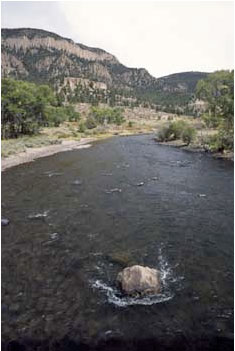
Fountain Creek: Lower Ark board declines opportunity to fund study of Waldo Canyon Fire effects on water quality

fountaincreek.jpg

From The Pueblo Chieftain (Chris Woodka):

The Lower Arkansas Valley Water Conservancy District board voted unanimously not to fund the request by Colorado State University-Pueblo scientists, saying it’s time for other agencies to step up on water quality studies. “The biggest problem is that there need to be more funding partners,” said Lynden Gill, acting chairman of the board. “We have limited resources and are in a situation where we feel uncomfortable.”[…]

[Scott Herrmann] said the water in Upper Monument Creek, near Cascade where the fire started, was as black as charcoal, turning grayer downstream. Further analysis also could detect whether there are higher levels of phosphorus in the water, a byproduct of ammonia phosphate and sulfate ions, the chief ingredients of the slurry dumped on wildfires. The researchers previously told the Lower Ark board they would like to expand the Fountain Creek study to the reach of the Arkansas River from Pueblo Dam to Baxter.

However, the Waldo Canyon Fire presented unique opportunities to study Fountain Creek, [Del Nimmo] said. “The fire has already had a profound impact,” Nimmo said. “There have been incredible changes on the Upper Fountain.”

More Fountain Creek coverage here and here.

Drought/precipitation news: Monsoon bolsters Yampa River streamflow #monsoon #CODrought

yampariveratsteamboatgage07182012.jpg

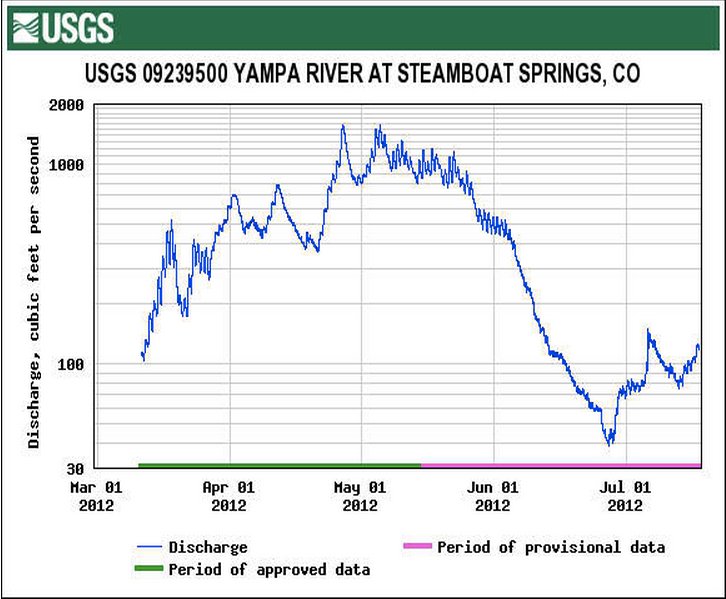
Click on the thumbnail graphic for the hydrograph for the Yampa River since March 1.

From Steamboat Today (Tom Ross):

Steamboat Springs weather observer Art Judson measured 0.13 inches of rain at 7 a.m. Tuesday at his station on an elevated bench between downtown and the ski mountain. Add that precipitation to the 0.29 inches he recorded Sunday morning and another 0.08 inches recorded Monday morning, and the unofficial three-day precipitation total is a tidy half-inch.

Despite the precipitation, Tuesday’s streamflow in the town stretch of the Yampa is just half of the average for the date…

A National Weather Service remote-automated weather station called Porcupine about 20 miles south of Steamboat recorded 0.21 inches of rain Sunday morning, none Monday morning and 0.84 inches Tuesday morning. Some of those precipitation amounts likely were reflected at Stagecoach Reservoir. The inflow at the reservoir was 113 cfs, and the dam release was 66 cfs Monday morning. Another weather station 5.5 miles east of Oak Creek recorded 0.31 inches of precipitation Tuesday morning, and another station 2.4 miles south of Steamboat recorded 0.2 inches. Just above the Steamboat town stretch of the Yampa and the official measuring station at the Fifth Street Bridge, Fish Creek was contributing 12 cfs to the river.

Here’s a release from the City of Carbondale via the Glenwood Springs Post Independent:

The Carbondale Board of Trustees has initiated water restrictions to conserve water until further notice. Due to high demand during this summer’s irrigation season, and to ensure proper functioning of the town water system, the town is imposing an even/odd restriction on irrigation.

Even-numbered addresses can irrigate on even-numbered days; odd-numbered addresses can irrigate on odd-numbered days.

In addition, the town requests no watering between 10 a.m. and 3 p.m., and asks residents to check the settings on sprinklers to eliminate water waste and overspraying.

Even with the recent rains, the area remains in a drought condition. These actions are necessary because of the lack of water within the Crystal River watershed.

Participation throughout the community will assist with maintaining adequate storage of the town’s treated water and help reduce the demands on the ditch systems.

From The Aspen Times (Scott Condon):

Hay prices are spiking already. Hay for cattle sells for about $300 per ton now compared with about $100 per ton last year, said Tom Turnbull, a Carbondale-area rancher since the early 1960s. And precious little hay is for sale in Colorado because the drought has been so severe. That means hay will have to be purchased from other states — adding transit costs that could easily double the price per ton.

Ranchers are in a precarious position. If the drought continues, the U.S. Forest Service and Bureau of Land Management might ask some ranchers to pull their cattle off grazing leases on federal lands earlier than usual. Typically cattle can stay on the range until mid-October…

A cow will eat roughly two tons of hay over the winter, the same as a horse, Turnbull said. If a rancher doesn’t have enough hay to feed a cow and has to buy, the economics don’t work well. As hay prices continue to climb, the cost of feeding a cow over the course of five winter months will exceed the $800 that a calf currently sells for, Turnbull said. When that occurs, ranchers must determine if it makes more sense to cull their herds and sell the cows that aren’t top producers…

Patrick McCarty, an agricultural extension agent with the Colorado State University Extension in Rifle, said ranchers in Garfield, Rio Blanco and Moffat counties are facing a particularly tough time. Parts of northwest Colorado are facing drought ranked “exceptional” by the U.S. Drought Monitor. Much of the state, including Pitkin County, is considered in “extreme” drought.

“This is a catastrophic drought for agriculture in western Colorado,” McCarty said. “The hay production has been affected immensely.”

From the Associated Press via The Denver Post (Jim Suhr/Steve Karnowski):

In the High Plains states of North Dakota, South Dakota, Wyoming, Nebraska, Colorado and Kansas, the areas designated as being in moderate to exceptional drought rose to 84 percent as of July 10 from 74 percent a week earlier…

Climatologists have labeled this year’s dry spell a “flash drought” because it developed in a matter of months, not over multiple seasons or years.

The current drought is similar to the droughts of the 1950s, which weren’t as intense as those of the 1930s, said Jake Crouch, a climatologist with the National Climatic Data Center. Farming has changed a lot since the Dust Bowl era. Better soil conservation has reduced erosion, and modern hybrids are much more resistant to drought.

But Crouch said it’s important to understand that this drought is still unfolding. “We can’t say with certainty how long this might last now. Now that we’re going up against the two largest droughts in history, that’s something to be wary of,” Crouch said. “The coming months are really going to be the determining factor of how big a drought it ends up being.”

U.S. Bureau of Reclamation launches website for youth

hooverdamspilling.jpg

Here’s the link to the new website. Here’s an excerpt from the “About” webpage:

Secretary Salazar established the Office of Youth in Natural Resources June 8, 2009. Its purpose is to coordinate present and future youth initiatives, including the creation of the 21st Century Youth Conservation Corps within the bureaus at the Department. The corps will be modeled after the Civilian Conservation Corps that provided three million men with jobs in the 1930s. By comparison, the 21st Century Youth Conservation Corps will include women as well as men and strive for greater diversity.

Reclamation has partnered with The Corps Network and The Student Conservation Association (SCA) to help develop a national Youth Conservation Corps at Reclamation. Through these cooperative agreements, Reclamation educates, engages and employs youth in conservation opportunities that include both hands-on crew work, as well as internship opportunities. The Youth Conservation Program at the Bureau of Reclamation involves youth in cultural and natural resource conservation related to Reclamation projects and promotes and stimulates public purposes such as education, job training, development of responsible citizenship, productive community involvement and furthering the understanding and appreciation of natural and cultural resources. Job opportunities through Reclamation’s Youth Conservation Corps include both hands-on, crew-type conservation work as well as educational internship options.

The employment effort complements Reclamation’s ongoing emphasis to educate and engage youth across all areas of our operations. Reclamation has a history of sharing scientific resources and current research with educators about hydropower, water conservation and water management throughout our regions in 17 Western states. Additionally, we proudly introduce the wonders of our treasured landscapes to disadvantaged and disabled youth through our long-term partnership with the Catch a Special Thrill (C.A.S.T.) for Kids Foundation.

More Bureau of Reclamation coverage here.

Tamarisk control: The leaf beetle for biocontrol program is yielding good results

tamariskleafbeetle.jpg

From the Summit County Citizens Voice (Bob Berwyn):

Efforts to control invasive tamarisk plants along the Arkansas River are looking up, thanks to a boost from some unexpected evolutionary adaptations. A small imported but that eats and kills the water-sucking plants has been expanding its range and reproducing more efficiently after adapting to regional cycles of darkness and light. “This is one of the clearest cases of rapid evolution,” said Tom Dudley, who has been involved in the tamarisk control efforts at UC Santa Barbara’s Marine Science Institute Riparian Invasive Research Laboratory. The tamarisk leaf beetle has managed to delay its entry into hibernation to adapt to the shorter days of the southern region of the United States. That adaptation enables the beetle to survive until spring and prolongs the time it has to reproduce.

More tamarisk control coverage here and here.

Greenland: Peterman glacier calves off chunk of ice twice the size of Manhattan Island

greenland.jpg

From the Summit County Citizens Voice (Bob Berwyn):

The University of Delaware is reporting that an ice island nearly twice the size of Manhattan has broken free of Greenland’s massive Peterman Glacier, which connects the Greenland ice sheet with the ocean via a floating ice shelf. The calving was reported July 16 by University of Delaware professor Andreas Muenchow in his Icy Seas” blog. Muenchow credited Trudy Wohleben of the Canadian Ice Service for first noticing the fracture, subsequently confirmed by one of NASA’s Earth-watch satellites. The same glacier spawned an iceberg nearly twice as big in 2010, which cut the size of the floating ice shelf by about 25 percent. The latest calving event puts the terminus of the glacier in a location where it hasn’t been for at least 150 years, according to Muenchow.

H.R. 6060: Endangered Fish Recovery Programs Extension Act of 2012

coloradopikeminnow.jpg

From The Pueblo Chieftain (Chris Woodka):

HR6060 would authorize the base funds of $4 million to the Upper Colorado and $2 million to the San Juan fish recovery programs. Revenues are generated through federal hydroelectric projects. All of Colorado’s congressional representatives, except Doug Lamborn, signed on to the bill as co-sponsors.

Pueblo benefits from the program because it has avoided environmental lawsuits which could affect imports of water from the Colorado River, said Alan Ward, water resources manager…

Pueblo annually contributes funds to the program, along with other large water importers — Denver, Colorado Springs, Aurora, Twin Lakes, and the Northern and Southeastern Colorado water conservancy districts. Indian tribes and Western Slope water users also contribute to and benefit from the program. The funds help pay for water that is used to sustain flows for the fish and for things like fish passages, hatcheries, screens or habitat improvement projects.

More endangered/threatened species coverage here and here.

Steamboat Springs: Colorado Water Congress Summer Conference August 15 – 17

steamboatsprings.jpg

Doug Kemper sent along the Colorado Water Congress Summer Conference detail via email. Click here to download a copy.

‘…we are trending towards an El Niño’ — Brett Anderson (AccuWeather senior meteorologist)

elninolanina.jpg

From USA Today (Doyle Rice):

“We’re not officially there yet,” AccuWeather senior meteorologist Brett Anderson says, “but we are trending towards an El Niño.”[…]

Anderson says that El Niño will most likely form by September…

Overall, other than a quiet hurricane season, the greatest weather impacts in the USA from El Niño tend to occur in winter, reports Michelle L’Heureux, a meteorologist with the Climate Prediction Center. Usually, she says, El Niño produces wetter and cooler-than-average weather across the southern tier of the USA and warmer and drier-than-average conditions across the northern half of the country, which is not good news for the parched upper Midwest.

Plateau Creek: The Dolores Water Conservancy District is moving on a pumpback hydroelectric project

pumpedstoragehydroelectricschematic.jpg

From the Cortez Journal (Kimberly Benedict):

The paperwork filed by the local water district is a competing proposal, a response to a similar application filed by Bellevue, Wash., engineering firm INCA Engineers. DWCD’s permit application, filed on May 10, seeks “municipal preference” for feasibility studies over the out-of-state company, which filed application paperwork with FERC on Nov. 30, 2011.

DWCD hopes its historic water rights and involvement in local water issues will win the day when permits are awarded, according to district manager Mike Preston. “DWCD holds the water rights on McPhee and certainly Plateau Creek is a tributary to McPhee Reservoir,” Preston said. “We want to maintain local control over this issue. We believe we have municipal preference because we are what is call a municipal provider, and we think we are very likely to be granted the permit.”

The local water conservancy district already operates two hydropower plants owned by the Bureau of Reclamation, Preston said.

More hydroelectric coverage here and here.

Douglas County forms a water and wastewater enterprise to fund infrastructure for renewable supplies

denverbasinwellsandpumping.jpg

From the Castle Rock News Press (Rhonda Moore):

The board of county commissioners on July 10 established the Douglas County water and wastewater enterprise, opening the door to bring money to the table for long-term water development. The enterprise allows the county to issue revenue bonds secured by future revenues from water providers who pass muster, said Lance Ingalls, county attorney. The enterprise, through state statute, allows the county to issue the revenue bonds to qualifying providers on a project-by-project basis, Ingalls said…

The authority was focused primarily on advancing the water infrastructure and supply efficiency project that is pivotal to filling the Rueter-Hess reservoir, said Eric Hecox, authority spokesman…

“This enterprise is opening the door for the county to be a catalyst for partnership to meet our renewable water needs,” Hecox said. “Having a partner as big a player as the county gives us the opportunity to meet our regional long term challenges.”

The strength of the county’s borrowing power bumps the water game up a notch in Douglas County, said Jill Repella, commissioner, District 2. Repella was part of the conversations with providers who made it clear the county’s role is critical to the success of any effort toward bringing long-term water to Douglas County.

More infrastructure coverage here.

Barr Lake: The July August Oasis newsletter is hot off the press, Barr Lake appreciation day July 14

barrlakeparksandwildlife.jpg

Click here to download a copy of the newsletter. There is a lot going on this summer.

More South Platte River basin coverage here and here.

NIDIS Weekly Climate, Water and Drought Assessment Summary of the Upper Colorado River Basin #CODrought

wycoutprecipitationjuly2thru82012.jpg

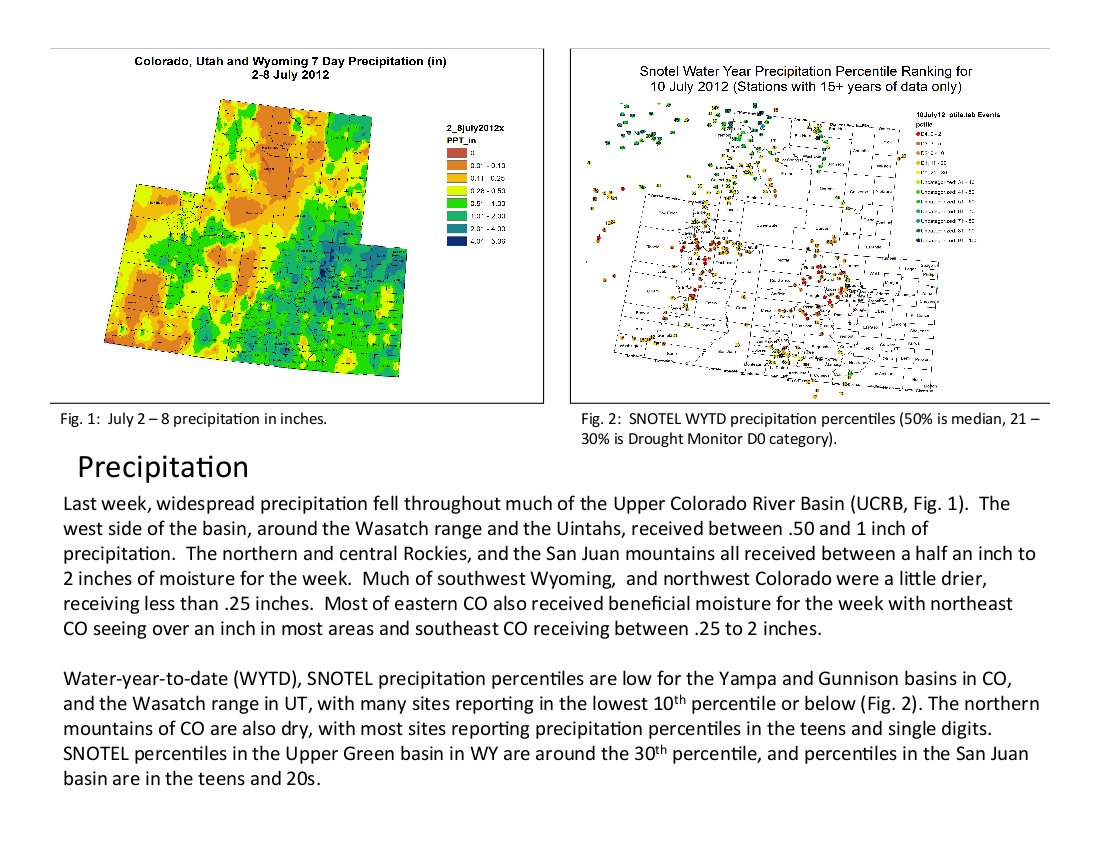
Here are the summaries from the Colorado Climate Center. Click on the thumbnail graphic for the precipitation summary from last week’s webinar.

The Metro Roundtable is on board with the Chatfield Reallocation Project

chatfieldreservoirace.jpg

Here’s the resolution of support:

More Chatfield Reservoir coverage here and here. More IBCC — basin roundtables coverage here.

Denver District Court Judge Christina Habas dismisses Powertech’s challenge to Colorado’s in situ mining rules

uraniuminsituleaching.jpg

From The Denver Post (Monte Whaley):

Denver District Judge Christina Habas Friday rejected a lawsuit by Powertech, a Canadian-based uranium prospecting company proposing the 7,000- acre Centennial project near Nunn. The lawsuit challenged a list of rules governing the reclamation of mined land and the requirement of public and private comment during the permitting process. Powertech sued the state’s Colorado Mined Land Reclamation Board, claiming the rules were “arbitrary and capricious.” Habas ruled Powertech’s allegations were baseless…

Powertech is disappointed in the judge’s ruling, said company attorney John Fognani said. The rules are far outside of the board’s powers, he said. “In addition, we are disappointed we didn’t have an opportunity to argue the decision before the judge,” said Fognani, noting Habas made her ruling on her final day as district judge. Powertech may appeal the ruling, he said,

The company, meanwhile, is postponing its work on the Centennial project as it concentrates operations in South Dakota.

From the Denver Business Journal (Cathy Proctor):

The suit, filed Nov. 1, 2011, argued that Colorado’s Mined Land Reclamation Board overreached its authority when it implemented new rules for mining operations in September 2010. The suit targeted rules governing groundwater protection and public involvement in mining permits…

“We are evaluating the decision and deciding whether to appeal,” Fongnani said. “We are disappointed in the decision because it doesn’t comport with the Administrative Procedures Act and the protections meant to be provided by the act to the regulated community as well as the environmental community.”[…]

“The Colorado uranium mining industry is wrong to keep fighting water quality protections and better public involvement,” Jeff Parsons, an attorney with the Western Mining Action Project who represented local communities that intervened in the case to defend the rules, said in a news release. “The people of Colorado have a right to be heard and will not accept mining projects that cannot protect the water.”

From the Associated Press via the Fort Collins Coloradoan:

Powertech attorney John Fognani said Monday the company is disappointed by the judge’s decision.

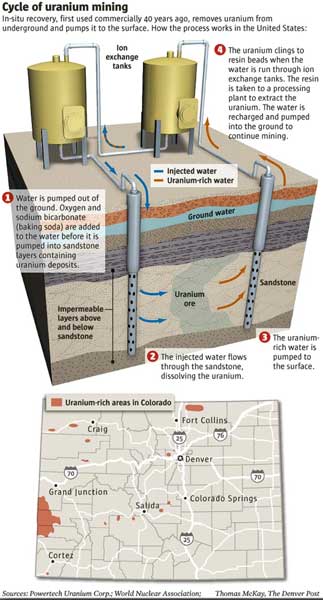
The company had envisioned having a mine in northern Colorado, where it would pump treated water underground to dissolve uranium and then pump it to the surface. It challenged new state requirements, including that it return the groundwater to its original purity when the process is completed.

Powertech alleged violations of the State Administrative Procedure Act, but a Denver judge on Friday rejected the company’s lawsuit challenging the rules.

From the Fort Collins Coloradoan (Bobby Magill):

“Centennial is still a viable project,” said John Fognani, attorney for Powertech Uranium…

Jay Davis, a mine opponent and Centennial Project neighbor, said the future prospects of uranium mining in Northern Colorado appear to be poor after the lawsuit was dismissed.

The state’s groundwater restoration requirements make it nearly impossible for companies to mine uranium using a process called in situ leaching, said Stuart Sanderson, president of the Colorado Mining Association.

He said that in situ leaching is very similar to the oil and gas industry’s use of hydraulic fracturing.

“It’s kind of ironic that fracking, which is not completely dissimilar technology, is occurring throughout Northern Colorado, and this one small uranium mining company has had to put the project on hold” because of difficulty seeking a mining permit, he said.

More coverage from Collin McRann writing for The Telluride Daily Planet. From the article:

The ruling holds up different rules and regulations put in place by decades of Colorado legislation. According to Parson, some of Colorado’s stricter mining laws have been influenced by studies and reviews of the Summitville Gold Mine and Superfund site in Rio Grande County. The mine went out of business in 1992 leaving masses of heavy metals and acids in soil and water supplies. The mine was listed as a Superfund site in 1994.

The state’s mining rules and requirements also apply to all types of uranium mines in terms of clean-up and contamination prevention.

From the Loveland Reporter-Herald (Jessica Maher):

Opponents of the in-situ technique, including the advocacy group Coloradoans Against Resource Destruction, say it threatens groundwater and would have health, environmental and economic impacts on Northern Colorado.

“The Colorado uranium mining industry is wrong to keep fighting water quality protections and better public involvement,” Jeff Parsons of the Western Mining Action Project said in a statement. “The people of Colorado have a right to be heard and will not accept mining projects that cannot protect the water.”

More nuclear coverage here and here.

Precipitation news: Monsoon moisture will hold over Colorado until the end of the week #CODrought #monsoon

From The Pueblo Chieftain (Jeff Tucker):

A bank of scattered thunderstorm brought as much as 0.35-inch of rain to some areas of Pueblo on Monday afternoon…About 0.3 of an inch of rain fell in the Downtown and Central Pueblo neighborhoods. The Downtown area also saw very small hail with the storm.

Drought news: U.S. drought nearing epic droughts of the dust bowl years and 1950s #CODrought

usdroughtmonitor07102012.jpg

From the Summit County Citizens Voice (Bob Berwyn):

Across the country, June was the third-driest in the 118-year record, and the month ranked among the top-10 driest for 11 states, including Wyoming, which reported its driest June ever. Nationally, more of the U.S. is experiencing drought conditions than at any time in the last half century, and by some measures, the drought is approaching Dust Bowl proportions. According to the National Climatic Data Center, 55 percent of the U.S. is in some stage of drought, “the largest percentage since December 1956, when 58 percent … was in moderate to extreme drought,” according to the NCDC’s monthly drought update

During the last three months, drought has expanded rapidly in Colorado, but it has not reached the magnitude of the 2002 record drought, according to the national drought monitor, in part due to the abundant moisture last year. About 66 percent of the West is experiencing drough, with only the Pacific Northwest seeing above-average rain during June.

Aspinall Unit update: Monsoon moisture helps streamflow in the Gunnison River #CODrought #monsoon

aspinallunitdescription.jpg

From email from Reclamation (Dan Crabtree):

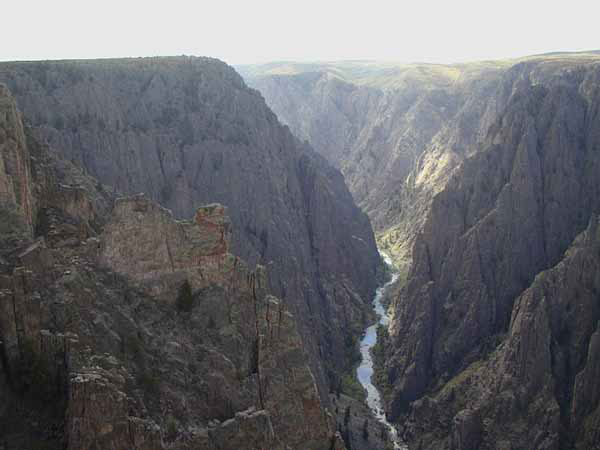
The rain came through this weekend and flows at the Whitewater gage have now reached 1400 cfs. Rain is expected to continue today and then taper off by Wednesday. Diversions at the Gunnison Tunnel are also decreasing by 50 cfs this morning. In order to further water conservation in the Aspinall Unit reservoirs, we will match the tunnel decrease from Crystal Dam plus an additional decrease of 100 cfs because of the higher flows at the Whitewater gage. After this change, flows in the Gunnison River through the Black Canyon should drop to about 520 cfs.

More Aspinall Unit coverage here.

Arkansas Valley Conduit: Reclamation public open houses July 17 and 18

arkansasvalleyconduitproposed.jpg

Here’s the release from Reclamation (Kara Lamb):

Who: Neighboring communities, the Bureau of Reclamation and the Southeastern Colorado Water Conservancy District need your help.

Why: Access to private land is needed in order to conduct geology and environmental studies for the proposed Arkansas Valley Conduit. The AVC would bring clean and safe drinking water to Arkansas River valley communities.

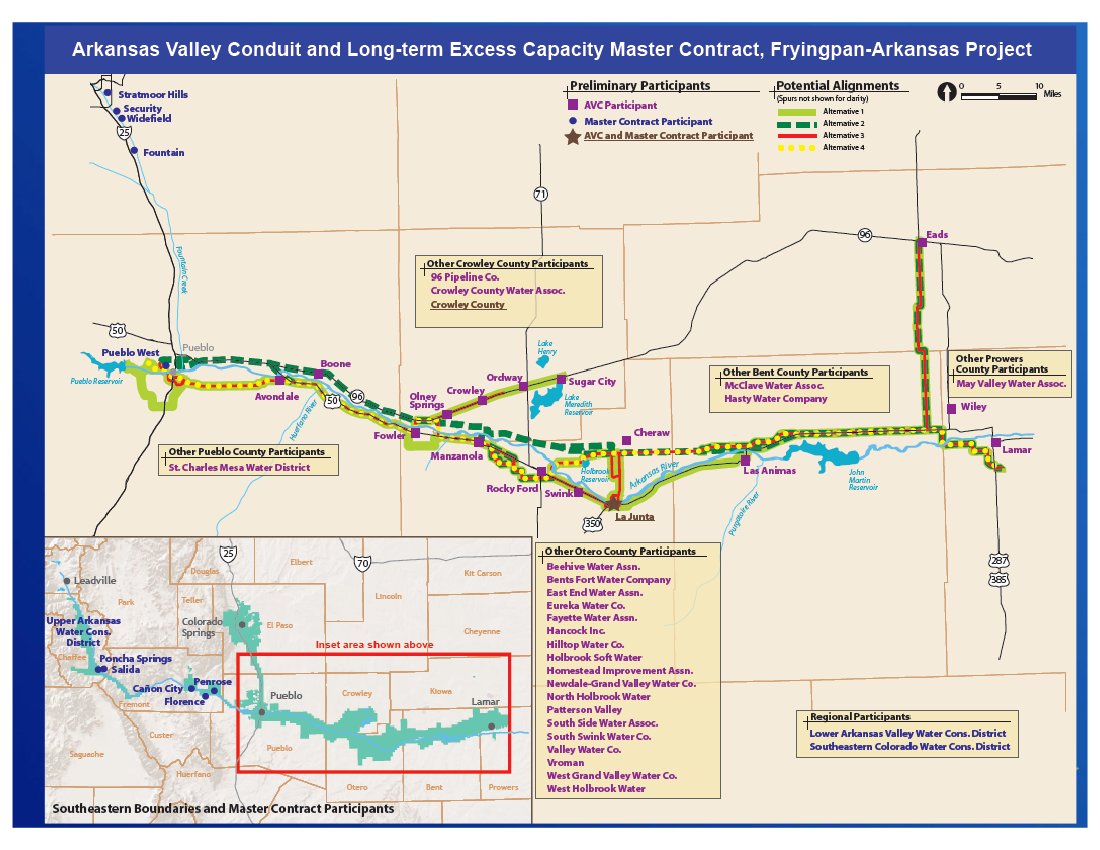
What: The proposed AVC is a feature of the Fryingpan-Arkansas Project that was never built, but its possibilities are now being investigated. Pipeline routes are being analyzed and engineering details are being designed. Collection of soil and geotechnical data from land parcels in eastern Colorado as well as environmental resource investigations will help with this planning process. The Bureau of Reclamation is preparing an environmental impact statement to evaluate the effects of this proposed project.

By allowing access to your land, Reclamation engineers and their contractors might dig or drill for soil samples, or record environmental data, which includes cultural or biological resources. Residents in the area might also see drill rigs or survey crews on adjacent properties.

Where: If constructed, the pipeline from Pueblo Reservoir would bring drinking water to communities east of Pueblo to Lamar in the Arkansas Valley.

When: This summer through 2013, the Bureau of Reclamation is conducting its geotechnical study,
drill sampling program, and cultural and biological resource studies to analyze possible pipeline routes and design project features. Public hearings for the environmental impact statement will be held in September 2012.

To obtain more information regarding right of entry on private lands for the AVC Project:

1. Attend local public open houses hosted by City of Las Animas, McClave Water Association, and Hasty Water Company. Each meeting will run from 6-8 p.m.

• Tuesday, July 17, 2012, Hasty Fire House, South Main Street, Hasty, CO
• Wednesday, July 18, 2012, Las Animas City Hall, 532 Carson St., Las Animas, CO

2. Visit our website at www.usbr.gov/avceis.

More Arkansas Valley Conduit coverage here and here.

Flaming Gorge pipeline task force update: Have the committee members been spending too much time on problems?

flaminggorgepipelineearthjustice.jpg

From The Pueblo Chieftain (Chris Woodka):

“There was a great deal of negativism in the first meetings, but at the last meeting we had a bit of a turnaround because we realized that we had not considered any of the positive things that would happen if we built Flaming Gorge,” Betty Konarski told the Arkansas Basin Roundtable Wednesday. Konarski, a task force member who represents El Paso County on the roundtable, said the task force has been so busy trying to identify problems that it has neglected the other side of its mission: to evaluate the potential benefits of a new supply of water. The task force was formed to evaluate competing plans by Fort Collins entrepreneur Aaron Million and the Colorado-Wyoming Coalition to build a Flaming Gorge pipeline.

More Flaming Gorge Task Force coverage here.

Pagosa Springs geothermal development hampered by shortage of capital

coloradohotsprings.jpg

From the Pagosa Springs Sun (Jim McQuiggin):

…two recent events highlighted the growing sense that Pagosa Country is edging closer towards making that geothermal resource the centerpiece of a larger economic development initiative.

Late last month, several community members made their way to Denver to make a presentation at the Geothermal Working Group meeting, sponsored by the Colorado Energy Office (previously known as the Governor’s Energy Office). In fact, Pagosa Country featured three speakers at the meeting out of a total 19 presenters, providing substantial representation for geothermal issues in the area…

“One problem,” [Archuleta County Commissioner Michael Whiting] told SUN staff last week, “is the lack of capital,” stating that it is difficult for rural communities to secure government dollars needed to develop geothermal resources. “The problem is parochialism,” Whiting continued, referring to attitudes that reject, or are unable to grasp, the potential of geothermal as an important resource for energy and economic development…

In essence, Starr’s presentation implied that, not only could local governments identify resources (geothermal) for state interests, but, after having done so, could apply for state funds to develop those resources. Starr’s presentation went on to show that the next provision of that section states, “(2) (a) The department of local affairs shall oversee and coordinate the provision of technical assistance and provide financial assistance as may be authorized by law.”[…]

local businessman Jerome Smith (founder of Pagosa Verde, LLC., a company currently engaged in researching the energy-producing potential of the local geothermal aquifer) presented on a subject Whiting had previously touched on: The challenges businesses faced acquiring needed funding for geothermal projects. As a solution, Smith spoke about the importance of an alliance of geothermal communities in the Region 9 Economic Development District of Southwest Colorado and throughout the state. Smith also spoke to the opportunities for financing geothermal development and power generation.

More geothermal coverage here.

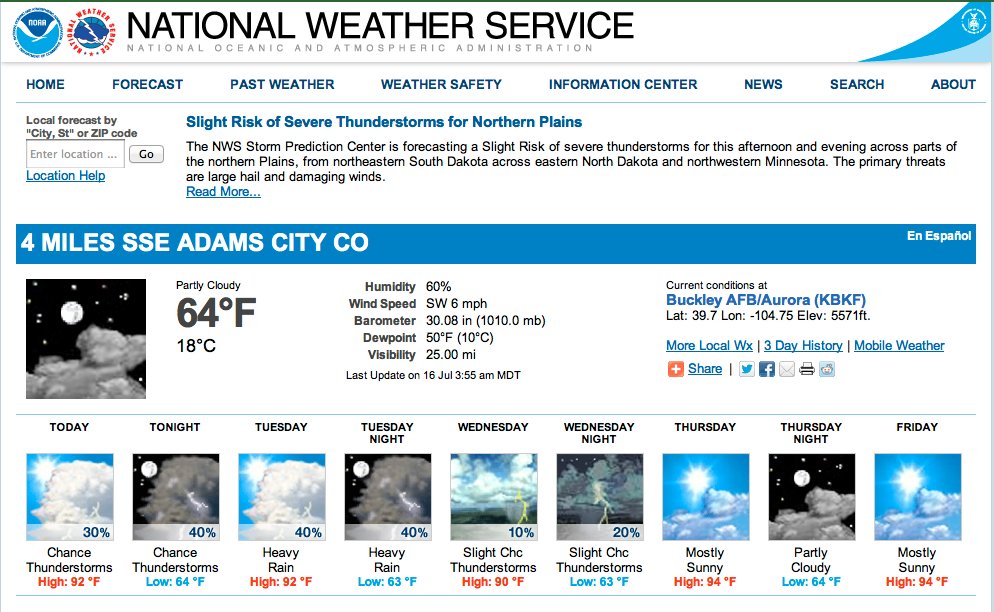
Drought/forecast news: Monsoon moisture expected over the next few days #CODrought

nwsforecastdenvermetro07162012.jpg

Click on the thumbnail graphic for a screen shot of the 7-day forecast for Metro Denver from the National Weather Service. Here’s a report from the Summit County Citizens Voice (Bob Berwyn):

National Weather Service forecasters in Grand Junction described conditions in western Colorado as almost tropical, with dew points in the mid-40s and 50s, which means there’s plenty of moisture available for condensation and formation of rain clouds. Precipitable water values in the atmosphere hovered close to 1 inch Sunday, and while a bit of drying is expected over western Colorado Monday, chances for rain remain good the next few days…

The rain won’t put a big dent in the long-term drought; only a big winter, or possibly an El Niño-fueled wet autumn, will help with that. But the monsoon rains could take the edge of the fire danger during the peak of the busy summer season, and help boost stream flows and lower stream temperatures just a bit until the days get a little shorter with more radiational cooling at night. That’s good news for fish. A large high pressure ridge over Colorado is forecast to move slightly eastward Monday and Tuesday, enabling a large plume of subtropical moisture move northward over Colorado, bringing more widely scattered showers the first part of the week. Most storms should deliver about 0.25 inches of water, with higher amounts possible under some of the stronger, slower-moving storms.

From the CWCB Colorado Flood Threat Portal (John Henz):

Monsoon moisture has split the state into two very different local climate regimes for the past five days. East of the Divide hot, dry weather dominates with near record temperatures in the mid-90 to low 100’s. West of the Divide monsoon moisture has produced strong thunderstorms, rains and reports of mud and rock slides, small stream flooding. Extensive cloud cover and rains have resulted in below normal temperature. It’ll be another LOW FLOOD THREAT day west of the Divide. We are issuing a MODERATE FLOOD THREAT for Ouray, San Juan, Gunnison, Pitkin, Lake, Summit, Eagle Garfield and Grand Counties where repeated rains have saturated the soils producing a higher likelihood of mud and rock slides and flash flooding. Hot, dry conditions will prevail east of the Divide before sunset. However look for the monsoon moisture to spill east of the Divide near sunset producing a round of gusty thundershowers along the Front Range foothills and urban corridor…

Saturday a strong surge of monsoon storms moved through Arizona causing extensive flooding issues and heavy rain. This new monsoon surge will arrive in Colorado this afternoon and linger into Tuesday evening increasing rainfall and storminess across western portions of the state [Sunday] that could spill over into northeastern Colorado [Sunday] evening.

The flood threat for [Sunday] will focus on the central Colorado mountains where strong storms will likely form and repeatedly move over the same areas. This storm training effect and rain rates of 0.50in to 1.50 inch /hr will produce minor stream flooding and rock slides. Wind gusts to 60mph and hail to 1.00 inch in diameter will be possible with severe storms. Storms across the northern mountains, Front Range and northeastern plains could produce strong microburst winds of 50-65mph, small hail and active cloud-to-ground lightning with squally rains of 0.25in/15-20 minutes.

From The Pueblo Chieftain (Ryan Severance):

Eric Hanagan, who owns Hanagan Farms, said the rain is a mixed bag for crops. “You know, it’s good and bad,” he said. “The timing isn’t great because we are starting to harvest right now with melons and squash and stuff, and any excess moisture can cause some damage if it’s too prolonged…

Hanagan said the biggest benefit of the recent moisture is its impact on farmer’s morale. “A good, consistent rain like that gives renewed optimism for all of us farmers and reminds us that it actually can rain again,” Hanagan said. “It will help out some with our crops, too — everything is coming along.”

From Steamboat Today (Matt Stensland):

The 85 cfs threshold is dictated by the Yampa River Management Plan. A voluntary fishing ban remains in effect for the town stretch of the Yampa River. Private tubing, kayaking and swimming also are included in the voluntary ban that takes effect when the river’s flow dips below 85 cfs…

Efforts are being made to keep the river at healthy levels.

The Colorado Water Trust agreed June 25 to pay $140,000 to the Upper Yampa Water Conservancy District to lease 4,000 acre-feet of water from Stagecoach Reservoir. That water began flowing out of the reservoir June 28 and is expected to contribute about 26 cfs to the Yampa through September. There also is a proposal to release water from Lake Catamount. The Catamount Homeowners Association has offered to donate 500 acre-feet of water from the lake, but it needs the city of Steamboat to move its 500 acre-feet of emergency reserves currently located at Stagecoach downstream to Lake Catamount.

From The Mountain Mail:

Compromising on flow levels so anglers, trout and the rafting industry will all prosper caused debate during the Arkansas Headwaters Recreation Area Citizens Task Force meeting Thursday. Roy Vaughan with the Bureau of Reclamation said the bureau’s highest priority with the Fryingpan-Arkansas Project is the fish hatchery, which prefers about 250 cubic feet per second.

Runoff from wildfire areas causes increased water treatment concerns, ‘blackwater rafting?’ #CODrought

halliganreservoir.jpg

From The Denver Post (Yesenia Robles):

“Fortunately we weren’t using Poudre water anyway when the fires started, so our customers haven’t noticed any differences,” [Donna Brosemer] said. “Our main concern is we want to keep as much as we can out of that water because we can’t continue to use the Horsetooth water indefinitely.”

While the ashy Poudre water can’t be used for drinking right now, some of it is being used by farmers, Brosemer said. “It can ultimately become a problem for them too because if there’s too much ash it can clog up their systems,” Brosemer said. “But they don’t have the same complications we do with the drinking water system.”

From The Denver Post (Electa Draper):

A black sludge now coats many river shores once sparkling with white, tan or pink sands. A canyon once heavily scented by pines smells like a smoky campfire. Many miles of this 126-mile-long river now evoke its namesake, the gunpowder buried by French trappers along its banks in the 1820s.

People now enjoy “blackwater rafting,” observed homeowner Mike Smith, whose deck juts over the Poudre.

More water treatment coverage here.

Rio Grande Basin Roundtable meeting recap: Streamflow is not recovering #CODrought

riograndebasin.jpg

From the Valley Courier (Ruth Heide):

Colorado Division of Water Resources Division 3 Engineer Craig Cotten told members of the Valley-wide water group, the Rio Grande Roundtable, this week that in a distressing pattern, streams from Conejos to Saguache were running well below average this year.

He said streams and rivers peaked early on and then dropped off significantly. For example, the Rio Grande at Del Norte was only running about 400 cubic feet per second (cfs) the first part of July, when it usually runs 1,500 cfs at that time of year.

Saguache Creek experienced hardly any peak at all this year and peaked about a month earlier than normal. The average peak on Saguache Creek is 200 cfs. This year it peaked at 80 cfs, Cotten said.

Sangre de Cristo had one good peak occurring a month earlier than normal and then dropped off significantly, according to Cotten who said the creek was down to about 100 cfs before the recent rains came and kicked it back up a bit.

Culebra Creek is also running significantly below the long-term average.

On the Conejos River near Mogote early run-off caused the river to peak a month earlier than normal and then drop off significantly, Cotten said…

He added that in terms of Allen Davey’s longitudinal study of the unconfined aquifer storage, this year is shaping up to provide a new low. Last year the study recorded the lowest point in the unconfined aquifer since the study began in 1976…

He said he knew of at least one farmer whose wells had gone dry, so he was done farming for the year.

More IBCC — basin roundtables coverage here.

Cañon City: Lincoln Park/Cotter Mill superfund site ‘path forward’ public meeting Thursday

cottercontamination.jpg

From the Cañon City Daily Record (Rachel Alexander):

The community has an opportunity to meet and discuss the proposed path forward for Cotter Corp., at a public meeting from 6 to 8 p.m. Thursday at the Abbey. The Colorado Department of Public Health and Environment, U.S. Environmental Protection Agency and Cotter have been working to develop a road map for laying out the most comprehensive and efficient path forward for completing the remediation of the Cotter site…

A public comment period will be open until Aug. 19. The draft document will be available on the CDPHE website, http://www.cdphe.state.co.us/hm/cotter/index.htm, Monday.

More Lincoln Park/Cotter Mill superfund site coverage here and here.

The Rio Grande Basin Roundtable approves conservation easement request for the Haywood Ranch

collerswariogrande.jpg

From the Del Norte Prospector (Stan Moyer):

More than 37 percent would be put up by a combination of $25,000 from the local Roundtable and $400,000 from the CWCB’s Water Supply Reserve Account (WSRA).

Focusing on the 400-acre Haywood Ranch, it was noted that the owners “contribute through a charitable portion of the value of of their conservation easement — in this project, an estimated value of $400,000.

“The land and water are available for the long term, and the environmental and recreational water benefits are sustained in perpetuity,” according to the application submitted by the Rio Grande Headwaters Land Trust (RiGHT). Nancy Butler is executive director of the Del Norte-based organization…

The potential catch in the creation of the conservation easement is that the Roundtable proposal for funding is contingent on receipt of about $300,000 in funding coming from the North American Wetlands Conservation Act (NAWCA), to meet the total estimated purchase costs of $1.125 million…

Among theses benefits are the “U.S. Fish and Wildlife Service’s recently produced habitat maps that show the Haywood Ranch as being within a zone of irreplaceable habitat,” including quite likely the Southwestern Willow Flycatcher and the Yellow Billed Cuckoo, which are in the Rio Grande Water Conservation District (RGWCD)’s effort to create a “Habitat Conservation Plan.”

The application emphatically details the importance of the success of the easement in protecting wildlife:

The project parcel submitted is within the Rio Grande’s floodplain and includes approximately 2/10 of a mile of the river, 160 acres of important wetlands and the No.1 senior water right on the river that sustains them. Riparian areas and wetlands along the river corridor provide highly important habitat for Haywood Ranch wins Roundtable nodall the area’s wildlife and several endangered species.

More IBCC — basin roundtables coverage here.

Aspinall Unit update: 620 cfs in the Gunnison River through Black Canyon #CODrought

gunnisonblackcanyon.jpg

From email from Reclamation (Erik Knight):

Even with the last couple release increases at Crystal, flows in the Gunnison River at the Whitewater gage are still below the 900 cfs target. Therefore releases at Crystal Dam will be increased by another 50 cfs today, July 13th. Hopefully with some help from rainfall over the weekend, this will be enough to push flows back up to the target level. This operation should cause flows in the Gunnison River through the Black Canyon to increase to about 620 cfs.

More Aspinall Unit coverage here.

Telluride water system update: Raw water pipeline construction has started

pipeline.jpg

From The Telluride Watch (Gus Jarvis):

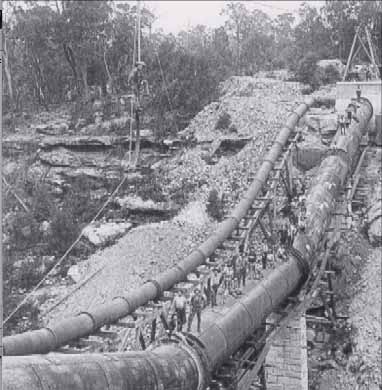
Telluride Town Attorney Kevin Geiger was happy to report last week that work on the raw water pipeline near the Bridal Veil Hydroelectric Power Plant has commenced, and once completed it will be the final piece of pipeline infrastructure needed to transport fresh water from Blue Lake, above Bridal Veil Falls, down to the two-acre site below the falls where the Pandora Water Treatment Facility will be located.

Crews will install a new horizontal water pipeline along with new trestles about 250 feet away from the Bridal Veil plant and then install vertical pipe that will transport the water to the bottom of a cliff. At that point, the line will be connected to a raw water pipeline that was installed last summer, just below Black Bear Pass Road, that runs to the water treatment facility site.

While the water pipeline infrastructure inches toward completion, Geiger said construction of the actual water treatment plant will start soon, as well.

“Most of the infrastructure is in from Blue Lake to the power house,” Geiger said. “A little segment, which will be difficult and challenging, needs to be completed and then actual construction of the water treatment plant needs to be completed. We think we will be breaking ground on that later this summer or fall.”

More infrastructure coverage here.

Fort Collins Weather Station: 45,750 days of weather reports

Drought news: ‘The scary part is, where’s all this water coming from next year?’ — Bill Markham #CODrought

usdroughtmonitor07102012.jpg

From the Fort Collins Coloradoan. (Bobby Magill):

With the season’s low humidity and high winds, it’s been difficult just to get water on crops, said Minerva Lee, a Berthoud landowner who sits on the Larimer County Agricultural Advisory Board.

“I have some corn under a center pivot that is maybe knee high, but it just can’t grow because we just can’t get it wet enough,” she said. “According to the center pivot, you’re putting on an inch, but that inch isn’t getting down to the plant.”

The heat curled the leaves on the corn, and recent rain and cooler temperatures didn’t heal them, she said.

The drought has been so damaging to crops across both Colorado and the entire country that last week the federal government declared Larimer County and more than 1,000 other counties in 26 states a massive natural disaster area…

“The scary part is, where’s all this water coming from next year?” Markham said…

Nolan Doesken looks at Northern Coloardo’s long history of years swinging between wet and dry to determine how optimistic he is about the future of the 2012 drought.

There’s reason to be optimistic: You’ll be hard pressed to find an extremely dry year followed by another extremely dry year, said Doesken, the Colorado state climatologist.

“We’re fortunate in that there historically tends to be, if you’ve had a dry year, the chances are the next year (is) likely to be wetter,” he said.

So, 2011 was very wet and 2012 was very dry, so chances are 2013 will be wetter than this year…

Doesken said long-term climate prediction is still “tenuous,” and that means you can’t bank on statistics or changes in ocean temperatures when betting on the future of this year’s drought. In other words, you can’t be certain the drought will go away anytime soon. There’s always a chance it could get worse…

“When our corn burns up and we’re out of water, it’s kind of like this: You get up some morning, you walk outside and you look up in the air, look around the sky and say, good Lord, we did the best we could with what we had,” Markham said.

Denver District Court Judge Christina Habas dismisses Powertech’s challenge to Colorado’s in situ mining rules

uraniuminsitu.jpg

From the Summit County Citizens Voice (Bob Berwyn):

In its lawsuit against the state, Powertech Uranium Corp. claimed that the Colorado exceeded its legal authority and that adoption of the rules was arbitrary and capricious.

By dismissing the lawsuit, the court also ensured that local communities will have a chance to be involved in the permitting of uranium mines.

“The Colorado uranium mining industry is wrong to keep fighting water quality protections and better public involvement,” said Western Mining Action Project attorney Jeff Parsons, who represented local communities that intervened on the side of the State in defending the rules against the Powertech lawsuit.

“The people of Colorado have a right to be heard and will not accept mining projects that cannot protect the water,” he said.

The lawsuit challenged a list of specific rules, each designed to ensure ground water protection as well as require public and local government involvement in the mine permit process. The rules were crafted over a two-year process and were supported by a diverse range of groups, including Coloradoans Against Resource Destruction (C.A.R.D.), Environment Colorado and other conservation groups statewide, Denver Water, multiple local governments and affected communities.

Phase II of the water needs assessment study for the Yampa/White and Colorado basin roundtables is hot off the press

yampariverbasin.jpg

coloradoriverbasincgs.jpg

From the Grand Junction Free Press (Sharon Sullivan):

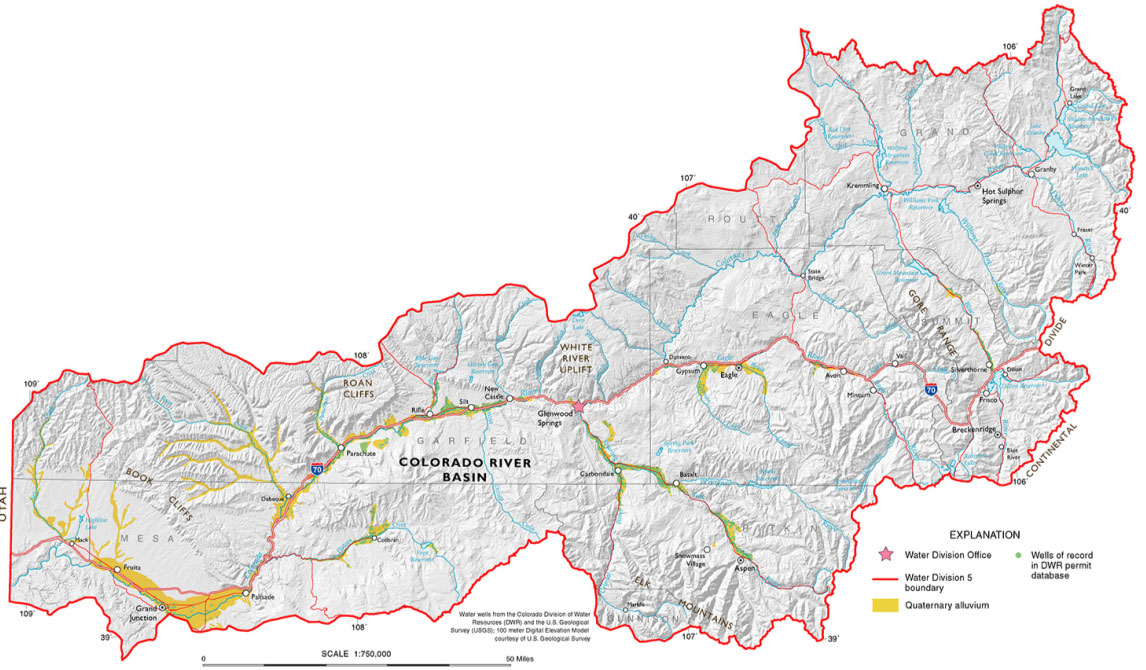
The study, “Energy Development Water Needs Assessment Phase II — Final Report,” was produced for the Colorado River and Yampa/White River Basin Roundtables by an engineering consulting firm, AMEC Earth & Environmental…

Grand Junction Utility and Streets manager Greg Trainor represented Mesa County municipalities on the Colorado River Basin Roundtable. He met with interested citizens Thursday, July 12, in the Mesa County government building, 544 Rood Ave. to discuss its study regarding future Western Slope water needs.

“Assuming that the state will double in population by 2050, municipalities will be looking for water,” Trainor said. “We need to get a handle on water estimates for energy development.”

Phase one of the report looked at water uses of all conventional energy sectors — oil shale, natural gas, coal and uranium. Much of the information for the report was collected from the Bureau of Land Management, and oil and gas companies.

“In phase one, we did not get as much cooperation from (the) industry as we wanted — particularly concerning oil shale development,” Trainor said.

The initial phase of the report found oil shale would require 400,000 acre feet of water per year to support a long-term, high-production scenario that would produce a million-and-a-half barrels of oil shale a day by 2070. That amount of water was based on a Dutch Shell plan that required electrical generation (construction of 12 power plants) to fuel its energy production.

Such an operation would be huge; it would require the construction of power lines, pipelines, roads, additional housing and railroads, resulting in an unrecognizable Western Slope, Trainor said…

The report identified three water projects in the White River Basin that could meet an annual energy industry demand of 110,000 acre feet of water. Most years, the Colorado River could meet an additional demand of 10,000 acre feet.

More IBCC — basin roundtables coverage here.

Grand Junction: CSU Extension and the Natural Resources Conservation Service Host Free Water Education Webinar Series

firstintimefirstinright.jpg

Here’s the release from Colorado State Universilty (Jennifer Dimas):

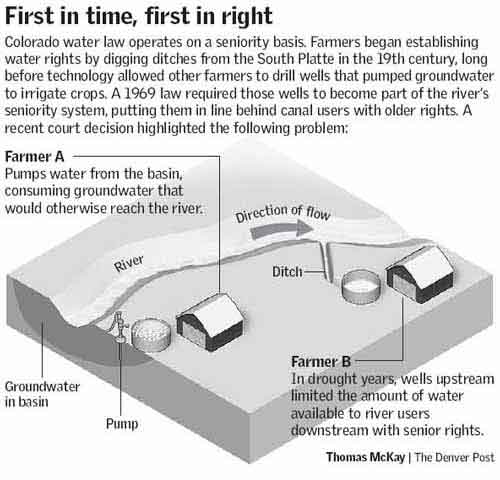
Colorado’s unique situation as a headwaters state provides the backdrop for diverse issues and concerns related to a most precious resource: water.

Colorado State University Extension, in partnership with the USDA Natural Resources Conservation Service, is hosting a Water Education Webinar Series to help landowners understand these contentious issues and provide ideas and recommendations to help ensure water security. The four-part, online series will highlight water conservation practices that don’t compromise crop production or livestock health.

The water situation in Colorado is rapidly changing, and understanding how to adaptively manage this finite resource will ensure this water is available for everyone’s use in the future.

In these free online webinars, offered from noon to 1 p.m., participants will learn:

• the Colorado Doctrine and tips to ensure the protection of your water rights, July 27;
• Colorado climate and drought trends now and in the future, Aug. 2;
• water administration, urban versus agricultural use, water quality implications, Aug. 15; and
• waterwise landscape solutions and recommended plant materials for use, Aug. 23.

Although these webinars are especially designed for small acreage landowners, anyone who owns or manages rural land will learn useful tips on how to manage water resources.

Presenters include Nolan Doesken, CSU state climatologist; Denis Reich, CSU Extension water specialist for the Western Region; Robert Cox, horticulture Extension agent; and Aaron Clay, former water referee for the Colorado Water Court.

The webinars are broadcast live and participants can interact with and ask experts questions during the presentation. To sign up for any and all of the webinars, visit http://www.ext.colostate.edu/sam/. The session also will be recorded and viewable through this web link after the webinar.

Thanks to The Fort Morgan Times for the heads-up.

More education coverage here.

Estes Park: Lawn Lake Dam failure remembered

lawnlakefloodwaters1982.jpg

From the Estes Park Trail Gazette (John Cordsen) via the Loveland Reporter-Herald:

The flood was first reported a little after 6 a.m. by former town trustee Stephen Gillette, who was a driver for A-1 Trash Service at the time.

He was making a pickup at the Lawn Lake trailhead and “heard a roar and saw debris in the air,” he said in an interview following the flood in 1982. “It was like a jet had crashed into the mountain.”

Millions of gallons of water rushed down Roaring River, creating the alluvial fan that is still visible today. The water merged with Fall River in Horseshoe Park and collapsed the Cascade Dam before joining the Big Thompson River and dumping into Lake Estes. The water hit the west edge of Estes Park around 8:12 a.m.

Flood waters destroyed 18 bridges, damaged road systems (particularly Fall River Road), inundated 177 businesses (75 percent of Estes Park’s commercial activity) and damaged 108 residences. Most businesses reported 3 to 4 feet of water, and as much as 2 feet of mud, in their establishments.

More South Platte River basin coverage here and here.

Aurora City Council approves $9.5 million water lease for oil and gas production and exploration

niobrarashale.jpg

From The Aurora Sentinel (Sara Castellanos):

The deal, which some Aurora residents heavily criticized at the meeting, was approved on a vote of 8 to 3 with council members Debi Hunter Holen, Renie Peterson and Molly Markert opposed.

About 35 residents from Aurora and surrounding cities attended the meeting to condemn Aurora council members for selling water to the company, and many of them spoke at the meeting. Four people spoke in support of the deal.

Several people who disapproved of the agreement between the city and Anadarko have also spoken against hydraulic fracturing within city limits. Before council members voted, they said they were concerned about the environmental impacts of hydraulic fracturing, and thought the city’s water should be kept for its residents in times of need.

More oil and gas coverage here and here.

The Central Colorado Water Conservancy District may ask voters to approve a $60 million bond issue for new supplies and storage

glencanyonconst.jpg

From KUNC (Nathan Heffel):

The district, or CCWCD, is exploring the possibility of asking voters to approve the $60 million bond measure this November to fund future water storage construction and acquisition of additional water rights…

Conservancy staff say the measure could help sustain the region’s strong agricultural economy and would cost residents in the district roughly $1.26 a month per $100,000 of a home’s market value for the next 25 years. That works out to around $15.48 per year.

At times, the public meeting at the Evan’s Community center was heated. Some in attendance were concerned about paying additional taxes without knowing what direct benefit they would see.

One farmer says he had been pumping water for over 45 years before his pump was shut off by the state.

“We need to know before we vote what the allocation is going to be. We still haven’t been able to pump for six or seven years.”

Conservancy president Gary Harman says an answer to that question isn’t known. However, he did give a dire prediction if voters failed to approve the bond initiative.

“If we don’t build these structures, believe me the [larger] municipalities will. And we will lose the opportunity to capture all of this water. And this is strictly your decision. And the things we can do here is help keep that water here in our area, and use in our communities, and use in our farms, and keep businesses in small towns in businesses, like in main street Greeley we can help that.”

More South Platte River basin coverage here and here.

Drought news: Rainfall last weekend helped reduce consumption #CODrought #monsoon

usdroughtmonitor07102012.jpg

From The Pueblo Chieftain (Chris Woodka):

With rains that left anywhere between 0.6-1.25 inches of rain over Pueblo on Sunday and Monday, stressed lawns and gardens got a much-needed drink. It’s also affected the amount of water being pumped through sprinkler systems. During last week’s hot spell, with no appreciable rainfall, the Pueblo Board of Water Works pumped an average of 52 million gallons per day. With rain and cooler temperatures, the number dropped to 38 million gallons per day for the first two days of this week…

The Sunday-Monday rain roughly averaged about 0.8 inches over the approximately 30,000-acre area served by the Pueblo water board. By that standard, the clouds dumped about 650 million gallons (2,000 acre-feet) of water on the city.

Meanwhile, the drought is still with us. Here’s a report from Chad Abraham writing for the Aspen Daily News. From the article:

The [Roaring Fork] river on Thursday was running through town at 23 cubic feet per second (cfs), below the state’s recommended instream flow of 32 cfs, and well off the 115 cfs average, according to a Roaring Fork Conservancy report.

Besides the drought, the level is so low because holders of some rights are allowed to take water and drop the river below the recommended instream level, which was implemented in the 1970s by the Colorado Water Conservation Board. The holders can do that because their rights are senior to the state’s.

“It’s depressing, but senior water rights often trump instream flow rights,” said Rick Lofaro, the conservancy’s executive director.

State recommended instream flows, also called state instream water right levels, are related to preserving the environment to a reasonable degree, according to the water conservation board website. There is some debate about what is reasonable, said Tim O’Keefe, education director for the conservancy.

He said some local water rights date back to the 1880s and were related to mining; other rights are for agriculture. The city of Aspen also has a “pretty old water right,” he said…

The Roaring Fork near Aspen on Thursday hit 68 degrees, the state standard for a healthy ecosystem, O’Keefe said. Anything above that affects dissolved oxygen in the stream to the point that fish get stressed; insects are also affected. If the temperature rises to 72 degrees, the Colorado Parks and Wildlife Division can shut down stretches of rivers to fishing.

From the Gunnison Times (Matt Smith):

And now those concerns have hit home, as Colorado Parks and Wildlife (CPW) implemented this week a “voluntary” closure of Tomichi Creek. The decision follows suit with at least four other streams on the Western Slope. With water temperatures reaching the mid-70s in recent weeks, the health of trout populations in Tomichi Creek is the main reason for taking extra precaution.

U.S. House Agriculture committee passes farm bill, Tipton amendment increases access to dough for rural water

watertreatment.jpg

From The Pueblo Chieftain (Chris Woodka):

The committee passed the 5-year, $500 billion bill 35-11 Thursday, but no decision has been made on full House consideration. The Senate passed the bill last month.

“My amendment seeks to expand access to private financing options for rural communities to build new water infrastructure or rebuild the existing water infrastructure. Once in effect, this will ensure clean, safe and reliable water supplies for rural communities, and create needed jobs in the process,” Tipton said. Tipton’s amendment would direct USDA to encourage lenders to finance rural water and waste disposal projects…

It also encourages the USDA to focus its own resources on the neediest communities.

More infrastructure coverage here.

Coyote Gulch outage

coyotegulchmidnightclassic07162011.jpg

I’m heading down the two-lane blacktop for a little summer R&R with Mrs. Gulch. Posting will be intermittent or non-existent since Internet connectivity will be unpredictable. I’ll see you Friday.

Drought news: Moffat County drought workshop July 12

usdroughtmonitor07032012.jpg

From the Craig Daily Press:

The Colorado State University Extension will sponsor a drought management workshop for agricultural producers from 7 to 9 p.m. July 12 at the Moffat County Fairgrounds Pavilion.

The event is open to all livestock producers and farmers in the county and will include information about U.S. Department of Agriculture designations and programs, management plans for herd reductions, and local fire evacuation emergency management plans.

Denver Water’s conservation program detailed #CODrought

xeriscapelandscape.jpg

Here’s a look at Denver Water’s conservation program from Jim Lochhead writing for the Summit Daily News. Lochhead is the head honcho at the utility. Here’s an excerpt:

Denver Water is leading the way in water conservation in Colorado, helping customers with an ambitious goal: Use 22 percent less water than before the 2002 drought. And the plan is working. Denver Water customers are using 20 percent less water than they were before 2002 — and there are nearly 10 percent more of them.

While Denver Water has promoted water conservation as early as the 1920s, following the drought of 2002, Denver Water customers embraced a cultural shift in how they value water. One of the primary drivers for this culture change has been Denver Water’s award-winning advertising campaign. The campaign helps customers appreciate the value of water by encouraging them to “Use Only What You Need.” A 2011 survey found that almost 95 percent of respondents recognize the advertising campaign.

Aside from the campaign, several programs and rules encourage customers to use water wisely. Large irrigation customers, such as homeowners associations and commercial properties, can earn $6,000 per acre-foot of water saved by developing a plan to cut water use by at least 3 acre-feet a year. In the past five years, Denver Water has signed 68 contracts with those customers (with more in the works), saving an estimated 510 acre-feet of water per year — the annual amount used by roughly 1,275 households.

Denver Water will pay industrial and institutional customers that save at least 100,000 gallons of water in a year. During the past five years, Denver Water completed 38 contracts and saved about 390 acre-feet of water — the annual amount used by roughly 975 households.

Denver Water offers rebates to residential customers who install high-efficiency toilets, washers and efficient irrigation products. Since 2007, nearly 108,700 residential rebates have been processed by Denver Water. Rebates for new high-efficiency products helped save about 2,500 acre-feet of water — roughly the amount used by 6,250 homes in a year.

The rate structure is affecting customers’ water use habits as well. Customers pay for water based on an increasing block-rate structure. The more they use, the more they pay.

More conservation coverage here.

Northern Colorado Water Utility Science Program Launches

wastewatertreatmentprocess.jpg

Say hello to GetIntoWater.org. The website is hoping to match educators, water utilities and students looking for a career in water and wastewater distribution and treatment. From the Northern Colorado Project page:

The NoCo WUSP will offer a customized learning approach for each student based on their interests and abilities. Through classroom courses and field training in Fall/Winter of 2012, students will learn important fundamentals of water treatment, wastewater treatment, water distribution and wastewater collection. By March 1, 2013 students will be asked to select the area in which they would like to become certified. Students will apply to take the applicable State of Colorado certification exam. Based on the preferred area of interest, a customized paid internship program will be developed for each student. During the internship program, the student will work with a utility mentor to gain in-depth knowledge of job requirements and duties (for the area of their choice) and study for the certification exam. Finally, the students will be eligible to apply for an On-the-Job Training/Summer Jobs Program for 2013.

There is no cost to participate in the program as a student. However, there is an application and qualification process because space is limited.

More education coverage here.

Steamboat Springs: Colorado Water Congress Summer Conference August 15 – 17

steamboatsprings.jpg

Here’s the link to the registration page. Here’s the description of the event (Meg Meyer):

The 2012 Colorado Water Congress Summer Conference will include water and energy interests once again as we combine forces and explore areas of common interest. The theme of the conference is The Balance of Power. We will spin the concept several different ways as we look at the balance of political power, the balance of governance, and the balance of energy and water sources.

Immediately preceding the CWC Summer Conference, the Colorado Coal and Power Generation group will hold an all-day event at the Holiday Inn in Craig on Tuesday, August 14th which will include a golf tournament and evening barbeque.

In addition, the Interim Water Resources Review Committee will meet in Steamboat, Tuesday afternoon, for their first substantive meeting to prepare for the 2013 legislative session.

The CWC Summer Conference will be held August 15th through August17th at the Sheraton in Steamboat Springs.

We will have three workshops on Wednesday morning covering topics of drought and current weather conditions, public trust, and endangered species. We will try something a little different this year with the conference kicking off with a luncheon on Wednesday. General Sessions will follow on Wednesday afternoon. An evening open public forum will held on Wednesday at 7:30 pm (attendance is optional for water and energy professionals).

We will have networking breakfasts on Thursday or Friday – a light continental breakfast will be served, but no formal speaker. The hotel restaurant or other local venues are available for those that prefer a heartier breakfast. General Sessions will be held on Thursday from 9:00 to 12:00. On Thursday afternoon, we will offer a couple of tours or you may want to use this time to catch up on other business. The POND Committee is also planning outdoor activities. We will have a reception on Thursday evening at 5:00. The Friday morning format will be similar to Thursday and the conference will conclude with a box lunch.

Old Dillon Reservoir expansion update: Reservoir will hold 286 acre-feet of water when project is completed

olddillonreservoir.jpg

From the Summit Daily News (Caddie Nath):

The $5 million resurrection of the Old Dillon Reservoir will allow each of the three local governments involved in the project to store, release and exchange their own water rights…

When it does fill, Silverthorne will own approximately 8 percent of the water, Dillon will take roughly 38 percent and Summit County government will have the remainder — slightly more than 53 percent. The three entities split the bill for the restoration and expansion project…

The water in the reservoir will complement the town of Silverthorne’s water rights. The county will use the reservoir to supplement environmental and other projects in the works, while the Dillon sees the facility as an alternate water source, to be tapped if something were happen to Straight Creek, the town’s primary water source…

Old Dillon Reservoir is fed by the Dillon Ditch, constructed at the same time as the reservoir to divert water from Salt Lick Gulch. Local entities will bypass some of the stream flow, allowing the water to continue downstream to where it sustains environmental features including beaver ponds and a wetlands area.

More Old Dillon Reservoir coverage here and here.

Colorado Waterwise: An interview with Reagan Waskom

reaganwaskomcsu.jpg

Click here to read the interview (Ruth Quade) from Colorado Waterwise: The voice of the conservation community. Here’s an excerpt:

WW: Regarding water resources and conservation, what do you feel are the biggest challenges facing Colorado?

I’ll separate these two issues because I see them as somewhat distinct. Regarding water resources, the challenge is living within the limits imposed by our climate, while our economy and population grows. If we do not figure out how to live within these limits, the losers will be the environment and agriculture, which I think are the two greatest assets we have in Colorado. Sure, this is partially about conservation, but it is also about growth and what we value in this state. Water quality is a big part of this equation – as humans divert and discharge we degrade the aquatic resources in Colorado. Nutrients, sediment, mercury, selenium and temperature concern me the most for Colorado, but we’ll have to deal with emerging contaminants sooner or later.

Regarding conservation, as a state we still have lots we can do. Per capita water use values revealed by the SWSI 2010 study are all over the map – from several hundred gpcd to less than 100 gpcd. Statewide values are 172 gpcd, which I think shows many Colorado communities can still tighten up their water use.

More conservation coverage here.

Reclamation Releases Rural Water Program Assessment Report, Seeks Comments on Proposed Funding Criteria

thegranddiversion1.jpg

Here’s the release from the U.S. Bureau of Reclamation (Dan DuBray):

The Bureau of Reclamation is seeking comments on its Rural Water Assessment Report that reviews the status of potable water projects for rural areas, provides Reclamation’s plan for completing congressionally authorized projects, and includes proposed construction funding prioritization criteria for projects in the Rural Water program.
“Rural communities, including farms and ranches, are the backbone of America. Water supply infrastructure is critical and Reclamation has developed a comprehensive strategy for effectively using available resources towards the construction of rural water projects authorized for its involvement,” Reclamation Commissioner Michael L. Connor said. “Given the budgetary uncertainties, and rising construction costs, the strategy focuses on maximizing the impact of its limited available funding by establishing clear programmatic goals and a set of transparent prioritization criteria. This approach is intended to continue to make meaningful progress in the construction of rural water projects and we look forward to receiving comments on our proposed strategy and criteria.”

The Rural Water Assessment Report also describes federal programs supporting the development and management of water supplies in rural communities in the 17 western states and describes Reclamation’s plans to coordinate the Rural Water Supply Program with similar programs managed by other agencies.

The proposed strategy for funding rural water construction projects describes the prioritization criteria intended to be used in a two-step process for requesting rural water construction appropriations. Reclamation is proposing to evaluate and rank projects using the criteria, then allocate requested funds to reflect project priorities and the ability of sponsors to complete phases that will deliver water and other project benefits.

The comment period for the Report is 60 days. Comments are now due by 5 p.m., (MDT), Sept. 10, 2012.

Please visit www.usbr.gov/ruralwater to read the Rural Water Program Assessment Report or learn more about the Rural Water Program.

More Reclamation coverage here.

El Niño: Be careful what you wish for #CODrought

elninolanina.jpg

From Reuters via the Huffington Post (Rene Pastor/Jeffrey Benkoe:

…global food production could also suffer massive disruptions from the warming caused by El Nino. Three years ago, it slowed development of India’s vital monsoon rains, sparking a rally in sugar prices to 30-year highs as the No. 2 producer in the world produced a poor cane crop. Unwanted rains also damage crops in agricultural powerhouses like Brazil and Argentina, while the normally dry areas of Chile, the world’s No. 1 copper producer, could see rampant floods…

Further ahead to the end of the year, the pattern could trigger severe winter storms during the northern hemisphere’s winter, particularly in California and other Western U.S. states.

Drought/precipitation news: Farmers and communities are facing supply shortages #CODrought

sevendayrainurbandrainage07092012.jpg

Click on the thumbnail graphic for the seven-day precipitation map for the Metro Denver Area from the Urban Drainage and Flood Control District.

From The Denver Post (Nancy Lofholm):

This year’s dearth of water is creating headaches across Colorado from farm fields to home faucets as water managers and users try to stretch low to no water levels. The state’s drought can be pictured in vivid colors on Colorado Climate Center charts and maps where red splotches across northwestern Colorado and in part of the Eastern Plains indicate extreme drought. The orange and tan that cover everything else west of the Continental Divide signal severe to moderate drought.

Precipitation charts for much of the state look like the flat line on the monitor of a dying patient.

“Things are tight” is how Uncompahgre Valley Water Users Association manager Steve Fletcher sums up the situation for the water users on the 80,000 acres his association covers. “Tight” in that farming belt means users are getting only 70 percent of their normal allotment of water. For the farmers, that means working nearly around the clock to switch around irrigation water so everything gets a partial drink…

Not all the water news is bad around Colorado. John Harold, owner of the Tuxedo Corn Co. in Olathe, said he has been able to manage with 70 percent of his water — and is starting to pick sweet corn this week. The harvest is 12 days earlier than normal years because of the hot temperatures. He would have been picking corn last week except that his fields just got a soaking for several days and were too wet and muddy. “We’re doing good,” he said. “We’re going to have corn this week.”

Meanwhile, the recent hot spell broke records across Colorado. Here’s a report from Bob Berwyn writing for the Summit County Citizens Voice. From the article:

Most of the state sat under a strong ridge of high pressure most of the month, reflected by the Denver weather stats, record daily highs were recorded June 4 and June 9, 17, 18, 25 and 26. Late in the month, Denver also recorded a five-day stretch with highs climbing above 100 degrees June 22-26) for only the third time in the city’s weather history. The previous five-day streaks were Jul 4-8, 1989 and July 19-23 in 2005. The 105-degree readings on June 25 and 26 were both all-time temperature records for the month of June and tied Denver’s all-time high for any month…

In Summit County, June precipitation was also well below normal, with the Dillon site reporting only 0.38 inches of water, only about a third of the average 1.14 inches. There were only four days with measurable precipitation, as compared to 11 on average.

From the Vail Daily (Scott N. Miller):

“Everything helps, but a tenth of an inch here and a tenth of an inch there isn’t really going to do us much good,” said Diane Johnson, of the Eagle River Water & Sanitation District. In fact, showers over the past couple of days have put just small spikes in local streamflows…

Eagle County’s in a little better shape than the Front Range foothills, but fire managers there have reported that standing trees are just about firewood dry. Getting more moisture into those standing trees will require deep, soil-soaking rain and lots of it. And even that may not be sufficient to revive the finer fuels that can spread fire. “The grasses may have already cured out and may not green up again until next year,” Eagle River Fire Protection District Chief Karl Bauer said.

From Steamboat Today (Brent Boyer):

The National Weather Service confirmed Saturday that the official weather monitoring station in Steamboat recorded 1.78 inches of rain in the 24-hour period from 7:30 a.m. Friday to 7:30 a.m. Saturday. That easily bested the previous July single-day rainfall record of 1.39 inches established on July 14, 1937. Although the 1.78 inches of rain established a new record, the spotty nature of Rocky Mountain thunderstorms proved true again Friday. Other unofficial weather monitoring stations in various locations throughout the city picked up 0.69 inches, 0.72 inches and 1.45 inches of rain, according to National Weather Service meteorologist Travis Booth. Regardless, the 1.78 inches will be the total that is referenced by history. Buoyed by that rainfall, Steamboat had received just short of 2 inches of rain through the first six days of the month. That already surpasses the average July total of 1.51 inches…

The recent rain, combined with additional water releases from Stagecoach Reservoir, continue to prop up flows in the Yampa River through Steamboat. The river was flowing at 126 cubic feet per second under the Fifth Street Bridge early Saturday evening. That flow remains above the 85 cfs threshold required for recreational activities like tubing. However, Colorado Division of Parks and Wildlife has not lifted the voluntary ban on fishing the town stretch of the Yampa River.

From The Greeley Tribune (Nate A. Miller):

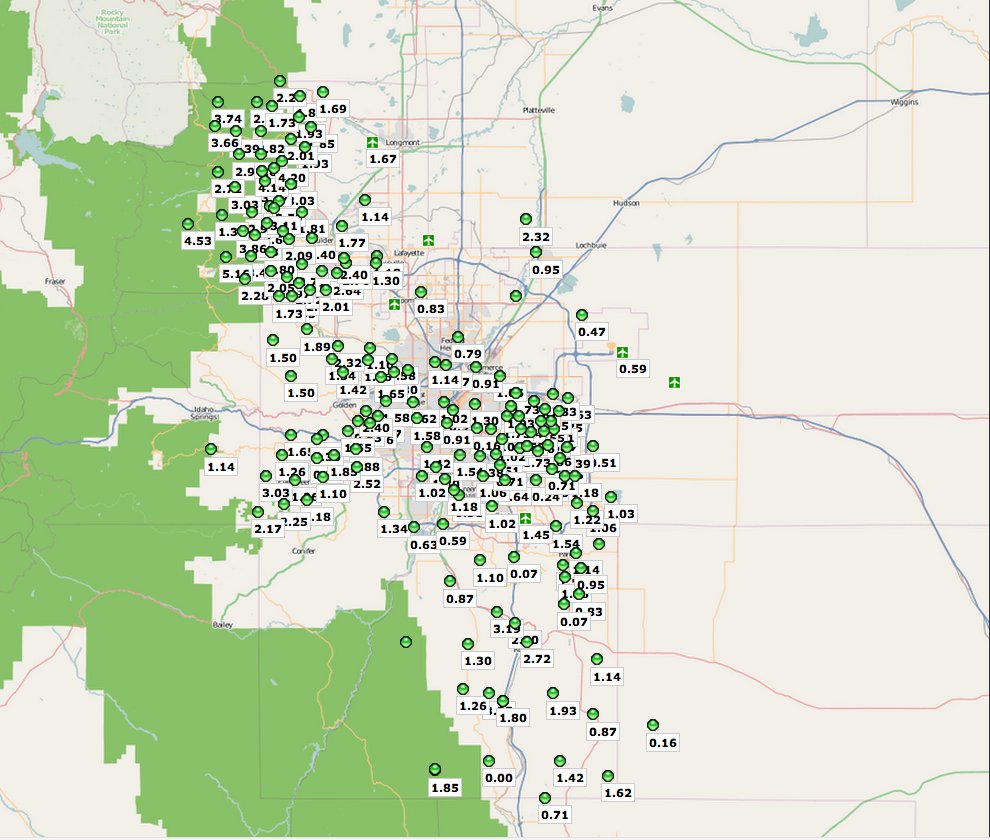
The storms Friday and Saturday nights marked the first significant rainfall in the county [Weld] since early June. Saturday’s storm brought the heaviest rain to the northern and southern parts of Weld, though about half an inch fell in Greeley, according to the National Weather Service. Near Dacono, where more than 1 inch of rain fell, Interstate 25 was closed Saturday night near Dacono from mile marker 232 to mile marker 235 because of flooding…
Jim Kalina, a meteorologist with the National Weather Service in Boulder, said the heaviest rain in Weld came in the northern part of the county. About 4 miles north of Purcell, about 2 inches fell, based on radar estimates. Not much rain fell east of Kersey, he said…

Outside of Greeley, much of the rest of Weld saw about half an inch of rain, though precipitation totals varied widely throughout the county, according to data compiled by the Community Collaborative Rain, Hail and Snow Network.

‘I was told that he [Ed Quillen] had a book about the Civil War in his hands at the end’ — Allen Best

edquillensbackyardsalida.jpg

From The Denver Post (Allen Best):

I was told that he had a book about the Civil War in his hands at the end. He was 62 – and a good friend, an occasional collaborator in both writing and outdoor adventure, and my first newspaper boss.

That was in Kremmling, Colorado, in 1977. Shortly after going to work for him that July, I mentioned to him a book I had read, “The Monkeywrench Gang,” by Edward Abbey. He had heard of neither. So I presented him with my copy one late Tuesday afternoon. He promised to look at it over dinner.

Two or three hours later he returned. A pokey writer then, I had written four or five paragraphs of my story. He had loved the book. “A real howler,” he said.

I surmised that he had made it through the opening sequence where Hayduke, Doc, and crew had done their devilment on Glen Canyon Dam, and perhaps another chapter or two beyond.

No, he had read the whole book.