

Click here to go to their dashboard and read the update. Here’s an excerpt:
Highlights
The region is heading into summer with long-term drought conditions comparable to or worse than early June 2012 in nearly all areas; significant drought impacts (water supply, agricultural, wildfire) can be expected May precipitation was above average in central Colorado, far northern Wyoming, and portions of eastern Utah, and below-average in northern Utah, southeastern Wyoming, and southern and eastern Colorado. Snowpacks have melted out except at the highest elevations; snowmelt occurred 1-3 weeks earlier than the median in most basins. The latest (June 1) runoff forecasts continue to call for below-average or well-below-average spring-summer streamflow over nearly all of the region; observed flows in April and May were generally well below average The NOAA CPC seasonal climate outlooks show a dry “tilt” for summer precipitation for southeastern Colorado, but no tilt elsewhere. The “SWcast” for July–September shows a slight wet tilt over eastern Colorado, and a dry tilt over north-central Colorado and northern Utah.
From the Albuquerque Journal (John Fleck):
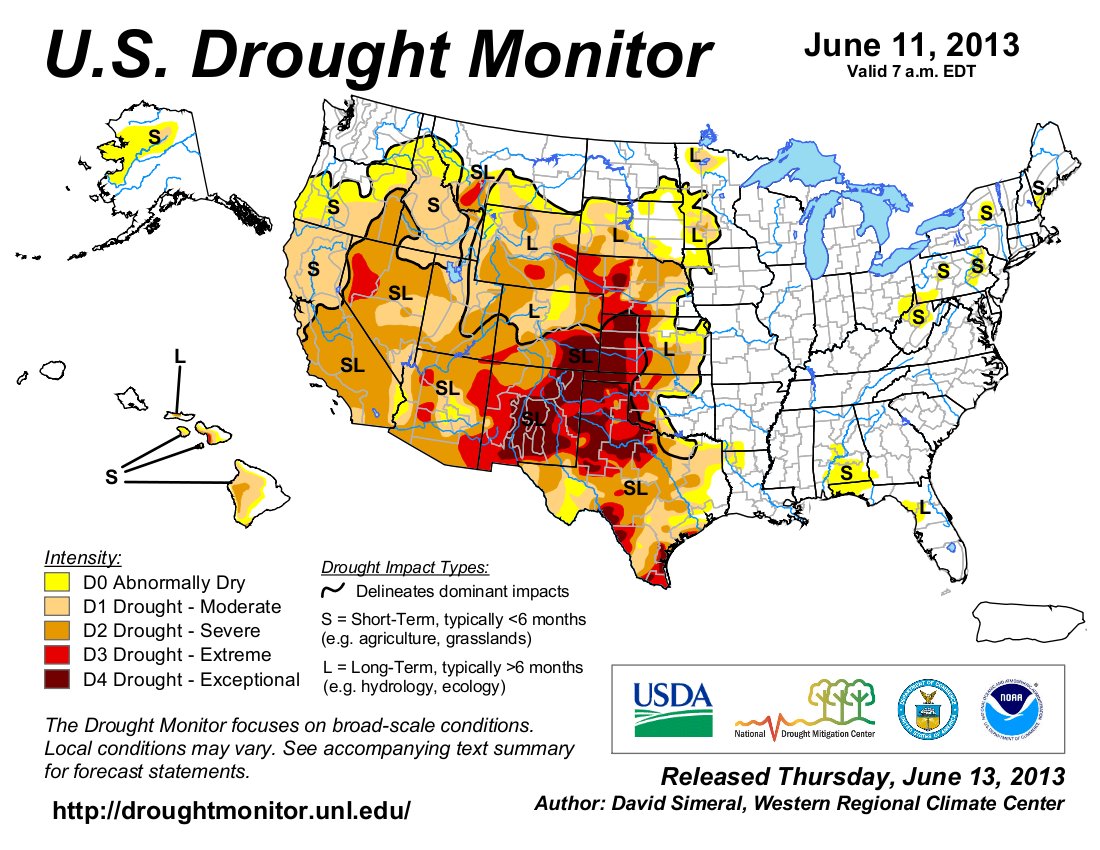
New Mexico’s drought conditions remain the worst in the nation, according to the weekly federal Drought Monitor, with 45 percent of the state, including the populous Rio Grande Valley, in “exceptional” drought.
From the Fort Collins Coloradoan:
Thanks to high temperatures and the late-season snows, the Poudre River is running about 1,800 cubic feet per second near the mouth of the canyon, normal for this time of year. The Poudre’s flows typically peak around this time of year, depending on the snowpack, mountain rains and air temperatures.
In Fort Collins, some bike path underpasses have been temporarily closed due to high water, although that’s normal for this time of year. And safety officials have warned area residents to use extra care around the fast-flowing Poudre and irrigation ditches, because water levels are high and the water temperature remains low.