
From the Aspen Business Journal (Brent Gardner-Smith):
“While House Resolution 1389’s stated intent (to help resolve a narrow conflict over water rights between the U.S. Forest Service and Colorado’s ski industry) may be legitimate, the bill is written very broadly and will have serious implications for water management across the country,” American Rivers wrote in a one-page document urging opposition to the bill…
On Wednesday, both the the U.S. Forest Service and the Interior Department issued testimony against the bill. Additionally, American Whitewater, the Sierra Club, the Natural Resources Defense Council, Earthjustice and Defenders of Wildlife, and a list of other watershed and river protection organizations are now opposing the bill.
A letter signed by 39 such organizations and submitted to the House Natural Resources Committee on Wednesday stated the bill could “prevent federal agencies from requiring protections for fish and other in-stream resources” and that, if passed, “agencies could be unable to implement reasonable requirements intended to keep water in rivers.”
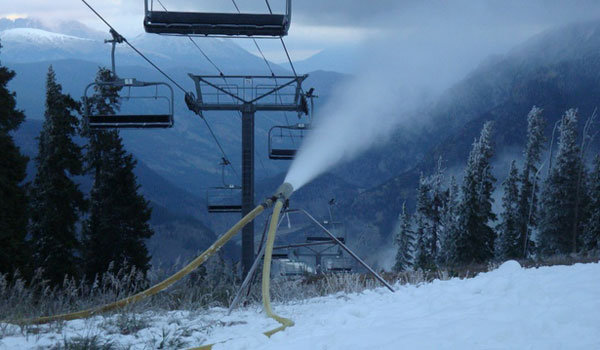
On Monday, Corbin said Skico’s interest in the bill is confined to protecting water rights held by ski areas, including the four mountains operated by Skico, which together use 200 to 250 million gallons of water each winter for snowmaking.
He said American Rivers’ opposition to the bill has not altered Skico’s support of it.
“We don’t share their apprehension,” said Corbin, after reviewing materials from American Rivers expressing its opposition to the bill. “I understand their concerns, but I think they are probably overreacting.”[…]
The Forest Service released testimony Wednesday in advance of Thursday’s markup session for the bill. The agency said it doesn’t think HR 3189 is necessary, as it is working on a new version of its rule concerning water rights that will “address the concerns associated with the previous ski area water rights clause.”
“We believe these changes will provide assurances to the public and communities that depend on economic activities from ski areas that they will continue to provide recreation opportunities,” the Forest Service stated. “Further, we believe that these objectives can be met without requiring the transfer of privately owned water rights to the government.”
The written testimony from the Forest Service further states “it is not in our interest or policy to take private water rights. Our interest is in sustaining skiing as a recreation opportunity on National Forest System lands now and in the future.”
The Forest Service also raises concerns about its ability to effectively transfer grazing permits if the bill is passed as is.
The Interior Department, which includes the BLM, also released testimony on Wednesday, stating that “the legislation is overly broad and could have numerous unintended consequences.”
The National Ski Areas Association welcomed the Forest Service’s conciliatory language regarding the issue of ski area water rights, but still wants to see the Water Rights Protection Act passed.
“HR 3189 would not hinder the agency’s new approach to water policy,” said Geraldine Link, the director of public policy for the NSAA, in an email. “The new (Forest Service) policy is expected to require ski areas to offer an option to purchase water rights at fair market value to the successor owner of a ski area. (And) the bill prohibits a forced transfer of property to the US.”
Groups such as the National Cattlemen’s Beef Association and the Public Lands Council also support HR 3189, and view it as a way to protect their industry’s water rights…
American Rivers says the hydropower industry and “big western agriculture” are driving the bill, ostensibly written to protect the ski industry, in an effort to “handcuff” the Interior and Agricultural departments and “prevent them from protecting rivers and public lands,” according to a memo on the bill.
Matt Rice, the director of conservation in Colorado for American Rivers, said the group’s opposition to HR 3189 is based on language in the bill that would prohibit “impairment of any water right” by federal agencies under the jurisdiction of either the Interior or Agriculture departments.
Rice said such agencies sometimes require mitigation for hydropower projects that are ultimately licensed by the Federal Energy Regulatory Commission, or FERC. The mitigation, for example, might require that hydropower developers leave some water in a river or in a fish passage structure.
Such a requirement, or mandate, from FERC or an associated federal or state agency, could be considered an “impairment” of a water right by the hydropower industry, according to Rice.
From the Glenwood Springs Post Independent (John Stroud):
U.S. Sen. Mark Udall of Colorado said Wednesday that he welcomed the U.S. Forest Service’s stated intention to not pursue the transfer of water rights from ski areas in exchange for permits to use public lands. Forest Service Chief Tom Tidwell issued the statement to the U.S. House Natural Resources Committee as a result of a compromise that Udall helped to broker…
“We believe that these changes will provide assurances to the public and communities that depend on economic activities from ski areas that they will continue to provide recreation opportunities,” Tidwell said in the Forest Service statement. “We believe that these objectives can be met without requiring the transfer of privately owned water rights to the government.” [ed. emphasis mine]
Udall, who serves on the U.S. Senate Energy and Natural Resources Committee, said the agreement “ensures Colorado’s job-creating ski industry and outdoor recreation businesses can continue to thrive, while protecting the long term availability of activities such as skiing on public land.”
“The Forest Service’s statement on these water rights is a victory for our state and our resort communities that depend on outdoor recreation,” he said…
The Garfield County Board of Commissioners and Associated Governments of Northwest Colorado have both lent their support to the Tipton bill, not only because of the potential impacts on ski areas but on agriculture and energy development in the region.
From the Vail Daily (Randy Wyrick):
Eagle County’s two U.S. congressmen successfully snuffed a Forest Service move to take water rights without paying for them. Jared Polis and Scott Tipton have been battling a U.S. Forest Service policy that would force ski areas and other stakeholders to turn over the private water rights before the Forest Service would renew their permit to do business…
“While I welcome the indication of the Forest Service that there may be a change of direction from the previous ski area water clause, we need to ensure that all water users are protected from uncompensated federal takings in the long term, not just for one group of water users, in one region, for a limited time,” Tipton said.
Lawmakers are going ahead with a bipartisan bill to protect water rights, Tipton said. HR 3189 is before the House Natural Resources committee this morning.
The feds have already done it to the owners of the Powderhorn ski area on Western Colorado’s Grand Mesa.
Vail local Andy Daly is part of the group that bought Powderhorn.
Vail Resorts would have had to deal with the Forest Service policy as it renews its operating permit for Breckenridge. The feds have already done it to California’s Alpine Meadows and Washington’s Stevens Pass ski areas…
The reversal came in a statement Wednesday delivered to the Senate Energy and Natural Resources Committee.
“We will be proposing changes to the ski area water clause that address the concerns associated with the previous ski area water rights clause,” Forest Service chief Tom Tidwell said in the statement. “We believe that these changes will provide assurances to the public and communities that depend on economic activities from ski areas that they will continue to provide recreation opportunities. Further, we believe that these objectives can be met without requiring the transfer of privately owned water rights to the government.”
More NSAA vs. USFS coverage here.