Drought news: South Platte and North Platte basins drought free, SE Colorado still hurting in areas #COdrought

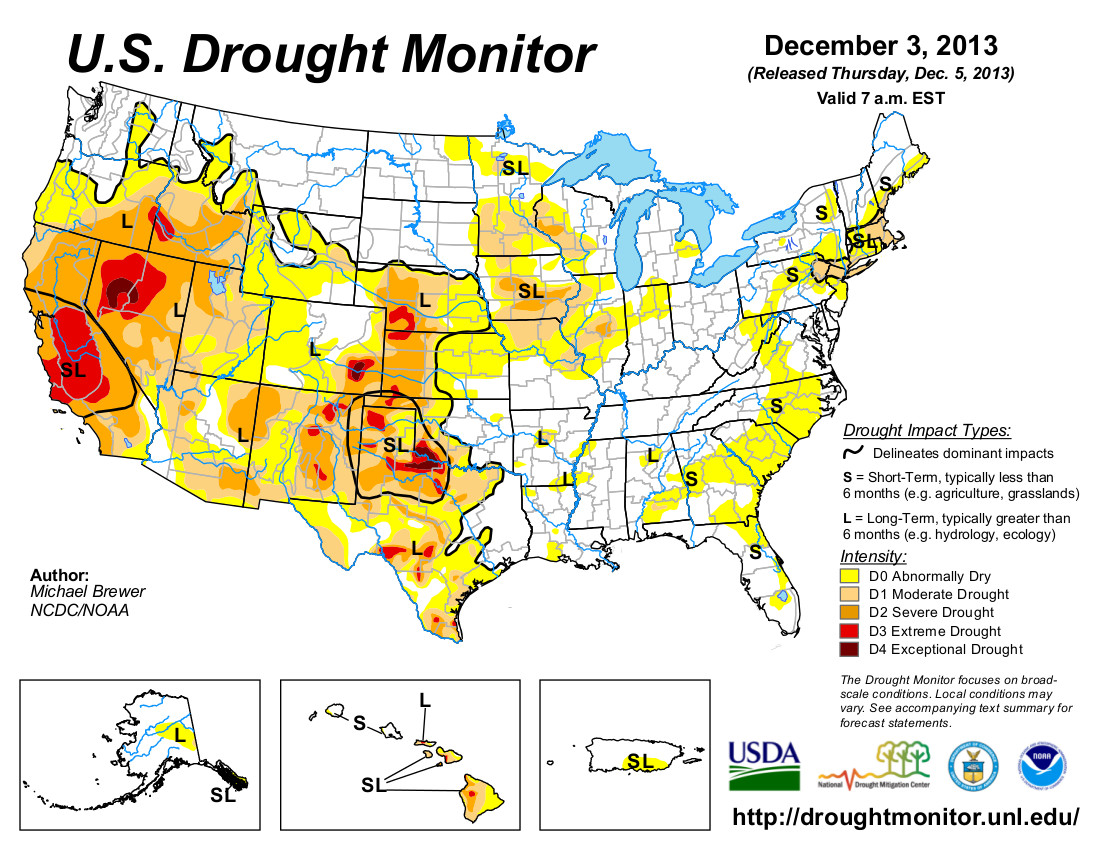
US Drought Monitor December 5, 2013

Click here to go to the US Drought Monitor website. Here’s an excerpt:

The Central and Northern Plains and the Midwest

This area remained status quo for the week. Moderate to cool temperatures and areas of frozen soil led to no change in the drought depiction in the region.

The West

Abnormal Dryness (D0) expanded in the northern Cascade Mountains in Oregon and Washington as well as on the Oregon Coast. These areas have missed most of the recent precipitation that has fallen around the Northwest and have significant deficits for the year. The rest of the West remains unchanged this week.

Looking ahead

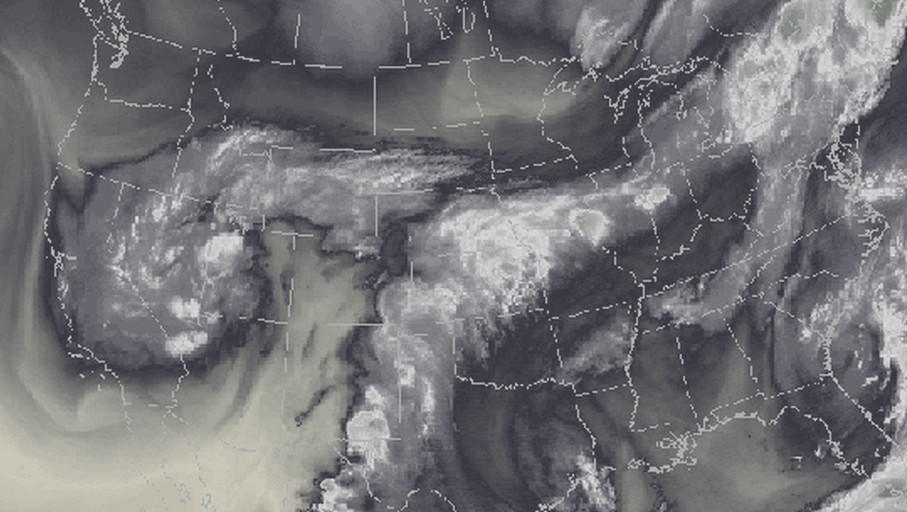
During the December 5-9, 2013 time period, precipitation is forecast along much of the eastern U.S., from the Southern Plains extending into New England. An above normal chance of precipitation is also present across areas of the West, particularly in the Southwest. Temperatures are expected to be below-normal across the country, with the exception of the East Coast during this time.

For the ensuing 5 days (December 10-14, 2013), the odds favor above-normal temperatures in the Southeast and in northern Alaska. Normal to below-normal temperatures are favored across the rest of the CONUS and in southern and central Alaska. Above normal-precipitation is likely across most of the eastern third of the country, in northern Alaska, and from the Pacific coast, through the Rockies and into the northern Plains. The eastern Southwest and the Central and Southern Plains, as well as the southwestern Midwest and southern Alaska are likely to see below-normal precipitation.

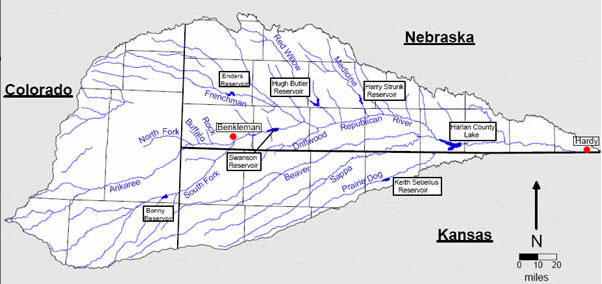
Republican River Basin: Arbiter Martha Pagel issues ruling on compliance pipeline

Republican River Basin

From the Yuma Pioneer (Tony Rayl) via the Imperial Republican:

Colorado and Nebraska entered into arbitration with Kansas earlier this year after Kansas’ representative on the Republican River Compact Administration voted against Colorado’s proposals on both issues.

The hearing was held before arbiter Martha Pagel earlier this fall, and Pagel issued separate rulings on both issues last Wednesday, November 27. In essence, Pagel ruled Colorado is taking the proper steps, but that Kansas remains “reasonable” in its objections.

“Although the Arbitrator found that Colorado’s revised Compact Compliance Pipeline (CCP) proposal had made significant progress in addressing unresolved issues from the prior arbitration proceeding, and that Colorado had offered a reasonable and persuasive proposal for modifying inputs to the Groundwater Model, the district is disappointed that Arbiter Pagel was not able to provide Colorado with any relief from the obstructionist behavior of Kansas officials,” stated the Republican River Water Conservation District in a statement issued by its legal representative, Peter Ampe of Hill & Robbins. Continue reading “Republican River Basin: Arbiter Martha Pagel issues ruling on compliance pipeline”

‘Groundwater will be a part of the state water plan’ John Stulp #COWaterPlan

Colorado Water Plan website screen shot November 1, 2013

From The Pueblo Chieftain (Chris Woodka):

Call it a wet-headed stepchild. Colorado has puzzled for years about how to account for its underground water resources, with about the same impact as water sloshing in the bottom of a precariously carried bucket. A state water plan will attempt to incorporate groundwater management, including possible aquifer storage, even though the relationship between surface water and well water is not fully understood.

“Groundwater will be a part of the state water plan,” John Stulp, the governor’s water adviser, told about 80 attendees of a groundwater conference this week. “There are a number of studies and plans that will go forward as the state water plan is developed.”

The conference, organized by the American Groundwater Trust, was designed to address policy as a follow-up to more technical reports generated from a 2012 conference.

While Colorado water rights stretch back to the mid-1800s, groundwater in the state was of little concern until more high-capacity wells were drilled in the 1950s and 1960s. It wasn’t until 1969 that well use was incorporated into the elaborate web of prior appropriation water right, explained Steve Sims, a water lawyer who once defended the state’s water rights in the attorney general’s office. But since then, a tug-of-war between the General Assembly and water courts has muddied how groundwater is treated. Non-tributary wells are regulated by a separate commission.

“What we got was a hodgepodge of rules,” Sims said. “It’s been driven by real estate developers.”

Key court cases eroded the jurisdiction of water courts themselves as well as the power of the state engineer to regulate wells, he said. The Empire Lodge case triggered a legislative fix to substitute water supply plans in 2002. The 2009 Vance case changed the way the state accounts for water produced by oil and gas drilling.

Geography also plays a part. Alluvial well regulations differ in all of the state’s major river basins, as well as in non-tributary basins. There is little scientific understanding of the relationship of groundwater levels to surface flows, other than the common wisdom that surface irrigation or flooding increase the levels, while pumping and drought decrease them. But the timing of return flows, availability of underground storage sites and long-term effects of pumping are still unknown.

“It’s not a precise science,” said Reagan Waskom of the Colorado Water Institute, which is completing a study of the South Platte basin mandated by the state Legislature in 2012. “If you had a valve and could put water back into the river when you need it, it would be great.”

More Colorado Water Plan coverage here.

Weekly Climate, Water and Drought Assessment of the Upper #ColoradoRiver Basin

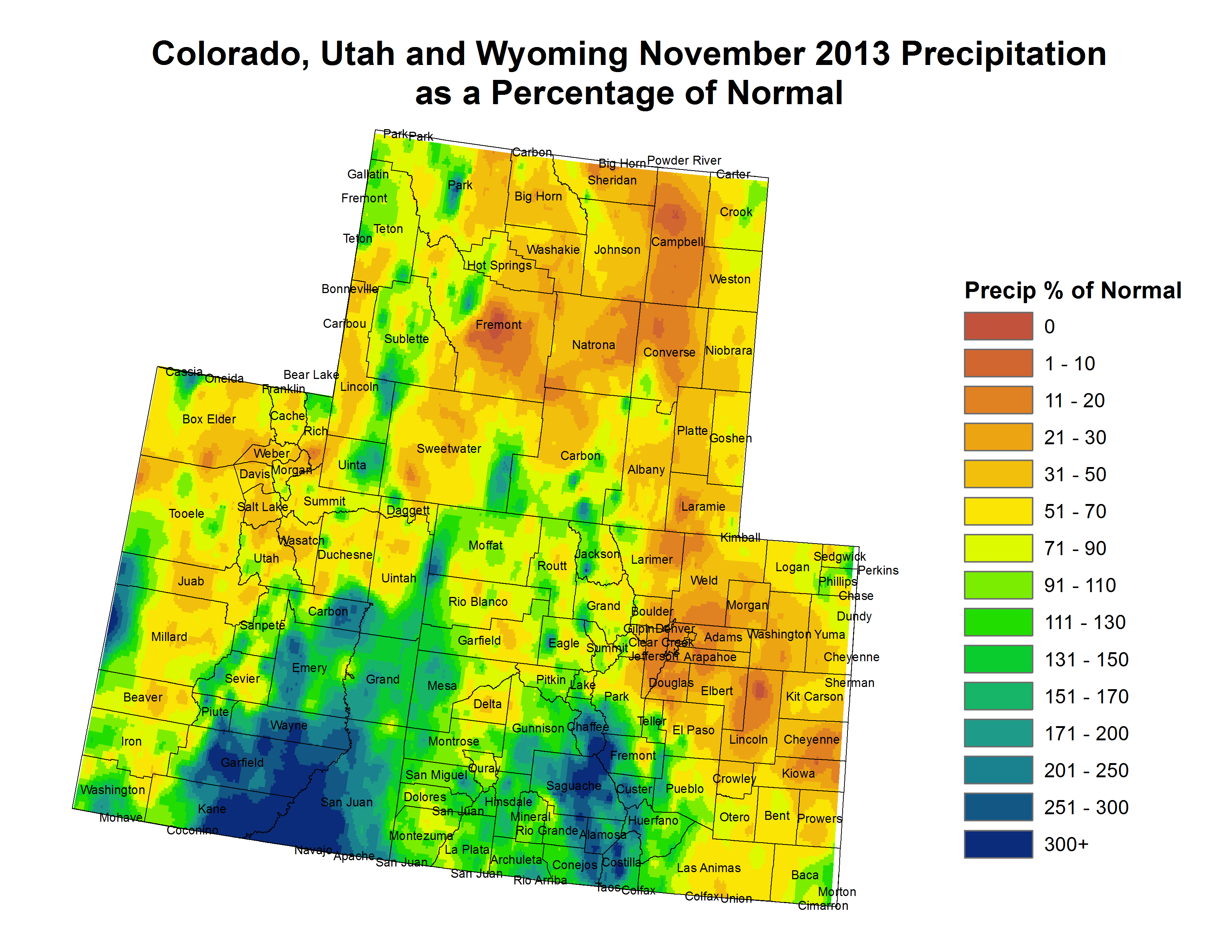
Upper Colorado River Basin November 2013 precipitation as a percent of normal via the Colorado Climate Center

Click here to read this week’s assessment. Click here to go to the NIDIS Upper Colorado River Regional Drought Early Warning System website from the Colorado Climate Center.

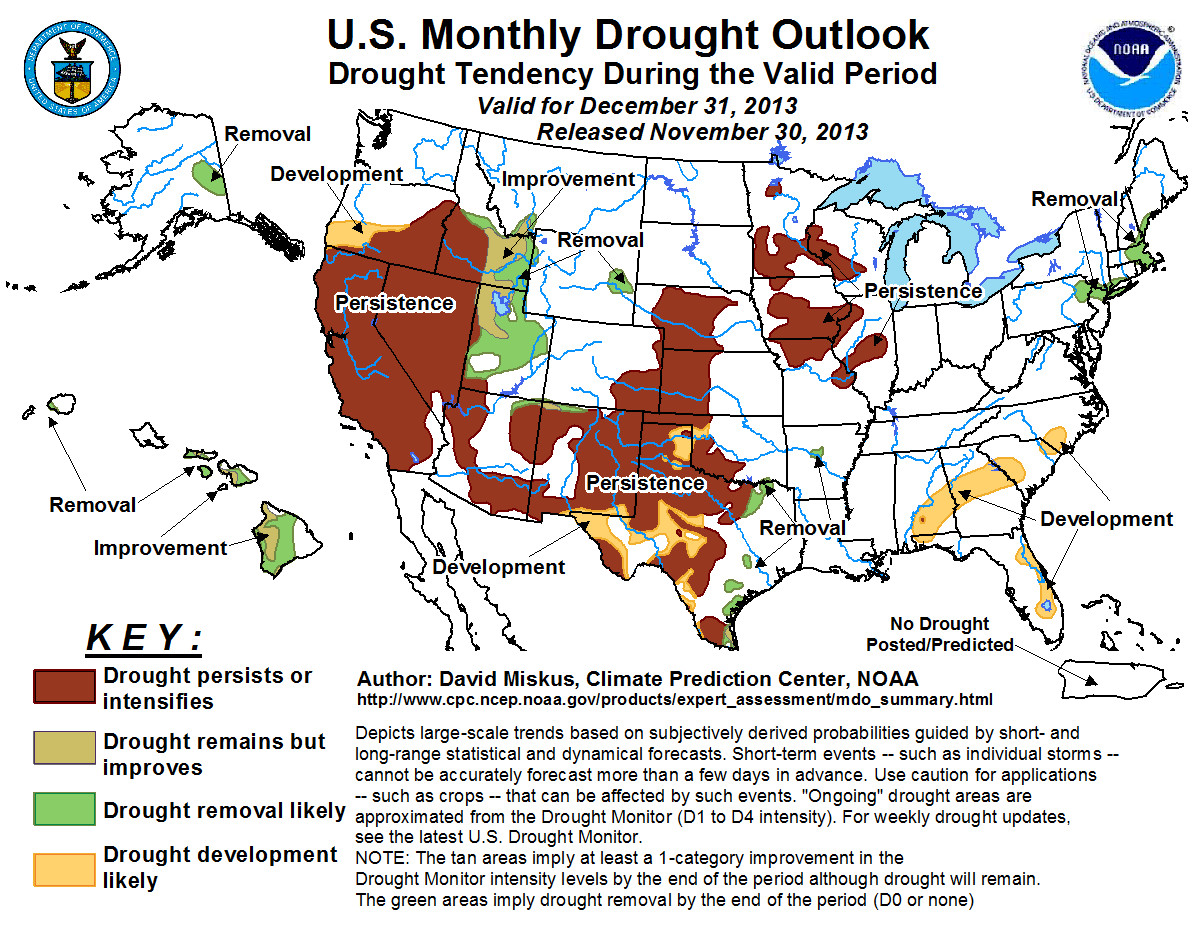
The latest monthly drought outlook is now available from the Climate Prediction Center #COdrought

Monthly Drought Outlook thru December 31, 2013 via the Climate Prediction Center

Click here to go to the Climate Prediction Center Website.

Permanent fixes for flood damage: ‘The magnitude of the task is still being assessed’ — Monte Whaley #COflood

Plume of subtropical moisture streaming into Colorado September 2013 via Weather5280

From The Denver Post (Monte Whaley):

A Dec. 1 deadline to reopen 27 flood-battered Colorado highways was tame compared with the years of complex challenges facing road crews charged with making permanent fixes to damage caused by September’s historic floods. The magnitude of the task is still being assessed while highway managers consider the types of technological and engineering changes they need to make to keep 485 miles of damaged roadway less vulnerable to mass flooding. It may take the Colorado Department of Transportation as long as 48 months to finish the permanent repairs needed on formerly flooded roads, said Johnny Olson, CDOT’s incident commander for the state’s infrastructure recovery force.

“We were charged with getting residents reconnected with their communities by getting these roadways done, and done to ensure safety by Dec. 1, and we did that,” said Olson. “Now we have to go back and evaluate and make repairs based on the long term.”

By Dec. 31, CDOT should have a pretty good idea of what needs to be done. By next spring, work could start on permanent “early out” projects where there was relatively minor damage to roadways. But on larger sections of highway — including U.S. 34 in Big Thompson Canyon — evaluations will take much longer and the work will be more detailed and challenging, Olson said. That road is getting particular attention since it was destroyed by the 1976 Big Thompson Flood and rebuilt to supposedly withstand another catastrophic flood.

“It was built to be indestructible,” said Gov. John Hickenlooper. “You see that it is very hard to be indestructible.”

Options weighed

CDOT Executive Director Don Hunt said engineers are weighing two possible options for the permanent rebuilding of U.S. 34 — reconstructing a road that will hold up against nearly any kind of flood or building a less expensive, but more vulnerable, highway. Those questions and others could be answered over the next few months, Olson said.

For example, he said: “What can we do to prevent this curve from washing out? What kind of striping does this stretch need? And what can we put under the surface of the roadway to make it last?”

Residents shouldn’t expect complete makeovers to damaged highways, said Olson. That’s because funding for repairs — including $450 million in state and federal funds — must be spent on specific damages. About one-third of the $450 million has been spent on temporary fixes, leaving the rest for permanent work, said Hunt.

It’s not clear if more funding will be available to Colorado in the near future, CDOT spokeswoman Mindy Crane said.

“Wherever there is damage, we can look at improving standards to protect us in the future,” Olson said. “But we can’t go through the whole U.S. 34 corridor and make changes.”

County roads crews also face months, or maybe years, of repairs due to the flooding.

“Hopefully, in some areas, we will be able to do permanent construction this summer,” said George Gerstle, transportation director in Boulder County, where the flood ravaged roads into mountain communities and a key segment of Colorado 7 between Lyons and Allens-park. “Others may take another year for design and construction because of the magnitude of the damage.”

County road crews rebuilt some 30 miles of canyon roads in about two months to make them passable, including Sunshine Canyon and Flagstaff Road, Gerstle said. Still, many county roads and bridges suffered heavy damage from creeks leaving their banks and establishing new channels. Crews will be busy doing temporary repairs on many of those areas over the next several months, including Lee Hill Road, Olde Stage Road, Apple Valley Road, Lickskillet Road and Longmont Dam Road. And while that work is going on, the county is looking at designs that will make bridges and roads less vulnerable to major floods that are likely to hit again.

“We are doing significant analysis on how we can construct roads and bridges that can withstand major flooding, which will come sometime in the future,” Gerstle said.

About 35 miles of Larimer County roads were destroyed in the flooding, but now 85 percent are back in operation, said Larimer County Commissioner Tom Donnelly. Officials expect the final miles of County Roads 43, 44H, 47 and 63 to open by Dec. 13.

But there may be bigger issues in Big Thompson Canyon, where seven of the canyon’s 17 bridges are owned by the county and all suffered heavy damage, Donnelly said. Most of the damage was caused by debris from the river that got plugged and overloaded the bridge infrastructure, he said. The county is looking to replace those with bridges that tilt and shrug off the rocks and tree branches that come with flooding, Donnelly said.

“In the long term, we want to be in a better position with our roads and bridges than where we are now,” he said.

Praise for progress

Still, he credits county crews, who worked in tandem with CDOT and contractors, for making formerly impassable roads, passable.

“We had 35 miles of roads destroyed in the flood, and now 85 percent are back in operation,” Donnelly said. “That’s impressive.”

Estes Park Mayor William Pinkham said some major restoration work will probably be needed on U.S. 36 near Pinewood Springs.

Otherwise, most residents are pleased with the temporary fixes along U.S. 34. “If you haven’t driven that road before, you never would have realized it’s a brand new road,” he said.

Mark Milburn, who lives near Allenspark, cheered with others last week when Hickenlooper cut the ribbon on Colorado 7 to reopen the road to Lyons. He, too, praised the speed of contractors and CDOT to get the work done so he could reunite with friends in Lyons. But Milburn worried that shoulders and turnouts on the highway won’t be restored.

“I know they were washed away by the floods, but for safety sake, I hope they will be returned,” Milburn said.

His wife, Sharon Milburn, also wished those huge concrete blocks known as Jersey barriers that funneled traffic away from road crews will disappear soon.

“It would be nice to see them go,” she said. “It would improve the view.”

The latest Eagle River Watershed Council newsletter is hot of the presses

Eagle River Basin
Eagle River Basin

Click here to read the newsletter.

More Eagle River Watershed coverage here and here.

#ColoradoRiver District: 2014 Water Resources Grant Program

Roaring Fork River
Roaring Fork River

From email from the Colorado River District (Martha Moore):

Effective immediately, the Colorado River District is accepting grant applications for projects that protect, enhance or develop water resources within its 15-county region. (district map)

Projects eligible for the grant program must achieve one or more of the following objectives:

• develop a new water supply
• improve an existing system
• improve instream water quality
• increase water use efficiency
• reduce sediment loading
• implement a watershed management action
• control invasive riparian vegetation
• protect pre-Colorado River Compact water rights (those in use before 1929)

Previous successfully grant-funded projects have included the construction of new water storage, the enlargement of existing water storage or diversion facilities, rehabilitation of nonfunctioning or restricted water storage / delivery / diversion structures, implementation of water efficiency improvements and watershed enhancements.

Successful grantees can receive up to a maximum of $150,000 (or approximately 25% of the total project cost; in the case of smaller projects, this percentage may be slightly higher) for their project. The total amount available for the 2014 competitive grant program is $250,000. The application deadline is Jan. 31, 2014.

To access the Water Resources Grant Program application, instructions, guidelines, policies, and other details please visit http://www.ColoradoRiverDistrict.org/page_193.

More information can be obtained by contacting Dave Kanzer or Alesha Frederick at 970-945-8522 or by e-mail to grantinfo@crwcd.org.

More Colorado River District coverage here.

Snowpack news: Powderhorn to open early on Saturday

Statewide SWE as a percent of normal December 3, 2013 via the NRCS

From the Grand Junction Daily Sentinel (Greg Ruland):

Get those skis and boards waxed, the season is about to start. Powderhorn Mountain Resort is making plans to open at 9 a.m. on Saturday, five days ahead of schedule thanks to the best early season snowfall in years, General Manager Sam Williams said.

“Mother Nature has blessed us with great early season conditions and cold temperatures,” Williams said.

News of the opening was first announced on the resort’s Facebook page on Monday, and news quickly spread via Twitter and other social media.

Persistent cold has allowed the resort to manufacture base conditions, but early precipitation is what will make the early opening possible, he said. More than 30 inches awaits skiers at the top of Grand Mesa, where wintertime is definitely underway, Williams said, adding that the base area could use more to be fully ready.

Help from Old Man Winter may arrive soon to take care of that.

“We got word from the National Weather Service that we’re probably going to receive another at least 12 inches of snow this week, which will give us the base we need to open,” he said.

That extra snow will allow the resort to open many of its runs earlier than usual, Williams said…

Across the state, several other resorts have already started their seasons, some just this week, including Telluride, Crested Butte, Purgatory, Steamboat and Aspen/Snowmass, according to Colorado Ski Country USA.

Sunlight Mountain Resort in Glenwood Springs is scheduled to open this weekend.

‘Denver-West Slope water agreement finally final’ — Glenwood Springs Post Independent #ColoradoRiver

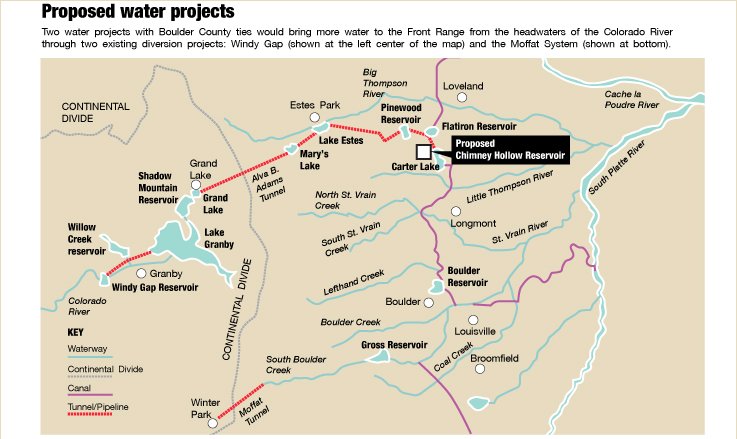
Moffat Collection System Project/Windy Gap Firming Project via the Boulder Daily Camera

From the Glenwood Springs Post Independent (Hannah Holm):

Denver can take a little more water from the Colorado River’s headwaters to increase the reliability of its system, but won’t develop any new transmountain diversions without West Slope agreement and will help repair damage from past diversions.

Those are some of the key provisions in the Colorado Cooperative Agreement between Denver Water and 42 West Slope water providers and local governments from the Grand Valley to Grand County.

The Colorado Cooperative Agreement covers a whole suite of issues related to Denver’s diversion of water from the Fraser and Blue River drainages, tributaries to the Colorado River. In October, with little fanfare, this historic agreement received its final signatures and was fully executed. It took five years of mediation and nearly two years of ironing out the details with state and federal agencies, against a backdrop of decades of litigation, to get to this point.

According to material from the Colorado River District’s latest quarterly meeting, the agreement, “is the direct result of Denver Water’s desire to expand its Moffat Tunnel transmountain water supply from the Fraser River in Grand County and to enlarge Gross Reservoir in Boulder County.” This project is expected to divert, on average, approximately 18,000 acre feet/year of water beyond the average of 58,000 acre feet/year it already diverts, which amounts to about 60% of the natural flow in the Fraser River at Winter Park.

Under the agreement, the West Slope parties agreed not to oppose the increased Moffat Collection System diversions, and Denver Water agreed not to expand its service area and not to develop new water projects on the West Slope without the agreement of the resident counties and the Colorado River District. The agreement also includes dozens of other provisions designed to limit water demands in Denver and address water quality and flow conditions in the Colorado River and its tributaries. Here’s a sampling:

Denver will contribute both water releases and several million dollars for a “learning by doing” project to improve aquatic habitat in Grand County. The project will be managed by representatives from Denver Water, Grand County, Colorado Parks and Wildlife, Trout Unlimited and other water users.

Denver will not exercise its rights to reduce bypass flows from Dillon Reservoir and its collection system in Grand County during droughts unless it has banned residential lawn watering in its service area.

Diversions and reservoirs operated by both Denver Water and West Slope parties will be operated as if the Shoshone hydroelectric power plant in Glenwood Canyon were calling for its (very senior) water right, even at times when the plant is down. This is important for recreational and environmental flows in the river, as well as for junior water users downstream from plant.

Denver Water will pay $1.5 million for water supply, water quality or water infrastructure projects benefiting the Grand Valley, and $500,000 to offset additional costs for water treatment in Garfield County when the Shoshone call is relaxed due to drought conditions.

A similar agreement is under development between West Slope entities and Northern Water, which currently diverts about 220,000 acre feet/year of water from the Upper Colorado River to the Front Range through the Colorado Big Thompson Project. Like the Colorado Cooperative Agreement, the Windy Gap Firming Project Intergovernmental Agreement trades West Slope non-opposition to increased transmountain diversions for mitigations to address the impacts of both past and future stream depletions.

Both the Colorado Cooperative Agreement and the Windy Gap Firming Project Intergovernmental Agreement have been hailed as models of cooperation. Meanwhile, East Slope – West Slope tensions continue to mount over how the Colorado Water Plan, currently under development, should address the possibility of additional diversions of water from the West Slope to meet growing urban demands on the Front Range. These agreements demonstrate that such tensions can be overcome, but also that it could take more time than allowed by the 2015 deadline Gov. Hickenlooper has set for completion of the Colorado Water Plan.

Full details on the Colorado Cooperative Agreement can be found on the River District’s website, under “features” at http://www.crwcd.org/. More information on the Colorado Water Plan can be found at http://coloradowaterplan.com/.

More Colorado River Cooperative Agreement coverage here.

Text of the Colorado Basin Roundtable white paper for the IBCC and Colorado Water Plan

New supply development concepts via the Front Range roundtables

Here’s the text from the recently approved draft of the white paper:

Introduction
The Colorado River Basin is the “heart” of Colorado. The basin holds the headwaters of the Colorado River that form the mainstem of the river, some of the state’s most significant agriculture, the largest West Slope city and a large, expanding energy industry. The Colorado Basin is home to the most-visited national forest and much of Colorado’s recreation-based economy, including significant river-based recreation.

Colorado’s population is projected by the State Demographer’s Office to nearly double by 2050, from the five million people we have today to nearly ten million. Most of the growth is expected to be along the Front Range urban corridor; however the fastest growth is expected to occur along the I-70 corridor within the Colorado Basin.

Continue reading “Text of the Colorado Basin Roundtable white paper for the IBCC and Colorado Water Plan”

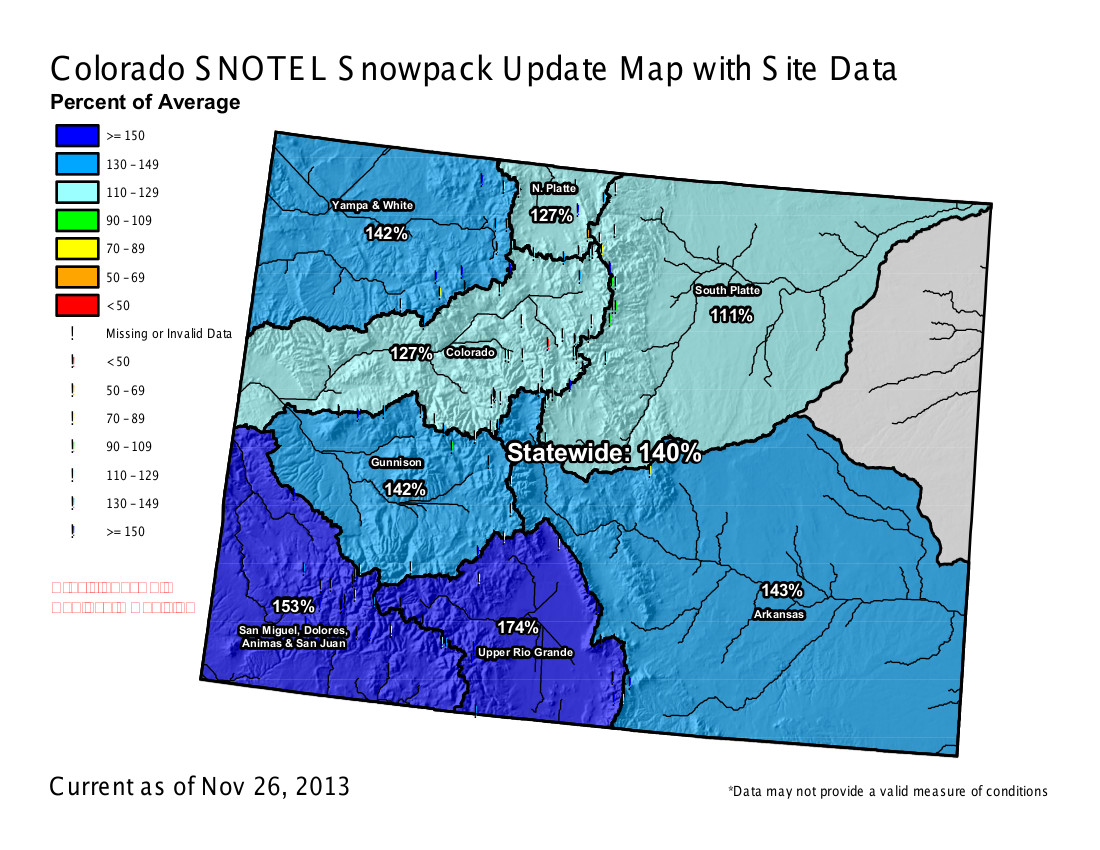
Snowpack news: Statewide = 140% of avg. as of November 26, storm due tonight and tomorrow

Colorado snowpack November 26, 2013

It’s a good start to the season but we have a long way to go. The South Platte was at 21% of average peak on November 26.

‘Don’t goddamn come here [#ColoradoRiver Basin] any more’ — Lurline Curran

Colorado transmountain diversions via the State Engineer's office
Colorado transmountain diversions via the State Engineer’s office

Here’s an article about the white paper approved last week by the Colorado Basin Roundtable, from Brent Gardner-Smith writing for Aspen Journalism. Click through and read the whole article. Here’s an excerpt:

“Don’t goddamn come here any more,” was the way Lurline Curran, county manager of Grand County, summed up the roundtable’s position just before the group voted to approve a white paper it has been working on for months.

“We’re trying to tell you, Front Range: Don’t count on us,” Curran said. “Don’t be counting on us to make up all the shortages.”

The actual paper crafted by the Colorado roundtable states its case in a more diplomatic fashion, but it is still blunt.

“The notion that increasing demands on the Front Range can always be met with a new supply from the Colorado River, or any other river, (is) no longer valid,” the position paper states…

“There is going to have to be a discussion and plan for developing a new West Slope water supply,” the South Platte roundtable stated in a June memo directed to Committee.

Together, the South Platte, Metro and Arkansas roundtables are pushing that discussion. They’re asking the state to preserve the option to build “several” 100,000 to 250,000 acre-foot projects on the Green River at Flaming Gorge Reservoir, the lower Yampa River, and/or the Gunnison River at Blue Mesa Reservoir…

On Nov. 25, the members of the Colorado River roundtable clearly wanted to inform the Committee that they don’t support the idea of new Western Slope projects.

Jim Pokrandt, a communications executive at the Colorado River District who chairs the Colorado roundtable, said the group’s paper, directed to the Committee, was “an answer to position statements put out by other basin roundtables.”

The Committee’s eventual analysis is expected to shape a draft statewide Colorado Water Plan, which is supposed to be on the governor’s desk via the Committee and the Colorado Water Conservation Board in 12 months.

And while there has been a decades-long discussion in Colorado about the merits of moving water from the Western Slope to the Front Range, the language in the position papers, and the roundtable meetings, is getting sharper as the state water plan now takes shape.

“It’s not ‘don’t take one more drop,’ but it is as close as we can get,” said Ken Neubecker, the environmental representative on the Colorado roundtable, about the group’s current position.

The paper itself advises, “the scenic nature and recreational uses of our rivers are as important to the West Slope as suburban development and service industry businesses are to the Front Range. They are not and should not be seen as second-class water rights, which Colorado can preserve the option of removing at the behest of Front Range indulgences.”

That’s certainly in contrast to the vision of the South Platte, Metro and Arkansas basin roundtables, which in a draft joint statement in July said that the way to meet the “east slope municipal supply gap” is to develop “state water projects using Colorado River water for municipal uses on the East and West slopes.”[…]

The white paper from the Colorado roundtable states that “new supply” is a euphemism for “a new transmountain diversion from the Colorado River system.”

“This option must be the last option,” the paper notes.

Instead of new expensive Western Slope water projects, the paper calls for more water conservation and “intelligent land use” on the Front Range.

It goes on to note that Front Range interests are actively pursuing the expansion of existing transmountain diversions — many of which are likely to be blessed by the Committee because they are already in the works.

It says the Western Slope has its own water gap, as the growing demands of agriculture, energy development, population growth and river ecosystems are coming together in the face of climate change.

It calls for reform to the state’s water laws, so it is easier to leave water in Western Slope rivers for environmental reasons, and it rejects the Front Range’s call to streamline the review process for new water projects.

“Streamlining as a means of forcing West Slope acquiescence to any new supply project ‘for the good of the state’ is unacceptable,” the paper states.

Finally, the document advises the state not to endorse or get behind a Western Slope water project unless it “has been agreed to by the impacted counties, conservancy districts and conservation districts from which water would be diverted.”

More IBCC — basin roundtables coverage here. More Colorado Water Plan coverage here.

Drought news: Little relief in Bent, Crowley and Otero counties #COdrought

From The Pueblo Chieftain (Chris Woodka):

Despite some encouraging snowfall in November, large parts of the state remain on drought alert, according to the latest report from the state drought task force. Conditions in the Arkansas Valley, particularly Bent, Crowley and Otero counties, are listed as exceptional drought by the U.S. Drought Monitor, an interagency monitor of long-term weather conditions. About three-quarters of the state is in some sort of drought. Only the South Platte and North Platte basins are listed as drought-free.

“Storage levels are strong and better than they were this time last year, easing concerns of municipal providers,” said Taryn Finnessey of the Colorado Water Conservation Board. “Early season snow has been decent, but long-range forecasts paint an unclear picture as to what we can expect throughout the winter months.”

Snowpack moisture statewide is slightly above average after the November snow. The northwest corner of Colorado is at about 115 percent, while all other basins are hovering around 100 percent. Water supply cannot be predicted from early snowfall reports, since the majority of snow typically falls in March and April.

Water storage levels have increased to about 83 percent of average statewide, up from 66 percent at the same time last year. Levels have increased by 10 percent since Sept. 1, according to the Natural Resources Conservation Service.

Storage in the Arkansas River basin is only about 72 percent of average and only 18 percent of capacity. In the Rio Grande basin, it is only 47 percent of average; 12 percent of capacity. Pueblo Board of Water Works storage is at about 55 percent capacity, which is close to the annual target for storage. The water board was able to increase the amount of water stored by about 37 percent this year, mostly by cutting back on raw water leases.

Colorado Springs Utilities reports its water storage is at 56 percent of capacity, or about 70 percent of average for this time of year. A report estimates it will finish the year with 1.6 years of supply in storage.

Aurora, which exports water from the Arkansas River basin, lists its reservoir storage at 67 percent of capacity systemwide, slightly below its target levels. A cool spring and September storms led to fuller reservoirs and reduced use, spokesman Greg Baker said.

Because of the September flooding, Denver Water reservoirs are nearly full.

Bureau of Reclamation: Upper #ColoradoRiver Basin water use pegged at 4.281 MAF in 2011

Colorado River Basin via Rand JIE

From inkstain (John Fleck):

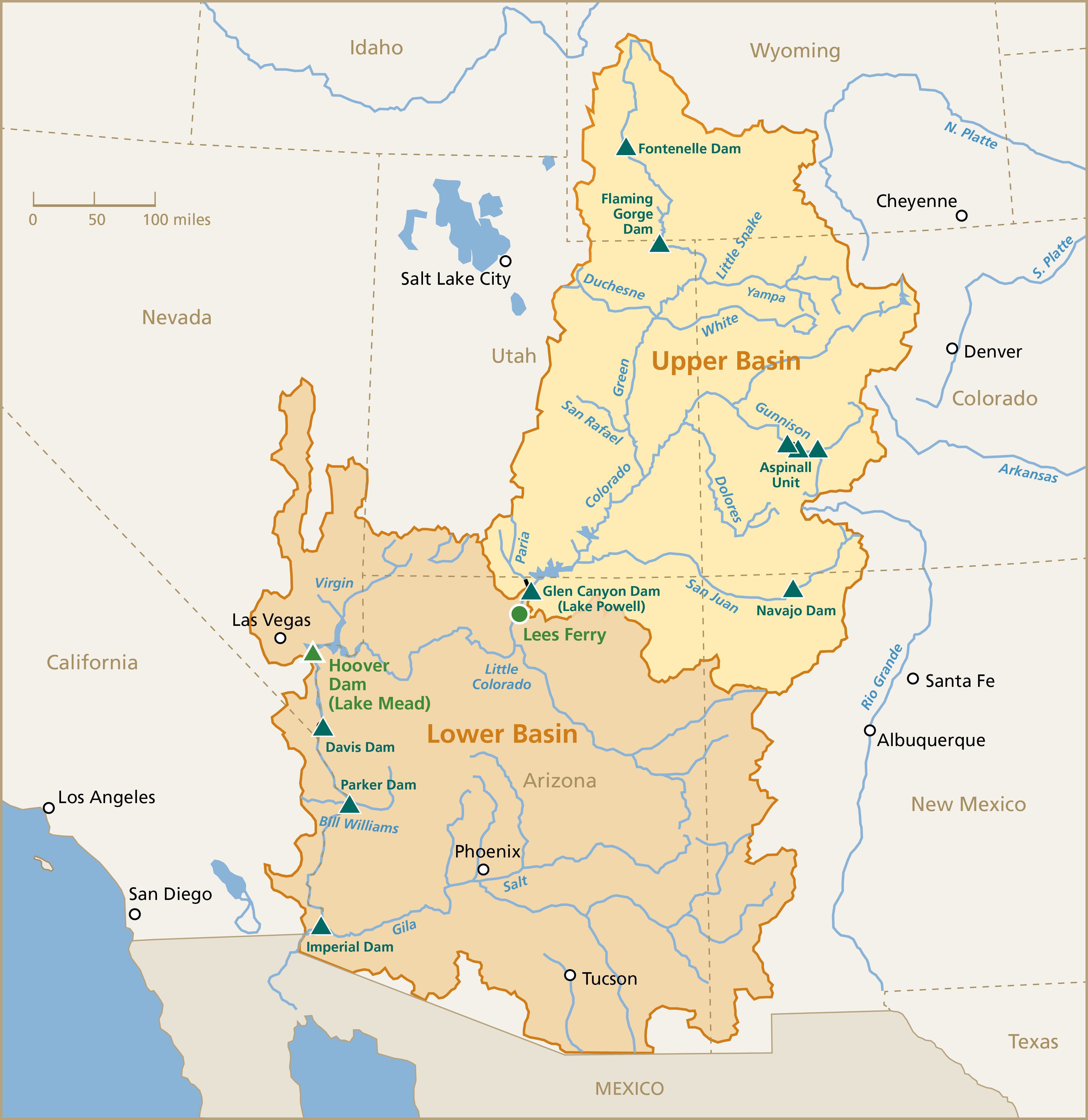
According to the U.S. Bureau of Reclamation’s new Consumptive Uses and Losses Report (pdf), consumptive use of Colorado River water in the states of the upper basin (Colorado, New Mexico, Utah, Wyoming and a sliver of Arizona) reached 4.281 million acre feet in 2011, the highest on record.

More Colorado River Basin coverage here and here.

‘Keeping the last wild river in the [#ColoradoRiver] Basin intact is important to a healthy environment’ — Susan Bruce

Yampa River Basin via the Colorado Geological Survey

Here’s a post arguing to keep the Yampa River riparian system as a baseline for a healthy river from Susan Bruce writing for the Earth Island Journal. Here’s an excerpt:

Governor John Hickenlooper’s directive to the Colorado Water Conservation Board earlier this year to create a Colorado Water Plan by 2015 has put the Yampa, which has the second largest watershed in the state, under the spotlight.

Efforts to dam the Yampa go back to the proposed construction of Echo Park Dam, which Congress vetoed in 1952, bowing to a groundswell of public outcry led by David Brower, then with the Sierra Club. But in a compromise he later regretted, Brower supported the construction of two other dams: Glen Canyon on the Colorado River and Flaming Gorge on the Green River. The Green and Yampa rivers used to have similar flows and ecosystems. The construction of the Flaming Gorge Dam in 1962 modified the Green’s hydrograph, reducing sediment flow by half and tapering its seasonal fluctuations to a slower, more consistent flow, opening the way for invasive species like the tamarisk tree to crowd out native ones.

More recently, in 2006, there was a proposal to build a reservoir near Maybell, CO, and pump water from the Yampa to a reservoir about 230 miles away for municipal and agricultural use on the Front Range. But the plan was scrapped due to environmental and cost concerns; the reservoir would have cost between $3 billion and $5 billion.

The oil and gas industry is also eyeing the Yampa. Shell Oil had plans to pump about 8 percent of the Yampa’s high-water flow to fill a 1,000-acre reservoir, but it shelved the proposal in 2010, citing a slowdown of its oil-shale development program. Still, oil production in Colorado is at its highest level since 1957 and gas production at an all-time high. While industrial and municipal water needs are projected to increase with population growth, the largest water user, agriculture, will continue to divert the lion’s share of Colorado’s water, around 80 percent. All of which mean the pressure to suck up Yampa’s water is only going to grow.

The most unique characteristic of the Yampa is its wild and unimpeded flow, in particular the extensive spring flooding that washes away sediment, giving the river its brownish hue. This “river dance” helps establish new streamside forests, wetlands, and sandy beaches, as well as shallows that support species like the endangered Colorado pikeminnow and razorback sucker. By late fall, the water barely covers the riverbed in some stretches…

The rafting industry, which contributes more than $150 million to Colorado’s economy, has a strong voice when it comes to the Yampa’s future. Although damming the Yampa would provide a more consistent flow over a longer season, George Wendt – founder of OARS, the largest rafting company in the world – speaks for most outfitters when he says he would rather see the Yampa retain its natural state.

Conservationists also argue that the Yampa’s full flow helps meet Colorado’s legal obligation to provide water to the seven states within the Colorado Basin and Mexico. Measures being considered to protect the Yampa include an instream flow appropriation by the Colorado Water Conservation Board that would reserve Yampa’s water for the natural function of rivers, and a Wild and Scenic River designation by Congress.

Many proponents of keeping the Yampa wild point to its value as a baseline – an ecosystem naturally in balance. “If things go awry on dammed rivers, which they do, we have a control river, so to speak,” says Kent Vertrees of The Friends of the Yampa. “Keeping the last wild river in the Colorado Basin intact is important to a healthy environment and so future generations can experience in situ millions of years of history little changed by man.”

More Yampa River Basin coverage here and here.

Second Wettest Fall Season on Record for Grand Junction with 5.50 inches of precipitation

Telluride: Snowmaking upgrade over the summer includes 16,000 feet of steel pipe

Telluride Ski Area via Powder Skiing Colorado

From The Watch (Gus Jarvis):

The ski area, thanks to the mind and work of Telluride Ski and Golf Company’s Director of Snowmaking Brandon Green, has taken some momentous steps this year toward reaching that goal by completing a huge snowmaking infrastructure upgrade which, combined with new snowmaking technology, will enable Telluride to open more runs earlier in the year.

Over the summer, crews replaced decrepit pipe and laid 16,000 feet of steel pipe in the ground as a start to building the foundation of the ski area’s snowmaking future. All of the pipe was painstakingly buried four feet underground, a foot below the frost line. On some portions of the system where wetlands existed, crews bored a hole for the new pipeline without having to touch the surface…

While the new, stronger pipe will eliminate down time due to breakage, the new pipe was laid in a loop system so that if a pipe does burst, the new system can still operate with the help of nearby shutoff valves.

“If something breaks on one spot,” Green said, “we can keep it running operationally and we will be able to maintain it with zero down time, which is ultimately my goal.”

The new pipe infrastructure also has the ability to bring water at a higher pressure, which is needed for the 71 new low energy Snow Logic snowmaking guns the ski area invested in over the past two years.

More infrastructure coverage here.

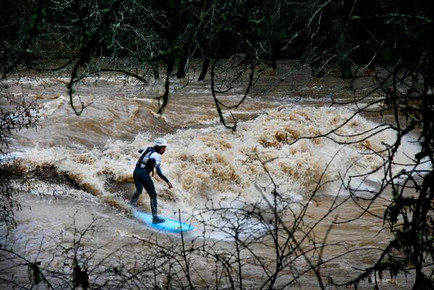
Boulder County flood structure tally — 337 structures destroyed, $41 million #COflood

Surfing Boulder Creek September 2013 via @lauras

From the Boulder Daily Camera (Charlie Brennan) via the Longmont Times-Call:

September’s historic flood destroyed a total of 337 structures on 313 properties in Boulder County, representing $41 million in market value, according to newly released data from the Assessor’s Office.

The county is waiving taxes on those ruined properties for Sept. 13 through the end of the year, meaning taxes won’t be levied against a combined total of $12,367,815 in market value. That figure counts only the value of the destroyed structures, and not the value of the land on which they stood.

Of the 313 properties destroyed in the county, 260 lay within the 100-year flood zone, while 53 did not.

Every one of the 82 properties in Lyons that were destroyed lay within the 100-year flood zone. In unincorporated Boulder County, however, while 54 of the destroyed properties sat in the 100-year flood zone, 32 did not…

Boulder has 14 tributaries, plus Boulder Creek, which flow through the city, and remapping efforts were already under way before the flood for some of them, including Two Mile Canyon Creek, Upper Goose Creek, Skunk Creek, King’s Gulch, Bluebell Canyon Creek, the Boulder Slough and Boulder Creek itself.

“Basically, because of the large number of creeks we have in town, we are in a continual cycle of mapping and mitigation. We already had various areas where we were in different stages of either studying or going through the map adaptation process, or pursuing mitigation measures,” said Jeff Arthur, Boulder’s director of public works for utilities…

The highest concentration of destroyed properties in the county, according to Roberts, was in two mobile home parks along the St. Vrain River: the 32-space Riverbend Mobile Home park in Lyons and the 60-space Royal Mobile Home Park in Longmont…

Earlier this fall, the city of Boulder released preliminary findings that the flood caused $48.91 million in damage to city infrastructure, parks and open space. Additionally, Boulder County shortly after the flood put the damage to county roads and bridges at $89 million, and damage to county buildings at $1.3 million.