‘The issue becomes who’s got the most water and what priority…ag users’ — Kathleen Curry #ColoradoRiver #COWaterPlan

Mount Sopris via the National Society Daughters of the American Revolution

From the Glenwood Springs Post Independent (Hannah Holm):

The Bookcliff, Mount Sopris and South Side conservation districts host the annual event. This year’s theme was water in the Colorado River basin, with a message that increasing demand, limited supply and less water throughout the state could be devastating to agriculture. Issues included water rights protection, water shortages and the smart-, or mega-ditch, a water conservation method used on an irrigation ditch near Carbondale.

Curry and Meyer led a discussion about the state water plan, which has to be finalized in six months. Afterwards, Curry said she is worried.

“Between the shortage on the Front Range due to the growth that they’re facing, and then watching the levels in Lake Powell and Lake Mead drop over the last couple of years, it hit me that we’re looking at not enough water to go around,” she told The Citizen Telegram.

Something will have to give, Curry added.

“The issue becomes who’s got the most water and what priority, and that always takes you back down the trail to the ag users,” she said…

Curry believes the long-term viability of Colorado agriculture is already at risk for a variety of reasons, and that the looming water gap could add to the pressure.

“It’s not a very profitable business because it’s very work-intensive and labor-intensive,” she said. “And if the commodity markets aren’t strong and [farmers and ranchers] don’t make much money that year, then you add this to it? It just becomes too much weight for them to carry.”

Another part of the problem is that there are fewer and fewer young ranchers to help carry that weight.

Carl Day, 30, has been with the Colorado Farm Bureau Young Farmers and Ranchers program for about a month. The program involves Farm Bureau members between the ages of 18-35 that wish to become effective leaders in the ag industry, and learn more about being successful on their own farms and ranches.

Day is the third generation to raise sheep at the Open Heart Ranch, near Harvey Gap Reservoir. He said that young people are leaving agriculture because the hours are long and the pay isn’t very good.

“[Agriculture work] pays way below the minimum wage,” he said. “You work from 6 a.m. to 10 p.m. in the summer and, in winter, you work an 8-hour day repairing stuff.”

More Colorado Water Plan coverage here.

SB14-115: Sen. Roberts and allies back off legislative approval for the #COWaterPlan #COleg

Colorado Water Plan website screen shot November 1, 2013

From The Durango Herald (Joe Hanel):

Roberts’ Senate Bill 115 would have required legislative approval of the Colorado Water Plan. But Roberts and her allies backed down Thursday and changed their bill to require public hearings and reports to the Legislature. The plan will no longer require legislative approval.

The Legislature has outsourced water policy for decades, starting in the 1930s, when it created the Colorado Water Conservation Board. In 2005, it set up a system of roundtables in each major river basin to begin working toward a state strategy.

Those roundtables have been working for eight years, and last year, Hickenlooper pushed the roundtables to come up with a state plan by the end of 2014…

…defenders of the roundtables say they have brought together all sorts of water users who used to be enemies, and more people than ever are now involved in crafting water policy.

“We need to realize that eight years of hard work has gone into the water plan already,” said Rep. Mike McLachlan, D-Durango, in a Wednesday interview.

McLachlan said he supports Roberts’ bill, but he doesn’t want the water plan to turn into a turf war between the Legislature and Hickenlooper…

The Senate Agriculture Committee passed the scaled-down bill 6-1 Thursday.

More 2014 Colorado legislation coverage here.

The #ColoradoRiver Basin Roundtable is soliciting input for the #COWaterPlan

Colorado Water Plan website screen shot November 1, 2013

From the Glenwood Springs Post Independent (Hannah Holm/Angie Boyer):

Water is important to all of us. Some of us just drink it, some of us rely on it to grow food and livelihoods, and others of us raft, fish, kayak, surf, swim or ski, or build our businesses around people who do. Most of us appreciate the beauty of healthy streams and rivers.

Many of us also take the water we rely on and enjoy for granted. In May of last year, Governor Hickenlooper ordered his administration to develop a statewide water plan, and said that “Colorado’s water plan must reflect its water values.” This is a call to stop taking water for granted and start defining what our water values are.

What does our water future hold for us?

Governor Hickenlooper issued his order because the state of Colorado is facing the prospect of significant water supply challenges in the future. The gap between the state’s developed water supplies and growing urban demands could exceed 500,000 acre feet by 2050 (an acre foot is about enough for two to three families for a year at current usage rates). The biggest gap is anticipated on the Front Range, home to Colorado’s largest cities, but there’s a projected gap in the Colorado Basin as well.

The options for filling this gap all involve trade-offs. If cities buy more water from irrigated farms and ranches, it has negative impacts on rural communities. Taking more water from the Western Slope to the Front Range would be very expensive and could worsen environmental impacts from existing trans-mountain diversions. Conservation seems easy, but conserving enough to eliminate the need for other water sources could require the broad application of land-use and landscaping restrictions that may not be politically palatable.

In order to sort through these challenges, the governor has directed his administration to work with “basin roundtables” of stakeholders to help bring forth the perspectives and values of the citizens living in each of the state’s eight major river basins (plus an additional roundtable that focuses on the Denver Metropolitan area). These nine basin roundtables are in the process of developing “basin implementation plans” which will identify solutions to meet water needs both inside each basin and statewide. These individual basin plans will serve as input into Colorado’s Water Plan, which Governor Hickenlooper has ordered to be completed by December 2015.

LEARN MORE

What are your water values? What water uses and attributes do you want to see protected or enhanced? What project ideas do you have? The Colorado Basin Roundtable needs your input as it develops its basin plan. Working with SGM, the Roundtable has set up the following ways for you to learn more and provide input.

1. Visit the Colorado Basin Implementation Plan website at http://www.coloradobip.sgm-inc.com.

2. Answer a quick survey here: http://www.surveymonkey.com/s/ColoBasinPlanValues.

3. Attend a meeting. Planning meetings are being held twice a week at the Community Center in Glenwood Springs and presentations are being given across the basin. Upcoming events include a Grand County Town Hall meeting Feb. 12, a seminar in Grand Junction Feb. 17, and a “Waterwise Wednesday” event in Avon Feb. 26. See the website above for an up-to-date schedule.

4. Facebook: You can find the Colorado Basin Implementation Plan page here: http://www.facebook.com/ColoradoBasinImplementationPlan or you can search “Colorado Basin Implementation Plan.”

5. Twitter: Follow the Colorado Basin Implementation Plan on Twitter: http://www.twitter.com/colobip.

6. Questions? If you have any questions or comments, please submit your inquiries to Angie Fowler at angief@sgm-inc.com

More Colorado Water Plan coverage here.

HB14-1026 would…[create] a new water right…exempt from the state’s…anti-speculation doctrine — Chieftain #COleg

squeezingmoney

The Pueblo Chieftain editorial staff is sounding the alarm about HB14-1026 and the anti-speculation doctrine:

Politically powerful The convergence of money and political influence, both natural offsprings of rising city and suburban populations, threatens to destroy Colorado’s farm communities — including towns up and down the Lower Arkansas Valley.

We raise the alarm to the latest threat, which is House Bill 1026. The bill has passed the Colorado House and been sent to the Senate, where it is assigned to the Agriculture Committee with no hearing date set yet. HB1026 would radically change Colorado water law by creating a new water right — the so-called “flex use” — that would be exempt from the state’s time-honored anti-speculation doctrine.

Since statehood, the doctrine has served Colorado well. It requires applicants for a water right change to identify upfront the specific beneficial use to which they intend to put the water. This protects Colorado water rights holders and the public from speculators who otherwise might buy up water rights, perhaps even corner a piece of the market, thus raking in huge profits at the expense of the rest of us.

In the face of this imminent threat, you’d think the Colorado Legislature would reject HB1026 out of hand. But that hasn’t happened yet.

The reason, we believe, is that urban lawmakers, who make up most of the Legislature, simply are insufficiently knowledgeable about Colorado water law — and the importance it grants to specific beneficial uses.

In the past, the Colorado Water Congress might have been expected to blow the whistle on such a radical proposal as HB1026. But the organization has changed. It has been taken over by a committee, mainly of Denver-area water lawyers, who represent lucrative urban markets.

The metro area’s political and economic dominance pose a real threat to rural Colorado. There’s no other excuse for HB1026, regardless of how hard the well-heeled lobbyists and lawyers in Denver try to sell it.

More 2014 Colorado legislation coverage here.

Drought news: Many Colorado eyes are watching the southwestern US drought #COdrought #ColoradoRiver

From The Pueblo Chieftain (Chris Woodka):

Colorado officials are worried that declining levels in reservoirs on the Colorado River could have an impact within the state.

“The storage in Lake Powell is going down, after 2012-13, two of the driest years on record,” said John McClow, a Gunnison attorney who represents the state on compact matters.

McClow gave an overview of the Colorado River Compact to the Arkansas Basin Roundtable Thursday, saying that good snowpack could provide much-needed moisture to stop the decline of Lake Powell levels at least for a year. Under the compact, upper basin states — Colorado, New Mexico, Utah and Wyoming — have an obligation to deliver a certain amount of water to lower basin states — Arizona, California and Nevada. While the compact is open to interpretation, the upper basin state has never failed to deliver the required amount. But if the drought of the last decade continues, there is a danger that there could be a shortfall sometime in the next decade.

“That’s not a prediction, but a worst-case scenario,” McClow said.

To prepare for that, the upper basin states have held strategy meetings that would use either coordinate releases from Flaming Gorge, Navajo and Blue Mesa reservoirs to provide water to Lake Powell, as intended under congressional laws surrounding the compact, or curtail use within the states.

While the amount of water delivered remains a numbers game, the political reality could be that Congress would not turn off water to California or Las Vegas.

In 2007, all seven states agreed to a plan to share shortages. It requires balancing Lake Powell and Lake Mead. However, the two lakes’ combined storage is at its lowest point since 1968.

The water level in Lake Mead is approaching the point where it will drop below its second intake, which could trigger releases from Lake Powell.

Las Vegas is spending $800 million to tunnel under Lake Mead to build its third intake, but that won’t be completed until at least 2015.

If Lake Powell levels drop, Colorado and the other basin states could be affected by the loss of hydropower generation. While 5.8 million people receive power from Lake Powell, the revenues from that power also help fund endangered fish programs, McClow said.

‘Gaps in water supply exist now’ — Gary Barber #COWaterPlan

Projected supply gap for 2030 via the Colorado Water Conservation Board

From The Pueblo Chieftain (Chris Woodka):

You get what you plan for. That’s the message the Arkansas Basin Roundtable would like communities to heed as the state develops a water plan.

“Gaps in water supply exist now, both in El Paso County and in the Lower Arkansas Valley,” Gary Barber, chairman of the roundtable, said at the group’s monthly meeting Wednesday at the Salida Steam Plant.

The roundtable is developing its own input into a state water plan under tight guidelines imposed by Gov. John Hickenlooper.

There has been friction from the state Legislature, where SB115 is causing ripples. Its sponsors claim lawmakers should have a greater say, while state officials argue that the roundtables, the Interbasin Compact Committee roundtables have studied the issues since 2005 and should have a lead position in developing the plan.

As it stands now, the Colorado Water Conservation Board will deliver a draft plan to the governor

“What you hear from talking to people is, ‘Why should I care?'” said Sandy White, who represents the Huerfano Conservancy District. “It’s always dangerous in rural Colorado to say, ‘I’m from the government and am here to help’…In selling the plan, we need to identify what it can do to help the water user.”

“Utilities like the Pueblo Board of Water Works and Colorado Springs have done planning for years, but how has agriculture planned?” replied Alan Hamel, the Arkansas River basin representative on the CWCB.

“I think we want to ask communities to contribute to the plan, even if their projects are several years down the road,” said Betty Konarski, who represents El Paso County interests on the roundtable.

The roundtable is stepping up its outreach efforts to get even more input from county commissioners or town councils. It plans to hold longer meetings in the next few months to allow more time to discuss the plan.

Meanwhile, the IBCC is working on ironing out differences between the basins.

Lower Arkansas Valley Water Conservancy District Manager Jay Winner, who represents the Arkansas basin on the IBCC, said preserving agriculture and food security need to be planks in the state water plan.

“We need a balanced plan that serves all interests,” Winner said.

More Colorado Water Plan coverage here.

Snowpack news

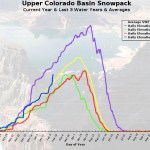
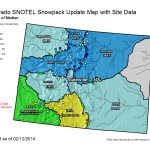
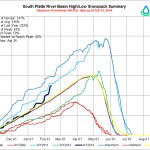
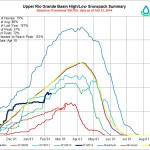
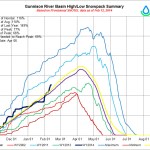
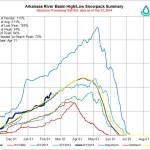
Mage at the NRCS has been busy this week. Click on a thumbnail to view a gallery of snowpack graphics.

Fourth Custer County Water Forum, March 1

Wet Mountain Valley
Wet Mountain Valley

From The Wet Mountain Tribune (J.E. Ward):

The Fourth Custer County Water Forum will be held on Saturday, March 1 in the Multi-Purpose room at the high school. County extension agent Robin Young explained that the conference is important for everyone.

“We might have had a lot of moisture so far this year,” Young said, “but we are always in a water crisis. Colorado is in a longer drought cycle. Though the moisture now is helpful, it depends on the spring’s showers if we produce good crops this year or not.”

Not only is the Wet Mountain Valley waiting to see if those spring rains come, but the state is in a crisis because it gives water to 18 other states, including California. As of now, many cities in California are about to run out of water and still have not adopted any water regulations.

“It impacts us greatly,” Young said. “We have strict water regulations, but they don’t.”

Young explained that the state, and the Valley, have been in a drought since the early 2000s. Climatologists have said that snow levels must consistently be met to end the drought.

The water conference is free for people to attend, though lunch will cost $3.50 or $4. The conference will focus on “Water on the Land and in the Ground.”

There will be an Upper Arkansas Water Conservancy District update, an update on water issues in Custer County, a balanced approach to tying water to the land, and the use of 1041 regulations by Huerfano County to protect water resources. Other lectures are also scheduled.

For pre-registration, contact the Custer County Conservation District office at 783-2481.

More Custer County coverage here and here.

Drought news

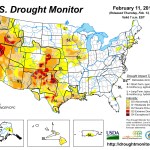
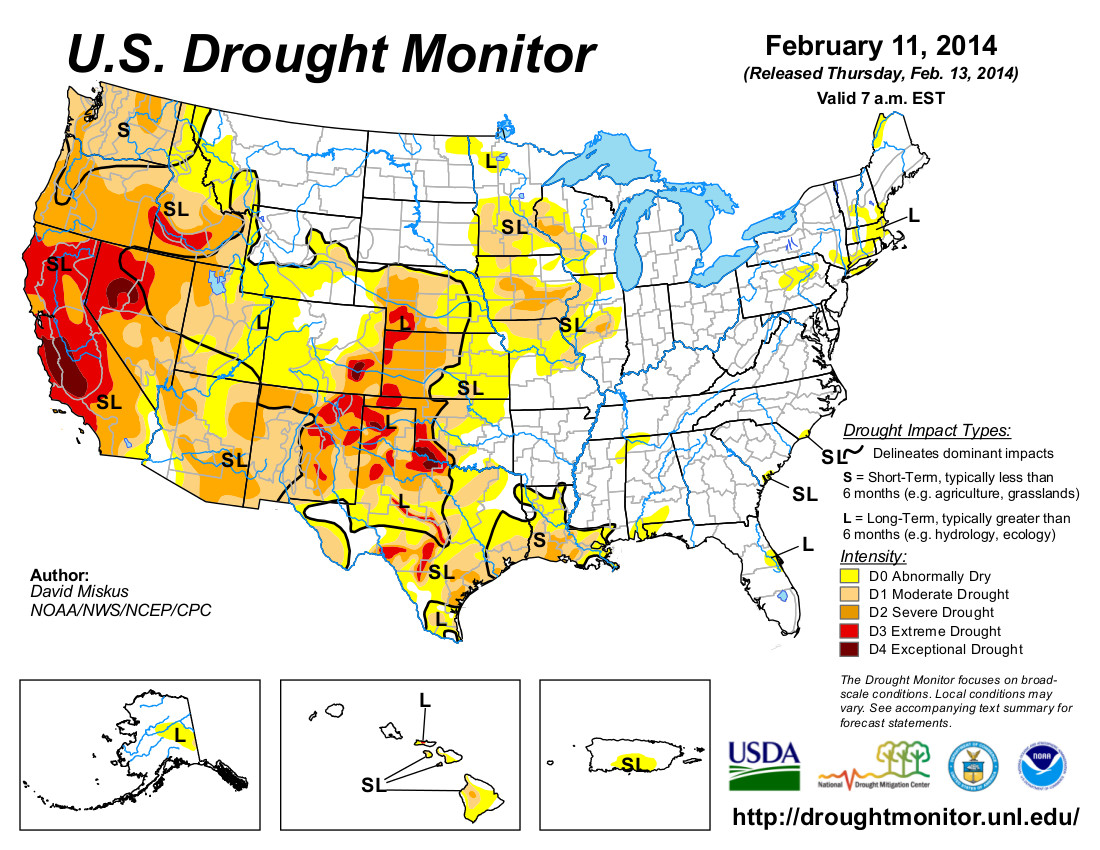
US Drought Monitor February 11, 2014

Click here to go to the US Drought Monitor website. Here’s an excerpt:

Summary

During the past 7-days, the first significant storm of the wet season (since October 1) inundated parts of central California and the northern Sierra Nevada with 6-12 inches of precipitation, with locally up to 15 inches. Although there were short-term local improvements from this week’s ample precipitation, the long stretch of subnormal precipitation dating back to 2011-12 wet season has accumulated large deficits, leaving rivers, lakes, reservoirs, and snow packs well below normal. Even though this storm was welcome, the central Sierra still needs 3-4 more copious storms to bring this wet season close to average. Farther north, lesser but welcome precipitation (2-4 inches) also fell on the southern Cascades, while unseasonably cold air dropped measurable snow from Portland, OR, to Seattle, WA. Unfortunately, little to no precipitation fell on southern California and the Southwest. Elsewhere, frigid conditions gripped much of the lower 48 States, with weekly temperatures averaging more than 10oF below normal from the Northwest into the Plains and Midwest. Decent precipitation from the Pacific storm also fell on parts of northern Nevada, southern Idaho, and the central Rockies. The central Plains into the Midwest saw light snow, while parts of the Southeast received 1-2 inches of rain. In the mid-Atlantic, sub-freezing air at the surface and mild air aloft generated a dangerous ice storm in parts of West Virginia, Maryland, Pennsylvania, and New Jersey. Alaska remained unseasonably mild, Hawaii saw additional showers in the northern and central islands, and eastern and western Puerto Rico reported light to moderate scattered showers…

Southwest

Little or no precipitation was reported in the Southwest as several locations in this region have yet to receive any measurable precipitation during 2014. The lack of appreciable winter precipitation has accumulated short-term deficits as most locations from southern California eastward into New Mexico have measured less than 25% of normal precipitation the past 60-days. Fortunately there was a surplus of rain at 6-months in most of these eastern and western areas; however, with drier conditions at 6-months in central Arizona and near the Salton Sea of southeastern California, D1 and D2 were slightly expanded there. According to the NRCS SNOTEL sites, Feb. 12 basin average snow water content remained low in central Arizona (13-33%, one site at 91%) and New Mexico (19-40% in the west and south, 41-60% in the north)…

The West

As mentioned in the opening Weekly Weather Summary, beneficial and overdue precipitation finally fell on much of the Far West, but especially on drought-stricken northern and central California. This was the first big storm of this year’s wet season (Oct-Apr) for California, bringing 8-15 inches of precipitation from just north of San Francisco (Marin, Sonoma, Napa counties) and to the western slopes of the Sierra Nevada. Although the amounts were large, the long-term drought in California since the 2011-12 wet season has accumulated huge deficits and brought severe hydrological, agricultural, and ecological impacts. Nevertheless, two small areas of improvement (D3 to D2) were made in locations where the greatest precipitation fell (8-15 inches). This caused localized stream and river flooding and did fill small water storages. On a larger scale, the Folsom Reservoir on the American River was the big winner in the recent event, doubling its storage; however, it would need to double again to get back to average. Oroville Reservoir was next best, going from 1.26 MAF (million acre-feet) to 1.33 MAF, with average for this time of year 2.37 MAF. Other large California reservoirs were not as fortunate. With respect to snowpack, the latest (2/12) NRCS Snotel average basin snow water content stood at 35-54% of normal for the Sierras (CA), 29-59% for the southern Cascades (OR), and 58-69% of normal for the northern Cascades (WA). Values were generally above-normal for the Rockies, and below normal to the west. So with this brief (1-week) glimmer of good news, the bad news is that California has a long, long way to go to get back to normal. To put this in historical perspective (which does NOT include the Feb. 4-10 storm), NCDC stated that except for January 2014 (3rd driest) and June 2013-January 2014 (2nd driest), all of the time periods from the last two months (Dec’13-Jan’14) through the last twelve months (Feb’13-Jan’14) ranked driest on record statewide for California since 1895. In addition, the last 24-months (Feb’12-Jan’14) was also the driest such 24-month period on record.

Elsewhere, from coastal Oregon southward to Sonoma County, 2-8 inches were measured. The northern Cascades generally saw 1.5 to 4 inches, while the southern Cascades 2 to 6 inches. Heavy precipitation (more than 2 inches) also spilled eastward into southern Idaho, northern Nevada, western Wyoming, northern Utah, and central Colorado. However, since the previous 3 months had been relatively dry in the West, only minor improvements were made where the greatest precipitation fell. This included: northeastern Nevada where 1.5 to 3 inches of precipitation diminished the D3 there; Idaho, a slight reduction of the northern D3 area and adjacent D2 area, and D2 to D1 improvement in the southeast; western Wyoming, D0 and D1 reduction; and northeastern Utah, D1 to D0 improvement. Elsewhere, the precipitation was enough to prevent any further deterioration, except in Washington.

In Washington, both short-term ACIS and AHPS precipitation amounts have been well below normal (<50%) at 30-, 60-, and 90-days, especially in the western and northeastern sections. In light of rapidly accumulating 90-day shortages of over 20 inches along the western coast and 4-8 inches in north-central sections, D2 was expanded northward from Oregon into the Seattle-Tacoma area, and introduced in north-central portions. D1 was also expanded eastward into northern Idaho while D0 slightly shifted into northwestern Montana…

Looking Ahead

During February 13-17, 2014, a departing Atlantic Coast storm (on Feb. 13) should drop moderate to heavy precipitation on the Northeast, while unsettled weather in the Northwest should bring heavy precipitation (4-12 inches) from the Cascades southward into northern California. Unfortunately, it appears as though the southern half of California will miss out on the precipitation. Decent precipitation should also fall on Idaho and the western parts of Montana and Wyoming. Light snows are expected for the northern Plains into the Great Lakes region and Ohio Valley. Dry weather is forecast for the southwestern quarter of the Nation. Much above-normal temperatures should envelop the western half of the U.S. while subnormal readings are expected in the northeastern quarter of the country.

For the ensuing 5-day period, February 18-22, 2014, the odds favor above-median precipitation across the northern half of the Nation, with the greatest probabilities in the Northwest and Great Lakes region. Below-median precipitation is favored across the southern third of the U.S., especially in the Southwest and Southeast. Above-median temperatures are likely east of the Rockies, while the odds for sub-median readings are probable in the Far West.

Colorado Water Bank Project: farmers & ranchers invited to discuss

Is This Winter’s Colorado Snowfall Setting Records? — @CopperCondos #COdrought

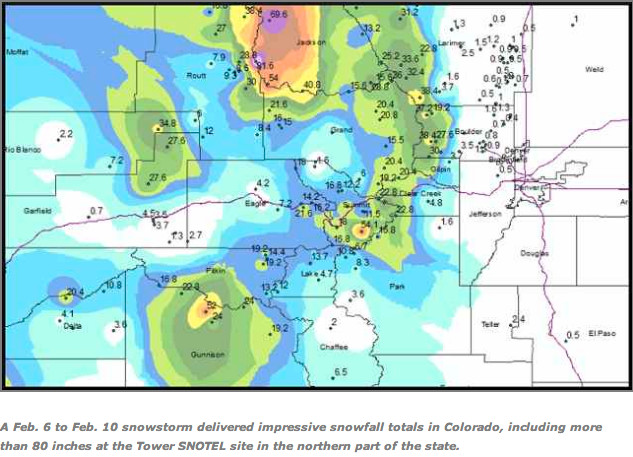
Map of snowfall totals from February 6, 2014 storm via @CopperCondos

From @CopperCondos:

So far, seasonal totals are well above average, with 231 inches to-date at Copper Mountain, but still below all-time Summit County snowfall records. But January’s snowfall was nothing to sneeze at, according to veteran Breckenridge weather-watcher Rick Bly, who has been tracking precipitation for the National Weather Service in his backyard for several decades. According to Bly’s measurements, January 2014 was the third-snowiest on record, just behind 1899 and 1996. So far for the season, every month since October has delivered above-average snowfall, Bly said.

Along with Bly’s manual measurements, weather experts also track Colorado snowfall through a widespread network of automated sensors, called SNOTEL sites. From this year’s data, it appears that Copper precipitation is on par with the totals Bly reported from Breckenridge. For the season to-date, total snowfall ranks in the top five seasons.

The SNOTEL station at Copper Mountain sits at 10,550 feet and has been delivering data since 1978. You can get a wealth of information about snowfall in the area by clicking on the links within the site, including cool graphs showing how this year’s precipitation measures up to the average and to previous winters.

From Steamboat Today (Tom Ross):

The Natural Resources Conservation Service reported Wednesday that the snowpack on Rabbit Ears Pass is 142 percent of the median for Feb. 12…

The automated measuring sites are useful, [Mage Hultstrand] said, but her agency ultimately relies on visits to each site to confirm the data, which is important to planning for the summer’s water supply…

Outside the scope of winter recreation, the snow on Buffalo Pass is significant to municipalities and irrigators all the way down the larger Colorado River Basin. The snow that melts from Buffalo Pass in June will flow into the Yampa River, which joins the Green River just east of Colorado’s border with Utah. The Green in turn flows into the Colorado in Utah’s Canyonlands National Park, not far upstream from Lake Powell, which stores much of the water that is set aside for states such as California, Arizona and Nevada…

Anyone interested in the future of water supplies in the Colorado River Basin is invited to attend Thursday night’s public meeting of the Yampa-White-Green Rivers Basin Roundtable at the Steamboat Springs Community Center.

Sens. Coram, Sonnenberg and Scott walk out of Senate Bill 14-115 hearing in protest #COleg

Colorado Water Plan website screen shot November 1, 2013

From The Denver Post (Lynn Bartels):

Three Republican lawmakers walked out of an ag committee hearing Wednesday morning in protest over the handling of a water bill scheduled to be heard Thursday afternoon.

Senate Bill 115 would give the legislature a say in the “Colorado Water Plan,” an executive order Democratic Gov. John Hickenlooper issued last year charging the state to address water needs in urban and rural areas. A draft of the plan is due in December.

Mike King, director of the Department of Natural Resources, and James Eklund, director of the Colorado Water Conservation Board, met with the bill sponsors Tuesday to discuss their concerns about the bipartisan proposal, which gives the legislature veto power over the plan. Eklund admitted that during the meeting he got “a little hot, maybe too hot.”

“I don’t like being lectured or dictated to,” said Rep. Don Coram, R-Montrose, who was at the Tuesday meeting.

King and Eklund’s concerns over the bill stems from earlier legislation passed in 2005 that attempted to depoliticize water talks by creating roundtables in each of the state’s nine water basins. Those basin roundtables have met almost 800 times since then.

“We need to respect the work they’ve done and continue to make sure that the people who live and use and recreate in these areas have the primary say in the future of Colorado’s water plan,” King said.

“I’m passionate about this because it’s important that we honor the work of these basin roundtables,” Eklund said.

Eklund was at a joint House and Senate ag committee Wednesday to talk about the water plan. Upset about their meeting earlier this week, Coram walked out and was joined by Rep. Jerry Sonnenberg of Sterling, and Rep. Ray Scott of Grand Junction.

“I have the utmost respect for James Eklund, but I don’t have respect for the process,” Sonnenberg said. “We have three branches of government, and it’s important that the legislature be involved in a statewide water plan.”

SB 115 is sponsored by Coram and Sens. Ellen Roberts, R-Durango, and Gail Schwartz, D-Snowmass Village, and Rep. Randy Fischer, D-Fort Collins. It is scheduled to be heard by the Senate Agriculture, Natural Resources & Energy Committee at its 1:30 p.m. meeting Thursday.

More 2014 Colorado legislation coverage here.

@SaveTheColorado details their issues with #COWaterPlan #ColoradoRiver

More Colorado Water Plan coverage here.

North Poudre pulls out of the Halligan Reservoir expansion project, @fortcollinsgov last partner standing

Halligan Reservoir
Halligan Reservoir

From the Fort Collins Coloradoan (Kevin Duggan):

City officials learned this week that North Poudre Irrigation Co., which owns the storage capacity of the existing reservoir, is backing out of the permitting process for the proposed enlargement of the reservoir northwest of the city. The move likely will increase Fort Collins’ costs for building the project, if it is approved by federal regulators, by about $1 million to an estimated $31 million, said Donnie Dustin, water resources manager with Fort Collin Utilities.

The irrigation company has seen little progress on the project during the nearly 10 years it has been going through an environmental review by the U.S. Army Corps of Engineers, said Scott Hummer, general manager of North Poudre.

“For as much money as the company was putting into the project, the board came to the opinion that some of that money could be going to some of our infrastructure needs and upgrades,” Hummer said. “It was a business decision.”

The Fort Collins-Loveland, East Larimer County and North Weld County water districts, also known as the Tri-Districts, cited the same reasons when they withdrew from the project in 2009…

North Poudre has put $1.8 million toward the permitting process over the years, said Nels Nelson, president of the irrigation company’s board of directors.

Initially, the cost of the environmental review, which covers the proposed Halligan expansion and a proposal by Greeley to expand Seaman Reservoir, was expected to be $4 million. Costs related to the process have reached $7.3 million, with Fort Collins paying about $3.7 million, officials said…

Halligan Reservoir is on the North Fork of the Poudre River. The 6,500-acre foot reservoir is about 100 years old.

Originally, partners in the project were seeking to expand the reservoir to 40,000 acre feet. But the size of the project has been reduced to about half after the Tri-Districts withdrew and Fort Collins’ water use changed with increased conservation efforts.

With North Poudre out of the project, the expansion will be resized again to match the smaller requirement, said Kevin Gertig, city water resources and treatment operations manager.

How the change will affect the review process is not known, he said. A draft Environmental Impact Statement of the Halligan-Seaman project is expected to be released in fall 2015.

“Fort Collin Utilities is committed to moving ahead with the project unless, of course, the City Council directs us otherwise,” Gertig said.

The city needs to acquire 8,125 acre feet of water storage capacity to meet its needs and protect against drought, Gertig said.

More Halligan/Seaman expansion coverage here and here.

Weekly Climate, Water and Drought Assessment of the Upper #ColoradoRiver Basin

Upper Colorado River Basin precipitation as a percent of normal January 2014

Click here to read the current assessment. Click here to go to the NIDIS website hosted by the Colorado Climate Center.

Salida: Wastewater treatment plant earns Waste Water System of the Year from the Colorado Rural Water Association

Salida Colorado early 1900s

From The Mountain Mail:

The Salida Wastewater Treatment Facility received the 2013 Colorado Waste Water System of the Year Award from the Colorado Rural Water Association Feb. 5 at the Colorado Rural Water Association’s annual conference. The award follows the completion of the city’s wastewater plant overhaul and construction project, which was completed in 2013 and was the largest capital project to date for the city of Salida.

Randy Sack, plant manager, said about winning the award, “We really appreciate this award. It makes us proud that our hard work has been recognized. The crew really deserves this recognition.”

More wastewater coverage here.

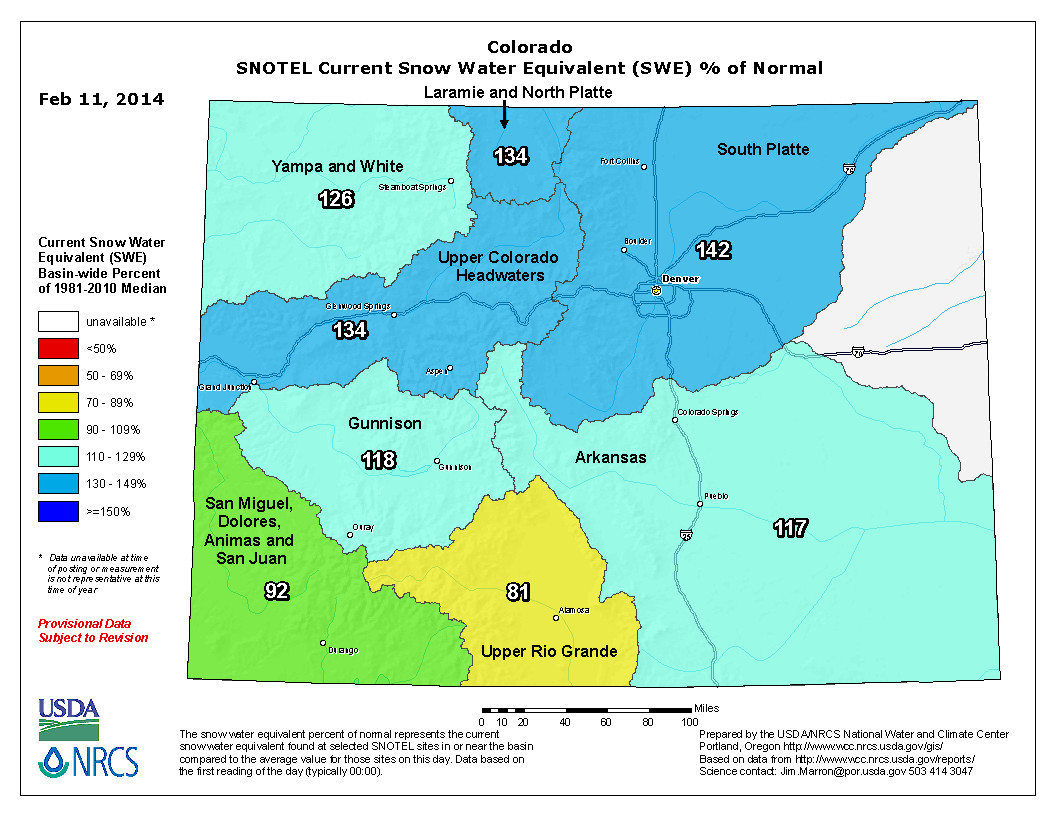
Snowpack news (SWE % of normal): South Platte = 142% (best in state), Upper #ColoradoRiver = 134%

Snow Water Equivalent as a percent of normal February 11, 2014 via the NRCS

The storms over the weekend really bumped things up. Unlike the last 3 seasons the South Platte headwaters are doing well.

From the Sky-Hi Daily News (Reid Tulley):

Brian Burden, who operates a small snow-removal business out of Granby, says business is booming right now, though he wouldn’t mind having some time to get caught up on moving the piles of snow. While Burden says “everyone is making money right now,” he also said he wouldn’t mind a break from the early mornings and 10-hour days he has been working due to the recent snowstorm…

While the movers of the snow will appreciate the break in the weather on Tuesday and Wednesday, Winter Park Resort is rejoicing in the recent snowfall and looking forward to more snow over the weekend. So far for the month of February, the resort has received 38.5 inches of snow, which is 15 inches ahead of the average snowfall for this time of the month, according to Steven Hurlbert, communications and public relations manager for the resort…

And folks at Ski Granby Ranch also appreciated the 19 inches that resort received. “It was super busy this weekend in the midst of all of the snow dumping,” said Amy Buzhardt, sales coordinator for Ski Granby Ranch.

Snowpack news: Breckenridge reports 3rd snowiest January on record

Snow Water Equivalent as a percent of normal February 11, 2014 via the NRCS

From the Summit County Citizens Voice (Bob Berwyn):

Last month really helped bolster the totals, as Breckenridge weather-watcher Rick Bly reported the third-snowiest January on record, dating back to the late 1800s. Bly tallied 60.5 inches at his weather station, where he tracks precipitation for the National Weather Service. According to Bly, only January 1899 (80.4 inches) and 1996 (71.8 inches) were snowier.

For the year to-date, Bly has already measured more than 10 feet of snow in Breckenridge — 128.4 inches, to be exact, making it the eighth snowiest on record. But there have been a couple of recent seasons with more snow through January, for exacmple 2005-2006, when 148.9 inches piled up through January, as well as 1983-1984, with 145.1 inches.
All that snow also bodes well for summer water supplies, with the year to-date snow-water equivalent at 8.72 inches, more than three inches above the average for the year to-date (5.81 inches).

And February snowfall is all but certain to surpass the average for the month, which is 23.5 inches. Bly said he was expecting to reach that total by Feb. 9, and there’s more moisture in the forecast for the coming week. But we have quite a way to go to break the all-time February record, set in 1893 with 84.5 inches.

Snowfall totals at the NWS observation site in Dillon were equally impressive for January, with a total snowfall of 43.5 inches, more than double the long-term average of 18.4 inches. The snowiest day of the month was Jan. 31, when the Dillon station picked up 16 inches of snow in a 24-hour period.

From The Pueblo Chieftain:

The Arkansas River basin is at 114 percent of the seasonal median. The Upper Colorado River basin, which provides supplemental water for the Arkansas Valley, is even better off, reporting snowpack at 121 percent. The Rio Grande basin, on the other hand, remains the driest in the state with just 82 percent of average.

Ski areas report some of the best snow totals they’ve experienced in some years. There’s a 100-inch base at Wolf Creek, 82-inch base at Monarch and 72-inch base at Ski Cooper.

Evans: Weld county needs help removing trailer homes contaminated by the September #COflood

Evans Colorado September 2013 via TheDenverChannel.com

From The Greeley Tribune (Analisa Romano):

Evans officials on Tuesday said time is running out before two mobile home parks ravaged in the September flood turn into a health hazard, calling on state and federal officials to help before the issue turns into a “second disaster.”

Last week, the Weld County Department of Public Health and Environment confirmed what Evans officials said they have been worried about — that, as soon as the weather warms, the piles of trash, old food, household hazardous waste, construction debris and mold left at Eastwood Village and Bella Vista mobile home parks will putrefy.

Soon, rodents and other animals will be attracted to the waste, and the threat of disease will be imminent, city and county officials say.

“Every day that goes by, spring gets closer,” said Evans Mayor Lyle Achziger from outside of the fenced-in Eastwood Village park, where Evans officials held a news conference on Tuesday.

They estimate removal of the 208 destroyed units between the two parks will cost about $1 million. They say the responsibility to remove the debris lies with the park owners.

But Keith Cowan, the owner of Eastwood Village, said he can’t legally remove the trailers because all of the people living in that park owned their own units.

He said he is also facing a stark financial situation, as he still owes a mortgage on Eastwood Village and won’t be able to rebuild the park because of revised floodplain regulations.

Sheryl Trent, Evans’ director of community and economic development, said there is a legal method the park owners can go through so that they have the right to remove the destroyed units, which is what the owner of Bella Vista has done.

Evans officials applied for a Federal Emergency Management Agency grant to remove the private debris, but the city’s application was denied.

“Now we’ve hit a brick wall, because we’ve been denied at every turn,” Achziger said.

He said Evans has appealed the denial.

FEMA very rarely approves of money to be used for debris removal from private property, said FEMA spokesman John Mills.

The private debris removal grant is awarded only in instances where enormous amounts of debris are spread across a great area, causing a widespread threat to public health and safety, Mills said.

Trent said another FEMA program would allow Evans to purchase the mobile home parks to mitigate the hazards, but nothing can be built on that land, and the city must still pay a 25 percent match to purchase the land at pre-flood prices.

Moreover, the city can’t apply for that program for another four to six months, which is too late to address the health hazards, which will worsen as soon as the weather warms, Trent said.

She said that has been the issue with most of the solutions the city is exploring.

Achziger and Weld County commissioners last week sent a letter to Colorado Gov. John Hickenlooper and Reeves Brown, executive director of the Colorado Department of Local Affairs, requesting a meeting to find a solution to the mobile home park issue.

Stephanie Donner, executive director and general counsel for the Governor’s Recovery Office, responded on Monday, saying she and the Department of Local Affairs are “keenly aware” of health and demolition issues at the two mobile home parks and specifically raised those issues at recent meetings in Washington, D.C., with the U.S. Department of Housing and Urban Development.

“We are hopeful our advocacy will provide additional support for Evans’ appeal to FEMA for assistance under the Private Property Debris Removal Grant,” she said.

Donner said the state is also waiting for approval from HUD to implement a plan that would allow Evans to apply for money from a community development grant specifically geared toward disaster recovery.

The plan would allow communities that sustained localized flood damage to get aid in removing debris and structures to avoid slum and blight in those areas, she said in the letter.

State officials will be in Evans for a public meeting on that plan on Thursday.

The Weld health department last week sent letters to the owners of Eastwood Village and Bella Vista notifying them that surrounding neighbors have complained of odor and other issues in the parks, and the department has deemed it a public nuisance.

If the nuisance isn’t removed, the property owners must go before the county’s Board of Health, at which point the legal issues surrounding the units’ ownership could be brought up, said Mark Wallace, executive director of Weld County’s Department of Public Health and Environment.

He said a very last resort would be for the county to contract a company for the debris removal and then try to recover the costs from the property owners.

Arkansas Valley: 10th Annual Farm/Ranch/Water Symposium recap #COdrought #COWaterPlan

US Drought Monitor February 4, 2014

From the Fowler Tribune (Bette McFarren):

The 10th Annual Farm/Ranch/Water Symposium once again proved its usefulness with a full house of participants on a cold and wintry day. The meeting was held on Thursday at the Gobin Building and Baggage Room at the Rocky Ford Depot. Not as many tradespeople were in evidence this year, but the crowd of participants appeared undiminished by frigid weather.

[Grady Grissom], who operates his own working cattle ranch, experimented with varying intensity of grazing and the addition of winter-tolerant grasses to maintain a vegetation cover on pastures. The latter practice was found to greatly enhance water retention in the soil and resilience of the pasture land. He gave four principles for the ranchers to take away: “1. Plant diversity provides economic and ecological resilience in a drought. 2. Total residuals over 800# per acre ensure effective water capture (2″ blue gramma mixed with 8-10″ mid-grasses). 3. Blue gramma residuals over 1.5″ prevent mortality in a drought. 4. Alternate-year grazing may be economically effective in a drought.” He once again, as he did last year, quoted his older mentor, “It takes grass to make grass.”

Barriers to successful revegetation were the subject of scholarly research by Benjamin and Mikha of the USDA Agriculture Research Service. They found that badly compacted land is extremely difficult to revegetate and bare ground blows away, a factor with which Matt Heimerich of Crowley County is only too familiar. The practice of chiseling the earth to stop blowing dirt is effective only a short time and will produce no long-term benefit to the ground. Crowley County had a limey soil and has become progressively more degraded since 1982. Even dried vegetation helps. It should not be removed.

In James Eklund’s report on the Colorado Water Plan, he revealed that the basic implementation plan will be finalized in July 2014. Dale Mauch, farmer from the eastern part of the Arkansas River Basin, questioned Eklund about the efficacy of continuing to rely on western water sources, which are progressively severely affected by the drought. Why not import water from the East by pipeline? Eklund said that such a method had been tried previously, the object being to import water from Lake Michigan. The surrounding states formed compacts forbidding the exporting of water. He said that our methods may not be as effective as we wish, but doing nothing would be much worse. He added that in conditions of extreme drought similar to ours, Australia finally resorted to taking control of water resources nationally.

More Arkansas River Basin coverage here.

2014 Colorado legislation, HB14-026 (Flex marketing): ‘We still believe this is a trojan horse’ — Jay Winner #COleg

Flood irrigation -- photo via the CSU Water Center
Flood irrigation — photo via the CSU Water Center

From The Pueblo Chieftain (Chris Woodka):

The state House approved legislation that creates a new type of water right called flex marketing last week and sent it to the Senate.

“We still believe this is a Trojan horse,” said Jay Winner of the Lower Arkansas Valley Water Conservancy District. “It allows speculation, and the cities could take water off the land 80 percent of the time.”

The bill, [HB14-1026], backed by water interests in the South Platte River basin, would allow farmers to designate their water for any beneficial use without identifying an end user. It would quantify consumptive use and allow that portion to be moved off fields in traditional fallowing programs and untested methods such as deficit irrigation or reduced cropping. While it requires action in water court to prevent damage to other water rights and requires that water stay in the basin of origin, it does contain enough safeguards to make sure agriculture remains the primary use, Winner said.

The Lower Ark district’s water attorney, Peter Nichols, suggested changes to the bill last month that would have restricted how often water could be removed from fields. The Lower Ark also objects to a bill that would put the primarily financial burden of water court on the farmers.

“We’re being ignored,” Winner said.

The Pueblo Chieftain editorial board opposes the bill because it would obliterate the anti-speculation doctrine, which has been key in stopping past attempted water grabs in the Arkansas Valley.

The House voted 47-13 to pass the measure. Rural lawmakers voted against the bill. Voting against the bill were state Reps. Leroy Garcia, D-Pueblo, Ed Vigil, D-Fort Garland, and Clarice Navarro, R-Pueblo.

It is awaiting hearing in the Senate agriculture committee.

More 2014 Colorado legislation coverage here.

Snowpack news: Roaring Fork Watershed snowpack is now at 133% of normal #COdrought

USACE: Moffat Collection System final EIS to be released on April 25 #ColoradoRiver

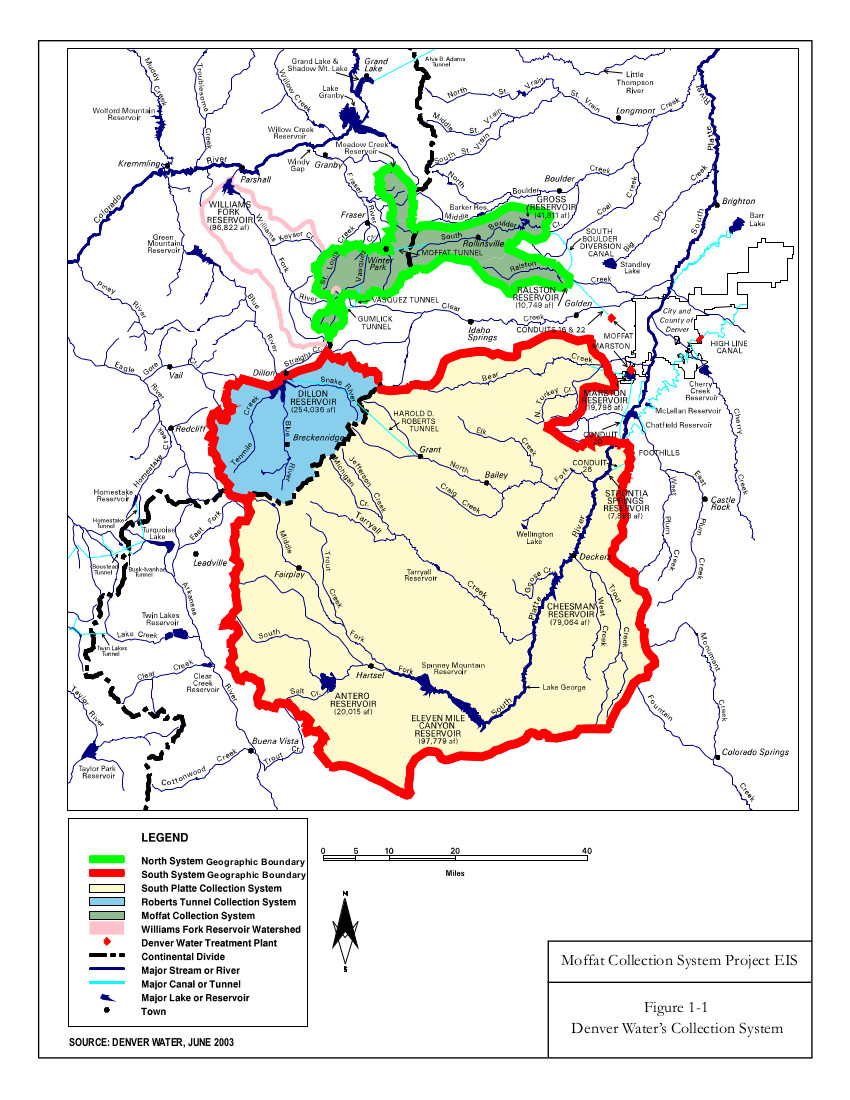
Denver Water's collection system via the USACE EIS
Denver Water’s collection system via the USACE EIS

Here’s the release from the US Army Corps of Engineers:

The U.S. Army Corps of Engineers, Omaha District, has announced April 25, 2014 for the release of its Final Environmental Impact Statement (EIS) for Denver Water’s Moffat Collection System Project. At this time the public will have an opportunity to review and comment on the Final EIS, which will in turn be considered prior to final decision-making by the U. S. Army Corps of Engineers.

The Final EIS and public comments, will serve as a basis for the Corps’ decision on whether to issue or deny a Section 404 Permit for the enlargement of Gross Reservoir, located in Boulder County, Colo. The Corps is charged with the responsibility of impartially reviewing Denver Water’s proposal in light of environmental and other Federal laws.

A year ago, the Corps had tentatively predicted that the Final EIS would be released in February 2014, however, due to further agency coordination, and a request from Denver Water to work with stakeholders to further refine a mitigation plan to present in the EIS, the schedule was extended.

Background:

Through the Moffat Collection System Project, Denver Water proposes to meet its water supply obligations and provide a more reliable supply infrastructure, while advancing its environmental stewardship. The project intends to enlarge the existing 41,811-acre foot Gross Reservoir to 113,811 AF, which equates to an expanded water surface area from 418 acres to 842 acres. Using existing collection infrastructure, water from the Fraser River, Williams Fork River, Blue River and South Platte River would be diverted and delivered to Denver’s existing water treatment system during average and wet years.

In June 2012, Colorado Gov. John Hickenlooper sent a letter to President Obama requesting that the president use his authority to coordinate federal agencies to work together more effectively and expeditiously to release a Final EIS. Cooperating agencies involved in the EIS include the Army Corps of Engineers, Environmental Protection Agency, Federal Energy Regulatory Commission, Colorado Department of Public Health and Environment Water Quality Division, Colorado Department of Natural Resources, and Grand County.

To remain up-to-date on the progress of the final report, please visit our Web site at: http://www.nwo.usace.army.mil/Missions/RegulatoryProgram/Colorado/EISMoffat.aspx

Moffat Collection System Project coverage here.

NRCS February 1, 2014 Colorado Basin Outlook Report — snowy and wet finale to January #COdrought

February 1, 2014 snowpack by sub-basin via the NRCS

Click here to read the report. Here’s an excerpt:

Summary

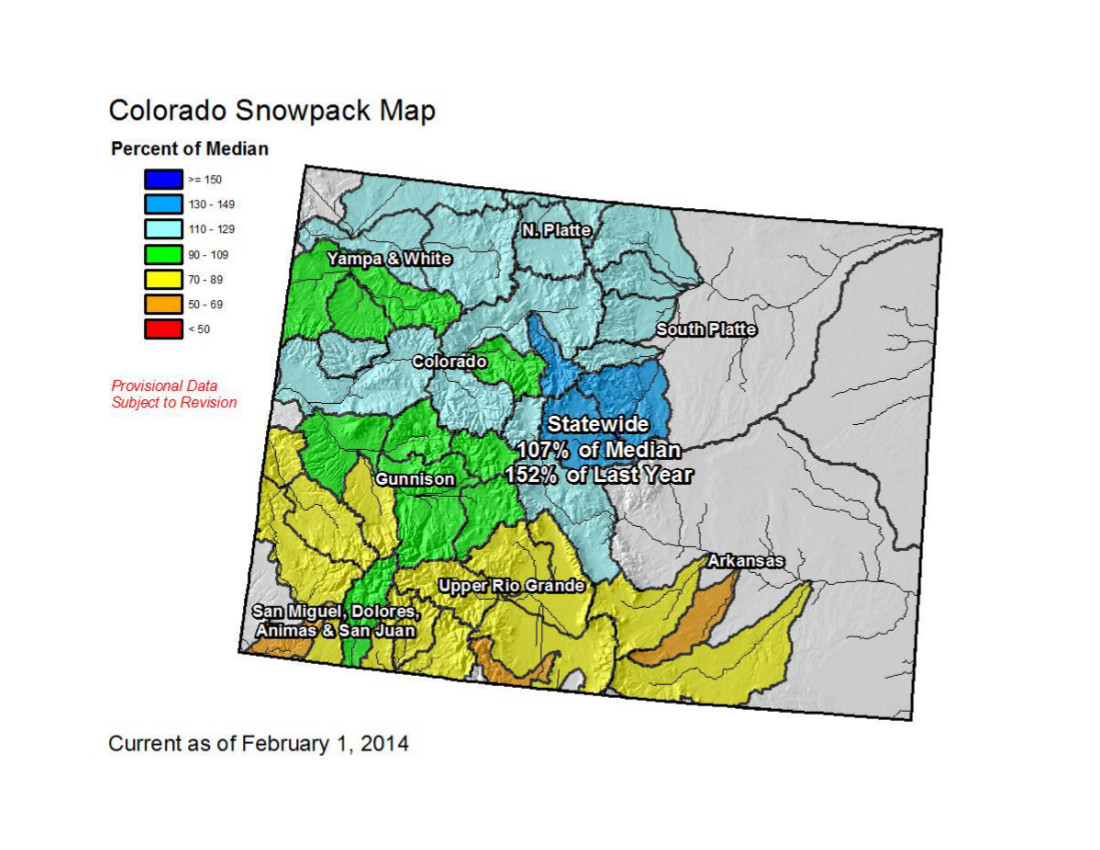
Colorado typically receives 20 percent of its snowpack in January, but this year, after a great start to the snow season it seemed as though January might disappoint. From January 15th to 27th snow accumulation statewide was almost nil, but thankfully winter storms during the last week of the month brought a snowy and wet finale. The entire state reaped the benefits of the late January storms. The northern and central mountains received enough snow to push snowpack reports back to above normal totals. In the southern part of the state the moisture was especially welcome since the region had received very little snow since early December. The storms improved snowpack percentages in this region but it was not enough for them to reach normal conditions. Water storage in the state has improved over the past month but statewide totals are still tracking slightly below average for this time of year. Storage in the southwest, Upper Rio Grande and Arkansas basins remains well below average. With only 40 percent of the winter snow accumulation season remaining, water managers in these regions should pay close attention to the weather patterns over the next couple months in order to make informed decisions concerning their water supplies.

Snowpack

Data collected from manual snow courses and automated SNOTEL sites across Colorado showed an overall increase in the snowpack during January. Statewide snowpack totals were 107 percent of median as of February 1. Looking beyond statewide totals, the data vividly shows the variability between the northern and southern part of the state. The combined San Juan (Animas, Dolores, San Miguel and San Juan) basins has declined from 100 percent of median on January 1 to 82 percent as of February 1. The Upper Rio Grande basin’s snowpack has also decreased since last month’s report; dropping from 99 percent of median on January 1 to 82 percent of median on February 1. The Arkansas basin saw a slight improvement in it’s snowpack from 105 percent to 108 percent of median, but this was mostly a result of the Upper Arkansas jumping from 92 percent to 119 percent of median. The snowpack in the lower reaches of the basin had significant decreases this month. The South Platte basin had the most notable gain in snowpack totals during January, with an increase from 99 percent of median to 126 percent of median as of February 1.

Precipitation

Statewide monthly SNOTEL precipitation totals were 117 percent of median for January, but three basins fell short of the “normal” mark for the month. The Gunnison basin recorded 92 percent of average for monthly precipitation and was at 97 percent for year-to-date precipitation as of February 1. The combined San Juan basins only recorded 59 percent of normal precipitation for the month, and year-to-date precipitation dropped to 87 percent of average. The Upper Rio Grande basin recorded monthly totals at 57 percent of average which dropped year-to-date precipitation to 82 percent of average. The remaining basins all recorded above average precipitation for the month of January. The Colorado and the South Platte basins both received well above average precipitation at 152 percent and 183 percent respectively.

Reservoir Storage

Colorado’s reservoir storage volumes are slightly below average for this time of year. Statewide storage was 90 percent of average at the end of January, which is a major improvement over the 69 percent of average reported last year at the same time. Both the South Platte and Yampa/White basins are reporting above average storage levels, at 111 percent and 112 percent respectively. The Colorado basin is currently storing water at near normal levels; 98 percent of average as of January 31. While the remaining basin’s storage volumes are all below average currently, current volumes are improvements compared to last year’s for this same date. The Arkansas basin has the lowest storage volumes as a percent of average, at 64 percent of average and 25 percent of capacity. The Upper Rio Grande is also storing well below normal amounts of water; storage was 65 percent of average at the end of January.

Streamflow

This month’s streamflow forecasts for the spring and summer season follow the trends observed in the snowpack reports. Near to above normal runoff is predicted for the Yampa/White, Colorado, Gunnison, South Platte and Upper Arkansas basins. Overall the February 1 forecasts in these regions have improved compared to those issued last month. Most forecasts in these areas are slightly above normal. Spring runoff in the combined San Juan basins is now expected to be around 80 percent of normal, all current forecasts in these basins have declined from last month’s. In the Upper Rio Grande basin the forecasts have also decreased from those issued last month, with larger decreases as you move from the headwaters of the basin to the southern tributaries. The forecasts for the downstream tributaries of the Arkansas basin have also dropped compared to last month’s in contrast to the improvements in the headwaters region mentioned above.

The BLM is accepting comments for the the proposed Gore Canyon Whitewater Park

Gore Canyon rafting via Blogspot.com

From the Glenwood Springs Independent:

The Bureau of Land Management is seeking public comment on its environmental assessment of the proposed Gore Canyon Whitewater Park at the Pumphouse Recreation Site on the upper Colorado River.

Grand County was recently awarded historic water rights for constructing this water park. The county has submitted a right of way application with the BLM to build the feature across the full width of the river upstream of the Pumphouse boat launch 2.

The feature consists of engineered boulders and block-like concrete objects placed across the stream channel that are not visible at normal flows and allow for fish passage at all flow rates. Construction is scheduled to begin this fall.

“The project would provide a unique recreational experience for the 60,000-70,000 people that visit the area each year,” said BLM Kremmling Field Manager Stephanie Odell. “It would also provide permanent protection for water flows supporting recreational floatboating.”

Developing a recreational in-channel diversion below Gore Canyon implements part of the Colorado River Cooperative Agreement among Denver Water and more than 30 Western Slope entities.

The BLM is writing an environmental assessment of the proposal that addresses multiple alternatives for the waterpark’s location and construction.

A copy of the preliminary environmental assessment, including maps, is available at http://www.blm.gov/CO/KFO. BLM will accept written public comments through Feb. 28.

Comments should be addressed to Annie Sperandio, Realty Specialist, Kremmling Field Office, P.O. Box 68, Kremmling, CO 80459.

More whitewater coverage here.

Montezuma County: The State Historical Society ponies up $125,000 for restoration of the McElmo Flume

McElmo Creek Flume via the Cortez Journal

From the Cortez Journal (Jim Mimiaga):

The State Historical Society announced this week it has awarded Montezuma County, which owns the Flume, $125,000 to restore and stabilize the foundation of the unique structure…

A $40,000 local match is required, and $17,500 has been raised, $15,000 from the Southwest Water Conservation Board, and $2,500 from Montezuma county.

“There is about $23,000 outstanding so we need more fundraising efforts in the next 3 to 4 months,” Towle said, adding that the State Historical Society is flexible on their deadline “as long as we are making progress.”

The grant money and matching funds will be used to repair braces on the south end of the structure. Old concrete will be removed from steel supports to repair corrosion and new concrete will be poured. The area will be graded and contoured so the flume rests on stable ground.

Once the match is raised, the project will go through a county competitive bid process.

The McElmo Flume No. 6 operated up until the mid-1990s, explained John Porter, president of the Southwestern Water Conservation Board. The old water delivery line was replaced by the Towaoc Canal and underground piping of the Dolores Project.

Fifteen years ago, a flash flood damaged a portion of the flume and undermined the foundation…

The flume system has a long and somewhat tumultuous history in the Montezuma Valley, he said.

In the late 1800s, the federal government gave the land to private companies who developed irrigation systems for new farms that spurred the city of Cortez. Once water was delivered, the irrigation companies sold the land to recoup their construction costs…

The flume is on the National Register of Historic Places and is adjacent to Highway 160, part of the Trail of the Ancients Scenic Byway. The organization has been awarded a $252,631 grant from the Federal Byways Program to construct a pullout and interpretive panels about the flume…

“It’s a symbol of the heritage of this valley,” Porter said. “Irrigation is what brought the population here, so it ought to be preserved.”

More San Juan Basin coverage here.

SB14-017: ‘We have no real ability to apply this, and no way to know if it has worked’ — Donna Brosemer #COleg

Orr Manufacturing Vertical Impact Sprinkler circa 1928 via the Irrigation Museum

From the Sterling Journal-Advocate (Marianne Goodland):

SB 17 created some odd bedfellows at the state capitol Thursday, drawing support from environmentalists, cattlemen and farmers. The bill has bipartisan support in the House and Senate, where it is carried by Sen. Mary Hodge (D-Brighton) and Sen. Ellen Roberts (R-Durango).

SB 17 prohibits local governments from approving new developments unless they also pass an ordinance that limits the amount of irrigated lawn to no more than 15 percent of the total area of all residential lots. The limit applies when the developer or municipality plans to use water that has been purchased from agricultural land and converted to domestic or municipal use, the so-called “buy and dry.”

During testimony on SB 17 in the Senate Ag Committee, witnesses noted that similar plans are already in place in Las Vegas, Phoenix and San Antonio, Texas. One witness estimated that a 15 percent limit would mean grass would be planted in the backyard of a home and none in the front yard.

Opponents of SB 17 complained the bill flies in the face of local control and may violate private property rights. Even Hodge noted that she has long championed local control, and that carrying the bill caused a bit of strife in her home, given that her husband is a former mayor of Brighton.

The Colorado Homebuilders Association opposed SB 17, as did the Colorado Municipal League. Kevin Bommer, representing CML, indicated the bill may be premature and that they should wait for the completion of the Colorado Water Plan. He also complained that not all stakeholders were involved in the bill-drafting process.

Testifying against the bill, Donna Brosemer of Greeley Water said the bill is about land use, not water, and that land use is the provenance of local government. “We have no real ability to apply this, and no way to know if it has worked,” she said.

Testifying in support of SB 17, Conservation Colorado’s Theresa Conley said that while they don’t want to impact private property rights, “this is the arid West” and the bill ties water use to land use. Colorado Farm Bureau and the Colorado Cattlemen’s Association also support the bill, as does the Colorado River Water Conservation District.

More 2014 Colorado legislation coverage here.

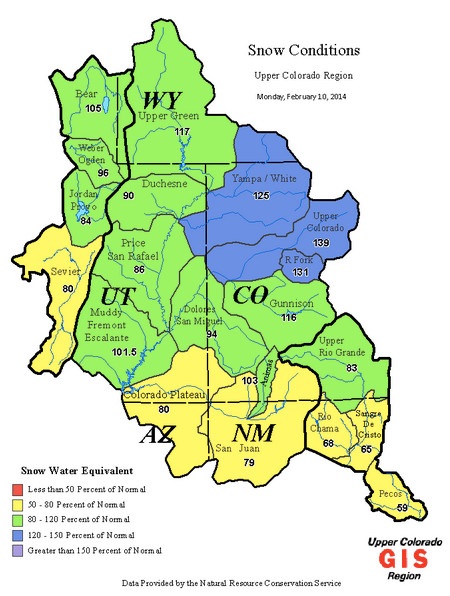
Snowpack news: Upper #ColoradoRiver region snow conditions from the USBR

Upper Colorado River Region snow conditions February 10, 2014  via USBR
Upper Colorado River Region snow conditions February 10, 2014 via USBR

Click here to go to the website. While you’re there click on any sub-basin for an ogive of the current snowpack.

Endangered species listing for the Rio Grande cutthroat?

Cutthroat trout historic range via Western Trout

From the Valley Courier (Lauren Krizansky):

Another possible endangered species listing is placing a high demand on the Valley’s resources, and it’s more than caught the attention of the six county governments. The U.S. Fish and Wildlife Service (FWS) continues to find listing the Rio Grande Cutthroat Trout (RGCT) warranted but precluded , according to the Federal Register, Fri. Nov. 22, 2013. The agency, however, is working on a proposed listing rule expected to publish prior to making the next annual resubmitted petition 12-month finding.

The ruling, an initial recommendation on whether the Valley’s historical breed of fish, which is also found in New Mexico, is endangered, threatened or not warranted for listing, is scheduled for September, according to agency officials. For the next few months, the FWS will continue to monitor new information about the RGCT in addition to considering public comments.

On Monday, the San Luis Valley County Commissioners Association (CCA) devoted much time to learn about the condition of the RGCT, and moved to set a work session in February to decide how they would support the long time Colorado Parks and Wildlife (CPW) led Rio Grande Cutthroat Trout Conservation Team (RGCT CT) efforts to keep the RGCT off any lists.

The RGCT CT’s findings and strategy suggest the potential listing is inappropriate , and an action that could affect the Valley’s economy and public and private land use while costing the six Valley counties thousands of dollars to accommodate on top of costs only starting to add up to fight a threatened or endangered ruling.

For the past 40 years, the Valley has spent dollars state, federal and private to keep the RGCT alive and well for reasons spanning from recreation to genetic diversity protection, fending off a species status change on several occasions.

In 1973, the species was listed as a threatened species in Colorado, and removed in 1984. Fourteen years later, a federal petition was filed under the Endangered Species Act, and it was contested in court in 2002. In 2007, the RGCT was reviewed, and a year later the FWS found the listing was warranted, but precluded.

Between 2003 and 2011, CPW expended $792,000 on RGCT conservation efforts, according to CPW data, including surveying RGCT populations, establishing conservation populations, erecting barriers preventing species contamination, stocking genetically pure RGCT populations and working with other agencies and groups to ensure there are sufficient instream flows to support native fish and their required habitat.

The RGCT CT’s undertakings are ongoing, and the group heads into 2014 monitoring 10 conservation populations and documenting new RGCT populations throughout the area, said CPW Senior Aquatic Biologist John Alves on Monday. Longtime broodstock development also continues at Haypress Lake. Since 2005, CPW has stocked 86,000 to 143,000 RGCT in high lakes and streams for angler recreation or to create new conservation populations.

RGCT CT activities, Alves added, include genetic testing to determine species, purity and level of introgression with other cutthroat species. Populations with more than 90 percent RGCT are considered conservation populations and populations with more than 99 percent RGCT are considered core conservation populations used for developing broodstocks or new populations. Other activities, he said, are focused on habitat improvement using man-made barriers to secure RGCT populations from non-native fish, replacing culverts and mitigating livestock grazing and logging in addition to a myriad of public outreach initiatives.

Other federal and state agency funded conservation plans taking into consideration water, land and their uses that do not directly address RGCT habitat and population, but support the productivity of the Valley’s ecosystem as a whole, are already helping to maintain and preserve the environmental condition of the downstream land if the fish was capable of living in the warmer river waters cutting through the Rio Grande Basin. The RGCT CT and its supporters do not foresee such a scenario unfolding because the species is primarily found in cold streams and lakes.

“The Rio Grande Water Conservation District (RGWCD ) does not believe listing the RGCT as an endangered species is warranted in light of the current status of the RGCT and ongoing voluntary conservation efforts,” RGWCD General Manger Steve Vandiver stated in a letter to the FWS presented at the CAA meeting. “The RGWCD has supported the ongoing voluntary conservation efforts in the San Luis Valley and in the Rio Grande Headwaters.”

The voluntary efforts are the doing of governments and agencies in Colorado and New Mexico including the CPW, the FWS, the New Mexico Department of Game and Fish, the U.S. Forest Service, the U.S. Bureau of Land Management , the National Park Service, the Jicarilla Apache Nation,the Mescalero Apache Nation and the Taos Pueblo Waterchief. Colorado Trout Unlimited, New Mexico Council of Trout Unlimited and the Rio Grande Watershed Emergency Action Team (RWEACT) also support the efforts the CCA is considering signing onto next month in addition to looking at other possible county actions regarding listings based on a model partially started in the Valley.

Saguache County is facing the possible listing of the Gunnison Sage Grouse, an action that would touch 11 other Colorado counties. The governments, working with active sage-grouse groups including the Poncha Pass Gunnison Sage-Grouse Work Group, united last year to revise the species’ needs and actions to date, revisit strategy and consider the impacts of future federal intervention like potential road closures.

The collaborative, whose methods are appealing to the CCA and neighboring sage-grouse and RGCT listing threatened Hinsdale County, has made progress with the recent reintroduction of several sage-grouse on Poncha Pass, and they are maintaining . The FWS will be made aware of the reintroduction’s progress before making a ruling in March.

“The implications of a listing are very huge,” said Hindsdale County Commissioner Cindy Dozier about creating government, agency and community task forces via telephone during Monday’s meeting. “There are things we can do.”

The implications from an endangered or threatened listing for any species can vary from jeopardizing tourism dollars due to changes in the public’s access to public lands to land owners having to enter into agreements prioritizing the species existence, actual or potential. Listings also come along with the identification of critical habitat, which calls for special management and protection, and include an area the species does not currently occupy, but will be needed for its recovery.

“Designating critical habitat outside the area currently occupied by RGCT would create an additional hardship for the residents of the San Luis Valley without providing any additional benefit to the RGCT,” Vandiver stated. “These residents already face the effect of a prolonged drought and the risk that the state may seek to restrict or curtail the operation of their irrigation wells, thus making it nearly impossible to continue successful farming or ranching operations.”

Streams historically capable of supporting the RGCT that the FWS could deem critical habitat include Rio Grande, Pecos and Canadian River Basins, according to CPW data, and presently the fish only occupy about 11 percent of the historic waters. There are 127 RGCT conservation populations range wide.

Some RGCT populations thrive on private Costilla County lands like the Trinchera Ranch, Alves said. Ute Creek, where the species was first discovered in 1857, runs through the now FWS conservation easement protected ranch, further complementing its reputation for protecting natural resources.

“This is a reason we have a good start on the conservation itself,” said Alves, commending the Trinchera Ranch for its vision to protect the RGCT, which some science points out is truly being conserved because of the introduction and poor management of nonnative trout species.

“The most significant threats are the presence of non-native trout and habitat loss,” stated Council of Trout Unlimited New Mexico Chair Arnold Atkins and Colorado Chair Rick Matsumoto in a letter to the FWS. “The effects of the presence of brown trout in a cutthroat stream have been documented in the scientific literature, and the experience of our members bears out what the literature tells us: once brown trout enter a stream, the native cutthroat disappear or are dramatically reduced in numbers, typically within a decade or less.”

In Colorado, and to a lesser degree in New Mexico, according to the Trout Unlimited letter, the presence of nonnative brook trout has had a similar effect.

“Hybridization with nonnative rainbow trout or other cutthroat subspecies remains a significant threat, although the agencies have taken steps to reduce it, including stocking triploid rainbows or not stocking rainbows at all in watersheds where RGCT are found,” the chairmen wrote. “… Trout Unlimited’s objective is to ensure that the RGCT continues to exist and that RGCT populations are protected and restored over a broader and more resilient range of waters.”

The FWS is accepting comments at the following address : Susan Rogers Oetker, Fish and Wildlife Biologist, United States Fish and Wildlife Service, 1875 Century Blvd. NE Suite 200, Atlanta, Ga., 30345.

More endangered/threatened species coverage here.

#COWaterPlan will address the protection of agriculture

San Luis Valley via National Geographic

From the Valley Courier:

Today’s agriculture landscape includes not just farming and ranching, but forestry, fruit cultivation, dairy, poultry, mushroom, bee keeping, marketing, processing, distribution of agricultural products etc. VALLEY For decades agriculture has been associated with the production of food crops. Accordingly, agriculture and farming were both one and the same, as long as farming was not commercialized. But as time In addition to food, agriculture also provides feedstuffs for livestock. This portion of agriculture ensures not only meat supplies, but also dairy products. Therefore, agriculture may be defined as the production, processing, marketing and distribution of crops and livestock products.

It is the agricultural sector that feeds this country’s trade. Products like wheat, soybeans, rice, cotton, tobacco etc. constitute the main items of exports from the US. Thus agriculture helps to balance foreign trade exchanges. Agriculture provides not only food and raw materials, but it also provides employment opportunities to a large proportion of population.

Colorado’s agriculture is no less important. According to the Colorado Department of Agriculture, “Agriculture is one of largest contributors to the state’s economy, supporting more than 173,000 jobs in Colorado, generates more than $40 billion of economic activity annually, and exported nearly $1.8 billion of food and agricultural products in 2012. Colorado ranks first in the nation in millet production, ranks in the top ten in the nation in nearly 25 commodities. There are over 1 billion eggs laid in Colorado each year. Cattle and Calves is Colorado’s number one agricultural commodity with 2.7 million head of cattle in the state. ”

It is safe to say that agriculture is a big deal in Colorado . It is for that reason the preservation of agriculture’s water is being addressed in Colorado’s Water Plan. The Water Plan will leverage and incorporate nine years of work that has been done by Colorado’s Basin Roundtables , the Inter Basin Compact Committee, and Colorado Water Conservation Board (CWCB). The goal of the plan will be to determine how to implement water supply planning solutions that meet Colorado’s future water needs while supporting healthy watersheds and environment, robust recreation and tourism economies, vibrant and sustainable cities, and viable and productive agriculture.

Agriculture is essential to Colorado’s economy and way of life. Yet, the state faces the potential for the permanent dry up of thousands of acres of farmland statewide, unless new solutions become implemented to address the looming gap between supply and demand. Agriculture represents more than 80 percent of Colorado’s consumptive water use. According to the Colorado Water Conservation Board, “Colorado’s Water Plan will develop a number of strategies designed to minimize the permanent buy-and-dry of irrigated agricultural land and begin to counter Colorado’s projected supply gap a gap potentially equivalent by 2050 to the amount of water necessary to supply all of Denver’s households for a full year.”

Some of these strategies include offering financial incentives for agriculture/ municipal partnerships that maintain land and water for agricultural uses, identifying alternatives to the permanent transfer of agricultural water to municipal use, and identifying the type and amount of infrastructure projects and methods to meet our current and future water supply needs. The Water Plan will be driven by input from each basin roundtable. The Rio Grande Basin Roundtable would like public input to be considered during the Basin Implementation Plan process. The most effective method for stakeholders to become involved is in one of three ways: 1) attend the Rio Grande Basin Roundtable monthly meetings (These meeting are held the second Tuesday of each month at the San Luis Valley Water Conservancy District office at 623 Fourth Street in Alamosa); 2) send comments directly to http://www.riograndewaterplan. webs.com and; 3) attend any one of the 5 BIP subcommittee meetings that can be found on the BIP website The lead consultant and local liaison from DiNatale Water Consultants is Tom Spezze, who can be contacted at tom@dinatalewater.com. It is suggested that input be submitted to the Basin Roundtable by February 28.

More Colorado Water Plan coverage here.

Water court approves new RICD for Carbondale

Roaring Fork River in winter

From the Aspen Daily News (Nelson Harvey):

Colorado District Five Water Court Judge James Boyd signed a decree on Feb. 3 granting Carbondale the recreational, in-channel water right necessary to built a whitewater park consisting of five obstructions — rocks or concrete barriers that would create waves of varying sizes — placed in the river over a 1,425-foot span between the Highway 133 bridge and the confluence of the Roaring Fork and Crystal Rivers.

The new water right is non-consumptive, meaning Carbondale can use the water for its kayak park so long as it leaves that water in the river and doesn’t divert it for irrigation, municipal use or other purposes.

Judge Boyd’s decree entitles Carbondale to varying amounts of water throughout the year, which would translate into waves that changed with the seasons.

Between March 15 and April 14, Carbondale could run 230 cubic feet per second (cfs) through its kayak park between the hours of 8 a.m. and 8 p.m. That same rate would apply in the late fall, between Nov. 1 and Nov. 30.

During periods of historically high runoff, such as between May 15 and July 14, the flow rate would be boosted to 1,000 cfs. Carbondale would also have the right to as much as 1,600 cfs for two special events such as kayak competitions lasting up to four days apiece in June, and to as much as 1,160 cfs for another special event between May 15 and May 31. During the June events, water could be used until midnight to facilitate the possibility of nighttime competition.

Although Carbondale has long contemplated building a kayak park to boost recreational opportunities for locals and tourists alike, there are no active plans to do so at this point. Placing obstructions in the river to create the park would require permits from other government agencies, including the U.S. Army Corps of Engineers and perhaps Colorado Parks and Wildlife.

Still, the recent water decree provides the town with the legal foundation necessary to proceed with the project sometime over the next six years if desired…

Over the last eight years, Hamilton has been negotiating to placate several local and Front Range water interests who registered objections to Carbondale’s application for the new water right, including the Colorado Water Conservation Board, the State and Division Engineers, Colorado Springs Utilities, the Southeastern Water Conservancy District, the Basalt Water Conservancy District, the Colorado River Water Conservation District, and Stanley and Valerie Koziel, who used to own Gateway Park near the intersection of Highway 82 and Highway 133.

More whitewater coverage here.

Colorado Mesa University issues RFP for high altitude fen research

Environment:: Some good news for endangered Colorado River fish

US Representative Gardner is pushing water legislation in Wasthington DC

George Washington addresses the Continental Congress via Son of the South

From The Greeley Tribune (Eric Brown):

Rep. Cory Gardner, R-Colo., has been pushing hard for two pieces of water legislation in Washington, D.C. As Gardner told The Tribune this past week, one bill is picking up steam. The other, not so much.

The bill that’s seeing movement, if eventually passed, would require federal regulators to approve or deny permits for reservoir projects within 270 days after a state’s governor endorses that water project. If a decision isn’t made within 365 days of the governor’s endorsement, the project would be automatically approved, according to Gardner’s proposed legislation, which also looks to create a federal “Office of Water Storage.”

Many stress the need for new storage projects — the 2010 Statewide Water Supply Initiative report shows that Colorado could face as much as a 600,000 acre-foot supply gap by 2050, and could see as many as 700,000 acres of irrigated farmland dry up. But while there’s the need for more water, a lengthy federal-permitting process has some proposed reservoirs about 10 years or more deep into the permitting effort.

Many water users, particularly farmers, have expressed frustration that during the above-average snowpack years of 2009, 2010 and 2011, the South Platte River basin watched about 1.4 million acre-feet of water above what’s legally required flow into Nebraska, according to numbers provided by the Northern Colorado Water Conservancy District in Berthoud. That much extra water was flowing into Nebraska because there weren’t enough reservoirs in the basin to capture the abundant snowmelt, they say, and having more reservoirs would have made a huge difference in enduring the 2012 drought.

Gardner’s other bill, which is at a standstill, he said, would reform tax provisions and allow irrigation and ditch companies to receive additional sources of income and still maintain their nonprofit status. The legislation requires, however, that the extra revenue be used exclusively for operations and maintenance of the ditch and irrigation company.

Many in Colorado are eager for passage, since routine upgrades and repairs to these water-delivery systems can add up into the millions of dollars.

Current law says that mutual ditch and irrigation companies must receive 85 percent of their income from shareholder investments to maintain nonprofit designation. In recent years, though, a number of ditch companies have seen an influx in revenue, mostly from an upswing in oil and gas activity on their land, and that increase in dollars has put some companies past the 85 percent threshold, leaving them to be taxed on the additional revenue.

The U.S. Joint Committee on Taxation estimated last year that Gardner’s bill would take away about $31 million in tax revenue from the federal government between 2012 and 2021 — “definitely worth it,” Gardner said, stressing how important irrigated agriculture is to the economy and to the nation’s food security. In Colorado alone, agriculture has a $40 billion impact.

We asked Gardner several questions about the bills:

Q — So, what’s the latest on your bill to speed up the permitting process on new water-storage projects?

A — It’s really seeing a lot of support … bipartisan support, I should stress. We offered it as an amendment to the Water Resources Reform and Development Act. Dozens of amendments were filed, but ours was only one of about 10 that was accepted. The Water Resources Reform and Development Act Chairman (U.S.) Rep. (Bill) Shuster (R-Penn.) is still wanting to have more discussions on the language of the bill, and we’re still waiting to have those conversations. But overall, things are moving along well with that bill.

Q — And how about the nonprofit/irrigation bill?

A — Unfortunately, we’re not seeing as much success over there. It, too, has received bipartisan support, but it’s just not going anywhere. I know how critical it is for farmers and ranchers in Colorado and elsewhere, but we’re just not making much progress.

Q — Why is that?

A — Basically, (the Committee on Ways and Means) Chairman Dave Camp (R-Mich.) is being told not to take up any smaller bills that are looking to change any tax code. He’s being pushed by others to hold off on anything until we sit down and look at comprehensive tax reform. It’s frustrating, but that’s where things stand, and I’m not sure how soon we’ll see movement on that.

Q — What do you think could speed up the process for that bill?

A — I really think it comes down to people in the East not understanding water needs in the West. In any way we can, we have to make Washington understand how critical both of these bills are, and how important other water legislation is. We’re already behind. We can’t be slowed down any more in catching up to meet our water needs.

Q — Aside from the push of your two bills, what other good do you see going on in Washington along the lines of water legislation?

A — We’ve really seen some good, smart legislation pass that will help develop and speed up the process of getting in place small hydropower projects on irrigation ditches, and other similar projects. That will be a big boost for farmers and ranchers, and rural Colorado as a whole. I have to tip my hat to Rep. (Scott) Tipton (R-Colo.) for all of his work on that.

Morgan County Conservation District annual meeting recap #COWaterPlan

fortmorganrainbowbridge

From The Fort Morgan Times (Dan Barker):

As the Colorado population grows — from people moving here or new families starting — water must be found to meet that hugely increasing demand, said Jim Yahn, manager of the North Sterling and Prewitt reservoirs.

He was speaking during the annual meeting of the Morgan Conservation District at the Country Steak Out in Fort Morgan on Thursday evening. After speaking on the history of Colorado water-law, he addressed the challenges facing water use in the state.

Between the year 2000 and today, Colorado’s population grew by about 500,000, and is expected to grow another 5 million by 2050, Yahn said.

More specifically for Morgan County, demographers project that the population will increase by 73 percent along the South Platte River Basin, he said.

Water leaders are trying to find ways to meet the water needs of the state, but also trying to avoid just selling off agricultural water rights to meet the needs of Colorado’s cities, Yahn noted.

If agricultural water rights were just bought up and transferred to city use, as has been the historical trend, from 22 to 32 percent of agricultural water along the South Platte River would be taken for use by cities by 2050, he warned.

That would mean the loss of production on 180,000 to 270,000 acres, Yahn said.

It is the state population that uses the water, not agriculture, because the water that goes into agricultural products eventually goes back to people in the form of food, he said. Water that does not go into the food largely soaks back into the underground aquifers after use for crops.

That means the state needs to develop new water strategies, and that is underway as various groups work on a state water plan, Yahn said.

Those working on the plan hope to address the expected water shortages in ways that will not dry up farm land and still preserves the state’s rivers.

The basin implementation plans which will be part of the overall plan are due back to Gov. John Hickenlooper this coming summer, and the draft of a state water plan is expected by the end of the year, Yahn said.

The trick is creating a plan that will be of actual use, not just another glossy report on the shelf, he said.

More Colorado Water Plan coverage here.

Poudre River Forum recap: ‘Frankly, I think the more compelling story is the history of collaboration’ — Doug Robotham

Cache la Poudre and Big Thompson watersheds via @ftcollinsgov

From the Fort Collins Coloradoan (Josie Sexton):

“The story around water is often one of conflict,” The Nature Conservancy’s Colorado Water Projects director Doug Robotham said as the event got underway. “Frankly, I think the more compelling story is the history of collaboration.”

The forum was facilitated by CSU’s Colorado Water Institute and sponsored by The Poudre Runs Through It Study/Action Work Group, a team composed of 30 community water stakeholders with backgrounds in fields ranging from ecology and irrigation to brewing and law.

Since 2012, the group has convened to discuss differing views on the Poudre and to finally put forward a trio of initiatives, which the group presented at Saturday’s forum.

Its suggestions, or the “three F’s,” as Colorado Water Institute’s MaryLou Smith explained, are “flow, funding and forum,” the last of which the team began with Saturday’s event and now hopes to hold annually.

For the first initiative, a five-person steering committee explained a vision of improved water flow along the Poudre, utilizing methods such as a “designated instream flow reach” to essentially lease leftover water upstream and send it downriver, meeting a specified minimimum flow requirement along a certain length of the Poudre, such as the stretch running right through Fort Collins.

The cost for such a project is where the group’s funding initiative comes in.

“All of that would take big money,” Smith said, adding it would need to be public money and not just “philanthropic seed dollars.”

According to John Stokes, director of the city of Fort Collins’ Natural Areas Department, the city did test such a water leasing project early last September.

“We tried to rent water, but our little 10 (cubic feet per second) got buried in 10,000 (cubic feet per second),” Stokes said, refering to Sepember’s flooding.

More Cache la Poudre River coverage here and here.

Cancer-causing chemical PCE contaminates Colorado soil, water and homes — The Denver Post

Groundwater movement via the USGS

Here’s an in-depth look at the problem of mitigating PCE (perchloroethylene or perc) spills around dry-cleaning operations, from Bruce Finley writing for The Denver Post. Click through and read the whole thing. Here’s an excerpt:

Spills releasing PCE, the cancer-causing chemical used in dry cleaning and metal degreasing, have produced at least 86 underground plumes across Colorado that are poisoning soil and water and fouling air inside buildings.

Cleaning up this chemical is a nightmare — a lesson in the limits of repairing environmental harm. The best that Colorado health enforcers and responsible parties have been able to do is keep the PCE they know about from reaching people…

Dry cleaners are found in most communities nationwide. But the PCE problem hasn’t been as visible as the large-scale industrial disasters that mobilize advocacy groups. Unlike oil rig ruptures and chemical spills into rivers, PCE plumes remain hidden.

They formed because, in the past, PCE legally could be flushed into sewers, dumped out backdoors, emptied down alleys. Dry cleaners didn’t grasp the potential cumulative impact of day-to-day drips on their floors.

PCE is heavy, sinking through soil and groundwater to form pools that can remain volatile for decades and do not readily break down.

Health authorities say they worry most about sites where PCE levels in soil and groundwater are so high that vapors rise up and contaminate buildings.

More water pollution coverage here.

#COWaterPlan: ‘Because it’s cheap and a public good, water gets no respect’ — James Eklund

Colorado Water Plan website screen shot November 1, 2013

From The Pueblo Chieftain (Chris Woodka):

If commodities were celebrities, water would be Rodney Dangerfield.

“Because it’s cheap and a public good, water gets no respect,” said James Eklund, director of the Colorado Water Conservation Board, who visited Pueblo last week for a water forum for the business community.

In Colorado, state and local leaders are not taking water for granted. They are in a final push to devise a plan that will guide the statewide uses of water for coming decades. As part of the push, they are calling for the business community to become more involved in the planning process, which first began after the drought of 2002 when Colorado cities found their historic assumption of water supplies were wrong.

The drought led to the formation of basin roundtables and the Interbasin Compact Committee in 2005. Since then, there have been nearly as many water meetings in Colorado as there are water lawyers. But there was never the push to develop a specific plan until last year when Gov. John Hickenlooper asked his staff to create one. And the governor wants one soon, by December 2014, so the state can begin to act on it following this November’s statewide elections. The water plan will be the culmination of nine years of meetings seeking alternatives to the default option of buying up farms and moving the water to municipal use. Conservation, new supply, new transfer methods, completing identified projects, environmental protection and storage will be a part of the plan. The details will emerge by the end of the year.

Eklund said Hickenlooper himself likens the water plan to a “business plan.”

“I was serving as the governor’s chief counsel and we were talking about the importance of water. He said, ‘Let’s see the business plan,’ ” Eklund said. “Governor Hickenlooper looks at life through a business lens, and it’s unacceptable to have no input.

More input is starting to come through meetings organized specifically for business interests.

One business group, the Colorado Competitive Council, which co-sponsored last week’s forum in Pueblo, wants to finalize its list of priorities — also known as “principles” — by July, Competitive Council Director Mizraim Cordero said. The council, along with Accelerate Colorado, conducted the meeting last week to engage Pueblo’s business community in the discussion. Turnout was light with about 20 people in attendance, a number that included several city and county elected officials.

Getting businesses involved in water policy discussion is a challenge, water experts concede. Cordero said small attendance at water meetings is not unusual. Steve Vandiver, manager of the Rio Grande Conservation District, joked that those in the water community should just hop on a bus, ride around and talk to itself.

Bryan Blakely, president of Accelerate Colorado, said the lack of interest is not surprising to some extent — “We’re complacent because we turn on a tap and expect water to come out” — but businesses risk a golden opportunity to shape the final statewide plan.

“We’re looking at this as our plan. This is our chance to weigh-in,” Blakely said.

Rod Slyhoff, president of the Greater Pueblo Chamber of Commerce, and Jack Rink, president of the Pueblo Economic Development Corp., expressed similar thoughts.

“We probably do get complacent,” Rink said. “We need to know where we can make a difference.”

Terry Book, executive director of the Pueblo Board of Water Works, said state policies can have a major impact at the local level. He told the group about the water utility’s struggle with higher energy costs tied to the state’s push for greener energy. That has created a domino effect of increased rates for commercial and residential customers, he said.

It’s an example of why businesses need to pay attention to state policymaking, including in the area of water, he said. “Nothing is simple in water,” Book said. “Good intentions can lead to unintended consequences.”

Arkansas Basin Roundtable Chairman Gary Barber, whose business is water consulting, noted that agriculture is a $1.5 billion business in the Arkansas Valley, about 6.6 percent of the region’s overall $23 billion economy.

It’s also tied to the vibrant and growing $222 million recreation industry on the Upper Arkansas River, he said.

“If you’re in Chaffee County, you want to make sure the water you use for rafting stays in Rocky Ford,” Barber said. “If you don’t have water, you don’t have an economy.”

More Colorado Water Plan coverage here.

Snowpack news: Aspen snowpack gets a big boost from 3 foot storm

Snow Water Equivalent as a percent of normal February 6, 2014 via the NRCS

From the Aspen Times (Scott Condon):

The snowpack at the Independence Pass site east of Aspen went from 113 percent of average on Jan. 30 to 123 percent of average as of 10 a.m. Friday.

The Fryingpan Valley was the big winner from the storm. Snow at lower elevations was below average until then.

The Nast Lake site went from below average at 93 percent on Jan. 30 to 129 percent Friday. The Kiln site went from 103 percent of average on Jan. 30 to 128 percent Friday. The Ivanhoe site, at 10,400 feet in elevation, shot up from 116 percent of average on Jan. 30 to 147 percent of average Friday.

The storms haven’t been quite as bountiful for the Crystal Valley. The North Lost Trail site near Marble measured a snowpack only 89 percent of average on Jan. 30. That climbed above average to 104 percent Friday. McClure Pass was at only 94 percent of average in late January but now stands at 114 percent. Schofield Pass went from 99 to 115 percent.

The Roaring Fork River Basin overall snowpack sat at 101 percent of normal on Jan. 30 after a long sunny, dry stretch. That had skyrocketed to 120 percent as of Friday morning.

The average snowpack for the state soared from 95 percent of average on Jan. 27 to 109 percent on Feb. 1, the Vail Daily reported.

DARCA Annual Convention: From Drought to Deluge – Dealing with Uncertainty, February 26-28

St. Vrain River floodplain November 2013 via the Longmont Times-Call

From email from DARCA:

The DARCA Board and staff welcome your presence at the 12th Annual DARCA Convention in Longmont, February 26-28, 2014. Thirty speakers are scheduled for DARCA’s Annual Convention, From Drought to Deluge – Dealing with Uncertainty, and the event will focus on flood and recovery issues facing ditch companies along the Front Range. A wide variety of speakers have been invited, ones that have first-hand knowledge of the September storm event. Additional topics will include presentations on the Colorado Water Plan, the Endangered Species Act, and new developments for hydroelectric power generation. The director of the Colorado Water Conservation Board, James Eklund, will be delivering the keynote address.

On the final day of the conference, DARCA will be convening a workshop on Water Efficiency Savings -The Ditch Company Perspective. Lately, there has been increased focus on finding new incentives to help ditch companies pay for upgrades to their aging infrastructure. The governor’s emphasis on protection of agricultural lands from buy and dry transfers of ag water and a better understanding in Colorado of the full value provided by ditch companies and irrigation are important first steps. These recognitions may not, however, be sufficient. This workshop will focus on legislative proposals that would allow ditch companies to realize value directly from their efficiency improvements. There are, of course, pros and cons to this approach that we hope to discuss at the workshop.

In order to properly understand ditch company needs and opportunities for structural efficiency improvement projects, Harry Seely, an economist from WestWater Research, will be sharing preliminary results from a project related to the potential economic, financial, and operational benefits from system modernization. While some of these benefits are relatively obvious to some, the wide array of financial benefits, reduced costs, and water security improvements are not well documented.

We have included a short survey that will help DARCA and WestWater Research better understand the complex issues related to water efficiency and economics. DARCA would like your input and if you have the time please fill out the enclosed survey and return it to me. You are welcome to give me a call and go over the survey on the phone. Another alternative is to drop it off at the registration table at the convention.

More infrastructure coverage here.

Essay: An ode to snow — Laura Pritchett

Acequia Day at the New Mexico State Legislature

Acequia cleaning prior to running the first water of the season

From the Taos Valley Acequia Association website:

Acequia Day at the NM State Legislature

Who: NMAA Members & Acequia Parciantes
When: Wednesday, February 12th at 8:30am
Where: State Capitol Building/Roundhouse, Santa Fe (Room 326)
RSVP: Please call NMAA at 505.995.9644

Acequia youth and leaders will gather at the State Capitol to be recognized by the State Legislature for centuries of water management in New Mexico and to commemorate the 25th Anniversary of the New Mexico Acequia Association.

TIMELINE OF EVENTS:
8:30am – Orientation Session at Room 326
9:00am – 10:00am – Visits with Legislators
10:00am – House and Senate Floor Sessions – Gallery
12:00am – Refreshments and Closing Reflections – Room 326

Senate Bill 14-115: ‘It brings so much politics into the issue’ — Rachel Richards #COleg #COWaterPlan

Colorado Water Plan website screen shot November 1, 2013

From the Aspen Daily News (Brent Gardner-Smith):

Senate Bill 14-115 would trump an executive order issued by Colorado Gov. John Hickenlooper in May 2013 that called for the Colorado Water Plan to be based on regional plans developed by river-basin “roundtables” around the state in coordination with the CWCB.

“The executive order did not identify a role for the general assembly, and yet we represent the people in the state,” Schwartz said.

Schwartz, a Democrat from Snowmass Village, is chair of the Senate Agriculture, Natural Resources and Energy Committee, where SB 14-115 has been sent for review.

Sen. Ellen Roberts, a Republican from Durango who serves on the interim Water Resources Review Committee, also is a co-sponsor of the bill.

“When an executive order is issued, that bypasses the legislature,” Roberts said at the Colorado Water Congress meeting held last week. “Now, that is certainly the governor’s prerogative, but when something is called the Colorado state water plan, it means the legislature is at the table.”[…]

A key question for communities on both the Western Slope and along the Front Range is whether more water will be piped under the Continental Divide from the west, where most of the state’s water is, to the east, where most of the state’s people are.

Pitkin County commissioner Rachel Richards is an active member of the Colorado Basin Roundtable and said she has “real concerns” about Schwartz’s bill.

“It brings so much politics into the issue,” Richards said about SB 14-115. “I think it will fall down to Front Range versus West Slope legislators. I have a hard time imagining any Front Range legislator running for re-election and saying he or she voted for a plan that did not include a new trans-mountain diversion of very significant magnitude. “

In addition to giving the legislature power over the final water plan, SB 14-115 also requires that regional public hearings be held after a draft is released and that public comment be taken into consideration in the final draft…

Gov. Hickenlooper’s executive order calls for the CWCB to finish a draft of the water plan by December and to complete a final version by December 2015.

The CWCB is to write the draft plan and then submit it “for review by the governor’s office,” according to the executive order. Then it is supposed to “work with the governor’s office to complete the final plan.”

The only substantive mention of the state legislature in the governor’s executive order is that the plan should include “recommendations to the governor for legislation that will improve coordination, streamline processes and align state efforts” regarding water projects.

That’s not a big enough role for the legislature, according to Schwartz.

“Yes, the plan may direct policy, but it does not have the weight of law,” she said.

SB 14-115 requires the plan to be reviewed by the Water Resources Committee, which would then introduce a bill to approve it — or not.

The bill also says that a water plan can only be considered official state policy if the legislature approves it. And it says that while the plan could still be the policy of the CWCB, the legislature also could declare that it is not.

In short, it gives the legislature firm control over future water projects in Colorado.

Roberts acknowledged that the bill might cause some “hurt feelings” among those at the basin roundtable level.

“It is not intended as any slight to the folks that are working hard on that, but we do feel that it is critically important that that be an open public process and it also involve the legislature,” Roberts said about the bill…

On Thursday, the board of the Colorado River District, which represents the Western Slope, voted to take a neutral position on the bill — for now.

Chris Treece, the external affairs manager for the river district, said SB 14-115 “was a very political bill” and suggested the organization monitor it “very closely from a very long distance.”

“I think it is an important discussion about who is in charge,” Treece said.

Mike King, the executive director of the Colorado Department of Natural Resources, which includes the CWCB, said having the legislature involved as proposed by the bill would mix politics and water.

“We need to depoliticize the development of Colorado’s water,” King said at the Water Congress meeting. “We need to remove it from the political pressures that are inherent in the legislative process and make it organic.”

And he believes the CWCB can handle the job.

“Seventy-six years ago the general assembly delegated to the CWCB the express policy setting authority for the state’s water vision,” King said. “I think it served the state well. And I think the CWCB has exercised that authority judiciously and appropriately throughout that period of time.”

More 2014 Colorado legislation coverage here.

Arkansas Basin: ‘I’ve got a son who’s farming. Will there be water for him?’ — Dale Mauch #COWaterPlan

Arkansas River Basin -- Graphic via the Colorado Geological Survey
Arkansas River Basin — Graphic via the Colorado Geological Survey

From The Pueblo Chieftain (Chris Woodka):

Balancing the needs of urban growth and maintaining the state’s agriculture is a difficult equation, and some are wondering if it can be solved with real numbers. The conflict bobbed to the surface during a discussion about the upcoming state water plan at Thursday’s Farm/Ranch/ Water Symposium at the Gobin Community Center.

“We don’t have enough water for growth and agriculture,” Lamar farmer Dale Mauch said. “This is a way to delay the ultimate end of the story. Who’s going to get it first, Colorado Springs and Pueblo or me in Lamar?”

Unless a new source of water is brought in, the continuing dry-up of agriculture in the Arkansas River basin will continue, Mauch said.

“I’ve got a son who’s farming. Will there be water for him?” Mauch asked.

Charged with providing the answers to his question was James Eklund, director of the Colorado Water Conservation Board. Eklund is heading up Gov. John Hickenlooper’s drive to develop a draft Colorado Water Plan by the end of this year.

“We don’t want to be in a situation where we knew that this was coming and didn’t do anything,” Eklund said.

Mauch suggested a project like the Flaming Gorge pipeline that brings new water into the state is the only way to assure agriculture and growth can co-exist.

Eklund said the political realities of moving water from one state to another might be more difficult than the decadelong process that has led up to a state water plan.

Another farmer, Wes Eck, said education should be a key component of a state water plan.

“I had some goose hunters from Colorado Springs come down. They looked at John Martin Reservoir (still at a very low level) and asked, ‘Where did all the water from our floods go?’ I told them we could soak up 100 times that much,” Eck said.

“We’ve got to do a better job explaining water,” Eklund replied.

More coverage from Chris Woodka writing for The Pueblo Chieftain:

Farmers in the Arkansas Valley generally favor a farm bill that beefs up subsidies for crop insurance, rather than providing direct payments that guarantee income regardless of harvest quality or crop prices.

“The biggest thing for us will be the crop insurance program,” Holly farmer Colin Thompson said Wednesday.

Like most of the other farmers attending the Farm/Ranch/Water Symposium at the Gobin Community Center Thursday, Thompson is unsure of how his operation will be affected by the farm bill.

But he said the safety net for farmers is a big deal, given the high costs of planting a crop.

The farm bill passed the U.S. Senate by a 68-32 vote this week, after passing the U.S. House by a 251-166 vote last week. It is awaiting President Barack Obama’s signature.

“I’m glad they got it done,” said John Stulp, Gov. John Hickenlooper’s water policy adviser and a Prowers County farmer. “The safety net on crop insurance is the big thing.”

The bill also boosts conservation programs available to farmers.

“It’s very important from a conservation and natural resources perspective,” said John Knapp of the Natural Resources Conservation Service office in Rocky Ford. “It will increase opportunities for conservation easements and land trusts.”

Dale Mauch, a Lamar farmer, said the crop insurance program is vital in order to keep farmers in business.

“In this day and age, you need crop insurance because of the cost of everything,” Mauch said. “People don’t realize how expensive it is to put in a crop. I just brought a brand new bailer in 2009 for $101,000. Today, that same piece of equipment is $180,000.”

Costs for seed and fertilizer have skyrocketed, and the price of corn, his primary cash crop, are $4 per bushel, half of what they were just two years ago.

“I’m glad they cut direct payments. All we need is crop insurance,” Mauch said, as heads nodded all around the table where he was seated. “Irrigated agriculture in the Arkansas Valley is unlike anywhere else in the world.”

Food stamps need to be a part of the farm bill as well, because only about 50 members of the 435-member House are from rural areas, Mauch said.

“I don’t think any kid should ever go hungry,” he said. “On the other hand, there are some (negligent) fathers who should go hungry.”

From The Pueblo Chieftain (Chris Woodka):

It’s no secret to farmers that the Arkansas Valley usually is short of water. But future consequences of the shortfall are illustrated by actions that already have occurred in the South Platte River and Rio Grande basins.

The coming crisis was discussed last week at the Arkansas Valley Farm/Ranch/Water Symposium, which attracted about 200 participants.

“We found that we’ve been double-counting the municipal return flow in the basin,” Arkansas Basin Roundtable Chairman Gary Barber told the group.

The “agricultural gap” in the Arkansas River basin was identified by the roundtable at 25,000-30,000 acre-feet in March 2012. What that means is that farmers already are irrigating with borrowed water. That became clear last year when augmentation water for wells was cut off during the third year of severe drought. Those who depended solely on surface rights dealt with a reduced water supply by planting fewer crops.

That will become the norm in the chronically dry Rio Grande basin, said Travis Smith, general manager of the San Luis Valley Irrigation District and a member of the Colorado Water Conservation Board. Subdistricts have formed that will slowly reduce the drawdown on the aquifers agriculture depends on.

“It’s painful when you talk about cutting a man’s water supply,” Smith said.

In the South Platte basin, wells were shut down after the Empire Lodge court case restricted the state engineer’s authority to administer temporary plans, said Jeris Danielson, a former state engineer who became a water consultant.

“They shut down 3,000 wells and now have flooded basements in Sterling because the groundwater table’s rising,” Danielson said. “What we have not done in this state is manage the resource.”

The Arkansas River basin lags behind the South Platte in developing ways to stretch the water supply such as aquifer recharge programs, said Bill Tyner, assistant engineer for Water Division 2.

Only two recharge programs exist in the Arkansas Valley now: on the Excelsior Ditch by the Arkansas Groundwater Users Association and the city of Lamar well field. The Arkansas Valley Super Ditch has done some preliminary work in identifying recharge opportunities on canals.

Jay Winner, general manager of the Lower Arkansas Valley Water Conservancy District, offered a menu of options to deal with filling the ag water gap.

“We need to buy and retire land that is not productive,” Winner said.

Farmers need to buy more water and retain it to reduce the dependency on the spot market — which usually means leasing from Pueblo, Colorado Springs or Aurora. They also need to look at trades among water rights owners, recharge and strengthening storage.

“But with storage, it does not go far when you have no water to put into it,” he cautioned.

More Colorado Water Plan coverage here.

Fountain Creek: ‘A vision plan is only as valuable as its ability to be implemented’ — Jeff Shoemaker

Fountain Creek
Fountain Creek

From The Pueblo Chieftain (Chris Woodka):

If you wanted to make a really fun toy, you would first have to go through the relatively boring process of building a factory.

So, after a mundane afternoon of listening to all of the problems of how fixing Fountain Creek has to meet the needs of state water planning, funding challenges, water quality and flood control, the crowd of 40 elected officials and business people finally got to the fun stuff.

Jeff Shoemaker, executive director of the Greenway Foundation in Denver, told the group how to turn a $125 million investment over 40 years into $12 billion in economic development benefits.

Now that’s fun.

“We like to call it a 40-year overnight success,” Shoemaker told the group, assembled by the Southern Colorado Business Partnership at Pikes Peak International Raceway Wednesday. “A vision plan is only as valuable as its ability to be implemented.”

There are parallels between the current effort to fix Fountain Creek and the Greenway Foundation’s unceasing quest to improve the South Platte River through Denver.

In 1965, that reach of the South Platte was a miserable, forgotten waterway. Trash and sewage were dumped in it with little thought. That changed when Joe Shoemaker, Jeff’s father, convinced the state to create the Denver Urban Drainage District in 1974. The district provided the canvas for the Greenway Foundation — in partnership with government and the private sector — to paint the future of Lower Downtown Denver, now among Colorado’s most valuable real estate.

“And we’re just getting started,” Shoemaker said.

Fast forward to 2009.

A vision task force convinced the state to form the Fountain Creek Watershed Flood Control and Greenway District, which since has struggled simply to find a way to fund its own existence. The district is patterned after the Denver Urban Drainage District and encompasses Pueblo and El Paso counties. Other speakers throughout the afternoon had dwelt on the problems and challenges of fixing Fountain Creek, which periodically sends sheets of water Pueblo’s way compounded by development in Colorado Springs and the surrounding area.

They spoke about flood control, mitigation projects and the need to protect agriculture while serving growing municipal needs through projects like Southern Delivery System.

So far, it has been optimistic frustration.

“Fountain Creek has been an amenity for academics,” joked Larry Small, director of the Fountain Creek district, referring to the volumes of past studies, which largely gather dust on shelves.

Projects themselves — SDS, flood control and creek improvements — have brought several million dollars into the area, but much of it has been government-driven.

Meanwhile, the South Platte has grown rich on the back of flood control projects like Chatfield Dam, and draws thousands of people to the river through an ambitious network of parks and recreation activities, Shoemaker said.

“Everything we do has a water-quality component,” Shoemaker said.

That type of thinking can benefit Pueblo, said Eva Montoya, Fountain Creek board president and a Pueblo City Council member.

“We got many of our ideas from the Greenway Foundation,” she said, referring to a new wheel park that is being designed for Pueblo’s Historic East Side.

More Fountain Creek coverage here and here.