
From The Greeley Tribune (Eric Brown):
With the water outlook now drastically better than it was in 2013, many Front Range cities in Colorado, which leased little or no water to ag users last year due to shortages, are now saying they will have extra water to lease out this year.
Harold Evans, chairman of the city of Greeley Water and Sewer Board, said board members officially decided at their recent meeting they would have extra water to lease to agriculture this year, although they would have to examine requests from farmers and take other things into consideration before deciding how much they would lease out.
Officials with the city of Loveland, too, said this week they will have extra water to lease to agriculture.
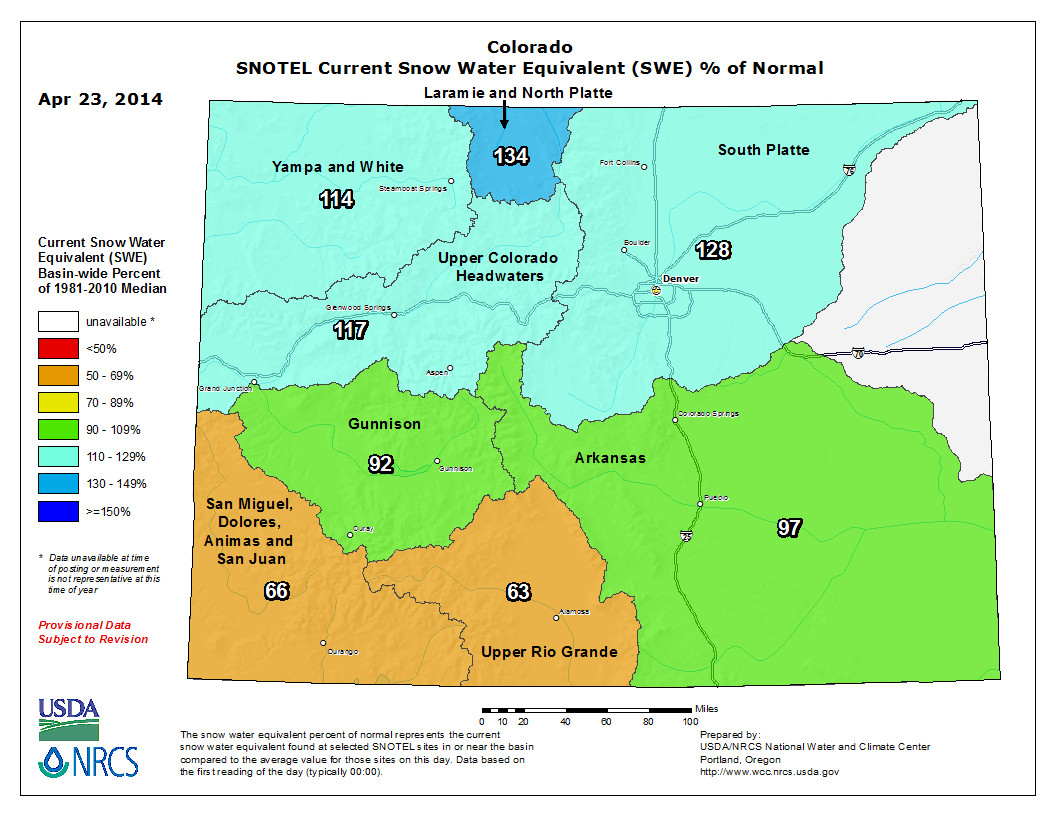
Snowpack on Tuesday in the South Platte River Basin — which supplies northeast Colorado — was 130 percent of historic average, according to NRCS figures, and reservoir levels in the basin are also above normal, sitting at 108 percent of historic average on April 1.
While the outlook has been good for months in northern Colorado, many city officials in the area were waiting to see how much water would be released this year from the Northern Colorado Water Conservancy District’s Colorado-Big Thompson Project, the largest water-supply project in the region, before giving the official yay or nay on leasing to agriculture.
The Northern Water board set its spring quota for the C-BT Project on April 11, and even though the board set it at a below-average 60 percent, it was enough to give most cities the green light to lease to ag.
While the C-BT quota played a large part in determining how much water most northern Front Range cities can lease out this year, the situation is a little different for the city of Longmont. Ken Huson, water resources administrator for Longmont, said that because some of its water-delivery systems are still under repair from September’s flooding, the city likely won’t be renting any water out this year.
Evans noted that while Greeley has plenty of water to lease this year, cities typically get fewer requests in years of good snowpack like this year, because so much snowmelt makes its way down the mountains, filling irrigation ditches and reducing the farmers’ needs of supplemental water from cities.
But even with plenty of snowmelt expected to fill ditches this spring, farmers still like to have water available to lease from cities as a back-up supply, if nothing else. Local farmers say they never know how fast the snow is going to melt and flow by, or how dry it’s going to get later into the summer.
At the beginning of last year, the state was coming off the 2012 drought, during which reservoirs were drained to low levels, and snowpack in the mountains was also historically bad.
As early as January of 2013, a number of cities — like Greeley, Pueblo, Longmont, Fort Collins and Loveland, each of which typically lease thousands of acre-feet of excess water each year to producers across eastern Colorado — were telling local farmers they would have little or no water to lease to ag users.
Back in 2011, which was a historically wet year, the city of Greeley — located in the most ag-productive part of the state — leased 25,427 acre-feet of water (nearly 8.3 billion gallons) to ag users, but last year, could only honor its long-term ag agreements of about 5,000 acre-feet.
Water officials from cities around the state said last year marked the first time in about a decade, longer in some cases, that they’d had such little water to lease to agricultural users.
This year is different.
Even in the southeast part of the state, where cities have less water compared to their neighbors to the north, it’s looking like those municipalities will have enough extra for agriculture.
According to NRCS figures, snowpack in the Arkansas River Basin that supplies southeast Colorado was at about historic average Wednesday and reservoirs were only filled to 60 percent of average on April 1.
Still, Sharon Carleo, water resources coordinator with the Board of Water Works of Pueblo, said they could lease in the range of 6,000 acre feet of water this year to farmers.
From the Fort Collins Coloradoan (Ryan Maye Handy):
On his farm just outside of Mead, [Kent Peppler] relies both on irrigated water and spring runoff. While water from the U.S. Bureau of Reclamation’s Colorado-Big Thompson Project can be an integral part of keeping his crop alive, Peppler only gets that water through cities like Fort Collins, which regularly lease extra water to irrigators and Front Range farmers.
“We’re hoping to rent some Big Thompson water this year, absolutely,” he said on Tuesday.
But this year it’s unlikely that Peppler, who lives well outside the Poudre basin and is on the city’s lowest priority rung, will get water from Fort Collins. When the Northern Colorado Water Conservancy District announced two weeks ago how much water customers will get from the reservoir system — 60 percent of their full allotment — city officials were concerned that amount would minimize the water leasing market. While “domestic” customers like homeowner associations will be able to lease water from the city, others like Peppler most likely will not.
Colorado-Big Thompson Project, or C-BT, rentals make up one of three water leasing markets the city runs. Fort Collins Utilities also leases water to the North Poudre Irrigation Co. and the Water Supply and Storage Co. in Fort Collins. C-BT leases have garnered the city the least money of the three since 2009. Last year, the city made $74,585 from the leases, down from $227,920 in 2009.
While not a huge moneymaker for a city with a nearly $500 million annual budget, C-BT leases can be cruicial for farmers like Peppler, who has leased water from Fort Collins sporadically over the past 30 years.
“We do depend on rented irrigation water,” he said. “We don’t have enough water rights to get us through.”
The city normally takes half of its water from the Poudre River and the other half from the Colorado-Big Thompson Project, a network of basins and reservoirs that brings water from the Western Slope to the Front Range. While the bulk of the water serves the daily needs of city residents and businesses, some fills city irrigation ditches, is channeled to homeowners associations, or feeds city parks. Fort Collins leases any leftover water to farmers like Peppler, who put in requests every year for a certain number of acre feet.
Leasing water from Fort Collins Utilities has been tricky after burn-scar debris from the High Park Fire polluted the Poudre River, forcing the city to rely more on reservoir water. The city is also partially reliant on the C-BT water when spring runoff and late-summer monsoons reduce Poudre River water quality.
High snowpack years like this can be mixed a blessing to those hoping for more C-BT water, as a plentiful snowpack doesn’t translate into a higher quota of water.
“It’s just the opposite,” said Susan Smolnik, a water resources engineer for Fort Collins Utilities. “Colorado-Big Thompson is a supplemental system. In the higher snowpack year, we will not get as much CB-T water.”
To manage the water it does receive, Fort Collins Utilities keeps strict priorities, dividing lessees into tiers. The first tier, made up of HOAs, city ditches and parks, had all its water requests fulfilled this year, worth about 80 acre feet, said Smolnik. Poudre basin farmers in the second tier had only about 25 percent of their requests for water fulfilled, although customers have requested leases for all 10,480 acre feet potentially available to the tier.
Peppler is among those in the bottom tier of users living outside the basin, who have no prospects of getting water from the city yet. Thus far, that group has requested 4,664 acre feet of water from the city.
Despite this year’s plentiful snowpack, Utilities has been “conservative,” Smolnik said, when it came to meeting regional water needs, because it will mostly rely on C-BT water until it is satisfied with the quality of Poudre River water.
“We planned that we are not going to treat more Poudre water until we know more about fire effects,” she said.
Ultimately, if city demands for C-BT water is less than expected, Utilities will be able to release more acre feet of water to those who seek leases.
For now, Peppler, who is president of the Rocky Mountain Farmers Union, hopes that a good spring runoff season will help fill the ditches that irrigate his corn, wheat and barley. Like most farmers he has crop insurance, which could help if planting season doesn’t turn out to be as lucrative as expected. But falling back on insurance is hard to justify during a year with a deep snowpack, even if that doesn’t translate into more water for Peppler’s fields.