$1.5 Million Contract Awarded to Repair Colorado-Big Thompson Infrastructure Damaged by 2013 Flooding — Bureau of Reclamation

The Big Thompson River September 14, 2013 via The Denver Post

Here’s the release from the Bureau of Reclamation (Tyler Johnson):

The Bureau of Reclamation has awarded a contract totaling nearly $1.5 million to Lillard and Clark Construction Company Inc., Denver, for repair to the Big Thompson Diversion Structure, an element of the Colorado-Big Thompson project that was damaged during the September 2013 flood, known as one of the worst natural disasters in Colorado history.

“Reclamation is addressing the infrastructure damage that occurred during the 2013 Colorado River flooding,” said Reclamation Commissioner Estevan López, while announcing today’s $1,457,570 contract award. “This work will ensure the project’s continued reliability.”

Big Thompson Diversion Structure, located 8.5 miles west of Loveland, Colorado, in Larimer County, requires removal and restoration of flood-damaged concrete areas, installation of a precast concrete building, repair and replacement of electrical systems, gates, gear boxes, electric motors and other rehabilitation tasks. The work is expected to begin in April 2015.

The Colorado-Big Thompson project spans approximately 250 miles in Colorado. It stores, regulates and diverts water from the Colorado River on the western slope of the Continental Divide to the eastern slope of the Rocky Mountains, providing supplemental water to irrigate about 720,000 acres of land for municipal and industrial uses, hydroelectric power and water-oriented recreation opportunities. Major features of the project include dams, dikes, reservoirs, power plants, pumping plants, pipelines, tunnels, transmission lines, substations and other associated structures. The Northern Colorado Water Conservancy District apportions water used for irrigation to more than 120 ditches and 60 reservoirs. Eleven communities receive municipal and industrial water from the project. Electric power produced by six power plants is marketed by the Western Division of the Pick-Sloan Missouri Basin Program.

More South Platte River Basin coverage here.

EPA: We considered over 1,200 pieces of peer-reviewed & published scientific literature when writing the Clean Water Rule

Snowpack news (Part 2)

Snowpack news

Westwide SNOTEL snow water equivalent as a percent of normal March 24, 2015 via the NRCS

Paonia: The Western Slope Switch 2020 Climate Challenge, May 1-3

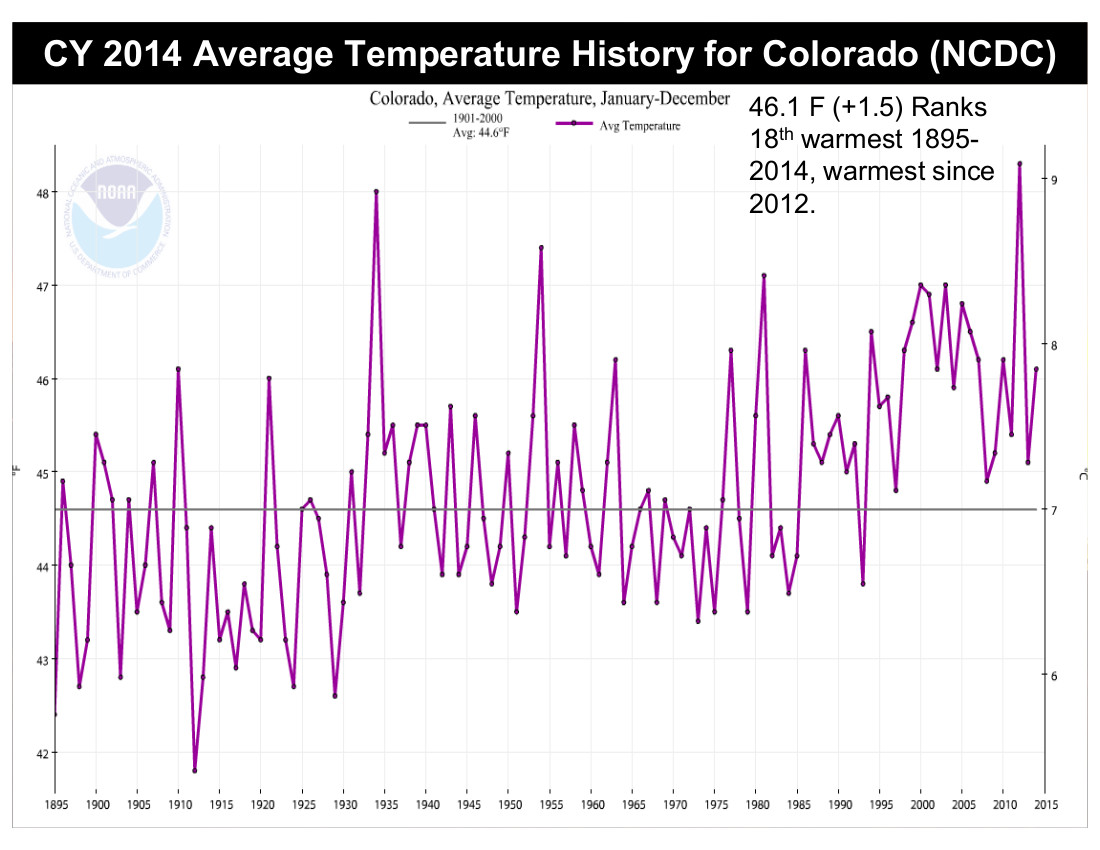
Colorado average temperature 1895 thru 2015 via the Colorado Climate Center

From email from Mountain West Strategies (Pete Kolbenschlag):

Our Goal? To deliver and follow through on a strong action plan that produces concrete steps toward solving the Colorado climate challenge. The Switch 2020 mission asks all of us (individuals, businesses and governments) to work together to move toward carbon neutrality by improving our energy efficiency and switching to renewable energy. Plus reduce our water use by half. Together we can do it!

Your ideas are going to pave the way to real change in Colorado!

We are bringing a diverse group of people together from all over Western Colorado. We are going to meet, focus on our challenges and hash out a firm action plan to change the course our future. We look forward to you joining us!

Why Participate and Engage?

Many projections see Colorado heading into a drier future and the earth’s climate heading toward crisis. Changing our energy consumption acting now and to protect our precious water resources are challenges vital to all of us. We can get this done today without it being done for us by someone else tomorrow.

Can Colorado single handedly reverse the course of the Climate Crisis? Maybe not, but it is possible for Colorado to become the global leader in showing how to do it.

With our can-do spirit, know-how and efforts to take on these challenges, our local communities, residents, environment and economy can immediately benefit by our actions.
As we make concrete steps toward solving this critical challenge, we can leverage our shared business and environmental expertise, engineering genius, and entrepreneurial spirit to improve all our lives.

The Western Slope Climate Challenge is a working conference where leaders of industry, activists, politicians and concerned citizens use the proven methods of rapid prototyping to explore issues and find agreed upon solutions. Presenter/Guides will lead participants into breakout session to identify a problem, discuss solutions, agree on action and write a working blueprint to tackle our challenges. Everyone self selects into a team of their choice to take on a specific challenge, then help implement plans to achieve the goals the team establishes. Going forward, everyone who participates plays an active role individually and together to make these plans happen. Once we leave the conference each of us must continue to be accountable to ourselves and our team’s objectives to make the difference. Together we can do this!

Click here to register.

Click here to go to the conference Facebook page.

Salida: Town hall meeting discusses water issues

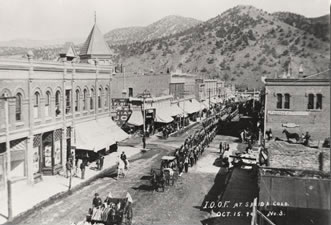
Salida Colorado early 1900s

From The Mountain Mail (J.D. Thomas):

State Sen. Kerry Donovan (D-Vail) and Terry Scanga, general manager of the Upper Arkansas Water Conservancy District, hosted a town hall meeting to discuss water issues Sunday in city council chambers.
Scanga opened the meeting by describing changes in Colorado water plans since 2002.

He said in 2011 a gap analysis of the various water basins showed the Arkansas River Basin will have a projected shortage of 54,000 acre-feet per year by 2035 or 2040.

He said various water conservancy districts are looking into conservation, identifying projects and processes, alternative transportation methods of water and new water supplies.

Another option being considered is rotational land fallowing and water leasing, which would lease water rights for irrigation from a section of land and transfer it to a municipality temporarily, which would increase water to an area that is experiencing a population growth, he said.

An issue raised involved poor irrigation and watering practices by agricultural users, which Scanga said is difficult to compare to poor watering practices of lawns in a municipality.

Another attendee asked about worst-case scenarios for future water shortages. Scanga said water conservancy groups in Arizona and Nevada have already started preparing for worst-case scenarios and have begun offering monetary incentives for users taking less water than before.

Donovan said she had been to Paonia and Delta Saturday and Crested Butte and Salida Sunday as part of her town hall meetings to obtain comments and gauge concerns of local residents about water in their basins.
She said feedback gained from meetings such as the one in Salida will be used to take the voices of locals to Denver.

More Arkansas River Basin coverage here.

2015 Colorado legislation: HB15-1225 (Federal Land Coordination) makes it through Senate Local Government Committee

Federal land and Indian reservations in Colorado

From The Durango Herald (Peter Marcus):

House Bill 1225 – which already made its way through the House with overwhelming support – made it through the Senate Local Government Committee unanimously.

The legislation would require that the state assist local governments with coordinating with the federal government over land-use issues. Local governments would be able to apply for a grant through the Department of Local Affairs asking for technical assistance on such issues as drafting a memorandum of understanding.

“By driving it at the local government level, you have the communities who are impacted by the federal lands surrounding them, you have that flavor that local government brings to it,” said Sen. Ellen Roberts, R-Durango, a co-sponsor of the legislation.

The bill comes as sportsmen and conservationists are calling on the Legislature to reject efforts that would transfer federal lands over to the state’s authority. They believe HB 1225, by requiring federal land coordination, is a way to keep lands public.

Sportsmen and conservationists held a rally at the Capitol in February opposing Senate Bill 39, which would allow Colorado to have some legislative and taxing authority over federal public lands. The federal government currently holds exclusive authority over its public land. SB 39 would allow Colorado to exercise authority along with the federal government.

Opponents say Senate Bill 39 is a slippery slope towards transferring federal lands over to the state’s authority, which they fear would result in a mismanagement of the lands acquired by the state. That could cut into the economic benefits Colorado gains from hunting, fishing and other outdoor tourism activities, critics said.

SB 39 has been delayed, as its sponsor, Sen. Kent Lambert, R-Colorado Springs, works on a few issues. He said the purpose is simply to establish clear jurisdictional authority.

Lambert said lines are blurry in several instances, making it unclear who has the authority, either the federal government, or local jurisdictions. That could impact even criminal investigations, he said.

“What is now part of the state may still be under federal jurisdiction,” he said. “So, if there’s a crime committed there, the state may not be able to prosecute the crime because it’s a federal jurisdiction.”

Another measure addressing federal lands, Senate Bill 232, was introduced Monday. The bill would create a commission to study transferring public lands from the federal government to the state.

Roberts said her bill, HB 1225, has more to do with how to best coordinate when it comes to such issues as forest management, water rights and energy and other issues.

“As we struggle with poor forest health, energy development, water issues – all of this is recognizing that it hasn’t been a level playing field,” Roberts said. “The local governments could use some technical assistance … which is incredibly complex and often far removed.”

More 2015 Colorado legislation coverage here.

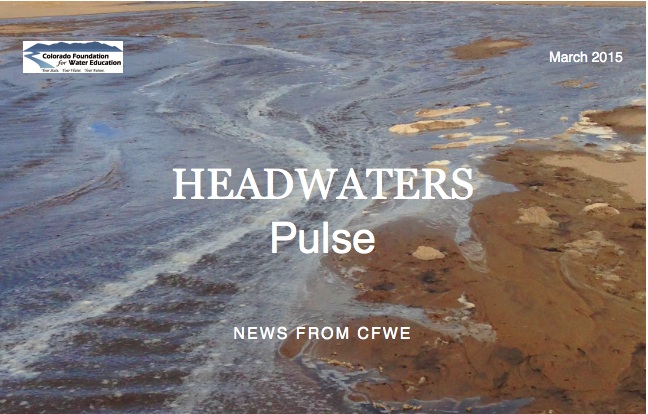
The March 2015 “Headwaters Pulse” is hot off the presses from the Colorado Foundation for Water Education

headwaterspulse032015cfwe

Click here to read the newsletter. Here’s an excerpt:

Now Available: Headwaters Magazine on Colorado’s Water Plan

It isn’t every day that concerned citizens, recreation planners, water professionals, elected officials, conservationists, farmers, business and industry leaders, and state agency staff in Colorado put their heads together to draft a state water plan. In fact, a comprehensive state plan for managing, distributing and conserving Colorado’s most precious natural resource has Never. Been. Done. Before. In this day and age, you don’t often get to say that about anything. The scope of the undertaking, combined with the disconcerting forecasts for what’s in store if Colorado doesn’t come up with a plan—and a good one at that—has made for an exciting couple of years for those involved, or even just observing, as Colorado’s Water Plan takes shape.

Depending on where you sit, the best or most challenging part of the whole process is that Coloradans of every stripe are invited to step up to the plate, take a seat at the table, grab a microphone, or dash off an email to provide input and feedback that those holding the wheel in shaping the plan’s content have committed to genuinely consider. Our winter issue of Headwaters, hot off the press, takes a close look at the state water planning process’ inner workings, including why we need the plan now, what it took to complete a first draft as of December last year, and where we’ll likely need to go further to achieve success. Plus, we help you chart your water future and explore how to get involved. Colorado’s Water Plan won’t be finalized until December 2015, so pick up or download your copy of Headwaters Winter 2015 issue today and get equipped to speak up. Bulk sales of additional copies for use in outreach activities are also available by contacting jennie@yourwatercolorado.org.

More Colorado Foundation for Water Education coverage here.