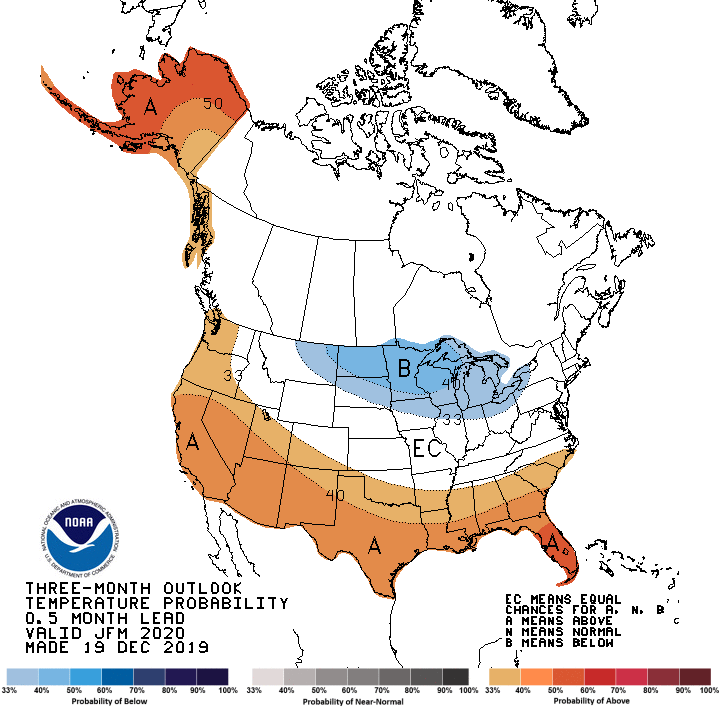
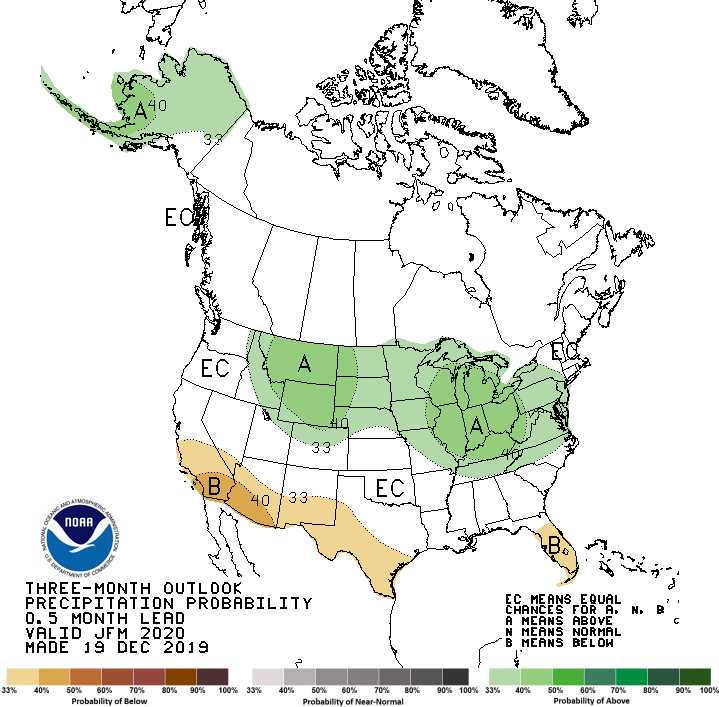
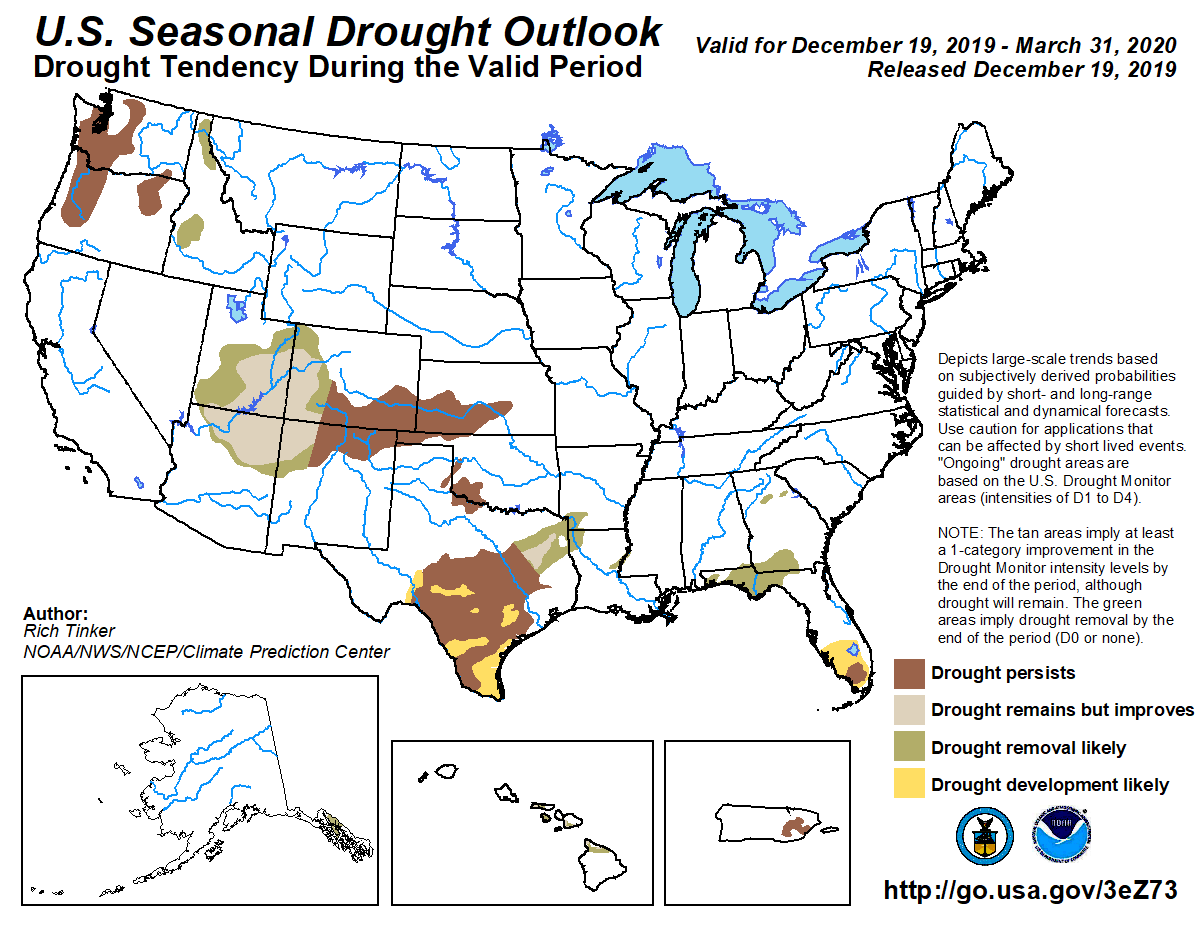
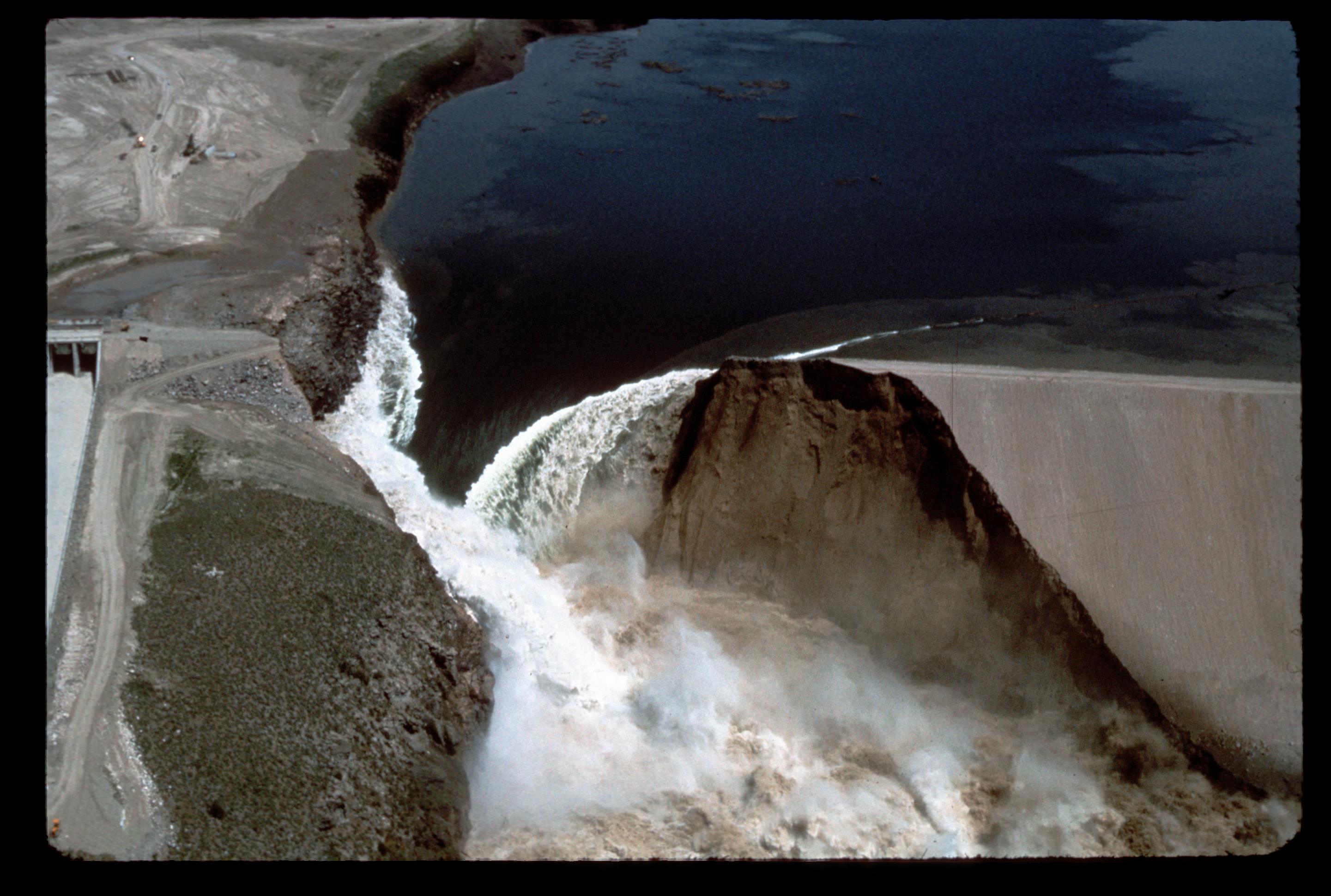
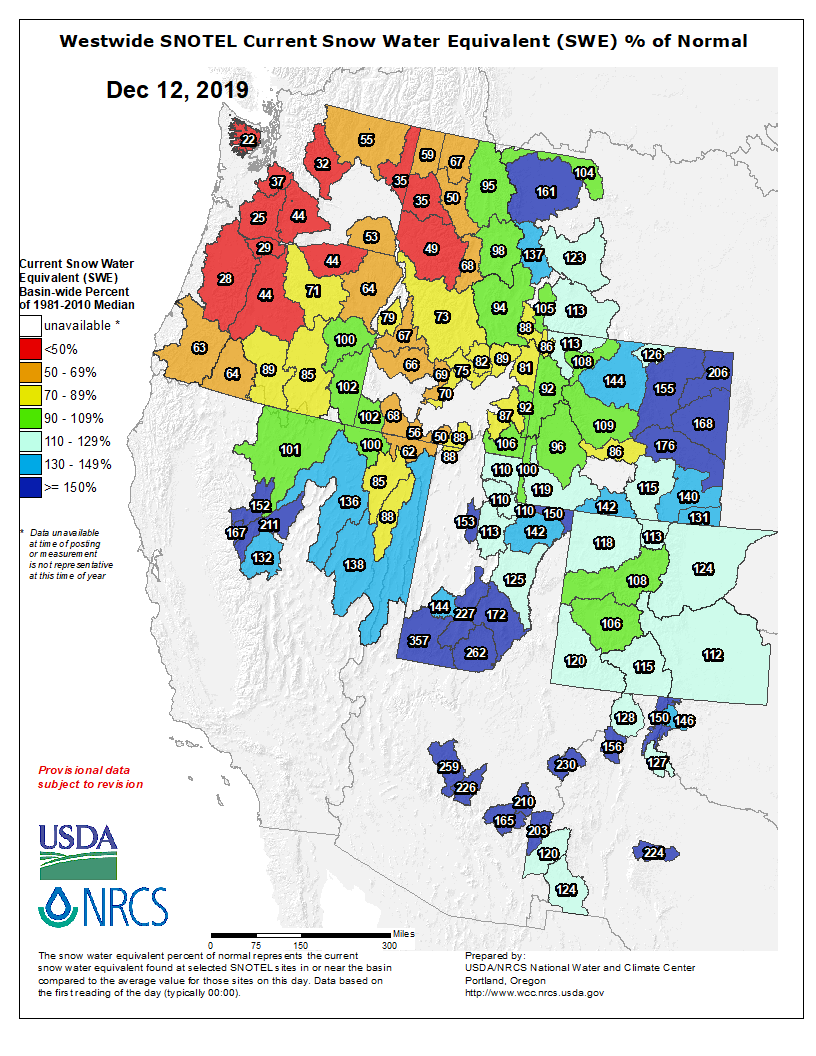
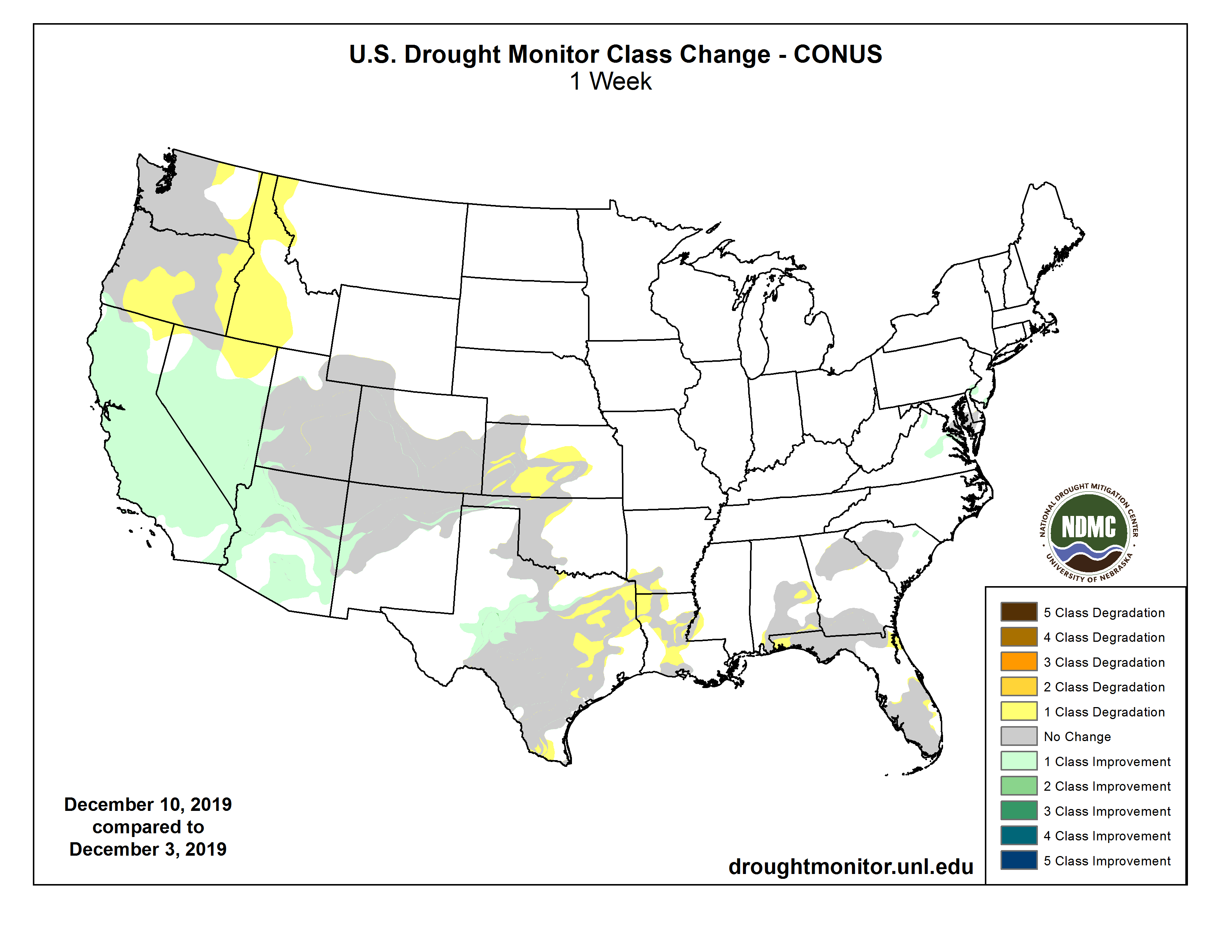
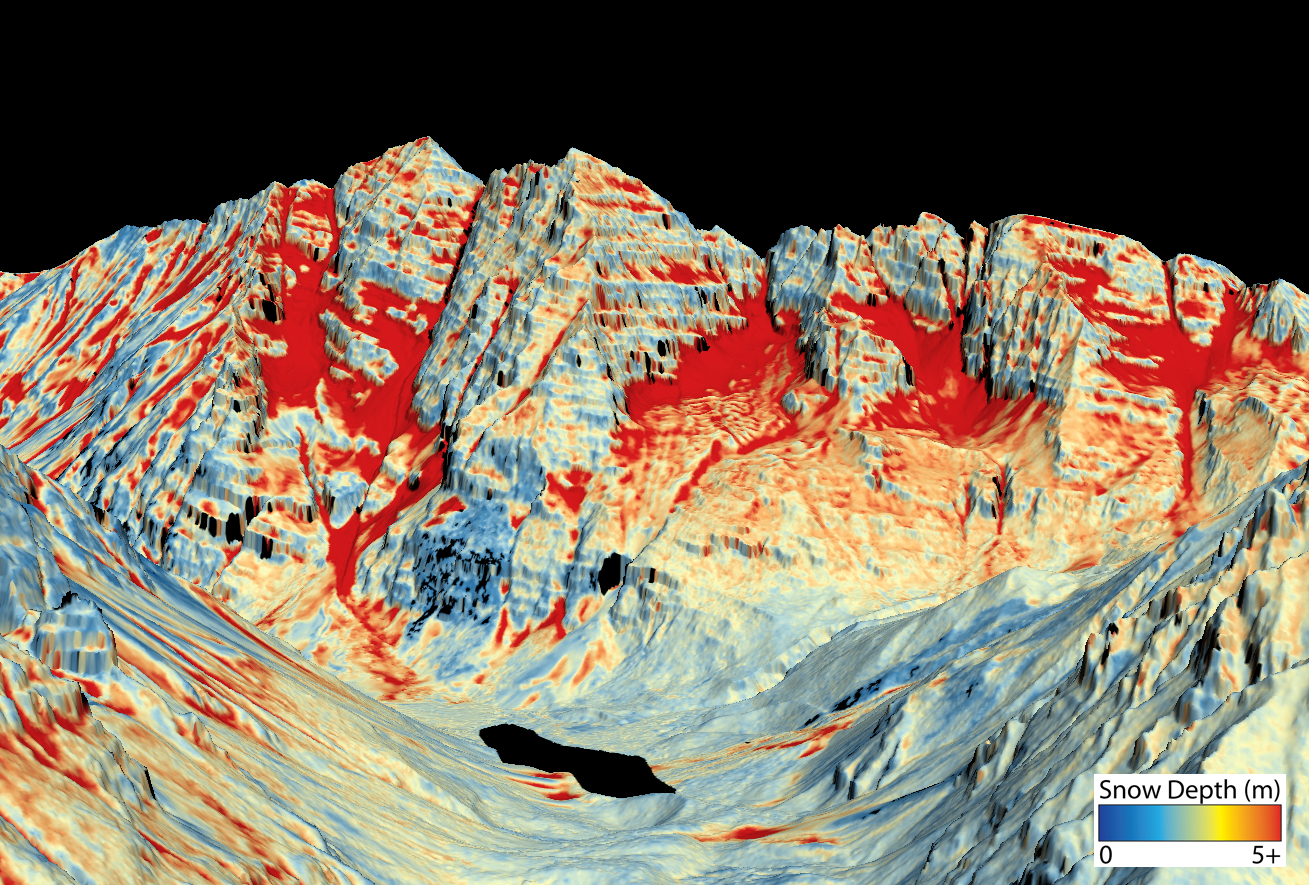
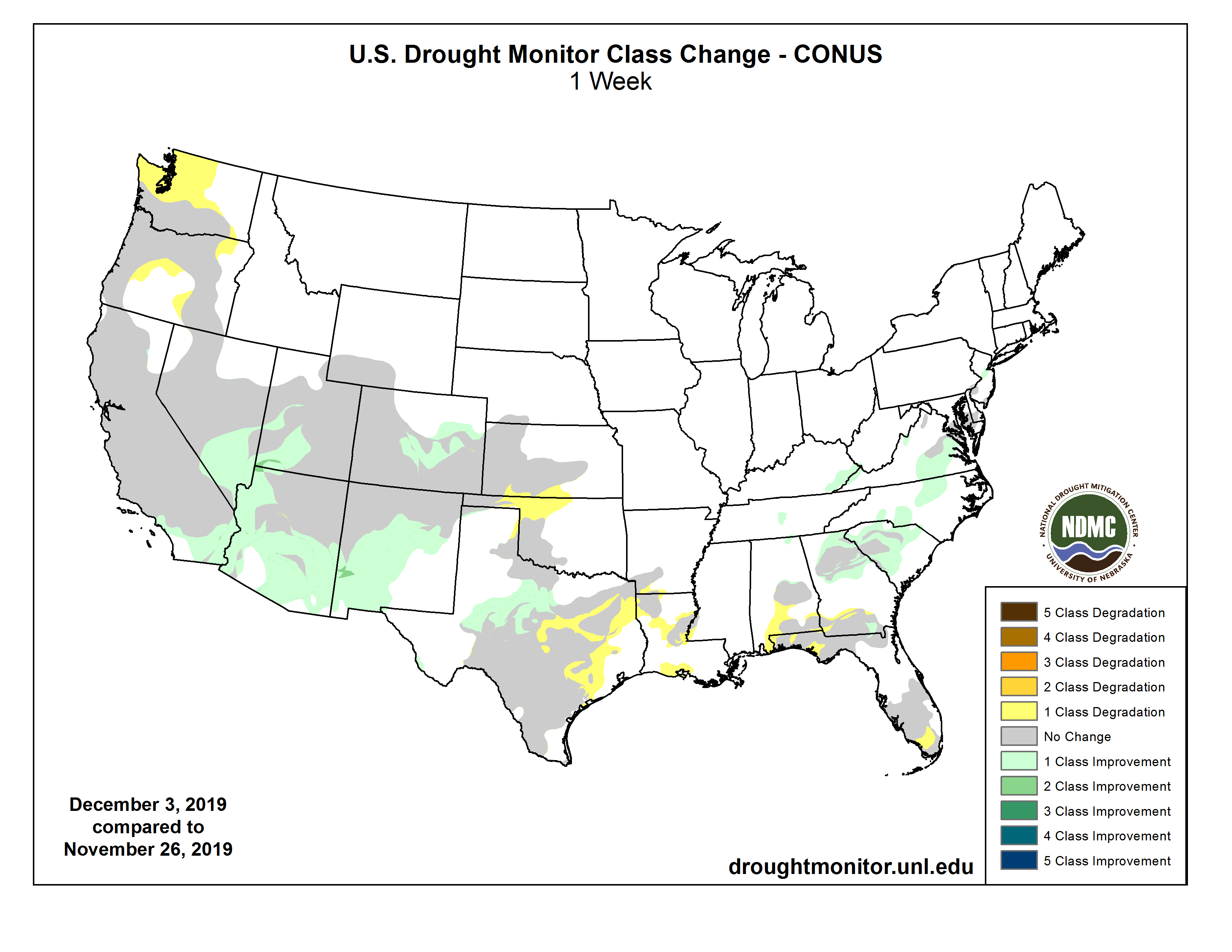
Click on a thumbnail graphic below to view a gallery of drought data from the US Drought Monitor.
US Drought Monitor December 17, 2019.
West Drought Monitor December 17, 2019.
Colorado Drought Monitor December 17, 2019.
Click here to go to the US Drought Monitor website: Here’s an excerpt:
This Week’s Drought Summary
A series of Pacific fronts brought welcome moisture to the Northwest (from northern California northward into Washington), but even with this precipitation, the Water Year to Date (WYTD; since Oct. 1) basin average precipitation and Snow Water Content (SWC) were still well below normal (30-70%). Farther east, frigid Arctic air (weekly average temperatures up to 15 degree F below normal) was bottled up in the northern Plains and upper Midwest (and central Canada), while the West, South, and East observed above-normal readings (weekly temperature anomalies + 3 to 6 degree F). As the fronts progressed eastward, they slowed and waves of low pressure developed along the fronts, generating widespread rains (1-4 inches, locally to 8 inches) in the Southeast, mid-Atlantic, and along coastal New England. In the colder air to the north, the precipitation fell as snow, blanketing parts of the lower Missouri and Ohio Valleys, northern Appalachians, eastern Great Lakes region, and interior New England with light to moderate totals (2-6 inches). In contrast, the Southwest, Plains, and western Corn Belt were mainly dry. In Alaska, above-normal temperatures prevailed across the state, with decent precipitation observed along the southern coast. Shower activity increased across the eastern Hawaiian Islands, allowing for some improvements on the Big Island…
Most of the Plains saw little or no precipitation this week, with some light snow falling across North Dakota, southeast Wyoming, Nebraska, and eastern Kansas (for Colorado, refer to the West). The frigid Arctic air was mostly confined to the northern Plains and upper Midwest (weekly TANs -5 to -10 degrees F), although some colder air spilled southward and eastward into the central Plains and Midwest. With this time of the year being climatologically dry, typically cold with little or no evaporation, and with frozen soils, it is a difficult time for drought to develop and expand in most northern areas. Plus, all short- to long-term indices are near to above normal (wet) in the northern Plains. Farther south, however, much drier conditions existed in southwestern Kansas (D2 to D3), especially during the 3- to 6-month range. After 1 to 2 category deteriorations were made the past 4 weeks, no changes were made here this week…
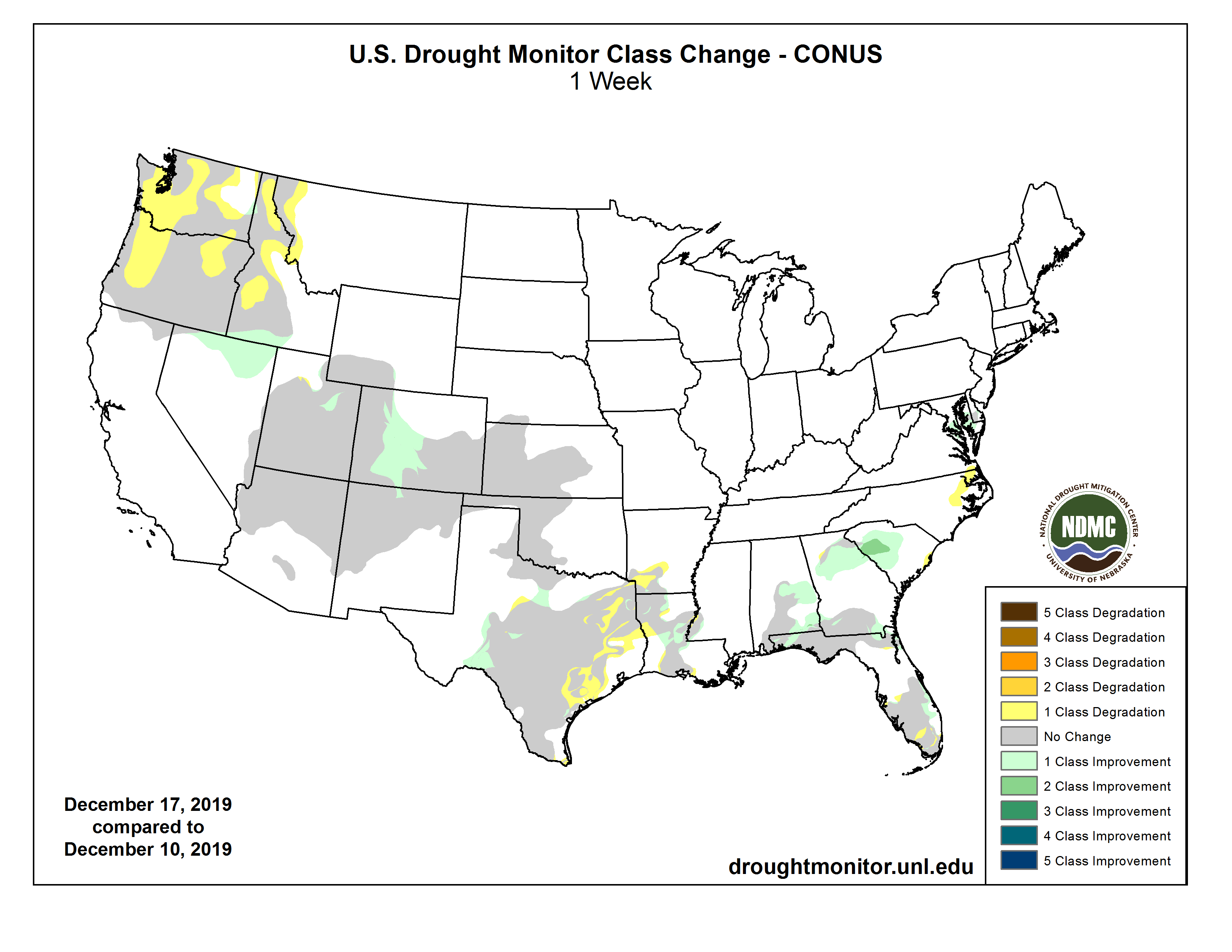
After several wet weeks in the Southwest (and much improvement), tranquil weather returned to most of the region. With SNOTEL WYTD basin average precipitation and SWE values in the Southwest generally at or above normal, this region was generally left unchanged. The exceptions to this was across northern Nevada and southern Idaho where light to moderate precipitation (0.5-2 inches) fell, producing positive SPIs (wet) at 1-, 2-, 3-,4-, 6-months, and beyond, along with above-normal USGS stream flows. As a result, D0 was removed in these 2 areas. In northern Utah and most of Colorado, light to moderate precipitation continued to provide drought relief, especially in the central and southern Rockies where a 1-category improvement was made in central Colorado and extreme northern New Mexico. The area of northern Utah was already drought-free.
In contrast, the Northwest (from northern California northward into Washington) finally received welcome and widespread precipitation (2-4 inches along the coast and in the Cascades and Sierra Nevada, locally to 10 inches in extreme northwestern California), but this Water Year has seen far too few weeks like this. This situation is further exacerbated by the fact that this is the wet season (large normal totals) so that even light precipitation can quickly accumulate huge deficits. Thus, even with this week’s precipitation, many stations SPIs at 30-, 60-, 90-days, and longer time periods were at D2-D4 levels; USGS 1-, 7-, 14-, and 28-day average stream flows were at near- or record lows (tenth percentile or less); 90-day deficits exceeded a foot (and more) in western Washington and Oregon; SNOTEL basin average WYTD precipitation ranged between 34-60% and Dec. 18 SWC was between 27-65%. Accordingly, D1 was introduced to the Washington and Oregon Cascades, northeastern Oregon, and northern and southwestern Idaho where the driest tools converged. In addition, D0 was expanded into central Washington, central Idaho, and western Montana…
While western sections were dry (Oklahoma, western two-thirds of Texas, western Arkansas), precipitation gradually increased across eastern sections, with scattered lines of showers and thunderstorms dropping light to moderate totals (1 to 3 inches) on parts of Louisiana, Mississippi, and Tennessee. The rains were enough to provide some slight improvement in northern and central Louisiana (D0 and D1 shrunken), but much lighter amounts in southwestern Arkansas and eastern Texas, along with slightly above-normal temperatures, somewhat increased the area of D0-D2 in those 2 areas. In western Oklahoma, conditions were maintained as November and December precipitation is normally quite low this time of year (each month contributes to 1-2% of the annual total), and seasonable temperatures helped…
Looking Ahead
During the next 5 days (December 19-23), most of the lower 48 States will be tranquil (dry), except for heavy precipitation (more than 4 inches) in the Pacific Northwest (from northern California northward), and in the southeastern quarter of the Nation (2-5 inches in the central and eastern Gulf and southern Atlantic Coasts). If this rain occurs, parts of Florida may close in or break their record high December amount, effectively wiping away any existing drought. The upper and eastern Great Lakes region should see snow showers along favored locations. 5-day temperatures should average above-normal for much of the contiguous U.S.
The CPC 6-10 day outlook (December 24-28) favors above-normal precipitation across the Southwest, Plains, and upper Midwest, and in southern and eastern Alaska. Subnormal precipitation is likely along the Atlantic Coast and Montana. Temperatures are expected to average below-normal in the Far West and Alaska, with good odds for unseasonably mild readings in the eastern half of the Nation.
US Drought Monitor one week change map ending December 17, 2019.
One of the Colorado Orange apples collected from an ancient tree in Fremont County, Colorado. (Provided by Montezuma Orchard Restoration Project) via The Colorado Sun.
The Montezuma Orchard Restoration Project compared the fruit of a tree found near Cañon City to botanical illustrations and wax castings of award-winning apples to identify the lost treasure
“We are 98% sure, give or take 3%, we have found the elusive Colorado Orange apple,” Addie Schuenemeyer wrote in an announcement from the nonprofit Montezuma Orchard Restoration Project she and her husband started to preserve old apple varieties in the southwest corner of the state.
The announcement came following a visit to Colorado State University where they matched a suspected Colorado Orange apple to a wax cast of that variety made more than a century ago.
The Colorado Orange was a popular apple in the late 1800s. It was more oval in shape than many other apples and had a yellow peel with an orange blush. In taste, it had a bit of a citrus note. It kept longer than many apples…
The Schuenemeyers scoured Montezuma County, once a prolific apple-growing hotspot in Colorado, and couldn’t find a single Colorado Orange…
In their continuing search, the Schuenemeyers were able to trace the origins of the Colorado Orange to Fremont County. There they found a lone, decimated tree that was down to a single living limb. They were able to pick enough apples for testing.
DNA tests on samples of those apples came back “unique unknown.” The apples didn’t match any other known cultivar in the U.S. Department of Agriculture apple collection.
But there was no Colorado Orange in that collection for comparison.
Next, the Schuenemeyers compared the apple to paintings of the Colorado Orange that were made by USDA artists in the early 1900s. The shape, size, color, ribs, seeds, cavity – everything matched.
One of four watercolor botanical illustrations of the Colorado Orange apple in the U.S. Department of Agriculture Pomological Watercolor Collection at the National Agricultural Library. This one was painted by Amanda Almira Newton in 1905, from a specimen collected in Canon City, Colorado via The Colorado Sun.
But they needed more. They needed a horticulture sample. They finally found one in Colorado State University’s Agricultural and Natural Resources Archive. Around the turn of the 20th century, a professor had made wax castings of award-winning apples, including the Colorado Orange.
U.S. Sen. Kirsten Gillibrand on Tuesday called for more federal money and oversight to shore up the nation’s aging dams following an Associated Press investigation that found scores of potentially troubling dams located near homes and communities across the country.
Gillibrand said new legislation in the works should ensure that federal standards are in place to make dams more resilient to extreme weather events that are becoming more common because of a changing climate. She also called for greater funding for federal grants to fix unsafe dams that pose a risk to the public.
“We should not wait for a catastrophic dam failure or major flooding event to spur us to action,” Gillibrand, a Democrat from New York, said in a letter to leaders of the Senate Environment and Public Works Committee, which is crafting a new water resources bill. Gillibrand is a member of the committee.
She cited an AP analysis published last month that used federal data and state open records laws to identify at least 1,688 high-hazard dams rated in poor or unsatisfactory condition as of last year in 44 states and Puerto Rico. The AP analysis noted that the actual number is almost certainly higher, because some states haven’t rated all their dams and several states declined to release full data.
The AP’s investigation focused on high-hazard dams — which could kill people if they were to fail — that were found by inspectors to be in the worst condition. Georgia led the way with 198 high-hazard dams in unsatisfactory or poor condition, followed by North Carolina with 168 and Pennsylvania with 145. New York had 48 such dams.
From El Paso County via The Colorado Springs Business Journal:
El Paso County is asking business owners and residents to give input for its new master plan in an online survey.
The survey covers similar ground to topics discussed at a visioning workshop held Dec. 11. Nearly 100 residents participated, and their input will be incorporated as the Planning Department finishes up the master plan development process.
Those who were unable to attend the workshop can provide feedback that will be considered as the county continues to develop the master plan.
The county started developing the master plan early this year, in what’s expected to be a two-year process. The Planning Department expects to begin implementing the master plan at the end of 2020.
The planning department, along with master plan consultant Houseal-Lavigne Associates, presented an Existing Conditions Report to the Board of County Commissioners at their meeting on Dec. 12.
Comprised of public input and statistical analysis, the 70-page report is a summary of current conditions in the county and a snapshot of county life as it stands today.
It covers a multitude of topics including zoning, development, transportation, water, military bases, recreation and tourism, community health and sustainability.
According to the county, the report will be instrumental as it develops the Whole County Master Plan.
“Finalizing the Existing Conditions Report is the first step toward understanding where the county is today, and it will serve as a bridge to the future,” Planning and Community Development Executive Director Craig Dossey said in a news release.
“The report gives us a strong foundation of understanding pertaining to the good, the bad and the ugly in the county, and provides a solid starting point as we move forward.”
“At the very least, the report gives residents a good idea of all the moving parts that are going into the master plan process,” John Houseal, principal at Houseal-Lavigne, said in a news release. “You won’t find another document with such extensive content relating to the current state of El Paso County.”
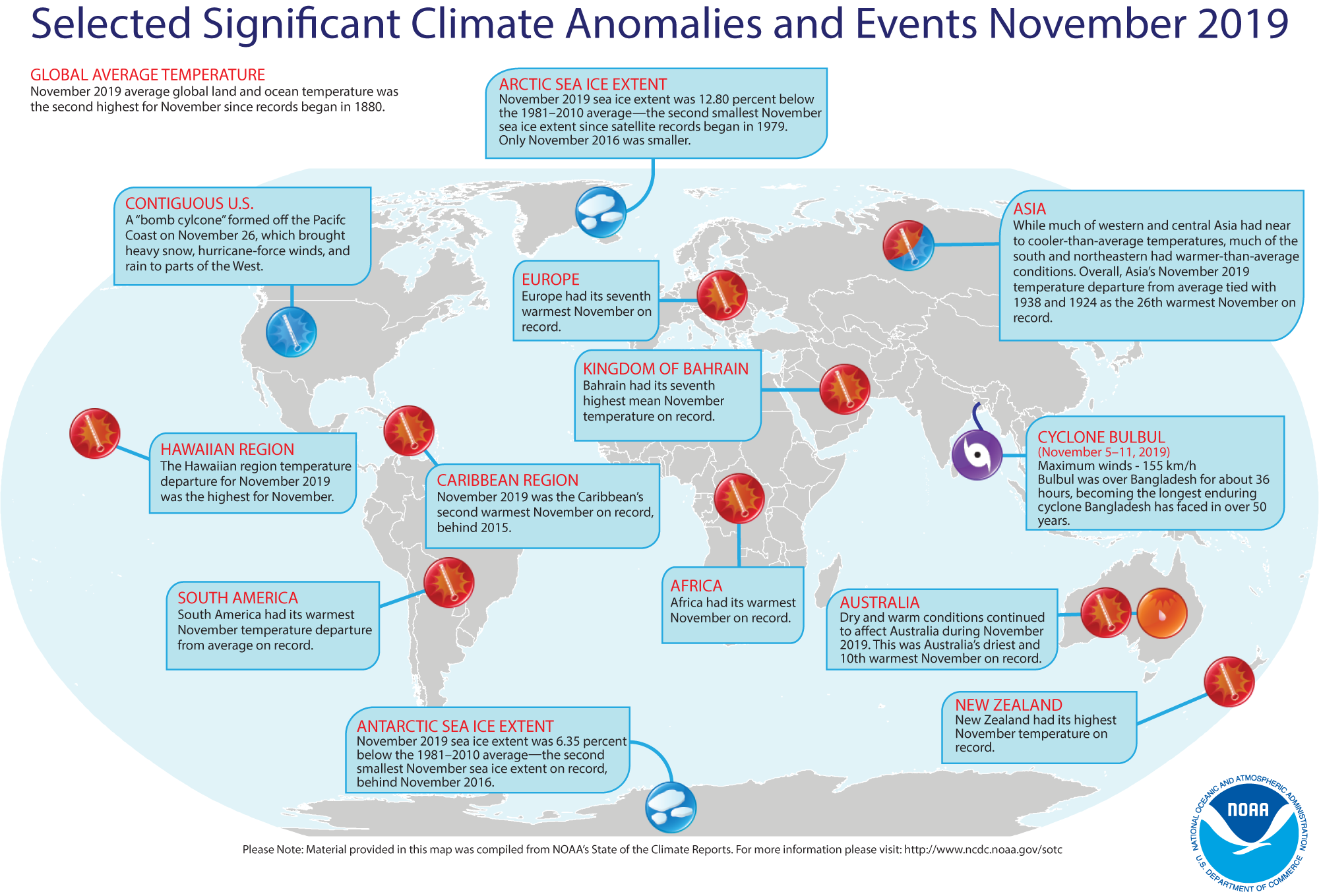
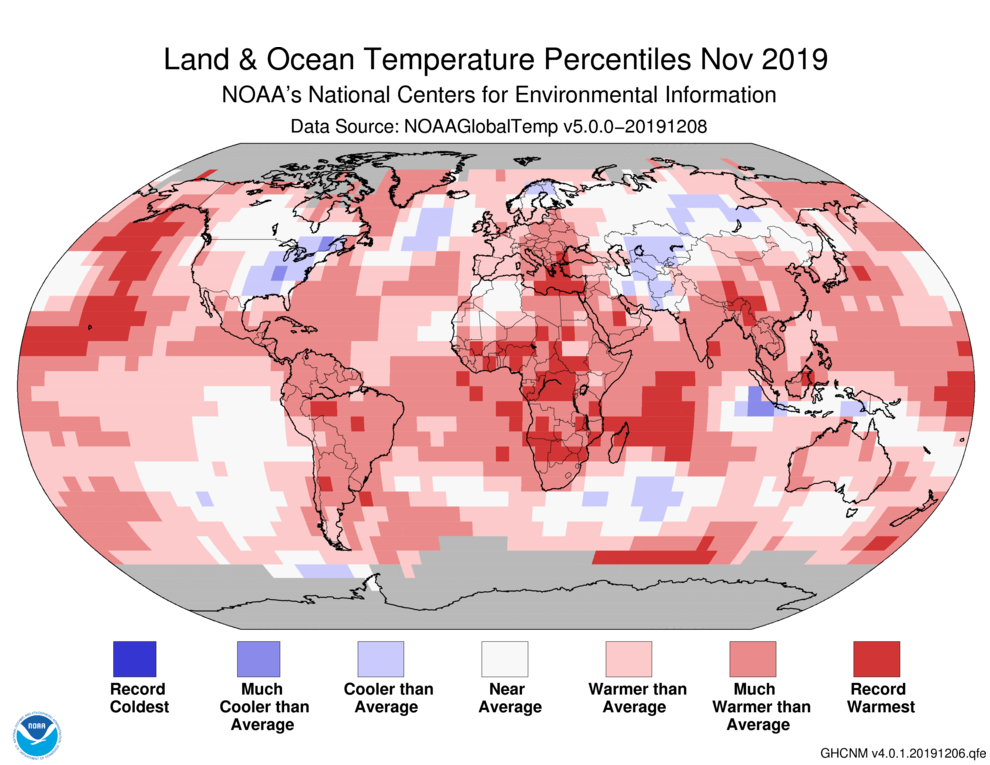
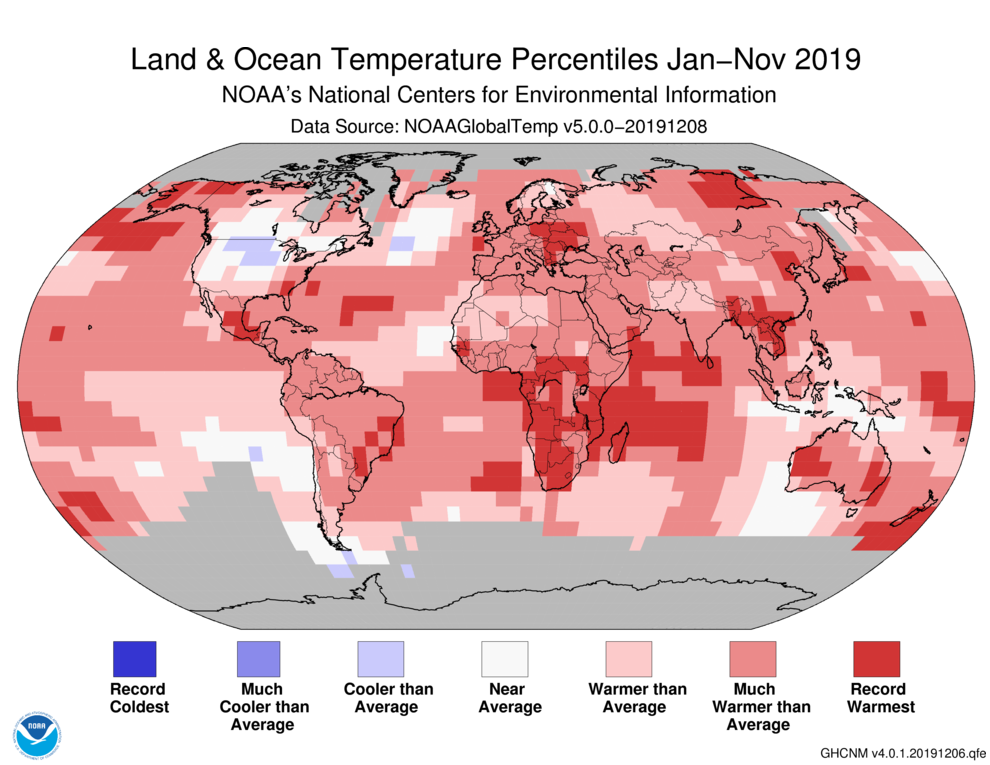
The global land and ocean surface temperature departure from average for November 2019 was the second highest for the month of November in the 140-year NOAA global temperature dataset record. The September–November 2019 and January–November 2019 temperatures were also the second highest such periods on record.
This monthly summary, developed by scientists at NOAA’s National Centers for Environmental Information, is part of the suite of climate services NOAA provides to government, business, academia, and the public to support informed decision-making.
November Temperature
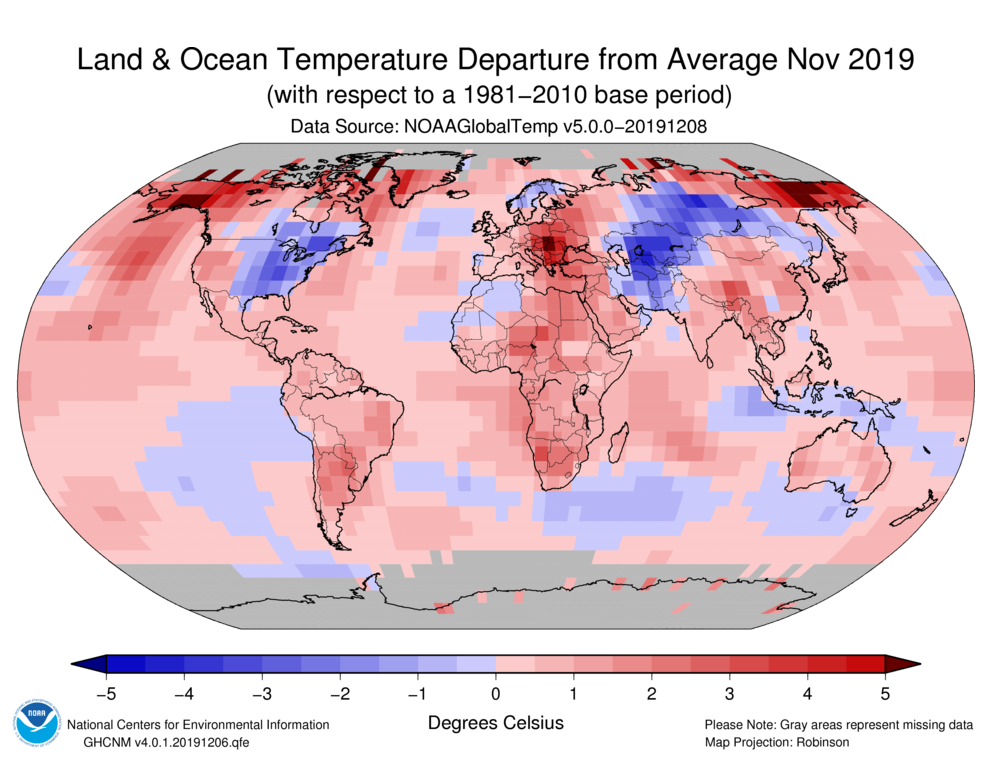
The November temperature across global land and ocean surfaces was 1.66°F (0.92°C) above the 20th-century average of 55.2°F (12.9°C) and was the second highest for November in the 1880–2019 record. Only November 2015 was warmer. The five warmest Novembers have all occurred since 2013.
November 2019 marked the 43rd consecutive November and the 419th consecutive month with temperatures, at least nominally, above the 20th century average.
November 2019 was characterized by warmer-than-average conditions across much of the global land and ocean surfaces. Record-warm November temperature departures from average were present across parts of the North and Western Pacific Ocean, Africa, southern Asia, South America, the Atlantic Ocean, the Mediterranean Sea, and northwestern Indian Ocean. Cooler-than-average conditions were present across the eastern half of the contiguous U.S. and southeastern Canada and northern parts of the Atlantic Ocean, as well as across parts of northern and southwestern Asia. However, no land or ocean areas had record-cold November temperatures.
Regionally, South America, Africa, and the Hawaiian region had record-warm November temperatures. The Caribbean region had its second warmest November on record, trailing behind November 2015. Europe had its seventh warmest November on record.
The November globally averaged land surface temperature was 2.34°F (1.30°C) above the 20th century average of 42.6°F (5.9°C). This was the eighth highest November land temperature in the 140-year record.
The November globally averaged sea surface temperature was 1.39°F (0.77°C) above the 20th-century monthly average of 60.4°F (15.8°C), also the second highest global ocean temperature for November on record, behind November 2015.
Sea Ice and Snow Cover
The Arctic sea ice extent for November 2019 was the second smallest on record at 530,000 square miles, or 12.80%, below the 1981–2010 average, according to an analysis by the National Snow and Ice Data Center (NSIDC) using data from NOAA and NASA. November 2016 had the lowest sea ice extent for the month at 790,000 square miles, or 19.1 percent, below the 1981–2010 average. The 10 smallest Arctic November sea ice extents have occurred since 2007. According to NSIDC, Chukchi Sea, Hudson Bay, and Davis Strait had well-below-average sea ice extent for the month.
The Antarctic sea ice extent for November 2019 was 390,000 square miles, or 6.35%, below the 1981–2010 average. This was also the second smallest sea ice extent for November in the 41-year record, trailing behind the record-low November sea ice extent of 2016 (10.6 percent below average).
According to data from NOAA and analyzed by the Rutgers Global Snow Lab, the Northern Hemisphere snow cover extent during November was 1.20 million square miles above the 1981–2010 average and the fifth highest November snow cover extent in the 54-year record. The North American and Eurasian snow cover extents were also above average, ranking as the third and 14th largest snow cover extent, respectively.
Seasonal (September–November 2019)
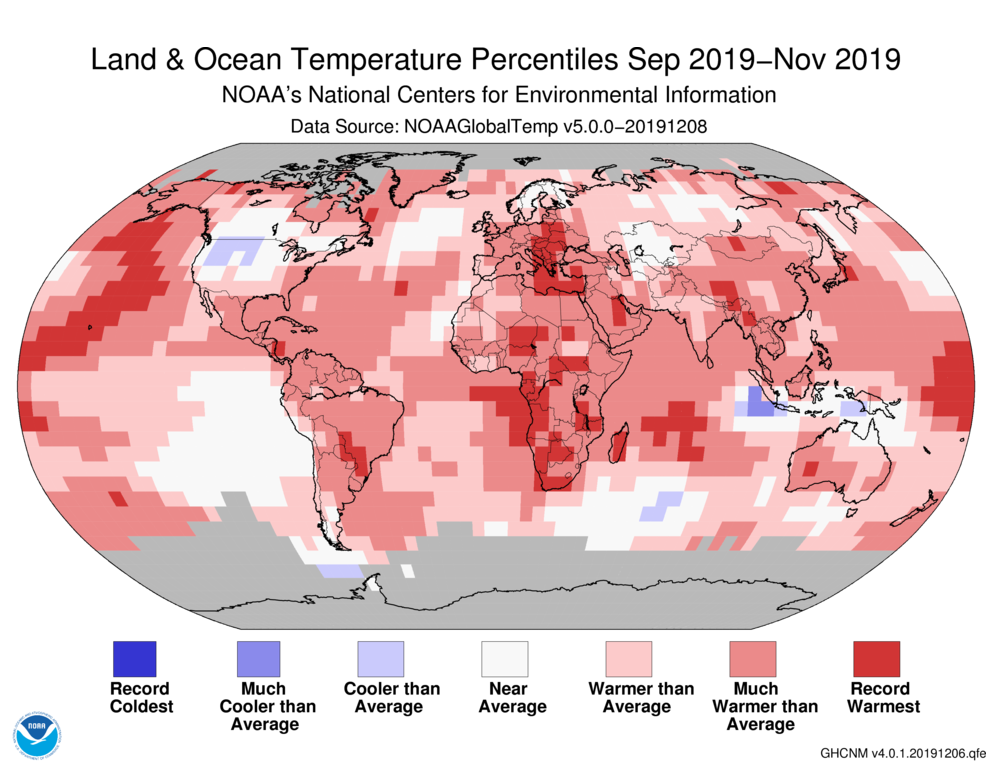
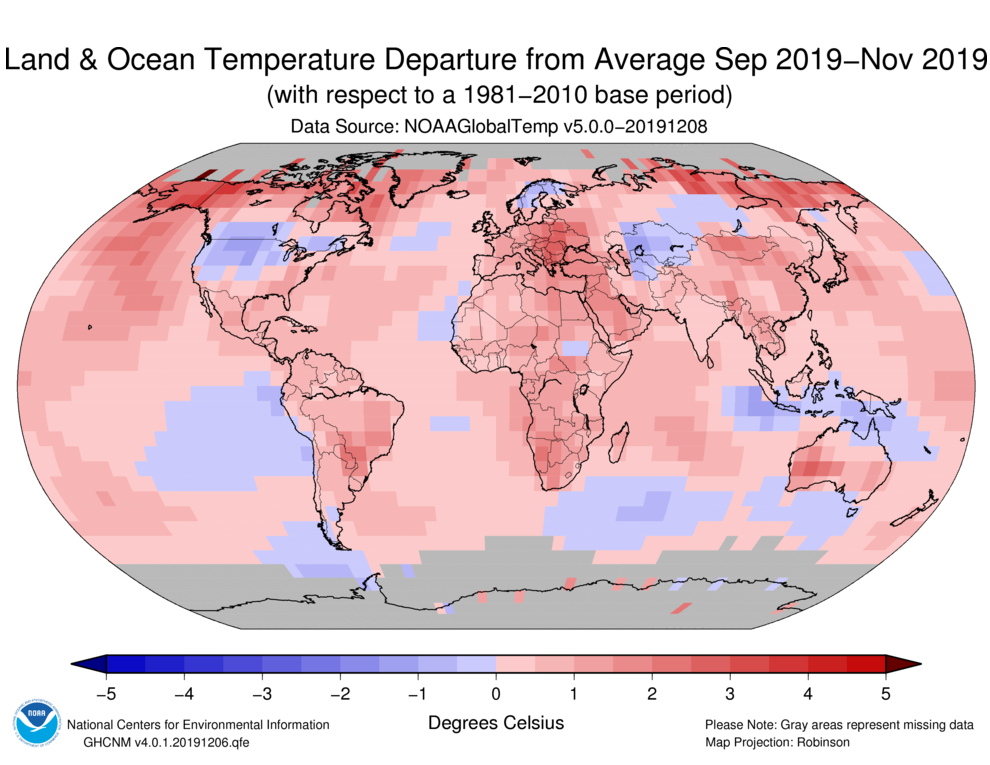
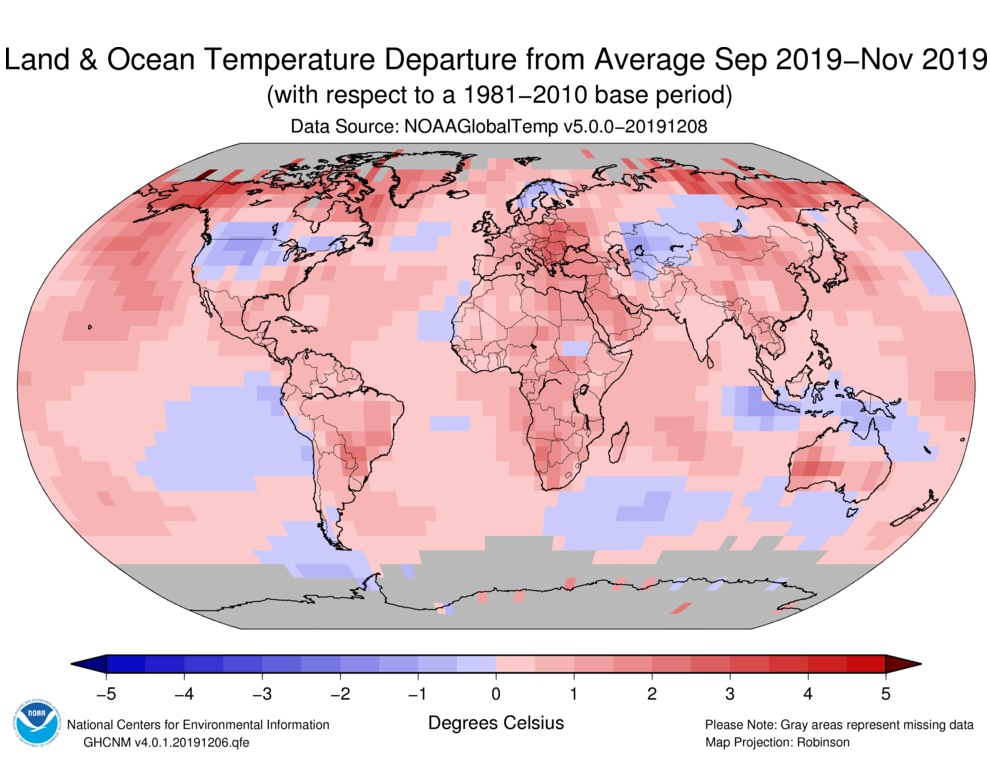
The September–November 2019 average temperature across global land and ocean surfaces was 1.69°F (0.94°C) above the 20th-century average of 57.1°F (14.0°C) and the second highest for September–November in the 1880–2019 record. September–November 2015 was the warmest such period on record at 1.80°F (1.00°C) above average. The five warmest September–November periods have occurred in the last five years (2015–2019).
The Northern Hemisphere September–November 2019 land and ocean surface temperature was also the second warmest such period in the 140-year record at 2.11°F (1.17°C) above average. This is only 0.07°F (0.04°C) cooler than the record-warm September–November set in 2015.
The Southern Hemisphere September–November 2019 land and ocean surface temperature tied with 2018 as the second highest September–November temperature since global records began in 1880, with a hemispheric land and ocean surface temperature average of 1.26°F (0.70°C) above average. Only September–November 2015 was warmer.
Warmer-than-average conditions were present across much of the globe during the three-month season. Record-warm temperatures during September–November 2019 were present across parts of the North and Western Pacific Ocean, Europe and the Mediterranean Sea, Africa, western tropical Indian Ocean, the Atlantic Ocean, and Asia. Cooler-than-average conditions were present across parts of the north-central contiguous U.S., the north Atlantic Ocean, and the southern oceans. However, no land or ocean areas had a record-cold September–November 2019 temperature.
The globally averaged land surface temperature for September–November was the second highest on record at 2.45°F (1.36°C) above the 20th-century average of 48.3°F (9.1°C). This value trails behind the record-warm September–November of 2015.
Regionally, South America, Europe, Africa, and the Hawaiian region had a September–November temperature departure from average that ranked among the three warmest such periods on record. Of note, South America and the Hawaiian region had their warmest September–November on record.
The September–November globally averaged sea surface temperature of 1.40°F (0.78°C) above the 20th-century average of 60.7°F (16.0°C) was the second warmest such period on record, behind 2015. The five warmest global sea surface temperatures for September–November have occurred since 2015.
Year-to-date (January–November 2019)
The year-to-date temperature across global land and ocean surfaces was 1.69°F (0.94°C) above the 20th-century average of 57.2°F (14.0°C) — the second highest for January–November in the 140-year record, trailing behind 2016 (+1.82°F / +1.01°C).
Record-warm temperatures during the year-to-date period were present across parts of North America, South America, Europe, the southern half of Africa, northern and southern Asia, Australia, and New Zealand. Across the oceans, record-warm year-to-date temperatures were present across parts of northern and southwestern Pacific Ocean, the Atlantic Ocean, and the western Indian Ocean. No land or ocean areas had record-cold temperatures during January–November 2019.
The year-to-date globally averaged land surface temperature was 2.50°F (1.39°C) above the 20th-century average of 48.1°F (9.0°C). This value was the third highest for January–November on record—only 2016 and 2017 were warmer.
Regionally, South America, Europe, Africa, Asia, Oceania, the Gulf of Mexico, and the Hawaiian region had a January–November 2019 temperature departure from average that ranked among the three highest such periods on record.
The year-to-date globally averaged sea surface temperature was 1.39°F (0.77°C) above the 20th-century average of 61.0°F (16.1°C). This was also the second highest for January–November in the 1880–2019 record, trailing behind 2016 by 0.05°F (0.03°C).
Once the proceedings were underway, Wayne Schwab of the Trinchera Irrigation Company recognized Emma Reesor, Vice-Chair of the Roundtable, for being named “Basin Hero” for the Rio Grande Basin by the Colorado Water Conservation Board.
Later, Bethany Howell of the Rio Grande Watershed Conservation and Education Initiative gave a funding request preview to add a staff position to the Public Education and Public Outreach (PEPO) program in the Basin. Howell pointed out that PEPO is becoming increasingly important because there is a growing lack of local and statewide water knowledge and a lack of communication between various entities that have the potential to collaborate. Also, she mentioned that PEPO could promote the work in the Basin along with highlighting “cutting edge” projects such as the new Doppler Radar System. Howell’s final presentation and the request will come at the January meeting.
Following Howell’s remarks, Virginia Christensen of the Terrace Irrigation Company also gave a funding preview and request. The Terrace Irrigation Company is seeking to replace diversions that makeup its canal system in 2020. Upon approval, the project anticipated to improve the administration of the system’s water along with numerous other benefits.
An all-star panel of water experts discusses what happened with water in 2019 and provides a glimpse into what they expect 2020 will look like. Jeff Kightlinger, GM of the Metropolitan Water District of Southern California; Sielen Namdar, a Smart Water executive with Cisco’s Cities and Communities team, and Reese Tisdale, President of Bluefield Research, collaborate to provide you with their insights into the water industry.
In this session, you’ll learn about:
The key takeaways from the water sector in 2019
The role data & IOT plays in utilities
How infrastructure continues to be a challenge for utilities
How utilities are leveraging partnerships for better outcomes
Convergence in the water sector and the broader utilities sector
What issues the panelists are watching out for in 2020
The Colorado River Water Users Association annual conference brings together nearly every municipal water agency, irrigation district, Native American tribe and environmental group that relies on the Colorado River.
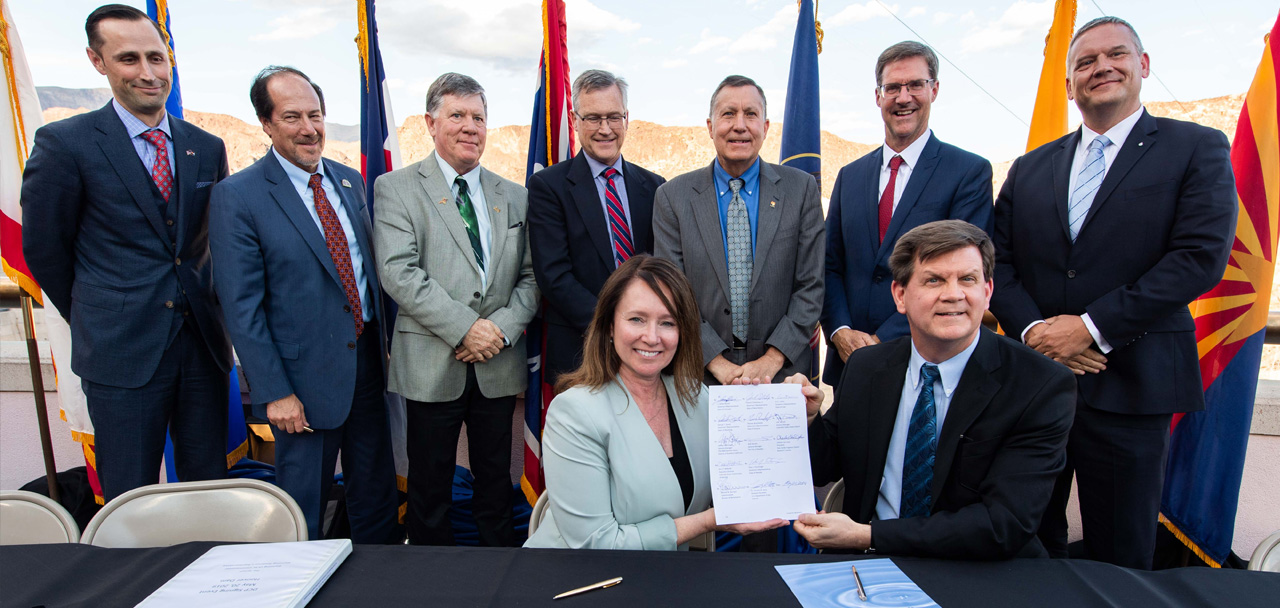
In a room the size of an airplane hangar, U.S. Bureau of Reclamation commissioner Brenda Burman took the stage to give attendees a congratulatory pat on the back for the recent completion of Drought Contingency Plans, which dominated discussion at these meetings for five years.
“To all of you in this room, to those of you in the negotiating parties, for those of you who covered for them at home while they had disappeared for months on end, to negotiate, to work, to analyze,” Burman said. “Well done, everyone.”
[…]
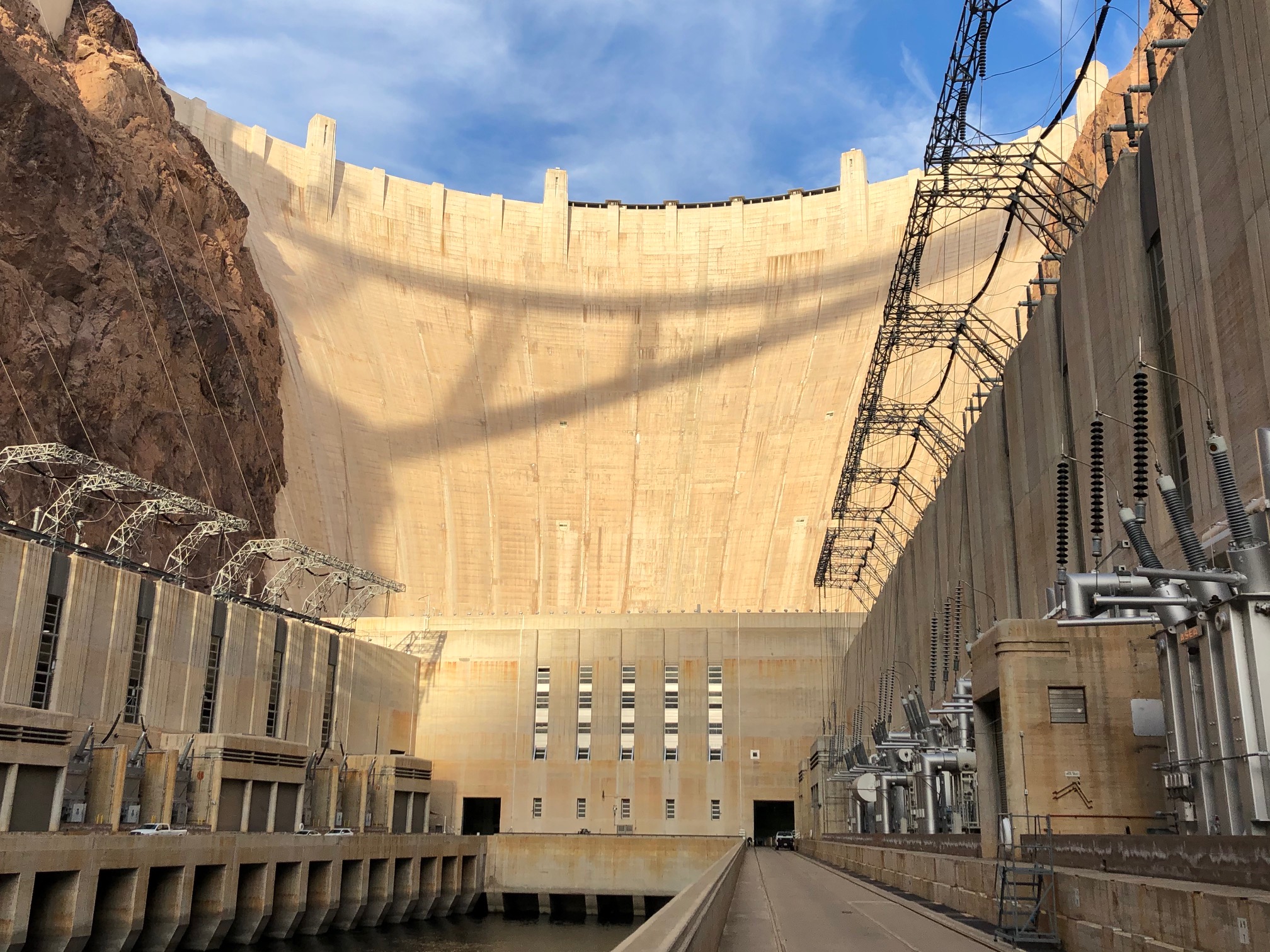
Operation of the Colorado River’s second largest reservoir, Lake Powell in southern Utah and northern Arizona, will be a major piece of negotiations on the river set to start next December. Hoover Dam from the deck of the Arizona power plant December 13, 2019.
At last year’s meeting Burman’s message was dire. She urged the river’s users to complete their Drought Contingency Plans, or face the federal government’s regulatory hammer.
With the deals signed earlier this spring, she acknowledged that they’re not a final solution.
“Since completion of the DCPs in May, I recognize that the hard work of implementation has begun,” Burman said.
That now includes the plans’ first true test. Lake Mead, the river’s largest reservoir just outside of Vegas, is still less than half full. Because of that, the drought plan requires users in Arizona, Nevada and Mexico take less water from it in 2020. Though, they’re all already conserving above and beyond what the plan requires.
It’s a different story in the river’s headwaters, where no restrictions were placed on users to take less from the Colorado River and its tributaries. Instead water managers in the river’s Upper Basin states — Colorado, Utah, Wyoming and New Mexicio — chose to focus on coordinating reservoir operations, and continuing to invest in weather modification .
Those states also began taking a look at a controversial program that attempts to curb water use in the midst of a crisis. Becky Mitchell, director of the Colorado Water Conservation Board, the state’s top water agency, said completion of the drought plan kicked off a statewide campaign to study the concept and gather feedback.
“That is the beginning. That is not the end,” Mitchell said of the Drought Contingency Plans. “And so that’s the process that we’re in right now, is looking at what’s best for the state of Colorado.”
A hayfield near Grand Junction, irrigated with water from the Colorado River. Under demand management pilot programs, the state could pay irrigators to fallow fields in an effort to leave more water in the river. Photo credit: Brent Gardner-Smith/Aspen Journalism
In theory, a demand management program would pay users to conserve in the midst of a crisis in order to boost the river’s big reservoirs. How it would work, who would participate and how it would be funded are still unanswered questions. Another concern is how to make the program equitable — so it doesn’t burden one user over another…
But for all the hand-wringing, the Drought Contingency Plans brought across the basin, it is a temporary fix for the region’s water problems. As one water manager put it during the Vegas conference, “it simply prevents a catastrophe.”
The drought plans expire in six years. They essentially give water managers some disaster insurance while they’re hammering out details of an even tougher deal, set to take effect in 2026. They’re known as the river’s operating guidelines, and they were last signed in 2007.
The renegotiation of the guidelines is set to start by the end of 2020. There’s little agreement about whether the new guidelines should be a big, broad response to the realities of climate change or a more conservative, incremental step toward someday solving the river’s long-term imbalances.
“There are some much larger challenges that we need to face,” said Jennifer Pitt, the National Audubon Society’s Colorado River program director. “We don’t know what the weather will be like in the next couple of decades, but we do know that the warming trend is going to dry the basin out.”
[…]
The negotiation over the 2007 guidelines left out key players like Native American tribes and environmental groups, Pitt said. Heading into a new round of talks, she said it’s in the basin’s best interest to have different perspectives at the table…
A long-standing dispute over who’s responsible for delivering Mexico’s allocation of the river’s water remains unresolved. Chatter about a possible water use cap for the Upper Basin states continues to grow louder. And Upper Basin states want to see the risks of climate change more evenly spread across the basin.
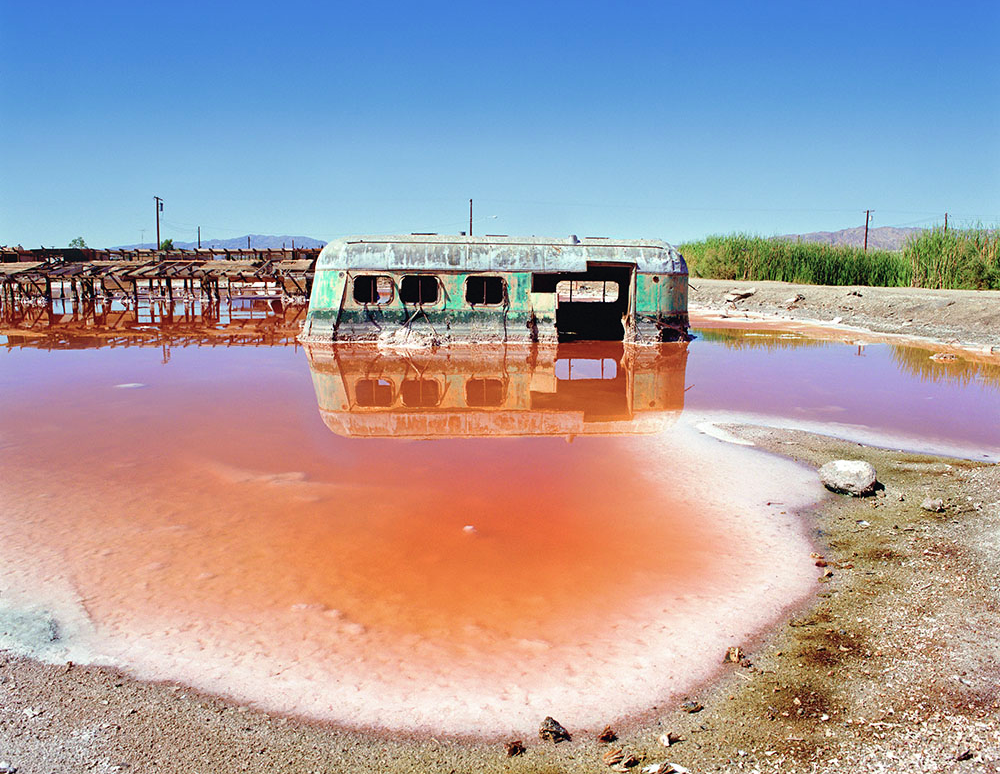
In California, the state with the largest entitlement to Colorado River water, a major sticking point over the last two decades has been the future of the Salton Sea, a huge inland lake that’s shrinking, causing health problems for people and wildlife alike.
“You know what? Sometimes you gotta throw a little rock or two to get people’s attention,” said Tina Shields, water manager for the Imperial Irrigation District — the sprawling expanse of vegetable and hay fields in southern California, and the single largest user of Colorado River water. The district became the lone holdout to the Drought Contingency Plans.
Before they sign onto any future deal, Shields said they want a long-term solution for the ecological disaster playing out in their backyard…
The Las Vegas meeting was also buzzing with grand ideas on how best to fix the Colorado River’s long-standing imbalance — where more water exists on paper then in the river itself.
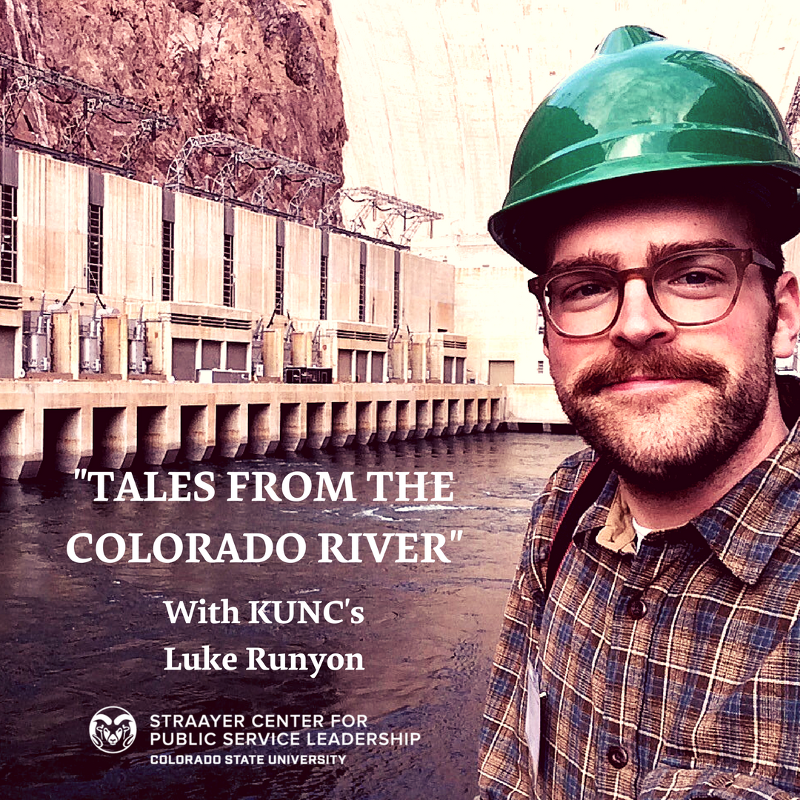
Luke Runyon near Hoover Dam power plan February 2018 via Colorado State University.
KUNC reporter Luke Runyon was in the midst of it all.
“The Drought Contingency Plan is sort of a temporary patch to some of the Colorado River basin’s long-term water scarcity problems,” Runyon explained.
The plan took five years to negotiate and was signed by both upper and lower basin states this year. But the plan looks different depending on which basin a state is in.
The lower basin part of the agreement is based on levels at Lake Mead.
“The plan really lays out a set of tiers of cuts for states when Lake Mead drops. States like Arizona, Nevada, even California would have to take water cut back deliveries to what they receive from the Colorado River,” he said.
For the upper basin states, it wasn’t about cutbacks but about managing use.
“There weren’t any cutbacks spelled out for those states. Instead, they’re focusing on this idea of demand management and what that is kind of code for is basically looking at how, in a crisis, can you ask or force people to reduce how much water they’re using.” Runyon said.
Runyon explained that the real focus is on farmers and how exactly to cut back on irrigation when reservoirs start dropping quickly. States in the upper basin still have to hammer out the details of that part of the plan.
Overall, Runyon said water managers along the Colorado River are pleased with the DCP because it provides an orderly cut back of water use.
“Anytime you’re talking about water cutbacks, people are not going to be happy that they’re receiving less water but when you talk to the water managers what they were really saying is, ‘We’ve created through the DCP a plan where those cutbacks are more orderly, where there’s not as steep of a cliff for water deliveries to fall over,’” he said.
David Bernhardt answers a question about climate change from Luke Runyon, December 13, 2019, Colorado River Water Users Association Annual Conference.
Luke Runyon reports on the Colorado river for KUNC and attended the conference last week.
What are some of the solutions in this drought contingency plan?
It varies by basin. The Colorado River is split into two basins: an upper and a lower. In the lower basin [California, Arizona and Nevada], the drought contingency plan looks like a series of cutbacks to water users. As Lake Mead, which is just outside of Las Vegas, drops due to climate change or drought, those water users will be forced to take some cutbacks to how much water they’re getting.
The upper basin looks a little bit different. One of the more controversial parts of the upper basin drought contingency plan was this concept of “demand management,” where basically the states in the upper basin are trying to figure out how to limit water use on a voluntary basis. That could look like paying farmers not to irrigate for a certain amount of time in order to save some of the reservoirs and boost their levels.
What long-term approaches to water shortages were discussed at the conference?
Attention is turning to these broader guidelines that are set to be renegotiated over the next several years. The current operating guidelines for the river were put into place during 2007 and they expire in 2026, so between now and [then], these Colorado river water managers have to come up with a broader set of guidelines. Determining what is included in those guidelines, how broad or how narrow they are, how conservative they are or how they might include big ideas, that has yet to be determined.
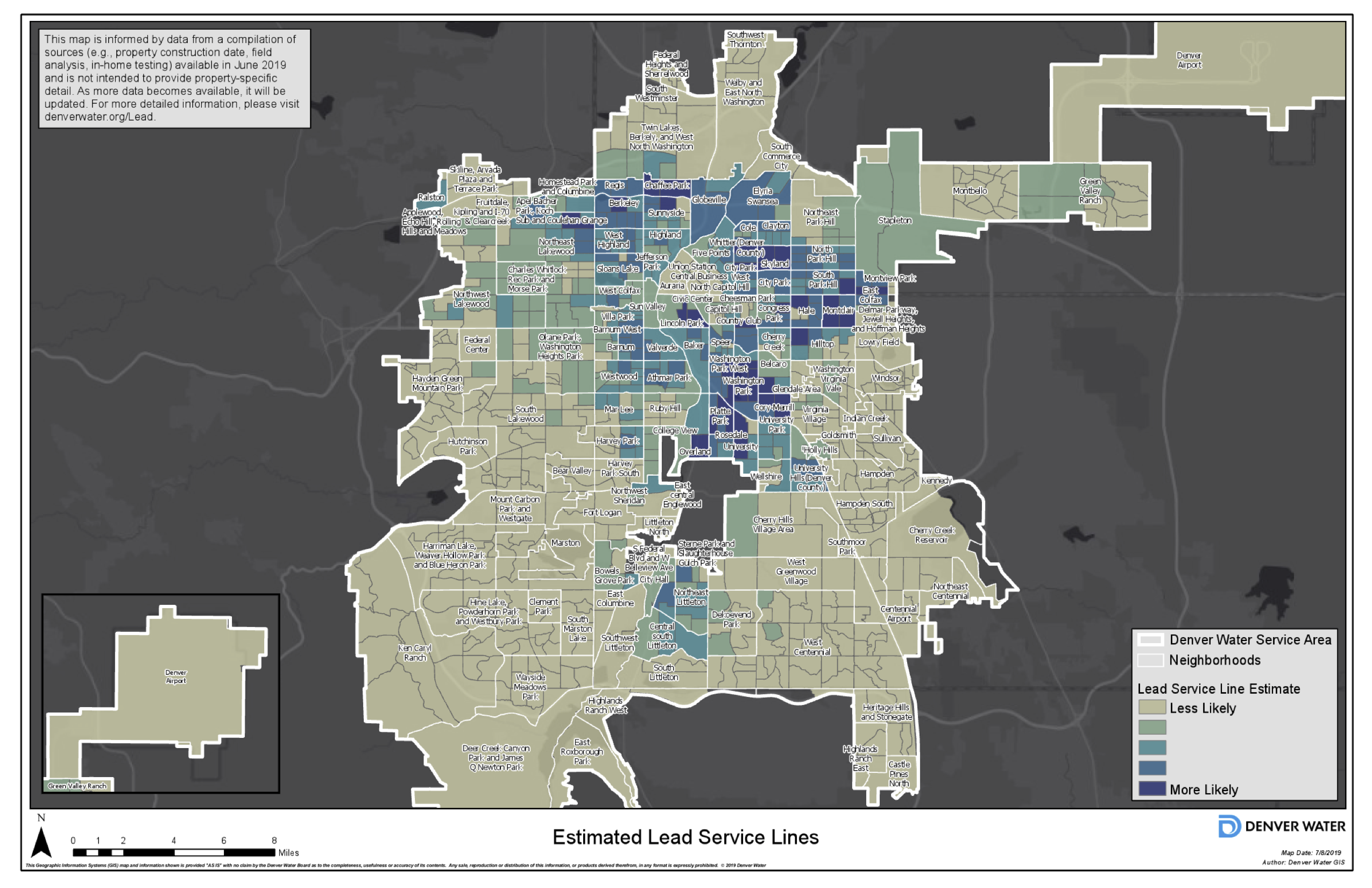
U.S. EPA Region 8 approved a variance under the Safe Drinking Water Act for Denver Water. This variance will allow Denver Water to implement a Lead Reduction Program Plan (LRPP) as an alternative to treating for the corrosion of lead and copper with orthophosphate. EPA believes that Denver’s LRPP will provide health benefits and will be as protective in lowering the lead levels as the requirements under the Lead and Copper Rule. Under the LRPP, Denver will implement a holistic lead management strategy that requires an accelerated lead service line replacement schedule, provides filters to customers, and controls corrosion through pH/alkalinity adjustments. Additionally, Denver Water will develop a comprehensive lead service line inventory and conduct an extensive community outreach campaign. This variance is effective for an initial period of three years and may be extended if Denver Water demonstrates that that LRPP can be effectively implemented and results in reductions to lead in drinking water.
Concurrent with this action, EPA is asking for comments on the potential criteria for how the Agency will determine whether to extend this variance for up to an additional twelve years. EPA is accepting public comments on these criteria and on EPA’s interpretation of the statutory standard for future variance requests. See the Federal Register notice in the docket for specific questions on which EPA is seeking feedback.
Denver Water will expedite the removal of lead pipes from homes across the metro area after the Environmental Protection Agency granted approval Monday.
The public agency will launch the program in 2020 and expects it to take 15 years and cost $500 million to complete. Officials estimate there are between 64,000 and 84,000 lead service lines in the system.
High lead exposure can lead to kidney and brain damage as well as developmental issues for children. Homes built prior to 1951 are more likely to have lead service lines, according to Denver Water…
Denver Water proposed the program to the EPA in July. Without the approved plan, it would take 50 years to remove the lead pipes, Lochhead said.
Denver Water has committed to remove at least 4,500 lines annually under an agreement with the EPA and the Colorado Department of Public Health and Environment.
The idea for the program came soon after the state ordered Denver Water to do orthophosphate treatment in its water supply in March of 2018. The treatments are used to reduce lead and copper in water that’s delivered to peoples’ taps.
“That did not cure the overall cause of the problem, which is the lead service lines,” Lochhead said. “Orthophosphate treatment, being a nutrient, creates water quality and environmental issues in the water supply as well as costing more than simply going in and removing them.”
Denver Water worked with federal and state agencies to develop this alternative approach. It will be funded through water rates, bonds, new service fees and hydropower generation. The company said it will also look for funding through loans, grants and partnerships.
Learn what’s next to develop and implement the Lead Reduction Program and what you should do in the meantime. The post Denver Water gets approval to fast-track removal of lead service lines appeared first on News on TAP.
Climate scientists list most encouraging, most discouraging, developments of 2019. (Part II, to come, on outlook for 2020)
Credit: Tom Toro via Yale Climate Solutions.
Picture it this way just for fun: Three scientists walk into a bar.
They join a few more, early arrivals, and soon after are joined by yet a few more; like them, perhaps, taking a respite from the intensity of consecutive long days of highly technical PowerPoint presentations at an annual year-end mega-conference.
The casual talk soon turns to their views of 2019’s most ENcouraging and most DIScouraging developments in their field. (Part II will explore scientists’ and crystal ball visions of the coming new year’s major developments – hoped-for, feared, or just expected best they can see down the road.)
Actually, of course, that’s not at all how it happened in what follows, not even close. Instead, those quoted below, each invited by the author, responded to an email seeking their views of high and low points of the year just ending, and their outlooks for the year just about to start.
Bright spots in an otherwise dim 2019 climate year
Perhaps not surprisingly, the youth movements – personified by, but not limited to, Swedish teenage activist Greta Thunberg, Time magazine’s 2019 “Person of the Year” – get several mentions, kudos.
Thunberg’s “Fridays for Future” international movement “changed the conversation in useful ways,” said Jeff Severinghaus, PhD, of Scripps Institution of Oceanography, University of California San Diego. “Instead of half-hearted national ambitions, the focus is now on the spectacular failure of today’s adults to solve a problem that will primarily impact the future of today’s children.
“It highlights the moral dimension of the climate problem,” according to Severinghaus, a member of the National Academy of Sciences: “One group harming another by abdication of responsibility is widely considered to be immoral.”
Maureen Raymo, PhD, of Columbia University’s Lamont Doherty Earth Observatory, along with Alan Robock, PhD., of Rutgers University and National Academy of Sciences member Peter H. Gleick, PhD, president-emeritus of the Pacific Institute in Oakland, California, also single out Thunberg and youth activism for praise. Raymo wrote that she is “heartened by the rapidly expanding engagement of youth and young adults in the climate movement. They appreciate that it is their future at stake.”
Going beyond the youths’ activities, Don Wuebbles, PhD, University of Illinois, said he finds particularly encouraging “the new science and technology developments being discussed that may help greatly reduce future greenhouse gas emissions.” He singled out developments in solar energy “in and of itself, and also the potential to use solar energy for high-temperature industrial applications.”
Katharine Hayhoe, PhD, of Texas Tech, said that, looking beyond the U.S., she is very encouraged by real-world, large-scale, system-wide actions that are being taken by countries around the world. For example:
Canada (my home) has a federal price on carbon and re-elected the party that introduced it (as compared to Australia where they were voted out and the carbon tax was flushed down the toilet).
The United Kingdom has (at least temporarily) imposed a moratorium on fracking.
Finland is phasing out coal and it will be banned by 2029.
Norway’s sovereign wealth fund is divesting from companies dedicated to oil and gas exploration.
Ireland became the first country in the world to divest from fossil fuels entirely (they voted on it in 2018 but I am counting it for this year since it takes a while to accomplish!).
New Zealand has committed to being carbon neutral by 2050, and Scotland by 2045. Additionally, nearly 70% of Scotland’s electricity is already green.
Hayhoe said she is encouraged by “the increasing awareness of the climate crisis and its coverage by the media,” and she pointed to youth protests, major IPCC and National Climate Assessment reports, and “the Trump Administration’s rejection of the science and rollback of environmental protections.” She also said public awareness of climate change implications has been driven by “the increasingly severe events we have been experiencing as a result of climate change loading the natural weather dice against us.”
Social scientist and international relations expert David Victor, PhD, of UCSD and Scripps, said he finds satisfaction in 2019 from “the expansion of carbon neutrality goals across more of the U.S. states.” And Andrew Dessler, PhD, of Texas A&M University, pointed to “the continued reduction in the price of renewables” as especially encouraging. “This alone might keep us below the RCP4.5 trajectory,”* Dessler wrote. “That’s good news!”
Finding yet more “good news,” Gleick pointed to “serious efforts by some Democratic presidential candidates to develop real climate plans.”
A flood of bad news from the year now ending
All that is not to put too rosy a picture on a year that also had abundant disappointments on climate change issues.
Turning to that side of the ledger, Wuebbles singled out as “most discouraging” the lack of progress on policy issues by the U.S. “and around the world.” Agreeing, Severinghaus decried “the current U.S. administration’s rollback of dozens of Obama-era positive climate mitigation” initiatives. “And the increasing use of disinformation on many fronts to weaken our democracy, and push the U.S. toward becoming a petroleum autocracy like Russia or Saudi Arabia.”
Lack of federal action in the U.S. is “obviously” a major disappointment in looking at 2019, according to Dessler. “A close second is the continued hollowing-out of the U.S. federal government’s ability to use science to make decisions.” He said he fears many senior federal scientists are being driven to leave civil service and added: “This will make it easier for politicians to make decisions that go against science and satisfy narrow constituencies rather than society as a whole. … Don’t expect things to snap back to the way they were before Trump.”
Those losses of federal scientific expertise come just as “new science is pointing to climate change actually being an even larger issue than we already thought,” according to Wuebbles. He pointed in particular to “more significant severe weather issues and higher climate sensitivity in new models suggesting longer-term impacts.”
‘So many depressing scientific studies’
“There ARE no encouraging advances in climate science in my opinion,” said Hayhoe. “just more bad news, punctuated by the occasional not-so-bad news.”
“It is truly hard to choose among so many depressing new scientific studies, so I would say in general: the trend towards recognizing that, increasingly and in many (but not all) ways, the scientific consensus has under-estimated the rate, magnitude, and/or extent of climate impacts on both human systems and the natural environment,” Hayhoe said. “This is not new – we’ve been seeing this for a number of years already – but there were a number of studies this year that continued to reinforce this discouraging trend.”
“Also discouraging,” she said, “is the fact that our carbon emissions continue to rise, globally, despite so many efforts that are being made to reduce them.”
Victor characterized as discouraging the U.S.’s formal notice of withdrawal from the 2015 Paris Climate Agreement. But he cautioned that “it is easy to overstate that” because he expects the U.S. will rejoin “when Trump is gone.”
An enduring concern, Victor said, is that “actions on Paris undermine U.S. credibility, and the damage from that will be lasting – as they will from our actions in Syria and many other places.”
In addition, Victor cautioned that “the ongoing (often petty) expansion of the trade war with China will amplify the damage to the U.S.-China relationship. That relationship is fraught with challenges that go far beyond the Trump administration, but it is impossible to get serious about climate without a serious engagement with China.”
Katharine Hayhoe’s concerns that our fears ‘could doom us’
What is it that makes Hayhoe “profoundly discouraged” right now? Hayhoe, seen as one of the nation’s most effective climate science communicators, spelled it out this way:
“I am profoundly discouraged by how quickly this [increased popular awareness of climate change] turns into fear, and fear turns into judgment, and judgment turns into circling the wagons and attacking each other.
“Climate fear is turning into a new religion (because what is religion other than a set of behavioral rules we obey because we believe they will make us right in our own eyes, and perhaps those of others and/or a god?) with a brand-new set of 10 commandments: Thou shalt not eat meat or animal products, thou shalt not fly, thou shalt not use any mechanized transportation, thou shalt not have a child – that we then use to persecute any we perceive to be heretics with the zeal of the Spanish Inquisition.
“If there is any trend I am most discouraged by this past year, it is this. I used to fear that apathy could doom us – now, I fear that it is our fear that will.”
*Editor’s note: RCP4.5 is an IPCC scenario in which average global surface temperatures would rise about 3 degrees C (about 4.8 degrees F) by 2100.
Tom Toro is a cartoonist and writer who has published more than 200 cartoons in The New Yorker since 2010.
From the Water Education Foundation (Gary Pitzer):
WESTERN WATER IN-DEPTH: WITH TALKS LOOMING ON A NEW OPERATING AGREEMENT FOR THE RIVER, A DEBATE HAS EMERGED OVER THE BEST APPROACH TO ADDRESS ITS CHALLENGES
Some Colorado River water users in 2020 will begin taking voluntary reductions to protect the water elevation level at Lake Mead. (Source: Bureau of Reclamation)
The Colorado River is arguably one of the hardest working rivers on the planet, supplying water to 40 million people and a large agricultural economy in the West. But it’s under duress from two decades of drought and decisions made about its management will have exceptional ramifications for the future, especially as impacts from climate change are felt.
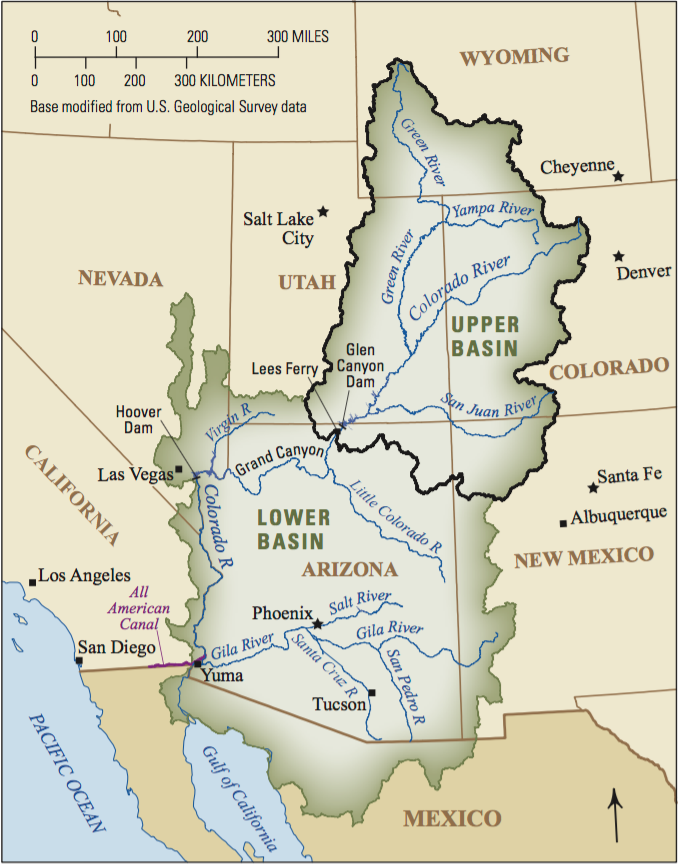
The issues facing water users are many, complex and span the entirety of the 1,450-mile river and its tributaries. The Colorado is overallocated, meaning more water is committed to water users as a whole than is available in an average year. Adding more pressure, the Upper Basin states of Colorado, Utah, Wyoming and New Mexico want to develop their full allocations. American Indian tribes, meanwhile, are asserting their rights to more of the river’s waters.
Amid these challenges, and with critical negotiations looming for an agreement that will chart how the river is operated and managed possibly for decades, a debate is emerging: Should stakeholders pursue a visionary “grand bargain” to wrap their arms around the host of challenges facing the Colorado River? Or is an incremental approach – solving the puzzle piece by piece instead of the whole puzzle at once — the best path toward getting disparate stakeholders to reach a consensus?
Colorado River Basin. Map credit: The Water Education Foundation
The stakes are high. Parties with an interest in the river will renegotiate the 2007 Interim Guidelines for shortage sharing and river operations that expire in 2026. The landmark 2007 deal spelled out Lower Basin shortage guidelines and rules to store conserved water in Lake Mead and equalize storage in both Mead and Lake Powell. Those issues have become even more critical as a two-decade drought and a structural deficit continue to drop the level in Lake Mead.
The debate surfaced anew in September at the Water Education Foundation’s Colorado River Symposium in Santa Fe, N.M. Panelists representing major stakeholders across the basin repeatedly invoked the idea of an incremental vs. a visionary approach as key interests prepare for those guideline negotiations, expected to begin in late 2020.
David Palumbo, the Bureau of Reclamation’s deputy commissioner, challenged the notion of a dividing line between incrementalism and grand visionary, suggesting to symposium participants that the two can coexist and are not mutually exclusive.
“Incrementalism is not small,” he said. “It is visionary and … maybe … we can purge our vernacular from this idea of incrementalism, at least the connotation that it’s small, that it’s not visionary.”
In a region that has seen its share of big projects and prolonged drought, some have said the time is right to take unprecedented problem-solving steps such as reopening the terms of the Colorado River Compact, the landmark 1922 document that divided the river into two basins and apportioned its waters.
Obstacles and Challenges
Since the Compact was signed in 1922 and then ratified by Congress in 1928, Colorado River water users have successfully navigated obstacles by a variety of means. Those include landmark deals for shortage sharing and voluntary use reductions to help protect Lake Mead’s water level and keep it from reaching dead pool – the point at which no water could pass Hoover Dam for downstream water users. Set to expire in 2026, the current operating guidelines for water deliveries and shortage sharing are designed to prevent disputes that could provoke conflict.
There is a sense among some that a big plan is needed for 2026 and beyond.
“We need to be more creative in our work and I think incrementalism should be thrown out of the dictionary and we should all become visionary,” Ted Kowalski, senior program officer with the Walton Family Foundation, said at the symposium. He formerly served as chief of the Interstate, Federal and Water Information Section of the Colorado Water Conservation Board.
Kowalski does not advocate reopening the Compact but believes creativity is needed in all aspects of the river’s operating agreements to support a vision that reconnects it with the Sea of Cortez, such as what occurred through a U.S.-Mexico agreement in 2014.
Reclamation Commissioner Brenda Burman supports collaboration and cooperation between Basins within the confines of the Compact. (Source: Water Education Foundation)
Advocates of incrementalism say it makes sense to maintain the course of collaboration and cooperation, staying within the existing framework of the Law of the River – the all-encompassing term that describes the compacts, federal laws, court decisions and decrees, and contracts and regulatory guidelines that oversee the use and management of the river among the seven basin states and Mexico.
Bureau of Reclamation Commissioner Brenda Burman is no fan of reopening the Colorado River Compact to forge a grand bargain.
“I see all these challenges on the river, but I don’t see a clear or a better outcome for this Basin by assuming that all of these challenges could be easily addressed if we were simply to rip up our founding document, the Compact, and start over,” she said at the symposium.
Former Interior Secretary and Arizona Gov. Bruce Babbitt echoed that sentiment, saying at the symposium that it’s not the time to begin a big negotiation about the Compact prior to 2026.
“I’m not a Compact modifier because every time I read that I say, ‘Man, if you can’t find your way to a consensus past that document, you better go back to school, because there’s all kinds of possibilities out there of reconciling these differences rather than stacking them up and sending out our respective advocates to build anticipatory cases,” he said.
Big River, Big Vision
Much of the discussion about Colorado River water use involves semantics. Can the many agreements enacted through years be categorized as incremental progress or evidence of a grander vision? Or is that characterization even the right way to view all the actions that have built dams and aqueducts, solidified water sharing agreements and provided for environmental needs.
Long-time policy participants say the scale and scope of what’s occurred in the past century has not been done piecemeal.
“The Colorado River Compact was not incremental,” Jim Lochhead, chief executive officer and manager of Denver Water, said at the symposium. “It was based on a huge idea of a major dam on the river and the All-American Canal. And it was premised on a lot of structural development in the Upper Basin.”
Bruce Babbitt, former secretary of the Interior and Arizona governor, said modifying the Colorado River Compact is not necessary for long-lasting solutions. (Source: Water Education Foundation)
On the flip side, he said, there have been environmental actions — the Endangered Species Act, Clean Water Act, Wilderness Act and the National Environmental Policy Act — that created a legacy of stewardship and balance on the river.
Babbitt said stakeholders can be locked into a narrow focus on the river and their relationship with it.
“All of us have tended for these vision discussions to be compartmentalized into sort of Lower Basin/Upper Basin, as if there’s kind of a virtual curtain across the basin line in which our best efforts at vision tend to look into our basin,” he said.
Major players “need to be out there in this basin, working the vision not via a negotiation, but by some real outreach to talk about the future,” Babbitt said.
One possible element of a bold, visionary approach that has been talked about would remove the Lower Basin’s legal right to “call” for water during dry times that was established by the Compact. Under the Compact, the Upper Basin cannot cause flow of the river at Lee Ferry to be depleted below an aggregate of 75 million acre-feet for any period of 10 consecutive years.
According to a November white paper called “The Risk of Curtailment Under the Colorado River Compact,” a debate has swirled since the drafting of the Compact as to whether this imposes a delivery obligation on the Upper Basin states, or merely a requirement that those states not deplete the flows of the river beyond that amount. That debate has intensified as projections of a drying basin have raised concerns that the water won’t be there to meet the obligation to the Lower Basin.
“A delivery obligation (as opposed to a non-depletion obligation) would mean the Upper Basin must absorb any climate change reductions to the flows in the Colorado River … even if that requires curtailing existing uses,” says the paper, written by Anne Castle, senior fellow with the Getches-Wilkinson Center at the University of Colorado Law School, and John Fleck, director of the University of New Mexico’s Water Resources Program.
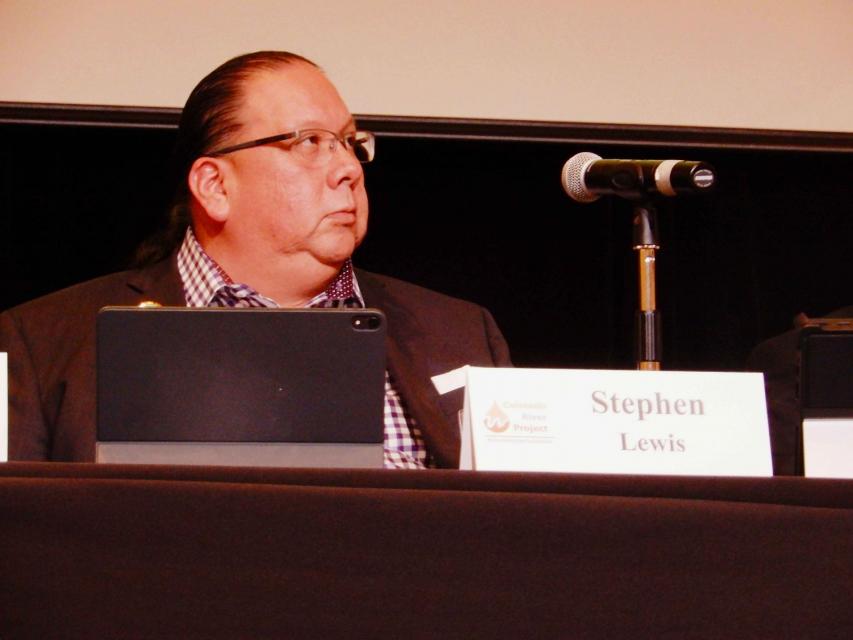
Gila River Indian Community (GRIC) Gov. Stephen Roe Lewis advocates early engagement of tribes in the decision-making process. (Source: Water Education Foundation)
Meanwhile, American Indian tribes in the Colorado River Basin want access to water allocations that are rightfully theirs, but which have not been developed. Combined, tribes have rights to more water than some states in the Basin. That means inclusion, collaboration and cooperation are crucial.
“What I’m advocating for is that the Basin states engage with tribes early on and incorporate them into the decision-making process,” Gov. Stephen Roe Lewis of the Gila River Indian Community said at the symposium. “Especially if tribes can bring something meaningful and innovative to the table to help address the difficult challenges we all face in managing our water resources.”
Looking Ahead to 2026
Because the task of creating a revised framework for the operation of the Colorado River in 2026 is so monumental, leadership from key players is critical, said Michael Cohen, senior researcher with the Pacific Institute, a water think tank that promotes sustainable water policy.
Through the years, Colorado River water users have deployed several tools to hone water use accounting and conducted mutually beneficial interstate sharing agreements, actions that were previously unheard of and far from incremental in nature, he said.
“There’s been significant changes in the river to date, and we like to call them incremental, and that’s how they’re framed,” Cohen said. “But what we’ve seen is dramatic change.”
The 2007 Interim Guidelines to better coordinate the operations of Lake Powell and Lake Mead are an example of the dramatic change that’s enabled users to prevent Lake Mead dropping to levels that crash the system. Forged from long-standing water accounting issues between the Upper and the Lower Basins, including the obligation to meet water deliveries to Mexico, the imbroglio resulted in then-Interior Secretary Gale Norton essentially strong-arming the Basin states to get together and resolve their disputes.
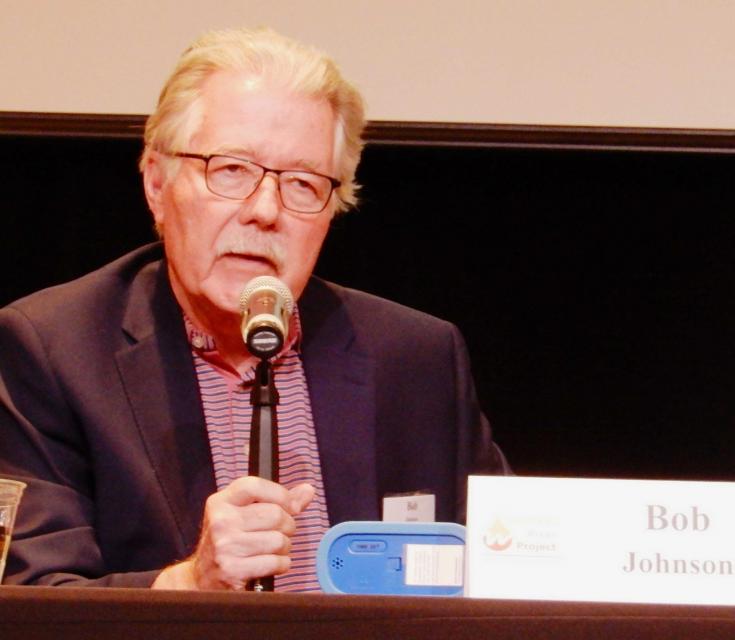
Former Reclamation Commissioner Robert Johnson said at the symposium that Norton warned stakeholders that if they didn’t solve the problem, she would.
“She was basically throwing down the gauntlet, an approach that Bruce Babbitt took frequently when he was secretary,” Johnson said. “That was the start of the 2007 guidelines, and true to form, the Basin states came through. They went far beyond just defining on an interim period. I’m sure that the disagreement over the legal aspects of the delivery to Mexico is still there, but the interim guidelines solved that problem for 20 years by putting operational procedures in place.”
Chuck Cullom, manager of Colorado River programs with the Central Arizona Project, said programs such as the 2007 guidelines, compensated conservation programs and voluntary use reductions demonstrate what can happen within the existing framework of laws and regulations to achieve resiliency.
There is a “false choice” between visionary focus and incrementalism, he said, adding that he describes it as incremental transformation. That transformation is evident in interstate and intrastate agreements in which people invested their time and resources to take concepts from development to implementation.
“It is not possible to understand all of the intended and unintended costs of an incremental transformation without testing it first,” Cullom said. “Metropolitan Water District took that concept in the early 90s to demonstrate that water could be saved in Lake Mead by investing with Palo Verde Irrigation District. There was no clear accounting framework to make all that happen, but they created a pathway for intentionally created surplus to be something that we’re all using on the river today.”
Incremental Progress
The challenges facing Colorado River water users are varied and complicated. The decline of water levels in Lake Mead spurred Basin states to sign on to a Drought Contingency Plan in May after more than five years of discussion. Yet Imperial Irrigation District, the river’s largest water rights holder, walked away from the agreement because it failed to address air and water quality issues of a shrinking Salton Sea.
Robert Johnson served as commissioner of the Bureau of Reclamation between 2006 and 2009. (Source: Water Education Foundation)
If the past is a reliable indicator, the answers going forward will build on the legacy of cooperation and innovation while steering away from precedent-setting action.
“There’s lots of increments that have gotten us to where we are today,” Palumbo with Reclamation said. “And those are visionary actions that were taken. They were visionary at the time and as we reflect on them, they’re visionary today.”
Water providers are “too humble” in describing the collective efforts taken to brace against the conditions caused by drought and an overallocated system, Cullom said. “We talk about increments,” he said. “We need to say these are visionary. The system conservation project (in which agricultural users were compensated for conserving water) is a visionary thing instead of an incremental approach to protecting Lake Mead.”
Reclamation Commissioner Burman said she believes there is much left to be done to solidify river management between the Upper and Lower basins.
“I don’t think we’re even close to being done with innovation and flexibility,” she said. “We have tools we haven’t invented yet and we have so much still to learn and do and cooperate and collaborate on this river.”
Does that mean renegotiating the Colorado River Compact is off the table?
“If you merely asked should we reopen the Compact, perhaps everyone can imagine that outcome would be better for their interest group, but I really question how could it be simultaneously better for all of our interest groups?” Burman said. “Looking for a panacea in that Compact renegotiation is just the wrong investment of time and talent.”
Castle with the University of Colorado Law School said the time is now for communities to bolster themselves against a future supply shock through varying responses, including clarifying shortage sharing rules and setting up voluntary, compensated water conservation programs.
“We think that any of those discussions need to be based on an objective risk assessment that could lead to either incremental or more radical approaches to Colorado River management,” she said in an email, referring to herself and Fleck, her research paper coauthor.
Castle, who served as assistant secretary for water and science at the Department of the Interior in the Obama administration, believes there is a false dichotomy between the incremental and visionary characterization of river management.
“I suggest that the best way to proceed is to have an articulated visionary goal with specific incremental steps to get there,” she wrote. “The vision is needed to guide choices along the way, but it’s not either desirable or realistic to suddenly make big changes in operations on the river, precipitously undermining investments and reliance on the previous status quo.”
Scientists warn that a drying climate means Colorado River flows could diminish substantially in the next 50 years. The prospect of steep declines in flows adds a sense of urgency because of the potential impacts to the environment, cities and agriculture.
Looking downstream at the Colorado River from Glen Canyon Dam tailrace. (Source: Bureau of Reclamation)
“This river can turn on a dime, and we need to be prepared for it as a Basin,” said Lochhead, with Denver Water. “If we take too incremental of an approach, we could be caught short. We need to be aspirational in terms of what we think we can achieve and reach for that and get as far as we can in this next set of negotiations.”
Kowalski, with the Walton Family Foundation, urged stakeholders to be innovative and not be afraid to act.
“We need to remember the river in all of this,” he said. “It’s critically important to take care of the river as well as your service requirements. I want to challenge you … as we’re looking at the renegotiations, how do we do that and not just have it be for the benefit of the system but for the benefit of the river that sustains us all?”
Reach Gary Pitzer: gpitzer@watereducation.org, Twitter: @gary_wef
Know someone else who wants to stay connected with water in the West? Encourage them to sign up for Western Water, and follow us on Facebook and Twitter.
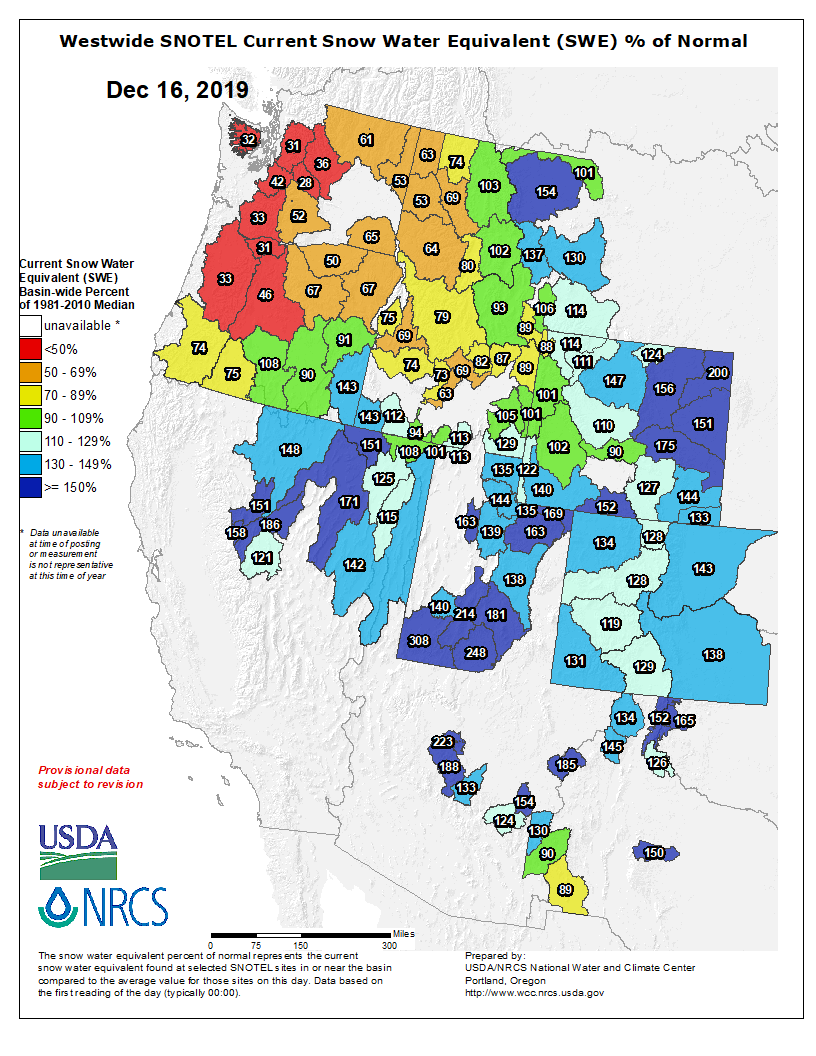
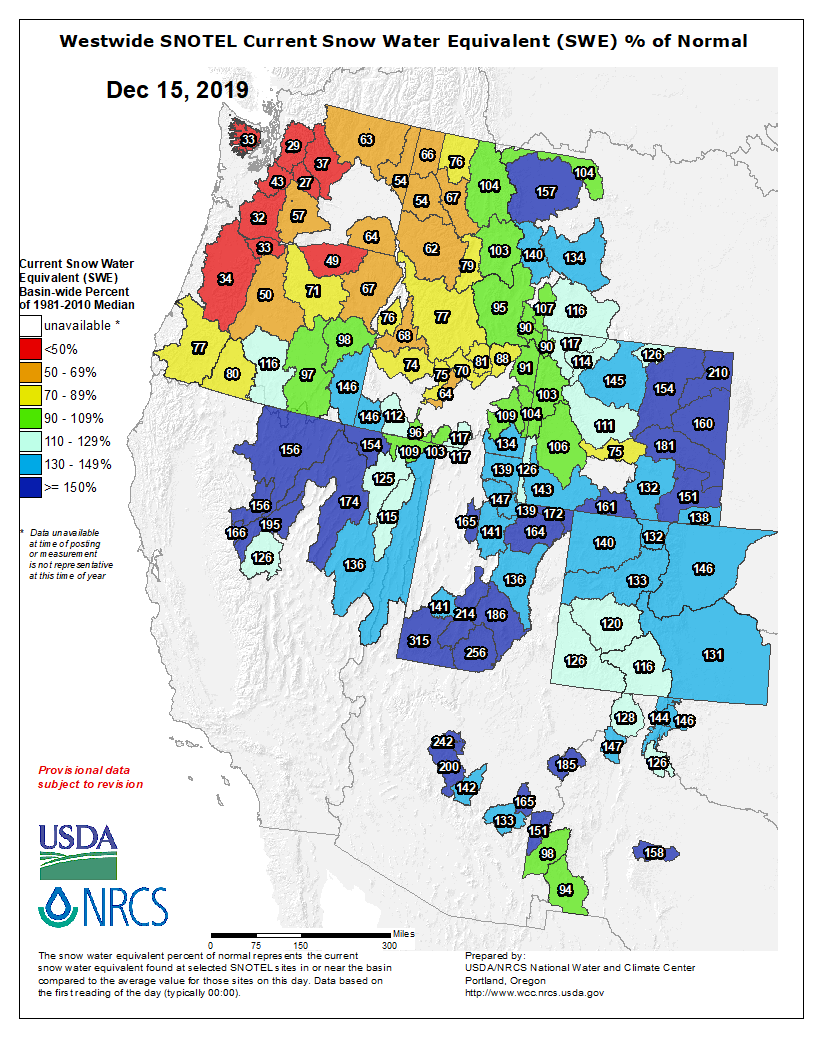
Westwide SNOTEL basin-filled map December 15, 2019 via the NRCS.
FromThe Grand Junction Daily Sentinel (Dennis Webb):
Statewide, snowpack was at 122% of median statewide Friday, according to the Natural Resources Conservation Service. Mother Nature has been consistently generous around the state, with snowpack levels ranging from 109% of median in the Gunnison River Basin to 128% in the South Platte Basin.
The Colorado and Upper Rio Grande river basins were both at 114% of median Friday; the Arkansas River Basin, 115%; the Yampa/White basins, 127%; and river basins in southwest Colorado, 121%…
Aldis Strautins, a hydrologist for the National Weather Service in Grand Junction, is happy to see the current snowfall levels, although he cautioned that numbers can jump around quite a bit this time of year thanks to just a couple of storms, or a lack thereof…
The early snow is helpful to the ski industry in ensuring resorts can open in a timely fashion. As of Wednesday, Colorado Ski Country USA was reporting that 19 of its 23 member ski areas had opened. At least one more member, Powderhorn Mountain Resort, opened Friday, with all its lifts operating and 60% of its terrain open.
Strautins said Friday that on Grand Mesa, the Mesa Lakes measurement site was recording snowpack at 100% of normal, with 4.7 inches of snow-water-equivalent, the amount of water contained in the snow. Elsewhere on Grand Mesa, Overland Reservoir was around 78-80% of normal.What the NRCS calls the Park Reservoir measurement site, at what’s also known as Trickle Park Reservoir, was at 97% of normal…
The Colorado Climate Center reported this week that even with decent snow lately, precipitation in the Gunnison River Basin was at 77% for the current water year, which started Oct. 1.
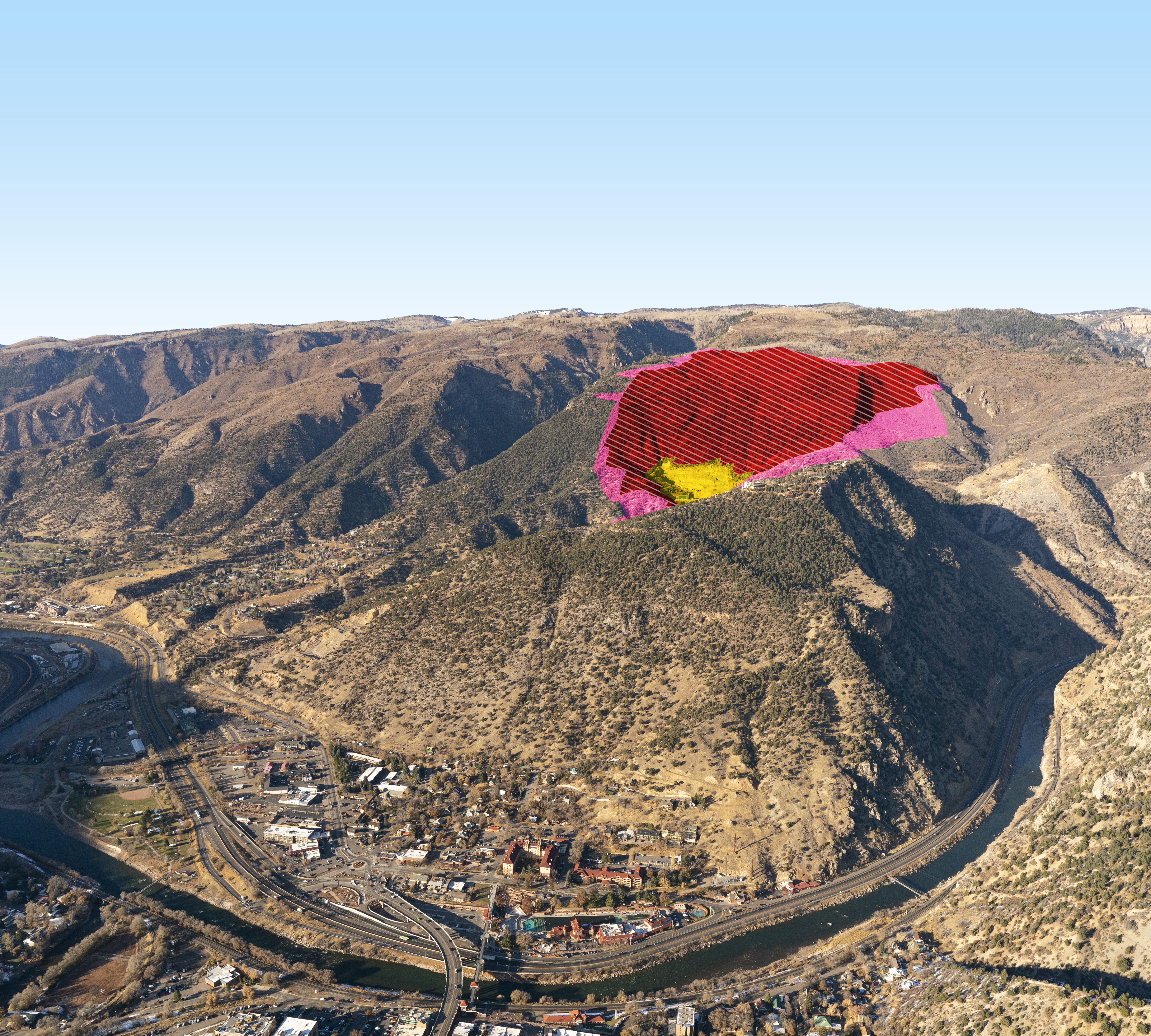
The proposed expansion of the Mid-Contintent Limestone Quarry above Glenwood Springs by the politically connected Rocky Mountain Resources has spurred the city to create a taxpayer funded campaign against the plan. The mine’s existing footprint of roughly 16 acres is in yellow and the proposed expansion is in red. Photo credit: City of Glenwood Springs via The Colorado Sun
FromThe Associated Press via TheDenverChannel.com:
The federal Bureau of Land Management plans to conduct an environmental assessment of test drilling proposed by the owner of a Colorado limestone quarry seeking to expand the operation, officials said.
Rocky Mountain Resources Industrials Inc. sought an environmental review exemption for five test wells, The Colorado Sun reported .
The company needs to perform the test drilling to assess the viability of expanding its Mid-Continent Limestone Quarry near Glenwood Springs, officials said.
The company will be required to pay for the environmental study that the agency will use to examine the potential impacts to the region’s water resources, bureau officials said.
The country’s top federal water manager said it was not time to renegotiate rules for managing water among the seven states and two countries that share the river. The current guidelines for the Colorado River are governed by a 2007 agreement that expires in 2026.
First, the U.S. Bureau of Reclamation, which operates a series of dams and reservoirs in the watershed, will conduct a review of how the current rules have worked and report back by the end of next year. That review will encompass input from the states, tribes and other water users. After the review is complete, negotiations for a new set of guidelines are set to begin in 2021.
“This is an important, foundational task,” said Brenda Burman, who leads the agency.
But the history of the Colorado River is a history of ongoing deliberation within a legal framework that has traditionally overestimated how much water the river could deliver to farms, cities and businesses from Wyoming to Mexico. Agreements tend to be complex. Although five years might seem like enough time to hammer out a deal, water users expect reaching a deal to be a difficult task.
“It’s going to be a much more complex set of agreements that we’ve done on the river,” said Bill Hasencamp, who oversees Colorado River resources for the Metropolitan Water District of Southern California.
Even though the negotiations won’t start for at least another year, top water managers were already laying the foundations for future talks last week, or at least identifying the questions that are likely to come into play. How do you prepare for the uncertainty of climate change on a river that is already strained? How do you share risk in a fair way? Who gets to be at the table?
[…[
‘Most water secure area’
Of the seven states that share the Colorado River, Nevada has the smallest share. At the same time, Las Vegas gets 90 percent of its drinking water from the river.
In recent years, the Southern Nevada Water Authority has spent hundreds of millions of dollars on new infrastructure to ensure that it can access water from Lake Mead, even if the man-made reservoir behind Hoover Dam ever fell so low that other states couldn’t access their supplies. With increased conservation and turf removal, the water authority has also decreased how much total water it removes from the reservoir each year. It consumes less than 80 percent of its total share.
“Between our physical security and our [conservation efforts], I really do feel that we’re the most water secure area in the Colorado River Basin,” water authority General Manager John Entsminger said during an interview at the conference…
Who’s at the table?
In 2007, the 29 federally recognized tribes in the Colorado River Basin were largely left out of the negotiations of the guidelines. But several speakers, including Burman, stressed the importance of tribal participation moving ahead.
Together, tribes are entitled to a share of water equal to about one fifth of the Colorado River, with many of their claims unresolved. Their water rights tend to be the most senior and protected from shortages. Tribal leaders say that it is all the more reason that they should be part of long-term river planning negotiations.
“Somebody used the word certainty,” Daryl Vigil, a member of the Jicarilla Apache Nation in New Mexico, said during a panel discussion on Thursday. “If you don’t include tribes in the conversation, given the nature of the volume of water rights that they have, how is that we start to create certainty if there is a big piece of the puzzle missing in terms of water rights in the basin?”
He said the track record is that states have not protected tribal rights in negotiations. Not including tribes now, he said, would be “irresponsible.”
“We have a long way to go,” he said…
Climate rhetoric and reality
In addition addressing equity issues in the upcoming negotiations, water managers will be tasked with a new challenge looming over the river: how to prepare for climate change. Warming temperatures and more evaporative demand are expected to decrease river streamflow. River flows could decline by about 20 percent in the middle of the century, according to climate scientists.
During a panel, Entsminger stressed the importance of being prepared for that.
“Success is knowing in advance objectively what everyone’s pain is going to be,” he said, when asked how to prepare for a climate change scenario of low river flows…
Other water managers who were representing Arizona, California and Colorado stressed the importance of addressing climate change, acknowledging a need to use less water. But their direct rhetoric contrasted with the rhetoric from federal officials who spoke at the conference. When one reporter asked about human-caused climate change, federal officials gave non-answers.
Despite that, Fleck said “Reclamation is taking climate change seriously.”
Given the administration’s position (President Trump is withdrawing the U.S. from the Paris Accords), he said that “they use their language with care.”
In an interview with reporters, Interior Secretary David Bernhardt said the climate was changing, but his rhetoric about how it fit into the calculus was restrained.
“I certainly believe the climate is changing,” he said. “I spend a lot of time with our scientists and I spend a lot of time with our models. Scientists tell me the best thing we can do is make sure we use multiple models and multiple ranges within each model.”
He added that scientists say it is the most “speculative” part of forecasting.
Although the negotiations heading into 2026 will encompass more issues, some water managers cautioned against biting off too much at once.
Ted Cooke, who manages the Central Arizona Project, a canal that runs that delivers water to Tucson and Phoenix, said that the guidelines should not be viewed as the only opportunity to revisit how the Colorado River is managed.
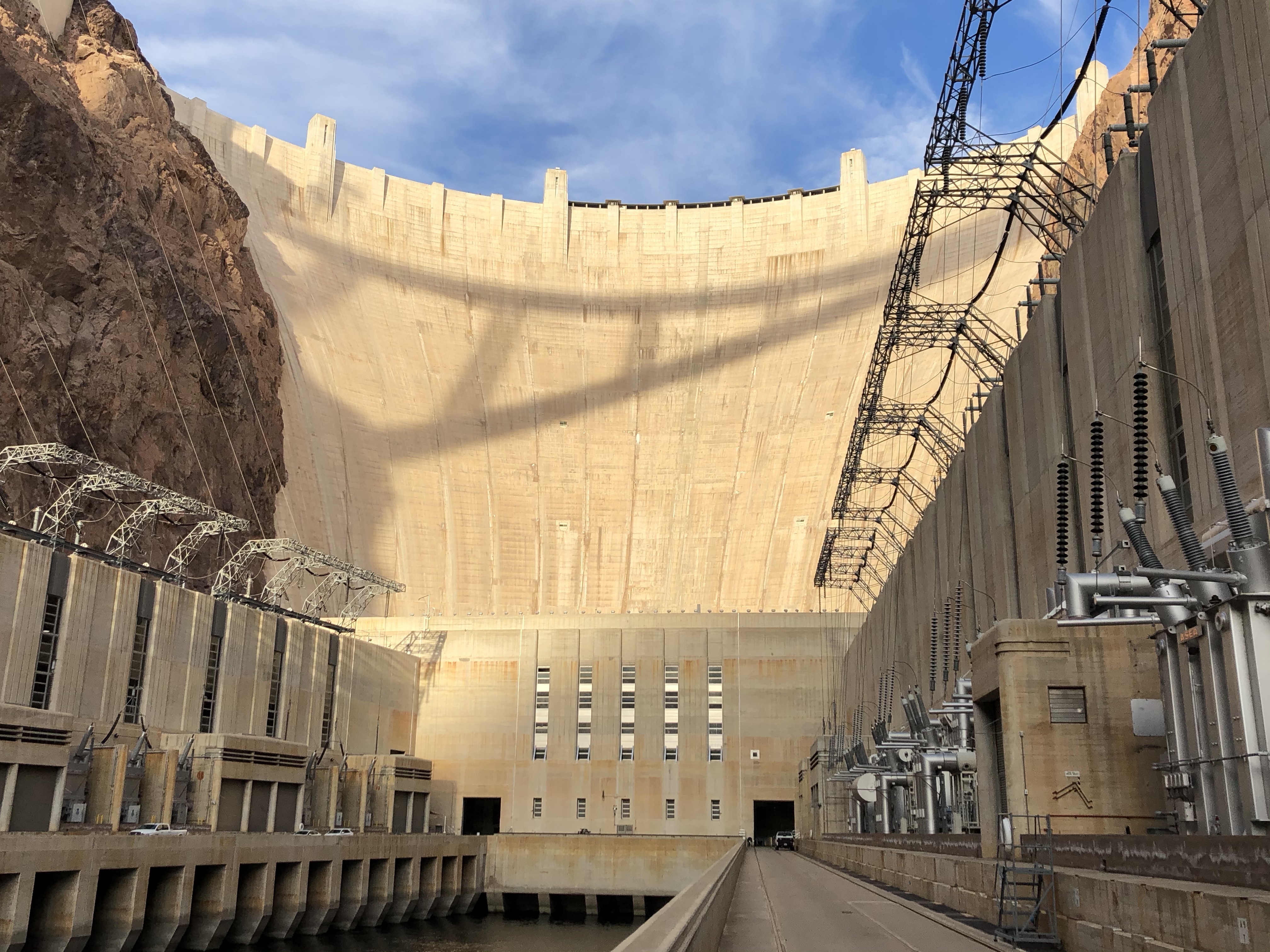
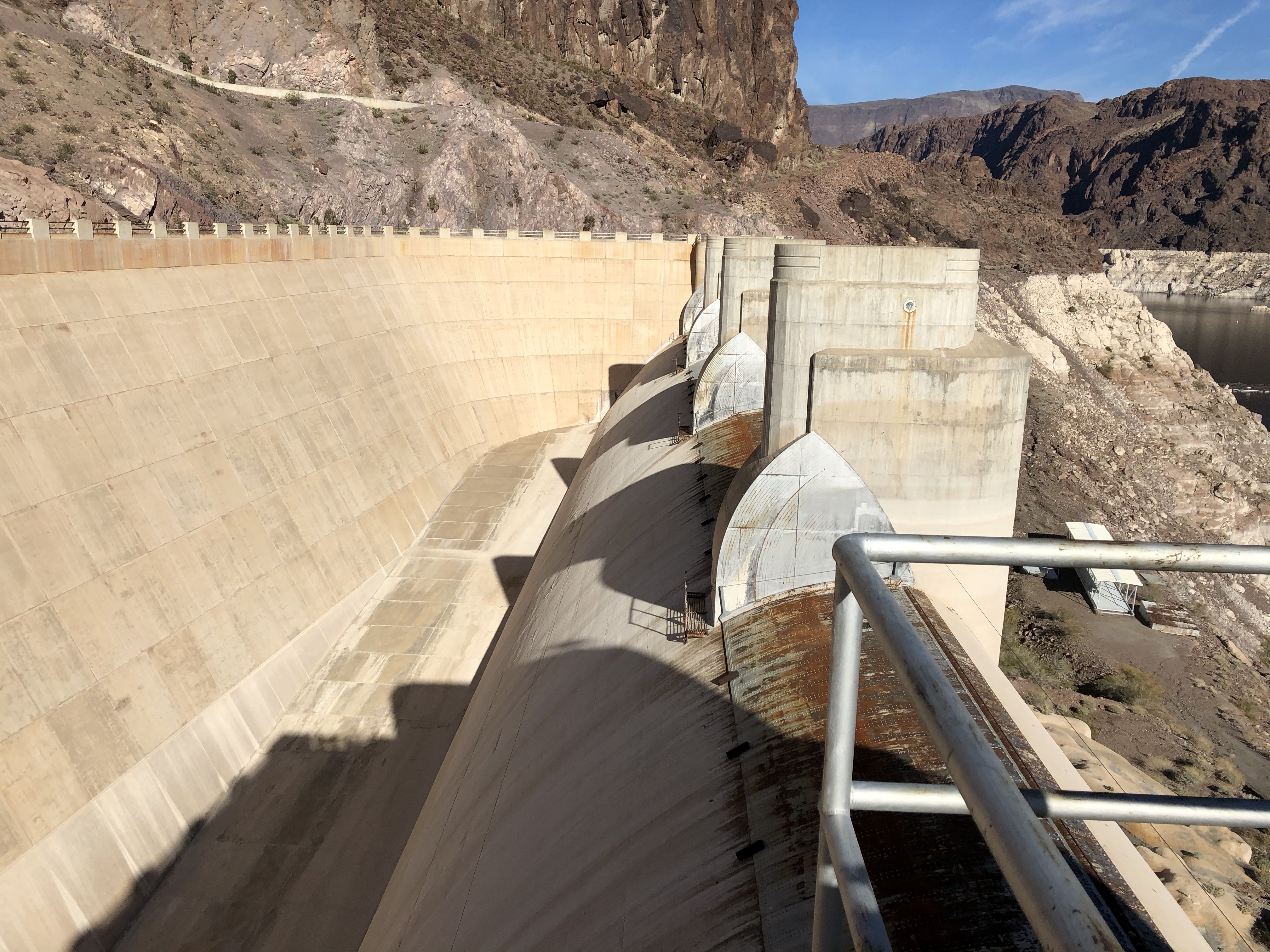
Coyote Gulch was lucky enough to get a tour of Hoover Dam on December 14, 2019. Thanks so much to the Bureau of Reclamation folks for arranging the tour. Here’s a photo gallery.
Hoover Dam from the Arizona Powerhouse deck December 13, 2019. As John Fleck said in a Tweet, “Friends who have the keys showed us around this afternoon.” Thanks USBR.
One of Lake Mead’s spillways the last time water lapped at the top of the spillway was 1999.
Face of Hoover Dam from the access highway.
Emergency spillway which utilizes the bypass tunnel from construction. Biggest spill came in 1983 when water was ~5′ above the raised gate.
Downslope to the bypass tunnel.
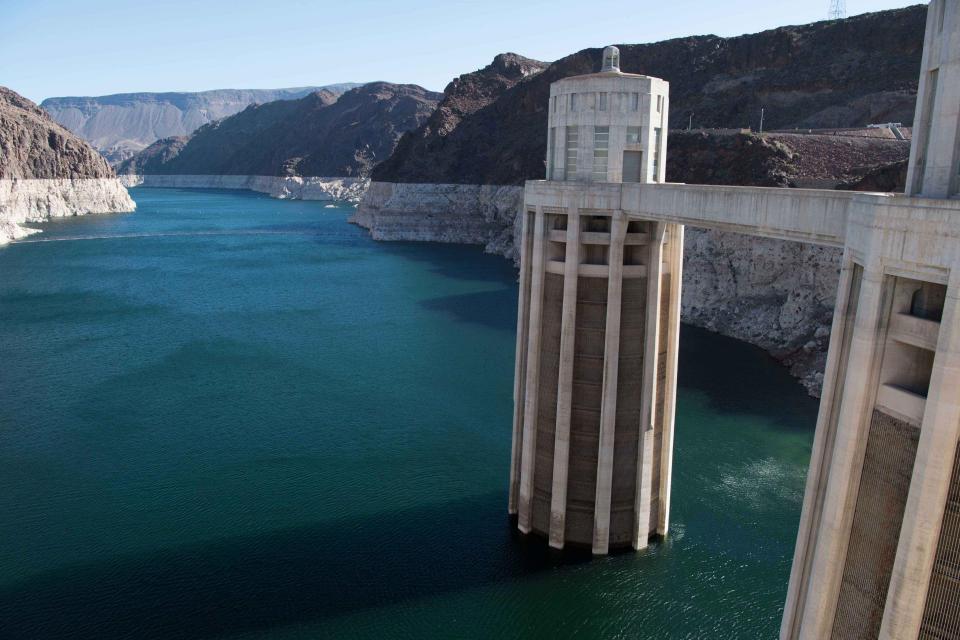
Intake towers for power generation at Hoover Dam December 13, 2019.
Looking down from the top of Hoover Dam.
Face of Hoover Dam looking towards Arizona.
Looking down on the power plants from the top of Hoover Dam.
Access tunnel inside Hoover Dam. Mark Cook, our host, on the right.
The Hoover Dam Arizona power plant turbines.
Beautiful tile work at the Arizona power plant in Hoover Dam. Elements of Native American art and industrial influences.
Operation of the Colorado River’s second largest reservoir, Lake Powell in southern Utah and northern Arizona, will be a major piece of negotiations on the river set to start next December. Hoover Dam from the deck of the Arizona power plant December 13, 2019.
Coyote Gulch on the Arizona power plant deck in a borrowed hard hat.
Looking downstream from the base of Hoover Dam. Concrete structure in the center of the photo is the outlet for the Nevada side emergency spillway.
Looking across the Colorado River at the Nevada side from the Arizona side.
Transformers and deck on the Arizona side.
Looking up at the cable system used to drop large vehicles and equipment that cannot be moved in using the access road.
3-phase(?) circuit breaker for the Arizona powerhouse.
Coyote Gulch in a borrowed hard hat on the deck of the Arizona powerhouse at Hoover Dam on December 13. 2019.
View towards the base of Hoover Dam. The rail system is used to move large equipment.
Highway bridge from the base of Hoover Dam.
Terminus of the access road at Hoover Dam.
Arizona/Nevada border marker at the base of Hoover Dam.
Tower with sculptures of the purpose of Hoover Dam. I love the navigation purpose. Elevator to the interior of the dam is located here.
Hoover Dam schematic via the Bureau of Reclamation.
Interior Secretary David Bernhardt said he asked the Bureau of Reclamation to start the review at the beginning of 2020, rather than by the end of 2020, which is the deadline under the existing agreement.
The bureau’s officials will examine how the 2007 guidelines have worked as the agency prepares for negotiations among the seven states on a new set of rules that will take effect after 2026.
“It makes sense to review how well something worked before determining its replacement,” Bernhardt said Friday during a speech at a Colorado River conference in Las Vegas. “We think that starting now and not waiting until the deadline a year from now makes sense.”
[…]
David Bernhardt answers a question about climate change from Luke Runyon, December 13, 2019, Colorado River Water Users Association Annual Conference.
Climate change, energy development
He didn’t mention the words climate change during his speech at the conference. But during a press conference afterward, reporters asked Bernhardt about the role of climate change.
“I certainly believe the climate is changing,” Bernhardt said. “I spend a lot of time with our scientists, and I spend a lot of time with our models. And you know, what the scientists tell me is that the best thing we can do is make sure that if we’re using a model, we use multiple models and multiple ranges within each model. And so that’s what I’ve insisted on when we’re looking forward to the future.”
In projecting the river’s flows into the future, he said, “we absolutely follow best practices all the time.”
President Donald Trump’s administration has begun pulling out of the landmark Paris climate agreement, and has promoted oil and gas drilling.
In California, the Trump administration is moving forward with a plan that could open up about 1.2 million acres to new oil and gas drilling. When asked about environmental groups’ opposition to the plan, Bernhardt said: “We have really strong policy guidance and laws that say that we’re supposed to develop energy, and we will develop energy responsibly.”
Before joining the Trump administration, Bernhardt worked as a lobbyist for the oil and gas industry in the West.
“The president was very clear when he ran for office on his position on energy. He’s for an all-of-the-above approach,” Bernhardt said. He pointed out that oil development on federal lands has generated revenues in New Mexico for schools and other state programs.
“And so, when people tell me that they want to stop oil and gas development on federal lands, I say call the governor of New Mexico,” Bernhardt said.
A ‘disconnect’ in Trump policies
John Fleck, director of the University of New Mexico’s Water Resources Program, said Bernhardt’s comments reflect a dichotomy within the federal government in which officials are taking steps on climate adaptation but not on combating planet-warming emissions.
On the one hand, water managers at the Bureau of Reclamation are working with scientists and using climate models to assess risks and project the river flows into the future, Fleck said.
“They’re absolutely taking climate change seriously. It’s built into the modeling work they’re doing,” Fleck said. “You don’t find water managers doubting the reality of human-caused climate change and its effects. They’re seeing it in the flow in their systems, and they’re dealing with it.”
On the other hand, he said, there is a “disconnect” in that the Trump administration isn’t taking steps to reduce greenhouse gas emissions.
“So that increases our risk,” Fleck said. “That’s a problem because we need to reduce greenhouse gases to mitigate the effects on the Colorado River.”
One of Lake Mead’s spillways the last time water lapped at the top of the spillway was 1999.
Bernhardt said the government’s review will focus on “what’s worked, what’s not worked.” He said that will include looking at lessons as the water cutbacks kick in next year under the drought deal.
Bernhardt said while the Colorado River Basin faces growing challenges, he is optimistic that parties across the region will continue working together to solve problems.
“We have a legacy here of states cooperating in a way that is absolutely incredible,” he said.
Hoover Dam from the Arizona Powerhouse deck December 13, 2019. As John Fleck said in a Tweet, “Friends who have the keys showed us around this afternoon.” Thanks USBR.
Here’s a report from Andrew Davey writing for Nevada Today. Click through and read the whole article, here’s an excerpt:
Around this time last year, Commissioner Brenda Burman delivered this ultimatum to CRWUA attendees: “Close isn’t done, and we are not done. Only done will protect this basin.” This year, as in just yesterday, Burman said, “It was truly remarkable to have the divergent interests of the basin forge a compromise and make the difficult agreements to complete the DCP.”
And unlike last year, when Burman urged officials from across the Colorado River Basin to finish the DCP already, this year she urged patience on matters like renegotiating the 2007 agreement that turned Lake Mead into a sort of regional water bank. On that, Burman declared, “It’s not yet time to take up that task.”
Yet despite Burman’s more relaxed approach, some at CRWUA want to see more “fierce urgency of now”. While the DCP successfully fended off the threat of federal water rations, and while Upper Colorado River Basin snowpack is currently running 15% above average, ongoing legal concerns and the ever escalating threat of climate change may yet upend the delicate peace that the DCP has ushered in for now…
While Burman voiced confidence in the states’, municipal water agencies’, and Native American tribal authorities’ ability to cooperate, some of these very local officials were voicing notes of warning and caution. Shortly after Burman’s presentation on the main stage, Southern Nevada Water Authority (SNWA) Director of Water Resources Colby Pellegrino noted their use of data from the U.S. Geological Survey and UNLV’s Center for Business and Economic Research (CBER) showing less Colorado River water for everyone to work with in the next 50 years.
As Pellegrino described this challenge, “It’s a pretty severe stress test for our water resource portfolio.” Pellegrino then noted how SNWA and the larger community have already been rising to this challenge with conservation programs like outdoor watering schedules and turf removal. As Pellegrino put it, “There’s significant water savings to be achieved by changing the mindset of how we use it.”
Later in the day, I caught up with Pellegrino to talk some more about her presentation and the challenges that lie ahead for her agency and the entire region. When asked how SNWA plans to handle those future challenges, she replied, “Conservation is still right here, under our noses, the quickest and most cost effective way.”
[Friday], it was Interior Secretary David Bernhardt’s turn to make news here in Nevada. And make news he did, as Bernhardt announced the federal government will launch an early start of its review of the 2007 Interim Guidelines (as in, the 2007 agreement that launched the ICS program to manage the Lower Basin’s water supply).
Soon after his main floor presentation, Bernhardt spoke with reporters about this and other pressing water issues. On his announcement to jump-start review of the Interim Guidelines, Bernhardt said, “We have an opportunity right now. We have the people in place. We might as well build on the success we have here.”
So what can we expect in this review? And for that matter, what kinds of future changes might we expect in federal oversight of the Colorado River? When I asked Bernhardt whether he’d take into account climate science and the changing needs and consumption patterns of the increasingly urban American Southwest, he replied, “I’ve never taken a position of what we need to tell a city or county what they need to do.”
Yet as Bernhardt’s discussion with reporters continued, the conversation occasionally veered into other environmental matters. And when a couple reporters asked about the proposed oil and gas leases on public lands that have run into local opposition, including right here in Nevada, in the Ruby Mountains outside Elko and in parts of Lincoln County that supply drinking water for Mesquite, Bernhardt declared, “The president was clear when he ran for office what his policy is on energy. He supports an ‘all of the above’ approach.” Bernhardt also suggested these leases are required by federal statute, even though the Obama administration took a more cautious and targeted approach toward such fossil fuel extraction on public lands…
Funny enough, one of my takeaways from my conversation with SNWA’s Colby Pellegrino on Thursday was that regardless of what becomes of the long-fought pipeline plan, SNWA has enough water available to keep the Las Vegas region going for the next 50 years. Also, I noticed that regardless of the Trump administration’s curious comments on climate change and “all of the above” approaches to water infrastructure and fossil fuels, SNWA officials recognize the clear and present danger of climate change, and they’re already acting on it.
And it may not just be SNWA doing this. Even as Trump appointees are skirting around acknowledgement of climate science, fossil fuel pollution, ongoing regional tensions, or the reality of urban and suburban growth in the Colorado River Basin, federal civil servants continue to collect data, analyze trends, and manage the water we all share. We’ll talk more about that next week.
Still, there’s a rather large gap between the rhetoric and overarching policies of the Trump administration and the promises of strong climate action that U.S. Senators Elizabeth Warren (D-Massachusetts) and Bernie Sanders (I-Vermont), former Vice President Joe Biden, and the other 2020 Democratic presidential candidates are providing. And yet, we don’t hear as much about the Colorado River and our fragile water supply as you’d expect considering their environmental and geopolitical importance. Yet no matter how much we ignore it, all we have to do is glimpse at Lake Mead to remember how important it truly is to our very livelihood.
U.S. Bureau of Reclamation Commissioner Brenda Burman told federal, state and local water managers that abiding by the promises they made will be crucial to ensuring that more painful cuts aren’t required…
“We need to be proud of what we’ve done,” Burman told hundreds at the annual Colorado River Water Users Association conference at a Las Vegas Strip resort, while also warning of “tougher challenges in the future.”
Arizona, Nevada and Mexico will start taking less water from the river Jan. 1 under a drought contingency agreement signed in May. It followed lengthy negotiations and multiple warnings from Burman that if the seven states didn’t reach a deal, the federal government, which controls the levers on the river, could impose severe water restrictions.
California would voluntarily cut water deliveries if reservoir levels keep falling at the river’s largest reservoir, Lake Mead…
Cuts will most affect farmers in Arizona. The Central Arizona Project will stop storage and replenishment operations and cut water for agricultural use by about 15%. The agency gets more than half of Arizona’s entitlement of water from the Colorado River…
The drought contingency plan is a voluntary agreement to use less water than users are allowed, and its success is measured at the surface level of Lake Mead, behind Hoover Dam east of Las Vegas.
The agreements are designed to prevent a more drastic drought-shortage declaration under a 2007 pact that would cut 11.4 percent of Arizona’s usual river water allocation and reduce Nevada’s share by 4.3 percent. That amount of water, combined, would serve more than 625,000 homes.
California would reduce its Colorado River use by about 6 percent.
Due to a relatively wet winter, Lake Mead is now 40% full and Lake Powell, an upstream reservoir, is at 53% capacity, Bureau of Reclamation spokeswoman Patricia Aaron said. A year ago, Lake Powell was 43% full, and Lake Mead was at 38%…
Water managers have called the last 20 dry years a drought, but climate researchers warn the river will continue to carry less water in coming years.
“Respected climate scientists have conservatively estimated declines in river flows of 20% by the middle of the 21st century and 35% by the end of the century,” researchers Anne Castle of the University of Colorado Law School and John Fleck of the University of New Mexico wrote in a study released in November.
The report refers to a “structural deficit” under which states and Mexico are promised more water than the river usually carries and encourages the seven states to clarify rules for handling future shortages.
Brad Udall: “…latest version of my 4-Panel plot thru Water Year (Oct-Sep) of 2019 of the #coriver big reservoirs, natural flows, precipitation, and temperature. Data goes back or 1906 (or 1935 for reservoirs.) This updates previous work with @GreatLakesPeck
Places where the forecast odds favor a much drier than usual winter (brown colors) or much wetter than usual winter (blue-green), or where the probability of a dry winter, a wet winter, or a near-normal winter are all equal (white). The darker the color, the stronger the chance of that outcome (not the bigger the departure from average). NOAA Climate.gov map, based on data from NOAA CPC. Seasonal precipitation outlook through February 29, 2020 via CPC.
Places where the forecast odds favor a much colder than usual winter (blue colors) or much warmer than usual winter (red), or where the probability of a cold winter, a warm winter, or a near-normal winter are all equal (white). The darker the color, the stronger the chance of that outcome (not the bigger the departure from average). NOAA Climate.gov map, based on data from NOAA CPC. Seasonal temperature outlook through February 29, 2020 via CPC.
Seasonal drought outlook through February 29, 2020 via CPC.
The most recent seasonal forecast from federal forecasters at the National Weather Service’s Climate Prediction Center shows much of the Colorado River watershed with equal chances for either above or below average precipitation from December through February. Northern portions of the basin are slightly favored to see precipitation above average, while its southern reaches are projected to see below average. Winter temperatures are set to be higher than average.
The winter bellwethers of El Niño and La Niña are absent this season. The large-scale climatic condition where longterm weather patterns are determined by the Pacific Ocean’s temperatures are in neutral conditions, making already uncertain seasonal predictions for the Colorado River watershed even moreso…
The early season spikes in snowpack totals are promising — the river’s Upper Basin is currently at 125% of average — but those who watch it closely are only cautiously optimistic…
Westwide SNOTEL basin-filled map December 12, 2019 via the NRCS.
But while it’s important to keep an eye on year-to-year snowpack to get a sense of what short-term impacts might be, University of Colorado-Boulder and Western Water Assessment researcher Jeff Lukas says you also need to look at the watershed as a whole.
“Any one year does not set the whole system into either crisis or into recovery,” Lukas said.
Whatever happens this winter — high snow, low snow or somewhere in between — he says it won’t cause the Colorado River’s biggest reservoirs to rise or fall in any dramatic way. That takes back-to-back years of extreme highs or lows. The two largest reservoirs — Lakes Powell and Mead — are both so large and managed in such a structured way that only consecutive years of extremes cause large system-wide changes.
“There’s no good that comes from a low runoff year like 2018,” Lukas said. “But it’s not the end of the world, especially if you’re lucky enough to have that followed with a high runoff year like we had in 2019.”
And if 2020 brings another high snowpack year, that doesn’t mean the Colorado River is out of crisis mode. It just means we’ve kicked the can down the road because over the long term, climate change is diminishing snowpack across the West, Lukas said.
Take a glimpse at the more than 1,000 employees who worked to deliver you water in 2019. The post Faces of your water system appeared first on News on TAP.
Photographs reveal history, passion and dedication of Gross Reservoir’s first caretaker. The post Family shares gift of a lifetime appeared first on News on TAP.
According to the National Weather Service, the “inland intrusion of an atmospheric river” is making landfall in parts of California and Oregon, expected to impact upcoming weather in Colorado’s mountains and high-altitude areas of the western slope. Starting late Thursday and continuing through Sunday morning, up to two feet of snow could fall in the northern and central mountains. Snowfall is currently forecasted to hit later in the San Juans, likely dropping flakes in the 12 to 18 inch range in this region.
Click on a thumbnail graphic to view a gallery of drought data from the US Drought Monitor.
US Drought Monitor December 10, 2019.
West Drought Monitor December 10, 2019.
Colorado Drought Monitor December 10, 2019.
Click here to go to the US Drought Monitor website. Here’s an excerpt:
This Week’s Drought Summary
The U.S. Drought Monitor week saw another round of winter storms, bringing snow to the mountainous areas of the West, northern Plains, upper Midwest, and Northeast while lower elevations of the West and parts of the South, Southeast, lower Midwest, and Mid-Atlantic regions saw rain. This week’s precipitation in the Southwest left many areas with accumulations that exceeded 300 percent of normal over the past 14-day period, leading to continued improvements in short-term dryness. Once again, precipitation in the Northwest was below normal. Many locations have received less than 25 percent of normal over the last 14 days, resulting in the expansion of abnormally dry conditions. Meanwhile, another dry week in the Southern Plains and below-normal rainfall in the South and Southeast led to expansions in pockets of abnormal dryness and drought…
Last week’s weather brought continued dryness to the abnormally dry and drought areas of south-central Nebraska, Kansas and eastern Colorado. In Kansas, where moisture deficits have been present for more than three months, abnormal dryness (D0), moderate drought (D1), and severe drought (D2) were expanded to reflect the increasing dryness and its impact on winter wheat. The map was unchanged this week for the remainder of the region…
Another week of above-normal rainfall and mountain snow led to continued improvements in the Southwest. In California and Nevada, rainfall over the last three weeks has helped to make up for the slow start to the water year, resulting in the removal of the abnormal dryness (D0) depiction across most of the state. Pockets of D0 remain in areas that missed the heaviest precipitation or where station data indicate below-normal snow. In the Four Corners states, the map depiction strives to balance the effect of the recent precipitation with the failure of the monsoon. Changes include a broad 1-category improvement across southern and western Arizona, western Utah, and western New Mexico. The heavy black line separating drought impact designations was expanded to delineate areas that are experiencing both short- (less than 6 months) and long-term (greater than 6 months) deficits. For example, the designation across southern and western Arizona is “L”, indicating that deficits are only present at longer time scales and in indicators such groundwater and root zone soil moisture, whereas the designation in eastern Colorado is “S”, indicating more seasonal deficits and impacts to indicators such as surface soil moisture and streamflow…
The South once again saw a mixture of degradations and improvements. Improvements were limited to central Texas, where last week’s rainfall, in excess of 300 percent of normal, resulted in a general one-category improvement. Meanwhile, the eastern and southern parts of the state continued to dry out with expansions to areas of abnormal dryness (D0) and moderate (D1) and severe (D2) drought. The heavy black line separating drought impact designations was shifted eastward in south Texas to reflect that this area is also experiencing dryness at longer (more than 6 months) time scales. Eastern Oklahoma also saw degradations with an expansion of D0 as dryness, extending back to September, continued. This dryness comes at a vital time in winter crop cycles, and a continued lack of moisture may cause impacts later. Other degradations include the expansion of D0 and/or D1 in southwest Arkansas, Louisiana, and southwest Mississippi…
Looking Ahead
The National Weather Service Weather Prediction Center forecast for the remainder of the week calls for moderate to heavy mountain snows extending from the Pacific Northwest to the north-central Great Basin and Rockies. Meanwhile, parts of the northern High Plains, Upper Mississippi Valley, and upper Great Lakes are expected to see snow. As this storm moves eastward over the weekend, the Southeast, Tennessee Valley, and Mid-Atlantic will see rain, while mixed precipitation is expected in the Northeast. Dry conditions are expected in the Southwest, Southern Plains, and lower Mississippi River Basin.
Moving into next week, the Climate Prediction Center 6 to 10 day outlook (valid December 16-20) favors above-normal temperatures for the central and northern coast of California; parts of the Pacific Northwest, Southwest, and Central Plains regions; and the Florida Peninsula. Areas with increased chances for below-normal temperatures include parts of the Ohio and Tennessee Valleys and the Northeast region. Precipitation is likely to be above normal over the Pacific Northwest, parts of northern California, and from the Southern Plains, across the Southeast, and into the Mid-Atlantic region.
EL NIÑO/SOUTHERN OSCILLATION (ENSO) DIAGNOSTIC DISCUSSION issued by CLIMATE PREDICTION CENTER/NCEP/NWS and the International Research Institute for Climate and Society 12 December 2019 ENSO Alert System Status: Not Active
Synopsis: ENSO-neutral is favored during the Northern Hemisphere winter 2019-20 (70% chance), continuing through spring 2020 (~65% chance).
Above-average sea surface temperatures (SSTs) were observed in the central tropical Pacific Ocean during November, with regions of above and below average SSTs observed farther east. In the most recent week, the SST indices were near average in the east-central and eastern Niño regions (+0.1°C to +0.3°C) and were above average in the westernmost Niño-4 region (+0.9°C). The equatorial subsurface temperature anomalies (averaged across 180°-100°W) returned to near zero during the month, reflecting the progression of Kelvin waves to the east. The low-level winds were near average during November, while easterly upper-level wind anomalies were observed over the western Pacific. Finally, tropical convection was suppressed near and east of the Date Line and also over Indonesia, and somewhat enhanced over the western Pacific northeast of Papua New Guinea. The overall oceanic and atmospheric system was consistent with ENSO-neutral.
The majority of models in the IRI/CPC plume continue to favor ENSO-neutral (Niño-3.4 index between -0.5°C and +0.5°C) through the Northern Hemisphere summer. Many dynamical model forecasts suggest Niño-3.4 SST index values may remain near +0.5°C into December before decreasing toward zero. Forecasters agree with this consensus and believe the chances for El Niño to be 25-30% during the winter and spring. In summary, ENSO-neutral is favored during the Northern Hemisphere winter 2019-20 (70% chance), continuing through spring 2020 (~65% chance; click CPC/IRI consensus forecast for the chance of each outcome for each 3-month period).
FromTime Magazine (Charlotte Alter, Suyin Haynes and Hustin Worland):
Greta Thunberg sits in silence in the cabin of the boat that will take her across the Atlantic Ocean. Inside, there’s a cow skull hanging on the wall, a faded globe, a child’s yellow raincoat. Outside, it’s a tempest: rain pelts the boat, ice coats the decks, and the sea batters the vessel that will take this slight girl, her father and a few companions from Virginia to Portugal. For a moment, it’s as if Thunberg were the eye of a hurricane, a pool of resolve at the center of swirling chaos. In here, she speaks quietly. Out there, the entire natural world seems to amplify her small voice, screaming along with her.
“We can’t just continue living as if there was no tomorrow, because there is a tomorrow,” she says, tugging on the sleeve of her blue sweatshirt. “That is all we are saying.”
It’s a simple truth, delivered by a teenage girl in a fateful moment…
Denver School Strike for Climate, September 20, 2019.
The politics of climate action are as entrenched and complex as the phenomenon itself, and Thunberg has no magic solution. But she has succeeded in creating a global attitudinal shift, transforming millions of vague, middle-of-the-night anxieties into a worldwide movement calling for urgent change. She has offered a moral clarion call to those who are willing to act, and hurled shame on those who are not. She has persuaded leaders, from mayors to Presidents, to make commitments where they had previously fumbled: after she spoke to Parliament and demonstrated with the British environmental group Extinction Rebellion, the U.K. passed a law requiring that the country eliminate its carbon footprint. She has focused the world’s attention on environmental injustices that young indigenous activists have been protesting for years. Because of her, hundreds of thousands of teenage “Gretas,” from Lebanon to Liberia, have skipped school to lead their peers in climate strikes around the world…
Thunberg is 16 but looks 12. She usually wears her light brown hair pulled into two braids, parted in the middle. She has Asperger’s syndrome, which means she doesn’t operate on the same emotional register as many of the people she meets. She dislikes crowds; ignores small talk; and speaks in direct, uncomplicated sentences. She cannot be flattered or distracted. She is not impressed by other people’s celebrity, nor does she seem to have interest in her own growing fame. But these very qualities have helped make her a global sensation. Where others smile to cut the tension, Thunberg is withering. Where others speak the language of hope, Thunberg repeats the unassailable science: Oceans will rise. Cities will flood. Millions of people will suffer…
Thunberg is not a leader of any political party or advocacy group. She is neither the first to sound the alarm about the climate crisis nor the most qualified to fix it. She is not a scientist or a politician. She has no access to traditional levers of influence: she’s not a billionaire or a princess, a pop star or even an adult. She is an ordinary teenage girl who, in summoning the courage to speak truth to power, became the icon of a generation. By clarifying an abstract danger with piercing outrage, Thunberg became the most compelling voice on the most important issue facing the planet.
Back Row Left to Right: James Eklund (CO), John D’Antonio (NM), Pat Tyrell (WY), Eric Melis (UT), Tom Buschatzke (AZ), Peter Nelson (CA), John Entsminger (NV), Front Row: Brenda Burman (US), and from DOI – Assistant Secretary of Water and Science Tim Petty. Photo credit: Colorado River Water Users Association
Arizona, Nevada and Mexico will start taking less water from the Colorado River in January as a hard-fought set of agreements kicks in to reduce the risk of reservoirs falling to critically low levels.
The two U.S. states agreed to leave a portion of their water allotments in Lake Mead under a deal with California called the Lower Basin Drought Contingency Plan, or DCP, which the states’ representatives signed at Hoover Dam in May.
California agreed to contribute water at a lower trigger point if reservoir levels continue to fall. And Mexico agreed under a separate accord to take steps to help prop up Lake Mead, the nation’s largest reservoir near Las Vegas, which now sits 40% full after a nearly 20-year run of mostly dry years.
The agreements, including another deal in the river’s Upper Basin, increase the odds of Western states making it through the next seven years without reservoir levels crashing. But researchers examining the latest climate projections have also warned of the possibility that declines in the river’s flow could force water curtailments in the coming years, and they’ve suggested looking at options to reduce risks.
For the first time since signing the drought contingency deals, representatives of seven states will meet this week at a conference in Las Vegas to talk over their next steps in managing the Colorado River…
Arizona will see a cut of 192,000 acre-feet in water deliveries next year, or 6.9% of its total allotment of 2.8 million acre-feet. Nevada’s share will be reduced by 8,000 acre-feet, while Mexico’s will take 41,000 acre-feet less.
That water will remain in Lake Mead, and will only be recovered in future years once the reservoir rises above an elevation of 1,100 feet. Its level now stands about 15 feet below that threshold.
The cuts under the deal represent 12% of the total water supply for the Central Arizona Project, which delivers water by canal to Phoenix, Tucson and other areas. The agency that manages the canal has said the cuts will reduce deliveries for agriculture by about 15% and eliminate water that would have been available for storing underground and replenishing groundwater at facilities along the CAP Canal…
According to Bureau of Reclamation figures, Arizona and California together conserved 316,000 acre-feet in 2018, and are on track to conserve an estimated 685,800 acre-feet in 2019. Burman said voluntary conservation efforts by the states have helped, and the drought contingency plan has incentivized more conservation…
Arizona’s plan for managing the water cutbacks involves deliveries of “mitigation” water to help lessen the blow for some farmers and other entities, as well as compensation payments for those that contribute water. The payments will be covered with more than $100 million from the state and the Central Arizona Water Conservation District.
Gila River watershed. Graphic credit: Wikimedia
Much of the money will go toward paying for water from the Colorado River Indian Tribes and the Gila River Indian Community…
In one study, climate scientists Brad Udall and Jonathan Overpeck used climate models to estimate a business-as-usual scenario of greenhouse gas emissions. They projected that without changes in precipitation, warming will likely cause the Colorado River’s flow to decrease by 35% or more by the end of the century…
In a new report, water researchers Anne Castle and John Fleck warn that the Colorado River’s water supply could decline so much in the next decade that the ability of the four Upper Basin states “to meet their legal obligations to downstream users in Nevada, Arizona, California, and Mexico would be in grave jeopardy.”
Castle and Fleck examined the latest science on projected flows and analyzed the legal framework governing the Colorado River…
Patti Aaron, a spokesperson for the Bureau of Reclamation, responded to the researchers’ findings.
“We applaud a continued focus on the Colorado River, particularly regarding the risks we all are facing going forward,” Aaron said in an email. “We have a solid history in this Basin of finding solutions to complex problems by working together in an open and collaborative way. Reports of this nature help us stay on that path.”
[…]
California signed on to the deal, but the state’s Imperial Irrigation District balked at participating.
Imperial holds the single largest share of Colorado River water, which flows to farms producing crops such as alfalfa, broccoli and Brussels sprouts. Imperial’s officials have called for the state and federal governments to urgently address a worsening environmental crisis at the Salton Sea, which is shrinking and exposing dry lake bed that sends dust blowing into surrounding communities.
The sea has been shrinking more rapidly under a 2003 deal that is transferring water from the Imperial Valley to growing urban areas in San Diego County and the Coachella Valley.
In October, the Imperial Irrigation District’s board members voted unanimously to declare an emergency at the Salton Sea, pressing for California officials to break through years of wrangling and red tape to get working on dust-control and habitat projects along the retreating shores.
Last month, the IID board adopted a resolution laying out parameters for IID’s involvement in future Colorado River negotiations. They said in the resolution that “the linkage between the Colorado River and the Salton Sea is inextricable.”
[…]
Burman, who is scheduled to speak, said the drought contingency plan has laid a foundation that will help the states and other parties work through their next steps.
“Our history on the Colorado River is making improvements and incremental progress as we go,” Burman said. “It’s important that we’re out there talking about the challenges. It’s important that we’re out there talking about possible solutions.”
Brad Evans loves to stir up shit. The founder of the Denver Cruisers Ride and a 2018 candidate for the RTD board is also the prime mover for Denver FUGLY, which draws attention to the most unsightly new development in the city. And he was among the driving forces behind Ditch the Ditch, a group that unsuccessfully sued to stop the Central 70 project.
Now, Evans has another title to add to his collection: South Platte River Waterkeeper. Under the auspices of Waterkeeper Alliance, an international organization that bills itself “the largest and fastest growing nonprofit solely focused on clean water,” he will work toward protecting and restoring a waterway that he sees as in desperate need of attention and care. The South Platte is one of Denver’s primary water sources, but a Waterkeeper Alliance release argues that it’s been tainted by “rampant development, unmonitored dumping from chemical and production plants, and hundreds of stormwater drains.”
“It’s been a sewer rather than a jewel,” Evans says. “So how do you shift from it being a sewer to treating it like a gem? That’s what we’re going to find out. But right now, we’re still in the sewer phase.”
Sounds like the perfect gig for a shit-stirrer — although he’s much more interested in reducing the river’s waste and pollution than simply swirling it around, as evidenced by a new online fundraising endeavor being launched in conjunction with Colorado Gives Day today, December 10.
According to Waterkeeper Alliance U.S. organizing manager Bart Mihailovich, “we’re a global support network of 350 waterkeepers and waterkeeper affiliates around the world. We serve to support autonomous, local grassroots work with services, so they can do the important work they do to fight for drinkable, fishable and swimmable waters around the world.”
Ducks patrol the South Platte River as construction workers shore up bank. Oct. 8, 2019. Credit: Jerd Smith
The South Platte River Basin is shaded in yellow. Source: Tom Cech, One World One Water Center, Metropolitan State University of Denver.
A new type of irrigation diversion structure that uses gates rather than solid walls to dam the river, has been installed on a stretch of the South Platte near Evans. The $3.3 million project modernized the diversion system, restored the river, created a fish passageway and provides future protection from flooding. May 22, 2019 Credit: Jerd Smith
The South Platte River runs by a utility plant near I-25 in Denver. The South Platte River runs by an electricity plant near I-25 in Denver. A project proposed by the South Platte Regional Opportunities Water Group would allow Front Range water managers to maximize the reuse of Colorado River water. Photo credit: Lindsay Fendt/Aspen Journalism
Irrigation sprinklers run over a farm in Longmont in the South Platte River basin. Photo credit: Lindsay Fendt/Aspen Journalism
The South Platte River runs near a farm in Henderson near one of the possible reservoir sites for a regional water project proposed by a working group of Front Range water providers.
The upper South Platte River, above the confluence with the North Fork of the South Platte. Photo: Brent Gardner-Smith/Aspen Journalism
The South Platte Hotel building that sits at the Two Forks site, where the North and South forks of the South Platte River come together. Photo: Brent Gardner-Smith/Aspen Journalism
A group called the South Platte Regional Opportunities Working Group, or SPROWG, is proposing to store 175,000 acre-feet of water in a series of reservoirs on the South Platte River, from north of Denver to the Morgan County line. The project also includes a long pipeline to pump water from the river back to the metro area to be cleaned and re-used. Graphic credit: CWCB via Aspen Journalism
Confluence Park, South Platte River and Cherry Creek June 7, 2017. Water Education Colorado’s Urban Waters Bike Tour.
Trains at 14th St and South Platte River June 19, 1965. Photo via Westword.com
In early August 2012, this is what the South Platte River looked like north of downtown Denver, near the Cherokee power plant. Photo/Allen Best .
The South Platte River typically all but vanishes as it passes through Denver’s industrial neighborhood north of downtown, downstream of the Burlington Ditch diversion, near the Cherokee power plant. Photo/Allen Best
Oxford Reach Whitewater Park Looking Upstream Toward Oxford Avenue via Arapahoe County.
Flooded confluence of Cherry Creek and the South Platte River June 2015 photo via Andy Cross, Getty Images and The Denver Post
The plains around DIA were parched by the scorching 2012 drought, although groundwater pumping along the South Platte River enabled some farms to continue irrigating — photo by Bob Berwyn
Skot Latona of South Platte Park discusses the 1965 floods and recent improvements to the river.
Metropolitan Wastewater Reclamation District Hite plant outfall via South Platte Coalition for Urban River Evaluation
I finished Eric Kuhn and John Fleck’s new book in the hotel last night on my way to Las Vegas for the Colorado River Water Users Association Annual Conference.
It’s a page-turner that charts the history of the “Law of the River” and how politics and enthusiastic engineers that loved the big projects mostly trumped science in the debate and decisions since the Colorado River Compact negotiations. That trumping set the stage for we users of the Colorado River going forward. The book has praise for current decision makers and the deliberate effort to listen to the scientists regarding the hydrology of the river and the acidification in the basin due to the climate crisis.
Click here to order your copy of “Science be Dammed”.
Brad Udall: “…latest version of my 4-Panel plot thru Water Year (Oct-Sep) of 2019 of the #coriver big reservoirs, natural flows, precipitation, and temperature. Data goes back or 1906 (or 1935 for reservoirs.) This updates previous work with @GreatLakesPeck
After World War II, the federal government, utilities, and developers embarked on a project to build dams, mines, power plants, and high-transmission lines across the Interior West in order to electrify and deliver water to the cities that were sprawling across the desert. The intent of what scholar and law professor Charles Wilkinson called “The Big Buildup” was both to meet the demand created by the huge post-War migration, and to create new demand — to lure more people, and therefore more money, to the Southwest. The likes of Phoenix and Las Vegas as we know them today were made possible by the Big Buildup, and the Big Buildup, in turn, was enabled by theft of land, cheating tribal nations out of royalties, government subsidies, and lax regulations.
For five decades this coal-fired machine churned away, pumping electricity into the cities, cash into state and tribal coffers, and pollution into the water, land, and air. Those of us born during or after 1970 would never know a Four Corners Country without economies that relied on coal, or without the yellow-gray gauze that obscures every vista. The machine seemed invincible, stable, recession proof, and immune to boom and bust cycles. The growing populations of the West would continue to demand more and more electricity, meaning the plants would burn more and more coal.
In 2008, recession washed over the nation like a wave, putting a damper on demand for electricity — and thus coal. There was nothing surprising about that. But what happened next was astounding: As the economy recovered, and demand for power stopped dropping, coal consumption kept plummeting. For the first time in sixty years, for a variety of reasons, the fortunes of coal and electricity had been decoupled.
Now the machine assembled by the Big Buildup is breaking down in dramatic fashion, with coal plants retiring left and right, and those that remain burning less and less coal.
This is not merely another downward swing in the extractive industries’ boom-bust cycle. It’s the death of an entire economic sector, a paradigm shift, if you will. Its effects will be every bit as profound as the Big Buildup’s. Call it the Big Breakdown. I’ll be covering the phenomenon here and elsewhere over the coming months and years — this is not a fast death.
But for now I’ll just leave you the chart above, which so clearly illustrates the great decoupling and the underlying cause of the Big Breakdown.
I’m heading to Las Vegas for the #CRWUA2019 Annual Conference so posting may be intermittent all week. Follow along on the Colorado River Water User’s Association Twitter Feed, @CRWUAwater and the hash tag #CRWUA2019.
Attendees react to a rare light moment at a meeting of the Upper Colorado River Commission, on Dec. 12, 2018 at Caesars Palace, as part of the Colorado River Water Users Association, in Las Vegas. During most of the meetings that week, water managers and officials heard a series of remarks about the state of the Colorado River that did not prompt smiles or laughter. Photo credit: Brent-Gardner Smith/Aspen Journalism
Prior to mining, snowmelt and rain seep into natural cracks and fractures, eventually emerging as a freshwater spring (usually). Graphic credit: Jonathan Thompson
Sunnyside Gold Corporation, the last mining company to actively operate in the Silverton caldera, was recognized for “five years of responsible mining and 30 years of successful remediation and reclamation,” according to the award announcement provided to The Daily Times by Sunnyside Gold Corporation.
This award comes as Sunnyside faces continued litigation alleging the bulkheads it installed in the Sunnyside Mine’s American Tunnel led to changes in water levels. The suit claims this eventually created a buildup of water in the Gold King Mine that U.S. Environmental Protection Agency contractors later accidentally released when they breached a collapsed portal into the mine.
“The primary purpose of the engineered concrete bulkheads was to isolate the interior workings of the Sunnyside Mine, and to prevent water flow from the interior workings to the Animas Basin,” said Kevin Roach, Sunnyside’s director of reclamation, in an email to The Daily Times.
Roach said that while Sunnyside owns mines near the Gold King, it never owned or operated the Gold King Mine. He said the company was not involved in the Gold King Mine spill and has no responsibility for it.
“There is no physical man-made connection between the Sunnyside and Gold King mine workings,” Roach said.
And Roach stood by the decision to install bulkheads in Sunnyside’s mine workings.
“One of the most important lessons that can be derived from SGC’s successful reclamation is that, in appropriate circumstances, bulkheading of closed mines can be an effective method to improve water quality,” he said.
Sunnyside has maintained the U.S. Environmental Protection Agency, which triggered the spill, bears the responsibility. Roach further highlighted studies showing the water quality in the Animas River returned to pre-spill conditions shortly after the incident…
The award also comes after Sunnyside refused to comply with an order the EPA sent the company to install groundwater wells and meteorological stations as part of the Bonita Peak Mining District Superfund Site remediation work. The Superfund site includes 48 mine sites believed to have impacted water quality in the Animas River. Some of these mine sites were related to Sunnyside’s operations…
Working to reclaim land
Over the past 30 years, Sunnyside has spent $30 million on reclamation work. Roach said much of Sunnyside’s work occurred at sites it does not own. In addition to installing bulkheads, this work included relocating or removing mine tailings from several sites, including near the Animas River and its tributaries.
Sunnyside Gold Corporation was a latecomer to the mining activity in the Silverton caldera, entering the region in 1985 when it acquired the Sunnyside Mine, which it operated until 1991. The mine itself dates back to 1873 and includes two tunnels for hauling ore and drainage, one of which is the American Tunnel.
Following the installation of bulkheads in the American Tunnel, the Sunnyside Gold Corporation was released from liabilities in 2003 when the Colorado Department of Public Health and Environment concluded it had completed its obligations laid out in a consent decree.
In terms of the future, Sunnyside does not have plans to resume mining in the Silverton caldera. However, that does not necessarily mean mining is gone from the caldera forever.
Bill Strengthens Preventative Efforts to Protect Water Infrastructure and Ecosystems from Invasive Mussels
Today, U.S. Senators Michael Bennet (D-Colo.), Steve Daines (R-Mont.), and Jon Tester (D-Mont.) introduced the Stop the Spread of Invasive Mussels Act of 2019, new legislation to slow the movement of aquatic invasive species, like zebra and quagga mussels, into Colorado, Montana, and other Western States.
“Because of our strong watercraft inspection efforts, Colorado is one of the few headwater states still free of zebra and quagga mussels, but there’s an ever-present risk of infestation from neighboring states,” said Bennet. “There is a lot on the line for water users and local economies. Our bill provides states and municipalities the resources they need to keep watercraft inspection and decontamination stations up and running, and prevent the spread of invasive mussels into Colorado.”
“Water is the most essential need of Montana communities, and a powerhouse for our recreation economy,” said Daines. “Our bipartisan bill helps continue the fight to prevent aquatic invasive species, like quagga and zebra mussels, from damaging pristine Montana ecosystems. Empowering our local communities with the resources they need to ensure our waterways, rivers, and lakes remain free from these invasive species is critical to our Montana way of life.”
“Invasive aquatic mussels present a serious threat to Montana’s water infrastructure and outdoor economy, and we’ve got to do more to stop them at the source. This bill is simple—it helps do that by building and staffing new inspection stations so we can better contain their spread and avoid hundreds of millions of dollars in mitigation down the line,” said Tester.
Aquatic invasive species pose a significant threat to Western rivers and reservoirs. Once established, these intruders are nearly impossible to eradicate and wreak havoc on crucial water infrastructure, limit recreation opportunities, and harm ecosystems and local economies. As invasive mussels spread across the West, preventative measures – like watercraft inspection and decontamination stations – are key to limiting their spread.
The Stop the Spread of Invasive Mussels Act would:
Strengthen prevention efforts by providing the Bureau of Reclamation (BOR) explicit authority to partner with states and municipalities to fund watercraft inspection and decontamination stations;
Provide all federal agencies who participate in the Aquatic Nuisance Species Task Force the same authorities to limit the movement of invasive species into and out of U.S. waters, eliminating problematic differences between the various agencies;
Ensure that all at-risk basins are eligible and prioritized for watercraft inspection and decontamination funding.
In the 2018 Water Resources Development Act (WRDA), Bennet secured a provision to protect Colorado’s watersheds from invasive species. That bill directed the U.S. Army Corps of Engineers to establish, operate, or fund watercraft inspection stations in a number of Colorado river basins. Bennet first introduced this provision as an amendment to the 2016 WRDA, but it was not included in the final bill.
Following the August 2017 detection of quagga mussel larvae in the Green Mountain Reservoir, Bennet led the Colorado delegation in sending a letter to then-Interior Secretary Ryan Zinke urging a rapid response. In 2010, Bennet introduced the Invasive Species Emergency Response Fund Act to establish a loan fund for Western states to combat invasive species.
“Containing the spread of invasive quagga and zebra mussels is a high priority for western states and we appreciate Senator Bennet’s, Senator Daines’s, and Senator Tester’s bipartisan leadership in enabling state and federal agencies to more effectively combat the spread of invasive mussels. Every year, these invaders cause substantial damage to water delivery systems, hydroelectric facilities, agriculture, recreational boating and fishing, and native wildlife,” said Jim Ogsbury, Executive Director of the Western Governors’ Association.
“This legislation is will be an incredible help to prevent the spread of zebra and quagga mussels, and other aquatic invasive species, which are a serious threat to Colorado waters,” said Colorado Department of Natural Resources Executive Director Dan Gibbs. “We are fortunate that in Colorado our multi-jurisdictional mandatory watercraft inspection and decontamination program has so far prevented the spread of these invasive aquatic species. We appreciate the leadership of Senator Bennet and his colleagues for introducing this legislation which will increase state and federal collaboration across jurisdictional boundaries to protect western watersheds from these harmful and costly invaders.”
“This legislation will provide the authorization needed, as well as a funding opportunity, to improve the joint implementation of mandatory watercraft inspection and decontamination stations that may significantly benefit Colorado and the Western U.S.,” said Colorado Parks and Wildlife Director Dan Prenzlow. “This partnership is critical to protecting our natural resources, outdoor recreation, and water supply systems used for drinking water, hydropower, agriculture and industrial uses for future generations.”
“The spread of quagga and zebra mussels throughout our nation’s water storage and delivery infrastructure is alarming,” said Andy Mueller, General Manager of the Colorado River District in Western Colorado. “This legislation will help to protect West Slope water users and bolster state-led efforts to inspect and prevent mussel infestations in our waterways. I want to thank Senator Bennet for his leadership on this important issue.”
The bill text is available HERE and a section-by-section is available HERE.
Here’s an in-depth look at four teenage women climate activists (and their mothers) from Rachel Sarah writing in The Lily. Click through and read the whole thing, here’s an excerpt:
I was that kid who worried a lot. Getting older has intensified my anxiety. And becoming a mother? That only heightened my fears. Knowing the world has just over a decade to get climate change under control keeps me up at night.
I’m worried about my daughters’ future, and about the future of children everywhere. That’s why young activists, especially the girls and women from climate justice movements such as Zero Hour, Youth Strike 4 Climate and Fridays For Future, give me hope. I’ve spent the past six months interviewing teens who are speaking up and standing up for the planet.
They’re fearless and passionate, and every time we chat, they tell me about their mothers, the women who often serve as the biggest supporters and cheerleaders — and sometimes, the biggest worriers — in their lives…
In Denver, 13-year-old Haven Coleman, co-director of Youth Climate Strike US, says she too starts her mornings with email and social media.
“I have dyslexia and dysgraphia,” an impairment that makes writing difficult, Haven says. “So my mom helps me stay organized. She goes through my inbox, finds the most prevalent emails and reads the emails out loud to me.”
“I also drive her to weekly strikes and keep her sisters entertained or out of traffic at the strikes,” says Nicole, Haven’s mom, adding that she spends “an enormous amount of time stressed out trying to juggle our family life with managing the spontaneous trips, interviews and opportunities she has, and helping her talk through the very adult decisions she has to work though daily. We spend a lot of time dealing with the emotional trauma this work puts her through and managing everyday life as a gifted LGBT teen with learning disabilities.”
Dr. Twila Moon Research Scientist National Snow & Ice Data Center, Cooperative Institute for Research in Environmental Sciences University of Colorado. Photo credit: ChangingIce.com
Dr. Maria Caffrey’s research covers both past and future climate change. Image credit: Jess Kornacki, Art of Her via MariaCaffrey.com
FromColorado Public Radio ( Michael Elizabeth Sakas):
For decades, scientists have warned of the dangers of human-caused climate change through what they do best — science. But are papers and global summits enough for those concerned that climate change is an existential threat?
More than 1,500 scientists recently signed a declaration in support of Extinction Rebellion, the climate activist group that uses nonviolent civil disobedience to encourage government action on reducing carbon emissions. Notable XR protests have included gluing themselves to the gates of London’s Buckingham Palace and interrupting a summit at the Colorado Governor’s Mansion.
The scientists’ declaration reads, “The scientific community has already tried all conventional methods to draw attention to the crisis. We believe that continued governmental inaction over the climate and ecological crisis now justifies peaceful and nonviolent protest and direct action, even if this goes beyond the bounds of the current law.”
There’s community disagreement over researchers supporting or participating in displays of activism. Colorado Matters spoke with Twila Moon, a climate scientist with the National Snow and Ice Data Center in Boulder, and Maria Caffrey, who was a partner with the National Park Service, about those differences.
Caffrey was recently catapulted onto the national stage after she filed a whistleblower complaint against the Trump administration. She alleges she lost her job with the park service because she refused to eliminate mentions of human-caused climate change from her research.
Moon chose not to sign the letter while Caffery did sign on in support of the actions of Extinction Rebellion.
Caffrey said she’s been working on climate change research for a long time, including work with the federal government, and she’s frustrated by her experience.
“I’ve been on the front line of seeing how they interpret that science and what actions they want to take with that,” she said. “We’ve been telling the government about climate change for decades and they have done nothing about it.”
“If there’s a call for people to take a nonviolent route to stand up and speak out about this, then I’m all for that. We need more action, we can’t wait any longer,” Caffrey said…
One of Caffrey’s big concerns is how scientists aren’t encouraged to reach out to the general public about their work. She said the community talks among themselves, and published papers get shared with colleagues. She argues the issue is that scientists are paid to do the work and teach.
“That takes up 60 to 70 hours of your week. We’re not getting paid to do outreach to the public. It would be really wonderful if our universities could start issuing contracts that would include a public component.”
Moon agrees, and said, “we are at a point where we are not appropriately recognizing the importance and rewarding the activity of bringing science outside the scientific sphere.”
Moon said that she makes an effort to speak to a wide range of audiences, and she “brings them the science.”
“Because right now, the science, the physical changes happening in our earth system are alarming. There’s no need to make up a story beyond today’s science to bring a real shock to people about what it is our human choice is about our future path.”
Caffrey said she signs these letters and declarations, like the one in support of Extinction Rebellion, to try and reach lawmakers, to show them that “people are outraged, that the people want action.”
Moon hopes the letters she signs reach those who are only mildly concerned about climate change…
Moon said that the “politicization of climate science” makes her feel “bullied and pushed around.”
“I’ve written proposals in which I’ve avoided using the phrase climate change because I’m well aware that Congress could say, ‘Hey, we want to see these proposals.’”
Instead, Moon said she uses phrases like “changes in temperature,” “increasing temperature” and “risks.”
“It feels really inappropriate to have to consider that,” Moon said. “Feeling this pressure to fit into a political understanding of science certainly I think has driven more scientists to paying attention to the political process and considering how it is that they maybe have to speak up about their science.”
[…]
In an age of online harassment, Caffrey understands why a scientist would choose not to be more public about their research.
“I’ve been called an entitled millennial, I’ve had comments made about my looks,” she said. “As a woman in science, you get a lot of those. I’ve had letters sent to my home… sometimes it feels like you’re putting not only yourself but your family at risk by doing it.”
Caffrey said she’s fighting for stronger scientific integrity protections. She said Moon’s example of having to change her language “shouldn’t happen.”
Click here to read the newsletter. Here’s an excerpt:
MODELING THE COLORADO RIVER
A new white paper on present and future strategies for modeling the Colorado River has been released by Utah State University’s Center for Colorado River Studies. Learn more here.
Paradox Valley Location Map. Credit: Bureau of Reclamation
Here’s the release from the Bureau of Reclamation (Justin Liff, Lesley McWhirter):
The Bureau of Reclamation is seeking public input on alternatives to reduce salinity in the Colorado River from sources in the Paradox Valley in western Colorado. Currently, the Paradox Valley Unit (PVU) in Montrose County, Colorado, is intercepting naturally occurring brine and injecting it 16,000 feet underground via a deep injection well. The PVU began operating in 1996 and is nearing the end of its useful life. The United States has a water quality obligation to control salt in the Colorado River, in compliance with the Colorado River Basin Salinity Control Act, the Clean Water Act, and a 1944 treaty with Mexico.
“The Paradox Valley Unit is a cost-effective salinity control project in the Colorado River Basin as it prevents 95,000 tons of salt annually from reaching the Dolores River and eventually the Colorado River—that’s approximately 7% of total salinity control occurring in the basin,” said Area Manager for Reclamation’s Western Colorado Area Office Ed Warner. “Reducing salt in the rivers improves water quality, crop production and wildlife habitat in the basin.”
Reclamation is preparing an Environmental Impact Statement and has released a draft for public review and comment. Alternatives analyzed in the draft EIS include a new injection well; evaporation ponds; zero liquid discharge technology; and no action, which would result in no salinity control in the Paradox Valley.
The public is invited to attend public meetings to learn more, ask questions and provide comments. Two public meetings will be held on:
– Tuesday, Jan. 14, 2020 in Paradox, Colorado at the Paradox Valley Charter School, 21501 6 Mile Rd., at 5 p.m. – Wednesday, Jan. 15, 2020 in Montrose, Colorado at the Holiday Inn Express & Suites, 1391 S. Townsend Ave., at 6 p.m.
Reclamation will consider all comments received by 11:59 p.m. Mountain Standard Time on Feb. 4, 2020. Those interested may submit comments by email to paradoxeis@usbr.gov or to Ed Warner, Area Manager, Bureau of Reclamation, 445 West Gunnison Ave, Suite 221, Grand Junction, CO 81501.
A view of the location of the proposed Chimney Hollow dam and reservoir site in the foothills between Loveland and Longmont. The 90,000 acre-foot reservoir would store water for nine Front Range cities, two water districts and a utility, and is being held up a lawsuit challenging federal environmental reviews. Graphic credit: Brent Gardner-Smith
Montana-based Barnard Construction Inc. has been selected by the board of the Northern Colorado Water Conservancy District to build the Chimney Hollow Reservoir dam west of Carter Lake, the district announced in a press release Friday.
The Bozeman firm will enter into a $485.4 million contract to build the dam for the 90,000-acre-foot reservoir. The company has previous experience working on water infrastructure projects, including the Keeyask Generating Station in Manitoba and a reservoir in central Florida.
The firm was chosen from two price bids because it had previous experience with similar dams, had a strong safety record and offered the best value for its work, Northern Water spokesperson Jeff Stahla said…
Construction could begin as early as May, the release said, and is expected to take four years. The material for the dam will be quarried from the property that will house the reservoir…
Barnard Construction will also build a 40-foot-tall saddle dam at the south end of the valley, opposite from the main dam at the north end, which will significantly increase the amount of water that the reservoir will be able to store.
As part of the permitting process for Chimney Hollow, Northern Water is also building the $18 million Colorado River Connectivity Channel in Grand County to the west of the Continental Divide. The channel is an environmental enhancement and mitigation project that will connect ecosystems above and below the Windy Gap Reservoir, just west of Granby.
Governor Mark Gordon has sent a letter to Secretary of Agriculture Sonny Perdue requesting a Disaster Designation for five Wyoming counties where agriculture producers were impacted by powerful early-season snowstorms.
The request covers Laramie, Goshen, Platte, Park and Big Horn counties. The scale, severity and timing of freezing and snow events that occurred in October were devastating to crops, particularly sugar beets. While producers did their best to maximize their harvest, damage from the storms was severe.
A copy of the Governor’s letter can be viewed here.
An electrochemical flow cell with a stainless steel cathode and a boron-doped diamond anode is used to treat a concentrated waste stream of GenX. Photo credit: Colorado State University
Here’s the release from Colorado State University (Anne Manning):
A cluster of industrial chemicals known by the shorthand term “PFAS” has infiltrated the far reaches of our planet with significance that scientists are only beginning to understand.
PFAS – Per- and polyfluoroalkyl substances – are human-made fluorine compounds that have given us nonstick coatings, polishes, waxes, cleaning products and firefighting foams used at airports and military bases. They are in consumer goods like carpets, wall paint, popcorn bags and water-repellant shoes, and they are essential in the aerospace, automotive, telecommunications, data storage, electronic and healthcare industries.
The carbon-fluorine chemical bond, among nature’s strongest, is the reason behind the wild success of these chemicals, as well as the immense environmental challenges they have caused since the 1940s. PFAS residues have been found in some of the most pristine water sources, and in the tissue of polar bears. Science and industry are called upon to clean up these persistent chemicals, a few of which, in certain quantities, have been linked to adverse health effects for humans and animals.
Among those solving this enormously difficult problem are engineers in the Walter Scott, Jr. College of Engineering at Colorado State University. CSU is one of a limited number of institutions with the expertise and sophisticated instrumentation to study PFAS by teasing out their presence in unimaginably trace amounts.
Cleaning up ‘GenX’
Now, CSU engineers led by Jens Blotevogel, research assistant professor in the Department of Civil and Environmental Engineering, have published a new set of experiments tackling a particular PFAS compound called hexafluoropropylene oxide dimer acid, better known by its trade name, GenX. The chemical, and other polymerization processes that use similar chemistries, have been in use for about a decade. They were developed as a replacement for legacy PFAS chemicals known as “C8” compounds that were – and still are – particularly persistent in water and soil, and very difficult to clean up (hence their nickname, “forever chemicals”).
GenX has become a household name in the Cape Fear basin area of North Carolina, where it was discovered in the local drinking water a few years ago. The responsible company, Chemours, has committed to reducing fluorinated organic chemicals in local air emissions by 99.99%, and air and water emissions from its global operations by at least 99% by 2030. For the last several years, Chemours has also funded Blotevogel’s team at CSU as they test innovative methods that would help the environment as well as assist the company’s legacy cleanup obligations.
Treatment train
Writing in Environmental Science and Technology, Blotevogel teamed up with Tiezheng Tong, assistant professor in civil and environmental engineering, to demonstrate an effective “treatment train” that combines multiple technologies to precisely isolate and destroy GenX residues in water.
One of the current practices for treating GenX-contaminated water is high-temperature incineration – a process that is “excessively expensive,” according to the researchers, and very wasteful for water and energy recovery. “It works,” Blotevogel said, “but it’s not sustainable.”
The researchers are offering a better solution. Tong, a leading expert in membrane filtration and desalination methods for environmental hazards, employed a nanofiltration membrane with appropriate pore sizes to filter out 99.5% of dissolved GenX compounds. Once that concentrated waste stream is generated, the researchers showed that electrochemical oxidation, which Blotevogel considers one of the most viable technologies for destructive PFAS cleanup, can then break down the waste into harmless products.
Currently, companies can also use several measures for removal of PFAS from water to acceptable levels: adsorption to activated carbon, ion exchange, and reverse osmosis. While all three of these technologies can be highly effective, they do not result directly in destruction of PFAS compounds, Blotevogel said.
The CSU researchers alternative solution of electrochemical treatment uses electrodes to chemically change the PFAS into more benign compounds. Blotevogel’s lab has demonstrated several successful pilot-scale decontamination efforts, and is working to continue optimizing their methodologies. Combined with Tong’s nanofiltration system, the waste stream would be directed and concentrated, saving companies money and lowering the entire process’s carbon footprint.
The researchers hope to continue working together to refine their process, for example, by testing different types of filtration membranes to determine the most optimal materials and design.
Releases from the Aspinall Unit will be increased to 1600 cfs on Monday, December 9th. Blue Mesa Reservoir elevation remains above the winter icing target level. Releases will be maintained at this level with the goal of lowering the reservoir to the icing target elevation of 7490 feet by December 31st. Flows in the lower Gunnison River are currently above the baseflow target of 1050 cfs. River flows are expected to stay above the baseflow target for the foreseeable future.
Pursuant to the Aspinall Unit Operations Record of Decision (ROD), the baseflow target in the lower Gunnison River, as measured at the Whitewater gage, is 1050 cfs for September through December.
Currently, there are no diversions into the Gunnison Tunnel and flows in the Gunnison River through the Black Canyon are around 1000 cfs. After this release change Gunnison Tunnel diversions will still be at zero and flows in the Gunnison River through the Black Canyon will be around 1600 cfs. Current flow information is obtained from provisional data that may undergo revision subsequent to review.
Neither ice nor snow stop Denver Water’s Emergency Services crews. The post When it’s frozen outside, what it takes to fix a pipeline appeared first on News on TAP.
This map shows the snowpack depth of the Maroon Bells in spring 2019. The map was created with information from NASA’s Airborne Snow Observatory, which will help water managers make more accurate streamflow predictions. Jeffrey Deems/ASO, National Snow and Ice Data Center
At a time when monitoring mountain snowpack is crucial for communities throughout the American West, has the next generation of measuring snow depth arrived?
Some top researchers seem to think so.
“We really feel we have the next evolution for water management,” said Jeffery Deems, a research scientist for the National Snow and Ice Data Center.
For years, the go-to monitoring method for measuring snowpack in the mountains has been a network of weather stations, known as Snotel sites, which are dispersed throughout the West to gauge snow depth and the amount of water contained in the snow.
But the system has its limitations: There are only about 730 sites across the entire western U.S. and Alaska, which is a small sample pool and doesn’t provide a comprehensive picture of entire basins. And, the technology for Snotels hasn’t been seriously updated since being installed in the late 1970s and early 1980s…
Combined lidar and aerial mapping
A better way?
In the early 2010s, NASA’s Jet Propulsion Laboratory teamed with the California Department of Water Resources to create the Airborne Snow Observatory to develop a new way of tracking snowpack in the mountains, looking to Light Detection and Ranging (lidar), a 3D scanning system, as a possible answer.
Lidar is not new technology. For years, it has been outfitted on planes to send beams down to earth to map elevations on the landscape, evaluate flood plains and even find the remnants of archaeological ruins underneath the ground.
But researchers started wondering if it could be applied to measuring snowpack.
The first flights were conducted in California in fall 2012 to create a baseline model of the mountains without snow, flying about 20,000 feet off the ground for five to six hours in a back-and-forth pattern.
Then, after a few storms, planes took flight again, and researchers were able to subtract elevation amounts to determine precise snow depths through high-resolution maps.
“We see it as moving from a sparse-point base network (with Snotel) to a system that can map the entire snowpack in a river basin,” Deems said. “It is really an enabling technology.”
[…]
This map shows the snowpack depth of Castle and Maroon valleys in spring 2019. The map was created with information from NASA’s Airborne Snow Observatory, which will help water managers make more accurate streamflow predictions. Jeffrey Deems/ASO, National Snow and Ice Data Center
Flying isn’t free
While those in the water world are excited about the potential of lidar, there is less enthusiasm for bringing out the check book.
Frank Kugel, the new director of the Southwestern Water Conservation District, said he saw the benefits firsthand when he was working in Gunnison, a time when many of the flights were in the experimental stage…
But Kugel said it could cost somewhere around $400,000 a year to fly the entire boundaries of the southwest district and convert that data to maps and usable information…
The Colorado Water Conservation Board is investing $250,000 in 2021 to conduct flights in the Gunnison basin, but Skeie said he hopes the project expands to other parts of Colorado in the coming years. But how that will look is yet to be determined.
In California, for example, lidar planes fly about 10 times a year, starting in January. When snowmelt begins around April, those flights ramp up.
Deems said the needs of each basin in Colorado, and how often water managers want flights, will vary, and the project can be tailored to those needs.
Note: I caught up with Jeff Deems last summer at the Colorado Water Congress Annual Summer Convention to ask about measuring density, which LIDAR and current aerial technology cannot do. He told me that we still need the SNOTEL sites and, in fact, we need more.
FromThe North Forty News (Libby James). Click through and read the whole article to learn about some local efforts. Here’s an excerpt:
The term regenerative agriculture has been around for more than 80 years but with the very real threat of climate change, the words have taken on new importance. The United States Congress called the waste of soil and moisture resources in farmland across the country a “menace to the national welfare.” Early in the 1930s, Congress reacted by establishing what has become NRCS, the National Resources Conservation Service, confirming the government’s commitment to conserving the nation’s soil and water resources.
The first soil experiment stations were established as early as 1929 and in 1932, under President Roosevelt’s New Deal, demonstration projects in eroded areas pointed out the benefits of soil conversation with farmers experiencing the devastating effects of the Dust Bowl. Widespread crop failures had exposed the soil to blowing winds noticed as far away as Washington DC and 300 miles out into the Atlantic Ocean.
By 1936 the government had initiated plans for flood control, drainage, and irrigation. Three thousand conservation districts were established across the country. A thousand dams were built on 2,000 watershed projects.
A drought in the 1950s resulted in the Great Plains Conservation Act that provided financial assistance to farmers for retiring cropland and planting protective cover crops. More laws were passed in the 1960s and the first Earth Day was held in 1970. Another farm crisis in the 1990s resulted in establishing tillage practices and restoration projects worked to select seeds and plants suitable for reviving wetlands and prairies.
More financial help and innovative programs aimed at evaluating conservation issues were undertaken by the government in that decade. And still, solutions remained elusive.
Today concerns with global warming have come increasingly to the forefront making efforts to promote regenerative agriculture more important than ever before.
Click on a thumbnail graphic to view a gallery of drought data from the US Drought Monitor.
US Drought Monitor December 3, 2019.
West Drought Monitor December 3, 2019.
Colorado Drought Monitor December 3, 2019.
Click here to go to the US Drought Monitor website. Here’s an excerpt:
This Week’s Drought Summary
A tandem of winter storms impacted the country during the week, bringing cold temperatures, heavy snow, and strong winds to the mountainous areas of the west, northern Plains, upper Midwest, and Northeast. Lower elevations and latitudes dealt with a combination of weather impacts, including moderate to heavy rainfall in the Southwest, showers and thunderstorms across the South and lower Midwest, and freezing rain to the Mid-Atlantic regions. Another week of above-normal precipitation in the Southwest continued to alleviate the effects of a sub-par monsoon season. In contrast, relatively little precipitation fell in the Northwest, continuing dryness-related impacts such as low streamflow, dry soils, and poor snowpack. Farther east, rain continued to chip away at lingering dryness in the southern Ohio River Valley, Mid-Atlantic, and parts of the Southeast while rainfall amounts in Gulf Coast states were generally not enough to stave off developing dryness.
High Plains
Last week’s winter storms brought widespread snow and winds to the northern Plains leaving the Dakotas. Farther south, precipitation in southern Nebraska and northern Kansas was enough to avoid degradations, but not enough to warrant improvements. Southwest Kansas saw an expansion of abnormal dryness (D0) and moderate drought (D1) in response to continued developing dryness, low streamflow conditions, and impacts to winter wheat. Eastern Colorado was the one area in the region that saw improvements (to areas of D0 and D1) as the result of cold, wet conditions in November…
West
The two storms brought record-breaking precipitation to the Southwest, resulting in widespread one-category improvements across southern and central New Mexico, southern and western Arizona, southern California, southern Nevada, and southwest Utah. Heavy precipitation helped erase short-term precipitation deficits, replenished soil moisture, and improved streamflow conditions. Remaining drought and abnormally dry areas in these regions have been designated with an “L” to denote that dryness is only apparent in longer-term (greater than 4 months) indicators. While beneficial, these events were not enough to allow for improvements to the Four Corners area, which has been experiencing deficits for nearly a year. Despite the significant precipitation, much of California was left in D0 (abnormal dryness) after consultation with the state drought monitoring team. While the precipitation has helped improve conditions, water year to date deficits remain. In contrast, dryness continued to develop in the Pacific Northwest, with parts of Oregon and Washington experiencing among the driest Novembers on record. Precipitation over the last 60 days is less than 50 percent of normal across much of the region, resulting in the expansion of D0…
South
The South saw a mixture of degradations and improvements. Last week’s rainfall resulted in a general one-category improvement across central Texas, while the eastern part of the state continued to dry out with expansions to areas of abnormal dryness (D0) and moderate drought (D1). An area of extreme drought (D3) was also introduced as precipitation deficits continue to build and impact rangeland. Northwest Oklahoma also saw degradations with an expansion of D0 and D1 as continued dryness combined with last week’s high winds resulted in a wildfire outbreak. Additionally, the U.S. Department of Agriculture reports that the dry weather has dried out topsoil and left winter wheat underdeveloped. Additionally, Arkansas saw expansions to D0, while Louisiana saw expansions in D0 and D1. These areas missed out on the heaviest precipitation and continue to accumulate moisture deficits…
Looking Ahead
According to the National Weather Service Weather Prediction Center forecast for the remainder of the week, a storm is expected to bring rain and higher elevation snow to the West Coast, with the highest totals focused over northern California, the southwest corner of Oregon, and the Sierra Nevada. Other areas of the West will likely see lesser amounts. Farther east, cold air moving over the Great Lakes is expected to generate bands of lake effect snow. Elsewhere, dry conditions should be in place for the remainder of the week. By early next week, precipitation will begin to develop over the eastern half of the country with the heaviest amounts favored over portions of the Tennessee Valley, southern Appalachians, and parts of the Ohio River Valley and Mid-Atlantic.
The Climate Prediction Center 6 to 10 day outlook for December 9-13 calls for an outbreak of cold arctic air across the across the lower 48 with temperature departures approaching -15 degrees Fahrenheit. The weather pattern favors above-normal temperatures over Alaska and the West Coast. Variable temperatures are expected along the East Coast. Precipitation is expected to be above normal for most of country, with the exception of California and the Southwest.
US Drought Monitor one week change map ending December 3, 2019.
Rate increases tied into planning for possible NISP construction, city officials say
Brent Nation, the city’s director of water resources and utilities, proposed to City Council members on Tuesday night rate increases that would mean that city customers will pay 8% more for water utilities and 2% more for sewage utilities starting in January 2020.
The Fort Morgan City Council then unanimously voted to approve those higher rates during the regular City Council meeting on Tuesday, Dec. 3.
“Looking at your average water bill for a resident in the City of Fort Morgan, it would go from $84 per month up to $90.75 per month, is what (our consultant) was projecting the change would be,” Nation said.
That expected average increase of $6.75 per month for residential customers represents an 8% increase to the monthly consumer charge and a $0.29 bump in the commodity charge per 1,000 gallons of water. The consumer charge for a 3/4-inch water meter will increase from $42.39 to $45.78, and the charge for a 1-inch water meter will rise from $74.05 to $79.97 with the new rates.
Sewer collection rates will increase, as well, in January 2020, with a $0.42 increase in the monthly charge for a 3/4″ residential water meter. The metered consumption charge per 1,000 gallons collected is rising 4 cents or 5 cents depending on the water meter size.
The city is enforcing those higher rates as per the recommendation of a consulting firm Fort Morgan commissioned in 2018 to develop a 10-year water utility financial plan and a five-year sewer utility financial plan. Raftelis Financial Consulting gave the city a report that called for the two recent water rate increases and the sewer rate increase.
Last year, the city also raised water consumer charge rates by a similar 8% across the board…
Nation said the higher rates are necessary to better position the city and its cash reserves for completing the Northern Integrated Supply Project in the coming years, and to support the bond payments that project will require. NISP, which is entering its 16th official year in 2020, could provide up to 40,000 acre-feet of municipal water supplies for 15 cities in the Northern Colorado region by building two large water storage facilities.
Fort Morgan committed to paying a $900,000 portion of NISP’s $10 million budget for the upcoming year during Tuesday’s council meeting.