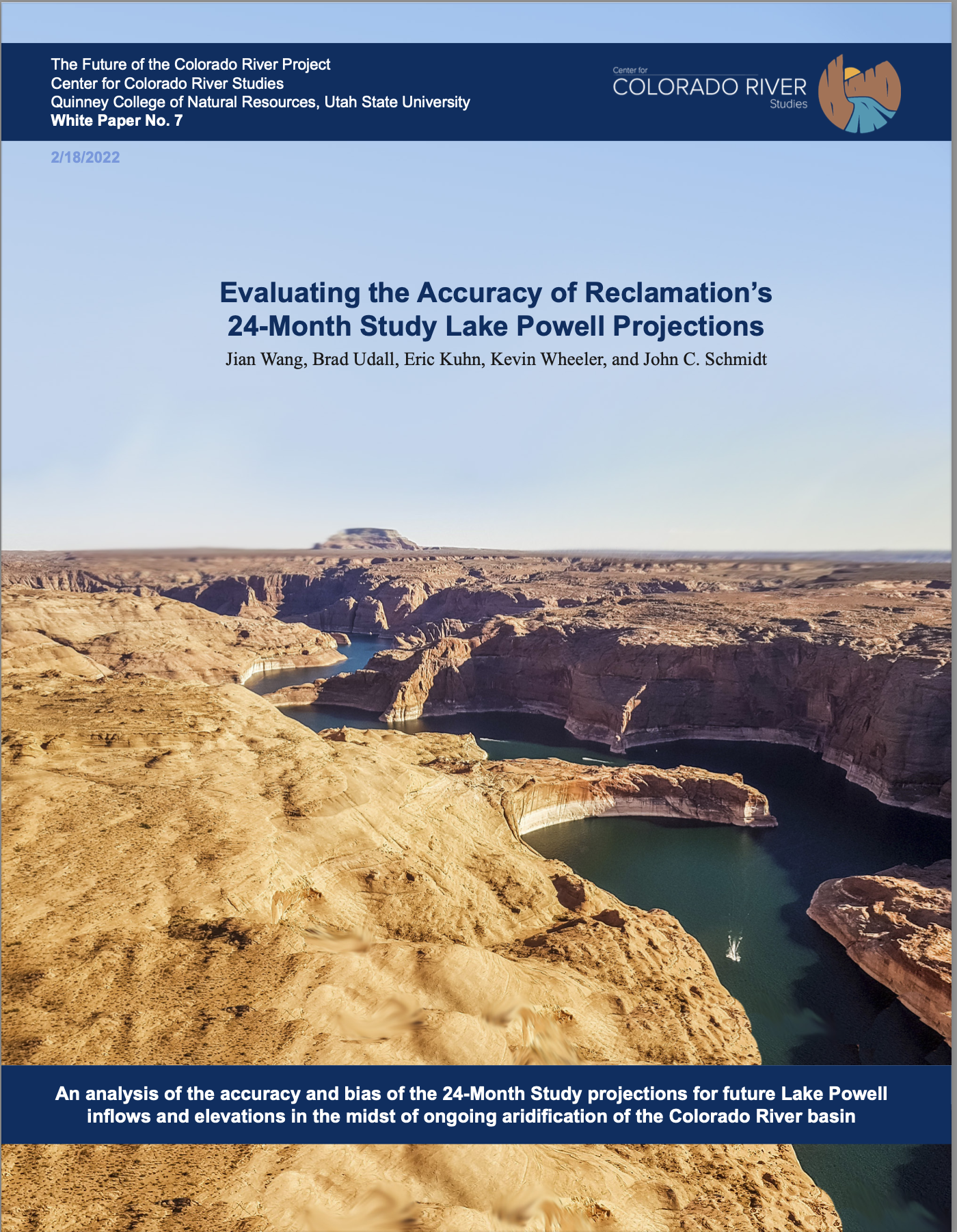
Click the link to read the white paper (Jian Wang, Brad Udall, Eric Kuhn, Kevin Wheeler, and John C. Schmidt) from The Future of the Colorado River Project.:
Point Summary:
1. The ‘24 Month Study,’ the Bureau of Reclamation’s monthly-issued forecasting report for elevations at Lake Powell and other reservoirs, relies on two very different estimation techniques that are applied to the first year of the forecast window and to the second year. Projections for reservoir elevations during the next few months are based on predictions of reservoir inflow using a widely accepted watershed hydrologic model run by the Col- orado Basin River Forecast Center. The input data for that model are observed snowpack in the watershed, soil moisture, and anticipated precipitation and temperature. Projections for reservoir elevations beyond the imme- diately proximate winter, a year or more in the future (‘second year projections’), are based on statistical probabilities calculated using analyses of past inflows during a 30-year reference period. Reclamation issues three different forecasts using three different inflows called Maximum Probable, Most Probable and Minimum Probable.
2. Analyses of past inflows use a 30-year reference period that is updated each decade. Until recently, that reference period was the estimated unregulated flows that occurred between 1981-2010. In fall 2021 the reference period was updated to the 1991-2020 period. The medi- an annual inflow from the earlier 1981-2010 reference period was higher than more recent periods—3% higher than the updated reference period and 9% higher than the unregulated inflows that have occurred since onset of the Millennium Drought. Our analysis of the accuracy and bias of second-year projections made in the 24 Month
Studies issued from 2010-2021 demonstrates that the most probable projected inflows were higher than what actually occurred by as much as ~7 million acre feet (maf) in some years, and predicted reservoir elevations were also higher than what occurred in some years.
3. During the years when the 1981-2010 reference period was used for forecasting (prior to fall 2021), the driest conditions of the Millennium Drought were not well anticipated or predicted until January of the year being forecast. In the very driest year, inflow predictions were consistently high until the entire snowmelt runoff season had ended. Multi-year periods of very low inflow were also not well predicted by projections based on the 1981-2010 reference period. These multi-year periods of very low inflow are a significant risk to sustainable water-supply management during the on-going Millen- nium Drought.
4. The accuracy of the first year of the forecast window improves as the winter progresses, and the uncertainty of the projections of reservoir inflow is reduced. However, there remains some uncertainty for inflow projections in the first year of the forecast window, because precipitation and temperature during the last months of winter and spring are also based on the statistical probabilities derived from the 30-year reference period.
5. During years 2010-2021, the Most Probable August 24-Month Study (used for determining the Lake Powell Operation tier for the upcoming year), tended to overestimate the end-of-calendar-year Lake Powell elevation by as much as ~10 feet. The September 24-Month Study came closer to the mark, and was within ~5 feet of what actually occurred. Similarly, the April forecast, used for adjusting the Lake Powell Operation tier in the middle of the water year, either overestimated or underestimated the actual end-of-water-year elevation by as much as 20 feet. The uncertainty of the May forecast was reduced to +/- 10 feet. From an accuracy perspective, the September and May forecasting reports are more accurate tools for determining and adjusting Lake Powell operation tiers than are the August or April estimates.
6. The bias for inflow predictions will likely be reduced now that the reference period includes a more recent, and somewhat drier, span of time, but projections of future inflows are likely to remain biased, because the hydrology of the 1991-2020 reference period was still wetter than the current Millennium Drought. These findings are consistent with Kuhn’s (2021) observation that the hydrology used in the 24 MS does not fully capture the risks of ongoing aridification of the Colorado River basin and that wa- ter-supply planning ought to better anticipate the risks of decreasing inflows to Lake Powell.
This is the seventh in a series of white papers from the Future of the Colorado River Project.
See the full list of white papers and summaries at this link