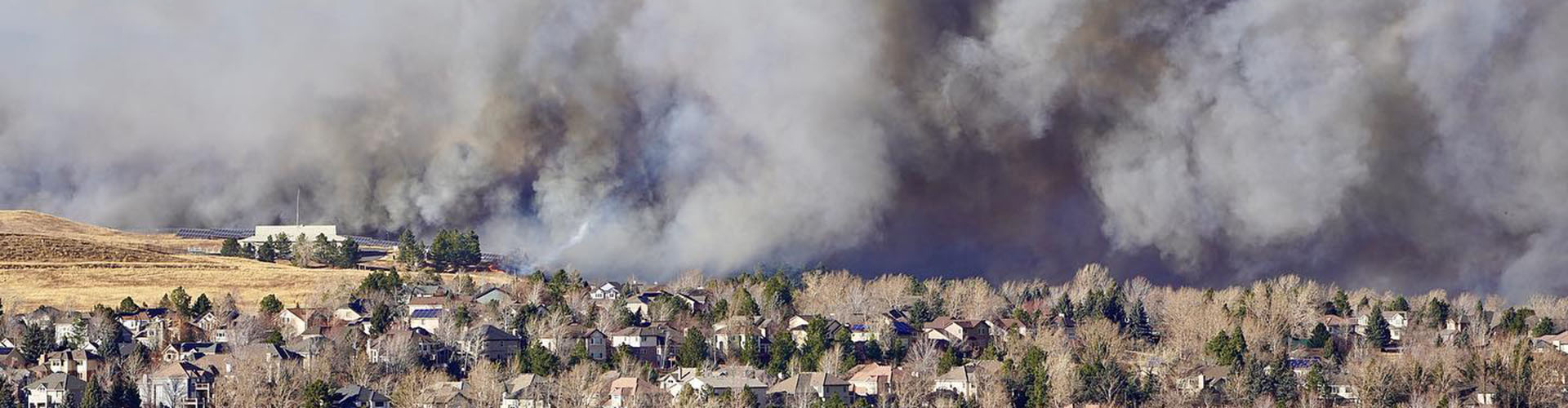
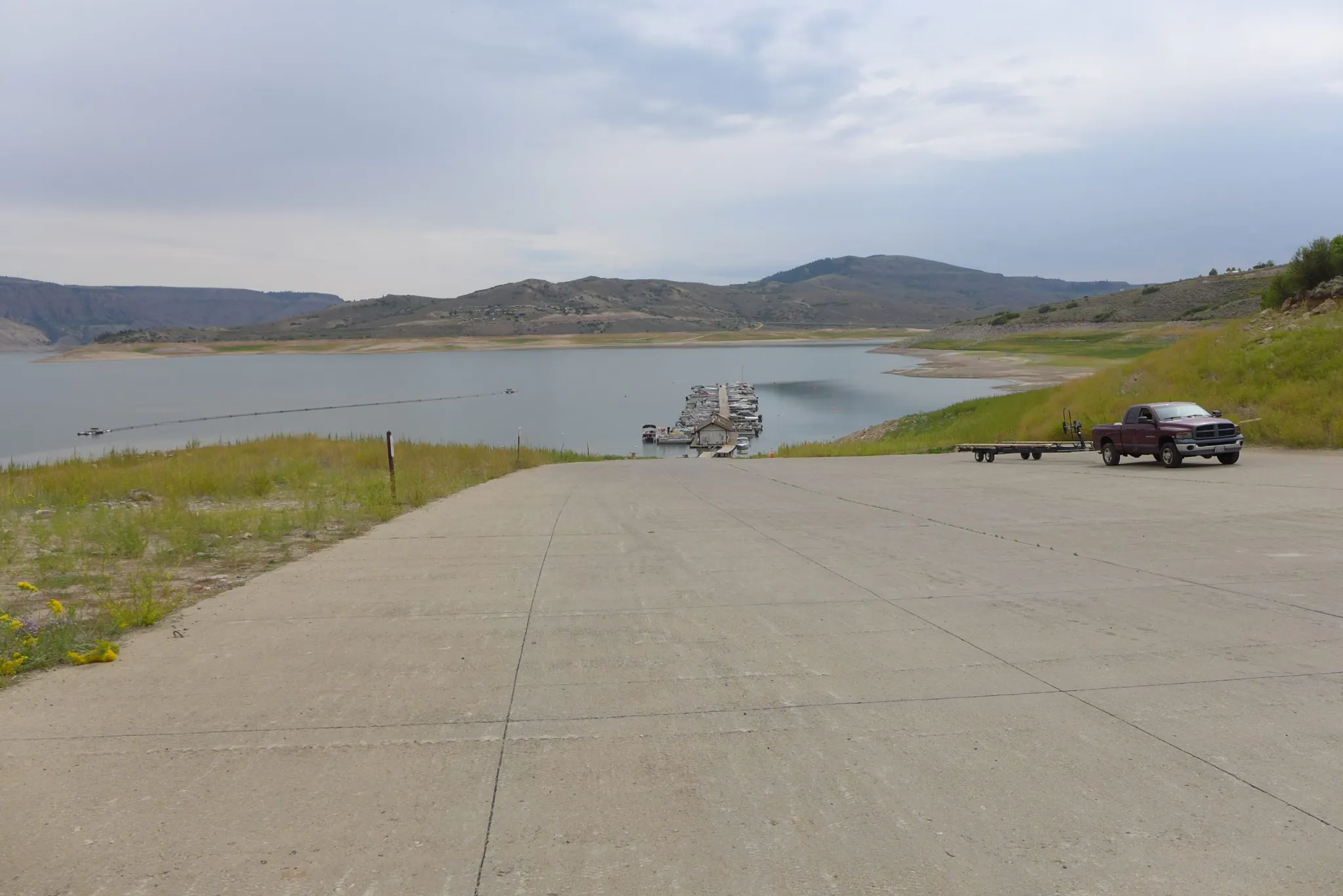
#BlueRiver #snowpack report — The Summit Daily #ColoradoRiver #COriver #aridification

Click the link to read the article on the Summit Daily News website (Eliza Noe). Here’s an excerpt:

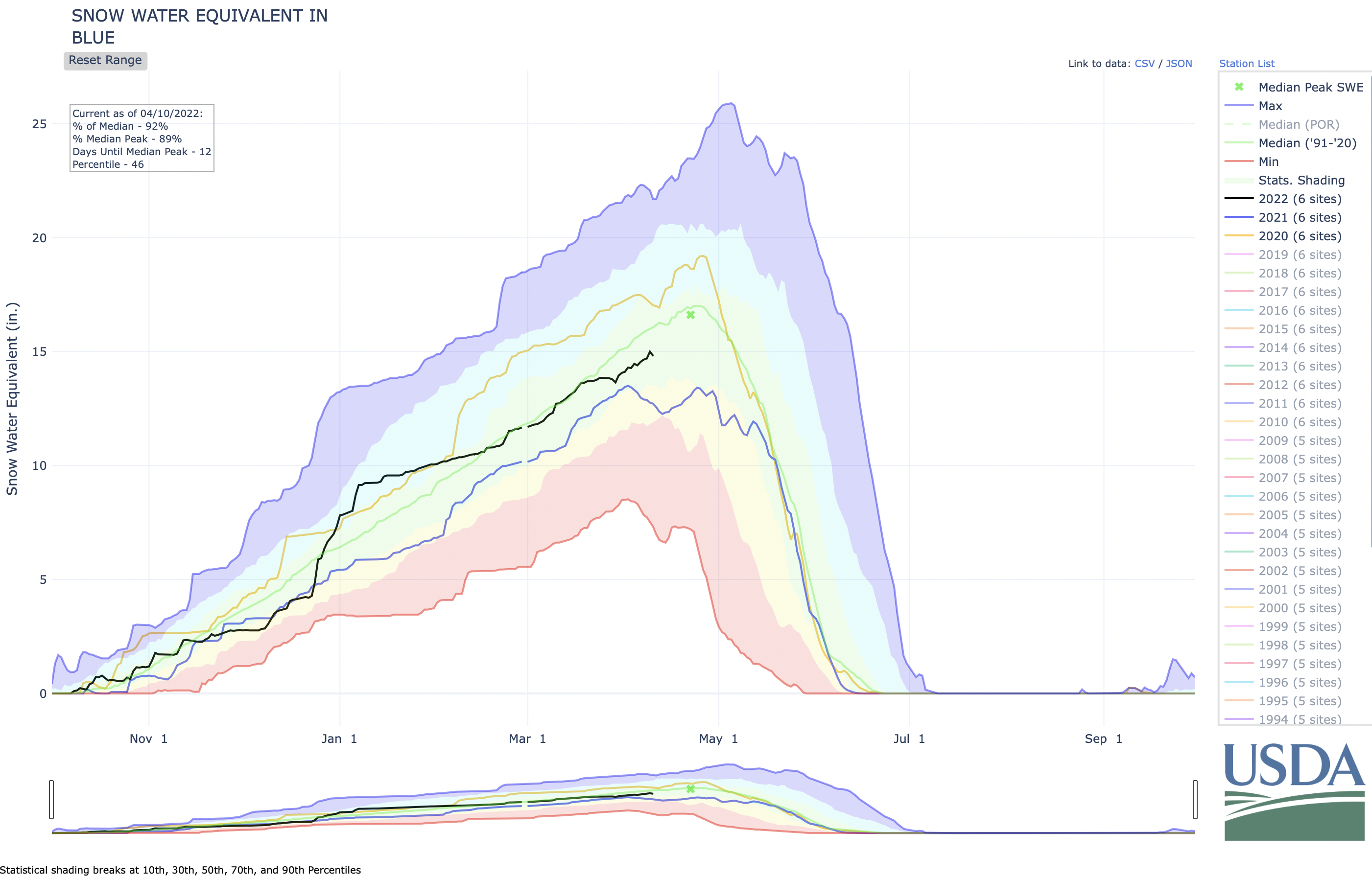
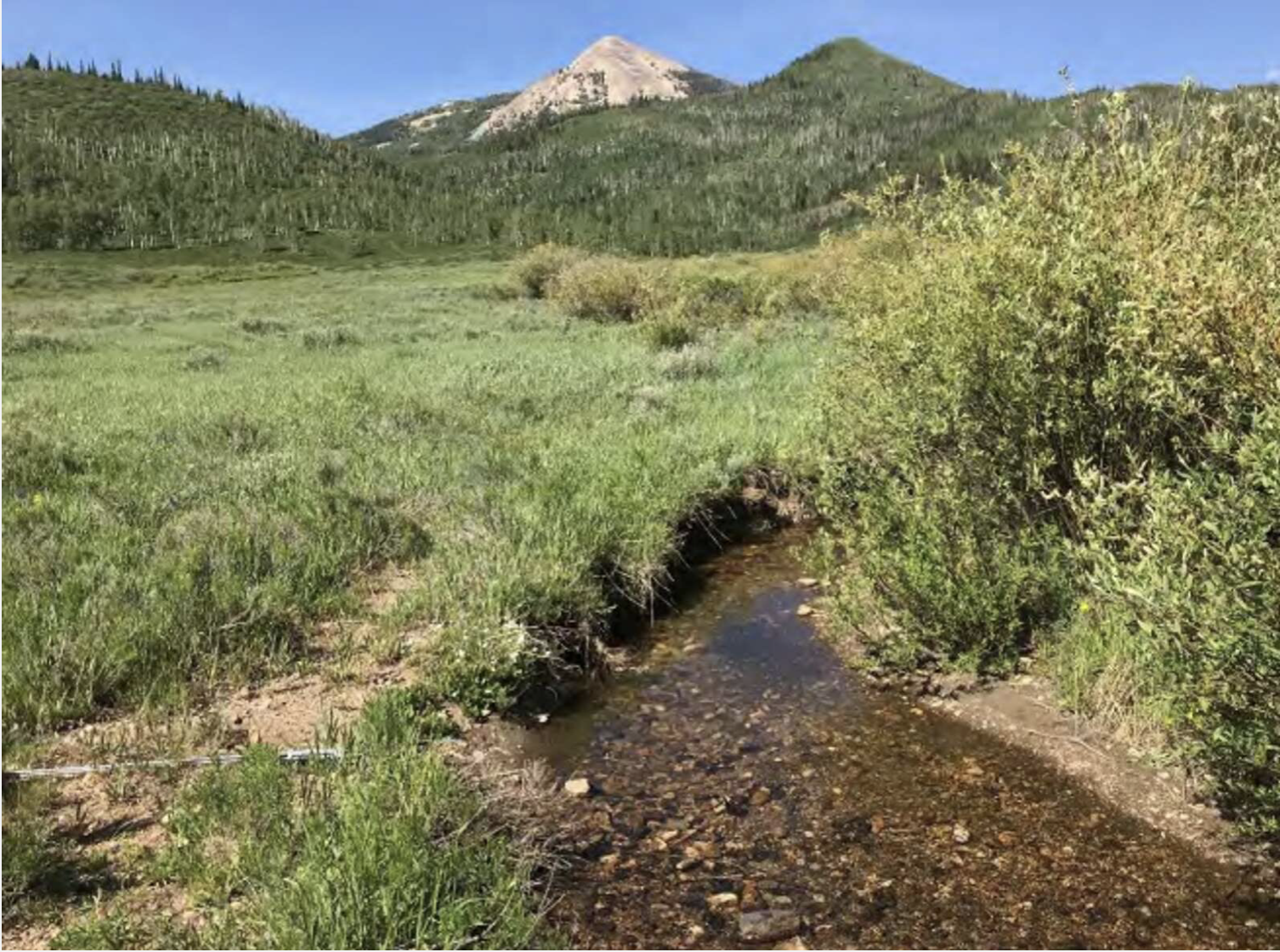
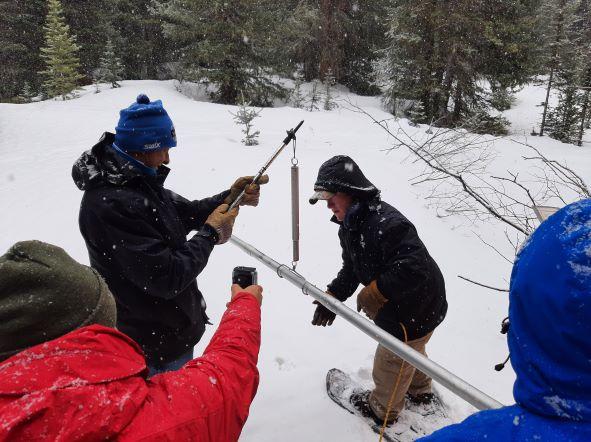
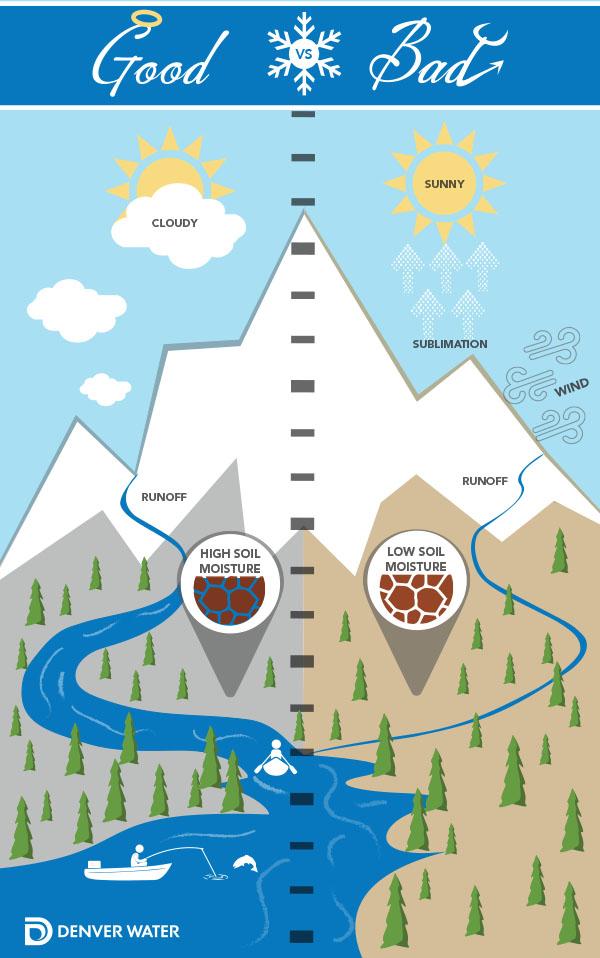
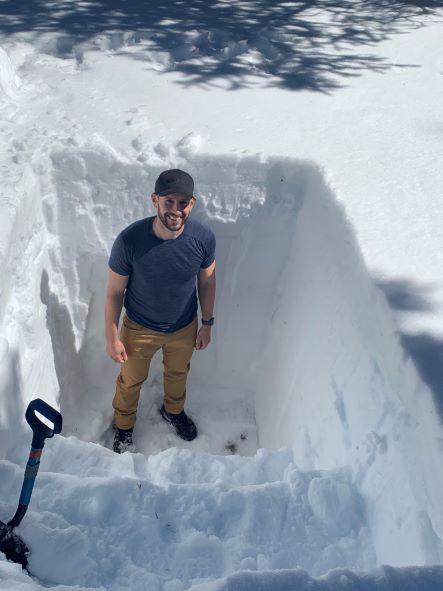
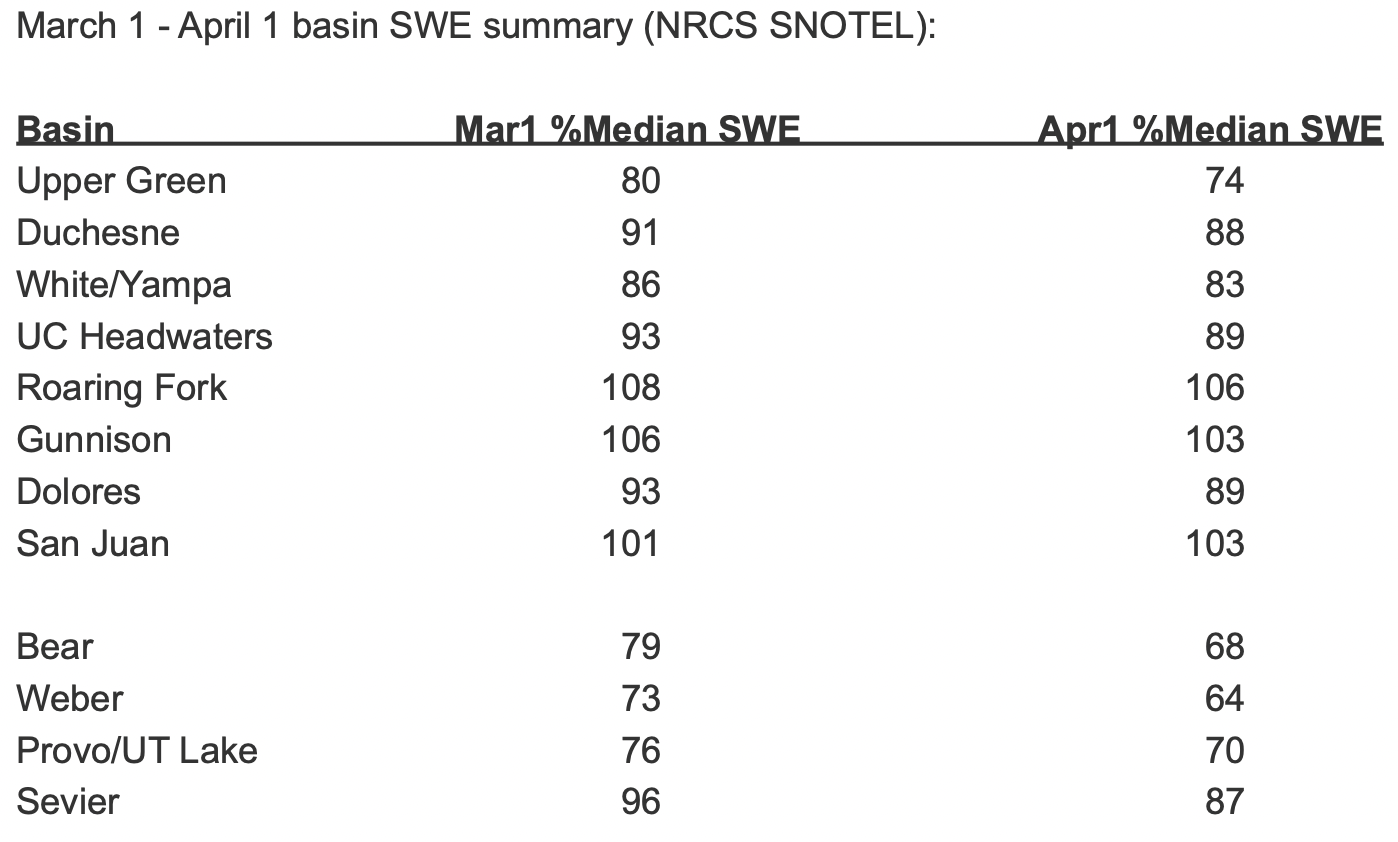
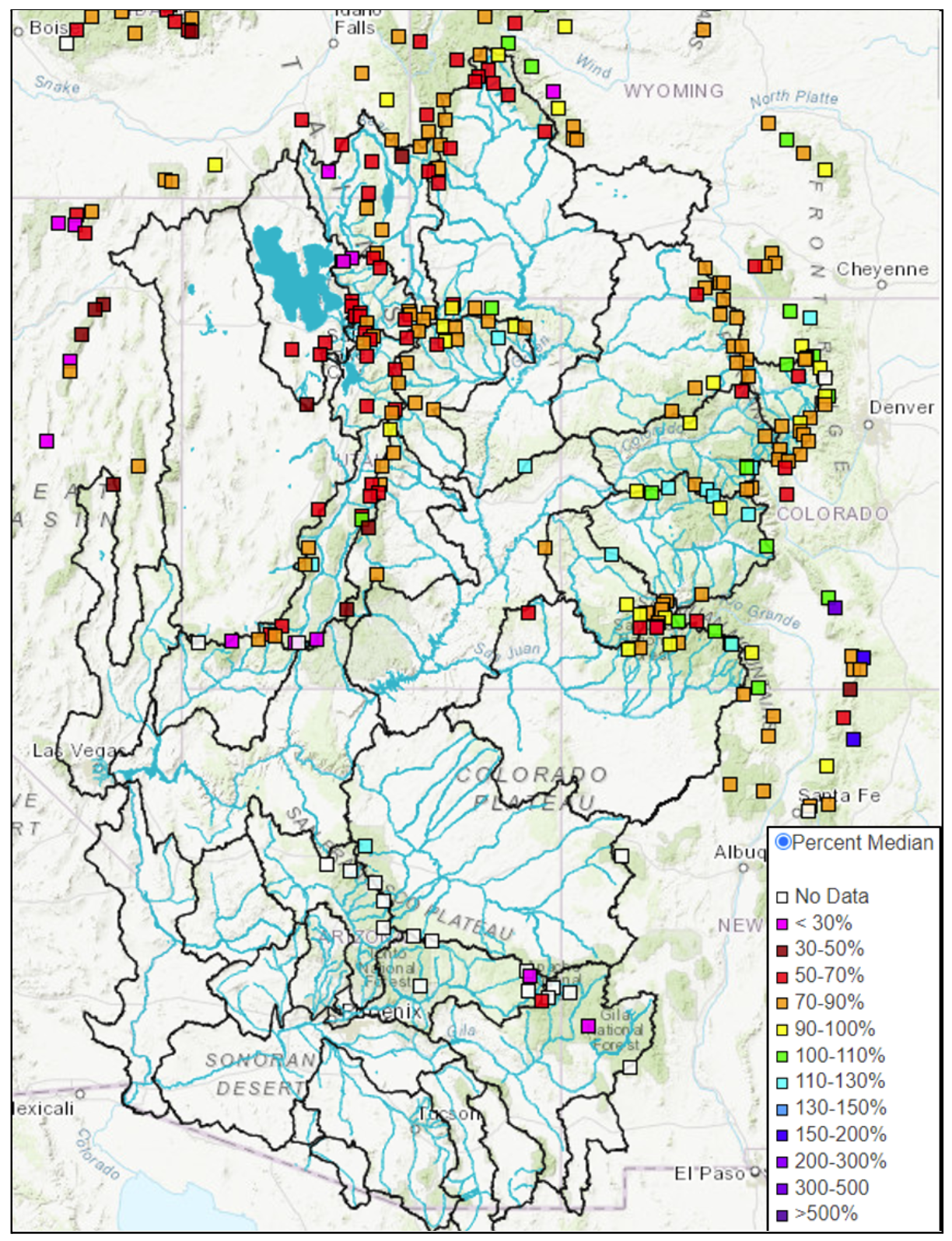
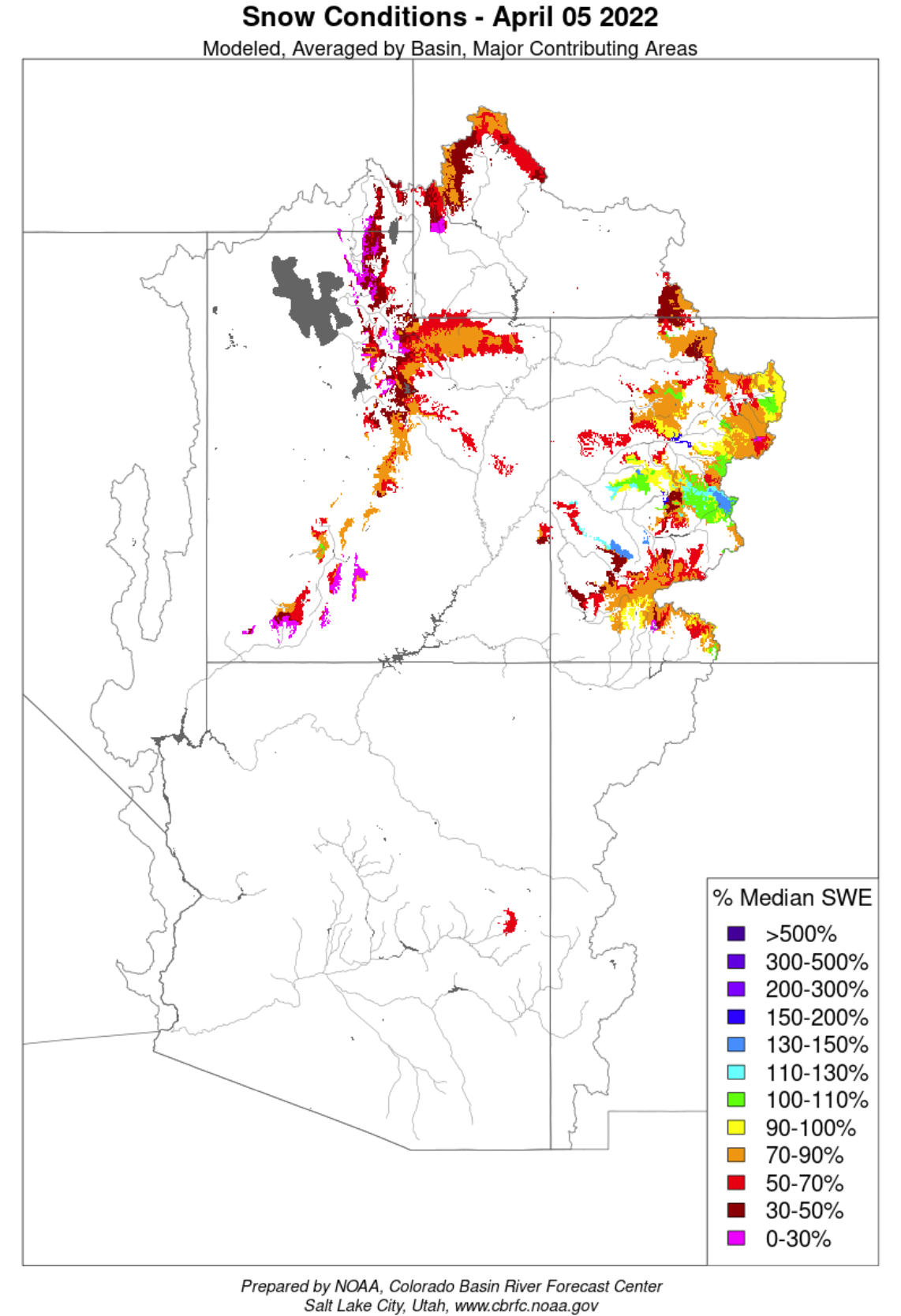
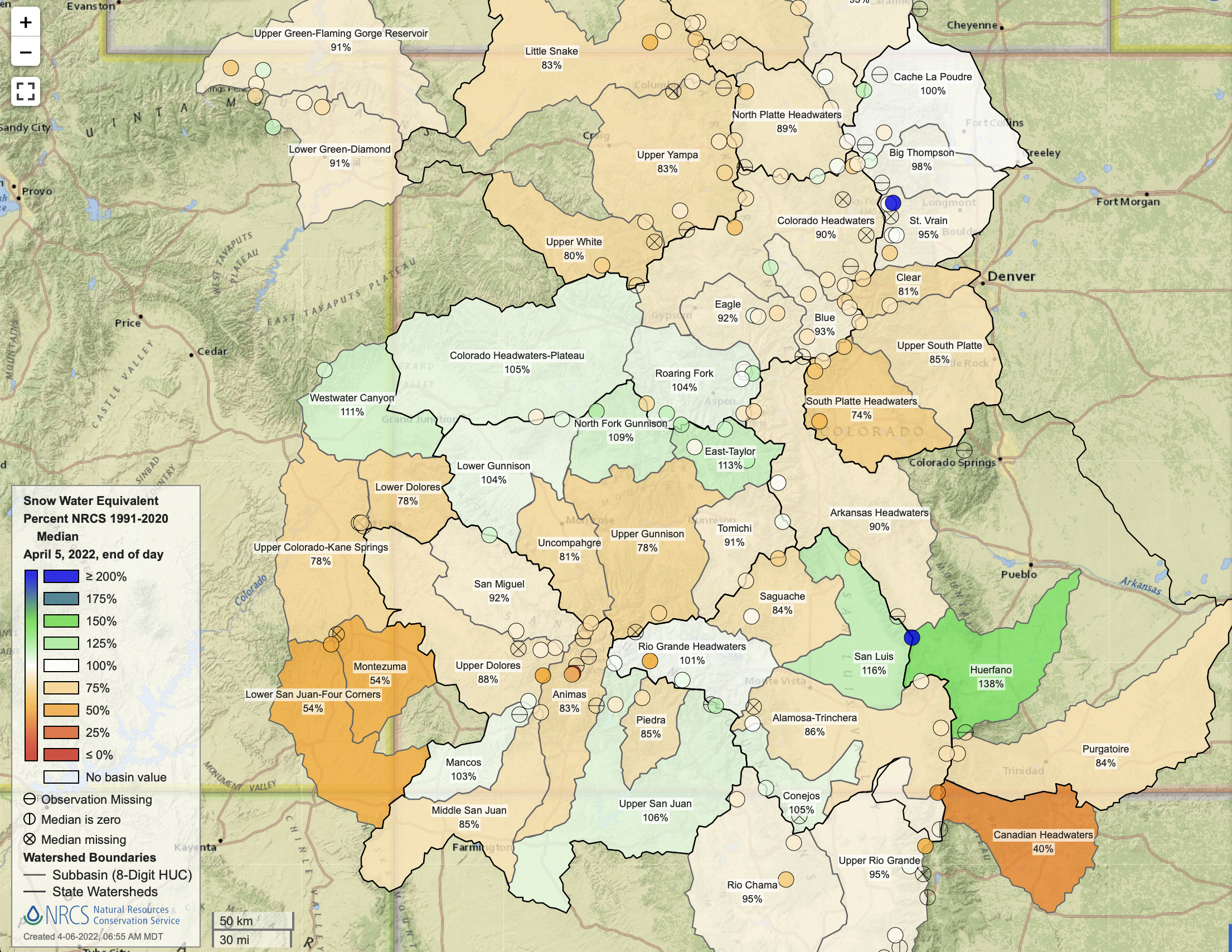
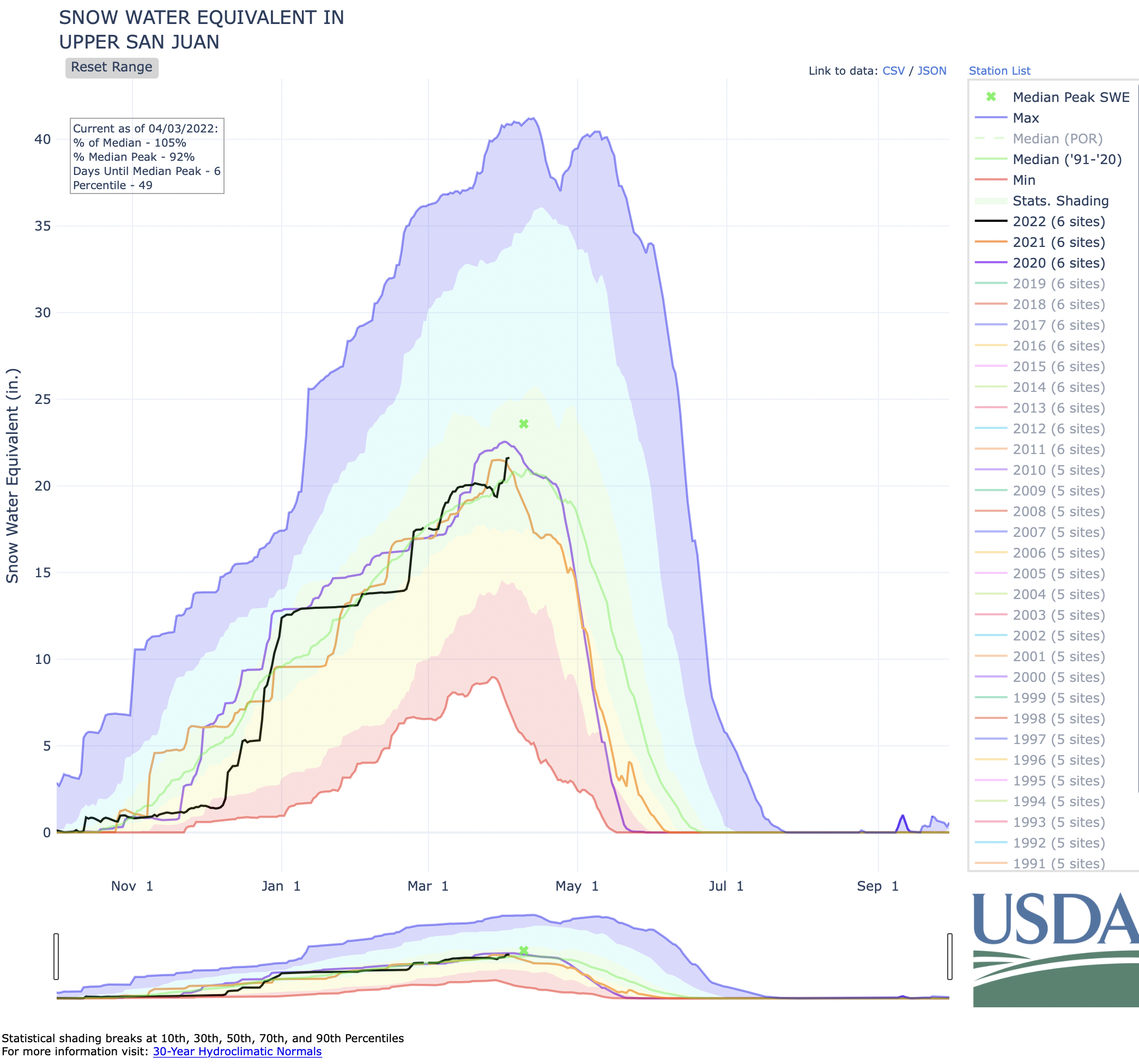
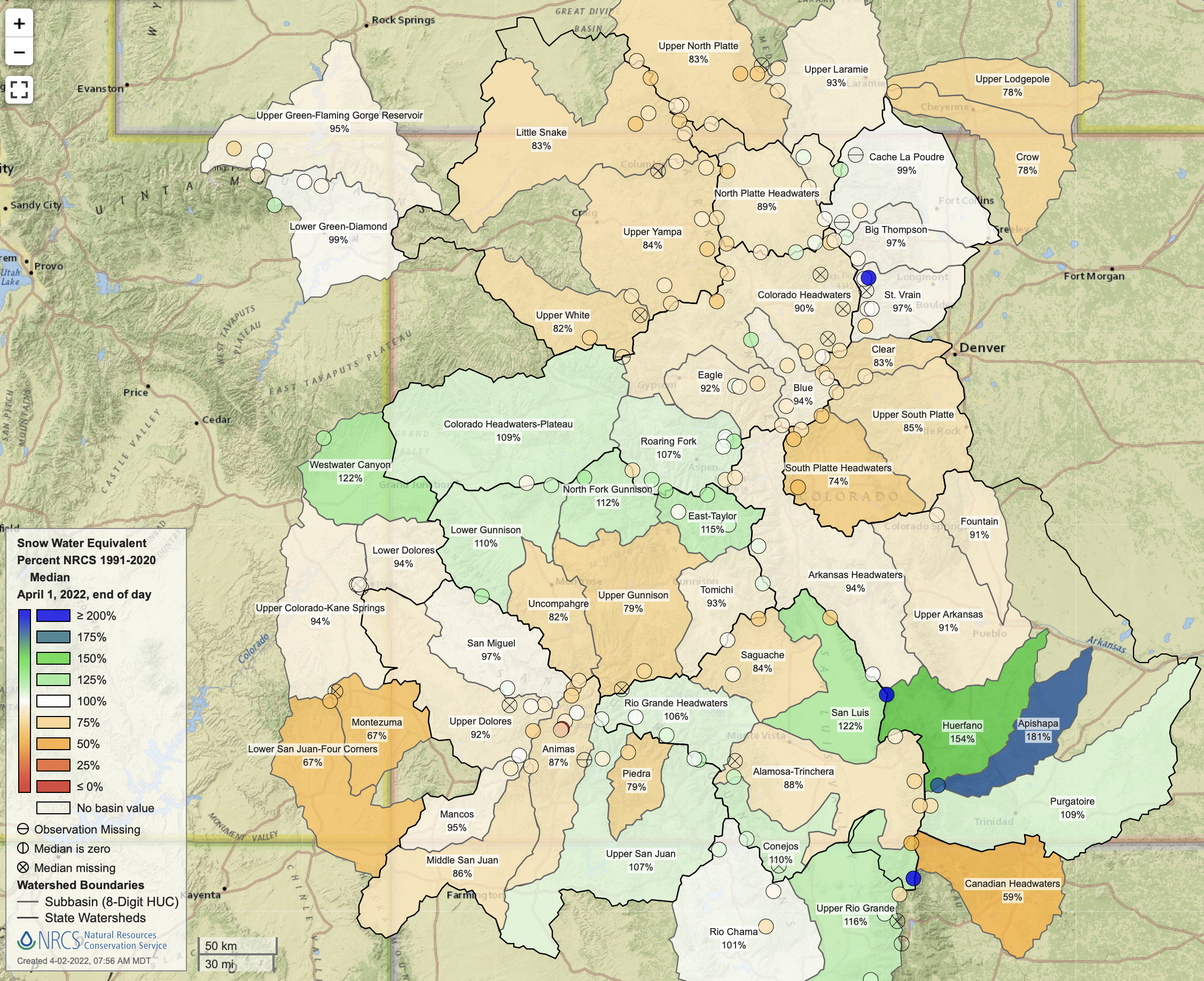
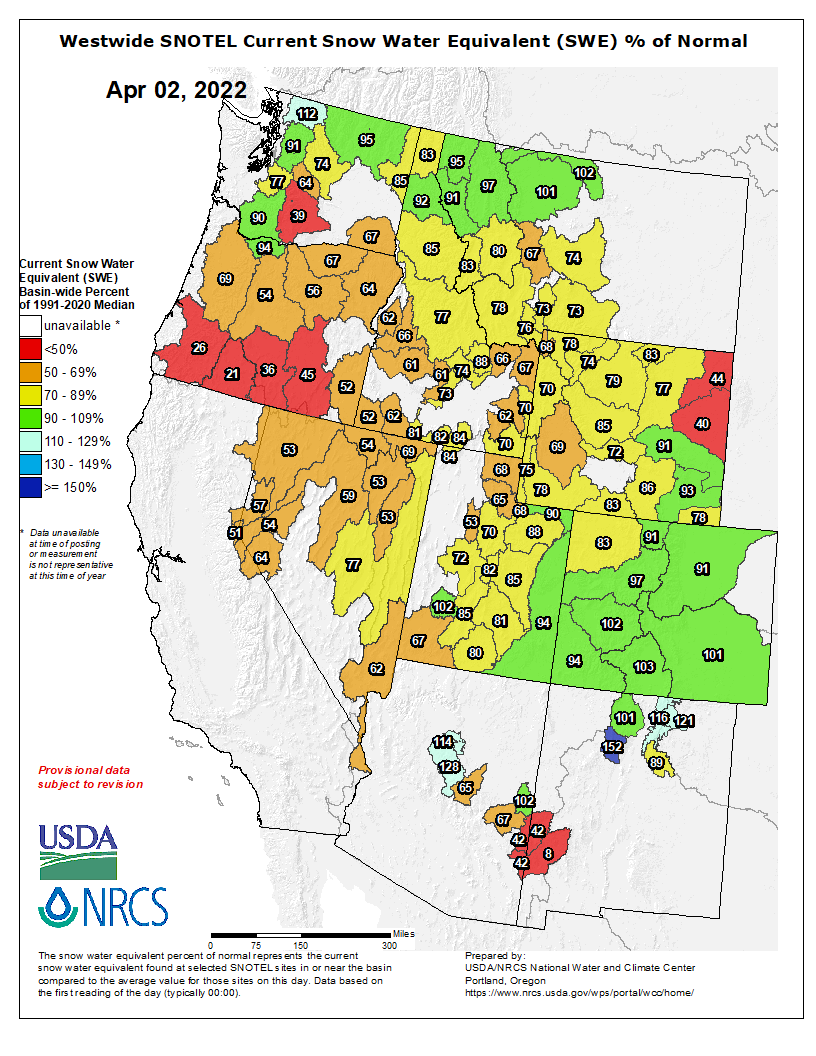
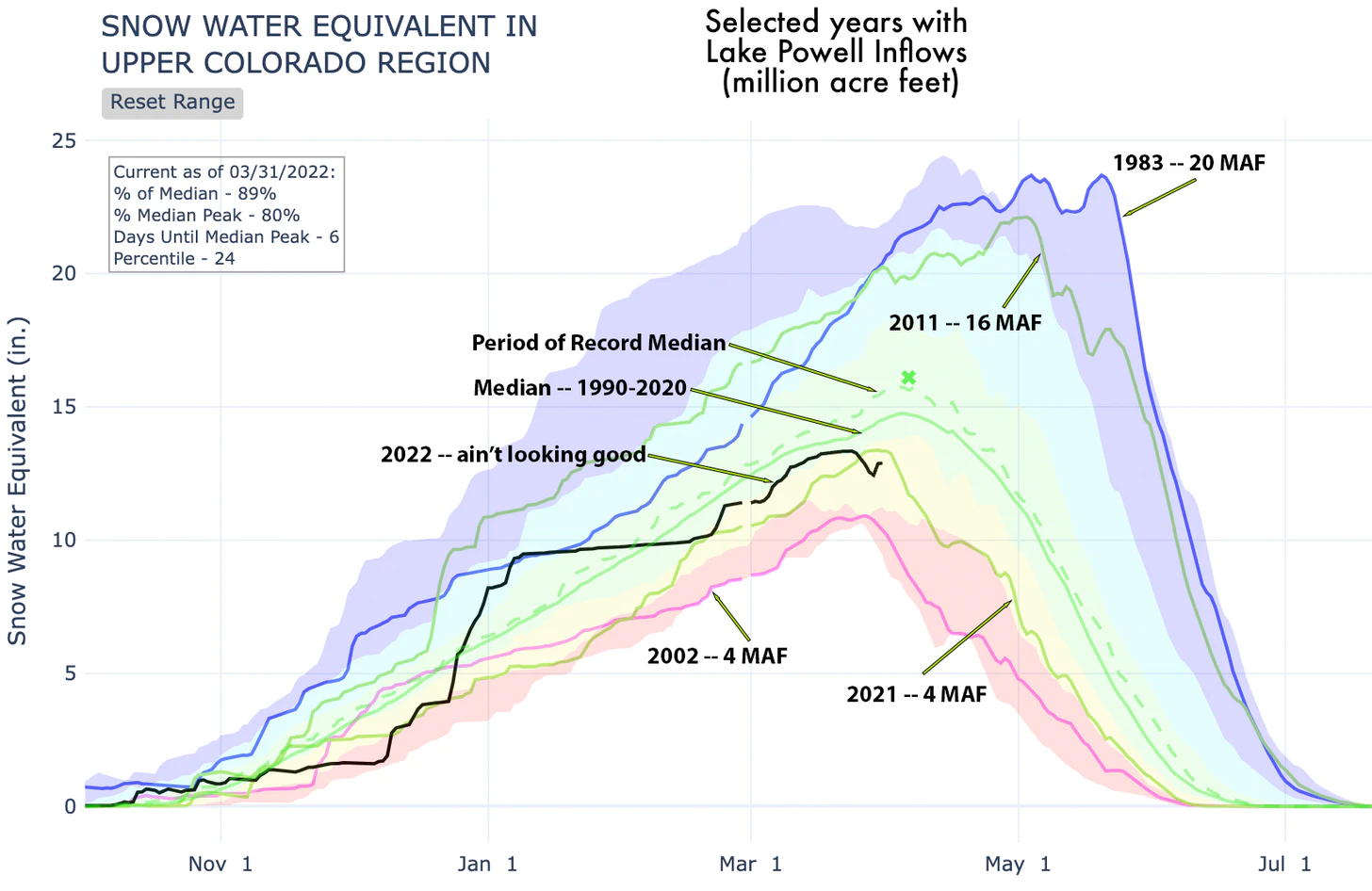
According to the latest data from the Natural Resources Conservation Service, the snow water equivalent of the Blue River was at 92% of the median, dipping slightly since Summit County had heavy snowfall in early March. This means that, so far, there are 13.7 inches of snowpack in the area. The 30-year median level for the same date is 14.7 inches, but this week’s expected snowfall is likely to push those levels closer to the median…

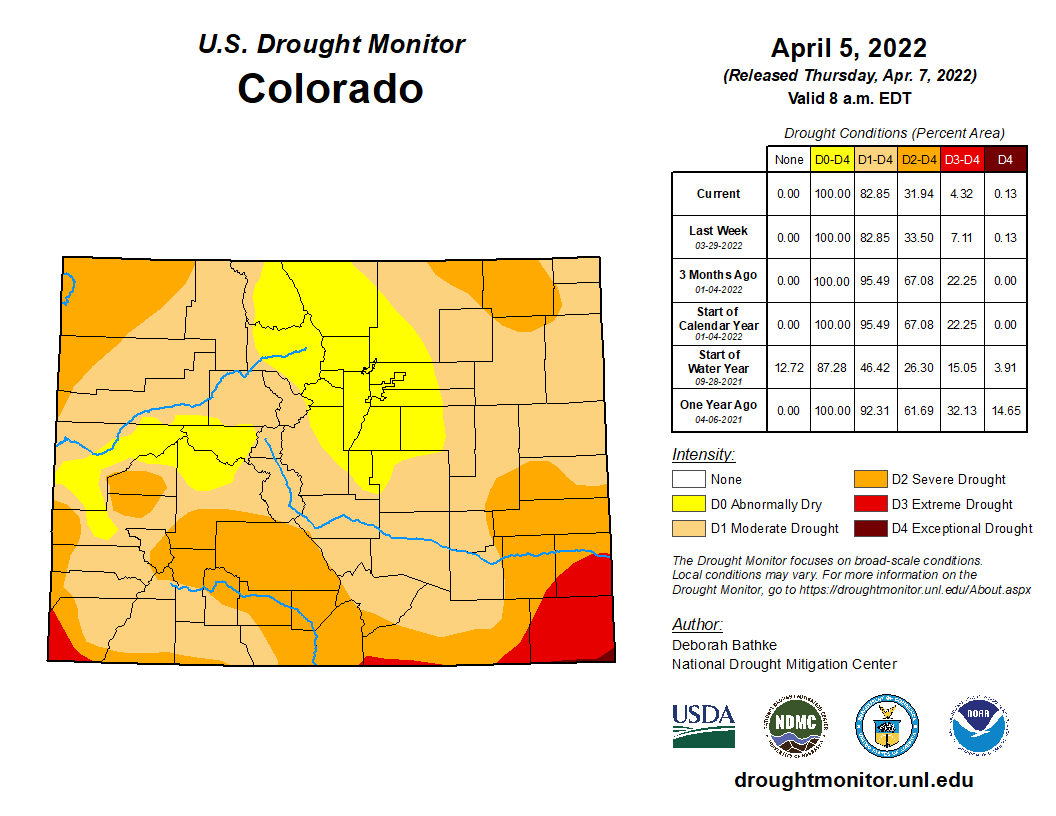
The Blue River Basin is still several weeks out from the median peak, which usually hits its crest on or around April 25. By that time, the basin usually has between 16.5 and 17 inches. This time last year — a particularly dry year across the Western Slope — the basin was already at its peak by the end of March. The most snow that had accumulated in 2021 was 13.5 inches, causing a dramatic drop throughout April and May.

U.N. Scientists Latest Report Offers Hope as New Poll Shows Americans Support Natural Infrastructure Solutions to #ClimateChange — The Walton Foundation #ActOnClimate

Click the link to read the article on the Walton Family Foundation website (Mark Shields):

As the Intergovernmental Panel on Climate Change (IPCC) released its latest report on mitigating the impacts of climate change, a new poll from the Walton Family Foundation, in collaboration with Morning Consult, reveals how Americans think about climate change solutions. Specifically, when asked about natural infrastructure, described as the use of naturally occurring landscape features or nature-based solutions that promote, use, restore, or emulate natural ecological features, three-in-four voters (76%) supported the use of natural infrastructure to address climate change.

Natural infrastructure is a bipartisan solution to addressing climate change. At least seven-in-ten Democrats and Republicans nationally support these solutions.

“Climate change is water change. As Americans reckon with the changes in climate that are already underway, we see that voters understand that we need to seek solutions to use the power of nature to help solve problems – and that’s what natural infrastructure is all about,” said Moira Mcdonald, Environment Program Director of the Walton Family Foundation. “Despite political divisions in our country, Americans agree on protecting our planet, and it is time we put this unity into action.”

As leaders from local, state, and federal offices consider how to apply funding made available through the bipartisan Infrastructure Investment and Jobs Act, voters strongly support natural infrastructure solutions, including:

  • Shoring up coastline and river communities to better withstand increasingly frequent and intense storms and flooding (80% support);
  • Restoring wetlands to mitigate climate impacts including soaking up water from storms and rehydrating landscapes to prevent wildfires (82% support);
  • Protecting groundwater supplies to increase available water while also supporting rivers and streams (83%);
  • Using floodplains to reduce flooding, and protect communities, farmlands, and wildlife (83%).

Other key findings from the poll include:

  • A majority of Americans agree climate change will alter important aspects of life in the U.S. such as agriculture (76% total, 89% Democrats, and 61% Republicans), water resources (76% total, 90% Democrats, and 59% Republicans) and the economy (71% total, 87% Democrats, and 55% Republicans).
  • 73% of Americans are worried about climate change and water scarcity, with at least three-in-five voters saying that drought, increased temperatures, wildfires, extreme weather and flooding are a product of climate change’s effect on water resources.
  • Black and Hispanic voters expressed more concern about climate change’s impacts on the economy (84% Black, 81% Hispanic, 68% White), health (88% Black, 78% Hispanic, 67% White), and issues around equality (69% Black voters, 62% Hispanic voters, 44% White).
  • One-quarter of American voters believe their state will not have enough water during their grandchildren’s lifetimes (the next 100 years). The numbers are even higher in western states – 55% in Colorado said their state would not have enough water in the next 100 years and 53% said the same in Arizona.

To read the full poll results, visit http://waltonfamilyfoundation.org/worldwaterday.

Polling Methodology:

The national poll was conducted between March 4-March 6, 2022 among a sample of 2005 Registered Voters across the United States. The interviews were conducted online, and the data were weighted to approximate a target sample of Registered Voters based on gender by age, educational attainment, race, marital status, homeownership, race by educational attainment, 2020 presidential vote, and region. Results from the full survey have a margin of error of plus or minus 2 percentage points.

The state-level polls were conducted between March 4-March 8, 2022, among a sample of 298 Registered Voters in Arizona and a sample of 300 Registered voters in Colorado. The interviews were conducted online, and the data were weighted to approximate a target sample of Registered Voters based on gender, age, education, race, ethnicity, marital status, homeownership, and 2020 vote choice. Results from the full survey have a margin of error of plus or minus 6 percentage points.

One Last #Climate Warning in New IPCC Report: ‘Now or Never’ — Inside Climate News #ActOnClimate #KeepItInTheGround

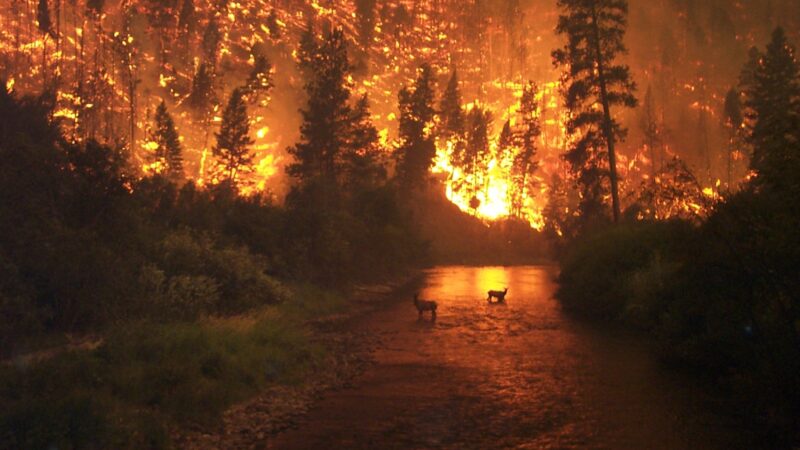
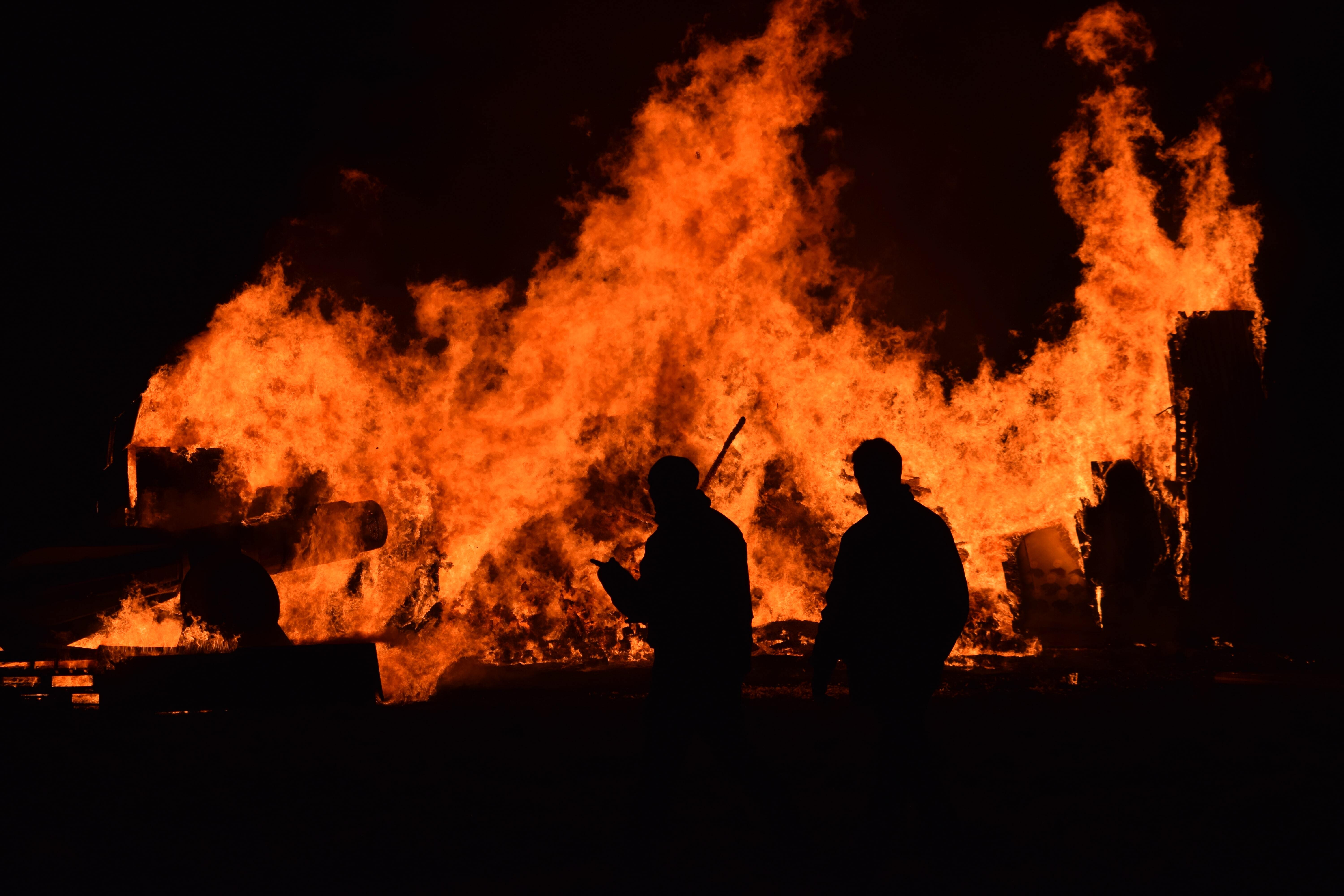
A forest fire next to the Bitterroot River in Montana. UCLA-led research revealed that larger fires tend to be followed by larger increases in streamflow. | Photo by John MacColgan/Creative Commons

Click the link to read the article on the Inside Climate News website (Bob Berwyn). Here’s an excerpt:

The world will probably burn through its carbon budget before the global climate panel issues its next update on mitigation

Whatever words and phrases the Intergovernmental Panel on Climate Change may have been parsing late into Sunday night, its new report, issued Monday, boils down to yet another dire scientific warning. Greenhouse gas emissions need to peak by 2025 to limit global warming close to 1.5 degrees Celsius (2.7 degrees Fahrenheit), as targeted by the Paris Agreement, the report says. In a way, it’s a final warning, because at the IPCC’s pace, the world most likely will have burned through its carbon budget by the time the panel releases its next climate mitigation report in about five or six years. Even with the climate clock so close to a deadline, it’s not surprising that the IPCC struggled to find consensus during the two-week approval session, said Paul Maidowski, an independent Berlin-based climate policy researcher and activist. The mitigation report may be the most challenging of the three climate assessments that are done every five to seven years under the United Nations Framework Convention on Climate Change, he said.

The first two reports of each IPCC assessment cycle, one on the physical basis of climate science, and another about impacts and adaptation, are mostly based on unyielding physics, like how much global temperature goes up for every added increment of CO2, and how fast and high sea level will rise based on that warming.

But the mitigation report, which outlines choices society can make to affect the trajectory of climate change, has to reconcile those scientific realities with economic and political assumptions that are not constrained by physics, Maidowski said. Other researchers have described the IPCC report as a mechanism to determine what is politically possible, he added. If those assumptions—for example about future availability of carbon dioxide removal technology—don’t materialize, “then you are left with illusions, essentially,” he said. The IPCC has “blinded itself” to deeper questions of sustainability and is thus asking the wrong questions, like how to decouple economic growth from greenhouse gas emissions, he added. Instead, it should be more up front about acknowledging the physical limits of the planet, and start asking how to downscale current resource consumption to a sustainable level.

The report found that “without immediate and deep emissions reductions across all sectors, limiting global warming to 1.5°C is beyond reach.”

On the hopeful side, the panel noted that renewable energy costs have dropped by as much as 85 percent in the past decade, and that new policies in many countries have accelerated deployment of wind and solar power.

Novel technique peeks beneath the ground at Yellowstone’s hot water plumbing system — USGS

Click the link to read the article on the USGS website (Carol A Finn, Ph.D. and Paul A Bedrosian):

What do the subsurface fluid pathways look like for all of the hot springs and geysers scattered throughout Yellowstone? A new set of data from an aerial electromagnetic survey provides a new perspective on this age-old question.

Old Faithful, Grand Prismatic Spring, Mammoth Hot Springs, Steamboat Geyser, and Mud Volcano are just a few of the over 10,000 active hydrothermal features formed by the interaction of ground water with the heat from the magmatic system beneath Yellowstone Caldera. While these enthralling features are enjoyed by millions of visitors every year, the underground plumbing system that feeds them is mostly hidden from view. Where does the hot water come from, and where does it go? Such information might tell us in general why surface thermal features are located where they are.

Yellowstone’s hydrothermal plumbing system results from several factors. The water from high precipitation (snow and rain) penetrates 4–5 kilometers (2.5–3.1 miles) deep along the many faults in the region. These deep waters are heated by magma and hot rock, forcing them to return to the surface much like “lava” in a lava lamp. This vast underground plumbing system ultimately feeds the iconic thermal features, where much is known about their temperature and chemistry. In contrast, little was known about how the surface features are connected to each other and deeper sources of fluids. Until now.

Sources/Usage: Public Domain.
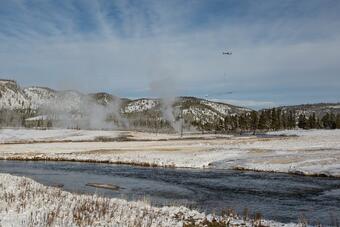
Helicopter with airborne electromagnetics sensors dangling beneath as it flies over a portion of Yellowstone National Park. Photo by Jeff Hungerford, November 2016.

In 2016, a technique called airborne electromagnetics (AEM) was used to measure the physical properties of ground beneath Yellowstone. AEM takes advantage of water being a much better electrical conductor than rock, and that this difference between wet and dry rock can be detected by a sensitive electromagnet to depths of 150–700 meters (500–2300 feet). The technology is a larger version of that used in induction stoves or wireless cell phone chargers. The AEM instrument, mounted on a hoop that is 15–25 meters (50–80 feet) across and dangles beneath a low-flying helicopter, detected these variations in detail, like a medical cat scan uses data from a set of surface detectors to “see” inside a human body.

In most volcanic hydrothermal systems, characteristic sequences of hydrothermal clays reveal fluid or gas conduits along faults and fractures that can also be detected from the air. To map these clays below the depth resolution of the AEM, down to about 3 kilometers (1.9 miles), an additional instrument was employed—one that senses variations in the magnetic properties of rocks. Clays are less magnetic than volcanic rocks, making this difference relatively easy to detect.

For several weeks, the helicopter flew back and forth across Yellowstone to measure variations in these electric and magnetic properties, in the process revealing clues about Yellowstone’s hydrothermal plumbing system. These techniques are highly effective in environments like Yellowstone, where strong contrasts in the electrical conductivity of cold groundwater, thermal fluids, and dry volcanic rocks can be exploited. Additionally, thermal fluids alter the rocks they pass through, turning rock into clay minerals which have low electrical resistivity and subdued magnetization. But flying the survey was only part of the challenge. Translating all that data into something tangible required years of painstaking work!

The instrument responses were analyzed to produce detailed cross-sections along the flight lines, as well as depth maps from resistivity and susceptibility models. The models show that most thermal features are located above low-resistivity and low-magnetic-susceptibility clay-capped buried faults and fractures that channel fluids and gases from depth. Shallow sub-horizontal pathways between ancient lava flows contribute groundwater into the system, which mixes with thermal fluids from the channels. As fluids approach the surface, local constrictions induce boiling, degassing, or conductive cooling that produce the diversity of thermal features at Yellowstone.

Sources/Usage: Public Domain. Visit Media to see details.
Cross sections from one-dimensional electrical resistivity (top of each section) and three-dimensional magnetic susceptibility inverted models (bottom of each section) along profiles that span (a) Norris Geyser Basin, and (b) Upper Geyser Basin. Geologic and geothermal features are from the Yellowstone geologic map. VE=vertical exaggeration. LCT=Lava Creek Tuff (A and B members).

Due to its resolution, capable of detecting features on the order of 100 meters (330 feet) in size, the AEM system cannot directly image the narrow fluid-flow paths to specific geysers and hot springs. By way of analogy, this would be like imaging a city’s water supply and distribution lines but not the lines feeding individual houses. Despite their diversity, the fluid flow paths to most thermal features are similar across Yellowstone, suggesting that local, rather than regional, conditions control the chemistry and style of geysers, mud pools and hot springs. The new models, however, provide a regional framework for focused geophysical and geochemical studies of the individual thermal features.

This work, published recently in the journal Nature, fills in a longstanding gap in knowledge about the underpinnings of Yellowstone’s charismatic hydrothermal features and has sparked considerable interest across a range of disciplines. This includes microbiologists looking to link areas of groundwater and gas mixing to regions of extreme microbiological diversity, geologists using the models to map lava flows and estimate eruptive volumes, hydrologists interested in incorporating flow paths and regions of groundwater and thermal water into geochemical fluid evolution models, and economic geologists interested in Yellowstone as a modern analogue for epithermal mineral deposits. The full potential of these new airborne geophysical data are just beginning to be realized!

YMCA of the Rockies inks $1.9M #water deal with #EstesPark — @WaterEdCO

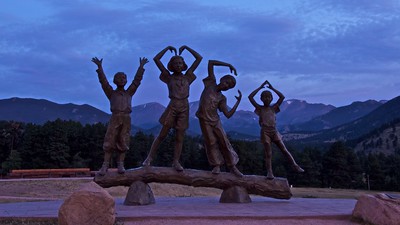
Statue at YMCA of the Rockies: Wikipedia Creative Commons

Click the link to read the article on the Water Education Colorado website (Jerd Smith):

Sometimes, when you’re a small nonprofit, the high price of water is a good thing.

The YMCA of the Rockies, an historic Estes Park resort founded more than 100 years ago, has entered into a multimillion-dollar agreement with the Town of Estes Park in which it will transfer water rights valued at roughly $1.9 million to the town, in exchange for a perpetual water treatment contract.

Chris Jorgensen, the YMCA’s chief financial officer, said the agreement allows the resort to forego the high cost of building a modern water treatment plant and gives Estes Park a more robust water portfolio and delivery system that has better economies of scale.

“The cool thing about it is the collaborative nature of it,” Jorgensen said. “Our existing plant is within a mile of theirs. We’re going to go from operating two water plants to one. It speaks to good stewardship of our natural resources, and it benefits both of us.”

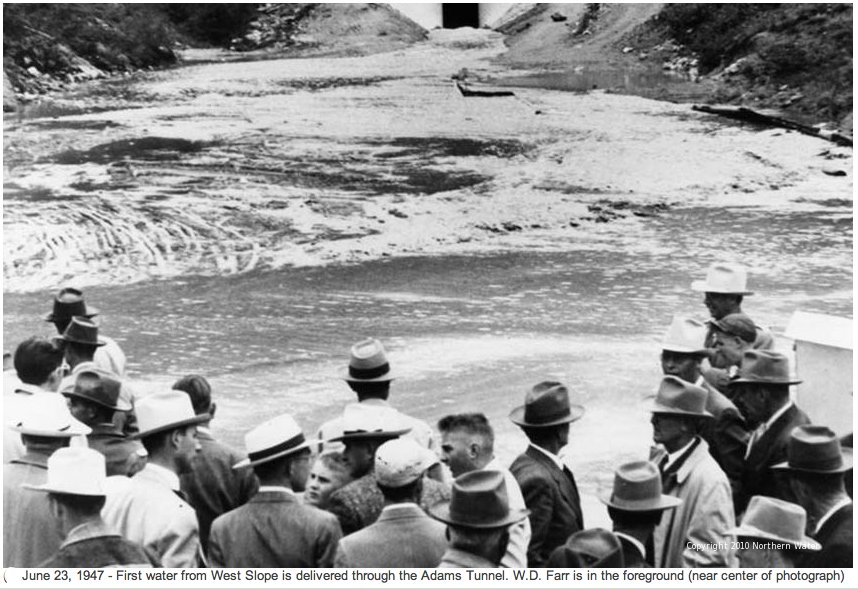
First water through the Adams Tunnel. Photo credit Northern Water.

The YMCA has 312 shares in the federally owned Colorado-Big Thompson (C-BT) Project water system, according to the Northern Colorado Water Conservancy District, which manages the C-BT Project. Flowing straight from the Alba B. Adams Tunnel under the Continental Divide from Grand Lake to the Front Range, the water is among the most highly valued in Colorado. Clean and easily delivered and traded, its value has skyrocketed in recent years.

Under the agreement, the YMCA is transferring 32 shares of its C-BT water to the Town of Estes Park. According to Northern Water, the value of the water varies, but recent sales have been priced at $60,000 to $65,000 per share. Just four years ago the price was closer to $30,000 per share.

That puts the water value of the deal at $1.9M with the YMCA also agreeing to pay the town $1 million over the next 10 years in system development charges.

Reuben Bergsten, Estes Park utilities director, said the town is making an effort to incorporate more small communities who lack modern water infrastructure into their treatment network.

“The town sees it as a civic duty,” Bergsten said.

What the YMCA plans to do with its remaining water rights isn’t clear yet. Jorgensen declined to comment on any other potential sales, but said the resort’s water portfolio is being used fully now to serve customers.

And Jorgensen said the value of the water isn’t the most important piece of the transaction.

“It’s a tremendous relief to be out of the water treatment business,” he said. “Now we can maximize the value of our business for our guests.”

Jerd Smith is editor of Fresh Water News. She can be reached at 720-398-6474, via email at jerd@wateredco.org or @jerd_smith.

Scientists sound alarm at US regulator’s new ‘forever chemicals’ definition: Narrower definition excludes chemicals in pharmaceuticals and pesticides that are generally defined as #PFAS

PFAS contamination in the U.S. via ewg.org. [Click the map to go to the website.]

Click the link to read the article on The Guardian website (Tom Perkins):

The Environmental Protection Agency (EPA) department responsible for protecting the public from toxic substances is working under a new definition of PFAS “forever chemicals” that excludes some of their widely used compounds. The new “working definition”, established by the Office of Pollution Prevention and Toxics, is not only at odds with much of the scientific world, but is narrower than that used by other EPA departments.

Among other uses, the narrower definition excludes chemicals in pharmaceuticals and pesticides that are generally defined as PFAS. The EPA also cited the narrower definition in December when it declined to take action on some PFAS contamination found in North Carolina…

The discussion within the EPA comes as the agency faces increased pressure to largely restrict the entire chemical class, and critics say the change benefits chemical manufacturers, the Department of Defense and industry…

The most widely used, inclusive definition, and that proposed by the Organization for Economic Cooperation and Development (OECD), defines any chemical with one fluorinated carbon atom as a PFAS. That could include tens of thousands of chemicals on the market. The EPA toxics office, however, wrote a “working definition” that calls for “at least two adjacent carbon atoms, where one carbon is fully fluorinated and the other is at least partially fluorinated”. It covers about 6,500 PFAS, and the EPA is using that definition in its recently introduced “national testing strategy”, which serves as a road map in its attempt to rein in PFAS pollution. Beyond chemicals in pesticides and pharmaceuticals, the narrower definition excludes some refrigerants and PFAS gases. Some of the excluded PFAS compounds turn into highly toxic chemicals, like PFOA and PFOS, as they break down in the environment or are metabolized by the human body. And the production of some excluded PFAS requires the use of other more dangerous PFAS compounds.

As EV Sales Soar, Automakers Back Higher Fuel Standards

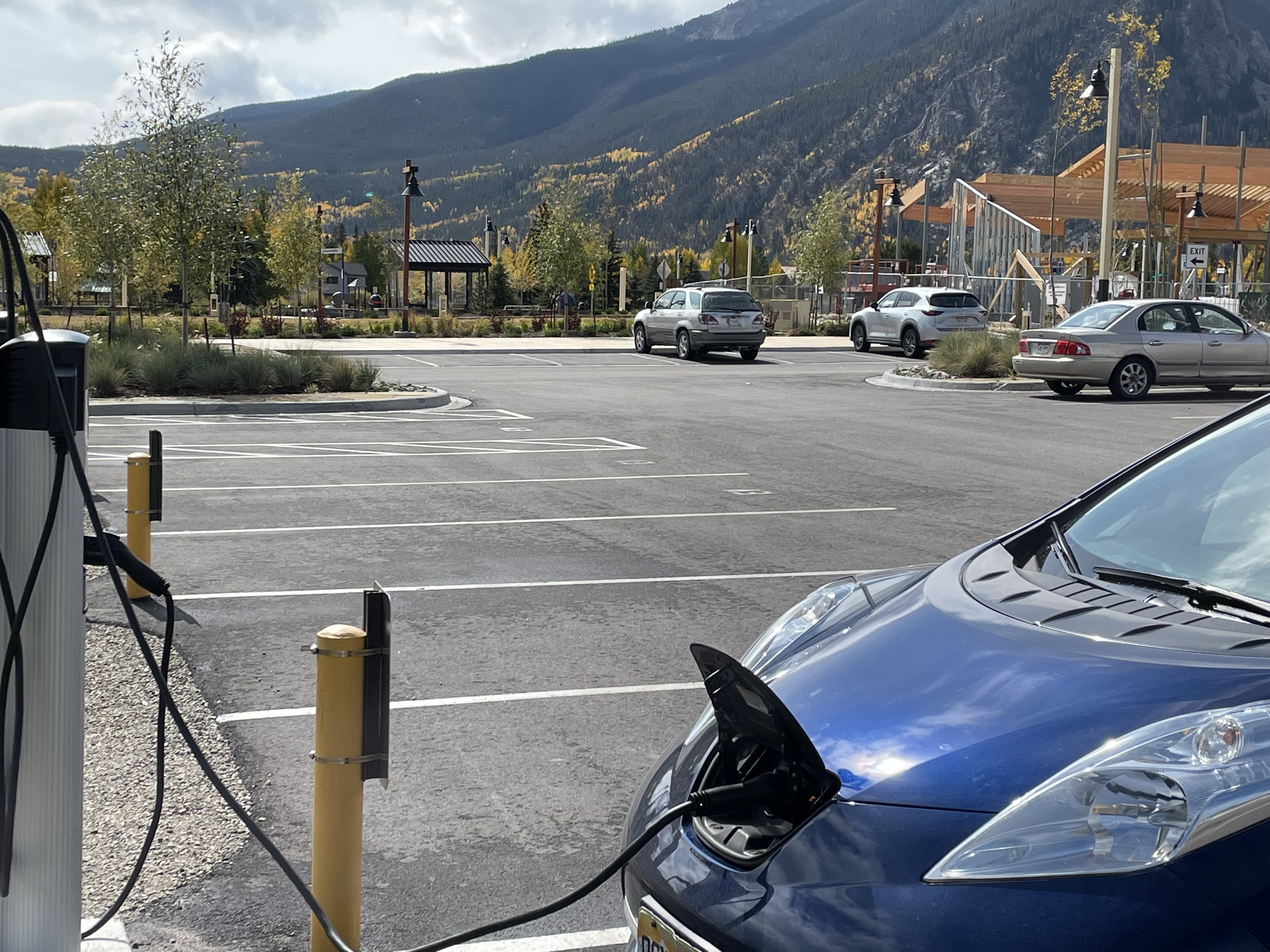
Leaf charging in Frisco September 30, 2021.

Click the link to read the article on the Yale 360 website:

Sales of electric cars are surging in the U.S. and Britain, a reflection of growing interest in plug-in vehicles and a response to high gas prices, analysts say. And as EV sales boom, automakers are backing the Biden administration’s new, more stringent fuel standards.

While the U.S. saw an overall dip in car sales in the first quarter of 2022, all-electric brands such as Karma, Polestar, and Tesla made significant gains, with sales of Teslas up 87 percent over the first quarter of last year. Major automakers also saw a significant EV uptick, with Ford reporting a 38 percent growth in EV sales over last year.

This trend was even more pronounced in the U.K., where automakers sold more electric cars in the month of March than they did in all of 2019, despite overall March car sales hitting their lowest point in 24 years. The growth of electric cars comes as oil prices soar, owing to problems in the supply chain and sanctions on Russia, a major oil producer, over its invasion of Ukraine.

“There was already massive growth in this segment and, if anything, the demand for vehicles is now even stronger as prices at the pumps rise on the back of the Ukraine crisis,” Ian Plummer, a director at car sales website AutoTrader, told The Guardian.

As EV sales rise, automakers are backing more stringent fuel standards recently announced by the EPA, Reuters reported. Texas and 15 other states are suing to block the new regulations, which call for a 28 percent cut in vehicle emissions by 2026. But the Alliance for Automotive Innovation, which represents nearly every major automaker, has sided with the EPA, saying in a court filing that it wants to make sure “critical regulatory provisions supporting electric vehicle technology are maintained.”

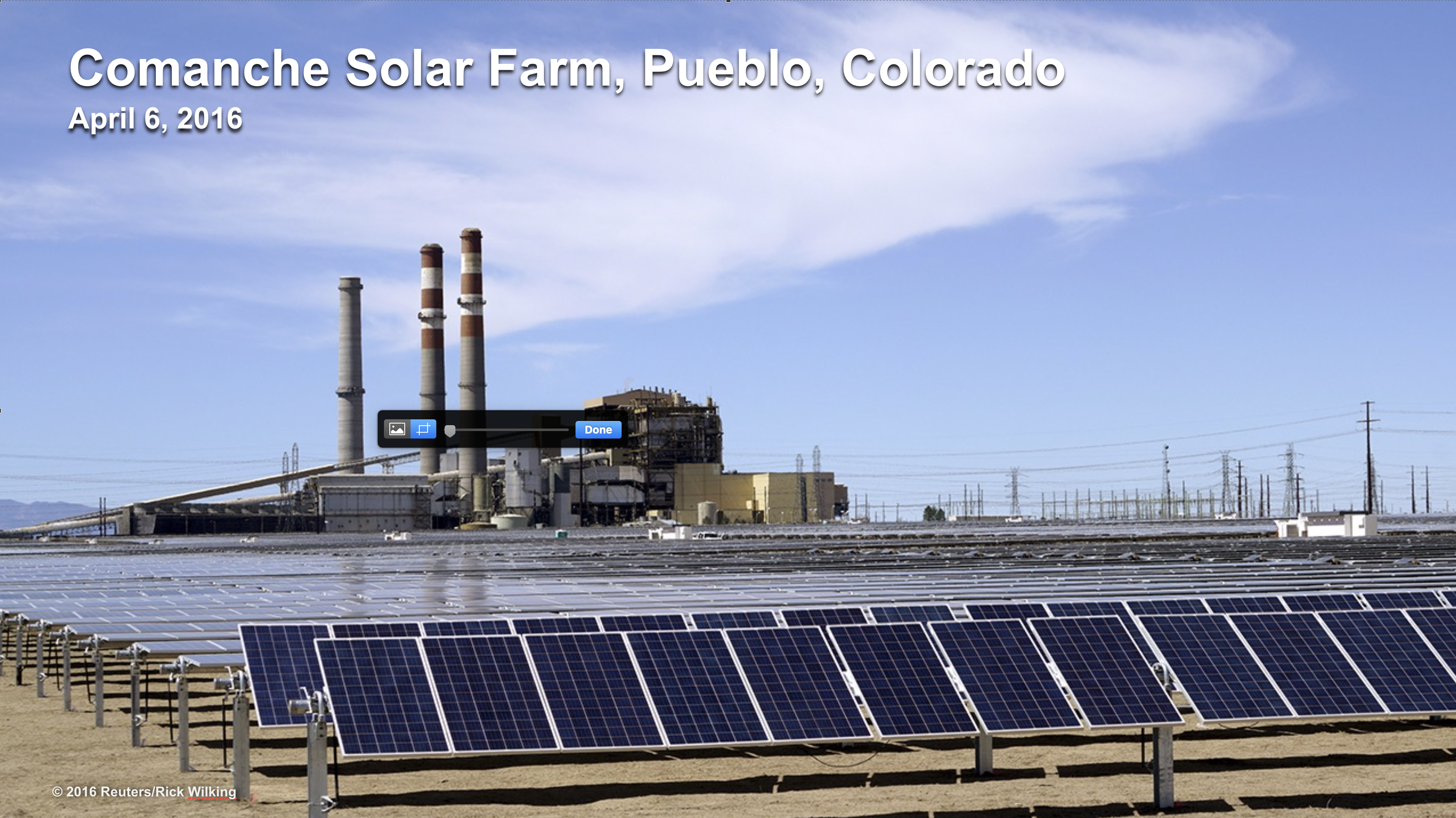
Comanche 3’s shaky reason to exist: Xcel Energy wants to keep Colorado’s youngest coal plant operating until 2034. But what is the evidence it can deliver power when it’s needed? — @BigPivots #ActOnClimate #KeepItInTheGround

Comanche Generating Station. Photo credit: Allen Best/Big Pivots

Click the link to read the article on the Big Pivots website (Allen Best):

For all electrical utilities, R is the first letter of the alphabet. Reliability, keeping the lights on, comes before A, affordability.
Colorado’s utility regulators soon will decide the role of Comanche 3, the state’s youngest but most unreliable coal-fired power plant, in ensuring reliability, and whether more natural gas generation will be required.

Xcel Energy, the operator and primary owner of the 750-megawatt coal plant, wants to keep the plant operating on limited, then seasonal-only, terms until 2034. It says the plant will meet peak demands during winter and summer. Several state agencies plus other groups have concurred.

Evidence for Comanche 3 serving this purpose is thin. All fossil fuel plants must occasionally be idled for repairs and maintenance. Comanche 3 has been first in this class. A 2021 report by the Public Utilities Commission staff found the coal unit from 2010 to 2020 “had the lowest availability” of all of Xcel’s coal and gas-fueled units in Colorado.

Comanche 3 was down for most of 2020. It’s down again this year, and until June at the earliest it won’t be generating any more electricity than a solar panel at midnight. At least the solar panels that now surround the plant on the edge of Pueblo generate electricity when the sun shines.

This should provide no comfort to people in Grand Junction, Denver, and other cities who expect air conditioning if temperatures soar to 116 degrees as happened in Portland last summer.

In a March meeting, two of the three PUC commissioners reported seeing no good argument for the plant operating beyond 2029. John Gavan, the commissioner from Paonia, was adamant in that. Megan Gilman, the commissioner from Edwards, was more inclined to kick the decision down the road until next year. Eric Blank, the chair of the PUC, who is from Boulder, observed that requiring the early retirement would in effect make the PUC responsible for ensuring reliability.

What may matter immensely is that Comanche 3 still hasn’t been paid off.
How different from just 18 years ago, when Comanche 3 was approved unanimously by a different set of PUC commissioners. Utilities and their regulators in 2004 saw a future that looked much like the past, giant coal plants gobbled coal delivered by a virtual conveyor belt from mines in Wyoming and Colorado. The plant that PUC commissioners approved was expected to continue operations until 2070.

Colorado Green, located between Springfield and Lamar, was Colorado’s first, large wind farm. Photo/Allen Best

Winds of change were even then picking up. Colorado Green, the state’s first wind farm, had begun operations between Lamar and Springfield earlier that year. That November, voters approved the state’s first renewable portfolio standard. Xcel easily met that initial 10% requirement years in advance of the deadline.

Today, Comanche 3 looks like a billion-dollar blunder. If ensuring winter lights or summer chillers is the goal, the relative grandfathers of Xcel’s coal-burning fleet, Hayden 1 and 2, completed in 1965 and 1976 respectively, might be better options for ensuring reliability. They’re currently scheduled to close in 2027 and 2028.

Xcel and other Colorado utilities now say with confidence they can achieve 80% carbon-free energy by 2030. Nobody, however, claims complete confidence in existing technologies and business models to go even higher than 90%. Holy Cross, the electrical provider for the Aspen and Vail areas, has a goal of 100%. Inconveniently, it also owns 8% of Comanche 3.

Xcel wants more natural gas generation to ensure reliability. This could potentially result in the better part of $1 billion in new infrastructure. But would those assets be stranded by new technology in another 20 years?

A decision may not be immediately necessary. In 2016, the last time Xcel submitted a plan to state regulators, it also wanted a ton of new natural gas generation. When it went shopping, it got bids for renewable generation in late 2017 that dropped jaws across the nation. The economics of renewables had become compelling.

Now, reliability remains a concern, but many ideas are percolating. Homes will likely become energy sources, the batteries of electric vehicles supplying household needs when the sun isn’t shining and the wind isn’t blowing. The grid increasingly will be two-way and with dispersed energy sources. Today’s electric grid that relies on a few big coal plants in a decade will look as quaint as a desk phone from … well, 2004.

By late next year we’ll have a much better idea whether new natural gas plants will be needed for reliability. As for Comanche 3, if it were a car, it’d already be in the automotive graveyard.

Scientists To Biden: Don’t Ramp Up #FossilFuels — Food & #Water Watch #ActOnClimate

Click the link to read the release on the Food & Water Watch website (Mark Schlosberg):

In recent weeks President Biden and his administration have moved to increase fossil fuel production and infrastructure. These actions fly in the face of climate science, which mandates a transition off of fossil fuels right away. Now scientists are speaking out, imploring President Biden to follow through on his commitments. As a candidate, Biden promised to listen to science, but his recent actions suggest the opposite.

The increased drought, wildfires, hurricanes, and floods that we’ve experienced recently would have been reason enough to curb this plan. But the Ukraine crisis has brought into full view the dangers of continued reliance on fossil fuels. Europe is planning for dramatic cuts in Russian gas and looking toward new sources. Rather than going all-in on renewable energy, Europe wants increased U.S. gas imports — for over a decade to come. This is a recipe for climate disaster.

A Broken Promise — President Biden Moves to Increase Fossil Fuel Production and Infrastructure

When President Biden ran for office, he pledged to listen to science. He also pledged to stop new drilling on federal lands, and initiate a transition off of fossil fuels. He was already falling massively short on these promises before the Ukraine crisis, but now he has reversed course completely. He and his administration have urged increased fossil fuel production, rush approvals of its infrastructure, and ramped-up exports to Europe. And his plan envisions a huge increase of gas exports by 2030 — more than tripling a big increase this year.

What these exports mean for the U.S. is more drilling, fracking, pipelines through communities and massive, polluting industrial facilities. These come with a litany of safety risks and local pollution, which have devastating environmental justice and health impacts.

It also will have monumental climate impacts, according to the most recent IPCC scientific report. Global emissions continue to increase and the very narrow window to avoid even 2 degrees of warming is rapidly closing. Building more infrastructure will certainly lock us into decades of more emissions.

As UN Secretary-General António Guterres said upon the release of the IPCC report: “Investing in new fossil fuels infrastructure is moral and economic madness.”

Failing on Climate: Lies From Leaders Will Be “Catastrophic”

The Biden approach to climate is, unfortunately, not unique. As the IPCC report highlights, governments worldwide have broken prior commitments even though those fell far short of requirements.

The only way to avert even worse impacts is to embrace scientific reality and adopt policies matching the rapidly escalating climate emergency. This means confronting hard truths and paying the crisis more than lip service. The only way to really achieve energy independence and security is to move off of fossil fuels. That means making quick, bold investments in renewable energy and immediately halting and rolling back fossil fuels and its infrastructure. To do otherwise fails to confront what is happening. Secretary-General Guterres said: “Some government and business leaders are saying one thing – but doing another…Simply put, they are lying, and the results will be catastrophic.”

Scientists Implore Biden to Reverse Course Before It’s Too Late

While President Biden has charted a perilous course, there’s still time to reverse and confront the reality of the climate crisis. Over 275 scientists wrote Biden to implore him to act. This is directly in response to his announced plans to double down on fossil fuels and the IPCC report release. They urged him to instead take bold action to move off fossil fuels and infrastructure and reject the mad dash to increase production and exports.

The initiative for this letter is led by scientists Bob Howarth, Mark Jacobson, Michael Mann, Sandra Steingraber, and Peter Kalmus. The message is prophetic and clear in its call to action. It concludes:

“As scientists who look at data every day, we implore you to keep this promise and listen to what the scientific community is saying about fossil fuels and the climate crisis. Do not facilitate more fuel extraction and infrastructure. The impacts of climate change are already significant and we have a very narrow window to avoid runaway climate chaos. We urge you to lead boldly, take on the fossil fuel titans, and rally the country towards a renewable energy future.”

Help amplify this call to action. Join them, and all of us at Food & Water Watch in calling on President Biden to reject fossil fuels — now.

Assessing the U.S. #Climate in March 2022 — NOAA

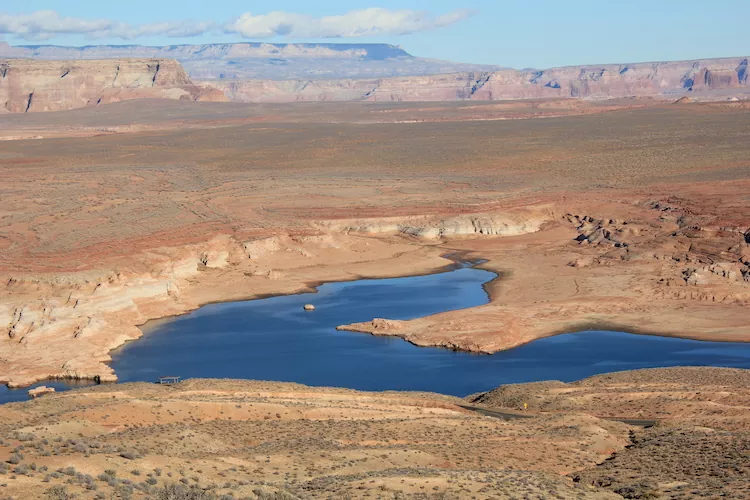
Nook on Lake Powell. Photo credit: Allen Best/Big Pivots

Click the link to read the article on the NOAA website:

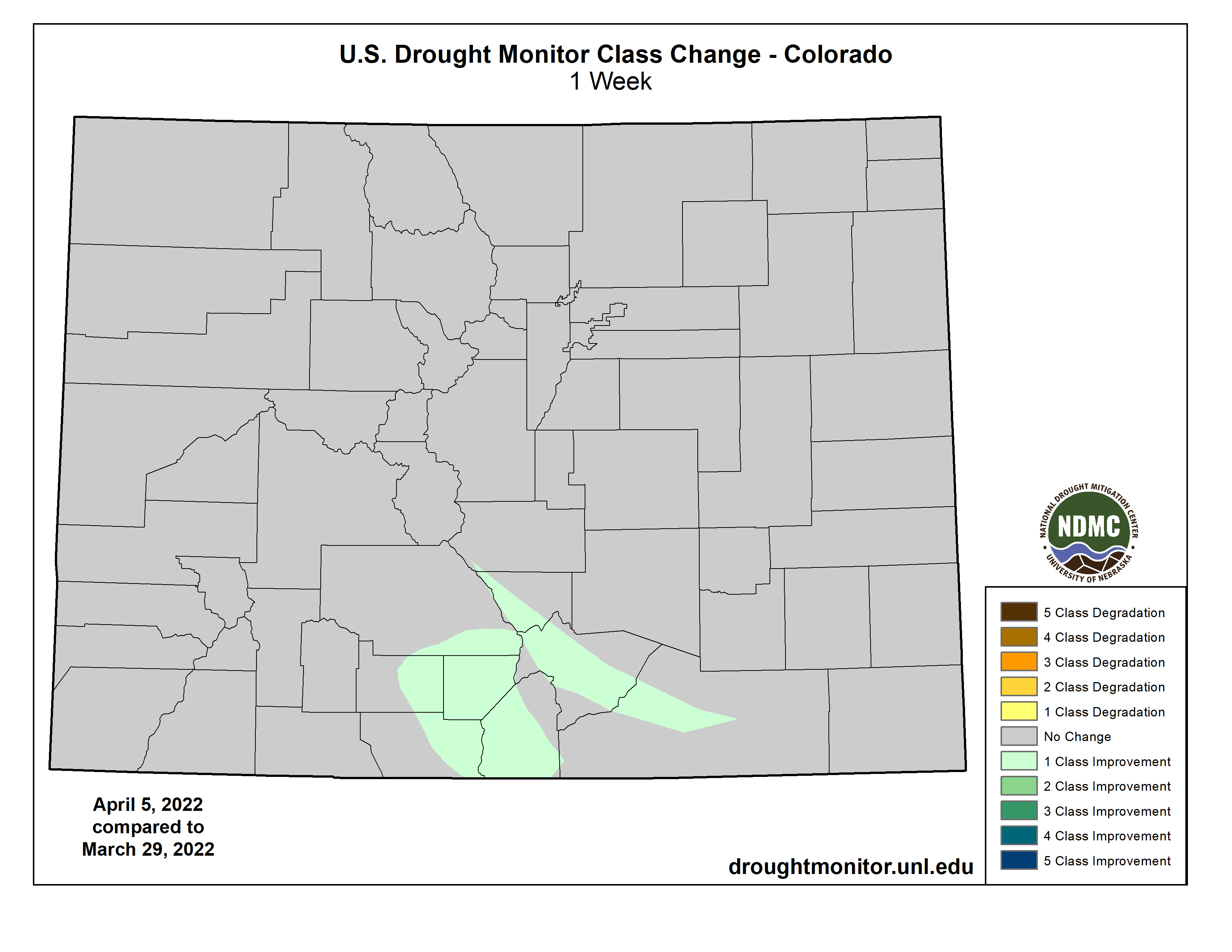
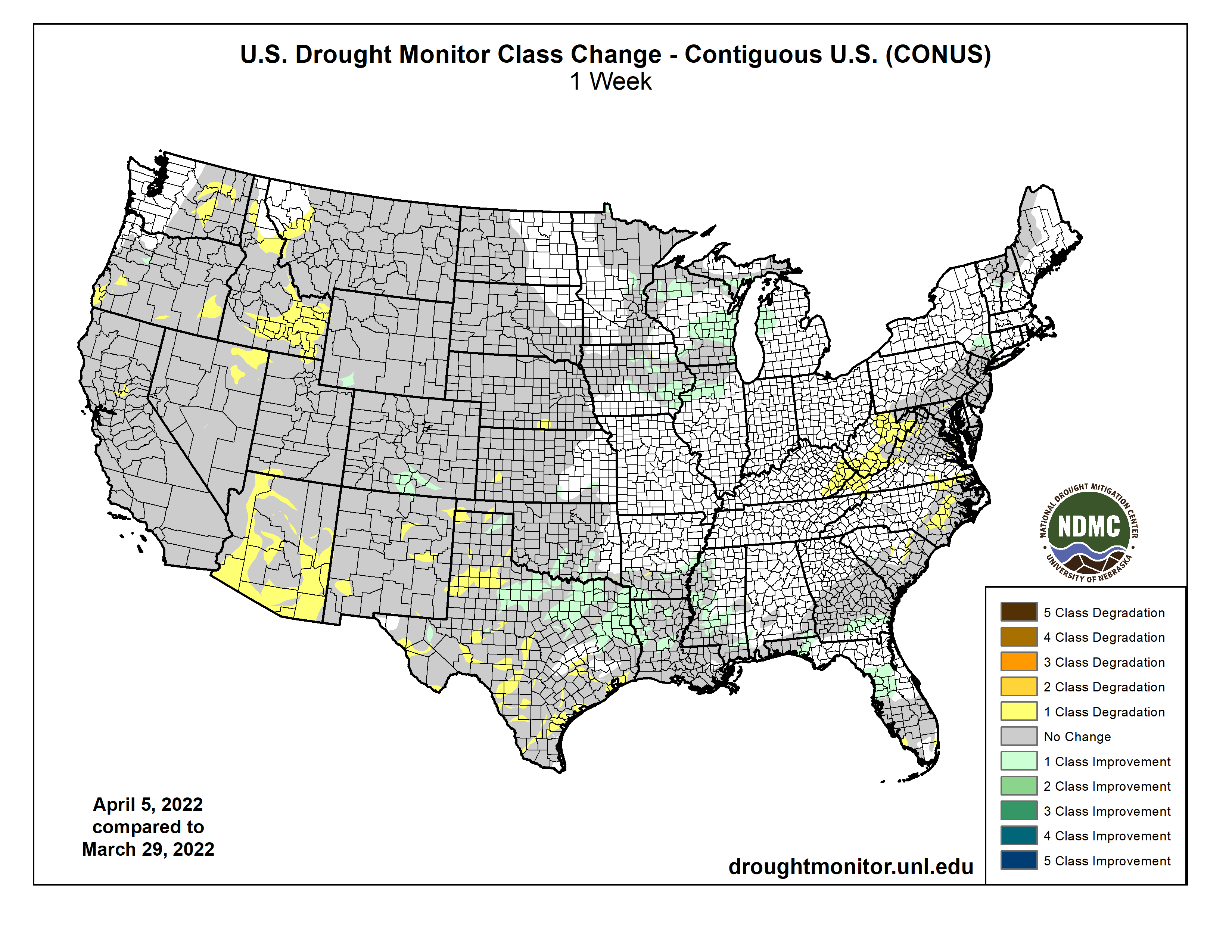
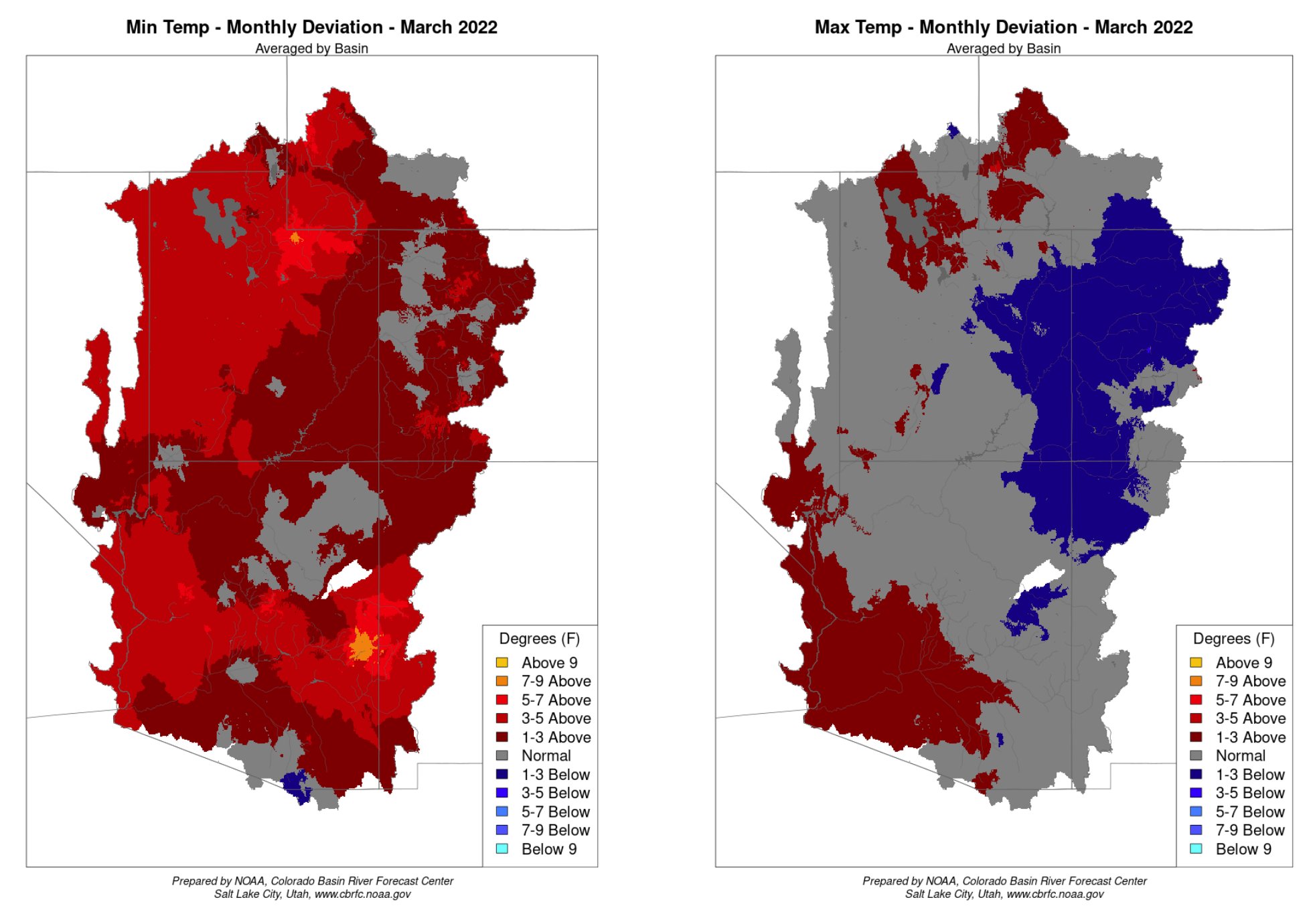
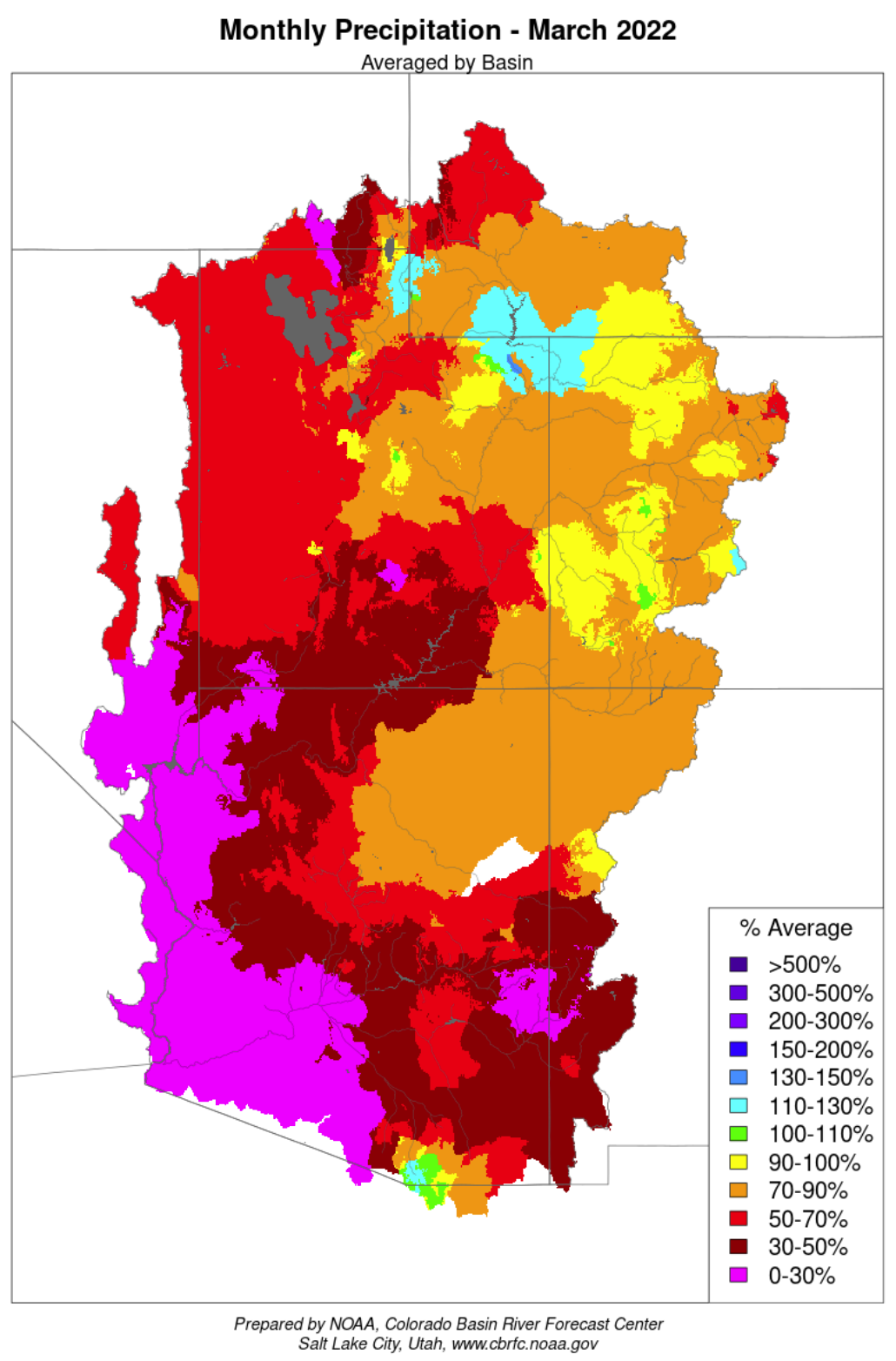
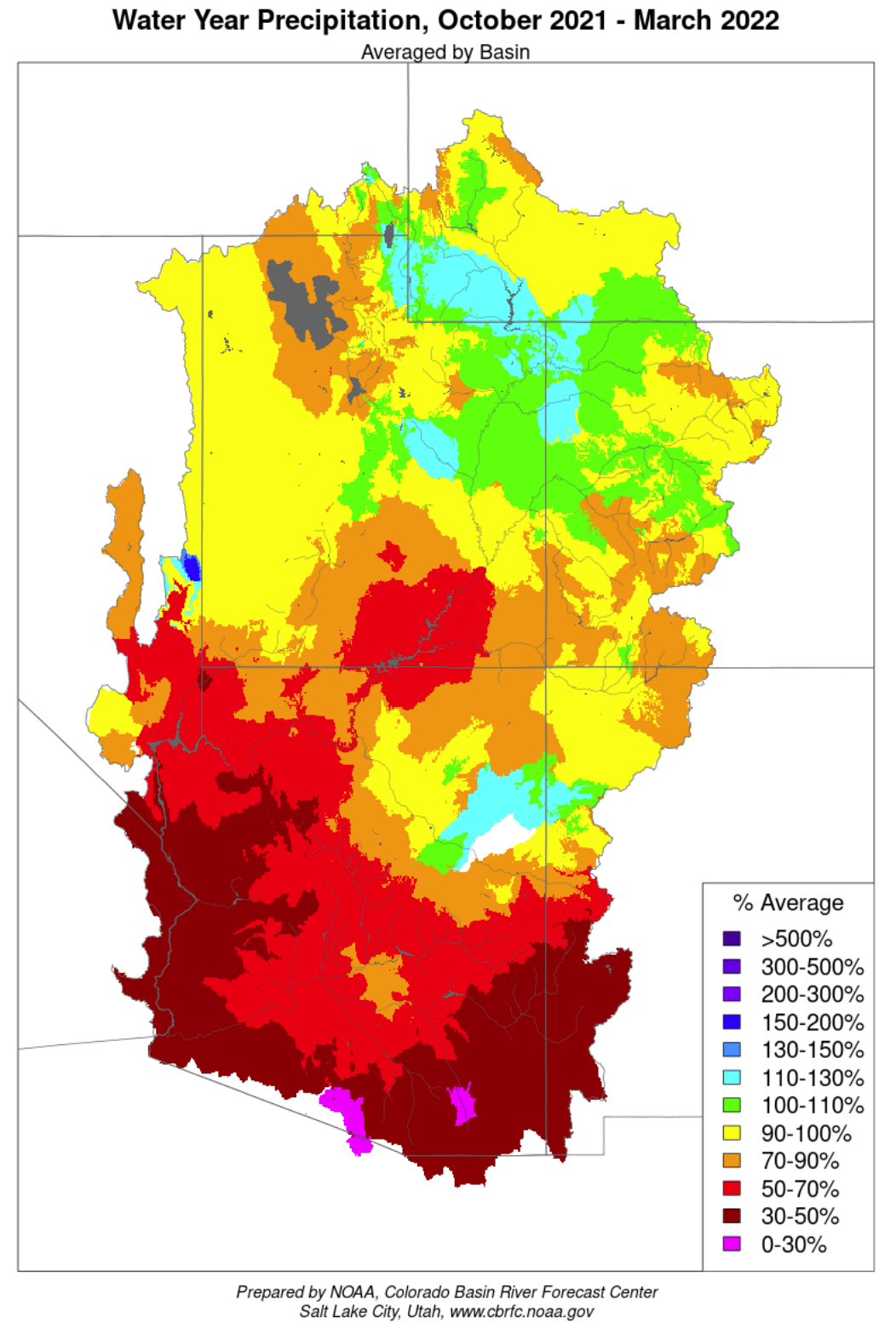
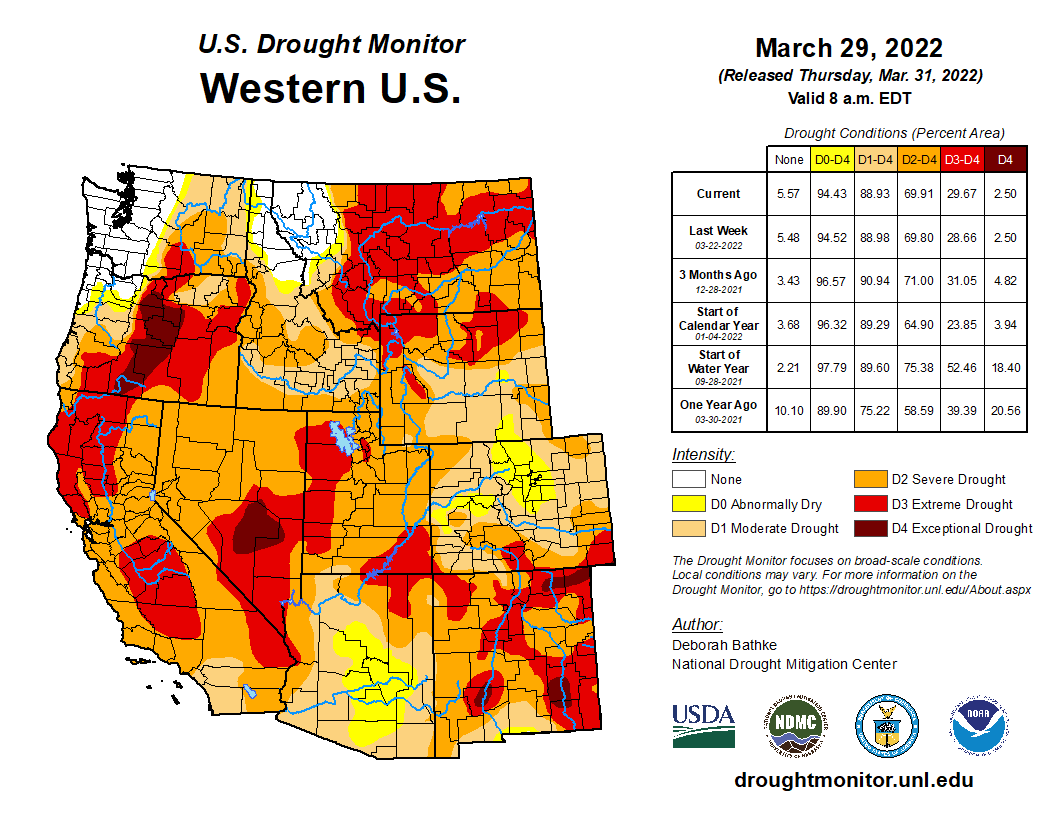
The current multi-year drought across the West is the most extensive and intense drought in the 22-year history of the U.S. Drought Monitor. Precipitation deficits during the first three months of 2022, across parts of the western U.S., are at or near record levels. As the climatological wet season ends across portions of the West, with below average snow coverConcerns for expanding and intensifying drought and water resource deficits are mounting. and reservoirs at or near record-low levels, concerns for expanding and intensifying drought and water resource deficits are mounting.

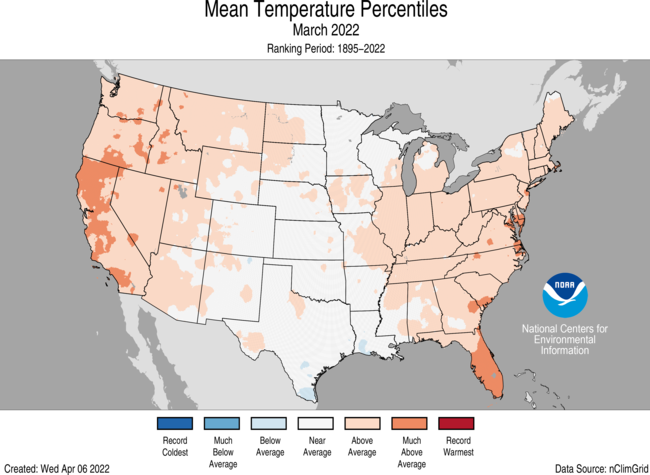
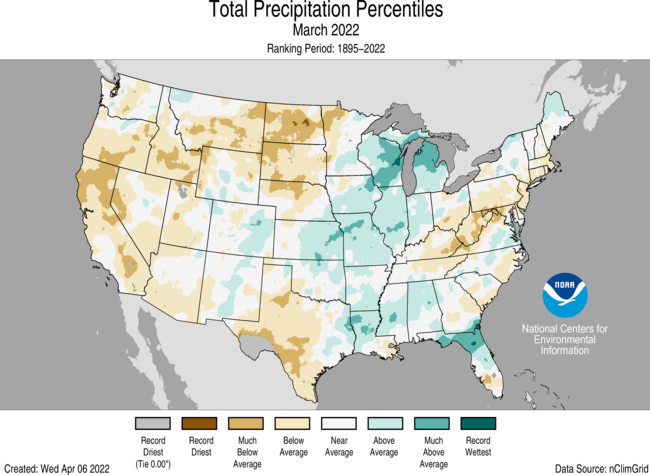
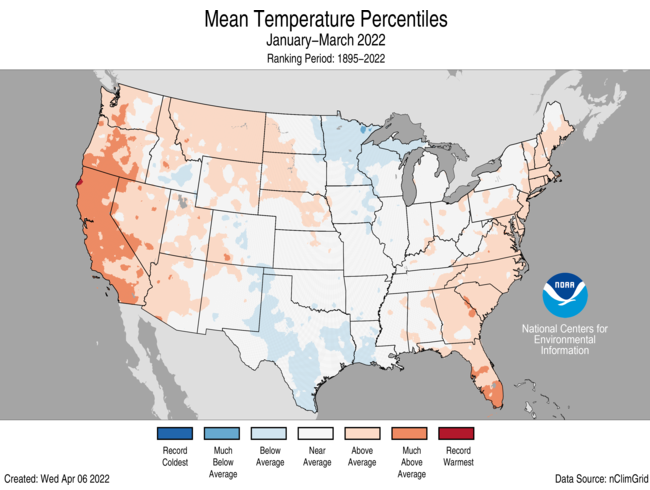
During March, the average contiguous U.S. temperature was 44.1°F, 2.6°F above the 20th-century average. This ranked in the warmest third of the 128-year period of record. The year-to-date (January-March) average contiguous U.S. temperature was 36.3°F, 1.2°F above average, ranking in the middle third of the record. TheMarch precipitation total for the contiguous U.S. was 2.26 inches, 0.25 inch below average, and ranked in the driest third of the 128-year period of record. The year-to-date precipitation total was 5.66 inches, 1.30 inches below average, ranking seventh driest in the January-March record.

This monthly summary fromNOAA National Centers for Environmental Information is part of the suite of climate services NOAA provides to government, business, academia and the public to support informed decision-making.

March

Temperature

  • A large cold-air outbreak across the central U.S. occurred during the second week of March. Despite this cold spell, temperatures for the month as a whole were above average across much of the West and from the Midwest to the East Coast. Temperatures were below average in pockets along the western Gulf Coast during March.
  • TheAlaska March temperature was 16.6°F, 5.8°F above the long-term average. This ranked in the warmest third of the 98-year period of record for the state. Temperatures were above average across most of the state with Anchorage and Talkeetna reporting a top-10 warm March.
  • Precipitation

  • Precipitation was above average from the central Plains to the Great Lakes, as well as across parts of the Deep South and Southeast. Precipitation was below average across much of the West, northern and southern Plains and from the Tennessee Valley to the Mid-Atlantic and parts of the Northeast. North Dakota ranked seventh driest on record, while Michigan ranked eighth wettest for the month.
  • Several severe weather outbreaks produced strong and damaging tornadoes during March.
  • On March 5, supercell thunderstorms produced at least 13 confirmed tornadoes across Iowa including a confirmed EF4 tornado in Winterset.
  • On March 21-22, severe weather and tornadoes were reported from Texas to Alabama including an EF3 tornado that substantially damaged two Jacksboro, Texas, schools and an EF3 tornado that ripped through the New Orleans metro area.
  • Another severe weather outbreak impacted the Gulf Coast states on March 30-31 from Louisiana to Florida with at least 14 tornadoes and 2 fatalities confirmed.
  • Precipitation across southeastern Alaska during March was above average. Following the wettest January and February on record, Juneau remained wet in March, ranking 10th wettest. As a result, the first three months of the year were the wettest on record and also the wettest January-April on record with the entire month of April still in play. End-of-March snowpack was above average across much of mainland Alaska with some locations near record high levels.
  • According to the March 29 U.S. Drought Monitor report, nearly 58 percent of the contiguous U.S. was in drought, down from 59 percent at the beginning of March. Drought conditions intensified and/or expanded across portions of the Southeast, Plains, southern Rockies, parts of the West Coast and Hawaii. Drought intensity and/or coverage lessened across parts of the northern Great Lakes. During March, the contiguous U.S. drought footprint reached 61 percent — the largest observed extent of drought since the fall of 2012.
  • Year-to-date (January-March)

    Temperature

  • Temperatures were above average across much of the West and along the East Coast. California ranked sixth warmest for the January-March period. Temperatures were below average across portions of the Upper Mississippi Valley and the Deep South.
  • The Alaska January-March temperature was 9.6°F, 3.7°F above the long-term average, ranking in the warmest third of the record for the state. Above-average temperatures were observed across much of the southern half of the state with the warmest departures from average occurring in portions of south-central Alaska.
  • Precipitation

    Billion-Dollar Weather and Climate Disasters

    During the first quarter of 2022, no new billion-dollar weather and climate disasters have been identified, although several events are currently being evaluated.

    In early April 2022, NCEI added an additional 13 historical weather and climate events which, through inflation and review, surpassed the billion-dollar threshold. The U.S. has now sustained 323 weather and climate disasters since 1980 where overall damages/costs reached or exceeded $1 billion (based on Consumer Price Index adjustment to 2022). The total cost of these 323 events exceeds $2.195 trillion.

    University of #Wyoming scholar says latest UN #climate report finally connects climate with #SocialJustice — Wyoming Public Radio

    Native land loss 1776 to 1930. Credit: Alvin Chang/Ranjani Chakraborty

    Click the link to read the article on the Wyoming Public Radio website (Jeff Victor). Here’s an excerpt:

    The latest report looks at the policy and lifestyle changes necessary to avert the worst effects. Those include radical changes to the energy system, the global economy and even the design of cities.

    University of Wyoming assistant professor Matt Henry said this report does something else significant. It identifies colonialism and its legacy as driving forces for the warming atmosphere. Henry said colonizers industrialized earlier and contributed far more to climate change than the countries and peoples they colonized. Now, formally colonized people and indigenous communities stand to bear the brunt of the devastation.

    “Those communities are especially vulnerable to climate change,” Henry said. “So, you’re more likely to, for example, be displaced from your home on the Gulf Coast when a hurricane hits if you’re a person of color, if you’re indigenous.”

    Each year in January, Colorado Water Trust and the Colorado Water Conservation Board launch the annual Request for Water Process

    Deep Creek, which flows from Hahns Peak down into Steamboat Lake in North Routt County, is being considered for an instream flow water right by the Colorado Water Conservation Board.
    Colorado Water Conservation Board/Courtesy photo

    Click the link to go to the Colorado Water Trust website. Here’s an excerpt:

    This process offers a streamlined approach to water transactions to benefit the environment on streams throughout the state. We invite water rights owners to explore options to use their water rights for streamflow restoration purposes.

    Voluntary water sharing arrangements or voluntary acquisitions of senior water rights, on a temporary or permanent basis, can help restore flows to rivers in need, sustain agriculture, and maximize beneficial uses of Colorado’s water.

    The Request for Water Process has several goals:

  • To invite voluntary water offers from willing water rights owners to benefit streamflows
  • To provide a user-friendly mechanism for water rights owners to explore working with CWCB and the Colorado Water Trust on water acquisitions and transactions that will benefit the natural environment
  • To streamline transaction processes and utilization of resources
  • To facilitate implementation of Colorado’s Water Plan objectives
  • To add flows to river segments in need while coordinating with agricultural and other water uses
  • This Process is confidential, completely voluntary and open to all water right owners, including agricultural, municipal, industrial, or other users.

    PRELIMINARY OFFERS OF WATER ARE DUE JUNE 30, 2022.

    Haboob: A Decade of Dust — Mike Olbinski

    Click the link to go to Mike Olbinski’s YouTube channel:

    Join this channel to get access to perks:
    https://www.youtube.com/channel/UCopM…

    Support me on Patreon: https://www.patreon.com/mikeolbinski
    All the Good Stuff: https://me.mikeolbinski.com

    Music By: “Etne” by RØRE licensed through Musicbed.com
    ——–

    Last summer marked the 10th anniversary of the historic haboob that hit downtown Phoenix in 2011, which just happened to be my third ever time-lapse attempt. I posted it online, it did well and thus I decided to keep time-lapsing dust and storms.

    Here we are, over a decade later, and the amount of haboob goodness I’ve witnessed and captured on camera has been a blast. Incredibly fun, exhilarating and rewarding. It started as a passion, turned into a business and now I consult annually with production companies on how to capture them on film.

    I’ve always wanted to do a short film displaying nothing but dust and haboobs, and it made sense to do it after collecting tens years worth of footage. This film doesn’t show all of the clips for sure, but it’s just most of my favorites, spanning the time period from 2011 to 2021. So some of this is older quality, not the 8K level I’ve been shooting at since 2016, but it still looks great to me!

    I love this song by RØRE as well, if you want to license your own music through the MusicBed, you can use my affiliate link here: http://share.mscbd.fm/mikeolbinski

    Hope you enjoy this look back at the dusty fun I’ve chased!

    Congratulations, soon to be Associate Justice of the U.S. Supreme Court, Ketanji Brown Jackson

    Ketanji Brown Jackson via the White House. Photo credit: Lelanie Foster, a young black photographer from the Bronx

    Click the link to read the remarks from President Biden, Vice President Kamala Harris, and Judge Ketanji Brown Jackson on the White House website:

    THE VICE PRESIDENT: Good morning. Good morning. (Applause.) Good morning, America. (Laughs.) Have a seat, please.

    President Joe Biden, First Lady Dr. Jill Biden, Second Gentleman Douglas Emhoff, members of Congress, members of the Cabinet, members of our administration, and friends and fellow Americans: Today is, indeed, a wonderful day — (applause) — as we gather to celebrate the confirmation of the next justice of the United States Supreme Court, Judge Ketanji Brown Jackson. (Applause.)

    President George Washington once referred to America as a “great experiment” — a nation founded on the previously untested belief that the people — we, the people — could form a more perfect union. And that belief has pushed our nation forward for generations. And it is that belief that we reaffirmed yesterday — (applause) — through the confirmation of the first Black woman to the United States Supreme Court. (Applause.)

    THE PRESIDENT: Whoa! It’s about time!

    THE VICE PRESIDENT: And, Judge Jackson, you will inspire generations of leaders. They will watch your confirmation hearings and read your decisions.

    In the years to come, the Court will answer fundamental questions about who we are and what kind of country we live in: Will we expand opportunity or restrict it? Will we strengthen the foundations of our great democracy or let them crumble? Will we move forward or backward?

    The young leaders of our nation will learn from the experience, the judgment, the wisdom that you, Judge Jackson, will apply in every case that comes before you. And they will see, for the first time, four women sitting on that Court at one time. (Applause.)

    So, as a point of personal privilege, I will share with you, Judge Jackson, that when I presided over the Senate confirmation vote yesterday, while I was sitting there, I drafted a note to my goddaughter. And I told her that I felt such a deep sense of pride and joy and about what this moment means for our nation and for her future. And I will tell you, her braids are just a little longer than yours. (Laughter.)

    But as I wrote to her, I told her what I knew this would mean for her life and all that she has in terms of potential.

    So, indeed, the road toward our more perfect union is not always straight, and it is not always smooth. But sometimes it leads to a day like today — (applause) — a day that reminds us what is possible — what is possible when progress is made and that the journey — well, it will always be worth it.

    So let us not forget that, as we celebrate this day, we are also here in great part because of one President, Joe Biden — (applause) — and — (laughs) — and because of Joe Biden’s vision and leadership and commitment — a lifelong commitment — to building a better America.

    And, of course, we are also here because of the voices and the support of so many others, many of whom are in this audience today.

    And with that, it is now my extreme and great honor to introduce our President, Joe Biden. (Applause.)

    THE PRESIDENT: Thank you, Kamala. Thank you, thank you, thank you. The first really smart decision I made in this administration. (Laughter.)

    My name is Joe Biden. Please, sit down. I’m Jill’s husband — (laughter) — and Naomi Biden’s grandfather.

    And, folks, you know, yesterday — this is not only a sunny day. I mean this from the bottom of my heart: This is going to let so much shine — sun shine on so many young women, so many young Black women — (applause) — so many minorities, that it’s real. It’s real.

    We’re going to look back — nothing to do with me — we’re going to look back and see this as a moment of real change in American history.

    I was on the phone this morning, Jesse, with President Ramaphosa of South Africa. And he was talking about how — the time that I was so outspoken about what was going on and my meeting with Nelson Mandela here. And I said, “You know” — I said, “I’m shortly going to go out,” look- — I’m looking out the window — “I’m going to go out in this — what they call the South Lawn of the White House, and I’m going to introduce to the world — to the world — the first African American woman out of over 200 judges on the Supreme Court.” And he said to me — he said, “Keep it up.” (Laughter.) “Keep it up.” (Applause.) We’re going to keep it up.

    And, folks, yesterday we all witnessed a truly historic moment presided over by the Vice President. There are moments, if people go back in history, and they’re literally historic, consequential, fundamental shifts in American policy.

    Today, we’re joined by the First Lady, the Second Gentleman, and members of the Cabinet, the Senate Majority Leader. Where — there you are, Chuck. The Senate Majority Leader. And so many who made this possible.

    But — and today is a good day, a day that history is going to remember. And in the years to come, they’re going to be proud of what we did, and which (inaudible) — Dick Durbin did as the chairman of the committee. (Applause.) I’m serious, Dick. I’m deadly earnest when I say that.

    To turn to our children and grandchildren and say, “I was there.” “I was there.” That — this is one of those moments, in my view.

    My fellow Americans, today I’m honored to officially introduce to you the next Associate Justice of the Supreme Court of the United States, Ketanji Brown Jackson. (Applause.)

    After more than 20 hours of questioning at her hearing and nearly 100 meetings — she made herself available to every single senator who wanted to speak to her and spoke for more than just a few minutes, answered their questions, in private as well as before the committee — we all saw the kind of justice she’ll be: Fair and impartial. Thoughtful. Careful. Precise. Precise. Brilliant. A brilliant legal mind with deep knowledge of the law. And a judicial temperament — which was equally important, in my view — that’s calm and in command. And a humility that allows so many Americans to see themselves in Ketanji Brown Jackson.

    That brings a rare combination of expertise and qualifications to the Court. A federal judge who has served on the second most powerful court in America behind the Supreme Court. A former federal public defender with the — (applause) — with the ability to explain complicated issues in the law in ways everybody — all people — can understand. A new perspective.

    When I made the commitment to nominate a Black woman to the Supreme Court, I could see this day. I literally could see this day, because I thought about it for a long, long time. As Jill and Naomi would tell you, I wasn’t going to run again. But when I decided to run, this was one of the first decisions I made. I could see it. I could see it as a day of hope, a day of promise, a day of progress; a day when, once again, the moral arc of the universe, as Barack used to quote all the time, bends just a little more toward justice.

    I knew it wouldn’t be easy, but I knew the person I nominated would be put through a painful and difficult confirmation process. But I have to tell you, what Judge Jackson was put through was well beyond that. There was verbal abuse. The anger. The constant interruptions. The most vile, baseless assertions and accusations.

    In the face of it all, Judge Jackson showed the incredible character and integrity she possesses. (Applause.) Poise. Poise and composure. Patience and restraint. And, yes, perseverance and even joy. (Applause.) Even joy.

    Ketanji — or I can’t — I’m not going to be calling you that in public anymore. (Laughter.) Judge, you are the very definition of what we Irish refer to as dignity. You have enormous dignity. And it communicates to people. It’s contagious. And it matters. It matters a lot.

    Maybe that’s not surprising if you looked to who sat behind her during those hearings — her husband Dr. Patrick Jackson and his family. (Applause.) Patrick, stand up, man. Stand up. (Applause.) Talia and Leila, stand up. (Applause.) I know it’s embarrassing the girls. I’m going to tell you what Talia said. I said to Talia, “It’s hard being the daughter or the son of a famous person.” I said, “Imagine what it’s like being President.” And he said — she said, “She may be.” (Laughter and applause.) I couldn’t agree more. Thank you. Thank you, thank you, thank you.

    And Ketajh, her brother, a former police officer and a veteran. Ketajh, stand up, man. (Applause.) This a man who looks like he can still play, buddy. He’s got biceps about as big as my calves. (Laughter.) Thank you, bud. Thank you, thank you, thank you.

    And, of course, her parents: Johnny and Ellery Brown. Johnny and Ellery, stand up. (Applause.) I tell you what — as I told Mom: Moms rule in my house. (Laughter.) No, you think I’m kidding. I’m not. My mom and my wife as well.

    Look, people of deep faith, with a deep love of family and country — that’s what you represent; who know firsthand, Mom and Dad, the indignity of Jim Crow, the inhumanity of legal segregation, and you had overcome so much in your own lives.

    You saw the strength of parents in the strength of their daughter that is just worth celebrating. I can’t get over, Mom and Dad — you know, I mean, what — what you did, and your faith, and never giving up any hope. And both that wonderful son you have and your daughter.

    You know, and that strength lifted up millions of Americans who watched you, Judge Jackson, especially women and women of color who have had to run the gauntlet in their own lives. So many of my Cabinet members are women — women of color, women that represent every sector of the community. And it matters. And you stood up for them as well. They know it — everybody out there, every woman out there, everyone — (applause) — am I correct? Just like they have. Just like they have.

    And same with the women members of Congress, as well, across the board.

    Look, it’s a powerful thing when people can see themselves in others. Think about that. What’s the most powerful thing — I’ll bet every one of you can go back and think of a time in your life where there was a teacher, a family member, a neighbor — somebody — somebody who made you believe that you could be whatever you wanted to be. It’s a powerful, powerful, powerful notion.

    And that’s one of the reasons I believed so strongly that we needed a Court that looks like America. Not just the Supreme Court. (Applause.)

    That’s why I’m proud to say, with the great help of Dick Durbin, I’ve nominated more Black women judges to the federal appeal courts than all previous presidents combined. (Applause.) Combined.

    And that’s why I’m proud that Kamala Harris is our Vice President of the United States. (Applause.) A brilliant lawyer. The Attorney General of the State of California. Former member of the Senate Judiciary Committee. Kamala was invaluable during this entire process. (Applause.)

    And, Chuck, our Majority Leader, I want to thank you, pal. You did a masterful job in keeping the caucus together, getting this vote across the finish line in a timely and historic manner. Just watching it on television yesterday, watching when the vote was taken — and the Democratic side, they’re brave people — there was such enthusiasm, genuine. You can tell when it’s real. You can tell when it’s real. You did an incredible job, Chuck. Thank you so much. (Applause.)

    Folks, because you’re all able to sit down and don’t have to stand, I’m going to go on a little longer here and tell you — (laughter) — I want to say something about Dick Durbin again. Dick, I’m telling you, overseeing the hearing, how you executed the strategy by the hour, every day, to keep the committee together. And you have a very divided committee with some of the most conservative members of the Senate on that committee. It was especially difficult with an evenly divided Senate.

    Dick, I served as chairman of that committee for a number of years before I had this job and the job of Vice President. As did all the Democrats, you did an outstanding — I think all the Democrats in the committee did and every Democrat in the Senate, all of whom voted for Judge Jackson.

    And notwithstanding the harassment and attacks in the hearings, I always believed that a bipartisan vote was possible. And I hope I don’t get him in trouble — I mean it sincerely — but I want to thank three Republicans who voted for Judge Jackson. (Applause.) Senators Collins, who’s a woman of integrity. Senator Murkowski, the same way — in Alaska — and up for reelection. And Mitt Romney, whose dad stood up like he did. His dad stood up and made these decisions on civil rights.

    They deserve enormous credit for setting aside partisanship and making a carefully considered judgment based on the Judge’s character, qualifications, and independence. And I truly admire the respect, diligence, and hard work they demonstrated in the course of the process.

    As someone who has overseen, they tell me, more Supreme Court nominations than anyone who’s alive today, I believe that respect for the process is important. And that’s why it was so important to me to meet the constitutional requirement to seek the advice and the consent of the Senate. The advice beforehand and the consent.

    Judge Jackson started the nominating process with an imper- — an impressive range of support: from the FOP to civil rights leaders; even Republican-appointed judges came forward.

    In fact, Judge Jackson was introduced at the hearing by Judge Thomas Griffith, the distinguished retired judge appointed by George W. Bush.

    She finished the hearing with among the highest levels of support of the American people of any nomination in recent memory. (Applause.)

    So, soon, Judge Jackson will join the United States Supreme Court. And like every justice, the decisions she makes will impact on the lives of America for a lot longer, in many cases, than any laws we all make. But the truth is: She’s already impacting the lives of so many Americans.

    During the hearing, Dick spoke about a custodial worker who works the night shift at the Capitol. Her name is Verona Clemmons. Verona, where are you? Stand up, Verona. I want to — (applause) — if you don’t mind.

    She told him what this nomination meant to her. So he invited Ms. Clemmons to attend the hearing because she wanted to see, hear, and stand by Judge Jackson.

    Thank you, Verona. (Applause.) Thank you, thank you, thank you.

    At her meeting with Judge Jackson, Senator Duckworth introduced her to 11-year-old — is it Vivian?

    AUDIENCE MEMBER: Vivienne.

    THE PRESIDENT: Vi-vinne?

    AUDIENCE MEMBER: Vivienne.

    THE PRESIDENT: Vivienne. I’m sorry, Vivienne. There — that’s her — that’s your sister. He’s point- — (laughter) — who was so inspired by the hearing that she wants to be a Supreme Court justice when she grows up. (Applause.) God love you. Stand up, honey. Am I going to embarrass you if I just ask you to stand up? Come on, stand. (Applause.)

    There’s tens of thousands of Viviennes all through the entire United States. She met Judge Jackson and saw her future. Vivienne, you’re here today, and thank you for coming, honey. I know I embarrassed you by introducing you, but thank you.

    People of every generation, of every race, of every background felt this moment, and they feel it now. They feel a sense of pride and hope, of belonging and believing, and knowing the promise of America includes everybody — all of us. And that’s the American experiment.

    Justice Breyer talked about it when he came to the White House in January to announce his retirement from the Court. He used to technically work with me when I was on the Judiciary Committee, and that’s before he became a justice. He’s a man of great integrity. We’re going to miss Justice Breyer. He’s a patriot, an extraordinary public service [servant], and a great justice of the Supreme Court.

    And, folks — (applause) — let me close with what I’ve long said: America is a nation that can be defined in a single word. I was in the foothi- — foot- — excuse me, in the foothills of the Himalayas with Xi Jinping, traveling with him. (Inaudible) traveled 17,000 miles when I was Vice President at the time. I don’t know that for a fact.

    And we were sitting alone. I had an interpreter and he had an interpreter. And he looked at me. In all seriousness, he said, “Can you define America for me?” And I said what many of you heard me say for a long time. I said, “Yes, I can, in one word: possibilities.” (Applause.) “Possibilities.” That, in America, everyone should be able to go as far as their hard work and God-given talent will take them. And possibilities. We’re the only ones. That’s why we’re viewed as the “ugly Americans”: We think anything is possible. (Laughter.)

    And the idea that a young girl who was dissuaded from even thinking you should apply to Harvard Law School — “Don’t raise your hopes so high.” Well, I don’t know who told you that, but I’d like to go back and invite her to the Supreme Court so she can see the interior. (Laughter.)

    Look, even Supreme Court of the United States of America.

    Now, folks, it’s my honor — and it truly is an honor; I’ve been looking forward to it for a while — to introduce to you the next Associate Justice of the United States Supreme Court, the Honorable Ketanji Brown Jackson. (Applause.)

    JUDGE JACKSON: Thank you. Thank you. (Applause.) Thank you all. Thank you, all, very much. Thank you.

    Thank you so much, Mr. President. It is the greatest honor of my life to be here with you at this moment, standing before my wonderful family, many of my close friends, your distinguished staff and guests, and the American people.

    Over these past few weeks, you’ve heard a lot from me and about me, so I hope to use this time primarily to do something that I have not had sufficient time to do, which is to extend my heartfelt thanks to the many, many people who have helped me as part of this incredible journey.

    I have quite a few people to thank. And — and as I’m sure you can imagine, in this moment, it is hard to find the words to express the depth of my gratitude.

    First, as always, I have to give thanks to God for delivering me as promised — (applause) — and for sustaining me throughout this nomination and confirmation process. As I said at the outset, I have come this far by faith, and I know that I am truly blessed. To the many people who have lifted me up in prayer since the nomination, thank you. I am very grateful.

    Thank you, as well, Mr. President, for believing in me and for honoring me with this extraordinary chance to serve our country.

    Thank you also, Madam Vice President, for your wise counsel and steady guidance.

    And thank you to the First Lady and the Second Gentleman for the care and warmth that you have shown me and my family.

    I would also like to extend my thanks to each member of the Senate. You have fulfilled the important constitutional role of providing advice and consent under the leadership of Majority Leader Schumer. And I’m especially grateful for the work of the members of the Senate Judiciary Committee, under Chairman Durbin’s skillful leadership. (Applause.)

    As you may have heard, during the confirmation process, I had the distinct honor of having 95 personal meetings with 97 sitting senators. (Laughter.) And we had substantive and engaging conversations about my approach to judging and about the role of judges in the constitutional system we all love.

    As a brief aside, I will note that these are subjects about which I care deeply. I have dedicated my career to public service because I love this country and our Constitution and the rights that make us free.

    I also understand from my many years of practice as a legal advocate, as a trial judge, and as a judge on a court of appeals that part of the genius of the constitutional framework of the United States is its design, and that the framers entrusted the judicial branch with the crucial but limited role.

    I’ve also spent the better part of the past decade hearing thousands of cases and writing hundreds of opinions. And in every instance, I have done my level best to stay in my lane and to reach a result that is consistent with my understanding of the law and with the obligation to rule independently without fear or favor.

    I am humbled and honored to continue in this fashion as an Associate Justice of the Supreme Court of the United States, working with brilliant colleagues, supporting and defending the Constitution, and steadfastly upholding the rule of law. (Applause.)

    But today, at this podium, my mission is far more modest. I’m simply here to give my heartfelt thanks to the categories of folks who are largely responsible for me being here at this moment.

    First, of course, there is my family. Mom and Dad, thank you not only for traveling back here on what seems like a mos- — moment’s notice, but for everything you’ve done and continue to do for me.

    My brother, Ketajh, is here as well. You’ve always been an inspiration to me as a model of public service and bravery, and I thank you for that.

    I love you all very much. (Applause.)

    To my in-laws, Pamela and Gardner Jackson, who are here today, and my sisters-in-law and brothers-in-law, William and Dana, Gardie and Natalie: Thank you for your love and support.

    To my daughters, Talia and Leila: I bet you never thought you’d get to skip school by spending a day at the White House. (Laughter.) This is all pretty exciting for me as well. But nothing has brought me greater joy than being your mother. I love you very much. (Applause.)

    Patrick, thank you for everything you’ve done for me over these past 25 years of our marriage. You’ve done everything to support and encourage me. And it is you who’ve made this moment possible. (Applause.)

    Your — your steadfast love gave me the courage to move in this direction. I don’t know that I believed you when you said that I could do this, but now I do. (Laughter and applause.) And for that, I am forever grateful.

    In the family category, let me also briefly mention the huge extended family, both Patrick’s and my own, who are watching this from all over the country and the world. Thank you for supporting me. I hope to be able to connect with you personally in the coming weeks and months.

    Moving on briefly to the second category of people that warrant special recognition: those who provided invaluable support to me professionally in the decades prior to my nomination, and the many, many friends I have been privileged to make throughout my life and career.

    Now, I know that everyone who finds professional success thinks they have the best mentors, but I truly do. (Laughter.) I have three inspiring jurists for whom I had the privilege of clerking: Judge Patti Saris, Judge Bruce Selya, and, of course, Justice Stephen Breyer. Each of them is an exceptional public servant, and I could not have had better role models for thoughtfulness, integrity, honor, and principle, both by word and deed.

    My clerkship with Justice Breyer, in particular, was an extraordinary gift and one for which I’ve only become more grateful with each passing year. Justice Breyer’s commitment to an independent, impartial judiciary is unflagging. And, for him, the rule of law is not merely a duty, it is his passion. I am daunted by the prospect of having to follow in his footsteps. And I would count myself lucky, indeed, to be able to do so with even the smallest amount of his wisdom, grace, and joy.

    The exceptional mentorship of the judges for whom I clerked has proven especially significant for me during this past decade of my service as a federal judge. And, of course, that service itself has been a unique opportunity. For that, I must also thank President Obama, who put his faith in me by nominating me to my first judicial role on the federal district court. (Applause.)

    This brings me to my colleagues and staff of the federal district court in Washington, D.C., and the D.C. Circuit: Thank you for everything. I am deeply grateful for your wisdom and your battle-tested friendship through the years.

    I also want to extend a special thanks to all of my law clerks, many of whom are here today, who have carved out time and space to accompany me on this professional journey.

    I’m especially grateful to Jennifer Gruda, who has been by my side since nearly the outset of my time on the bench — (applause) — and has promised — has promised not to leave me as we take this last big step.

    To the many other friends that I have had the great, good fortune to have made throughout the years — from my neighborhood growing up; from Miami Palmetto Senior High School, and especially the debate team; from my days at Harvard College, where I met my indefatigable and beloved roommates, Lisa Fairfax, Nina Coleman Simmons, and Antoinette Sequeira Coakley — they are truly my sisters. (Applause.)

    To my time at Harvard Law School and the many professional experiences that I’ve been blessed to have since graduation: Thank you.

    I have too many friends to name, but please know how much you’ve meant to me and how much I have appreciated the smiles, the hugs, and the many “atta girls” that have propelled me forward to this day.

    Finally, I’d like to give special thanks to the White House staff and the special assistants who provided invaluable assistance in helping me to navigate the confirmation process.

    My trusted sherpa, Senator Doug Jones, was an absolute godsend. (Applause.) He was an absolute godsend. He’s not only the best storyteller you’d ever want to meet, but also unbelievably popular on the Hill, which helped a lot. (Laughter.)

    I’m also standing here today in no small part due to the hard work of the brilliant folks who interact with the legislature and other stakeholders on behalf of the White House, including Louisa Terrell, Reema Dodin, and Tona Boyd, Minyon Moore, Ben LaBolt, and Andrew Bates. (Applause.)

    I am also particularly grateful for the awe-inspiring leadership of White House Counsel Dana Remus. (Applause.) Of Paige Herwig. Where is Paige? (Applause.) And Ron Klain. (Applause.)

    They led an extraordinarily talented team of White House staffers in the Herculean effort that was required to ensure that I was well prepared for the rigors of this process and in record time. Thank you all. (Applause.)

    Thank you, as well, to the many, many kind-hearted people from all over this country and around the world who’ve reached out to me directly in recent weeks with messages of support.

    I have spent years toiling away in the relative solitude of my chambers, with just my law clerks, in isolation. So, it’s been somewhat overwhelming, in a good way, to recently be flooded with thousands of notes and cards and photos expressing just how much this moment means to so many people.

    The notes that I’ve received from children are particularly cute and especially meaningful because, more than anything, they speak directly to the hope and promise of America.

    It has taken 232 years and 115 prior appointments for a Black woman to be selected to serve on the Supreme Court of the United States. (Applause.)

    But we’ve made it. (Applause.) We’ve made it, all of us. All of us.

    And — and our children are telling me that they see now, more than ever, that, here in America, anything is possible. (Applause.)

    They also tell me that I’m a role model, which I take both as an opportunity and as a huge responsibility. I am feeling up to the task, primarily because I know that I am not alone. I am standing on the shoulders of my own role models, generations of Americans who never had anything close to this kind of opportunity but who got up every day and went to work believing in the promise of America, showing others through their determination and, yes, their perseverance that good — good things can be done in this great country — from my grandparents on both sides who had only a grade-school education but instilled in my parents the importance of learning, to my parents who went to racially segregated schools growing up and were the first in their families to have the chance to go to college.

    I am also ever buoyed by the leadership of generations past who helped to light the way: Dr. Martin Luther King Jr., Justice Thurgood Marshall, and my personal heroine, Judge Constance Baker Motley. (Applause.)

    They, and so many others, did the heavy lifting that made this day possible. And for all of the talk of this historic nomination and now confirmation, I think of them as the true pathbreakers. I am just the very lucky first inheritor of the dream of liberty and justice for all. (Applause.)

    To be sure, I have worked hard to get to this point in my career, and I have now achieved something far beyond anything my grandparents could’ve possibly ever imagined. But no one does this on their own. The path was cleared for me so that I might rise to this occasion.

    And in the poetic words of Dr. Maya Angelou, I do so now, while “bringing the gifts…my ancestors gave.” (Applause.) I –“I am the dream and the hope of the slave.” (Applause.)

    So as I take on this new role, I strongly believe that this is a moment in which all Americans can take great pride.

    We have come a long way toward perfecting our union.

    In my family, it took just one generation to go from segregation to the Supreme Court of the United States. (Applause.)

    And it is an honor — the honor of a lifetime — for me to have this chance to join the Court, to promote the rule of law at the highest level, and to do my part to carry our shared project of democracy and equal justice under law forward, into the future.

    Thank you, again, Mr. President and members of the Senate for this incredible honor. (Applause.)

    1:15 P.M. EDT

    #GlenwoodSprings secures #water right for #whitewater parks: Agreements with opposers allow for future water development — @AspenJournalism

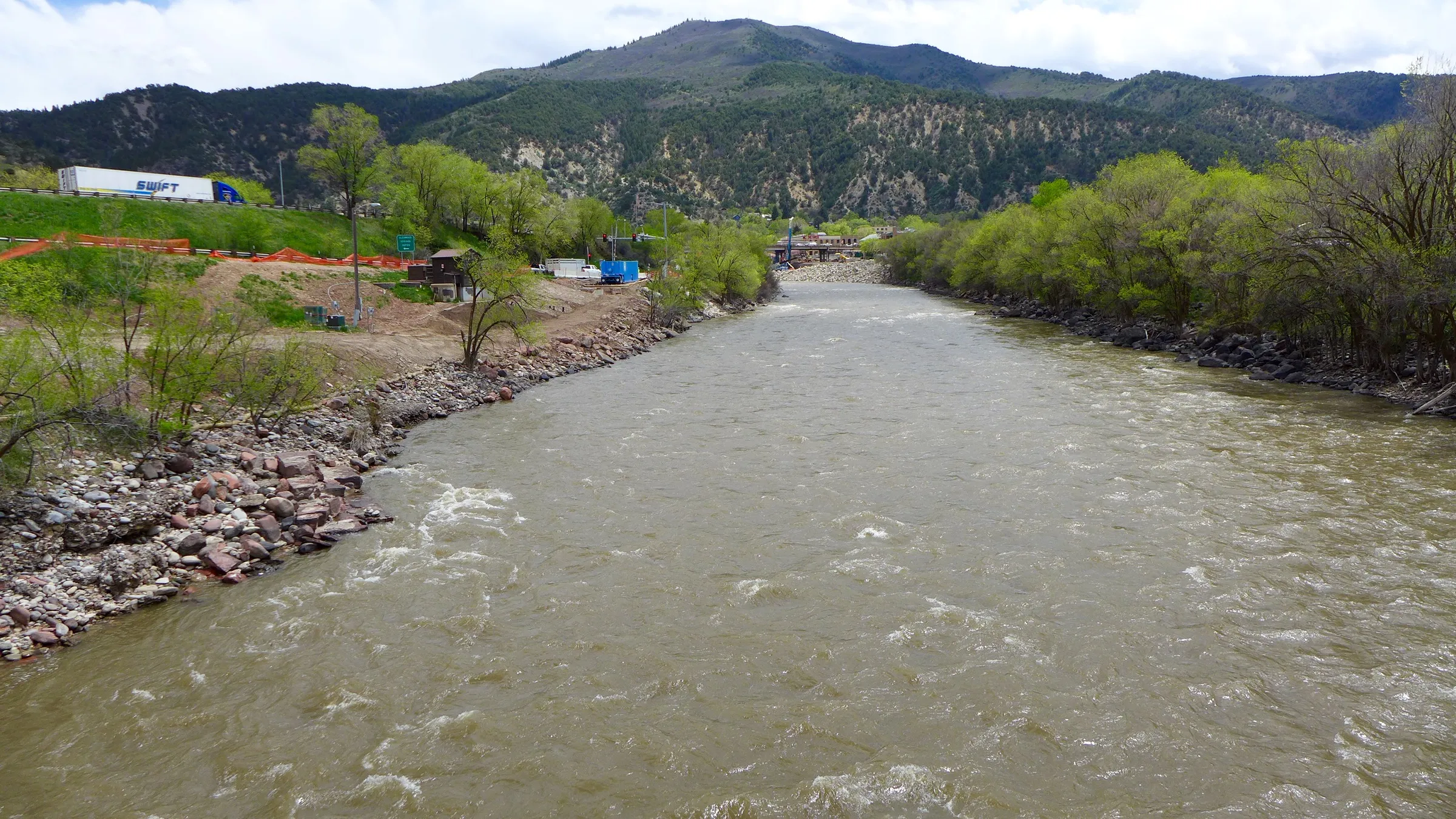
    A view looking up the Colorado River from the pedestrian bridge over the river, just upstream of the river’s confluence with the Roaring Fork River. The location is one of three sites where the City of Glenwood Springs plans to build a whitewater park using a water right for recreation. CREDIT: BRENT GARDNER-SMITH/ASPEN JOURNALISM

    Click the link to read the article on the Aspen Journalism website (Heather Sackett):

    After a lengthy water court battle, the city of Glenwood Springs has secured a conditional water right for three potential whitewater parks on the Colorado River.

    The new recreational in-channel diversion, or RICD, water right is a win for Colorado’s river recreation community, even though the city had to make concessions to future water development to get it.

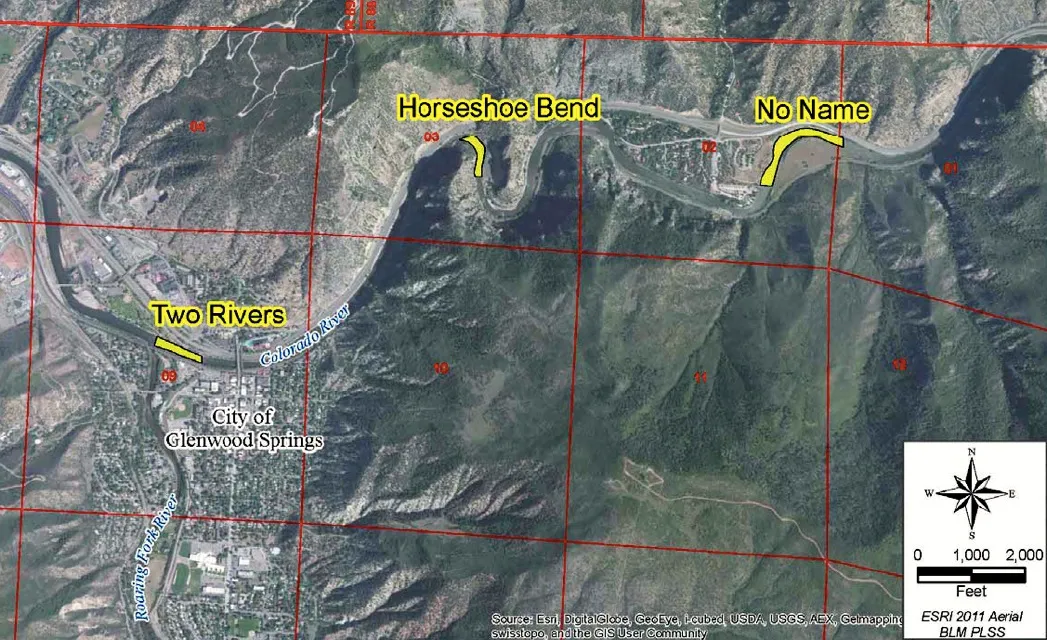
    The new water right is tied to three proposed boating parks: No Name, Horseshoe Bend and Two Rivers. The City plans to build a park at just one of the sites. The whitewater parks would be able to call for higher flows during certain times of year — 1,250 cubic feet per second from April 1 to Sept. 30; 2,500 cfs between June 8 and July 23 and 4,000 cfs for five days between June 30 and July 6.

    The different flow rates would allow beginner, intermediate and expert boaters to all enjoy the boating structures, which have yet to be built. The five days of high flow would allow Glenwood to host a competitive event around the Fourth of July holiday.

    The decree granted by water court judge James Berkley Boyd on March 23 is the culmination of nine years of work for Glenwood Springs, crafting agreements or otherwise settling with all parties that had filed statements of opposition in the case.

    “We know outdoor recreation is a big part of our local culture and local economy so being able to have this opportunity to expand options and enhance options for our river recreation is really exciting,” said Bryana Starbuck, public information officer for the city of Glenwood Springs.

    The city will now begin looking at designs for each of the three sites, investigating potential funding options and choosing the one that is the best fit, Starbuck said. The city will have to reapply to water court in six years to show it’s making progress on the parks to maintain the conditional right.

    Glenwood Springs joins a handful of other Colorado communities with RICDs for human-made whitewater features, including Steamboat Springs, Pueblo, Fort Collins, Golden, Avon, Breckenridge, Durango, Aspen, Basalt and Carbondale.

    Hattie Johnson, Southern Rockies stewardship director for American Whitewater, said in a prepared statement that this is an incredible victory for river recreation.

    “The Colorado River through Glenwood Canyon is an iconic stretch of whitewater that attracts residents and visitors from far and wide,” she said. “This was an important case to ensure the Colorado River, the heart of the Glenwood Springs community, will continue to be enjoyed well into the future.”

    “The Homestake Partners (Aurora Water and Colorado Springs Utilities) and Glenwood Springs worked very hard over a long period of time to reach the negotiated conclusion embodied within the stipulated Decree entered by the Water Court,” read a prepared statement from Greg Baker, manager of public relations for Aurora Water.

    A map filed by the city of Glenwood Springs showing the locations of three proposed whitewater parks. The city recently secured a recreational in-channel diversion (RICD) water right to build the parks.
    CREDIT: CITY OF GLENWOOD SPRINGS / WATER COURT FILING

    Agreements with opposers

    To get its water right, the city had to negotiate agreements with a long list of other water users and entities who opposed it, including the Colorado Water Conservation Board and Front Range water providers like Denver Water and Colorado Springs Utilities.

    According to its decree, Glenwood Springs made allowances for future water rights that have not yet been developed.

    A RICD water right’s power comes from its ability to place a “call.” In theory, once built, if the whitewater parks were not receiving the full amount of water they are entitled to, the city could “call out” other junior water rights users upstream, who would have to stop diverting water until the parks got their full amount.

    But the decree includes a provision called “Yield Protection for New Water Rights,” which lays out restrictions on the city’s ability to call for its water during dry years. It allows 30,000 additional acre-feet of water to be developed over the next 30 years, which would be protected from a call above 1,250 cfs. As long as a new water rights holder could prove with real-time stream gauge monitoring data that they are not getting their full amount because of a call placed by Glenwood Springs for the 2,500 cfs amount, then Glenwood has to cancel the call.

    This would kick in only in years when the 50% exceedance probability for streamflow in the Colorado River at Dotsero is less than 1.4 million acre-feet from April through June, according to forecasts from the National Resources Conservation Service. The provision would apply to water rights younger than Dec. 31, 2013, which is the appropriation date for the city’s water right.

    Glenwood Springs also cannot use the RICD water right as the basis to oppose any future water development upstream on the Colorado River or its tributaries.

    These agreements, which allow for some level of future water development by upstream parties that will not be subject to the restrictions created by a RICD, have been included in other recently completed RICDs, like Pitkin County’s whitewater waves in Basalt.

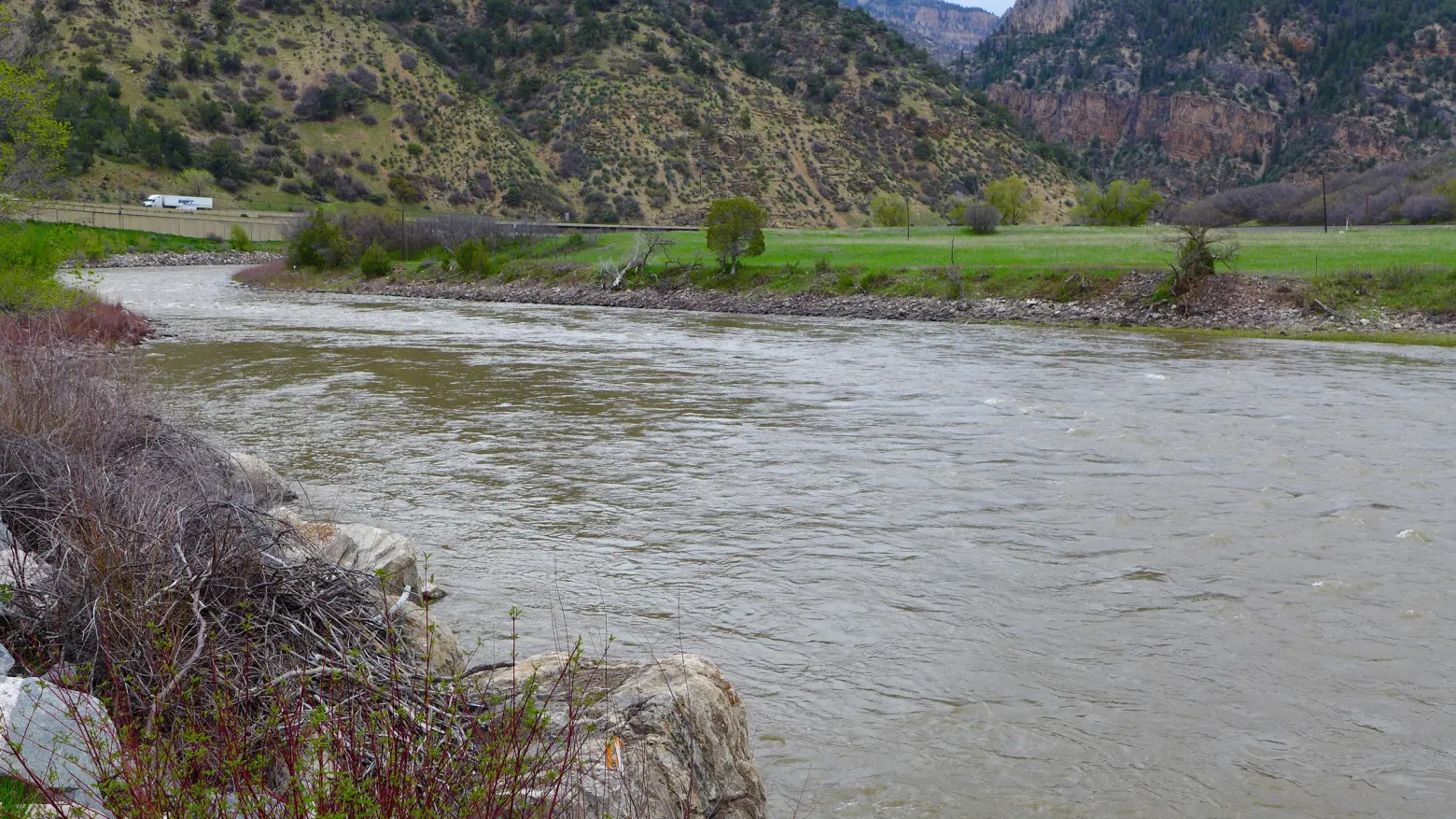
    The Colorado River at No Name, above Glenwood Springs, and just off of I-70 near the No Name rest stop. This is one of three sites where the City of Glenwood Springs plans to build a whitewater park with a newly secured water right for recreation.
    CREDIT: BRENT GARDNER-SMITH/ASPEN JOURNALISM

    Water for recreation hard to secure

    The backbone of Colorado’s of water law, known as prior appropriation, is the concept that older water rights get first use of the river. But even though RICDs have only been around for about 20 years and are therefore junior to major agricultural and transmountain diversions, RICDs still often end up making concessions to allow future water development.

    That is partly because the CWCB is tasked with making sure RICDs, which help keep water in the river channel, don’t prevent the state from developing all the water it legally can under the Colorado River Compact.

    “I think in a perfect world you would have a more clear delineation of recreational rights like this one,” said Bart Miller, healthy rivers program director for environmental conservation group Western Resource Advocates. “If they are applying for water, they should be treated the same as any other right, that is, when they come along, they get their place in line and they get water appropriate for that time.”

    Securing water for recreation has proved challenging in Colorado, where agriculture and cities have long dictated water policy, even as river recreation represents a growing segment of the state’s economy.

    In 2021, after being met with opposition, river recreation proponents scrapped a proposal that would have let natural stream features like a rapid secure a water right for recreation. A second proposal earlier this year that would have allowed municipalities to create a “recreation in-channel values reach” has also been tabled and will not be introduced at the legislature this session.

    “That’s something I think we can aspire to, to have rights for recreation and the environment be on an even playing field with all the other rights in the state,” Miller said. “I think it’s really important to the state of Colorado to recognize and support recreational water rights and recreational uses.”

    Aspen Journalism covers water and rivers in collaboration with The Aspen Times and the Glenwood Spring Post-Independent. This story ran in the March 6 edition of The Aspen Times and Glenwood Springs Post-Independent.

    Large declines in #snowpack across the U.S. West — NOAA #runoff

    Click the link to read the article on the Climate.gov website (Michon Scott and Rebecca Lindsey):

    In many watersheds in the western United States, more water is stored in the mountain snowpack than in the region’s human-built reservoirs. As climate has warmed, spring snowpack across the American West has declined by nearly 20 percent on average between 1955 and 2020—and by significantly more at some individual locations, according to an analysis by the U.S Environmental Protection Agency.

    Observed change in April snowpack—historically the month of peak snow volume—across the western United States from 1955–2020. Locations where April snowpack has increased appear in blue, with larger dots for bigger increases. Locations where April snowpack has decreased appear in brown, with larger dots indicating bigger declines. Map by NOAA Climate.gov based on USDA Natural Resources Conservation Service snow data provided by the EPA.

    Changes in snowpack mean changes in streamflows, which affect millions of Americans who rely on snowpack for drinking water and crop irrigation. Declining snowpack also increases fire risk and impairs hydropower production.

    “From 1955 to 2020, April snowpack declined at 86 percent of the sites measured,” according to the EPA summary. “Decreases have been especially prominent in Washington, Oregon, northern California, and the northern Rockies. In the Northwest (Idaho, Oregon, Washington) all but four stations saw decreases in snowpack over the period of record.”

    Observed changes in the timing of peak snowpack from 1982–2020. Locations where snowpack is peaking earlier in the year appear in pink, and locations where snowpack is peaking later in the year appear in green. Map by NOAA Climate.gov based on USDA Natural Resources Conservation Service snow data provided by the EPA.

    One way to think about the Western snowpack is that it’s like a five-year old’s Halloween candy. If you are five years old and control that candy yourself, there’s a good chance it will be gone in days. If your mom holds on to it for you, she will dole it out to you slowly and responsibly, making it last a lot longer. In the West, precipitation that falls as snow and persists in mountain snowpack is like mom-managed candy: it remains available months later to keep rivers and streams flowing through dry summer months.

    In many places, however, it’s not just the amount of snow that’s changing; it’s also the timing of the melt. When the melt starts and finishes early, streamflow may be out of sync with both human water demands and ecological processes like fish spawning. According to the EPA:

    “About 81 percent of sites have experienced a shift toward earlier peak snowpack… .This earlier trend is especially pronounced in southwestern states like Colorado, New Mexico, and Utah. Across all stations, peak snowpack has shifted earlier by an average of nearly eight days since 1982…, based on the long-term average rate of change.”

    […]

    These maps are based on an annual climate change indicator from the U.S. Environmental Protection Agency. Supported with funding from the Climate Observations and Monitoring Division in NOAA’s Climate Program Office, the indicator is based on analysis of snow observations kept by the U.S. Department of Agriculture’s National Resource Conservation Service for more than half a century. The indicator is one of dozens the agency uses to track the U.S. impacts of global warming and climate change.

    Aspinall Unit forecast for operations April 7, 2022 — Reclamation #GunnisonRiver #ColoradoRiver #COriver #aridification

    Click the graphic for a larger view.

    Tribes assert #water rights on #ColoradoRiver Basin: 1922 Colorado River Compact that divided resources between states left out Native Americans — The #Durango Herald #COriver #aridifcation

    Lake Nighthorse and Durango March 2016 photo via Greg Hobbs.

    Click the link to read the article on The Durango Herald website (Jim Mimiaga). Here’s an excerpt:

    The Ute Mountain Ute and Southern Ute tribes of Southwest Colorado are fighting for water, including an effort to reclaim rights flowing downstream to other users. Ute Mountain Chairman Manuel Heart and Southern Ute Council member Lorelei Cloud presented their perspectives and plans for water management during a session of the Southwestern Water Conservation District’s annual meeting last week in Durango…

    Native Americans did not gain U.S. citizenship until two years after the 1922 Colorado River Compact divided Colorado River water between upper and lower basins. Now, the 1922 compact is under review for water management changes in the mega-drought era and has a 2026 deadline for new interim guidelines. This time, tribes are asserting their water rights and demanding to be included in negotiations about how Colorado River Basin water is divided…

    From the 2018 Tribal Water Study, this graphic shows the location of the 29 federally-recognized tribes in the Colorado River Basin. Map credit: USBR

    Thirty tribes within the Colorado River Basin hold 25% of the water rights, but some of the water has not been available for use or has not been recognized as tribe-owned.

    “When the laws were made, we were not included; we were an afterthought. We know (tribes) have 25% or more of that water,” Cloud said. “If tribes were to put that water to use, it will be a major impact for those downstream who have been using it for free. As tribes put our water to use, there will be less water down river.”

    Cloud said the Southern Ute Tribe has 129,000 acre-feet per year of federally reserved water rights on seven rivers that run through its reservation, but it only has the capacity to divert 40,600 acre-feet per year. The tribe stores water in Vallecito, Lemon and Lake Nighthorse reservoirs…

    Ute Mountain Ute Chairman Manuel Heart said his tribe is also continuing its fight for water rights. He is chairman of the 10 Tribe Partnership, a coalition of tribes working to protect their water rights and provide input on Colorado River Basin water management.

    Atmospheric levels of powerful greenhouse gas #methane rose by a record amount (17 parts per billion) last year – highest annual increase since start of measurements in 1983 — World Meteorological Organization

    Methane emissions 2021 via WMO

    #FortCollins City Council mulls an unusual path for preventing oil and gas development — The Fort Collins Coloradoan #ActOnClimate #KeepItInTheGround

    Downtown “Old Town” Fort Collins. By Citycommunications at English Wikipedia, CC BY 3.0, https://commons.wikimedia.org/w/index.php?curid=50283010

    Click the link to read the article on the Fort Collins Coloradoan website (Jacy Marmaduke). Here’s an excerpt:

    One way or another, Fort Collins City Council is interested in limiting oil and gas activity as much as possible in the city’s boundaries and growth management area. What’s less clear is how they’ll try to do it. The city could adopt regulations, currently being drafted by staff, that effectively ban new drilling in city limits. It could incentivize the plugging and abandoning of wells or leverage new state rules to do so. Or Fort Collins could pursue another idea that attracted some City Council members’ attention at a March 22 work session: What if the city bought all the mineral rights in Fort Collins?

    “I’m talking about buying out the operators who own the oil and gas,” Mayor Jeni Arndt said at the work session. “That just seems like an elegant solution that is probably cheaper than all these rules and regulations and potential lawsuits for takings.”

    […]

    Staff are investigating the feasibility of Arndt’s idea while continuing to work on the regulations and considering how to facilitate the plugging of inactive or low-producing wells. Ralph Cantafio, a Colorado attorney who specializes in oil and gas, told the Coloradoan the buy-out idea seems “wildly impractical.”

    […]

    But first, a rundown of the city’s draft regulations. Staff have been working on them since 2019, with the process drawn out as they awaited new state regulations on everything from setbacks to financial assurances. A 2018 state law gave municipalities the right to adopt oil and gas regulations that are stricter than the state standards and triggered the overhaul of the state’s regulations. City staff are considering draft regulations that would allow drilling only in areas with industrial zoning, located at least 2,000 feet from homes, parks, natural areas, schools, hospitals and anything defined as “occupiable space.” The 2,000-foot standard, unlike the state’s regulations, would leave no room for exceptions. It’s based on a Colorado Department of Public Health and Environment study that found the greatest health risks of living near oil and gas wells were for those living within 2,000 feet of the site. No land in city limits meets all the city’s draft requirements, so they would essentially prohibit new drilling. Council members haven’t expressed any discomfort at that possibility, pointing to the 2013 ballot measure where about 55% of voters supported a five-year moratorium on fracking.

    2022 Ark Basin Water Forum returns to the Salida Steam Plant #ArkansasRiver

    Salida Steam Plant Arkansas River

    Click the link to register.

    Click the link to read the agenda

    2022 Ark Basin Water Forum returns to the Salida Steam Plant
    “Risk and Resilience in the Arkansas Basin” restores in-person event after 2-year pandemic pause”

    The 26th episode of the Arkansas River Basin Water Forum, the basin’s premiere water event, will feature the state’s top water experts discussing critical issues facing all segments of water users – agriculture, municipal, recreation, environmental and industrial – and engage attendees in seeking solutions to the many challenges faced in planning for a secure water future for the largest of Colorado’s river basins.

    Taking place Thursday and Friday, April 28-29, the 2022 Arkansas River Basin Water Forum will focus on “Risk and Resilience in the Arkansas Basin,” exploring topics that include the effect of Colorado River policies on the Arkansas River, ongoing drought and potential aridification in the southwestern United States, the impact of wildfires on water supplies, and much more (see attached draft program).

    Keynote presentations will be provided by Dan Gibbs, Executive Director of the Colorado Department of Natural Resources, and Chris Sturm, Watershed Program Director, Colorado Water Conservation Board.

    The Forum format continues to evolve, influenced by attendee needs and the resources available to provide interactive experiences for attendees. In addition to expert presentations and panel discussions in the morning sessions, a variety of outdoor field trips will be offered on the afternoons of both days of the Forum. Full information on registering for the Forum, including afternoon field trips, is online at http://www.arbwf.org.

    Registration costs for the Forum remain an excellent value:

    Two-day full registration, including lunches – $200
    One-day registration, either Thursday or Friday, including lunch – $100
    Percolation and Runoff networking dinner – $20

    Plan on joining us Thursday evening for what is, hands-down, one of the funnest parts of the Forum. Not to be missed, the Percolation and Runoff social networking event is designed to raise money for our college scholarship fund. The $20 cost includes a delicious dinner, drinks and sparkling conversation. You won’t find a better dinner and drinks deal in Salida. All proceeds from this event support the scholarship fund, helping us to help students and working professionals in their education and research in water resources, watershed studies, hydrology, natural resources management and other water-related fields.

    For more information, contact Jean van Pelt, Forum Coordinator, at arbwf1994@gmail.com

    A sliver of good news on the #water front: Soil moisture, a key indicator for spring #runoff, has improved in Denver Water’s collection area — News on Tap

    Denver Water field crews measure how much water is frozen in the snow near Winter Park on March 29. The utility’s teams take these kind of measurements at 13 sites every month during the winter and early spring. Photo credit: Denver Water.

    Click the link to read the article on the Denver Water website (Todd Hartman):

    Water news seems dreadful these days, with a megadrought in the Colorado River Basin, hydropower at risk in a fast-draining Lake Powell and a warming climate assuring these issues will only get worse.

    So, amid these calamities, Denver Water wants to cite a small measure of good news: Soil moisture levels in parts of Colorado have improved.

    Yes, this may only be a temporary blip on a downhill slide, but let’s celebrate what we can.

    Soil moisture is a key indicator of drought conditions and has a big impact on water supplies. That’s because dry, thirsty soils can drink up a lot of the snowmelt that otherwise would flow into rivers and reservoirs.

    Know your snowpack: 9 facts about Colorado’s snowpack.

    Here’s an example from Denver Water’s own system: In 2021, snowpack above Dillon Reservoir peaked at 88% of normal. It wasn’t a banner year for snowpack, but it wasn’t terrible either. But dry soils made the lower snowpack levels far worse — runoff was only 57% of normal.

    “The low soil moisture soaked up a lot of the melting snow before it reached rivers and reservoirs,” explained Nathan Elder, water supply manager for Denver Water.

    The 2019-20 water year told a similar story, when snowpack peaked at 124% in the South Platte Basin but runoff came in at just 54% of average at one key measuring point.

    Low soil moisture can soak up snow runoff, leaving less for rivers and reservoirs. Image credit: Denver Water.

    A similar pattern also cut into runoff in 2018.

    This year, water forecasters expect a better scenario. That’s because a big monsoon season on the West Slope and in the mountains last summer brought soil moisture levels up. Snowstorms on the Front Range throughout the winter helped soils here, too.

    “This year, with soil moisture better, we are expecting more runoff from the snowpack,” Elder said.

    Nathan Elder, water supply manager for Denver Water, in April 2019, standing in a snowpit dug to gauge the snow’s temperature, depth,

    Currently, snowpack above Dillon is 87% of normal and, because of greater moisture within the soil, streamflow forecasts are higher too — 82% of normal, a big improvement from last year.

    Evidence of the improvement in soil moisture comes thanks to data from NOAA, the National Oceanic and Atmospheric Administration, a federal agency that closely tracks such matters.

    The numbers can be complicated, but one way to understand the impact of the soil moisture is in what Denver Water’s water supply managers call “runoff efficiency.”

    Learn how Denver Water is leaning into the challenges around climate change.

    In a year when soil moisture numbers are just slightly below normal — such as this year — you can expect runoff volumes to be 10% to 15% less than the peak snowpack number.

    In a year when soil moisture conditions are worse, as we’ve seen in several recent cases, the dry soils can reduce runoff efficiency by 15% to 20%. That can translate to a big cut in water supply.

    Colorado Drought Monitor map April 5, 2022.

    Another key measure comes from the U.S. Drought Monitor map. That map shows the Denver metro area — as well as much of Denver Water’s collection area — in “abnormally dry” conditions. That may sound bad, but it is actually a marked improvement from recent months when much of the state was in various stages of drought.

    A year ago, the region’s drought levels ranged from “moderate” to “extreme” drought.

    Things can still change, of course.

    Should we get a long spell of warm, dry weather this spring, the situation could become worse. But, at this point in early spring, things look a bit better than in recent years.

    “We’ll obviously be watching our watersheds and the weather closely,” Elder said. “But we take the good news where we can get it and, at least for the moment, we’re happy to see these conditions.”

    #Drought news (April 7, 2022): South-central #Colorado saw a reduction in severe (D2) and extreme (D3) drought

    Click on a thumbnail graphic to view a gallery of drought data from the US Drought Monitor.

    Click the link to go to the US Drought Monitor website. Here’s an excerpt:

    This Week’s Drought Summary

    April brought heavy rain to parts of the Midwest, South, and Southeast leading to broad areas of drought improvement in these regions. Meanwhile, drought expanded and intensified in the West with many locations setting records for the driest 3-month period (January to March). The High Plains remained largely unchanged this week with small pockets of improvements and degradations…

    High Plains

    South-central Colorado saw a reduction in severe (D2) and extreme (D3) drought. Last week’s precipitation continued a trend of wetter-than-normal conditions that’s been in place since the start of the year. Short- and long-term indicators including precipitation, snowpack, soil moisture, and stream flow are responding to the excess moisture. Severe drought also decreased in southwest Wyoming for similar reasons. Kansas saw drought worsen in the west and improve in the east. D3 expanded in southwest Kansas, where precipitation deficits are less than 10 percent of normal over the last 60 to 90 days. Other indicators supporting this assessment include increased evaporative demand and soil moisture. In eastern Kansas, the map depicts a continuation of improvements made last week. In south-central Nebraska, moderate drought expanded in response to increasing precipitation deficits, dry soil moisture indicators, and reports of low stock ponds. The rest of the region remained unchanged this week. State drought monitoring teams have all noted the increasing dryness across the region…

    Colorado Drought Monitor one week change map ending April 5, 2022.

    West

    Parts of the Northwest saw a healthy dose of precipitation and mountain snow during the past week. In most cases, this precipitation fell over areas free from drought or simply wasn’t enough to bring relief to drought impacted areas. Only southwest Oregon saw improvement with a small decline in moderate drought (D1). Oregon also saw an expansion of drought of severe (D2) and extreme (D3) drought. Water-year-to-date (October 1 to April 5) precipitation fell short and warmer-than-normal temperatures caused rapid and early melt out to the state’s snowpack. Soil moisture and shallow groundwater indicators are reflecting the worsening conditions. In the southeast part of the state, the drought monitoring team noted impacts including extremely dry soil conditions, a lack of surface water, and poor pasture forage conditions. Central Washington, Idaho, and northwest Montana also saw increases in drought extent or severity as short-term dryness continues to build upon long-term moisture deficits extending back to last year. Many parts of southern Idaho, and the rest of the West, have set records for the driest 3-month period (January to March) going back 100 years or more. Meanwhile near record warmth increased evaporative demand from plants and soils. Farther south, extreme drought (D3) expanded in parts of California, Nevada, and New Mexico while moderate (D1) and severe (D2) drought expanded across Arizona. In California, Cooperative Extension reports impacts to agriculture including reduced forage, livestock stress, decreased water allocation, and the selling livestock earlier than normal. Data such as reduced stream flows and declines in satellite-based vegetation health and soil moisture indicators confirm these reports…

    South

    Like last week, the South saw drought worsen across west and south Texas and the Oklahoma Panhandle. Above-normal temperatures combined with below-normal precipitation and high winds exacerbated conditions. Drought indicators supporting the degradations include increasing precipitation deficits, dry surface and root zone soil moisture and low stream flow. One-category improvements were made to drought conditions across east Texas, southern Arkansas, north and central Louisiana and Mississippi as the effects of the recent wet pattern propagated through indicators such as streamflow, soil moisture, and vegetation. Note that the heavy, solid black line separating the part of the region experience short-term drought was modified to reflect the effects of the recent rain…

    Looking Ahead

    The National Weather Service Weather Prediction Center (valid April 7 – April 9) calls for another storm system to move across the eastern half of the Lower 48. Multi-day snow is expected over the long-term drought areas in the Upper Midwest. Drought areas in the Southeast and Mid-Atlantic are expected to see rain. Meanwhile, dry weather is expected across much of the drought-stricken Plains and West. An approaching front moving into the Pacific Northwest and Northern Rockies will bring rain and snow. Moving into the weekend, the forecast (valid April 9 – 13) calls for rain and high elevation snow and well below normal temperatures across the West. The colder temperatures, rain, and snow will reach into the northern and central Plains by early next week. At 8 – 14 days, the Climate Prediction Center Outlook (valid April 14 – 20) calls for below normal temperatures over much of the western and central U.S. and Alaska. Above normal temperatures are predicted over the east and west coasts. Near to above normal precipitation is favored for the Central Rockies eastward. Below normal precipitation is favored over California, Nevada, southeastern New Mexico, and southwestern Texas.

    US Drought Monitor one week change map ending April 5, 2022.

    Here’s a gallery of early April US Drought Monitor maps for the past few years.

    This slideshow requires JavaScript.

    April 1, 2022 Water Supply Forecast Discussion: #LakePowell inflow forecast is 4.1 MAF (64% of average) — #Colorado Basin River Forecast Center #ColoradoRiver #COriver #aridification

    Click the link to read the discussion on the Colorado Basin River Forecast Center website:

    Water Supply Forecast Summary

    March consisted of fairly typical spring weather across the region and featured both warm/dry periods that generated snowmelt and more active cool/wet periods that brought rain to lower elevations and snow to higher elevations. Much of the region received moisture during March, but monthly precipitation totals were generally below average. January-March has been very dry across the region, with precipitation ranking in the bottom five of the historical gage record at most SNOTEL sites across Utah, southwest Wyoming, and western Colorado during the three-month period.

    Below average March precipitation across much of the region led to declines in percent of normal SWE values across most basins over the past month. April 1 snow water equivalent (SWE) conditions generally range between 75-105% of normal across the Upper Colorado River Basin and 65-85% of normal across the Great Basin. Snow across the Lower Colorado River Basin has mostly melted out with the majority of SNOTEL stations across Arizona reporting less than an inch of SWE.

    Water supply forecast volumes decreased over the past month across most of the Great Basin and Colorado River Basin as a result of below normal March precipitation. Upper Colorado River Basin water supply forecasts generally range between 40-100% of the 1991-2020 historical April-July average. Great Basin water supply forecasts are 30-80% of average. Lower Colorado River Basin January-May water supply runoff volume forecasts are 10-65% of the 1991-2020 historical median.

    April 1 water supply forecast ranges (percent of normal) by basin:

    April-July unregulated inflow forecasts for some of the major reservoirs in the Upper Colorado River Basin include Fontenelle 435 KAF (59% average), Flaming Gorge 520 KAF (54%), Green Mountain 230 KAF (82%), Blue Mesa 530 KAF (83%), McPhee 152 KAF (60%), and Navajo 390 KAF (62%). The Lake Powell inflow forecast is 4.1 MAF (64% of average), which is a five percent decrease from March.
    Warm and dry conditions are expected across the region through the start of this weekend. A shift into an active weather pattern is expected later this weekend into next week. Most of the region will see several periods of precipitation next week, with higher terrain likely to receive over an inch of precipitation.

    Upper Colorado, Great, Virgin River Basins
    April 2022 April-July forecast volumes as a percent of the 1991-2020 average (50% exceedance probability forecast)
    Lower Colorado River Basin (AZ/NM)
    April 2022 January-May forecast volumes as a percent of 1991-2020 median (50% exceedance probability forecast)

    For specific site water supply forecasts click here

    March Weather/Precipitation

    March consisted of fairly typical spring weather across the region and featured both warm/dry periods that generated snowmelt and more active cool/wet periods that brought rain to lower elevations and snow to higher elevations. Two periods of above normal temperatures near the beginning (March 1-3) and end (March 26-29) of the month led to snowmelt below around 9,500 feet, which is not uncommon for this time of year. March minimum temperatures were mostly above average across the region while March maximum temperatures were near average.

    March minimum temperature (left) and maximum temperature (right) departure from the 1991-2020 average.

    Much of the region received moisture during March, but monthly precipitation totals were generally below average. Across western Colorado March precipitation was around 70-90% of average. A few small areas received near to above average monthly precipitation, most notably along the western interior of Colorado and around the Utah-Wyoming-Colorado border near the confluence of the mainstem of the Green River with the Duchesne/White/Yampa Rivers. SNOTEL stations in the eastern Uintas reported March precipitation values around 100-150% of average, however the Wyoming Range just north of this area in southwest Wyoming received much less precipitation during March with SNOTEL stations generally 30-50% of average and ranking in the driest five on record for the month. The Upper Green River Basin in southwest Wyoming has had a very dry extended period, with precipitation during February and March ranking as the driest on record at most SNOTEL stations in the Upper Green River Basin.

    March precipitation was mostly below normal across the Great Basin and generally ranged between 50-80% of average at SNOTEL stations. Precipitation during February and March ranked in the driest three at most SNOTEL locations across the northern Great Basin.

    March precipitation across the Lower Colorado River Basin was variable with most basins receiving below average monthly precipitation. Virgin River Basin March precipitation was 40-65% of average. A number of SNOTEL stations across central Arizona along the divide of the Verde/Salt/Little Colorado basins received near average precipitation during March. March precipitation across the Upper Gila River Basin in west central Arizona was below normal (30-50% of average).

    March 2022 percent of normal precipitation. (Averaged by basins defined in the CBRFC hydrologic model)

    Water Year Precipitation

    Water year precipitation has been highly variable from month-to-month and is shown in the image below. October and December precipitation was above to much above average over most of the region while November, January, February, and March precipitation was below to much below average. After a very wet December, the January-March three month period has been very dry across the region. January-March precipitation was around 35-55% of average across Utah, southwest Wyoming, and Arizona, and around 50-85% of average across western Colorado. Furthermore, January-March precipitation ranks in the bottom five of the historical gage record at most SNOTEL sites across Utah, southwest Wyoming, and western Colorado.

    Water Year 2022 percent of normal precipitation. (Averaged by basins defined in the CBRFC hydrologic model)

    Snowpack

    April 1 snow water equivalent (SWE) conditions are generally near to below the 1991-2020 normal (median) across the region and are summarized in the below table. Below average March precipitation and snowmelt across much of the region led to declines in percent of normal SWE values in most basins over the past month.

    Upper Colorado River Basin April 1 SWE conditions range from 75-105% of normal and did not change significantly in the past month. Upper Colorado River Basin SWE conditions continue to be most favorable along the divide of the Roaring Fork and Gunnison River Basins in western Colorado, where SWE conditions are around 105% of normal. SWE conditions are 80-90% of normal in the Duchesne, White/Yampa, Dolores, and the headwaters of the Upper Colorado River. The very dry January-March weather across southwest Wyoming has led to a steady decline in snowpack conditions across the Upper Green River Basin, where April 1 SNOTEL SWE conditions are around 75% of normal and ranked in the bottom five of the historical gage record.

    Below average March precipitation across the Great Basin led to modest declines in SWE conditions over the past month. April 1 SWE conditions range from 65-85% across the Great Basin, with conditions generally increasing from north to south and faring the best across the Sevier River Basin in south central Utah. Northern Great Basin (Bear, Weber, Provo/Utah Lake) early April snowpack conditions are poor with April 1 SWE values generally below the 25 th percentile.

    Snowpack conditions across the Lower Colorado River Basin are more variable and tend to fluctuate more frequently over time, with April 1 SWE conditions often based on just a few SNOTEL stations that haven’t melted out. Early April snow across the Lower Colorado River Basin has mostly melted out with the majority of SNOTEL stations across Arizona reporting less than an inch of SWE. Most of the remaining SWE across the Lower Colorado River Basin exists in the Virgin River Basin in southwest Utah, where April 1 SWE is near normal. There are also a few higher elevation SNOTEL stations along the divide of the Verde and Little Colorado basins in central Arizona reporting greater than five inches of SWE.

    The images below show observed snow conditions and CBRFC hydrologic model snow conditions.

    SNOTEL percent median observed SWE – April 6, 2022.
    CBRFC hydrologic model percent median SWE – April 5, 2022.

    For updated SNOTEL information refer to click here For CBRFC hydrologic model snow click here
    For CBRFC hydrologic model snow click here

    Soil Moisture

    CBRFC model fall soil moisture conditions impact early season water supply forecasts and the efficiency of spring runoff. Above average fall soil moisture conditions have a positive impact on early season water supply forecasts while below average conditions have a negative impact. The impacts are most pronounced when soil moisture conditions and snowpack conditions are both much above or much below average. The timing and magnitude of spring runoff is ultimately a result of SWE conditions, spring weather (precipitation/temperature), and antecedent soil moisture conditions.

    A wet monsoon season and above average October precipitation improved soil moisture conditions, especially across Utah and Arizona. Fall (antecedent) soil moisture conditions are improved from a year ago but remain below average across many of the major runoff producing areas. Larger than normal antecedent soil moisture deficits exist across much of western Colorado and are expected to negatively impact early spring runoff efficiency. Fall model soil moisture conditions are closer to normal across southwest Wyoming and Utah and even above normal in parts of the Duchesne River Basin.

    Comparison of November 2020 (left) and November 2021 (right) CBRFC hydrologic model soil moisture conditions entering the winter season.

    Soil moisture conditions tend to fluctuate more in the Lower Colorado River Basin of Arizona and New Mexico in the winter due to the frequency of rain events and possibility of melting snow. Soil conditions in the fall are less informative than they are in the northern basins that remain under snowpack throughout the winter season. Basins with above average soil moisture conditions can be expected to experience more efficient runoff from rainfall or snowmelt while basins with below average soil moisture conditions can be expected to have lower runoff efficiency until soil moisture deficits are fulfilled.

    Model soil moisture conditions across the Lower Colorado River Basin have improved from a year ago as a result of above average monsoon season precipitation and storm activity that has occurred during the water year. However, below normal January-March precipitation across Arizona and southwest New Mexico has led to declines in soil moisture conditions over the past several months. Early April model soil moisture conditions are mostly below normal across the Lower Colorado River Basin.

    Lower Colorado River Basin (AZ/NM) model soil moisture – April 5, 2022.

    Upcoming Weather

    Dry and warm conditions are expected across the region through the start of this weekend due to an upper-level ridge over the western US. By the end of this weekend, this ridge will move east, allowing for a shift into an active weather pattern next week. Most of the region will see several periods of precipitation next week, with higher terrain likely to receive over an inch of precipitation. Elsewhere will likely receive between 0.25 to 0.50 inches of precipitation. Below average temperatures will accompany this period of active weather. In the long range forecast beyond next week, a return to drier weather is likely to occur as another ridge is favored to set up over the Eastern Pacific, though temperatures should remain below average across the region.

    NWS Weather Prediction Center precipitation forecast for April 6-13, 2022.
    NWS Climate Prediction Center precipitation and temperature probability forecasts for April 13-19, 2022.

    #PuebloWest may sell just 400 water taps this year — The #Pueblo Chieftain #ArkansasRiver

    Pueblo West. By Jeffrey Beall – Own work, CC BY 4.0, https://commons.wikimedia.org/w/index.php?curid=61051069

    Click the link to read the article on the Pueblo Chieftain website (Tracy Harmon). Here’s an excerpt:

    New water tap sales in Pueblo West could be limited to 400 this year to try to slow explosive growth in the face of a dwindling water supply, Pueblo West Metro District officials said at a meeting Tuesday.

    The district’s water team proposed that around 1,050 water taps should be sold over the next three years, a middle-ground figure between FCS Group consultant Jason Mumm’s estimate that Pueblo West will have enough water to serve about 2,771 new water taps and a more conservative estimate from Alan Leak at RESPEC who estimated the district has enough water for about 695 new taps. District water officials recommended the sale of 400 water taps this year, 400 next year and just 100 in 2024. The remaining 150 taps should be “held in reserve for sale at the board’s discretion,” they proposed.

    Last year, Pueblo West sold 538 water taps, said Jeffrey DeHerrera, deputy director of utilities. The recommendation to scale back sales isn’t set in stone and can be reevaluated as the district obtains more water resources, he said. Director of Utilities Jim Blasing agreed, pointing out his team is aggressively seeking what water rights it can get on behalf of Pueblo West. The board will reach a recommendation when it meets Monday and water tap sales could resume the next day, after being suspended since Jan. 24…

    Pueblo West Metro District Board President Doug Proal said staff are working on a plan to roll out taps fairly. The board’s recommendations, along with what new water taps will cost and by how much water and sewer rates will increase, are expected to be decided on at the board’s meeting on Monday at 5 p.m. at Fire Station 3, 729 E. Gold Drive.

    One Last #Climate Warning in New IPCC Report: ‘Now or Never’ — Inside Climate News #ActOnClimate #KeepItInTheGround

    Marshall Fire December 30, 2021. Photo credit: Boulder County

    Click the link to read the article on the Inside Climate News website (Bob Berwyn). Here’s an excerpt:

    Whatever words and phrases the Intergovernmental Panel on Climate Change may have been parsing late into Sunday night, its new report, issued Monday, boils down to yet another dire scientific warning. Greenhouse gas emissions need to peak by 2025 to limit global warming close to 1.5 degrees Celsius (2.7 degrees Fahrenheit), as targeted by the Paris Agreement, the report says.

    In a way, it’s a final warning, because at the IPCC’s pace, the world most likely will have burned through its carbon budget by the time the panel releases its next climate mitigation report in about five or six years.

    Even with the climate clock so close to a deadline, it’s not surprising that the IPCC struggled to find consensus during the two-week approval session, said Paul Maidowski, an independent Berlin-based climate policy researcher and activist. The mitigation report may be the most challenging of the three climate assessments that are done every five to seven years under the United Nations Framework Convention on Climate Change, he said.

    The first two reports of each IPCC assessment cycle, one on the physical basis of climate science, and another about impacts and adaptation, are mostly based on unyielding physics, like how much global temperature goes up for every added increment of CO2, and how fast and high sea level will rise based on that warming.

    But the mitigation report, which outlines choices society can make to affect the trajectory of climate change, has to reconcile those scientific realities with economic and political assumptions that are not constrained by physics, Maidowski said. Other researchers have described the IPCC report as a mechanism to determine what is politically possible, he added. If those assumptions—for example about future availability of carbon dioxide removal technology—don’t materialize, “then you are left with illusions, essentially,” he said.

    The IPCC has “blinded itself” to deeper questions of sustainability and is thus asking the wrong questions, like how to decouple economic growth from greenhouse gas emissions, he added. Instead, it should be more up front about acknowledging the physical limits of the planet, and start asking how to downscale current resource consumption to a sustainable level.

    The report found that “without immediate and deep emissions reductions across all sectors, limiting global warming to 1.5°C is beyond reach.”

    […]

    On the hopeful side, the panel noted that renewable energy costs have dropped by as much as 85 percent in the past decade, and that new policies in many countries have accelerated deployment of wind and solar power…

    An Unrealistic Leap of Faith

    The contradictions between scientific reality and hopeful political assumptions identified by Maidowski are clear in the new report, which says, on the one hand, that greenhouse emissions need to peak in the next three years, while also finding that average annual greenhouse gas emissions from 2010 to 2019 were higher than in any previous decade.

    Believing that emissions can peak by 2025 on that trajectory requires an enormous and unrealistic leap of faith, and many climate scientists, including NASA researcher Peter Kalmus, are not buying it.

    “This IPCC report is absolutely harrowing. Wake up everyone,” Kalmus wrote on Twitter. “Brief summary of the new IPCC report: We know what to do, we know how to do it, it requires taking toys away from the rich, and world leaders aren’t doing it,” he continued.

    #SouthPlatteRiver canal project clears second round — The #Nebraska City News-Press

    The Platte River is formed in western Nebraska east of the city of North Platte, Nebraska by the confluence of the North Platte and the South Platte Rivers, which both arise from snowmelt in the eastern Rockies east of the Continental Divide. Map via Wikimedia.

    Click the link to read the article on the Nebraska City News-Press website. Here’s an excerpt:

    A proposal to build a canal that would divert South Platte River water from Colorado to Nebraska under a 1923 interstate compact advanced to the final round of debate March 29 after senators amended it to include conflict-of-interest provisions…

    LB1015, introduced by Sen. Mike Hilgers of Lincoln, would authorize the state Department of Natural Resources to develop, construct, manage and operate the canal and its associated storage facilities, called the Perkins County Canal Project, under the terms of the compact.

    Sen. Machaela Cavanaugh of Omaha introduced an amendment on select file that would prohibit the department’s director, employees and their immediate family members from having a direct or indirect financial interest in any entity that is party to a contract or from having a financial interest in the ownership or lease of any property relating to the development, construction, management or operation of the project. Senators voted 44-0 to adopt the amendment.

    A second Cavanaugh amendment, adopted 44-0, would extend the conflict-of-interest provision to members of the Legislature and elected officials in the executive branch of state government…

    After adopting the amendments, lawmakers advanced LB1015 to final reading by voice vote.

    #Colorado #Snowpack ‘Just Okay’ According To State Climatologists — CBS #Denver

    Colorado snowpack sub-basin filled map April 6, 2022 via the NRCS.

    Click the link to read the article on the CBS Denver website (Spencer Wilson). Here’s an excerpt:

    “(The) snowpack is fairly decent,” Assistant State Climatologist Becky Bolinger said. “I wish it were a little bit better. I would feel more comfortable if we were, you know, above average at this point. But we’ve been keeping along with average a little bit, lagging behind occasionally, but then getting up there.”

    You can check the models from the Colorado Climate Center here https://climate.colostate.edu/co_cag/index.html

    Bolinger said the focus now becomes making sure there’s an even temperature for the snowpack to melt, if it melts too quickly, we could lose some of that hard-earned moisture. More late-season snowstorms would be good too… but not if it’s too stormy.

    Westwide SNOTEL basin-filled map April 5, 2022 via the NRCS.

    4 #Colorado Companies Awarded For Slashing Pollution — 303 Magazine

    Leprino Foods headquarters in North Denver April 22, 2020.

    Click the link to read the article on the 303 Magazine website (Ellie Sullum). Here’s an excerpt:

    Every year, the U.S. Environmental Protection Agency (EPA) honors companies nationwide for significant progress in pollution prevention This year, the EPA awarded four Colorado-based companies for their contributions to the state’s sustainability efforts…

    Taco Star

    A Thornton staple, family-owned Taco Star now has four locations in the Denver Metro Area. The Colorado fast-food chain updated its infrastructure to feature LED lighting, low-flow sink aerators and sustainable commercial refrigerators. Refrigeration is the leading source of energy misuse, making Taco Star’s transition a vital step towards energy conservation within Colorado’s sustainability work. Overall, Taco Star’s activities have contributed to an annual cost savings of $4,695, 32 metric tons of carbon dioxide equivalent avoided and 13,000 gallons of water conserved…

    Leprino Foods Company

    Based in [Denver], Leprino Foods Company is a leading dairy manufacturer. With over 5,000 employees in multiple locations, they specialize in producing mozzarella cheese and popular dairy products. Conventional dairy production is a leading polluter industry. To reduce the company’s footprint, Leprino Foods installed sustainable equipment to limit greenhouse gas and water use. They also implemented cleaning and production process improvements to lower waste brine…By overhauling its equipment and systems, the company modeled water conservation processes for others in the industry to follow…

    Management and Engineering Services

    Headquartered in Longmont, Management and Engineering Services LLC provides business consulting services. They specialize in consulting with government agencies and private companies that operate on public lands. Over a three-year span, the company installed water reduction equipment, stopped stocking disposable office products and implemented renewable energy throughout the building. They also promoted a bike-to-work program and provided bicycles for employees. Through their efforts to improve Colorado’s sustainability, Management and Engineering Services embodies the purpose of their own work in environmental business solutions.

    Learn more about the 2021 EPA Region 8 Pollution Prevention (P2) Award Program here.

    Aspinall Unit operations update (April 5, 2022): Bumping releases up to 750 cfs #GunnisonRiver #ColoradoRiver #COriver #aridification

    The boat ramp at the Lake Fork Marina closed for the season on Sept. 2 due to declining reservoir levels. The Bureau of Reclamation is making emergency releases out of Blue Mesa Reservoir to prop up levels in Lake Powell and preserve the ability to make hydropower.
    CREDIT: HEATHER SACKETT/ASPEN JOURNALISM

    From email from Reclamation (Erik Knight):

    Releases from the Aspinall Unit will be increased from 700 cfs to 750 cfs on Tuesday, April 4th. Releases are being increased as diversions to the Gunnison Tunnel continue to increase. Currently snowpack in the Upper Gunnison Basin is 106% of normal and the forecasted April-July runoff volume for Blue Mesa Reservoir is 83% of average.

    Flows in the lower Gunnison River are currently above the baseflow target of 1050 cfs. River flows are expected to stay at levels above the baseflow target for the foreseeable future.

    Pursuant to the Aspinall Unit Operations Record of Decision (ROD), the baseflow target in the lower Gunnison River, as measured at the Whitewater gage, is 1050 cfs for April and May.

    Currently, Gunnison Tunnel diversions are 300 cfs and flows in the Gunnison River through the Black Canyon are around 400 cfs. After this release change Gunnison Tunnel diversions will be around 400 cfs and flows in the Gunnison River through the Black Canyon will be near 350 cfs. Current flow information is obtained from provisional data that may undergo revision subsequent to review.

    United Nations #climate report: It’s ‘now or never’ to limit #GlobalWarming to 1.5 degrees C #ActOnClimate #KeepItInTheGround

    A young boy collects what little water he can from a dried up river due to severe drought in Somalia. Credit: UNICEF/Sebastian Rich

    Click here to access the report.

    Click the link to read the release from the IPCC:

    The evidence is clear: the time for action is now. We can halve emissions by 2030.

    GENEVA, Apr 4, 2022 – In 2010-2019 average annual global greenhouse gas emissions were at their highest levels in human history, but the rate of growth has slowed. Without immediate and deep emissions reductions across all sectors, limiting global warming to 1.5°C is beyond reach. However, there is increasing evidence of climate action, said scientists in the latest Intergovernmental Panel on Climate Change (IPCC) report released today.

    Since 2010, there have been sustained decreases of up to 85% in the costs of solar and wind energy, and batteries. An increasing range of policies and laws have enhanced energy efficiency, reduced rates of deforestation and accelerated the deployment of renewable energy.

    “We are at a crossroads. The decisions we make now can secure a liveable future. We have the tools and know-how required to limit warming,” said IPCC Chair Hoesung Lee. “I am encouraged by climate action being taken in many countries. There are policies, regulations and market instruments that are proving effective. If these are scaled up and applied more widely and equitably, they can support deep emissions reductions and stimulate innovation.”

    The Summary for Policymakers of the IPCC Working Group III report, Climate Change 2022: Mitigation of climate change was approved on April 4 2022, by 195 member governments of the IPCC, through a virtual approval session that started on March 21. It is the third instalment of the IPCC’s Sixth Assessment Report (AR6), which will be completed this year.

    We have options in all sectors to at least halve emissions by 2030

    Limiting global warming will require major transitions in the energy sector. This will involve a substantial reduction in fossil fuel use, widespread electrification, improved energy efficiency, and use of alternative fuels (such as hydrogen).

    “Having the right policies, infrastructure and technology in place to enable changes to our lifestyles and behaviour can result in a 40-70% reduction in greenhouse gas emissions by 2050. This offers significant untapped potential,” said IPCC Working Group III Co-Chair Priyadarshi Shukla. “The evidence also shows that these lifestyle changes can improve our health and wellbeing.”

    Cities and other urban areas also offer significant opportunities for emissions reductions. These can be achieved through lower energy consumption (such as by creating compact, walkable cities), electrification of transport in combination with low-emission energy sources, and enhanced carbon uptake and storage using nature. There are options for established, rapidly growing and new cities.

    “We see examples of zero energy or zero-carbon buildings in almost all climates,” said IPCC Working Group III Co-Chair Jim Skea. “Action in this decade is critical to capture the mitigation potential of buildings.”

    Click the link to read “United Nations climate report: It’s ‘now or never’ to limit GlobalWarming to 1.5 degrees C” on the United Nations website:

    A new flagship UN report on climate change out Monday indicating that harmful carbon emissions from 2010-2019 have never been higher in human history, is proof that the world is on a “fast track” to disaster, António Guterres has warned, with scientists arguing that it’s ‘now or never’ to limit global warming to 1.5 degrees.

    Reacting to the latest findings of the Intergovernmental Panel on Climate Change (IPCC), the UN Secretary-General insisted that unless governments everywhere reassess their energy policies, the world will be uninhabitable.

    His comments reflected the IPCC’s insistence that all countries must reduce their fossil fuel use substantially, extend access to electricity, improve energy efficiency and increase the use of alternative fuels, such as hydrogen.

    Unless action is taken soon, some major cities will be under water, Mr. Guterres said in a video message, which also forecast “unprecedented heatwaves, terrifying storms, widespread water shortages and the extinction of a million species of plants and animals”.

    Horror story

    The UN chief added: “This is not fiction or exaggeration. It is what science tells us will result from our current energy policies. We are on a pathway to global warming of more than double the 1.5-degree (Celsius, or 2.7-degrees Fahreinheit) limit” that was agreed in Paris in 2015.

    Providing the scientific proof to back up that damning assessment, the IPCC report – written by hundreds of leading scientists and agreed by 195 countries – noted that greenhouse gas emissions generated by human activity, have increased since 2010 “across all major sectors globally”.

    In an op-ed article penned for the Washington Post, Mr. Guterres described the latest IPCC report as “a litany of broken climate promises”, which revealed a “yawning gap between climate pledges, and reality.”

    He wrote that high-emitting governments and corporations, were not just turning a blind eye, “they are adding fuel to the flames by continuing to invest in climate-choking industries. Scientists warn that we are already perilously close to tipping points that could lead to cascading and irreversible climate effects.”

    Urban issue

    An increasing share of emissions can be attributed to towns and cities, the report’s authors continued, adding just as worryingly, that emissions reductions clawed back in the last decade or so “have been less than emissions increases, from rising global activity levels in industry, energy supply, transport, agriculture and buildings”.

    Striking a more positive note – and insisting that it is still possible to halve emissions by 2030 – the IPCC urged governments to ramp up action to curb emissions.

    The UN body also welcomed the significant decrease in the cost of renewable energy sources since 2010, by as much as 85 per cent for solar and wind energy, and batteries.

    A new flagship UN report on climate change out Monday indicating that harmful emissions from 2010-2019 were at their highest levels in human history, is proof that the world is on a “fast track” to disaster, António Guterres has warned.
    Reacting to the latest findings of the Intergovernmental Panel on Climate Change (IPCC), the UN Secretary-General insisted that unless governments everywhere reassess their energy policies, the world will be uninhabitable.

    Encouraging climate action

    “We are at a crossroads. The decisions we make now can secure a liveable future,” said IPCC Chair Hoesung Lee. “I am encouraged by climate action being taken in many countries. There are policies, regulations and market instruments that are proving effective. If these are scaled up and applied more widely and equitably, they can support deep emissions reductions and stimulate innovation.”

    To limit global warming to around 1.5C (2.7°F), the IPCC report insisted that global greenhouse gas emissions would have to peak “before 2025 at the latest, and be reduced by 43 per cent by 2030”.

    Methane would also need to be reduced by about a third, the report’s authors continued, adding that even if this was achieved, it was “almost inevitable that we will temporarily exceed this temperature threshold”, although the world “could return to below it by the end of the century”.

    Now or never

    “It’s now or never, if we want to limit global warming to 1.5°C (2.7°F); without immediate and deep emissions reductions across all sectors, it will be impossible,” said Jim Skea, Co-Chair of IPCC Working Group III, which released the latest report.

    Global temperatures will stabilise when carbon dioxide emissions reach net zero. For 1.5C (2.7F), this means achieving net zero carbon dioxide emissions globally in the early 2050s; for 2C (3.6°F), it is in the early 2070s, the IPCC report states.

    “This assessment shows that limiting warming to around 2C (3.6F) still requires global greenhouse gas emissions to peak before 2025 at the latest, and be reduced by a quarter by 2030.”

    Families forced to move all their belongings, including livestock, South Sudan. © UNICEF/Sebastian Rich

    Policy base

    A great deal of importance is attached to IPCC assessments because they provide governments with scientific information that they can use to develop climate policies.

    They also play a key role in international negotiations to tackle climate change.

    Among the sustainable and emissions-busting solutions that are available to governments, the IPCC report emphasised that rethinking how cities and other urban areas function in future could help significantly in mitigating the worst effects of climate change.

    “These (reductions) can be achieved through lower energy consumption (such as by creating compact, walkable cities), electrification of transport in combination with low-emission energy sources, and enhanced carbon uptake and storage using nature,” the report suggested. “There are options for established, rapidly growing and new cities,” it said.

    Echoing that message, IPCC Working Group III Co-Chair, Priyadarshi Shukla, insisted that “the right policies, infrastructure and technology…to enable changes to our lifestyles and behaviour, can result in a 40 to 70 per cent reduction in greenhouse gas emissions by 2050. “The evidence also shows that these lifestyle changes can improve our health and wellbeing.”

    A cow trying to leave an area affected by intense flooding, South Sudan. Credit: UNICEF/Sebastian Rich

    Click the link to read “New UN Climate Report Outlines Failure of Existing Policies, Need for Rapid Emissions Cuts” on the Yale 360 website:

    The Yallourn Power Station and adjacent brown coal mine in the Latrobe Valley of Victoria, Australia. STEPHEN EDMONDS VIA WIKIPEDIA

    The world must make immediate and drastic cuts to carbon emissions to keep warming to under 1.5 degrees C, according to a new report from the UN Intergovernmental Panel on Climate Change (IPCC). Existing policies and economic growth would allow warming to reach 3.2 degrees C, or nearly 6 degrees F, the report finds.

    “It’s now or never, if we want to limit global warming to 1.5 degrees C,” said IPCC Working Group III co-chair Jim Skea. “Without immediate and deep emissions reductions across all sectors, it will be impossible.”

    To reach the 1.5 degree goal, emissions must peak by 2025, drop by roughly half by 2030, and reach net zero by 2050, the report says. By mid-century, countries must cut their use of natural gas by 45 percent, oil by 60 percent, and must stop burning coal entirely. They must also remove large amounts of carbon dioxide from the atmosphere, for instance, by planting trees.

    The IPCC report said that such progress is not unrealistic thanks to rapidly falling prices for solar, wind, and batteries, which have dropped by as much as 85 percent since 2010. But countries must act swiftly to cut emissions. At the current rate, the world will unleash enough heat-trapping gas by 2030 to produce 1.5 degrees C of warming. The failure of existing climate policies drew a harsh rebuke from UN Secretary-General António Guterres.

    “High-emitting governments and corporations are not just turning a blind eye; they are adding fuel to the flames,” he said. “They are choking our planet based on their vested interests and historic investments in fossil fuels, when cheaper, renewable solutions provide green jobs, energy security, and greater price stability.”

    The new report is the third and final installment in the IPCC’s latest review of climate science. IPCC assessments are produced around every seven years, meaning this is potentially the last report to be released before the end of this critical decade. Guterres called the document “a file of shame, cataloguing the empty pledges that put us firmly on track towards an unlivable world.”

    Humans and fire have coexisted for years. But reorganizing our society around constant combustion may burn it to the ground.
    (Photo Credit: Issy Bailey, @bailey_i, via Unsplash)

    Click the link to read “The world is running out of options to hit climate goals, U.N. report shows” on The Washington Pose website (Sarah Kaplan and Brady Dennis):

    With the world on track to blaze past its climate goals, only immediate, sweeping societal transformation can stave off catastrophic warming

    Whether humanity can change course after decades of inaction is largely a question of collective resolve, according to the latest report from the U.N. Intergovernmental Panel on Climate Change. Governments, businesses and individuals must summon the willpower to transform economies, embrace new habits and leave behind the age of fossil fuels — or face the catastrophic consequences of unchecked climate change.

    “The science has been ever more consistent and ever more clear,” Inger Andersen, executive director of the U.N. Environment Program, said in an interview.

    What’s needed now is “political courage,” she added. “That is what it will take — the ability to look beyond current interests.”

    Human carbon pollution has already pushed the planet into unprecedented territory, ravaging ecosystems, raising sea levels and exposing millions of people to new weather extremes. At the current rate of emissions, the world will burn through its remaining “carbon budget” by 2030 — putting the ambitious goal of keeping warming to 1.5 degrees Celsius (2.7 degrees Fahrenheit) irrevocably out of reach.

    It is still technically possible, and even economically viable, for nations to curb carbon pollution on the scale that’s required, according to the United Nations-assembled panel of 278 top climate experts. However, the report’s authors write, it “cannot be achieved through incremental change.”

    Monday’s report represents the IPCC’s first analysis of humanity’s remaining paths for climate action since the landmark Paris agreement, in which world leaders committed to prevent dangerous warming. The nearly 3,000-page document details how coordinated efforts to scale up renewable energy sources, overhaul transportation systems, restructure cities, improve agriculture and pull carbon from the air could put the planet on a more sustainable path while improving living standards around the globe.

    Denver smog. Photo credit: NOAA

    Navajo Dam operations update: Bumping down to 300 cfs April 5, 2022 #SanJuanRiver #ColoradoRiver #COriver #aridification

    Swim class on the San Juan River. Photo: Brent Gardner-Smith/Aspen Journalism

    From email from Reclamationk (Susan Novak Behery):

    In response to increasing flows in the critical habitat reach, the Bureau of Reclamation has scheduled a decrease in the release from Navajo Dam from 350 cubic feet per second (cfs) to 300 cfs for Tuesday, April 5th, at 4:00 AM.

    Releases are made for the authorized purposes of the Navajo Unit, and to attempt to maintain a target base flow through the endangered fish critical habitat reach of the San Juan River (Farmington to Lake Powell). This release change is calculated as the minimum required to maintain the target baseflow.

    The San Juan River Basin Recovery Implementation Program recommends a target base flow of between 500 cfs and 1,000 cfs through the critical habitat area. The target base flow is calculated as the weekly average of gaged flows throughout the critical habitat area from Farmington to Lake Powell.

    U.S. mining sites dump 50 million gallons of fouled #wastewater daily — PBS

    Settling ponds used to precipitate iron oxide and other suspended materials at the Red and Bonita mine drainage near Gold King mine, shown Aug. 14, 2015. (Photo by Eric Vance/EPA)

    Click the link to read the article on the PBS website (Matthew Brown). Here’s an excerpt:

    Every day many millions of gallons of water loaded with arsenic, lead and other toxic metals flow from some of the most contaminated mining sites in the U.S. and into surrounding streams and ponds without being treated, The Associated Press has found. That torrent is poisoning aquatic life and tainting drinking water sources in Montana, California, Colorado, Oklahoma and at least five other states.

    Bonita Mine acid mine drainage. Photo via the Animas River Stakeholders Group.

    The pollution is a legacy of how the mining industry was allowed to operate in the U.S. for more than a century. Companies that built mines for silver, lead, gold and other “hardrock” minerals could move on once they were no longer profitable, leaving behind tainted water that still leaks out of the mines or is cleaned up at taxpayer expense.

    Using data from public records requests and independent researchers, the AP examined 43 mining sites under federal oversight, some containing dozens or even hundreds of individual mines. The records show that at average flows, more than 50 million gallons of contaminated wastewater streams daily from the sites. In many cases, it runs untreated into nearby groundwater, rivers and ponds — a roughly 20-million-gallon daily dose of pollution that could fill more than 2,000 tanker trucks. The remainder of the waste is captured or treated in a costly effort that will need to carry on indefinitely, for perhaps thousands of years, often with little hope for reimbursement…

    Perpetual pollution

    Problems at some sites are intractable.

    Among them:

  • In eastern Oklahoma’s Tar Creek mining district, waterways are devoid of life and elevated lead levels persist in the blood of children despite a two-decade effort to clean up lead and zinc mines. More than $300 million has been committed since 1983, but only a small fraction of the impacted land has been reclaimed and contaminated water continues to flow.
  • At northern California’s Iron Mountain Mine, cleanup teams battle to contain highly acidic water that percolates through a former copper and zinc mine and drains into a Sacramento River tributary. The mine discharged six tons of toxic sludge daily before an EPA cleanup. Authorities now spend $5 million a year to remove poisonous sludge that had caused massive fish kills, and they expect to keep at it forever.
  • In Colorado’s San Juan Mountains, site of the Gold King blowout, some 400 abandoned or inactive mine sites contribute an estimated 15 million gallons (57 million liters) of acid mine drainage per day.
    This landscape of polluted sites occurred under mining industry rules largely unchanged since the 1872 Mining Act.
  • Desert hydrology: Science Moab highlights talks with Eric Kuhn, Jack Schmidt, Brian Richter, and Arne Hultquist #ColoradoRiver #COriver #aridification

    Colorado River near Moab, Utah.

    Click the link to read the article on the Moab Sun News website (Science Moab). Here’s an excerpt:

    In the desert, few issues are as crucial as water. As a historic megadrought continues in the West, water usage is at the top of mind for many scientists. Hydrologists can help us understand how and when to enact new water policies. In this week’s column, Science Moab highlights important messages from conversations with hydrologists, speaking with Eric Kuhn, Jack Schmidt, Brian Richter, and Arne Hultquist.

    Science Moab: Are we bound by water usage policies enacted years ago? If nature can’t sustain those, what then?

    Eric Kuhn: One hundred years ago, we had some flexibility because the river was not very well-used. Today, not a drop of the Colorado River reaches the Gulf of California, so we don’t have that luxury. The way I look at it is: we legally allocated water based on an assumption that this river system had about 20 million acre-feet. Today, we think it’s more like 13, and it might be less in the future with climate change. Predictions and models show that increasing temperatures are going to reduce flows to the Colorado River. The drama is not how much water we’re going to have in the future — we know it’s going to be less. The drama is how we’re going to decide who gets less water, and when…

    These turbines at Lake Powell’s Glen Canyon Dam are at risk of becoming inoperable should levels at Powell fall below what’s known as minimum power pool due to declining flows in the Colorado River. Photo courtesy U.S. Bureau of Reclamation.

    Science Moab: At the start of 2021, Lake Powell was at 41% of its capacity. Why should we be so concerned that Lake Powell levels continue to fall to all-time lows?

    Brian Richter: Lake Powell serves three really important benefits. One is that it generates hydropower from the Glen Canyon Dam, which provides electricity throughout the southwestern United States. Two, Lake Powell is important for tourism, which is impacted by falling water levels. But by far the biggest concern is that if Lake Powell drops by another 85 feet — and for reference, the lake level dropped by more than 30 feet in 2020 — then the lake will drop below the hydropower outlets, so all the electricity production out of Glen Canyon Dam will stop. But even worse is that it will become physically impossible to move enough water into the Lower Basin states to provide for their water needs.

    Colorado transmountain diversions via the State Engineer’s office

    Bulkheads caused the Gold King Mine spill. Could they also be part of the solution? Remediation tool can limit acidic drainage, but experts must also understand the complicated hydrology — The #Durango Herald

    Bulkheads, like this one at the Red and Bonita Mine, help stop mine water discharges and allow engineers to monitor the mine pool. Credit: EPA.

    Click the link to read the article on The Durango Herald website (Aedan Hannon). Here’s an excerpt:

    Bulkheads remain relatively obscure except to those involved in mine remediation, but their purpose is to plug mines and limit the release of mine waste while reversing the chemical processes that contribute to acid mine drainage. They can be simple fixes for extraordinarily complex mining systems and produce unintended consequences. But they are also a critical tool for the EPA and those working to improve water quality and reduce the lingering effects of more than a century of mining in the Bonita Peak Mining District…

    The role of bulkheads in the Gold King Mine Spill

    In its October 2015 technical assessment of the incident, the U.S. Bureau of Reclamation argued that bulkheads were at least partially responsible for the Gold King Mine spill. The Gold King Mine is a maze of tunnels, faults and fissures located at different elevations inside Bonita Peak and the surrounding mountains in Gladstone. The mine opening that drained when the EPA crews struck a plug holding back water was actually what’s known as the “Upper Gold King Mine,” or Gold King Mine Level 7. A short distance away lies the “Gold King Mine,” which refers to a mine adit called American Tunnel…

    With oversight from the Colorado Division of Reclamation, Mining and Safety, Sunnyside Gold Corp. first installed a bulkhead in American Tunnel in 1995 to stop mine drainage from entering Cement Creek. The company closed the valve on the first bulkhead in October 1996 and would go on to install two other bulkheads in American Tunnel. With the installation of the bulkheads, the flow of toxic mine waste into Cement Creek decreased from 1,700 gallons per minute to about 100 gallons per minute. But as the impounded water rose behind the bulkheads, the water rose elsewhere, including in Gold King Mine Level 7, which sits about 750 feet above American Tunnel, according to the Bureau of Reclamation’s assessment…The EPA has yet to determine if it was faults and fractures in the rock or other internal mine workings that carried water from American Tunnel to Gold King Mine Level 7, but the EPA and the Bureau of Reclamation have both said the spill was in part the result of this buildup from the bulkheads in American Tunnel. Bulkheads have been used in mine remediation efforts in Colorado for more than three decades, and there are about 40 installed across the state, said Jeff Graves, director of Colorado Division of Reclamation, Mining and Safety’s Inactive Mine Reclamation Program…Bulkheads back up water and fill mine tunnels. When they do so, they limit the air rocks can come into contact with, preventing the chemical reaction that creates acid mine drainage…

    Prior to mining, snowmelt and rain seep into natural cracks and fractures, eventually emerging as a freshwater spring (usually). Graphic credit: Jonathan Thompson

    Acid mine drainage can also still make its way into river systems. Water naturally moves through rock and can turn into acid mine drainage when exposed to oxygen, though in smaller volumes.

    The “Bonita Peak Mining District” superfund site. Map via the Environmental Protection Agency

    Fast-growing Douglas County communities need more #water. Is a controversial San Luis Valley export plan the answer? — @WaterEdCO #Water22 #RioGrande

    Construction workers build a single family home in Castle Rock. The community needs new surface water supplies to reduce its reliance on non-renewable groundwater. Credit: Jerd Smith

    Click the link to read the article on the Water Education Colorado website (Jerd Smith:

    Castle Rock’s building boom has barely slowed over the past 20 years and its appetite for growth and need for water hasn’t slowed much either.

    The city, which ranks No. 1 in the state for water conservation, will still need to at least double its water supplies in the next 40 years to cope with that growth. It uses roughly 9,800 acre-feet of water now and may need as much as 24,000 acre-feet when it reaches buildout.

    With an eye on that growth and the ongoing need for more water, Douglas County commissioners are debating whether to spend $10 million in federal American Rescue Plan Act funding to help finance a controversial San Luis Valley farm water export proposal.

    Thirteen Douglas County and South Metro regional water suppliers say they have no need or desire for that farm water, according to Lisa Darling, executive director of the South Metro Water Supply Authority. [Editor’s note: Lisa Darling is president of the board of Water Education Colorado, which is a sponsor of Fresh Water News]

    “It is not part of our plan and it is not something we are interested in,” said Mark Marlowe, director of Castle Rock Water. “We have invested hundreds of millions of dollars in our long-term plan and we are pursuing the projects that are in that plan. The San Luis Valley is not in the plan.”

    Renewable Water Resources, a development firm backed by former Colorado Gov. Bill Owens and Sean Tonner, has spent years acquiring agricultural water rights in the San Luis Valley. It hopes to sell that water to users in the south metro area, delivering it via a new pipeline. In December, RWR asked the Douglas County commissioners for $10 million to help finance the $400 million plus project.

    Tonner did not respond to a request for comment for this article, but he has said previously that the water demands in south metro Denver will be so intense in the coming decades, that the San Luis Valley export proposal makes sense.

    Opposition to the export plan stems in part from concern in the drought-strapped San Luis Valley about losing even a small amount of its water to the Front Range. But RWR has said the impact to local water supplies could be mitigated, and that the proposed pipeline could help fund new economic development initiatives in the valley.

    Stakes for new water in Douglas County and the south metro area are high. In addition to demand fueled by growth, the region’s reliance on shrinking, non-renewable aquifers is putting additional pressure on the drive to develop new water sources.

    Denver Basin Aquifer System graphic credit USGS.

    Marlowe and other water utility directors in the region have been working for 20 years to wean themselves from the deep aquifers that once provided clean water, cheaply, to any developer who could drill a well. But once growth took off, and Douglas County communities super-charged their pumping, the aquifers began declining. Because these underground reservoirs are so deep, and because of the rock formations that lie over them, they don’t recharge from rain and snowfall, as some aquifers do.

    At one point in the early 2000s the aquifers were declining at roughly 30 feet a year. Cities responded by drilling more, deeper wells and using costly electricity to pull water up from the deep rock formations.

    Since then, thanks to a comprehensive effort to build recycled water plants and develop renewable supplies in nearby creeks and rivers, they’ve been able to take pressure off the aquifers, which are now declining at roughly 5 feet per year, according to the South Metro Water Supply Authority.

    The goal among Douglas County communities is to wean themselves from the aquifers, using them only in times of severe drought.

    Ron Redd is director of Parker Water and Sanitation District, which serves Parker and several other communities as well as some unincorporated parts of Douglas County.

    Like Castle Rock, Parker needs to nearly double its water supplies in the coming decades. It now uses about 10,000 acre-feet annually and will likely need 20,000 acre-feet at buildout to keep up with growth.

    Parker is developing a large-scale pipeline project that will bring renewable South Platte River water from the northeastern corner of the state and pipe it down to the south metro area. Castle Rock is also a partner in that project along with the Lower South Platte Water Conservancy District in Sterling.

    Redd said the San Luis Valley export plan isn’t needed because of water projects, such as the South Platte Water Partnership, that are already in the works.

    “For me to walk away from a project in which we already have water, and hope a third party can deliver the water, just doesn’t make sense,” Redd said.

    The costs of building two major pipelines would also likely be prohibitive for Douglas County residents, Redd said.

    “We would have to choose one. We could not do both.”

    Steve Koster is Douglas County’s assistant planning director and oversees new developments, which must demonstrate an adequate supply of water to enter the county’s planning approval process.

    Koster said small communities in unincorporated parts of the county reach out to his department routinely, looking for help in establishing sustainable water supplies.

    He said the county provides grants for engineering and cost studies to small developments hoping to partner with an established water provider.

    “All of them are working to diversify and strengthen their water systems so they are sustainable. Having a system that encourages those partnerships is what we’re looking at,” Koster said.

    Potential Water Delivery Routes. Since this water will be exported from the San Luis Valley, the water will be fully reusable. In addition to being a renewable water supply, this is an important component of the RWR water supply and delivery plan. Reuse allows first-use water to be used to extinction, which means that this water, after first use, can be reused multiple times. Graphic credit: Renewable Water Resources

    Whether an RWR pipeline will play a role in the water future of Douglas County and the south metro area isn’t clear yet.

    Douglas County spokeswoman Wendy Holmes said commissioners are evaluating more than a dozen proposals from water districts, including RWR, and that the commission has not set a deadline for when it will decide who to fund.

    Jerd Smith is editor of Fresh Water News. She can be reached at 720-398-6474, via email at jerd@wateredco.org or @jerd_smith.

    Governor Polis, Legislative Leadership & Community Leaders Take Bold #Climate Action, Unveil Transformative Legislation to Fight for Clean Air & a Healthier, Cleaner #Colorado #ActOnClimte #KeepItInTheGround

    West Grand School District electric school bus. Photo credit: The Mountain Town News/Allen Best

    Click the link to read the release on Governor Polis’ website:

    Today, Governor Polis joined legislative leadership, bill sponsors, and community leaders to unveil comprehensive legislation to preserve and protect Colorado’s air quality, and ensure Coloradans are healthy, safe, and can thrive. The Polis Administration has made record investments to improve air quality since day one, and the newly unveiled legislation is a critical step forward towards achieving a healthier, cleaner Colorado.

    “We are fighting for a cleaner, healthier Colorado. I am proud that in partnership with the legislature, we are moving forward on a comprehensive plan for clean air that will benefit Colorado for years to come while helping save people and businesses money. The time is now for bold action,” said Gov. Polis.

    The historic package of bills includes record investments in clean transportation, energy efficient buildings, and air quality monitoring, regulation, and incentives. The electrification of school bus fleets will protect Colorado kids from harmful pollutant exposure and save Colorado schools money on both expensive fuel and maintenance costs.

    Denver smog. Photo credit: NOAA

    “Cleaning up our air and building a healthier Colorado requires all hands on deck,” said Senate President Steve Fenberg, D-Boulder. “That’s why we’re taking a comprehensive approach to ensure every Coloradan, particularly communities who have historically borne the brunt of air pollution, can breathe clean air. With transformative investments to reduce industrial emissions, initiatives to clean up our transportation system, and plans to improve air monitoring, we’re putting Colorado on the path to a cleaner future for all.”

    The newly introduced legislation supports good-paying jobs for drivers, mechanics, and construction workers with bold investments in expanded public transit service and energy efficient buildings.

    “This legislation will improve our air quality, save people money and create jobs in Colorado,” said Rep. Alex Valdez, D-Denver. “By investing in new technologies, we will reduce harmful industrial emissions, and our air will be cleaner. Our kids deserve a smog free ride to school, and electric school buses will reduce emissions and protect students’ health. I’m excited that we are taking significant action to reduce pollution and create good jobs in critical industries.”

    “Every Coloradan deserves safe and healthy air to breathe, but too often we are exposed to dangerous emissions and high ozone levels that threaten our health and hit disadvantaged communities the hardest,” said Senator Julie Gonzales, D-Denver. “This legislation represents an important step toward reducing those harmful emissions and achieving true environmental justice for all.”

    “Last summer Colorado had the worst air quality in the world, and we must take immediate action to address it,” said Senator Faith Winter, D-Westminster. “That’s why I am proud to bring this legislation to reduce local air pollution by offering free transit rides during peak ozone season. This commonsense bill will encourage transit ridership, reduce harmful emissions, and help us further our climate goals while giving Colorado families cleaner, healthier air to breathe.”

    “The future is coming, and we want Colorado homes to be ready so consumers don’t have to spend thousands retrofitting their properties for the technologies we know are going to be commonplace in just a few years,” said Rep. Tracey Bernett, D-Louisville. “Our building codes need to be forward looking, and with this bill, new homes are going to be ready for clean heat, solar power and electric vehicles. With these codes in place, Coloradans will benefit from cleaner indoor air and save money on their utility bills.”

    “For too long, we’ve suffered from unhealthy, unsafe air in Colorado, and it’s only getting worse. That’s why I am proud to champion this legislation that will help upgrade our homes and buildings to reduce emissions throughout Colorado,” said Senator Chris Hansen, D-Denver. “This $22 million investment will help families, businesses, and communities improve buildings to reduce energy use and pollution, improve our indoor air quality, and help give more Coloradans a cleaner, healthier future.”

    The latest “The Catch” newsletter is hot off the presses from @CoCoRaHS

    Click the link to read the newsletter on the CoCoRaHS website. Here’s an excerpt:

    The Wild Rollercoaster We Call “Spring”

    March has been living up to expectations. When I started writing this more than two weeks ago the midday temperature here in Northern Colorado was hovering near +10 F (~ -2C) and snow was tumbling down. Now that we’re eight weeks past Groundhog Day we’re in the 70s. Day to day weather changes this time of year in the middle of North America can be huge. After our mild and nearly snow-free fall and early winter, we have had plenty of cold and snow. In fact, we’ve now received over 45 inches of snowfall since December 31 and nearly double our average precipitation for that time period as well (as of mid-March). As you can see from this graph, we are now back up to average after five+ months of the 2022 water year as we move into our wetter seasons of the year…

    Yesterday there were furious wildfires in portions of TX, OK and NM as well as major dust storms. Severe thunderstorms are rumbling into the Mississippi Valley. And in the Upper Great Lakes area it probably still felt a lot more like January than spring. What comes next? Well, that depends on where you are. For our southern states, the last bites of winter are about done. And for those of you who happen to be in the Bahamas, Hawaii, Puerto Rico, the US Virgin Islands, and the Florida Keys – we know your song – ‘Winter? What’s that?” But for areas farther north or higher in elevation there can still be several more weeks that look and feel a lot like winter – except, of course, for the ever-longer daylength. The old saying that goes “As the days grow longer, the storms grow stronger” just may be true. For the next several weeks as the transition from winter to summer progresses, be ready for just about anything – especially in the battle grounds between north and south where airmasses duke it out.

    #Wyoming prepares to ‘electrify’ roadways: WYDOT will host a series of public meetings to pinpoint where to install dozens of new electric-vehicle charging stations across the state — WyoFile #ActOnClimate #KeepItInTheGround

    A Tesla Model X 100D hitched to a camper in Sinks Canyon outside of Lander. (Patrick Lawson)

    Click the link to read the article on the WyoFile website (Dustin Bleizeffer):

    Patrick Lawson of Riverton was in the driver’s seat of a Tesla Model S 100D Ludicrous between Rawlins and Laramie on Interstate 80 last week, but it was the car that was doing the driving.

    “It’s passing a semi truck right now because [the semi is] going too slow,” Lawson told WyoFile.

    Cross-winds of up to 60 mph were chewing into mileage, Lawson said. But after departing from home in Riverton with a full battery he’d topped it off at a “high-speed” EV charging station during a stop in Rawlins. A full charge will propel the Tesla over 300 miles of road, he said.

    However, relying on an electric vehicle in Wyoming can be challenging. There are many “dead zones” — especially in the central portion of the state, Lawson said. Also, most all the existing charging stations available to the public are exclusively designed to charge Tesla vehicles.

    That will soon change, thanks to a new federal EV infrastructure initiative. Wyoming has access to nearly $24 million in federal dollars to begin “electrifying” its roadways, beginning with the three interstates in the state.

    “We need more fast-charging stations that are open to all brands,” Lawson said.

    Going EV in Wyo

    There are other considerations besides battery-draining wind when piloting an EV in Wyoming. Driving up mountains, hills and long inclines will reduce mileage — the same for petrol-propelled vehicles, Lawson said. The benefit of an EV, however, is as long as you have enough juice to crest an incline, the vehicle gains mileage on the decline by recharging the battery.

    He learned that lesson the hard way during a drive through Utah when his vehicle ran out of power near the top of a climb just outside a town with EV charging stations. He had to call for a tow.

    “It was kind of embarrassing,” he said.

    Yet for all of the elevation, wind gusts, extreme weather and long distances between charging stations, Wyoming is a good place to be an EV owner, said Lawson, who boasts being part of an “all-EV” family. His wife drives a 2017 Tesla Model X 100D and his son drives a 2012 Nissan Leaf. His mother and sister also drive EVs in Wyoming. The bottomline for Lawson is EVs save money.

    It costs around $10 to add 200 miles of range, according to Lawson. That’s less than a third the cost of a gasoline-powered vehicle, at $3 per gallon. His home charging station cost less than $2,000 to install, and he estimates the extra power load nudged up his home electric bill by about $50 per month.

    “It’s worth it for me because I drive a lot of miles,” said Lawson, who serves as executive manager for Wind River Internet.

    However, Wyoming needs a major buildout to shorten the distance between EV charging stations. Another urgent need is for charging stations to accommodate all brands and models of EVs. There’s an all-brand EV charging station in Jackson. The Harley-Davidson dealership in Cheyenne has a charging station for Harleys. But almost all other existing EV stations in Wyoming are designed exclusively for Tesla vehicles because Tesla paid for them.

    Tesla installed a series of electric charging stations in Wyoming, including this one in Sheridan. But the stations only work for Tesla vehicles. (Dustin Bleizeffer/WyoFile)

    That’s one of the mandates of the National Electric Vehicle Infrastructure (NEVI) program that’s driving billions in federal dollars to states. Wyoming already has a federal NEVI allocation of $3.9 million, and will receive another $5 million each year for the next four years. The Wyoming Department of Transportation just released its draft Zero Emission Vehicle Strategy under the NEVI program, and will launch a series of public meetings across the state to fine-tune the strategy, beginning [April 4, 2022] in Cheyenne.

    “We want to know, how do we make this plan better?” Wyoming Department of Transportation Director Luke Reiner said.

    Electrifying roadways

    There’s only 460 EVs currently registered in Wyoming, and about 360 of those are Teslas, according to WYDOT. But tens of thousands of EVs — of all varieties — travel Wyoming roadways, and the numbers are quickly increasing for both commercial and tourism traffic.

    “Tourism is our second-largest industry in terms of the state’s economy,” Reiner said. “So it’s really important for us to set the conditions to allow tourists with electric vehicles to visit our great state and to see the sights.”

    The federal NEVI program mandates states to first “electrify” main corridors. “In order, that’s [Interstate] 80, I-25 and I-90, that’s how we’re going to tackle that,” Reiner said. Along those routes charging stations must be within 50 miles of each other, must accommodate a minimum of four simultaneously charging vehicles, and must be located within a mile of an interstate exit.

    Other federal priorities for Wyoming include main tourism routes to Grand Teton and Yellowstone national parks, which mostly rely on public input to determine. Secondary routes for general connectivity across the state rank third in the list of federal EV infrastructure priorities. WYDOT is going to “stretch” the federal NEVI dollars as far as possible, Reiner said, but there are other funds available to continue the EV infrastructure buildout.

    “Discretionary” grants are available via the Infrastructure Investment and Jobs Act. Plus, Wyoming has access to more than $8 million from the Volkswagen Clean Air Act Civil Settlement. Those programs include various matching requirements, but communities can already apply for the funds, which is an important option, Reiner said. The NEVI program mostly focuses on the installation of charging stations along corridors and routes, not necessarily within cities and towns.

    WYDOT will begin accepting proposals from contractors within the year, Reiner said. The EV infrastructure effort is another example of a federal program that provides an opportunity for entrepreneurs to specialize in a growing industry, and Reiner said he hopes some of those businesses will be located in Wyoming.

    Another vital piece of the NEVI program is broadband, Reiner said. Charging stations must be connected to the internet — that’s how customers pay for the electricity.

    Given the recent gasoline price shock spurred by Russia’s invasion of Ukraine, Lawson said he expects EVs will quickly become more socially acceptable in Wyoming. Especially as carmakers produce more trucks and SUVs with towing power, like the Ford F-150 Lightning and the Rivian R1T.

    Lawson said his company, Wind River Internet, has been shifting its fleet from petrol to electric vehicles.

    “It’s great because we were spending a fortune on gas,” he said. “We drive 100 miles a day and we were spending like $500. Now we’re spending like $50 or $60 on electricity.”

    The Razor’s Edge of A Warming World — GQ Magazine

    CO2 at Mauna Loa. Credit: NOAA

    Click the link to read the article on the GQ website (Emily Atkin AND Caitlin Looby). Here’s an excerpt:

    This reality is one that all of the earth’s inhabitants are now grappling with: If we want to preserve the places we love, we have to focus on moving away from fossil fuels immediately. The latest United Nations climate report, released in February, made it clear that irreversible destruction can no longer be avoided. The question is no longer “How can we fix climate change?” It’s “How much irreversible planetary damage are we willing to accept in order to continue extracting and burning fossil fuels?”

    […]

    The hottest temperature ever recorded on the planet, 56.7 degrees Celsius (134 degrees Fahrenheit), was in California’s Death Valley. But Jacobabad, in Pakistan’s Sindh province, might be the world’s hottest—and perhaps the most unlivable—city. Summer temperatures routinely exceed 50 degrees Celsius (122 degrees Fahrenheit); according to a recent study, Jacobabad—which has a population of 190,000 and a surrounding district of 1 million—is one of two cities on earth where temperatures and humidity levels have reached a point at which the human body can no longer cool itself, and has done so on four separate occasions…

    Coral reefs are vital to both human societies and the ocean’s ecosystem—they protect shorelines from storm surges and erosion, and serve as nurseries for marine life. They’re also frighteningly imperiled by warming waters, which produce conditions that turn them a ghostly white and expose them to a blanket of algae. That’s what Kim Cobb saw one day in 2016 when she swam up to the reef in the central Pacific’s Line Island chain that she’d been studying for 18 years. A heat wave had killed or bleached 95 percent of the corals…

    Last July, Julie Johnson walked around her vineyard in the Napa Valley town of St. Helena. The grapevines looked exhausted, and the nearby land was scarred by wildfires. But it was hardly shocking: The western U.S. is in the midst of a mega-drought, the worst in over a millennium. California’s 2020 wildfire season burned 42 percent of the land in Napa County. And now warmer temperatures are changing the soil, and the wine itself…

    The roughly 15,000 Inuit who inhabit Qikiqtaaluk—also known as the Baffin Region, an area mostly composed of Arctic islands between Greenland and the Canadian mainland—are known for their resilience. In 2019, the Canadian government formally apologized for years of traumatic colonial practices, including forced relocation and the separation of parents and children. But now the Qikiqtani are facing a different threat. They depend on sea ice for hunting seals—a tradition that serves important economic and cultural functions. That ice is now deteriorating across Baffin Bay, including the area around Qikiqtarjuaq, an island home to just under 600 people. Locals acknowledge that reduced and less stable sea ice has made hunting more difficult…

    One of the ski regions most affected by climate change is the Italian Alps, where some 200 resorts have already shuttered. And that trend could soon get worse: One study forecasts that with 1.5 degrees of warming, Italy would see about 750,000 fewer overnight stays each winter, and about 1.25 million fewer stays in a 2-degree scenario…

    With temperatures that regularly reach minus 40 degrees Celsius, Yakutsk, in eastern Siberia, is known as the coldest city in the world. Like much of the surrounding Yakutia region, the city sits atop the permafrost, a layer of soil that traditionally remains frozen year-round. But the permafrost here has begun to thaw, setting in motion a potentially catastrophic sinking. “The difference between 1.5 degrees Celsius and 2 degrees Celsius, for this kind of permafrost, is the difference between life and death,” says Vladimir Romanovsky, a geophysicist at the University of Alaska, Fairbanks, who has studied the Yakutian permafrost. Particularly concerning, Romanovsky says, is the type of permafrost found in Yakutia, which contains abnormally large amounts of ice. “If it’s a huge amount of ice, then all this foundation will turn into a lake,” he says. “Imagine if it’s on a slope.”

    […]

    Stretching across southern Africa, the Miombo Woodlands—named after the umbrella-shaped miombo trees—are home to elephants, lions, leopards, spotted hyenas, buffalo, antelope, and giraffes. But it’s becoming a less hospitable habitat: Rainfall is now more sporadic and intense, while the shifting climate threatens to increase wildfires and imperil a number of the region’s charismatic megafauna, like the critically endangered black rhinoceros, already long threatened by poaching…

    The world’s islands are, of course, under threat from rising sea levels, but many of those same places face another peril exacerbated by climate change: hurricanes. That danger was made shockingly clear in 2017, when a pair of hurricanes tore through Antigua and Barbuda days apart; Irma damaged 81 percent of Barbuda’s buildings. “Our region was decimated by Irma and Maria,” Gaston Browne, the country’s prime minister, tells GQ.

    The latest Confluence Newsletter for April 2022 is hot off the presses from @CWCB_DNR

    Rancher Bryan Bernal irrigates a field that depends on Colorado River water near Loma, Colo. Credit: William Woody

    Click the link to read the newsletter on the Colorado Water Conservation Board website. Here’s an excerpt:

    Colorado Water Conservation Board to Focus on Water Resilience within the State as Demand Management Investigation Paused

    In March, the Colorado Water Conservation Board (CWCB) decided to pause its Demand Management Feasibility Investigation in Colorado. Demand Management is the concept of temporary, voluntary, and compensated reductions in the consumptive use of water in the Colorado River Basin. Colorado has been a leader among the Upper Basin States in the feasibility investigation, gathering information from Colorado water users, stakeholders, and the public since 2019, and developing a Roadmap for answering questions in the future. CWCB stands ready to continue its investigation when more information becomes available from the ongoing feasibility investigations in the other Upper Basin States. All Upper Basin States would need to agree to a program if it is to be established, and any such program would depend upon a storage pool in Lake Powell, which could only be used to ensure ongoing Compact compliance. This pause provides an opportunity for CWCB to focus on what can be done in the more immediate future within Colorado. CWCB will consider a full range of mechanisms that would not be dependent on other states or the broader Colorado River System and could be implemented by and within Colorado, with the purpose of protecting Colorado’s water users through increased hydrologic shortage and variability.

    Californians urged to save #water as state faces dismal #snowpack in Sierra Nevada — The Los Angeles Times

    Credit: California Department of Water Resources

    Click the link to read the article on the Los Angeles Times website (Ian James). Here’s an excerpt:

    The mountain snowpack, as measured by snow sensors across the Sierras, now stands at just 38% of the long-term average. State officials stood on bare ground at a snow survey site in the mountains on Friday, saying the paltry snowpack reflects the state’s accelerating water challenges with climate change…

    The levels of most of California’s biggest reservoirs, from Shasta Lake to San Luis Reservoir, measure far below average…

    Gov. Gavin Newsom this week issued an order for urban water suppliers to implement more aggressive conservation measures, requiring them to activate “Level 2” of their local drought contingency plans to prepare for shortages. Water deliveries have also been cut back for many farming areas in the state this year. Nemeth said those cutbacks are expected to lead to more farmland being left dry and unplanted.

    Warmer temperatures brought on by climate change have been making droughts more intense in California and across the West. Scientists have found that the extreme dryness since 2000 in the West, from Montana to northern Mexico, now ranks as the driest 22-year period in at least 1,200 years and has been worsened by the heating of the planet. The past three years have been among California’s driest on record.

    West Drought Monitor map March 29, 2022.

    Upper #SanJuanRiver #snowpack report (April 3, 2022) — The #PagosaSprings Sun #ColoradoRiver #COriver #aridification

    Click the link to read the article on the Pagosa Springs Sun website (Josh Pike):

    Snowpack report

    According to the U.S. Department of Agriculture (USDA) National Water and Climate Center’s snowpack report, the Wolf Creek summit, at 11,000 feet of elevation, had 34.0 inches of snow water equivalent as of 10 a.m. on Wednes- day, March 30. That amount is up 0.2 inches from the snow water equivalent depth of 33.8 inches reported Wednesday, March 23. The Wolf Creek summit is at 121 percent of the March 30 snowpack median.

    The San Miguel, Dolores, Animas and San Juan river basins were at 93 percent of the March 30 median in terms of snowpack.

    San Juan Water Conservancy District and Pagosa Area Water and Sanitation District discuss future of Dry Gulch Reservoir — The #PagosaSprings Sun #SanJuanRiver

    View to the south into the snaking West Fork of the San Juan River as seen from US 160, halfway up to the summit of Wolf Creek Pass. By User:Erikvoss, CC BY-SA 3.0, https://commons.wikimedia.org/w/index.php?curid=61976794

    Click the link to read the article on the Pagosa Springs Sun website (Josh Pike). Here’s an excerpt:

    At their March 10 joint meeting, the boards of the San Juan Water Conservancy District (SJWCD) and Pagosa Area Water and Sanitation District (PAWSD) discussed the future of the Dry Gulch reservoir.

    The meeting opened with SJWCD board president Al Pfister providing an update on the organization’s activities related to Dry Gulch.

    “We haven’t really … done a lot of work in the past two years,” Pfister said.

    He continued to explain that SJWCD had unanimously voted to hire Wilson Water Group to perform a water needs assessment study at its meeting earlier in the day. This study will cost $15,000 and will be completed over a three- month period. The study will examine the mu- nicipal, agricultural, industrial, environmental and recreational water needs of the community and assess how these needs are likely to change in the future given the population increases the county has recently experienced…

    Secrist provided an update on SJWCD’s work with Colorado Parks and Wildlife (CPW) to potentially nominate the Dry Gulch site to be a state park site. According to Secrist, this process began in the summer of 2021 when Secrist was approached by CPW representatives about the possibility of locating a state park at the Dry Gulch site…He explained that the state park application would need to be submitted by June 1 and that CPW is interested in creating the park whether or not the site contains a reservoir.

    University of #Denver Water Law Review Symposium, April 14-15, 2022: 100 Years of the #ColoradoRiver Compact: Flowing into a New Era #COriver #aridification

    Colorado River headwaters tributary in Rocky Mountain National Park photo via Greg Hobbs.

    Click the link to register for the symposium.

    Here’s the release:

    The University of Denver Sturm College of Law is home to the Water Law Review, the premier water law journal in the nation. This year, the annual Water Law Review symposium will celebrate the 100-year anniversary of the Colorado River Compact, a document designed to guide seven western states and Mexico in allocating and sharing water from the river.

    Water is a precious resource, and the Colorado River is becoming more important than ever before due to climate change and growth of western cities putting pressure on an over-allocated resource. To learn from history, the symposium will first discuss what went into drafting the Compact 100 years ago. As a foundation for panel discussions, we will have a hydrology report to learn the state of the river and the status of this precious resource. Colorado River professionals will then come together from each of the basin states, Mexico, and the Tribes to discuss how the Compact has affected each of their communities, and how we can continue to work together to share a diminishing resource.

    From the 2018 Tribal Water Study, this graphic shows the location of the 29 federally-recognized tribes in the Colorado River Basin. Map credit: USBR

    We have created a unique opportunity to hear perspectives from such distinguished speakers, including our keynote speaker: Tanya Trujillo, the Assistance Secretary for Water and Science at the U.S. Department of the Interior.

    Our panel speakers include:

    ▪ William Philpott, Associate Professor of History, University of Denver
    ▪ Michelle Garrison, Senior Water Resource Specialist, Colorado Water Conservation Board
    ▪ Terry Goddard, Attorney, President of the Central Arizona Project, Former Arizona Attorney General
    ▪ Peter Fleming, General Counsel, Colorado River District
    ▪ Daniel Galindo, Deputy Director of the Colorado River Mexican Section of the International Boundary
    Water Commission
    ▪ Peter Ortego, General Counsel for Ute Mountain Ute
    ▪ Puoy Premsrirut, Attorney, Chairwoman of the Colorado River Commission of Nevada
    ▪ Rolf Schmidt-Petersen, Director, New Mexico Interstate Stream Commission
    ▪ Gene Shawcroft, Utah Colorado River Commissioner
    ▪ Chris Brown, Wyoming Senior Assistant Attorney General
    ▪ Philip Womble, Fellow, Stanford Law School; Postdoctoral Fellow, Woods Institute for the
    Environment, Stanford University
    ▪ James Eklund, Founder of Eklund Hanlon, LLC, Former director of the Colorado Water Conservation
    Board, Former Colorado River Commissioner for Colorado
    ▪ Amy Ostdiek, Section Chief of Interstate, Federal, and Water Information Section, Colorado Water
    Conservation Board
    ▪ Celene Hawkins, Colorado and Colorado River Tribal Engagement Program Director
    ▪ Christopher Harris, Executive Director, Colorado River Board of California

    The event is April 14th and 15th at the University of Denver. All Pertinent details can be found on our website. Registration ends midnight on Sunday April 10th.

    For any questions, please reach out to Andie Hall at ahall22@law.du.edu or Andrea Thomas at athomas24@law.du.edu.

    Peak #Snowpack Is A Week Away And The Mountains Need More Snow — CBS #Denver

    Click the link to read the article on the CBS Denver website (Ashton Altieri). Here’s an excerpt:

    With the average date for peak mountain snowpack just a week away, only two of Colorado’s eight river basins are at or above normal. March was not as snowy in the mountains as it needed to be after a unusually dry January and February…As of Thursday morning, statewide snowpack was 8% lower than normal for the final day of March.

    The Yampa Basin is in the worst shape with snowpack measuring only 83% compared to normal through the end of March. Ideally all eight river basins in Colorado would be at least 100% of average by the first week in April. The average date for maximum snowpack is April 8. After that date, the combination of a higher sun angle, longer days, and generally warmer temperatures means the snowpack starts to gradually disappear regardless of how many spring storms bring additional snow.

    Westwide SNOTEL basin-filled map April 2, 2022 via the NRCS.

    #Climate timidity rules in #Colorado: The state must act quicker to shut down #coal-fired power plants — Colorado Newsline #ActOnClimate

    Comanche Solar Farm near Pueblo April 6, 2016. Photo credit: Reuters via The Climate Reality Project

    Every climate-enabled fire in Colorado should spark fury at the timidity that inhibits the state from taking serious climate action.

    Every instance of climate blowback should prompt fierce campaigns of accountability.

    Every time lives and property are threatened due to human-caused warming in the West, Colorado residents should demand a change in approach or, absent that, a change in leadership.

    Another instance arrived last weekend.

    The NCAR Fire south of Boulder ignited Saturday afternoon and forced the evacuation of an estimated 19,000 people in 8,000 homes. Severely drought-stressed fuels played a role in the fire’s advance on the city. Only three months ago, Boulder County was the site of the most destructive fire in state history — the Marshall Fire devoured more than a thousand homes, and was propelled by human-caused climate change. Extreme fires are becoming the norm in Colorado, which, along with other states in the Southwest, is facing climate-caused water shortages.

    This was all predicted.

    Human activity is to blame.

    And — in the face of massive property loss, threatened public health, and loss of life — leaders in Colorado are proving unequal to the crisis.

    GET THE MORNING HEADLINES DELIVERED TO YOUR INBOX

    The state’s climate response looks comparatively good on paper. Its 2019 greenhouse gas emissions law, House Bill 19-1261, is one of the strongest in the country. It sets clear reduction targets compared to 2005 levels that the state must hit — 26% by 2025, 50% by 2030 and 90% by 2050. Gov. Jared Polis and members of his administration often employ the right rhetoric. During his State of the State address in January, Polis talked about “meeting the climate crisis head on.”

    But in practice Polis prefers to meet the climate crisis only around the edges. The state is not on track to meet its own emission reduction targets, and even if it were, the targets increasingly appear too relaxed in light of the accelerating catastrophic effects of climate change throughout the world.

    The Polis administration notes certain big-ticket climate-action achievements as evidence it is taking meaningful action. These include Xcel Energy’s Clean Energy Plan, new rules adopted last year that reduce dangerous methane emissions at oil and gas operations, and the state’s zero-emission vehicle standard, meant to ensure electric vehicles are available for sale in Colorado. This week Polis and several Democratic lawmakers announced a package of proposed air-quality measures at the Legislature.

    But the state has delayed climate action, such as an Advanced Clean Trucks rule, or abandoned it, such as the Employee Traffic Reduction Program, on a comparable scale. The Polis administration has a maddening predilection for a “market-driven transition” to renewable energy and a feckless preference for voluntary industry action. The state is preparing for a dramatic increase in oil and gas production through about 2030. The result is that, at the current trajectory, the state likely won’t hit its own emission reduction targets. 

    The state must stop issuing new oil and gas drilling permits, and it must mandate a faster transition to renewable energy.

    An Environmental Defense Fund analysis about a year ago concluded that the state was on track to achieve at best 16% reductions — not 26% — by 2025, and at best 26% — not 50% by 2030. Alex DeGolia, who leads EDF’s state climate strategy in Colorado and other states, told Newsline this week that a forthcoming updated analysis that accounts for the latest climate action in Colorado will show the state is still “well short of meeting its targets.”

    We know what must happen if climate action is to measure up to the climate emergency.

    The state must stop issuing new oil and gas drilling permits, and it must mandate a faster transition to renewable energy.

    Several coal-fired power plants in the state continue to churn out pollution, and at least one coal-fired unit is projected to remain in operation beyond 2030. The state should not allow that to occur. Every coal-fired unit should be fast-tracked for closure at a quicker pace than currently planned, yet the Polis administration has an alarming tendency to favor the preferences of utilities over the health of the planet.

    There are statewide efforts to encourage more electric vehicles, public transit, the electrification of home heating and appliances, and other areas that involve the participation of millions of individuals and properties. These are all worthy programs, but a transition to renewable energy would target several large sources of pollution; it’s cost-effective and it can yield significant short-term emissions reduction. What’s required to achieve such a transition is the willingness of Polis and climate advocates in the General Assembly to be bold. So far they instead have prioritized corporate interests and cowered before opposition from industry lobbyists and business advocates.

    Opponents of a rapid, regulated transition to renewable energy argue that it could lead to higher costs and economic disruptions. Even if this were true in the short-term, the long-term costs of a failure to implement immediate and immense changes are incalculable, and the disruptions that should really command our attention are those endured by so many Boulder County families displaced by fire, and other climate victims throughout the state and the world. Climate action must also be more robust at the federal level and in other developed countries. But Coloradans have a responsibility to hold state leaders to account.

    There will be another destructive wildfire. Drought will continue to pummel the West. Climate change will increasingly threaten public health. And with each new climate-enabled disaster, Coloradans should recall that state leaders chose half-measures and lip service over leadership.

    SUPPORT NEWS YOU TRUST.

    Colorado Newsline is part of States Newsroom, a network of news bureaus supported by grants and a coalition of donors as a 501c(3) public charity. Colorado Newsline maintains editorial independence. Contact Editor Quentin Young for questions: info@coloradonewsline.com. Follow Colorado Newsline on Facebook and Twitter.

    Restoration of Home Lake is underway — The #Alamosa News

    Sediment removal is underway at Home Lake. Photo credit: city-data.com

    Click the link to read the article on the Alamosa News website:

    Colorado Parks and Wildlife began restoration efforts this week to remove sediment from high spots in Home Lake just east of Monte Vista. Tyler Cerny, CPW District Wildlife Manager for the Monte Vista District, said sediment has accumulated in the lake for years primarily from the water inlet from the Lariat Ditch on the south side of the lake. With irrigation season slated to start in early April, plans are to remove as much sediment as possible before the water allotment is available. Fish restocking will begin as early as May or June with plans to include trout, bluegill, large mouth bass, catfish, grass carp and possibly crappie.

    #Empire narrows down #water issue to two suspect areas: Board of Trustees approves emergency declaration — The Canyon Courier

    View down Clear Creek from the Empire Trail 1873 via the USGS

    Click the link to read the article on the Canyon Courier website (Corinne Westeman). Here’s an excerpt:

    Empire has confirmed there’s a leaking water pipe on private property, and there’s another suspect area underneath U.S. Highway 40.

    Police Chief John Stein stated on April 1 that, while the leak on private property was confirmed to be drinking water, it was relatively small compared to the town’s overall system. So, it cannot be the sole cause of Empire’s loss in water last month, he described.

    The suspect area underneath U.S. 40, which Stein said could be a valve that isn’t shutting completely or a cracked pipe, requires further research. If it’s a valve that’s not closing completely, water might not be leaving the system in that location, he explained.

    Stein said he couldn’t guarantee it, but Empire’s water woes could be from these two problems plus residents’ relatively high water use during last month’s cold spell.

    It’s still possible, he continued, there is a larger issue with the water infrastructure that the town and its partners haven’t identified yet.

    Now, it’s spillway time! — @Land_Desk #ColoradoRiver #COriver #aridification

    A rare sight: Water shoots out of Glen Canyon Dam’s river outlets or “jet tubes” during a high-flow experimental release in 2013. Typically all of the dam’s outflows go through penstocks to turn the turbines on the hydroelectric plant. The outlets are only used during these experiments, meant to redistribute sediment downstream, and when lake levels get too high. Spillways are used as a last, last resort. The river outlets may be used again in the not so distant future: Once Lake Powell’s surface level drops below 3,490 feet, or minimum power pool, water can no longer be run through the turbines and can only be sent to the river below via the outlets. This is cause for concern because the river outlets were not built for long-term use. Jonathan P. Thompson photo.

    Click the link to read the article on The Land Desk website (Jonathan P. Thompson):

    If you read my impressions from a visit to Hoover Dam, you’ll remember that I ended it with these sentences describing the spillway at the dam (not the dam, itself): “It’s beautiful in the way functional structures can be. And yet, it no longer serves any real function—and never will—except, perhaps, as a reminder of what was.”

    When the venerable LA Times environment reporter Sammy Roth tweeted out the description, this was one of the responses:

    Okay, well, I’m not sure how it’s “arrogant” to say that a spillway will never be used again, but a subsequent Twitter discussion fleshed out the bigger point he was trying to make: Just as climate change can exacerbate drought, warming can also trigger extremely abundant precipitation, leading to catastrophic flooding a la 1983, which could fill up the reservoirs again and put the spillways back into use. Others piped in, as well, pointing to Lake Oroville in California, which went from nearly empty to overflowing and back to empty over the course of several years.

    It got me thinking that maybe I had been too rash in asserting the spillways would never be needed again. After all, anything’s possible: We know that the 1911 Flood sent around 300,000 cubic feet per second or more past the current Glen Canyon Dam site (compared to the 1983 flows of 120,000 cfs), and paleoflood investigations suggest deluges in the distant past have topped out above 600,000 cfs—a Biblical sort of event.

    Could a climate change-induced megaflood of this magnitude reverse the effects of a climate change-induced megadrought and fill Powell and Mead back to the brim?

    It seems unlikely.

    The issue here is one of scale. Lake Powell and Lake Mead are both gargantuan in size. Powell is 186 miles long when full with over 1,900 miles of coastline. It can store nearly 27 million acre feet (af) of water (minus a million or two due to siltation). Contrast that to Lake Oroville, with its relatively minuscule 3.5 million acre feet of capacity.

    Powell currently has less than 6 million acre feet in it, leaving 20 million acre feet of empty storage that needs to be filled before water would reach the spillways. Lake Mead’s numbers are similarly huge.

    Now, the monster flood of 650,000 cfs would dump 1.3 million acre feet of water per day into the reservoir. So, you’d need two weeks of this to fill up Powell—and Lake Mead would still have 20 million acre feet of unused capacity, meaning you’d need another two weeks of deluge to fill it up. Megafloods usually don’t last that long—the 1911 Flood brought up river levels for several days, not weeks (and Colorado river flows for the entire year were unremarkable). And besides, 650,000 cfs isn’t going to sneak up on the dam operators. They’d see it coming and start releasing water from the reservoirs ahead of time, obviating the need to use the spillways.

    Conclusion: A sudden megaflood is not going to cause either Mead or Powell—and certainly not both of them—to overflow.

    But what about a string of really wet years, when record-setting snowfall is followed by torrential summer rains? We know this is possible, because it’s exactly what happened in 1983 through 1986, the last time the spillways were used. We also know, from streamflow reconstructions back to the 8th Century, that the wet and wild 1980s were not entirely unprecedented. They were, however, an anomaly, and they are among the wettest four consecutive years on record.

    So, let’s assume a repeat. Would that fill the dams to overflowing and put the spillways back to use? Perhaps.

    Here are the numbers as of March 30:

  • Lake Powell Current storage: 5.8 million acre feet (MAF)
  • Full capacity: 27 MAF
  • Minimum annual release: 8.23 MAF
  • Annual evaporation: .4 MAF
  • Lake Mead current: 8.6 MAF
  • Full capacity: 28.2 MAF
  • Minimum annual release: 9.6 MAF
  • Annual evaporation: .6 MAF
  • Las Vegas withdrawal: .3 MAF
  • These were the actual inflows into Lake Powell during the super soaker years from 1983-1986, also known as the only time the spillways at Glen Canyon and Hoover Dams were actually used. It didn’t go so well, but we’ll get to that in a minute.

  • 1983: 20 MAF
  • 1984: 21.6 MAF
  • 1985: 18.2 MAF
  • 1986: 18.4 MAF
  • To put this in context, consider inflows during the four biggest water years of the last two decades:

  • 2011: 16.3 MAF
  • 2008: 12.4 MAF
  • 2019: 11.7 MAF
  • 2005: 11.4 MAF
  • And, just to give you an idea of the dismal state of the Colorado River currently:

  • 2021: 4.03 MAF
  • 1983, the last time the spillways at Glen Canyon and Hoover Dams were used, was a remarkable year in many ways. The winter started out above average in terms of snowfall, but not wildly so. Then, in March, it started dumping and didn’t stop until the end of May (snowpack peaked on May 20, more than a month later than normal). The temperature shot up rapidly followed by heavy June rains. Glen Canyon’s operators weren’t expecting the deluge and failed to leave enough room in Lake Powell to accommodate it. Source: NRCS and USBR.

    Glen Canyon Dam operators are required to send at least 8.23 MAF downstream to Lake Mead each year, but usually only go above that when Powell gets close to full and “equalization” kicks in—it’s basically a “fill Powell first” philosophy. The following Glen Canyon release numbers are guesses based on that. Of course, once Lake Powell is full, then releases would equal inflows.

    The equation, then, is:

    Begin Water Year Storage + Inflows – (evaporation+withdrawals) = End WY Storage

    So, at the end of the nearly unprecedented string of wet years, Lake Powell would be full but Lake Mead still would need another 6 million acre feet of water before the spillways could be used.

    Let’s just say I’m feeling better about my spillway “never again” comment.

    There is another possible scenario: Four years of giant snow/water years followed by the monster megaflood—the double whammy. That certainly would fill up both Powell and Mead and could lead to a 1983 situation all over again, or worse.

    But that doesn’t necessarily mean the spillways would be utilized again. In fact, dam operators will do everything they can to avoid it because they really aren’t intended to be used. In 1983 it wasn’t the big water that forced the spillways into use, it was the dam operators’ failure to prepare for the sudden runoff by releasing enough water beforehand. And that stemmed from faulty weather forecasting.

    When the runoff did hit the already full reservoir, it caused the water to spill into the spillways, which are actually tunnels through the cliffs on either side of the dam. A phenomenon called cavitation occurred, in which vapor bubbles in the water collapse, sending shockwaves through the tunnels. That tore huge gouges into the concrete lining and then the rock, which in turn threatened the dam, itself. Plywood extenders were added to the top of Glen Canyon Dam’s spillway gates to stop the water from entering them.

    So, even in the extraordinarily unlikely event of a double whammy 1983 water year + a megaflood, dam operators will be ready for it. So, I’m standing by my assertion as rash as it may be: The spillways on both Glen Canyon and Hoover Dams are obsolete, except maybe as extreme skateboarding chutes.

    In kinda related news, the federal Energy Information Administration published figures on the effects of last year’s drought on hydropower generation. As expected it was kind of grim, with California facilities only producing about half of what they normally would.

    But it’s okay, right? I mean that was last year and now the drought’s over, so … Huh? What’s that? Oh. Oh, dear. This just in: Snowpack levels in the Sierras are between 30 percent and 44 percent of average for this date. Unless the storms come quick and bountiful, it’s going to be another year of diminished hydropower in the Golden State. Not good.

    We promised we’d be doing various Colorado River Compact-related coverage this year, so here are a couple pretty fascinating tidbits I found in a 1916 USGS paper on the Colorado River. On the left are population figures for major towns and cities in the Colorado Basin and for the portion of states lying within the Basin. On the right are annual streamflows for the Colorado River above its confluence with the Gila. Turns out the average for that time period was a bit higher than the historic mean, leading Compact negotiators to parcel out more water than actually existed in the river. Whoops!

    Population and streamflow at the time the Colorado River Compact was being negotiated. Credit: The Land Desk