
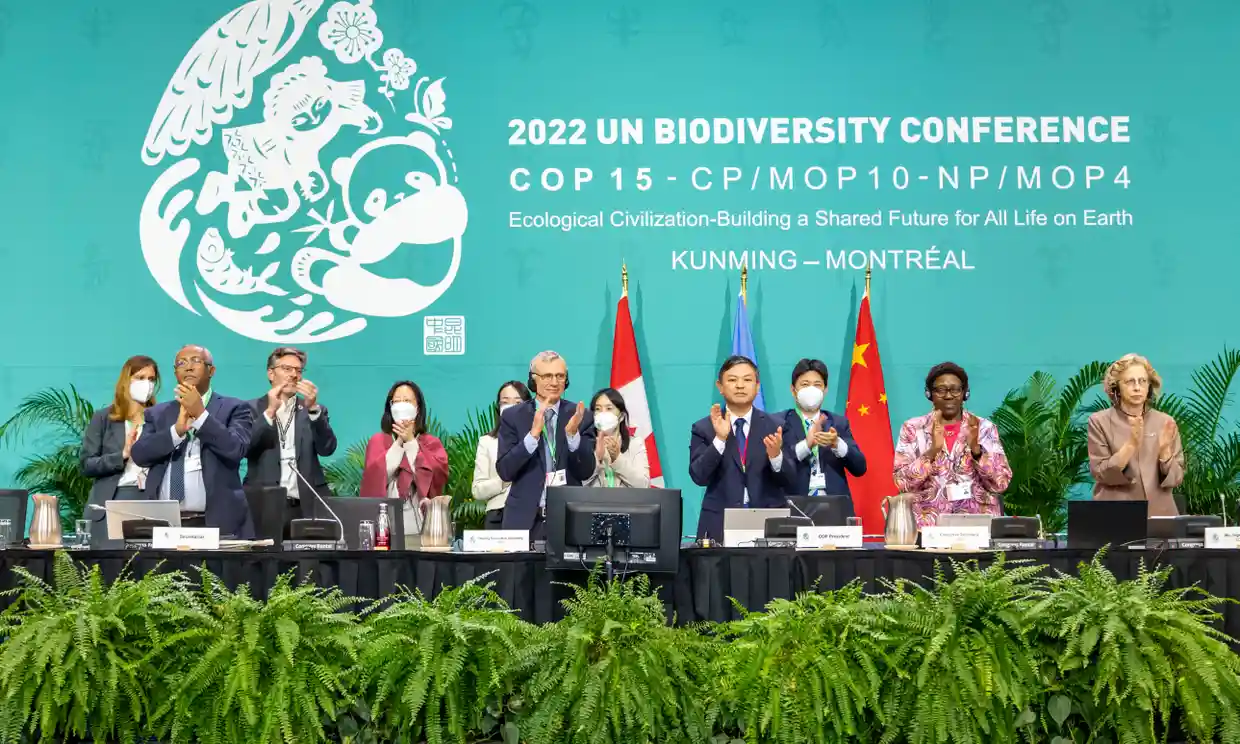
Click the link to read the key points from COP15 from The Guardian website (Patrick Greenfield and Phoebe Weston). Here’s an excerpt:
Main points of the historic agreement signed in Montreal to halt the destruction of Earth’s ecosystems
The Kunming-Montreal pact is a series of agreements that range from scientific cooperation to human-wildlife conflict. Here are the main points at a glance in the once-in-a-decade deal to halt the destruction of Earth’s ecosystems.
Agreement to conserve 30% of Earth by the end of the decade
Inspired by the Harvard biologist EO Wilson’s vision of protecting half the planet for the long-term survival of humanity, the most high-profile target at Cop15 has inspired and divided in equal measure. The final wording commits governments to conserving nearly a third of Earth for nature by 2030 while respecting indigenous and traditional territories in the expansion of new protected areas…
Indigenous rights at the heart of conservation
Indigenous peoples are mentioned 18 times in this decade’s targets to halt and reverse biodiversity, something to which activists are pointing as a historic victory. Several scientific studies have shown that Indigenous peoples are the best stewards of nature, representing 5% of humanity but protecting 80% of Earth’s biodiversity…
Reform of environmentally harmful subsidies
Definitely in the category of boring-but-important, the world spends at least $1.8tn (£1.3tn) every year on government subsidies driving the annihilation of wildlife and a rise in global heating, according to a study earlier this year…
Nature disclosures for businesses
Although the language was watered down in the final text, target 15 of the deal requires governments to ensure that large and transnational companies disclose “their risks, dependencies and impacts on biodiversity”…
A way forward on digital biopiracy
Ahead of Cop15, digital sequence information (DSI) was the controversial hot potato – and something few really understood. DSI refers to digitised genetic information that we get from nature, which is used frequently to produce new drugs, vaccines and food products. These digital forms of biodiversity come from rainforests, peatlands, coral reefs and other rich ecosystems, but they are hard to trace back to their origin country, with many in the developing world now expecting payment for the use of their resources.
Click the link to read the article on The Guardian website (Patrick Greenfield and Phoebe Weston). Here’s an excerpt:
Governments appear to have signed a once-in-a-decade deal to halt the destruction of Earth’s ecosystems, but the agreement seems to have been forced through by the Chinese president, ignoring the objections of some African states…In an extraordinary plenary that began on Sunday evening and lasted for more than seven hours, countries wrangled over the final agreement. Finally, at about 3.30am local time on Monday, news broke that an agreement had been struck. The Democratic Republic of the Congo’s negotiator appeared to block the final deal presented by China, telling the plenary that he could not support the agreement in its current form because it did not create a new fund for biodiversity, separate to the existing UN fund, the global environment facility (GEF). China, Brazil, Indonesia, India and Mexico are the largest recipients of GEF funding, and some African states wanted more money for conservation as part of the final deal. However, moments later, China’s environment minister and the Cop15 president, Huang Runqiu, signalled that the agreement was finished and agreed, and the plenary burst into applause…
Amid plummeting insect numbers, acidifying oceans filled with plastic waste, and the rampant overconsumption of the planet’s resources as humanity’s population grows wealthier and soars past 8 billion, the agreement, if implemented, could signal major changes to farming, business supply chains and the role of Indigenous communities in conservation. The deal was negotiated over two weeks and includes targets to protect 30% of the planet for nature by the end of the decade, reform $500bn (£410bn) of environmentally damaging subsidies, and restore 30% of the planet’s degraded terrestrial, inland water, coastal and marine ecosystems. Governments also agreed urgent actions to halt human-caused extinctions of species known to be under threat and to promote their recovery. The deal follows scientific warnings that humans are causing the start of Earth’s sixth mass extinction event, the largest loss of life since the time of the dinosaurs. Canada’s Steven Guilbeault, a former environmental campaigner turned minister, said the Kunming-Montreal pact was a “bold step forward to protect nature”.