
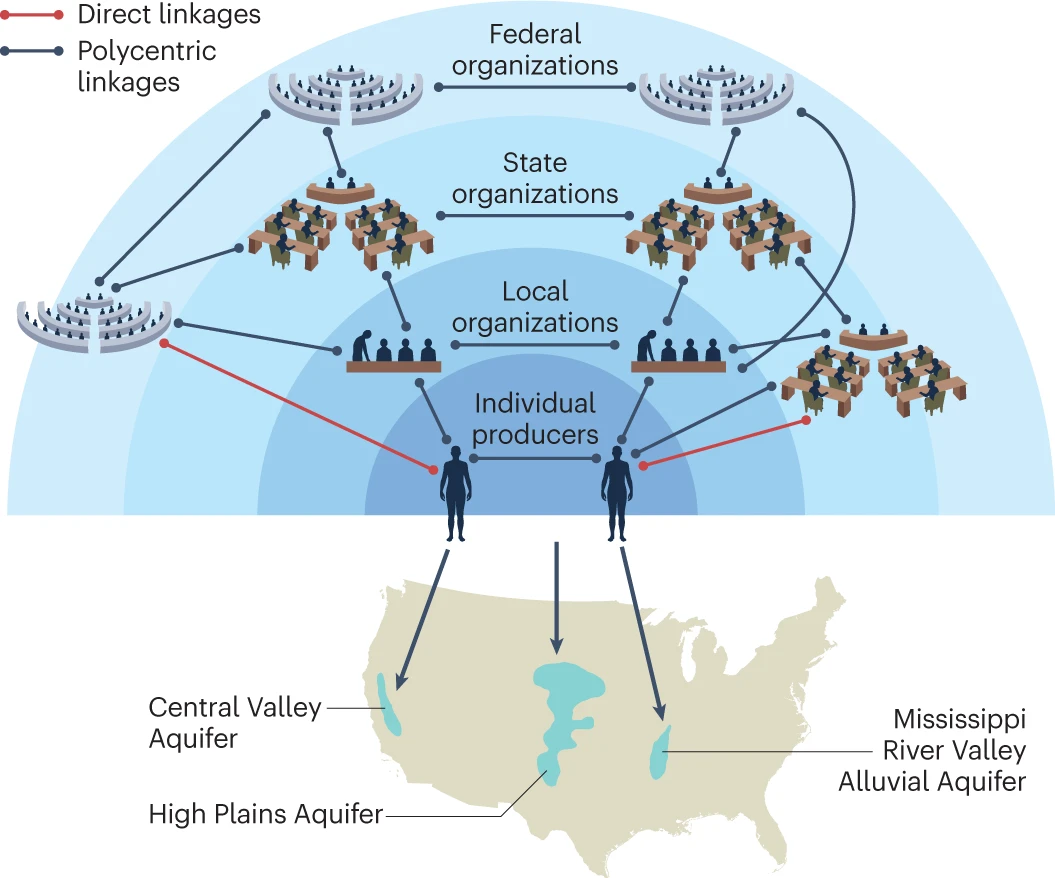
Click the link to access the report on the Nature Water website (Meagan E. Schipanski, Matthew R. Sanderson, Linda Estelí Méndez-Barrientos, Amy Kremen, Prasanna Gowda, Dana Porter, Kevin Wagner, Charles West, Charles W. Rice, Mark Marsalis, Bridget Guerrero, Erin Haacker, James Dobrowolski, Chittaranjan Ray & Brent Auvermann). Here’s the abstract:
Global groundwater resources are under strain, with cascading effects on producers, food and fibre production systems, communities and ecosystems. Investments in biophysical research have clarified the challenges, catalysed a proliferation of technological solutions and supported incentivizing individual irrigators to adjust practices. However, groundwater management is fundamentally a governance challenge. [ed. emphasis mine] The reticence to prioritize building governance capacity represents a critical ‘blind spot’ contributing to a low return on investment for research funding with negative consequences for communities moving closer towards resource depletion. In this Perspective, we recommend shifts in research, extension and policy priorities to build polycentric governance capacity and strategic planning tools, and to re-orient priorities to sustaining aquifer-dependent communities in lieu of maximizing agricultural production at the scale of individual farm operations. To achieve these outcomes, groundwater governance needs to be not only prioritized but also democratized.