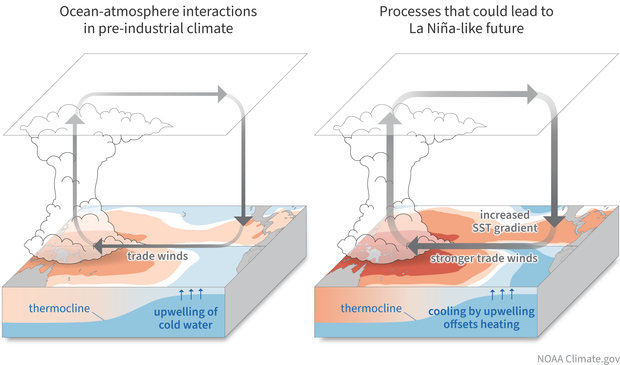
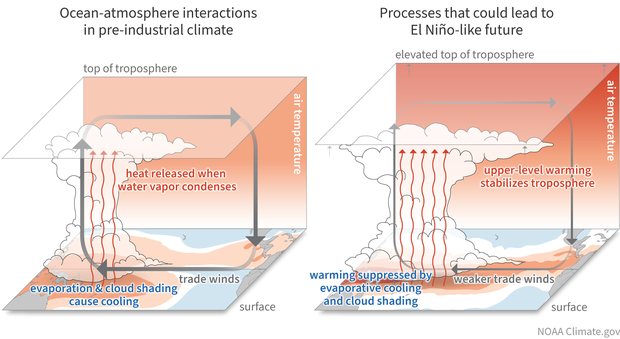
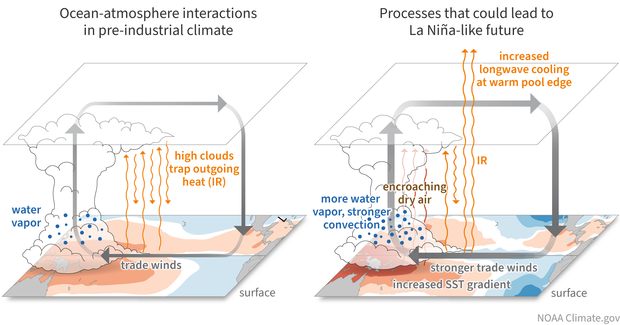
(D) Can we reconcile the seemingly different trends in the models versus the observations? Could they both be “right?”
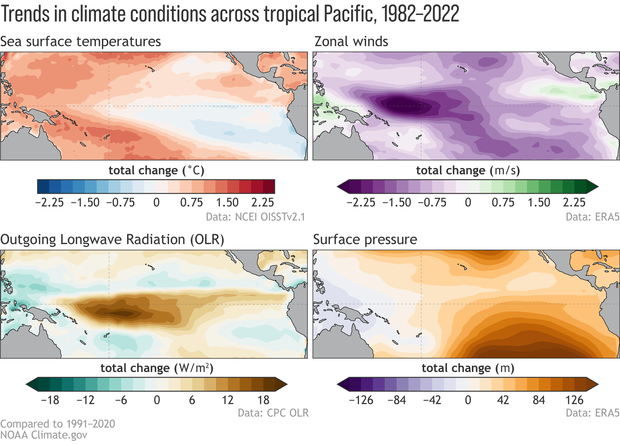
UH: It is entirely possible that the La Niña-like trends in the Pacific we are observing now are transient (short-term) and will reverse at some point in the next 100 years and start to look more like the modeled projections, with the eastern Pacific Ocean warming faster than the rest of the tropical oceans (9). Even if it is just transient, we need to understand these trends better: is it a response to global warming? (I tend to think so!), natural variability, or some mix of the two? However, this is difficult to diagnose using the models because the historical model simulations (run using observed historical forcings) and the observations still do not agree very well.
KK: It is fair to say both might be “right” in the very general sense that both sets of mechanisms are real and part of the fundamental physics controlling the climate system, but I don’t think we can say that both are right in terms of their relative importance. If the models and observations agreed on what *has* happened since the beginning of the Industrial Revolution, then that would be one thing, but they don’t. As for the future, it is possible that a mixture of physical processes can evolve, and some of Ulla’s work has really been groundbreaking in thinking along those lines. However, I suspect that as time goes on, we will learn that the models are still not representing some of the key ocean processes very well (10), such as the currents and upwelling, and their relation to changes in the wind—especially in places like the eastern equatorial Pacific Ocean where the thermocline is very shallow.
(E) How and when will scientists figure out where we are headed? What more could be done to help resolve this important question?
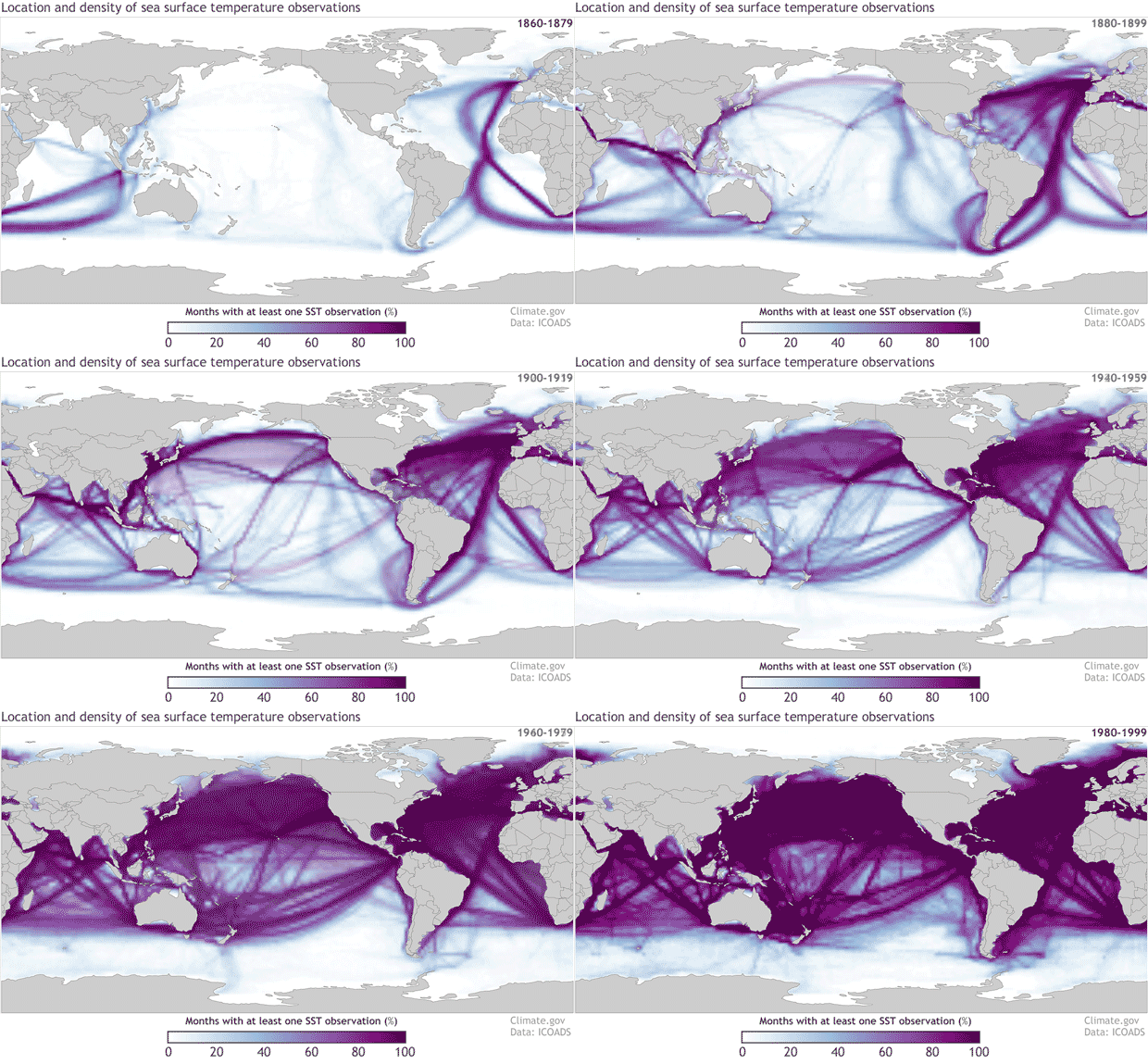
KK: Progress on the observational side might be slow. I don’t know how much more we can improve our ability to describe historical trends back to the 1800s. Even as different groups of scientists throw new statistical techniques to fill in the gaps, etc., the observational uncertainties aren’t being reduced very much. That said, we now have 40+ years of satellite data. When I started grad school, that was only 22 years. We probably have a few more decades to go, but we are getting closer to an acceptably long satellite record that can distinguish between ENSO, decadal variability, and long-term trends that are arising from human activities.
On the modeling side, heroic efforts are being done at modeling centers around the world to improve the representation of the physical processes. Perhaps gains will come from moving toward higher spatial resolution of the models as computers get cheaper and faster, which I suspect is critical for resolving upwelling, the shear between currents flowing in different directions, and the way that the friction from wind makes its way down into the ocean to influence the currents and mixing. I’m hopeful, and I’m glad I still have a few decades left to work on this fun and important problem!
SL: I agree with Kris that as the length of observational records increases, the impact of the internal variability on the trend diminishes, and therefore increasing the likelihood that the La Niña-like trends we’ve seen represents nature’s response to greenhouse gases. However, it is difficult to lengthen our historical record and infill where there are few measurements, so improving the accuracy of climate models is critical. Kris points out that we need to better resolve the ocean, but I think we also need to focus on how well tropical convection and rainfall is captured, which occur on scales that are unresolved by current model grid spacing. The current generation of parameterizationsstill warms the upper troposphere too aggressively and therefore weakens the simulated Walker circulation, leading to a more El Niño-like state.
For good reason, improving the parameterization is one of the most prominent research activities in climate science. At the same time, I believe that continued efforts should be made to develop new theories and to improve existing theories of fundamental mechanisms. In the meantime, for users who need to make decisions, it is important to recognize that there may be two different “storylines” for the tropical Pacific in the future, which they need to take into account.
Lead Editor: Michelle L’Heureux (NOAA CPC)
Footnotes:
(1) Tom has done a masterful job going over these questions. Check out his most recent post going over the latest IPCC findings related to ENSO and climate change. I also really like his older post using a dimmer switch metaphor.
(2) I’m avoiding using the term “zonal gradient” up top because it involves two fairly jargon-y terms that I think confuse most non-scientific readers. But, for those who are familiar, I’m talking about trends in the zonal gradient across the tropical Pacific Ocean. In other words, we’re interested in the relative rate of trends in tropical sea surface temperature, sea level pressure, rainfall, etc. in the zonal, or east-west, direction—i.e. comparing impacts between the eastern Pacific versus the western Pacific.
(3) Now some readers might ask “Wait, isn’t ENSO already tied to the pattern of sea surface temperatures across the tropical Pacific Ocean? El Niño is associated with ocean temperatures warming up (more than average) in the central and eastern equatorial Pacific and La Niña is linked to cooler ocean temperatures there. So how is this question about trend patterns any different from asking how ENSO itself will change?” Good question smart readers!
Changes in El Niño and La Niña are most strongly tied to seasonal (3-month) average anomalies in the climate system, and this seasonal variability has its own mechanismsthat result in the growth and decay of events over the span of a year or couple years. In contrast, what we are talking about here is the slower, smaller background changes in the tropical Pacific that occur over multiple decades or even centuries. Even though the timescales and mechanisms are separate and distinct from the seasonal ENSO cycle, folks often use the phrases “El Niño-like change/trends” or “La Niña-like change/trends” to describe these longer, gradual trends.
Although potentially confusing, these terms provide a handy shortcut because El Niño-like change means that these trends will look more El Niño-like over the tropical Pacific (relatively warmer in the central/east Pacific and cooler in the western Pacific) or La Niña-like (relatively cooler in the central/east Pacific and warmer in the western Pacific).
(4) I think Sukyoung Lee’s review paper (which available through open access) is a nice place to start reading about different ideas and approaches (disclosure: two ENSO bloggers are co-authors). There are also more papers that have been released since that review paper was assembled that are also worth checking out:
Hartmann, D. L. (2022). The Antarctic ozone hole and the pattern effect on climate sensitivity. Proceedings of the National Academy of Sciences, 119(35), e2207889119. https://doi.org/10.1073/pnas.2207889119
Wills, R. C. J., Dong, Y., Proistosecu, C., Armour, K. C., & Battisti, D. S. (2022). Systematic climate model biases in the large-scale patterns of recent sea-surface temperature and sea-level pressure change. Geophysical Research Letters, 49, e2022GL100011. https://doi.org/10.1029/2022GL100011
Dong, Y., Pauling, A. G., Sadai, S., & Armour, K. C. (2022). Antarctic ice-sheet meltwater reduces transient warming and climate sensitivity through the sea-surface temperature pattern effect. Geophysical Research Letters, 49, e2022GL101249. https://doi.org/10.1029/2022GL101249
(5) For example, one recent study has shown that the ocean surface near the Galapagos Islands in the far eastern equatorial Pacific cooled down by about a half degree Celsius over the past 40 years.
(6) It is often useful to make a distinction between climate change and climate impacts. Climate change refers to the ‘big picture’ of how earth’s climate is changing in response to more greenhouse gasses in the atmosphere. This includes questions like how much the surface of the planet is warming, how the jet stream is changing, how fast the ice sheets are melting, and – you guessed it – how the tropical Pacific is changing. Climate impacts are the consequences of climate change that impacts humans locally. For example, climate impacts could be increased droughts, more frequent forest fires, flooding of coastal cities, stronger hurricanes making landfall.
(7) The reason why La Niña events bring about wavier conditions is because the latent heat released during cloud formation in the tropics is mostly confined to the western part of the tropical Pacific. The latent heating generates so-called Rossby waves which are responsible for the aforementioned waviness (see Figure 6 in Lee et al., 2022). If the latent heating is uniform in the east-west direction, the heating cannot generate Rossby waves. Therefore, the more east-west confinement of the latent heating, the more the waviness, which has profound impacts on temperature and precipitation locally around the globe. The pattern of the future tropical Pacific is not necessarily the same as either El Niño or La Niña.
(8) For more details see:
Lee, S. (2012). Testing of the Tropically Excited Arctic Warming Mechanism (TEAM) with Traditional El Niño and La Niña, Journal of Climate, 25(12), 4015-4022.
Clark, J. P., & Lee, S. (2019). The role of the Tropically Excited Arctic Warming Mechanism on the warm Arctic cold continent surface air temperature trend pattern. Geophysical Research Letters, 46, 8490– 8499. https://doi.org/10.1029/2019GL082714
(9) Here are some papers that delve on the issue of future Pacific warming:
Heede, Ulla, and Alexey Fedorov. 2021. ‘Eastern Equatorial Pacific Warming Delayed by Aerosols and Thermostat Response to CO2’.
Heede, Ulla K., Alexey V. Fedorov, and Natalie J. Burls. 2020. ‘Timescales and Mechanisms for the Tropical Pacific Response to Global Warming: A Tug of War between the Ocean Thermostat and Weaker Walker’. Journal of Climate, April. https://doi.org/10.1175/JCLI-D-19-0690.1.
Wu, Mingna, Tianjun Zhou, Chao Li, Hongmei Li, Xiaolong Chen, Bo Wu, Wenxia Zhang, and Lixia Zhang. 2021. ‘A Very Likely Weakening of Pacific Walker Circulation in Constrained Near-Future Projections’. Nature Communications12 (1): 6502. https://doi.org/10.1038/s41467-021-26693-y.
Ying, Jun, Matthew Collins, Wenju Cai, Axel Timmermann, Ping Huang, Dake Chen, and Karl Stein. 2022. ‘Emergence of Climate Change in the Tropical Pacific’. Nature Climate Change, March, 1–9. https://doi.org/10.1038/s41558-022-01301-z.
(10) Karnauskas, K. B., J. Jakoboski, T. M. S. Johnston, W. B. Owens, D. L. Rudnick, and R. E. Todd, 2020: The Pacific Equatorial Undercurrent in Three Generations of Global Climate Models and Glider Observations. J. Geophys. Res.–Oceans, 125(11), e2020JC016609, doi: 10.1029/2020JC016609.
This paper analyzed a ton of climate models, from the ones that were state-of-the-art a dozen years ago (CMIP3 / IPCC AR4) to the most recent generation of CMIP6 models that fed into the 6thIPCC Assessment Report. While the currents along the equatorial Pacific have improved over time, there is still a ways to go, and this has implications for how SST changes.
Coats, S., and K. B. Karnauskas, 2018: A role for the Equatorial Undercurrent in the ocean dynamical thermostat. J. Climate, 31, 6245–6261, doi: 10.1175/JCLI-D-17-0513.1.
This paper analyzed a recent generation of global climate models (CMIP5 / IPCC AR5) and found, among other things, that the relationship between the wind stress and the underwater currents does not match observations in the eastern equatorial Pacific, which has implications for how SST changes in that climatically important region.