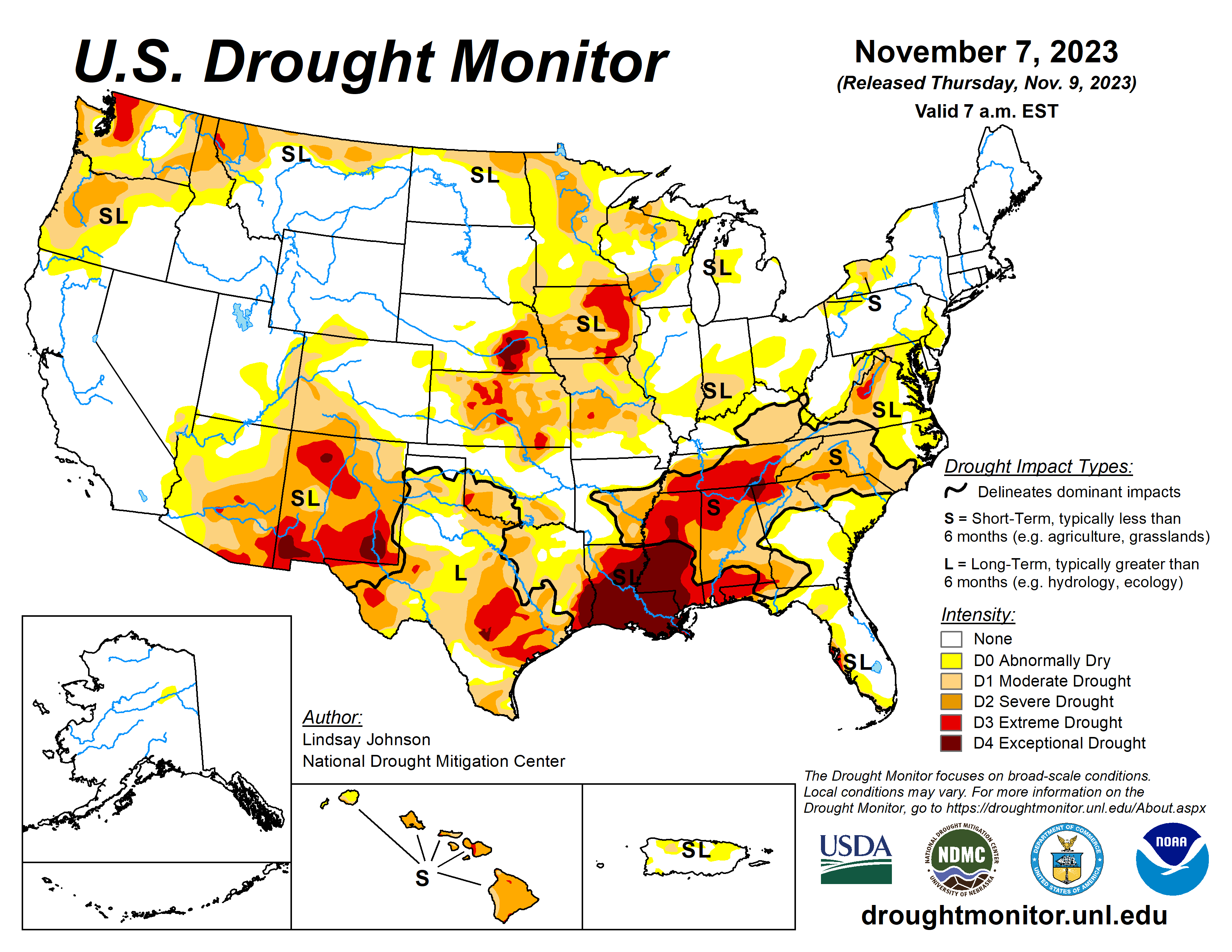
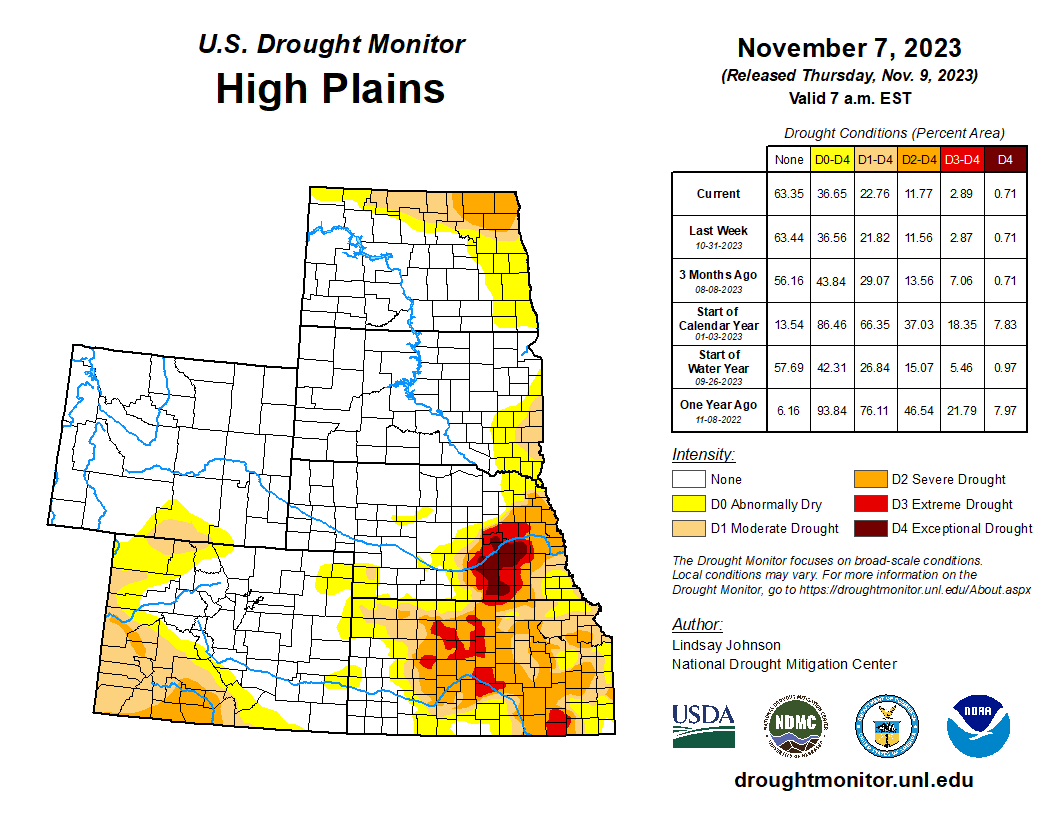
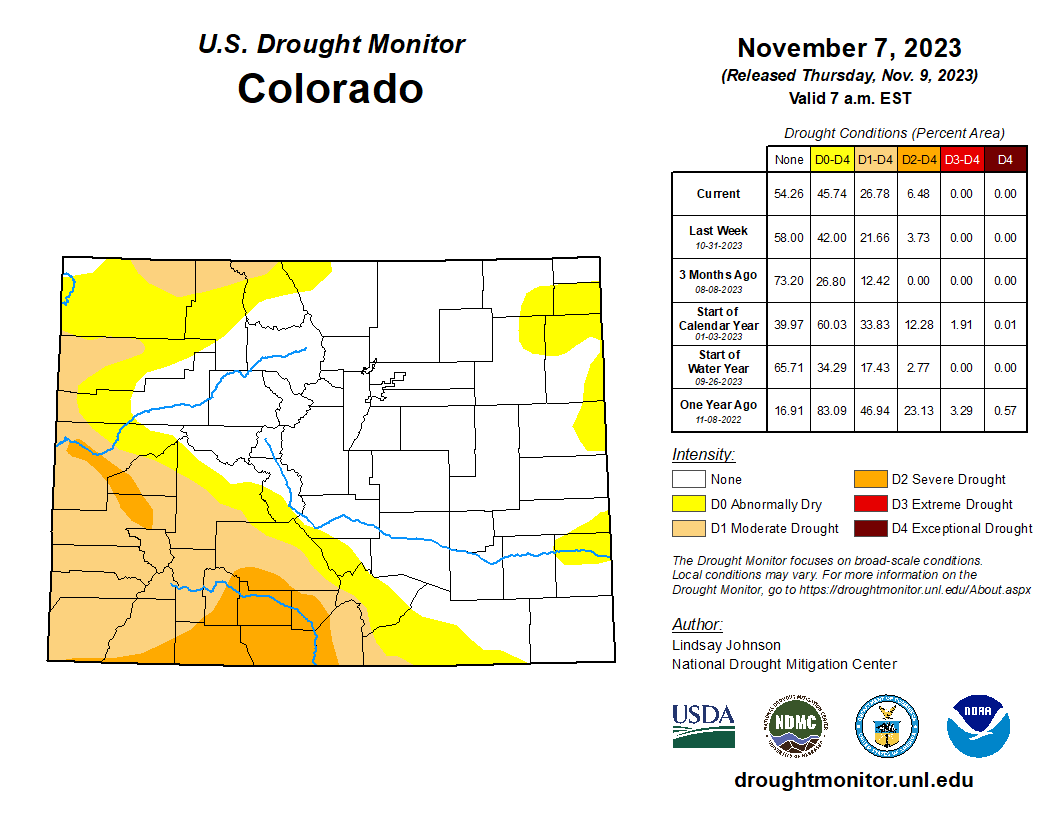
#Drought news November 9, 2023: Dry conditions persisted across the High Plains where temperatures are above normal, with #Wyoming and #Colorado seeing temperatures of 3-8 degrees above normal

Click on a thumbnail graphic to view a gallery of drought data from the US Drought Monitor website.

Click the link to go to the US Drought Monitor website. Here’s an excerpt:

This Week’s Drought Summary

Residual impacts from the prior week’s storm continued to bring some improvements to the Pacific Northwest, northern Plains and upper Midwest. However, in the South and Southeast, conditions continue to rapidly deteriorate, leading to flash drought and widespread expansion of drought conditions.,,

High Plains

Dry conditions persisted across the High Plains where temperatures are above normal, with Wyoming and Colorado seeing temperatures of 3-8 degrees above normal. The eastern boundary experienced near- or slightly-above-normal temperatures, except for North Dakota where temperatures were 3 or more degrees below normal. South Dakota and northeastern Nebraska continued to see improvements as remnants of the past week’s precipitation aid in dry conditions. There were 1-category improvements along the eastern South Dakota and northeastern Nebraska borders. Areas in South Dakota are so wet that producers have reported issues with planting winter crops…

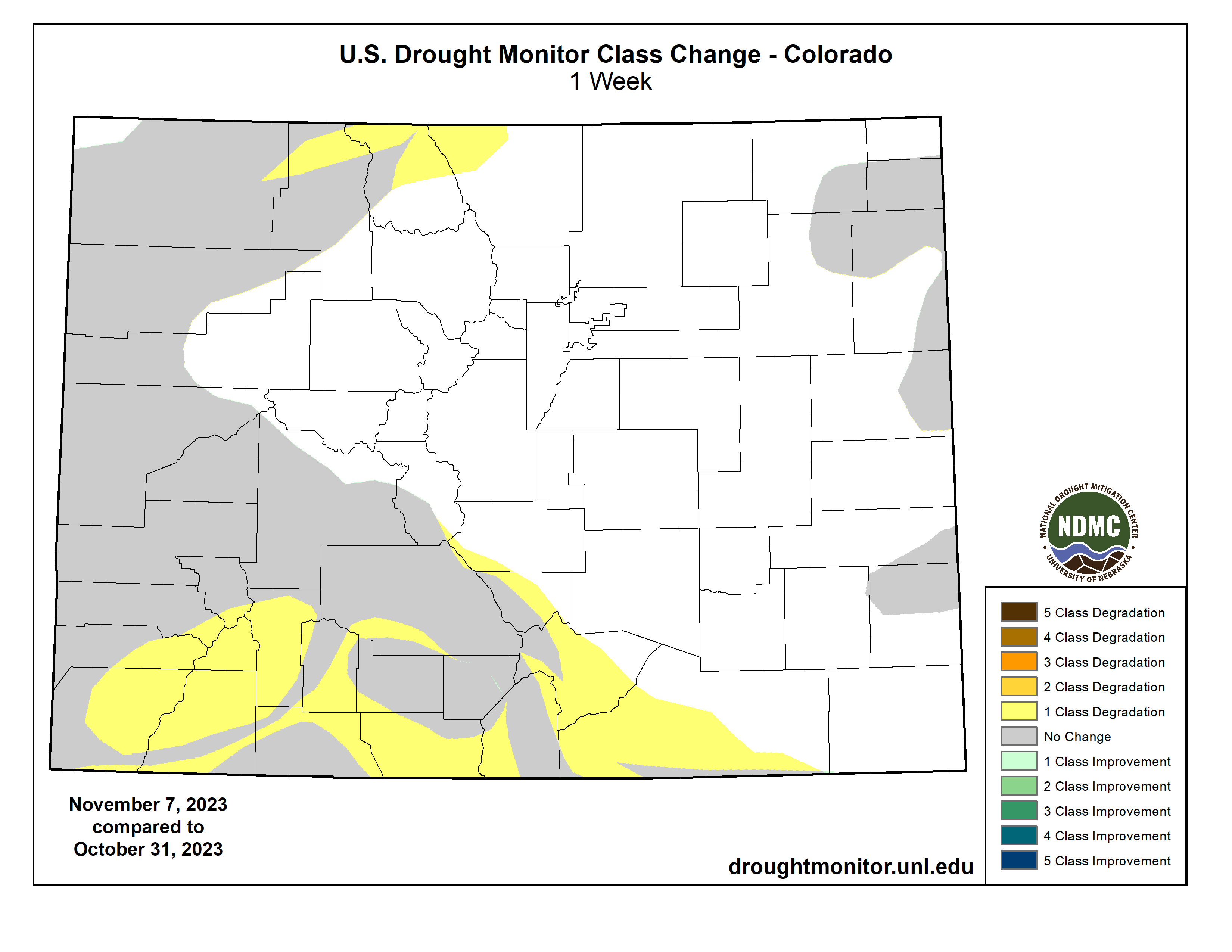
Colorado Drought Monitor one week change map ending November 7, 2023.

West

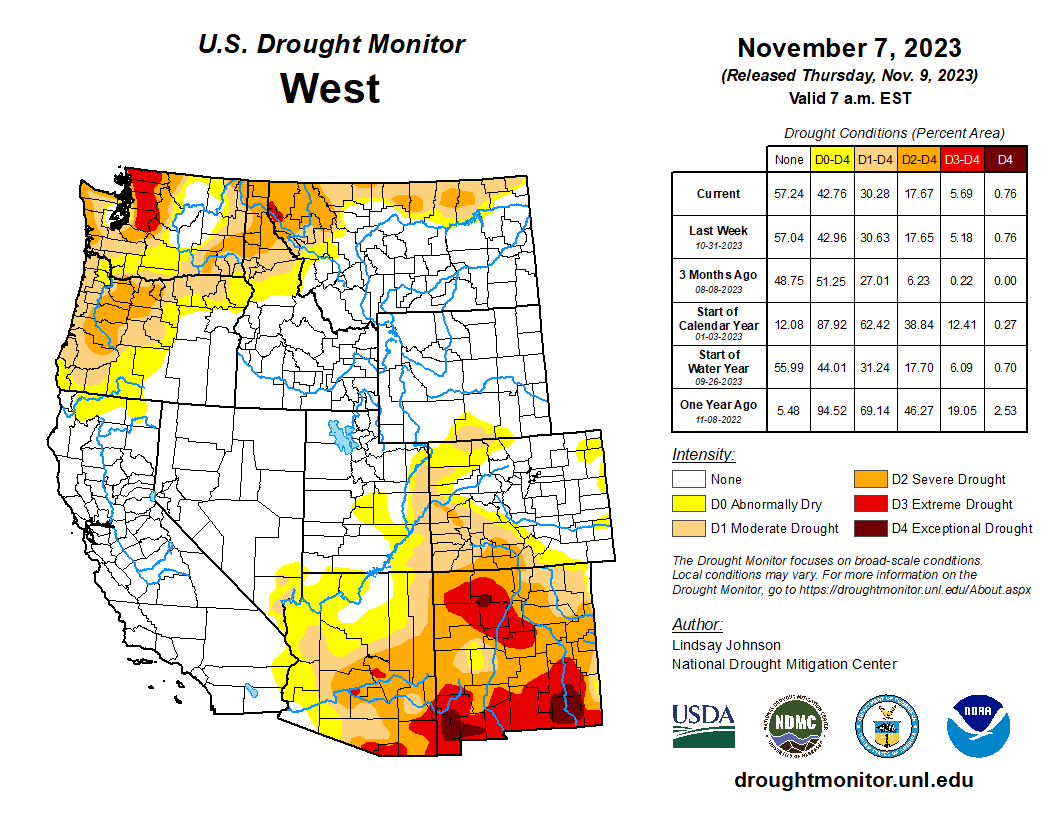
An atmospheric river cascaded over parts of the Pacific Northwest, bringing several inches of new rain and snow accumulation along with last week’s precipitation. With this continued influx of precipitation, modest 1-category improvements were made across the northwest, particularly on the windward side of the Cascade Range. Further improvements were seen in northern Idaho and Montana, which received up to 4 inches of precipitation in some areas. Despite the deluge of precipitation over the last one to two weeks, temperatures have been 1-3 degrees above normal, and south-central Montana even had temperatures of 6-9 degrees above normal. The remaining states in the West remained status quo…

South

Dry conditions continued across the South, with the entire region at or below 25% of normal precipitation. Despite this lack of precipitation, there was some relief in terms of temperatures, which were 2-4 degrees below normal. Areas of Louisiana and Mississippi were up to 8 degrees below normal. Louisiana and Mississippi did not see any drought relief, with 1-category degradations across the two states. In Louisiana, over 50% of the state is in Exceptional Drought, and in Mississippi rapid deterioration spilling eastward from Louisiana resulted in 1-category degradations. Tennessee is also in Extreme Drought, and Exceptional Drought was introduced along the tri-state border, along with Alabama and Georgia. Extreme and Severe drought also migrated northward. Texas and Oklahoma remained largely unchanged, with some improvements in central Texas and status quo conditions for Oklahoma…

Looking Ahead

Over the next five to seven days, much of the western and central Gulf Coast region will likely see 2-5 inches of precipitation as an unformed tropical depression makes its way north from Cuba into the western Gulf of Mexico. Some of this moisture will continue across the Southeast. The Casacade Mountian range and surrounding areas are likely to continue to receive more moisture. Temperatures are expected to be slightly below normal in Texas, the south Atlantic region and the Northeast. The High Plans and parts of the northern West and Midwest are likely to see maximum temperatures of 8-12 degrees above normal.

The six- to 10-day outlook shows a strong chance of above-normal temperatures centered over the eastern High Plains and western Midwest. Much of the rest of the county is also projected to experience above-normal temperatures. Below-normal precipitatation is forecasted across much of the northern regions from eastern Montana to Maryland and Maine. The West is projected to have above-normal precipitation, particularly in central and southern California as well as Alaska and Hawaii.

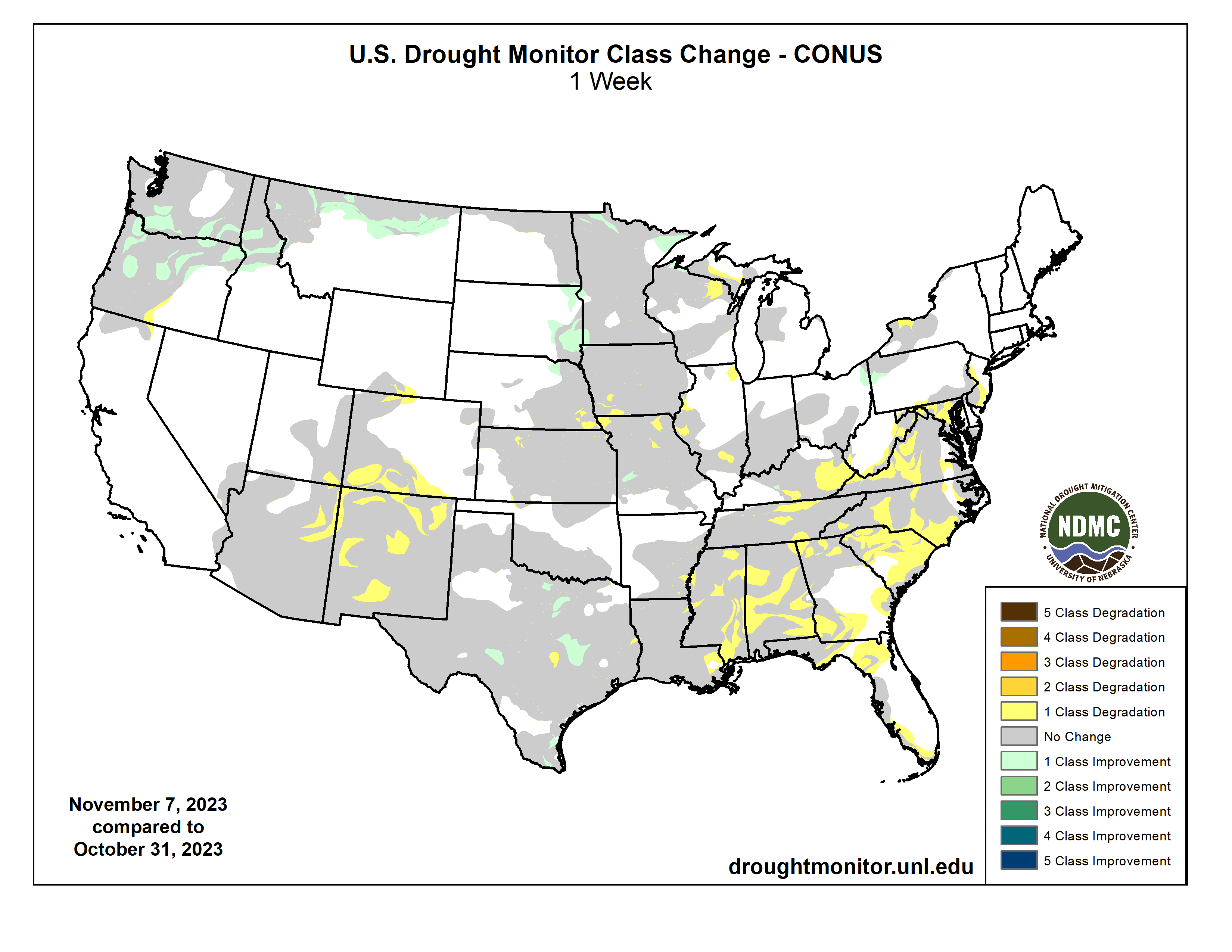
US Drought Monitor one week change map ending November 7, 2023.

Just for grins here’s a slideshow of early November US Drought Monitor maps for the past several years.

EPA report says #LincolnCreek contamination is naturally occurring — @AspenJournalism #RoaringForkRiver

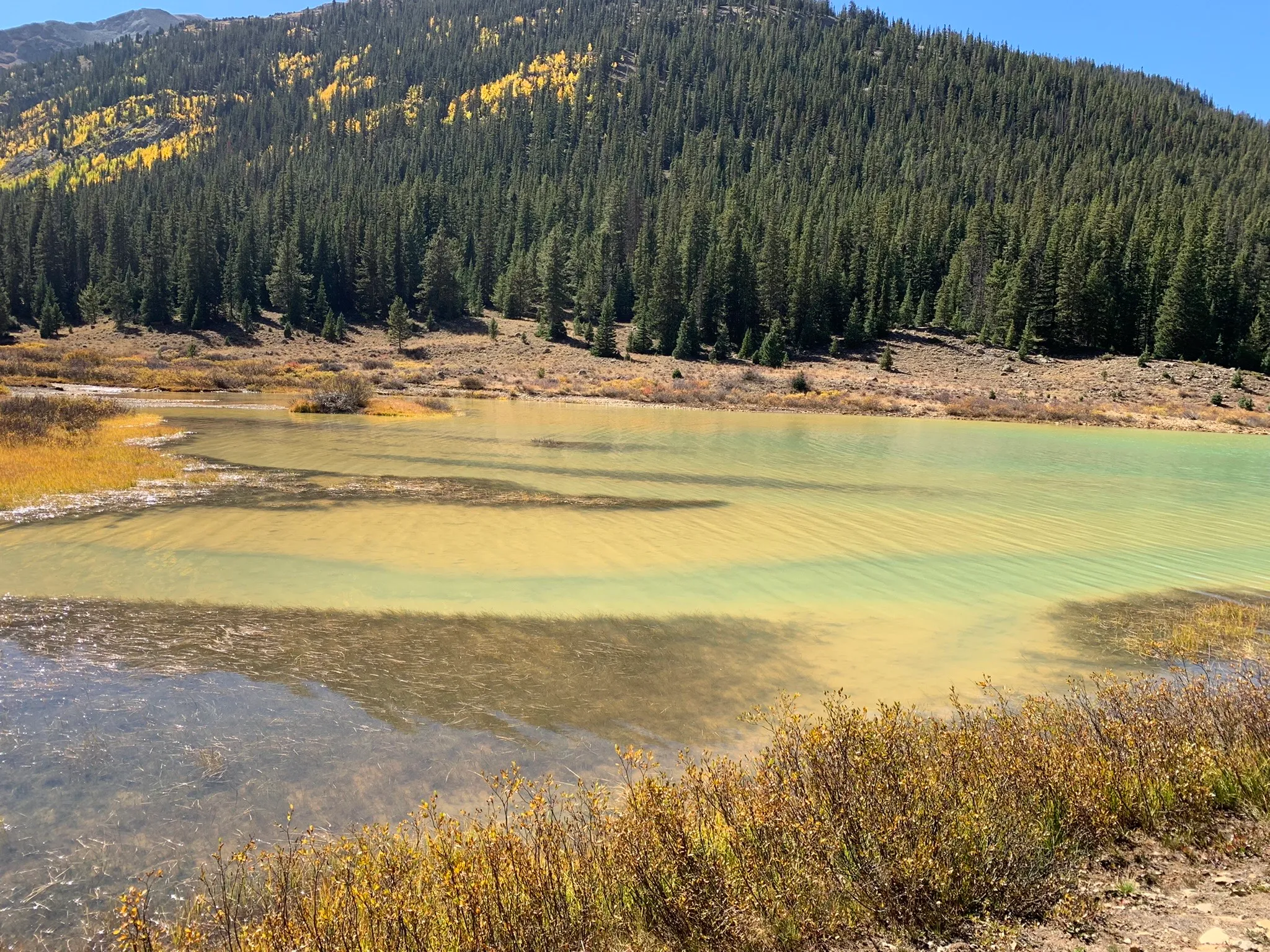
Lincoln Creek was yellow as it flowed into Grizzly Reservoir in September 2022. A report from the Environmental Protection Agency says metals contamination in the creek and reservoir is a result of natural causes, not a nearby mine.Ā CREDIT:Ā HEATHER SACKETT/ASPEN JOURNALISM

Click the link to read the article on the Aspen Journalism website (Heather Sackett):

The results of water quality testing on Lincoln Creek show that the waterway is toxic to fish and that metals concentrations have been increasing in recent years. But because the main source of the contamination is a nearby tributary — and not a mine — it is unclear who should take responsibility for cleaning it up.

report released this week by the Environmental Protection Agency shows that Lincoln Creek in the four miles between the Ruby Mine and Grizzly Reservoir exceeds state water quality standards for aquatic life for aluminum, cadmium, copper, iron, lead, manganese and zinc. Aluminum and copper concentrations were higher than standards set by the Colorado Department of Public Health and Environment in multiple locations: in Lincoln Creek downstream of Ruby Mine, in Grizzly Reservoir and in Lincoln Creek downstream of the reservoir.

ā€œThe high concentrations of these metals are toxic to aquatic life and make Lincoln Creek uninhabitable for fish,ā€ the report says. 

The report is based on water quality sampling data from 2022.

Karin Teague, executive director of the Independence Pass Foundation, said she is glad the report is finally out so that the community can talk about what to do about the contamination. The foundation’s mission is to restore and protect the ecological integrity of the pass corridor. 

ā€œWe have a dead creek on our hands,ā€ Teague said. ā€œIt’s a hard thing to see, and it’s a disaster for the living things that used to call the creek home. It’s bad for the wildlife and has human health implications.ā€

But those human health implications remain unclear. 

In addition to exceeding standards for aquatic life, the report says cadmium, copper, iron and nickel were present in concentrations exceeding the state standards for domestic water supply. 

Lincoln Creek feeds into the Twin Lakes Reservoir and Canal Company’s transmountain diversion system, in which Grizzly Reservoir is used as a collection pond before sending water through the Twin Lakes Tunnel to the Front Range, where it is used primarily in Front Range cities, including for drinking water. Colorado Springs Utilities owns the majority of the water in the Twin Lakes system. 

The report says there is a slight potential that the metals are contaminating drinking water, but the substantial mixing, the distance that the water travels and the filtration limit these impacts. Lincoln Creek is a tributary of the Roaring Fork River, but Aspen’s domestic water supply is not affected; the city’s drinking water comes primarily from Castle Creek.Ā Ā 

Colorado Parks and Wildlife stocks Grizzly Reservoir with fish each year, making it a popular and scenic spot for summer alpine fishing and camping. There have been fish die-offs in the reservoir in recent years, including 2021. But CPW aquatic biologist Kendall Bakich said that since Grizzly Reservoir is diluted with water from several surrounding cleaner drainages, fish can still survive there and CPW plans to continue stocking.Ā 

CPW stocks the reservoir with ā€œcatchable trout,ā€ meaning anglers can take them out and eat them. Since the trout have been raised in hatcheries with clean water and food, and have probably lived in the reservoir for only a short time (most trout that aren’t caught by anglers during the summer don’t survive the harsh winter in Grizzly), Bakich said they are not likely to pose a risk to human health. But CPW tested the tissue anyway of some of the few fish that made it through the winter since they would have the most exposure to the toxic metals.

ā€œWe haven’t gotten the results back on those tissue samples,ā€ Bakich said. ā€œAt this point, what we know about copper and how it resides in a fish’s body, it resides in the organs and people don’t eat the organs. If you are harvesting fish in the summer, they have just been put in there.ā€Ā 

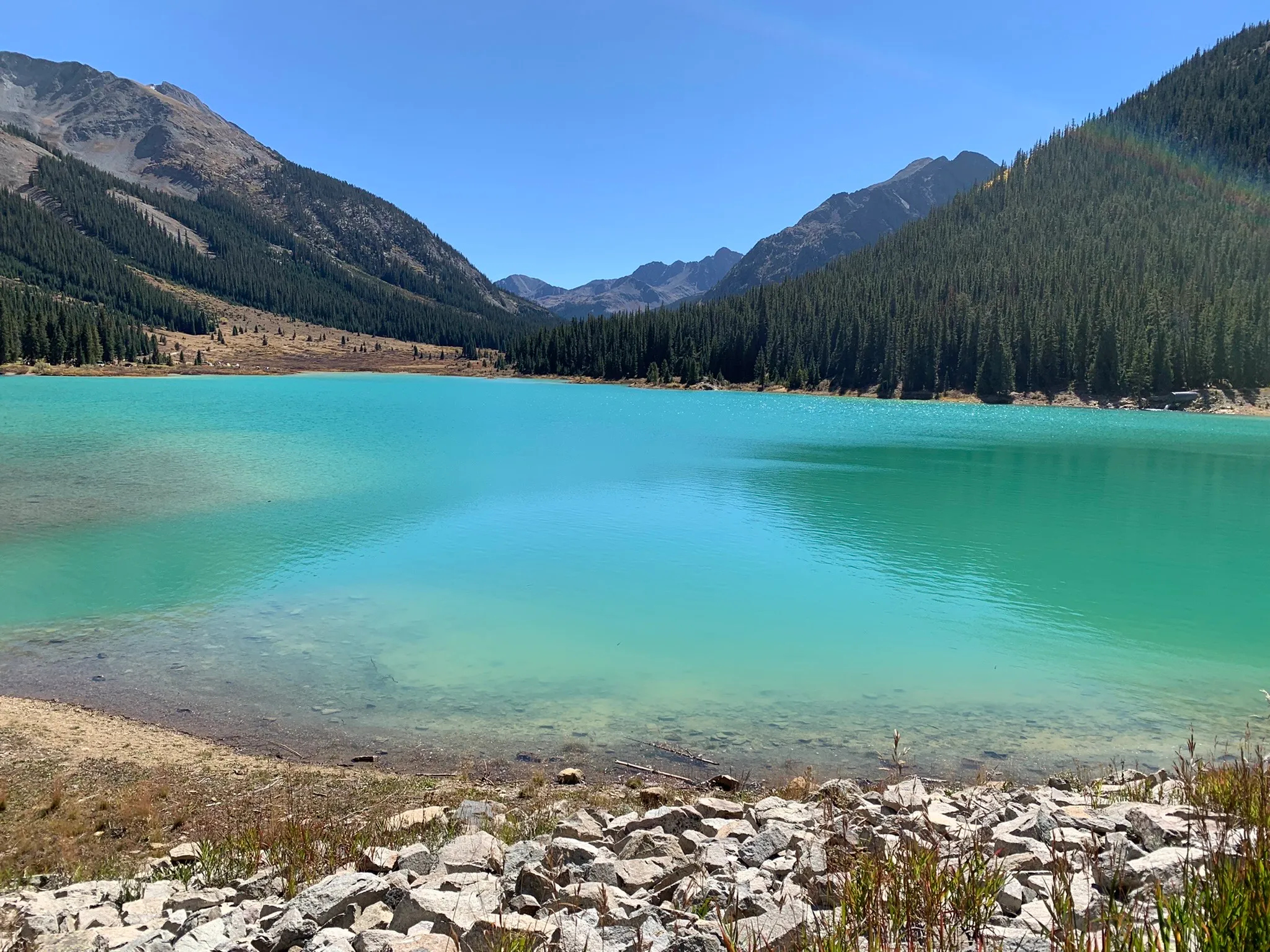
Grizzly Reservoir was a bright shade of turquoise in September 2022. The man-made alpine lake has high concentrations of metals that are toxic to fish, according to a report from the Environmental Protection Agency. CREDIT: HEATHER SACKETT/ASPEN JOURNALISM

Natural source of contamination

The report points to natural sources as the culprit for creek contamination, referring to a ā€œmineralized tributary.ā€ The mineralized tributary in question is a drainage in a steep slope above Ruby Mine, which flows into Lincoln Creek just below the discharge from the Ruby Mine portal. Prospectors dug for gold, silver, lead and copper at now-defunct Ruby Mine in the early 1900s.

The report says that the mine discharge and the mineralized tributary have very different water chemistry and that the contamination has been traced back to the tributary, not the mine. The report estimates that the mineralized tributary contributes 98.5% of the copper contamination to Lincoln Creek.

ā€œWhile historical mining does appear to play a role in some of the impacts to Lincoln Creek, all of the data and observations point to natural sources as the major component of metals loading into Lincoln Creek,ā€ the report reads. ā€œTherefore, cleanup or removal activities associated with Ruby Mine would have minimal benefits to improve the overall quality of Lincoln Creek.ā€

The EPA is authorized to address elevated metals concentrations only from human-caused sources, not contamination from natural sources.

Yellow and white sediment settled on the streambed of Lincoln Creek in September 2022, prompting concerns from residents and local organizations, and water quality testing. A report from the EPA found that the creek has metals concentrations that are toxic to fish. CREDIT: HEATHER SACKETT/ASPEN JOURNALISM

Climate change a cause?

Water quality issues on Lincoln Creek have been a concern for years, with the creek above the reservoir often running a yellowish color, and Grizzly Reservoir often a bright turquoise. In September 2022, Lincoln Creek below the reservoir turned a milky-green color, and white and yellow sediment settled on the streambed, prompting water quality testing in the fall of 2022 and the EPA report. These conditions in 2022 could be seen downstream at the confluence with the Roaring Fork River, sparking concern for local residents and organizations. 

Although water quality issues on Lincoln Creek are not new, according to the report, the metals concentrations — especially copper — have increased over the past 20 years. And climate change may be to blame. 

ā€œWhile the exact cause for observed trends is not known, it is suspected that climate change may be altering hydrologic cycles and thawing once-frozen rock deep in the mountain,ā€ the report reads. ā€œThese processes could expose more metals-bearing rock to oxygen, thereby increasing potential to generate acidic drainage and dissolution of metals.ā€ 

Now that the findings have been released, the next step is figuring out what to do about the contamination and which agencies should be involved. Pitkin County Environmental Health Manager Kurt Dahl said a meeting has been scheduled for Thursday with representatives from Pitkin County, CDPHE, the U.S. Forest Service, CPW, the Roaring Fork Conservancy, EPA, and the Colorado Division of Reclamation, Mining and Safety.

ā€œBeing a natural source, (EPA) is not going to deal with it,ā€ Dahl said. ā€œIs there another agency that will deal with it? The question of what are the next steps is one of the more important pieces to answer.ā€ 

Teague hopes to learn more about the potential health risks of the contamination and that the community can figure out a solution to clean it up. 

ā€œThis is a community that cares a lot about its backyard, the health of its wild places,ā€ she said. ā€œIf we can talk about building $50 million trails, maybe we can talk about millions of dollars to bring a creek back to life.ā€

Aspen Journalism is a nonprofit, investigative news organization covering water, environment, social justice and more. Visit http://aspenjournalism.org. 

Pitkin County supports Aspen Journalism with a grant from the Healthy Community Fund. Aspen Journalism is solely responsible for its editorial content.

Map of the Roaring Fork River drainage basin in western Colorado, USA. Made using USGS data. By Shannon1 – Own work, CC BY-SA 4.0, https://commons.wikimedia.org/w/index.php?curid=69290878

How about 98.5% emissions-free electricity by 2040? — Allen Best (@BigPivots)

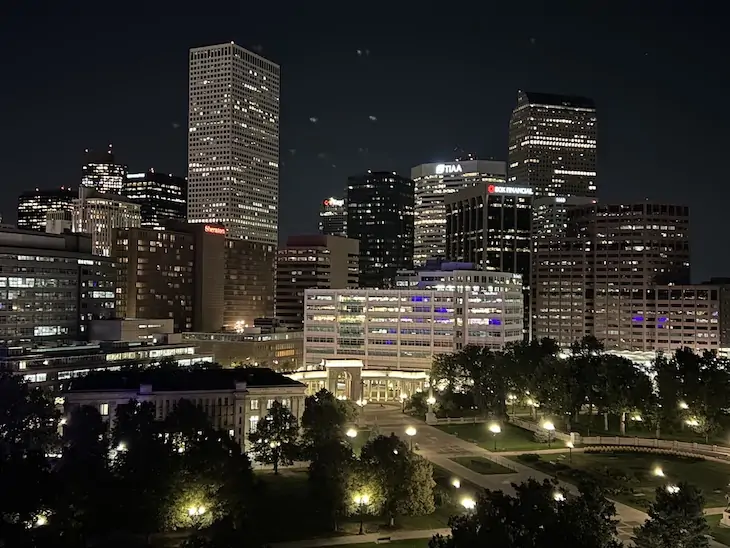
Downtown Denver from the Denver Art Museum. Photo/Allen Best

Click the link to read the article on the Big Pivots website (Allen Best):

Study finds that existing technology can get Colorado to near-zero electricity without need for breakthroughs in geothermal, nuclear or other realms. It will require a bit of natural gas.

Colorado can decarbonize its electricity very deeply by 2040 without busting the bank. But there’s a catch.

To hit this 98.5% decarbonization level will require accepting natural gas as 1% of the mix along with a small percentage of carbon-based electricity imported into Colorado. And getting there will not require still-costly emerging technologies.

That’s the take-away from a modeling study commissioned by the Colorado Energy Office.

How about 100% emissions-free electricity? That can be achieved, and in several different ways — all of them at a higher price, according to the modeling conducted by Ascend Analytics, a Boulder-based company.

The company modeled two other scenarios deploying deep levels of geothermal, hydrogen, and advanced nuclear reactors as well as other emerging technologies. Still another scenario examined the cost of using simply wind, solar, and existing battery technology. And one scenario emphasized local generation.

These five other scenarios came in at prices of $47.1 billion to $56.2 billion in net-present value — all substantially higher than the $37.5 billion of the less-than-perfect scenario using some natural gas.

Burning natural gas on an as-needed basis to ensure reliability will produce 565,000 metric tons of emissions in 2040. That compares with 40 million tons in 2005, according to the modeling study. This scenario also envisions a higher share of electricity , about 17%, being imported into Colorado.

All the scenarios in the modeling assume substantial amounts of improved energy efficiency, in effect partially eliminating the need for new generation. All models also assume that Colorado utilities will, as required by a state law, be participating in some sort of regional market for electricity by 2030.

Will Toor, director of the Colorado Energy Office, called the study results ā€œhuge.ā€

ā€œThe biggest takeaway of the study is understanding that we can get very deep emissions reductions, nearly zero emissions by 2040 while minimizing costs to utility customers. That is not something that we understood going into this study,ā€ he said in an interview.

ā€œAs we look at developing the policy framework for 2040, it will be very much informed by that understanding,ā€ he added.

The modeling study will likely deliver the justification for a bill in the legislative session beginning in January that would propose a new emissions-reduction target for Colorado’s electrical utilities. Laws adopted in 2019 and in subsequent years tasked those utilities with reducing emissions 80% by 2030. Most and perhaps all seem to be on track to get there with relative ease.

Some moving higher more quickly

Some utilities expect to get far higher—and soon. Notable is Holy Cross Energy, the electrical cooperative based in Glenwood Springs. It expects to achieve 92% emissions-free electricity by early in 2024 and has a goal of 100% by 2030.

Bryan Hannegan, chief executive of Holy Cross, has long said that the path to 90% was reasonably clear. The hard part, with answers still unknown, he has said, will be that final 10%. And unlike the path to 90%, that final leg will likely be more expensive.

The modeling has any number of assumptions. Some likely are further out on the limb than others.

All the scenarios assume a 40% increase in electrical demand across Colorado during the next 17 years. Population growth will drive some of this new demand. Increased demand will also result from electricity replacing fossil fuels in both transportation and building and water heating.

To satisfy this increased demand will require new generation. Just how much new generation will depend upon the type. Wind and solar exclusively from generators within Colorado coupled with battery storage would require 74,492 megawatts of installed capacity. Having natural gas available will require far less, 44,474 megawatts.

On a more micro level and with a concrete challenge, Platte River Power Authority — the supplier to Fort Collins, Loveland, Estes Park and Longmont — is putting together its resource plan looking out to 2030. Directors in 2018 identified a goal of 100% renewables by 2030 but also attached a handful of conditions to that goal. Five years later, Platte River’s planners don’t see a way to 100% by 2030, at least not without risking reliability or absorbing considerable costs. One scenario calls for 85% renewables. The plan, however, is not scheduled to be completed until June.

For an explanation of the reasoning for a unanimous resolution by Platte River’s board of directors,Ā see a blog by Fort Collins Mayor Jeni Arndt, her city’s board representative.

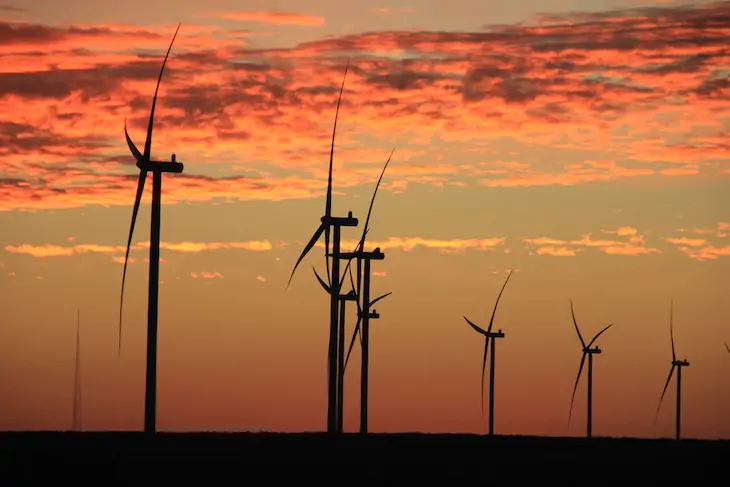
The Crossing Trails Wind Farm between Kit Carson and Seibert, about 150 miles east of Denver, has an installed capacity of 104 megawatts, which goes to Tri-State Generation and Transmission. Photo/Allen Best

Transmission, seen by many as critical to deep levels of emissions reductions, gets relatively little mention in the modeling report. Arguably, an entire scenario could be built around potential for transmission upgrades, such as greater ease of moving electricity between the Western Interconnection grid, of which Colorado is a part, and the Eastern Interconnection, which starts at Kansas and Nebraska.

Ascend Analytics had conducted similar modeling about deep, deep decarbonization of electricity for Los Angeles Water and Power. The question in that study was what would it take for Los Angeles to achieve zero-emissions electricity?

Twenty years ago Colorado and its electrical utilities almost entirely embraced coal generation as the cheapest energy source far into the future. By 15 years ago, that resolve had weakened. Voters had adopted the state’s first renewable energy mandate and legislators had upped it. Wind prices were swooping down. Not least utilities had become confident of keeping lights on while deploying wind and solar.

A watershed year was 2017. Xcel Energy, Colorado’s largest utility, which supplies roughly half of the electricity in the state, sought bids for new electrical generation. The low prices for wind and solar dramatically undercut those of fossil fuels. Proponents of renewables were elated. A year later, Xcel Energy announced its plans for 80% decarbonization by 2030. The paradigm had shifted.

Most of those wind, solar, and storage projects bid in 2017 have now or soon will go on line. Statistics for 2023 are not yet available. However, as of 2022, renewable energy accounted for 37% of the state’s electrical generation, with wind power accounting for four-fifths of that renewable generation, according to the U.S. Energy Information Administration.

Two coal plants have closed since 2017 and now eight more will be laid down before the end of 2031. One, Pawnee, located at Brush, is to be converted to natural gas.

Toor said his agency began having discussions in 2022 about the next steps beyond 2030. The questions guided creation of the modeling study. The state called in utilities, environmental groups, industrial sectors, and others for conversations about how to frame the study.

What some said

Ean Tafoya, the Colorado director for GreenLatinos, a national advocacy group, said he remembers the first meeting occurring in May. Based on the number of those interested in environmental justice invited to participate as stakeholders, he suspects dozens of stakeholders were involved.

The results of the modeling Tafoya described as ā€œvery promising.ā€

ā€œIt shows me that the emerging technologies that my community has been very concerned about, that we don’t need them,ā€ he said, referring to hydrogen, carbon capture and sequestration and direct-air capture as well as deep-well geothermal.  ā€œAnd if we can do this by 2040 without change of policy, that is very exciting.ā€

If Colorado can find ways to leverage capital through green infrastructure banking and address workforce training, Colorado ā€œcan truly be a leader nationally and globally,ā€ he added.

Xcel Energy issued a statement that said the company was ā€œencouraged by the Colorado Energy Office’s findings.ā€

ā€œWe agree there is a need for new 24/7 carbon-free technology to achieve deep carbon reductions. The state’s policies will enable us to reduce carbon emissions greater than 80% by 2030 and will inform our future investments into the local infrastructure necessary to move clean energy reliably into our customers’ homes – while keeping bills low.ā€

Do Colorado’s modeling results suggest a template for other states or regions of the United States, even other countries? Toor thinks so.

ā€œIt is saying that you can get to near-zero greenhouse gas emissions and pollution from electricity generation within the next 20 years —with no incremental cost to customers. That’s true with other states, and it doesn’t matter whether you’re a red state or blue state. ā€œRegulators and utilities should be excited about the ability to minimize costs to customers while nearly entirely eliminating emissions. I think that is a really important conclusion.ā€

That said, added Toor, other states are starting at different places. ā€œWe have already had substantial progress.ā€

Colorado also is blessed with renewable resources. It has wind – not the best, but among the best. It also has strong solar. Again, not the best, but very good.

ā€œI want to be careful about claiming insight into other states, but I do think it is a very striking result that you can achieve such deep pollution reductions simply by developing the lowest-cost resources,ā€ said Toor.

In creating the documents, Ascent based its projected costs of various technologies on projections by the National Renewable Energy Laboratory but also Ascend’s Market Intelligence Team.

How fast will technology move?

Even with those presumably careful calculations based on strong information, how good are they? After all, 20 years ago, the cost numbers argued for coal. Incredibly, some people still try to make that argument.

Also 20 years ago, many smart people projected the imminent arrival of both peak oil and, by extension, peak natural gas. Those projections, based on rear-view mirror data, failed to anticipate the rapid incremental advances in hydrofracturing, horizontal drilling and other extraction technology. From $14.50 per million Btu in 2008, natural gas prices plummeted to $2.50 with the recession – but never returned to the stratospheric levels that justified poking very deep holes across the Piceance Basin southwest of Craig. Meantime, the U.S. became a net exporter of oil.

Of course, we have had similar cost curves with wind, then solar, and now storage prices.

Might the same thing occur with geothermal, using underground heat to produce electricity, as is already done in California and some other places? Sarah Jewett, vice president for strategy at Fervo Energy, suggested cause for similar optimism in her industry during her remarks at the Colorado Rural Electric Association conference on Monday. The cost curve in recent projects in Utah and Nevada has been bending downward, she said.

Earlier that same day, a panel of experts about nuclear energy reported cause for optimism about nuclear, while yet another panel predicted reason to believe hydrogen will play an important role in the future.

Toor acknowledged the unexpected cost declines for many technologies. ā€œIt’s quite possible that hydrogen and other technologies will be lower cost than now projected,ā€ he said.

Regardless, he added, these near-zero or zero-emissions pathways should become the baseline.

ā€œI think it would be important that utilities are looking at new technologies and that utility regulators are able to look at getting to even deeper reductions based on what the actual cost trajectories turn out to be,ā€ he said.

Colorado’s energy regulation framework is well suited to achieving those deep reductions —even deeper than the low-cost 98.5% emissions-free that this modeling suggests will be possible.

A final report, after review by stakeholders, is expected in December.

Following are what the modeling study cites as its key findings. The language is verbatim from the report:

  • The Economic Deployment scenario, which relies on current state and federal policies and is projected to meet demand at the lowest cost, is projected to reliably meet electricity needs in 2040 while achieving 98.5% reduction in greenhouse gas emissions in 2040 from a 2005 level while also achieving near zero emissions reduction in nitrous oxide and sulfur oxide.
  • Wind and solar will be the main source of electricity in Colorado in 2040. In the Economic Deployment scenario, 76% of electricity comes from in-state wind and solar; 16% comes from out-of-state imports of near zero-emissions electricity (mostly wind from a wholesale electricity market); and 10% from energy efficiency, with the rest coming from other sources. Across all other scenarios, in-state wind and solar account for more than 90% of electricity.
  • In the Economic Deployment scenario, gas-fired electricity generation meets only about 1% of total need for electricity.
  • Under current cost assumptions, the Optimized 100 scenario, which achieves zero emissions by 2040 using a technology-neutral, least-cost approach, selects a substantial amount of hydrogen and a modest amount of geothermal to complement wind, solar, and batteries. It is 25% more expensive than the economic deployment scenario.
  • The Wind, Solar and Battery scenario is 20% more expensive than the Optimized 100 scenario and 50% more expensive than the least cost Economic Deployment scenario. The Accelerate Geothermal scenario is 11% more expensive than the Optimized 100.
  • The Optimized 100 scenario retires all gas-fired generation by 2040. It replaces retiring gas capacity primarily with clean hydrogen starting in 2032. By 2040, this scenario has 5,061 MW of clean hydrogen and 125 MW of geothermal generation.
  • The model does not select gas with carbon capture or advanced modular reactors in any scenario because of the cost.
  • The Accelerated Geothermal scenario adds a requirement to have 10% of demand met with geothermal in 2040, which results in 1,989 MW of installed capacity (compared to 125 MW in the Optimized 100 scenario).

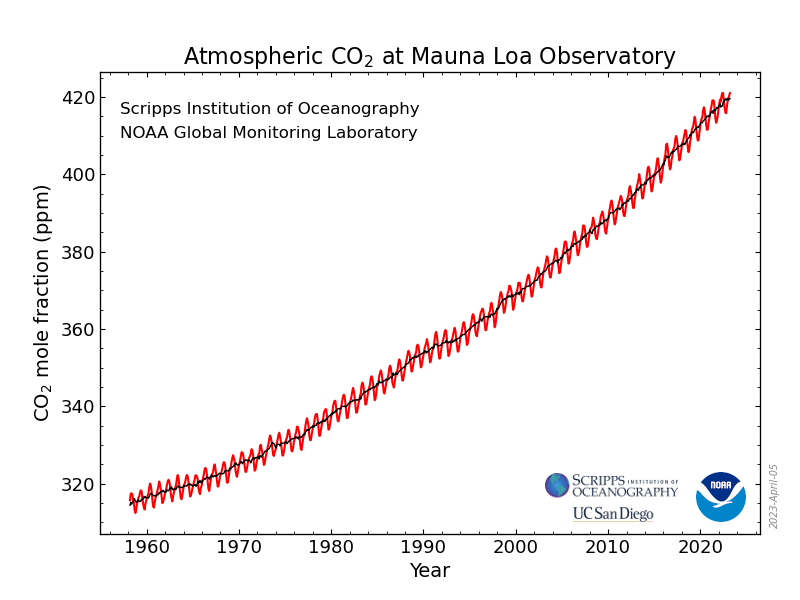
Mauna Loa is WMO Global Atmosphere Watch benchmark station and monitors rising CO2 levels Week of 23 April 2023: 424.40 parts per million Weekly value one year ago: 420.19 ppm Weekly value 10 years ago: 399.32 ppm šŸ“· http://CO2.Earthhttps://co2.earth/daily-co2. Credit: World Meteorological Organization

Greeley Water receives $250,000 grant for lead replacement program — The #Greeley Tribune

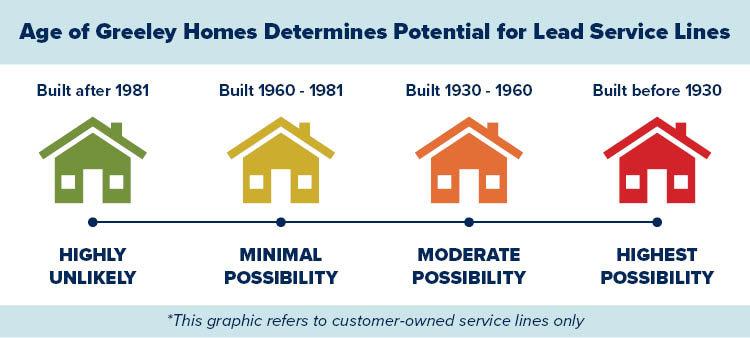
A graphic from the city of Greeley indicating the likelihood of certain homes to have lead in customer-owned water service lines. The city is working to identify and replace all customer-owned service lines that contain lead. (Courtesy/City of Greeley)

Click the link to read the release on the City of Greeley website (Keri Fishlock):

A $250,000 grant from the Colorado Water Quality Control Division will help Greeley Water identify and inventory water service lines that contain lead. 

As it works to help customers reduce their risk of lead exposure, Greeley Water must create a mapped inventory of water service line materials by October 2024 to meet federal and state regulations. This process helps the city identify and replace any remaining customer-owned lead service lines at no cost to the homeowner.  

Greeley Water plans to use grant funding for the following:

  • Water service line inventory
  • Lead or galvanized service line confirmations
  • Geographic Information Systems (GIS) mapping and analysis

ā€œThis grant is great news for the City of Greeley. It helps speed up our inventory process. It directs more of our available funds toward replacing service lines that contain lead,ā€ said Keri Fishlock, an engineer with Greeley’s Water and Sewer Department.

In recent years, there has been greater national awareness of the potential health risks of lead in drinking water. Water testing confirms that water leaving Greeley’s treatment facilities is treated to a high standard and is lead-free. Yet, lead may be present in older homes’ plumbing, faucets or service lines. Greeley Water is working with customers to identify and reduce those risks. 

Go to www.greeleygov.com/leadsurvey to complete a short survey about your water service line. Participants can win one of three $100 gift cards awarded monthly.

Contact Greeley Water if you need help at leadprotection@greeleygov.com or 970-336-4273.