Feb 25, 2025: Schultz Lecture in Energy with Tommy Beaudreau — Getches-Wilkinson Center

The construction project to build the Kayenta solar farms on the Navajo Nation, shown here in 2018, employed hundreds of people, nearly 90 percent of whom were Navajo citizens. Renewable energy is drawing increasing attention from tribes and others as a way to build jobs for the future. (Photo from the Navajo Tribal Utility Authority / Navajo Nation)

Click the link for all the inside skinny from the Getches-Wilkinson Center website:

The Getches-Wilkinson Center and Center of the American West will co-host the 16th Annual Schultz Lecture in Energy on February 25, 2025 with special guest, Tommy Beaudreau, former Deputy Secretary of the Interior.

Tuesday, February 25, 2025
6:00-7:30 p.m. (Mountain Time)
Wolf Law Building, Wittemyer Courtroom

A reception will be held immediately following the lecture for all in person registrants. 

Two general CLE credits have been approved for Colorado attorneys.

Register Here

“The Lords of Yesterday and the Imperatives of Now”

Beaudreau will discuss the structural, legal, and political challenges to energy transition on public lands.  He will provide an exploration of the contemporary problems that must be solved for bringing public lands to bear in energy transition efforts, and how the roots of those issues rest in the legacy of American westward expansion and the displacement of Native people.

Student Lunch and Learns
Tues, February 25, 2025 at the Center of the American West
Wed, February 26, 2025 in Room 207 in Wolf Law

GWC and CWA respectively, will host a lunch and learn for students, where Tommy Beaudreau will share his professional experiences and offered advice and guidance to students and engage in a Q&A session.

Tommy Beaudreau

Tommy Beaudreau is co-chair of WilmerHale’s Energy, Environment and Natural Resources and Native American Law Practices. Mr. Beaudreau focuses his practice on a broad range of areas including conventional and renewable energy and large-scale infrastructure projects; environmental regulatory, litigation and enforcement matters; crisis management and response; and Tribal matters. In addition, Mr. Beaudreau leads internal investigations and responses to government investigations and congressional oversight.

Mr. Beaudreau served in senior leadership roles in the United States Department of the Interior for nearly a decade across two administrations. Most recently, he served as the Deputy Secretary of the Interior after being confirmed by the US Senate in June 2021 by a vote of 88-9, reflecting his strong reputation as a bi-partisan problem solver. In this role, Mr. Beaudreau was point on the most pressing and high-profile matters before the Department, including energy development on public lands and waters, water infrastructure and delivery to address sustained drought in the American west, infrastructure permitting and critical minerals development, implementation of the historic investments through the Bipartisan Infrastructure Law and Inflation Reduction Act, and a broad range of priorities relative to Indian Country.

Mr. Beaudreau previously served for nearly seven years at the Department of the Interior (DOI) during the Obama Administration, including as the first director of the Bureau of Ocean Energy Management, Acting Assistant Secretary for Land and Minerals Management, and chief of staff for the Interior Department.

He is a Distinguished Visiting Fellow at the Center on Global Energy Policy (CGEP) at Columbia University’s School of International and Public Affairs.


The Schultz Lectureship in Energy

In 2007, the Schultz Lecture in Energy was launched to support an annual lecture by renowned scholars in energy or natural resources law. This series was made possible by the generosity of John H. and Cynthia H. Schultz and allows the Getches-Wilkinson Center (GWC) to bring in thought leaders from across the country. Our speakers address emerging issues and challenges in the oil and gas, energy, and natural resources fields, providing valuable information to policymakers, practitioners, business executives, students, and the academic community.

John Schultz (CU Econ, Political. Science ‘51) (CU Law ‘53) was an oil and gas attorney whose impactful career in Colorado and the Western U.S. spanned the second half of the 20th century. John Schultz passed away on April 5, 2020, surrounded by family in the comfort of his own home in Lafayette, Colorado. Cynthia Schultz was a University of Colorado administrative staff member who served the University in many ways. She was a member of the Graduate School Advisory Council, the Graduate School Resource Committee, and on the Ad Hoc Task Force on Graduate Education. Cynthia passed away on December 20, 2011. Both John’s and Cynthia’s generosity of time with our students was exceptional.

Their legacies continue, in part, through their substantial gifts to the University of Colorado, Colorado Law, and to the GWC where we are so appreciative of the Schultz family’s generosity. The family’s continued commitment means that this lecture can be free and open to the public. The format (normally) includes a public reception following the talk, providing the opportunity to continue a lively discussion, as well as a dinner with the speaker, the extended Schultz family, the Dean, GWC faculty, and several law students.

This cold air? It’s probably not the #PolarVortex — NOAA

Click the link to read the article on the NOAA website (Amy Butler and Laura Ciasto):

February 20, 2025

Because this is the Polar Vortex Blog, we would love to be able to tell you how the stratospheric polar vortex is doing super cool things that can explain how cold and snowy it’s been in many parts of the US this winter. But the truth is, in our opinion at least, while the stratosphere has been doing some interesting stretching and wobbling, there’s just not much evidence that this is really the main driver of our winter weather so far this year.

One way to track the polar vortex is through potential vorticity, which describes the amount of rotational energy, or “spin,” in a parcel of air. This animation shows daily potential vorticity in the stratosphere in February 2025. The darkest blues represent the coldest, most isolated air. In the second week of February, the vortex remained strong, but began to stretch out over North America. NOAA Climate.gov animation by Breanna Zavadoff, based on ERA5 reanalysis data.

Little typical communication between the stratosphere and troposphere

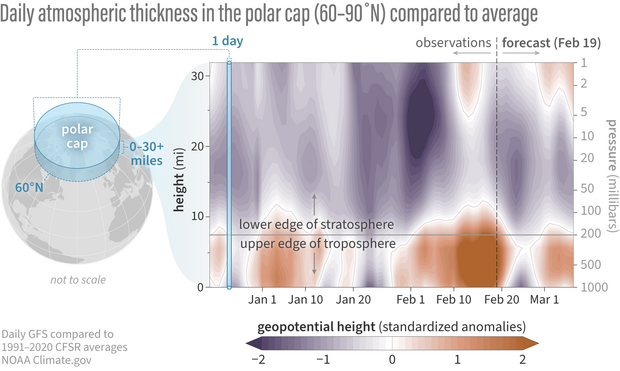
As we have described before, one measure of “typical” downward coupling between the stratosphere and the troposphere are these plots showing the difference from average atmospheric thickness (aka geopotential height anomalies) over the Arctic. When the entire column of air has the same sign/color, the atmosphere is coupled. Sometimes there is an obvious lag between the troposphere and the stratosphere. For example, after a polar vortex disruption, the largest signal appears in the stratosphere and then descends to the troposphere, sometimes for many weeks afterwards. 

Differences from average atmospheric thickness (“standardized geopotential height anomalies”) in the column of air over the Arctic for the stratosphere and troposphere. For much of the recent period back to late December, the stratosphere and troposphere have been largely uncoupled. One exception was in late January when the low thickness anomalies (indicative of a stronger than average polar vortex) extended from mid-stratosphere to the surface. Recent positive thickness anomalies in the troposphere have been remarkably strong while the stratosphere shows negative thickness anomalies. Standardized anomalies are based on departures from the 1991-2020 Climate Forecast System Reanalysis climatologies and have been divided by the standard deviation. Data are from the Global Forecast System observational analysis and forecast. NOAA Climate.gov image, adapted from original by Laura Ciasto.

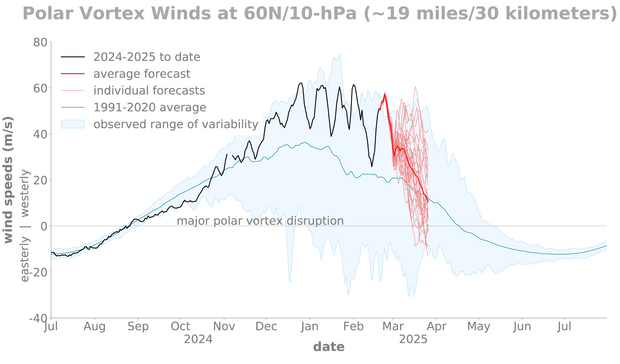
This winter, the polar vortex winds have stayed consistently stronger than average, corresponding to anomalously low atmospheric thickness over the Arctic (and generally warmer than averaged conditions across Europe and Asia). With the exception of a few weeks in late December and mid-January when lower-than-normal atmospheric thickness connected all the way to the surface, the troposphere and stratosphere have been mostly doing opposite things over the polar region. 

This is particularly emphasized over the last 2-3 weeks, as a huge positive thickness anomaly in the Arctic troposphere [footnote 1] has been at odds with a negative thickness anomaly in the stratosphere. The negative anomalies did weaken slightly over the last few weeks, as the polar vortex took a break from its record daily high zoomies and relaxed to near average speeds. While this slight weakening of the vortex winds may have contributed a little to the build up of positive thickness anomalies in the troposphere, it seems unlikely that such a slight vortex weakening could fully explain such a strong anomaly in atmospheric thickness in the lower atmosphere.

Next week, it looks like the strong polar vortex signal may briefly couple all the way to the surface, as the polar vortex winds briefly strengthen once again to near daily records. However, the reign of the strong polar vortex looks to be coming to an end after that, with the polar vortex winds sharply decelerating, and then more gradually slowing down as we head into March [footnote 2].

Observed and forecasted (NOAA GEFSv12) wind speed at the 10-hPa pressure level and the 60-degrees North latitude circle. The forecast is initialized on 19 Feb 2025. The polar stratospheric winds have gone up and down over the last few months but have stayed consistently stronger than average. The wind are forecast to strengthen further this week, before the winds weaken again into March. During March there is large variability from one ensemble member to another in terms of what will happen with the polar vortex. NOAA Climate.gov image, adapted from original by Laura Ciasto.

Could the stratospheric polar vortex be driving cold weather in other ways?

As we have talked about other times this winter, some research suggests that perhaps it’s not always about the strength of the polar vortex, but the shape. At least qualitatively, it does seem like the stratospheric polar vortex has extended over North America more than it normally does this winter. However, there are a few reasons we feel like that connection is more uncertain than many news stories and social media posts would have you believe.

For one thing, scientists have not agreed on a common method for measuring this “extension,” which makes it hard to say on the fly whether the vortex really was more stretched than normal this winter. Additionally, decades of research have built our understanding of how “typical” coupling between the stratosphere and troposphere works, meaning the literal mechanics of it. In contrast, the idea of the polar vortex influencing weather patterns through stretching is relatively new, and the mechanics by which it might occur are less understood [footnote 3]. That uncertainty means it’s also unclear whether polar vortex stretching actually leads to, or is just a result of, the tropospheric conditions that drive cold air outbreaks over North America.

In short—and we can’t believe we’re saying this—we wish we weren’t seeing so many headlines blaming the polar vortex for this winter’s weather in the U.S. It turns out that for the polar vortex, there may be such a thing as bad publicity.

Footnotes

1. This corresponds to a strongly negative phase of the Arctic Oscillation

2. Note that the forecast models do not include chemical reactions involving stratospheric ozone, which interact with the winds and temperatures. Because of the lack of tropospheric wave driving this winter– which means less stratospheric ozone is transported from the tropics to the pole and also a stronger and colder polar vortex– stratospheric ozone levels in the polar vortex region are already very low this year. We will talk about it in a future blog post, but it’s possible this could affect the March polar vortex winds in a way that the forecast models can’t perceive because they don’t have these processes.

3. It’s generally thought that polar vortex stretching is associated with a process called “stratospheric wave reflection”, which does seem to have been at play at least a few times this winter. We hope to discuss stratospheric wave reflection in a future post.

President Trump’s War on Water #Conservation — Brian Richter (SustainableWaters.org)

Click the link to read the article on the Sustainable Waters website (Brian Richter):

February 19, 2025

Donald Trump is throwing another toilet tantrum.

He’s insisting that the US Environmental Protection Agency weaken the water efficiency standard of its Water Sense label.

To claim that the elimination of water efficiency standards will “lower the cost of living” is a blatant falsehood.

The EPA had previously estimated that low-flush toilets enable American families to reduce their water use by 20-60% and save $110 per year on average and $2200 over the lifetime of a toilet (note that this web page has now been removed from EPA’s website).

The genesis of the Water Sense program was, interestingly, the National Energy Policy Act of 1992, passed under the administration of George HW Bush. The architects of this energy bill recognized that drinking water and wastewater plants are often the largest energy consumers within municipalities, typically accounting for 30–40% of total energy consumed. The Act thus set residential fixture and appliance standards that limit the volume of water used per flush or per minute for toilets, urinals, showerheads, and faucets. Most notably, it required that every toilet installed after 1994 use just 6 L (1.6 gallons) of water per flush, a 54% reduction from the pre-legislation norm of 13 L per flush (3.4 gallons). The associated reduction in energy resulting from use of low-flow plumbing fixtures has further reduced the cost of residential water bills.

US toilet manufacturers have thus been making low-flush toilets for more than 30 years.

The Water Sense label was created to push water conservation even further. It recognizes plumbing fixtures that are 20% more efficient than required under the energy act.

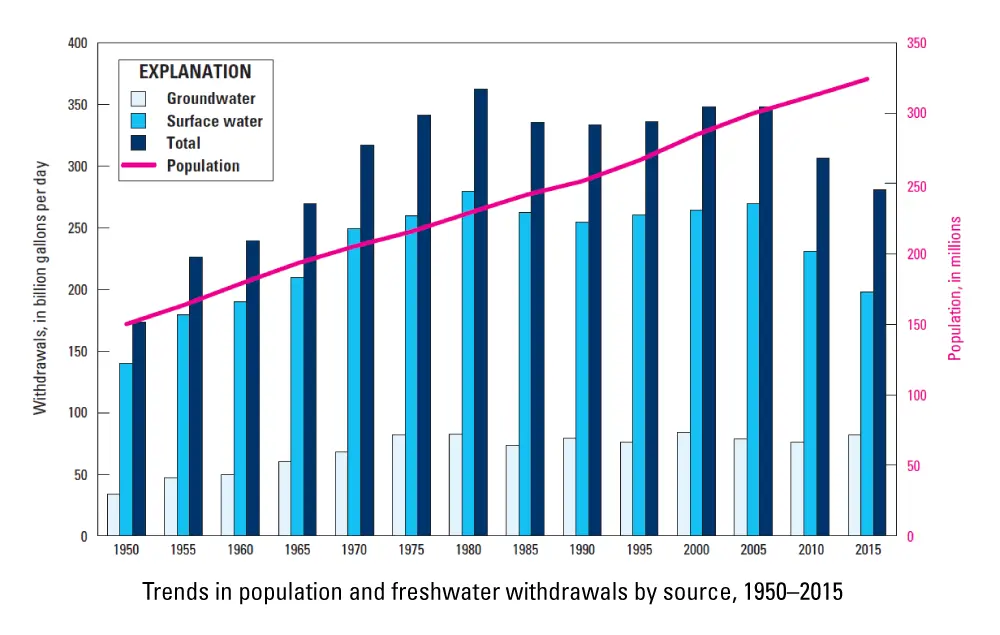
These federal initiatives have had a substantial influence on residential indoor water use in the US. The 1992 Act has been credited with saving an estimated seven billion gallons per day, equating to seven times the daily water use of New York City and 18% of total daily US public water-supply use. They are a major reason for the ‘decoupling’ of water use from population growth in the US; the graph below shows that as water-efficient plumbing fixtures began to become available in the 1980s, total water use in the US began to decrease for the first time. As cities began to encourage replacement of old water-guzzling toilets with new low-flush toilets by offering rebates on purchases of low-flush toilets, the decline in water use steepened further.

Why in the world would we want to take away the single-most important tool in the water conservation toolbox used by cities around the planet?

Source: USGS

Our manufacture of low-flush toilets and water-efficient dishwashers, washing machines, and other appliances is also important to our global trade economy. The US sold its low-flush toilets to 156 different countries last year. Similar to the sentiment of US farmers to “feed the world,” US manufacturers take pride in providing water-saving devices around the world. As Bill Darcy Jr., global president and CEO of the US National Kitchen and Bath Association has put it: “The commitment to water efficiency and hygiene is more crucial now than ever.” When Trump tried to weaken the efficiency standards in his first term, the International Association of Plumbing and Mechanical Officials offered a bunch of good reasons for not rolling back the standards.

Trump has falsely complained that low-flush toilets don’t work properly. “People are flushing toilets 10 times, 15 times as opposed to once.” His comment reminded me of a conversation I had with the president of American Standard, a leading US manufacturer of low-flush toilets in the US. He boasted that “Our toilets can flush a one-pound russet potato.” I will spare you the visual imagery of the YouTuber that easily flushed 56 chicken nuggets in his low-flush toilet.

“It looks like the hydrology is calling us to action” — Becky Mitchell (via AZCentral.com) #ColoradoRiver #COriver #aridification

Colorado River “Beginnings”. Photo: Brent Gardner-Smith/Aspen Journalism

NOTE: This is post 30,076 here on WordPress. Whew! I missed the turnover to 30,000 but here’s that post.

Click the link to read the article on the AZCentral.com website (Brandon Loomis). Here’s an excerpt:

February 19. 2025

Negotiators for the states haggling over future cuts to their use of Colorado River water say they’re committed to reaching consensus, though time and snow are running short. The seven states are effectively under a deadline to reach a deal by summer or face whatever water-use restrictions the federal government or courts may impose after the existing shortage guidelines expire next year. Meantime, a slow start to winter precipitation has dialed up the stakes, possibly leading to painful new cuts by the end of next year.

The Upper Colorado River Commission, representing Colorado, New Mexico, Utah and Wyoming, met virtually on Tuesday and heard projections from the U.S. Bureau of Reclamation suggesting that current trends indicate the natural flow into Lake Powell this year will be about 71% of the 30-year average, accounting for near-normal snowpack atop soils that were parched heading into winter. It’s not a great outlook for a reservoir that’s currently 35% full and that holds the key to providing water to the Lower Basin.

“It looks like hydrology is calling us to action,” Colorado’s river commissioner, Becky Mitchell, told colleagues…

Members of the Colorado River Commission, in Santa Fe in 1922, after signing the Colorado River Compact. From left, W. S. Norviel (Arizona), Delph E. Carpenter (Colorado), Herbert Hoover (Secretary of Commerce and Chairman of Commission), R. E. Caldwell (Utah), Clarence C. Stetson (Executive Secretary of Commission), Stephen B. Davis, Jr. (New Mexico), Frank C. Emerson (Wyoming), W. F. McClure (California), and James G. Scrugham (Nevada) CREDIT: COLORADO STATE UNIVERSITY WATER RESOURCES ARCHIVE via Aspen Journalism

The rift flows out of a math problem that a previous generation of negotiators set up in 1922. The Colorado River Compact and a suite of subsequent deals tied to it envisioned a river spilling 16 million acre-feet of water in a typical year. The Lower Basin, below Lake Powell, would get 7.5 million acre-feet, and so would the Upper Basin, with some left over for Mexico. But the river today, after decades of drought and warming, sometimes provides only about 12 million acre-feet.

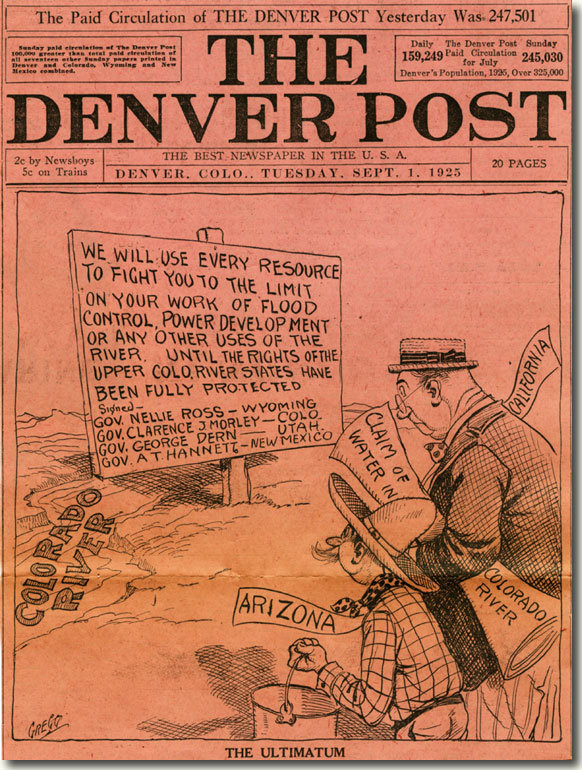
Upper Basin States vs. Lower Basin circa 1925 via CSU Water Resources Archives

$1.7 Million in Water Related Projects to Benefit the St. Vrain Watershed — St. Vrain and Left Hand Water District #StVrainRiver #SouthPlatteRiver

Left Hand Creek NW of Boulder, Colorado. By Kayakcraig – Own work, CC BY-SA 4.0, https://commons.wikimedia.org/w/index.php?curid=48080249

Here’s the release from the St. Vrain and Left Hand Water District (Jenny McCarty):

February 21, 2025

LONGMONT – Funding approved by Longmont’s voters in 2024 is enabling the St. Vrain and Left Hand Water Conservancy District to leverage grants and other sources to provide $1.7 million this year to community partners working to address the most imminent water and watershed issues today. The funds will help mitigate wildfire risks, improve farm irrigation, save water by reducing non-functional turf grass, and enhance stream flows to benefit the environment.

In 2025, the District is partnering with and funding the Boulder Valley and Longmont Conservation Districts, Crocker Ditch, HFR Enterprises, Holland Ditch Company, Hover Park Home Owners Association (“HOA”), Town of Lyons, and The Watershed Center. 2025 marks the fourth year the District offered funding through their Partner Funding Program. Including $352,000 earmarked for 2025, the District has awarded 25 partners a total of $1.2 million, leveraging those dollars for more than $6.1 million since January 2022 (369%) toward improvements in water management within the St. Vrain watershed.

The St. Vrain Forest Health Partnership (“SVFHP”) includes 100+ partners including fire districts, agencies, towns and community members working to increase fire resilience to benefit communities, the forests and water quality. A portion of the District’s $352,000 will go to support the SVFHP’s outreach and education efforts. “We couldn’t accomplish this work without the District’s support and funding and are grateful to our community who voted for the ballot initiative,” said Yana Sorokin, Executive Director of The Watershed Center.

The Boulder Valley and Longmont Conservation Districts (“BVLCD”) are working alongside the SVFHP to develop forest management plans on private properties and conduct forest treatments to reduce risk of catastrophic wildfires. “These funds will help to reduce wildfire risk to life, property, and important surface waters within District boundaries,” explained Rob Walker, Director of BVLCD.

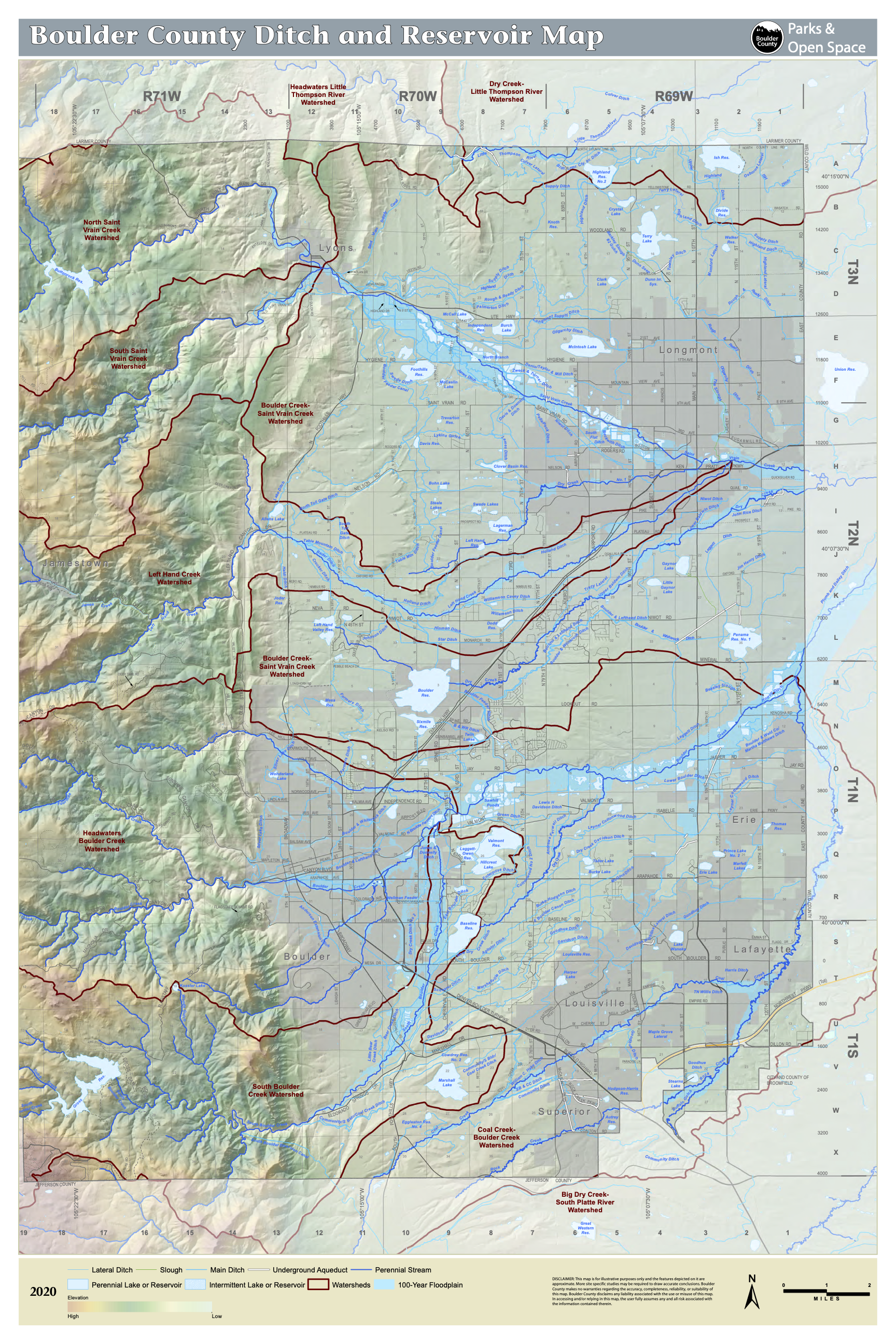
Boulder County Ditch and Reservoir map. Credit: The St. Vrain and Lefthand Water Conservancy District

The District is also partnering with Crocker Ditch, HFR Enterprises, and Holland Ditch Company to help improve local aging agriculture infrastructure and vegetation encroachment to support its future function.

Andy Pelster, Agriculture and Water Stewardship Sr. Manager for City of Boulder, which has ownership in Crocker Ditch, stated, “District funds will help improve water delivery efficiency and tracking.” Danna Ortiz, a representative of HFR Enterprises added, “This project gives us hope that the Knoth Reservoir may once again function, providing water for our ag neighbors and wildlife.” Larry Scripter, Vice President of the Holland Ditch Company said, “We wouldn’t be able to keep going with this work without the District’s financial support.”

Hover Park HOA is leading one of the first District-supported turf replacement projects in Longmont this year. In addition to funding support from other local agencies, Hover Park HOA is working to “replace over 8,200 square feet of thirsty turf grass with water-wise plants that support pollinators, look beautiful, and will create a more usable space for our community,” says Barbara Hau, resident representative for the HOA.

The Town of Lyons is using District funding to complete a preliminary analysis for managing stream flows on the St. Vrain Creek through Lyons for environmental benefit. Tracy Sanders, Lyons Flood Recovery Lead, said the District’s funds might “help determine whether environmental flows can improve creek conditions for temperature, and ultimately fish health.”

“These partnerships continue the District’s strong history of collaboration,” said Sean Cronin, Executive Director of the St. Vrain and Left Hand Water Conservancy District. “Each project advances our goals the voters approved: to protect water quality, maintain healthy rivers and creeks, support local food production, and protect forests that are critical to our water supply,” he added.

About the St. Vrain and Left Hand Water Conservancy District

The St. Vrain and Left Hand Water Conservancy District (“District” and “SVLHWCD”), created in 1971, is your trusted local government working to safeguard water resources for all. The District’s work is founded in the Water Plan five pillars: protect water quality and drinking water sources, safeguard and conserve water supplies, grow local food, store water for dry years, and maintain healthy rivers and creeks. Aligned with the Water Plan, the District is pleased to promote local partner water protection and management strategies through the Partner Funding Program.

As a local government, non-profit agency formed at the request of our community under state laws, the District serves Longmont and the surrounding land area and basin that drains into both the St. Vrain and Left Hand Creeks. Learn more at http://www.svlh.gov.

If you have any questions about the District’s Partner Funding Program, please contact Watershed Program Manager at: jenny.mccarty@svlh.gov or 303.772.4060.

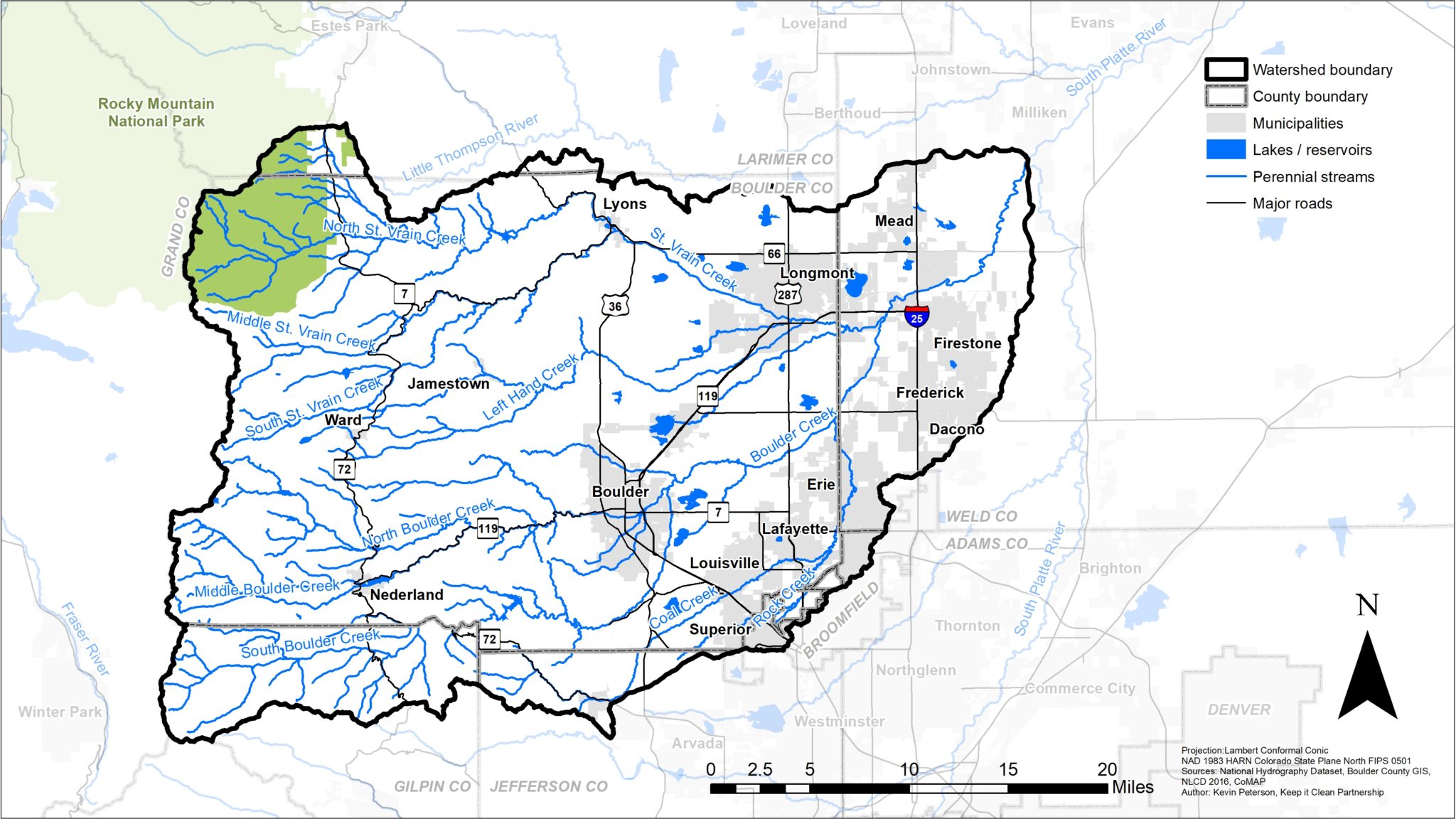
Boulder Creek/St. Vrain River watershed. Map credit: Keep It Clean Partnership