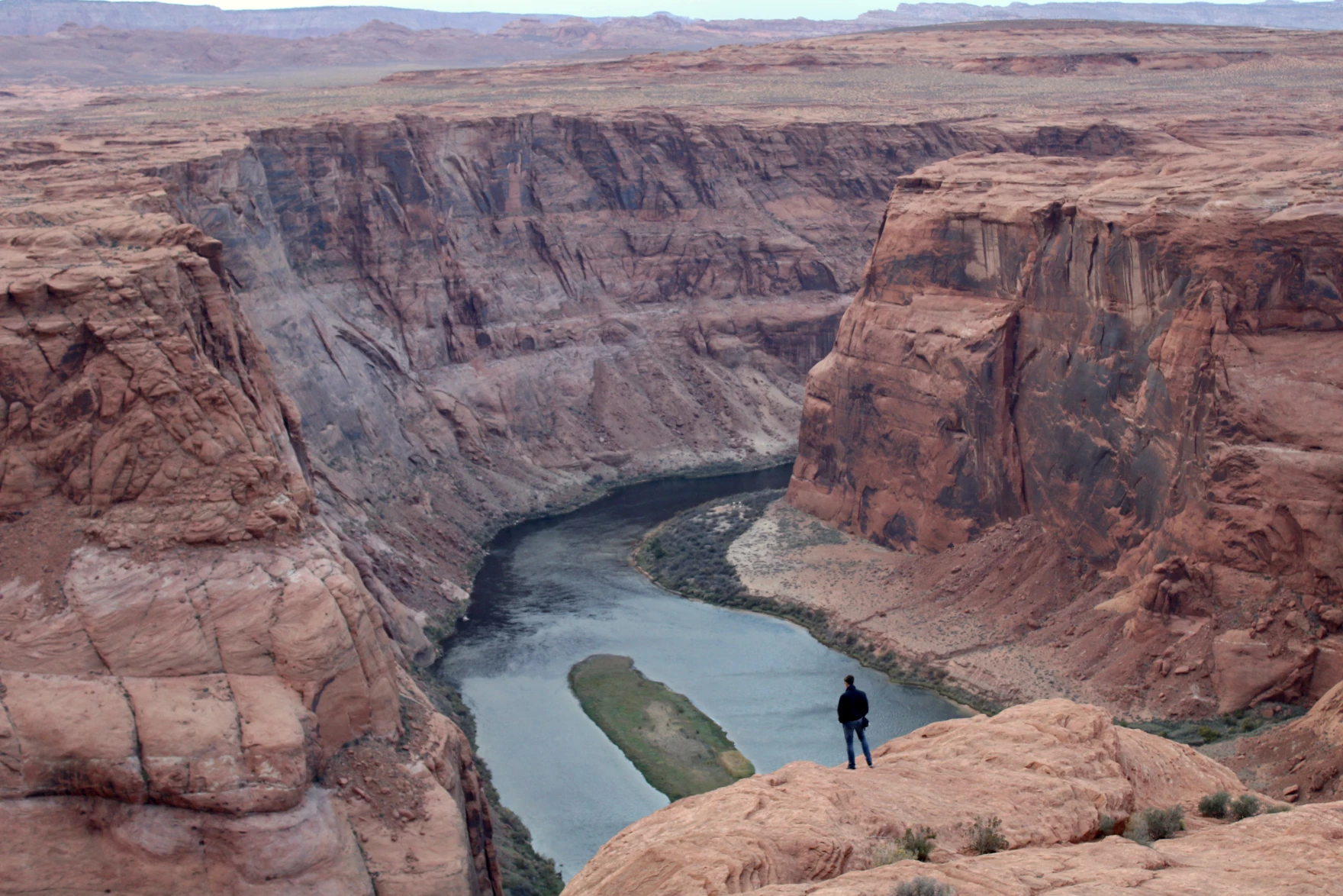
A person looks out over the Colorado River near Page, Arizona on November 2, 2022. The seven states that use its water are caught in a standoff about how to share the shrinking supply. They say they want to avoid a court battle, but some states are quietly preparing for that outcome. Alex Hager/KUNC
Click the link to read the article on the KUNC website (Alex Hager):
February 19, 2025
This story is part of ongoing coverage of water in the West, produced by KUNC in Colorado and supported by the Walton Family Foundation. KUNC is solely responsible for its editorial coverage.
When it comes to the Colorado River, a court battle between the states that use its water is sometimes referred to as “the nuclear option.” But now, as those states are locked in disagreement about how to share its water, they are tiptoeing closer toward litigation.
State leaders insist they want to avoid a trip to the Supreme Court, but some are quietly preparing for that outcome.
The Colorado River supplies water to about 40 million people from Wyoming to Mexico. Climate change is shrinking its supplies. The cities and farms that use it are under pressure to rein in demand accordingly.
Water managers from the seven states that use the Colorado River are caught in a standoff about who exactly should use less water, and they appear to have made little progress ahead of a 2026 deadline for new rules about how to share.
In January, Arizona’s government made headlines when a proposed state budget included up to $3 million for litigation related to the Colorado River.
“It’s really a backstop in case we don’t come to a collaborative agreement,” said Tom Buschatzke, Arizona’s top water negotiator.
Buschatzke described the litigation fund as a contingency plan and said state leaders were focused on collaborating.
“I think each state honestly does not want to be in a courtroom rolling the dice regarding how a judge might rule,” he said.
Nevada’s John Entsminger, Arizona’s Tom Buschatzke, and California’s JB Hamby sit on a panel of state water leaders at the Colorado River Water Users Association annual conference in Las Vegas on December 5, 2024. State leaders say they want to avoid litigation, but they are quietly preparing for that outcome. Alex Hager/KUNC
For all of their differences, the two sides of the current Colorado River dispute seem to agree on one central issue: they want to keep their debate out of the Supreme Court. That appears to be the case in the Lower Basin states of Arizona, California and Nevada, as well as the states on the other side of the disagreement — the Upper Basin states of Colorado, Utah, Wyoming and New Mexico.
“We are the ones who should really shape the outcome here,” said Amy Haas, executive director of the Colorado River Authority of Utah. “We’re the experts. We’re the water managers. We understand the system. Why would we want to relinquish that control and that responsibility?”
She said Utah would prefer to spend its money on avoiding a court battle rather than preparing for one.
“I think it would be folly for us to pursue a litigated outcome here,” Haas said.
An overwhelming majority of Colorado River policymakers — including Arizona’s — say they’d prefer to work amongst themselves instead of getting the federal government involved. Why, then, would Arizona make a show of its proposed litigation fund?
Some onlookers say it’s a negotiation tactic.
“This is definitely a posturing issue,” said Gage Hart Zobell, a Utah-based water lawyer with the firm Dorsey & Whitney. “I think a lot of what we see is the Lower Basin is trying to make it very clear they are willing and open to litigate this issue because they think they have the higher hand.”
Buschatzke outright denied that the litigation fund was a form of posturing, but Hart Zobell said there’s a financial reality that suggests Arizona’s move is a form of saber-rattling.
“In the event litigation does go forward,” he said. “You don’t have to build a litigation fund to come up with $5 million. Any state budget can come up with $1 million, $2 million, $3 million to fight this.”
Hart Zobell pointed to a recent Supreme Court case that helps give some clues as to how the Colorado River debate might get settled if it heads there. The 2024 case “Texas v. New Mexico” brought tensions over another Southwestern river, the Rio Grande, to the high court. The case gave the federal government more leverage in talks about managing that river’s water.
“Under the new Supreme Court precedent, if we get into a lawsuit, they have a right to intervene,” Hart Zobell said. “Once they’re in, we’re not just having Upper and Lower Basin discussing. We’ve got a third party that we’ve got to settle with.”
So Arizona’s litigation fund, Hart Zobell said, it may be a way to remind other states of the consequences if they don’t come to an agreement amongst themselves.
“I think that looming specter is really going to push the states a lot more to finding some negotiated settlement,” he said. “Because if the federal government does intervene, I don’t think any state is going to get what it wants.”
Rows of alfalfa grow in Imperial Valley, California on June 20, 2023. Agriculture uses the majority of the river’s water, and is often at the center of conversations about how to bring down demand on the Colorado River. Alex Hager/KUNC
Arizona’s Buschatzke said that other states, such as New Mexico, Wyoming, and Colorado were also preparing money for Colorado River litigation.
KUNC reached out to each of the seven states that use the Colorado River. Arizona was the only one that indicated it had a specific pool of money for Colorado River work.
A spokeswoman for Colorado’s negotiating team pointed to a “long-standing litigation fund” that could be used for the Colorado River, and a division of the Colorado Attorney General’s office that has been focused specifically on the Colorado River since 2006.
New Mexico and Wyoming’s top water offices declined to comment for this story. The Upper Colorado River Commission, a group that brings together water leaders from Colorado, Utah, New Mexico and Wyoming said that it was not preparing a litigation fund.
Native America in the Colorado River Basin. Credit: USBR
The Colorado River basin is also home to 30 federally recognized Native American tribes. Although Indigenous people in the Southwest have been using Colorado River water longer than any other group in the region, they have largely been excluded from discussions about how the river is shared. Tribes that use the river control about a quarter of its flow, but most lack the money and infrastructure to use their full allotments.
Jay Weiner, water counsel for the Quechan Indian Tribe of the Fort Yuma Indian Reservation, said that is likely to add another layer to any legal battle over water.
“There is no version of this that you do not have tribes seeking to intervene in this litigation,” he said. “Or potentially seeking to bring their own claims as part of whatever food fight that the states end up in the Supreme Court over.”
Whether the states settle their differences amongst themselves or in court, they will be forced to reckon with a water supply that has been significantly reshaped by climate change. More than two decades of dry conditions have forced the states into tough conversations about using less water across the farms and cities of the arid West.
“It is very, very hard to ask people to agree to sign up to make hypothetical future sacrifices of bone-cutting magnitude,” Weiner said.
Some state leaders have indicated that the threat of litigation might actually help them make those sacrifices. At a 2023 conference about water law, Nevada’s top water negotiator John Entsminger said the “federal anvil” hanging over the basin states was key to finding agreement during other contentious water-sharing talks over the past two decades.
Map of the Colorado River drainage basin, created using USGS data. By Shannon1 Creative Commons Attribution-Share Alike 4.0
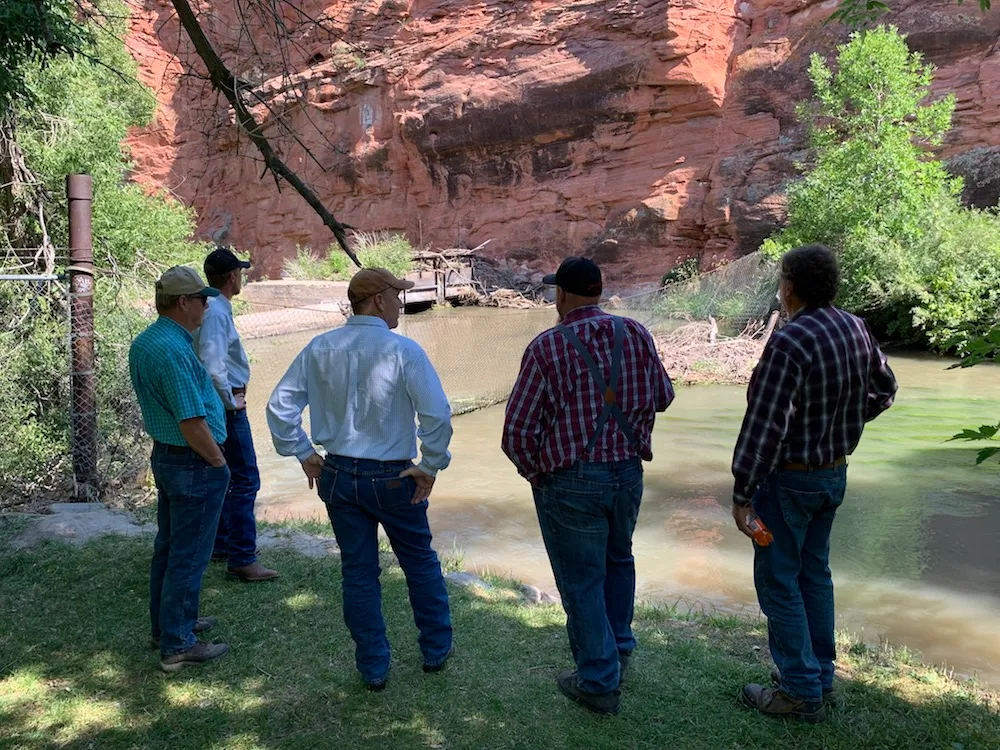
The aging LaPrele Dam is seen in Converse County on Jan. 31, 2025. Late last year, the state ordered the 116-year-old concrete structure to be breached and eventually demolished to avoid possible catastrophic failure. (Dan Cepeda)
Click the link to read the article on the WyoFile.com website (Dustin Bleizeffer):
February 18, 2025
As crews prepare to crack the dam this month, farmers who rely on that water prepare for lean times and lawmakers debate funding for a new structure.
As a kid, Casey Darr would hop in the truck with his father for the drive up the narrow canyon to LaPrele Dam to check outflow gauges and the water level behind the hulking concrete structure.
His family’s ranch relied on that storage water, and these excursions were a welcomed break from tending to livestock on the open prairie a few miles away.
During spring runoff, when water gushed from the overflow tunnel near the top of the structure and shot out of the dam’s lower outlet, the spray cast richly colored rainbows between the canyon walls and over lush, green flora below. The mist combined with the roar of moving water tamed by early 20th-century ingenuity created a weirdly tranquil atmosphere. It was an exclusive experience: The reservoir, dam and stretch of canyon leading to them are private property, accessible only to the landowners and irrigators who hold title to the dam.
“It was almost like going into Jurassic Park,” Darr said, noting the oddity of such a space hidden in what appears, from a distance, to be dull foothills of the Laramie Range. “It was just mind-blowing. It was just really, really beautiful to see, and you felt honored to be one of the few individuals that got to see it.”
Philip Dziardziel, Vice President of the LaPrele irrigation district board, and Casey Darr, Treasurer of the irrigation district board, pose on a small bridge near the LaPrele Dam on Jan. 31, 2025. They and many locals feel a special connection to the dam, which has allowed generations of families to thrive on the land it protects. (Dan Cepeda)
But in January, when Darr, who serves as treasurer on the LaPrele Irrigation District Board, and District Vice President Philip Dziardziel drove up the canyon with two journalists, they had to stop at a temporary, mobile office to ask permission to approach the dam. It’s now a condemned structure because it poses a catastrophic risk to humans and everything below it — including, according to engineers, Ayres Natural Bridge Park, several ranch homes and other structures, two bridges on Interstate 25 and, potentially, anything or anyone along the North Platte River banks all the way through Douglas, a town with 6,400 people 20 miles to the east.
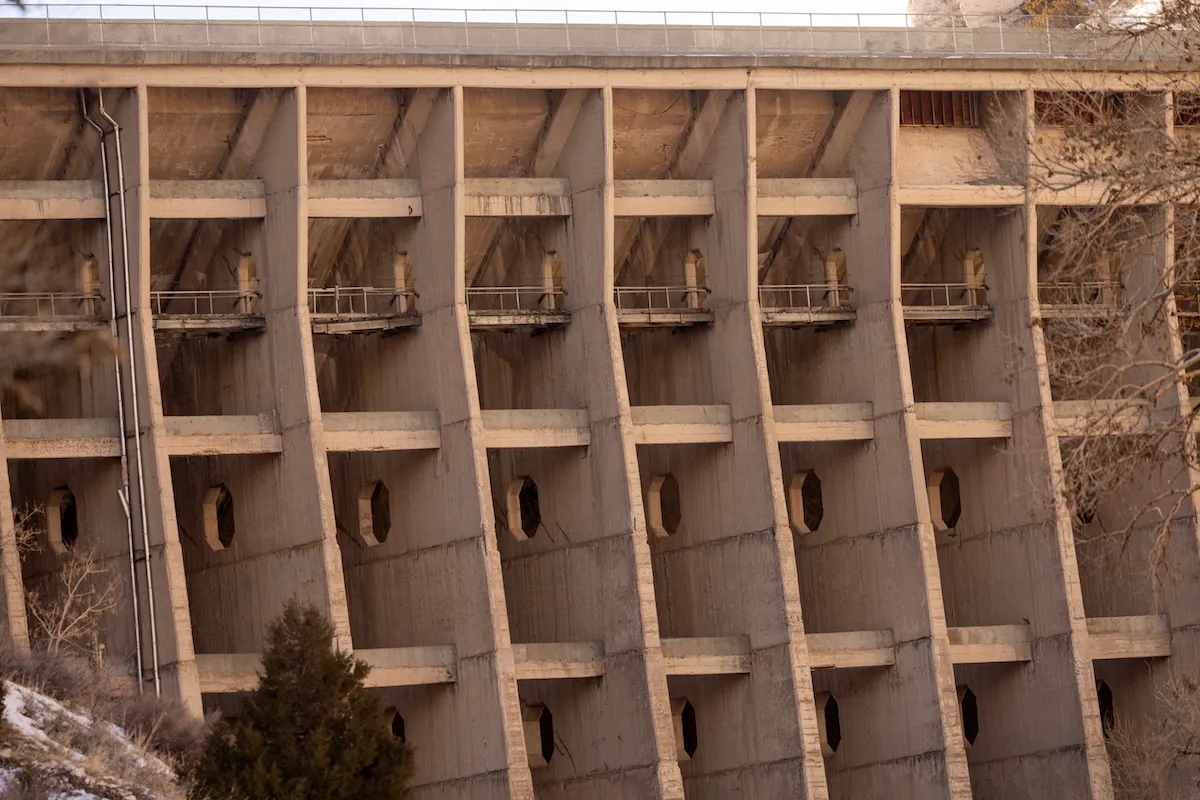
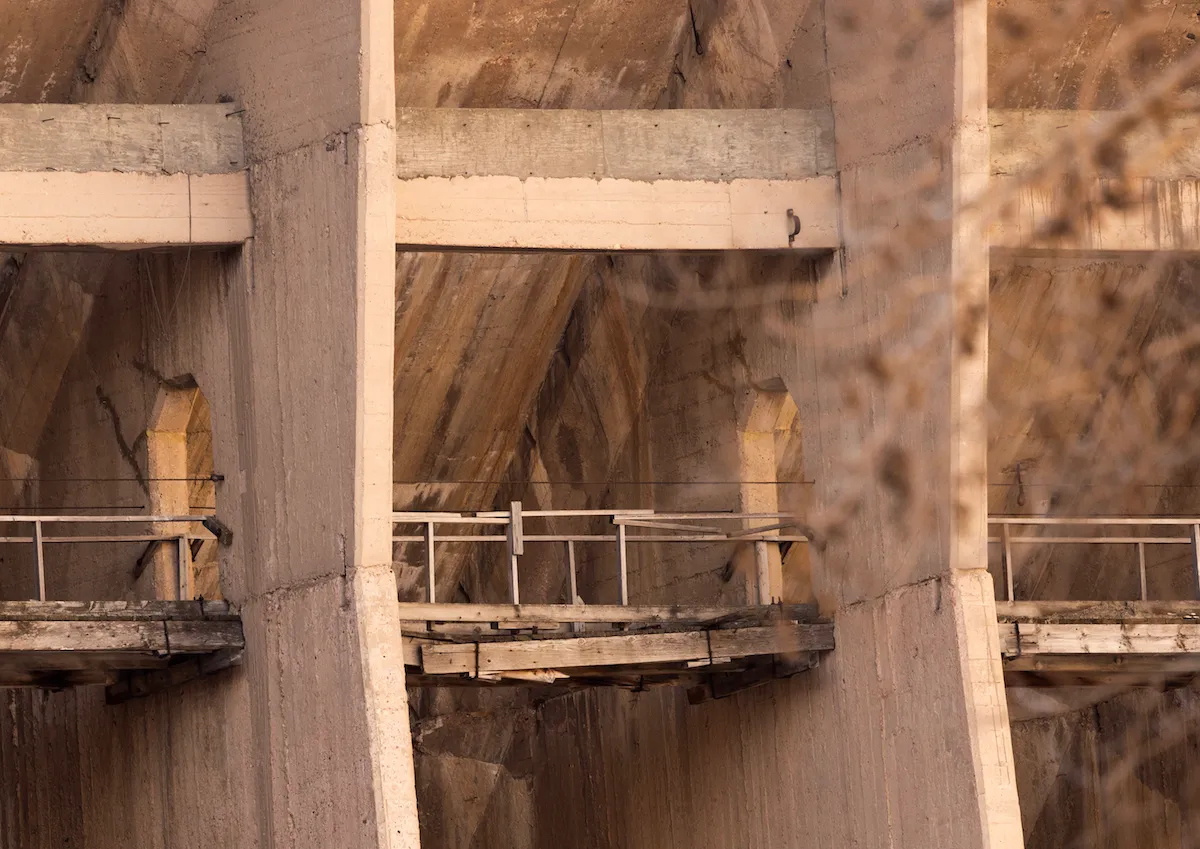
In fact, it’s a wonder the dam has stood this long, engineers who have studied it say. Completed in 1909, it’s the last standing Ambursen-style flat-slab and fin-buttress dam in the U.S. — a design that was determined to be a bad idea decades later. With so many individual concrete slabs, there’s more potential for flaws and erosion, and there’s little redundancy to hold if there’s a failure in one piece. If any of the multiple concrete slabs fail while holding back a full reservoir, it wouldn’t merely leak, according to engineers. It would immediately crumble like a house of cards.
The aging LaPrele Dam is seen in Converse County on Jan. 31, 2025. Late last year, the state ordered the 115-year-old concrete structure to be breached and eventually demolished to avoid possible catastrophic failure. (Dan Cepeda)
Under a full reservoir scenario, the torrent of water would rip through about 1.5 miles of narrow canyon before it overcomes Ayres Natural Bridge while shredding old stands of cottonwood and boxelder trees and filling the natural bowl with flotsam before boiling over to continue its path of destruction.
‘Got to suck it up’
Darr and thousands of others who have relied on the LaPrele Dam for their livelihoods for more than a century have always carried with them a sense of nausea understanding their concrete savior that bestowed an unusually prolific agricultural economy to otherwise high-and-dry plains wouldn’t last forever. Now, with crews setting up to breach, then take down Darr’s Jurassic Park concrete wall, he and others are preparing for what will feel like a “funeral.”
“It’s been a part of our lives and these communities for over 100 years,” Dziardziel said, hands in his pockets, while standing next to Darr just below the dam.
“It’s been very emotional for a lot of people — ourselves included,” Darr agreed. “But at the same time, you’ve got to take your own personal feelings, thoughts, opinions aside and do what’s right for the safety of others.”
Not all irrigators reliant on the dam share the sentiment. Some suppose that engineers’ warnings and estimations of worst-case failure and destruction models amount to hyperbole, and insist the dam will hold until a replacement is constructed in about five years.
Farmland is seen near the LaPrele Dam in Converse County. (Dan Cepeda)
“It’s not necessary at all to destroy the old one and to open up all those people, all that land and everything else, to destruction [from potential flooding],” said Leonard Chamberlain, who grew up in the irrigation district and whose family business still has a stake in it. “I would like to see it in place to make sure all the funding, permitting and lawsuits are done, and it’s up before you take out the structure that’s protecting everybody.”
Dziardziel said he’d felt the same way and, for a long time, was dead set against taking the dam down before a replacement was built.
“But once I was up there with the engineers and actually put my hands on the surface of that dam, and they showed me the cracks, it was obvious that, just for safety reasons, we could not store water in that dam,” he said. “It would just put people at risk. There was absolutely no way we could do that.”
Though design plans are in the works for a new dam — estimated at $182 million — not all of the funding pieces have fallen into place. Nor is there unanimous support for how much or whether the state and federal government should pitch in.
Farmland is seen near the LaPrele Dam in Converse County. (Dan Cepeda)
There is one thing for certain: The dam will be mechanically breached before spring runoff — enough to ensure that LaPrele Creek free-flows through the structure without any water backing up behind it, according to state officials. Until a replacement is completed, LaPrele irrigators will be entirely at the whims of Mother Nature, which rarely provides enough natural flow for late-season irrigation. With the dam cracked open to the point of free flow, Mother Nature might also serve up floods in an agricultural community that, for the past 116 years, has built up an infrastructure without much consideration for a deluge.
“We just got to suck it up and deal with it for a few years in exchange for the safety of the community,” Darr said. “It’s been a hard decision. None of us are happy about this. But at the same time, the right decision isn’t always the easy one.”
Patchwork, boulder fall and a change of plans
Construction of the original dam was funded via the federal Carey Act of 1894, a measure pushed by Wyoming’s U.S. Sens. Francis E. Warren and Joseph M. Carey to help arid western states develop more water for irrigation. Completed in 1909 with an expected lifespan of about 50 years, the dam enabled a prosperous little agricultural community of 104 different family businesses that, in turn, became an integral part of the economy for the broader region.
The aging LaPrele Dam is seen in Converse County on Jan. 31, 2025. Late last year, the state ordered the 115-year-old concrete structure to be breached and eventually demolished to avoid possible catastrophic failure. (Dan Cepeda)
Irrigators were aware of concerns surrounding the dam’s Ambursen buttress-style design, but held a sort of cross-that-bridge-when hope for its longevity, which was first tested in 1970s when it was first determined to have reached the end of its safely useful life. Cost estimates for a replacement then seemed insurmountable for members of the LaPrele Irrigation District.
But the district received an offer from a private company that it couldn’t refuse.
The Panhandle Eastern Pipeline Co. was gunning to develop a coal-gasification project nearby, and it needed water. In return for a slice of storage water rights, the company agreed to finance major patching and concrete refurbishing. The work was completed, but Panhandle’s coal-gasification project never came to fruition. LaPrele irrigators retained all their storage rights — and a gussied-up dam, to boot — and carried on with their operations that continued to inject dollars into the economies of Glenrock, Douglas and beyond.
Until somebody noticed a boulder that had apparently tumbled — in 2016 — from the western side of the limestone-walled canyon just below the dam. It struck a dirt mound on the way down and, by luck, rolled away from the dam’s concrete fins instead of toward them, according to engineers’ accounts. Had it landed on the other side of the mound, it would have rolled toward the dam.
The aging LaPrele Dam is seen in Converse County on Jan. 31, 2025. Late last year, the state ordered the 115-year-old concrete structure to be breached and eventually demolished to avoid possible catastrophic failure. (Dan Cepeda)
The boulder aroused curiosity about the state of the dam.
Migrating cracks, observed from usual vantage points, were apparent. Engineers took a closer look by rappelling down the structure. Crack measurement devices were installed, and in November 2019 the data led to a state order to maintain the reservoir behind the dam at a lower level — to ease pressure on the structure — resulting in a 45% squeeze on available storage water for irrigation.
The dam continued to crumble and crack, and in August 2021 a tour was organized to begin underscoring the dam’s inevitable demise, setting into motion plans for a replacement and how to fund it. The plan, until recently, was to maintain the aging dam while constructing a new one just below, allowing for mostly uninterrupted irrigation. But cracks continued to widen, alarming state officials, and in November, State Engineer Brandon Gebhart issued a breach order, declaring the dam at risk of “catastrophic failure.”
The Ambursen-style design LaPrele Dam consists of a series of concrete walls — or “fins” — to support an angled, flat slab on the reservoir side. The design is prone to catastrophic failure, according to engineers. (Dustin Bleizeffer/WyoFile)
“This dam has significant structural deficiencies and has exceeded its useful life,” Gebhart said in issuing the order.
Funding, legislation and criticism
When Darr and Dziardziel guided a pair of journalists to the dam on a recent, breezy January day, they had to remain at a distance from the structure. Cold water gurgled under a bridge and beneath crusts of ice at the creek’s edges.
“I’ve been coming here for 50 years, and every time I come around that bend [and the dam comes into view],” Dziardziel said, “it always reminds me of what they accomplished back in the early 1900s. I mean it was just amazing, and it makes you proud to be an American, really.”
Self-described “hermits” who prefer the solitude of ditch riding and tending to their ranches (WyoFile had to twist their arms for an in-person interview), Darr and Dziardziel lamented their forced entrance into the bureaucracy and politics of government needed to negotiate a tangle of demolition and reconstruction matters.
Bison graze on farmland near the LaPrele Dam in Converse County, an area that has relied on the dam for stored irrigation water and flood control for more than a century. (Dan Cepeda)
“We were all petrified of having to go deal with all this stuff that we’re not experienced with,” Darr said. “But it’s been remarkable how members from both sides of the table see a problem and have come together with us to help work through it. It’s taken a lot of fear out of politics for me, to be honest.”
But the work isn’t over.
As LaPrele irrigators prepare for a spring of free-flowing water and a late season without storage, lawmakers are in Cheyenne debating how much money to provide, which pots of money to dip into and whether the state ought to demand public access for fishing and recreation in return for the investment or even, potentially, assume state ownership of the new structure.
The estimate for the dam’s replacement ranges from $116 million to about $182 million, according to state-level discussions. The Wyoming Legislature, in 2022, set aside $30 million and is now considering adding another $60 million.
So far, the state has secured a total $63 million in federal grants for the project via the Infrastructure Investment and Jobs Act to help cover both demolition and replacement costs.
With Wyoming potentially kicking in a total $90 million — which faces some opposition — lawmakers have said they’re hopeful the federal government will kick in an additional $34 million. Though LaPrele irrigators and state officials have received assurances of supplemental federal funding for the project in recent years, the picture has become less clear under the Trump administration.
The primary funding proposal for Wyoming’s potential $60 million appropriation lies within House Bill 117, “Omnibus water bill-construction.” The majority of that funding comes from redirecting $50 million away from the Alkali Reservoir. A prudent move, proponents say, because that project doesn’t have the easements needed to start construction.
A “backup” measure, of sorts, House Bill 143, “LaPrele dam rebuilding,” would provide the same level of funding without shifting dollars from the Alkali project.
Meantime, HB 117 has been amended to include a $1 million grant to the LaPrele Irrigation District to assess the feasibility of drilling one or more water wells to supplement water supplies during the expected five-year period between demolition and replacement. The amendments would also provide a loan of $19 million to construct the wells.
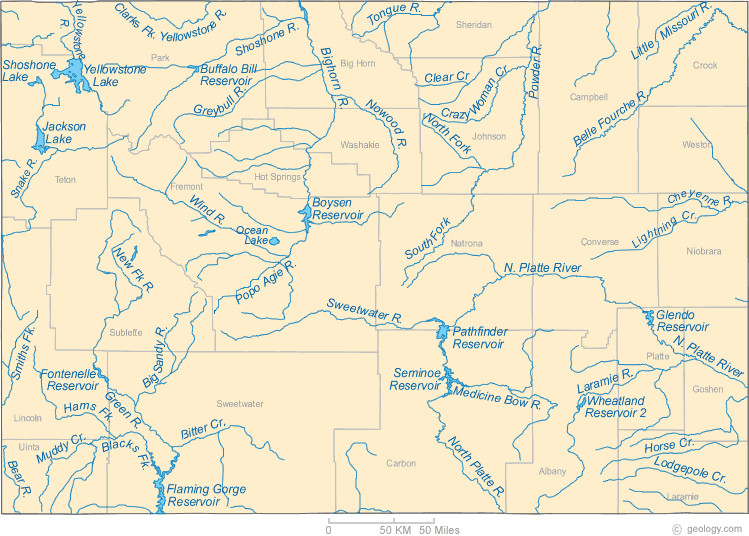
Members of the Wyoming Water Commission and a member of the LaPrele Irrigation District examine a diversion in LaPrele Creek. (Dustin Bleizeffer/WyoFile)
The funding proposals — like many water infrastructure construction projects — face criticism from many who see them as spending taxpayer money for the benefit of a limited number of irrigation operations. Such appropriations amount to “picking winners and losers,” Lander Republican Rep. Lloyd Larsen of Lander said during a recent committee discussion regarding one portion of the funding proposals. “Government can’t just step in and take care of things for everybody,” he added.
Regarding such criticism, Darr said, yes, the LaPrele Irrigation District and the family businesses it supports would be prime beneficiaries of the investment. But, he pointed out, this would be the first major state investment in an irrigation district that provides economic support to the broader communities in the area, including businesses in Glenrock, Douglas and beyond.
Click the link to read the article on the Sky-Hi News website (Ali Longwell). Here’s an excerpt:
February 23, 2025
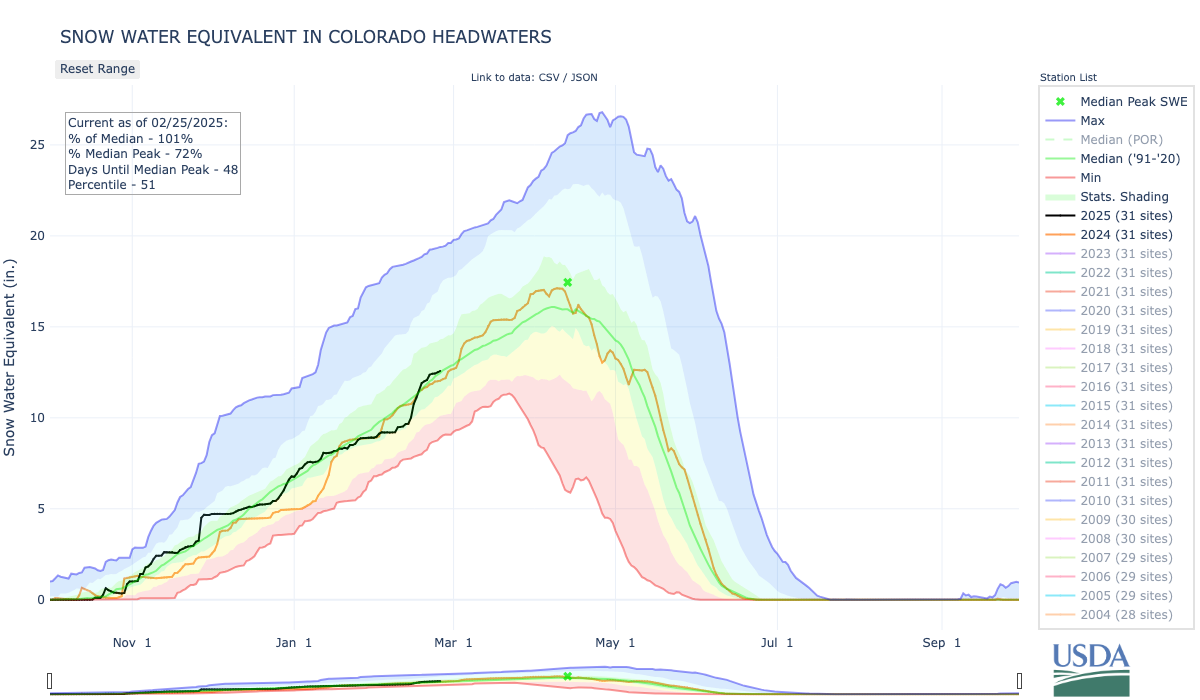
The storms also put the water supply in the Colorado River headwaters basin near Kremmling just above the 30-year normal
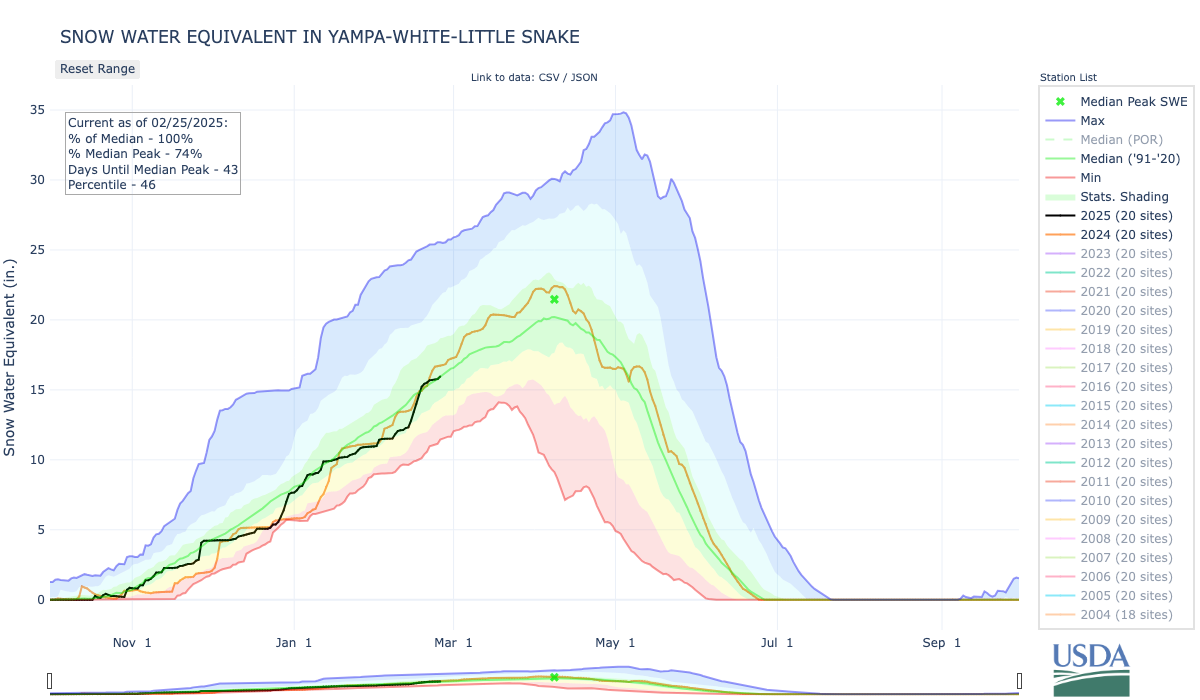
At the Steamboat Resort, 40 snow inches fell at the mountain, bringing the resort’s snowpack to 110% of the 30-year median…At the Winter Park Resort, 46 snow inches fell at the mountain, bringing the resort’s snowpack to 114% of the 30-year median.
“The streamflow forecasts for the Colorado River Basin were not well before this storm. They were looking quite bad,” he said. “This storm will certainly help with the water supply forecast. But then now we’ll have another 10 days, maybe more, of dryness.”