Questions about weed management and water plans along with critical public comment were enough to postpone a vote on a biodynamic farm and agritourism destination at a Garfield County Planning Commission meeting last week. The commission voted to continue the discussion and a vote for the planned unit development application for Nutrient Farm to a March 12 hearing, giving the applicant time to work with county staff to whittle down the initial 53 conditions of approval. Nutrient Holdings LLC got its first meeting in front of the commission on Jan. 29 after completing submission in 2023. They’re seeking a PUD zoning change for a 1,136-acre property in unincorporated Garfield County between Glenwood Springs and New Castle…Plans for the property include two farm areas (one for hay/livestock, one for fruits/vegetables/herbs), three residential areas, a residential/solar energy area, a recreational/entertainment area and a commercial/industrial area. About 608 acres of the property are slated for “private open space,” which would be closed to the public and undeveloped with a private trail…
Nutrient Farm plans to reactivate the Vulcan Ditch, which neighbors contend has not been active for decades and the landscape couldn’t handle. The applicant contends they have decreed rights to do so; the matter is in water court. Over two hours of public comment pushed the meeting past 10 p.m., without anyone speaking in explicit support of the proposal — though many said they supported the spirit of the application, which intends to divert water from Canyon Creek, a Colorado River tributary on the opposite side of the river and Interstate 70 from the Nutrient Farm property…
“The reuse of the long abandoned Vulcan Ditch threatens to ruin Canyon Creek and will … negatively affect the ranches and the wildlife and habitat that depend on a healthy Canyon Creek water flow,” said Michael Goscha, a Canyon Creek resident. “I’m disappointed that a proposed development focus on improving the environment has such a substantial fatal flaw.”
The old is new again and this time, it’s saving water. Residents in the desert southwest are rediscovering the use of clay pots for watering plants and there’s a company in Tucson that’s trying to mass produce the “olla balls” for wider use. Experts say they use much less water than typical present-day irrigation methods. Producer: Tony Paniagua via Arizona Public Media
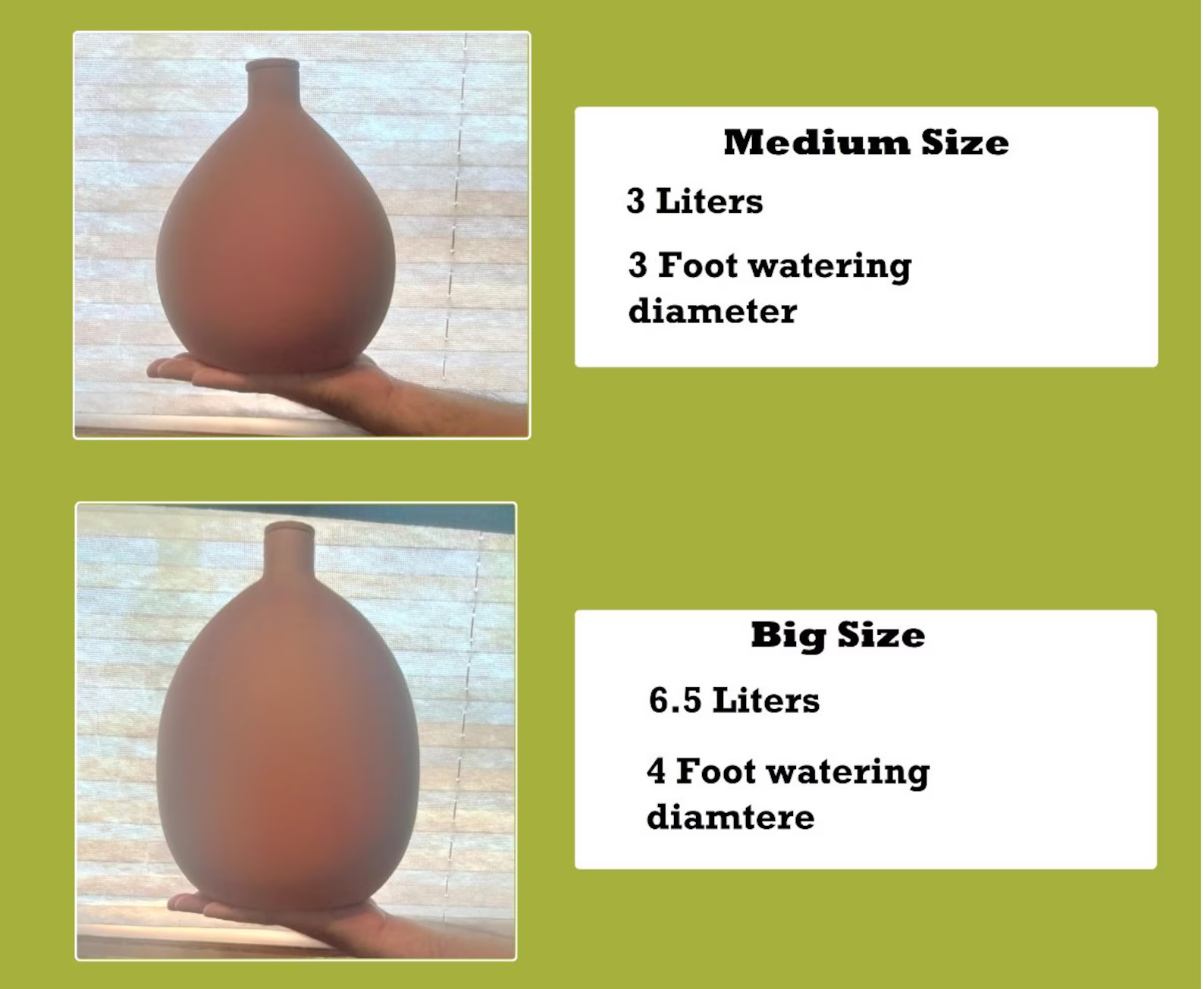
Because water seeps through the walls of an unglazed olla by using soil-moisture tension, one can use ollas to irrigate plants. The olla is buried in the ground, with the neck of the olla extending above the soil. The olla is filled with water, and plants such as tomatoes, melons, corn, beans, carrots, etc are planted around the olla. Or, an olla can be put near a new sapling, or bush to get it through its first year. After that, given enough annual rain, the olla near the tree or bush can be lifted out of the ground and used somewhere else.
Olla irrigation works like this:
When the soil around the olla is dry, the soil pulls the water through the wall of the olla and into the soil, (the tension is between wet and dry), thus providing water for the roots.
When the soil is wet from rain or has not dried out yet, there is no tension and the water is not pulled through the wall of the olla.
How far out the water is pulled depends on the size of the olla and the quality of the soil. Dense soil (clay) does not water out as far as good soil. Large ollas, with a capacity of (say) 11 liters, will water longer than a smaller 1 liter olla, for example. Olla, or clay pot, irrigation is considered the most efficient watering system by many[quantify], since the plants are never over- or under-watered, saving from 50% to 70% in water, according to Farmer’s Almanac.[4] Watering below the soil level allows the plant roots to get what water they need, and therefore to grow stronger roots. As Geoff Lawton says, clay pots can make your garden drought-proof.[5] Little water is lost to evaporation or run-off.[6]
Spanish settlers introduced this irrigation technique to the Americas in colonial times. Agriculture and gardening specialists are teaching it, and olla use is making a comeback in New Mexico and the American West. The state’s master gardening program is spreading the word. It can be effective for homeowners to use in the desert climate.[6] It has also been put to use by the Global Buckets project.
As a modern gardening tool, ollas are generally made from terracotta plant pots.[7] There are various methods to create them, but one of the easiest is to fill the bottom opening in an unglazed terracotta pot, bury it in the ground, and keep it topped up with water. Plants need to be within roots’-reach of the olla to make use of the water reservoir.
In their September 2013 newsletter Ecology Action describes using five 5-gallon ollas for a 100-square-foot garden plot. The test plot used 1.25 gallons per olla every four days. The ollas are fitted with caps that reduce evaporation and collect rain.
Fascinating and fetid, the Salton Sea in southern California lures me back, every year.
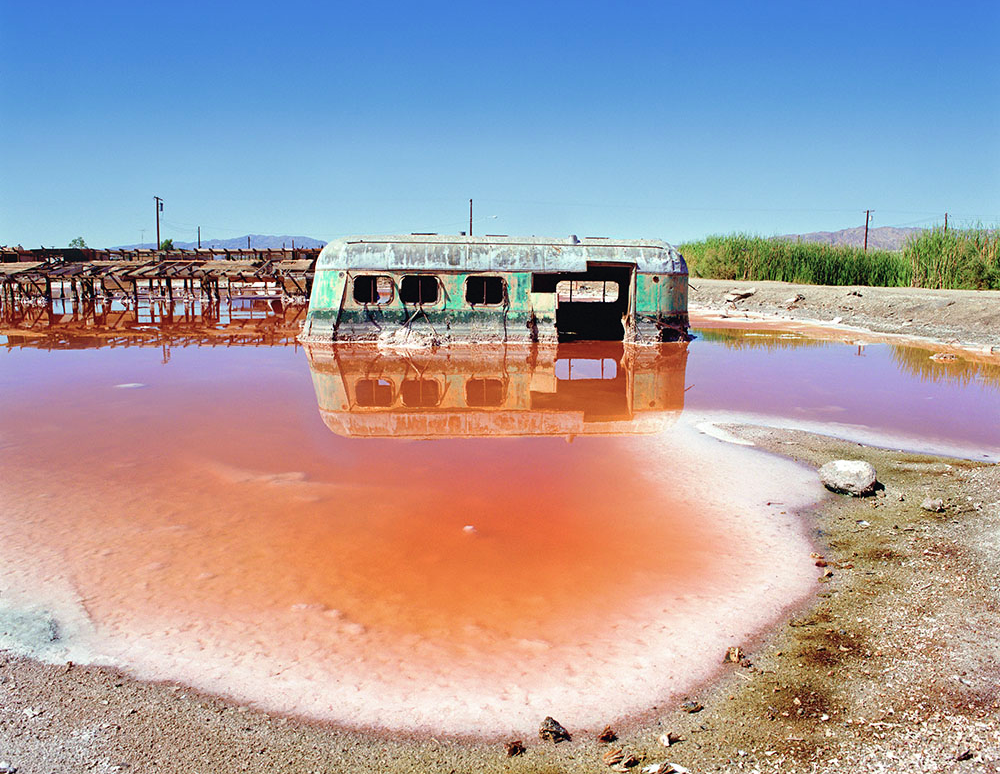
Driving south from Utah, I take bits of historic Highway 66 and then skirt Joshua Tree National Park to cruise through little known Box Canyon to Mecca, California. When the landscape opens up, I see the beautiful wreck of the Salton Sea, created by the collision of geology and bad luck.
Southern Pacific passenger train crosses to Salton Sea, August 1906. Photo via USBR.
The sea occupies a much smaller footprint of what used to be Lake Cahuilla, which disappeared in the late 1500s. Then, in a wild spring runoff in 1905, the Colorado River blew out a diversion dam and for three years, and the mighty Colorado drained into the Salton Sink. Agriculture runoff replenished the shallow lake over the following decades, though recently lined canals, courtesy of San Diego, in the Imperial Valley resulted in diminished flows. Its run as a bombing range ended in the 1970s.
If the lake were to completely dry up there would be a horror to behold. While at shrinking Lake Mead a few gangster cadavers showed up in the mud, the Salton Sea contains crashed planes and practice bombs, the targets simulations during the 1940s for the real atomic bombs dropped on Japan.
The lake is bracketed by opulent Palm Springs to the north and the arty squalor of Slab City to the south, home to about 150 full-time residents but temporary home to as many as 4,000 in the winter. In between there are hot springs RV resorts, date palm groves, geothermal energy plants and the town of Bombay Beach sitting atop the San Andreas fault.
Is the diminished sea worth saving? It’s too late to ask the question because, like the great Salt Lake, the cost of not saving it is likely higher than the rescue. Like many invasive species around the West, there is no easy way to get rid of it. Yet most of its fish are already dead and migrating birds have little to eat.
Dust is the issue, and most conservation programs attempt to mitigate dust.
The 1950s and 60s brought out the excesses of post-war revelers to the Salton Sea. You can see the salt-encrusted remains of former resorts and second homes of the Los Angeles fancy people. You can imagine the ghosts of boat races and cocktails.
Those folks even named the local wildlife refuge after swinging Sony Bono, but what came next was toxic salinity and decay as less water came in and the water that remained increased in salinity.
Still, the sea persists. Its salt-encrusted shores circle about 340 square miles of sea. A silo-full of conspiracy theories features the Salton Sea: The military may have accidently dropped a real bomb that did not explode, and the bomb might even be under the water along with hundreds of other dummy bombs and fallen planes. Bodies may still sit in the planes. We know for certain that Slab City is what’s left of a decommissioned military base built about 70 years ago.
Most of the people I meet around the lake seem happy. The place brings pleasure to pre-apocalyptic people like me and those creating outsider art on the actual beach near Bombay Beach. Thousands of Canadians migrate there each winter because the highest temperatures rarely top 80 degrees.
I look forward to my week at the hopefully named Fountain of Youth Spa RV Resort. I joke that I have been coming there since 1906 so it must be working.
It attracts so many Canadians that the resort hosts U.S. vs. Canada Games featuring geezer sports of pickleball, horseshoes, bocce and karaoke. Poutine and box wine flow freely, and people sometimes stay up into the double-digit hours of the evening.
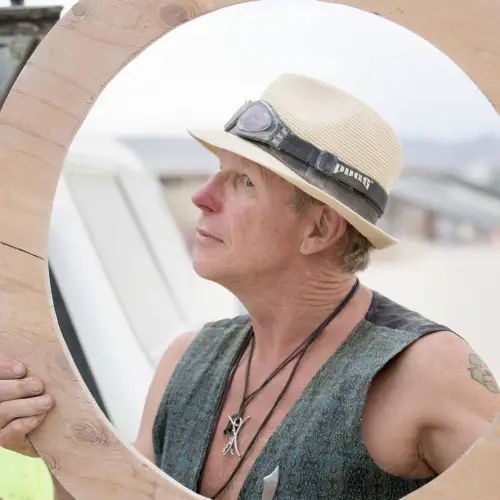
Dennis Hinkamp. Photo credit: Writers on the Range
The Salton Sea will likely remain a curiosity and hiding place for the weird until some real monster beneath the sea emerges, which could be a rush to start mining lithium made by the sea.
On the other hand, the San Andreas fault might just swallow the whole thing in one glorious gulp. Meanwhile, it’s my refuge, my winter solace away from anxious headlines, and just strange enough to be hospitable.
Dennis Hinkamp is a contributor to Writers on the Range, writersontherange.org, the independent nonprofit dedicated to spurring lively conversation about the West. He writes in Utah.