How good have models been at predicting #ENSO in the 21st century? — NOAA

Click the link to read the article on the NOAA website (Tom Di Liberto):

February 27, 2025

…we’ve discussed ad nauseum how complicated El Niño and La Niña are, and how difficult it is to forecast all of the ENSO nuances. Heck, I even wrote a threepart series 75 years ago that evaluated all of our seasonal forecasts (ok, it was 2014-2015 but it still feels that long ago). In a new paperAzhar Ehsan, friend of the blog and a member of NOAA’s ENSO forecast team, and colleagues analyzed over 20 years’ worth of climate model forecasts of ENSO and found some interesting results.

Why is this paper unique? Well, most seasonal forecasting evaluations focus on model hindcasts, which are forecasts run using past observational data as the start (or initial) condition. For example, if the models are provided the initial conditions on July 1st, 1983, what forecast would it have made? The nice thing about running on past data is that you already know what occurred and can immediately see how well the forecast did. The downside is that sometimes the model development itself can be influenced by this past data. The purest test for models is how well they do in the future, on data that the model has never ever seen. This type of evaluation on “real-time forecasts” is much rarer, and is exactly what Azhar and his co-authors did.

ENSO Terms and conditions

La Niña and El Niño make up the El Niño/Southern Oscillation, or ENSO. La Niña is characterized by cooler-than-average sea surface temperatures across the central and eastern tropical Pacific Ocean. El Niño is the opposite phase, with warmer-than-average water present across the tropical Pacific Ocean. These changes in sea surface temperature across the Pacific jumble up the atmosphere above which can lead to global impacts on climate patterns. Seems pretty important, right? And unlike most other climate phenomena, the state of ENSO can be forecast months in advance, giving communities time to prepare.

Tell me about that sweet, sweet data

Let me paint you a picture. It’s February 2002. Crossroads starring Britney Spears has just come out, while Ja Rule and Nickelback are burning up the music charts. At Columbia University’s International Research Institute for Climate and Society (IRI), a plucky group of scientists has begun issuing ENSO forecasts. That effort has now become the world’s longest archive of real-time monthly ENSO forecasts from modeling groups across the globe. The list of forecast contributors has continued to grow since 2002, and the tally of the treasure trove of climate model data currently stands at 28 different climate models.

Why so many? No single model forecast is ever going to be exactly correct all the time. To get a sense of the range of potential outcomes, it’s important to not only have a bunch of forecasts using the same climate model due to the chaos of climate but also forecasts from a bunch of different models due to the idiosyncrasies of each individual (we call these combined bunches multi-model ensembles). A well-constructed forecast ensemble won’t tell you precisely what outcome to expect, but it will tell you how much the odds are tilted toward one outcome or the other (i.e., probabilities).

The model forecasts can be split into two types, dynamical and statistical. Dynamical models refer to models which take observational data to simulate earth’s future climate by using equations that represent our best understanding of the laws of physics (e.g., like the computer climate models that make up the North American Multi-Model Ensemble, or NMME, that are frequently featured in this blog). Statistical models, on the other hand, use the historical relationships between ENSO and other climate variables from the observational record and then use these relationships to make predictions for the current situation.
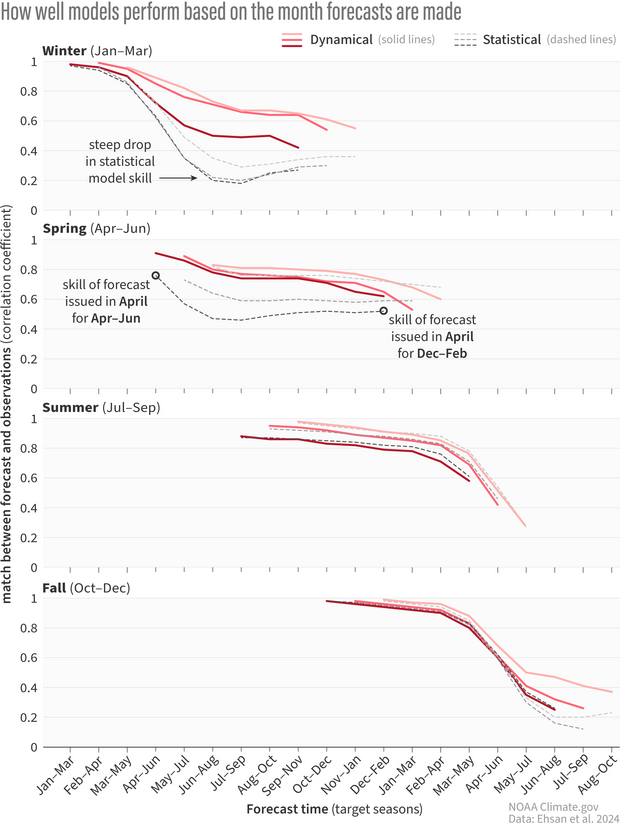
A stacked graph showing the correlation coefficient, or the match between the forecast and observations, of climate model forecasts for nine consecutive three-month periods starting from the month the forecast was issued. One means a perfect match, and zero is the complete opposite. Red lines refer to dynamical models while black dotted lines are statistical models. Each of the four graphs represents forecasts made during months in different seasons. The darkness of the line represents which month the forecast is from, with the darkest lines being the last month in the marked season. In winter, statistical model skill falls rapidly by the spring, while dynamical models don’t exhibit nearly as much decline in skill. Forecasts made in spring and summer show similar skill between statistical and dynamical models. Climate.gov image adapted from Ehsan et al., 2024.

How did the models do?

By analyzing all model forecasts of the seasonal (three-month) Niño-3.4 index from 2002 through 2023, Azhar and his co-authors discovered some interesting patterns. First, it was clear that there was a decent amount of variation in how well both the dynamical and statistical models performed given both when the forecast was made and what season was targeted. From past ENSO blog posts (herehere, and here), we know that the model skill for forecasts made during the spring predictability barrier—a time where models do particularly poorly in forecasting the fall/winter state of ENSO—is not great. But even then, the skill of statistical model forecasts issued just before and during the spring fell off a cliff for target months in early summer and beyond, much more so than dynamical models. However, the skill of statistical and dynamical model forecasts issued in summer and fall were comparable for all times in the future.
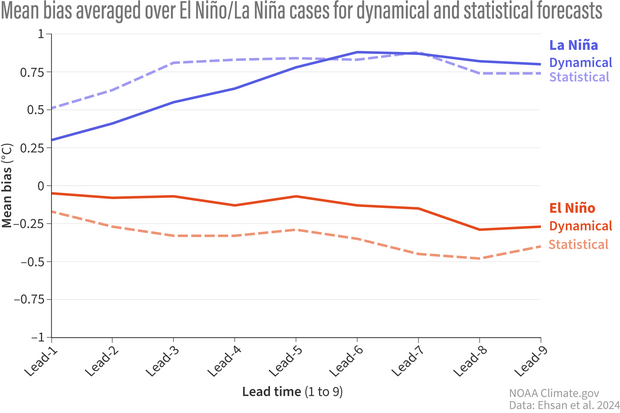
The mean bias of climate model forecasts averaged over El Nino (red) and La Nina (blue) events for each lead time, which refers to the three-month period forecasted. Solid lines are dynamical model forecasts, and dotted lines are statistical models. Overall, models have less bias when predicting El Nino than La Nina. And dynamical models have less bias in general compared to statistical models. Climate.gov image adapted from Ehsan et al., 2024.

Second, there were differences in model performance for predicting El Niño versus predicting La Niña. Overall, models had greater skill in predicting El Niño, compared to La Niña, no matter when the forecast was made, whether it was one month or nine months prior. Dynamical models also outperformed the statistical models in forecasting El Niño at all lead times, and for La Niña for short time horizons. For forecasts of La Niña made five or more seasons out, both statistical and dynamical models performed comparably (and not very well).
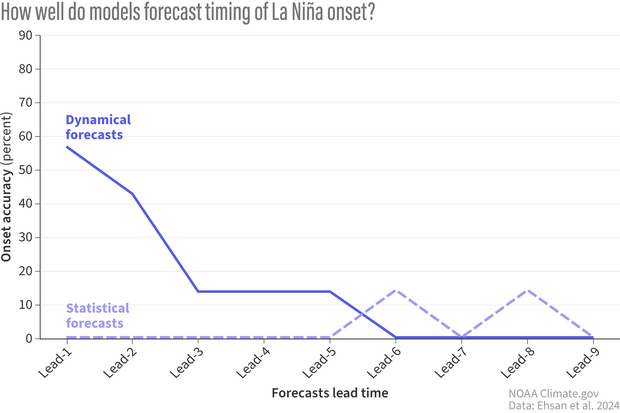
How often (percent) real-time climate model forecasts correctly predict the onset of El Nino (3-month average Nino3.4 values less than or equal to -0.5C) at increasingly far-off lead times. Solid lines represent the multi-model mean of dynamical models. Dotted lines are the multi-model mean of the statistical models. After the first three forecasted seasons, accuracy plummets below 20% in dynamical models. Statistical model accuracy is 0 for most leads except leads 6 and 8. This does not imply that statistical models have more “skill” at these leads as, given the variability in ENSO events and in model forecasts, it is probabilistically likely that models will occasionally correctly predict the onset by chance. Climate.gov image adapted from Ehsan et al., 2024.

Can someone tell me when this El Niño or La Niña turns on?

It’s one thing to predict the strength of an El Niño or La Niña event when its already at its peak and mature, and quite another challenge to correctly predict when an event begins. And one rather interesting finding falls right in line with what we’ve observed so far during the current La Niña.

How often (percent) real-time climate model forecasts correctly predict the onset of El Nino (3-month average Nino3.4 values greater than or equal to 0.5C) at increasingly far-off lead times. Solid lines are the multi-model mean of dynamical model forecasts. Dotted lines are the multi-model mean of statistical model forecasts. Dynamical models have excellent accuracy at predicting the onset through the first three seasonal lead times before dropping to 30-40% accuracy from lead-4 onwards. Statistical models show less accuracy overall. Climate.gov image adapted from Ehsan et al., 2024.

Azhar and his team found that dynamical models are excellent at predicting the start of El Niño events up to a three-month lead (they are accurate more than ~60% of the time). But for La Niña, yikes. Dynamical models are ok for onset predictions two seasons in the future (40-60% accurate), but after that the accuracy drops to 20% and then to 0 (Footnote 1). Meanwhile, the less I say about statistical models predicting the onset of El Niño and La Niña, the better. Suffice to say, they’re not great.

Remember this analysis did not include 2024. So, the incredibly delayed start to the current La Niña, one that many models missed, was not in this analysis.

Caveats

When it comes to science, usually it’s easier to find the patterns then to determine exactly why those patterns exist. Azhar and his fellow authors shared some potential explanations but solid conclusions will need additional research.

Why is there a difference in skill between dynamical and statistical models? Dynamical models have seen a rapid evolution from 2002 to now. Advancements in computer resources, better observations, and a more complete understanding of our atmosphere and ocean have not just improved existing models but have led to an increase in the number of dynamical models over time. The number of statistical models has remained roughly the same. Though, over the last couple of years, the numbers have been increasing (Footnote 2).

So, why bother including statistical models? For one, statistical models serve as a valuable benchmark to measure more complicated models against. Two, they are much cheaper and thus faster to run. And three, unlike dynamical models where the factors that are driving a certain ENSO forecast may be too mixed together and unclear, statistical models with their simplicity can sometimes allow forecasters to unpack what factors are driving the forecast.

Of course, one major caveat here is that this analysis only looks at a small amount of ENSO events. Nevertheless, some conclusions are clear. Predicting the onset of an El Niño and La Niña event is hard. To which THIS ENSO forecaster (me) says “Tell me about it!”

Footnotes

1) Accuracy here is defined as the ratio of correctly forecasted ENSO onset times to the number of total episodes. A forecast is a “hit” if the forecasted Niño-3.4 index meets or exceeds the threshold for El Niño (+0.5°C) or La Niña events (-0.5°C) at the event onset. A 0% accuracy for a given lead time means that no model correctly forecast the onset of the event at that lead time.

2) There are new types of promising statistical models popping up that incorporate artificial intelligence and machine learning which have been added into the plume. Model evolution is not strictly the domain of dynamical models! Hopefully, additional statistical models can be incorporated into the IRI plume to potentially offer better real-time ENSO forecasts.
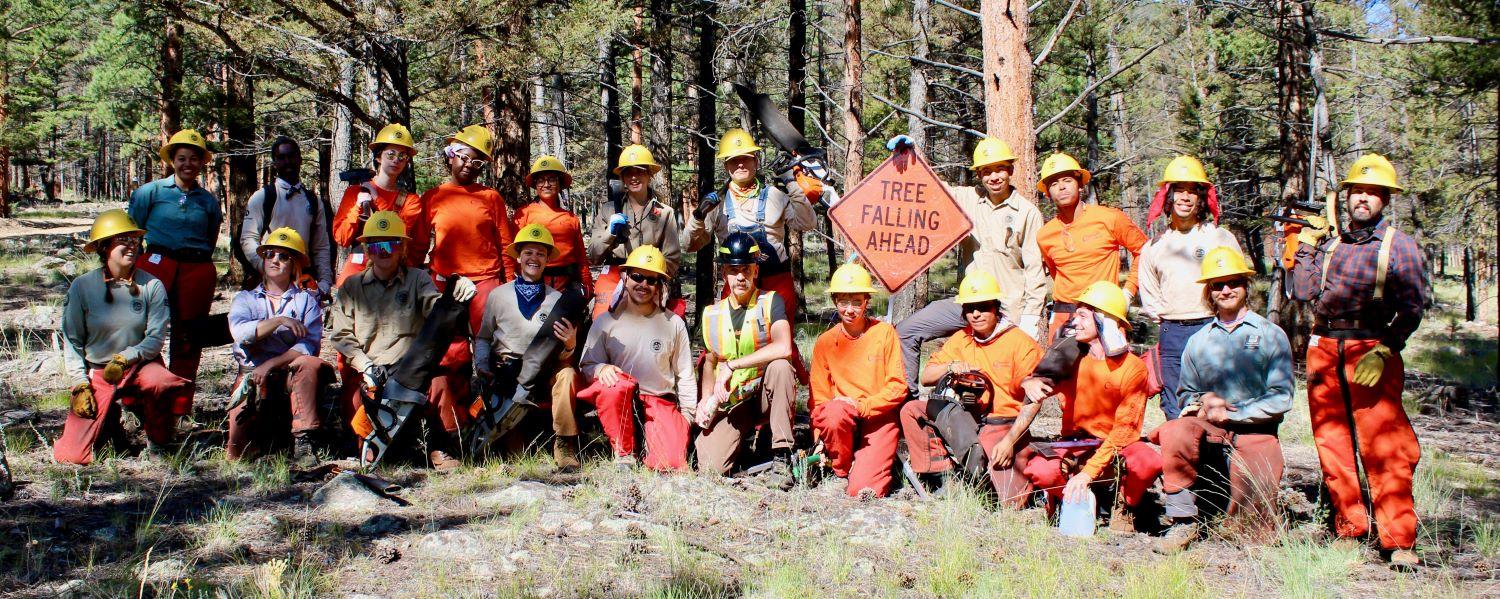
Governor Polis, The Department of Natural Resources, #Colorado Strategic Wildfire Action Program Invests $8.4 Million in 19 New Wildfire Mitigation Projects

Photo credit: Colorado Department of Natural Resources

Click the link to read the release on the DNR website:

February 27, 2025

(DENVER) – Today, Governor Polis and the Colorado Department of Natural Resources (DNR) announced today $8.4 million through the Colorado Strategic Wildfire Action Program (COSWAP), which accelerates forest restoration and wildfire risk reduction through targeted projects that protect communities, watersheds and critical infrastructure.

This round includes 14 Workforce Development Grants to treat 1,045 acres of forested land and train over 150 wildfire mitigation individuals, and five Landscape Resilience Investments in partnership with the Colorado Water Conservation Board’s Wildfire Ready Watersheds(opens in new window) program to strategically support wildfire risk reduction and critical water infrastructure protection in high priority watersheds in targeted counties including in Garfield, Grand, Boulder, Jackson and Montezuma.

“Here in Colorado, no matter what happens in Washington DC, we are aggressively expanding fire prevention strategies that work, and that includes the Colorado Strategic Wildfire Action Program. This critical funding supports wildfire mitigation efforts across the state and helps Coloradans gain skills, and earn hands-on experience to become the next generation of well-equipped Colorado foresters,” said Governor Polis.

“This year, I am pleased we are able to provide significant new funding for on the ground hand crews and training and significant landscape scale projects to a wider range of Colorado communities for forest mitigation and watershed protection work,” said Dan Gibbs, Executive Director, Colorado Department of Natural Resources. Dan Gibbs. “Our COSWAP program rose up out of the devastating 2020 wildfire season and I am proud of the growth and innovation the program has shown. It provides essential on the ground funding to help protect lives, property and critical infrastructure while helping our communities become more resilient in the face of larger, more complex wildfires.”

COSWAP’s Workforce Development Grant is designed to reduce wildfire risk through entry-level training opportunities and hands-on experience. The mission of this program is strengthened by COSWAP’s partners at the Colorado Youth Corps Association (CYCA) and Department of Corrections’ State Wildland Inmate Fire Teams (DOC SWIFT) who offer the next generation of land stewards the skills, experience and career exposure to succeed in wildfire mitigation and forestry. Lt. Governor Dianne Primavera has been a leader in securing investments for CYCA and creating avenues so AmeriCorps members can gain skills to help better lead mitigation efforts in Colorado.

In this round of Workforce Development Grants, CYCA crews including Larimer County Conservation Corps, Rocky Mountain Youth Corps, Mile High Youth Corps and Southwest Conservation Corps received awards to complete six wildfire mitigation projects. Similarly, the DOC SWIFT crews will work on three projects. The remaining five workforce development awards will go towards training individuals in basic wildland firefighting and chainsaw operations.

“COSWAP is a transformational program in Colorado. Not only does it protect the lives and livelihoods of millions of Coloradans, it also unites people through service to their communities. This investment will develop the next generation of wildland firefighters, provide a pathway to the next chapter of service for the women and men of the National Guard, and bring a sense of purpose and accomplishment to conservation corps members. It represents the best of government, allocating resources to proven, impactful solutions,” said Scott Segerstrom, Executive Director, Colorado Youth Corps Association.

“The Pueblo Fire Department has obtained this grant funding every year since 2022, and it has had a significant positive effect on the spread of fire in those areas. The City of Pueblo cannot express how much we appreciate being awarded this grant for three years in a row continuing into 2025 and how much it increases the safety of our citizens,” said Deputy Fire Chief Kieth Novak from the City of Pueblo Fire Department. “The COSWAP grant has benefited the City of Pueblo, working with the Pueblo Fire Department and the City of Pueblo Parks Department, to mitigate wildland fire risks along the north Fountain River as well as multiple areas of the Arkansas River through the City of Pueblo by clearing areas along the rivers of underbrush, trees and other plants to make the area more accessible when there is a fire, as well as decreasing the possibility of fire spread by creating fire breaks and ground clearing. The work these crews do has significantly decreased the hazard risk associated with fire spread to homes around the rivers.”

This year, the Colorado Strategic Wildfire Action Program is proud to support Serve Colorado and Colorado National Guard in their pilot project working with the Rocky Mountain Youth Corps in the Medicine Bow-Routt National Forest. Although this project is located outside of COSWAP’s Strategic Focus Areas(opens in new window), it was a unique opportunity to leverage two service-oriented entities that provide workforce development for their members as well as wildfire mitigation benefits for the community.

“Members of the Colorado National Guard make up a population that are dedicated to serving their state and nation. By partnering with AmeriCorps to develop workforce pathways for National Guard personnel into the public sector, we as a nation receive substantial returns on our investments from multiple levels of government. Through this program, our part-time service members receive financial stability – building our military readiness-, our communities benefit from the military training those service members have already received, and our military forces benefit from well rounded service members who are able to bring the skills they’ve gained in AmeriCorps to the warfight.

This partnership is a perfect example of government efficiency and maximizes the return on investment for American tax dollars, all while ensuring our local communities and service members are more prepared for whatever the future throws at them,” said Major General Laura Clellan.

COSWAP’s Landscape Resilience Investments focus on large-scale, cross-boundary fuels reduction projects. This year, COSWAP launched a special release of this funding opportunity in partnership with the Colorado Water Conservation Board’s Wildfire Ready Watersheds program.

Through this special release, awardees will implement wildfire risk reduction projects that protect critical water infrastructure within high priority watersheds. COSWAP distributed $4,850,000 between the City of Boulder, City of Fort Collins, City of Glenwood Springs, Grand Fire Protection District and Mancos Conservation District to treat a combined 1,313 acres over the next three years.

All five recipients of the Landscape Resilience Investment are also developing a Wildfire Ready Action Plan to assess the potential impacts of wildfire on community infrastructure, and advance a framework for their community to plan and implement mitigation strategies to minimize these impacts before wildfires occur.

“The Wildfire Ready Watersheds program is designed to help communities understand and mitigate the risks that post-wildfire hazards, e.g. floods and debris flows, pose to their lives, property, water supplies, and other infrastructure. By integrating this work with COSWAP’s Landscape Resilience Investments, we’re ensuring that wildfire mitigation efforts not only protect homes and infrastructure but also safeguard the watersheds that sustain our communities,” said Chris Sturm, Watershed Program Director, Colorado Water Conservation Board. “These grants set our partners up for success by combining strategic planning with on-the-ground action, helping Colorado build more resilient landscapes and water systems before the next wildfire strikes.”

COSWAP’s special release leverages a vital partnership to integrate both forest and watershed health. For example, the City of Glenwood Springs and Grand Fire Protection District projects are both located in high wildfire risk areas as well as high priority watersheds that drain into the Colorado River. Ultimately, supporting projects that integrate forest and watershed health will promote long-term ecological resilience.

Through Senate Bill 21-258, COSWAP has invested $25.4 million into its Landscape Resilience Investment program, as well as $13.8 million towards its Workforce Development program. COSWAP releases Workforce Development Grant opportunities every year, while Landscape Resilience Investments are typically every other year, with about $5 million available annually.

To see a full list of Workforce Development and Landscape Resilience Investment grants please see the Colorado Strategic Wildfire Action Program website.

#Wyoming delegation scrambles to restore millions for irrigators’ water #conservation: — Angus M. Thuermer Jr. (WyoFile.com)

A locked irrigation headgate on a canal in the Upper Green River Basin. (Angus M. Thuermer Jr./Wyofile)

Click the link to read the article on the WyoFile.com website

February 21, 2025

Congress ended a program that offered $8.3 million, mostly to ranchers, to conserve water in 2023. Wyoming wants it renewed.

Wyoming’s federal delegation has filed legislation to restore millions of dollars to pay state irrigators in the Colorado River Basin for conserving water.

Bills filed in the U.S. Senate and House would restore the System Conservation Pilot Program that Congress ended in December. The program contracted to pay $8.3 million in 2023 to 21 entities in Wyoming,

The conservation effort aims to supply more water to downstream states without harming Wyoming water users. Headwater upper-basin states of Wyoming, Colorado, Utah and New Mexico favor voluntary paid-for conservation over uncompensated reductions proposed by California, Nevada and Arizona.

The seven Colorado River Compact states propose competing programs to share dwindling flows in a river system that supports some 40 million people in the southwest and Mexico.

It’s uncertain whether the bills might enable the conservation program this year, according to members of the Upper Colorado River Commission who met Tuesday.

“With that uncertainty,” said Wyoming State Engineer Brandon Gebhart, “the four of us as [upper-basin] commissioners haven’t had sufficient time to figure out what a program would be.”

He made his remarks to fellow commissioners Becky Mitchell, Gene Shawcroft and Estevan Lopez representing Colorado, Utah and New Mexico respectively.

The federal representative on the commission, Anne Castle, resigned on Jan. 28 as requested by the Trump administration, according to her resignation letter obtained by journalist John Fleck. She stated she was worried that the administration’s policies are creating “a more disordered and chaotic Colorado River system.”

Bills moving

The pilot program contracted with 21 entities to conserve 15,571 acre feet of “consumptive use” in 2023, according to the latest report posted on the commission’s website published in June 2024. Eighteen of the contracts offered ranchers up to $611 an acre foot for water left in the stream.

(A report on the 2024 program has not been posted on the commission’s website, but could be available this summer if the previous publication schedule is followed.)

The four states and federal government had hoped to continue the program in 2025, but it expired in December when the U.S. House failed to reauthorize it.

“Last year, the Commission was hopeful that the SCPP would be reauthorized and could be used as a potential tool,” Mitchell, the chair of the Upper Colorado group said at the meeting. “However, that federal package that we saw [at] the end of last year did not include much in the way of natural resources legislation.”

Maps of ranch land along South Piney Creek show how low flows in 2022 resulted in curtailment of irrigation compared to the flush water year of 2023. The images were presented to the Upper Colorado River Basin Commission in February 2025. (Screengrab/UCRBC)

Although bills to resurrect the program have been filed, “the future of SCPP legislation remains unclear, as does federal funding,” she said. In 2023, the multi-state program administered by the Bureau of Reclamation received $125 million through the Biden administration’s Inflation Reduction Act.

The Colorado River Basin System Conservation Extension Act would extend the program through 2026, at which time stopgap rules governing drought allocations expire. U.S. Sen. John Hickenlooper, a Colorado Democrat, sponsored the Senate version with U.S. Sens. John Barrasso and Cynthia Lummis, Wyoming Republicans. U.S. Rep. Harriet Hageman, also a Republican, has offered a version in the U.S. House.

“Our bipartisan legislation extends these important programs to help address drought issues across our states.” Barrasso said in a statement. Lummis called the program “forward-thinking.”

Hageman said the pilot program to pay ranchers allows irrigators and water managers a chance to explore alternatives to “severe water regulation during droughts.”

Both bills have begun to advance in their respective chambers.

Yampa River Basin via Wikimedia.

Piney creeks, Little Snake River

The 2023 program saw significant contracts awarded in the Little Snake River drainage in Carbon County and also around Big Piney in Sublette County.

The largest single contract was for $2.6 million in the Little Snake. Irrigators along North, Middle and South Piney creeks collectively signed up for $3.4 million.

By the end of the 2023 summer, a consultant estimated the program conserved 8,477 acre feet of water or about 55% of the 15,507 acre-foot contracted goal for Wyoming, according to calculations made from the 2023 Upper Basin report.

In the Piney creeks area, the program saved about 55% of the stated goal, in the Little Snake about 42%.

“In all cases, the participant completed the required conservation activities,” the 2023 report states. “Variation in average estimated [conserved consumptive use] and actual [conserved consumptive use] is to be expected” due to annual variations in temperature and precipitation, the report said.

In theory, the water that ranchers — plus one municipal and one industrial entity — did not use would flow on to Lake Powell. That would help prevent lower basin states from demanding their share — allowed under laws, compacts and agreements — and forcing reductions in upper basin usage.

Myriad factors complicate that concept, however, including whether conserved water actually makes it to the reservoir, how and whether upper basin states are credited for conserved water, what toll evaporation takes and more.

Green River Basin

What’s not complicated is the impact of diminishing river flows to the economy of Wyoming’s Green River and Little Snake River basins and Cheyenne, which uses Colorado River Basin water diverted across the Continental Divide.

“Hydraulic shortages, the increased variability and the changed timing of the available water supply increases the uncertainty to all of our water-use sectors,” Gebhart told fellow commission. “If our farmers and ranchers are forced to reduce or eliminate the herd size because they don’t have the water to grow the food, it can take many years to recover and regrow these herds.”

There are larger implications, he said.

“These shortages also impact the fish, wildlife, wetlands, the riparian areas, and that has an impact on our tourism [and] recreation sectors,” Gephart said. “Not only do [lower flows] negatively impact our economy, but they impact our culture, and it impacts the relationships that have evolved and exist between all of our water use sectors. This can create conflict.”

Map of the Colorado River drainage basin, created using USGS data. By Shannon1 Creative Commons Attribution-Share Alike 4.0

President Trump’s funding freeze muddies water outlook on the drought-stricken #ColoradoRiver — AZCentral.com #COriver #aridification

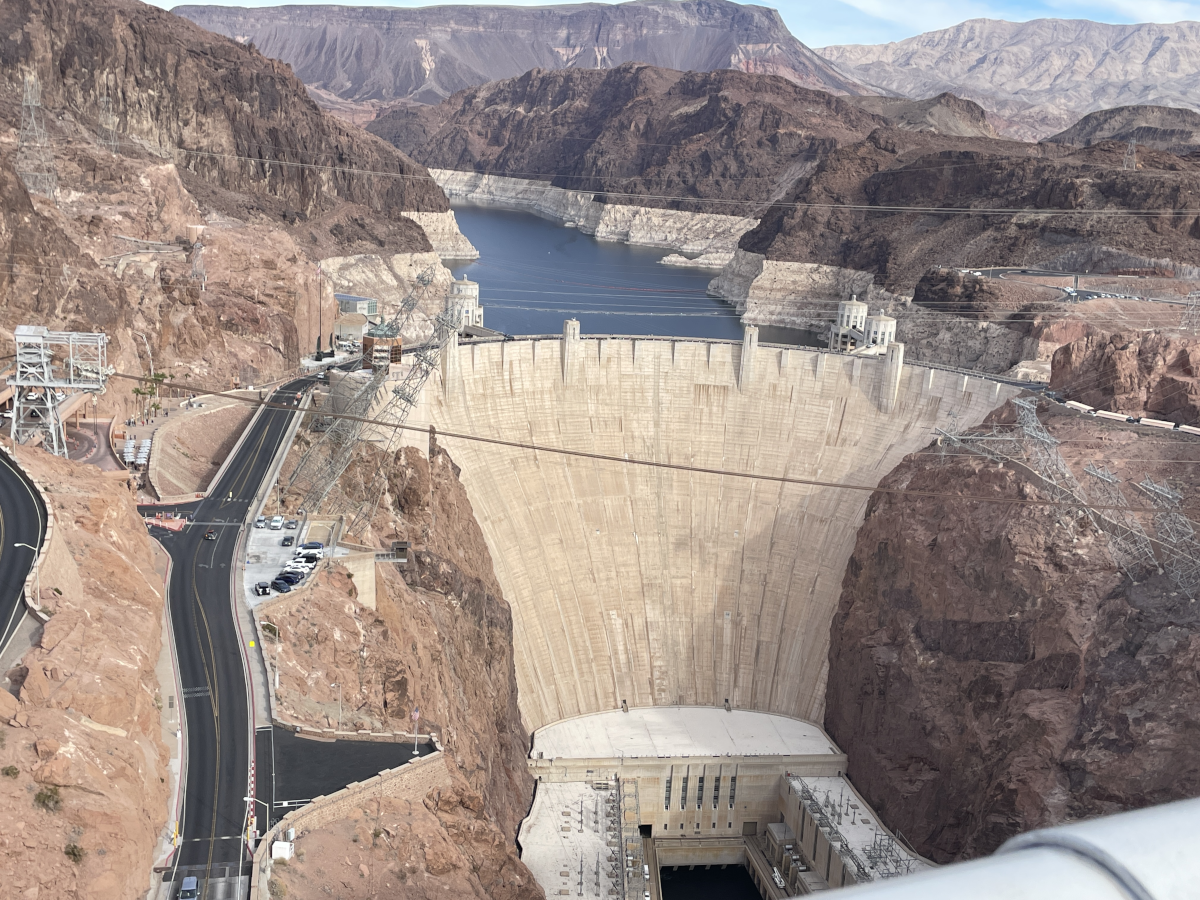
Hoover Dam from the U.S.-93 bridge over the Colorado River December 3, 2024.

Click the link to read the article on the AZCentral website (Brandon Loomis):

February 27, 2025

Key Points

  • Congress and the Biden administration committed $4 billion to Western drought relief, including money for users who agree to leave water in Lake Mead.
  • The money is apparently caught in a freeze of federal funds ordered by President Donald Trump, though questions remain without a Reclamation commissioner.
  • Lawmakers and Arizona’s top water official fear that without the funding, the Colorado River could be pushed deeper into drought, leading to more cutbacks in Arizona.

Facing a dwindling supply that provoked emergency actions to keep the river flowing past Hoover Dam, Congress directed $4 billion to Western drought relief, most of it aimed at shoring up Colorado River water storage. The U.S. Bureau of Reclamation signed deals with irrigators, tribes and other rights holders to forgo deliveries and save 1.5 million acre-feet of water over three years through 2025, with some extensions beyond this year. A second round of funds, which members of Congress say is also frozen, is intended to make long-term efficiency improvements, such as lining canals to stop losses when water is delivered to farms. Without the water or the agreements, some officials fear the ongoing negotiations among the seven river states could fall apart…

Officials with the Bureau of Reclamation did not respond to requests for comment or to confirm the freeze or how long it is intended to last. The administration has frozen various congressionally appropriated funds as cost-cutting aide Elon Musk’s team searches for fraud and savings. The president has not yet appointed a commissioner for the Reclamation Bureau, which manages the dams on the Colorado…

Projections for likely reservoir storage by the end of next year put Mead dangerously close to 1,050 feet above sea level, or the trigger that would cause Arizona to lose another 80,000 acre-feet, Arizona Water Resources Director Tom Buschatzke said this week…Failure to save  water with the contractual deals that Reclamation made for 2025 could tip the region into that next shortage tier, he said, because the projections already assume that the water will have been saved.

“I have advocated strongly to my Arizona (congressional) delegation — the entire delegation — that that money in both the upper and lower basins that was committed needs to be spent,” Buschatzke said. “Those projects are critical to stabilizing the system as we continue to work toward a post-2026 world.”

The Biden administration inked three-year deals with about two dozen water users, including the cities of Phoenix, Tucson, Scottsdale and others, at a rate of $400 per acre-foot. California’s Imperial Irrigation District got a sweeter deal, at $777 for a one-year contract in 2023, but also has among the river’s safest rights against reductions when reservoir levels fall. Most of the water users who signed on were in Arizona, though the biggest deal, a four-year pact to leave 351,000 acre-feet in Mead, was with the Metropolitan Water District of Southern California and Paloverde Irrigation District of California. Arizona’s largest deal was with the Gila River Indian Community, for 341,000 acre-feet, according to a chart provided by Stanton’s staff. The contracts in the Lower Basin states — those downstream of Glen Canyon Dam —  totaled nearly $664 million…A second batch of federal conservation funds, also reportedly frozen, is intended to make lasting water savings by, for instance, putting $87 million toward an advanced water purification plant in Tucson that will enable 56,000 acre-feet to stay in Lake Mead over a decade. A $107 million investment in the Gila River Indian Community, south of Phoenix, is projected to save 73,000 acre-feet over 10 years.

Udall/Overpeck 4-panel Figure Colorado River temperature/precipitation/natural flows with trend. Lake Mead and Lake Powell storage. Updated through Water Year 2024. Credit: Brad Udall

Glen Canyon Dam Adaptive Management Work Group meeting canceled by President Trump’s administration — KNAU ColoradoRiver #COriver #aridification

A high desert thunderstorm lights up the sky behind Glen Canyon Dam — Photo USBR

Click the link to read the article on the KNAU website (Melissa Sevigny). Here’s an excerpt:

February 24, 2025

This week’s scheduled meeting of a group focused on the management of Glen Canyon Dam was canceled by the Trump administration. It’s one of many scientific conferences and federal meetings that have been canceled or indefinitely postponed. The U.S. Bureau of Reclamation says the meeting will be rescheduled to ensure new Department of the Interior and Reclamation leadership are “fully briefed” on the Glen Canyon Dam Adaptive Management Work Group. The group advises the Secretary of the Interior on how best to manage Glen Canyon Dam in keeping with the 1992 Grand Canyon Protection Act. Matt Rice of American Rivers says that involves balancing the needs of water and hydropower users with cultural, environmental, and recreational values.

“And this group is the forum to balance and make management decisions based on all those values, to protect those values. So massively important.”

[…]

The canceled meeting comes amid a funding freeze that has stalled Colorado River conservation projects and amid layoffs at the U.S. Geological Survey, National Park Service and other federal agencies.

As President Trump’s administration cuts funding, lays off USDA staff, #Colorado farmers and ranchers feel the hit — Colorado Public Radio

Photo credit: Jonathan P. Thompson/Land Desk

Click the link to read the article on the Colorado Public Radio website (Caitlyn Kim). Here’s an excerpt:

February 26, 2025

In rural Colorado, U.S. Department of Agriculture funding has long provided not only a safety net against disasters and shifting commodity prices but also the seed money for projects ranging from irrigation ditches to broadband expansion. President Donald Trump’s efforts to remake and slim down the federal government are putting that support in question.

“We lost an NRCS (Natural Resources Conservation Service) grant that totaled about $640,000 or $630,000,” said Michael Nolan, president of the Mancos Conservation District and a farmer himself. “We had spent down about 25 percent of that already implementing programs, paying staff time, and to have that rug just pulled out from underneath us means … potential furloughs, potential layoffs. It’s a big hit to our conservation district.”

Agriculture Secretary Brooke Rollins said last week the USDA will release about $20 million in Inflation Reduction Act funding that had been frozen, but the rest was still under review. And other grant funding is expected to be canceled…The Conservation District signed a contract with USDA in February 2024 to do conservation education. It involved listening sessions, equipment demonstrations, field trainings and agricultural education on issues from soil moisture to crop management.

“At the end of the day, we believe the funding was pulled because of two phrases in it. One was ‘equity’ and one was ‘underserved communities’,” Nolan said…

One Western Slope ag producer said right now there’s no certainty over what will or will not be funded…It’s not just individual producers that have been impacted by the USDA cuts. Six rural electric cooperatives in the state that received USDA grants funded through Biden’s signature climate and health bill have had their funding frozen, while the U.S. Forest Service, also under USDA, laid off more than 3,000 employees.