Mass firings cut the muscle not the fat — Riva Duncan (WritersOnTheRange.org)

Riva Duncan. Credit: Writers on the Range

Click the link to read the article on the Writers on the Range website (Riva Duncan):

February 24, 2025

The stories are heartbreaking. US Forest Service, National Park Service and other federal workers — some of them within weeks of ending probationary periods — fired. And not for cause; these workers were just starting out on dreamed-of careers or taking on new responsibilities in agencies where they’d already been for years.

The Trump administration’s vaunted effort to “trim the fat” from the federal government and curb “waste and fraud” reveal one terrible — but not surprising — fact: The cost-cutters have no idea how government works or who does what in the federal workforce. 

Probation doesn’t mean poor performers. It simply means that someone has only worked one or two years under authorities such as Veterans Recruitment Authority or Schedule A of a permanent job. Or it’s their first time in a supervisory position.

I worked for the Forest Service in forestry and then wildland fire for over 32 years before retiring in 2020. Because I’m now an advocate for firefighters, I’ve heard from many Forest Service workers who were suddenly fired by the Trump administration.  I’ll tell you about two of them.

When he was 18, Cyrus Issari was hired to work with the Idaho Conservation Corps, building trail in the Sawtooth Mountains. He’d “found his passion,” he said, getting jobs as a temporary employee for the Bureau of Land Management and then the Forest Service. He cleared hazard trees with a chainsaw, cleaned campgrounds and also donned the Smokey Bear costume for public events. Best of all, he started fighting wildfires.

In 2022, Issari secured a permanent position — what he called his “dream job”—with a wilderness trail crew on New Mexico’s Gila National Forest. A few weeks ago, his entire eight-person trail crew was fired. Issari had been making $18.96 an hour.

“The land and people will suffer from (this) if nothing is done,” Issari told me.

Liz Crandall was fired last week from her field ranger position in Central Oregon. She started as a volunteer on the Umpqua National Forest in Southwest Oregon in 2016, helping a botanist get rid of invasive weeds. 

The recreation shop scooped her up and put her to work doing sign maintenance, improving trails and cleaning campgrounds. Hired into a temporary recreation position in 2018, she also received wildland fire training and assisted on numerous wildfires.

She moved on to work for Oregon’s Willamette National Forest in recreation and then, in 2023, secured her permanent position as a field ranger on the Deschutes National Forest. 

“I have dedicated my career and life to the US Forest Service,” Crandall said.  Her performance evaluations were rated “excellent,” which is why she was outraged by the wording of her termination:

“The Agency finds, based on your performance, that you have not demonstrated that your further employment in the Agency would be in the public interest.”  Liz had been making $19.10 per hour.

There are common denominators in these stories, shared by the thousands (so far, 3,400 from the US Forest Service, 1,000 from the National Park Service, and 400 from the US Fish and Wildlife Service) of others who have been fired. 

These folks love our public lands and have trained to do a variety of needed jobs. They feel a calling to serve the American taxpayers and countless visitors. They seek jobs that always pay more in sunsets than money.

Make no mistake, these hard-working and dedicated people aren’t the fat, they are the muscle. 

These firings will have ripple effects. They are your neighbors who pay rent or take on mortgages. They shop in the local grocery stores and feed stores and coach basketball.

Many will have to move, and they will take their small, but meaningful, paychecks with them. They won’t be there to assist with search and rescue, to fight the wildfires that are becoming larger and more unpredictable, threatening the lives and livelihoods of countless Americans.  

What can we do to support them? Show up for rallies. Write, or better yet call, your elected officials and tell them what effect these firings will have on you, your family, your business, your community. Be kind to those who are still working. Some were forced to fire the very people who never should have been let go.

There’s a big void to fill, now, and everyone needs to pitch in.

Riva Duncan is a contributor to Writers on the Range, writersontherange.org, an independent nonprofit dedicated to spurring lively conversation about Western issues. She is vice president of Grassroots Wildland Firefighters, grassrootswildlandfirefighters.com, and also works as an international consultant in emergency management.

How two former U.S. representatives view today’s political milieu — Allen Best (BigPivots.com) #CWCAC2025

Former U.S. Rep. Ed Perlmutter, left, responds to a question from Dick Wadhams January 31, 2025. Photo credit: Allen Best/Big Pivots

Click the link to read the article on the Big Pivots website (Allen Best):

February 22, 2025

One Democrat, the other Republican, shared their views of the Trump presidency, Colorado’s political shift and other topics at the Colorado Water Congress

Lauren Boebert in 2020 was running a gun-themed restaurant in Rifle called Shooters Grill and Smokehouse. A political unknown, having never been elected to so much as a town board, she defeated Scott Tipton, the incumbent representing Colorado’s Third Congressional District in the Republican primary. She was 34 years old.

Her ascendancy shocked many. It had a precedent of sorts, as was noted during a panel discussion during the Colorado Water Congress annual conference in late January.

“She had a great political antenna, “said Dick Wadhams, a Republican political consultant who moderated the discussion with two former members of Congress. “She saw an opportunity to take out a respected incumbent, Scott Tipton. And nobody saw that coming.”

Wadhams noted that another member of Congress from the Western Slope had also been upset in a party primary. That was in 1972. Wayne Aspinall, a Democrat and a vital member of Congress in delivering federal dollars to build the massive water infrastructure of the Colorado River Basin in the 1960s, was ousted by Alan Merson of Breckenridge. Democrats in that district decided that Aspinall was too conservative — although it was a Republican Jim Johnson of Fort Collins, who went on to win the general election.

“You do have upheavals in the parties from time to time,” said Wadhams. “That year it was the Democratic Party. This year it’s the Republican.”

Amid his analysis, Wadhams was posing questions to two former members of the U.S. House of Representatives.

Ed Perlmutter, a Democrat, represented the metropolitan area’s western suburbs in Congress from 2003 to 2023. Ken Buck represented the Eastern Plains of Colorado and some fringes of the Front Range beginning in 2015. If very clearly conservative in his political views, he took positions apart from the Trump-dominated Republican majority and resigned in 2024. He was facing a primary election he likely would have lost but denied that that was the cause for his resignation.

Wadhams asked the former members of Congress what did they make of the new Trump presidency?

“When I watch the left react to Trump, it makes me smile, because Trump does so many things that are crazy that the things that are really damaging to the left get missed in all the other crazy stuff,” said Buck. That crazy, he suggested, was part of his strategy.

“If you just look at what he says, it’s going to drive people crazy. If you look at the point of what he’s saying and the strategy behind what he’s saying, you still may think it’s wrong, but at least it’s a little more understandable and people will calm down a little bit.”

He cited the flow of fentanyl into the United States from other countries, especially Mexico, as a problem that the Biden administration had not taken seriously enough.

Perlmutter agreed that Trump’s outrageous behavior was intended to move the conversation.

But if Republicans hold a trifecta in Washington D.C. with a president, plus majorities in both the Senate and House, it’s a very narrow majority in the House: three votes. To actually get a bill passed, such as for appropriations, will require some help from Democrats. And that help, said Buck, comes at a high price.

“They want their programs in Greece, and that’s when you start getting the Marjorie Taylor Greene and others who will say, ‘OK, we’re going to take this speaker out because he’s now working with Democrats.’ Well, you don’t’ have a choice. You can either shut down government or work with Democrats. And that’s the choice that (House Speaker Mike Johnson) has. So he will work with Democrats.”

At that point, added Buck, there will be three or four weeks while Republicans figure out a new speaker of the House. That job, he added, is the worst.

Perlmutter said Democrats will likely regain the majority in the House in the 2026 election, and it will then be the task of the speaker they elect to rein in the wishes of the more extreme elements of the party. Nancy Pelosi, he said, did a pretty good job of it.

In the meantime, the extreme voices can be shrill. Perlmutter cited the example of Boebert. “Her voice is going to be loud now. Whether that’s to get stuff done productively or not. That’s a whole other question. She has the capacity and the ability to do it, and on a one-on-one basis, she’s okay. But you know, she can be pretty out there when she wants to be.”

The two former congressmen agreed that Colorado’s members in Congress, both Democrats and Republicans, can come together on many issues that are, as Perlmutter put it, Colorado-centric type issues such as water, transportation, and energy.

“There are going to be the hot-button issues of immigration, some environmental issues, but generally our members are very close on those kinds of things,” said Perlmutter.

“You’re talking about eight people who see each other every day on the floor (of the House) and oftentimes sit together and have conversations,” said Buck. “I think that Colorado is really well represented on both sides of the aisle.”

Both men served in the Colorado Legislature before their election to the federal offices. Since 2019, Democrats have had majorities in both chambers at the Capitol. Colorado’s electorate has changed dramatically in the last seven or eight years, Wadhams observed. Voters are younger, more socially liberal – and more inclined to be unaffiliated. They’re very anti-Trump and favorable to Democrats but – maybe not always so. He cited Proposition HH, a property tax proposal heavily supported by Democrats and opposed by Republicans. It was defeated by a 20% margin.

Perlmutter also noted swings in Colorado’s electorate. He was the first Democrat elected to the Colorado Legislature from the Jefferson County communities of Lakewood, Wheat Ridge, Arvada. and Golden in 50 years. It now is overwhelmingly Democrat.

Colorado Republicans held sway in 1998, the year that Bill Owens was elected governor. He was the only Republican governor in Colorado in the last 50 years.

Today’s unaffiliated voters – 50% of the electorate – swing left, noted Perlmutter. Biden won Colorado by 23 % percentage points and Kamala Harris in 2024 by 12%.

“It’s still obviously pretty left, but if you’re an independent, if you’re unaffiliated, you can move pretty quickly,” Perlmutter said. He suggested fellow Democrats need to be careful to not get too far afield from the core concerns of the electorate.

What does it mean for western water management when the federal government becomes an unreliable partner? — John Fleck (InkStain.net) #RioGrande

Outlet flow at Cochiti Dam in 2002. By U.S. Army Corps of Engineers, Douglas Bailey – U.S. Army Corp of Engineers Digital Visual Library[1]Image description pageDigital Visual Library home page, Public Domain, https://commons.wikimedia.org/w/index.php?curid=1813624

Click the link to read the article on the InkStain.net website (John Fleck):

February 26, 2025

I got a text message yesterday afternoon about this, which is nuts:

Accidentally dumping 8,000 cubic feet per second into a river channel that hasn’t seen that much water since 1985 is a big deal. The gage data suggests the river level rose four feet basically instantaneously.

I’ve been thinking a lot lately about the stuff the federal government does in water management in the United States that we used to be able to take for granted, like, for example safely operate the dams.

We all love to complain about the federal government’s water management work, but the complaints are based on narrow questions and presume a broad societal consensus that there’s a bunch of stuff the federal government can be reliably counted on to do while we argue over details. Reclamation and the Corps are gonna operate the dams, for example. The details we argue about are at important margins, but they’re at the margins, based on the presumption that the basic stuff will get done.

Like, for example, spending the money that Congress approved to help us manage shortages in the Colorado River Basin. Which money has now been yanked out from under us by the autocrats who think they know better, as Alex Hager reported yesterday.

I have no idea what happened at Cochiti Dam yesterday, whether the person who made the “procedural error” was new because the old timer who knows how to run the dam took the early buyout and bailed. But I do know that is exactly the “what if” scenario I was gonna lay out in a blog post that’s been percolating in my head about this question of how we in the West go forward in water management when the federal government suddenly becomes an unreliable partner.

I am not saying this because complaining about the stunningly arrogant idiots crashing through the federal government right now is great clickbait. I’m tired of all the angry clickbait, frankly, which is why I hadn’t written the blog post until today.

My point here is a serious question, not a rhetorical one: What would it mean for us in Western water management if the federal government becomes an unreliable partner? What must we do to prepare? What does that even look like?

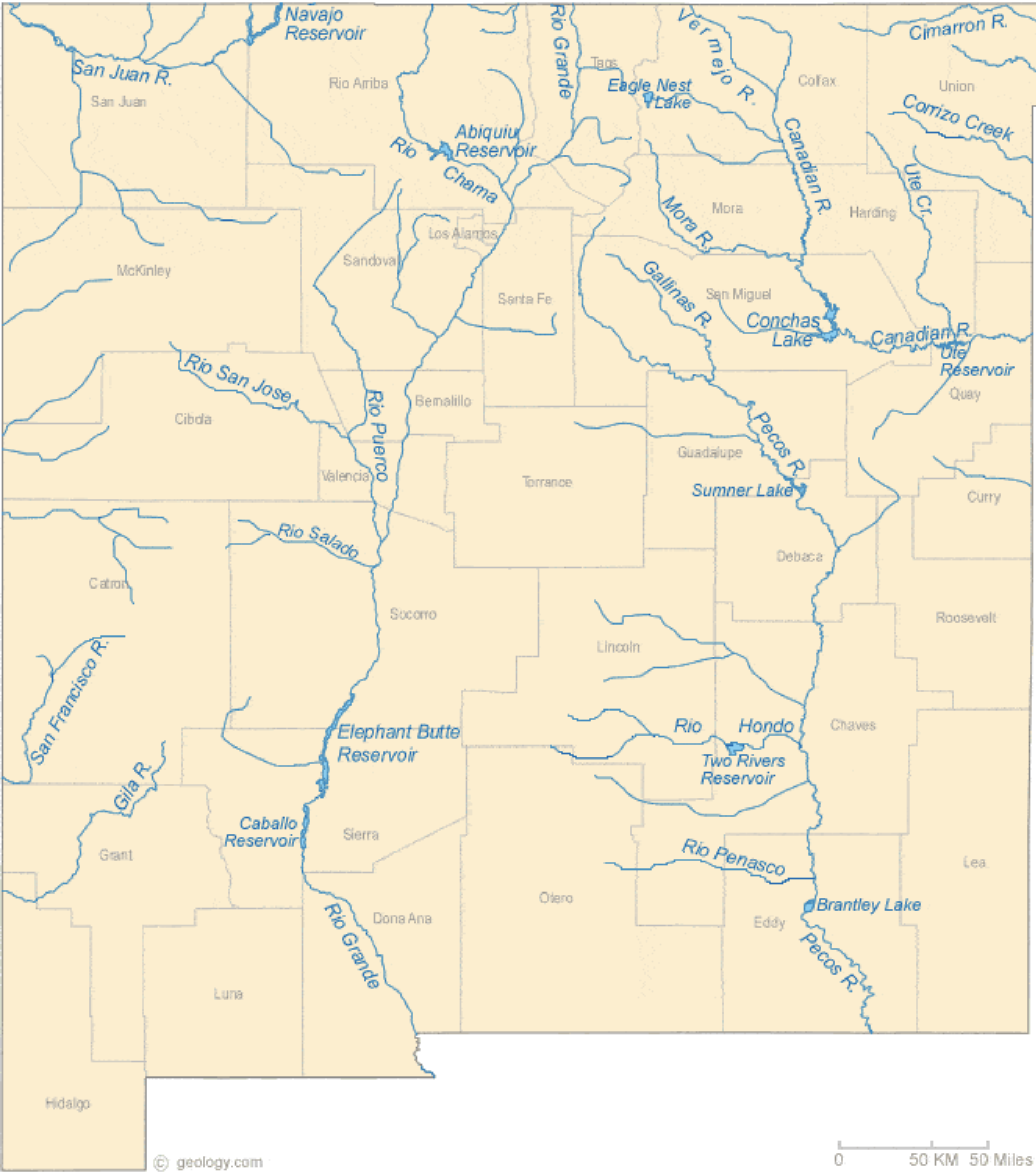
New Mexico Lakes, Rivers and Water Resources via Geology.com.

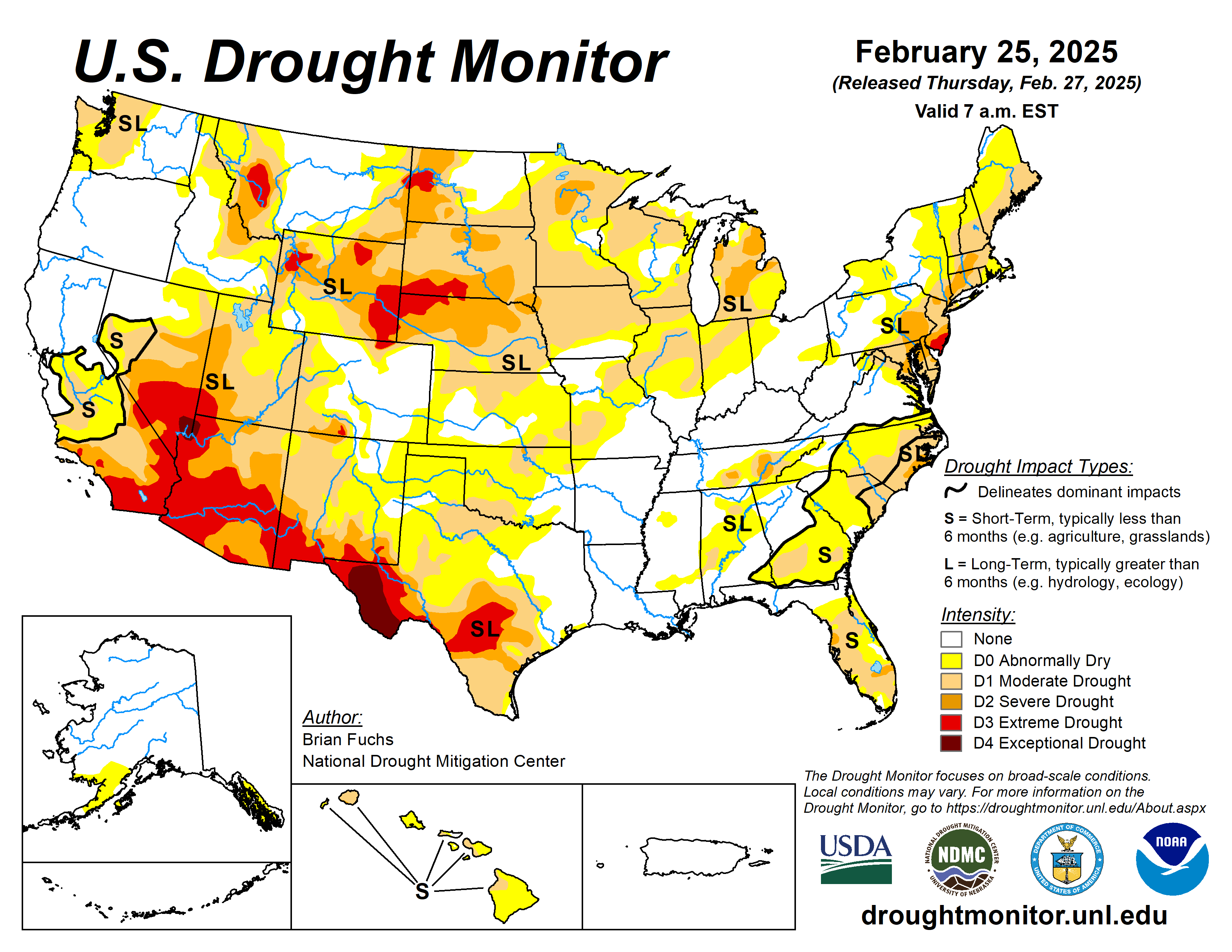
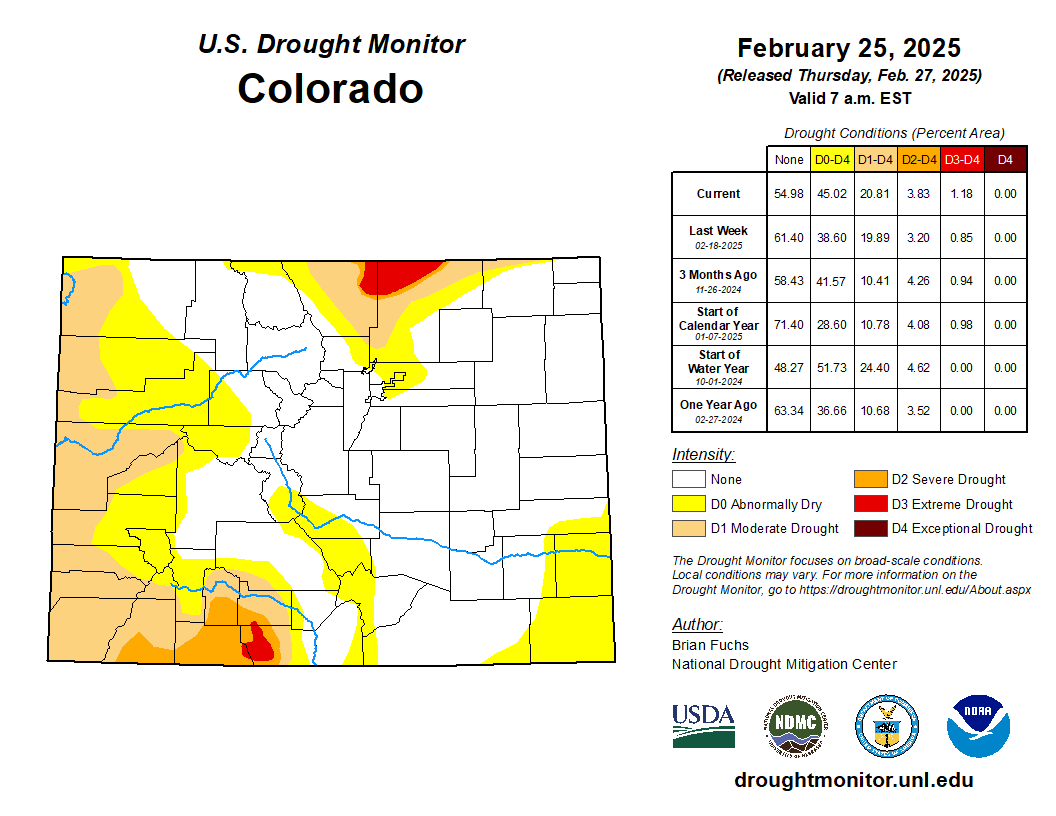
#Drought news February 27, 2025: In #Colorado moderate and severe drought expanded in the S. along with a new pocket of extreme drought due to the long-term drought indicators and the poor snow season to date

Click on a thumbnail graphic to view a gallery of drought data from the US Drought Monitor website.

Click the link to go to the US Drought Monitor website. Here’s an excerpt:

This Week’s Drought Summary

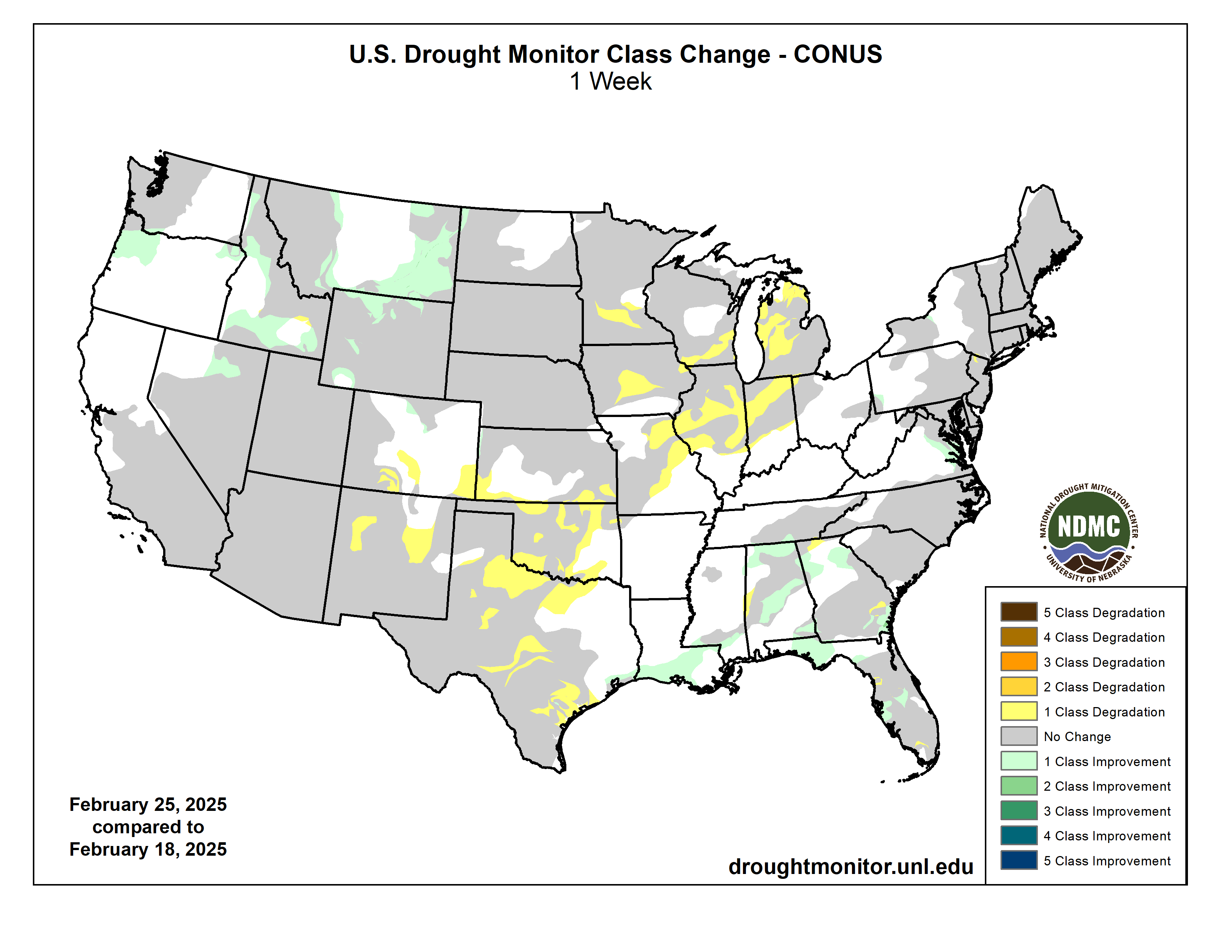
With limited precipitation during the week, most of the country was dry after a fairly active week prior. The week was highlighted by the wild temperature swings from the first part of the period to the end. The current period started off with temperatures that were well below normal over much of the country and ended with temperatures that were well above normal. Valentine, Nebraska, had an observed low temperature of -33°F on Feb. 20, and this rebounded to 69°F on Feb. 25, a swing of 102 degrees over that five-day span. Precipitation was greatest over the coastal areas of the Pacific Northwest as well as along the Gulf Coast and Florida. In southern Louisiana, 4-6 inches of rain was common for the region. Even with cold temperatures over much of the eastern half of the country, the West was normal to slightly above normal for the week…

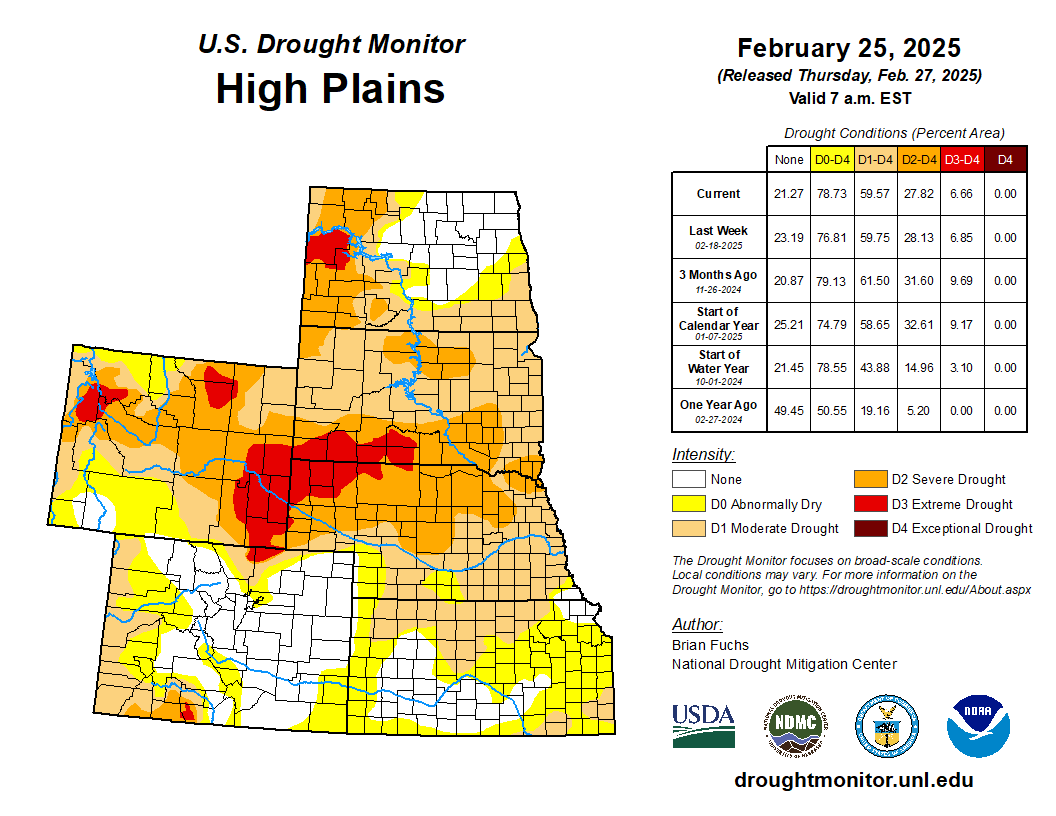
High Plains

Light precipitation was measured from eastern Wyoming into Kansas and Nebraska as well as in portions of western North Dakota and the plains of eastern Montana. Most other areas were dry for the week. Colder-than-normal temperatures dominated the region with areas of southeast Kansas 20-25 degrees below normal for the week. With the dry conditions, moderate drought levels were expanded over southern Kansas along with additional abnormally dry conditions being shown…

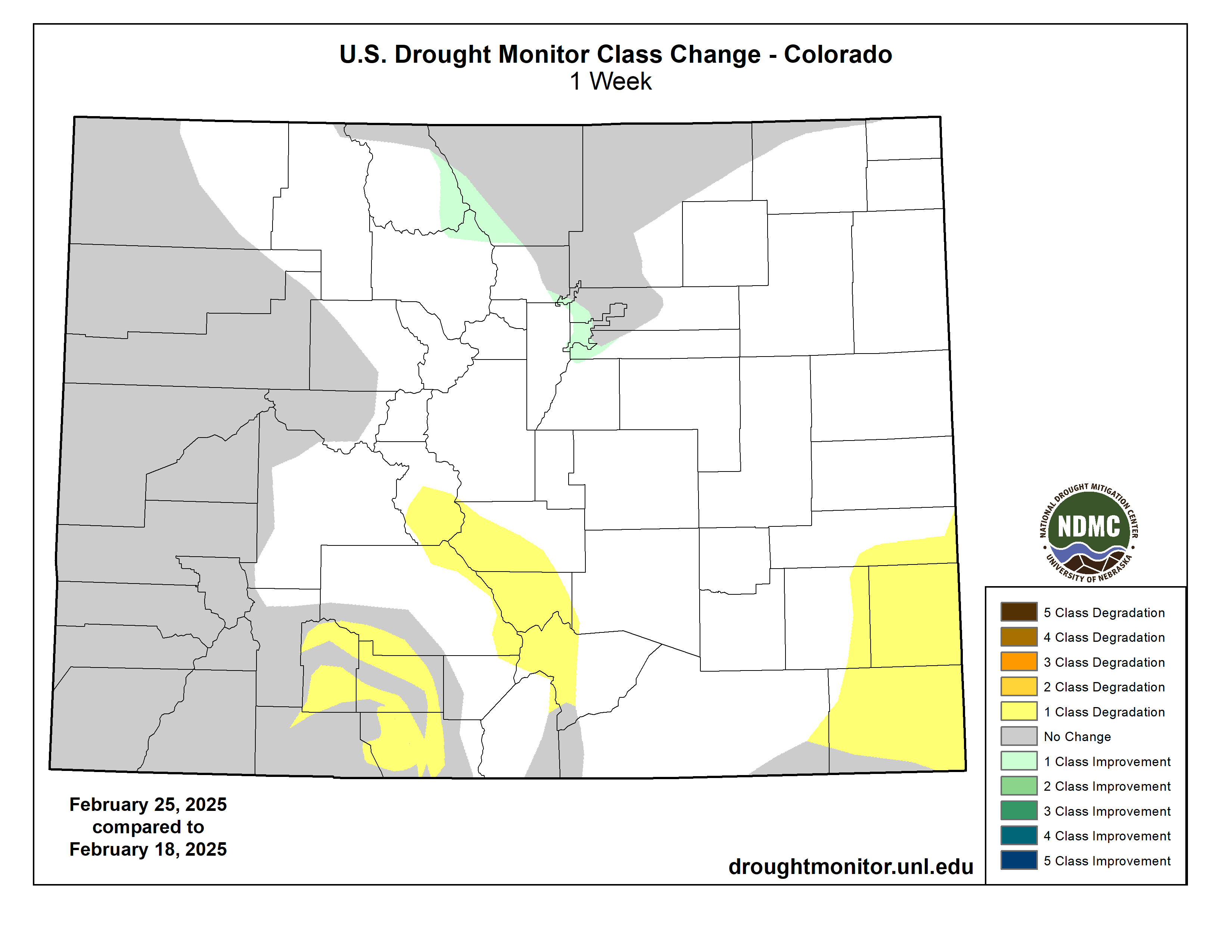
Colorado Drought Monitor one week change map ending February 25, 2025.

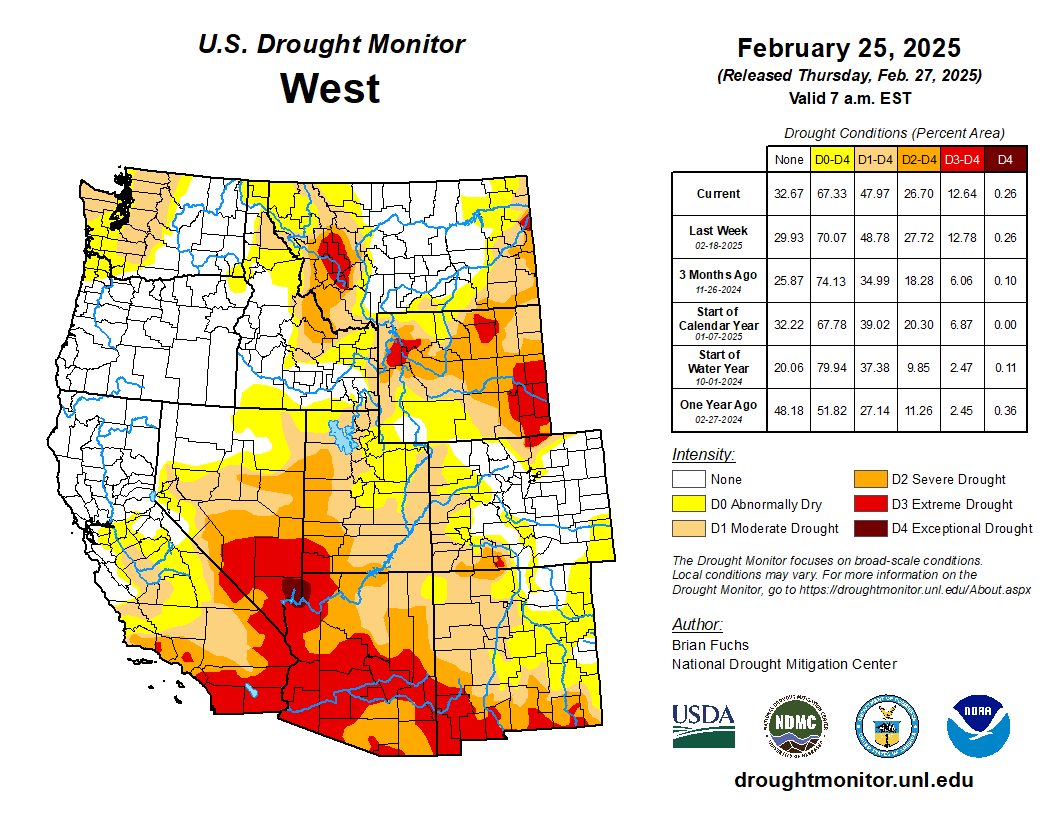
West

A very divided region with wetter-than-normal conditions in the north and zero precipitation in the south. The most abundant precipitation was along the coastal areas of Washington and Oregon and into Idaho and western Montana. Unlike the rest of the country, much of the West had near- to slightly-above-normal temperatures this week. The wetter pattern in Oregon allowed for abnormally dry conditions to improve in the west and both moderate drought and abnormally dry conditions improved in the northeast. No changes in Washington occurred this week as the most recent rains helped to stabilize conditions that had been deteriorating. In Idaho, abnormally dry conditions were improved over much of western and southern portions of the state. Abnormally dry conditions were improved over northern portions of Nevada. In Wyoming, abnormally dry conditions improved over the southwest part of the state while moderate, severe and extreme drought conditions improved over the northern and western parts of the state. Montana had improvements to moderate, severe and extreme drought over eastern portions of the state in response to the improving indicators. In Colorado, some abnormally dry conditions improved in the northcentral areas while they were expanded in the south. Moderate and severe drought expanded in the south along with a new pocket of extreme drought due to the long-term drought indicators and the poor snow season to date. In New Mexico, moderate drought expanded over the west and abnormally dry conditions expanded in the east…

South

It was a colder-than-normal week over the region with temperatures in the 10-20 degrees below normal range over the entire area. The greatest rain occurred across the coastal areas of east Texas, Louisiana and portions of northeast Oklahoma. The region has been dry over much of the winter after a few very wet weeks in the autumn. The short-term data are picking up the dryness that also was prevalent prior to the wet November. As the dryness persists, moderate drought was expanded into more of southwest Oklahoma and into northern and central Texas. Abnormally dry conditions were expanded over much of southern Oklahoma and north Texas. Due to ongoing hydrological drought issues in south Texas, drought expanded this week with more moderate, severe and extreme drought conditions. Abnormally dry conditions were improved over east Texas but were not removed completely due to some lingering dryness being observed at longer timescales. The recent rains allowed for the removal of the abnormally dry conditions over southern Louisiana and some improvements in southern Mississippi, where both moderate drought and abnormally dry conditions were improved…

Looking Ahead

Over the next five to seven days, it is anticipated that the best chances of precipitation will be over the West coast and into the Great Basin, the Mid-Atlantic into the Northeast, the upper Midwest and across the Ozark plateau and into portions of the southern Plains. Temperatures are anticipated to be above normal over most of the Plains and into the Southeast with coastal areas of the West below normal. The greatest departures from normal are expected over the southern Plains with departures of 10-13 degrees above normal.

The 6-10 day outlooks show the high probability of above-normal temperatures over the upper Midwest and from south Texas and along the Gulf Coast as well as Alaska. The best chances of cooler-than-normal temperatures will be over much of California and into the Four Corners region. Most of the country will have above-normal chances of above-normal precipitation, with the greatest chances over southern California and from the Ohio Valley into the Northeast. West and southern Texas has the best chances of below-normal precipitation.

US Drought Monitor one week change map ending February 25, 2025.

Friday Mish-Mash — Jonathan P. Thompson (LandDesk.org)

Photo illustration by Jonathan P. Thompson.

Click the link to read the article on The Land Desk website (Jonathan P. Thompson):

February 21, 2025

There’s a lot going on in the Land Desk beat these days, making it difficult to keep up and to focus on any one element of the orders and job and funding cuts coming out of the White House. I suspect that’s partially by design: They’re trying to disorient the American public so we lose track of what they’re actually trying to do. Rest assured, I’m doing my best to keep an eye on all of it and to watch where the pieces land.

Oh, and y’all gave some wonderful responses to Tuesday’s thread on coping. If you haven’t already, go over there and read through them. And thank you all for participating.

I want to use today’s dispatch to catch up on a few things, briefly …

First, some good news: The storm that was expected to hit a big swath of the West delivered, bringing a fair amount of moisture to places that desperately needed it. The San Juan Mountains in southwestern Colorado were one of the biggest beneficiaries, with high-country SNOTEL stations gaining two to four inches of snow water equivalent (which amounts to a lot of snow). Red Mountain Pass’s snowpack was brought back up to normal for the date. Las Vegas, Nevada, which hadn’t seen measurable precipitation for more than 200 days, got a relative soaking (.57”). And the snowpack in the mountains above Flagstaff, where the snow situation has been especially grim this year, was also bolstered. Yet the snowpack remains below normal in the more southerly zones.

All of that new snow falling on top of old, rotten snow resulted in an unstable snowpack. That led to dozens of avalanches — many naturally triggered, others set off by skiers or snowmobilers — across the region, some of which buried people, one fatally. On Feb. 20, a backcountry skier and a snowboarder were on a feature called The Nose in the Mineral Creek drainage near Silverton, when they were caught in an avalanche. The skier was able to escape; the snowboarder, reportedly a 41-year-old woman from Crested Butte, was buried and did not survive. In February 2021, an avalanche on The Nose killed four caught four backcountry skiers, killing three of them.

🥵 Aridification Watch 🐫

In somewhat related news … At the end of each water year, I like to run this chart of the “natural flows” at Lees Ferry on the Colorado River below Glen Canyon Dam. Natural flow is a calculation of how much water would have passed that point had there been no upstream diversions (because of Glen Canyon Dam, the actual flows at Lees Ferry are highly regulated and vary only slightly from year to year). In other words, it’s a reflection of the hydrologic health of the Upper Colorado River Basin. I forgot to run this one the WY 2024 data was first released, so here you go.

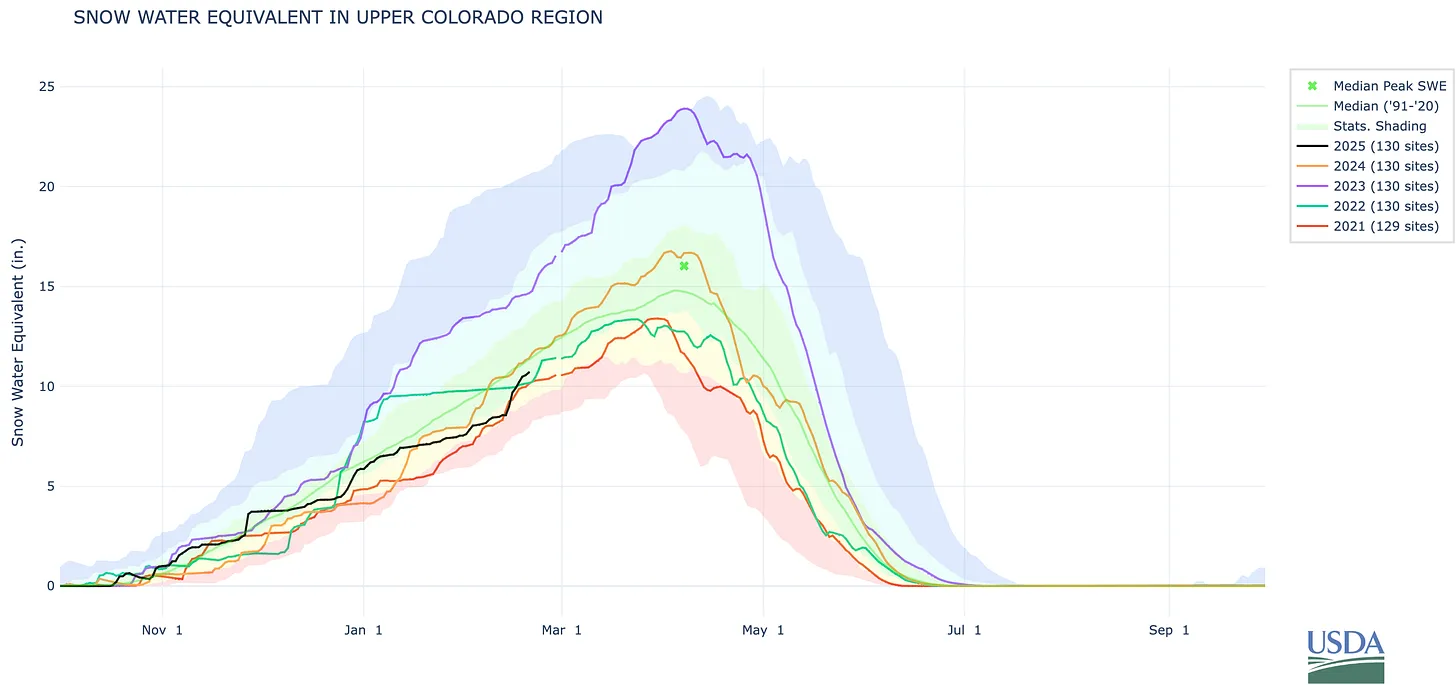
It’s worth noting that this year’s snowpack in the Upper Colorado River watershed (second graph below) is slightly below where it was last year on this date. If that trend continues, you can expect the natural flow to also be lower than last year’s, which is a bit worrisome.

Source: Bureau of Reclamation.

🌵 Public Lands 🌲

Earlier this month, Interior Secretary Doug Burgum addressed the National Congress of American Indians. It was a bit of a rambling speech in which he said this, about public lands, which I thought was rather telling:

First of all, his notion that any public lands that aren’t designated as a national park or monument is “inhospitable or unoccupied” and is therefore lacking in value (aside from the commodities contained within) is a bunch of bunk. And yet it reveals how this guy sees the millions of acres of public land he is charged with overseeing. Also, the guy apparently hasn’t been paying attention, because for him to say that “our return on that investment right now is almost nothing” is a load of horseshit. Last year, natural resource extraction from federal lands generated more than $16 billion in revenue, mostly from oil and gas drilling and coal mining, and mostly from lands that Burgum considers “inhospitable.”

***

Former President Joe Biden received a lot of flack from some greens for failing to live up to his campaign promise of ending oil and gas drilling on federal lands. He was also saddled with a not-quite-accurate claim that his administration issued more drilling permits than the first Trump administration. But what often escaped notice, is that Biden leased out far less public land to drillers than any other administration in years. This didn’t slow drilling or oil and gas production one bit, showing that oil and gas companies lease land speculatively, with no intention of developing it, to bolster their reserves and assets.

Source: Bureau of Land Management.

***

⛏️Mining Monitor ⛏️

There is a lot of talk about a looming uranium mining renaissance on the Colorado Plateau, but the only significant ore production appears to be at Energy Fuels’ Pinyon Plain, née Canyon, Mine on traditional Havasupai land near Red Butte and within the Baaj Nwaavjo I’tah Kukveni-Ancestral Footprints of the Grand Canyon National Monument.

The mining has sparked controversy, since it could contaminate groundwater, among other impacts. And so has the transportation of the ore, via tarp-covered big rigs, across the Navajo Nation to the White Mesa uranium mill in San Juan County, Utah. When Energy Fuels sent its first trucks northward, across an accident-riddled route, it ran into a figurative roadblock, as the Navajo Nation and Arizona’s attorney general protested. The shipments were put on hold.

Earlier this month, the Navajo Nation and Energy Fuels entered into an ore transport agreement and the shipments resumed last week. But the fight to stop the trucks has not subsided. Advocacy groups, Diné citizens, and the Havasupai Tribe continue to push back, and have condemned Navajo Nation President Buu Nygren and the tribal council for a lack of transparency and failing to include other tribal nations in its negotiations.

“This is real for us,” the Havasupai Tribal Council wrote in a statement. “We live here. Our culture and traditions originate here and are knit together with who we are as individual tribal members and as a tribe. … Today there are two trucks, by month’s end it will be four trucks, each hauling 24 tons of this dangerous and highly toxic material. It is clear that EFRI has no regard for others and is simply acting in their own interest. … We will not give up. We owe that to our ancestors, our children, and the generations to come. We will fight on.”


🏠 Random Real Estate Room 🤑

Got an extra $15 million lying around? Then you can buy the iconic Bear Creek Falls outside of Telluride, along with about 33 acres across five patented mining claims. The current owners allow the public to access the land via a nice trail from town. Let’s hope whoever buys it does the same. This particular part of the drainage is riddled with big slide paths, so you wouldn’t expect anyone to develop it. But then …

🗺️ Messing with Maps 🧭

I don’t have much to say about this one, except that I really love these old site sketches of Puebloan structures. This one is by W.H. Holmes, from “Report on the Ancient Ruins of Southwestern Colorado, Examined During the Summers of 1875 and 1876.”

Lawmakers get update on post-2026 #ColoradoRiver basin negotiations — Steamboat Pilot & Today #COriver #aridification

DALLE Image by Scott Harding American Whitewater

Click the link to read the article on the Steamboat Pilot & Today website (Ali Longwell). Here’s an excerpt:

February 20, 2025

The deadline for the U.S. Department of Interior to determine the post-2026 future of Lake Powell and Lake Mead — and the entire Colorado River basin — is now six months away. As precarious negotiations continue between the Upper and Lower Basin stakeholders, the new presidential administration has also cast concerns on the future of the critical water system.   

“Honestly, I’ve seen nothing out of the administration that suggests that they even know there is a Colorado River,” said Democratic Sen. Michael Bennet during a press call on Thursday, Feb. 13. “I had a daily conversation with somebody at least, probably three times a day, in my office with somebody on the Colorado River, and we’ve seen nothing so far.”

[…]

On Thursday, Feb. 20, Colorado water officials provided state lawmakers in the House Agriculture, Water and Natural Resources Committee with a high-level update on the negotiations, which will set the basin’s future operating regime…In November, the Bureau of Reclamation released a document with five management options for the river’s post-2026 future. [Becky] Mitchell said that the Upper Basin states submitted an alternative that offers a more sustainable supply-driven approach to management, rather than allowing downstream demand to dictate releases. These states have also agreed to consider conservation efforts and strategic releases, she said…While elements of the Upper Basin’s proposal — and what was proposed by Lower Basin states— have been incorporated into the Bureau of Reclamation’s alternatives, negotiations are attempting to strike a balance…

“I’m hopeful that the change in administration won’t cause a significant change in policy direction on Colorado River issues. It hasn’t in the past, and I’m hopeful that it won’t now,” [Anne] Castle said. “But I’m less optimistic about that than I was a month ago. I still think that’s the case, but now I’m not sure.” 

Map of the Colorado River drainage basin, created using USGS data. By Shannon1 Creative Commons Attribution-Share Alike 4.0