
U.S. Supreme Court kills #Utah land grab — Jonathan P. Thompson

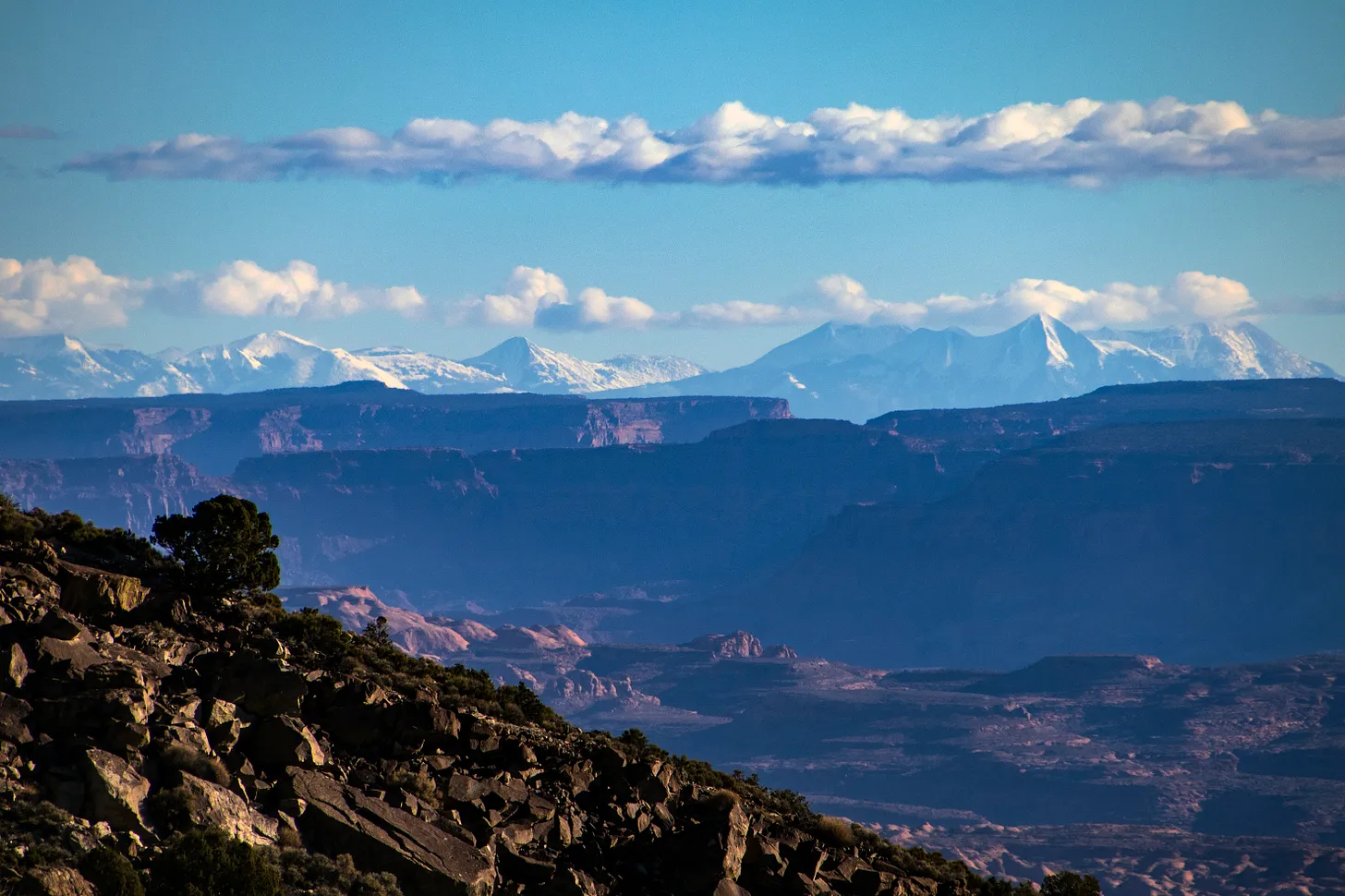
A bunch of Utah public lands. Jonathan P. Thompson photo.

Click the link to read the article on the Landdesk.org website (Jonathan P. Thompson):

January 14, 2025

The latest public-land grab attempt is dead — at least for now. On Monday, the U.S. Supreme Court refused to hear Utah’s lawsuit attempting to seize control of 18.5 million acres of “unappropriated” federal lands in the state. This effectively ends Utah’s bid to take its case directly to the Supreme Court1, albeit not before it had spent over $1 million of the state taxpayer’s cash on legal expenses and a goofy PR campaign that included this bizarre ad aimed at inducing nostalgia for an era that never really was.

One might hope that this defeat at the hands of a conservative court would teach Utah’s elected officials to give up and be grateful for the abundance of public land in their state, which is actually the envy of folks everywhere. But alas, I kind of doubt they’d be that wise, because, well … Utah. So after licking their wounds, they’re likely to come back with some other strategy for purloining public lands.

Perhaps they’ll follow the lead of the Wyoming legislature, which just introduced a resolution “demanding that the United States Congress … extinguish federal title in those public lands and subsurface resources in this state that derive from former federal territory.” Which is to say that Wyoming is ordering the U.S. — i.e. all Americans — to surrender public lands within the state, with the exception of Yellowstone National Park, to the state, thus opening it up to be privatized.

Yes, the hard-right Freedom Caucus has taken control of the Wyoming legislature and, according to reporting by WyoFile, they plan to introduce “bold policies that probably have never had the opportunity to see the light of day” and that are based upon “godly principles.”

This would include public land grabs and repealing gun-free zones because, you know, Jesus was all about AR-15s. And it includes the — I kid you not — “Make Carbon Dioxide Great Again” law that would bar the state from designating or treating carbon dioxide as a pollutant. It would also nix Gov. Mark Gordon’s efforts to establish the state as a leader in carbon capture and sequestration technology and actually would relinquish any primacy over carbon storage to the feds. Go figure.

And just in case Congress isn’t cowed by the threat of a Wyoming-lawmaker-led revolt, then Rep. Harriet Hageman will step in with her own federal legislation. While it doesn’t attempt to transfer public land, it is aimed at neutering the Bureau of Land Management by nullifying management plans that have been years in the making. Hageman recently introduced a bill that would block implementation of the Rock Springs and Buffalo field office resource management plans.

Stay tuned. I’m sure we haven’t heard the last of these shenanigans.


⛏️ Mining Monitor ⛏️
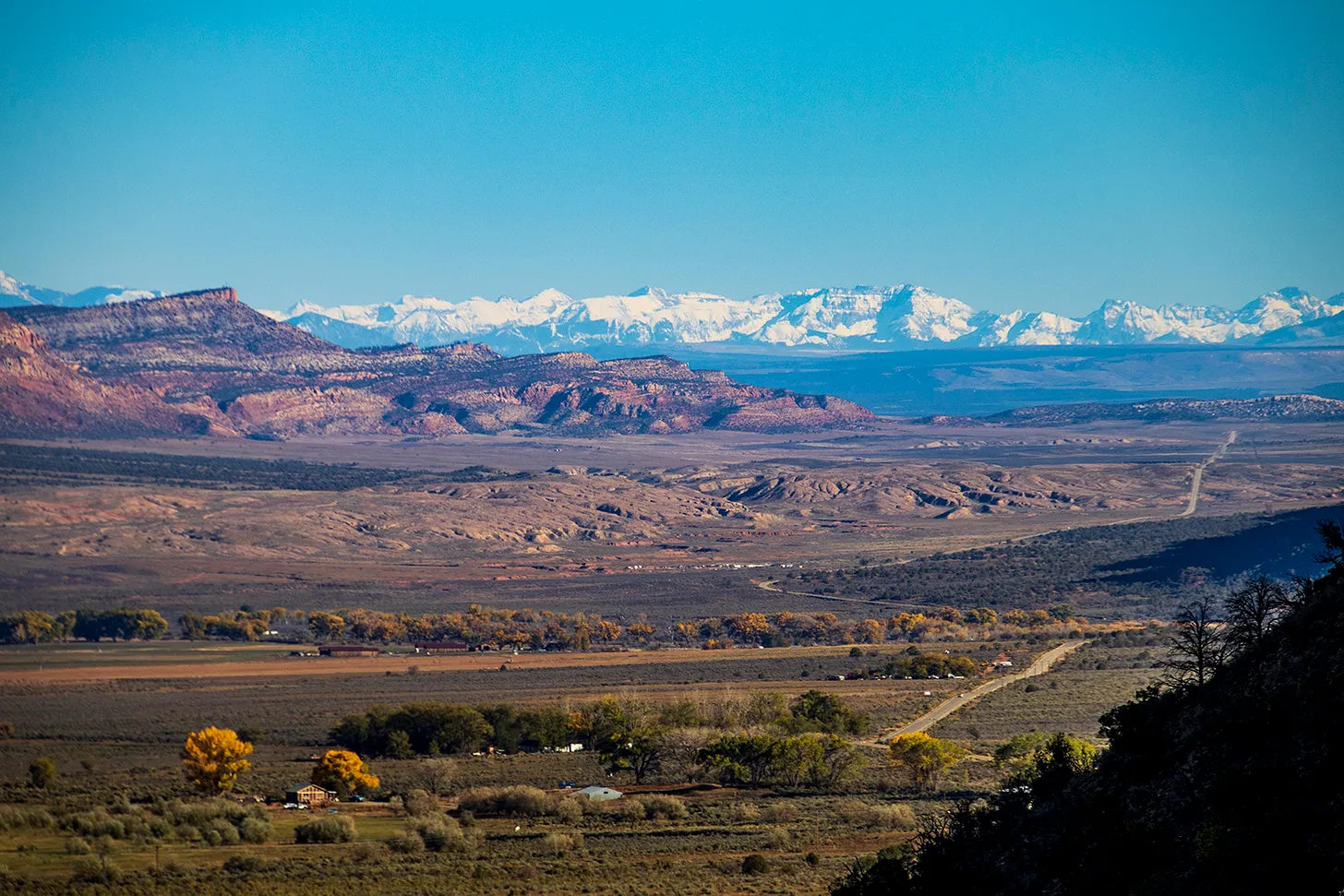
The Paradox Valley in western Colorado. The proposed Mustang, née Piñon Ridge, uranium mill would be located on the far side of the valley (center right in the picture). Jonathan P. Thompson photo.

For the past few years, Western Uranium & Vanadium, based in Canada and Nucla, Colorado, has been making a lot of noise about plans to bring its Sunday Mine Complex in the Uravan Mineral Belt into production. It’s also proposing to establish a new uranium mill just outside Green River, Utah — thereby furthering the industrialization of the melon-farming town. So far, however, the mine has not produced any ore, nor has the mill progressed beyond the “baseline data collection” stage.

But that hasn’t stopped the company from keeping the hype going. Yesterday it announced it would begin data collection at the former Piñon Ridge uranium mill site in the Paradox Valley, which it’s now calling the Mustang Mineral Processing Facility.

You may recognize the Piñon Ridge name. Back in 2007, Energy Fuels — the current owner of the White Mesa Uranium Mill — purchased the site and proposed building a uranium mill there. At the time, George Glasier, who currently helms Western Uranium & Vanadium, was Energy Fuel’s CEO. A lot of locals were not so psyched about having a new radioactive site in their midst, and opposition to the proposed mill was fierce.

twisted saga ensued, finally ending when the state revoked the mill’s permit in 2018. In the interim, Glasier had stepped down from the helm of Energy Fuels, which had acquired the White Mesa Mill, started his own company, and purchased the Piñon Ridge project. Last year, Western U&V acquired the Piñon Ridge project from Glasier’s company. And now Glasier seems to think he can get a newly designed mill permitted (he has yet to apply for a permit). Or maybe he’s just fishing for more investors’ dollars. In any case, the folks who led the resistance to the mill last time are ready to push back once again if necessary.


📖 Reading Room 🧐
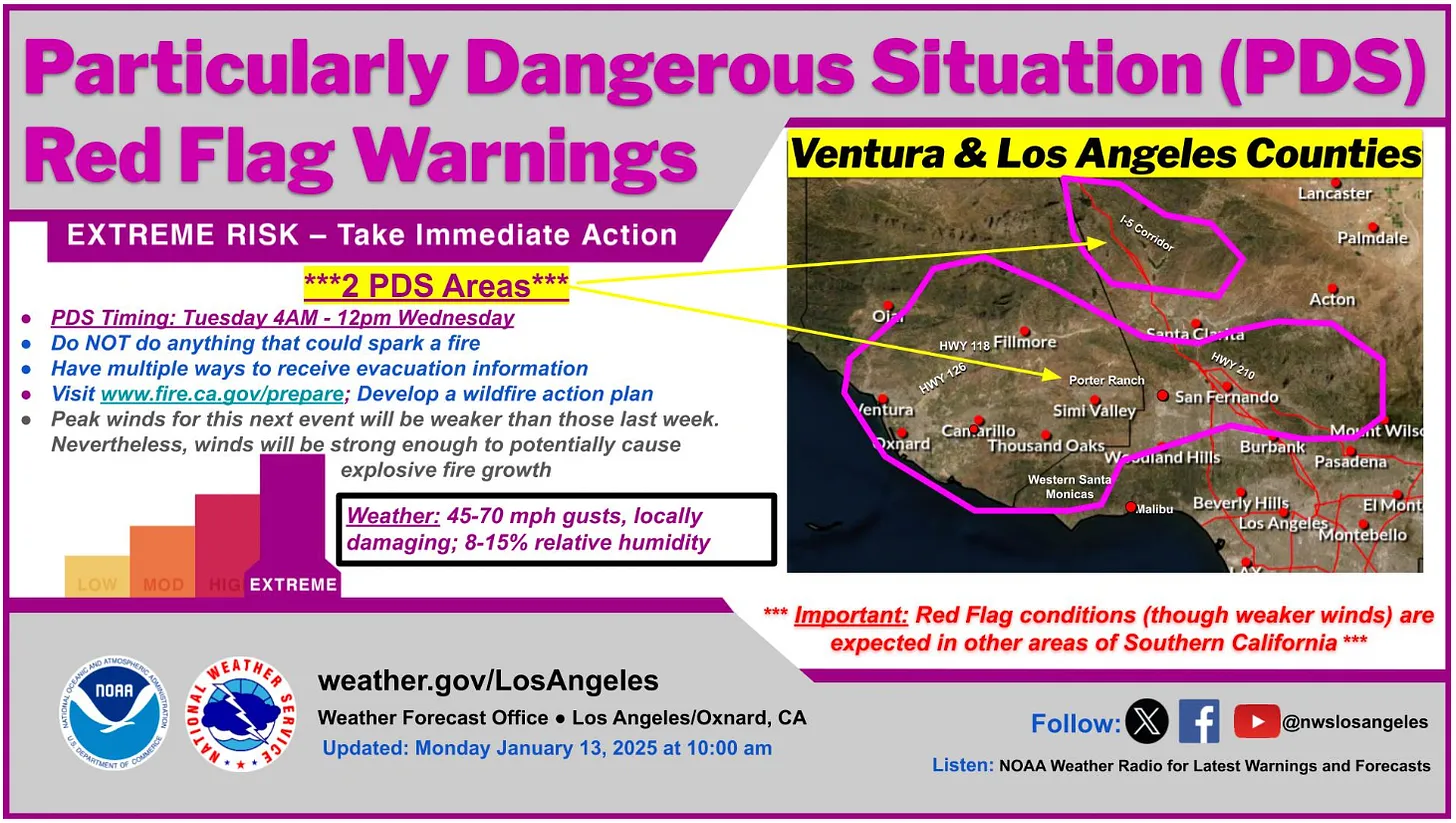
Here come those Santa Ana winds again …

The National Weather Service has issued an extreme fire danger bulletin for a good chunk of the greater Los Angeles metro area, including a “particularly dangerous situation” alert, through tomorrow as the Santa Ana winds kick up again. This as the Palisades and Eaton fires continue to burn, having already taken 24 lives and an estimated 12,300 structures.

It’s been stunning to watch the destruction from afar and heartbreaking to imagine the collective sense of loss rippling across the sprawling metropolis of 18 million. The immensity of it all, the rate at which the fires spread, and the way the Santa Anas send flaming embers into the air to spawn their own blazes miles away is horrifying. Equally baffling is the way the tragedy seems to have opened up a firehose of stupidity, finger-pointing, and grandstanding, issuing forth from the President-elect, Elon Musk, political pundits, and and even Rep. Marjorie Taylor Greene, who asked: “Why don’t they use geoengineering like cloud seeding to bring rain down on the wildfires in California? They know how to do it.”2

I considered spending a bunch of words explaining how and why these folks are wrong. But even acknowledging their existence and repeating their inane lies makes me vomit a bit in my mouth, and trying to debunk even a fraction of the claims is to play a futile game of whack a mole, though that’s not stopping California’s government from trying. As an antidote, I’ve been reading some smart things about the fires, the Santa Ana winds, and Los Angeles, and I figured it would be nice to share some of them with you.

Start out with Joan Didion’s essay on the Santa Ana winds, in which she reminds us that this month’s raging Santa Anas aren’t entirely unprecedented. A two-week long Thanksgiving-time Santa Ana event in 1957 included 100-mph gusts that toppled oil derricks, propelled heavy objects through the air (some of which killed people), and drove a blaze through the San Gabriels for well over a week. She writes:

Then check out the opening lines of Raymond Chandler’s Red Wind (and how can you stop reading after this!?):

And the late Mike Davis’s “The Case for Letting Malibu Burn” should be required reading in these times. And yes, it’s quite a bit more nuanced than the title might suggest. Davis gives a good history of post-colonial fires in the Malibu area and explains how in 1930 Frederick Law Olmsted, Jr., called for turning 10,000 acres there into a public park (that could have burned in natural cycles, without destroying homes).

Alas, that didn’t happen. Instead, Malibu was developed, and fires roared through there in 1930, 1935, 1936, 1937, and 1938. The city had the opportunity to acquire 17,000 acres for just $1.1 million and turn it into a preserve in 1938 — it passed up the chance. Housing came, instead, along with more destructive fires. He writes:

Each fire, then, was followed by reconstruction on a larger, more exclusive scale. Malibu went from being a ranching, rural area, to a bohemian enclave, to a high-end suburb. “Two kinds of Californians will continue to live with fire:,” Davis writes, “those who can afford (with indirect public subsidies) to rebuild and those who can’t afford to live anywhere else.”

Joshua Frank mentions Davis’s essay in a poignant piece for CounterPunch in which he asks folks to stop their victim-blaming and have a bit of compassion, even if they don’t like L.A.. He writes:

At his Public Lands Media Substack, George Wuerthner talks about how these are really urban wildfires, not forest fires, and so the old mitigation and prevention techniques don’t necessarily apply.

He argues that prescribed burns and thinning wouldn’t have worked, because the fires started in the chaparral, which has a natural fire regime of about 30 to 100 years. Prescribed burns tend to eliminate native species that are then replaced by more flammable grasses.

In an interview with the Los Angeles Times, fire experts Jack Cohen and Stephen Pyne also talk about how these fires don’t fit into conventional notions of wildfire. In both the Palisades and Eaton fires, there were unburned trees sitting right next to homes that had been totally destroyed. Cohen:

Here’s hoping for an ember-free day for Los Angeles.


1 This was corrected from saying it effectively ended their legal bid. As reader Slickrock Stranger pointed out, that’s not necessarily the case. Utah could still take its case to the lower courts and keep losing until it ends up at the Supreme Court (which could again decline to hear the case, or something else). But SCOTUS did shoot down this particular strategy of going straight to the Supreme Court for a decision.

2 Oh, that’s right, because “they” modified the weather so that Hurricane Helene would wreck the southeast and keep all those Republicans from voting. Yeah. No. First off, Marge, while the theory behind cloudseeding is legit, there is scant evidence that it significantly increases precipitation. And, even so, it only works if there are already moisture-laden clouds present to seed. Thus the name. Now, maybe if They sent a hurricane to L.A. blowing inland from the Pacific, it would cancel out the Santa Anas, which blow toward the ocean, and then we’d be fine. Alas, They can’t control the weather.

Future water conservation program almost guaranteed in Upper Basin: River District warns again about impacts to Western Slope — Heather Sackett (AspenJournalism.org) #ColoradoRiver #COriver #aridification

This hayfield near Rifle is irrigated with water from a tributary of the Colorado River. The future of Colorado River management is almost guaranteed to include a conservation program for the Upper Basin. CREDIT: HEATHER SACKETT/ASPEN JOURNALISM

Click the link to read the article on the Aspen Journalism website (Heather Sackett):

January 30, 2025

After years of studying and experimenting with pilot programs, the future of Colorado River management will almost certainly include a permanent water conservation program for the Upper Basin states. 

Upper Basin officials have submitted refinements to their March 2024 plan for how water should be released from Lake Powell and Lake Mead, and how shortages should be shared after the current guidelines expire in 2026. In it, they offer up the potential for up to 200,000 acre-feet per year of water conservation. 

“The kind of conservation activities, I think the exact contours of that and how that would work, all that is yet to be determined,” said Amy Ostdiek, chief of the interstate, federal and water information section of the Colorado Water Conservation Board. “But conservation activities across the Upper Division states, in one way or another, I think, will likely continue.”

The proposal by the Upper Basin states (Colorado, New Mexico, Utah and Wyoming) now includes two water-savings accounts in Lake Powell. One is a Lake Powell Conservation Account that will store up to 200,000 acre-feet per year from conservation and from quantified and settled but unused tribal water. The second, a Lake Powell Protection Account, would store water released from upstream reservoirs — Flaming Gorge, Navajo and Blue Mesa — when Lake Powell drops below 3,535 feet in elevation. 

These pools would be part of what the Upper Basin is calling “parallel activities,” and details would be hammered out in agreements separate from the new reservoir operation guidelines, which the seven Colorado River basin states are negotiating. Conservation is based on each year’s hydrology, with more water saved in wet years.

For the past several years, Upper Basin officials have pushed back on the notion that their states should contribute to cutbacks in water use since their water users already suffer shortages in dry years and the four states have never used their entire allocation of the river, while the Lower Basin (California, Arizona and Nevada) overuses its share. At the same time, however, the Upper Basin has been exploring programs that would pay water users to cut back. These programs include the System Conservation Pilot Program and the state of Colorado’s study of a demand management program

In March, each basin submitted to the U.S. Bureau of Reclamation competing proposals for future river management, with the Lower Basin calling for cuts to be shared by the Upper Basin under the most critical conditions. For months, each basin dug in their heels, saying their alternative was best. The result was a stalemate when talks ground to a halt by the end of the year. 

According to state officials, representatives of the seven basin states have recently resumed talks.

“I’m happy to report that the seven states are continuing discussions,” Becky Mitchell, a commissioner to the Upper Colorado River Commission and who represents Colorado in talks among the seven states, said at the Colorado Water Congress annual convention Thursday in Aurora. “We are working hard to identify potential areas of consensus.”

Colorado River expert and author Eric Kuhn said the Upper Basin’s proposal for the two water savings pools in Lake Powell is a sign of optimism.

“I kind of see it as a change in tone and putting something on the table that is closer to the Lower Basin’s proposal,” Kuhn said. “That seems like fairly significant progress to me.”

The watchwords for these types of conservation programs have always been “temporary, voluntary and compensated.” But in the face of a hotter, drier future with less water to go around, officials are acknowledging the inevitability of a more permanent Upper Basin water-conservation program. 

“I think it’s almost guaranteed,” said Amy Haas, executive director of the Colorado River Authority of Utah.

Navajo Bridge spans the Colorado River downstream from Lake Powell near Lee Ferry, the dividing line between the upper and lower basin. Upper Basin officials have proposed up to 200,000 acre-feet of water conservation a year in Lake Powell. Photo credit: Aspen Journalism

Western Slope concerns remain

Paying water users to cut back is not a new concept in the Upper Basin.

In 2023, using federal money from the Inflation Reduction Act, the Upper Basin states rebooted the System Conservation Pilot Program, which first took place from 2015 to 2018. Over two years, the program saved 101,000 acre-feet of water at a cost of $45 million. SCPP has been criticized for a lack of transparency, for not tracking conserved water to Lake Powell and the high cost.

And although all water-use sectors — including agriculture, cities and industry — were invited to participate, in practice all the participating water users in the state of Colorado were Western Slope irrigators. 

This disproportionate participation by one area of the state and the potential harm it could cause to rural agricultural communities has long been something the Glenwood Springs-based Colorado River Water Conservation District has warned against. The district, which leads in the protection, conservation, use and development of water across 15 Western Slope counties, had sought to play a role in setting criteria and approving applications for the SCPP. But in the end, the Upper Colorado River Commission had the sole authority for deciding who could participate. 

Now that the Upper Basin seems poised for more permanent and robust conservation, the River District is reasserting the need for rules that protect the Western Slope. 

“Our state and the three other Upper Basin states have put it on the table as a negotiating chip,” River District General Manager Andy Mueller said at the district’s regular board meeting Jan. 21. “We will see some form of program come out of this. The question is: When it gets operated inside of our state, can we influence how it gets operated? Can we create a situation where we avoid every drop of that water coming out of the West Slope?”

The River District board on Jan. 21 authorized writing a letter to state officials and Colorado’s congressional delegation about creating a conservation program that avoids disproportionate impacts to Western Slope water users. One of the River District’s fears is that Front Range cities — which have junior water rights from the Colorado River and have deep pockets — in a version of “buy and dry” could pay for water conservation in Western Slope agriculture and store the water in Lake Powell to protect themselves from future mandatory cutbacks. 

“That’s not something we would be supportive of,” Mueller said. “That’s the kind of guidelines we want to see come out of the state for conditions on participating in a program.” 

Lake Powell is seen in a November 2019 aerial photo from the nonprofit EcoFlight. The Upper Basin states are proposing two pools of stored water in Lake Powell: A Lake Powell protection account and a Lake Powell conservation account. Credit: EcoFlight

Utah demand management

The future of SCPP in 2025 is unclear, with federal funding authorization pending. But the state of Utah is not waiting for a basinwide program to materialize. With a $4 million appropriation, the state is funding a two-year demand-management pilot program, which will pay irrigators to take water off their fields, switch to more efficient irrigation methods or release downstream water stored in reservoirs. Haas said the program has received 26 applications for 2025. 

A main goal of Utah’s conservation program is to track and account for the saved water in Lake Powell, something the SCPP has failed to do in its first years. The Upper Colorado River Commission recently penned an agreement with Reclamation that will allow Upper Basin water users to account for water saved through conservation programs in Lake Powell.

“Utah really believes that in order to put teeth on our commitments in the Upper Basin post-2026, we’ve got to be undertaking these conservation activities,” Haas said. “I think that’s why we are headed in this direction, and we are leading among the four Upper Division states in terms of piloting our own demand-management program.”

The state of Colorado did a two-year study of its own potential demand-management program beginning in 2019, but the state has since shelved that work. 

Federal water managers also seem to be gravitating toward conservation in the Upper Basin. On Jan. 17, the Bureau of Reclamation released a report on five potential alternatives for reservoir operations and shortage sharing. Three of the four “action” alternatives include the provision for storing up to 200,000 acre-feet of water annually in Lake Powell. (The analysis also includes a “no-action” alternative as a formality, which is required by the National Environmental Policy Act.) 

Even though the Upper Basin states will commit to some amount of future water conservation, officials say exactly how much will vary by year.

“That number is going to be driven by hydrology,” Ostdiek said. “We also know in the Upper Basin, our ability to store water in that type of account will probably be greater in wetter years. … It’s not an assumption that we would be able to do 200,000 acre-feet in every year.”

Udall/Overpeck 4-panel Figure Colorado River temperature/precipitation/natural flows with trend. Lake Mead and Lake Powell storage. Updated through Water Year 2024. Credit: Brad Udall