

Click the link to read the article on the WyoFile.net website (Dustin Bleizeffer):
March 17, 2025
If you want to know how weather is shaping life in Wyoming on any given day, just ask a Wyoming Department of Transportation employee, like Andrea Staley.
Her phone was blowing up early Friday afternoon with reports about a rash of crashes along Interstate 80 between Rawlins and Vedauwoo — Wyoming’s busiest roadway.
“By about 11 [a.m.], the road surface had gotten real icy,” she told WyoFile. “And with the wind, the visibility was causing issues.”
Staley, a WyDOT senior public relations publicist for southeast Wyoming, pines for “boring winters.”
“They’re my favorite,” she said.
It’s been a bit of a mixed bag, according to local meteorologists. But no big surprises, and for an economy that thrives on predictable levels of snow and cold, the weather basically delivered.
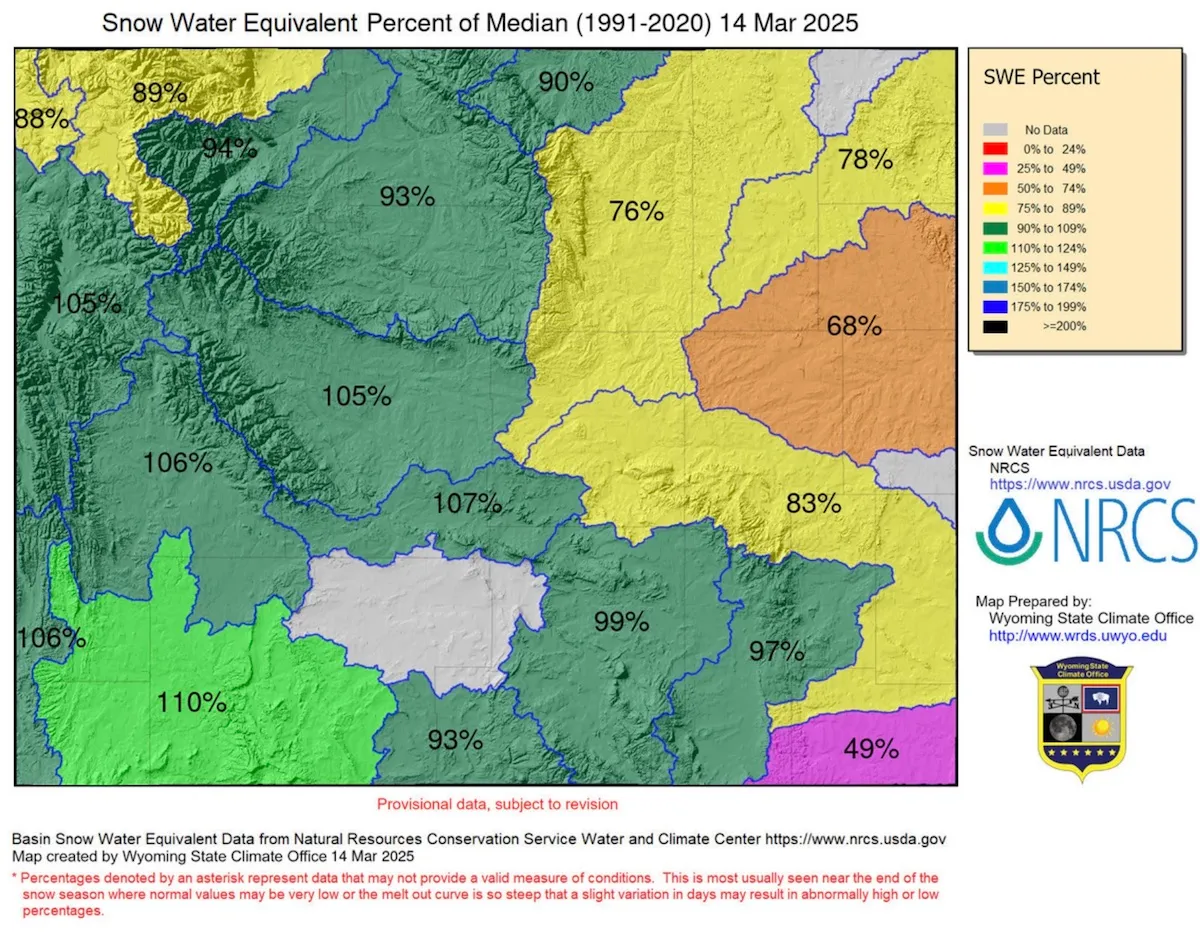
Wyoming is emerging from a fairly mild winter that has been devoid of brutal, prolonged cold snaps or massive snow dumps. With a “snow water equivalent” hovering around 94% of the median across the state, snowpack is “looking pretty good,” according to Natural Resources Conservation Service Water Supply Specialist Jeff Coyle.
There’s lower-than-normal snowpack in the northeast, including the southern portion of the Bighorn Mountains and some parts of the Black Hills on the South Dakota border.
“We’re on course to be kind of an average year in most areas of the state,” Coyle said, adding that both high elevations and basin areas appear to be meeting typical expectations. The wild card, of course, is what Mother Nature might deliver this spring — a time when Wyoming can see its biggest snow dumps.

Despite an early February snowstorm that helped pad winter snowpack in the southeast, areas around Cheyenne and Laramie are about a foot below average, according to Cheyenne National Weather Service Meteorologist Mike Charnick. Accumulation of the white stuff in the Snowy Range, however, is average and even a bit more in some areas there.
In terms of overall winter precipitation in the southeast, it was among the top 10 or 12 driest years, according to another Wyoming meteorologist.
Generally speaking, it was a “mild” winter in terms of temperature — particularly in the southeast, Charnick said. “We have certainly been pretty far above average,” he said. “The lowest temperature in February was minus six [degrees Fahrenheit] and minus 12 [degrees Fahrenheit] in January.”
Winter was warmer-than-usual in other parts of the state, too.
“Western and southwest Wyoming was in the top third of warmest years over the last 115 years, whereas the rest of the state was pretty close to normal,” Riverton National Weather Service Meteorologist Lance VandenBoogart said.
