Despite Staff and Budget Cuts, NOAA Issues Critical Drought Warnings in Its Spring #Climate Outlook — Bob Berwyn (InsideClimateNews.org)

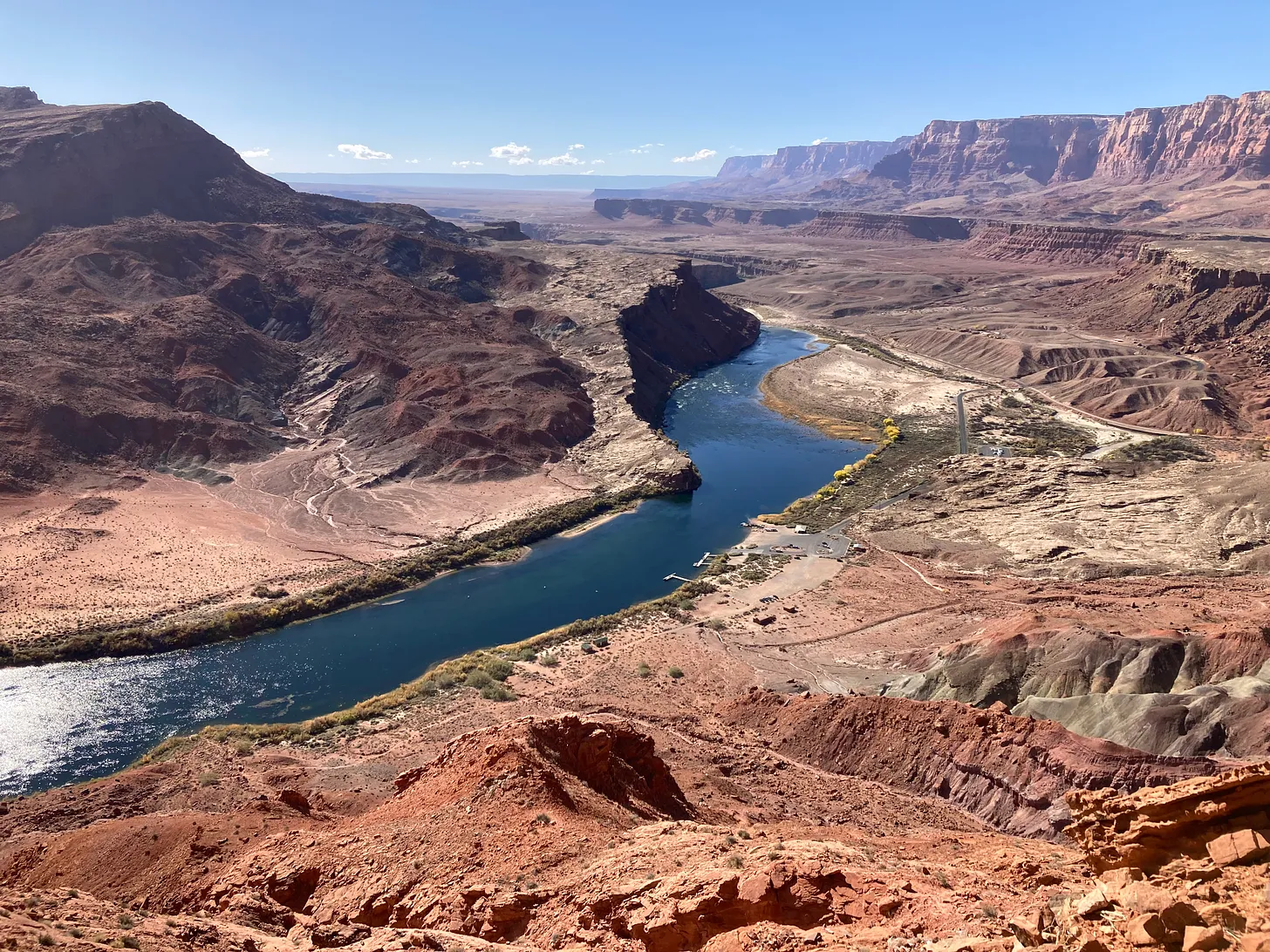
The Colorado River at Lees Ferry, the dividing line between the Upper Basin and Lower Basin states. Jonathan P. Thompson photo.

Click the link to read the article on the Inside Climate News website (Bob Berwyn):

March 24, 2025

The embattled agency continues to disseminate crucial updates in a hostile political environment, while scientists warn that cutting climate intelligence is folly at a time of escalating climate extremes.

The National Oceanic and Atmospheric Administration, although battered by Trump administration attempts to impose massive staff and budget cuts on the agency, nevertheless continues to publish critical climate information, including some dire drought warnings in the spring outlook published March 20 by NOAA’s Climate Prediction Center.

The outlook calls for continued dry conditions in the Southwest, where global warming is a key driver of a long-term megadrought that is already disrupting water supplies to cities and nationally important agricultural zones.
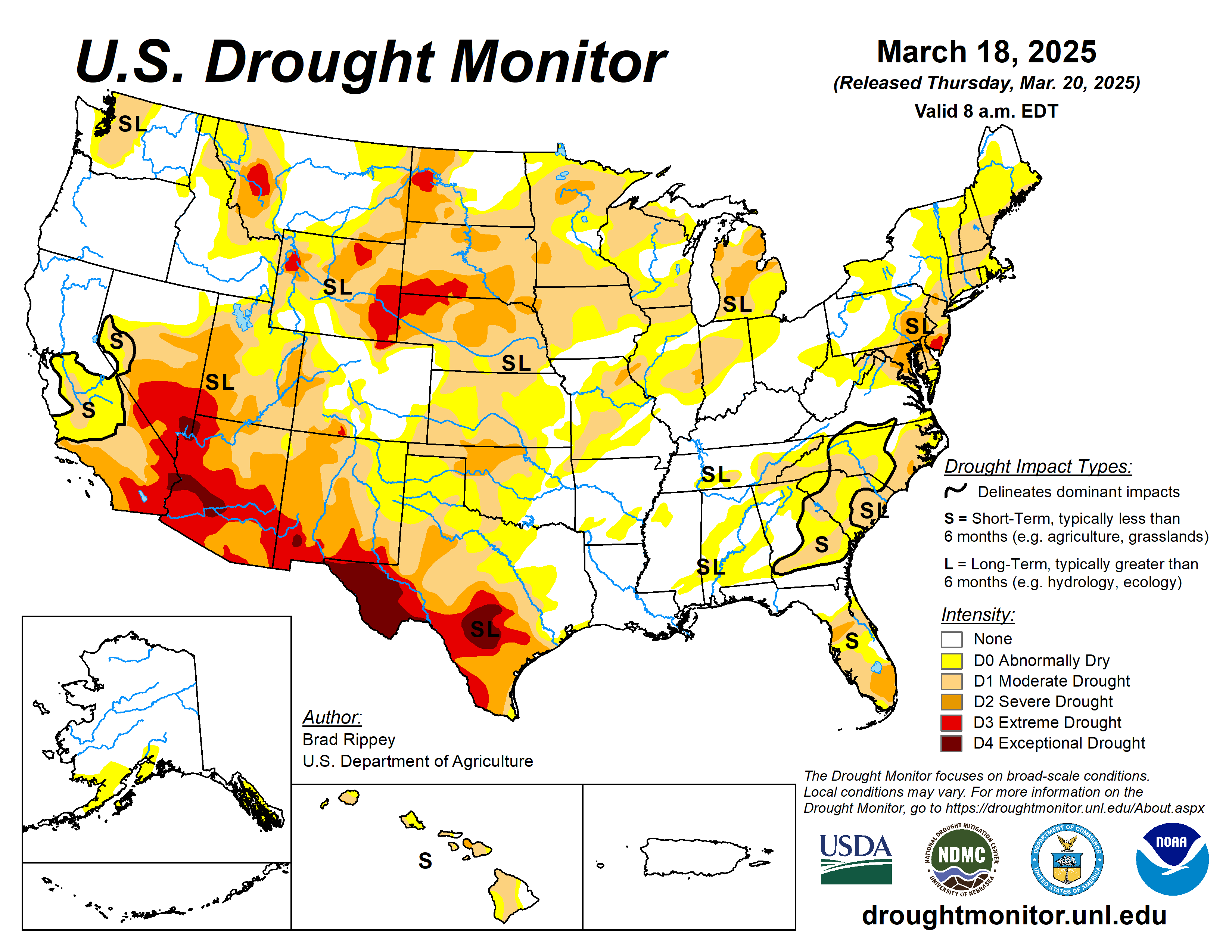
US Drought Monitor map March 18, 2025.

About 40 percent of the contiguous 48 states are currently in some stage of drought or abnormally dry conditions, and those are expected to persist in the Rocky Mountains and the Southwest and Southern Plains, according to the March 20 bulletin. 

In the past two weeks, water officials in the West warned that, despite near-average snowpack in some parts of the Colorado River’s mountain watershed, the river’s flows are expected to drop below normal, exacerbating tensions between water users in the region. In New Mexico, water experts said the Rio Grande is likely to dry up completely in Albuquerque as early as June. A 2024 study explained how global warming drives a cycle that leads to measured flows in Western rivers and streams being consistently lower than predictions based solely on snowpack measurements.

Other recent research suggests drought risks in North America have been widely underestimated by major climate reports, as rising global temperatures bake the moisture out of plants and out of the soil itself. Annual cycles of decreasing winter snow followed by extreme heat are pushing “a global transition to flash droughts under climate change,” a 2023 study concluded.

“Watch out,” said Dave Breshears. a University of Arizona climate and tree researcher and regents professor emeritus. “We have a triple whammy, with areas already in drought headed into more drought and associated with warmer than usual temperatures. Hotter droughts make wildfires more likely, more extreme and bigger.”

Breshears has co-authored research showing “what conditions cause lots of trees to die, and we know if hotter droughts continue for a longer period, we could have more die-off of trees and other plants,” he said. “This becomes a fuel source for future wildfires.”

NOAA needs more, not fewer, resources to adequately identify such rapidly intensifying climate threats that put people, food supplies and ecosystems at risk, he said.

“The large-scale coordinated data that our premier federal agencies bring together to create these products are so important to so many people on a day-to-day basis,” he said. “Many of them are not aware of the ultimate source of this information.” NOAA’s widespread coordination of data for important reports like the seasonal outlooks is “something we won’t be able to reproduce if they aren’t there for us,” he added.

Citing its aims to reduce costs and make government more efficient, the Trump administration tried to fire hundreds of NOAA employees in February. On March 13, a federal judge in Maryland issued a temporary restraining order, and the U.S. Department of Commerce then said it would reinstate employees—but put them on administrative leave pending further judicial review.

The continuing budget resolution passed by Congress March 14 reduces NOAA’s operations, research and facilities budget by 11 percent from the previous year, and according to congressional sources, it stripped away some of Congress’s budgetary oversight privileges. That could enable the Trump administration to zero out budgets for programs and offices within NOAA and use its ocean and climate budgets as a slush fund.

In the past week, the National Weather Service, a branch of NOAA, said it was cutting the number of weather balloon launches at several locations, which could compromise the agency’s ability to provide timely and accurate drought warnings, as well as forecasts for other dangerous extremes.

In early February, NOAA also removed the latest edition of a climate literacy guide from its website. The guide was designed specifically to help educate the public about climate science and efforts to halt global warming and adapt to its impacts. The 2024 edition of the guide included information about Indigenous knowledge related to climate and environmental justice, both topics that have been targeted for censorship by the Trump administration. But a copy of the guide was preserved and posted online by a designer involved in its conception.

“Purging the government of scientists, experts, and career civil servants and slashing fundamental programs will cost lives,” said Sen. Chris Van Hollen (D-MD) in a prepared statement. “The Trump Administration’s illegal actions to slash NOAA’s workforce indiscriminately and without cause will only hurt vital services that Americans depend on. My Democratic colleagues and I will keep fighting back in state and federal courts, in the halls of Congress, and the court of public opinion.”

Regarding NOAA’s spring outlook, University of Michigan climate scientist Jonathan Overpeck said, “It looks rough for the western half of the country, and especially the Southwest. It’s been really dry this winter, and with temperatures projected to be above normal, and precipitation below normal, it means that the megadrought that has gripped the region since 1999 will intensify.”

The outlook is bad news for Colorado River and Rio Grande flows, and for soil moisture and vegetation health across the region. Drying vegetation heightens concerns for another bad wildfire season in the Southwest, he added.

“This is what hot drought looks like and what climate change looks like,” he said. “It’s grim and will keep getting worse over years to come if we don’t halt the burning of fossil fuels.

Udall/Overpeck 4-panel Figure Colorado River temperature/precipitation/natural flows with trend. Lake Mead and Lake Powell storage. Updated through Water Year 2024. Credit: Brad Udall

Case study details water #conservation wins in #Colorado — National #Drought Mitigation Center

Bessemer Ditch circa 1890 via WaterArchives.org

Click the link to read the article on the National Drought Mitigation Center website:

March 2025

The Bessemer Ditch is an irrigation canal that serves agricultural areas in Pueblo County. In 2009 and 2010, the Pueblo Board of Water Works acquired nearly one-third of water rights to the ditch to supply the city of Pueblo with water. While necessary to support the city, it simultaneously threatens producers’ livelihoods.  

Since 2015, Palmer Land Conservancy, a nonprofit based in Colorado Springs, has been working with the county to help preserve the area’s agricultural identity while allocating water wisely.

As part of these efforts, a “substitution of dry-up” provision was developed and later incorporated into Pueblo Water’s decree. This keeps the most fertile agricultural land in production by enabling voluntary, market-based transactions where less productive farmland is substituted to be dried-up. 

Palmer was invited to work with the Pueblo County agricultural community to identify ideal dry-up candidate areas (DCAs) through the Bessemer Farmland Conservation Project. The DCA farms, which are often located along riparian corridors, would be revegetated once dried up, according to the plan—bolstering local ecology. 

The project is funded by the Colorado Water Conservation Board of the Colorado Department of Natural Resources and partners.

Read the case study.

U.S. Denial of #Mexico’s Request Sparks Diplomatic Strain: Water at a Breaking Point — #Texas Border Business #RioGrande #ColoradoRiver #COriver #aridification

Created by Imgur user Fejetlenfej , a geographer and GIS analyst with a ‘lifelong passion for beautiful maps.’ It highlights the massive expanse of river basins across the country – in particular, those which feed the Mississippi River, in pink.

Click the link to read the article on the Texas Border Business website. Here’s an excerpt:

March 25, 2025

In a historic and consequential move, the United States has officially denied Mexico’s request for a special water delivery from the Colorado River to Tijuana. The Bureau of Western Hemisphere Affairs, a U.S. Department of State division, addressed this matter on March 20, 2025, via their official social media channels. It marks the first time since the signing of the 1944 Water Treaty that such a request has been rejected — signaling deepening tensions over water management and compliance between the neighboring nations. The 1944 treaty, a longstanding bilateral agreement, regulates water distribution between the U.S. and Mexico between the Rio Grande and Colorado Rivers. According to the treaty, Mexico must deliver 1.75 million acre-feet of water to the U.S. over five-year cycles, averaging 350,000 acre-feet annually. However, by late 2024, Mexico had fallen over one million acre-feet behind its commitments. Officials attribute this shortfall to a combination of prolonged drought, increased agricultural demands, and aging infrastructure on the Mexican side of the border. The U.S. Department of State defended its decision by citing the severe impact that Mexico’s ongoing shortfalls have had on American agriculture — particularly in the Rio Grande Valley of Texas, where water scarcity is crippling the livelihoods of thousands of farmers. Crops such as citrus, cotton, and vegetables have suffered from reduced irrigation, leading to lower yields and economic instability in the region…

Tijuana, which sources approximately 90% of its water from the Colorado River, faces intensifying shortages. The city’s aging infrastructure, combined with the broader regional drought, means the denial of emergency water deliveries from the U.S. could further strain Baja California’s already fragile water supply systems. The water crisis is also reshaping the agricultural landscape in South Texas — most notably in Santa Rosa. The Rio Grande Valley Sugar Growers, Inc. (RGVSG), a cooperative of over 100 family-owned farms and the last remaining sugar mill in Texas, was forced to shut its doors after over five decades of operation. The closure followed a dramatic decline in sugarcane acreage, which dropped from 34,000 acres in early 2023 to just 10,000 by early 2024. Without reliable irrigation water — much of it linked to Mexico’s unmet deliveries — sugarcane farming became economically unsustainable.

Tommy Beaudreau on “The Lords of Yesterday and the Imperatives of Now”: Challenges to Energy Transition on Public Lands — Victoria Matson and Oliver Skelly (Getches-Wilkinson Center) #ActOnClimate

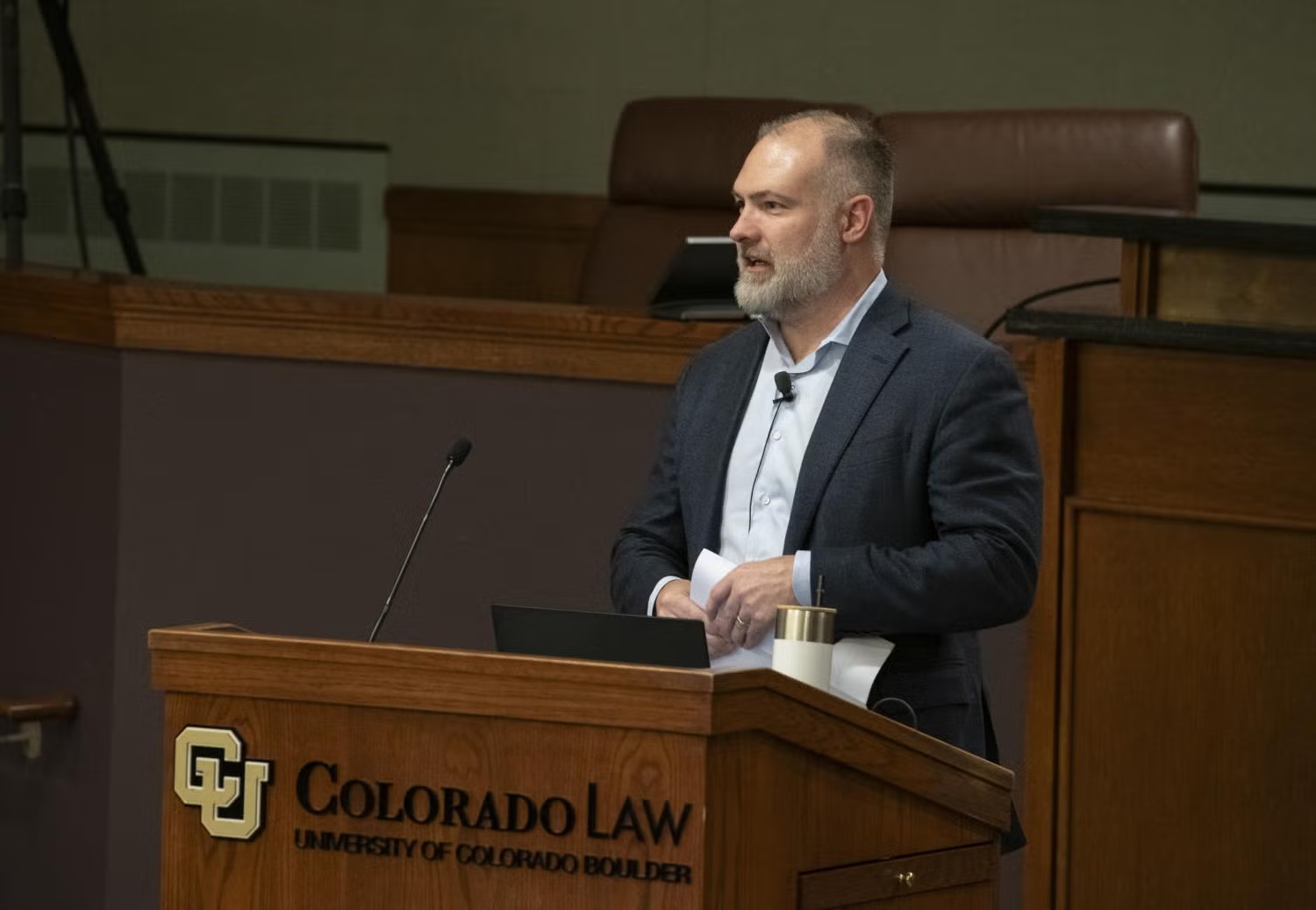
Tommy Beaudreau at the 2025 Schultz Lecture in Energy. Photo credit: Getches-Wilkinson Center

Click the link to read the article on the Getches-Wilkinson Center website (Victoria Matson and Oliver Skelly):

March 20, 2025

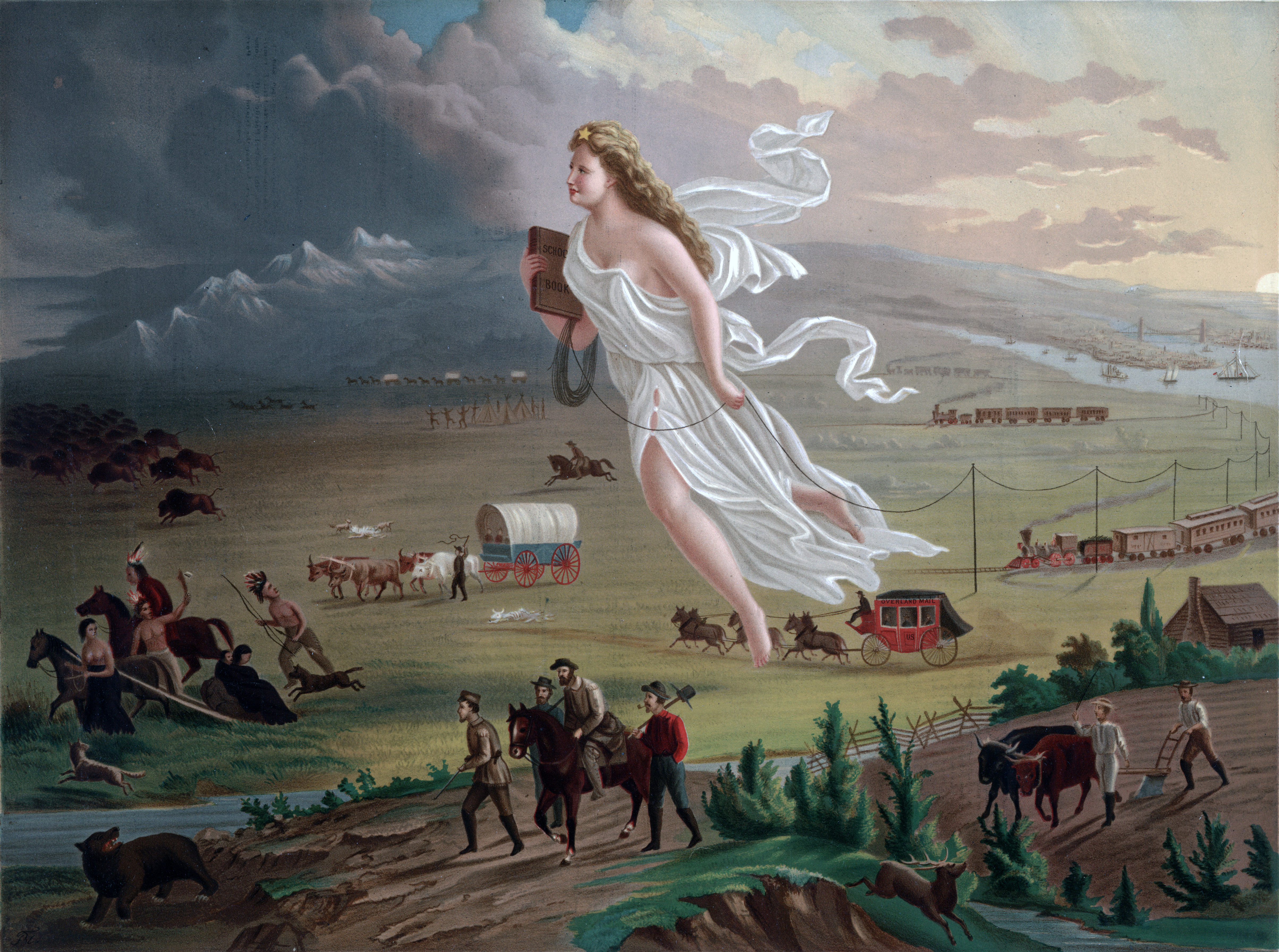
On Tuesday, February 25th, Tommy Beaudreau, former Deputy Secretary of the Interior, delivered the Schultz Lecture, offering a sobering analysis of the structural, legal, economic, and political hurdles to the energy transition on public lands. His talk, “The Lords of Yesterday and the Imperatives of Now,” constituted a tribute to the late Charles Wilkinson’s coined phrase. Harkening back to Wilkinson’s work, Beaudreau traced these contemporary challenges to the legacy of westward expansion and Indigenous displacement, illustrating how outdated laws and entrenched interests continue to shape today’s energy policies.

American Progress (1872) by John Gast is an allegorical representation of the modernization of the new west. Columbia, a personification of the United States, is shown leading civilization westward with the American settlers. She is shown bringing light from east to west, stringing telegraph wire, holding a book, and highlighting different stages of economic activity and evolving forms of transportation. By John Gast – This image is available from the United States Library of Congress’s Prints and Photographs division under the digital ID 09855.This tag does not indicate the copyright status of the attached work. A normal copyright tag is still required. See Commons:Licensing for more information., Public Domain, https://commons.wikimedia.org/w/index.php?curid=373152

Beaudreau framed public lands as a political flashpoint in the energy transition. While state and private lands—particularly in North Dakota and the Southwest—have played significant roles in the oil and gas boom, debates over renewables, permitting, and leasing disproportionately focus on federal lands. Ironically, legal tools once used to block fossil fuel projects are now being turned against renewables, complicating efforts to decarbonize.

Beyond regulatory hurdles, fossil fuel revenues remain deeply embedded in state economies, funding schools, public safety, and infrastructure. Many Tribal nations, too, rely on fossil fuel revenues, balancing economic interests with environmental concerns. Beaudreau stressed that a “just transition” must provide financial alternatives before communities can fully embrace renewables.

Outdated laws, like the 1872 Mining Law, remain a major obstacle to energy reform. Beaudreau highlighted the Inflation Reduction Act (IRA) as a key step in shifting energy policy, but legal battles persist over leasing rights, mineral access, and state-federal control. He pointed to Louisiana’s lawsuit over the Biden administration’s oil and gas lease moratorium, which raised critical questions about governmental statutory and commercial contractual rights in energy development.

Economic arguments also dominate the debate. Critics claim renewables are too costly for federal subsidies, mirroring past fights over offshore oil incentives. Meanwhile, global competition—especially China’s control of solar panel and battery supply chains—adds geopolitical complexity to the transition.

Despite these challenges, Beaudreau offered a measured note of optimism. He pointed to Western landowners and ranchers, historically conservation advocates, as potential allies in sustainable land management. Their interest in wildlife migration corridors and outdoor access could foster new conservation coalitions.

This map shows land owned by different federal government agencies. By National Atlas of the United States – http://nationalatlas.gov/printable/fedlands.html, “All Federal and Indian Lands”, Public Domain, https://commons.wikimedia.org/w/index.php?curid=32180954

Ultimately, Beaudreau underscored that energy transition requires modernizing laws, addressing economic realities, and building broad political consensus. As attendees left Wittemyer Courtroom, they carried with them a clear message: the road ahead is uncertain, but public lands remain central to shaping America’s energy future and, as Wilkinson’s “lords of yesterday” remain, the imperatives of change have arrived.

The recording of the 16th annual Schultz Lecture can be found here.

Native land loss 1776 to 1930. Credit: Alvin Chang/Ranjani Chakraborty

From email from the Getches-Wilkinson Center (Annie Carlozzi):

Thank you for joining the Getches-Wilkinson Center and the Center of the American West for the Schultz Lecture in Energy on February 25th! We are so grateful to Tommy Beaudreau for making time in his schedule to spend lunch with our law students and the evening with all of our attendees in person and online.

We have a few things to share with you:

Conference Photos

Barb Colombo of 11:11 Productions Photography has provided us with wonderful images of the lecture with Tommy Beaudreau. We’ve added them to a Flickr album for easy viewing here.

Conference Recordings

The Law School IT Team has released the recording from the lecture.

GWC Blog
Current Colorado Law students Victoria Matson and Oliver Skelly shared their reflections on Tommy Beaudreau’s visit to the Colorado Law School on the GWC blog. You can read their piece here.

Upcoming Event

We hope you will consider joining us for the annual Colorado River Conference co-convened by GWC and the Water & Tribes Initiative. You can find more information on our website regarding this year’s theme: Turning Hindsight into Foresight: The Colorado River at a Crossroads.

Photo credit: Getches-Wilkinson Center