#Colorado Basin Forecast Center Water Supply Forecast Discussion March 17, 2025 — NOAA #ColoradoRiver #COriver #aridification

Click the link to read the discussion on the Colorado Basin River Forecast Center website:

The Colorado Basin River Forecast Center (CBRFC) geographic forecast area includes the Upper Colorado River Basin (UCRB), Lower Colorado River Basin (LCRB), and Eastern Great Basin (GB).

Water Supply Forecasts

The mid-March water supply outlook for the UCRB and GB is generally below normal and summarized in the figure and table below. Snowpack, soil moisture, and future weather are the primary hydrologic conditions that impact the water supply outlook.

Mid-March water supply summary. Credit: Colorado Basin River Forecast Center

March Weather

The first half of March brought an active pattern across the entire CBRFC area, including the wettest period of the season for the LCRB. Most of the mountains of AZ and UT experienced above average precipitation, with more of a mixed bag for the mountains of CO and WY. Given the cold temperatures, the bulk of precipitation that fell over the high terrain fell as snow.

For context, Flagstaff, AZ has already experienced its 16th snowiest March on record (out of 126 years) with 35.6 inches of snow. However, if the season were to end today, it would also rank as the 22nd least snowy water year on record. A similar story can be applied to much of the rest of the LCRB – while March has seen a wet start, the season as a whole remains historically dry. Water year-to-date precipitation remains near normal across the northern basins of the GB and UCRB.

See the figures below for details.

Credit: Colorado Basin River Forecast Center

Snowpack Conditions

UCRB mid-March snow water equivalent (SWE) conditions range between 65-115% of normal and are most favorable across northern areas including the Upper Green, White/Yampa, and Colorado River headwaters, and Gunnison basins. SWE is below to well below normal elsewhere across the UCRB, with the least favorable conditions in the San Juan River Basin. Mid-March observed SWE ranks in the driest five at several SNOTEL stations in the Gunnison, Dolores, and San Juan basins. UCRB mid-March snow covered area is around 99% of the 2001-2024 median. A recent Colorado Dust-On-Snow (CODOS) report indicates this is the least severe dust-on-snow winter to-date, with the period of record dating back to 2004.

LCRB mid-March SWE conditions tend to fluctuate more frequently and are difficult to provide statistics for due to percentages being computed using smaller values. With that said, LCRB SWE conditions are highly variable (45-170% of normal), with the poorest conditions in southwest UT and the most favorable conditions in central AZ.

GB March 1 SWE conditions range between 60-110% of normal and generally improve from south to north. SWE is generally near normal across most of the GB, with the least favorable snowpack conditions in the Sevier River Basin, where mid-March SWE is below the 10th percentile and ranked in the driest three on record at several SNOTEL sites. UT snow covered area is around 124% of the 2001-2024 median. SWE conditions are summarized in the figure and table below.

Credit: Colorado Basin River Forecast Center

Soil Moisture

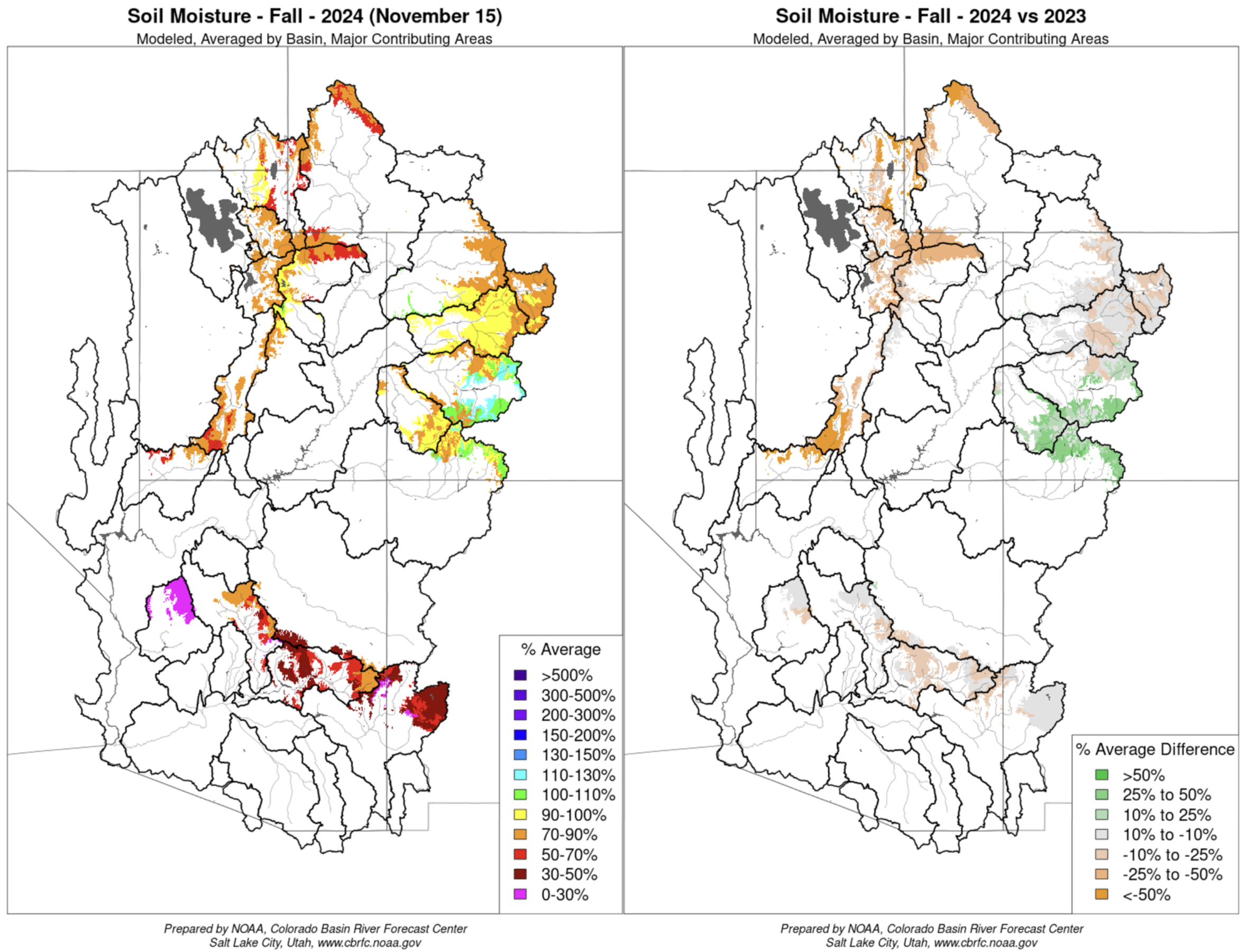
CBRFC hydrologic model fall (antecedent) soil moisture conditions impact water supply forecasts and the efficiency of spring runoff. Basins with above average soil moisture conditions can be expected to experience more efficient runoff from rainfall or snowmelt while basins with below average soil moisture conditions can be expected to have lower runoff efficiency until soil moisture deficits are fulfilled. The timing and magnitude of spring runoff is impacted by snowpack conditions, spring weather, and soil moisture conditions.

A very dry June-October 2024 across southwest WY and UT resulted in soil moisture conditions that are below normal and worse compared to a year ago. NW CO soil moisture conditions are near to below normal and similar compared to a year ago. SW CO soil moisture conditions are closer to average and improved from a year ago due to a wetter than normal monsoon (mid-June through September). Monsoon precipitation was near/below normal across the LCRB, where soil moisture conditions are below average and similar compared to last year. CBRFC hydrologic model soil moisture conditions are shown in the figures below.

November 2024 CBRFC hydrologic model soil moisture conditions – as a percent of the 1991-2020 average (left) and compared to November 2023 (right). Credit: Colorado Basin River Forecast Center

Upcoming Weather

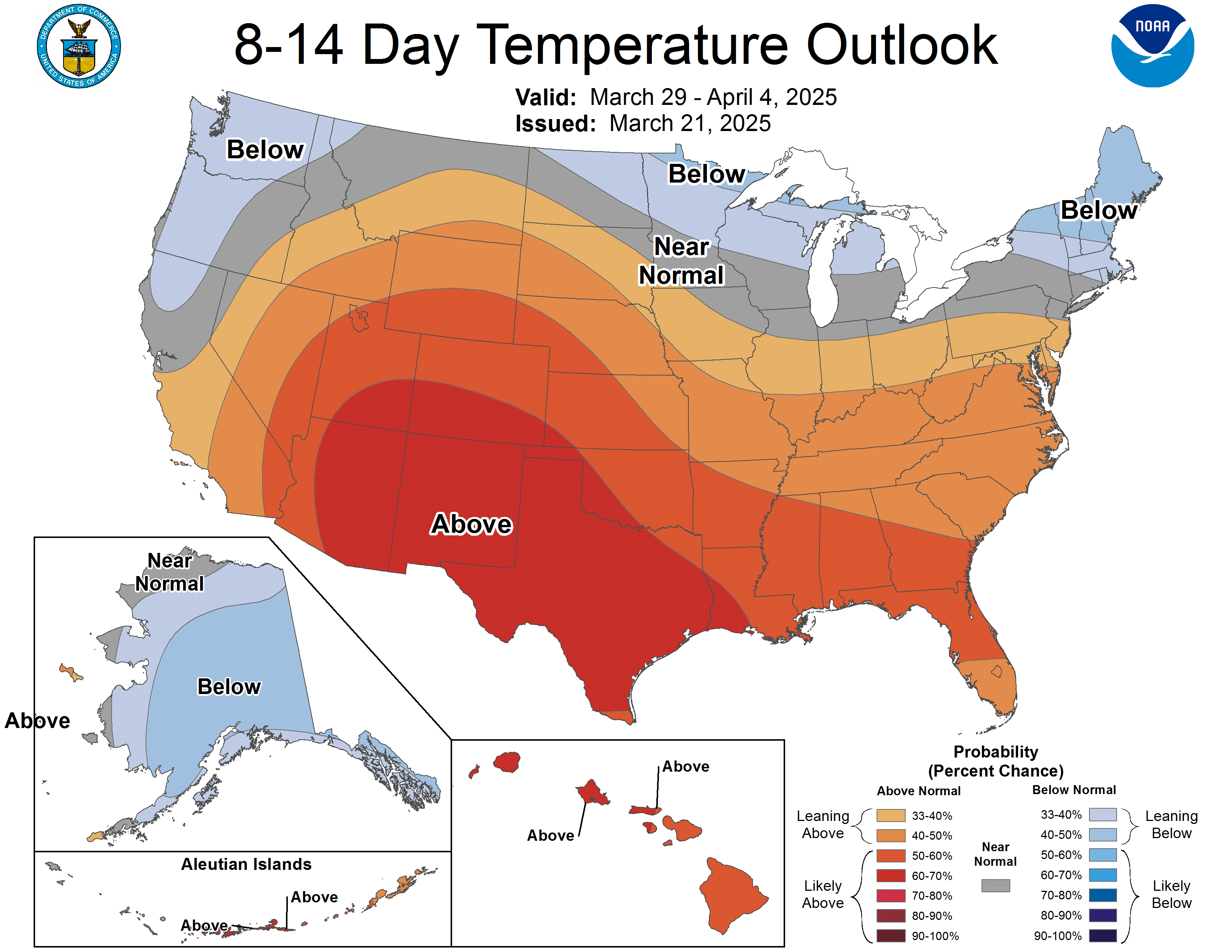
The next week will continue to bring cold temperatures and waves of precipitation across much of the GB and UCRB, while the LCRB dries out. Over the next seven days, expect 1–3 inches of precipitation for the northern mountains of the GB and UCRB. Lighter amounts are forecast elsewhere in the GB and UCRB, with little of anything for the LCRB. Beyond the next week, there is an increased chance for warmer and drier than normal conditions across much of the CBRFC area. See the figures below for details.

7-day precipitation forecast for March 17–23, 2025. Credit: Colorado Basin River Forecast Center
Climate Prediction Center temperature probability forecast for March 29 to April 4, 2025.
Climate Prediction Center precipitation probability forecasts for March 29 to April 4, 2025.

Report: State of the Birds Report 2025 United States of America — StateOfTheBirds.org

Click the link to read the report on the StateOfTheBirds.org website. Here’s the executive summary:

This 2025 edition of the State of the Birds report is a status assessment of the health of the nation’s bird populations, delivered to the American people by scientists from U.S. bird conservation groups.

5 Years After the 3 Billion Birds Lost Research, America Is Still Losing Birds. A 2019 study published in the journal Science* sounded the alarm—showing a net loss of 3 billion birds in North America in the past 50 years. The 2025 State of the Birds report shows those losses are continuing, with declines among several bird trend indicators. Notably duck populations—a bright spot in past State of the Birds reports, with strong increases since 1970—have trended downward in recent years.

Conservation Works. Examples spotlighted throughout this report—from coastal restoration and conservation ranching to forest renewal and seabird translocations—show how proactive, concerted efforts and strategic investments can recover bird populations. The science is solid on how to bring birds back. [ed. emphasis mine] Private lands conservation programs, and voluntary conservation partnerships for working lands, hold some of the best opportunities for sparking immediate turn-arounds for birds.

Bird-friendly Policies Bring Added Benefits for People, and Have Broad Support. Policies to reverse bird declines carry added benefits such as healthier working lands, cleaner water, and resilient landscapes that can withstand fires, floods, and drought. Plus birds are broadly popular—about 100 million Americans are birdwatchers, including large shares of hunters and anglers. All that birding activity stimulates the economy, with $279 billion in total annual economic output generated by birder expenditures.

Budget disputes stall passage of #GoldKingMine Spill Act: Legislators will continue to pursue financial compensation for affected Coloradans — The #Durango Herald

This image was taken during the peak outflow from the Gold King Mine spill at 10:57 a.m. Aug. 5, 2015. The waste-rock dump can be seen eroding on the right. Federal investigators placed blame for the blowout squarely on engineering errors made by the Environmental Protection Agency’s-contracted company in a 132-page report released Thursday [October 22, 2015]

Click the link to read the article on The Durango Herald website (Jessica Bowman). Here’s an excerpt:

March 17, 2025

Colorado Sen. Micheal Bennet’s efforts to compensate business owners who were financially harmed by the 2015 Gold King Mine spill have been impeded by yet another roadblock – the passage of stopgap funding legislation in Congress…

TheĀ Gold King Mine Compensation ActĀ was introduced for the second time in February by Colorado Sens. Michael Bennet and John Hickenlooper, alongside Rep. Jeff Hurd. It would have given the EPA $3.3 million to compensate the residents and businesses affected by the mine spill. Earlier this month the House of Representatives passed a continuing resolution: short-term legislation that maintains current federal spending levels to prevent a government shut down. The Senate passed the bill on Friday. The continuing resolution leaves out funding for the bill said Hurd’s chief of staff, Nick Bayer. The resolution’s passage has stalled the passage of the Gold King Mine Compensation Act, leaving it with no clear path forward, Bennet’s Four Corners Regional Director John Whitney said Tuesday at Durango’s Economic Development Alliance meeting.

The ā€œBonita Peak Mining Districtā€ superfund site. Map via the Environmental Protection Agency

Romancing the River: Learning to Live in the Anthropocene — George Sibley (SibleysRivers.com) #ActOnClimate

Image credit: Sibley’s Rivers

Click the link to read the article on the Sibley’s Rivers website (George Sibley):

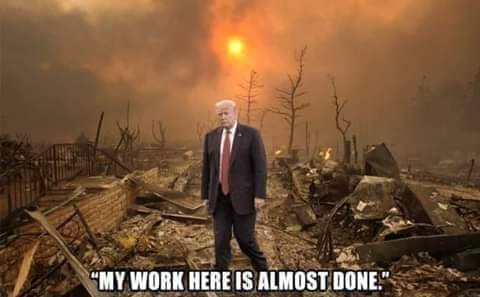
Fiddling while Rome burns – that’s what it felt like, thinking about the next blog post on the intricate subtleties of learning to live with the Colorado River, while all around us things we value are being broken by a PINO and his self-appointed unelected shotgun, claiming that a 1.5 percent voter ā€˜mandate’ gives them license to do any damn thing they want to us and to the institutions we have evolved over 250 years to try to govern ourselves.

PINO: President in Name Only, not just because he is not behaving the way presidential behavior is constitutionally defined, but mostly because the PINO himself is not satisfied with ā€˜president’; he has publicly stated his belief that ā€˜king’ would be a better name to call him, or whatever name would anoint him with the total authority he believes he warrants. Therefore, President in Name Only, until he can anoint himself with a name more fitting.

So anyway – Rome is burning. Or to abandon the metaphor for a little more accuracy – America is burning; the nation-state that we have evolved into a position of global leadership (even if we aren’t sure where we are leading to) is being broken up like old worn-out furniture and thrown on a burn-pile. America is burning, and for the most part most of us are just fiddling as it happens. Carrying on like it were just another day in our exceptionalist paradise because, well, what else are we going to do? When it comes down to it, the goal in the Preamble to the Constitution most of us most want is the one to ā€˜insure domestic Tranquility,’ and who wants to take on a handful of narcissistic egomaniacs throwing that Constitution on the bonfire of their vanities? It is as the poet Yeats said: ā€˜The best lack all conviction, while the worst / Are full of passionate intensity.’

Most of the politicians who call themselves ā€˜Democrats,’ and who might therefore be expected to try with similar vigor to stop this destruction of our imperfect but sincere effort at democracy, are lying low, saying let the ā€˜Repugnican’ wing of those who call themselves ā€˜Republicans’ dig themselves into a hole they eventually won’t be able to get out of. The problem there is that the hole they are digging was the foundation of our democracy, and we are kind of in the hole with them. And as with Humpty Dumpty, all the president’s horses and all the president’s men may not be able to put Trumpty-Mumpsy’s debris of democracy back together again – if we can even muster the will to try.

Our generally convictionless media have been snide about the Repugnicans in Congress being ā€˜cowed’ by the PINO, afraid to speak up. But I think the PINO is doing exactly what most of the Repugnican wing of the once-responsible Republican party want him to do, and would be doing themselves, were they not afraid of having to face their electorate about what it is doing to them. We had, and some of us even read, their ā€œProject 2025’ plan for more than a year before the election, which lays out in considerable detail exactly what they planned to do if elected, and we elected them, and they are executing their plan with a passionate intensity.

The callous and casual cruelty of what the Repugnicans are doing under PINO’s flood-the-zone assault is astounding. They have summarily fired thousands of our fellow Americans for no reason other than the fact that they were working at jobs created by saner, more far-sighted and big-hearted Congresses back when we wanted our government to be a positive force in the nation and the world, as well as possessed of and by the biggest military hammer ever assembled to which every incipient conflict in the world looked like a nail. But in addition to that cruelty, the DOGEies have illegally frozen the funds already committed by Congress to fund those agencies and departments, which will cause considerable stress and even death in the nation and around the world.

The DOGEy chainsaw massacre seems to have focused on three areas. First, any agency or department that tries to help people who are not wealthy is on the sawbuck for cutting; this ranges from USAID which tries to help the truly poor of the world, to organizations like the Consumer Financial Protection Bureau that tries to prevent predatory organizations like banks and other more usurious organizations from taking advantage of U.S. citizens. The DOGEies have not yet set the chainsaw to Social Security and Medicare (although those remain long-term targets for the Repugnican element), but Medicaid will undoubtedly receive serious amputations soon if any semblance of the current Republican budget proposal gets passed. To fund tax cuts for the wealthy, even SNAP benefits will be cut – one area where Trump’s promise to reduce grocery costs could be actually be fulfilled, but, well, it’s the fraud, you know. And the Trump approach to ferreting out fraud in federal programs is to shoot first, then question the corpse.

The second area of DOGEy massacres is any federal entity charged with being a watchdog on the government itself. Federal inspectors general have been fired; the Department of Justice has been totally weaponized to support the PINO, including the office charged with investigating corruption in the government. This opens the gate for patronage at best – already evidenced by PINO’s staff and his strange selections of thoroughly unqualified cabinet members.

And a third area for cutting/freezing/killing is anything remaining that might make people appreciate their federal government. Staffs for both the National Park Service and the Forest Service that manages the National Forests have been severely cut after decades of small cuts. It is as if the Repugnicans want people to have unpleasant experiences visiting our national treasures – possibly preparatory for ā€˜privatizing’ them or just selling them off; their protection from exploratory drilling and oil-and-gas leasing will probably be eroded. The Environmental Protection Agency, which also has considerable popular support for improvements in local waterways and other areas where both beauty and public health have been served, now has a new mission, according to its new director: to make using your car and heating your house cheaper. Drill, baby, drill.

Beyond the DOGEy chainsaw massacres on we the people, there’s PINO actions on the international level, where he seems determined to alienate all of our longtime democratic friends, and court all of the growing number of autocratic or oligarchic nations. We laughed uneasily when he talked about ā€˜annexing’ Canada, Greenland, the Panama Canal; now we have stopped laughing because he won’t stop talking about it.

Summing it all up – the callous cruelty, the constant lying and false promises, the economic attacks on his own base, the insulting attacks on our longtime allies, the fawning behavior toward a longtime enemy, the midnight rages that he immortalizes on his ā€˜Truth Social’ site, the childish conviction that if we officially purge all mention of the climate crisis from any public discourse the crisis will no longer exist – all of these things make one wonder if we have not maybe elected a psychologically sick person to the presidency, a malignant narcissist slipping into dementia.

But then we remember that most of the substantive things he and his sidekick Elon are doing – excepting the more ā€˜personalized things like the childish language excision and the mad rants – is laid out in some detail in ā€˜Project 2025,’ authored by some of the people he has appointed to high places in governance.

The conspiracy theorist in my overactive brain sees the ā€˜Project 2025’ minions letting the PINO go until he has completely destroyed the existing government, then convening the cabinet to relieve him of his duties due to ā€˜illness’ and putting the vice-president in his seat. That would give us J.D. Vance who, to my mind, is a much more dangerous person than the PINO, who gets lost too easily in his own self-admiration and paranoia.

But all that I’ve said there sounds to me like just more fiddling while America burns. What am I doing about it; what am I going to do about it? For the moment, continue reading the news, calling my senators, and occasionally my representative (a Repugnican who I think would rather be a Republican). But it drives me back to what I wrote when I started posting these reflections. The subtitle for this blog is ā€˜Learning to Live in the Anthropocene.’ That is the long game here: adapting mentally and psychologically, then economically and politically, to the fact that we have – however inadvertently – become change agents at the planetary level.

This is not a small thing; it requires a paradigm shift to end all paradigm shifts, in the way we see ourselves in the world, and that kind of shift obviously does not happen overnight. In an earlier post here, I described Elizabeth Kubler-Ross’s five stages in the acceptance of death ā€“ but really the acceptance of anything that uproots our sense of who and what we are, and what we should do. Those five stages:

  • Denial:Ā Ā This can’t be true; this can’t be happening here; if we ignore it, will it go away?
  • Anger:Ā Ā This is notĀ myĀ fault; it is the fault of (Choose one or two: the immigrants, the Jews, the blacks, the whites, God, etc.).Ā Get rid of them, and we’ll get rid of the problem.
  • Negotiation:Ā Ā Maybe we tweak a few things that will enable us to adapt without changing everything.
  • Depression:Ā Ā Damn. Nothing works to change the fact that the facts have changed. Our old world is dying. I want to go to sleep forever.
  • Acceptance:Ā Ā Well. There’s nothing to do but to make do with what’s left – and what’s new where what was no longer is. Is something new possible? Lifeboat dialogue: ā€˜Pull for the horizon, boys. It’s better than nothing.’

And where are we now? We are so deep in denial about the changes we have inadvertently imposed on the planet, that we have elected a president who promised to make denial official policy – who has officially removed any mention of ā€˜climate crisis,’ ā€˜renewable energy’ and ā€˜green anything’ from any government communication.

There is anger too – the transition between denial and anger is a slow smoldering segue as denial is worn thin under abrasion from reality, and we begin to try to figure out who we can blame for the no-longer-ignorable reality. We get dangerous when we get angry.

And that’s where we are. President Biden had actually begun to try to move us on to the negotiation stage – how much of the world that we have and sort of love can we still have if we get more serious about a new infrastructure of energy and transportation…. But now we are back in the murky world of threadbare denial and enough anger to declare open war on anyone we can convince ourselves is part of our problems.

Despite near-normal snowpack, key #ColoradoRiver reservoir is expected to see lower spring flows — The #Denver Post

Westwide SNOTEL basin-filled map March 20, 2025 via the NRCS.

Click the link to read the article on The Denver Post website (Elise Schmelzer). Here’s an excerpt:

March 20, 2025

Snowpack across the entire Upper Colorado River Basin sits at 95% of median as the winter draws to a close, according to a reportĀ released this week by the Colorado Basin River Forecast Center. But only about 4.5 million acre-feet of water are expected to flow into Lake Powell as snow melts across the Upper Basin — 70% of the median amount recorded between 1991 and 2020. That means there is little hope that spring runoff into the crucial river that makes modern life possible across the Southwest will significantly raise water levels in the region’s two major reservoirs: Lake Powell and Lake Mead…

March 1, 2025 seasonal water supply forecast summary. Map | List

Below-normal runoff is becoming a norm that must be dealt with, Miller said. Research shows that warmer temperaturesdrier soils that suck up water and more variable precipitation — all fueled by climate change ā€” have significantly reduced runoff in the Colorado River Basin. Those are among factors that contribute to the discrepancy between normal snowpack and below-normal inflow to Lake Powell, Miller said.

ā€œAs a basin, we’re having to face the fact that there is more demand for water than the river can provide,ā€ he said.

Udall/Overpeck 4-panel Figure Colorado River temperature/precipitation/natural flows with trend. Lake Mead and Lake Powell storage. Updated through Water Year 2024. Credit: Brad Udall