Click the link to read the article on The Land Desk website (Jonathan P. Thompson):
March 7, 2025
Interior Secretary Doug Burgum has given another indication of how he plans to oversee public lands with the reported appointment of Karen Budd-Falen, a Wyoming property rights lawyer and rancher, as associate deputy Interior secretary, the department’s third in command. This will be Budd-Falen’s third stint at Interior: She worked under James Watt, Ronald Reagan’s notorious Interior secretary, and served as deputy Interior solicitor for wildlife and parks under the first Trump administration. Budd-Falen revealed the appointment to Cowboy State Daily this week, though the administration has yet to announce it.
Budd-Falen has spent much of her five-decade-long career fighting against federal oversight and environmental protections — she has been called an “architect of the modern Sagebrush Rebellion” — and is a private property rights extremist (except when they get in the way of public lands grazing).
In 2011, Budd-Falen divulged her core philosophy — and her distorted view of the U.S. Constitution — in a keynote speech to a meeting of Oregon and California county sheriffs, many of who adhered to the “constitutional sheriff” creed. She told them that “the foundation for every single right in this country, our freedom of speech, our freedom to vote, our freedom to petition, is all based on the right of ownership of private property.”
While this is obviously a messed up interpretation, it is an honest reflection of her worldview, and she has often stuck with it even if it meant going after extractive interests. In the 1990s, for example, Budd-Falen represented the legendary, stalwart Republican-turned-anti-oil-and-gas activist Tweeti Blancett in her attempt to get the Bureau of Land Management to clean up the mess its industry-friendly ways had facilitated on and around her northwest New Mexico ranch. And Budd-Falen’s law firm often worked with landowners to get the best possible deal from energy companies that developed their property.
But more often than not, Budd-Falen’s vision of private property rights extends beyond a landowner’s property lines and onto the public lands and resources — at the expense of the land itself, the wildlife that live there, and the people who rely upon it for other uses.
In a telling article in the Idaho Law Review in 1993, Budd-Falen and her husband, Frank Falen, argued that grazing livestock on public lands was actually a “private property right” protected by the Constitution. If you were to extend this flawed logic to oil and gas and other energy leases and unpatented mining claims, then corporations and individuals would have private property rights on hundreds of millions of acres of public lands. This may sound alarmist, but the fact is, the federal land management agencies often adhere to this belief. Once an oil and gas lease is issued, for example, a BLM field office is unlikely to deny a drilling permit for the lease, since doing so would be violating the company’s private property rights. Who needs public land transfers when this sort of de facto privatization is commonplace?
Many of Budd-Falen’s cases relied on a similar argument: That private property rights can apply to public resources. She defended Andrew VanDenBerg, for example, who bulldozed a road across the Whitehead Gulch Wilderness Study Area in Colorado’s San Juan Mountains to access his mining claim — just one of many times she wielded RS-2477, the 160-year-old statute, to try to keep roads across public lands open to motorized travel and bulldozers. She represented big landowners who felt that they had the right to kill more big game — a public resource — than the law allowed, because they owned more acreage.
Budd-Falen was instrumental in crafting a slew of ordinances for Catron County, New Mexico, declaring county authority over federally managed lands and, specifically, grazing allotments. While the ordinances and resolutions focused on land use, they also contained language influenced by the teachings of W. Cleon Skousen, an extreme right-wing author, Mormon theologian, and founder of the National Center for Constitutional Studies, née the Freeman Institute, known for its bestselling pocket-size versions of the US Constitution.
The ordinances were “about the legal authority of county governments and the legal rights of local citizens as regards the use of federal and state lands.” They were intended to preserve the “customs and culture” of the rural West, which apparently included livestock operations, mining, logging, and riding motorized vehicles across public lands. And the Catron County commissioners were ready to turn to violence and even civil war to stop, in the words of the ordinance, “federal and state agents” that “threaten the life, liberty, and happiness of the people of Catron County … and present danger to the land and livelihood of every man, woman, and child.” The National Federal Lands Conference, a Utah-based organization launched in the late 1980s by Sagebrush Rebel Bert Smith, a contemporary and philosophical collaborator of Skousen’s, peddled similar ordinances to other counties around the West.
Budd-Falen has been especially antagonistic toward the Endangered Species Act, often representing clients hoping to reduce the law’s scope or to water down its enforcement or applicability. In 2013, for instance, she filed an amicus brief in support of People for the Ethical Treatment of Property Owners’ claim that the ESA should not apply to Utah prairie dogs because the species’ range was confined to one state. The property owners lost and the U.S. Supreme Court declined to hear the case.
Occasionally Budd-Falen has veered away from defending property rights, however, if it means keeping cows on public lands. After Bill Clinton designated Grand Staircase-Escalante National Monument in 1996, the Grand Canyon Trust bought out grazing allotments in the monument from willing sellers with the intention of retiring the permits for good. It was a win-win situation, one that allowed ranchers to bring in a pile of cash and maybe retire or move operations to a more cattle-appropriate area, and it protected sensitive areas from the ravages of grazing.
Nevertheless, Kane and Garfield County commissioners didn’t like the deal, mostly because they didn’t like the monument. So they sued to block the permit retirements, in an attempt to undercut the transactions, and Budd-Falen stepped in to represent them. She said she was trying to ensure the survival of the “cowboy’s Western way of life,” apparently even if it was against the cowboys’ own wishes. “I think it’s important to keep ranchers on the land,” she told the Deseret News. She definitely will not do anything to reform public lands grazing during her tenure, but then that’s no different from any other administration so far, Republican or Democrat.
In the early 1990s Budd-Falen represented a number of southern Nevada ranchers —including Cliven Bundy — in their beef with the feds over grazing in endangered desert tortoise habitat. Budd-Falen was quick to condemn the Bundys’ armed insurrection against the federal government when BLM rangers tried to remove their cows from public lands, where they had been grazing illegally for years. And she also spoke out against the Bundy-led armed takeover of the Malheur National Wildlife Refuge.
Still, one can’t deny that her work and words — often hostile and aimed at environmentalists and federal land agencies — provide an intellectual underpinning for the Bundy worldview. She is an alumni of the Mountain West Legal Foundation, the breeding ground for the Sagebrush Rebellion and Wise Use movement that helped launch the careers of Watt and Gale Norton, the Interior secretary under W. Bush. And in 2007 Budd-Falen told High Country News’s Ray Ring that her most important case was when she used RICO, and anti-racketeering law, to go after BLM agents who had cited her client for violating grazing regulations.
Her rhetoric outside the courtroom not only inflames, but also provides justification for those who may be inclined to take up arms against their purported oppressors. She has referred to federal land management agencies as “a dictatorship” wielding its “bureaucratic power … to take private property and private property rights.” She once made the spurious claim that “the federal government pays environmental groups to sue the federal government to stop your use of your property.”
Seems pretty crazy to put someone like that near the top of a federal land management agency, but then, that’s par for the course for Trump and company.
The tally at Interior now includes, in addition to Budd-Falen:
- Interior Secretary Doug Burgum, who has close ties to oil tycoon Harold Hamm, and who suggested using “inhospitable or unoccupied” public lands to pay down the federal debt.
- BLM director Kathleen Sgamma, an oil and gas industry lobbyist who has sued the agency she is now tapped to lead.
- Deputy Interior Secretary Katharine McGregor, who served the same position during the final year of Trump’s first term, and was most recently the VP of Environmental Services at NextEra Energy in Florida.
⛏️Mining Monitor ⛏️
It appears that Trump’s executive orders are beginning to change the way regional public lands offices operate. Patrick Lohmann with Source NM reports, for example, that Cibola National Forest Service employees — at least the ones that weren’t fired by DOGE — were ordered to prioritize “mission critical” activities, including reviews of proposed uranium mines, to comply with Trump’s energy orders.
There are currently two proposed uranium mines on the forest, which includes Mount Taylor and surrounding areas near Grants, New Mexico. Energy Fuels — the owner of the Pinyon Plain uranium mine and the White Mesa uranium mill — is looking to develop the Roca Honda mine on about 183 acres. And Laramide Resources wants to build the La Jara Mesa mine. Both projects would be underground, not surface mines, and were originally proposed over a decade ago, but stalled out when uranium prices crashed. Now that prices have increased, the firms have expressed renewed interest.
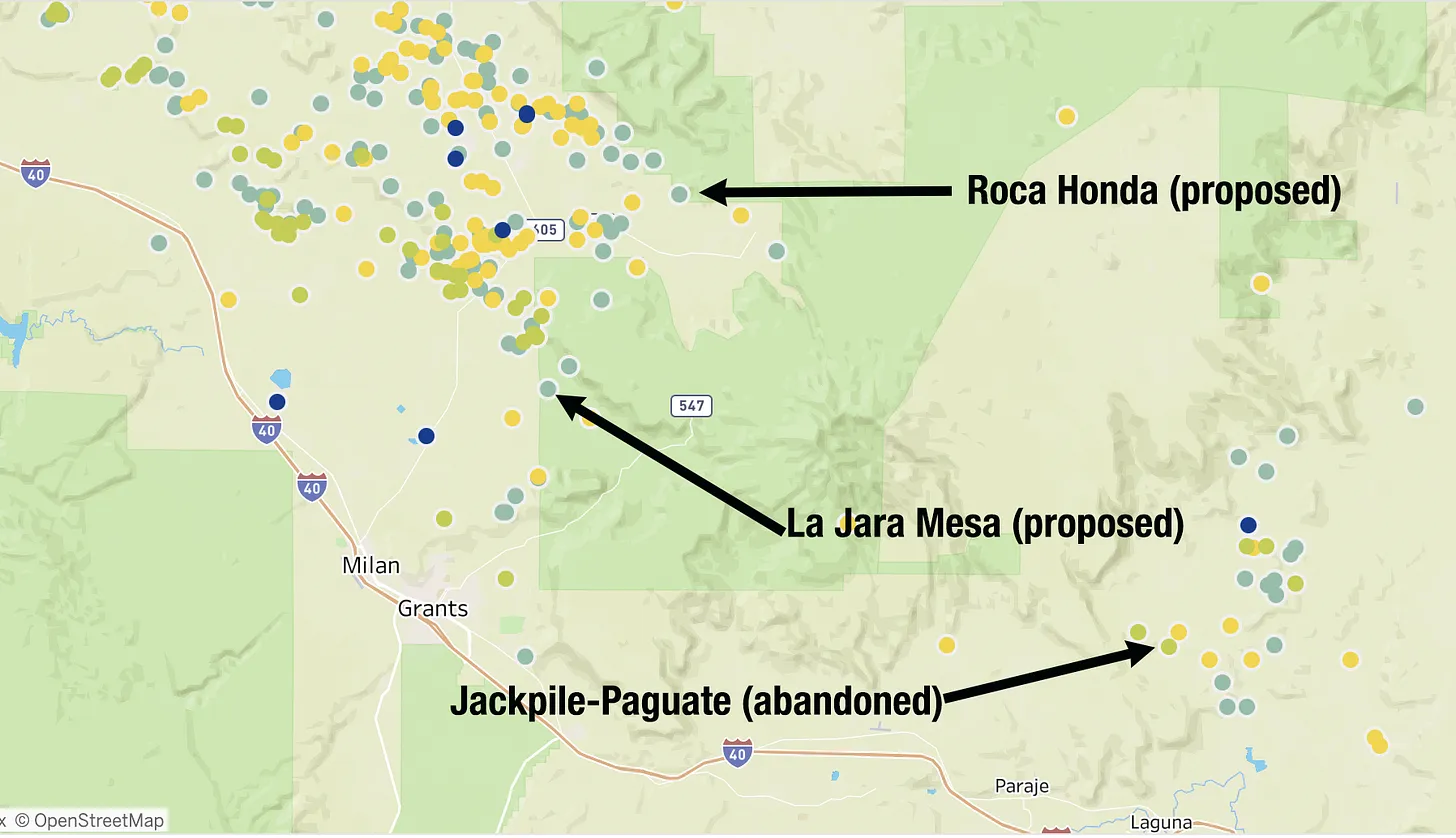
The Grants and Mount Taylor area was ravaged by Cold War-era uranium mining and the wounds from the previous boom continue to fester. That include the remnants of Anaconda Minerals Company’s Jackpile-Paguate Mine on Laguna Pueblo land, which was once the world’s largest open-pit uranium mine, producing some 24 million tons of ore.
Miners were exposed to radioactive and toxic heavy metals daily, even spending their lunch breaks sitting on piles of uranium ore. Blasting sent tremors through the pueblo’s adobe homes, and a cloud of poisonous dust drifted into the village of Paguate, just 2,000 feet from the mine, coating fruit trees, gardens, corn, and meat that was set out to dry. A toxic plume continued to spread through groundwater aquifers, and the Rio Paguate, a Rio Grande tributary, remains contaminated more than a decade after the facility became a Superfund site, despite millions of dollars in cleanup work. Laguna residents and former mine workers still suffer lingering health problems — cancer, respiratory illnesses and kidney disease — from the mine and its pollution.
Now the feds are saying approving new uranium mines in the same area is “mission critical.”
***
In December, the Biden administration began the process of halting new mining claims and mineral leasing for the next 20 years on 165,000 acres in the upper Pecos River watershed west of Santa Fe, New Mexico. This included holding meetings to gather public input on the plan. But the BLM canceled the first such meeting, scheduled for late February, and has not announced a new date, sparking fears that the new administration may be withdrawing plans for a mineral withdrawal.

Included within the acreage are more than 200 active mining claims held by Comexico LLC, a subsidiary of Australia-based New World Resources. For the past several years, Comexico has been working its way through the permitting process to do exploratory drilling at what it calls its Tererro mining project. It has met with stiff resistance from locals and regional advocacy groups, partly because mining has a dark history in the Pecos River watershed. In 1991, a big spring runoff washed contaminated mine and mill waste from a long-defunct mine into the upper Pecos River, killing as many as 100,000 trout. That prompted a multi-year cleanup of various mining sites.
***
📸 Parting Shot 🎞️
And now for a special treat, or maybe torture, but either way it might help take your mind off the dismantling of Democracy for a few moments. It’s my blow-by-blow analysis of the 1978 movie Avalanche, starring Rock Hudson and Mia Farrow. Normally this would be behind a paywall, like all of the other Land Desk archives. But I’m opening up to everyone for a limited time only in honor of the snowslide-triggering storm that is pounding the San Juans as I write. Enjoy. And, while you’re at it, check out our interactive map of long-lost ski hills in southwest Colorado.
AVALANCHE: A blow-by-blow analysis of the 1978 disaster flick — Jonathan P. Thompson, February 9, 2022

I was drawn in by the close-up winter aerial shots of ridges and peaks of the San Juan Mountains—Look, there’s Vestal! I yelled to my non-existent viewing companions as Rock Hudson’s name flashed on the screen. And Arrow! And Mount Garfield! I kept watching the lost-to-obscurity 1978 disaster film,