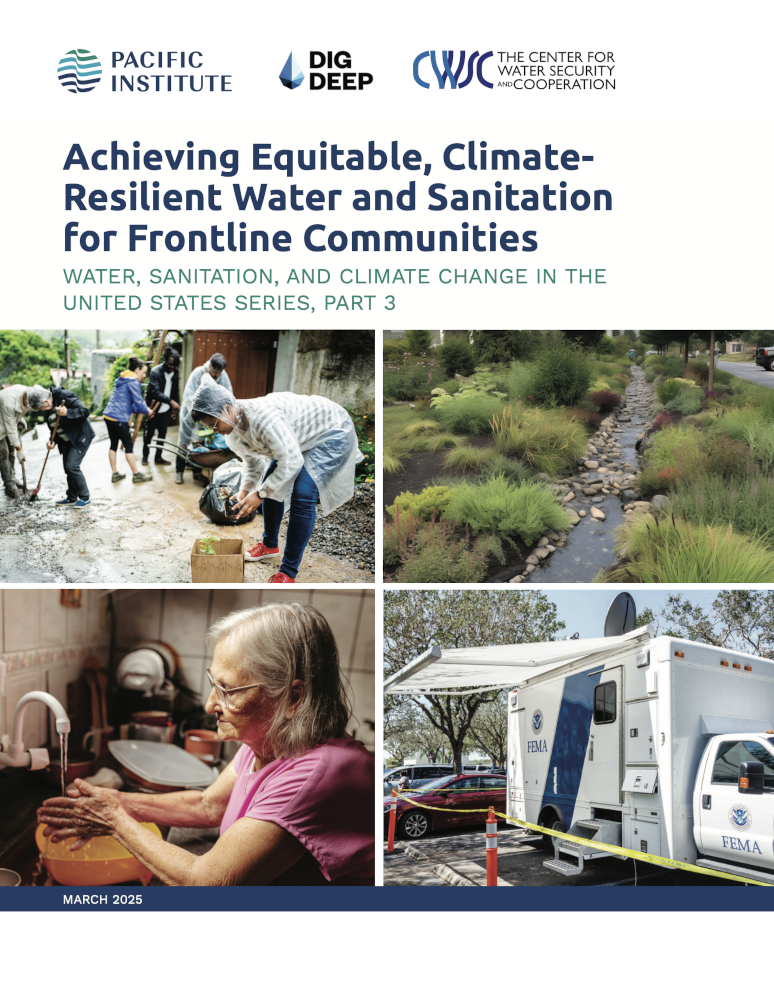
Click the link to read the report on the Pacific Institute website (Shannon McNeeley, Morgan Shimabuku, Rebecca Anderson, Rachel Will, Jessica Dery). Here’s and excerpt from the summary:
As climate change intensifies and causes more frequent extreme storms and catastrophic floods, raises sea level, intensifies heat waves and droughts, and sparks more intense wildfires, frontline communities in the US will be at greater risk of losing access to safe, reliable drinking water and functional plumbing (Pacific Institute and DigDeep 2024). However, frontline communities are resilient, and they are finding ways to overcome the myriad barriers and challenges they face from climate change to create equitable, climate-resilient water and sanitation access and systems. This report aims to identify documented strategies and approaches for achieving equitable, climate-resilient water and sanitation for frontline communities in the US. To do this, we first asked: What is equitable, climate-resilient water and sanitation? What are its characteristics or attributes? And what are communities, organizations, and government agencies doing to achieve it? We developed an eight-part framework to organize, categorize, and communicate the attributes, and then we identified documented strategies and approaches for achieving this goal. In doing this we reviewed academic publications, government and NGO reports, and online resources and tools. In addition, we solicited input from experts in the field at convening events and through online meetings and discussions. We primarily focused on literature, resources, and case examples from the US but drew on literature from non-US contexts when relevant.
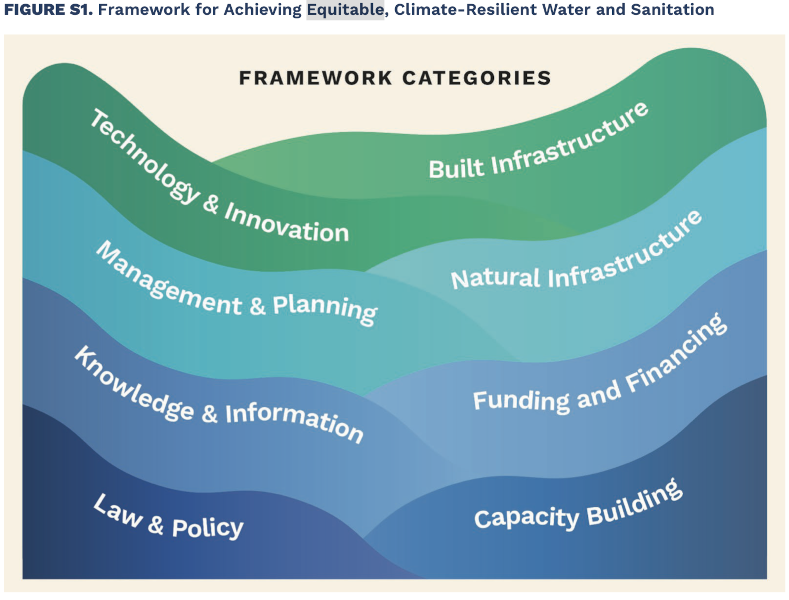
Note: The figure depicts the eight categories of climate-resilient and equitable water and sanitation, which serves as the organizing framework for the attributes and corresponding strategies in the report. The visualization incorporates themes and colors from the Pacific Institute’s logo, using wave imagery to emphasize the eight framework categories and their interconnections in building equitable, climate-resilient water and sanitation systems. Figure designed by Pacific Institute and DigDeep, graphic design by Max Olson, DigDeep
While the framework includes the law and policy category, this report does not include this section. We will address this topic in a future report that focuses on law and policy attributes and criteria for identifying laws and policies necessary for achieving equitable, climate-resilient water and sanitation in frontline communities. We also covered law and policies in part 2 of this series titled Law and Policies that Address Equitable, Climate-Resilient Water and Sanitation: Water, Sanitation, and Climate Change in the United States Series, Part 2.