The #YampaRiver is a recreation hotspot, but #SteamboatSprings can close it during summer’s peak — Alex Hager (KUNC.com)

Tubers float down the Yampa River in Steamboat Springs on July 23, 2025. A stretch of the river running near downtown can see more than 20,000 tubers through the course of the summer, but city officials sometimes roll out recreational shutdowns to protect the Yampa’s fish. Alex Hager/KUNC

Click the link to read the article on the KUNC website (Alex Hager):

August 5, 2025

This story is part of ongoing coverage of water in the West produced by KUNC and supported by the Walton Family Foundation.

On a hot summer day in Steamboat Springs, the Yampa River feels like the beating heart of the city. On a recent July afternoon, its banks teemed with people looking for a cool refuge from the mid-80s temperatures and direct sun.

Local mom Alohi Madrigal was one of them. She and two friends watched their kids jump off the rocks into the Yampa’s clear water. A steady stream of relaxed-looking tubers floated by too, sprawled out on thick, yellow inflatables.

Even at 3 p.m. on a Wednesday, this little section of the Yampa looked like a postcard-perfect picture of a summer vacation in the Colorado mountains.

“It’s totally amazing,” Madrigal said. “It’s beautiful. It’s gorgeous.”

“And free,” one of her friends chimed in.

But days like this are a precious commodity in Steamboat Springs. When it gets too hot, the city shuts down this specific stretch of river: a roughly six-and-a-half-mile section that flows through downtown, just steps away from the shops and restaurants. During the driest years, it can be bereft of swimmers, tubers and anglers for weeks at a time.

This year, it was already closed for four days in July, and may close again before the summer is through.
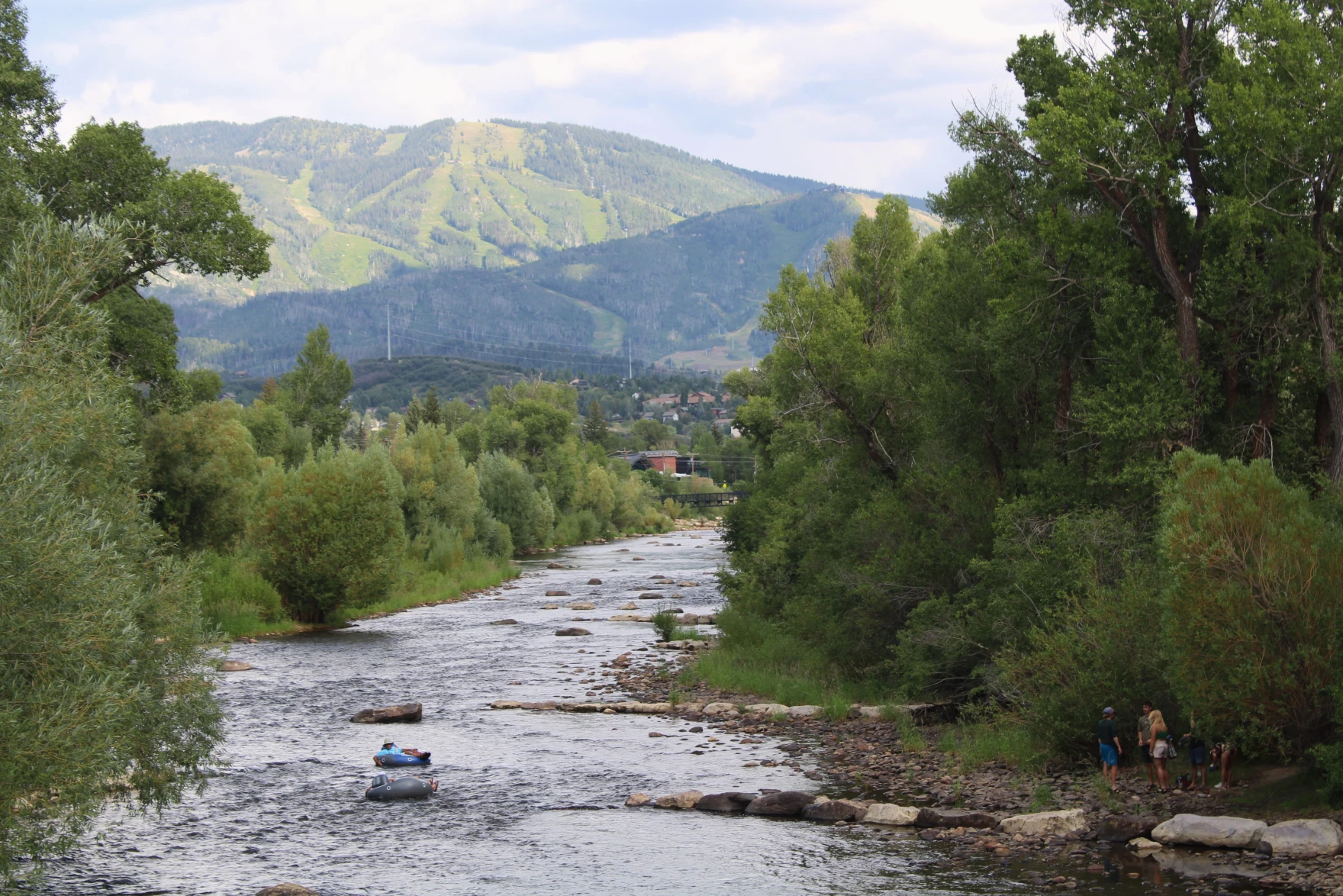
Tubers float down the Yampa River, in the shadow of Steamboat Ski Resort, on July 23, 2025. City officials close the river to recreation when it gets too hot, too low, or lacks oxygen for fish. Alex Hager/KUNC

It’s part of an uneasy balance struck by Steamboat Springs. The Yampa is the city’s lifeblood. Its water irrigates nearby farms and ranches. The same river supplies drinking water to homes and businesses all over town. During the summer, it becomes a mecca for vacationers who flock to the resort town for a cool mountain escape. The city estimates that more than 21,000 people took tubes down this stretch of river in 2024.

But it’s also home to fish. When the river is hot and low, too many humans in the water can setress out its fish – causing lasting damage to their health or even killing them. That could create an unpleasant scene for all of those river users and throw the Yampa’s ecosystem out of whack.

As a result, the city enforces periodic shutdowns to keep the river healthy, even if it means people – and businesses that can make big bucks on equipment rentals – will have to avoid it on the days when its cool water beckons the most.

Flows for fish

It’s easy to look at the Yampa and think about the paddlers and floaters playing on its surface. It’s also easy to forget about the silent, scaly residents beneath. But those fish are at the heart of the river’s summer closures.

“It pretty much all comes down to fish health,” said Emily Burke, conservation program manager at the nonprofit Friends of the Yampa. “Fish get super stressed when river temperatures reach a certain level.”

Recreational closures on the Yampa can be triggered by three things: low water levels, high water temperature or low levels of dissolved oxygen in the water. All three make it harder for fish to survive.

Models of fish that live in the Yampa River are on display at the Steamboat Flyfisher shop in Steamboat Springs on July 24, 2025. When water is low and hot, fish can get stressed and even die. Alex Hager/KUNC

When the river gets low and hot, fish often don’t have enough oxygen to breathe, causing them to get exhausted. That could make them too tired to look for food or stop eating. Already stressed and drained of energy, the extra stress added by humans in the river can cause lasting harm to fish health and — in some cases — kill them.

“If you have a bunch of people splashing around in these deep pools [that] these fish are using as refuge,” Burke said, “It’s really stressful for them, and it can sometimes lead to fish die-offs.”

Measuring stations along the river gather data about its water every fifteen minutes. If the water is hotter than 75 degrees for two consecutive days or flowing lower than 85 cubic feet per second, city officials will roll out a river closure.

‘A huge economic driver’

When the Yampa is teetering on the edge of a shutdown, the people watching closest are often those whose businesses depend on it. Johnny Spillane is one of them. He owns Steamboat Flyfisher, which has a back patio that overhangs the river itself.

On a recent Thursday morning, as people milled in and out of brunch spots and started heading toward tourist activities, Spillane stood behind the counter of his store.

“You can tell in the shop right now it’s pretty quiet,” Spillane said. “If it was a busy, hopping day with people fishing in town, it would be a lot busier right now.”

The river was still open for swimming, tubing and paddling, but officially shut down for fishing.

“July days are our most important days as a business, so losing July days certainly hurts a little bit more,” Spillane said. “But at the same time, you know, losing the fish in the river would hurt a lot more than that. For us, protecting the fish, protecting the resource, is far much more important than getting an extra couple days of fishing on the town stretch, or selling a couple dozen extra flies.”
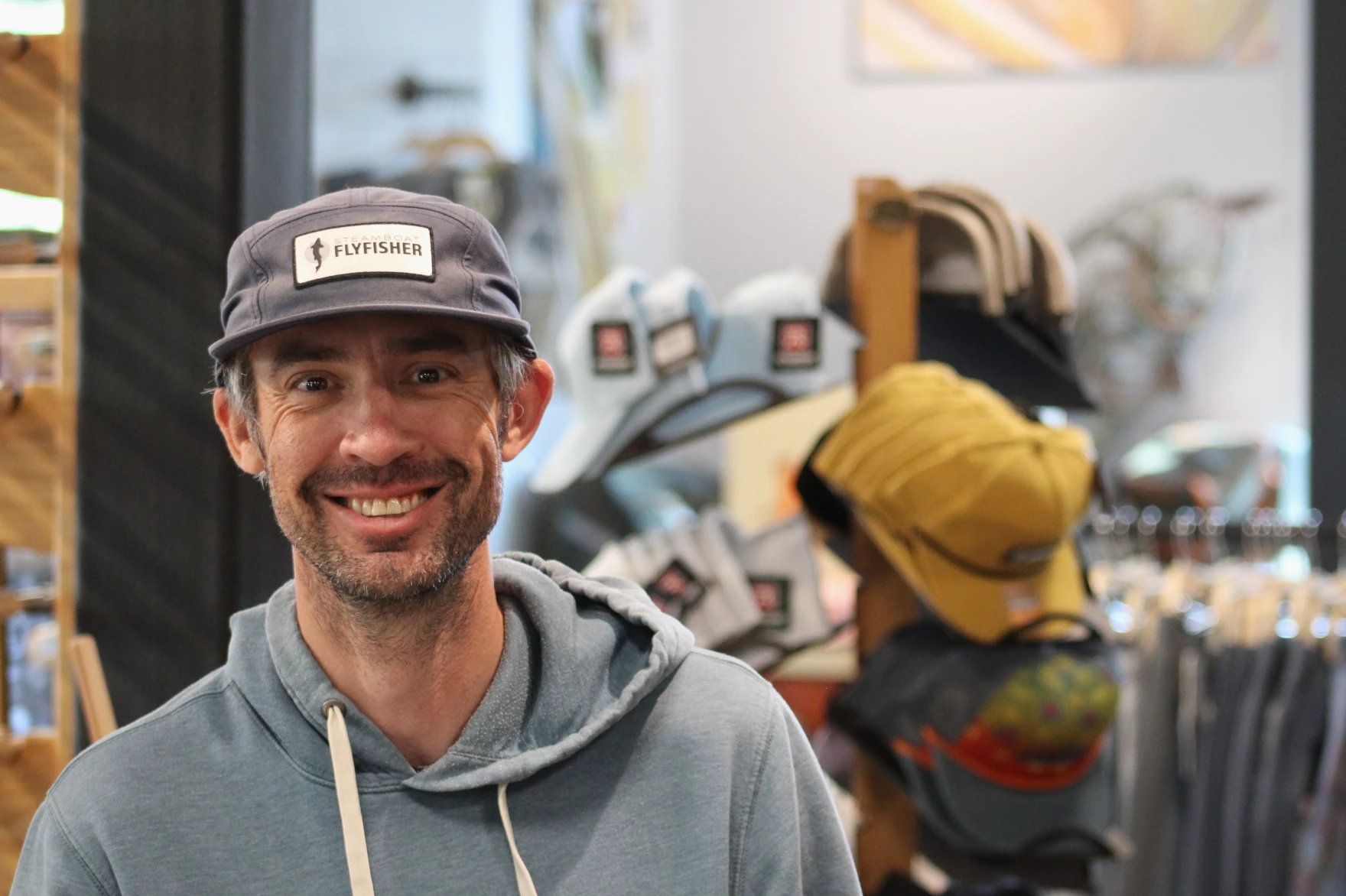
Johnny Spillane, owner of Steamboat Flyfisher, poses in his shop on July 24, 2025. “Protecting the fish,” he said, “protecting the resource, is far much more important than getting an extra couple days of fishing on the town stretch, or selling a couple dozen extra flies.” Alex Hager/KUNC

Spillane said the river closure doesn’t affect his business that much. Fewer people come into the store to buy equipment, but the shop’s fishing guides — who can run more than 200 trips each week — can take customers 20-30 minutes outside of town to other streams, rivers and lakes that are open for anglers.

Even owners of businesses that are inextricably tied to the Yampa’s “town stretch” share Spillane’s mentality.

Backdoor Sports sits just a short walk downstream from the flyfishing shop. It’s a powerhouse in the local tube renting scene. Backdoor moves so many rental tubes – as many as 400 a day during the peak of summer – that it has a drive-thru-style window to keep customers moving from signup to river in short order. The shop dispatches rental tubes from a literal backdoor, which lies no more than a couple dozen feet from the Yampa.
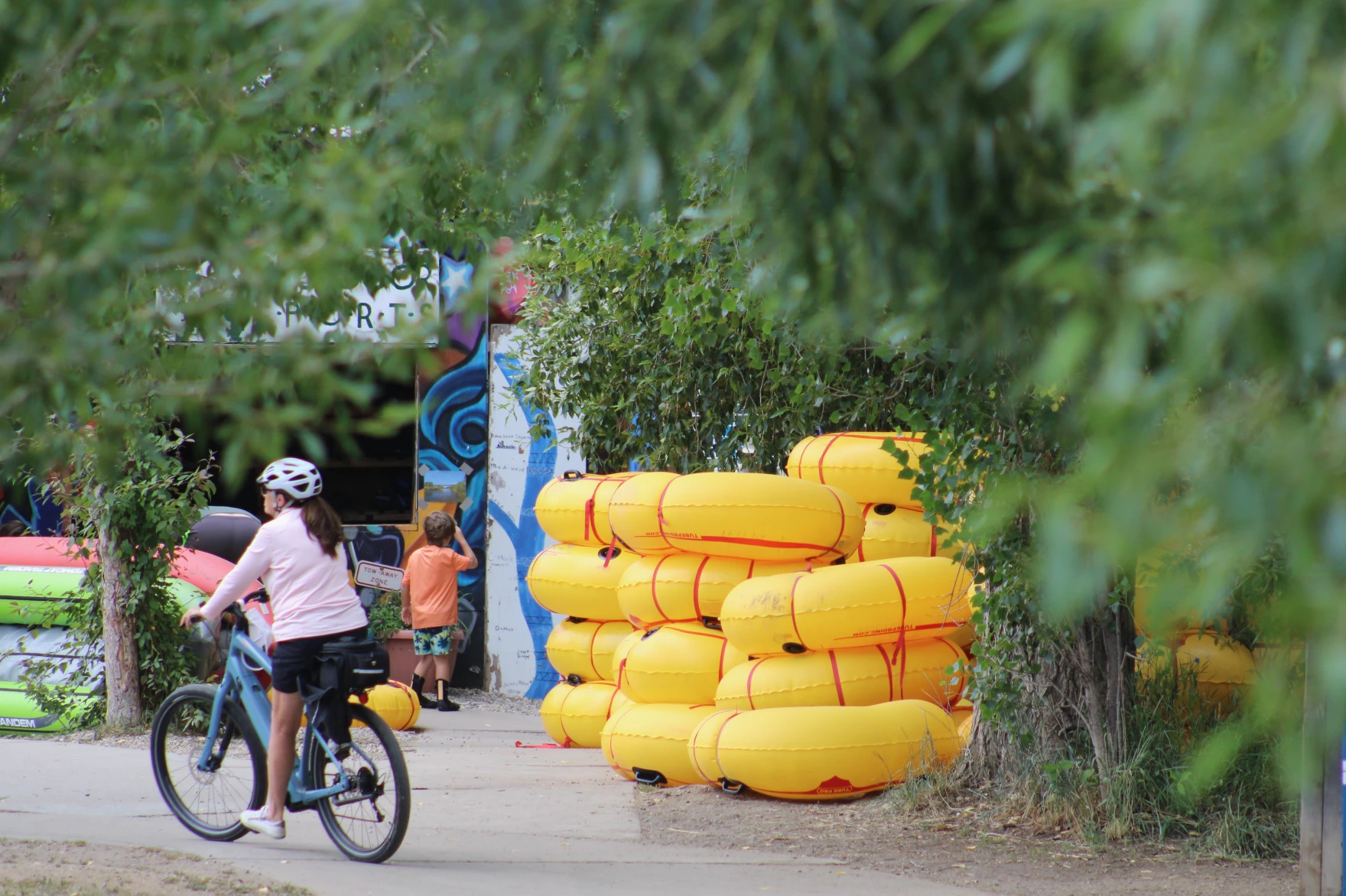
Stacks of inflatable tubes wait for renters at Backdoor Sports in Steamboat Springs on July 23, 2025. “The closures can be tough at times,” said Mike Welch, the shop’s owner, “But also necessary, because it’s good to protect what we have here.” Alex Hager/KUNC

“The Yampa River is a huge economic driver for the city,” said Mike Welch, a co-owner of Backdoor. “We want to make sure that it stays that way for a lot of years to come. The closures can be tough at times, but also necessary, because it’s good to protect what we have here. It’s a wonderful, wonderful thing that we’ve got.”

While it takes some extra preparation to steel Backdoor against changing river conditions and shutdowns, Welch said communication from city officials makes it easier.

“The city has done a great job in setting those parameters,” he said. “So we know what the water is looking like and where and when those closures are potentially coming. So we can plan for it.”

People ride a tube through the Yampa River in Steamboat Springs on July 23, 2025. The river is a major draw for tourists and locals alike during the summer. Alex Hager/KUNC

Welch bought the business alongside his brother and sister-in-law this spring. The previous owner, Pete Van De Carr, was a well-known local who died in February following a skiing accident.

Another shop owner, Marty Smith, said Van De Carr played a part in getting the city to specify its plans for reopening the river after a closure.

“Every day, all the outfitters in town, we would get emails from Pete saying we need to come up with a rule to reopen the river,” said Smith, owner of Mountain Sports Kayak School. “I think that they definitely listened to Pete.”

City officials say they are trying to be more transparent about the criteria they use to reopen the Yampa for recreation and communicate directly with outfitters about upcoming changes to closures. The city consults with Colorado Parks and Wildlife before reopening the river. They consider current river conditions, weather forecasts and the amount of stress that fish may already be feeling from hot, dry conditions.

‘A tough spot to be in’

For the city officials who manage closures on the Yampa, it’s all about balance.

“We hate having to do this,” said Jenny Carey, the city’s Open Space and Trails supervisor, “Because you inevitably will hear from somebody that it’s just ruining their day, their business. And that’s tough. That’s a tough spot to be in. We don’t want to do that.”

Carey said Steamboat Springs puts up signs and social media posts to inform people about the closures and the reasons for them.

“We understand that people want to be in the river,” she said, “And so it’s a difficult conversation. We do our best to educate as best we can. I think a lot of our locals are getting used to this, and they understand the reason.”

While it can be rocky trying to tell out-of-town tourists that they won’t be able to tube on a hot summer day, locals really do seem to be getting the message. In a 2024 survey of Steamboat Springs residents, 92% of people said “management of the health of the Yampa River” was essential or very important.

That’s only five points lower than the fire department. Managing the Yampa’s health ranked as more important than city parks and the police department.

“The Yampa river is considered one of the most important services that the city provides,” said Julie Baxter, the city’s water resources manager. “So we feel very grounded that we have the support of the local community members that live here in Steamboat Springs.”

Bears play along the banks of the Yampa River in Steamboat Springs on July 23, 2025. In a survey of city residents, 92% of people said protecting the health of the river was important — scoring it higher than city parks and the police department. Alex Hager/KUNC

Recreational closures on the Yampa are mandatory for rental shops, but technically voluntary for individuals who want to bring their own tubes or kayaks. But with so many locals on board, few people decide to take a dip.

“If there is a closure in place and you get in the river,” Baxter said with a chuckle, “You will likely have a local yell at you.”

Alohi Madrigal, who was raised in Steamboat Springs and still lives in town, watched her kids splash in a stretch of the Yampa that may be closed later this summer. She said a shutdown wouldn’t be the end of the world.

“There’s a million things to do here,” she said, proceeding to list off a handful of other swimming spots. “We have to take care of the river, or it won’t be here for long.”

Yampa River Basin via Wikimedia.

The well-lived life of John Stulp — Allen Best (BigPivots.com)

Photo credit: Allen Best

Click the link to read the article on the Big Pivots website (Allen Best):

August 5, 2025

Colorado governors of the past and possibly the future gathered in Lamar to pay their respects. His last wishes were that the wheat harvest go on.

When it became clear that John Stulp had little time left to live, he specified that the memorial service would come later, after the wheat had been harvested but before the next planting.

That service was held on Saturday, August 2, at the First Baptist Church in Lamar, in southeastern Colorado, not quite a month after his death. Several hundred people attended, many of us from out of town.

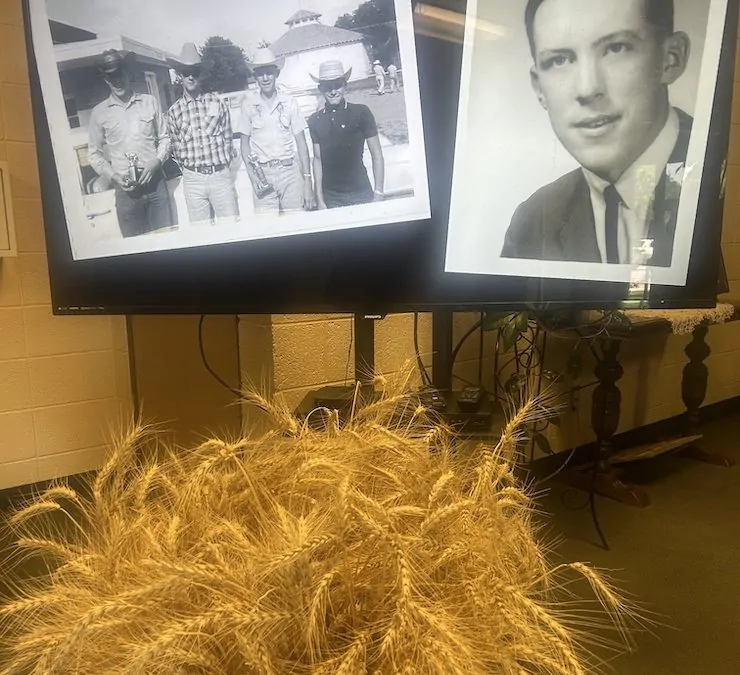
Fittingly, the family had positioned a few large vases fill with bundles of wheat next to the photos of Stulp. One photo was Yuma High School, and another was from a meeting with then-President Jimmy Carter. He got around in his life, but in his heart, he remained a farmer.

Tributes to his life were lavished at the church in Lamar, and from my experiences with him during the last 13 years or so, they were deserved. Responding to my first impressions on Facebook, one individual said this: “A great man.” Said another: “These sorts of people make civilization work.”

Former Colorado Gov. Bill Ritter was at the remembrance in Lamar, as was an individual who may possibly become Colorado’s next governor, Phil Weiser. Neither spoke, and as for Weiser, I saw no evidence he was campaigning. It appeared to me he was simply there to pay his respects after likely arising early in [Denver] to get to Lamar by mid-morning.

This was in addition to former U.S. senator, Ken Salazar, who was in the audience along with Kate Greenberg, the current Colorado commissioner of agriculture, and two of her predecessors, Don Brown and John Salazar. I also recognized various people from the Colorado Water Conservation Board, including at least two former directors of the Colorado Water Conservation Board, Becky Mitchell and James Eklund.

John Hickenlooper, still another former Colorado governor, was not there but had delivered a eulogy from the floor of the Senate shortly after John’s death on July 7. “John was a good man, a great man by any measure,” Hickenlooper had said.

What came out again and again was his love of place, his devotion to family and community, his generous heart. And while he was also a notably good listener, it was also said that John was a very good storyteller.

I knew Stulp a bit. In about 2012, I went to Beaver Creek for a water forum, and he was a speaker. I struck up a conversation with him, and he invited me to visit him on his farm south of Lamar the following weekend. Then I didn’t fully realize the irony of his position as the state’s “water czar” for Hickenlooper: his farm south of Lamar was entirely dryland.

When I visited him at that farm, we talked at length before he showed me around his home country. We stayed in touch after that, usually it being a matter of me seeking his perspective about water, energy, and other matters.

John leaned into the future. He saw the tiny details and the big pictures. Several times I consulted him to understand the role of eastern Colorado in our state’s energy transition. He had been a Prowers County commissioner from 1992 to 2003, and during the latter time he voted for approval of Colorado Green. The wind farm south of Lamar was, when it began operations in 2004, the largest in the country.

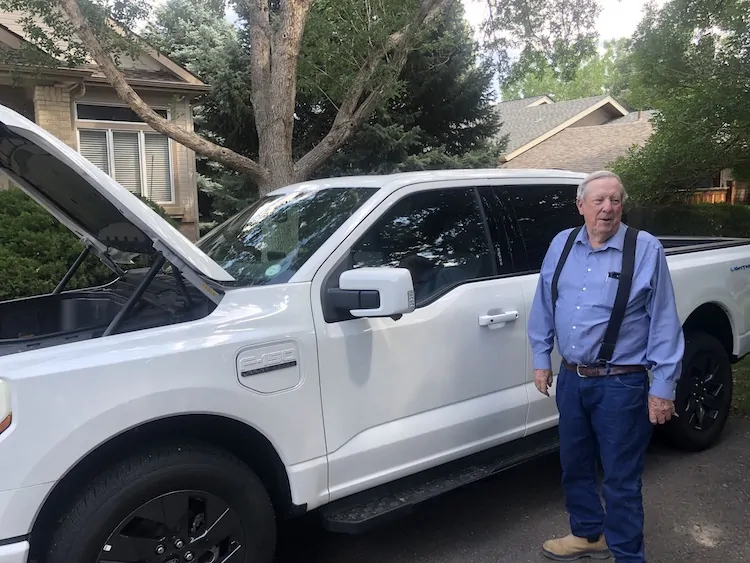
John Stulp purchased an electric pickup truck in 2022 and was happy to show it to visitors. Photo credit: Allen Best/Big Pivots

Of late, I was particularly interested in his experience as an early adopter. In his electric pickup he made the rounds between Lamar, a home in Lakewood that I believe he and his wife, Jane, had acquired during his 12 years in his position in Colorado state government, and Yuma, where he had begun life during an intense snowstorm in 1948 and where he still had farming property. Trips often also included Fort Collins, where two of his children lived.

See: Electric pickups and farm country

Earlier this year, I was curious whether the growing network of fast-charging stations in eastern Colorado was meeting his traveling needs. By then, he was on oxygen, eight liters a minute, and when in the pickup he needed to draw on the battery. That gave him less margin for error, he said, and no, Colorado’s fast-charging infrastructure on the eastern plains fell short. He had been forced to return to an internal-combustion engine for trips to the Front Range.

As recently as late June, I had written to him after noticing a letter from him filed in a Colorado Public Utilities docket. It was, I wrote to him truthfully, the most compelling of all the comments I had seen filed in that case.

The main reflection I had after hearing the remarks in Lamar was a reinforcement of my previous opinion. For whatever reason, John put it together early in life. Many of us struggle to figure out our paths. He did not. He must have been a bright boy. By age 4, he was accompanying his aunt to a one-room schoolhouse. He grew up farming, growing corn, and raising cattle and hogs. He went to Colorado State University and became a veterinarian.

After stints as a veterinarian in Windsor and then Las Cruces, N.M., he and his wife, Jane, moved to the Lamar area, where she had grown up on a farm. They had five children, and he assumed new roles in agriculture organizations, his community, and state and national organizations. He was on the board of directors for the State Land Board, for the Colorado Wildlife Commission, and the board of governors of Colorado State University.

In the 1990s, then Colorado Gov. Roy Romer twice asked him to be the state ag commissioner, but he declined, citing the need to be with his family. Bill Ritter made the same request when he was elected in 2006, and this time he excitedly said yes. He served a four-year term.

Governor Hickenlooper, John Salazar and John Stulp at the 2012 Drought Conference

When John Hickenlooper was elected governor in 2010, he asked Stulp to be part of his team but in a different capacity. In his eulogy on the floor of the Senate, Hickenlooper explained what he was up to. Colorado had experienced particularly severe drought in 2011 and even more in 2012.

“I was convinced that we needed a blueprint, a plan of some sort, to address the projected growth and its future water supply, to make sure that we had the supply that could match our needs. I recruited John to serve as my top water policy advisor. We made it a cabinet-level position. He came to all our cabinet meetings. He was our water czar.”

Wheat harvest was a time of hard work but also joy at the Stulp farm south of Lamar. Photo credit: Allen Best/Bigg Pivots

Stulp’s background in agriculture — which uses 85% to 90% of water in Colorado — was key to his choice.

“John understood the agriculture community in Colorado better than almost anyone,” explained Hickenlooper. “Maybe that’s why, when I first approached him with the idea of a statewide water plan, he wasn’t immediately convinced. Actually, he was far from it. He was, I would say, more than skeptical.”

Hickenlooper explained that he understood how difficult it would be to get buy-in. “He didn’t think it was a smart idea for me politically as a new governor to take on an issue that had the potential to be so divisive,” explained Hickenlooper. “But he understood that we couldn’t let our rivers and farms be at risk of running dry. We needed him. Colorado needed him. And he set aside his reservations, rolled up his sleeves and went to work.”

Stulp’s work in achieving consensus was part of the state water plan completed in 2015 (and since updated twice). What has been the result of that plan? Has it actually been a success? That’s a much longer story.

In his eulogy, Hickenlooper also added a personal touch.

“I’m not sure there are gradations of ‘goodness,’ but I have traveled long distances with John Stulp, and I’ve stayed at his home in Prowers County where he and his remarkable wife, Jane, would cook up a barbecue and get me together with some of their neighbors.” “He even loaned my son, Teddy, a .410 shotgun so he could learn how to shoot,” said Hickenlooper.

“If I did believe in gradations of ‘goodness,’ John and Jane Stulp would be at the very top.”

Delivering a testament later, once again in response to my Facebook post, was Jackie Brown, who spent 39 yeas in public health, including 22 years in Prowers County. Stulp had recruited her to the position from nearby Baca County.

“John was the best example of a good man and a great leader,” she wrote. “He was honest, smart, caring, fair and had integrity. His family, community and his employees were his priority. Plus, he had a great sense of humor.”

The service was held in a church, and it turns out that Stulp was deeply religious. During covid, after his work in Colorado state government, he was confined to his home. He had, he told me, been admonished by one of his sons for venturing out to Walmart. Later, he lost a brother in Yuma to covid.

In this time of isolation, John agreed to take over the Baptist minister’s daily phone tree that sought to connect people during times of isolation. The pastor, Darren Stroh, said that Stulp had sent more than 200 messages. One of them contained these thoughts:

“If you were judged — choose understanding.

If you were rejected — choose acceptance.

If you were shamed — choose compassion.

Be the person you needed when you were hurting, not the person who hurt you.

Vow to be better than what broke you -— to heal instead of becoming bitter.

Act from your heart — not your pain.”

At the church on Saturday, his son Jensen told us about the father he knew, the father who relished wheat harvest, where he loved to offer rides in a combine to his grandchildren and others. Harvest on July 4th always produces extra energy amid questions of will it rain and will there be time to watch fireworks.

On this year’s July 4th, days before he died, the Stulp family gathered around John. With his strength ebbing, he delivered “one of the most meaningful and powerful speeches we’ve ever heard,” said John Stulp III. “It was a charge to the grandkids. First thing he said, finish harvest. Keep cutting the wheat. That was said multiple times.”

Then he continued about how he wanted them to comport themselves. Be flexible. The world is better when you are generous. We produce food, and the world is hungry. Care for others. Make sure they know you love them. Jesus wasn’t petty; neither should you be. Live in this moment and live it to the fullest, but plan for the future.

And with those words to his grandchildren remembered we were invited to the fellowship hall and a long table of tasty home-cooked food and an equally long table of desserts. In the middle of each table was a centerpiece consisting of a mementoes of John’s life and a small bundle of wheat.

See also:

Agriculture and global warming: John Stulp says that farmers are a solution, not the problem, in global warming.

Even in Idalia, soon a fast-charger for passing EVs: In urban and rural places, Colorado now has 1,100 fast-charing ports. But how many aren’t working?

Arkansas River Basin via The Encyclopedia of Earth

Toxicity: The Invisible Tsunami — Deep Science Ventures

Click the link to access the report on the Deep Science Ventures website:

How pervasive toxicity threatens  human and planetary survival

What if one of the biggest threats to our health and planet is invisible, yet found in our air, food, and water?

Our latest report is the first time that a single report has attempted to analyse the broader collective problem and solution spaces of chemical toxicity answering the questions: how and why are toxic chemicals produced, how do they get into our bodies and the environment, and how do they affect the health of humans and other organisms?

Over eight months, we conducted an extensive analysis, including reviewing countless peer-reviewed studies and 50+ interviews with global experts. This research shows that the impacts of chemical toxicity are largely underestimated, contributing to increasing cancer rates, declining fertility, and a surge in chronic diseases, alongside ecosystem damage.

The overarching conclusion is that chemical toxicity is an underestimated risk to society and deserves significantly more attention and resources. 

But this report isn’t just about the problem; it’s a call to action for solutions. We highlight critical industry, regulatory gaps and, most importantly, identify key areas for innovation and urgent funding that can put us on the right path to increase our understanding and make positive changes where it’s most needed.

We identified three opportunity areas that demand solutions: pesticides (herbicides and insecticide), food contact materials, personal care products.

Key takeaways include:

  • Over 3,600 synthetic chemicals from food contact materials are found within human bodies globally.
  • PFAS have contaminated the entire world, with levels in rainwater often exceeding safe drinking water limits.
  • Over 90% of the global population is exposed to air pollution exceeding World Health Organisation (WHO) guidelines.
  • The impact of pesticide use on cancer incidence may rival that of smoking and is linked to leukaemia, non-Hodgkin’s lymphoma, bladder, colon, and liver cancer. Prenatal pesticide exposure increases the odds of childhood leukemia and lymphoma by over 50%.

To learn more, you can download both the executive summary and the full report below. If you’re curious about how to create an impactful and commercially viable company in this space, we’d love to hear from you!

Download the report.

#Colorado Parks & Wildlife is developing a #Beaver (Castor canadensis) Conservation and Management Strategy: Public scoping through August 31, 2025

Click the link to go to the Colorado Parks & Wildlife Engage CPW website for all the inside skinny:

CPW is developing a Beaver (Castor canadensis) Conservation and Management Strategy. The public scoping period is now open through August 31, 2025. Please provide feedback through the comment form on this page. A recorded presentation with more information is available under Important Links.

Background and Need

As a keystone species, beavers provide essential ecosystem services and increase local biodiversity in ecologically suitable habitats. However, beavers also represent a source of human-wildlife conflict, particularly at the interface of human infrastructure and waterways. 

Increasing interest in beavers as an agent for ecological restoration prompted Colorado Parks and Wildlife (CPW) to begin developing formal guidance to inform beaver conservation and management, including such topics as: harvest regulation, restoration, techniques for coexisting with beaver, and relocation. Given the broad reach, complexity, and interrelatedness of these topics, CPW is gathering input from diverse stakeholders to inform a strategy for beaver conservation and management.

How to Get Involved

The public scoping period will be open from July 30 through August 31, 2025. A scoping feedback form will be available at the bottom of this page once the input period opens.

Public input on the draft Beaver Conservation and Management Strategy will be open in Fall 2025.

American beaver, he was happily sitting back and munching on something. and munching, and munching. By Steve from washington, dc, usa – American Beaver, CC BY-SA 2.0, https://commons.wikimedia.org/w/index.php?curid=3963858