The dismantling of the Forest Service: President Trump’s administration plans would remake the agency and public lands. The deadline to comment is September 30, 2025 — Jonathan P. Thompson (High Country News)

Welcome to the Landline, a monthly newsletter from High Country News about land, water, wildlife, climate and conservation in the Western United States. Sign up to get it in your inbox.

Click the link to read the article on the High Country News website (Jonathan P. Thompson):

September 23, 2025

In the 1880s, giant cattle companies turned thousands of cattle out to graze on the “public domain” — i.e., the Western lands that had been stolen from Indigenous people and then opened up for white settlement. In remote southeastern Utah, this coincided with a wave of settlement by members of the Church of Jesus Christ of Latter-day Saints. The region’s once-abundant grasslands and lush mountain slopes were soon reduced to denuded wastelands etched with deep flash-flood-prone gullies. Cattlemen fought, sometimes violently, over water and range.

North American Indian regional losses 1850 thru 1890.

The local citizenry grew sick and tired of it, sometimes literally: At one point, sheep feces contaminated the water supply of the town of Monticello and led to a typhoid outbreak that killed 11 people. Yet there was little they could do, since there were few rules on the public domain and fewer folks with the power to enforce them.

That changed in 1891, when Congress passed the Forest Reserve Act, which authorized the president to place some unregulated tracts under “judicious control,” thereby mildly restraining extractive activities in the name of conservation. In 1905, the Forest Service was created as a branch of the U.S. Agriculture Department to oversee these reserves, and Gifford Pinchot was chosen to lead it. And a year later, the citizens of southeastern Utah successfully petitioned the Theodore Roosevelt administration to establish forest reserves in the La Sal and Abajo Mountains.

Manti-La Sal National Forest in the La Sal Mountains, Utah. The mountains have been managed by the U.S. Forest Service since 1906. Luna Anna Archey/High Country News

Since then, the Forest Service has gone through various metamorphoses, shifting from stewarding and conserving forests for the future to supplying the growing nation with lumber to managing forests for multiple uses and then to the ecosystem management era, which began in the 1990s. Throughout all these shifts, however, it has largely stayed true to Pinchot and his desire to conserve forests and their resources for future generations. 

But now, the Trump administration is eager to begin a new era for the agency and its public lands, with a distinctively un-Pinchot-esque structure and a mission that maximizes resource production and extraction while dismantling the administrative state and its role as environmental protector. Over the last nine months, the administration has issued executive orders calling for expanded timber production and rescinding the 2001 Roadless Ruledeclared “emergency” situations that enable it to bypass regulations on nearly 60% of the public’s forests, and proposed slashing the agency’s operations budget by 34%.
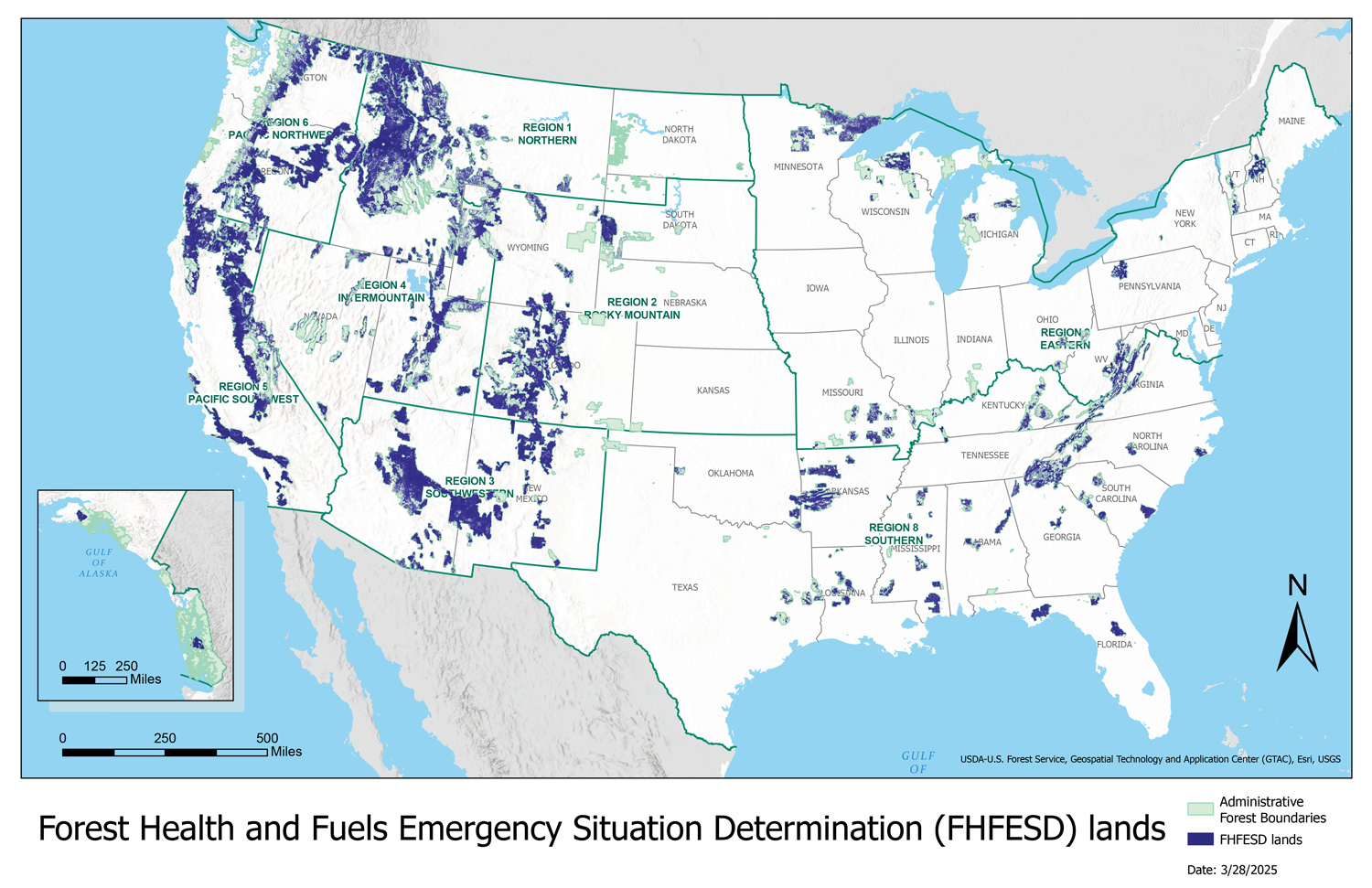
Forest Service lands declared as “emergency” situations this year, which includes nearly 60% of the nation’s forests. Credit: U.S. Forest Service

The most recent move, which is currently open to public comment, involves a proposal by Agriculture Secretary Brooke Rollins to radically overhaul the entire U.S. Department of Agriculture. Its stated purposes are to ensure that the agency’s “workforce aligns with financial resources and priorities,” and to consolidate functions and eliminate redundancy. This will include moving at least 2,600 of the department’s 4,600 Washington, D.C., employees to five hub locations, with only two in the West: Salt Lake City, Utah, and Fort Collins, Colorado. (The others will be in North Carolina, Missouri and Indiana.) The goal, according to Rollins’ memorandum, is to “bring the USDA closer to its customers.” The plan is reminiscent of Trump’s first-term relocation of the Bureau of Land Management’s headquarters to Grand Junction, Colorado, in 2019. That relocation resulted in a de facto agency housecleaning; many senior staffers chose to resign or move to other agencies, and only a handful of workers ended up in the Colorado office, which shared a building with oil and gas companies.

Though Rollins’ proposal is aimed at decentralizing the department, it would effectively re-centralize the Forest Service by eliminating its nine regional offices, six of which are located in the West. Each regional forester oversees dozens of national forests within their region, providing budget oversight, guiding place-specific implementation of national-level policies, and facilitating coordination among the various forests.

Rollins’ memo does not explain why the regional offices are being axed, or what will happen to the regional foresters’ positions and their functions, or how the change will affect the agency’s chain of command. When several U.S. senators asked Deputy Secretary Stephen Vaden for more specifics, he responded that “decisions pertaining to the agency’s structure and the location of specialized personnel will be made after” the public comment period ends on Sept. 30. Curiously, the administration’s forest management strategy, published in May, relies on regional offices to “work with the Washington Office to develop tailored strategies to meet their specific timber goals.” Now it’s unclear that either the regional or Washington offices will remain in existence long enough to carry this out.

The administration has been far more transparent about its desire to return the Forest Service to its timber plantation era, which ran from the 1950s through the ’80s. During that time, logging companies harvested 10 billion to 12 billion board-feet per year from federal forests, while for the last 25 years, the annual number has hovered below 3 billion board-feet. Now, Trump, via his Immediate Expansion of American Timber Production order, plans to crank up the annual cut to 4 billion board-feet by 2028. This will be accomplished — in classic Trumpian fashion — by declaring an “emergency” on national forest lands that will allow environmental protections and regulations, including the National Environmental Protection Act, Endangered Species Act and Clean Water Act, to be eased or bypassed.
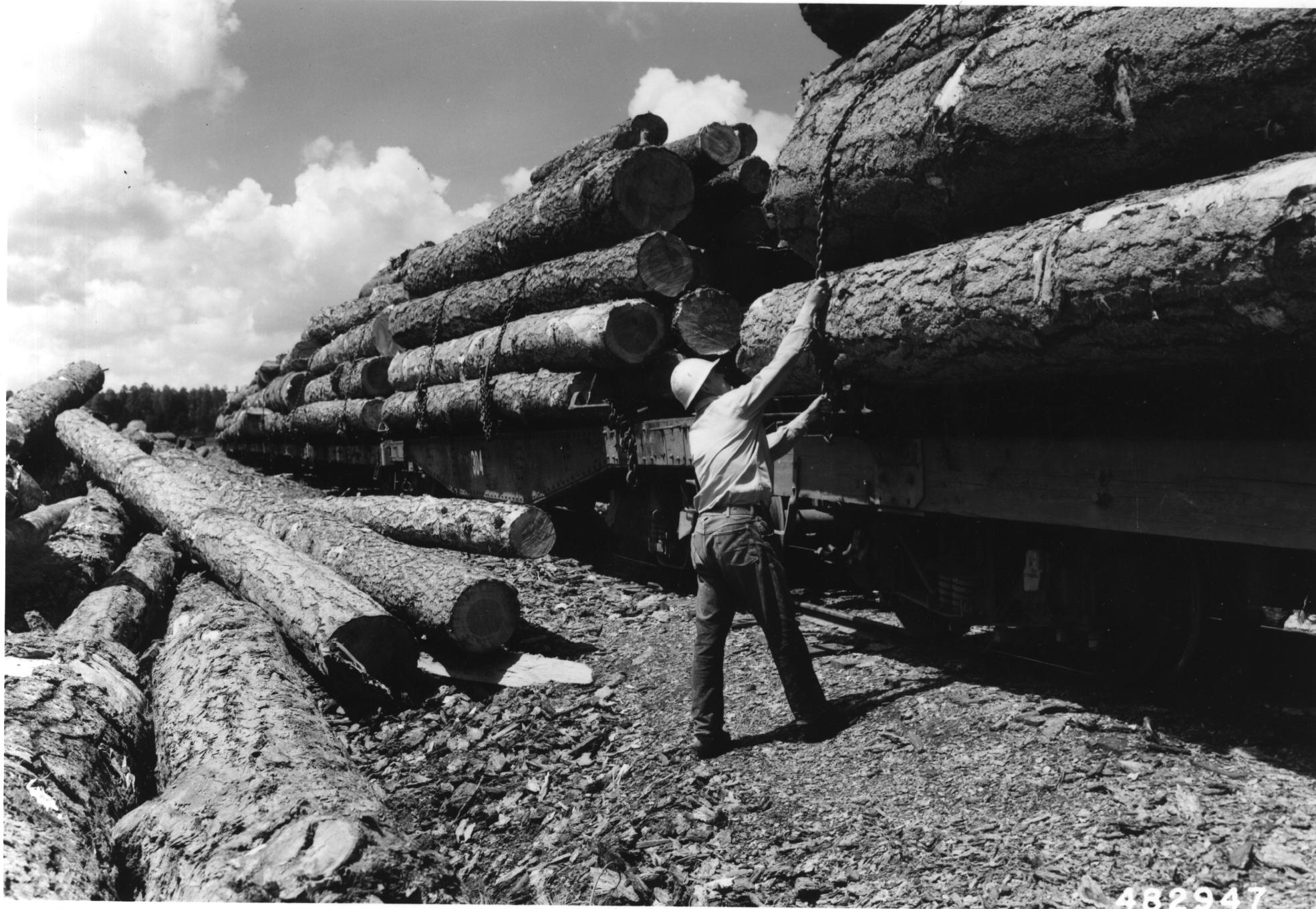
Logging operations in Coconino National Forest, Arizona, in 1957. Credit: U.S. Forest Service

In April, Rollins issued a memorandum doing just that, declaring that the threat of wildfires, insects and disease, invasive species, overgrown forests, the growing number of homes in the wildland-urban interface and more than a century of rigorous fire suppression have contributed to what is now “a full-blown wildfire and forest health crisis.”

Emergency determinations aren’t limited to Trump and friends; in 2023, the Biden administration identified almost 67 million acres of national forest lands as being under a high or very high fire risk, thus qualifying as an “emergency situation” under the Infrastructure Investment and Jobs Act. Rollins, however, vastly expanded the “emergency situation” acreage to almost 113 million acres, or 59% of all Forest Service lands. This allows the agency to use streamlined environmental reviews and “expedited” tribal consultation time frames to “carry out authorized emergency actions,” ranging from commercial harvesting of damaged trees to removing “hazardous fuels” to reconstructing existing utility lines. Meanwhile, the administration has announced plans to consolidate all federal wildfire fighting duties under the Interior Department. This would completely zero out the Forest Service’s $2.4 billion wildland fire management budget, sowing even more confusion and chaos.

The administration also plans to slash staff and budgets in other parts of the agency, further compromising its ability to carry out its mission. The so-called “Department of Government Efficiency,” or DOGE, fired about 3,400 Forest Service employees, or more than 10% of the agency’s total workforce, earlier this year. And the administration has proposed cutting the agency’s operations budget, which includes salaries, by 34% in fiscal year 2026, which will most likely necessitate further reductions in force. It would also cut the national forest system and capital improvement and maintenance budgets by 21% and 48% respectively.

The goal, it seems, is to cripple the agency with both direct and indirect blows. The result, if the administration succeeds, will be a diminished Forest Service that would be unrecognizable to Gifford Pinchot.


Gifford Pinchot portrait via the Forest History Society

Geoengineering Won’t Save Us From #GlobalWarming, New Study Says — Bob Berwyn (InsideClimateNews.org)

Arctic Ocean. Photo credit: The European Commission

Click the link to read the article on the Inside Climate News website (Bob Berwyn):

September 9, 2025

The research by a team of top ice and climate scientists debunks some speculative technological climate fixes for preserving the polar ice caps.

A team of the world’s best ice and climate researchers studied a handful of recently publicized engineering concepts for protecting Earth’s polar ice caps and found that none of them are likely to work.

Their peer-reviewed research, published Tuesday, shows some of the untested ideas, such as dispersing particles in the atmosphere to dim sunlight or trying to refreeze ice sheets with pumped water, could haveunintended and dangerous consequences

The various speculative notions that have been floated, mainly via public relations efforts, include things such as spreading reflective particles over newly formed sea ice to promote its persistence and growth; building giant ocean-bottom sea walls or curtains to deflect warmer streams of water away from ice shelves; pumping water from the base of glaciers to the surface to refreeze it, and even intentionally polluting the upper atmosphere with sulfur-based or other reflective particles to dim sunlight.

Research shows the particle-based sunlight-dimming concept could shift rainfall patterns like seasonal monsoons critical for agriculture in some areas, and also intensify regional heat, precipitation and drought extremes. And the authors of the new paper wrote that some of the mechanical interventions to preserve ice would likely disrupt regional ocean ecosystems, including the marine food chain, from tiny krill to giant whales.

Lead author Martin Siegert, a glaciologist at the University of Exeter, said that to provide a comprehensive view of the challenges, the new paper included 40 authors with expertise in fields including oceanography, marine biology, glaciology and atmospheric science.

The paper counters a promotional geo-engineering narrative with science-based evidence showing the difficulties and unintended consequences of some of the aspirational ventures, he said. Most 

geoengineering ideas are climate Band-Aids at best. They only address symptoms, he added, but don’t tackle the root cause of the problem—greenhouse gas emissions.

“I think it’s fair to say that the promotion of some of these ideas have not provided a sense of just how difficult it would be,” Siegert said. “So what you get is the maximizing of the potential of doing it and minimizing the challenge of it ever happening. It becomes a sort of distorted, one-sided proposition.”

To assess the feasibility of five specific concepts, he said they developed a set of questions that could also apply to geoengineering proposals in areas other than the poles. In nearly every case, they found that the costs and logistics are prohibitive, and that there’s no reason to think they would be effective in protecting ice or reducing the impacts of global warming in other ways. 

The first question, he said, is whether the idea would even work in practice. Then, it’s important to think about risks, both the obvious ones and the unexpected side effects that might come with any intervention large enough to affect the climate. Money is an obvious factor, since these kinds of projects could cost tens or even hundreds of billions of dollars. 

Size and timing matter, he continued. Any plan must be able to grow to a scale that truly helps within the next few decades to help reach global climate goals.

“We have to avoid giving people false hope by suggesting that climate change can be fixed without cutting carbon emissions, which is the only real solution,” he said, adding that special care is also needed in the polar regions because of their harsh conditions, logistical hurdles and delicate ecosystems. In places such as Antarctica, he added, international treaties meant to protect the environment would make large-scale interventions very difficult, if not impossible.

“It’s not that we wanted to do this study, but there is a very small minority that is really pushing this,” said co-author James Kirkham, chief science advisor for a group of more than 20 countries that first joined together at the 2022 COP27 U.N. climate talks in Egypt to focus more attention on the threat of melting ice and rising sea levels.

The following year at COP28 in Dubai, he noted that numerous events promoted concepts that are generally grouped under the term “geoengineering,” which refers to artificially and intentionally intervening with parts of the climate system. Many climate scientists were alarmed that some of the geoengineering ideas, no matter how far-fetched, seemed to be gaining traction with a few policymakers.

In some cases, the presentations were designed to look like they were sponsored by national pavilions, “even though at least the people we’ve talked to within these administrations don’t want anything to do with this at all,” Kirkham said. “The thing that really wound us up was that they were pitching these fringe ideas as if they had the backing of the entire research community.”

The assessment shows that “no current geoengineering idea passes an objective and comprehensive test regarding its use in the coming decades,” he said.

In an email, Kirkham wrote that most geoengineering ideas had long been “dismissed and ignored” by the mainstream climate science community. But in recent years, “there seems to have been a shift … with a lot more money flowing into these sorts of projects and the hiring of experienced and slick PR people to get these ideas out there into the media,” he said.

Big Tech invades #Nevada’s power grid (and desert): Data Center Watch; President Trump Ticker; Messing with Maps — Jonathan P. Thompson (LandDesk.org)

Click the link to read the article on The Land Desk website (Jonathan P. Thompson):

September 23, 2025

🤖 Data Center Watch 👾

Last week, Jeff Brigger, an executive with NV Energy, Nevada’s largest utility — and a Berkshire Hathaway subsidiary — told a gathering in Las Vegas that tech firms are asking the utility to supply up to 22,000 megawatts of electricity to support planned data centers.

That is an insanely enormous amount of generation capacity. It’s about two-and-a-half times NV Energy’s current peak demand of 9,000 MW, according to a Las Vegas Review-Journal story. It’s enough to power about 11 million homes. And it’s equivalent to the generating capacity of five Palo Verde generating stations, the nation’s largest nuclear power plant.

Brigger noted, correctly, that these are “unprecedented times” before going on to say that the utility is “excited to serve this load.” I bet they are. Not only does it mean selling a hell of a lot more of their product, but it will also require investing in new infrastructure in a massive way, for which they can then recover the costs, with a profit, from all of their ratepayers. Warren Buffet’s about to get even richer — so long as power line-sparked wildfires don’t drain his utilities of all their cash.

To its credit, NV Energy has largely moved away from coal generation, shutting down its heavily polluting Reid Gardner plant near Moapa and replacing it with battery storage and solar. It is in the process of shutting down its North Valmy coal plant, too, but instead of tearing it down, the utility will convert it to run on natural gas, adding to its already substantial fleet of the fossil fuel-burning facilities. It’s likely that a portion of that requested 22,000 MW will come from new methane-fired plants.

But a great deal of the new capacity will also come from solar power. NV Energy is currently constructing the $4.2-billion Greenlink West transmission line between Las Vegas and Reno. And it is seeking Bureau of Land Management approval for its Greenlink North line that will run along Highway 50, also known as the Loneliest Road in America. These lines will open up hundreds of square miles of public land to utility-scale solar development, with most or all of the power going to data centers in the Reno and Las Vegas areas.

Proposed path of the Greenlink North transmission project. Credit: BLM

Look, I’d much rather see a solar or wind facility than a coal or natural gas plant. No matter how you figure it, the environmental and human health toll from burning fossil fuels is far greater than solar or wind power. A solar plant doesn’t spew sulfur dioxide and mercury and arsenic into the air (and bodies of those nearby); nor will it explode catastrophically, as a natural gas pipeline did this week in southern Wyoming, damaging a freight train and sending up flames visible from Colorado. Coal mining and natural gas extraction often occurs on public lands, damaging the ecosystem, fragmenting wildlife habitat, and polluting the water.

So it’s one thing when a new giant solar installation leads to a fossil fuel generator being retired. Yet the Big Data Center Buildup’s energy needs are so high that utilities end up deferring coal and gas plant retirements, building more gas plants, and carpeting public lands with solar. As the Center for Biological Diversity’s Patrick Donnelly put it in an email: “Turns out the destruction of the desert for renewable energy isn’t about displacing fossil fuels, it’s about feeding the big tech machine.”

Of course, at this point it’s anyone’s guess whether those solar and wind installations are ultimately built. While some are already under development in Nevada along the Greenlink West line, the Greenlink North line has yet to garner BLM approval. And since it is intended to carry primarily solar-generated electrons, it could face added scrutiny from the Trump administration. Meanwhile, Trump’s “Big Beautiful Bill” wiped out federal tax credits for solar and wind, making new developments less feasible.

It’s somewhat surprising that data centers continue to flock to the Las Vegas area given the water constraints. Nevada has butted up against the limits of its 300,000 acre-feet (down to 279,000 under current restrictions) Colorado River allotment for years. That has forced the Southern Nevada Water Authority to crack down on water consumption by banning new lawns, limiting pool sizes, and putting a moratorium on commercial and industrial evaporative cooling systems like those used by many data centers in arid regions.

As long as the moratorium stays in place — a Nevada lawmaker unsuccessfully tried to ban the ban this year — it will force new data centers in the Vegas-area to use less water-intensive, but more energy-intensive, cooling methods1. Still, the Las Vegas data centers that began operating prior to the 2023 ban use a lot of water: more than 716 million gallons, or about 2,200 acre-feet2, in 2024, according to Las Vegas Valley Water data obtained and reported by the Review-Journal.

It’s a bit overwhelming, especially since it all came on so fast. I looked back through the news and noticed that just five years ago talk about data centers’ energy and water use was confined to a few cryptocurrency miners setting up shop in rural Washington to take advantage of cheap hydropower. While the impact was big locally, it wasn’t yet throwing utilities’ long-term plans into disarray. But here we are.

Stopping the Big Data Center Buildup may not be possible. But there are ways to mitigate the impacts, and the Great Basin Water Network has some good ideas for doing so.

***

In other data center news, the Doña Ana County commissioners voted 4-1 to approve tax incentives for Project Jupiter, a proposed $165 billion data center campus in Santa Teresa in the southeastern corner of New Mexico. Once again it’s a situation in which the community and region need the economic benefits and diversity the campus offered, but which is also short on water. As such, it sparked both opposition and support.

New Mexico journalist Heath Haussamen has the most in-depth rundown in a series of stories at haussamen.com.


🤯 Trump Ticker 😱

You may wonder why a place would try to lure, welcome, or even allow data centers into their communities, given their hefty resource consumption.

Sometimes they don’t: Tucson’s city council recently rejected a proposed data center after local residents raised concerns about water and power use and a lack of transparency. (The developers re-upped their proposal for a site outside the city, but opponents aren’t backing down).

The answer, as is often the case, is for the economic shot in the arm they offer. These sprawling facilities each create hundreds of construction jobs, which offer relatively high wages (even if they are short lived). Then they need employees to operate the centers (although not nearly as many). And they pay property taxes.

Right now, Las Vegas and Nevada as a whole seem to need a little help, given that they are one of the nation’s biggest victims of Trumponomics. Visitor volume to Las Vegas was down 11% in June and 12% in July compared to the same months in 2024, with hotel occupancy rates also taking a big hit. The state has lost 600 federal government jobs since Trump took office. And it has shed a whopping 7,300 construction jobs since January. Ouch.

On a similar note, Wyoming’s mining and logging sector shed about 1,000 jobs since January, a 6% drop. That’s surprising, given that this includes coal and uranium miners and oil and gas workers, who are supposed to be the main beneficiaries of Trump’s “energy dominance” agenda. Go figure.

🗺️ Messing with Maps 🧭

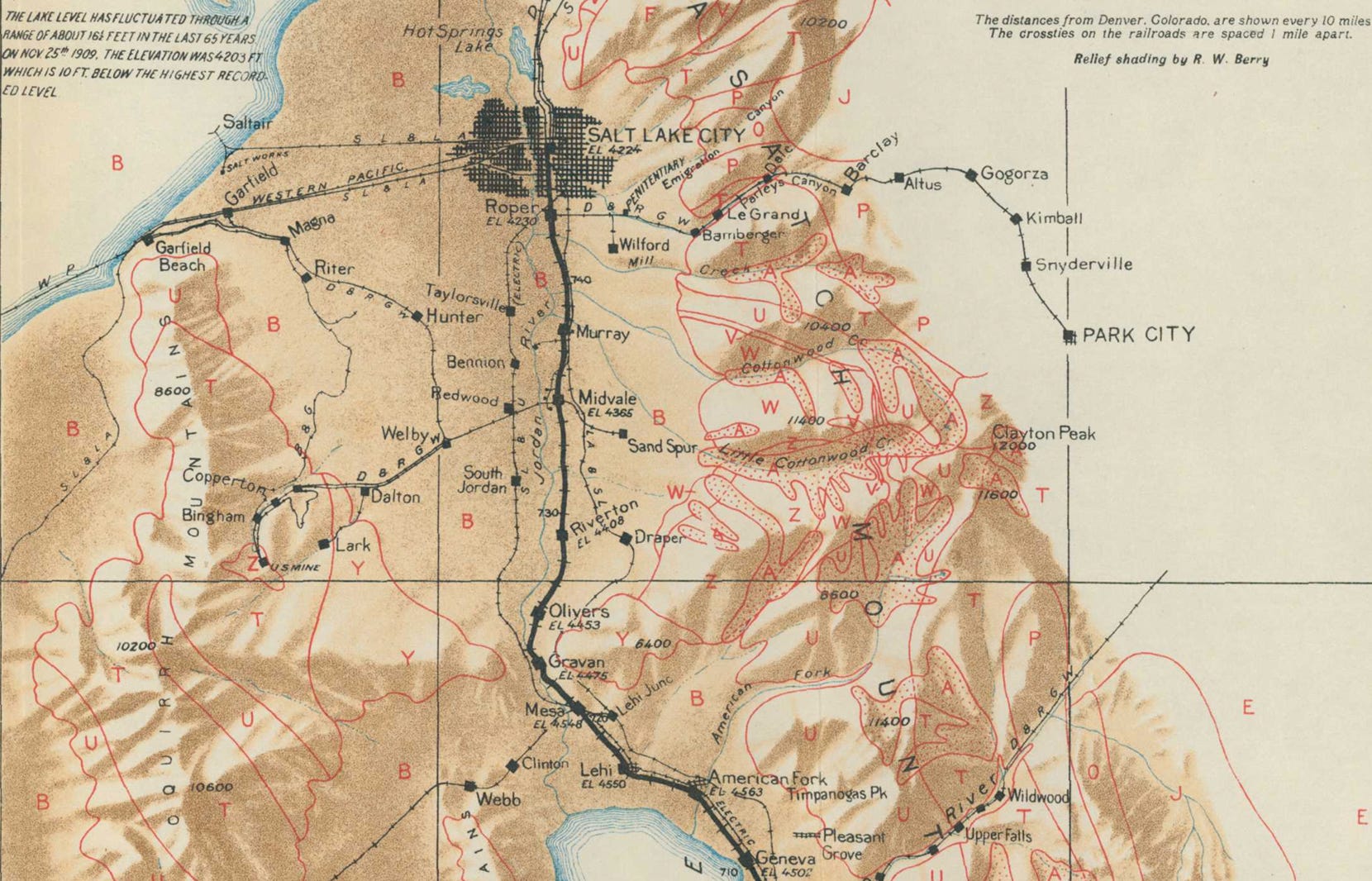
Here’s one more from the USGS’s Guidebook of the western United States: Part E – The Denver & Rio Grande Western route, published in 1922. This map shows a segment of the Wasatch Front in Utah. I’ve also included a Google Earth image of the same area now. It’s remarkable to me because back then Salt Lake City was a small city that stood on its own; now it’s surrounded by a sea of sprawl. Salt Lake was a bit bigger then (or rather, the lake level was higher than it was when the Google Earth image was made; when the map was made in 1909 it was 4,203 feet, now it’s about 13 feet lower). And Bingham Canyon still was a canyon, with little towns in it, rather than the gaping hole known as the Bingham Canyon copper mine.

The Bureau of Land Management announces 2025 Rangeland Stewardship and Innovations Award winners

Cattle graze in an allotment east of the Owyhee River Canyon near Soldier Creek in Oregon, June 8, 2017. Photo credit: Greg Shine, BLM

Click the link to read the release on the Bureau of Land Management website (Richard Packer):

September 16, 2025

The Bureau of Land Management is naming winners of the 2025 Rangeland Stewardship and Rangeland Innovations awards, which recognize exemplary management and outstanding accomplishments in restoring and maintaining the health of public rangelands.  

The bureau will present the awards on Sept. 17, at a ceremony hosted by the Public Lands Council during its 57th Annual Meeting, held this year in Flagstaff, Ariz., and via Zoom from 12-1:30 p.m. Mountain Standard Time (please join 5-10 minutes early). 

The BLM and Public Lands Council continue a 20-year partnership to honor BLM livestock grazing permittees and lessees who demonstrate exceptional management, collaboration, and communication that restores, conserves, or enhances our public lands, and to recognize their accomplishments at a gathering of their peers. 

“The BLM partners with 18,000 permittees to manage livestock grazing on about 21,000 allotments covering 155 million acres of public lands; supporting about 36,000 jobs and generating $2.87 billion in annual economic output,” said Acting BLM Director Bill Groffy. “These awardees represent collaborative, locally-led efforts to apply new technologies and grazing practices that will provide more flexibility to producers and improve rangeland health and public lands ecosystems.” 

“As federal lands ranchers, we all are partners with BLM in maintaining western landscapes and raising our livestock with the best available methods. Livestock grazing creates robust habitat, prevents catastrophic wildfires, and produces wholesome consumer products, the benefits are numerous, but it takes a tremendous amount of hard work,” said Public Lands Council President and Colorado permittee Tim Canterbury. “This is not an easy job, and it only gets tougher every year – but these award recipients have proven their ranching and conservation prowess beyond any doubt. PLC congratulates these award winners, and I am personally honored to share this profession and our traditions with them.” 

The Rangeland Stewardship Awards recognize the demonstrated use of beneficial management practices to restore, protect, or enhance rangeland resources while working with the BLM and other partners. 

  • The 2025 Rangeland Stewardship Award – Permittee Category winner is the Molsbee family of Cottonwood Ranch in Wells, Nev., nominated by the Wells Field OfficeBLM Nevada

    This sixth-generation beef and horse ranch includes 36,000 acres of federal grazing permits in northeast Nevada. It has been a cornerstone of the local community and economy for over 60 years and is currently home to four generations. Family patriarch Agee Smith has served in local, county, and state conservation district and commission leadership roles since the 1980s. His daughter and son in law, McKenzie and Jason Molsbee, are incorporating new technologies as they raise their sons to apply sustainable ranching operations.  

    In partnership with the University of Nevada Reno, BLM, and U.S. Fish and Wildlife Service, they have spent five years refining virtual fencing technology and are now using their fifth-generation collar design. The ranch has significantly improved ecosystem health, restored riparian areas, expanded redband trout habitat, and boosted beaver and moose activity while more than doubling cattle stocking rates. 

The Rangeland Innovations Awards recognize outstanding examples of demonstrated creativity, willingness to embrace change, and/or a modified perspective or approach to persistent rangeland stewardship challenges in addition to the accomplishments meriting the Rangeland Stewardship Award. 

The Public Lands Council represents the cattle and sheep producers who hold approximately 22,000 public lands grazing permits. Federal grazing permit holders provide essential food and fiber resources to the nation, as well as important land management services like the eradication of invasive species, mitigation of wildfire risk, and conservation of vital wildlife habitat. The Public Lands Council works in active partnership with the BLM, the U.S. Forest Service, the National Park Service, the U.S. Fish and Wildlife Service, and local land management offices to make landscapes more resilient across the West. 

Schematic on how virtual fencing works (collars, base station, grazing areas). Graphic credit: Colorado State University AgNext