
Mrs. Gulch’s landscape January 3, 2026

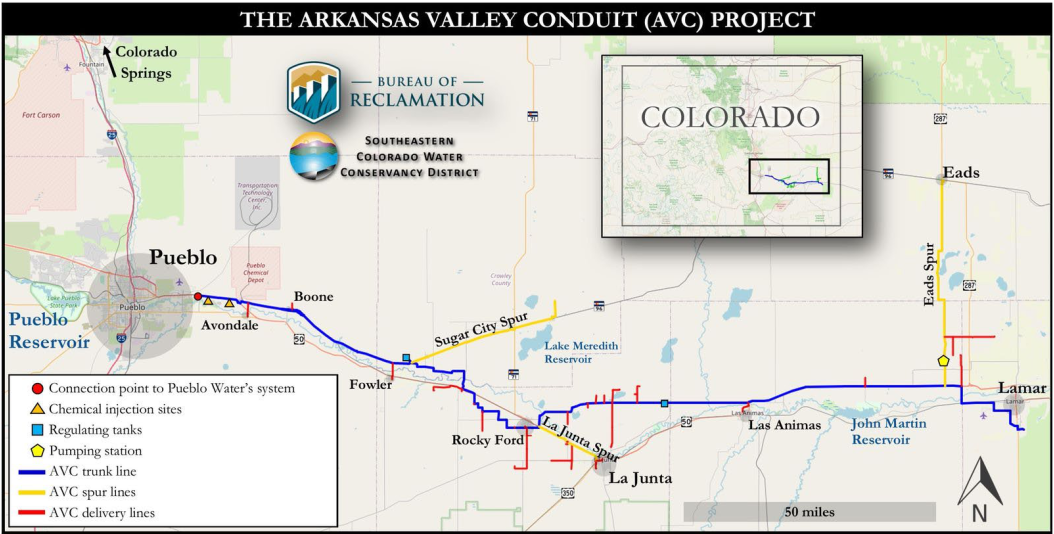
Click the link to read the article on the Associated Press website (Michelle l. Price and Meg Kinnard). Here’s an excerpt:
President Donald Trump issued the first vetoes of his second term on Tuesday, rejecting two low-profile bipartisan bills, a move that had the effect of punishing backers who had opposed the president’s positions on other issues. Trump vetoed drinking water pipeline legislation from Republican Rep. Lauren Boebert of Colorado, a longtime ally who broke with the president in November to release files on convicted sex offender Jeffrey Epstein. He also vetoed legislation that would have given the Miccosukee Tribe of Indians of Florida more control of some of its tribal lands. The tribe was among groups suing the administration over an immigration detention center in the Everglades known as “ Alligator Alcatraz.” Both bills had bipartisan support and had been noncontroversial until the White House announced Trump’s vetoes Tuesday night…
Trump did not allude to Boebert in his veto of her legislation, but raised concerns about the cost of the water pipeline at the heart of that bill. Boebert, one of four House Republicans who sided with House Democrats early on to force the release of the Epstein files, shared a statement on social media suggesting that the veto may have been “political retaliation.” Boebert’s legislation, the “Finish the Arkansas Valley Conduit Act,” aimed to improve access to clean drinking water in eastern Colorado.

Click the link to read the article on The Denver Post website (Elise Schmelzer). Here’s an excerpt:
Colorado farmers plant tens of millions of corn seeds every year, nearly every one of them covered in a thin layer of insecticide. The neonicotinoids used in the coatings protect the seed from pests in the soil and, as the crop matures, the chemical is absorbed into the plant’s tissue, where it continues to paralyze and kill insects that chomp on the crop. Farmers say the insecticide is necessary, but growing concerns about its impact on crucial pollinator species and the wider environment are prompting a push in Colorado for more regulation of the widely used class of chemicals. Environmental advocates plan to seek a bill in the state legislature in 2026 that would limit their use in hopes of protecting pollinators and water quality. While a draft bill has not yet been made public, the environmental groups working on it said the legislation would ban the use of neonicotinoids without prior approval by inspectors overseen by the Colorado Department of Agriculture.

Click the link to read the article on the Colorado Newsline website (Chase Woodruff):
January 2, 2026
Following the Trump administration’s last-minute invocation of an energy “emergency” to order a Colorado coal plant to postpone its scheduled retirement, the electricity provider that co-owns the plant is warning that the high costs of continuing to operate it will be shouldered by Colorado utility customers.
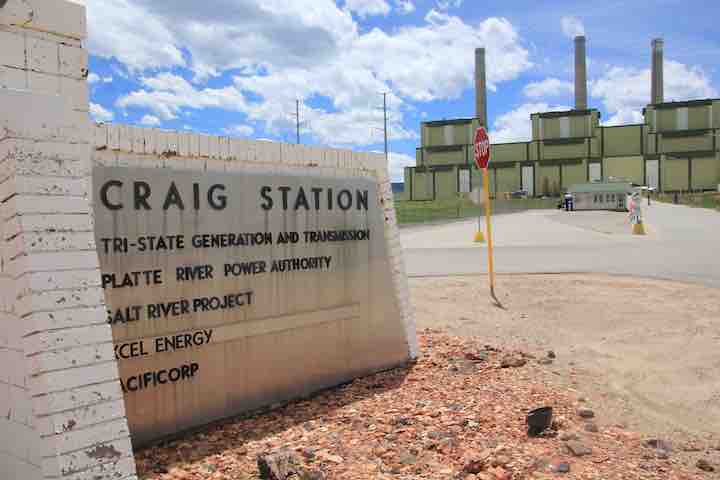
Located in Moffat County, Craig Generating Station’s 446-megawatt Unit 1 had been scheduled to go offline on Dec. 31, 2025, part of a wave of coal retirements planned across Colorado through 2030. But an emergency order issued Dec. 30 by the Department of Energy requires the plant to “take all measures necessary to ensure that Craig Unit 1 is available to operate” until at least March 30, 2026.
Tri-State Generation and Transmission Association, co-owner of Craig Generating Station, said in a press release that the “additional investments in operations, repairs, maintenance and, potentially, fuel supply” required by the order will raise costs for the plant’s customers, which include dozens of electric utilities and rural co-ops. Unit 1 was already offline due to a mechanical failure on Dec. 19, Tri-State said.
“We are continuing to review the order to determine what this means for Craig Station employees and operations, and the financial impacts,” said Tri-State CEO Duane Highley. “As a not-for-profit cooperative, our membership will bear the costs of compliance with this order unless we can identify a method to share costs with those in the region. There is not a clear path for doing so, but we will continue to evaluate our options.”
The five-page DOE order, signed by Energy Secretary Chris Wright, cites “growing resource adequacy concerns” as justification for the move, which followed similar actions in Indiana and Washington.
Shortly after taking office last year, President Donald Trump declared a “national energy emergency” in an executive order blasted by environmental advocates as a pretext for advancing the interests of fossil-fuel companies. Despite the declaration’s stated concerns about “insufficient energy production,” the administration has continued to cancel and delay major wind and solar projects.
An analysis released in December by the Sierra Club estimated that keeping Craig’s Unit 1 open for 90 days would cost ratepayers at least $20 million. Critics of the administration anticipate that the DOE’s orders will continue to be renewed every 90 days under the authority granted to the department by Federal Power Act, raising costs by $85 million to $150 million annually.
“Keeping this dirty and outdated coal plant online will harm the health of surrounding communities and hurt all of our pocketbooks,” said Michael Hiatt of environmental group Earthjustice. “This unlawful order will benefit no one but the struggling coal industry.”
The DOE order comes amid a series of Trump administration actions targeting Colorado that are widely viewed as retaliation for the ongoing incarceration of Trump ally and former Mesa County Clerk Tina Peters, who was convicted on felony charges for her role in a breach of her own office’s secure election equipment in 2021.
Colorado U.S. Sen. Michael Bennet voted to confirm Wright, a former Denver oil executive, as Trump’s pick for Energy Secretary in January 2025, calling Wright “passionate about strengthening America’s energy independence and lowering costs for Colorado families.” In a statement Wednesday, Bennet, a Democrat who is running for Colorado governor, said he was “disappointed but not surprised by this continued revenge tour.”
“The DOE order is the latest in a string of attacks against Colorado, because we refuse to bend to the President,” Bennet said. “President Trump continues to take out his personal and political grievances on Coloradans who are already struggling to make ends meet.”

Click the link to read the article on the Sustainable Waters website (Brian Richter).
December 31, 2025
‘Sustainability’ is a foundational tenet of modern natural resource management. The concept of sustainable development gained global recognition in 1987 when the United Nations’ Brundtland Commission published its report on Our Common Future, in which sustainable development was defined as “meeting the needs of the present without compromising the ability of future generations to meet their own needs.” In simple terms, this means avoiding the depletion of natural resources and loss of species over time.

Our research group has just published our third detailed assessment of water resources management in three major river basins in the western United States. Our three studies — focusing on the Colorado River, the Great Salt Lake basin, and the Rio Grande-Bravo — clearly document that water managers and political leaders are failing in their efforts to manage these water resources for long-term sustainability, meaning that they have not balanced water consumption with natural replenishment from snowmelt runoff, rainfall, and aquifer recharge. As a result, reservoir and groundwater levels are falling, rivers are shriveling, and numerous endangered species are in great jeopardy. The livelihoods and well-being of tens of millions of people dependent on these water systems, along with the extraordinary ecological systems and species sustained by these waters, are now at great risk.
As a Native American friend said recently, “our world is out of balance.”
These systemic failures share a common history with hundreds of other stressed river basins and aquifers around the planet. For thousands of years, the human populations dependent on each water source were small enough that water consumed for human endeavors had little to no impact on water sources and associated ecosystems, i.e., their use of water was ‘renewable’ and ‘sustainable.’ But over the course of the 20th century, the growth of human populations and associated food needs grew rapidly — largely without constraint or control — to the point of consuming all of the renewable annual water supplies in many river basins, including the three we studied. Then as we entered into the 21st century, climate warming began reducing the replenishment of rivers, lakes, and aquifers. The balance between water consumption and replenishment became overweighted on the consumption side as the replenishment side got lighter. Our world went out of balance.
The Risks of Continued Imbalance Are Very Frightening
The potential consequences of this imbalance are nothing short of horrific and dangerous in the three basins we studied. Here are some of the highlights from our trilogy of recent papers:

- Colorado River Basin: Since 2000, more water has been consumed than replenished in this basin in three out of every four years, on average. These recurring deficits in the basin’s annual water budget has been offset by depleting water stored in the basin’s reservoirs and aquifers, analogous to pulling money out of a savings account to make up for overdrafts in a checking account. As a result, the basin’s two biggest reservoirs — Lake Powell and Lake Mead — are now 70% empty. There is great concern that if the water level in Lake Powell drops below 3490′ elevation (see graph below), it could become physically impossible to release sufficient water through the Grand Canyon to meet the water needs of ~30 million people downstream. In a worst case scenario, the volume of water flowing out of Glen Canyon Dam could intermittently shrink to a trickle if the dam’s managers determine that continuous use of the lowest river outlets is too structurally risky and releases into the Grand Canyon must be drastically reduced. This calamity would further imperil unique freshwater ecosystems and wipe out the $50 million/year whitewater rafting industry in the Grand Canyon. We estimate that average annual water consumption needs to be reduced immediately by at least 13% below the recent 20-year average to rebalance water consumption with natural replenishment in this basin.


- Great Salt Lake Basin: The lake has lost nearly half of its volume since 2000, dramatically shrinking the area of the lake’s surface and exposing extensive salt flats around the lake’s perimeter. Those salty soils are loaded with toxic heavy metals including arsenic, lead, and mercury. Recurring high winds blow that dangerous dust into the nostrils and lungs of more than two million people living in the Salt Lake City area. Brine shrimp living in the lake also suffer at low lake levels due to extreme salinity, greatly reducing the food supply for more than 10 million migratory birds along the Pacific Flyway and decimating production of brine shrimp eggs that are a critical feed source for the world’s aquaculture industry. The reduced evaporation from a shrinking lake also impacts the formation of storm clouds that drop the “world’s greatest snow” onto the Wasatch Mountains, site of the upcoming 2034 Winter Olympics. Water consumption in the basin needs to be rapidly reduced by 21% to stabilize the lake.


- Rio Grande-Bravo: Reservoir storage in this large international basin is now three-quarters empty. New Mexico’s reservoirs hold only 13% of their capacity, presenting a “Day Zero” scenario in which the remaining reservoir storage could be wiped out in just one or two more bad water years. This has created heated political conflict: New Mexico has been failing to deliver the volume of water it owes to Texas under the Rio Grande Compact, and Mexico has been unable to deliver sufficient water to the US under the terms of an international water treaty. Also of great concern is plundering of the vast groundwater reserves in the basin that has accelerated as surface water supplies have run short (see map of groundwater depletion below). Only half of the water being consumed for human endeavors in this basin is sustained by natural replenishment; the other half depends on unsustainably depleting reservoirs and groundwater aquifers and drying the river.

Governance Failures
The response to these crises has been woefully inadequate. Instead of addressing these imbalances at the scale and speed necessary to avert catastrophe, political leaders and water managers have been unable or unwilling to mobilize sufficient corrective actions to rebalance these water budgets. From my observations, there are multiple interacting causes of these governance failures:
- There is continuing belief among many political leaders and water users that more bountiful replenishment years in the future will restore the massive accumulated deficits in reservoir and aquifer volumes. This belief runs contrary to the evidence of 25+ years of declining water trends and many scientific assessments warning that replenishment will continue to decline due to climate warming and aridification.
- Water users have not been adequately or truthfully educated about the potential consequences of continued depletion of reservoirs and aquifers, and the rapid rate at which risks are increasing. The lack of honest communication and misunderstanding of pending dangers perpetuates complacency and inaction. What is needed is full and honest disclosure about the degree to which water consumption is out of balance with replenishment, and which water users and economic sectors are at great risk from deepening water shortages in future years.
- Fearing hostile reaction to any mandated cutbacks in water consumption, political leaders lack the will to force or incentivize the actions required to rebalance consumption with (diminishing) replenishment. There are no plans in the three basins described above for correcting imbalances at the necessary scale and speed. Legislative appropriations to address these crises have been orders of magnitude smaller than what is needed. These meager appropriations serve to placate the general public by giving the impression that responsible actions are being taken, serving as a smoke screen hiding the monstrous dangers on the horizon.
- Instead of facing the reality that consumption needs to be speedily reduced, water managers continue to flout pipe dreams for augmenting water supplies such as long distance water importation schemes (bring water from the Great Lakes! bring water from the Yukon!), or desalinating ocean water, or recycling water ‘produced’ from oil and gas fracking operations. There is no truthful reporting of how much additional water can be secured by these schemes, how much that water will cost, and who will be able to afford it. Irrigated agriculture is by far the dominant water consumer in the three basins we studied, but there is no way that farmers are going to be able to afford these water augmentation dreams.
The Way Forward: Sustainability Principles
Throughout my career I’ve always said that one should not deliver criticism without also offering solutions. In my Chasing Water book I outlined seven principles for sustainable water management.

I continue to believe in this recipe for water sustainability. But I need to offer some important clarifications:
- Principle #1 is arguably the most important. Given that water consumed on farms is typically much greater than is consumed in cities, it is critically important to meaningfully engage farmers in water planning because they will bear the greatest burden of any limitations placed on water consumption. They can bring their best ideas forward, and in doing so help to ensure that water plans address both their concerns and their abilities to adapt. But it is essential that any water plans be built upon an honest and technically credible assessment of how much water will be available in the future.
- Principles #2 and #3 should not be permanent, static volumes. Under a changing climate, the imposed limits need to be adaptive to changing water availability; during wet periods more water can be consumed, but lesser volumes should be allocated during dry times. I believe that the best way to do this is to set a 5-year fixed volume (a “cap“) on annual consumption based on an average of how much water has been available in the recent 5 years, and then allocate portions or shares of that volume to each user (i.e., to each geopolitical unit, community, or individual water user). The cap volume needs to be updated every five years. I like a 5-year adaptive cap because it gives water users enough time to plan and implement changing allocations while not allowing any overconsumption to cause severe problems before readjusting the cap.
- Principle #6 acknowledges the reality that water conservation measures can be costly for both rural and urban users, and can impact the profitability of farms. Subsidization of these expenses or losses will be essential in rebalancing these water systems for sustainability, enabling both urban and rural communities to transition to lower water use as rapidly as possible, and with least economic and social impact. The price tags may seem exorbitant or impossible at first blush, but the costs of continued unsustainable water use will be much, much greater.
- Principle #7 requires investment in continuously monitoring reservoir, aquifer, and river levels, and enforcement of water allocations. One of the most important indicators of management performance is whether reservoir or aquifer levels or annual river flow volumes are declining. If this is the case, allocations need to be adjusted until balance returns.
Passing the Torch to a New Generation
Today is my retirement day.
In my Chasing Water book, I mused about the fact that when I was born in 1956, the western US was in the grips of one of the longest and most severe droughts in American history. It seems fitting to have spent my professional life focusing on water scarcity and environmental flows.
But I now find it quite depressing to acknowledge that our society has still not become any better at sustainable water management. Many river basins, including the three summarized above, are now facing their most dangerous crises.
When I was teaching water sustainability at the university level, I would point out to my students that in my birth year of 1956 virtually all of the Colorado River’s water was being consumed. Why we allowed greater and greater use of water in that river basin for another half-century continues to astonish and bewilder me to this day. Why is our species so incapable of recognizing clear and present dangers and so inept at responding accordingly?
But I leave you eternally hopeful. The students that I’ve taught, and the many younger adults I’ve met through my work in more than 40 countries, have the intellect and the passion to bend the arc of water management back towards sustainability, if we give them the chance. I urge them to take up this charge, to find ways to gain positions of authority and power to lead toward better days ahead.
I’ll leave these next generations with one bit of advice: The management of water cannot remain solely in the hands of hydrologists and engineers and economists. We need legions of young new professionals that understand social science, political science, behavioral science. And we need artists.
After all, managing water is about people, and the human spirit.
Adiós
Click the link to read the article on The Denver Post website (Elise Schmelzer). Here’s an excerpt:
December 30, 2025
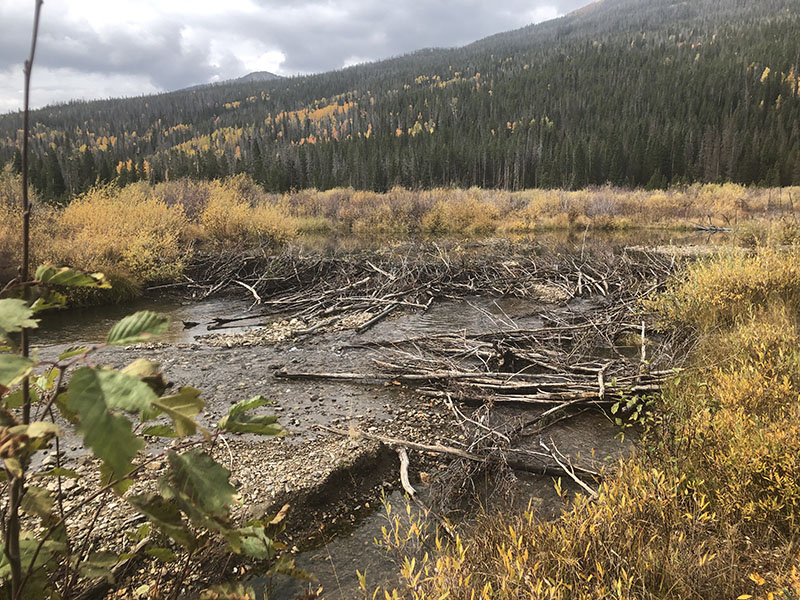
High in the mountains west of Fort Collins, teams of scientists and engineers are pretending to be beavers.
They may not be swimming or chewing trees, but researchers with the U.S. Forest Service and Colorado State University are building [beaver dam analogs] in burn scars to study how wetlands created by the dams impact ecosystem restoration and water quality after wildfires. The research led by Tim Fegel is some of the first of its kind, he said. Scientists have studied how meadow and wetland restoration affects wildlife habitat, but there’s been little exploration of how wetlands created by beaver dams could change water quality post-wildfire, said Fegel, a biogeochemistry lab manager with the Forest Service who is leading the project.
“It’s kind of a brave new world for us with this type of work,” said Fegel, who is also a doctoral candidate at Colorado State University.
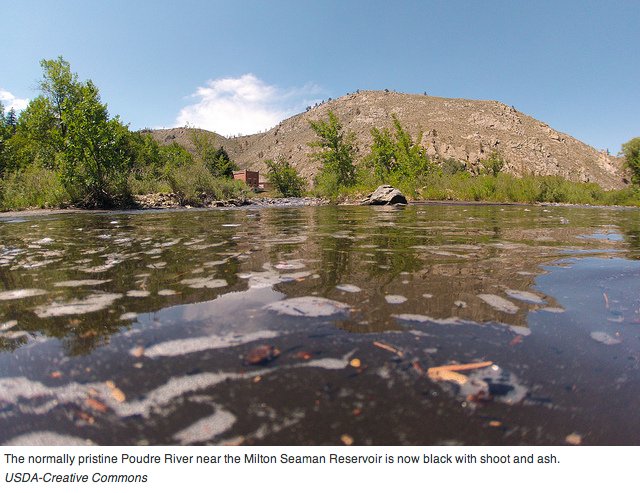
Wildfires destabilize soils and make them less capable of absorbing rain and snowmelt, resulting in higher runoffs and increased flood probability. High volumes of water, combined with a lack of vegetation roots to hold soil in place, mean that more sediment and debris travel downstream, impacting water quality and water treatment systems.

Five years ago, the Cameron Peak and East Troublesome wildfires ripped through Colorado’s northern mountains, charring more than 620 square miles across watersheds that provide water for hundreds of thousands of people who live along the Front Range. That’s where Fegel and other researchers think the [beaver dam analogs] can help. Fegel hopes the work will provide land managers and water utilities with more data and, potentially, another water-quality tool. The team installed beaver-style dams across the Cache la Poudre and Willow Creek watersheds — both burned in the 2020 wildfires — to help slow water flow and instead spread the water over a floodplain. Engineers designed the dams, which are generally made of large logs hammered into the earth with branches and other material.

Click the link to access the report on the American Meteorological Society Journals website. Here’s the abstract:
August 29, 2025
The snow-to-liquid ratio (SLR) and its inverse, snow density, are crucial for forecasting snowfall in numerical weather prediction models and for estimating snow water equivalent (SWE) on the ground using remote sensing. SLR also varies widely in space and time, making it challenging to forecast accurately, particularly in the heterogenous terrain and climate of the mountains of the western United States. This study utilizes high-quality, manually collected measurements of new snowfall and new SWE from 14 mountainous sites across the region to build multiple linear regression (MLR) and random forest (RF) algorithms to predict SLR as a function of atmospheric variables. When an MLR algorithm is trained on a simple combination of wind speed and temperature from either the ERA5 reanalysis, the GFS, or the High-Resolution Rapid Refresh (HRRR), it predicts SLR with considerably more skill than existing SLR prediction methods. When a more extensive set of variables is considered, the skill improves further. The variables used to achieve the most skillful prediction of SLR are temperature, wind speed, relative humidity, specific humidity, maximum solar altitude angle during the observing period, convective available potential energy (CAPE), and HRRR quantitative precipitation forecast (QPF). When an RF algorithm is trained using these variables, it can predict SLR with R2 = 0.43 and mean absolute error (MAE) = 2.94. For the existing SLR prediction techniques currently used in operations, R2 ranges from 0.04 to 0.23 and MAE ranges from 4.01 to 9.45. Therefore, the algorithms built in this paper can drastically improve SLR prediction over the mountains of the western United States.
Click the link to read the article on the Big Pivots website (Allen Best):
December 31, 2025
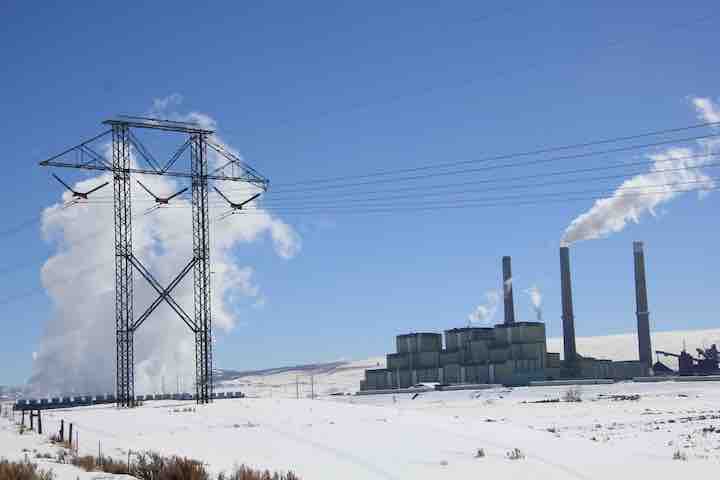
Trump orders Craig coal unit planned for retirement to stay open. But it so happens the unit is broken. Ludicrous says Polis team. Sierra Club challenges basis for emergency declaration.
It was no surprise. Tri-State Generation and Transmission has said for at least three months that it expected to get orders from the Trump administration to continue operating a coal-burning unit at Craig, in northwest Colorado, beyond its scheduled retirement on Dec. 31, 2025.
The order was posted at 6 p.m. MST Tuesday. Citing emergency authority claimed by President Donald Trump, Energy Secretary Chris Wright ordered the coal unit to remain in operation through March 2026. The order cited a sudden increase in demand for electricity, or a shortage of generation capacity.
The irony of the order is that it was issued when the 427-megawatt unit was out of operation, according to a statement issued by the office of Colorado Gov. Jared Polis.
“Ludicrously, the coal plant isn’t even operational right now, meaning repairs — to the tune of millions of dollars — just to get it running, all on the backs of rural Colorado ratepayers!” Polis said.
“Going backwards is an attempt to force local communities to foot the bill to extend plant operations and will cost energy consumers more. Today’s action flies in the face of this careful planning, is inconsistent with market forces, and will hurt Coloradans.”
The Polis team estimated continued operations would cost tens of millions of dollars “to keep a coal plant open that is broken and not needed.”
Tri-State, in a statement on Wednesday morning, explained that the unit “went into an outage” on Dec. 19, 2025, due to a mechanical failure of a valve. “Tri-State and the other co-owners will need to take the necessary steps to repair the valve in a timely manner,” the statement said.
“Tri-State has a policy of 100% compliance, and we will work with Unit 1 co-owners, and federal and state governments to determine the most cost-effective path to that end,” said Duane Highley, Tri-State CEO. “We are continuing to review the order to determine what this means for Craig Station employees and operations, and the financial impacts. As a not-for-profit cooperative, our membership will bear the costs of compliance with this order unless we can identify a method to share costs with those in the region. There is not a clear path for doing so, but we will continue to evaluate our options.”
As a result of the order, retaining Unit 1 will likely require additional investments in operations, repairs, maintenance and, potentially, fuel supply, all factors increasing costs, Tri-State said. “Tri-State is continuing to review the order to determine how best to comply while limiting the costs to its members, and the impacts to its employees and operations.”
Highley told Big Pivots in October that the wholesale supplier for cooperatives in Colorado and three other states did not need the electrical production at this time, as it is actually producing more than it needs.
Wright, in his order, No. 202-25-14, cited several justifications.
One justification was a 2024 report by the Western Electricity Coordinating Council that forecast growth of 8.5% in peak demand during the next decade in Colorado and several adjoining states.
The order also said that Tri-State and its co-owners — Fort Collins-based Platte River Power Authority, Phoenix-based Salt River Project, Salt Lake City-based PacifiCorp., and Denver-based Xcel Energy — “take all measures necessary” to ensure that Craig Unit 1 is available to operate at the direction of either Western Area Power Administration in its role as a balancing authority or the Southwest Power Pool West in its role as the reliability coordinator.
The Sierra Club emphasized the cost of operating Craig No. 1. It cited a recent report by Grid Strategies that found operating the unit past the retirement deadline will cost the plant owners $85 million per year. This is distinct from repairs that may be necessary.
“Trump is playing politics with coal,” said Margaret Kran-Annexstein, director of the Colorado chapter, in a statement issued shortly after the order was posted.
Matthew Gerhart, the senior attorney for the Sierra Club at its Denver office, had even stronger language in an interview with Big Pivots.
“I think this order is a joke even by this administration’s standards,” he said. “This is quite clearly just a political move. None of the documents they cite even come close to saying there is an emergency.”
Wright’s order cited the 2025-2026 Winter Reliability Assessment issued by the North America Electric Reliability Corporation. That report in November noted total and net internal demand increases of almost 1% driven primarily by data centers and commercial and industrial customer growth. Even so, the operating reserve margins in the Rocky Mountain were expected to be met before imports in all winter scenarios.
That being said, Xcel Energy almost a year ago began expressing concerns about resource adequacy.
Gerhart also found fault with Wright’s order that the unit be available to operate at the direction of the Southwest Power Pool West in its role as the reliability coordinator. SPP exists, but not the configuration — a regional transmission organization — that would allow SPP to do this, he said. SPP has a day-ahead market and also a balancing market but not the apparatus set up to manage the operation of Craig No. 1, he said.
Will Toor, director of the Colorado Energy Office, also pointed to the report from the North America Reliability Corporation that found no short-term or long-term elevated reliability risks in the Rocky Mountain region,
“These orders will take money out of the pockets of Colorado ratepayers, and especially harm rural communities across the West who could be forced to absorb the unnecessary excess costs required to keep this plant operational,” he said. “The Trump administration is engaging in Soviet-style central planning, driven by ideology rather than the realities of the electric grid, that will drive dirtier air and higher electric rates across our state. These orders are unlawful and will not improve energy security in Colorado or the region.”
Trump has claimed authority to order coal plants remain in operation under the Federal Power Act. That nearly century-old law explicitly gives presidents authority to order electrical plants to operate under duress of war or weather emergencies. Since last April, Trump has sought to expand the power, citing emergencies caused by concerns about resource adequacy. The concerns, he has said, result from retiring fossil fuel and nuclear plants, dramatic growth in demand, and the intermittency of renewables.
For a deeper dive on Trump’s contested use of the emergency clause in the Federal Power Act, see this Big Pivots story from Nov. 3: “Will feds order Colorado coal plants to stay open?”
U.S. Sen. Michael Bennet, a gubernatorial candidate, also pushed back: “The DOE order is the latest in a string of attacks against Colorado, because we refuse to bend to the President. President Trump continues to take out his personal and political grievances on Coloradans who are already struggling to make ends meet. Federal intervention like this makes long-term planning impossible – this is not how you operate a business, plan an electric grid, or help a community stay prosperous. I am disappointed but not surprised by this continued revenge tour.”
Wright’s order said that 417.3 megawatts of coal-fired generating capacity across six units at three locations have retired in Colorado since 2019. It cited the Western Electricity Coordinating Council. “Looking forward, by 2029, about 3,700 megawatts of coal-fired generating capacity in Colorado is scheduled to be retired.” The order said that during that time, 675.6 megawatts of natural gas-fired generating capacity in Colorado will retire as well.

In 2025, wind accounted for over 5,300 megawatts of Colorado’s electricity generating capacity, the order noted.
Wright’s order described wind as intermittent. Of course, coal can be intermittent, too. That has been demonstrated repeatedly at Pueblo, particularly in the case of Comanche 3. The coal unit went down again in August and is not expected to be restored into operation until June 2026. In its absence, Xcel asked — and the Polis administration agreed — that Comanche 2 would not be retired this month, as had been planned for several years.
As for Craig No. 1, its retirement was planned in an agreement reached almost a decade ago. Air quality standards in Rocky Mountain National Park and other national parks and wilderness areas are being violated in part because of emissions from the unit. The regional haze standards were federally created and state enforced. The agreement with the Colordo Air Quality Control Commission was reached in 2016.
Tri-State’s electric resource plan of 2023 showed adequate resources to maintain reliability on Tri-State’s system following the retirement of Craig No. 1 as well as two other units at Craig Station that are scheduled to close in 2028. Unit 2, which Tri-State owns with its other partners in Unit 1, has a capacity of 410 megawatts. Tri-State owns 100% of Unit 3, which has a capacity of 448 megawatts. The three units were constructed and went on line in the late 1970s and early 1980s.
The Trump administration first cited the Federal Power Act earlier this year this year for plants in Michigan and in Pennsylvania and has recently used that same emergency power to order continued operation of fossil fuel plants in Indiana and Washington.


From email from Brian McNeece:
December 31, 2025
I arrived late to the Upper Colorado River Commission meeting in Las Vegas, having briefly gotten lost in the disorienting maze of garishly lit slot machines, escalators reaching to the heavens, and hallways with a vanishing point at infinity. Could there be a more incongruous place to hold a convention about something so natural and sublime as water?
Just as I took my seat, Becky Mitchell, the forceful, passionate commissioner from the state of Colorado, said something puzzling and important. “The Lower Basin states continue to overuse their allocation of Colorado River water.”
And thus, in my very first minutes at the Colorado River Water Users Association (CRWUA) conference, I had my theme for the next three days. Because, in fact, that is not true. The Lower Basin states of Nevada, Arizona, and California are not overusing their allocation. In fact, last year, they used 6 million acre-feet, 1.5 maf less than their allocation. Why would Ms. Mitchell say that?
I asked this question numerous times in the next few days. I got some arcane answers. Perhaps Ms. Mitchell doesn’t accept that Arizona isn’t charged Gila River water as part of its allocation. Maybe she thinks the Lower Basin should be charged for evaporation losses below Glen Canyon Dam.
One Colorado water attorney brought his own charts to breakfast and showed me how the Lower Basin states had in fact been overusing their allocation—in the past. True, but we’re talking about now. Ms. Mitchell has not answered my email request for an explanation.
Ms. Mitchell apparently stands alone in her assertion that even now, the Lower Basin is overusing water. For after she spoke, neither Brandon Gebhart of Wyoming, nor Gene Shawcroft of Utah, nor Estevan Lopez of New Mexico repeated her claim.
As leader of the Upper Colorado River Commission, Ms. Mitchell has also protested that Mother Nature cuts her users when it doesn’t rain, and therefore Upper Basin states cannot take any more cuts.
But in fact, the Upper Basin has dozens of reservoirs above Lake Powell that right now are holding around 5 million acre-feet of water—about a year and a half of storage at recent Upper Basin use. The Upper Basin has wiggle room for taking emergency cuts.
Even those water users who are directly cut by Mother Nature can take cuts—during wetter years. Currently, the state of Colorado has a provision in its water law known as Free River, which means that when the flow in a creek exceeds the volume needed to fulfill all local water rights, users along the creek are free to divert all the water they want. In 2023, the South Platte River was in Free River condition for 64 days. This should stop.
Read: Prior Appropriation. A free river is a river or stream reach where the natural flow is sufficient to satisfy all existing decreed water rights, so no administrative curtailment (a “call”) is required.
Jason Turner, an attorney for Colorado River water Conservation District, told the audience that Free River, despite appearances, is not wasteful of water that could otherwise go to the next reservoir downstream. No, he said, this water helps bring moisture deep into the soil, preventing the pasture grass from dying during the later dry months of the year.
Every user on the Colorado River would love to invoke Free River—use as much as you want when times are flush. But seeing the Colorado River system as a whole, times are not going to be flush. The whole region is getting drier, and we have to reduce water north and south.
With her two claims, Ms. Mitchell has extended her character beyond passion and resolve; she is holding positions that challenge the foundation of the Law of the River going back to the Compact of 1922.
It seems that Ms. Mitchell is the adamantine wall preventing progress toward new rules for operating the Colorado River watershed after the interim rules expire next September. The word on the convention floor was that she is willing to ride her position into court, a risky move that almost everyone else wants to avoid. The solution is for the other states to negotiate a deal without Colorado.

This has happened before. Arizona refused to ratify the Colorado River Compact after its commissioner Winfield S. Norviel signed it in 1922, but the deal went forward anyway. Arizona finally ratified the agreement in 1944.

The Lower Basin states of Nevada, Arizona and California have volunteered to continue taking 1.5 maf of cuts into the future, but if deeper cuts are needed, they propose that the Lower Basin and Upper Basin share reductions fifty-fifty. Maybe those numbers can be adjusted somewhat. Wyoming, Utah, and New Mexico, it’s time to make a deal. Colorado can sign on later. Everyone needs to do her part.
[ed. The 1.5 MAF satisfies the structural deficit because the Lower Basin has never been charged for shrink, and it is a significant commitment. However, the Lower Basin folks are talking around the fact that no one has the authority to order mandatory cuts by Colorado diverters; No one has the technology to “color” (account for) the water in the Colorado River due to measurement uncertainty, the lack of structures in place, hundreds of river miles with gaining and losing reaches; The classic paper water vs. wet water dilemma; Prior Appropriation — if the water is in the stream, and a diverter has a decree that is in priority, the it is lawful for the diverter to divert and water bypassed by upstream diverters; Any uncompensated restriction would be a “taking” so a funding stream is needed to pay for compensated savings.]


Click the link to read the article on the Circle of Blue website (Brett Walton):
December 22, 2025
Colorado River water could enable a pumped storage hydropower project intended to make the region’s electric grid more resilient.
KEY POINTS
One of the longest-duration pumped storage hydropower projects in the country is proposed for Navajo Nation land in the Four Corners region.
The project received a $7.1 million Department of Energy grant this year for feasibility studies.
Pumped storage hydropower is the largest form of energy storage in the U.S.
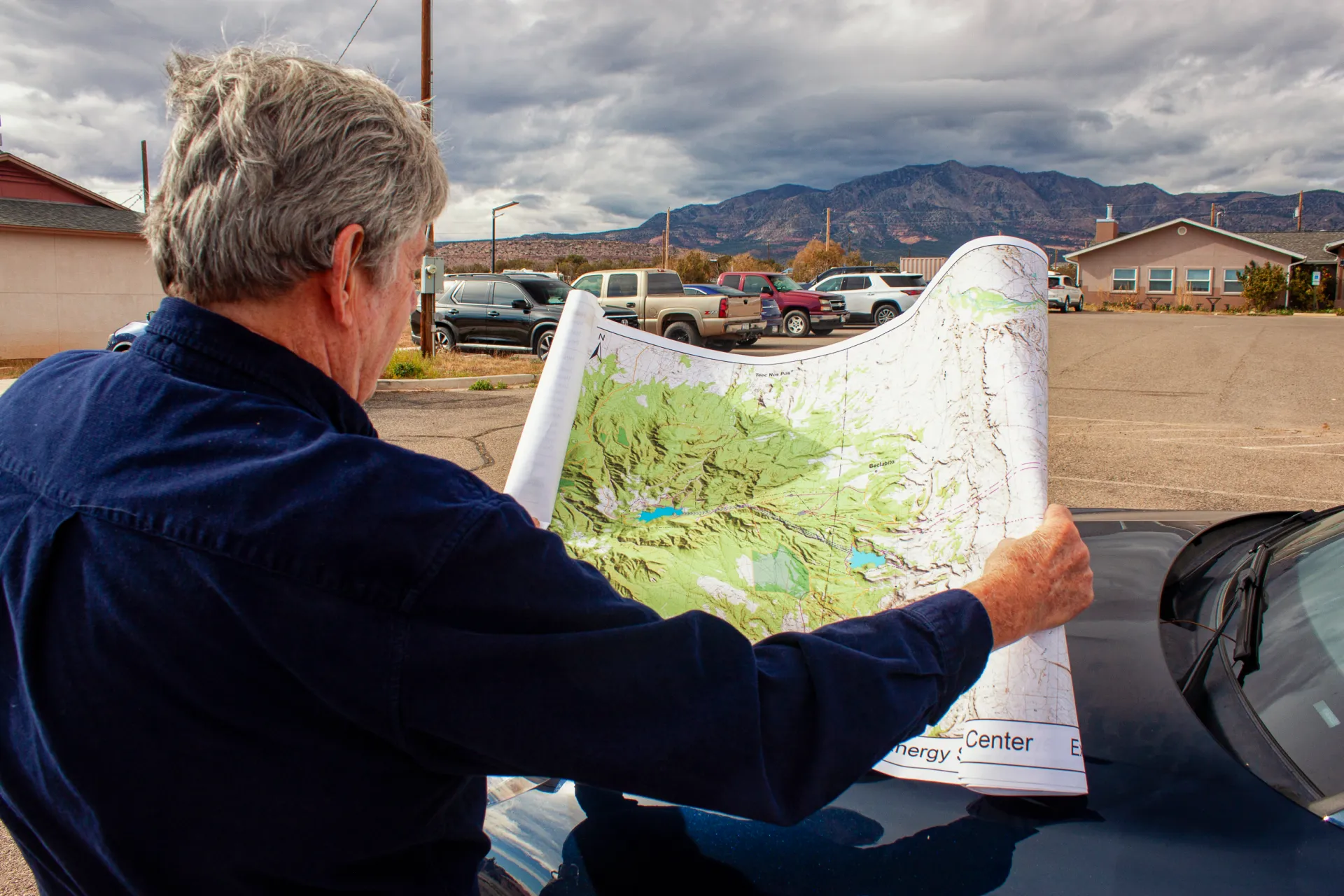
Standing in a breezy parking lot on Navajo land in the state’s far northwest corner, Tom Taylor looked toward the western horizon and then upwards at the furrowed mass of the Carrizo Mountains less than 10 miles away.
If all goes to plan, the infrastructure that could one day spill from the mountain’s flanks and through its core will become an essential piece of the region’s electric grid, able to store surplus electricity from renewable energy and other power sources for when it is needed later.
Fighting the wind that chilly November morning, Taylor used both hands to pin a detailed map against the hood of his Porsche Macan. A jumble of dashed lines and blue splotches representing proposed power lines, reservoirs, a water-supply pipeline, and access roads were printed atop the real-world geography on display in front of us.
“This will be a battery that lasts a long time,” Taylor said, holding tightly to the map.

The project is the $5 billion Carrizo Four Corners Pumped Storage Hydro Center, which is designed to be one of the largest long-duration energy storage projects in the country. Pumped storage moves water between two reservoirs at different elevations. Water is pumped uphill when excess electricity is available and released to generate electricity when power demand warrants it.
Taylor, a former mayor of Farmington and a state House representative from 2000 to 2014, is employed by Kinetic Power, the three-person, Santa Fe-based outfit behind the Carrizo proposal. The company sees the project as a way to make the region’s electric grid more durable and cost-effective, not only by smoothing the intermittent nature of wind and solar but also as a bulwark against energy emergencies like the winter storm in 2021 that caused blackouts and 246 deaths in Texas. The twinned reservoirs, using water sourced from a Colorado River tributary nearby, would have the capacity to generate 1,500 megawatts over 70 hours – a form of battery that could provide the equivalent output of a large nuclear plant for nearly three days.
“We believe that the key is delivering economic value,” said Thomas Conroy, Kinetic Power’s co-founder, who has four decades of experience developing energy projects.
What seems straightforward when placing lines on a map is much less so in three dimensions. Carrizo Four Corners, which is still in the exploratory stage and is at least five years away from breaking ground, has nearly as many questions as answers at this point. What is the geology within the Carrizo Mountains? Will it support a 3,300-foot-deep shaft, a subterranean powerhouse, and dam abutments? How will drought affect the water supply? What cultural sites and wildlife might be at risk from construction? What are the power market dynamics?
Answering those questions is the goal of a $7.1 million, two-and-a-half-year Department of Energy grant that Kinetic and its six university and research partners secured in August. (The state of New Mexico and the research partners are also contributing $7.1 million.) On the political side, will future Navajo administrations feel as favorably toward Carrizo as current president Buu Nygren?
The technical questions are but one piece of an ambitious project that touches many of the most pressing questions about natural resources in the American West today: energy development, water use, and the relationship between federal law and tribal law.
Connecting Water and Energy
Though the details are still to be worked out, the project can be described in broad strokes.
The Federal Energy Regulatory Commission, which oversees federal hydropower licensing, granted Kinetic a preliminary permit in 2021. In February 2025 FERC extended the permit, which allows for site investigations but no construction work, for another four years.
The company envisions two “off-channel” reservoirs that would not dam a flowing river. The lower reservoir will be near Beclabito. The upper, in the high reaches of the Carrizo Mountains. Both are on Navajo land, but on different sides of the Arizona-New Mexico border.
The powerhouse that holds the electricity-generating turbines will be located underground, some 3,300 feet below the upper reservoir. Some of the longest pumped storage tunnels in the country will be required to connect the reservoirs and the powerhouse.
Despite the geotechnical challenges, Conroy is particularly enthused by the site, which he said is the most optimal in Arizona and New Mexico – and possibly the entire country – to locate a pumped storage hydropower project.
The site stands out for four reasons, he said. It is near existing transmission corridors and grid connections due to the region’s legacy of enormous coal-fired power plants. And it will have a comparatively low capital cost for the energy it will produce.
The other two reasons relate to water. Because of the extreme height differential between the upper and lower reservoirs – almost three Empire State Buildings – less water will be required to produce a unit of energy than for reservoirs with a gentler gradient. And because the upper reservoir site is a deep canyon, surface area and thus evaporation will be minimized.
“Water is just top of mind here in the Southwest,” Conroy said. “And our project is as water-efficient as can be made.”
Water to fill the reservoirs would be drawn from the San Juan River, a tributary of the Colorado, via pipeline. The water would come from the Navajo Nation’s San Juan rights, which have been quantified but are not fully used.

How much water? In its FERC permit application, Kinetic estimated that the initial fill, which will take one and a half to two years, would require 38,300 acre-feet. To cover subsequent evaporation losses, the reservoirs would need to be topped up with 2,635 acre-feet per year. Those numbers will be refined in the feasibility studies.
“It’s what, about 1,300 acres of corn?” Taylor said, doing a rough mental calculation of the equivalent water consumption for the annual evaporation loss. “I think this is more valuable than 1,300 acres of corn.”
Saving for Tomorrow
So far the project has threaded the federal government’s fraught energy politics. The Trump administration is hostile to wind and solar, which in their eyes reek of liberal values. Two water-based technologies – hydropower and geothermal – have escaped condemnation and are listed in the administration’s energy dominance documents. The DOE grant that Carrizo secured is a holdover from the Biden administration’s infrastructure bill, which provided up to $10 million for feasibility studies for pumped storage projects that would store renewable energy generated on tribal lands.
Storage is the holy grail of renewable energy. Human civilization has advanced, from the dawn of agriculture to the artificial intelligence revolution today, by being able to carry a surplus from one season and one year to the next. So it is with wind and solar. To maximize their utility and counteract their intermittent nature, engineers have been searching for cost-effective ways to store energy when the sun shines and when the wind blows for the days when neither of those things happen.
“If you want to improve the resiliency of the system, you either build more firm capacity instead of more renewable, or you build longer storage,” said Fengyu Wang, a New Mexico State University assistant professor who is the principal investigator for the DOE grant.

Storage has taken many forms. Some are fantastic mechanical configurations – lifting heavy objects and dropping them, or forcing air into caverns and releasing it. Thermal options use molten salt to trap the sun’s heat. The most familiar are batteries, which leverage chemical energy. But the most common, at least in the U.S., is pumped storage hydropower.
The 43 pumped storage facilities in the U.S. represent the bulk of the country’s utility-scale energy storage. They accounted for 88 percent of the total in 2024, according to Oak Ridge National Laboratory. That is changing quickly, however, as more battery storage comes online. The share for pumped storage was 96 percent in 2022.
Still, long-duration storage is where pumped storage shines. According to Oak Ridge, the median battery storage is two hours. For pumped storage, it is 12 hours. Longer duration provides more buffer, not only from day to day but also season to season.
In that regard, Carrizo would signify a huge leap. The only comparable pumped storage project under consideration in the U.S. is Cat Creek, in Idaho. Even though its duration is 121 hours, its generating capacity is less than half, at 720 megawatts.
Carrizo will have a different use case than other U.S. pumped storage projects, Conroy said. Many facilities have one customer and one generator. A nuclear plant, for instance, might be paired with a pumped storage system so that the nuclear plant can run continuously.
For Carrizo, there might be a consortium of utilities that have multiple generating sources feeding into this project and moving the water uphill. They would take delivery of that power across a large region with different climatic conditions and different needs for when and how they use the stored power. That means operating the facility will be more complicated than a traditional pumped storage project. One thing is certain, Conroy said: the Navajo will have an equity stake.
Tribal Outlook
Caution on the part of the Navajo would be understandable. The tribe’s lands have long been the center of energy developments with environmentally ruinous but economically helpful outcomes.
Uranium mining to fuel the Manhattan Project and then the nation’s reactors polluted rivers and groundwater, as did the coal mines that fed Four Corners Power Plant and the now-shuttered Navajo Generating Station and San Juan Generating Station. On the other hand, these developments provided employment and income. Navajo Mine, which supplies Four Corners Power Plant, accounts for about 35 percent of the Navajo Nation’s general fund.
Navajo and other tribal lands in the Four Corners region have been the target for a handful of pumped storage proposals in recent years. The Navajo Nation opposed three projects proposed for the Little Colorado River watershed, which were either withdrawn by the developer or denied a permit by FERC. Two other projects – Carrizo and Sweetwater, both using San Juan River water – are still in development. Sweetwater, a smaller project with eight hours duration, is being co-developed with the Ute Mountain Ute Tribe. A third project, Western Navajo Pumped Storage, which would be located near the former Navajo Generating Station, received a FERC preliminary permit in August.
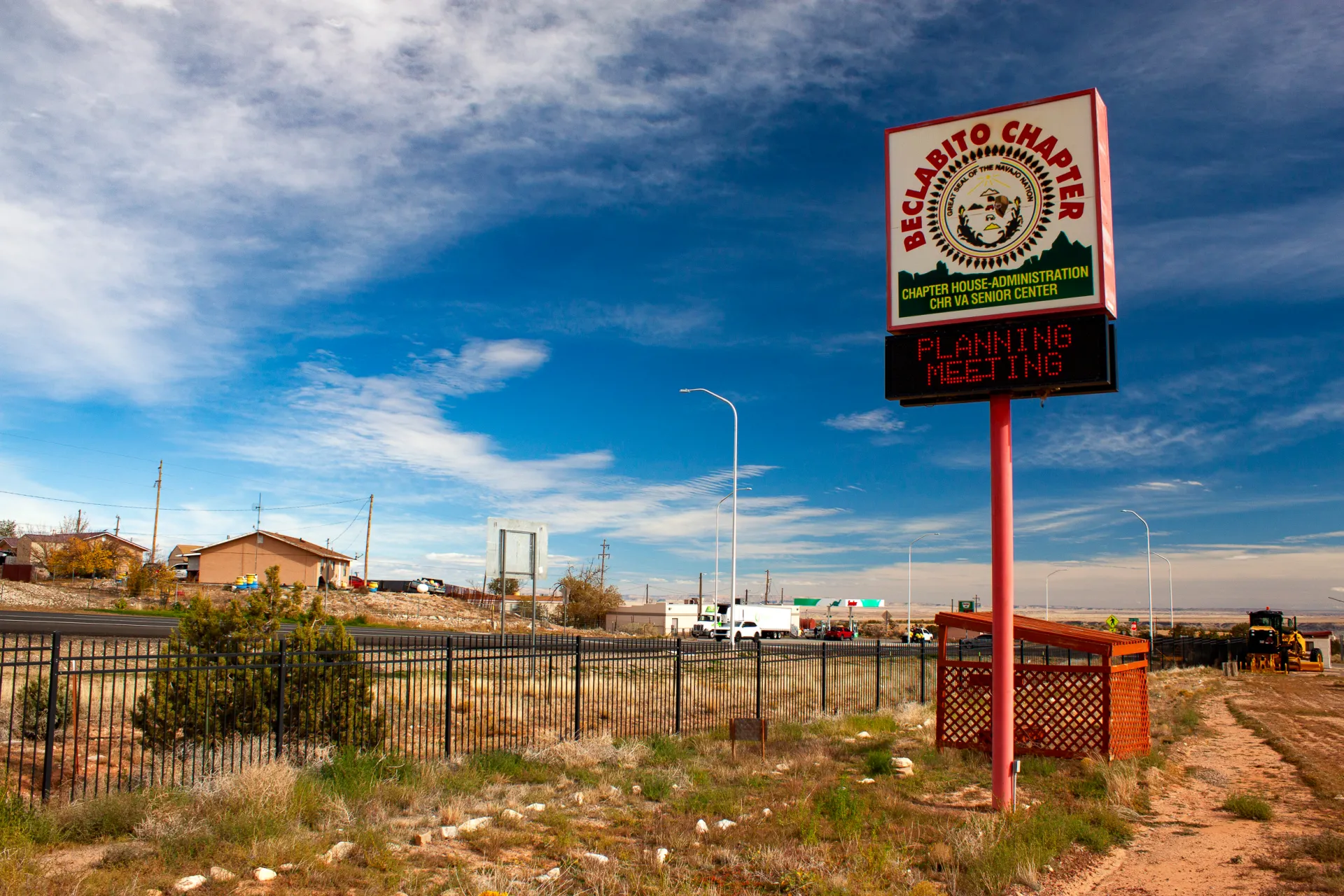
Carrizo has not run into the same level of opposition as the other proposals. In part that is due to the proposed use of the San Juan River instead of groundwater, said Erika Pirotte, an assistant attorney general in the Navajo Nation’s water rights unit. Many Navajo communities rely on groundwater, and using it for pumped storage was viewed as unreasonable.
The lack of strong opposition is also because of Kinetic’s engagement with the Navajo Nation. The company has held meetings with the Beclabito, Red Valley, and Teec Nos Pos chapters, in addition to meetings with Navajo Nation agencies and Buu Nygren, the Navajo Nation president. Kinetic has a memorandum of understanding with Nygren, who also signed a letter of support for the project’s DOE grant application.
“We have the support of the council,” Conroy said. “We have a very high level of support from the president, and he is just extraordinarily interested in this project and seeing that it moves forward.”
From the Navajo perspective, what is interesting are the “ancillary benefits” that could come from the water supply pipeline, Pirotte said. Once the reservoirs are filled and the pipeline’s full capacity is not needed, the extra space could be repurposed for tribal water supply uses.
“That’s why the feasibility studies are really important for the Nation, because they help us understand to what extent Navajo Nation resources would be used for the project,” Pirotte said.
None of this is immediately around the corner, Conroy cautions. The DOE grant extends for more than two years. The FERC permitting process could be another two to four years. With Congress and the Trump administration talking about faster permitting and better coordination, that timeline is a best guess.
And then there is the question of tribal authority in the permitting process, not just for the Carrizo project but for other such developments. Will FERC abide by its 2024 stance that preliminary permits for hydropower projects on tribal lands require tribal consent? The Trump administration would like to see that policy scrapped. If FERC approves a project must a tribe assent to all the associated infrastructure? Will the Navajo be allowed to conduct reviews and issue permits?
And then there is construction, the biggest component. That will take four to six years, Conroy said.
Even on an ambitious timeline, Carrizo is not operating until the mid-2030s.
“I’m 77,” Taylor said. “I probably won’t see it.”
This story was produced by Circle of Blue, in partnership with The Water Desk at the University of Colorado Boulder’s Center for Environmental Journalism.
