
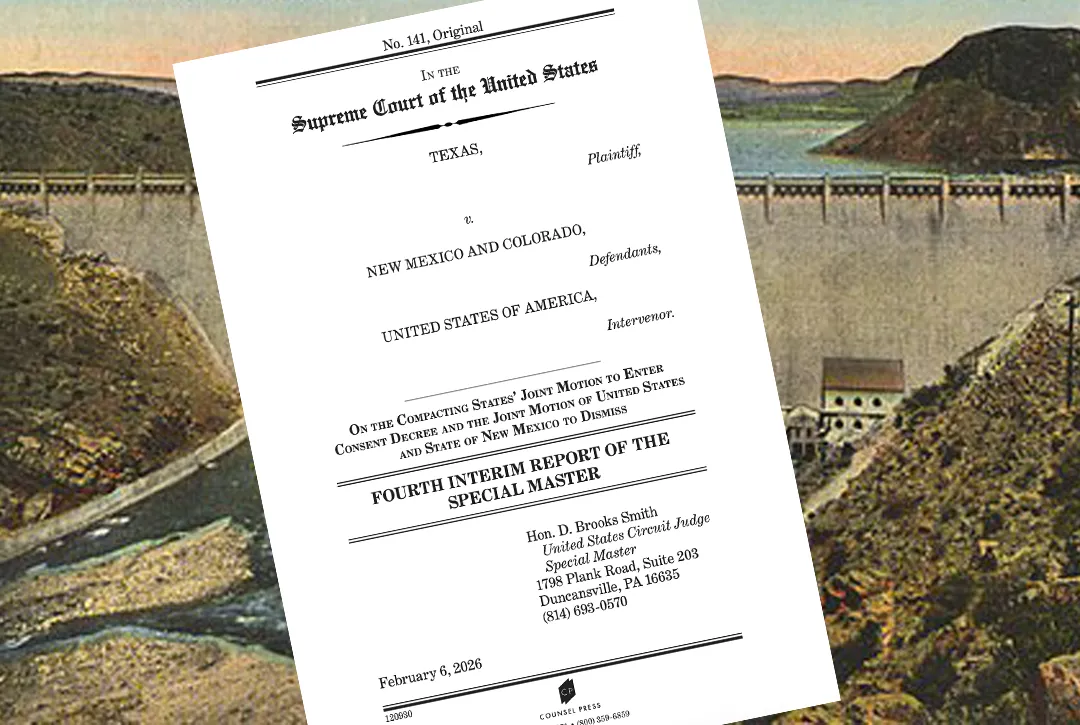
Click the link to read the article on the Alamosa Citizen website:
February 9. 2026
A 2013 complaint that Texas was being deprived by New Mexico of its equitable apportionment of Rio Grande Compact water has finally been resolved and the compact decree approved by the special master in the case.In a Fourth Interim Report dated Feb. 6, Hon. D. Brooks Smith agreed with the negotiated settlement by the states and the federal government that specifies how much compact water released by Colorado ends up with New Mexico and how much with Texas.
The proposed compact decree, which has to be accepted by the U.S. Supreme Court, employs use of the “Effective El Paso Index (‘Index’),” which provides a means of tracking the movement of water below Elephant Butte Reservoir for Texas’ accounting.
“Much like the river whose water the parties have quarreled over for decades, this original action has proceeded in a meandering fashion. First articulated by Texas in its 2013 Complaint, the dispute, in some sense, began about 8,000 years ago, in ancient Mesopotamia, when the Sumerians invented the concept of irrigation and incited a run on Earth’s navigable waterways,” Smith wrote in his report to the U.S. Supreme Court.
For its part, New Mexico countered that it was “excess water consumption in Texas” that interfered with the compact reporting. The standoff between the two states, with Colorado as a third party, lasted until July 3, 2023, when then-Special Master Michael J. Melloy issued a Third Interim Report (“TIR”) on the matter, which began: “Texas, New Mexico, and Colorado . . . have filed a joint motion to enter a consent decree compromising and settling ‘all claims among them arising from the 1938 Rio Grande Compact.’”
The proposed 2023 compact decree was filed with the U.S. Supreme Court, which rejected it at the request of the federal government, and appointed a new special master in Smith. He brought the states and federal government back together for another round of talks, and in June of 2025 visited the lower Rio Grande to talk to farmers and to familiarize himself with the features of the basin.
“I am grateful to the parties, the amici, and all of counsel for their cooperative efforts in organizing and carrying out what was a highly informative and comprehensive real-time view of both the waters of the Lower Rio Grande and the Project,” Smith wrote in his report.
The Effective El Paso Index (“Index”), which is a feature of the proposed compact decree, measures compliance based on the amount of water that actually passes through the El Paso Gage.
“I am pleased that the Special Master has recommended the U.S. Supreme Court accept the parties’ proposed settlement of the Rio Grande Compact litigation. The settlement is the result of collaboration between Texas, New Mexico, Colorado, and the United States; it includes entry of a proposed Compact Decree and dismissal of the United States’ claims,” said Colorado Attorney General Phil Weiser. “I appreciate the Special Master’s thoughtful engagement in the matter and his recommendation supporting this collaborative result. His recommendation gets even closer to the finish line.”
The last step will be a decision from the Supreme Court, which Weiser said he hopes to receive by June.
