
Click the link to read the article on the Denver Water website:
February 9, 2026
Denver Water depends on mountain snowpack for 90% of its water supply, which serves 1.5 million people in Denver and surrounding suburbs.
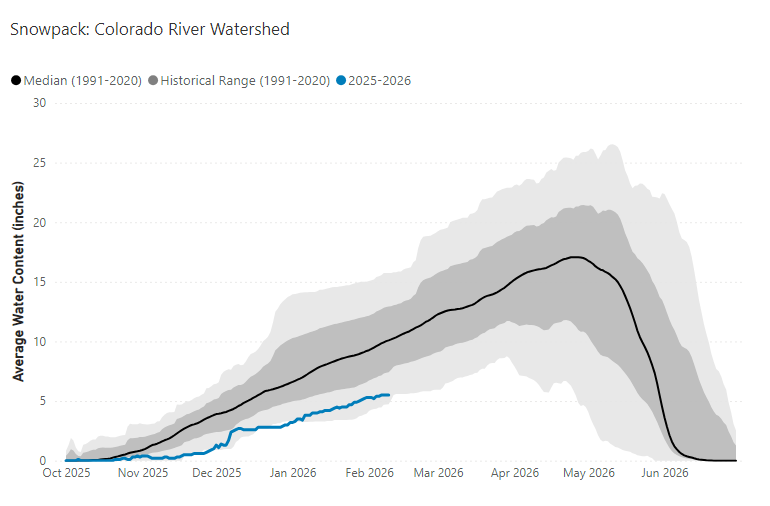
Snowpack as of Feb. 9, 2026, was near record lows: The Colorado River Basin within Denver Water’s collection system was at 55% of normal. The South Platte River Basin within Denver Water’s collection area was 42% of normal. In Denver Water’s decades of records for its watershed collection areas, as of Feb. 9, the Colorado River snowpack ranked among the worst, and the South Platte River snowpack ranked the worst.
No matter what, Denver Water’s annual summer watering rules will always be in place during the irrigation season. And, it is possible that we will need to implement additional drought response measures this year. Denver Water’s response to drought conditions uses a tiered approach, including the potential for additional watering restrictions, in order to preserve water supplies. Denver Water will move closer to developing recommendations for its Board of Water Commissioners on a potential drought response over the next couple of months.
Since 2000, Denver Water’s response to dry conditions in previous years included issuing a Drought Watch (voluntary restrictions) in 2002, 2003, 2004, 2012 and 2013. In some of those years (2002, 2003, 2004, 2013), Denver Water levied additional drought restrictions as part of declaring a Stage 1 level response, which required mandatory reductions in outdoor water use.
Denver Water snowpack update for Feb. 9, 2026
- Conditions remain highly concerning. Poor snowfall combined with warm temperatures have left us roughly 4 feet of snow short of where we’d prefer to be in the Denver Water collection area.
- Reservoir storage conditions are below average, but in reasonably good shape: 81% full versus an average of 85% full for this time. Those levels are also artificially affected by the need to keep Gross Reservoir low during construction to raise the dam, a project designed to increase the storage capacity of the reservoir.
- Denver Water has been here several times over roughly 50 years of reliable records. On the positive side, we have experienced years that started dry and conditions dramatically improved in March, April and May. This year, however, we are running out of time to build a healthy winter base.
- We’re reminding customers to do their part by making water-efficient upgrades, inside and outside, including rethinking their yards. These steps preserve water supplies and create more adaptable and drought-resilient landscapes that fit naturally into our climate.
- No matter what, Denver Water’s annual summer watering rules will always be in place during the irrigation season. Additional drought restrictions, voluntary or mandatory, will depend in part on how the rest of the snow season shapes up and will be aimed at preserving water supplies in case this unusually dry stretch deepens into a multiyear drought.
- Comment from Nathan Elder, Denver Water’s manager of water supply:
- “We are running out of winter. Conditions are highly concerning, and as we continue to hope for relief in the spring months, we also are preparing recommendations for our drought response. We encourage customers to think about conservation even now, with smart indoor use and potential changes in landscapes that would reduce outdoor use in the irrigation season.
- “Water is a precious resource that supports our way of life across Colorado, from the mountains to the ski resorts to our communities on both sides of the Continental Divide. We all have a role to play in using water responsibly.
- “If you’ve been up skiing, you’ve likely seen the low snowpack firsthand, and — if conditions don’t improve — when that snow melts, it won’t be enough to completely fill our reservoirs this spring and summer.”

To learn more about the work Denver Water employees do to monitor the snowpack, read this TAP story about Denver Water employees snowshoeing into the forest near the top of Vail Pass in late January 2026 to conduct a monthly “snow survey.”
Additional information on Denver Water’s drought planning can be found here. Additional information on Denver Water reservoir levels, customer water use and snowpack can be found in the Water Watch Report, which is updated regularly during winter, spring and summer.