

Click the link to read the article on The Denver Post website (Elise Schmelzer). Here’s an excerpt:
February 17, 2026
Negotiators from the seven states along the Colorado River blew past yet another federal deadline over the weekend without reaching a compromise on how to share its water — even as this winter’s dismal snowpack could spell immediate disaster for the river system.

Years-long discussions about how to split the river’s shrinking water supply, which is relied upon by 40 million people, remained deadlocked as the Saturday deadline for a final deal came and went. It was a deadline set by the U.S. Department of the Interior. The seven basin states are split into two factions that have not agreed on how to divvy up cuts to water supplies in dry years. The Lower Basin states of Arizona, California and Nevada lie downstream of Lakes Powell and Mead and rely on releases from those reservoirs for water. The Upper Basin states — Colorado, Wyoming, Utah and New Mexico — are upstream of the reservoirs and primarily depend on mountain snowpack for their water supplies. Leaders from each basin pointed fingers at the other as the deadline passed. Lower Basin negotiators have repeatedly said that Upper Basin states must “share the pain” and take mandatory cuts in dry years, which have become increasingly common in recent decades. But the Upper Basin states say their water users already take cuts every year because their supplies depend on the amount of water available and are not propped up by supplies in Lakes Powell and Mead. Repeated overuse in the Lower Basin has drained the two reservoirs, they’ve argued.
“We’re being asked to solve a problem we didn’t create with water we don’t have,” Colorado’s negotiator, Becky Mitchell, said in a statement Friday. “The Upper Division’s approach is aligned with hydrologic reality and we’re ready to move forward.”

As political leaders unleashed a series of pointed statements Friday, the Bureau of Reclamation released new projections that show one of the river system’s major reservoirs could be in peril as soon as this summer. The bureau’s new projections show that, if drought conditions remain dire, Lake Powell could fall so low by the end of July that water would no longer flow through Glen Canyon Dam’s hydropower system — a level called “dead pool.” Even if snow conditions improve, the reservoir could still reach dead pool in November — a scenario the bureau dubbed its most probable outcome. The Colorado River District, an agency created by the Colorado legislature that’s based in Glenwood Springs and advocates for Western Slope water needs, said it was disappointing that Lower Basin negotiators walked away from discussions on the day the projections were released.
“With Lake Powell now quickly approaching dead pool, that decision reflects a continued disconnect from hydrologic reality and a clear refusal to confront the core problem: longstanding Lower Basin overuse,” the district said Monday in a statement.
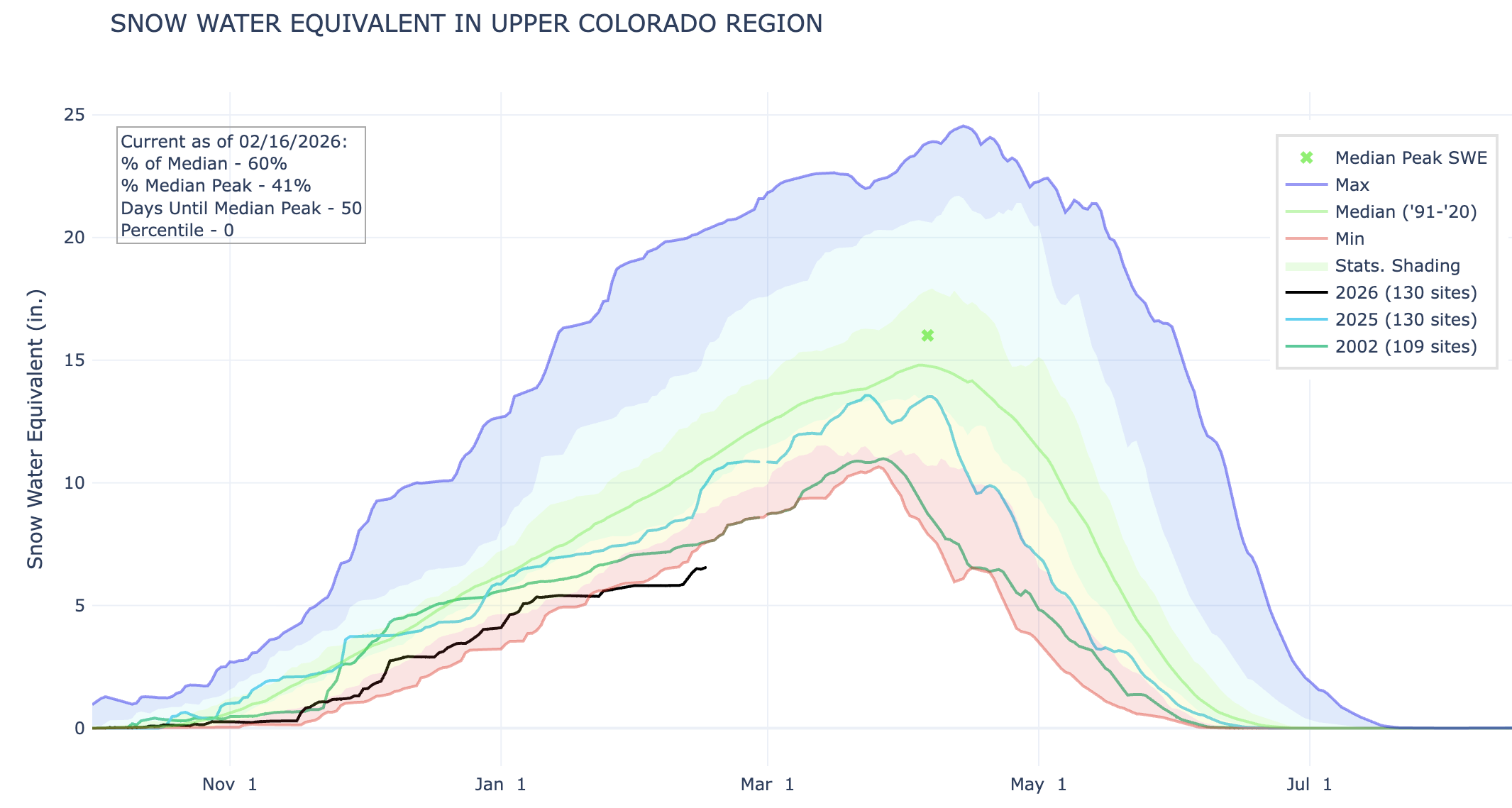
Snowpack across the mountains that feed the Colorado River remained dismal in early February. Above Lake Powell, snowpack on Feb. 1 sat at 47% of the median recorded for that time of year between 1991 and 2020. The water year — which began Oct. 1 — has so far featured record-setting warmth and limited precipitation, according to the National Weather Service’sColorado Basin River Forecast Center. That could translate to water supplies at 38% of normal, according to the center. Current projections show inflow into Lake Powell will total a meager 2.4 million acre-feet — far less than the 7.5 million acre-feet allocated to the Lower Basin in the 1922 Colorado River Compact.
