
Click the link to read the article on the High Country News website (Jonathan P. Thompson):
February 26, 2026
This is an installment of the Landline, a monthly newsletter from High Country News about land, water, wildlife, climate and conservation in the Western United States. Sign up to get it in your inbox.
When I was growing up in southwestern Colorado along the banks of a tributary to a Colorado River tributary, I was immersed not only in the quirks of water law, but also in Western water culture — the peculiar mores and customs that come from constantly looming scarcity. One oft-repeated maxim, usually used to justify building a new dam or encouraging inefficient irrigation practices, was: If we don’t use the water, it will just flow downstream to California — where it would presumably be used to water golf courses, fill LA’s swimming pools and serve other nefarious West Coast purposes.
I’m sure the idea arose partly from the animosity — and envy — the Interior West has long harbored toward its largest and wealthiest coastal neighbor. But I also think it comes from our idiosyncratic laws governing water use and the way they pit the headwaters communities against their downstream neighbors.
Whatever its origin, the sentiment endures and in fact has only grown stronger as the river and its reservoirs reach critically diminished levels, while the seven states that rely on them fail to agree on how to manage the issue going forward. Maybe the maxim needs an update. The big question today is: How much of the Colorado River’s water should be allowed to flow downstream to California, Arizona and Nevada?
How did we get here?
Western water law is based on the prior appropriation doctrine, which gives the first entity to make “beneficial use” of water the right to keep on using that amount, even if that means that upstream “junior” users’ spigots will get shut off. By the early 1900s, a rapidly growing California was enthusiastically diverting the Colorado River, with huge irrigation districts gobbling up the senior water rights. Less-populous Colorado, Wyoming and Utah were forced to watch in increasing dismay as downstream users gained control over larger and larger shares of “their” river.
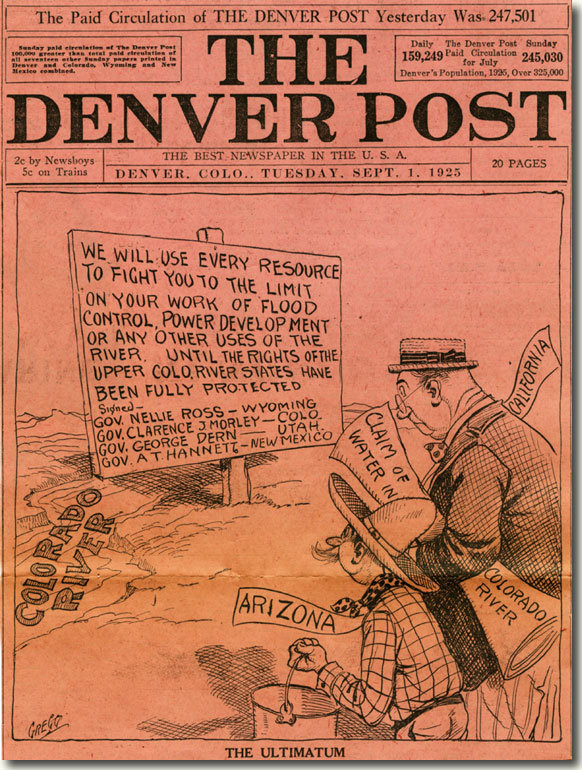
To appease these headwaters states — and to garner their support for huge dams and other water projects on the lower river — the seven Colorado River Basin states hammered out the Colorado River Compact of 1922. It divided the states into an Upper Basin (Colorado, Wyoming, Utah and New Mexico) and a Lower Basin (Arizona, California and Nevada), with the dividing line at Lees Ferry, Arizona. It aimed to share the river’s water equally between them, giving each basin the exclusive use of 7.5 million acre-feet (MAF) of water per year.
Climate change causes turbulence
The compact was far from perfect, but the concept of dividing the water equally generally held up, even if the reality didn’t always follow suit: The Upper Basin states have always used far less than their allotted amount (around 4 MAF), while the Lower Basin for years has consumed far more than its share (as much as 11 million MAF). That wasn’t a problem as long as the river had enough water to go around. But for the last 26 years, it hasn’t.
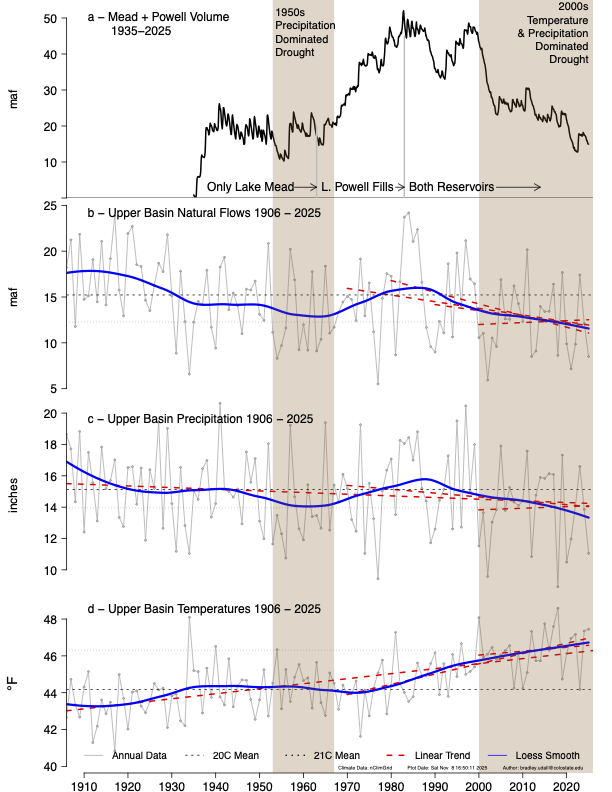
Since around the turn of the century, warming temperatures and abnormally dry years have severely diminished the headwaters states’ snowpack, thereby shrinking the river. The annual “natural flow” at Lees Ferry, or the estimated amount of water the river would hold without any upstream diversions or human consumption, has been about 12 MAF on average since 2000, dropping below 6 MAF in 2002, or just over half of what the Lower Basin alone consumed at the time.
The meager flows simply do not jibe with the numbers in the compact. And that makes it virtually impossible for the Upper Basin to comply with the compact’s “non-depletion clause,” which dictates that the Upper Basin “will not cause the flow of the river at Lee Ferry to be depleted below an aggregate of 75,000,000 acre feet for any period of ten consecutive years.” There are different interpretations of this provision, but it appears to say the Upper Basin states has no option but to allow the water to flow down to California — even if it means they come up short themselves.

Glen Canyon Dam and Lake Powell were supposed to make things easier by acting as an Upper Basin savings account that could be drawn from during dry years. But withdrawals have greatly exceeded deposits more often than not in recent decades, leaving Lake Powell at about one-third of its full storage capacity and bringing its surface level critically close to hitting minimum power pool, the point at which water can no longer be released through the hydroelectric turbines.
When this happens — possibly as early as this fall, according to current federal forecasts — the dam will stop generating hydropower for Southwestern utilities. It will also force all releases to go through the outlets lower in the dam, which were not engineered for such sustained use. This would compromise the outlets and possibly the dam itself, and Bureau of Reclamation engineers have strongly warned against it, meaning that minimum power pool becomes the de facto deadpool.
If current climate trends continue, the only way to avoid reaching minimum power pool — aside from re-engineering the dam on a very short timeframe — is either to substantially increase flows into Lake Powell by curtailing Upper Basin water use and draining upstream reservoirs, or else significantly reduce releases from Glen Canyon Dam, forcing the Lower Basin — and the river through the Grand Canyon and its endangered native fish — to take major cuts.

The solution is simple; consensus is not
In 2022, the Interior Department told the seven states to broker a plan to balance demand with diminishing supplies by cutting overall consumptive use by 2 million to 4 million acre-feet per year. So far, however, the states have failed to reach consensus.
The Lower Basin states, which have maxed out their allotment and then some, have taken some cuts already and have agreed to accept more, if the Upper Basin agrees to mandatory, verifiable cuts of its own. Meanwhile, the Lower Basin wants to see some version of the non-depletion provision remain in place.
Upper Basin negotiators argue that they haven’t even come close to using all of the water they’re entitled to, and besides, they don’t use nearly as much as the Lower Basin does anyway. So why should they be forced to reduce even more? Furthermore, Upper Basin water users, especially those with junior water rights, are already struggling with drastic reductions during dry years because the region lacks large reservoirs for storing water, meaning their water use is dictated by the rivers’ flows. In 2021, for example, many southwestern Colorado farms had their ditches cut off as early as June, forcing them to sit the season out, while the Ute Mountain Ute Tribe received only about 10% of its allocation.
It’s also simpler logistically to reduce consumption in the Lower Basin, where huge water users are served by a handful of very large diversions, such as the Central Arizona Project canal, which carries water to Phoenix and Tucson; the All-American Canal, which serves the Imperial Irrigation District (and its gigantic alfalfa fields) — the largest single water user on the entire river — and the California Aqueduct, which serves Los Angeles and other cities, all of which are fed by Lake Mead and other reservoirs. The Upper Basin, on the other hand, pulls water from the river and its tributaries via hundreds of much smaller diversions. Achieving meaningful cuts would require shutting off thousands of irrigation ditches to thousands of small water users under uncertain authority.
The Upper Basin negotiators have suggested a “supply driven” plan that would base releases from Lake Powell on the amount of water in the river and the reservoir, thereby honoring the spirit — if not the actual figures — of the Colorado River Compact. While Lower Basin negotiators have expressed interest in the idea, the two sides have yet to agree on details, such as the percentage of flows that would be released or whether a non-depletion minimum-flow requirement would remain in place.
Deadpool doesn’t care about deals or deadlines
In the end, the river basin’s climate and hydrology are likely to decide the issue. As Lake Powell inevitably sinks this summer, the BuRec will probably drain upstream reservoirs — Flaming Gorge, Blue Mesa and Navajo — to delay its decline. But when the reservoir drops to minimum power pool, dam operators must decide whether to release water through the river outlets and hope they don’t fail, or else shift Glen Canyon Dam to a “run-of-the-river” operation, which would keep the reservoir level from falling further by making releases equal to reservoir inflows minus evaporation and seepage. The relatively scant outflows from the dam would cause Lake Mead’s levels to plummet, forcing the Lower Basin states to accept potentially calamitous cuts. The Central Arizona Project, one of the basin’s most junior rights holders, would almost certainly lose some of its water, imperiling all the cities and farms that rely on it.
If the diminished releases were to persist for several months or more, it would likely put the Upper Basin in violation of the non-depletion clause, triggering litigation from downstream users, and throwing the entire watershed back in time to the anxious and combative pre-compact days.

I used to wonder why folks worried so about Colorado’s water running downstream to California, as if letting it go were some sort of sin. I can understand not wanting to lose the water that originates in your state, but to prefer wasting it or locking it up in reservoirs to sharing it didn’t seem right. After all, every drop that Colorado sends to California and Arizona is another drop that stays in the river for that much longer, benefiting fish and the other critters and boaters that rely on its waters.
I suspect that the most egregious flaw of the Colorado River Compact wasn’t that it overestimated the amount of water in the river, but that it pitted one group of states, tribes and other water users against another, rather than creating a framework in which they could all work together for the benefit of the entire watershed. Maybe it’s time to scrap the compact altogether and, while we’re at it, do away with the whole prior appropriations doctrine on the Colorado River — starting over again from scratch, in other words.
After all, as the climate keeps getting warmer and drier, there will be less and less water to argue about. If there’s nothing left to send downstream, the Colorado River Compact will soon be worth less than the paper it’s printed on.
