Click the link to read the article on The Land Desk website (Jonathan P. Thompson):
February 24, 2026
🌵 Public Lands 🌲
Just when you thought the GOP’s assaults on public lands couldn’t get any worse, the Trump administration launched a new blitzkrieg on environmental protections.That includes eviscerating the National Environmental Policy Act, the federal law requiring agencies to analyze, mitigate, and avoid impacts of major federal projects and projects on public land.
Interior Secretary Doug Burgum this week announced the “rescission of more than 80% of Interior’s prior NEPA regulations.” The changes, which includes limiting public comment, are aimed at streamlining permitting across the board, much as the department did with its “emergency permitting procedures” for oil and gas, uranium, coal, and critical minerals projects on public lands.
Associate Deputy Secretary Karen Budd-Falen, who is in hot water over potential ethics violations, lauded the changes, saying in a statement: “These reforms will help unleash American energy, strengthen rural communities ,and deliver real results faster for the American people.” As long as they are fossil fuels, that is, since Interior has put a de facto blockade on solar and wind developments on public lands.
Burgum finalized the NEPA rules a few days after opening 2.1 million acres of previously protected public lands in Alaska’s Dalton Corridor to new mining claims and oil and gas drilling.
***
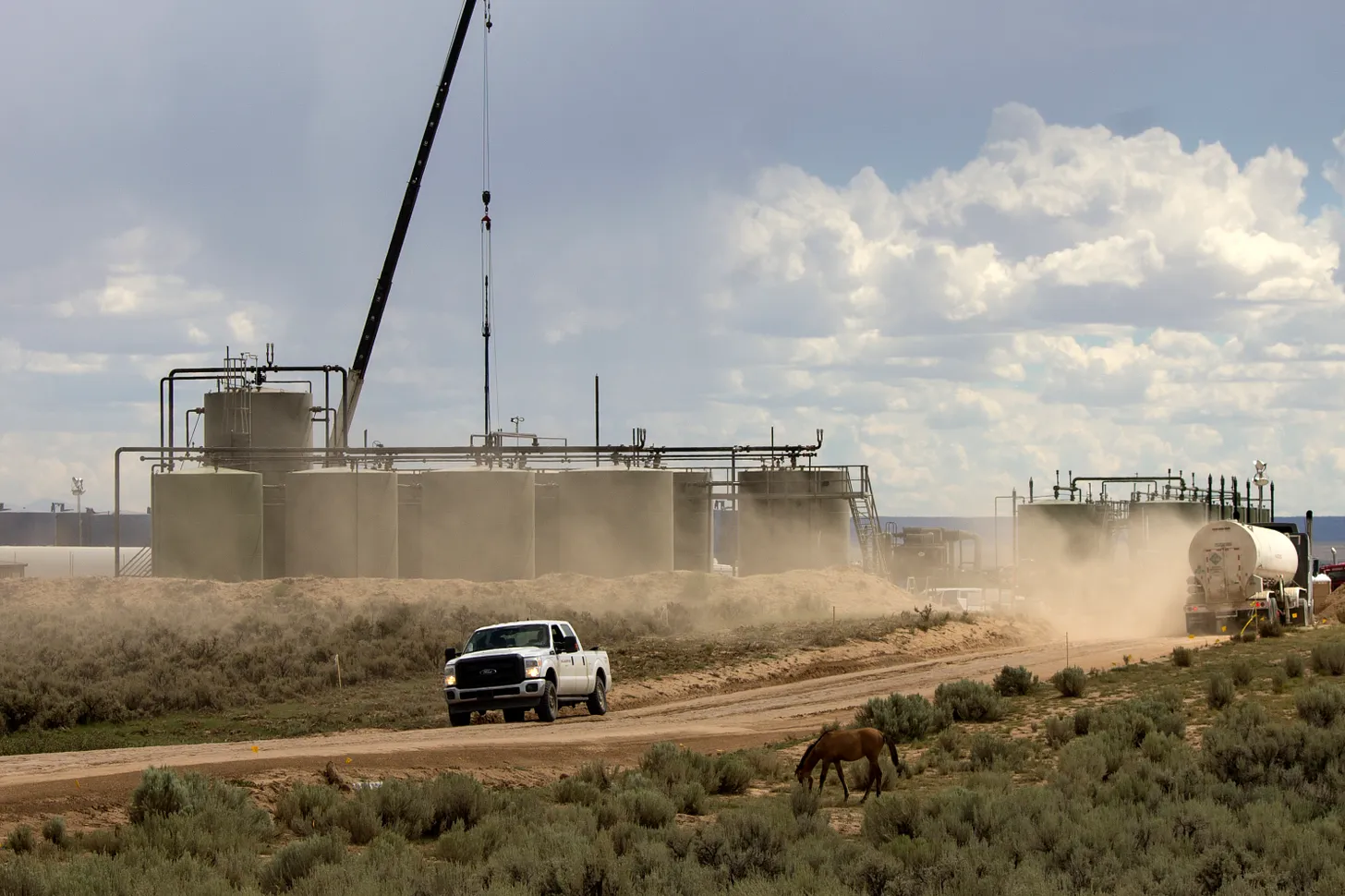
The Bureau of Land Management is, thankfully, still taking comments on proposed oil and gas leases, though it’s not clear that they will pay them any heed. You have until March 23 to give your two cents on the Farmington Field Office’s plan to auction 12 parcels covering about 16,856 acres this August. The parcels are on the checkerboard, with the biggest block of them about 20 miles east of Chaco Culture National Historical Park.
Find more information and comment at the agency’s project page.
***
This week confirmation hearings begin for Steve Pearce, Trump’s pick to lead the BLM and oversee some 245 million acres of public land.
Pearce is a hard-right Republican, former congressman from New Mexico, and no friend of public lands or environmental protections. Pearce’s political career was infused with hostility toward the agency he has been nominated to oversee. Pearce has opposed new national monument designations, is a fan of drilling public lands, has tried to weaken or eliminate the Endangered Species Act, lied about wolves in an effort to defund the Mexican wolf recovery program, received a 4% score from the League of Conservation Voters.
A few months ago we would have considered his confirmation a slam-dunk, since at the time most Republicans were still willing to debase themselves to any degree to curry favor with Trump. But with Trump’s approval rating plummeting as he suffers from more frequent cognitive mishaps and more revelations of his involvement with Jeffrey Epstein, the Senate may not be so friendly to Pearce.
***
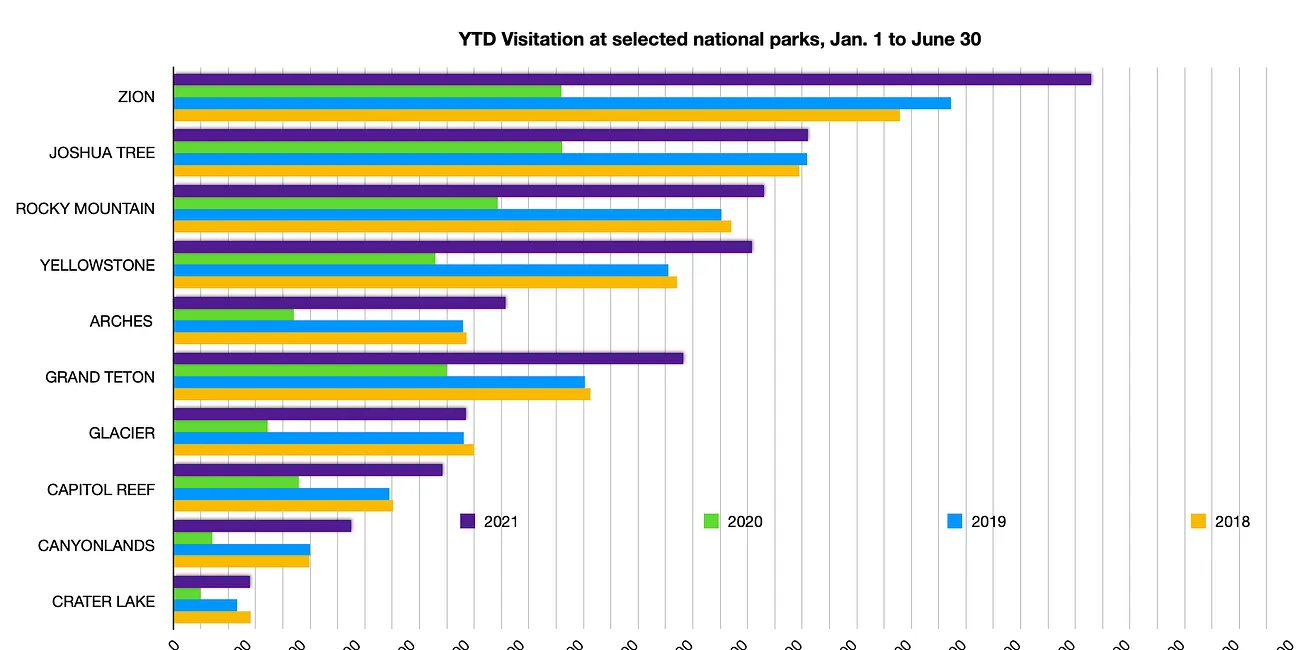
The News: The National Park Service “expands access,” a.k.a. limits or eliminates timed-entry reservation systems, at Arches, Yosemite, Glacier, and Rocky Mountain National Parks, sparking fears that unmanageable crowds will once again overwhelm the popular parks.
The Context: In the wake of the first wave of the COVID-19 pandemic, when Zoom boomers flooded Western communities and the masses descended on the surrounding public lands, people became increasingly concerned about the resulting crowds at national parks and at popular non-park trails and sites. Not only did the crowds risk damaging the parks’ resources, but they also potentially screwed up the visitors’ experiences.
In Arches National Park, for example, cars backed up at the entry gate for close to a mile, parking lots were crammed with vehicles and trail-jams weren’t uncommon, and on especially busy days park officials had to actually shut the gates and turn folks away — even those who may have traveled from abroad to see Delicate Arch.
To ease the pressure, the National Park Service in 2022 instituted a timed-entry reservation system during the busiest months of the year. This limited the number of people entering the park, but it also ensured the ones that made a reservation that they wouldn’t be turned away. The system led to a sharp drop in visitation during its first year, though the number of people entering the park averaged around 4,000 per day. But it has climbed every year since, including in 2025 when other Canyon Country parks saw visitation decline.
Still, some locals, presumably those of the quantity over quality variety, pushed back, saying the new system was diminishing visitation and hurting the local tourism industry. Last fall, Grand County Commissioner Brian Martinez asked the park service to revoke the timed-entry system and to build up the park’s infrastructure to enable it to maximize visitor numbers. The Trump administration’s park service apparently listened, and now timed-entry is no more.
Neither fire, smoke, nor searing heat can stop the public land swarms — Jonathan P. Thompson
🐓 Regulatory Capture Chronicles 🦊
Trump’s apparent disdain for clean air (and a healthy public) was manifested in recent weeks as the administration not only rolled back the EPA’s “endangerment finding,” which authorizes it to regulate greenhouse gas emissions, but also the Biden-era mercury toxic air standards.
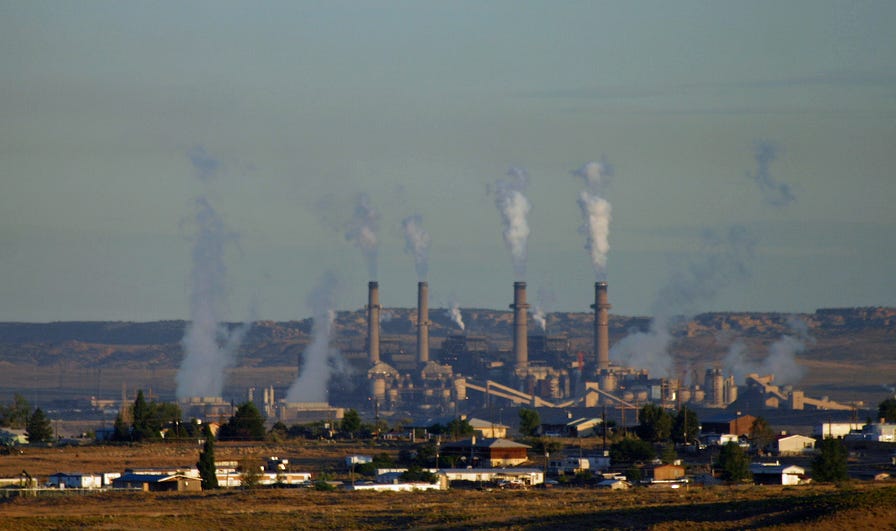
Mercury emissions are an environmental and public health hazard. The Four Corners-area coal plants once kicked out more than four thousand pounds of mercury each year, along with thousands of pounds of selenium and copper and hundreds more pounds of lead, arsenic, and cadmium, not to mention sulfur dioxide, nitrogen oxide, and other pollutants.
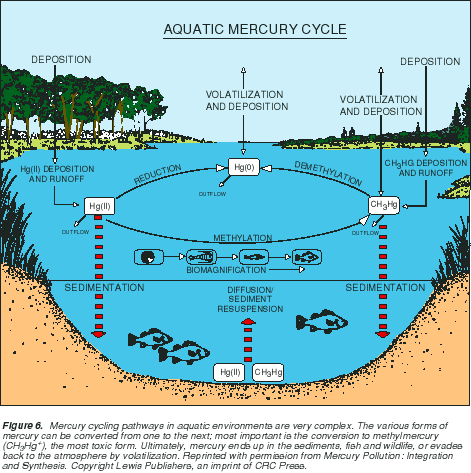
Those emissions have decreased considerably over the years as federal regulations kicked in and as coal plants were shuttered altogether. Still, the Four Corners plant puts out about 150 pounds of mercury each year, along with varying quantities of other toxic metals. Most of these pollutants are then deposited in the surrounding water, on the land, and on homes. For years, rain and snow falling on Mesa Verde National Park have contained some of the highest levels of mercury in the nation, and elevated levels have even been found on Molas Pass, just south of Silverton. The mercury is then taken up by bacteria in lakes and rivers, which convert it to highly toxic methylmercury, which then enters the food chain. Mercury messes with fishes’ brains, and even at relatively low concentrations can impair bird and fish reproduction and health. It’s not so good for the people who live near the plant, drink the water, or eat those fish, either.
Because most existing coal plants in the West already complied with the Biden regulations, Trump’s rollback isn’t expected to have a significant effect in most cases (unless power plants dismantle existing pollution-control equipment). However, it is expected to allow the Colstrip coal plant in Montana — one of the nation’s worst polluters — to continue to operate (the operators complained that compliance with the Biden rule would have forced it out of business).
🐐 Things that get my Goat 🐐
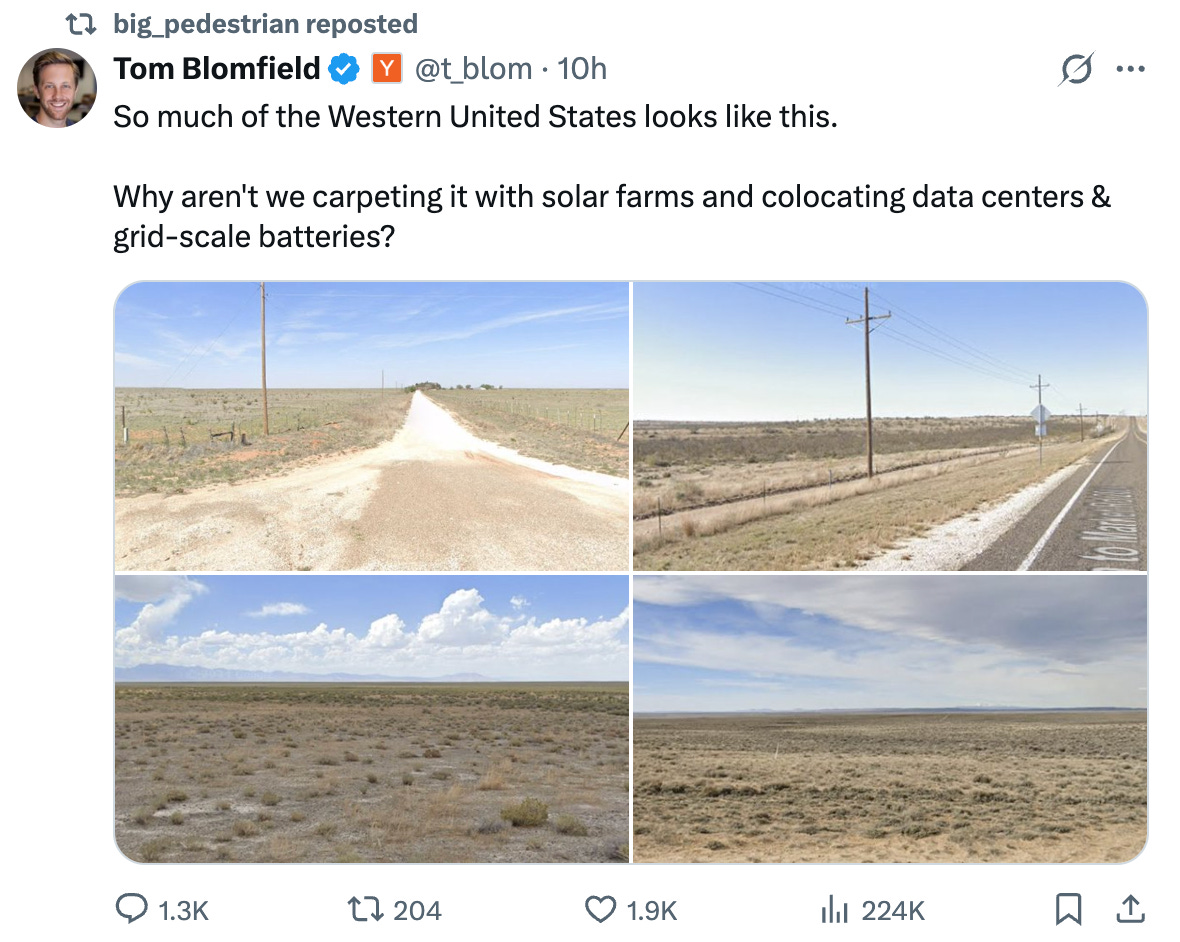
I probably shouldn’t put this here, but geez, really? Aren’t we over the whole “The West is a big empty space that we can clutter up with our myths and technology and nuclear waste” complex? I guess not. I’m sure this guy, who is clearly from somewhere that is not the Western U.S., means well. But he needs to figure out that the West’s “empty” spaces are actually full of life and beauty and, well, space, which most of us value quite highly.
Granted, the spaces shown in this guy’s pictures do look like they may have been extensively grazed, but that does not mean they are appropriate places for a bunch of damned power- and water-guzzling data centers and their associated energy facilities.
Data Centers: The Big Buildup of the Digital Age — Jonathan P. Thompson

🤖 Data Center Watch 👾
🌞 Good News! 😎
A new study has shown that it is possible, in some cases, to build large-scale solar systems without destroying the desert on which they sit.
The Gemini Solar Project in southern Nevada is one of the nation’s largest such facilities, covering about 5,000 acres of desert land. During its construction in 2022, the developers refrained from the full “blade-and-grade” site preparation that is typical, and instead worked to minimize disturbance and leave some areas of vegetation and soils completely intact.
A group of researchers from the Desert Research Institute and the U.S. Geological Survey surveyed the plant population — with a focus on the rare and sensitive threecorner milkvetch — before and two years after construction. Their hypothesis was that the facility would detrimentally affect the plant, and that the areas nearer the panels would see the biggest impacts.
What they found is that not only did the milkvetch survive, but it actually thrived “within the novel environment created at Gemini.” The plants found after construction were larger and more fecund than those found off-site. “Our results suggest that the altered environment created by panel arrays did not alter threecorner milkvetch survivorship at Gemini.”
It’s just one study focused on one solar installation and one plant. But it does suggest that, if done correctly, utility-scale solar development does not have to be a desert’s death knell.
In related, but less sunny news: Lawmakers from a handful of states have proposed bills that would make it easier for residents and businesses to install plug-in or balcony solar panels. While these panels don’t generate a ton of electricity, they are relatively inexpensive and, as the name indicates, are pretty simple to hook up. They are common in parts of Europe, especially Germany, and are gaining popularity in the U.S. since the Trump administration has killed most federal rooftop solar subsidies. The legislation is mostly aimed at allowing folks to plug these things in without a permit or go-ahead from the utility.
Last year, Utah, of all places, actually passed one of these bills. But so far this year plug-in solar legislation has died in Wyoming and in Arizona, after utilities expressed concerns. Come on! The California bill seems to still be alive.
Parting Note
I’ll be leading a couple of workshops and giving a talk at this year’s Entrada Institute “Writing from the Land” on May 14-16 in Torrey, Utah. Check it out: