Click the link to read the article on The Denver Post website (John Aguilar). Here’s an excerpt:
March 15, 2026
Thornton is first to adopt restrictions; Denver Water, others prepare similar measures
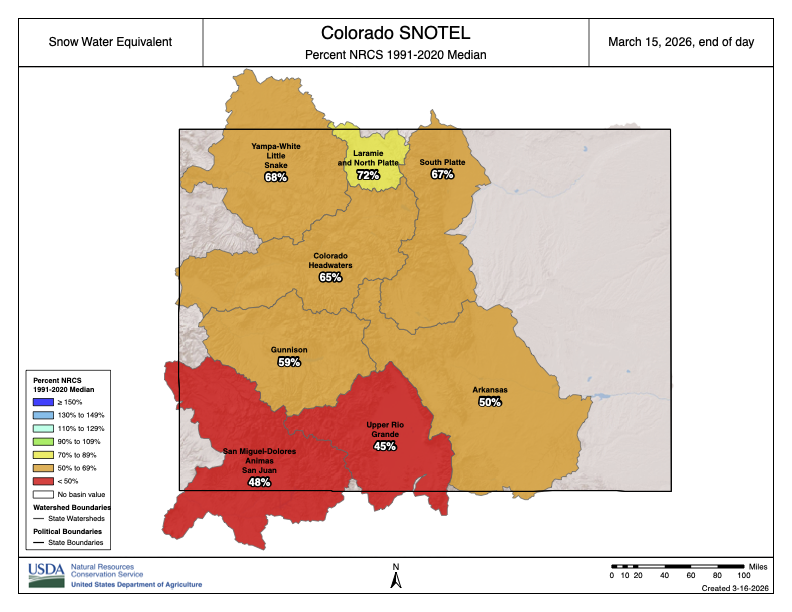
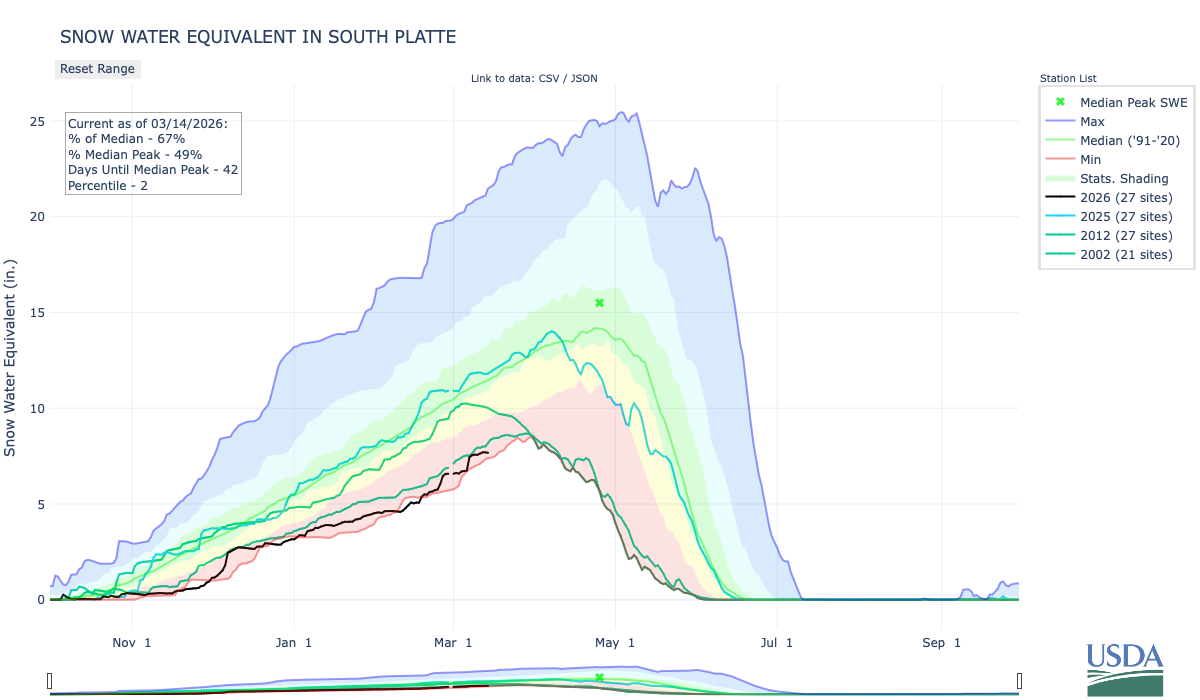
When Thornton enacted a Stage 1 drought declaration last week, it became the first city in metro Denver to place a mandatory twice-weekly limit on outdoor watering for the upcoming hot season. But the northern suburb likely won’t be the last. Metro cities and utilities are starting to lay out various defensive strategies against what has become a crispy-dry 2026, starting with an alarmingly warm and dry winter in Colorado that’s been marked by one of the worst snowpacks in recorded state history. Denver Water, which serves 1.5 million people, could follow a similar track to Thornton’s by month’s end. Aurora Water, which is relied upon by 400,000 people, may be right behind with its own Stage 1 drought declaration in early April…Locally, that also translates to abysmal conditions in the Clear Creek basin, where Westminster gets most of its water. Last week, the Westminster City Council discussed enacting a drought watch — a less severe step than a Stage 1 declaration that would rely on voluntary cutbacks.
…the latest monthly bulletin from the National Weather Service painted a grim weather picture based on conditions in Denver. Last month was the third-warmest and second-driest February in the city, while it was the least-snowiest February on record for Denver, tying 2009’s equally snow-starved February…
What water managers can control sits on the demand side of the water ledger. Thornton gets the bulk of its water from the Upper South Platte River and Clear Creek watersheds, which are both at “record low levels,” according to a memo accompanying last Tuesday’s council meeting. Emily Hunt, Thornton’s interim infrastructure director, says the concern lies not so much with the summer ahead but with the summers to follow, assuming precipitation stays meager. Colorado’s sixth-largest city is presently at 83% of storage capacity across the 19 reservoirs that hold its water. It stores a large portion of the water it consumes in Standley Lake, which is also a water source for Westminster and Northglenn.
“We’re going into the summer with good storage, but with this snowpack, we’re not going to be able to top off our reservoirs the way we normally would,” Hunt said. “We’re basically trying to keep the year in balance so that if the drought continues into next year, we’ll be in pretty good shape.”