
Click the link to read the article on the Big Pivots website (Allen Best):
March 6, 2026
Might the Colorado River runoff be as bad as 2002? March could bring snow and rain. Almost certainly it will bring warm temperatures.
What if March brings temperatures suitable for flip flops in places like Steamboat, Vail and Telluride? And what if the snow that does fall on the headwaters of the Colorado River is average or less?
Things could get much more grim in the Colorado River Basin this year, conceivably as bad as 2002. That year was memorable for the pitiful runoff, the peak barely discernible in Glenwood Canyon in April and May. Worse came in June when three fires erupted at very nearly the same time.

Bill Owens, who was then Colorado’s governor, toured the state by plane, visiting the Hayman fire that started near Colorado Springs, the Coal Seam Fire at Glenwood Springs, and the Missionary Ridge Fire north of Durango. “All of Colorado is on fire,” he said, a remark that some, concerned about impacts to tourism, derided as an overstatement. But within that statement was a certain truth.
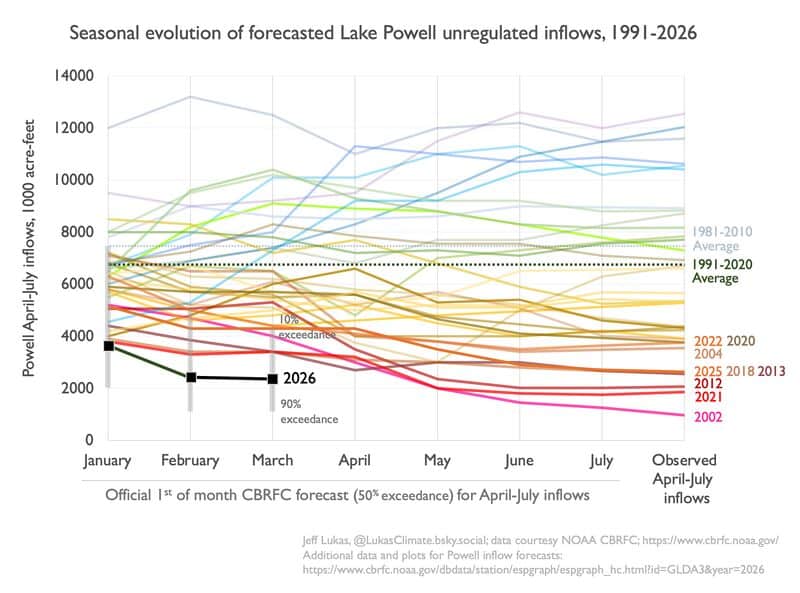
This week, NOAA’s Colorado River Basin Forecast Center released its projected flows into Lake Powell. It doesn’t look pretty. Jeff Lukas, the principle at Lukas Climate Research and Consulting, assembled this graphic that shows how the projections visually compare to other years since 1991.
“Despite better snowfall in February, the most probable forecast remains bleak at 36% of average,” he said on LinkedIn. That, he added, would put runoff in the observed flows into Powell in 2012, 2013, 2018, 2021, and 2025. “In other words, a bad neighborhood,” he said.
An unusually wet and cool March through May would only get the inflow to 65% of average. On the other hand, it could go in the other direction. A warm and dry March could eviscerate the existing snowpack.
James Eklund, a water attorney and former director of the Colorado Water Conservation Board, pointed out that the long-term average has been 6.7 million acre-feet. The March forecast projected runoff of around 2.3 million ace-feet.

“The river cares not about our legal arguments,” he said in a LinkedIn post, a reference to the intense squabbling about how to share a river that has been rapidly diminishing in average volume in the 21st century. Even in places like Arvada, people who don’t realize that they are watering their lawns and taking their showers with water imported from a Colorado River tributary do realize the Colorado River has problems.
The runoff could conceivably be worse than 2002. There’s a big difference, though. In 2002, the reservoirs held a great deal of water. Not completely full, but within a good water year of being full. Total runoff that year was 25% of average. Most years since then have been below average, leaving water levels of Powell within striking distance of deadpool.
From his post in the Glenwood Springs area, Eric Kuhn sees March storms having potential to bump up the runoff numbers. “This is one of those years where March could make a big difference. But when I look at the outlook for three or four weeks, it looks like March will definitely be above average in temperatures, which is not good news. I think it’s too soon to tell whether we will have average or below average precipitation. But warm temperatures will not be good to the snowpack.” [ed. emphasis mine]
This year’s runoff will add tension to the already fraught situation in the Colorado River Basin. Kuhn, a former manager of the Colorado River Water Conservation District, said he wouldn’t be surprised if the Bureau of Reclamation — an agency within the Department of Interior that oversees operation of the federal dams — finds it must release one million acre-feet less than the base 7.5 million acre-feet release.
This could trigger a legal fight. The Colorado River Compact imposes a requirement upon the upper Colorado River Basin states to deliver 75 million acre-feet on a rolling 10-year average. This would take the upper-basin states below that threshold.
That provision in the compact has been debated almost since Congress approved it in 1929. But, under the most aggressive interpretation by lower-basin states, this could put the upper-basin out of compliance. As such, this could be the year that puts the basin states on long road to a U.S. Supreme Court review.
A meager runoff this year will also put the Department of Interior into an uncomfortable position of having to make decisions. Kuhn says the federal agency’s water officials have traditionally tried to mediate disputes among the seven basin states. This year the agency might have to make decisions that leave people upstream and down unhappy.
“They could sit back (in former days) and say we are not going to take a position because we don’t want to upset either side. We have to work with both sides. Those days have come to an end, unfortunately.”
