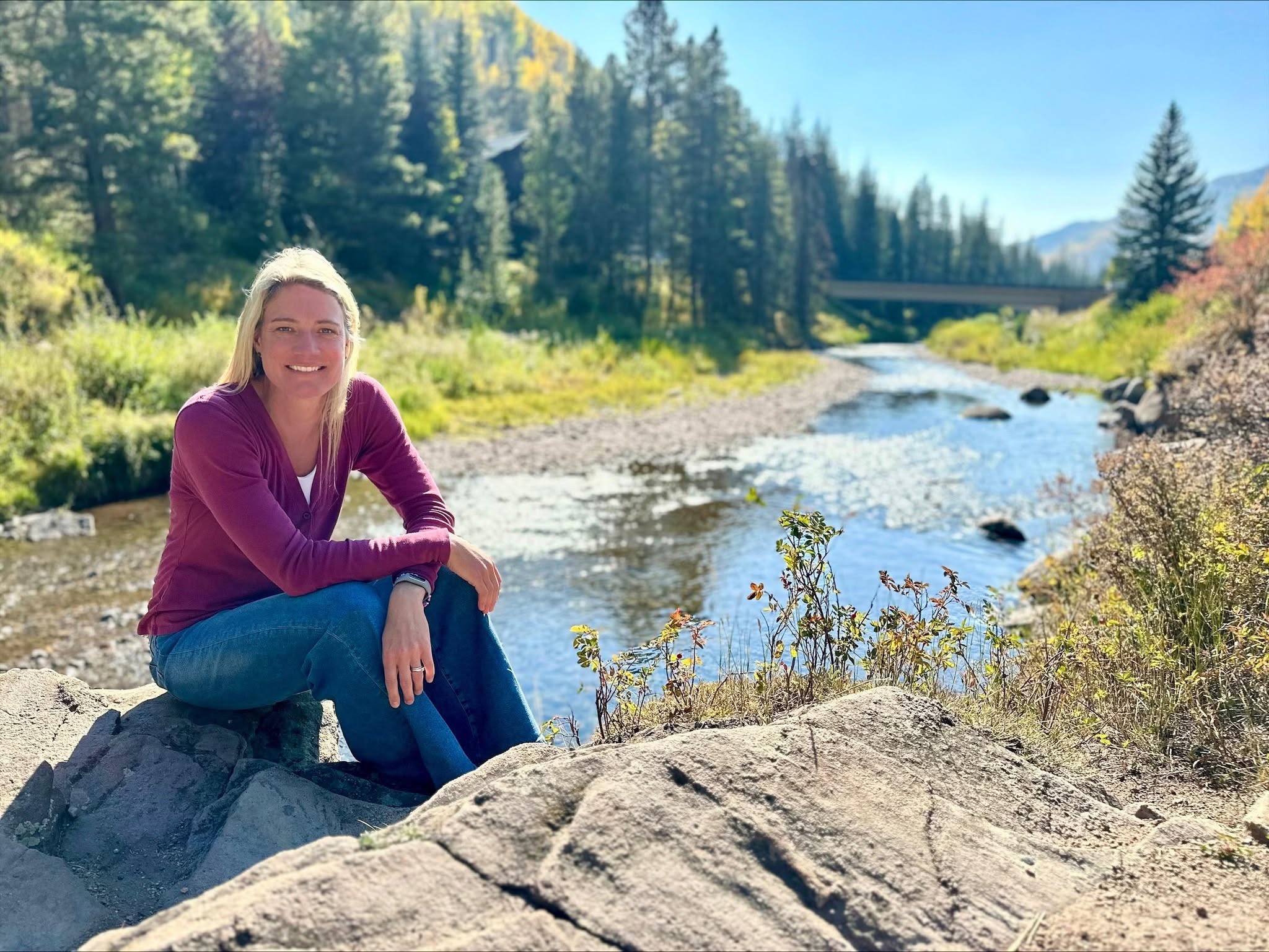
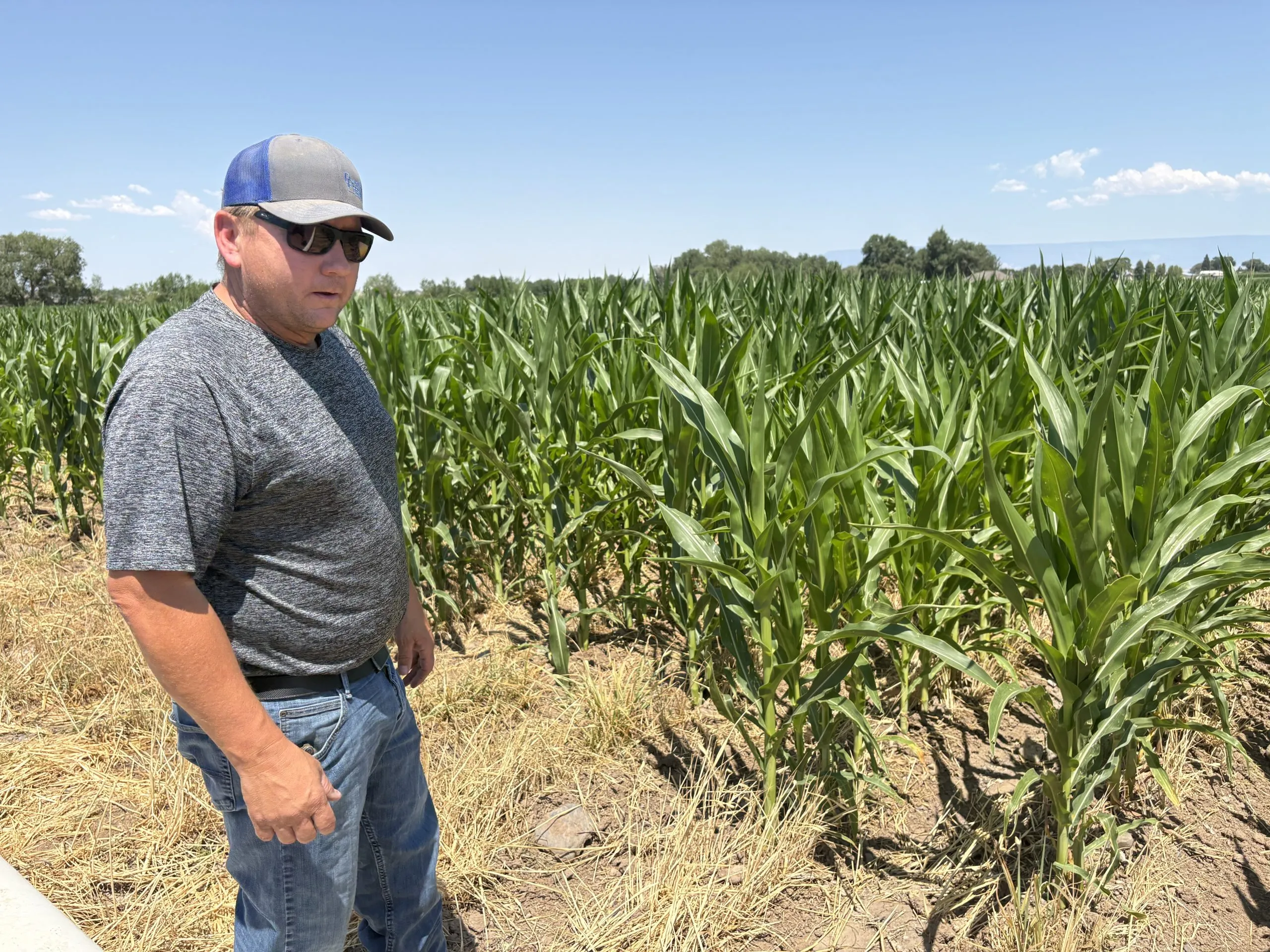
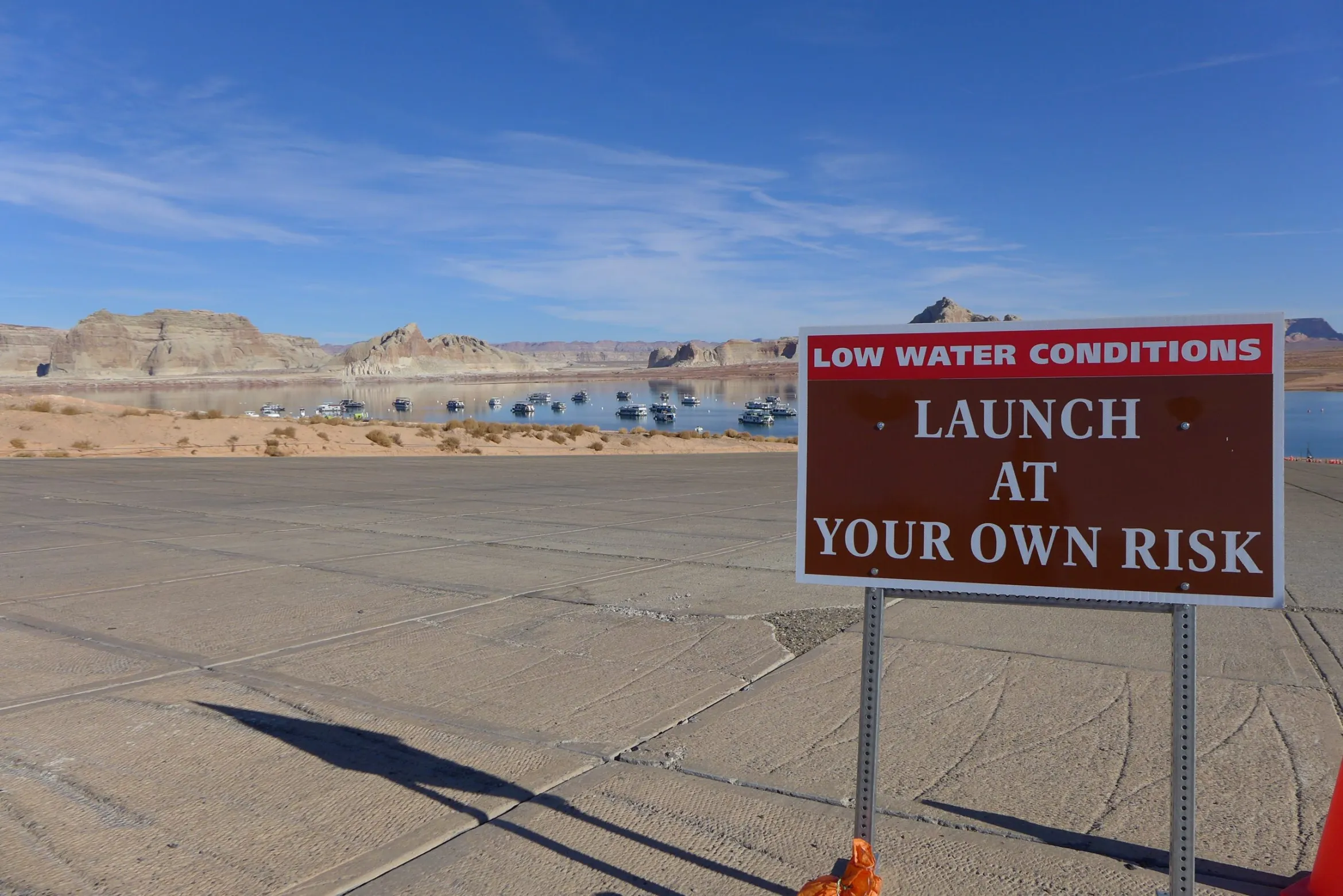
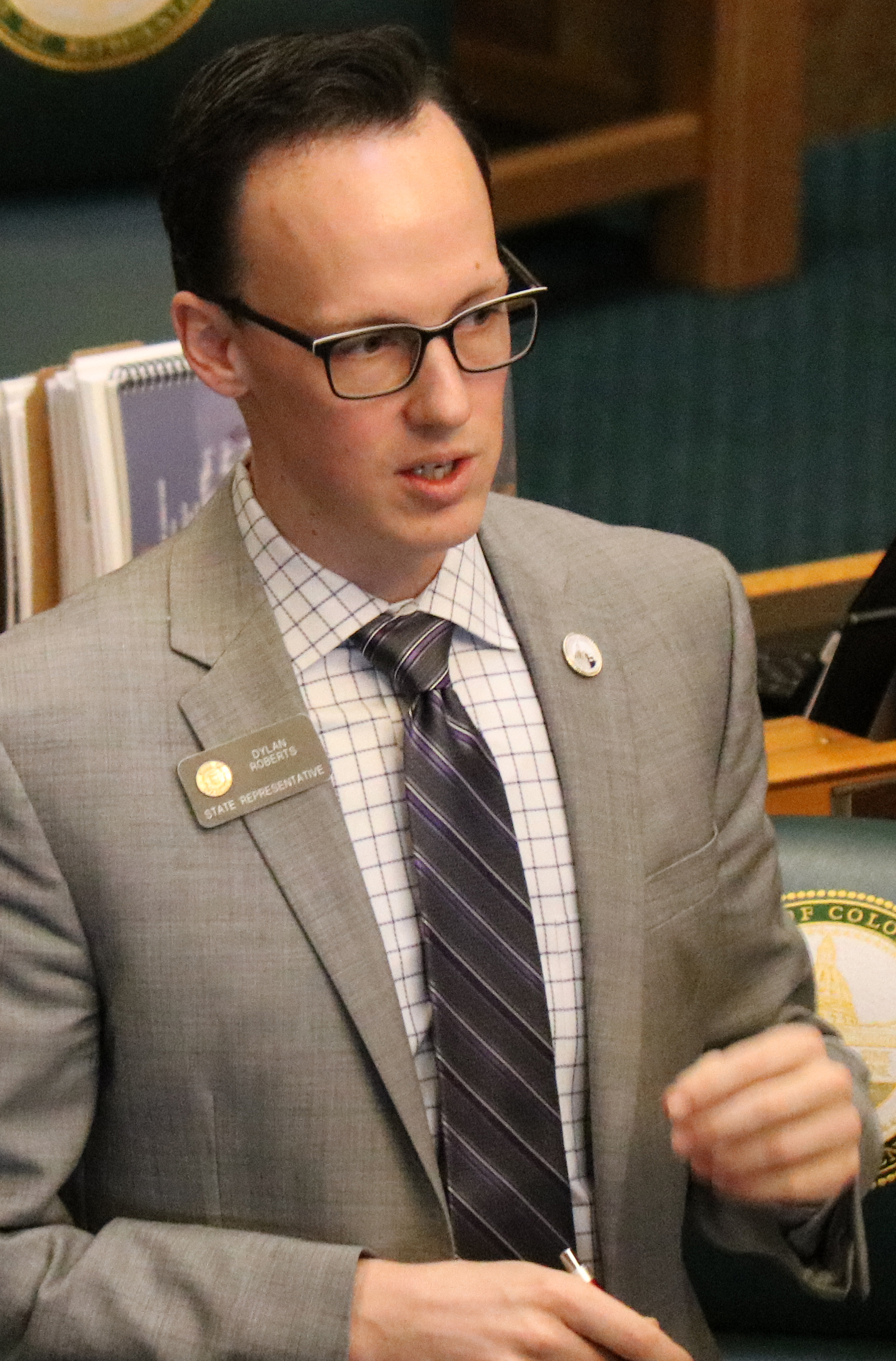
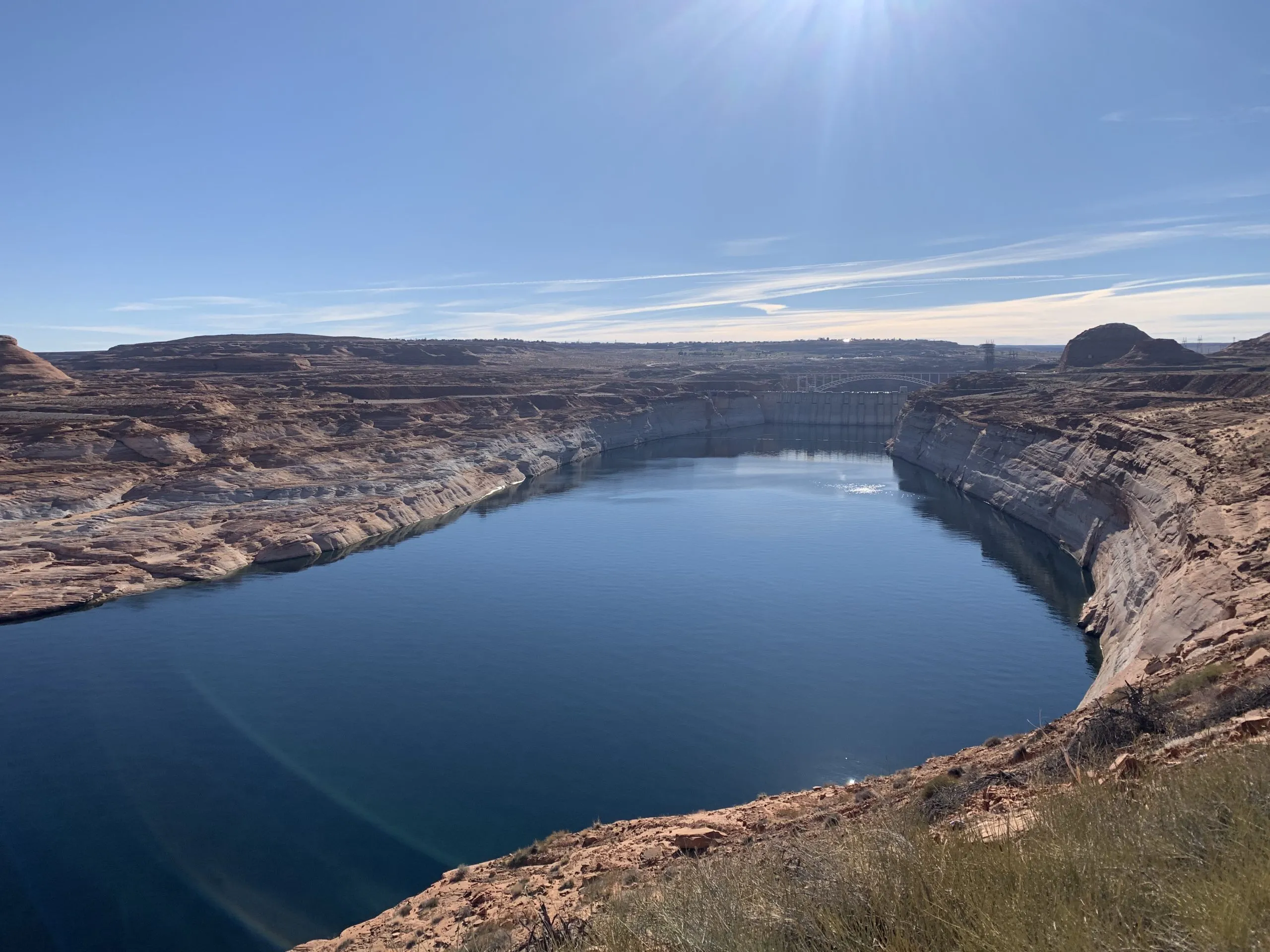
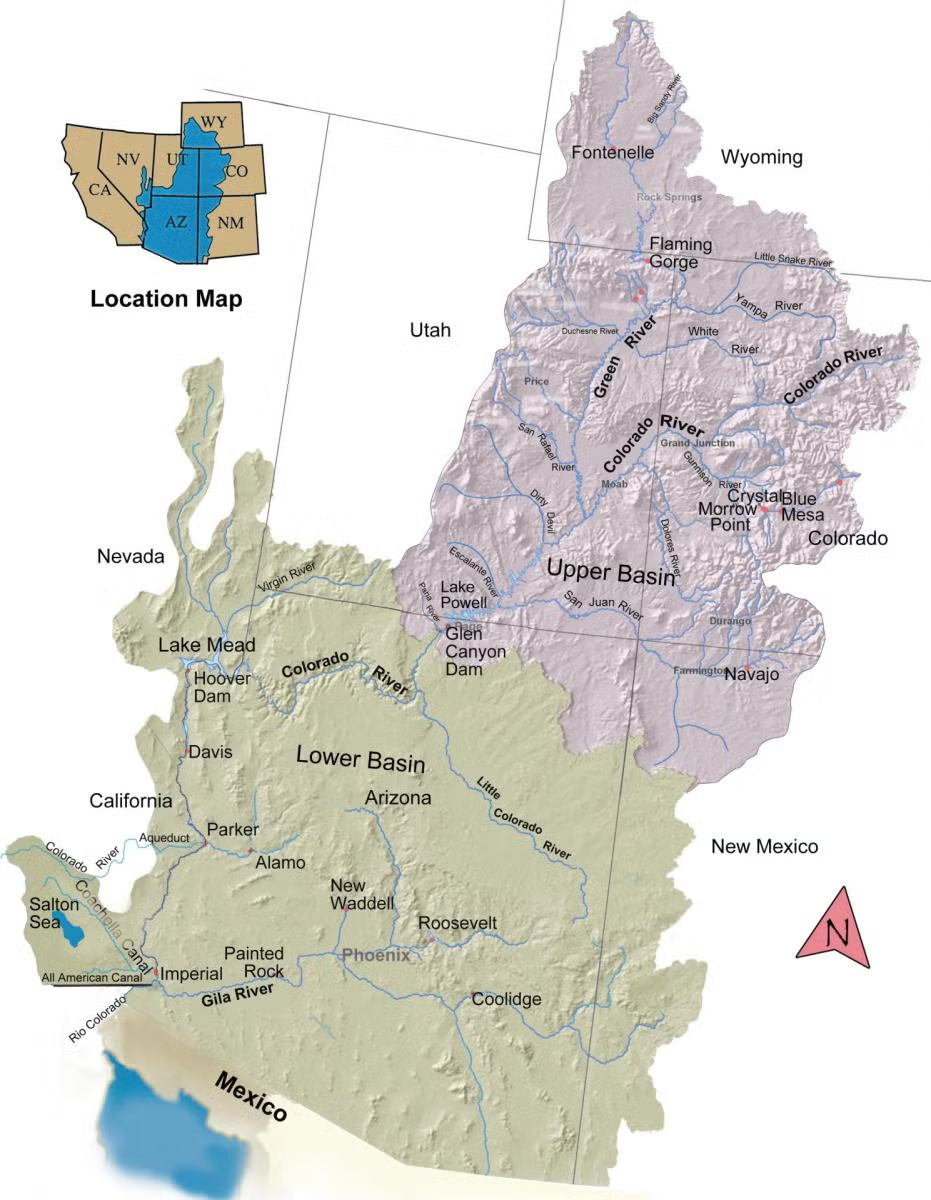
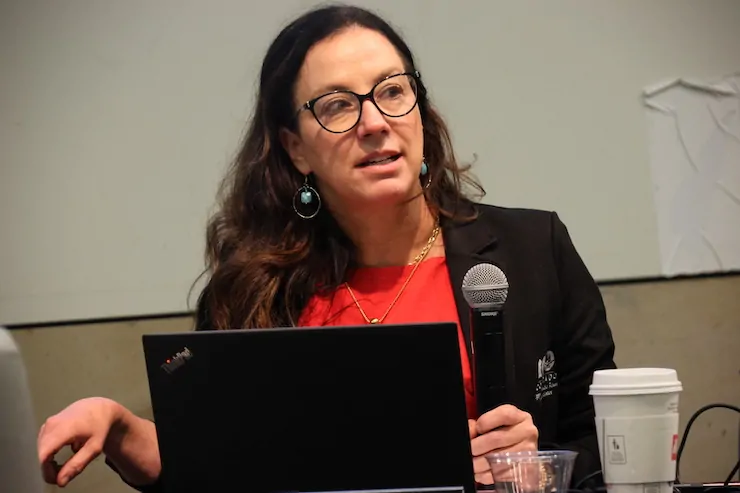
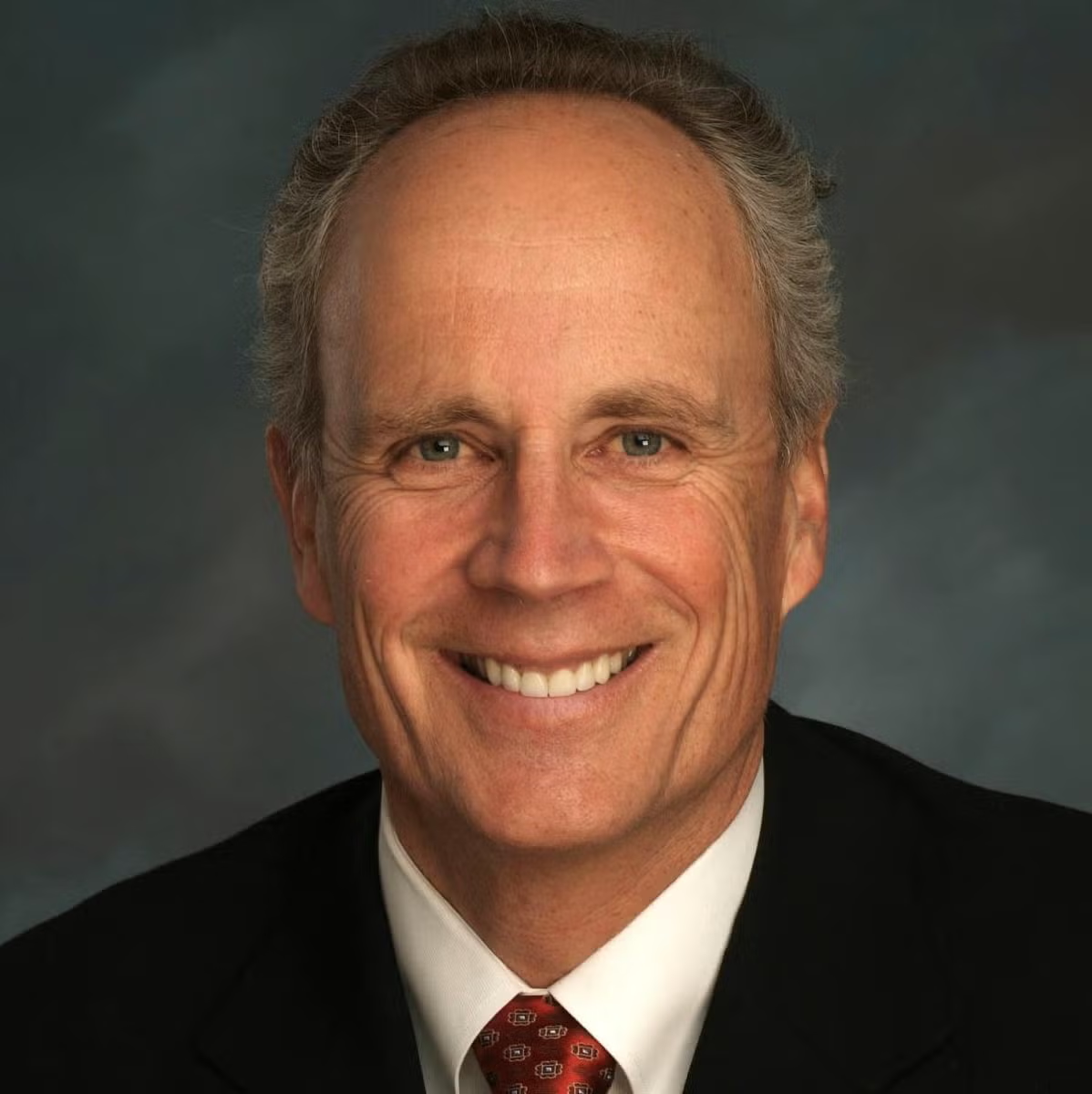
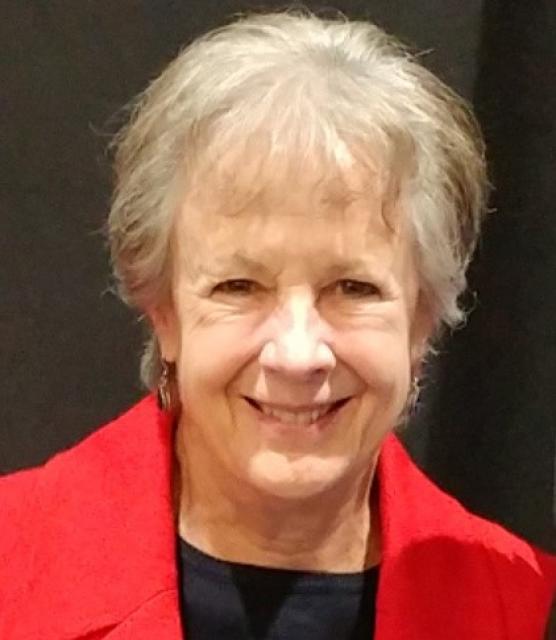
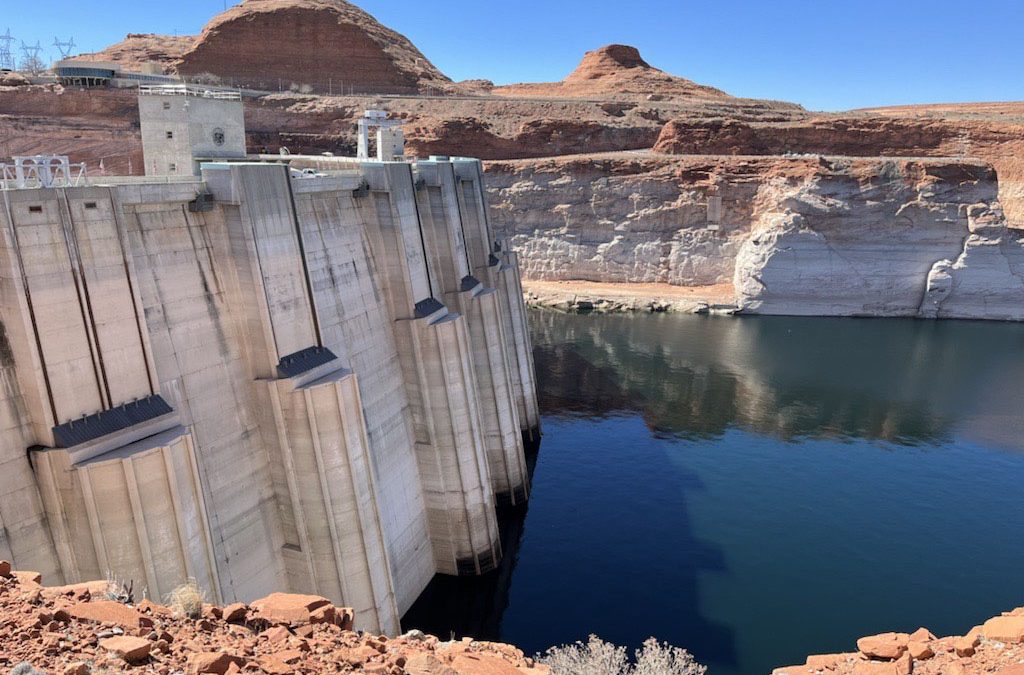
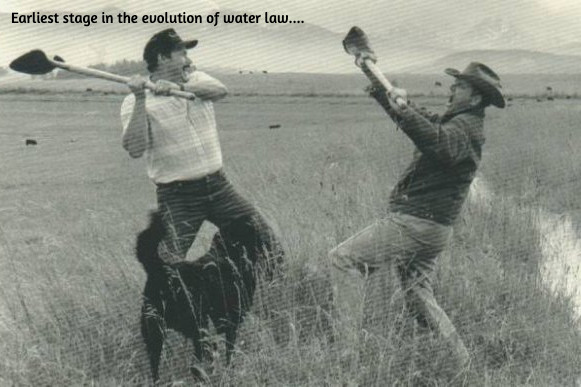
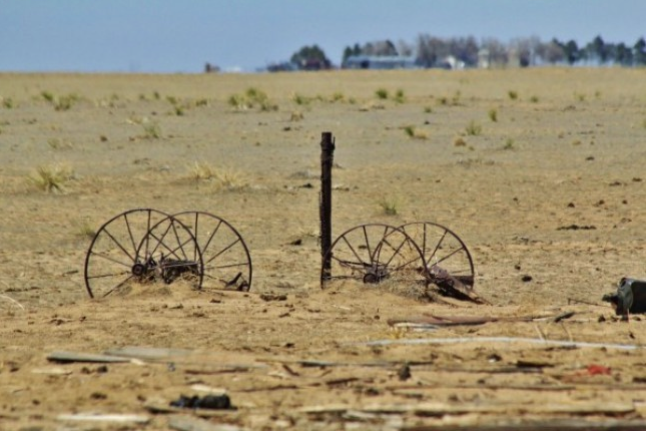
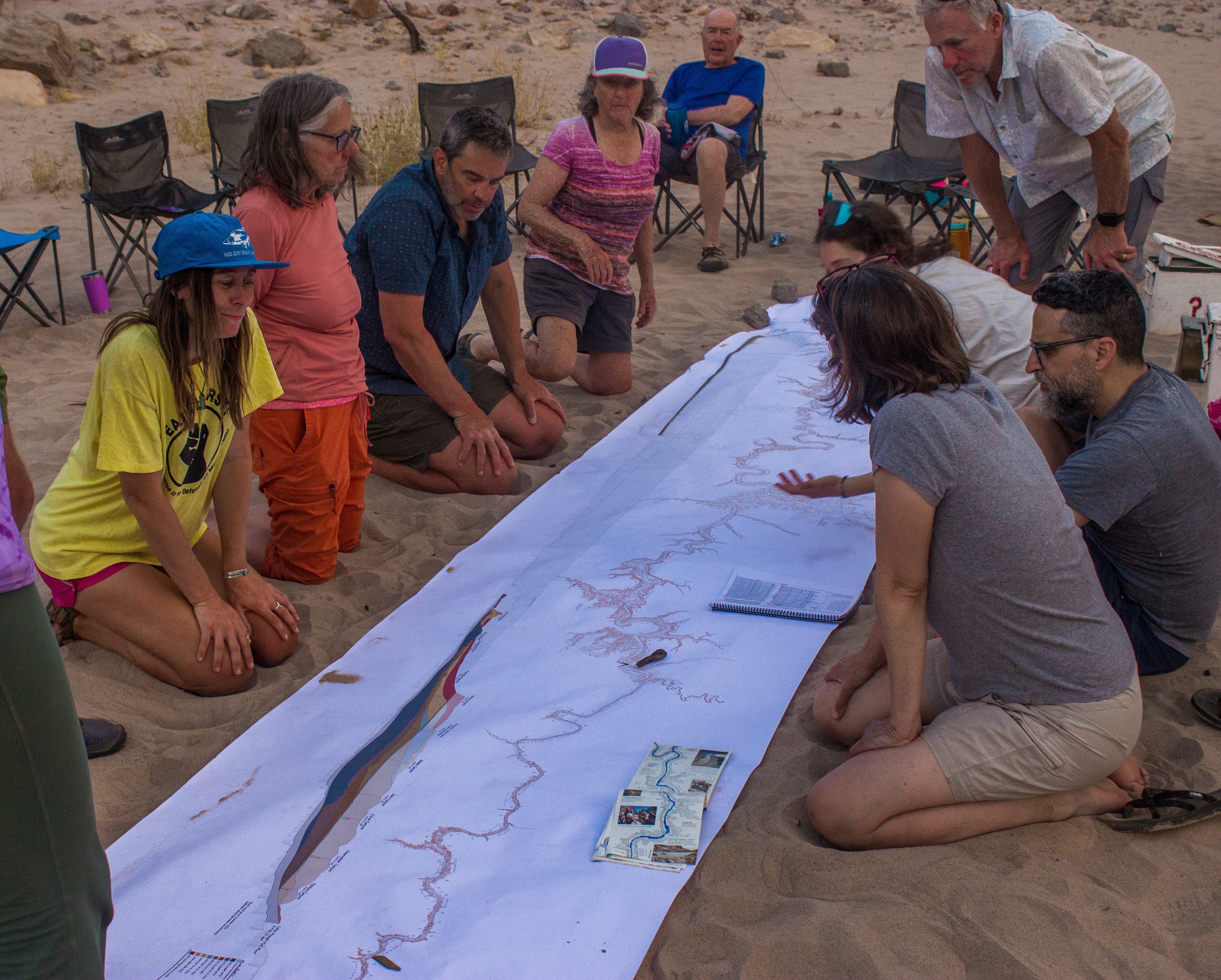
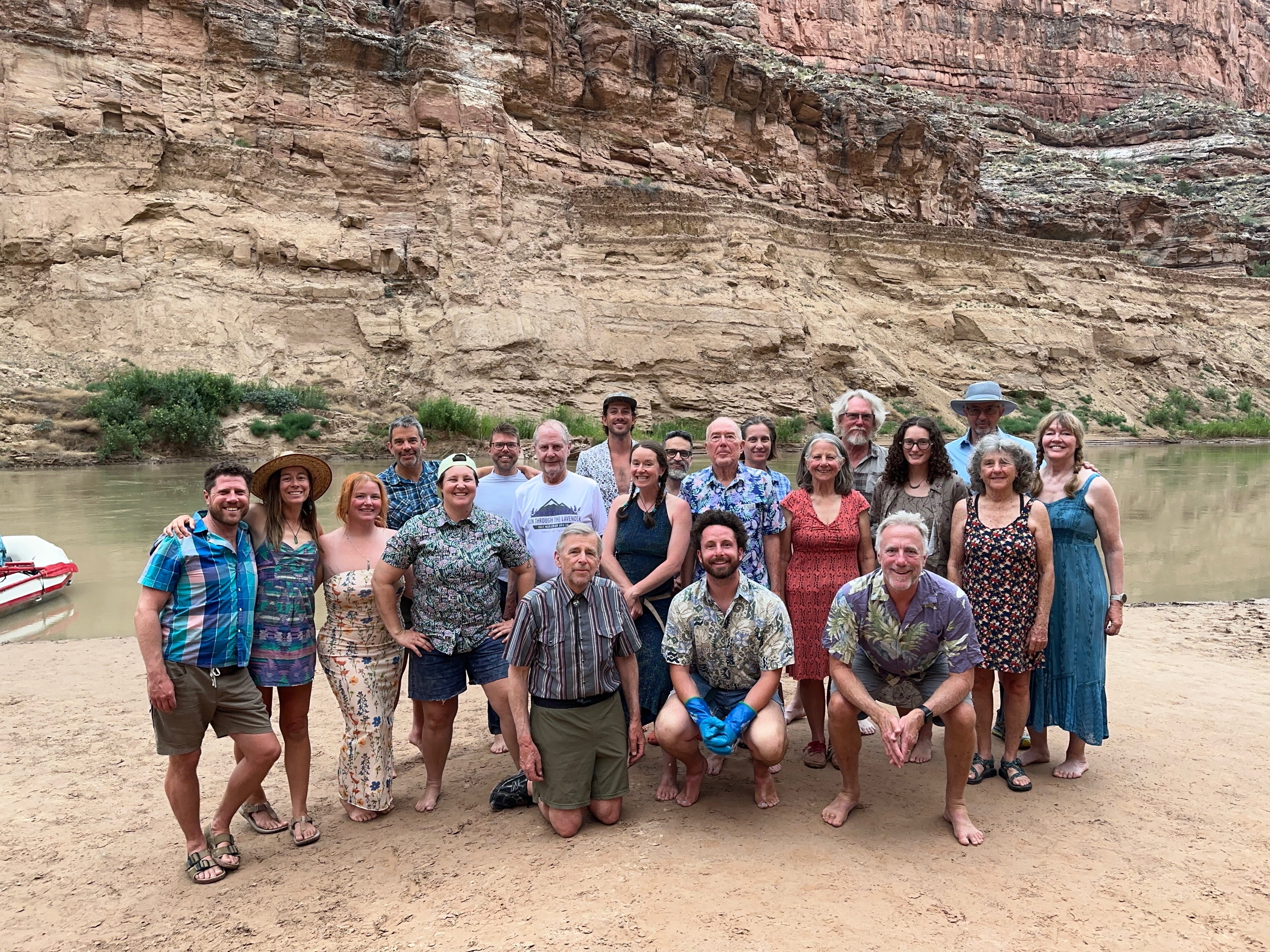
L to R: Allen Best, Alan Salazar, Siri Roman, Pat Mulroy during the panel discussion “Liquid Courage” at the Museum of Nature & Science, July 21, 2026. Photo credit: Big Pivots
Click the link to read the article on the Big Pivots website (Allen Best):
July 27, 2026
“We know climate change is real. We know we’re living it, but no one expected it to move this quickly.”
As moderator at last week’s water forum held at the Denver Museum of Nature and Science, I posed the question to our three panelists about this hot and dry summer after last winter’s exceptional warmth and dearth of snow.
“From where you sit now, is this any different from what we’ve been through before?”
Pat Mulroy, a senior fellow at the University of Nevada, Las Vegas’ Boyd School of Law and the former longtime general manager of the Southern Nevada Water Authority, is an advocate for extensively rethinking how the Colorado River is managed. (Image: University of Nevada, Las Vegas’ Boyd School of Law)
Pat Mulroy was quick to answer. She calls herself a “recovering CEO.” For 23 years she oversaw the Southern Nevada Water Authority‘s operations in Las Vegas and its suburbs. Early in her watch, the population of Clark County, where Las Vegas is located, exceeded the population of Manhattan. It now has a population of 2.5 million people.
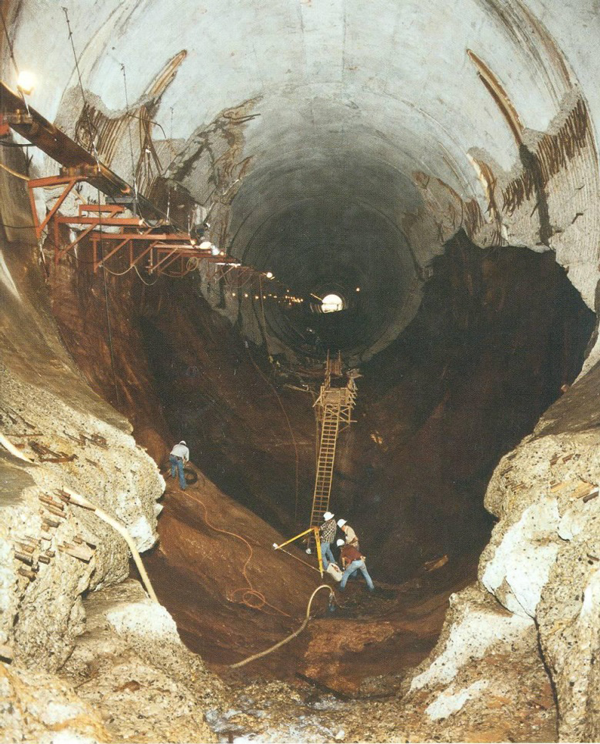
The metro area there gets 90% of its water from the Colorado River via tunnels into three levels of Lake Mead. The newest — one she championed, despite a cost of $1 billion — comes up from underneath the reservoir. Even when Hoover Dam backs up too little water to be released downstream, Las Vegas will have access to water.
“I always love coming to Denver, now that I no longer come to Denver as the protagonist from the evil lower basin,” she said.
Footnote here: Many who had never heard Mulroy speak before were astonished at her liveliness.
“This summer is different only because the cumulative effect of all the summers that went before has come home to roost,” she continued.
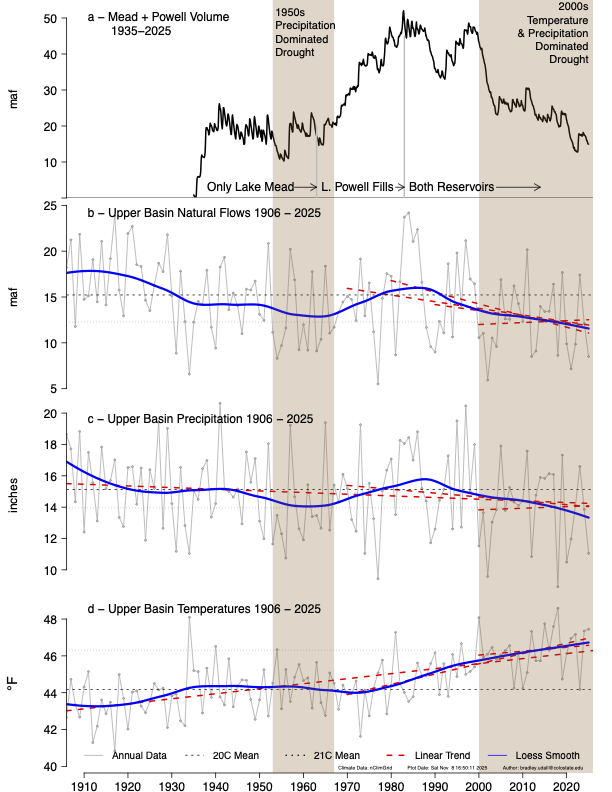
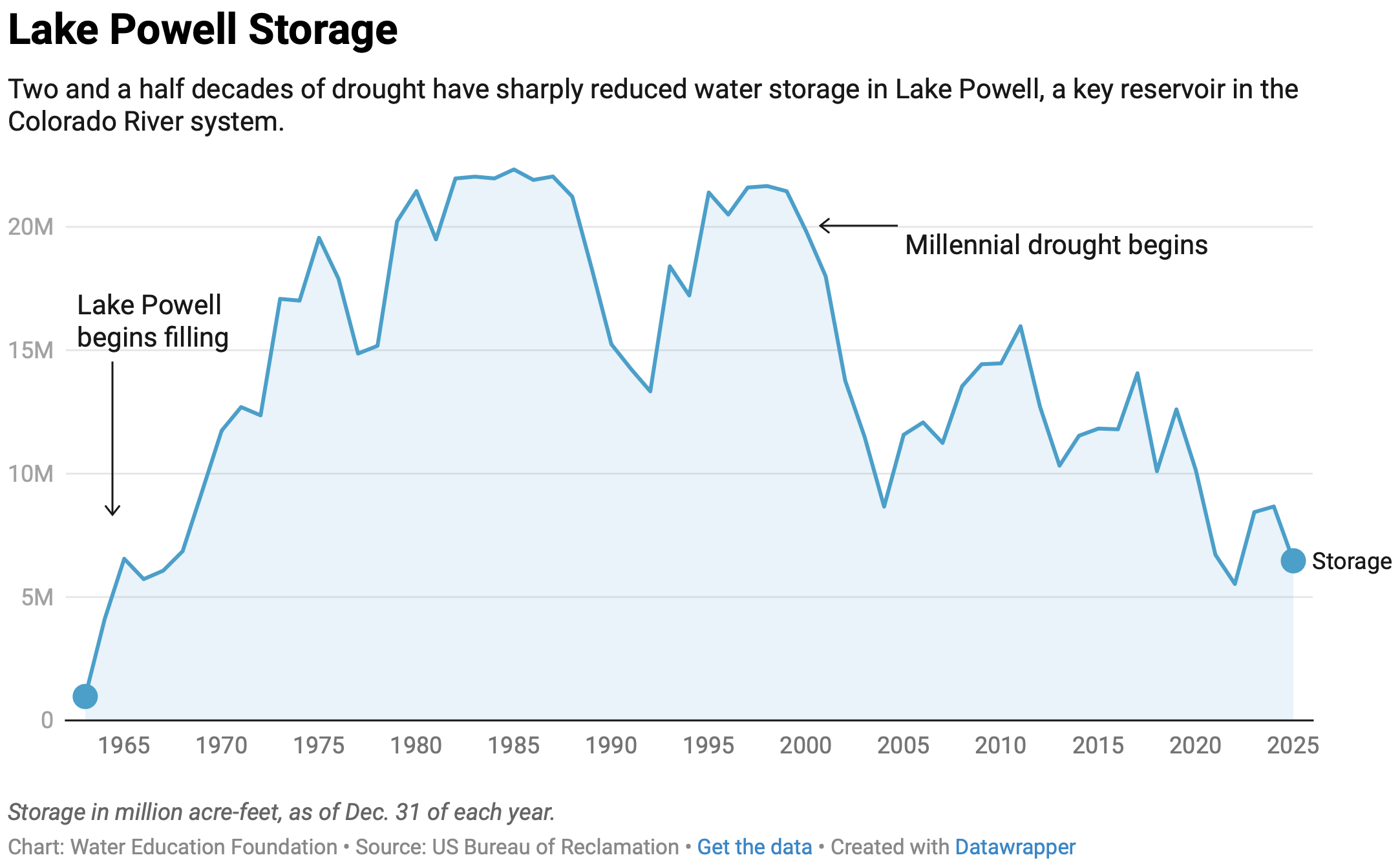
“All the cushion we have (had) is gone. I mean, it’s one thing to have 2002 when you had a bad winter and Lake Powell started going down rapidly, but Lake Mead still had (water to an elevation of) over 1,200 feet. We’re now seeing the very real possibility that Lake Mead is going to go to 900 feet by next year. That would be 10 feet above deadpool.”
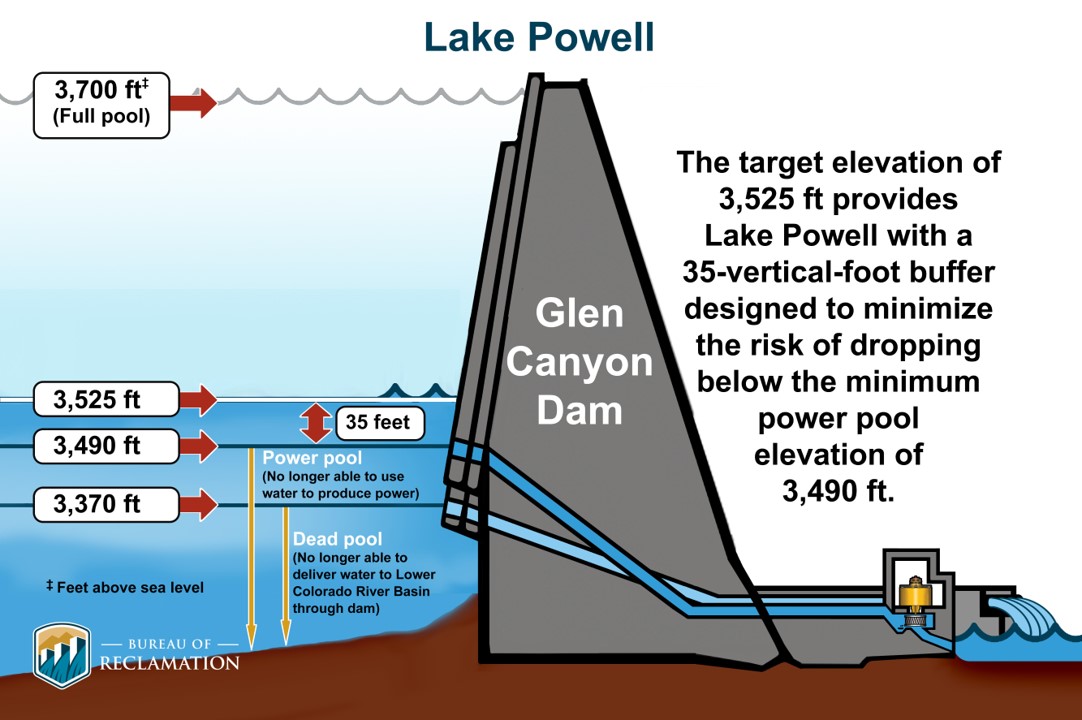
Deadpool is the water level that is so low that water can no longer be released from a dam. The level at which electricity can no longer be produced is higher.
Mulroy went on to say that while the Metropolitan Water District of Southern California is taking steps to “replenish” Mead — by taking less water than allotted — the problem continues to worsen. That indicates the depth of this problem.
“It’s never ending, and the rate of change is so much faster than any of us expected,” added Mulroy. ” We know climate change is real. We know we’re living it, but no one expected it to move this quickly.”
Siri Roman via her Facebook page.
Siri Roman was next. She manages the Vail-based Eagle River Water and Sanitation District. “I think that 2002 changed water in Colorado, and 2026 is going to change it completely again. A lot of our planning and assumptions are being challenged this year,” she said.
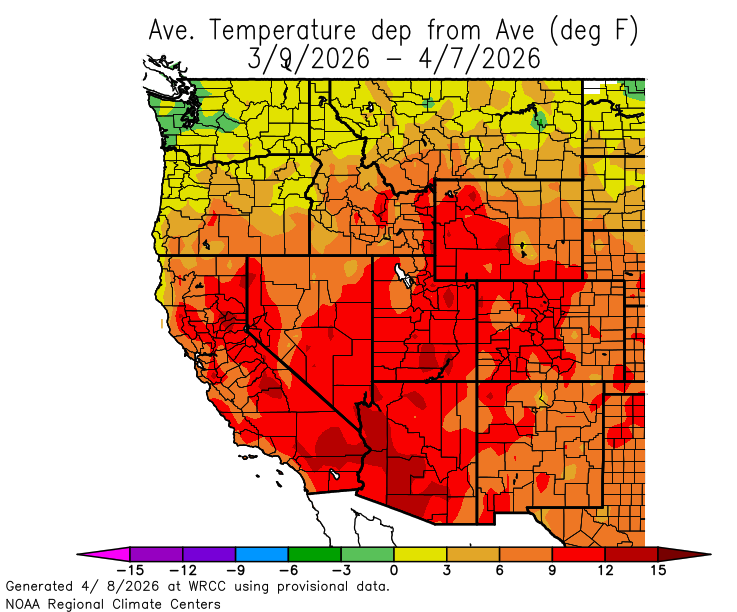
“I mean, it was 80 degrees for two weeks in March. Watching our very little snowpack — the lowest snowpack we had on record — nearly melt out in March was quite alarming to us.”
Eagle River Water and Sanitation District has several small reservoirs. Among them is the reservoir at Vail Pass, another near Camp Hale, and a third near Minturn.
“They weren’t able to fill because the stream flows were so low. There are a lot of things we rely on that we’re not going to be able to rely on moving forward. How do we get creative, looking at demand and other solutions about how to prepare for a drier year?” Roman continued.
“Statistically, they always say you won’t get two years like this in a row. I don’t think we can say that anymore. We can’t rely on the statistics because we’re seeing such abnormal patterns.” [ed. emphasis mine]
Denver Board of Water Commissioners/Courtesy photo.
Alan Salazar, the third panelist, is CEO of Denver Water. The water agency delivers water to about 25% of the 6 million Coloradans. “We use just 2% of the state’s water, and that has been pretty steady going back through the 1970s. That didn’t happen by accident, because we took measures. My predecessor and Denver water employees in the last 20 years use water more efficiently and with conservation in mind.”
Salazar had high-level positions as policy advisor to several elected officials, mostly in Colorado. One of them was the former U.S. Sen. Mark Udall, an advocate of protecting natural resources and an early advocate of public awareness around climate change. He recalled what his boss had told him: “Alan, no matter how many laws we pass, no matter how many regulations we implement, Mother Nature bats last. And boy, is she batting.”
As compared to 2002, he said, this year is more extreme. “We had a heat dome that made the spring more difficult, and it’s partly why the response from our customers has lagged, because even though there are water restrictions, the extremes in temperatures have put greater pressure on water use. So, it’s quite a bit different.”
These remarks were delivered early in the 90-minute sessions devoted to water and urban uses in Colorado and somewhat beyond.
The museum’s Institute for Science and Policy will hold another session on Aug. 27 in its two-part Liquid Courage series. This next session will have four panelists:
Robert Sakata, a farmer from Brighton and now a senior adviser at the Colorado Department of Agriculture;
Anne Castle, a former Interior Department undersecretary for water in the Obama administration now affiliated with the Getches-Wilkinson Center at the University of Colorado Law School;
Nathan Coombs, a San Luis Valley farmer and a member of the Colorado Water Conservation Board; and
Sarah Jones, co-founder of Rye Resurgence and co-owner of Jones Farm Organics near Hooper, in the San Luis Valley.
Click the link to read the article on the Crested Butte News website (Katherine Nettles). Here’s an excerpt:
July 22, 2026
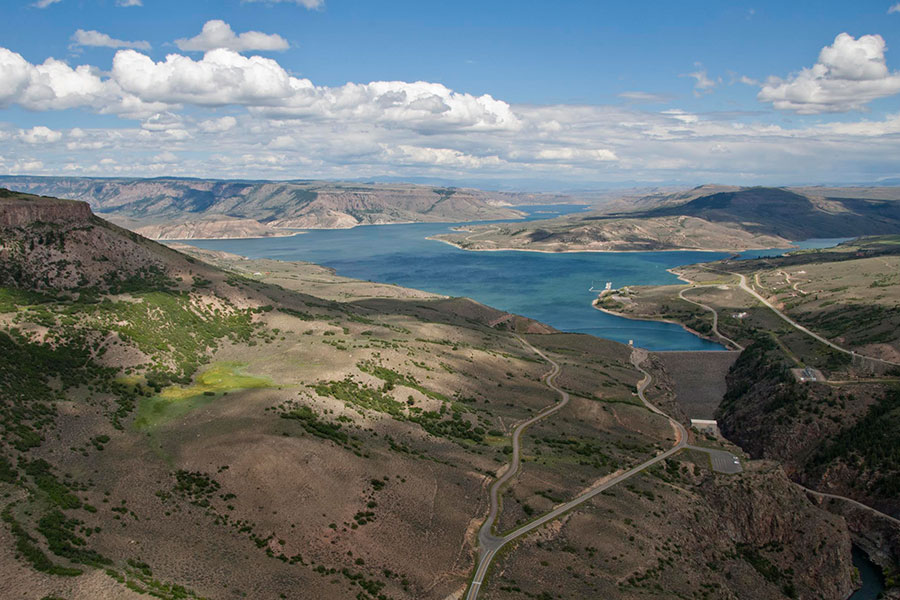
Given the severe drought throughout the past water year, Blue Mesa Reservoir and the dams below it that serve downstream users are all at precariously low levels this summer. This is impacting recreation, power generation and aquatic life. As reservoir levels fall dangerously close to “power pool” level at which point hydroelectric power becomes impossible, the Bureau of Reclamation (BOR) last week made some adjustments to try and prevent that. The hope is that the new flows will hold up Blue Mesa power production, and protect various other uses and aquatic biology through the end of the year…According to Andrew Limbach with BOR’s Western area office, the release schedule from the Crystal Dam below Blue Mesa changed over a period of three days from 1,465 cubic feet per second (cfs) on July 15 to 1,265 cfs by July 17. Gunnison River flows in the Black Canyon/Gunnison Gorge were scheduled to decrease from 360 cfs to 250 cfs over the course of those same three days. “In response to the extreme drought conditions, the BOR has collaborated with US Fish and Wildlife and the National Park Service to reduce the target flows to 500 cfs at Whitewater and 200 cfs through the Black Canyon of the Gunnison until further notice…
Jennifer Erickson, public affairs officer with the Department of the Interior, shared the latest information available regarding Blue Mesa elevation. “As of our last projections, Blue Mesa Reservoir is expected to fall to elevation 7,412 ft by the end of September. That number is from last month’s 24-Month study projections.” When full, the elevation is at 7,519 feet…
“To maintain safe and operational marina facilities, the NPS has moved the Elk Creek marina infrastructure to deeper water. Approximately half of the Lake Fork Marina has also been moved to deep water. Trailered watercraft can no longer use the Lake Fork boat ramp and will not be able to use the Elk Creek boat ramp when reservoir elevations reach 7435’. Hand-launching of non-trailered watercraft will remain available at both ramps.”
The NPS also advised that on Sunday, July 26remaining Lake Fork marina operations will no longer be operational at 4 p.m., and on Monday, July 27 all boats must be out of Lake Fork Marina slips by noon.
On Friday, July 31, the NPS projected that the Elk Creek boat ramp will no longer be safe for launching or retrieving trailered watercraft. “All trailered watercraft on Blue Mesa reservoir should be retrieved before this elevation is reached. The ramp will remain open for hand-launching,” according to the release.
So while Blue Mesa shouldn’t go to “deadpool” mud or canyon levels, it will be as low as it’s been in decades.
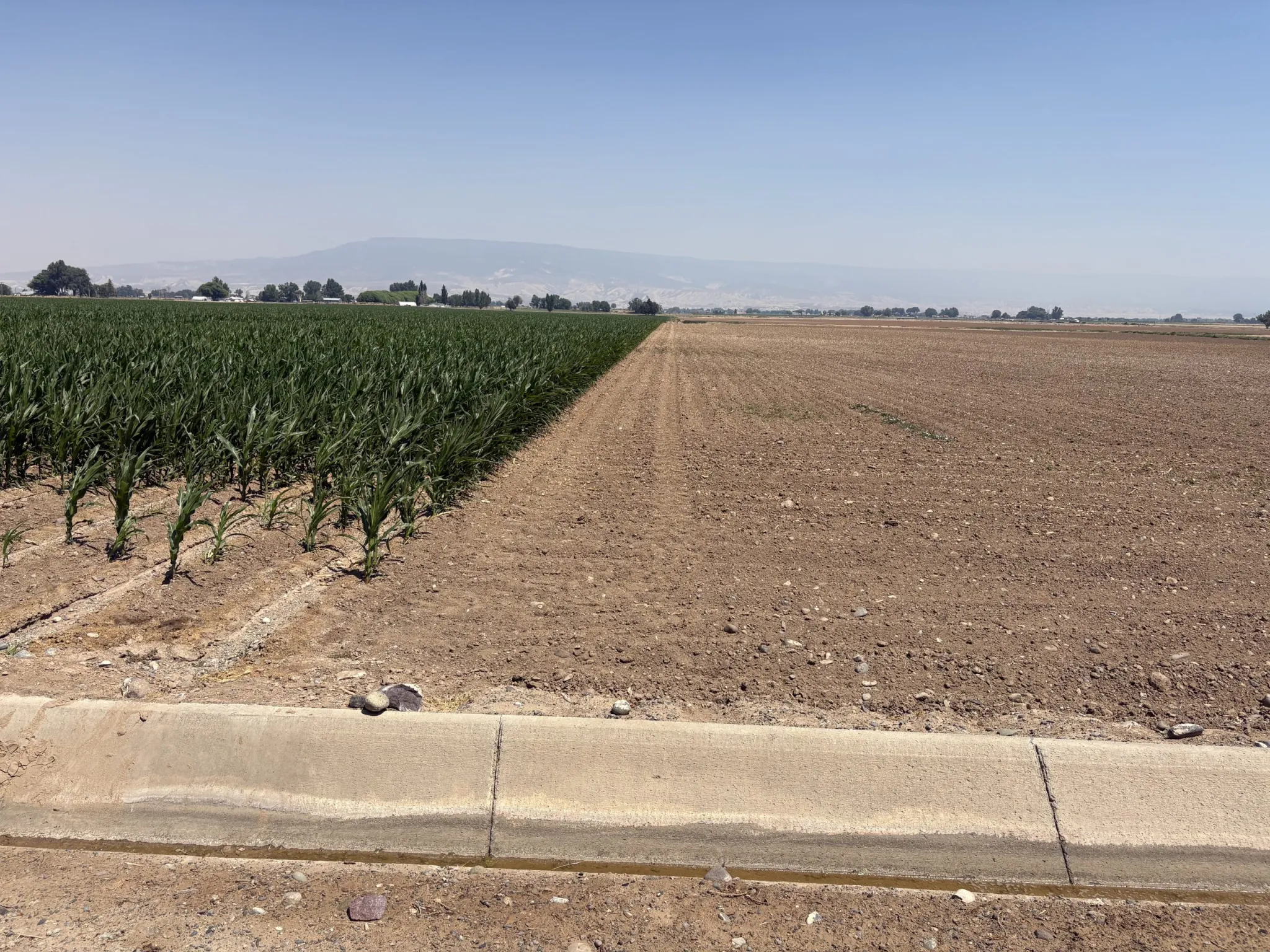
Farmer Randy Friend grows corn in the Olathe area. He left the debris from last year’s crop on the ground as a form of mulch to try to retain moisture in this exceptionally dry year. CREDIT: HEATHER SACKETT/ASPEN JOURNALISM
Fourth-generation Olathe farmer Randy Friend stopped his pickup truck next to a row of corn whose green leaves were limp and curling, with a gray tinge. Friend’s corn was stressed as the valley endured a July heat wave with temperatures nudging close to 100 degrees.
“I hate to see it looking like that with our water situation,” Friend said.
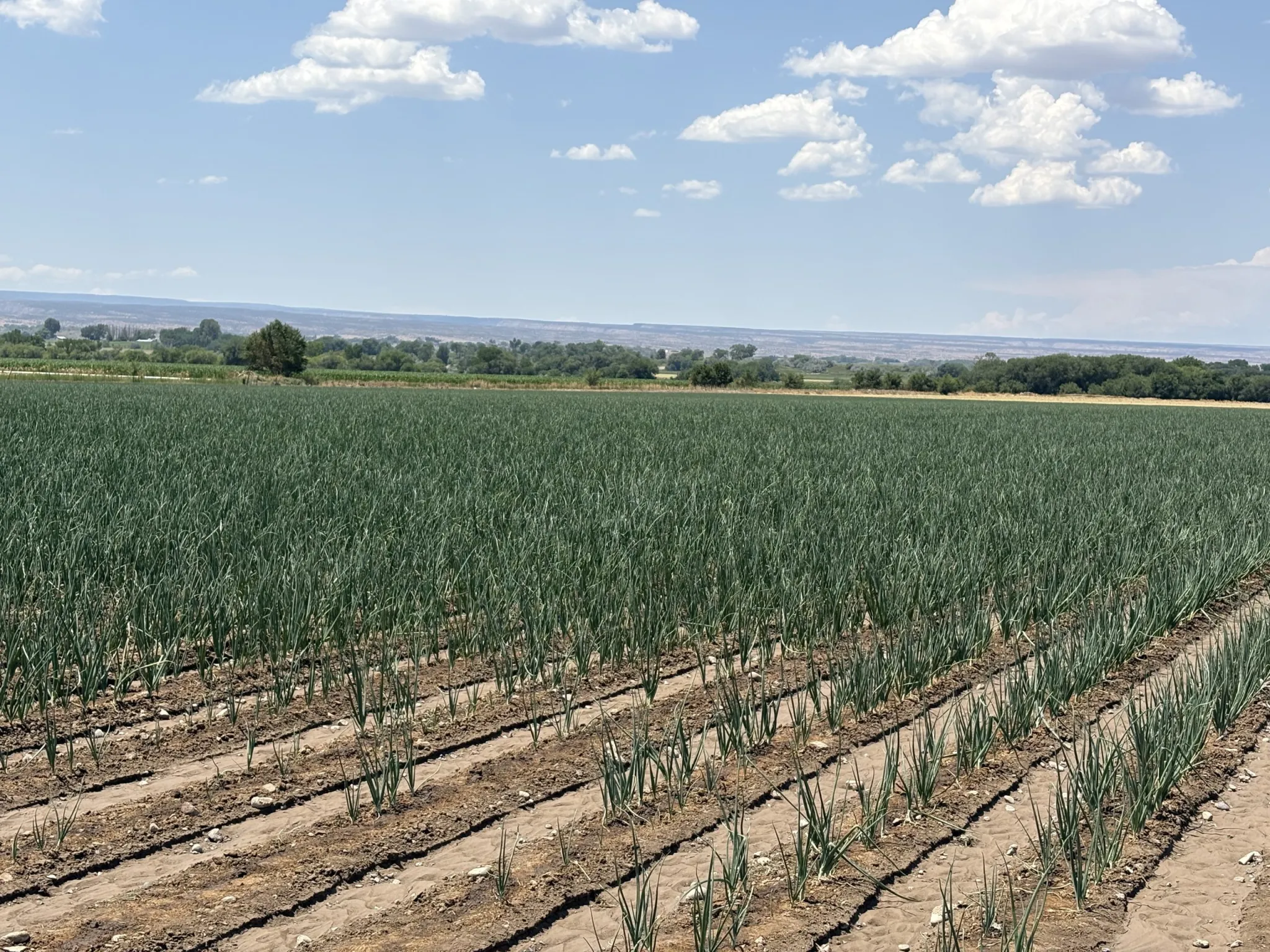
Next was a field of onions, a thirsty crop with a long growing season. The furrows between the dark-green sprouts were still damp, an indication the field was just irrigated that morning.
“Onions are our most expensive crop to grow and the most reward on a good year,” Friend said. “But they can also bankrupt you because they take so much more water.”
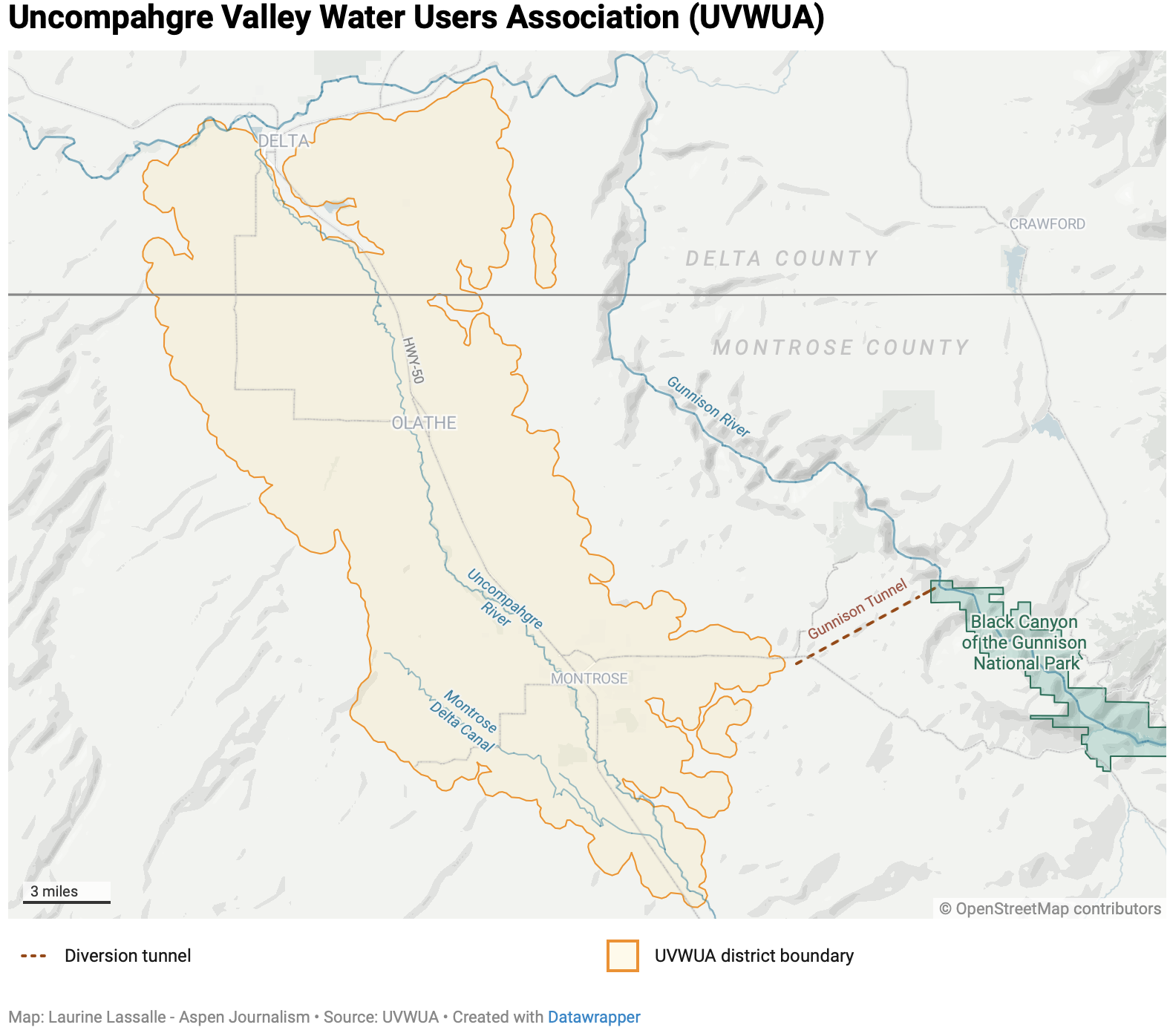
Friend farms corn, onions and forage crops for livestock as part of the Uncompahgre Valley Water Users Association, a vast expanse of farmland that extends from just south of Montrose to Delta, on Colorado’s Western Slope. Water from the Gunnison and Uncompahgre rivers, along with miles of tunnels, canals and ditches, transforms about 76,000 acres of high desert into lush green fields of corn, pinto beans, onions and alfalfa.
But this year, Uncompahgre Valley farmers are making tough decisions and developing new tools as they try to adapt to one of the hottest, driest years on record in the Upper Colorado River basin. Many are leaving fields dry, culling their cattle herds, switching to crops that use less water and relying on crop insurance payouts as the association faces a 50% cut to its irrigation water supply.
“I’ve been farming 30 years now, and this is by far the most extreme, biggest cut of water that I’ve ever had to deal with,” Friend said.
Some producers in the Uncompahgre Valley Water Users association have left some fields unplanted due to drought. The association has only about half its normal water supply this year. CREDIT: HEATHER SACKETT/ASPEN JOURNALISM
The Uncompahgre water users get about half of their water supply from Taylor Park Reservoir, at the headwaters of the Gunnison River, via the Gunnison Tunnel, a six-mile-long aqueduct that can bring up to about 1,175 cubic feet per second to the valley. The other half comes from the Uncompahgre River, a much smaller river basin that saw an abysmal end-of-season snowpack with just 14% of median April 1. That means the association has only about half its normal water supply for irrigation season.
“We’re limping along right now, but it’s going to be a challenging year,” said association manager Steve Pope. “We got to get our producers through Labor Day; we’re going to need the water then. It’s just a physical supply issue; the water just wasn’t there.”
With its water cut by half, many producers in the Uncompahgre Valley have chosen to irrigate only some of their fields, leaving others unplanted for the season. The district’s northwest area, which is where much of the valley’s row crops are grown, has been the hardest hit. Pope estimates those farmers are fallowing between 30% and 60% of their ground. Driving around the district revealed many fields that were brown and dry.
“There’s just a tremendous amount of land out there that’s just barren, and there’s nothing you can do about it,” he said.
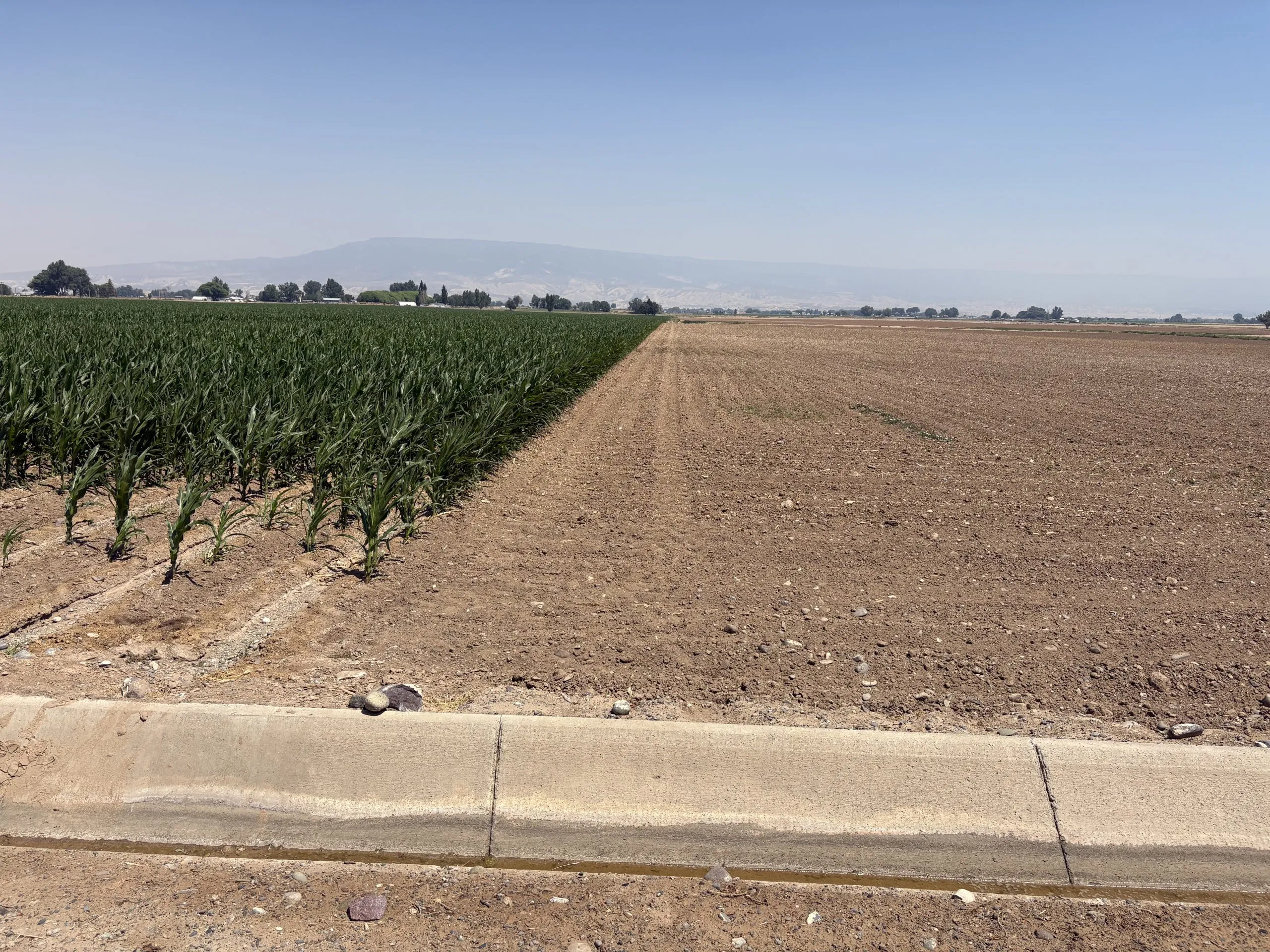
This field in the Uncompahgre Valley Water Users Association district has been fallowed this season due to a lack of water. The state of Colorado announced Wednesday that it will set up a conservation program using federal dollars, which means more fields on the Western Slope could soon look like this. CREDIT: HEATHER SACKETT/ASPEN JOURNALISM
Friend, an association board member, said he is fallowing about one-fourth of the land he farms and using about 30% to 40% of his acres to grow forage crops that use less water, such as sorghum-Sudangrass. But switching to drought-resistant plants is a strategy that doesn’t work for every grower. Friend also owns a feedlot so he can mix these drought-tolerant crops with higher-quality feed to make it work. Although some growers on the Western Slope are experimenting with alternative forage crops, such crops have yet to be grown on a large scale. Water-intensive alfalfa, with its high protein content, remains dominant.
Daris Jutten, a fifth-generation rancher in Ouray and Montrose counties, said the lack of water has prompted him to cut his herd back to the fewest cows he has ever had on his ranch. He has also left some of his alfalfa fields fallow.
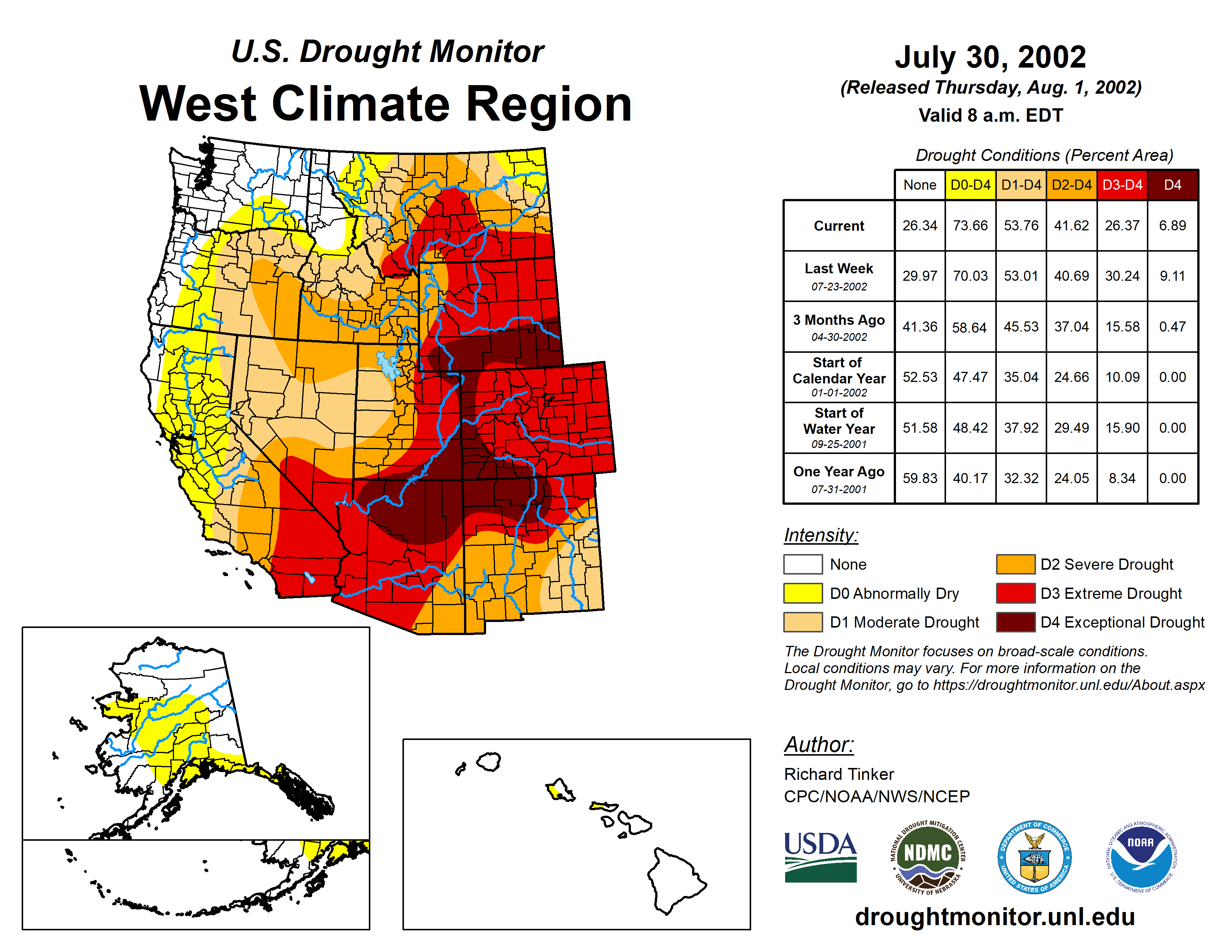
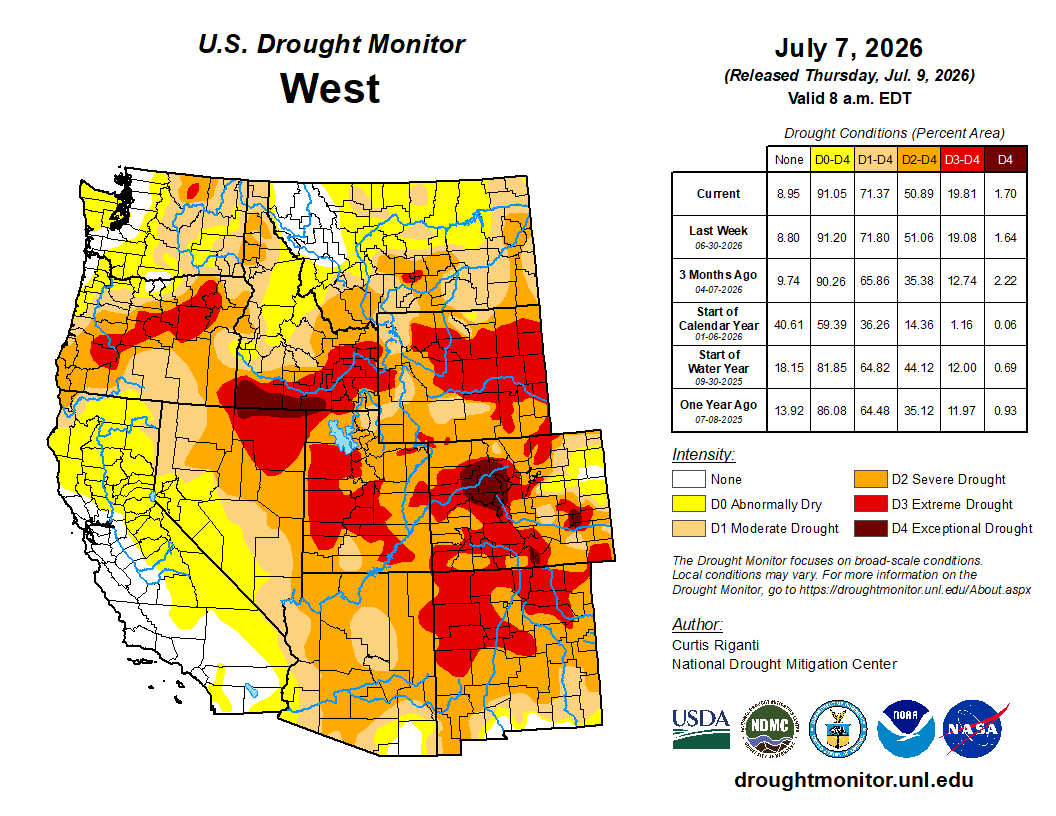
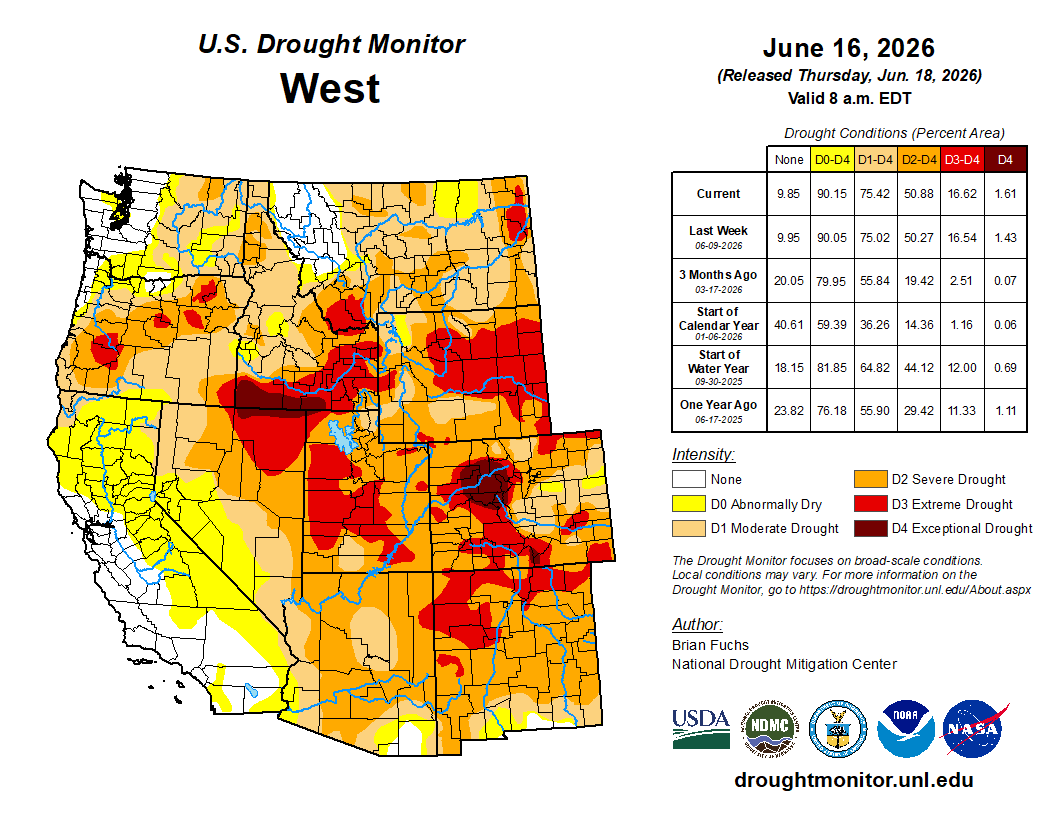
West Drought Monitor map July 30, 2002.
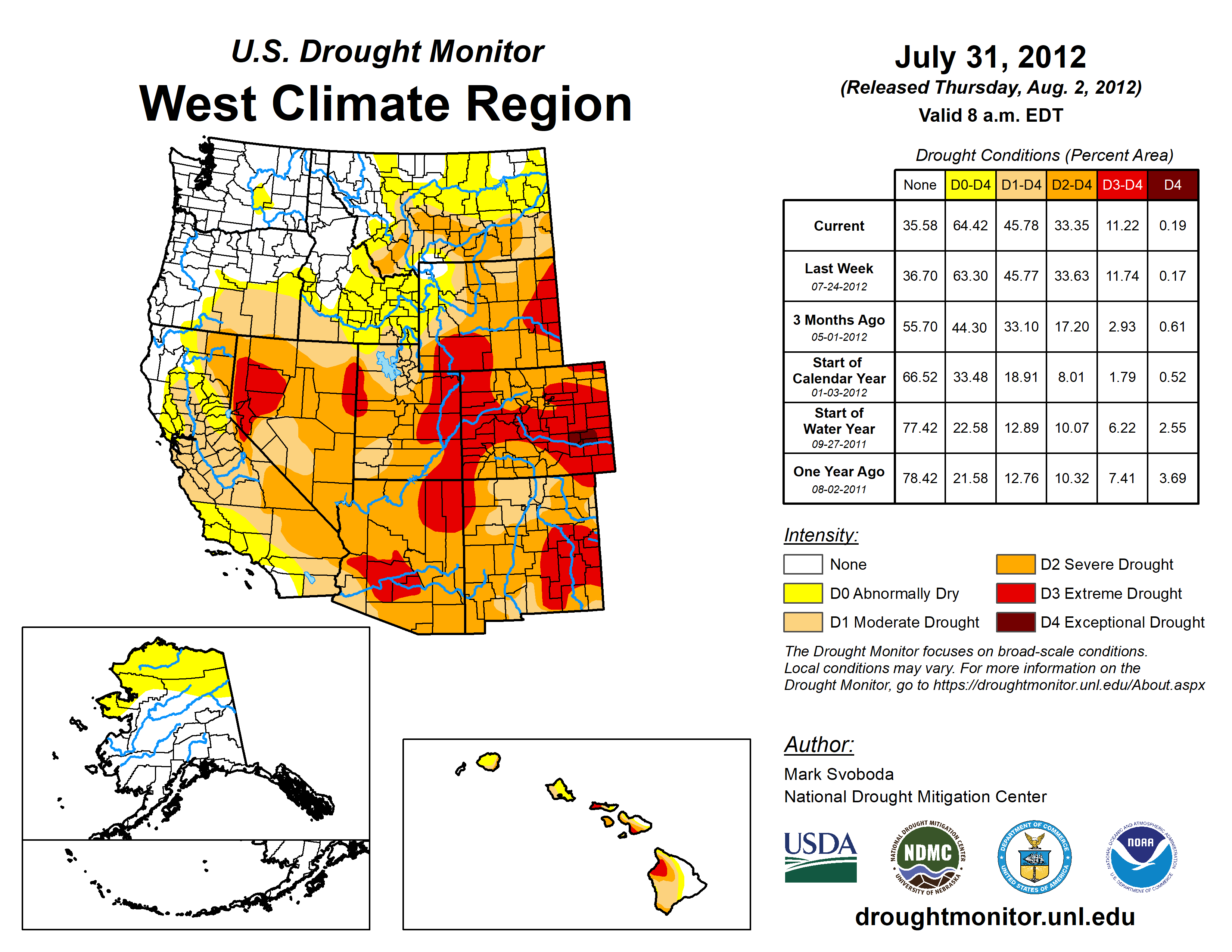
West Drought Monitor map July 31, 2012.
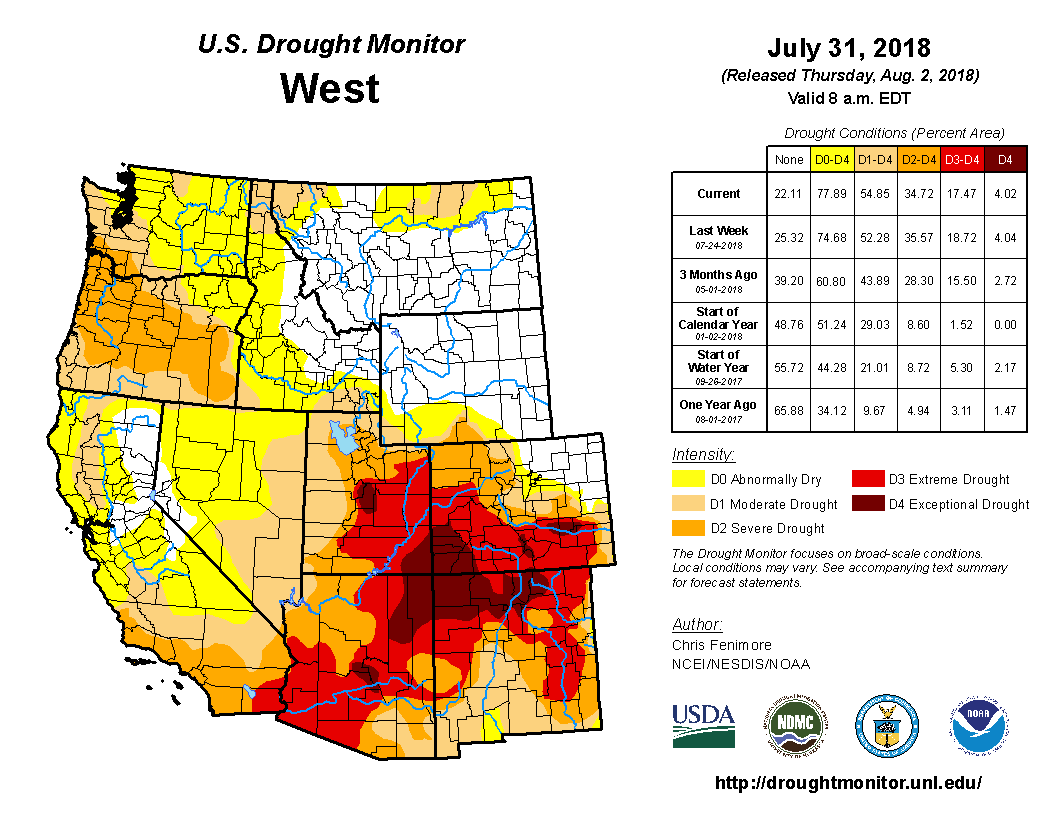
West Drought Monitor July 31. 2018
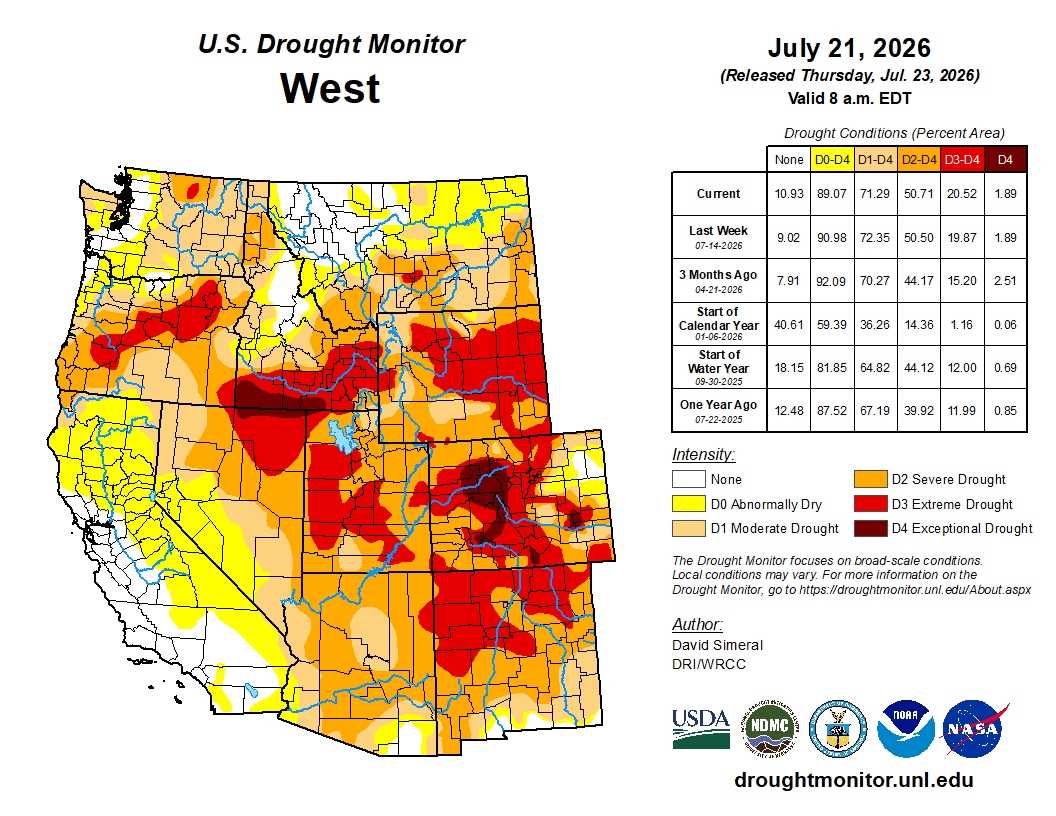
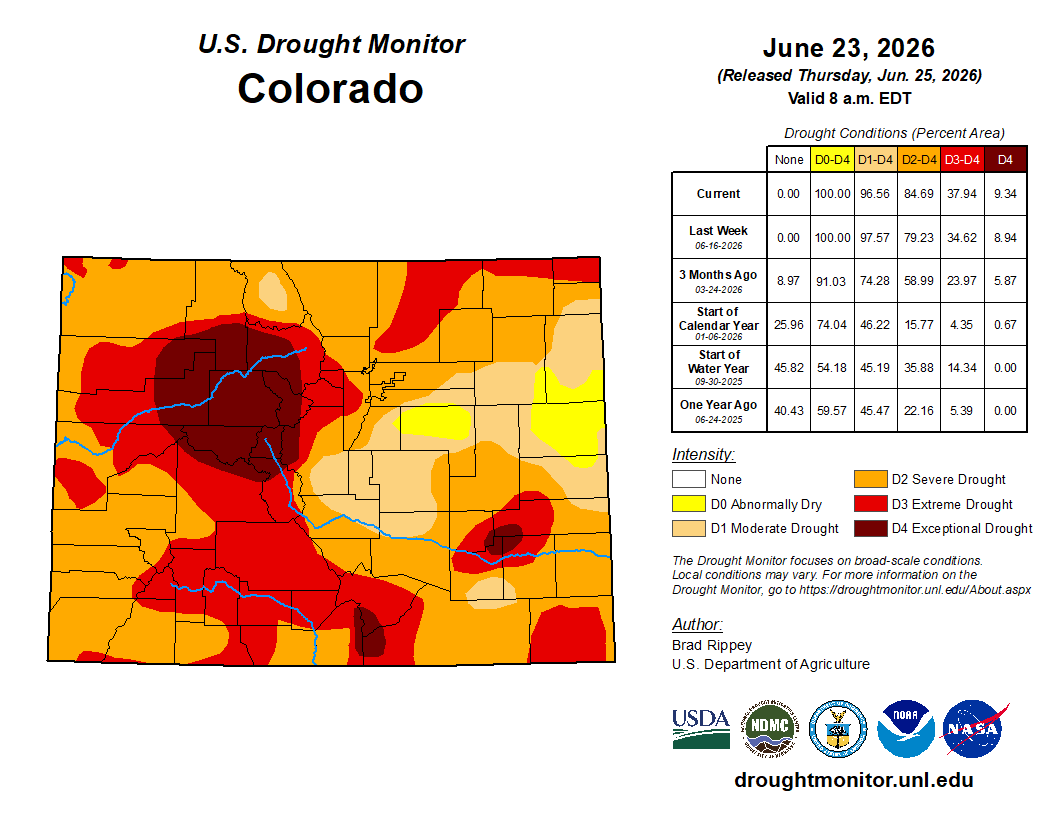
West Drought Monitor map July 21, 2026.
“I’ve seen it bad before, but I’ve never seen it this bad,” Jutten said. “2002 was bad. 2018, 2012 were all bad. But they don’t even come close to what this thing is.”
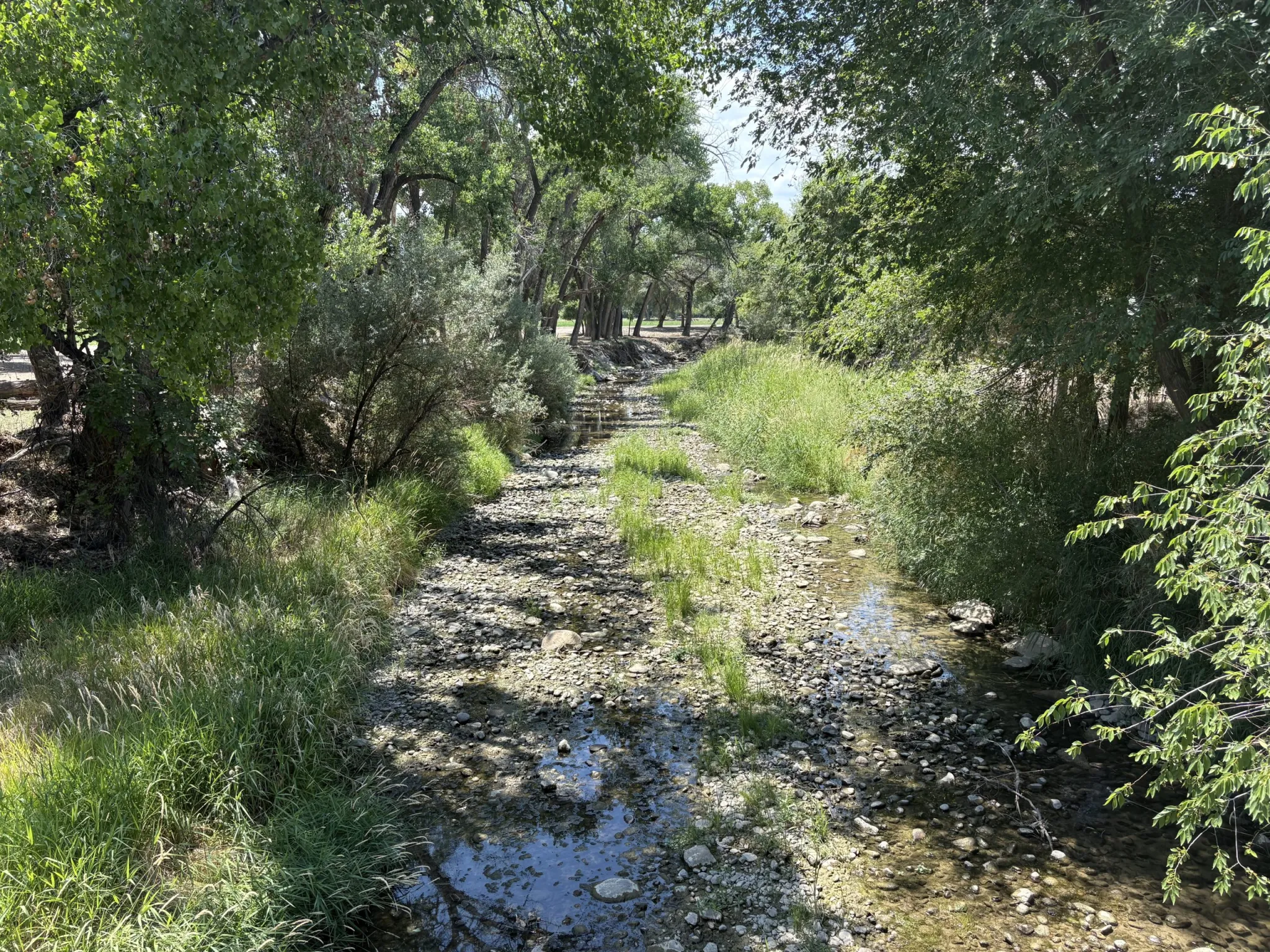
The Uncompahgre River in Olathe was nearly dried up in July due to agricultural diversions and drought. The Uncompahgre Valley Water Users Association is the biggest agricultural water user in the Upper Colorado River Basin. CREDIT: HEATHER SACKETT/ASPEN JOURNALISM
Colorado’s new conservation program adds pressure to cut water use
This year’s lack of water and a management crisis have brought the Colorado River system to the brink of collapse.
As the nation’s two largest reservoirs, Lake Powell and Lake Mead, plummet to new lows, water managers are taking emergency steps to keep Lake Powell levels high enough to produce hydropower at Glen Canyon Dam. At the same time, federal officials are crafting a plan for how the seven states that share the Colorado River will share shortages and how the reservoirs will be operated for the next two years.
Colorado’s new conservation program adds pressure to cut water use
This year’s lack of water and a management crisis have brought the Colorado River system to the brink of collapse.
As the nation’s two largest reservoirs, Lake Powell and Lake Mead, plummet to new lows, water managers are taking emergency steps to keep Lake Powell levels high enough to produce hydropower at Glen Canyon Dam. At the same time, federal officials are crafting a plan for how the seven states that share the Colorado River will share shortages and how the reservoirs will be operated for the next two years.
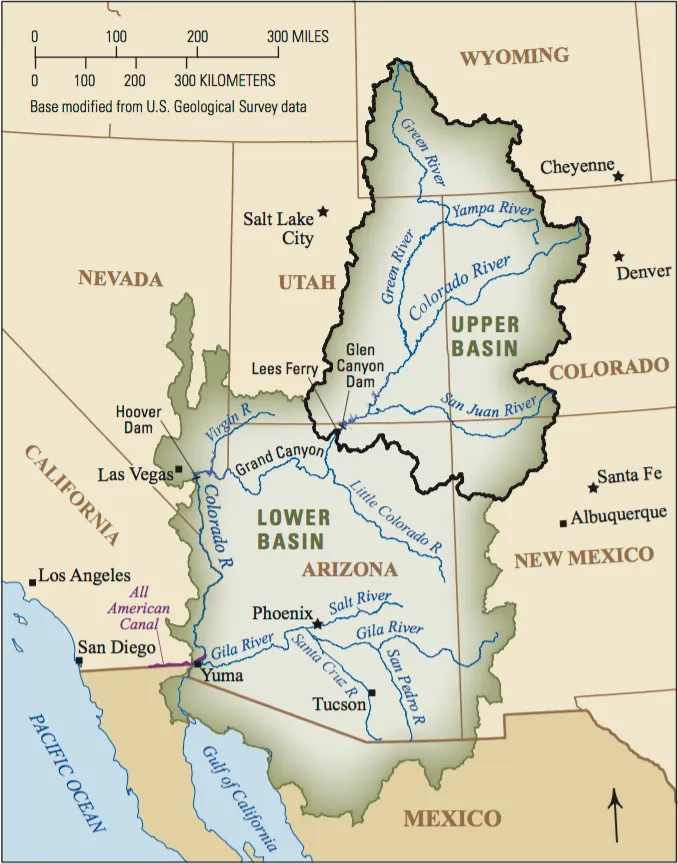
Upper Basin water managers have focused on the fact that their farmers and ranchers are affected first by a warming climate and are already experiencing shortages because the water simply isn’t there. The Upper Basin states (Colorado, New Mexico, Utah and Wyoming) suffer because there aren’t major reservoirs from which they can draw in dry years the way that the Lower Basin states (Arizona, California and Nevada) do. Both basins are increasingly expected to reduce consumption because supplies are shrinking and the Colorado River system as a whole must be managed within these new limits.
Onions are one of the water-intensive row crops grown in the Uncompahgre Valley. Farmers in the region are adapting to drought by fallowing fields and planting crops that use less water. CREDIT: HEATHER SACKETT/ASPEN JOURNALISM
On July 15, state officials announced the creation of a “near-term contribution program” that will pay water users to voluntarily cut back in 2027 and 2028, using $100 million in promised funding from the U.S. Bureau of Reclamation. The Upper Basin states have a goal of saving 100,000 acre-feet by the end of September 2028, which marks the end of water year 2028. The saved water will need to have a home in Upper Basin storage buckets — Lake Powell, Navajo, Blue Mesa or Flaming Gorge reservoirs — but precisely how it will be used and how it will fit into broader Colorado River management are still unknown.
The program has been a long time coming, and the concept is not new to Colorado. Officials said they are incorporating the lessons learned from previous demand-management studies beginning in 2019, stakeholder input and recent pilot programs.
As the biggest agricultural user in the Upper Basin, the Uncompahgre Valley — drought-stricken as it is — is ideally located for these types of programs and is considered one of the lowest-hanging fruits when it comes to finding places to save water.
When Colorado’s contribution program is implemented next year, the association will be ready. Knowing that a program was inevitable, Western Slope water managers have been proactive, developing a data-mapping tool that can help the association adapt to drought.
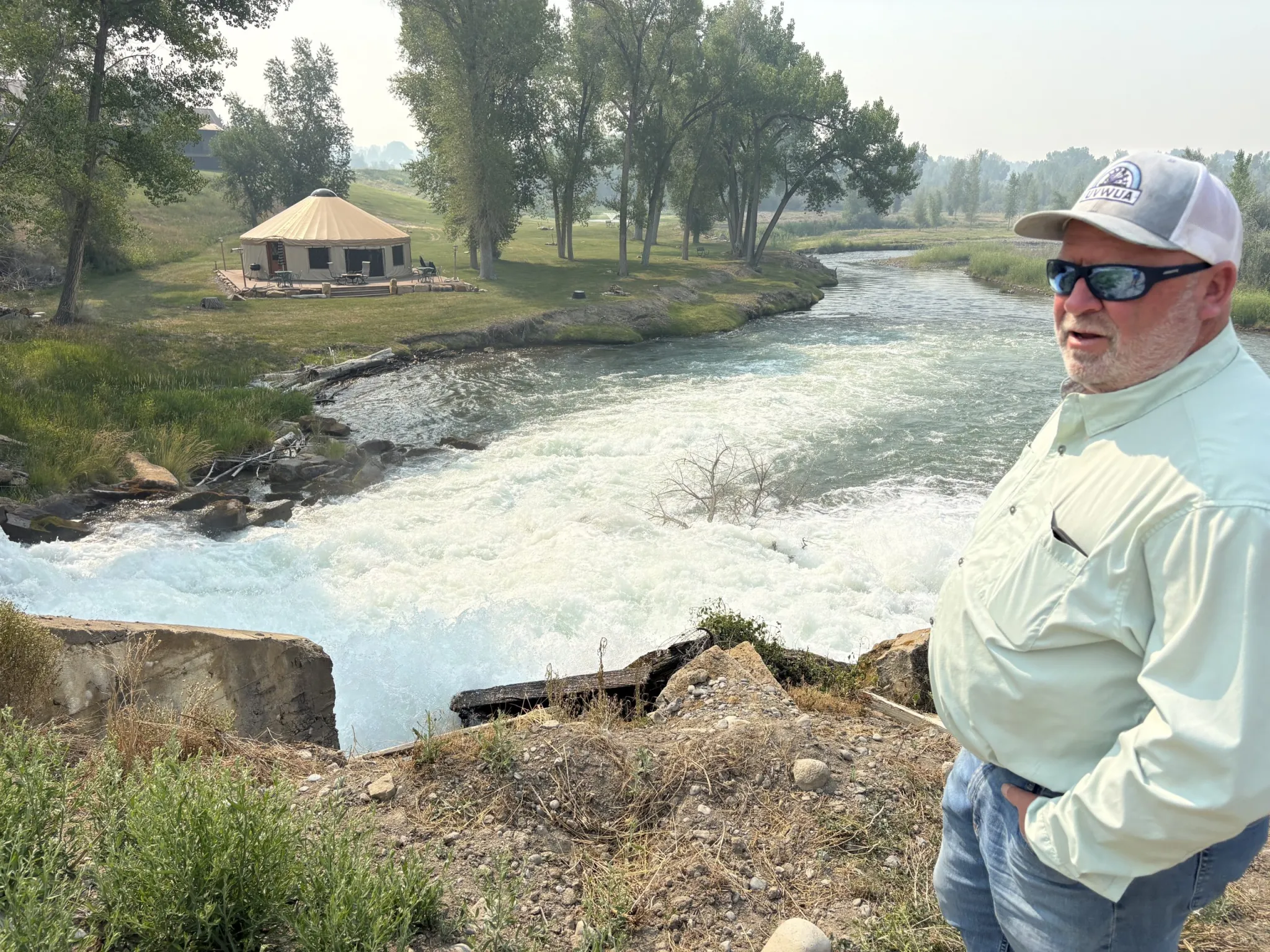
UVWUA Manager Steve Pope stands at the spot where water from the South Canal dumps water from the Gunnison River into the Uncompahgre River. It’s then diverted to the west side of the valley where it irrigates fields and row crops. CREDIT: HEATHER SACKETT/ASPEN JOURNALISM
Mapping tool helps plan conservation
With 550 miles of interconnected canals and laterals snaking through the valley, downstream irrigators often depend on reusing the water that runs off an upstream neighbor’s fields, and leaving a field dry could have unintended downstream consequences.
Developed by the Colorado River Water Conservation District and The Freshwater Trust, the tool can pinpoint where the greatest opportunities for water savings are, as well as how to avoid the worst consequences of fallowing ground. It can show what happens when efficiency improvements are made to the association’s century-old infrastructure and can show which ditches should be lined to provide the most bang for the buck to reduce seepage loss.
“From our perspective, it’s a great management tool because it allows us to track water through our system,” Pope said. “Let’s say there’s [a conservation] program, well, what would be the best farms to go to a deficit irrigation or fallow that would create the most (water savings), and you can target that.”
The tool is aimed at helping producers adapt to drought and can show which projects would result in the most water savings. Although the River District does not endorse a large-scale conservation program, it has long recognized that one was inevitable and has sought to mitigate the worst impacts to rural agricultural communities.
The intent of the tool is to help create a program that can maximize economic and environmental benefits as well as water conservation, said Raquel Flinker, director of interstate and regional water resources with the River District.
“It was always to provide data and analytics that would make whatever entity [is] creating a program design it in a way that seemed the most sensible,” Flinker said.
Some Uncompahgre Valley producers have participated in experimental programs that pay them to cut their water use, including the federally funded System Conservation Pilot Program, which took place in 2023 and 2024. Friend and a few others in the association enrolled in 2024 and were paid to reduce their water use. The association’s board has allowed their members to participate in conservation programs, but they remain somewhat controversial. An irrigation district in the Western Slope’s other big agricultural area, the Grand Valley, does not allow its members to participate.
Pope said instead of programs that pay farmers not to irrigate, he would rather see federal money pay for more efficiency upgrades to water-delivery systems such as lining ditches and improving headgates. The recently announced state program is meant to include a broad range of water-saving actions, but pilot conservation programs in the Upper Basin have always defaulted to paying irrigators to temporarily stop using water.
“The problem I see with it is if somebody enrolls and they sign off the year before, and then we don’t get any water and they are 50% fallowed anyway, did the program really generate any water?” Pope said. “It’s very difficult to measure the benefits of these types of programs when you have such an unreliable supply to begin with.”
Pope brings up an inherent contradiction about Upper Basin conservation: How can agricultural water users cut back when they already don’t have enough in drought years like this?
Despite the 100,000-acre-foot goal for the Upper Basin, Colorado leaders have long said they can’t commit to saving a specific amount of water. They said that figure can be reached only if sufficient federal funding is available and hydrologic conditions allow. And for now, the program remains short-term, while the effects of a warmer and drier climate appear likely to continue for the long-term.
“If this is the new normal, it’s going to get way more difficult,” Friend said. “If we have another winter like this last one, a lot of people are pretty worried about it.”
The Northern Colorado Water Conservancy District (Northern Water), the U.S. Bureau of Reclamation, Grand County, the Northwest Colorado Council of Governments (NWCCOG), the Colorado River Water Conservation District (Colorado River District) and the Town of Grand Lake today announced a landmark agreement establishing the Three Lakes CLEAR Initiative, a long-term effort to improve water clarity, watershed health and resilience across Grand Lake, Shadow Mountain Reservoir and Granby Reservoir (the Three Lakes).
The Three Lakes System is part of the federal Colorado-Big Thompson (C-BT) Project, which collects and stores water in Grand County and then diverts it for use by C-BT beneficiaries on the Front Range through a series of reservoirs, ditches and tunnels. The CLEAR Initiative continues the ongoing Grand Lake Adaptive Management framework for managing C-BT Project operations and incorporates additional collaborative initiatives to enhance clarity and provide watershed health benefits within and upstream of the Three Lakes System.
CLEAR stands for Clarity, Legacy, Ecosystem, Adaptation and Resilience, reflecting the shared commitment by partners to protect and improve this important resource.
The agreement marks a major milestone following two decades of coordinated work to improve clarity in Grand Lake and water quality in Shadow Mountain Reservoir and reflects a renewed commitment to sustained action and investment. It also provides a long-term framework to continue and expand this work as the Grand Lake Clarity Stakeholders’ Memorandum of Understanding (MOU), established in 2016, expires in December 2026. Today’s action renews and expands upon that MOU, protecting the Three Lakes and tributary watersheds for the next 30 years.
As part of the agreement, Northern Water, the Northern Colorado Water Conservancy District Municipal Subdistrict, and the Windy Gap Firming Project Water Activity Enterprise will provide $30 million over 30 years to address both C-BT Project operations and the broader environmental conditions influencing water quality by supporting implementation of projects and initiatives that address watershed and lake conditions. Of that amount, $20 million will be directed toward project funding to accelerate near-term, priority on-the-ground improvements initiatives, while $10 million will build a long-term reserve fund intended to provide sustained, legacy funding and the flexibility to address future needs as conditions evolve beyond the 30-year agreement.
The initiative continues and strengthens the collaborative adaptive management of C-BT Project operations in the Three Lakes that began with the original MOU, using real-time adjustments to improve clarity in Grand Lake while balancing water supply, power generation and environmental needs. At the same time, the initiative establishes a dedicated fund directed by the parties, to invest in watershed and system health projects that improve water quality and ecological conditions across the Three Lakes system and tributary watersheds.
Projects will focus broadly on watershed and forest health, reducing sediment and nutrient inputs, improving lake and reservoir conditions, and strengthening monitoring and adaptive management tools across the interconnected system.
“The foundation for this landmark agreement to improve Grand Lake clarity and create the Three Lakes CLEAR Fund was laid over decades of effort by many, representing all parties, to improve and use our knowledge of the Three Lakes System for actionable projects that can move the needle for better Grand Lake clarity. The parties have differing interests for sure, but we strive to find common ground because we have a spirit of mutual trust and respect,” said Jeff Metzger, Town of Grand Lake.
Northern Water emphasized the enduring framework the agreement creates to support the long-term health and resilience of the Three Lakes System while benefiting communities on both sides of the Continental Divide.
“The Three Lakes CLEAR Initiative demonstrates how shared stewardship of Grand Lake clarity and the health of the broader Three Lakes System and its watersheds can strengthen the long-term resilience of the Colorado-Big Thompson Project for the benefit of Front Range water users while supporting the natural resources and thriving West Slope communities that depend on them. By creating a lasting legacy of collaboration and investment, this agreement helps ensure these shared resources will continue to be protected for generations to come,” said Esther Vincent, Environmental Services Director for Northern Water.
Grand County Board of County Commissioners Chair Edward Raegner highlighted the importance of the agreement for Grand County and the local communities that have stewarded the Three Lakes watershed for generations.
“This 30-year MOU reflects an unprecedented commitment to Grand Lake’s health and the long-term future of the Three Lakes System. Grand County is proud to work alongside our partners to help preserve Grand Lake’s water clarity for generations to come.”
The Colorado River District emphasized the value of continuing the collaborative approach that has guided clarity improvements in the Three Lakes System for the past decade.
“This MOU continues the collaborative approach that has guided clarity work in Grand Lake and water quality throughout the Three Lakes system since 2016. Over the past decade, we’ve gained valuable knowledge about how to effectively use adaptive management in the system, and this agreement will provide a strong foundation to continue that work for the long term. As a signatory to this MOU, the Colorado River District will continue to be a voice for the Western Slope and advocate for solutions that protect our water resources and the communities which depend on them,” said Rebecca Briesmoore, Senior Water Resources Engineer with the Colorado River District.
Former NWCCOG Executive Director Jon Stavney also welcomed the long-term commitment.
“Since the 1970s, our organization has been engaged in multiple efforts to protect and enhance the water quality of Grand Lake. This MOU represents a new beginning backed by a long-term commitment of substantial resources to the clarity of Grand Lake.”
Colorado-Big Thompson Project map. Courtesy of Northern Water.
Click the link to access the report on the PNAS website (Adrienne M. Marshall, Marianne Cowherd, Stefan Rahimi, and Yuhong Ye). Here’s the abstract:
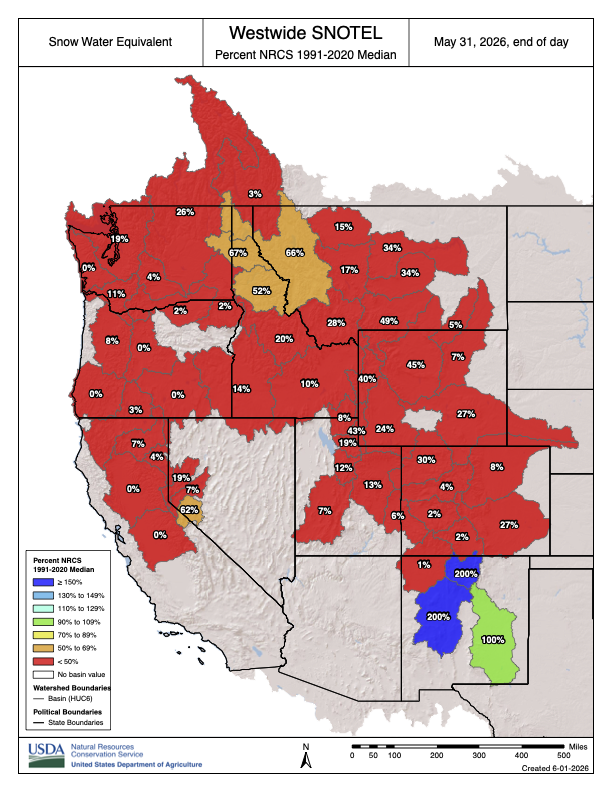
In the spring of 2026, anomalously low snow conditions in the western United States threatened winter recreation and water supplies. Here, we investigate: to what extent was this snow drought attributable to the climate change that has occurred since the pre-industrial period? We find that a snow drought this severe across the western United States was approximately 4.4 [95% CI: 2.6, 9.4] times more likely in the current climate than in the preindustrial period. In the Upper Colorado River Basin, the snow drought was approximately 14 times more likely [0.09, 4,300]. Given a projected increase in the frequency of snow droughts at least this severe in a moderately high emissions warming scenario, the lived experience of this event may help scientists, resource managers, and the public consider what western US snow might look like if greenhouse gas emissions are not aggressively reduced.
In the winter and spring of 2026, a snow drought gripped the American West; “record-low” conditions were widely reported. The snow drought was associated with anomalously high temperatures, with moderately dry to average precipitation. While it is still too early to know how the consequences of this snow drought will materialize, the US Bureau of Reclamation projected for the first time in spring 2026 that Lake Powell would fall below its minimum power pool threshold by the following winter in median climatological conditions. The snow drought is also likely to increase fire risk and reduce water availability for energy, agriculture, and municipalities.
As the snow drought progressed, scientists, the recreation industry, and the press asked whether the low snow anomaly was attributable to climate change. The frequency, severity, and temperature of snow droughts increase in climate models but formal climate attribution has only rarely been applied to snow drought [see Mote et al. for one exception]. Since then, the science and data available for climate attribution studies have advanced substantially. Here, we ask: to what extent is the 2026 western US snow drought attributable to climatic changes that have occurred since the preindustrial period?
Northern Water will pay $30 million over the next 30 years to solve long-standing clarity and water quality problems at one of Colorado’s most treasured natural wonders, Grand Lake.
Under the terms of the agreement, the giant water provider will spend $1 million annually to test and implement new solutions to the problem, including weed control, aeration and sediment removal. The deal is the first time a dedicated source of money has been set aside to help the lake, Northern Water spokesperson Jeff Stahla said.
Grand Lake, located near the west entrance to Rocky Mountain National Park, is Colorado’s deepest natural lake and has been a major tourist destination since the late 1800s. A coalition of federal and state agencies, and local advocacy groups have been working and arguing over how to restore it since at least 2008.
“It has been a long and arduous process to get here,” Stahla said. “We’re hopeful that this is a turning point for being able to work together for the common good.”
Grand Lake is a key element of Northern Water’s Colorado-Big Thompson delivery system, which provides water to more than 1 million people on the northern Front Range and thousands of acres of irrigated farmlands.
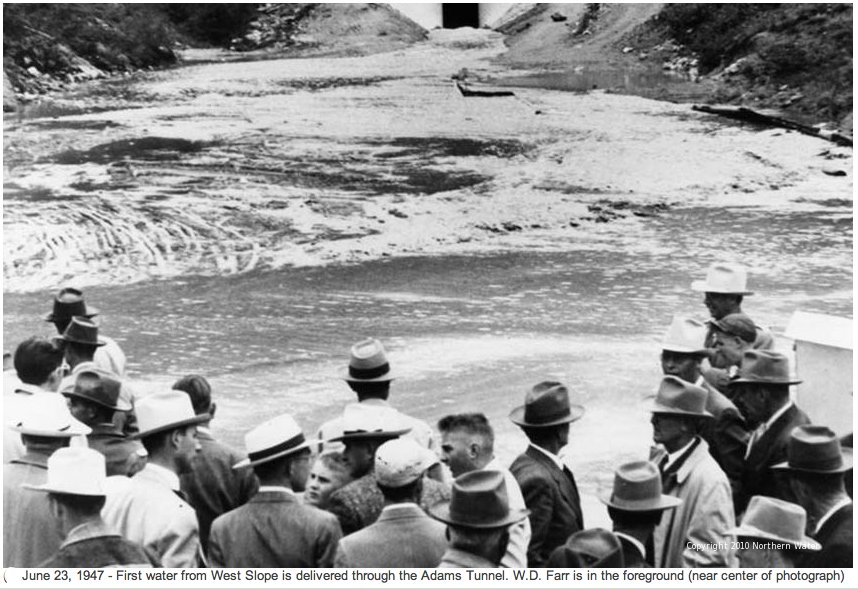
Owned by the U.S. Bureau of Reclamation and operated by Northern Water, The C-BT gathers water from the Upper Colorado River, and stores it in two holding pools built by the federal government: Lake Granby and Shadow Mountain Reservoir. From there it is eventually moved into Grand Lake and delivered via the Adams Tunnel under the Continental Divide to Carter Lake, west of Berthoud, and Horsetooth Reservoir, west of Fort Collins.
Colorado-Big Thompson Project map. Courtesy of Northern Water.
During that process, algae and sediment are carried into Grand Lake, clouding its formerly clear waters and causing algae blooms and weed growth, and harming recreation.
In 2008, the Colorado Water Quality Control Commission moved to set a clarity standard, but it has since been replaced with a clarity goal and the aim of achieving “the highest level of clarity attainable.” Since then, Northern Water and others have implemented different management techniques, including changing pumping patterns, to find ways to improve water quality in all three water bodies.
In 2016, the U.S. Bureau of Reclamation took the first steps required under the National Environmental Policy Act of 1969 to do the scientific and engineering studies needed to fix the system and hold public hearings. But Reclamation stopped the process in 2020, saying that it could not definitively establish any structural alternatives that would work, nor could it find a way forward on funding such a major infrastructure redesign.
Frustration among Grand Lake advocates continued to build, however, and in 2024, Colorado lawmakers passed a resolution calling for more work on the issue.
In 1941, before the Colorado-Big Thompson Project began operating, clarity was measured at 9.2 meters in depth, about 32 feet, according to Northern Water. Since 2016, the goal has been to achieve clarity of 3.2 meters, just over 9 feet. “We’ve been hitting the goals much more steadily than we have before, thanks to changes in the way the water is pumped through the system,” Stahla said.
Still the lake is plagued by infusions of warm, murky water during the summer and algae blooms that harm its recreational value, locals say.
Mike Cassio, president of the Three Lakes Watershed Association and a long-time Grand Lake advocate, said the new agreement was the only way the local interests could see to move forward, given what they say is an imbalance of power between the federal government and Northern Water, and the people of Grand County.
“The Bureau of Reclamation has estimated that replumbing and fixing Grand Lake is a $1 billion project and it would take a congressional mandate to fund it,” Cassio said. “Is this agreement the best that we have? Probably. Is anybody up for a fight with Northern and the Bureau? Probably not. So the best thing to do is to work together.”
In addition to the $30 million, the new agreement also expands the governing body overseeing the work to include the town of Grand Lake, which will for the first time have an official role in how the three-lake system is managed, Stahla said.
The Colorado River District, which represents 15 Western Slope counties, signed off on the deal this week, saying via email that the new agreement would provide a strong foundation for future work on the lake.
Other signers to the agreement include Grand County, the Northwest Colorado Council of Governments, Northern Water, and the town of Grand Lake. It must still be signed by the U.S. Bureau of Reclamation.
As we enter the thick of watering season in mid-July, it’s a good time to assess how Denver Water customers are doing in cutting water use amid a drought.
The early verdict: Good but needs to be even better.
Denver’s Board of Water Commissioners, in its drought declaration of March 25, called for a 20% reduction in water use over the coming year.
By one important measure, the 1.5 million people Denver Water serves are meeting that goal. Customers are using about 20% less than projected — when the record-setting hot and dry weather we’ve experienced in 2026 is factored in.
By another measure, against the five-year average, customers are conserving water — but have a ways to go to hit the goal. Using the five-year average sets a tough bar, however, as those years were not generally as hot and dry as what the Denver region has seen so far this year.
Get tips for helping your lawn survive the summer on mandatory drought restrictions that allow residential water only on two assigned days per week. Photo credit: Denver Water.
Overall, when you consider the conditions, the high temperatures and lack of precipitation, we think customers are doing well,” said Greg Fisher, manager of demand planning for Denver Water. “They are showing restraint even as the spring and early summer continued the record-breaking drought numbers we saw last fall and winter, combined with extremely high temperatures.”
In fact, tracking at Denver Water’s three weather stations, spaced out west to east across the metro area, shows January through June of 2026 experienced the highest daily average temperature ever, at 67 degrees, compared to an average of 62 degrees.
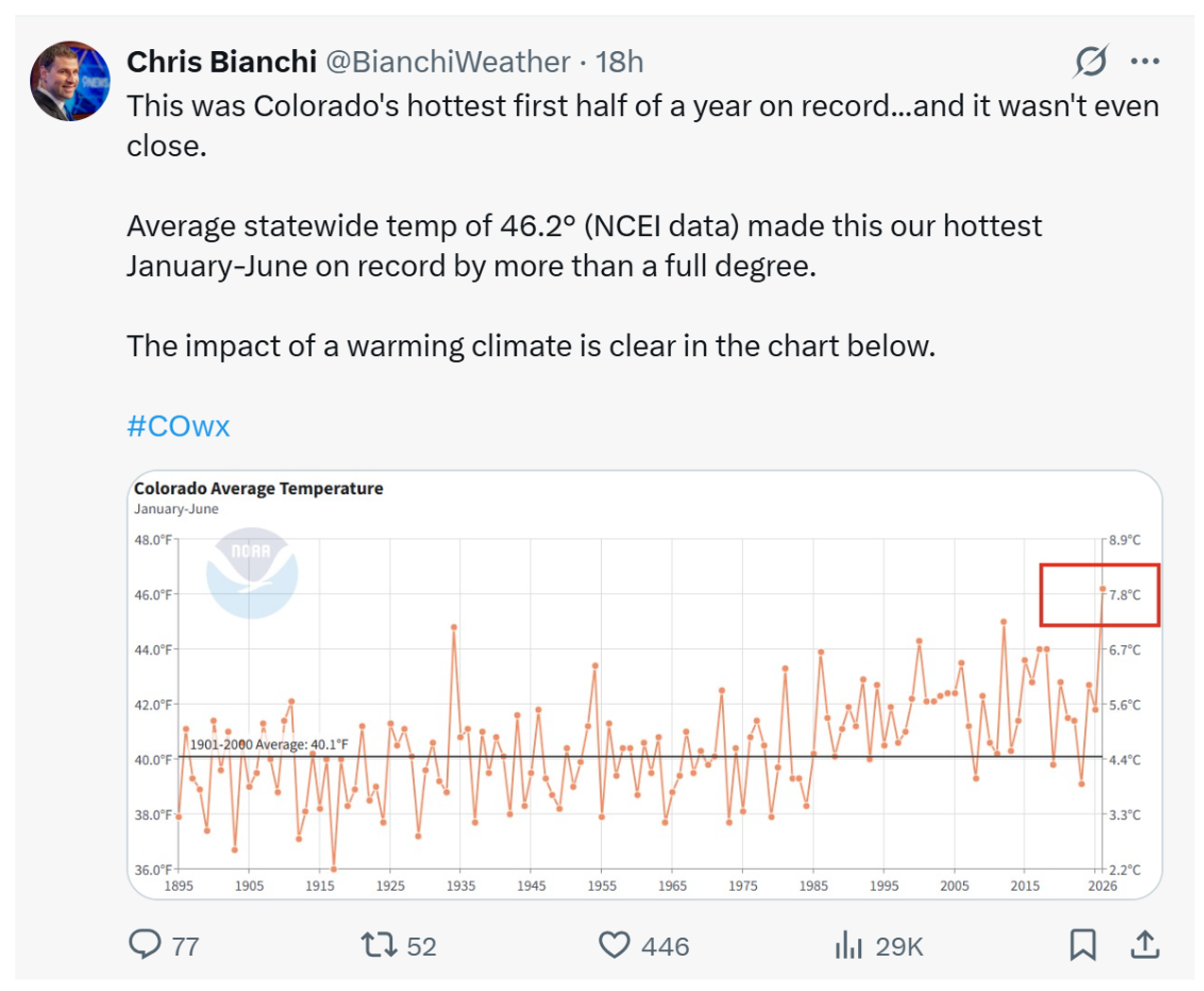
9News meteorologist Chris Bianchi’s July 9 post on Twitter noted that Colorado has just experienced the hottest opening half of the year on record, “and it wasn’t even close.” Image credit: Chris Bianchi via Twitter.
Colorado as a whole is seeing the same trend, with 9News meteorologist Chris Bianchi reporting that it was the hottest opening half of the year on record, “and it wasn’t even close,” he noted on Twitter July 9.
The average temperature of 46.2 degrees beat the previous mark by a full degree. “The impact of a warming climate is clear,” Bianchi noted.
The weather has taken a toll, putting water supplies and landscapes in a major water deficit, Fisher said. Even so, customers have heard the call for conservation.
Overall, they adhered to Denver Water’s call to hold off on activating sprinkler systems until mid-to-late May or even June.
But as spring rains retreated and temperatures rose, watering season hit its stride and the hot weather predictably drove up use to levels similar to the five-year average recorded from 2021-2025.
Now, as we enter the heat of July and August, Denver Water should get a better sense of how well customers continue to keep water use in check and hold to mandatory two-day-a-week watering schedules.
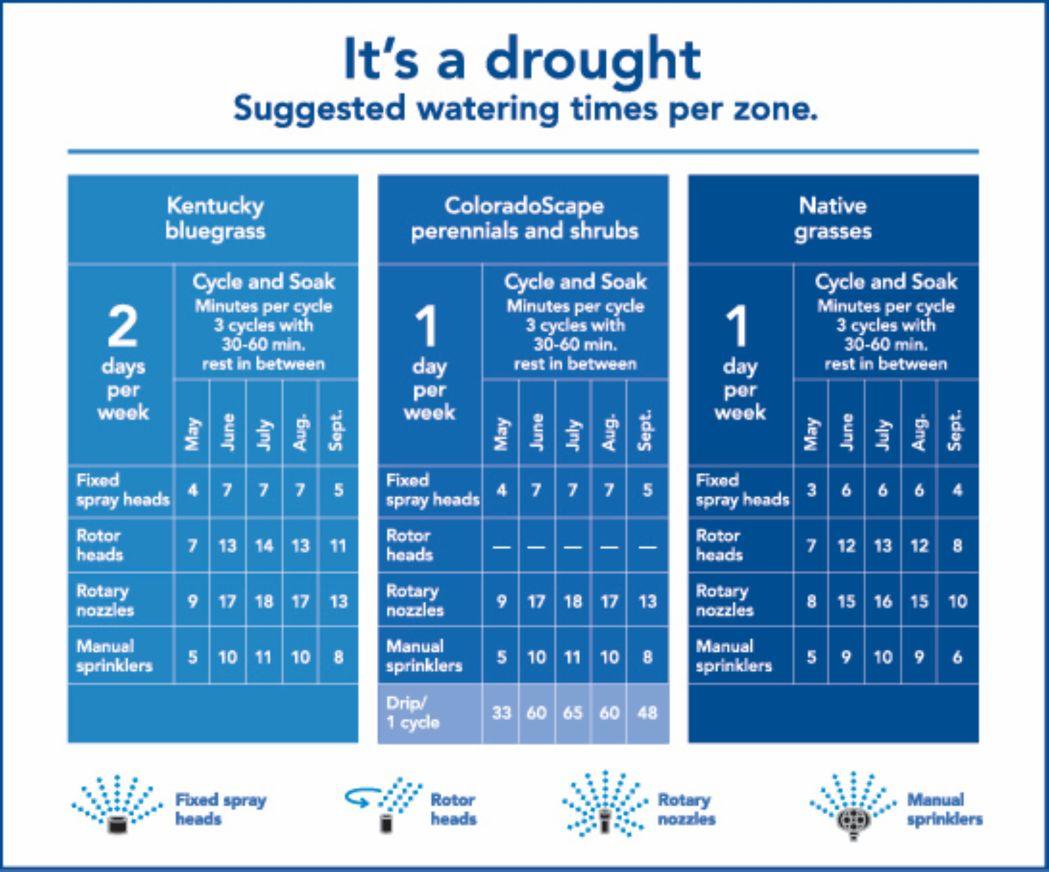
Suggested watering times that comply with Denver Water’s mandatory drought restrictions that limit outdoor watering to two days per week. Image credit: Denver Water.
Mother Nature may help, with some climate models suggesting the potential for a rainier summer that could reduce the need to turn on sprinklers, cut demand and keep water in Denver Water reservoirs.
“It’s so important for customers to pay attention to the weather, and keep irrigation systems off around rain events,” Fisher said. “A good rainstorm should allow you to take your watering day off and, in some cases a rainy week means you can skip watering on both designated days.”
Preserving water supplies in Denver Water’s reservoirs is key.
Overall reservoir levels, as of July 13, are currently around 78% percent full (compared to percentage levels usually in the high-90s at this time of year), but levels are dropping as summer watering hits full stride.
The more Denver Water customers can stretch those supplies, the quicker the storage levels can begin to recover after a year — or more likely years — of better winter snowpack.
Too much drawing down of precious water supplies stored in reservoirs could be consequential for water users.
Antero Reservoir in 2026, after its water was moved to Cheesman Reservoir to reduce the amount of water lost to evaporation. Photo credit: Denver Water.
Should supplies drop too low this summer, water planners would potentially consider reducing outdoor watering to one day a week to further ease pressure on supplies and avoid an even larger storage deficit next spring. So now is the time to pay close attention to water use outdoors — and indoors.
Every bit you save, whether it’s while you shave, shower or water the lawn improves the chances we can avoid even tougher restrictions and look with hope for a stronger winter to come and begin recovering storage supplies.
“We need people to be thinking bigger than this week or this year when they think about water,” Fisher said.
“Even with watering restrictions in place now, we’ll enter next year with a water deficit due to the record snow-drought last winter. Recovering from that requires not only some good snow years, but thoughtful conservation from our customers.”
Ruedi Reservoir on the Fryingpan River is operated by the U.S. Bureau of Reclamation. Releases for the Colorado River Endangered Fish Recovery Program have boosted late summer and fall river flows in recent years. Credit: Heather Sackett/Aspen Journalism
Click the link to read the article on The Aspen Times website (River Stingray). Here’s an excerpt:
July 13, 2026
The city of Aspen’s Ruedi Hydroelectric Facility is anticipated to lose hydroelectric power in early August due to current U.S. Bureau of Reclamation reservoir forecasts and operating conditions. The updated reservoir data indicate that the timing has shifted later than previously anticipated, which the city’s Utilities Resource & Portfolio Manager Joshua Mattson confirmed to The Aspen Times. According to him, earlier planning projections that were provided by the U.S. Bureau of Reclamation indicated the reservoir could drop below the hydroelectric power pool threshold in mid- to late July.
“Updated reservoir elevations, inflow and outflow conditions, and U.S. Bureau of Reclamation operational forecasts now indicate the threshold is more likely to be reached in early to mid-August,” Mattson wrote in an email. “The shift reflects actual reservoir conditions improving relative to earlier projections and ongoing changes in reservoir operations and water demand. This remains a forecast and will continue to be evaluated as conditions evolve.”
The hydroelectric power pool represents the minimum reservoir elevation that is required in order to safely operate the hydroelectric turbine and associated equipment, according to an information update provided to Aspen City Council on Monday. When reservoir levels fall below this threshold, city staff will consequently take the Ruedi Hydroelectric Facility offline in order to protect equipment.
“This outage is not related to dam safety; rather, it is the result of hydrologic limitations associated with drought conditions,” the information update states. “The facility is expected to remain offline until reservoir levels recover above the minimum power pool elevation, which is anticipated to occur in spring 2027 as seasonal inflows increase.”
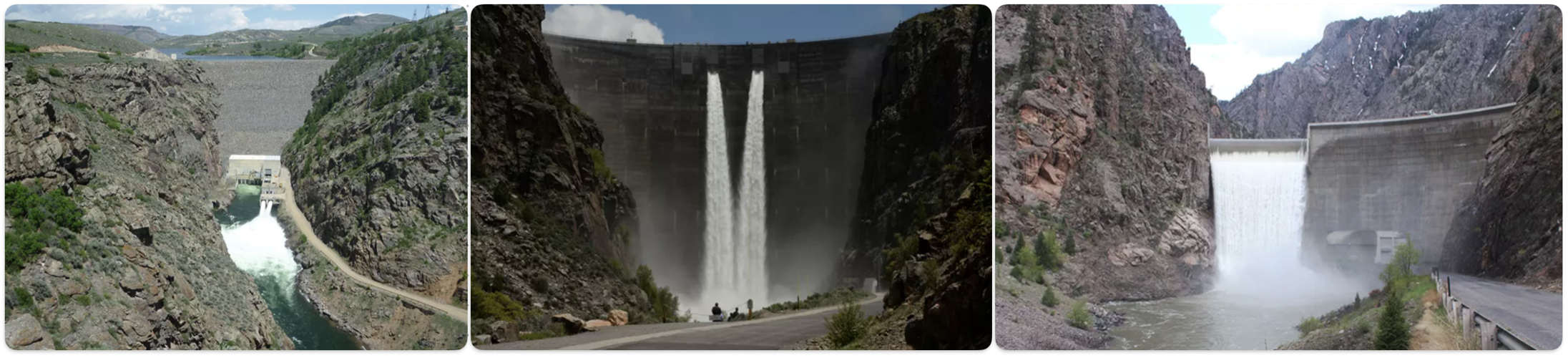
In the 1950s, the U.S. Bureau of Reclamation built the Blue Mesa, Morrow Point and Crystal dams west of Gunnison as part of the massive regional Colorado River Storage Project. The Bureau of Reclamation is currently in the process of replacing all four original valves at Blue Mesa Dam for the first time. (Photos/National Park Service)
The Wayne N. Aspinall Unit, Colorado’s only stake in a federal hydropower system that sells power across the West, is on pace to generate nearly 30% less electricity than its historical average dating to 1978, according to the Bureau of Reclamation. The shortfall is the latest sign of a decades-long decline eroding a system that accounts for about 3% of Colorado’s energy supply.
Aspinall Unit dams
The unit’s three dams on the Gunnison River — including Blue Mesa, Morrow Point and Crystal — make up Colorado’s only piece of the Colorado River Storage Project, a Depression-era network of federal dams selling power to municipalities, cooperatives, tribes and irrigation districts across the West. Blue Mesa Reservoir, the largest body of water entirely within Colorado, is expected to end the year at just 17% of its live storage capacity.
As the river shrinks under the stresses of climate change, so does the unit’s output. And the electricity that the waterway does not help to generate has to come from somewhere else, usually at a higher price.
Nationwide, residential electricity users have already seen an annual price increase of more than 7% in the year ending in March. Judging by Xcel Energy’s recent effort in Colorado to obtain rate increases that might exceed 50% by the end of the decade, additional hits to consumers’ budgets could become the most obvious consequence of the building crisis in the Colorado River Storage Project’s capacity to generate power.
That economic scenario is unfolding as the West braces for a surge in electricity demand from data centers built to power artificial intelligence. On June 18, the Federal Energy Regulatory Commission boosted the effort to hook up those large users when it ordered the nation’s six grid operators to speed transmission connections for AI data centers.
“We are setting the stage for a resilient, reliable, and forward-thinking grid that empowers communities and safeguards consumers by transforming the way large energy users access the grid,” agency chair Laura Swett said.
It’s a lopsided moment, since federal regulators are accelerating new demand onto a grid whose supply side, at least in Colorado, is apparently decaying.
A dangerous threshold
The mechanics of Colorado’s hydroelectricity system are straightforward, even if mostly invisible to consumers. Reclamation operates the dams. The Western Area Power Administration markets the power to “preference customers” at cost-based rates. The Aspinall Unit’s output is pooled with Glen Canyon, Flaming Gorge, and other project dams under the Salt Lake City Integrated Projects Area arrangement, so Colorado utilities hold a share of that pool, not an Aspinall-specific allocation.
Less water also means less pressure, or “hydraulic head,” through the turbines: At full pool, one megawatt-hour at Glen Canyon Dam on the Colorado River takes about 1.9 acre-feet of water and, at today’s lower elevations, roughly 2.9 acre feet, said Jen Pelz of the Flagstaff, Arizona-based Grand Canyon Trust, an environmental organization that advocates for conservation of Colorado Plateau natural resources.
The same mechanism plays out at Blue Mesa. At its current elevation of about 7,446 feet, the reservoir’s generating capacity is approximately 18% below the amount for which it was designed, said Nick Williams, Reclamation’s power manager for the Upper Colorado Basin. Electricity generation stops entirely at 7,393 feet, Blue Mesa’s minimum power pool.
A high desert thunderstorm lights up the sky behind Glen Canyon Dam — Photo USBR
Reclamation moved aggressively this spring to avoid a more dangerous threshold. In April, it projectedinflow at Lake Powell, behind the Glen Canyon Dam, at just 29% of average and warned that without action, the reservoir could fall below its minimum power-pool elevation of 3,490 feet by August. That is the point at which Glen Canyon Dam’s turbines stop generating.
View below Flaming Gorge Dam from the Green River, eastern Utah. Photo credit: USGS
While the agency issued a more optimistic prediction in May, it nevertheless ordered additional emergency releases from Flaming Gorge Reservoir through April 2027 and cut Powell’s release to Lake Mead for the year by roughly 1.5 million acre-feet. That protects Glen Canyon’s generators, partly by drawing down Mead, which has in turn already cut Hoover Dam’s generating capacity by an estimated 5% to 8.5%. The Hoover Dam power production decline is already reflected in the agency’s June forecasts, according to Len Schilling, the Reclamation official overseeing dam operations in the Lower Colorado Basin. None of the agency’s moves solve the shortage. Instead, Reclamation decides, reservoir by reservoir, where the pain lands first.
A test of the cost gap
The clearest documented example of that pain in dollars comes from the Western Area Power Administration’s own numbers. From fiscal 2023 through 2025, the agency paid more per megawatt-hour for replacement power than it charges customers every year and roughly tripled its rate in 2023, narrowing to about 35% above it by 2025, according to a Colorado Newsline analysis of WAPA and federal energy data. WAPA also spent $18.9 million in 2024 and $6.5 million in 2025 on replacement power tied to “Cool Mix,” a protocol that bypasses Glen Canyon’s turbines to protect native fish downstream, according to a Colorado River Research Group report drawing on an Argonne National Laboratory analysis and figures from WAPA.
Platte River Power Authority, which supplies Fort Collins, Loveland, Longmont and Estes Park and holds a direct WAPA allocation, could be the clearest Front Range-based test of that cost gap. A spokesperson for the utility said it could not respond to questions before publication. A recent organization budget cited reduced federal deliveries and rising WAPA rates as adverse financial factors, but current estimated financial consequences for the power authority, and what it will mean for the utility’s customers, remain unclear. WAPA did not respond to requests for comment.
A smaller utility in the state offers a contrasting situation. La Plata Electric Association, the rural cooperative serving Colorado’s southwest corner, relies mostly on the Southwest Power Pool for its electricity supply after joining that regional transmission organization earlier this year. But the association’s chief executive officer, Chris Hansen, said the cooperative still relies on WAPA for a hydropower allocation tied to the Southern Ute Indian Tribe. That WAPA dependence amounts to about 3% of the association’s supply. Hansen said market access and a diversified portfolio buffer the small utility against hydrologic risk.
“Even if that 3% were to double in cost, which is possible, it would have a relatively small impact on our total cost of power purchases,” he said. “So we have low exposure. Other co-ops do not. For us it would be (a) relatively small change.”
Whether joining the Southwest Power Pool can give utilities facing more financial pressure much hedge against rising power costs is not yet clear. Sydney Welter, an energy markets policy advisor at Western Resource Advocates, explained that “with just three months of market operations and without having seen data from Colorado preference customers, I’m not certain what the long-term costs and benefits will be.” While the Brattle Group, an industry watcher, predicted that utilities would save tens of millions of dollars per year by joining power pools, it is not clear whether that is happening.
Rise in demand
Colorado lawmakers considered a bill this year that would have imposed accountability requirements on data centers. Senate Bill 26-102 was killed before the General Assembly adjourned in May, though the issue isn’t likely to fade. Xcel Energy, the state’s largest utility, expects large industrial customers, mostly data centers, to drive roughly two-thirds of its new demand. Nationally, data centers consumed an estimated 4.7% of U.S. electricity, a figure that Lawrence Berkeley National Laboratory projects could reach nearly 12% by 2030. Increasing data center electricity use in Colorado would add pressure to a system that is already experiencing supply reductions caused by the loss of flows at the Aspinall Unit.
That framework also shapes the deeper risk involving a “compact call” to the Lower Basin states demanding delivery of more water from Colorado, New Mexico, Utah and Wyoming. That has never happened in the Colorado River Compact’s history, but it could increase pressure on Western Slope water and power as Front Range cities lease senior water rights across the Continental Divide, according to University of Wyoming law professor Jason Robison.
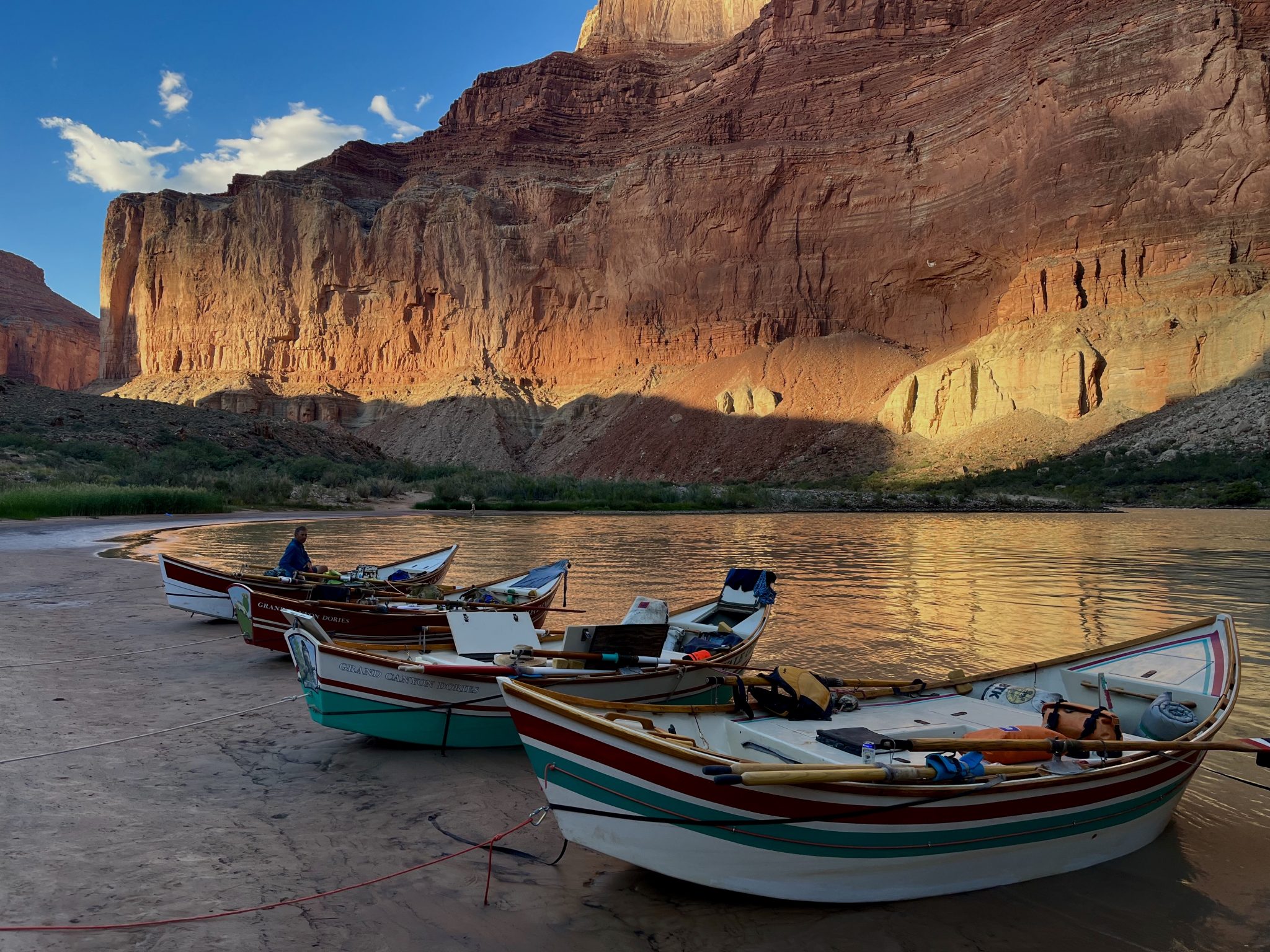
Dories at rest on a glorious Grand Canyon eve. Photo by Brian Richter
No one is predicting a call soon. But Pelz argues the standoff between electricity costs and environmental protection is a false choice: The Grand Canyon Protection Act of 1992 already requires dam operations consistent with the river ecosystem’s long-term sustainability, and Congress could have eased the cost pressure through diversified supply or a dedicated fund, but has not done so in the 30 years since that law was enacted. Reclamation is now studying a broader infrastructure fix at Glen Canyon Dam, with initial findings due in 2027.
That may be too late for the pressures already showing up this year at reservoirs like Blue Mesa.
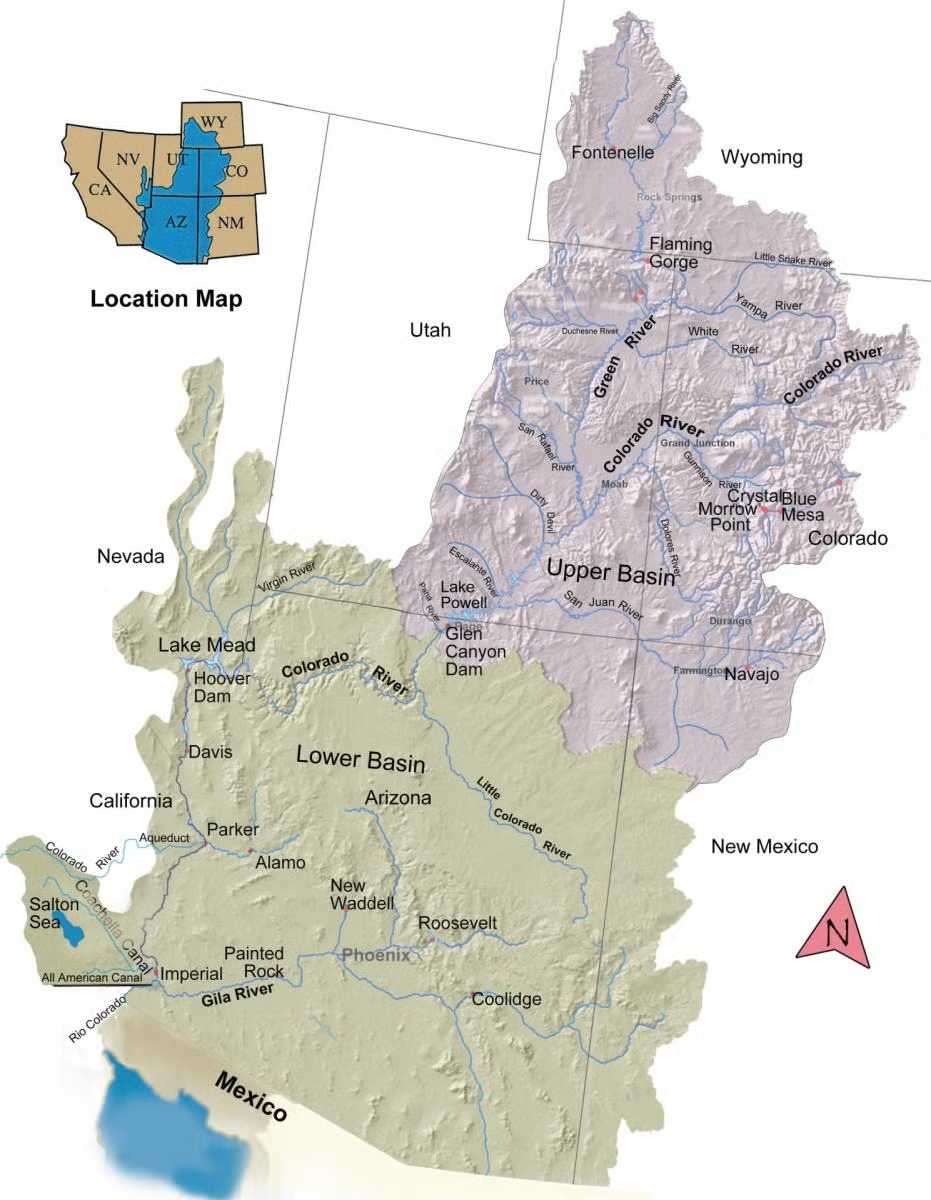
The Colorado River Basin spans seven U.S. states and part of Mexico. Lake Powell, upstream from the Grand Canyon, and Lake Mead, near Las Vegas, are the two principal reservoirs in the Colorado River water-supply system. (Bureau of Reclamation)
As of July 12, Blue Mesa Reservoir near Gunnison sat only 32% full at 266,000 acre feet of storage water — about 35,000 acre feet less than the historic minimum for that date, down 35%…Severe drought conditions at the reservoir have resulted in critically low storage levels, a limitation on water allocation to the Uncompahgre Valley and its agricultural water users, limited flows for releasing endangered fish species, decreased recreational opportunities on the water that go hand-in-hand with a downturn in the regional recreational economy, and uncertainty over power generation and water usage in the near future. Colorado River District spokeswoman Lindsay DeFrates called it a “crisis”, as the reservoir and the Wayne N. Aspinall Unit — which stores water and generates hydroelectric power through the reservoir as well as the Morrow Point and Crystal Reservoir dams — is one of the upper units that feeds the crucial Lake Powell downstream.
“Everyone’s looking downstream at Lake Powell while we have this happening in our backyard right now,” DeFrates said…
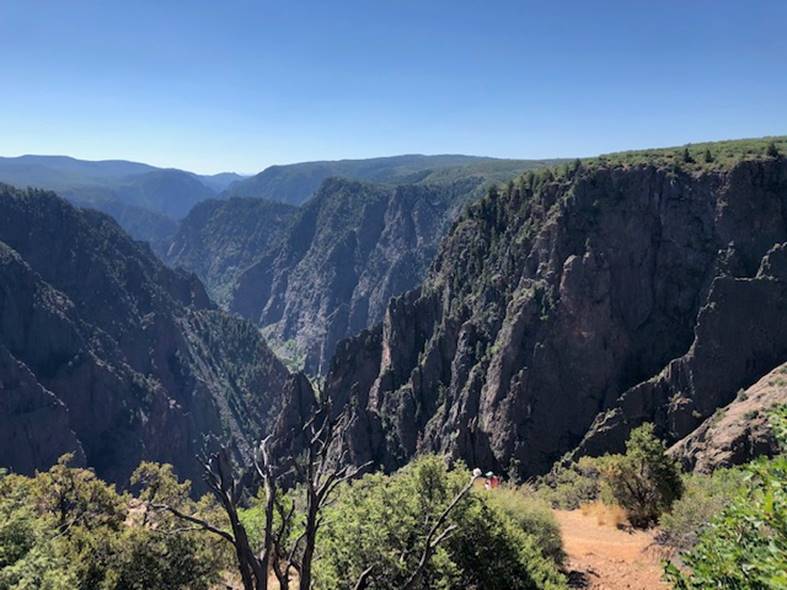
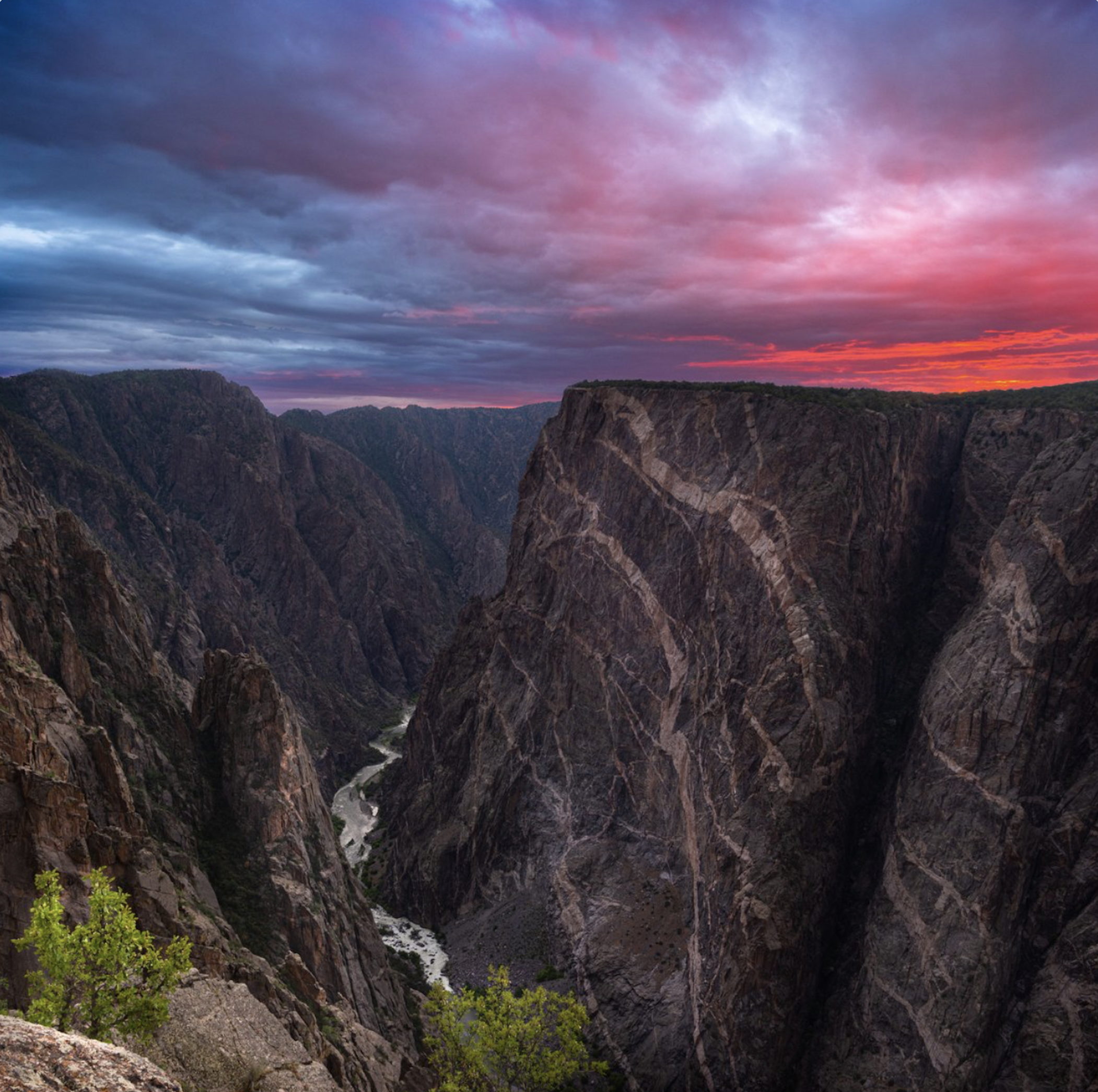
Black Canyon July 2020. Photo credit: Cari Bischoff
When he was the Division 4 assistant engineer for the Colorado Division of Water Resources (DWR), Jason Ullmann would have never entertained the notion that the Black Canyon of the Gunnison National Park’s portion of the river could ever dry up. Now, as the DWR director and Colorado state engineer, he said it’s unlikely to happen this year or next — but it’s “not an impossibility.”
“The actual inflow from April to July this year was the lowest on record. Barring a change in the climate conditions that produce this monsoon everybody’s waiting for, it doesn’t seem like we’re going to have a significant increase in inflow. We’re going to have one of the lowest inflow seasons — if not the lowest — on record at Blue Mesa,” Ullmann said. “Blue Mesa started the year approximately 20 feet below the normal level it would start the year on. The water levels are very low and will continue to drop.”
Colorado River District Senior Water Resources Engineer Caleb Foy compared 2026 to some of the region’s driest years — 1977, 2002, 2012 and 2018 — and said 2026 “takes the gold medal in terms of poor hydrological conditions”, impacting water storage at Blue Mesa Reservoir which, in turn, has multiple impacts downstream…
Foy noted that the reservoir’s storage could drop below the power pool level, which is the minimum amount of water needed to produce hydropower from the dam. According to the U.S. Bureau of Reclamation’s June 2026 24-month study, this drop could happen as soon as February 2027. According to other forecasts, this drop could happen as soon as the end of this summer if the region sees no monsoon conditions and current operations aren’t modified to preserve storage at the reservoir…A reduction in downstream flow would negatively affect downstream diversions, Colorado River flow, the Black Canyon of the Gunnison, and endangered fish species in both the Gunnison and Colorado rivers. The BOR has worked with Fish and Wildlife to temporarily reduce flow targets while trying to minimize negative impacts to endangered fish species. Ullmann said the minimal target flow for the Endangered Fish Recovery Rights is, in a typical year, no lower than 750 cubic feet per second. This year, the target is at 750 cfs — and last week, the flow was as low as 700 cfs. This has been alarming enough to spark conversations between the state and the BOR.
This field in the Uncompahgre Valley Water Users Association district has been fallowed this season (2026) due to a lack of water. The state of Colorado announced Wednesday that it will set up a conservation program using federal dollars, which means more fields on the Western Slope could soon look like this. CREDIT: HEATHER SACKETT/ASPEN JOURNALISM
In the culmination of a process that has been years in the making, Colorado officials Wednesday announced the creation of a state-run water conservation program.
In what officials are calling a “near-term contribution program,” the Upper Basin states (Colorado, New Mexico, Utah and Wyoming) will pay water users to voluntarily cut back in 2027 and 2028, using $100 million in promised funding from the U.S. Bureau of Reclamation. Colorado will now join Utah and Wyoming in setting up a conservation program within their respective states.
The noteworthy, long-expected announcement came at the regular July meeting of the Colorado Water Conservation Board, where board members considered the criteria for the program. A draft list says the program must, among other criteria, avoid negative community impacts; encourage contributions from across the state and water-use sectors; incentivize environmental benefits; encourage tribal participation; and build local drought resiliency. The board is scheduled to finalize the program criteria at its September meeting.
These types of conservation programs have traditionally targeted agricultural water users, often seen as the low-hanging fruit for water savings because they use the majority of Colorado River water. But officials are hoping this program will have participation across all water-use sectors, including municipal and industrial.
“I love that it is called a contribution program because that kind of imagines broader participation and engagement,” said board member Taylor Hawes. “So I think that is good. I think the more flexibility we can have, the better in a program like this.”
But details were scant on exactly how much water Colorado will contribute to the program and how the saved water would be used. And although some experts have begun calling for permanent reductions in water use, it remains — for now — a temporary, short-term program.
“We cannot guarantee a certain amount of water will be conserved in a given year because we don’t know how much water our water users are going to get,” said Amy Ostdiek, interstate section chief at the CWCB. “We have been clear that we just can’t do that.”
In a May letter to federal officials, the Upper Colorado River Commission said it has a goal of saving 100,000 acre-feet by the end of September 2028, which marks the end of water year 2028, but only if sufficient federal funding is available and hydrologic conditions allow. Colorado’s share of the Upper Basin’s allocation is 51.75%, meaning Colorado could be on the hook for 51,750 acre-feet over the next two years.
But Ostdiek said they are not at this time discussing a specific target that Colorado or the Upper Basin would have to contribute in exchange for the $100 million from the Bureau of Reclamation.
“We have felt confident that we can generate up to 100,000 acre-feet by 2028,” Ostdiek said in a Q&A session with the media after her presentation to the CWCB. “But really, what we’re going to be focused on is getting robust participation.”
It’s also unclear exactly how the saved water will be used. Officials said it’s not meant for use by the Lower Basin (California, Arizona and Nevada); it will be for the benefit of the Upper Basin. The water will need to have a home in Upper Basin storage buckets — Lake Powell, Navajo, Blue Mesa or Flaming Gorge reservoirs — but how it will fit into broader reservoir operations is unknown. [ed. emphasis mine]
“I think that is going to be the subject of ongoing discussion, exactly how this water is used and characterized,” Ostdiek said. “I think what we know is that it needs to be credited to or subject to the discretion of the Upper Division states in some way.”
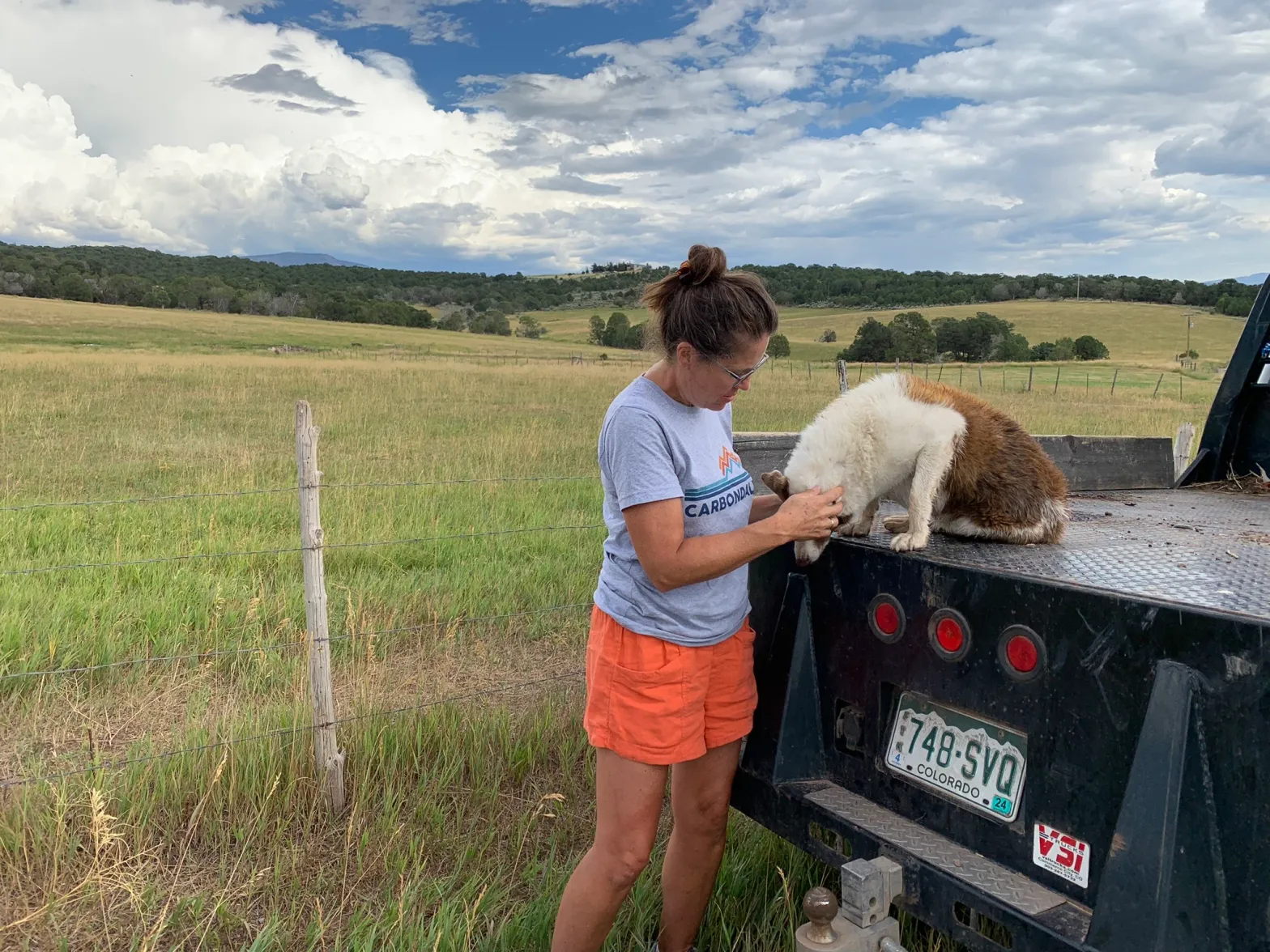
Missouri Heights resident Cassie Cerise pets her dog Dinah on her ranch outside of Carbondale in summer 2023. Cerise enrolled the field behind her in the Upper Colorado River Commission’s System Conservation Program, getting paid to not irrigate it. CREDIT: HEATHER SACKETT/ASPEN JOURNALISM
Conservation concept is not new
These types of programs that pay water users to cut back are not new to Colorado, and officials said they are incorporating the lessons learned from previous demand-management studies beginning in 2019, stakeholder input and pilot programs. The state participated in the 2023 and 2024 System Conservation Pilot Program, as well as an earlier version that ran from 2015 to 2018.
But conservation programs remain controversial. The Grand Valley Water Users Association, one of the largest irrigation districts on the mainstem of the Colorado River, did not allow its members to participate in SCPP for fear of negative impacts to other water users in the district.
All of the projects enrolled in SCPP involved agricultural water users on the Western Slope, a potentially risky situation, according to the Colorado River Water Conservation District. The Glenwood Springs-based agency, which represents 15 counties across the Western Slope, had tried to influence the creation of criteria for participation in SCPP to avoid negative impacts to rural agricultural communities.
Ultimately, only the Upper Colorado River Commission determined who got to participate in SCPP. Now, it seems state officials are taking to heart the River District’s recommendations. River District General Counsel Peter Fleming thanked Ostdiek for including some of the criteria that the district had set forth in its principles about how to create a conservation program.
Fleming encouraged the board members to adopt variable pricing to account for the difference in the value of relatively cheap water on the Western Slope versus more-expensive water on the Front Range. Pueblo Water had wanted to participate in SCPP, but the $509 per acre-foot offered in 2024 to Colorado participants was too far below market value.
“You can see the variable economic values of the water assigned there and the need to have variable pricing in order to encourage widespread participation,” Fleming said.
The River District’s position is that the entire burden of a conservation program shouldn’t be borne by the Western Slope, but must also be shouldered by Front Range water providers, who collectively deplete the Colorado River basin by about 500,000 acre-feet a year.
He added that a program should also have a strong element of local control.
“The River District obviously would like to stay involved in this process,” he said.
The creation of a conservation program for Colorado comes at a critical time for the basin, which remains locked in the grip of a historic drought, with combined storage in Lake Powell and Lake Mead at an all-time low since the reservoirs began filling. Although the Upper Basin has argued that it has never used its entire allocation granted by the 1922 Colorado River Compact (and therefore shouldn’t have to cut back), in the face of dwindling flows and calls for conservation from its downstream neighbors, the four states can no longer avoid reducing their water demand.
The Colorado River basin is also in the midst of a management crisis, with the seven states that share the river still unable to find agreement on a new framework after more than two years of failed negotiations. The current guidelines for how shortages are shared and how reservoirs are operated expire this year, and the feds are poised to step in with their own management plan, expected later this month.
The Upper Basin would need separate parallel agreements with Reclamation alongside the federal management plan to account for and get credit for water saved through the contribution program.
In her presentation, Ostdiek gave a preview of Reclamation’s expected plan, which could allow for a pool in Lake Powell to store up to 3 million acre-feet conserved by Upper Basin states. But board chair Barbara Vasquez worried about overestimating the amount of water that could be contributed given the recent historically dry conditions. Farmers and ranchers across Colorado are now experiencing the fallout from the worst snowpack on record in the form of shortages and fallowed fields.
“So prior programs, we spent a lot of money for very little water conserved. I worry that next year may be even worse than this year, and it’s not willingness, but ability,” Vasquez said. Given the water that’s available, she said, “that might disappoint expectations on the part of the negotiators at the table for the Colorado River.”
Aspen Journalism is a nonprofit, investigative news organization covering water, environment, social justice and more. Visit aspenjournalism.org.
Colorado River “Beginnings”. Photo: Brent Gardner-Smith/Aspen Journalism
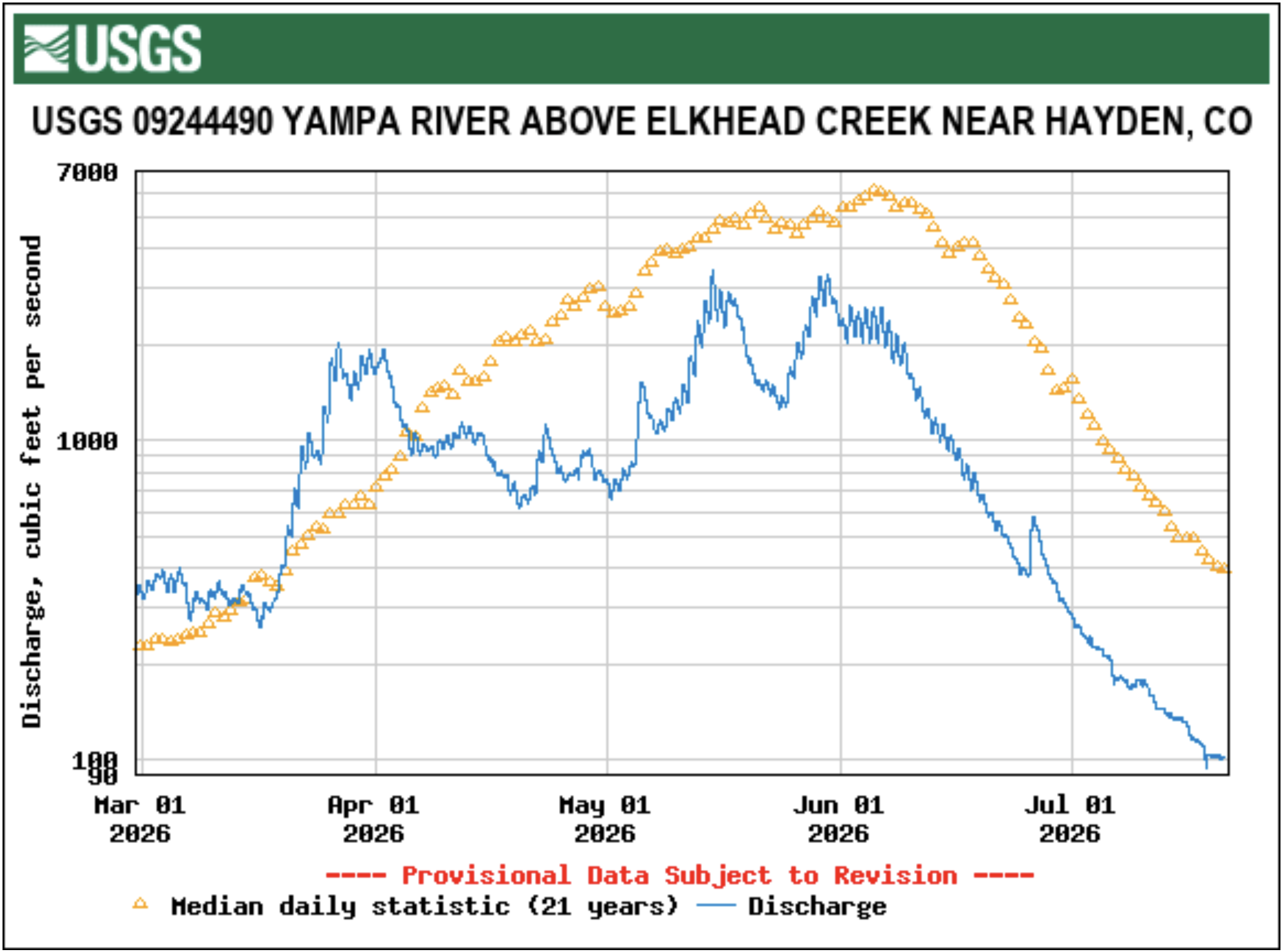
On July 13th, the Colorado River District, in partnership with the Colorado Water Trust and the Yampa River Fund, began releasing water from Elkhead Reservoir to mitigate the impacts of extreme drought and critically low streamflows in the Yampa River Valley. Beginning with a release of 10 cubic feet per second, the releases are part of the Yampa River Reservoir Release Program, a 2,000-acre-foot pool first established in 2021 with funding from the Colorado River District’s Community Funding Partnership. The program is designed to reduce drought-related pressure on agricultural producers while supporting river health and aquatic habitat.
“While we’re experiencing exceptionally difficult drought conditions, the story of 2026 is neighbors and water users working together. No single reservoir, organization or water user can solve this alone,” said Hunter Causey, Chief Engineer for the Colorado River District. “By coordinating releases, operations and water use across the basin, we can stretch a limited supply further and provide meaningful benefits for agricultural producers, local communities and the river.”
Below-average snowfall and persistent summer drought have reduced streamflows and increased water temperatures throughout the Yampa River Basin. Releases through the Yampa River Reservoir Release Program are intended to support agricultural water users, help delay or prevent a call on the river during periods of critically low flow, and benefit designated critical habitat for four endangered fish species. Releases are expected to increase in the coming weeks and continue through July.
“The Colorado Water Trust is an environmental nonprofit, and our work is keeping water in rivers,” said Blake Mamich, Programs Director for the Colorado Water Trust. “In a drought this deep, that same mission means showing up for agriculture. Coordinating closely with the River District and the Division of Water Resources, we can time these releases so a single pool of water helps irrigators extend a tough season and keeps water in Yampa for habitat and fish.”
“This is a difficult year for producers throughout the Yampa Valley, and we wanted to be part of a practical solution that helps the broader community,” said Yampa Basin rancher Matt Boeddeker of Lily Park Land & Cattle. “Water users across Colorado are making hard choices and working together to stretch limited supplies, and like them, we hope to help our neighbors complete critical irrigation and reduce the immediate impacts of drought.”
The Yampa River is primarily supplied by snowmelt from the Flat Tops and Gore Range and flows through agricultural areas of northwest Colorado before joining the Green River in Dinosaur National Monument. During dry years, coordinated releases from Stagecoach and Elkhead reservoirs supplement streamflows for agricultural water users, river habitat and endangered fish. The Colorado River District and its partners will continue to monitor streamflow, water temperature, irrigation demand, and habitat needs, and will adjust releases as conditions warrant.
Click the link to read the article on The Denver Post website (Elise Schmelzer). Here’s an excerpt:
July 15, 2026
Even in the driest of years — like this one — powerful Western Slope water rights on the mainstem of the Colorado River draw water downstream, making boating on the state’s major water artery possible.
“For mainstem floating, we should still have pretty darn good flows for the rest of the season for as long as people want to be boating,” said Sam Calahan, a water resources specialist for the Colorado River District. The taxpayer-funded agency is based in Glenwood Springs and works to protect Western Slope water…
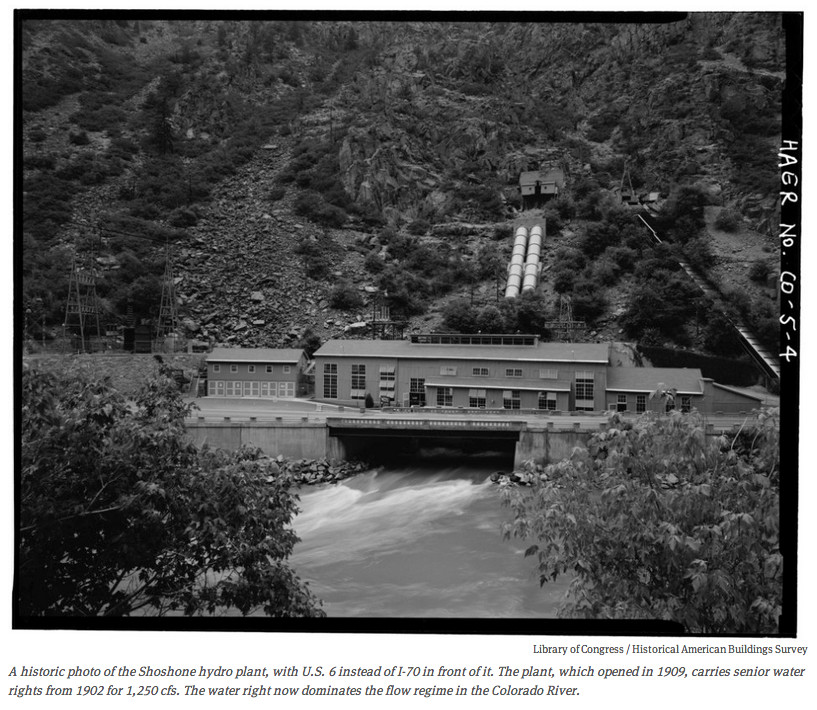
On Wednesday, Browns Canyon — a popular section of the Arkansas River near Buena Vista — was flowing at the lowest level in 55 years of data and at 16% of its median flow for that date. Clear Creek near Idaho Springs was flowing at 61 cubic feet per second on Wednesday, also a record low for the date in 72 years of data. The median flow for the date is 347 cfs, or more than five times as much water…But flows on much of the Colorado River were high enough for rafts and kayaks this week. Flows on a popular section near Kremmling were near normal, as were water levels farther downstream in Glenwood Canyon. Two major factors keep water flowing down the Colorado River during drought: large senior water rights owned by farmers in Mesa County’s Grand Valley and the water rights connected to the Shoshone Power Plant, a hydroelectric facility in Glenwood Canyon owned by Xcel Energy. Irrigators and power plant operators can call water to their facilities from upstream reservoirs, like Green Mountain Reservoir, which is on the Blue River — a tributary of the Colorado River — north of Silverthorne. This year, the irrigators began calling down water on July 1, boosting flows in the Colorado River.
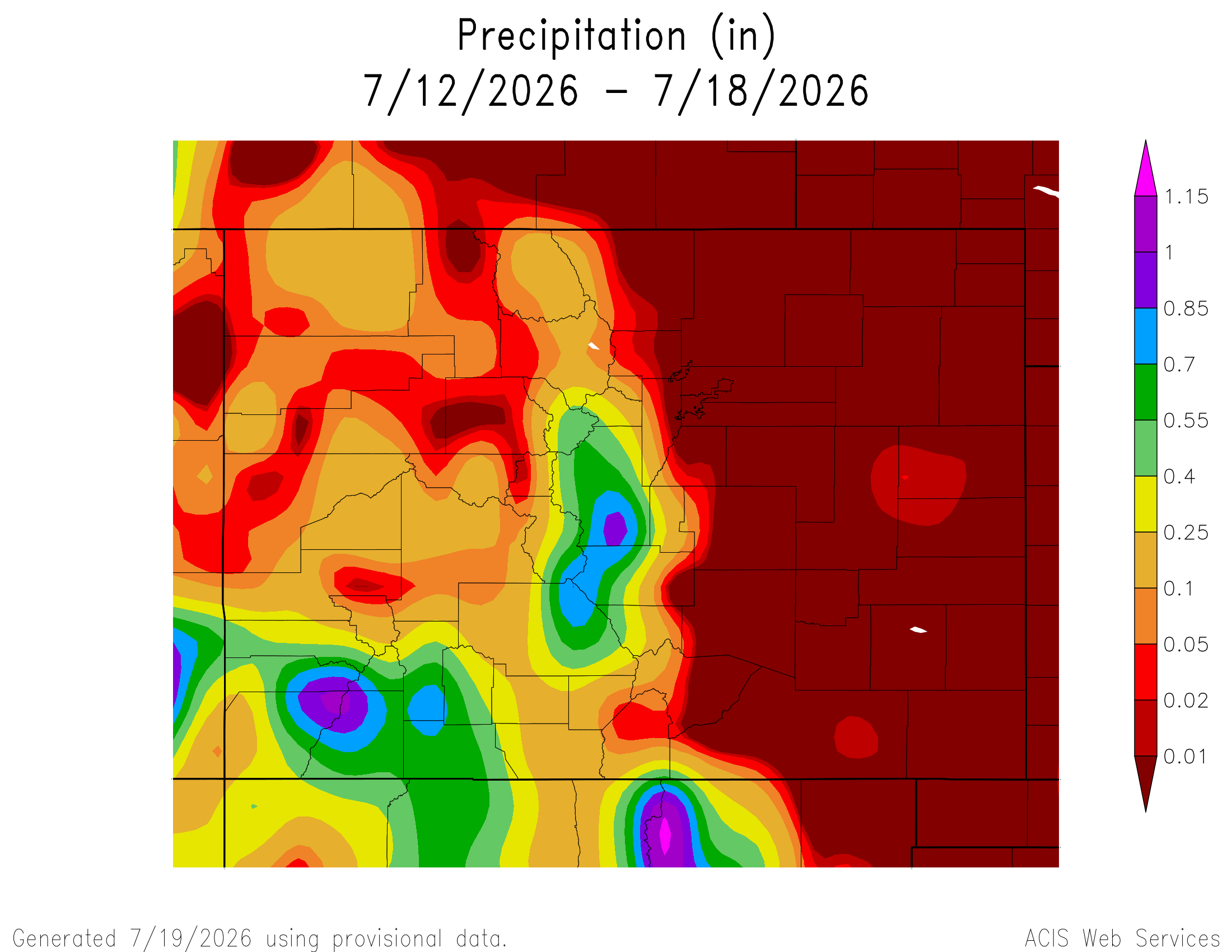
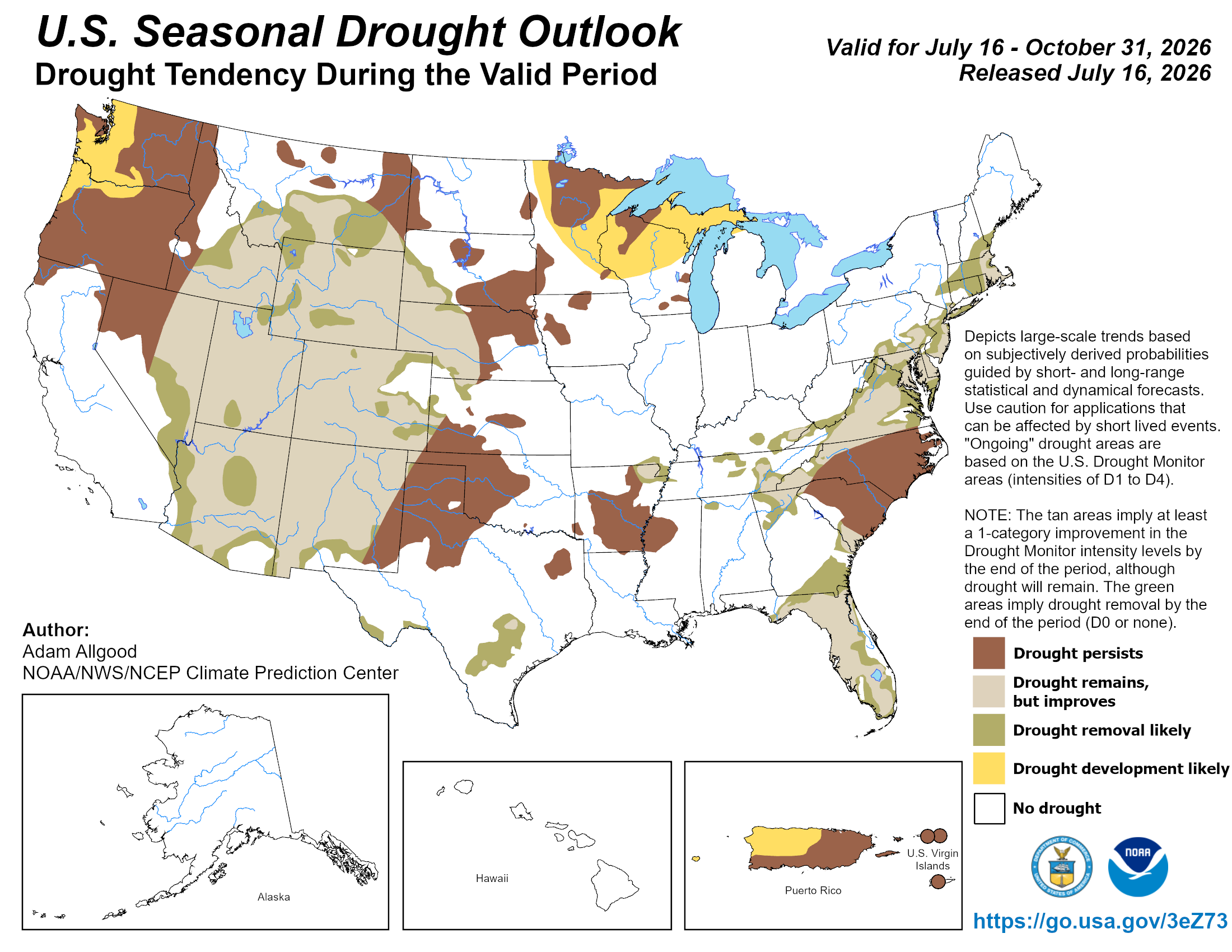
This week, rain returned to Pagosa Country, bringing some relief from the dry heat that dominated June and early July and heralding the start of the summer monsoon season. Weather modeling by the National Integrated Drought Information Center (NIDIS) suggests that the summer monsoon season is likely to bring average or above average precipitation to the region — a bounty compared to the approximately 25 to 50 percent of average precipitation Archuleta County received in last month. The National Weather Service Climate Prediction Center forecasts that drought conditions in the area will improve by Sept. 30, although it suggests that current severe and extreme drought levels calculated by the U.S. Drought Monitor will persist through July.
The Pagosa Area Water & Sanitation District is currently in drought stage two, which includes a number of restrictions on outdoor irrigation, as well as additional fees for high water use. In stage two, irrigation is allowed only between 9 p.m. and 9 a.m. every other weekday, with even-numbered addresses able to irrigate on even-numbered days and odd-numbered addresses on odd-numbered days. Weekend irrigation is prohibited. However, drip irrigation and hand watering edible or ornamental gardens is allowed at all times. Residential water use above 4,000 gallons per month is subject to a two times rate multiplier. PAWSD District Manager Andrew Connor explained that, while the rains associated with the monsoons might eventually impact the district’s drought restrictions, changes would require a large amount of rain and would not be immediate. In the summer, the drought stage is primarily driven by the water level in Hatcher Reservoir, flows in the San Juan River and the date…
PAWSD District Engineer Justin Ramsey explained that the district’s drought management plan focuses on irrigation since it composes a large portion of the district’s water use in the summer and because losing green lawn grass or other plants has a smaller impact on people’s lives than restrictions on showering, dish washing or other indoor water uses…The drought stages in the district’s drought management plan align with this goal, imposing progressively tightening restrictions on when irrigation can occur while placing no restrictions on indoor water use except increasing fees for high water consumption. However, for all but the most severe drought stage, these restrictions only cover irrigation done with sprinklers and other automated devices, with the use of drip irrigation devices and hand watering allowed at all times…Manual and drip irrigation encourage people to be more conscious about how they use water by involving them more deeply in the process and requiring more hands-on time, he added. Another way to increase the water available for gardens and landscaping without paying more fees is to reduce water waste in your home, Connor and Ramsey highlighted.
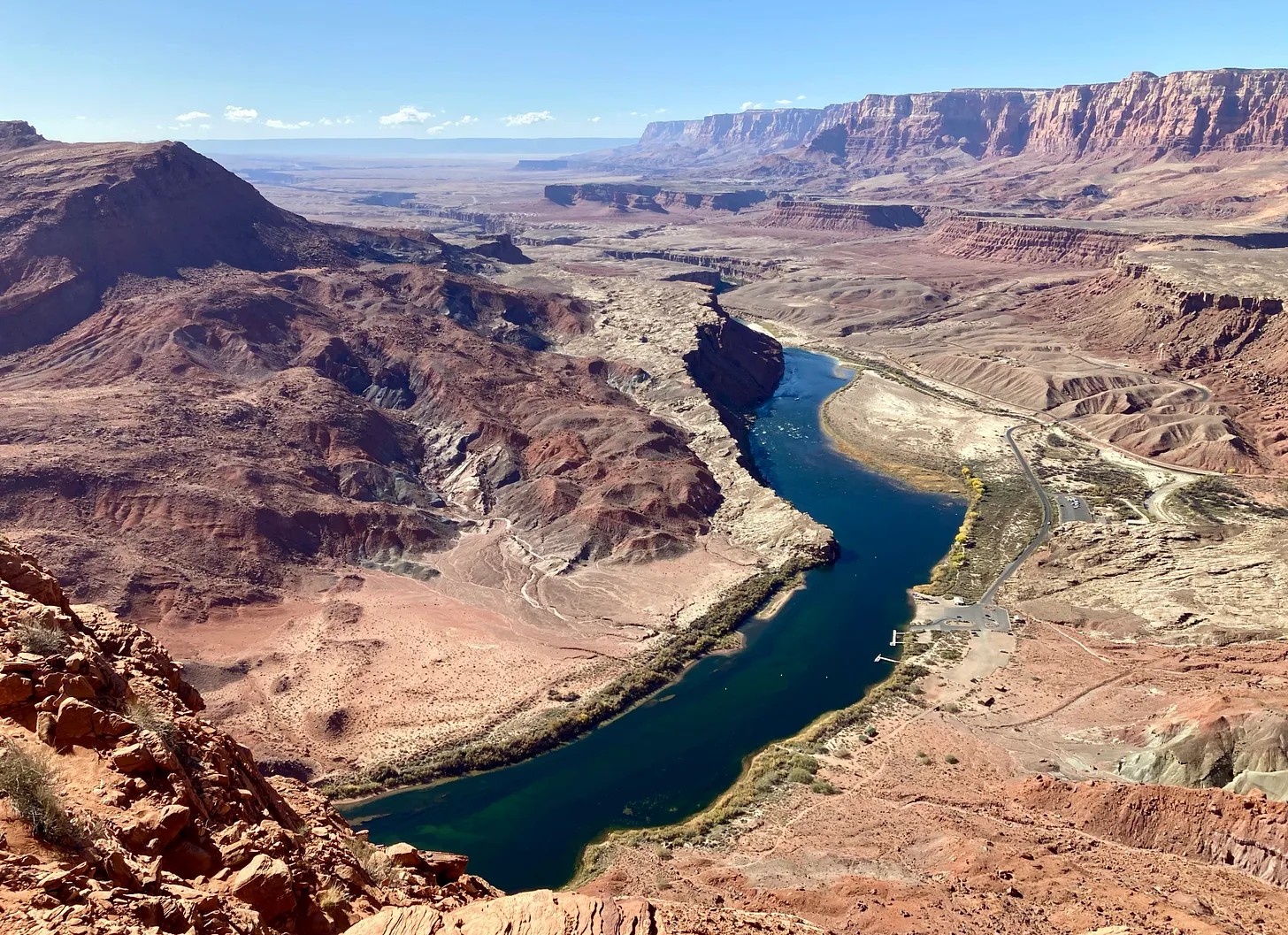
Looking down at the Colorado River, Lees Ferry, and the Paria River. Jonathan P. Thompson photo.
Click the link to read the article on the KJZZ website (Alex Hager). Here’s an excerpt:
July 16, 2026
Sara Porterfield, Colorado River program director with the conservation nonprofit Trout Unlimited, stood on a narrow, rocky river beach, about as close to Glen Canyon Dam as a boat can go.
“This is not a zero sum game,” she said. “Investing in watershed health is not an either-or. We need the system to be healthy from an ecological perspective in order for the rest of it to function.”
The river, Porterfield said, cannot deliver big volumes of clean water if it does not, at least partially, function like a normal, healthy river. For example, if the river’s upper reaches are dried out, they’ll be susceptible to wildfires and wetland degradation, which make it harder for them to hold on to water and release it slowly into the streams where humans have been able to reliably divert and collect it for generations.
“It’s not just plumbing, but it’s also not just water in a river,” Porterfield said as the dam’s hydroelectric generators emitted a whining hum in the background. “We’re not separate from the natural world, we’re part of it. When we recognize that, and we take help to take care of it, we get a lot further than when we’re just thinking about a plumbing system.”
Glen Canyon downstream from Glen Canyon Dam. Photo credit: Allen Best/Big Pivots
Porterfield, who has a Ph.D. in Colorado River history, said calling the river a “plumbing system” is a useful way to think about one of its jobs, but not the whole picture. Environmental advocates say the river can be protected while still flowing through the dams and canals that keep the West wet for humans. Those protections can even be part of the wonky and rigid legal policies that dictate where water goes. John Berggren, a water policy manager at the conservation nonprofit Western Resource Advocates, had some recommendations for the next set of river-sharing rules. An important one, he said, is to get the river out of “crisis mode.”
[…]
“You can be much more proactive and thoughtful and careful and intentional about how you manage the river and include river health,” he said.
Another way to help protect the river’s ecosystems, creatures and flows, Berggren said, is by carefully timing the release of water from reservoirs. For example, policymakers can write flexible rules about where and when water is stored, so water that is flowing downstream to cities and farms can also help make life better for native fish. The water can be used to help the environment without being taken away from humans downstream.
“They’re going to move the water anyway,” he said. “Let’s do it in a way that actually benefits ecological conditions.”
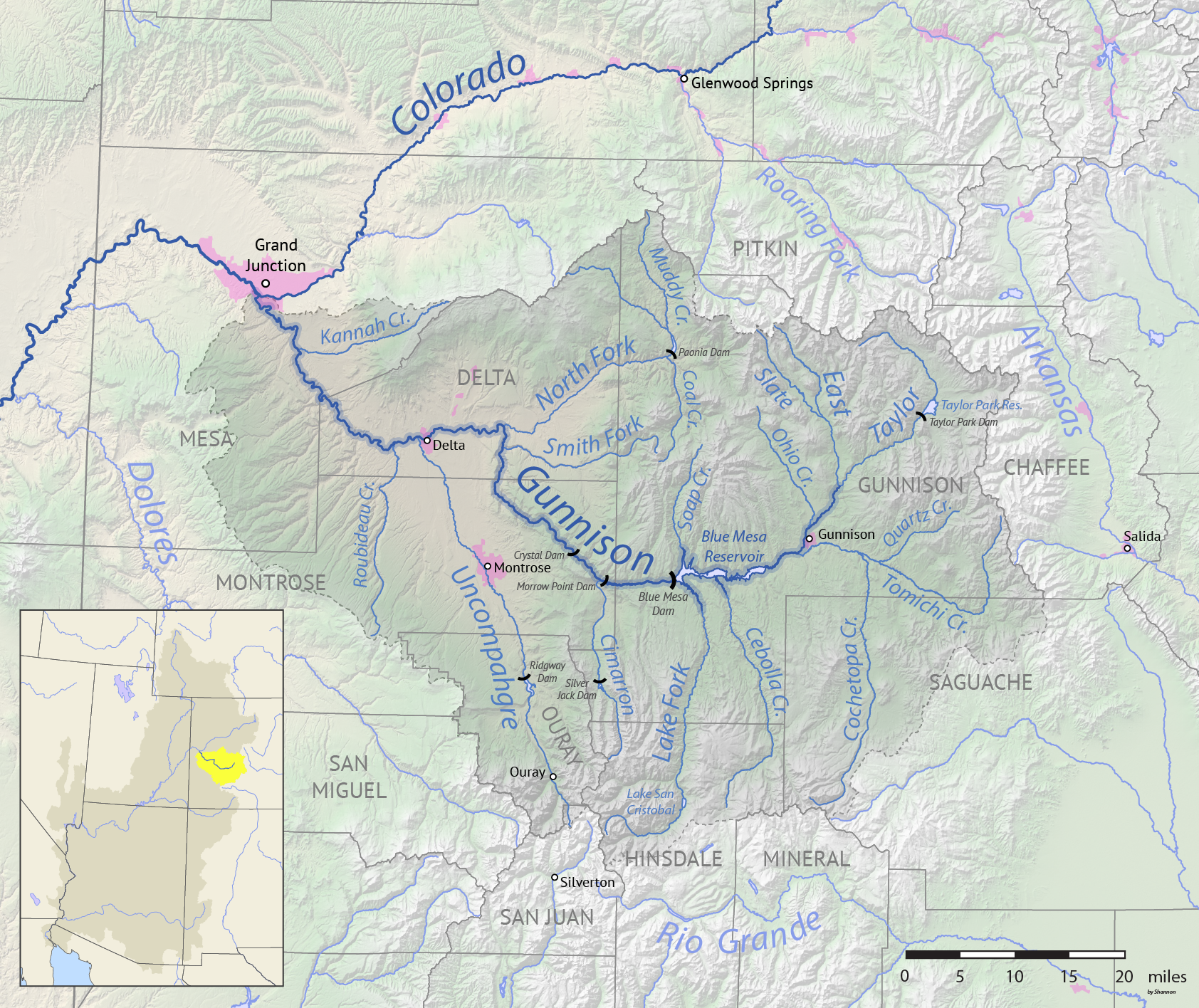
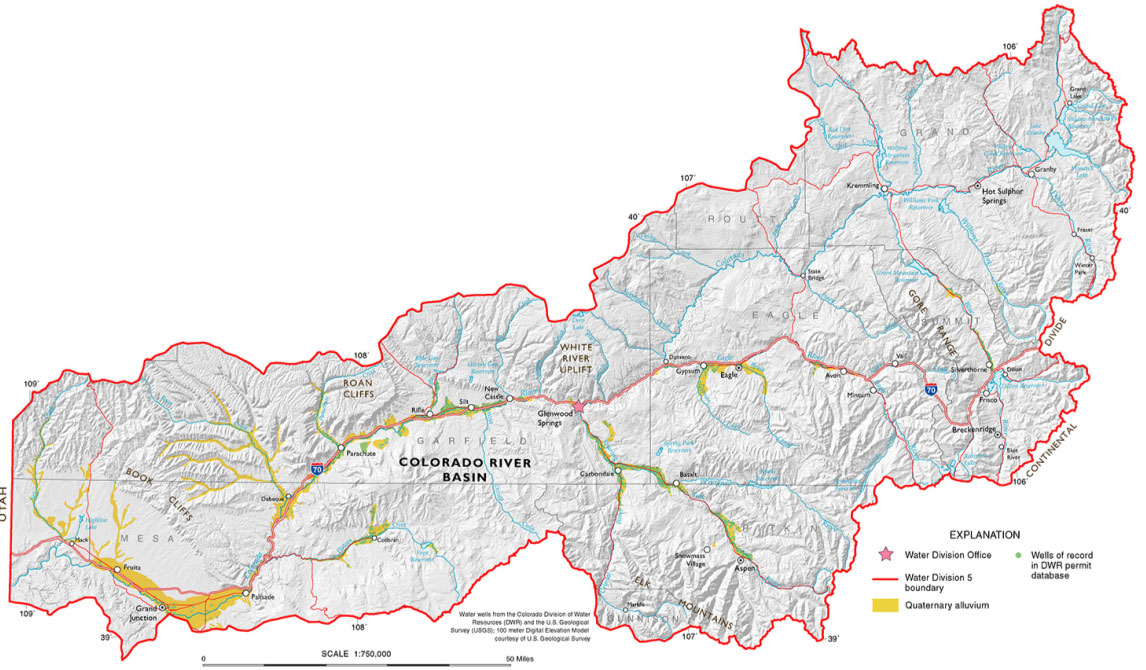
Map of the Colorado River drainage basin, created using USGS data. By Shannon1 Creative Commons Attribution-Share Alike 4.0
Black Canyon National Park July 2020. Photo credit: Claire Codling/The Department of Interior
From email from Reclamation (Andrew Limbach):
July 14, 2026
Aspinall Unit Operations Update – Release scheduled change to 1,390 cfs on Wednesday, July 15th.
On Wednesday, July 15th, the adjusted scheduled releases from Crystal Dam will decrease to 1,390 cfs from 1,465 cfs.
Gunnison River flows in the Black Canyon/Gunnison Gorge will decrease to 360 cfs.
On Thursday, July 16th, the adjusted scheduled releases from Crystal Dam will decrease to 1,315 cfs from 1,390 cfs.
Gunnison River flows in the Black Canyon/Gunnison Gorge will decrease to 290 cfs.
Reclamation will continue to monitor flows in the Gunnison River, and on Friday, July 17th, the scheduled releases from Crystal Dam may decrease to 1,265 cfs from 1,315 cfs.
Gunnison River flows in the Black Canyon/Gunnison Gorge would decrease to 250 cfs. An additional notification will be sent out confirming any change after Wednesday.
In response to the extreme drought conditions, the BOR has collaborated with US Fish and Wildlife and the National Park Service to reduce the target flows to 500 cfs at Whitewater and 200 cfs through the Black Canyon of the Gunnison until further notice. These releases are made for the authorized purposes of the Aspinall Unit, and to attempt to maintain a target base flow through the endangered fish critical habitat reach of the Gunnison while preserving critical storage in Blue Mesa Reservoir.
Contact Andrew Limbach (alimbach@usbr.gov or 970-248-0644) for more information regarding Aspinall operations or the Operation Group meeting.
Click the link to read the release on the USFS website:
June 26, 2026
Today the White River National Forest released the Draft Environmental Impact Statement for the Sweetwater Lake Recreation Management and Development Project for public review.
The project will determine the recreation management approach for 844 acres at Sweetwater Lake in Garfield County — 433 acres acquired in 2021 through the Land and Water Conservation Fund and 413 acres of previously existing National Forest System lands. The acquisition greatly increased public access, leading the Forest Service to begin developing a proactive management plan to address the potential increase in recreation while maintaining the area’s sensitive resources.
The Draft EIS analyzes four potential alternatives covering a wide range of potential management options for the Sweetwater Lake area. While the draft identifies a proposed alternative, the entire range of alternatives is being considered, and the final plan may be a blend of alternatives.
“Public involvement is an important part of determining the future of the Sweetwater Lake,” said Eagle-Holy Cross District Ranger Leanne Veldhuis. “We developed these alternatives with significant input from the public and other stakeholders.”
The Proposed Alternative would authorize a 20-year special use permit to Colorado Parks and Wildlife to manage the Sweetwater area.
“We have proposed partnering with Colorado Parks and Wildlife because they have the expertise to effectively manage this long-cherished area,” Veldhuis said. “We could achieve more working together.”
The Forest is hosting public meetings to provide additional information and answer questions July 22 at the Glenwood Springs Library, Glenwood Classroom, 815 Cooper Ave; and July 23 at the Gypsum Town Council Chambers, 50 Lundgren Blvd. Both meetings are open house formats, and the public can stop by any time between 4 p.m. and 7 p.m.
Sweetwater Lake Recreation Management and Development Project
The draft environmental impact statement for the Sweetwater Lake Recreation Management and Development Project provides a detailed analysis of four potential management alternatives that were developed with public involvement.
The final plan could be a combination of components from any alternative, based in part on public and stakeholder comments.
The White River National Forest developed these alternatives working closely with the public and the project’s Cooperating Agencies: Colorado Parks and Wildlife, Garfield County, Eagle County, and the Town of Gypsum.
Alternative 1 is the No Action Alternative, meaning there would be no change to the current Forest Service management direction or level of management intensity for the Sweetwater Lake area.
Alternative 2 is the Proposed Action, which emphasizes maintaining and improving the existing recreational opportunities at Sweetwater while protecting sensitive resources. The Proposed Action would create eight recreational zones to help spread out recreational use and minimize user conflicts. Colorado Parks and Wildlife would manage the area under a Special Use Permit.
Alternative 3 was developed to consider managing the Sweetwater area with fewer recreation improvements and facilities compared to the Proposed Action. Rather than a state-managed developed recreation site, the objective of Alternative 3 would be to provide a primitive recreation experience with limited facilities and limited staffing. A long-term partnership with Colorado Parks and Wildlife would not be included.
Alternative 4 was developed to manage site capacity to the full potential visitor market availability without limiting visitation. This alternative would contain more facilities and infrastructure to accommodate a greater number of day and overnight visitors than the Proposed Action. Colorado Parks and Wildlife would manage the area under a Special Use Permit.
Colorado’s Roan Plateau, a favorite backcountry zone for hunters, anglers and hikers because of its high-quality wildlife habitat, is once being proposed for oil and gas development. The Bureau of Land Management, in accordance with direction from the Trump administration’s One Big Beautiful Bill Act to hold lease sales in Colorado every quarter, has listed four leases on top of the plateau in its proposed December sale, with two additional leases nearby.
The wildlands of the Roan Plateau and animals that rely on them draw hikers, hunters and anglers to the area. The potential for oil and natural gas below the surface draws attention from industry, too, and sets the stage for a confrontation over how to fulfill the multiple-use mandate that governs federal lands.
Hunters, anglers and conservationists are also raising the alarm that implementation of federal law and proposed changes to BLM rules are stripping the public of its voice in public lands management.
The BLM has identified 114 parcels across Colorado available for oil and gas leasing in its December sale. Four of those parcels, totaling 4,645 acres, are on top of the Roan Plateau near Rifle, on the site of two undeveloped leases that were not canceled as part of a 2014 settlement between leaseholders and 10 conservation, trade and wildlife organizations.
*NCAs include a landscape area that encompasses Potential Conservation Areas (PCAs) that share similar species or natural communities and ecological processes; or a mostly intact, lightly fragmented landscape that supports wide- ranging species and large scale disturbances. Sources: BLM, CPW, Colorado Natural Heritage Program, CDPHE. Credit: Laurine Lassalle – Aspen Journalism. Click to enlarge.
In that settlement, the BLM canceled 17 of 19 leases that had been issued in 2008 on top of the Roan Plateau and refunded leaseholders; the agency updated its resource management plan, which guides land use, and closed about 34,000 acres, roughly 54 square miles, to future leasing.
But two leases, whose holders did not agree to cancellation as part of the settlement, remained open for future development, although the leaseholders were meant to contribute to a conservation fund that would be used for restoration and conservation efforts. Although the fund was established, no money was invested. The leases changed hands and were eventually relinquished, but their existence during the land-use planning process meant that that area remained available for future development, and conservation groups have foreseen this moment.
“We had unleased, unprotected land on top of the plateau, and that was very concerning to us,” said Juli Slivka, senior director of policy and programs at Carbondale-based nonprofit Wilderness Workshop, which was one of 10 plaintiffs in the lawsuit that lead to the 2014 settlement. “We immediately began urging BLM Colorado to close that area to new leasing.”
Slivka and other conservationists have argued that the BLM could have removed the potential for new leases because Colorado Parks and Wildlife has found that the area is home to high-priority habitat for a range of species, including an endemic species of Colorado cutthroat trout, elk, deer and greater sage grouse.
Brittany Parker grew up in Rifle, hiking and camping on the plateau. As an adult, she hunts there nearly every year, she said. Parker works for the trade group Backcountry Hunters and Anglers — which advocates for protections for the Roan — as the field operations coordinator for seven states, including Colorado. She said she’s passionate about protecting the Roan Plateau after watching it “change drastically” under development pressures in her lifetime.
The area has seen significant oil and gas development on private lands atop the plateau.
“It’s already pretty developed with oil and gas, so to imagine even more up in that region, it just seems like there would be nothing left,” Parker said. “It would so significantly fragment the habitat that the sense of refuge would be seriously diminished for our wildlife.”
There is heavy natural gas production at the base of the Roan Plateau. The BLM has proposed new leases on public lands at the top plateau in a December sale. CREDIT: COURTESY OF ECOFLIGHT
A recent flight over the Roan Plateau by Aspen-based conservation organization EcoFlight showed the extent of the development from above; there’s a sharp contrast between the development below the top of the plateau and on private lands compared with the untouched public lands. The flight path followed Parachute Creek, to the west of which is highly developed private land.
“You forget how heavily drilled it is up there. It’s just nonstop, roads and wellpads” on the private lands, said Jane Pargiter, executive director of EcoFlight, who has been working to protect the Roan since 2008. (Pargiter is an Aspen Journalism board member.)
The view changes quickly to the east side of the creek.
“It instantly transitions into this pristine landscape, which is where they have proposed these lease parcels for the December lease sale,” Pargiter said. “It’s just beautiful, pristine, and it’s green still.”
Parker and Backcountry Hunters and Anglers are quick to point out that they are not against energy development on public lands but are, rather, focused on ensuring that leasing happens in appropriate places.
“We’re advocating for protections on specific landscapes that have exceptional habitat and watershed values that are worth protecting,” Parker said.
The state wildlife agency, conservation groups and recreationalists have argued for nearly two decades that the Roan Plateau is not the right place for oil and gas development, which has been shown to lead to declines in wildlife populations. The Roan has prime habitat for elk calving, which is a particularly sensitive time, and is a migration corridor for elk and mule deer. It also provides habitat and breeding grounds, known as lek sites, for the greater sage grouse, which are particularly sensitive to industrial disturbance.
Dean Riggs retired in 2020 as the deputy regional manager for Colorado Parks and Wildlife and spent years working with the BLM and leaseholders to avoid, minimize and mitigate impacts to wildlife when there is industrial development, including on the Roan Plateau. He says he has hunted, including elk and grouse on the Roan Plateau, since he was big enough to pick up a rifle.
In his time at CPW, Riggs advocated for science-based, species-specific protections, which in some cases means avoiding development in certain areas altogether, such as breeding sites for grouse.
“If a company wants to pluck a five-acre site right down on top of a lek, you’re going to lose the lek,” Riggs said. “With that being a really sensitive species, every lek counts. Every lek keeps us from the endangered species list.”
Diagram showing critical reservoir levels at Glen Canyon Dam and Lake Powell. Land Desk diagram with data from the Bureau of Reclamation. Click to enlarge.
The Colorado River watershed’s spring runoff — if you can call the measly increase in streamflows “runoff” — peaked in mid-May and was pretty much over by mid-June.
The variations in streamflow showed up as a little bump in Lake Powell’s total inflows, which were augmented by extra releases from Flaming Gorge reservoir on the Wyoming-Utah border, many miles upstream. That buoyed Lake Powell’s surface level to a high point of 3,528 feet in early June, before it began its long decline that’s likely to continue until next year’s runoff.
The reservoir’s surface level is currently at about 3,525 feet, the lowest it has been since 2023 and the lowest it has been on this date since it was filled. It’s also the level that would trigger a reduction in releases from Glen Canyon Dam to 7.48 million acre-feet per year. This year that’s not going to happen, because releases are already on track to be closer to 6 MAF.
The data show why, even with reduced releases, the surface level is falling at about two inches per day as of the beginning of July.
3,527.97; 3,524.99 feet above sea level: Surface elevation of Lake Powell on June 1 and July 6, respectively.
2.1 million acre-feet: Median total inflows into Lake Powell (1991-2020).
399,304 acre-feet: Total inflows into Lake Powell during the month of June 2026, or about 19% of “normal.” The “unregulated inflow,” which is what the inflow would be without augmentation from upstream reservoirs, was just 305,000 af.
507,747 acre-feet: Total releases from Glen Canyon Dam in June 2026. At this level, all releases go through the hydroelectric turbines and generate power.
20,475 acre-feet: Estimated amount of water lost to evaporation from Lake Powell in June 2026.
8,951 acre-feet: Inflow into Lake Powell on July 7, 2026.
15,546 acre-feet: Release from Glen Canyon Dam on July 7, 2026.
788 acre-feet: Estimated evaporation from Lake Powell on July 7, 2026.
(7,383 acre-feet): Lake Powell’s daily water deficit on July 7, 2026.
In other words, as of early July the reservoir was losing nearly 7,400 acre-feet of water each day, or about 220,000 acre-feet per month. If this rate of decline continues or speeds up, then we can expect the reservoir to reach de facto deadpool — or 3,500 feet — before the end of the year.
If the level drops below 3,500 feet, dam operators will no longer be able to release water through the penstocks and hydroelectric turbines, meaning they must rely entirely on the river outlets lower on the dam for all releases. This would not only zero out the dam’s hydropower output, but could also damage the outlet tubes, since they aren’t engineered for long-term, sustained use.
One possible scenario: Dam operators switch to the river outlets for releases, the reservoir’s surface level is drawn down to, say, 3,475 feet, then the river outlet tubes begin deteriorating due to cavitation, forcing them to be shut down. This would then make it impossible to release any water from the dam until the outlets were repaired or the lake level rose back up to 3,500 feet, meaning the Colorado River in the Grand Canyon would effectively dry up completely.
That’s why the Bureau of Rec is so intent on “defending” that 3,500-foot level, presumably even if it means going to a run-of-the-river operation, in which water is released from the dam at the approximate rate that it is flowing into the reservoir, minus evaporation. On July 7, this would have amounted to about 2,800 cubic feet per second, or about one-third of current releases, diminishing hydropower output, and affecting downstream recreation and aquatic life.
If — or more likely, when — this occurs, it will render Lake Powell useless as a water savings account, and reduce it to a marginal power generator, silt collector, and evaporation pool. Boating will still be possible, but most existing boat ramps will no longer be usable. This will lend strength to calls to drain the reservoir, either by decommissioning the dam altogether, or by building bypass tunnels that can be shut down if climatic conditions change and aridification is reversed.
In the video above Katrina Grants from Reclamation explained how her agency is planning operations of Glen Canyon Dam for the next few years and emphasized that they can operate safely with just the outlet tubes, with increased maintenance activity. The planning shows the river hydrology is the primary driver of releases rather than limitations from the tube design. “We can release the water if it is there,” she said.
⛏️ Mining Monitor ⛏️
The U.S. Forest Service granted final approval to South32’s proposal to re-open and expand the Hermosa Mine in southern Arizona to extract battery materials such as manganese and zinc, along with silver and lead.
The mine is on patented claims (private land), but would be expanded onto unpatented claims in the Coronado National Forest in southern Arizona’s Patagonia Mountains, an area long inhabited by the Sobaipuri O’odham and Hohokam people. The mountains occupy the nexus of several different biological provinces and are home to hundreds of species of birds, bees, bats, and butterflies, as well as the unique Madrean Pine-Oak Woodlands.
The approved plan of operations includes:
Disturbance of about 400 acres of Forest Service land, including 225 acres for tailings and waste storage.
Mining will be done by the long-hole open stope method at a projected rate of about 4.7 million tons of ore per year.
The Australian company has approval to discharge up to 4,500 gallons per minute of treated water into Harshaw Creek, Mowry Wash South, and Goldbaum Canyon.
During operations the plan anticipates 169 heavy truck round trips per day and 76 light vehicle or bus round trips per day on the main access road, which will be constructed for the project.
The Biden administration expedited the environmental review for the proposed plan back in 2023 because the materials extracted are considered “critical.” Manganese is used in large capacity batteries; zinc is used to galvanize steel.
Area residents and advocates worry this sort of industrialization will harm the delicate and unique ecosystem and the diverse array of wildlife that depends on it. As is often the case with underground hardrock mining, a primary concern is for its effects on water quality and quantity. Groundwater pumping is expected to deplete area aquifers, which could affect springs and wells. Acid mine drainage is expected to occur in the sulfide ore body, which, if not treated properly, could contaminate groundwater or streams in the arid region.
The West these days is teeming with so many fly-by-night mining companies and speculators staking claims on public lands and launching exploratory drilling projects that it’s hard to tell which ones to take seriously. Most of these bids will likely fizzle out as soon as commodity prices fall.
Faraday Copper’s Copper Creek Project, however, seems to be worth paying attention to, if only because they have some serious financial backing.
The Canada company just finalized its agreement to acquirethe shuttered San Manuel copper mine in southern Arizona from BHP Group Limited. BHP, a global corporation and a co-proponent of the proposed Resolute copper mine at Oak Flat, will take a 30% equity interest in Faraday when the deal is completed later this year.
The San Manuel mine, just outside Mammoth, Arizona, was once the nation’s largest underground copper mine and a significant producer up to its closure in 1999. “The definitive agreement provides a pathway for the development by Faraday of a new copper hub in Arizona,” said a BHP press release, “combining existing infrastructure and mineral inventory at San Manuel with Faraday’s adjacent Copper Creek project.”
Faraday’s Copper Creek Project properties near Mammoth, Arizona.
The proposed Copper Creek mine covers about 78 square kilometers in the Galiuro Mountains about nine miles east of Mammoth. Its open pit would likely be in the middle of Copper Creek, a tributary to the Lower San Pedro River. Last June, the Bureau of Land Management approved Faraday’s plan to construct 67 drill pads, along with associated roads and infrastructure, and the company recently completed the first round of water-intensive drilling. The firm reports that the drilling identified oxide mineralization that “supports potential open-pit resource expansion.”
Faraday’s preliminary mining plan for the Copper Creek Project. Source: Faraday Copper.
For now, at least, Faraday is not really a mining company. It holds mining claims at the Copper Creek project in Arizona and another “pre-feasibility” project in Nevada, but it has yet to do any actual mining. It’s an exploratory company that last year posted a net loss of nearly $28 million.
Still, it’s getting some help from some very deep-pocketed interests. First off there’s BHP, assuming the San Manuel deal goes through. And then there’s the backing of the Lundin Group, which owns metal and diamond mining, petroleum, and renewable energy companies around the world. Lundin, which was founded in Sweden, is also known for human rights violations. Two executives of Lundin Oil (now Orrön Energy and owned by another company) allegedly aided and abetted war crimes in what is now South Sudan in the late 1990s and early 2000s. Their trial in Stockholm ended in late May and a verdict is expected later this year.
The development has sparked pushback from residents, advocates, and tribal nations, who worry about the drilling’s potential impacts to water quantity and quality in the Lower San Pedro River, which flows nearby, not to mention the prospect of a giant open pit mine in the biodiverse mountain range. The proposed mine site is also near the Aravaipa Wilderness Area, a stunning canyon and desert riparian zone.
For now, at least, Faraday is not really a mining company. It holds mining claims at the Copper Creek project in Arizona and another “pre-feasibility” project in Nevada, but it has yet to do any actual mining. It’s an exploratory company that last year posted a net loss of nearly $28 million.
Still, it’s getting some help from some very deep-pocketed interests. First off there’s BHP, assuming the San Manuel deal goes through. And then there’s the backing of the Lundin Group, which owns metal and diamond mining, petroleum, and renewable energy companies around the world. Lundin, which was founded in Sweden, is also known for human rights violations. Two executives of Lundin Oil (now Orrön Energy and owned by another company) allegedly aided and abetted war crimes in what is now South Sudan in the late 1990s and early 2000s. Their trial in Stockholm ended in late May and a verdict is expected later this year.
Copper Creek Canyon. Photo credit: Russ McSpadden/Center for Biological Diversity
The development has sparked pushback from residents, advocates, and tribal nations, who worry about the drilling’s potential impacts to water quantity and quality in the Lower San Pedro River, which flows nearby, not to mention the prospect of a giant open pit mine in the biodiverse mountain range. The proposed mine site is also near the Aravaipa Wilderness Area, a stunning canyon and desert riparian zone.
There’s also an ironic twist to this situation. In order for Resolution Copper — a BHP/Rio Tinto partnership — to move forward on its Oak Flat mine near Superior, Arizona, about 40 miles northwest of the Copper Creek project, the company had to do a land exchange. It would take ownership of Oak Flat — USFS land that had been withdrawn from mineral entry in 1955 — in exchange for various private parcels in the region with environmental or recreational significance. One of those gained by the federal government is a 3,050-acre parcel along the Lower San Pedro just east of Mammoth; putting it in federal hands should have protected the stretch from development. But it also covers the Copper Creek-Lower San Pedro confluence, and lies between Faraday’s Copper Creek Project and BHP’s San Manuel Mine. In other words, it would potentially be affected, directly or indirectly, by Faraday’s project.
Actual mining isn’t going to happen anytime soon; Faraday has paused its drilling program for the summer and doesn’t plan to resume until the fall. But the deal with BHP and the funding from Lundin are reason enough to keep an eye on this one.
🥵 Aridification Watch 🐫
Speaking of the San Pedro River, one of southern Arizona’s iconic streams and biodiversity zones, it reportedly has gone dry for only the second time in the last century at its Charleston gage. To be clear, the San Pedro is not a huge river, and it has been reduced to a mere trickle at times. But for it to completely vanish at this particular gage — the last time it happened was in 2005 — is a sign that aridification and groundwater overpumping are coming together to destroy one of the last un-dammed desert rivers in the Southwest.
USGS hydrograph for the San Pedro River at Charleston for the last year. While it normally plummets to below 3 cfs in late June, it also normally starts rebounding in early July when the monsoon arrives. Source: USGS.
Of course, the San Pedro is not alone. Nearly every stream in the Interior West is running at below normal flows currently. The Dolores River below McPhee Dam is so depleted that a helicopter searching the stream for water to dump on the Ferris Fire came up empty. The San Miguel River at Uravan, Colorado, is flowing at just 6 cubic feet per second, which is about 2% of the median flow for this date. And the Animas River below Aztec, New Mexico, is running at a measly 16 cfs, which is far too low for Farmington’s surf wave.
And of course, we can’t forget about the beleaguered Rio Grande. Laura Paskus reports that 87 miles of the Middle Rio Grande have gone dry. She has a heartbreaking account of walking a stretch of the dry zone near Albuquerque at her Substack newsletter.
Unfortunately, conditions are likely only to get worse this weekend, as a heat wave moves in and scorches the West, especially parts of the central and northern Rocky Mountains. Temperatures are forecasted to reach the triple digits in places like Hotchkiss and Grand Junction, Colorado. And check out this weekend forecast (7/11-7/14) for Thermopolis, Wyoming.
107° F in Thermopolis, Wyoming?!? Ouch. I think I’d avoid the hot springs this weekend [July 11, 2026] and stick to the river. Source: NWS.
🤯 Oh, the Humans! 😱
The San Miguel County Sheriff’s Office is a bit irritated, if their social media posts are any indication. This week they received a Garmin SOS signal from someone who had apparently fallen 150 to 200 feet in the Columbine Basin above Telluride, broken his leg, and needed search and rescue’s help.
Following an extensive rescue team deployment, which included a CARE Flight helicopter flying into the scene at 13,000 feet in elevation, the SAR team found the victim walking around. He told them he was BASE jumping on his own, his chute didn’t open, and he was injured in the fall. But the broken leg thing? Nope: He not only refused a helicopter flight, but any assistance at all. Adding to the annoyance: The purported victim had previously triggered a massive SAR operation while BASE jumping in the Swiss Alps that included a $175,000 air evacuation.
“Our SAR team consists of skilled professionals who risk their own lives to help others in need,” said Sheriff Dan Covault in a statement. “This individual chose to participate in an extremely dangerous activity alone, and particularly given his prior rescue history, his actions demonstrated a disregard for the risks involved and the resources required to rescue him. His decisions unnecessarily diverted emergency resources, including a Care Flight helicopter, that may have been needed for other emergencies. The fact that he was able to hike back down shows a profound lack of respect for the tremendous effort and resources devoted to this rescue.”
📸 Parting Shot 🎞️
Images from badlands in northwestern New Mexico that Georgia O’Keefe painted and called the “Black Place.”
Click the link to read the article on the Pagosa Springs Sun website (Josh Pike). Here’s an excerpt:
July 8, 2026
On July 6, Pagosa Area Water and Sanitation District (PAWSD) District Engineer Justin Ramsey issued a clarification to the district’s stage two drought restrictions, indicating that outdoor irrigation is allowed between 9 p.m. and 9 a.m. In his clarification, he explains that the district’s drought management plan had sections that indicated that irrigation was restricted to between 6 p.m. and 9 a.m. and sections that indicated the limitation was between 9 p.m. and 9 a.m. He adds that the district has now settled on the latter interpretation, which is different from some previous sources of information about the drought restrictions. The other restrictions for drought stage two remain the same. Irrigation is allowed every other day at the designated times on weekdays, with odd-numbered addresses watering on odd-numbered days and even-numbered addresses watering on even-numbered days. Weekend watering is prohibited. Edible and ornamental gardens can still be hand watered or drip irrigated. Residential water use above 4,000 gallons a month is subject to a two times rate multiplier under drought stage two. Restaurants are required to serve water only on request, and hotels are encouraged to only replace towels and bed linens for new guests and at the request of current guests. The goal of drought stage two is to reduce water usage by 20 to 30 percent, according to the PAWSD drought management plan…
The U.S. Geological Survey’s (USGS’s) water flow monitoring data is the primary window into local river flows, which factor into PAWSD’s drought stage calculations. The primary monitoring station for the San Juan River in Pagosa Springs is located underneath the bridge where U.S. 160 crosses the river near 1st Street. The reported flows have undergone significant recalibrations this month, with flows in the San Juan River appearing at times in later June to drop below the historic low flows in 2002 before being revised upward. These revisions are partially driven by last year’s flooding events, explained Kyle Raimer, who works as a hydrologic technician for the USGS Colorado Water Science Center’s Western Colorado Office in Durango. Raimer stated that the monitoring system sends out a radar pulse every 15 minutes, which contacts the water below the monitor and returns to the sensor, allowing it to measure how high the water level is. The flooding event and other construction work near the site have changed the shape of the channel and altered this relationship between water level and river discharge, Raimer indicated. USGS staff are working to rebuild accurate estimates by taking manual river flow measurements of the river at different water levels, Raimer stated, which can then be used to establish the correct correlations between water level and discharge.
Map of the San Juan River, a tributary of the Colorado River, in Arizona, Colorado, New Mexico and Utah, USA. Made using USGS National Map data. By Shannon1 – Own work, CC BY-SA 4.0, https://commons.wikimedia.org/w/index.php?curid=47456307
The Northern Water Board of Directors has unanimously approved a change to Colorado-Big Thompson Project accounting procedures concerning C-BT water tracking.
During a rule-making hearing at the June 11 Board meeting, Directors heard about the changes to the rules surrounding the tracking of water from the Project. The new accounting procedures will require accounting of tracking data to be provided in a manner to allow for the administration of C-BT Project water return flows, which will help Northern Water protect them as described in the District’s Repayment Contract with the Bureau of Reclamation, the Water Conservancy Act and contracts with allottees.
The modifications affect only domestic and municipal users, and Northern Water staff met or contacted 26 municipalities, water districts and treatment plants in the months before the rule change was approved.
Map of the Colorado-Big Thompson Project via Northern Water
The Colorado River, from one viewpoint, is a mess.
The iconic waterway, fundamental to the region’s modern existence – its desert metropolises, its high-tech industries, its agriculture, and its recreation economy – is on the verge of crashing. A two-decade drying trend, aided by carbon pollution in the atmosphere and water use that exceeds supply have nearly drained the basin’s liquid savings accounts.
Nature is now threatening to overwhelm human interventions. Lake Powell is 28 percent of its capacity. Lake Mead, just 24 percent. Climate pressures abound in these hot, dry times. A March heat dome obliterated temperature records. Snowpack was the worst on record. At least five fires larger than 25,000 acres are currently burning in the parched basin.
The basin’s seven states, unable to find consensus on how to live with a shrinking supply, are deadlocked after four years of attempting to negotiate the river’s management rules. State and federal authorities are deciding how much less Colorado River water will be available, anticipating that the reductions will hurt. Knowing that water enables economic growth, they don’t want to be viewed as selling out their constituents.
Look closer, however, and the narrative of warring factions fades a bit. At the local level, water managers are collaborating to ensure residents and businesses have adequate water supplies. They are signing multiparty deals and pursuing joint projects to share resources and keep water flowing to homes and businesses. Such dealmaking is not a remedy to all that ails the basin. But it is viewed as essential in a time of deep climate uncertainty and anxiety.
In June, six water suppliers in Arizona, California, and Nevada signed a memorandum of understanding with the Bureau of Reclamation, a federal agency, to facilitate interstate exchanges of desalinated and recycled water for Colorado River water. The exchanges, taking advantage of spare treatment capacity on the California coast, would introduce new water into a depleting basin.
Earlier this spring, Phoenix, Tucson, and other Arizona water users announced a venture to create an emergency reserve of water for cities facing shortages and to simplify voluntary water transfers in the state – “an easy button” to move water to where it is needed, said Max Wilson, Phoenix’s water resources management adviser.
The Grand River Diversion Dam, also known as the “Roller Dam”, was built in 1913 to divert water from the Colorado River to the Government Highline Canal, which farmers use to irrigate their lands in the Grand Valley. Photo credit: Bethany Blitz/Aspen Journalism
And in New Mexico, Santa Fe’s water utility is in early talks with neighboring pueblos about joint infrastructure for storing water underground, recycling water, and sharing water between systems in case wildfire pollutes a water source and renders it unusable.
“Cities have the ultimate responsibility to make sure there’s tap water,” said Kathryn Sorensen of Arizona State University and the former director of the Phoenix water utility. “And that means they have to be constantly vigilant and constantly innovate and constantly find new arrangements and new supplies.”
These arrangements, while not a new development, have taken on greater significance as the American West struggles through record heat and aridity this year that is an indicator of worsening water supply challenges in the drying region. Based on a decades-long track record, these arrangements also illustrate that neighbors helping neighbors can be a cost-effective form of climate adaptation.
“It makes sense to me that this happens at the local level because that’s where the risk is,” Sorensen said. She cited the Central Arizona Project, or CAP, as another example. CAP delivers Colorado River water to Phoenix, Tucson and other customers in the state’s populous midsection.
“The risk to the CAP of there not being water in the canal is that the CAP doesn’t deliver water to its contractors and subcontractors,” she said. In other words, a contractual failure.
But for the cities who hold those contracts? A failure to deliver water would hasten a public health and economic crisis. “The risk to a city is there’s no tap water,” Sorensen said. “And that’s just a totally different level of risk. So you see these types of innovations happen at the level where the risk exists.”
Collective Action
Partnerships do not happen spontaneously. They are the product of months and years of discussion, negotiation, and relationship building.
“The biggest challenge is communication, understanding the needs of your partners and clearly their sensitivities,” said Bill Schneider, the Santa Fe water resources manager.
Schneider is part of discussions with four pueblos in the Santa Fe area on joint water infrastructure projects, including water recycling and underground storage.
One clear possibility is that Santa Fe could connect its water system to the Pojoaque Regional Water System, which will serve Pojoaque, Nambé, San Ildefonso, and Tesuque pueblos with Rio Grande water.
Connecting neighboring systems is a form of insurance, Schneider explained. Wildfires are a perpetual risk in the watersheds of northern New Mexico. If a severe wildfire sends ash and debris into the Rio Grande, the polluted water could force water systems to shut off their river intakes. It has happened before on the Rio Grande. The Albuquerque Bernalillo County Water Utility Authority had to close its intake for two months in 2011 after the Las Conchas fire. With an interconnected system, water could be delivered to the pueblos from Santa Fe’s other sources, which include the Santa Fe River and groundwater.
Due to the high cost of building infrastructure, system interties and similar partnerships make financial sense, Schneider said. “It means you don’t have to go out and build an entirely new system.”
These infrastructure arrangements already exist in many places, but especially in Arizona. Nevada, for instance, has banked part of its Colorado River allocation underground in Arizona for more than two decades.
A decade ago, when Sorensen was the director of Phoenix Water Services, Phoenix and Tucson signed a trailblazing water deal. It allowed Phoenix to bank some of its Colorado River water underground in Tucson. When the water is needed, Tucson will be able to pump the groundwater and, in exchange, Phoenix will take some of Tucson’s share of Colorado River water. The deal, which has not yet had to be exercised, makes the most efficient use of the water treatment capabilities and infrastructure in the two cities.
That agreement, Sorensen said, paved the way for other exchange partnerships in central Arizona. Mesa, in a project completed this year, provides treated wastewater to the Gila River Indian Community in exchange for 8,000 acre-feet of Colorado River water. (An acre-foot – 326,000 gallons – can supply about 3.5 households in urban Arizona for a year.)
In Sorensen’s view, dealmaking is fundamental for utility leaders.
“They’re good horse traders, right?” she said. “That’s part of the job. ‘How can we make a win-win exchange or trade here that makes everyone happy and maximizes the resource?’ The water managers are really good at that.”
The latest iteration is the Secure Water Arizona Program, or SWAP, that Phoenix and Tucson are developing with other central Arizona cities.
Details are still being finalized, but the program will have three components. One is an emergency reserve of water that cities can tap as a last resort. A second piece is facilitating water exchanges between willing sellers and willing buyers. The third element is what Wilson calls “the sandbox” – a forum for collaboration on the next generation of central Arizona water projects.
The idea, said Max Wilson, the Phoenix water adviser, is a form of mutual aid. “At its core, the assumption of the SWAP is that water users shouldn’t be letting other water users go dry.”
Even with the benefits, Wilson acknowledged that collaboration needs to be carefully calibrated.
“People don’t want to see water being forcibly reallocated, for sure,” he said. “People don’t want to see their water going to uses that they necessarily wouldn’t see as beneficial. But when people have legitimate needs, I’ve been really impressed by how the water user community has come together and been willing to say, ‘Let’s talk and let’s figure out what a potentially mutually beneficial solution to those needs could be.’”
The Roaring Fork River in Aspen on July 8. Pitkin County Commissioners gave initial approval to buying more shares of Twin Lakes water to boost low flows on the Fork. CREDIT: HEATHER SACKETT/ASPEN JOURNALISM
Against the recommendation of an advisory board, Pitkin County commissioners on Wednesday gave preliminary approval to buy more water to boost flows in the often-depleted Roaring Fork River.
Commissioners approved on first reading a resolution and ordinance to spend $442,500 to buy 4.68 shares from the Twin Lakes Reservoir & Canal Co., which is about 3.5 acre-feet of water, according to a staff memo. The deal is in addition to the $6.5 million Pitkin County already agreed to spend earlier this year for about 71 acre-feet from Twin Lakes and another ditch company.
Twin Lakes collection system
The water is currently taken across the Continental Divide to the Arkansas River basin to be used by entities on the Front Range. The deal would allow the water to be released out of Grizzly Reservoir to Lincoln Creek and could help boost the Roaring Fork through Aspen and upstream, which suffers from low flows in dry years.
“I think it’s really critical that we purchase water rights when we can, and this is an opportunity that we can, and we should,” District 1 Commissioner Patti Clapper said.
Pitkin County has long had a goal of increasing the amount of water in the Roaring Fork, a river that has about 40% of its headwaters diverted to the eastern side of the state through the Independence Pass Transmountain Diversion System to be used by Colorado Springs, Pueblo and Aurora. These diversions can often contribute to the depletion of the Roaring Fork through Aspen, and purchasing Twin Lakes water represents a rare opportunity to return water to the Western Slope.
Commissioner Greg Poschman said he supports acquiring the water shares.
“I think it’s great that we are doing this,” he said. “I know it’s expensive; there are some raised eyebrows about that, but I think this is something we have to do.”
Poschman added that he was concerned that the Healthy Rivers board members recommended against buying more water and said he would like to fully understand their reasons. County staff said they were trying to schedule a joint meeting with the Board of County Commissioners and the Healthy Rivers board in August.
Members of the county’s Healthy Rivers board, which advises the BOCC, are concerned that the water will have a small impact on river health but a big impact on the program’s budget. The board held a special meeting June 25 to consider acquiring the shares and approved a motion saying the water yield would potentially be only 1 additional cubic feet per second for two days.
“Additionally, the deleterious effects of the purchase price on the long-term fund balance of the Healthy Rivers Fund will reduce the Healthy Rivers Program’s ability to support programs to address other ballot measure mandates, including water quality, ecological health, recreation opportunities, wildlife and riparian habitat, and promoting water conservation,” the motion reads.
The motion goes on to say that in the future, the county should implement a framework for evaluating the true value of water shares to the Roaring Fork.
At Wednesday’s meeting, County Budget Director Connie Baker told the BOCC that the Healthy Rivers board will have to trim or reallocate about $500,000 from next year’s budget to account for the combined impact of this year’s two water purchases.
Healthy Rivers board member Ned Andrews said he is against the purchase, citing the impact that it will have on the program’s budget.
“None of the analysis or details that would justify such a purchase or a strategy going forward has been done,” Andrews told Aspen Journalism. “I think before you commit essentially a quarter of your budget for the next 15 years, you’d want to have an analysis that shows you what could be accomplished. My gut feeling is that it wouldn’t really accomplish much.”
Andrews also opposed the earlier, larger water share purchase, although the rest of the Healthy Rivers board was supportive.
At their regular June meeting, Healthy Rivers board members went through the budget line by line and considered where they could trim, although those cuts have not yet been finalized.
Spending big bucks in an effort to rescue rivers is not new for Pitkin County, which has spent at least $3.5 million on the Roaring Fork River Park in Basalt, including a water court battle to secure the water right for recreation, several redesigns of problematic waves, and improvements to the riverbank and boat launch.
Grizzly Reservoir, a forebay that collects water to send through the Twin Lakes Tunnel to the Front Range, sits in the middle of the Lincoln Creek watershed and connects water users on both sides of the Continental Divide. Pitkin County commissioners gave initial approval to a deal that would allow more water to be released from Grizzly for the benefit of the Roaring Fork. CREDIT: HEATHER SACKETT/ASPEN JOURNALISM
Bond for original purchase approved
The BOCC at Wednesday’s meeting also approved issuing a bond for the original purchase of Twin Lakes shares. That deal cost the county $6.5 million, although only 45 of those acre-feet represent Western Slope water that is currently diverted to the Front Range. The county plans to sell or trade the other 26 acre-feet, which is owned by the Fountain Mutual Ditch Co. in El Paso County and decreed for use on the east side of the divide.
The 45 acre-feet of water can be released down the Roaring Fork during the irrigation season when flows are low, and it must be used by a downstream water user on the Colorado River before the town of DeBeque. Instream flow for the benefit of the environment is not a decreed use of the water.
This year, according to Colorado Water Resources Division 5 Engineer Tyler Benton, at least some of Pitkin County’s Twin Lakes water was released as part of the Colorado River Water Conservation District’s emergency substitute water supply plan, which the district enacted in response to this year’s historic drought. Benton said he expects the River District to provide a full accounting of how much Pitkin County water has been released Friday.
Grizzly Reservoir is currently drained for dam maintenance, which may have affected how much water could be released under the River District’s plan.
At a time when drought impacts are being acutely felt across the state and climate change continues to rob rivers of their flows, for some, the unique opportunity to put water back into a depleted stream is worth the cost.
“This is expensive water, but it’s the only water you can get up at the headwaters of the Roaring Fork,” said Pitkin County Deputy Attorney Anne Marie McPhee. “So that scarcity makes it more valuable.”
The issue is scheduled for a public hearing and second reading July 22.
A man fills his water tank at a well a few miles from the Hopi village of Mishongnovi, on the tribe’s northern Arizona reservation.
Click the link to read the article on the Pro-Publica website (Mark Olalde and Alex Hager):
June 29, 2026
ProPublica is a nonprofit newsroom that investigates abuses of power. Sign up for Dispatches, a newsletter that spotlights wrongdoing around the country, to receive our stories in your inbox every week. This story was co-published with KJZZ News-Phoenix.
Reporting Highlights
Certainty on the River: Tribes have negotiated a settlement to resolve the largest outstanding claim to the Colorado River, while providing billions of dollars for water infrastructure.
Upper Hand: Colorado, New Mexico, Utah and Wyoming — the Upper Basin states — are resisting the deal because it allows the Navajo and Hopi to lease water outside their reservations.
Unfulfilled Promise: It has been 118 years since the Supreme Court ruled that the federal government owes tribes water, but many are still fighting to resolve their rights.
These highlights were written by the reporters and editors who worked on this story.
A deal to bring Colorado River water to Native American communities in northern Arizona, where a third of homes lack running water, is being blocked by neighboring states, caught up in a broader battle over how to divide the dwindling river.
The largest tribal water rights settlement in U.S. history — the product of decades of negotiations to secure water for the Navajo Nation, Hopi Tribe and San Juan Southern Paiute Tribe — was on the verge of being realized before Colorado, New Mexico, Utah and Wyoming stepped in to oppose it being codified by Congress.
Those four states, known collectively as the Upper Basin, are at a stalemate with the Lower Basin states of Arizona, California and Nevada over new rules governing how they share the Colorado River, a key water source for nearly 40 million people. Congress and the White House, under both Democratic and Republican leadership, have declined to approve the settlement until all parties reach an agreement.
For 83-year-old Marilyn Tewa, the stalemate means her family will continue to go without running water. Tewa serves on the Hopi Tribal Council, where her duties include working on the water rights agreement, but her village of Mishongnovi, on the tribe’s northern Arizona reservation, lacks indoor plumbing.
Every other day, she loads 5-gallon buckets into her pickup and drives 5 miles to a windmill originally built for livestock that draws untreated water from underground.
“That’s what keeps us alive,” Tewa said, tapping the spigot on a May afternoon.
Back home, Tewa bustled about her kitchen while her daughter kneaded dough for dinner. There’s no faucet in the kitchen, which is decorated with a framed American flag and a painting of a katsina, a figure with spiritual significance in Hopi culture. Instead, the family stores water in large plastic containers. Because of the lack of indoor plumbing, the Tewa family and its neighbors use portable toilets that stand among the houses.
If passed into law, the Northeastern Arizona Indian Water Rights Settlement Actwould resolve the largest outstanding claim on the Colorado River while providing about $5 billion in federal funding to build infrastructure to transport the water across the reservations. The legislation would also go beyond water rights, creating a reservation for the San Juan Southern Paiute. The tribe’s effort to secure a permanent homeland was added to the settlement due to their difficulty getting it through Congress independently.
“That’s my prayer,” Tewa said, “that we get this settlement through for all three tribes.”
Marilyn Tewamain sits in her chair inside her home Saturday afternoon. Photo credit: Sharon Chischilly
The tribes need pipes, pumps and treatment plants to use the water secured through the settlement. To defray the cost beyond the federal government’s expected contribution, the Navajo and Hopi plan to lease some of their water rights, almost certainly to growing towns around Phoenix. The towns would pay to use the tribes’ water for a set number of years.
While the Lower Basin states support the settlement, the Upper Basin states have latched onto this provision in particular as they stand in the way of the settlement.
The Colorado River’s upper and lower basins don’t precisely follow state borders. Some states have portions in both sections, and the line dividing the two basins cuts across northeastern Arizona and directly through the Navajo reservation. If water moves across that line, they argue, the rules governing the river give them veto power over the settlement. (It’s an open legal question whether approval from all seven states is necessary.)
The Upper Basin states fear that, in the future, water they currently control might be leased on an open market. They view any monetary transaction that moves water downstream as setting a precedent that could allow the highest bidder — possibly thirsty cities with money such as Los Angeles, Phoenix and Las Vegas — to buy vast quantities of their water.
In an effort to assuage that concern and close the deal, the Navajo and Hopi made major concessions over the volume of water and length of time they could lease. The tribes also offered to leave some of their water in one of the river’s drought-depleted reservoirs to help keep water levels high enough that it could continue flowing downstream. But the Upper Basin has not wavered in its opposition.
Tewa’s family travels 5 miles each way to haul water in 5-gallon plastic buckets from a well initially drilled for livestock. Photo credit: Sharon Chischilly
ProPublica and KJZZ News-Phoenix reached out to the governor, senators and lead negotiator from every Upper Basin state for comment. Utah’s and Wyoming’s lead negotiators deferred to the letter they co-signed. A spokesperson for New Mexico Gov. Michelle Lujan Grisham said in a statement that the tribes addressed most of the state’s concerns but that questions remain as to whether the water that the tribes would lease to Arizona cities could be counted as part of what the Upper Basin states are legally required to send to the Lower Basin. “New Mexico remains committed to finding a workable solution,” the spokesperson said.
A spokesperson for Colorado Gov. Jared Polis also said the state is “committed to finding a path forward” and pointed to the letter that Becky Mitchell, the state’s lead river negotiator, submitted to Congress. Mitchell wrote that the settlement’s leasing provisions violate laws governing the river and that the state was concerned about what the sale of water across the basin would mean for “the security and certainty” of Colorado’s share of the river.
Heather Tanana is an assistant professor at the University of Denver’s law school, where she focuses on federal Indian law. She is also a citizen of the Navajo Nation and said the Upper Basin is “trying to hide behind” how the river has traditionally been managed rather than find a way to give the tribes access to a resource that is rightfully theirs and one that they need to survive.
“It’s a fundamental human rights issue,” she said.
While negotiations drag on, the three tribes continue waiting for water they say will help them to build more housing, grow sustainable economies, better protect public health and preserve cultural practices.
The Hopi believe their ancestors return as clouds to bring the rain that nourishes their corn, but drought is wracking the region. An overreliance on groundwater has dried up springs that have been used for ceremonies and agriculture for centuries. When the settlement brings more water to the reservation, Tewa said, aquifers will have a chance to recharge, restoring the springs.
“I’m speaking on behalf of my children, my grandchildren and their children that haven’t come yet,” she said. “I hope, in the future, that they will have water.”
The village of Mishongnovi, which Tewa represents on the Hopi Tribal Council, sits atop a rocky mesa. Photo credit: Sharon Chischilly
Tewa washes her hands with untreated water she hauled from a well. Photo credit: Sharon Chischilly
Fighting for Water Since Elvis Was on TV
That the settlement even reached Congress seemed like a small miracle to those involved.
If the tribes were to use every drop to which they are entitled, the system of sharing the river that supports more than $1 trillion in annual economic output would collapse.
“Everybody’s getting free Navajo, Hopi and San Juan Southern Paiute water right now. The seven basin states are all benefiting in the absence of a settlement,” said Ethel Branch, a former Navajo attorney general who was involved in the negotiations, adding that the water had been “stolen for over a century.”
In 1908, the Supreme Court ruled that, if the federal government confined tribes to reservations, then it owed them enough water to sustain an agrarian economy on that land. But securing that promised water, referred to as “Winters rights,”has proven arduous.
Tribes were excluded from the compacts that apportioned the river. The Navajo in particular were barred from joining a seminal case quantifying other users’ rights, and members of the tribe themselves rejected a proposed settlement in 2012 when they viewed the deal as unfair. So the tribe went back to the Supreme Court, asking that the justices force the federal government to quickly settle the claims. The Navajo once again lost, with the court’s majority deciding that their treaty with the U.S. didn’t require the government to take any “affirmative steps” to deliver the water it owed the tribe.
“At each turn, they have received the same answer: ‘Try again,’” Justice Neil Gorsuch wrote of the Navajo in his dissent. “When this routine first began in earnest, Elvis was still making his rounds on The Ed Sullivan Show.”
Arizona politicians and tribal leaders have since concluded that they needed to combine all three tribes’ claims to finally settle their rights.
That was no simple feat. The Navajo and Hopi have long had a contentious relationship. Underlining their thorny partnership, leaders of various tribes around the region have accused Navajo, the largest tribal nation in the U.S., of flexing their political strength to the detriment of other tribes.
About a third of homes on the Navajo Nation lack the pipes and other infrastructure necessary to deliver running water, including near Page, Arizona, close to a large reservoir on the Colorado River. Photo credit: Sharon Chischilly
But Navajo and Hopi struck a deal, and Arizona moved off its bargaining position. Now in lockstep, the settlement’s supporters turned to Congress, only to hit more roadblocks: The House of Representatives balked at the spiraling price tag to fund the deals; presidential administrations were unwilling to expend political capital on such settlements; and more than a dozen settlements are in the works, clogging the system. (No settlement has been enacted since 2022.)
“Partisanship has gone to a new low in this country, and Indian water settlements have gotten swept up into that,” said Pam Williams, who spent about two decades as director of the Secretary’s Indian Water Rights Office in the Department of the Interior before she retired last year.
In November 2024, as President Donald Trump prepared for his return to the White House, the tribes believed they had an opening to get their settlement through Congress while President Joe Biden was still in office.
Navajo leadership had supported the Democratic presidential ticket and feared the incoming administration would be vindictive toward them.
Every basin state’s lead negotiator, tribes’ staff and a federal representative descended upon the Arizona Department of Water Resources’ offices in Phoenix for what several attendees described as a “Hail Mary.” At the meeting, the Navajo offered a major compromise: limiting how much water they could lease and for how long they could lease it.
But the Upper Basin states showed up with a list of grievances, multiple attendees told ProPublica and KJZZ News-Phoenix, and weren’t interested in negotiating over the Navajo leasing concessions.
“It’s difficult for the Upper Basin to wrap their heads around this settlement,” said Tom Buschatzke, Arizona’s Colorado River lead.
Navajo President Buu Nygren says the fact that his tribe’s reservation straddles the upper and lower divisions of the Colorado River Basin should not be held against the tribe as it negotiates for water. Photo credit: Sharon Chischilly
In March 2026, leaders from the tribes traveled to Washington for a Senate hearing where they made an impassioned plea for Congress to pass a version of the bill that now included the concessions they had offered in the Hail Mary meeting. Sen. Lisa Murkowski, the Alaska Republican who ran the hearing, expressed support for the settlement but worried its $5 billion price tag was too high, a concern echoed by an Interior Department official who testified. (The tribes and department are currently negotiating to shrink that cost.)
All four Upper Basin states submitted comments opposing the settlement. Their main concerns were about the ability to lease across the basin and whether the water for the settlement would be counted against the upper or lower division of the river.
Leasing would last only as long as it’s needed to pay for infrastructure to distribute their newly acquired water, said Navajo President Buu Nygren. It would not set a precedent, he said, because no other tribe straddles both basins.
“We shouldn’t be punished for being in two basins,” Nygren said, “because other tribal nations, other settlements have been able to lease water.”
A construction crew installs pipes at the new LeChee Water Treatment Plant near Lake Powell, along the Arizona-Utah border. Photo credit: Sharon Chischilly
The former Navajo Generating Station’s intakes, which drew water from Lake Powell to cool the coal power plant, sit unused, awaiting funding from the stalled settlement. Photo credit: Sharon Chischilly
“How Precious Water Is to Us”
During the decades that the tribes fought to access their water, they helped quench the thirst of growing cities in the Colorado River Basin.
A water intake plant on Navajo land drew from Lake Powell to cool the nearby Navajo Generating Station. The coal plant powered pumps for the Central Arizona Project, the 336-mile series of canals that sends Colorado River water to Phoenix and Tucson.
The power station shut down in 2019, and the intake plant was handed over to the Navajo for the iiná bá-paa tuwaqat’si pipeline, which means “for life” in Diné and “water is life” in Hopi, to deliver water to the three tribes. But for now, the massive pumps remain mothballed, the building sitting musty and dark like a tomb, and the pipeline remains an engineering schematic, waiting for funding from the stalled settlement.
The irony is not lost on tribal leaders, they told ProPublica and KJZZ News-Phoenix: After helping deliver water beyond their lands, they are now blocked from using that same water and infrastructure to sustain their communities. The insult is compounded, they said, by the fact that water use is drastically lower on reservations.
“It’s not about green-grass lawns or golf courses or swimming pools,” said Crystalyne Curley, speaker of the Navajo Nation Council. “It’s just basically turning on the faucet and getting water to boil eggs for your children or turning on a faucet to wipe and clean the table or washing your hands after butchering a sheep.”
San Juan Southern Paiute Vice President Johnny Lehi Jr. is fighting for the settlement because it would finally ratify a treaty with the Navajo that would create a reservation for his tribe. Photo credit: Sharon Chischilly
For the San Juan Southern Paiute, the settlement is also about having a permanent homeland. They have no reservation but struck a deal with Navajo in 2000 to transfer some of its land. Since the tribes already reached an agreement, it’s an uncontroversial proposition. But, without political clout to get Congress to take it up, the land transfer was pulled into the water settlement.
“During the COVID era, it took a lot of the tribal elders, and there are only a handful that saw the treaty signed and are really wanting to see this before their time is up,” said San Juan Southern Paiute Vice President Johnny Lehi Jr., whose father signed the 2000 agreement. Finally securing a reservation, he said, means the ability to build housing and develop an economy for a tribe that currently rents its government building.
Nearby, on the Hopi reservation, Councilmember Marilyn Fredericks grabbed a pair of hiking poles, donned a hat with a roadrunner pin on it and set out from her village on a recent spring afternoon. To stay fit as she grows older, she walks up and down the hand-carved steps of a terraced garden that used to produce food for her community.
Seven natural springs once fed the garden, but only two still flow. Ponds that stored their excess sit dry, stains on the rock now just a memory of the water. It’s been six years since there was enough to plant.
The settlement would fund a pipeline that would be “our umbilical cord,” Fredericks said. Future generations of Hopi have a right to clean, reliable water, she said. “This is evidence of how precious water is to us.”
Native America in the Colorado River Basin. Credit: USBR
The full impact of this past winter’s record-low snowpack is rearing its ugly head in the form of:
Record-low spring stream flows.
Low reservoir storage levels.
An empty reservoir.
And one incredibly rare statistic.
On June 17, Denver Water’s reservoir system hit its peak storage level following a diminished spring runoff.
Water levels in the utility’s reservoirs collectively hit 81% of the system’s storage capacity — the second-lowest peak storage level on records dating back to 1983, considered the beginning of the modern Denver Water collection system.
“Peak storage” is the moment, or day, when the utility’s collection system holds the most water it will hold for the next year. It’s akin to topping off a swimming pool once a year in June to carry the pool through the next year of use.
Typically, the “peak storage” moment happens in mid-June, after the spring runoff.
But in 2026, due to the record-low winter snowpack and low spring runoff, Denver Water’s collection system held more water on Jan. 1 — 83% of capacity — than on June 17, as the runoff dwindled and storage levels inched to 81% of capacity.
There’s only one other year since 1983, when the Strontia Springs Dam was completed, that Denver Water’s storage was higher in the dead of winter than the dawn of summer — the drought year of 2002.
“Having our highest amount of water happen in January is incredibly rare. It speaks to how little snow we saw this winter and the impact of the record-setting warm weather,” said Nathan Elder, Denver Water’s manager of water supply.
“We’ve seen many records fall this year, and unfortunately, they were not good ones.”
Dillon Reservoir reached 80% capacity on June 17, the highest elevation it is expected to see in 2026. Dillon is the largest reservoir in Denver Water’s collection system, storing roughly 38% of the utility’s water supply. Photo credit: Denver Water.
During the spring peak, the amount of water stored in Denver Water’s reservoirs typically hits an average of 97.5% of capacity.
And since 1983, the utility’s peak storage levels have hit at least 95% of capacity (considered sufficient for normal operating conditions) in all but six years.
“Ideally, we like to top off our mountain reservoirs during the spring runoff, but this year our storage levels came up well short,” Elder said.
Record low ‘paycheck’
Why do water managers focus on peak storage numbers?
The peak reservoir storage figure is critical to determining how much water is available until next year’s spring runoff. It’s comparable to a family determining how much money they have to pay the bills until the next paycheck comes through.
“The spring runoff is our annual paycheck from Mother Nature,” Elder said. “The water filling our reservoirs is the cash that fills our bank account. But in our case, that paycheck only comes once a year — and this year we didn’t get anywhere close to the normal amount.”
Tenmile Creek in Frisco, as it enters Dillon Reservoir on June 12. Denver Water saw record low flows into the reservoir in 2026. Photo credit: Denver Water.
This year’s meager paycheck was reflected in the record-low peak flows on the rivers and streams that feed Denver Water’s reservoirs.
Mountain snowmelt accounts for 90% of Denver Water’s supply, which provides water to 1.5 million people in metro Denver.
In Summit County, Denver Water recorded this year’s peak stream runoff into Dillon Reservoir at just 404 cubic feet per second, or cfs, on May 29. That’s a record-low “peak inflow” and less than a quarter of the normal peak inflow into the reservoir of 1,750 cfs, which typically happens on June 7.
In Park County, the South Fork of the South Platte River experienced a double-whammy, with record-low flows that occurred abnormally early in the season.
Flows on the South Fork peaked on March 25 at a record-low flow of just 18 cfs. That’s 15% of the normal peak flow of 120 cfs, which usually happens on June 10.
The South Fork of the South Platte River south of Fairplay on May 22. The river peaked at a record low flow of just 18 cfs in 2026. Photo credit: Denver Water.
“In a typical year, the rivers and streams start rising in late-April as the snow starts to melt, then they peak in early June, and then they start to ease back to normal flows throughout the summer,” Elder said.
“This year the runoff started about six weeks early in March, and the normal spring surge of water we usually see was basically nonexistent.”
Reservoir impact
The results of the record-low spring flows are having a significant impact on three of Denver Water’s most popular reservoirs.
Dillon Reservoir in Summit County topped off on June 17 at 80% of capacity, with water levels about 18 feet below normal for this time of year. Water levels are expected to drop over the next year until the 2027 spring runoff — hopefully more boisterous than this year’s meager flow — begins.
Dillon Reservoir in Summit County reached 80% capacity on June 17. This picture shows the low levels at the Snake Inlet on the southeast corner of the reservoir on June 12. Photo credit: Denver Water.
In Grand County, Williams Fork Reservoir topped off June 21 at merely 53% of capacity, about 35 feet below normal for this time of year and forcing the closure of the reservoir’s boat ramp.
At the Williams Fork Reservoir in Grand County, the boat ramp will be closed all summer due to low snowpack and record-low runoff. Photo credit: Denver Water.
Because of the low snowpack, Denver Water also dipped into its emergency water supply at Antero Reservoir in Park County.
Using water from Antero Reservoir is only done in extremely dry years. It’s comparable to someone having to dip into their 401(k) savings to pay bills until their next paycheck.
Denver Water moved water out of Antero this spring and sent it downstream to Cheesman Reservoir to avoid losing water in shallow Antero due to evaporation.
Denver Water moved water from Antero to Cheesman reservoir in 2026 to reduce losses from evaporation. The water in Antero Reservoir, pictured above, is only used in extreme dry years. Photo credit: Denver Water.
Early forecasts for the abysmal spring runoff and low peak storage were two factors that led Denver Water to issue a Stage 1 drought declaration in March.
The declaration, which calls on customers to reduce water use by 20% and includes mandatory watering restrictions of two assigned days per week, seeks to stretch existing water supplies until next spring’s paycheck is deposited in the reservoirs.
“While the reservoirs are low this year, they are doing what they were built for, which is to help us get us through a dry year,” Elder said.
“We hope customers notice the low reservoir levels and take steps to conserve water at home so we can stretch our water supplies over the coming months.”
Maybell Irrigation District’s headgate on the Yampa River, September 2022. Photo credit: Heather Sackett/Aspen Journalism
Click the link to read the article on The Denver Post website (Noelle Phillips). Here’s an excerpt:
June 18, 2026
For the 18 ranchers who rely on the Maybell Irrigation District’s canal to funnel water to their fields, the 127-year-old headgate that diverted flow from the Yampa River meant a two-hour round trip through a rocky canyon whenever they needed water. The rusted structure was barely hanging on, and its operation was time-consuming for the busy ranchers, who had to lug special tools on all-terrain vehicles and on foot to open or close the mechanism. But it seemed impossible for the tiny district to find the $6.8 million needed to replace the headgate and the rocky diversion dam that pushed water into the canal. Then legalized sports betting came along, and, with it, millions of dollars for Colorado water projects. The tiny irrigation district, in Moffat County in the far northwest corner of the state, soon became the poster child for how gambling money is benefiting Colorado’s waterways. The district received a $750,000 grant from the Colorado Water Conservation Board, which doles out money from sports betting tax revenue, said Diana Lane, sustainable food and water program director for The Nature Conservancy in Colorado, which helped the district land the grant. That led to a matching grant from the U.S. Bureau of Reclamation’s WaterSMART program. With those two grants in hand, other organizations jumped on board, and money poured in, she said. In 2024, the Maybell Irrigation District installed a new headgate that can be opened or closed via cellphone. If a rancher is cutting hay and doesn’t need to irrigate, he can close the gates to match the amount of water he actually needs at that moment, Lane said. And the diversion structure no longer uses boulders to control the water flow. Instead, it’s a modern structure that is the right height for water control. The project also benefited four fish species, including the threatened humpback chub, and it made river navigation easier for boaters, helping the region’s outdoor recreation economy.
“That $750,000 was really the ball that got it all rolling, that showed people, ‘Oh, this is going somewhere,’” Lane said of that initial state grant.
Since sports betting became legal in May 2020, the state has collected more than $154 million in taxes, and the Colorado Water Conservation Board has funneled $140 million to various projects that preserve and conserve Colorado’s precious water. Supporters say the gambling money is a godsend for ranchers, fishermen, paddlers and others who want to protect the state’s water and those who depend on it for their livelihoods. Critics, however, say legalized sports betting has come at a cost — fueling an addiction crisis that the state was unprepared for and is underfunding.
Today’s Colorado River Delta is a far cry from the lush waterway that thrived before the river was forced behind dams that diverted much of its flow for half a century. Now, with just small amounts of water and funding, stretches of the parched riverbed have been transformed into healthy riparian habitats.
Click the graphic to download a copy of the report.
A new report from a University of Arizona-led team of researchers has evaluated the effects of the 2014-2025 controlled water releases along the lower Colorado River in Mexico to restore natural habitat. The report also lays out a roadmap for continuing the current binational restoration efforts. The report was published today by the Center for Colorado River Studies at Utah State University.
“It’s hard to find some good news about the Colorado River, but we believe we have some to share,” said first author Karl Flessa, professor emeritus in the U of A Department of Geosciences. “The lessons learned from more than a decade of work show that a small amount of water can do big things.”
The controlled water deliveries to the Colorado River streambed from 2014-2025 were mandated by two addenda of the U.S.-Mexico Water Treaty of 1944, which governs the allocation of Colorado River water between the two countries. The current addendum expires at the end of 2026.
To ensure the restoration sites continue to thrive, Flessa said sustaining this binational success will require a renewed commitment of water and funding by the United States, Mexico and non-governmental organizations.
The report reveals that bird numbers and diversity have increased since restoration began in 2014. The delta is an important rest stop for birds migrating along the Pacific Flyway. Beavers and other wildlife have also increased.
Graphic credit: USGS
The restoration of the Colorado River Delta began in 2014, in the form of a so-called pulse flow, a one-time water release from Morelos Dam that lasted 57 days. Before that, the riverbed below Morelos Dam was dry. The pulse flow was conducted to allow researchers to assess the effects on the ecosystem once water returned.
The pulse flow of 2014 kickstarted a concerted, binational effort to systematically restore riparian habitat along certain stretches of the formerly dry river delta. Environmental NGOs, both in the U.S. and in Mexico, developed three designated restoration sites by terrain-shaping and planting of native riparian vegetation, including cottonwood trees, mesquite trees and willows – species that once dominated the landscape when the Colorado flowed through a healthy delta.
In 2019, AZPM produced a story on revitalizing the Colorado River delta five years after the 2014 pulse flow.
“These NGOs actually have nurseries on site, in which they germinate an array of Sonoran Desert riparian plants. Those seedlings are then planted and carefully irrigated according to the habitat needs,” said Martha Gomez-Sapiens, a U of A research scientist and co-author on the study. “In some cases you will see irrigation drip lines that go to each individual tree – a system designed to maximize water efficiency in this desert environment.”
Subsequent creation, irrigation and maintenance of 1,381 acres of riparian vegetation attracted birds and other wildlife. Deliveries to the river channel raised water tables, supported existing vegetation and increased the length of the flowing river.
In addition, local communities have benefited from recreational, educational and job opportunities. All three restoration sites have visitor programs that cater to local communities and schools, and one – the Laguna Grande complex, managed by the Tucson-based Sonoran Institute – even boasts a visitor center. All offer recreational opportunities in a region dominated by water scarcity.
While the pulse flow of 2014 demonstrated the feasibility of revitalizing former habitats with controlled and planned water releases, the authors conclude that releasing large amounts of water during a limited timeframe has limited benefits for a long-term revitalization of the delta.
“Most of the pulse flow water infiltrated into the groundwater before it could be used by new vegetation,” Flessa said. “Since then, we have learned how to use the water more efficiently for restoration of riparian habitat.”
Importantly, the report points out that restoration sites are not self-sustaining. Revitalizing degraded river habitat will require continuing maintenance, occasional water allocations and monitoring.
According to the authors, just 6,890 acre-feet per year, which represents approximately 0.05% of the Colorado’s total annual average flow, would suffice to preservethe existing restoration sites. With a little more water and a little more funding, the number or size of the sites could be increased even more, according to the report.
“Effective and sustainable habitat restoration can be done with a little bit of water, a small amount of funding and a lot of hard work.” Flessa said.
Other co-authors on the report are Eduardo González-Sargas in the Department of Biology at Colorado State University and Roberto Real Rangel, of The Nature Conservancy in Mexicali, Mexico.
Fig. 1. The Colorado River Basin covers parts of seven U.S. states as well as part of Mexico. Credit: U.S. Geological Survey
Click the link to read the article on the Pagosa Springs Sun website (Clayton Chaney). Here’s an excerpt:
July 1, 2026
The Archuleta County Board of Health (BoH) held a special meeting on June 15 to consider approval of Regulation 43, pertaining to on-site wastewater treatment system (OWTS), also known as septic systems…
According to the regulation attached to the meeting agenda, “The purpose of these Regulations is to establish the minimum standards for the location, design, construction, performance, installation, alteration, and use of OWTS with a design capacity equal to or less than 2,000 gallons per day within the Jurisdiction.”
[…]
It also states that the regulations apply to all OWTS in the unincorporated areas of the county and over all municipal corporations within the territorial limits of Archuleta County.
Furthermore, it explains that an “OWTS permit must not be issued to any person when the subject property is located within a municipality or special district that provides public sewer service, except where such sewer service to the property is not feasible according to the determination of the municipality or special district, or the permit is otherwise authorized by the municipality or special district.”
The document explains that Archuleta County Water Quality Department “may enter upon a private property at reasonable times and upon reasonable notice for the purpose of determining whether or not an operating OWTS is functioning in compliance with the OWTS Act and applicable regulations adopted pursuant thereto and the terms and conditions of any permit issued and to inspect and conduct tests in evaluating any permit application.”
Map of the San Juan River, a tributary of the Colorado River, in Arizona, Colorado, New Mexico and Utah, USA. Made using USGS National Map data. By Shannon1 – Own work, CC BY-SA 4.0, https://commons.wikimedia.org/w/index.php?curid=47456307
Confluence of the Little Colorado River and the Colorado River. Climate change is affecting western streams by diminishing snowpack and accelerating evaporation. The Colorado River’s flows and reservoirs are being impacted by climate change, and environmental groups are concerned about the status of the native fish in the river. Photo credit: DMY at Hebrew Wikipedia [Public domain]
Click the link to read the article on the InkStain website (John Fleck):
June 18, 2026
A grab bag from my friends and colleagues working on Colorado River issues….
The good news
From friend of Inkstain Karl Flessa (the guy who helped get me started thinking about the Colorado River Delta), a new analysis concluding that despite the terrible hydrology and political difficulties, environmental restoration work in the delta is working:
Figure 1. Graph showing total storage in 46 reservoirs in the Colorado River Basin since January 1, 2023. The minimum amount during this period occurred in mid-March 2023, when total storage was less than at any time since late May 1965. The amount of increase or decrease in total Basin storage during the accumulation and depletion periods of each year are shown. Updated to June 14, 2026. Credit: Traveling Wilburys of the Colorado River
Last month, U.S. Agriculture Department Undersecretary Michael Boren issued a memo, with a preamble by Agriculture Secretary Brooke Rollins, to Forest Service employees directing them on “advancing grazing on Forest Service” lands. It’s a curious, sometimes alarming memo. And, as is customary for the Trump administration, its authors are a bit confused about history.
While most public lands grazing occurs on Bureau of Land Management land, the memo reminds us that national forests also host more than 2 million cattle, sheep, and horses and burros. The current administration desperately wants more livestock on America’s forests, although it’s not clear why.
The memo directs the agency’s staff to streamline the permitting process, to treat public lands1 ranchers with deference and respect, and to bring more “flexibility” to prairie dog “management,” which I assume means they want more efficient ways to kill the animals. It also guides line officers to offer up unallocated forage “to the maximum extent possible” and work to “solicit interest/applications from the eligible ranching community” to occupy vacant and closed grazing allotments. The goal? To add 500,000 head months2 of cattle and other livestock to national forest lands over the next two years, purportedly in part to “maintain the fabric of rural America.”
The fabric of rural America very well may be frayed, but throwing a bunch of half-ton methane dispensers onto drought-addled national forests to gobble up what grass and wildflowers remain in high-country meadows, trample stream banks, sully trout habitat, and make a mess out of trails, isn’t going to repair it.
Boren acknowledges that grazing on national forests has declined over the last 60 years in part due to “changing rangeland conditions” and “catastrophic wildfire and variable moisture levels.” But he seems oblivious to the fact that in most of the West, moisture levels remain at an all time low, and putting livestock on that land would not only lead to some pretty skinny cows, but also would further decimate the drought-stressed soils and vegetation.
Ranchers nationwide are actually thinning their herds due to drought and rising overhead costs, and cattle numbers are at record lows this year despite high beef prices. That reduces the chances that Boren will actually have many takers for the vacant allotments.
Still, it’s concerning. With the top brass pressuring the entire agency to pull out all of the stops to get more livestock on the forests, it’s not hard to imagine a district ranger succumbing and permitting a vacant allotment — even one that a conservation organization bought out from a willing rancher to help wildlife or reduce conflicts.
Rollins, meanwhile, seems confused about the origins of the agency she oversees. She writes:
But she doesn’t seem to consider what Congress was trying to “protect” the forests from, because in the next paragraph she writes: “From those early beginnings, grazing has been an integral part of our nation’s national forests …” Yeah, not quite. Let’s step back a bit, shall we?
During the early and mid-1800s, the United States stole, conquered, purchased, or acquired by treaty hundreds of millions of acres of land in the West and declared it the “public domain.” The government then went about “disposing” of the land, giving it away or selling it for virtually nothing via the Homestead Act, the General Mining Act, the Pacific Railway Act, the Desert Land Act, and so forth. By the end of the 1880s, huge tracts of public land had been handed over to the railroads, to mining interests, to states, and to homesteaders, yet across the West hundreds of millions of acres still remained in the public domain, and nearly all of those lands were open to unrestricted grazing, timber-cutting, and the devastation that came with them.
Gifford Pinchot would later describe the period like this:
Albert Potter, the USFS’s first chief of grazing, called the 1880s the era of “spoilation,” writing:
Unfettered livestock grazing wasn’t just diminishing the forage, but also wrecking watersheds. In southeastern Utah, the big livestock companies, notably the New Mexico and Kansas Land and Cattle Company, ran thousands of cattle and sheep across the once abundant grasslands on the slopes of the Abajo and La Sal Mountains, reducing them to denuded, dusty, gullied, flash-flood-prone wastelands. At one point, allegedly out of spite, the Carlisle livestock concern turned out thousands of sheep on the upper branches of Montezuma Creek, Monticello’s source for drinking water. Bacteria from the sheep feces contaminated the water, leading to a typhoid outbreak in Monticello that killed eleven people.
In hopes of mitigating the wreckage, in 1891 Congress passed the Forest Reserve Act, giving the president the authority to withdraw areas from the public domain3 as forest reserves, to be overseen by the Interior Department. Six years later Congress passed the Forest Management or Organic Administrative Act, which gave the previous law some teeth by providing a framework for managing the reserves. In 1905 President Theodore Roosevelt transferred management of the reserves to the Department of Agriculture and named the agency the Forest Service, appointing Gifford Pinchot as his chief forester.
Together, Pinchot and Roosevelt represented a major shift in the way the government managed and society perceived and treated the public lands. Roosevelt set aside some of the nation’s most cherished landmarks as national monuments. Pinchot believed that humans should utilize the forests and grasslands but that they should do so in a more sustainable manner so as to save some of the timber and forage for future generations. This conservationist ethos came to be known as Pinchotism, a term spit derogatorily by western politicians who were beholden to the extractive industries, such as Republican senator Weldon Heyburn from Idaho. Employing the same rhetoric that would later be used by the Sagebrush Rebels, Heyburn derided the forest reserve laws, suggesting that they amounted to theft of the “people’s forests.”
The question of livestock grazing on the forest lands was a contentious one for years. Under the Forest Reserve Act, grazing was effectively banned on the new reserves. After the Organic Act passed, the General Land Office began permitting grazing by cattle and horses, but not sheep — which were generally seen as far more destructive4— on the condition that it didn’t harm the forests. Eventually, Pinchot succumbed to the sheep industry lobby and grudgingly allowed grazing on some forests, causing a schism between him and John Muir, who was strongly opposed to sheep in forests.
Over the ensuing years, the Forest Service developed a grazing policy, permitting system, and set fees — very low ones — based on the number of animals, much to livestock operators’ dismay. This was in stark contrast to the lands in the public domain, where grazing remained a free-for-all until Congress passed the Taylor Grazing Act in 1934.
These minimal restraints, however, were not enough to stop the destruction. In the years following World War I, Forest Service officials found that grazing was still wreaking havoc on vegetation and spawning more erosion. Yet every time they tried to reduce the number of livestock on the land, they were hit with legal challenges, lobbying campaigns, and political pressure.
Ultimately the backlash to Pinchotism elevated Warren G. Harding, a friend to the industries that wanted free rein over the public lands, to the presidency. Harding chose Albert Bacon Fall to be his interior secretary, who immediately went about rolling back regulations and doing his best to erase the legacy left by Pinchot and Roosevelt, including opening up the public domain and Indian land to coal mining and oil and gas drilling. While Trump and his minions like to compare themselves to Teddy Roosevelt, in reality they much more closely resemble Harding and Fall.
A number of ferocious wildfires continue to rage across the Interior West. One of the largest is the Babylon Fire in Bears Ears National Monument, which had grown to over 81,000 acres as of Thursday night. It’s also on Forest Service land and is burning through some large, active grazing allotments, including the Babylon, Gooseberry, Twin Springs, and Cottonwood, and looks like it’s making its way onto some BLM allotments as well.
The Gold Mountain Fire near Ouray, Colorado, had grown to about 21,000 acres, with the Ferris Fire near Dove Creek reaching nearly 29,000 acres. Fire weather is expected to continue through the weekend.
🗺️ Messing with Maps 🧭
Note: On the occasion of America’s 250th birthday, I’m rerunning this piece from a couple of years ago on the July 1776 Escalante-Dominguez expedition that occurred even as the American Revolution was unfolding far to the east.
Don Bernardo Miera y Pacheco’s map, drawn following the 1776 Escalante-Dominguez expedition via The Land Desk
I’ve been fascinated by maps of all sorts for as long as I remember. Don Bernardo Miera y Pacheco’s map, drawn following the 1776 Escalante-Dominguez expedition, has intrigued me for nearly as long. And the more I look at old maps of the region, the more interesting this one becomes, in part because it’s far more accurate, especially in its depictions of the Four Corners Country, than maps made a century later by U.S. surveyors.
In July of 1776, Atanasio Dominguez and Silvestre Vélez de Escalante, a couple of Franciscan priests, headed out with a motley crew from Santa Fe in search of a route to California. Instead, they ended up going up what is now Colorado’s Western Slope and through the heart of Ute territory, across to the Great Salt Lake, dropping down through western Utah, and finally looping — somewhat erratically — back to Santa Fe. But if they didn’t find California, they did leave behind relatively detailed journals and maps that give us insight into what the region looked like prior to the Euro-American invasion, and into early European colonists’ perception of the region.
The party set out from the Pueblo of Santa Rosa de Abiquiu, on the first day of August, effectively leaving the Spanish Empire. The country beyond was the domain of the Weenuchiu, Tabeguache, Caputa, and Mouache bands of Ute. Not wanting to provoke the Ute people any more than necessary — they had made that mistake before — the Spanish Crown forbade settlers from wandering into the territory of or trading with the Utes.
Still, the path they followed was well-established. Juan Rivera had travelled it a decade earlier, and he had followed well-established routes through a land that had been inhabited for millennia, and that had been intimately mapped in the collective consciousness of oral histories. Rivera probably wasn’t even the first Spaniard to tread these paths; mavericks defied the travel and trade ban to acquire deerskins or to try their luck in the mineralized slopes of the high San Juan Mountains. The Spanish mavericks, in turn, were merely following paths already well trodden by Ute, Diné, Paiute, and Pueblo travelers long before.
So it shouldn’t be much of a surprise that current day routes more or less follow Escalante’s and Dominguez’s path. From Abiquiu the party traveled northwest, roughly following Hwy. 84 about to Los Ojos/Tierra Amarilla, which they described as:
This sort of assessment of a site’s suitability for a settlement is common in Escalante’s journals. Most places he deemed good for a village now have a village on them, from Arboles to Ignacio to Dolores to Hotchkiss, though none would be established for another century or more after Escalante’s journey.
They then cut westward, meeting up with the Navajo River near Dulce, which originates in what they called the Sierra de la Grulla, or the Mountains of the Cranes — now known as the South San Juans. Later they note that the headwaters of the Rio de Los Pinos are in the Sierra de la Plata, indicating that the entirety of what we now think of as the Western San Juans were then called the La Plata Mountains. When they reach the confluence with the San Juan River near Carracas, they write:
They called their camp “Nuestra Señora de las Nieves,” or Our Lady of the Snows, because they could see snow-capped peaks from there. This seems odd given that it was early August and they would have been looking at the south faces of the San Juans, where the snow should have melted months earlier. Maybe 1776 was a cold year, because later, they describe the passage between Durango and Hesperus like this: “the terrain is very moist, since it rains very frequently because of its proximity to the Sierra; as a result, both in the mountain forest — which consist of very tall and straight pines, scrub oak, and several kinds of wild fruits — and in its narrow valleys there are the prettiest of pastures. The climate here is excessively cold even in the months of July and August.”
On this version of the map, Miera did not include the route of the expedition. But the little circles with crosses indicate places they stopped, camped, or named. Via The Land Desk
They make it to the Big Bend of the Dolores River and then do some bending of their own, deviating from their westward course by 90 degrees for reasons I can’t figure out. Were their guides trying to avoid the rugged Canyon Country of southern Utah? Were they blindly following the path of their predecessor, Rivera? For whatever reason, they ended up heading north, encountering the Dolores River a second time near Cahone and a third time near Slick Rock.
The party tried to follow the Dolores River downstream (north), but was stymied by the narrow, twisty gorge, writing: “The canyon we named El Laberinto de Miera because of the varied and pleasing scenery of rock cliffs which it has on either side and which, for being so lofty and craggy at the turns, makes the exit seem all the more difficult the farther one advances.” They turned eastward into the Big Gypsum valley, then toward Naturita and Nucla, before crossing the Uncompahgre Plateau where they found “deer and roe and other animals breed, and certain chicken fowl the size and shape of the common domestic ones, from which they differ in not having combs. Their flesh is very tasty.”
They dropped down to what they call the El Rio de San Francisco north of Montrose and that the “Yutas” call Ancapagri — i.e. Uncompahgre — or “Red Lake”, “because they say that near its source there is a spring of red-colored water, hot and ill-tasting.”
It seems that part of the reason Miera’s maps somewhat accurately depict areas the party never journeyed to is because they spoke with the Indigenous people who intimately knew the country. This is in sharp contrast to U.S. maps drawn a century later, which depict much of southeastern Utah as a big blank spot, with the San Juan River vanishing into the desert after passing the Four Corners. Miera y Pacheco’s map, meanwhile, accurately shows the stream meeting up with the Colorado in Glen Canyon.
That said, Miera y Pacheco does make some errors. He has the Gunnison River (San Xavier) running into the Dolores River near the present site of Gateway (passing through the Unaweap Gorge, perhaps?), and his maps appear to have the Green River (Rio San Buenaventura) flowing through the Wasatch Range and into Utah Lake.
Miera’s depiction of the Great Salt Lake and Utah Lake. Via The Land Desk
At Montrose the party again took an odd route, going up the Gunnison River, in a northeasterly direction, rather than following it downstream to the northwest, up and over Sierra del Venado Alazan (Mountain of the Sorrel-Colored Deer), or Grand Mesa, before getting back on course (sort of) and making their way to the Great Salt Lake. It wasn’t until that point, when winter was starting to set in, that they realized maybe they should have taken a different route, and that Monterey, their final destination, was still a long ways off.
From the Great Salt Lake, the expedition went southward, roughly following I-15, before cutting east at St. George and encountering the Colorado River where it passes through the Marble Gorge. As you might imagine, crossing the river and the canyon wasn’t easy. Via The Land Desk
So they went south, all the way down to St. George, before turning back to the east, Santa Fe-bound. This is where it gets interesting, because their guides were not familiar with the country (what we would now call the Arizona strip) they were headed for. And yet, even though their route-finding was sometimes determined by drawing lots, they somehow managed to encounter the Colorado River at one of the few places they could get down to it, just downstream from the Paria River. Crossing the river, itself, wasn’t so easy.
So they built a raft of logs, and “Father Fray Silvestre, accompanied by the servants, tried to cross the river; but although the poles they used to propel it were about five yards long, they did not touch bottom even a short distance from the bank.”
It was late October by then and, “Not knowing when we would be able to leave this place, and having already eaten up the meat of the first horse, the pine kernels and the other provisions we had bought, we ordered another horse killed.” Desperate, they hiked up the Paria until they were able to climb up to the plateau, then dropped back down to the Colorado River in Glen Canyon in a place they called San Diego. Finally they found a place where the canyon and river widened — now inundated by Lake Powell — and they were able to cross. After climbing out of the canyon: “We found today many Indian tracks, but saw no one. So many wild sheep flourish here that their tracks look like great herds of domestic sheep. They are smaller than the domestic variety, of the same shape but much swifter.”
The party finally reached Santa Fe and in the ensuing years Miera y Pacheco created at least two maps of the country they had traveled through.
1 When I use the term “public lands” I’m referring not only to BLM lands, but also to national forests, national parks and monuments, and national wildlife refuges.
2 Head Month is the U.S. Forest Service term for a cow-calf pair eating public forage for one month. It’s similar to an Animal Unit Month on BLM land.
3 When land is “withdrawn” from the public domain, it simply means that it is no longer available for “disposal.” That is, it can’t be privatized via homesteads or mining claims.
4 During a meeting with Colorado stockmen in 1905 to discuss grazing fees, Teddy Roosevelt reportedly pounded the arm of his chair with his fist and declared: “Gentlemen, sheep are destructive.”
Three federal firefighters were killed and two seriously injured when the Knowles and Gore fires overtook them southwest of Grand Junction near the Utah-Colorado line. The fires joined with others to become the Snyder Fire, which had grown to 30,000 acres as of Monday.
The fatalities were the tragic result of what has become a downright terrifying wildfire situation in the Interior West, with more than a dozen 1,000-acre-plus blazes tearing through forests in Utah, Colorado, Arizona, and New Mexico during the last days of June. Without substantial and soaking rainfall soon, it’s likely to get even worse.
The fury of these conflagrations is evident in their rapid rate of growth.
The Babylon Fire within Bears Ears National Monument, for example, was first reported on the afternoon of June 26 on Elk Ridge north of the Bears Ears Buttes. By the evening of June 29 it was mapped at over 48,000 acres and was spreading northward. The National Park Service closed the Needles District of Canyonlands National Park as a result and the Manti-La Sal National Forest shut down the entire Elk Ridge area.
Further east, in Colorado, the Ferris Fire was first reported late on June 27 just north of the Dolores River along the Dolores and Montezuma county line. It quickly tore through piñon and juniper, then scrub oak and ponderosa forest toward the Disappointment Valley, and had reached about 20,600 acres as of Monday night.
The Gold Mountain Fire, apparently ignited when a tree fell on a powerline, was first reported Saturday afternoon near the Bachelor Syracuse Mine Tour north of Ouray. By Monday night it was over 8,300 acres and had forced evacuations and the closure of Highway 550.
On the eastern side of the Divide the Aspen Acres Fire grew to 23,000 acres in less than 24 hours, driven through a parched landscape by 100-mile-per-hour winds, and was threatening the towns of Beulah and Rye. The Willow Fire in Lake County is at a relatively small 1,900 acres, but is perilously close to Leadville.
Many factors contribute to the intensity, size, and frequency of the fires, from decades of fire suppression, to human encroachment in forests, to flammable noxious weed infestations. But the biggest driver of this regional calamity is clearly the hot, dry weather, which has been exacerbated by human-caused climate change.
Winter was an utter dud as far as the snowpack was concerned, in large part because of the unusually high temperatures. The hot, dry weather continued into the spring — with July-like temps at the end of March — sucking moisture from the soil and vegetation, and pushing huge swaths of the Interior West into severe to extreme drought conditions. Throw in gusty wind and a June heat wave — nearly 1,000 daily high temperature records were tied or broken in the West this month — and you’ve got a recipe for disaster.
There have been hot and dry years in the past, along with catastrophic wildfires: In 1879 the Lime Creek Burn charred 26,000 high-country acres south of Silverton, burning through what later became known as the “asbestos forest” due to its apparent blaze-resistance.
Back then, however, 1879-like dry and warm years were anomalous, as were mega fires. The Lime Creek Burn stood as the state’s largest blaze until 2002; now it’s not even in the top 20 for acreage burned. This year, while relatively extreme, is no outlier. The West’s temperatures have been trending upward since reliable record-keeping began some 130 years ago, and the Southwest is suffering through year 26 of an ongoing megadrought, the most severe in at least 1,200 years.
Nor is the phenomenon isolated to the arid West. A heat dome is on its way to the Midwest and East Coast. And a record-breaking heat wave has gripped much of western Europe. France has recorded over 1,000 heat-related fatalities in recent days, and was forced to shut down nuclear reactors because the rivers from which they pull their cooling waters are too warm (and the discharged water is even warmer, threatening river ecosystems).
So it’s utterly surreal to, on the one hand, breathe in the blanket of smoke that’s settling into the West’s valleys, to observe new flame icons popping up on the Watch Duty map, and see satellite imagery smoke plumes stretch across the region, and on the other to hear U.S. Energy Secretary Chris Wright downplay the deaths in Europe. Unlike his boss, President Trump, Wright acknowledges that human-related greenhouse gas emissions are heating the planet, but he says it’s not a crisis and that its effects are “manageable.”
Wright’s disrespect for the victims, including the injured and killed firefighters in Colorado, is dumbfounding. And his willful ignorance of the science and reality on the ground in order to perpetuate Trump’s drill-baby-drill agenda and bolster oil company profits is simply sickening. The same goes for Trump’s Interior Secretary Doug Burgum. His department now oversees the nation’s wildland firefighting force. And yet he is also leading the charge to deregulate the oil and gas industry and allow them to spew more planet-warming methane in order to spur more oil and gas drilling on public lands — ultimately leading to more fossil fuel burning, carbon emissions, warmer global temperatures, and more severe fires.
It reminds me a little bit of the story of the California firefighter who admitted setting dozens of fires as a job-creation scheme, allowing him and his colleagues to earn overtime pay. The difference here is that Burgum is not only playing his dangerous game with the lives of the firefighters under his command, but also with the planet as a whole.
Sprinklers on the Great Sage Plain in southwestern Colorado. Jonathan P. Thompson photo.
One of the many things I’m interested in is the water-energy nexus: The way a coal plant requires vast amounts of water to make steam to turn turbines to generate electricity to run the pumps on the Central Arizona Project canals, for example. Now, with dry times in full-swing and electricity prices on the rise almost everywhere, the spotlight is on the water-energy-agriculture/food nexus.
In the arid West, most agriculture is of the irrigated kind. In many cases, this means relying on pumps to move the water across the land, to bring groundwater up from a well, and to pressurize sprinkler systems. And pumps require energy, in the form of electricity from the grid, from distributed solar or wind systems, or from diesel or gasoline motors or generators.
During a dry year like this one, farmers need to start irrigating earlier in the season, meaning their pumps run more often and consume more energy, which costs more money. That’s the situation Wyoming farmers and ranchers Tim Teichert and Jason Thornock are up against this year, according to a June 11 WyoFile report by Dustin Bleizeffer. These guys fork out up to $150,000 annually for electricity, the drought is pushing that bill higher, and now Rocky Mountain Power — a subsidiary of Berkshire Hathaway — is looking for a 37.7% rate increase on irrigators. Ouch.
Here’s where the nexus comes in: If the rate hike goes through, it will make it prohibitively expensive for other farmers to switch from flood irrigation to more efficient sprinkler systems. While this would seem to be the perfect opportunity for farmers to go solar, that’s not so easy in Wyoming, either. State law caps the size of solar arrays eligible for net metering, or the system by which the utility credits a customer for exporting excess power into the grid, at 25 kilowatts, which is far smaller than most farmers would need to power their pumps.
Down in Arizona the stakes are even higher, according to a study by Andrew Berry and Mikhail V. Chester published in 2017 in Environmental Research Letters. They highlighted the fact that in Arizona, most irrigation is powered by electricity.
The Central Arizona Project’s 15 pumping stations guzzle 2.8 gigawatt-hours of electricity annually to move water more than 300 miles from the Colorado River to the middle of the state, with a total vertical climb of about 3,000 feet. Then the farmers have to pump it from the canal to their fields and rely on pumps to power sprinkler systems. Arizona farmers that don’t rely on the canals use groundwater, which also requires pumping.
When temperatures go up or precipitation decreases, the farmers need more water, which means they also use more energy, putting more strain on the electrical grid. And even without all of those irrigation pumps churning away, heat stresses the grid in other ways, primarily because power demand surges in the afternoons, when everyone cranks up their air conditioners. Also, hot power lines are less efficient, wildfires can take out transmission lines and other electricity infrastructure, smoke diminishes solar output, and low streamflows can deplete hydropower generation.
All of this has the potential to take down the power grid, which would cause the irrigation and water-movement systems to shut down, which would affect crops and food supplies.
Over the last century and a half, especially in the years following World War II, the federal and state governments, utilities, and private interests have created huge networks for generating and moving power and for diverting, storing, and delivering water. Research and stories like the ones mentioned here just go to show how inextricably intertwined the two systems have become, how important they both are to Western communities, and how fragile they can be. Climate change — along with increasing demand — is raising the risk of a catastrophic, cascading failure in these systems, which would be calamitous for the entire region.
Brad Udall always lays out the hydrology and climate in an easy to understand, and often frightening, way. This YouTube video is well worth your time, particularly if you are a climate skeptic. Our political leadership needs to start paying attention to the scientists, the Colorado River Basin is a bellwether for the future. If you add energy to a system it responds and we are adding energy (heat) to the Water Cycle. As Brad has said, “Climate Change is water change.”
Glen Canyon Dam has four bypass tubes, also referred to as river outlet works (ROWs).
In the video above Katrina Grants from Reclamation explained how her agency is planning operations of Glen Canyon Dam for the next few years and emphasized that they can operate safely with just the outlet tubes, with increased maintenance activity. The planning shows the river hydrology is the primary driver of releases rather than limitations from the tube design. “We can release the water if it is there,” she said.
The back of Glen Canyon Dam circa 1964, not long after the reservoir had begun filling up. Here the water level is above dead pool, meaning water can be released via the river outlets, but it is below minimum power pool, so water cannot yet enter the penstocks to generate electricity. Bureau of Reclamation photo. Annotations: Jonathan P. Thompson
Last year the agency coated the tubes with Epoxy primer– applied directly to the blasted steel for corrosion protection and adhesion and Polysiloxane topcoat – a highly durable finish that provides abrasion resistance, chemical resistance, and long-term protection in a submerged environment. The coating was applied using a robotic sprayer after robotic abrasive blasting removed the old lining. Grants said that every six months one tube will need to be taken offline for a while for inspection and repair while using the other 3 tubes for releases. So, Reclamation does not believe that modifications to the dam are necessary at this time.
Colorado River “Beginnings”. Photo: Brent Gardner-Smith/Aspen Journalism
Green Mountain Reservoir is owned by the U.S. Bureau of Reclamation and located in Summit County north of Silverthorne along the Blue River. Photo credit: Denver Water.
Historic water shortages are drying out the scenic mountains that lie at the heart of Colorado’s tourist economy, prompting the state to issue emergency orders earlier this month allowing water to be shifted to the towns and ranches most likely to run dry.
The Colorado River District, which represents 15 Western Slope counties, is running the emergency response effort and with financial support from the Colorado Water Conservation Board has anted up nearly $1 million to make sure even towns that can’t afford it, will have access to drinking water should it be needed.
To make the plan work, the river district opted not to lease portions of the water it normally holds in two high country reservoirs, Ruedi in the Roaring Fork Basin and Wolford Mountain, near Kremmling, on a first-come, first-served basis, as it normally does. Instead, the water is being doled out based on community need, with people and food production getting the water first, according to Andy Mueller, manager of the river district.
“We had a number of requests to lease that water out, but a lot of it would have gone to wealthy gentlemen rancher … but it wouldn’t have been for the common good,” he said.
Under Colorado law, water can only be diverted, stored and used for a designated purpose, such as city drinking water, farm irrigation, environmental streamflows, and industrial uses. Water rights are also tied to seasons, with some available only in the winter or summer.
But this spring, the river district, seeking more flexibility than the laws typically allow, went to Colorado State Engineer Jason Ullmann and asked for emergency authorization to use its water supplies differently. The state agreed, giving the district until the end of August to conduct emergency releases.
At the same time, large agricultural water users in the Grand Valley agreed to cut their water use in an effort to lessen strain on the Colorado River, and protect some of the small towns and ranchers who would have been cut off otherwise.
At issue is a special pool of water that lies within Green Mountain Reservoir, near Heeney, known as the historic users pool, or the HUP. The water is meant as a backup source that allows towns to pump wells and divert from streams even when their water rights are not in priority on the giant mainstem of the Colorado River.
But this year, because of the drought, Green Mountain’s HUP isn’t projected to fill, something that hasn’t occurred since the 1960s when the pool was created to protect mountain water users who had junior water rights, according to Ullmann. The emergency order means that even without the backup from Green Mountain, these communities and ranches will be unlikely to have their water supplies cut off.
The Eagle River Water and Sanitation District, which serves Vail and other small towns in Eagle County, has water in the HUP.
Working in the shadow of a nearly snowless winter, the Eagle River District moved early to enact watering restrictions, limiting outdoor use to just two days a week back in April, after March saw temperatures soar to 80 degrees and the patchy snow cover evaporate months earlier than normal.
“The writing was on the wall,” said Siri Roman, CEO of the Eagle River Water and Sanitation District. “This is a benefit of being in the headwaters and being a resort,” she said referring to the headwaters of the Colorado River. “Our whole community is so connected to snowpack and snow-water equivalencies and what that means. By February we knew there wasn’t enough snow to change the picture for us. We wanted to get to the decision-makers early and say the red lights are flashing. We need to prepare for a water shortage this summer.”
Eagle residents took conservation messages seriously
In Eagle, Tom Gosiorowski, the utilities manager, was standing in Brush Creek shooting videos for the town’s Facebook page, letting its 10,000 water customers know that the stream was the community’s only source of water and it wasn’t looking good. Eagle also relies on the HUP for some of its backup supplies.
“We are really wholly dependent on the streamflow and the water that is in the creek. It’s different from the big Front Range utilities” that have reservoirs, he said.
The district is limiting outdoor water use to two days a week and is sharply limiting the filling of hot tubs and swimming pools. Gosiorowski said he expects golf courses to be restricted as well as the summer wears on.
“We could get to a point where they can only irrigate tees and greens on the golf course,” he said. “We’ve never had to reduce use, but this is so extreme that I think there will be some.”
Gosiorowski said the town was still working on worst-case scenario planning for the end of summer, when streams are normally at their driest. “It’s hard to know exactly what’s going to happen. We’ve never experienced a drought to this degree in recorded history.”
Aspen has also enacted two-day-a-week watering and is prohibiting the filling of pools and hot tubs.
Grand Lake, another community that could be impacted by the shortages at Green Mountain, is not showing signs of strain yet, though officials there are concerned about lake levels.
Grand Lake, the deepest natural lake in Colorado, is linked to two other reservoirs, Shadow Mountain and Lake Granby. All three are part of Northern Water’s Colorado-Big Thompson Project. The C-BT delivers water from the Colorado River to 1 million customers and hundreds of farms on the northern Front Range.
Mike Cassio is a citizen activist who tracks Grand Lake’s health and works with a coalition of community groups and water agencies to help manage the system. Cassio said he’s worried about late summer water levels falling.
“We know Mother Nature controls everything,” Cassio said. If levels in Lake Granby and Shadow Mountain fall too low, water quality will suffer and that “will be the biggest issue.”
Kathy Chandler-Henry sits on the river district’s board and is a former Eagle County commissioner. She said the brown hillsides and dusty streambeds are unnerving.
“Before it was never a question,” she said. “There was always snowfall, there was always water. … Nothing like this year, when it was 80 degrees in March in Vail.”
Back in the 1980s, she said she participated in some regional planning efforts to help the Western Slope learn how to manage its growth. That there could be a winter without snow was unthinkable, if not downright funny.
“One planning consultant in the workshop asked folks what it would be like without snow,” she said. “And everyone just laughed.”
Despite this summer’s deep dry spell, water users say they are encouraged by recent light rains and cool weather. Just weeks ago, the HUP was projected to barely fill at all, but now the 66,000 acre-foot pool is rising again. It recently topped 33,000 acre-feet and is expected to move higher, providing some relief.
But Mueller, of the river district, said this summer is a dress rehearsal for what lies ahead as climate change and warmer temperatures continue to hamper mountain snows and spring stream levels.
“We are just beginning to grapple with the impacts of climate change. Science indicates that 30 years from now, this year may be on the wetter side.”
Last month, leaders from across Colorado’s Western Slope celebrated the release of $40 million in federal funding for the Shoshone Water Rights Preservation Project. At a time when Colorado is celebrating its 150th anniversary and our nation approaches its 250th birthday, this investment represents more than a funding milestone; it marks one of the most significant water preservation achievements our state has seen in generations. It also would not have happened without the determination of our congressional representative, Jeff Hurd, who made this project a priority and worked tirelessly to deliver results for the communities he serves. What Rep. Hurd understands is the same thing that has united more than 100 local, state, and federal elected officials and leaders in support of preserving these critical senior water rights: the future of the Western Slope is inseparable from the future of the Shoshone water rights. Protecting these rights protects the flows of the Colorado River, sustains our agricultural heritage, strengthens our recreation- and tourism-based economies, and helps preserve the rural communities that make this part of Colorado unique…
I believe that 150 years from now, our grandchildren’s grandchildren will look back on the Shoshone Water Rights project as a turning point. They will see a generation of leaders who understood what was at stake and chose to act. They will see communities that put aside differences, came together, and made a long-term investment in the future of the Colorado River. History will remember the Shoshone project as a major milestone in the stewardship of our most precious resources. From Western Slope ditch companies and water conservancy districts to local governments, state leaders, and members of Congress, countless individuals are still working together to turn this vision into reality. The lesson is an important one. On the Western Slope, progress happens when we pull in the same direction. It takes communities working in harness together to move mountains and sometimes to move water. And it takes elected leaders like Jeff Hurd who are willing to put their shoulders into that work. The Shoshone project demonstrates what is possible when rural Colorado speaks with one voice about protecting its water, its economy, and its future.
The main boat ramp at Wahweap Marina was unusable due to low water levels in Lake Powell in December 2021. Water levels are projected to soon fall even lower than this at the nation’s second-largest reservoir. CREDIT: HEATHER SACKETT/ASPEN JOURNALISM
Western Slope lawmakers had harsh words for water managers at a state committee hearing last week, questioning whether Colorado has done enough to avoid a lawsuit with its downstream neighbors.
Colorado Sen. Dylan Roberts, a District 8 Democrat who represents several Western Slope counties, including Eagle, Grand, Garfield, Routt and Summit, asked Colorado’s lead negotiator, Becky Mitchell, whether the people of Colorado should have confidence that negotiations among the seven states that share the Colorado River have put the state in the best possible position. The states have been at an impasse for more than two years without a deal for future management as reservoirs continue to decline to record-low levels.
“My constituents just see fighting and intransigence,” Roberts said. “And it’s concerning to me, especially as a Western Slope lawmaker … that the strategy is just ‘Let’s hire more lawyers; we’re going to court no matter what.’ That doesn’t give me confidence, because I don’t think Colorado fares well when we go to court against Arizona and California and Nevada, throwing our fate to the nine justices on the U.S. Supreme Court.”
The remarks came at Thursday’s meeting of the state Water Resources and Agriculture Review Committee in Denver. Along with Mitchell, in the hot seat were state engineer Jason Ullmann and Amy Ostdiek, interstate section chief at the Colorado Water Conservation Board. The three are employees of the state Department of Natural Resources and have the backing of the Attorney General’s office in negotiations.
Roberts’ line of questioning seemed prompted by recent projections that show river flows dipping below a threshold that could trigger litigation. The Lower Basin states (Arizona, California and Nevada) believe that the Upper Basin states (Colorado, New Mexico, Utah and Wyoming) are bound by the 1922 Colorado River Compact to deliver 82.5 million acre-feet of water over a 10-year rolling average. According to the Upper Colorado River Commission, the 10-year average will dip later this year to about 81.3 million acre-feet because of persistent drought.
Some experts believe that this amounts to a “tripwire” that could trigger a lawsuit from the Lower Basin states (Arizona, in particular, has been openly preparing for litigation) that could result in mandatory cuts in water use for the Upper Basin. Upper Basin water managers don’t subscribe to this interpretation, saying their states are only required not to deplete the river’s flows by more than 75 million acre-feet over 10 years.
Mitchell was reluctant to share details of Colorado’s legal strategy in a public forum, but she answered “absolutely” that her team’s work was putting Colorado in the best position. She said cutting back prematurely just to satisfy the Lower Basin’s interpretation of the century-old agreement would be bad for the state.
“If we initiate curtailment now, that is worse for Coloradans,” Mitchell said. “I think that is an important thing to remember.”
Wracked by drought, climate change and a management crisis, the situation on the river has never been more dire. The current management guidelines expire this year, and in the absence of a seven-state deal to share shortages and operate the nation’s two largest reservoirs, Lake Powell and Lake Mead, the feds are poised to step in. The U.S. Bureau of Reclamation plans to release a more detailed, short-term plan to manage the river for the next two years by mid-to-late summer.
State Rep. Julie McCluskie, a District 13 Democrat, said communities in her district have been living with the incredible angst, anxiety and pain of no snow and low reservoirs.
“The frustration I hear in my community is that we have missed multiple deadlines; they are becoming a funny joke,” McCluskie said. “There is such a fear about the lengthy litigation process, the fear of an outcome that is far worse for Colorado than a compromise that we have some control over.”
Lake Powell is formed by Glen Canyon Dam. In a concept pitched by a conservation organization, a flexible pool of water could be moved between Upper Basin reservoirs to wherever it’s needed most. CREDIT: HEATHER SACKETT/ASPEN JOURNALISM
Conservation conversation is the ‘bare minimum’
Lawmakers also had strong words for state officials regarding conservation, saying legislators must be involved in the creation of any program.
Colorado has dabbled with pilot conservation programs in the past, but traditional programs that pay farmers and ranchers to temporarily cut back on water use remain controversial. This is especially true on the Western Slope, which has long been the target for these types of programs, and where some worry that they could harm rural communities if not done carefully. After two years of exploring how the state could set up a temporary, voluntary and compensated conservation program, officials shelved the idea in favor of focusing on drought-resilience initiatives.
“Other states out of the seven have very clear and actionable roles for their general assemblies, their legislatures,” McCluskie said. “We have less so, and yet the stakes are so high. So I beg of you, decision-makers, that it is essential that we be a part of those next steps.”
Julie McCluskie. Photo credit: Colorado General Assembly
Ostdiek said that any program would need to start slow and make sure it incorporates input from people throughout the state.
“I think that we can continue to assess as we go what we might need from you all, and what a program like that might look like,” Ostdiek said. “I think what we can certainly commit to is continuing this dialogue and continuing the discussion about what we might need to make this a success.”
In 2023, Colorado lawmakers tried to force stakeholders to come up with recommendations on conservation programs by creating a statewide task force, which met 10 times over six months. But the group failed to find a consensus, with some saying it was “premature” to create a conservation program.
As part of a post-2026 framework, the Upper Basin states plan to create a “contribution” pool in Lake Powell, which could be used to help stabilize the system, keeping water levels above critical thresholds to protect hydropower at Glen Canyon Dam and acting as an insurance pool against forced cutbacks. In a May 22 letter to federal officials, the Upper Basin states said they have a goal of saving 100,000 acre-feet by the end of water year 2028, but only if sufficient federal funding is available and hydrologic conditions allow.
Three Upper Basin states have different methods for contributing to this pool: Utah has its own demand management program; Wyoming lawmakers passed a law this year allowing for a conservation program; and New Mexico plans to release water from Navajo Reservoir.
But precisely how — and how much — Colorado would contribute to this pool is unclear. The state’s share of the Upper Basin’s allocation is 51.75%, meaning Colorado could be on the hook for 51,750 acre-feet.
And ensuring that saved water actually gets into a pool in Lake Powell remains part of the problem. Currently, conserved water that stays in the river can just be picked up by a downstream user, with no net gain to Lake Powell. Colorado officials say they do not have the authority to “shepherd” water past other water users to the state line unless it is specifically for compact compliance. [ed. emphasis mine]
Last year, some Delta County ranchers asked lawmakers to take up the issue and pass a law that would address this issue, allowing water users to conserve and get credit for contributing water to a Lake Powell pool. But legislators did not take up a bill in the 2026 session.
Colorado officials told lawmakers they were continuing to explore what a program might look like and whether legislation would be needed.
Roberts said conversations with the legislature should be the bare minimum if Colorado is going to have a conservation program.
“If the department or any agency of the state were to pursue a conserved consumptive use program or demand management program that used state tax dollars to pay for it and did not go through the legislature in a formal process, I imagine that all of us on this panel and many of our colleagues would raise holy hell about the unilateral decision-making coming from Denver about programs impacting all parts of the state,” Roberts said. “So, please, let’s just cut that off at my recommendation. Let’s work together on this.”
Officials opened the hearing by highlighting the impacts of this year’s severe drought on Colorado’s farmers and ranchers, noting how even some of the most senior water users will experience shortages as streamflows dwindle. Orchards in the North Fork Valley and row crops in the Uncompahgre River Valley already have unprecedented shortages.
In response to Roberts’ concerns about the failure to find a compromise among the seven states, Mitchell posed a high-stakes rhetorical question: “I would ask, ‘What else do you think we can give?’”
The Colorado River Basin spans seven U.S. states and is divided into Upper and Lower Basins. Lake Powell, upstream from the Grand Canyon, and Lake Mead, near Las Vegas, are the two principal reservoirs in the Colorado River water-supply system. (Bureau of Reclamation)
Becky Mitchell. Photo credit: Allen Best/Big Pivots
Click the link to read the article on the Big Pivots website (Allen Best):
June 25, 2026
In haggling with their down-river states about sharing the rapidly shrinking Colorado River, the headwater states have delivered a consistent message.
We don’t have two big reservoirs named Mead and Powell sitting upstream from us, they say. Mostly we must make do with what the sky delivers.
At the Upper Colorado River Commission meeting in Denver this week, the states reiterated this message, offering ample evidence from places like Emery, Utah, and Kemmerer, Wyo.
Lest anybody miss the message, Chuck Cullom, the director of the upper-basin commission, showed aerial images of farming areas in Colorado and the other upper-basin states. Far less green was evident in the Montrose area and on the Ute Mountain Ute Reservation during June than in 2024.
This exceptional year for drought and heat was described by several speakers in Denver as dire. “I want you all to recognize the significance and severity of the things we’re dealing with,” said the Utah representative, Gene Shawcroft. “Totally unprecedented.”
In western Colorado, a Meeker rancher used the same word to describe withered streams. “The situation here has gone from bad to dire.”
Upper-basin states have been in a tug-of-war for the last three years with lower-basin states about how to share this diminished river. As Becky Mitchell (above), Colorado’s representative, says repeatedly, we have a math problem. It’s impossible to continue releasing more water from reservoirs than flow into them. Upper-basin states, she says, “live within the means of the river.”
Udall/Overpeck 4-panel Figure Colorado River temperature/precipitation/natural flows with trend. Lake Mead and Lake Powell storage. Updated through Water Year 2025. Note the tiny points on the annual data so that you can flyspeck the individual years. Credit: Brad Udall
In crafting the Colorado River Compact in 1922, delegates assumed annual flows of roughly 17 to 18 million acre-feet annually at Lee Ferry, the legal division point separating the upper and lower basins. The 20th century delivered naturalized flows of 15.2 million on average.
In this century, flows have slackened even more. Since 2019 they have averaged 10.2 million acre-feet. This year less than 1 million acre-feet is expected to flow into Lake Powell other than releases from upstream reservoirs.
The compact pledged 7.5 million acre-feet to each of the two basins. The lower-basin states for many years over-used their allocation. Upper-basin states topped out at about 4.5 million acre-feet, using 3.5 million acre-feet in drier years.
Colorado and other basins states insist upon the right to use more water — if it’s there. Pre-compact rights of all Native American tribes have yet to be realized. All this creates a different math problem.
When the four upper basin states adopted their own compact in 1948, they wisely chose to use a percentage not an absolute number. That would make sense for the Colorado River Basin altogether — if the two basins could agree upon it. Tensions have elevated. Outwardly this marriage looks very rocky.
Might there be another way? Tanya Trujillo, New Mexico’s new representative, offered an intriguing statement at the Denver meeting.
“I think we need to think differently about some things,” she said. “In New Mexico, we’re going to be taking a fresh look at some of the issues that we are facing and really try to look for a collaborative process going forward.”
In time of crisis, she added, it’s important to “project calm, knowledgeable reassurance and try to be part of the solution, not part of the problem.”
For whom was that message intended? It was not clear. However, even in Colorado, some have suggested upper-basin states have overstated their case.
What cannot be contested is Mitchell’s assertion that demands cannot exceed supplies. This year, we’re robbing Peter to pay Paul. Water is being taken from Flaming Gorge and other federal upstream reservoirs to keep water in Powell. Blue Mesa Reservoir near Gunnison may have too little water to release any downstream, a condition called dead pool. The Bureau of Reclamation similarly sees that possibility for Navajo, the reservoir on the Colorado-New Mexico border.
The Bureau intends to release six million acre-feet from Powell for the lower-basin, leaving Powell 80% empty. The agency’s “most probable” projections see reservoir levels at Glen Canyon Dam early next year being too low to generate electricity.
In Grand Junction this week, people stood in the rain with sheer delight. It was a feel-good moment. But will El Niño save us from calamity? Maybe, but don’t bet on it. The warming climate seems to be rewriting the rules about how much water from the Pacific Ocean arrives on our mountains.
hat was the takeaway from a recent presentation by Brad Udall, a scientist scholar affiliated with Colorado State University. El Niños in the past have produced big water years. One was in 1983, the year that flood waters nearly broke Glen Canyon Dam. Often, though, an El Niño produces no more moisture than a La Niña.
“The real question” said Shawcroft, the Utah representative, “is what happens if next year looks like this?”
Map of the Colorado River drainage basin, created using USGS data. By Shannon1 Creative Commons Attribution-Share Alike 4.0
The Pagosa Area Water and Sanitation District (PAWSD) entered stage two drought on June 22 due to decreasing water levels in Hatcher Reservoir and the San Juan River. Drought stage two imposes a variety of additional restrictions on water use in addition to the restrictions from drought stage one…
On Wednesday morning, the San Juan River in Pagosa Springs was flowing at approximately 35 cubic feet per second (cfs), about 5 cfs above the record low flow of 30.4 cfs, which the river reached in 2002. The mean flow for the river on June 24 is approximately 952 cfs…Two of PAWSD’s three water plants draw water from different locations on the San Juan River, while the third takes water from Hatcher Reservoir. The water level in Hatcher on June 22 was about 13 inches below full pool, which is down about 5 inches from June 9. According to the National Oceanic and Atmospheric Administration’s National Integrated Drought Information System (NIDIS), 64 percent of Archuleta County is in severe drought, while 36 percent of the county is in extreme drought.
This field of alfalfa near Carbondale is grown with water from the Crystal River. Some Colorado River experts are advocating for a permanent reduction in the use of water by agriculture. CREDIT: HEATHER SACKETT/ASPEN JOURNALISM
Some Colorado River experts are floating a concept to address the basin’s water woes that is both radical and mundane: permanently reducing the amount of water used by agriculture.
Many cities have already reduced their water use in recent decades while adding residents, proving that population growth doesn’t have to be tied to an increase in water use. A 2024 study by Colorado River scientists found that agriculture is responsible for about 74% of water used by people in the basin, meaning urban conservation alone cannot solve the crisis.
“I think we need to have permanent reductions in use on the table and agriculture will have to be part of that,” said Anne Castle, a Colorado River expert and a former federal representative to the Upper Colorado River Commission.
Castle was the lead author on a June 1 paper that urgently called on the entire basin to permanently decrease consumptive uses to avoid the worst impacts to reservoirs and water users. Castle and the paper’s other authors are Colorado River experts and academics, and are the brain trust of the basin sometimes referred to as the Traveling Wilburys, a joking reference to the rock music supergroup. But their message is anything but humorous.
The latest paper says another dry winter would deplete remaining storage and result in devastating consequences like run-of-the-river operations where the nation’s two largest reservoirs can only release downstream the same amount of water that flows into them. It’s the last stop before deadpool, when levels are too low to release water. The authors urge water managers to act immediately to reduce use and avoid a system crash.
But permanently cutting the amount of water that goes to agriculture remains a controversial topic, and water managers from both the Upper and Lower basins say drying up land is not a solution for their basin. Most conservation programs up until now either have been temporary or have allowed the saved water to be used elsewhere. Castle said the problem is especially difficult when people’s livelihoods are on the line.
“The folks who are vulnerable to those kinds of permanent reductions are understandably resistant,” Castle said. “But there’s not enough water. The river won’t allow us to use the same amount of water that we’ve been accustomed to using in the past.”
The seven states that share the Colorado River are under increasing pressure to cut water use as one of the worst droughts on record threatens the water supply for millions of people. On the heels of one of the hottest and driest winters since measuring began, spring flows into Lake Powell this year are projected to be the lowest on record.
Much of the $4 billion from the Inflation Reduction Act earmarked for drought mitigation has gone toward short-term conservation. Water users in the Lower Basin states (California, Arizona and Nevada) were paid to temporarily leave water in Lake Mead. And in the Upper Basin (Colorado, New Mexico, Utah and Wyoming), the feds paid irrigators $45 million to leave fields dry during a two-year reboot of a pilot conservation program.
But in the midst of a climate change-fueled megadrought that has already robbed the river of at least 20% of its flows, experts say temporary measures no longer cut it. Water managers are reckoning with the reality that the river will probably never again deliver what was promised a century ago by the Colorado River Compact. The demand for water now far outstrips the dwindling supply.
“Are we going to continue to spend hundreds of millions of dollars a year and not have a permanent solution?” said author and Colorado River expert Eric Kuhn. “I think, at some point, it just makes economic sense to go ahead and say, ‘Let’s buy out the existing demand.’” [ed. emphasis mine]
These hay bales stand ready to be collected on a ranch outside of Carbondale. Credit: Heather Sackett/Aspen Journalism
Buying out demand
Against this backdrop, some in the academic community are advocating for the federal government to either set up a voluntary program to buy and retire lands that use a lot of water or pay landowners who agree to permanent restrictions on water use.
A paper released last year and authored by Kathryn Sorensen and Sarah Porter, who are Colorado River experts at the Kyl Center for Water Policy at Arizona State, lays out how this could be done. Eligible land would have to meet certain characteristics, including being in an area where the economic impacts of not using water are least painful and where impacted crops could be feasibly grown outside of the Colorado River basin, among others.
According to Porter, the federal government should be the entity that buys down demand. The large infrastructure projects funded by the feds in the 20th century are what created booming irrigated agriculture in the West to begin with. And the other entities in the basin that have the ability to buy agricultural water want to use it themselves, not keep it in the system.
“A reset in the Colorado River basin really is needed,” Porter said. “We have a lot of agriculture that’s really a legacy of how the United States was settled… . And now we’re grappling with overallocation and shortage and struggling to figure out a way to manage the Colorado River.”
The proposal is different from the much-derided “buy-and-dry” which usually involves an opportunistic transferring of water from agriculture to cities, not an overall reduction in water use. Still, the potential negative impacts to rural communities have to be considered.
“You have to have a provision for what happens to the land when you remove agriculture and what happens to the local economy when you remove agriculture,” Porter said.
And experts say there is a precedent for the type of federal buyouts that could help the drought-stricken river: the Bankhead-Jones Tenant Farm Act from 1937. This New Deal piece of legislation was a response to the Dust Bowl and allowed the federal government to buy and retire badly eroded or economically unproductive farmland.
The paper says a Colorado River program could start not with those that grow valuable vegetables in winter but, rather, with lands that use a lot of water but have low economic output. The paper says retired agricultural lands could be used for alternative purposes that support local economies such as recreational opportunities or low water-use industries.
Figuring out how to implement conservation programs without harming rural agricultural communities has been a main focus in recent years of the Colorado River Water Conservation District, which works to keep water on the Western Slope. River District General Manager Andy Mueller said that agriculture has a role to play in reducing water consumption, but that permanently retiring agricultural land is a misguided approach that will put the country in danger of not being able to feed itself. Programs should remain temporary, and focus on efficiency improvements and growing less-thirsty crops, he said.
“If it’s temporary, if it’s well-designed in a way that respects local communities, traditions and practices, is custom-built for each community in a way that really tries to do as little economic damage as possible — potentially even bringing some benefits to those farming families that participate — there are ways to do it,” Mueller said.
A tractor on a farm in California’s Imperial Irrigation District, the largest user of agricultural water in the Colorado River basin. A California representative says there is no interest in drying up ag land because it’s so extremely productive. CREDIT: HEATHER SACKETT/ASPEN JOURNALISM
On the fringe
Although certain academics and experts are talking about permanently drying up agricultural lands as a means of saving water, the concept remains on the fringe of Colorado River politics. It’s both the third rail and the elephant in the room.
“It’s going to pull away from the fringe really quickly when you’ve got to really justify continuing to pay on an annual basis forever,” Kuhn said. “We’re just trying to get the discussion out there, make it acceptable to have the discussion.”
On top of the abysmal hydrologic conditions, the basin is also in the midst of a management crisis. After two years of negotiating, the Upper Basin and Lower Basin states have failed to reach a consensus on how they will share future cuts and have blown past deadlines to come up with a plan. The responsibility for river management now falls to the federal government, which is scheduled to release this summer a short-term operating plan for Lake Powell and Lake Mead.
Part of what makes the problem so tricky is that water managers are still guided by the Colorado River Compact, a century-old agreement that splits the river’s flows evenly between the two basins. Upper Basin water managers still cling to the notion that because their states are already living within the 7.5 million acre-feet of water allotted to them annually, cutbacks are the responsibility of the Lower Basin, which they say uses more than its fair share.
Becky Mitchell, Colorado’s lead negotiator in talks among the seven states, said that permanent dry-up of agriculture in the Upper Basin isn’t necessary because the Upper Basin states already send more than 8 million acre-feet — more than legally required — of water downstream per year. Dry-up may be part of the overall solution, she said, but each state should take its own individual approach to making cuts.
“Those durable reductions are going to be required (for the Lower Basin) to first get in line with their apportionment, but then getting in line with the available supplies is a whole ’nother conversation,” Mitchell said.
California’s representative, JB Hamby, said permanent fallowing doesn’t have a place in reducing the state’s demand either. California is home to the biggest urban and agricultural water districts, as well as the largest allocation of Colorado River water of any of the seven states that share the river.
“In the case of California, there’s no real discussion or interest whatsoever in the retirement of ag lands,” Hamby said. “Land in Southern California that receives Colorado River water is so extremely productive. There is a year-round growing season where every single day of the year there are things being grown.”
Past water savings in Southern California have mostly come from efficiency improvements on farms and in delivery systems, and from deficit irrigation programs in which water is temporarily taken off fields for part of a season. In the absence of a seven-state deal, the Lower Basin states have offered up 700,000 acre-feet of cuts per year through 2028, which is on top of an initial 1.5 million acre-feet in cuts. Most estimates say the basin needs to cut water use by 2 million to 4 million acre-feet.
“There’s full agreement that water should be reduced,” he said. “There’s not agreement in how or where it should be reduced. So the Lower Basin is moving forward, doing our thing, making reductions.”
Cowgirls wrangle a calf at a Delta County ranch. Farming and ranching are an important part of the heritage of the American West, which makes permanently reducing water for agriculture a tricky issue. CREDIT: HEATHER SACKETT/ASPEN JOURNALISM
Ultimately, discussions about permanently reducing the amount of water that goes to farmlands in the basin remain difficult, in part because agricultural water rights are some of the biggest, oldest and most politically powerful in the basin. But there is also an attachment to the American West’s farming and ranching heritage.
“We love agriculture; it’s part of our roots,” Porter said. “We don’t like to think about losing agricultural production. I think we are generally hesitant to have that conversation, and we really haven’t had it as a basin.”
Map of the Colorado River drainage basin, created using USGS data. By Shannon1 Creative Commons Attribution-Share Alike 4.0
Glen Canyon Dam and Lake Powell, one of the nation’s largest-capacity reservoirs whose operation has been a point of contention between the Upper and Lower Basins of the Colorado River. (Alexander Heilner, The Water Desk)
Western Water In-depth: A ‘wild idea’ to defuse the colorado river compact’s legal time bomb has been kept alive by seasoned observers who believe it could still save the river
For the past 20 years, the Colorado River has been operated under a set of guidelines negotiated between the seven states that depend on the river. Those guidelines expire this year, and after five years of grinding negotiations over a new agreement, the upstream states of Colorado, Wyoming, Utah and New Mexico remain deadlocked against the downstream states of California, Arizona and Nevada.
Some 40 million people and 5.5 million acres of farmland depend on the river’s water. But after the states failed to meet two federal deadlines in three months, the river is in a moment of unprecedented crisis. A dire snowpack has left flows just 15 percent of normal, many farms without water and several cities scrambling to secure water supplies as they gird themselves for shortages.
That has set up a showdown over a legal time bomb that’s been ticking away at the heart of the Colorado River Compact since the river’s guiding document was signed more than 100 years ago. The Lower Basin states believe the Compact promised them a minimum delivery of water sent down the river from the Upper Basin. The Upper Basin states believe the Compact promised them a fixed amount of water that they could rely on to meet future growth. As the river’s flows have dwindled, those two supposed guarantees are proving to be irreconcilable.
Experts have seen the showdown coming for a long time, but climate change has accelerated the day of reckoning. In 2000, a drought sunk its teeth into the river and hasn’t let up. Dubbed the Millennium Drought, it is now recognized as one of the worst droughts on the river in more than 1,200 years — and may actually be the beginning of a long-term shift to a drier reality.
Despite near-endless negotiations to find a way to keep the river’s massive reservoir system from crashing — an effort that began over two decades ago — the drought may have finally pushed the Colorado River Compact to its limit. Now, the system is nearly empty and runoff from this winter’s snowpack, the source of any water that might offer even a small hope of relief, will be among the lowest since Glen Canyon Dam was built near the Arizona-Utah border, creating Lake Powell, more than 60 years ago. Flows in the river are perilously close to hitting the primary legal “tripwire” in the Compact. Once that’s crossed, the Lower Basin states would likely try to force the Upper Basin to deliver their water apportionment downstream — a prospect long considered unthinkable.
“All those negotiations helped push the day of reckoning back further, and helped delay the inevitable,” says Doug Kenney, who heads the University of Colorado’s Western Water Policy Program. “But at some point, you just have to acknowledge the fact that the numbers don’t add up and you’re going to have to deal with it. We’re at that point.”
Two obvious paths now lie ahead. One is a courtroom fight, either against the U.S. Secretary of the Interior or a challenge between two states under the terms of the Colorado River Compact, which would go directly before the Supreme Court. A high court case would be a doomsday scenario, a messy and protracted legal battle that, until now, the seven states desperately sought to avoid. The other potential path is a stopgap fix, a short-term interim plan negotiated between the states or imposed by the Interior secretary. That could, at least temporarily, forestall a trip to court, but it wouldn’t resolve the fundamental conflict.
For more than two decades, however, the possibility of a third path has stubbornly persisted in the background: A “grand bargain,” an idea first proposed in 2005 by Colorado’s negotiating team early in the effort to grapple with the worsening drought. The concept was an unorthodox bid to defuse the ticking time bomb — but it would require each basin to trade away its most cherished claim on the river.
‘A WILD IDEA’
Roughly 90 percent of the Colorado River’s flow originates as snowpack in the Rocky Mountains. One of the principal goals of the 1922 Compact, which is essentially a seven-state treaty, was to avoid future legal battles by creating an “equitable division and apportionment” of water between the Upper Basin states in the river’s headwaters and the faster-growing Lower Basin. The Compact apportioned 7.5 million acre-feet a year from the mainstem of the river to each basin. (An acre-foot is 325,851 gallons, enough to supply the average annual needs of roughly 3 households, depending on their location and climate.)
The Colorado River Basin spans seven U.S. states and is divided into Upper and Lower Basins. Lake Powell, upstream from the Grand Canyon, and Lake Mead, near Las Vegas, are the two principal reservoirs in the Colorado River water-supply system. (Bureau of Reclamation)
The Compact also contains a requirement that the headwaters states not deplete the flow of the river below 75 million acre-feet, plus another roughly 7.5 million acre-feet (half of the apportionment earmarked for Mexico), on a 10-year running average. Those provisions were intended to provide surety to the downstream Lower Basin states that they would receive their 7.5 million-acre-foot annual apportionment and that the basins would share equally in the Mexican obligation. If the 10-year running average requirement is violated, the Lower Basin states could — at least in theory — initiate a Compact “call” against the Upper Basin in an attempt to force the headwaters states to deliver more water downstream.
For roughly 80 years after the Compact was signed, the prospect of a Compact call was purely theoretical. Then the Millennium Drought set in. By 2005, the two flagship reservoirs on the Colorado River — Lakes Mead and Powell — were half empty.
The drought was pushing the river’s flows closer to a Compact violation trigger, making the risk of a call by the Lower Basin a growing probability. The Lower Basin, particularly Arizona, was insisting on guaranteed releases of water from Lake Powell. And because Colorado has the biggest share of the river within the Upper Basin and uses a greater portion of its apportionment than the other upstream states, it is most at risk. It began searching for a way to slip out of the legal noose of a Compact call.
In September 2005, the seven states’ top negotiators met in Albuquerque, New Mexico. During a lunch break, Colorado’s team made its pitch. The state’s negotiators proposed that the Lower Basin waive its right to force a downstream delivery through a Compact call. In exchange, the Upper Basin states would limit their water use to less than what’s strictly apportioned in the Compact, thereby reducing potential demand in the headwaters of Colorado and Wyoming that supply nearly the entirety of the river’s flow.
The offer was essentially a simplification and reframing of a dizzying array of technical disagreements over various provisions of the Compact — an attempt to throw spaghetti at the wall to see if it would stick.
Jim Lochhead, who had previously been Colorado’s top negotiator and in 2005 was serving as a legal advisor on the state’s team.
“My recollection was that it was a pretty spontaneous proposal,” says Jim Lochhead, who had previously been Colorado’s top negotiator and in 2005 was continuing to serve as a legal advisor on the state’s team. “We weren’t making any progress, and it was pitched as, ‘If you really want to cut through all of this and get to the bottom, here’s a wild idea.’”
The proposal sparked discussion among all the parties at the negotiating table but also raised difficult issues.
“It was a great concept on paper,” says Pat Mulroy, who was the head of the Southern Nevada Water Authority and Nevada’s principal negotiator at the time. “Whether it was politically doable or not is a whole other ball game.”
In large part, that’s because a grand bargain would have forced both basins to give up assurances in the Compact that they consider sacrosanct.
“I’m not sure the Upper Basin would ever have agreed to limiting their ability to fully develop their 7.5. It’s like giving up your birthright — I’m not sure they could have sold that at home,” says Mulroy. Conversely, she says, “giving up that call provision is really the only weapon the Lower Basin has.”
And, indeed, following its spontaneous birth in Albuquerque, the proposal ran into stiff political headwinds back home in Colorado, where it failed to get then-governor Bill Owens’ blessing.
“I wasn’t directly representing the state of Colorado at that time; I was representing Colorado water users,” Lochhead says. “And when I brought the idea back to the state, it pretty quickly got shot down: ‘No, we can’t agree to anything that would not keep the dream alive of 7.5 million acre-feet being developed in the Upper Basin.’”
The prospect of a grand bargain itself faded from discussion. And yet, in ways that aren’t often acknowledged, it continued to shape the broad contours of the negotiations that unfolded over the next two decades.
The quest to escape the noose of a Compact call has remained central to Colorado’s bargaining position.
“The concept of a waiver of a Compact call is alive and well,” says Anne Castle, a former assistant Interior secretary who is now a senior fellow at the University of Colorado. “The quid pro quo for that waiver has taken different forms.”
To a large extent, the details of the various offers the Lower Basin has made in exchange for a possible waiver — which have sometimes been characterized within the negotiations as “mini grand bargains” — have never become public. What is clear is that the two basins have consistently failed to cut a deal.
Instead, the seven states adopted a more incremental approach, negotiating a series of drought-protection agreements based on smaller, more politically palatable deals. While that’s been a safer path for everyone politically, it has brought other kinds of risk.
“It just added layer upon layer of Gorilla Glue and Band-Aids that’s made it much more complicated to try to unwind or develop new agreements,” Lochhead says, “and has obviously proven to be inadequate in protecting the system.”
A SECOND LIFE
While the concept of a grand bargain led a short life at the negotiating table, it has gone on to live a remarkable second life. The idea was picked up and revived by a loose-knit group of seasoned observers of Colorado River issues who, for years, have called for more durable alternatives to the patchwork of ideas [ed. “The Law of the River”] in play among negotiators.
Eric Kuhn was a member of Colorado’s negotiating team when the grand bargain was proposed in 2005. At the time, he was the general manager of the Colorado River Water Conservation District based in Glenwood Springs and he has written thoughtfully and voluminously about the river’s problems. After his retirement in 2018, he partnered with John Fleck, a former journalist who is now author-in-residence at the University of New Mexico’s Utton Center, to write Science Be Dammed: How Ignoring Inconvenient Science Drained the Colorado River.
Kuhn and Fleck concluded the book by observing that “there is not enough water in the Colorado River for all the lawyers to be right,” and suggested the grand bargain as a way to avoid the courtroom.
“The basic idea of a grand bargain is, in lieu of litigation, we’re going to agree to something that both sides want,” says Kuhn.
He and Fleck weren’t the only ones who pushed for more serious consideration of the idea. Doug Kenney at the University of Colorado also has championed the concept. In 2012, he enlisted Kevin Wheeler, a widely respected engineer and fellow at Oxford University, to undertake modeling analysis of the kinds of trade-offs a grand bargain might require.
Persistent drought has lowered Lake Powell’s water level and exposed land that was once submerged at Wahweap Marina, as seen in this 2022 photo. (Bureau of Reclamation)
In 2021, Wheeler — together with a group of collaborators including Kuhn, climate scientist Brad Udall and Jack Schmidt, the director of Utah State’s Center for Colorado River Studies — published a white paper called “Alternative Management Paradigms for the Future of the Colorado and Green Rivers.” It was a comprehensive assessment of more ambitious strategies for weathering the drought and climate change than had emerged from now-perpetual negotiations between the states.
“New approaches that are responsive to significantly drier climate conditions and changing patterns of consumptive uses may require bolder policy initiatives that exceed the incremental approach of modern management,” the group wrote. “It is critical to explore alternative water management strategies that may extend beyond the framework of the Law of the River as presently interpreted.”
The following year, the team published a paper in the journal Science titled “What Will it Take to Stabilize the Colorado River?” And, it turned out, stabilizing the system would take something that looked a lot like a grand bargain.
Assuming the drought persists as it has since 2000, Wheeler and his partners identified two scenarios that would stabilize the river, both of which assumed the Lower Basin had waived its ability to make a Compact call. In one, the Lower Basin would need to decrease its water use by about 2 million acre-feet a year when Lake Mead and Lake Powell reach low levels. That would assure it of about 78 percent of its apportionment — an amount roughly in line with cuts it has already committed to taking. In exchange, the Upper Basin would have to cap its water use at 4 million acre-feet. But that’s only slightly more than half of its 7.5 million-acre-foot Compact apportionment, and roughly 300,000 acre-feet less than what it currently uses.
The second scenario — call it the “near-parity scenario” for simplicity — more equally distributed the Upper and Lower Basins’ relative cuts in apportionment. In it, the Upper Basin would cap its use at 4.5 million acre-feet, leaving it with 60 percent of its Compact apportionment. The Lower Basin would be able to use about 67 percent of its Compact apportionment when reservoirs are low, just slightly more percentage-wise than the Upper Basin. But it would have to cut its uses by 3 million acre-feet below its apportionment.
That would stabilize the system — or at least go a long way toward doing so — while largely meeting existing water demands in both basins. The Upper Basin currently uses about 4.3 million acre-feet per year. The Lower Basin, after ramping up an aggressive water conservation effort since 2007, has driven its annual use down to about 6 million acre-feet per year, and has signaled that it could likely reduce demand further.
But it would leave practically no leeway for future growth, at least without reshaping the socioeconomic landscape across the entire Basin. In particular, any future urban growth could come only by shifting significant amounts of water from farms to cities.
HARD MATH
Today, there is a simple, hard reality on the Colorado River: The available water supply is already maxed out. Water use throughout the basin needs to be reduced by roughly 25 percent just to make the numbers work now — to say nothing of the future, which is likely to be significantly drier.
In Colorado, that has raised hard questions about fairness, the “equitable division and apportionment” provision of the Compact, and the assurance the state thought it had that its water would be there to develop when it’s finally ready.
“Everyone agrees that there should be an equitable division of water, and the word ‘equity’ is one that everyone will rally around,” says Kenney. “But does equitable mean equal? That’s the crux of the issue.”
Over the past several years, Colorado’s attorney general, Phil Weiser, has been building his office’s staff of water lawyers. This January, Weiser, who is currently running for governor, appeared before a joint hearing of the state legislature’s judiciary committees.
“If we can’t get a deal — and I’m committed to not getting a bad deal just to get a deal — we’ll be in litigation. We’re ready for it,” he said. “If and when we can get a reasonable deal based in reality, I’m for it. But if we can’t, then we will be falling back on our rights under (the) 1922 Compact.”
Because of the peculiarities of the water-rights hierarchy in the Lower Basin, Arizona is arguably most at risk there. In March, that state — whose governor, Katie Hobbs, is running for re-election — retained the high-powered law firm Sullivan & Cromwell to represent it in potential Colorado River litigation. At the time, a spokesman for the governor said, “it’s critical that Arizona be prepared to defend ourselves in court if an agreement cannot be reached or the Law of the River is violated.”
Anne Castle, a veteran of Colorado River issues. Former U.S. Commissioner, Upper Colorado River Commission • Former Assistant Secretary for Water and Science, U.S. Department of the Interior. (Source: Water Education Foundation)
“It is very difficult for a political figure — and they’re all political figures, even if they’re not elected — to agree to reduce the water use of their constituents and keep their career alive,” says Anne Castle. “They have to be able to tell their constituents, ‘I’m fighting for your water. I’m doing everything I can to keep your water secure, and it’s the other guy’s fault.’ The political incentives are directly at odds with the kind of compromise that’s needed in this type of hydrologic situation.”
Following the breakdown in negotiations between the Colorado River states, the federal government has announced its intention to step in. In May, the Bureau of Reclamation, on behalf of the Department of the Interior, revealed that it is preparing the first of what could be a series of five two-year interim plans for the river.
The final details are expected to be released this summer. But the federal government has indicated that the Interior secretary could cut water deliveries to the Lower Basin states by up to 3 million acre-feet — 40 percent of their Compact apportionment. During a briefing for Arizona water users in May, Brenda Burman, the head of the Central Arizona Project, presented modeling analysis of the proposed reductions and noted that, given the diminished releases from Lake Powell, the Upper Basin is “in a definite breach of the Compact by Sept. 30 of 2026.”
Owing to some quirks of river history, the secretary debatably has less authority in the Upper Basin, and so Reclamation has proposed no cuts there. But as climate change continues to eat away at snowpack and river flows, the Upper Basin states will likely be forced to cut back their uses anyway. Regardless of what the Compact says the Upper Basin gets, the water simply won’t be there.
And so now the seven states are facing a situation eerily similar to those in the near-parity scenario Wheeler and his colleagues laid out in their Science paper four years ago — but without a bargain.
COMING FULL CIRCLE?
In many ways, the prospects have never been worse for something like a grand bargain. Yet the fundamental problems the grand bargain was intended to solve have only grown sharper in the 20 years since it was first proposed.
“The grand bargain has gotten a bad name,” Kuhn says. “But if these issues aren’t resolved through a grand bargain, they’re going to be resolved through litigation.” In 2007, he says, the river’s reservoirs still had ample water to work with. “With empty reservoirs, you cannot finesse these issues.”
Glen Canyon Dam creates water storage on the Colorado River in Lake Powell. Credit: U.S. Bureau of Reclamation
Litigation could come as soon as August, when Reclamation will likely release a record of decision for its proposed new operating plan. Legal action could take one of several paths. The one with the highest stakes would be direct enforcement of the Compact, likely in the form of a Compact call brought by Arizona and the other Lower Basin states against the Upper Basin states. Because the Compact is essentially a treaty between multiple states, that would go directly before the Supreme Court. But such cases are often grindingly long: Arizona’s 1952 lawsuit against California over Colorado River rights took a dozen years to resolve. A case in the Supreme Court could put the river in protracted litigation during a time of profound crisis.
Other, more limited challenges are possible, most likely against the Bureau of Reclamation or the secretary of the Interior for failure to comply with the Compact or violating environmental laws. But they, too, are not without risk.
“I have a hard time believing you could keep litigation contained, once that genie’s out of the bottle,” says Kenney. “I just have to believe that inevitably blows up into a full-fledged interstate litigation and it bumping right up to the Supreme Court.”
As the odds rise of a legal challenge to the Compact that could ultimately wind up before the highest court in the land, the fundamental tension the grand bargain was intended to resolve will likely be front and center before the justices. And, paradoxically, that could force the states themselves to finally make the really tough sacrifices they’ve been trying to avoid.
“I think that a road to a grand bargain runs through litigation,” says Kuhn.
That’s because in past interstate fights over shared rivers, the Supreme Court has typically appointed a water-law expert known as a special master to referee such cases. The most recent example is the dispute between Texas, New Mexico and Colorado over the Rio Grande. In that case, Kuhn notes, “the special master said, ‘You don’t want me or the court to decide this; get in a room and negotiate it.’ The special master kept the pressure on the states to negotiate.”
This May, the Supreme Court approved a settlement between those three states. Still, even that resolution only came a full 13 years after the case was initially filed, and it involves relatively small reductions in overall water use.
On the Colorado River, both water and time are in far shorter supply.
Western Water, our flagship publication by Foundation journalists, is available online. Check out our latest articles. Reach writer Matt Jenkins at mjenkins@watereducation.org.
Know someone who wants to stay connected to water in the West? Encourage them to sign up for Western Water and follow us on LinkedInand Instagram.
Colorado River “Beginnings”. Photo: Brent Gardner-Smith/Aspen Journalism
Last post here, I suggested that at least some of the ongoing failure of the seven Colorado River states to reach agreement on a river management plan for even the next several years, let alone new century, stems from some ‘elephants in the river.’ You know – the big things that nobody wants to look at because they are so big. So big that some of the rules and guidelines we operate under were created to avoid having to address them.
The first ‘elephant in the river’ I discussed last time was the single-minded focus on the Colorado’s surface waters, and a failure to begin considering the whole integrated water supply, surface water and groundwater – of which the surface water is a relatively minor part, with users going to the groundwater in a haphazard way when the surface water is insufficient.
I did make an incorrect statement in that analysis, however. I said that Colorado was the first, and thus far only, state to begin integrating groundwater into its appropriation priority system statewide. (Arizona developed – by federal mandate – a Groundwater Management Plan circa 1970 for those specific parts of the state served by the Central Arizona Project.)
This is true about Colorado – but I was mistaken in implying that the all groundwater use was integrated into its appropriation system by 1969 legislation. Only alluvial groundwater is covered by that law – groundwater that is naturally integrated with surface water, either trickling into the surface streams when the groundwater table is high or drawing riparian water from the surface streams when the water table is low.
Not covered by the Colorado law are ‘non-tributary’ aquifers that have no natural interaction with the surface waters – aquifers like the Oglalla Aquifer in eastern Colorado, or the Denver Basin aquifer. Most of their water filters down from the alluvial groundwater, and only modern pumping technology makes that groundwater accessible to surface use. Most of these deep aquifers have accumulated their water slowly over geological periods of time, and even moderate use of their water dips quickly into ‘water-mining.’ Colorado law for such aquifers attempts to limit annual use to a hundredth of a presumed 100-year supply, but no one knows for sure how much water is really down there, or whether it will truly constitute a 100-year supply.
The standard response throughout much of the basin to shortages in surface water is to go to groundwater pumping; if ‘tributary’ (alluvial) groundwater is tapped, the pumping will gradually lower the water table – which in turn will begin to diminish the surface streams, which in turn will increase the pumping – et cetera, a vicious downward cycle. And the pumping of ‘non-tributary’ aquifers is largely unregulated in the basin.
At any rate – apologies for the error, and thanks to John McClow for pointing it out.
And on to another elephant in the room. Is it finally time to determine limits on the presumed universal applicability of the appropriation doctrine? To avoid being shot before I finish the paragraph, I will say immediately I am not suggesting doing away with the appropriation doctrine; it is a good enough last resort down on the ground where the appropriation doctrine started, for working out local problems of water use on a surface stream when neighborliness fails – that is, when old grumps and feuds preclude the ‘gentlemen’s agreement’ on sharing out what water is available, rather than shutting down the junior users with a ‘call’ so the seniors can get all their decreed water. After two or three generations, seniority can be acknowledged, but is too abstract to apply against your neighbors, if a plan for sharing blameless misfortune can be worked out.
The abstraction, however, becomes more applicable when it is distant water organizations calling out other water organizations upstream, or an earlier developed watershed placing a call on users in an adjacent more recently developed watershed. And when a stream is declared by the district engineer to be over-appropriated – not enough water to fill everyone’s decrees in a near-average year – it becomes even more abstract, a tool for enforcing a status quo, and nothing anywhere about what represents the best uses of the water.
There are, in other words, some areas in which the appropriation doctrine gets stretched beyond its elastic limits by emerging challenges of water use; any questions about ‘best and highest use’ have been essentially declared unanswerable as a matter of conflicting values, and it just seems easier to let seniority of use be the ultimate determinant of priorities.
A century ago, with California quintupling its population in the first two decades of the 20th century, the other six of the seven states in the Colorado River Basin (Arizona, Nevada, Colorado, New Mexico, Utah and Wyoming) began to worry that California might put so much of the river’s water to use that there would not be enough unappropriated water for them to put to use when their time of growth came. They were all committed to versions of the appropriation doctrine within their states, but came to believe that reliance on the appropriation doctrine alone at the interstate level could cause more regional problems than it would resolve.
That concern was affirmed in 1922 when the U.S. Supreme Court resolved a conflict between Colorado and Wyoming over a Laramie River tributary that started in Colorado but was put to use first in Wyoming; the court declared that states who used the appropriation doctrine intrastate would also have to respect each other’s appropriations interstate. This made real the specter of slow-growing upstream states having to let all their Colorado River water go downstream to fill huge Arizona and California decrees.
So they assembled in 1922 to try to do something about that – a fundamental fact about the Colorado River Compact commission that we tend to forget: the original intent of the compact commissioners in 1922 was to develop an alternative to the appropriations doctrine at the interstate level. They came together with the intent of working out a seven-way division of the use of the river, based on possible future development, that would eliminate a horse-race of interstate appropriative competition. Six of the states convened the commission because they feared California, and California reluctantly participated because it knew the feds would never build the big control and storage dam they needed until all seven states were on board with it. That seven-way division trumping interstate appropriation was what the Compact Commissioners assembled to do –and spent a frustrating week early in 1922 trying to do.
They were unable to effect a seven-way split for a couple of reasons: for one thing they had no good measure of how much dependable water was in the river; estimates at the time ranged from 12 to 20 million acre-feet (maf). But for a second thing, the sum total of the water they each felt their state needed, based on rosy early-20th-century estimates, was closer to 24 maf – and nobody wanted to go home having backed down from their carefully imagined numbers.
Members of the Colorado River Commission, in Santa Fe in 1922, after signing the Colorado River Compact. From left, W. S. Norviel (Arizona), Delph E. Carpenter (Colorado), Herbert Hoover (Secretary of Commerce and Chairman of Commission), R. E. Caldwell (Utah), Clarence C. Stetson (Executive Secretary of Commission), Stephen B. Davis, Jr. (New Mexico), Frank C. Emerson (Wyoming), W. F. McClure (California), and James G. Scrugham (Nevada). CREDIT: COLORADO STATE UNIVERSITY WATER RESOURCES ARCHIVE via Aspen Journalism
What they did instead – in order to persuade Congress that there was general agreement – was to cobble together the Compact we are burdened with today; they created what Commission Chair Herbert Hoover called a ‘temporary equitable division’ of the seven states into Upper and Lower River Basins, until ‘ those men who may come after us, possessed of a far greater fund of information’ could do the ‘further division’ of the river among the states.
They also decided – as early 20th-century Americans would – to lean toward the more optimistic estimates of river flow, dividing ‘equally’ between the Basins only 15 maf of a river they presumed would continue running 16-20 maf – hence the 7.5 maf for each Basin written into the compact, to be further divided among the states of each Basin in their own good time. That left some water for Mexico, but they did nothing specific for the Indian tribes in the basins because national Indian policy at that time was ‘soft genocide’ – full assimilation (‘kill the Indian, save the man’), leaving tribal water a concern they thought would disappear.
This all made reasonable sense with a river running a quarter-century average of just under 18 maf – but then through the 1930s the river experienced a drought unsurpassed until the past quarter century. By the end of World War II, Colorado river water users had a ‘far greater fund of information’ about the river’s flow, which would have made it a good time to have ‘fixed’ the Compact – but the growing fund of information was all bad news that no one wanted to incorporate into a more realistic policy. So by default the ‘temporary equitable division,’ with its mythic 18 maf river, took on the permanence of something carried off a sacred mountain carved in stone.
And now – we are seeing it reduced to a sad irony. The states of the Lower Basin had their fears too, and wanted a clause in the Compact stating that, should the Upper Basin states have a wild spurt of growth, they should not ‘deplete the flow’ to the Lower Basin below an average of 7.5 maf a year. But now – when it looks like diminished flows throughout the basin might really drop the flow at the division point between basins below that average – the Lower Basin is threatening the Upper Basin with an Article III(d) ‘call,’ saying the upper states will have to cut their own uses enough to meet the lower states’ fantasy 7.5 maf. States that set out a century ago to create a compact that would transcend the appropriation doctrine at the interstate level are now trying to turn that ‘temporary equitable division’ into what amounts to a senior interstate water right.
There has to be a level, or category, of action in which the law of first-come first-served is transcended by other considerations. And can we not say, at this point a century later, that the original intention of the compact commission has been achieved de facto? No state will ever get the use of more water than it had (or believed it had) around the turn of the century because there is even less water now. For better or worse, the use of the river has been distributed among the states (including some of the tribes) and Mexico.
Udall/Overpeck 4-panel Figure Colorado River temperature/precipitation/natural flows with trend. Lake Mead and Lake Powell storage. Updated through Water Year 2025. Note the tiny points on the annual data so that you can flyspeck the individual years. Credit: Brad Udall
Whether this is an equitable division is arguable; the states of the Lower Basin have been using roughly two-thirds of the river’s water, the Upper Basin states around one third, rather than the 50-50 split explicit in the Compact (7.5 maf per Basin). But arguably that does reflect the relative productivity of Lower Basin agricultural use (by far the largest use) and also its millions of urbanites drawing on it for at least part of their municipal water. It was a huge step toward reality when the Lower Basin states finally agreed that they must absorb the Lower Basin’s system losses (mostly evapotranspiration) and their half of Mexico’s allotment out of their own shares of the river, rather than relying on a fictional surplus to cover it – a fiction that combined with drought to draw down both Powell and Mead Reservoirs to the dangerous level where they linger today.
Yampa River Basin via Wikimedia. Note the Little Snake River crossing the Colorado-Wyoming line.
The 1948 Upper Colorado River Compact was the first reality-based document in the ‘Law of River’ portfolio because its negotiators knew by then – that ‘greater fund of knowledge’ – that it was doubtful that there would always be 7.5 maf for their use, and actually accepted that as their reality. So the divided their ‘half’ of the river into percentages for each state of whatever was left for the upper states after the Lower Basin got it Boulder Canyon Project Act waters. After three-quarters of a century, the four states are not too far from those percentages in their development of around 4.5 maf; only Wyoming is significantly under its 13 percent; Utah is a little below its 23 percent; and Colorado is a little over its 51.75 percent. Given the geographic irrelevance of western state boundaries (the Little Snake River crosses the Colorado-Wyoming border half a dozen times), this was pretty good 1948 estimating.
The reality today is that all Colorado River water users in all seven basin states are using a finite and measurable resource that will probably continue to diminish for the foreseeable future as we continue to heat up the planet, and we need to come to an agreement on what that means for all users. [ed. emphasis mine]
It seems to me there are three ways to address that diminishing flow. One way is to continue to accept the divine sanctity of the Colorado River Compact, with the Upper Basin states forced by the Supremes (they ride for power, not for the law) to cut back their own uses to meet the 7.5 maf average delivery to the Lower Basin – basically the interstate nightmare (for the upper states) the Compact was meant to address. Call this the stubborn denial option.
A second way would be to accept the evolved eight-way division (seven states plus Mexico) of the use of the river’s water, which was what the seven states wanted to do in 1922, instead of the ‘temporary equitable’ compact they came up with. Percentages for each basin state could be set according to the amount each state was using at the end of the major river development era, say in Y2K (remember that?), when the 70-year average annual flow was ~14.5 maf (1930-2000). Those state percentages of the river’s consumptive use could be retained – but the actual volume of water for each state would gradually diminish as the combination of ‘dry drought’ and ‘heat drought’ continues to diminish the river. Given that losses attributable to climate warming are both everybody’s and nobody’s fault, the losses to each states would be proportionate to their percentage of the river’s consumptive use, with no falling back on seniority, as though it were just a squabble between users. Each state could then either stay with the appropriation doctrine intrastate with junior users bearing the loss, or equitably share out the loss proportionate to use. Call the latter the shared reality option.
Photo of Crowley County by Jennifer Goodland
A third way lies between stubborn denial and shared reality, and will probably prevail as the default American Way: let money work it out. Municipal and industrial users will continue to work out money-for-water deals with agricultural users, like San Diego and the Metropolitan Water District have done with the Palo Verde and Imperial Valley ag districts, with responsible districts using the money for systemic improvements that minimize the impact of lost water. This is by no means going to ‘dry up’ agriculture. With 75-85 percent of the river’s water being used by agriculture, a doubling of M&I use would only require transfer of 10-15 percent of ag water, although (money being blind to all but profitability) the transfers would probably cause some local tragedies like Crowley County in Colorado where too much water was bought out of a single small irrigation district by Front Range entrepreneurs.
The appropriation doctrine, with its strange ‘property right’ independent of the property for which it was granted, is quite compatible with the money option for resolving water distribution, once over-appropriation is achieved. The idea that water’s seniority in a certain use can be transferred to a totally different use along with the water strikes me as strange – shouldn’t a new use initiate a new right? It is also contradictory to the doctrine’s initial democratic-populist effort to prevent the dominance of big money in water distribution by limiting water rights to what one could put to use. But it does seem to be the American way that everything eventually comes down to money as the base determinant of value.
Enough for today. The elephants in the river. I obviously favor ‘ratifying’ the evolved split of the use of the river, and an equitable proportionate sharing among all states – and within all states – of the consequences of our cultural climate changes. But that will not fly among those who have steadfast faith (senior water right holders) in the appropriation doctrine as the answer to all problems.
The river? It abides, rises and falls with the water table in its surrounding groundwater, and it may occasionally disappear, but it won’t have died, it will just have gone underground until the water table rises again and the ground can’t hold all the water – if we figure out how to let that happen.
Map of the Colorado River drainage basin, created using USGS data. By Shannon1 Creative Commons Attribution-Share Alike 4.0
Dillon Reservoir reached 80% capacity on June 17, the highest elevation it is expected to see in 2026. Dillon is the largest reservoir in Denver Water’s collection system, storing roughly 38% of the utility’s water supply. Photo credit: Denver Water.
Click the link to read the article on the The Aspen Times website (Ryan Spencer). Here’s an excerpt:
June 21, 2026
Summer is off to a hot start in the Colorado mountains as soaring temperatures, a lack of precipitation and wind are worsening already severe drought conditions and exacerbating wildfire concerns. Across most of the mountain region, June has featured near-record temperatures and little — if any — precipitation, according to Colorado State Climatologist Russ Schumacher. One weather station in Dillon with 130 years of temperature data recorded the second-hottest first half of June ever, and just 1/100th of an inch of rain so far this month.
“On the one hand, June tends to be the driest month on the Western Slope before the monsoon season starts, but the average is not zero — we usually get some rain in June,” Schumacher said. “It’s been warm and dry up to this point in the month, and at least for the next several days to a week, it looks like that is going to continue.”
After the exceptionally hot and dry winter, May offered temperatures and precipitation levels that were closer to normal for most parts of the mountains. Some parts of northwestern Colorado saw above-average precipitation, offering a slight reduction in the drought conditions…Still, exceptional drought — the highest level — continues to impact vast swathes of Summit, Grand, Eagle, Pitkin, Garfield, Rio Blanco and Moffat counties, according to the U.S. Drought Monitor report published Thursday, June 18. Schumacher noted that the drought conditions on the Western Slope didn’t begin this past winter but carried over from last summer, when above-average temperatures and dry weather also dominated. He said the hot weather that Colorado has seen is a symptom of climate change and the amount of heat-trapping gases, like carbon dioxide, that humans have pumped into the atmosphere by burning fossil fuels.
Click the link to read the article on the Vail Daily website (Ali Longwell). Here’s an excerpt:
June 19, 2026
“This valley was once a really significant wetland in Colorado … it was just this really thriving beaver-willow-wetland complex, and very biologically diverse,” said Kimberly Tekavec, the senior source water protection specialist for Northern Water. “And over the last 100 years or so — and really significantly in the last few decades — this valley has been severely disrupted, and we’re essentially witnessing, and have witnessed this ecosystem collapse.”
The Kawuneeche Valley exists just downstream from the Colorado River headwaters in the Never Summer Mountain Range, following the river through Rocky Mountain National Park to Shadow Mountain Reservoir near Grand Lake. As Tekavec described, the valley was once home to dense stands of tall willows, hundreds of beavers and wetlands that stretched 8 miles long and half a mile wide…In an attempt to restore this landscape — and create a habitat beavers can, and will, return to — Northern Water, Rocky Mountain National Park, Colorado State University, Grand County, Rocky Mountain Conservancy, the town of Grand Lake and the Arapaho-Roosevelt National Forest and the Nature Conservancy came together and formed the Kawuneeche Valley Restoration Collaborative in 2020. To date, the collaborative has raised over $4 million to not only construct its first project, but plan for three additional sites in the national park…On June 2, representatives from Rocky Mountain National Park, Colorado State University and Northern Water gave state water experts and elected officials a tour of the collaborative’s first project site at Beaver Creek to share how they’re learning from nature and beavers to build resiliency amid the state’s critical drought conditions.
“Here, with all these structures and resistating these processes that are beaver-dominated systems (the goal) is to slow the water down, let it linger on the landscape longer and rehydrate these wetlands and just create healthy habitats and functional wetlands that provide clean, reliable water sources to downstream users,” Shaw said…
The first thing you notice at the Beaver Creek project site is a tall fence extending around a 35-acre perimeter. It’s meant to prevent overgrazing by the park’s ungulate populations, particularly moose — which Chris Clatterbuck, the natural resources program manager at Rocky Mountain National Park, called “a perfectly designed willow-eating machine.”
“During the summer, they’ll eat over 90% of their diet in willow,” Clatterbuck said. “As a result, one moose is about the equivalent of 15 elk in terms of willow impact. They convert over 50 pounds of willow every day.”
A beaver dam analog in Rocky Mountain National Park’s Kawuneeche Valley. Photo by Eric Brown, courtesy of Northern Water
One of the reasons that the tall willows transformed into “zombie willows” — ancient, heavily browsed willow structures that are surviving on long-held sugar stores — was overgrazing following Colorado’s reintroduction of moose starting in the late 1970s. Before 1978, there were no breeding populations of moose, and when they arrived without any natural predators — wolves or grizzlies — into a national park where hunting is banned, populations flourished and the willows declined, Clatterbuck said. Elk herds have also flourished and impacted the natural flora. Without tall willows, beavers lost the large wood they needed to build dams and lodges, and they lost their winter food supply, Shaw said. “So they left.” Within the fence, the collaborative has done a lot of work to reinvigorate the landscape near the stream. This includes the creation of almost 30 structures that mimic beavers. Before the collaborative’s work, Beaver Creek was a single tributary where one molecule of water would speed quickly to the Colorado River, Shaw said…It also spreads the water across the surface, rehydrating the wetlands and increasing groundwater storage, decreasing sediment flows downstream in the reservoir — all of which has numerous benefits, not only for drought mitigation, but wildfire risk as well…The Beaver Creek site is the first of four planned within the national park. The collaborative is set to begin work this fall on the second project down valley called Onahu Creek. Beyond that, Shaw said the goal is to look for similar projects outside of the park with private landowners in the valley.
American beaver, he was happily sitting back and munching on something. and munching, and munching. By Steve from washington, dc, usa – American Beaver, CC BY-SA 2.0, https://commons.wikimedia.org/w/index.php?curid=3963858
Click the link to read the study (and check out the operating plans for the Colorado River system reservoirs) on the Bureau of Reclamation website:
June 15, 2026
The operation of Lake Powell and Lake Mead in the June 2026 24-Month Study is pursuant to the December 2007 Record of Decision on Colorado River Interim Guidelines for Lower Basin Shortages and the Coordinated Operations of Lake Powell and Lake Mead (Interim Guidelines),1 the Supplemental Environmental Impact Statement for Near-term Colorado River Operations Record of Decision (2024 Interim Guidelines SEIS ROD),2 and reflects the 2026 Annual Operating Plan (AOP). Pursuant to the Interim Guidelines, the August 2025 24-Month Study projections of the January 1, 2026, system storage and reservoir water surface elevations set the operational tier for the coordinated operation of Lake Powell and Lake Mead during 2026.
The August 2025 24-Month Study projected the January 1, 2026, Lake Powell elevation to be less than 3,575 feet and at or above 3,525 feet and the Lake Mead elevation to be at or above 1,025 feet. Consistent with Section 6.C.1 of the Interim Guidelines, and Section 6.E of the 2024 Interim Guidelines SEIS ROD, the operational tier for Lake Powell in water year (WY) 2026 is the Mid-Elevation Release Tier and the water year release volume from Lake Powell was originally projected to be 7.48 million acre-feet (maf). Further, given the hydrologic variability of the Colorado River System and potential for declining reservoir conditions, Section 6.E of the 2024 Interim Guidelines SEIS ROD allows for Lake Powell’s release in WY 2026 to be less than 7.48 maf. Consistent with Section 6.E of the 2024 Interim Guidelines SEIS ROD, Reclamation will consider all tools that are available during the interim period to avoid Lake Powell elevation declining below 3,500 feet.
To protect a target elevation at Lake Powell of 3,525 feet, adjustments to Glen Canyon Dam monthly volume releases for the months of December 2025 through April 2026 were implemented in the December 2025 24-Month Study, reducing the release volume for these months by 0.598 maf. As historically dry conditions persisted in WY 2026 and reservoir conditions were projected to decline below 3,500 feet at Lake Powell, the Department of the Interior implemented an action under Section 6.E of the 2024 Interim Guidelines SEIS ROD by reducing Lake Powell’s annual release from 7.48 maf to 6.00 maf in WY 2026.3 This action was taken in conjunction with the 2026 Drought Response Operations Plan which will release between approximately 660,000 acre-feet to 1.00 maf of additional water from Flaming Gorge reservoir to Lake Powell by April 2027.4 The May 2026 Most Probable 24-Month Study reflects a 1.00 maf Drought Response Operations release.
The August 2025 24-Month Study projected the January 1, 2026, Lake Mead elevation to be below 1,075 feet and above 1,050 feet. Consistent with Section 2.D.1 of the Interim Guidelines, a Shortage Condition consistent with Section 2.D.1.a will govern the operation of Lake Mead for calendar year (CY) 2026. In addition, Section III.B of Exhibit 1 to the Lower Basin Drought Contingency Plan (DCP) Agreement will also govern the operation of Lake Mead for CY 2026. Lower Basin projections for Lake Mead take into consideration additional conservation efforts under the DCP and the Lower Colorado River Basin Conservation and Efficiency Program (LC Conservation Program).
Current runoff projections into Lake Powell are provided by the National Weather Service’s Colorado Basin River Forecast Center. The observed unregulated inflow into Lake Powell for the month of May was 0.383 maf or 18% of the 30-year average from 1991 to 2020. The June 2026 unregulated inflow forecast for Lake Powell is 0.170 maf or 7% of the 30-year average. The 2026 April through July unregulated inflow forecast for Lake Powell is 0.950 maf or 15% of average. The WY 2026 unregulated inflow forecast for Lake Powell is 3.40 maf or 35% of average.
In this study, the CY 2026 diversion for Metropolitan Water District of Southern California (MWD) is projected to be 0.941 maf. The CY 2026 diversion for the Central Arizona Project (CAP) is projected to be 0.924 maf. Consumptive use for Nevada above Hoover (SNWP Use) is projected to be 0.188 maf for CY 2026.
Due to changing Lake Mead elevations, Hoover’s generator capacity is adjusted based on estimated effective capacity and plant availability. The estimated effective capacity is based on projected Lake Mead elevations. Unit capacity tests will be performed as the lake elevation changes. This study reflects these changes in the projections.
For questions on Upper Colorado River Basin (UCB) reservoir operations, please contact Alex Pivarnik, the UCB River Operations Group Supervisor, at apivarnik@usbr.gov. For questions on Lower Colorado River Basin (LCB) reservoir operations, please contact Noe Santos, the LCB River Operations Manager, at nsantos@usbr.gov.
Hoover, Davis, and Parker Dam historical gross energy figures come from Power, Operations, and Maintenance reports provided by the Lower Colorado Region’s Power Office, Bureau of Reclamation, Boulder City, Nevada. Questions regarding these historical energy numbers can be directed to Rebecca Rogers (rrogers@usbr.gov) or Kyra Cubi (kcubi@usbr.gov).
1 For modeling purposes, simulated years beyond 2026 assume a continuation of the 2007 Interim Guidelines including the 2024 Supplement to the 2007 Interim Guidelines (no additional SEIS conservation is assumed to occur after 2026), the 2019 Colorado River Basin Drought Contingency Plans, and Minute 323 including the Binational Water Scarcity Contingency Plan. With the exception of certain provisions related to Intentionally Created Surplus recovery and Upper Basin demand management, operations under these agreements are in effect through 2026. Reclamation initiated the process to develop operations for post-2026 in June 2023, and the modeling assumptions described here are subject to change.
Click the link to read the article on The Denver Post website (Elise Schmelzer). Here’s an excerpt:
June 21, 2026
The two major reservoirs on the Colorado River face dire outlooks that will likely spur federal officials to restrict the amount of water flowing downstream — and decrease hydropower generation — in the coming months, even after they ordered recent emergency measures. Projections released last week by the U.S. Bureau of Reclamation show that if dry conditions persist, Lake Powell’s water level could dip below a threshold called “minimum power pool” as soon as February. That’s the level below which water can no longer flow through the reservoir’s hydropower turbines. Without intervention, the projections say, the lake will remain below the critical elevation for the foreseeable future.
Lake Powell key elevations. Credit: Reclamation
The threat of Powell hitting that threshold — 3,490 feet in elevation — has hovered above federal water managers for months as the reservoir has continued to drop to record-low levels. In April, U.S. Bureau of Reclamation leaders announced that they would send up to 1 million acre-feet of water from the upstream Flaming Gorge Reservoir to Powell and reduce the amount of water released from Powell to keep the reservoir’s level at 3,500 feet above sea level — which includes a small buffer Reclamation officials want to maintain to stay above the power pool level. Powell’s water levels continue to drop as Colorado River leaders deal with two crises: one climatological and one political. Long-term drought fueled by climate change has shrunk the Colorado River’s flows as federal officials and water leaders in the seven basin states — including Colorado, home to its headwaters — struggle to agree on longer-term plans for the river’s management. So far, they’ve failed to find agreement on how to divvy up the usage cuts necessary to adapt to lower flows that reduce the water supply for farmers and residents in a region that’s home to 40 million people.
The back of Glen Canyon Dam circa 1964, not long after the reservoir had begun filling up. Here the water level is above dead pool, meaning water can be released via the river outlets, but it is below minimum power pool, so water cannot yet enter the penstocks to generate electricity. Bureau of Reclamation photo. Annotations: Jonathan P. Thompson
When Lake Powell’s levels fall below minimum power pool, that means water can no longer flow through the intake tubes for Glen Canyon Dam‘s hydropower facility, which is the primary method for moving water downstream from the reservoir in southern Utah. Instead, water can move only through much smaller bypass tubes that, for years, have been considered unsafe for long-term use — though Reclamation officials now say they can be operated safely with continuous maintenance. The bureau’s most recent projections, released Tuesday, show that the emergency measures taken this spring will only be a stopgap, unless extremely wet weather returns…If Lake Powell falls below minimum power pool, the only way to release water downstream is through four 8-foot-diameter tubes called the river outlet works. For years, Bureau of Reclamation officials have said the tubes were not designed for long-term use at low water levels, and such use could cause structural damage to the dam. But officials now say there’s a way to safely use the river outlet works, if needed…Recent studies of the river outlet works have shown that managers can operate the backup tubes continuously in a safe way, said Katrina Grantz, the deputy regional director for Reclamation’s Upper Colorado Region, at a conference in Boulder earlier this month. But the outlets require frequent inspections and maintenance when used continuously, which means that one of the four conduits will routinely be offline. Over the course of a year, the maintenance rotation will result in an effective capacity of about three and a half outlets operating continuously, bureau spokesman Peter Soeth wrote in an email in response to follow-up questions from The Denver Post.
“The river outlet works were never designed to serve as the primary or long‑term release pathway,” Soeth said. “Relying on them continuously would reduce operational flexibility and, over extended periods, could introduce wear that requires more intensive maintenance.”
On Saturday, June 6, the Colorado River District, in partnership with the Colorado Water Conservation Board, began to release water from Wolford Reservoir as part of a collaborative effort to protect hundreds of water users who depend on the Colorado River from being curtailed due to exceptional drought conditions.
Extremely low snowpack and a warm winter, along with extreme heat in March, prevented the full storage of a critical water supply known as the Historic Users Pool (HUP) which is held in Green Mountain Reservoir (GMR), just north of Silverthorne. Without the protection provided by this supply, hundreds of entities, including towns, HOA’s, and local water districts could have faced curtailment in early June.
The success of this initiative depended on the cooperation of Grand Valley water users, who agreed to temporarily reduce the senior Cameo demand below its full legal limit so these protections could be implemented for other Colorado River water users. By voluntarily curtailing a portion of their own irrigation use, these districts helped keep upstream users whole and delayed a senior call on the river that would have otherwise required the curtailment of HUP beneficiaries.
“Irrigation entities across the Grand Valley chose to reduce water use early in the summer to help build the storage we rely on that was sorely lacking (almost non-existent) due to the warm and dry winter conditions that left us with very little snowpack,” said Roblee Talbott, president of the Orchard Mesa Irrigation District Board of Directors. “What we gained in storage will help carry us further into the season than originally anticipated. Beyond that, we’ve committed to work together to ensure we can finish crops later in the season. While this decision represents some very real risks for the family farms and ranches that sustain our local economy and food supply, it also reflects the strong spirit of collaboration in our Grand Valley agricultural irrigation community.”
“This year has reminded us how connected Western Slope communities truly are,” said Siri Roman, General Manager of the Eagle River Water and Sanitation District. “We are grateful to the Grand Valley water users who voluntarily reduced irrigation to help support upstream communities during these challenging conditions. As drought impacts become more prevalent, we all have a responsibility to use water wisely and support the long-term health of our communities, agriculture, and rivers. In the Eagle River Valley, we are actively working to reduce our outdoor water use and encouraging our customers to make lasting landscaping changes that will decrease water demand for years to come.”
“Having access to this program has been extremely important for our community in western Grand County, and we are grateful for the willingness of the Colorado River District and their partners to work with us,” said Brenda Kellen, board member for the Blue Valley Metropolitan District. “Without this support, we would have struggled to have access to adequate water supplies for our residents this summer. We recognize the challenges involved in managing and protecting water resources, and we appreciate the cooperation and partnership with CRWCD and water users from Grand County to Grand Junction.”
West Drought Monitor map June 16, 2026.
“The drought conditions affecting Colorado this year are creating immense challenges across the state,” said Lauren Ris, Director of the Colorado Water Conservation Board. “The CWCB was pleased to support this effort that demonstrates how partners can work together to develop creative, collaborative solutions that help address immediate drought impacts while providing multiple benefits for water users and the environment. As conditions continue to evolve, we remain committed to working with communities throughout Colorado to explore innovative approaches that strengthen drought resilience and help meet critical water needs.”
“Our duty is to help protect West Slope water users during exceptionally difficult conditions like the ones they are facing this year, and we have been navigating a complex and rapidly changing situation to determine how a limited supply of water can do the most good for the most people,” said ColoradoRiver District General Manager Andy Mueller. “These releases are designed to help a broad array of water users, but they are not a substitute for ongoing conservation. We expect that beneficiaries will do their part by reducing demand where possible, including cutting outdoor domestic watering to one day per week.”
At its April 2026 meeting, the Colorado River District Board of Directors approved $450,000 from the Community Funding Partnership program for use in emergency drought response efforts. The Colorado Water Conservation Board also committed just over $585,000 to the effort at its May meeting in recognition that the releases will be multi-beneficial, supporting in-stream flow benefits, along with municipal, domestic, and irrigation needs. These funds will support the release of over 15,000 acre-feet of water currently stored in Wolford and Ruedi Reservoirs to protect both municipal and agricultural users along the Colorado River and its major tributaries from Grand County to the Grand Valley. These releases will also support in-stream flow needs providing fishery benefits that mitigate high water temperatures and the loss of aquatic habitat due to critically dry conditions.
As of June 17, the HUP was a little more than half full with approximately 40,800 acre-feet of water stored.
The initial release from Wolford Reservoir, which began on June 6, is currently around 9 cfs, and is intended to specifically protect the indoor water uses in Summit, Grand and Eagle counties. Between now and next spring, approximately 3,000 acre-feet of water is available for this purpose from both Wolford and Ruedi Reservoirs.
An additional 12,000-acre-feet of water will also be made available for irrigation and agricultural production in the Grand Valley throughout the summer until supplies run out.
The Colorado River District appreciates the support of the leadership and staff of the Division 5 engineer’s office in the implementation of this effort, as well as the work of the Colorado Water Conservation Board staff and directors to expedite funding, a temporary loan for instream flow use, and emergency substitute water supply plan approval.
Colorado River Basin in Colorado via the Colorado Geological Survey
Click the link to read the article on the Big Pivots website (Allen Best):
June 23, 2026
Twenty years ago, some might have hoped that drought in the Colorado River Basin would diminish or disappear altogether.
Hope remains but of a distinctly diminished variety. Will the arriving El Niño will bring a rare deluge, bringing the water levels of Lake Powell from the brink of deadpool, too low to release water downstream?
Two books have been written in the last few years with “deadpool” in their titles, indicating how close to the edge we have been. If not for a very big snow year in 2022-2023, we might well have been there in 2023. Now, we’re in the same place or worse.
It’s very possible that Lake Powell will have too little water by September to generate electricity. That is called minimum power pool. Deadpool lies just a few steps below.
Unlike 20 years ago, nobody seems to harbor delusions that this problem will be solved by a turn of nature. As for the El Niño, it may help but Brad Udall advised against too much hope hedging.
Cavitation at the Glen Canyon Dam, the cause of the emergency in 1983 via Flow Science.
Speaking at the Colorado River conference at the University of Colorado Law School in early June, Udall explained that El Niño increased the odds of large impacts as it did in 1983. That year Glen Canyon Dam almost broke with the runoff of 24 million acre-feet. Another big year was 1997 with 19 million acre-feet. And then produced 13.4 million in 2016. Those exceptional years aside, El Niño can be sort of a bust, said Udall, a scientist and scholar affiliated with Colorado State University.
The evidence continues to strengthen that the warming climate — a climate caused by growing greenhouse gas emissions — will continue to rob the river of water. And, as in the past few decades, the warm temperatures will filch water at larger and large volumes.
Udall had been tasked with summarizing what the 2026 water year that ends in September could be in the context of long-term trends and short-term impacts.
NOAA’s Colorado River Basin Forecast Center had predicted 13% of average runoff flows, just 800,000 acre-feet, compared to the more average 6 million. “It’s below even 2002, which was the lowest year on record, just about a million,” said Udall.
Members of the Colorado River Commission, in Santa Fe in 1922, after signing the Colorado River Compact. From left, W. S. Norviel (Arizona), Delph E. Carpenter (Colorado), Herbert Hoover (Secretary of Commerce and Chairman of Commission), R. E. Caldwell (Utah), Clarence C. Stetson (Executive Secretary of Commission), Stephen B. Davis, Jr. (New Mexico), Frank C. Emerson (Wyoming), W. F. McClure (California), and James G. Scrugham (Nevada) CREDIT: COLORADO STATE UNIVERSITY WATER RESOURCES ARCHIVE via Aspen Journalism
As is now widely understood, those who met in Santa Fe in November 1922 to create a framework for sharing the Colorado River had assumed river flows from the upper basin states would be plentiful, 17.5 to 18 million acre-feet. They erred grievously on the side of optimism. The 20thcentury average was 15.2 million acre-feet, and this century bent downward even more. Since 2019, the average has been 10.2 million acre-feet.
Udall/Overpeck 4-panel Figure Colorado River temperature/precipitation/natural flows with trend. Lake Mead and Lake Powell storage. Updated through Water Year 2025. Note the tiny points on the annual data so that you can flyspeck the individual years. Credit: Brad Udall
Realizing how on-target climate change models have been both comforting and chilling, consider a chapter by the late John Opie, the author of several books about the Ogallala Aquifer. In his concluding chapter in a book published in 1998 called “Sense of he American West,” he mentioned predictions that global temperatures would rise1.5 degrees C by 2030. So far, we’re at 1.2 to 1.35 degrees C.
In the American Southwest, we’re heating more rapidly, about 3.5 degrees C per century, according to a paper issued by the Rhodium Group.
We had a sharp taste of that in March. Temperatures across the Colorado River Basin that month averaged 9 degrees F above the 20th century average. In Colorado, Fort Collins had a new record for the first day above 90 degrees in records going back to 1895. This year that first 90-degree day arrived in March. This year’s first skipped over April. The previous earliest was in May.
What will increased heat mean in terms of precipitation? The short answer is that it increases evaporation and transpiration. So, of the snow or rain that falls, less of it emerges as water in downstream reservoirs or, for that matter, in transmountain diversions.
Taking a more global perspective, Udall pointed to a natural phenomenon that became apparent to scientists only in 1997, called the Pacific Decadal Oscillation. It alters jet streams and storm tracks in the American West. Like El Niño and La Nina, it has different phases. The negative phase of the Pacific Decadal Oscillator pushes storm tracks north, meaning drier conditions in the Colorado River Basin.
Now it seems stuck, according to a paper issued by scientists in 2025. The scientists claim this trend is largely driven by human emissions of aerosols. They cooled the planet, but as we cease their emissions, the effect is to warm the planet. The takeaway from that paper is as long as greenhouse gas emission trends continue, the Pacific Decadal Oscillation will remain stuck, producing drought in the Southwestern states.
Another recent paper examined the North Pacific Ocean and the response to changes in the atmosphere during the last 6,000 years. The takeaway is that the models had under-appreciated the effect of warming, which causes 20% precipitation reductions.
“And I’ll note a 20% decline in precipitation is probably like a 50% decline in river flow,” said Udall.
In other words, 90% of the heat caused by the thickening concentration of greenhouse gases in the atmosphere goes into the ocean, and scientists are still piecing together how that heat in the ocean then affects the climate for the Colorado River Basin.
Even if we reduced our greenhouse gas emissions immediately, the heat will remain for hundreds and then thousands of years.
Think we might see a return to even the 15.2 million acre-feet of the 20th century at Lee Ferry? Forget about it. We might get lucky with an El Niño, but then again, said Udall, the evidence doesn’t support much optimism. The more grounded hope is that the meager snowfall and extraordinary warmth of the last year does not come with an echo this coming winter.
Map of the Colorado River drainage basin, created using USGS data. By Shannon1 Creative Commons Attribution-Share Alike 4.0
Normally, there are world-class rapids just an hour away down Westwater Canyon or approachable overnight fun just up-river in Ruby Horsethief Canyon. One of the most accessible sections of the Colorado River runs right through the heart of Grand Junction. However, low water levels could mean smaller crafts and shorter trips…At a gathering of local water organization leaders back in May, the attendees characterized the conditions as “bleak.” They identified an earlier snowpack peak in March at around 8.9 inches of snow water equivalent (SWE). That is less than half of the state’s median, which peaks in April at 16 inches of SWE…According to the United States Geological Survey (USGS), the cfs of the Colorado River near the Colorado-Utah state line peaked at around 25,000 cfs on June 10, 2024. In 2025, it peaked on June 4 at 12,000 cfs. This year, it peaked on May 19 at 4,280 cfs.
Hite Marina and boat ramp on what once was the northern end of Lake Powell. Jonathan P. Thompson photo via The Land Desk.
Click the link to read the article on the Grist website (Jake Bittle):
June 23, 2026
Desalination. Pipelines. Cloud seeding. Those are just a few ideas for how the Trump administration should save the desiccated waterway.
The crisis on the Colorado River is simple: The seven Western states that border the essential waterway use more water than it contains. Chronic overuse [ed. allowed and caused by the “Law of the River”] has drained its two largest reservoirs, Lake Powell and Lake Mead, and a two-decade drought cycle has pushed them to the point of collapse.
The dream solution to this crisis is an agreement among all involved to use less water. Such a deal would decide who must reduce consumption, which means asking which cities would ban irrigating lawns and washing cars and which farmers would rip up their fields.
This has proven impossible. The states have been trying to work this out since the last dry spell, in 2022, but talks have ended in frustration and name-calling. The main sticking point is between the Upper Basin states, led by Colorado and Utah (along with Wyoming and New Mexico), and the Lower Basin states of Arizona, California, and Nevada. Each side believes the other has a legal and a moral responsibility to cut usage during dry years. The stalemate means the Trump administration must design a schedule of restrictions ahead of a crucial deadline in September. So far, Interior Secretary Doug Burgum has balked at resolving the quarrel.
Instead, the administration is turning to a far less controversial plan: Throw money at the problem. The Interior Department and Congress are pondering a slew of projects that could increase supply — a reversal of President Trump’s zeal for cutting federal grants. The seven state governors have sent Washington a “wish list” of over $50 billion, and several startups have their hands out as well.
Federal investment makes sense given the scale of the problem and the intractable impasse, said Jennifer Pitt, the Colorado River program director at the National Audubon Society and an expert on the governance of the river.
“It is something easier for people to agree on,” she said. “This is a slow moving crisis, but it is a crisis, and we do see the federal funding come in to address crises in other parts of the country. Just because this is a slow moving one doesn’t make it any less worthy.”
During a Senate committee hearing last week, the Interior Department’s top water official, Andrea Travnicek, said the agency has yet to vet the wish list. She didn’t offer a specific funding request, and urged lawmakers to be “thoughtful” about how they spend taxpayer money. But senators in both parties seemed to encourage new investments. “The basin should not be forced to choose between stabilizing the present and negotiating the future,” said Senator Martin Heinrich, a Democrat from New Mexico.
The possibility of new funding marks a return to the policy of Joe Biden’s administration. During the last extreme drought in 2022, the Interior Department paid farmers billions to leave their fields fallow, but that money, from the Inflation Reduction Act, has almost run dry.
The difference now is that the roster of proposals is far more ambitious, and some far less certain to bolster the basin’s water supply. They range from desalination plants and desert groundwater pipelines to forest ecosystem restoration.
Here are a few of the major solutions state officials and companies are proposing.
The Claude “Bud” Lewis Desalination Plant in Carlsbad, California. Photo by Robert Marcos
Desalination
As the Colorado River crisis has deepened, some cities in the Southwest have eyed desalination, which extracts salt from sea water. A company called Poseidon Water opened such a plant in San Diego in 2015 and tried for decades to open another in Los Angeles. The wish list to the Interior Department requests as much as $6 billion to build one across the border in the Mexican state of Baja California to supplement Arizona’s vanishing Colorado River supplies.
The Interior Department also signed an agreement in early June with San Diego’s water agency that explains how that plant would help. Rather than sending treated seawater inland, states would pay the city to take less from the Colorado River. Arizona stands to lose the most water during drought years, and it would be the most likely to participate in that exchange.
But desalination is expensive, requires enormous amounts of electricity, and state-of-the-art industrial technology. The Poseidon facility cost $1 billion, but San Diego has diversified its water portfolio so much that it no longer needs all the water it must purchase from the plant. Trading water could help it offset some of that cost.
Taming tech and power
Nevada uses less water than any state on the river and has cut usage in Las Vegas by replacing grass with artificial turf. It is now seeking money to slake some of its last thirsty industries: power plants and data centers. These facilities need a fraction of what agriculture requires, but they dominate usage in the Silver State.
The state’s wish list includes $300 million to retrofit its largest natural gas plant and reduce water consumption by an amount equivalent to more than 3,000 average homes. It also seeks $650 million to install zero-water cooling systems in airports, schools, and industrial facilities. These closed-loop systems, which recirculate the same cooled water or, in the case of data centers, blast hot servers with cold air, have become more popular in Western states amid concerns about the tech boom’s growing thirst.
A cloud seeding generator is located in Grand Mesa. The Colorado Water Conservation Board administers the state’s weather modification program, which permits cloud seeding operations. Colorado Water Conservation Board/Courtesy photo
Squeezing rain from the clouds
Whereas Lower Basin states like Arizona and California can draw from the Colorado River’s big reservoirs on demand, northern states at its headwaters only receive the rain and snow that feed it.
These Upper Basin states have been trying for decades to engineer more precipitation, with support from Washington, D.C. It sounds futuristic, but cloud seeding — spraying salt or silver iodide into clouds, forcing them to release water they might otherwise retain — has proven fairly effective on a small scale. Utah spends a few million dollars each year doing this, and officials say it could boost annual snowpack by as much as 10 percent.
In addition, a few startups are pitching cheaper and more scalable versions of this technology. Rain Enhancement, a Florida-based outfit, says it has brought about 15,000 homes’ worth of rain to a river tributary in Utah this year; another, Rainmaker, says it can produce 1,000 times that much by 2031. That’s enough to close the supply gap on the river. That promise is fanciful, but these companies could secure federal funding from an administration that loves the tech industry.
Mining a hoard of desert groundwater
The West teems with companies that have promised miracles, from building a 300-mile pipeline to tapping a hoard of groundwater in Nevada. But perhaps no project has had a longer and more turbulent history than Cadiz, a proposal, almost 30 years old, to export groundwater from an aquifer in the Mojave Desert.
This has drawn vicious opposition from environmentalists and the late California Senator Dianne Feinstein, who called it a “grave threat” to the desert. Cadiz experienced several setbacks during the Biden administration: It lost a federal permit, California ended its pipeline lease, Arizona declined to support it, and its stock price fell to almost zero. But Susan Kennedy, its CEO, says Cadiz is flowing again with a funding agreement from the Interior Department to study exchanges between Cadiz and the Colorado River.
The company still needs to finish two pipelines, one to the Central Valley and another to the aqueduct that carries Colorado River water to California. It also must build a plant to remove contaminants in the water, but Kennedy believes she can have the tap running by 2028.
“This isn’t a competition; it’s an all-of-the-above situation,” she said of the situation on the river. That may be so, but the seven states did not include Cadiz on the wish list sent the Interior Department.
Map of the Colorado River drainage basin, created using USGS data. By Shannon1 Creative Commons Attribution-Share Alike 4.0
“Colorado River Negotiators” in Cataract Canyon. No clue how the gal in the Earth First! shirt slipped in there? Photo credit: Wild Words
Click the link to read the article on the Wild Words website (Morgan Sjogren):
On Monday, June 15, a new cadre of representatives from seven Colorado River Basin states convened below Cataract Canyon for water negotiations. The open-air meeting was held in an eddy flanked by a thick layer of the Dominy Formation.1 Silt tumbled into the banks in low runoff conditions as the Upper Basin (Colorado, Utah, Wyoming, New Mexico) and Lower Basin (California, Arizona, Nevada) prepared statements about how to reduce over-consumption of the shrinking Colorado River.
The impromptu Colorado River standoff theater was not real. It was a beach game intended to explain water overallocation. That it still resulted in imaginary litigation speaks loudly to this moment in history. The ability to take this lunchtime activity a little too literally was also because the participants were members of Glen Canyon Institute and guides for Holiday River Expeditions. These shenanigans took place in the final hours of a five-day river trip in Cataract Canyon to support GCI’s ongoing efforts for the restoration of Glen Canyon.
The group was certainly highly astute to Colorado River current events to throw down such an intricate dialogue on the spot. Instead of making a list of the very real solutions to distribute Colorado River water to forty million people, the group recognized what is literally standing in the way: seven state representatives who are just as responsible for the looming potential for a Colorado River crash as Glen Canyon Dam.
The basin-wide impasse is by far the most frustrating aspect of explaining the current problems and future management of the Colorado River. The potential solutions are abundant, even obvious. Everyone in the basin needs to use less water.
Other critical changes, like giving all thirty Colorado River-connected tribes a seat at the negotiating table and updating the 1922 Colorado River Compact to actually meet river flows where they are at in 2026 (an average of 12.5 million acre-feet down from 15 million acre-feet a century ago), are long overdue. Not to mention, ensuring the Colorado River’s right to flow, in line with the Colorado River Indian Tribe’s legal personhood status for the river under their Tribal law.
Beyond the dam, is the Colorado River’s most glaring problem, both concealed and amplified by the water crisis-–is this what democracy is supposed to look like? And what can a citizen of the Colorado River watershed actually do about it?
Despite this broken system, advocacy, especially in the long-term, can move the needle. Until recently, opposition to Glen Canyon Dam was viewed by some as a fringe environmental cult.
Yet Glen Canyon Institute has maintained a constant presence on the front lines of this issue. Since 1996, GCI “embarked upon a multi-year campaign to protect and restore Glen Canyon and reverse the decline of Grand Canyon’s fragile ecosystem.” The Fill Mead First plan takes a hard look at the long-term realities of keeping two major reservoirs, Powell and Mead, more than half empty. Then, in 2024, the Bureau of Reclamation made an announcement that opened minds (and some hearts) to consider that Glen Canyon Dam is a major part of the current problem.
Through persistent love and devotion of these advocacy efforts, awareness for the recovery of Glen Canyon continues to gain momentum. So does dealing with Glen Canyon Dam’s outdated infrastructure which is becoming more mainstream and realistic everyday. In a recent letter, the Lower Basin states urged the Bureau of Reclamation to make dam modifications.2
While it is electrifying to be on the pulse of a major change that stands to benefit Glen Canyon and the lower Colorado River, the current negotiation process is still a dystopian nightmare circus.3
Holiday named a new raft Dominy to spur conversation among guests. Some of us felt superstitiously avoidant of this boat during the rapids. Photo credit: Wild Words
Did I mention mud? Our put-in situation at Mineral Bottom on the Green River was enhanced by recent emergency releases and fish management pulse flows from Flaming Gorge Dam. Holiday’s guides insist this put-in is more challenging than the old North Wash Boat Ramp, which is now repaired and fodder for a different story. Photo credit: Wild Words
For some folks, like myself, this shit show is so fascinating that we are keen to immerse ourselves in the muck. However, even if you care deeply for the Colorado River, this can be overwhelming, especially amid the persistant horrors of this era. Naturally, our instinct may be to turn away. This came up during a riverside policy talk on the trip led by GCI’s projects and development manager Anna Penner and me. With so much going on and the constant information overload online, it is important to trust your gut instinct and give yourself space away from the news. Just don’t pull your heart from the Colorado River itself. [ed. emphasis mine]
The Colorado River carries hope. The side effects of drought, overallocation, and indecision is the steady return of a free flowing Colorado River and Glen Canyon emerging from a shrinking reservoir. I’ve written before that many of us were too late to experience Glen Canyon before the dam, but we are now right on time to witness its resurrection. Cataract Canyon is an ideal place to experience the changes in motion. From muddy sediment-rich river flows and returning rapids to strongholds of native plants like box elders and seep willows propagating in tributary canyons.
Photo credit: Wild Words
For one guest, Tom, these watershed moments for Glen Canyon are major bookends in his life. As a young lad, his family crossed the old Hite Ferry at Dandy Crossing in their station wagon during a road trip. They then drove up the rock-rutted and sandy North Wash, sans road, before it became Highway 95. He also boated on Lake Powell in 1965, before it filled completely, and vividly recalls seeing the fully exposed Hole-in-the-Rock site. Now age seventy seven, Tom and his lifelong friend Paul make time every year to return to the Colorado River with GCI. He has been a member for twenty-one years
Photo of Dandy Crossing: Photo credit: Cindy Stafford
North Wash travel. Credit: Cindy Stafford
This was Aaron’s first Cataract River trip, and a deserved reward for living with my Colorado River obsession. His perpetual and ever-widening smile affirmed how important quality time with the river is, now and always. Post-trip, he told me his favorite part of the trip was “watching the swirling eddy lines at sunset, while sitting on the beach with the group.”
Right now, we are all in an eddy. The decisions made, or not, in 2026 will ripple beyond our lifetime. But so will our unrelenting love for the river and the water that sustains life in the West. Impossible dreams, like the EarthFirst! symbolic crack in the dam, may come to life in yet unimagined ways, so long as we do not give up.
Glen Canyon Institute 2026 river trip group photo. Photo credit: Wild Words
Charles L. Bernheimer. Credit: “Path of Light” — Morgan Sjogren
To this, I pause and take another swig of whiskey and muddy water. This spring, I had more than one interview with so-called major environmental groups that sounded more like public relations agents for Glen Canyon Dam and Lake Powell.
Lee continued:
Exhausting? Perhaps. But better tired than apathetic. With tin cups filled with muddy water, this moment asks us to stand with all who have defended the Colorado River in the past and will continue on into the future. Protecting what we love is a journey without end.
To support efforts to restore Glen Canyon and ensure continued water deliveries below Glen Canyon Dam, consider becoming a supporter of Glen Canyon Institute.
Wild Words is a reader-supported publication. To receive new posts and support my work, consider becoming a free or paid subscriber.
1 The reservoir sediment left behind as Lake Powell drops is not so affectionately named in reference to Floyd Dominy, the former Bureau of Reclamation Director responsible for the creation of Glen Canyon Dam. Some of us have thoughts about this. I am saving these for my next book, Riverside, to be published by Torrey House Press in 2027.)