Biden-Harris Administration Announces $3 Billion for Lead Pipe Replacement to Advance Safe Drinking Water as Part of Investing in America Agenda

Click the link to read the release on the Environmental Protection Agency website:

May 2, 2024

EPA announces latest round of funding toward President Bidenโ€™s commitment to replace every lead pipe in the nation, protecting public health and helping to deliver safe drinking water

WASHINGTON โ€“ Today, May 2, the U.S. Environmental Protection Agency announced $3 billion from President Bidenโ€™s Investing in America agenda to help every state and territory identify and replace lead service lines, preventing exposure to lead in drinking water. Lead can cause a range of serious health impacts, including irreversible harm to brain development in children. To protect children and families, President Biden has committed to replacing every lead pipe in the country. Todayโ€™s announcement, funded by the Bipartisan Infrastructure Law and available through EPAโ€™s successful Drinking Water State Revolving Fund (DWSRF), takes another major step to advance this work and the Administrationโ€™s commitment to environmental justice. This funding builds on the Administrationโ€™s Lead Pipe and Paint Action Plan and EPAโ€™s Get the Lead Out Initiative.

Working collaboratively, EPA and the State Revolving Funds are advancing the Presidentโ€™s Justice40 Initiative to ensure that 40% of overall benefits from certain federal investments flow to disadvantaged communities that are marginalized by underinvestment and overburdened by pollution. Lead exposure disproportionately affects communities of color and low-income families. The $9 billion in total funding announced to date through EPAโ€™s Lead Service Line Replacement Drinking Water State Revolving Fund program is expected to replace up to 1.7 million lead pipes nationwide, securing clean drinking water for countless families.

โ€œThe science is clear, there is no safe level of lead exposure, and the primary source of harmful exposure in drinking water is through lead pipes,โ€ said EPA Administrator Michael S. Regan. โ€œPresident Biden understands it is critical to identify and remove lead pipes as quickly as possible, and he has secured significant resources for states and territories to accelerate the permanent removal of dangerous lead pipes once and for all.โ€

President Bidenโ€™s Bipartisan Infrastructure Law invests a historic $15 billion to identify and replace lead service lines. The law mandates that 49% of funds provided through the DWSRF General Supplemental Funding and DWSRF Lead Service Line Replacement Funding must be provided as grants and forgivable loans to disadvantaged communities, a crucial investment for communities that have been underinvested in for too long. EPA projects a national total of 9 million lead services lines across the country, based on data collected from the updated 7th Drinking Water Infrastructure Needs Survey and Assessment. The funding announced today will be provided specifically for lead service line identification and replacement and will help every state and territory fund projects to remove lead pipes and reduce exposure to lead from drinking water.

The Lead Service Line-specific formula used to allot these funds allows states to receive financial assistance commensurate with their need as soon as possible, furthering public health protection nationwide. The formula and allotments are based on need โ€” meaning that states with more projected lead service lines receive proportionally more funding.

Alongside the funding announced today, EPA is also releasing aย new memorandumย that clarifies how states can use this and other funding to most effectively reduce exposure to lead in drinking water. Additionally, EPA has developedย new outreach documentsย to help water systems educate their customers on drinking water issues, health impacts of lead exposure, service line ownership, and how customers can support the identification of potential lead service lines in their homes.

The Biden-Harris Administrationโ€™s ambitious initiative to remove lead pipes has already delivered significant results for families across the nation. Todayโ€™s latest funding will ensure more families benefit from these unprecedented resources, and support projects like these:

  • West View Water Authority inย Pennsylvaniaย has received $8 million through the Bipartisan Infrastructure Law to replace 750 lead service lines in underserved areas of the community โ€” primarily inย Allegheny County. Of that funding, more than $5.4 million is forgivable, reducing the overall financial burden on ratepayers and the community.
  • Inย Tucson, Arizona, the city received $6.95 million in Bipartisan Infrastructure Law funds to develop lead service line inventories for their nine public water systems. The city will use this inventory to develop a plan to replace lead service lines in the community and improve drinking water quality for residents โ€” many of whom live in low-income and disadvantaged communities.
  • Located in between Chicago and Milwaukee, the community ofย Kenosha, Wisconsinย has been at the forefront of the stateโ€™s efforts to remove 5,000 lead service lines in their community. To accelerate lead service line removal, Kenosha is working with EPAโ€™s Bipartisan Infrastructure Law-funded Water TA team to help customers self-inventory their service line material and apply for federal funding to remove and replace lead service lines.
  • Theย Eastern Band of Cherokee Indians, located across westernย North Carolina, has been selected to received support from the Bipartisan Infrastructure Lawโ€™s lead service line replacement funds to conduct service line inventories and prepare preliminary engineering reports for five of the public water systems on their land.

o view more stories about how the unpreceded investments from the Bipartisan Infrastructure Law are transforming communities across the country, visit EPAโ€™s Investing in Americaโ€™s Water Infrastructure Story Map. To read more about some additional projects that are underway, see EPAโ€™s recently released Quarterly Report on Bipartisan Infrastructure Law Funded Clean Water and Drinking Water SRF projects and explore the State Revolving Funds Public Portal.  

Todayโ€™s allotments are based on EPAโ€™s updated 7th Drinking Water Infrastructure Needs Survey and Assessment (DWINSA) including an assessment of newly submitted information. To date, this is the best available data collected and assessed on service line materials in the United States. Later this summer, EPA will release an addendum to the 7th DWINSA Report to Congress which will include the updated lead service line projections. EPA anticipates initiating data collection, which will include information on lead service lines, for the 8th DWINSA in 2025.

For more information, including state-by-state allotment of 2024 funding, and a breakdown of EPAโ€™s lead Drinking Water State Revolving Fund, please visit EPAโ€™s Drinking Water website.

Rapid snowmelt on New Mexicoโ€™s #RioGrande — John Fleck (InkStain.net)

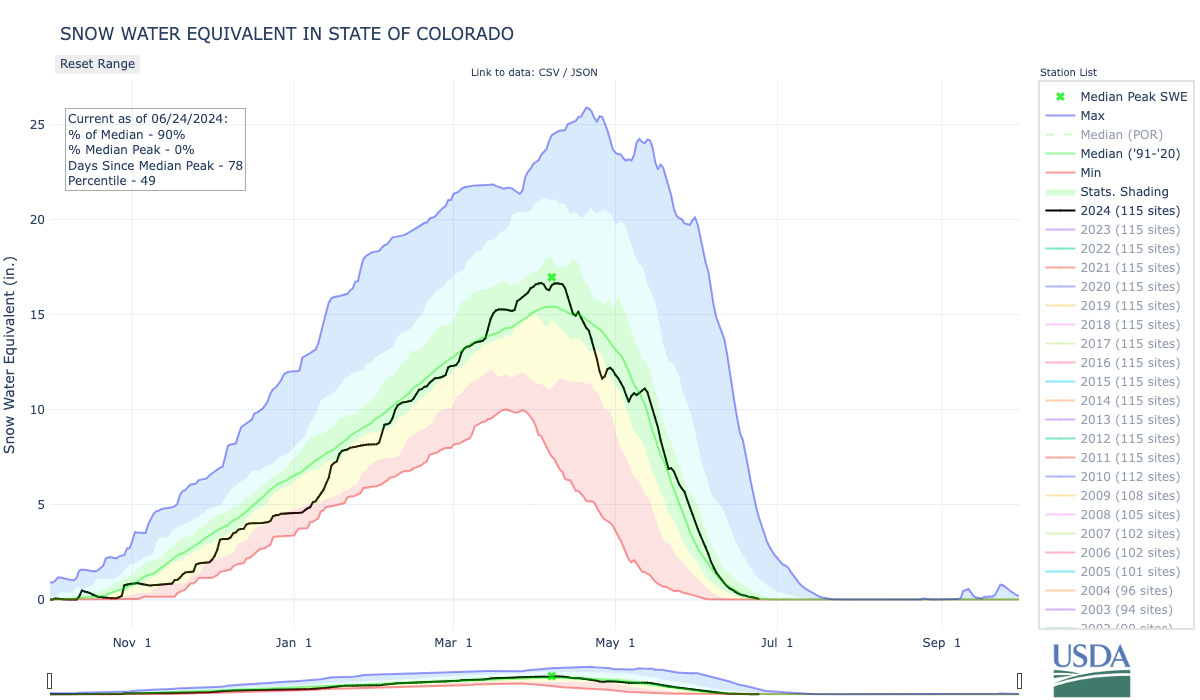
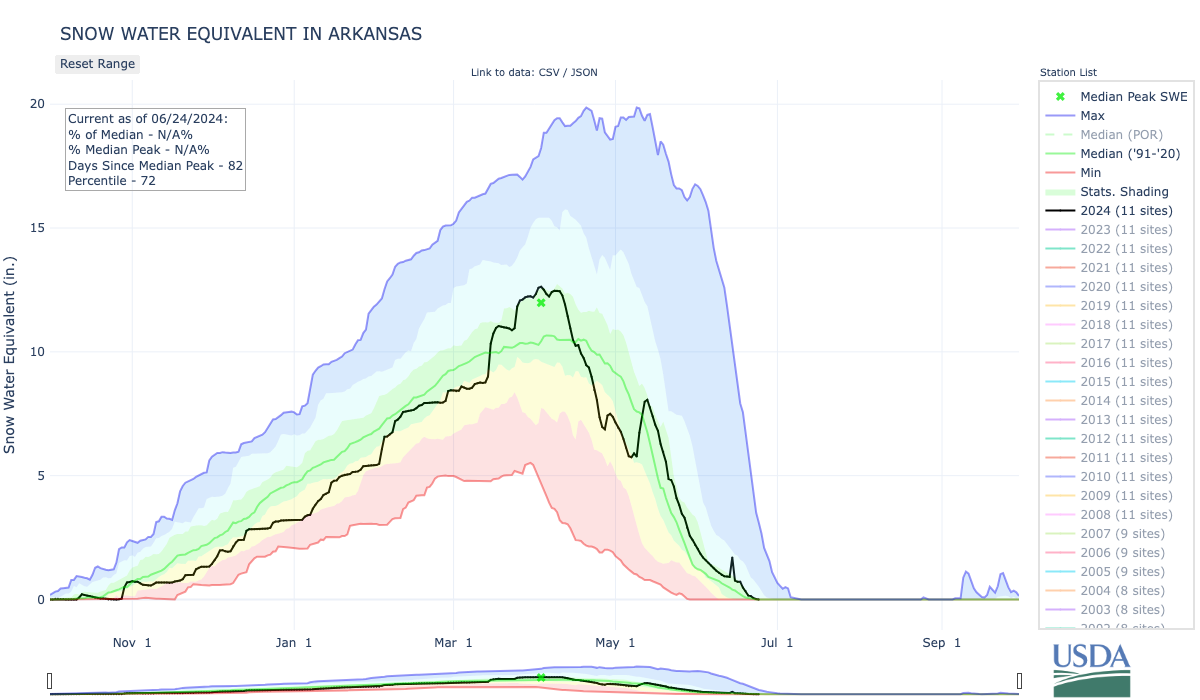
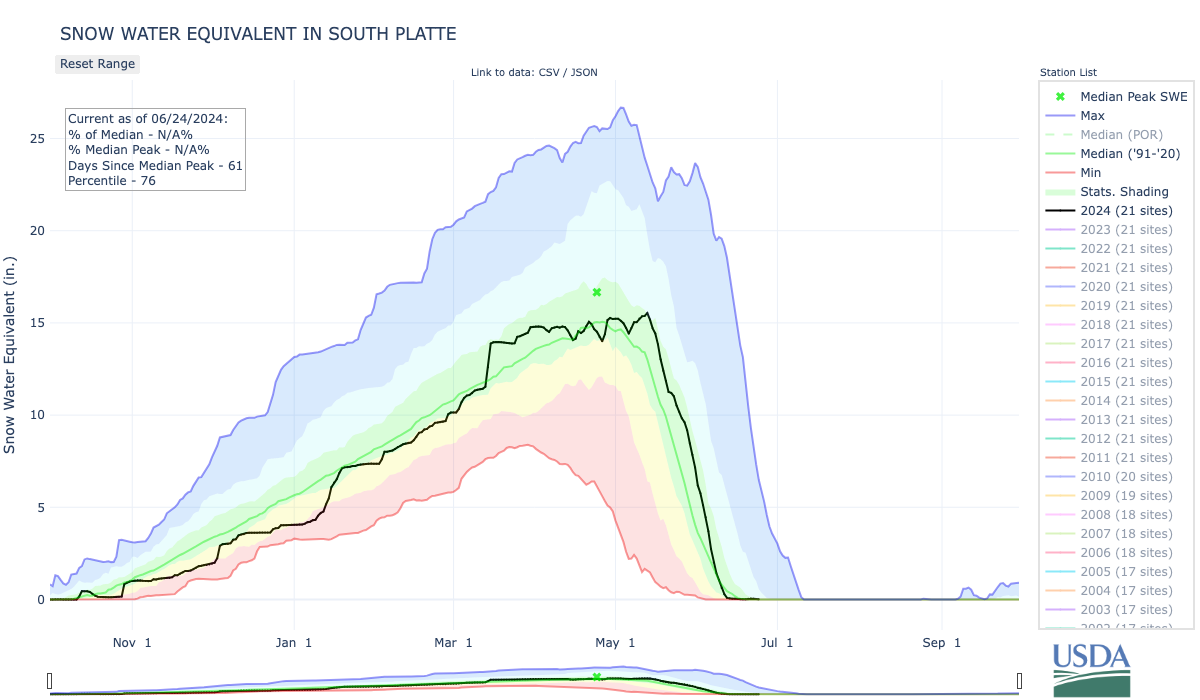
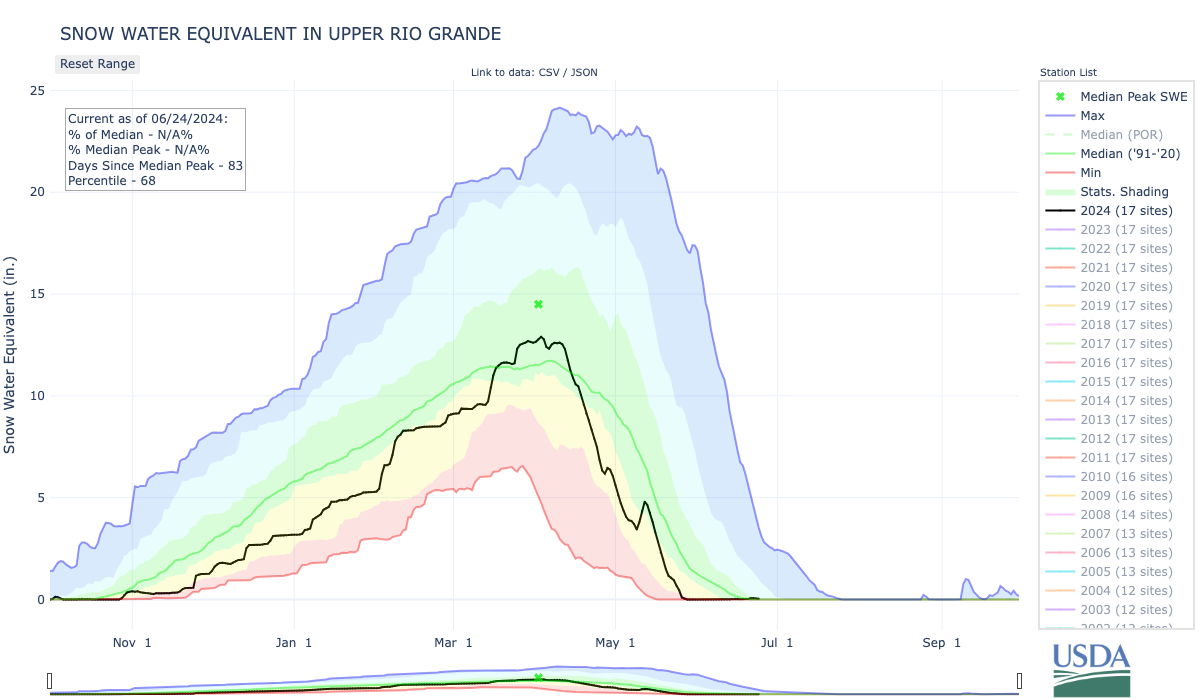
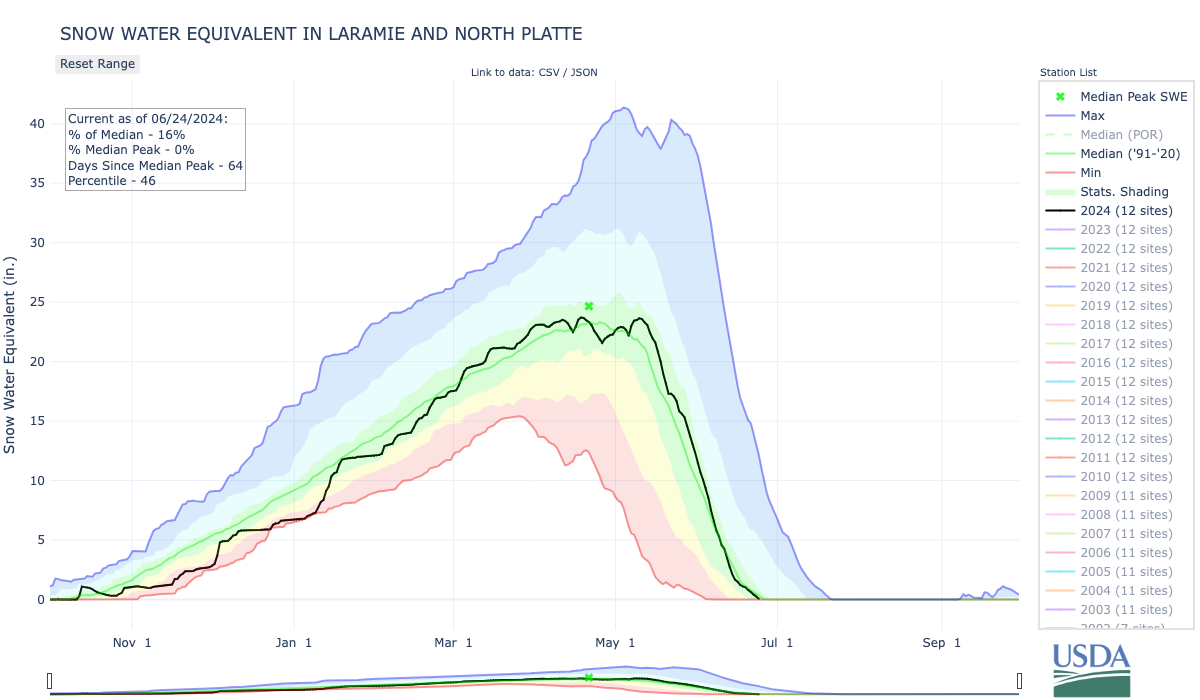
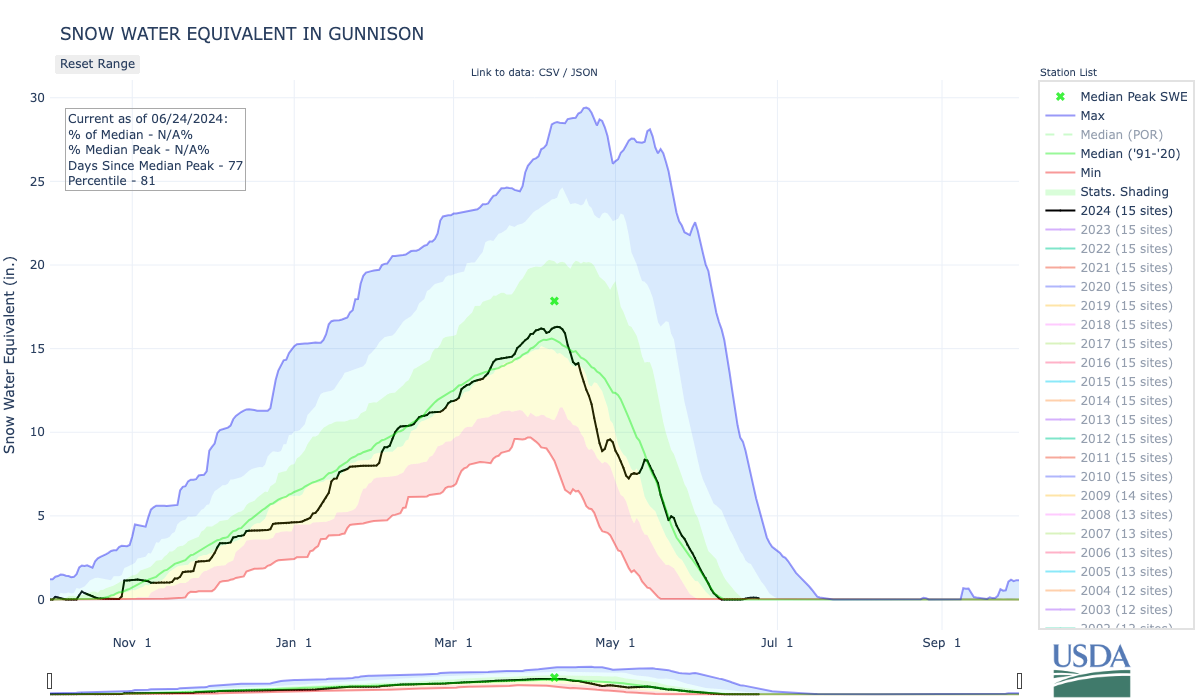
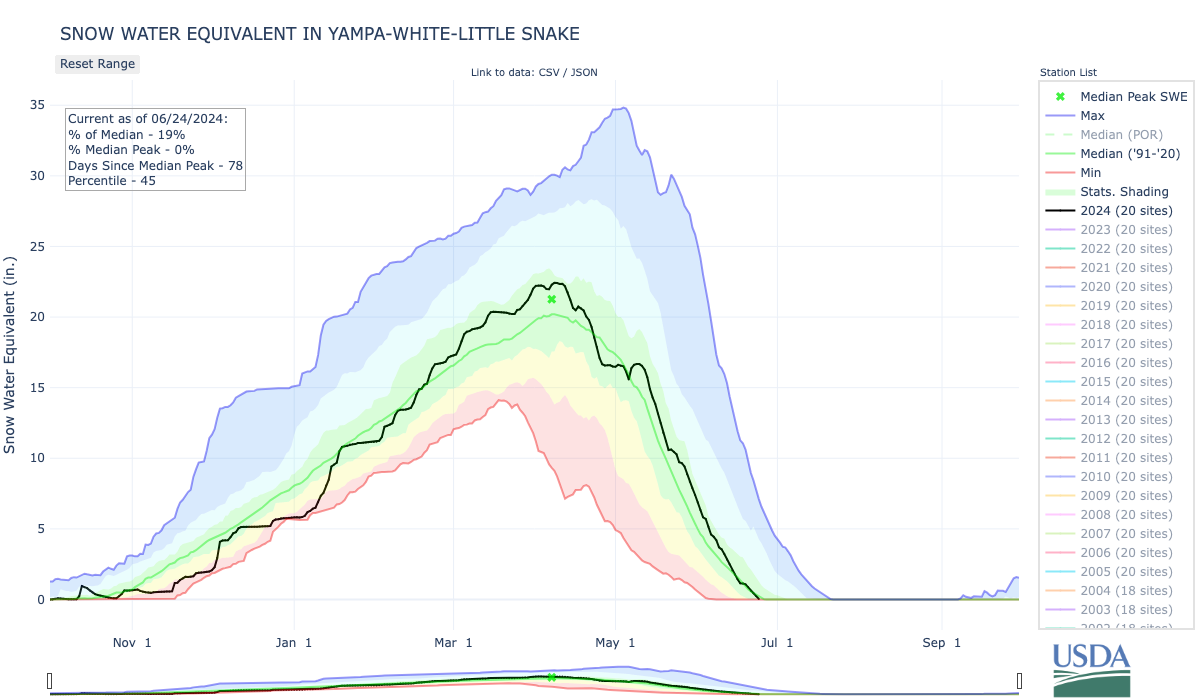
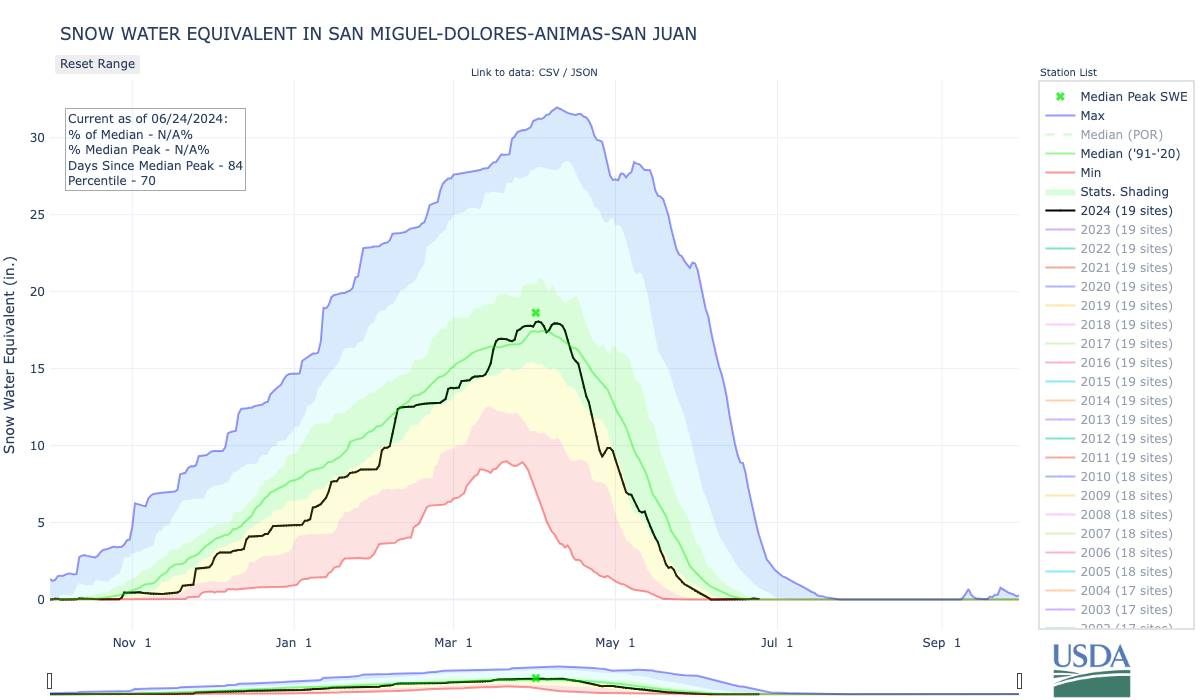
Snowmelt in the Rio Grande headwaters as of May 2, 2024, courtesy NRCS

Click the link to read the article on the InkStain website (John Fleck):

April 29, 2024

A recent rapid warmup has brought high flows to the Rio Grande through New Mexico. But with a modest snowpack sitting in the mountains to the north, that means we should expect the early rise to be followed by an early drop.

Members of the Inkstain Rio Grande Rapid Response Team (IRGRRT) were busy over the weekend monitoring the river. (โ€œMonitoring the riverโ€ actually just means โ€œgoing for walks, bike rides, and boating the riverโ€ like we do nearly every weekend, but โ€œmonitoring the riverโ€ and โ€œRio Grande Rapid Response Teamโ€ sound cooler and more official than a bunch of river nerds goofing.)

Rio Grande, up out of the main channel, at the Rio Bravo Bridge in Albuquerque South Valley. Photo credit: John Fleck/InkStain

IRGRRT team members saw enough water through the Albuquerque reach to float over many of the sandbars, and flows in some of the overbank shallows beyond the main river channel. Those overbank flows are a mixed bag โ€“ important for ecological system function, less helpful for meeting Rio Grande Compact deliveries to our downstream neighbors with whom we share this river.

Last year, with a much larger snowpack, we saw sustained flows this high (and higher) through the end of June, when the Army Corps of Engineers slammed on the brakes. The tail end of the 2023 runoff sat behind the upstream dams at Abiquiu and Cochiti until Nov. 1, when the Corps began releasing it to meet our delivery obligations to our downstream neighbors. That wonโ€™t happen in 2024.

This yearโ€™s flow shot up with the big warmup two weeks ago melting off the snow in a hurry. Thatโ€™s the rapid drop you see in the snowpack graph above. It may already have peaked, with flows hitting 3,600 cubic feet per second at Otowi (the gage above New Mexicoโ€™s Middle Rio Grande Valley). In response, the Corps has dropped releases at Cochiti. At Albuquerque, the peak hit ~3,200 cfs, and has now settled under 3,000 cfs.

Flows at Albuquerque, April 29, 2024. Graphic credit: John Fleck/InkStain

Thanks to all the IRGRRT volunteers, andย Inkstain supporters.

Romancing the River: Cowboys and Indians — George Sibley (Sibley’s Rivers) #ColoradoRiver #COriver #aridification

Great Seal of the Salt River Pima-Maricopa Indian Community.

Click the link to read the article on the Sibley’s Rivers website (George Sibley):

May 1, 2024

The maze design above is the Great Seal of the Salt River Pima-Maricopa Indian Community, inhabiting a relatively small First People Reservation (53,600 acres) in Arizona at the confluence of the Salt and Gila Rivers. The Gila River system drains most of the state of Arizona โ€“ what there is to drain in the subtropical Sonora Desert. The Gila joins the Colorado River at Yuma, near the Mexican border. The reservation was created in 1879 to get the First People out of the way of the Euro-American tsunami coalescing along the Gila as the city of Phoenix โ€“ which has since grown to surround the reservation with suburbs.

Gila River watershed. Graphic credit: Wikimedia

Given the kind of heraldic symbolockry that makes up most Great Seals, signifying power and glory โ€“ I think that to put a maze on your Great Seal takes a certain admirable chutzpah, the higher humor of those who laugh with their gods rather than just being laughed at by them. But when it comes to water and the Colorado River in general, the maze might be an accurate enough symbol for where we all are today: at the ragged end of a century of building a magnificent hydraulic society that has devolved to a near-collapse at the systemic level. Having cobbled together a strategy for nursing the system under a much-amended set of โ€˜Interim Guidelinesโ€™ through to the end of the interim in 2026, the water mavens of the Colorado River Region are now working, not exactly together, on a plan for operating the river post-2026 for at least a couple decades further into the 21stย century. At this point, the Bureau of Reclamation has received at least four alternative post-2026 management plans at this point: one from the four states above the riverโ€™s canyon region, one from the three states below the canyons, one (at least) from a group of environmentalists, and one we might call the โ€˜eldersโ€™ planโ€™ submitted by Eric Kuhn, Jack Schmidt and their scribe John Fleck. Welcome to the maze: these alternatives will all be analyzed through an Environmental Impact Study over the next year or two or five, andย e pluribus unum,ย a management plan will emerge like the sun at the center of what ought to be the Great Seal of the entire Colorado River.
There is, however, probably no set of river users more experienced at wandering in the maze than the 30 tribes of First People on reservations in the Colorado River Basin. They have been finding their way for a century and a half in a maze whose dead ends for them were to be the end of their cultural lives, if they didnโ€™t backtrack and try another way. But they have now, at this point, come through most of those trials and achieved a growing acceptance of the cultural diversity they bring to American society; the government is no longer practicing an active policy of forced assimilation; and there is a growing interest in their cultural and spiritual ways.

But they seem to still have trouble being taken seriously in the Colorado River Basin as potentially part of the solution of the water challenges rather than just objectified as part of the problem. They have not submitted a post-2026 management plan per se; they have instead submitted a three-page letter that is something between a request and a demand: first, that the federal government meet its trust responsibility to Basin Tribes by actively protecting their Tribal water rights from being first-to-be-cut (irrespective of whether they have already been finally quantified); second, that the government eliminate systemic obstacles to their full development of their water rights; and third, that the government provide a permanent, formalized structure for Tribal participation in implementing the Post-2026 Guidelines, and in any future Colorado River policy and governance. (Click here for their letter.)

As usual, this wants a little historical context. Any discussion of โ€˜Tribal Water Rightsโ€™ requires, for example, a clear understanding of the distinction between โ€˜paper waterโ€™ and โ€˜wet waterโ€™: โ€˜paper waterโ€™ is water which one has a legal right to use; โ€˜wet waterโ€™ is the amount of paper water one can actually afford to put to use with money, time and will.

In 1908 the U. S. Supreme Court gave โ€“ or appeared to give โ€“ the First People tribes a lot of paper water with a very senior right: in a Montana case involving settlers in the Milk River valley and the Ft. Belknap Crow Reservation, Winters v. The United States, the Court said that whenever the federal government reserved public lands for any purpose, it also implicitly reserved the water necessary to carry out that purpose โ€“ and the priority date for that reservation of water would be the date the reservation was created. Also, the standard โ€˜use it or lose itโ€™ mandate of the appropriation doctrine would not apply; the water right would be there whenever the reservation was finally able to develop its paper water.

This โ€˜Wintersย doctrineโ€™ was a real wild card dropped into the federal governmentโ€™s relationship with the First People at the time. Government policy toward the โ€˜Indian problemโ€™ by the turn of the century had advanced beyond โ€˜the only good Indian is a dead Indian,โ€™ to a policy of forced assimilation โ€“ โ€˜Kill the Indian to save the person.โ€™ It was a policy change from an Indian War waged by the cavalrymen, to cowboy work for the Office of Indian Affairs (OIA): roundโ€™em up, corralโ€™em, feedโ€™em โ€“ but donโ€™t letโ€™em get too comfortable because we want to moveโ€™em on into good jobs and a better life as โ€˜real Americans.โ€™

And the OIA cowboys rode for the USA brand, not the Indians. Theirs was the job of carrying out the 1887 Dawes Act, whereby reservations for people who had only known the land and water as commons for everyone (in their band) to use, saw the land divided into private farm plots which they would own individually and be individually responsible for (whatever that meant). Their children were torn from family and clan and hustled off to distant Indian schools were they were taught industrial skills and the advantages of no longer being an Indian. The goal was to facilitate the disappearance of the โ€˜Indian problemโ€™, into the farm towns and industrial cities surrounding the reservations, with a liquor store just down the road at every exit.

Theย Wintersย doctrine was also an unexpected and unappreciated wild card played in the federal-state relationship. Until that assertion by the nationโ€™s highest court, water matters had been left to the states since there was no one-size-fits-all for the variability in climate, state by state. But the creation ofย federalย reserved rights for water in the arid states was capable of blowing large holes in theย state-levelย prior appropriation doctrine the arid and semi-arid states had all adopted as grassroots common law. Dating the reserved water rights to the creation dates of the reservations made the First People (not unjustly) senior to practically every other user โ€“ and then allowing the reservers to hold the water right indefinitely without putting the water immediately to beneficial use โ€“ it was easy to see the federal reserved right as a deadly attack on the appropriation law.

The states eventually struck back at the concept of the federal reserved right. The U.S. Congress tamed the federal reserved right somewhat in 1952 with the McCarran Amendment by Nevada Senator Pat McCarran; this mandated that any federal reserved right would have to go through the standard water right adjudication procedures of the state(s) involved. Further court decisions said that quantification of the reserved water right was limited to the primary purpose of the reservation, and the decree could only be for the minimum amount of water necessary to fulfill that purpose.

On the positive side for the First People, American public opinion about them was mellowing through the first third of the 20thย century, as reflected in the Indian Reorganization Act in 1934. This mostly reversed (for at least a couple decades) the more brutal aspects of the assimilation policies, and restored some local control over First People land and resources; the People were encouraged to create their own tribal governance. The often heavy-handed trustee relationship with the OIA cowboys continued to be a very mixed blessing (especially where water was concerned), but at least self-governance gave them the opportunity to raise a unified voice.

Water continued to be problematic, however. In considering the importance of the federal reserved right in the Colorado River Basin, it is important to note that less than half of the First People tribes were being rounded up and herded in from hunter-forager lives โ€“ or as that life had evolved due to the presence of Spanish horses and the crowding due to population growth and white pressure, the hunter-gatherer-herder-warrior-raider life. These were tribes like the Utes, Navajos, Apaches and Comanches who had decided that, rather switching to agriculture, they would rather fight each other and the Euro-Americans over territory, horses, slaves, and plain love of the skirmish, while raiding more settled People for their subsistence.

Meanwhile, many other First People were well into the transition from hunting and foraging to farming. As the gold and silver rushes brought on the white tsunami in the 1850s and 60s, two First People tribes farming on the Colorado River floodplains and hunting in the adjacent uplands โ€“ the Mojave and Chemehuevi โ€“ actuallyย requestedย that the Office of Indian Affairs create a reservation for them on the river floodplain, yielding their upland hunting grounds for a place the white settlers could not invade.Reservations for the Mojave, Chemehuevi and โ€˜Colorado River Indian Tribesโ€™ (both tribes) were duly created near where California, Nevada and Arizona intersect. Small tribes farming farther down the river also received small reservations, some for groups of only a few hundred people.

Screen shot from episode of “Tom Talks” April 2020.

Then there were the First People who had been irrigating farmland from time immemorable in the Gila River Basin, mostly branches of the Tohono Oโ€™odam People like the Pima and Maricopa, who traced their heritage and culture back to the Huhugam (Hohokam) hegemon that had prevailed in the Gila Basin several hundred years before the Spanish Entrada in the Southwest, and (like all advanced โ€˜civilizationsโ€™) collapsed mysteriously, probably from some combination of over-population and unsustainable economic and cultural complexity.

Many of the First People in the Southwest did not, in other words, evenย needย the supposed advantage of a federal reserved right; they could have filed directly into the state adjudication system for the right to water they had been using beneficially since well before the Euro-American invasion โ€“ย ifย their supposed trustee, the OIA cowboys, had explained the new laws to them and shepherded them into and through the adjudication process, standing up for them as Congress had supposedly charged them to do.

Instead, the First People found their water disappearing as the land filled in around them, upstream and down, and their physical and cultural lives deteriorated accordingly, as well as their sustainable economics. The white settlers irrigating their own lands were not consciously stealing Indian water; they were just participating in the first-come first-served race for resources that the prior appropriation doctrine sets up, and the First People were not privy to the procedures for getting into that race.

The cultural undermining of the Gila River Basin First People in the late 19thย century falls entirely on the failure of their government trustees to help them negotiate the bewildering new appropriation systems. But that is a historical judgment that has to balanced with a little empathy for the OIA cowboys themselves, trapped in the history of Americaโ€™s cowboy epoch. They undoubtedly believed they were just carrying out federal policy, which was assimilation of the First People โ€“ forced when necessary. The โ€˜potโ€™ looking today at that โ€˜black kettleโ€™ has to be aware of the fact that our government still seems to be dominated by representatives who believe โ€“ perhaps not consciously โ€“ that keeping conditions on the reservations generally miserable and hopeless helps bring the First People along to leaving the reservation and becoming real Americans. Otherwise, why would we allow conditions to remain so bad on so many reservations?

But this not a story with the usual unhappy ending. The fact is, some of these First People reservations are bootstrapping themselves back into a state of reasonably well-watered economic and cultural vitality, and are doing a lot of it on their own impetus, with their cowboy trustees riding shotgun to help as necessary with authority and funding. They have actually acquired quite a lot of decreed paper water โ€“ a full third of the total current flow of the river โ€“ but they have only been able to put maybe a fourth of that to work as real water. They will tell you that they are not done โ€“ as their letter to the Bureau indicates โ€“ but will also say they want to work out the use of their water so consumptive use does not increase significantly.

We will look more closely at that apparent contradiction, and how it is unfolding, in the next post.

Meanwhile โ€“ welcome to the maze. Where it might make sense to stop, look and listen to those who have been here longest.

Native America in the Colorado River Basin. Credit: USBR

The spring melt is coming for mountain snow, but not all will make it to the #ColoradoRiver — KUNC #COriver #aridification

A pair of skiers descends Arapahoe Basin Ski Resort on April 22, 2024. Colorado’s Rocky Mountains just reached their peak for winter snow. Soon, it will melt into rivers and reservoirs that combine to supply about 40 million people across the Southwest. Photo credit: Alex Hager/KUNC

Click the link to read the article on the KUNC website (Alex Hager):

April 29, 2024

This story is part of ongoing coverage of the Colorado River, produced by KUNC in Colorado and supported by the Walton Family Foundation. KUNC is solely responsible for its editorial coverage.

High in the Rocky Mountains, spring is the time of year when altitude makes all the difference. Above the treeline, the mountains have been rendered almost featureless, blanketed by the deepest snow theyโ€™ll see all year. Lower down, that white blanket is starting to turn to slush, beginning its spring trickle into the streams and rivers that flow downhill.

Forecasters are optimistic after a relatively strong snow season, but say a variety of weather factors could limit the amount of water that will run off into rivers and reservoirs this spring.

Water managers from across the West are turning their eyes to those high-alpine climes to get a sense of summertime water supply for cities and farms across the region. The Colorado River, which supplies 40 million people from Wyoming to Mexico, gets the vast majority of its water from mountain snow. Two-thirds of that snow falls in Colorado.

Snowpack in the Upper Colorado River Basin โ€“ which includes Colorado, Wyoming, Utah and New Mexico โ€“ appears to have peaked on April 3, within a few days of the average peak date. It is measured by calculating the amount of water held in snow.

At its peak, the amount of water held in snow was right around average when compared to winters across the past three decades, and marked the second-highest peak since 2019.

SNOTEL automated data collection site. Credit: NRCS

A vast network of sensors, often hidden deep in the woods, gathers weather data in different parts of the Rockies, giving climate scientists and water forecasters a robust set of metrics about snow.

On the day the Upper Basinโ€™s snowpack peaked, nearly every sensor in western Colorado and eastern Utah showed snow totals above 90% of average, with many above 100 percent. A handful of stations showed drier conditions, especially around the Green River in Wyoming and the San Juan River in Colorado. Both watersheds included a number of stations that recorded earlier snowpack peaks and melting periods than the rest of the region.

Hurdles on the way to the river

Even though snow totals are about average, there are a few things that stand in the way of that snow reaching rivers and reservoirs once it melts. Becky Bolinger, Coloradoโ€™s assistant state climatologist, expressed some guarded optimism about the stateโ€™s snow data.

โ€œLiving in Colorado, sometimes it’s hard to have those good vibes because it can just turn on a dime,โ€ she said.

Bolinger highlighted two big factors that could mean lower river flows than near-average snow totals might suggest.

The first is dry soil. Hot summers can sap the water out of the ground, leaving it parched when snow starts to fall. Thatโ€™s the case this year, and Bolinger expects that some areas will see that thirsty dirt act like a sponge, soaking up snowmelt before it has a chance to reach rivers and reservoirs.

The second is high temperature. Abnormally warm days, which are becoming more common due to climate change, could cause that water to melt quicker and earlier before evaporating into the air. Bolinger said that is more likely in the warmer parts of southern Colorado, around the San Juan Mountains and Sangre de Cristo Mountains.

Bolinger added that windblown dust from nearby plains could land on mountain snow, causing it to melt faster, since dark colors attract more heat from the sun than pure white snow.

Looking back at El Niรฑo

As winter turns to spring, climate scientists have a chance to compare their early-season forecasts with the outcome of this winter.

This year brought โ€œEl Niรฑoโ€ conditions to the Western U.S, a phenomenon that typically comes around every two to seven years. Itโ€™s a pattern driven by warm water in the Pacific Ocean, which tends to cause warm conditions in the northern part of the West and wet conditions in the southern part. It can be hard to predict the impact of El Niรฑo on Colorado River basin snowpack because the dividing line between those two trends falls in or around Colorado.

This year, El Niรฑo delivered less snow than expected.

โ€œEl Niรฑo will tilt the odds in favor of wetter or snowier conditions over the region,โ€ said Nat Johnson, a meteorologist with the National Oceanic and Atmospheric Administration. โ€œBut it doesn’t rule out the possibility of the opposite outcome. Sometimes, just the influence of our chaotic weather and the climate system can overrule the influence of El Niรฑo.โ€

Grays and Torreys, Dillon Reservoir May 2017. Photo credit Greg Hobbs.

Johnson, who works with the agencyโ€™s Geophysical Fluid Dynamics Laboratory, said that could be the result of other patterns in ocean temperature as well as the unpredictable nature of weather.

Climate change is driving warmer days and earlier snowmelt in the Colorado River basin itself, but it also impacts faraway phenomena that influence the Southwestโ€™s weather, making that weather harder to predict. That may have been the case with this yearโ€™s El Niรฑo.

โ€œGlobal oceans were just so incredibly warm,โ€ Johnson said. โ€œNot just breaking records, but really shattering the records. It just makes me think that just the really unusual warmth that we saw may have been an even bigger factor than we’ve typically seen in recent years.โ€

Planning for an unpredictable future

Data about snow, streams and soil doesnโ€™t just matter to the people living near the mountains. Itโ€™s also watched closely by people hundreds of miles away.

“It’s extremely important,โ€ said Kristen Johnson, manager of Colorado River Programs at the Arizona Department of Water Resources. โ€œThere’s no way around it. We can’t have the Arizona economy without abundant snow in the Upper Basin and efficient runoff from that snow into Lake Powell.โ€

About 36% of Arizonaโ€™s water comes from the Colorado River. That includes sprawling farm fields near the river itself, which forms the stateโ€™s western border with California. It also includes water routed away from the river through a 330-mile canal across the desert for use in Phoenix and its suburbs.

Parts of Nevada and Southern California also rely on faraway snow to fill the Colorado River and the nationโ€™s two largest reservoirs โ€“ Lake Powell and Lake Mead. They have both shrunk to record lows in recent years as a result of climate change and steady demand.

Changing snow patterns, driven by warmer temperatures, are at the heart of a debate about how to manage those reservoirs going forward.

Scientists say the Westโ€™s water crisis goes beyond โ€œdrought,โ€ which is considered to be temporary. Instead, they say the two-decade stretch of dry conditions around the Southwest is a sign of โ€œaridificationโ€ โ€“ a permanent resetting of the baseline for how much water is expected to enter rivers and streams each year.

The seven states which use the Colorado River are currently mired in a standoff about how to manage that shrinking supply in the future. Theyโ€™re divided into two camps and have submitted competing proposals for how to share the river after 2026, when the current guidelines expire.

The Lower Basinโ€™s proposal, submitted by Arizona, California and Nevada, puts forth a new system of distributing water cutbacks in times of shortage that is based on the amount of water currently in reservoirs, rather than projections for future water availability.

โ€œEveryone’s recognizing that relying on forecasts is not the best way to be making decisions,โ€ Arizonaโ€™s Johnson said. โ€œI think we’re just looking to take the guesswork out of making those decisions in the future.โ€

Meanwhile, the Upper Basin states of Colorado, Utah, Wyoming and New Mexico submitted a competing proposal. It suggests entirely different management changes than the Lower Basinโ€™s plan, but also centers around the basic fact that climate change is shrinking the snowpack that feeds the Colorado River, and people need to respond by using less water.

That plan suggests that the four Upper Basin states should be allowed to send less water to their Lower Basin counterparts. Opponents say doing so would go in the face of long standing legal agreements and may not survive challenges in court. The planโ€™s authors frame it as a necessary step to alleviate the sting of climate change from those who are nearest to the snow and feel it the most.

States donโ€™t appear close to compromise when it comes to future Colorado River management, but theyโ€™re under pressure from the federal government to find some agreement before the end of 2024 and avoid any possible complications that could be brought on by a change of presidential administrations after the November election.

โ€˜I Water That Way,โ€™ new music video from the Splashstreet Boys: #Denverโ€™s summer watering rules have never sounded like this — News on Tap

April 29, 2024 | By:ย Jimmy Luthye

Click through to YouTube to follow along with the lyrics.

US military bases teem with #PFAS. Thereโ€™s still no firm plan to clean them up — Grist

Petersen Air Force Base. Photo credit: Peterson Air and Space Museum

Click the link to read the article on the Grist website (Sachi Kitajima Mulkey):

April 29, 2024

Excessive levels of PFAS have been detected at 80 percent of active and decommissioned military bases.

In 2016, Tony Spaniola received a notice informing him that his family shouldnโ€™t drink water drawn from the well at his lake home in Oscoda, Michigan. Over the course of several decades, the Air Force had showered thousands of gallons of firefighting foam onto the ground at Wurtsmith Air Force Base, which closed in 1993. Those chemicals eventually leached into the soil and began contaminating the groundwater.

Alarmed, Spaniola began looking into the problem. โ€œThe more I looked, the worse it got,โ€ he said. Two years ago,ย  his concern prompted him to co-found the Great Lakesย PFASย Action network. The coalition of residents and activists is committed to making polluters, like the military and a factory making waterproof shoes, clean up the โ€œforever chemicalsโ€ theyโ€™ve left behind.

PFAS, or per- and polyfluoroalkyl substances, are a class of nearly 15,000 fluorinated chemicals used since the 1950s to make clothing and food containers, among other things, oil- and water-repellent. Theyโ€™re also used in firefighting foam. These chemicals do not break down over time, and have contaminated everything from drinking water to food. Research has linked them to cancer, heart and liver problems, developmental issues, and other ailments.

The U.S. Department of Defense, or DOD, is among the nationโ€™s biggest users of firefighting foam and says 80 percent of active and decommissioned bases require clean up. Some locations, like Wurtsmith, recorded concentrations overย 3,000 times higherย than what the agency previously considered safe.

Today, the EPA considers it unsafe to be exposed to virtually any amount of PFOA and PFOS, two of the most harmful substances under the PFAS umbrella. Earlier this month, it implemented the nationโ€™sย first PFAS drinking water regulations, which included capping exposure to them at the lowest detectable limit. As of April 19, the agency also designated these two compounds โ€œhazardous substancesโ€ under the federalย Superfundย law, making it easier to force polluters to shoulder the costs of cleaning them up.ย 

Meeting these regulations means that almost all of the 715 military sites and surrounding communities under Defense Department investigation for contamination will likely require remediation. Long-standing cleanup efforts at more than 100 PFAS contaminated bases that are already designated Superfund sites, like Wurtsmith, reveal some of the challenges to come.

โ€œThe heart of the issue is, how quickly are you going to clean it up, and what actions are you going to take in the interim to make sure people arenโ€™t exposed?โ€ said Spaniola.

A sign warning hunters not to eat deer because of high amounts of toxic PFAS chemicals in their meat, in Oscoda, Michigan. Drew YoungeDyke, National Wildlife Federation

In a statement to Grist, the DOD says its plan is to follow a federal clean up law called the Comprehensive Environmental Response, Compensation, and Liability Act, or CERCLA, to investigate contamination and determine near- and long-term clean up actions based on risk. But many advocates, including Spaniola, say the process is too slow and that short-term fixes have been insufficient. 

The problem started decades ago. In the 1960s, the Defense Departmentย worked with 3M, one of the largest manufacturers of PFAS chemicals, to develop a foam called AFFF that can extinguish high-temperature fires. The PFAS acts as a surfactant, helping the material spread more quickly. By the 1970s, every military base, Navy ship, civilian airport, and fire station regularly used AFFF.ย 

Firefighting foam containing PFAS chemicals is responsible for contamination in Fountain Valley. Photo via USAF Air Combat Command

In the decades that followed, millions of gallons flowed into the environment. According to the nonprofit Environmental Working Group, or EWG, 710 military sites throughout the country and its territories have known or suspected PFAS contamination. Internal studies and memos show that not long after 3M and the US Navy patented the foam in 1966, 3M learned that its PFAS products could harm animal test subjects and accumulated in the body. 

In a 2022 Senate committee hearing, residents from Oscodatestified about the health impacts, such as tumors and miscarriages, from the PFAS contamination at Wurtsmith. In 2023, Michigan reached a settlement after suing numerous manufacturers, including 3M and Dupont. Today, thousands ofย victims across the country are suingย the chemicalโ€™s manufacturers. While some organizations and communities have tried to hold the military financially responsible for this pollution โ€” farmers in several states recently filed suits in the U.S. District Court in South Carolina to do just that โ€”ย the DOD says itโ€™s not legally liable.

Congressional pressure on the Pentagon to clean these sites has been growing. In 2020, National Defense Authorization Acts required it to phase out PFAS-laden firefighting foam by October, 2023. Since passing that law, Congress has also ordered the department to publish the findings of drinking and groundwater tests on and around bases.

Results showed nearlyย 50 sitesย with extremely high levels of contamination, and hundreds more with levels above what was then the EPAโ€™s health advisory. Following further congressional pressure, the military announced plans to implement interim clean-up measures atย three dozenย locations, including a water filtering system in Oscoda.

According to a report by the Environmental Working Group, it took an average of nearly three years for the Department of Defense to complete testing at these high-contamination sites. It took just as long to draft stopgap cleanup plans. Today, 14 years after PFAS contamination was discovered at Wurtsmith, the first site to be tested, no site has left the โ€œinvestigationโ€ phase, and there has yet to be a comprehensive plan to begin permanent remediation on any base.

The Department of Defense says any site found to have PFAS contamination exceeding the Environmental Protection Agencyโ€™s previous guideline of 70 parts per trillion will receive immediate remediation, such as bottled waters and filters on faucets. When a site is found to be contaminated, the EPA says, the department has 72 hours to provide residents with alternate sources of water.

After six years spent working with various clean up initiatives, Spaniola says waiting for the military to take action has taken a toll on the people of Oscoda. โ€œThe community had a really good relationship with the military,โ€ he said. โ€œIโ€™ve watched that change from a very trusting relationship to a terrible one.โ€ 

Dozens of states have mandated additional requirements to treat PFAS in municipal water systems, but such efforts often overlook private well owners. Thatโ€™s leaving thousands of people at risk, given that in Michigan, where some 1.5 million people drink water from contaminated sources, 25 percent of residents rely on private wells.  

Nationwide, the Environmental Working Group found unsafe water in wells nearย 63 military bases in 29 states. While the DOD has tested private wells, it has not published the total number of wells tested or identified which of them need to be cleaned up.ย 

Typical water well

โ€œFor those who are on well water, itโ€™s a real problem until thereโ€™s a bit of recognition for some sort of responsibility for the contamination,โ€ said Daniel Jones, associate director of the Michigan State University Center for PFAS Research. He is advising cleanup efforts near Grayling, Michigan. โ€œIt sort of comes down to who has pockets deep enough to pay for the things that need to be done.โ€

The EPAโ€™s recent decision to designate PFOA and PFOS โ€œhazardous substancesโ€ under the federal Superfund law isย unlikely to provide quick financial assistance to communities, even though the agency has madeย $9 billion availableย for private well owners and small public water systems to address contamination. Whether that support reaches private well owners is up to individual states, which can work with regional EPA offices to draft project plans beforeย applying for grantsย to secure funding.
The agency has established a five-year window for water systems to test for PFAS and install filtering equipment before compliance with the newly tightened levels will be enforced. While EPA says the new PFOA and PFOS regulations do not immediately trigger an investigation or qualify them as Superfund sites on theย National Priorities List,ย decisions for each site will be on a case-by-case basis.

โ€œIt is a tremendous win for public health, it is tremendously important and cannot cannot come soon enough, particularly for military communities who have been exposed for decades,โ€ said Melanie Benesh, vice president of governmental affairs at the Environmental Working Group. Benesh hopes that the new rules help push the Defense Department to move more quickly.

PFAS contamination in the U.S. October 18, 2021 via ewg.org.

#Wyoming Governor Gordon promises to sue after Environmental Protection Agency moves to slash #coal emissions — @WyoFile #ActOnClimate

Ceremonial shovels mark the location of the Innovation Center coal refinery field demonstration project north of Gillette on Sept. 2, 2022. It will be co-located with Atlas Carbon’s facility that produces activated carbon products. (Dustin Bleizeffer/WyoFile)

Click the link to read the aricle on the WyoFile website (Dustin Bleizeffer):

April 26, 2024

Biden administrationโ€™s suite of coal pollution rules a win for climate and health, advocates say, but a major blow to one of Wyomingโ€™s bedrock economic drivers.

Gov. Mark Gordon has promised to sue over a new suite of federal rules that most observers agree will hasten the U.S. thermal coal industryโ€™s trajectory toward extinction โ€” an existential threat to many Wyoming communities and one of the stateโ€™s main economic drivers.

The U.S. Environmental Protection Agency on Thursday issued four โ€œfinalโ€ rules aimed at drastically cutting coal pollution, including a mandate that existing coal-fired power plants cut or capture 90% of their planet-warming carbon dioxide emissions by 2032 or convert to natural gas or close altogether. The agencyโ€™s other rules set timelines for significant cuts to smokestack emissions of mercury and other toxic metals, polluted wastewater from coal power plants and more stringent standards for coal ash disposal.

The โ€œpower plantโ€ rules make good on President Joe Bidenโ€™s promise to address human-caused climate change, according to the EPA. The actions are also intended to help curtail illness and premature deaths from coal pollution while providing a clear regulatory framework for utilities to shift to renewable sources of energy.

The agency also noted that it consulted with coal-reliant utilities about their existing plans regarding coal facilities and crafted the implementation schedules to allow for planning that avoids electrical power supply issues.

Gov. Mark Gordon and U.S. Environmental Protection Agency Administrator Michael Regan held a joint press conference at the University of Wyoming on August 9, 2023. (Dustin Bleizeffer/WyoFile)

โ€œBy developing these standards in a clear, transparent, inclusive manner, EPA is cutting pollution while ensuring that power companies can make smart investments and continue to deliver reliable electricity for all Americans,โ€ EPA Administrator Michael S. Regan said in a prepared statement.

Coal proponents in Wyoming are furious.ย 

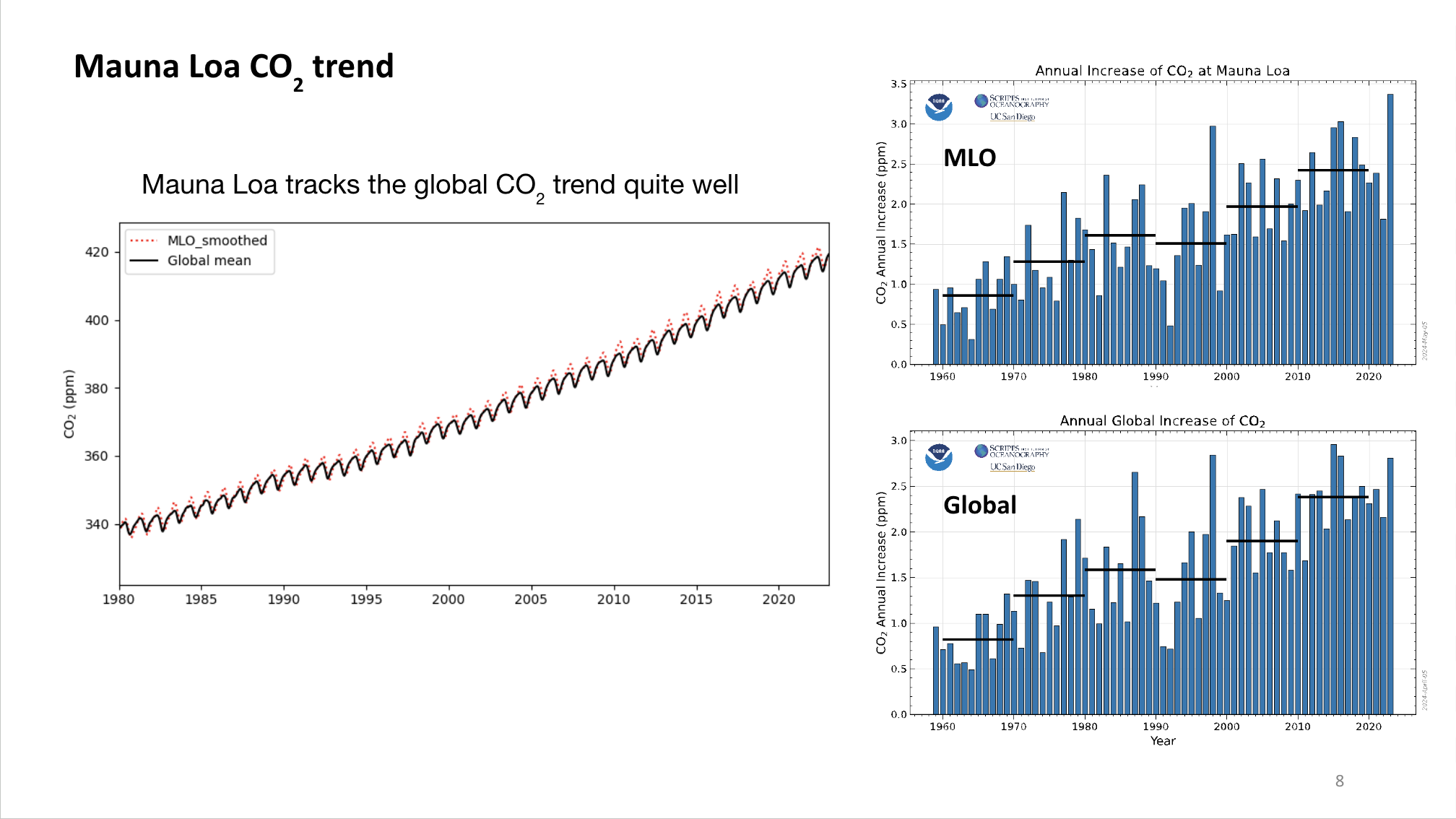
This graph shows the globally averaged monthly mean carbon dioxide abundance measured at the Global Monitoring Laboratoryโ€™s global network of air sampling sites since 1980. Data are still preliminary, pending recalibrations of reference gases and other quality control checks. Credit: NOAA GML

While the rules target coal-fueled power plants, they also put Wyoming coal mines on notice: Their already waning U.S. customer base has an expiration date.

โ€œIt is clear the only goal envisioned by these rules released by the Environmental Protection Agency today is the end of coal communities in Wyoming,โ€ Gordon said in a prepared statement Thursday. โ€œEPA has weaponized the fear of climate change into a crushing set of rules that will result in an unreliable electric grid, unaffordable electricity and thousands of lost jobs.โ€

The Wyoming Mining Association also discounted climate change as an excuse to attack the coal industry. 

โ€œWyoming is once again the sacrificial lamb on the altar of the climate change cult,โ€ the associationโ€™s Executive Director Travis Deti said. 

The rules

Theย carbon dioxide emissions ruleย applies to coal-fired power plants as well as new natural gas-fired facilities, requiring them to prevent at least 90% of greenhouse gasses from entering the atmosphere.ย 

โ€œExisting coal-fired power plants are the largest source of [greenhouse gas] from the power sector,โ€ the EPA stated in the rule. โ€œNew natural gas-fired combustion turbines are some of the largest new sources of [greenhouse gas] being built today, and these final standards will ensure that they are constructed to minimize their [greenhouse gas] emissions.โ€ 

The rule updating Mercury and Air Toxics Standards tightens emissions by about 70%, an especially significant reduction for plants that burn lignite โ€” a lower-value coal than Wyomingโ€™s subbituminous product โ€” according to the agency.

Coal-fueled power plants will also be required to reduce various โ€œpollutantsโ€ associated with wastewater by more than 660 million pounds annually, and follow more stringent standards to prevent leaks at coal-ash storage facilities.

Implications for Wyoming

Wyoming remains the nationโ€™s largest coal producer, although production has plummeted by nearly half since 2008, with companies shipping some 237 million tons in 2023, according to the Wyoming State Geological Survey. More than 90% of coal mined in the state is sold to power plants in the U.S., which is why itโ€™s often referred to as โ€œthermal coalโ€ โ€” unlike โ€œmetallurgic coalโ€ that is sold to steel manufacturers.

Wyoming coal production has decreased by nearly half since 2008. (University of Wyoming)

Coal mining contributed some $650 million in taxes, royalties and fees to the state in 2019 and employed more than 5,000 workers, according to the Wyoming Mining Association.

The vast majority of coal mining occurs in the Powder River Basin in the northeast corner of the state, while several communities host nearby coal-fired power plants: Gillette, Glenrock, Wheatland, Kemmerer and Rock Springs.

Although Wyoming has experienced declines in both coal production and coal-fired power, the industry still serves as a major economic backbone for the state โ€” and a significant source of government revenue. The potential loss of coal-fired power facilities is an especially daunting prospect for nearby communities.

Those communities have wrestled with the knowledge of potential plant closures for a long time already, and the EPAโ€™s new rules only serve to clarify that potential reality, said Robert Godby, associate professor at the University of Wyomingโ€™s Economics Department.

โ€œIt really just kind of steepens the glide path to what we all knew was happening anyway,โ€ he told WyoFile on Friday.ย 

Explosive materials are loaded into a โ€œblast holeโ€ at a coal mine. (Dyno Nobel)

The new rules are likely to be challenged in court, not only by Wyoming, but also by other coal-reliant states, Godby said. Politics will also continue to play a role โ€” particularly if a Republican wins the presidential election this year. He noted, however, that former President Donald Trump was not able to make good on a promise to turn around the coal industryโ€™s decline.

Regardless, utilities are under increasing pressure to make long-term investment decisions in a quickly changing energy environment, and the EPAโ€™s actions this week diminish the likelihood that theyโ€™ll find the regulatory certainty needed to invest in coal-fueled power.

โ€œIt makes it more likely theyโ€™re going to retire [coal plants] and announce firm dates,โ€ Godby said. โ€œThatโ€™s going to create more certainty for the communities that are affected.โ€

Meantime, Gordon, who has touted technologies to reduce carbon dioxide from coal power plants, has vowed to fight the rules.

โ€œThese rules are a travesty, and their effects are devastating,โ€ Gordon said. โ€œI have directed the Wyoming Attorney General to engage with and lead a coalition of states to challenge the power plant emissions rule, and we are prepared to apply our litigation strategy to the oncoming wave of federal regulatory actions that threaten Wyoming.โ€

The University of Wyoming’s School of Energy Resources, and its partners, are advancing multiple CO2 capture and sequestration demonstration projects at Basin Electric’s Dry Fork Station north of Gillette, seen here on Sept. 2, 2022. (Dustin Bleizeffer/WyoFile)

#Snowpack news April 29, 2024

Colorado snowpack basin-filled map April 29, 2024 via the NRCS.
Westwide SNOTEL basin-filled map April 29, 2024 via the NRCS.

Trump will dismantle key US weather and science agency, climate experts fear: Plan to break up NOAA claims its research is โ€˜climate alarmismโ€™ and calls for commercializing forecasts, weakening forecasts — The Guardian #ActOnClimate

Meteorologists preparing a forecast, early 20th century. By NOAA Photo Library – wea01302, Public Domain, https://commons.wikimedia.org/w/index.php?curid=17970931

Click the link to read the article on The Guardian website (Dharna Noor). Here’s an excerpt:

April 26, 2024

Climate experts fearย Donald Trumpย will follow a blueprint created by his allies to gut the National Oceanic and Atmospheric Administration (Noaa), disbanding its work on climate science and tailoring its operations to business interests…The plan to โ€œbreak up Noaa is laid out inย the Project 2025 documentย written byย more than 350 rightwingersย and helmed by the Heritage Foundation. Called the Mandate for Leadership: The Conservative Promise, it is meant toย guide the first 180 days of presidencyย for an incoming Republican president. The document bears the fingerprints of Trump allies, including Johnny McEntee, who was one of Trumpโ€™s closest aides and is aย senior adviserย to Project 2025. โ€œThe National Oceanographic [sic] and Atmospheric Administration (Noaa) should be dismantled and many of its functions eliminated, sent to other agencies, privatized, or placed under the control of states and territories,โ€ the proposal says…

Thatโ€™s a sign that the far right has โ€œno interest in climate truthโ€, said Chris Gloninger, who last year left his job as a meteorologist in Iowa after receiving death threats over his spotlighting of global warming…The guidebook chapter detailing the strategy, which was recently spotlighted by E&E News, describes Noaa as a โ€œcolossal operation that has become one of the main drivers of the climate change alarm industry and, as such, is harmful to future US prosperityโ€. It was written by Thomas Gilman, a former Chrysler executive who during Trumpโ€™s presidency was chief financial officer for Noaaโ€™s parent body, the commerce department…

Gilman writes that one of Noaaโ€™s six main offices, the Office of Oceanic and Atmospheric Research, should be โ€œdisbandedโ€ because it issues โ€œtheoreticalโ€ science and is โ€œthe source of much of Noaaโ€™s climate alarmismโ€. Though he admits it serves โ€œimportant public safety and business functions as well as academic functionsโ€, Gilman says data from the National Hurricane Center must be โ€œpresented neutrally, without adjustments intended to support any one side in the climate debateโ€. But Noaaโ€™s research and data are โ€œlargely neutral right nowโ€, said Andrew Rosenberg, a former Noaa official who is now a fellow at the University of New Hampshire. โ€œIt in fact basically reports the science as the scientific evidence accumulates and has been quite cautious about reporting climate effects,โ€ he said. โ€œItโ€™s not pushing some agenda.โ€

[…]

Noaa also houses the National Weather Service (NWS), which provides weather and climate forecasts and warnings. Gilman calls for the service to โ€œfully commercialize its forecasting operationsโ€. He goes on to say that Americans are already reliant on private weather forecasters, specifically naming AccuWeather and citing a PR release issued by the company to claim that โ€œstudies have found that the forecasts and warnings provided by the private companies are more reliableโ€ than the public sectorโ€™s. (The mention is noteworthy as Trump once tapped the former CEO of AccuWeather to lead Noaa, though his nomination was soon withdrawn.) The claims come amid years of attempts from US conservatives to help private companies enter the forecasting arena โ€“ proposals that are โ€œnonsenseโ€, said Rosenberg. Right now, all people can access high-quality forecasts for free through the NWS. But if forecasts were conducted only by private companies that have a profit motive, crucial programming might no longer be available to those in whom business executives donโ€™t see value, said Rosenberg.

Specially designed hurricane-proof building constructed to house joint offices of the Houston-Galveston National Weather Service Forecast Office and the Galveston County Emergency Management Office. By Nsaum75 at en.wikipedia, CC BY-SA 3.0, https://commons.wikimedia.org/w/index.php?curid=8895755

Good News from the Clean Energy Beat: #Solar for All! Clean Energy Powers California! — Jonathan P. Thompson (LandDesk.org) #ActOnClimate

Photo credit: Jonathan P. Thompson

Click the link to read the article on The Land Desk website (Jonathan P. Thompson):

April 26, 2024

๐Ÿ˜€ย Good News Cornerย ๐Ÿ˜Ž

Now this is what Iโ€™m talking about: Last week, the Biden administration forked out $7 billion to states, tribal nations, and non-profits to carry out its Solar for All program aimed at expanding rooftop and residential solar and energy storage access to low-income folks and other underserved communities.  About $1.7 billion of that cash will go to the West (see breakdown below). This is what I call a win-win-win-win situation:

  • Win 1 = It will add more solar power to the nationโ€™s energy mix, hopefully displacing some fossil fuel generation, which will result in cleaner air and fewer greenhouse gas emissions.
  • Win 2 = This added solar will be on rooftops or vacant lots in or near towns or cities, reducing the need to blanket the desert with photovoltaics, which can be hugely destructive to ecosystems and wildlife habitat. 
  • Win 3 = Rooftop and community-level solar installations will increase residentsโ€™ self-sufficiency and reduce dependency on the grid, which is becoming less and less reliable as more frequent and severe extreme weather events damage infrastructure and utilities are forced to shut off power to reduce wildfire hazard. Plus, many homes that lack access to electricity, especially on tribal lands, will now have power. 
  • Win 4 = This program has the potential to radically transform the residential solar landscape, redistributing this exclusive amenity now reserved to homeowners who can afford to spend tens of thousands of dollars upfront on a solar system, to, well, all of us, including renters. 

Recipients include:

  • Colorado Energy Office: $156 million for single-family and multifamily rooftop solar statewide. 
  • New Mexico Energy, Minerals, & Natural Resources Department: $156 million to โ€œhelp overcome existing barriers to widespread adoption of distributed solar generationโ€ by expanding access to shared solar beyond the new community solar program. 
  • Utah Office of Energy Development: $62 million to launch a new program to โ€œstrengthen the market for deploying residential-serving solar โ€ฆ for disadvantaged and low-income homesโ€ 
  • Montana and Wyoming and Idaho, Bonneville Environmental Foundation: $131 million to โ€œexpand economic and environmental benefits of solar to low-income, tribal, and disadvantaged communities.โ€ 
  • Colorado-based Oweesta Corporation: $156 million to โ€œaddress adoption barriers to Native residential and community solar deploymentโ€ in tribal lands across the nation. 
  • Executive Office of the State of Arizona: $156 million to โ€œbring the benefits of the stateโ€™s abundant solar resources to the stateโ€™s low-income and disadvantaged communities.โ€ 
  • California Infrastructure Economic Development Bank: $250 million to reach โ€œthe homes and businesses statewide that are most in need of affordable, reliable clean energy.โ€ 
  • Nevada Clean Energy Fund: $156 million 
  • Hopi Utilities Corporation: $25 million to deploy residential solar and storage systems on the Hopi Reservation, where 35% of households do not have electricity and those that do experience frequent and extended outages. 
  • GRID Alternatives (Western Indigenous Network Solar for All) $62 million. Provides grants and incentives and technical assistance to deploy tribal residential solar, prioritizing communities in Arizona, Colorado, Nevada, New Mexico, and Utah. 
  • Alaska Energy Authority, $62 million, to partner with Alaska Housing Finance Corporation to deploy solar photovoltaic infrastructure statewide. 
  • Oregon Department of Energy, $87 million 
  • Washington State Department of Commerce, $156 million 
  • Alaska, Tanana Chiefs Conference $62 million to provide tribal residents with residential and community solar. 

***

And the good news keeps a coming: Wind, solar, hydropower, and geothermal generation supplied more than 100% of Californiaโ€™s energy demand on 39 of 47 days this spring. It wasnโ€™t all day, by any means, but anywhere from about 15 minutes on some days to just over nine hours on April 20. 

That is to say that a state of 39 million people, with one of the worldโ€™s largest economies, ran on non-fossil-fuel energy sources for more than nine hours. Thatโ€™s a big deal. 

Sure, it was on a Saturday in spring, when power demand tends to be lower, and on 4/20, when I guess a lot of people might have been outside smoking dope, which may or may not have affected electricity use. And a small percentage of that power came from large hydropower dams, which have their own problems and which California does not apply toward its renewable portfolio standards. Still, itโ€™s a milestone that wasnโ€™t imaginable a couple of decades ago, when coal generation dominated the power grid and utility-scale solar and wind power barely registered.

Most of the power came from utility-scale solar installations (California grid operators donโ€™t track rooftop solar output, but it contributed by reducing overall demand). In fact, the stateโ€™s collective solar systems not only met demand, but exceeded it enough to charge grid-scale batteries and still have enough left over to export to other states. On some days there was so much solar they had to curtail generation โ€” or basically throw it away.

Hereโ€™s what it looked like:

Graphic credit: Jonathan P. Thompson/The Land Desk
The green line represents electricity demand for the day. Part of the reason it dips during the middle of the afternoon is because thatโ€™s when rooftop solar output is at its peak, and rooftop solar reduces grid demand since folks are using power from their own panels rather than taking it from the grid. Source: CAISO.

And then thereโ€™s the dreaded solar duck curve to deal with. This refers to the shape of the electricity net-demand graph on sunny days (net-demand is determined by subtracting solar and wind supply from demand since they arenโ€™t โ€œdispatchableโ€ power sources). On a number of days this spring, solar output was so high that it pushed the net-demand curve down into negative territory in the middle of the day. The real problemโ€™s start when the sun sets and solar output suddenly diminishes. The net-demand curve shoots back up, forcing grid operators to fire up natural gas generation to โ€œfollow the load,โ€ or meet demand. 

But even that dynamic is changing as an ever-increasing amount of that late afternoon load spike is being met with power from grid-scale batteries that had been charging all day. On the evening of April 16, for example, another milestone was reached when battery storage discharge became the largest energy source on Californiaโ€™s grid, contributing nearly as much power as natural gas and nuclear generation combined for about an hour. Just this week, California announced it had surpassed 10,000 megawatts of battery storage capacity โ€” a 1,250% increase from just five years ago. 

Batteries alone, however, wonโ€™t get California or the West to 100% clean energy. The region will also need more of whatโ€™s known as โ€œgeographic smoothing,โ€ or moving power around the region to fill gaps left when wind and solar generation drop off. This might include sending Wyoming wind power to California when the sun stops shining, or shipping California solar to Colorado during the middle of the day. Achieving this will require better regional integration of the grid and power markets. Just yesterday the Biden administration announced a plan to spend $331 million to help build out transmission lines, an important step in realizing this goal.

Read more about the Duck Curve:

The Energy Transition and Public Lands, Part III — December 15, 2021.

A pronghorn hangs out among Wyoming wind turbines. Better integration of the Western grid would allow California and Arizona to draw on Wyoming wind to back up solar when the sun goes down. Jonathan P. Thompson photo.

A recap of Part I and Part II: Climate change is wreaking havoc on the electricity grid as extreme heat spurs an increase in demand for pโ€ฆ

Read full story

***

NEWS: Another proposed pumped hydropower storage project on the Navajo Nation bites the dust.

CONTEXT: One way to store energy is in batteries. Another way is with pumped hydropower facilities, usually consisting of two reservoirs, one above the other. Surplus power from the grid, usually generated by solar or wind during the day, is used to pump water from the lower to the upper reservoir. When the power is needed, such as when the sun sets and solar drops off, water is released from the upper reservoir and gravity propels it through a turbine that feeds electricity into the grid before emptying into the lower reservoir to begin the cycle anew.

Itโ€™s smart technology, capable of providing massive amounts of energy just when itโ€™s needed. The problem is, these things require water, dams, reservoirs, pumping plants, and pipelines, all of which can have an impact. That means properly siting these facilities โ€” and working with stakeholders before finalizing plans or applying for permits โ€” is important. And, well, so far, a lot of developers havenโ€™t done a great job with that, and now itโ€™s biting them in the butt.
Confluence of the Little Colorado River and Colorado River; Credit: EcoFlight

A few months ago the Land Desk reported on federal regulatorsโ€™ rejection of seven proposed pumped hydropower storage projects on the Navajo Nation, while also establishing a policy of denying any project on tribal land if the tribe opposes it. The regulators deferred a decision on one additional proposal โ€” the massive, three-reservoir Big Canyon project that would be on Navajo Nation land along a tributary of the Little Colorado River. The Navajo Nation initially had expressed concerns about the proposal without explicitly opposing it. After the new policy was put in place, the tribe clarified its opposition. This week, the Federal Energy Regulatory Commission followed its new policy and rejected the permit.

Itโ€™s a bummer to see so many clean energy proposals go down in flames. Had they been built, the projects would have contributed mightily to the Western energy transition. Their failure, however, is not on the tribal nation or advocates who opposed the projects. The developers are to blame for faulty siting decisions and for failing to adequately consult with stakeholders at the very beginning of the process. That would save everyone a lot of headaches, and it might even result in some good projects getting built in the right places.

For more on the proposals and their problems, check out this excellent piece โ€” complete with great maps โ€” by the Grand Canyon Trustโ€™s Daryn Akei Melvyn.

๐Ÿ“ธ Parting Shot ๐ŸŽž๏ธ

Ute Mountain in the spring. Jonathan P. Thompson photo.

The #ColoradoRiver district kicks in more funds for study of reservoir project — The #GrandJunction Daily Sentinel #WhiteRiver #GreenRiver #COriver #aridification

A view looking down the Wolf Creek valley toward the White River. The proposed off-channel dam would stretch between the dirt hillside on the right, across the flat mouth of the valley, to the hillside on the left. CREDIT: BRENT GARDNER-SMITH/ASPEN JOURNALISM

Click the link to read the article on The Grand Junction Daily Sentinel website (Dennis Webb). Here’s an excerpt:

April 27, 2024

The Colorado River District has contributed $550,000 toward efforts to pursue permitting for a possible 66,720 acre-foot reservoir on a tributary of the White River in Rio Blanco County. The river district board recently approved the funding after approving a previous grant of $330,000 in 2021 to help with permitting efforts. The funding is coming from Community Funding Partnership money that is generated by a tax increase approved by voters in the 15-county district in 2020.

The Rio Blanco Water Conservancy District has been pursuing the project for more than a decade. In 2021, the Rio Blanco district and state Division of Water Resources reached an agreement averting a trial in water court and resulting in a decree giving the district the right to store 66,720 acre-feet of water for a number of uses. The Rio Blanco districtโ€™s preferred reservoir site would be on Wolf Creek, and the reservoir would be filled with water pumped from the White River. Among anticipated uses, it would supply water to the town of Rangely and to farmers and ranchers.

The river district board hasnโ€™t taken a formal position on the project itself. But it approved the 2021 funding after district staff endorsed the need for an inclusive, collaborative permitting process, and for a robust review of alternatives and reservoir sizing that identified local water needs, according to a river district staff memo to the districtโ€™s board. The board also encouraged the Rio Blanco district at that time to seek more river district funding as the permitting process progressed.

While the Rio Blanco district, through a Bureau of Land Management process, completed the permitting work that the initial river district funding supported, the U.S. Army Corps of Engineers in January determined the project will require an individual Corps of Engineers permit, meaning more review will be needed. The Rio Blanco district spent about $3.25 million for permitting and pre-permitting work on the project from 2021-23. It has estimated that permitting will cost another $2.7 million through 2025, and other project expenses in 2024-25, such as design and engineering, will cost nearly $2 million. It had asked for $1.5 million from the river district in its latest request.

A #Nevada professorโ€™s invention has steered Western water supply for more than 100 years — #Wyoming Public Media #snowpack

James Church in his office. Photo credit: The University of Nevada Reno

Click the link to read the article on the Wyoming Public Media website (Kaleb Roedel). Here’s an excerpt:

March 8, 2024

In the early 1900s, James Church was a professor at the University of Nevada, Reno. He taught classics, German and art history. Outside the classroom, he loved to be outside โ€“ in the mountains…That propelled Church and researchers from the Nevada Agricultural Experiment Station to build a weather observatory on the summit of Mt. Rose. Their goal was to better track snowfall and spring runoff data. In the process, Church developed and patented a snow tube he called the Mt. Rose sampler. Itโ€™s the device still used by Anderson and hydrologists around the world…Before Church created the Mt. Rose sampler, snowpack measurements focused on depth. His invention, however, showed how much water was in the snow and would end up in rivers and lakes…

Karl Wetlaufer (NRCS), explaining the use of a Federal Snow Sampler, SnowEx, February 17, 2017.

[Adrian] Harpold says the snow science pioneered by Church does more than help water managers predict summertime water supplies for cities and farmers. It also allows emergency managers to forecast floods and droughts, which are becoming more frequent and severe in a warming world.

โ€œThe value of that small piece of metal that he invented is probably literally billions of dollars over the last 100 years,โ€ Harpold says…

Churchโ€™s groundbreaking work in the early 1900s became the backbone of water management in the West, says [Jeff] Anderson, adding that โ€œby the โ€˜20s, which is only like 10 years after he developed the snow tubes, it already spread to other states across the West.โ€ And in 1935, after a year of severe drought, the federal government created a Western snow survey and water supply forecasting program, based entirely on Churchโ€™s techniques…A century later, newer technologies can measure the amount of water in the snow crunching beneath my snowshoes. It can be done automatically at remote weather stations called SNOTEL sites.

SNOTEL automated data collection site. Credit: NRCS

Pagosa Paddle #whitewater races to be held May 11, 2024 — Friends of the Upper #SanJuanRiver

Near Pagosa Springs. Photo credit: Greg Hobbs

Click the link for all the inside skinny on the Friends of tthe Upper San Juan River website:

Saturday May 11, 2024

Pagosa Springs/San Juan River

ย On Saturdayย May 11,ย the San Juan River will have a surge of boaters competing for cash and prizes during the annualย Pagosa Paddleย whitewater races. ย ย Not up for paddling? Come out to cheer on these athletes as they go through the downtown water features that make up the whitewater park on the San Juan River through downtown Pagosa Springs. ย ย Spectators can watch the action from above at the Overlook viewing point, alongside the almost famous river walk or from the healing waters at The Springs Resort. ย We are collaborating again with ย The Springs Resortย during their Pints, Pools and Paddles event. All Pagosa Paddle participants will receive a FREE soaking pass and a tshirt. Even better, the first 25 athletes to register will receive ย a full access pass to Pints, Pools and Paddles which means soaking and beer tasting after the race!!

RESERVE YOUR SPOT

Navajo Unit April Operations Meeting Minutes and Slides — Reclamation #SanJuanRiver #ColoradoRiver #COriver #aridification

Aerial view of Navajo Dam and Reservoir. Photo credit: USBR

From email from the Western Colorado Area Office:

April 26, 2024

Please see the links below for the Meeting Summary and Slides from the April Operations Meeting of the Navajo Unit.ย 

Meeting Summary: https://www.usbr.gov/uc/wcao/water/rsvrs/mtgs/pdfs/archives/nm2024_04.pdf

Meeting Slides: https://www.usbr.gov/uc/wcao/water/rsvrs/mtgs/pdfs/archives/nmho2024_01.pdf

Arizonans Celebrate #ColoradoRiver Tribesโ€™ Landmark Water Agreement — #Arizona Department of Water Resources #COriver #aridfication

Amelia Flores, chairwoman of the Colorado River Indian Tribes. (Source: CRIT)

Click the link to read the article on the Arizona Department of Water Resources website:

April 26, 2024

Arizonaโ€™s Governor and ADWR Director joined with theย Colorado River Indian Tribesย and top federal officials on Friday in signing documents implementing an agreement allowing the tribes to market portions of theirย Colorado Riverย allocation to water users off-reservation.

The signing event represents a critical step to implement theย Colorado River Indian Tribes Water Resiliency Act of 2022.

Present at the event to execute the agreements at the Bluewater Resort on the CRIT reservation near Parker were Arizona Governor Katie HobbsU.S. Senator Mark Kelly of Arizona, as well as Secretary of the Interior Deb HaalandBureau of Reclamation Commissioner Camille Calimlim Touton and Tom Buschatzke, Director of the Arizona Department of Water Resources.

Both Governor Hobbs and Director Buschatzke participated in the signing ceremony.

In her remarks at the event, Governor Hobbs gave a gracious nod to Director Buschatzke โ€œand your entire teamโ€ for the Departmentโ€™s years of effort to help make the marketing agreements a reality.

From left: ADWR Director Tom Buschatzke, Bureau of Reclamation Commissioner Camille Calimlim Touton, and U.S. Sen. Mark Kelly. Photo credit: Arizona Department of Water Resources

โ€œDirector Buschatzke, I feel like this is the 100th time Iโ€™ve said this since I took office, but we are lucky to have you leading the Arizona Department of Water Resources and I want to thank you and your entire team who have spent years working on this,โ€ the Governor said.

According to a statement released by the tribes, the agreements signed on Friday โ€œwill move CRIT one step closer to strengthening its sovereignty over its water resources to improve the lives of future generations of CRIT members while protecting the life of the river.โ€

Governor Hobbs observed that the agreements bring an end to โ€œan outdated frameworkโ€ that restricted the tribes from making choices about allocating their own water resources.

โ€œThe celebration today is the beginning of a new chapter for tribal sovereignty and self-determination, where tribal leaders have the freedom to manage their resources, and by extension, their futures,โ€ said Governor Hobbs.

She also noted the important role the tribes played โ€œas a partner in protecting the Colorado Riverโ€ when they participated in theย 2019 Drought Contingency Planย to helpย stabilize Lake Mead.

The CRIT reservation stretches along the Colorado River on both the Arizona and California side. It includes approximately 300,000 acres, with the river serving as the focal point and lifeblood of the area.

Native America in the Colorado River Basin. Credit: USBR

Newย EPA rules will force fossil fuel power plants to cut pollution

by Robert Zullo, Utah News Dispatch
April 25, 2024

The U.S. Environmental Protection Agency on Thursday released a sweeping set of rules aimed at cutting air, water and land pollution from fossil fuel-fired power plants.

Environmental and clean energy groups celebrated the announcement as long overdue, particularly for coal-burning power plants, which have saddled hundreds of communities across the country with dirty air and hundreds of millions of tons of toxic coal ash waste. The ash has leached a host of toxins โ€“ including arsenic, mercury, lead, cadmium, radium and other pollutants โ€“ into ground and surface water.

โ€œToday is the culmination of years of advocacy for common-sense safeguards that will have a direct impact on communities long forced to suffer in the shadow of the dirtiest power plants in the country,โ€ said Ben Jealous, executive director of the Sierra Club, one of the nationโ€™s oldest and largest environmental organizations. โ€œIt is also a major step forward in our movementโ€™s fight to decarbonize the electric sector and help avoid the worst impacts of climate change.โ€

But some electric industry and pro-coal organizations blasted the rules as a threat to jobs and electric reliability at a time when power demands are surging. They also criticized the ruleโ€™s reliance on largely unproven carbon capture technologies.

Americaโ€™s Power, a trade organization for the nationโ€™s fleet of about 400 coal power plants across 42 states, called the number of new rules โ€œunprecedented,โ€ singling out the new emissions standards that will force existing coal plants to cut their carbon emissions by 90% by the 2032 if they intend to keep running past 2039.  Michelle Bloodworth, the groupโ€™s president and CEO, called the rule โ€œan extreme and unlawful overreach that endangers Americaโ€™s supply of dependable and affordable electricity.โ€

The Pennsylvania Coal Alliance, a nonprofit organization representing Pennsylvania coal mining companies, called the new rule โ€œa haphazard and dangerous threat to our gridโ€™s electricity supply, national security and our economy,โ€ in a news release.

โ€˜This forces thatโ€™

Many experts expect the regulations to be litigated, particularly the carbon rule, since the last time the EPA tried to restrict carbon emissions from power plants, a group of states led by West Virginia mounted a successful legal challenge that went to the U.S. Supreme Court.

But Julie McNamara, deputy policy director with the Union of Concerned Scientists, said the agency took great pains to conform the rule to the legal constraints outlined by the court.

โ€œThis rule is specifically responsive to that Supreme Court decision,โ€ she said. โ€œWhich doesnโ€™t mean that it wonโ€™t go to the courts but this is so carefully hewn to that decision that it should be robust.โ€

The four rules EPA released Thursday mainly target coal-fired power plants.

โ€œBy developing these standards in a clear, transparent, inclusive manner, EPA is cutting pollution while ensuring that power companies can make smart investments and continue to deliver reliable electricity for all Americans,โ€ EPA Administrator Michael S. Regan said.

In some ways, they attach a framework to a sea change in electric generation that is already well under way, McNamara said.

Coal accounted for just 16% of U.S. electric generation in 2023, according to the U.S. Energy Information Administration. In 1990, by comparison, it comprised more than 54% of power generation. However, some states are more reliant on coal power than others.

In 2021, the most coal-dependent states were West Virginia, Missouri, Wyoming and Kentucky, per a 2022 report by  the EIA.

โ€œThis rulemaking adds structure to that transition,โ€ McNamara said. โ€œFor those who have chosen not to assess the future use of their coal plants, this forces that.โ€

The same EIA report found that Ohio and Pennsylvania had the largest declines in coal-fired capacity over the past two decades. Both states shifted from coal to natural gas as their largest source of electricity over that period.

Heather Oโ€™Neill, president and CEO of the clean energy trade group Advanced Energy United, said the new regulations are a chance for utilities to embrace cheaper, cleaner and more reliable options for the electric grid.

โ€œInstead of looking to build new gas plants or prolong the life of old coal plants, utilities should be taking advantage of the cheaper, cleaner, and more trusty tools in the toolbox,โ€ she said.

The carbon rule 

In 2009, the EPA concluded that greenhouse gas emissions โ€œendanger our nationโ€™s public health and welfare,โ€ the agency wrote, adding that since that time, โ€œthe evidence of the harms posed by GHG emissions has only grown and Americans experience the destructive and worsening effects of climate change every day.โ€

The new carbon emissions regulation will apply to existing coal plants and new natural gas plants. Coal plants that plan to operate beyond 2039 will have to capture 90% of their carbon emissions by 2032. New gas plants are split into three categories based on their capacity factor, a measure of how much electricity is generated over a period of time relative to the maximum amount it could have produced.

The plants that run the most (more than 40% capacity factor) will have to capture 90% of their carbon emissions by 2032. Existing gas plants will be regulated under a forthcoming rule that โ€œmore comprehensively addresses GHG emissions from this portion of the fleet,โ€ the agency said.

Michelle Solomon, a senior policy analyst for Energy Innovation, an energy and climate policy think tank, predicts that most coal plants will close rather than install the costly technology to capture carbon emissions.

โ€œClimate goals aside, the public health impacts of the rules in securing the retirement of coal fired power plants is so important,โ€ she said. Coal power in the U.S. has been increasingly pressured by cheaper gas and renewable generation and mounting environmental restrictions, but some grid operators have still been caught flat-footed by the pace of coal plant closures.

โ€œI think the role of this rule, to provide that certainty about where weโ€™re going, is so crucial to get the entities that have control over the rate of the transition to start to take action here,โ€ she said. But the National Rural Electric Cooperative Associationโ€™s CEO, Jim Matheson, called the rules โ€œunlawful, unrealistic and unachievableโ€ noting that it relies on technology โ€œthat is not ready for prime time.โ€

And Todd Snitchler, president and CEO of the Electric Power Supply Association, a trade group for competitive power suppliers, called the rule โ€œa painful example of aspirational policy outpacing physical and operational realitiesโ€ because of its reliance on unproven carbon capture and hydrogen blending technologies to cut emissions.

A beefed up Mercury and Air Toxic Standards rule

The EPA called the revision to the Mercury and Air Toxic Standards  โ€œthe most significant update since MATS was first issued in February 2012.โ€ It predicted the rule would cut emissions of mercury and other air pollutants like nickel, arsenic, lead, soot, sulfur dioxide, nitrogen oxide and others. It cuts the mercury limit by 70% for power plants fired by lignite coal, which is the lowest grade of coal and one of the dirtiest to burn for power generation.

For all coal plants, the emissions limit for toxic metals is reduced by 67%. The EPA says the rule will result in major cuts in releases of mercury and other hazardous metals, fine particulate matter, nitrogen oxides and carbon dioxide.  The agency projects โ€œ$300 million in health benefits,โ€ including reducing risks of heart attacks, cancer and developmental delays in children and $130 million in climate benefits.

Stronger wastewater discharge limits for power plants

Coal fired power plants use huge volumes of water, and when the wastewater is returned to lakes, rivers and streams it can be laden with mercury, arsenic and other metals as well as bromide, chloride and other pollution and contaminate drinking water and harm aquatic life.

The new rule is projected to cut about 670 million pounds of pollutants discharged in wastewater from coal plants per year. Plants that will cease coal combustion over the next decade can abide by less stringent rules.

โ€œPower plants for far too long have been able to get away with treating our waterways like an open sewer,โ€ said Thomas Cmar, a senior attorney at Earthjustice, a nonprofit environmental law organization, during a briefing on the new rules earlier this week.

Closing a coal ash loophole 

Coal ash, whatโ€™s left after coal has been burned for power generation, is one the nationโ€™s largest waste streams. The 2015 EPA Coal Combustion Residuals rule were the first federal regulations for coal ash. But that rule left about half of the ash sitting at power plant sites and other locations โ€“ much of it in unlined disposal pits โ€“ unregulated because it did not apply to so-called โ€œlegacy impoundmentsโ€ that were not being used to accept new ash.

โ€œWeโ€™re going to see a long-awaited crackdown on coal ash pollution from Americaโ€™s coal plants, and itโ€™ll be a huge win for Americaโ€™s health and water resources,โ€ said Lisa Evans, a senior attorney with Earthjustice. โ€œThey are all likely leaking toxic chemicals like arsenic into groundwater and most contain levels of radioactivity that can be dangerous to human health.โ€

Groundwater monitoring data shows that the vast majority of ash ponds at coal plants are contaminating groundwater, said Abel Russ, a senior attorney with the Environmental Integrity Project. Butunder the old rule, Russ said, facilities could dodge cleanup requirements by blaming contamination on older ash dumps not covered by the regulation.

โ€œThis is a huge loophole,โ€ Russ said. โ€œYou canโ€™t restore groundwater quality if youโ€™re only addressing half of the coal ash sources on site.โ€

However, several attorneys on the Earthjustice briefing said the new rules, which will require monitoring at clean up and hundreds of more ash sites, will only be as good as the enforcement.

โ€œItโ€™s meaningful only if these utilities obey the law. Unfortunately to date, many of them have not,โ€ said Frank Holleman, a senior attorney with the Southern Environmental Law Center.

Utah News Dispatch is part of States Newsroom, a nonprofit news network supported by grants and a coalition of donors as a 501c(3) public charity. Utah News Dispatch maintains editorial independence. Contact Editor McKenzie Romero for questions: info@utahnewsdispatch.com. Follow Utah News Dispatch on Facebook and Twitter.

#Wyoming stakeholders nudge feds in opposing directions on sage grouse #conservation plan — @WyoFile

Sunrise Ceremony

The courtship ritual performed by the sage-grouse, the icon of western North Americaโ€™s sagebrush plains, is one of natureโ€™s most dramatic. Males woo hens at display sites, called leks, fanning their tails and inflating their breast sacs. For decades, The Nature Conservancty has worked with ranchers and energy and mining companies to protect the grouseโ€™s stage in the sage. GREATER SAGE-GROUSE ยฉ Charlie Hamilton James

Click the link to read the article on the WyoFile website (Dustin Bleizeffer):

April 26, 2024

Embracing the stateโ€™s decades of collaboration, federal officials have found more agreement than outrage in response to a pending plan to protect the iconic western bird.

As home to about 38% of the planetโ€™s remaining greater sage grouse โ€” far more than any other state or province โ€” and the architect of key conservation measures, Wyoming has a lot to gain or lose from upcoming changes to the complex, multi-agency matrix of rules and regulations governing management of the imperiled bird and its habitat. 

Those stakes were top of mind Wednesday evening for Natrona County rancher Doug Cooper and others who attended a BLM information session on the agencyโ€™s recently released draft management plan for sage grouse habitat

โ€œWhen you say โ€˜conservation,โ€™ it sounds wonderful,โ€ Cooper said. โ€œBut Iโ€™m not sure โ€˜conservationโ€™ is going to mean just that when we get down on the ground.โ€

Similar questions bubbled up for the dozen residents trying to make sense of the latest developments in what has been a whipsaw of approaches between Republican and Democratic administrations. Does the pending plan account for sage grouse predation from ravens and magpies? Is livestock grazing considered a harmful practice that might come under new restrictions in sage grouse habitats? And how might restrictions on federal lands impact grazing and oil and gas development on adjacent private property?

Natrona County rancher Doug Cooper poses a question to Bureau of Land Management officials April 24, 2024 in Casper. (Dustin Bleizeffer/WyoFile)

Not only is the birdโ€™s future at stake, but it serves as an indicator for 350 other species that rely on a sprawling sage-steppe ecosystem that also supports rural economies in Wyoming and throughout much of the West. If the sage grouse is in peril, so are myriad other species and rural economies, according to proponents. The future of the species and its habitat also has major implications for the oil and gas industry, which frequently targets minerals underlying the sage grouseโ€™s habitat in Wyoming. 

The agency is soliciting public comments through June 13 on itsย draft environmental impact statement. After weighing that input, the BLM will issue a final rule for how it will manage sage grouse habitat in 10 western states, including the speciesโ€™ stronghold in Wyoming.

โ€œIt is extremely important to get your guysโ€™ feedback and ideas on how this plan can be improved,โ€ BLM Wyoming Sage Grouse Coordinator Matt Holloran said.

Holloran, a wildlife biologist who has led myriad sage grouse studies, explained that the draft plan includes several aspects of the agencyโ€™s 2015 and 2019 plans while incorporating new scientific data and accounting for mounting pressures on the birdโ€™s habitat from climate change, invasive plant species and wildfire.
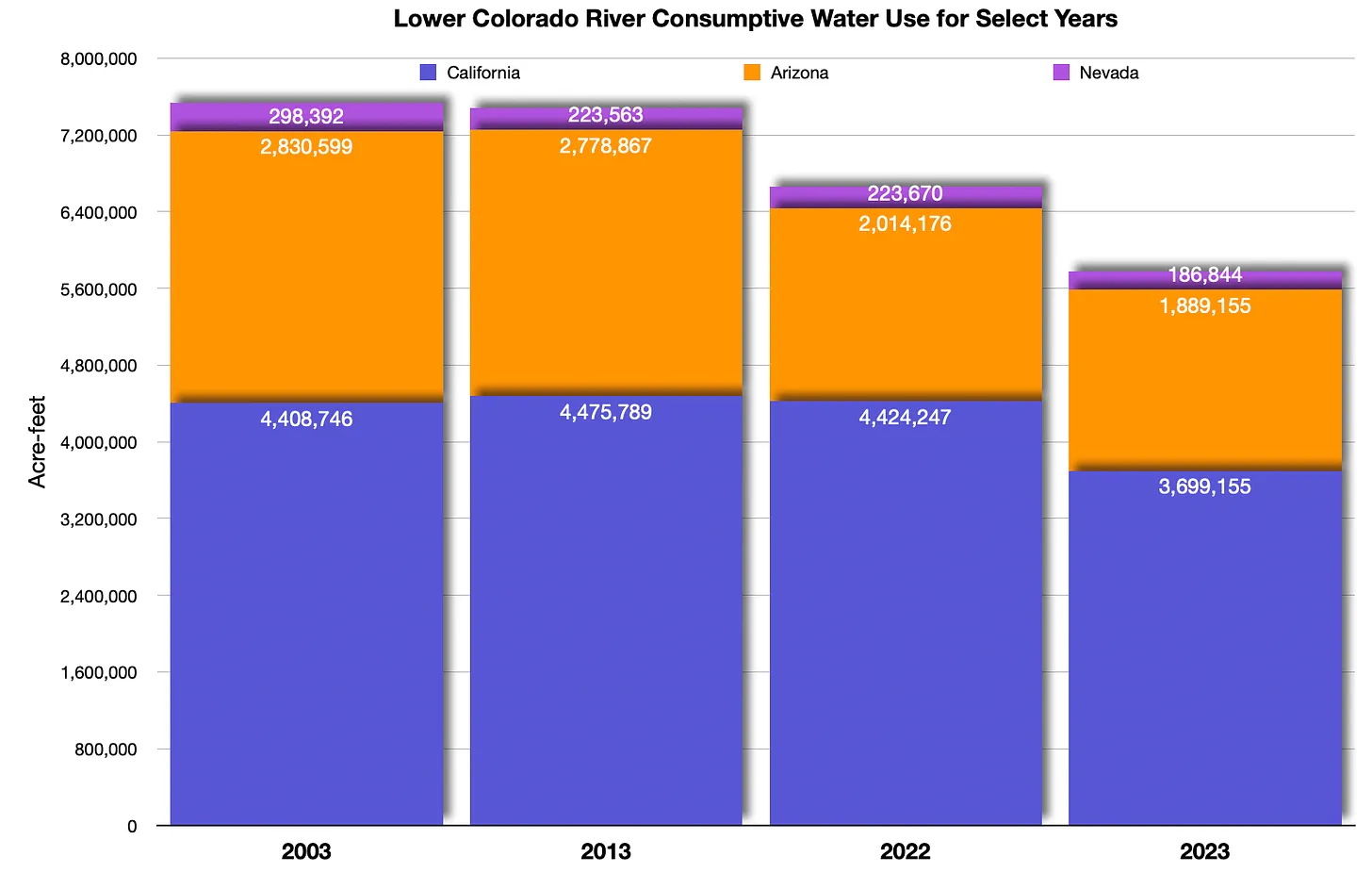
The draft plan includes six alternative approaches, ranging from very stringent conservation measures to no change in current management. The BLMโ€™s โ€œpreferredโ€ option is Alternative 5, which mostly aligns with Wyomingโ€™s own evolving management strategies implemented by executive order under recent governors.

Bureau of Land Management Wyoming Sage Grouse Coordinator Matt Holloran (right) visits with a Natrona County resident April 24, 2024 in Casper. (Dustin Bleizeffer/WyoFile)

That alignment with state policy has likely contributed to stakeholders across the spectrum in Wyoming expressing cautious, but caveated, optimism since the BLM published the draft plan in March

Sage grouse conservation in Wyoming

The BLM manages 18 million surface acres and about 43 million acres of subsurface minerals in Wyoming. Although the agency does not manage wildlife, it does manage wildlife habitats, giving it an outsized influence on the stateโ€™s bedrock energy, recreation, wildlife and agriculture industries.

When conservation groups in the early 2000s sounded alarms about declining sage grouse populations, state leaders sprung into action fearing economy-endangering federal action, including a potential listing under the Endangered Species Act. Wyoming has earned accolades since for being the first state to voluntarily take on greater sage grouse protections โ€” both a proactive drive for conservation and in defense of ongoing agriculture and oil and gas development.

In some instances, the stateโ€™s protections go further than the federal governmentโ€™s, including a maximum 5% disturbance threshold for industrial activity in sage grouse โ€œcore areas.โ€ So far, Wyoming is the only western state with a disturbance threshold that also takes wildfire impacts into account.

How the 5% calculation is made, however, is important. Some critics have alleged that some core area boundaries are simply made larger to allow for more disturbance.

The gubernatorial-appointed Sage Grouse Implementation Team is considering adding tens of thousands of acres of protective โ€œcore area,โ€ along with some retractions, to the state map. Proposed changes are outlined here. (Sage Grouse Implementation Team)

So far, the BLM management strategies align with Wyomingโ€™s, which are prescribed in its sage grouse core areas plan and overseen by the Sage-Grouse Implementation Team.

Following Wyomingโ€™s lead, the BLM proposes to maintain livestock grazing within core areas โ€” mostly considered an insignificant impact and, in some cases, beneficial to sage grouse, according to state and federal documents. Although the BLMโ€™s preferred alternative doesnโ€™t include major changes to grazing, it does further define poor grazing practices that would be restricted in sage grouse management areas, according to local BLM officials.

Stakeholder responses

Oil and gas industry officials in Wyoming have tentatively expressed hope for a workable federal approach to conserving sage grouse and its habitat. Notably, the BLMโ€™s preferred alternative does not include new leasing restrictions for oil and gas.

Conservation groups, however, want the BLM to include the use of a special wildlife habitat designation โ€”ย Areas of Critical Environmental Concernย โ€” which would prohibit industrial activities. They point to a 2021ย U.S. Geological Survey studyย that shows sage grouse populations have declined 80% throughout the West since 1965, and that even with recent conservation measures the speciesโ€™ population is still expected to decline.

Responding to a question Wednesday, the BLMโ€™s Holloran said the agency takes the speciesโ€™ cyclical population into account. โ€œWhat you see is those lows keep getting lower and the highs are not as high,โ€ he said.

The Petroleum Association of Wyoming says it will push back against calls to include stringent habitat designations such as Areas of Critical Environmental Concern.

โ€œAlternative 5 is the best option presented, but there is still work to be done,โ€ PAW Vice President Ryan McConnaughey told WyoFile via email. โ€œWe appreciate the BLMโ€™s willingness to take a measured approach and will work through the comment process to share our concerns.โ€

Reached for comment, Gov. Mark Gordonโ€™s office referred to earlier statements regarding the BLMโ€™s draft plan.

โ€œWhile more analysis of this is needed,โ€ Gordon said in March, โ€œthe first pass shows the BLM picked a preferred alternative that will allow for detailed comments that specifically [address] Wyomingโ€™s  concerns, including that the preferred alternative does not propose Areas of Critical Environmental Concern (ACEC) on top of our state identified core areas.โ€

Visit this BLM website for more information regarding the draft plan and how to comment.

Greater sage grouse range map via the USFWS.

Is Biden a public-lands protector?ย 

by Jonathan Thompson, High Country News
April 25, 2024

Welcome to the Landline, a monthly newsletter from High Country News about land, water, wildlife, climate and conservation in the Western United States.  Sign up to get it in your inbox.

On March 27, Interior Secretary Deb Haaland signed an order withdrawing nearly 222,000 acres of federal land in western Coloradoโ€™s Thompson Divide area from future mining claims and oil and gas leases. The protected area includes aspen forests, alpine ridges, piรฑon-juniper-dotted mesas and high-country meadows โ€” diverse habitat that is home to an array of big game species and other wildlife. It stretches from Glenwood Springs to Crested Butte and over to Paonia, home of High Country Newsโ€™ headquarters.

The move was a big deal for the eclectic ensemble of local ranchers, environmentalists and recreational users who had spent the last two decades fighting proposed mining and fossil fuel development in the area. It solidified a decade-old ban on new oil and gas leases while also driving a nail into the coffin of a thwarted bid to mine molybdenum on the โ€œRed Lady,โ€ a wildflower-strewn mountain outside Crested Butte.

The Thompson Divide protections cover just one-tenth of 1% of the land administered by the Bureau of Land Management. So a cynic might see this temporary withdrawal โ€” it expires in 2044 โ€” as little more than a mildly consequential attempt by President Joe Biden to further differentiate himself from his Republican rival and perhaps regain the support of voters disillusioned by his administrationโ€™s failure to end or significantly curtail fossil fuel development on public lands.

Zoom out a bit, though, and a much different picture reveals itself: The Thompson Divide withdrawal, like the Chaco region leasing ban, is merely one piece in a far larger policy puzzle. Taken alone, theyโ€™re not terribly significant. But the whole is far greater than the sum of the parts: Itโ€™s the most significant shift in public-land management since Congress passed the Federal Land Policy and Management Act of 1976, which mandated multiple use and sought to rid the BLM of its reputation as the โ€œBureau of Livestock and Mining,โ€ in the process rocking the Western political landscape and sparking the Sagebrush Rebellion.

Marcelina Mountain in the Raggeds Wilderness is seen from Gunnison National Forestโ€™s Horse Ranch Park trail, Colorado. A portion of the scene is part of a withdrawal of nearly 222,000 acres of federal lands in Coloradoโ€™s Thompson Divide area from future mining claims and oil and gas leases.

The administration has issued so many public-lands-related orders, rules and protections over the last several weeks that Iโ€™ve had a tough time keeping up. Tracking the environmentalistsโ€™ fluctuating responses โ€” along with the growing outrage from Republican officials โ€” has been downright exhausting, and at times exasperating. The recent acts include:

The BLM finalized its methane waste prevention rule on March 27, requiring operators on public lands to find and repair leaks and to reduce flaring and venting of the potent greenhouse gas. Each year, oil and gas facilities on federal land lose about 44.2 billion cubic feet of methane โ€” i.e., natural gas โ€” and other associated gases to venting and flaring alone. This equates to burning 2.7 million tons of coal, and it also robs American taxpayers of as much as $32 million per year in lost royalties. The rule will not only require drillers to capture or reuse methane when feasible, it will also charge royalties on wasted gas, bringing in tens of millions of dollars annually in additional revenue.

The administration blocked new oil and gas leases on 13 million acres โ€” or just over half โ€” of the National Petroleum Reserve-Alaska. The move is a bittersweet victory for environmentalists; it doesnโ€™t affect the gargantuan Willow Project, which the Biden administration approved last year, or any other active leases in the reserve. Alaska Republicans slammed Biden nonetheless, calling his action an โ€œillegalโ€ blow and a โ€œone-two punchโ€ to the stateโ€™s economy.

The administration revoked a Trump-era approval for the proposed 211-mile Ambler industrial road through northwestern Alaska wilderness, saying it would violate environmental laws and harm wildlife and Indigenous subsistence hunters. The road would give mining companies access to a massive copper deposit buried beneath ecologically sensitive lands.

The Biden administration also blocked new mining claims and oil and gas leases on 4,200 acres of federal land near Placitas, New Mexico, for the next 50 years. The Pueblos of San Felipe and Santa Ana consider the land in question sacred.  

The administration finalized rules raising royalty rates and reclamation bonding amounts for oil and gas drilling on federal land. Environmentalists welcomed the new rules, which mark one of the most significant changes to the Mineral Leasing Act since it became law in 1920. However, some argued that they did not go far enough to reduce hydrocarbon production โ€” or reduce the resulting emissions โ€” from public lands. And a ProPublica/Capital & Main investigation found that the new bonding amounts, which were based on flawed math, would not be nearly enough to cover the actual costs of cleaning up all the wells. Meanwhile, New Mexicoโ€™s oil and gas industry, which has enjoyed record-high profits in recent years, whined: โ€œThe new anti-oil and gas development policies will substantially handcuff production opportunities for small producers.โ€
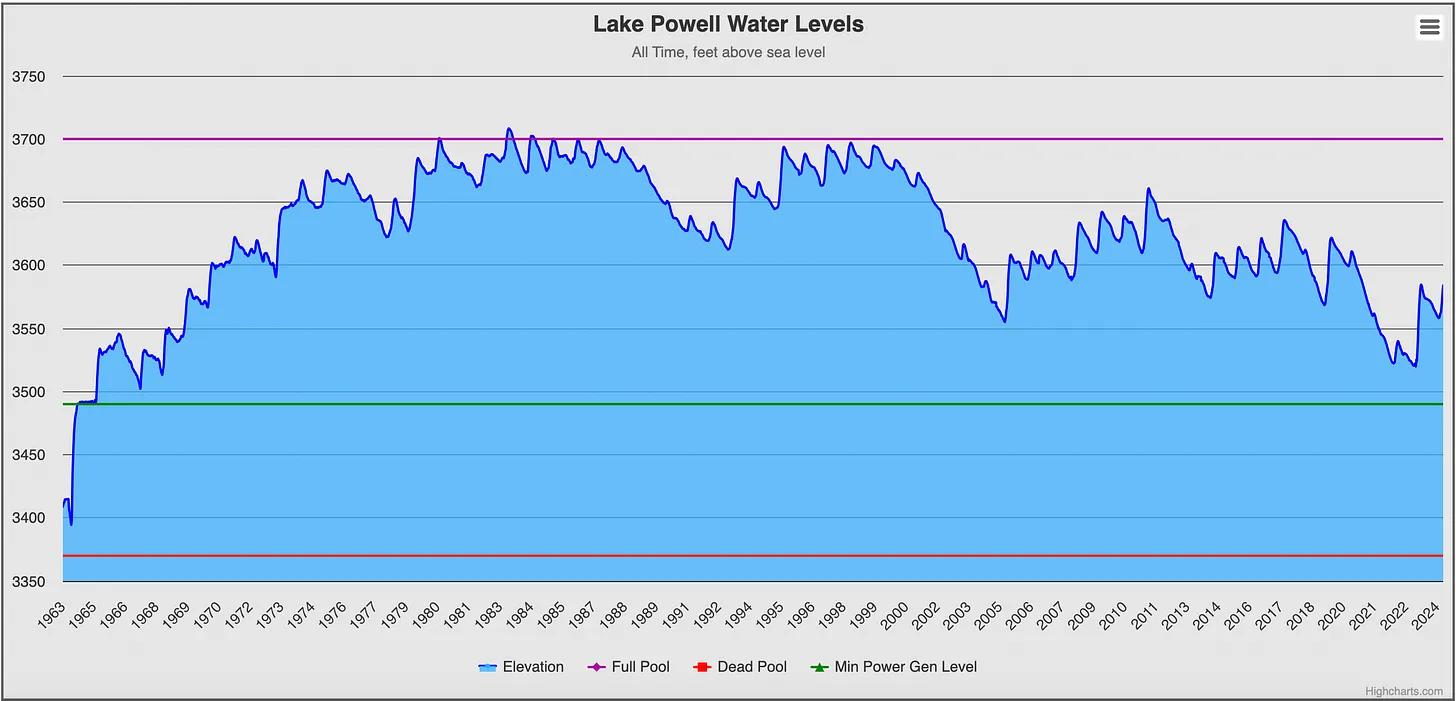
The Biden administration just blocked new oil and gas leases on over half of Alaska’s National Petroleum Reserve.

Probably the most intense reactions โ€” of both elation and anger โ€” came in response to last weekโ€™s finalization of the public-lands rule, designed to put conservation on a par with oil and gas development, grazing and other extractive uses. The rule directs the agency to prioritize landscape health and creates a mechanism enabling outside entities to lease public land for restoration projects, much as a rancher or oil and gas company might lease BLM land. It also allows firms to lease land for mitigation work to offset impacts from development elsewhere on public lands, and it clarifies the process for designating areas of critical environmental concern, or ACECs, where land managers can add extra regulations to protect cultural or natural resources. And it directs the agency to incorporate Indigenous knowledge into decision-making, particularly when considering ACECs.

Environmentalists lauded the decision. In a written statement, Wilderness Society President Jamie Williams called it a โ€œgeneration-defining shift in how we manage our shared resources.โ€ It was met by an equally fervent but entirely opposite response from conservative lawmakers. Rep. Lauren Boebert, a Colorado Republican, denounced it as a โ€œland grabโ€ that would โ€œend federal grazingโ€ and block access to public lands โ€” a misguided worry that was echoed by a variety of her GOP colleagues.

Both responses are likely to prove excessive. The rule doesnโ€™t add any new restrictions or put any public land off-limits to development, nor does it give greens the power to expel a legitimate drilling, mining or grazing operation in order to do a restoration project. It simply provides new tools to help the BLM uphold the multiple-use charge that Congress mandated nearly 50 years ago, before the agency went astray during the Reagan and successive Bush administrations. And Boebertโ€™s notion that it will hurt grazing is especially off-base: While Biden has occasionally stood up to the oil industry, he has done nothing to reform public-lands grazing policy, much to conservationistsโ€™ dismay.

Again, taken on its own, the new rule is hardly radical or revolutionary. But combined with the administrationโ€™s other actions โ€” from significantly reducing the amount of land leased to oil and gas companies, to restricting energy development via resource management plans, to establishing new and restoring shrunken national monuments โ€” it begins to amount to something important.  At long last, a coherent โ€” if imperfect โ€” public-lands climate policy has begun to take shape.

This article first appeared on High Country News and is republished here under a Creative Commons license.

2024 #COleg: Correcting Discrepancies within SB24-127 — Getches-Wilkinson Center

Every March, thousands of Sandhill cranes stop in #GreatSandDunes National Park & Preserve on their way to their northern breeding grounds. The fields and wetlands of #Coloradoโ€™s San Luis Valley provide excellent habitat for these majestic #birds. With the dunes and mountains nearby, they dance and call to each other. Itโ€™s one of natureโ€™s great spectacles. Photo @greatsanddunesnps by #NationalPark Service.

Click the link to read the article on the Getches-Wilkinson Center website (Andrew Teegarden):

April 24, 2024

Currently, there are two conflicting bills in the Colorado Legislature that would create a new state program regulating the dredge and fill of wetlands and streams across the State โ€“ HB 24-1379 and SB 24-127. A key question facing lawmakers is the scope of this new program or, in other words, which wetlands and streams will be protected. The sponsors of the Senate Bill assert that it will mirror the federal program as it existed under the Obama Administration and that it adopts the โ€œsignificant nexusโ€ test, which dictated the scope of the federal Clean Water Act program during that timeframe. This article dispels that argument and demonstrates that SB24-127 would, in fact, coverย far fewer wetlands and waterbodiesย than were protected under the significant nexus test of the federal Clean Water Act.

I. The โ€œSignificant Nexusโ€ Test

The history of wetland regulation at the federal level has a long and complicated history that we have previously detailed. The Supreme Court has now decided four cases that address the definition of โ€œWaters of the United Statesโ€ (WOTUS). In response to those cases, nearly every administration since 2000 has attempted to craft its own definition of WOTUS by regulation.

In 2006, the Supreme Court decided Rapanos v. Army Corps of Engineers, and Justice Kennedy developed by the significant nexus test in his concurring opinion.1 Pursuant to this test, wetlands were said to have a significant nexus to traditional navigable waters if, โ€œeither alone or in combination with similarly situated lands in the region, significantly affect the chemical, physical, and biological integrity of other covered waters.โ€2 To conform with this test, the Obama administration amended the regulatory definition of WOTUS and included eight categories of waters.

Under this regulatory definition of the significant nexus test, any wetlands located within the 100-year floodplain and are not more than 1500 feet from the ordinary high-water line were defined as โ€œadjacentโ€ and therefore a WOTUS.3 Additionally, wetlands within 4,000 feet of the high-water mark of any traditional navigable water, interstate water, territorial seas, impoundments, or covered tributaries could be included as a WOTUS if they have an effect on the chemical, physical, or biological integrity of navigable waters.4 Therefore, the significant nexus set a floor by including all wetlands within the 100-year floodplain and within 1500 feet from the ordinary high-water line while also protecting certain other wetlands within 4,000 feet of a high water mark depending on site characteristics.

II. Distinguishing SB24-127 from the Significant Nexus Test

SB24-127 does not fill the gap created by Sackett, because it does not provide potential protections for those wetlands out to 4000 feet from the ordinary high-water mark, which could include a significant number of wetlands in a high elevation state like Colorado. SB24-127 would limit the jurisdiction of the new state removal fill program, to those waters within the 100-year floodplain and those not more than 1500 feet from a lake, reservoir, or stream.5 Unlike the Obama Administrationโ€™s significant nexus test, however, SB24-127 does not provide for coverage for any wetlands outside the 100-year floodplain and 1500-foot demarcation, regardless of whether those waters have a significant nexus to traditional navigable waters. Thus, if a wetland were outside the 100-year floodplain and 1501 feet away from a state water, it would not be protected regardless of how important that wetland may be in protecting the integrity of state waters and wildlife habitat.

SB24-127 claims to limit jurisdiction under these parameters because it would help remove the time intensive and costly process of completing case-specific analysis to determine jurisdiction. However, the program will still have to engage in determining which wetlands are subject to the state agencyโ€™s jurisdiction.

Moose heading down to the wetlands and the Colorado River in Rocky Mountain National Park May 19, 2023.

III. Implications for Colorado

Our analysis demonstrates that SB24-127 does not fill the gap created by theย Sackettย decision. As compared to the significant nexus test that was put in place by the Obama Administration after theย Rapanosย decision, SB24-127 would protect far fewer wetlands across Colorado even though these wetlands play a critical role in protecting clean water, wildlife habitat, and outdoor recreation.

In our view, HB24-1379 is the better policy choice, because it includes all wetlands within the definition of state waters and thus does not require time-consuming and expensive case-by-case determinations about jurisdiction. HB 24-1379 also includes exclusions for certain activities โ€“ not categories of wetlands โ€“ which are much easier to administer. And it relies heavily on general permits for routine categories of activities, which provide predictability and certainty for the regulated community.

If we make the wrong policy choice in designing Coloradoโ€™s wetland protection program, we may possibly threaten the interconnectedness of our water systems in Colorado, create long-term water quality impacts, and affect downstream waters. Our state waters also play a vital role in flood and fire mitigation which are likely to be of greater importance as climate change ravages the Western United States.

SB24-179 does not fill the Sackett gap, it instead creates new, unpredictable regulatory gaps that will be difficult and expensive to administer, creating uncertainty for the regulated community and other stakeholders. If there is one thing we have learned from the tortured history of the federal wetland program it is this โ€“ any attempt to define the scope of the program based on the โ€œconnectionโ€ between a wetland and other surface water is doomed to conflict and unnecessary expense. All wetlands deserve protection, especially here in the state of Colorado. We have an opportunity right now to avoid that morass, but SB24-179 would simply lead us back down that same dusty road.

547 U.S. 715 (2006).

2 Id. at 780.

33 C.F.R ยง 328.3 (2018).

4 Id.

5ย SB24-127 p. 19 lines 7-10 available atย https://leg.colorado.gov/sites/default/files/documents/2024A/bills/2024a_127_01.pdf

Wetlands – Russell Lakes SWA with Avocets. Photo credit: Colorado Parks and Wildlife

The Upper Gunnison Water Conservancy District gives $260K to water projects — The Gunnison Country Times

Map of the Gunnison River drainage basin in Colorado, USA. Made using public domain USGS data. By Shannon1 – Own work, CC BY-SA 4.0, https://commons.wikimedia.org/w/index.php?curid=69257550

Click the link to read the article on The Gunnison Country Times website. Here’s an excerpt:

April 24, 2024

The Upper Gunnison River Water Conservancy District awarded $260,000 to organizations and individuals across the basin during its 2024 grant cycle. This year marked the water districtโ€™s 15th annual grant program, which uses tax revenue to support diverse water projects in the basin. Grant funds will be used for projects that improve irrigation water management and efficiency, restore degraded stream channels and aquatic habitat, support engineering and design and carry out basin water education. The district received requests for more than $315,000. All applicants were required to provide a 50% cost match…

The 16 projects funded this year include maintenance on the boardwalk bog bridge along the Rec Path in Crested Butte, as well as the installation of educational signage about the wetlands in the area. The district gave $25,000 to support the ongoing harmful algal bloom study at Blue Mesa Reservoir with the U.S. Geological Survey. Two Western Colorado University students will work with the National Park Service to explore the effects of toxic algal blooms on the foraging patterns of kokanee salmon. An Arch Ditch automation project will allow the diversion to fully operate remotely. This is the first one of its kind in the Gunnison Basin. The upgrade will reduce the labor needed to manage the diversion and conserve water. In Gunnison, $50,000 will help address irrigation issues at the Dos Rios Golf Club and reduce water use. The existing system is 40 years old, and uses roughly 65 million gallons of water per year. With the new system, the managers expect to cut water use almost in half.

2024 #COleg: #Colorado voters may be asked to send more sports betting money to water projects — Fresh Water News

Central City back in the day

Click the link to read the article on the Water Education Colorado website (Jerd Smith):

April 25, 2024

Colorado voters may be asked to let more money flow to water projects by allowing the state to keep all of the sports betting tax revenue it collects, if a measure referring the issue to the November ballot is approved by lawmakers.

House Bill 24-1436ย has bipartisan support, with House Speaker Julie McCluskie, D-Dillon, and Rep. Marc Catlin, R-Montrose, serving as the measureโ€™s main sponsors in the House, and Sen. Dylan Roberts, D-Frisco, and Sen. Cleave Simpson, R-Alamosa, leading sponsorship in the Senate.

The sports betting program was initially approved by voters in 2019, passing with just over 51% of the vote. The measure collects a 10% tax on the proceeds of licensed sports betting. Some of the money is used to cover the cost of regulating betting and the rest, up to $29 million total, is funneled toward water projects. In the event tax collections exceed $29 million, the legislature decides how to refund the money under the Taxpayerโ€™s Bill of Rights.

Thatโ€™s where House Bill 1436 comes in.

If House Bill 1436 passes but voters reject the ballot measure, the bill directs the state to refund any sports betting tax revenue collected in excess of $29 million to sports betting operators. The provision is aimed at persuading voters to cast a โ€œyesโ€ vote on the question.

While the original sports betting ballot measure received tepid support, the tax question, if it makes the ballot, may win broader support due to ongoing voter concerns about water conservation and protection and the high-profile crisis on the drought-stressed Colorado River, veteran pollster and political analyst Floyd Ciruli said.

โ€œI have not seen any polls that negate what we knew strongly back then, that water conservation and water protection are environmental issues that Coloradans care strongly about,โ€ he said.

Since 2021, nearly $43.1 million in sports betting tax revenue has been transferred to water projects, according to the Colorado Department of Revenue, with annual cash for water projects nearly tripling during that time, rising from $7.9 million at the end of the 2021 fiscal year, to $23.7 million in 2023.

Brian Jackson, director of Western water for the Environmental Defense Fund, helped spearhead the 2019 campaign backing the initial ballot measure. He and a similar coalition of environmental groups are forming to campaign for this latest ballot measure as well, if lawmakers ultimately refer it to the ballot.

โ€œFrankly, we never thought we would hit that cap,โ€ Jackson said. โ€œBut revenues and profits have snowballed.โ€

State forecasts indicate the cap is likely to be exceeded in the next year or two, Jackson said, reaching $31 million this fiscal year, which ends June 30, and $35 million in the next.

Jackson said early polling indicates strong support for a new ballot initiative among Democratic and Republican voters statewide, but he said those who back removing the cap plan to campaign heavily even with the early support, in part because this Novemberโ€™s ballot is expected to be crowded with a number of questions on topics like property taxes and abortion access.

โ€œWe are going to run a campaign because this is a great opportunity to invest in our state and to widen the message about conserving and protecting Coloradoโ€™s water,โ€ Jackson said.

Voters approved Proposition II, a similar tax-surplus measure related to tobacco taxes for preschool funding, in 2023.

Little formal opposition appears to have formed as of now, although at least one tribal community, the Ute Mountain Ute in Towaoc, has been engaged in a three-year battle with the state over the sports betting program. Among the issues is whether, as a sovereign nation, the tribe should be required to pay the 10% tax on profits, according to Peter Ortego, general counsel for the Ute Mountain Ute.

โ€œWe believe federal law makes it clear that we do not have to pay that tax,โ€ Ortego said.  โ€œBut we are very far apart from the state on that issue.โ€ The Ute Mountain Ute have not taken a position on House Bill 1436.

The Colorado Department of Revenue did not respond to a request for comment about the dispute with the tribes over sports betting.

The gaming industry spent millions in 2019 in support of the original sports betting ballot measure. Whether it will support or oppose House Bill 1436 isnโ€™t clear. The Colorado Gaming Association did not respond to a request for comment.

The measure has passed the House and is now in the Senate. The 2024 legislative session ends May 8.

More by Jerd SmithJerd Smith is editor of Fresh Water News. She can be reached at 720-398-6474, via email at jerd@wateredco.org or @jerd_smith.

Five Tips for an Earth-Friendly Yard — #Colorado State University

Downy serviceberry in Mrs. Gulch’s landscape April 25, 2024.

Jessica Thrasher from the Colorado Water Center shares five tips on creating your own earth-friendly, sustainable yard to conserve water and support pollinators and surrounding wildlife. Watch all videos in our How To Be A Better Earthling series:    โ€ข How to Be a Better Earthling  

Money keeps pouring in for Shoshone rights — The #GrandJunction Daily Sentinel #ColoradoRiver #COriver #aridification

The wave at Glenwood Whitewater Park has become a destination for kayaking and paddling enthusiasts. Itโ€™s also a nice spot for families looking to spend time on a sunny afternoon. Streamflow on the Colorado River near the park on April 12, 2023 was at 2,040 cubic feet per second. CREDIT: LAURINE LASSALLE/ASPEN JOURNALISM

Click the link to read the article on The Grand Junction Daily Sentinel website (Dennis Webb). Here’s an excerpt:

April 24, 2024

Local funding

Following is a list of local entities that have committed funds so far to an effort to purchase the historic Shoshone power plant water rights:

* Eagle County, $2 million

* Ute Water Conservancy District, $2 million

* Mesa County, $1 million

* Grand County, $1 million

* City of Grand Junction, $1 million

* Clifton Water District, $250,000

* Grand Valley Irrigation Co., $250,000

* Grand Valley Water Users Association, $100,000

* City of Rifle, $100,000

* Orchard Mesa Irrigation District, $100,000

* Basalt Water Conservancy District, $100,000

* Palisade Irrigation District, $50,000

* Mesa County Irrigation District, $50,000

* West Divide Water Conservancy District, $50,000

Total: $8.05 million

Secretarial #drought designations for 2024 include 569 primary counties and 345 contiguous counties through April 24, 2024 — @DroughtDenise

For more info, please see the Emergency Disaster Designation and Declaration Process Fact Sheet at https://fsa.usda.gov/Assets/USDA-FSA-Public/usdafiles/FactSheets/emergency_disaster_designation_declaration_process-factsheet.pdf

Biden-Harris Administration Announces New Interagency Effort to Support Tribal Water and Sanitation Infrastructure

Photo credit: U.S. Department of Interior

Click the link to read the release on the U.S. Department of Interior website:

April 23, 2024

WASHINGTON โ€” The Department of the Interiorโ€™s Bureau of Reclamation and Indian Health Service (IHS) today announced a new Memorandum of Understanding to further develop safe drinking water and community sanitation infrastructure projects across Indian Country. Principal Deputy Assistant Secretary for Water and Science Michael Brain made the announcement at the White Houseโ€™s first-ever Clean Water Summit, alongside Indian Health Service Deputy Director Benjamin Smith and Yakama Nation Chairman Gerald Lewis. Reclamation Commissioner Camille Calimlim Touton also spoke on a panel at the event to uplift Reclamationโ€™s investments in climate and drought resilience across the West.

Through the Memorandum of Understanding, the agencies will collaborate to complete studies, planning and design to be used in constructing domestic water infrastructure projects. The collaboration is aimed at accelerating completion of such facilities in Tribal communities. The MOU follows President Bidenโ€™s Executive Order 14112, which directs federal agencies to work together to remove barriers and streamline Tribal access to resources. 

โ€œAt the Interior Department, we know that having modern water infrastructure is not only crucial to the health of our kids and families โ€“ it’s also important for economic opportunity, job creation and responding to the intensifying effects of climate change,โ€ said Principal Deputy Assistant Secretary for Water and Science Michael Brain. โ€œThrough this new agreement, and historic resources from President Bidenโ€™s Investing in America agenda, we are taking a significant stride towards ensuring essential water and sanitation infrastructure throughout Indian Country.  

โ€œThis Administrationโ€™s all-of-government approach allows us to leverage funds from historic investments through President Bidenโ€™s Investing in America Agenda to go even further for Tribal communities,โ€ said Commissioner Camille Calimlim Touton. โ€œReclamation is pleased to work with the Indian Health Service in exploring opportunities for projects with the Yakama Nation and other Tribes to initiate implementation of this MOU.โ€ 

A potential pilot project under this agreement has been identified on the Yakama Reservation in Washington State. After an IHS engineering investigation confirmed high levels of arsenic in the water system of the small community of Georgeville, the Yakama Nation and IHS agreed to construct a treatment system to remove arsenic from the water supply using Bipartisan Infrastructure Law funding. The MOU allows the Bureau of Reclamation to provide technical support for this and future projects.  

โ€œHaving access to safe and reliable water systems is an essential matter of public health,โ€ said Indian Health Service Director Roselyn Tso. โ€œUnfortunately, far too many Native American communities are still awaiting these basic services. The Indian Health Service appreciates the Biden Administrationโ€™s historic multi-billion-dollar investment in water and sanitation infrastructure in Indian Country. This agreement with the Bureau of Reclamation will accelerate completion of these critical projects and reduce barriers for our tribal nations to partner with our agencies.โ€  

In 2022, Reclamation joined the Federal Infrastructure Task Force to Improve Access to Safe Drinking Water and Basic Sanitation to Tribal Communities. With new resources provided through the Bipartisan Infrastructure Law and Inflation Reduction Act, the Bureau has committed significant funding towards Tribal water infrastructure projects. Earlier this month, the Bureau made $320 millionย availableย for Tribal domestic water supply projects, as part of an overall $550 million allocated through the Inflation Reduction Act and as part of President Bidenโ€™s Justice40 Initiative for domestic water assistance for disadvantaged communities. The Indian Health Service is currently in its third year of funding water and sanitation projects through a $3.5 billion investment from the Biden-Harris administration, and today announced allocation decisions of $700 million in Fiscal Year 2024. ย 

President Bidenโ€™sโ€ฏInvesting in America agendaโ€ฏrepresents the largest investment in climate resilience in the nationโ€™s history and is providing much-needed resources to enhance Western communitiesโ€™ resilience to drought and climate change, including providing significant resources towards expanding access to clean water in Tribal communities. Theย Bureau of Indian Affairsย has also dedicated $250 million from the Bipartisan Infrastructure Law towards repairing Tribal water infrastructure โ€“ including dams, irrigation, and water sanitation systems.ย ย 

Native land loss 1776 to 1930. Credit: Alvin Chang/Ranjani Chakraborty

Mesa County contributes $1 million to the Shoshone Water Rights

Shoshone Falls hydroelectric generation station via USGenWeb

Click the link to read the release on the Mesa County website:

April 23, 2024

On April 23, during the administrative public hearing of the Board of Mesa County Commissioners, they approved a million-dollar contribution toward the permanent protection of the most senior, non-consumptive water right on the Colorado River โ€” the Shoshone water rights.

“Mesa County’s $1 million investment in the Shoshone water rights is not just a financial commitment, but a pledge to our community’s future,” said Bobbie Daniel, Chair of the Board of Mesa County Commissioners. “By safeguarding these rights, Mesa County ensures that the West Slope’s lifeblood โ€” our beloved Colorado River โ€” continues to sustain our families, farms, and natural habitats. We stand united with our fellow counties and stakeholders in protecting and preserving our most precious resource for future generations.”

For more information about the Shoshone Water Right Preservation Campaign & Coalition, visit KeepShoshoneFlowing.org.

Watch the video below to learn why the signing of the Shoshone Water Rights Agreement is vital to Mesa County.

A Future for Birds and People in the #ColoradoRiver Basin: Audubon and partner NGOs propose an alternative for post-2026 operations — Audubon #COriver #aridification

Adult Yellow-billed Cuckoo. Photo: Andy Reago and Chrissy McClarren/Flickr (CC-BY-2.0)

Click the link to read the release on the Audubon website (Jennifer Pitt):

March 29, 2024

Audubon has joined partner conservation organizations to propose โ€œCooperative Conservationโ€ as an alternative for the federal Bureau of Reclamation (Reclamation) to study as they consider how to manage the Colorado River after 2026, when current management rules expire. Reclamation has initiated a process expected to assess multiple alternatives before they establish new operational rules.

In recent weeks the Upper Basin (Colorado, New Mexico, Utah and Wyoming) and Lower Basin (Arizona, California and Nevada) have each submitted proposals of their own. They appear to be in broad agreement that Colorado River water uses need to be reduced, not only because the Colorado Riverโ€™s water is over-allocated, but also because climate change is shrinking the river. But alignment between the Upper Basin and Lower Basin ends there, with significant dispute over whose water uses should be reduced.

Cooperative Conservation has a different focus. It prioritizes stabilizing the Colorado River water supply, provides opportunities to make management more equitable, and creates mechanisms to improve environmental outcomes [ed. emphasis mine]:

  • Water supply reliabilityย would be improved by consideration of recent trends as well as assessing the health of the entire system, departing from the current operations that have not kept up with changing conditions such that in 2022 federal managers were worried about the continued ability release water through the dams.
  • Ecosystem healthย would be addressed with stewardship and mitigation provisions. Todayโ€™s operations are based on a policy framework that has not prioritized Colorado River habitats, leaving many used by birds such as Yuma Ridgewayโ€™s Rails and Yellow-billed cuckoos degraded and vulnerable.
  • Colorado River Deltaย habitats and flows have been restored in recent United โ€“ States Mexico agreements, and the opportunity for future binational agreements to extend and expand commitments to these resources would be preserved. Most of Coloradoโ€™s Delta was desiccated as the river was developed through the 20thย century, and these agreements have developed a path towards restoring some of what was lost.
  • Aย Conservation Reserveย program to incentivize water conservation, that improves on the current system of โ€œIntentionally Created Surplusโ€ by adding to the stability of water supplies, offering an opportunity for state and federal governments to forge an agreement with Colorado River Basin Tribes looking to realize greater benefits from their water rights, and create ecological benefits through flexible management that puts water where it is needed in the Colorado River.

These innovations could help the diversity of birds and wildlife and more than 35 million people who depend on the Colorado River. But Reclamation will not be able to move forward with them if the states cannot answer important questions about who should reduce water uses to bring demands into balance with supplies. Without consensus, Colorado River management could be headed to the courts, and opportunities for improved management will be lost. We remain optimistic that over the coming months the states will negotiate a solution, and urge them to recognize that reaching agreement on how to share water shortages is essential.

In the meantime, Audubon will be promoting Cooperative Conservation and all that it offers. Reclamation is expected to publish their analysis of Colorado River management alternatives by the end of 2024.

DOWNLOADABLE RESOURCES

Cooperative Conservation Alternative 20240329.pdf

Map credit: AGU

New Agreement to Improve River Flows in Grand County — @Northern_Water

Willow Creek, at the headwaters of the Colorado River, on April 2, 2021. Photo/Allen Best

Here’s the release from the Northern Colorado Water Conservancy District (Christine Travis and Jeff Stahla):

April 23, 2024

Grand County and Northern Colorado Water Conservancy District (Northern Water) have agreed to a unique and first-of-its-kind Operational Framework that provides Grand County with the ability to have as much as 7,000 acre-feet of additional controllable water to release from the Colorado-Big Thompson (C-BT) Project for stream enhancement and other purposes that will benefit Grand Countyโ€™s recreation and agriculture industries. The volume available for streamflow improvement will be dependent on annual river conditions and C-BT Project storage levels.

Approved Tuesday [April 23, 2024] by the Grand County Commissioners, the agreement outlines a methodology to determine the water that will be available to the County each year. Water made available under this agreement to the County will be released to Willow Creek, or to the Colorado River, will supplement existing flows, and could accumulate to nearly 40,000 acre-feet over the course of a decade. Prior to 2005, this water was used for irrigation of hay fields near the Town of Granby. Since that time, the underlying lands have been removed from agricultural production and converted to residential and commercial development. Without this agreement, the water will continue to be captured by the C-BT Project and available to Northern Water for uses in Northeastern Colorado.

โ€œThe Operational Framework Agreement will provide the County with an additional water management tool to improve and enhance flows on the Colorado River,โ€ said Grand County Commissioner Chair Merrit Linke. โ€œThe Colorado River is the life blood to sustaining our agriculture and recreation industries that are critically important to our local economy as well as all of the West Slope.โ€

Grand County and Northern Water will, in coming months, consult and coordinate with the U.S. Bureau of Reclamation regarding the implementation of the agreement.

Some of the winter wheat is feeling the effects of the dry weather over the past few months — @DroughtDenise #drought

The amount of #winterwheat in good to excellent condition has fallen, while the wheat in poor to very poor condition has risen. https://agindrought.unl.edu/Home.aspx

#ElNiรฑoย  is winding down. Hereโ€™s what the winter season looked like for #Coloradoโ€™s mountains โ€” and what comes next: The seasonal pattern is transitioning to #LaNiรฑa into the summer, bringing with it a change in the jet stream — The Summit Daily #ENSO

Click the link to read the article on the Summit Daily website (Robert Tann). Here’s an excerpt:

April 23, 2024

This past winterย marked the first in three years to experience an El Niรฑo season. But what impact the pattern had on the Rocky Mountains is harder to tell compared to other parts of the state. In Breckenridge, for example, the majority of winter and early spring netted above-average precipitation, something that would be associated with a La Nina year, said Kenley Bonner, meteorologist for the National Weather Service office in Boulder.ย November was the only month to see below-normal precipitation, while the rest of the months through March were above normal, Bonner said. Temperature wise, this past winter was warmer than average, according to data collected in Dillon.ย The same can be said for much of the Western Slope. In Grand Junction, monthly average temperatures have hovered around 4 degrees above normal since November, said Lucas Boyer, meteorologist for the National Weather Service office in Grand Junction…

Snowpack in the Blue River Basin, which encompasses all of Summit County, had a slow start to the season,ย with levels below the 30-year medianย for much of November through the first half of January. Snowpack climbed afterwards, trending along the 30-year median line for much of Februaryย before rising above normal for all of March and the first two weeks of April.ย 

The same was true for the entirety of the Colorado River Headwaters Basin, which includes some central and northern mountain areas as well as parts of the Western Slope…

NOAA Climate Prediction Center forecast for each of the three possible ENSO categories for the next 8 overlapping 3-month seasons. Blue bars show the chances of La Niรฑa, gray bars the chances for neutral, and red bars the chances for El Niรฑo. Graph by Michelle L’Heureux.

According to an April 11 report from the Climate Prediction Center, a transition from El Nino to a neutral system, where ocean temperatures are seasonally normal, is 85% likely to happen between April and June. There is currently a 60% chance that a La Nina system will then develop between June and August.ย Early reportsย show the transition could make for a hotter, dryer than normal summerย across the U.S…

A three-month outlookย released by the prediction center on April 11ย shows Colorado has between a 33% and 50% chance of experiencing above-normal temperatures for May, June and July in various areas. The southwestern portion of the state also has between a 33% and 40% chance of seeing below-normal precipitation during that period, while the northeastern portion has equal chances of seeing above- or below-normal precipitation.

Missed the public hearing for Thorntonโ€™s 1041 water pipeline application (April 22, 2024)? Hereโ€™s a recap — The #FortCollins Coloradoan #PoudreRiver

Graphic credit: ThorntonWaterProject.com

Click the link to read the article on the Fort Collins Coloradoan website (Ignacio Calderon). Here’s an excerpt:

April 22, 2024

Monday’s hearing started with a presentation from county staff, during which the Larimer County Planning Commission recommended approval of the project if proposed conditions were met. Thornton then gave another presentation to talk about how the city’s new application is different from the previous one. After that, the session was open to public comment, which will continue at the next hearing…

Planning Commission recommends approval

โ€œWith the proposed conditions of approval in place, this application meets the review criteria for a water transmission pipeline,โ€ [John] Barnett said. โ€œ… Therefore, the development service team recommends approval of the Thornton water project.โ€

[…]

The public hearing session will resume at 6 p.m. May 6 via Zoom and in person in the First-Floor Hearing Room of the Larimer County Administrative Services Building, 200 W. Oak St. in Fort Collins. For more details on how to sign up for public comment and the 1041 regulations, visitย www.larimer.gov/planning/1041-regulations. You can also track the progress on the permit and access related documentsย on this county portal.

#Drought news April 25, 2024: According to the NRCS SNOTEL network (4/23), region-level (2-digit HUCs) median SWE levels are as follows: Missouri 80%, California 95%, Great Basin 108%, Upper Colorado 87%, Lower Colorado 145%, Rio Grande 78%, and Arkansas-White-Red 79%

Click on a thumbnail graphic to view a gallery of drought data from the US Drought Monitor website.

Click the link to go to the US Drought Monitor website. Here’s an excerpt:

This Week’s Drought Summary

This U.S. Drought Monitor (USDM) week saw improvements on the map in drought-affected areas of the Southwest, Northern Plains, and the Midwest while conditions deteriorated in areas of the Pacific Northwest, Eastern Plains of Colorado and Montana, Southern Plains, and the South. In the Pacific Northwest, a combination of factors (below-normal snowpack conditions, short-term dryness, low streamflows) led to expansion of areas of Abnormally Dry (D0) and Moderate Drought (D1) in western portions of Oregon and Washington. In Montana, poor snowpack conditions in the northwestern and west-central part of the state led to expansion of areas of Extreme Drought (D3) where some SNOTEL stations were reporting record or near-record low snow-water equivalent (SWE) levels. In the Southern Plains, drier-than-normal conditions during the past 30-90-day period in addition to low streamflows, declining soil moisture, and impacts to crops led to expansion of areas of Moderate Drought (D1) and Severe Drought (D2) in Oklahoma and Kansas. Conversely, wetter-than-normal conditions have prevailed during the past 30-60 days in portions of the Midwest leading to widespread improvements across drought-affected areas of Iowa, Minnesota, Wisconsin, and Michigan. Likewise, improvements were made on the map in areas of the Southwest (Arizona and New Mexico) in response to beneficial precipitation received across much of the region since the beginning of the Calendar Year (January 1). In California, snowpack conditions moving into late April (4/24) were near normal levels with the statewide snowpack at 97% of normal, according to the California Department of Water Resources. Elsewhere in the West, below-normal SWE levels have persisted in the mountain ranges of Washington, northern Idaho, Montana, and northeastern Wyoming. According to the Natural Resources Conservation Service (NRCS) SNOTEL network (4/23), region-level (2-digit HUCs) median SWE levels are as follows: Pacific Northwest 75%, Souris-Red-Rainy 76%, Missouri 80%, California 95%, Great Basin 108%, Upper Colorado 87%, Lower Colorado 145%, Rio Grande 78%, and Arkansas-White-Red 79%…

High Plains

On this weekโ€™s map, one-category degradations were made in Kansas where precipitation has been below normal during the past 90-day period with the greatest departures (4 to 5 inches) observed in south-central and eastern Kansas. Moreover, stream gages on numerous creeks and rivers in central and eastern Kansas were reporting much below-normal flows (< 10th percentile), according to the USGS. In terms of impacts, the USDA reported (4/21/24) that 26% of the winter wheat crop in Kansas was rated in poor to very poor condition. In addition to dry conditions, average temperatures across the Plains states have been well above normal levels (ranging from 4 to 8+ degrees F) during the past 90 days with the greatest anomalies observed in far eastern portions of the region. In North Dakota Climate Division 6 (East Central Division), the December-March period was the 2nd warmest on record with an +11.6 degrees F anomaly, according to NOAA NCEI. In northeastern Nebraska and northwestern South Dakota, shorter-term improvements in drought-related conditions led to reductions in areas of Abnormally Dry (D0) and Moderate Drought (D1). For the week, average temperatures were below normal (2 to 10+ degrees F) with the greatest departures observed in western portions of the Dakotas and Nebraska as well as along the eastern plains of Wyoming and Montana. Overall, the region was generally dry during the past week except for a few areas that benefitted from isolated shower activity in northeastern Kansas, north central and northeastern Nebraska, and southwestern South Dakota…

Colorado Drought Monitor one week change map ending April 23, 2024.

West

On the map, improvements were made across areas of central and southeastern Arizona and in southern New Mexico in response to a re-assessment of overall conditions looking at numerous drought metrics at various time scales. Since January 1, much of Arizona as well as western and northern portions of New Mexico have observed precipitation levels ranging from normal to well above normal. In contrast, below-normal precipitation has prevailed across much of eastern New Mexico. Looking at SWE levels (April 1) from the NRCS SNOTEL network, all basins (6-digit HUC) within Arizona and New Mexico were above normal. Elsewhere in the region, areas of Abnormally Dry (D0) were introduced in western Oregon and Washington in response to short-term dry conditions and very low streamflow levels that have significantly dipped in recent weeks. In Montana, poor snowpack conditions led to further degradations on the map…

South

In the South, light-to-moderate rainfall (up to 4 inches) was observed across isolated areas of the region during the past week with the heaviest accumulations logged in eastern Texas, northern Louisiana, southwestern Arkansas, and central Mississippi. For the week, average temperatures were near to slightly above normal in southern portions of Texas and Louisiana, while areas in the northern half of the region were generally cooler-than-normal (1 to 8 degrees F). On the map, conditions deteriorated in areas of the South Texas Plains and Edwards Plateau in response to a combination of factors including short-term dryness (past 30-90 days), low streamflows, declining soil moisture levels, and stressed vegetation. In terms of water supply, statewide reservoir conditions in Texas were at 73.9% full (4/24). However, some lingering low reservoir conditions are being reported in the western half of the state in the San Angelo and San Antonio areas, according to Water Data for Texas. In Oklahoma, dry conditions led to another round of degradations on the map across the northern portion of the state. According to the latest U.S. Department of Agriculture (USDA) Oklahoma Crop Progress and Condition report (4/21/24), the statewide soil moisture (topsoil) condition was rated 46% short to very short. In northwestern Tennessee, reductions in areas of Abnormally Dry (D0) and Moderate Drought (D1) were made in response to precipitation during the past 30-day period…

Looking Ahead

The NWS Weather Prediction Center (WPC) 7-Day Quantitative Precipitation Forecast (QPF) calls for moderate-to-heavy precipitation accumulations ranging from 2 to 5+ inches (liquid) across western Washington and Oregon as well as eastern portions of the Southern and Central Plains and lower Midwest. Lighter accumulations (< 2 inches) are expected in areas of the Central and Northern Rockies and Upper Midwest, while isolated light shower activity is expected in portions of Northern California, the Great Basin, and the Northeast. The NWS Climate Prediction Center (CPC) 6-10 Day Outlooks call for a moderate-to-high probability of above-normal temperatures across most of the conterminous U.S., with the exception of the Far West, and the western Great Basin where cooler-than-normal temperatures are expected. In Alaska, there is a low-to-moderate probability of above-normal temperatures in the southern half of the state and below-normal temperatures north of the Brooks Range. In terms of precipitation, below-normal precipitation is expected across the Eastern Tier of the conterminous U.S. as well as out West in western Colorado, Utah, and southern Nevada. Elsewhere, there is a high probability of above-normal precipitation across the Pacific Northwest, Northern California, eastern New Mexico, Texas, the Plains states, and the Upper Midwest.

US Drought Monitor one week change map ending April 23, 2024.

A flurry of public land protections: Biden’s rushing to get new rules in place, just in case โ€ฆ — Jonathan P. Thompson (LandDesk.org)

Beeweed and pumpjack. San Juan Basin, New Mexico. Jonathan P. Thompson photo.

Click the link to read the article on The Land Desk website (Jonathan P. Thompson):

The public lands beat has been rather busy, to put it mildly, as the Biden administration rushes to finalize rules, orders, and protections as soon as possible to make them less vulnerable to being rolled back if Biden were to lose in November to, ummm, a more hostile candidate. Maybe Bidenโ€™s also working to more clearly distinguish himself on environmental issues from Trump in advance of the election โ€” as if the stark contrast isnโ€™t abundantly clear already. 

So much has happened that Iโ€™ve fallen behind. So forget the pre-amble, letโ€™s get to it:

In late March, the Bureau of Land Management finalized its methane waste prevention rule, which requires oil and gas operators on federal lands to find and repair leaks in their infrastructure and to phase out flaring and venting of methane โ€” a.k.a. natural gas. The rules complement the EPAโ€™s similar regulations finalized earlier this year. 

Methane is a potent greenhouse gas, having about 86 times the warming potential of carbon dioxide over the near-term (methane in the atmosphere breaks down into carbon dioxide and water over the long-term). While methane โ€” which occurs alongside oil in underground reservoirs โ€” can be captured and marketed as natural gas, oil drillers tend to vent or flare it and other associated gases, since it isnโ€™t as profitable as oil.ย 

Flaring and venting of methane and other gases shot up after horizontal drilling-multistage hydraulic fracturing opened up vast new stores of oil. Source: Bureau of Land Management.

Between 2010 and 2020, after the โ€œfrackingโ€-enabled shale revolution got underway, oil and gas operations on federal and tribal land vented and flared an average of 44.2 billion cubic feet of methane annually. Thatโ€™s as bad for the climate as burning around 9 million tons of coal. And since operators donโ€™t pay royalties on gas they throw away,  that cost American taxpayers some $166 million in lost revenue over a decade. 

The rules look to rein that in by gradually decreasing the maximum amount of methane that can be flared or vented and charging royalties on the gases that are wasted. It is expected to slash greenhouse gas emissions and result in about $50 million annually in added royalty revenue.ย 

Methane Madness: Part IJonathan P. Thompson

***

A few days later, the administration finalized its ban on new oil and gas leases and mining claims on about 220,000 acres along Western Coloradoโ€™s Thompson Divide. The protections cover a stretch of high-country BLM and USFS land between Glenwood Springs, Crested Butte, and Somerset. It does not affect valid, existing leases or claims. 

In the early 2000s an eclectic group of environmentalists, ranchers, and recreational users banded together to protect the Divide from the growing threat of oil and gas development. Their efforts goaded the feds to halt new development and cancel existing leases on much of the acreage, long before this springโ€™s move. Meanwhile, a similar uprising in the Crested Butte area blocked a proposed molybdenum mine on Mt. Emmons, or the Red Lady. 

The administrationโ€™s withdrawal bolsters these efforts and blocks new development for the next 20 years. By then, one would hope, the administrationโ€™s demand-side efforts to reduce fossil fuel consumption โ€” including encouraging clean energy development and pushing zero-emission cars โ€” will have kicked in.ย 

***

And Biden and Interior Secretary Deb Haaland raised royalty rates and reclamation bonding amounts for oil and gas drilling on federal land. This one was a long-time coming. The previous 12.5% royalty rate has remained unchanged since Congress passed the Mineral Leasing Act in 1920. And oil and gas drillers have been getting away with posting bonds for all of their wells in a state that donโ€™t get anywhere near covering the cost of cleaning up a single well. 

Environmentalists welcomed the reforms, but also criticized them for failing to address climate impacts of oil and gas development on public lands. Oh, and then thereโ€™s the thing about the faulty math: Mark Olalde and Nick Bowlin, for ProPublica and Capital & Main, found that even the new bonding amounts wouldnโ€™t cover clean up. The problem? A BLM staffer miscalculated the cost to plug and reclaim a single well, and the inaccurate figure got incorporated into the analysis and final rule. Whoops. 

***

The administration blocked new oil and gas leases on 13 million acres of the National Petroleum Reserve-Alaska. Thatโ€™s a huge amount of land and especially remarkable given that itโ€™s in a petroleum reserve and itโ€™s likely to result in some 50% less greenhouse gas emissions than Trumpโ€™s plan for the same area. Still, it may not be enough for the climate hawks who remain livid over the administrationโ€™s approval of a scaled-back, but still gargantuan, Willow (a.k.a. โ€œcarbon bombโ€) drilling project in the reserve. Meanwhile, Bidenโ€™s Willow approval is not enough to soothe the anger of Alaskaโ€™s congressional delegation โ€” including Democrat Rep. Mary Peltola โ€” who blasted Biden for ignoring Alaskaโ€™s love for fossil fuels and called it an โ€œillegalโ€ move that dealt a โ€œone-two punchโ€ to the stateโ€™s economy. You just canโ€™t win for losing, can you? 

***ย 

Light and texture. Big Gypsum Valley, Colorado. Jonathan P. Thompson photo.

And last, but certainly not least: The Bureau of Land Management finalized its public lands rule, designed to put conservation on a par with oil and gas development, grazing, and other extractive uses.

The ruleโ€™s main provisions include:ย 

  • It directs the agency to prioritize landscape health in all decision making, which is what itโ€™s already supposed to do when assessing grazing allotments. It hasnโ€™t done a very good job at that, so far.ย 
  • It creates a mechanism for outside entities โ€” states, tribes, or nonprofits โ€” to lease public land for restoration projects โ€” much as a rancher or oil and gas company might lease BLM land.ย 
  • It allows firms to lease land for mitigation work to offset impacts from development elsewhere.ย 
  • It clarifies the process for designating areas of critical environmental concern, or ACECs, where land managers can add extra regulations to protect cultural or natural resources.ย 
  • And it directs the agency to incorporate Indigenous knowledge into decision-making, particularly when considering ACECs.ย 

The rule is being hailed by conservationists as a โ€œgeneration-defining shiftโ€ in public land management, and lambasted by Sagebrush Rebel-wannabes as a โ€œmisguided land grab meant to prevent oil and gas production โ€ฆ <and> โ€ฆ an attack on our ranchers and farmers that will end grazing on federal lands and will also prevent Coloradans from accessing their public lands.โ€ (A gold star to whoever guesses which MAGA-loving congress member made the latter grossly misinformed quote!).

Honestly, Iโ€™m not sure either sideโ€™s hoohas are warranted. Itโ€™s hard to see how a couple new leasing categories will be generation defining, I kinda doubt the rules will affect oil and gas production, and Iโ€™m absolutely certain they wonโ€™t end grazing or otherwise block access to public lands. 

The rule doesnโ€™t add any new restrictions or put any land off-limits to development. It doesnโ€™t give greens the power to kick a legitimate drilling, mining or grazing operation off public land to do a restoration or mitigation project. The mitigation leases could actually facilitate energy development. As for grazing, the Biden administration has indicated it considers ranching to be a type of land conservation, a theory that is manifested in the BLMโ€™s policy of veering away from public lands grazing reform. Grazing is allowed in most ACECs. And the agency just set the 2024 grazing fee at $1.35 per animal unit month, the minimum Congress allows. I think the cows and their ranchers will be just fine under this new rule.

It seems to me that this ruleโ€™s provisions are fairly open to interpretation. That means the actual implementation โ€” and how it plays out on the ground โ€” will depend largely on BLM state, regional, and field-office managers. And those local-level bureaucrats can be swayed by the prevailing attitudes of the communities where they live and work, and by pressure from local or state officials.ย 

In the end, the rule is essentially a reminder to the BLM that their job is not just to bend over for corporate and extractive interests, but to actually care for the land that belongs to all Americans. It is simply reinforcing the multiple-use charge Congress set forth when it passed the Federal Lands Policy and Management Act back in 1976. Itโ€™s not that big of a deal. But then again, FLPMA helped spark the Sagebrush Rebellion in the late 1970s. So who knows what this rule might inspire now…

๐Ÿ“ธ Parting Shot ๐ŸŽž๏ธ

Eagles in a tree near Norwood, Colorado. Jonathan P. Thompson photo.

April 2024 #ENSO update: gone fishing — NOAA

Click the link to read the article on the NOAA website (Emily Becker):

April 11, 2024

The El Niรฑo of 2023โ€“24 is weakening. Forecasters estimate an 85% chance that El Niรฑo will end and the tropical Pacific will transition to neutral conditions by the Aprilโ€“June period. Thereโ€™s a 60% chance that La Niรฑa will develop by Juneโ€“August. Overall, the forecast this month is very similar to last month, and we continue to expect La Niรฑa for the Northern Hemisphere fall and early winter (around 85% chance).

La Niรฑa and El Niรฑo are opposite phases of the El Niรฑo-Southern Oscillation climate pattern. โ€œENSOโ€ for short. Just like El Niรฑo, La Niรฑa changes the ocean and atmospheric circulation in the tropics. Those changes start in the Pacific Ocean and then ripple around the world in predictable ways. So, the arrival of La Niรฑa gives us an early picture of potential upcoming climate conditions.

Why are our probabilities relatively high, even though weโ€™re still solidly in the grip of the โ€œspring predictability barrier,โ€ a time of year when forecasts are often trickier? What could La Niรฑa mean for summer and fall climate? And what might we expect for the global average surface temperature, after a record-setting year? So many questions! The hooks are baited, letโ€™s cast our lines.

Tropical fishes

First things first: current ENSO conditions. The sea surface temperature anomaly in theย Niรฑo-3.4 regionย of the tropical Pacific is our primary metric for ENSO (anomaly = departure from the long-term average, long-term in this case is 1991โ€“2020). Since El Niรฑoโ€™s peak in Novemberโ€“December 2023 at aboutย 2.0 ยฐC (3.6 ยฐF), this anomaly has been dropping steadily, but, at 1.2 ยฐC, it is still well above theย El Niรฑo thresholdย of 0.5 ยฐC (0.9 ยฐF).

2-year history of sea surface temperatures in the Niรฑo-3.4 region of the tropical Pacific for all strong El Niรฑo events since 1950 (gray lines) and the current event (purple line). Graph by Emily Becker based on monthly Niรฑo-3.4 index data from CPC using ERSSTv5.

Looking at the atmosphere over the tropical Pacific, however, we find that the expected El Niรฑo patternโ€”weaker-than-average trade winds, more rain and clouds in the central tropical Pacific, drier conditions over Indonesia, reflecting a weakerย Walker Circulationโ€”has largely disappeared. This is not unexpected; as ENSO events decay, sometimes the atmosphere and the ocean are on somewhat different schedules. (This is also the case when they begin.) What it tells us is that theย ocean-atmosphere coupling, an essential component of ENSO, has likely ended. That provides confidence that the warm sea surface temperature anomaly will continue to diminish, likely crossing into neutral (between 0.5 and -0.5 ยฐC) by Aprilโ€“June.

Animation of maps of sea surface temperatures in the Pacific Ocean compared to the long-term average over five-day periods from February through early April 2024. El Niรฑoโ€™s warm surface is weakening and some regions of cooler-than-average sea surface temperature are appearing. NOAA Climate.gov, based on Coral Reef Watch maps available from NOAA View.

Creatures of the deep

More evidence that El Niรฑo is likely to give way to neutral soon, with La Niรฑa right on its tail, can be found under the surface of the tropical Pacific. We keep a close eye on the temperature of the water in the upper 300 meters (~1000 feet) of the equatorial Pacific because this water provides a source to the surface. Since January, two upwellingย Kelvin wavesโ€”blobs of cooler water that travel from the west to the east under the surfaceโ€”have been moving through.

Water temperatures in the top 300 meters (1,000 feet) of the tropical Pacific Ocean compared to the 1991โ€“2020 average in Februaryโ€“April 2024. NOAA Climate.gov animation, based on data from NOAA’s Climate Prediction Center.

The more recent upwelling Kelvin wave will continue to shift eastward and rise up, providing a source of cooler-than-average water to the surface.

Sailfish

As I mentioned above, La Niรฑa causes changes in global atmospheric circulation, making certain temperature and rainfall patterns more likely. Weโ€™ll dig into this a bit more after El Niรฑo ends, but one potential La Niรฑa impact has been getting some notice recently: La Niรฑa tends to encourage a more activeย Atlantic hurricane season. It does this by reducing vertical wind shearโ€”the change in wind from near the surface to high up in the atmosphereโ€”over the Atlantic Ocean, making it easier for hurricanes to grow. Considering that the tropical Atlantic Ocean is already very warm, you can bet that NOAAโ€™s hurricane outlook team is paying close attention to the likelihood of La Niรฑa. NOAAโ€™s early seasonal hurricane outlook will come out next month, and weโ€™ll have a post about hurricanes on the ENSO Blog in June.

NOAA Climate Prediction Center forecast for each of the three possible ENSO categories for the next 8 overlapping 3-month seasons. Blue bars show the chances of La Niรฑa, gray bars the chances for neutral, and red bars the chances for El Niรฑo. Graph by Michelle L’Heureux.

Shark tank

Speaking of the bathwater Atlantic, letโ€™s revisit the topic of the global average surface temperature. This metric isnโ€™t particularly relevant to anyoneโ€™s day-to-day operationโ€”whenโ€™s the last time you woke up in the morning and thought โ€œIโ€™ll just check the global mean surface temperature forecast for today!โ€โ€”but itโ€™s a critical monitoring tool for climate change.

El Niรฑoโ€™s warmer-than-average tropical Pacific tends to contribute to higher global average surface temperature, while La Niรฑaโ€™s cooler tropical Pacific usually contributes to relatively cooler years. However, emphasis is on the relative since more recent La Niรฑa events have been among the top ten warmest years ever.  One can see that much of the global oceans are warmer than average, going beyond El Niรฑo.

Like with ENSO, we track the global surface temperature anomaly as the departure from the long-term average. Unlike ENSO, a few different โ€œlong-termโ€ base periods are used by different researchers and in different situations, including 1991โ€“2020 (recent normal), 1901โ€“2000 (the 20thย century), and 1850โ€“1900 (the pre-industrial era). However, so long as you pay attention to which base period is being used, the message is still the sameโ€”the global average temperature anomaly isย breaking records.

According toย NOAAโ€™s National Center for Environmental Information, โ€œthe February global surface temperature was 2.52 ยฐF (1.40 ยฐC) above the 20th-century average of 53.8 ยฐF (12.1 ยฐC), making it the warmest February on record [dating back to 1850] and the ninth consecutive month of record-high global temperatures.โ€

This map from the National Center for Environmental Information shows where February 2024 temperatures fall in the 1951โ€“2024 record. Record-warm February temperatures covered large areas of the Atlantic and Indian Oceans. Approximately 13.8% of the world’s surface experienced record warm temperature this February, the highest percentage for February since the start of records in 1951.

Could a developing La Niรฑa return the global average surface temperature closer to normal? Not very likely. We are just a few months in, and NCEIโ€™s Global Annual Temperature Outlook already predicts โ€œa 45% chance that 2024 will rank as the warmest year on record and a 99% chance that it will rank in the top five.โ€ For more info on how NCEI makes this prediction, check outย this post.

The forecast from theย North American Multi-Model Ensemble (NMME), a collection of state-of-the-artย climate modelsย from U.S. and Canadian centers, predicts only a slight reduction in the global surface temperature anomaly over the next several months. Note that the NMME prediction uses a base period of 1850โ€“1900 to provide an estimate of theย increase in global temperature over โ€œpre-industrialโ€ times.

Monthly average temperatures (red dots and line) rose to more than 1.5 degrees Celsius above the pre-industrial average in late 2023. On average, forecasts from the North American Multi-model Ensemble (NMME) system indicate temperatures are likely to decline only slightly as El Niรฑo continues to wane through early 2024. Graph by Kayla Besong based on data from NCEI and Emily Becker/IRI.

It could be another very interesting year, climate-wise. Stay tuna-ed for more from us on ENSO and global climate!

‘Peak #snowpack’ can pack a surprise punch: Mountain snowpack typically peaks in April, but there have been some harrowing, far-from-typical years — News on Tap #ColoradoRiver #SouthPlatteRiver #COriver #aridification

Click the link to read the article on the Denver Water website (Todd Hartman):

April 22, 2024

April is a big month for water watchers. Thatโ€™s when Coloradoโ€™s snowpack typically reaches its highest level before the big melt-out that follows. 

The watchers call this moment โ€œpeak snowpack.โ€ And it can be a useful measure to predict water supplies for the warm months to come.

The snow-covered Continental Divide, seen from Loveland Pass. Melted snow, captured and stored in mountain reservoirs, is the source of nearly all the water Denver Water provides to customers every day. Photo credit: Denver Water.

Peak moments that fall earlier on the calendar can mean a spring runoff that ends too soon and reservoirs that donโ€™t fill. Conversely, late peaks can mean reservoirs spill and high-water flows that can overtop riverbanks. 

Indeed, a closer look at โ€œpeakโ€ numbers over the last several decades reveals some big surprises when the timing of the maximum snowpack falls outside the late April norm. Such off-rhythm peaks can lead to watering limits or, in the other extreme, raging runoff that can do damage to land and property.

For Denver Water, this yearโ€™s peak snowpack numbers look good. 

A mid-to-late April high point appears likely, and a healthy amount of water in the snow supports the utilityโ€™s forecast for full reservoirs for the upcoming irrigation season.

In short, itโ€™s what Denverโ€™s water watchers might call โ€œa typical year.โ€


Join people with a passion for water, at denverwater.org/Careers.


In fact, though, the timing of the peak snowpack and how much frozen water the snow holds at that point is a highly variable condition and can leave water supply managers scrambling. This variability can be easy to forget when most years follow the script, or donโ€™t veer far from it.

โ€œAs a water manager, if I only had one piece of data to determine how water supply was looking for a given year, it would be peak snowpack,โ€ said Nathan Elder, who manages the tricky business of water supply for Denver Water.ย 

โ€œSnowpack peaks can be highly variable in quantity and timing, and those factors indicate what the runoff and water supply situation will look like.โ€ 

Take a look at the following graphs, which show the wide variability in the amount of water frozen in the snow at the point of โ€œpeak snowpackโ€ over the past 45 years. The range in both the Colorado and South Platte river basins where Denver Water collects water can stretch from 10 inches to more than 25 inches of water in the snow.

The amount of water frozen in the snow at the moment of โ€œpeak snowpackโ€ over the last 45 years in the Colorado River Basin, where Denver Water collects water. Image credit: Denver Water.
The amount of water frozen in the snow at the moment of โ€œpeak snowpackโ€ over the past 45 years for the South Platte River Basin, where Denver Water collects water. Image credit: Denver Water.

Denver Water gets its water from parts of two major river basins โ€” the South Platte and the Colorado. Both tend to hit peak snowpack in late April (the 23rd and the 25th respectively) and hit an average of about 12 and 17 inches of โ€œsnow-water equivalent,โ€ or SWE, a fancy way of saying amount of water in the snowpack.

But some years Mother Nature has ignored those averages by frightening margins.

One of the scariest was 2012, when peak snowpack for Denver Water collection areas in both basins came not in mid-to-late April, but early March โ€” March 5 in the South Platte and March 6 in the Colorado. 

That was about seven weeks ahead of average and it forced Denver Water to implement outdoor restrictions as reservoirs failed to replenish.

Then there was the infamous spring of 2002, when snow-water totals for Denver Water collection areas at peak were a mere 50% of average in the South Platte Basin and 56% in the Colorado โ€” another example, like 2012, of terrible numbers striking both of Denver Waterโ€™s collection basins in the same year. 


Learn more about how Denver Water monitors the snowpack


The spring 2002 peak snowpack contained some of the lowest amount of water in the snow over the last 45 years of records.ย 

My kids and their friends built a small terrain park in front of their house near Sloans Lake after the March 2003 St. Patrick’s Day blizzard.

That early 2000s drought hung on until the following spring in 2003, when it was busted โ€” fantastically and famously โ€” with a late March blizzard that dropped 7 feet of wet snow in the foothills, 3 feet of snow in the city and put an end to 19 months of below-average precipitation in Denver. 

โ€œLiquid Gold,โ€ blared the banner headline of the now-closed Rocky Mountain News. Anyone living in Denver more than 20 years remembers the storm.ย 

Peak snowpack has also offered surprises on the opposite end of the spectrum, bringing late peaks and a wealth of water.

In 2015, the peak snowpack date in both basins came a month later than normal, on May 23. That meant a more compressed runoff season and flooding challenges, particularly along the South Platte.

Watch this video about the epic spring runoff of 2015:ย 

In 1997, the South Platteโ€™s peak snowpack hit a stunning 203% of average. In all, that was 24 inches of water in the snow, twice the average level in a basin that fills four major reservoirs for Denver Water.

Another mark experts like to track is date of melt-out โ€” the date when the last of the snow melts at various measuring spots in the high country. In both basins that typically happens in early June. But, like peak snowpack, melt-out dates can surprise too.

Way back in 1981, a terribly dry year, the South Platte basin saw melt-out April 27 โ€” about the time when Denver Water would typically see peak snowpack! Scary stuff.

Alas, in 1995, the South Platte went to different extremes, with the final melt recorded July 4, an entire month later than average.

During the 1983 Colorado River flood, described by some as an example of a “black swan” event, sheets of plywood (visible just above the steel barrier) were installed to prevent Glen Canyon Dam from overflowing. Source: Bureau of Reclamation

In the Colorado River Basin, the latest such melt-out stretched to July 12, in 1983. That year is famous for the swollen river flows all the way to Lake Powell, where Glen Canyon Dam nearly overtopped.

That runoff season was memorialized in the “The Emerald Mile,” a remarkable book that chronicled attempts to take advantage of record river flows to set speed records boating through the Grand Canyon. 

All of it is a reminder that average years are just another way nature leaves room for surprises. 

So, letโ€™s be satisfied this spring with an โ€œaverageโ€ peak and a solid water supply for 2024.

The Environmental Protection Agency, South Adams County Water and Sanitation District to break ground on drinking water treatment enhancements for #PFAS chemicals on April 25, 2024

This USGS map shows the number of PFAS detected in tap water samples from select sites across the nation. The findings are based on a USGS study of samples taken between 2016 and 2021 from private and public supplies at 716 locations. The map does not represent the only locations in the U.S. with PFAS. Sources/Usage: Public Domain. Visit Media to see details.

From email from the EPA:

DENVER (April 23, 2024) — On Thursday, April 25, U.S. Environmental Protection Agency (EPA) Regional Administrator KC Becker will join U.S. Senator Michael Bennet on a visit to the South Adams County Water and Sanitation District (SACWSD) to break ground on a water treatment system that will allow SACWSD to deliver high-quality drinking water that meets all state and federal regulations, including EPA regulations for to treat PFAS chemical contamination by 2029.

WHO:       

ยท       U.S. Senator Michael Bennet

ยท       EPA Regional Administrator KC Becker

ยท       South Adams County Water and Sanitation District Board President Heidi McNeely

ยท       South Adams County Water and Sanitation District Manager Abel Moreno

Additional representatives from South Adams County Water and Sanitation District will be in attendance, along with other key project partners from:

ยท       Brown & Caldwell, engineering consultant

ยท       PCL Construction, construction manager

ยท       United States Environmental Protection Agency

ยท       Colorado Department of Public Health and Environment

WHAT:  

EPA and partners will break ground on the Klein Enhancement Project. The project, a partnership with Brown & Caldwell Engineering and PCL Construction, will construct an ion-exchange water treatment system that will allow SACWSD to deliver high-quality drinking water that meets all state and federal regulations, including EPA regulations required to treat for PFAS chemical contamination. SACWSD was recently awarded nearly $61 million in federal funding to complete the construction. The project is expected to be completed in late 2026. 

Tours of existing treatment facilities and the enhancement project site will be available after speakersโ€™ remarks.

WHEN:         2 p.m., Thursday, April 25, 2024

WHERE:       7400 Quebec Street, Commerce City, Colorado 

U.S. Bureau of Land Management #conservation rule likely to survive challenges, advocates say — @WyoFile

A Sublette Herd pronghorn sizes up an intruder in its habitat within the confines of Jonah Energy’s Normally Pressured Lance gas field in August 2023. (Mike Koshmrl/WyoFile)

Click the link to read the article on the WyoFile website (Angus M. Thuermer Jr.):

April 22, 2024

A federal rule to put conservation on par with extractive industries will not be subject to the Congressional Review Act that could allow it to be easily overturned, a U.S. representative from New Mexico said Monday.

The Bureau of Land Management has drawn criticism from Wyomingโ€™s governor, its D.C. delegation, industrial leaders and agricultural interests after finalizing the Public Lands Rule last week. But a coalition of conservationists defended the BLM in a press call Monday organized by the Conservation Lands Foundation and The Wilderness Society.

The rule will allow the BLM to consider โ€œmitigation restoration leasingโ€ equally with other uses like grazing, mining and oil and gas development.

The rule identifies conservation tools to keep natural landscapes intact and restore them where degraded, a move advocates say marks a shift from what the BLM has considered or ignored when setting frameworks for use of its 18.4 million acres in Wyoming.

Although Republican U.S. Sen. John Barrasso, a staunch advocate for the energy industry, has said he would use theย Congressional Review Actย to block the rule, U.S. Rep. Melanie Stansbury, a Democrat from New Mexico, said thatโ€™s not going to happen.

The review act, successfully employed by former U.S. Rep. Liz Cheney to block another BLM planning effort in 2017, is subject to time limits and deadlines that make its successful use improbable in this instance, Stansbury said. โ€œThis rule being finalized now should protect it from a rollback by Congress,โ€ she said. โ€œIt should be fine in terms of making it ineligible for Congressional Review Act repeal.โ€

Wyoming native Jordan Schreiber, a lobbyist for The Wilderness Society, said she was โ€œvery confidentโ€ about defending the rule. โ€œIโ€™m not losing sleep over it,โ€ she said of congressional discomfort.

A durable measure

To thwart the rule, Barrasso last year introduced a bill that targets the BLM initiative. Nine senators, including U.S. Sen. Cynthia Lummis, another Republican, joined as sponsors. The bill has not advanced.

Industrial users also have challenged the plan, as has Gov. Mark Gordon, who questioned the constitutionality of the BLM action. The Petroleum Association of Wyoming called it โ€œa new, extra-legal, executive branch authority.โ€ That suggests lawsuits will be filed.

BLM supporters said the rule will survive such legal challenges. โ€œWe are confident that the rule will prove durable over time and we intend to strongly defend the rule โ€ฆ in the courts,โ€ said Michael Carroll, BLM campaign director with The Wilderness Society.

The Sand Dunes Wilderness Study Area encompasses 27,000 acres of BLM land in the Red Desert. There, people can hike, bird watch and hunt. (Bob Wick/BLM/FlickrCC)

New Mexicoโ€™s Stansbury also dismissed misinformation. โ€œThis is not a land grab,โ€ she said, blaming Republicans for inaccurate spin.

โ€œThis is not an attempt by the federal government to take away activities on public lands,โ€ including utilizing resources โ€œthat we use in everyday life,โ€ Stansbury said. โ€œThis is really about modernizing the way that we do land management. Itโ€™s about putting conservation and cultural uses on par with extractive uses.โ€

Congress stated that the BLM โ€œshould not emphasize the greatest short-term economic element,โ€ when outlining how to manage its 30% of Wyomingโ€™s land and 245 million acres nationwide, said Chris Winter, a professor at the University of Colorado Law School. The U.S. 10th Circuit Court of Appeals has said that โ€œconservation to protect environmental balanceโ€ is one of the uses the BLM must weigh along with oil and gas development, grazing and so on, Winter said.

Lander resident Bailey Brennan, an attorney and farmer, said her 3-year-old daughter has been with her on three pronghorn hunts on public lands, all possible because of intact migration corridors. With the rule, restoration leases will allow the National Wildlife Federation she works for to help fight cheatgrass and restore riparian areas along those routes.

That type of work will ensure daughter Frances could have the same pronghorn hunting experience โ€œwhen she is a grown-up with her children,โ€ Brennan said.

Water conflict: #ColoradoSprings Utilities, others say #Aurora in violation of 2003 pact — #Colorado Politics #ArkansasRiver

Straight line diagram of the Lower Arkansas Valley ditches via Headwaters Magazine

Click the link to read the article on the Colorado Politics website (Mary Shinn). Here’s an excerpt:

April 22, 2023

Aurora Water is spending $80 million on a ranch of about 5,000 acres near Rocky Ford and its associated water rights. An Aurora presentation showed it estimates it is paying about $9,600 per acre-foot of water. The purchase could yield 18,000 to 22,500 acre-feet every 10 years, Aurora city documentation states…Aurora Water expects to use the water three out of every 10 years to help support its growth and allow the water to irrigate crops during the remaining seven years…

Southeastern Colorado Water Conservancy District President Bill Long said the purchase breaks an agreement Aurora Water signed with the district. Residents in the district have paid property taxes to support bringing water from the Western Slope to the Arkansas Basin.  

“They have purchased water when they agreed not to,” he said.

Colorado Springs Utilities said in an official statement they agree with the Southeastern Colorado Water Conservancy District’s interpretation that the purchase is a violation of the 2003 agreement.

Polluters must pay to clean up areas contaminated with PFOA, PFOS — SourceNM.com #PFAS

EPA Administrator Michael Regan (Photo by Lisa Sorg / NC Policy Watch)

Click the link to read the article on the SourceNM.com website (Lisa Sorg):

April 22, 2024

Industries that discharge toxic PFOA and PFOS compounds into the environment will now be held legally and financially responsible for the contamination, according to a final rule issued by the EPA last week.

The Department of Defense is also subject to the new requirements.

PFOA and PFOS are now classified as hazardous substances under Superfund law, which authorizes the EPA to use its enforcement powers to require polluters pay for and clean up the contamination. The designation also mandates new reporting requirements for facilities that release the compounds into the environment.

These facilities include 3M, DuPont and its spinoff company, Chemours.

โ€œDesignating these chemicals under our Superfund authority will allow EPA to address more contaminated sites, take earlier action, and expedite cleanups, all while ensuring polluters pay for the costs to clean up pollution threatening the health of communities,โ€ EPA Administrator Michael Regan said.

The EPA announced the new rule a week after setting legally enforceable drinking water standards for five types of the toxic compounds, as well as a mixture. PFOA and PFOS are among those compounds with maximum contamination limits of 4 parts per trillion.

Exposure to PFOA, PFOS and other similar compounds has been linked to multiple health problems, including thyroid and liver disorders, reproductive and fetal development problems, immune system deficiencies, high cholesterol, and kidney, testicular and other cancers.

There are several exemptions to the rule โ€” entities that receive, often unknowingly, these compounds from industrial sources: community water systems and publicly owned treatment works, municipal storm sewer systems, publicly owned/operated municipal solid waste landfills, publicly owned airports and local fire departments, and farms where biosolids are applied to the land.

When Regan announced the new drinking water standards, public utilities clamored for ways to pass the treatment costs to polluters. PFOA and PFOS, as well as other types of the toxic compounds, canโ€™t be removed through traditional treatment methods. The upgrades can run in the tens of millions of dollars. The $1 billion in federal funding to help utilities meet the drinking water standards is not enough, given the widespread contamination.

โ€œCommunities across the Southeast and the country have been shouldering the costs of PFAS contamination for far too long,โ€ said Kelly Moser, senior attorney and leader of the Water Program at the Southern Environmental Law Center. โ€œTodayโ€™s designations will help put the burden of addressing PFAS pollution back on the polluter. Now states and municipalities must use the tools they have to stop ongoing toxic PFAS pollution before more contaminated Superfund sites are created.โ€

Under the new rule, entities are required to immediately report releases of PFOA and PFOS that meet or exceed the reportable quantity of one pound within a 24-hour period to the National Response Center, as well as state, tribal and local emergency responders.

โ€œAfter decades of industry using and disposing PFOA and PFOS, EPA can now accelerate cleanups of the most contaminated sites,โ€ said Earthjustice Legislative Counsel Christine Santillana, in a prepared statement. โ€œItโ€™s highly encouraging to see EPA initiate this designation and gives hope to impacted communities that their health will be better protected.โ€

The final rule also means that federal entities that transfer or sell their property must provide notice about the storage, release, or disposal of PFOA or PFOS on the property and guarantee that contamination has been cleaned up or, if needed, that additional cleanup will occur in the future. It will also lead the Department of Transportation to list and regulate these substances as hazardous materials, according to the EPA.

Under federal law, hazardous materials can be transported only with a special permit, accompanied by a shipping manifest. Transportation documents for most hazardous substances are public through the EPAโ€™s e-Manifest database; it will now be easier to track the transport of PFOA and PFOS.

This designation of the two chemicals will also ensure that hundreds of Department of Defense installations with PFOA and PFOS contamination are finally cleaned up.

This could affect the Tarheel Army Missile Plant in Burlington, where PFOA and PFOS were found in the groundwater and soil last year. Although the military has already transferred that property to private owners, the Department of Defense is responsible for cleaning up contamination below the ground โ€” now including PFOA and PFOS.

โ€œNearly 500 military installations are contaminated with PFAS, but the DOD has failed to make PFAS cleanup a priority โ€“ and our service members and defense communities are paying the price,โ€ said Jared Hayes, a senior policy analyst at the Environmental Working Group.

The national Sierra Club had submitted public comments last year, asking the EPA to crack down on industrial dischargers.

โ€œWeโ€™re grateful that the EPA continues to find ways to fight what can only be described as an uphill battle against PFAS contamination,โ€ said Erin Carey, acting director of the North Carolina chapter of the Sierra Club. โ€œRight now, the regulation of these dangerous chemicals is far too narrow to be fully protective. With more than ten thousand of these compounds in production, we must move toward regulation of PFAS as a class, rather than this โ€˜whack-a-moleโ€™ method of regulating individual compounds. Broader and more ambitious action will be required of this agency, of industry and of our elected leaders to meaningfully tackle the terrifying and widespread threat of โ€˜forever chemicalsโ€™ in our bodies and our environment.โ€

NC Newsline is part of States Newsroom, a nonprofit news network supported by grants and a coalition of donors as a 501c(3) public charity. NC Newsline maintains editorial independence. Contact Editor Rob Schofield for questions: info@ncnewsline.com. Follow NC Newsline on Facebook and Twitter.

Court sides with Forest Service in Purgatory Resort water rights dispute — The #Durango Herald #Hermosa Creek

A view of Hermosa Creek in Hermosa, Colorado. The view is from a bridge on U.S. Highway 550 and shows a Durango and Silverton Narrow Gauge Railroad trestle. By Jeffrey Beall – Own work, CC BY 4.0, https://commons.wikimedia.org/w/index.php?curid=89863900

Click the link to read the article on The Durango Herald website (Reuben M. Schafir). Here’s an excerpt:

April 21, 2024

Purgatory is seeking to access federal land so that it may capture water from Hermosa Creek for snowmaking and other municipal purposes. San Juan Nation Forest has objected to the access on the basis that the diversion could detrimentally impact the native cutthroat trout population. The ruling, issued Monday by Senior Judge William Martinez in the U.S. District Court for the District of Colorado, passed judgment on the application of the Quiet Title Act and found that the statue of limitations had expired years before the lawsuit was filed on Oct. 27, 2022. The decision did not address the substantive questions around the resortโ€™s access to Hermosa Creek water, and it does not put the entire issue to bed, San Juan National Forest Supervisor Dave Neely said.

For over two decades, SJNF officials have expressed concern about Purgatoryโ€™s attempts to divert 4.54 cubic feet per second of water from Hermosa Creek via an in-stream diversion and ground wells. A water court decreed two water rights in 1972 and 1982, respectively. The water is to be diverted from the East Fork of Hermosa Creek and its alluvial groundwater on land on the back side of the resort area. In a 1991 agreement, the SJNF made a trade with Purgatoryโ€™s corporate predecessors and acquired that land. In exchange, the resort acquired land on the front of the mountain.

The core of the case is whether Purgatory retained a right to an easement on the backside on National Forest land โ€“ a necessity to access and divert the water in question โ€“ when it conveyed the land in an agreement stating it was โ€œfree from all encumbrances.โ€ Purgatory sought a quiet claims action that would have definitively affirmed its rights to the water and an easement or right of way necessary to access it under the federal Quiet Title Act.

Drinking water for 268,000 Coloradans exceeds new limits on โ€œforever chemicals.โ€ How will providers find millions to fix the water? — The #Denver Post #PFAS

This USGS map shows the number of PFAS detected in tap water samples from select sites across the nation. The findings are based on a USGS study of samples taken between 2016 and 2021 from private and public supplies at 716 locations. The map does not represent the only locations in the U.S. with PFAS. Sources/Usage: Public Domain. Visit Media to see details.

Click the link to read the article on The Denver Post website (Noelle Phillips and Elise Schmelzer). Here’s an excerpt:

April 21, 2024

Theย 27 water systemsย identified by the Colorado Department of Public Health and Environment as exceeding the new standards range in size from Thornton, which serves about 155,000 customers, to Dawn of Hope Ranch, a religious retreat in Teller County that serves 55 people. Some of the larger utilities on the stateโ€™s list already are planning to build multimillion-dollar filtration systems, but experts say the smaller water providers will be among the last to fall into compliance. While grant money is available, experts note itโ€™s likely water customers will pay some of the costs via higher rates.

The federal regulations announced 10 days ago require drinking water providers to lower the concentration of forever chemicals below the new limit by 2029. The chemicals โ€” perfluoroalkyl and polyfluoroalkyl substances, collectively known as PFAS โ€” have been used for decades to make waterproof, nonstick or stain-resistant products and are linked to a wide range of health problems, including cancer and reduced fertility…

In Colorado, state water regulators have a good idea which water systems have PFAS in their drinking water supplies, said Christopher Higgins, a professor of civil and environmental engineering at the Colorado School of Mines, who is an expert in PFAS contamination. Fifty-six other water providers in the state have found PFAS in their water but in concentrations below the EPAโ€™s limit, including Aurora, Frisco and Gunnison…

The federal government set aside more than $10 billion to help communities test and treat drinking water for PFAS. That money is intended for rural or disproportionately impacted communities. Thatโ€™s not nearly enough, Zobell said…Unless there is a leap in PFAS-removal technology in the next three years, many providers will have to raise rates or find money elsewhere, Zobell said. Moody, with the American Water Works Association, said the financial burden has been a primary concern among water providers…There are just a handful of companies in the United States that build and install the filtration systems, Moody said. They will go after the larger contracts, leaving the smallest, more rural water companies in the back of the line because those contracts will be less profitable.

Airborne survey indicates short runoff season — The #Aspen Daily News #RoaringForkRiver #FryingpanRiver #ColoradoRiver #COriver #aridification

Click the link to read the article on The Aspen Daily News website (Austin Corona). Here’s an excerpt:

April 18, 2024

A report from an airborne survey conducted on April 9 shows that snowpack in the upper reaches of both rivers is warmer and smaller than last year. The survey was conducted by Boulder-based Airborne Snow Observatories, a private company operating through contracts with local governments. The survey area includes the headwaters of the Roaring Fork from the Continental Divide to just above Aspen, as well as the Fryingpan River above Ruedi Reservoir, and the headwaters of Snowmass Creek, Maroon Creek, Castle Creek, Hunter Creek and Woody Creek…

Jeff Deems, a Carbondale resident and chief technical officer for hardware at ASO, said the โ€œcold contentโ€ of the snow โ€” a measurement of how much energy is required to melt snow โ€” measured on the day of the survey indicates that much of the watershedโ€™s snowpack is already melting or on the verge of melting. According to a report from ASOโ€™s survey, the amount of snow in the basin below freezing, or โ€œunripe,โ€ is roughly 10 percentage points lower than last year around the same time. It currently stands at about 26% of the overall snowpack. The rest of that snow is right at, or approaching, its melting point.  

โ€œI think we’re seeing a fairly warm snowpack this year,โ€ Deems said. โ€œI dug a snow pit on April 9, when the plane was in the air, at 11,000 feet on Richmond Ridge. And most of the snowpack was isothermal โ€” so that is at zero degrees Celsius, at the melting point. There was a very minimal layer in the middle that was a few degrees below freezing.โ€

The total amount of water in this yearโ€™s snowpack is smaller than last year. The snow water equivalent, or SWE, in the survey area this year was about 520,000 acre-feet on April 9, a roughly 12% drop from the same number taken at the same time last year (the 2023 survey occurred April 11-12). Deems said the SWE observed in the April 9 flight indicates that this yearโ€™s snowpack is smaller than previously thought. Snow telemetry (SNOTEL) sites around the basin show similar snowpack conditions from last year, while the ASO survey shows a clear drop in SWE.  Deems said he thinks the disparity is a result of changing snow distribution patterns, which the SNOTEL sites cannot measure with detail because they are tied to a fixed location.

This map shows the snowpack depth of the Maroon Bells in spring 2019. The map was created with information from NASAโ€™s Airborne Snow Observatory, which will help water managers make more accurate streamflow predictions. Jeffrey Deems/ASO, National Snow and Ice Data Center

Utahโ€™s reservoirs and streams in โ€˜impressiveโ€™ shape, state says

by Kyle Dunphey, Utah News Dispatch
April 20, 2024

Utahโ€™s streams and reservoirs are in good shape heading into the spring, with the snowpack likely seeing its peak for the season and runoff expected to bring more water down from the mountains in the coming weeks. 

The Utah Division of Water Resources on Thursday reported the stateโ€™s reservoirs at about 85% capacity, which officials say is โ€œimpressiveโ€ for this time of year. The announcement comes on the heels of an above average winter, with Utah seeing about 132% of the normal snow water equivalent โ€” essentially how much water is in the snowpack โ€” at the beginning of April. 

March alone brought 150% of normal snow water equivalent, and 156% of normal precipitation. 

That brings the water year, which is defined as the 12-month period from Oct. 1 to Sept. 30, to about 117% above normal. Across the state, the snowpack appears to have reached a peak of 18.8 inches in early April. 

โ€œThe timing and magnitude of our snowpack peak plays a crucial role in our water management strategies,โ€ said Candice Hasenyager, director of the Division of Water Resources, in a statement. โ€œWe have all this snow still in the mountains, and we need to pay attention to how it melts.โ€

Reservoirs around the state are currently averaging about 20% above normal capacity for this time of year, with many reservoirs releasing water to make way for spring runoff. Deer Creek reservoir is currently at 96% capacity, with Strawberry at 92%, Echo at 85% and Jordanelle at 81%. 

Thatโ€™s a stark contrast to last year, when the statewide reservoir capacity was around 50%. 

โ€œSpring runoff is really where the magic happens for water supply,โ€ Hasenyager said. โ€œKnowing how much water to release and estimating how much water will make its way into the reservoir requires continual monitoring.โ€

State data also points to 60% of Utahโ€™s streams flowing at normal to above-normal levels. That water is giving a needed boost to the Great Salt Lake, which hit a historic low of 4,191.3 feet in 2021. The division on Thursday reported a 2.5 foot rise in levels since October, bringing the elevation of the lakeโ€™s south arm up to 4,194.5 feet as of Friday. 

Most of Utahโ€™s water supply โ€” an estimated 95% โ€” comes from the snowpack. Spring runoff will continue to result in above-average, sometimes dangerous, flows near streams and rivers. The state is urging residents to be cautious, with the high volume resulting in โ€œtreacherousโ€ conditions, especially for children and pets. 

โ€œRising temperatures, while beneficial for spring runoff, require careful monitoring. A balance must be maintained to avoid both flooding from rapid melting and inadequate water replenishment from slow melting,โ€ reads a press release from the Division of Water Resources.ย 

Utah News Dispatch is part of States Newsroom, a nonprofit news network supported by grants and a coalition of donors as a 501c(3) public charity. Utah News Dispatch maintains editorial independence. Contact Editor McKenzie Romero for questions: info@utahnewsdispatch.com. Follow Utah News Dispatch on Facebook and Twitter.

Earth Day 2024

Click the link to read “Nine practices from Native American culture that could help the environment” on The Washington Post website (Samuel Gilbert). Here’s an excerpt:

Zuni waffle gardens

Certain ancient practices could mitigate the deleterious effects of global warming. From building seaside gardens to water management in desert terrain, these time-honored practices work with the natural worldโ€™s rhythms. Some might even hold the key to a more resilient future and a means of building security for both Indigenous communities and other groups disproportionately impacted by climate change.

Edward S. Curtis photographed the waffle garden design, an example of subsistence farming practiced by the Zuni in the American Southwest, during the 1920s. (Edward S. Curtis/Library of Congress)

[jim] Enote has continued this ancient garden design, creating rows of sunken squares surrounded by adobe walls that catch and hold water like pools of syrup in a massive earthen waffle. The sustainable design protects crops from wind, reduces erosion and conserves water…

UC Davis students, academics and members of the local Native American community take part in a collaborative cultural burn at the Tending and Gathering Garden at the Cache Creek Nature Preserve in Woodland, Calif. Photo: Alysha Beck/UC Davis

โ€˜Good fireโ€™

Before European settlers traveled to the American West, Indigenous people managed the landscape of northern California with โ€œcultural burnsโ€ to improve soil quality, spur the growth of particular plants, and create a โ€œhealthy and resilient landscape,โ€ according to the National Park Service.

โ€œThe Karuk have developed a relationship with fire over the millennia to maintain and steward a balanced ecosystem,โ€ said Bill Tripp, director of natural resources and environmental policy for the Karuk Tribe. โ€œA good portion of the resources that we depend on, in the natural environment, are dependent on fire.โ€

[…]

Acequia cleaning prior to running the first water of the season

Ancient irrigation

In New Mexico, there are 700 functioning acequias, centuries-old community irrigation systems that have helped the parched state build water resilience. These acequias โ€” a design from North African, Spanish and Indigenous traditions โ€” were established during the 1600s. The name can refer to both the gravity-fed ditches filled with water and the farmers who collectively manage water. Unlike large-scale irrigation systems, water seepage from unlined acequias helps replenish the water table and reduce aridification by adding water to the landscape. The earthen ditches mimic seasonal streams and expand riparian habitats for numerous native species…

Some of the flora in the Giant Tree Forest August 4, 2022.

The original carbon capture technology

U.S. forests are carbon sinks, sequestering up to 10 percent of nationwide CO2 emissions. Indigenous forestry can play a critical role in reducing global warming by restoring biodiversity and health to these ecosystems, including the management of culturally significant plants, animals and fungi that contribute to healthier soil…

Granadian fields, view from La Calahorra castle. Dryland farming in the Granada region of Spain. Jebulon – Own work CC BY-SA 3.0

Dryland farming

The Hopi nation in Arizona receives an average of 10 inches of rain per year โ€” a third of what crop scientists say is necessary to grow corn successfully. Yet Hopi farmers have been cultivating corn and other traditional crops without irrigation for millennia, relying on traditional ecological knowledge rooted in life in the high desert…

Salmon Weir at Quamichan Village on the Cowichan River, Vancouver Island. By Dally, Frederick – Library and Archives Canada. See Category:Images from Library and Archives Canada., Public Domain, https://commons.wikimedia.org/w/index.php?curid=1718515

Restoring salmon runs

In recent decades, an Indigenous-led plan has begun to restore salmon runs on the Klamath River. The salmon began to disappear in 1918 when the first of five dams blocked the path of the Chinook salmon as they made their way upstream to spawn…

Maรญz de concho from Almunyah Dos Acequias.Viejo San Acacio, CO Photo by Devon G. Peรฑa

Resilient seeds

Seventy-five percent of global crop diversity has been lost in the past century, further threatening food security as agriculture becomesย increasingly vulnerableย to climate change…

Stylized cross section of a clam garden like the ones located along northern Hunter Island. Credit: Hรบyฬ“at

Swinomish clam gardens

When Swinomish fisherman Joe Williams walked onto the shore of Skagit Bay in Washington to help build the first modern clam garden in the United States, he was overwhelmed with a sense of the past and present colliding. โ€œIt was magic, really,โ€ said Williams, who also serves as the community liaison for the Swinomish tribe. โ€œI could feel the presence of my ancestors.โ€

[…]

Ahwฤri mudhif. By Mohamad.bagher.nasery – Own work, CC BY-SA 3.0, https://commons.wikimedia.org/w/index.php?curid=22245902

Climate-smart Indigenous design

In the field of architecture, Indigenous knowledge and technologies have long been overlooked. Julia Watsonโ€™s book โ€œLoโ€”TEK: Design by Radical Indigenism,โ€ published in 2019, examines Indigenous land management practices that represent a catalogue of sustainable, adaptable and resilient design, from living bridges able to withstand monsoons in northern India to man-made underground streams, called qanats, in what is now Iran…

How much water remains in southeast #Coloradoโ€™s aquifers?: Colorado legislative committee approves many millions for water projects in Colorado โ€” including $250,000 for a study crucial for Baca County — Allen Best (@BigPivots) #OgallalaAquifer #RepublicanRiver #RioGrande

Corn in Baca County. Photo credit: Allen Best/Big Pivots

Click the link to read the article on the Big Pivots website (Allen Best):

Unanimous votes in the Colorado Legislature are rare, but they do happen. Consider HB24-1435, the funding for the Colorado Water Conservation Board projects.

The big duffle bag of funding for various projects was approved 13-0 by the Senate Water and Agriculture Resources Committee. It had bipartisan sponsors, including Rep. Marc Catlin, a former water district official from Montrose.

โ€œColorado has been a leader in water for a long, long time, and this is bill is an opportunity for us to stay in that leadership position,โ€ said Catlin, a Republican and a co-sponsor.

โ€œThis is one of my favorite bills,โ€ said Rep. Karen McCormick, a Democrat from Longmont and former veterinarian. She is also a co-sponsor.

This historical photo shows the penstocks of the Shoshone power plant above the Colorado River. A coalition led by the Colorado River District is seeking to purchase the water rights associated with the plant. Credit: Library of Congress photo

The bill has some very big-ticket items, including $20 million for the Shoshone power plant agreement between Western Slope interests and Public Service Co. of Colorado, better known by its parent company, Xcel Energy. Andy Mueller, the general manager of the Glenwood Springs-based Colorado River District, called the effort to keep the water in the river โ€œincredibly importantโ€ to those who make a living in the Colorado River Basin.

This map shows the 15-mile reach of the Colorado River near Grand Junction, home to four species of endangered fish. Map credit: CWCB

Mueller also pointed out that keeping water in the river will benefit of four endangered species of fish that inhabit what is called the 15-mile stretch of the Colorado River near Grand Junction.

Another $2 million was appropriated for the turf-replacement program in cities, a program first funded in 2022. Another mid-range item is telemetry for Snotel sites, to keep track of snow depths, the better to predict runoff. It is to get $1.8 million.

Among the smallest items in the budget is a big one for Baca County, in Coloradoโ€™s southeast corner. The bill, if adopted, would provide the Colorado Water Conservation Board with $250,000 to be used to evaluate the remaining water in aquifers underlying southeastern Colorado. There, near the communities of Springfield and Walsh, some wells long ago exhausted the Ogallala aquifer and have gone deeper into lower aquifers, in a few cases exhausting those, too. Farmers in other areas continue to pump with only modest declines.

What exactly is the status of the underground water there? How many more decades can the agricultural economy dependent upon water from the aquifers continue? The area is well aside from the Arkansas River or other sources of snowmelt.

A study by the McLaughlin Group in 2002 delivered numbers that are sobering. Wes McKinley, a former state legislator from Walsh, at a meeting in February covered by the Plainsman Herald of Springfield, said the McLaughlin study numbers show that 84% of the water has been extracted. That study suggested 50-some years of water remaining. If correct, that leaves 34 years of water today.

Tim Hume, the areaโ€™s representation on the Colorado Groundwater Commission, has emphasized that he believes this new study will be needed to accurately determine how water should be managed.

How soon will this study proceed? asked Rep. Ty Winter, a Republican from Trinidad who represents southeastern Colorado. Tracy Kosloff, the deputy director of the Colorado Division of Water Resources, answered that the technical analysis should begin sometime after July. โ€œI would think it is reasonable to finish it up by the end of 2025, but that is just an educated guess.โ€

She said the state would work with the Baca County community to come up with a common goal and direction โ€œabout how they want to manage their resources.โ€

Ogallala Aquifer groundwater withdrawal rates (fresh water, all sources) by county in 2000. Source: National Atlas. By Kbh3rd – Own work, CC BY-SA 3.0, https://commons.wikimedia.org/w/index.php?curid=6079001

Unlike the Republican River area of northeastern Colorado, where farmers also have been plunging wells into the Ogallala and other aquifers, this area of southeastern Colorado has no native river. In the Republican Basin, Colorado is trying to remove 25,000 acres from irrigation by the end of 2029 in order to leave more water to move into the Republican River.ย See story. A similar proposition is underway in the San Luis Valley, where farmers have also extensively tapped the underground aquifers that are tributary to the Rio Grande.ย See story.

San Luis Valley Groundwater

The closest to critical questioning of the bill came from Rep. Richard Holtorf, a Republican who represents many of the farming counties of northeastern Colorado. He questioned the $2 million allocated to the Office of the Attorney General.

He was told that $1 million of that constantly replenishing fund is allocated to the Colorado River, $110,000 for the Republican River, $459,000 for the Rio Grande, $35,000 for the Arkansas and $200,000 for the South Platte.

Then thereโ€™s the litigation with Nebraska about the proposed ditch that would begin in Colorado near Julesburg but deliver water to Nebraskaโ€™s Perkins County. Colorado hotly disputes that plan.

Lauren Ris, the director of the Colorado Water Conservation Board, said Colorado is โ€œvery confident in our legal strategy.โ€

Holtorf also noted that the severance tax provides 25% of the funding for the water operations. The severance tax comes from fossil fuel development. As Colorado moves to renewable energy, โ€œwhat happens to this Colorado water if we kill the goose that lays the golden egg?โ€

Ris replied said future declines in the severance tax is a conversation underway among many agencies in Colorado state government.

The South Platte Hotel building that sits at the Two Forks site, where the North and South forks of the South Platte River come together. Photo: Brent Gardner-Smith/Aspen Journalism

Revitalizing a 71-mile regional gem: High Line Canal Conservancy unveils โ€˜Great Lengths Campaignโ€™ following GOCO award — News on Tap #SouthPlatteRiver

Click the link to read the article on the Denver Water website:

April 13, 2024

Last month, the High Line Canal Conservancy announced its โ€œGreat Lengths for the High Line,โ€ a $33 million campaign poised to revitalize one of the region’s most cherished resources. 

This investment leverages public funding for a total investment of $100 million in the canal over five years, breathing new life into the 71-mile High Line Canal and ensuring its preservation, protection and enhancement for generations to come.

A sign along the High Line Canal trail in Aurora installed in 2021 provides a map to help trail users navigate the corridor. Photo credit: Denver Water.

In a significant leap toward this goal, the nonprofit on March 15 announced a $7 million contribution from Great Outdoors Colorado, often referred to as GOCO. 

The conservancy said the extraordinary award from GOCO adds to the significant philanthropic support from donors across Colorado to date, including $10 million from Denver Water, and leaves the conservancy with a remaining $1 million to raise. 


Learn more about the work behind the transformation of the High Line Canal. 


Completion of the campaign will ensure that the community vision for the canal is realized through more than 30 prioritized trail projects. The GOCO grant brings the conservancy closer to its goal, but there is still a great deal of work to be done.   

โ€œFor decades, the future of the historic High Line Canal has been in jeopardy. Today, with tremendous public and private investment, we can immediately begin fulfilling the communityโ€™s vision for the canal and, together with our many partners, ensure the High Line Canal will be improved and protected as a centerpiece of our regionโ€™s park system,โ€ said Harriet Crittenden LaMair, CEO of the High Line Canal Conservancy.ย 

The High Line Canal is an irrigation ditch built in the 1880s. Denver Water still uses the canal to deliver irrigation water to customers when conditions allow. Photo credit: Denver Water.

Formed in 2014 to revitalize Denver Waterโ€™s historic 71-mile irrigation delivery system into one of the nation’s longest continuous urban trails, the High Line Canal Conservancy aims to enhance trail users’ experience and improve the region’s environmental health.

โ€œDenver Water has a century-old canal that has outlived its usefulness as an irrigation canal,โ€ said Alan Salazar, CEO/Manager of Denver Water. 

โ€œWe wanted to transform the canal into a recreational and environmental crown jewel for the region. And, after years of building partnerships with the help of our governmental partners and the leadership from the High Line Canal Conservancy, today, with GOCOโ€™s investment, we celebrate a giant leap toward this vision. With $32 million in private funds raised by the conservancy and matching funding from local partners and Denver Water, we are thrilled to help make this vision a reality for our region,โ€ Salazar said.


Are you on TAP? Get the free weekly email for water conservation tips, news and stories about the people who deliver the water.


In partnership with local jurisdictions and Denver Water, the Great Lengths campaign will support the conservancyโ€™s work to improve safety, ecological sustainability, community vitality, and equitable access along the High Line Canal, which meanders continuously from Waterton Canyon in Littleton to the high plains near Denver International Airport.

Over the past seven years, the conservancy and its partners have engaged communities across the region to develop a comprehensive plan,ย โ€œThe Plan for the High Line Canal,โ€ to protect and enhance the trail.ย 

Today, as one of the most exciting and largest urban trail projects in the country, the transformation of the canal with enriched landscape, safer crossings, improved access, better signage, and areas for gathering, play and education is becoming a reality.ย 

The High Line Canal Conservancy in March announced its โ€œGreat Lengths for the High Line,โ€ a $33 million campaign aimed at reimagining the historic canal as one of the nationโ€™s premier linear parks. Image credit: High Line Canal Conservancy.

โ€œWe owe our progress to the more than 10,000 community members across the region โ€” countless volunteers, youth and leaders โ€” that have participated and underscored the importance of safety, connectivity, access and comfort along the Canal,โ€ said LaMair. 

โ€œNow we look forward to High Line Canal users joining our Great Lengths for the High Line fundraising campaign, so this great work continues for decades to come.โ€

Projects along the canal will be implemented in partnership with the local governments, including counties, cities and special districts. No donation is too small and can be made by logging on to highlinecanal.org/great-lengths.


Join people delivering water to their community, at denverwater.org/Careers.


โ€œWe are grateful for this much-needed investment and commitment to improving accessibility and quality of life for residents across our region,โ€ says Arapahoe County Board Chair Carrie Warren-Gully. 

โ€œThe county has long been a leading partner in efforts to enhance the High Line Canal corridor. This new investment reinforces the power of collaboration to ensure future generations can enjoy this treasured resource, especially along a stretch of the canal that has been historically underserved and underfunded. We are ready to roll up our sleeves and get the work done.โ€

From “Poem: I am not alone” โ€” Greg Hobbs along the High Line Canal. Photo credit: Bobbi Hobbs

Serving more than 1 million trail users annually across 11 jurisdictions, the canal traverses some of the most diverse communities in the state. The 860-acre canal connects 24 schools, hundreds of neighborhoods, and millions of people to more than 8,000 acres of open space. 

โ€œInvesting in the Great Lengths Campaign is a wonderful way to improve the canal not just in your own community โ€” but across all communities. Itโ€™s an opportunity for individuals to leverage their philanthropic dollars in a public-private partnership to create a legacy for generations to come,โ€ said Tom and Margie Gart, co-chairs of the Great Lengths Campaign Committee.

Reclamation awards $1.9M for new water treatment technology

Desalination plant, Aruba

Click the link to read the release on the Bureau of Reclamation website (Chelsea Lair):

Apr 18, 2024

WASHINGTONย โ€“ The Bureau of Reclamationโ€™s Desalination and Water Purification Research program awarded eight projects funding totaling more than $1.9 million. Reclamation selected the projects from 80 eligible applications all submitting pioneering solutions toย desalination and water treatment technologies.

โ€œThese awards allow us to tackle the climate crisis by investing in development and application of advanced water treatment technologies that expand access to otherwise unusable water resources,โ€ said Research and Development Program Manager Ken Nowak. โ€œThese efforts increase water supply flexibility under the risks of long-term climate change and shorter-term drought.โ€

The Desalination and Water Purification Research Program provides financial assistance for advanced water treatment research and development, leading to improved technologies for developing water supply from non-traditional waters, including seawater, brackish groundwater, and municipal wastewater, among others.โ€ฏ 

Recipients of the project funding have provided an additional $1.4 million of non-federal cost share to further support these research efforts.

ARIZONA

Arizona State University: Funds awarded ($209,708 federal funding, $424,479 total project cost) for Nanobubbles as a Chemical-Free Fouling and Scale Control Strategy for Reverse Osmosis Project. This project proposes a chemical-free solution during water desalination.

COLORADO

Mickley & Associates LLC: Funds awarded ($117,700 federal funding, $235.400 total project cost) for the Updated Survey of U.S. Municipal Desalination Plants Project. This project aims to identify an estimated 50 to 70 facilities and gather detailed information about U.S. municipal desalination facilities that have been built since 2017 and will be built through 2024. The project will also determine that status of facilities included in past surveys as several older facilities are no longer operating.

University of Colorado: Funds awarded ($250,000 federal funding, $339,133 total project cost) for the Advancing Water Reuse Through Improved Diagnostic Tools for Corrosion Control Project. This project will develop a new method for proactively assessing the presence of toxic metal release in water systems and the susceptibility of release due to changing water conditions. Current methods are limited, because they do not link the presence of a toxic metal to the likelihood of release into potable water.

MASSACHUSETTS

Harmony Desalination Corporation: Funds awarded ($390,871 federal funding, $781,742 total project cost) for the Field Pilot Testing a Batch RO Process Using Electrically Conducting Reverse Osmosis Membranes Project. This project proposes extended field testing of a high recovery batch reverse osmosis process using innovative anti-scaling and antifouling electrically conducting membranes in comparison with conventional reverse osmosis membranes.

NEW JERSEY

New Jersey Institute of Technology: Funds awarded ($249,940 federal funding, $396,971 total project cost) for the Enhanced Coagulation for the Removal of Per- and Polyfluoroalkyl Substances using Hydrophobic Ion Pairing Approach Project. This project proposes to utilize hydrophobic ion-pairing as a pretreatment to enhance the removal of both short-chain and long-chain per-/polyfluoroalkyl substances during coagulation/flocculation process.

New Jersey Institute of Technology: Funds awarded ($250,000 federal funding, $500,334 total project cost) for the Field-Effect Transistor Nanosensors for Testing Per- and polyfluoroalkyl Substances Impacted Water and Air Project. This project will fabricate novel field-effect transistor sensors, systematically examine the sensing performance, device stability, and reusability when probing per-/polyfluoroalkyl in synthetic water and air samples and conduct a field demonstration of the sensors.

NEW MEXICO

New Mexico State University: Funds awarded ($250,000 federal funding, $312,514 total project cost) for the Brine 2030: Enhanced Water Recovery with Mineral Valorization for Sustainable Cement Production Project. This project seeks to address two seemingly different problems: brine management and greenhouse gas emissions from cement manufacturing.

TEXAS

Texas State University: Funds awarded ($250,000 federal funding, $399,234 total project cost) for the Pilot Photobioreactor Development for Scalant Removal and Enhanced Water Recovery from Brackish Reverse Osmosis Concentrate Project. This project seeks to demonstrate continuous pilot photobioreactor operation using sunlight and reduction of the reactor footprint.

For more information on Reclamationโ€™s Desalination and Water Purification Research Program visit http://www.usbr.gov/research/dwpr.

Every #NewMexico river endangered and vulnerable to contamination, according to national report — SourceNM.com

Water flows through the Rio Grande on April 16, 2024 near the Mesilla Valley Bosque State Park in Doรฑa Ana County. (Photo by Leah Romero fr Source NM)

Click the link to read the article on the SourceNM.com website (Leah Romero):

Reasons include recent rollbacks to Clean Water Act protections and a state water permitting system that is still in the planning phase

There are over 108,000 miles of river in New Mexico, all of which were deemed the most endangered in the country recently by a national report. 

American Rivers is a national nonprofit organization concerned with conservation and advocacy on behalf of the countryโ€™s rivers. The organization releases an annual report listing the countryโ€™s top 10 endangered rivers for the year. 

New Mexico waterways have made the list in recent years. This year the organization found enough evidence to show that recent rollbacks in national streams and wetlands protections place up to 95% of the stateโ€™s rivers in jeopardy. 

โ€œWhen you have a national report that singles out New Mexico, it should be a very big wake up call,โ€ said Paula Garcia, executive director of the New Mexico Acequia Association. โ€œWe should be looking at how we can protect these waters because our state is unique in how dependent our communities are on these very small drain systems.โ€

The report cites the May 2023 U.S. Supreme Court opinion in the case of Sackett v. Environmental Protection Agency

The case reintroduced the question of what constitutes โ€œwaters of the U.S.โ€ which have more protections under the 1972 Clean Water Act. 

The Supreme Court, in an opinion written by Justice Samuel Alito, ultimately decided that these waters were defined as โ€œa relatively permanent body of water connected to traditional interstate navigable waters.โ€ 

Wetlands were defined as having โ€œa continuous surface connection with that water, making it difficult to determine where the โ€˜waterโ€™ ends and the โ€˜wetlandโ€™ begins.โ€

Water experts and conservationists note that the definition of a โ€œrelatively permanentโ€ body of water is vague and places several of New Mexicoโ€™s rivers โ€“ which do not have water for months out of the year โ€“ at risk of contamination. 

New Mexicoโ€™s surface water is at a higher risk due to the stateโ€™s arid climate and reliance on dwindling waters for drinking, agriculture and recreation.

Garcia said New Mexicoโ€™s smaller streams and acequias, which flow as tributaries to larger rivers, are particularly endangered because they are reliant on open dams, rainfall or snowpack runoff.

New Mexico is one of three states, including New Hampshire and Massachuttes, without a state-based surface water quality permitting program. 

State environment department leaders and legislators started the process of implementing such a program before the Supreme Court decision, according to Tricia Snyder, Rivers and Waters program director for New Mexico Wild. 

The 2024 state legislature appropriated $7.6 million to the New Mexico Environment Departmentโ€™s water quality management fund to develop the permitting program. The money was designated through the General Appropriation Act of 2024. However, planning is still in the early stages and it could be several more years before New Mexico has it set up. 

Source New Mexico reached out to the New Mexico Environment Department for comment but received no response. We will update if and when we receive that reponse.

Rachel Cann, deputy director at the water conservation organization Amigos Bravos, explained that the lack of a state permitting program was not a major priority in the past since the federal government issued permits.

She added that New Mexicoโ€™s smaller waterways and the lack of a permitting program is why the state is โ€œreally feeling the bruntโ€ of the federal protection rollbacks. 

Matt Rice, southwest regional director for American Rivers, said this recent report is the first time in the organizationโ€™s 40 years where an entire stateโ€™s rivers were named on the list.

โ€œThere wasnโ€™t just one river we could point to that was facing a specific threat,โ€ Rice said. โ€œBecause there arenโ€™t that many large rivers in New Mexico, all the rivers I think, have a more urgent importance.โ€

Rice pointed out that while New Mexico rivers have appeared on the endangered list in recent years, the contributing factors have largely been addressed by state and local governments as well as advocacy organizations. 

While the designation of most endangered in the country is striking, Rice said the story is โ€œnot a sad one.โ€ The Gila, Pecos and Gallinas rivers have all appeared on the list in recent years for diversion plans, mining proposals and wildfire damage respectively. However, Rice said โ€œtremendous progressโ€ has been made in addressing the dangers to each river. 

โ€œ(The list) is showing that New Mexico is doing things the right way. Theyโ€™re proactively working to establish their own program to protect their water, because only New Mexicans know how important their rivers and streams are to them,โ€ Rice said.ย 

New Mexico Lakes, Rivers and Water Resources via Geology.com.