
From the Colorado Springs Independent (Pam Zubeck):
But on this day, as we hop into Utilities’ 2001 Dodge Durango for a day-long tour of the project, [Dan] Higgins’ spirits are high. “It’s actually happening,” he says…
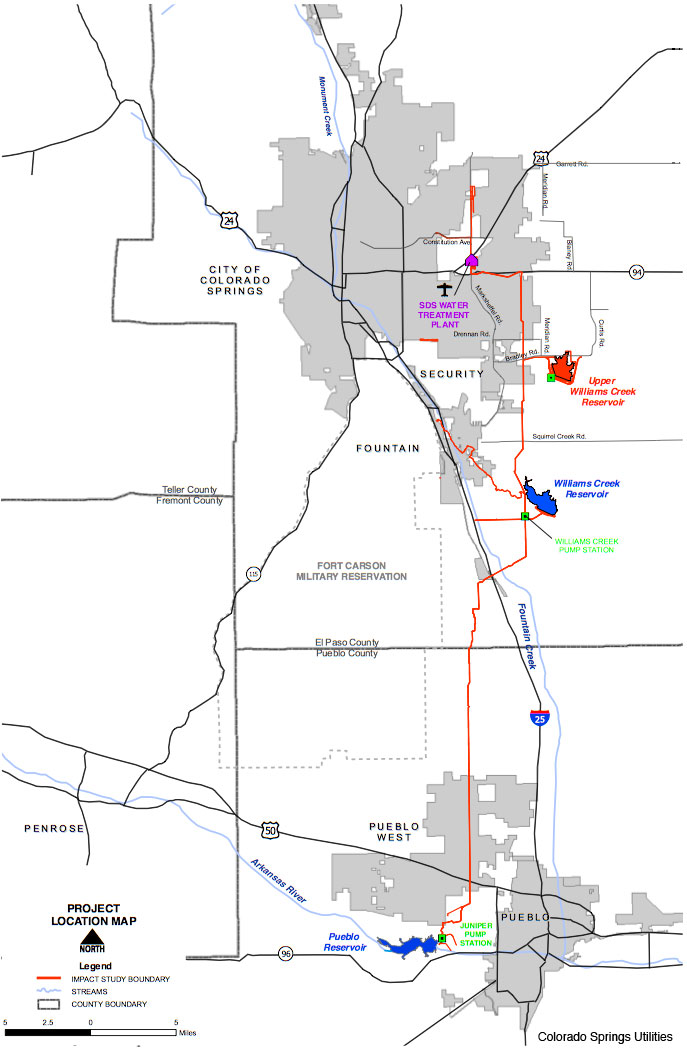
The pipe along Marksheffel, which extends 4,000 feet and burrows under Sand Creek, is the first segment under construction; it’s being buried in tandem with El Paso County’s widening of the road. Next month, Utilities will open bids from seven pre-qualified pipeline contractors for a four-mile segment southeast of Colorado Springs, several miles east of Interstate 25, where pipe at least 66 inches in diameter will be buried.
SDS — which includes 62 miles of pipe, three pump stations and the treatment plant — represents a dozen construction contracts that will require 700 workers at the peak of construction. And contractors are hungry. Higgins says the Marksheffel stretch drew bids 15 percent below the engineer’s estimate.
Heading south, we pull off Marksheffel along vacant rolling hills where Utilities has acquired 120 acres for a treatment plant, slated for construction in mid-2012.
Northeast of here lies Jimmy Camp Creek, where the city sunk more than $6 million into 14 tracts targeted for a treatment plant and reservoir. The deals, which paid some landowners up to four times their property’s assessed value, triggered an overhaul of city land acquisition rules in 2006.
The federal environmental study later identified archaeological and paleontological artifacts at Jimmy Camp. Also, developers alleged putting a reservoir there would violate the 1988 Banning Lewis annexation agreement, which calls for a passive park — one without the distractions of a reservoir and other activities on the site. Moreover, downstream residents feared loss of life and property if the dam failed.
Now, Jimmy Camp is held as an option to a new site. That site, Upper Williams Creek, is farther south, along Bradley Road, on hundreds of acres that an 1893 map in Penrose Library’s archives shows is near “Burial Rocks” amid former Arapahoe Indian territory. The site, which Utilities has not yet acquired, also might sit atop a network of abandoned mines. A 1967 city Planning Department geology report shows mines in that general area from which more than 445,000 tons of coal were removed from 1883 to 1964…
Our next stop is Pueblo West, a project partner that will be bisected by the pipeline. Utilities is making headway on land acquisition here, having bought several easements and six homes at prices that nearly match assessed values. Higgins notes the homes are being stripped of reusables, such as appliances, windows and doors, to be used by Habitat for Humanity.
At Pueblo Dam, Higgins points out a gushing stream from the dam’s north side. A new outlet from the dam will be built there so that some water can still empty into the Arkansas River to nurture habitat, while another stream goes into Utilities’ new pipeline. This is the site of SDS’ first construction contract, awarded to Pueblo West-based ASI Constructors…
Pushing all that water 1,100 feet uphill will require three 21,000-horsepower pump stations. Power will come from Black Hills Electric and Mountain View Electric, Higgins says. Power for Phase 1 is estimated to cost $1.5 million annually; after both phases are implemented, the bill will be $7.4 million a year.